Presented by: M.Bhargavi 08Q61A0558
Introduction Overview of the Authentication Methods The survey Recognition Based Techniques Recall Based Techniques Discusssion Security Usability Conclusion
How about text-based passwords ? Difficulty of remembering passwords easy to remember -> easy to guess hard to guess -> hard to remember Users tend to write passwords down or use the same passwords for different accounts An alternative: Graphical Passwords Psychological studies: Human can remember pictures better than text
If the number of possible pictures is sufficiently large, the possible  password space  may exceed that of text-based schemes, thus offer better resistance to  dictionary attacks . can  be used to: workstation web log-in application ATM machines mobile devices
Conduct a comprehensive survey of the existing graphical password techniques Discuss the strengths and limitations of each method  Point out future research directions
Token based authentication key cards, band cards, smart card, … Biometric based authentication Fingerprints, iris scan, facial recognition, … Knowledge based authentication text-based passwords, picture-based passwords, … most widely used authentication techeniques
Recognition Based Techniques a user is presented with  a set of images  and the user passes the authentication by  recognizing  and  identifying  the images he selected during the registration stage Recall Based Techniques A user is asked to  reproduce  something that he  created or selected earlier during the registration stage
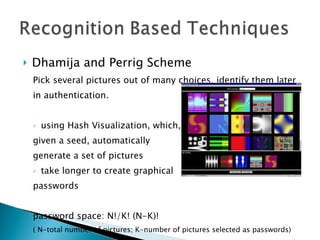
Dhamija and Perrig Scheme Pick several pictures out of many choices, identify them later in authentication. using Hash Visualization, which,  given a seed, automatically  generate a set of pictures take longer to create graphical passwords password space: N!/K! (N-K)! ( N-total number of pictures; K-number of pictures selected as passwords)
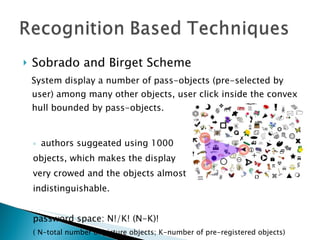
Sobrado and Birget Scheme System display a number of pass-objects (pre-selected by user) among many other objects, user click inside the convex hull bounded by pass-objects. authors suggeated using 1000  objects, which makes the display  very crowed and the objects almost indistinguishable. password space: N!/K! (N-K)! ( N-total number of picture objects; K-number of pre-registered objects)
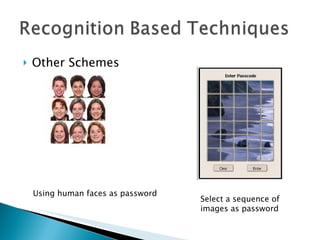
Other Schemes Using human faces as password Select a sequence of images as password
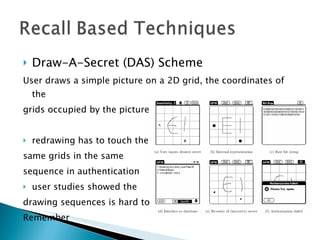
Draw-A-Secret (DAS) Scheme User draws a simple picture on a 2D grid, the coordinates of the  grids occupied by the picture are stored in the order of drawing redrawing has to touch the same grids in the same  sequence in authentication user studies showed the  drawing sequences is hard to  Remember
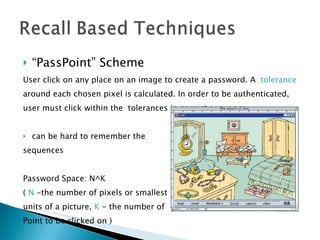
“ PassPoint” Scheme User click on any place on an image to create a password. A  tolerance   around each chosen pixel is calculated. In order to be authenticated,  user must click within the  tolerances in correct sequence. can be hard to remember the  sequences Password Space: N^K (  N  -the number of pixels or smallest  units of a picture,  K  - the number of Point to be clicked on )
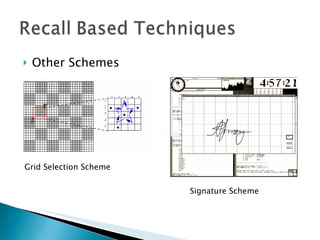
Other Schemes Grid Selection Scheme Signature Scheme
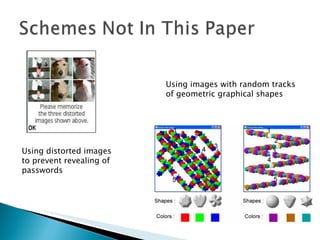
Using distorted images to prevent revealing of passwords Using images with random tracks of geometric graphical shapes
Is a graphical password as secure as text-based passwords? text-based passwords have a  password space  of  94^N  (94 – number of printable characters, N- length of passwords).  Some graphical password techniques can compete:  Draw-A-Secret  Scheme,  PassPoint  Scheme. Brute force search / Dictionary attacks The attack programs need to automatically generate accurate mouse motion to imitate human input, which is more difficult compared to text passwords. Guessing  Social engineering …
Pictures are easier to remember than text strings Password registration and log-in process take too long Require much more storage space than text based passwords
main argument for graphical passwords:  people are better at memorizing graphical passwords than text-based passwords It is more difficult to break graphical passwords using the traditional attack methods such as:burte force search, dictionary attack or spyware. Not yet widely used, current graphical password techniques are still immature


graphical password authentication

  • 1.
  • 2.
    Introduction Overview ofthe Authentication Methods The survey Recognition Based Techniques Recall Based Techniques Discusssion Security Usability Conclusion
  • 3.
    How about text-basedpasswords ? Difficulty of remembering passwords easy to remember -> easy to guess hard to guess -> hard to remember Users tend to write passwords down or use the same passwords for different accounts An alternative: Graphical Passwords Psychological studies: Human can remember pictures better than text
  • 4.
    If the numberof possible pictures is sufficiently large, the possible password space may exceed that of text-based schemes, thus offer better resistance to dictionary attacks . can be used to: workstation web log-in application ATM machines mobile devices
  • 5.
    Conduct a comprehensivesurvey of the existing graphical password techniques Discuss the strengths and limitations of each method Point out future research directions
  • 6.
    Token based authenticationkey cards, band cards, smart card, … Biometric based authentication Fingerprints, iris scan, facial recognition, … Knowledge based authentication text-based passwords, picture-based passwords, … most widely used authentication techeniques
  • 7.
    Recognition Based Techniquesa user is presented with a set of images and the user passes the authentication by recognizing and identifying the images he selected during the registration stage Recall Based Techniques A user is asked to reproduce something that he created or selected earlier during the registration stage
  • 8.
    Dhamija and PerrigScheme Pick several pictures out of many choices, identify them later in authentication. using Hash Visualization, which, given a seed, automatically generate a set of pictures take longer to create graphical passwords password space: N!/K! (N-K)! ( N-total number of pictures; K-number of pictures selected as passwords)
  • 9.
    Sobrado and BirgetScheme System display a number of pass-objects (pre-selected by user) among many other objects, user click inside the convex hull bounded by pass-objects. authors suggeated using 1000 objects, which makes the display very crowed and the objects almost indistinguishable. password space: N!/K! (N-K)! ( N-total number of picture objects; K-number of pre-registered objects)
  • 10.
    Other Schemes Usinghuman faces as password Select a sequence of images as password
  • 11.
    Draw-A-Secret (DAS) SchemeUser draws a simple picture on a 2D grid, the coordinates of the grids occupied by the picture are stored in the order of drawing redrawing has to touch the same grids in the same sequence in authentication user studies showed the drawing sequences is hard to Remember
  • 12.
    “ PassPoint” SchemeUser click on any place on an image to create a password. A tolerance around each chosen pixel is calculated. In order to be authenticated, user must click within the tolerances in correct sequence. can be hard to remember the sequences Password Space: N^K ( N -the number of pixels or smallest units of a picture, K - the number of Point to be clicked on )
  • 13.
    Other Schemes GridSelection Scheme Signature Scheme
  • 14.
    Using distorted imagesto prevent revealing of passwords Using images with random tracks of geometric graphical shapes
  • 15.
    Is a graphicalpassword as secure as text-based passwords? text-based passwords have a password space of 94^N (94 – number of printable characters, N- length of passwords). Some graphical password techniques can compete: Draw-A-Secret Scheme, PassPoint Scheme. Brute force search / Dictionary attacks The attack programs need to automatically generate accurate mouse motion to imitate human input, which is more difficult compared to text passwords. Guessing Social engineering …
  • 16.
    Pictures are easierto remember than text strings Password registration and log-in process take too long Require much more storage space than text based passwords
  • 17.
    main argument forgraphical passwords: people are better at memorizing graphical passwords than text-based passwords It is more difficult to break graphical passwords using the traditional attack methods such as:burte force search, dictionary attack or spyware. Not yet widely used, current graphical password techniques are still immature
  • 18.
  • 19.