Application of IFAD Scaling up
 Framework on the Development
Marketplace Projects and Selected
World Bank-supported Agriculture
and Rural Development Operations


    Marketa Jonasova, John Mackedon and Sanjiva Cooke
Continuing commitment to scaling up
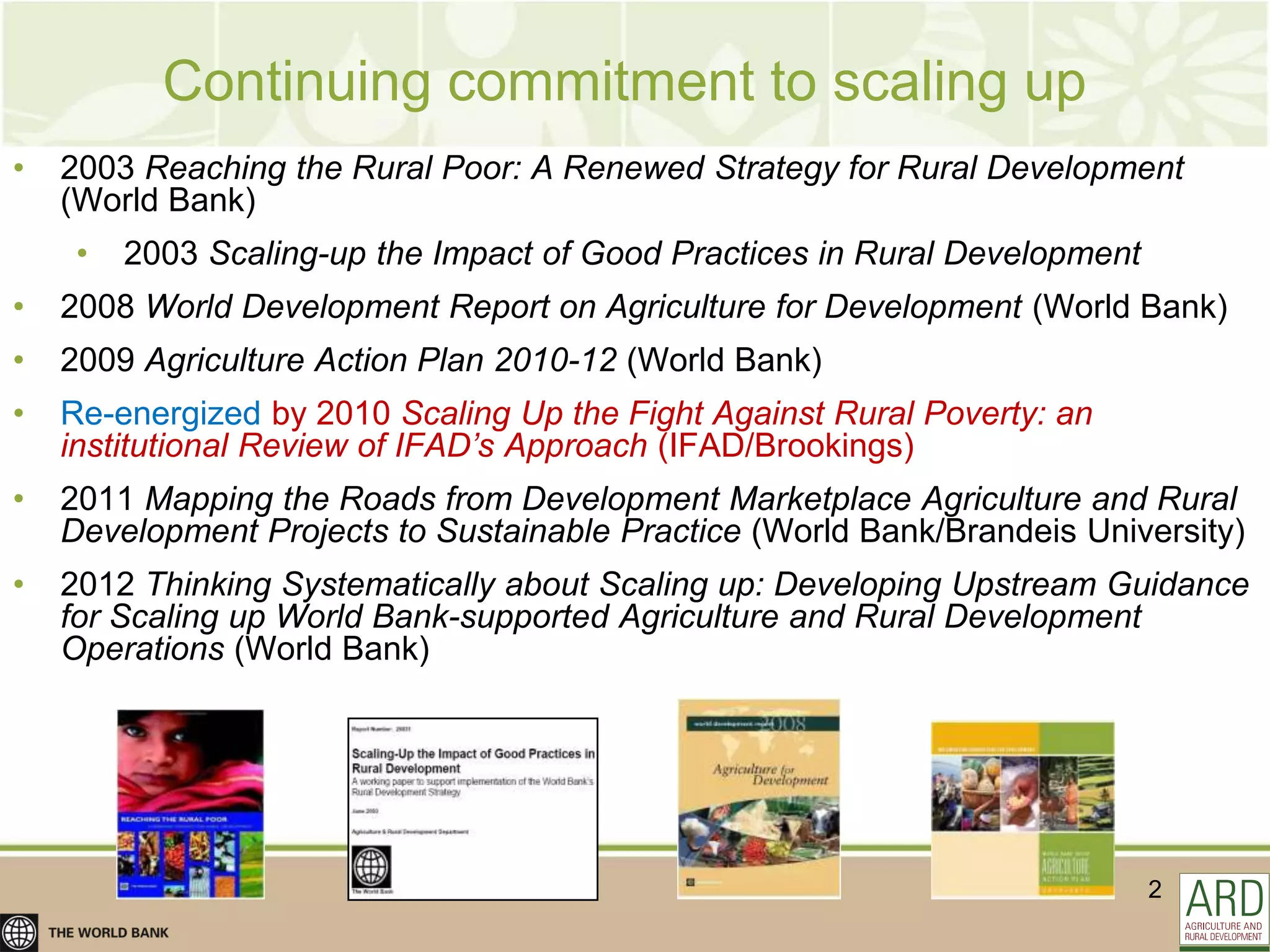
•   2003 Reaching the Rural Poor: A Renewed Strategy for Rural Development
    (World Bank)
     •   2003 Scaling-up the Impact of Good Practices in Rural Development
•   2008 World Development Report on Agriculture for Development (World Bank)
•   2009 Agriculture Action Plan 2010-12 (World Bank)
•   Re-energized by 2010 Scaling Up the Fight Against Rural Poverty: an
    institutional Review of IFAD’s Approach (IFAD/Brookings)
•   2011 Mapping the Roads from Development Marketplace Agriculture and Rural
    Development Projects to Sustainable Practice (World Bank/Brandeis University)
•   2012 Thinking Systematically about Scaling up: Developing Upstream Guidance
    for Scaling up World Bank-supported Agriculture and Rural Development
    Operations (World Bank)


                                                                             2
Continuing commitment to scaling up – cont.
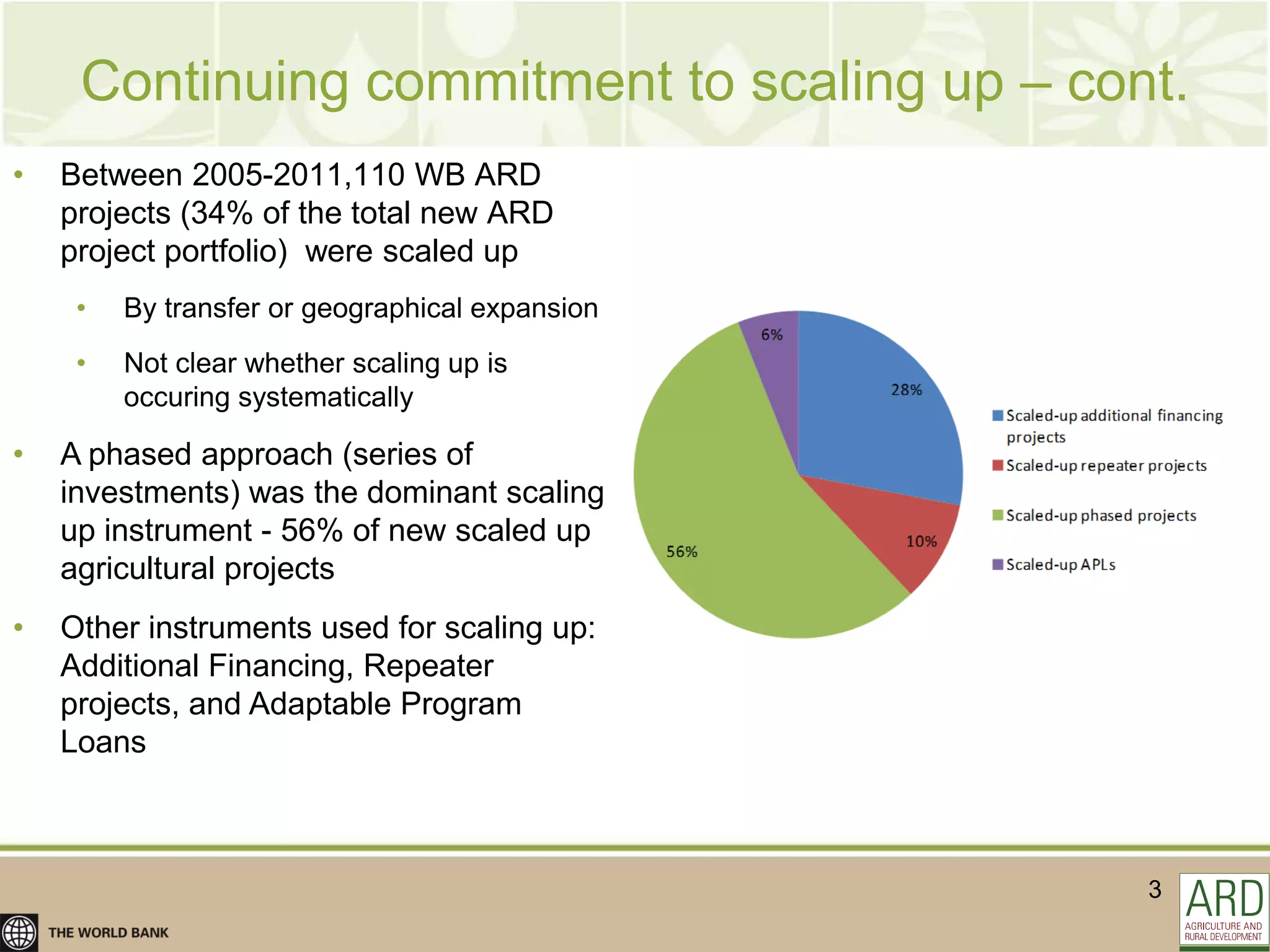
•   Between 2005-2011,110 WB ARD
    projects (34% of the total new ARD
    project portfolio) were scaled up
     •   By transfer or geographical expansion
     •   Not clear whether scaling up is
         occuring systematically

•   A phased approach (series of
    investments) was the dominant scaling
    up instrument - 56% of new scaled up
    agricultural projects
•   Other instruments used for scaling up:
    Additional Financing, Repeater
    projects, and Adaptable Program
    Loans


                                                 3
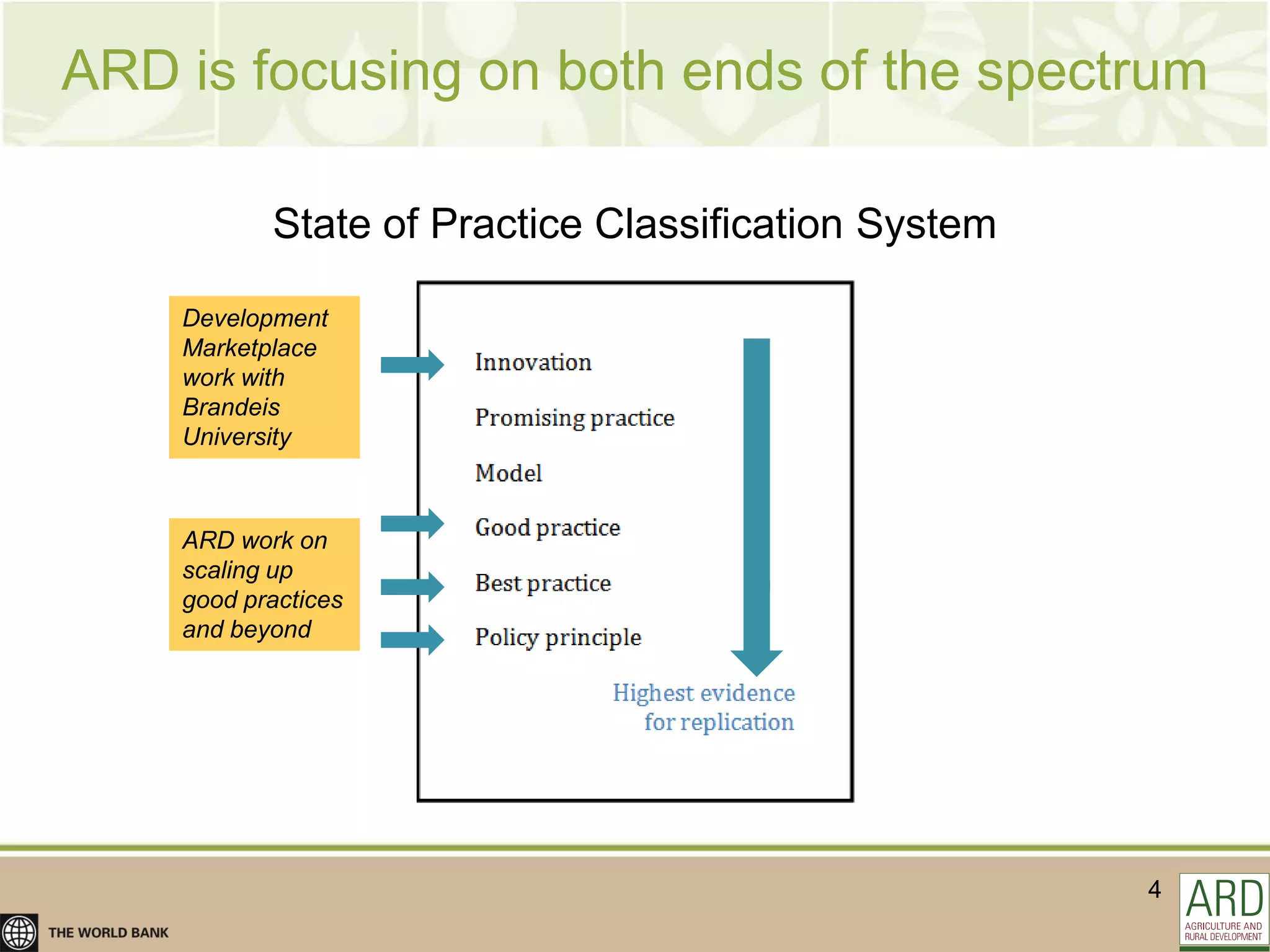
ARD is focusing on both ends of the spectrum

           State of Practice Classification System

    Development
    Marketplace
    work with
    Brandeis
    University


    ARD work on
    scaling up
    good practices
    and beyond


                                                     4
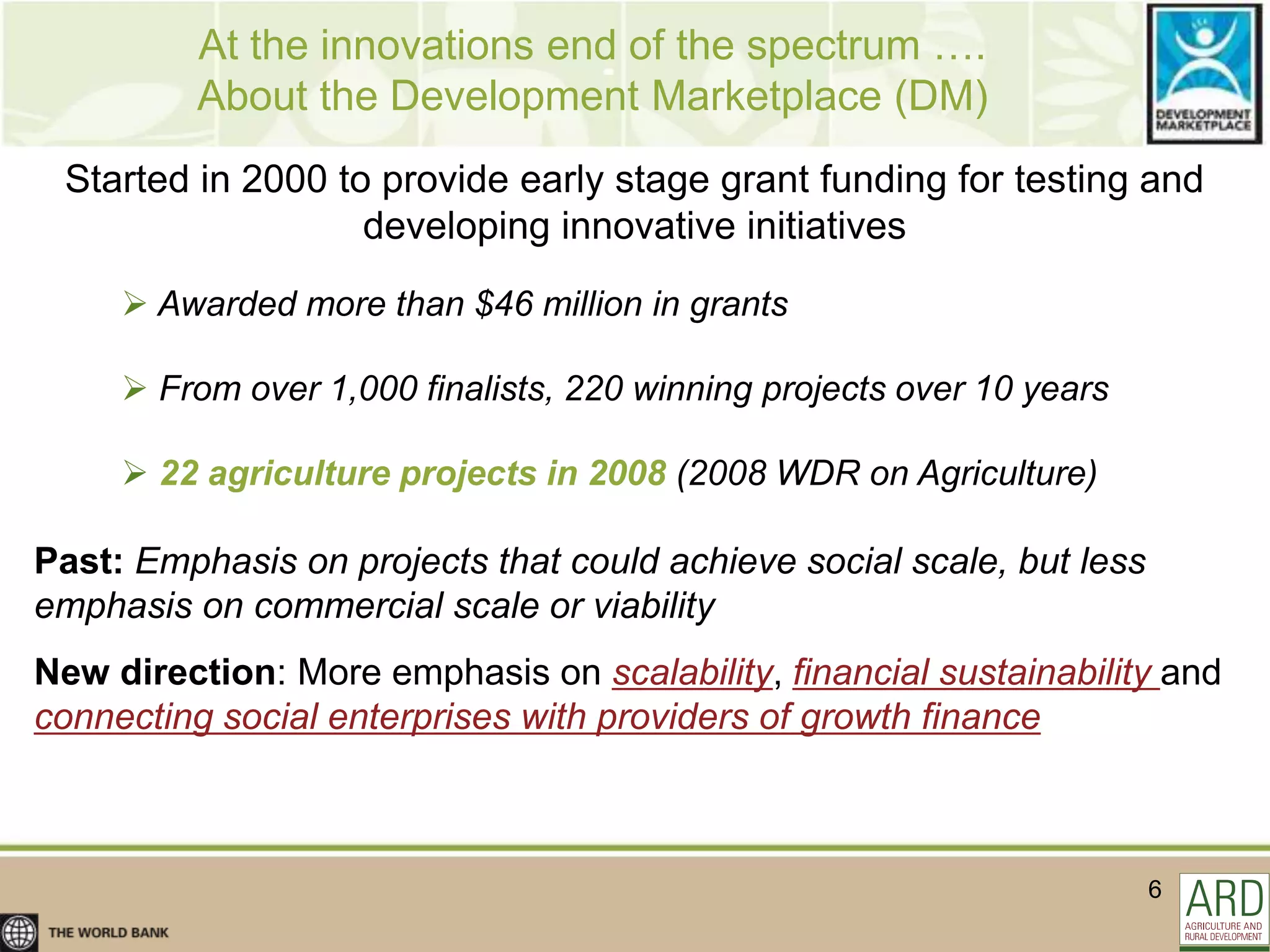
At the innovation end of the spectrum ….

 Assessing Scalability: Lessons from Practice

Mapping the Roads from Development Marketplace
  Agriculture and Rural Development Projects to
               Sustainable Practice

     (World Bank/Brandeis University, 2011)

                                              5
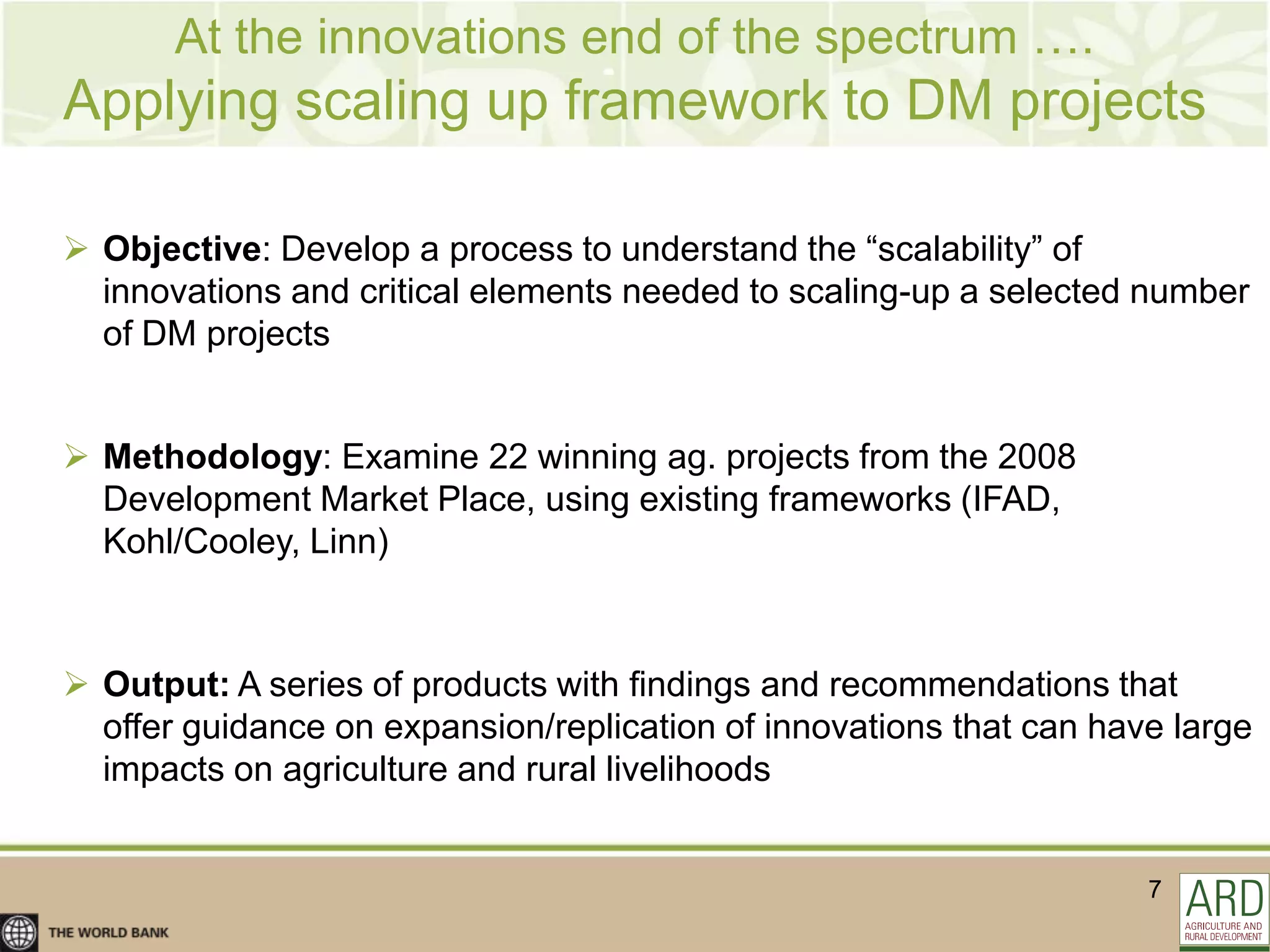
At the innovations end of the spectrum ….
                              DM
          About the Development Marketplace (DM)
 Started in 2000 to provide early stage grant funding for testing and
                   developing innovative initiatives
      Awarded more than $46 million in grants

      From over 1,000 finalists, 220 winning projects over 10 years

      22 agriculture projects in 2008 (2008 WDR on Agriculture)

Past: Emphasis on projects that could achieve social scale, but less
emphasis on commercial scale or viability
New direction: More emphasis on scalability, financial sustainability and
connecting social enterprises with providers of growth finance


                                                                       6
At the innovations end of the spectrum ….
Applying scaling up framework to DM projects

 Objective: Develop a process to understand the “scalability” of
  innovations and critical elements needed to scaling-up a selected number
  of DM projects


 Methodology: Examine 22 winning ag. projects from the 2008
  Development Market Place, using existing frameworks (IFAD,
  Kohl/Cooley, Linn)


 Output: A series of products with findings and recommendations that
  offer guidance on expansion/replication of innovations that can have large
  impacts on agriculture and rural livelihoods


                                                                     7
At the innovations end of the spectrum ….
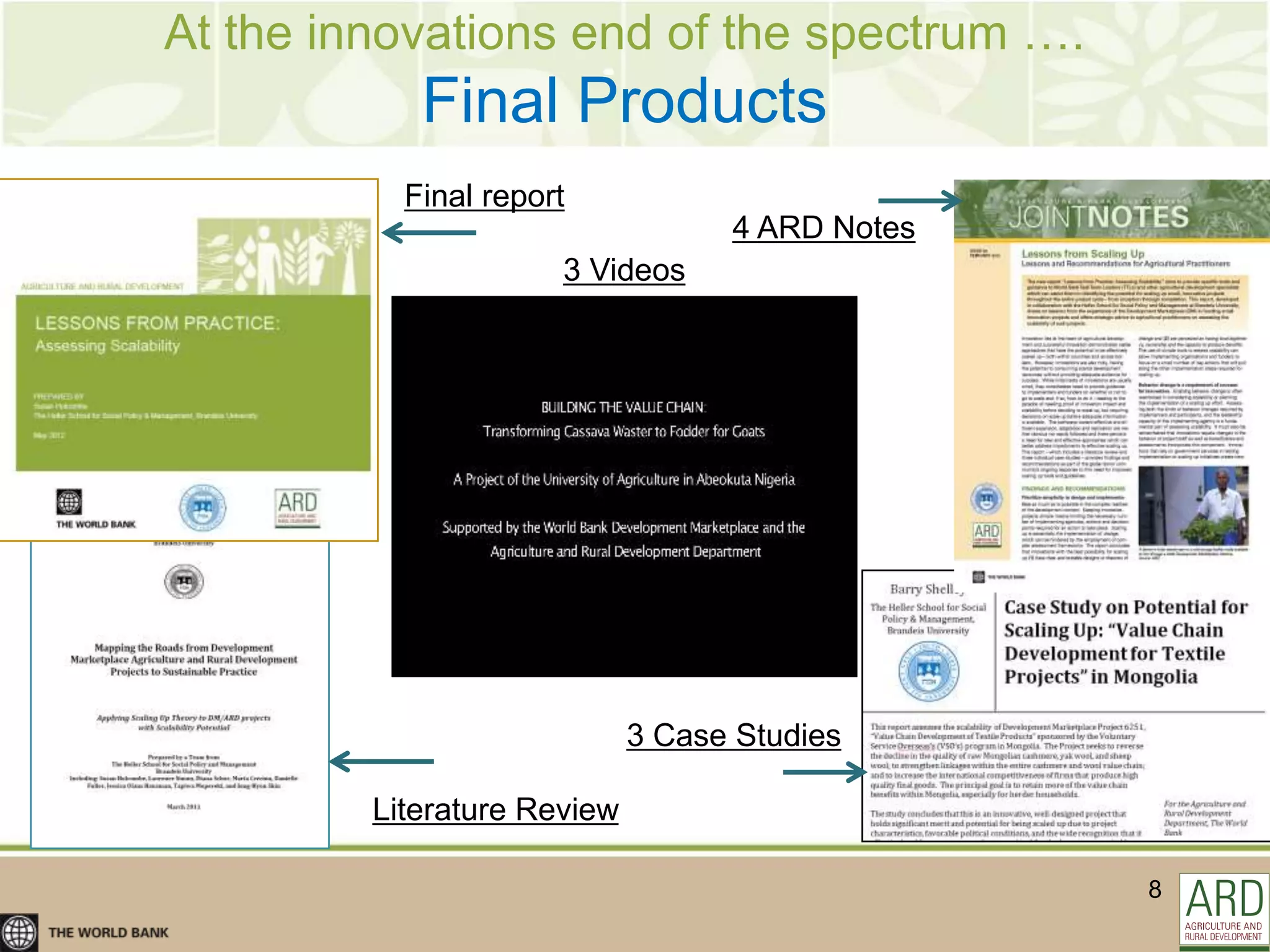
            Final Products
           Final report
                                   4 ARD Notes
                      3 Videos


                             3 Case Studies

         Literature Review

                                                 8
At the innovations end of the spectrum ….
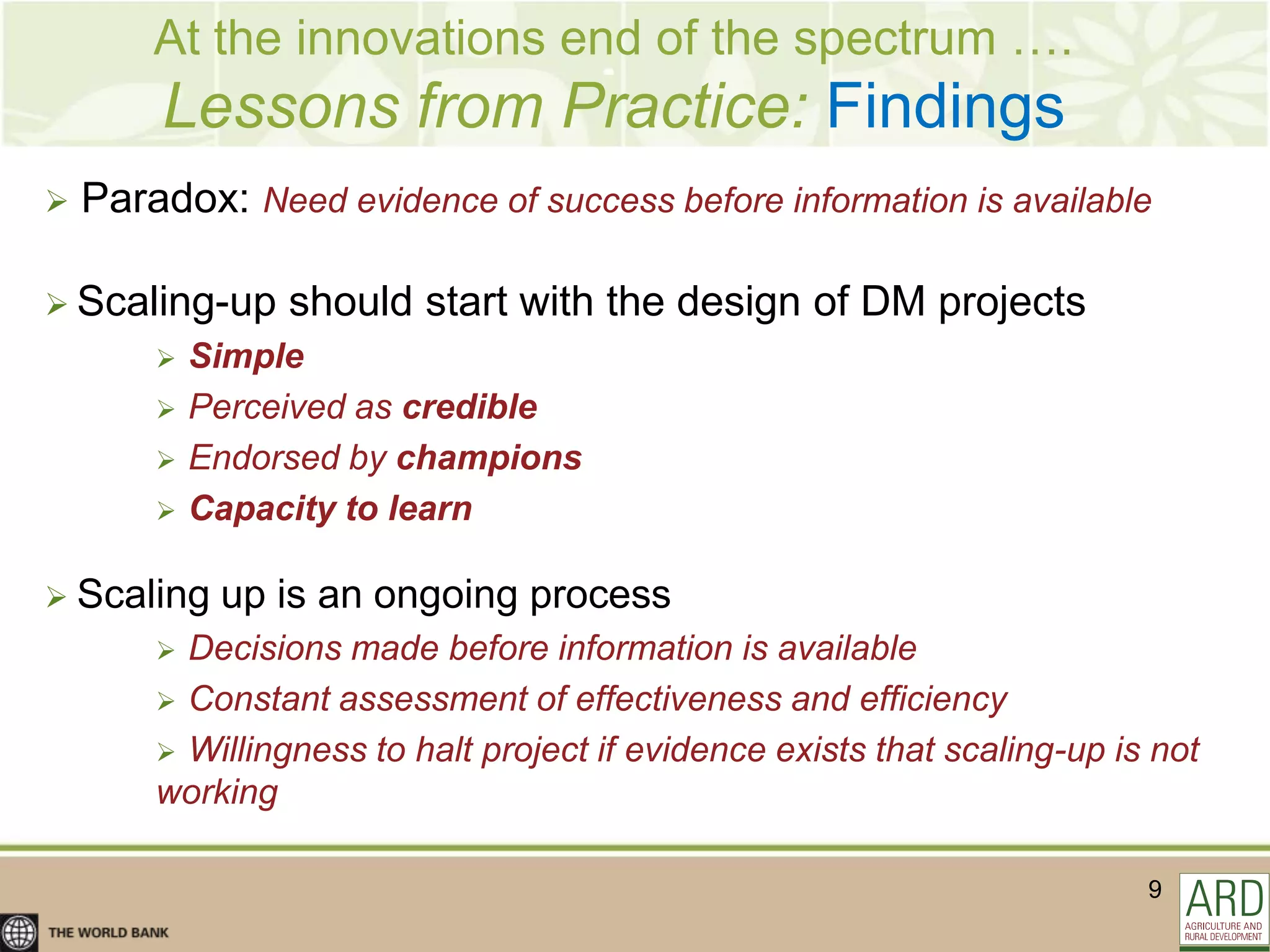
        Lessons from Practice: Findings
   Paradox: Need evidence of success before information is available

 Scaling-up     should start with the design of DM projects
           Simple
           Perceived as credible
           Endorsed by champions
           Capacity to learn

 Scaling    up is an ongoing process
         Decisions made before information is available
         Constant assessment of effectiveness and efficiency
         Willingness to halt project if evidence exists that scaling-up is not
        working

                                                                           9
At the innovations end of the spectrum ….
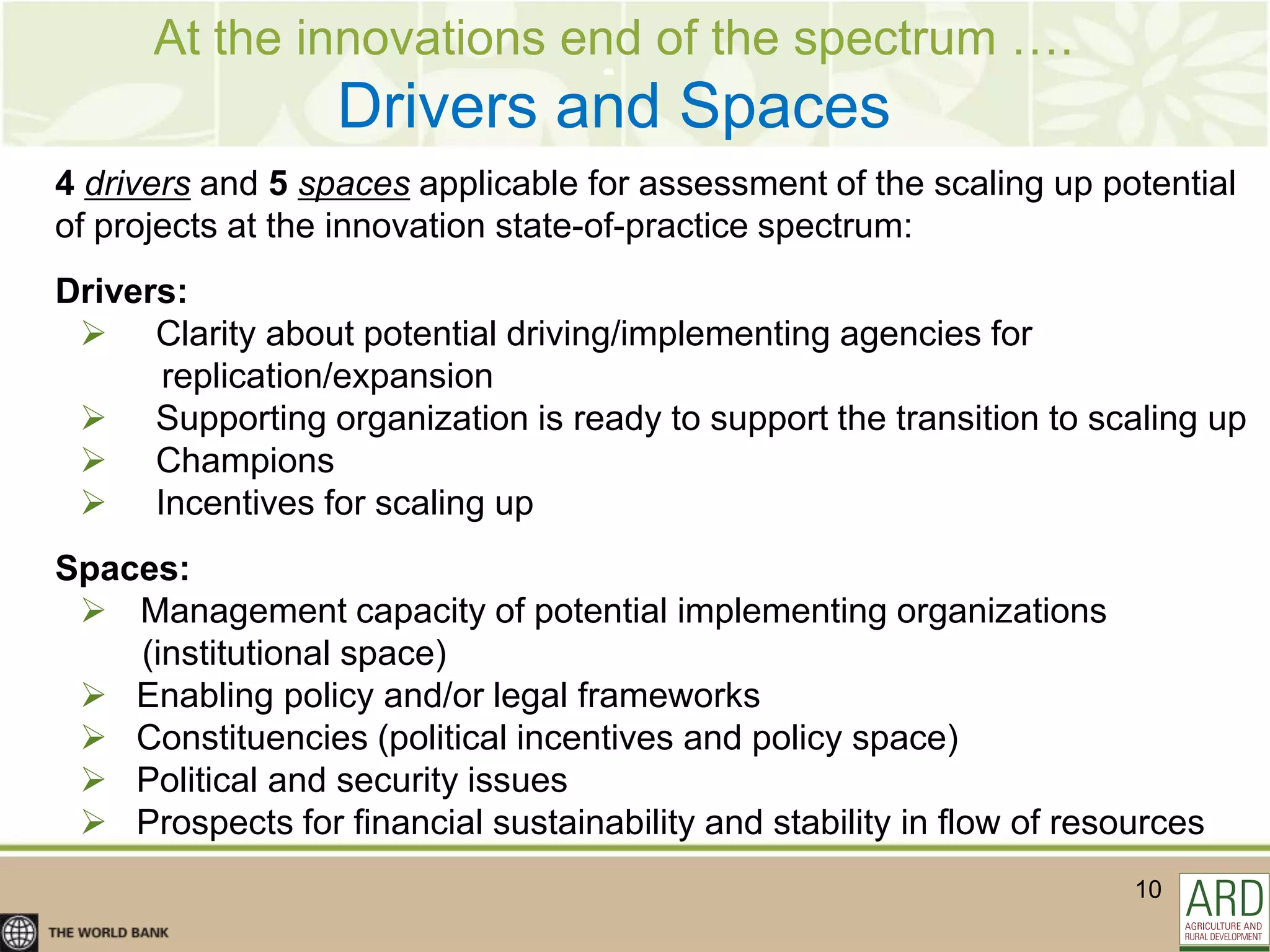
                  Drivers and Spaces
4 drivers and 5 spaces applicable for assessment of the scaling up potential
of projects at the innovation state-of-practice spectrum:
Drivers:
  Clarity about potential driving/implementing agencies for
      replication/expansion
  Supporting organization is ready to support the transition to scaling up
  Champions
  Incentives for scaling up
Spaces:
  Management capacity of potential implementing organizations
    (institutional space)
  Enabling policy and/or legal frameworks
  Constituencies (political incentives and policy space)
  Political and security issues
  Prospects for financial sustainability and stability in flow of resources
                                                                       10
At the innovations end of the spectrum ….
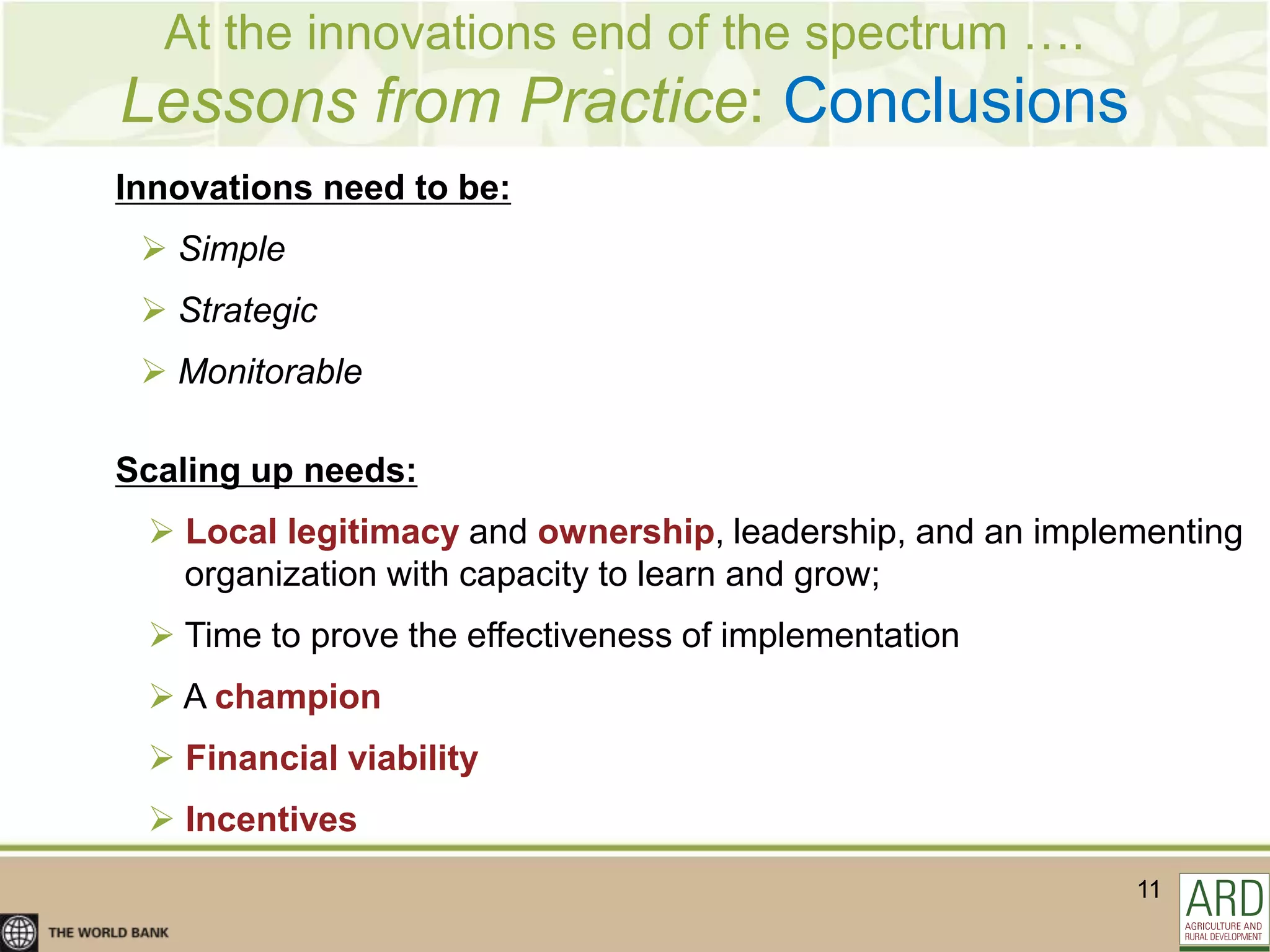
Lessons from Practice: Conclusions
Innovations need to be:
  Simple
  Strategic
  Monitorable

Scaling up needs:
  Local legitimacy and ownership, leadership, and an implementing
   organization with capacity to learn and grow;
  Time to prove the effectiveness of implementation
  A champion
  Financial viability
  Incentives
                                                           11
At the innovations end of the spectrum ….
                                     DM
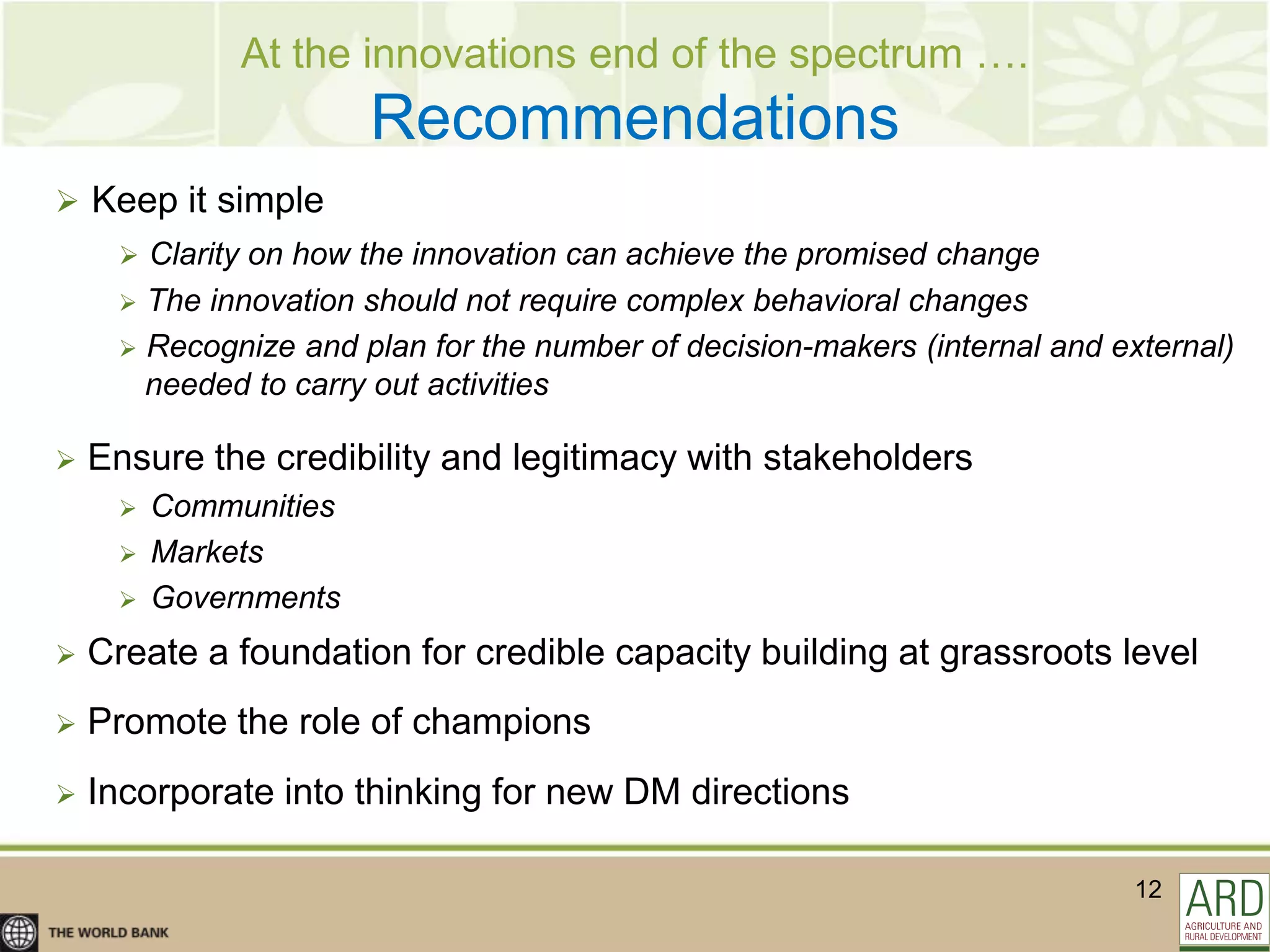
                       Recommendations
 Keep it simple
      Clarity on how the innovation can achieve the promised change
      The innovation should not require complex behavioral changes
      Recognize and plan for the number of decision-makers (internal and external)
       needed to carry out activities

   Ensure the credibility and legitimacy with stakeholders
        Communities
        Markets
        Governments
   Create a foundation for credible capacity building at grassroots level
   Promote the role of champions
   Incorporate into thinking for new DM directions

                                                                            12
At the innovations end of the spectrum ….
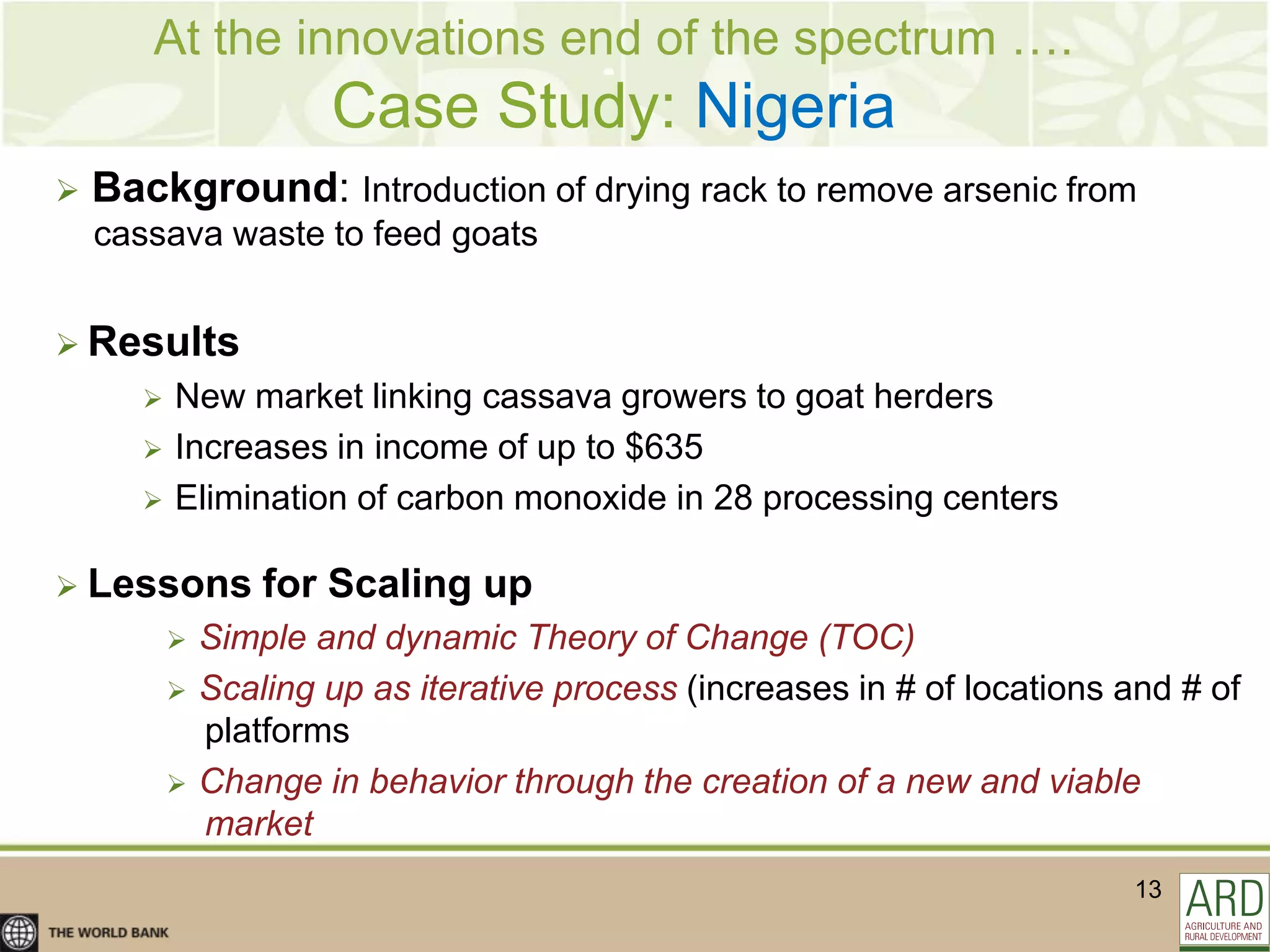
                       Case Study: Nigeria
   Background: Introduction of drying rack to remove arsenic from
    cassava waste to feed goats


 Results
          New market linking cassava growers to goat herders
          Increases in income of up to $635
          Elimination of carbon monoxide in 28 processing centers

 Lessons          for Scaling up
              Simple and dynamic Theory of Change (TOC)
              Scaling up as iterative process (increases in # of locations and # of
               platforms
              Change in behavior through the creation of a new and viable
               market
                                                                            13
At the innovations end of the spectrum ….
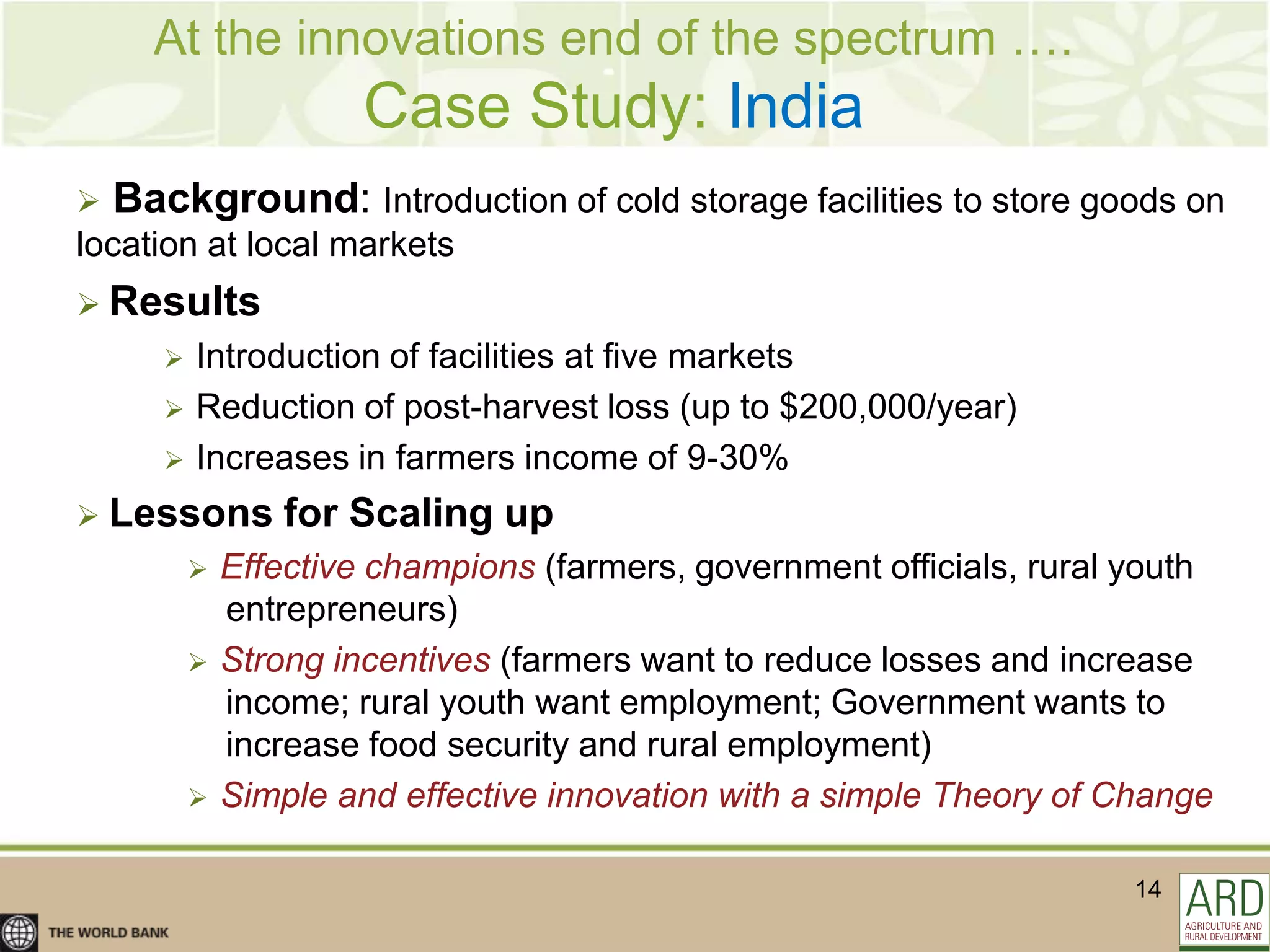
                        Case Study: India
   Background: Introduction of cold storage facilities to store goods on
location at local markets
 Results
          Introduction of facilities at five markets
          Reduction of post-harvest loss (up to $200,000/year)
          Increases in farmers income of 9-30%
 Lessons          for Scaling up
              Effective champions (farmers, government officials, rural youth
               entrepreneurs)
              Strong incentives (farmers want to reduce losses and increase
               income; rural youth want employment; Government wants to
               increase food security and rural employment)
              Simple and effective innovation with a simple Theory of Change

                                                                         14
At the innovations end of the spectrum ….
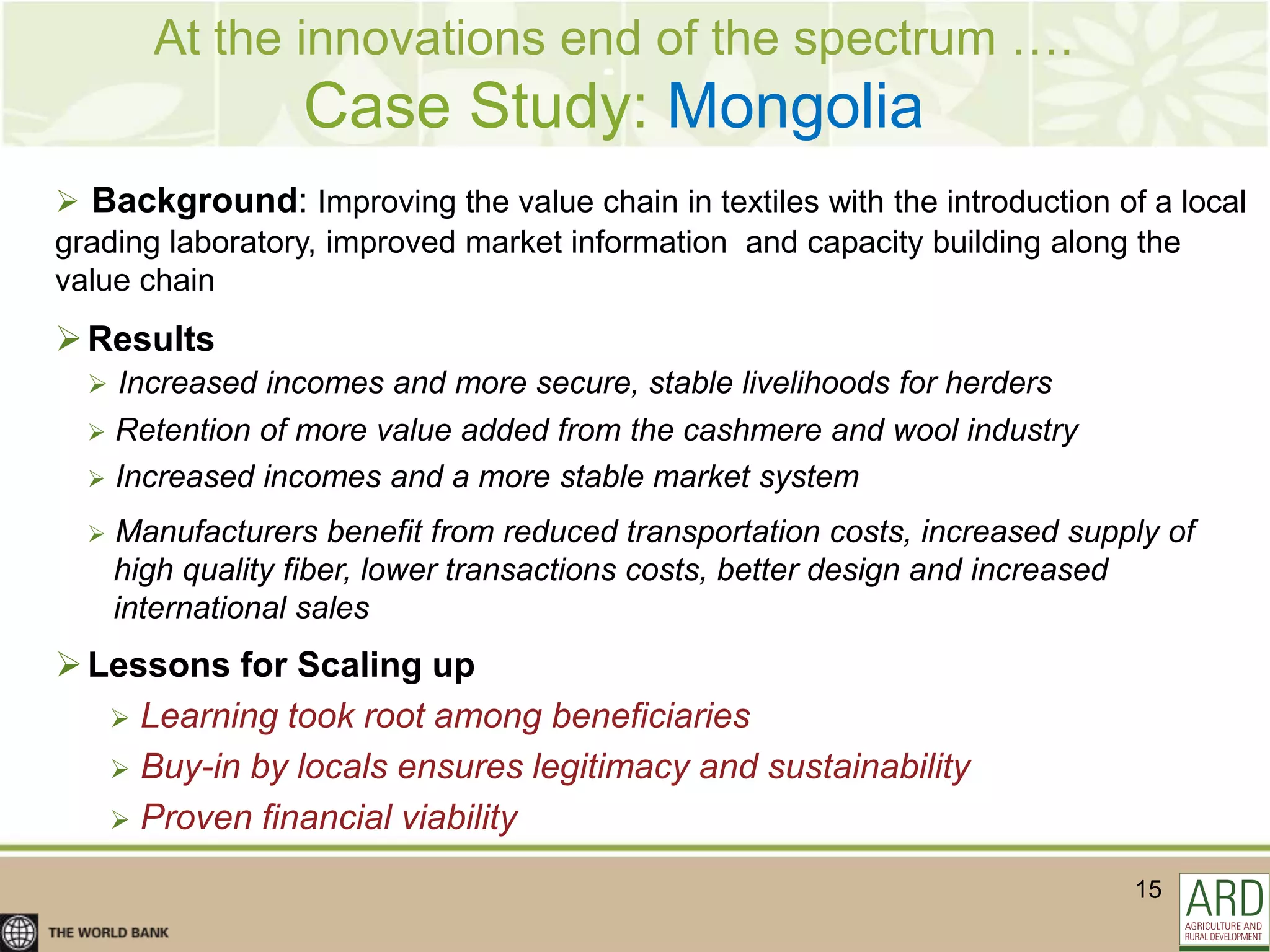
                   Case Study: Mongolia
 Background: Improving the value chain in textiles with the introduction of a local
grading laboratory, improved market information and capacity building along the
value chain
 Results
   Increased incomes and more secure, stable livelihoods for herders
   Retention of more value added from the cashmere and wool industry
   Increased incomes and a more stable market system

     Manufacturers benefit from reduced transportation costs, increased supply of
      high quality fiber, lower transactions costs, better design and increased
      international sales
 Lessons for Scaling up
    Learning took root among beneficiaries
    Buy-in by locals ensures legitimacy and sustainability
    Proven financial viability

                                                                             15
At the good practice end of the spectrum ….

Thinking Systematically about Scaling up: Developing
   Upstream Guidance for Scaling up World Bank-
    supported Agriculture and Rural Development
                     Operations

                (World Bank, 2012)


                                                16
Thinking Systematically about Scaling up: Developing Upstream Guidance for Scaling
      up World Bank-supported Agriculture and Rural Development Operations


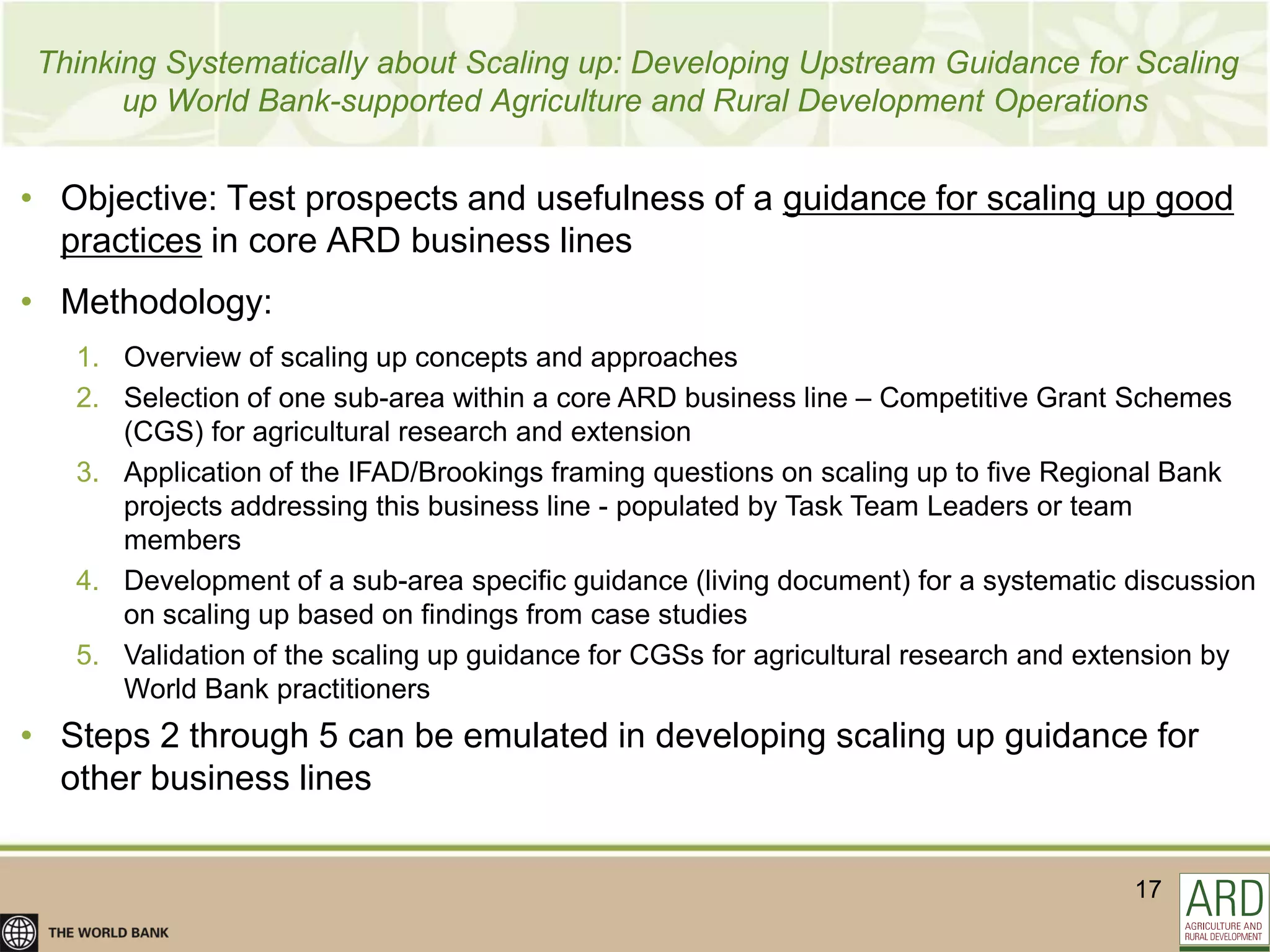
• Objective: Test prospects and usefulness of a guidance for scaling up good
  practices in core ARD business lines
• Methodology:
   1. Overview of scaling up concepts and approaches
   2. Selection of one sub-area within a core ARD business line – Competitive Grant Schemes
      (CGS) for agricultural research and extension
   3. Application of the IFAD/Brookings framing questions on scaling up to five Regional Bank
      projects addressing this business line - populated by Task Team Leaders or team
      members
   4. Development of a sub-area specific guidance (living document) for a systematic discussion
      on scaling up based on findings from case studies
   5. Validation of the scaling up guidance for CGSs for agricultural research and extension by
      World Bank practitioners
• Steps 2 through 5 can be emulated in developing scaling up guidance for
  other business lines


                                                                                     17
IFAD/Brookings scaling up framework at-a-glance

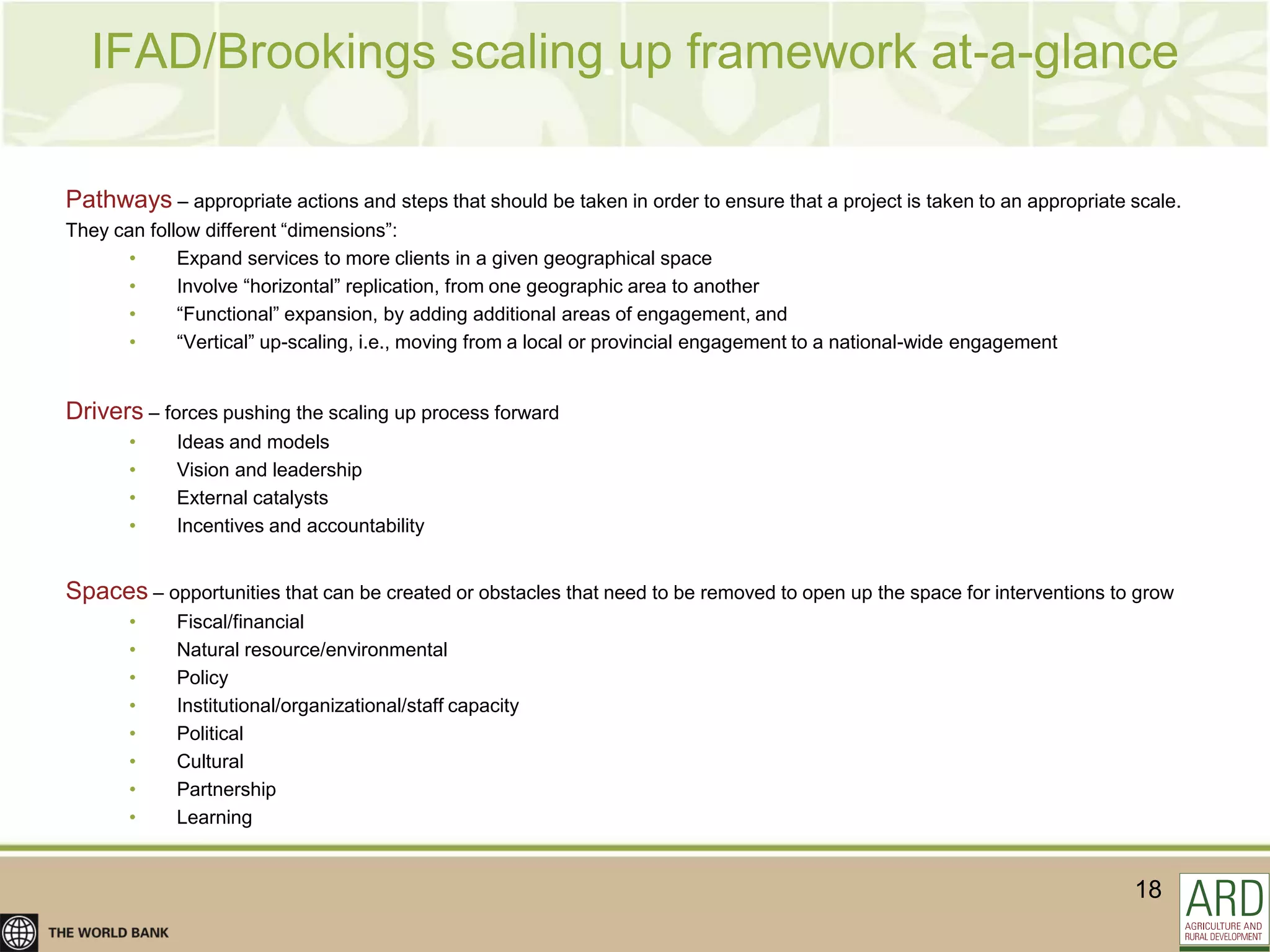
Pathways – appropriate actions and steps that should be taken in order to ensure that a project is taken to an appropriate scale.
They can follow different “dimensions”:
       •     Expand services to more clients in a given geographical space
       •     Involve “horizontal” replication, from one geographic area to another
       •     “Functional” expansion, by adding additional areas of engagement, and
       •     “Vertical” up-scaling, i.e., moving from a local or provincial engagement to a national-wide engagement


Drivers – forces pushing the scaling up process forward
       •     Ideas and models
       •     Vision and leadership
       •     External catalysts
       •     Incentives and accountability


Spaces – opportunities that can be created or obstacles that need to be removed to open up the space for interventions to grow
       •     Fiscal/financial
       •     Natural resource/environmental
       •     Policy
       •     Institutional/organizational/staff capacity
       •     Political
       •     Cultural
       •     Partnership
       •     Learning


                                                                                                                           18
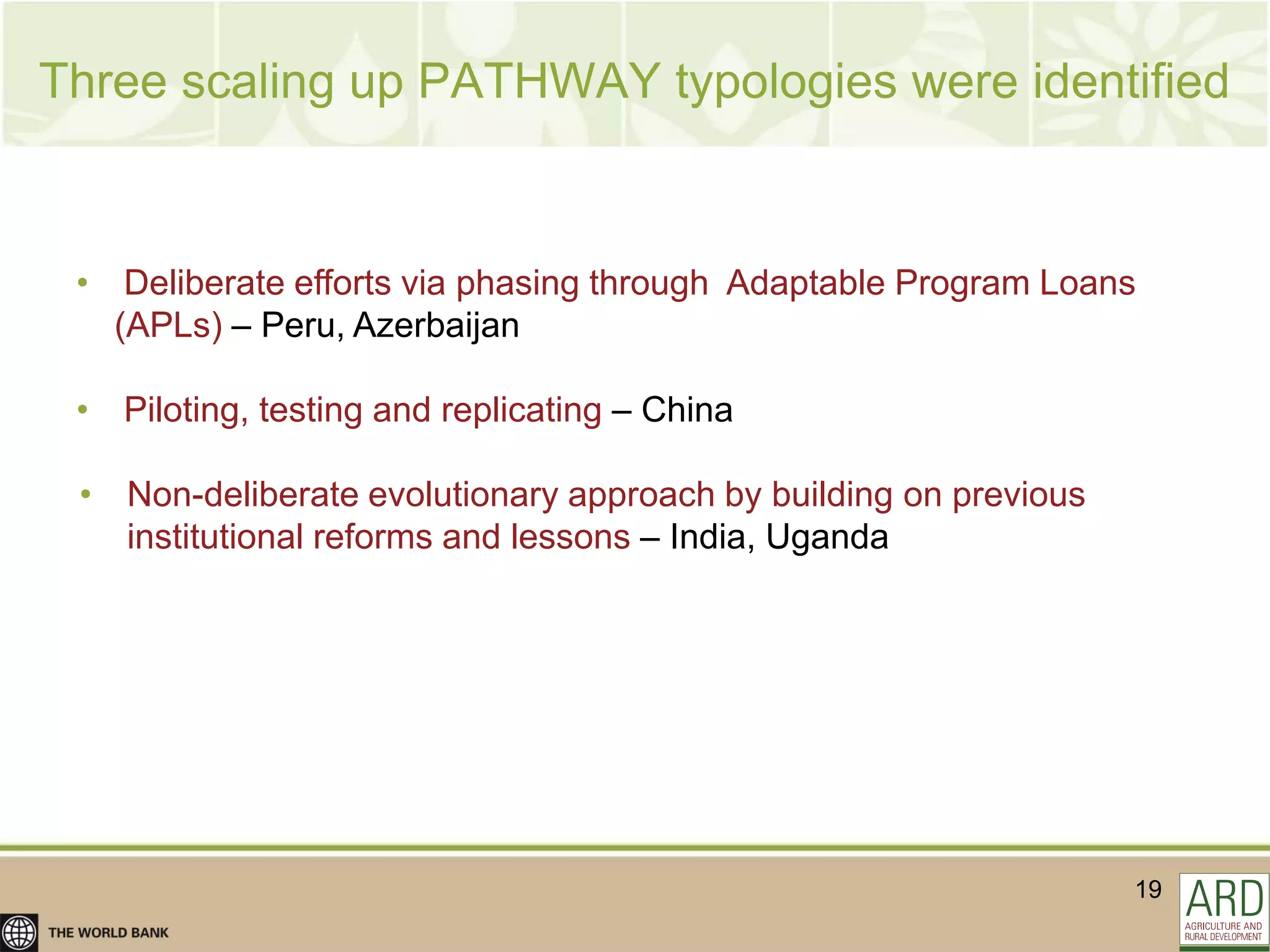
Three scaling up PATHWAY typologies were identified


 • Deliberate efforts via phasing through Adaptable Program Loans
   (APLs) – Peru, Azerbaijan

 • Piloting, testing and replicating – China

 • Non-deliberate evolutionary approach by building on previous
   institutional reforms and lessons – India, Uganda


                                                                  19
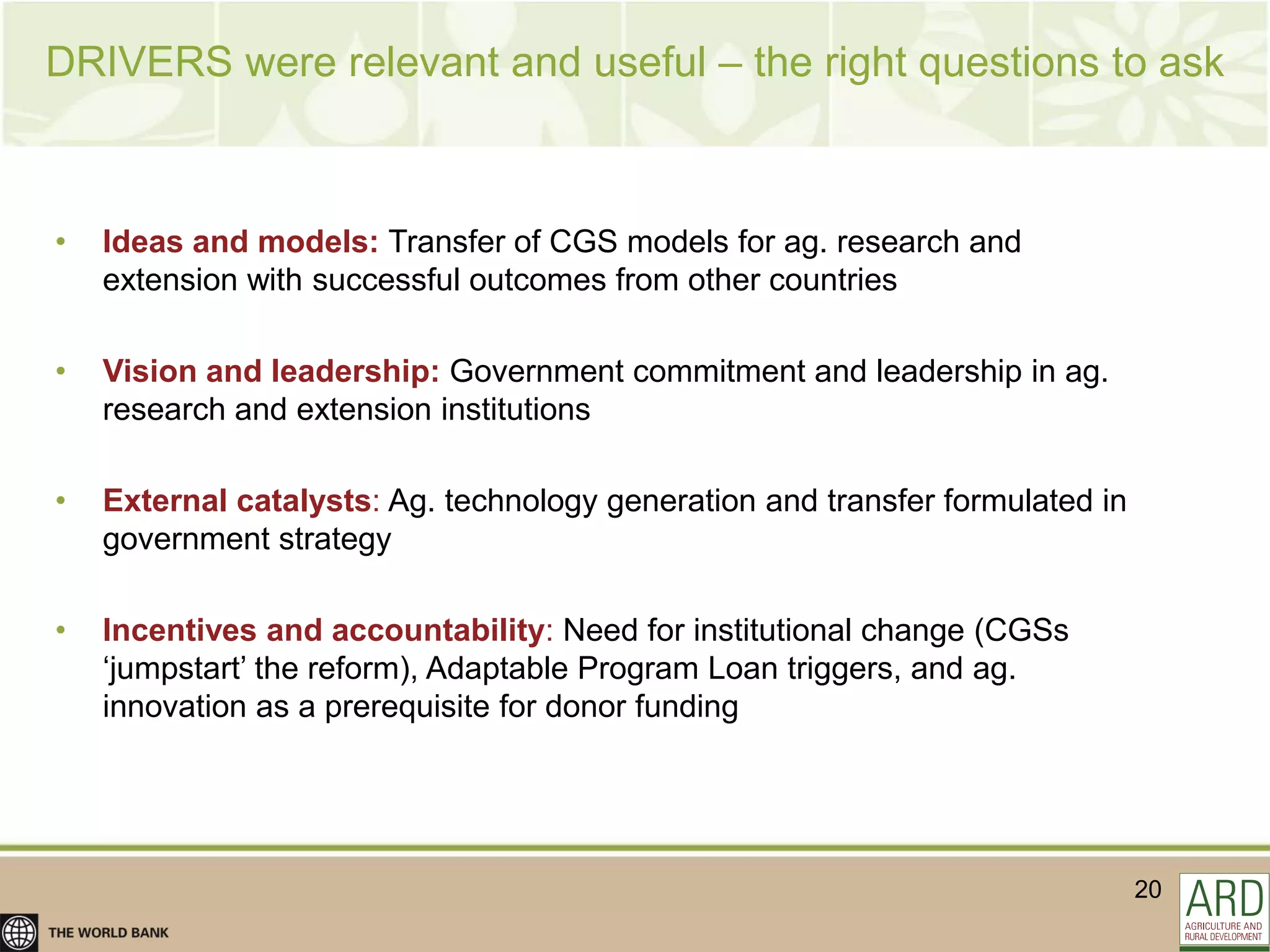
DRIVERS were relevant and useful – the right questions to ask


•   Ideas and models: Transfer of CGS models for ag. research and
    extension with successful outcomes from other countries

•   Vision and leadership: Government commitment and leadership in ag.
    research and extension institutions

•   External catalysts: Ag. technology generation and transfer formulated in
    government strategy

•   Incentives and accountability: Need for institutional change (CGSs
    „jumpstart‟ the reform), Adaptable Program Loan triggers, and ag.
    innovation as a prerequisite for donor funding


                                                                               20
SPACES – useful application with one addition


•   Fiscal space: Projects embedded in CAS and MTEF (if significant fiscal
    impact )

•   NRM space: Value-added of the GEF component (competitive window for
    NRM)

•   Policy and institutional space: Legal framework established in Phase 1

•   Institutional/organizational/staff capacity space: Strong institutions
    (integrated PIU in a government agency and established regional offices) for
    managing CGSs

•   Political space: No obstacles for expansion of CGSs; in particular,
    competitive matching grants politically important

                                                                             21
SPACES – useful application with one addition – cont.

•   Cultural space: CGS design adapted for prevailing cultural norms of the
    targeted areas

•   Partnership space: Collaboration with other in-country partners, value-added
    of partnership with IDA and GEF

•   Learning space: An effective, integrated M&E system; IT/communications
    platforms for documenting lessons; and a help desk

•   Social space (added by the WB – a critical base on which interventions can
    get scaled up is the social capital created and nurtured): All projects
    incorporated gender and marginalized groups in their design

•   Role of the World Bank: Value-added of Adaptable Program Loan instrument
    for scaling up; expertise and funding, Technical Assistance

                                                                              22
Emerging findings


• IFAD/Brookings scaling up framing questions:
   • Applicable to any ARD sub-sector
   • Constructive for bringing out tacit knowledge
   • First step towards general agreement on terms
   • To be complemented by relevant analytical tools (e.g.
     economic analysis, PER, PSIA)
   • Not all will be applicable or sufficient for the different
     institutions and typologies of projects (WB, Development
     Marketplace, GIZ)


                                                         23
Emerging findings – cont.

• Consider applying “importance weights” to drivers,
  spaces, and pathways.
• Develop a flowchart to ease the project designer‟s use of
  the scaling up guideline.
• A focus on learning during scaling-up process is important
  as interventions evolve during implementation. The
  lessons learned through M&E, along with external
  knowledge should act as a feedback loop for the next
  design.


                                                        24
Thank You
 www.worldbank.org/ard


                         25

5 wb jonasova ifad scalingup event june 2012 final as of june 6

  • 1.
    Application of IFADScaling up Framework on the Development Marketplace Projects and Selected World Bank-supported Agriculture and Rural Development Operations Marketa Jonasova, John Mackedon and Sanjiva Cooke
  • 2.
    Continuing commitment toscaling up • 2003 Reaching the Rural Poor: A Renewed Strategy for Rural Development (World Bank) • 2003 Scaling-up the Impact of Good Practices in Rural Development • 2008 World Development Report on Agriculture for Development (World Bank) • 2009 Agriculture Action Plan 2010-12 (World Bank) • Re-energized by 2010 Scaling Up the Fight Against Rural Poverty: an institutional Review of IFAD’s Approach (IFAD/Brookings) • 2011 Mapping the Roads from Development Marketplace Agriculture and Rural Development Projects to Sustainable Practice (World Bank/Brandeis University) • 2012 Thinking Systematically about Scaling up: Developing Upstream Guidance for Scaling up World Bank-supported Agriculture and Rural Development Operations (World Bank) 2
  • 3.
    Continuing commitment toscaling up – cont. • Between 2005-2011,110 WB ARD projects (34% of the total new ARD project portfolio) were scaled up • By transfer or geographical expansion • Not clear whether scaling up is occuring systematically • A phased approach (series of investments) was the dominant scaling up instrument - 56% of new scaled up agricultural projects • Other instruments used for scaling up: Additional Financing, Repeater projects, and Adaptable Program Loans 3
  • 4.
    ARD is focusingon both ends of the spectrum State of Practice Classification System Development Marketplace work with Brandeis University ARD work on scaling up good practices and beyond 4
  • 5.
    At the innovationend of the spectrum …. Assessing Scalability: Lessons from Practice Mapping the Roads from Development Marketplace Agriculture and Rural Development Projects to Sustainable Practice (World Bank/Brandeis University, 2011) 5
  • 6.
    At the innovationsend of the spectrum …. DM About the Development Marketplace (DM) Started in 2000 to provide early stage grant funding for testing and developing innovative initiatives  Awarded more than $46 million in grants  From over 1,000 finalists, 220 winning projects over 10 years  22 agriculture projects in 2008 (2008 WDR on Agriculture) Past: Emphasis on projects that could achieve social scale, but less emphasis on commercial scale or viability New direction: More emphasis on scalability, financial sustainability and connecting social enterprises with providers of growth finance 6
  • 7.
    At the innovationsend of the spectrum …. Applying scaling up framework to DM projects  Objective: Develop a process to understand the “scalability” of innovations and critical elements needed to scaling-up a selected number of DM projects  Methodology: Examine 22 winning ag. projects from the 2008 Development Market Place, using existing frameworks (IFAD, Kohl/Cooley, Linn)  Output: A series of products with findings and recommendations that offer guidance on expansion/replication of innovations that can have large impacts on agriculture and rural livelihoods 7
  • 8.
    At the innovationsend of the spectrum …. Final Products Final report 4 ARD Notes 3 Videos 3 Case Studies Literature Review 8
  • 9.
    At the innovationsend of the spectrum …. Lessons from Practice: Findings  Paradox: Need evidence of success before information is available  Scaling-up should start with the design of DM projects  Simple  Perceived as credible  Endorsed by champions  Capacity to learn  Scaling up is an ongoing process  Decisions made before information is available  Constant assessment of effectiveness and efficiency  Willingness to halt project if evidence exists that scaling-up is not working 9
  • 10.
    At the innovationsend of the spectrum …. Drivers and Spaces 4 drivers and 5 spaces applicable for assessment of the scaling up potential of projects at the innovation state-of-practice spectrum: Drivers:  Clarity about potential driving/implementing agencies for replication/expansion  Supporting organization is ready to support the transition to scaling up  Champions  Incentives for scaling up Spaces:  Management capacity of potential implementing organizations (institutional space)  Enabling policy and/or legal frameworks  Constituencies (political incentives and policy space)  Political and security issues  Prospects for financial sustainability and stability in flow of resources 10
  • 11.
    At the innovationsend of the spectrum …. Lessons from Practice: Conclusions Innovations need to be:  Simple  Strategic  Monitorable Scaling up needs:  Local legitimacy and ownership, leadership, and an implementing organization with capacity to learn and grow;  Time to prove the effectiveness of implementation  A champion  Financial viability  Incentives 11
  • 12.
    At the innovationsend of the spectrum …. DM Recommendations  Keep it simple  Clarity on how the innovation can achieve the promised change  The innovation should not require complex behavioral changes  Recognize and plan for the number of decision-makers (internal and external) needed to carry out activities  Ensure the credibility and legitimacy with stakeholders  Communities  Markets  Governments  Create a foundation for credible capacity building at grassroots level  Promote the role of champions  Incorporate into thinking for new DM directions 12
  • 13.
    At the innovationsend of the spectrum …. Case Study: Nigeria  Background: Introduction of drying rack to remove arsenic from cassava waste to feed goats  Results  New market linking cassava growers to goat herders  Increases in income of up to $635  Elimination of carbon monoxide in 28 processing centers  Lessons for Scaling up  Simple and dynamic Theory of Change (TOC)  Scaling up as iterative process (increases in # of locations and # of platforms  Change in behavior through the creation of a new and viable market 13
  • 14.
    At the innovationsend of the spectrum …. Case Study: India  Background: Introduction of cold storage facilities to store goods on location at local markets  Results  Introduction of facilities at five markets  Reduction of post-harvest loss (up to $200,000/year)  Increases in farmers income of 9-30%  Lessons for Scaling up  Effective champions (farmers, government officials, rural youth entrepreneurs)  Strong incentives (farmers want to reduce losses and increase income; rural youth want employment; Government wants to increase food security and rural employment)  Simple and effective innovation with a simple Theory of Change 14
  • 15.
    At the innovationsend of the spectrum …. Case Study: Mongolia  Background: Improving the value chain in textiles with the introduction of a local grading laboratory, improved market information and capacity building along the value chain  Results  Increased incomes and more secure, stable livelihoods for herders  Retention of more value added from the cashmere and wool industry  Increased incomes and a more stable market system  Manufacturers benefit from reduced transportation costs, increased supply of high quality fiber, lower transactions costs, better design and increased international sales  Lessons for Scaling up  Learning took root among beneficiaries  Buy-in by locals ensures legitimacy and sustainability  Proven financial viability 15
  • 16.
    At the goodpractice end of the spectrum …. Thinking Systematically about Scaling up: Developing Upstream Guidance for Scaling up World Bank- supported Agriculture and Rural Development Operations (World Bank, 2012) 16
  • 17.
    Thinking Systematically aboutScaling up: Developing Upstream Guidance for Scaling up World Bank-supported Agriculture and Rural Development Operations • Objective: Test prospects and usefulness of a guidance for scaling up good practices in core ARD business lines • Methodology: 1. Overview of scaling up concepts and approaches 2. Selection of one sub-area within a core ARD business line – Competitive Grant Schemes (CGS) for agricultural research and extension 3. Application of the IFAD/Brookings framing questions on scaling up to five Regional Bank projects addressing this business line - populated by Task Team Leaders or team members 4. Development of a sub-area specific guidance (living document) for a systematic discussion on scaling up based on findings from case studies 5. Validation of the scaling up guidance for CGSs for agricultural research and extension by World Bank practitioners • Steps 2 through 5 can be emulated in developing scaling up guidance for other business lines 17
  • 18.
    IFAD/Brookings scaling upframework at-a-glance Pathways – appropriate actions and steps that should be taken in order to ensure that a project is taken to an appropriate scale. They can follow different “dimensions”: • Expand services to more clients in a given geographical space • Involve “horizontal” replication, from one geographic area to another • “Functional” expansion, by adding additional areas of engagement, and • “Vertical” up-scaling, i.e., moving from a local or provincial engagement to a national-wide engagement Drivers – forces pushing the scaling up process forward • Ideas and models • Vision and leadership • External catalysts • Incentives and accountability Spaces – opportunities that can be created or obstacles that need to be removed to open up the space for interventions to grow • Fiscal/financial • Natural resource/environmental • Policy • Institutional/organizational/staff capacity • Political • Cultural • Partnership • Learning 18
  • 19.
    Three scaling upPATHWAY typologies were identified • Deliberate efforts via phasing through Adaptable Program Loans (APLs) – Peru, Azerbaijan • Piloting, testing and replicating – China • Non-deliberate evolutionary approach by building on previous institutional reforms and lessons – India, Uganda 19
  • 20.
    DRIVERS were relevantand useful – the right questions to ask • Ideas and models: Transfer of CGS models for ag. research and extension with successful outcomes from other countries • Vision and leadership: Government commitment and leadership in ag. research and extension institutions • External catalysts: Ag. technology generation and transfer formulated in government strategy • Incentives and accountability: Need for institutional change (CGSs „jumpstart‟ the reform), Adaptable Program Loan triggers, and ag. innovation as a prerequisite for donor funding 20
  • 21.
    SPACES – usefulapplication with one addition • Fiscal space: Projects embedded in CAS and MTEF (if significant fiscal impact ) • NRM space: Value-added of the GEF component (competitive window for NRM) • Policy and institutional space: Legal framework established in Phase 1 • Institutional/organizational/staff capacity space: Strong institutions (integrated PIU in a government agency and established regional offices) for managing CGSs • Political space: No obstacles for expansion of CGSs; in particular, competitive matching grants politically important 21
  • 22.
    SPACES – usefulapplication with one addition – cont. • Cultural space: CGS design adapted for prevailing cultural norms of the targeted areas • Partnership space: Collaboration with other in-country partners, value-added of partnership with IDA and GEF • Learning space: An effective, integrated M&E system; IT/communications platforms for documenting lessons; and a help desk • Social space (added by the WB – a critical base on which interventions can get scaled up is the social capital created and nurtured): All projects incorporated gender and marginalized groups in their design • Role of the World Bank: Value-added of Adaptable Program Loan instrument for scaling up; expertise and funding, Technical Assistance 22
  • 23.
    Emerging findings • IFAD/Brookingsscaling up framing questions: • Applicable to any ARD sub-sector • Constructive for bringing out tacit knowledge • First step towards general agreement on terms • To be complemented by relevant analytical tools (e.g. economic analysis, PER, PSIA) • Not all will be applicable or sufficient for the different institutions and typologies of projects (WB, Development Marketplace, GIZ) 23
  • 24.
    Emerging findings –cont. • Consider applying “importance weights” to drivers, spaces, and pathways. • Develop a flowchart to ease the project designer‟s use of the scaling up guideline. • A focus on learning during scaling-up process is important as interventions evolve during implementation. The lessons learned through M&E, along with external knowledge should act as a feedback loop for the next design. 24
  • 25.