Abstract 1: Two-Spring VLM Design
Objective or Goal: Although the VLM’s 8-spring design is very symmetrical and aesthetically
pleasing, it is difficult to manufacture at dimensions 10x10x6 mm. Therefore, the VLM’s design must
be simplified and improved.
Materials and Methods: I used the Solidworks 2011 program to design a 2-spring VLM at
dimensions 10x10x6 mm, and then contacted suppliers in Beijing to manufacture both designs.
Considering the manufacturing difficulties, both designs were enlarged 3x.
Results: During assembly, the 8-spring design could not be assembled due its to complex structure.
The 2-spring VLM was modified slightly during assembly, but it could function reliably.
Conclusion/Discussion: The 2-spring VLM design is superior to the 8-spring design. It is cheaper
to manufacture and operates reliably.
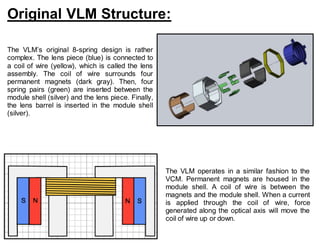
Original VLM Structure:
The VLM’s original 8-spring design is rather
complex. The lens piece (blue) is connected to
a coil of wire (yellow), which is called the lens
assembly. The coil of wire surrounds four
permanent magnets (dark gray). Then, four
spring pairs (green) are inserted between the
module shell (silver) and the lens piece. Finally,
the lens barrel is inserted in the module shell
(silver).
The VLM operates in a similar fashion to the
VCM. Permanent magnets are housed in the
module shell. A coil of wire is between the
magnets and the module shell. When a current
is applied through the coil of wire, force
generated along the optical axis will move the
coil of wire up or down.
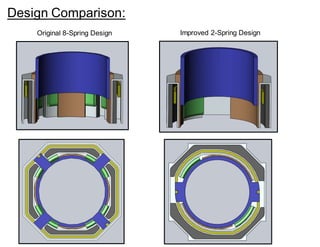
Design Comparison:
Original 8-Spring Design Improved 2-Spring Design
Two-Spring VLM Design:
I designed the 2-spring VLM with the Solidworks 2011 3D CAD design software. The entire process,
from its inception to completion, took over four months. The resulting 2-spring VLM design is superior
to the 8-spring VLM design in three ways:
1. Structural complexity is reduced. Fewer parts are manufactured and assembled.
2. Driving force is greater in the 2-spring design. The permanent magnets that surround the coil of
wire have been enlarged.
3. The barrel sleeve covers more of the lens assembly, making the entire system more stable.
Assembly:
Both designs were enlarged 3x, and sent to prototype to Beijing. Both designs were created from the
same Computer Numerically Controlled Machine Tool. The finished parts were assembled in
February 2013.
1.The 8-spring design was difficult to assemble, and even after assembly the VLM could not function
(most likely because spring pairs were too small and varied in terms of elasticity).
2. The 2-spring design also encountered problems. During manufacturing, the curved permanent
magnets were cut in two for convenient magnetizing. However, the magnets would repel each other
when assembled in the module. Two magnets were removed, but the 2-spring design could function
quite well after.
Vibrating Linear Motor and Camera Integration:
The 2-spring VLM camera module was successfully integrated to a PC camera system. With a USB
driver and a 2.0 MP sensor, the image can be focused manually. We are incredibly fortunate to have
the world’s first manual focus Vibrating Linear Motor.
Conclusion:
The 2-spring design of the VLM is a significant improvement from the 8-spring design. First, the
number of components is less, so manufacturing costs and assembly complexities are both
decreased. Second, after performing various tests with both designs of the VLM, the 2-spring VLM is
proven to be more reliable.

5 VLM Design Comparison

  • 1.
    Abstract 1: Two-SpringVLM Design Objective or Goal: Although the VLM’s 8-spring design is very symmetrical and aesthetically pleasing, it is difficult to manufacture at dimensions 10x10x6 mm. Therefore, the VLM’s design must be simplified and improved. Materials and Methods: I used the Solidworks 2011 program to design a 2-spring VLM at dimensions 10x10x6 mm, and then contacted suppliers in Beijing to manufacture both designs. Considering the manufacturing difficulties, both designs were enlarged 3x. Results: During assembly, the 8-spring design could not be assembled due its to complex structure. The 2-spring VLM was modified slightly during assembly, but it could function reliably. Conclusion/Discussion: The 2-spring VLM design is superior to the 8-spring design. It is cheaper to manufacture and operates reliably.
  • 2.
    Original VLM Structure: TheVLM’s original 8-spring design is rather complex. The lens piece (blue) is connected to a coil of wire (yellow), which is called the lens assembly. The coil of wire surrounds four permanent magnets (dark gray). Then, four spring pairs (green) are inserted between the module shell (silver) and the lens piece. Finally, the lens barrel is inserted in the module shell (silver). The VLM operates in a similar fashion to the VCM. Permanent magnets are housed in the module shell. A coil of wire is between the magnets and the module shell. When a current is applied through the coil of wire, force generated along the optical axis will move the coil of wire up or down.
  • 3.
    Design Comparison: Original 8-SpringDesign Improved 2-Spring Design
  • 4.
    Two-Spring VLM Design: Idesigned the 2-spring VLM with the Solidworks 2011 3D CAD design software. The entire process, from its inception to completion, took over four months. The resulting 2-spring VLM design is superior to the 8-spring VLM design in three ways: 1. Structural complexity is reduced. Fewer parts are manufactured and assembled. 2. Driving force is greater in the 2-spring design. The permanent magnets that surround the coil of wire have been enlarged. 3. The barrel sleeve covers more of the lens assembly, making the entire system more stable. Assembly: Both designs were enlarged 3x, and sent to prototype to Beijing. Both designs were created from the same Computer Numerically Controlled Machine Tool. The finished parts were assembled in February 2013. 1.The 8-spring design was difficult to assemble, and even after assembly the VLM could not function (most likely because spring pairs were too small and varied in terms of elasticity). 2. The 2-spring design also encountered problems. During manufacturing, the curved permanent magnets were cut in two for convenient magnetizing. However, the magnets would repel each other when assembled in the module. Two magnets were removed, but the 2-spring design could function quite well after.
  • 5.
    Vibrating Linear Motorand Camera Integration: The 2-spring VLM camera module was successfully integrated to a PC camera system. With a USB driver and a 2.0 MP sensor, the image can be focused manually. We are incredibly fortunate to have the world’s first manual focus Vibrating Linear Motor. Conclusion: The 2-spring design of the VLM is a significant improvement from the 8-spring design. First, the number of components is less, so manufacturing costs and assembly complexities are both decreased. Second, after performing various tests with both designs of the VLM, the 2-spring VLM is proven to be more reliable.