After going throughthis
module, you are expected to:
1. Differentiate the 21st century
literary genres, and the one’s
from the original genres;
2. Enumerate the elements,
structures and traditions of each
genre;
3. Appreciate the unique features
of each genre.
Q1M2 – Conventional and 21st Century Genres 2
3.
21st Century Literature
•Refers to new literary work created within the last
decade.
• Written by contemporary authors which may deal
with current themes/issues and reflects a
technological culture.
• Often breaks the traditional writing rules.
Q1M2 – Conventional and 21st Century Genres 3
4.
21st Century Reader
•Grew up using technology as primary learning tool.
• Is capable of navigating and interpreting digital formats and media messages.
• Also possesses literary skills which includes technological abilities such as:
• Keyboarding
• Internet navigation
• Interpretation of technological speak
• Ability to communicate and interpret coded language and decipher
graphics
Q1M2 – Conventional and 21st Century Genres 4
5.
What’s New
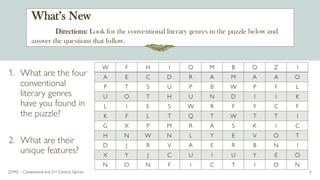
Directions: Lookfor the conventional literary genres in the puzzle below and
answer the questions that follow.
Q1M2 – Conventional and 21st Century Genres 5
W F H I O M B O Z I
A E C D R A M A A O
P T S U P B W P F L
U O T H U N D I I K
L I E S W R F Y C F
K F L T Q T W T T I
G X P M R A S K I C
H N W N L Y E V O T
D J R V A E R B N I
X Y J C U I U Y E O
N O N F I C T I O N
1. What are the four
conventional
literary genres
have you found in
the puzzle?
2. What are their
unique features?
6.
What’s New
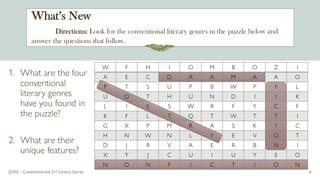
Directions: Lookfor the conventional literary genres in the puzzle below and
answer the questions that follow.
Q1M2 – Conventional and 21st Century Genres 6
W F H I O M B O Z I
A E C D R A M A A O
P T S U P B W P F L
U O T H U N D I I K
L I E S W R F Y C F
K F L T Q T W T T I
G X P M R A S K I C
H N W N L Y E V O T
D J R V A E R B N I
X Y J C U I U Y E O
N O N F I C T I O N
1. What are the four
conventional
literary genres
have you found in
the puzzle?
2. What are their
unique features?
7.
POETRY
• An imaginativeawareness of experience expressed through
meaning, sound and rhythmic language choices to evoke an
emotional response.
• It has been known to employ meter and rhyme.
• The very nature of poetry as an authentic and individual
mode of expression makes it nearly impossible to define.
Q1M2 – Conventional and 21st Century Genres 7
8.
DRAMA
• A compositionin prose or verse presenting in dialogue or
pantomime a story involving conflict more contrast of
character, especially on intended to be acted on a stage: a
play.
• It may be any situation or series of events having vivid,
emotional, conflicting or striking interest.
Q1M2 – Conventional and 21st Century Genres 8
9.
FICTION
• Is literaturecreated from the imagination, not
presented as fact.
• Though it may be based on a true story or
situation.
• Types of literature in the fiction include the novel,
short story and novella.
Q1M2 – Conventional and 21st Century Genres 9
10.
NON-FICTION
• Is basedon facts and the author’s opinion about a
subject.
• The purpose of non-fiction writing is to inform and
sometimes to persuade.
• Examples are biographies, articles from textbooks
and magazines and newspapers.
Q1M2 – Conventional and 21st Century Genres 10
ILLUSTRATED NOVEL
• Storythrough text and illustrated images.
• 50% of the narrative is presented without words.
• The reader must interpret the images to comprehend the story completely.
• Textual portions are presented in traditional form.
• Some may contain no text at all.
• Span all genres.
• Examples include The Invention of Hugo Cabret by Brian Selznick, and The
Arrival by Shaun Tan.
Q1M2 – Conventional and 21st Century Genres 12
13.
DIGI-FICTION
• Triple MediaLiterature
• Combines three media: book, movie/video and internet website.
• To get the full story, students must engage in navigation, reading,
and viewing in all three forms.
• Patrick Carman’s Skeleton Creek and Anthony Zuiker’s Level 26
are examples.
Q1M2 – Conventional and 21st Century Genres 13
14.
GRAPHIC NOVEL
• Narrativein comic book formats.
• Narrative work in which the story is conveyed to the reader
using a comic form.
• The term is employed in broadly manner, encompassing
non-fiction works and thematically linked short stories as
well as fictional stories across a number of genres.
• Archie Comics by John Goldwater and illustrator, Bob
Montana, is a good example.
Q1M2 – Conventional and 21st Century Genres 14
15.
MANGA
• Japanese wordfor comics.
• Used in English-speaking world as a generic term
for all comic books and graphic novels published in
Japan.
• Considered as an artistic and storytelling style.
• Ameri-manga – sometimes used to refer to comics
created by American artists in manga style.
Q1M2 – Conventional and 21st Century Genres 15
16.
• Shonen –Boy’s Manga (Naruto, Bleach, One Piece)
• Shojo – Girl’s Manga (Sailormoon)
• Seinen – Men’s Manga (Akira)
• Josei – Women’s Manga (Loveless, Paradise Kiss)
• Kodomo – Children’s Manga (Doraemon, Hello
Kitty)
Presentation title 16
17.
DOODLE FICTION
• Literarypresentation where the author incorporates doodle
writing, drawings and handwritten graphics in place of the
traditional font.
• Drawing enhances the story, often adding humorous
elements.
• Examples include The Diary of a Wimpy Kid by Jeff Kinney
and Timmy Failure by Stephen Pastis.
Q1M2 – Conventional and 21st Century Genres 17
18.
TEXT-TALK NOVELS
• Blogs,email and IM format narratives.
• Stories told almost entirely in dialogue
simulating social network exchanges.
Q1M2 – Conventional and 21st Century Genres 18
19.
CHICK LIT orCHICK LITERATURE
• Is genre fiction which addresses issues of modern
womanhood, often humorously and lightheartedly.
• Typically features a female protagonist whose femininity
is heavily thermalizing in the plot.
• Scarlet Bailey’s The night before Christmas and Miranda
Dickinson’s It started with a Kiss are examples of this.
Q1M2 – Conventional and 21st Century Genres 19
20.
FLASH FICTION
• Astyle of fictional literature of extreme brevity.
• There is no widely accepted definition of the length
and category.
• It could range from word to a thousand.
Q1M2 – Conventional and 21st Century Genres 20
21.
SIX-WORD FLASH FICTION
•Ernest Hemingway:
• For sale: baby socks, never worn.
• Margaret Atwood:
• Longed for him. Got him, Shit.
Q1M2 – Conventional and 21st Century Genres 21
22.
CREATIVE NON-FICTION
• Alsoknown as literary non-fiction or narrative non-fiction.
• A genre of writing that uses literary styles and techniques to
create factually accurate narratives.
• Contrasts with other non-fiction, such as technical writing or
journalism, which is also rooted in accurate fact, but is not
primarily written in service to its craft.
Q1M2 – Conventional and 21st Century Genres 22
23.
• As agenre, creative non-fiction is still relatively
young and is only beginning to be scrutinized
with the same critical analysis given to fiction and
poetry.
• 1000 Gifts by Ann Voscamp and Wind, Sand,
and Stars by Antoine de Saint-Exupery are
examples.
Presentation title 23
24.
SCIENCE FICTION
• Isa genre of speculative fiction dealing with imaginative
concepts such as futuristic science and technology, space
travel, time travel, faster than light travel, a parallel universe
and extra-terrestrial life.
• Often explores the potential consequences of scientific and
other innovations and has been called a “literature of ideas”.
• Examples are Suzanne Collins’ Mockingjay and Sarah Maas’
Kingdom of Ash.
Q1M2 – Conventional and 21st Century Genres 24
25.
BLOG
• A weblog,a website containing short articles called
posts that are changed regularly.
• Some blogs are written by one person containing
his or her own opinions, interests and experiences,
while others are written by different people.
Q1M2 – Conventional and 21st Century Genres 25
26.
HYPER POETRY
• Digitalpoetry that uses links and hypertext mark-up.
• It can either involved set words, phrases, lines, etc. that are
presented in variable order but sit on the page much as
traditional poetry does, or it can contain parts of the poem
that move and transform.
• It is usually found online, through CD-ROM and diskette
versions exist.
• Earliest examples date to no later than the mid-1980’s.
Q1M2 – Conventional and 21st Century Genres 26
27.
Performance Task #2
• Create a six-word story and post in on your Facebook account.
• STRICTLY NO COPYING FROM THE INTERNET.
• Can be Tagalog, English, or Taglish.
• Malaya kayong pumili ng topic (p’wedeng current issue).
• Individual.
• Explain sa comment section ‘yung thought behind it.
Q1M2 – Conventional and 21st Century Genres 27
28.
Performance Task #2
• Tag me in the comment section.
• Walang ibang ipo-post kundi ‘yung six-word story lang.
• Hindi paramihan ng likes.
• 100 highest grade.
• Matic 0, kapag nahuli kong kuha sa net or nangopya sa iba.
• No second chance.
Q1M2 – Conventional and 21st Century Genres 28
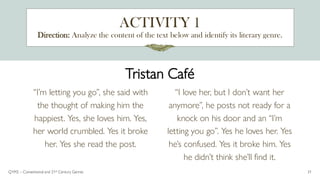
ACTIVITY 1
Direction: Analyzethe content of the text below and identify its literary genre.
Q1M2 – Conventional and 21st Century Genres 31
“I’m letting you go”, she said with
the thought of making him the
happiest. Yes, she loves him. Yes,
her world crumbled. Yes it broke
her. Yes she read the post.
“I love her, but I don’t want her
anymore”, he posts not ready for a
knock on his door and an “I’m
letting you go”. Yes he loves her. Yes
he’s confused. Yes it broke him. Yes
he didn’t think she’ll find it.
Tristan Café
32.
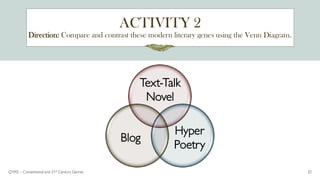
ACTIVITY 2
Direction: Compareand contrast these modern literary genes using the Venn Diagram.
Q1M2 – Conventional and 21st Century Genres 32
Text-Talk
Novel
Hyper
Poetry
Blog


![Conventional and 21st Century Genres [Autosaved].pptx](https://cdn.slidesharecdn.com/ss_thumbnails/conventionaland21stcenturygenresautosaved-241207105539-d16327f9-thumbnail.jpg?width=640&height=640&fit=bounds)


