MICROSCOPY 1
ELECTRON MICROSCOPE
 Electron beam is the source of illumination.
 Image is produced by magnetic field.
 Contrasting features between light microscope and electron microscope are
construction, working principle, specimen preparation, cost-expenses and designed
room (vacuum chamber).
ELECTRON
 Electrons are sub-atomic particles around the nucleus with negative charge.
 Electrons have high velocity and shorter wavelength about 0.05 A0 [105K times shorter
than wavelength of visible light- 5500 A0]
 Shorter the wavelength, higher is the resolution.
 Electrons are sensitive to magnetic field.
 In 1924, BROGLIE proposed Dual nature of electrons (wave and particular)
PRINCIPLE OF ELECTRON MICROSCOPE
A vacuum chamber with heating metal filament such as tungsten [at about ~6000volts]
generates electron rays. Multiple electro-magnetic lenses i.e., the copper wires coiled
around hallow cylindrical tube induces electromagnetic field during current flow and
converts electron rays into electron beam. Electron beam is similar to light rays, but
have shorter wavelength. Electron beam on interaction with atoms of the biological
sample produces image and is displayed on fluorescent screen. Faster the electron
moves, shorter the wavelength and greater is the image quality.
TYPES OF ELECTRON MICROSCOPE
1. Transmission Electron Microscope [TEM]
2. Scanning Electron Microscope [SEM]
TRANSMISSION ELECTRON MICROSCOPE [TEM]
 The Transmission Electron Microscope [TEM] was first type of Electron Microscope.
 TEM was developed by MAX RUSKA in 1931 and was awarded Nobel Prize for Physics
in 1986.
WORKING PRINCIPLE
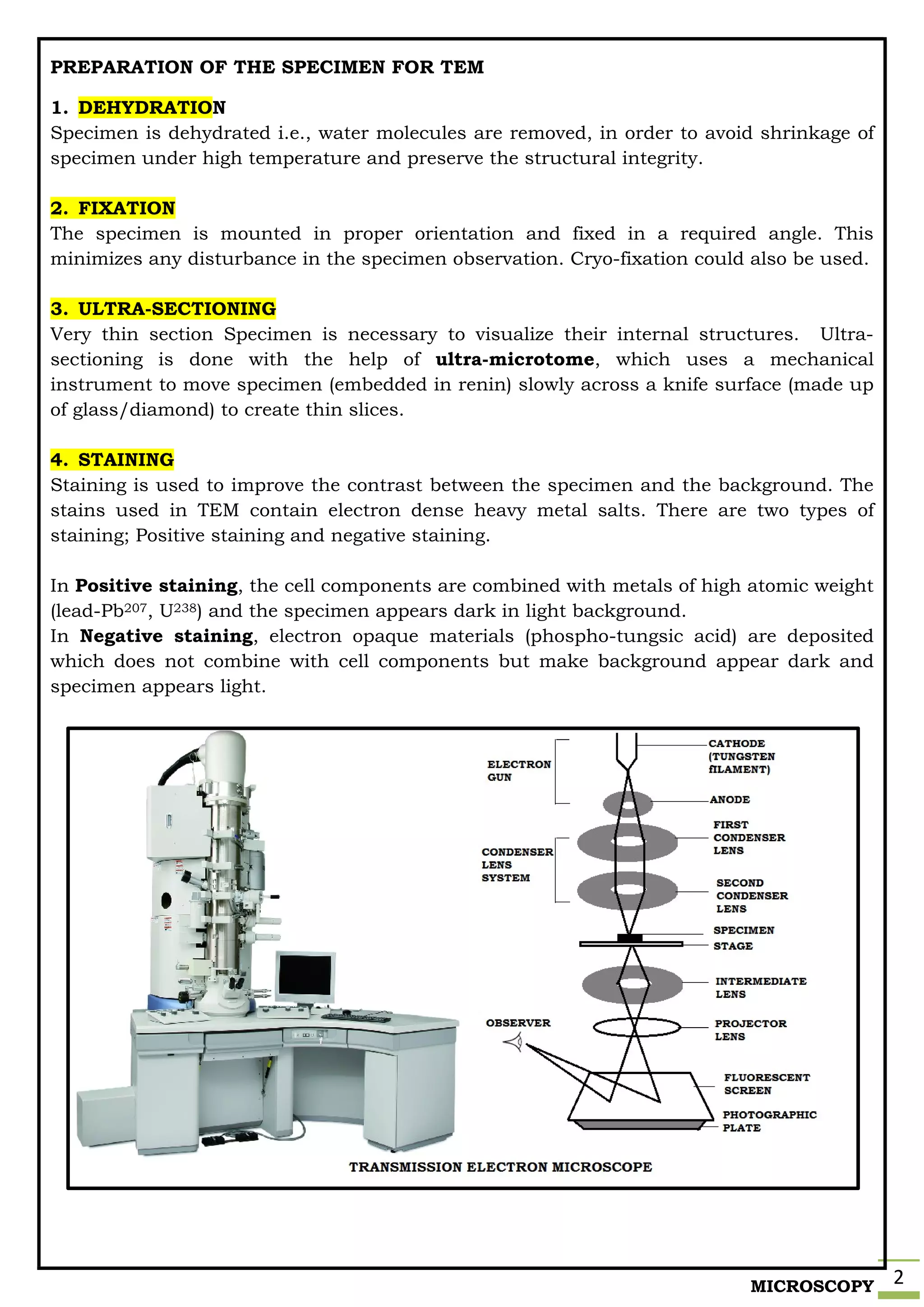
Electron generator is the source of illumination with a tungsten filament. When heated
by electric current, it emits a stream of electrons. The stream of electrons is directed
through anode aperture into a condenser lens system. The condenser lens system (1st
electromagnetic coils) adjusts the beam and guides the beam towards the specimen. As
the electron beam passes through the specimen placed below the condenser, electron
beam is scattered depending on the varying refractive index of the specimen. From the
specimen, the beam of electrons passes through objective/intermediary lens (2ndset of
electromagnetic coils) forming an intermediary image. The projection lens(3rdset of
electromagnetic coils) produces final image and is projected on a fluorescent screen/
photographic plate.
MICROSCOPY 2
PREPARATION OF THE SPECIMEN FOR TEM
1. DEHYDRATION
Specimen is dehydrated i.e., water molecules are removed, in order to avoid shrinkage of
specimen under high temperature and preserve the structural integrity.
2. FIXATION
The specimen is mounted in proper orientation and fixed in a required angle. This
minimizes any disturbance in the specimen observation. Cryo-fixation could also be used.
3. ULTRA-SECTIONING
Very thin section Specimen is necessary to visualize their internal structures. Ultra-
sectioning is done with the help of ultra-microtome, which uses a mechanical
instrument to move specimen (embedded in renin) slowly across a knife surface (made up
of glass/diamond) to create thin slices.
4. STAINING
Staining is used to improve the contrast between the specimen and the background. The
stains used in TEM contain electron dense heavy metal salts. There are two types of
staining; Positive staining and negative staining.
In Positive staining, the cell components are combined with metals of high atomic weight
(lead-Pb207, U238) and the specimen appears dark in light background.
In Negative staining, electron opaque materials (phospho-tungsic acid) are deposited
which does not combine with cell components but make background appear dark and
specimen appears light.
MICROSCOPY 3
TEM ADVANTAGES
 TEM provides most powerful magnification.
 TEM offers detailed and high quality image.
 They are easy to operate with proper training.
 TEM is ideal for a number of different fields such as life-sciences, nanotechnology,
medical, biological and material research, forensic analysis, gemology and metallurgy.
 TEM provides topographical, morphological, compositional and crystalline information.
TEM DISADVANTAGES
 TEMs are large and very expensive.
 Dehydration may alter morphological features dealing to mis-interpretation.
 Requires large, special housing and maintenance.
 They are expensive and as laborious sample preparation
 Images are black and white.
 Operation and analysis requires special training.
SCANNING ELECTRON MICROSCOPE [SEM]
 Scanning Electron Microscope [SEM] was developed by DENNIS MC MULLAN (PhD
student - England) and CHARLES OUTLAY (Engineer) in 1948.
 SEM generates an image by scanning the specimens with a beam of electrons and
enables topographical study of the specimen surface.
NOTE: The path of the electron beam within SEM differs from that of the TEM.
WORKING PRINCIPLE
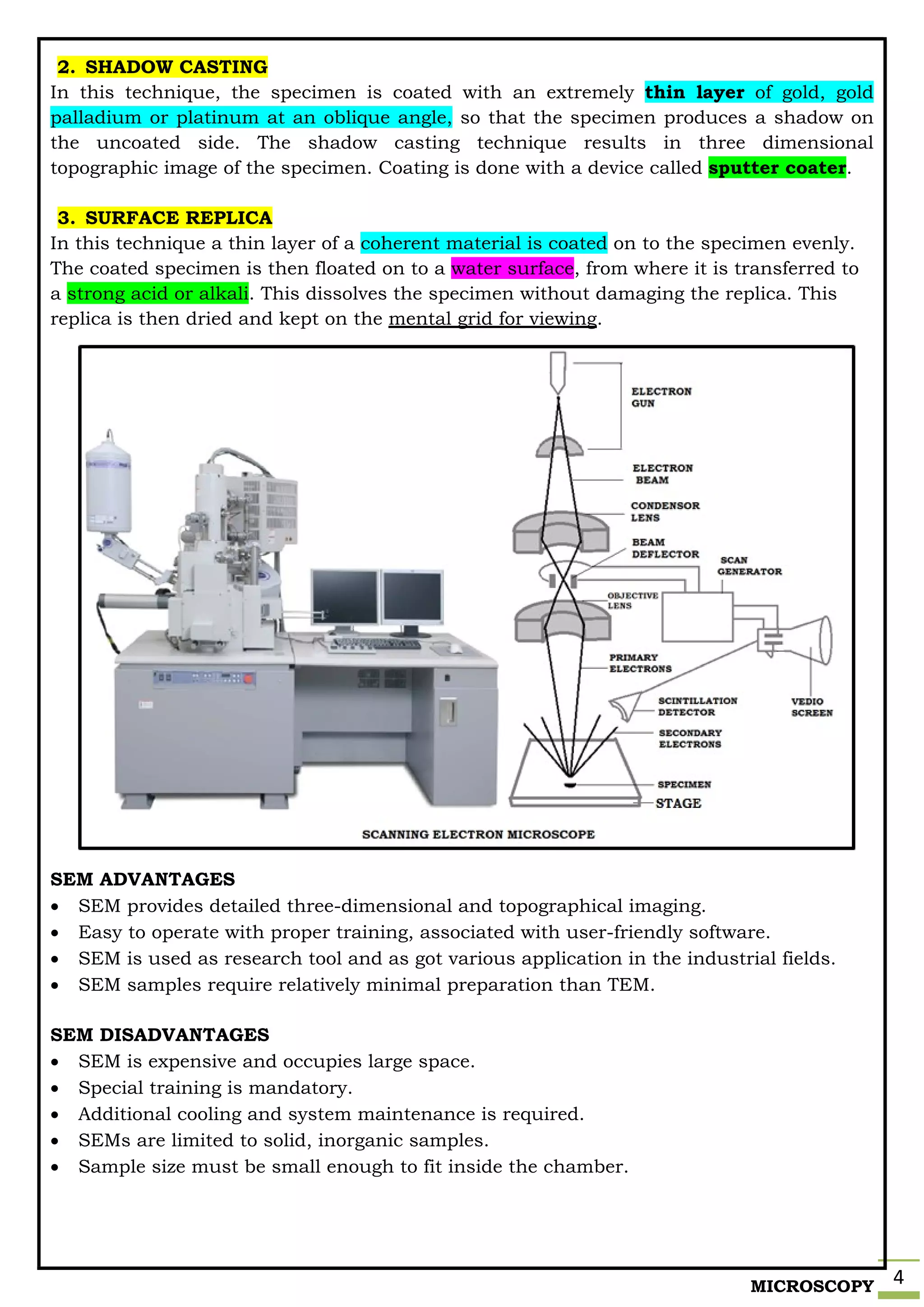
Electron gun is the source of illumination in a vacuum chamber that produces a stream
of electrons and is directed into a condenser lens, thus generating the narrow electron
beam. Rapidly moving electron beam passes through the beam deflector, enters the
objective lens and primary electron beam is created. The primary electron beam strikes
the specimen, the surface atoms discharge shower of second electrons and are called as
Secondary electrons. The secondary electrons are collected by a Scintillator detector
(composed of scintillator and photomultiplier) which generates an electronic signal.
These signals help in the formation of the final image on a CRT/Video screen. The
secondary electrons emitted from each point on the specimen are characteristic of the
surface. The image on the screen thus reflects the composition and topography of the
specimen surface. This image gives a three-dimensional appearance.
PREPARATION OF THE SPECIMEN FOR SEM
1. DEHYDRATION
SEM allows observing the surface topography. So, dehydration is achieved by critical
point drying which minimizes artifact formation (disturbance in surface configuration).
In critical point drying, at a particular temperature and pressure the liquid changes to
gas without any surface tension damage to the specimen. The specimen is first immersed
in ethanol or acetone to remove water and then in pressurized liquid of CO2.
Simultaneously, rising the temperature above 320C (the critical point of CO2). At this
temperature, the liquid vaporizes without surface tension leaving the specimen perfectly
dry.
MICROSCOPY 4
2. SHADOW CASTING
In this technique, the specimen is coated with an extremely thin layer of gold, gold
palladium or platinum at an oblique angle, so that the specimen produces a shadow on
the uncoated side. The shadow casting technique results in three dimensional
topographic image of the specimen. Coating is done with a device called sputter coater.
3. SURFACE REPLICA
In this technique a thin layer of a coherent material is coated on to the specimen evenly.
The coated specimen is then floated on to a water surface, from where it is transferred to
a strong acid or alkali. This dissolves the specimen without damaging the replica. This
replica is then dried and kept on the mental grid for viewing.
SEM ADVANTAGES
 SEM provides detailed three-dimensional and topographical imaging.
 Easy to operate with proper training, associated with user-friendly software.
 SEM is used as research tool and as got various application in the industrial fields.
 SEM samples require relatively minimal preparation than TEM.
SEM DISADVANTAGES
 SEM is expensive and occupies large space.
 Special training is mandatory.
 Additional cooling and system maintenance is required.
 SEMs are limited to solid, inorganic samples.
 Sample size must be small enough to fit inside the chamber.

5. Microsocope ELECTRON MICROSCOPE (TEM & SEM ) - Basics

  • 1.
    MICROSCOPY 1 ELECTRON MICROSCOPE Electron beam is the source of illumination.  Image is produced by magnetic field.  Contrasting features between light microscope and electron microscope are construction, working principle, specimen preparation, cost-expenses and designed room (vacuum chamber). ELECTRON  Electrons are sub-atomic particles around the nucleus with negative charge.  Electrons have high velocity and shorter wavelength about 0.05 A0 [105K times shorter than wavelength of visible light- 5500 A0]  Shorter the wavelength, higher is the resolution.  Electrons are sensitive to magnetic field.  In 1924, BROGLIE proposed Dual nature of electrons (wave and particular) PRINCIPLE OF ELECTRON MICROSCOPE A vacuum chamber with heating metal filament such as tungsten [at about ~6000volts] generates electron rays. Multiple electro-magnetic lenses i.e., the copper wires coiled around hallow cylindrical tube induces electromagnetic field during current flow and converts electron rays into electron beam. Electron beam is similar to light rays, but have shorter wavelength. Electron beam on interaction with atoms of the biological sample produces image and is displayed on fluorescent screen. Faster the electron moves, shorter the wavelength and greater is the image quality. TYPES OF ELECTRON MICROSCOPE 1. Transmission Electron Microscope [TEM] 2. Scanning Electron Microscope [SEM] TRANSMISSION ELECTRON MICROSCOPE [TEM]  The Transmission Electron Microscope [TEM] was first type of Electron Microscope.  TEM was developed by MAX RUSKA in 1931 and was awarded Nobel Prize for Physics in 1986. WORKING PRINCIPLE Electron generator is the source of illumination with a tungsten filament. When heated by electric current, it emits a stream of electrons. The stream of electrons is directed through anode aperture into a condenser lens system. The condenser lens system (1st electromagnetic coils) adjusts the beam and guides the beam towards the specimen. As the electron beam passes through the specimen placed below the condenser, electron beam is scattered depending on the varying refractive index of the specimen. From the specimen, the beam of electrons passes through objective/intermediary lens (2ndset of electromagnetic coils) forming an intermediary image. The projection lens(3rdset of electromagnetic coils) produces final image and is projected on a fluorescent screen/ photographic plate.
  • 2.
    MICROSCOPY 2 PREPARATION OFTHE SPECIMEN FOR TEM 1. DEHYDRATION Specimen is dehydrated i.e., water molecules are removed, in order to avoid shrinkage of specimen under high temperature and preserve the structural integrity. 2. FIXATION The specimen is mounted in proper orientation and fixed in a required angle. This minimizes any disturbance in the specimen observation. Cryo-fixation could also be used. 3. ULTRA-SECTIONING Very thin section Specimen is necessary to visualize their internal structures. Ultra- sectioning is done with the help of ultra-microtome, which uses a mechanical instrument to move specimen (embedded in renin) slowly across a knife surface (made up of glass/diamond) to create thin slices. 4. STAINING Staining is used to improve the contrast between the specimen and the background. The stains used in TEM contain electron dense heavy metal salts. There are two types of staining; Positive staining and negative staining. In Positive staining, the cell components are combined with metals of high atomic weight (lead-Pb207, U238) and the specimen appears dark in light background. In Negative staining, electron opaque materials (phospho-tungsic acid) are deposited which does not combine with cell components but make background appear dark and specimen appears light.
  • 3.
    MICROSCOPY 3 TEM ADVANTAGES TEM provides most powerful magnification.  TEM offers detailed and high quality image.  They are easy to operate with proper training.  TEM is ideal for a number of different fields such as life-sciences, nanotechnology, medical, biological and material research, forensic analysis, gemology and metallurgy.  TEM provides topographical, morphological, compositional and crystalline information. TEM DISADVANTAGES  TEMs are large and very expensive.  Dehydration may alter morphological features dealing to mis-interpretation.  Requires large, special housing and maintenance.  They are expensive and as laborious sample preparation  Images are black and white.  Operation and analysis requires special training. SCANNING ELECTRON MICROSCOPE [SEM]  Scanning Electron Microscope [SEM] was developed by DENNIS MC MULLAN (PhD student - England) and CHARLES OUTLAY (Engineer) in 1948.  SEM generates an image by scanning the specimens with a beam of electrons and enables topographical study of the specimen surface. NOTE: The path of the electron beam within SEM differs from that of the TEM. WORKING PRINCIPLE Electron gun is the source of illumination in a vacuum chamber that produces a stream of electrons and is directed into a condenser lens, thus generating the narrow electron beam. Rapidly moving electron beam passes through the beam deflector, enters the objective lens and primary electron beam is created. The primary electron beam strikes the specimen, the surface atoms discharge shower of second electrons and are called as Secondary electrons. The secondary electrons are collected by a Scintillator detector (composed of scintillator and photomultiplier) which generates an electronic signal. These signals help in the formation of the final image on a CRT/Video screen. The secondary electrons emitted from each point on the specimen are characteristic of the surface. The image on the screen thus reflects the composition and topography of the specimen surface. This image gives a three-dimensional appearance. PREPARATION OF THE SPECIMEN FOR SEM 1. DEHYDRATION SEM allows observing the surface topography. So, dehydration is achieved by critical point drying which minimizes artifact formation (disturbance in surface configuration). In critical point drying, at a particular temperature and pressure the liquid changes to gas without any surface tension damage to the specimen. The specimen is first immersed in ethanol or acetone to remove water and then in pressurized liquid of CO2. Simultaneously, rising the temperature above 320C (the critical point of CO2). At this temperature, the liquid vaporizes without surface tension leaving the specimen perfectly dry.
  • 4.
    MICROSCOPY 4 2. SHADOWCASTING In this technique, the specimen is coated with an extremely thin layer of gold, gold palladium or platinum at an oblique angle, so that the specimen produces a shadow on the uncoated side. The shadow casting technique results in three dimensional topographic image of the specimen. Coating is done with a device called sputter coater. 3. SURFACE REPLICA In this technique a thin layer of a coherent material is coated on to the specimen evenly. The coated specimen is then floated on to a water surface, from where it is transferred to a strong acid or alkali. This dissolves the specimen without damaging the replica. This replica is then dried and kept on the mental grid for viewing. SEM ADVANTAGES  SEM provides detailed three-dimensional and topographical imaging.  Easy to operate with proper training, associated with user-friendly software.  SEM is used as research tool and as got various application in the industrial fields.  SEM samples require relatively minimal preparation than TEM. SEM DISADVANTAGES  SEM is expensive and occupies large space.  Special training is mandatory.  Additional cooling and system maintenance is required.  SEMs are limited to solid, inorganic samples.  Sample size must be small enough to fit inside the chamber.