Chapter Thirteen: New
Learning Objectives
After reading this chapter the reader should be
able to:
Identify some of the new security technology
available on the commercial market.
Comprehend how these technologies may fit well,
or not, within a transportation component
network.
Grasp the costs related to developing new
technology and the liability risks involved.
Compare current technologies to the needs in the
field and be able to debate the effectiveness of
some of these technologies within an indoor versus
outdoor environment.
Subtopics
Introduction
Costs of new technology are enormous
and may take years to perfect.
However, the longer the government
waits to encourage this development the
longer it will take to acquire them.
Steps in the right direction have taken
place with the passage of the SAFETY
Act, which provides some relief from
liability.
Radio Frequency Identification Technology (RFID)
This technology is essentially an electronic barcode that has traditionally
been used to track and manage inventory. The main components of an
RFID system are a tag, a reader, and a database. A reader scans the tag
for data and sends the information to a database, which stores the data
contained on the tag. The major initiatives at federal agencies that use or
propose to use the technology include physical access control and
tracking assets, documents, or materials. The system transmits a stored
code from a chip to a reader without direct contact or line of sight
scanning. Radio Frequency Identification technology will also allow
transporters and security staff to track luggage from the time it is
checked in to when it is loaded into cargo holds. Currently, most
facilities use optical based systems. For example, this technology is
essentially an electronic barcode that has traditionally been used to track
and manage inventory. The system transmits a stored code from a chip
to a reader without direct contact or line of sight scanning. Radio
Frequency Identification technology will also allow transporters and
security staff to track luggage from the time it is checked in to when it is
loaded into cargo holds. Currently most facilities use optical-based
systems.
Pulsed Neutron Analysis
A major goal of the Transportation Security Administration
(TSA) is the development of new technologies for detecting
explosives and illegal drugs in freight cargo and passenger
luggage. Pulsed fast neutron analysis (PFNA) technology is
based on detection of signature radiation (gamma rays)
induced in material scanned by a beam of neutrons. These
technologies exploit the high nitrogen and oxygen content
present in most explosives. Pulsed fast neutron transmission
spectroscopy (PFNTS), one of these element-specific detection
technologies, also has the potential for generating low-
resolution tomographic images (NRC, 1998; Overlay, 1987).
However, PFNTS also has a number of practical limitations,
including large size and weight, the necessity of radiation
shielding, and the regulatory and safety issues associated with
using a nuclear-based technology (NRC, 1993, 1997).
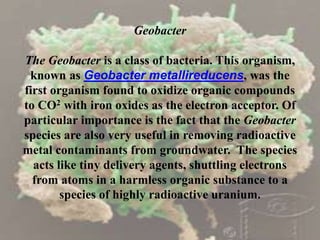
Geobacter
The Geobacter is a class of bacteria. This organism,
known as Geobacter metallireducens, was the
first organism found to oxidize organic compounds
to CO2 with iron oxides as the electron acceptor. Of
particular importance is the fact that the Geobacter
species are also very useful in removing radioactive
metal contaminants from groundwater. The species
acts like tiny delivery agents, shuttling electrons
from atoms in a harmless organic substance to a
species of highly radioactive uranium.
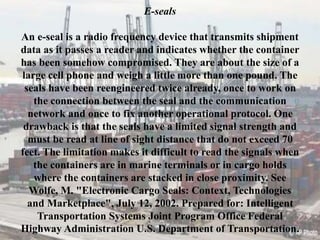
E-seals
An e-seal is a radio frequency device that transmits shipment
data as it passes a reader and indicates whether the container
has been somehow compromised. They are about the size of a
large cell phone and weigh a little more than one pound. The
seals have been reengineered twice already, once to work on
the connection between the seal and the communication
network and once to fix another operational protocol. One
drawback is that the seals have a limited signal strength and
must be read at line of sight distance that do not exceed 70
feet. The limitation makes it difficult to read the signals when
the containers are in marine terminals or in cargo holds
where the containers are stacked in close proximity. See
Wolfe, M. "Electronic Cargo Seals: Context, Technologies
and Marketplace", July 12, 2002. Prepared for: Intelligent
Transportation Systems Joint Program Office Federal
Highway Administration U.S. Department of Transportation.
Transportation Worker Identification Credentials (TWIC)
A comprehensive evaluation of the DHS-sponsored TWIC
Program reveals that currently there is grave opposition to its
implementation due to competing interests of stakeholders
and inadequately designed methods aimed at achieving its
goals. The TWIC program’s goals are to improve security
through reducing fraudulent credentials by using biometrics,
enhance commerce by streamlining the application process
for transportation workers, and preserve privacy by using a
secure network. The recommendations for program
improvement require government officials to establish an
oversight committee for privacy concerns and reevaluate
costs and applicant vetting procedures.
Active Denial System (ADS)
The Active Denial System is a non-lethal, counter
personnel directed energy weapon. It is designed to
prove stand-off non-lethal capabilities at ranges
beyond the effectiveness of small arms. It projects a
focused, speed-of-light, millimeter-wave energy
beam to induce an intolerable heating sensation on
the target’s skin. The reaction is so intense that the
targeted individual is repelled without injury. The
tactical theory behind the weapon is to provide a
means to stop an aggressor without causing any
injury and before a more serious situation develops.
Radioactive Material Detectors
Over 5,000 are currently in use but they are only effective at
very close range and the cost of encasing radioactive materials
in a lead shield, thereby avoiding detection is only about $100.
Portals that scan moving vehicles were developed before 9/11;
however, they are limited in that they can only properly scan
very slow moving vehicles. Newer technology will improve the
chances of successful detection. In December 2005, undercover
teams from the Government Accountability Office, carried small
amounts of cesium-137—a radioactive material used for cancer
therapy, industrial gauges, and well logging—in the trunks of
rental cars through border checkpoints in Texas and
Washington state. The material triggered radiation alarms, but
the smugglers used false documents to persuade U.S. Customs
and Border Protection inspectors to let them through with it.
Read What every Public Safety Officer should know about
radiation and Radioactive Materials.
Update: October 25, 2006 Department of Homeland Security — DHS
announces investment in next generation handheld radiological detection
equipment. The Department of Homeland Security's (DHS) Domestic
Nuclear Detection Office (DNDO) announced on Wednesday, October 25,
$113 million in competitive awards to enhance the detection of
radiological materials at the nation's ports of entry. "These next
generation handheld devices will bring an even faster and more reliable
means to detecting and identifying radioactive materials at our ports,"
said Vayl S. Oxford, DNDO director. "They are part of a robust global
nuclear detection architecture built for the most consequential threats to
the homeland." DNDO anticipates purchasing and deploying roughly
1,000 next generation handheld systems and 200 backpack systems
through the Human Portable Radiation Detection Systems program. The
portable technology will be used primarily by U.S. Customs and Border
Protection officers for secondary screening of cargo to identify and
localize radiological material after a primary alarm has been triggered. It
is also anticipated that the devices could be used by U.S. Coast Guard
officers aboard vessels prior to an arrival at port. There are more than
14,000 handheld devices in use at the nation's ports.
Bioagent Autonomous Networked Detectors
The U.S. Department of Homeland Security's
Science and Technology Directorate announced in
mid-2004 that more than a dozen teams have been
selected for contract negotiations with the Homeland
Security Advanced Research Projects Agency
(HSARPA). These contractors will be expected to
conduct research and development leading to next
generation biological detection sensors and systems.
See: Homeland Security Advanced Research
Projects Agency (HSARPA) Biological
Countermeasures Programs, Technologies for
Critical Incident Preparedness. New MagViz Airport
Liquid Analysis System Undergoes Testing
Fiber Optic Sensor Systems
Fiber optic sensor systems have provided perimeter security
for many permanent and temporary military facilities for
many years. They are particularly useful in the protection of
borders because of their stability, long range applicability,
suitability for buried applications, and the fact they are
immune to lightening and other electrical interference.
Newer systems provide protection for a diverse mix of fences,
walls, buildings, driveways, or fields that may require
monitoring. Some systems are zone-based detection systems
with zone lengths limited only by the total length of the
overall system: 100 km. A command system supports up to
four zones. Each zone can be mounted on a different
platform: fence, below ground, or on almost any other
available base. A single fiber optic cable is all that is needed
for complete coverage and no additional infrastructure is
required.
Short Waited Integrated Flight Travel (SWIFT)
Travelers who voluntarily submit to and pass a
security screen will use a card containing personal
and biometric information. The government will
define the details of the clearance, specifically the
national databases to be scanned and the criteria for
granting approval of each traveler. The students
have recommended that the biometric component
use finger and iris scans. They believe the system will
streamline the security operation at checkpoints and
enable security officers to focus on passengers not
previously cleared.
ibuttons
One of the newest technologies relating to access control is the iButton.® It
consists of a computer chip enclosed in a 16mm stainless steel can.
Because of this unique and durable stainless steel can, up-to-date
information can travel with a person or object anywhere they go. The steel
button can be mounted virtually anywhere because it is rugged enough to
withstand harsh environments, indoors or outdoors. It is durable enough
to attach to a key fob, ring, watch, or other personal items and used daily
for applications such as access control to buildings and computers. In a
security application, Guard Tour enables a guard to quickly and easily
check the security conditions of any facility and report all information
back to a supervisor. By using a small iButton reader, the guard simply
walks his rounds and touches iButtons at each designated location to
prove that he checked that location at the prescribed time. Collected data
from the reader is then uploaded to a reporting system that generates
reports for supervisors.
Small Craft Intrusion Barrier (SCIB)
The SCIB™ can be configured as a swinging gate
with end point attachment slings to provide for an
enclosed protected area, but with the possibility of
opening the area immediately. By using a small craft
of sufficient power the SCIB™ can be swung on a
pivot point to allow for large craft to pass. A facility
can be completely enclosed and protected, but ready
for the quick movement of large vessels, if conditions
require. The SCIB was designed both to demarcate
the marine port security zone and significantly
impede hostile small crafts from penetrating it.
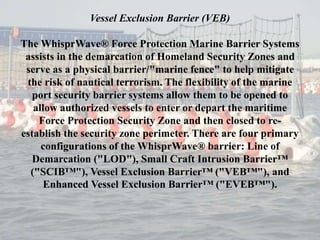
Vessel Exclusion Barrier (VEB)
The WhisprWave® Force Protection Marine Barrier Systems
assists in the demarcation of Homeland Security Zones and
serve as a physical barrier/"marine fence" to help mitigate
the risk of nautical terrorism. The flexibility of the marine
port security barrier systems allow them to be opened to
allow authorized vessels to enter or depart the maritime
Force Protection Security Zone and then closed to re-
establish the security zone perimeter. There are four primary
configurations of the WhisprWave® barrier: Line of
Demarcation ("LOD"), Small Craft Intrusion Barrier™
("SCIB™"), Vessel Exclusion Barrier™ ("VEB™"), and
Enhanced Vessel Exclusion Barrier™ ("EVEB™").
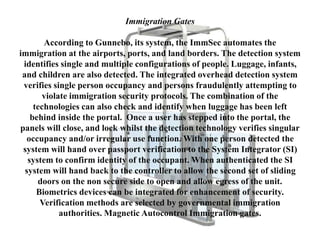
Immigration Gates
According to Gunnebo, its system, the ImmSec automates the
immigration at the airports, ports, and land borders. The detection system
identifies single and multiple configurations of people. Luggage, infants,
and children are also detected. The integrated overhead detection system
verifies single person occupancy and persons fraudulently attempting to
violate immigration security protocols. The combination of the
technologies can also check and identify when luggage has been left
behind inside the portal. Once a user has stepped into the portal, the
panels will close, and lock whilst the detection technology verifies singular
occupancy and/or irregular use function. With one person detected the
system will hand over passport verification to the System Integrator (SI)
system to confirm identity of the occupant. When authenticated the SI
system will hand back to the controller to allow the second set of sliding
doors on the non secure side to open and allow egress of the unit.
Biometrics devices can be integrated for enhancement of security.
Verification methods are selected by governmental immigration
authorities. Magnetic Autocontrol Immigration gates.
Exit Security System
The ExitSentry airport security detection system is sensitive
enough to allow for detection of a person or an object
traveling in the wrong direction in the presence of may
people traveling in the right direction. In June 2003, GAO
has concluded that INS had preliminary plans showing that
it intended to acquire and deploy a system that has
functional and performance capabilities that satisfy the
general scope of capabilities required under various laws.
These include the capability to (1) collect and match alien
arrival and departure data electronically; (2) be accessible
to the border management community (including consular
officers, federal inspection agents, and law enforcement and
intelligence agencies responsible for identifying and
investigating foreign nationals); and (3) support machine-
readable, tamper-resistant documents with biometric
identifiers at ports of entry.
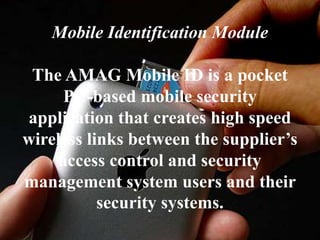
Mobile Identification Module
The AMAG Mobile ID is a pocket
PC-based mobile security
application that creates high speed
wireless links between the supplier’s
access control and security
management system users and their
security systems.
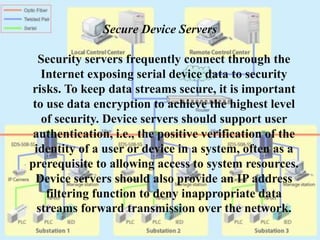
Secure Device Servers
Security servers frequently connect through the
Internet exposing serial device data to security
risks. To keep data streams secure, it is important
to use data encryption to achieve the highest level
of security. Device servers should support user
authentication, i.e., the positive verification of the
identity of a user or device in a system, often as a
prerequisite to allowing access to system resources.
Device servers should also provide an IP address
filtering function to deny inappropriate data
streams forward transmission over the network.
Conclusion
Advances in technology will continue to improve
security at transportation facilities. However, how
quickly prototypes can be transformed into practical
use and exactly who will pay for the research and
development costs will continue to be important
issues and will need to be addressed. The public
must also accept them. If the public feels they are too
intrusive or somehow unhealthy or dangerous, the
implementation of any new technology will be
lengthy or not happen at all depending on its
purpose and effectiveness. Staying on top of what is
under development and what is commercially
available can amount to a full time job.
Case Study: Research a security technology currently
on the horizon but not available for commercial use,
which may be useful to your place of employment.
Discussion Questions and Exercises
1. How can RFID be used effectively within the
transportation security logistics chain?
2. Explore the problems and success of the
program to implement TWICS.
3. Discuss the deficiencies of pulsed neutron
analysis within a transportation component
environment.
4. What is Geobacter technology and how can it
be used effectively?
5. Flight Guard was developed by the Israelis and is
presently in use by El Al. Can this technology be efficiently
adapted to the U.S. market?
6. Analyze the use of non-lethal crowd control systems.
7. The U.S. Bio-Watch program uses biological
autonomous network detectors. Has their deployment been
advantageous? What are their drawbacks?
8. How has the emergent field of biometrics been
integrated in the security of the transportation network?
9. How can t-Rays improve transportation facility security?
10. Describe how fiber optics function.
11. Critique the deployment of radiological detection
devices in the United States.
12. Track the development of immigration Gates in the
United States.
13. Discuss emerging maritime security devices.
403 13

403 13

  • 1.
  • 2.
    Learning Objectives After readingthis chapter the reader should be able to: Identify some of the new security technology available on the commercial market. Comprehend how these technologies may fit well, or not, within a transportation component network. Grasp the costs related to developing new technology and the liability risks involved. Compare current technologies to the needs in the field and be able to debate the effectiveness of some of these technologies within an indoor versus outdoor environment.
  • 3.
    Subtopics Introduction Costs of newtechnology are enormous and may take years to perfect. However, the longer the government waits to encourage this development the longer it will take to acquire them. Steps in the right direction have taken place with the passage of the SAFETY Act, which provides some relief from liability.
  • 4.
    Radio Frequency IdentificationTechnology (RFID) This technology is essentially an electronic barcode that has traditionally been used to track and manage inventory. The main components of an RFID system are a tag, a reader, and a database. A reader scans the tag for data and sends the information to a database, which stores the data contained on the tag. The major initiatives at federal agencies that use or propose to use the technology include physical access control and tracking assets, documents, or materials. The system transmits a stored code from a chip to a reader without direct contact or line of sight scanning. Radio Frequency Identification technology will also allow transporters and security staff to track luggage from the time it is checked in to when it is loaded into cargo holds. Currently, most facilities use optical based systems. For example, this technology is essentially an electronic barcode that has traditionally been used to track and manage inventory. The system transmits a stored code from a chip to a reader without direct contact or line of sight scanning. Radio Frequency Identification technology will also allow transporters and security staff to track luggage from the time it is checked in to when it is loaded into cargo holds. Currently most facilities use optical-based systems.
  • 5.
    Pulsed Neutron Analysis Amajor goal of the Transportation Security Administration (TSA) is the development of new technologies for detecting explosives and illegal drugs in freight cargo and passenger luggage. Pulsed fast neutron analysis (PFNA) technology is based on detection of signature radiation (gamma rays) induced in material scanned by a beam of neutrons. These technologies exploit the high nitrogen and oxygen content present in most explosives. Pulsed fast neutron transmission spectroscopy (PFNTS), one of these element-specific detection technologies, also has the potential for generating low- resolution tomographic images (NRC, 1998; Overlay, 1987). However, PFNTS also has a number of practical limitations, including large size and weight, the necessity of radiation shielding, and the regulatory and safety issues associated with using a nuclear-based technology (NRC, 1993, 1997).
  • 6.
    Geobacter The Geobacter isa class of bacteria. This organism, known as Geobacter metallireducens, was the first organism found to oxidize organic compounds to CO2 with iron oxides as the electron acceptor. Of particular importance is the fact that the Geobacter species are also very useful in removing radioactive metal contaminants from groundwater. The species acts like tiny delivery agents, shuttling electrons from atoms in a harmless organic substance to a species of highly radioactive uranium.
  • 8.
    E-seals An e-seal isa radio frequency device that transmits shipment data as it passes a reader and indicates whether the container has been somehow compromised. They are about the size of a large cell phone and weigh a little more than one pound. The seals have been reengineered twice already, once to work on the connection between the seal and the communication network and once to fix another operational protocol. One drawback is that the seals have a limited signal strength and must be read at line of sight distance that do not exceed 70 feet. The limitation makes it difficult to read the signals when the containers are in marine terminals or in cargo holds where the containers are stacked in close proximity. See Wolfe, M. "Electronic Cargo Seals: Context, Technologies and Marketplace", July 12, 2002. Prepared for: Intelligent Transportation Systems Joint Program Office Federal Highway Administration U.S. Department of Transportation.
  • 9.
    Transportation Worker IdentificationCredentials (TWIC) A comprehensive evaluation of the DHS-sponsored TWIC Program reveals that currently there is grave opposition to its implementation due to competing interests of stakeholders and inadequately designed methods aimed at achieving its goals. The TWIC program’s goals are to improve security through reducing fraudulent credentials by using biometrics, enhance commerce by streamlining the application process for transportation workers, and preserve privacy by using a secure network. The recommendations for program improvement require government officials to establish an oversight committee for privacy concerns and reevaluate costs and applicant vetting procedures.
  • 10.
    Active Denial System(ADS) The Active Denial System is a non-lethal, counter personnel directed energy weapon. It is designed to prove stand-off non-lethal capabilities at ranges beyond the effectiveness of small arms. It projects a focused, speed-of-light, millimeter-wave energy beam to induce an intolerable heating sensation on the target’s skin. The reaction is so intense that the targeted individual is repelled without injury. The tactical theory behind the weapon is to provide a means to stop an aggressor without causing any injury and before a more serious situation develops.
  • 12.
    Radioactive Material Detectors Over5,000 are currently in use but they are only effective at very close range and the cost of encasing radioactive materials in a lead shield, thereby avoiding detection is only about $100. Portals that scan moving vehicles were developed before 9/11; however, they are limited in that they can only properly scan very slow moving vehicles. Newer technology will improve the chances of successful detection. In December 2005, undercover teams from the Government Accountability Office, carried small amounts of cesium-137—a radioactive material used for cancer therapy, industrial gauges, and well logging—in the trunks of rental cars through border checkpoints in Texas and Washington state. The material triggered radiation alarms, but the smugglers used false documents to persuade U.S. Customs and Border Protection inspectors to let them through with it. Read What every Public Safety Officer should know about radiation and Radioactive Materials.
  • 13.
    Update: October 25,2006 Department of Homeland Security — DHS announces investment in next generation handheld radiological detection equipment. The Department of Homeland Security's (DHS) Domestic Nuclear Detection Office (DNDO) announced on Wednesday, October 25, $113 million in competitive awards to enhance the detection of radiological materials at the nation's ports of entry. "These next generation handheld devices will bring an even faster and more reliable means to detecting and identifying radioactive materials at our ports," said Vayl S. Oxford, DNDO director. "They are part of a robust global nuclear detection architecture built for the most consequential threats to the homeland." DNDO anticipates purchasing and deploying roughly 1,000 next generation handheld systems and 200 backpack systems through the Human Portable Radiation Detection Systems program. The portable technology will be used primarily by U.S. Customs and Border Protection officers for secondary screening of cargo to identify and localize radiological material after a primary alarm has been triggered. It is also anticipated that the devices could be used by U.S. Coast Guard officers aboard vessels prior to an arrival at port. There are more than 14,000 handheld devices in use at the nation's ports.
  • 14.
    Bioagent Autonomous NetworkedDetectors The U.S. Department of Homeland Security's Science and Technology Directorate announced in mid-2004 that more than a dozen teams have been selected for contract negotiations with the Homeland Security Advanced Research Projects Agency (HSARPA). These contractors will be expected to conduct research and development leading to next generation biological detection sensors and systems. See: Homeland Security Advanced Research Projects Agency (HSARPA) Biological Countermeasures Programs, Technologies for Critical Incident Preparedness. New MagViz Airport Liquid Analysis System Undergoes Testing
  • 16.
    Fiber Optic SensorSystems Fiber optic sensor systems have provided perimeter security for many permanent and temporary military facilities for many years. They are particularly useful in the protection of borders because of their stability, long range applicability, suitability for buried applications, and the fact they are immune to lightening and other electrical interference. Newer systems provide protection for a diverse mix of fences, walls, buildings, driveways, or fields that may require monitoring. Some systems are zone-based detection systems with zone lengths limited only by the total length of the overall system: 100 km. A command system supports up to four zones. Each zone can be mounted on a different platform: fence, below ground, or on almost any other available base. A single fiber optic cable is all that is needed for complete coverage and no additional infrastructure is required.
  • 17.
    Short Waited IntegratedFlight Travel (SWIFT) Travelers who voluntarily submit to and pass a security screen will use a card containing personal and biometric information. The government will define the details of the clearance, specifically the national databases to be scanned and the criteria for granting approval of each traveler. The students have recommended that the biometric component use finger and iris scans. They believe the system will streamline the security operation at checkpoints and enable security officers to focus on passengers not previously cleared.
  • 19.
    ibuttons One of thenewest technologies relating to access control is the iButton.® It consists of a computer chip enclosed in a 16mm stainless steel can. Because of this unique and durable stainless steel can, up-to-date information can travel with a person or object anywhere they go. The steel button can be mounted virtually anywhere because it is rugged enough to withstand harsh environments, indoors or outdoors. It is durable enough to attach to a key fob, ring, watch, or other personal items and used daily for applications such as access control to buildings and computers. In a security application, Guard Tour enables a guard to quickly and easily check the security conditions of any facility and report all information back to a supervisor. By using a small iButton reader, the guard simply walks his rounds and touches iButtons at each designated location to prove that he checked that location at the prescribed time. Collected data from the reader is then uploaded to a reporting system that generates reports for supervisors.
  • 20.
    Small Craft IntrusionBarrier (SCIB) The SCIB™ can be configured as a swinging gate with end point attachment slings to provide for an enclosed protected area, but with the possibility of opening the area immediately. By using a small craft of sufficient power the SCIB™ can be swung on a pivot point to allow for large craft to pass. A facility can be completely enclosed and protected, but ready for the quick movement of large vessels, if conditions require. The SCIB was designed both to demarcate the marine port security zone and significantly impede hostile small crafts from penetrating it.
  • 21.
    Vessel Exclusion Barrier(VEB) The WhisprWave® Force Protection Marine Barrier Systems assists in the demarcation of Homeland Security Zones and serve as a physical barrier/"marine fence" to help mitigate the risk of nautical terrorism. The flexibility of the marine port security barrier systems allow them to be opened to allow authorized vessels to enter or depart the maritime Force Protection Security Zone and then closed to re- establish the security zone perimeter. There are four primary configurations of the WhisprWave® barrier: Line of Demarcation ("LOD"), Small Craft Intrusion Barrier™ ("SCIB™"), Vessel Exclusion Barrier™ ("VEB™"), and Enhanced Vessel Exclusion Barrier™ ("EVEB™").
  • 22.
    Immigration Gates According toGunnebo, its system, the ImmSec automates the immigration at the airports, ports, and land borders. The detection system identifies single and multiple configurations of people. Luggage, infants, and children are also detected. The integrated overhead detection system verifies single person occupancy and persons fraudulently attempting to violate immigration security protocols. The combination of the technologies can also check and identify when luggage has been left behind inside the portal. Once a user has stepped into the portal, the panels will close, and lock whilst the detection technology verifies singular occupancy and/or irregular use function. With one person detected the system will hand over passport verification to the System Integrator (SI) system to confirm identity of the occupant. When authenticated the SI system will hand back to the controller to allow the second set of sliding doors on the non secure side to open and allow egress of the unit. Biometrics devices can be integrated for enhancement of security. Verification methods are selected by governmental immigration authorities. Magnetic Autocontrol Immigration gates.
  • 23.
    Exit Security System TheExitSentry airport security detection system is sensitive enough to allow for detection of a person or an object traveling in the wrong direction in the presence of may people traveling in the right direction. In June 2003, GAO has concluded that INS had preliminary plans showing that it intended to acquire and deploy a system that has functional and performance capabilities that satisfy the general scope of capabilities required under various laws. These include the capability to (1) collect and match alien arrival and departure data electronically; (2) be accessible to the border management community (including consular officers, federal inspection agents, and law enforcement and intelligence agencies responsible for identifying and investigating foreign nationals); and (3) support machine- readable, tamper-resistant documents with biometric identifiers at ports of entry.
  • 24.
    Mobile Identification Module TheAMAG Mobile ID is a pocket PC-based mobile security application that creates high speed wireless links between the supplier’s access control and security management system users and their security systems.
  • 25.
    Secure Device Servers Securityservers frequently connect through the Internet exposing serial device data to security risks. To keep data streams secure, it is important to use data encryption to achieve the highest level of security. Device servers should support user authentication, i.e., the positive verification of the identity of a user or device in a system, often as a prerequisite to allowing access to system resources. Device servers should also provide an IP address filtering function to deny inappropriate data streams forward transmission over the network.
  • 26.
    Conclusion Advances in technologywill continue to improve security at transportation facilities. However, how quickly prototypes can be transformed into practical use and exactly who will pay for the research and development costs will continue to be important issues and will need to be addressed. The public must also accept them. If the public feels they are too intrusive or somehow unhealthy or dangerous, the implementation of any new technology will be lengthy or not happen at all depending on its purpose and effectiveness. Staying on top of what is under development and what is commercially available can amount to a full time job.
  • 27.
    Case Study: Researcha security technology currently on the horizon but not available for commercial use, which may be useful to your place of employment. Discussion Questions and Exercises 1. How can RFID be used effectively within the transportation security logistics chain? 2. Explore the problems and success of the program to implement TWICS. 3. Discuss the deficiencies of pulsed neutron analysis within a transportation component environment. 4. What is Geobacter technology and how can it be used effectively?
  • 28.
    5. Flight Guardwas developed by the Israelis and is presently in use by El Al. Can this technology be efficiently adapted to the U.S. market? 6. Analyze the use of non-lethal crowd control systems. 7. The U.S. Bio-Watch program uses biological autonomous network detectors. Has their deployment been advantageous? What are their drawbacks? 8. How has the emergent field of biometrics been integrated in the security of the transportation network? 9. How can t-Rays improve transportation facility security? 10. Describe how fiber optics function. 11. Critique the deployment of radiological detection devices in the United States. 12. Track the development of immigration Gates in the United States. 13. Discuss emerging maritime security devices.

Editor's Notes

  • #5 http://www.youtube.com/watch?v=Y3LkL7ZvlLA stopping RFID Thieves http://www.youtube.com/watch?v=XhFuINhTRaA RFID how it works
  • #6 http://www.abc.net.au/catalyst/stories/3576774.htm AIR CARGO SCANNER
  • #7 https://www.youtube.com/watch?v=mueFDd6sozY New uses for microorganisms
  • #8 https://www.youtube.com/watch?v=3a5A2KiCzQs Flight Guard Israel https://www.youtube.com/watch?v=BRDZvDJ0_qE New Israeli Advanced Military Systems by RAFAEL https://www.youtube.com/watch?v=IMBSWGYlnF0 Iron Dome - missile protection system https://www.youtube.com/watch?v=jUol9NQaSew IAI at Paris Airshow 2011
  • #9 http://www.youtube.com/watch?v=9vI23j11Ndo&feature=share&list=PL3D9C5D1C49856716 E-seals
  • #11 http://www.wired.com/dangerroom/2007/03/inside_the_navy/ ADS
  • #12 http://www.davidicke.com/forum/showthread.php?p=1059240729 IRIS http://www.youtube.com/watch?v=B14ZiNdcOx8 http://dotsub.com/view/74c7d29f-1a42-4d13-bfc3-2ce9861864ab https://www.youtube.com/watch?v=My7ANDuohKw&list=PL63A6C4A30AEF20BE 150,000 Workers Will Require Biometric ID to Work http://www.youtube.com/watch?v=eZTfgNIiNUA&feature=player_embedded
  • #13 http://www.youtube.com/watch?v=Fmf5wLkaFD8 Automatic Radioactive Detection and Measurement System for the detection of Radiosotopes.
  • #14 http://www.youtube.com/watch?v=f6Ui1QxAQoc&playnext=1&list=PL958DF9CF27AC01FC&feature=results_main
  • #15 https://www.youtube.com/watch?v=xT2zncrtU-s New MagViz Airport Liquid Analysis System Undergoes Testing
  • #16 http://www.experiencefestival.com/wp/videos/terahertz-radiation-research-at-the-university-of-memphis/-OjmPy3V0kk
  • #18 http://edition.cnn.com/2012/03/23/business/airline-precheck-security/index.html
  • #20 http://www.youtube.com/watch?v=hRnXmhoIixw
  • #21 http://www.whisprwave.com/2011/02/28/whisprwave-boat-barrier-demonstration-stopping-small-boat-attack/
  • #23 http://www.youtube.com/watch?v=ccmn1qGFJX0 passport gate http://www.youtube.com/watch?v=Cf_H4P3Oicw
  • #25 http://www.youtube.com/watch?v=CYvVN5dJD7A http://www.youtube.com/watch?v=6NnFJsCtx-k LAPD Blue chip http://www.youtube.com/watch?v=aqE7Db1UzPM Priority Health mobile ID card
  • #26 http://www.dailymotion.com/video/xqzbjd_the-10-best-computer-networking-device-servers_tech#.UMCfrFk0WSo 10 best