Consumer and Business Buyer Behavior
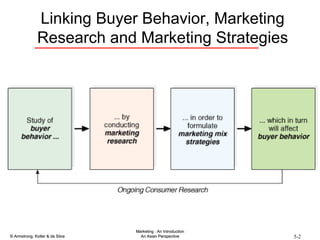
Linking Buyer Behavior, Marketing Research and Marketing Strategies
Consumer Buying Behavior Refers to the buying behavior of people who buy goods and services for personal use. These people make up the  consumer market . The central question for marketers is: “ How do consumers respond to various marketing efforts the company might use?”
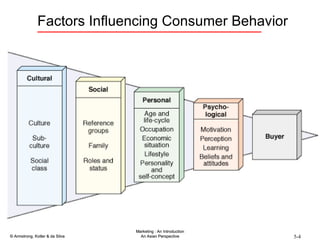
Factors Influencing Consumer Behavior
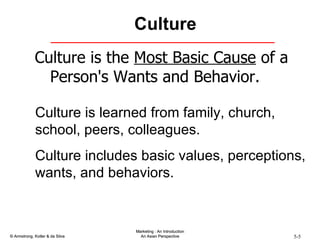
Culture Culture is the  Most Basic Cause  of a Person's Wants and Behavior.  Culture is learned from family, church, school, peers, colleagues. Culture includes basic values, perceptions, wants, and behaviors.
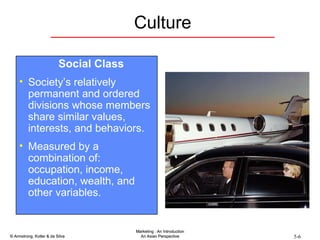
Culture Social Class Society’s relatively permanent and ordered divisions whose members share similar values, interests, and behaviors. Measured by a combination of: occupation, income, education, wealth, and other variables.
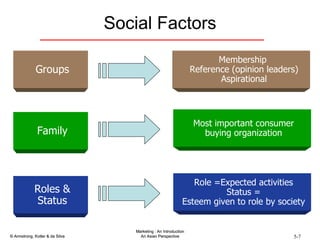
Social Factors Membership Reference (opinion leaders) Aspirational Groups Family Roles & Status Most important consumer buying organization Role =Expected activities Status = Esteem given to role by society
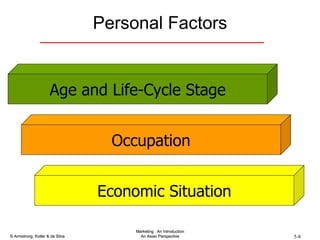
Personal Factors Age and Life-Cycle Stage Occupation Economic Situation
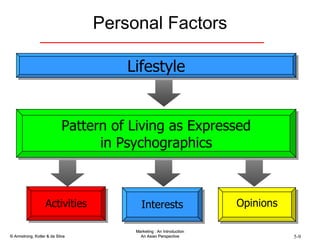
Personal Factors Activities Interests Lifestyle Opinions Pattern of Living as Expressed in Psychographics
Personality & Self-Concept Personality refers to the unique psychological characteristics that lead to relatively consistent and lasting responses to one’s own environment. Generally defined in terms of traits. Self-concept suggests that people’s possessions contribute to and reflect their identities.
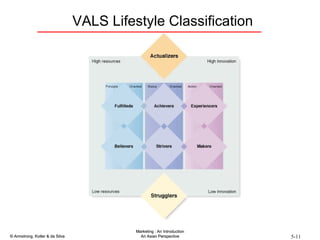
VALS Lifestyle Classification
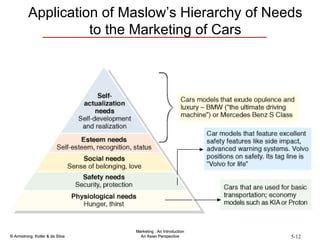
Application of Maslow’s Hierarchy of Needs to the Marketing of Cars
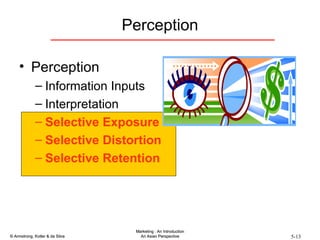
Perception Perception Information Inputs Interpretation Selective Exposure Selective Distortion Selective Retention
Information inputs  are the sensations received through the sense organs.   Perception  is the process of selecting, organizing, and interpreting information inputs to produce meaning. Perception
Selective Attention:   the process of selecting some inputs to attend to while ignoring others. An input is more likely to reach a person’s awareness if it relates to an anticipated event. Perception
Selective distortion  is an individual’s changing or twisting of information when it is inconsistent with personal feelings or beliefs. Selective retention  is remembering information that supports personal feelings and beliefs and forgetting inputs that do not. Perception
Learning Learning:   a relatively permanent change in behavior due to experience. Interplay of drives, stimuli, cues, responses, and reinforcement. Strongly influenced by the consequences of an individual’s behavior Behaviors with satisfying results tend to be repeated. Behaviors with unsatisfying results tend  not  to be repeated.
Beliefs & Attitudes A  belief  is a descriptive thought that a person holds about something. Attitude  describes a person’s consistently favorable or unfavorable evaluations, feelings, and tendencies toward an object or idea.
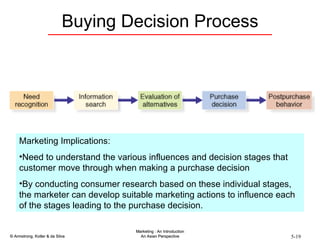
Buying Decision Process Marketing Implications: Need to understand the various influences and decision stages that customer move through when making a purchase decision By conducting consumer research based on these individual stages, the marketer can develop suitable marketing actions to influence each of the stages leading to the purchase decision.
Step #1 = Need Recognition Buyer becomes aware of a difference between a desired state and an actual condition. Individual may be unaware of the problem or need. Marketers may use sales personnel, advertising, and packaging to  trigger recognition  of needs or problems. Recognition speed can be slow or fast. Buying Decision Process
Step #2 = Information Search This stage begins after the consumer becomes aware of the problem or need. The search for information about products will help resolve the problem or satisfy the need. There are various sources of information. Buying Decision Process
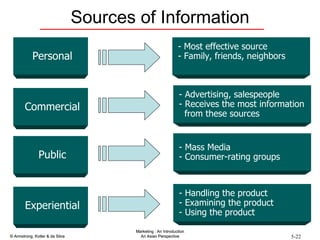
Sources of Information - Most effective source  - Family, friends, neighbors Personal Commercial Public - Advertising, salespeople - Receives the most information from these sources - Mass Media - Consumer-rating groups Experiential - Handling the product - Examining the product - Using the product
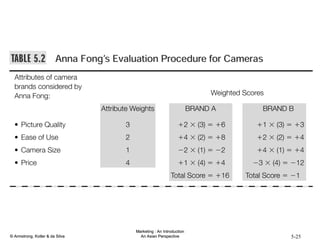
Step #3= Alternative Evaluation Consumer is now confronted with a number of options Choice involves element of risk Consumer will evaluate product options based on different “evaluative criteria” or attributes Consumer will apply different decision rules depending on complexity of the decision Buying Decision Process
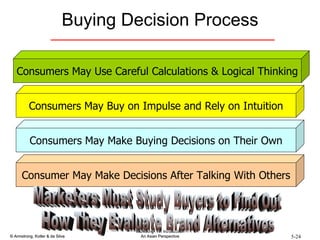
Buying Decision Process Consumers May Use Careful Calculations & Logical Thinking Consumers May Buy on Impulse and Rely on Intuition Consumers May Make Buying Decisions on Their Own Consumer May Make Decisions After Talking With Others Marketers Must Study Buyers to Find Out How They Evaluate Brand Alternatives
 
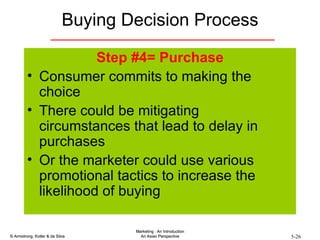
Step #4= Purchase Consumer commits to making the choice There could be mitigating circumstances that lead to delay in purchases Or the marketer could use various promotional tactics to increase the likelihood of buying Buying Decision Process
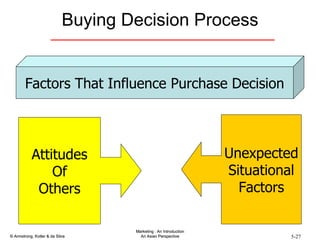
Buying Decision Process Factors That Influence Purchase Decision Attitudes Of Others Unexpected Situational Factors
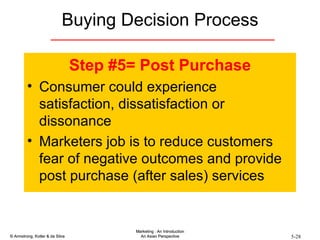
Step #5= Post Purchase Consumer could experience satisfaction, dissatisfaction or dissonance Marketers job is to reduce customers fear of negative outcomes and provide post purchase (after sales) services Buying Decision Process
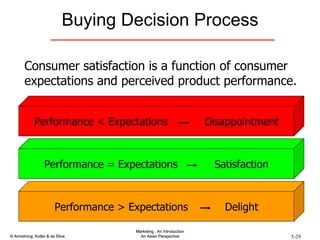
Buying Decision Process Consumer satisfaction is a function of consumer expectations and perceived product performance. Performance < Expectations  Disappointment Performance = Expectations  Satisfaction Performance > Expectations  Delight
Buying Decision Process Cognitive dissonance:  a buyer’s doubts shortly after a purchase about whether it was the right decision.
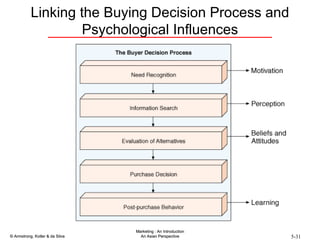
Linking the Buying Decision Process and Psychological Influences
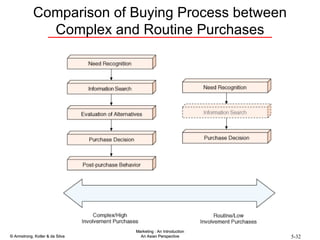
Comparison of Buying Process between Complex and Routine Purchases
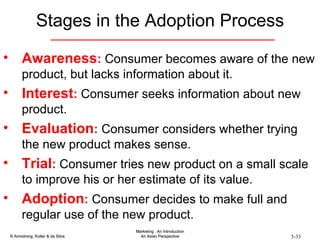
Stages in the Adoption Process Awareness :  Consumer becomes aware of the new product, but lacks information about it. Interest :  Consumer seeks information about new product. Evaluation :  Consumer considers whether trying the new product makes sense. Trial :  Consumer tries new product on a small scale to improve his or her estimate of its value. Adoption :  Consumer decides to make full and regular use of the new product.
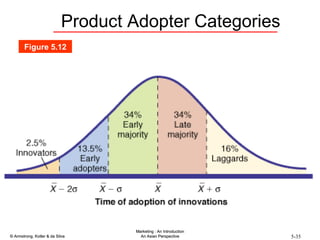
Product Adopter Categories When an organization introduces a new product, people do not begin the adoption process at the same time, nor do they move through it at the same speed.  Adopters  are divided into five categories.
Product Adopter Categories Figure 5.12
Influence of Product Characteristics on Rate of Adoption Relative Advantage : Is the innovation superior to existing products? Compatibility : Does the innovation fit the values and experience of the target market? Complexity : Is the innovation difficult to understand or use? Divisibility : Can the innovation be used on a limited basis? Communicability : Can results be easily observed or described to others?
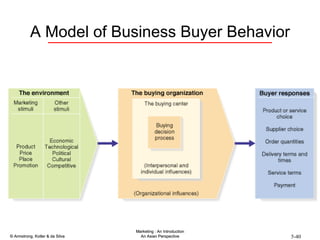
Business Markets & Business Buyer Behavior The  business market  is vast and involves far more dollars and items than do consumer markets. Business buyer behavior  refers to the buying behavior of the organizations that buy goods and services for use in the production of other products and services that are sold, rented, or supplied to others.
Business Markets Market Structure and Demand: Contains far fewer but larger buyers. Customers are more geographically concentrated. Business demand is derived from consumer demand. Nature of the Buying Unit: Business purchases involve more decision participants. Business buying involves a more professional purchasing effort.
Types of Decisions and the Decision Process Business buyers usually face more complex buying decisions. Business buying process tends to be more formalized. Buyers and sellers are much more dependent on each other.
A Model of Business Buyer Behavior
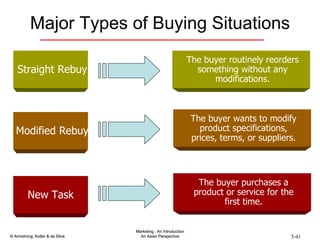
Major Types of Buying Situations The buyer routinely reorders something without any modifications. Straight Rebuy Modified Rebuy New Task  The buyer wants to modify product specifications, prices, terms, or suppliers. The buyer purchases a product or service for the first time.
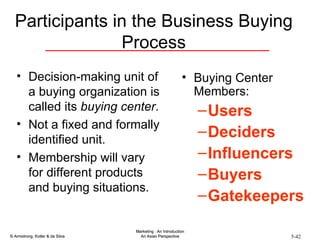
Participants in the Business Buying Process Decision-making unit of a buying organization is called its  buying center . Not a fixed and formally identified unit. Membership will vary for different products and buying situations. Buying Center Members: Users Deciders Influencers Buyers Gatekeepers
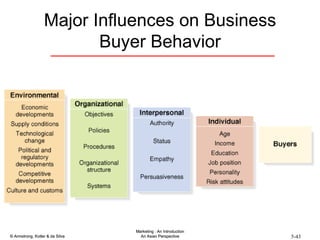
Major Influences on Business Buyer Behavior
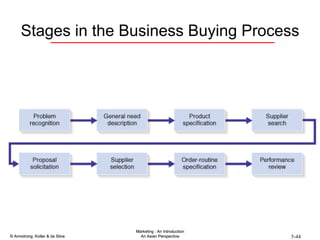
Stages in the Business Buying Process

MARKETING-CH4

  • 1.
    Consumer and BusinessBuyer Behavior
  • 2.
    Linking Buyer Behavior,Marketing Research and Marketing Strategies
  • 3.
    Consumer Buying BehaviorRefers to the buying behavior of people who buy goods and services for personal use. These people make up the consumer market . The central question for marketers is: “ How do consumers respond to various marketing efforts the company might use?”
  • 4.
  • 5.
    Culture Culture isthe Most Basic Cause of a Person's Wants and Behavior. Culture is learned from family, church, school, peers, colleagues. Culture includes basic values, perceptions, wants, and behaviors.
  • 6.
    Culture Social ClassSociety’s relatively permanent and ordered divisions whose members share similar values, interests, and behaviors. Measured by a combination of: occupation, income, education, wealth, and other variables.
  • 7.
    Social Factors MembershipReference (opinion leaders) Aspirational Groups Family Roles & Status Most important consumer buying organization Role =Expected activities Status = Esteem given to role by society
  • 8.
    Personal Factors Ageand Life-Cycle Stage Occupation Economic Situation
  • 9.
    Personal Factors ActivitiesInterests Lifestyle Opinions Pattern of Living as Expressed in Psychographics
  • 10.
    Personality & Self-ConceptPersonality refers to the unique psychological characteristics that lead to relatively consistent and lasting responses to one’s own environment. Generally defined in terms of traits. Self-concept suggests that people’s possessions contribute to and reflect their identities.
  • 11.
  • 12.
    Application of Maslow’sHierarchy of Needs to the Marketing of Cars
  • 13.
    Perception Perception InformationInputs Interpretation Selective Exposure Selective Distortion Selective Retention
  • 14.
    Information inputs are the sensations received through the sense organs. Perception is the process of selecting, organizing, and interpreting information inputs to produce meaning. Perception
  • 15.
    Selective Attention: the process of selecting some inputs to attend to while ignoring others. An input is more likely to reach a person’s awareness if it relates to an anticipated event. Perception
  • 16.
    Selective distortion is an individual’s changing or twisting of information when it is inconsistent with personal feelings or beliefs. Selective retention is remembering information that supports personal feelings and beliefs and forgetting inputs that do not. Perception
  • 17.
    Learning Learning: a relatively permanent change in behavior due to experience. Interplay of drives, stimuli, cues, responses, and reinforcement. Strongly influenced by the consequences of an individual’s behavior Behaviors with satisfying results tend to be repeated. Behaviors with unsatisfying results tend not to be repeated.
  • 18.
    Beliefs & AttitudesA belief is a descriptive thought that a person holds about something. Attitude describes a person’s consistently favorable or unfavorable evaluations, feelings, and tendencies toward an object or idea.
  • 19.
    Buying Decision ProcessMarketing Implications: Need to understand the various influences and decision stages that customer move through when making a purchase decision By conducting consumer research based on these individual stages, the marketer can develop suitable marketing actions to influence each of the stages leading to the purchase decision.
  • 20.
    Step #1 =Need Recognition Buyer becomes aware of a difference between a desired state and an actual condition. Individual may be unaware of the problem or need. Marketers may use sales personnel, advertising, and packaging to trigger recognition of needs or problems. Recognition speed can be slow or fast. Buying Decision Process
  • 21.
    Step #2 =Information Search This stage begins after the consumer becomes aware of the problem or need. The search for information about products will help resolve the problem or satisfy the need. There are various sources of information. Buying Decision Process
  • 22.
    Sources of Information- Most effective source - Family, friends, neighbors Personal Commercial Public - Advertising, salespeople - Receives the most information from these sources - Mass Media - Consumer-rating groups Experiential - Handling the product - Examining the product - Using the product
  • 23.
    Step #3= AlternativeEvaluation Consumer is now confronted with a number of options Choice involves element of risk Consumer will evaluate product options based on different “evaluative criteria” or attributes Consumer will apply different decision rules depending on complexity of the decision Buying Decision Process
  • 24.
    Buying Decision ProcessConsumers May Use Careful Calculations & Logical Thinking Consumers May Buy on Impulse and Rely on Intuition Consumers May Make Buying Decisions on Their Own Consumer May Make Decisions After Talking With Others Marketers Must Study Buyers to Find Out How They Evaluate Brand Alternatives
  • 25.
  • 26.
    Step #4= PurchaseConsumer commits to making the choice There could be mitigating circumstances that lead to delay in purchases Or the marketer could use various promotional tactics to increase the likelihood of buying Buying Decision Process
  • 27.
    Buying Decision ProcessFactors That Influence Purchase Decision Attitudes Of Others Unexpected Situational Factors
  • 28.
    Step #5= PostPurchase Consumer could experience satisfaction, dissatisfaction or dissonance Marketers job is to reduce customers fear of negative outcomes and provide post purchase (after sales) services Buying Decision Process
  • 29.
    Buying Decision ProcessConsumer satisfaction is a function of consumer expectations and perceived product performance. Performance < Expectations Disappointment Performance = Expectations Satisfaction Performance > Expectations Delight
  • 30.
    Buying Decision ProcessCognitive dissonance: a buyer’s doubts shortly after a purchase about whether it was the right decision.
  • 31.
    Linking the BuyingDecision Process and Psychological Influences
  • 32.
    Comparison of BuyingProcess between Complex and Routine Purchases
  • 33.
    Stages in theAdoption Process Awareness : Consumer becomes aware of the new product, but lacks information about it. Interest : Consumer seeks information about new product. Evaluation : Consumer considers whether trying the new product makes sense. Trial : Consumer tries new product on a small scale to improve his or her estimate of its value. Adoption : Consumer decides to make full and regular use of the new product.
  • 34.
    Product Adopter CategoriesWhen an organization introduces a new product, people do not begin the adoption process at the same time, nor do they move through it at the same speed. Adopters are divided into five categories.
  • 35.
  • 36.
    Influence of ProductCharacteristics on Rate of Adoption Relative Advantage : Is the innovation superior to existing products? Compatibility : Does the innovation fit the values and experience of the target market? Complexity : Is the innovation difficult to understand or use? Divisibility : Can the innovation be used on a limited basis? Communicability : Can results be easily observed or described to others?
  • 37.
    Business Markets &Business Buyer Behavior The business market is vast and involves far more dollars and items than do consumer markets. Business buyer behavior refers to the buying behavior of the organizations that buy goods and services for use in the production of other products and services that are sold, rented, or supplied to others.
  • 38.
    Business Markets MarketStructure and Demand: Contains far fewer but larger buyers. Customers are more geographically concentrated. Business demand is derived from consumer demand. Nature of the Buying Unit: Business purchases involve more decision participants. Business buying involves a more professional purchasing effort.
  • 39.
    Types of Decisionsand the Decision Process Business buyers usually face more complex buying decisions. Business buying process tends to be more formalized. Buyers and sellers are much more dependent on each other.
  • 40.
    A Model ofBusiness Buyer Behavior
  • 41.
    Major Types ofBuying Situations The buyer routinely reorders something without any modifications. Straight Rebuy Modified Rebuy New Task The buyer wants to modify product specifications, prices, terms, or suppliers. The buyer purchases a product or service for the first time.
  • 42.
    Participants in theBusiness Buying Process Decision-making unit of a buying organization is called its buying center . Not a fixed and formally identified unit. Membership will vary for different products and buying situations. Buying Center Members: Users Deciders Influencers Buyers Gatekeepers
  • 43.
    Major Influences onBusiness Buyer Behavior
  • 44.
    Stages in theBusiness Buying Process