Relational
Model
Relational Model
• A Database is a collection of relations, where
– Each relation is a table, consisting of tuples
(records) with given names and types
• Two components of a relation:
1. Relation schema, describes properties of the table
(meta-data)
2. Relation instance, a table (data)
• Sometimes abbreviated as Relation
Relation Schema
• R = (A1, A2, …, An ) is a relation schema
• Where:
– R is the relation
– A1, A2, …, An are attributes
Relation Schema
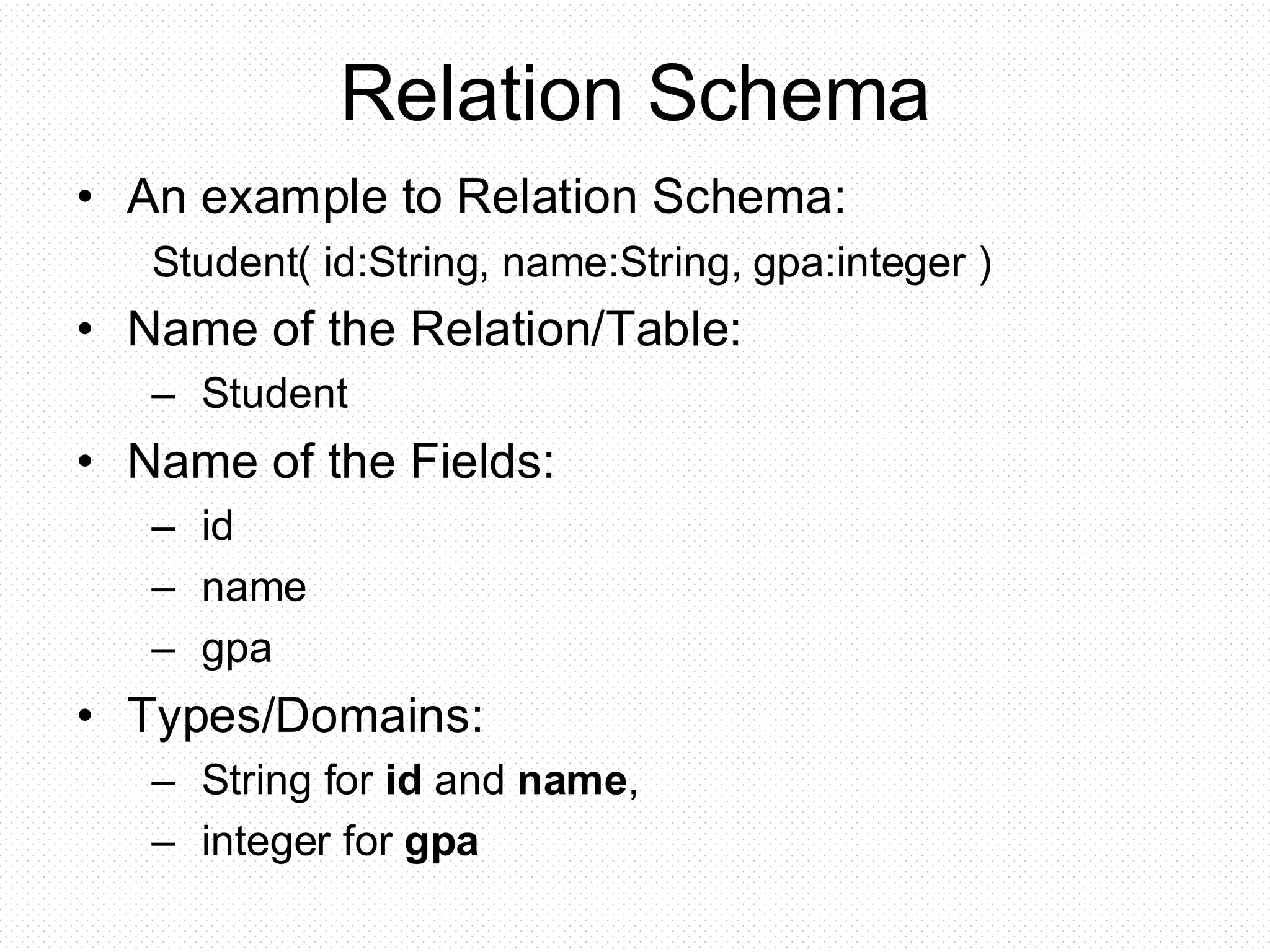
• An example to Relation Schema:
Student( id:String, name:String, gpa:integer )
• Name of the Relation/Table:
– Student
• Name of the Fields:
– id
– name
– gpa
• Types/Domains:
– String for id and name,
– integer for gpa
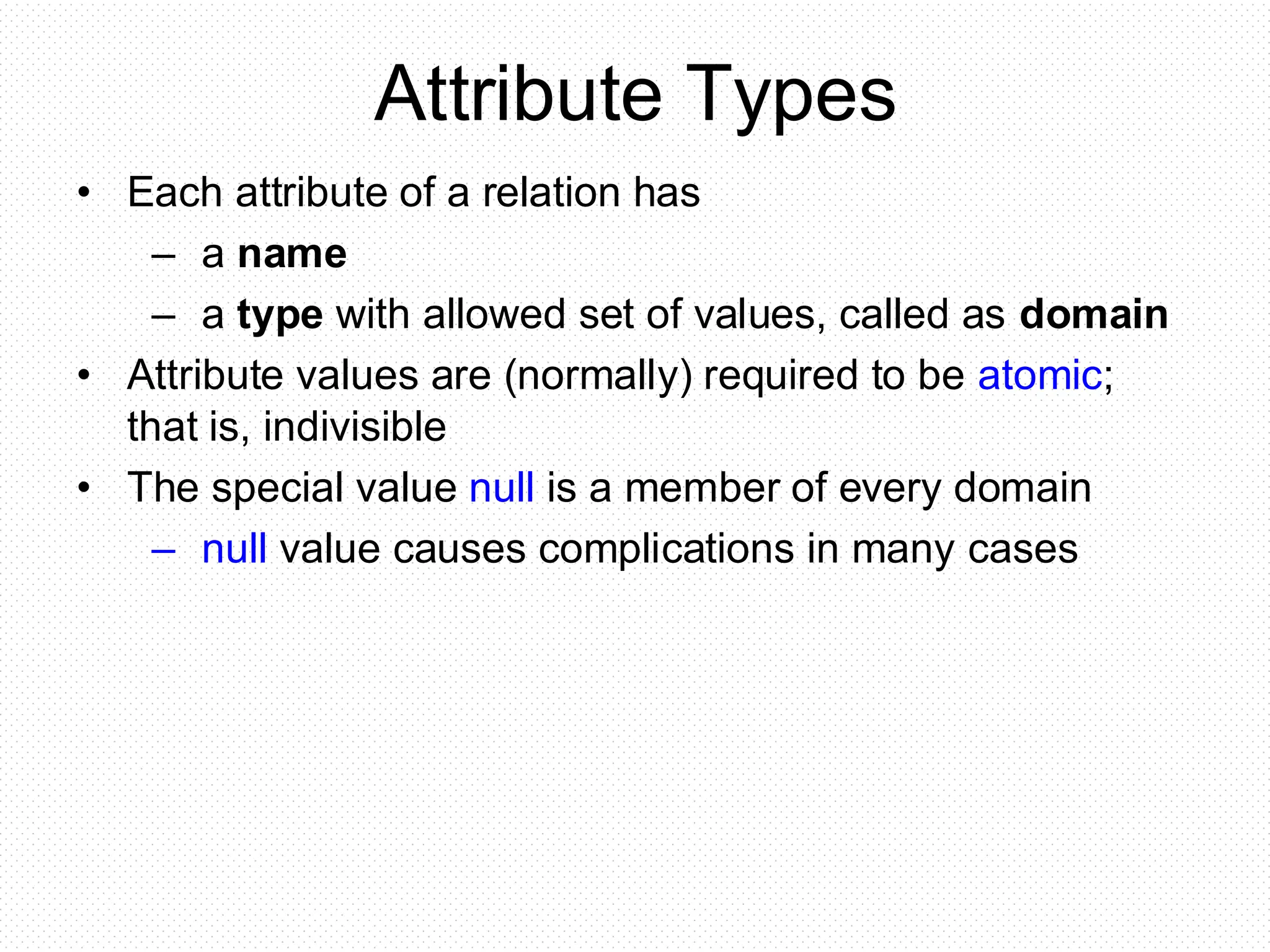
Attribute Types
• Each attribute of a relation has
– a name
– a type with allowed set of values, called as domain
• Attribute values are (normally) required to be atomic;
that is, indivisible
• The special value null is a member of every domain
– null value causes complications in many cases
Table
• A Table is an instance of a Relation
• A Table consists of tuples / records
• Each tuple has to include values of all fields of the
Relation Schema
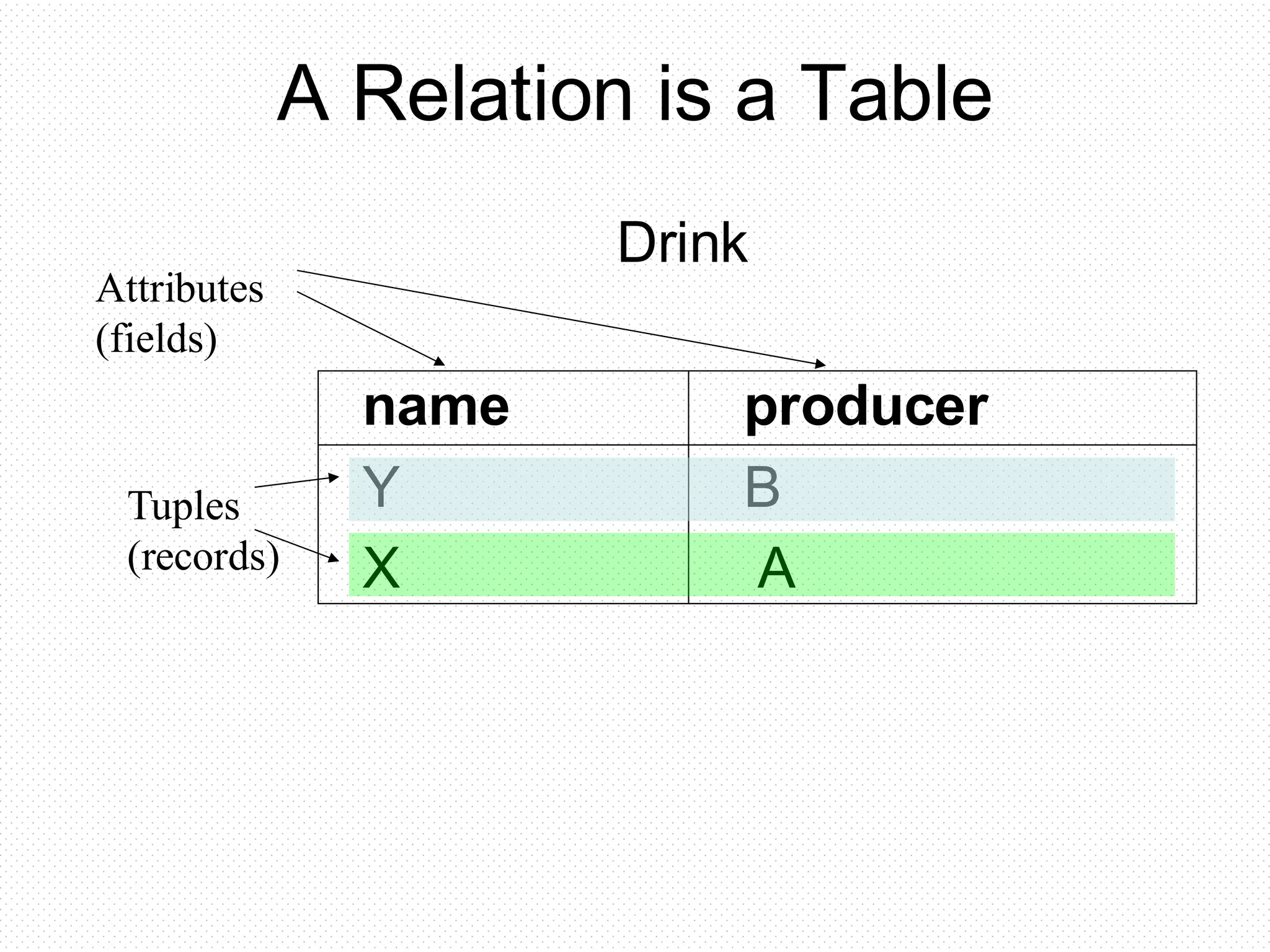
A Relation is a Table
Drink
name producer
Y B
X A
Attributes
(fields)
Tuples
(records)
From E/R Diagrams to Relations
• E/R Diagrams can be transferred to Relational Diagram
almost mechanically
• There exists two components of an E/R diagram which
are to be converted to Relational Model components:
– (Strong & Weak) Entity Set
– Relationship
Entity Set → Table
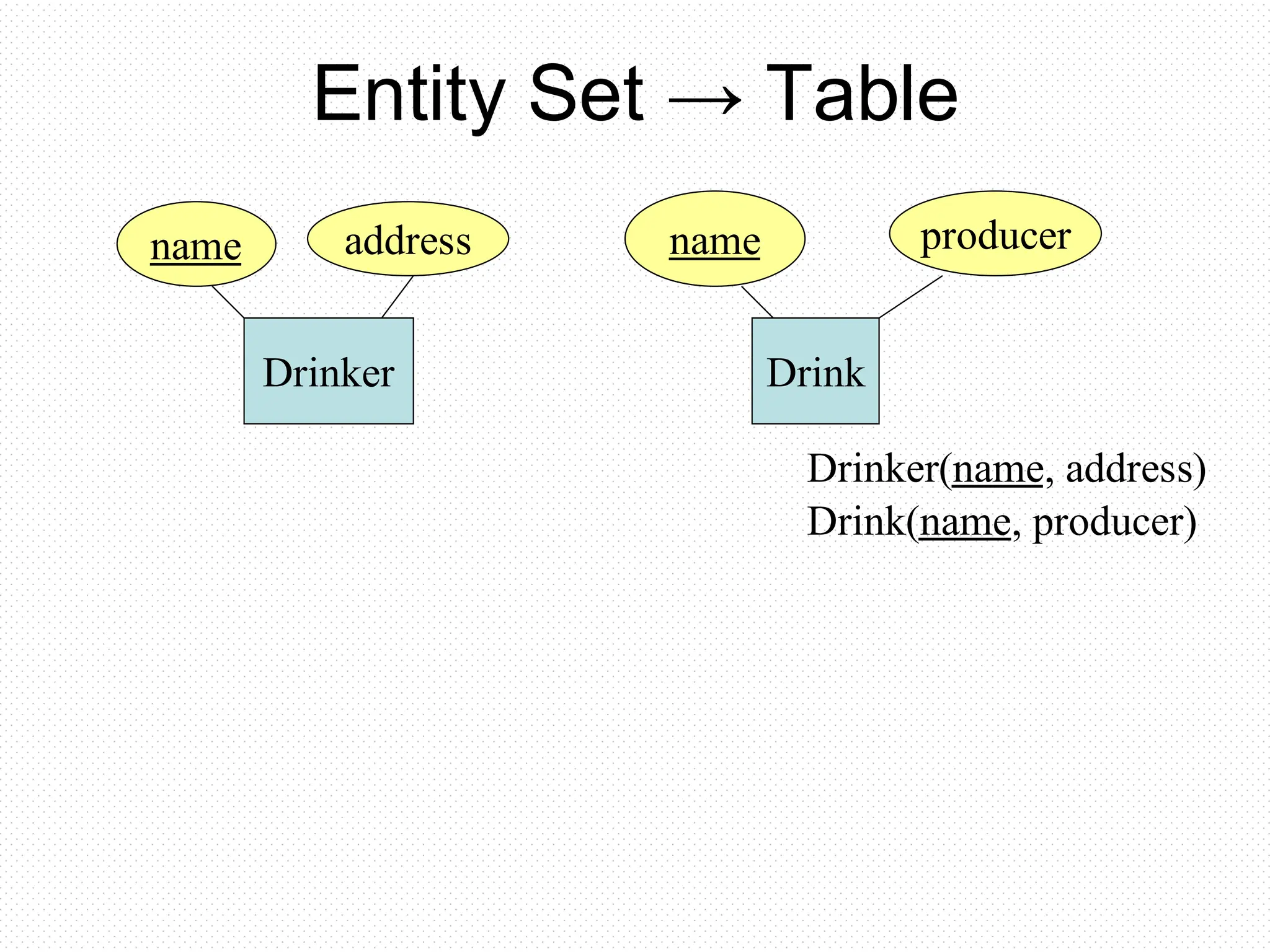
• Each Entity set becomes a table
• Attributes of the Entity set becomes a field of the
corresponding table
Entity Set → Table
Drinker
name address
Drink
name producer
Drinker(name, address)
Drink(name, producer)
Relationship → Table
• Relationships also are transferred into tables
• The created table includes (only and all) attributes of the
related Entity Sets those provide uniqueness (only)
• Hence, the attributes of the entity sets those does not
provide uniqueness are not included within the
corresponding table
Relationship → Table
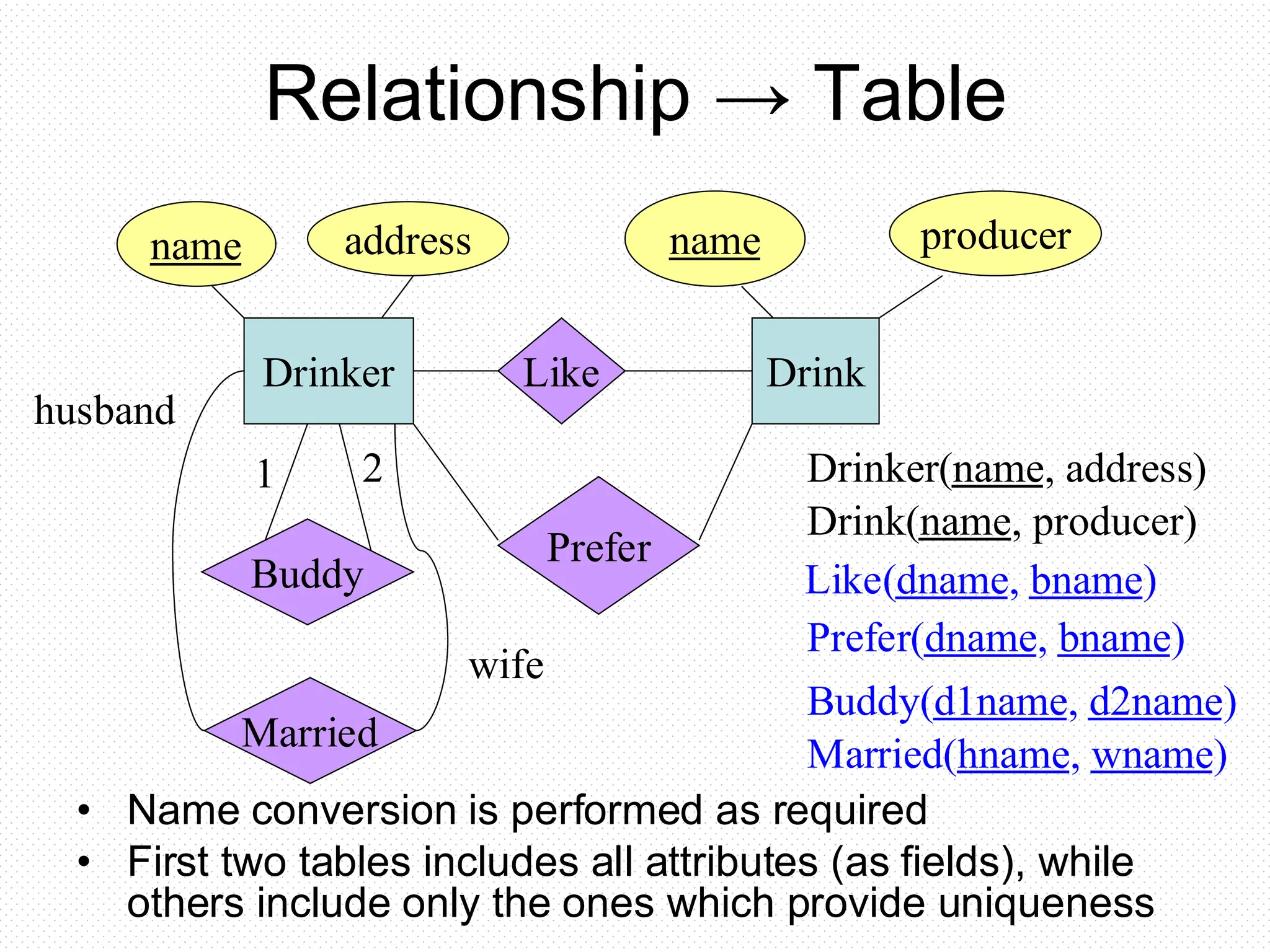
Like(dname, bname)
Prefer(dname, bname)
Married(hname, wname)
Buddy(d1name, d2name)
Prefer
Like
Married
husband
wife
Drinker
name address
Drink
name producer
Buddy
1 2
• Name conversion is performed as required
• First two tables includes all attributes (as fields), while
others include only the ones which provide uniqueness
Drinker(name, address)
Drink(name, producer)
Embedding Relations
• Sometimes Relationships may be embedded, or merged
into one of the Entity Set that is attached before creating
the tables
Embedding Relations
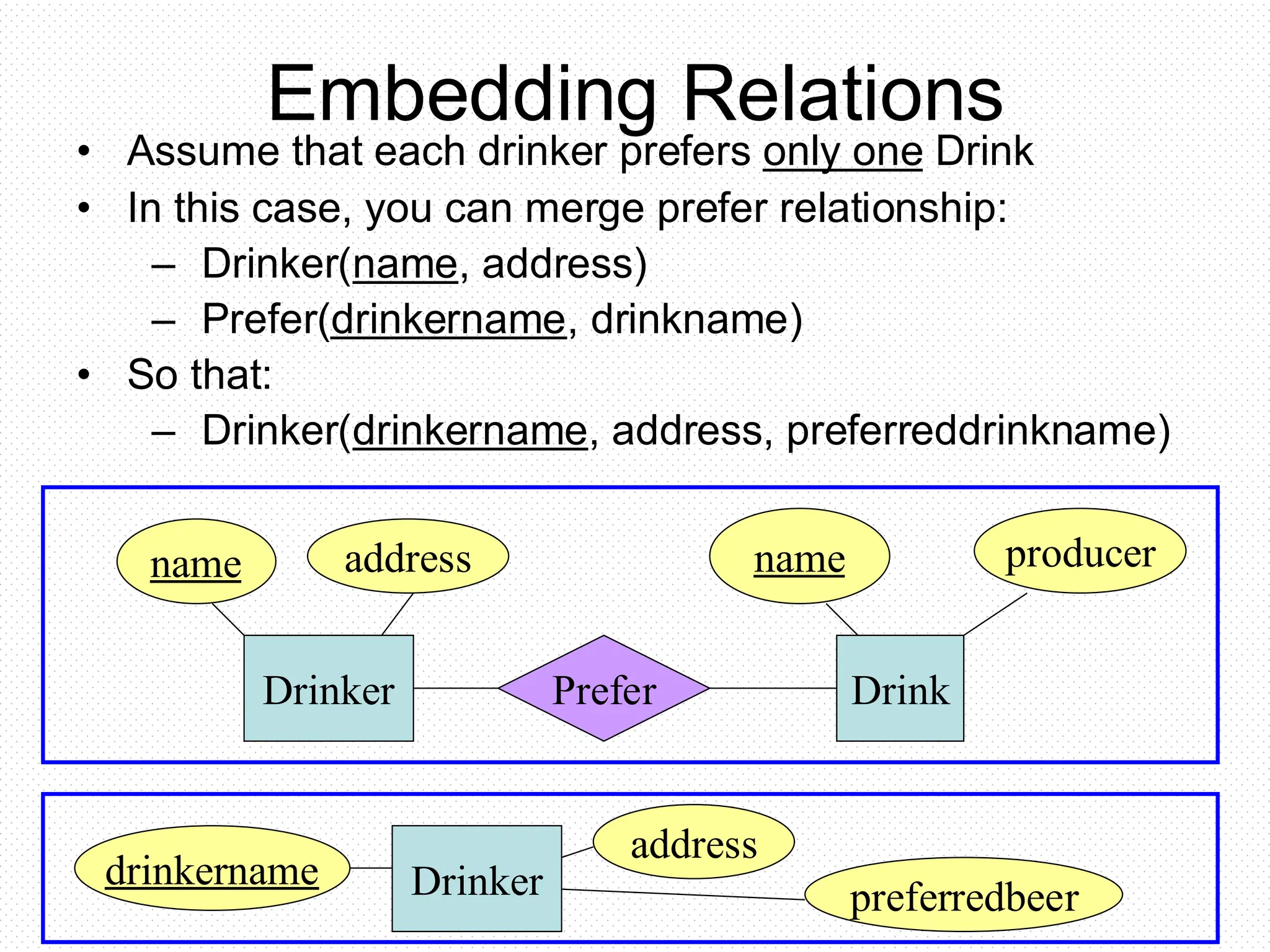
• Assume that each drinker prefers only one Drink
• In this case, you can merge prefer relationship:
– Drinker(name, address)
– Prefer(drinkername, drinkname)
• So that:
– Drinker(drinkername, address, preferreddrinkname)
Prefer
Drinker
name address
Drink
name producer
Drinker
drinkername
address
preferredbeer
Embedding Relations
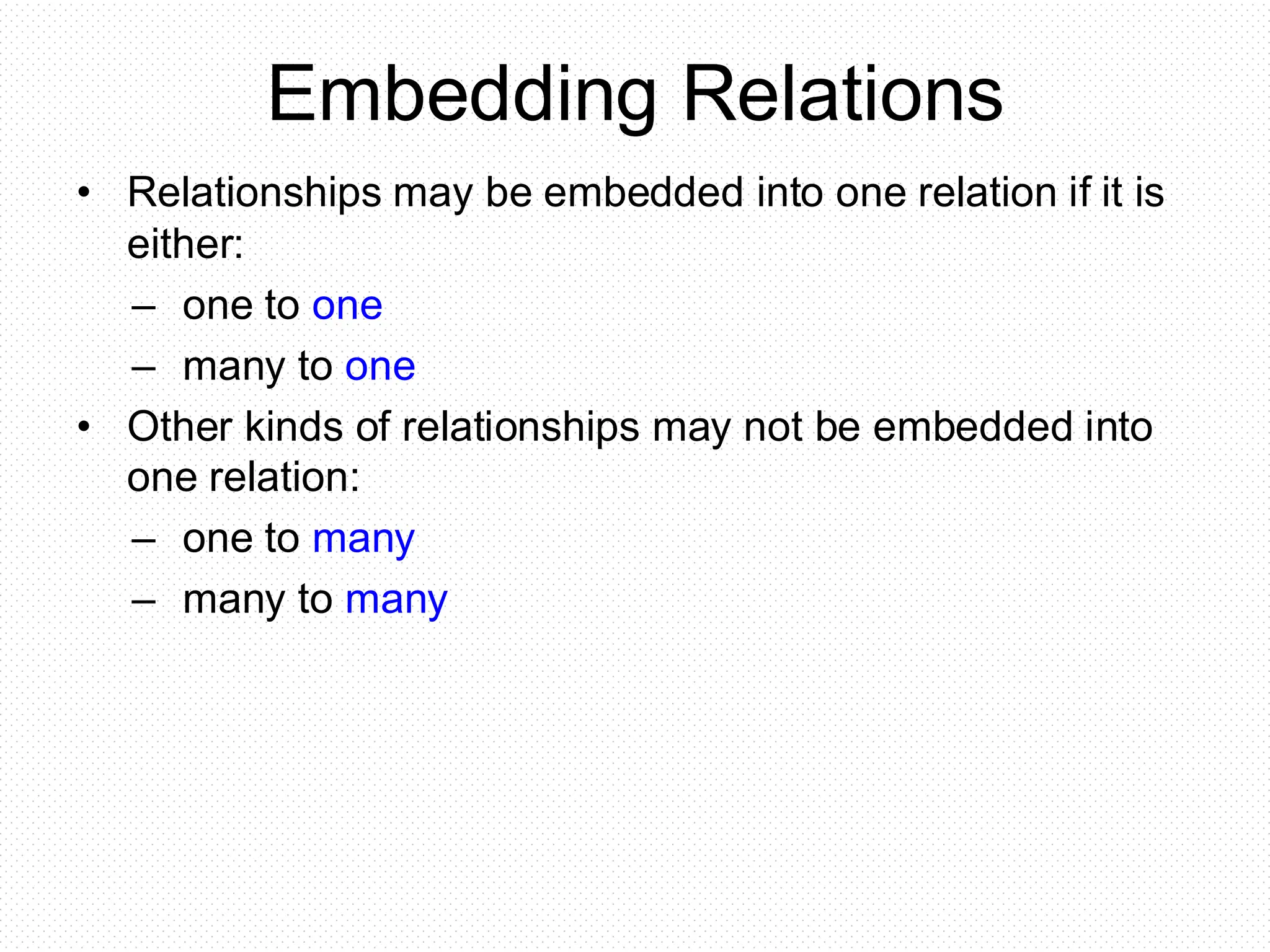
• Relationships may be embedded into one relation if it is
either:
– one to one
– many to one
• Other kinds of relationships may not be embedded into
one relation:
– one to many
– many to many
Risk in Embedding Relations
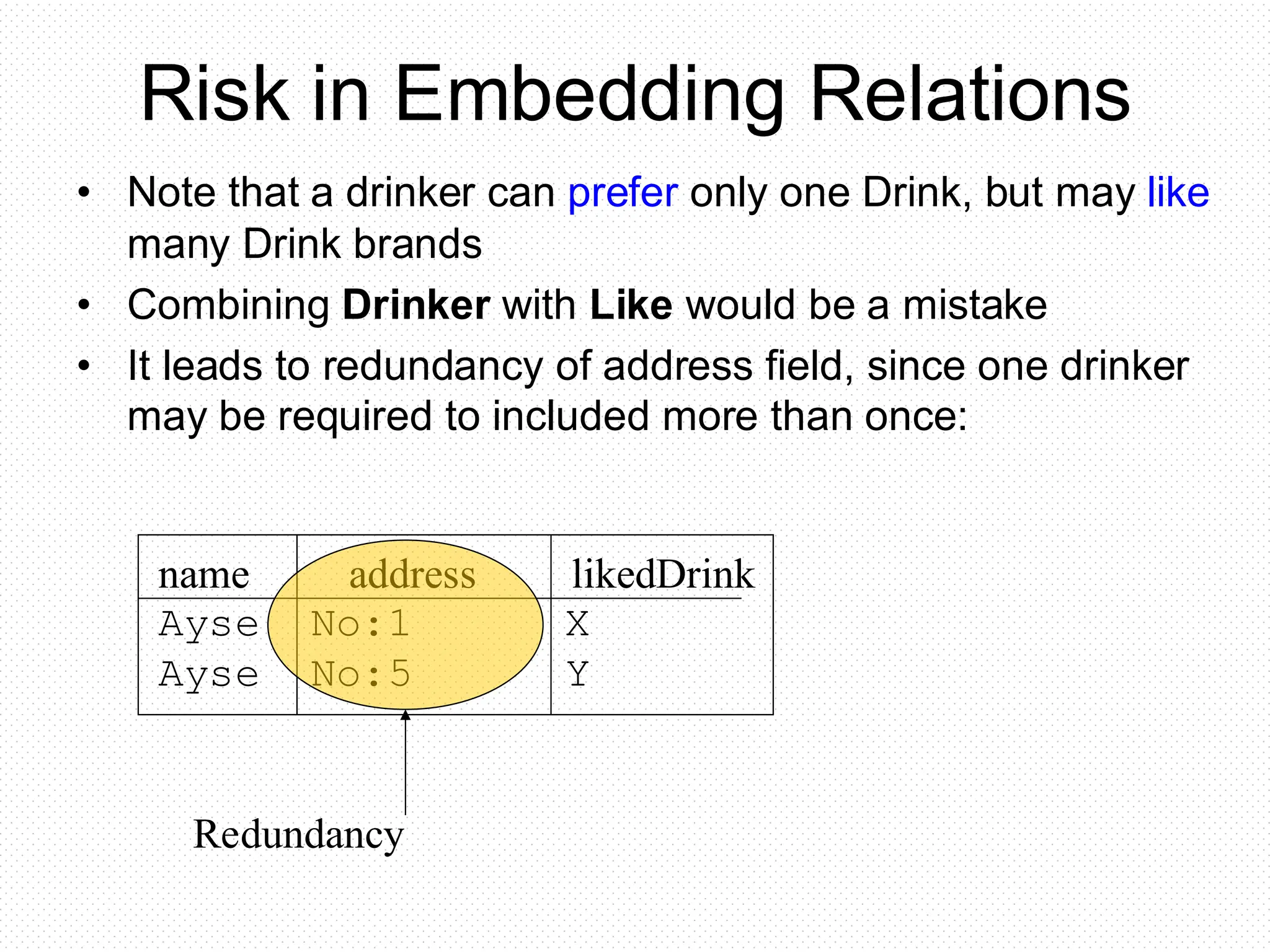
• Note that a drinker can prefer only one Drink, but may like
many Drink brands
• Combining Drinker with Like would be a mistake
• It leads to redundancy of address field, since one drinker
may be required to included more than once:
name address likedDrink
Ayse No:1 X
Ayse No:5 Y
Redundancy
Handling Weak Entity Sets
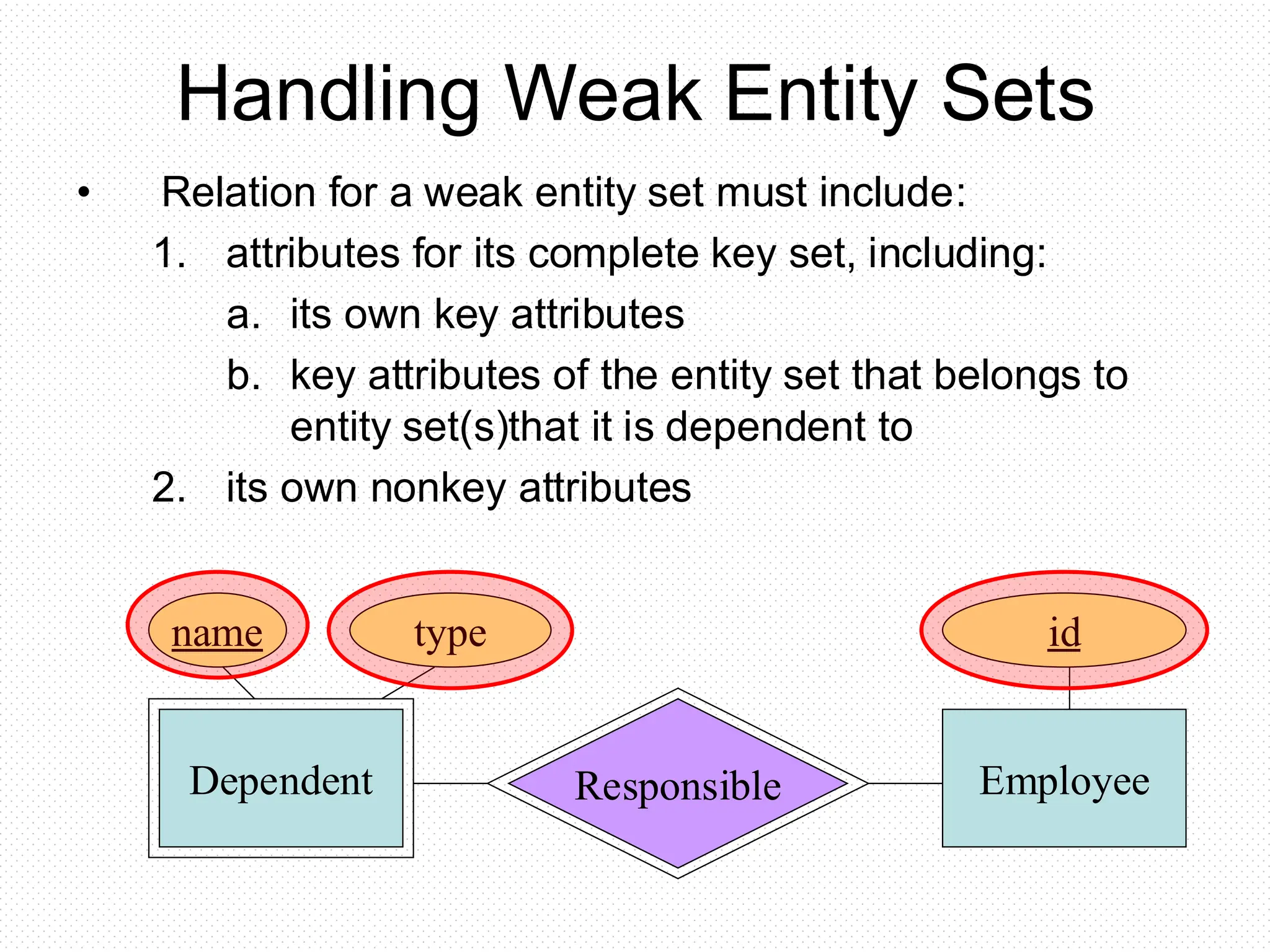
• Relation for a weak entity set must include:
1. attributes for its complete key set, including:
a. its own key attributes
b. key attributes of the entity set that belongs to
entity set(s)that it is dependent to
2. its own nonkey attributes
Responsible
Dependent
name type
Employee
id
Handling Weak Relationships
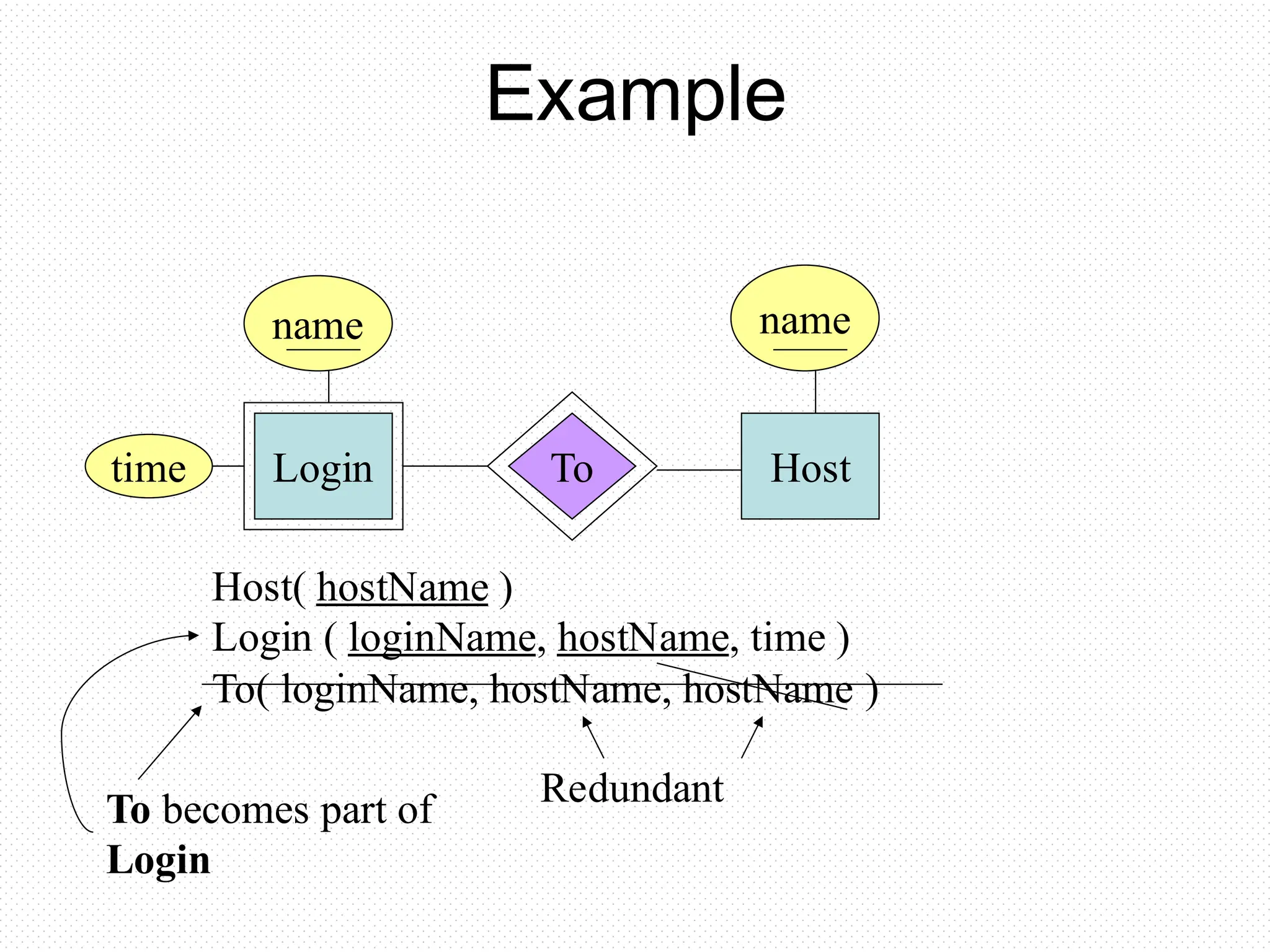
• A weak/supporting/double-diamond relationship is
redundant and yields no relation (table)
Example
Host( hostName )
Login ( loginName, hostName, time )
To( loginName, hostName, hostName )
Redundant
Login Host
To
name name
time
To becomes part of
Login
Thank you. ☺
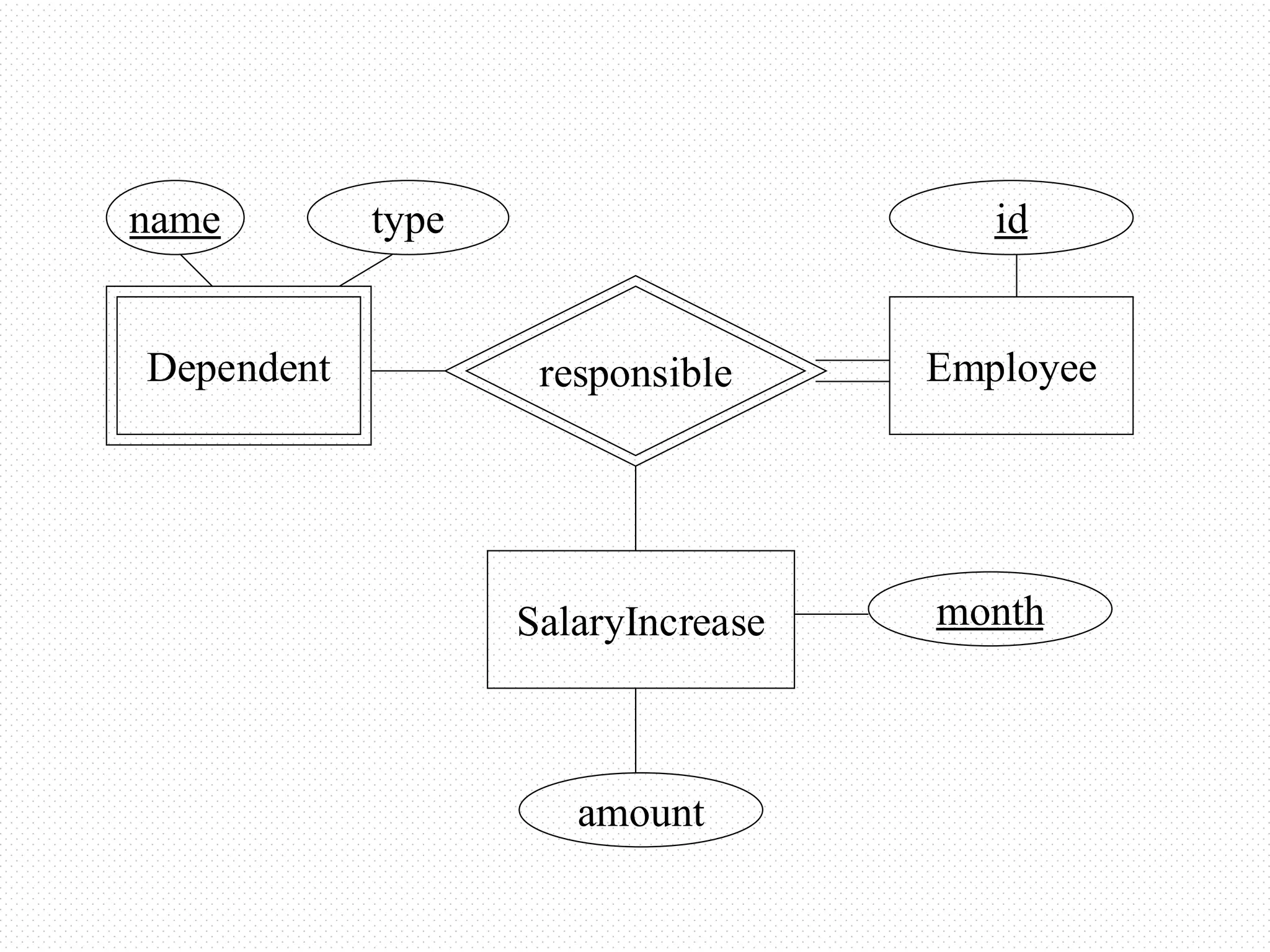
responsible
Dependent
name type
Employee
id
SalaryIncrease month
amount

4 DATABASE MANAGEMENT SYSTEMS RELATIONAL MODEL.pdf

  • 1.
  • 2.
    Relational Model • ADatabase is a collection of relations, where – Each relation is a table, consisting of tuples (records) with given names and types • Two components of a relation: 1. Relation schema, describes properties of the table (meta-data) 2. Relation instance, a table (data) • Sometimes abbreviated as Relation
  • 3.
    Relation Schema • R= (A1, A2, …, An ) is a relation schema • Where: – R is the relation – A1, A2, …, An are attributes
  • 4.
    Relation Schema • Anexample to Relation Schema: Student( id:String, name:String, gpa:integer ) • Name of the Relation/Table: – Student • Name of the Fields: – id – name – gpa • Types/Domains: – String for id and name, – integer for gpa
  • 5.
    Attribute Types • Eachattribute of a relation has – a name – a type with allowed set of values, called as domain • Attribute values are (normally) required to be atomic; that is, indivisible • The special value null is a member of every domain – null value causes complications in many cases
  • 6.
    Table • A Tableis an instance of a Relation • A Table consists of tuples / records • Each tuple has to include values of all fields of the Relation Schema
  • 7.
    A Relation isa Table Drink name producer Y B X A Attributes (fields) Tuples (records)
  • 8.
    From E/R Diagramsto Relations • E/R Diagrams can be transferred to Relational Diagram almost mechanically • There exists two components of an E/R diagram which are to be converted to Relational Model components: – (Strong & Weak) Entity Set – Relationship
  • 9.
    Entity Set →Table • Each Entity set becomes a table • Attributes of the Entity set becomes a field of the corresponding table
  • 10.
    Entity Set →Table Drinker name address Drink name producer Drinker(name, address) Drink(name, producer)
  • 11.
    Relationship → Table •Relationships also are transferred into tables • The created table includes (only and all) attributes of the related Entity Sets those provide uniqueness (only) • Hence, the attributes of the entity sets those does not provide uniqueness are not included within the corresponding table
  • 12.
    Relationship → Table Like(dname,bname) Prefer(dname, bname) Married(hname, wname) Buddy(d1name, d2name) Prefer Like Married husband wife Drinker name address Drink name producer Buddy 1 2 • Name conversion is performed as required • First two tables includes all attributes (as fields), while others include only the ones which provide uniqueness Drinker(name, address) Drink(name, producer)
  • 13.
    Embedding Relations • SometimesRelationships may be embedded, or merged into one of the Entity Set that is attached before creating the tables
  • 14.
    Embedding Relations • Assumethat each drinker prefers only one Drink • In this case, you can merge prefer relationship: – Drinker(name, address) – Prefer(drinkername, drinkname) • So that: – Drinker(drinkername, address, preferreddrinkname) Prefer Drinker name address Drink name producer Drinker drinkername address preferredbeer
  • 15.
    Embedding Relations • Relationshipsmay be embedded into one relation if it is either: – one to one – many to one • Other kinds of relationships may not be embedded into one relation: – one to many – many to many
  • 16.
    Risk in EmbeddingRelations • Note that a drinker can prefer only one Drink, but may like many Drink brands • Combining Drinker with Like would be a mistake • It leads to redundancy of address field, since one drinker may be required to included more than once: name address likedDrink Ayse No:1 X Ayse No:5 Y Redundancy
  • 17.
    Handling Weak EntitySets • Relation for a weak entity set must include: 1. attributes for its complete key set, including: a. its own key attributes b. key attributes of the entity set that belongs to entity set(s)that it is dependent to 2. its own nonkey attributes Responsible Dependent name type Employee id
  • 18.
    Handling Weak Relationships •A weak/supporting/double-diamond relationship is redundant and yields no relation (table)
  • 19.
    Example Host( hostName ) Login( loginName, hostName, time ) To( loginName, hostName, hostName ) Redundant Login Host To name name time To becomes part of Login
  • 20.
  • 21.