24SC2006 - OOP(R) 2
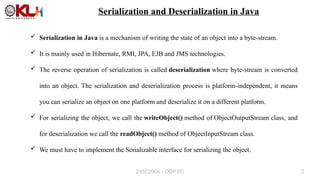
Serialization and Deserialization in Java
Serialization in Java is a mechanism of writing the state of an object into a byte-stream.
It is mainly used in Hibernate, RMI, JPA, EJB and JMS technologies.
The reverse operation of serialization is called deserialization where byte-stream is converted
into an object. The serialization and deserialization process is platform-independent, it means
you can serialize an object on one platform and deserialize it on a different platform.
For serializing the object, we call the writeObject() method of ObjectOutputStream class, and
for deserialization we call the readObject() method of ObjectInputStream class.
We must have to implement the Serializable interface for serializing the object.
3.
24SC2006 - OOP(R) 3
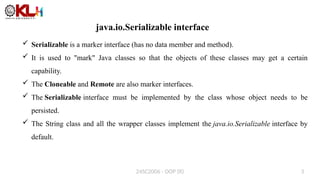
Serializable is a marker interface (has no data member and method).
It is used to "mark" Java classes so that the objects of these classes may get a certain
capability.
The Cloneable and Remote are also marker interfaces.
The Serializable interface must be implemented by the class whose object needs to be
persisted.
The String class and all the wrapper classes implement the java.io.Serializable interface by
default.
java.io.Serializable interface
4.
24SC2006 - OOP(R) 4
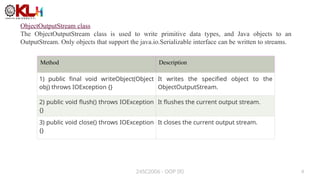
Method Description
1) public final void writeObject(Object
obj) throws IOException {}
It writes the specified object to the
ObjectOutputStream.
2) public void flush() throws IOException
{}
It flushes the current output stream.
3) public void close() throws IOException
{}
It closes the current output stream.
ObjectOutputStream class
The ObjectOutputStream class is used to write primitive data types, and Java objects to an
OutputStream. Only objects that support the java.io.Serializable interface can be written to streams.
5.
24SC2006 - OOP(R) 5
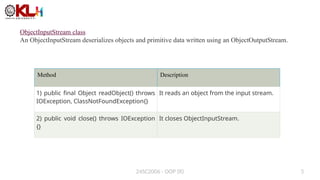
Method Description
1) public final Object readObject() throws
IOException, ClassNotFoundException{}
It reads an object from the input stream.
2) public void close() throws IOException
{}
It closes ObjectInputStream.
ObjectInputStream class
An ObjectInputStream deserializes objects and primitive data written using an ObjectOutputStream.
6.
24SC2006 - OOP(R) 6
import java.io.Serializable;
public class Student implements Serializable{
int id;
String name;
public Student(int id, String name) {
this.id = id;
this.name = name;
} }
import java.io.*;
class Ser{
public static void main(String args[]){
try{
//Creating the object
Student s1 =new Student(211,"ravi");
//Creating stream and writing the object
FileOutputStream fout=new FileOutputStream("f.txt");
ObjectOutputStream out=new ObjectOutputStream(fout);
out.writeObject(s1);
out.flush();
out.close();
System.out.println("success");
}
catch(Exception e)
{
System.out.println(e);
}
}
}
![24SC2006 - OOP (R) 6
import java.io.Serializable;
public class Student implements Serializable{
int id;
String name;
public Student(int id, String name) {
this.id = id;
this.name = name;
} }
import java.io.*;
class Ser{
public static void main(String args[]){
try{
//Creating the object
Student s1 =new Student(211,"ravi");
//Creating stream and writing the object
FileOutputStream fout=new FileOutputStream("f.txt");
ObjectOutputStream out=new ObjectOutputStream(fout);
out.writeObject(s1);
out.flush();
out.close();
System.out.println("success");
}
catch(Exception e)
{
System.out.println(e);
}
}
}](https://image.slidesharecdn.com/39-objectserializationanddeserialization-251127125817-9e0a7f23/85/39-Object-Serialization-and-Deserialization-pptx-6-320.jpg)