Orbital NotationOrbital Notation
Props to Mr. Smyk for giving this to me.
What is Orbital NotationWhat is Orbital Notation
 Orbital notation is a visual transformationOrbital notation is a visual transformation
of the electron configuration.of the electron configuration.
 Orbital notation shows you where eachOrbital notation shows you where each
specific electron is placed (in order) andspecific electron is placed (in order) and
what it’s “spin” is.what it’s “spin” is.
Vocabulary List CheckVocabulary List Check
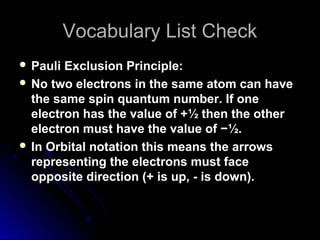
 Pauli Exclusion Principle:Pauli Exclusion Principle:
 No two electrons in the same atom can have
the same spin quantum number. If one
electron has the value of +½ then the other
electron must have the value of −½.
 In Orbital notation this means the arrows
representing the electrons must face
opposite direction (+ is up, - is down).
Vocabulary List CheckVocabulary List Check
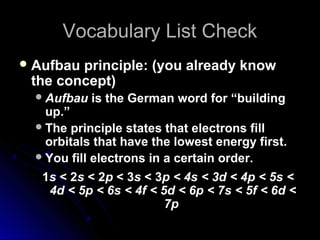
 Aufbau principle: (you already knowAufbau principle: (you already know
the concept)the concept)
Aufbau is the German word for “building
up.”
The principle states that electrons fill
orbitals that have the lowest energy first.
You fill electrons in a certain order.
11ss < 2< 2ss < 2< 2pp < 3< 3ss < 3< 3p < 4s < 3d < 4p < 5s <p < 4s < 3d < 4p < 5s <
4d < 5p < 6s < 4f < 5d < 6p < 7s < 5f < 6d <4d < 5p < 6s < 4f < 5d < 6p < 7s < 5f < 6d <
7p7p
Vocabulary List CheckVocabulary List Check
 Hund’s Rule:Hund’s Rule:
 The rule that states that for an atom in the
ground state, the number of unpaired
electrons is the maximum possible and these
unpaired electrons have the same spin.
 What?
 You must share your electrons. “Everybody
gets one before anyone gets two.”
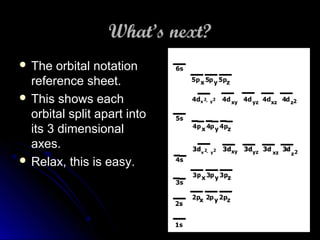
What’s next?What’s next?
 The orbital notationThe orbital notation
reference sheet.reference sheet.
 This shows eachThis shows each
orbital split apart intoorbital split apart into
its 3 dimensionalits 3 dimensional
axes.axes.
 Relax, this is easy.Relax, this is easy.
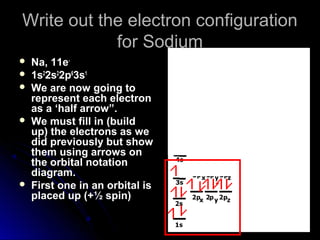
Write out the electron configurationWrite out the electron configuration
for Sodiumfor Sodium
 Na, 11eNa, 11e--
 1s1s22
2s2s22
2p2p66
3s3s11
 We are now going toWe are now going to
represent each electronrepresent each electron
as a ‘half arrow”.as a ‘half arrow”.
 We must fill in (buildWe must fill in (build
up) the electrons as weup) the electrons as we
did previously but showdid previously but show
them using arrows onthem using arrows on
the orbital notationthe orbital notation
diagram.diagram.
 First one in an orbital isFirst one in an orbital is
placed up (+placed up (+½½ spin)spin)
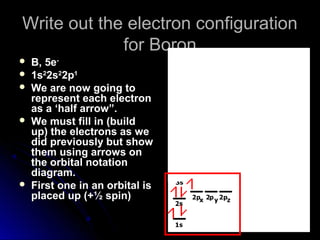
Write out the electron configurationWrite out the electron configuration
for Boronfor Boron
 B, 5eB, 5e--
 1s1s22
2s2s22
2p2p11
 We are now going toWe are now going to
represent each electronrepresent each electron
as a ‘half arrow”.as a ‘half arrow”.
 We must fill in (buildWe must fill in (build
up) the electrons as weup) the electrons as we
did previously but showdid previously but show
them using arrows onthem using arrows on
the orbital notationthe orbital notation
diagram.diagram.
 First one in an orbital isFirst one in an orbital is
placed up (+placed up (+½½ spin)spin)
Write out the electron configurationWrite out the electron configuration
for Titaniumfor Titanium
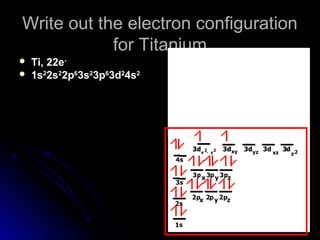
 Ti, 22eTi, 22e--
 1s1s22
2s2s22
2p2p66
3s3s22
3p3p66
3d3d22
4s4s22
On your own. CalciumOn your own. Calcium
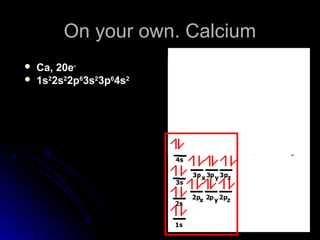
 Ca, 20eCa, 20e--
 1s1s22
2s2s22
2p2p66
3s3s22
3p3p66
4s4s22
HomeworkHomework
 Complete the Electron ConfigurationComplete the Electron Configuration
Homework WKST.Homework WKST.

3.3 orbital notation

  • 1.
    Orbital NotationOrbital Notation Propsto Mr. Smyk for giving this to me.
  • 2.
    What is OrbitalNotationWhat is Orbital Notation  Orbital notation is a visual transformationOrbital notation is a visual transformation of the electron configuration.of the electron configuration.  Orbital notation shows you where eachOrbital notation shows you where each specific electron is placed (in order) andspecific electron is placed (in order) and what it’s “spin” is.what it’s “spin” is.
  • 3.
    Vocabulary List CheckVocabularyList Check  Pauli Exclusion Principle:Pauli Exclusion Principle:  No two electrons in the same atom can have the same spin quantum number. If one electron has the value of +½ then the other electron must have the value of −½.  In Orbital notation this means the arrows representing the electrons must face opposite direction (+ is up, - is down).
  • 4.
    Vocabulary List CheckVocabularyList Check  Aufbau principle: (you already knowAufbau principle: (you already know the concept)the concept) Aufbau is the German word for “building up.” The principle states that electrons fill orbitals that have the lowest energy first. You fill electrons in a certain order. 11ss < 2< 2ss < 2< 2pp < 3< 3ss < 3< 3p < 4s < 3d < 4p < 5s <p < 4s < 3d < 4p < 5s < 4d < 5p < 6s < 4f < 5d < 6p < 7s < 5f < 6d <4d < 5p < 6s < 4f < 5d < 6p < 7s < 5f < 6d < 7p7p
  • 5.
    Vocabulary List CheckVocabularyList Check  Hund’s Rule:Hund’s Rule:  The rule that states that for an atom in the ground state, the number of unpaired electrons is the maximum possible and these unpaired electrons have the same spin.  What?  You must share your electrons. “Everybody gets one before anyone gets two.”
  • 6.
    What’s next?What’s next? The orbital notationThe orbital notation reference sheet.reference sheet.  This shows eachThis shows each orbital split apart intoorbital split apart into its 3 dimensionalits 3 dimensional axes.axes.  Relax, this is easy.Relax, this is easy.
  • 7.
    Write out theelectron configurationWrite out the electron configuration for Sodiumfor Sodium  Na, 11eNa, 11e--  1s1s22 2s2s22 2p2p66 3s3s11  We are now going toWe are now going to represent each electronrepresent each electron as a ‘half arrow”.as a ‘half arrow”.  We must fill in (buildWe must fill in (build up) the electrons as weup) the electrons as we did previously but showdid previously but show them using arrows onthem using arrows on the orbital notationthe orbital notation diagram.diagram.  First one in an orbital isFirst one in an orbital is placed up (+placed up (+½½ spin)spin)
  • 8.
    Write out theelectron configurationWrite out the electron configuration for Boronfor Boron  B, 5eB, 5e--  1s1s22 2s2s22 2p2p11  We are now going toWe are now going to represent each electronrepresent each electron as a ‘half arrow”.as a ‘half arrow”.  We must fill in (buildWe must fill in (build up) the electrons as weup) the electrons as we did previously but showdid previously but show them using arrows onthem using arrows on the orbital notationthe orbital notation diagram.diagram.  First one in an orbital isFirst one in an orbital is placed up (+placed up (+½½ spin)spin)
  • 9.
    Write out theelectron configurationWrite out the electron configuration for Titaniumfor Titanium  Ti, 22eTi, 22e--  1s1s22 2s2s22 2p2p66 3s3s22 3p3p66 3d3d22 4s4s22
  • 10.
    On your own.CalciumOn your own. Calcium  Ca, 20eCa, 20e--  1s1s22 2s2s22 2p2p66 3s3s22 3p3p66 4s4s22
  • 11.
    HomeworkHomework  Complete theElectron ConfigurationComplete the Electron Configuration Homework WKST.Homework WKST.