What is Electronic
Configuration?
In atomic physics and quantum chemistry,
the electron configuration is the distribution of
electrons of an atom or molecule (or other physical
structure) in atomic or molecular orbitals.
How electrons are arranged
around the nucleus of an atom?
• The number of protons in the atom of
an element determines its place in the
Periodic Table.
• The number of electrons in an atom is
the same as the number of protons.
These electrons are arranged in shells or
'energy levels' around the nucleus.
What are the Subshells?
• A subshell is a subdivision of electron
shells or energy levels separated by
electron orbitals.
• Subshells are labelled s, p, d, and f in an
electron configuration. Examples: The first
electron shell is the 1s subshell. The
second shell of electrons contains the 2s
and 2p subshells.
1
2
3
4
5
6
7
6
7
1A
2A
3B 4B 5B 6B 7B 8B 8B 8B 1B 2B
3A 4A 5A 6A 7A
8Agroup # = # valence (outside) e-
d p
f
s
Row
=
# shells
• The block names (s, p, d, f and g) are
derived from the spectroscopic notation
for the associated atomic orbitals
: sharp, principal, diffuse and fundamental
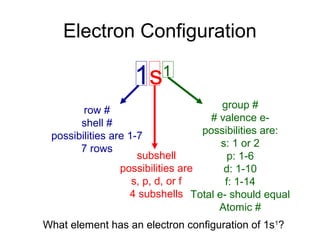
Electron Configuration
1s1
row #
shell #
possibilities are 1-7
7 rows
subshell
possibilities are
s, p, d, or f
4 subshells
group #
# valence e-
possibilities are:
s: 1 or 2
p: 1-6
d: 1-10
f: 1-14
Total e- should equal
Atomic #
1
2
3
4
5
6
7
6
7
period#=#e-shells
1A
2A
3B 4B 5B 6B 7B 8B 8B 8B 1B 2B
3A 4A 5A 6A 7A
8Agroup # = # valence e-
d
f
3d
4d
5d
6d
4f
5f
Subshells d and f are “special”
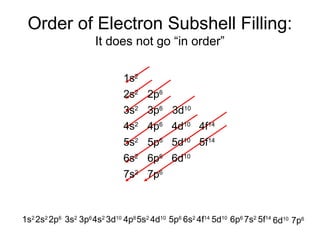
Order of Electron Subshell Filling:
It does not go “in order”
1s2
2s2
2p6
3p6
4p6
5p6
6p6
7p6
3s2
4s2
5s2
6s2
7s2
3d10
4d10
5d10
6d10
4f14
5f14
1s2
2s2
2p6
3p6
3s2
4s2
4p6
5s2
3d10
5p6
6s2
4d10
6p6
7s2
5d10
4f14
7p6
6d105f14
Electron Configuration
1s1
row #
shell #
possibilities are 1-7
7 rows
subshell
possibilities are
s, p, d, or f
4 subshells
group #
# valence e-
possibilities are:
s: 1 or 2
p: 1-6
d: 1-10
f: 1-14
Total e- should equal
Atomic #
What element has an electron configuration of 1s1
?
Practice:
Ask these questions every time you have to write an
electron configuration
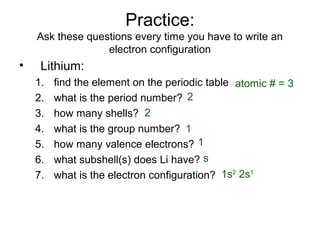
• Lithium:
1. find the element on the periodic table
2. what is the period number?
3. how many shells?
4. what is the group number?
5. how many valence electrons?
6. what subshell(s) does Li have?
7. what is the electron configuration?
atomic # = 3
2
2
1
1
s
1s2
2s1
Practice:
Ask these questions every time you have to write an
electron configuration
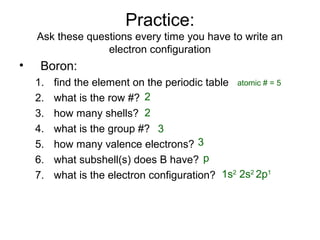
• Boron:
1. find the element on the periodic table
2. what is the row #?
3. how many shells?
4. what is the group #?
5. how many valence electrons?
6. what subshell(s) does B have?
7. what is the electron configuration?
atomic # = 5
2
2
3
3
p
1s2
2s2
2p1
Practice:
Ask these questions every time you have to write an
electron configuration
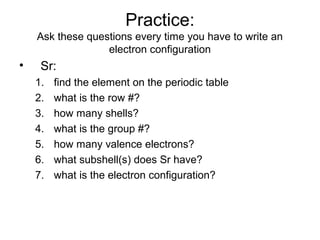
• Sr:
1. find the element on the periodic table
2. what is the row #?
3. how many shells?
4. what is the group #?
5. how many valence electrons?
6. what subshell(s) does Sr have?
7. what is the electron configuration?
Practice:
Ask these questions every time you have to write an
electron configuration
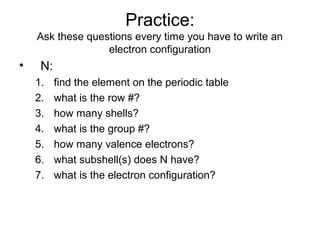
• N:
1. find the element on the periodic table
2. what is the row #?
3. how many shells?
4. what is the group #?
5. how many valence electrons?
6. what subshell(s) does N have?
7. what is the electron configuration?
Practice:
Ask these questions every time you have to write an
electron configuration
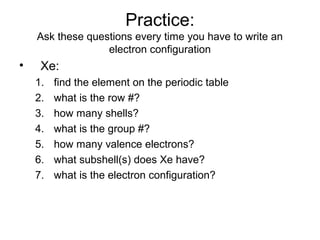
• Xe:
1. find the element on the periodic table
2. what is the row #?
3. how many shells?
4. what is the group #?
5. how many valence electrons?
6. what subshell(s) does Xe have?
7. what is the electron configuration?
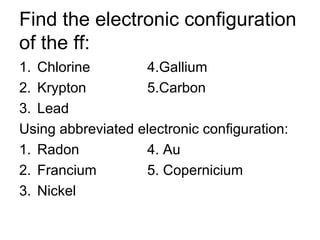
Find the electronic configuration
of the ff:
1. Chlorine 4.Gallium
2. Krypton 5.Carbon
3. Lead
Using abbreviated electronic configuration:
1. Radon 4. Au
2. Francium 5. Copernicium
3. Nickel

Electronic Configuration

  • 1.
    What is Electronic Configuration? Inatomic physics and quantum chemistry, the electron configuration is the distribution of electrons of an atom or molecule (or other physical structure) in atomic or molecular orbitals.
  • 2.
    How electrons arearranged around the nucleus of an atom? • The number of protons in the atom of an element determines its place in the Periodic Table. • The number of electrons in an atom is the same as the number of protons. These electrons are arranged in shells or 'energy levels' around the nucleus.
  • 3.
    What are theSubshells? • A subshell is a subdivision of electron shells or energy levels separated by electron orbitals. • Subshells are labelled s, p, d, and f in an electron configuration. Examples: The first electron shell is the 1s subshell. The second shell of electrons contains the 2s and 2p subshells.
  • 4.
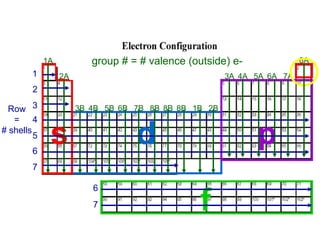
    1 2 3 4 5 6 7 6 7 1A 2A 3B 4B 5B6B 7B 8B 8B 8B 1B 2B 3A 4A 5A 6A 7A 8Agroup # = # valence (outside) e- d p f s Row = # shells
  • 5.
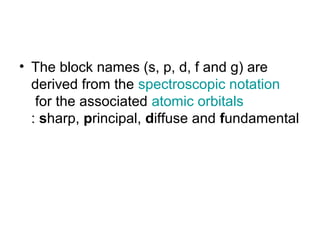
    • The blocknames (s, p, d, f and g) are derived from the spectroscopic notation for the associated atomic orbitals : sharp, principal, diffuse and fundamental
  • 6.
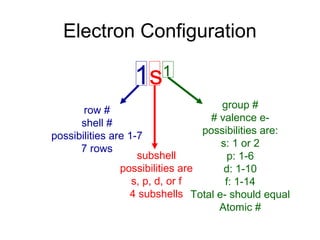
    Electron Configuration 1s1 row # shell# possibilities are 1-7 7 rows subshell possibilities are s, p, d, or f 4 subshells group # # valence e- possibilities are: s: 1 or 2 p: 1-6 d: 1-10 f: 1-14 Total e- should equal Atomic #
  • 7.
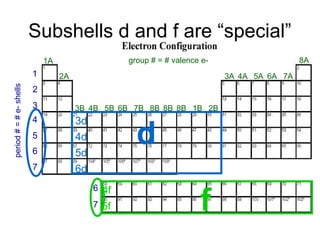
    1 2 3 4 5 6 7 6 7 period#=#e-shells 1A 2A 3B 4B 5B6B 7B 8B 8B 8B 1B 2B 3A 4A 5A 6A 7A 8Agroup # = # valence e- d f 3d 4d 5d 6d 4f 5f Subshells d and f are “special”
  • 8.
    Order of ElectronSubshell Filling: It does not go “in order” 1s2 2s2 2p6 3p6 4p6 5p6 6p6 7p6 3s2 4s2 5s2 6s2 7s2 3d10 4d10 5d10 6d10 4f14 5f14 1s2 2s2 2p6 3p6 3s2 4s2 4p6 5s2 3d10 5p6 6s2 4d10 6p6 7s2 5d10 4f14 7p6 6d105f14
  • 9.
    Electron Configuration 1s1 row # shell# possibilities are 1-7 7 rows subshell possibilities are s, p, d, or f 4 subshells group # # valence e- possibilities are: s: 1 or 2 p: 1-6 d: 1-10 f: 1-14 Total e- should equal Atomic # What element has an electron configuration of 1s1 ?
  • 10.
    Practice: Ask these questionsevery time you have to write an electron configuration • Lithium: 1. find the element on the periodic table 2. what is the period number? 3. how many shells? 4. what is the group number? 5. how many valence electrons? 6. what subshell(s) does Li have? 7. what is the electron configuration? atomic # = 3 2 2 1 1 s 1s2 2s1
  • 11.
    Practice: Ask these questionsevery time you have to write an electron configuration • Boron: 1. find the element on the periodic table 2. what is the row #? 3. how many shells? 4. what is the group #? 5. how many valence electrons? 6. what subshell(s) does B have? 7. what is the electron configuration? atomic # = 5 2 2 3 3 p 1s2 2s2 2p1
  • 12.
    Practice: Ask these questionsevery time you have to write an electron configuration • Sr: 1. find the element on the periodic table 2. what is the row #? 3. how many shells? 4. what is the group #? 5. how many valence electrons? 6. what subshell(s) does Sr have? 7. what is the electron configuration?
  • 13.
    Practice: Ask these questionsevery time you have to write an electron configuration • N: 1. find the element on the periodic table 2. what is the row #? 3. how many shells? 4. what is the group #? 5. how many valence electrons? 6. what subshell(s) does N have? 7. what is the electron configuration?
  • 14.
    Practice: Ask these questionsevery time you have to write an electron configuration • Xe: 1. find the element on the periodic table 2. what is the row #? 3. how many shells? 4. what is the group #? 5. how many valence electrons? 6. what subshell(s) does Xe have? 7. what is the electron configuration?
  • 16.
    Find the electronicconfiguration of the ff: 1. Chlorine 4.Gallium 2. Krypton 5.Carbon 3. Lead Using abbreviated electronic configuration: 1. Radon 4. Au 2. Francium 5. Copernicium 3. Nickel