Warm-Up What is the symbol for the following elements. Gold Au Aluminum Al Sodium Na Lithium Li
3-1 – Atomic Theories Objectives Describe  the four main models of the atom and  explain  how each was discovered.
 
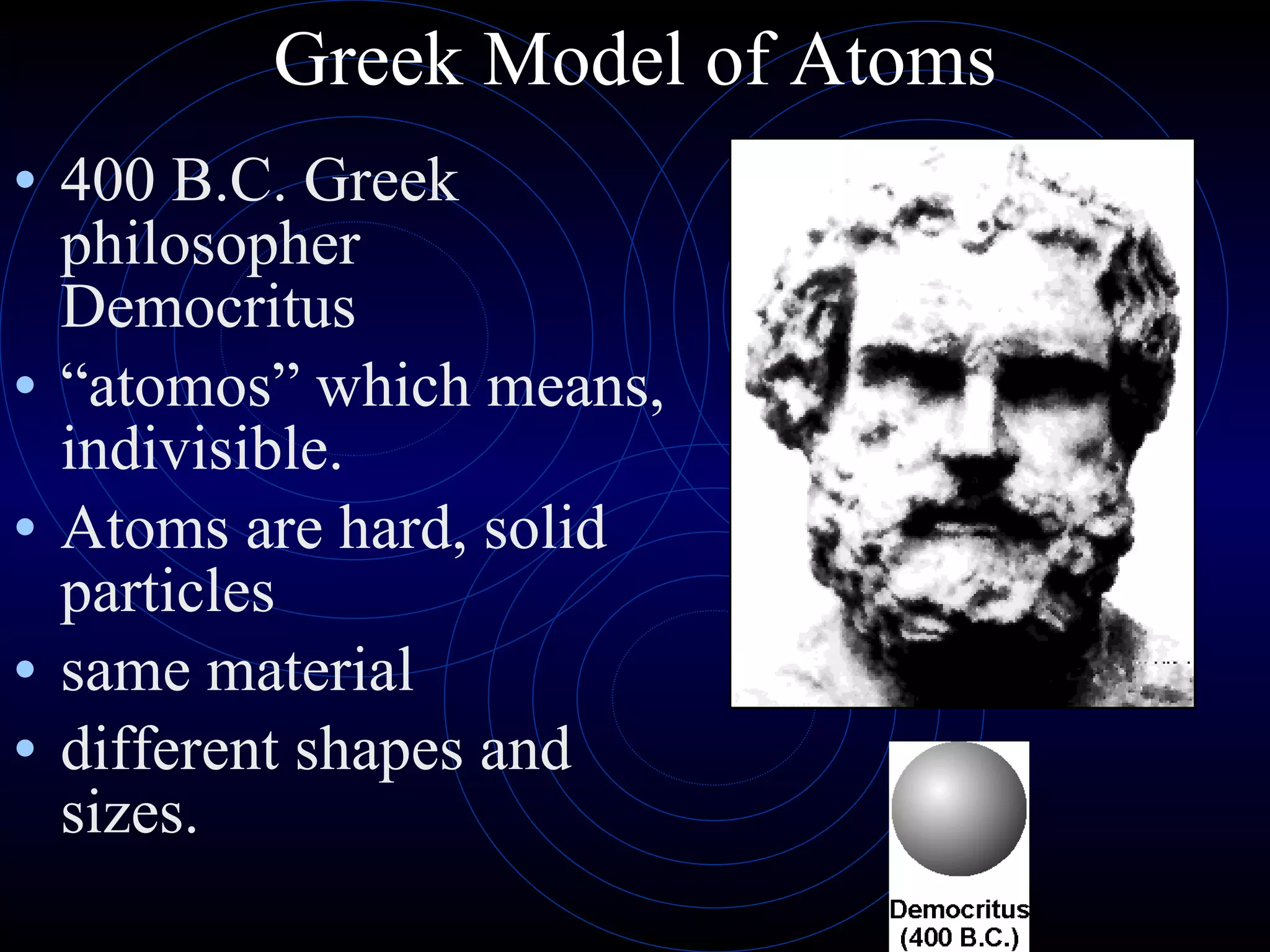
Greek Model of Atoms 400 B.C. Greek philosopher  Democritus “ atomos” which means, indivisible. Atoms are hard, solid particles same material  different shapes and sizes.
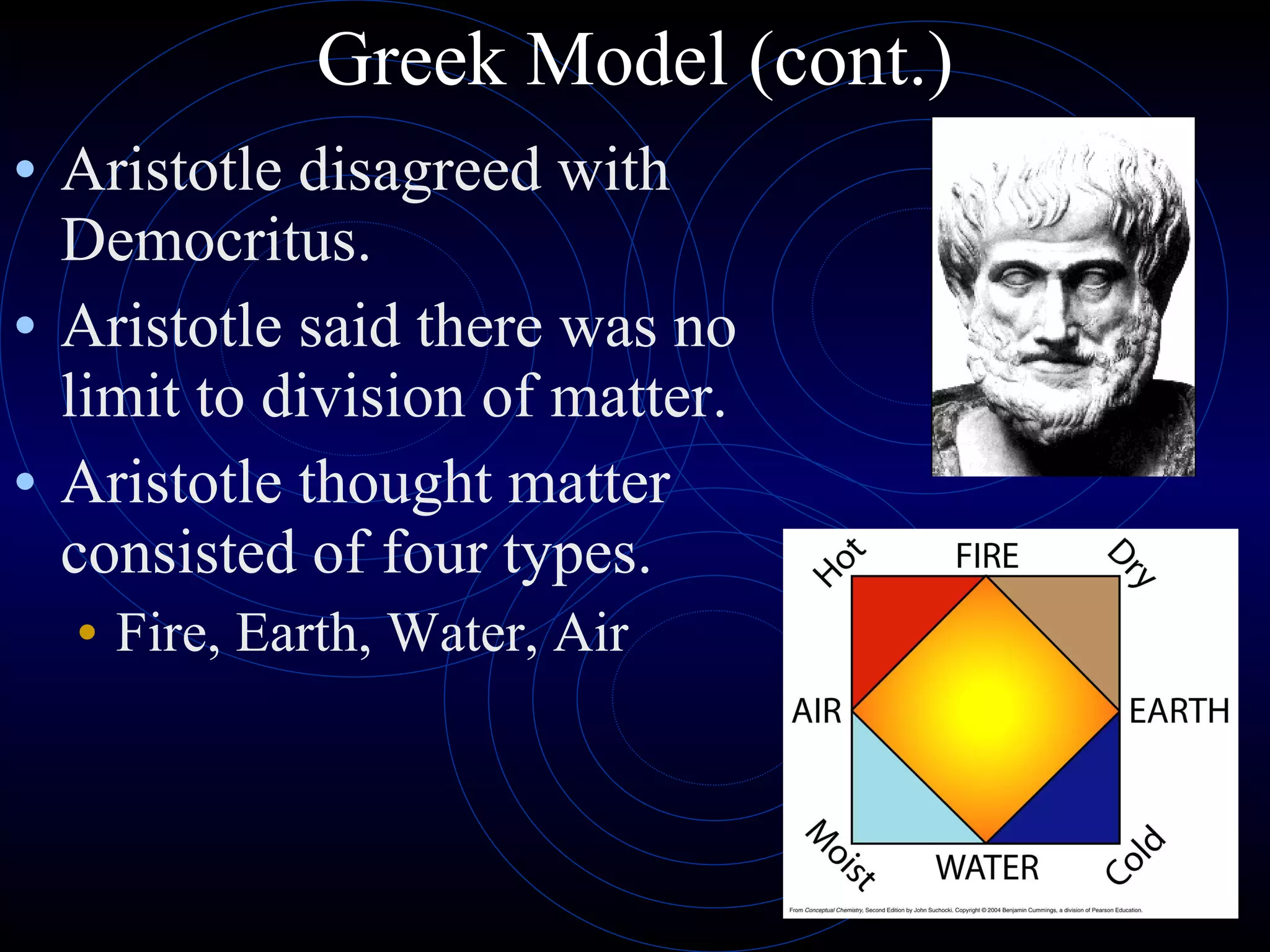
Greek Model (cont.) Aristotle disagreed with Democritus. Aristotle said there was no limit to division of matter. Aristotle thought matter consisted of four types. Fire, Earth, Water, Air
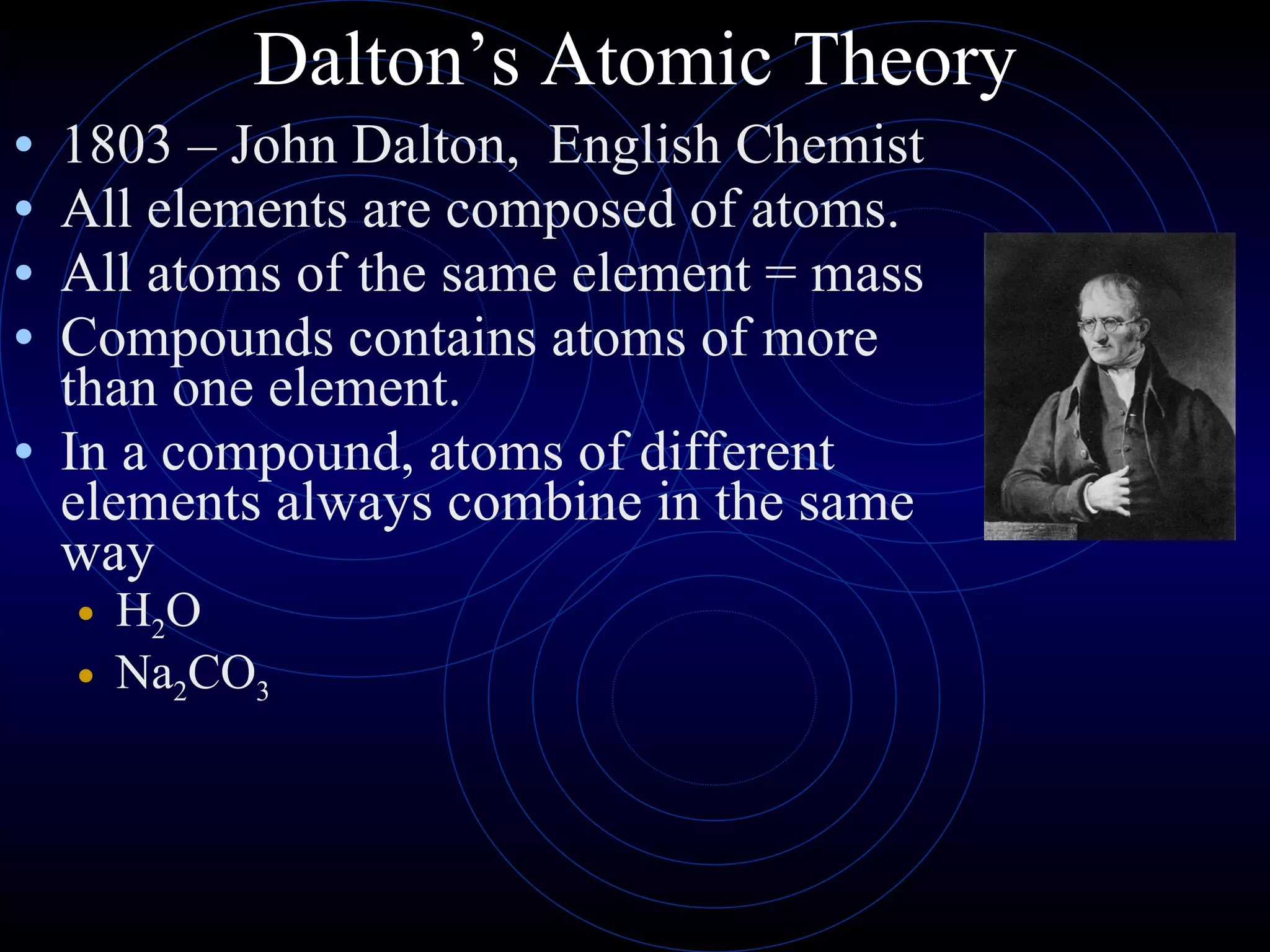
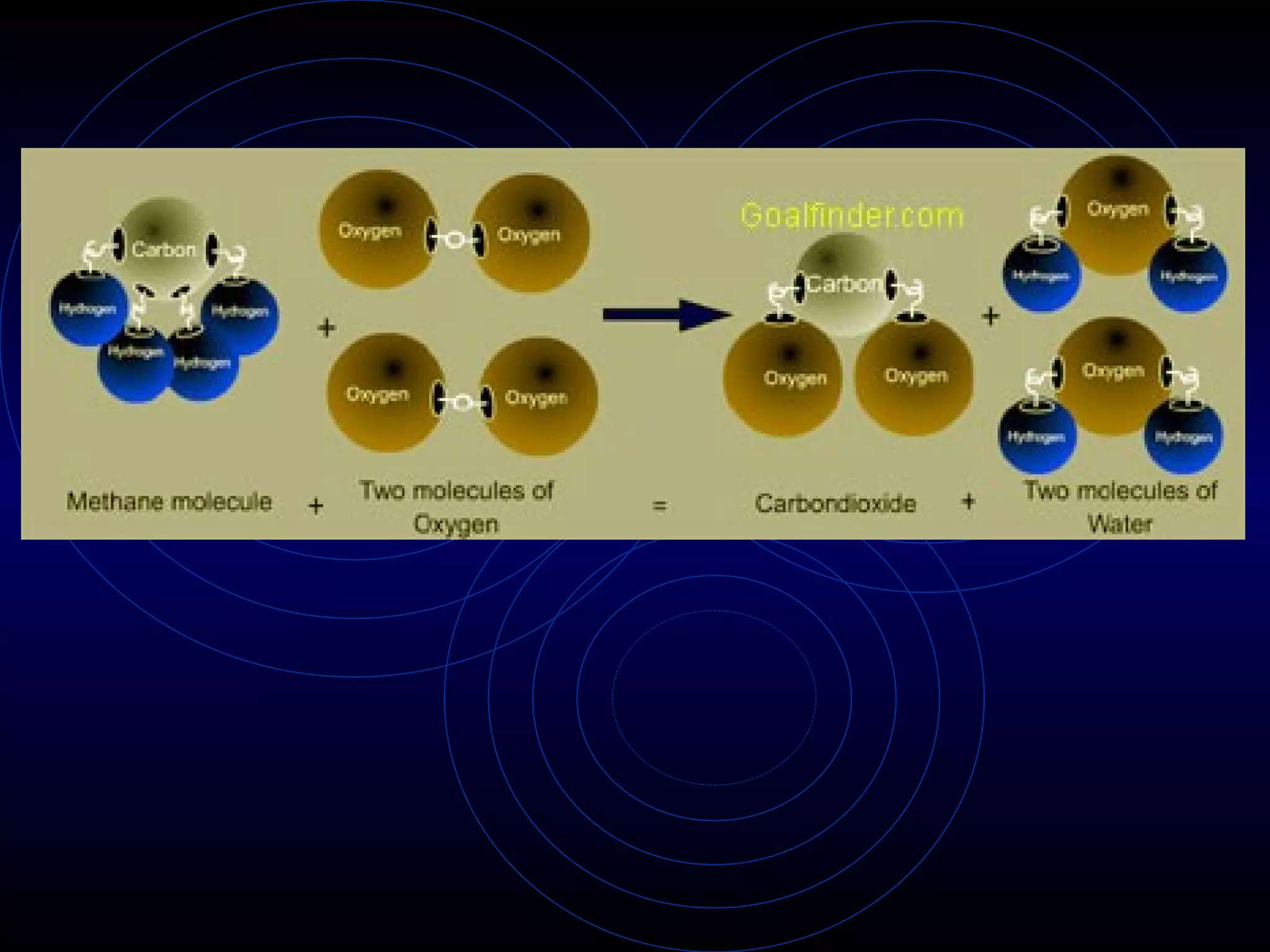
Dalton’s Atomic Theory 1803 – John Dalton,  English Chemist All elements are composed of atoms. All atoms of the same element = mass Compounds contains atoms of more than one element. In a compound, atoms of different elements always combine in the same way H 2 O Na 2 CO 3
 
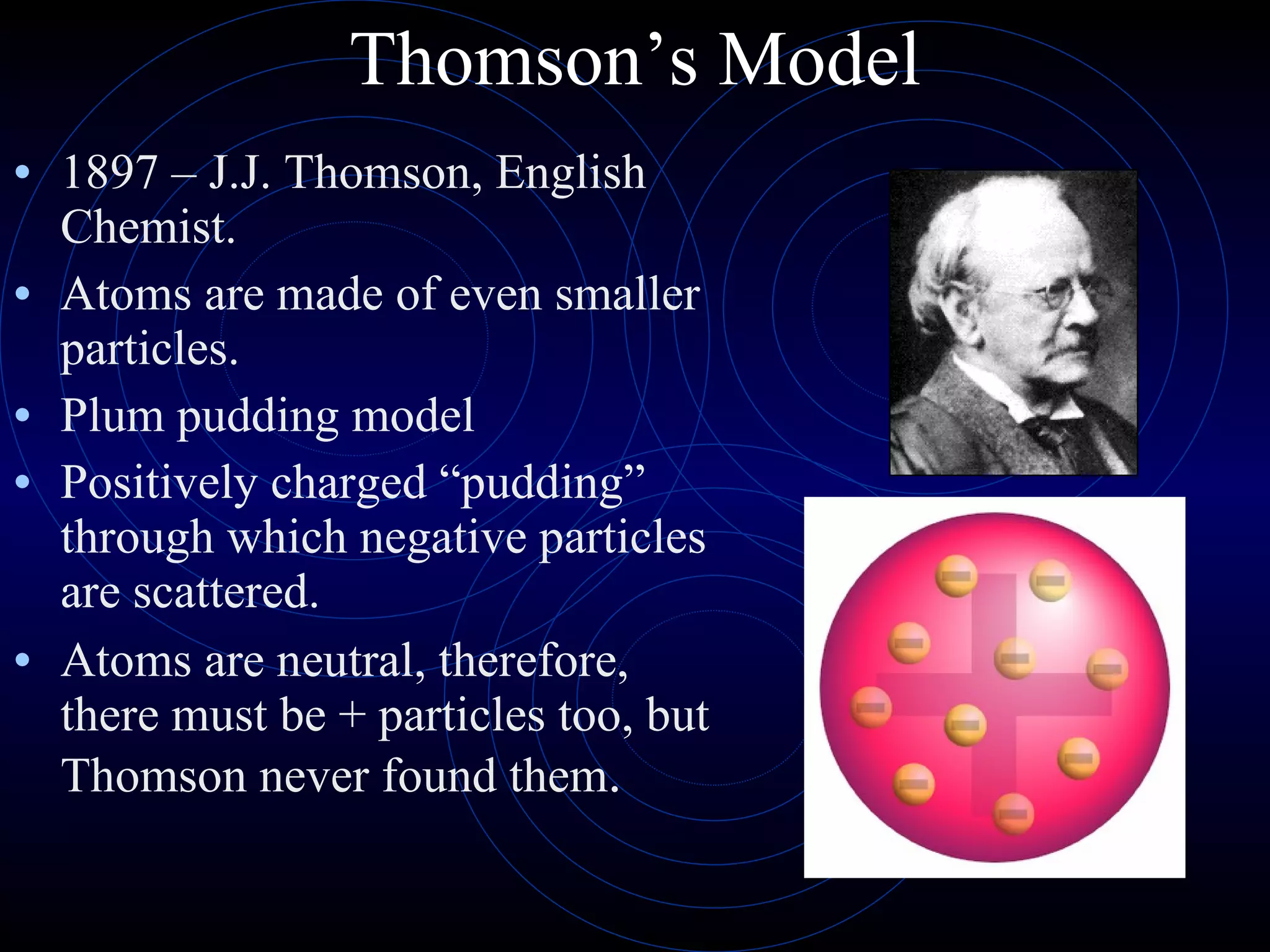
Thomson’s Model 1897 – J.J. Thomson, English Chemist. Atoms are made of even smaller particles. Plum pudding model Positively charged “pudding” through which negative particles are scattered. Atoms are neutral, therefore, there must be + particles too, but Thomson never found them .
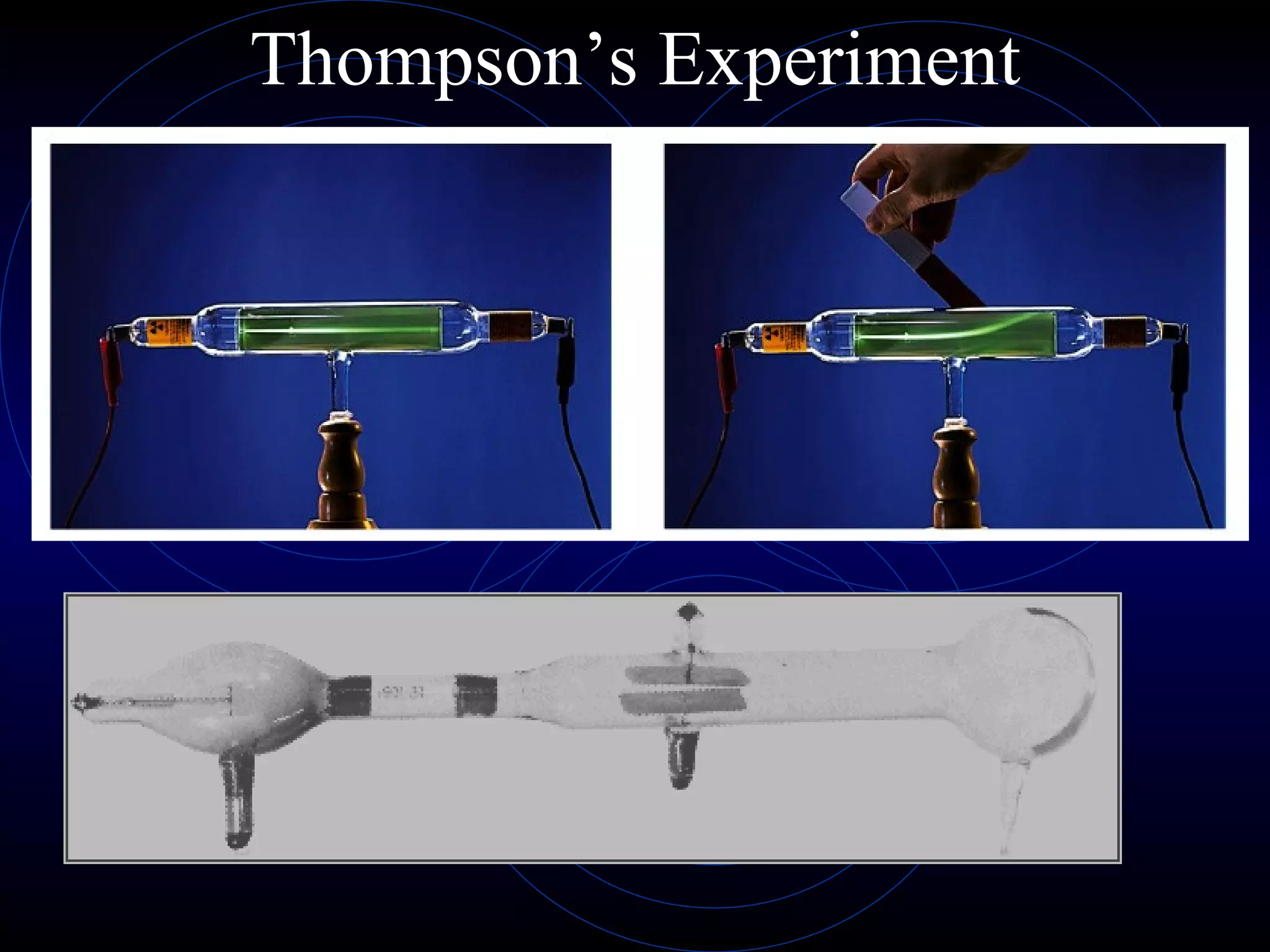
Thompson’s Experiment
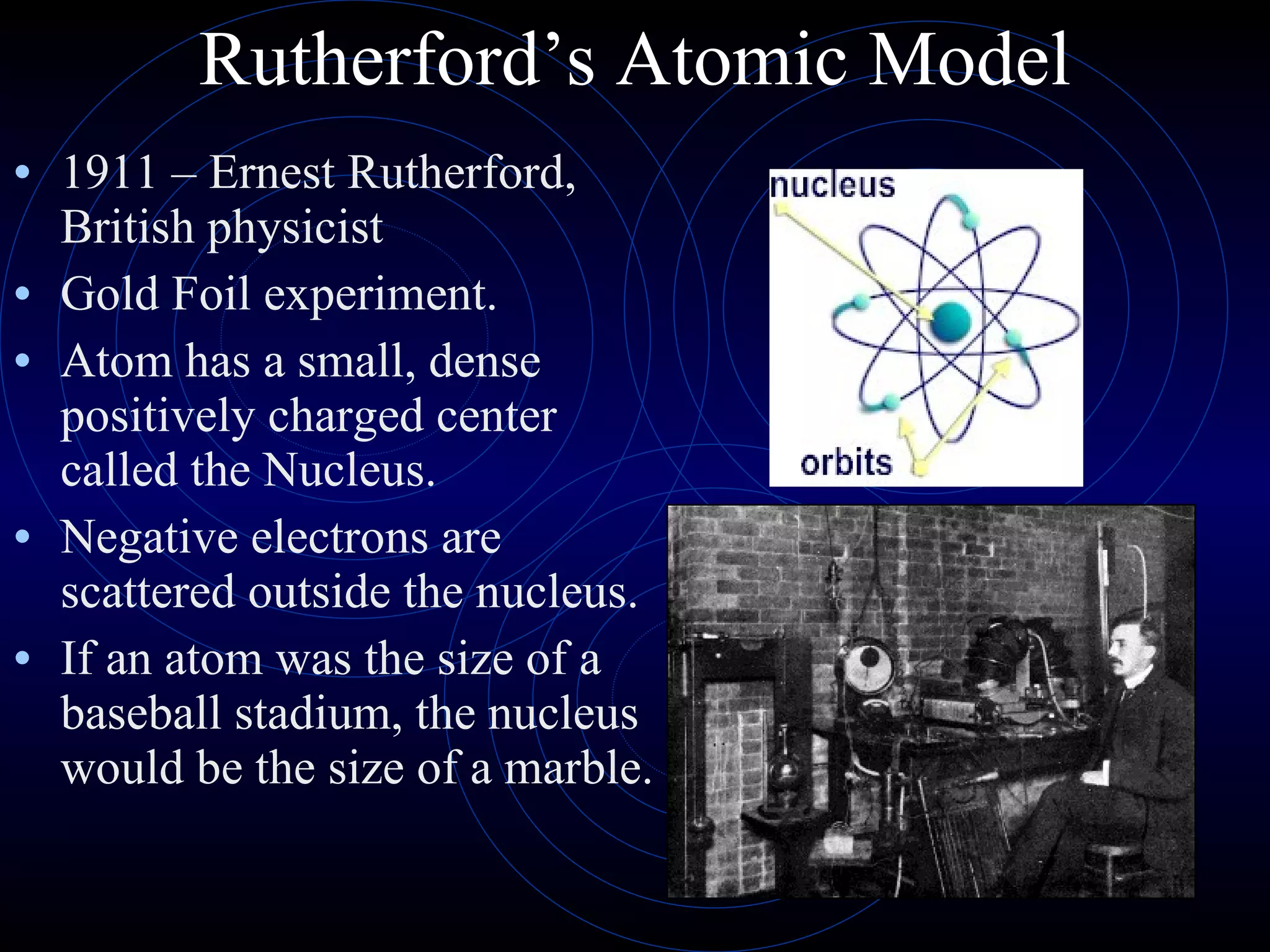
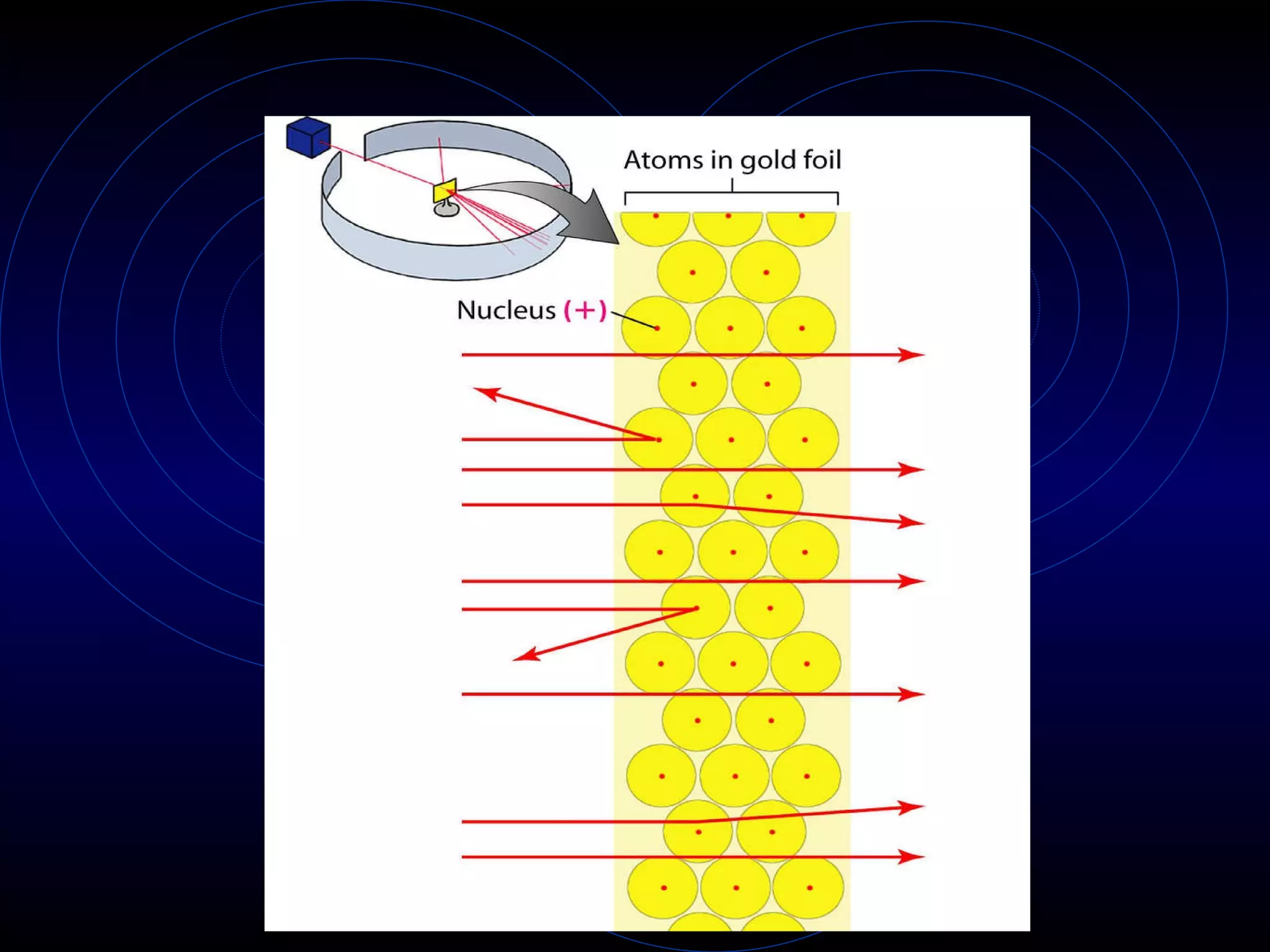
Rutherford’s Atomic Model 1911 – Ernest Rutherford, British physicist Gold Foil experiment. Atom has a small, dense positively charged center called the Nucleus. Negative electrons are scattered outside the nucleus. If an atom was the size of a baseball stadium, the nucleus would be the size of a marble.
 
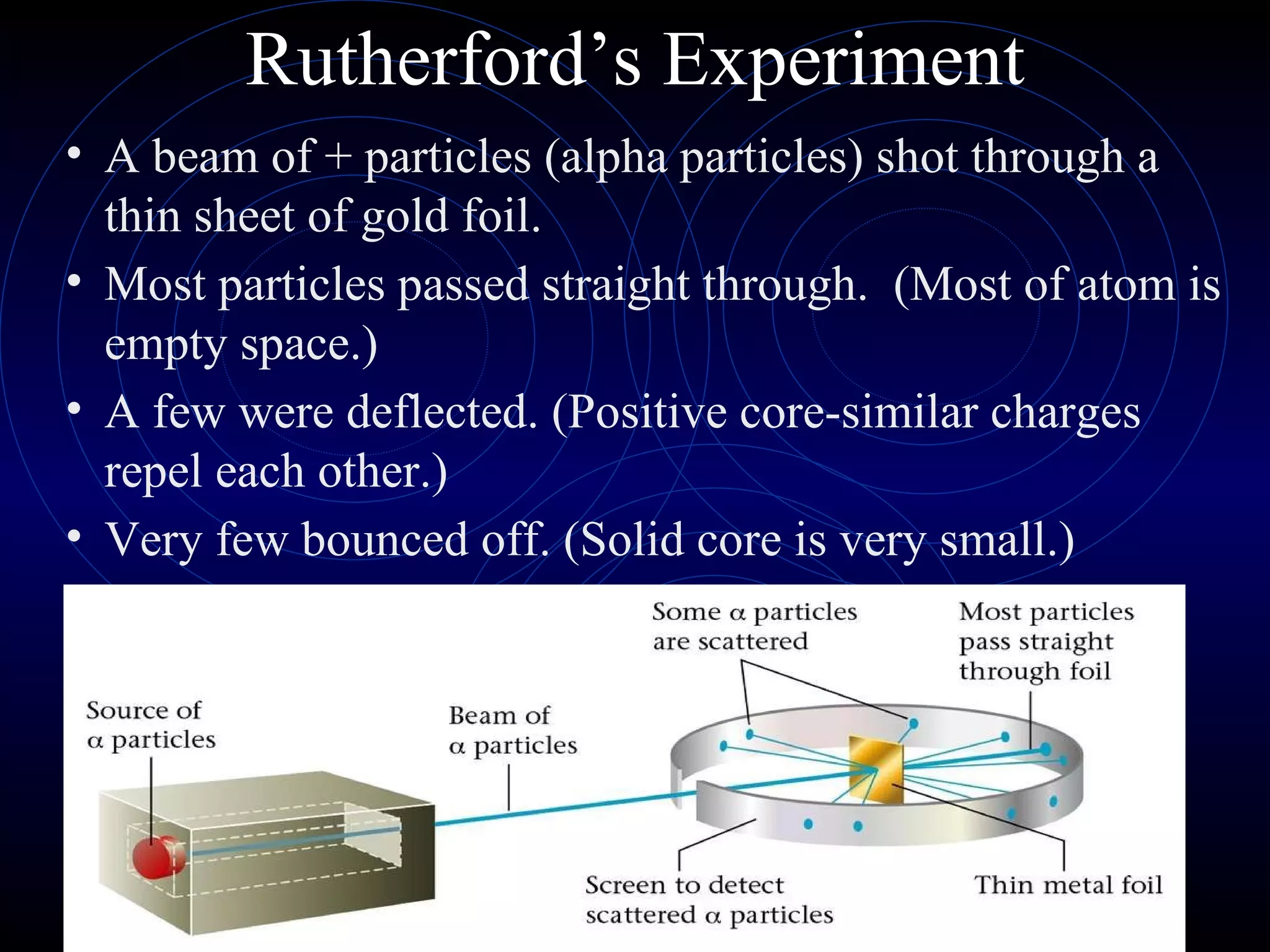
Rutherford’s Experiment A beam of + particles (alpha particles) shot through a thin sheet of gold foil. Most particles passed straight through.  (Most of atom is empty space.) A few were deflected. (Positive core-similar charges repel each other.) Very few bounced off. (Solid core is very small.)
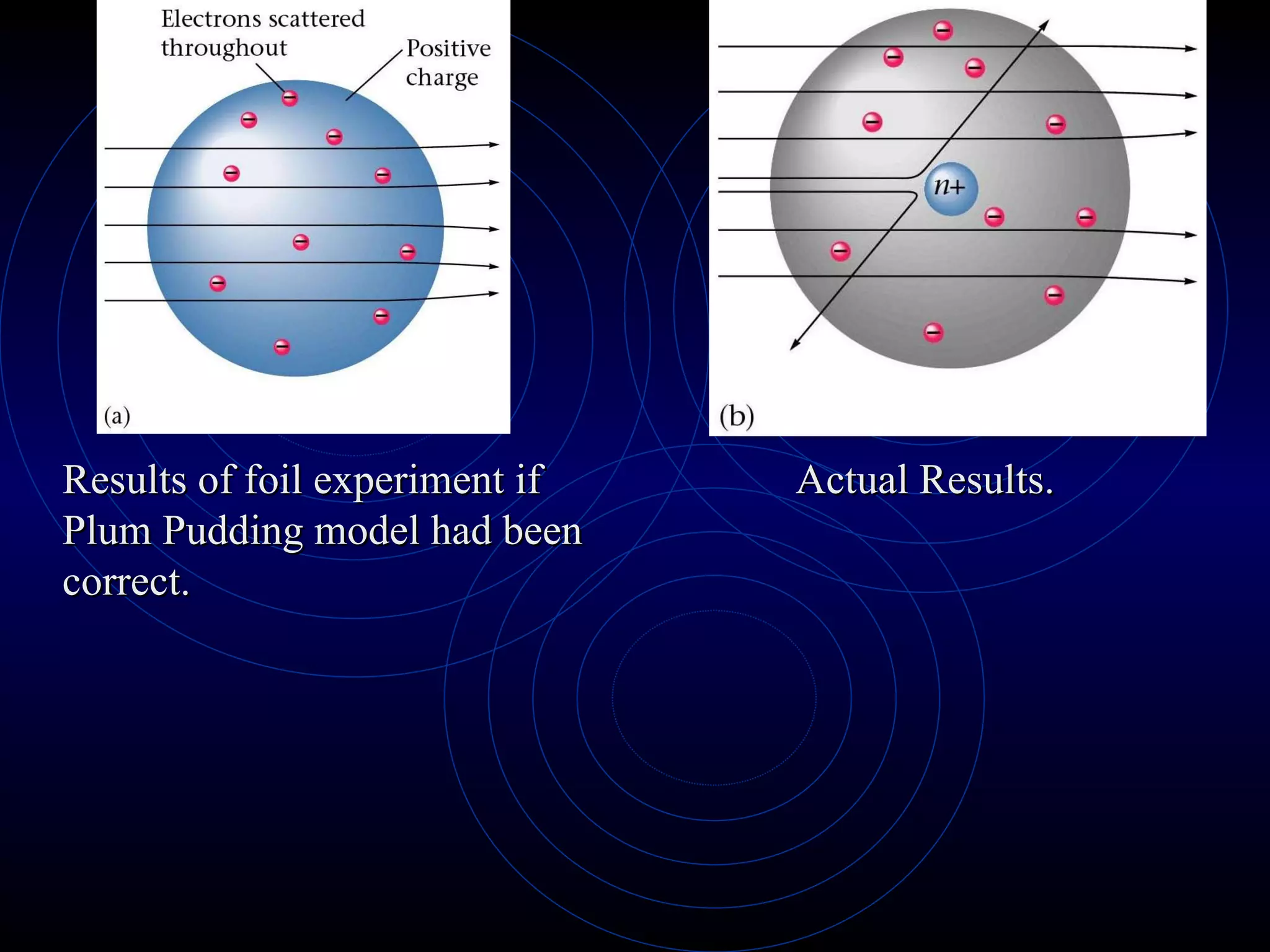
Actual Results. Results of foil experiment if Plum Pudding model had been correct.
 
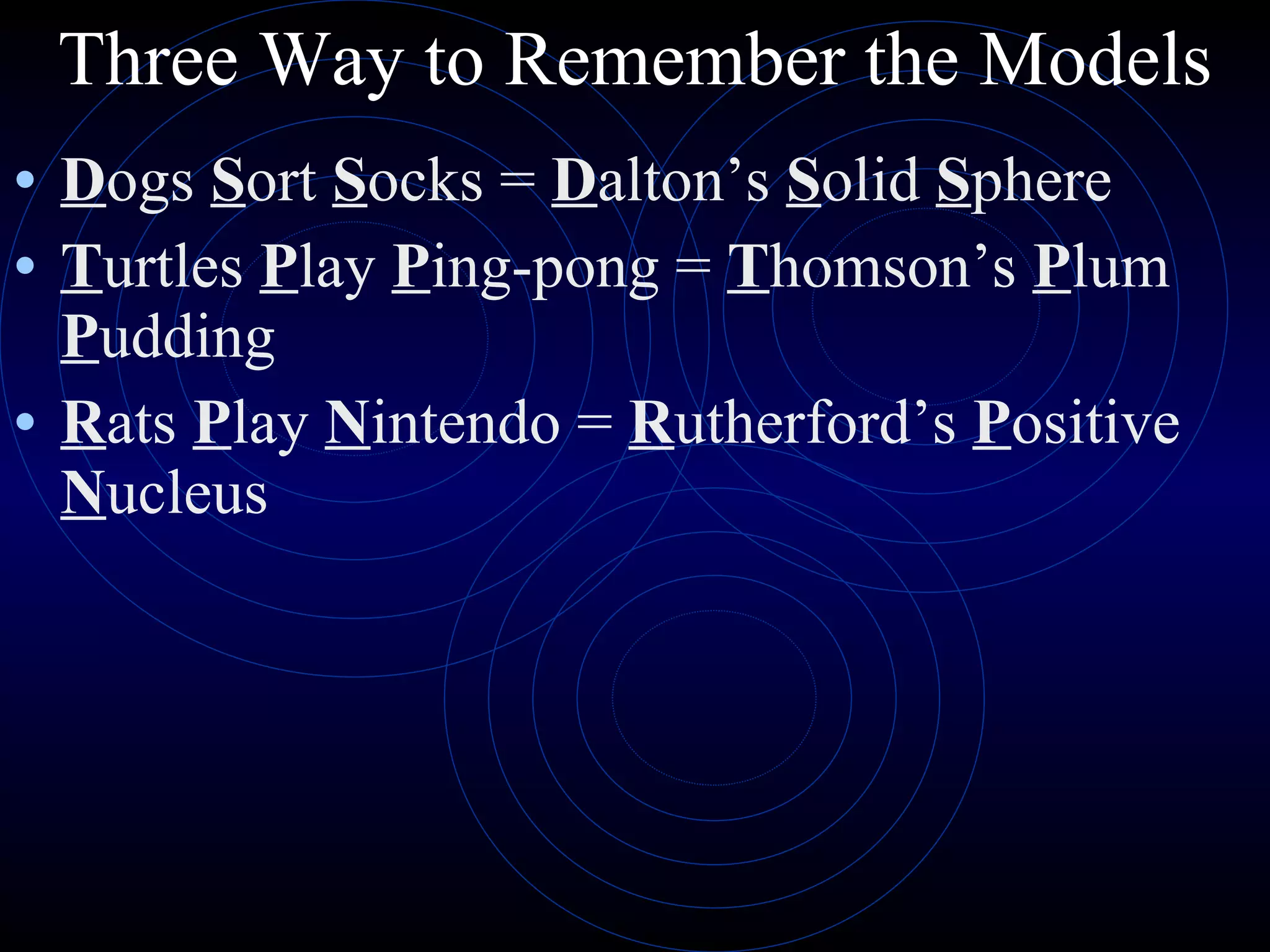
Three Way to Remember the Models D ogs  S ort  S ocks =  D alton’s  S olid  S phere T urtles  P lay  P ing-pong =  T homson’s  P lum  P udding R ats  P lay  N intendo =  R utherford’s  P ositive  N ucleus
3-1 Summary Who founded atomic theory? Ancient Greeks founded atomic theory. Thought matter was made up of four elements Democritus believed all matter was made up of atoms. Who founded modern atomic theory? John Dalton, father of modern atomic theory. Developed atom theory; Solid sphere Element have same make up Compounds always combine the same way.
3-1 Summary (Cont.) Thomson Atomic Theory Experiment with Cathode ray tubes. Atoms are made up of smaller particles. Plum Pudding model Rutherford Atomic Theory Gold foil experiment Discovered the nucleus Positive nucleus
Warm Up Oops!! Those “harmless” Germanium capsules you just swallowed may have an  extra  proton in each nucleus.  Is this good news or bad news? Why? This is bad news, for germanium nucleus with an additional proton is not Germanium, but arsenic!!!!

3-1 Studying Atoms

  • 1.
    Warm-Up What isthe symbol for the following elements. Gold Au Aluminum Al Sodium Na Lithium Li
  • 2.
    3-1 – AtomicTheories Objectives Describe the four main models of the atom and explain how each was discovered.
  • 3.
  • 4.
    Greek Model ofAtoms 400 B.C. Greek philosopher Democritus “ atomos” which means, indivisible. Atoms are hard, solid particles same material different shapes and sizes.
  • 5.
    Greek Model (cont.)Aristotle disagreed with Democritus. Aristotle said there was no limit to division of matter. Aristotle thought matter consisted of four types. Fire, Earth, Water, Air
  • 6.
    Dalton’s Atomic Theory1803 – John Dalton, English Chemist All elements are composed of atoms. All atoms of the same element = mass Compounds contains atoms of more than one element. In a compound, atoms of different elements always combine in the same way H 2 O Na 2 CO 3
  • 7.
  • 8.
    Thomson’s Model 1897– J.J. Thomson, English Chemist. Atoms are made of even smaller particles. Plum pudding model Positively charged “pudding” through which negative particles are scattered. Atoms are neutral, therefore, there must be + particles too, but Thomson never found them .
  • 9.
  • 10.
    Rutherford’s Atomic Model1911 – Ernest Rutherford, British physicist Gold Foil experiment. Atom has a small, dense positively charged center called the Nucleus. Negative electrons are scattered outside the nucleus. If an atom was the size of a baseball stadium, the nucleus would be the size of a marble.
  • 11.
  • 12.
    Rutherford’s Experiment Abeam of + particles (alpha particles) shot through a thin sheet of gold foil. Most particles passed straight through. (Most of atom is empty space.) A few were deflected. (Positive core-similar charges repel each other.) Very few bounced off. (Solid core is very small.)
  • 13.
    Actual Results. Resultsof foil experiment if Plum Pudding model had been correct.
  • 14.
  • 15.
    Three Way toRemember the Models D ogs S ort S ocks = D alton’s S olid S phere T urtles P lay P ing-pong = T homson’s P lum P udding R ats P lay N intendo = R utherford’s P ositive N ucleus
  • 16.
    3-1 Summary Whofounded atomic theory? Ancient Greeks founded atomic theory. Thought matter was made up of four elements Democritus believed all matter was made up of atoms. Who founded modern atomic theory? John Dalton, father of modern atomic theory. Developed atom theory; Solid sphere Element have same make up Compounds always combine the same way.
  • 17.
    3-1 Summary (Cont.)Thomson Atomic Theory Experiment with Cathode ray tubes. Atoms are made up of smaller particles. Plum Pudding model Rutherford Atomic Theory Gold foil experiment Discovered the nucleus Positive nucleus
  • 18.
    Warm Up Oops!!Those “harmless” Germanium capsules you just swallowed may have an extra proton in each nucleus. Is this good news or bad news? Why? This is bad news, for germanium nucleus with an additional proton is not Germanium, but arsenic!!!!

Editor's Notes

  • #6 What qualities did Aristotle use to describe air? What element was a combination of dry and cold? Is “wet and cold” an accurate description of water?
  • #7 Magnesium in bell Jar Demo
  • #13 One could think of this experiment as shooting marbles across the floor.