Finding Similar Items:
Locality Sensitive Hashing
Viet-Trung Tran
Credits
• Mining of Massive Datasets
– Jure Leskovec, Anand Rajaraman, Jeff Ullman Stanford
University
– http://www.mmds.org
2
Scene Completion Problem
3
[Hays and Efros, SIGGRAPH 2007]
10 nearest neighbors from a collection of 20,000 images
Scene Completion Problem
4
[Hays and Efros, SIGGRAPH 2007]
10 nearest neighbors from a collection of 2 million images
Scene Completion Problem
5
[Hays and Efros, SIGGRAPH 2007]
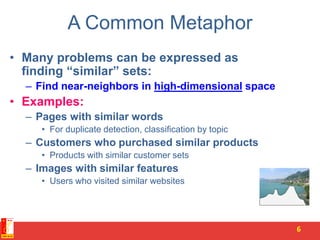
A Common Metaphor
• Many problems can be expressed as
finding “similar” sets:
– Find near-neighbors in high-dimensional space
• Examples:
– Pages with similar words
• For duplicate detection, classification by topic
– Customers who purchased similar products
• Products with similar customer sets
– Images with similar features
• Users who visited similar websites
6
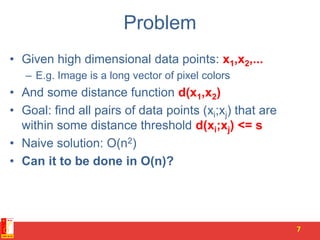
Problem
• Given high dimensional data points: x1,x2,...
– E.g. Image is a long vector of pixel colors
• And some distance function d(x1,x2)
• Goal: find all pairs of data points (xi;xj) that are
within some distance threshold d(xi;xj) <= s
• Naive solution: O(n2)
• Can it to be done in O(n)?
7
Relation to Previous Lecture
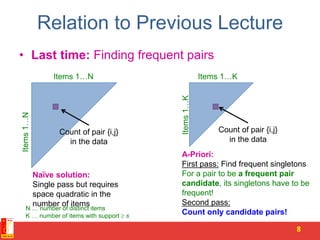
• Last time: Finding frequent pairs
8
Items1…N
Items 1…N
Count of pair {i,j}
in the data
Naïve solution:
Single pass but requires
space quadratic in the
number of items
Items1…K
Items 1…K
Count of pair {i,j}
in the data
A-Priori:
First pass: Find frequent singletons
For a pair to be a frequent pair
candidate, its singletons have to be
frequent!
Second pass:
Count only candidate pairs!
N … number of distinct items
K … number of items with support  s
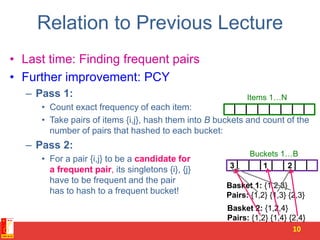
Relation to Previous Lecture
• Last time: Finding frequent pairs
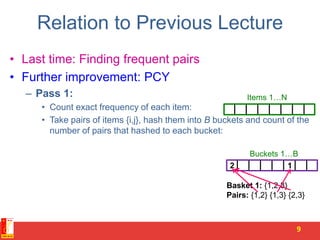
• Further improvement: PCY
– Pass 1:
• Count exact frequency of each item:
• Take pairs of items {i,j}, hash them into B buckets and count of the
number of pairs that hashed to each bucket:
9
Items 1…N
Basket 1: {1,2,3}
Pairs: {1,2} {1,3} {2,3}
Buckets 1…B
2 1
Relation to Previous Lecture
• Last time: Finding frequent pairs
• Further improvement: PCY
– Pass 1:
• Count exact frequency of each item:
• Take pairs of items {i,j}, hash them into B buckets and count of the
number of pairs that hashed to each bucket:
– Pass 2:
• For a pair {i,j} to be a candidate for
a frequent pair, its singletons {i}, {j}
have to be frequent and the pair
has to hash to a frequent bucket!
10
Items 1…N
Basket 1: {1,2,3}
Pairs: {1,2} {1,3} {2,3}
Basket 2: {1,2,4}
Pairs: {1,2} {1,4} {2,4}
Buckets 1…B
3 1 2
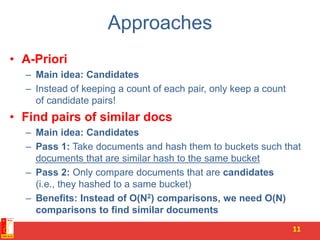
Approaches
• A-Priori
– Main idea: Candidates
– Instead of keeping a count of each pair, only keep a count
of candidate pairs!
• Find pairs of similar docs
– Main idea: Candidates
– Pass 1: Take documents and hash them to buckets such that
documents that are similar hash to the same bucket
– Pass 2: Only compare documents that are candidates
(i.e., they hashed to a same bucket)
– Benefits: Instead of O(N2) comparisons, we need O(N)
comparisons to find similar documents
11
Finding Similar Items
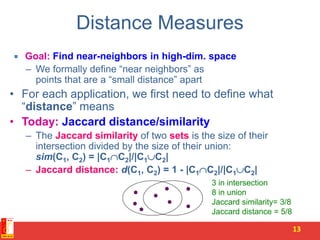
Distance Measures
 Goal: Find near-neighbors in high-dim. space
– We formally define “near neighbors” as
points that are a “small distance” apart
• For each application, we first need to define what
“distance” means
• Today: Jaccard distance/similarity
– The Jaccard similarity of two sets is the size of their
intersection divided by the size of their union:
sim(C1, C2) = |C1C2|/|C1C2|
– Jaccard distance: d(C1, C2) = 1 - |C1C2|/|C1C2|
13
3 in intersection
8 in union
Jaccard similarity= 3/8
Jaccard distance = 5/8
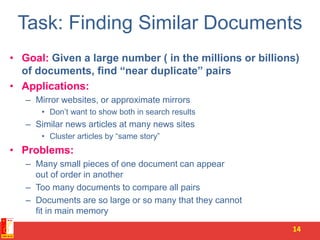
Task: Finding Similar Documents
• Goal: Given a large number ( in the millions or billions)
of documents, find “near duplicate” pairs
• Applications:
– Mirror websites, or approximate mirrors
• Don’t want to show both in search results
– Similar news articles at many news sites
• Cluster articles by “same story”
• Problems:
– Many small pieces of one document can appear
out of order in another
– Too many documents to compare all pairs
– Documents are so large or so many that they cannot
fit in main memory
14
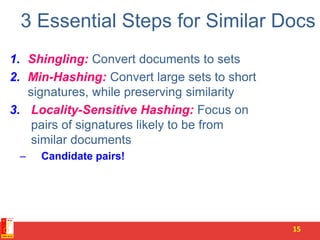
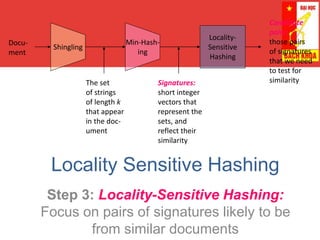
3 Essential Steps for Similar Docs
1. Shingling: Convert documents to sets
2. Min-Hashing: Convert large sets to short
signatures, while preserving similarity
3. Locality-Sensitive Hashing: Focus on
pairs of signatures likely to be from
similar documents
– Candidate pairs!
15
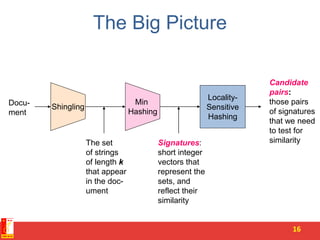
The Big Picture
16
Docu-
ment
The set
of strings
of length k
that appear
in the doc-
ument
Signatures:
short integer
vectors that
represent the
sets, and
reflect their
similarity
Locality-
Sensitive
Hashing
Candidate
pairs:
those pairs
of signatures
that we need
to test for
similarity
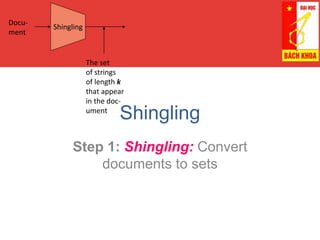
Shingling
Step 1: Shingling: Convert
documents to sets
Docu-
ment
The set
of strings
of length k
that appear
in the doc-
ument
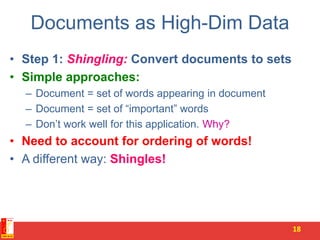
Documents as High-Dim Data
• Step 1: Shingling: Convert documents to sets
• Simple approaches:
– Document = set of words appearing in document
– Document = set of “important” words
– Don’t work well for this application. Why?
• Need to account for ordering of words!
• A different way: Shingles!
18
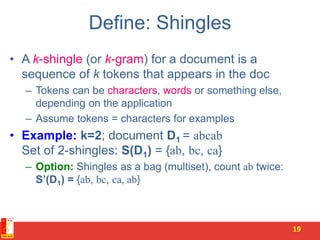
Define: Shingles
• A k-shingle (or k-gram) for a document is a
sequence of k tokens that appears in the doc
– Tokens can be characters, words or something else,
depending on the application
– Assume tokens = characters for examples
• Example: k=2; document D1 = abcab
Set of 2-shingles: S(D1) = {ab, bc, ca}
– Option: Shingles as a bag (multiset), count ab twice:
S’(D1) = {ab, bc, ca, ab}
19
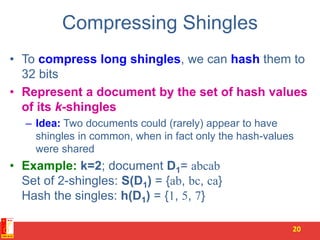
Compressing Shingles
• To compress long shingles, we can hash them to
32 bits
• Represent a document by the set of hash values
of its k-shingles
– Idea: Two documents could (rarely) appear to have
shingles in common, when in fact only the hash-values
were shared
• Example: k=2; document D1= abcab
Set of 2-shingles: S(D1) = {ab, bc, ca}
Hash the singles: h(D1) = {1, 5, 7}
20
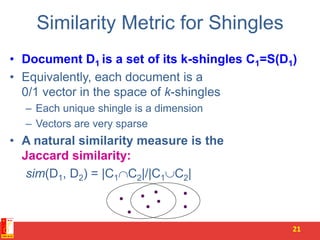
Similarity Metric for Shingles
• Document D1 is a set of its k-shingles C1=S(D1)
• Equivalently, each document is a
0/1 vector in the space of k-shingles
– Each unique shingle is a dimension
– Vectors are very sparse
• A natural similarity measure is the
Jaccard similarity:
sim(D1, D2) = |C1C2|/|C1C2|
21
Working Assumption
• Documents that have lots of shingles in
common have similar text, even if the text
appears in different order
• Caveat: You must pick k large enough, or most
documents will have most shingles
– k = 5 is OK for short documents
– k = 10 is better for long documents
22
Motivation for Minhash/LSH
• Suppose we need to find near-duplicate
documents among 𝑵 = 𝟏 million documents
• Naïvely, we would have to compute pairwise
Jaccard similarities for every pair of docs
– 𝑵(𝑵 − 𝟏)/𝟐 ≈ 5*1011 comparisons
– At 105 secs/day and 106 comparisons/sec,
it would take 5 days
• For 𝑵 = 𝟏𝟎 million, it takes more than a year…
23
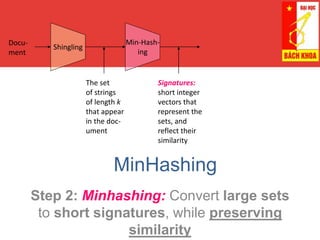
MinHashing
Step 2: Minhashing: Convert large sets
to short signatures, while preserving
similarity
Docu-
ment
The set
of strings
of length k
that appear
in the doc-
ument
Signatures:
short integer
vectors that
represent the
sets, and
reflect their
similarity
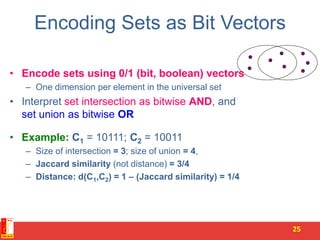
Encoding Sets as Bit Vectors
• Encode sets using 0/1 (bit, boolean) vectors
– One dimension per element in the universal set
• Interpret set intersection as bitwise AND, and
set union as bitwise OR
• Example: C1 = 10111; C2 = 10011
– Size of intersection = 3; size of union = 4,
– Jaccard similarity (not distance) = 3/4
– Distance: d(C1,C2) = 1 – (Jaccard similarity) = 1/4
25
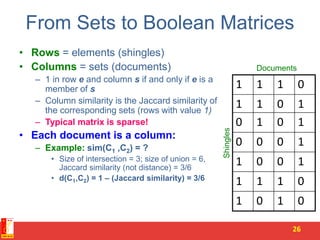
From Sets to Boolean Matrices
• Rows = elements (shingles)
• Columns = sets (documents)
– 1 in row e and column s if and only if e is a
member of s
– Column similarity is the Jaccard similarity of
the corresponding sets (rows with value 1)
– Typical matrix is sparse!
• Each document is a column:
– Example: sim(C1 ,C2) = ?
• Size of intersection = 3; size of union = 6,
Jaccard similarity (not distance) = 3/6
• d(C1,C2) = 1 – (Jaccard similarity) = 3/6
26
0101
0111
1001
1000
1010
1011
0111
Documents
Shingles
Outline: Finding Similar Columns
• So far:
– Documents  Sets of shingles
– Represent sets as boolean vectors in a matrix
• Next goal: Find similar columns while
computing small signatures
– Similarity of columns == similarity of signatures
27
Outline: Finding Similar Columns
• Next Goal: Find similar columns, Small signatures
• Naïve approach:
– 1) Signatures of columns: small summaries of columns
– 2) Examine pairs of signatures to find similar columns
– 3) Optional: Check that columns with similar signatures are
really similar
• Warnings:
– Comparing all pairs may take too much time: Job for LSH
• These methods can produce false negatives, and even false
positives (if the optional check is not made)
28
Hashing Columns (Signatures)
• Key idea: “hash” each column C to a small signature
h(C), such that:
– (1) h(C) is small enough that the signature fits in RAM
– (2) sim(C1, C2) is the same as the “similarity” of signatures
h(C1) and h(C2)
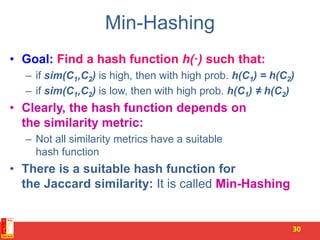
• Goal: Find a hash function h(·) such that:
– If sim(C1,C2) is high, then with high prob. h(C1) = h(C2)
– If sim(C1,C2) is low, then with high prob. h(C1) ≠ h(C2)
• Hash docs into buckets. Expect that “most” pairs of
near duplicate docs hash into the same bucket!
29
Min-Hashing
• Goal: Find a hash function h(·) such that:
– if sim(C1,C2) is high, then with high prob. h(C1) = h(C2)
– if sim(C1,C2) is low, then with high prob. h(C1) ≠ h(C2)
• Clearly, the hash function depends on
the similarity metric:
– Not all similarity metrics have a suitable
hash function
• There is a suitable hash function for
the Jaccard similarity: It is called Min-Hashing
30
Min-Hashing
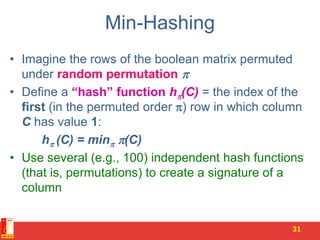
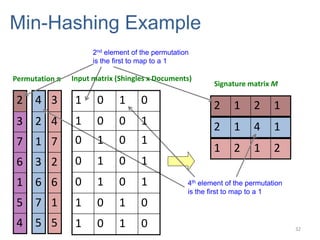
• Imagine the rows of the boolean matrix permuted
under random permutation 
• Define a “hash” function h(C) = the index of the
first (in the permuted order ) row in which column
C has value 1:
h (C) = min (C)
• Use several (e.g., 100) independent hash functions
(that is, permutations) to create a signature of a
column
31
Min-Hashing Example
32
3
4
7
2
6
1
5
Signature matrix M
1212
5
7
6
3
1
2
4
1412
4
5
1
6
7
3
2
2121
2nd element of the permutation
is the first to map to a 1
4th element of the permutation
is the first to map to a 1
0101
0101
1010
1010
1010
1001
0101
Input matrix (Shingles x Documents)Permutation 
Similarity for Signatures
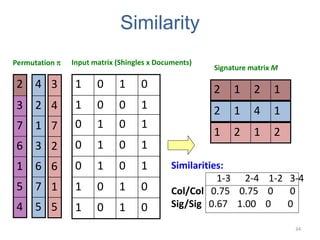
• We know: Pr[h(C1) = h(C2)] = sim(C1, C2)
• Now generalize to multiple hash functions
• The similarity of two signatures is the fraction of
the hash functions in which they agree
• Note: Because of the Min-Hash property, the
similarity of columns is the same as the expected
similarity of their signatures
33
Similarity
34
Similarities:
1-3 2-4 1-2 3-4
Col/Col 0.75 0.75 0 0
Sig/Sig 0.67 1.00 0 0
Signature matrix M
1212
5
7
6
3
1
2
4
1412
4
5
1
6
7
3
2
2121
0101
0101
1010
1010
1010
1001
0101
Input matrix (Shingles x Documents)
3
4
7
2
6
1
5
Permutation 
Implementation Trick
• Row hashing!
– Pick K = 100 hash functions ki
– Ordering under ki gives a random row permutation!
• One-pass implementation
– For each column C and hash-func. ki keep a “slot” for the
min-hash value
– Initialize all sig(C)[i] = 
– Scan rows looking for 1s
• Suppose row j has 1 in column C
• Then for each ki :
– If ki(j) < sig(C)[i], then sig(C)[i]  ki(j)
35
How to pick a random
hash function h(x)?
Universal hashing:
ha,b(x)=((a·x+b) mod p) mod N
where:
a,b … random integers
p … prime number (p > N)
Locality Sensitive Hashing
Step 3: Locality-Sensitive Hashing:
Focus on pairs of signatures likely to be
from similar documents
Docu-
ment
The set
of strings
of length k
that appear
in the doc-
ument
Signatures:
short integer
vectors that
represent the
sets, and
reflect their
similarity
Locality-
Sensitive
Hashing
Candidate
pairs:
those pairs
of signatures
that we need
to test for
similarity
LSH: First Cut
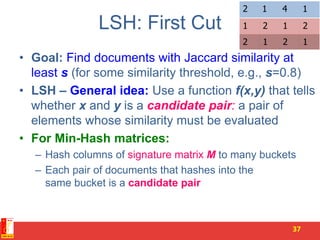
• Goal: Find documents with Jaccard similarity at
least s (for some similarity threshold, e.g., s=0.8)
• LSH – General idea: Use a function f(x,y) that tells
whether x and y is a candidate pair: a pair of
elements whose similarity must be evaluated
• For Min-Hash matrices:
– Hash columns of signature matrix M to many buckets
– Each pair of documents that hashes into the
same bucket is a candidate pair
37
1212
1412
2121
Partition M into b Bands
38
Signature matrix M
r rows
per band
b bands
One
signature
1212
1412
2121
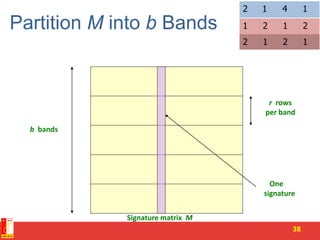
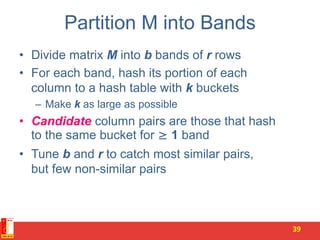
Partition M into Bands
• Divide matrix M into b bands of r rows
• For each band, hash its portion of each
column to a hash table with k buckets
– Make k as large as possible
• Candidate column pairs are those that hash
to the same bucket for ≥ 1 band
• Tune b and r to catch most similar pairs,
but few non-similar pairs
39
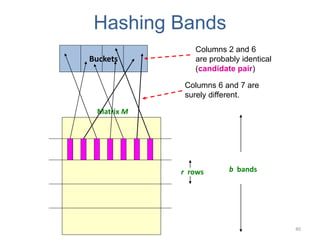
Matrix M
r rows b bands
Buckets
Columns 2 and 6
are probably identical
(candidate pair)
Columns 6 and 7 are
surely different.
Hashing Bands
40
Simplifying Assumption
• There are enough buckets that columns are
unlikely to hash to the same bucket unless they are
identical in a particular band
• Hereafter, we assume that “same bucket” means
“identical in that band”
• Assumption needed only to simplify analysis, not for
correctness of algorithm
41
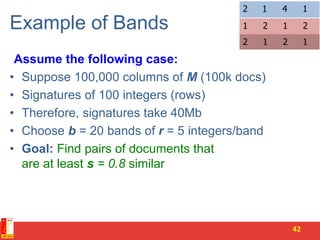
Example of Bands
Assume the following case:
• Suppose 100,000 columns of M (100k docs)
• Signatures of 100 integers (rows)
• Therefore, signatures take 40Mb
• Choose b = 20 bands of r = 5 integers/band
• Goal: Find pairs of documents that
are at least s = 0.8 similar
42
1212
1412
2121
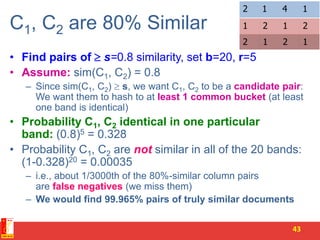
C1, C2 are 80% Similar
• Find pairs of  s=0.8 similarity, set b=20, r=5
• Assume: sim(C1, C2) = 0.8
– Since sim(C1, C2)  s, we want C1, C2 to be a candidate pair:
We want them to hash to at least 1 common bucket (at least
one band is identical)
• Probability C1, C2 identical in one particular
band: (0.8)5 = 0.328
• Probability C1, C2 are not similar in all of the 20 bands:
(1-0.328)20 = 0.00035
– i.e., about 1/3000th of the 80%-similar column pairs
are false negatives (we miss them)
– We would find 99.965% pairs of truly similar documents
43
1212
1412
2121
C1, C2 are 30% Similar
• Find pairs of  s=0.8 similarity, set b=20, r=5
• Assume: sim(C1, C2) = 0.3
– Since sim(C1, C2) < s we want C1, C2 to hash to NO
common buckets (all bands should be different)
• Probability C1, C2 identical in one particular band:
(0.3)5 = 0.00243
• Probability C1, C2 identical in at least 1 of 20 bands: 1 -
(1 - 0.00243)20 = 0.0474
– In other words, approximately 4.74% pairs of docs with
similarity 0.3% end up becoming candidate pairs
• They are false positives since we will have to examine them (they
are candidate pairs) but then it will turn out their similarity is below
threshold s
44
1212
1412
2121
LSH Involves a Tradeoff
• Pick:
– The number of Min-Hashes (rows of M)
– The number of bands b, and
– The number of rows r per band
to balance false positives/negatives
• Example: If we had only 15 bands of 5 rows,
the number of false positives would go down,
but the number of false negatives would go
up
45
1212
1412
2121
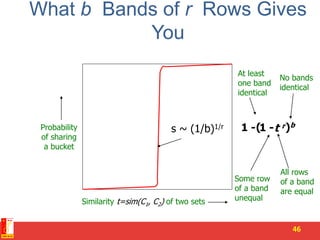
What b Bands of r Rows Gives
You
46
t r
All rows
of a band
are equal
1 -
Some row
of a band
unequal
( )b
No bands
identical
1 -
At least
one band
identical
s ~ (1/b)1/r
Similarity t=sim(C1, C2) of two sets
Probability
of sharing
a bucket
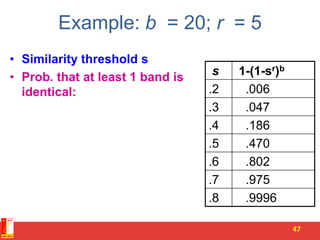
Example: b = 20; r = 5
• Similarity threshold s
• Prob. that at least 1 band is
identical:
47
s 1-(1-sr)b
.2 .006
.3 .047
.4 .186
.5 .470
.6 .802
.7 .975
.8 .9996
LSH Summary
• Tune M, b, r to get almost all pairs with similar
signatures, but eliminate most pairs that do not
have similar signatures
• Check in main memory that candidate pairs
really do have similar signatures
• Optional: In another pass through data, check
that the remaining candidate pairs really
represent similar documents
48
Summary: 3 Steps
• Shingling: Convert documents to sets
– We used hashing to assign each shingle an ID
• Min-Hashing: Convert large sets to short signatures,
while preserving similarity
– We used similarity preserving hashing to generate
signatures with property Pr[h(C1) = h(C2)] = sim(C1, C2)
– We used hashing to get around generating random
permutations
• Locality-Sensitive Hashing: Focus on pairs of
signatures likely to be from similar documents
– We used hashing to find candidate pairs of similarity  s
49

3 - Finding similar items

  • 1.
    Finding Similar Items: LocalitySensitive Hashing Viet-Trung Tran
  • 2.
    Credits • Mining ofMassive Datasets – Jure Leskovec, Anand Rajaraman, Jeff Ullman Stanford University – http://www.mmds.org 2
  • 3.
    Scene Completion Problem 3 [Haysand Efros, SIGGRAPH 2007]
  • 4.
    10 nearest neighborsfrom a collection of 20,000 images Scene Completion Problem 4 [Hays and Efros, SIGGRAPH 2007]
  • 5.
    10 nearest neighborsfrom a collection of 2 million images Scene Completion Problem 5 [Hays and Efros, SIGGRAPH 2007]
  • 6.
    A Common Metaphor •Many problems can be expressed as finding “similar” sets: – Find near-neighbors in high-dimensional space • Examples: – Pages with similar words • For duplicate detection, classification by topic – Customers who purchased similar products • Products with similar customer sets – Images with similar features • Users who visited similar websites 6
  • 7.
    Problem • Given highdimensional data points: x1,x2,... – E.g. Image is a long vector of pixel colors • And some distance function d(x1,x2) • Goal: find all pairs of data points (xi;xj) that are within some distance threshold d(xi;xj) <= s • Naive solution: O(n2) • Can it to be done in O(n)? 7
  • 8.
    Relation to PreviousLecture • Last time: Finding frequent pairs 8 Items1…N Items 1…N Count of pair {i,j} in the data Naïve solution: Single pass but requires space quadratic in the number of items Items1…K Items 1…K Count of pair {i,j} in the data A-Priori: First pass: Find frequent singletons For a pair to be a frequent pair candidate, its singletons have to be frequent! Second pass: Count only candidate pairs! N … number of distinct items K … number of items with support  s
  • 9.
    Relation to PreviousLecture • Last time: Finding frequent pairs • Further improvement: PCY – Pass 1: • Count exact frequency of each item: • Take pairs of items {i,j}, hash them into B buckets and count of the number of pairs that hashed to each bucket: 9 Items 1…N Basket 1: {1,2,3} Pairs: {1,2} {1,3} {2,3} Buckets 1…B 2 1
  • 10.
    Relation to PreviousLecture • Last time: Finding frequent pairs • Further improvement: PCY – Pass 1: • Count exact frequency of each item: • Take pairs of items {i,j}, hash them into B buckets and count of the number of pairs that hashed to each bucket: – Pass 2: • For a pair {i,j} to be a candidate for a frequent pair, its singletons {i}, {j} have to be frequent and the pair has to hash to a frequent bucket! 10 Items 1…N Basket 1: {1,2,3} Pairs: {1,2} {1,3} {2,3} Basket 2: {1,2,4} Pairs: {1,2} {1,4} {2,4} Buckets 1…B 3 1 2
  • 11.
    Approaches • A-Priori – Mainidea: Candidates – Instead of keeping a count of each pair, only keep a count of candidate pairs! • Find pairs of similar docs – Main idea: Candidates – Pass 1: Take documents and hash them to buckets such that documents that are similar hash to the same bucket – Pass 2: Only compare documents that are candidates (i.e., they hashed to a same bucket) – Benefits: Instead of O(N2) comparisons, we need O(N) comparisons to find similar documents 11
  • 12.
  • 13.
    Distance Measures  Goal:Find near-neighbors in high-dim. space – We formally define “near neighbors” as points that are a “small distance” apart • For each application, we first need to define what “distance” means • Today: Jaccard distance/similarity – The Jaccard similarity of two sets is the size of their intersection divided by the size of their union: sim(C1, C2) = |C1C2|/|C1C2| – Jaccard distance: d(C1, C2) = 1 - |C1C2|/|C1C2| 13 3 in intersection 8 in union Jaccard similarity= 3/8 Jaccard distance = 5/8
  • 14.
    Task: Finding SimilarDocuments • Goal: Given a large number ( in the millions or billions) of documents, find “near duplicate” pairs • Applications: – Mirror websites, or approximate mirrors • Don’t want to show both in search results – Similar news articles at many news sites • Cluster articles by “same story” • Problems: – Many small pieces of one document can appear out of order in another – Too many documents to compare all pairs – Documents are so large or so many that they cannot fit in main memory 14
  • 15.
    3 Essential Stepsfor Similar Docs 1. Shingling: Convert documents to sets 2. Min-Hashing: Convert large sets to short signatures, while preserving similarity 3. Locality-Sensitive Hashing: Focus on pairs of signatures likely to be from similar documents – Candidate pairs! 15
  • 16.
    The Big Picture 16 Docu- ment Theset of strings of length k that appear in the doc- ument Signatures: short integer vectors that represent the sets, and reflect their similarity Locality- Sensitive Hashing Candidate pairs: those pairs of signatures that we need to test for similarity
  • 17.
    Shingling Step 1: Shingling:Convert documents to sets Docu- ment The set of strings of length k that appear in the doc- ument
  • 18.
    Documents as High-DimData • Step 1: Shingling: Convert documents to sets • Simple approaches: – Document = set of words appearing in document – Document = set of “important” words – Don’t work well for this application. Why? • Need to account for ordering of words! • A different way: Shingles! 18
  • 19.
    Define: Shingles • Ak-shingle (or k-gram) for a document is a sequence of k tokens that appears in the doc – Tokens can be characters, words or something else, depending on the application – Assume tokens = characters for examples • Example: k=2; document D1 = abcab Set of 2-shingles: S(D1) = {ab, bc, ca} – Option: Shingles as a bag (multiset), count ab twice: S’(D1) = {ab, bc, ca, ab} 19
  • 20.
    Compressing Shingles • Tocompress long shingles, we can hash them to 32 bits • Represent a document by the set of hash values of its k-shingles – Idea: Two documents could (rarely) appear to have shingles in common, when in fact only the hash-values were shared • Example: k=2; document D1= abcab Set of 2-shingles: S(D1) = {ab, bc, ca} Hash the singles: h(D1) = {1, 5, 7} 20
  • 21.
    Similarity Metric forShingles • Document D1 is a set of its k-shingles C1=S(D1) • Equivalently, each document is a 0/1 vector in the space of k-shingles – Each unique shingle is a dimension – Vectors are very sparse • A natural similarity measure is the Jaccard similarity: sim(D1, D2) = |C1C2|/|C1C2| 21
  • 22.
    Working Assumption • Documentsthat have lots of shingles in common have similar text, even if the text appears in different order • Caveat: You must pick k large enough, or most documents will have most shingles – k = 5 is OK for short documents – k = 10 is better for long documents 22
  • 23.
    Motivation for Minhash/LSH •Suppose we need to find near-duplicate documents among 𝑵 = 𝟏 million documents • Naïvely, we would have to compute pairwise Jaccard similarities for every pair of docs – 𝑵(𝑵 − 𝟏)/𝟐 ≈ 5*1011 comparisons – At 105 secs/day and 106 comparisons/sec, it would take 5 days • For 𝑵 = 𝟏𝟎 million, it takes more than a year… 23
  • 24.
    MinHashing Step 2: Minhashing:Convert large sets to short signatures, while preserving similarity Docu- ment The set of strings of length k that appear in the doc- ument Signatures: short integer vectors that represent the sets, and reflect their similarity
  • 25.
    Encoding Sets asBit Vectors • Encode sets using 0/1 (bit, boolean) vectors – One dimension per element in the universal set • Interpret set intersection as bitwise AND, and set union as bitwise OR • Example: C1 = 10111; C2 = 10011 – Size of intersection = 3; size of union = 4, – Jaccard similarity (not distance) = 3/4 – Distance: d(C1,C2) = 1 – (Jaccard similarity) = 1/4 25
  • 26.
    From Sets toBoolean Matrices • Rows = elements (shingles) • Columns = sets (documents) – 1 in row e and column s if and only if e is a member of s – Column similarity is the Jaccard similarity of the corresponding sets (rows with value 1) – Typical matrix is sparse! • Each document is a column: – Example: sim(C1 ,C2) = ? • Size of intersection = 3; size of union = 6, Jaccard similarity (not distance) = 3/6 • d(C1,C2) = 1 – (Jaccard similarity) = 3/6 26 0101 0111 1001 1000 1010 1011 0111 Documents Shingles
  • 27.
    Outline: Finding SimilarColumns • So far: – Documents  Sets of shingles – Represent sets as boolean vectors in a matrix • Next goal: Find similar columns while computing small signatures – Similarity of columns == similarity of signatures 27
  • 28.
    Outline: Finding SimilarColumns • Next Goal: Find similar columns, Small signatures • Naïve approach: – 1) Signatures of columns: small summaries of columns – 2) Examine pairs of signatures to find similar columns – 3) Optional: Check that columns with similar signatures are really similar • Warnings: – Comparing all pairs may take too much time: Job for LSH • These methods can produce false negatives, and even false positives (if the optional check is not made) 28
  • 29.
    Hashing Columns (Signatures) •Key idea: “hash” each column C to a small signature h(C), such that: – (1) h(C) is small enough that the signature fits in RAM – (2) sim(C1, C2) is the same as the “similarity” of signatures h(C1) and h(C2) • Goal: Find a hash function h(·) such that: – If sim(C1,C2) is high, then with high prob. h(C1) = h(C2) – If sim(C1,C2) is low, then with high prob. h(C1) ≠ h(C2) • Hash docs into buckets. Expect that “most” pairs of near duplicate docs hash into the same bucket! 29
  • 30.
    Min-Hashing • Goal: Finda hash function h(·) such that: – if sim(C1,C2) is high, then with high prob. h(C1) = h(C2) – if sim(C1,C2) is low, then with high prob. h(C1) ≠ h(C2) • Clearly, the hash function depends on the similarity metric: – Not all similarity metrics have a suitable hash function • There is a suitable hash function for the Jaccard similarity: It is called Min-Hashing 30
  • 31.
    Min-Hashing • Imagine therows of the boolean matrix permuted under random permutation  • Define a “hash” function h(C) = the index of the first (in the permuted order ) row in which column C has value 1: h (C) = min (C) • Use several (e.g., 100) independent hash functions (that is, permutations) to create a signature of a column 31
  • 32.
    Min-Hashing Example 32 3 4 7 2 6 1 5 Signature matrixM 1212 5 7 6 3 1 2 4 1412 4 5 1 6 7 3 2 2121 2nd element of the permutation is the first to map to a 1 4th element of the permutation is the first to map to a 1 0101 0101 1010 1010 1010 1001 0101 Input matrix (Shingles x Documents)Permutation 
  • 33.
    Similarity for Signatures •We know: Pr[h(C1) = h(C2)] = sim(C1, C2) • Now generalize to multiple hash functions • The similarity of two signatures is the fraction of the hash functions in which they agree • Note: Because of the Min-Hash property, the similarity of columns is the same as the expected similarity of their signatures 33
  • 34.
    Similarity 34 Similarities: 1-3 2-4 1-23-4 Col/Col 0.75 0.75 0 0 Sig/Sig 0.67 1.00 0 0 Signature matrix M 1212 5 7 6 3 1 2 4 1412 4 5 1 6 7 3 2 2121 0101 0101 1010 1010 1010 1001 0101 Input matrix (Shingles x Documents) 3 4 7 2 6 1 5 Permutation 
  • 35.
    Implementation Trick • Rowhashing! – Pick K = 100 hash functions ki – Ordering under ki gives a random row permutation! • One-pass implementation – For each column C and hash-func. ki keep a “slot” for the min-hash value – Initialize all sig(C)[i] =  – Scan rows looking for 1s • Suppose row j has 1 in column C • Then for each ki : – If ki(j) < sig(C)[i], then sig(C)[i]  ki(j) 35 How to pick a random hash function h(x)? Universal hashing: ha,b(x)=((a·x+b) mod p) mod N where: a,b … random integers p … prime number (p > N)
  • 36.
    Locality Sensitive Hashing Step3: Locality-Sensitive Hashing: Focus on pairs of signatures likely to be from similar documents Docu- ment The set of strings of length k that appear in the doc- ument Signatures: short integer vectors that represent the sets, and reflect their similarity Locality- Sensitive Hashing Candidate pairs: those pairs of signatures that we need to test for similarity
  • 37.
    LSH: First Cut •Goal: Find documents with Jaccard similarity at least s (for some similarity threshold, e.g., s=0.8) • LSH – General idea: Use a function f(x,y) that tells whether x and y is a candidate pair: a pair of elements whose similarity must be evaluated • For Min-Hash matrices: – Hash columns of signature matrix M to many buckets – Each pair of documents that hashes into the same bucket is a candidate pair 37 1212 1412 2121
  • 38.
    Partition M intob Bands 38 Signature matrix M r rows per band b bands One signature 1212 1412 2121
  • 39.
    Partition M intoBands • Divide matrix M into b bands of r rows • For each band, hash its portion of each column to a hash table with k buckets – Make k as large as possible • Candidate column pairs are those that hash to the same bucket for ≥ 1 band • Tune b and r to catch most similar pairs, but few non-similar pairs 39
  • 40.
    Matrix M r rowsb bands Buckets Columns 2 and 6 are probably identical (candidate pair) Columns 6 and 7 are surely different. Hashing Bands 40
  • 41.
    Simplifying Assumption • Thereare enough buckets that columns are unlikely to hash to the same bucket unless they are identical in a particular band • Hereafter, we assume that “same bucket” means “identical in that band” • Assumption needed only to simplify analysis, not for correctness of algorithm 41
  • 42.
    Example of Bands Assumethe following case: • Suppose 100,000 columns of M (100k docs) • Signatures of 100 integers (rows) • Therefore, signatures take 40Mb • Choose b = 20 bands of r = 5 integers/band • Goal: Find pairs of documents that are at least s = 0.8 similar 42 1212 1412 2121
  • 43.
    C1, C2 are80% Similar • Find pairs of  s=0.8 similarity, set b=20, r=5 • Assume: sim(C1, C2) = 0.8 – Since sim(C1, C2)  s, we want C1, C2 to be a candidate pair: We want them to hash to at least 1 common bucket (at least one band is identical) • Probability C1, C2 identical in one particular band: (0.8)5 = 0.328 • Probability C1, C2 are not similar in all of the 20 bands: (1-0.328)20 = 0.00035 – i.e., about 1/3000th of the 80%-similar column pairs are false negatives (we miss them) – We would find 99.965% pairs of truly similar documents 43 1212 1412 2121
  • 44.
    C1, C2 are30% Similar • Find pairs of  s=0.8 similarity, set b=20, r=5 • Assume: sim(C1, C2) = 0.3 – Since sim(C1, C2) < s we want C1, C2 to hash to NO common buckets (all bands should be different) • Probability C1, C2 identical in one particular band: (0.3)5 = 0.00243 • Probability C1, C2 identical in at least 1 of 20 bands: 1 - (1 - 0.00243)20 = 0.0474 – In other words, approximately 4.74% pairs of docs with similarity 0.3% end up becoming candidate pairs • They are false positives since we will have to examine them (they are candidate pairs) but then it will turn out their similarity is below threshold s 44 1212 1412 2121
  • 45.
    LSH Involves aTradeoff • Pick: – The number of Min-Hashes (rows of M) – The number of bands b, and – The number of rows r per band to balance false positives/negatives • Example: If we had only 15 bands of 5 rows, the number of false positives would go down, but the number of false negatives would go up 45 1212 1412 2121
  • 46.
    What b Bandsof r Rows Gives You 46 t r All rows of a band are equal 1 - Some row of a band unequal ( )b No bands identical 1 - At least one band identical s ~ (1/b)1/r Similarity t=sim(C1, C2) of two sets Probability of sharing a bucket
  • 47.
    Example: b =20; r = 5 • Similarity threshold s • Prob. that at least 1 band is identical: 47 s 1-(1-sr)b .2 .006 .3 .047 .4 .186 .5 .470 .6 .802 .7 .975 .8 .9996
  • 48.
    LSH Summary • TuneM, b, r to get almost all pairs with similar signatures, but eliminate most pairs that do not have similar signatures • Check in main memory that candidate pairs really do have similar signatures • Optional: In another pass through data, check that the remaining candidate pairs really represent similar documents 48
  • 49.
    Summary: 3 Steps •Shingling: Convert documents to sets – We used hashing to assign each shingle an ID • Min-Hashing: Convert large sets to short signatures, while preserving similarity – We used similarity preserving hashing to generate signatures with property Pr[h(C1) = h(C2)] = sim(C1, C2) – We used hashing to get around generating random permutations • Locality-Sensitive Hashing: Focus on pairs of signatures likely to be from similar documents – We used hashing to find candidate pairs of similarity  s 49

Editor's Notes

  • #4 10 nearest neighbors, 20,000 image database
  • #5 10 nearest neighbors, 20,000 image database
  • #6 10 nearest neighbors, 2.3 million image database
  • #34 Each agress with prob s. So to estimate s we compute what fraction of hash functions agree
  • #46 false negative : a false negative is an error in which a test result improperly indicates no presence of a condition (the result is negative), when in reality it is present.