Raw data investigation

Joachim Jacob
20 and 27 January 2014

This presentation is available under the Creative Commons Attribution-ShareAlike 3.0 Unported License. Please refer to
http://www.bits.vib.be/ if you use this presentation or parts hereof.
Experimental setup
We have decided on:
● how many samples per condition
● how deep
This determines how reliable the statistics will be,
using experience, and tools like Scotty. A wrong
experimental design cannot be fixed. Best
approach: pilot data (3 samples per condition, 10M)
But we have other sequencing options to choose!
PE versus SE Illumina

●

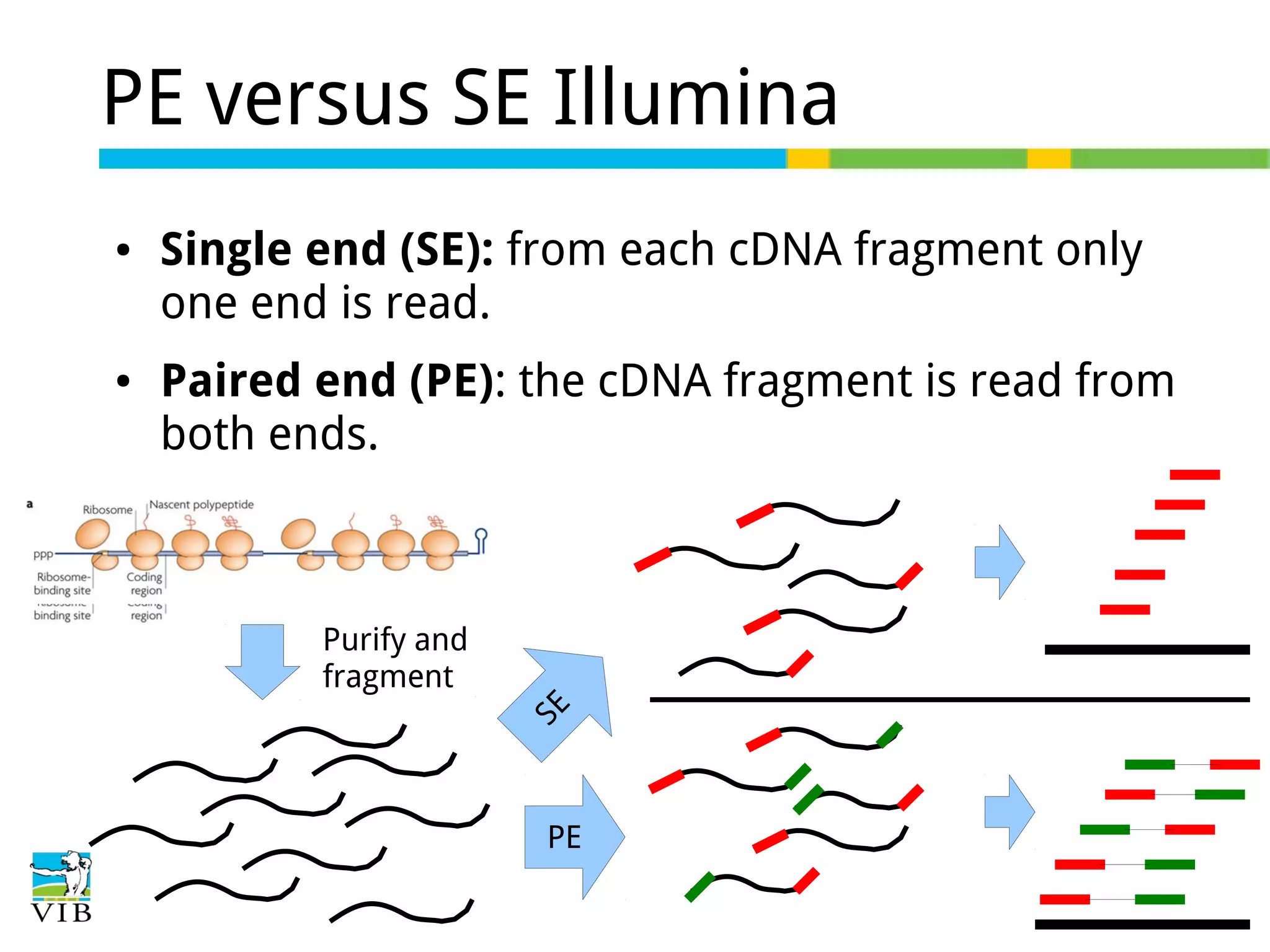
Single end (SE): from each cDNA fragment only
one end is read.
Paired end (PE): the cDNA fragment is read from
both ends.

Purify and
fragment
SE

●

PE
PE versus SE Illumina
Single end (SE):
●

Gene level differential expression

Paired end (PE):
●

Novel splice junction detection

●

De novo assembly of transcriptome

●

Helps with correctly positioning reads on the
reference genome sequence.

Note: PE not the same as mate pairs.
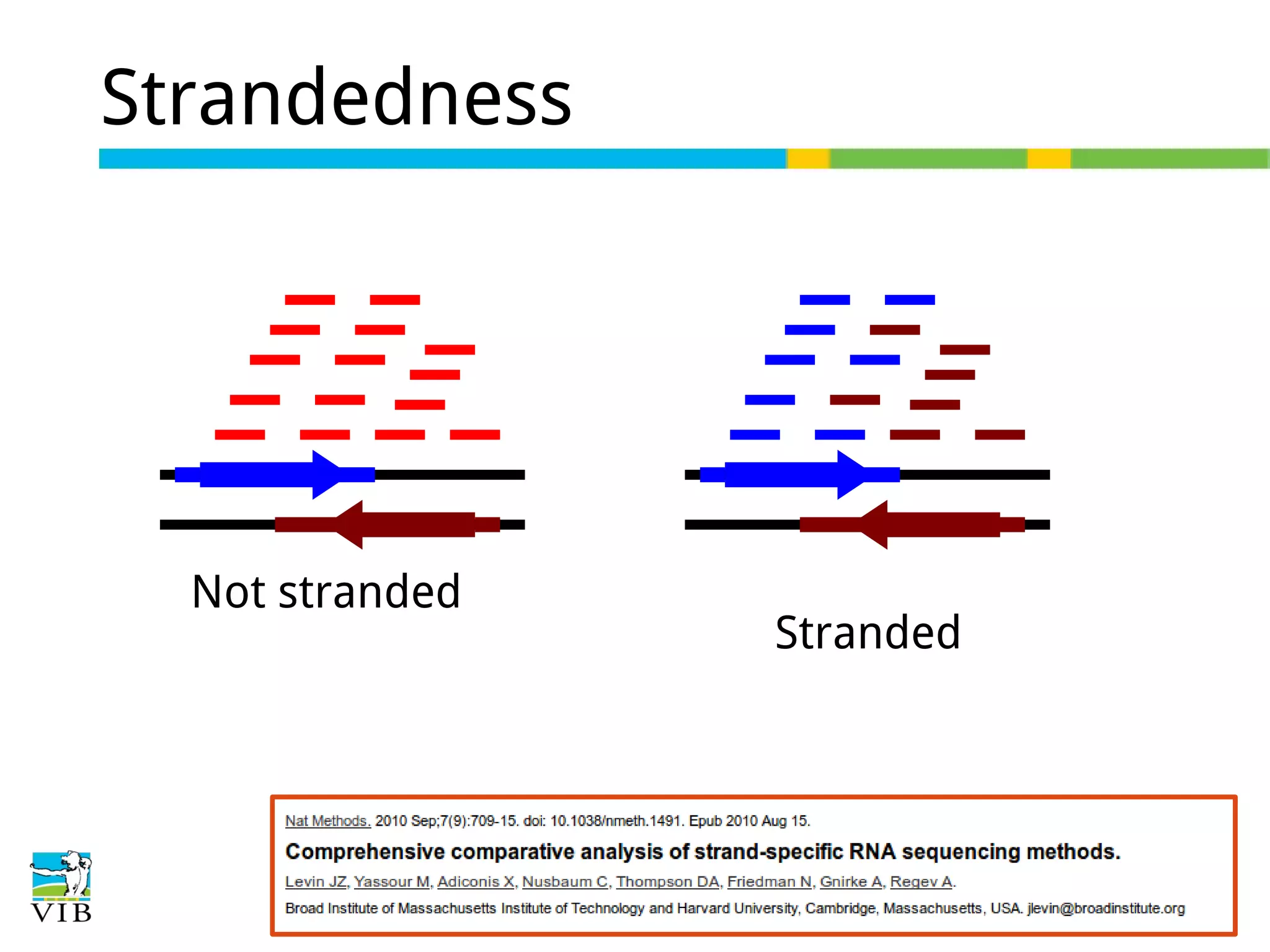
Strandedness
●

●

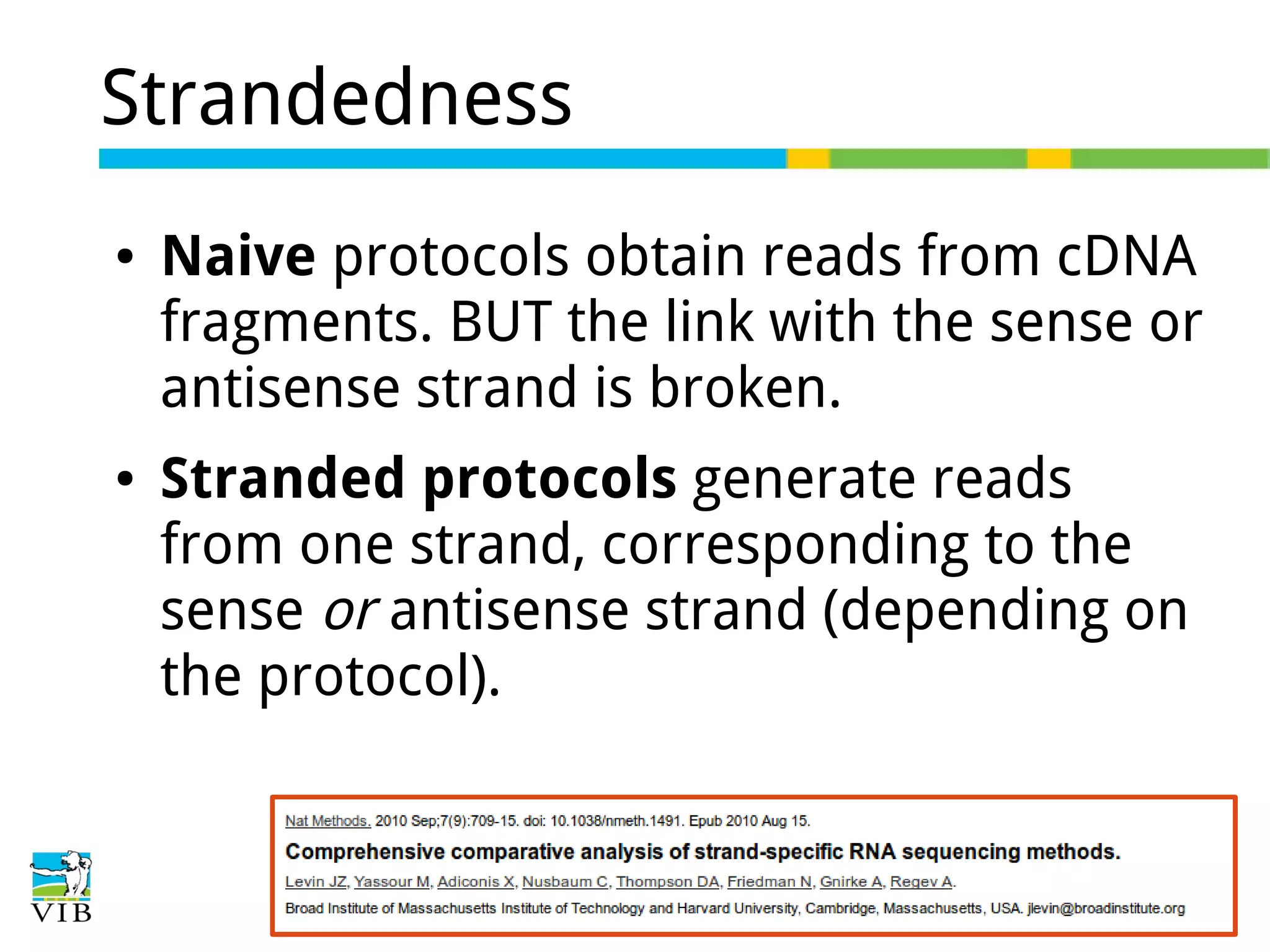
Naive protocols obtain reads from cDNA
fragments. BUT the link with the sense or
antisense strand is broken.
Stranded protocols generate reads
from one strand, corresponding to the
sense or antisense strand (depending on
the protocol).
Strandedness

Not stranded

Stranded
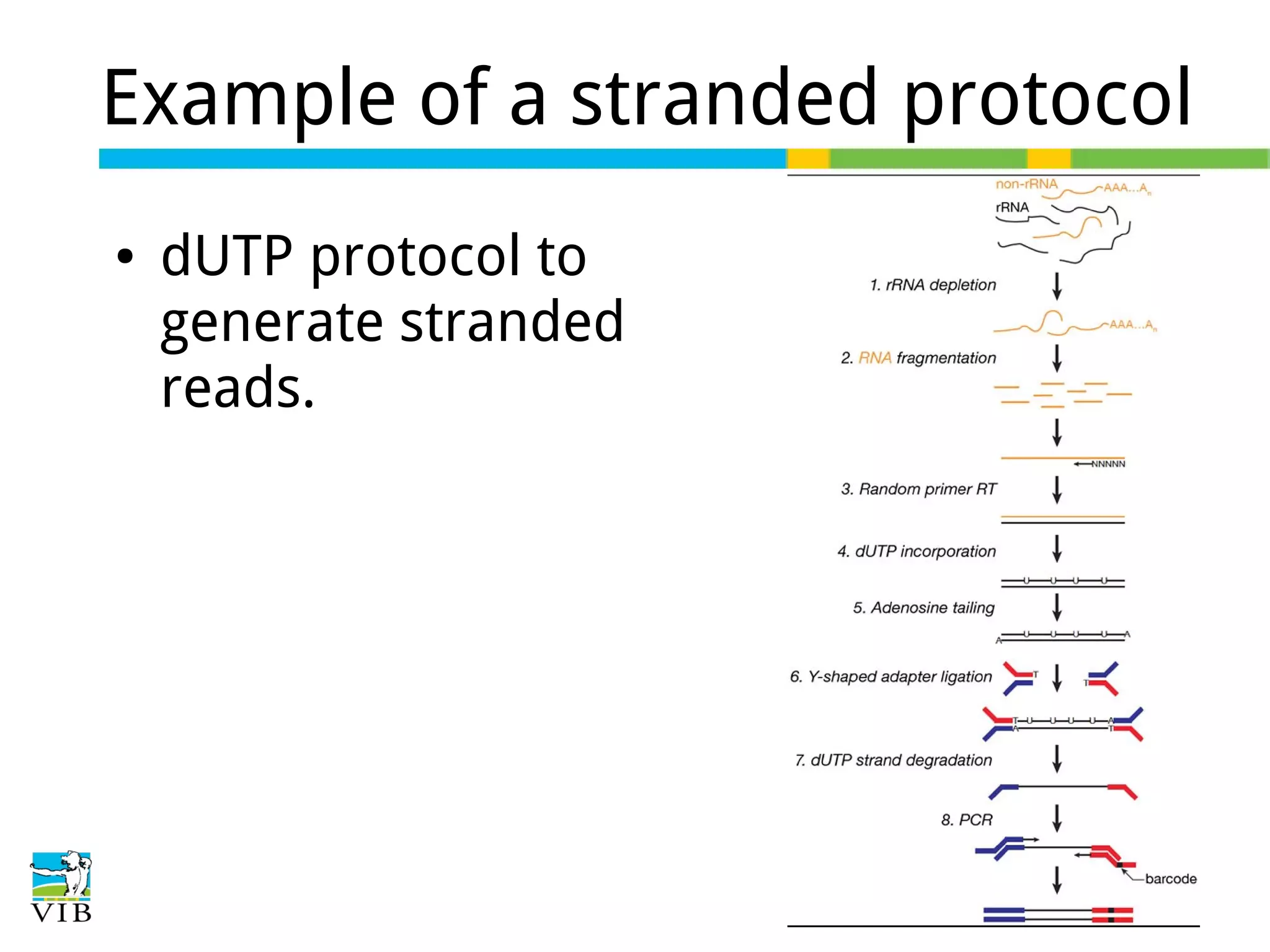
Example of a stranded protocol
●

dUTP protocol to
generate stranded
reads.
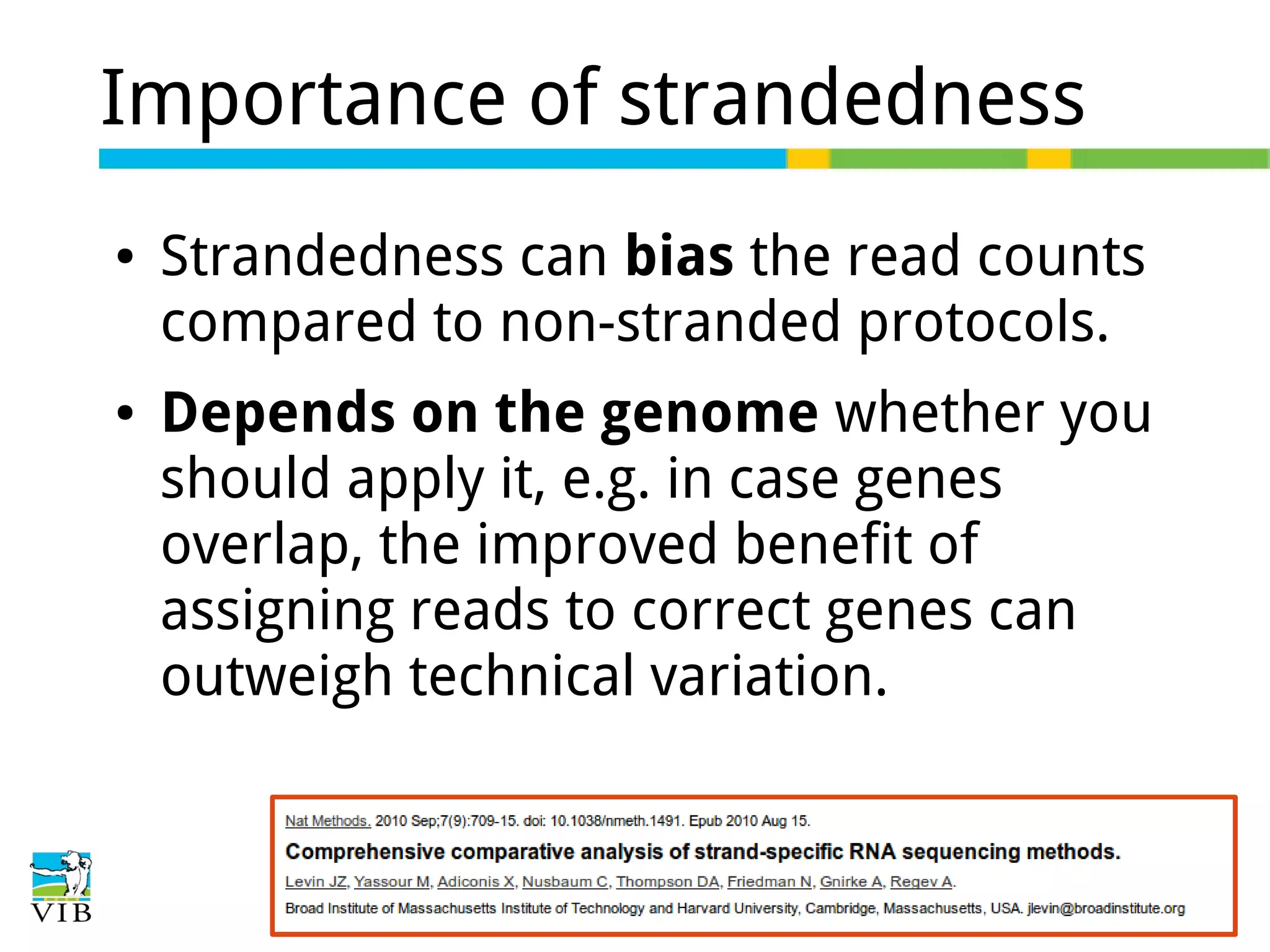
Importance of strandedness
●

●

Strandedness can bias the read counts
compared to non-stranded protocols.
Depends on the genome whether you
should apply it, e.g. in case genes
overlap, the improved benefit of
assigning reads to correct genes can
outweigh technical variation.
Length of the reads
●

●

●

Does not matter so much (when we want
to quantify aligning to a reference
sequence): 50 bp will do.
The most important point is to be able to
accurately position the read on the
reference genome sequence, to assign it
to the correct gene.
Length can become important, if you
want to assemble the transcriptome.
For DE on the gene level
The 'cheapest' protocol for high-throughput
sequencing suffices to achieve DE detection:
●

SE

●

50bp

●

Option: strandedness.

Use the money you have left over for
increasing the number of replicates.
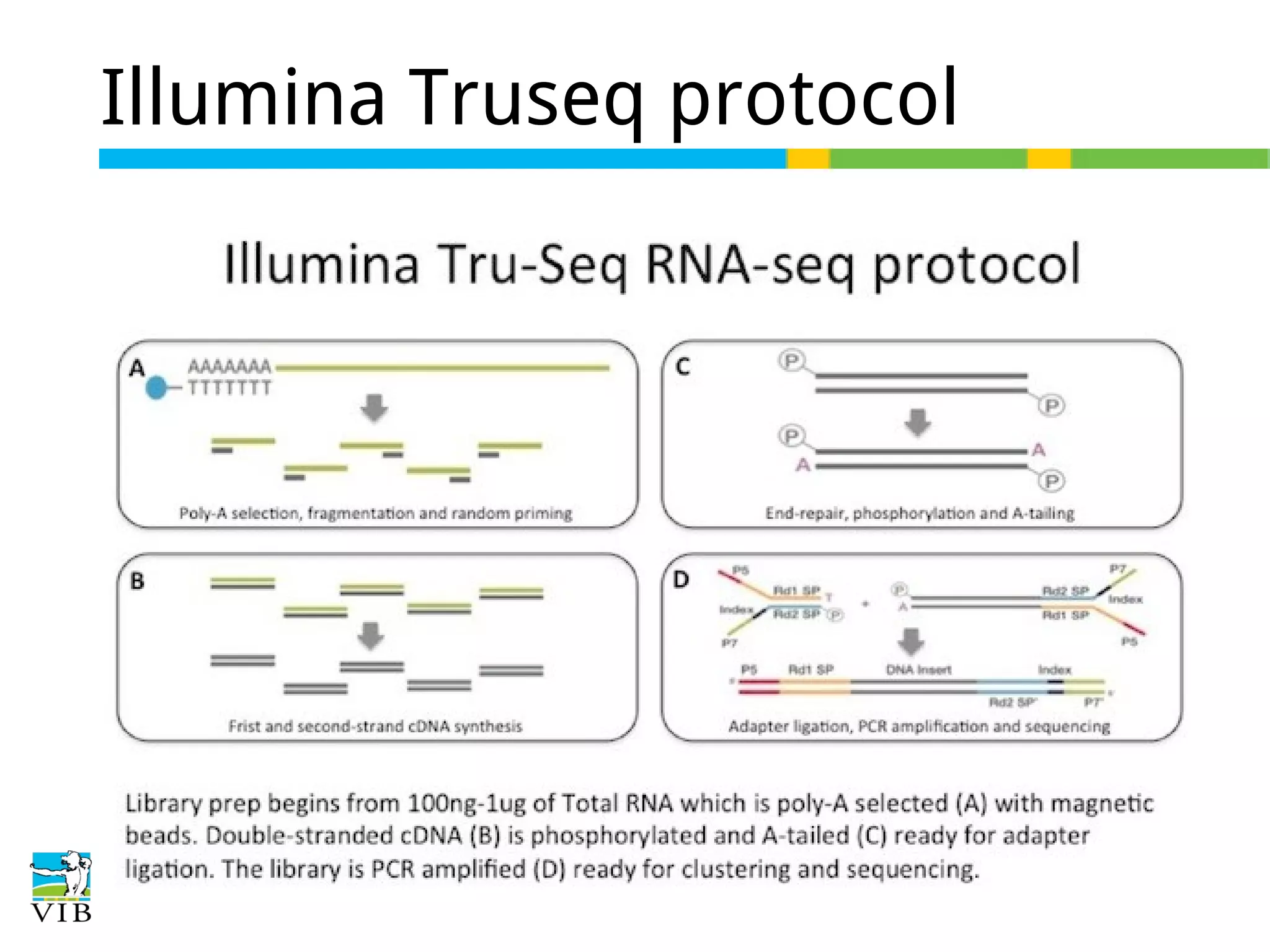
Illumina Truseq protocol
sdf
Raw Illumina data
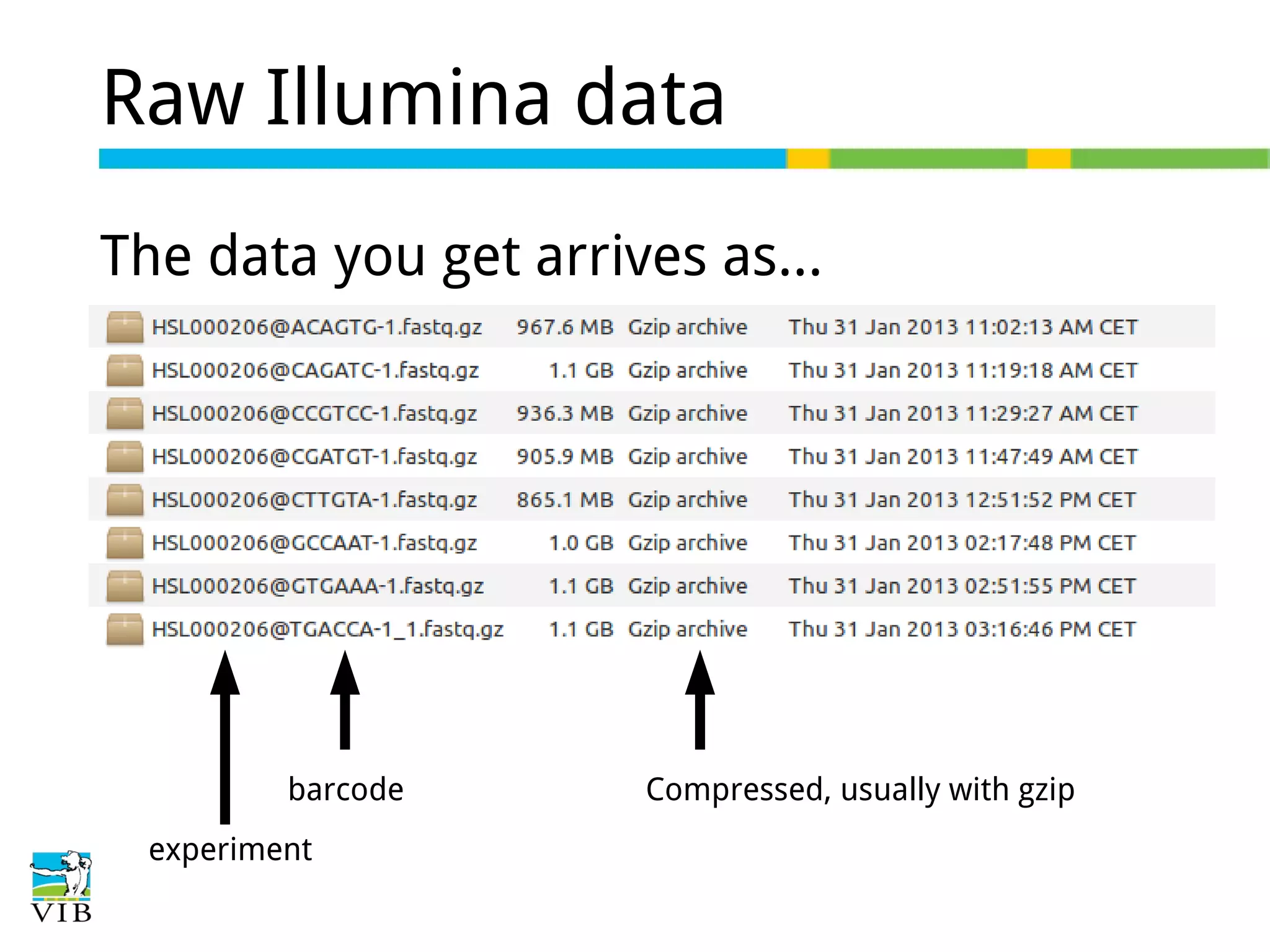
The data you get arrives as...

barcode
experiment

Compressed, usually with gzip
Raw Illumina data
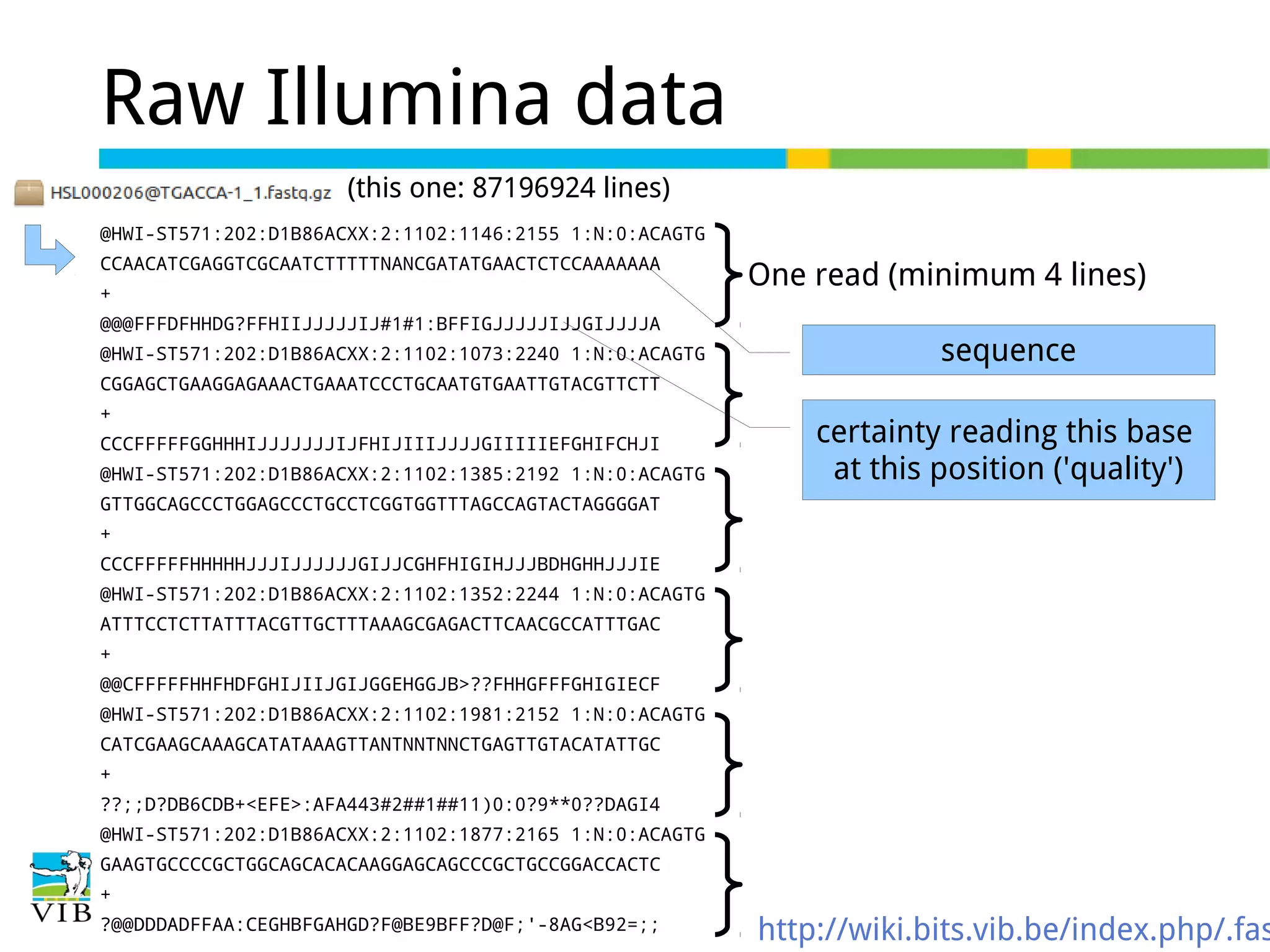
(this one: 87196924 lines)
@HWI-ST571:202:D1B86ACXX:2:1102:1146:2155 1:N:0:ACAGTG
CCAACATCGAGGTCGCAATCTTTTTNANCGATATGAACTCTCCAAAAAAA
+
@@@FFFDFHHDG?FFHIIJJJJJIJ#1#1:BFFIGJJJJJIJJGIJJJJA
@HWI-ST571:202:D1B86ACXX:2:1102:1073:2240 1:N:0:ACAGTG

One read (minimum 4 lines)
sequence

CGGAGCTGAAGGAGAAACTGAAATCCCTGCAATGTGAATTGTACGTTCTT
+
CCCFFFFFGGHHHIJJJJJJJIJFHIJIIIJJJJGIIIIIEFGHIFCHJI
@HWI-ST571:202:D1B86ACXX:2:1102:1385:2192 1:N:0:ACAGTG

certainty reading this base
at this position ('quality')

GTTGGCAGCCCTGGAGCCCTGCCTCGGTGGTTTAGCCAGTACTAGGGGAT
+
CCCFFFFFHHHHHJJJIJJJJJJGIJJCGHFHIGIHJJJBDHGHHJJJIE
@HWI-ST571:202:D1B86ACXX:2:1102:1352:2244 1:N:0:ACAGTG
ATTTCCTCTTATTTACGTTGCTTTAAAGCGAGACTTCAACGCCATTTGAC
+
@@CFFFFFHHFHDFGHIJIIJGIJGGEHGGJB>??FHHGFFFGHIGIECF
@HWI-ST571:202:D1B86ACXX:2:1102:1981:2152 1:N:0:ACAGTG
CATCGAAGCAAAGCATATAAAGTTANTNNTNNCTGAGTTGTACATATTGC
+
??;;D?DB6CDB+<EFE>:AFA443#2##1##11)0:0?9**0??DAGI4
@HWI-ST571:202:D1B86ACXX:2:1102:1877:2165 1:N:0:ACAGTG
GAAGTGCCCCGCTGGCAGCACACAAGGAGCAGCCCGCTGCCGGACCACTC
+
?@@DDDADFFAA:CEGHBFGAHGD?F@BE9BFF?D@F;'-8AG<B92=;;

http://wiki.bits.vib.be/index.php/.fas
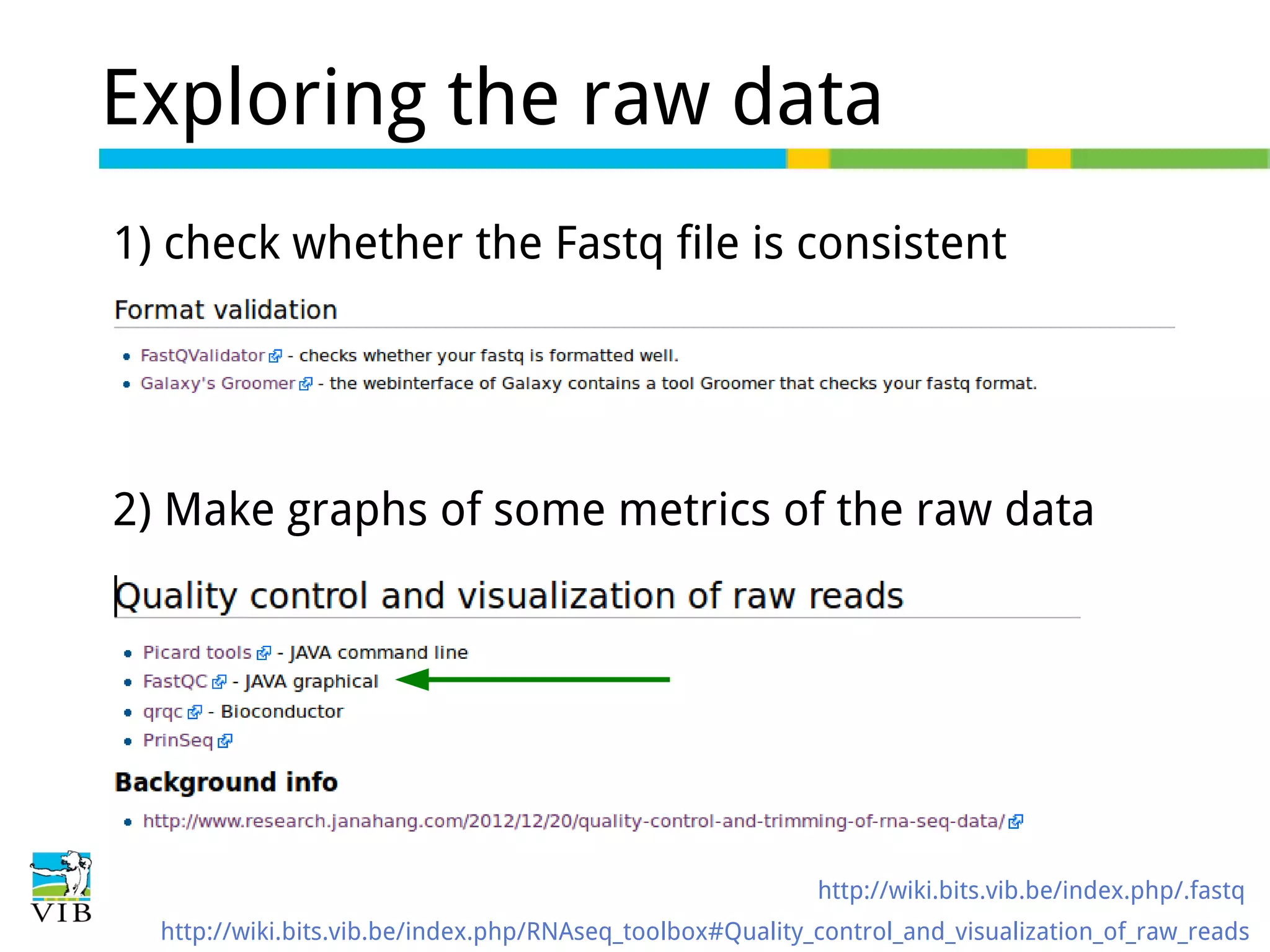
Exploring the raw data
1) check whether the Fastq file is consistent
-

2) Make graphs of some metrics of the raw data

http://wiki.bits.vib.be/index.php/.fastq
http://wiki.bits.vib.be/index.php/RNAseq_toolbox#Quality_control_and_visualization_of_raw_reads
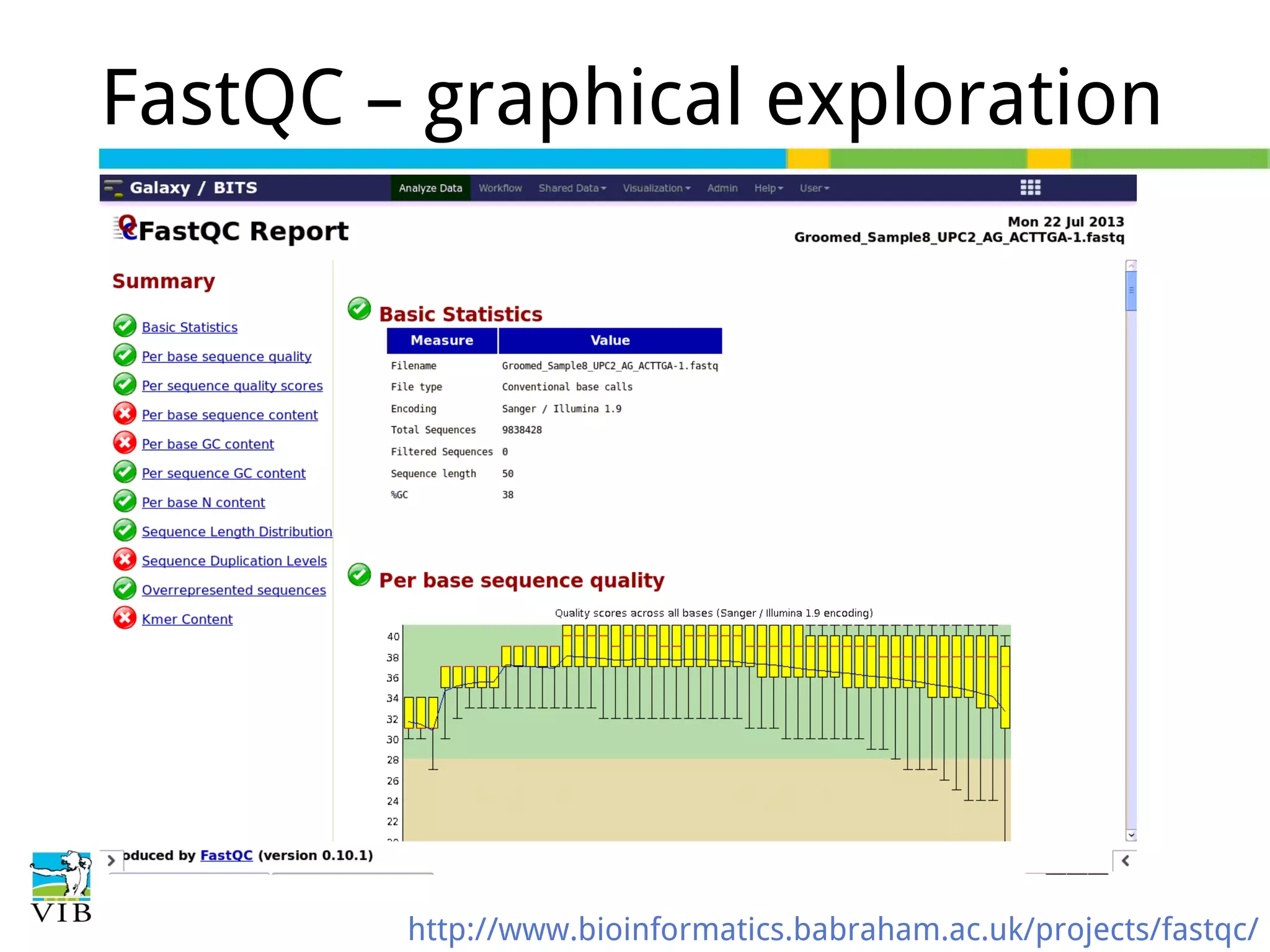
FastQC – graphical exploration

http://www.bioinformatics.babraham.ac.uk/projects/fastqc/
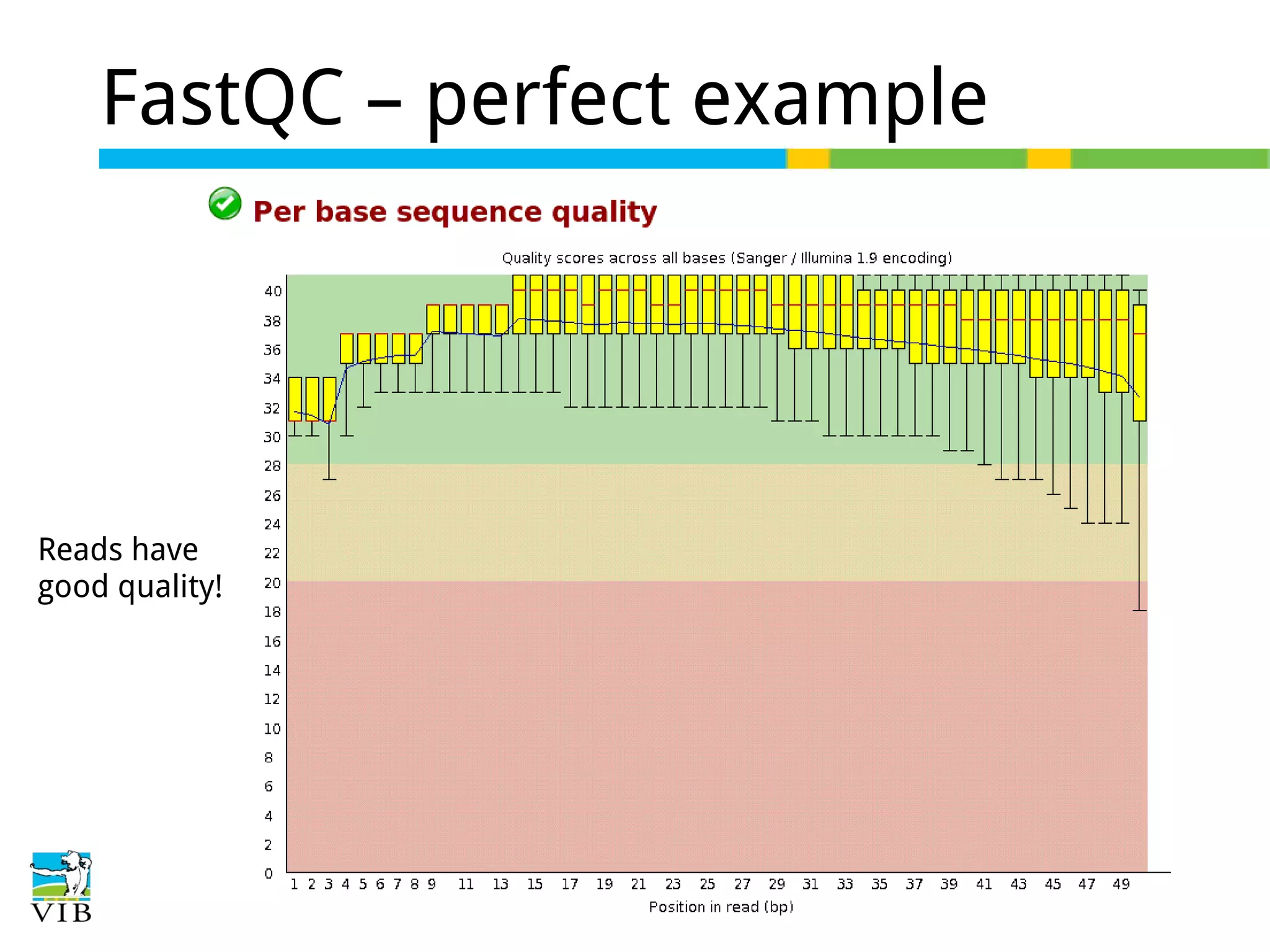
FastQC – perfect example

Reads have
good quality!
FastQC – perfect example
Anna Karenina principle: “There is only one way
to be good, but there are many ways to be
wrong.”

We will start by showing a good sample.
Afterwards we will discuss a less good sample.

http://en.wikipedia.org/wiki/Anna_Karenina_principle
FastQC – perfect example

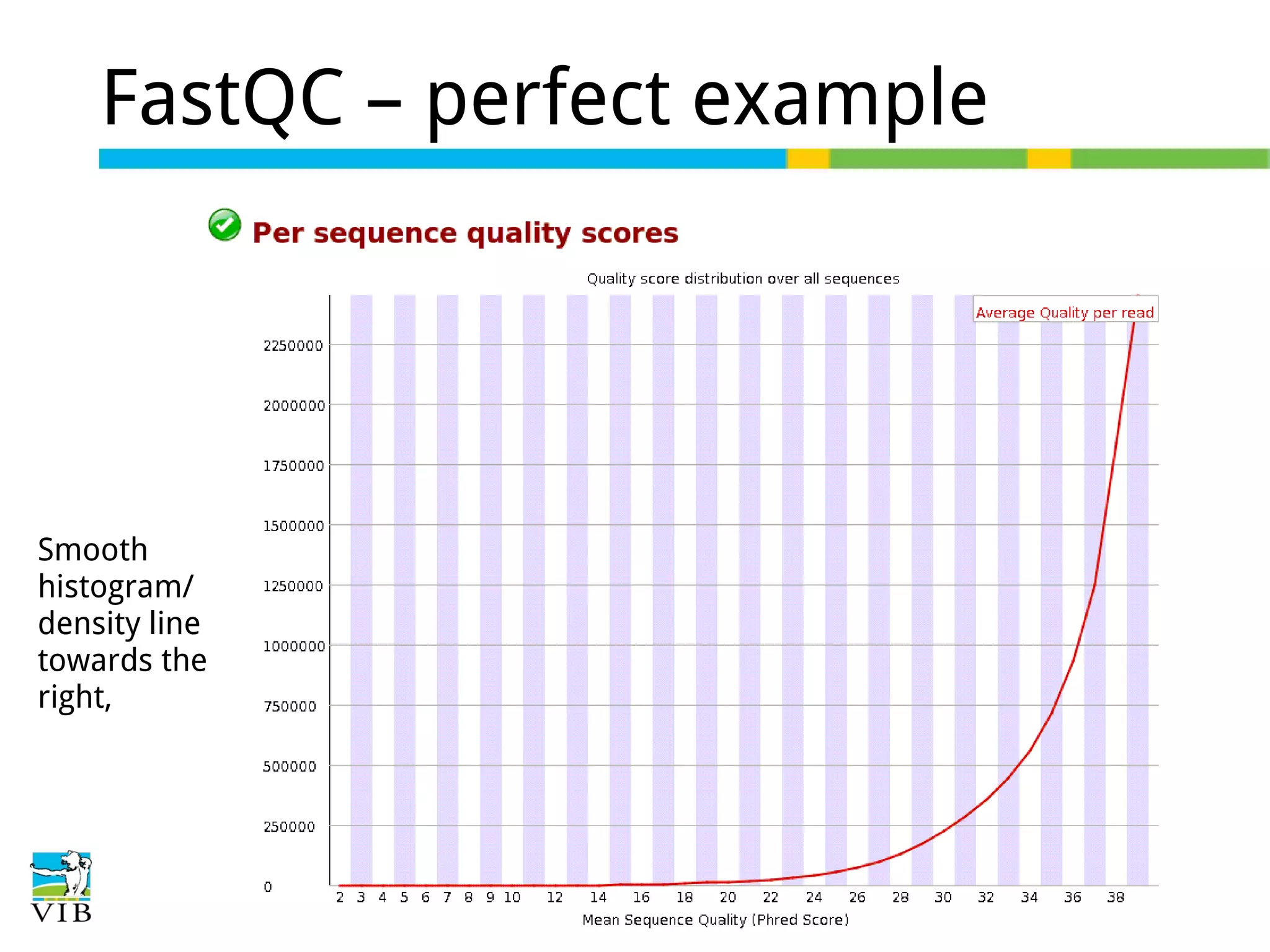
Smooth
histogram/
density line
towards the
right,
FastQC – perfect example

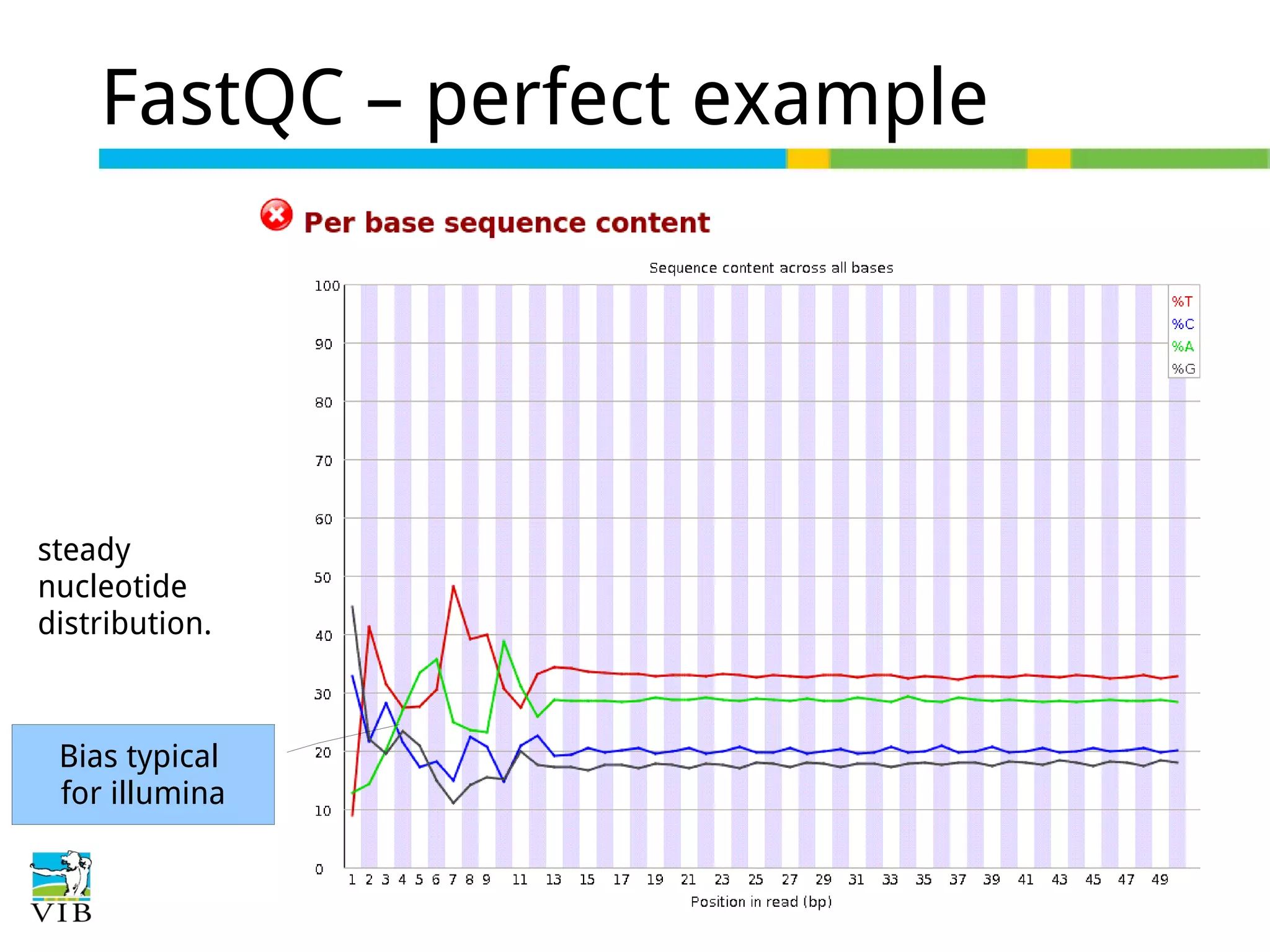
steady
nucleotide
distribution.

Bias typical
for illumina
FastQC – perfect example

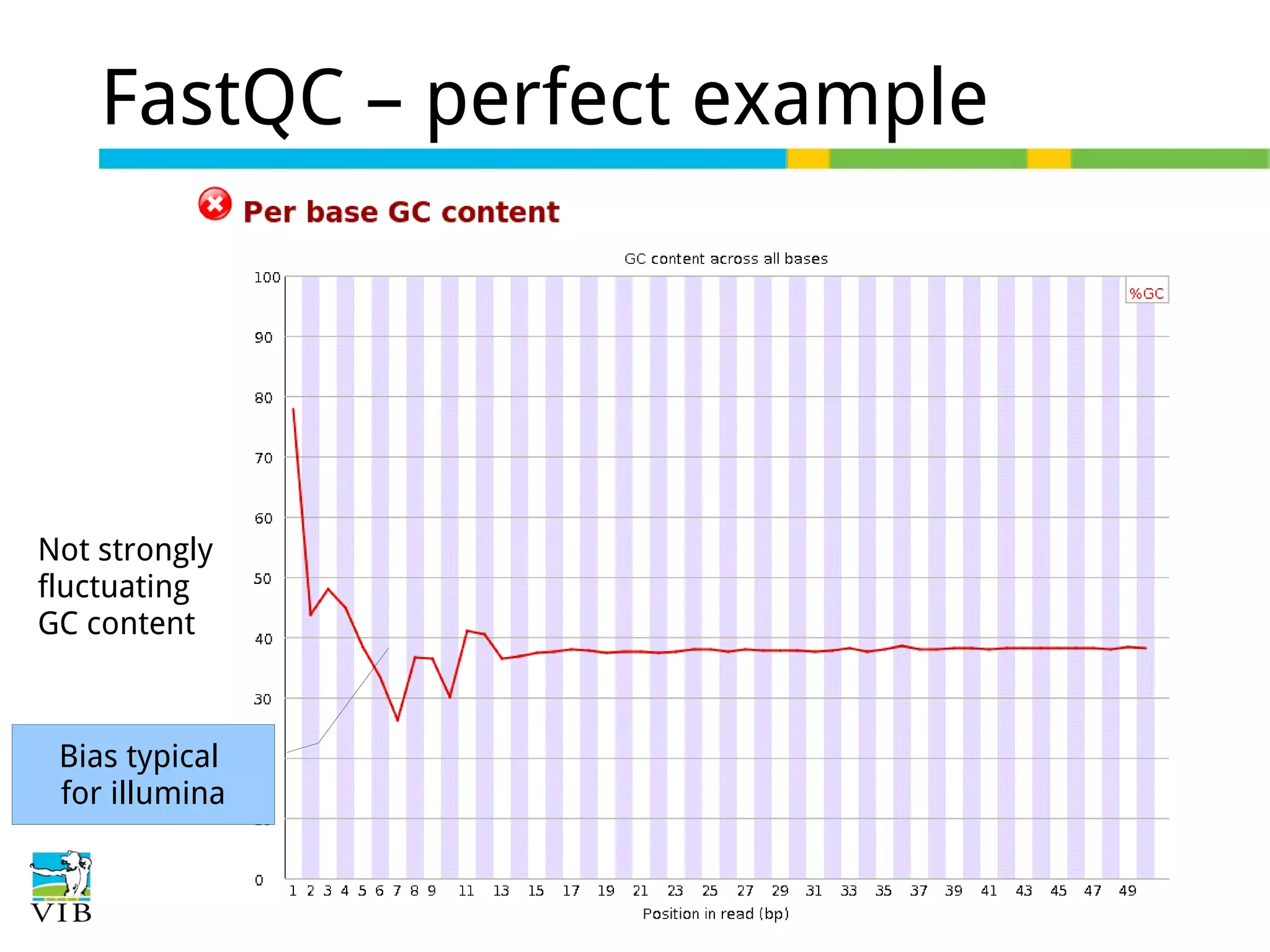
Not strongly
fluctuating
GC content

Bias typical
for illumina
FastQC – perfect example

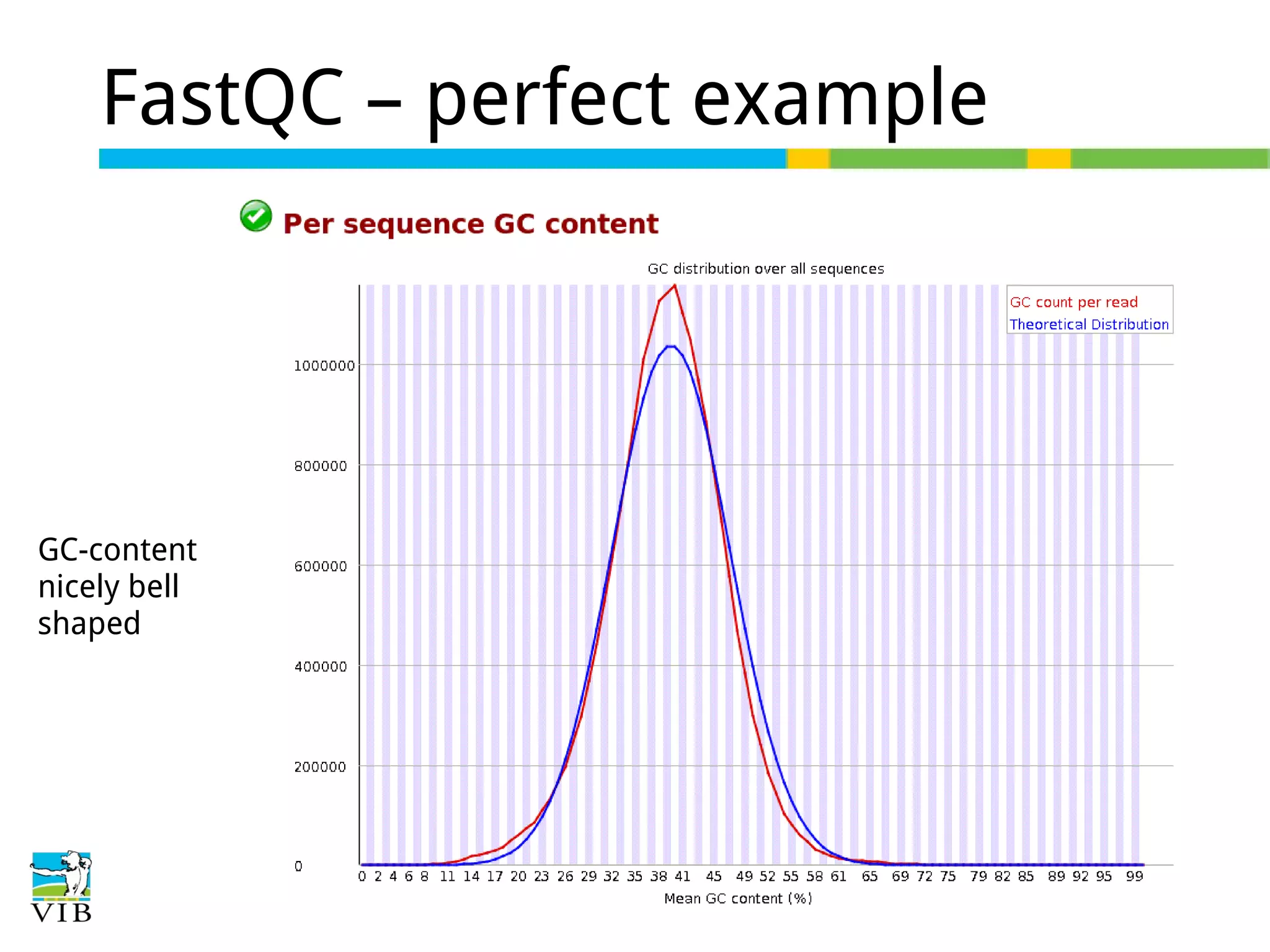
GC-content
nicely bell
shaped
FastQC – perfect example

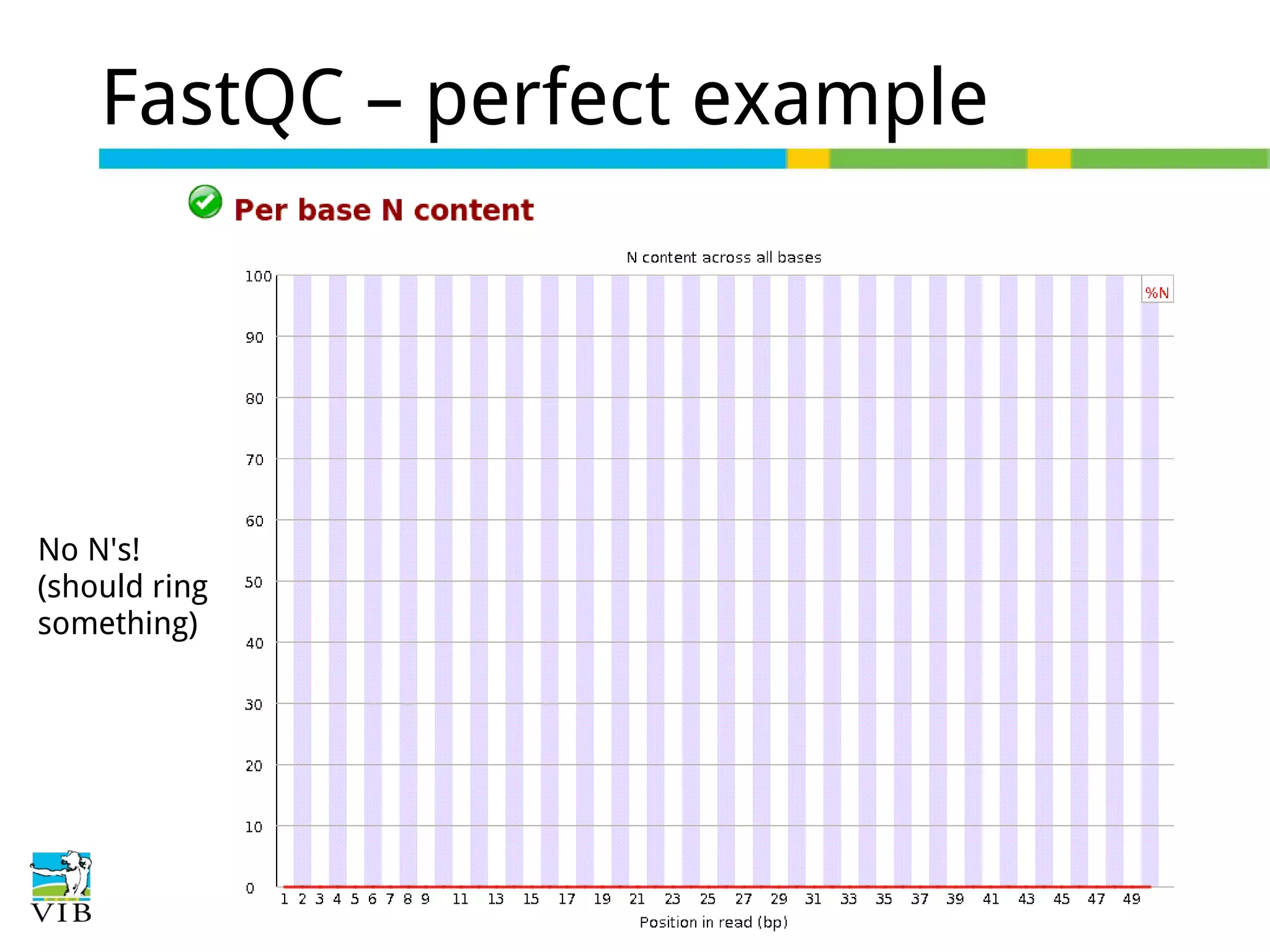
No N's!
(should ring
something)
FastQC – perfect example

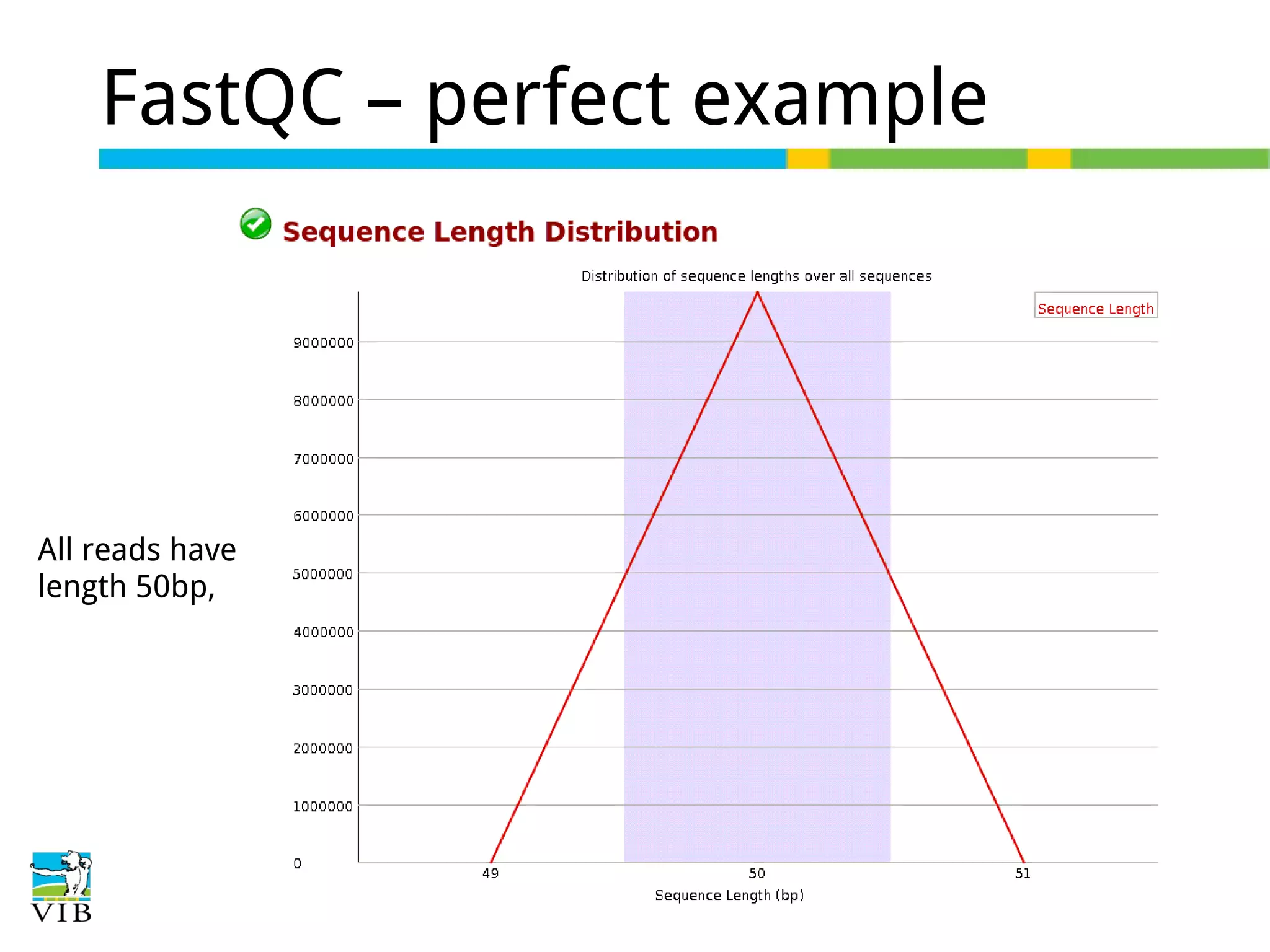
All reads have
length 50bp,
FastQC – perfect example

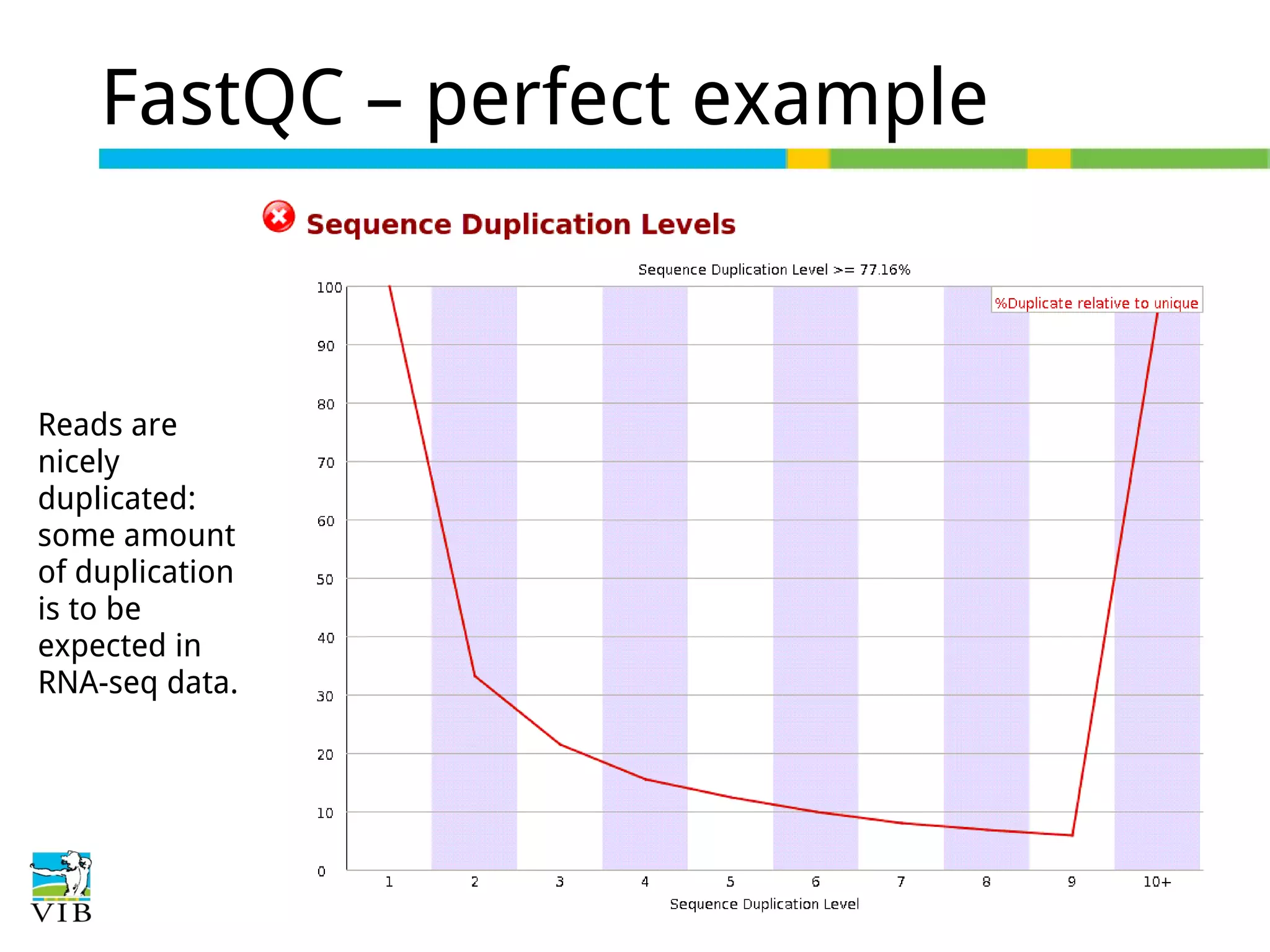
Reads are
nicely
duplicated:
some amount
of duplication
is to be
expected in
RNA-seq data.
FastQC – perfect example

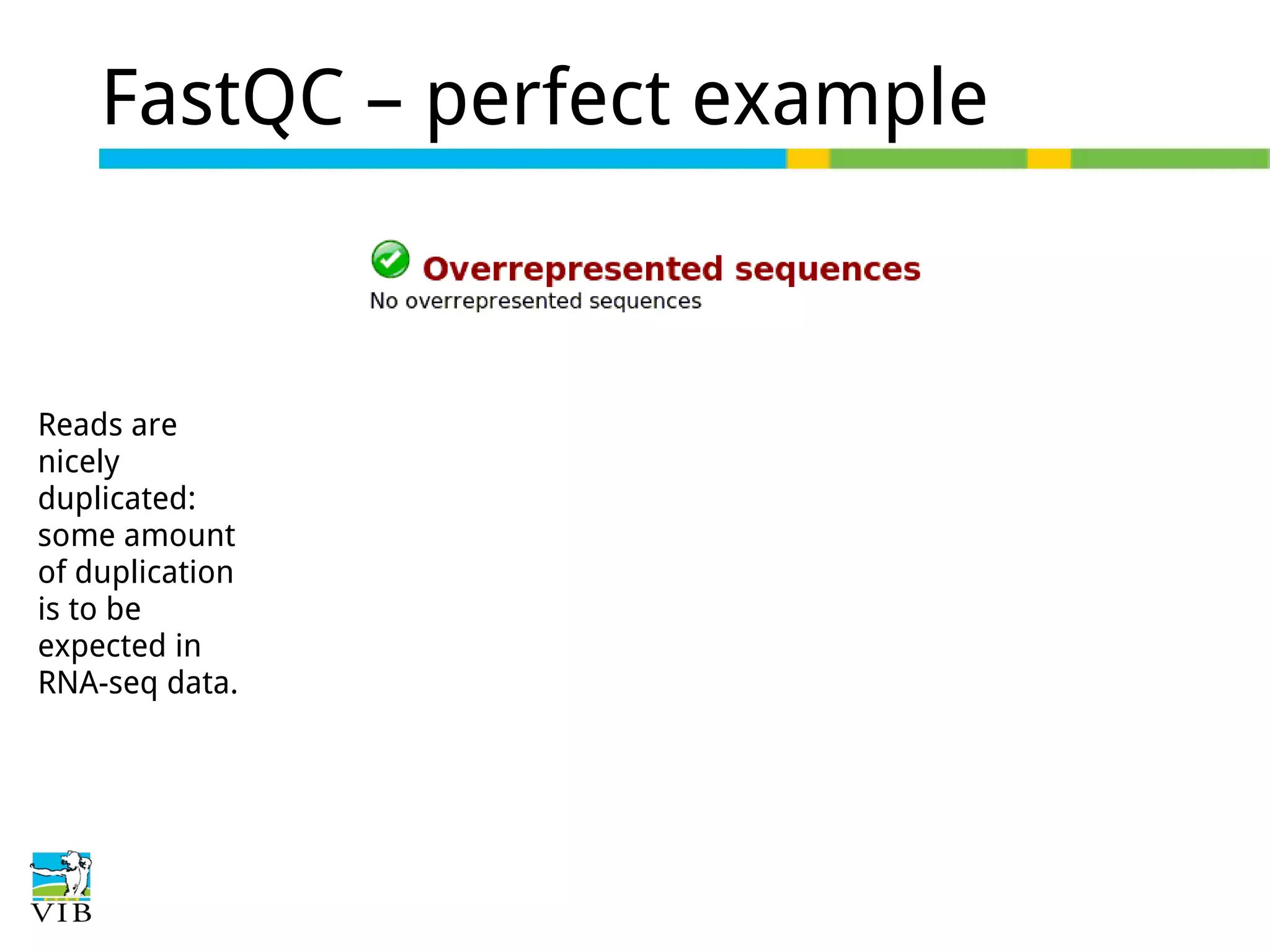
Reads are
nicely
duplicated:
some amount
of duplication
is to be
expected in
RNA-seq data.
FastQC – perfect example

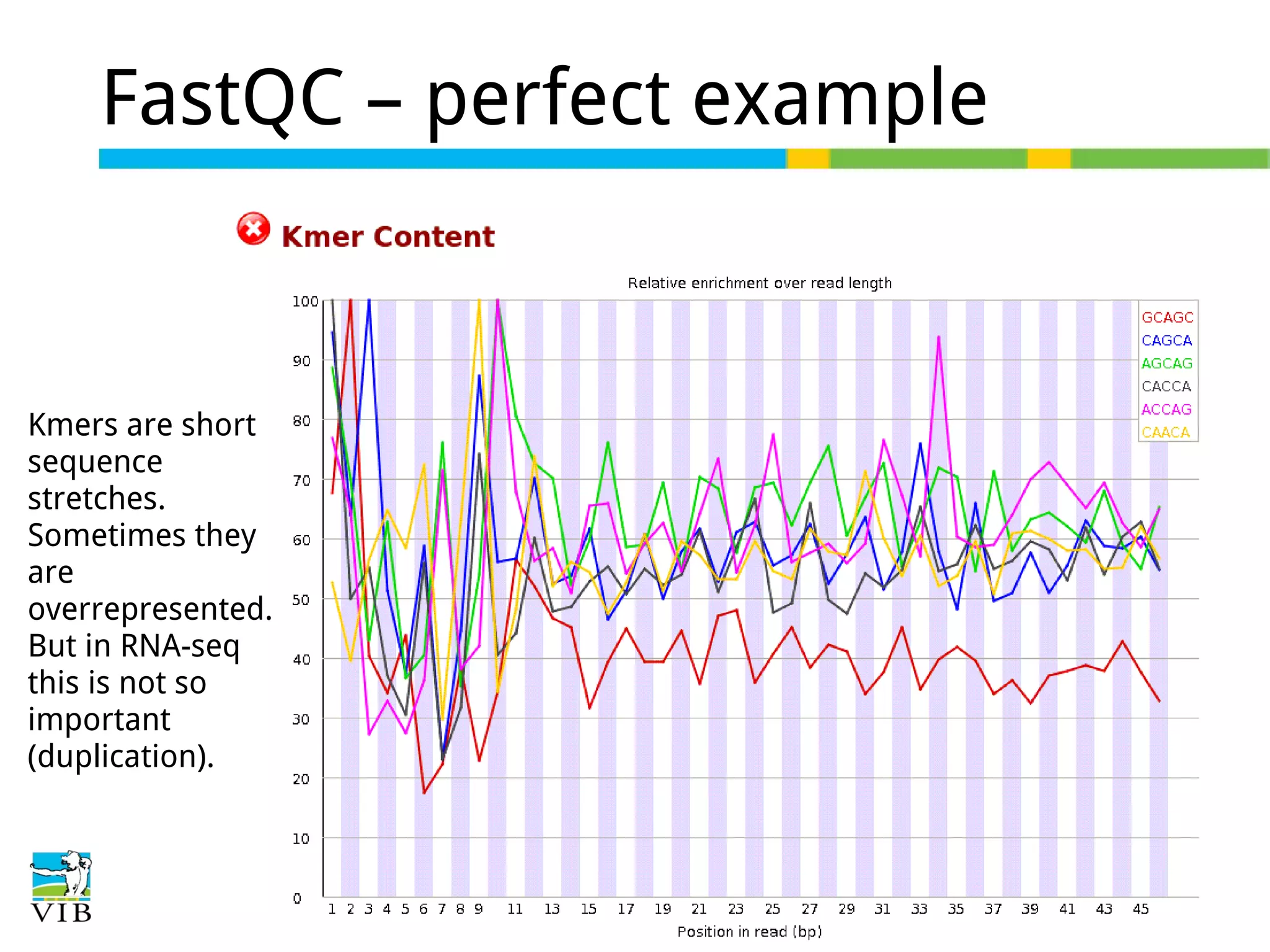
Kmers are short
sequence
stretches.
Sometimes they
are
overrepresented.
But in RNA-seq
this is not so
important
(duplication).
FastQC – less good RNA-seq sample

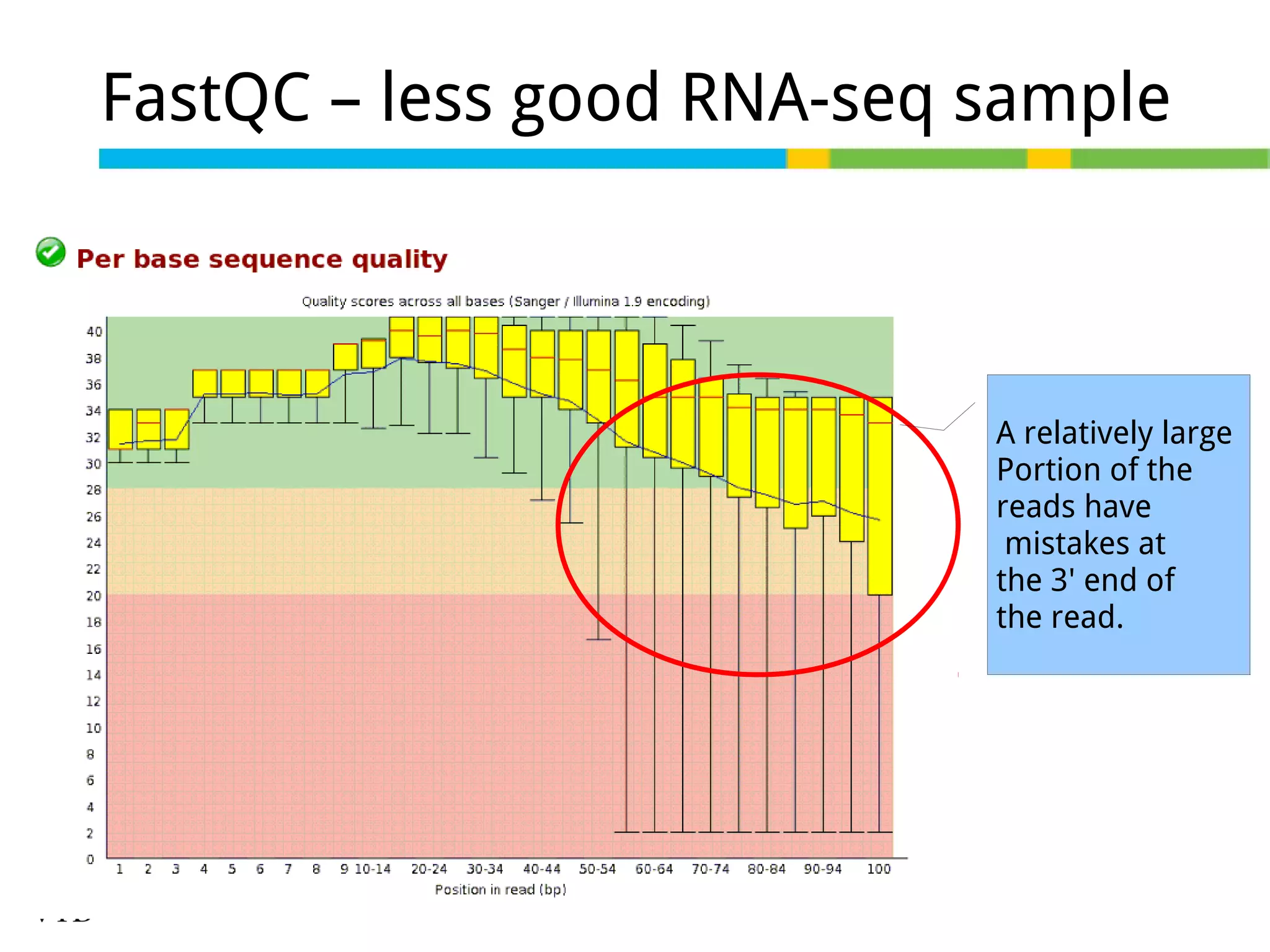
A relatively large
Portion of the
reads have
mistakes at
the 3' end of
the read.
FastQC – less good RNA-seq sample

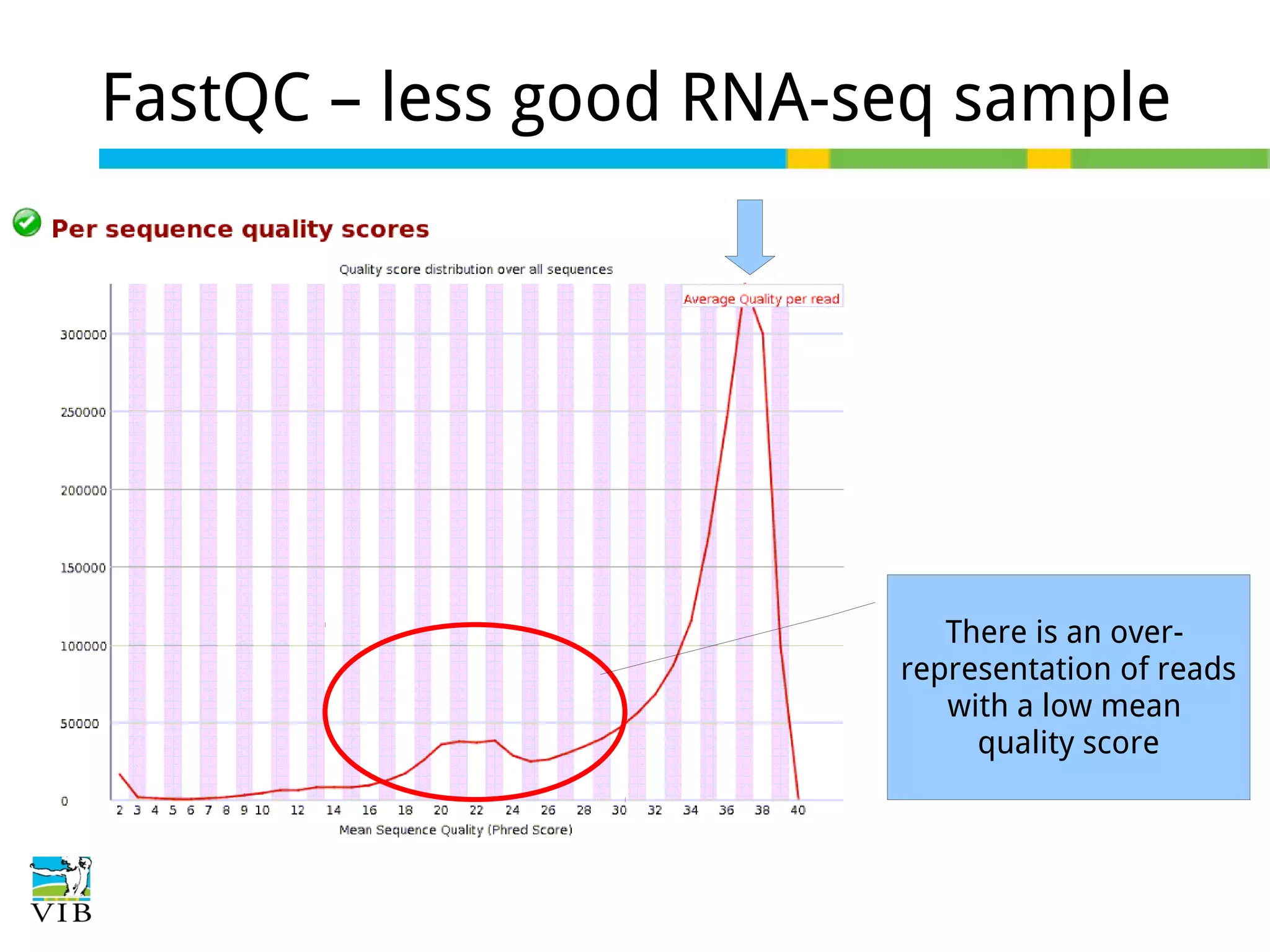
There is an overrepresentation of reads
with a low mean
quality score
FastQC – less good RNA-seq sample

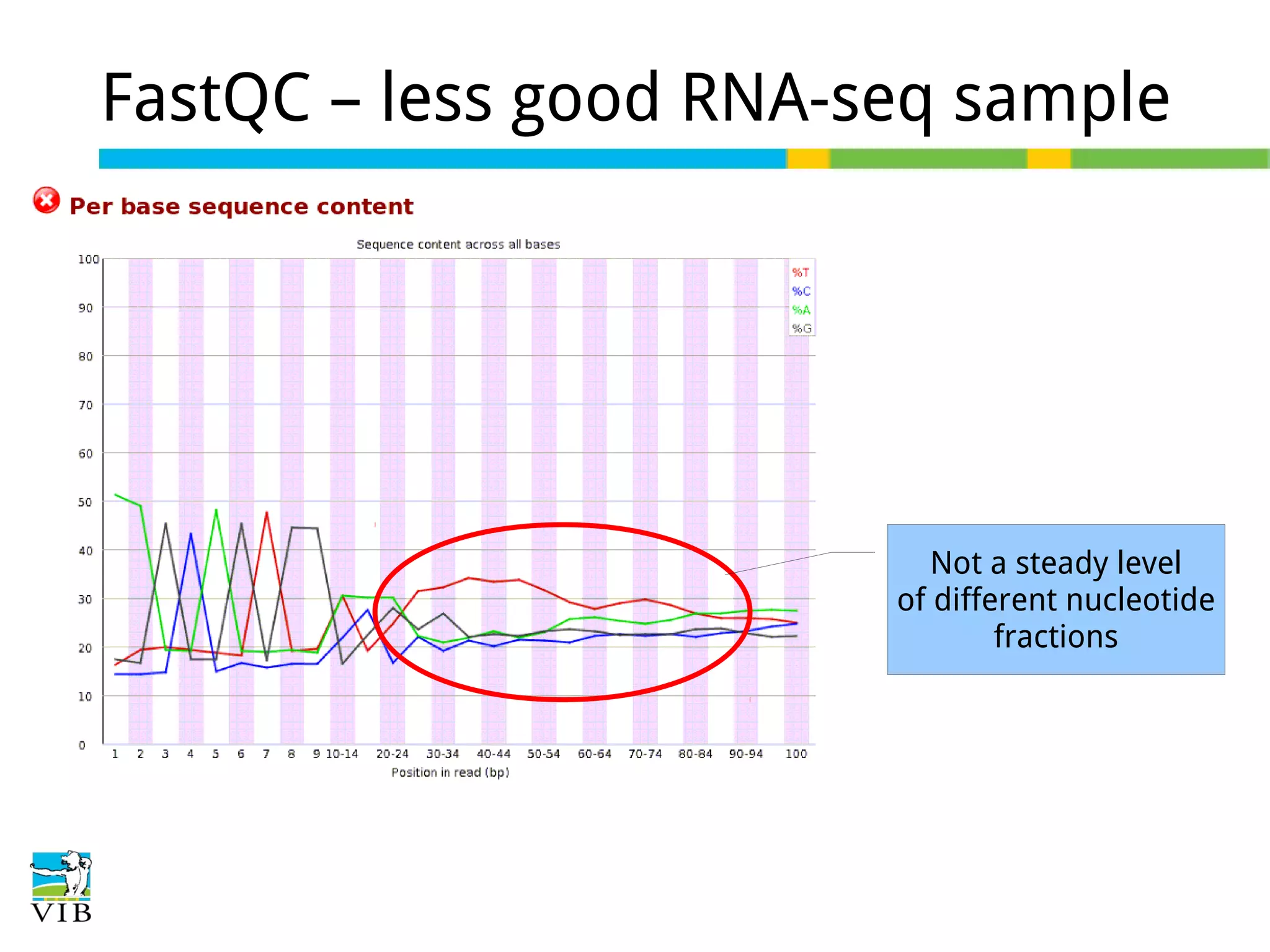
Not a steady level
of different nucleotide
fractions
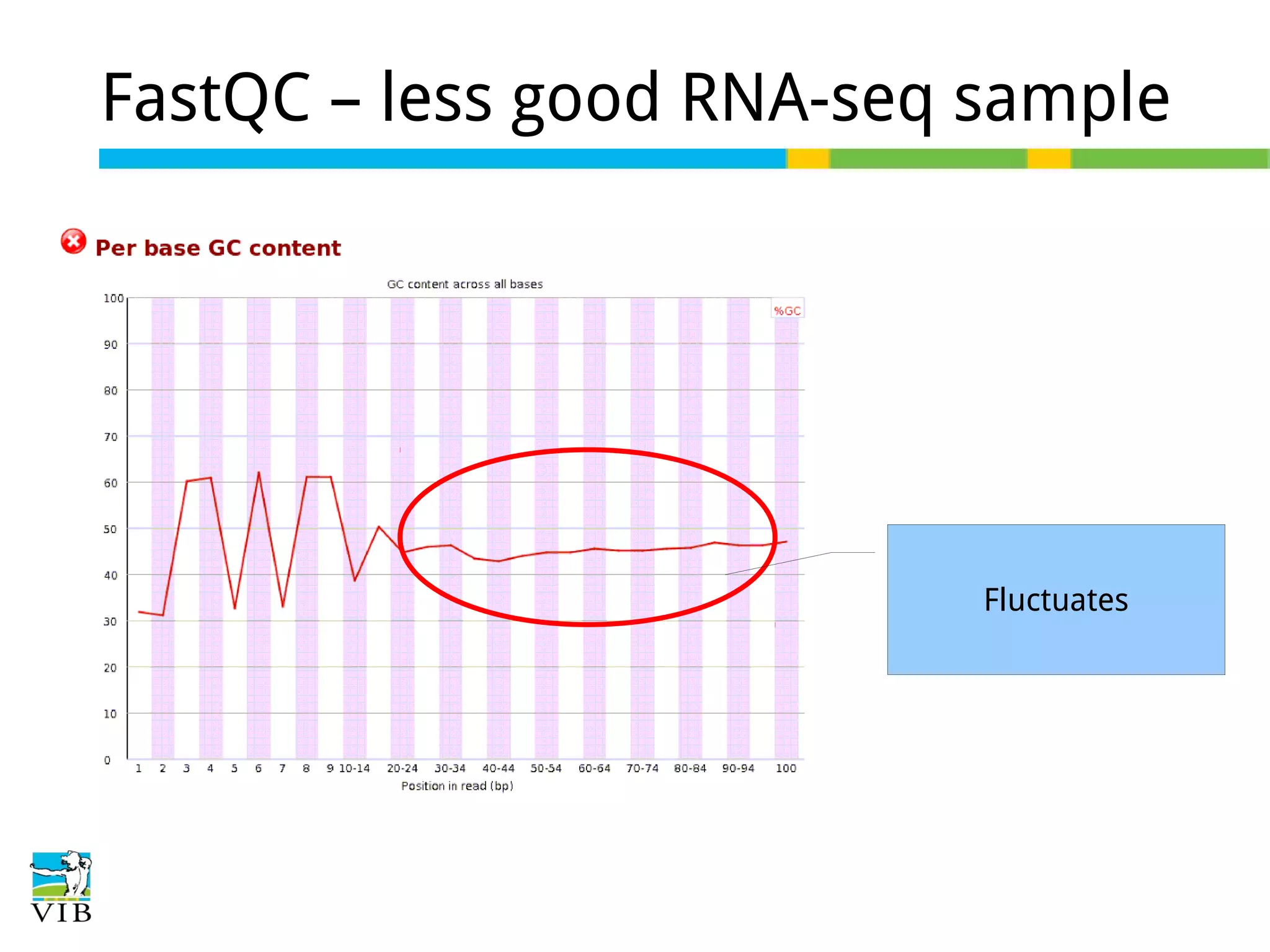
FastQC – less good RNA-seq sample

Fluctuates
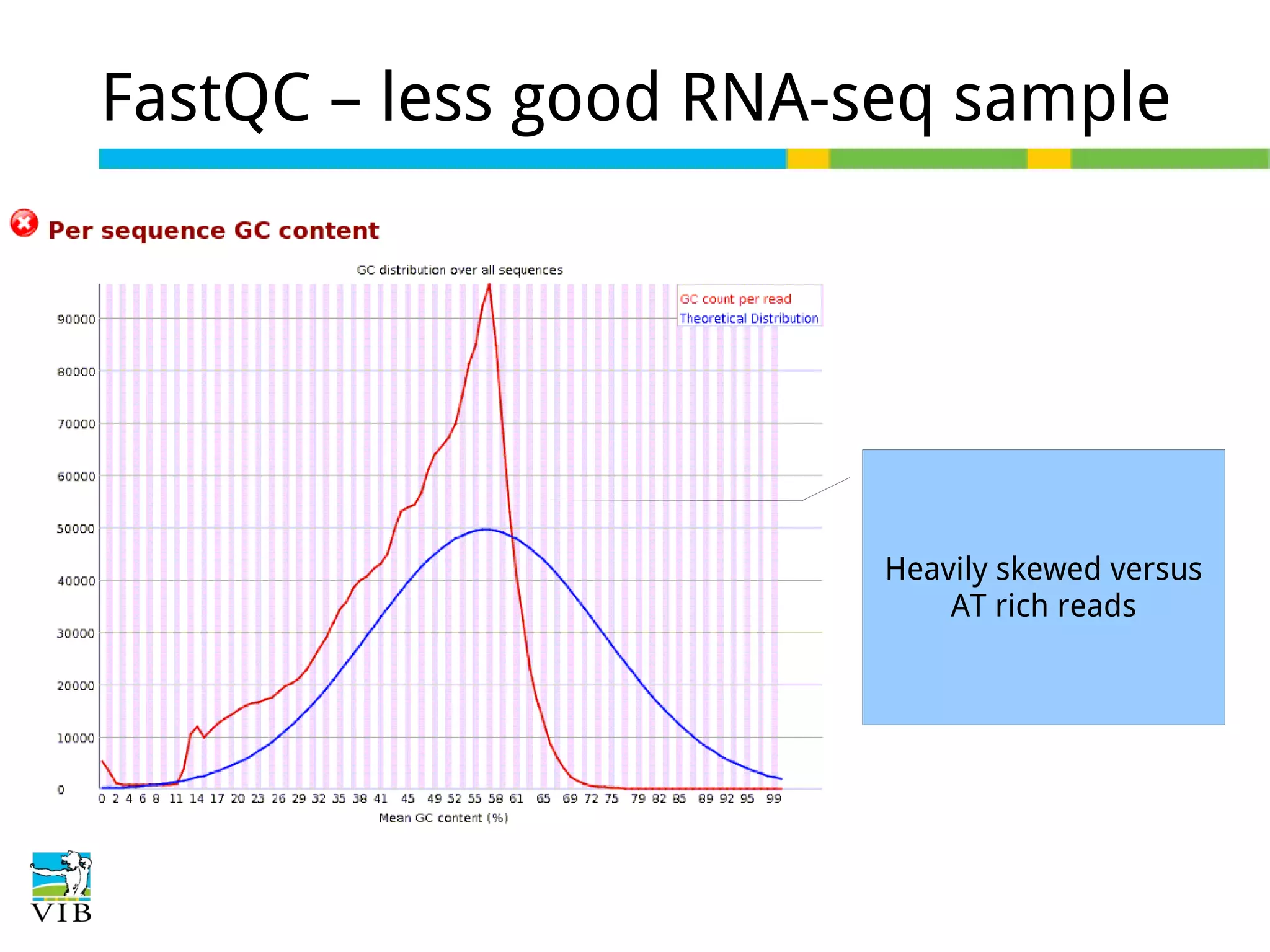
FastQC – less good RNA-seq sample

Heavily skewed versus
AT rich reads
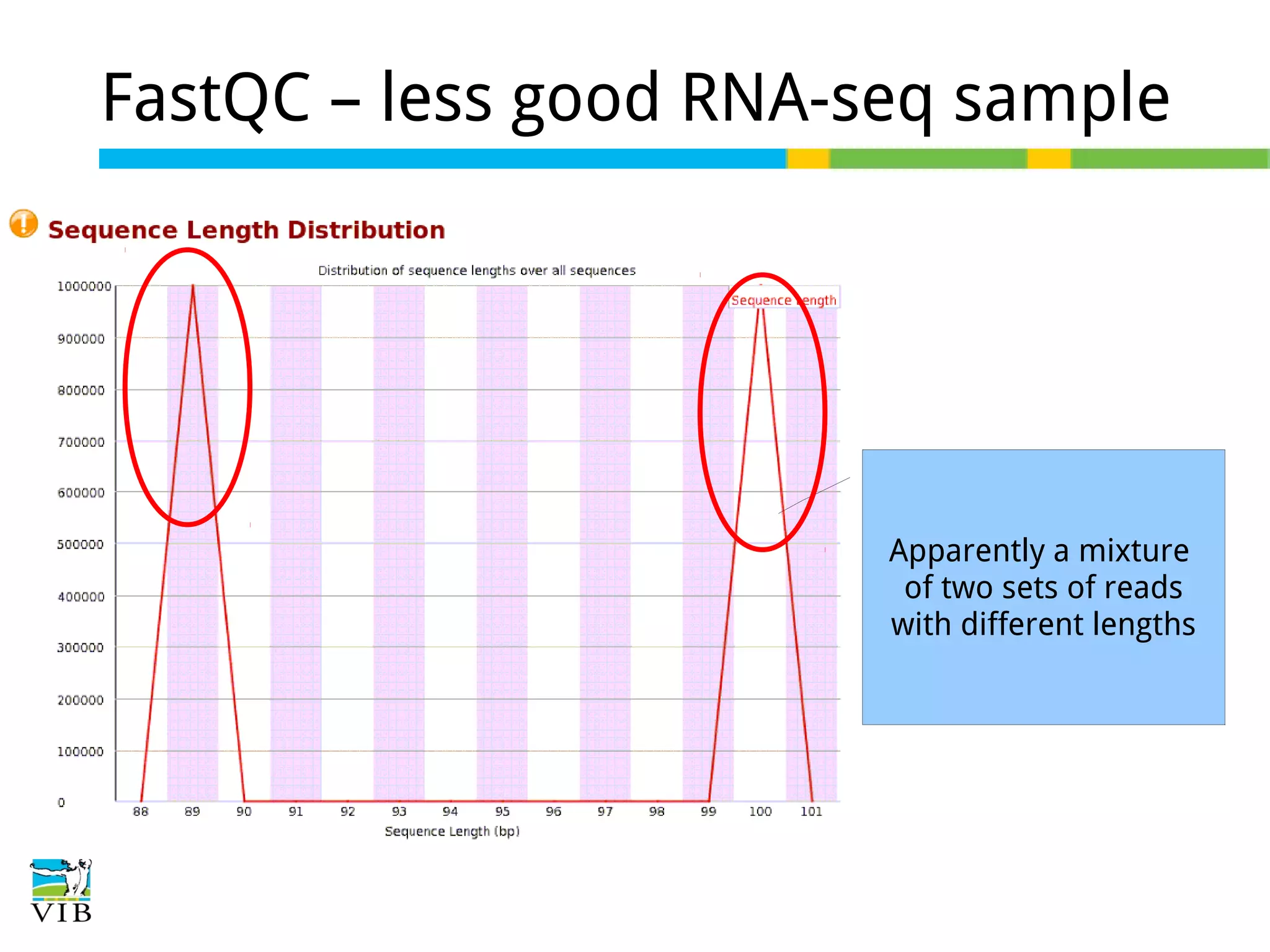
FastQC – less good RNA-seq sample

Apparently a mixture
of two sets of reads
with different lengths
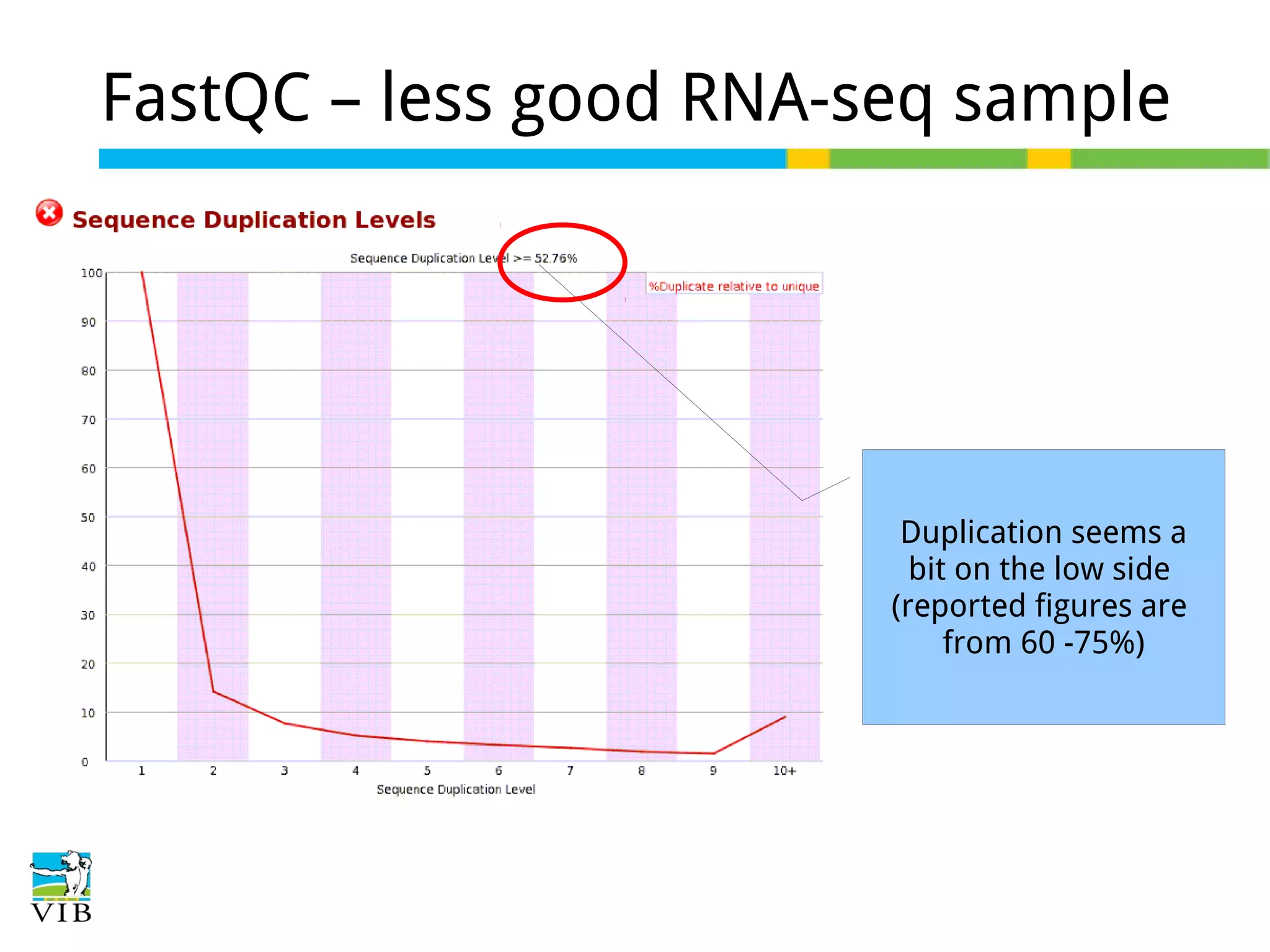
FastQC – less good RNA-seq sample

Duplication seems a
bit on the low side
(reported figures are
from 60 -75%)
FastQC – less good RNA-seq sample

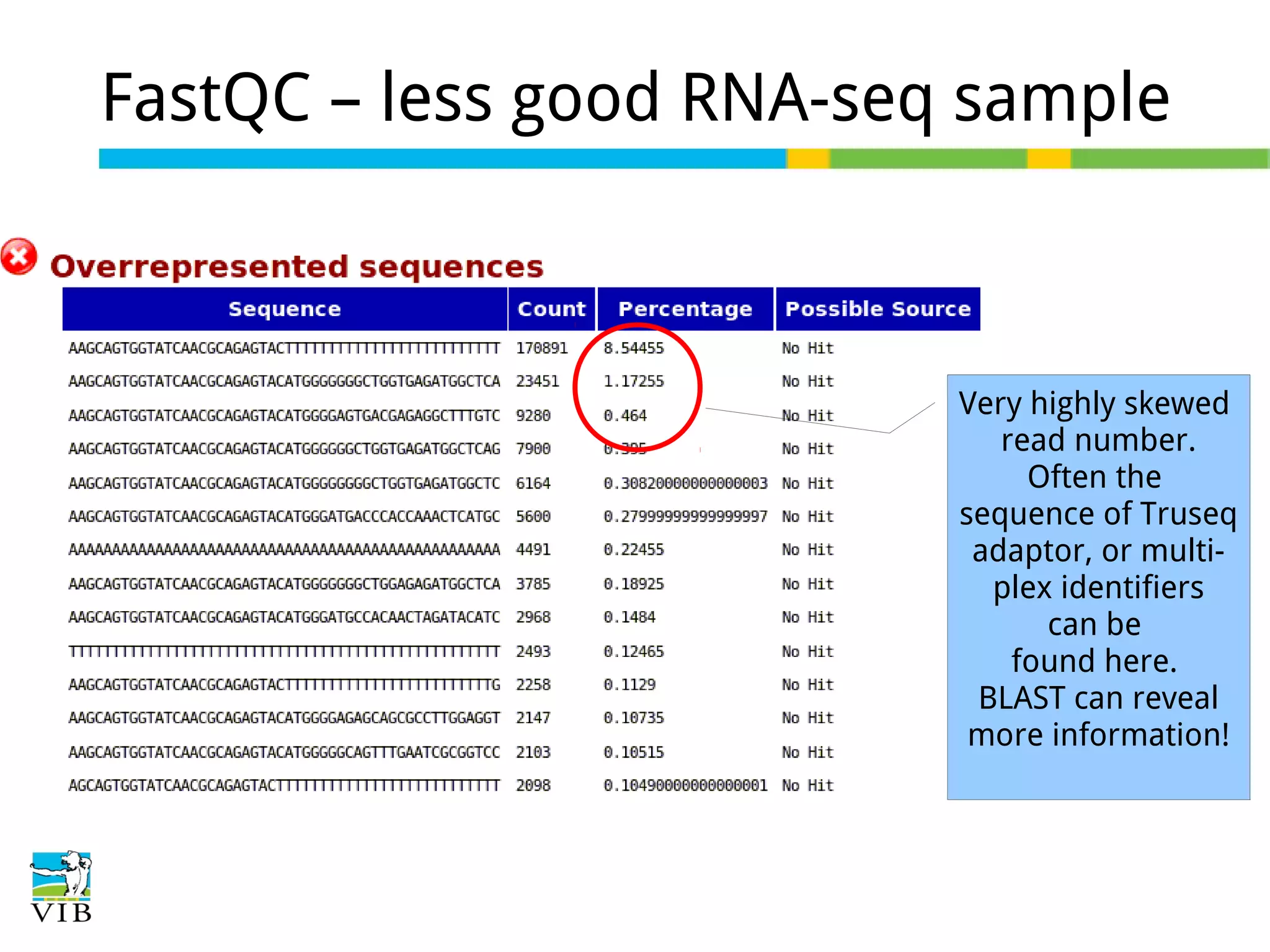
Very highly skewed
read number.
Often the
sequence of Truseq
adaptor, or multiplex identifiers
can be
found here.
BLAST can reveal
more information!
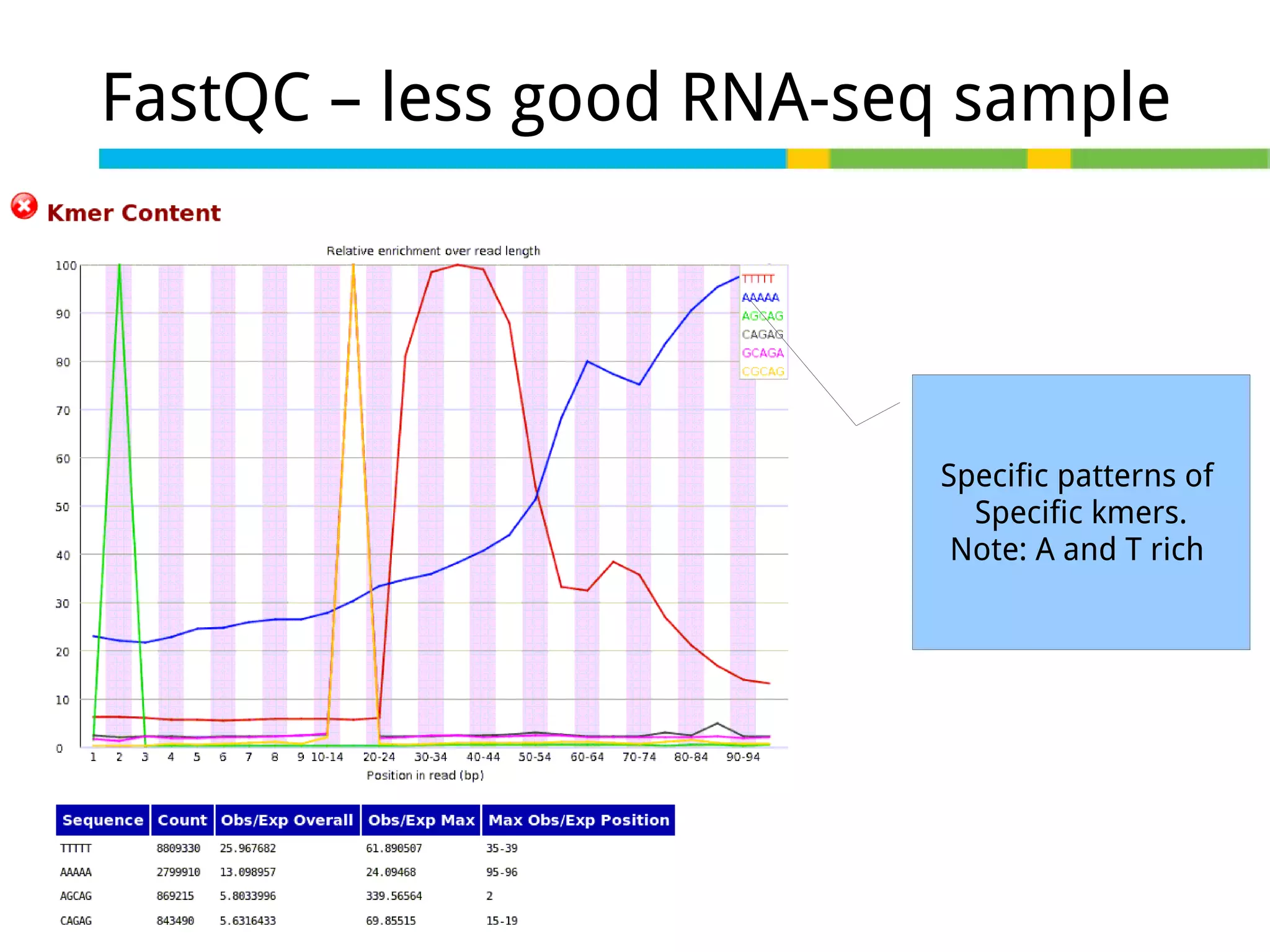
FastQC – less good RNA-seq sample

Specific patterns of
Specific kmers.
Note: A and T rich
Quality control of raw data
Proceed? Or rerun?
This QC can guide you to which preprocessing steps
you need to apply for sure. The extra time and
money needed to correct the biases can sometimes
justify a rerun of the experiment.
This QC shows which preprocessing steps have
already been made by the sequencing provider.
Preprocessing
Removing unwanted parts of the raw data so it helps as
much as possible with reaching our goal: defining
differentially expressed genes.
1) removing technical contamination
● Low quality read parts
● Technical sequences: adaptors
● PhiX internal control sequences
2) removing biological contamination
● polyA-tails
● rRNA sequences
● mtDNA sequences
After this, we run FastQC again.
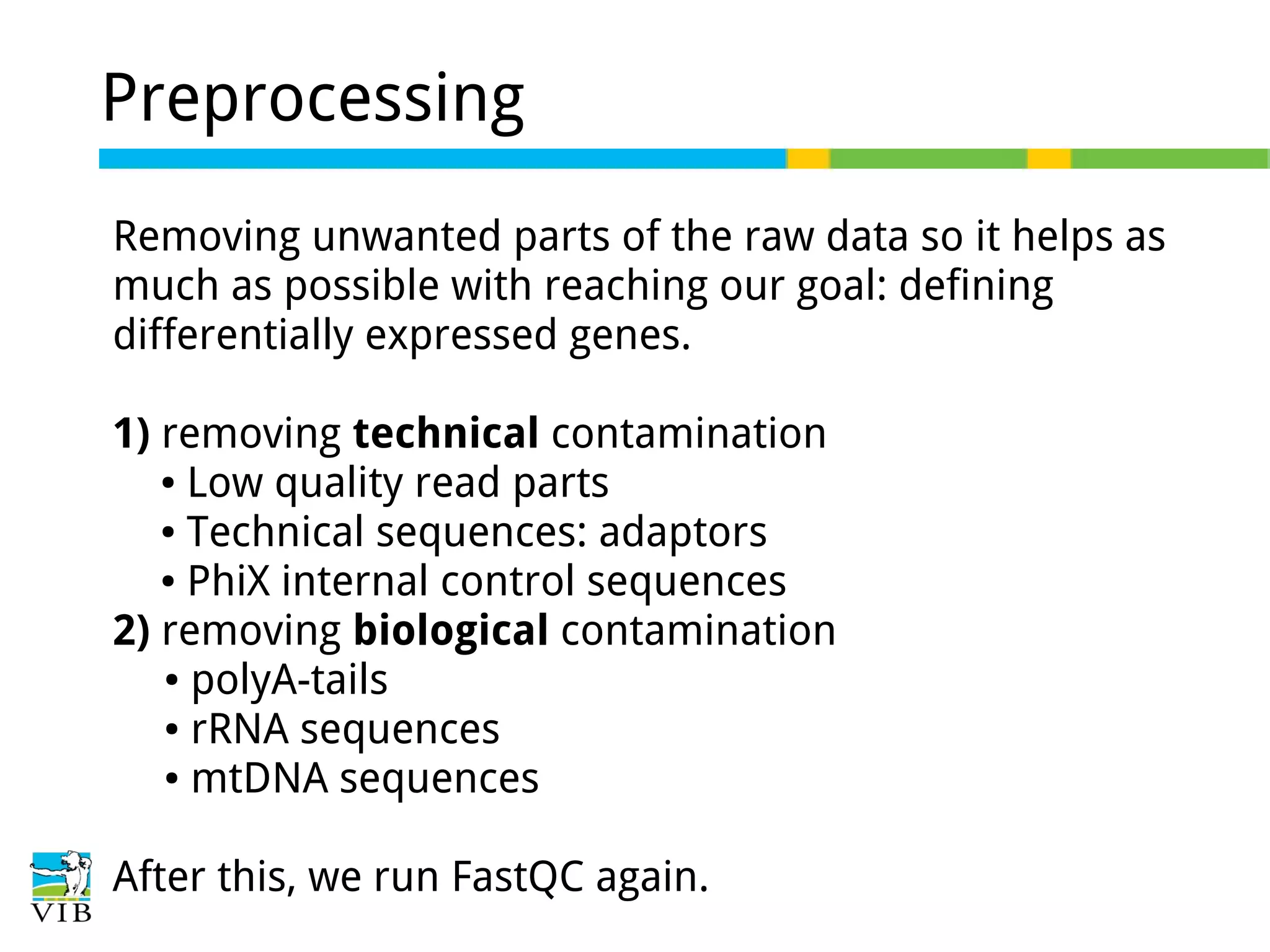
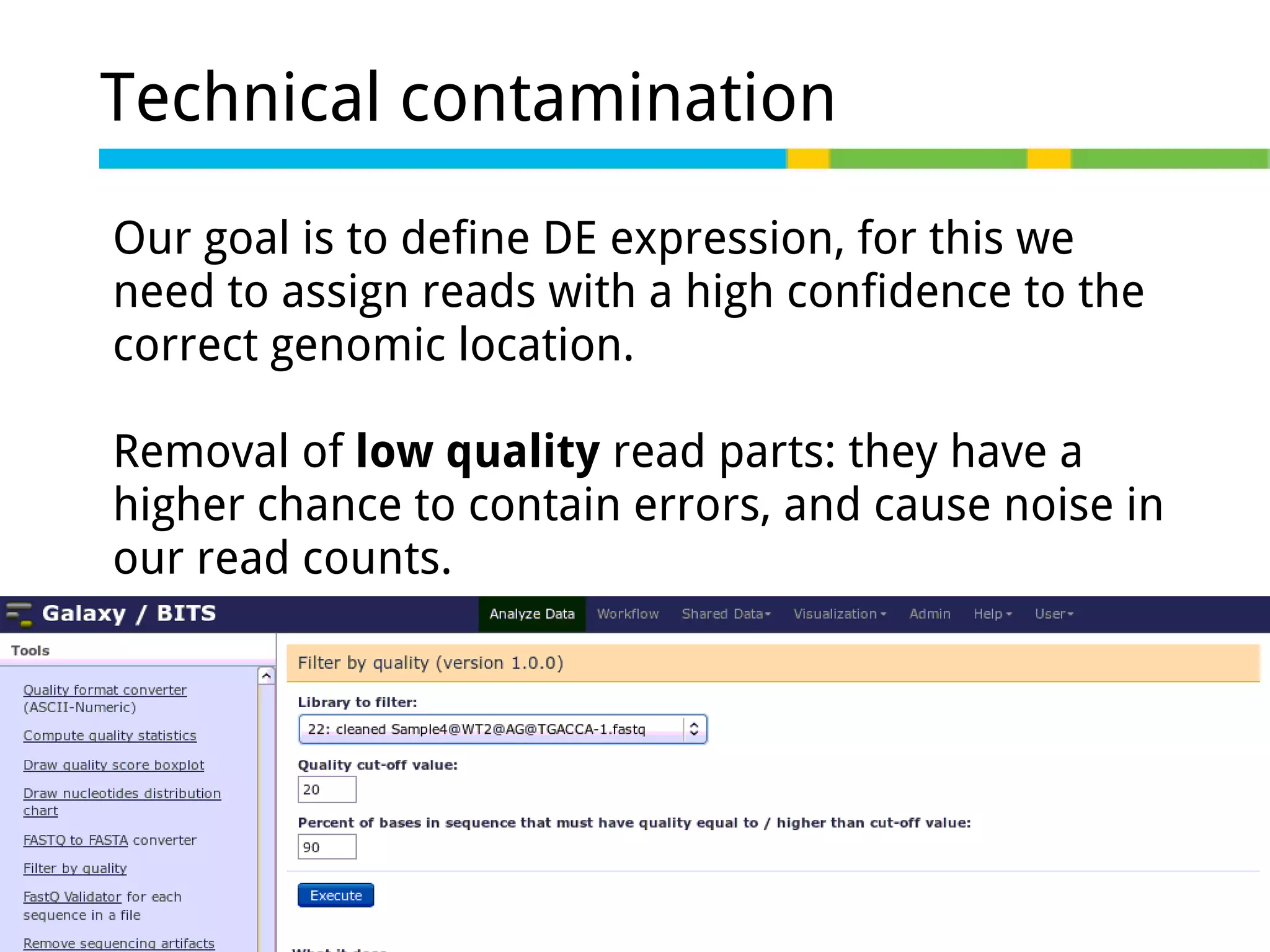
Technical contamination
Our goal is to define DE expression, for this we
need to assign reads with a high confidence to the
correct genomic location.
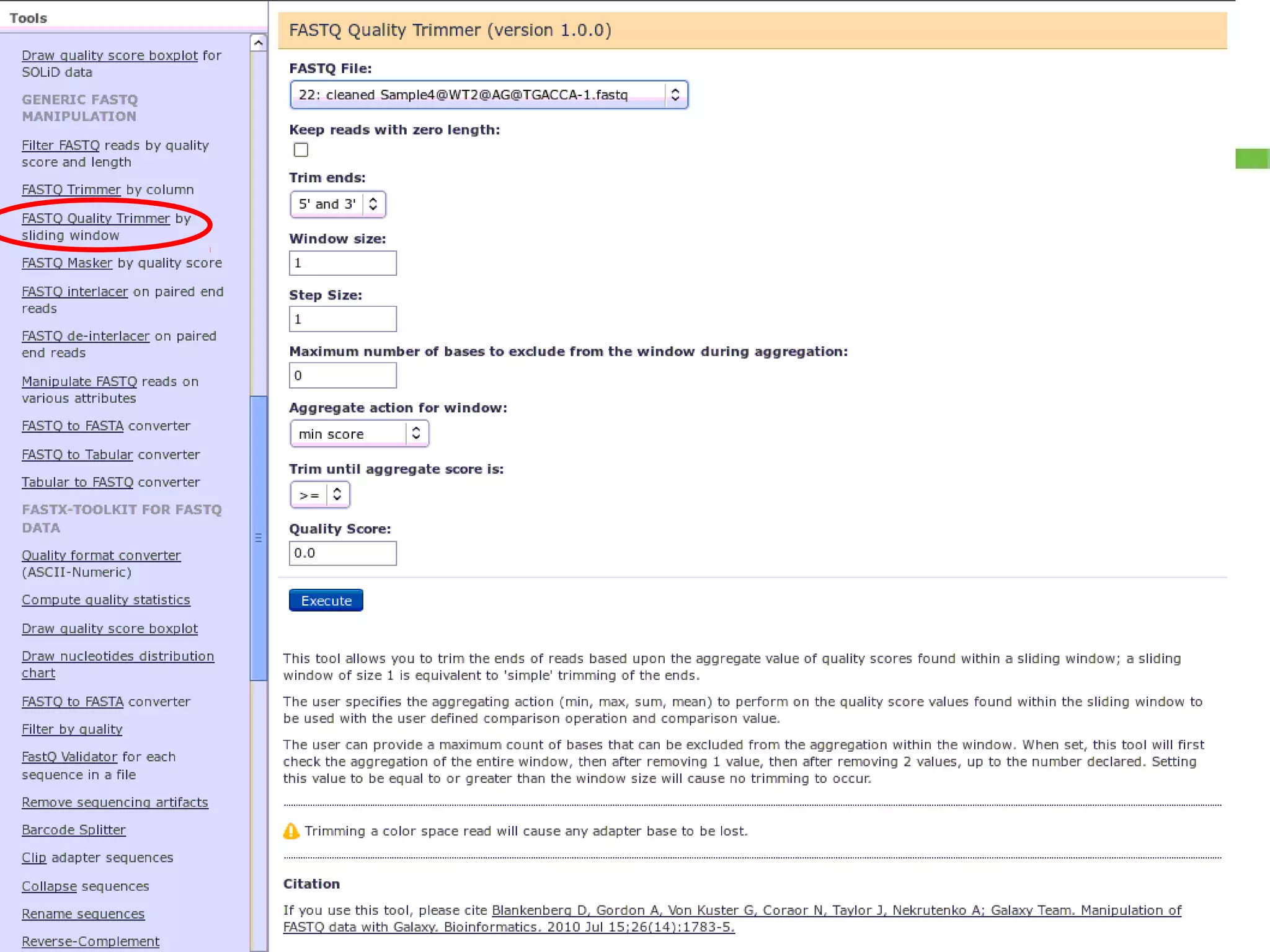
Removal of low quality read parts: they have a
higher chance to contain errors, and cause noise in
our read counts.
Technical contamination
Our goal is to define DE expression, for this we
need to assign reads with a high confidence to the
correct genomic location.
Removal of low quality read parts: they have a
higher chance to contain errors, and cause noise in
our read counts.
Technical contamination
Our goal is to define DE expression, for this we
need to assign reads with a high confidence to the
correct genomic location.
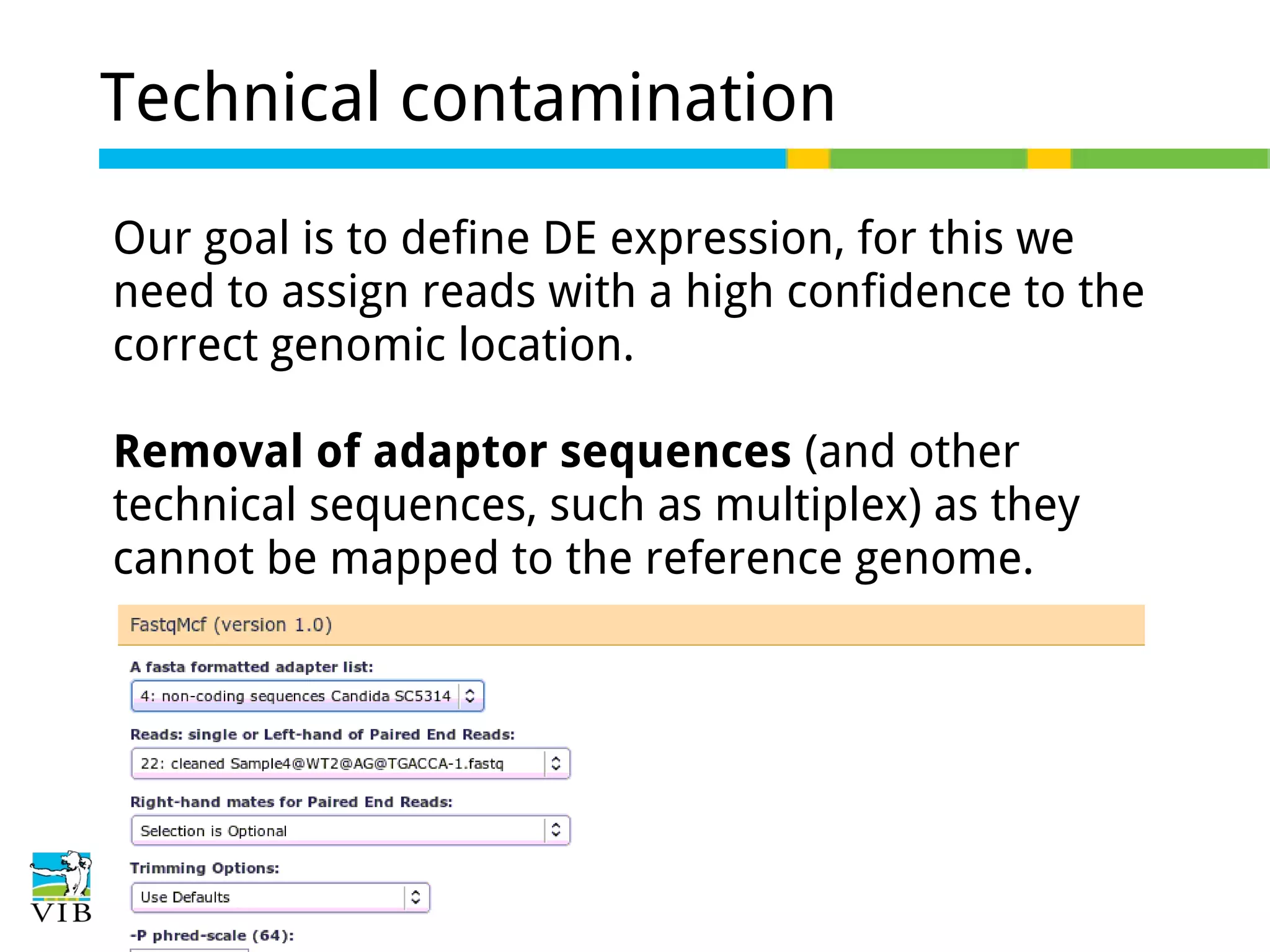
Removal of adaptor sequences (and other
technical sequences, such as multiplex) as they
cannot be mapped to the reference genome.
Technical contamination
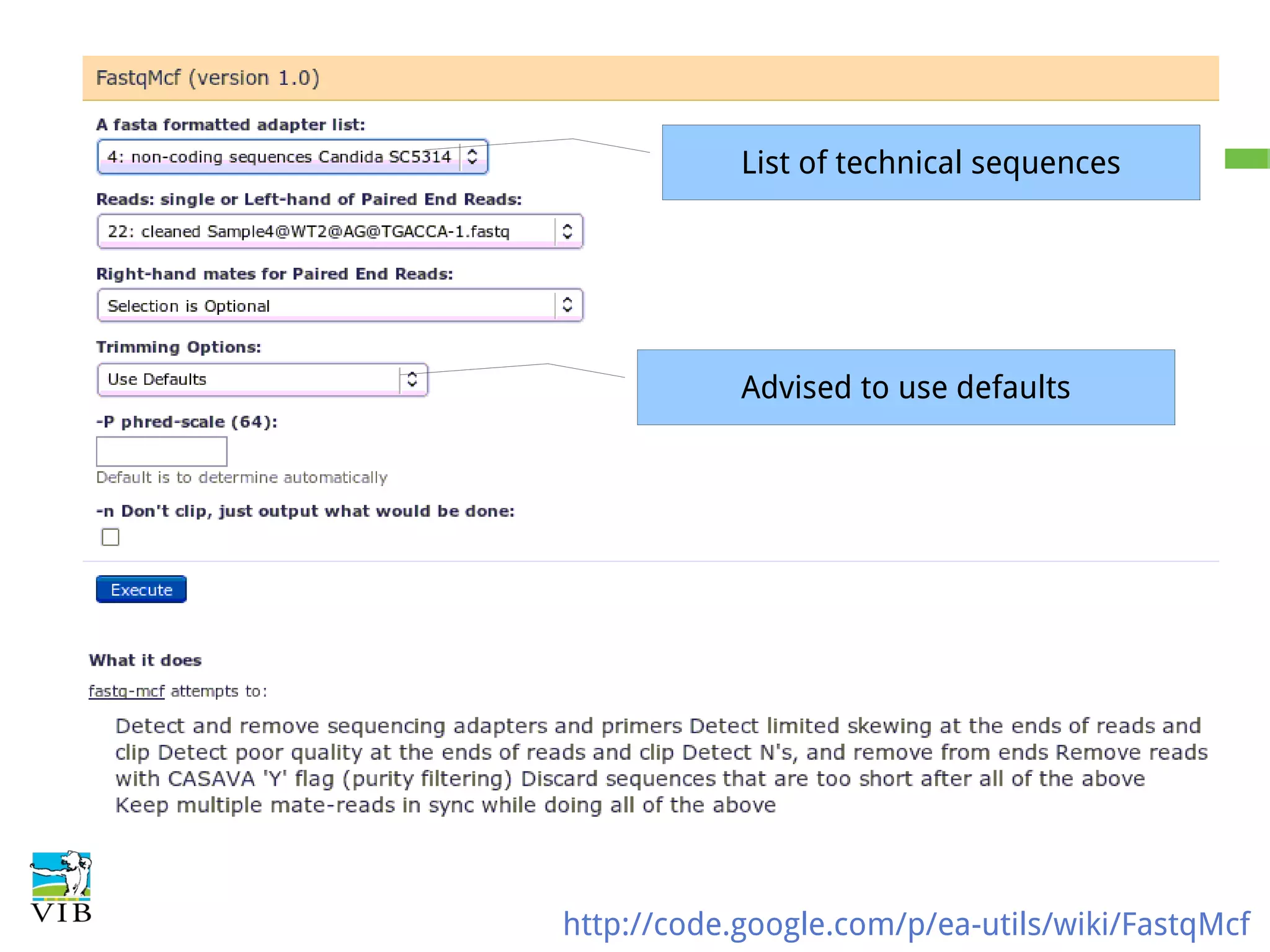
List of technical sequences

Our goal is to define DE expression, for this we
need to assign reads with a high confidence to the
correct genomic location.
Advised to use defaults

Removal of adaptor sequences (and other
technical sequences, such as multiplex) as they
cannot be mapped to the reference genome.

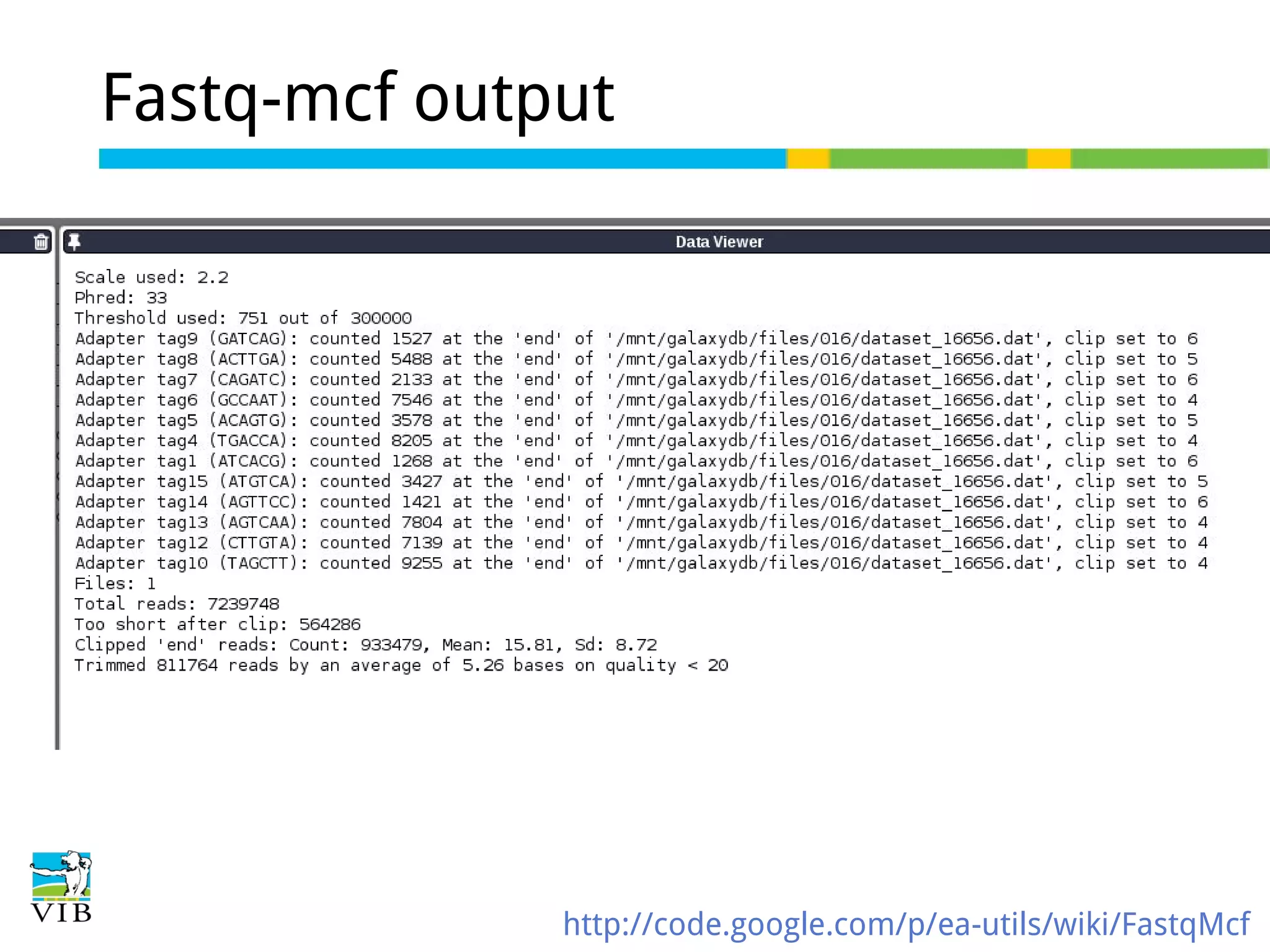
http://code.google.com/p/ea-utils/wiki/FastqMcf
Fastq-mcf output

http://code.google.com/p/ea-utils/wiki/FastqMcf
Technical contamination
Never remove duplicate reads! Highly expressed
genes can have genuine duplicate reads, which are
not due to the PCR amplification step in the
protocol.
●

PhiX sequences: the DNA of Phi X bacteriophage
is spiked in to monitor and optimize sequencing on
Illumina machines. Your sequencing provider
should filter out those sequences before delivery.
You can filter them out by aligning your reads to the
PhiX genome.
●

http://en.wikipedia.org/wiki/Phi_X_174
Biological contamination
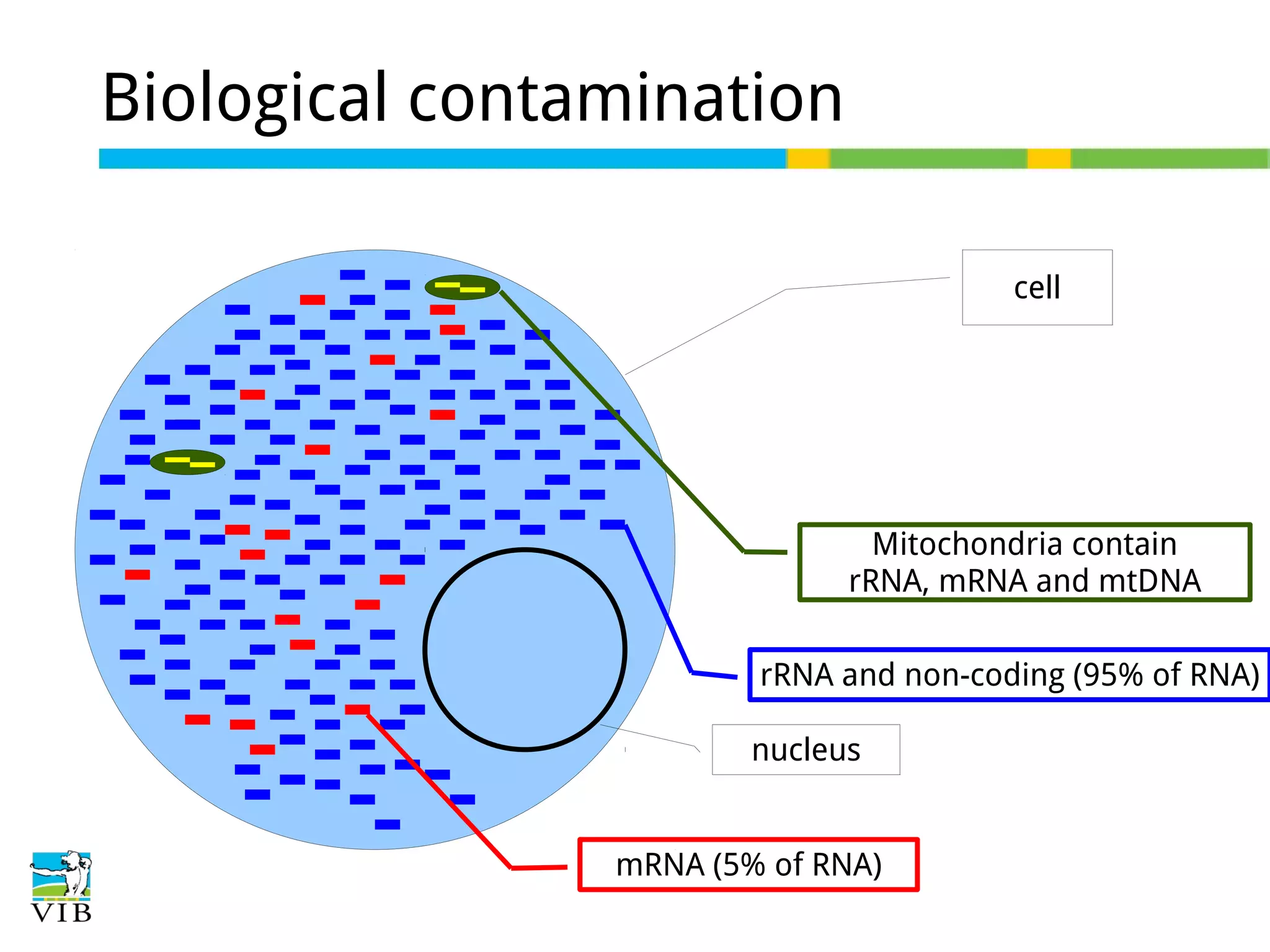
cell

Mitochondria contain
rRNA, mRNA and mtDNA
rRNA and non-coding (95% of RNA)
nucleus
mRNA (5% of RNA)
Biological contamination
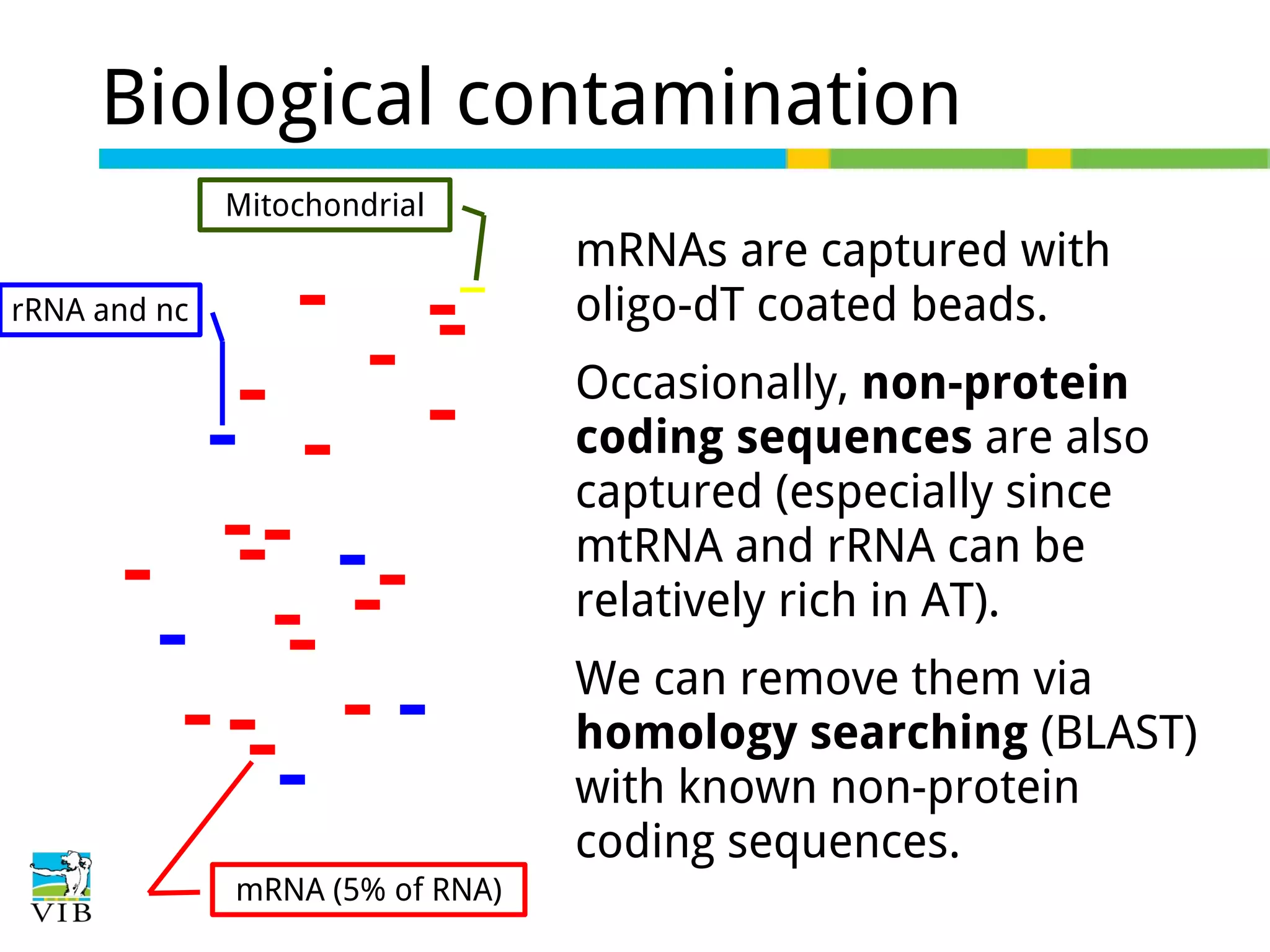
Mitochondrial
rRNA and nc

mRNAs are captured with
oligo-dT coated beads.
Occasionally, non-protein
coding sequences are also
captured (especially since
mtRNA and rRNA can be
relatively rich in AT).
We can remove them via
homology searching (BLAST)
with known non-protein
coding sequences.

mRNA (5% of RNA)
Biological contamination

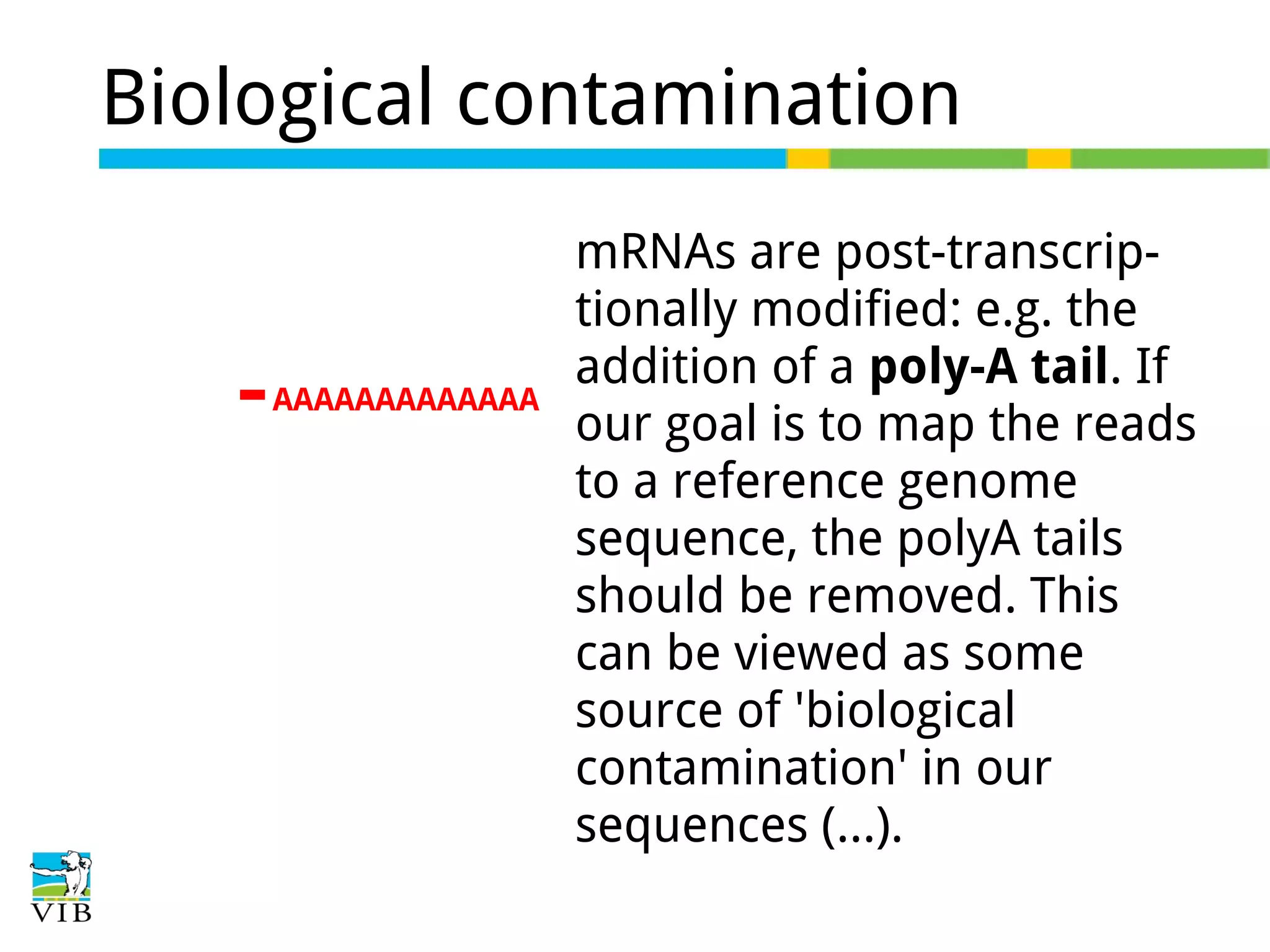
AAAAAAAAAAAAA

mRNAs are post-transcriptionally modified: e.g. the
addition of a poly-A tail. If
our goal is to map the reads
to a reference genome
sequence, the polyA tails
should be removed. This
can be viewed as some
source of 'biological
contamination' in our
sequences (…).
Biological contamination
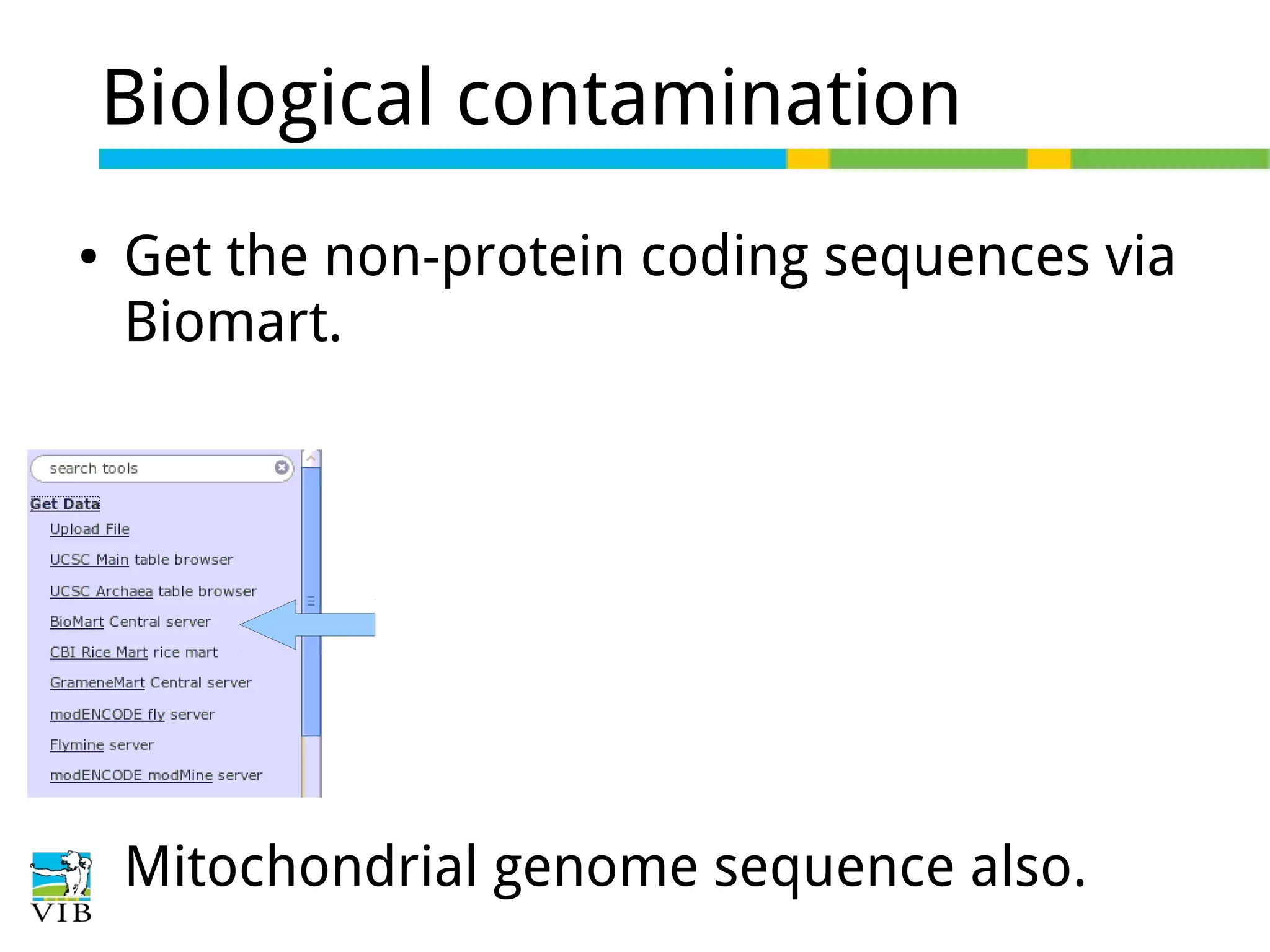
●

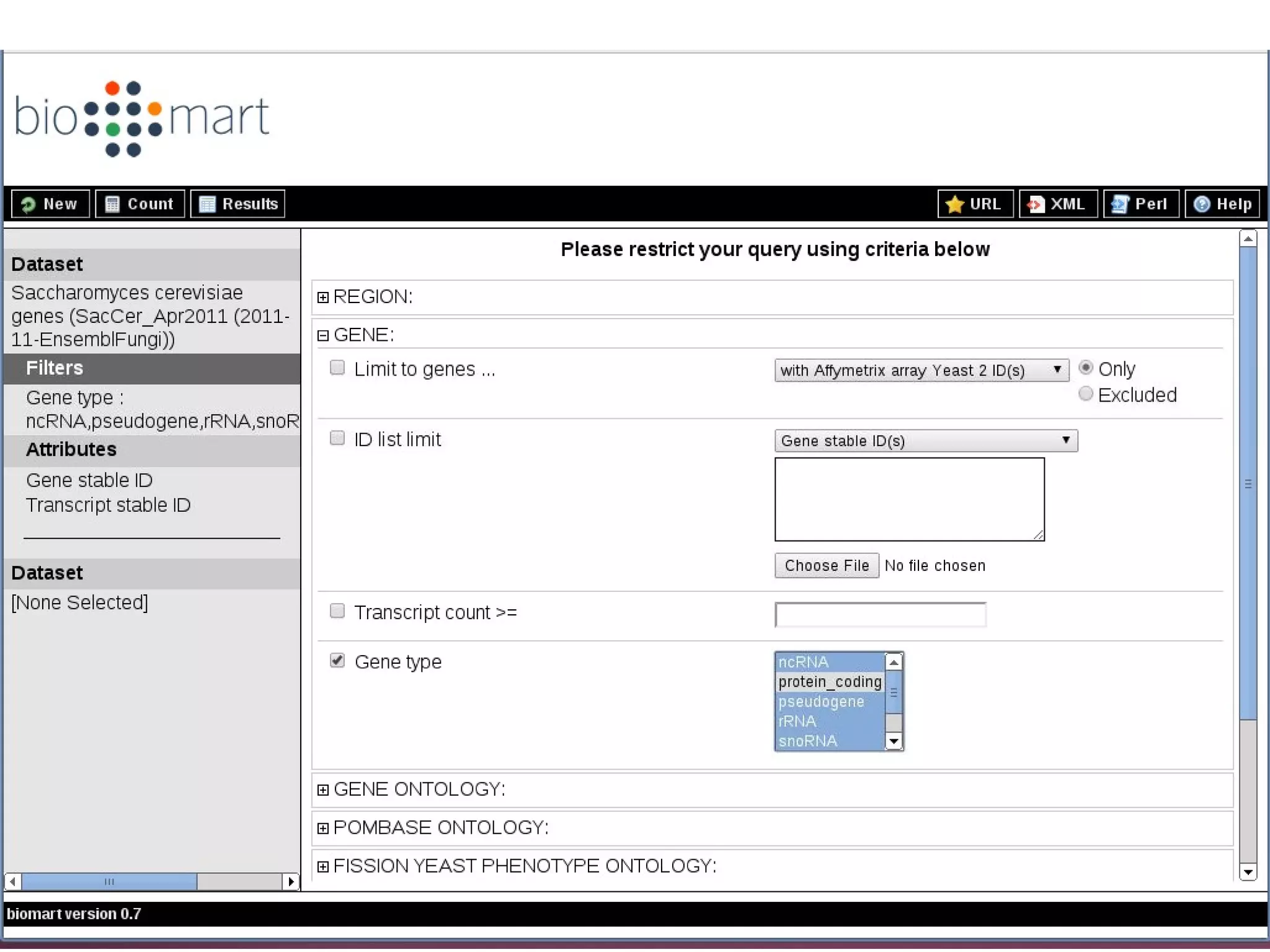
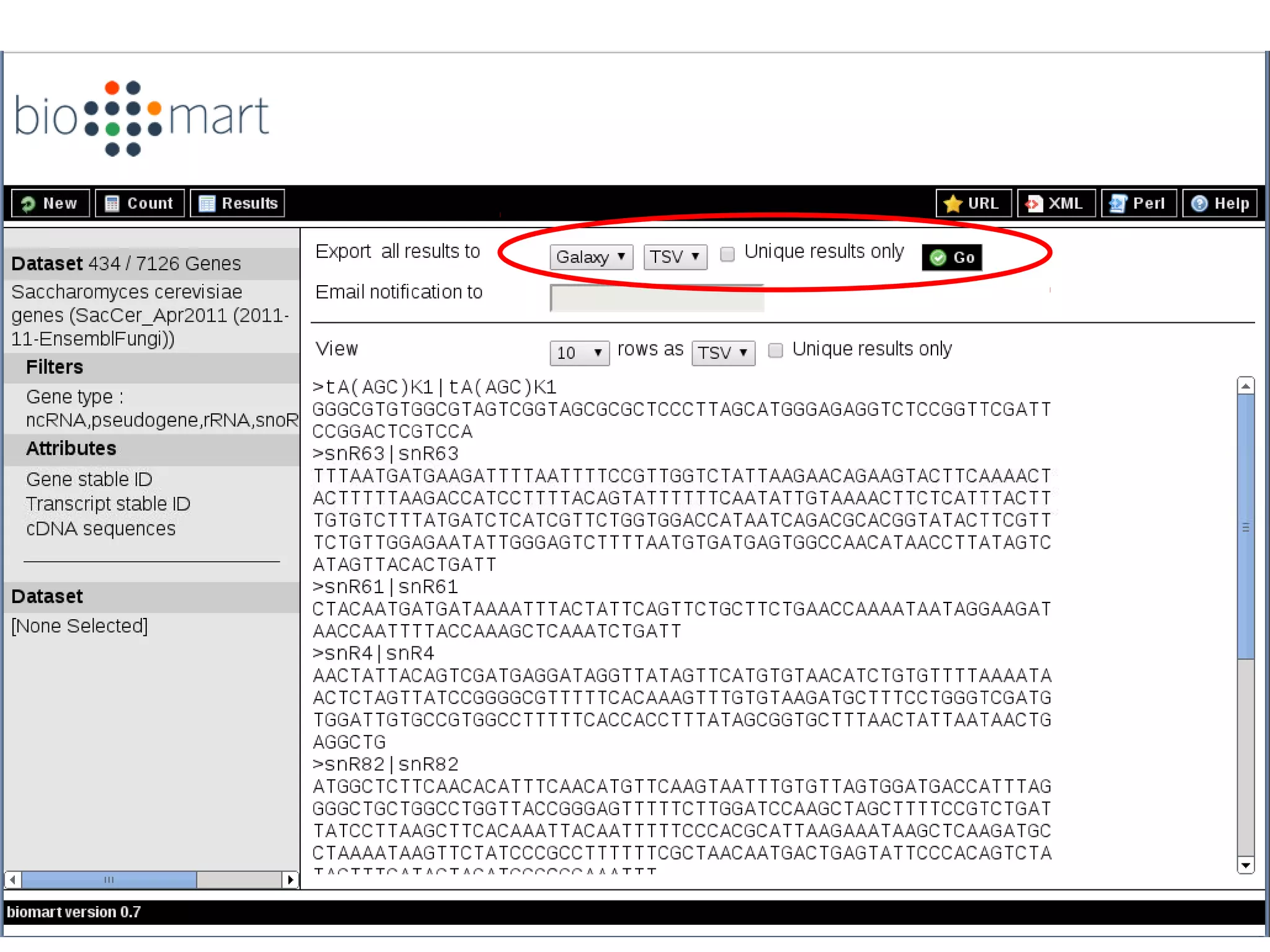
Get the non-protein coding sequences via
Biomart.

Mitochondrial genome sequence also.
Biological contamination
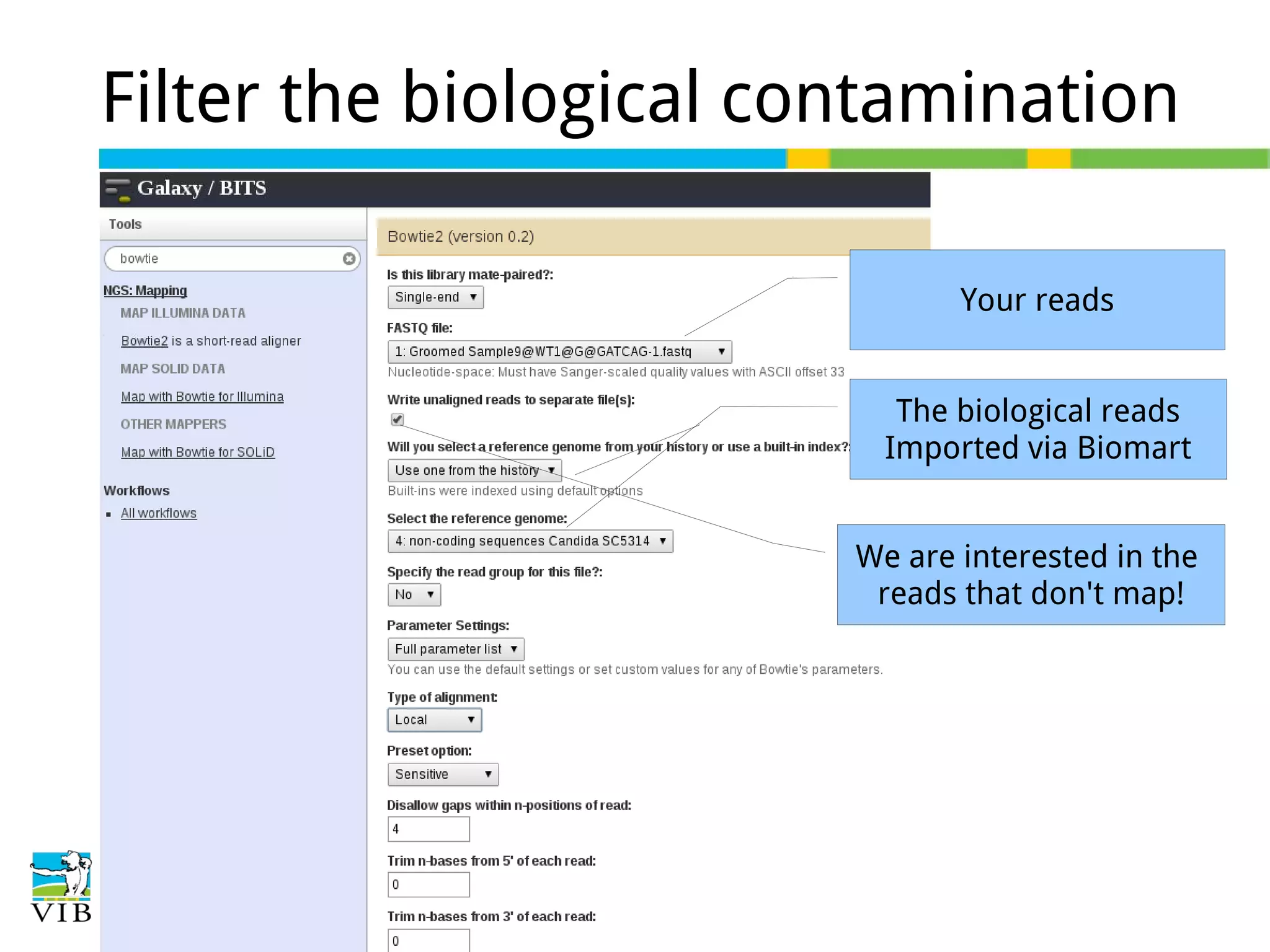
Filter the biological contamination
Your reads
The biological reads
Imported via Biomart
We are interested in the
reads that don't map!
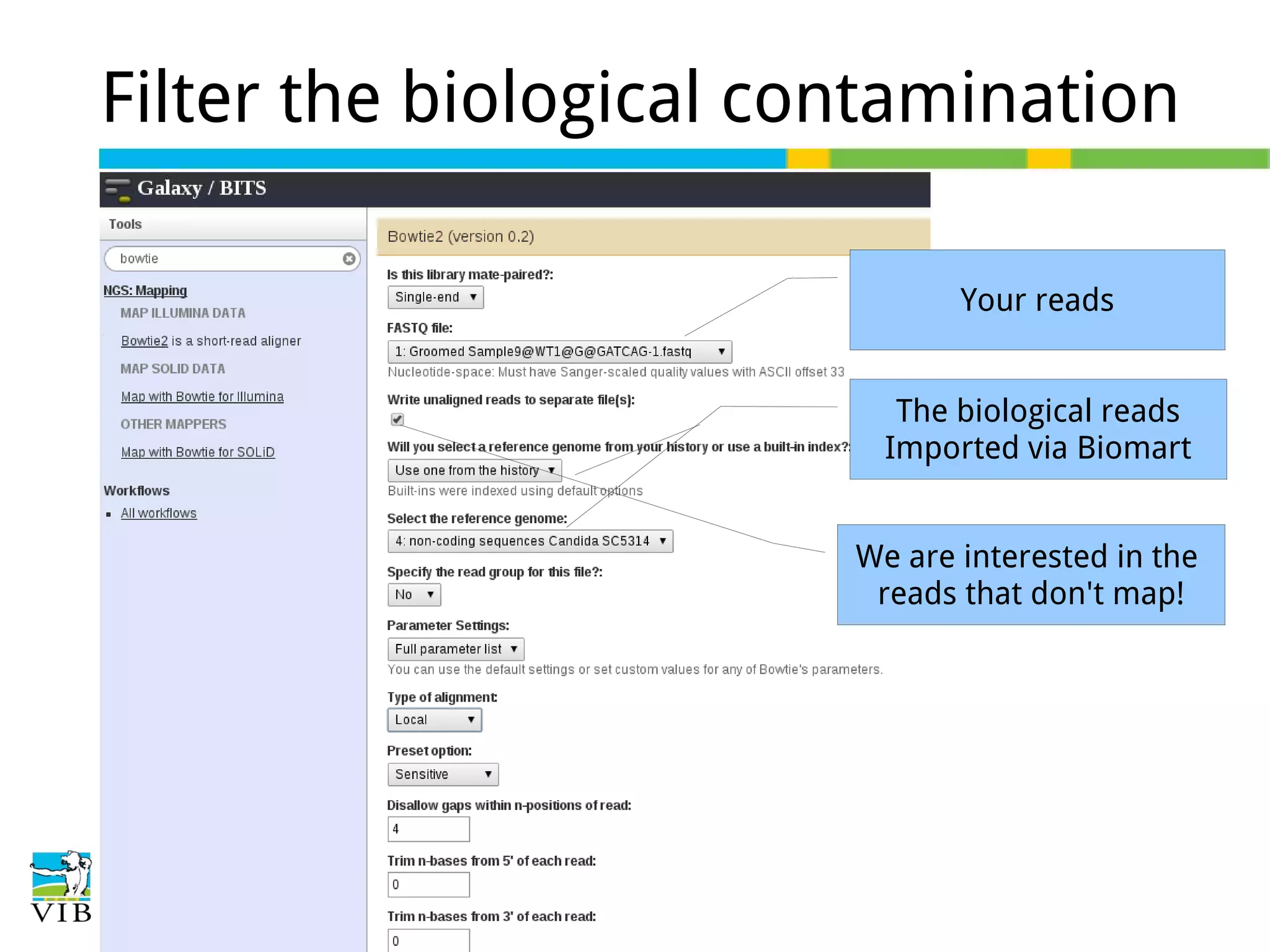
Filter the biological contamination
Your reads
The biological reads
Imported via Biomart
We are interested in the
reads that don't map!
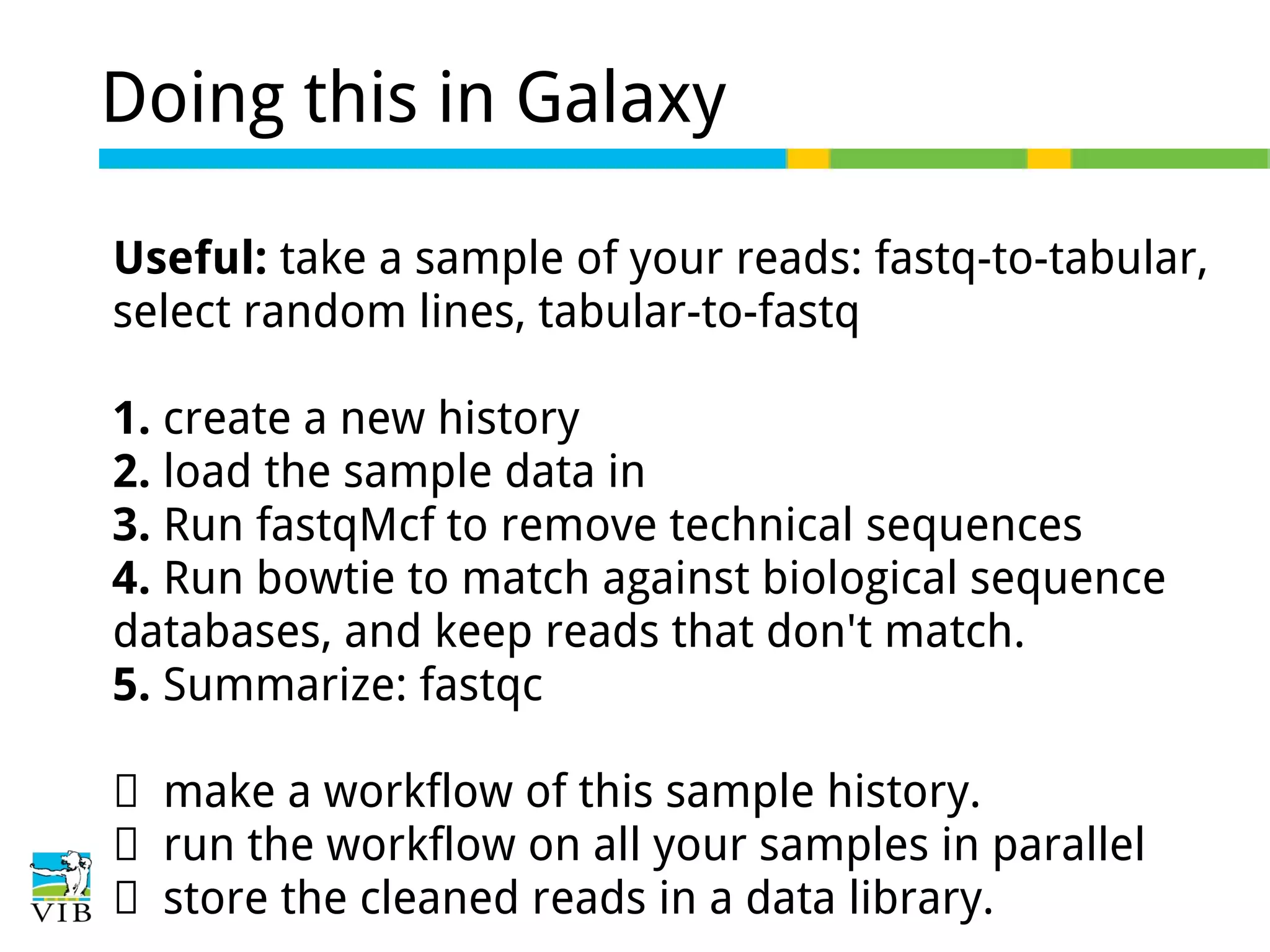
Doing this in Galaxy
Useful: take a sample of your reads: fastq-to-tabular,
select random lines, tabular-to-fastq
1. create a new history
2. load the sample data in
3. Run fastqMcf to remove technical sequences
4. Run bowtie to match against biological sequence
databases, and keep reads that don't match.
5. Summarize: fastqc
→ make a workflow of this sample history.
→ run the workflow on all your samples in parallel
→ store the cleaned reads in a data library.
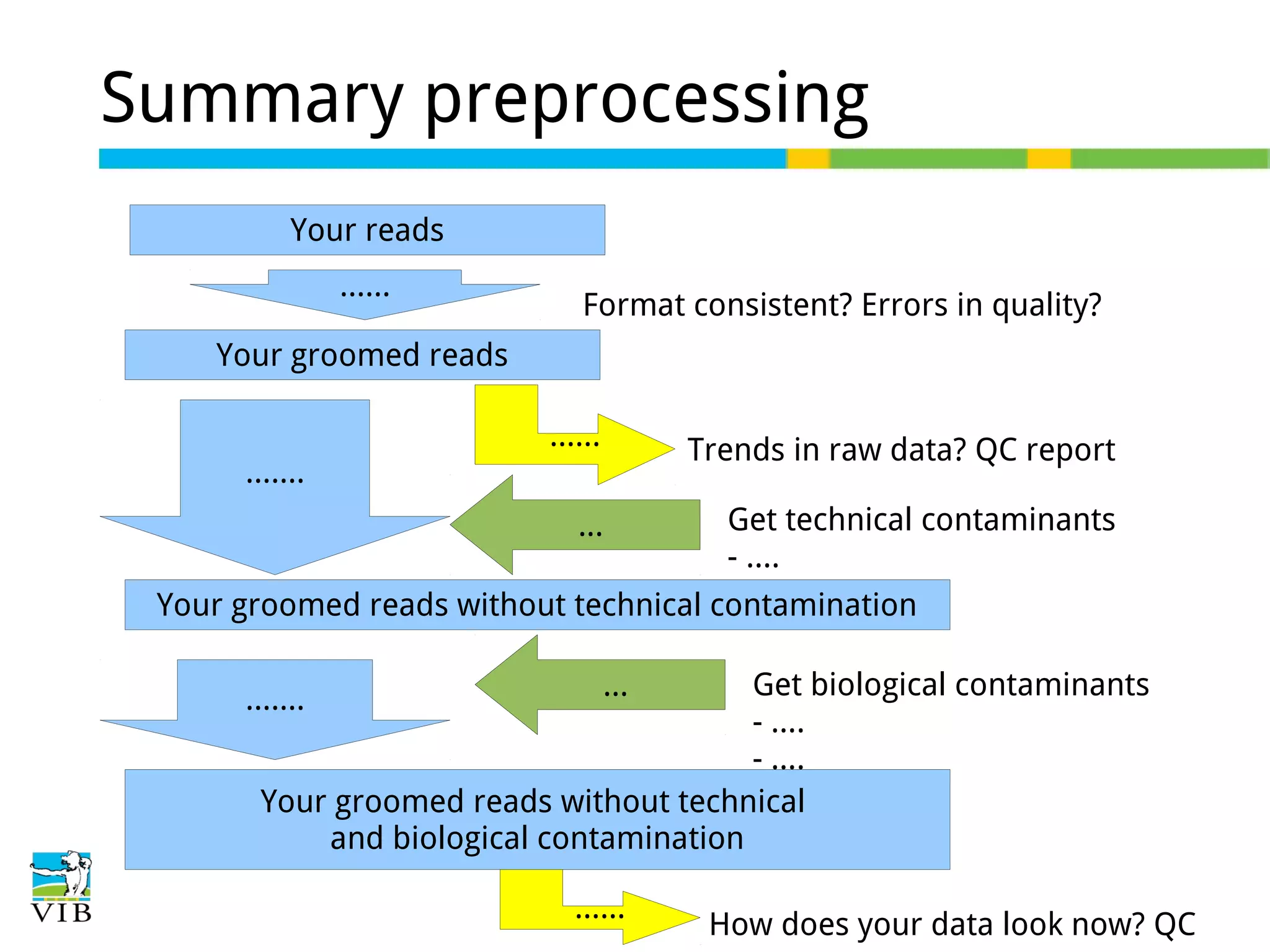
Summary preprocessing
Your reads
…...

Format consistent? Errors in quality?

Your groomed reads
Trends in raw data? QC report

...

…....

…...

Get technical contaminants
- ….

Your groomed reads without technical contamination
Get biological contaminants
- ….
- ….
Your groomed reads without technical
and biological contamination

…....

...

…...

How does your data look now? QC
Keywords
Paired end
Stranded reads
gzip
fastq
Biological contamination
Technical contamination
Adapter sequence

Write in your own words what the terms mean
Exercise
→ investigating and preprocessing raw RNA-seq data
Break

RNA-seq: analysis of raw data and preprocessing - part 2

  • 1.
    Raw data investigation JoachimJacob 20 and 27 January 2014 This presentation is available under the Creative Commons Attribution-ShareAlike 3.0 Unported License. Please refer to http://www.bits.vib.be/ if you use this presentation or parts hereof.
  • 2.
    Experimental setup We havedecided on: ● how many samples per condition ● how deep This determines how reliable the statistics will be, using experience, and tools like Scotty. A wrong experimental design cannot be fixed. Best approach: pilot data (3 samples per condition, 10M) But we have other sequencing options to choose!
  • 3.
    PE versus SEIllumina ● Single end (SE): from each cDNA fragment only one end is read. Paired end (PE): the cDNA fragment is read from both ends. Purify and fragment SE ● PE
  • 4.
    PE versus SEIllumina Single end (SE): ● Gene level differential expression Paired end (PE): ● Novel splice junction detection ● De novo assembly of transcriptome ● Helps with correctly positioning reads on the reference genome sequence. Note: PE not the same as mate pairs.
  • 5.
    Strandedness ● ● Naive protocols obtainreads from cDNA fragments. BUT the link with the sense or antisense strand is broken. Stranded protocols generate reads from one strand, corresponding to the sense or antisense strand (depending on the protocol).
  • 6.
  • 7.
    Example of astranded protocol ● dUTP protocol to generate stranded reads.
  • 8.
    Importance of strandedness ● ● Strandednesscan bias the read counts compared to non-stranded protocols. Depends on the genome whether you should apply it, e.g. in case genes overlap, the improved benefit of assigning reads to correct genes can outweigh technical variation.
  • 9.
    Length of thereads ● ● ● Does not matter so much (when we want to quantify aligning to a reference sequence): 50 bp will do. The most important point is to be able to accurately position the read on the reference genome sequence, to assign it to the correct gene. Length can become important, if you want to assemble the transcriptome.
  • 10.
    For DE onthe gene level The 'cheapest' protocol for high-throughput sequencing suffices to achieve DE detection: ● SE ● 50bp ● Option: strandedness. Use the money you have left over for increasing the number of replicates.
  • 11.
  • 12.
    Raw Illumina data Thedata you get arrives as... barcode experiment Compressed, usually with gzip
  • 13.
    Raw Illumina data (thisone: 87196924 lines) @HWI-ST571:202:D1B86ACXX:2:1102:1146:2155 1:N:0:ACAGTG CCAACATCGAGGTCGCAATCTTTTTNANCGATATGAACTCTCCAAAAAAA + @@@FFFDFHHDG?FFHIIJJJJJIJ#1#1:BFFIGJJJJJIJJGIJJJJA @HWI-ST571:202:D1B86ACXX:2:1102:1073:2240 1:N:0:ACAGTG One read (minimum 4 lines) sequence CGGAGCTGAAGGAGAAACTGAAATCCCTGCAATGTGAATTGTACGTTCTT + CCCFFFFFGGHHHIJJJJJJJIJFHIJIIIJJJJGIIIIIEFGHIFCHJI @HWI-ST571:202:D1B86ACXX:2:1102:1385:2192 1:N:0:ACAGTG certainty reading this base at this position ('quality') GTTGGCAGCCCTGGAGCCCTGCCTCGGTGGTTTAGCCAGTACTAGGGGAT + CCCFFFFFHHHHHJJJIJJJJJJGIJJCGHFHIGIHJJJBDHGHHJJJIE @HWI-ST571:202:D1B86ACXX:2:1102:1352:2244 1:N:0:ACAGTG ATTTCCTCTTATTTACGTTGCTTTAAAGCGAGACTTCAACGCCATTTGAC + @@CFFFFFHHFHDFGHIJIIJGIJGGEHGGJB>??FHHGFFFGHIGIECF @HWI-ST571:202:D1B86ACXX:2:1102:1981:2152 1:N:0:ACAGTG CATCGAAGCAAAGCATATAAAGTTANTNNTNNCTGAGTTGTACATATTGC + ??;;D?DB6CDB+<EFE>:AFA443#2##1##11)0:0?9**0??DAGI4 @HWI-ST571:202:D1B86ACXX:2:1102:1877:2165 1:N:0:ACAGTG GAAGTGCCCCGCTGGCAGCACACAAGGAGCAGCCCGCTGCCGGACCACTC + ?@@DDDADFFAA:CEGHBFGAHGD?F@BE9BFF?D@F;'-8AG<B92=;; http://wiki.bits.vib.be/index.php/.fas
  • 14.
    Exploring the rawdata 1) check whether the Fastq file is consistent - 2) Make graphs of some metrics of the raw data http://wiki.bits.vib.be/index.php/.fastq http://wiki.bits.vib.be/index.php/RNAseq_toolbox#Quality_control_and_visualization_of_raw_reads
  • 15.
    FastQC – graphicalexploration http://www.bioinformatics.babraham.ac.uk/projects/fastqc/
  • 16.
    FastQC – perfectexample Reads have good quality!
  • 17.
    FastQC – perfectexample Anna Karenina principle: “There is only one way to be good, but there are many ways to be wrong.” We will start by showing a good sample. Afterwards we will discuss a less good sample. http://en.wikipedia.org/wiki/Anna_Karenina_principle
  • 18.
    FastQC – perfectexample Smooth histogram/ density line towards the right,
  • 19.
    FastQC – perfectexample steady nucleotide distribution. Bias typical for illumina
  • 20.
    FastQC – perfectexample Not strongly fluctuating GC content Bias typical for illumina
  • 21.
    FastQC – perfectexample GC-content nicely bell shaped
  • 22.
    FastQC – perfectexample No N's! (should ring something)
  • 23.
    FastQC – perfectexample All reads have length 50bp,
  • 24.
    FastQC – perfectexample Reads are nicely duplicated: some amount of duplication is to be expected in RNA-seq data.
  • 25.
    FastQC – perfectexample Reads are nicely duplicated: some amount of duplication is to be expected in RNA-seq data.
  • 26.
    FastQC – perfectexample Kmers are short sequence stretches. Sometimes they are overrepresented. But in RNA-seq this is not so important (duplication).
  • 27.
    FastQC – lessgood RNA-seq sample A relatively large Portion of the reads have mistakes at the 3' end of the read.
  • 28.
    FastQC – lessgood RNA-seq sample There is an overrepresentation of reads with a low mean quality score
  • 29.
    FastQC – lessgood RNA-seq sample Not a steady level of different nucleotide fractions
  • 30.
    FastQC – lessgood RNA-seq sample Fluctuates
  • 31.
    FastQC – lessgood RNA-seq sample Heavily skewed versus AT rich reads
  • 32.
    FastQC – lessgood RNA-seq sample Apparently a mixture of two sets of reads with different lengths
  • 33.
    FastQC – lessgood RNA-seq sample Duplication seems a bit on the low side (reported figures are from 60 -75%)
  • 34.
    FastQC – lessgood RNA-seq sample Very highly skewed read number. Often the sequence of Truseq adaptor, or multiplex identifiers can be found here. BLAST can reveal more information!
  • 35.
    FastQC – lessgood RNA-seq sample Specific patterns of Specific kmers. Note: A and T rich
  • 36.
    Quality control ofraw data Proceed? Or rerun? This QC can guide you to which preprocessing steps you need to apply for sure. The extra time and money needed to correct the biases can sometimes justify a rerun of the experiment. This QC shows which preprocessing steps have already been made by the sequencing provider.
  • 37.
    Preprocessing Removing unwanted partsof the raw data so it helps as much as possible with reaching our goal: defining differentially expressed genes. 1) removing technical contamination ● Low quality read parts ● Technical sequences: adaptors ● PhiX internal control sequences 2) removing biological contamination ● polyA-tails ● rRNA sequences ● mtDNA sequences After this, we run FastQC again.
  • 38.
    Technical contamination Our goalis to define DE expression, for this we need to assign reads with a high confidence to the correct genomic location. Removal of low quality read parts: they have a higher chance to contain errors, and cause noise in our read counts.
  • 39.
    Technical contamination Our goalis to define DE expression, for this we need to assign reads with a high confidence to the correct genomic location. Removal of low quality read parts: they have a higher chance to contain errors, and cause noise in our read counts.
  • 40.
  • 41.
    Technical contamination Our goalis to define DE expression, for this we need to assign reads with a high confidence to the correct genomic location. Removal of adaptor sequences (and other technical sequences, such as multiplex) as they cannot be mapped to the reference genome.
  • 42.
    Technical contamination List oftechnical sequences Our goal is to define DE expression, for this we need to assign reads with a high confidence to the correct genomic location. Advised to use defaults Removal of adaptor sequences (and other technical sequences, such as multiplex) as they cannot be mapped to the reference genome. http://code.google.com/p/ea-utils/wiki/FastqMcf
  • 43.
  • 44.
    Technical contamination Never removeduplicate reads! Highly expressed genes can have genuine duplicate reads, which are not due to the PCR amplification step in the protocol. ● PhiX sequences: the DNA of Phi X bacteriophage is spiked in to monitor and optimize sequencing on Illumina machines. Your sequencing provider should filter out those sequences before delivery. You can filter them out by aligning your reads to the PhiX genome. ● http://en.wikipedia.org/wiki/Phi_X_174
  • 45.
    Biological contamination cell Mitochondria contain rRNA,mRNA and mtDNA rRNA and non-coding (95% of RNA) nucleus mRNA (5% of RNA)
  • 46.
    Biological contamination Mitochondrial rRNA andnc mRNAs are captured with oligo-dT coated beads. Occasionally, non-protein coding sequences are also captured (especially since mtRNA and rRNA can be relatively rich in AT). We can remove them via homology searching (BLAST) with known non-protein coding sequences. mRNA (5% of RNA)
  • 47.
    Biological contamination AAAAAAAAAAAAA mRNAs arepost-transcriptionally modified: e.g. the addition of a poly-A tail. If our goal is to map the reads to a reference genome sequence, the polyA tails should be removed. This can be viewed as some source of 'biological contamination' in our sequences (…).
  • 48.
    Biological contamination ● Get thenon-protein coding sequences via Biomart. Mitochondrial genome sequence also.
  • 49.
  • 50.
  • 51.
    Filter the biologicalcontamination Your reads The biological reads Imported via Biomart We are interested in the reads that don't map!
  • 52.
    Filter the biologicalcontamination Your reads The biological reads Imported via Biomart We are interested in the reads that don't map!
  • 53.
    Doing this inGalaxy Useful: take a sample of your reads: fastq-to-tabular, select random lines, tabular-to-fastq 1. create a new history 2. load the sample data in 3. Run fastqMcf to remove technical sequences 4. Run bowtie to match against biological sequence databases, and keep reads that don't match. 5. Summarize: fastqc → make a workflow of this sample history. → run the workflow on all your samples in parallel → store the cleaned reads in a data library.
  • 54.
    Summary preprocessing Your reads …... Formatconsistent? Errors in quality? Your groomed reads Trends in raw data? QC report ... ….... …... Get technical contaminants - …. Your groomed reads without technical contamination Get biological contaminants - …. - …. Your groomed reads without technical and biological contamination ….... ... …... How does your data look now? QC
  • 55.
    Keywords Paired end Stranded reads gzip fastq Biologicalcontamination Technical contamination Adapter sequence Write in your own words what the terms mean
  • 56.
    Exercise → investigating andpreprocessing raw RNA-seq data
  • 57.