Review of the Relational Model                                                      Acknowledgements
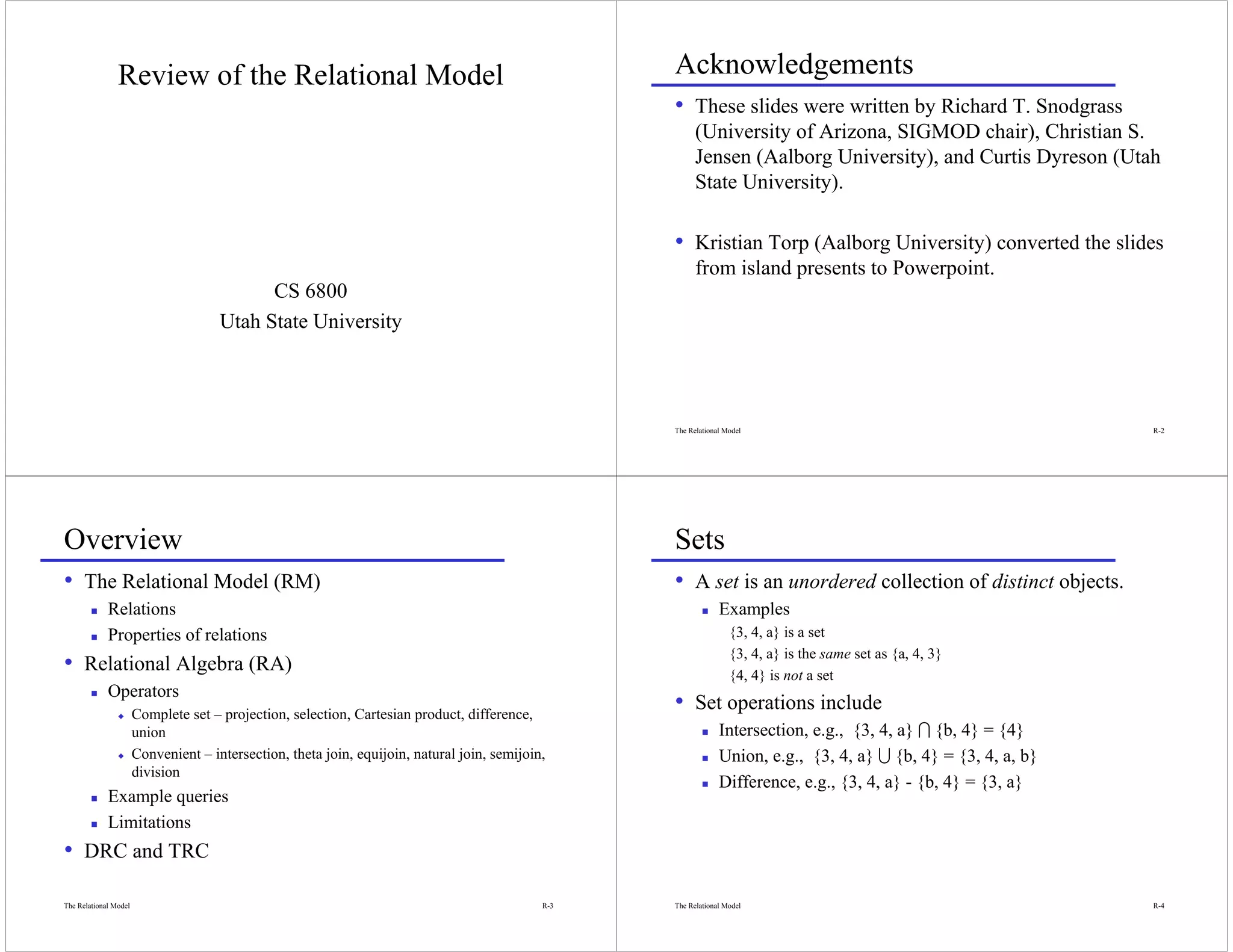
                                                                                                    • These slides were written by Richard T. Snodgrass
                                                                                                          (University of Arizona, SIGMOD chair), Christian S.
                                                                                                          Jensen (Aalborg University), and Curtis Dyreson (Utah
                                                                                                          State University).

                                                                                                    • Kristian Torp (Aalborg University) converted the slides
                                                                                                          from island presents to Powerpoint.
                                            CS 6800
                                      Utah State University


                                                                                                    The Relational Model                                          R-2


Overview                                                                                            Sets
• The Relational Model (RM)                                                                         • A set is an unordered collection of distinct objects.
             Relations                                                                                           Examples
             Properties of relations                                                                                {3, 4, a} is a set
                                                                                                                    {3, 4, a} is the same set as {a, 4, 3}
• Relational Algebra (RA)                                                                                           {4, 4} is not a set
             Operators
                x      Complete set – projection, selection, Cartesian product, difference,
                                                                                                    • Set operations include
                       union                                                                                     Intersection, e.g., {3, 4, a} I {b, 4} = {4}
                x      Convenient – intersection, theta join, equijoin, natural join, semijoin,                  Union, e.g., {3, 4, a} U {b, 4} = {3, 4, a, b}
                       division
                                                                                                                 Difference, e.g., {3, 4, a} - {b, 4} = {3, a}
             Example queries
             Limitations
• DRC and TRC
The Relational Model                                                                          R-3   The Relational Model                                          R-4
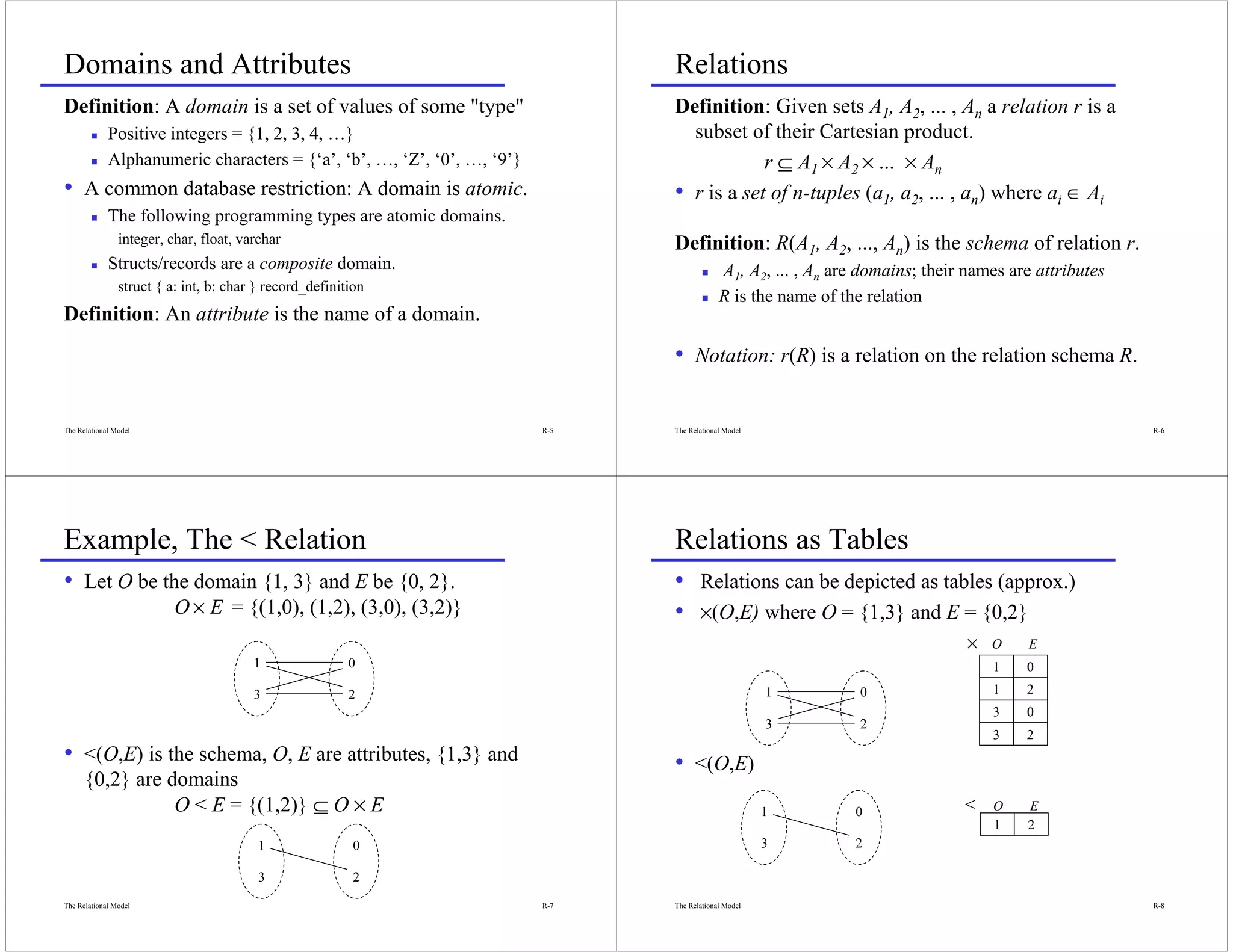
Domains and Attributes                                                         Relations
Definition: A domain is a set of values of some "type"                         Definition: Given sets A1, A2, ... , An a relation r is a
             Positive integers = {1, 2, 3, 4, …}                                 subset of their Cartesian product.
             Alphanumeric characters = {‘a’, ‘b’, …, ‘Z’, ‘0’, …, ‘9’}                     r ⊆ A1 × A2 × ... × An
• A common database restriction: A domain is atomic.                           • r is a set of n-tuples (a1, a2, ... , an) where ai ∈ Ai
             The following programming types are atomic domains.
                integer, char, float, varchar                                  Definition: R(A1, A2, ..., An) is the schema of relation r.
             Structs/records are a composite domain.                                        A1, A2, ... , An are domains; their names are attributes
                struct { a: int, b: char } record_definition
                                                                                            R is the name of the relation
Definition: An attribute is the name of a domain.
                                                                               • Notation: r(R) is a relation on the relation schema R.

The Relational Model                                                     R-5   The Relational Model                                                    R-6


Example, The < Relation                                                        Relations as Tables
• Let O be the domain {1, 3} and E be {0, 2}.                                  • Relations can be depicted as tables (approx.)
                          O × E = {(1,0), (1,2), (3,0), (3,2)}                 • ×(O,E) where O = {1,3} and E = {0,2}
                                                                                                                                ×   O   E
                                        1                0                                                                          1   0

                                        3                2                                            1         0                   1   2
                                                                                                                                    3   0
                                                                                                      3         2
                                                                                                                                    3   2
• <(O,E) is the schema, O, E are attributes, {1,3} and                         • <(O,E)
      {0,2} are domains
                 O < E = {(1,2)} ⊆ O × E                                                              1        0               <    O   E
                                                                                                                                    1   2
                                         1                0                                           3        2

                                         3                2
The Relational Model                                                     R-7   The Relational Model                                                    R-8
Tuples                                                                                   Characteristics of Relations
Definition: An element t of a relation r is called a tuple.                              • Tuples in a relation are unorderd.
                                                                                         • Example: The following two relations have the same
• We refer to component values of a tuple t by t[Ai] = vi                                      information content.
      (the value of attribute Ai for tuple t).
             Alternatively, use ‘dot’ notation, e.g., t.Ai is the ith attribute
             of tuple t
                                                                                                                Name Age                         Name Age
• t[Ai, ... , Ak] refers to the subtuple of t containing the
                                                                                                                 Pat     1                        Sue   3
      values of attributes Ai, ... , Ak respectively.                                                           Fred 2                           Pam 4
•     Table metaphor                                                                                            Sue      3                       Fred 2
             Tuple is a row                                                                                     Pam 4                             Pat   1
             Attribute is a column


The Relational Model                                                               R-9   The Relational Model                                               R-10


Characteristics of Relations (cont.)                                                     Characteristics of Relations (cont.)
• Attributes in a tuple/relation are ordered.                                            • Values in a tuple are atomic (indivisible).
             But, we can change the order at will (to be shown in future).               • A value cannot be a structure, record, or relation
             Example: The following relations do not have the same                               Example: All atomic values (string or integer).
             information.                                                                                                 Name Age
                                                                                                                               Pat     1
                           Name Age                  Age Name                                                                  Fred 2
                             Pat   1                   1   Pat
                             Fred 2                    2 Fred                                    Example: The following is not a relation, Name is not atomic
                             Sue   3                   3   Sue                                                          Name               Age
                             Pam 4                     4 Pam                                                           First     Last
                                                                                                                                            1
                                                                                                                       Joe           Doe

                                                                                                                       First     Last
                                                                                                                                            2
                                                                                                                       Sue           Doe

The Relational Model                                                              R-11   The Relational Model                                               R-12
Degree and Cardinality                                                                              Relational Algebra
                       Ord      CID        Date      Salesperson
                                                                                                    • Five primary operators (complete)
                       102      42        860207     Johnson                                                     Selection: σ
                       103      39        860211     Strong
                                                                                                                 Projection: π
                       104      24        860228     Boggs
                       105      42        860303     Strong                                                      Union: ∪
                       107      34        860308     West              Tuples (or records, rows)
                       108      46        860308     Wset
                                                                       [Cardinality is # of them]                Difference: –
                       110      24        860312     Boggs                                                       Cartesian Product: ×
                       111      21        860318     Strong
                       112      29        860320     Clark
                                                                                                    • Convenient derived operators (closed)
                                      degree/arity                                                               Intersection: ∩
                                                                                                                 Theta join nθ, equijoin n= , and natural join n
                                                                                                                 Semijoins: left l and right r
                                                                                                                 Relational division: ÷
The Relational Model                                                                        R-13    The Relational Model                                                R-14


RA Operations Produce Relations                                                                     Selection, Formal Description
                                                                                                                               σP(r) =
                                                                                                    • P is a formula in propositional calculus, dealing with terms of
Name Age                                    Name Age                            Name                      the form:
  joe 4                                      sue 10                              sue
                                                                                                                  attribute (or constant) = attribute (or constant)
 sue  10                                     sam  9                              sam
 sam  9                      operation1                            operation2                                     attribute ≠ attribute
                                                                                                                  attribute < attribute
                                                                                                                  attribute ≤ attribute
                                                                                                                  attribute ≥ attribute
                                                                                                                  attribute > attribute
Notation:                operation2( operation1(R) )                                                              term ∧ term (Note: ∧ is AND)
                                                                                                                  term ∨ term (Note: ∨ is OR)
                                                                                                                  ¬(term)


The Relational Model                                                                        R-15    The Relational Model                                                R-16
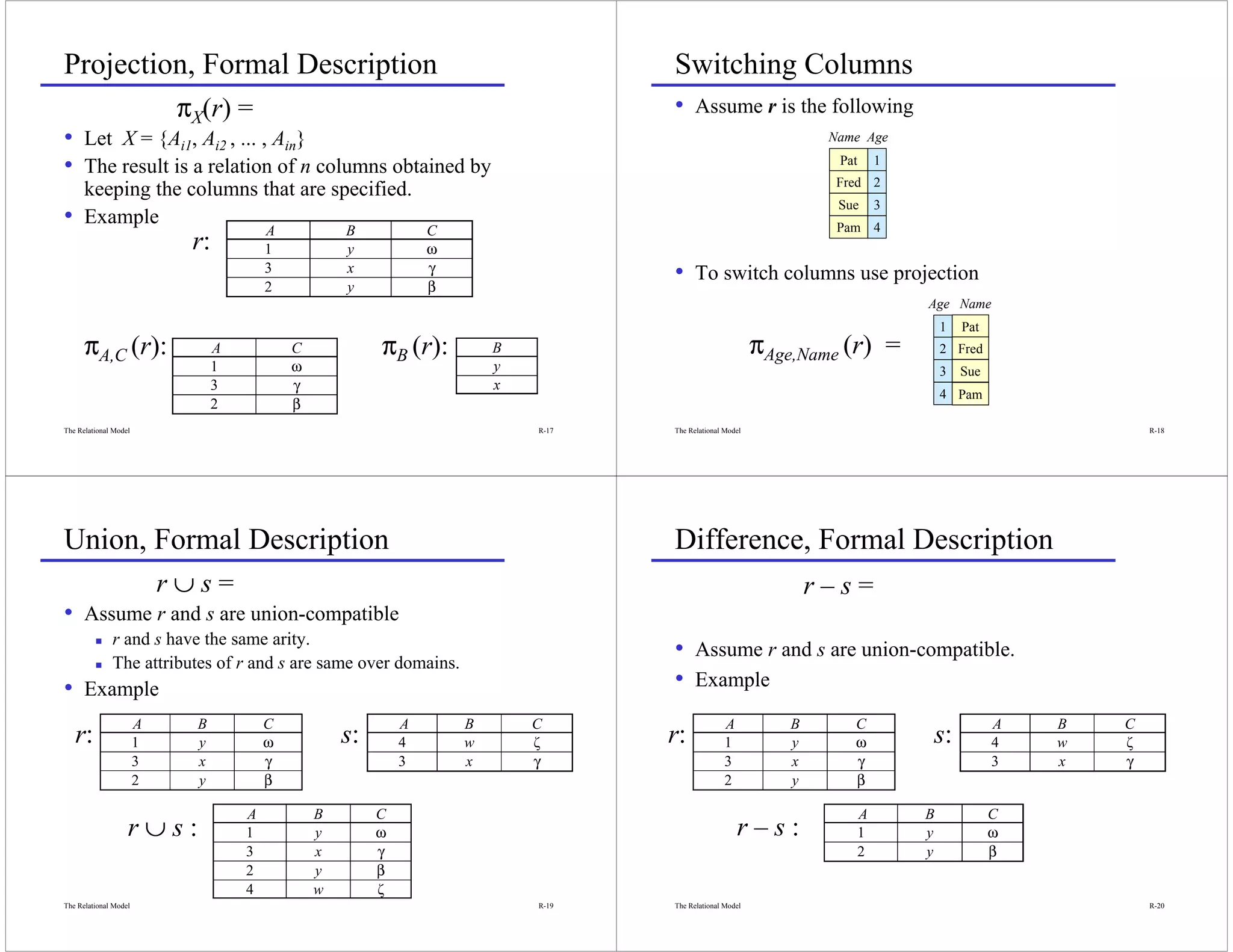
Projection, Formal Description                                                        Switching Columns
                            πX(r) =                                                   • Assume r is the following
• Let X = {Ai1, Ai2 , ... , Ain}                                                                                      Name Age

• The result is a relation of n columns obtained by                                                                    Pat   1
                                                                                                                       Fred 2
      keeping the columns that are specified.
                                                                                                                       Sue   3
•     Example
                                          A           B            C                                                   Pam 4
                             r:           1           y            ω
                                          3           x            γ                  • To switch columns use projection
                                          2           y            β
                                                                                                                                 Age Name
                                                                                                                                     1   Pat
      πA,C (r):                   A           C            πB (r):         B                                 πAge,Name (r) =         2 Fred
                                  1           ω                            y                                                         3   Sue
                                  3           γ                            x
                                                                                                                                     4 Pam
                                  2           β
The Relational Model                                                           R-17   The Relational Model                                                 R-18


Union, Formal Description                                                             Difference, Formal Description
                           r∪s=                                                                                      r–s=
• Assume r and s are union-compatible
              r and s have the same arity.
              The attributes of r and s are same over domains.
                                                                                      • Assume r and s are union-compatible.
• Example                                                                             • Example
                       A     B            C                    A       B       C                     A           B       C                     A   B   C
    r:                 1     y            ω           s:       4       w       ζ      r:             1           y       ω       s:            4   w   ζ
                       3     x            γ                    3       x       γ                     3           x       γ                     3   x   γ
                       2     y            β                                                          2           y       β


                   r∪s:
                                      A           B        C                                                             A       B             C
                                      1           y        ω                                             r–s:            1       y             ω
                                      3           x        γ                                                             2       y             β
                                      2           y        β
                                      4           w        ζ
The Relational Model                                                           R-19   The Relational Model                                                 R-20
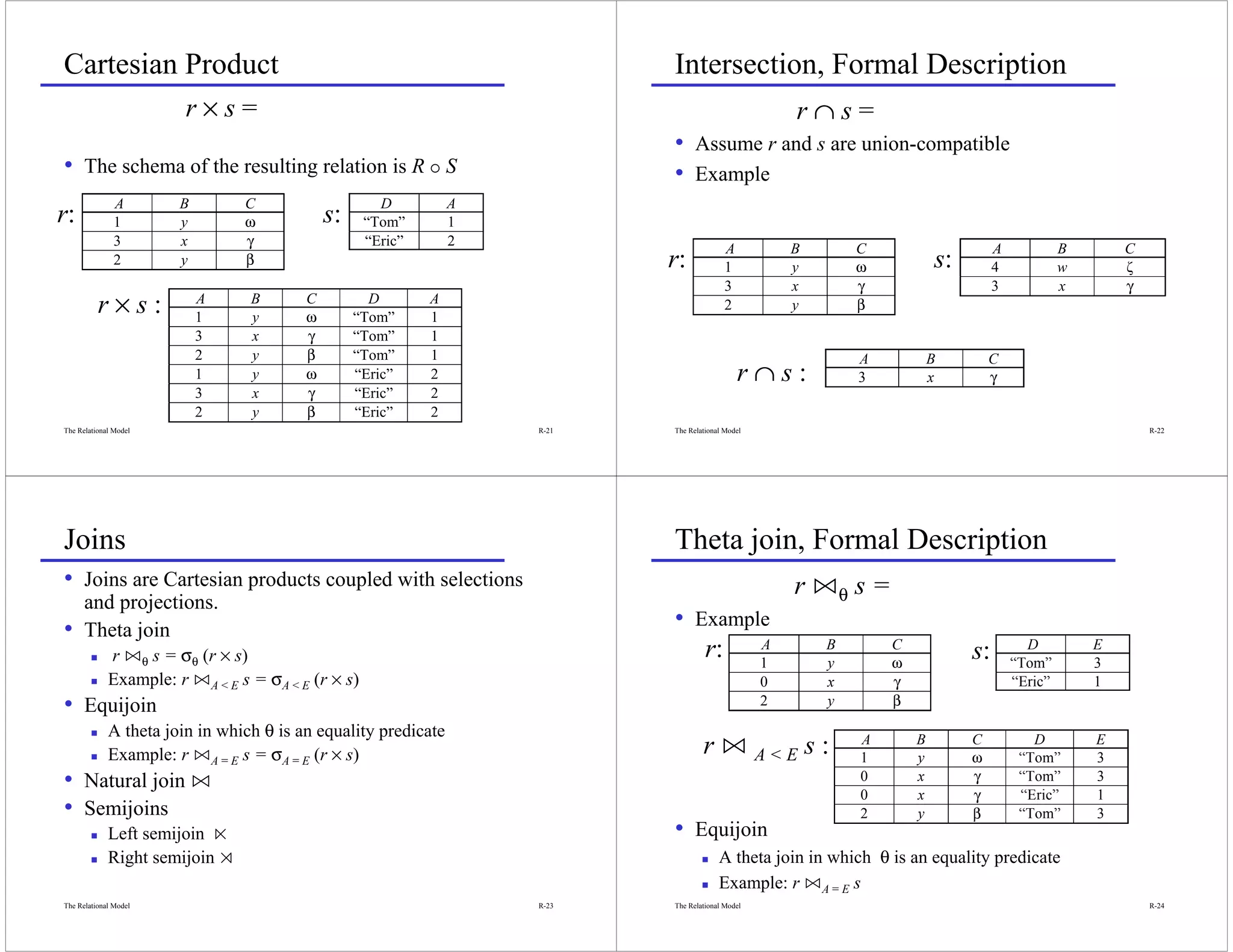
Cartesian Product                                                           Intersection, Formal Description
                        r×s=                                                                           r∩s=
                                                                            • Assume r and s are union-compatible
• The schema of the resulting relation is R S                               • Example
               A       B        C                     D          A
r:             1       y        ω            s:     “Tom”        1
               3       x        γ                   “Eric”       2
                                                                                           A           B       C                     A            B       C
               2       y        β                                           r:             1           y       ω           s:        4            w       ζ
                                                                                           3           x       γ                     3            x       γ
          r×s:             A
                           1
                                 B
                                 y
                                         C
                                         ω
                                                    D
                                                  “Tom”
                                                             A
                                                             1
                                                                                           2           y       β

                           3     x       γ        “Tom”      1
                           2     y       β        “Tom”      1                                                 A           B        C
                           1     y       ω        “Eric”     2                                 r∩s:            3           x        γ
                           3     x       γ        “Eric”     2
                           2     y       β        “Eric”     2
The Relational Model                                                 R-21   The Relational Model                                                              R-22


Joins                                                                       Theta join, Formal Description
• Joins are Cartesian products coupled with selections                                                 r nθ s =
      and projections.
•     Theta join
                                                                            • Example
             r nθ s = σθ (r × s)                                                     r:            A
                                                                                                   1
                                                                                                           B
                                                                                                           y
                                                                                                                   C
                                                                                                                   ω
                                                                                                                                s:         D
                                                                                                                                         “Tom”
                                                                                                                                                      E
                                                                                                                                                      3
             Example: r nA < E s = σA < E (r × s)                                                  0       x       γ                     “Eric”       1
• Equijoin                                                                                         2       y       β

             A theta join in which θ is an equality predicate                                                  A       B        C           D         E
             Example: r nA = E s = σA = E (r × s)                                   r n A<E s :                1       y        ω         “Tom”       3
• Natural join n                                                                                               0       x        γ         “Tom”       3
                                                                                                               0       x        γ         “Eric”      1
• Semijoins                                                                                                    2       y        β         “Tom”       3
             Left semijoin l                                                • Equijoin
             Right semijoin r                                                            A theta join in which θ is an equality predicate
                                                                                         Example: r nA = E s
The Relational Model                                                 R-23   The Relational Model                                                              R-24
Natural Join                                                                              Semijoins
                                  r n s=                                                                              r ls =
• Schema of result is R∪S                                                                 • The result has the same schema as the left-hand
• Let t be a tuple in the result.                                                               argument, r.
             t[R] has the same value as a tuple tR ∈ r.                                   •     Example
             t[S] has the same value as a tuple ts ∈ s.
                                                                                                                 A         B          C
• Example                                                                                               r:       1         y          ω
                                                                                                                                                  s:     D
                                                                                                                                                       “Tom”
                                                                                                                                                               B
                                                                                                                                                               y
                             A          B          C
                       r:    1          y          ω
                                                                s:     D
                                                                     “Tom”
                                                                               B
                                                                               y
                                                                                                                 3         x          γ
                                                                                                                 2         y          β
                             3          x          γ                 “Eric”    x
                             2          y          β
                                                                                                         rls:               A          B          C
                                         A           B          C       D                                                   1          y          ω
                       rns:              1           y          ω     “Tom”                                                 2          y          β
                                         3           x          γ     “Eric”
                                         2           y          β     “Tom”               • Right semijoin: r r s =
The Relational Model                                                               R-25   The Relational Model                                                     R-26


Relational Division                                                                       Relational Division, cont.
                       r ÷ s = { t | ∀u ∈s (t u ∈ r)}                                     • Let r and s be relations on schemes R and S
                                                                                                respectively, where
•       Example
                                                                                                        R = (A1, A2, ..., An, B1, B2, ..., Bn,)
                       A      B          C
                                                                                                        S = (B1, B2, ..., Bn,)
                                                            B
      r:               1      y          ω
                                                       s:   y
                       3      x          γ                  z
                       2      y          β                                                • The result of r divided by s is a relation on scheme
                       1      z          ω                                                      R ÷ S = (A1, A2, ..., An)


                           r÷s:          A
                                         1
                                                     C
                                                     ω
                                                                                          • R ÷ S = πR – S (r) – πR – S ((πR – S (r) × s) – r)


The Relational Model                                                               R-27   The Relational Model                                                     R-28
Renaming Operator                                                                Limitations of the Algebra
• Find the film(s) with the highest rental price.                                • Can't do arithmetic.
                                                                                              Find the rental price assuming a 10% increase.
• We need a renaming operator: ρName                                             • Can't do aggregates.
                                                                                              How many films has each customer reserved?
• Alternative formulation: Find the film(s) with a rental                        • Can't handle “missing” data.
      price for which no other rental price is higher.                                        Make a list of the films, along with who reserved it, if
                                                                                              applicable.
                                                                                 • Can't perform transitive closure.
                                                                                              For a partof(Part, ConstituentPart) relation, find all parts in
                                                                                              the car door.
        πTitle(Film) –
               πF2.Title (σFilm.RentalPrice > F2.RentalPrice (Film×ρF2(Film)))   • Can't sort, or print in various formats.
                                                                                              Print a reserved summary, sorted by customer name.
                                                                                 • Can't modify the database.
                                                                                              Increase all $3.25 rentals to $3.50.
The Relational Model                                                     R-29    The Relational Model                                                           R-30


Extending the Projection Operator                                                Aggregates
• The generalized projection operator allows expressions                         AGagg1, ..., aggk       (r) =
      in addition to column names in the subscript.                                                     t a1 ... ak | t ∈ r ∧
                                                                                                        a1 = agg1 ({u | u ∈ r ∧ u[G] = t[G]})
• Find the rental price, assuming a 10% increase.                                                                   ....
                                                                                                        ak = aggk ({u | u ∈ r ∧ u[G] = t[G]})

                          πTitle, RentalPrice*1.1(Film)                          • Appends new attributes.
                                                                                 • Each aggregate function aggi decides which attribute
                                                                                       to aggregate over.
                                                                                 •     The grouping attributes A are optional.

The Relational Model                                                     R-31    The Relational Model                                                           R-32
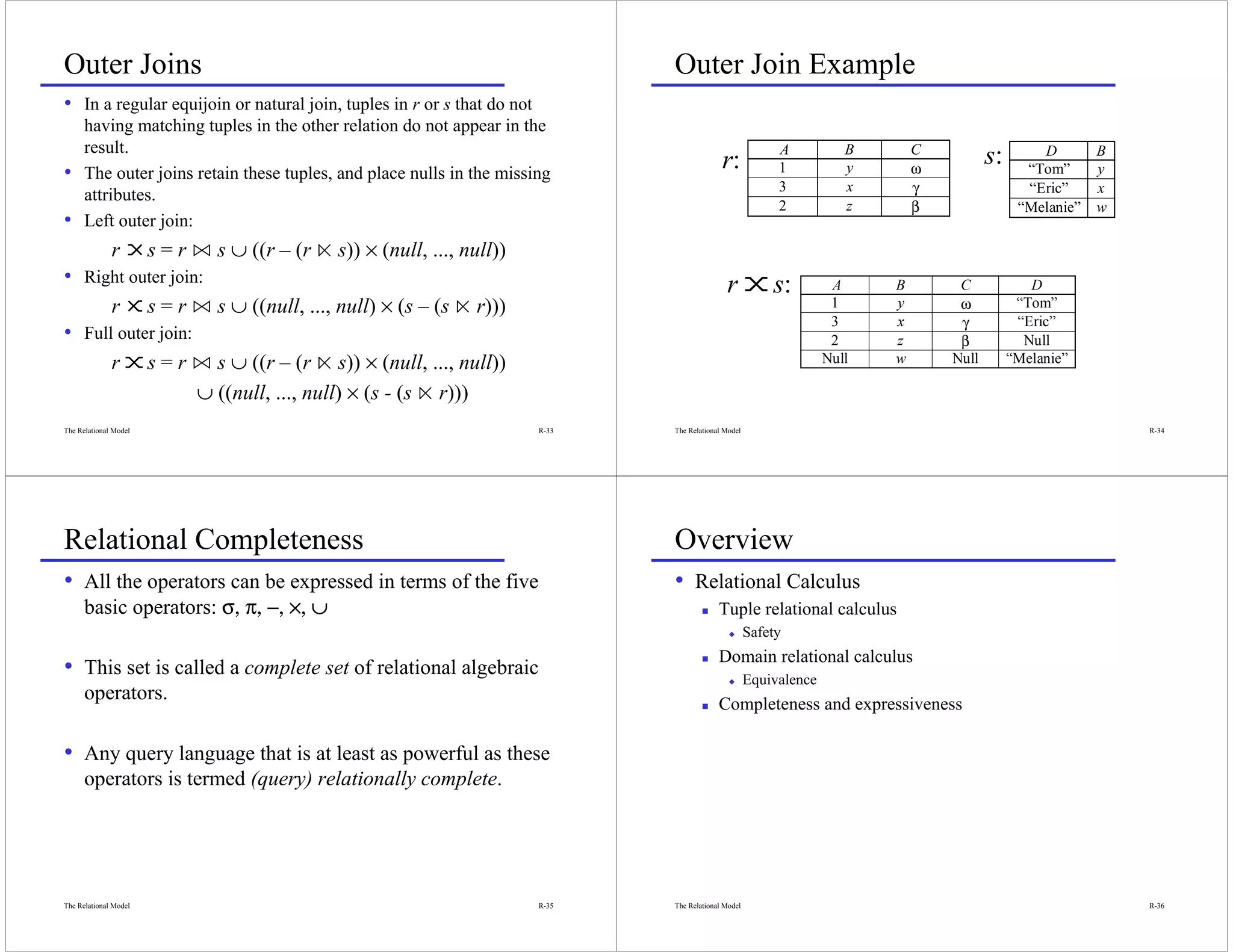
Outer Joins                                                                    Outer Join Example
• In a regular equijoin or natural join, tuples in r or s that do not
      having matching tuples in the other relation do not appear in the
      result.                                                                                              A           B       C
                                                                                             r:            1           y       ω
                                                                                                                                          s:       D
                                                                                                                                                 “Tom”
                                                                                                                                                            B
                                                                                                                                                            y
•     The outer joins retain these tuples, and place nulls in the missing
                                                                                                           3           x       γ                 “Eric”     x
      attributes.
                                                                                                           2           z       β                “Melanie”   w
•     Left outer join:
              r L s = r n s ∪ ((r – (r l s)) × (null, ..., null))
• Right outer join:                                                                           r N s:                 A     B        C             D
      r R s = r n s ∪ ((null, ..., null) × (s – (s l r)))                                                            1     y        ω           “Tom”
                                                                                                                     3     x        γ           “Eric”
• Full outer join:                                                                                                   2     z        β            Null
      r N s = r n s ∪ ((r – (r l s)) × (null, ..., null))                                                           Null   w       Null        “Melanie”

                   ∪ ((null, ..., null) × (s - (s l r)))
The Relational Model                                                    R-33   The Relational Model                                                             R-34


Relational Completeness                                                        Overview
• All the operators can be expressed in terms of the five                      • Relational Calculus
      basic operators: σ, π, −, ×, ∪                                                        Tuple relational calculus
                                                                                               x      Safety
                                                                                            Domain relational calculus
• This set is called a complete set of relational algebraic                                    x      Equivalence
      operators.                                                                            Completeness and expressiveness

• Any query language that is at least as powerful as these
      operators is termed (query) relationally complete.


The Relational Model                                                    R-35   The Relational Model                                                             R-36
Relational Calculus                                                               Relational Calculus, cont.
• The relational algebra is procedural, specifying a                              • Two forms of calculi
      sequence of operations to derive the desired results.
•     Relational calculus is based on first-order predicate
      calculus.
•     Relational calculus is more declarative, specifying                                      Tuple Relational Calculus (TRC)
      what is desired.
•     The expressive power of the two languages is identical.
             This implies that relational calculus is relationally complete.                   Domain Relational Calculus (DRC)
• Many commercial relational query languages are based
      on the relational calculus.
•     The implementations are based on the relational
      algebra.

The Relational Model                                                       R-37   The Relational Model                                                          R-38


Tuple Relational Calculus                                                         Syntax of Tuple Relational Calculus
• A tuple variable ranges over tuples of a particular                                                    {t1 .A1, t2.A2, ... , tj.Aj | P (t1, t2 , ... , tj)}
      relation.
•     Example: List the information about expensive films.
                                                                                  • t1, t2 , ... , tj are tuple variables.
         {t | t ∈ Film ∧ t[RentalPrice] > 4}
• t ∈ Film specifies the range relation Film for the tuple                        • Each tk is an tuple of the relation over which it ranges.
      variable t.
•     Each tuple satisfying t[RentalPrice] > 4 is retrieved.
•     The entire tuple is retrieved.
                                                                                  • P is a predicate, which is made up of atoms, of the
                                                                                        following types.
•     List the titles of expensive films.
                                                                                           tk ∈ R or R (tk) identifies R as the range of tk
          {t | x ∈ Film (x[RentalPrice] = t[RentalPrice]
                                                                                               Atoms from predicate calculus: ∧, ∨, ¬,∀, ∃
                                                                                                                                      ∀
                          ∧ x[RentalPrice] > 4)}
The Relational Model                                                       R-39   The Relational Model                                                          R-40
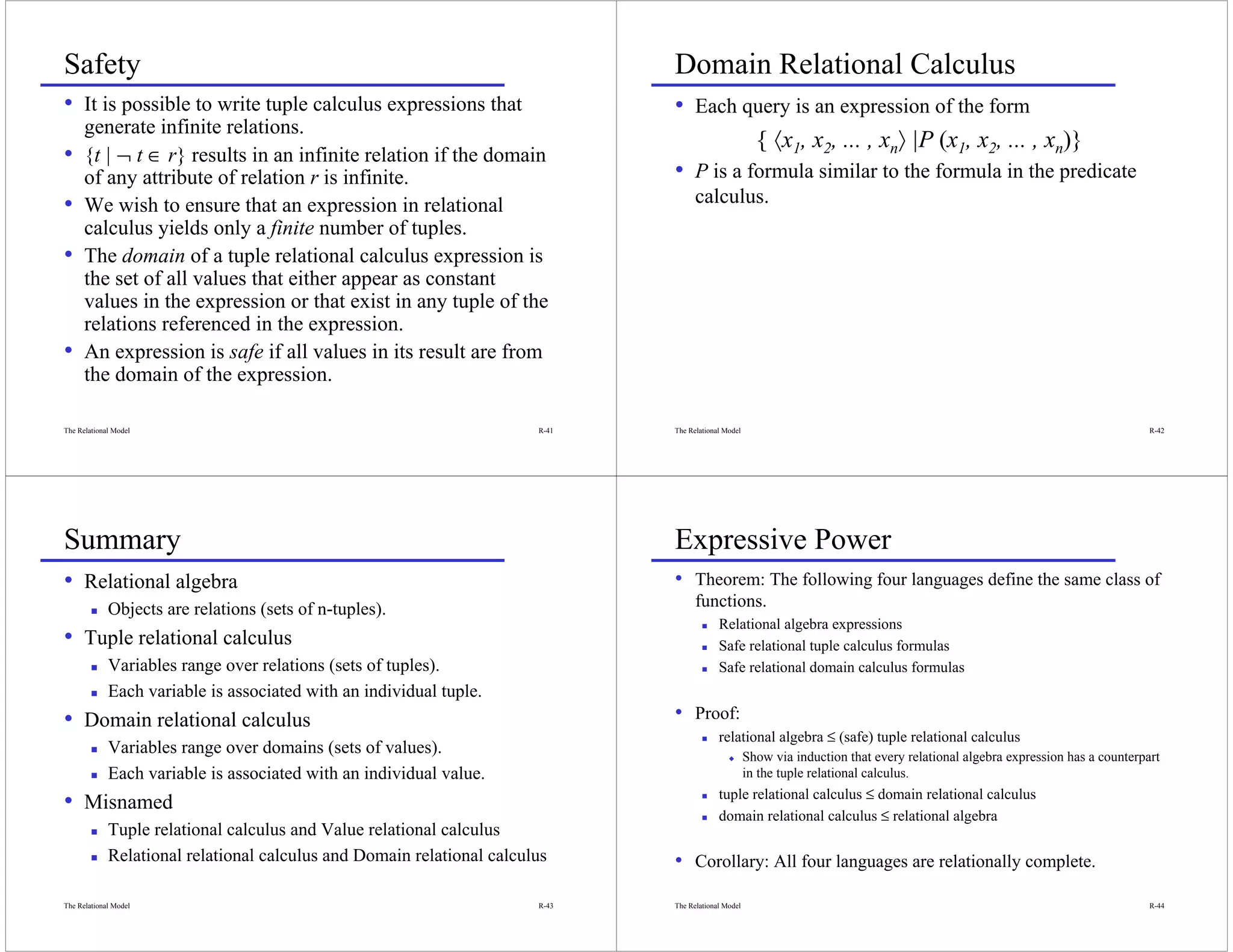
Safety                                                                         Domain Relational Calculus
• It is possible to write tuple calculus expressions that                      • Each query is an expression of the form
      generate infinite relations.
                                                                                                        { 〈x1, x2, ... , xn〉 |P (x1, x2, ... , xn)}
•     {t | ¬ t ∈ r} results in an infinite relation if the domain
      of any attribute of relation r is infinite.                              • P is a formula similar to the formula in the predicate
•     We wish to ensure that an expression in relational                             calculus.
      calculus yields only a finite number of tuples.
•     The domain of a tuple relational calculus expression is
      the set of all values that either appear as constant
      values in the expression or that exist in any tuple of the
      relations referenced in the expression.
•     An expression is safe if all values in its result are from
      the domain of the expression.

The Relational Model                                                    R-41   The Relational Model                                                                              R-42


Summary                                                                        Expressive Power
• Relational algebra                                                           • Theorem: The following four languages define the same class of
             Objects are relations (sets of n-tuples).                               functions.
                                                                                            Relational algebra expressions
• Tuple relational calculus                                                                 Safe relational tuple calculus formulas
             Variables range over relations (sets of tuples).                               Safe relational domain calculus formulas
             Each variable is associated with an individual tuple.
• Domain relational calculus                                                   • Proof:
                                                                                            relational algebra ≤ (safe) tuple relational calculus
             Variables range over domains (sets of values).                                    x      Show via induction that every relational algebra expression has a counterpart
             Each variable is associated with an individual value.                                    in the tuple relational calculus.
                                                                                            tuple relational calculus ≤ domain relational calculus
• Misnamed                                                                                  domain relational calculus ≤ relational algebra
             Tuple relational calculus and Value relational calculus
             Relational relational calculus and Domain relational calculus     • Corollary: All four languages are relationally complete.
The Relational Model                                                    R-43   The Relational Model                                                                              R-44
Completeness                                                                     Completeness, Example
• Theorem: The tuple relational calculus is complete.                            • List the titles of all reserved films.
                                                                                   πTitle (σFilm,FilmID = Reserved.FilmID(Film × Reserved))
                                                                                                   πTitle (Film n Reserved)
• Proof:
             Selection               σP(r) ⇒ { t | t ∈ r ∧ P(t) }
             Projection              πX(r) ⇒ {t | s ∈ r (s[X] = t[X] )}          • Replace projection:
             Union                   r∪s⇒{t|t∈r∨t∈s}
             Difference              r – s ⇒ { t | t ∈ r ∧ ¬t ∈ s }
             Cartesian product       r×s⇒ {t q|t∈r∧ q∈s}                                                {t.Title | t ∈ σFilm,FilmID = Reserved.FilmID
             Induct on length of the algebraic expression.                                                                   (Film × Reserved)}


The Relational Model                                                      R-45   The Relational Model                                                   R-46


Completeness, Example, Cont.                                                     Equivalence of Expressive Power
• Replace selection:                                                             • Theorem: The relational algebra is as expressive as the
                                                                                       (safe) tuple relational calculus.
        {t.Title | t ∈ (Film × Reserved)
                     ∧ t[Film.FilmID] = t[Reserved.FilmID] }
                                                                                 • (Informal) Proof: by induction on the number of
                                                                                       operators in the calculus predicate
• Replace the Cartesian product:

         {t.Title. | q ∈ Film ∧ r ∈ Reserved
                       ∧ q.FilmID = r.FilmID ∧ t = q r }


The Relational Model                                                      R-47   The Relational Model                                                   R-48

2red reviewrelation

  • 1.
    Review of theRelational Model Acknowledgements • These slides were written by Richard T. Snodgrass (University of Arizona, SIGMOD chair), Christian S. Jensen (Aalborg University), and Curtis Dyreson (Utah State University). • Kristian Torp (Aalborg University) converted the slides from island presents to Powerpoint. CS 6800 Utah State University The Relational Model R-2 Overview Sets • The Relational Model (RM) • A set is an unordered collection of distinct objects. Relations Examples Properties of relations {3, 4, a} is a set {3, 4, a} is the same set as {a, 4, 3} • Relational Algebra (RA) {4, 4} is not a set Operators x Complete set – projection, selection, Cartesian product, difference, • Set operations include union Intersection, e.g., {3, 4, a} I {b, 4} = {4} x Convenient – intersection, theta join, equijoin, natural join, semijoin, Union, e.g., {3, 4, a} U {b, 4} = {3, 4, a, b} division Difference, e.g., {3, 4, a} - {b, 4} = {3, a} Example queries Limitations • DRC and TRC The Relational Model R-3 The Relational Model R-4
  • 2.
    Domains and Attributes Relations Definition: A domain is a set of values of some "type" Definition: Given sets A1, A2, ... , An a relation r is a Positive integers = {1, 2, 3, 4, …} subset of their Cartesian product. Alphanumeric characters = {‘a’, ‘b’, …, ‘Z’, ‘0’, …, ‘9’} r ⊆ A1 × A2 × ... × An • A common database restriction: A domain is atomic. • r is a set of n-tuples (a1, a2, ... , an) where ai ∈ Ai The following programming types are atomic domains. integer, char, float, varchar Definition: R(A1, A2, ..., An) is the schema of relation r. Structs/records are a composite domain. A1, A2, ... , An are domains; their names are attributes struct { a: int, b: char } record_definition R is the name of the relation Definition: An attribute is the name of a domain. • Notation: r(R) is a relation on the relation schema R. The Relational Model R-5 The Relational Model R-6 Example, The < Relation Relations as Tables • Let O be the domain {1, 3} and E be {0, 2}. • Relations can be depicted as tables (approx.) O × E = {(1,0), (1,2), (3,0), (3,2)} • ×(O,E) where O = {1,3} and E = {0,2} × O E 1 0 1 0 3 2 1 0 1 2 3 0 3 2 3 2 • <(O,E) is the schema, O, E are attributes, {1,3} and • <(O,E) {0,2} are domains O < E = {(1,2)} ⊆ O × E 1 0 < O E 1 2 1 0 3 2 3 2 The Relational Model R-7 The Relational Model R-8
  • 3.
    Tuples Characteristics of Relations Definition: An element t of a relation r is called a tuple. • Tuples in a relation are unorderd. • Example: The following two relations have the same • We refer to component values of a tuple t by t[Ai] = vi information content. (the value of attribute Ai for tuple t). Alternatively, use ‘dot’ notation, e.g., t.Ai is the ith attribute of tuple t Name Age Name Age • t[Ai, ... , Ak] refers to the subtuple of t containing the Pat 1 Sue 3 values of attributes Ai, ... , Ak respectively. Fred 2 Pam 4 • Table metaphor Sue 3 Fred 2 Tuple is a row Pam 4 Pat 1 Attribute is a column The Relational Model R-9 The Relational Model R-10 Characteristics of Relations (cont.) Characteristics of Relations (cont.) • Attributes in a tuple/relation are ordered. • Values in a tuple are atomic (indivisible). But, we can change the order at will (to be shown in future). • A value cannot be a structure, record, or relation Example: The following relations do not have the same Example: All atomic values (string or integer). information. Name Age Pat 1 Name Age Age Name Fred 2 Pat 1 1 Pat Fred 2 2 Fred Example: The following is not a relation, Name is not atomic Sue 3 3 Sue Name Age Pam 4 4 Pam First Last 1 Joe Doe First Last 2 Sue Doe The Relational Model R-11 The Relational Model R-12
  • 4.
    Degree and Cardinality Relational Algebra Ord CID Date Salesperson • Five primary operators (complete) 102 42 860207 Johnson Selection: σ 103 39 860211 Strong Projection: π 104 24 860228 Boggs 105 42 860303 Strong Union: ∪ 107 34 860308 West Tuples (or records, rows) 108 46 860308 Wset [Cardinality is # of them] Difference: – 110 24 860312 Boggs Cartesian Product: × 111 21 860318 Strong 112 29 860320 Clark • Convenient derived operators (closed) degree/arity Intersection: ∩ Theta join nθ, equijoin n= , and natural join n Semijoins: left l and right r Relational division: ÷ The Relational Model R-13 The Relational Model R-14 RA Operations Produce Relations Selection, Formal Description σP(r) = • P is a formula in propositional calculus, dealing with terms of Name Age Name Age Name the form: joe 4 sue 10 sue attribute (or constant) = attribute (or constant) sue 10 sam 9 sam sam 9 operation1 operation2 attribute ≠ attribute attribute < attribute attribute ≤ attribute attribute ≥ attribute attribute > attribute Notation: operation2( operation1(R) ) term ∧ term (Note: ∧ is AND) term ∨ term (Note: ∨ is OR) ¬(term) The Relational Model R-15 The Relational Model R-16
  • 5.
    Projection, Formal Description Switching Columns πX(r) = • Assume r is the following • Let X = {Ai1, Ai2 , ... , Ain} Name Age • The result is a relation of n columns obtained by Pat 1 Fred 2 keeping the columns that are specified. Sue 3 • Example A B C Pam 4 r: 1 y ω 3 x γ • To switch columns use projection 2 y β Age Name 1 Pat πA,C (r): A C πB (r): B πAge,Name (r) = 2 Fred 1 ω y 3 Sue 3 γ x 4 Pam 2 β The Relational Model R-17 The Relational Model R-18 Union, Formal Description Difference, Formal Description r∪s= r–s= • Assume r and s are union-compatible r and s have the same arity. The attributes of r and s are same over domains. • Assume r and s are union-compatible. • Example • Example A B C A B C A B C A B C r: 1 y ω s: 4 w ζ r: 1 y ω s: 4 w ζ 3 x γ 3 x γ 3 x γ 3 x γ 2 y β 2 y β r∪s: A B C A B C 1 y ω r–s: 1 y ω 3 x γ 2 y β 2 y β 4 w ζ The Relational Model R-19 The Relational Model R-20
  • 6.
    Cartesian Product Intersection, Formal Description r×s= r∩s= • Assume r and s are union-compatible • The schema of the resulting relation is R S • Example A B C D A r: 1 y ω s: “Tom” 1 3 x γ “Eric” 2 A B C A B C 2 y β r: 1 y ω s: 4 w ζ 3 x γ 3 x γ r×s: A 1 B y C ω D “Tom” A 1 2 y β 3 x γ “Tom” 1 2 y β “Tom” 1 A B C 1 y ω “Eric” 2 r∩s: 3 x γ 3 x γ “Eric” 2 2 y β “Eric” 2 The Relational Model R-21 The Relational Model R-22 Joins Theta join, Formal Description • Joins are Cartesian products coupled with selections r nθ s = and projections. • Theta join • Example r nθ s = σθ (r × s) r: A 1 B y C ω s: D “Tom” E 3 Example: r nA < E s = σA < E (r × s) 0 x γ “Eric” 1 • Equijoin 2 y β A theta join in which θ is an equality predicate A B C D E Example: r nA = E s = σA = E (r × s) r n A<E s : 1 y ω “Tom” 3 • Natural join n 0 x γ “Tom” 3 0 x γ “Eric” 1 • Semijoins 2 y β “Tom” 3 Left semijoin l • Equijoin Right semijoin r A theta join in which θ is an equality predicate Example: r nA = E s The Relational Model R-23 The Relational Model R-24
  • 7.
    Natural Join Semijoins r n s= r ls = • Schema of result is R∪S • The result has the same schema as the left-hand • Let t be a tuple in the result. argument, r. t[R] has the same value as a tuple tR ∈ r. • Example t[S] has the same value as a tuple ts ∈ s. A B C • Example r: 1 y ω s: D “Tom” B y A B C r: 1 y ω s: D “Tom” B y 3 x γ 2 y β 3 x γ “Eric” x 2 y β rls: A B C A B C D 1 y ω rns: 1 y ω “Tom” 2 y β 3 x γ “Eric” 2 y β “Tom” • Right semijoin: r r s = The Relational Model R-25 The Relational Model R-26 Relational Division Relational Division, cont. r ÷ s = { t | ∀u ∈s (t u ∈ r)} • Let r and s be relations on schemes R and S respectively, where • Example R = (A1, A2, ..., An, B1, B2, ..., Bn,) A B C S = (B1, B2, ..., Bn,) B r: 1 y ω s: y 3 x γ z 2 y β • The result of r divided by s is a relation on scheme 1 z ω R ÷ S = (A1, A2, ..., An) r÷s: A 1 C ω • R ÷ S = πR – S (r) – πR – S ((πR – S (r) × s) – r) The Relational Model R-27 The Relational Model R-28
  • 8.
    Renaming Operator Limitations of the Algebra • Find the film(s) with the highest rental price. • Can't do arithmetic. Find the rental price assuming a 10% increase. • We need a renaming operator: ρName • Can't do aggregates. How many films has each customer reserved? • Alternative formulation: Find the film(s) with a rental • Can't handle “missing” data. price for which no other rental price is higher. Make a list of the films, along with who reserved it, if applicable. • Can't perform transitive closure. For a partof(Part, ConstituentPart) relation, find all parts in the car door. πTitle(Film) – πF2.Title (σFilm.RentalPrice > F2.RentalPrice (Film×ρF2(Film))) • Can't sort, or print in various formats. Print a reserved summary, sorted by customer name. • Can't modify the database. Increase all $3.25 rentals to $3.50. The Relational Model R-29 The Relational Model R-30 Extending the Projection Operator Aggregates • The generalized projection operator allows expressions AGagg1, ..., aggk (r) = in addition to column names in the subscript. t a1 ... ak | t ∈ r ∧ a1 = agg1 ({u | u ∈ r ∧ u[G] = t[G]}) • Find the rental price, assuming a 10% increase. .... ak = aggk ({u | u ∈ r ∧ u[G] = t[G]}) πTitle, RentalPrice*1.1(Film) • Appends new attributes. • Each aggregate function aggi decides which attribute to aggregate over. • The grouping attributes A are optional. The Relational Model R-31 The Relational Model R-32
  • 9.
    Outer Joins Outer Join Example • In a regular equijoin or natural join, tuples in r or s that do not having matching tuples in the other relation do not appear in the result. A B C r: 1 y ω s: D “Tom” B y • The outer joins retain these tuples, and place nulls in the missing 3 x γ “Eric” x attributes. 2 z β “Melanie” w • Left outer join: r L s = r n s ∪ ((r – (r l s)) × (null, ..., null)) • Right outer join: r N s: A B C D r R s = r n s ∪ ((null, ..., null) × (s – (s l r))) 1 y ω “Tom” 3 x γ “Eric” • Full outer join: 2 z β Null r N s = r n s ∪ ((r – (r l s)) × (null, ..., null)) Null w Null “Melanie” ∪ ((null, ..., null) × (s - (s l r))) The Relational Model R-33 The Relational Model R-34 Relational Completeness Overview • All the operators can be expressed in terms of the five • Relational Calculus basic operators: σ, π, −, ×, ∪ Tuple relational calculus x Safety Domain relational calculus • This set is called a complete set of relational algebraic x Equivalence operators. Completeness and expressiveness • Any query language that is at least as powerful as these operators is termed (query) relationally complete. The Relational Model R-35 The Relational Model R-36
  • 10.
    Relational Calculus Relational Calculus, cont. • The relational algebra is procedural, specifying a • Two forms of calculi sequence of operations to derive the desired results. • Relational calculus is based on first-order predicate calculus. • Relational calculus is more declarative, specifying Tuple Relational Calculus (TRC) what is desired. • The expressive power of the two languages is identical. This implies that relational calculus is relationally complete. Domain Relational Calculus (DRC) • Many commercial relational query languages are based on the relational calculus. • The implementations are based on the relational algebra. The Relational Model R-37 The Relational Model R-38 Tuple Relational Calculus Syntax of Tuple Relational Calculus • A tuple variable ranges over tuples of a particular {t1 .A1, t2.A2, ... , tj.Aj | P (t1, t2 , ... , tj)} relation. • Example: List the information about expensive films. • t1, t2 , ... , tj are tuple variables. {t | t ∈ Film ∧ t[RentalPrice] > 4} • t ∈ Film specifies the range relation Film for the tuple • Each tk is an tuple of the relation over which it ranges. variable t. • Each tuple satisfying t[RentalPrice] > 4 is retrieved. • The entire tuple is retrieved. • P is a predicate, which is made up of atoms, of the following types. • List the titles of expensive films. tk ∈ R or R (tk) identifies R as the range of tk {t | x ∈ Film (x[RentalPrice] = t[RentalPrice] Atoms from predicate calculus: ∧, ∨, ¬,∀, ∃ ∀ ∧ x[RentalPrice] > 4)} The Relational Model R-39 The Relational Model R-40
  • 11.
    Safety Domain Relational Calculus • It is possible to write tuple calculus expressions that • Each query is an expression of the form generate infinite relations. { 〈x1, x2, ... , xn〉 |P (x1, x2, ... , xn)} • {t | ¬ t ∈ r} results in an infinite relation if the domain of any attribute of relation r is infinite. • P is a formula similar to the formula in the predicate • We wish to ensure that an expression in relational calculus. calculus yields only a finite number of tuples. • The domain of a tuple relational calculus expression is the set of all values that either appear as constant values in the expression or that exist in any tuple of the relations referenced in the expression. • An expression is safe if all values in its result are from the domain of the expression. The Relational Model R-41 The Relational Model R-42 Summary Expressive Power • Relational algebra • Theorem: The following four languages define the same class of Objects are relations (sets of n-tuples). functions. Relational algebra expressions • Tuple relational calculus Safe relational tuple calculus formulas Variables range over relations (sets of tuples). Safe relational domain calculus formulas Each variable is associated with an individual tuple. • Domain relational calculus • Proof: relational algebra ≤ (safe) tuple relational calculus Variables range over domains (sets of values). x Show via induction that every relational algebra expression has a counterpart Each variable is associated with an individual value. in the tuple relational calculus. tuple relational calculus ≤ domain relational calculus • Misnamed domain relational calculus ≤ relational algebra Tuple relational calculus and Value relational calculus Relational relational calculus and Domain relational calculus • Corollary: All four languages are relationally complete. The Relational Model R-43 The Relational Model R-44
  • 12.
    Completeness Completeness, Example • Theorem: The tuple relational calculus is complete. • List the titles of all reserved films. πTitle (σFilm,FilmID = Reserved.FilmID(Film × Reserved)) πTitle (Film n Reserved) • Proof: Selection σP(r) ⇒ { t | t ∈ r ∧ P(t) } Projection πX(r) ⇒ {t | s ∈ r (s[X] = t[X] )} • Replace projection: Union r∪s⇒{t|t∈r∨t∈s} Difference r – s ⇒ { t | t ∈ r ∧ ¬t ∈ s } Cartesian product r×s⇒ {t q|t∈r∧ q∈s} {t.Title | t ∈ σFilm,FilmID = Reserved.FilmID Induct on length of the algebraic expression. (Film × Reserved)} The Relational Model R-45 The Relational Model R-46 Completeness, Example, Cont. Equivalence of Expressive Power • Replace selection: • Theorem: The relational algebra is as expressive as the (safe) tuple relational calculus. {t.Title | t ∈ (Film × Reserved) ∧ t[Film.FilmID] = t[Reserved.FilmID] } • (Informal) Proof: by induction on the number of operators in the calculus predicate • Replace the Cartesian product: {t.Title. | q ∈ Film ∧ r ∈ Reserved ∧ q.FilmID = r.FilmID ∧ t = q r } The Relational Model R-47 The Relational Model R-48