A.F.R.
Judgment Reserved
Delivered on 29.01.2021
Court No. - 29
Case :- CRIMINAL MISC. WRIT PETITION No. - 10974 of 2020
Petitioner :- Jeeshan @ Jaanu And Another
Respondent :- State Of U P And 4 Others
Counsel for Petitioner :- Abou Sofian Usmani,Upendra Upadhyay
Counsel for Respondent :- G.A.
with
Case :- CRIMINAL MISC. WRIT PETITION No. - 13521 of 2020
Petitioner :- Balveer Singh Yadav
Respondent :- State Of U.P. And 2 Others
Counsel for Petitioner :- Siya Ram Verma
Counsel for Respondent :- G.A.
with
Case :- CRIMINAL MISC. WRIT PETITION No. - 14300 of 2020
Petitioner :- Doodh Nath Yadav
Respondent :- State Of U.P. And 3 Others
Counsel for Petitioner :- Amit Kumar Tiwari,Shiv Bahadur Singh
Counsel for Respondent :- G.A.
Hon'ble Pankaj Naqvi,J.
Hon'ble Vivek Agarwal,J.
(Vivek Agarwal,J.)
Heard Sri Upendra Upadhyay, Siya Ram Verma and Sri Shiv
Bahadur Singh, learned counsel for the petitioners, Sri Vinod
Diwaker, learned A.A.G. for the State assisted by Sri Deepak Mishra
and Ms. Manju Thakur, learned A.G.A. and Sri Vinay Saran, learned
Amicus assisted by Sri Saumitra Dwivedi.
These three petitions raise a common issue of violation of Right
to Privacy on account of list of top-10 criminals displayed at different
Police Stations namely, Khuldabad, District-Prayagraj, Police Station-
Bithoor, District-Kanpur Nagar and at Police Station-Karchhana,
District-Prayagraj.
Brief facts of each petition
1. Petitioners in C.M.W.P. No. 10974 of 2020 are real brothers
engaged in business and claim to be income tax payees. They are
aggrieved with a list published at Police Station-Khuldabad,
showing their names as top-10 criminals for the year 2020.
Petitioner no. 1- Jeeshan @ Jaanu is at serial no. 3 and petitioner
no. 2 at the top of list of top-10 criminals at Police Station-
Khuldabad, (Annexure-2) to the writ petition. Petitioner no. 1 is also
aggrieved with the opening of his history sheet on 20.08.2020.
(1A) Petitioners grievance is that they are relatives of Ex-
Member of Parliament from Allahabad Constituency and due to
political vendetta, they are being harassed by the police authorities
by illegally publishing their names in the list of top-10 criminals of
Police Station-Khuldabad.
(1B) As per the contention of petitioner no. 1, police has
shown nine cases against him, out of which, he has yet not been
charge-sheeted in four cases while two cases are lodged at the
behest of Prayagraj Development Authority regarding irregularities
in the constructions.
(1C) Case of petitioner no. 2 is that in the year 2007, three
cases were registered against him simultaneously at Police
Station-Dhoomanganj, District-Prayagraj.
(1D) Vide order dated 29.10.2013 passed by the Court of
learned Additional Sessions Judge, Court No. 2, Allahabad,
petitioner no. 2 has been acquitted in Case Crime No. 287 of 2007.
In another Case Crime No. 120 of 2007, he is on bail, granted by
the Court of Sessions Judge, Allahabad while in third case, i.e.
Case Crime No. 113 of 2007, he was granted bail by the High
Court.
2
(1E) Two new cases have been registered against petitioner
no. 2 in the year 2019 and 2020 purely on political motivation. In
one of the cases, he has been granted anticipatory bail while in
another, police authorities have been restrained from taking any
coercive action against the petitioner. Another fresh case has been
registered against him in 2020 at Police Station-Khuldabad under
Section 27 of the Arms Act.
(1F) It is submitted that only one case is registered against
each of the petitioners at Police Station-Khuldabad and yet on the
basis of a single case their names have been included in the list of
top-10 criminals of Police Station-Khuldabad.
(1G) It is petitioner's contention that the act of the authorities
of State is violative of Article 21 of the Constitution of India
inasmuch as Right to Life includes the right to live with human
dignity. Placing reliance on the judgment of the Hon'ble Supreme
Court in Maneka Gandhi vs. Union of India, AIR 1978 SC 59, it is
pointed out that Right to Life also means that the State cannot
curtail the dignity of a citizen in an arbitrary manner.
(1H) Petitioner's contention is that personal enmity is being
taken to illogical ends, so as to harass them by violating their
fundamental rights and malafidely declaring them to be top-10
criminals of Police Station-Khuldabad, so as to tarnish their image
and dent their dignity in public and harass their entire family. In
above backdrop, a prayer has been made for issuance of a writ,
order or direction in the nature of mandamus directing the
respondents to delete the name of the petitioners from the list of
top-10 criminals of Police Station-Khuldabad, District-Prayagraj
with a further prayer to direct the police authorities to close the
history sheet of petitioner no. 1 and not to harass them.
Brief facts in C.M.W.P. No. 13521of 2020
2. Petitioner claims himself to be an Advocate, practicing at
District-Kanpur Dehat. Petitioner's contention is that he being a
3
legal professional, appears for litigants facing criminal prosecution,
as a result of which, police personnel posted at Police Station-
Bithoor, District-Kanpur Nagar have developed enmity. This enmity
became aggravated when petitioner refused to support the brother
of his opponent in the election of Gram Pradhan, Gram Panchayat-
Baikunthpur, District-Kanpur Nagar. On 11.03.2018, an FIR was
registered at the behest of petitioner against his rivals as Case
Crime No. 66 of 2018, in which his opponents have been charge-
sheeted.
(2A). According to the petitioner, he is being falsely implicated
in different cases by including his name in the list of top-10
criminals of Police Station-Bithoor, District-Kanpur Nagar,
(Annexure 1), where his name is mentioned at serial no. 8.
(2B). Petitioner's contention is that he has nothing to do with
criminal activities yet he is being falsely implicated. It is submitted
that in pending Case Crime No. 64 of 2018, under Sections 147,
148, 149, 452, 307, 323, 504, 506 IPC and Section 3(1)(10) of SC/
ST Act, cognizance has already been taken and matter is pending
before the Court of learned IInd Additional Sessions Judge (SC/ST
Act), Kanpur Nagar, yet on the basis of a single case, inclusion of
the petitioner's name in the list of top-10 criminals of Police Station-
Bithoor, District-Kanpur Nagar is arbitrary and illegal.
Brief facts in C.M.W.P. No. 14300 of 2020
3. Petitioner's contention is that he is into the business of a
concrete and sand, his firm is registered, along with GST number.
Petitioner claims to be an income tax payee.
(3A). It is submitted that out of rivalry between two groups,
false FIR was lodged in the year 2011, in which final report was
submitted on 29.08.2011, discharging petitioner and final report
was accepted by the Court. Petitioner's case is that again in the
year 2019, a false case has been registered against him and his
entire family has been roped in under Sections 323, 504, 506 IPC,
4
and also under Section 3(1)(da) and 3(1)(dha) of Scheduled
Castes and the Scheduled Tribes (Prevention of Atrocities) Act,
1989 at Police Station-Karchhana, District-Prayagraj. In this case,
Investigating Officer has given a clean chit to the petitioner and
final report too has been accepted by the Court, yet another FIR
was registered against him on 27.05.2020 under Section 379 IPC ,
Sections 4 and 21of Mines and Minerals (Regulation and
Development) Act, 1957 and Rules 3, 57, 7 of U.P. Minor Minerals
(Concession) Rules, 1963.
(3B). It is submitted that High Court has been pleased to
quash the FIR against the petitioner and others in regard to all
offences except offence under Section 379 IPC, as can be verified
from order passed in C.M.W.P. No. 6027 of 2020. Placing reliance
on said judgment, it is submitted that name of the petitioner has
been wrongly included at serial no. 4 in the list of top-10 criminals
pasted at Police Station-Karchhana, District-Prayagraj, a copy of
which is enclosed as Annexure-13, to the petition.
(3C). It is submitted that petitioner had sought information as
to on what grounds his name has been included, but information
sought under Right to Information Act, 2005 has not been provided.
It is submitted that no notice under Section 41 Cr.P.C. has been
issued to the petitioner, yet on account of certain election rivalry
and political affiliations, petitioner has been falsely included in the
list of top-10 criminals.
(3D). Petitioner's case is that from 2011 to 2020, only three
cases have been registered against him, yet in violation of his
fundamental rights, his name is being scandalized and propagated
without following procedure established by law. Petitioner has not
yet been convicted in any of the criminal cases and therefore, a
prayer has been made to remove/delete his name at serial no. 4
from the list of top-10 criminals with a further prayer to take action
against respondent no. 4 directing the authorities to initiate
appropriate proceedings against the Station House Officer for
5
arbitrarily and malafidely including his name in the list of top-10
criminals.
(3E). It is submitted that on inquiry, police authorities are not
in a position to disclose as to what is the criteria for preparation of
list of top 10 criminals of a police station or of district and under
what authority of law it is being published.
(3F). A common thread running through all the three petitions
is so called action of the police authorities in displaying names of
the petitioners along with others though they are undertrials, having
different vocations like business, advocacy or politics, but their
image is being tarnished and dignity dented by the police by
canvassing their names as top-10 criminals of the district or the
police station concerned, as the case may be.
(3G). This act of the respondent authorities is assailed on the
ground that publication/displaying/disclosing of the names of
petitioner infringes upon right to privacy and right to live with dignity
which brings disrepute.
4. Learned counsel for the petitioners led by Sri Vinay Saran,
Amicus submits that Right to Privacy is recognized as a sacred
fundamental right under Article 21 of the Constitution of India. He
submits that publication of the name of petitioners as well as their
criminal history is a clear violation of Right to Privacy and the right
to live with human dignity, which is a facet of Article 21 of the
Constitution. He submits that dignity of a citizen is of utmost
importance and police authorities cannot tinker with the same.
5. Learned Amicus places reliance on the order of Allahabad
High Court in case of In re Banners Placed at Roadside in the City
of Lucknow vs. State of U.P. (2020) 4 ADJ 386, wherein it was held
that without there being any rational nexus between the object and
means adopted to achieve them, there cannot be any violation of
either the Right to Life guaranteed under Article 21 of the
Constitution or the human rights covered under the United Nations
Declaration of Human Rights, and our Municipal Law so also Right
6
to Privacy recognized under the International Covenant on Civil
and Political Rights and other International and Regional Treaties.
6. Reliance is also placed on the judgment of the Supreme
Court in case of Mehmood Nayyar Azam vs. State of Chhattisgarh
and Others, (2012) 8 SCC 1, wherein it has been held that
"any form of torture or cruel, inhuman or degrading
treatment would fall within the ambit of Article 21 of the
Constitution, whether it occurs during investigation,
interrogation or otherwise. It is further held that the right
to life of a citizen cannot be put in abeyance on his
arrest. The precious right guaranteed by Article 21 of
the Constitution of India cannot be denied to convicts,
undertrials, detainue and other prisoners in custody,
except according to the procedure established by law by
placing such reasonable restrictions as are permitted by
law. This judgment further deals with the aspects of
inhuman treatment having many a facet. It can cover
such acts which have been inflicted with an intention to
cause physical suffering or severe mental pain. It would
also include a treatment when inflicted causes
humiliation and compels a person to act against his will
or conscience. Torture is not merely physical but may
even consist of mental and psychological torture
calculated to create fright to submit to the demands of
the police. Any treatment meted out to an accused
while he is in custody which causes humiliation and
mental trauma corrodes the concept of human dignity.
The majesty of law protects dignity of a citizen in a
society governed by law."
7. Reliance is also placed on the judgment of the Supreme
Court in R. Rajagopal alias R.R. Gopal and another v. State of
Tamil Nadu (1994) 6 SCC 632, Jeevan Reddy, J. speaking for the
7
Court observed that in recent times right to privacy has acquired
constitutional status. The Apex Court held that
"the right to privacy is implicit in the right to life and
liberty guaranteed to the citizens of this country by
Article 21. It is a "right to be let alone". A citizen has a
right "to safeguard the privacy of his own, his family,
marriage, procreation, motherhood, child-bearing and
education among other matters".
8. Reliance was also placed on the judgment in Bhavesh
Jayanti Lakhani vs. State of Maharashtra and Others, (2009) 9
SCC 551, wherein it was held that:
"right to privacy is a part of the right to 'life' and
'personal liberty' enshrined under Article 21 of the
Constitution. Once the facts in a given case constitute a
right to privacy, Article 21 is attracted. The said right
cannot be curtailed 'except according to the procedure
established by law'."
9. Learned Amicus submits that disclosure of criminal
antecedents and history sheet is governed by U.P. Police
Regulations. Chapter XX of U.P. Police Regulations deals with the
registration and surveillance of bad characters. Regulation 223
states about the village crime note book, which is a confidential
record, kept at police station. Regulation 223 envisages that officer
incharge of the police station is responsible for case study of such
village crime note book. Part V of case crime note book consist of
history sheet, which is again a personal record of a criminal under
surveillance.
10. Regulation 240 deals with history sheet of Class-A 'offenders
considered capable of reform' and Class-B 'offenders considered
incapable of reform' and provides that it may be opened either on
the basis of suspicion, on conviction or acquittal.
8
11. It is submitted that Regulation 240 will be applicable to the
facts of the present set of cases where history sheet can be
opened on the basis of suspicion, however, Regulation 250
provides that the list of bad characters in history sheets are
confidential records and it is the responsibility of the Station House
Officer to ensure that persons other than authorized under
Regulation 240 namely, the Station House Officer, the Circle Officer
and the Superintendent of Police/Senior Superintendent of Police
and no other person has access to them.
12. Placing reliance on the judgment of Supreme Court in Malak
Singh and Others vs. State of Punjab and Haryana and Others,
(1981) 1 SCC 420 and the judgment of Allahabad High Court in
Abdul Rahman vs. Abdul Rahim, (1924) ILR 46 (All) 884, it is
submitted that even history sheets and village crime note books
are not public documents, therefore, publishing names of the
petitioners as top-10 criminals is neither envisaged under the U.P.
Police Regulations nor it can be read into the policy of the State
dated 06th July, 2020. It is submitted that there is nothing in the
policy to reveal that even policy envisages publication of any such
list of top-10 criminals on the notice board or flysheet board of a
police station.
13. Placing reliance on the judgment of Supreme Court in
Umesh Kumar vs. State of Andhra Pradesh and Others, (2013) 10
SCC 591, it is submitted that Right to Life includes right to ones
reputation, freedom from defamation. It is submitted that right to
reputation is held to be a personal right protected under Article 21.
It is submitted that
"reputation is a sort of right to enjoy the good opinion of
others and it is a personal right and an injury to
reputation is a personal injury. Thus, slander and
defamation are injurious to reputation. Reputation has
been defined in dictionary as “to have a good name; the
9
credit, honor, or character which is derived from a
favourable public opinion or esteem and character by
report”. Personal rights of a human being include the
right of reputation. A good reputation is an element of
personal security and is protected by the Constitution
equally with the right to the enjoyment of life, liberty and
property. International Covenant on Civil and Political
Rights 1966 recognizes the right to have opinions and
the right of freedom of expression under Article 19 is
subject to the right of reputation of others. Reputation is
“not only a salt of life but the purest treasure and the
most precious perfume of life.” Placing reliance on this
judgment, it is submitted that even if the
circular/guidelines issued by the DGP on 06th July, 2020
is taken as it is, then also the guidelines does not permit
publication of names of criminal/accused/history
sheeters on the flysheet board of a police station.
(13A). Placing reliance on the judgment of the
Supreme court in Natural Resources Allocation, in Re,
Special Reference No.1 of 2012 – (2012) 10 SCC 1, it is
submitted that while determining violability of a
legislation or executive action on the touchstone of
Article 14 of the constitution, test that is to be applied is
that State action, to escape the scrutiny of Article 14 has
to be fair, reasonable and non-discriminatory, in pursuit
of promotion of healthy competition and equitable
treatment. State action must conform to norms, which
are rational, informed with reasons and guided by public
interest. Executive action should have clearly defined
limits and should be predictable. Man on the street
should know why a decision has been taken in favour of
a particular person. Lack of transparency in decision
making process would render it arbitrary.
10
14. Shri Vinod Diwakar, learned Additional Advocate General for
the State of Uttar Pradesh in turn supports the impugned policy
dt.06.07.2020 and submits that Chapter I Regulation 1 of the Uttar
Pradesh Police Regulations provides that the Inspector General is
the head of the police department and the Adviser of the Governor-
in-Council in all questions of police administration. All orders from
the Governor-in-Council to a member of police force are issued
through him, except in cases of urgency when copies of any orders
issued directly to subordinate officers are sent to him. Thus placing
reliance on such provisions of Regulation 1, it is submitted that
orders passed by the Director General of Police is a valid order and
has a binding force on all the personnel of the police department
subordinate to the Director General of Police.
15. Learned A.A.G. submits that policy/circular even if not law,
yet State can on the basis of intelligible criteria publish names of
the accused. Learned counsel for the State placed reliance on the
judgment of the Supreme Court in the case of Kailash Chandra
Sharma etc. etc. Vs. State of Rajasthan and others as reported in
(2002) 6 SCC 562 specifically drawing attention to para 11 of the
judgment, wherein circular dated 10.06.1998 providing for bonus
marks to residents of the concerned district and the rural areas
within that district was put to test. On the touchstone of Article 14
read with Article 16 of the Constitution it was held that impugned
circular is the product of the policy decision taken by the State
Government. Even then, as rightly pointed out by the High Court,
such decision has to pass the test of Articles 14 and 16 of the Con-
stitution. If the policy decision, which in the present case has un-
doubted effect of deviating from normal and salutary rule of selec-
tion based on merit is subversive of the doctrine of equality, it can-
not sustain. It should be free from the vice of arbitrariness and con-
form to the well-settled norms both positive and negative underly-
ing Articles 14 and 16, which together with Article 15 form part of
the Constitutional code of equality.
11
16. Reliance has also been placed on the decision of the Su-
preme Court in Union of India Vs. Navin Jindal and another, (2004)
2 SCC 510, which provides that Flag Code is not a statute and can
not regulate fundamental right to fly national flag, however, the
guidelines as laid down under the Flag Code deserve to be fol-
lowed to the extent it provides for preservation of dignity and re-
spect for the national flag. Reliance is also placed on the decision
of the Supreme Court in Narendra Kumar Maheshwari Vs. Union of
India and others, (1990) SCC Supl. 440, wherein importance of
subordinate and delegated legislation has been discussed and it
has been held that “it has to be borne in mind that State instru-
mentalities should be committed to the endeavours of the constitu-
tional aspiration to secure justice, inter alia, social and economic,
and also under Article 39 (b) & (c) of the Constitution to ensure
that the ownership and control of the material resources of the
community are so distributed as to best subserve the common
good and that the operation of the economic system does not res-
ult in concentration of wealth and means of production to the com-
mon detriment. Yet, every instrumentality and functionary of the
State must fulfill its own role and should not trespass or encroach/
entrench upon the field of others. Progress is ensured and devel-
opment helped if each performs his role in common endeavour.
17. Reliance is also placed on the judgment of the Supreme
Court in Syndicate Bank Vs. Ramchandran Pillai, (2011) 15 SCC
398, wherein it was held that
“If any executive instructions are to have the force of
statutory rules, it must be shown that they were issued
either under the authority conferred on the Central Gov-
ernment or a State Government or other authority by
some Statute or the Constitution. Guidelines or execut-
ive instructions which are not statutory in character, are
not 'laws', and compliance thereof can not be enforced
through courts. Even if there has been any violation or
12
breach of such non-statutory guidelines, it will not confer
any right on any member of the public, to seek a direc-
tion in a court of law, for compliance with such
guidelines.” Placing reliance on this judgment of Syndic-
ate Bank (supra), it is submitted that policy or guidelines
are not justiciable and therefore petitioners can not
claim any right claiming violation of the guidelines.
18. Reliance is also placed on the judgment of the Supreme
Court in Navtej Singh Johar and others Vs. Union of India through
Secretary Ministry of Law and justice and other connected matters
– (2018) 10 SCC 1, wherein in para 637.2, twin-test of classifica-
tion under Article 14 has been reiterated which provides that ;
(i) there should be a reasonable classification based on
intelligible differentia; and,
(ii) this classification should have a rational nexus with the
objective sought to be achieved.
19. Learned A.A.G. submits that accused have no right to privacy
as society needs to be aware of the criminals and their ante-
cedents. Dissemination of information to antecedents of criminals
does not amount to any discrimination. He submits that police reg-
ulation 287 provides for a notice board to be set up in a conspicu-
ous place at every police station for displaying proclamation and
public notice. He submits that when Police Regulation 287, itself
provides for a notice board for putting up proclamations and public
notices, then pasting names of top 10 criminals of a police station
or a district can not be faulted with. He further submitted that even
Interpol has a policy of listing top 10 most wanted criminals/fugit-
ives, thus, publishing such a list on the flysheet of a police station
can not be termed as arbitrary or illegal.
20. Learned A.A.G. placed reliance on the concept of dignity as
propounded by Immanuel Kant, to submit that even he accepted
13
that human dignity is not an unfettered right and an accused can-
not claim any immunity from publication of his name on the display
board of a police station seeking protection under the cover of dig-
nity.
21. It is submitted that policy/guidelines framed by the State gov-
ernment and circulated on 06.07.2020 demonstrates a resolve of
the State to show zero tolerance to crime. It is submitted that the
Police Act of 1961, permits opening of history sheets and it further
permits display of such history sheets on display board maintained
by each police station. It is submitted that law laid down by Su-
preme court in K.S.Puttaswamy (Retd) Vs. Union of India and oth-
ers as reported in (2019) 1 SCC 1, has its own limitations in regard
to securing right to privacy. Placing reliance on para 98 of the judg-
ment, which quotes from another judgment of Supreme Court in
National Human Rights Commission Vs. State of Arunachal Pra-
desh – (1996) 1 SCC 742, that
“We are a country governed by the Rule of Law. Our
Constitution confers certain rights on every human be-
ing and certain other rights on citizens. Every person is
entitled to equality before the law and equal protection
of the laws.”, it is submitted that if criminals have any
right, then citizens too have their rights; Rights of cit-
izens can not be jeopardized in the name of extending
protection to the criminals.
22. Learned A.A.G. submits that policy can not be quashed
merely for the asking and further as per concept of rule of law pro-
pounded by Dicey, maintenance of law and order is the prime re-
sponsibility of the functionaries of police, therefore, publishing list
of top 10 criminals can not be faulted with. Policy is unquestion-
able, therefore, petitions be dismissed.
23. Having heard learned counsel for the parties and after going
through the records, it is apparent that policy/guidelines issued by
14
the Director General of Police is not in the exercise of executive
powers of the Governor conferred under Article 162 of the Constitu-
tion. The policy/guideline is neither issued in the name of or by the
order of Governor nor it has any force of law.
24. However, a close scrutiny of the policy and its aim and object
can be inferred from the opening lines of the circular dated July 6,
2020, which lays down the background in which it has been issued.
Backdrop is a video conference convened by the Chief Minister to
discuss law and order situation especially in the context of loss of
lives of seven police personnel in an ambush between police per-
sonnel and miscreants recently at Village Bikru of Kanpur Nagar.
25. Para 2 of the policy/circular provides for preparation of a list
of top 10 criminals at the level of each police station and district so
to keep it updated to help police in keeping a tab on active
hardened and functional criminals. In fact, most of the provisions in
the circular are in consonance with law laid down by the Supreme
Court in Prakash Singh and others Vs. Union of India and others,
(2006) 8 SCC 1, which extensively dealt with the subject of police
reforms and the exercises which are required to be taken to insu-
late police machinery from political and executive interference so
as to make it more efficient, effective and strengthen rule of law.
Thus, when tested on this touchstone, circular/guidelines/policy of
the State cannot be said to be arbitrary, but any action taken by the
police personnel in excess of the authority bestowed upon them
through the circular/policy/regulations or Police Act is definitely re-
quired to be tested on the touchstone of Articles 14, 15 and 16 of
the Constitution of India.
26. Issues which need to be examined in the present context are
as under :-
(i)Whether policy/circular is ultra vires of the provisions
contained in Constitution of India especially Articles 14,
15
15 and 21 of the Constitution, Police Act, 1861 or U.P.
Police Regulations?
(ii) Whether the policy/circular grants right to the police au-
thories to publish names of so called criminals/accused
persons on the flysheet board of the concerned police
station ? and
(iii) Whether publication of names of such accused persons
violates the right to privacy and dignity?
27. Re Question (i) :- As far as challenge to the policy/circular is
concerned, it is well settled that validity of any subordinate legisla-
tion can be challenged on the following four grounds as have been
laid down in Indian Express Newspapers (Bombay) Private Limited
Vs. Union of India, AIR 1986 SC 515 :-
(i) It is possible that the courts might invalidate statutory
instrument on the grounds of unreasonableness or un-
certainty, vagueness or aribitrariness; but the writer's (1)
[1964] 1 Q.B.. 214 view is that for all practical purposes
such instruments must be read as forming part of the
parent statute, subject only to the ultra vires test.
(ii) The courts are prepared to invalidate bye- laws, or
any other form of legislation, emanating from an elected,
representative authority, on the grounds of unreason-
ableness uncertainty or repugnance to the ordinary law;
but they are reluctant to do so and will exercise their
power only in clear cases.
(iii) The courts may be readier to invalidate bye-laws
passed by commercial undertakings under statutory
power, although cases reported during the present cen-
tury suggest that the distinction between elected author-
16
ities and commercial undertakings, as explained in
Kruse v. Johnson, might not now be applied so strin-
gently.
(iv) As far as subordinate legislation of non- statutory ori-
gin is concerned, this is virtually obsolete, but it is clear
from In re French Protestant Hospital [1951] ch. 567 that
it would be subject to strict control."
28. A subordinate legislation is amenable to challenge on the
above four grounds besides excessive delegation would be an-
other ground for challenge. It may also be challenged as being
manifestly arbitrary and unreasonable. Besides, it may be chal-
lenged for non- conformity with the parent statute, in reference to
which it is made or any other plenary law.
29. The grounds of challenge to an administrative or quasi judi-
cial action are substantive and procedural ultra vires. It would be a
case of substantive ultra vires if it transgresses the limits set by the
parent statute; is repugnant to its other substantive provisions or its
general purpose or is repugnant to any other plenary statute. It
would suffer from the vice of procedural ultra vires if the procedure
prescribed by publication, consultation, laying or any condition pre-
cedent for enacting it or the manner of performance is not followed.
30. It is trite that all instrumentalities, which have powers and au-
thority conferred on them by the Constitution or the Statute, must
act within the limits of such powers. Otherwise their actions would
be ultra vires i.e. outside their powers and hence invalid. If the au-
thority acts outside or in excess of the authority conferred on it,
then it would be a case of substantive ultra vires.
31. It is seen that many statutes clothe an authority with discre-
tionary powers, however, discretion is to be exercised judiciously
and not whimsically. According to ‘Aharon Barak’, Discretion really
17
exists, only when there is a choice between more than one reason-
able and legal alternative. Two reasonable persons can come to
two opposite conclusions without either of them being unreason-
able.
32. As per Tom Bingham, “The Rule of law”, Allen Lane (an im-
print of Penguin Books) 2010, the authority vested with discretion is
expected to exercise the discretion judiciously. It should not abuse
the discretion nor abdicate it. What matters is that decisions should
be based on stated criteria and that they should be amenable to
legal challenge, although a challenge is unlikely to succeed if the
decision was one legally and reasonably open to the decision
maker. The rule of law does not require that official or judicial de-
cision makers should be deprived of all discretions, but it does re-
quire that no discretion should be unconstrained so as to be poten-
tially arbitrary. No discretion may be legally unfettered.
33. Other grounds for annulling an order include fraud, malice or
malafide, non application of mind, promissory estoppel and legitim-
ate expectation.
34. When power is exercised in breach of law, it is a fraud on
power. Malice has two facets, namely; malice in law and malice in
fact. Malice in law, is to do with something not permitted by law
even if it is done with best motives. Malice in fact, is when power is
exercised for an improper motive.
35. In Nawab Khan Abbas Khan Vs. State of Gujarat, AIR 1974
SC 1471, it has been held that when an order encroaches funda-
mental rights without due process of law it is still-born and liable to
be ignored.
36. In view of the aforesaid discussion, when circular/policy
dt.06.07.2020 is considered then policy per se does not appear to
suffer from vice of ultra vires, because the aim and object of the
policy is to keep the police updated of the activities of the criminals
18
with a view to keep a better control on law and order situation. No
facet of fraud, malice or non application of mind has been brought
out by the learned counsel’s for the petitioners including learned
Amicus to assail the policy/circular and therefore while answering
Reference Question No.(i) I have no hesitation to hold that policy/
circular in its content or language does not suffer from lack of com-
petence. When tested within the four corners of the law laid down
in the case of Indian Express Newspapers (supra), policy can not
be said to be the arbitrary, illegal or ultra vires of either the Consti-
tution or the Police Act or the Police Regulations.
37. Re Question (ii) : After having held that policy/ circular is not
ultra vires I may hasten to add that there is no provision in the cir-
cular to publish list of identified top 10 criminals and mafia ele-
ments either on the flysheet board of the concerned police station
or anywhere else.
38. When there is no provision in the circular to publish list of
identified top 10 criminals and mafia elements either on the fly-
sheet board of the concerned police station in public domain or
anywhere else, the action of the authorities of the State in publish-
ing such names will fall within the case of substantive ultra vires, as
the action of the functionaries of the State is beyond the powers
and authority conferred on them by the Constitution or the Statute
and their act is even beyond the limits and powers transcribed by
the circular from which respondent State functionaries claim to
draw their authority to make such publication.
39. As has been discussed above, quoting Lord Bingham, “All of-
ficials at all levels must exercise the powers conferred on them in
good faith, fairly, for the purpose for which the powers are con-
ferred, without exceeding the limit of such powers and not unreas-
onably. This is indeed fundamental and lies at the very heart of the
rule of law.
19
40. Lord Diplock in Council of Civil Services Union Vs. Minister
for the Civil Service, (1984) 3 All ER 935, propounded principles of
judicial review of administrative action. They are, illegality which is
the main substantive areas of ultra vires, where law is breached; ir-
rationality which is succinctly referred to as Wednesbury unreason-
ableness, it applies to a decision which is so outrageous in its defi-
ance of logic and procedural impropriety which is failure to follow
the prescribed statutory procedure or rules of natural justice.
41. As per the law laid down by the Constitution Bench in Natural
Resources Allocation (supra), it has been held that Article 14 of the
constitution mandates that the State action, be it legislative or ex-
ecutive has to be fair, reasonable, non-discriminatory, transparent,
non-capricious, unbiased, without favouritism or nepotism. State
action must conform to the norms, which are rational, informed with
reasons and guided by public interest. Executive action should
have clearly defined limits and should be predictable. The man on
the street should know why the decision has been taken in favour
of a particular person. Lack of transparency in decision making pro-
cess would render it arbitrary. Fundamental principle of executive
governance is based on realisation that sovereignty rests in the
people. Every limb of the constitutional machinery is obliged to be
people oriented. Every holder of public office is accountable to the
People. Question of unfettered discretion in the executive just does
not arise. Public authorities are ordained to act reasonably and in
good faith and upon lawful and relevant grounds of public interest.
42. Though, it is argued that publication of names of criminals on
the flysheet board of the concerned police station is permissible in
the case of proclaimed offenders and even police regulation au-
thorizes preparation of different registers which have been men-
tioned in the policy/circular issued by the Director General of Po-
lice, issued on April, 10, 2011 and it is further submitted that State
can publish names of proclaimed offenders or persons under sur-
veillance, but there is no provision for displaying such names in
20
public domain except that of proclaimed offenders on the flysheet
board of the concerned police station. Chapter XX of the Police
Regulations deals with the aspect of registration and surveillance
of bad characters, Regulation 223 provides for maintenance of, ‘Vil-
lage crime book’, terming it to be a confidential record to be kept at
every police station containing information about the crime and
criminals of each village in the circle.
43. Regulation 228 deals with the history sheets and deals with
Class A and Class B history sheets. It specifically provides that his-
tory sheets are personal records of criminals under surveillance.
Regulation 250 provides that history sheets are confidential re-
cords and though they are kept in the village crime note book, the
Station House Officer is directed to see that unauthorized persons
do not obtain access to them.
44. Regulation 215 deals with the procedure in case of ab-
sconded offenders and the purpose of maintaining register of ab-
sconded offenders Regulation 218 provides that at every police
stastion a register shall be maintained in form No.214 is to bring
the names and full particulars of all absconded offenders only.
45. Regulation 287, on which lot of emphasis has been placed by
Learned AAG, provides for a notice board but makes it clear that
this notice board shall be set up in a conspicuous place at every
police station for proclamations and public notices. It reads as un-
der :-
“287.Notice Board - A notice board shall be set up in
a conspicuous place at every police station for pro-
clamation and public notices. Officer in charge shall
remove or renew notices as occasion arises. If any of
the sections of the Gambling Act except Section 13
and 17, have been extended to any place within the
limits of the station circle, a notice stating the bound-
21
aries of the place should be kept on the board and re-
newed as often as it becomes illegible.”
46. Thus, Regulation 287 authorises publication of proclamations
and public notices only on the notice board.
47. Section 82 (1) of the Code of Criminal Procedure 1973 as
amended up to date provides for the conditions in which a proclam-
ation can be issued by any court for an absconding person and fur-
ther sub section (2) of Section 82 gives statutory mandate to pub-
lication of a proclamation in the manner provided under sub section
(2) of Section 82 Cr.P.C.
48. “Accused” is a person against whom an allegation is made
that he has committed an offence or who is charged with an of-
fence, whereas a convict is a person found guilty of an offence.
Both these definitions have been extracted from the Legal Gloss-
ary, published by the Government of India by the Department of
Law, Justice and Company Affairs and Department of Legislature
and Rajbhasha.
49. Two things emanates from this discussion, namely; Police
Regulation 287 does not authorize publication of anything other
than a proclamation issued under authority of a judicial officer au-
thorized to issue such proclamation besides public notices only. It
does not authorize publication of anything else other than what has
been provided under Police Regulation 287. Therefore, publication
of top 10 list is not permissible even on a careful and liberal consid-
eration of Police Regulation 287. Thus, referring to Question No.(ii)
in Reference, it is held that neither the policy/circular nor any of the
provisions contained in police regulation, Police Act or Cr.P.C., au-
thorizes authorities of the police to publish names of so called crim-
inals/accused persons on the flysheet board of concerned police
station, unless a proclamation is obtained against them following
the procedure established by law.
22
50. Re Question (iii) “Epictetus”, a Greek Philosopher, born in 50
AD in Turkey famously quoted that “Men are disturbed not by
things but by the view which we take of them”, has succinctly dealt
with concept of desire in the following words :
Our desires and aversions are mercurial rulers. They
demand to be pleased. Desire commands us to run off
and get what we want. Aversion insists that we must
avoid the things that repel us. Typically when we don’t
get what we want, we are disappointed, and when we
get what we don’t’ want, we are distressed.
51. This quote extracted from the book, “The Art of Living” by
Sharon Lebell, reflects the dilemma of the authorities of the State
reflecting their desire to name and shame certain individuals owing
to their aversions towards them.
52. Hon’ble Supreme Court in K.S.Puttaswamy (supra), has high-
lighted the pivotal position of an individual as a focal point of the
constitution. Fundamental rights are ‘basic’ and act as protective
wall against State power. This judgment focusing on an aspect of
privacy as a right to life has in fact insulated an individual from ex-
ercise of authority either by the legislation or the State so to pre-
vent a person being made an object of ridicule or scorn. There can
not be any hostile discrimination. Preamble of our constitution
deals with the concept of fraternity assuring the dignity of indi-
vidual and the unity and integrity of the nation.
53. The sanctity of privacy, lies in its functional relationship with
dignity. This judgment lays down that privacy of an individual is an
essential aspect of dignity. Privacy represents the core of the hu-
man personality, which is part of broader concept of liberty. Dignity
is an entitlement of a constitutionally protected interest in itself.
Dignity and freedom are intertwined and facilitate each other.
23
54. Concept of privacy is not new to us. The Supreme Court de-
veloped various rights – interests, similar to privacy, i.e. right of free
enjoyment, right to sleep, right to human dignity, right to have
justice etc. enlarging the concept of personal liberty under Article
21 of the constitution. In Kharak Singh Vs. State of U.P., AIR 1963
SC 1295, for the first time, Supreme Court considered the right to
privacy in a case of police surveillance and domiciliary visits at
night by the police personnel.
55. In Francis Coralie Mullin Vs. The Administrator, Union
Territory of Delhi and others, AIR 1981 SC 746, the Supreme Court
referred to the views of judges of the Supreme Court of U.S. to
conclude that fundamental rights of a person continue to embed in
him despite detention and hence, a convict is also entitled to the
rights guaranteed under Article 21. It held that fundamental right to
life is the most precious human right and hence be interpreted in
an expansive spirit that will intensify its significance by enhancing
the dignity and worth of individual and his life. The Court went to
the extent of analyzing the meaning of ‘life’ to determine what
entails the right to life. The Court recommended it to be not merely
restricted to animal existence but meaning more than just physical
survival. It is inclusive of all those limbs and faculties by which life
is enjoyed. The Court held that even partial damage to such limb or
faculty as a deprivation, whether it be permanent or temporary or
continuing would be the invasion of his life/liberty. It also held that
the right to life includes the right to live with human dignity and to
fulfil the bare necessities of life. This interpretation encompassing
the right to protection against torture or cruel, inhuman or
degrading treatment which is enunciated in Article 5 of the
Universal Declaration of Human Rights and also guaranteed
by Article 7 of the International Covenant on Civil and Political
Rights is implicit in Article 21 of the Constitution.
56. In this context, it is held that right to life being an undeniable
right can only be abridged according to the procedure established
by law and therefore a detenu cannot move freely outside the jail
24
however would be entitled to have interviews with family members
and friends and no procedure curtailing this right can stand the test
of reasonable, fair and just under Article 14 and 21 of the
Constitution.
57. This judgment is a polite reminder to the law enforcing agen-
cies that even convicts and detenu are not to be relegated to an-
imal existence. Thus, ratio of judgment is that when fundamental
rights of detenu and convict is intact, then there is no question of it
being curtailed for an accused by naming and shaming him, so to
relegate him to animal existence.
58. This again bring us to the question of what is human dignity?
Answering this question, Author Gaymon Bennett dealt with the as-
pect of human dignity as figures in the universal declaration of hu-
man rights, in his book titled, “Technicians of Human Dignity”, Book
Subtitle: “Bodies, Souls and the Making of Intrinsic Worth”, Book
Author(s): Gaymon Bennett, published by Fordham University
Press (Page 142), as under :-
“What is human dignity then? Whatever else it
may be, human dignity is that which is inherent and it is
that which can be, and must be, recognized. It is the
kind of thing that one can have faith in. It does not
need to account for itself by pointing beyond itself to a
feature of human nature, reason, or the divine. It is not
derivative of these features, nor is it cultivated or pro-
duced. It is, rather, what defines humans as part of the
human family. Moreover, and in addition to all this, it is
the source of political goods. The recognition of dignity
issues in freedom, justice, and peace, and its violation
brings with it outrage and disunity.
A number of years ago, legal scholar Klaus Dicke
published an essay that, among other things, offers a
meditation on the significance of the fact that human
25
dignity in these passages is set forth in a strictly formal
manner. This formalism, Dicke suggested, was elabor-
ated in a threefold manner. First, dignity was figured as
a given. Second, it was figured without explicit sub-
stantive definition—at least insofar as the question of
origins is concerned. Third, it was figured as the source
and guarantee of human good. Human dignity, as a
given, is also a moral mandate and places an absolute
obligation on conscience and thereby political action.
However, in the course of the declaration, human dig-
nity does not remain a matter of pure form. Where ex-
plicit substantive definition might be lacking, tacit and
operational definition quickly fills in. It fills in by way of
something like retrodiction. In the declaration, human
dignity is declaimed as the ground for human rights.
What proves to be the case, however, is that human
rights, which are subsequently elaborated, effectively
define the substance of human dignity. Dignity is only a
guarantee of goods to the extent that the rights that ad-
here in it are assured. Dignity and rights share a mutu-
ally formative and constraining relation, and that rela-
tion defines what it means to be human, politically
speaking. Among other things, all of this means that, in
the declaration, a heterogeneous and novel anthropo-
logy is synthesized.
Several aspects about this anthropology are par-
ticularly crucial. First, the human is that being whose
dignity is immanent and inherent. It is immanent in that
dignity does not point beyond itself to another source.
It is inherent in that dignity is coincident with being hu-
man, per se, and is therefore an essential truth about
human being. And insofar as it is coincident with the
actuality of being human, dignity is self-referential. I do
26
not mean to say that the delegates to the CHR pro-
claimed dignity to be self-referential; the debate over
sources indicates that most delegates conceived of
dignity as grounded in origins of one sort or another. In
the course of these debates dignity was not taken to be
self-referential. Nevertheless, human dignity, as formu-
lated in the declaration, simply refers to itself; it is self-
grounding. This is a first crucial anthropological artifact
of the pragmatic and procedural solution to the prob-
lem of origins: self-referentiality and self-grounding.
The second artifact concerns the mode of reason-
ing proper to a self-referential dignity. Terms such as
“recognition,” “faith,” and of course “declaration” are
not incidental but rather indicate that the speech-acts
that can be taken to be true about human dignity are
those produced and authorized in a declamatory fash-
ion. I think it is reasonable to suggest that this concep-
tion of the human, this immanent form of dignity, would
not have been put in play and would not have come to
be commonplace in discussions of human rights if any
of the alternatives in the debate over the question of
the source of dignity had been found acceptable:
reason, God, nature, or the like. Neither these terms
nor the modes of reasoning recommending them car-
ried the day. Instead, human dignity was simply de-
claimed. Consequently, the human was enshrined as
that being whose truth could be conceived through a
mode of reasoning that was neither theological nor sci-
entific, neither demonstrative nor verificational, but de-
clamatory. The second anthropological artifact of the
declaration is that the human is that being whose dig-
nity must simply be declaimed.
27
The third artifact concerns the mode of jurisdiction
appropriate to, even prescribed by, human dignity. The
declaration states that human dignity is inherent, and,
as inherent, it is the guarantee of human goods. It is
morally non-negotiable. As a guarantee of human
goods it functions as both absolute and transcendental.
It is therefore inviolable: violations of dignity result in
outrageous and barbarous acts. It is also demanding:
given the fact of past barbarism and the constant threat
of further outrage, human dignity prescribes what must
be done. And what is it that must be done? Insofar as
human dignity is inherent and absolute, it is not sus-
ceptible to the play of minimization and maximization. It
does not derive from a capacity or a characteristic that
could be variable or cultivated. Human dignity does not
require the daily conduct of conduct either toward the
governmental ends of wealth and security or toward
ethical ends of virtue and justice (although dignity will
certain provide the metric according to which gov-
ernance and ethics might be rightly aligned). Rather,
dignity requires protection, reorientation, and redress.
Dignity must be protected against violation. Dignity
must reorient those practices that threaten to violate it.
And dignity commands us to redress those situations
where dignity has been compromised.”
59. In 1890, Samuel Warren and Louis D.Brandies in an art-
icle published in Harward Law Review, titled “the Right to Privacy”,
4 HLR 193-220 (1890) defined right to privacy as right to be let
alone as under :-
“Thus, in very early times, the law gave a remedy
only for physical interference with life and property,
for trespass vi et armis. Then the “right to life”
severed only to protect the subject from battery in its
28
various forms; liberty meant freedom from actual re-
strain; and the right to property secured to the indi-
vidual his lands and his cattle. Later there came re-
cognition of man’s spiritual nature, of his feelings and
his intellect. Gradually the scope of these legal rights
broadened; and now the right to life has come to
mean the right to enjoy life – the right to be let
alone….”
60. According to Alan Furman Westin, a Professor of Public Law
and Government Emeritus, Columbia University, “Privacy and
Freedom”, (1970) New York, at 7, privacy is the claim of individu-
als, groups or institutions to determine for themselves when, how
and to what extent information about them is communicated to oth-
ers. Privacy is the voluntary and temporary withdrawal of a person
from the general society through physical or psychological means,
either in a state of solitude or small-group intimacy or, when among
larger groups, in a condition of anonymity or reserve.
61. John Rawls in his celebrated book “Justice as fairness : A
Restatement” has enumerated three basic points under Chapter –
Principles of Justice. First basic point is that justice as fairness is
framed for a democratic society. A democratic society not only pro-
fess but wants to take seriously the idea that citizens are free and
equal and tries to realize that in its main institutions. The second
point is that primary subject of political justice is taken as the basic
structure of society i.e. political and social institutions are viewed
from an angle as to how they fit together into one united system of
cooperation. The third point is that justice as fairness is a form of
political liberalism. These three basic tenets presupposes two prin-
ciples of justice :-
(i) Each person has the same indefeasible claim to a
fully adequate scheme of equal basic liberties, which scheme
is compatible with the same scheme of liberties for all; and
29
(ii) Social and economic inequalities are to satisfy two
conditions :
(a) They are to be attached to offices and positions
open to all under conditions of fair equality of op-
portunity;
(b) They are to be the greatest benefit of the least-
advantaged members of society.
62. From this point of view, when I view privacy and dignity, then
in K.S.Puttaswamy (supra), in para 109 referring to the earlier judg-
ment of K.S.Puttaswamy (Retd.) Vs. Union of India – (2017) 10
SCC 1, it has been held :
109. A close reading of this judgment brings about the
following features:
109.1. Privacy has always been a natural right: The cor-
rect position in this behalf has been established by a
number of judgments starting from Gobind Vs. State of
M.P. Various opinions conclude that:
109.1.1. Privacy is a concomitant of the right of the indi-
vidual to exercise control over his or her personality.
109.1.2. Privacy is the necessary condition precedent to
the enjoyment of any of the guarantees in Part III.
109.1.3. The fundamental right to privacy would cover at
least three aspects –
(i) intrusion with an individual’s physical body,
ii) informational privacy, and
30
(iii) privacy of choice.
109.1.4. One aspect of privacy is the right to control the
dissemination of personal information. And that every in-
dividual should have a right to be able to control exer-
cise over his/her own life and image as portrayed in the
world and to control commercial use of his/her identity.”
508.13. In view of the above, the Court discussed the
contours of right to privacy, as laid down in K.S. Put-
taswamy, principle of human dignity and doctrine of pro-
portionality. After taking note of the discussion contained
in different opinions of six Hon’ble Judges, it stands es-
tablished, without any pale of doubt, that privacy has
now been treated as part of fundamental right. The
Court has held that, in no uncertain terms, that privacy
has always been a natural right which given an indi-
vidual freedom to exercise control over his or her per-
sonality. The judgment further affirms three aspects of
the fundamental right to privacy, namely:
(i) intrusion with an individual’s physical body,
(ii) informational privacy and
(iii) privacy of choice.
508.17…………….Insofar as principles of human dignity
are concerned, the Court, after taking note of various
judgments where this principle is adopted and elabor-
ated, summed up the essential ingredients of dignity jur-
isprudence by noticing that the basic principle of dignity
and freedom of the individual is an attribute of natural
law which becomes the right of all individuals in a consti-
tutional democracy. Dignity has a central normative role
as well as constitutional value. This normative role is
performed in three ways:
31
508.17.1. it becomes basis for constitutional rights;
508.17.2. it serves as an interpretative principle for de-
termining the scope of constitutional rights; and,
508.17.3. it determines the proportionality of a statute
limiting a constitutional right. Thus, if an enactment puts
limitation on a constitutional right and such limitation is
disproportionate, such a statute can be held to be un-
constitutional by applying the doctrine of proportionality.
508.18. As per Dworkin, there are two principles about
the concept of human dignity, First principle regards an
‘intrinsic value’ of every person, namely, every person
has a special objective value which value is not only im-
portant to that person alone but success or failure of the
lives of every person is important to all of us. It can also
be described as self respect which represents the free
will of the person, her capacity to think for herself and to
control her own life. The second principle is that of ‘per-
sonal responsibility’, which means every person has the
responsibility for success in her own life and, therefore,
she must use her discretion regarding the way of life that
will be successful from her point of view.
508.19. Sum total of this exposition can be defined by
explaining that as per the aforesaid view dignity is to be
treated as ‘empowerment’ which makes a triple demand
in the name of ‘respect’ for human dignity, namely:
508.19.1. respect for one's capacity as an agent to make
one's own free choices;
508.19.2. respect for the choices so made; and
32
508.19.3. respect for one's need to have a context and
conditions in which one can operate as a source of free
and informed choice.
63. In the above context some paragraphs from the judgment of
the Supreme Court in State of Maharashtra Vs. Saeed Sohail
Sheikh – (2012) 13 SCC 192 are worth reproducing, which are as
under :
39. In a country governed by the rule of law police ex-
cesses whether inside or outside the jail cannot be
countenanced in the name of maintaining discipline or
dealing with anti-national elements. Accountability is one
of the facets of the rule of law. If anyone is found to have
acted in breach of law or abused his position while exer-
cising powers that must be exercised only within the
parameters of law, the breach and the abuse can be
punished. That is especially so when the abuse is al-
leged to have been committed under the cover of au-
thority exercised by people in uniform. Any such action
is also open to critical scrutiny and examination by the
Courts. 40. Having said that we cannot ignore the fact
that the country today faces challenges and threats from
extremist elements operating from within and outside In-
dia. Those dealing with such elements have at times to
pay a heavy price by sacrificing their lives in the dis-
charge of their duties. The glory of the constitutional
democracy that we have adopted, however, is that
whatever be the challenges posed by such dark forces,
the country’s commitment to the Rule of Law remains
steadfast. Courts in this country have protected and
would continue to protect the ideals of the rights of the
citizen being inviolable except in accordance with the
procedure established by law.”
33
The word “goodfaith” is defined in Section 52 of IPC as
under:-
“Good faith”.—Nothing is said to be done or believed in
“good faith” which is done or believed without due care
and attention.
64. The authorities of the police are required to act in goodfaith
and not negligently and motivatingly.
65. In Bhim Singh Vs. State of Jammu and Kashmir – (1985) 4
SCC 677, Supreme Court has held that
“Police Officers who are the custodians of law and order
should have the greatest respect for the personal liberty
of citizens and should not flout the laws by stooping to
such bizarre acts of lawlessness. Custodians of law and
order should not become depredators of civil liberties.
Their duty is to protect and not to abduct.”
66. Supreme Court in Sandeep Kumar Bafna Vs. State of Ma-
hashtra as reported in (2014) 16 SCC 623 has laid down the law as
under :-
7. Article 21 of the Constitution states that no person
shall be deprived of his life or personal liberty except ac-
cording to procedure established by law. We are imme-
diately reminded of three sentences from the Constitu-
tion Bench decision in P.S.R. Sadhanantham vs Ar-
unachalam (1980) 3 SCC 141, which we appreciate as
poetry in prose - “Article 21, in its sublime brevity, guards
human liberty by insisting on the prescription of proced-
ure established by law, not fiat as sine qua non for
34
deprivation of personal freedom. And those procedures
so established must be fair, not fanciful, nor formal nor
flimsy, as laid down in Maneka Gandhi case. So, it is ax-
iomatic that our Constitutional jurisprudence mandates
the State not to deprive a person of his personal liberty
without adherence to fair procedure laid down by law.”
67. Starting from Gayman Bennett to Samuel Warren and
Louis D.Brandies and other scholars throughout have emphas-
ized on the aspect of dignity as an inherent guarantee to hu-
man beings. It being non-negotiable and fundamental. This
has been accepted by not only authors of erudition and has
been imbibed to be an integral part of Article 21 of the Consti-
tution. K.S. Puttaswamy also treats it as a natural right. It ac-
cepts that right to privacy cannot be impinged without a just,
fair and reasonable law. It has to fulfill the test of proportional-
ity i.e., (i) existence of a law, (ii) must serve a legitimate State
aim and (iii) should be proportionate. But when these tests are
applied to the present facts situation, then it is apparent that
State has failed to respect both the aspects of privacy and dig-
nity while trying to display their weller or tact in displaying the
names of so called top 10 criminals under a police station or of
a district.
68. Submission of learned Additional Advocate General Gen-
eral to the effect that even Immanuel Kant accepted that hu-
man dignity is not an unfettered right, it is only a quote out of
context. Kant’s ethics theory is organised around the motion of
a “categorical imperative”, which is a universal ethical principle
stating that one would always respect the humanity in others,
and that one should only act in accordance with rules that
could hold for everyone. Even George Wilhelm Friedrich Hegel
propounded hegelianism, which is the philosophy of G.W.F.
35
Hegel and can be summed up in one line namely, “the rational
alone is real”.
69. Hegel was greatly influenced by Immanuel Kant and in this
backdrop, when submission of the Learned AAG is examined, then
in fact the judgments on which he relied, all support the view that
State or its instrumentalities are to respect fundamental rights,
pass the test of Articles 14 and 16 of the Constitution and the ob-
ject of any subordinate or delegated legislation cannot be but to
make an endeavour to secure justice. Simultaneously, all the ac-
tions of the State should be fair, reasonable, non-discriminatory,
transparent, non-capricious, unbiased, without favoritism or nepot-
ism in pursuit of promotion of healthy competition and equitable
treatment. Thus, there is no quarrel to the proposition that no act of
the State unless authorized by a statute or clothed with any consti-
tutional provisions takes away the right to privacy and dignity in any
manner whatsoever.
70. In the above backdrop, it is apparent that neither socially nor
politically it is desirable to curtail human dignity, which is infringed
when names of accused persons are displayed on the flysheet
board of the police station concerned or anywhere else without
there being any proclamation issued against them under Section
82 Cr.P.C. Thus, this practice of putting the names on the flysheet
board is derogatory to the concept of human dignity and privacy
and therefore Reference Question No. iii is answered in affirmative
that publication of names of accused persons violates their right to
privacy and dignity.
71. Once it is held that the act of the authorities of the police is il-
legal, a logical question arises as to whether petitioners need to be
compensated by the State for flagrant violation of their right to pri-
vacy and dignity. In my opinion, Yes, they do need to be com-
36
pensated and the State can not go scot-free. Merely, saying that it
is discharging its sovereign functions of governance by making so-
ciety aware about crime and criminals, they cannot escape their re-
sponsibility for their failure to learn to understand constitutionally
sanctified protections extended to individuals to preserve their fun-
damental right of privacy and dignity. The immediate question
which arises next is, as to what should be the quantum of com-
pensation. I would have proceeded to determine the compensation
but as this aspect has neither been argued nor raised but has been
putforth as a corollary to the discussion made holding that publica-
tion of names of the petitioners amounts to violation of right to pri-
vacy and dignity, I leave it to the petitioners to approach competent
court in appropriate proceedings to claim compensation for the
wrongs done by the State.
72. Before parting, I would like to place on record my appreciation
for valuable services rendered by Sri Vinay Saran, learned Amicus
assisted by Sri Saumitra Dwivedi.
73. The petitions are allowed. The Court grant the following re-
liefs:-
(i) The policy/circular dated 06.07.2020 is intra vires Art-
icles 14, 15 and 21 of the Constitution.
(ii) The DGP, UP is directed to forthwith remove the
names/identities of Top-10 criminals along with their criminal
antecedents from the flysheet board from all the police sta-
tions. He is also directed to ensure that a circular in the light
of this judgment is sent to all the police heads of the districts
so as to ensure strict compliance.
(iii) The circular shall also provide that any violation of
this judgment would not only invite disciplinary action but also
37
criminal prosecution under appropriate provisions including
payment of compensation from the erring official.
(iv) The benefit of this judgment will not be available to pro-
claimed offenders and fugitives in law.
Order Date :-29.01.2021
Vikram/-
(VIVEK AGARWAL,J.) (PANKAJ NAQVI, J.)
38
1
AFR
RESERVED
DELIVERED ON 29.01.2021
Court No. - 29
Case :- CRIMINAL MISC. WRIT PETITION No. - 10974 of 2020
Petitioner :- Jeeshan @ Jaanu And Another
Respondent :- State Of U P And 4 Others
Counsel for Petitioner :- Abou Sofian Usmani,Upendra Upadhyay
Counsel for Respondent :- G.A.
with
Case :- CRIMINAL MISC. WRIT PETITION No. - 13521 of 2020
Petitioner :- Balveer Singh Yadav
Respondent :- State Of U.P. And 2 Others
Counsel for Petitioner :- Siya Ram Verma
Counsel for Respondent :- G.A.
with
Case :- CRIMINAL MISC. WRIT PETITION No. - 14300 of 2020
Petitioner :- Doodh Nath Yadav
Respondent :- State of U.P. And 3 Others
Counsel for Petitioner :- Amit Kumar Tiwari,Shiv Bahadur Singh
Counsel for Respondent :- G.A.
Hon'ble Pankaj Naqvi,J.
Hon'ble Vivek Agarwal,J.
(PANKAJ NAQVI, J.)
I have gone through the judgment of my learned brother with
whom I am in complete agreement including the reliefs granted.
However, as the issue raised is of considerable public importance
involving the dignity of an individual, I have penned my thoughts, but
have refrained from adverting to the factual matrix, as the same has
been elaborately discussed by my esteemed brother.
2
Whether the State has a right to disclose the identity and
criminal antecedents of an accused in the public domain is an issue
involved in this petition?
1. Sri Vinod Diwakar, the learned Addl. Advocate General
assisted by Sri Deepak Mishra and Ms. Manju Thakur, the learned
AGA for the State justified the disclosure as need of the hour as
according to them the nature of crime and criminality is constantly
changing and unless the State is conferred with such a power, crime
and criminals cannot be controlled putting the lives of citizens at risk.
2. Sri Upendra Upadhyay, Sri Siya Ram Verma and Sri Shiv
Bahadur Singh, learned counsel for the petitioners in the respective
petitions and Sri Vinay Saran, the learned Amicus assisted by Sri
Saumitra Dwivedi vehemently opposed the defence of the State on
the premise that the above public disclosure undermines the dignity
of an accused as a human being constitutionally protected under
Article 21 and the State under the garb of its police power cannot
invade such a right.
3. Immanuel Kant defined dignity as “A quality of intrinsic,
absolute value, above any price and thus excluding any
equivalence.”1
Ruth Bader Ginsberg has maintained the idea of essential human
dignity, that we are all people entitled to respect from our
Government as persons of full human stature, and must not be
treated as lesser creatures. 2
According to French Philosopher Charles Renouvier- “Republic is a
state which best reconciles the interest and the dignity of each
individual with the interests and dignity of everyone.”
Neomi Rao an American Jurist in an illuminating article titled
“Three Concepts of Dignity” (NOTRE DAME REVIEW (Vol- 86-
1 Lecture on Ethics (1779)
2 Lecture delivered at CUNY School of Law, 7 NY City, LR 221, 232 (2004).
3
2011)) has emphasized first and foremost on inherent birth of each
individual as an essential facet of dignity. Dignity inheres in every
human being. It is not dependent on intelligence, morality or social
status. Intrinsic dignity is a presumption of human equality, each
person is born with the same quantity of dignity. Secondly,
substantive forms of dignity may require living in a certain way, eg,
self control, courage and modesty. Substantive conception of dignity
is also associated with social welfare rights or protection by the State
from poverty and violence. This dignity is not inherent in an individual
as it is capable of being lost or gained. Thirdly, Constitutional Courts
often associate dignity with recognition and respect. This recognition
requires individuals to demonstrate concern for each other, which is
compatible with the concept of fraternity and dignity.
5. Post World War-II the atrocities committed by the Nazi regime
led to the emergence of modern Constitutional democracies, where
prime importance was given to protection of basic human rights with
special emphasis on dignity, in their Constitutions.
The preamble of Universal Declaration of Human Rights (UDHR),
1948 mentions dignity as under –
“Whereas recognition of the inherent dignity and of the equal
and inalienable rights of all members of the human family is the
foundation of freedom, justice and peace in the world, ...”
Article 1 of UDHR
“All human beings are born free and equal in dignity and rights. They
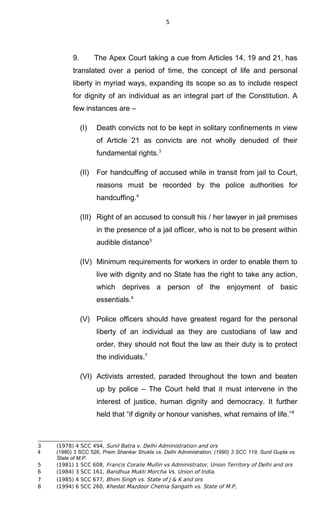
are endowed with reason and conscience and should act towards
one another in a spirit of brotherhood.” Article -12 thereof respects
honour and reputation:
International Covenant on Civil and Political Rights (ICCPR),
1966 to which India is a signatory provides that in accordance with
the principles proclaimed in the Charter of United Nations,
4
recognition of inherent dignity and of the equal and inalienable rights
of all members of the human family is the foundation of freedom,
justice and peace in the world. Article 17 provides that the obligation
imposed by this Article requires the State to adopt legislative and
other measures to give effect to the prohibition against such
interferences and attacks as well as to the protection of the rights.
The framers of the Indian Constitution while drafting the same
were conscious that justice, liberty and equality would be futile if the
Constitution is unable to protect and preserve the dignity of an
individual. To achieve the goals enshrined in the preamble of the
Constitution, the framers gave utmost importance to the existence
and enforcement of fundamental rights of the individual.
6. The concept of dignity of an individual is not endowed either
on account of the Constitution or the laws rather it inheres in an
individual as a human being, which commences the moment he is
born and continues even after death. This is how dignity is
acknowledged as a manifestation of human rights. The preamble of
the Constitution contains a solemn promise to secure the dignity of
the individual as its framers were aware that the Constitution is an
outcome of a long arduous struggle, which must value the dignity of
an individual, independent of his social status.
7. The Protection of Human Rights Act, 1993 defines “human
rights” as inclusive of dignity. Section 2(1)(d) thereof reads as under--
2(1)(d) – “ human rights” means the rights relating to life, liberty,
equality and dignity of the individual guaranteed by the Constitution
or embodied in the international covenants and enforceable by courts
in India.
8. Dignity means self-respect. It cannot be gainsaid that once
self-respect is affected, dignity is compromised. Dignity of an
individual is inalienable and is not dependent on the status and class
of an individual as it originates from the person being a human being
and continues even after death.
5
9. The Apex Court taking a cue from Articles 14, 19 and 21, has
translated over a period of time, the concept of life and personal
liberty in myriad ways, expanding its scope so as to include respect
for dignity of an individual as an integral part of the Constitution. A
few instances are –
(I) Death convicts not to be kept in solitary confinements in view
of Article 21 as convicts are not wholly denuded of their
fundamental rights.3
(II) For handcuffing of accused while in transit from jail to Court,
reasons must be recorded by the police authorities for
handcuffing.4
(III) Right of an accused to consult his / her lawyer in jail premises
in the presence of a jail officer, who is not to be present within
audible distance5
(IV) Minimum requirements for workers in order to enable them to
live with dignity and no State has the right to take any action,
which deprives a person of the enjoyment of basic
essentials.6
(V) Police officers should have greatest regard for the personal
liberty of an individual as they are custodians of law and
order, they should not flout the law as their duty is to protect
the individuals.7
(VI) Activists arrested, paraded throughout the town and beaten
up by police – The Court held that it must intervene in the
interest of justice, human dignity and democracy. It further
held that “if dignity or honour vanishes, what remains of life.”8
3 (1978) 4 SCC 494, Sunil Batra v. Delhi Administration and ors
4 (1980) 3 SCC 526, Prem Shankar Shukla vs. Delhi Administration; (1990) 3 SCC 119, Sunil Gupta vs.
State of M.P.
5 (1981) 1 SCC 608, Francis Coralie Mullin vs Administrator, Union Territory of Delhi and ors
6 (1984) 3 SCC 161, Bandhua Mukti Morcha Vs. Union of India.
7 (1985) 4 SCC 677, Bhim Singh vs. State of J & K and ors
8 (1994) 6 SCC 260, Khedat Mazdoor Chetna Sangath vs. State of M.P,
6
(VII) Exhaustive guidelines laid down to be followed by the police,
while effecting the arrest of an accused keeping in view the
dignity of the accused.9
(VIII) Practice of custodial torture, rape and death in police custody
as being in naked violation of human dignity came to be
deprecated, coupled with several directions to protect the
rights of accused along with vicarious liability of the State for
compensation, if found to be culpable for the infringement of
fundamental rights of the accused.10
(IX) Human dignity was held to be an intrinsic value of every
human being by virtue of his existence and it is the duty of the
State not only to protect the human dignity but to facilitate it
by taking positive steps.11
(X) Accused during investigation cannot be subjected to Narco
Analysis / Polygraph/ Brain Electrical Activation Profile
(BEAP) without his consent, else it would be violative of
Article 20(3) and 21 of the Constitution.12
(XI) Many rights of accused are derived from his dignity as a
human being.13
(XII) The Constitutional value of human dignity has a central
normative role. Human dignity as a constitutional value is the
factor that unites the human rights into one whole.14
10. I, now proceed to deal with the case of Mohd Nayyar Azam
Vs. State of Chhattisgarh, (2012) 8 SCC 1, as its facts are akin to
the present case.
Azam was a doctor working for the marginalised section of the
society, who incurred the wrath of the local coal mafia, the police and
9 (1994) 4 SCC 260, Joginder Kumar vs. State of UP and ors
10 (1997) 1 SCC 416, D.K. Basu vs. State of West Bengal
11 (2006) 8 SCC 212, M. Nagraj v. Union of India
12 (2010) 7 SCC 263, Selvi vs. State of Kerala
13 (2015) 6 SCC 702, Shabnam v. Union of India.
14 (2016)7 SCC 761, Jeeja Ghosh v. Union of India
7
persons, whose interest was affected. He came to be arrested and
while he was kept in the lock up at the police station, he was not only
abused and assaulted, but the SHO and ASI took his photograph
compelling him to hold a photograph on which the following was
written: “Mai Dr. M.N. Azam chal-kapati, chor aur badmash hun”,
which translated in English would mean that “I, Dr. M.N. Azam, am a
cheat, fraud, thief and a rascal”. Subsequently the said photograph
was circulated at large. The Apex Court, inter alia, took the view that
the conduct of the police in getting the petitioner photographed with a
placard containing the malicious statement did amount to humiliation
and mental trauma in police custody corroding human dignity. I
derive support from the following paragraphs of Nayyar (supra)—
“38. It is imperative to state that it is the sacrosanct
duty of the police authorities to remember that a citizen
while in custody is not denuded of his fundamental
right under Article 21 of the Constitution. The
restrictions imposed have the sanction of law by which
his enjoyment of fundamental right is curtailed but his
basic human rights are not crippled so that the police
officers can treat him in an inhuman manner. On the
contrary, they are under obligation to protect his
human rights and prevent all forms of atrocities.
We may hasten to add that a balance has to be struck
and, in this context, we may fruitfully quote a passage
from D.K. Basu (supra):
There can be no gainsaying that freedom of an
individual must yield to the security of the State. The
right of preventive detention of individuals in the
interest of security of the State in various situations
prescribed under different statutes has been upheld by
the Courts. The right to interrogate the detenus,
culprits or arrestees in the interest of the nation, must
take precedence over an individual's right to personal
liberty. .......... The action of the State, however, must be
"right, just and fair". Using any form of torture for
extracting any kind of information would neither be
'right nor just nor fair' and, therefore, would be
impermissible, being offensive to Article 21. Such a
crime-suspect must be interrogated-indeed subjected
to sustain and scientific interrogation-determined in
accordance with the provisions of law. He cannot,
8
however, be tortured or subjected to third degree
methods or eliminated with a view to elicit information,
extract confession or derive knowledge about his
accomplices, weapons etc. His constitutional right
cannot be abridged except in the manner permitted by
law, though in the very nature of things there would be
qualitative difference in the method of interrogation of
such a person as compared to an ordinary criminal.
39. ….
40. ….
41. Presently, we shall advert to the aspect of grant of
compensation. The Learned Counsel for the State, as
has been indicated earlier, has submitted with immense
vehemence that the Appellant should sue for
defamation. Our analysis would clearly show that the
Appellant was tortured while he was in custody. When
there is contravention of human rights, the inherent
concern as envisaged in Article 21 springs to life and
enables the citizen to seek relief by taking recourse to
public law remedy.
11. A welfare State is governed by rule of law. The approach of
the Apex Court in respecting and upholding the dignity of an
individual, whether he be an accused or a convict, is both pragmatic
and sensitive.
Sensitization is an important aspect of policing as the Police
being in the forefront to maintain law and order are expected to
strictly uphold the rule of law. A police force sans sensitivity could
play havoc with the life and liberty of an individual including his / her
dignity. Dignity is neither class centric nor an elitist concept. It
inheres in all individuals as human beings. Article 21 encompasses
all shades of dignity as a necessary concomitant of liberty. Life
without dignity would amount to mere animal existence in the opinion
of the Apex Court. Fundamental rights of an accused while in
custody or not are never wholly denuded, they stand abrogated only
to the extent he is unable to enjoy them on account of his
incarceration. The State has no right whatsoever to indulge in any
act, which dents the dignity of an individual, as once dignity is lost, it
cannot be retrieved.
9
12. The circular of D.G, Police, U.P dated 6.7.2020 envisaging a
criteria to select Top-10 criminals in a district and in each police
station is in exercise of power to maintain surveillance, to which no
illegality could be attached. I also hold the circular dated 6.7.2020 to
be lawful and valid. However, there is nothing in the circular which
enables the police to disclose the identity of an accused and his
criminal antecedents in public gaze. It could not be disputed by the
learned Addl. Advocate General that a police station is a public place
as any member of public is entitled to right of entry. The State sought
to justify the disclosure with a view to alert and caution its citizens as
to the activities of the accused. The State also relied on an order of
the Apex Court, i.e, Ram Babu Singh Thakur v. Sunil Arora and
Ors, 2020 SCC Online SC 178, where it permitted the Election
Commission of India to disclose the criminal antecedents of a
candidate contesting elections under the Representation of People
Act, 1951 in public domain.
13. I am not impressed with either of the pleas. A welfare State,
governed by rule of law must adhere to all constitutional norms. All
actions of the State must be prompted in public interest and not be
an outcome of preconceived prejudices. It does not behove a State
to dent the dignity of an individual howsoever horrific his conduct
may be. All that the State is constitutionally empowered to do is to
conduct fair and unbiased investigation against an accused,
prosecute him in a court of law by providing adequate opportunity to
defend himself. I need not reiterate that a convict too is entitled to the
enforcement of at least those fundamental rights or basic human
rights which affect his life and liberty including dignity as a human
being under Article-21.
14. The order of the Apex Court in Election case was in the
context of the power of Election Commission to hold free and fair
election, to elect a democratic government, which is one of the basic
structures of the Constitution. If the elector is made aware of the
alleged criminal antecedents of a candidate, the voter would be in a
10
better position to take an informed decision to vote. Here in the
present case no laudable object is achieved with the disclosure of
identity of the accused and his alleged criminal antecedents in public
domain.
15. The recent decision in K.S. Puttaswamy and Ors. vs. Union
of India (UOI) and Ors, (2017) 10 SCC 1 only reinforces the view
that the privacy of an individual is inextricably linked with dignity
which inheres in Article-21.
Dr. D.Y. Chandrachud, J.
“ Para-119-- To live is to live with dignity. The draftsmen of
the Constitution defined their vision of the society in which
constitutional values would be attained by emphasising,
among other freedoms, liberty and dignity. So fundamental
is dignity that it permeates the core of the rights
guaranteed to the individual by Part III. Dignity is the core
which unites the fundamental rights because the
fundamental rights seek to achieve for each individual the
dignity of existence. Privacy with its attendant values
assures dignity to the individual and it is only when life can
be enjoyed with dignity can liberty be of true substance.
Privacy ensures the fulfilment of dignity and is a core value
which the protection of life and liberty is intended to
achieve.”
Justice S.A. Bobde
“Para-411 – It is difficult to see how dignity - whose
constitutional significance is acknowledged both by the
Preamble and by this Court in its exposition of Article 21,
among other rights - can be assured to the individual
without privacy. Both dignity and privacy are intimately
intertwined and are natural conditions for the birth and
death of individuals, and for many significant events in life
between these events. Necessarily, then, the right of
privacy is an integral part of both 'life' and 'personal
liberty' Under Article 21, and is intended to enable the
rights bearer to develop her potential to the fullest extent
made possible only in consonance with the constitutional
values expressed in the Preamble as well as across Part
III.”
Justice A.M. Sapre
“Para-542 – The keynote of the Preamble was to lay
emphasis on two positive aspects - one, "the Unity of the
Nation" and the second "Dignity of the individual". The
expression "Dignity" carried with it moral and spiritual
imports. It also implied an obligation on the part of the
Union to respect the personality of every citizen and
11
create the conditions in which every citizen would be left
free to find himself/herself and attain self-fulfillment.
543. The incorporation of expression "Dignity of the
individual" in the Preamble was aimed essentially to show
explicit repudiation of what people of this Country had
inherited from the past. Dignity of the individual was,
therefore, always considered the prime constituent of the
fraternity, which assures the dignity to every individual.
Both expressions are interdependent and intertwined.
544. In my view, unity and integrity of the Nation cannot
survive unless the dignity of every individual citizen is
guaranteed. It is inconceivable to think of unity and
integration without the assurance to an individual to
preserve his dignity. In other words, regard and respect
by every individual for the dignity of the other one brings
the unity and integrity of the Nation.”
16. Surveillance is expected to be secretive and discreet so that
the person concerned does not know that he is under surveillance. It
is an important power of police with a view to keep both criminals and
crimes at bay. Once the identity of a person under surveillance is
made known to public not only the purpose of surveillance stands
frustrated, but the State and its officers also become vicariously liable
for infringing the dignity of an individual. U.P. Police Regulations may
not be having statutory support as they are only guidelines for
efficient working of the police, but when Rule 250 provides that
history-sheets are confidential records and the Station Officer must
see that unauthorized persons do not have access to them then how
can the police be permitted to violate its own rules under the garb of
controlling crime by naming and shaming persons?
17. Prof. James Witman of Yale Law School has described
shaming as a practice as “intuitively barbaric” when society shows
its contempt or disgust towards individual wrongdoing by subjecting
the perpetrator to a form of peculiar vulnerability, which can deprive
him or her of dignity or personhood.”15
15 (1) James Q. Witman. “What is wrong with inflicting shame sanctions?” Yale Law Journal 107
(1988): 1055-92.
12
Similarly, Prof. James Carey has warned against the use of
rituals of shame for they are “dangerous moments in the life of
democracies, when the power of the State, public opinion or both is
inscribed on the body of the targetted individuals.16
18. Human dignity has become an inseparable part of
constitutionalism and human rights. The beauty of Article-21 is that
its protection is available to all persons. What could be more
horrifying for our generation than to witness a psychopath terrorist,
on a shooting spree in the lanes of Mumbai, ultimately nabbed by the
police, put on trial, provided a counsel at State expense, resulting in
conviction and sentenced to death but still buried with dignity. This is
how our Constitutional Courts and Constitutional morality have
extended dignity even to a dead person irrespective of his class/
caste/ religion without being swayed by the gravity of offence. The
Constitutional Courts are obliged under all circumstances to uphold
the dignity of an individual.
19. I, in the ultimate analysis, am of the view that the circular of
DG (Police) dated 6.7.2020 cannot be faulted, but the action of its
officers in disclosing the identity of petitioners in police stations in
public gaze is absolutely unwarranted and uncalled for as being
violative of Article 21 of the Constitution.
The writ petitions are allowed.
Order Date :- 29.01.2021
N.S.Rathour (Pankaj Naqvi,J.)
16 James W. Carey. “Political Ritual on Television: Episodes in the History of Shame, Degradation
and Excommunication.” In Media, Ritual and Identity. Edited by Tamar Liebes and James
Curran. London: Routledge, 1998, pp. 42-70.

29.01.2021 abad hc order

  • 1.
    A.F.R. Judgment Reserved Delivered on29.01.2021 Court No. - 29 Case :- CRIMINAL MISC. WRIT PETITION No. - 10974 of 2020 Petitioner :- Jeeshan @ Jaanu And Another Respondent :- State Of U P And 4 Others Counsel for Petitioner :- Abou Sofian Usmani,Upendra Upadhyay Counsel for Respondent :- G.A. with Case :- CRIMINAL MISC. WRIT PETITION No. - 13521 of 2020 Petitioner :- Balveer Singh Yadav Respondent :- State Of U.P. And 2 Others Counsel for Petitioner :- Siya Ram Verma Counsel for Respondent :- G.A. with Case :- CRIMINAL MISC. WRIT PETITION No. - 14300 of 2020 Petitioner :- Doodh Nath Yadav Respondent :- State Of U.P. And 3 Others Counsel for Petitioner :- Amit Kumar Tiwari,Shiv Bahadur Singh Counsel for Respondent :- G.A. Hon'ble Pankaj Naqvi,J. Hon'ble Vivek Agarwal,J. (Vivek Agarwal,J.) Heard Sri Upendra Upadhyay, Siya Ram Verma and Sri Shiv Bahadur Singh, learned counsel for the petitioners, Sri Vinod Diwaker, learned A.A.G. for the State assisted by Sri Deepak Mishra and Ms. Manju Thakur, learned A.G.A. and Sri Vinay Saran, learned Amicus assisted by Sri Saumitra Dwivedi. These three petitions raise a common issue of violation of Right to Privacy on account of list of top-10 criminals displayed at different Police Stations namely, Khuldabad, District-Prayagraj, Police Station-
  • 2.
    Bithoor, District-Kanpur Nagarand at Police Station-Karchhana, District-Prayagraj. Brief facts of each petition 1. Petitioners in C.M.W.P. No. 10974 of 2020 are real brothers engaged in business and claim to be income tax payees. They are aggrieved with a list published at Police Station-Khuldabad, showing their names as top-10 criminals for the year 2020. Petitioner no. 1- Jeeshan @ Jaanu is at serial no. 3 and petitioner no. 2 at the top of list of top-10 criminals at Police Station- Khuldabad, (Annexure-2) to the writ petition. Petitioner no. 1 is also aggrieved with the opening of his history sheet on 20.08.2020. (1A) Petitioners grievance is that they are relatives of Ex- Member of Parliament from Allahabad Constituency and due to political vendetta, they are being harassed by the police authorities by illegally publishing their names in the list of top-10 criminals of Police Station-Khuldabad. (1B) As per the contention of petitioner no. 1, police has shown nine cases against him, out of which, he has yet not been charge-sheeted in four cases while two cases are lodged at the behest of Prayagraj Development Authority regarding irregularities in the constructions. (1C) Case of petitioner no. 2 is that in the year 2007, three cases were registered against him simultaneously at Police Station-Dhoomanganj, District-Prayagraj. (1D) Vide order dated 29.10.2013 passed by the Court of learned Additional Sessions Judge, Court No. 2, Allahabad, petitioner no. 2 has been acquitted in Case Crime No. 287 of 2007. In another Case Crime No. 120 of 2007, he is on bail, granted by the Court of Sessions Judge, Allahabad while in third case, i.e. Case Crime No. 113 of 2007, he was granted bail by the High Court. 2
  • 3.
    (1E) Two newcases have been registered against petitioner no. 2 in the year 2019 and 2020 purely on political motivation. In one of the cases, he has been granted anticipatory bail while in another, police authorities have been restrained from taking any coercive action against the petitioner. Another fresh case has been registered against him in 2020 at Police Station-Khuldabad under Section 27 of the Arms Act. (1F) It is submitted that only one case is registered against each of the petitioners at Police Station-Khuldabad and yet on the basis of a single case their names have been included in the list of top-10 criminals of Police Station-Khuldabad. (1G) It is petitioner's contention that the act of the authorities of State is violative of Article 21 of the Constitution of India inasmuch as Right to Life includes the right to live with human dignity. Placing reliance on the judgment of the Hon'ble Supreme Court in Maneka Gandhi vs. Union of India, AIR 1978 SC 59, it is pointed out that Right to Life also means that the State cannot curtail the dignity of a citizen in an arbitrary manner. (1H) Petitioner's contention is that personal enmity is being taken to illogical ends, so as to harass them by violating their fundamental rights and malafidely declaring them to be top-10 criminals of Police Station-Khuldabad, so as to tarnish their image and dent their dignity in public and harass their entire family. In above backdrop, a prayer has been made for issuance of a writ, order or direction in the nature of mandamus directing the respondents to delete the name of the petitioners from the list of top-10 criminals of Police Station-Khuldabad, District-Prayagraj with a further prayer to direct the police authorities to close the history sheet of petitioner no. 1 and not to harass them. Brief facts in C.M.W.P. No. 13521of 2020 2. Petitioner claims himself to be an Advocate, practicing at District-Kanpur Dehat. Petitioner's contention is that he being a 3
  • 4.
    legal professional, appearsfor litigants facing criminal prosecution, as a result of which, police personnel posted at Police Station- Bithoor, District-Kanpur Nagar have developed enmity. This enmity became aggravated when petitioner refused to support the brother of his opponent in the election of Gram Pradhan, Gram Panchayat- Baikunthpur, District-Kanpur Nagar. On 11.03.2018, an FIR was registered at the behest of petitioner against his rivals as Case Crime No. 66 of 2018, in which his opponents have been charge- sheeted. (2A). According to the petitioner, he is being falsely implicated in different cases by including his name in the list of top-10 criminals of Police Station-Bithoor, District-Kanpur Nagar, (Annexure 1), where his name is mentioned at serial no. 8. (2B). Petitioner's contention is that he has nothing to do with criminal activities yet he is being falsely implicated. It is submitted that in pending Case Crime No. 64 of 2018, under Sections 147, 148, 149, 452, 307, 323, 504, 506 IPC and Section 3(1)(10) of SC/ ST Act, cognizance has already been taken and matter is pending before the Court of learned IInd Additional Sessions Judge (SC/ST Act), Kanpur Nagar, yet on the basis of a single case, inclusion of the petitioner's name in the list of top-10 criminals of Police Station- Bithoor, District-Kanpur Nagar is arbitrary and illegal. Brief facts in C.M.W.P. No. 14300 of 2020 3. Petitioner's contention is that he is into the business of a concrete and sand, his firm is registered, along with GST number. Petitioner claims to be an income tax payee. (3A). It is submitted that out of rivalry between two groups, false FIR was lodged in the year 2011, in which final report was submitted on 29.08.2011, discharging petitioner and final report was accepted by the Court. Petitioner's case is that again in the year 2019, a false case has been registered against him and his entire family has been roped in under Sections 323, 504, 506 IPC, 4
  • 5.
    and also underSection 3(1)(da) and 3(1)(dha) of Scheduled Castes and the Scheduled Tribes (Prevention of Atrocities) Act, 1989 at Police Station-Karchhana, District-Prayagraj. In this case, Investigating Officer has given a clean chit to the petitioner and final report too has been accepted by the Court, yet another FIR was registered against him on 27.05.2020 under Section 379 IPC , Sections 4 and 21of Mines and Minerals (Regulation and Development) Act, 1957 and Rules 3, 57, 7 of U.P. Minor Minerals (Concession) Rules, 1963. (3B). It is submitted that High Court has been pleased to quash the FIR against the petitioner and others in regard to all offences except offence under Section 379 IPC, as can be verified from order passed in C.M.W.P. No. 6027 of 2020. Placing reliance on said judgment, it is submitted that name of the petitioner has been wrongly included at serial no. 4 in the list of top-10 criminals pasted at Police Station-Karchhana, District-Prayagraj, a copy of which is enclosed as Annexure-13, to the petition. (3C). It is submitted that petitioner had sought information as to on what grounds his name has been included, but information sought under Right to Information Act, 2005 has not been provided. It is submitted that no notice under Section 41 Cr.P.C. has been issued to the petitioner, yet on account of certain election rivalry and political affiliations, petitioner has been falsely included in the list of top-10 criminals. (3D). Petitioner's case is that from 2011 to 2020, only three cases have been registered against him, yet in violation of his fundamental rights, his name is being scandalized and propagated without following procedure established by law. Petitioner has not yet been convicted in any of the criminal cases and therefore, a prayer has been made to remove/delete his name at serial no. 4 from the list of top-10 criminals with a further prayer to take action against respondent no. 4 directing the authorities to initiate appropriate proceedings against the Station House Officer for 5
  • 6.
    arbitrarily and malafidelyincluding his name in the list of top-10 criminals. (3E). It is submitted that on inquiry, police authorities are not in a position to disclose as to what is the criteria for preparation of list of top 10 criminals of a police station or of district and under what authority of law it is being published. (3F). A common thread running through all the three petitions is so called action of the police authorities in displaying names of the petitioners along with others though they are undertrials, having different vocations like business, advocacy or politics, but their image is being tarnished and dignity dented by the police by canvassing their names as top-10 criminals of the district or the police station concerned, as the case may be. (3G). This act of the respondent authorities is assailed on the ground that publication/displaying/disclosing of the names of petitioner infringes upon right to privacy and right to live with dignity which brings disrepute. 4. Learned counsel for the petitioners led by Sri Vinay Saran, Amicus submits that Right to Privacy is recognized as a sacred fundamental right under Article 21 of the Constitution of India. He submits that publication of the name of petitioners as well as their criminal history is a clear violation of Right to Privacy and the right to live with human dignity, which is a facet of Article 21 of the Constitution. He submits that dignity of a citizen is of utmost importance and police authorities cannot tinker with the same. 5. Learned Amicus places reliance on the order of Allahabad High Court in case of In re Banners Placed at Roadside in the City of Lucknow vs. State of U.P. (2020) 4 ADJ 386, wherein it was held that without there being any rational nexus between the object and means adopted to achieve them, there cannot be any violation of either the Right to Life guaranteed under Article 21 of the Constitution or the human rights covered under the United Nations Declaration of Human Rights, and our Municipal Law so also Right 6
  • 7.
    to Privacy recognizedunder the International Covenant on Civil and Political Rights and other International and Regional Treaties. 6. Reliance is also placed on the judgment of the Supreme Court in case of Mehmood Nayyar Azam vs. State of Chhattisgarh and Others, (2012) 8 SCC 1, wherein it has been held that "any form of torture or cruel, inhuman or degrading treatment would fall within the ambit of Article 21 of the Constitution, whether it occurs during investigation, interrogation or otherwise. It is further held that the right to life of a citizen cannot be put in abeyance on his arrest. The precious right guaranteed by Article 21 of the Constitution of India cannot be denied to convicts, undertrials, detainue and other prisoners in custody, except according to the procedure established by law by placing such reasonable restrictions as are permitted by law. This judgment further deals with the aspects of inhuman treatment having many a facet. It can cover such acts which have been inflicted with an intention to cause physical suffering or severe mental pain. It would also include a treatment when inflicted causes humiliation and compels a person to act against his will or conscience. Torture is not merely physical but may even consist of mental and psychological torture calculated to create fright to submit to the demands of the police. Any treatment meted out to an accused while he is in custody which causes humiliation and mental trauma corrodes the concept of human dignity. The majesty of law protects dignity of a citizen in a society governed by law." 7. Reliance is also placed on the judgment of the Supreme Court in R. Rajagopal alias R.R. Gopal and another v. State of Tamil Nadu (1994) 6 SCC 632, Jeevan Reddy, J. speaking for the 7
  • 8.
    Court observed thatin recent times right to privacy has acquired constitutional status. The Apex Court held that "the right to privacy is implicit in the right to life and liberty guaranteed to the citizens of this country by Article 21. It is a "right to be let alone". A citizen has a right "to safeguard the privacy of his own, his family, marriage, procreation, motherhood, child-bearing and education among other matters". 8. Reliance was also placed on the judgment in Bhavesh Jayanti Lakhani vs. State of Maharashtra and Others, (2009) 9 SCC 551, wherein it was held that: "right to privacy is a part of the right to 'life' and 'personal liberty' enshrined under Article 21 of the Constitution. Once the facts in a given case constitute a right to privacy, Article 21 is attracted. The said right cannot be curtailed 'except according to the procedure established by law'." 9. Learned Amicus submits that disclosure of criminal antecedents and history sheet is governed by U.P. Police Regulations. Chapter XX of U.P. Police Regulations deals with the registration and surveillance of bad characters. Regulation 223 states about the village crime note book, which is a confidential record, kept at police station. Regulation 223 envisages that officer incharge of the police station is responsible for case study of such village crime note book. Part V of case crime note book consist of history sheet, which is again a personal record of a criminal under surveillance. 10. Regulation 240 deals with history sheet of Class-A 'offenders considered capable of reform' and Class-B 'offenders considered incapable of reform' and provides that it may be opened either on the basis of suspicion, on conviction or acquittal. 8
  • 9.
    11. It issubmitted that Regulation 240 will be applicable to the facts of the present set of cases where history sheet can be opened on the basis of suspicion, however, Regulation 250 provides that the list of bad characters in history sheets are confidential records and it is the responsibility of the Station House Officer to ensure that persons other than authorized under Regulation 240 namely, the Station House Officer, the Circle Officer and the Superintendent of Police/Senior Superintendent of Police and no other person has access to them. 12. Placing reliance on the judgment of Supreme Court in Malak Singh and Others vs. State of Punjab and Haryana and Others, (1981) 1 SCC 420 and the judgment of Allahabad High Court in Abdul Rahman vs. Abdul Rahim, (1924) ILR 46 (All) 884, it is submitted that even history sheets and village crime note books are not public documents, therefore, publishing names of the petitioners as top-10 criminals is neither envisaged under the U.P. Police Regulations nor it can be read into the policy of the State dated 06th July, 2020. It is submitted that there is nothing in the policy to reveal that even policy envisages publication of any such list of top-10 criminals on the notice board or flysheet board of a police station. 13. Placing reliance on the judgment of Supreme Court in Umesh Kumar vs. State of Andhra Pradesh and Others, (2013) 10 SCC 591, it is submitted that Right to Life includes right to ones reputation, freedom from defamation. It is submitted that right to reputation is held to be a personal right protected under Article 21. It is submitted that "reputation is a sort of right to enjoy the good opinion of others and it is a personal right and an injury to reputation is a personal injury. Thus, slander and defamation are injurious to reputation. Reputation has been defined in dictionary as “to have a good name; the 9
  • 10.
    credit, honor, orcharacter which is derived from a favourable public opinion or esteem and character by report”. Personal rights of a human being include the right of reputation. A good reputation is an element of personal security and is protected by the Constitution equally with the right to the enjoyment of life, liberty and property. International Covenant on Civil and Political Rights 1966 recognizes the right to have opinions and the right of freedom of expression under Article 19 is subject to the right of reputation of others. Reputation is “not only a salt of life but the purest treasure and the most precious perfume of life.” Placing reliance on this judgment, it is submitted that even if the circular/guidelines issued by the DGP on 06th July, 2020 is taken as it is, then also the guidelines does not permit publication of names of criminal/accused/history sheeters on the flysheet board of a police station. (13A). Placing reliance on the judgment of the Supreme court in Natural Resources Allocation, in Re, Special Reference No.1 of 2012 – (2012) 10 SCC 1, it is submitted that while determining violability of a legislation or executive action on the touchstone of Article 14 of the constitution, test that is to be applied is that State action, to escape the scrutiny of Article 14 has to be fair, reasonable and non-discriminatory, in pursuit of promotion of healthy competition and equitable treatment. State action must conform to norms, which are rational, informed with reasons and guided by public interest. Executive action should have clearly defined limits and should be predictable. Man on the street should know why a decision has been taken in favour of a particular person. Lack of transparency in decision making process would render it arbitrary. 10
  • 11.
    14. Shri VinodDiwakar, learned Additional Advocate General for the State of Uttar Pradesh in turn supports the impugned policy dt.06.07.2020 and submits that Chapter I Regulation 1 of the Uttar Pradesh Police Regulations provides that the Inspector General is the head of the police department and the Adviser of the Governor- in-Council in all questions of police administration. All orders from the Governor-in-Council to a member of police force are issued through him, except in cases of urgency when copies of any orders issued directly to subordinate officers are sent to him. Thus placing reliance on such provisions of Regulation 1, it is submitted that orders passed by the Director General of Police is a valid order and has a binding force on all the personnel of the police department subordinate to the Director General of Police. 15. Learned A.A.G. submits that policy/circular even if not law, yet State can on the basis of intelligible criteria publish names of the accused. Learned counsel for the State placed reliance on the judgment of the Supreme Court in the case of Kailash Chandra Sharma etc. etc. Vs. State of Rajasthan and others as reported in (2002) 6 SCC 562 specifically drawing attention to para 11 of the judgment, wherein circular dated 10.06.1998 providing for bonus marks to residents of the concerned district and the rural areas within that district was put to test. On the touchstone of Article 14 read with Article 16 of the Constitution it was held that impugned circular is the product of the policy decision taken by the State Government. Even then, as rightly pointed out by the High Court, such decision has to pass the test of Articles 14 and 16 of the Con- stitution. If the policy decision, which in the present case has un- doubted effect of deviating from normal and salutary rule of selec- tion based on merit is subversive of the doctrine of equality, it can- not sustain. It should be free from the vice of arbitrariness and con- form to the well-settled norms both positive and negative underly- ing Articles 14 and 16, which together with Article 15 form part of the Constitutional code of equality. 11
  • 12.
    16. Reliance hasalso been placed on the decision of the Su- preme Court in Union of India Vs. Navin Jindal and another, (2004) 2 SCC 510, which provides that Flag Code is not a statute and can not regulate fundamental right to fly national flag, however, the guidelines as laid down under the Flag Code deserve to be fol- lowed to the extent it provides for preservation of dignity and re- spect for the national flag. Reliance is also placed on the decision of the Supreme Court in Narendra Kumar Maheshwari Vs. Union of India and others, (1990) SCC Supl. 440, wherein importance of subordinate and delegated legislation has been discussed and it has been held that “it has to be borne in mind that State instru- mentalities should be committed to the endeavours of the constitu- tional aspiration to secure justice, inter alia, social and economic, and also under Article 39 (b) & (c) of the Constitution to ensure that the ownership and control of the material resources of the community are so distributed as to best subserve the common good and that the operation of the economic system does not res- ult in concentration of wealth and means of production to the com- mon detriment. Yet, every instrumentality and functionary of the State must fulfill its own role and should not trespass or encroach/ entrench upon the field of others. Progress is ensured and devel- opment helped if each performs his role in common endeavour. 17. Reliance is also placed on the judgment of the Supreme Court in Syndicate Bank Vs. Ramchandran Pillai, (2011) 15 SCC 398, wherein it was held that “If any executive instructions are to have the force of statutory rules, it must be shown that they were issued either under the authority conferred on the Central Gov- ernment or a State Government or other authority by some Statute or the Constitution. Guidelines or execut- ive instructions which are not statutory in character, are not 'laws', and compliance thereof can not be enforced through courts. Even if there has been any violation or 12
  • 13.
    breach of suchnon-statutory guidelines, it will not confer any right on any member of the public, to seek a direc- tion in a court of law, for compliance with such guidelines.” Placing reliance on this judgment of Syndic- ate Bank (supra), it is submitted that policy or guidelines are not justiciable and therefore petitioners can not claim any right claiming violation of the guidelines. 18. Reliance is also placed on the judgment of the Supreme Court in Navtej Singh Johar and others Vs. Union of India through Secretary Ministry of Law and justice and other connected matters – (2018) 10 SCC 1, wherein in para 637.2, twin-test of classifica- tion under Article 14 has been reiterated which provides that ; (i) there should be a reasonable classification based on intelligible differentia; and, (ii) this classification should have a rational nexus with the objective sought to be achieved. 19. Learned A.A.G. submits that accused have no right to privacy as society needs to be aware of the criminals and their ante- cedents. Dissemination of information to antecedents of criminals does not amount to any discrimination. He submits that police reg- ulation 287 provides for a notice board to be set up in a conspicu- ous place at every police station for displaying proclamation and public notice. He submits that when Police Regulation 287, itself provides for a notice board for putting up proclamations and public notices, then pasting names of top 10 criminals of a police station or a district can not be faulted with. He further submitted that even Interpol has a policy of listing top 10 most wanted criminals/fugit- ives, thus, publishing such a list on the flysheet of a police station can not be termed as arbitrary or illegal. 20. Learned A.A.G. placed reliance on the concept of dignity as propounded by Immanuel Kant, to submit that even he accepted 13
  • 14.
    that human dignityis not an unfettered right and an accused can- not claim any immunity from publication of his name on the display board of a police station seeking protection under the cover of dig- nity. 21. It is submitted that policy/guidelines framed by the State gov- ernment and circulated on 06.07.2020 demonstrates a resolve of the State to show zero tolerance to crime. It is submitted that the Police Act of 1961, permits opening of history sheets and it further permits display of such history sheets on display board maintained by each police station. It is submitted that law laid down by Su- preme court in K.S.Puttaswamy (Retd) Vs. Union of India and oth- ers as reported in (2019) 1 SCC 1, has its own limitations in regard to securing right to privacy. Placing reliance on para 98 of the judg- ment, which quotes from another judgment of Supreme Court in National Human Rights Commission Vs. State of Arunachal Pra- desh – (1996) 1 SCC 742, that “We are a country governed by the Rule of Law. Our Constitution confers certain rights on every human be- ing and certain other rights on citizens. Every person is entitled to equality before the law and equal protection of the laws.”, it is submitted that if criminals have any right, then citizens too have their rights; Rights of cit- izens can not be jeopardized in the name of extending protection to the criminals. 22. Learned A.A.G. submits that policy can not be quashed merely for the asking and further as per concept of rule of law pro- pounded by Dicey, maintenance of law and order is the prime re- sponsibility of the functionaries of police, therefore, publishing list of top 10 criminals can not be faulted with. Policy is unquestion- able, therefore, petitions be dismissed. 23. Having heard learned counsel for the parties and after going through the records, it is apparent that policy/guidelines issued by 14
  • 15.
    the Director Generalof Police is not in the exercise of executive powers of the Governor conferred under Article 162 of the Constitu- tion. The policy/guideline is neither issued in the name of or by the order of Governor nor it has any force of law. 24. However, a close scrutiny of the policy and its aim and object can be inferred from the opening lines of the circular dated July 6, 2020, which lays down the background in which it has been issued. Backdrop is a video conference convened by the Chief Minister to discuss law and order situation especially in the context of loss of lives of seven police personnel in an ambush between police per- sonnel and miscreants recently at Village Bikru of Kanpur Nagar. 25. Para 2 of the policy/circular provides for preparation of a list of top 10 criminals at the level of each police station and district so to keep it updated to help police in keeping a tab on active hardened and functional criminals. In fact, most of the provisions in the circular are in consonance with law laid down by the Supreme Court in Prakash Singh and others Vs. Union of India and others, (2006) 8 SCC 1, which extensively dealt with the subject of police reforms and the exercises which are required to be taken to insu- late police machinery from political and executive interference so as to make it more efficient, effective and strengthen rule of law. Thus, when tested on this touchstone, circular/guidelines/policy of the State cannot be said to be arbitrary, but any action taken by the police personnel in excess of the authority bestowed upon them through the circular/policy/regulations or Police Act is definitely re- quired to be tested on the touchstone of Articles 14, 15 and 16 of the Constitution of India. 26. Issues which need to be examined in the present context are as under :- (i)Whether policy/circular is ultra vires of the provisions contained in Constitution of India especially Articles 14, 15
  • 16.
    15 and 21of the Constitution, Police Act, 1861 or U.P. Police Regulations? (ii) Whether the policy/circular grants right to the police au- thories to publish names of so called criminals/accused persons on the flysheet board of the concerned police station ? and (iii) Whether publication of names of such accused persons violates the right to privacy and dignity? 27. Re Question (i) :- As far as challenge to the policy/circular is concerned, it is well settled that validity of any subordinate legisla- tion can be challenged on the following four grounds as have been laid down in Indian Express Newspapers (Bombay) Private Limited Vs. Union of India, AIR 1986 SC 515 :- (i) It is possible that the courts might invalidate statutory instrument on the grounds of unreasonableness or un- certainty, vagueness or aribitrariness; but the writer's (1) [1964] 1 Q.B.. 214 view is that for all practical purposes such instruments must be read as forming part of the parent statute, subject only to the ultra vires test. (ii) The courts are prepared to invalidate bye- laws, or any other form of legislation, emanating from an elected, representative authority, on the grounds of unreason- ableness uncertainty or repugnance to the ordinary law; but they are reluctant to do so and will exercise their power only in clear cases. (iii) The courts may be readier to invalidate bye-laws passed by commercial undertakings under statutory power, although cases reported during the present cen- tury suggest that the distinction between elected author- 16
  • 17.
    ities and commercialundertakings, as explained in Kruse v. Johnson, might not now be applied so strin- gently. (iv) As far as subordinate legislation of non- statutory ori- gin is concerned, this is virtually obsolete, but it is clear from In re French Protestant Hospital [1951] ch. 567 that it would be subject to strict control." 28. A subordinate legislation is amenable to challenge on the above four grounds besides excessive delegation would be an- other ground for challenge. It may also be challenged as being manifestly arbitrary and unreasonable. Besides, it may be chal- lenged for non- conformity with the parent statute, in reference to which it is made or any other plenary law. 29. The grounds of challenge to an administrative or quasi judi- cial action are substantive and procedural ultra vires. It would be a case of substantive ultra vires if it transgresses the limits set by the parent statute; is repugnant to its other substantive provisions or its general purpose or is repugnant to any other plenary statute. It would suffer from the vice of procedural ultra vires if the procedure prescribed by publication, consultation, laying or any condition pre- cedent for enacting it or the manner of performance is not followed. 30. It is trite that all instrumentalities, which have powers and au- thority conferred on them by the Constitution or the Statute, must act within the limits of such powers. Otherwise their actions would be ultra vires i.e. outside their powers and hence invalid. If the au- thority acts outside or in excess of the authority conferred on it, then it would be a case of substantive ultra vires. 31. It is seen that many statutes clothe an authority with discre- tionary powers, however, discretion is to be exercised judiciously and not whimsically. According to ‘Aharon Barak’, Discretion really 17
  • 18.
    exists, only whenthere is a choice between more than one reason- able and legal alternative. Two reasonable persons can come to two opposite conclusions without either of them being unreason- able. 32. As per Tom Bingham, “The Rule of law”, Allen Lane (an im- print of Penguin Books) 2010, the authority vested with discretion is expected to exercise the discretion judiciously. It should not abuse the discretion nor abdicate it. What matters is that decisions should be based on stated criteria and that they should be amenable to legal challenge, although a challenge is unlikely to succeed if the decision was one legally and reasonably open to the decision maker. The rule of law does not require that official or judicial de- cision makers should be deprived of all discretions, but it does re- quire that no discretion should be unconstrained so as to be poten- tially arbitrary. No discretion may be legally unfettered. 33. Other grounds for annulling an order include fraud, malice or malafide, non application of mind, promissory estoppel and legitim- ate expectation. 34. When power is exercised in breach of law, it is a fraud on power. Malice has two facets, namely; malice in law and malice in fact. Malice in law, is to do with something not permitted by law even if it is done with best motives. Malice in fact, is when power is exercised for an improper motive. 35. In Nawab Khan Abbas Khan Vs. State of Gujarat, AIR 1974 SC 1471, it has been held that when an order encroaches funda- mental rights without due process of law it is still-born and liable to be ignored. 36. In view of the aforesaid discussion, when circular/policy dt.06.07.2020 is considered then policy per se does not appear to suffer from vice of ultra vires, because the aim and object of the policy is to keep the police updated of the activities of the criminals 18
  • 19.
    with a viewto keep a better control on law and order situation. No facet of fraud, malice or non application of mind has been brought out by the learned counsel’s for the petitioners including learned Amicus to assail the policy/circular and therefore while answering Reference Question No.(i) I have no hesitation to hold that policy/ circular in its content or language does not suffer from lack of com- petence. When tested within the four corners of the law laid down in the case of Indian Express Newspapers (supra), policy can not be said to be the arbitrary, illegal or ultra vires of either the Consti- tution or the Police Act or the Police Regulations. 37. Re Question (ii) : After having held that policy/ circular is not ultra vires I may hasten to add that there is no provision in the cir- cular to publish list of identified top 10 criminals and mafia ele- ments either on the flysheet board of the concerned police station or anywhere else. 38. When there is no provision in the circular to publish list of identified top 10 criminals and mafia elements either on the fly- sheet board of the concerned police station in public domain or anywhere else, the action of the authorities of the State in publish- ing such names will fall within the case of substantive ultra vires, as the action of the functionaries of the State is beyond the powers and authority conferred on them by the Constitution or the Statute and their act is even beyond the limits and powers transcribed by the circular from which respondent State functionaries claim to draw their authority to make such publication. 39. As has been discussed above, quoting Lord Bingham, “All of- ficials at all levels must exercise the powers conferred on them in good faith, fairly, for the purpose for which the powers are con- ferred, without exceeding the limit of such powers and not unreas- onably. This is indeed fundamental and lies at the very heart of the rule of law. 19
  • 20.
    40. Lord Diplockin Council of Civil Services Union Vs. Minister for the Civil Service, (1984) 3 All ER 935, propounded principles of judicial review of administrative action. They are, illegality which is the main substantive areas of ultra vires, where law is breached; ir- rationality which is succinctly referred to as Wednesbury unreason- ableness, it applies to a decision which is so outrageous in its defi- ance of logic and procedural impropriety which is failure to follow the prescribed statutory procedure or rules of natural justice. 41. As per the law laid down by the Constitution Bench in Natural Resources Allocation (supra), it has been held that Article 14 of the constitution mandates that the State action, be it legislative or ex- ecutive has to be fair, reasonable, non-discriminatory, transparent, non-capricious, unbiased, without favouritism or nepotism. State action must conform to the norms, which are rational, informed with reasons and guided by public interest. Executive action should have clearly defined limits and should be predictable. The man on the street should know why the decision has been taken in favour of a particular person. Lack of transparency in decision making pro- cess would render it arbitrary. Fundamental principle of executive governance is based on realisation that sovereignty rests in the people. Every limb of the constitutional machinery is obliged to be people oriented. Every holder of public office is accountable to the People. Question of unfettered discretion in the executive just does not arise. Public authorities are ordained to act reasonably and in good faith and upon lawful and relevant grounds of public interest. 42. Though, it is argued that publication of names of criminals on the flysheet board of the concerned police station is permissible in the case of proclaimed offenders and even police regulation au- thorizes preparation of different registers which have been men- tioned in the policy/circular issued by the Director General of Po- lice, issued on April, 10, 2011 and it is further submitted that State can publish names of proclaimed offenders or persons under sur- veillance, but there is no provision for displaying such names in 20
  • 21.
    public domain exceptthat of proclaimed offenders on the flysheet board of the concerned police station. Chapter XX of the Police Regulations deals with the aspect of registration and surveillance of bad characters, Regulation 223 provides for maintenance of, ‘Vil- lage crime book’, terming it to be a confidential record to be kept at every police station containing information about the crime and criminals of each village in the circle. 43. Regulation 228 deals with the history sheets and deals with Class A and Class B history sheets. It specifically provides that his- tory sheets are personal records of criminals under surveillance. Regulation 250 provides that history sheets are confidential re- cords and though they are kept in the village crime note book, the Station House Officer is directed to see that unauthorized persons do not obtain access to them. 44. Regulation 215 deals with the procedure in case of ab- sconded offenders and the purpose of maintaining register of ab- sconded offenders Regulation 218 provides that at every police stastion a register shall be maintained in form No.214 is to bring the names and full particulars of all absconded offenders only. 45. Regulation 287, on which lot of emphasis has been placed by Learned AAG, provides for a notice board but makes it clear that this notice board shall be set up in a conspicuous place at every police station for proclamations and public notices. It reads as un- der :- “287.Notice Board - A notice board shall be set up in a conspicuous place at every police station for pro- clamation and public notices. Officer in charge shall remove or renew notices as occasion arises. If any of the sections of the Gambling Act except Section 13 and 17, have been extended to any place within the limits of the station circle, a notice stating the bound- 21
  • 22.
    aries of theplace should be kept on the board and re- newed as often as it becomes illegible.” 46. Thus, Regulation 287 authorises publication of proclamations and public notices only on the notice board. 47. Section 82 (1) of the Code of Criminal Procedure 1973 as amended up to date provides for the conditions in which a proclam- ation can be issued by any court for an absconding person and fur- ther sub section (2) of Section 82 gives statutory mandate to pub- lication of a proclamation in the manner provided under sub section (2) of Section 82 Cr.P.C. 48. “Accused” is a person against whom an allegation is made that he has committed an offence or who is charged with an of- fence, whereas a convict is a person found guilty of an offence. Both these definitions have been extracted from the Legal Gloss- ary, published by the Government of India by the Department of Law, Justice and Company Affairs and Department of Legislature and Rajbhasha. 49. Two things emanates from this discussion, namely; Police Regulation 287 does not authorize publication of anything other than a proclamation issued under authority of a judicial officer au- thorized to issue such proclamation besides public notices only. It does not authorize publication of anything else other than what has been provided under Police Regulation 287. Therefore, publication of top 10 list is not permissible even on a careful and liberal consid- eration of Police Regulation 287. Thus, referring to Question No.(ii) in Reference, it is held that neither the policy/circular nor any of the provisions contained in police regulation, Police Act or Cr.P.C., au- thorizes authorities of the police to publish names of so called crim- inals/accused persons on the flysheet board of concerned police station, unless a proclamation is obtained against them following the procedure established by law. 22
  • 23.
    50. Re Question(iii) “Epictetus”, a Greek Philosopher, born in 50 AD in Turkey famously quoted that “Men are disturbed not by things but by the view which we take of them”, has succinctly dealt with concept of desire in the following words : Our desires and aversions are mercurial rulers. They demand to be pleased. Desire commands us to run off and get what we want. Aversion insists that we must avoid the things that repel us. Typically when we don’t get what we want, we are disappointed, and when we get what we don’t’ want, we are distressed. 51. This quote extracted from the book, “The Art of Living” by Sharon Lebell, reflects the dilemma of the authorities of the State reflecting their desire to name and shame certain individuals owing to their aversions towards them. 52. Hon’ble Supreme Court in K.S.Puttaswamy (supra), has high- lighted the pivotal position of an individual as a focal point of the constitution. Fundamental rights are ‘basic’ and act as protective wall against State power. This judgment focusing on an aspect of privacy as a right to life has in fact insulated an individual from ex- ercise of authority either by the legislation or the State so to pre- vent a person being made an object of ridicule or scorn. There can not be any hostile discrimination. Preamble of our constitution deals with the concept of fraternity assuring the dignity of indi- vidual and the unity and integrity of the nation. 53. The sanctity of privacy, lies in its functional relationship with dignity. This judgment lays down that privacy of an individual is an essential aspect of dignity. Privacy represents the core of the hu- man personality, which is part of broader concept of liberty. Dignity is an entitlement of a constitutionally protected interest in itself. Dignity and freedom are intertwined and facilitate each other. 23
  • 24.
    54. Concept ofprivacy is not new to us. The Supreme Court de- veloped various rights – interests, similar to privacy, i.e. right of free enjoyment, right to sleep, right to human dignity, right to have justice etc. enlarging the concept of personal liberty under Article 21 of the constitution. In Kharak Singh Vs. State of U.P., AIR 1963 SC 1295, for the first time, Supreme Court considered the right to privacy in a case of police surveillance and domiciliary visits at night by the police personnel. 55. In Francis Coralie Mullin Vs. The Administrator, Union Territory of Delhi and others, AIR 1981 SC 746, the Supreme Court referred to the views of judges of the Supreme Court of U.S. to conclude that fundamental rights of a person continue to embed in him despite detention and hence, a convict is also entitled to the rights guaranteed under Article 21. It held that fundamental right to life is the most precious human right and hence be interpreted in an expansive spirit that will intensify its significance by enhancing the dignity and worth of individual and his life. The Court went to the extent of analyzing the meaning of ‘life’ to determine what entails the right to life. The Court recommended it to be not merely restricted to animal existence but meaning more than just physical survival. It is inclusive of all those limbs and faculties by which life is enjoyed. The Court held that even partial damage to such limb or faculty as a deprivation, whether it be permanent or temporary or continuing would be the invasion of his life/liberty. It also held that the right to life includes the right to live with human dignity and to fulfil the bare necessities of life. This interpretation encompassing the right to protection against torture or cruel, inhuman or degrading treatment which is enunciated in Article 5 of the Universal Declaration of Human Rights and also guaranteed by Article 7 of the International Covenant on Civil and Political Rights is implicit in Article 21 of the Constitution. 56. In this context, it is held that right to life being an undeniable right can only be abridged according to the procedure established by law and therefore a detenu cannot move freely outside the jail 24
  • 25.
    however would beentitled to have interviews with family members and friends and no procedure curtailing this right can stand the test of reasonable, fair and just under Article 14 and 21 of the Constitution. 57. This judgment is a polite reminder to the law enforcing agen- cies that even convicts and detenu are not to be relegated to an- imal existence. Thus, ratio of judgment is that when fundamental rights of detenu and convict is intact, then there is no question of it being curtailed for an accused by naming and shaming him, so to relegate him to animal existence. 58. This again bring us to the question of what is human dignity? Answering this question, Author Gaymon Bennett dealt with the as- pect of human dignity as figures in the universal declaration of hu- man rights, in his book titled, “Technicians of Human Dignity”, Book Subtitle: “Bodies, Souls and the Making of Intrinsic Worth”, Book Author(s): Gaymon Bennett, published by Fordham University Press (Page 142), as under :- “What is human dignity then? Whatever else it may be, human dignity is that which is inherent and it is that which can be, and must be, recognized. It is the kind of thing that one can have faith in. It does not need to account for itself by pointing beyond itself to a feature of human nature, reason, or the divine. It is not derivative of these features, nor is it cultivated or pro- duced. It is, rather, what defines humans as part of the human family. Moreover, and in addition to all this, it is the source of political goods. The recognition of dignity issues in freedom, justice, and peace, and its violation brings with it outrage and disunity. A number of years ago, legal scholar Klaus Dicke published an essay that, among other things, offers a meditation on the significance of the fact that human 25
  • 26.
    dignity in thesepassages is set forth in a strictly formal manner. This formalism, Dicke suggested, was elabor- ated in a threefold manner. First, dignity was figured as a given. Second, it was figured without explicit sub- stantive definition—at least insofar as the question of origins is concerned. Third, it was figured as the source and guarantee of human good. Human dignity, as a given, is also a moral mandate and places an absolute obligation on conscience and thereby political action. However, in the course of the declaration, human dig- nity does not remain a matter of pure form. Where ex- plicit substantive definition might be lacking, tacit and operational definition quickly fills in. It fills in by way of something like retrodiction. In the declaration, human dignity is declaimed as the ground for human rights. What proves to be the case, however, is that human rights, which are subsequently elaborated, effectively define the substance of human dignity. Dignity is only a guarantee of goods to the extent that the rights that ad- here in it are assured. Dignity and rights share a mutu- ally formative and constraining relation, and that rela- tion defines what it means to be human, politically speaking. Among other things, all of this means that, in the declaration, a heterogeneous and novel anthropo- logy is synthesized. Several aspects about this anthropology are par- ticularly crucial. First, the human is that being whose dignity is immanent and inherent. It is immanent in that dignity does not point beyond itself to another source. It is inherent in that dignity is coincident with being hu- man, per se, and is therefore an essential truth about human being. And insofar as it is coincident with the actuality of being human, dignity is self-referential. I do 26
  • 27.
    not mean tosay that the delegates to the CHR pro- claimed dignity to be self-referential; the debate over sources indicates that most delegates conceived of dignity as grounded in origins of one sort or another. In the course of these debates dignity was not taken to be self-referential. Nevertheless, human dignity, as formu- lated in the declaration, simply refers to itself; it is self- grounding. This is a first crucial anthropological artifact of the pragmatic and procedural solution to the prob- lem of origins: self-referentiality and self-grounding. The second artifact concerns the mode of reason- ing proper to a self-referential dignity. Terms such as “recognition,” “faith,” and of course “declaration” are not incidental but rather indicate that the speech-acts that can be taken to be true about human dignity are those produced and authorized in a declamatory fash- ion. I think it is reasonable to suggest that this concep- tion of the human, this immanent form of dignity, would not have been put in play and would not have come to be commonplace in discussions of human rights if any of the alternatives in the debate over the question of the source of dignity had been found acceptable: reason, God, nature, or the like. Neither these terms nor the modes of reasoning recommending them car- ried the day. Instead, human dignity was simply de- claimed. Consequently, the human was enshrined as that being whose truth could be conceived through a mode of reasoning that was neither theological nor sci- entific, neither demonstrative nor verificational, but de- clamatory. The second anthropological artifact of the declaration is that the human is that being whose dig- nity must simply be declaimed. 27
  • 28.
    The third artifactconcerns the mode of jurisdiction appropriate to, even prescribed by, human dignity. The declaration states that human dignity is inherent, and, as inherent, it is the guarantee of human goods. It is morally non-negotiable. As a guarantee of human goods it functions as both absolute and transcendental. It is therefore inviolable: violations of dignity result in outrageous and barbarous acts. It is also demanding: given the fact of past barbarism and the constant threat of further outrage, human dignity prescribes what must be done. And what is it that must be done? Insofar as human dignity is inherent and absolute, it is not sus- ceptible to the play of minimization and maximization. It does not derive from a capacity or a characteristic that could be variable or cultivated. Human dignity does not require the daily conduct of conduct either toward the governmental ends of wealth and security or toward ethical ends of virtue and justice (although dignity will certain provide the metric according to which gov- ernance and ethics might be rightly aligned). Rather, dignity requires protection, reorientation, and redress. Dignity must be protected against violation. Dignity must reorient those practices that threaten to violate it. And dignity commands us to redress those situations where dignity has been compromised.” 59. In 1890, Samuel Warren and Louis D.Brandies in an art- icle published in Harward Law Review, titled “the Right to Privacy”, 4 HLR 193-220 (1890) defined right to privacy as right to be let alone as under :- “Thus, in very early times, the law gave a remedy only for physical interference with life and property, for trespass vi et armis. Then the “right to life” severed only to protect the subject from battery in its 28
  • 29.
    various forms; libertymeant freedom from actual re- strain; and the right to property secured to the indi- vidual his lands and his cattle. Later there came re- cognition of man’s spiritual nature, of his feelings and his intellect. Gradually the scope of these legal rights broadened; and now the right to life has come to mean the right to enjoy life – the right to be let alone….” 60. According to Alan Furman Westin, a Professor of Public Law and Government Emeritus, Columbia University, “Privacy and Freedom”, (1970) New York, at 7, privacy is the claim of individu- als, groups or institutions to determine for themselves when, how and to what extent information about them is communicated to oth- ers. Privacy is the voluntary and temporary withdrawal of a person from the general society through physical or psychological means, either in a state of solitude or small-group intimacy or, when among larger groups, in a condition of anonymity or reserve. 61. John Rawls in his celebrated book “Justice as fairness : A Restatement” has enumerated three basic points under Chapter – Principles of Justice. First basic point is that justice as fairness is framed for a democratic society. A democratic society not only pro- fess but wants to take seriously the idea that citizens are free and equal and tries to realize that in its main institutions. The second point is that primary subject of political justice is taken as the basic structure of society i.e. political and social institutions are viewed from an angle as to how they fit together into one united system of cooperation. The third point is that justice as fairness is a form of political liberalism. These three basic tenets presupposes two prin- ciples of justice :- (i) Each person has the same indefeasible claim to a fully adequate scheme of equal basic liberties, which scheme is compatible with the same scheme of liberties for all; and 29
  • 30.
    (ii) Social andeconomic inequalities are to satisfy two conditions : (a) They are to be attached to offices and positions open to all under conditions of fair equality of op- portunity; (b) They are to be the greatest benefit of the least- advantaged members of society. 62. From this point of view, when I view privacy and dignity, then in K.S.Puttaswamy (supra), in para 109 referring to the earlier judg- ment of K.S.Puttaswamy (Retd.) Vs. Union of India – (2017) 10 SCC 1, it has been held : 109. A close reading of this judgment brings about the following features: 109.1. Privacy has always been a natural right: The cor- rect position in this behalf has been established by a number of judgments starting from Gobind Vs. State of M.P. Various opinions conclude that: 109.1.1. Privacy is a concomitant of the right of the indi- vidual to exercise control over his or her personality. 109.1.2. Privacy is the necessary condition precedent to the enjoyment of any of the guarantees in Part III. 109.1.3. The fundamental right to privacy would cover at least three aspects – (i) intrusion with an individual’s physical body, ii) informational privacy, and 30
  • 31.
    (iii) privacy ofchoice. 109.1.4. One aspect of privacy is the right to control the dissemination of personal information. And that every in- dividual should have a right to be able to control exer- cise over his/her own life and image as portrayed in the world and to control commercial use of his/her identity.” 508.13. In view of the above, the Court discussed the contours of right to privacy, as laid down in K.S. Put- taswamy, principle of human dignity and doctrine of pro- portionality. After taking note of the discussion contained in different opinions of six Hon’ble Judges, it stands es- tablished, without any pale of doubt, that privacy has now been treated as part of fundamental right. The Court has held that, in no uncertain terms, that privacy has always been a natural right which given an indi- vidual freedom to exercise control over his or her per- sonality. The judgment further affirms three aspects of the fundamental right to privacy, namely: (i) intrusion with an individual’s physical body, (ii) informational privacy and (iii) privacy of choice. 508.17…………….Insofar as principles of human dignity are concerned, the Court, after taking note of various judgments where this principle is adopted and elabor- ated, summed up the essential ingredients of dignity jur- isprudence by noticing that the basic principle of dignity and freedom of the individual is an attribute of natural law which becomes the right of all individuals in a consti- tutional democracy. Dignity has a central normative role as well as constitutional value. This normative role is performed in three ways: 31
  • 32.
    508.17.1. it becomesbasis for constitutional rights; 508.17.2. it serves as an interpretative principle for de- termining the scope of constitutional rights; and, 508.17.3. it determines the proportionality of a statute limiting a constitutional right. Thus, if an enactment puts limitation on a constitutional right and such limitation is disproportionate, such a statute can be held to be un- constitutional by applying the doctrine of proportionality. 508.18. As per Dworkin, there are two principles about the concept of human dignity, First principle regards an ‘intrinsic value’ of every person, namely, every person has a special objective value which value is not only im- portant to that person alone but success or failure of the lives of every person is important to all of us. It can also be described as self respect which represents the free will of the person, her capacity to think for herself and to control her own life. The second principle is that of ‘per- sonal responsibility’, which means every person has the responsibility for success in her own life and, therefore, she must use her discretion regarding the way of life that will be successful from her point of view. 508.19. Sum total of this exposition can be defined by explaining that as per the aforesaid view dignity is to be treated as ‘empowerment’ which makes a triple demand in the name of ‘respect’ for human dignity, namely: 508.19.1. respect for one's capacity as an agent to make one's own free choices; 508.19.2. respect for the choices so made; and 32
  • 33.
    508.19.3. respect forone's need to have a context and conditions in which one can operate as a source of free and informed choice. 63. In the above context some paragraphs from the judgment of the Supreme Court in State of Maharashtra Vs. Saeed Sohail Sheikh – (2012) 13 SCC 192 are worth reproducing, which are as under : 39. In a country governed by the rule of law police ex- cesses whether inside or outside the jail cannot be countenanced in the name of maintaining discipline or dealing with anti-national elements. Accountability is one of the facets of the rule of law. If anyone is found to have acted in breach of law or abused his position while exer- cising powers that must be exercised only within the parameters of law, the breach and the abuse can be punished. That is especially so when the abuse is al- leged to have been committed under the cover of au- thority exercised by people in uniform. Any such action is also open to critical scrutiny and examination by the Courts. 40. Having said that we cannot ignore the fact that the country today faces challenges and threats from extremist elements operating from within and outside In- dia. Those dealing with such elements have at times to pay a heavy price by sacrificing their lives in the dis- charge of their duties. The glory of the constitutional democracy that we have adopted, however, is that whatever be the challenges posed by such dark forces, the country’s commitment to the Rule of Law remains steadfast. Courts in this country have protected and would continue to protect the ideals of the rights of the citizen being inviolable except in accordance with the procedure established by law.” 33
  • 34.
    The word “goodfaith”is defined in Section 52 of IPC as under:- “Good faith”.—Nothing is said to be done or believed in “good faith” which is done or believed without due care and attention. 64. The authorities of the police are required to act in goodfaith and not negligently and motivatingly. 65. In Bhim Singh Vs. State of Jammu and Kashmir – (1985) 4 SCC 677, Supreme Court has held that “Police Officers who are the custodians of law and order should have the greatest respect for the personal liberty of citizens and should not flout the laws by stooping to such bizarre acts of lawlessness. Custodians of law and order should not become depredators of civil liberties. Their duty is to protect and not to abduct.” 66. Supreme Court in Sandeep Kumar Bafna Vs. State of Ma- hashtra as reported in (2014) 16 SCC 623 has laid down the law as under :- 7. Article 21 of the Constitution states that no person shall be deprived of his life or personal liberty except ac- cording to procedure established by law. We are imme- diately reminded of three sentences from the Constitu- tion Bench decision in P.S.R. Sadhanantham vs Ar- unachalam (1980) 3 SCC 141, which we appreciate as poetry in prose - “Article 21, in its sublime brevity, guards human liberty by insisting on the prescription of proced- ure established by law, not fiat as sine qua non for 34
  • 35.
    deprivation of personalfreedom. And those procedures so established must be fair, not fanciful, nor formal nor flimsy, as laid down in Maneka Gandhi case. So, it is ax- iomatic that our Constitutional jurisprudence mandates the State not to deprive a person of his personal liberty without adherence to fair procedure laid down by law.” 67. Starting from Gayman Bennett to Samuel Warren and Louis D.Brandies and other scholars throughout have emphas- ized on the aspect of dignity as an inherent guarantee to hu- man beings. It being non-negotiable and fundamental. This has been accepted by not only authors of erudition and has been imbibed to be an integral part of Article 21 of the Consti- tution. K.S. Puttaswamy also treats it as a natural right. It ac- cepts that right to privacy cannot be impinged without a just, fair and reasonable law. It has to fulfill the test of proportional- ity i.e., (i) existence of a law, (ii) must serve a legitimate State aim and (iii) should be proportionate. But when these tests are applied to the present facts situation, then it is apparent that State has failed to respect both the aspects of privacy and dig- nity while trying to display their weller or tact in displaying the names of so called top 10 criminals under a police station or of a district. 68. Submission of learned Additional Advocate General Gen- eral to the effect that even Immanuel Kant accepted that hu- man dignity is not an unfettered right, it is only a quote out of context. Kant’s ethics theory is organised around the motion of a “categorical imperative”, which is a universal ethical principle stating that one would always respect the humanity in others, and that one should only act in accordance with rules that could hold for everyone. Even George Wilhelm Friedrich Hegel propounded hegelianism, which is the philosophy of G.W.F. 35
  • 36.
    Hegel and canbe summed up in one line namely, “the rational alone is real”. 69. Hegel was greatly influenced by Immanuel Kant and in this backdrop, when submission of the Learned AAG is examined, then in fact the judgments on which he relied, all support the view that State or its instrumentalities are to respect fundamental rights, pass the test of Articles 14 and 16 of the Constitution and the ob- ject of any subordinate or delegated legislation cannot be but to make an endeavour to secure justice. Simultaneously, all the ac- tions of the State should be fair, reasonable, non-discriminatory, transparent, non-capricious, unbiased, without favoritism or nepot- ism in pursuit of promotion of healthy competition and equitable treatment. Thus, there is no quarrel to the proposition that no act of the State unless authorized by a statute or clothed with any consti- tutional provisions takes away the right to privacy and dignity in any manner whatsoever. 70. In the above backdrop, it is apparent that neither socially nor politically it is desirable to curtail human dignity, which is infringed when names of accused persons are displayed on the flysheet board of the police station concerned or anywhere else without there being any proclamation issued against them under Section 82 Cr.P.C. Thus, this practice of putting the names on the flysheet board is derogatory to the concept of human dignity and privacy and therefore Reference Question No. iii is answered in affirmative that publication of names of accused persons violates their right to privacy and dignity. 71. Once it is held that the act of the authorities of the police is il- legal, a logical question arises as to whether petitioners need to be compensated by the State for flagrant violation of their right to pri- vacy and dignity. In my opinion, Yes, they do need to be com- 36
  • 37.
    pensated and theState can not go scot-free. Merely, saying that it is discharging its sovereign functions of governance by making so- ciety aware about crime and criminals, they cannot escape their re- sponsibility for their failure to learn to understand constitutionally sanctified protections extended to individuals to preserve their fun- damental right of privacy and dignity. The immediate question which arises next is, as to what should be the quantum of com- pensation. I would have proceeded to determine the compensation but as this aspect has neither been argued nor raised but has been putforth as a corollary to the discussion made holding that publica- tion of names of the petitioners amounts to violation of right to pri- vacy and dignity, I leave it to the petitioners to approach competent court in appropriate proceedings to claim compensation for the wrongs done by the State. 72. Before parting, I would like to place on record my appreciation for valuable services rendered by Sri Vinay Saran, learned Amicus assisted by Sri Saumitra Dwivedi. 73. The petitions are allowed. The Court grant the following re- liefs:- (i) The policy/circular dated 06.07.2020 is intra vires Art- icles 14, 15 and 21 of the Constitution. (ii) The DGP, UP is directed to forthwith remove the names/identities of Top-10 criminals along with their criminal antecedents from the flysheet board from all the police sta- tions. He is also directed to ensure that a circular in the light of this judgment is sent to all the police heads of the districts so as to ensure strict compliance. (iii) The circular shall also provide that any violation of this judgment would not only invite disciplinary action but also 37
  • 38.
    criminal prosecution underappropriate provisions including payment of compensation from the erring official. (iv) The benefit of this judgment will not be available to pro- claimed offenders and fugitives in law. Order Date :-29.01.2021 Vikram/- (VIVEK AGARWAL,J.) (PANKAJ NAQVI, J.) 38
  • 39.
    1 AFR RESERVED DELIVERED ON 29.01.2021 CourtNo. - 29 Case :- CRIMINAL MISC. WRIT PETITION No. - 10974 of 2020 Petitioner :- Jeeshan @ Jaanu And Another Respondent :- State Of U P And 4 Others Counsel for Petitioner :- Abou Sofian Usmani,Upendra Upadhyay Counsel for Respondent :- G.A. with Case :- CRIMINAL MISC. WRIT PETITION No. - 13521 of 2020 Petitioner :- Balveer Singh Yadav Respondent :- State Of U.P. And 2 Others Counsel for Petitioner :- Siya Ram Verma Counsel for Respondent :- G.A. with Case :- CRIMINAL MISC. WRIT PETITION No. - 14300 of 2020 Petitioner :- Doodh Nath Yadav Respondent :- State of U.P. And 3 Others Counsel for Petitioner :- Amit Kumar Tiwari,Shiv Bahadur Singh Counsel for Respondent :- G.A. Hon'ble Pankaj Naqvi,J. Hon'ble Vivek Agarwal,J. (PANKAJ NAQVI, J.) I have gone through the judgment of my learned brother with whom I am in complete agreement including the reliefs granted. However, as the issue raised is of considerable public importance involving the dignity of an individual, I have penned my thoughts, but have refrained from adverting to the factual matrix, as the same has been elaborately discussed by my esteemed brother.
  • 40.
    2 Whether the Statehas a right to disclose the identity and criminal antecedents of an accused in the public domain is an issue involved in this petition? 1. Sri Vinod Diwakar, the learned Addl. Advocate General assisted by Sri Deepak Mishra and Ms. Manju Thakur, the learned AGA for the State justified the disclosure as need of the hour as according to them the nature of crime and criminality is constantly changing and unless the State is conferred with such a power, crime and criminals cannot be controlled putting the lives of citizens at risk. 2. Sri Upendra Upadhyay, Sri Siya Ram Verma and Sri Shiv Bahadur Singh, learned counsel for the petitioners in the respective petitions and Sri Vinay Saran, the learned Amicus assisted by Sri Saumitra Dwivedi vehemently opposed the defence of the State on the premise that the above public disclosure undermines the dignity of an accused as a human being constitutionally protected under Article 21 and the State under the garb of its police power cannot invade such a right. 3. Immanuel Kant defined dignity as “A quality of intrinsic, absolute value, above any price and thus excluding any equivalence.”1 Ruth Bader Ginsberg has maintained the idea of essential human dignity, that we are all people entitled to respect from our Government as persons of full human stature, and must not be treated as lesser creatures. 2 According to French Philosopher Charles Renouvier- “Republic is a state which best reconciles the interest and the dignity of each individual with the interests and dignity of everyone.” Neomi Rao an American Jurist in an illuminating article titled “Three Concepts of Dignity” (NOTRE DAME REVIEW (Vol- 86- 1 Lecture on Ethics (1779) 2 Lecture delivered at CUNY School of Law, 7 NY City, LR 221, 232 (2004).
  • 41.
    3 2011)) has emphasizedfirst and foremost on inherent birth of each individual as an essential facet of dignity. Dignity inheres in every human being. It is not dependent on intelligence, morality or social status. Intrinsic dignity is a presumption of human equality, each person is born with the same quantity of dignity. Secondly, substantive forms of dignity may require living in a certain way, eg, self control, courage and modesty. Substantive conception of dignity is also associated with social welfare rights or protection by the State from poverty and violence. This dignity is not inherent in an individual as it is capable of being lost or gained. Thirdly, Constitutional Courts often associate dignity with recognition and respect. This recognition requires individuals to demonstrate concern for each other, which is compatible with the concept of fraternity and dignity. 5. Post World War-II the atrocities committed by the Nazi regime led to the emergence of modern Constitutional democracies, where prime importance was given to protection of basic human rights with special emphasis on dignity, in their Constitutions. The preamble of Universal Declaration of Human Rights (UDHR), 1948 mentions dignity as under – “Whereas recognition of the inherent dignity and of the equal and inalienable rights of all members of the human family is the foundation of freedom, justice and peace in the world, ...” Article 1 of UDHR “All human beings are born free and equal in dignity and rights. They are endowed with reason and conscience and should act towards one another in a spirit of brotherhood.” Article -12 thereof respects honour and reputation: International Covenant on Civil and Political Rights (ICCPR), 1966 to which India is a signatory provides that in accordance with the principles proclaimed in the Charter of United Nations,
  • 42.
    4 recognition of inherentdignity and of the equal and inalienable rights of all members of the human family is the foundation of freedom, justice and peace in the world. Article 17 provides that the obligation imposed by this Article requires the State to adopt legislative and other measures to give effect to the prohibition against such interferences and attacks as well as to the protection of the rights. The framers of the Indian Constitution while drafting the same were conscious that justice, liberty and equality would be futile if the Constitution is unable to protect and preserve the dignity of an individual. To achieve the goals enshrined in the preamble of the Constitution, the framers gave utmost importance to the existence and enforcement of fundamental rights of the individual. 6. The concept of dignity of an individual is not endowed either on account of the Constitution or the laws rather it inheres in an individual as a human being, which commences the moment he is born and continues even after death. This is how dignity is acknowledged as a manifestation of human rights. The preamble of the Constitution contains a solemn promise to secure the dignity of the individual as its framers were aware that the Constitution is an outcome of a long arduous struggle, which must value the dignity of an individual, independent of his social status. 7. The Protection of Human Rights Act, 1993 defines “human rights” as inclusive of dignity. Section 2(1)(d) thereof reads as under-- 2(1)(d) – “ human rights” means the rights relating to life, liberty, equality and dignity of the individual guaranteed by the Constitution or embodied in the international covenants and enforceable by courts in India. 8. Dignity means self-respect. It cannot be gainsaid that once self-respect is affected, dignity is compromised. Dignity of an individual is inalienable and is not dependent on the status and class of an individual as it originates from the person being a human being and continues even after death.
  • 43.
    5 9. The ApexCourt taking a cue from Articles 14, 19 and 21, has translated over a period of time, the concept of life and personal liberty in myriad ways, expanding its scope so as to include respect for dignity of an individual as an integral part of the Constitution. A few instances are – (I) Death convicts not to be kept in solitary confinements in view of Article 21 as convicts are not wholly denuded of their fundamental rights.3 (II) For handcuffing of accused while in transit from jail to Court, reasons must be recorded by the police authorities for handcuffing.4 (III) Right of an accused to consult his / her lawyer in jail premises in the presence of a jail officer, who is not to be present within audible distance5 (IV) Minimum requirements for workers in order to enable them to live with dignity and no State has the right to take any action, which deprives a person of the enjoyment of basic essentials.6 (V) Police officers should have greatest regard for the personal liberty of an individual as they are custodians of law and order, they should not flout the law as their duty is to protect the individuals.7 (VI) Activists arrested, paraded throughout the town and beaten up by police – The Court held that it must intervene in the interest of justice, human dignity and democracy. It further held that “if dignity or honour vanishes, what remains of life.”8 3 (1978) 4 SCC 494, Sunil Batra v. Delhi Administration and ors 4 (1980) 3 SCC 526, Prem Shankar Shukla vs. Delhi Administration; (1990) 3 SCC 119, Sunil Gupta vs. State of M.P. 5 (1981) 1 SCC 608, Francis Coralie Mullin vs Administrator, Union Territory of Delhi and ors 6 (1984) 3 SCC 161, Bandhua Mukti Morcha Vs. Union of India. 7 (1985) 4 SCC 677, Bhim Singh vs. State of J & K and ors 8 (1994) 6 SCC 260, Khedat Mazdoor Chetna Sangath vs. State of M.P,
  • 44.
    6 (VII) Exhaustive guidelineslaid down to be followed by the police, while effecting the arrest of an accused keeping in view the dignity of the accused.9 (VIII) Practice of custodial torture, rape and death in police custody as being in naked violation of human dignity came to be deprecated, coupled with several directions to protect the rights of accused along with vicarious liability of the State for compensation, if found to be culpable for the infringement of fundamental rights of the accused.10 (IX) Human dignity was held to be an intrinsic value of every human being by virtue of his existence and it is the duty of the State not only to protect the human dignity but to facilitate it by taking positive steps.11 (X) Accused during investigation cannot be subjected to Narco Analysis / Polygraph/ Brain Electrical Activation Profile (BEAP) without his consent, else it would be violative of Article 20(3) and 21 of the Constitution.12 (XI) Many rights of accused are derived from his dignity as a human being.13 (XII) The Constitutional value of human dignity has a central normative role. Human dignity as a constitutional value is the factor that unites the human rights into one whole.14 10. I, now proceed to deal with the case of Mohd Nayyar Azam Vs. State of Chhattisgarh, (2012) 8 SCC 1, as its facts are akin to the present case. Azam was a doctor working for the marginalised section of the society, who incurred the wrath of the local coal mafia, the police and 9 (1994) 4 SCC 260, Joginder Kumar vs. State of UP and ors 10 (1997) 1 SCC 416, D.K. Basu vs. State of West Bengal 11 (2006) 8 SCC 212, M. Nagraj v. Union of India 12 (2010) 7 SCC 263, Selvi vs. State of Kerala 13 (2015) 6 SCC 702, Shabnam v. Union of India. 14 (2016)7 SCC 761, Jeeja Ghosh v. Union of India
  • 45.
    7 persons, whose interestwas affected. He came to be arrested and while he was kept in the lock up at the police station, he was not only abused and assaulted, but the SHO and ASI took his photograph compelling him to hold a photograph on which the following was written: “Mai Dr. M.N. Azam chal-kapati, chor aur badmash hun”, which translated in English would mean that “I, Dr. M.N. Azam, am a cheat, fraud, thief and a rascal”. Subsequently the said photograph was circulated at large. The Apex Court, inter alia, took the view that the conduct of the police in getting the petitioner photographed with a placard containing the malicious statement did amount to humiliation and mental trauma in police custody corroding human dignity. I derive support from the following paragraphs of Nayyar (supra)— “38. It is imperative to state that it is the sacrosanct duty of the police authorities to remember that a citizen while in custody is not denuded of his fundamental right under Article 21 of the Constitution. The restrictions imposed have the sanction of law by which his enjoyment of fundamental right is curtailed but his basic human rights are not crippled so that the police officers can treat him in an inhuman manner. On the contrary, they are under obligation to protect his human rights and prevent all forms of atrocities. We may hasten to add that a balance has to be struck and, in this context, we may fruitfully quote a passage from D.K. Basu (supra): There can be no gainsaying that freedom of an individual must yield to the security of the State. The right of preventive detention of individuals in the interest of security of the State in various situations prescribed under different statutes has been upheld by the Courts. The right to interrogate the detenus, culprits or arrestees in the interest of the nation, must take precedence over an individual's right to personal liberty. .......... The action of the State, however, must be "right, just and fair". Using any form of torture for extracting any kind of information would neither be 'right nor just nor fair' and, therefore, would be impermissible, being offensive to Article 21. Such a crime-suspect must be interrogated-indeed subjected to sustain and scientific interrogation-determined in accordance with the provisions of law. He cannot,
  • 46.
    8 however, be torturedor subjected to third degree methods or eliminated with a view to elicit information, extract confession or derive knowledge about his accomplices, weapons etc. His constitutional right cannot be abridged except in the manner permitted by law, though in the very nature of things there would be qualitative difference in the method of interrogation of such a person as compared to an ordinary criminal. 39. …. 40. …. 41. Presently, we shall advert to the aspect of grant of compensation. The Learned Counsel for the State, as has been indicated earlier, has submitted with immense vehemence that the Appellant should sue for defamation. Our analysis would clearly show that the Appellant was tortured while he was in custody. When there is contravention of human rights, the inherent concern as envisaged in Article 21 springs to life and enables the citizen to seek relief by taking recourse to public law remedy. 11. A welfare State is governed by rule of law. The approach of the Apex Court in respecting and upholding the dignity of an individual, whether he be an accused or a convict, is both pragmatic and sensitive. Sensitization is an important aspect of policing as the Police being in the forefront to maintain law and order are expected to strictly uphold the rule of law. A police force sans sensitivity could play havoc with the life and liberty of an individual including his / her dignity. Dignity is neither class centric nor an elitist concept. It inheres in all individuals as human beings. Article 21 encompasses all shades of dignity as a necessary concomitant of liberty. Life without dignity would amount to mere animal existence in the opinion of the Apex Court. Fundamental rights of an accused while in custody or not are never wholly denuded, they stand abrogated only to the extent he is unable to enjoy them on account of his incarceration. The State has no right whatsoever to indulge in any act, which dents the dignity of an individual, as once dignity is lost, it cannot be retrieved.
  • 47.
    9 12. The circularof D.G, Police, U.P dated 6.7.2020 envisaging a criteria to select Top-10 criminals in a district and in each police station is in exercise of power to maintain surveillance, to which no illegality could be attached. I also hold the circular dated 6.7.2020 to be lawful and valid. However, there is nothing in the circular which enables the police to disclose the identity of an accused and his criminal antecedents in public gaze. It could not be disputed by the learned Addl. Advocate General that a police station is a public place as any member of public is entitled to right of entry. The State sought to justify the disclosure with a view to alert and caution its citizens as to the activities of the accused. The State also relied on an order of the Apex Court, i.e, Ram Babu Singh Thakur v. Sunil Arora and Ors, 2020 SCC Online SC 178, where it permitted the Election Commission of India to disclose the criminal antecedents of a candidate contesting elections under the Representation of People Act, 1951 in public domain. 13. I am not impressed with either of the pleas. A welfare State, governed by rule of law must adhere to all constitutional norms. All actions of the State must be prompted in public interest and not be an outcome of preconceived prejudices. It does not behove a State to dent the dignity of an individual howsoever horrific his conduct may be. All that the State is constitutionally empowered to do is to conduct fair and unbiased investigation against an accused, prosecute him in a court of law by providing adequate opportunity to defend himself. I need not reiterate that a convict too is entitled to the enforcement of at least those fundamental rights or basic human rights which affect his life and liberty including dignity as a human being under Article-21. 14. The order of the Apex Court in Election case was in the context of the power of Election Commission to hold free and fair election, to elect a democratic government, which is one of the basic structures of the Constitution. If the elector is made aware of the alleged criminal antecedents of a candidate, the voter would be in a
  • 48.
    10 better position totake an informed decision to vote. Here in the present case no laudable object is achieved with the disclosure of identity of the accused and his alleged criminal antecedents in public domain. 15. The recent decision in K.S. Puttaswamy and Ors. vs. Union of India (UOI) and Ors, (2017) 10 SCC 1 only reinforces the view that the privacy of an individual is inextricably linked with dignity which inheres in Article-21. Dr. D.Y. Chandrachud, J. “ Para-119-- To live is to live with dignity. The draftsmen of the Constitution defined their vision of the society in which constitutional values would be attained by emphasising, among other freedoms, liberty and dignity. So fundamental is dignity that it permeates the core of the rights guaranteed to the individual by Part III. Dignity is the core which unites the fundamental rights because the fundamental rights seek to achieve for each individual the dignity of existence. Privacy with its attendant values assures dignity to the individual and it is only when life can be enjoyed with dignity can liberty be of true substance. Privacy ensures the fulfilment of dignity and is a core value which the protection of life and liberty is intended to achieve.” Justice S.A. Bobde “Para-411 – It is difficult to see how dignity - whose constitutional significance is acknowledged both by the Preamble and by this Court in its exposition of Article 21, among other rights - can be assured to the individual without privacy. Both dignity and privacy are intimately intertwined and are natural conditions for the birth and death of individuals, and for many significant events in life between these events. Necessarily, then, the right of privacy is an integral part of both 'life' and 'personal liberty' Under Article 21, and is intended to enable the rights bearer to develop her potential to the fullest extent made possible only in consonance with the constitutional values expressed in the Preamble as well as across Part III.” Justice A.M. Sapre “Para-542 – The keynote of the Preamble was to lay emphasis on two positive aspects - one, "the Unity of the Nation" and the second "Dignity of the individual". The expression "Dignity" carried with it moral and spiritual imports. It also implied an obligation on the part of the Union to respect the personality of every citizen and
  • 49.
    11 create the conditionsin which every citizen would be left free to find himself/herself and attain self-fulfillment. 543. The incorporation of expression "Dignity of the individual" in the Preamble was aimed essentially to show explicit repudiation of what people of this Country had inherited from the past. Dignity of the individual was, therefore, always considered the prime constituent of the fraternity, which assures the dignity to every individual. Both expressions are interdependent and intertwined. 544. In my view, unity and integrity of the Nation cannot survive unless the dignity of every individual citizen is guaranteed. It is inconceivable to think of unity and integration without the assurance to an individual to preserve his dignity. In other words, regard and respect by every individual for the dignity of the other one brings the unity and integrity of the Nation.” 16. Surveillance is expected to be secretive and discreet so that the person concerned does not know that he is under surveillance. It is an important power of police with a view to keep both criminals and crimes at bay. Once the identity of a person under surveillance is made known to public not only the purpose of surveillance stands frustrated, but the State and its officers also become vicariously liable for infringing the dignity of an individual. U.P. Police Regulations may not be having statutory support as they are only guidelines for efficient working of the police, but when Rule 250 provides that history-sheets are confidential records and the Station Officer must see that unauthorized persons do not have access to them then how can the police be permitted to violate its own rules under the garb of controlling crime by naming and shaming persons? 17. Prof. James Witman of Yale Law School has described shaming as a practice as “intuitively barbaric” when society shows its contempt or disgust towards individual wrongdoing by subjecting the perpetrator to a form of peculiar vulnerability, which can deprive him or her of dignity or personhood.”15 15 (1) James Q. Witman. “What is wrong with inflicting shame sanctions?” Yale Law Journal 107 (1988): 1055-92.
  • 50.
    12 Similarly, Prof. JamesCarey has warned against the use of rituals of shame for they are “dangerous moments in the life of democracies, when the power of the State, public opinion or both is inscribed on the body of the targetted individuals.16 18. Human dignity has become an inseparable part of constitutionalism and human rights. The beauty of Article-21 is that its protection is available to all persons. What could be more horrifying for our generation than to witness a psychopath terrorist, on a shooting spree in the lanes of Mumbai, ultimately nabbed by the police, put on trial, provided a counsel at State expense, resulting in conviction and sentenced to death but still buried with dignity. This is how our Constitutional Courts and Constitutional morality have extended dignity even to a dead person irrespective of his class/ caste/ religion without being swayed by the gravity of offence. The Constitutional Courts are obliged under all circumstances to uphold the dignity of an individual. 19. I, in the ultimate analysis, am of the view that the circular of DG (Police) dated 6.7.2020 cannot be faulted, but the action of its officers in disclosing the identity of petitioners in police stations in public gaze is absolutely unwarranted and uncalled for as being violative of Article 21 of the Constitution. The writ petitions are allowed. Order Date :- 29.01.2021 N.S.Rathour (Pankaj Naqvi,J.) 16 James W. Carey. “Political Ritual on Television: Episodes in the History of Shame, Degradation and Excommunication.” In Media, Ritual and Identity. Edited by Tamar Liebes and James Curran. London: Routledge, 1998, pp. 42-70.