Classification of Transformers
P. MARIA SHEEBA
AP/ECE
MZCET
2.2. Transformer Classification
• In last Class we discussed about the basics and
principle behind the working of transformer.
• The principle behind the operation known as
the electromagnetic induction.
• In today’s class we will discuss about the
classification of transformers and the
insulation offered across the windings.
• In terms of number of windings
– Conventional transformer: two windings
– Autotransformer: one winding
– Others: more than two windings
• In terms of number of phases
– Single-phase transformer
– Three-phase transformer
Transformer Classification
MZCET/ECE/III Sem/EE6352- Unit 2 3
• Depending on the voltage level at which the winding is
operated
– Step-up transformer: primary winding is a low voltage (LV)
winding
– Step-down transformer : primary winding is a high voltage
(HV) winding
Transformer Classification2.1
MZCET/ECE/III Sem/EE6352- Unit 2 4
• It is based on principle of MUTUAL
INDUCTION.
Principle of Operation
2.2
MZCET/ECE/III Sem/EE6352- Unit 2 5
MUTUAL INDUCTION
• . When an e.m.f. is induced in a coil when
current in the neighbouring coil changes
2.2
MZCET/ECE/III Sem/EE6352- Unit 2 6
Working of a transformer
1. When current in the
primary coil changes
being alternating in
nature, a changing
magnetic field is
produced
.
2.2
MZCET/ECE/III Sem/EE6352- Unit 2 7
2.This changing magnetic field gets associated
with the secondary through the soft iron core
3.Hence magnetic flux linked with the
secondary coil changes.
4.Which induces e.m.f. in the secondary
Working of a transformer
2.2
MZCET/ECE/III Sem/EE6352- Unit 2 8
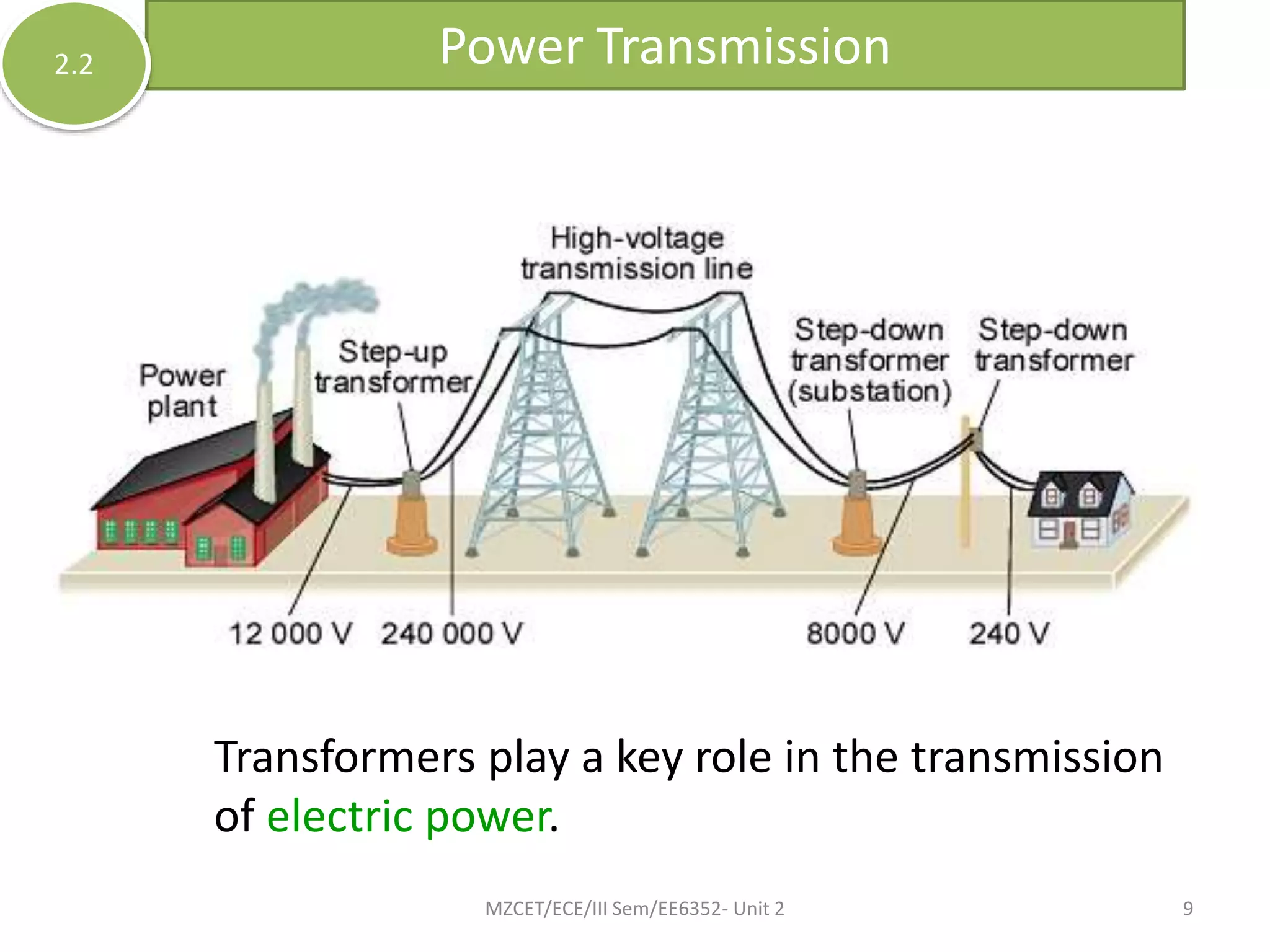
Power Transmission
Transformers play a key role in the transmission
of electric power.
2.2
MZCET/ECE/III Sem/EE6352- Unit 2 9
• There are two basic parts of transformer
1. Transformer core
2. Transformer coil
Construction2.2
MZCET/ECE/III Sem/EE6352- Unit 2 10
Transformer winding
• There are three types of transformer winding
• 1. Shell type.
• 2.Core type.
• 3.Berry type.
2.2
MZCET/ECE/III Sem/EE6352- Unit 2 11
Shell type
• Windings are wrapped around the center leg of a
laminated core.
2.2
MZCET/ECE/III Sem/EE6352- Unit 2 12
Core type
• Windings are wrapped around two sides of a laminated square
core.
2.2
MZCET/ECE/III Sem/EE6352- Unit 2 13
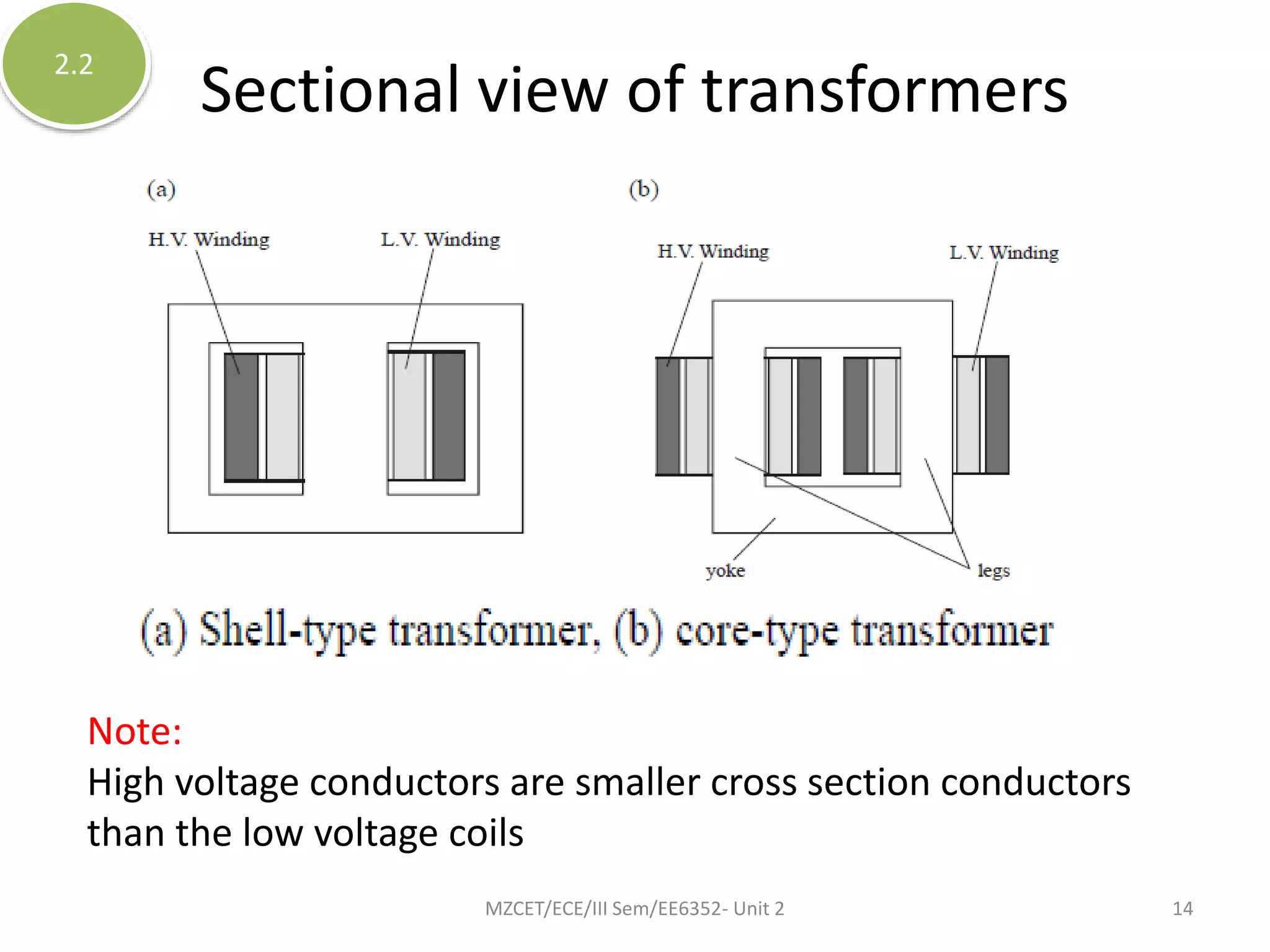
Sectional view of transformers
Note:
High voltage conductors are smaller cross section conductors
than the low voltage coils
2.2
MZCET/ECE/III Sem/EE6352- Unit 2 14
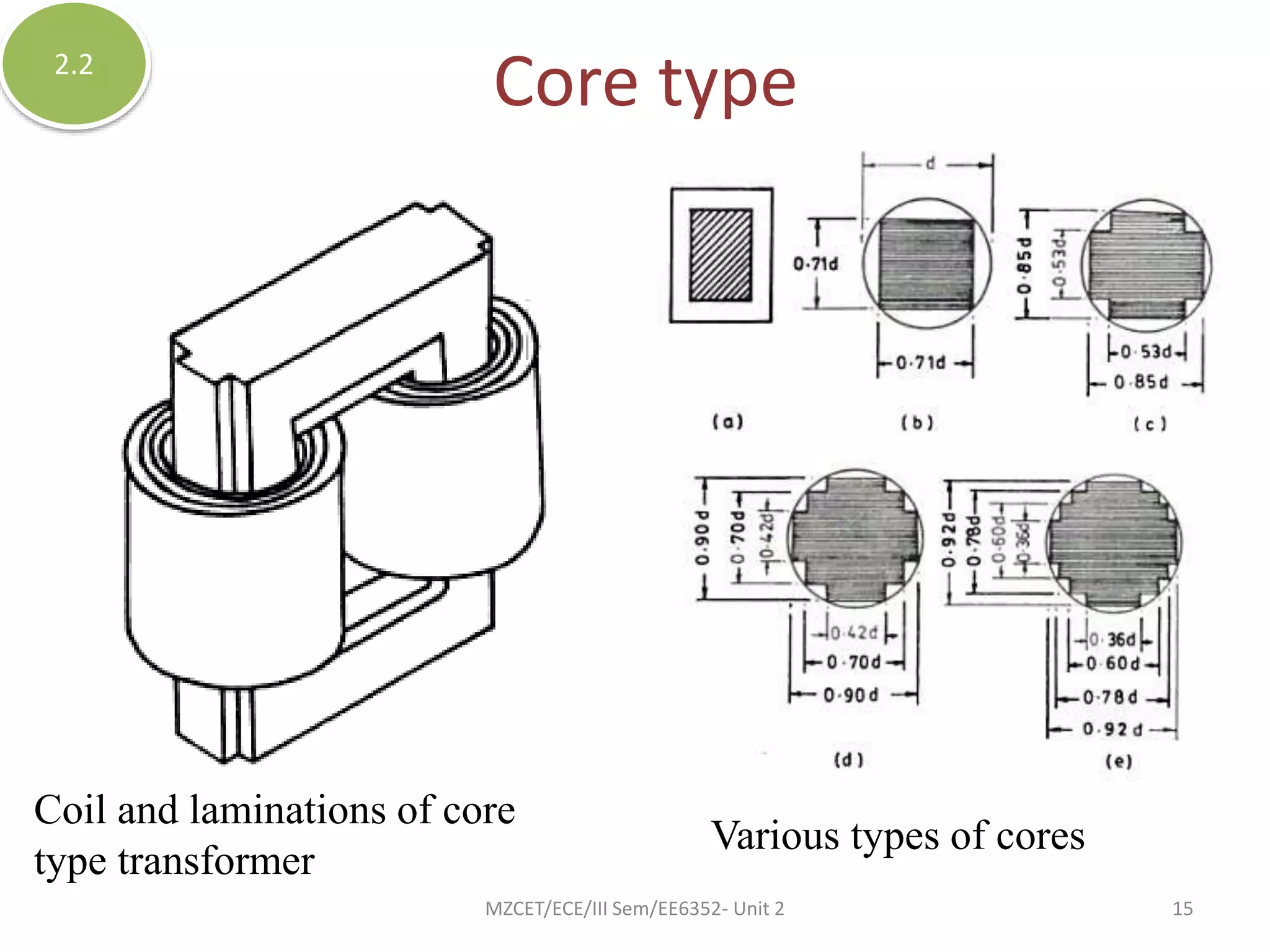
Core type
Coil and laminations of core
type transformer
Various types of cores
2.2
MZCET/ECE/III Sem/EE6352- Unit 2 15
Shell type
• The HV and LV
windings are split
into no. of sections
• Where HV winding
lies between two LV
windings
• In sandwich coils
leakage can be
controlled
Sandwich windings
2.2
MZCET/ECE/III Sem/EE6352- Unit 2 16

2.2

  • 1.
    Classification of Transformers P.MARIA SHEEBA AP/ECE MZCET
  • 2.
    2.2. Transformer Classification •In last Class we discussed about the basics and principle behind the working of transformer. • The principle behind the operation known as the electromagnetic induction. • In today’s class we will discuss about the classification of transformers and the insulation offered across the windings.
  • 3.
    • In termsof number of windings – Conventional transformer: two windings – Autotransformer: one winding – Others: more than two windings • In terms of number of phases – Single-phase transformer – Three-phase transformer Transformer Classification MZCET/ECE/III Sem/EE6352- Unit 2 3
  • 4.
    • Depending onthe voltage level at which the winding is operated – Step-up transformer: primary winding is a low voltage (LV) winding – Step-down transformer : primary winding is a high voltage (HV) winding Transformer Classification2.1 MZCET/ECE/III Sem/EE6352- Unit 2 4
  • 5.
    • It isbased on principle of MUTUAL INDUCTION. Principle of Operation 2.2 MZCET/ECE/III Sem/EE6352- Unit 2 5
  • 6.
    MUTUAL INDUCTION • .When an e.m.f. is induced in a coil when current in the neighbouring coil changes 2.2 MZCET/ECE/III Sem/EE6352- Unit 2 6
  • 7.
    Working of atransformer 1. When current in the primary coil changes being alternating in nature, a changing magnetic field is produced . 2.2 MZCET/ECE/III Sem/EE6352- Unit 2 7
  • 8.
    2.This changing magneticfield gets associated with the secondary through the soft iron core 3.Hence magnetic flux linked with the secondary coil changes. 4.Which induces e.m.f. in the secondary Working of a transformer 2.2 MZCET/ECE/III Sem/EE6352- Unit 2 8
  • 9.
    Power Transmission Transformers playa key role in the transmission of electric power. 2.2 MZCET/ECE/III Sem/EE6352- Unit 2 9
  • 10.
    • There aretwo basic parts of transformer 1. Transformer core 2. Transformer coil Construction2.2 MZCET/ECE/III Sem/EE6352- Unit 2 10
  • 11.
    Transformer winding • Thereare three types of transformer winding • 1. Shell type. • 2.Core type. • 3.Berry type. 2.2 MZCET/ECE/III Sem/EE6352- Unit 2 11
  • 12.
    Shell type • Windingsare wrapped around the center leg of a laminated core. 2.2 MZCET/ECE/III Sem/EE6352- Unit 2 12
  • 13.
    Core type • Windingsare wrapped around two sides of a laminated square core. 2.2 MZCET/ECE/III Sem/EE6352- Unit 2 13
  • 14.
    Sectional view oftransformers Note: High voltage conductors are smaller cross section conductors than the low voltage coils 2.2 MZCET/ECE/III Sem/EE6352- Unit 2 14
  • 15.
    Core type Coil andlaminations of core type transformer Various types of cores 2.2 MZCET/ECE/III Sem/EE6352- Unit 2 15
  • 16.
    Shell type • TheHV and LV windings are split into no. of sections • Where HV winding lies between two LV windings • In sandwich coils leakage can be controlled Sandwich windings 2.2 MZCET/ECE/III Sem/EE6352- Unit 2 16