Enterpreneurship
HARSH SHARMA
21MCA005
I would like to convey my heartfelt gratitude to Dr Gyanbati
Khuraijam for her tremendous support and assistance in the
completion of this presentation. She was always there to assist
me at every step of the way, and her motivation is what enabled
me to accomplish my task effectively.
Acknowledgement
Harsh Sharma
21MCA005
Entrepreneurship is the key to innovation,
productivity and effective competition.
When a person realizes his ability or capacity
and makes its practical use and establishes
new business unit this activity is known as
entrepreneurship.
Concept of Entrepreneurship :
Entrepreneurship is an innovative function. It is a
leadership rather than an ownership. The
process of innovation may be in the form of
 Introduction of a New Product
 Use of a New Method of production
 Opening of a New Market
-
Risk refers to the variability of outcomes (or
returns).
Entrepreneurs are “risk-taker”- people who
don’t fear anything in business.
Entrepreneurship involve taking of risks and
making the necessary investments under
conditions of uncertainty.
Entrepreneurship is ability to connect and
organize a venture and enterprise.
It is bringing together the factors
coordinate the productive resources to
of
production and to organize them.
Entrepreneur makes decisions about resource
allocations.
Entrepreneurship is the process of bringing
together creative and innovative ideas and
actions with the management & leadership
skills to mobilize the appropriate people,
money and operating resources to create
wealth in the process.
Entrepreneurs can translate their ideas into
action with management and leadership
skills.
economic agents who
Entrepreneurs are
transform demand into supply and they
transform resources into useful goods &
services, that lead to creation of wealth and
industrial growth.
Entrepreneurship education is a fast growing
area in Colleges & Universities.
Most universities in the countries did
research on entrepreneurship, followed by
training courses.
Due to fully developed subject, many
entrepreneurial schools have been opened.
The definition of entrepreneurship may be
classified in-
Establishment of new enterprises based
Function based
Combination based
Decision making based
Innovation based
Components or Elements of Entrepreneurship
 Entrepreneur
Pursuit of Opportunities
Innovation
Organisation Creation
Creating Values
Profit or Non-for- Profit
Growth
Uniqueness
Process
Characteristics of Entrepreneurship :
o Innovation
o Risk-Bearing Capacity
oCreative Decision
oCreating & ManagingResources
o Managerial Skills & Leadership
o Gap Filling Function
o Business Oriented Tendency
o Economic Activity
o Producing Results
oLife Style
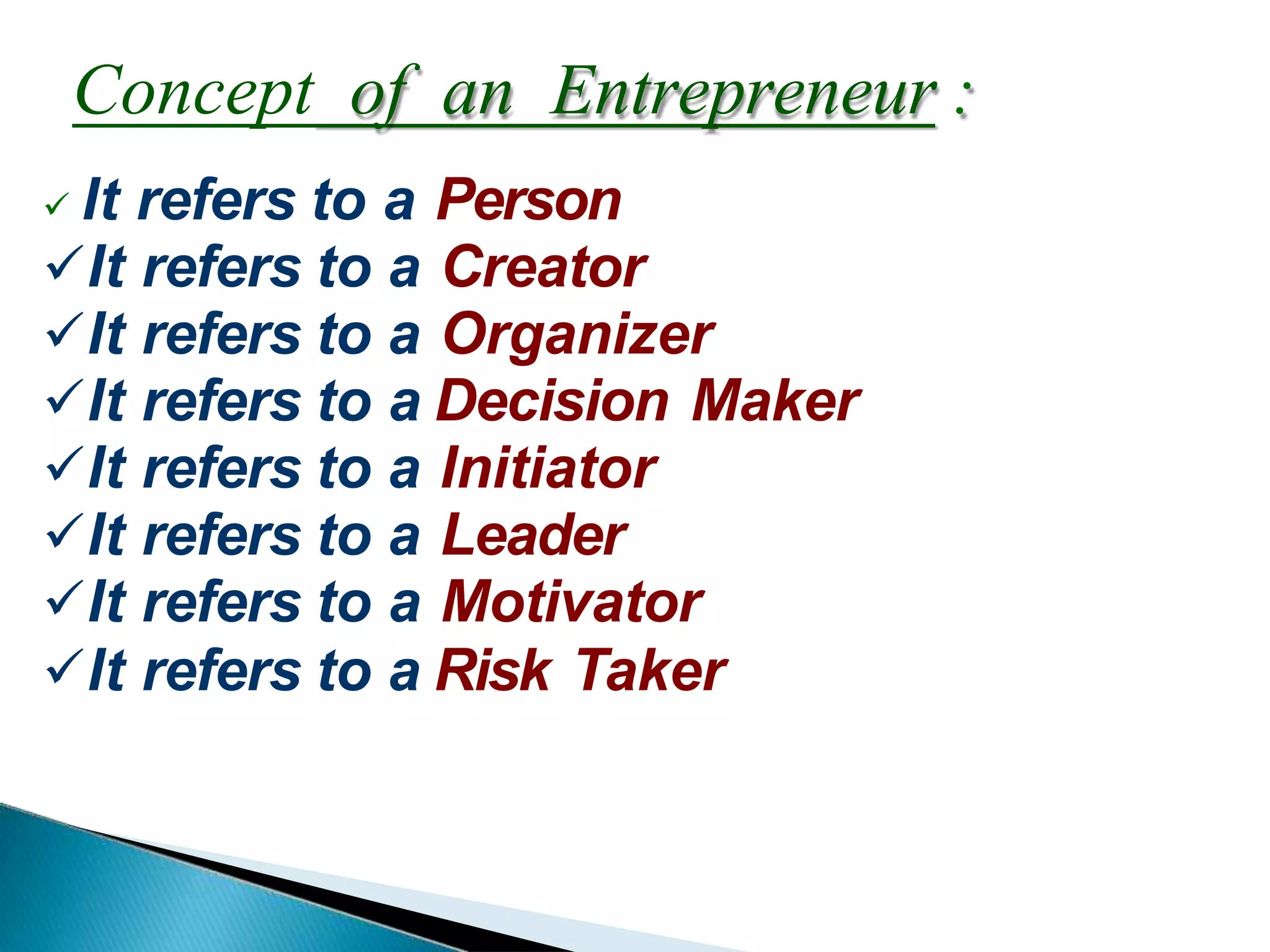
Concept of an Entrepreneur :
 It refers to a Person
It refers to a Creator
It refers to a Organizer
It refers to a Decision Maker
It refers to a Initiator
It refers to a Leader
It refers to a Motivator
It refers to a Risk Taker
Who is Entrepreneur ?
• An entrepreneur is an individual who starts a
business venture and is responsible for its
development.
• An individual who bears the risk of operating a
business in the face of uncertainty.
• One who organizes, manage and assumes the risk
of a business or enterprise.
Mental Ability – Entrepreneur must have creative thinking and
must be able to analyze problems and situations. He should be
able to anticipate changes.
Business Secrecy – He should guard his business secrets from his
competitors.
Clear Objectives – He must have clear objectives as to the exact
nature of business or the nature of goods to be produced.
Human Relations – He must maintain good relation with his
customers, employees, etc. To maintain good relationship he
should have emotional stability, personal relations, tactfulness
and consideration.
Communication Ability – He should have good communication
skills means both the sender and the receiver should understand
each others message.
Technical Knowledge – He should have sufficient technical
knowledge.
Help in bringing changes in Social Framework
Contribution in the formation of Industrial Climate
Contribution to generate Employment
Opportunities
Contribution to raise the Standard of Living
Help in removing Regional Disparities
Encouragement to Investigation & Research

21MCA005_Enterpreneurship.pptx

  • 1.
  • 2.
    I would liketo convey my heartfelt gratitude to Dr Gyanbati Khuraijam for her tremendous support and assistance in the completion of this presentation. She was always there to assist me at every step of the way, and her motivation is what enabled me to accomplish my task effectively. Acknowledgement Harsh Sharma 21MCA005
  • 3.
    Entrepreneurship is thekey to innovation, productivity and effective competition. When a person realizes his ability or capacity and makes its practical use and establishes new business unit this activity is known as entrepreneurship.
  • 4.
    Concept of Entrepreneurship: Entrepreneurship is an innovative function. It is a leadership rather than an ownership. The process of innovation may be in the form of  Introduction of a New Product  Use of a New Method of production  Opening of a New Market -
  • 5.
    Risk refers tothe variability of outcomes (or returns). Entrepreneurs are “risk-taker”- people who don’t fear anything in business. Entrepreneurship involve taking of risks and making the necessary investments under conditions of uncertainty.
  • 6.
    Entrepreneurship is abilityto connect and organize a venture and enterprise. It is bringing together the factors coordinate the productive resources to of production and to organize them. Entrepreneur makes decisions about resource allocations.
  • 7.
    Entrepreneurship is theprocess of bringing together creative and innovative ideas and actions with the management & leadership skills to mobilize the appropriate people, money and operating resources to create wealth in the process. Entrepreneurs can translate their ideas into action with management and leadership skills.
  • 8.
    economic agents who Entrepreneursare transform demand into supply and they transform resources into useful goods & services, that lead to creation of wealth and industrial growth.
  • 9.
    Entrepreneurship education isa fast growing area in Colleges & Universities. Most universities in the countries did research on entrepreneurship, followed by training courses. Due to fully developed subject, many entrepreneurial schools have been opened.
  • 10.
    The definition ofentrepreneurship may be classified in- Establishment of new enterprises based Function based Combination based Decision making based Innovation based
  • 11.
    Components or Elementsof Entrepreneurship  Entrepreneur Pursuit of Opportunities Innovation Organisation Creation Creating Values Profit or Non-for- Profit Growth Uniqueness Process
  • 12.
    Characteristics of Entrepreneurship: o Innovation o Risk-Bearing Capacity oCreative Decision oCreating & ManagingResources o Managerial Skills & Leadership o Gap Filling Function o Business Oriented Tendency o Economic Activity o Producing Results oLife Style
  • 13.
    Concept of anEntrepreneur :  It refers to a Person It refers to a Creator It refers to a Organizer It refers to a Decision Maker It refers to a Initiator It refers to a Leader It refers to a Motivator It refers to a Risk Taker
  • 14.
    Who is Entrepreneur? • An entrepreneur is an individual who starts a business venture and is responsible for its development. • An individual who bears the risk of operating a business in the face of uncertainty. • One who organizes, manage and assumes the risk of a business or enterprise.
  • 15.
    Mental Ability –Entrepreneur must have creative thinking and must be able to analyze problems and situations. He should be able to anticipate changes. Business Secrecy – He should guard his business secrets from his competitors. Clear Objectives – He must have clear objectives as to the exact nature of business or the nature of goods to be produced. Human Relations – He must maintain good relation with his customers, employees, etc. To maintain good relationship he should have emotional stability, personal relations, tactfulness and consideration. Communication Ability – He should have good communication skills means both the sender and the receiver should understand each others message. Technical Knowledge – He should have sufficient technical knowledge.
  • 16.
    Help in bringingchanges in Social Framework Contribution in the formation of Industrial Climate Contribution to generate Employment Opportunities Contribution to raise the Standard of Living Help in removing Regional Disparities Encouragement to Investigation & Research