Stepped Stones: an Experiment on the Acquisition
and Development of Flint Knapping Skill
Feliksas Petrosevicius
2034483
This dissertation is submitted in part fulfilment of the requirements for
the degree of M.A. with Honours in Archaeology at the University of
Glasgow
April 2016
i
Abstract
“SteppedStones:anExperimentonthe AcquisitionandDevelopmentof FlintknappingSkill”
FeliksasPetrosevicius
With flintknapping and archaeological lithic analysis being very closely tied, this dissertation is
aimed to give some insights into the problematic study of skill signatures in archaeological
assemblage. Following recent trends in experimental studies, this was done by recording and
observing the process of reduction of flint beach pebbles from Kilchattan bay, Isle of Bute. The
reduction was done by a novice, with no previous knapping experience. The results were recorded
and later analysed to provide unskilled lithic data, study the effects of pebble shape and size on the
reduction and learning process, and to track the process of skill acquisition throughout the
experiment. Comparison with other novice and expert knappers’ data allowed the data to be
incorporated into a wider academic world. The whole process gave the author a deeper
understandingof lithicassemblagesandanovice skill inflintknapping.
ii
Contents
ABSTRACT I
LIST OF FIGURES III
ACKNOWLEDGEMENTS V
CHAPTER 1 –INTRODUCTION 1
CHAPTER 2 – A BRIEF HISTORY OF FLINT KNAPPING IN LITHIC ANALYSIS 2
CHAPTER 3 – DEFINITION, TRANSFER AND VISIBILITY OF SKILL 4
DEFINITION OF SKILL....................................................................................................................................................................4
KNOWLEDGEAND KNOW-HOW....................................................................................................................................................5
SKILL ACQUISITION AND TRANSFER...............................................................................................................................................6
THEVISIBILITYOF SKILL IN ARCHAEOLOGICAL DATA........................................................................................................................8
CHAPTER 4 – EXPERIMENT AIMS, METHODOLOGY, RESEARCH QUESTIONS AND RAW MATERIAL 9
CHAPTER 5 – LITHIC ANALYSIS 13
FLAKEREGULARITY....................................................................................................................................................................13
FRAGMENTATION AND BREAKAGE..............................................................................................................................................15
STEP OR HINGETERMINATIONS AND REJUVENATION FLAKES........................................................................................................17
MISHITS...................................................................................................................................................................................18
FEATHERED TERMINATIONS .......................................................................................................................................................22
EFFICIENTUSEOF RAW MATERIAL ..............................................................................................................................................23
LENGTH TO WIDTH RATIO ..........................................................................................................................................................27
CONCLUSION............................................................................................................................................................................28
CHAPTER 6 – DISCUSSION AND CONCLUSION 30
KNAPPING SKILL DEVELOPMENT.................................................................................................................................................31
CONCLUSION............................................................................................................................................................................34
BIBLIOGRAPHY: 35
APPENDICES: 42
APPENDIX 1 –LISTOF DEFINITIONS. ..........................................................................................................................................42
APPENDIX 2 –EXAMPLEOF EXPERIMENT SHEETWITH PHOTOS* .................................................................................................46
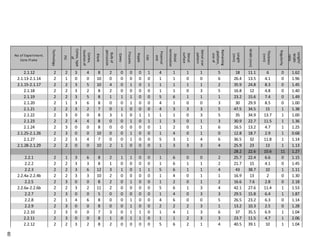
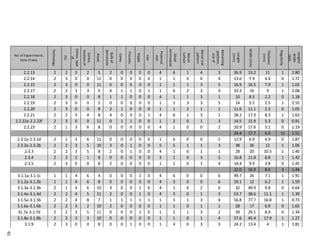
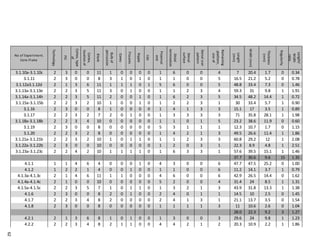
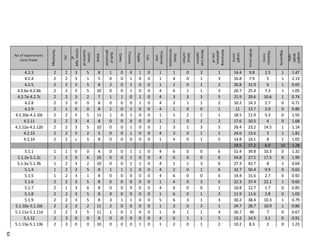
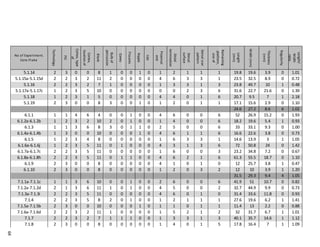
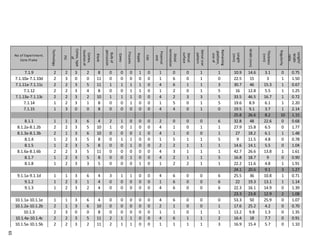
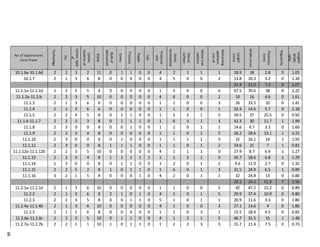
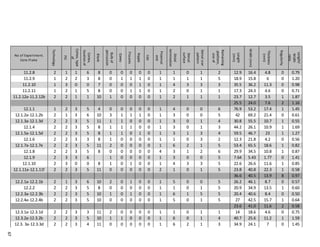
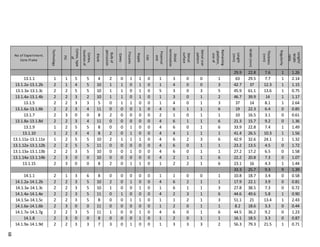
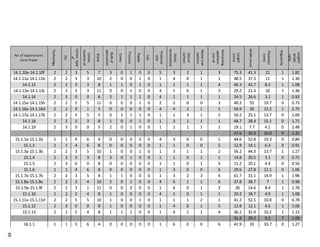
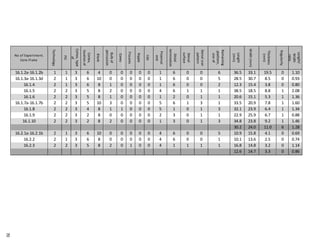
APPENDIX 3 –LITHIC ANALYSIS DATA.........................................................................................................................................57
APPENDIX 4 –KNAPPING JOURNAL*.........................................................................................................................................73
ELECTRONIC APPENDICES IN THEATTACHED CD:
APPENDIX E1 – EXPERIMENTSHEETS WITH PHOTOS.
APPENDIX E2 – KNAPPING JOURNAL
THE CD WAS SUBMITTED WITH THEDISSERTATION.A COPYIS AVAILABLEUPON REQUEST.
iii
List of Figures
FIGURE 2.1 A TABLE SHOWING THE MAIN CONCEPTS OF KNOWLEDGE AND KNOW-HOW. 5
FIGURE 3.1 TABLE OF KNAPPING SESSIONS AND THE EXPERIMENTS WORKED ON DURING THEM. 10
FIGURE 3.2 TABLE SHOWING THE DISTRIBUTION OF PEBBLES IN THE GROUPS. 11
FIGURE 3.3 PEBBLE SPHERICITY AND ROUNDNESS. 11
FIGURE 3.4 TABLE SHOWING THE ATTRIBUTES OF THE PEBBLES. 12
FIGURE 4.1 A COLOUR VARIABILITY OF THE PEBBLE FLINT. 13
FIGURE 4.2 A CHART SHOWING FLAKE REGULARITY OVER EXPERIMENTS. 14
FIGURE 4.3 A CHART OF REGULARITY AMONGST DIFFERENT PEBBLE SHAPES. 14
FIGURE 4.4 A CHART SHOWING FLAKE REGULARITY IN PEBBLE SIZES. 14
FIGURE 4.5 EXPERIMENT 7 PEBBLE WITH AN INCLUSION IN THE MIDDLE. 14
FIGURE 4.6 GRAPH SHOWING THE COMPLETENESS OF FLAKES. 16
FIGURE 4.7 GRAPH SHOWING COMPLETENESS OF FLAKES THROUGHOUT DIFFERENT PEBBLE SHAPES. 16
FIGURE 4.8 A CHART SHOWING FLAKE COMPLETENESSIN PEBBLE GROUPS. 16
FIGURE 4.9 A CHART SHOWING THE RELATION BETWEEN BREAKAGE RATE AND PRONOUNCED BULBS OF PERCUSSION. 16
FIGURE 4.10 CHART SHOWING THE PERCENTAGE OF STEP/HINGE TERMINATIONS AND THE ABILITY TO FIX THEM. 17
FIGURE 4.11 A CHART SHOWING STEP/HINGE TERMINATIONS IN PEBBLE SIZES. 17
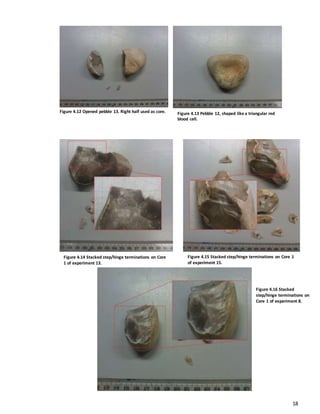
FIGURE 4.12 OPENED PEBBLE 13. RIGHT HALF USED AS CORE. 18
FIGURE 4.13 PEBBLE 12, SHAPED LIKE A TRIANGULAR RED BLOOD CELL. 18
FIGURE 4.14 STACKED STEP/HINGE TERMINATIONS ON CORE 1 OF EXPERIMENT 13. 18
FIGURE 4.15 STACKED STEP/HINGE TERMINATIONS ON CORE 1 OF EXPERIMENT 15. 18
FIGURE 4.16 STACKED STEP/HINGE TERMINATIONS ON CORE 1 OF EXPERIMENT 8. 18
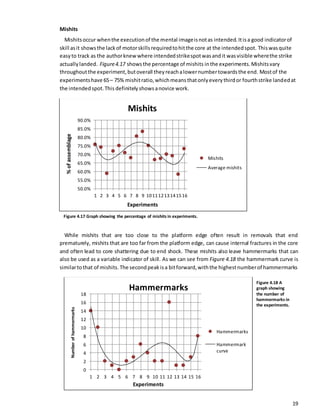
FIGURE 4.17 GRAPH SHOWING THE PERCENTAGE OF MISHITS IN EXPERIMENTS. 19
FIGURE 4.18 A GRAPH SHOWING THE NUMBER OF HAMMERMARKS IN THE EXPERIMENTS. 19
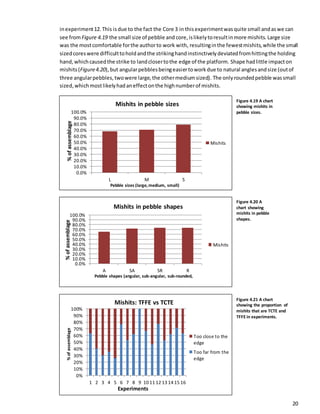
FIGURE 4.19 A CHART SHOWING MISHITS IN PEBBLE SIZES. 20
FIGURE 4.20 A CHART SHOWING MISHITS IN PEBBLE SHAPES. 20
FIGURE 4.21 A CHART SHOWING THE PROPORTION OF MISHITS THAT ARE TCTE AND TFFE IN EXPERIMENTS. 20
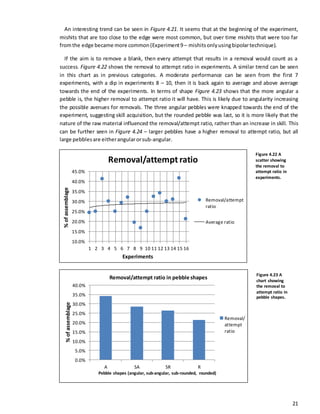
FIGURE 4.22 A SCATTER SHOWING THE REMOVAL TO ATTEMPT RATIO IN EXPERIMENTS. 21
FIGURE 4.23 A CHART SHOWING THE REMOVAL TO ATTEMPT RATIOIN PEBBLE SHAPES. 21
FIGURE 4.24 A CHART SHOWING THE REMOVAL TO ATTEMPT RATIOIN PEBBLE SIZES. 22
FIGURE 4.25 A GRAPH SHOWING THE CURVE OF FEATHERED TERMINATIONS IN EXPERIMENTS. 22
FIGURE 4.26 A GRAPH SHOWING THE FEATHERED TERMINATIONS IN PEBBLE SIZES. 23
FIGURE 4.27 A TABLE SHOWING PEBBLE SIZE DISTRIBUTION IN PEBBLE SHAPE GROUPS. 23
FIGURE 4.28 AVERAGE REMAINING PLATFORMSIZEIN EXPERIMENTS. 23
FIGURE 4.29 A GRAPH SHOWING AVERAGE REMAINING PLATFORM SIZE IN PEBBLE SIZES. 24
FIGURE 4.30 A CHART SHOWING SIZE OF REMAINING PLATFORMSIZEIN SHAPES. 24
FIGURE 4.31 A TABLE WITH EXPERIMENTS AND THEIR CORES. 25
iv
FIGURE 4.32 A CHART SHOWING THE ABANDONMENT REASONS FOR CORES. 25
FIGURE 4.33 A CHART SHOWING THE ABANDONMENT REASONS FOR CORESIN PEBBLE SHAPES. 25
FIGURE 4.34 A GRAPH SHOWING WEIGHT TO REMOVAL RATIO IN EXPERIMENTS. 26
FIGURE 4.35 A GRAPH SHOWING WEIGHT TO REMOVAL RATIO IN PEBBLE SHAPES. 26
FIGURE 4.36 A GRAPH SHOWING WEIGHT TO REMOVAL RATIO IN PEBBLE SIZES. 27
FIGURE 4.37 A GRAPH SHOWING LENGTH TO WIDTH RATIO IN EXPERIMENTS. 27
FIGURE 4.38 A GRAPH SHOWING LENGTH TO WIDTH RATIO IN PEBBLE SHAPES. 28
FIGURE 4.39 A GRAPH SHOWING LENGTH TO WIDTH RATIO IN PEBBLE SIZES. 28
FIGURE 4.40 A GRAPH SHOWING EXPERIMENT DISTRIBUTION OVER TIME. 29
FIGURE 5.2 A GRAPH SHOWING THE COMPARISON OF DISTAL TERMINATIONS. 30
FIGURE 5.1 A GRAPH SHOWING THE COMPARISON OF DISTAL TERMINATIONS. 30
FIGURE 5.3 A CHART SHOWING THE NOVICE MISTAKESIN PEBBLE SIZES. 32
FIGURE 5.4 A CHART SHOWING THE NOVICE MISTAKESIN PEBBLE SHAPES. 32
FIGURE 5.5 MODEL OFINDIVIDUAL KNAPPING SKILL ASIT RELATES TO THE LIFE CYCLE. 33
FIGURE 5.6 A CHART SHOWING THE NOVICE MISTAKESIN EXPERIMENTS WITH A “LEARNING CURVE”. 33
v
Acknowledgements
I would like to thank my supervisor Dr Nyree Finlay for the plentiful advice and time given to me
and the earlierdraftsof thisdissertation. Iam alsothankful forthe experimental dataprovided.
I would like to express my gratitude for Dr Dene Wright for introducing and guiding my first steps
on “the enjoyable road to madness”, as well as the enormous amount of patience with my seemingly
endlessquestions.
Many thanks go to Mr Gert Petersen for his advice, help and supplies in the laboratory as well as
the alwayscheerful attitude.
Lastly, but by no means least, I would like to thank Kristina Krukonytė for her unwavering support
and encouragement.
Anymistakesare solelymyresponsibility.
1
Chapter 1 – Introduction
“…the things humankind makes and uses at any particular time and place are probably the truest
representation we have of values and meaning within a society.”
W.D. Kingery1996, ix
Humans are the only animals who have developed a special connection with tools. While other
animals have shown examples of tool use to overcome certain challenges (Oakley 1949:6, Wymer
1994:43), only humans have developed both the areas of the brain required for tool use and
production (Johnson-Frey 2003, 2004) and the technologies necessary for the production of their

tools (Stout and Chaminade 2007). Handedness, bi-pedal stature, dexterity and physical coordination
meant that humans had the fundamental biological conditions to produce stone tools (Corbetta
2005). Being so uniquely associated with humans, tools can tell a lot about the humans that thought
of, made, and used them. The way people interact with their tools is a part of their culture. Lithic
tools become especially useful when studying prehistoric past, where they are the most prominent
surviving traces of the cultures of the past. As archaeology studies the past using material culture
(Gamble 2008:1), a certain level of expertise in objects, especially stone tools, is crucial to any
archaeologist. During this experiment the author was documenting the development of his flint-
knapping skill and experience. Experimental knapping being one of the core parts of lithic analysis
(Odell 2004:4, Whittaker 1994, Apel and Knutsson 2006:22, Carr and Bradbury 2010:72) meant that it
also provided a deeper understanding and knowledge on lithic artefacts and their production to the
author. Over the course of the experiment the development of knapping skill was observed with
answers being sought to research questions like: How does the size and shape of the pebble affect
the learning process? What is the learning curve in flint knapping? Do the attributes most commonly
associated with novices show up in the lithic assemblage? Does time between the sessions affect the
learning curve? To try to answer these questions I will look at the current ideas in skill development
both in modern and prehistoric circumstances and then see how it corresponds with the lithic
assemblage produced during this experiment. A comparison with other experimental data will help
place the experiment into the wider academic world, hopefully providing some insights into the early
stagesof skill development.
This experiment was aimed to provide more data for the recognition of skill acquisition in
archaeological record and to analyse the process of learning of flint-knapping. Chapter 2 covers the
history of experimental knapping as a part of lithic analysis, including several recent studies in lithic
skill. The concept of skill, its development and visibility in the archaeological data is discussed in
Chapter 3. Chapter 4 covers the methodology and aims, as well as the progress of the experiment.
Flint beach pebbles – the raw material that was used - is described in Chapter 4 as well, with the
pebbles’ metric parameters included. The analysis of the lithic assemblage is produced in Chapter 5.
The results are then compared to other available experimental novice data providing some more
insightsinto adiscussion aboutskill inChapter6.
2
CHAPTER 2 – A brief history of flint knapping in lithic analysis
In this chapter I take a look at the history of lithic analysis and experimentation as a field of study,
witha fewrecentstudiesatthe end.
Lithic remains, chiefly debitage, are the most common and the most numerous types of finds in
many if not most archaeological sites all over the world (Odell 1996:1, Andrefsky 2001:2). These
remains are usually found in the same condition which they were deposited in archaeological
contexts (Apel 2008:95). They allow not only the study and reconstruction of the knapping process,
but they also embody gestures, in turn bearing evidence to the aims and intentions of the stone
worker (ibid 2008:94). Developments in lithic analysis field can change the way we look at prehistory
and applying the best analytical methods will allow reassessing and shaping of current views on
almostany site inthe worldwhichhasa lithicassemblage.
Stone tools, which are the earliest known evidence of human material culture, have been
researched since the beginning of archaeological studies (Oakley 1949, Johnson 1978, Odell 2004,
McCall 2011). Experimental flint knapping has been a part of archaeological studies of prehistory
since the 19th
century (Johnson 1978:337, Olausson 2010). These two fields started and developed
hand in hand: “…the work of the archaeologist/lithic analyst and the flint-knapper proceed in a
hermeneutic fashion” (Apel 2008:96). In 1797 John Frere, an antiquarian, identified some worked
flint at Hoxne, near Diss in Suffolk. He published his findings suggesting the existence of prehistoric
people, who used these tools instead of metal ones. But this idea was not generally accepted and
much disputed. It contradicted the widespread Biblical idea of the world being few thousand years
old (Prestwich 1859:53, Johnson 1978:337). Swedish archaeologist and zoologist Sven Nilsson was
one of the first scholars to use flint knapping experiments as an aid to explain the prehistory (Nilsson
1834(1868)). In 1846 Boucher de Perthes, an amateur archaeologist, found flint tools similar to those
found in England before. Only in mid-19th
century, when Joseph Prestwich and John Evans visited
Abbeville and examined the finds, were the other scholars more convinced of the prehistoric people
(Prestwich 1859, Oakley 1949, Johnson 1978:338). The first public flint knapping was demonstrated
by Evans before the International Congress of Prehistoric Archaeology (Stevens 1870). Evans also
analysed the lithic assemblages based on his previous knowledge and the experience gained during
his flint knapping experiments. He would compare the odd or unknown flint production technologies
and the flakes he produced during his knapping sessions. He would then draw certain conclusions
based on the similarities between the two (Johnson 1978:358). Both in the past and the present,
familiarity with flint knapping has certainly aided academics in analysing the lithic assemblages.
Understanding of knapping techniques and methods helps to identify and describe the debitage,
whichotherwise wouldbe impossible todescribeasman-made ormisidentified.
Naturally occurring flakes and eoliths were a problem for early prehistorians (Barnes 1939:100).
There were many debates in trying to distinguish finds between natural and human-worked. Barnes
explained some of the main differences helping to distinguish between the two. While conducting
experiments trying to replicate the natural processes involved in producing similar fractured stones,
he noticed that the main method to discern the human involvement in fractures were the angle
platform-scar. That is the dihedral angle between the surfaces of the striking or pressure platform
and the flake (Barnes1939:111).
3
Leon Coutier throughout his experience with flint-knapping found out the importance of abrasion.
The preparation before striking ensured the hammer did not slip and retain the wanted trajectory
(Johnson 1978:350). He was also filmed in 1947 showing the replication of prehistoric tools
(archive.org).
Don Crabtree and François Bordes pioneered the sudden increase in popularity of flint-knapping in
1960s. The meeting at Les Eyzies, France among F. Bordes, J. Tixier, and D. Crabtree propelled
experimental knapping to become more prominent in archaeological community (Odell 2004,
Johnson 1978). While previously the knapping community was interested in replicating the
prehistoric tools and overcoming certain problems and obstacles encountered on the way, the
importance now shifted from the product to the process of tool making. The methods of reduction
and the technology of reduction became important to the archaeologists (Crabtree 1972, Olausson
2010).
Errett Callahan and D. Crabtree started noticing differences amongst individual knappers, even
though the technologies and the artefacts they were replicating were the same. Refitting the flakes to
the cores archaeologists became able to tell the exact process of reduction – “ascertaining exactly
what tool maker did, rather than what they may have done” (Odell 2004:5). Micro-wear analysis
allowed modern technologies to be used to analyse the use, sturdiness, and longevity of stone tools
(Keeley and Newcomer 1977). Crabtree’s law and his work (1972) are still used today by modern
flintknappers. Experimental flint knapping in archaeology is used to study the chaîne operatoire – the
social and technological processes of tool making, use and disposal (Apel 2001:22). Through
replication and imitation of the prehistoric methods and techniques archaeologists seek to
understandthe cognitive processesof the prehistoricpeopleandindividuals(Olausson2010).
The changing approaches to lithic technologies and assemblages means that it is possible to re-
evaluate the archaeological data, even though it has been collected using previous frameworks.
Ethnoarchaeological studies have shed light on interesting aspects on stone knapping skill
development, which can be used to interpret prehistoric data (Stout 2002, Winton 2005, Roux et al
1995). Experimental knapping also allowed to recognise novice flint-knapping in the archaeological
record (Shelley 1990, Finlay 2008, Bleed 2008, Apel 2008, Högberg 2008, McCall 2011). Experimental
knapping of flint beach pebbles during The Southern Hebrides Mesolithic Project allowed some
interesting insights into the knapping techniques, the spatial spread of debitage and knapping skill in
the Mesolithic (Mithen et al 2000). Finlay explores the novice flint-knapping and the recognition and
identification of children in the archaeological record as well as various skill signatures in
archaeological lithicremains(Finlay 2008, 2015).
4
CHAPTER 3 – Definition, transfer and visibility of skill
This chapter shows the difficulties of defining skill, including the acquisition and transfer of skill and
howscholars can findskill signatures inlithicremains.
Definitionofskill
Skill in flintknapping is found in the interception between knowledge and practice; the
relationship between them changes in terms of experience and the complex interplay of mind
and material aseach flakeis struck (BamforthandFinlay2008:3).
Skill is a kind of knowledge. It refers to the developed ability to manipulate the vocabulary of
techniques, designs, and customary resources that are available in a particular technology. It is
a qualitythatcan be developed,something thatsomepeople“know” (Bleed2008:156).
Skill is at once a form of knowledge and a form of practice, of –if you will-it is both practical
knowledgeand knowledgeablepractice (Ingold1993:433).
While the idea of skill can be difficult to narrow down to a single definition, many scholars point to
the duality of the concept – the information, knowledge, dexterity, mental patterns and the
experience developed over time. It includes the ability to not only form a mental image andexpress it
into a material one, but it also describes the ability to do it in a quick, constant, and specific manner:
“skill is often associated with precision, regularity, optimization, swiftness and so on” (Roux et al
1995:66). Stout claims that “it is possible to make sound inferences about the relative skill of
prehistoric stone knappers” (Stout 2002:714). These inferences and assumptions are important
because the meaning of skill is closely related to a multitude of social, cognitive and economic
aspects (Apel 2001, Stout 2002, Andrews 2003). Indeed, Apel and Knutsson claim that “skill is related
to the understanding of the whole cultural setting and world view in which a technology is imbued”
(Apel and Knutsson 2006:16). And if, as Stout (2002) suggested, reasonable interpretations can be
made about the skill of prehistoric knappers, in turn it is possible to draw conclusions about the
social, economic, and individual conditions in the Stone Age. Sociologist Marcel Mauss suggested that
“the reasons for making a certain gesture, and not another one, could not be fully explained by
physiological factors but to an important degree also by knowledge of the tradition whichimposed it”
(Mauss 1979:109). He implied that there are a connection between gestures and their social context.
Indeed,gesturesare regardedasthe lowestcommondenominatorseeninlithic artefactsas
“…each percussion act is ‘expressed’ into a flake and its negative, and each debitage sequence
leaveson the ground a series of productsand by products.Theseelementsretain,to a various degree,
someevidence of the succession of gestures carried out prior to their own detachment. On this basis,
it becomespossibleto decipher and reconstruct,with greaterprecision,the coherenceof theknapping
process, the techniques employed, and the aims of the actor” (Pigeot 1990:127).
As Pigeot suggests,it is possible to quite accurately reconstruct the sequence of gestures that were
involved in the production of certain lithics. And each gesture is impossible without the interaction of
knowledge and know-how.
5
Knowledge and know-how
Introduced into archaeology by Pelegrin, these terms describe the two core principles of the neuro-
psychological nature of the enactment of a gesture (Pelegrin 1990:118). These terms separate the
information that can come from outside of the body and the unconscious, muscle memory that is
developed through practice. Keller and Keller (1996:156) claim that craft skill is the ability to actualize
mental images through physical actions. So skill in flint knapping would be the ability to successfully
execute (know-how) a certain technique (knowledge). Bleed (1996:156-157) also suggests that skill is
a knowledge that can be taught, but it necessitates development through practice; it includes both
mental and physical abilities. Knowledge is certain information that is required to successfully carry
out a particular task. It can be acquired by either observing another skilled individual, being taught by
a skilled individual or self-taught through trial and error (Harlacker 2006:221). It becomes a part of
the knapper’s explicit memory (Apel 2001:28). A knapper has to know which platforms are suitable
for striking, how to prepare them; the location, angle and the force of the strike; how to hold the
core. This is some of the basic knowledge required to start developing a knapping skill. It can be
transferredbyword,example orobservation.
Know-how, however, cannot be transferred and has to be developed through practice. Lack of it
can result in the frustrating situation of knowing what to do to perform a certain task, but being
unable to actually do it (Apel 2001:37). The knapper has to know how to “translate theoretical
knowledge into a practical outcome” (Olausson 1998:106). A prehistoric site of Trollesgave,
Denmark, provides an example for the situation Apel described. Anders Fischer found two cores of
high quality flint, which showed signs of novice work. Fischer noted that the cores were principally
the same to the expert worked ones, but the actual execution of the technique was different. He
likened the results seen on these two cores to the results school children get when they are first
tryingto learnto write (Fischer1990).
Knowledge Know-how
Explaining
Explicit memory
Communicative
Theoretic memory
Lost in case of lost memory
Words (two dimensional)
Acting
Implicit memory
Intuitive
Muscle memory
Not lost in case of lost memory
Mental pictures (three dimensional)
Experience
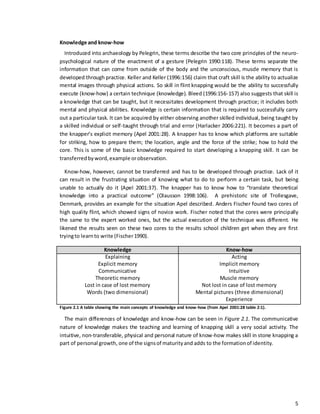
Figure 2.1 A table showing the main concepts of knowledge and know-how (from Apel 2001:28 table 2:1).
The main differences of knowledge and know-how can be seen in Figure 2.1. The communicative
nature of knowledge makes the teaching and learning of knapping skill a very social activity. The
intuitive, non-transferable, physical and personal nature of know-how makes skill in stone knapping a
part of personal growth, one of the signsof maturityand adds to the formationof identity.
6
Skill acquisitionand transfer
Each person upon developing knapping skill obtains a certain unique style of knapping. Johnson
points this out by discussing the differences in the body movements during knapping between three
American knappers (Johnson 1978:359). François Bordes, commenting on Johnson’s statements, says
that:
“…most of the time I can tell whether a stone has been worked by [Don] Crabtree, [Jacques] Tixier,
or myself. Ourstyles are different,butdo notaskme to say whatthe differencesare! I feel them more
than I see them.”
FrançoisBordes1978, 359
Not only does Bordes mention the differences between individual styles, but also states, that the
differences are more felt than seen (at least to him). It could be argued, that these differences
develop unconsciously as part of the development of knapping skills and practice. Even when using
the same or similar technology, the outcome is slightly different, just enough to be picked up by an
experienced flint knapper. Bordes was talking about the know-how part of skill. Having practiced
knapping for many years, he had a lot of experience and thus could differentiate between the slight
differences in reduction. Note that, he “feels” them more than he sees them. This is due to the
intuitive nature of know-how. Practice is a major part of stone knapping skill acquisition. Olausson
mentions that in an unpublished study John E. Clark suggested “a direct relationship between
knapping skill and time spent knapping” (1998:94). Several ethnographic studies show that
apprenticeship of a certain craft involving stone knapping usually takes several years. For example
the novice bead knappers in modern Khambhat, India spend up to seven years learning not only the
main knapping techniques, but also how to adapt different strategies to local sub-goals, which vary
depending on the shapes, dimensions, and quality of beads as well as the raw material (Roux et al
1995). Studies of knapping skill development in the production of hand-axes has shown that the most
difficult task to master is the first one, where the rough shape of the hand-axe is produced, but
differs based on the variability of raw material (Winton 2005:113). These are just some of the studies
that show the importance of practice and time investment required in the development of skill. Brain
scans done during the initial stages of stone knapping skill acquisition have shown that the
development of sensimotor skills is most crucial in the beginning stages of craft learning (Stout and
Chaminade 2007:1098). The increase of these sensimotor skills is based on natural preconditions and
mindful practice (Iriki 2005). But practice is not just to develop certain muscle memory. Rather than
being a process of developing a specific motor ability, skill acquisition is a way of learning how to act
in order to solve a problem – “flint knapping is all about problem solving” (Wright, personal
communication;Ferguson2008a:125-126).
Ferguson (2008b:52) compares transfer of skill in stone knapping to skills taught in archaeological
field schools. Both the good quality raw material and the archaeological record are valuable and non-
renewable. While it does require a degree of knowledge that can be taught, it is essential to get the
practical experience of participating in an excavation by oneself. Archaeology students are given
actual expert tasks with help and support of more experienced archaeologists or post-graduate
students. This is similar to how novice flintknappers are thought with minimal waste of the raw
material using scaffolding, where the beginners are given the tasks that have the highest success rate,
with supervision by experts (Ferguson 2008b:52-53). Even though it is possible to teach the
knowledge required, practice is crucial for the development of skill. This is because the information
7
that is transferred cannot cover all the possible situations that the knapper will encounter due to the
variabilityof rawmaterial andthe variability betweenindividual knappers.
If transferred to prehistoric context, where the ability to make lithic tools is crucial for survival and
is a sign of maturity, the transfer of skill could be interpreted as a rite of passage. Indeed, Danish flint
daggers held a high social meaning, as the primary stages in their production were carried out by
novices, but at remote locations, while the later stages, which required expert levels of skill were
carried out in more public places. This was done to preserve the high social status of the daggers and
their makers (Apel 2008:99). This example shows that the knowledge (seeing the production of the
dagger in the later stages) is useless without the know-how (the routinely practice of making them).
While the flint knapping knowledge can be transferred, the know-how cannot, and requires practice
to develop (Apel 2008). By contrast, training and production were incorporated into daily life of
Medicine Creek Paleoindian inhabitants. Both skilled and unskilled knappers worked in residential
areas (Bamforth and Hicks 2008). The investment of skill and time into some projectile points, beyond
efficiency, is a sign of special meaning of both them and their crafters (Bamforth and Hicks 2008).
While the stone working skill in Medicine Creek was not as exclusive as in Neolithic Scandinavia, the
routinely practice required to develop skill is evident in both cases. Goody (1989:235) suggests that
skill training happened mostly within domestic groups. This would make sense as the close
relationship would create a safe and familiar atmosphere and the daily practice would help develop
the necessary dexterity. After all, “behavioural routines are the basis of motor skills” (Bleed
2008:158).
Imitation could have been one of the ways for the novice knappers to develop skill (Högberg 2008;
Grimm 2000; Ferguson 2008b). It is also noted that work and play are often mixed for novices (Lave
and Wenger 1991:111). Lave and Wenger (1991:34-36) describe learning and knowledge as relations
between individuals, which they call ‘Legitimate Peripheral Participation’ (LPP). Learning takes place
when novices are included in expert practices, where they become participating members of society.
The various activities described by Grimm (2000:65) involving the maintenance of the knapping area,
aid in knapping tool and raw material acquisition, gathering of fuel and other resources, etc. were all
part of apprentices’ skill development and transformation into a member of society. It is evident that
the development of knapping skill is a part of personal growth, maturing, and it changes the way one
perceives oneself and others (Finlay 2015:106). Learning process and skill development are closely
related with personhood and identity (Sinclair 1995:60). Both the individual and the socio-economic
conditions the individual acts in can be seen from the development of stone knapping skill. With the
transfer of lithic skill, certain values and ideas are also transferred. “Think before striking” is the
advice given to apprentice adze makers (Stout 2002:703). This advice could go further beyond the
field of stone tool production and could be advice for life in general (“think before acting”), which is
passedonfrom parentsto theirchildren.
As stone knapping skill is fluid and dynamic (Bamforth and Finlay 2008:16; Bamforth and Hicks
2008:132) it can also tell us about the changes both in individuals and society: “the expression of an
individual’s skill can vary depending on the context he or she is working in” (Bamforth and Hicks
2008). While it is difficult to single out individuals, there are ways to separate the novices and experts
inarchaeological data. Certainattributesof debitagecanbe tiedtocertainlevelsof skill.
8
The visibilityofskill in archaeological data
As previously mentioned (Pelegrin 1990: 127) it is possible to see the gesture ‘captured’ in a flake
and its negative scar. By studying these gestures, their sequences and reasons, archaeologists can
separate expert work from novice. Many scholars through experiments,ethnohistorical observations,
and refitting note that novices make more numerous and more consistent mistakes (Shelley 1990;
Ferguson 2008a, 2008b; Grimm 2000:54; Apel 2001, 2008; Bleed 2008; Bamforth and Finlay 2008;
Finlay 2008). The focus on mistakes is due to their visibility in the assemblage. Probably the only easy
measures of technological efficiency are negative ones, echoes of activity in the course of failure
(Bleed 2008:159). While skill is subjective and can be difficult to quantify (Spier 1975) it can be
distinguished using some indicators. Bamforth and Finlay (2008:6 Table 2) provide a table with the
indicators of novice/ unskilled knappers with references to the scholars providing evidence for them.
Some of those, which are used in this experiment, are flake regularity, stacked step and hinge
terminations, mishits and hammermarks, wasteful and inefficient use of raw material, and low
length/width flake ratio. Rejuvenation flakes are seen as another sign of skill (Shelley 1990:191, Stout
2002:704), but the need for rejuvenation can be interpreted as a sign of less skill (Bleed 2008:162).
While the absence of errors is a sign of skilfulness, the ability to correct the errors, that even the most
experienced knappers make due to raw material (Finlay 2008:75) should be seen a sign of skill. High
fragmentation and breakage rates can be interpreted as a sign of lack of experience, as it might be
caused by the knapper applying excessive force (Shelley 1990:191). Other signs of excessive force are
erailleur scars and pronounced bulb of percussions (Milne 2005:334). Feathered terminations can be
assigned to a higher level of skill as it produces a flake with a sharp edge and leaves the flaking
surface in the best possible state (Dibble and Whittaker 1981: 287). These are the categories that
among others were recorded and will be focused on to try to track the development of flint knapping
skill.
9
CHAPTER 4 – Experiment aims, methodology, research questions and raw material
This chapter gives insight into the structure of the experiment. Aims and research questions are
presented here with the relevant methodology to reach and answer them. The choice of flint beach
pebblesasthe rawmaterial forthe experimentisexplained inthischapter,too.
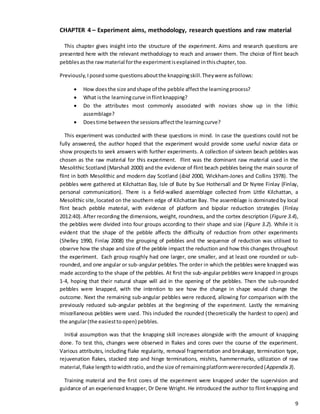
Previously,Iposed some questionsaboutthe knappingskill.Theywere asfollows:
 How doesthe size andshape of the pebble affectthe learningprocess?
 What isthe learningcurve inflintknapping?
 Do the attributes most commonly associated with novices show up in the lithic
assemblage?
 Doestime betweenthe sessionsaffectthe learningcurve?
This experiment was conducted with these questions in mind. In case the questions could not be
fully answered, the author hoped that the experiment would provide some useful novice data or
show prospects to seek answers with further experiments. A collection of sixteen beach pebbles was
chosen as the raw material for this experiment. Flint was the dominant raw material used in the
Mesolithic Scotland (Marshall 2000) and the evidence of flint beach pebbles being the main source of
flint in both Mesolithic and modern day Scotland (ibid 2000, Wickham-Jones and Collins 1978). The
pebbles were gathered at Kilchattan Bay, Isle of Bute by Sue Hothersall and Dr Nyree Finlay (Finlay,
personal communication). There is a field-walked assemblage collected from Little Kilchattan, a
Mesolithic site,located on the southern edge of Kilchattan Bay. The assemblage is dominated by local
flint beach pebble material, with evidence of platform and bipolar reduction strategies (Finlay
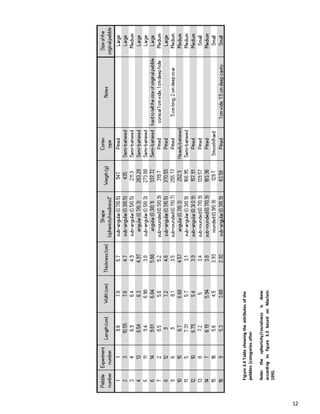
2012:40). After recording the dimensions, weight, roundness, and the cortex description (Figure 3.4),
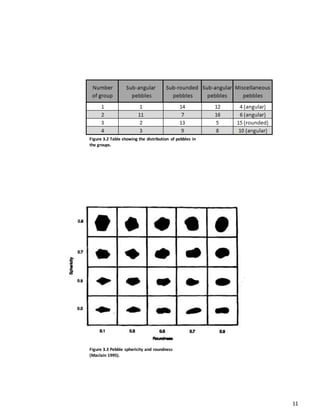
the pebbles were divided into four groups according to their shape and size (Figure 3.2). While it is
evident that the shape of the pebble affects the difficulty of reduction from other experiments
(Shelley 1990, Finlay 2008) the grouping of pebbles and the sequence of reduction was utilised to
observe how the shape and size of the pebble impact the reduction and how this changes throughout
the experiment. Each group roughly had one larger, one smaller, and at least one rounded or sub-
rounded, and one angular or sub-angular pebbles. The order in which the pebbles were knapped was
made according to the shape of the pebbles. At first the sub-angular pebbles were knapped in groups
1-4, hoping that their natural shape will aid in the opening of the pebbles. Then the sub-rounded
pebbles were knapped, with the intention to see how the change in shape would change the
outcome. Next the remaining sub-angular pebbles were reduced, allowing for comparison with the
previously reduced sub-angular pebbles at the beginning of the experiment. Lastly the remaining
miscellaneous pebbles were used. This included the rounded (theoretically the hardest to open) and
the angular(the easiestto open) pebbles.
Initial assumption was that the knapping skill increases alongside with the amount of knapping
done. To test this, changes were observed in flakes and cores over the course of the experiment.
Various attributes, including flake regularity, removal fragmentation and breakage, termination type,
rejuvenation flakes, stacked step and hinge terminations, mishits, hammermarks, utilization of raw
material,flake lengthtowidthratio,andthe size of remainingplatformwererecorded(Appendix 3).
Training material and the first cores of the experiment were knapped under the supervision and
guidance of an experienced knapper, Dr Dene Wright. He introduced the author to flint knapping and
10
made sure the experiments were possible to be undertaken by the author without supervision. About
half-way through experiment 1 the author wasleft unsupervised. It could be argued, that this was the
best method of observing skill development as it can be almost invisible when the novice is working
with close supervision and support (Ferguson 2008a:121). Many skilled stone knappers associate the
unsupervised experimental trial-and-error practice with the highest skill development (Olausson
1998:101; Whittaker 1994:7). Despite that, one of the advantages of working with supervision was
that the recording was done not by the knapper. This way the knapper could work in an undisturbed
manner and get into what is known as “flintknapping rhythm” (Carr and Bradbury 2010:73). Indeed,
throughout the unsupervised experiments, the author found that the best results were achieved
when recording was done after several consecutive reduction attempts instead of each one.
Knapping took place in a ‘knapping station’ – an enclosure with tarpaulin laid to ease the recovery of
debitage. Nevertheless some material was lost due to the parts being too small or small fracture
debitage (removals that with maximum measurements <10mm) falling into small crevices of the
bipolar working area, which was made of several flint boulders stacked on top of each other. This was
corrected with the extension of tarpaulin, but not all material was recovered. The recovery rate for
the majority of the cores was above 90%, with an average recovery rate of 94.4%. The only cores that
resulted in recovery rates of 79.4% and 63.1% were 11.2 and 16.2 accordingly. The large spread was
due to the varying hardness of the pebbles and the author applying excessive force due to lack of
experience.
The experiment took place over 15 weeks. Hard hammers were used in both platform and bipolar
reduction. One lighter hammer stone was used for platform reduction, and a heavier one was used
for bipolar reductions. This was done in light of the author getting used to the lighter hammer stone
for platform technique and for fear that the hammer stone might break due to bigger force exerted
when using the bipolar technique. Bipolar technique with an anvil support was mostly used to open
the pebbles and in cases, when the size of the core was too small to work hand-held. The results of
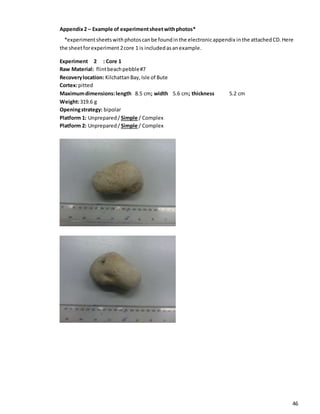
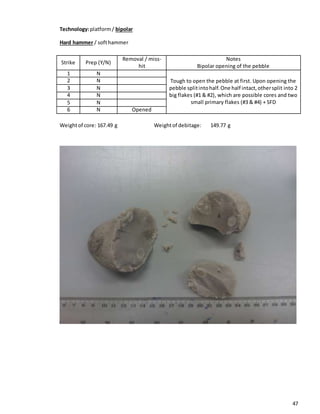
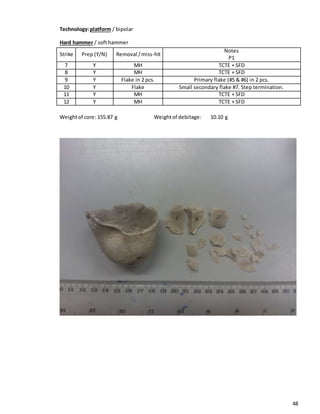
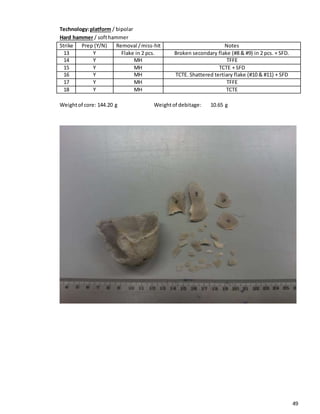
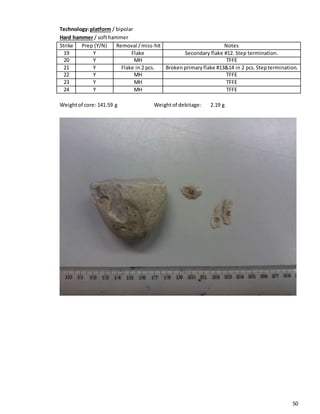
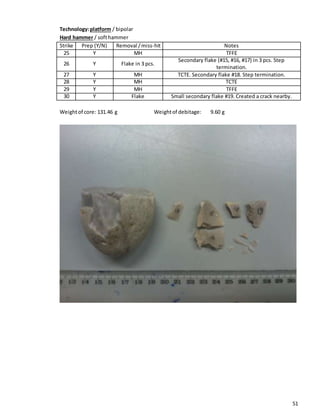
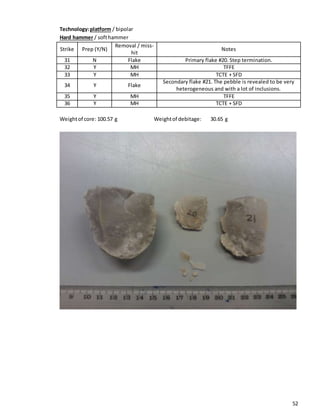
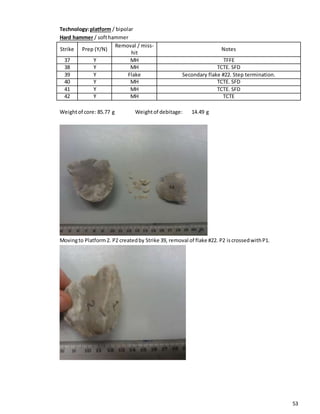
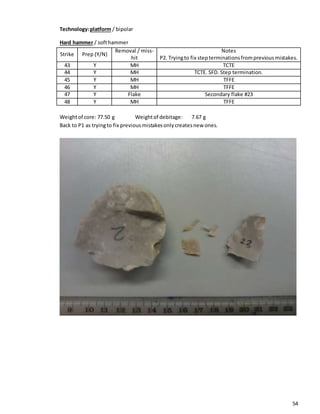
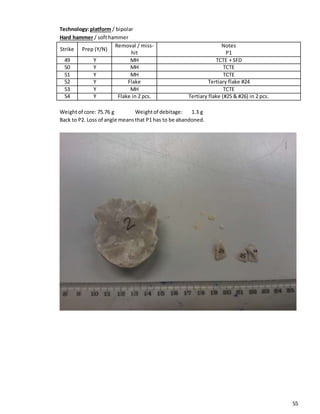
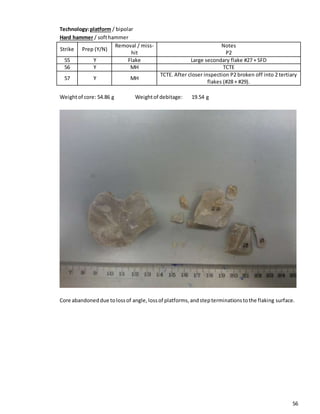
knapping were recorded in forms (see Appendix 2 for the sheets). After each 6 strikes, the core and
the debitage were weighed, photographed, and bagged accordingly. Weighing the pebble and the
cores after each strike made it possible to see how much material was unrecoverable. It also
provided a visual record of the reduction process. This allowed for easier lithic analysis and helped in
refitting of the cores at the end of the experiment. All throughout the experiments, a ‘Knapping
Journal’ was kept with daily entries after each day of work in the laboratory (see Appendix 5). The
journal provided a possibility to ‘go back’ to a certain point and observe the learning process from a
point of view different than the lithic assemblage. It was also used to keep track of the time it took
for each core reduction. The journal was also used to keep track of the knapping sessions and the
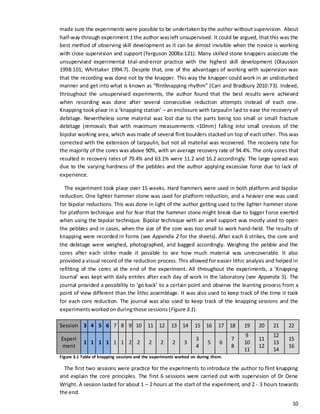
experimentsworkedonduringthose sessions (Figure3.1).
Session 3 4 5 6 7 8 9 10 11 12 13 14 15 16 17 18 19 20 21 22
Experi
ment
1 1 1 1 1 1 2 2 2 2 2 3
3
4
5 6
7
8
9
10
11
11
12
12
13
14
15
16
Figure 3.1 Table of knapping sessions and the experiments worked on during them.
The first two sessions were practice for the experiments to introduce the author to flint knapping
and explain the core principles. The first 6 sessions were carried out with supervision of Dr Dene
Wright. A session lasted for about 1 – 2 hours at the start of the experiment, and 2 - 3 hours towards
the end.
11
Figure 3.3 Pebble sphericity and roundness
(Maclain 1995).
Figure 3.2 Table showing the distribution of pebbles in
the groups.
12
Figure3.4Tableshowingtheattributesofthe
pebbles(categoriesafter
Note:thesphericity/roundnessisdone
accordingtofigure3.3basedonMaclain
1995.
13
CHAPTER 5 – Lithic analysis
The analysisof the experimental assemblage is presentedinthischapter.
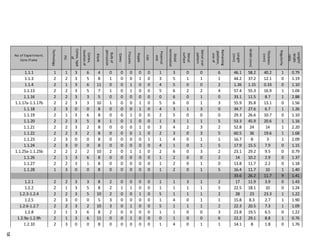
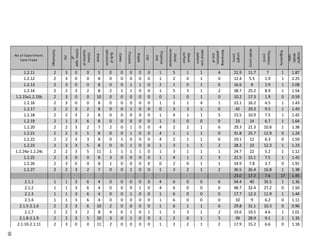
The pebbles were reduced in 16 experiments, with a total of 24 cores. 301 blanks were produced
with a large number of small fracture debitage (maximum dimension <10 mm, SFD). In the analysis a
range of attributes were measured and observed. Metric attributes, such as length, width, and
thickness were recorded for each individual blank. Broken or shattered pieces were treated as one,
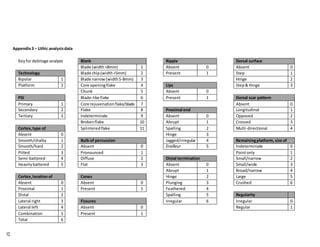
but the fragmentation was noted. Other attributes like location and type of cortex, PSI, dorsal surface
attributes, ventral surface scar patterns, the size of remaining platform, and regularity were recorded
using an analysis system developed after Finlayson et al (2000:62-64, figures 2.5.2 and 2.5.4) and
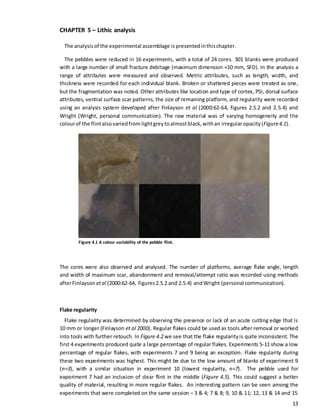
Wright (Wright, personal communication). The raw material was of varying homogeneity and the
colourof the flintalsovariedfrom lightgreytoalmostblack,withan irregularopacity (Figure4.1).
Figure 4.1 A colour variability of the pebble flint.
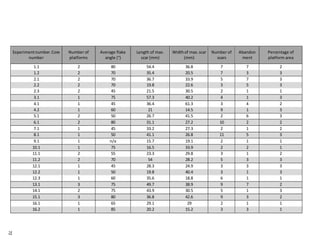
The cores were also observed and analysed. The number of platforms, average flake angle, length
and width of maximum scar, abandonment and removal/attempt ratio was recorded using methods
afterFinlayson etal (2000:62-64, figures2.5.2 and 2.5.4) andWright (personal communication).
Flake regularity
Flake regularity was determined by observing the presence or lack of an acute cutting edge that is
10 mm or longer (Finlayson et al 2000). Regular flakes could be used as tools after removal or worked
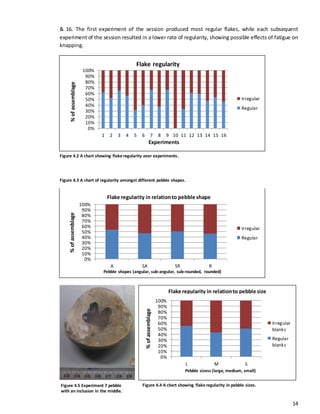
into tools with further retouch. In Figure 4.2 we see that the flake regularityis quite inconsistent. The
first 4 experiments produced quite a large percentage of regular flakes. Experiments 5-11 show a low
percentage of regular flakes, with experiments 7 and 9 being an exception. Flake regularity during
these two experiments was highest. This might be due to the low amount of blanks of experiment 9
(n=3), with a similar situation in experiment 10 (lowest regularity, n=7). The pebble used for
experiment 7 had an inclusion of clear flint in the middle (Figure 4.5). This could suggest a better
quality of material, resulting in more regular flakes. An interesting pattern can be seen among the
experiments that were completed on the same session – 3 & 4; 7 & 8; 9, 10 & 11; 12, 13 & 14 and 15
14
& 16. The first experiment of the session produced most regular flakes, while each subsequent
experiment of the session resulted in a lower rate of regularity, showing possible effects of fatigue on
knapping.
Figure 4.2 A chart showing flake regularity over experiments.
Figure 4.3 A chart of regularity amongst different pebble shapes.
0%
10%
20%
30%
40%
50%
60%
70%
80%
90%
100%
1 2 3 4 5 6 7 8 9 10 11 12 13 14 15 16
Irregular
Regular
Flake regularity
Experiments
%ofassemblage
0%
10%
20%
30%
40%
50%
60%
70%
80%
90%
100%
A SA SR R
Irregular
Regular
Flake regularity in relationto pebble shape
Pebble shapes (angular, sub-angular, sub-rounded, rounded)
%ofassemblage
Figure 4.5 Experiment 7 pebble
with an inclusion in the middle.
0%
10%
20%
30%
40%
50%
60%
70%
80%
90%
100%
L M S
Irregular
blanks
Regular
blanks
Flake regularity in relationto pebble size
%ofassemblage
Pebble sizess (large, medium, small)
Figure 4.4 A chart showing flake regularity in pebble sizes.
15
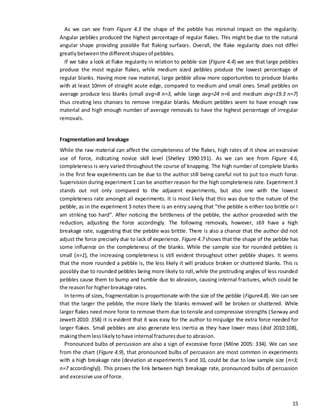
As we can see from Figure 4.3 the shape of the pebble has minimal impact on the regularity.
Angular pebbles produced the highest percentage of regular flakes. This might be due to the natural
angular shape providing possible flat flaking surfaces. Overall, the flake regularity does not differ
greatlybetweenthe differentshapesof pebbles.
If we take a look at flake regularity in relation to pebble size (Figure 4.4) we see that large pebbles
produce the most regular flakes, while medium sized pebbles produce the lowest percentage of
regular blanks. Having more raw material, large pebble allow more opportunities to produce blanks
with at least 10mm of straight acute edge, compared to medium and small ones. Small pebbles on
average produce less blanks (small avg=8 n=3, while large avg=24 n=6 and medium avg=19.3 n=7)
thus creating less chances to remove irregular blanks. Medium pebbles seem to have enough raw
material and high enough number of average removals to have the highest percentage of irregular
removals.
Fragmentationand breakage
While the raw material can affect the completeness of the flakes, high rates of it show an excessive
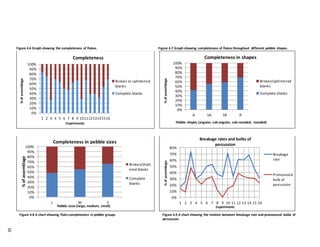
use of force, indicating novice skill level (Shelley 1990:191). As we can see from Figure 4.6,
completeness is very varied throughout the course of knapping. The high number of complete blanks
in the first few experiments can be due to the author still being careful not to put too much force.
Supervision during experiment 1 can be another reason for the high completeness rate. Experiment 3
stands out not only compared to the adjacent experiments, but also one with the lowest
completeness rate amongst all experiments. It is most likely that this was due to the nature of the
pebble, as in the experiment 3 notes there is an entry saying that “the pebble is either too brittle or I
am striking too hard”. After noticing the brittleness of the pebble, the author proceeded with the
reduction, adjusting the force accordingly. The following removals, however, still have a high
breakage rate, suggesting that the pebble was brittle. There is also a chance that the author did not
adjust the force precisely due to lack of experience. Figure 4.7 shows that the shape of the pebble has
some influence on the completeness of the blanks. While the sample size for rounded pebbles is
small (n=1), the increasing completeness is still evident throughout other pebble shapes. It seems
that the more rounded a pebble is, the less likely it will produce broken or shattered blanks. This is
possibly due to rounded pebbles being more likely to roll,while the protruding angles of less rounded
pebbles cause them to bump and tumble due to abrasion, causing internal fractures, which could be
the reasonfor higherbreakage rates.
In terms of sizes, fragmentation is proportionate with the size of the pebble (Figure4.8). We can see
that the larger the pebble, the more likely the blanks removed will be broken or shattered. While
larger flakes need more force to remove them due to tensile and compressive strengths (Serway and
Jewett 2010: 358) it is evident that it was easy for the author to misjudge the extra force needed for
larger flakes. Small pebbles are also generate less inertia as they have lower mass (ibid 2010:108),
makingthemlesslikelytohave internal fracturesdue to abrasion.
Pronounced bulbs of percussion are also a sign of excessive force (Milne 2005: 334). We can see
from the chart (Figure 4.9), that pronounced bulbs of percussion are most common in experiments
with a high breakage rate (deviation at experiments 9 and 10, could be due to low sample size (n=3;
n=7 accordingly)). This proves the link between high breakage rate, pronounced bulbs of percussion
and excessive use of force.
0%
10%
20%
30%
40%
50%
60%
70%
80%
90%
100%
A SA SR R
Broken/splinterred
blanks
Complete blanks
Completeness in shapes
%ofassemblage
Pebble shapes (angular, sub-angular, sub-rounded, rounded)
Figure 4.6 Graph showing the completeness of flakes. Figure 4.7 Graph showing completeness of flakes throughout different pebble shapes.
0%
10%
20%
30%
40%
50%
60%
70%
80%
90%
100%
1 2 3 4 5 6 7 8 9 10111213141516
Broken or splinterred
blanks
Complete blanks
Completeness
Experiments
%ofassemblage
0%
10%
20%
30%
40%
50%
60%
70%
80%
90%
100%
L M S
Broken/shatt
ered blanks
Complete
blanks
Completeness in pebble sizes
%ofassemblage
Pebble sizes (large, medium, small)
0%
10%
20%
30%
40%
50%
60%
70%
80%
1 2 3 4 5 6 7 8 9 10 11 12 13 14 15 16
Breakage
rate
Pronounced
bulb of
percussion
%ofassemblage
Experiments
Breakage rates and bulbs of
percussion
Figure 4.9 A chart showing the relation between breakage rate and pronounced bulbs of
percussion.
Figure 4.8 A chart showing flake completeness in pebble groups.
16
17
Step or hinge terminations and rejuvenationflakes
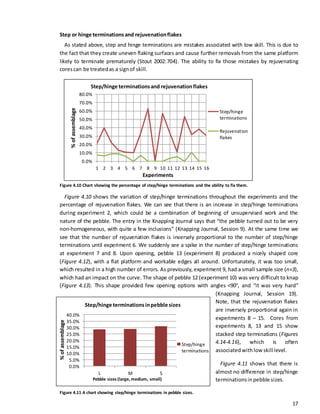
As stated above, step and hinge terminations are mistakes associated with low skill. This is due to
the fact that they create uneven flaking surfaces and cause further removals from the same platform
likely to terminate prematurely (Stout 2002:704). The ability to fix those mistakes by rejuvenating
corescan be treatedas a signof skill.
Figure 4.10 Chart showing the percentage of step/hinge terminations and the ability to fix them.
Figure 4.10 shows the variation of step/hinge terminations throughout the experiments and the
percentage of rejuvenation flakes. We can see that there is an increase in step/hinge terminations
during experiment 2, which could be a combination of beginning of unsupervised work and the
nature of the pebble. The entry in the Knapping Journal says that “the pebble turned out to be very
non-homogeneous, with quite a few inclusions” (Knapping Journal, Session 9). At the same time we
see that the number of rejuvenation flakes is inversely proportional to the number of step/hinge
terminations until experiment 6. We suddenly see a spike in the number of step/hinge terminations
at experiment 7 and 8. Upon opening, pebble 13 (experiment 8) produced a nicely shaped core
(Figure 4.12), with a flat platform and workable edges all around. Unfortunately, it was too small,
which resulted in a high number of errors. As previously, experiment 9, had a small sample size (n=3),
which had an impact on the curve. The shape of pebble 12 (experiment 10) was very difficult to knap
(Figure 4.13). This shape provided few opening options with angles <90°, and “it was very hard”
(Knapping Journal, Session 19).
Note, that the rejuvenation flakes
are inversely proportional again in
experiments 8 – 15. Cores from
experiments 8, 13 and 15 show
stacked step terminations (Figures
4.14-4.16), which is often
associatedwith low skill level.
Figure 4.11 shows that there is
almost no difference in step/hinge
terminationsinpebble sizes.
Figure 4.11 A chart showing step/hinge terminations in pebble sizes.
0.0%
10.0%
20.0%
30.0%
40.0%
50.0%
60.0%
70.0%
80.0%
1 2 3 4 5 6 7 8 9 10 11 12 13 14 15 16
Step/hinge
terminations
Rejuvenation
flakes
Step/hinge terminationsand rejuvenationflakes
Experiments
%ofassemblage
0.0%
5.0%
10.0%
15.0%
20.0%
25.0%
30.0%
35.0%
40.0%
L M S
Step/hinge
terminations
%ofassemblage
Pebble sizes (large, medium, small)
Step/hinge terminationsinpebble sizes
18
Figure 4.12 Opened pebble 13. Right half used as core. Figure 4.13 Pebble 12, shaped like a triangular red
blood cell.
Figure 4.14 Stacked step/hinge terminations on Core
1 of experiment 13.
Figure 4.15 Stacked step/hinge terminations on Core 1
of experiment 15.
Figure 4.16 Stacked
step/hinge terminations on
Core 1 of experiment 8.
19
Mishits
Mishitsoccur whenthe executionof the mental imageisnotas intended. Itisa good indicatorof
skill asit showsthe lackof motorskillsrequiredtohitthe core at the intendedspot. Thiswasquite
easyto track as the authorknew where intendedstrikespotwasandit wasvisible wherethe strike
actuallylanded. Figure4.17 showsthe percentage of mishits inthe experiments.Mishitsvary
throughoutthe experiment,butoverall theyreachalowernumbertowardsthe end. Mostof the
experimentshave 65– 75% mishitratio,whichmeansthatonlyeverythirdor fourthstrike landedat
the intendedspot.This definitely showsanovice work.
While mishits that are too close to the platform edge often result in removals that end
prematurely, mishits that are too far from the platform edge, can cause internal fractures in the core
and often lead to core shattering due to end shock. These mishits also leave hammermarks that can
also be used as a variable indicator of skill. As we can see from Figure 4.18 the hammermark curve is
similartothat of mishits. The secondpeakisa bitforward,withthe highestnumberof hammermarks
50.0%
55.0%
60.0%
65.0%
70.0%
75.0%
80.0%
85.0%
90.0%
1 2 3 4 5 6 7 8 9 10111213141516
Mishits
Mishits
Average mishits
Experiments
%ofassemblage
0
2
4
6
8
10
12
14
16
18
1 2 3 4 5 6 7 8 9 10 11 12 13 14 15 16
Hammermarks
Hammermarks
Hammermark
curve
Numberofhammermarks
Experiments
Figure 4.17 Graph showing the percentage of mishits in experiments.
Figure 4.18 A
graph showing
the number of
hammermarks in
the experiments.
20
inexperiment12. This isdue to the fact the Core 3 in thisexperimentwasquite small andaswe can
see fromFigure 4.19 the small size of pebble and core,islikelytoresultinmore mishits. Large size
was the mostcomfortable forthe authorto work with, resultinginthe fewestmishits,while the small
sizedcoreswere difficulttoholdandthe strikinghandinstinctivelydeviatedfromhittingthe holding
hand,whichcausedthe strike to landclosertothe edge of the platform. Shape hadlittle impacton
mishits(Figure4.20),but angularpebblesbeingeasiertoworkdue to natural anglesandsize (outof
three angularpebbles,twowere large,the othermediumsized). The onlyroundedpebble wassmall
sized,whichmostlikelyhadaneffectonthe highnumberof mishits.
0.0%
10.0%
20.0%
30.0%
40.0%
50.0%
60.0%
70.0%
80.0%
90.0%
100.0%
L M S
Mishits
%ofassemblage
Pebble sizes (large,medium, small)
Mishits in pebble sizes
0.0%
10.0%
20.0%
30.0%
40.0%
50.0%
60.0%
70.0%
80.0%
90.0%
100.0%
A SA SR R
Mishits
Mishits in pebble shapes
%ofassemblage
Pebble shapes (angular, sub-angular, sub-rounded,
0%
10%
20%
30%
40%
50%
60%
70%
80%
90%
100%
1 2 3 4 5 6 7 8 9 10 11 12 13 14 15 16
Too close to the
edge
Too far from the
edge
Mishits: TFFE vs TCTE
%ofassemblage
Experiments
Figure 4.19 A chart
showing mishits in
pebble sizes.
Figure 4.20 A
chart showing
mishits in pebble
shapes.
Figure 4.21 A chart
showing the proportion of
mishits that are TCTE and
TFFE in experiments.
21
An interesting trend can be seen in Figure 4.21. It seems that at the beginning of the experiment,
mishits that are too close to the edge were most common, but over time mishits that were too far
fromthe edge became more common(Experiment9– mishitsonlyusingbipolartechnique).
If the aim is to remove a blank, then every attempt that results in a removal would count as a
success. Figure 4.22 shows the removal to attempt ratio in experiments. A similar trend can be seen
in this chart as in previous categories. A moderate performance can be seen from the first 7
experiments, with a dip in experiments 8 – 10, then it is back again to average and above average
towards the end of the experiments. In terms of shape Figure 4.23 shows that the more angular a
pebble is, the higher removal to attempt ratio it will have. This is likely due to angularity increasing
the possible avenues for removals. The three angular pebbles were knapped towards the end of the
experiment, suggesting skill acquisition, but the rounded pebble was last, so it is more likely that the
nature of the raw material influenced the removal/attempt ratio, rather than an increase in skill. This
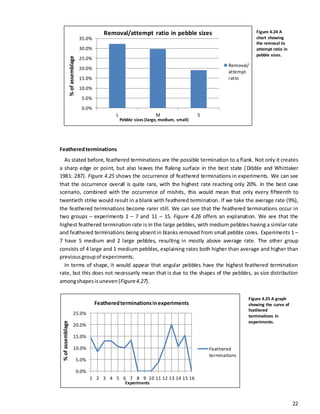
can be further seen in Figure 4.24 – larger pebbles have a higher removal to attempt ratio, but all
large pebblesare eitherangularorsub-angular.
10.0%
15.0%
20.0%
25.0%
30.0%
35.0%
40.0%
45.0%
1 2 3 4 5 6 7 8 9 10 11 12 13 14 15 16
Removal/attempt ratio
Removal/attempt
ratio
Average ratio
%ofassemblage
Experiments
0.0%
5.0%
10.0%
15.0%
20.0%
25.0%
30.0%
35.0%
40.0%
A SA SR R
Removal/
attempt
ratio
Removal/attempt ratio in pebble shapes
Pebble shapes (angular, sub-angular, sub-rounded, rounded)
%ofassemblage
Figure 4.22 A
scatter showing
the removal to
attempt ratio in
experiments.
Figure 4.23 A
chart showing
the removal to
attempt ratio in
pebble shapes.
22
Featheredterminations
As stated before, feathered terminations are the possible termination to a flank. Not only it creates
a sharp edge or point, but also leaves the flaking surface in the best state (Dibble and Whittaker
1981: 287). Figure 4.25 shows the occurrence of feathered terminations in experiments. We can see
that the occurrence overall is quite rare, with the highest rate reaching only 20%. In the best case
scenario, combined with the occurrence of mishits, this would mean that only every fifteenth to
twentieth strike would result in a blank with feathered termination. If we take the average rate (9%),
the feathered terminations become rarer still. We can see that the feathered terminations occur in
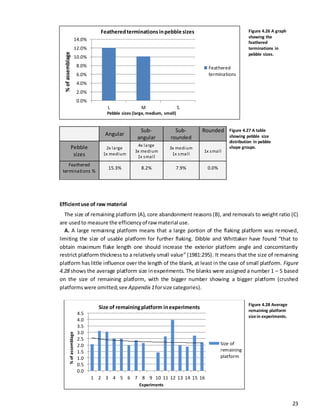
two groups – experiments 1 – 7 and 11 – 15. Figure 4.26 offers an explanation. We see that the
highest feathered termination rate is in the large pebbles, with medium pebbles having a similar rate
and feathered terminations being absentin blanks removed from small pebble cores. Experiments 1 –
7 have 5 medium and 2 large pebbles, resulting in mostly above average rate. The other group
consists of 4 large and 1 medium pebbles, explaining rates both higher than average and higher than
previousgroupof experiments.
In terms of shape, it would appear that angular pebbles have the highest feathered termination
rate, but this does not necessarily mean that is due to the shapes of the pebbles, as size distribution
amongshapesisuneven(Figure4.27).
0.0%
5.0%
10.0%
15.0%
20.0%
25.0%
30.0%
35.0%
L M S
Removal/
attempt
ratio
%ofassemblage
Pebble sizes (large, medium, small)
Removal/attempt ratio in pebble sizes
0.0%
5.0%
10.0%
15.0%
20.0%
25.0%
1 2 3 4 5 6 7 8 9 10 11 12 13 14 15 16
Feathered
terminations
%ofassemblage
Experiments
Featheredterminationsinexperiments
Figure 4.25 A graph
showing the curve of
feathered
terminations in
experiments.
Figure 4.24 A
chart showing
the removal to
attempt ratio in
pebble sizes.
23
Angular
Sub-
angular
Sub-
rounded
Rounded
Pebble
sizes
2x large
1x medium
4x large
3x medium
1x small
3x medium
1x small
1x small
Feathered
terminations %
15.3% 8.2% 7.9% 0.0%
Efficientuse of raw material
The size of remaining platform (A), core abandonment reasons (B), and removals to weight ratio (C)
are usedto measure the efficiencyof raw material use.
A. A large remaining platform means that a large portion of the flaking platform was removed,
limiting the size of usable platform for further flaking. Dibble and Whittaker have found “that to
obtain maximum flake length one should increase the exterior platform angle and concomitantly
restrict platform thickness to a relatively small value” (1981:295). It means that the size of remaining
platform has little influence over the length of the blank, at least in the case of small platform. Figure
4.28 shows the average platform size inexperiments. The blanks were assigned a number 1 – 5 based
on the size of remaining platform, with the bigger number showing a bigger platform (crushed
platformswere omitted;see Appendix 1forsize categories).
0.0%
2.0%
4.0%
6.0%
8.0%
10.0%
12.0%
14.0%
L M S
Feathered
terminations
Featheredterminationsinpebble sizes
%ofassemblage
Pebble sizes (large, medium, small)
0.0
0.5
1.0
1.5
2.0
2.5
3.0
3.5
4.0
4.5
1 2 3 4 5 6 7 8 9 10 11 12 13 14 15 16
Size of
remaining
platform
%ofassemblage
Experiments
Size of remainingplatform inexperiments
Figure 4.26 A graph
showing the
feathered
terminations in
pebble sizes.
Figure 4.28 Average
remaining platform
size in experiments.
Figure 4.27 A table
showing pebble size
distribution in pebble
shape groups.
24
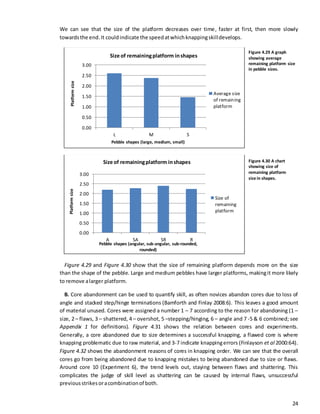
We can see that the size of the platform decreases over time, faster at first, then more slowly
towardsthe end. It couldindicate the speedatwhichknappingskilldevelops.
Figure 4.29 and Figure 4.30 show that the size of remaining platform depends more on the size
than the shape of the pebble. Large and medium pebbles have larger platforms, makingit more likely
to remove alarger platform.
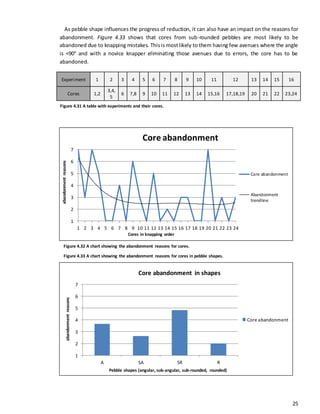
B. Core abandonment can be used to quantify skill, as often novices abandon cores due to loss of
angle and stacked step/hinge terminations (Bamforth and Finlay 2008:6). This leaves a good amount
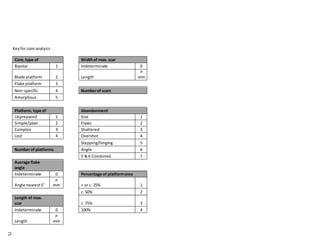
of material unused. Cores were assigned a number 1 – 7 according to the reason for abandoning (1 –
size, 2 – flaws, 3 – shattered, 4 – overshot, 5 –stepping/hinging, 6 – angle and 7 -5 & 6 combined; see
Appendix 1 for definitions). Figure 4.31 shows the relation between cores and experiments.
Generally, a core abandoned due to size determines a successful knapping, a flawed core is where
knapping problematic due to raw material, and 3-7 indicate knappingerrors (Finlayson et al 2000:64).
Figure 4.32 shows the abandonment reasons of cores in knapping order. We can see that the overall
cores go from being abandoned due to knapping mistakes to being abandoned due to size or flaws.
Around core 10 (Experiment 6), the trend levels out, staying between flaws and shattering. This
complicates the judge of skill level as shattering can be caused by internal flaws, unsuccessful
previousstrikesoracombinationof both.
0.00
0.50
1.00
1.50
2.00
2.50
3.00
L M S
Average size
of remaining
platform
Platformsize
Pebble shapes (large, medium, small)
Size of remainingplatform inshapes
0.00
0.50
1.00
1.50
2.00
2.50
3.00
A SA SR R
Size of
remaining
platform
Platformsize
Pebble shapes (angular, sub-angular, sub-rounded,
rounded)
Size of remainingplatform inshapes
Figure 4.29 A graph
showing average
remaining platform size
in pebble sizes.
Figure 4.30 A chart
showing size of
remaining platform
size in shapes.
25
As pebble shape influences the progress of reduction, it can also have an impact on the reasons for
abandonment. Figure 4.33 shows that cores from sub-rounded pebbles are most likely to be
abandoned due to knapping mistakes. Thisis mostlikely to them having few avenues where the angle
is <90° and with a novice knapper eliminating those avenues due to errors, the core has to be
abandoned.
Experiment 1 2 3 4 5 6 7 8 9 10 11 12 13 14 15 16
Cores 1,2
3,4,
5
6 7,8 9 10 11 12 13 14 15,16 17,18,19 20 21 22 23,24
1
2
3
4
5
6
7
1 2 3 4 5 6 7 8 9 10 11 12 13 14 15 16 17 18 19 20 21 22 23 24
Core abandonment
Core abandonment
Abandonment
trendline
abandonmentreasons
Cores in knapping order
1
2
3
4
5
6
7
A SA SR R
Core abandonment
Pebble shapes (angular, sub-angular, sub-rounded, rounded)
abandonmentreasons
Core abandonment in shapes
Figure 4.32 A chart showing the abandonment reasons for cores.
Figure 4.33 A chart showing the abandonment reasons for cores in pebble shapes.
Figure 4.31 A table with experiments and their cores.
26
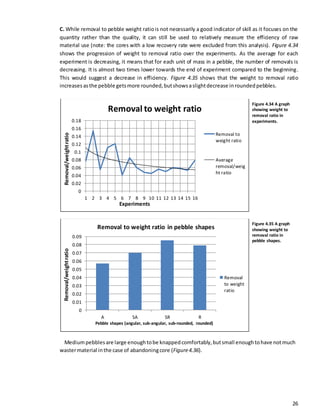
C. While removal to pebble weight ratiois not necessarily a good indicator of skill as it focuses on the
quantity rather than the quality, it can still be used to relatively measure the efficiency of raw
material use (note: the cores with a low recovery rate were excluded from this analysis). Figure 4.34
shows the progression of weight to removal ratio over the experiments. As the average for each
experiment is decreasing, it means that for each unit of mass in a pebble, the number of removals is
decreasing. It is almost two times lower towards the end of experiment compared to the beginning.
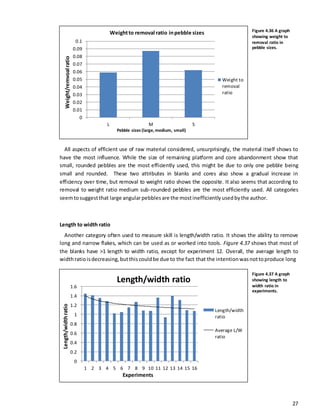
This would suggest a decrease in efficiency. Figure 4.35 shows that the weight to removal ratio
increases asthe pebble getsmore rounded,butshowsaslightdecrease inroundedpebbles.
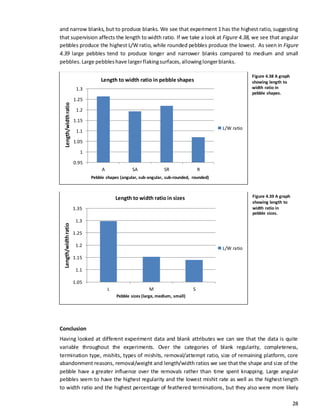
Mediumpebblesare large enoughtobe knappedcomfortably,butsmall enoughtohave notmuch
wastermaterial inthe case of abandoningcore (Figure4.36).
0
0.02
0.04
0.06
0.08
0.1
0.12
0.14
0.16
0.18
1 2 3 4 5 6 7 8 9 10 11 12 13 14 15 16
Removal to weight ratio
Removal to
weight ratio
Average
removal/weig
ht ratio
Experiments
Removal/weightratio
0
0.01
0.02
0.03
0.04
0.05
0.06
0.07
0.08
0.09
A SA SR R
Removal
to weight
ratio
Pebble shapes (angular, sub-angular, sub-rounded, rounded)
Removal to weight ratio in pebble shapes
Removal/weightratio
Figure 4.34 A graph
showing weight to
removal ratio in
experiments.
Figure 4.35 A graph
showing weight to
removal ratio in
pebble shapes.
27
All aspects of efficient use of raw material considered, unsurprisingly, the material itself shows to
have the most influence. While the size of remaining platform and core abandonment show that
small, rounded pebbles are the most efficiently used, this might be due to only one pebble being
small and rounded. These two attributes in blanks and cores also show a gradual increase in
efficiency over time, but removal to weight ratio shows the opposite. It also seems that according to
removal to weight ratio medium sub-rounded pebbles are the most efficiently used. All categories
seemtosuggestthat large angularpebblesare the mostinefficientlyusedbythe author.
Length to width ratio
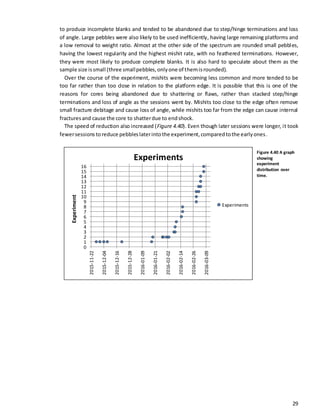
Another category often used to measure skill is length/width ratio. It shows the ability to remove
long and narrow flakes, which can be used as or worked into tools. Figure 4.37 shows that most of
the blanks have >1 length to width ratio, except for experiment 12. Overall, the average length to
widthratioisdecreasing,butthiscouldbe due to the fact that the intentionwasnottoproduce long
0
0.01
0.02
0.03
0.04
0.05
0.06
0.07
0.08
0.09
0.1
L M S
Weight to
removal
ratio
Pebble sizes (large, medium, small)
Weightto removal ratio inpebble sizes
Weight/remvoalratio
0
0.2
0.4
0.6
0.8
1
1.2
1.4
1.6
1 2 3 4 5 6 7 8 9 10 11 12 13 14 15 16
Length/width ratio
Length/width
ratio
Average L/W
ratio
Length/widthratio
Experiments
Figure 4.36 A graph
showing weight to
removal ratio in
pebble sizes.
Figure 4.37 A graph
showing length to
width ratio in
experiments.
28
and narrow blanks, but to produce blanks. We see that experiment 1 has the highest ratio, suggesting
that supervision affects the length to width ratio. If we take a look at Figure 4.38, we see that angular
pebbles produce the highest L/W ratio, while rounded pebbles produce the lowest. As seen in Figure
4.39 large pebbles tend to produce longer and narrower blanks compared to medium and small
pebbles. Large pebbleshave largerflakingsurfaces,allowinglongerblanks.
Conclusion
Having looked at different experiment data and blank attributes we can see that the data is quite
variable throughout the experiments. Over the categories of blank regularity, completeness,
termination type, mishits, types of mishits, removal/attempt ratio, size of remaining platform, core
abandonment reasons, removal/weight and length/width ratios we see that the shape and size of the
pebble have a greater influence over the removals rather than time spent knapping. Large angular
pebbles seem to have the highest regularity and the lowest mishit rate as well as the highest length
to width ratio and the highest percentage of feathered terminations, but they also were more likely
0.95
1
1.05
1.1
1.15
1.2
1.25
1.3
A SA SR R
L/W ratio
Length/widthratio
Pebble shapes (angular, sub-angular, sub-rounded, rounded)
Length to width ratio in pebble shapes
1.05
1.1
1.15
1.2
1.25
1.3
1.35
L M S
L/W ratio
Length/widthratio
Pebble sizes (large, medium, small)
Length to width ratio in sizes
Figure 4.38 A graph
showing length to
width ratio in
pebble shapes.
Figure 4.39 A graph
showing length to
width ratio in
pebble sizes.
29
to produce incomplete blanks and tended to be abandoned due to step/hinge terminations and loss
of angle. Large pebbles were also likely to be used inefficiently, having large remaining platforms and
a low removal to weight ratio. Almost at the other side of the spectrum are rounded small pebbles,
having the lowest regularity and the highest mishit rate, with no feathered terminations. However,
they were most likely to produce complete blanks. It is also hard to speculate about them as the
sample size issmall (three smallpebbles,onlyone of themisrounded).
Over the course of the experiment, mishits were becoming less common and more tended to be
too far rather than too close in relation to the platform edge. It is possible that this is one of the
reasons for cores being abandoned due to shattering or flaws, rather than stacked step/hinge
terminations and loss of angle as the sessions went by. Mishits too close to the edge often remove
small fracture debitage and cause loss of angle, while mishits too far from the edge can cause internal
fracturesand cause the core to shatterdue to endshock.
The speed of reduction also increased (Figure 4.40). Even though later sessions were longer, it took
fewersessions toreduce pebbleslaterintothe experiment,comparedtothe earlyones.
0
1
2
3
4
5
6
7
8
9
10
11
12
13
14
15
16
2015-11-22
2015-12-04
2015-12-16
2015-12-28
2016-01-09
2016-01-21
2016-02-02
2016-02-14
2016-02-26
2016-03-09
Experiments
Experiments
Experiment
Figure 4.40 A graph
showing
experiment
distribution over
time.
30
CHAPTER 6 – Discussion and conclusion
In this chapter we come back to the skill issues set out in the beginning chapters. Overview of the
results of the experiment and comparison with other novice data provides some insights into skill
development.
If the experiment has shown one thing it is that skill is indeed hard to quantify. There is no average
against which a skill level can be measured if we are not looking into replication attempts. There
needs to be a standard, which would allow an evaluation of a knapper’s performance (Stout
2002:705). One of the optionsis to compare knappers witheach other. There are a few ways of doing
this: comparing several experimental knappers to see the skill differences among them (Finlay 2008,
Stout 2002, Shelley 1990); comparing modern knappers to archaeological data (Roux et al 1995,
Winton 2005); or comparing archaeological assemblages together, to draw certain conclusions about
knapping skill and its social role in general (Bleed 2008, Bamforth and Hicks 2008). Employing the first
method, in Figure 5.1 we see the distal terminations in experimental work of more experienced
knappers, with the author’s results at the bottom. We can see a much lower percentage of feather
terminations, with a higher occurrence of abrupt terminations. Plunging and jagged terminations are
also more common in the novice assemblage. With the lower numbers in desirable terminations and
more terminations that are attributed to knapping errors, this assemblage shows clear signatures of
novice skill.
0% 20% 40% 60% 80% 100%
Author
A
B
C
D
Feather
Abrupt
Hinge
Jagged
Plunging
Distal termination
0%
10%
20%
30%
40%
50%
60%
70%
80%
90%
100%
A C D E Author
Irregular
Feathered
Plunging
Hinge
Abrupt
Distal termination
Figure 5.1 A graph
showing the
comparison of distal
terminations in
experienced
knappers’
assemblages and
author’s assemblage
(Finlay, 2008:76-77,
data used with
permission)
Figure 5.2 A graph
showing the
comparison of distal
terminations in
experienced
knappers’
assemblages and
author’s assemblage
(Finlay, 2008:83, data
used with
permission)
31
Figure5.2 showsa comparisonof author’sdata withanotherexperimental datafromknappersof
varyingskill levels. Yetagain,we cansee a highnumberof stepterminationsanda low percentage of
featheredterminations. Duringthe experimentthe knapperswereplacedintothree groupsaccording
to previousexperience andself-evaluationskill:A – experienced,CandD – mediocre,E–
inexperienced. The author’sassemblage isinthe rightmostcolumn.These experimentsweredone
withsimilarbeachflintpebbles,fromIslay(Finlay2008:74). KnappersC– E workedina group
knappingsession,whichcouldhave influencedthe outcomesof lessexperiencedknappers(Finlay
2008: 83). Note,that the amountof hinge terminationsissimilaramongall skill levels.Thisismost
likelydue torawmaterial variability. WhatisalsointerestingthatknapperE,producedahigher
percentage of featheredterminations,comparedtomore skilledknappers.Finlaynotesthatthiscan
come from biasesof sample sizes,butitshowsthat“it may onlytake on successful eventinseveralto
realise the goalsof production”(Finlay2008:85). Additionally,the qualityandsize of the rawmaterial
can resultinnovice level blanks,evenif the toolmakerisskilful (Milne 2005:331). If we lookat the
example in IrianJaya,groupactivities, engagingbothmasterandnovice adze makers,involve
procurementandtool making. Duringthese activities,the experiencedknappersteachthe
inexperiencedonesandtheycheerone anotherwithasuccessful knappingevent(Stout2002:696-
698). Aswe have seenfromthe lithicanalysisof thisexperimentthe variabilityinthe assemblageis
closelytiedtothe variabilityinraw material. Indeed,itisrecognised,thatone of the hardeststepsfor
a novice to overcome isthe abilitytoadaptto variousfluctuationsof raw material andthe outcomes
of knappingattempts(Roux etal1995:80). As mentionedbefore problemsolvingisamajor part of
this(see Chapter3).Groupactivitiesgreatlyincreaseproblem-solvingcapabilities of each individual
(MingChiu2000:27), thus makingthe visibleskilllevelinassemblagesproduced duringgroup
sessionshighercomparedto individual work.
Knapping skill development
Scholars not only have difficulty in describing and formulating a definite interpretation of individual
skill, but they also have limited resources of finding prehistoric individuals, as “the archaeological
record is not the best place to start the search, especially as we have only generalities about what
distinguishes one knapper from another in the lithic record” (Eren et al 2011:230). Even if it is
possible to distinguish individuals, how can we determine the degree to which skill-related criteria
reflect skill and how dowe take into account the various other factors of skill expression? As mistakes
are the only evaluations of skill visible in material remains (Bleed 2008:159) and we have seen both
from this experiment and similar ones that knappers of all skill levels can and do make them,it is very
hard to discern the reasons for the occurrence of particular mistakes in the first place, making the
measurement of skill a complicated matter. The problem is that it is easier to track the skill only at
extremesof the spectrum,butitismuch harderto notice mediocre performances(Finlay2008:87).
These are the questionsposedat the beginningof the experimentwithanswersformulatedbelow:
 How doesthe size andshape of the pebble affectthe learningprocess?
We have seen that the pebble size and shape had varying effects on the observed lithic attributes
that were used to measure skill. If we take a look at Figure 5.3 we see the combination of novice
mistakes in pebble sizes. While differing at particular attributes, it seems that overall all of the pebble
sizeshave the same amountof influence overthe outcomesof knapping.
32
Figure 5.4 showsthe novice mistakesinpebbleshapes. Similarlytothe sizes,pebbleshapeshave
more or lessequal influence over the outcomesof reductioninthisexperiment.
To fully answer the question, it important to define the learning process of skill in flint knapping,
but, as mentioned before, it is very problematic. We see that if looking at a single category, pebble
shapes and sizes have different effects on the results, but all together, they seem to be similarly
affectingthe learningprocess.
 What isthe learningcurve inflintknapping?
Trying to answer this question we run into the same problems as most scholars. It is possible to have
a general learning curve (Figure 5.5), but to draw it for an individual from a lithic assemblage is very
hard if not impossible. Figure 5.6 shows the learning curve, where the skill is measured by successful
removals throughoutthe experiments.Itisalso placedinthe general curve. While the experiments’
0.0%
10.0%
20.0%
30.0%
40.0%
50.0%
60.0%
70.0%
80.0%
90.0%
100.0%
L M S
Novice mistakes in pebble sizes
Novice
mistakes
%ofassemblage
Pebble sizes (large, medium, small)
0.0%
10.0%
20.0%
30.0%
40.0%
50.0%
60.0%
70.0%
80.0%
90.0%
100.0%
A SA SR R
Novice mistakes in pebble shapes
Novice
mistakes
%ofassemblage
Pebble shapes (angular, sub-angular, sub-rounded,
rounded)
Figure 5.3 A chart
showing the novice
mistakes in pebble
sizes (the harmonic
means of irregular,
broken, step/hinge
terminating blank
percentages, mishit
percentages,
removal/attempt
rate and the size of
platform
percentages).
Figure 5.4 A chart
showing the novice
mistakes in pebble
shapes (the
harmonic means of
irregular, broken,
step/hinge
terminating blank
percentages, mishit
percentages,
removal/attempt
rate and the size of
platform
percentages).
33
Figure 5.6 A chart showing the novice mistakes in experiments with a “learning curve” and its placement in the
general learning curve (Figure 5.5).
Figure 5.5 Model of individual knapping skill as it relates to the life cycle. (Clark 2003:223, Figure 16.2).
34
“learning curve” goes down with time,it would gradually go up and follow the general learning curve.
Thisshowsthe variabilityanddynamicnature of skill.
 Do the attributes most commonly associated with novices show up in the lithic
assemblage?
We have seen in Chapter 5 that the attributes indeed show up in the assemblage and correspond
with the results of other experimental data (Shelley 1990; Ferguson 2008a, 2008b; Grimm 2000:54;
Apel 2001, 2008; Bleed 2008; Bamforth and Finlay 2008; Finlay 2008). We have also seen that the
attributes vary greatly throughout the experiment, some suggesting a gradual increase in skill, others
showing a gradual decrease, highlighting some of the problems of skill recognition in lithic
assemblages.
 Doestime betweenthe sessionsaffectthe learningcurve?
While it is hard to accredit certain mistakes to time gaps between sessions, in some cases we can see
that the successful knapping (Figure 5.6) is down at experiments 9, 10, which were carried out after a
two week break from knapping. Olausson compared knapping skill acquisition to skill development in
music (2008:43). Similar to learning to play a musical instrument, for certain motor and cognitive
skillstodevelop itisimportanttopractice routinely(StoutandChaminade 2007:1098).
Conclusion
The experimenthasshownthat skill isindeed difficulttoquantify,defineandtrack. The skill
signatures,contrarytoauthor’sexpectations,turnedouttobe veryvariedand have suggested
differentratesandtrendsof skill development. The closenessof lithicanalysis andflintknapping
resemble the dualityof skill –by gainingsome knowledgeaboutlithicstudies,the author has
improvedhisflintknappingabilities andbyimprovingflintknappingabilities,the authorhasgained
knowledge onstone knapping.The interplayof these twoaspectsproducedadeeperunderstanding
of bothskill inflintknappingandthe lithicsthemselves.Nevertheless, skill acquisitionisstill a
problematictopic. The small sample sizeof this experimenthasproducedsome biasedresults. The
recordingof knappingprocess alsogotinthe wayof a more free-formindividual experimental
knapping.The uncontrolledvariabilityof raw material provedtobe a biggerproblemthan
anticipated. The authorwouldbe gladandinterestedtosee furtherlargerscale andlonger
experimentationsinthe future. The use of glassas the raw material couldeliminate the rawmaterial
variability,whichplayedamajorrole inthe inconsistencyof skill signatures. The authoragreeswith
P. Kelteborn,whostatesthat“withoutaclimate thatencouragescooperationandconstructive
dialogues,aswell asinvolvementsincommonprojectsamongacademicarchaeologists,controlled
experimenters,andtraditionalreplicative flintknappers,progresswillremainslow forall parties
involved”(Kelteborn2003:131).
Words intext:10 890
35
Bibliography:
AndrefskyW. Jr.
2001 Lithic debitage:context,form,meaning. SaltLake City:The Universityof UtahPress
AndrewsB.
2003 MeasuringPrehistoricCraftsmanSkill:ContemplatingItsApplicationto
MesoamericanCore-BladeResearchinHirth K.G. (ed.) Mesoamerican Lithic
Technology:Experimentation and Interpretation:208-219. SaltLake City:The
Universityof UtahPress
Apel J.
2001 DaggersKnowledge&Power:the Social Aspectsof Flint-DaggerTechnology in
Scandinavia 2350-1500 cal BC. Uppsala:Coast to coast project
2008 Knowledge,Know-howandRaw Material – The Productionof Late NeolithicFlint
Daggersin Scandinavia.Journalof ArchaeologicalMethod and Theory 15: 91-111
Apel J. and Knutsson K.
2006 SkilledProductionandSocial Reproduction –an introductiontothe subjectinApel J.
and KnutssonK.(eds.) Skilled Production and SocialReproduction Aspectsof
TraditionalStone-toolTechnologies:Proceedingsof a Symposiumin Uppsala,August
20-24, 2003: 11-24. Uppsala: Societas ArchaeologicaUpsaliensis
Bamforth D. B. and Hicks K.
2008 ProductionSkill andPaleoindianWorkgroupOrganizationinthe MedicineCreek
Drainage,SouthwesternNebraska. Journalof ArchaeologicalMethod and Theory 15:
132-153
Bamforth D. B. and FinlayN.
2008 Introduction:Archaeological ApproachestoLithicProductionSkill andCraftLearning.
Journalof ArchaeologicalMethod and Theory 15: 1-27
Barnes A. S.
1939 The DifferencesBetweenNatural andHumanFlakingonPrehistoricFlint
Implements. American Anthropologist41 (1):99-112
BleedP.
1996 Riskand Costin Japanese Microcore technology. Lithictechnology 21(2): 95-107
2008 Skill Matters. Journalof ArchaeologicalMethod and Theory 15: 154-166
36
Bordes F.
1978 Commentson“A Historyof Flint-KnappingExperimentation,1838-1976” byJohnson
L. L. CurrentAnthropology 19(2): 359-360
Carr P. J. and Bradbury A. P.
2010 Flake DebrisandFlintknappingExperimentationinFergusonJ.R. Designing
ExperimentalResearch in Archaeology.Examining Technology Through Production
and Use:71-91. Boulder:UniversityPressof Colorado
Clark J. E.
2003 CraftsmanshipandCraftSpecializationinHirthK.G. (ed.) MesoamericanLithic
Technology:Experimentation and Interpretation:220-233. SaltLake City:The
Universityof UtahPress
Corbetta D.
2005 DynamicInteractionsbetweenPosture,Handedness,andBimanual Coordinationin
Human Infants:WhyStone Knappingmightbe aUniquelyHomininBehaviourinRoux
V.and Bril B. (eds.) Stoneknapping thenecessary conditionsfora uniquely hominin
behaviour:187-204. Cambridge:McDonaldInstitute of Archaeological Research
Crabtree D. E.
1972 An Introduction to Flintworking Pocatello:IdahoState UniversityMuseum
Dibble H. L. and WhittakerJ. C.
1981 NewExperimental Evidence onthe RelationBetweenPercussionFlakingandFlake
Variation. Journalof ArchaeologicalScience8: 283-296
Eren M. I., Bradley B. A., Sampson C. G.
2011 Middle PalaeolithicSkillLevel andthe Individual Knapper:anExperiment. American
Antiquity76(2): 229-251
FergusonJ. R.
2008a An Experimental Testof the Conservationof Raw Material inFlintknappingSkill
Acquisition. LithicTechnology 28(2): 113-131
2008b The When,Where and How of NovicesinCraftProduction. Journalof Archaeological
Method and Theory 15: 51-67
FinlayN.
2008 BlankConcerns:Issuesof Skill andConsistencyinthe Replicationof ScottishLater
MesolithicBlades. Journalof ArchaeologicalMethod and Theory 15: 68-90
37
2012 Foragersto Farmers.The EarlierPrehistoryof Bute inDuffyP.(ed.) OneIsland,Many
Voices:Bute, Archaeology and theDiscoverButeLandscapePartnership Scheme:37-
51. Donington:ShaunTyas
2015 Kid-knappedKnowledge:ChangingPerspectivesonthe ChildinLithicStudies.
Childhood in the Past: an InternationalJournal8 (2): 104-112
FinlaysonB., Finlay N.and MithenS.
2000 The CataloguingandAnalysisof the LithicAssemblagesin MithenS.(ed.) Hunter-
gathererlandscapearchaeology:TheSouthern HebridesMesolithicProject1988-1998
vol.1 & 2: 61-72. Cambridge:McDonaldInstitute forArchaeological Research
FischerA.
1990 A late paleolithic“school”of flint-knappingatTrollesgave,Denmark.Resultsfrom
refitting. ActaArchaeologica 60: 33-50
Gamble C.
2008 Archaeology:theBasics. Oxford:Routledge
GoodyE. N.
1989 Learning,apprenticeshipandthe divisionof labourinCoyM. W. (ed.)
Apprenticeship:FromTheory to Method and BackAgain:163-193. Albany:SUNYPress
GrimmL.
2000 Apprentice flintknapping:relatingmaterialculture andsocial practice inthe Upper
PalaeolithicinSofarDerevenski J.(ed.) Children and MaterialCulture: 53-71. London:
Routledge
Harlacker L.
2006 Knowledgeandknow-how inthe Oldowan:anexperimental approach inApel J.and
KnutssonK.(eds.) Skilled Production and SocialReproduction Aspectsof Traditional
Stone-toolTechnologies:Proceedingsof a Symposiumin Uppsala,August20-24,
2003: 219-243. Uppsala:SocietasArchaeologicaUpsaliensis
Högberg A.
2008 PlayingwithFlint:TracingaChild’sImitationof AdultWorkina LithicAssemblage.
Journalof ArchaeologicalMethod and Theory 15: 112-131
IngoldT.
1993 Tool-use,socialityandintelligence inGibsonK.R.andIngoldT. (eds.) Tools,Language
and Cognition in Human Evolution: 429-445. Cambridge:Cambridge UniversityPress
38
Inizan M.-L.,Reduron-BallingerM.,Roche H. and TixierJ.
1999 Technology and Terminology of Knapped Stone. TranslatedbyFéblot-AugustinsJ.
Nanterre:CREP
Iriki A.
2005 A prototype of Homo faber:A silentprecursorof humanintelligence inthe tool-using
monkeybraininDehaene S.,Duhamel J.-R.,HauserD.and Rizzolatti G.(eds.) From
monkey brain to human brain:A FYssen Foundation symposium:253-271. Cambridge,
MA: MIT Press
JohnsonL. L.
1978 A Historyof Flint-KnappingExperimentation,1838-1976. CurrentAnthropology
19(2): 337-372
Johnson-FreyS.H.
2003 What’s So Special aboutHumanTool Use? Neuron 39: 201-204
2004 The Neural Basesof Complex Tool Use inHumansin Trends.CognitiveSciences 8(2):
71-78
KeeleyL.H. and NewcomerM. H.
1977 MicrowearAnalysisof Experimental FlintTools:aTestCase.Journalof Archaeological
Science 4: 29-62
KeltebornP.
2003 Measurable Flintknapping inHirthK.G. (ed.) Mesoamerican LithicTechnology:
Experimentation and Interpretation:120-131. SaltLake City:The Universityof Utah
Press
KellerC. and KellerJ.
1996 Cognition and tooluse:The Blacksmith atwork. New York: Cambridge University
Press
KingeryW. D. (ed.)
1996 Learning fromThings:Method and Theory of Material CultureStudies. Washington:
SmithsonianInstitutionPress
Lave J. and WengerE.
1991 Situated Learning:Legitimate peripheralparticipation. Cambridge:Universityof
Cambridge Press
Maclain D.
1995 Sedimentology. Oxford:OxfordUniversityPress
39
Mauss M.
1979 The Notionof Body TechniquesinMaussM. Sociology and Psychology.Essays.
London:Routledge &KeganPaul
Marshall G.
2000 The Distributionof BeachPebble FlintinWesternScotlandwithReference toRaw
Material Use duringthe Mesolithicin MithenS.(ed.) Hunter-gathererlandscape
archaeology:TheSouthern HebridesMesolithicProject1988-1998 vol. 1 & 2: 75-78.
Cambridge:McDonaldInstitute forArchaeological Research
Milne S. B.
2005 Paleo-EskimoNovice Flintknappinginthe EasternCanadianArtic. Journalof Field
Archaeology 30: 329-345
Ming Chiu,M.
2000 Group Problem-SolvingProcesses:Social InteractionsandIndividualActions. Journal
of the Theory of SocialBehaviour30(1): 27-49
MithenS., Marshall G.,Dopel B. and Lake M.
2000 The Experimental Knappingof FlintBeachPebbles inMithenS.(ed.) Hunter-gatherer
landscapearchaeology:TheSouthern HebridesMesolithicProject1988-1998 vol.1 &
2: 529-540. Cambridge:McDonaldInstitute forArchaeological Research
McCall G.(ed.)
2011 Pushing theEnvelope:ExperimentalDirections in the Archaeology of StoneTools.
NewYork:Nova
NilssonS.
1838 Skandinaviska NordensUrinvanare translatedintoEnglishbyLubbockJ.1868 The
Primitive inhabitantsof Scandinavia.London:Longmans,Greenandco.
OakleyK. P.
1949 Man the Tool-Maker. London:Bortholomew Press
Odell G.H.
1996 StoneTools: Theoretical Insightsinto Human Prehistory. New York:Plenumpress
2004 Lithic Analysis. New York:KluwerAcademic/PlenumPublishers
OlaussonD.
1998 DifferentStokesforDifferentFolks:PossibleReasonsforVariationinQualityof
Knapping. Lithic Technology 23(2):90-115
40
2010 ExperimentalFlintknappingReplication –A Valuable Methodof Archaeological
AnalysisinNami H.G. (ed.) Experiments and Interpretation of Traditional
Technologies:Essays in Honorof Errett Callahan:37-56. Buenos Aires:Ediciones de
ArqueologiaContemporanea
PelegrinJ.
1990 PrehistoricLithicTechnology:Some aspectsof research. ArchaeologicalReview from
Cambridge9: 116-125
PrestwichJ.
1859 On the Occurrence of Flint-implements, associatedwiththe Remainsof Extinct
Mammalia, inUndisturbed Bedsof a late Geological Period.Proceedingsof theRoyal
Societyof London 1859-1860 10:50-59, published 1 January 1859
Roux V, Bril B. and DietrichG.
1995 Skillsandlearningdifficulties involvedinstone knapping:the case of stone-bead
knappinginKhambhat, India. World Archaeology 27(1):63-87
Serway R. A. and JewettJ. A., Jr.
2010 Physics forScientists and Engineers with Modern Physics, Eighth Edition.Belmont,
USA: Brooks/Cole
ShelleyP.H.
1990 VariationinLithicAssemblage:AnExperiment. Journalof Field Archaeology 17(2):
187-193
Sinclair A.
1995 The technique asa symbol inLate Glacial Europe. World Archaeology 27:50-62
SpierR. F. G.
1975 Skill asa Componentof Technological Complexity inRaymondJ.S., Loveseth B.,
Arnold C.and Reardon G. (eds.) PrimitiveArt and Technology:162-166. Calgary:
University of Calgary Archaeological Association
StevensE. T.
1870 Flint chips: A guideto pre-historicarchaeology,asillustrated by thecollection of the
BlackmoreMuseum.London:Bell andDaldy
Stout D.
2002 Skill andCognition inStone Tool Production:anEthnographicCase Study fromIrian
Jaya. CurrentAnthropology 43(5):693-722
41
Stout D. and Chaminade T.
2007 The Evolutionary Neuroscienceof Tool Making.Neuropsychologia 451091-1100
WhittakerJ. C.
1994 Flintknapping.Making and Understanding StoneTools.Austin:Universityof Texas
Press
Wickham-JonesC.R. and CollinsG.H.
1978 The sourcesof flintandchertin northernBritain. Proceedingsof theSocietyof
Antiquariesof Scotland 109:7-21
WintonV.
2005 An Investigationof Knapping-skillDevelopmentinthe Manufacture of Palaeolithic
Handaxes inRoux V.and Bril B. (eds.) Stoneknapping thenecessary conditionsfora
uniquely hominin behaviour:109-117. Cambridge:McDonaldInstitute of
Archaeological Research
WymerJ.
1994 Introduction:Raw MaterialsandPetrology –An Overview inAshtonN.andDavidA.
(eds.) Storiesin Stone.Proceedingsof Anniversary ConferenceatStHilda’s College,
Oxford,April1993: 43-44. London:LithicStudiesSociety
Websites:
https://archive.org/details/Prehistoricstoneworkingtechniques-wellcomeA videoshowingL.Coutier’s
flint-knappingandtool replicationsessionin1947 accessed10/12/2015
42
Appendices:
Appendix1 – List of definitions. The debitage analysis was done using Microsoft Excel™. Pieces
are analysed with proximal end towards the observer, ventral surface downward. Definitions
in the text, assemblage catalogue and the experiment sheets are as follow:
Size of the original pebble
Medium pebbles are approximately fist sized (Finlayson et al 2000).
Techniques
Bipolar technique implies a reduction technique where the core is supported on an
anvil.
Platform technique implies a reduction technique where the core is hand-held and
flaked from one surface – a platform.
PSI
Primaryremoval – the dorsal surface iscompletelycoveredincortex.
Secondaryremoval –the dorsal surface ispartiallycoveredin cortex,there are scars from
previousremovals.
Tertiaryremoval – no cortex presentonthe dorsal surface.
Cortex,type of
Smooth/chalky –thiscortex remainssoftandcan easilybe scratched.Itis similartothe
cortex on a freshpiece of chalkflint.
Smooth/hard – thisappearsas smooth/chalky,butthe cortex hasbeenpartiallyabradedand
has lostitschalkynature.
Pitted– the surface of the cortex has a pittedappearance.
Semi-battered–the cortex has beenatleastpartiallybatteredandrolled,butnotall
surfaceshave beensignificantlyaltered.
Heavilybattered –thisdescribesacortical surface that showsevidence forsubstantial
batteringandabrasion(Finlayson etal2000)
Cortex,location of. The locationof the cortex on the dorsal surface.
Blank
Blade – a flake thatis at leasttwice as longas itis wide and showsevidenceof parallel
removalsonthe dorsal face (Inizan et al 1999).
43
Core openingflake –a flake thatwas producedusingbipolartechnique,whenopeningthe
pebble.
Blade-like flake –a flake thatfitsthe measurementdescriptionof the blade,buthas
unparalleledlateraledges.
Cortex flake –a flake thatiscompletelymade of cortex.
Core rejuvenationflake/blade –a flake/blade thathasevidence of step/hingeterminationsof
the dorsal face,and a level ventral face,creatingagoodflakingsurface.
Flake – fragmentof hard stone that isremoved(Inizan etal1999).
Brokenflake – a flake thathas beenbroken intotwoormore pieces,which are c.45%of the
original flake.
Splinteredflake - aflake thathas splinteredintothree ormore pieces,whichare >35%of the
original flake.
Bulbof percussion –a more or lesspronouncedconchoidal relief,whichformsonthe ventral
face of the flake,radiatingfromthe point of impact(Inizan etal 1999).
Cone – linkingthe butttothe bulbitis a fissure thatdevelops inthe formof aright-angled
cone from the platform, whenthe percussionisnot followedbyaremoval (Inizan etal 1999).
Fissure – a small markformedon the ventral surface of the flake,followingthe force of
impact.
Ripple –a relief onthe ventral surface of the flake, followingthe compressionwave.
Lip – a small ridge onthe buttof the flake. Typicallyassociated withsoft-hammer(Inizan etal
1999).
Proximal end
Spalling–showingevidence of smallerpiecesfallingof alargerone.
Hinge – a shape createdbythe fracture plane archingupward,interceptingthe dorsal surface
prematurely(Inizan etal 1999).
Step– see steptermination.
Erailleur – a small scar onthe dorsal surface of a flake, nearthe proximal end.
Distal termination
Hinge/steptermination –a shape createdby the fracture plane suddenlyinterceptingthe
dorsal surface,producinga hinge or a stepon the flakingsurface (Inizan etal 1999).
Plunging–a removal,whose fracture planearchesinward,removingalargerpiece.
Feathered –a gradual thinningof aflake,resultinginasharp edge or point.
44
Dorsal scar pattern
Longitudinal –previousremovalsthatcanbe seenonthe blank’sdorsal surface runinthe
same directionasthe blank(Finlayson etal2000).
Opposed – previousremovalsruninthe opposite directionof the blank(Finlayson etal
2000).
Crossed – previousremovalsrunperpendiculartothe blank(Finlayson etal 2000).
Multi-directional –previousremovalsruninseveral differentdirections(Finlayson etal
2000).
Remainingplatform, size of. The size of remainingplatformisdeterminedbasedonitslengthand
widthinrelationtothe widthandthe lengthof the blankrespectfully(Lp – lengthof the platform,Wp
– widthof the platform,Lb – lengthof the blank,Wb – widthof the blank):
Pointonly Lp < 33% Wb Wp < 33% Lb
Small/narrow 33% Wb < Lp < 66% Wb Wp < 33% Lb
Small/wide 33% Wb < Lp < 66% Wb 33 % Lb < Wp < 66% Lb
Broad/narrow 66% Wb < Lp 33% Lb < Wp < 66% Lb
Large 66% Wb < Lp 66% Lb < Wp
Crushed – the platformhasbeencrushed.Thisismostcommon usingbipolartechnique.
Dimensions Measurementswere made usingcallipers andrecordedinmillimetres.The removals
are orientedwiththe proximal endtowardsthe observer,dorsal surface downward. The lengthisthe
maximumdistance at90° fromthe platform.The widthisthe widestpartof the blank,takenat90° of
length. Thicknessisthe thickestpartof the blank,takenat90° to the lengthandwidth. Lengthof
pebblesisthe maximumdimension,withothersmeasuredat90° as above (Finlayson etal2000). For
the lengthof scars on coressame rulesapply.
Regularity Indicates whetherthe blankis regular(more than10 mmof acute straightedge) or
irregular(lessthan10 mm or none) (Finlayson etal 2000).
Core abandonment
Size – thismeansthat the core wasabandoneddue tobeingtoosmall to safelywork hand-
held.
Flaws– thismeansthat there were problemswiththe raw material itself (fissures,inclusions,
vugs,etc.)
45
Shattered – the core wasabandoneddue toshattering.Itisindeterminate whetheritwas
due to faultswithinraw material orendshockdue to previousmishits.
Overshot– thismeansthat the core was abandonedafterthe removal of anovershotflake
(where the base of the core was removed) (Finlayson etal 2000)
Stepping/hinging–the core hasbeenabandoneddue tostep/hingeterminationstothe
flakingsurface,meaningfurtherflakingwasimpossible orrequiredcore rejuvenation,which
was notundertaken.
Angle – the core was abandoneddue tolossof angle betweenthe platformandthe flaking
surface.
In the experimentsheets,the abbreviationsare asfollows:
P1, P2, P3 … - Platform1,2, 3 …
SFD – Small fracture debitage (<10mm maximumdimension)
TCTE – mishit,indicatingthatthe strike wastooclose to the edge.
TFFE – mishit,indicatingthatthe strike wastoofar fromthe edge.
MH – mishit.Indicatesthatthe hammerstone strucknot at the intendedspot.
46
Appendix2 – Example of experimentsheetwithphotos*
*experimentsheetswithphotoscanbe foundinthe electronicappendix inthe attachedCD. Here
the sheetforexperiment 2core 1 is includedasanexample.
Experiment 2 : Core 1
Raw Material: flintbeachpebble#7
Recoverylocation: KilchattanBay,Isle of Bute
Cortex:pitted
Maximumdimensions:length 8.5 cm; width 5.6 cm; thickness 5.2 cm
Weight:319.6 g
Openingstrategy: bipolar
Platform 1: Unprepared/ Simple / Complex
Platform 2: Unprepared/ Simple / Complex
47
Technology:platform/ bipolar
Hard hammer / softhammer
Strike Prep (Y/N)
Removal / miss-
hit
Notes
Bipolar opening of the pebble
1 N
Tough to open the pebble at first. Upon opening the
pebble splitintohalf.One half intact,othersplit into 2
big flakes (#1 & #2), which are possible cores and two
small primary flakes (#3 & #4) + SFD
2 N
3 N
4 N
5 N
6 N Opened
Weightof core: 167.49 g Weightof debitage: 149.77 g
48
Technology:platform / bipolar
Hard hammer / softhammer
Strike Prep (Y/N) Removal /miss-hit
Notes
P1
7 Y MH TCTE + SFD
8 Y MH TCTE + SFD
9 Y Flake in 2 pcs. Primary flake (#5 & #6) in 2 pcs.
10 Y Flake Small secondary flake #7. Step termination.
11 Y MH TCTE + SFD
12 Y MH TCTE + SFD
Weightof core: 155.87 g Weightof debitage: 10.10 g
49
Technology:platform / bipolar
Hard hammer / softhammer
Strike Prep (Y/N) Removal /miss-hit Notes
13 Y Flake in 2 pcs. Broken secondary flake (#8 & #9) in 2 pcs. + SFD.
14 Y MH TFFE
15 Y MH TCTE + SFD
16 Y MH TCTE. Shattered tertiary flake (#10 & #11) + SFD
17 Y MH TFFE
18 Y MH TCTE
Weightof core: 144.20 g Weightof debitage: 10.65 g
50
Technology:platform / bipolar
Hard hammer / softhammer
Strike Prep (Y/N) Removal /miss-hit Notes
19 Y Flake Secondary flake #12. Step termination.
20 Y MH TFFE
21 Y Flake in 2 pcs. Brokenprimaryflake #13&14 in 2 pcs.Steptermination.
22 Y MH TFFE
23 Y MH TFFE
24 Y MH TFFE
Weightof core: 141.59 g Weightof debitage: 2.19 g
51
Technology:platform / bipolar
Hard hammer / softhammer
Strike Prep (Y/N) Removal /miss-hit Notes
25 Y MH TFFE
26 Y Flake in 3 pcs.
Secondary flake (#15, #16, #17) in 3 pcs. Step
termination.
27 Y MH TCTE. Secondary flake #18. Step termination.
28 Y MH TCTE
29 Y MH TFFE
30 Y Flake Small secondary flake #19. Created a crack nearby.
Weightof core: 131.46 g Weightof debitage: 9.60 g
52
Technology:platform / bipolar
Hard hammer / softhammer
Strike Prep (Y/N)
Removal / miss-
hit
Notes
31 N Flake Primary flake #20. Step termination.
32 Y MH TFFE
33 Y MH TCTE + SFD
34 Y Flake
Secondary flake #21. The pebble is revealed to be very
heterogeneous and with a lot of inclusions.
35 Y MH TFFE
36 Y MH TCTE + SFD
Weightof core: 100.57 g Weightof debitage: 30.65 g
53
Technology:platform / bipolar
Hard hammer / softhammer
Strike Prep (Y/N)
Removal / miss-
hit
Notes
37 Y MH TFFE
38 Y MH TCTE. SFD
39 Y Flake Secondary flake #22. Step termination.
40 Y MH TCTE. SFD
41 Y MH TCTE. SFD
42 Y MH TCTE
Weightof core: 85.77 g Weightof debitage: 14.49 g
Movingto Platform2. P2 createdby Strike 39, removal of flake #22. P2 iscrossedwithP1.
54
Technology:platform / bipolar
Hard hammer / softhammer
Strike Prep (Y/N)
Removal / miss-
hit
Notes
P2. Tryingto fix stepterminationsfrompreviousmistakes.
43 Y MH TCTE
44 Y MH TCTE. SFD. Step termination.
45 Y MH TFFE
46 Y MH TFFE
47 Y Flake Secondary flake #23
48 Y MH TFFE
Weightof core: 77.50 g Weightof debitage: 7.67 g
Back to P1 as tryingto fix previousmistakesonlycreatesnew ones.
55
Technology:platform / bipolar
Hard hammer / softhammer
Strike Prep (Y/N)
Removal / miss-
hit
Notes
P1
49 Y MH TCTE + SFD
50 Y MH TCTE
51 Y MH TCTE
52 Y Flake Tertiary flake #24
53 Y MH TCTE
54 Y Flake in 2 pcs. Tertiary flake (#25 & #26) in 2 pcs.
Weightof core: 75.76 g Weightof debitage: 1.3 g
Back to P2. Loss of angle meansthat P1 has to be abandoned.
56
Technology:platform / bipolar
Hard hammer / softhammer
Strike Prep (Y/N)
Removal / miss-
hit
Notes
P2
55 Y Flake Large secondary flake #27 + SFD
56 Y MH TCTE
57 Y MH
TCTE. After closer inspection P2 broken off into 2 tertiary
flakes (#28 + #29).
Weightof core: 54.86 g Weightof debitage: 19.54 g
Core abandoneddue tolossof angle,lossof platforms,andstepterminationstothe flaking surface.
Appendix3 – Lithic analysisdata
Keyfor debitage analysis Blank Ripple Dorsal surface
Blade (width>8mm) 1 Absent 0 Absent 0
Technology Blade chip(width<5mm) 2 Present 1 Step 1
Bipolar 1 Blade narrow(width5-8mm) 3 Hinge 2
Platform 2 Core openingflake 4 Lips Step& Hinge 3
Chunk 5 Absent 0
PSI Blade-like flake 6 Present 1 Dorsal scar pattern
Primary 1 Core rejuvenationflake/blade 7 Absent 0
Secondary 2 Flake 8 Proximal end Longitudinal 1
Tertiary 3 Indeterminate 9 Absent 0 Opposed 2
Brokenflake 10 Abrupt 1 Crossed 3
Cortex,type of Splinteredflake 11 Spalling 2 Multi-directional 4
Absent 0 Hinge 3
Smooth/chalky 1 Bulb of percussion Jagged/irregular 4 Remainingplatform, size of
Smooth/hard 2 Absent 0 Erailleur 5 Indeterminate 0
Pitted 3 Pronounced 1 Pointonly 1
Semi-battered 4 Diffuse 2 Distal termination Small/narrow 2
Heavilybattered 5 Flat 3 Absent 0 Small/wide 3
Abrupt 1 Broad/narrow 4
Cortex,location of Cones Hinge 2 Large 5
Absent 0 Absent 0 Plunging 3 Crushed 6
Proximal 1 Present 1 Feathered 4
Distal 2 Spalling 5 Regularity
Lateral right 3 Fissures Irregular 6 Irregular 0
Lateral left 4 Absent 0 Regular 1
Combination 5 Present 1
Total 6
57
No of Experiment.
Core.Flake
Technology
PSI
Cortex,type
of
Cortex,
locationof
Blank
Bulbof
percussion
Cones
Fissures
Ripple
Lips
Proximal
end
Distal
termination
Dorsal
surface
Dorsalscar
pattern
Remaining
platform,
sizeof
Length
(mm)
Width(mm)
Thickness
(mm)
Regularity
Length/
Width
ratio
1.1.1 1 1 3 6 4 0 0 0 0 0 1 3 0 0 6 46.1 58.2 40.2 1 0.79
1.1.3 2 2 3 5 8 1 0 0 1 0 3 5 1 1 1 44.2 37.2 12.1 0 1.19
1.1.4 2 1 3 6 11 0 0 1 0 0 4 5 0 0 2 1.26 1.15 0.33 0 1.10
1.1.13 2 2 3 5 7 1 0 1 0 0 5 6 2 2 4 57.4 55.3 16.9 1 1.04
1.1.16 2 2 3 3 5 0 0 0 0 0 0 6 0 1 0 33.1 11.5 8.7 1 2.88
1.1.17a-1.1.17b 2 2 3 3 10 1 0 0 1 0 5 6 0 1 3 55.9 35.8 13.1 0 1.56
1.1.18 2 3 0 0 8 0 0 0 1 0 4 3 1 3 0 34.7 27.6 6.7 1 1.26
1.1.19 2 1 3 6 8 0 0 1 0 0 2 5 0 0 0 29.3 26.6 10.7 0 1.10
1.1.20 2 2 3 5 8 1 0 1 0 0 1 3 1 1 5 53.3 45.9 20.6 1 1.16
1.1.21 2 2 3 2 8 0 0 0 1 0 3 4 2 3 2 52.8 24 14 1 2.20
1.1.22 2 2 3 2 8 0 0 0 1 0 2 3 0 3 5 60.5 36 19.6 1 1.68
1.1.23 2 3 0 0 8 0 0 0 0 1 1 4 0 1 1 16.7 8 3 1 2.09
1.1.24 2 3 0 0 8 0 0 0 0 0 4 1 0 1 5 17.9 15.5 7.9 0 1.15
1.1.25a-1.1.25b 2 2 2 2 10 2 0 1 1 0 2 6 0 3 2 23.1 29.2 9.5 0 0.79
1.1.26 2 1 3 6 8 0 0 0 0 0 1 2 0 0 2 14 10.2 2.9 0 1.37
1.1.27 2 2 3 1 8 0 0 0 0 0 1 2 0 1 0 13.8 11.7 2.2 0 1.18
1.1.28 1 3 0 0 8 0 0 0 0 0 1 2 0 1 5 16.4 11.7 10 1 1.40
33.6 26.2 11.7 9 1.41
1.2.1 2 2 3 3 8 2 0 0 0 0 1 1 3 1 2 17 11.9 3.9 0 1.43
1.2.2 2 1 3 5 8 2 1 1 0 0 1 1 1 1 5 22.5 18.1 10 0 1.24
1.2.3-1.2.4 2 2 3 5 10 2 0 0 1 0 5 1 1 1 2 28 23 23.3 1 1.22
1.2.5 2 3 0 0 5 3 0 0 0 0 1 4 0 1 1 15.8 8.3 2.7 1 1.90
1.2.6-1.2.7 2 2 3 2 10 3 0 1 0 0 5 1 1 1 2 22.3 20.5 7.3 1 1.09
1.2.8 2 1 3 6 8 2 0 0 0 0 1 1 0 0 3 23.8 19.5 6.5 0 1.22
1.2.9a-1.2.9h 2 1 3 6 11 0 0 1 0 0 0 1 0 0 6 22.2 29.1 8.8 1 0.76
1.2.10 2 3 0 0 8 0 0 0 0 0 1 4 0 1 1 14.1 8 1.8 0 1.76
58
No of Experiment.
Core.Flake
Technology
PSI
Cortex,type
of
Cortex,
locationof
Blank
Bulbof
percussion
Cones
Fissures
Ripple
Lips
Proximal
end
Distal
termination
Dorsal
surface
Dorsalscar
pattern
Remaining
platform,
sizeof
Length
(mm)
Width(mm)
Thickness
(mm)
Regularity
Length/
Width
ratio
1.2.11 2 3 0 0 5 0 0 0 0 0 1 5 1 1 4 21.9 11.7 7 1 1.87
1.2.12 2 3 0 0 8 0 0 0 0 0 1 2 0 1 0 12.4 5.5 1.9 1 2.25
1.2.13 2 3 0 0 8 0 0 1 1 0 2 1 0 1 6 16.6 8 2.9 1 2.08
1.2.14 2 2 3 2 8 2 1 1 0 0 1 5 3 1 2 38.7 25.2 8.9 1 1.54
1.2.15a1.2.15b 2 3 0 0 10 0 0 0 0 0 0 1 0 1 0 10.2 17.3 1.9 0 0.59
1.2.16 2 3 0 0 8 0 0 0 0 0 1 2 1 4 1 23.1 16.2 4.5 1 1.43
1.2.17 2 2 3 2 8 0 0 1 0 0 0 3 3 1 0 42 29.3 9.5 1 1.43
1.2.18 2 2 3 2 8 0 0 0 0 0 1 4 1 1 5 15.5 10.9 7.5 1 1.42
1.2.19 2 1 3 6 8 0 0 0 0 0 1 5 0 0 0 23 14 6.7 1 1.64
1.2.20 2 2 3 2 7 2 0 1 0 0 4 2 2 1 6 29.3 21.3 10.8 1 1.38
1.2.21 2 2 3 5 8 0 0 1 0 0 4 1 1 1 0 31.8 25.7 12.9 0 1.24
1.2.22 2 2 3 3 8 0 1 0 0 0 4 2 1 1 6 19.1 12 6.3 0 1.59
1.2.23 2 2 3 5 8 0 0 1 0 0 1 3 1 1 2 28.2 23 12.3 1 1.23
1.2.24a-1.2.24c 2 2 3 5 11 1 1 1 1 0 1 3 1 1 1 24.7 22 5.2 1 1.12
1.2.25 2 3 0 0 8 3 0 0 0 0 1 4 1 1 3 21.5 15.1 7.5 1 1.42
1.2.26 2 3 0 0 8 1 0 0 0 0 0 2 0 1 1 14.9 7.8 3.7 0 1.91
1.2.27 2 2 3 2 7 0 0 1 0 0 1 3 2 1 2 36.5 26.4 16.8 1 1.38
23.0 17.2 7.6 17 1.45
2.1.1 1 1 3 6 4 0 0 0 0 0 4 6 0 0 6 54.4 40 35.5 1 1.36
2.1.2 1 1 3 6 4 0 0 0 1 0 4 6 0 0 6 48.7 32.4 27.2 0 1.50
2.1.3 1 1 3 6 4 0 0 1 0 0 1 6 0 0 0 17.7 12.3 11.9 1 1.44
2.1.4 1 1 3 6 4 0 0 0 0 0 1 6 0 0 0 10 9 6.2 0 1.11
2.1.5-2.1.6 2 2 3 6 10 2 0 0 0 0 1 6 1 1 6 29.8 31.1 10.3 0 0.96
2.1.7 2 2 3 2 8 4 0 1 0 1 1 2 3 1 2 19.6 19.5 4.6 1 1.01
2.1.8-2.1.9 2 2 3 5 10 3 0 1 0 0 1 2 0 1 5 39 28.9 9.1 1 1.35
2.1.10-2.1.11 2 3 0 0 11 2 0 0 0 0 1 2 2 1 2 17.9 15.2 6.6 0 1.18
59
No of Experiment.
Core.Flake
Technology
PSI
Cortex,type
of
Cortex,
locationof
Blank
Bulbof
percussion
Cones
Fissures
Ripple
Lips
Proximal
end
Distal
termination
Dorsal
surface
Dorsalscar
pattern
Remaining
platform,
sizeof
Length
(mm)
Width(mm)
Thickness
(mm)
Regularity
Length/
Width
ratio
2.1.12 2 2 3 4 8 2 0 0 0 1 4 1 1 1 5 18 11.1 6 0 1.62
2.1.13-2.1.14 2 1 0 0 10 0 0 0 0 0 1 1 0 0 6 26.4 13.5 4.1 0 1.96
2.1.15-2.1.17 2 2 3 5 10 4 0 1 0 1 1 1 1 1 2 35.9 24.8 8.3 0 1.45
2.1.18 2 2 3 2 8 2 0 0 0 0 1 1 0 3 5 16.8 12 4.8 0 1.40
2.1.19 2 2 3 5 8 1 1 1 0 0 5 6 1 1 1 23.2 15.6 7.4 0 1.49
2.1.20 2 1 3 6 8 0 0 1 0 0 4 1 0 0 3 30 29.9 8.5 0 1.00
2.1.21 2 2 3 2 7 0 1 0 0 0 4 3 3 3 5 47.5 34.5 15 1 1.38
2.1.22 2 3 0 0 8 3 1 0 1 1 1 1 0 3 5 35 34.9 13.7 1 1.00
2.1.23 2 2 4 4 8 0 0 1 0 1 1 3 0 1 3 30.9 22.7 11.5 1 1.36
2.1.24 2 3 0 0 8 0 0 0 0 0 1 2 0 1 6 16.5 13.2 4.7 1 1.25
2.1.25-2.1.26 2 3 0 0 10 0 0 1 0 0 1 4 0 1 0 12.8 18.7 2.9 1 0.68
2.1.27 2 2 3 4 7 0 0 1 0 0 5 3 1 4 6 36.5 32 11.8 1 1.14
2.1.28-2.1.29 2 2 0 0 10 2 1 0 0 0 1 3 3 3 4 25.9 23 13 1 1.13
28.2 22.6 10.6 11 1.27
2.2.1 2 1 3 6 8 2 1 1 0 0 1 6 0 0 2 25.7 22.4 6.6 0 1.15
2.2.2 2 2 3 3 8 1 0 0 0 0 1 6 1 1 2 21.7 15 4.1 0 1.45
2.2.3 2 2 3 6 12 3 1 0 1 1 5 6 1 1 4 43 38.7 10 1 1.11
2.2.4a-2.2.4b 2 2 3 3 10 2 0 0 0 0 1 4 0 1 1 16.9 13 2 0 1.30
2.2.5 2 3 0 0 8 2 0 1 0 0 1 2 0 1 2 16.6 7.6 2.8 0 2.18
2.2.6a-2.2.6b 2 2 3 2 11 2 0 0 0 0 5 6 1 3 4 42.1 27.6 11.4 1 1.53
2.2.7 2 3 0 0 5 0 0 0 0 0 1 4 0 3 3 29.5 15.8 6.4 1 1.87
2.2.8 2 1 4 6 8 0 0 1 0 0 4 6 0 0 5 26.5 23.2 6.3 0 1.14
2.2.9 2 3 0 0 8 0 0 1 0 0 2 2 2 3 1 13.2 10.3 2.5 0 1.28
2.2.10 2 3 0 0 7 3 0 1 1 0 1 4 1 3 6 37 35.5 6.9 1 1.04
2.2.11 2 3 0 0 8 1 0 1 1 0 1 1 2 3 3 23.7 11.5 4.7 1 2.06
2.2.12 2 2 3 2 8 2 0 0 0 0 5 6 2 1 4 40.5 39.1 10 1 1.04
60
No of Experiment.
Core.Flake
Technology
PSI
Cortex,type
of
Cortex,
locationof
Blank
Bulbof
percussion
Cones
Fissures
Ripple
Lips
Proximal
end
Distal
termination
Dorsal
surface
Dorsalscar
pattern
Remaining
platform,
sizeof
Length
(mm)
Width(mm)
Thickness
(mm)
Regularity
Length/
Width
ratio
2.2.13 2 2 3 2 5 2 0 0 0 0 4 6 1 4 3 36.9 13.2 11 1 2.80
2.2.14 2 3 0 0 11 0 0 0 0 0 1 1 0 0 4 13.6 7.9 4.4 0 1.72
2.2.15 2 3 0 0 11 0 0 0 0 0 1 1 1 3 5 16.9 16.5 7.9 1 1.02
2.2.17 2 2 3 3 5 4 1 1 0 1 1 6 2 3 4 33.3 16 9 1 2.08
2.2.18 2 3 0 0 8 1 1 0 0 0 4 1 1 3 1 10 8.5 2.2 0 1.18
2.2.19 2 3 0 0 5 0 0 0 0 0 1 1 3 3 5 14 5.5 2.5 1 2.55
2.2.20 2 3 0 0 8 2 1 0 0 0 1 1 2 1 1 11.6 11.1 2.3 0 1.05
2.2.21 2 2 3 4 8 4 0 0 0 1 4 6 1 3 1 28.2 17.3 8.3 1 1.63
2.2.22a-2.2.22f 2 3 0 0 11 0 1 1 0 0 1 2 0 1 3 14.5 15.9 5.3 0 0.91
2.2.23 2 1 3 6 8 0 0 0 0 0 4 1 0 0 2 20.9 17.6 5.1 0 1.19
24.4 17.7 6.0 11 1.51
2.3.1a-2.3.1d 2 1 3 6 11 0 0 0 0 0 1 6 0 0 2 12.9 6.9 4.9 0 1.87
2.3.2a-2.3.2b 2 2 3 5 10 3 0 1 0 0 5 5 1 1 3 38 36 12 1 1.06
2.3.3 2 2 3 5 8 2 0 1 0 0 4 1 0 1 1 28 20 10.5 1 1.40
2.3.4 2 2 2 1 8 0 0 0 0 0 3 1 0 3 5 16.8 11.8 8.8 1 1.42
2.3.5 2 3 0 0 8 2 0 0 0 0 1 1 0 1 4 14.4 9.9 3.8 0 1.45
22.0 16.9 8.0 3 1.44
3.1.1a-3.1.1c 1 1 4 6 4 0 0 0 1 0 4 6 0 0 6 49.7 26 7.1 1 1.91
3.1.2a-3.1.2b 1 1 4 6 8 0 0 0 0 0 4 3 0 0 6 19.1 12 6.2 1 1.59
3.1.3a-3.1.3b 2 1 4 6 10 3 0 0 1 0 4 1 0 2 6 32 49.9 9.8 0 0.64
3.1.4a-3.1.4d 2 2 4 5 11 2 0 0 1 0 4 3 0 1 3 53.7 38.6 11.1 1 1.39
3.1.5a-3.1.5b 2 2 4 8 7 1 1 1 1 1 1 3 1 3 4 56.8 77.7 16.8 1 0.73
3.1.6a-3.1.6b 2 2 3 2 10 2 0 0 0 0 1 1 0 1 1 28 17 6.9 0 1.65
31.7a-3.1.7d 2 2 3 5 11 0 0 0 1 0 1 2 1 3 2 39 29.1 8.4 0 1.34
3.1.8a-3.1.8b 2 2 3 3 10 0 0 0 0 0 1 1 0 1 4 57.6 45.4 17.9 1 1.27
3.1.9 2 3 0 0 8 0 0 1 0 0 1 4 0 3 3 24.2 13.4 4 1 1.81
61
No of Experiment.
Core.Flake
Technology
PSI
Cortex,type
of
Cortex,
locationof
Blank
Bulbof
percussion
Cones
Fissures
Ripple
Lips
Proximal
end
Distal
termination
Dorsal
surface
Dorsalscar
pattern
Remaining
platform,
sizeof
Length
(mm)
Width(mm)
Thickness
(mm)
Regularity
Length/
Width
ratio
3.1.10a-3.1.10c 2 3 0 0 11 1 0 0 0 0 1 6 0 0 4 7 20.4 1.7 0 0.34
3.1.11 2 3 0 0 8 3 1 0 1 0 1 1 0 0 5 16.5 21.2 5.2 0 0.78
3.1.12a3.1.12d 2 1 3 6 11 1 1 1 0 1 5 6 0 0 5 48.8 33.4 7.3 0 1.46
3.1.13a-3.1.13e 2 2 3 5 11 3 0 1 0 0 1 1 2 3 4 59.3 31 9.8 1 1.91
3.1.14a-3.1.14h 2 2 3 5 11 2 0 0 1 0 1 6 2 3 5 34.5 48.2 14.4 1 0.72
3.1.15a-3.1.15b 2 2 3 2 10 1 0 0 1 0 1 2 2 3 1 30 33.4 5.7 1 0.90
3.1.16 2 3 0 0 8 1 0 0 0 0 1 4 1 3 3 15.1 17 3.5 1 0.89
3.1.17 2 2 3 2 7 2 0 1 0 0 1 3 3 3 3 71 35.8 28.1 1 1.98
3.1.18a-3.1.18b 2 2 3 4 10 0 0 0 0 0 1 1 0 1 5 23.2 38.6 11.9 0 0.60
3.1.19 2 3 0 0 8 0 0 0 0 0 5 3 1 1 1 12.3 10.7 1.7 0 1.15
3.1.20 2 2 3 2 8 0 0 0 0 0 1 4 2 1 3 49.5 26.6 11.4 1 1.86
3.1.21a-3.1.21b 2 2 3 2 10 1 0 1 1 0 1 1 2 3 3 60.8 29.2 12 1 2.08
3.1.22a-3.1.22b 2 3 0 0 10 0 0 0 0 0 1 2 0 3 1 22.3 8.9 4.8 1 2.51
3.1.23a-3.1.23c 2 2 4 2 10 1 1 1 1 0 1 6 3 3 1 57.6 39.5 15.1 1 1.46
37.7 30.6 9.6 15 1.35
4.1.1 1 1 4 6 4 0 0 0 1 0 4 3 0 0 6 47.7 47.5 25.2 0 1.00
4.1.2 1 2 2 1 4 0 0 1 0 0 1 1 0 0 6 11.2 14.1 3.7 1 0.79
4.1.3a-4.1.3c 2 1 4 6 11 1 1 0 0 0 4 6 0 0 6 42.9 26.5 14.4 0 1.62
4.1.4a-4.1.4c 2 1 0 0 10 0 0 0 0 0 5 2 0 0 4 31.4 24 8.5 1 1.31
4.1.5a-4.1.5c 2 2 3 5 7 1 0 1 1 0 1 3 2 1 3 43.9 31.8 13.3 1 1.38
4.1.6 2 3 0 0 8 2 0 1 0 0 2 4 0 1 1 14.5 10 2.5 0 1.45
4.1.7 2 2 3 4 8 2 0 0 0 0 2 4 1 3 1 21.1 13.7 3.5 0 1.54
4.1.8 2 3 0 0 8 0 0 0 0 0 1 1 1 1 3 11 10.6 2.6 0 1.04
28.0 22.3 9.2 3 1.27
4.2.1 2 1 3 6 8 1 0 1 0 0 1 3 0 0 3 29.6 24 9.8 1 1.23
4.2.2 2 2 3 4 8 2 1 1 0 0 4 4 2 1 2 20.3 10.9 2.2 1 1.86
62
No of Experiment.
Core.Flake
Technology
PSI
Cortex,type
of
Cortex,
locationof
Blank
Bulbof
percussion
Cones
Fissures
Ripple
Lips
Proximal
end
Distal
termination
Dorsal
surface
Dorsalscar
pattern
Remaining
platform,
sizeof
Length
(mm)
Width(mm)
Thickness
(mm)
Regularity
Length/
Width
ratio
4.2.3 2 2 3 5 8 1 0 0 1 0 1 1 0 3 1 14.4 9.8 2.5 1 1.47
4.2.4 2 2 3 1 5 0 0 1 0 0 1 4 0 1 3 16.8 7.9 5 1 2.13
4.2.5 2 2 3 5 8 2 0 1 0 0 1 1 0 1 2 20.8 31.9 6 1 0.65
4.2.6a-4.2.6b 2 2 3 5 10 0 0 1 0 0 4 6 1 1 3 26.7 25.4 7.3 1 1.05
4.2.7a-4.2.7c 2 2 3 2 7 1 1 0 1 0 4 3 3 3 5 21.9 29.6 10.6 1 0.74
4.2.8 2 3 0 0 8 0 0 0 1 0 4 2 1 1 2 10.2 14.3 2.7 0 0.71
4.2.9 2 1 0 0 8 1 0 1 0 0 4 1 0 0 1 11 13.7 2.9 0 0.80
4.2.10a-4.2.10c 2 2 3 5 11 1 0 1 0 0 1 1 2 1 1 18.5 11.9 5.3 0 1.55
4.2.11 2 2 3 4 8 0 0 0 0 0 1 1 0 1 2 17.6 10.5 4 0 1.68
4.2.12a-4.2.12b 2 2 3 5 10 0 0 1 0 0 1 3 1 3 5 26.4 23.2 14.5 1 1.14
4.2.13 2 2 3 2 5 0 0 1 0 0 4 3 0 1 1 24.6 13.6 3 1 1.81
4.2.14 2 2 s 5 8 0 0 0 0 0 1 4 0 1 5 14.8 14.1 8 1 1.05
19.5 17.2 6.0 10 1.28
5.1.1 1 1 0 0 4 0 0 1 1 0 4 6 0 0 6 52.4 39.8 10.3 0 1.32
5.1.2a-5.1.2c 1 1 3 6 10 0 0 1 0 0 4 6 0 0 6 54.8 27.5 17.5 0 1.99
5.1.3a-5.1.3b 1 2 3 2 10 0 0 1 1 0 4 1 1 3 6 27.3 42.7 8 1 0.64
5.1.4 1 2 3 5 8 1 1 1 0 0 4 2 0 1 6 32.7 50.4 9.9 0 0.65
5.1.5 1 2 3 1 8 0 0 0 0 0 4 6 0 0 6 14.4 15.6 2.7 0 0.92
5.1.6 2 2 3 5 8 0 0 0 0 0 1 4 0 3 5 22.3 37.4 22.1 1 0.60
5.1.7 2 1 3 6 8 0 0 0 0 0 4 6 0 0 1 10.8 12.7 1.7 0 0.85
5.1.8 2 2 3 5 8 0 0 0 0 0 1 6 0 1 3 11.9 11.6 2.8 0 1.03
5.1.9 2 2 3 5 8 3 1 1 0 0 5 6 3 1 3 30.2 38.4 10.3 1 0.79
5.1.10a-5.1.10c 2 2 3 2 11 2 0 0 0 0 1 3 0 3 1 24.7 28.7 10.9 1 0.86
5.1.11a-5.1.11d 2 2 3 5 11 1 0 1 0 0 1 6 1 1 4 26.7 40 7 0 0.67
5.1.12 2 3 0 0 8 0 0 0 0 0 4 6 1 1 5 13.2 14.5 3.1 0 0.91
5.1.13a-5.1.13b 2 3 0 0 10 0 0 0 1 0 1 2 0 1 2 10.2 8.3 2 0 1.23
63
No of Experiment.
Core.Flake
Technology
PSI
Cortex,type
of
Cortex,
locationof
Blank
Bulbof
percussion
Cones
Fissures
Ripple
Lips
Proximal
end
Distal
termination
Dorsal
surface
Dorsalscar
pattern
Remaining
platform,
sizeof
Length
(mm)
Width(mm)
Thickness
(mm)
Regularity
Length/
Width
ratio
5.1.14 2 3 0 0 8 1 0 0 1 0 1 2 1 1 1 19.8 19.6 3.9 0 1.01
5.1.15a-5.1.15d 2 2 3 2 11 2 0 0 0 0 4 6 3 3 1 23.5 32.5 8.9 0 0.72
5.1.16 2 2 3 2 7 1 0 0 0 0 1 3 3 1 3 23.8 49.7 10 1 0.48
5.1.17a-5.1.17c 1 2 3 5 10 0 0 0 0 0 0 0 2 3 6 31.6 22.7 21.6 0 1.39
5.1.18 1 2 3 1 5 0 0 0 0 0 4 4 0 1 6 20.7 9.5 7 1 2.18
5.1.19 2 3 0 0 8 3 0 0 1 0 1 2 0 1 1 17.1 15.6 2.9 0 1.10
24.6 27.2 8.6 6 1.02
6.1.1 1 1 4 6 4 0 0 1 0 0 4 6 0 0 6 52 26.9 15.2 0 1.93
6.1.2a-6.1.2b 1 2 3 2 10 2 0 1 0 0 1 4 0 0 6 18.2 19.6 5.4 1 0.93
6.1.3 1 1 3 6 8 3 0 1 1 0 2 5 0 0 6 33 33.1 9.3 0 1.00
6.1.4a-6.1.4b 1 3 0 0 10 0 0 0 1 0 4 6 1 1 6 16.6 22.6 3.8 0 0.73
6.1.5 1 2 3 4 8 0 0 0 0 0 1 6 3 3 1 14.6 13.9 3 1 1.05
6.1.6a-6.1.6j 1 2 3 5 11 0 1 0 0 0 4 3 1 3 6 72 50.8 24 0 1.42
6.1.7a-6.1.7c 2 2 3 5 11 0 0 0 0 0 1 6 0 0 3 23.2 34.8 7.2 0 0.67
6.1.8a-6.1.8h 2 2 3 5 11 0 1 1 0 0 4 6 2 1 6 61.3 55.5 18.7 0 1.10
6.1.9 2 3 0 0 8 0 0 0 0 0 4 1 0 1 0 12 25.7 3.8 1 0.47
6.1.10 2 3 0 0 8 0 0 0 0 0 1 2 0 3 2 12 10 3.9 1 1.20
31.5 29.3 9.4 4 1.05
7.1.1a-7.1.1c 1 1 3 6 10 0 0 1 0 0 2 6 0 0 6 41.9 51 10.7 0 0.82
7.1.2a-7.1.2d 2 1 3 6 11 1 0 1 0 0 4 5 0 0 2 32.7 44.9 9.9 0 0.73
7.1.3a-7.1.3i 2 2 3 5 11 0 0 0 0 0 4 6 0 1 0 31.4 33.6 11.8 0 0.93
7.1.4 2 2 3 5 8 2 0 1 0 0 1 2 1 1 1 27.6 19.6 6.2 1 1.41
7.1.5a-7.1.5b 2 3 0 0 10 0 0 0 1 0 1 1 0 1 1 11.4 13 2.2 0 0.88
7.1.6a-7.1.6d 2 2 3 2 11 1 0 0 0 0 1 5 2 1 2 32 31.7 6.7 1 1.01
7.1.7 2 2 3 2 7 1 1 1 0 0 1 3 3 1 3 40.1 35.7 14.6 1 1.12
7.1.8 2 3 0 0 8 0 0 0 0 0 1 4 0 1 5 17.8 16.4 7 1 1.09
64
No of Experiment.
Core.Flake
Technology
PSI
Cortex,type
of
Cortex,
locationof
Blank
Bulbof
percussion
Cones
Fissures
Ripple
Lips
Proximal
end
Distal
termination
Dorsal
surface
Dorsalscar
pattern
Remaining
platform,
sizeof
Length
(mm)
Width(mm)
Thickness
(mm)
Regularity
Length/
Width
ratio
7.1.9 2 2 3 2 8 0 0 0 1 0 1 0 0 1 1 10.9 14.6 3.1 0 0.75
7.1.10a-7.1.10d 2 3 0 0 11 0 0 0 0 0 1 6 0 1 0 22.5 15 3 1 1.50
7.1.11a-7.1.11c 2 2 3 5 11 1 1 1 1 0 4 6 1 1 3 30.7 46 15.3 1 0.67
7.1.12 2 2 3 4 8 0 0 1 1 0 1 2 0 1 5 16 12.8 5.5 1 1.25
7.1.13a-7.1.13c 2 2 3 2 10 1 1 1 0 0 4 2 3 3 5 33.5 46.5 16.7 1 0.72
7.1.14 1 2 3 1 8 0 0 1 0 0 1 5 0 1 5 19.6 8.9 6.1 1 2.20
7.1.15 1 3 0 0 8 0 0 0 0 0 4 4 0 1 0 19.5 9.1 3.7 1 2.14
25.8 26.6 8.2 10 1.15
8.1.1 1 1 3 6 4 2 1 0 0 0 2 0 0 0 6 32.8 48 22.6 0 0.68
8.1.2a-8.1.2b 2 2 3 5 10 1 0 1 0 0 4 1 0 1 1 27.9 15.8 6.5 0 1.77
8.1.3a-8.1.3b 2 1 3 6 10 0 0 0 1 0 4 1 0 0 1 27 18.2 6.1 1 1.48
8.1.4 1 2 3 5 8 0 1 1 0 0 1 5 1 1 5 9 11.5 4.8 0 0.78
8.1.5 1 2 3 5 8 0 0 1 0 0 2 2 1 1 1 14.6 14.1 5.5 0 1.04
8.1.6a-8.1.6b 2 2 3 5 11 0 0 0 0 0 4 3 1 1 1 42.7 26.6 13.8 1 1.61
8.1.7 1 2 3 5 8 0 0 1 0 0 4 2 1 1 5 16.8 18.7 9 0 0.90
8.1.8 1 2 3 3 5 0 0 0 1 0 1 2 2 1 1 22.2 11.6 4.8 1 1.91
24.1 20.6 9.1 3 1.27
9.1.1a-9.1.1d 1 1 3 6 4 3 1 1 0 0 4 6 0 0 6 25.5 36 10.8 1 0.71
9.1.2 1 2 3 1 4 0 0 0 0 0 1 6 0 0 6 22 19.3 13.1 1 1.14
9.1.3 1 2 3 2 4 0 0 0 0 0 4 6 0 0 6 22.3 16.1 14.9 0 1.39
23.3 23.8 12.9 2 1.08
10.1.1a-10.1.1e 1 1 3 6 4 0 0 0 0 0 4 6 0 0 0 53.3 50 25.9 0 1.07
10.1.2a-10.1.2b 2 1 3 6 10 0 0 0 0 0 2 1 0 0 1 17.6 25.2 4.2 0 0.70
10.1.3 2 3 0 0 8 0 0 0 0 0 1 1 0 1 1 13.2 9.8 1.3 0 1.35
10.1.4a-10.1.4c 2 2 3 5 11 2 1 1 0 0 4 6 1 1 2 16.4 18 7.7 0 0.91
10.1.5a-10.1.5b 2 2 3 2 11 2 1 1 0 0 1 1 1 1 3 16.9 15.4 5.7 0 1.10
65
No of Experiment.
Core.Flake
Technology
PSI
Cortex,type
of
Cortex,
locationof
Blank
Bulbof
percussion
Cones
Fissures
Ripple
Lips
Proximal
end
Distal
termination
Dorsal
surface
Dorsalscar
pattern
Remaining
platform,
sizeof
Length
(mm)
Width(mm)
Thickness
(mm)
Regularity
Length/
Width
ratio
10.1.6a-10.1.6d 2 2 3 2 11 0 1 1 0 0 4 2 1 1 1 18.9 18 2.8 0 1.05
10.1.7 2 1 3 6 8 0 0 0 0 0 4 5 0 0 2 13.8 10.3 3.2 0 1.34
21.4 21.0 7.3 0 1.07
11.1.1a-11.1.1d 1 2 5 5 4 0 0 0 0 0 1 3 0 0 6 67.5 70.6 38 0 2.22
11.1.2a-11.2.b 2 2 3 5 10 0 0 0 0 0 4 6 0 0 2 10 16 4.6 0 1.61
11.1.3 2 1 3 6 6 0 0 0 0 0 1 1 0 0 3 26 33.5 10 0 1.41
11.1.4 2 1 3 6 6 0 0 0 0 0 1 1 0 0 1 32.4 14.6 5.7 0 2.18
11.1.5 2 2 4 5 8 0 1 1 0 0 1 5 2 1 3 59.5 37 25.5 0 0.92
11.1.6-11.1.7 2 2 3 3 8 0 1 1 1 0 1 6 3 1 3 42.3 30 11.7 1 1.99
11.1.8 2 3 0 0 8 0 0 1 0 0 1 1 0 1 1 14.6 6.7 3.3 0 1.60
11.1.9 2 2 3 4 8 0 0 0 0 0 1 1 0 1 5 26.2 28.6 13.1 1 3.21
11.1.10 2 3 0 0 8 0 1 0 0 0 1 1 1 1 3 32 16.1 14 1 1.92
11.1.11 2 3 0 0 8 1 1 1 0 0 1 1 0 1 2 33.6 21 7 1 0.81
11.1.12a-11.1.12b 2 2 3 5 10 0 0 0 0 0 4 1 1 1 0 27.9 8.7 6.9 1 1.27
11.1.13 2 2 3 4 8 1 1 1 1 1 1 1 2 1 3 35.7 18.6 6.8 1 1.29
11.1.14 1 3 0 0 8 0 1 1 0 0 1 2 0 1 2 9.6 11.9 2.7 0 1.32
11.1.15 2 2 5 2 8 1 0 1 1 0 1 6 0 1 3 31.5 24.9 6.5 1 0.89
11.1.16 3 2 1 5 8 0 0 0 1 0 4 2 0 1 1 32 24.8 13 0 0.80
32.1 24.2 11.3 7 1.56
11.2.1a-11.2.1d 2 1 3 6 10 0 0 0 0 0 1 1 0 0 5 42 47.2 15.2 0 0.89
11.2.2 2 1 3 6 8 2 1 0 1 0 4 1 0 1 5 29.9 37.4 10.9 0 0.80
11.2.3 2 2 3 5 8 0 0 1 1 0 5 1 0 1 1 20.9 11.6 3.3 0 1.80
11.2.4a-11.1.4b 2 1 3 6 10 0 0 0 0 0 4 1 0 0 3 27.1 14.6 4 0 1.86
11.2.5 2 1 1 6 8 0 0 0 0 0 1 1 0 3 1 15.5 18.9 4.5 0 0.82
11.2.6a-11.2.6c 2 2 3 5 10 0 1 1 0 0 4 1 2 1 5 46.7 31.5 15 1 1.48
11.2.7a-11.2.7b 2 2 1 1 10 1 0 1 1 0 1 2 2 3 5 15.7 21.4 7.5 0 0.73
66
No of Experiment.
Core.Flake
Technology
PSI
Cortex,type
of
Cortex,
locationof
Blank
Bulbof
percussion
Cones
Fissures
Ripple
Lips
Proximal
end
Distal
termination
Dorsal
surface
Dorsalscar
pattern
Remaining
platform,
sizeof
Length
(mm)
Width(mm)
Thickness
(mm)
Regularity
Length/
Width
ratio
11.2.8 2 1 1 6 8 0 0 0 0 0 1 1 0 1 2 12.9 16.4 4.8 0 0.79
11.2.9 1 2 2 3 8 0 1 1 1 0 1 1 1 1 5 18.9 15.8 6 0 1.20
11.2.10 1 3 0 0 7 0 0 0 1 0 1 4 3 3 3 35.5 36.2 11.3 0 0.98
11.2.11 1 2 1 5 8 0 0 1 1 0 1 2 0 1 1 17.3 24.3 4.6 0 0.71
11.2.12a-11.2.12b 2 2 1 1 10 1 0 0 0 0 1 2 1 1 1 23.7 12.7 3.5 1 1.87
25.5 24.0 7.6 2 1.16
12.1.1 1 2 3 5 4 0 0 0 0 0 1 4 0 0 6 76.9 53.2 17.4 1 1.45
12.1.2a-12.1.2b 2 1 3 6 10 3 1 1 1 0 1 3 0 0 5 42 69.2 21.4 0 0.61
12.1.3a-12.1.3d 2 2 3 5 11 1 1 0 0 0 1 3 0 1 4 30.8 55.5 10.7 1 0.55
12.1.4 2 2 3 5 8 1 1 1 0 0 1 3 0 1 3 44.2 26.1 10.9 1 1.69
12.1.5a-12.1.5d 2 2 3 5 8 1 1 0 1 0 1 3 1 3 4 59.5 46.7 23 1 1.27
12.1.6 2 2 3 3 8 1 0 0 0 0 1 1 0 3 2 12.3 21.8 4.2 0 0.56
12.1.7a-12.1.7e 2 2 3 5 11 2 0 0 0 0 1 6 2 1 5 53.4 65.5 18.6 1 0.82
12.1.8 2 2 3 5 8 0 0 0 0 0 4 3 1 2 6 29.9 34.5 10.8 1 0.87
12.1.9 2 3 3 6 1 0 0 0 0 1 3 0 0 5 7.64 5.43 1.77 0 1.41
12.1.10 2 3 0 0 8 1 0 1 0 0 1 4 3 3 5 22.6 26.6 11.6 1 0.85
12.1.11a-12.1.11f 2 2 3 5 11 0 0 0 0 0 2 1 0 1 5 23.8 40.8 22.3 1 0.58
36.6 40.5 13.9 8 0.97
12.2.1a-12.2.1b 2 1 3 6 10 2 0 1 0 0 1 5 0 0 5 26.2 46.1 8.7 0 0.57
12.2.2 2 2 3 5 8 0 0 0 0 0 1 1 0 1 5 20.9 34.9 13.5 1 0.60
12.2.3a-12.2.3b 2 2 3 5 10 1 0 1 0 0 1 6 1 5 5 20.4 40.6 8.4 0 0.50
12.2.4a-12.2.4b 2 2 3 5 10 0 0 0 0 0 1 5 0 1 5 27 42.5 15.7 1 0.64
23.6 41.0 11.6 2 0.58
12.3.1a-12.3.1d 2 2 3 3 11 2 0 0 0 0 1 1 0 1 1 14 18.6 4.6 0 0.75
12.3.2a-12.3.2b 2 2 3 5 10 1 1 0 0 0 1 6 0 1 4 40.7 25.6 11.2 1 1.59
12.3. 3a-12.3.3d 2 2 3 4 11 0 0 0 0 0 1 6 2 1 3 34.9 24.1 7 0 1.45
67
No of Experiment.
Core.Flake
Technology
PSI
Cortex,type
of
Cortex,
locationof
Blank
Bulbof
percussion
Cones
Fissures
Ripple
Lips
Proximal
end
Distal
termination
Dorsal
surface
Dorsalscar
pattern
Remaining
platform,
sizeof
Length
(mm)
Width(mm)
Thickness
(mm)
Regularity
Length/
Width
ratio
29.9 22.8 7.6 1 1.26
13.1.1 1 1 5 5 4 2 0 1 1 0 1 3 0 0 1 63 29.5 7.7 1 2.14
13.1.2a-13.1.2b 2 1 4 5 10 1 1 0 1 0 1 4 0 0 3 42.7 37 12.3 1 1.15
13.1.3a-13.1.3c 2 2 5 5 10 1 1 0 1 0 5 3 0 3 5 45.9 61.1 13.6 1 0.75
13.1.4a-13.1.4b 2 2 3 2 10 1 1 0 1 0 1 3 0 1 2 46.7 39.9 14 1 1.17
13.1.5 2 2 3 3 5 0 1 1 0 0 1 4 0 1 3 37 14 8.1 1 2.64
13.1.6a-13.1.6b 2 2 3 4 11 0 0 0 1 0 4 6 1 1 6 19 22.3 6.4 0 0.85
13.1.7 2 3 0 0 8 2 0 0 0 0 2 1 0 1 1 10 16.5 3.1 0 0.61
13.1.8a-13.1.8d 2 2 3 4 11 0 0 0 0 0 4 6 1 1 6 21.3 15.7 9.2 0 1.36
13.1.9 1 2 5 5 8 0 0 1 0 0 4 6 0 1 6 33.9 22.8 7.4 1 1.49
13.1.10 1 2 3 4 8 2 0 1 0 0 4 4 1 1 1 41.4 26.5 10.3 1 1.56
13.1.11a-13.1.11e 1 2 5 5 10 2 1 1 1 0 4 6 2 3 6 42.9 32.6 24.1 1 1.32
13.1.12a-13.1.12b 2 2 5 5 11 0 0 0 0 0 4 6 0 1 1 23.2 13.5 4.5 0 1.72
13.1.13a-13.1.13b 2 2 3 5 10 0 0 1 0 0 4 6 0 1 1 27.2 17.2 6.5 0 1.58
13.1.14a-13.1.14b 2 3 0 0 10 0 0 0 0 0 4 2 1 1 6 22.2 20.8 7.3 0 1.07
13.1.15 2 3 0 0 8 2 0 1 1 0 1 2 2 1 6 23.1 16 4.3 1 1.44
33.3 25.7 9.3 9 1.39
14.1.1 2 1 3 6 8 0 0 0 0 0 1 1 0 0 1 10.8 18.7 3.4 0 0.58
14.1.2a-14.1.2b 2 2 3 5 10 2 0 1 0 0 4 6 2 1 1 17.9 22.1 3.9 0 0.81
14.1.3a-14.1.3c 2 2 3 5 10 1 0 0 1 0 1 6 1 1 3 27.8 38.5 7.3 0 0.72
14.1.4a-14.1.4e 2 2 3 5 11 0 1 0 0 0 4 2 3 1 6 44.6 49.6 5.8 1 0.90
14.1.5a-14.1.5c 2 2 3 5 8 0 0 1 1 0 1 1 2 1 3 51.1 21 13.4 1 2.43
14.1.6a-14.1.6b 2 3 0 0 11 0 0 0 0 0 1 2 0 1 1 8.2 18.6 3.3 0 0.44
14.1.7a-14.1.7g 2 2 3 5 11 1 0 0 1 0 4 6 0 1 6 44.5 36.2 9.2 0 1.23
14.1.8 2 3 0 0 8 0 0 0 1 0 1 2 0 1 1 16.1 18.5 3.3 0 0.87
14.1.9a-14.1.9d 2 2 3 3 7 3 0 1 0 0 1 3 3 3 2 56.3 79.3 21.5 1 0.71
68
No of Experiment.
Core.Flake
Technology
PSI
Cortex,type
of
Cortex,
locationof
Blank
Bulbof
percussion
Cones
Fissures
Ripple
Lips
Proximal
end
Distal
termination
Dorsal
surface
Dorsalscar
pattern
Remaining
platform,
sizeof
Length
(mm)
Width(mm)
Thickness
(mm)
Regularity
Length/
Width
ratio
14.1.10a-14.1.10f 2 2 3 5 7 3 0 1 0 0 5 3 2 1 3 75.3 41.3 21 1 1.82
14.1.11a-14.1.11b 2 2 3 3 10 2 0 0 1 0 1 4 0 1 1 48.5 37.3 11 1 1.30
14.1.12 2 2 3 3 8 1 1 0 1 0 1 1 1 1 4 46.3 42.7 8.2 1 1.08
14.1.13a-14.1.13c 2 2 3 3 11 0 0 1 0 0 4 1 0 1 3 29.2 21.4 10 1 1.36
14.1.14 2 3 0 0 8 2 1 1 1 0 4 1 1 1 1 24.5 26.6 3.1 1 0.92
14.1.15a-14.1.15h 2 2 5 5 11 0 0 0 1 0 2 2 0 0 3 40.2 55 19.7 0 0.73
14.1.16a-14.1.16d 2 2 3 1 5 0 0 0 0 0 4 4 2 1 1 54.9 20 12.2 1 2.75
14.1.17a-14.1.17b 2 2 3 5 5 0 1 1 1 0 1 1 3 1 2 50.2 25.1 13.7 0 2.00
14.1.18 2 2 3 3 8 1 0 0 1 0 1 3 1 1 1 48.7 28.4 15.1 0 1.71
14.1.19 2 3 0 0 5 2 0 1 0 0 1 1 1 1 1 19.1 7.7 4.1 0 2.48
37.6 32.0 10.0 9 1.31
15.1.1a-15.1.1b 1 1 4 6 4 0 0 0 0 0 4 3 0 0 1 44.6 52.8 19.3 0 0.84
15.1.2 2 1 4 6 8 0 0 0 0 0 1 1 0 0 5 12.9 14.1 6.3 0 0.91
15.1.3a-15.1.3b 2 2 3 5 10 1 0 0 1 0 1 3 1 1 2 56.2 44.3 13.7 1 1.27
15.1.4 2 2 3 3 8 3 0 1 0 0 1 1 0 1 1 14.8 20.5 3.1 0 0.72
15.1.5 2 3 0 0 8 0 0 0 0 0 1 1 0 1 3 11.2 20.1 4.4 0 0.56
15.1.6 1 1 4 6 8 0 0 0 0 0 1 3 0 0 6 29.6 27.8 12.1 0 1.06
15.1.7a-15.1.7b 2 2 3 5 8 1 1 0 0 0 1 3 2 3 4 61.7 31.1 14.9 1 1.98
15.1.8a-15.1.8e 2 2 3 4 10 2 0 1 0 0 4 6 1 1 6 37.8 38.7 7 1 0.98
15.1.9a-15.1.9f 2 2 3 1 11 0 0 0 0 0 1 6 0 1 3 26 14.6 8.4 1 1.78
15.1.10 1 2 2 4 8 1 0 0 0 0 4 1 0 1 1 20.2 18.7 4.9 1 1.08
15.1.11a-15.1.11d 2 2 5 5 10 1 0 0 1 0 1 1 1 2 1 41.2 52.5 10.8 0 0.78
15.1.12 2 3 0 0 8 1 0 0 0 0 1 4 0 1 5 12.8 12.1 4.5 1 1.06
15.1.13 2 2 5 4 8 1 1 1 0 0 1 4 2 1 4 36.2 31.9 10.2 1 1.13
31.2 29.2 9.2 7 1.09
16.1.1 1 1 3 6 4 0 0 0 0 0 1 6 0 0 6 41.9 33 33.7 0 1.27
69
No of Experiment.
Core.Flake
Technology
PSI
Cortex,type
of
Cortex,
locationof
Blank
Bulbof
percussion
Cones
Fissures
Ripple
Lips
Proximal
end
Distal
termination
Dorsal
surface
Dorsalscar
pattern
Remaining
platform,
sizeof
Length
(mm)
Width(mm)
Thickness
(mm)
Regularity
Length/
Width
ratio
16.1.2a-16.1.2b 1 1 3 6 4 0 0 0 0 0 1 6 0 0 6 36.5 33.1 19.5 0 1.10
16.1.3a-16.1.3d 2 1 3 6 10 0 0 0 0 0 1 6 0 0 5 28.5 30.7 8.5 0 0.93
16.1.4 2 1 3 6 8 1 0 0 0 0 1 6 0 0 2 12.3 15.4 3.8 0 0.80
16.1.5 2 2 3 5 8 2 0 0 0 0 4 6 1 1 1 38.5 18.5 8.8 1 2.08
16.1.6 2 2 3 5 8 1 0 0 0 0 1 2 0 1 1 20.6 15.1 5.3 1 1.36
16.1.7a-16.1.7b 2 2 3 5 10 3 0 0 0 0 5 6 1 3 1 33.5 20.9 7.8 1 1.60
16.1.8 2 2 3 4 8 1 1 0 0 0 5 1 0 1 3 32.1 23.9 6.4 1 1.34
16.1.9 2 2 3 2 8 0 0 0 0 0 2 3 0 1 1 22.9 25.9 6.7 1 0.88
16.1.10 2 2 3 2 8 2 0 0 0 0 1 3 0 1 3 34.8 23.8 9.2 1 1.46
30.2 24.0 11.0 6 1.28
16.2.1a-16.2.1b 2 1 3 6 10 0 0 0 0 0 4 6 0 0 5 10.9 15.8 4.1 0 0.69
16.2.2 2 1 3 6 8 0 0 0 0 0 4 6 0 0 1 10.1 13.6 2.5 0 0.74
16.2.3 2 2 3 5 8 2 0 1 0 0 4 1 1 1 1 16.8 14.8 3.2 0 1.14
12.6 14.7 3.3 0 0.86
70
Keyfor core analysis
Core,type of Widthof max. scar
Bipolar 1 Indeterminate 0
Blade platform 2 Length
n
mm
Flake platform 3
Non-specific 4 Numberof scars
Amorphous 5
Platform, type of Abandonment
Unprepared 1 Size 1
Simple/plain 2 Flaws 2
Complex 3 Shattered 3
Lost 4 Overshot 4
Stepping/hinging 5
Numberof platforms Angle 6
5 & 6 Combined 7
Average flake
angle
Indeterminate 0 Percentage of platformarea
Angle nearest5°
n
mm < or c. 25% 1
c. 50% 2
Length of max.
scar c. 75% 3
Indeterminate 0 100% 4
Length
n
mm
71
Experimentnumber.Core
number
Number of
platforms
Average flake
angle (°)
Length of max.
scar (mm)
Widthof max.scar
(mm)
Number of
scars
Abandon
ment
Percentage of
platform area
1.1 2 80 54.4 36.8 7 7 2
1.2 2 70 35.4 20.5 7 3 3
2.1 2 70 36.7 33.9 5 7 3
2.2 2 70 19.8 22.6 3 5 3
2.3 2 45 21.5 30.5 2 1 1
3.1 1 75 57.3 40.2 4 1 3
4.1 1 45 36.4 61.3 3 4 2
4.2 1 60 21 14.5 9 1 3
5.1 2 50 26.7 41.5 2 6 3
6.1 2 80 31.1 27.2 10 2 2
7.1 1 45 33.2 27.3 2 1 2
8.1 1 50 41.1 26.8 11 5 3
9.1 1 n/a 15.7 19.1 2 1 1
10.1 1 75 16.5 33.9 2 2 1
11.1 2 55 23.3 29.8 3 1 2
11.2 2 70 54 28.2 5 3 3
12.1 1 45 28.3 24.9 3 3 3
12.2 1 50 19.8 40.4 3 1 3
12.3 1 60 35.6 18.8 6 1 1
13.1 3 75 49.7 38.9 9 7 2
14.1 2 75 43.9 30.5 5 1 3
15.1 3 80 36.8 42.6 9 3 2
16.1 1 65 29.1 29 2 1 1
16.2 1 85 20.2 15.2 3 3 1
72
Appendix4 – KnappingJournal*
*here are some example pagesfromthe KnappingJournal.FullKnappingJournal canbe foundinthe
digital CDattachment.
19.01.2016 Session9 Experiment2
Today I openedanotherpebble.Itwasveryhard to openit,butafter speakingwithDene,andhim
showingthe bestspotto try,I’ve managedto openit.The pebble turnedouttobe verynon-
homogeneous,withquiteafewinclusionswhichisapainto knap.I still keepmakingalotof step
terminationsandIcan’t getflakes thattravel the full lengthof the core.My handalso hurtsa bit and
it’stiredfromknapping.
Today I learnt:
 Usuallywhentryingtofix myown mistakes,Imake more.
 It mightnot be a bad ideato switchplatformsmid6strikes.
09.02.2016 Session15 Experiments3&4
Today I finishedExperiment3.There was1 more large flake,apossible [tool]preform, butthe
platformwastoo small.I’ve openedanotherpebble.Afterafew goodflakes,few mishits,Itried
takingoff the cortex on the otherside,butI accidentallycrackedthe core inhalf Luckily,Ihad one of
the openingflakesasanothercore,soI usedthat to make some possiblemicroliths.The core got
small veryfast;I had to use bare handsto holdit up to a pointwhere itwastoo dangeroustoholdit.
Today I learnt:
 Don’tleta fewmistakesgetyoudown.
 Don’tmake rash decisions.
 I’ve startedto getan eye where wouldbe the bestplace toopenpebbles.
29.02.2016 Session19 Experiments9-11
Today I finished2pebblesandstartedanotherone. The firstone wasverysmall;Iwouldnothave
pickediton the beach.The otherone hada badshape,like atriangularredbloodcell.Anditwasalso
veryhard. Intermsof gathering,skill obviouslyaffectsthe choice of pebbles.The thirdone wasgood.
The flintwasblack andhomogeneous. Atfirstthe flakingwashard,butonce I got usedto it,it was
easier.
Today I learnt:
 Some pebblesare notmeanttobe knapped.
73

2034483DC

  • 1.
    Stepped Stones: anExperiment on the Acquisition and Development of Flint Knapping Skill Feliksas Petrosevicius 2034483 This dissertation is submitted in part fulfilment of the requirements for the degree of M.A. with Honours in Archaeology at the University of Glasgow April 2016
  • 2.
    i Abstract “SteppedStones:anExperimentonthe AcquisitionandDevelopmentof FlintknappingSkill” FeliksasPetrosevicius Withflintknapping and archaeological lithic analysis being very closely tied, this dissertation is aimed to give some insights into the problematic study of skill signatures in archaeological assemblage. Following recent trends in experimental studies, this was done by recording and observing the process of reduction of flint beach pebbles from Kilchattan bay, Isle of Bute. The reduction was done by a novice, with no previous knapping experience. The results were recorded and later analysed to provide unskilled lithic data, study the effects of pebble shape and size on the reduction and learning process, and to track the process of skill acquisition throughout the experiment. Comparison with other novice and expert knappers’ data allowed the data to be incorporated into a wider academic world. The whole process gave the author a deeper understandingof lithicassemblagesandanovice skill inflintknapping.
  • 3.
    ii Contents ABSTRACT I LIST OFFIGURES III ACKNOWLEDGEMENTS V CHAPTER 1 –INTRODUCTION 1 CHAPTER 2 – A BRIEF HISTORY OF FLINT KNAPPING IN LITHIC ANALYSIS 2 CHAPTER 3 – DEFINITION, TRANSFER AND VISIBILITY OF SKILL 4 DEFINITION OF SKILL....................................................................................................................................................................4 KNOWLEDGEAND KNOW-HOW....................................................................................................................................................5 SKILL ACQUISITION AND TRANSFER...............................................................................................................................................6 THEVISIBILITYOF SKILL IN ARCHAEOLOGICAL DATA........................................................................................................................8 CHAPTER 4 – EXPERIMENT AIMS, METHODOLOGY, RESEARCH QUESTIONS AND RAW MATERIAL 9 CHAPTER 5 – LITHIC ANALYSIS 13 FLAKEREGULARITY....................................................................................................................................................................13 FRAGMENTATION AND BREAKAGE..............................................................................................................................................15 STEP OR HINGETERMINATIONS AND REJUVENATION FLAKES........................................................................................................17 MISHITS...................................................................................................................................................................................18 FEATHERED TERMINATIONS .......................................................................................................................................................22 EFFICIENTUSEOF RAW MATERIAL ..............................................................................................................................................23 LENGTH TO WIDTH RATIO ..........................................................................................................................................................27 CONCLUSION............................................................................................................................................................................28 CHAPTER 6 – DISCUSSION AND CONCLUSION 30 KNAPPING SKILL DEVELOPMENT.................................................................................................................................................31 CONCLUSION............................................................................................................................................................................34 BIBLIOGRAPHY: 35 APPENDICES: 42 APPENDIX 1 –LISTOF DEFINITIONS. ..........................................................................................................................................42 APPENDIX 2 –EXAMPLEOF EXPERIMENT SHEETWITH PHOTOS* .................................................................................................46 APPENDIX 3 –LITHIC ANALYSIS DATA.........................................................................................................................................57 APPENDIX 4 –KNAPPING JOURNAL*.........................................................................................................................................73 ELECTRONIC APPENDICES IN THEATTACHED CD: APPENDIX E1 – EXPERIMENTSHEETS WITH PHOTOS. APPENDIX E2 – KNAPPING JOURNAL THE CD WAS SUBMITTED WITH THEDISSERTATION.A COPYIS AVAILABLEUPON REQUEST.
  • 4.
    iii List of Figures FIGURE2.1 A TABLE SHOWING THE MAIN CONCEPTS OF KNOWLEDGE AND KNOW-HOW. 5 FIGURE 3.1 TABLE OF KNAPPING SESSIONS AND THE EXPERIMENTS WORKED ON DURING THEM. 10 FIGURE 3.2 TABLE SHOWING THE DISTRIBUTION OF PEBBLES IN THE GROUPS. 11 FIGURE 3.3 PEBBLE SPHERICITY AND ROUNDNESS. 11 FIGURE 3.4 TABLE SHOWING THE ATTRIBUTES OF THE PEBBLES. 12 FIGURE 4.1 A COLOUR VARIABILITY OF THE PEBBLE FLINT. 13 FIGURE 4.2 A CHART SHOWING FLAKE REGULARITY OVER EXPERIMENTS. 14 FIGURE 4.3 A CHART OF REGULARITY AMONGST DIFFERENT PEBBLE SHAPES. 14 FIGURE 4.4 A CHART SHOWING FLAKE REGULARITY IN PEBBLE SIZES. 14 FIGURE 4.5 EXPERIMENT 7 PEBBLE WITH AN INCLUSION IN THE MIDDLE. 14 FIGURE 4.6 GRAPH SHOWING THE COMPLETENESS OF FLAKES. 16 FIGURE 4.7 GRAPH SHOWING COMPLETENESS OF FLAKES THROUGHOUT DIFFERENT PEBBLE SHAPES. 16 FIGURE 4.8 A CHART SHOWING FLAKE COMPLETENESSIN PEBBLE GROUPS. 16 FIGURE 4.9 A CHART SHOWING THE RELATION BETWEEN BREAKAGE RATE AND PRONOUNCED BULBS OF PERCUSSION. 16 FIGURE 4.10 CHART SHOWING THE PERCENTAGE OF STEP/HINGE TERMINATIONS AND THE ABILITY TO FIX THEM. 17 FIGURE 4.11 A CHART SHOWING STEP/HINGE TERMINATIONS IN PEBBLE SIZES. 17 FIGURE 4.12 OPENED PEBBLE 13. RIGHT HALF USED AS CORE. 18 FIGURE 4.13 PEBBLE 12, SHAPED LIKE A TRIANGULAR RED BLOOD CELL. 18 FIGURE 4.14 STACKED STEP/HINGE TERMINATIONS ON CORE 1 OF EXPERIMENT 13. 18 FIGURE 4.15 STACKED STEP/HINGE TERMINATIONS ON CORE 1 OF EXPERIMENT 15. 18 FIGURE 4.16 STACKED STEP/HINGE TERMINATIONS ON CORE 1 OF EXPERIMENT 8. 18 FIGURE 4.17 GRAPH SHOWING THE PERCENTAGE OF MISHITS IN EXPERIMENTS. 19 FIGURE 4.18 A GRAPH SHOWING THE NUMBER OF HAMMERMARKS IN THE EXPERIMENTS. 19 FIGURE 4.19 A CHART SHOWING MISHITS IN PEBBLE SIZES. 20 FIGURE 4.20 A CHART SHOWING MISHITS IN PEBBLE SHAPES. 20 FIGURE 4.21 A CHART SHOWING THE PROPORTION OF MISHITS THAT ARE TCTE AND TFFE IN EXPERIMENTS. 20 FIGURE 4.22 A SCATTER SHOWING THE REMOVAL TO ATTEMPT RATIO IN EXPERIMENTS. 21 FIGURE 4.23 A CHART SHOWING THE REMOVAL TO ATTEMPT RATIOIN PEBBLE SHAPES. 21 FIGURE 4.24 A CHART SHOWING THE REMOVAL TO ATTEMPT RATIOIN PEBBLE SIZES. 22 FIGURE 4.25 A GRAPH SHOWING THE CURVE OF FEATHERED TERMINATIONS IN EXPERIMENTS. 22 FIGURE 4.26 A GRAPH SHOWING THE FEATHERED TERMINATIONS IN PEBBLE SIZES. 23 FIGURE 4.27 A TABLE SHOWING PEBBLE SIZE DISTRIBUTION IN PEBBLE SHAPE GROUPS. 23 FIGURE 4.28 AVERAGE REMAINING PLATFORMSIZEIN EXPERIMENTS. 23 FIGURE 4.29 A GRAPH SHOWING AVERAGE REMAINING PLATFORM SIZE IN PEBBLE SIZES. 24 FIGURE 4.30 A CHART SHOWING SIZE OF REMAINING PLATFORMSIZEIN SHAPES. 24 FIGURE 4.31 A TABLE WITH EXPERIMENTS AND THEIR CORES. 25
  • 5.
    iv FIGURE 4.32 ACHART SHOWING THE ABANDONMENT REASONS FOR CORES. 25 FIGURE 4.33 A CHART SHOWING THE ABANDONMENT REASONS FOR CORESIN PEBBLE SHAPES. 25 FIGURE 4.34 A GRAPH SHOWING WEIGHT TO REMOVAL RATIO IN EXPERIMENTS. 26 FIGURE 4.35 A GRAPH SHOWING WEIGHT TO REMOVAL RATIO IN PEBBLE SHAPES. 26 FIGURE 4.36 A GRAPH SHOWING WEIGHT TO REMOVAL RATIO IN PEBBLE SIZES. 27 FIGURE 4.37 A GRAPH SHOWING LENGTH TO WIDTH RATIO IN EXPERIMENTS. 27 FIGURE 4.38 A GRAPH SHOWING LENGTH TO WIDTH RATIO IN PEBBLE SHAPES. 28 FIGURE 4.39 A GRAPH SHOWING LENGTH TO WIDTH RATIO IN PEBBLE SIZES. 28 FIGURE 4.40 A GRAPH SHOWING EXPERIMENT DISTRIBUTION OVER TIME. 29 FIGURE 5.2 A GRAPH SHOWING THE COMPARISON OF DISTAL TERMINATIONS. 30 FIGURE 5.1 A GRAPH SHOWING THE COMPARISON OF DISTAL TERMINATIONS. 30 FIGURE 5.3 A CHART SHOWING THE NOVICE MISTAKESIN PEBBLE SIZES. 32 FIGURE 5.4 A CHART SHOWING THE NOVICE MISTAKESIN PEBBLE SHAPES. 32 FIGURE 5.5 MODEL OFINDIVIDUAL KNAPPING SKILL ASIT RELATES TO THE LIFE CYCLE. 33 FIGURE 5.6 A CHART SHOWING THE NOVICE MISTAKESIN EXPERIMENTS WITH A “LEARNING CURVE”. 33
  • 6.
    v Acknowledgements I would liketo thank my supervisor Dr Nyree Finlay for the plentiful advice and time given to me and the earlierdraftsof thisdissertation. Iam alsothankful forthe experimental dataprovided. I would like to express my gratitude for Dr Dene Wright for introducing and guiding my first steps on “the enjoyable road to madness”, as well as the enormous amount of patience with my seemingly endlessquestions. Many thanks go to Mr Gert Petersen for his advice, help and supplies in the laboratory as well as the alwayscheerful attitude. Lastly, but by no means least, I would like to thank Kristina Krukonytė for her unwavering support and encouragement. Anymistakesare solelymyresponsibility.
  • 7.
    1 Chapter 1 –Introduction “…the things humankind makes and uses at any particular time and place are probably the truest representation we have of values and meaning within a society.” W.D. Kingery1996, ix Humans are the only animals who have developed a special connection with tools. While other animals have shown examples of tool use to overcome certain challenges (Oakley 1949:6, Wymer 1994:43), only humans have developed both the areas of the brain required for tool use and production (Johnson-Frey 2003, 2004) and the technologies necessary for the production of their tools (Stout and Chaminade 2007). Handedness, bi-pedal stature, dexterity and physical coordination meant that humans had the fundamental biological conditions to produce stone tools (Corbetta 2005). Being so uniquely associated with humans, tools can tell a lot about the humans that thought of, made, and used them. The way people interact with their tools is a part of their culture. Lithic tools become especially useful when studying prehistoric past, where they are the most prominent surviving traces of the cultures of the past. As archaeology studies the past using material culture (Gamble 2008:1), a certain level of expertise in objects, especially stone tools, is crucial to any archaeologist. During this experiment the author was documenting the development of his flint- knapping skill and experience. Experimental knapping being one of the core parts of lithic analysis (Odell 2004:4, Whittaker 1994, Apel and Knutsson 2006:22, Carr and Bradbury 2010:72) meant that it also provided a deeper understanding and knowledge on lithic artefacts and their production to the author. Over the course of the experiment the development of knapping skill was observed with answers being sought to research questions like: How does the size and shape of the pebble affect the learning process? What is the learning curve in flint knapping? Do the attributes most commonly associated with novices show up in the lithic assemblage? Does time between the sessions affect the learning curve? To try to answer these questions I will look at the current ideas in skill development both in modern and prehistoric circumstances and then see how it corresponds with the lithic assemblage produced during this experiment. A comparison with other experimental data will help place the experiment into the wider academic world, hopefully providing some insights into the early stagesof skill development. This experiment was aimed to provide more data for the recognition of skill acquisition in archaeological record and to analyse the process of learning of flint-knapping. Chapter 2 covers the history of experimental knapping as a part of lithic analysis, including several recent studies in lithic skill. The concept of skill, its development and visibility in the archaeological data is discussed in Chapter 3. Chapter 4 covers the methodology and aims, as well as the progress of the experiment. Flint beach pebbles – the raw material that was used - is described in Chapter 4 as well, with the pebbles’ metric parameters included. The analysis of the lithic assemblage is produced in Chapter 5. The results are then compared to other available experimental novice data providing some more insightsinto adiscussion aboutskill inChapter6.
  • 8.
    2 CHAPTER 2 –A brief history of flint knapping in lithic analysis In this chapter I take a look at the history of lithic analysis and experimentation as a field of study, witha fewrecentstudiesatthe end. Lithic remains, chiefly debitage, are the most common and the most numerous types of finds in many if not most archaeological sites all over the world (Odell 1996:1, Andrefsky 2001:2). These remains are usually found in the same condition which they were deposited in archaeological contexts (Apel 2008:95). They allow not only the study and reconstruction of the knapping process, but they also embody gestures, in turn bearing evidence to the aims and intentions of the stone worker (ibid 2008:94). Developments in lithic analysis field can change the way we look at prehistory and applying the best analytical methods will allow reassessing and shaping of current views on almostany site inthe worldwhichhasa lithicassemblage. Stone tools, which are the earliest known evidence of human material culture, have been researched since the beginning of archaeological studies (Oakley 1949, Johnson 1978, Odell 2004, McCall 2011). Experimental flint knapping has been a part of archaeological studies of prehistory since the 19th century (Johnson 1978:337, Olausson 2010). These two fields started and developed hand in hand: “…the work of the archaeologist/lithic analyst and the flint-knapper proceed in a hermeneutic fashion” (Apel 2008:96). In 1797 John Frere, an antiquarian, identified some worked flint at Hoxne, near Diss in Suffolk. He published his findings suggesting the existence of prehistoric people, who used these tools instead of metal ones. But this idea was not generally accepted and much disputed. It contradicted the widespread Biblical idea of the world being few thousand years old (Prestwich 1859:53, Johnson 1978:337). Swedish archaeologist and zoologist Sven Nilsson was one of the first scholars to use flint knapping experiments as an aid to explain the prehistory (Nilsson 1834(1868)). In 1846 Boucher de Perthes, an amateur archaeologist, found flint tools similar to those found in England before. Only in mid-19th century, when Joseph Prestwich and John Evans visited Abbeville and examined the finds, were the other scholars more convinced of the prehistoric people (Prestwich 1859, Oakley 1949, Johnson 1978:338). The first public flint knapping was demonstrated by Evans before the International Congress of Prehistoric Archaeology (Stevens 1870). Evans also analysed the lithic assemblages based on his previous knowledge and the experience gained during his flint knapping experiments. He would compare the odd or unknown flint production technologies and the flakes he produced during his knapping sessions. He would then draw certain conclusions based on the similarities between the two (Johnson 1978:358). Both in the past and the present, familiarity with flint knapping has certainly aided academics in analysing the lithic assemblages. Understanding of knapping techniques and methods helps to identify and describe the debitage, whichotherwise wouldbe impossible todescribeasman-made ormisidentified. Naturally occurring flakes and eoliths were a problem for early prehistorians (Barnes 1939:100). There were many debates in trying to distinguish finds between natural and human-worked. Barnes explained some of the main differences helping to distinguish between the two. While conducting experiments trying to replicate the natural processes involved in producing similar fractured stones, he noticed that the main method to discern the human involvement in fractures were the angle platform-scar. That is the dihedral angle between the surfaces of the striking or pressure platform and the flake (Barnes1939:111).
  • 9.
    3 Leon Coutier throughouthis experience with flint-knapping found out the importance of abrasion. The preparation before striking ensured the hammer did not slip and retain the wanted trajectory (Johnson 1978:350). He was also filmed in 1947 showing the replication of prehistoric tools (archive.org). Don Crabtree and François Bordes pioneered the sudden increase in popularity of flint-knapping in 1960s. The meeting at Les Eyzies, France among F. Bordes, J. Tixier, and D. Crabtree propelled experimental knapping to become more prominent in archaeological community (Odell 2004, Johnson 1978). While previously the knapping community was interested in replicating the prehistoric tools and overcoming certain problems and obstacles encountered on the way, the importance now shifted from the product to the process of tool making. The methods of reduction and the technology of reduction became important to the archaeologists (Crabtree 1972, Olausson 2010). Errett Callahan and D. Crabtree started noticing differences amongst individual knappers, even though the technologies and the artefacts they were replicating were the same. Refitting the flakes to the cores archaeologists became able to tell the exact process of reduction – “ascertaining exactly what tool maker did, rather than what they may have done” (Odell 2004:5). Micro-wear analysis allowed modern technologies to be used to analyse the use, sturdiness, and longevity of stone tools (Keeley and Newcomer 1977). Crabtree’s law and his work (1972) are still used today by modern flintknappers. Experimental flint knapping in archaeology is used to study the chaîne operatoire – the social and technological processes of tool making, use and disposal (Apel 2001:22). Through replication and imitation of the prehistoric methods and techniques archaeologists seek to understandthe cognitive processesof the prehistoricpeopleandindividuals(Olausson2010). The changing approaches to lithic technologies and assemblages means that it is possible to re- evaluate the archaeological data, even though it has been collected using previous frameworks. Ethnoarchaeological studies have shed light on interesting aspects on stone knapping skill development, which can be used to interpret prehistoric data (Stout 2002, Winton 2005, Roux et al 1995). Experimental knapping also allowed to recognise novice flint-knapping in the archaeological record (Shelley 1990, Finlay 2008, Bleed 2008, Apel 2008, Högberg 2008, McCall 2011). Experimental knapping of flint beach pebbles during The Southern Hebrides Mesolithic Project allowed some interesting insights into the knapping techniques, the spatial spread of debitage and knapping skill in the Mesolithic (Mithen et al 2000). Finlay explores the novice flint-knapping and the recognition and identification of children in the archaeological record as well as various skill signatures in archaeological lithicremains(Finlay 2008, 2015).
  • 10.
    4 CHAPTER 3 –Definition, transfer and visibility of skill This chapter shows the difficulties of defining skill, including the acquisition and transfer of skill and howscholars can findskill signatures inlithicremains. Definitionofskill Skill in flintknapping is found in the interception between knowledge and practice; the relationship between them changes in terms of experience and the complex interplay of mind and material aseach flakeis struck (BamforthandFinlay2008:3). Skill is a kind of knowledge. It refers to the developed ability to manipulate the vocabulary of techniques, designs, and customary resources that are available in a particular technology. It is a qualitythatcan be developed,something thatsomepeople“know” (Bleed2008:156). Skill is at once a form of knowledge and a form of practice, of –if you will-it is both practical knowledgeand knowledgeablepractice (Ingold1993:433). While the idea of skill can be difficult to narrow down to a single definition, many scholars point to the duality of the concept – the information, knowledge, dexterity, mental patterns and the experience developed over time. It includes the ability to not only form a mental image andexpress it into a material one, but it also describes the ability to do it in a quick, constant, and specific manner: “skill is often associated with precision, regularity, optimization, swiftness and so on” (Roux et al 1995:66). Stout claims that “it is possible to make sound inferences about the relative skill of prehistoric stone knappers” (Stout 2002:714). These inferences and assumptions are important because the meaning of skill is closely related to a multitude of social, cognitive and economic aspects (Apel 2001, Stout 2002, Andrews 2003). Indeed, Apel and Knutsson claim that “skill is related to the understanding of the whole cultural setting and world view in which a technology is imbued” (Apel and Knutsson 2006:16). And if, as Stout (2002) suggested, reasonable interpretations can be made about the skill of prehistoric knappers, in turn it is possible to draw conclusions about the social, economic, and individual conditions in the Stone Age. Sociologist Marcel Mauss suggested that “the reasons for making a certain gesture, and not another one, could not be fully explained by physiological factors but to an important degree also by knowledge of the tradition whichimposed it” (Mauss 1979:109). He implied that there are a connection between gestures and their social context. Indeed,gesturesare regardedasthe lowestcommondenominatorseeninlithic artefactsas “…each percussion act is ‘expressed’ into a flake and its negative, and each debitage sequence leaveson the ground a series of productsand by products.Theseelementsretain,to a various degree, someevidence of the succession of gestures carried out prior to their own detachment. On this basis, it becomespossibleto decipher and reconstruct,with greaterprecision,the coherenceof theknapping process, the techniques employed, and the aims of the actor” (Pigeot 1990:127). As Pigeot suggests,it is possible to quite accurately reconstruct the sequence of gestures that were involved in the production of certain lithics. And each gesture is impossible without the interaction of knowledge and know-how.
  • 11.
    5 Knowledge and know-how Introducedinto archaeology by Pelegrin, these terms describe the two core principles of the neuro- psychological nature of the enactment of a gesture (Pelegrin 1990:118). These terms separate the information that can come from outside of the body and the unconscious, muscle memory that is developed through practice. Keller and Keller (1996:156) claim that craft skill is the ability to actualize mental images through physical actions. So skill in flint knapping would be the ability to successfully execute (know-how) a certain technique (knowledge). Bleed (1996:156-157) also suggests that skill is a knowledge that can be taught, but it necessitates development through practice; it includes both mental and physical abilities. Knowledge is certain information that is required to successfully carry out a particular task. It can be acquired by either observing another skilled individual, being taught by a skilled individual or self-taught through trial and error (Harlacker 2006:221). It becomes a part of the knapper’s explicit memory (Apel 2001:28). A knapper has to know which platforms are suitable for striking, how to prepare them; the location, angle and the force of the strike; how to hold the core. This is some of the basic knowledge required to start developing a knapping skill. It can be transferredbyword,example orobservation. Know-how, however, cannot be transferred and has to be developed through practice. Lack of it can result in the frustrating situation of knowing what to do to perform a certain task, but being unable to actually do it (Apel 2001:37). The knapper has to know how to “translate theoretical knowledge into a practical outcome” (Olausson 1998:106). A prehistoric site of Trollesgave, Denmark, provides an example for the situation Apel described. Anders Fischer found two cores of high quality flint, which showed signs of novice work. Fischer noted that the cores were principally the same to the expert worked ones, but the actual execution of the technique was different. He likened the results seen on these two cores to the results school children get when they are first tryingto learnto write (Fischer1990). Knowledge Know-how Explaining Explicit memory Communicative Theoretic memory Lost in case of lost memory Words (two dimensional) Acting Implicit memory Intuitive Muscle memory Not lost in case of lost memory Mental pictures (three dimensional) Experience Figure 2.1 A table showing the main concepts of knowledge and know-how (from Apel 2001:28 table 2:1). The main differences of knowledge and know-how can be seen in Figure 2.1. The communicative nature of knowledge makes the teaching and learning of knapping skill a very social activity. The intuitive, non-transferable, physical and personal nature of know-how makes skill in stone knapping a part of personal growth, one of the signsof maturityand adds to the formationof identity.
  • 12.
    6 Skill acquisitionand transfer Eachperson upon developing knapping skill obtains a certain unique style of knapping. Johnson points this out by discussing the differences in the body movements during knapping between three American knappers (Johnson 1978:359). François Bordes, commenting on Johnson’s statements, says that: “…most of the time I can tell whether a stone has been worked by [Don] Crabtree, [Jacques] Tixier, or myself. Ourstyles are different,butdo notaskme to say whatthe differencesare! I feel them more than I see them.” FrançoisBordes1978, 359 Not only does Bordes mention the differences between individual styles, but also states, that the differences are more felt than seen (at least to him). It could be argued, that these differences develop unconsciously as part of the development of knapping skills and practice. Even when using the same or similar technology, the outcome is slightly different, just enough to be picked up by an experienced flint knapper. Bordes was talking about the know-how part of skill. Having practiced knapping for many years, he had a lot of experience and thus could differentiate between the slight differences in reduction. Note that, he “feels” them more than he sees them. This is due to the intuitive nature of know-how. Practice is a major part of stone knapping skill acquisition. Olausson mentions that in an unpublished study John E. Clark suggested “a direct relationship between knapping skill and time spent knapping” (1998:94). Several ethnographic studies show that apprenticeship of a certain craft involving stone knapping usually takes several years. For example the novice bead knappers in modern Khambhat, India spend up to seven years learning not only the main knapping techniques, but also how to adapt different strategies to local sub-goals, which vary depending on the shapes, dimensions, and quality of beads as well as the raw material (Roux et al 1995). Studies of knapping skill development in the production of hand-axes has shown that the most difficult task to master is the first one, where the rough shape of the hand-axe is produced, but differs based on the variability of raw material (Winton 2005:113). These are just some of the studies that show the importance of practice and time investment required in the development of skill. Brain scans done during the initial stages of stone knapping skill acquisition have shown that the development of sensimotor skills is most crucial in the beginning stages of craft learning (Stout and Chaminade 2007:1098). The increase of these sensimotor skills is based on natural preconditions and mindful practice (Iriki 2005). But practice is not just to develop certain muscle memory. Rather than being a process of developing a specific motor ability, skill acquisition is a way of learning how to act in order to solve a problem – “flint knapping is all about problem solving” (Wright, personal communication;Ferguson2008a:125-126). Ferguson (2008b:52) compares transfer of skill in stone knapping to skills taught in archaeological field schools. Both the good quality raw material and the archaeological record are valuable and non- renewable. While it does require a degree of knowledge that can be taught, it is essential to get the practical experience of participating in an excavation by oneself. Archaeology students are given actual expert tasks with help and support of more experienced archaeologists or post-graduate students. This is similar to how novice flintknappers are thought with minimal waste of the raw material using scaffolding, where the beginners are given the tasks that have the highest success rate, with supervision by experts (Ferguson 2008b:52-53). Even though it is possible to teach the knowledge required, practice is crucial for the development of skill. This is because the information
  • 13.
    7 that is transferredcannot cover all the possible situations that the knapper will encounter due to the variabilityof rawmaterial andthe variability betweenindividual knappers. If transferred to prehistoric context, where the ability to make lithic tools is crucial for survival and is a sign of maturity, the transfer of skill could be interpreted as a rite of passage. Indeed, Danish flint daggers held a high social meaning, as the primary stages in their production were carried out by novices, but at remote locations, while the later stages, which required expert levels of skill were carried out in more public places. This was done to preserve the high social status of the daggers and their makers (Apel 2008:99). This example shows that the knowledge (seeing the production of the dagger in the later stages) is useless without the know-how (the routinely practice of making them). While the flint knapping knowledge can be transferred, the know-how cannot, and requires practice to develop (Apel 2008). By contrast, training and production were incorporated into daily life of Medicine Creek Paleoindian inhabitants. Both skilled and unskilled knappers worked in residential areas (Bamforth and Hicks 2008). The investment of skill and time into some projectile points, beyond efficiency, is a sign of special meaning of both them and their crafters (Bamforth and Hicks 2008). While the stone working skill in Medicine Creek was not as exclusive as in Neolithic Scandinavia, the routinely practice required to develop skill is evident in both cases. Goody (1989:235) suggests that skill training happened mostly within domestic groups. This would make sense as the close relationship would create a safe and familiar atmosphere and the daily practice would help develop the necessary dexterity. After all, “behavioural routines are the basis of motor skills” (Bleed 2008:158). Imitation could have been one of the ways for the novice knappers to develop skill (Högberg 2008; Grimm 2000; Ferguson 2008b). It is also noted that work and play are often mixed for novices (Lave and Wenger 1991:111). Lave and Wenger (1991:34-36) describe learning and knowledge as relations between individuals, which they call ‘Legitimate Peripheral Participation’ (LPP). Learning takes place when novices are included in expert practices, where they become participating members of society. The various activities described by Grimm (2000:65) involving the maintenance of the knapping area, aid in knapping tool and raw material acquisition, gathering of fuel and other resources, etc. were all part of apprentices’ skill development and transformation into a member of society. It is evident that the development of knapping skill is a part of personal growth, maturing, and it changes the way one perceives oneself and others (Finlay 2015:106). Learning process and skill development are closely related with personhood and identity (Sinclair 1995:60). Both the individual and the socio-economic conditions the individual acts in can be seen from the development of stone knapping skill. With the transfer of lithic skill, certain values and ideas are also transferred. “Think before striking” is the advice given to apprentice adze makers (Stout 2002:703). This advice could go further beyond the field of stone tool production and could be advice for life in general (“think before acting”), which is passedonfrom parentsto theirchildren. As stone knapping skill is fluid and dynamic (Bamforth and Finlay 2008:16; Bamforth and Hicks 2008:132) it can also tell us about the changes both in individuals and society: “the expression of an individual’s skill can vary depending on the context he or she is working in” (Bamforth and Hicks 2008). While it is difficult to single out individuals, there are ways to separate the novices and experts inarchaeological data. Certainattributesof debitagecanbe tiedtocertainlevelsof skill.
  • 14.
    8 The visibilityofskill inarchaeological data As previously mentioned (Pelegrin 1990: 127) it is possible to see the gesture ‘captured’ in a flake and its negative scar. By studying these gestures, their sequences and reasons, archaeologists can separate expert work from novice. Many scholars through experiments,ethnohistorical observations, and refitting note that novices make more numerous and more consistent mistakes (Shelley 1990; Ferguson 2008a, 2008b; Grimm 2000:54; Apel 2001, 2008; Bleed 2008; Bamforth and Finlay 2008; Finlay 2008). The focus on mistakes is due to their visibility in the assemblage. Probably the only easy measures of technological efficiency are negative ones, echoes of activity in the course of failure (Bleed 2008:159). While skill is subjective and can be difficult to quantify (Spier 1975) it can be distinguished using some indicators. Bamforth and Finlay (2008:6 Table 2) provide a table with the indicators of novice/ unskilled knappers with references to the scholars providing evidence for them. Some of those, which are used in this experiment, are flake regularity, stacked step and hinge terminations, mishits and hammermarks, wasteful and inefficient use of raw material, and low length/width flake ratio. Rejuvenation flakes are seen as another sign of skill (Shelley 1990:191, Stout 2002:704), but the need for rejuvenation can be interpreted as a sign of less skill (Bleed 2008:162). While the absence of errors is a sign of skilfulness, the ability to correct the errors, that even the most experienced knappers make due to raw material (Finlay 2008:75) should be seen a sign of skill. High fragmentation and breakage rates can be interpreted as a sign of lack of experience, as it might be caused by the knapper applying excessive force (Shelley 1990:191). Other signs of excessive force are erailleur scars and pronounced bulb of percussions (Milne 2005:334). Feathered terminations can be assigned to a higher level of skill as it produces a flake with a sharp edge and leaves the flaking surface in the best possible state (Dibble and Whittaker 1981: 287). These are the categories that among others were recorded and will be focused on to try to track the development of flint knapping skill.
  • 15.
    9 CHAPTER 4 –Experiment aims, methodology, research questions and raw material This chapter gives insight into the structure of the experiment. Aims and research questions are presented here with the relevant methodology to reach and answer them. The choice of flint beach pebblesasthe rawmaterial forthe experimentisexplained inthischapter,too. Previously,Iposed some questionsaboutthe knappingskill.Theywere asfollows:  How doesthe size andshape of the pebble affectthe learningprocess?  What isthe learningcurve inflintknapping?  Do the attributes most commonly associated with novices show up in the lithic assemblage?  Doestime betweenthe sessionsaffectthe learningcurve? This experiment was conducted with these questions in mind. In case the questions could not be fully answered, the author hoped that the experiment would provide some useful novice data or show prospects to seek answers with further experiments. A collection of sixteen beach pebbles was chosen as the raw material for this experiment. Flint was the dominant raw material used in the Mesolithic Scotland (Marshall 2000) and the evidence of flint beach pebbles being the main source of flint in both Mesolithic and modern day Scotland (ibid 2000, Wickham-Jones and Collins 1978). The pebbles were gathered at Kilchattan Bay, Isle of Bute by Sue Hothersall and Dr Nyree Finlay (Finlay, personal communication). There is a field-walked assemblage collected from Little Kilchattan, a Mesolithic site,located on the southern edge of Kilchattan Bay. The assemblage is dominated by local flint beach pebble material, with evidence of platform and bipolar reduction strategies (Finlay 2012:40). After recording the dimensions, weight, roundness, and the cortex description (Figure 3.4), the pebbles were divided into four groups according to their shape and size (Figure 3.2). While it is evident that the shape of the pebble affects the difficulty of reduction from other experiments (Shelley 1990, Finlay 2008) the grouping of pebbles and the sequence of reduction was utilised to observe how the shape and size of the pebble impact the reduction and how this changes throughout the experiment. Each group roughly had one larger, one smaller, and at least one rounded or sub- rounded, and one angular or sub-angular pebbles. The order in which the pebbles were knapped was made according to the shape of the pebbles. At first the sub-angular pebbles were knapped in groups 1-4, hoping that their natural shape will aid in the opening of the pebbles. Then the sub-rounded pebbles were knapped, with the intention to see how the change in shape would change the outcome. Next the remaining sub-angular pebbles were reduced, allowing for comparison with the previously reduced sub-angular pebbles at the beginning of the experiment. Lastly the remaining miscellaneous pebbles were used. This included the rounded (theoretically the hardest to open) and the angular(the easiestto open) pebbles. Initial assumption was that the knapping skill increases alongside with the amount of knapping done. To test this, changes were observed in flakes and cores over the course of the experiment. Various attributes, including flake regularity, removal fragmentation and breakage, termination type, rejuvenation flakes, stacked step and hinge terminations, mishits, hammermarks, utilization of raw material,flake lengthtowidthratio,andthe size of remainingplatformwererecorded(Appendix 3). Training material and the first cores of the experiment were knapped under the supervision and guidance of an experienced knapper, Dr Dene Wright. He introduced the author to flint knapping and
  • 16.
    10 made sure theexperiments were possible to be undertaken by the author without supervision. About half-way through experiment 1 the author wasleft unsupervised. It could be argued, that this was the best method of observing skill development as it can be almost invisible when the novice is working with close supervision and support (Ferguson 2008a:121). Many skilled stone knappers associate the unsupervised experimental trial-and-error practice with the highest skill development (Olausson 1998:101; Whittaker 1994:7). Despite that, one of the advantages of working with supervision was that the recording was done not by the knapper. This way the knapper could work in an undisturbed manner and get into what is known as “flintknapping rhythm” (Carr and Bradbury 2010:73). Indeed, throughout the unsupervised experiments, the author found that the best results were achieved when recording was done after several consecutive reduction attempts instead of each one. Knapping took place in a ‘knapping station’ – an enclosure with tarpaulin laid to ease the recovery of debitage. Nevertheless some material was lost due to the parts being too small or small fracture debitage (removals that with maximum measurements <10mm) falling into small crevices of the bipolar working area, which was made of several flint boulders stacked on top of each other. This was corrected with the extension of tarpaulin, but not all material was recovered. The recovery rate for the majority of the cores was above 90%, with an average recovery rate of 94.4%. The only cores that resulted in recovery rates of 79.4% and 63.1% were 11.2 and 16.2 accordingly. The large spread was due to the varying hardness of the pebbles and the author applying excessive force due to lack of experience. The experiment took place over 15 weeks. Hard hammers were used in both platform and bipolar reduction. One lighter hammer stone was used for platform reduction, and a heavier one was used for bipolar reductions. This was done in light of the author getting used to the lighter hammer stone for platform technique and for fear that the hammer stone might break due to bigger force exerted when using the bipolar technique. Bipolar technique with an anvil support was mostly used to open the pebbles and in cases, when the size of the core was too small to work hand-held. The results of knapping were recorded in forms (see Appendix 2 for the sheets). After each 6 strikes, the core and the debitage were weighed, photographed, and bagged accordingly. Weighing the pebble and the cores after each strike made it possible to see how much material was unrecoverable. It also provided a visual record of the reduction process. This allowed for easier lithic analysis and helped in refitting of the cores at the end of the experiment. All throughout the experiments, a ‘Knapping Journal’ was kept with daily entries after each day of work in the laboratory (see Appendix 5). The journal provided a possibility to ‘go back’ to a certain point and observe the learning process from a point of view different than the lithic assemblage. It was also used to keep track of the time it took for each core reduction. The journal was also used to keep track of the knapping sessions and the experimentsworkedonduringthose sessions (Figure3.1). Session 3 4 5 6 7 8 9 10 11 12 13 14 15 16 17 18 19 20 21 22 Experi ment 1 1 1 1 1 1 2 2 2 2 2 3 3 4 5 6 7 8 9 10 11 11 12 12 13 14 15 16 Figure 3.1 Table of knapping sessions and the experiments worked on during them. The first two sessions were practice for the experiments to introduce the author to flint knapping and explain the core principles. The first 6 sessions were carried out with supervision of Dr Dene Wright. A session lasted for about 1 – 2 hours at the start of the experiment, and 2 - 3 hours towards the end.
  • 17.
    11 Figure 3.3 Pebblesphericity and roundness (Maclain 1995). Figure 3.2 Table showing the distribution of pebbles in the groups.
  • 18.
  • 19.
    13 CHAPTER 5 –Lithic analysis The analysisof the experimental assemblage is presentedinthischapter. The pebbles were reduced in 16 experiments, with a total of 24 cores. 301 blanks were produced with a large number of small fracture debitage (maximum dimension <10 mm, SFD). In the analysis a range of attributes were measured and observed. Metric attributes, such as length, width, and thickness were recorded for each individual blank. Broken or shattered pieces were treated as one, but the fragmentation was noted. Other attributes like location and type of cortex, PSI, dorsal surface attributes, ventral surface scar patterns, the size of remaining platform, and regularity were recorded using an analysis system developed after Finlayson et al (2000:62-64, figures 2.5.2 and 2.5.4) and Wright (Wright, personal communication). The raw material was of varying homogeneity and the colourof the flintalsovariedfrom lightgreytoalmostblack,withan irregularopacity (Figure4.1). Figure 4.1 A colour variability of the pebble flint. The cores were also observed and analysed. The number of platforms, average flake angle, length and width of maximum scar, abandonment and removal/attempt ratio was recorded using methods afterFinlayson etal (2000:62-64, figures2.5.2 and 2.5.4) andWright (personal communication). Flake regularity Flake regularity was determined by observing the presence or lack of an acute cutting edge that is 10 mm or longer (Finlayson et al 2000). Regular flakes could be used as tools after removal or worked into tools with further retouch. In Figure 4.2 we see that the flake regularityis quite inconsistent. The first 4 experiments produced quite a large percentage of regular flakes. Experiments 5-11 show a low percentage of regular flakes, with experiments 7 and 9 being an exception. Flake regularity during these two experiments was highest. This might be due to the low amount of blanks of experiment 9 (n=3), with a similar situation in experiment 10 (lowest regularity, n=7). The pebble used for experiment 7 had an inclusion of clear flint in the middle (Figure 4.5). This could suggest a better quality of material, resulting in more regular flakes. An interesting pattern can be seen among the experiments that were completed on the same session – 3 & 4; 7 & 8; 9, 10 & 11; 12, 13 & 14 and 15
  • 20.
    14 & 16. Thefirst experiment of the session produced most regular flakes, while each subsequent experiment of the session resulted in a lower rate of regularity, showing possible effects of fatigue on knapping. Figure 4.2 A chart showing flake regularity over experiments. Figure 4.3 A chart of regularity amongst different pebble shapes. 0% 10% 20% 30% 40% 50% 60% 70% 80% 90% 100% 1 2 3 4 5 6 7 8 9 10 11 12 13 14 15 16 Irregular Regular Flake regularity Experiments %ofassemblage 0% 10% 20% 30% 40% 50% 60% 70% 80% 90% 100% A SA SR R Irregular Regular Flake regularity in relationto pebble shape Pebble shapes (angular, sub-angular, sub-rounded, rounded) %ofassemblage Figure 4.5 Experiment 7 pebble with an inclusion in the middle. 0% 10% 20% 30% 40% 50% 60% 70% 80% 90% 100% L M S Irregular blanks Regular blanks Flake regularity in relationto pebble size %ofassemblage Pebble sizess (large, medium, small) Figure 4.4 A chart showing flake regularity in pebble sizes.
  • 21.
    15 As we cansee from Figure 4.3 the shape of the pebble has minimal impact on the regularity. Angular pebbles produced the highest percentage of regular flakes. This might be due to the natural angular shape providing possible flat flaking surfaces. Overall, the flake regularity does not differ greatlybetweenthe differentshapesof pebbles. If we take a look at flake regularity in relation to pebble size (Figure 4.4) we see that large pebbles produce the most regular flakes, while medium sized pebbles produce the lowest percentage of regular blanks. Having more raw material, large pebble allow more opportunities to produce blanks with at least 10mm of straight acute edge, compared to medium and small ones. Small pebbles on average produce less blanks (small avg=8 n=3, while large avg=24 n=6 and medium avg=19.3 n=7) thus creating less chances to remove irregular blanks. Medium pebbles seem to have enough raw material and high enough number of average removals to have the highest percentage of irregular removals. Fragmentationand breakage While the raw material can affect the completeness of the flakes, high rates of it show an excessive use of force, indicating novice skill level (Shelley 1990:191). As we can see from Figure 4.6, completeness is very varied throughout the course of knapping. The high number of complete blanks in the first few experiments can be due to the author still being careful not to put too much force. Supervision during experiment 1 can be another reason for the high completeness rate. Experiment 3 stands out not only compared to the adjacent experiments, but also one with the lowest completeness rate amongst all experiments. It is most likely that this was due to the nature of the pebble, as in the experiment 3 notes there is an entry saying that “the pebble is either too brittle or I am striking too hard”. After noticing the brittleness of the pebble, the author proceeded with the reduction, adjusting the force accordingly. The following removals, however, still have a high breakage rate, suggesting that the pebble was brittle. There is also a chance that the author did not adjust the force precisely due to lack of experience. Figure 4.7 shows that the shape of the pebble has some influence on the completeness of the blanks. While the sample size for rounded pebbles is small (n=1), the increasing completeness is still evident throughout other pebble shapes. It seems that the more rounded a pebble is, the less likely it will produce broken or shattered blanks. This is possibly due to rounded pebbles being more likely to roll,while the protruding angles of less rounded pebbles cause them to bump and tumble due to abrasion, causing internal fractures, which could be the reasonfor higherbreakage rates. In terms of sizes, fragmentation is proportionate with the size of the pebble (Figure4.8). We can see that the larger the pebble, the more likely the blanks removed will be broken or shattered. While larger flakes need more force to remove them due to tensile and compressive strengths (Serway and Jewett 2010: 358) it is evident that it was easy for the author to misjudge the extra force needed for larger flakes. Small pebbles are also generate less inertia as they have lower mass (ibid 2010:108), makingthemlesslikelytohave internal fracturesdue to abrasion. Pronounced bulbs of percussion are also a sign of excessive force (Milne 2005: 334). We can see from the chart (Figure 4.9), that pronounced bulbs of percussion are most common in experiments with a high breakage rate (deviation at experiments 9 and 10, could be due to low sample size (n=3; n=7 accordingly)). This proves the link between high breakage rate, pronounced bulbs of percussion and excessive use of force.
  • 22.
    0% 10% 20% 30% 40% 50% 60% 70% 80% 90% 100% A SA SRR Broken/splinterred blanks Complete blanks Completeness in shapes %ofassemblage Pebble shapes (angular, sub-angular, sub-rounded, rounded) Figure 4.6 Graph showing the completeness of flakes. Figure 4.7 Graph showing completeness of flakes throughout different pebble shapes. 0% 10% 20% 30% 40% 50% 60% 70% 80% 90% 100% 1 2 3 4 5 6 7 8 9 10111213141516 Broken or splinterred blanks Complete blanks Completeness Experiments %ofassemblage 0% 10% 20% 30% 40% 50% 60% 70% 80% 90% 100% L M S Broken/shatt ered blanks Complete blanks Completeness in pebble sizes %ofassemblage Pebble sizes (large, medium, small) 0% 10% 20% 30% 40% 50% 60% 70% 80% 1 2 3 4 5 6 7 8 9 10 11 12 13 14 15 16 Breakage rate Pronounced bulb of percussion %ofassemblage Experiments Breakage rates and bulbs of percussion Figure 4.9 A chart showing the relation between breakage rate and pronounced bulbs of percussion. Figure 4.8 A chart showing flake completeness in pebble groups. 16
  • 23.
    17 Step or hingeterminations and rejuvenationflakes As stated above, step and hinge terminations are mistakes associated with low skill. This is due to the fact that they create uneven flaking surfaces and cause further removals from the same platform likely to terminate prematurely (Stout 2002:704). The ability to fix those mistakes by rejuvenating corescan be treatedas a signof skill. Figure 4.10 Chart showing the percentage of step/hinge terminations and the ability to fix them. Figure 4.10 shows the variation of step/hinge terminations throughout the experiments and the percentage of rejuvenation flakes. We can see that there is an increase in step/hinge terminations during experiment 2, which could be a combination of beginning of unsupervised work and the nature of the pebble. The entry in the Knapping Journal says that “the pebble turned out to be very non-homogeneous, with quite a few inclusions” (Knapping Journal, Session 9). At the same time we see that the number of rejuvenation flakes is inversely proportional to the number of step/hinge terminations until experiment 6. We suddenly see a spike in the number of step/hinge terminations at experiment 7 and 8. Upon opening, pebble 13 (experiment 8) produced a nicely shaped core (Figure 4.12), with a flat platform and workable edges all around. Unfortunately, it was too small, which resulted in a high number of errors. As previously, experiment 9, had a small sample size (n=3), which had an impact on the curve. The shape of pebble 12 (experiment 10) was very difficult to knap (Figure 4.13). This shape provided few opening options with angles <90°, and “it was very hard” (Knapping Journal, Session 19). Note, that the rejuvenation flakes are inversely proportional again in experiments 8 – 15. Cores from experiments 8, 13 and 15 show stacked step terminations (Figures 4.14-4.16), which is often associatedwith low skill level. Figure 4.11 shows that there is almost no difference in step/hinge terminationsinpebble sizes. Figure 4.11 A chart showing step/hinge terminations in pebble sizes. 0.0% 10.0% 20.0% 30.0% 40.0% 50.0% 60.0% 70.0% 80.0% 1 2 3 4 5 6 7 8 9 10 11 12 13 14 15 16 Step/hinge terminations Rejuvenation flakes Step/hinge terminationsand rejuvenationflakes Experiments %ofassemblage 0.0% 5.0% 10.0% 15.0% 20.0% 25.0% 30.0% 35.0% 40.0% L M S Step/hinge terminations %ofassemblage Pebble sizes (large, medium, small) Step/hinge terminationsinpebble sizes
  • 24.
    18 Figure 4.12 Openedpebble 13. Right half used as core. Figure 4.13 Pebble 12, shaped like a triangular red blood cell. Figure 4.14 Stacked step/hinge terminations on Core 1 of experiment 13. Figure 4.15 Stacked step/hinge terminations on Core 1 of experiment 15. Figure 4.16 Stacked step/hinge terminations on Core 1 of experiment 8.
  • 25.
    19 Mishits Mishitsoccur whenthe executionofthe mental imageisnotas intended. Itisa good indicatorof skill asit showsthe lackof motorskillsrequiredtohitthe core at the intendedspot. Thiswasquite easyto track as the authorknew where intendedstrikespotwasandit wasvisible wherethe strike actuallylanded. Figure4.17 showsthe percentage of mishits inthe experiments.Mishitsvary throughoutthe experiment,butoverall theyreachalowernumbertowardsthe end. Mostof the experimentshave 65– 75% mishitratio,whichmeansthatonlyeverythirdor fourthstrike landedat the intendedspot.This definitely showsanovice work. While mishits that are too close to the platform edge often result in removals that end prematurely, mishits that are too far from the platform edge, can cause internal fractures in the core and often lead to core shattering due to end shock. These mishits also leave hammermarks that can also be used as a variable indicator of skill. As we can see from Figure 4.18 the hammermark curve is similartothat of mishits. The secondpeakisa bitforward,withthe highestnumberof hammermarks 50.0% 55.0% 60.0% 65.0% 70.0% 75.0% 80.0% 85.0% 90.0% 1 2 3 4 5 6 7 8 9 10111213141516 Mishits Mishits Average mishits Experiments %ofassemblage 0 2 4 6 8 10 12 14 16 18 1 2 3 4 5 6 7 8 9 10 11 12 13 14 15 16 Hammermarks Hammermarks Hammermark curve Numberofhammermarks Experiments Figure 4.17 Graph showing the percentage of mishits in experiments. Figure 4.18 A graph showing the number of hammermarks in the experiments.
  • 26.
    20 inexperiment12. This isdueto the fact the Core 3 in thisexperimentwasquite small andaswe can see fromFigure 4.19 the small size of pebble and core,islikelytoresultinmore mishits. Large size was the mostcomfortable forthe authorto work with, resultinginthe fewestmishits,while the small sizedcoreswere difficulttoholdandthe strikinghandinstinctivelydeviatedfromhittingthe holding hand,whichcausedthe strike to landclosertothe edge of the platform. Shape hadlittle impacton mishits(Figure4.20),but angularpebblesbeingeasiertoworkdue to natural anglesandsize (outof three angularpebbles,twowere large,the othermediumsized). The onlyroundedpebble wassmall sized,whichmostlikelyhadaneffectonthe highnumberof mishits. 0.0% 10.0% 20.0% 30.0% 40.0% 50.0% 60.0% 70.0% 80.0% 90.0% 100.0% L M S Mishits %ofassemblage Pebble sizes (large,medium, small) Mishits in pebble sizes 0.0% 10.0% 20.0% 30.0% 40.0% 50.0% 60.0% 70.0% 80.0% 90.0% 100.0% A SA SR R Mishits Mishits in pebble shapes %ofassemblage Pebble shapes (angular, sub-angular, sub-rounded, 0% 10% 20% 30% 40% 50% 60% 70% 80% 90% 100% 1 2 3 4 5 6 7 8 9 10 11 12 13 14 15 16 Too close to the edge Too far from the edge Mishits: TFFE vs TCTE %ofassemblage Experiments Figure 4.19 A chart showing mishits in pebble sizes. Figure 4.20 A chart showing mishits in pebble shapes. Figure 4.21 A chart showing the proportion of mishits that are TCTE and TFFE in experiments.
  • 27.
    21 An interesting trendcan be seen in Figure 4.21. It seems that at the beginning of the experiment, mishits that are too close to the edge were most common, but over time mishits that were too far fromthe edge became more common(Experiment9– mishitsonlyusingbipolartechnique). If the aim is to remove a blank, then every attempt that results in a removal would count as a success. Figure 4.22 shows the removal to attempt ratio in experiments. A similar trend can be seen in this chart as in previous categories. A moderate performance can be seen from the first 7 experiments, with a dip in experiments 8 – 10, then it is back again to average and above average towards the end of the experiments. In terms of shape Figure 4.23 shows that the more angular a pebble is, the higher removal to attempt ratio it will have. This is likely due to angularity increasing the possible avenues for removals. The three angular pebbles were knapped towards the end of the experiment, suggesting skill acquisition, but the rounded pebble was last, so it is more likely that the nature of the raw material influenced the removal/attempt ratio, rather than an increase in skill. This can be further seen in Figure 4.24 – larger pebbles have a higher removal to attempt ratio, but all large pebblesare eitherangularorsub-angular. 10.0% 15.0% 20.0% 25.0% 30.0% 35.0% 40.0% 45.0% 1 2 3 4 5 6 7 8 9 10 11 12 13 14 15 16 Removal/attempt ratio Removal/attempt ratio Average ratio %ofassemblage Experiments 0.0% 5.0% 10.0% 15.0% 20.0% 25.0% 30.0% 35.0% 40.0% A SA SR R Removal/ attempt ratio Removal/attempt ratio in pebble shapes Pebble shapes (angular, sub-angular, sub-rounded, rounded) %ofassemblage Figure 4.22 A scatter showing the removal to attempt ratio in experiments. Figure 4.23 A chart showing the removal to attempt ratio in pebble shapes.
  • 28.
    22 Featheredterminations As stated before,feathered terminations are the possible termination to a flank. Not only it creates a sharp edge or point, but also leaves the flaking surface in the best state (Dibble and Whittaker 1981: 287). Figure 4.25 shows the occurrence of feathered terminations in experiments. We can see that the occurrence overall is quite rare, with the highest rate reaching only 20%. In the best case scenario, combined with the occurrence of mishits, this would mean that only every fifteenth to twentieth strike would result in a blank with feathered termination. If we take the average rate (9%), the feathered terminations become rarer still. We can see that the feathered terminations occur in two groups – experiments 1 – 7 and 11 – 15. Figure 4.26 offers an explanation. We see that the highest feathered termination rate is in the large pebbles, with medium pebbles having a similar rate and feathered terminations being absentin blanks removed from small pebble cores. Experiments 1 – 7 have 5 medium and 2 large pebbles, resulting in mostly above average rate. The other group consists of 4 large and 1 medium pebbles, explaining rates both higher than average and higher than previousgroupof experiments. In terms of shape, it would appear that angular pebbles have the highest feathered termination rate, but this does not necessarily mean that is due to the shapes of the pebbles, as size distribution amongshapesisuneven(Figure4.27). 0.0% 5.0% 10.0% 15.0% 20.0% 25.0% 30.0% 35.0% L M S Removal/ attempt ratio %ofassemblage Pebble sizes (large, medium, small) Removal/attempt ratio in pebble sizes 0.0% 5.0% 10.0% 15.0% 20.0% 25.0% 1 2 3 4 5 6 7 8 9 10 11 12 13 14 15 16 Feathered terminations %ofassemblage Experiments Featheredterminationsinexperiments Figure 4.25 A graph showing the curve of feathered terminations in experiments. Figure 4.24 A chart showing the removal to attempt ratio in pebble sizes.
  • 29.
    23 Angular Sub- angular Sub- rounded Rounded Pebble sizes 2x large 1x medium 4xlarge 3x medium 1x small 3x medium 1x small 1x small Feathered terminations % 15.3% 8.2% 7.9% 0.0% Efficientuse of raw material The size of remaining platform (A), core abandonment reasons (B), and removals to weight ratio (C) are usedto measure the efficiencyof raw material use. A. A large remaining platform means that a large portion of the flaking platform was removed, limiting the size of usable platform for further flaking. Dibble and Whittaker have found “that to obtain maximum flake length one should increase the exterior platform angle and concomitantly restrict platform thickness to a relatively small value” (1981:295). It means that the size of remaining platform has little influence over the length of the blank, at least in the case of small platform. Figure 4.28 shows the average platform size inexperiments. The blanks were assigned a number 1 – 5 based on the size of remaining platform, with the bigger number showing a bigger platform (crushed platformswere omitted;see Appendix 1forsize categories). 0.0% 2.0% 4.0% 6.0% 8.0% 10.0% 12.0% 14.0% L M S Feathered terminations Featheredterminationsinpebble sizes %ofassemblage Pebble sizes (large, medium, small) 0.0 0.5 1.0 1.5 2.0 2.5 3.0 3.5 4.0 4.5 1 2 3 4 5 6 7 8 9 10 11 12 13 14 15 16 Size of remaining platform %ofassemblage Experiments Size of remainingplatform inexperiments Figure 4.26 A graph showing the feathered terminations in pebble sizes. Figure 4.28 Average remaining platform size in experiments. Figure 4.27 A table showing pebble size distribution in pebble shape groups.
  • 30.
    24 We can seethat the size of the platform decreases over time, faster at first, then more slowly towardsthe end. It couldindicate the speedatwhichknappingskilldevelops. Figure 4.29 and Figure 4.30 show that the size of remaining platform depends more on the size than the shape of the pebble. Large and medium pebbles have larger platforms, makingit more likely to remove alarger platform. B. Core abandonment can be used to quantify skill, as often novices abandon cores due to loss of angle and stacked step/hinge terminations (Bamforth and Finlay 2008:6). This leaves a good amount of material unused. Cores were assigned a number 1 – 7 according to the reason for abandoning (1 – size, 2 – flaws, 3 – shattered, 4 – overshot, 5 –stepping/hinging, 6 – angle and 7 -5 & 6 combined; see Appendix 1 for definitions). Figure 4.31 shows the relation between cores and experiments. Generally, a core abandoned due to size determines a successful knapping, a flawed core is where knapping problematic due to raw material, and 3-7 indicate knappingerrors (Finlayson et al 2000:64). Figure 4.32 shows the abandonment reasons of cores in knapping order. We can see that the overall cores go from being abandoned due to knapping mistakes to being abandoned due to size or flaws. Around core 10 (Experiment 6), the trend levels out, staying between flaws and shattering. This complicates the judge of skill level as shattering can be caused by internal flaws, unsuccessful previousstrikesoracombinationof both. 0.00 0.50 1.00 1.50 2.00 2.50 3.00 L M S Average size of remaining platform Platformsize Pebble shapes (large, medium, small) Size of remainingplatform inshapes 0.00 0.50 1.00 1.50 2.00 2.50 3.00 A SA SR R Size of remaining platform Platformsize Pebble shapes (angular, sub-angular, sub-rounded, rounded) Size of remainingplatform inshapes Figure 4.29 A graph showing average remaining platform size in pebble sizes. Figure 4.30 A chart showing size of remaining platform size in shapes.
  • 31.
    25 As pebble shapeinfluences the progress of reduction, it can also have an impact on the reasons for abandonment. Figure 4.33 shows that cores from sub-rounded pebbles are most likely to be abandoned due to knapping mistakes. Thisis mostlikely to them having few avenues where the angle is <90° and with a novice knapper eliminating those avenues due to errors, the core has to be abandoned. Experiment 1 2 3 4 5 6 7 8 9 10 11 12 13 14 15 16 Cores 1,2 3,4, 5 6 7,8 9 10 11 12 13 14 15,16 17,18,19 20 21 22 23,24 1 2 3 4 5 6 7 1 2 3 4 5 6 7 8 9 10 11 12 13 14 15 16 17 18 19 20 21 22 23 24 Core abandonment Core abandonment Abandonment trendline abandonmentreasons Cores in knapping order 1 2 3 4 5 6 7 A SA SR R Core abandonment Pebble shapes (angular, sub-angular, sub-rounded, rounded) abandonmentreasons Core abandonment in shapes Figure 4.32 A chart showing the abandonment reasons for cores. Figure 4.33 A chart showing the abandonment reasons for cores in pebble shapes. Figure 4.31 A table with experiments and their cores.
  • 32.
    26 C. While removalto pebble weight ratiois not necessarily a good indicator of skill as it focuses on the quantity rather than the quality, it can still be used to relatively measure the efficiency of raw material use (note: the cores with a low recovery rate were excluded from this analysis). Figure 4.34 shows the progression of weight to removal ratio over the experiments. As the average for each experiment is decreasing, it means that for each unit of mass in a pebble, the number of removals is decreasing. It is almost two times lower towards the end of experiment compared to the beginning. This would suggest a decrease in efficiency. Figure 4.35 shows that the weight to removal ratio increases asthe pebble getsmore rounded,butshowsaslightdecrease inroundedpebbles. Mediumpebblesare large enoughtobe knappedcomfortably,butsmall enoughtohave notmuch wastermaterial inthe case of abandoningcore (Figure4.36). 0 0.02 0.04 0.06 0.08 0.1 0.12 0.14 0.16 0.18 1 2 3 4 5 6 7 8 9 10 11 12 13 14 15 16 Removal to weight ratio Removal to weight ratio Average removal/weig ht ratio Experiments Removal/weightratio 0 0.01 0.02 0.03 0.04 0.05 0.06 0.07 0.08 0.09 A SA SR R Removal to weight ratio Pebble shapes (angular, sub-angular, sub-rounded, rounded) Removal to weight ratio in pebble shapes Removal/weightratio Figure 4.34 A graph showing weight to removal ratio in experiments. Figure 4.35 A graph showing weight to removal ratio in pebble shapes.
  • 33.
    27 All aspects ofefficient use of raw material considered, unsurprisingly, the material itself shows to have the most influence. While the size of remaining platform and core abandonment show that small, rounded pebbles are the most efficiently used, this might be due to only one pebble being small and rounded. These two attributes in blanks and cores also show a gradual increase in efficiency over time, but removal to weight ratio shows the opposite. It also seems that according to removal to weight ratio medium sub-rounded pebbles are the most efficiently used. All categories seemtosuggestthat large angularpebblesare the mostinefficientlyusedbythe author. Length to width ratio Another category often used to measure skill is length/width ratio. It shows the ability to remove long and narrow flakes, which can be used as or worked into tools. Figure 4.37 shows that most of the blanks have >1 length to width ratio, except for experiment 12. Overall, the average length to widthratioisdecreasing,butthiscouldbe due to the fact that the intentionwasnottoproduce long 0 0.01 0.02 0.03 0.04 0.05 0.06 0.07 0.08 0.09 0.1 L M S Weight to removal ratio Pebble sizes (large, medium, small) Weightto removal ratio inpebble sizes Weight/remvoalratio 0 0.2 0.4 0.6 0.8 1 1.2 1.4 1.6 1 2 3 4 5 6 7 8 9 10 11 12 13 14 15 16 Length/width ratio Length/width ratio Average L/W ratio Length/widthratio Experiments Figure 4.36 A graph showing weight to removal ratio in pebble sizes. Figure 4.37 A graph showing length to width ratio in experiments.
  • 34.
    28 and narrow blanks,but to produce blanks. We see that experiment 1 has the highest ratio, suggesting that supervision affects the length to width ratio. If we take a look at Figure 4.38, we see that angular pebbles produce the highest L/W ratio, while rounded pebbles produce the lowest. As seen in Figure 4.39 large pebbles tend to produce longer and narrower blanks compared to medium and small pebbles. Large pebbleshave largerflakingsurfaces,allowinglongerblanks. Conclusion Having looked at different experiment data and blank attributes we can see that the data is quite variable throughout the experiments. Over the categories of blank regularity, completeness, termination type, mishits, types of mishits, removal/attempt ratio, size of remaining platform, core abandonment reasons, removal/weight and length/width ratios we see that the shape and size of the pebble have a greater influence over the removals rather than time spent knapping. Large angular pebbles seem to have the highest regularity and the lowest mishit rate as well as the highest length to width ratio and the highest percentage of feathered terminations, but they also were more likely 0.95 1 1.05 1.1 1.15 1.2 1.25 1.3 A SA SR R L/W ratio Length/widthratio Pebble shapes (angular, sub-angular, sub-rounded, rounded) Length to width ratio in pebble shapes 1.05 1.1 1.15 1.2 1.25 1.3 1.35 L M S L/W ratio Length/widthratio Pebble sizes (large, medium, small) Length to width ratio in sizes Figure 4.38 A graph showing length to width ratio in pebble shapes. Figure 4.39 A graph showing length to width ratio in pebble sizes.
  • 35.
    29 to produce incompleteblanks and tended to be abandoned due to step/hinge terminations and loss of angle. Large pebbles were also likely to be used inefficiently, having large remaining platforms and a low removal to weight ratio. Almost at the other side of the spectrum are rounded small pebbles, having the lowest regularity and the highest mishit rate, with no feathered terminations. However, they were most likely to produce complete blanks. It is also hard to speculate about them as the sample size issmall (three smallpebbles,onlyone of themisrounded). Over the course of the experiment, mishits were becoming less common and more tended to be too far rather than too close in relation to the platform edge. It is possible that this is one of the reasons for cores being abandoned due to shattering or flaws, rather than stacked step/hinge terminations and loss of angle as the sessions went by. Mishits too close to the edge often remove small fracture debitage and cause loss of angle, while mishits too far from the edge can cause internal fracturesand cause the core to shatterdue to endshock. The speed of reduction also increased (Figure 4.40). Even though later sessions were longer, it took fewersessions toreduce pebbleslaterintothe experiment,comparedtothe earlyones. 0 1 2 3 4 5 6 7 8 9 10 11 12 13 14 15 16 2015-11-22 2015-12-04 2015-12-16 2015-12-28 2016-01-09 2016-01-21 2016-02-02 2016-02-14 2016-02-26 2016-03-09 Experiments Experiments Experiment Figure 4.40 A graph showing experiment distribution over time.
  • 36.
    30 CHAPTER 6 –Discussion and conclusion In this chapter we come back to the skill issues set out in the beginning chapters. Overview of the results of the experiment and comparison with other novice data provides some insights into skill development. If the experiment has shown one thing it is that skill is indeed hard to quantify. There is no average against which a skill level can be measured if we are not looking into replication attempts. There needs to be a standard, which would allow an evaluation of a knapper’s performance (Stout 2002:705). One of the optionsis to compare knappers witheach other. There are a few ways of doing this: comparing several experimental knappers to see the skill differences among them (Finlay 2008, Stout 2002, Shelley 1990); comparing modern knappers to archaeological data (Roux et al 1995, Winton 2005); or comparing archaeological assemblages together, to draw certain conclusions about knapping skill and its social role in general (Bleed 2008, Bamforth and Hicks 2008). Employing the first method, in Figure 5.1 we see the distal terminations in experimental work of more experienced knappers, with the author’s results at the bottom. We can see a much lower percentage of feather terminations, with a higher occurrence of abrupt terminations. Plunging and jagged terminations are also more common in the novice assemblage. With the lower numbers in desirable terminations and more terminations that are attributed to knapping errors, this assemblage shows clear signatures of novice skill. 0% 20% 40% 60% 80% 100% Author A B C D Feather Abrupt Hinge Jagged Plunging Distal termination 0% 10% 20% 30% 40% 50% 60% 70% 80% 90% 100% A C D E Author Irregular Feathered Plunging Hinge Abrupt Distal termination Figure 5.1 A graph showing the comparison of distal terminations in experienced knappers’ assemblages and author’s assemblage (Finlay, 2008:76-77, data used with permission) Figure 5.2 A graph showing the comparison of distal terminations in experienced knappers’ assemblages and author’s assemblage (Finlay, 2008:83, data used with permission)
  • 37.
    31 Figure5.2 showsa comparisonofauthor’sdata withanotherexperimental datafromknappersof varyingskill levels. Yetagain,we cansee a highnumberof stepterminationsanda low percentage of featheredterminations. Duringthe experimentthe knapperswereplacedintothree groupsaccording to previousexperience andself-evaluationskill:A – experienced,CandD – mediocre,E– inexperienced. The author’sassemblage isinthe rightmostcolumn.These experimentsweredone withsimilarbeachflintpebbles,fromIslay(Finlay2008:74). KnappersC– E workedina group knappingsession,whichcouldhave influencedthe outcomesof lessexperiencedknappers(Finlay 2008: 83). Note,that the amountof hinge terminationsissimilaramongall skill levels.Thisismost likelydue torawmaterial variability. WhatisalsointerestingthatknapperE,producedahigher percentage of featheredterminations,comparedtomore skilledknappers.Finlaynotesthatthiscan come from biasesof sample sizes,butitshowsthat“it may onlytake on successful eventinseveralto realise the goalsof production”(Finlay2008:85). Additionally,the qualityandsize of the rawmaterial can resultinnovice level blanks,evenif the toolmakerisskilful (Milne 2005:331). If we lookat the example in IrianJaya,groupactivities, engagingbothmasterandnovice adze makers,involve procurementandtool making. Duringthese activities,the experiencedknappersteachthe inexperiencedonesandtheycheerone anotherwithasuccessful knappingevent(Stout2002:696- 698). Aswe have seenfromthe lithicanalysisof thisexperimentthe variabilityinthe assemblageis closelytiedtothe variabilityinraw material. Indeed,itisrecognised,thatone of the hardeststepsfor a novice to overcome isthe abilitytoadaptto variousfluctuationsof raw material andthe outcomes of knappingattempts(Roux etal1995:80). As mentionedbefore problemsolvingisamajor part of this(see Chapter3).Groupactivitiesgreatlyincreaseproblem-solvingcapabilities of each individual (MingChiu2000:27), thus makingthe visibleskilllevelinassemblagesproduced duringgroup sessionshighercomparedto individual work. Knapping skill development Scholars not only have difficulty in describing and formulating a definite interpretation of individual skill, but they also have limited resources of finding prehistoric individuals, as “the archaeological record is not the best place to start the search, especially as we have only generalities about what distinguishes one knapper from another in the lithic record” (Eren et al 2011:230). Even if it is possible to distinguish individuals, how can we determine the degree to which skill-related criteria reflect skill and how dowe take into account the various other factors of skill expression? As mistakes are the only evaluations of skill visible in material remains (Bleed 2008:159) and we have seen both from this experiment and similar ones that knappers of all skill levels can and do make them,it is very hard to discern the reasons for the occurrence of particular mistakes in the first place, making the measurement of skill a complicated matter. The problem is that it is easier to track the skill only at extremesof the spectrum,butitismuch harderto notice mediocre performances(Finlay2008:87). These are the questionsposedat the beginningof the experimentwithanswersformulatedbelow:  How doesthe size andshape of the pebble affectthe learningprocess? We have seen that the pebble size and shape had varying effects on the observed lithic attributes that were used to measure skill. If we take a look at Figure 5.3 we see the combination of novice mistakes in pebble sizes. While differing at particular attributes, it seems that overall all of the pebble sizeshave the same amountof influence overthe outcomesof knapping.
  • 38.
    32 Figure 5.4 showsthenovice mistakesinpebbleshapes. Similarlytothe sizes,pebbleshapeshave more or lessequal influence over the outcomesof reductioninthisexperiment. To fully answer the question, it important to define the learning process of skill in flint knapping, but, as mentioned before, it is very problematic. We see that if looking at a single category, pebble shapes and sizes have different effects on the results, but all together, they seem to be similarly affectingthe learningprocess.  What isthe learningcurve inflintknapping? Trying to answer this question we run into the same problems as most scholars. It is possible to have a general learning curve (Figure 5.5), but to draw it for an individual from a lithic assemblage is very hard if not impossible. Figure 5.6 shows the learning curve, where the skill is measured by successful removals throughoutthe experiments.Itisalso placedinthe general curve. While the experiments’ 0.0% 10.0% 20.0% 30.0% 40.0% 50.0% 60.0% 70.0% 80.0% 90.0% 100.0% L M S Novice mistakes in pebble sizes Novice mistakes %ofassemblage Pebble sizes (large, medium, small) 0.0% 10.0% 20.0% 30.0% 40.0% 50.0% 60.0% 70.0% 80.0% 90.0% 100.0% A SA SR R Novice mistakes in pebble shapes Novice mistakes %ofassemblage Pebble shapes (angular, sub-angular, sub-rounded, rounded) Figure 5.3 A chart showing the novice mistakes in pebble sizes (the harmonic means of irregular, broken, step/hinge terminating blank percentages, mishit percentages, removal/attempt rate and the size of platform percentages). Figure 5.4 A chart showing the novice mistakes in pebble shapes (the harmonic means of irregular, broken, step/hinge terminating blank percentages, mishit percentages, removal/attempt rate and the size of platform percentages).
  • 39.
    33 Figure 5.6 Achart showing the novice mistakes in experiments with a “learning curve” and its placement in the general learning curve (Figure 5.5). Figure 5.5 Model of individual knapping skill as it relates to the life cycle. (Clark 2003:223, Figure 16.2).
  • 40.
    34 “learning curve” goesdown with time,it would gradually go up and follow the general learning curve. Thisshowsthe variabilityanddynamicnature of skill.  Do the attributes most commonly associated with novices show up in the lithic assemblage? We have seen in Chapter 5 that the attributes indeed show up in the assemblage and correspond with the results of other experimental data (Shelley 1990; Ferguson 2008a, 2008b; Grimm 2000:54; Apel 2001, 2008; Bleed 2008; Bamforth and Finlay 2008; Finlay 2008). We have also seen that the attributes vary greatly throughout the experiment, some suggesting a gradual increase in skill, others showing a gradual decrease, highlighting some of the problems of skill recognition in lithic assemblages.  Doestime betweenthe sessionsaffectthe learningcurve? While it is hard to accredit certain mistakes to time gaps between sessions, in some cases we can see that the successful knapping (Figure 5.6) is down at experiments 9, 10, which were carried out after a two week break from knapping. Olausson compared knapping skill acquisition to skill development in music (2008:43). Similar to learning to play a musical instrument, for certain motor and cognitive skillstodevelop itisimportanttopractice routinely(StoutandChaminade 2007:1098). Conclusion The experimenthasshownthat skill isindeed difficulttoquantify,defineandtrack. The skill signatures,contrarytoauthor’sexpectations,turnedouttobe veryvariedand have suggested differentratesandtrendsof skill development. The closenessof lithicanalysis andflintknapping resemble the dualityof skill –by gainingsome knowledgeaboutlithicstudies,the author has improvedhisflintknappingabilities andbyimprovingflintknappingabilities,the authorhasgained knowledge onstone knapping.The interplayof these twoaspectsproducedadeeperunderstanding of bothskill inflintknappingandthe lithicsthemselves.Nevertheless, skill acquisitionisstill a problematictopic. The small sample sizeof this experimenthasproducedsome biasedresults. The recordingof knappingprocess alsogotinthe wayof a more free-formindividual experimental knapping.The uncontrolledvariabilityof raw material provedtobe a biggerproblemthan anticipated. The authorwouldbe gladandinterestedtosee furtherlargerscale andlonger experimentationsinthe future. The use of glassas the raw material couldeliminate the rawmaterial variability,whichplayedamajorrole inthe inconsistencyof skill signatures. The authoragreeswith P. Kelteborn,whostatesthat“withoutaclimate thatencouragescooperationandconstructive dialogues,aswell asinvolvementsincommonprojectsamongacademicarchaeologists,controlled experimenters,andtraditionalreplicative flintknappers,progresswillremainslow forall parties involved”(Kelteborn2003:131). Words intext:10 890
  • 41.
    35 Bibliography: AndrefskyW. Jr. 2001 Lithicdebitage:context,form,meaning. SaltLake City:The Universityof UtahPress AndrewsB. 2003 MeasuringPrehistoricCraftsmanSkill:ContemplatingItsApplicationto MesoamericanCore-BladeResearchinHirth K.G. (ed.) Mesoamerican Lithic Technology:Experimentation and Interpretation:208-219. SaltLake City:The Universityof UtahPress Apel J. 2001 DaggersKnowledge&Power:the Social Aspectsof Flint-DaggerTechnology in Scandinavia 2350-1500 cal BC. Uppsala:Coast to coast project 2008 Knowledge,Know-howandRaw Material – The Productionof Late NeolithicFlint Daggersin Scandinavia.Journalof ArchaeologicalMethod and Theory 15: 91-111 Apel J. and Knutsson K. 2006 SkilledProductionandSocial Reproduction –an introductiontothe subjectinApel J. and KnutssonK.(eds.) Skilled Production and SocialReproduction Aspectsof TraditionalStone-toolTechnologies:Proceedingsof a Symposiumin Uppsala,August 20-24, 2003: 11-24. Uppsala: Societas ArchaeologicaUpsaliensis Bamforth D. B. and Hicks K. 2008 ProductionSkill andPaleoindianWorkgroupOrganizationinthe MedicineCreek Drainage,SouthwesternNebraska. Journalof ArchaeologicalMethod and Theory 15: 132-153 Bamforth D. B. and FinlayN. 2008 Introduction:Archaeological ApproachestoLithicProductionSkill andCraftLearning. Journalof ArchaeologicalMethod and Theory 15: 1-27 Barnes A. S. 1939 The DifferencesBetweenNatural andHumanFlakingonPrehistoricFlint Implements. American Anthropologist41 (1):99-112 BleedP. 1996 Riskand Costin Japanese Microcore technology. Lithictechnology 21(2): 95-107 2008 Skill Matters. Journalof ArchaeologicalMethod and Theory 15: 154-166
  • 42.
    36 Bordes F. 1978 Commentson“AHistoryof Flint-KnappingExperimentation,1838-1976” byJohnson L. L. CurrentAnthropology 19(2): 359-360 Carr P. J. and Bradbury A. P. 2010 Flake DebrisandFlintknappingExperimentationinFergusonJ.R. Designing ExperimentalResearch in Archaeology.Examining Technology Through Production and Use:71-91. Boulder:UniversityPressof Colorado Clark J. E. 2003 CraftsmanshipandCraftSpecializationinHirthK.G. (ed.) MesoamericanLithic Technology:Experimentation and Interpretation:220-233. SaltLake City:The Universityof UtahPress Corbetta D. 2005 DynamicInteractionsbetweenPosture,Handedness,andBimanual Coordinationin Human Infants:WhyStone Knappingmightbe aUniquelyHomininBehaviourinRoux V.and Bril B. (eds.) Stoneknapping thenecessary conditionsfora uniquely hominin behaviour:187-204. Cambridge:McDonaldInstitute of Archaeological Research Crabtree D. E. 1972 An Introduction to Flintworking Pocatello:IdahoState UniversityMuseum Dibble H. L. and WhittakerJ. C. 1981 NewExperimental Evidence onthe RelationBetweenPercussionFlakingandFlake Variation. Journalof ArchaeologicalScience8: 283-296 Eren M. I., Bradley B. A., Sampson C. G. 2011 Middle PalaeolithicSkillLevel andthe Individual Knapper:anExperiment. American Antiquity76(2): 229-251 FergusonJ. R. 2008a An Experimental Testof the Conservationof Raw Material inFlintknappingSkill Acquisition. LithicTechnology 28(2): 113-131 2008b The When,Where and How of NovicesinCraftProduction. Journalof Archaeological Method and Theory 15: 51-67 FinlayN. 2008 BlankConcerns:Issuesof Skill andConsistencyinthe Replicationof ScottishLater MesolithicBlades. Journalof ArchaeologicalMethod and Theory 15: 68-90
  • 43.
    37 2012 Foragersto Farmers.TheEarlierPrehistoryof Bute inDuffyP.(ed.) OneIsland,Many Voices:Bute, Archaeology and theDiscoverButeLandscapePartnership Scheme:37- 51. Donington:ShaunTyas 2015 Kid-knappedKnowledge:ChangingPerspectivesonthe ChildinLithicStudies. Childhood in the Past: an InternationalJournal8 (2): 104-112 FinlaysonB., Finlay N.and MithenS. 2000 The CataloguingandAnalysisof the LithicAssemblagesin MithenS.(ed.) Hunter- gathererlandscapearchaeology:TheSouthern HebridesMesolithicProject1988-1998 vol.1 & 2: 61-72. Cambridge:McDonaldInstitute forArchaeological Research FischerA. 1990 A late paleolithic“school”of flint-knappingatTrollesgave,Denmark.Resultsfrom refitting. ActaArchaeologica 60: 33-50 Gamble C. 2008 Archaeology:theBasics. Oxford:Routledge GoodyE. N. 1989 Learning,apprenticeshipandthe divisionof labourinCoyM. W. (ed.) Apprenticeship:FromTheory to Method and BackAgain:163-193. Albany:SUNYPress GrimmL. 2000 Apprentice flintknapping:relatingmaterialculture andsocial practice inthe Upper PalaeolithicinSofarDerevenski J.(ed.) Children and MaterialCulture: 53-71. London: Routledge Harlacker L. 2006 Knowledgeandknow-how inthe Oldowan:anexperimental approach inApel J.and KnutssonK.(eds.) Skilled Production and SocialReproduction Aspectsof Traditional Stone-toolTechnologies:Proceedingsof a Symposiumin Uppsala,August20-24, 2003: 219-243. Uppsala:SocietasArchaeologicaUpsaliensis Högberg A. 2008 PlayingwithFlint:TracingaChild’sImitationof AdultWorkina LithicAssemblage. Journalof ArchaeologicalMethod and Theory 15: 112-131 IngoldT. 1993 Tool-use,socialityandintelligence inGibsonK.R.andIngoldT. (eds.) Tools,Language and Cognition in Human Evolution: 429-445. Cambridge:Cambridge UniversityPress
  • 44.
    38 Inizan M.-L.,Reduron-BallingerM.,Roche H.and TixierJ. 1999 Technology and Terminology of Knapped Stone. TranslatedbyFéblot-AugustinsJ. Nanterre:CREP Iriki A. 2005 A prototype of Homo faber:A silentprecursorof humanintelligence inthe tool-using monkeybraininDehaene S.,Duhamel J.-R.,HauserD.and Rizzolatti G.(eds.) From monkey brain to human brain:A FYssen Foundation symposium:253-271. Cambridge, MA: MIT Press JohnsonL. L. 1978 A Historyof Flint-KnappingExperimentation,1838-1976. CurrentAnthropology 19(2): 337-372 Johnson-FreyS.H. 2003 What’s So Special aboutHumanTool Use? Neuron 39: 201-204 2004 The Neural Basesof Complex Tool Use inHumansin Trends.CognitiveSciences 8(2): 71-78 KeeleyL.H. and NewcomerM. H. 1977 MicrowearAnalysisof Experimental FlintTools:aTestCase.Journalof Archaeological Science 4: 29-62 KeltebornP. 2003 Measurable Flintknapping inHirthK.G. (ed.) Mesoamerican LithicTechnology: Experimentation and Interpretation:120-131. SaltLake City:The Universityof Utah Press KellerC. and KellerJ. 1996 Cognition and tooluse:The Blacksmith atwork. New York: Cambridge University Press KingeryW. D. (ed.) 1996 Learning fromThings:Method and Theory of Material CultureStudies. Washington: SmithsonianInstitutionPress Lave J. and WengerE. 1991 Situated Learning:Legitimate peripheralparticipation. Cambridge:Universityof Cambridge Press Maclain D. 1995 Sedimentology. Oxford:OxfordUniversityPress
  • 45.
    39 Mauss M. 1979 TheNotionof Body TechniquesinMaussM. Sociology and Psychology.Essays. London:Routledge &KeganPaul Marshall G. 2000 The Distributionof BeachPebble FlintinWesternScotlandwithReference toRaw Material Use duringthe Mesolithicin MithenS.(ed.) Hunter-gathererlandscape archaeology:TheSouthern HebridesMesolithicProject1988-1998 vol. 1 & 2: 75-78. Cambridge:McDonaldInstitute forArchaeological Research Milne S. B. 2005 Paleo-EskimoNovice Flintknappinginthe EasternCanadianArtic. Journalof Field Archaeology 30: 329-345 Ming Chiu,M. 2000 Group Problem-SolvingProcesses:Social InteractionsandIndividualActions. Journal of the Theory of SocialBehaviour30(1): 27-49 MithenS., Marshall G.,Dopel B. and Lake M. 2000 The Experimental Knappingof FlintBeachPebbles inMithenS.(ed.) Hunter-gatherer landscapearchaeology:TheSouthern HebridesMesolithicProject1988-1998 vol.1 & 2: 529-540. Cambridge:McDonaldInstitute forArchaeological Research McCall G.(ed.) 2011 Pushing theEnvelope:ExperimentalDirections in the Archaeology of StoneTools. NewYork:Nova NilssonS. 1838 Skandinaviska NordensUrinvanare translatedintoEnglishbyLubbockJ.1868 The Primitive inhabitantsof Scandinavia.London:Longmans,Greenandco. OakleyK. P. 1949 Man the Tool-Maker. London:Bortholomew Press Odell G.H. 1996 StoneTools: Theoretical Insightsinto Human Prehistory. New York:Plenumpress 2004 Lithic Analysis. New York:KluwerAcademic/PlenumPublishers OlaussonD. 1998 DifferentStokesforDifferentFolks:PossibleReasonsforVariationinQualityof Knapping. Lithic Technology 23(2):90-115
  • 46.
    40 2010 ExperimentalFlintknappingReplication –AValuable Methodof Archaeological AnalysisinNami H.G. (ed.) Experiments and Interpretation of Traditional Technologies:Essays in Honorof Errett Callahan:37-56. Buenos Aires:Ediciones de ArqueologiaContemporanea PelegrinJ. 1990 PrehistoricLithicTechnology:Some aspectsof research. ArchaeologicalReview from Cambridge9: 116-125 PrestwichJ. 1859 On the Occurrence of Flint-implements, associatedwiththe Remainsof Extinct Mammalia, inUndisturbed Bedsof a late Geological Period.Proceedingsof theRoyal Societyof London 1859-1860 10:50-59, published 1 January 1859 Roux V, Bril B. and DietrichG. 1995 Skillsandlearningdifficulties involvedinstone knapping:the case of stone-bead knappinginKhambhat, India. World Archaeology 27(1):63-87 Serway R. A. and JewettJ. A., Jr. 2010 Physics forScientists and Engineers with Modern Physics, Eighth Edition.Belmont, USA: Brooks/Cole ShelleyP.H. 1990 VariationinLithicAssemblage:AnExperiment. Journalof Field Archaeology 17(2): 187-193 Sinclair A. 1995 The technique asa symbol inLate Glacial Europe. World Archaeology 27:50-62 SpierR. F. G. 1975 Skill asa Componentof Technological Complexity inRaymondJ.S., Loveseth B., Arnold C.and Reardon G. (eds.) PrimitiveArt and Technology:162-166. Calgary: University of Calgary Archaeological Association StevensE. T. 1870 Flint chips: A guideto pre-historicarchaeology,asillustrated by thecollection of the BlackmoreMuseum.London:Bell andDaldy Stout D. 2002 Skill andCognition inStone Tool Production:anEthnographicCase Study fromIrian Jaya. CurrentAnthropology 43(5):693-722
  • 47.
    41 Stout D. andChaminade T. 2007 The Evolutionary Neuroscienceof Tool Making.Neuropsychologia 451091-1100 WhittakerJ. C. 1994 Flintknapping.Making and Understanding StoneTools.Austin:Universityof Texas Press Wickham-JonesC.R. and CollinsG.H. 1978 The sourcesof flintandchertin northernBritain. Proceedingsof theSocietyof Antiquariesof Scotland 109:7-21 WintonV. 2005 An Investigationof Knapping-skillDevelopmentinthe Manufacture of Palaeolithic Handaxes inRoux V.and Bril B. (eds.) Stoneknapping thenecessary conditionsfora uniquely hominin behaviour:109-117. Cambridge:McDonaldInstitute of Archaeological Research WymerJ. 1994 Introduction:Raw MaterialsandPetrology –An Overview inAshtonN.andDavidA. (eds.) Storiesin Stone.Proceedingsof Anniversary ConferenceatStHilda’s College, Oxford,April1993: 43-44. London:LithicStudiesSociety Websites: https://archive.org/details/Prehistoricstoneworkingtechniques-wellcomeA videoshowingL.Coutier’s flint-knappingandtool replicationsessionin1947 accessed10/12/2015
  • 48.
    42 Appendices: Appendix1 – Listof definitions. The debitage analysis was done using Microsoft Excel™. Pieces are analysed with proximal end towards the observer, ventral surface downward. Definitions in the text, assemblage catalogue and the experiment sheets are as follow: Size of the original pebble Medium pebbles are approximately fist sized (Finlayson et al 2000). Techniques Bipolar technique implies a reduction technique where the core is supported on an anvil. Platform technique implies a reduction technique where the core is hand-held and flaked from one surface – a platform. PSI Primaryremoval – the dorsal surface iscompletelycoveredincortex. Secondaryremoval –the dorsal surface ispartiallycoveredin cortex,there are scars from previousremovals. Tertiaryremoval – no cortex presentonthe dorsal surface. Cortex,type of Smooth/chalky –thiscortex remainssoftandcan easilybe scratched.Itis similartothe cortex on a freshpiece of chalkflint. Smooth/hard – thisappearsas smooth/chalky,butthe cortex hasbeenpartiallyabradedand has lostitschalkynature. Pitted– the surface of the cortex has a pittedappearance. Semi-battered–the cortex has beenatleastpartiallybatteredandrolled,butnotall surfaceshave beensignificantlyaltered. Heavilybattered –thisdescribesacortical surface that showsevidence forsubstantial batteringandabrasion(Finlayson etal2000) Cortex,location of. The locationof the cortex on the dorsal surface. Blank Blade – a flake thatis at leasttwice as longas itis wide and showsevidenceof parallel removalsonthe dorsal face (Inizan et al 1999).
  • 49.
    43 Core openingflake –aflake thatwas producedusingbipolartechnique,whenopeningthe pebble. Blade-like flake –a flake thatfitsthe measurementdescriptionof the blade,buthas unparalleledlateraledges. Cortex flake –a flake thatiscompletelymade of cortex. Core rejuvenationflake/blade –a flake/blade thathasevidence of step/hingeterminationsof the dorsal face,and a level ventral face,creatingagoodflakingsurface. Flake – fragmentof hard stone that isremoved(Inizan etal1999). Brokenflake – a flake thathas beenbroken intotwoormore pieces,which are c.45%of the original flake. Splinteredflake - aflake thathas splinteredintothree ormore pieces,whichare >35%of the original flake. Bulbof percussion –a more or lesspronouncedconchoidal relief,whichformsonthe ventral face of the flake,radiatingfromthe point of impact(Inizan etal 1999). Cone – linkingthe butttothe bulbitis a fissure thatdevelops inthe formof aright-angled cone from the platform, whenthe percussionisnot followedbyaremoval (Inizan etal 1999). Fissure – a small markformedon the ventral surface of the flake,followingthe force of impact. Ripple –a relief onthe ventral surface of the flake, followingthe compressionwave. Lip – a small ridge onthe buttof the flake. Typicallyassociated withsoft-hammer(Inizan etal 1999). Proximal end Spalling–showingevidence of smallerpiecesfallingof alargerone. Hinge – a shape createdbythe fracture plane archingupward,interceptingthe dorsal surface prematurely(Inizan etal 1999). Step– see steptermination. Erailleur – a small scar onthe dorsal surface of a flake, nearthe proximal end. Distal termination Hinge/steptermination –a shape createdby the fracture plane suddenlyinterceptingthe dorsal surface,producinga hinge or a stepon the flakingsurface (Inizan etal 1999). Plunging–a removal,whose fracture planearchesinward,removingalargerpiece. Feathered –a gradual thinningof aflake,resultinginasharp edge or point.
  • 50.
    44 Dorsal scar pattern Longitudinal–previousremovalsthatcanbe seenonthe blank’sdorsal surface runinthe same directionasthe blank(Finlayson etal2000). Opposed – previousremovalsruninthe opposite directionof the blank(Finlayson etal 2000). Crossed – previousremovalsrunperpendiculartothe blank(Finlayson etal 2000). Multi-directional –previousremovalsruninseveral differentdirections(Finlayson etal 2000). Remainingplatform, size of. The size of remainingplatformisdeterminedbasedonitslengthand widthinrelationtothe widthandthe lengthof the blankrespectfully(Lp – lengthof the platform,Wp – widthof the platform,Lb – lengthof the blank,Wb – widthof the blank): Pointonly Lp < 33% Wb Wp < 33% Lb Small/narrow 33% Wb < Lp < 66% Wb Wp < 33% Lb Small/wide 33% Wb < Lp < 66% Wb 33 % Lb < Wp < 66% Lb Broad/narrow 66% Wb < Lp 33% Lb < Wp < 66% Lb Large 66% Wb < Lp 66% Lb < Wp Crushed – the platformhasbeencrushed.Thisismostcommon usingbipolartechnique. Dimensions Measurementswere made usingcallipers andrecordedinmillimetres.The removals are orientedwiththe proximal endtowardsthe observer,dorsal surface downward. The lengthisthe maximumdistance at90° fromthe platform.The widthisthe widestpartof the blank,takenat90° of length. Thicknessisthe thickestpartof the blank,takenat90° to the lengthandwidth. Lengthof pebblesisthe maximumdimension,withothersmeasuredat90° as above (Finlayson etal2000). For the lengthof scars on coressame rulesapply. Regularity Indicates whetherthe blankis regular(more than10 mmof acute straightedge) or irregular(lessthan10 mm or none) (Finlayson etal 2000). Core abandonment Size – thismeansthat the core wasabandoneddue tobeingtoosmall to safelywork hand- held. Flaws– thismeansthat there were problemswiththe raw material itself (fissures,inclusions, vugs,etc.)
  • 51.
    45 Shattered – thecore wasabandoneddue toshattering.Itisindeterminate whetheritwas due to faultswithinraw material orendshockdue to previousmishits. Overshot– thismeansthat the core was abandonedafterthe removal of anovershotflake (where the base of the core was removed) (Finlayson etal 2000) Stepping/hinging–the core hasbeenabandoneddue tostep/hingeterminationstothe flakingsurface,meaningfurtherflakingwasimpossible orrequiredcore rejuvenation,which was notundertaken. Angle – the core was abandoneddue tolossof angle betweenthe platformandthe flaking surface. In the experimentsheets,the abbreviationsare asfollows: P1, P2, P3 … - Platform1,2, 3 … SFD – Small fracture debitage (<10mm maximumdimension) TCTE – mishit,indicatingthatthe strike wastooclose to the edge. TFFE – mishit,indicatingthatthe strike wastoofar fromthe edge. MH – mishit.Indicatesthatthe hammerstone strucknot at the intendedspot.
  • 52.
    46 Appendix2 – Exampleof experimentsheetwithphotos* *experimentsheetswithphotoscanbe foundinthe electronicappendix inthe attachedCD. Here the sheetforexperiment 2core 1 is includedasanexample. Experiment 2 : Core 1 Raw Material: flintbeachpebble#7 Recoverylocation: KilchattanBay,Isle of Bute Cortex:pitted Maximumdimensions:length 8.5 cm; width 5.6 cm; thickness 5.2 cm Weight:319.6 g Openingstrategy: bipolar Platform 1: Unprepared/ Simple / Complex Platform 2: Unprepared/ Simple / Complex
  • 53.
    47 Technology:platform/ bipolar Hard hammer/ softhammer Strike Prep (Y/N) Removal / miss- hit Notes Bipolar opening of the pebble 1 N Tough to open the pebble at first. Upon opening the pebble splitintohalf.One half intact,othersplit into 2 big flakes (#1 & #2), which are possible cores and two small primary flakes (#3 & #4) + SFD 2 N 3 N 4 N 5 N 6 N Opened Weightof core: 167.49 g Weightof debitage: 149.77 g
  • 54.
    48 Technology:platform / bipolar Hardhammer / softhammer Strike Prep (Y/N) Removal /miss-hit Notes P1 7 Y MH TCTE + SFD 8 Y MH TCTE + SFD 9 Y Flake in 2 pcs. Primary flake (#5 & #6) in 2 pcs. 10 Y Flake Small secondary flake #7. Step termination. 11 Y MH TCTE + SFD 12 Y MH TCTE + SFD Weightof core: 155.87 g Weightof debitage: 10.10 g
  • 55.
    49 Technology:platform / bipolar Hardhammer / softhammer Strike Prep (Y/N) Removal /miss-hit Notes 13 Y Flake in 2 pcs. Broken secondary flake (#8 & #9) in 2 pcs. + SFD. 14 Y MH TFFE 15 Y MH TCTE + SFD 16 Y MH TCTE. Shattered tertiary flake (#10 & #11) + SFD 17 Y MH TFFE 18 Y MH TCTE Weightof core: 144.20 g Weightof debitage: 10.65 g
  • 56.
    50 Technology:platform / bipolar Hardhammer / softhammer Strike Prep (Y/N) Removal /miss-hit Notes 19 Y Flake Secondary flake #12. Step termination. 20 Y MH TFFE 21 Y Flake in 2 pcs. Brokenprimaryflake #13&14 in 2 pcs.Steptermination. 22 Y MH TFFE 23 Y MH TFFE 24 Y MH TFFE Weightof core: 141.59 g Weightof debitage: 2.19 g
  • 57.
    51 Technology:platform / bipolar Hardhammer / softhammer Strike Prep (Y/N) Removal /miss-hit Notes 25 Y MH TFFE 26 Y Flake in 3 pcs. Secondary flake (#15, #16, #17) in 3 pcs. Step termination. 27 Y MH TCTE. Secondary flake #18. Step termination. 28 Y MH TCTE 29 Y MH TFFE 30 Y Flake Small secondary flake #19. Created a crack nearby. Weightof core: 131.46 g Weightof debitage: 9.60 g
  • 58.
    52 Technology:platform / bipolar Hardhammer / softhammer Strike Prep (Y/N) Removal / miss- hit Notes 31 N Flake Primary flake #20. Step termination. 32 Y MH TFFE 33 Y MH TCTE + SFD 34 Y Flake Secondary flake #21. The pebble is revealed to be very heterogeneous and with a lot of inclusions. 35 Y MH TFFE 36 Y MH TCTE + SFD Weightof core: 100.57 g Weightof debitage: 30.65 g
  • 59.
    53 Technology:platform / bipolar Hardhammer / softhammer Strike Prep (Y/N) Removal / miss- hit Notes 37 Y MH TFFE 38 Y MH TCTE. SFD 39 Y Flake Secondary flake #22. Step termination. 40 Y MH TCTE. SFD 41 Y MH TCTE. SFD 42 Y MH TCTE Weightof core: 85.77 g Weightof debitage: 14.49 g Movingto Platform2. P2 createdby Strike 39, removal of flake #22. P2 iscrossedwithP1.
  • 60.
    54 Technology:platform / bipolar Hardhammer / softhammer Strike Prep (Y/N) Removal / miss- hit Notes P2. Tryingto fix stepterminationsfrompreviousmistakes. 43 Y MH TCTE 44 Y MH TCTE. SFD. Step termination. 45 Y MH TFFE 46 Y MH TFFE 47 Y Flake Secondary flake #23 48 Y MH TFFE Weightof core: 77.50 g Weightof debitage: 7.67 g Back to P1 as tryingto fix previousmistakesonlycreatesnew ones.
  • 61.
    55 Technology:platform / bipolar Hardhammer / softhammer Strike Prep (Y/N) Removal / miss- hit Notes P1 49 Y MH TCTE + SFD 50 Y MH TCTE 51 Y MH TCTE 52 Y Flake Tertiary flake #24 53 Y MH TCTE 54 Y Flake in 2 pcs. Tertiary flake (#25 & #26) in 2 pcs. Weightof core: 75.76 g Weightof debitage: 1.3 g Back to P2. Loss of angle meansthat P1 has to be abandoned.
  • 62.
    56 Technology:platform / bipolar Hardhammer / softhammer Strike Prep (Y/N) Removal / miss- hit Notes P2 55 Y Flake Large secondary flake #27 + SFD 56 Y MH TCTE 57 Y MH TCTE. After closer inspection P2 broken off into 2 tertiary flakes (#28 + #29). Weightof core: 54.86 g Weightof debitage: 19.54 g Core abandoneddue tolossof angle,lossof platforms,andstepterminationstothe flaking surface.
  • 63.
    Appendix3 – Lithicanalysisdata Keyfor debitage analysis Blank Ripple Dorsal surface Blade (width>8mm) 1 Absent 0 Absent 0 Technology Blade chip(width<5mm) 2 Present 1 Step 1 Bipolar 1 Blade narrow(width5-8mm) 3 Hinge 2 Platform 2 Core openingflake 4 Lips Step& Hinge 3 Chunk 5 Absent 0 PSI Blade-like flake 6 Present 1 Dorsal scar pattern Primary 1 Core rejuvenationflake/blade 7 Absent 0 Secondary 2 Flake 8 Proximal end Longitudinal 1 Tertiary 3 Indeterminate 9 Absent 0 Opposed 2 Brokenflake 10 Abrupt 1 Crossed 3 Cortex,type of Splinteredflake 11 Spalling 2 Multi-directional 4 Absent 0 Hinge 3 Smooth/chalky 1 Bulb of percussion Jagged/irregular 4 Remainingplatform, size of Smooth/hard 2 Absent 0 Erailleur 5 Indeterminate 0 Pitted 3 Pronounced 1 Pointonly 1 Semi-battered 4 Diffuse 2 Distal termination Small/narrow 2 Heavilybattered 5 Flat 3 Absent 0 Small/wide 3 Abrupt 1 Broad/narrow 4 Cortex,location of Cones Hinge 2 Large 5 Absent 0 Absent 0 Plunging 3 Crushed 6 Proximal 1 Present 1 Feathered 4 Distal 2 Spalling 5 Regularity Lateral right 3 Fissures Irregular 6 Irregular 0 Lateral left 4 Absent 0 Regular 1 Combination 5 Present 1 Total 6 57
  • 64.
    No of Experiment. Core.Flake Technology PSI Cortex,type of Cortex, locationof Blank Bulbof percussion Cones Fissures Ripple Lips Proximal end Distal termination Dorsal surface Dorsalscar pattern Remaining platform, sizeof Length (mm) Width(mm) Thickness (mm) Regularity Length/ Width ratio 1.1.11 1 3 6 4 0 0 0 0 0 1 3 0 0 6 46.1 58.2 40.2 1 0.79 1.1.3 2 2 3 5 8 1 0 0 1 0 3 5 1 1 1 44.2 37.2 12.1 0 1.19 1.1.4 2 1 3 6 11 0 0 1 0 0 4 5 0 0 2 1.26 1.15 0.33 0 1.10 1.1.13 2 2 3 5 7 1 0 1 0 0 5 6 2 2 4 57.4 55.3 16.9 1 1.04 1.1.16 2 2 3 3 5 0 0 0 0 0 0 6 0 1 0 33.1 11.5 8.7 1 2.88 1.1.17a-1.1.17b 2 2 3 3 10 1 0 0 1 0 5 6 0 1 3 55.9 35.8 13.1 0 1.56 1.1.18 2 3 0 0 8 0 0 0 1 0 4 3 1 3 0 34.7 27.6 6.7 1 1.26 1.1.19 2 1 3 6 8 0 0 1 0 0 2 5 0 0 0 29.3 26.6 10.7 0 1.10 1.1.20 2 2 3 5 8 1 0 1 0 0 1 3 1 1 5 53.3 45.9 20.6 1 1.16 1.1.21 2 2 3 2 8 0 0 0 1 0 3 4 2 3 2 52.8 24 14 1 2.20 1.1.22 2 2 3 2 8 0 0 0 1 0 2 3 0 3 5 60.5 36 19.6 1 1.68 1.1.23 2 3 0 0 8 0 0 0 0 1 1 4 0 1 1 16.7 8 3 1 2.09 1.1.24 2 3 0 0 8 0 0 0 0 0 4 1 0 1 5 17.9 15.5 7.9 0 1.15 1.1.25a-1.1.25b 2 2 2 2 10 2 0 1 1 0 2 6 0 3 2 23.1 29.2 9.5 0 0.79 1.1.26 2 1 3 6 8 0 0 0 0 0 1 2 0 0 2 14 10.2 2.9 0 1.37 1.1.27 2 2 3 1 8 0 0 0 0 0 1 2 0 1 0 13.8 11.7 2.2 0 1.18 1.1.28 1 3 0 0 8 0 0 0 0 0 1 2 0 1 5 16.4 11.7 10 1 1.40 33.6 26.2 11.7 9 1.41 1.2.1 2 2 3 3 8 2 0 0 0 0 1 1 3 1 2 17 11.9 3.9 0 1.43 1.2.2 2 1 3 5 8 2 1 1 0 0 1 1 1 1 5 22.5 18.1 10 0 1.24 1.2.3-1.2.4 2 2 3 5 10 2 0 0 1 0 5 1 1 1 2 28 23 23.3 1 1.22 1.2.5 2 3 0 0 5 3 0 0 0 0 1 4 0 1 1 15.8 8.3 2.7 1 1.90 1.2.6-1.2.7 2 2 3 2 10 3 0 1 0 0 5 1 1 1 2 22.3 20.5 7.3 1 1.09 1.2.8 2 1 3 6 8 2 0 0 0 0 1 1 0 0 3 23.8 19.5 6.5 0 1.22 1.2.9a-1.2.9h 2 1 3 6 11 0 0 1 0 0 0 1 0 0 6 22.2 29.1 8.8 1 0.76 1.2.10 2 3 0 0 8 0 0 0 0 0 1 4 0 1 1 14.1 8 1.8 0 1.76 58
  • 65.
    No of Experiment. Core.Flake Technology PSI Cortex,type of Cortex, locationof Blank Bulbof percussion Cones Fissures Ripple Lips Proximal end Distal termination Dorsal surface Dorsalscar pattern Remaining platform, sizeof Length (mm) Width(mm) Thickness (mm) Regularity Length/ Width ratio 1.2.112 3 0 0 5 0 0 0 0 0 1 5 1 1 4 21.9 11.7 7 1 1.87 1.2.12 2 3 0 0 8 0 0 0 0 0 1 2 0 1 0 12.4 5.5 1.9 1 2.25 1.2.13 2 3 0 0 8 0 0 1 1 0 2 1 0 1 6 16.6 8 2.9 1 2.08 1.2.14 2 2 3 2 8 2 1 1 0 0 1 5 3 1 2 38.7 25.2 8.9 1 1.54 1.2.15a1.2.15b 2 3 0 0 10 0 0 0 0 0 0 1 0 1 0 10.2 17.3 1.9 0 0.59 1.2.16 2 3 0 0 8 0 0 0 0 0 1 2 1 4 1 23.1 16.2 4.5 1 1.43 1.2.17 2 2 3 2 8 0 0 1 0 0 0 3 3 1 0 42 29.3 9.5 1 1.43 1.2.18 2 2 3 2 8 0 0 0 0 0 1 4 1 1 5 15.5 10.9 7.5 1 1.42 1.2.19 2 1 3 6 8 0 0 0 0 0 1 5 0 0 0 23 14 6.7 1 1.64 1.2.20 2 2 3 2 7 2 0 1 0 0 4 2 2 1 6 29.3 21.3 10.8 1 1.38 1.2.21 2 2 3 5 8 0 0 1 0 0 4 1 1 1 0 31.8 25.7 12.9 0 1.24 1.2.22 2 2 3 3 8 0 1 0 0 0 4 2 1 1 6 19.1 12 6.3 0 1.59 1.2.23 2 2 3 5 8 0 0 1 0 0 1 3 1 1 2 28.2 23 12.3 1 1.23 1.2.24a-1.2.24c 2 2 3 5 11 1 1 1 1 0 1 3 1 1 1 24.7 22 5.2 1 1.12 1.2.25 2 3 0 0 8 3 0 0 0 0 1 4 1 1 3 21.5 15.1 7.5 1 1.42 1.2.26 2 3 0 0 8 1 0 0 0 0 0 2 0 1 1 14.9 7.8 3.7 0 1.91 1.2.27 2 2 3 2 7 0 0 1 0 0 1 3 2 1 2 36.5 26.4 16.8 1 1.38 23.0 17.2 7.6 17 1.45 2.1.1 1 1 3 6 4 0 0 0 0 0 4 6 0 0 6 54.4 40 35.5 1 1.36 2.1.2 1 1 3 6 4 0 0 0 1 0 4 6 0 0 6 48.7 32.4 27.2 0 1.50 2.1.3 1 1 3 6 4 0 0 1 0 0 1 6 0 0 0 17.7 12.3 11.9 1 1.44 2.1.4 1 1 3 6 4 0 0 0 0 0 1 6 0 0 0 10 9 6.2 0 1.11 2.1.5-2.1.6 2 2 3 6 10 2 0 0 0 0 1 6 1 1 6 29.8 31.1 10.3 0 0.96 2.1.7 2 2 3 2 8 4 0 1 0 1 1 2 3 1 2 19.6 19.5 4.6 1 1.01 2.1.8-2.1.9 2 2 3 5 10 3 0 1 0 0 1 2 0 1 5 39 28.9 9.1 1 1.35 2.1.10-2.1.11 2 3 0 0 11 2 0 0 0 0 1 2 2 1 2 17.9 15.2 6.6 0 1.18 59
  • 66.
    No of Experiment. Core.Flake Technology PSI Cortex,type of Cortex, locationof Blank Bulbof percussion Cones Fissures Ripple Lips Proximal end Distal termination Dorsal surface Dorsalscar pattern Remaining platform, sizeof Length (mm) Width(mm) Thickness (mm) Regularity Length/ Width ratio 2.1.122 2 3 4 8 2 0 0 0 1 4 1 1 1 5 18 11.1 6 0 1.62 2.1.13-2.1.14 2 1 0 0 10 0 0 0 0 0 1 1 0 0 6 26.4 13.5 4.1 0 1.96 2.1.15-2.1.17 2 2 3 5 10 4 0 1 0 1 1 1 1 1 2 35.9 24.8 8.3 0 1.45 2.1.18 2 2 3 2 8 2 0 0 0 0 1 1 0 3 5 16.8 12 4.8 0 1.40 2.1.19 2 2 3 5 8 1 1 1 0 0 5 6 1 1 1 23.2 15.6 7.4 0 1.49 2.1.20 2 1 3 6 8 0 0 1 0 0 4 1 0 0 3 30 29.9 8.5 0 1.00 2.1.21 2 2 3 2 7 0 1 0 0 0 4 3 3 3 5 47.5 34.5 15 1 1.38 2.1.22 2 3 0 0 8 3 1 0 1 1 1 1 0 3 5 35 34.9 13.7 1 1.00 2.1.23 2 2 4 4 8 0 0 1 0 1 1 3 0 1 3 30.9 22.7 11.5 1 1.36 2.1.24 2 3 0 0 8 0 0 0 0 0 1 2 0 1 6 16.5 13.2 4.7 1 1.25 2.1.25-2.1.26 2 3 0 0 10 0 0 1 0 0 1 4 0 1 0 12.8 18.7 2.9 1 0.68 2.1.27 2 2 3 4 7 0 0 1 0 0 5 3 1 4 6 36.5 32 11.8 1 1.14 2.1.28-2.1.29 2 2 0 0 10 2 1 0 0 0 1 3 3 3 4 25.9 23 13 1 1.13 28.2 22.6 10.6 11 1.27 2.2.1 2 1 3 6 8 2 1 1 0 0 1 6 0 0 2 25.7 22.4 6.6 0 1.15 2.2.2 2 2 3 3 8 1 0 0 0 0 1 6 1 1 2 21.7 15 4.1 0 1.45 2.2.3 2 2 3 6 12 3 1 0 1 1 5 6 1 1 4 43 38.7 10 1 1.11 2.2.4a-2.2.4b 2 2 3 3 10 2 0 0 0 0 1 4 0 1 1 16.9 13 2 0 1.30 2.2.5 2 3 0 0 8 2 0 1 0 0 1 2 0 1 2 16.6 7.6 2.8 0 2.18 2.2.6a-2.2.6b 2 2 3 2 11 2 0 0 0 0 5 6 1 3 4 42.1 27.6 11.4 1 1.53 2.2.7 2 3 0 0 5 0 0 0 0 0 1 4 0 3 3 29.5 15.8 6.4 1 1.87 2.2.8 2 1 4 6 8 0 0 1 0 0 4 6 0 0 5 26.5 23.2 6.3 0 1.14 2.2.9 2 3 0 0 8 0 0 1 0 0 2 2 2 3 1 13.2 10.3 2.5 0 1.28 2.2.10 2 3 0 0 7 3 0 1 1 0 1 4 1 3 6 37 35.5 6.9 1 1.04 2.2.11 2 3 0 0 8 1 0 1 1 0 1 1 2 3 3 23.7 11.5 4.7 1 2.06 2.2.12 2 2 3 2 8 2 0 0 0 0 5 6 2 1 4 40.5 39.1 10 1 1.04 60
  • 67.
    No of Experiment. Core.Flake Technology PSI Cortex,type of Cortex, locationof Blank Bulbof percussion Cones Fissures Ripple Lips Proximal end Distal termination Dorsal surface Dorsalscar pattern Remaining platform, sizeof Length (mm) Width(mm) Thickness (mm) Regularity Length/ Width ratio 2.2.132 2 3 2 5 2 0 0 0 0 4 6 1 4 3 36.9 13.2 11 1 2.80 2.2.14 2 3 0 0 11 0 0 0 0 0 1 1 0 0 4 13.6 7.9 4.4 0 1.72 2.2.15 2 3 0 0 11 0 0 0 0 0 1 1 1 3 5 16.9 16.5 7.9 1 1.02 2.2.17 2 2 3 3 5 4 1 1 0 1 1 6 2 3 4 33.3 16 9 1 2.08 2.2.18 2 3 0 0 8 1 1 0 0 0 4 1 1 3 1 10 8.5 2.2 0 1.18 2.2.19 2 3 0 0 5 0 0 0 0 0 1 1 3 3 5 14 5.5 2.5 1 2.55 2.2.20 2 3 0 0 8 2 1 0 0 0 1 1 2 1 1 11.6 11.1 2.3 0 1.05 2.2.21 2 2 3 4 8 4 0 0 0 1 4 6 1 3 1 28.2 17.3 8.3 1 1.63 2.2.22a-2.2.22f 2 3 0 0 11 0 1 1 0 0 1 2 0 1 3 14.5 15.9 5.3 0 0.91 2.2.23 2 1 3 6 8 0 0 0 0 0 4 1 0 0 2 20.9 17.6 5.1 0 1.19 24.4 17.7 6.0 11 1.51 2.3.1a-2.3.1d 2 1 3 6 11 0 0 0 0 0 1 6 0 0 2 12.9 6.9 4.9 0 1.87 2.3.2a-2.3.2b 2 2 3 5 10 3 0 1 0 0 5 5 1 1 3 38 36 12 1 1.06 2.3.3 2 2 3 5 8 2 0 1 0 0 4 1 0 1 1 28 20 10.5 1 1.40 2.3.4 2 2 2 1 8 0 0 0 0 0 3 1 0 3 5 16.8 11.8 8.8 1 1.42 2.3.5 2 3 0 0 8 2 0 0 0 0 1 1 0 1 4 14.4 9.9 3.8 0 1.45 22.0 16.9 8.0 3 1.44 3.1.1a-3.1.1c 1 1 4 6 4 0 0 0 1 0 4 6 0 0 6 49.7 26 7.1 1 1.91 3.1.2a-3.1.2b 1 1 4 6 8 0 0 0 0 0 4 3 0 0 6 19.1 12 6.2 1 1.59 3.1.3a-3.1.3b 2 1 4 6 10 3 0 0 1 0 4 1 0 2 6 32 49.9 9.8 0 0.64 3.1.4a-3.1.4d 2 2 4 5 11 2 0 0 1 0 4 3 0 1 3 53.7 38.6 11.1 1 1.39 3.1.5a-3.1.5b 2 2 4 8 7 1 1 1 1 1 1 3 1 3 4 56.8 77.7 16.8 1 0.73 3.1.6a-3.1.6b 2 2 3 2 10 2 0 0 0 0 1 1 0 1 1 28 17 6.9 0 1.65 31.7a-3.1.7d 2 2 3 5 11 0 0 0 1 0 1 2 1 3 2 39 29.1 8.4 0 1.34 3.1.8a-3.1.8b 2 2 3 3 10 0 0 0 0 0 1 1 0 1 4 57.6 45.4 17.9 1 1.27 3.1.9 2 3 0 0 8 0 0 1 0 0 1 4 0 3 3 24.2 13.4 4 1 1.81 61
  • 68.
    No of Experiment. Core.Flake Technology PSI Cortex,type of Cortex, locationof Blank Bulbof percussion Cones Fissures Ripple Lips Proximal end Distal termination Dorsal surface Dorsalscar pattern Remaining platform, sizeof Length (mm) Width(mm) Thickness (mm) Regularity Length/ Width ratio 3.1.10a-3.1.10c2 3 0 0 11 1 0 0 0 0 1 6 0 0 4 7 20.4 1.7 0 0.34 3.1.11 2 3 0 0 8 3 1 0 1 0 1 1 0 0 5 16.5 21.2 5.2 0 0.78 3.1.12a3.1.12d 2 1 3 6 11 1 1 1 0 1 5 6 0 0 5 48.8 33.4 7.3 0 1.46 3.1.13a-3.1.13e 2 2 3 5 11 3 0 1 0 0 1 1 2 3 4 59.3 31 9.8 1 1.91 3.1.14a-3.1.14h 2 2 3 5 11 2 0 0 1 0 1 6 2 3 5 34.5 48.2 14.4 1 0.72 3.1.15a-3.1.15b 2 2 3 2 10 1 0 0 1 0 1 2 2 3 1 30 33.4 5.7 1 0.90 3.1.16 2 3 0 0 8 1 0 0 0 0 1 4 1 3 3 15.1 17 3.5 1 0.89 3.1.17 2 2 3 2 7 2 0 1 0 0 1 3 3 3 3 71 35.8 28.1 1 1.98 3.1.18a-3.1.18b 2 2 3 4 10 0 0 0 0 0 1 1 0 1 5 23.2 38.6 11.9 0 0.60 3.1.19 2 3 0 0 8 0 0 0 0 0 5 3 1 1 1 12.3 10.7 1.7 0 1.15 3.1.20 2 2 3 2 8 0 0 0 0 0 1 4 2 1 3 49.5 26.6 11.4 1 1.86 3.1.21a-3.1.21b 2 2 3 2 10 1 0 1 1 0 1 1 2 3 3 60.8 29.2 12 1 2.08 3.1.22a-3.1.22b 2 3 0 0 10 0 0 0 0 0 1 2 0 3 1 22.3 8.9 4.8 1 2.51 3.1.23a-3.1.23c 2 2 4 2 10 1 1 1 1 0 1 6 3 3 1 57.6 39.5 15.1 1 1.46 37.7 30.6 9.6 15 1.35 4.1.1 1 1 4 6 4 0 0 0 1 0 4 3 0 0 6 47.7 47.5 25.2 0 1.00 4.1.2 1 2 2 1 4 0 0 1 0 0 1 1 0 0 6 11.2 14.1 3.7 1 0.79 4.1.3a-4.1.3c 2 1 4 6 11 1 1 0 0 0 4 6 0 0 6 42.9 26.5 14.4 0 1.62 4.1.4a-4.1.4c 2 1 0 0 10 0 0 0 0 0 5 2 0 0 4 31.4 24 8.5 1 1.31 4.1.5a-4.1.5c 2 2 3 5 7 1 0 1 1 0 1 3 2 1 3 43.9 31.8 13.3 1 1.38 4.1.6 2 3 0 0 8 2 0 1 0 0 2 4 0 1 1 14.5 10 2.5 0 1.45 4.1.7 2 2 3 4 8 2 0 0 0 0 2 4 1 3 1 21.1 13.7 3.5 0 1.54 4.1.8 2 3 0 0 8 0 0 0 0 0 1 1 1 1 3 11 10.6 2.6 0 1.04 28.0 22.3 9.2 3 1.27 4.2.1 2 1 3 6 8 1 0 1 0 0 1 3 0 0 3 29.6 24 9.8 1 1.23 4.2.2 2 2 3 4 8 2 1 1 0 0 4 4 2 1 2 20.3 10.9 2.2 1 1.86 62
  • 69.
    No of Experiment. Core.Flake Technology PSI Cortex,type of Cortex, locationof Blank Bulbof percussion Cones Fissures Ripple Lips Proximal end Distal termination Dorsal surface Dorsalscar pattern Remaining platform, sizeof Length (mm) Width(mm) Thickness (mm) Regularity Length/ Width ratio 4.2.32 2 3 5 8 1 0 0 1 0 1 1 0 3 1 14.4 9.8 2.5 1 1.47 4.2.4 2 2 3 1 5 0 0 1 0 0 1 4 0 1 3 16.8 7.9 5 1 2.13 4.2.5 2 2 3 5 8 2 0 1 0 0 1 1 0 1 2 20.8 31.9 6 1 0.65 4.2.6a-4.2.6b 2 2 3 5 10 0 0 1 0 0 4 6 1 1 3 26.7 25.4 7.3 1 1.05 4.2.7a-4.2.7c 2 2 3 2 7 1 1 0 1 0 4 3 3 3 5 21.9 29.6 10.6 1 0.74 4.2.8 2 3 0 0 8 0 0 0 1 0 4 2 1 1 2 10.2 14.3 2.7 0 0.71 4.2.9 2 1 0 0 8 1 0 1 0 0 4 1 0 0 1 11 13.7 2.9 0 0.80 4.2.10a-4.2.10c 2 2 3 5 11 1 0 1 0 0 1 1 2 1 1 18.5 11.9 5.3 0 1.55 4.2.11 2 2 3 4 8 0 0 0 0 0 1 1 0 1 2 17.6 10.5 4 0 1.68 4.2.12a-4.2.12b 2 2 3 5 10 0 0 1 0 0 1 3 1 3 5 26.4 23.2 14.5 1 1.14 4.2.13 2 2 3 2 5 0 0 1 0 0 4 3 0 1 1 24.6 13.6 3 1 1.81 4.2.14 2 2 s 5 8 0 0 0 0 0 1 4 0 1 5 14.8 14.1 8 1 1.05 19.5 17.2 6.0 10 1.28 5.1.1 1 1 0 0 4 0 0 1 1 0 4 6 0 0 6 52.4 39.8 10.3 0 1.32 5.1.2a-5.1.2c 1 1 3 6 10 0 0 1 0 0 4 6 0 0 6 54.8 27.5 17.5 0 1.99 5.1.3a-5.1.3b 1 2 3 2 10 0 0 1 1 0 4 1 1 3 6 27.3 42.7 8 1 0.64 5.1.4 1 2 3 5 8 1 1 1 0 0 4 2 0 1 6 32.7 50.4 9.9 0 0.65 5.1.5 1 2 3 1 8 0 0 0 0 0 4 6 0 0 6 14.4 15.6 2.7 0 0.92 5.1.6 2 2 3 5 8 0 0 0 0 0 1 4 0 3 5 22.3 37.4 22.1 1 0.60 5.1.7 2 1 3 6 8 0 0 0 0 0 4 6 0 0 1 10.8 12.7 1.7 0 0.85 5.1.8 2 2 3 5 8 0 0 0 0 0 1 6 0 1 3 11.9 11.6 2.8 0 1.03 5.1.9 2 2 3 5 8 3 1 1 0 0 5 6 3 1 3 30.2 38.4 10.3 1 0.79 5.1.10a-5.1.10c 2 2 3 2 11 2 0 0 0 0 1 3 0 3 1 24.7 28.7 10.9 1 0.86 5.1.11a-5.1.11d 2 2 3 5 11 1 0 1 0 0 1 6 1 1 4 26.7 40 7 0 0.67 5.1.12 2 3 0 0 8 0 0 0 0 0 4 6 1 1 5 13.2 14.5 3.1 0 0.91 5.1.13a-5.1.13b 2 3 0 0 10 0 0 0 1 0 1 2 0 1 2 10.2 8.3 2 0 1.23 63
  • 70.
    No of Experiment. Core.Flake Technology PSI Cortex,type of Cortex, locationof Blank Bulbof percussion Cones Fissures Ripple Lips Proximal end Distal termination Dorsal surface Dorsalscar pattern Remaining platform, sizeof Length (mm) Width(mm) Thickness (mm) Regularity Length/ Width ratio 5.1.142 3 0 0 8 1 0 0 1 0 1 2 1 1 1 19.8 19.6 3.9 0 1.01 5.1.15a-5.1.15d 2 2 3 2 11 2 0 0 0 0 4 6 3 3 1 23.5 32.5 8.9 0 0.72 5.1.16 2 2 3 2 7 1 0 0 0 0 1 3 3 1 3 23.8 49.7 10 1 0.48 5.1.17a-5.1.17c 1 2 3 5 10 0 0 0 0 0 0 0 2 3 6 31.6 22.7 21.6 0 1.39 5.1.18 1 2 3 1 5 0 0 0 0 0 4 4 0 1 6 20.7 9.5 7 1 2.18 5.1.19 2 3 0 0 8 3 0 0 1 0 1 2 0 1 1 17.1 15.6 2.9 0 1.10 24.6 27.2 8.6 6 1.02 6.1.1 1 1 4 6 4 0 0 1 0 0 4 6 0 0 6 52 26.9 15.2 0 1.93 6.1.2a-6.1.2b 1 2 3 2 10 2 0 1 0 0 1 4 0 0 6 18.2 19.6 5.4 1 0.93 6.1.3 1 1 3 6 8 3 0 1 1 0 2 5 0 0 6 33 33.1 9.3 0 1.00 6.1.4a-6.1.4b 1 3 0 0 10 0 0 0 1 0 4 6 1 1 6 16.6 22.6 3.8 0 0.73 6.1.5 1 2 3 4 8 0 0 0 0 0 1 6 3 3 1 14.6 13.9 3 1 1.05 6.1.6a-6.1.6j 1 2 3 5 11 0 1 0 0 0 4 3 1 3 6 72 50.8 24 0 1.42 6.1.7a-6.1.7c 2 2 3 5 11 0 0 0 0 0 1 6 0 0 3 23.2 34.8 7.2 0 0.67 6.1.8a-6.1.8h 2 2 3 5 11 0 1 1 0 0 4 6 2 1 6 61.3 55.5 18.7 0 1.10 6.1.9 2 3 0 0 8 0 0 0 0 0 4 1 0 1 0 12 25.7 3.8 1 0.47 6.1.10 2 3 0 0 8 0 0 0 0 0 1 2 0 3 2 12 10 3.9 1 1.20 31.5 29.3 9.4 4 1.05 7.1.1a-7.1.1c 1 1 3 6 10 0 0 1 0 0 2 6 0 0 6 41.9 51 10.7 0 0.82 7.1.2a-7.1.2d 2 1 3 6 11 1 0 1 0 0 4 5 0 0 2 32.7 44.9 9.9 0 0.73 7.1.3a-7.1.3i 2 2 3 5 11 0 0 0 0 0 4 6 0 1 0 31.4 33.6 11.8 0 0.93 7.1.4 2 2 3 5 8 2 0 1 0 0 1 2 1 1 1 27.6 19.6 6.2 1 1.41 7.1.5a-7.1.5b 2 3 0 0 10 0 0 0 1 0 1 1 0 1 1 11.4 13 2.2 0 0.88 7.1.6a-7.1.6d 2 2 3 2 11 1 0 0 0 0 1 5 2 1 2 32 31.7 6.7 1 1.01 7.1.7 2 2 3 2 7 1 1 1 0 0 1 3 3 1 3 40.1 35.7 14.6 1 1.12 7.1.8 2 3 0 0 8 0 0 0 0 0 1 4 0 1 5 17.8 16.4 7 1 1.09 64
  • 71.
    No of Experiment. Core.Flake Technology PSI Cortex,type of Cortex, locationof Blank Bulbof percussion Cones Fissures Ripple Lips Proximal end Distal termination Dorsal surface Dorsalscar pattern Remaining platform, sizeof Length (mm) Width(mm) Thickness (mm) Regularity Length/ Width ratio 7.1.92 2 3 2 8 0 0 0 1 0 1 0 0 1 1 10.9 14.6 3.1 0 0.75 7.1.10a-7.1.10d 2 3 0 0 11 0 0 0 0 0 1 6 0 1 0 22.5 15 3 1 1.50 7.1.11a-7.1.11c 2 2 3 5 11 1 1 1 1 0 4 6 1 1 3 30.7 46 15.3 1 0.67 7.1.12 2 2 3 4 8 0 0 1 1 0 1 2 0 1 5 16 12.8 5.5 1 1.25 7.1.13a-7.1.13c 2 2 3 2 10 1 1 1 0 0 4 2 3 3 5 33.5 46.5 16.7 1 0.72 7.1.14 1 2 3 1 8 0 0 1 0 0 1 5 0 1 5 19.6 8.9 6.1 1 2.20 7.1.15 1 3 0 0 8 0 0 0 0 0 4 4 0 1 0 19.5 9.1 3.7 1 2.14 25.8 26.6 8.2 10 1.15 8.1.1 1 1 3 6 4 2 1 0 0 0 2 0 0 0 6 32.8 48 22.6 0 0.68 8.1.2a-8.1.2b 2 2 3 5 10 1 0 1 0 0 4 1 0 1 1 27.9 15.8 6.5 0 1.77 8.1.3a-8.1.3b 2 1 3 6 10 0 0 0 1 0 4 1 0 0 1 27 18.2 6.1 1 1.48 8.1.4 1 2 3 5 8 0 1 1 0 0 1 5 1 1 5 9 11.5 4.8 0 0.78 8.1.5 1 2 3 5 8 0 0 1 0 0 2 2 1 1 1 14.6 14.1 5.5 0 1.04 8.1.6a-8.1.6b 2 2 3 5 11 0 0 0 0 0 4 3 1 1 1 42.7 26.6 13.8 1 1.61 8.1.7 1 2 3 5 8 0 0 1 0 0 4 2 1 1 5 16.8 18.7 9 0 0.90 8.1.8 1 2 3 3 5 0 0 0 1 0 1 2 2 1 1 22.2 11.6 4.8 1 1.91 24.1 20.6 9.1 3 1.27 9.1.1a-9.1.1d 1 1 3 6 4 3 1 1 0 0 4 6 0 0 6 25.5 36 10.8 1 0.71 9.1.2 1 2 3 1 4 0 0 0 0 0 1 6 0 0 6 22 19.3 13.1 1 1.14 9.1.3 1 2 3 2 4 0 0 0 0 0 4 6 0 0 6 22.3 16.1 14.9 0 1.39 23.3 23.8 12.9 2 1.08 10.1.1a-10.1.1e 1 1 3 6 4 0 0 0 0 0 4 6 0 0 0 53.3 50 25.9 0 1.07 10.1.2a-10.1.2b 2 1 3 6 10 0 0 0 0 0 2 1 0 0 1 17.6 25.2 4.2 0 0.70 10.1.3 2 3 0 0 8 0 0 0 0 0 1 1 0 1 1 13.2 9.8 1.3 0 1.35 10.1.4a-10.1.4c 2 2 3 5 11 2 1 1 0 0 4 6 1 1 2 16.4 18 7.7 0 0.91 10.1.5a-10.1.5b 2 2 3 2 11 2 1 1 0 0 1 1 1 1 3 16.9 15.4 5.7 0 1.10 65
  • 72.
    No of Experiment. Core.Flake Technology PSI Cortex,type of Cortex, locationof Blank Bulbof percussion Cones Fissures Ripple Lips Proximal end Distal termination Dorsal surface Dorsalscar pattern Remaining platform, sizeof Length (mm) Width(mm) Thickness (mm) Regularity Length/ Width ratio 10.1.6a-10.1.6d2 2 3 2 11 0 1 1 0 0 4 2 1 1 1 18.9 18 2.8 0 1.05 10.1.7 2 1 3 6 8 0 0 0 0 0 4 5 0 0 2 13.8 10.3 3.2 0 1.34 21.4 21.0 7.3 0 1.07 11.1.1a-11.1.1d 1 2 5 5 4 0 0 0 0 0 1 3 0 0 6 67.5 70.6 38 0 2.22 11.1.2a-11.2.b 2 2 3 5 10 0 0 0 0 0 4 6 0 0 2 10 16 4.6 0 1.61 11.1.3 2 1 3 6 6 0 0 0 0 0 1 1 0 0 3 26 33.5 10 0 1.41 11.1.4 2 1 3 6 6 0 0 0 0 0 1 1 0 0 1 32.4 14.6 5.7 0 2.18 11.1.5 2 2 4 5 8 0 1 1 0 0 1 5 2 1 3 59.5 37 25.5 0 0.92 11.1.6-11.1.7 2 2 3 3 8 0 1 1 1 0 1 6 3 1 3 42.3 30 11.7 1 1.99 11.1.8 2 3 0 0 8 0 0 1 0 0 1 1 0 1 1 14.6 6.7 3.3 0 1.60 11.1.9 2 2 3 4 8 0 0 0 0 0 1 1 0 1 5 26.2 28.6 13.1 1 3.21 11.1.10 2 3 0 0 8 0 1 0 0 0 1 1 1 1 3 32 16.1 14 1 1.92 11.1.11 2 3 0 0 8 1 1 1 0 0 1 1 0 1 2 33.6 21 7 1 0.81 11.1.12a-11.1.12b 2 2 3 5 10 0 0 0 0 0 4 1 1 1 0 27.9 8.7 6.9 1 1.27 11.1.13 2 2 3 4 8 1 1 1 1 1 1 1 2 1 3 35.7 18.6 6.8 1 1.29 11.1.14 1 3 0 0 8 0 1 1 0 0 1 2 0 1 2 9.6 11.9 2.7 0 1.32 11.1.15 2 2 5 2 8 1 0 1 1 0 1 6 0 1 3 31.5 24.9 6.5 1 0.89 11.1.16 3 2 1 5 8 0 0 0 1 0 4 2 0 1 1 32 24.8 13 0 0.80 32.1 24.2 11.3 7 1.56 11.2.1a-11.2.1d 2 1 3 6 10 0 0 0 0 0 1 1 0 0 5 42 47.2 15.2 0 0.89 11.2.2 2 1 3 6 8 2 1 0 1 0 4 1 0 1 5 29.9 37.4 10.9 0 0.80 11.2.3 2 2 3 5 8 0 0 1 1 0 5 1 0 1 1 20.9 11.6 3.3 0 1.80 11.2.4a-11.1.4b 2 1 3 6 10 0 0 0 0 0 4 1 0 0 3 27.1 14.6 4 0 1.86 11.2.5 2 1 1 6 8 0 0 0 0 0 1 1 0 3 1 15.5 18.9 4.5 0 0.82 11.2.6a-11.2.6c 2 2 3 5 10 0 1 1 0 0 4 1 2 1 5 46.7 31.5 15 1 1.48 11.2.7a-11.2.7b 2 2 1 1 10 1 0 1 1 0 1 2 2 3 5 15.7 21.4 7.5 0 0.73 66
  • 73.
    No of Experiment. Core.Flake Technology PSI Cortex,type of Cortex, locationof Blank Bulbof percussion Cones Fissures Ripple Lips Proximal end Distal termination Dorsal surface Dorsalscar pattern Remaining platform, sizeof Length (mm) Width(mm) Thickness (mm) Regularity Length/ Width ratio 11.2.82 1 1 6 8 0 0 0 0 0 1 1 0 1 2 12.9 16.4 4.8 0 0.79 11.2.9 1 2 2 3 8 0 1 1 1 0 1 1 1 1 5 18.9 15.8 6 0 1.20 11.2.10 1 3 0 0 7 0 0 0 1 0 1 4 3 3 3 35.5 36.2 11.3 0 0.98 11.2.11 1 2 1 5 8 0 0 1 1 0 1 2 0 1 1 17.3 24.3 4.6 0 0.71 11.2.12a-11.2.12b 2 2 1 1 10 1 0 0 0 0 1 2 1 1 1 23.7 12.7 3.5 1 1.87 25.5 24.0 7.6 2 1.16 12.1.1 1 2 3 5 4 0 0 0 0 0 1 4 0 0 6 76.9 53.2 17.4 1 1.45 12.1.2a-12.1.2b 2 1 3 6 10 3 1 1 1 0 1 3 0 0 5 42 69.2 21.4 0 0.61 12.1.3a-12.1.3d 2 2 3 5 11 1 1 0 0 0 1 3 0 1 4 30.8 55.5 10.7 1 0.55 12.1.4 2 2 3 5 8 1 1 1 0 0 1 3 0 1 3 44.2 26.1 10.9 1 1.69 12.1.5a-12.1.5d 2 2 3 5 8 1 1 0 1 0 1 3 1 3 4 59.5 46.7 23 1 1.27 12.1.6 2 2 3 3 8 1 0 0 0 0 1 1 0 3 2 12.3 21.8 4.2 0 0.56 12.1.7a-12.1.7e 2 2 3 5 11 2 0 0 0 0 1 6 2 1 5 53.4 65.5 18.6 1 0.82 12.1.8 2 2 3 5 8 0 0 0 0 0 4 3 1 2 6 29.9 34.5 10.8 1 0.87 12.1.9 2 3 3 6 1 0 0 0 0 1 3 0 0 5 7.64 5.43 1.77 0 1.41 12.1.10 2 3 0 0 8 1 0 1 0 0 1 4 3 3 5 22.6 26.6 11.6 1 0.85 12.1.11a-12.1.11f 2 2 3 5 11 0 0 0 0 0 2 1 0 1 5 23.8 40.8 22.3 1 0.58 36.6 40.5 13.9 8 0.97 12.2.1a-12.2.1b 2 1 3 6 10 2 0 1 0 0 1 5 0 0 5 26.2 46.1 8.7 0 0.57 12.2.2 2 2 3 5 8 0 0 0 0 0 1 1 0 1 5 20.9 34.9 13.5 1 0.60 12.2.3a-12.2.3b 2 2 3 5 10 1 0 1 0 0 1 6 1 5 5 20.4 40.6 8.4 0 0.50 12.2.4a-12.2.4b 2 2 3 5 10 0 0 0 0 0 1 5 0 1 5 27 42.5 15.7 1 0.64 23.6 41.0 11.6 2 0.58 12.3.1a-12.3.1d 2 2 3 3 11 2 0 0 0 0 1 1 0 1 1 14 18.6 4.6 0 0.75 12.3.2a-12.3.2b 2 2 3 5 10 1 1 0 0 0 1 6 0 1 4 40.7 25.6 11.2 1 1.59 12.3. 3a-12.3.3d 2 2 3 4 11 0 0 0 0 0 1 6 2 1 3 34.9 24.1 7 0 1.45 67
  • 74.
    No of Experiment. Core.Flake Technology PSI Cortex,type of Cortex, locationof Blank Bulbof percussion Cones Fissures Ripple Lips Proximal end Distal termination Dorsal surface Dorsalscar pattern Remaining platform, sizeof Length (mm) Width(mm) Thickness (mm) Regularity Length/ Width ratio 29.922.8 7.6 1 1.26 13.1.1 1 1 5 5 4 2 0 1 1 0 1 3 0 0 1 63 29.5 7.7 1 2.14 13.1.2a-13.1.2b 2 1 4 5 10 1 1 0 1 0 1 4 0 0 3 42.7 37 12.3 1 1.15 13.1.3a-13.1.3c 2 2 5 5 10 1 1 0 1 0 5 3 0 3 5 45.9 61.1 13.6 1 0.75 13.1.4a-13.1.4b 2 2 3 2 10 1 1 0 1 0 1 3 0 1 2 46.7 39.9 14 1 1.17 13.1.5 2 2 3 3 5 0 1 1 0 0 1 4 0 1 3 37 14 8.1 1 2.64 13.1.6a-13.1.6b 2 2 3 4 11 0 0 0 1 0 4 6 1 1 6 19 22.3 6.4 0 0.85 13.1.7 2 3 0 0 8 2 0 0 0 0 2 1 0 1 1 10 16.5 3.1 0 0.61 13.1.8a-13.1.8d 2 2 3 4 11 0 0 0 0 0 4 6 1 1 6 21.3 15.7 9.2 0 1.36 13.1.9 1 2 5 5 8 0 0 1 0 0 4 6 0 1 6 33.9 22.8 7.4 1 1.49 13.1.10 1 2 3 4 8 2 0 1 0 0 4 4 1 1 1 41.4 26.5 10.3 1 1.56 13.1.11a-13.1.11e 1 2 5 5 10 2 1 1 1 0 4 6 2 3 6 42.9 32.6 24.1 1 1.32 13.1.12a-13.1.12b 2 2 5 5 11 0 0 0 0 0 4 6 0 1 1 23.2 13.5 4.5 0 1.72 13.1.13a-13.1.13b 2 2 3 5 10 0 0 1 0 0 4 6 0 1 1 27.2 17.2 6.5 0 1.58 13.1.14a-13.1.14b 2 3 0 0 10 0 0 0 0 0 4 2 1 1 6 22.2 20.8 7.3 0 1.07 13.1.15 2 3 0 0 8 2 0 1 1 0 1 2 2 1 6 23.1 16 4.3 1 1.44 33.3 25.7 9.3 9 1.39 14.1.1 2 1 3 6 8 0 0 0 0 0 1 1 0 0 1 10.8 18.7 3.4 0 0.58 14.1.2a-14.1.2b 2 2 3 5 10 2 0 1 0 0 4 6 2 1 1 17.9 22.1 3.9 0 0.81 14.1.3a-14.1.3c 2 2 3 5 10 1 0 0 1 0 1 6 1 1 3 27.8 38.5 7.3 0 0.72 14.1.4a-14.1.4e 2 2 3 5 11 0 1 0 0 0 4 2 3 1 6 44.6 49.6 5.8 1 0.90 14.1.5a-14.1.5c 2 2 3 5 8 0 0 1 1 0 1 1 2 1 3 51.1 21 13.4 1 2.43 14.1.6a-14.1.6b 2 3 0 0 11 0 0 0 0 0 1 2 0 1 1 8.2 18.6 3.3 0 0.44 14.1.7a-14.1.7g 2 2 3 5 11 1 0 0 1 0 4 6 0 1 6 44.5 36.2 9.2 0 1.23 14.1.8 2 3 0 0 8 0 0 0 1 0 1 2 0 1 1 16.1 18.5 3.3 0 0.87 14.1.9a-14.1.9d 2 2 3 3 7 3 0 1 0 0 1 3 3 3 2 56.3 79.3 21.5 1 0.71 68
  • 75.
    No of Experiment. Core.Flake Technology PSI Cortex,type of Cortex, locationof Blank Bulbof percussion Cones Fissures Ripple Lips Proximal end Distal termination Dorsal surface Dorsalscar pattern Remaining platform, sizeof Length (mm) Width(mm) Thickness (mm) Regularity Length/ Width ratio 14.1.10a-14.1.10f2 2 3 5 7 3 0 1 0 0 5 3 2 1 3 75.3 41.3 21 1 1.82 14.1.11a-14.1.11b 2 2 3 3 10 2 0 0 1 0 1 4 0 1 1 48.5 37.3 11 1 1.30 14.1.12 2 2 3 3 8 1 1 0 1 0 1 1 1 1 4 46.3 42.7 8.2 1 1.08 14.1.13a-14.1.13c 2 2 3 3 11 0 0 1 0 0 4 1 0 1 3 29.2 21.4 10 1 1.36 14.1.14 2 3 0 0 8 2 1 1 1 0 4 1 1 1 1 24.5 26.6 3.1 1 0.92 14.1.15a-14.1.15h 2 2 5 5 11 0 0 0 1 0 2 2 0 0 3 40.2 55 19.7 0 0.73 14.1.16a-14.1.16d 2 2 3 1 5 0 0 0 0 0 4 4 2 1 1 54.9 20 12.2 1 2.75 14.1.17a-14.1.17b 2 2 3 5 5 0 1 1 1 0 1 1 3 1 2 50.2 25.1 13.7 0 2.00 14.1.18 2 2 3 3 8 1 0 0 1 0 1 3 1 1 1 48.7 28.4 15.1 0 1.71 14.1.19 2 3 0 0 5 2 0 1 0 0 1 1 1 1 1 19.1 7.7 4.1 0 2.48 37.6 32.0 10.0 9 1.31 15.1.1a-15.1.1b 1 1 4 6 4 0 0 0 0 0 4 3 0 0 1 44.6 52.8 19.3 0 0.84 15.1.2 2 1 4 6 8 0 0 0 0 0 1 1 0 0 5 12.9 14.1 6.3 0 0.91 15.1.3a-15.1.3b 2 2 3 5 10 1 0 0 1 0 1 3 1 1 2 56.2 44.3 13.7 1 1.27 15.1.4 2 2 3 3 8 3 0 1 0 0 1 1 0 1 1 14.8 20.5 3.1 0 0.72 15.1.5 2 3 0 0 8 0 0 0 0 0 1 1 0 1 3 11.2 20.1 4.4 0 0.56 15.1.6 1 1 4 6 8 0 0 0 0 0 1 3 0 0 6 29.6 27.8 12.1 0 1.06 15.1.7a-15.1.7b 2 2 3 5 8 1 1 0 0 0 1 3 2 3 4 61.7 31.1 14.9 1 1.98 15.1.8a-15.1.8e 2 2 3 4 10 2 0 1 0 0 4 6 1 1 6 37.8 38.7 7 1 0.98 15.1.9a-15.1.9f 2 2 3 1 11 0 0 0 0 0 1 6 0 1 3 26 14.6 8.4 1 1.78 15.1.10 1 2 2 4 8 1 0 0 0 0 4 1 0 1 1 20.2 18.7 4.9 1 1.08 15.1.11a-15.1.11d 2 2 5 5 10 1 0 0 1 0 1 1 1 2 1 41.2 52.5 10.8 0 0.78 15.1.12 2 3 0 0 8 1 0 0 0 0 1 4 0 1 5 12.8 12.1 4.5 1 1.06 15.1.13 2 2 5 4 8 1 1 1 0 0 1 4 2 1 4 36.2 31.9 10.2 1 1.13 31.2 29.2 9.2 7 1.09 16.1.1 1 1 3 6 4 0 0 0 0 0 1 6 0 0 6 41.9 33 33.7 0 1.27 69
  • 76.
    No of Experiment. Core.Flake Technology PSI Cortex,type of Cortex, locationof Blank Bulbof percussion Cones Fissures Ripple Lips Proximal end Distal termination Dorsal surface Dorsalscar pattern Remaining platform, sizeof Length (mm) Width(mm) Thickness (mm) Regularity Length/ Width ratio 16.1.2a-16.1.2b1 1 3 6 4 0 0 0 0 0 1 6 0 0 6 36.5 33.1 19.5 0 1.10 16.1.3a-16.1.3d 2 1 3 6 10 0 0 0 0 0 1 6 0 0 5 28.5 30.7 8.5 0 0.93 16.1.4 2 1 3 6 8 1 0 0 0 0 1 6 0 0 2 12.3 15.4 3.8 0 0.80 16.1.5 2 2 3 5 8 2 0 0 0 0 4 6 1 1 1 38.5 18.5 8.8 1 2.08 16.1.6 2 2 3 5 8 1 0 0 0 0 1 2 0 1 1 20.6 15.1 5.3 1 1.36 16.1.7a-16.1.7b 2 2 3 5 10 3 0 0 0 0 5 6 1 3 1 33.5 20.9 7.8 1 1.60 16.1.8 2 2 3 4 8 1 1 0 0 0 5 1 0 1 3 32.1 23.9 6.4 1 1.34 16.1.9 2 2 3 2 8 0 0 0 0 0 2 3 0 1 1 22.9 25.9 6.7 1 0.88 16.1.10 2 2 3 2 8 2 0 0 0 0 1 3 0 1 3 34.8 23.8 9.2 1 1.46 30.2 24.0 11.0 6 1.28 16.2.1a-16.2.1b 2 1 3 6 10 0 0 0 0 0 4 6 0 0 5 10.9 15.8 4.1 0 0.69 16.2.2 2 1 3 6 8 0 0 0 0 0 4 6 0 0 1 10.1 13.6 2.5 0 0.74 16.2.3 2 2 3 5 8 2 0 1 0 0 4 1 1 1 1 16.8 14.8 3.2 0 1.14 12.6 14.7 3.3 0 0.86 70
  • 77.
    Keyfor core analysis Core,typeof Widthof max. scar Bipolar 1 Indeterminate 0 Blade platform 2 Length n mm Flake platform 3 Non-specific 4 Numberof scars Amorphous 5 Platform, type of Abandonment Unprepared 1 Size 1 Simple/plain 2 Flaws 2 Complex 3 Shattered 3 Lost 4 Overshot 4 Stepping/hinging 5 Numberof platforms Angle 6 5 & 6 Combined 7 Average flake angle Indeterminate 0 Percentage of platformarea Angle nearest5° n mm < or c. 25% 1 c. 50% 2 Length of max. scar c. 75% 3 Indeterminate 0 100% 4 Length n mm 71
  • 78.
    Experimentnumber.Core number Number of platforms Average flake angle(°) Length of max. scar (mm) Widthof max.scar (mm) Number of scars Abandon ment Percentage of platform area 1.1 2 80 54.4 36.8 7 7 2 1.2 2 70 35.4 20.5 7 3 3 2.1 2 70 36.7 33.9 5 7 3 2.2 2 70 19.8 22.6 3 5 3 2.3 2 45 21.5 30.5 2 1 1 3.1 1 75 57.3 40.2 4 1 3 4.1 1 45 36.4 61.3 3 4 2 4.2 1 60 21 14.5 9 1 3 5.1 2 50 26.7 41.5 2 6 3 6.1 2 80 31.1 27.2 10 2 2 7.1 1 45 33.2 27.3 2 1 2 8.1 1 50 41.1 26.8 11 5 3 9.1 1 n/a 15.7 19.1 2 1 1 10.1 1 75 16.5 33.9 2 2 1 11.1 2 55 23.3 29.8 3 1 2 11.2 2 70 54 28.2 5 3 3 12.1 1 45 28.3 24.9 3 3 3 12.2 1 50 19.8 40.4 3 1 3 12.3 1 60 35.6 18.8 6 1 1 13.1 3 75 49.7 38.9 9 7 2 14.1 2 75 43.9 30.5 5 1 3 15.1 3 80 36.8 42.6 9 3 2 16.1 1 65 29.1 29 2 1 1 16.2 1 85 20.2 15.2 3 3 1 72
  • 79.
    Appendix4 – KnappingJournal* *hereare some example pagesfromthe KnappingJournal.FullKnappingJournal canbe foundinthe digital CDattachment. 19.01.2016 Session9 Experiment2 Today I openedanotherpebble.Itwasveryhard to openit,butafter speakingwithDene,andhim showingthe bestspotto try,I’ve managedto openit.The pebble turnedouttobe verynon- homogeneous,withquiteafewinclusionswhichisapainto knap.I still keepmakingalotof step terminationsandIcan’t getflakes thattravel the full lengthof the core.My handalso hurtsa bit and it’stiredfromknapping. Today I learnt:  Usuallywhentryingtofix myown mistakes,Imake more.  It mightnot be a bad ideato switchplatformsmid6strikes. 09.02.2016 Session15 Experiments3&4 Today I finishedExperiment3.There was1 more large flake,apossible [tool]preform, butthe platformwastoo small.I’ve openedanotherpebble.Afterafew goodflakes,few mishits,Itried takingoff the cortex on the otherside,butI accidentallycrackedthe core inhalf Luckily,Ihad one of the openingflakesasanothercore,soI usedthat to make some possiblemicroliths.The core got small veryfast;I had to use bare handsto holdit up to a pointwhere itwastoo dangeroustoholdit. Today I learnt:  Don’tleta fewmistakesgetyoudown.  Don’tmake rash decisions.  I’ve startedto getan eye where wouldbe the bestplace toopenpebbles. 29.02.2016 Session19 Experiments9-11 Today I finished2pebblesandstartedanotherone. The firstone wasverysmall;Iwouldnothave pickediton the beach.The otherone hada badshape,like atriangularredbloodcell.Anditwasalso veryhard. Intermsof gathering,skill obviouslyaffectsthe choice of pebbles.The thirdone wasgood. The flintwasblack andhomogeneous. Atfirstthe flakingwashard,butonce I got usedto it,it was easier. Today I learnt:  Some pebblesare notmeanttobe knapped. 73