34
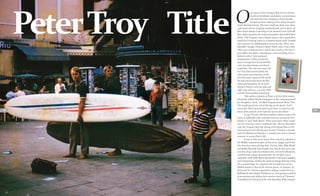
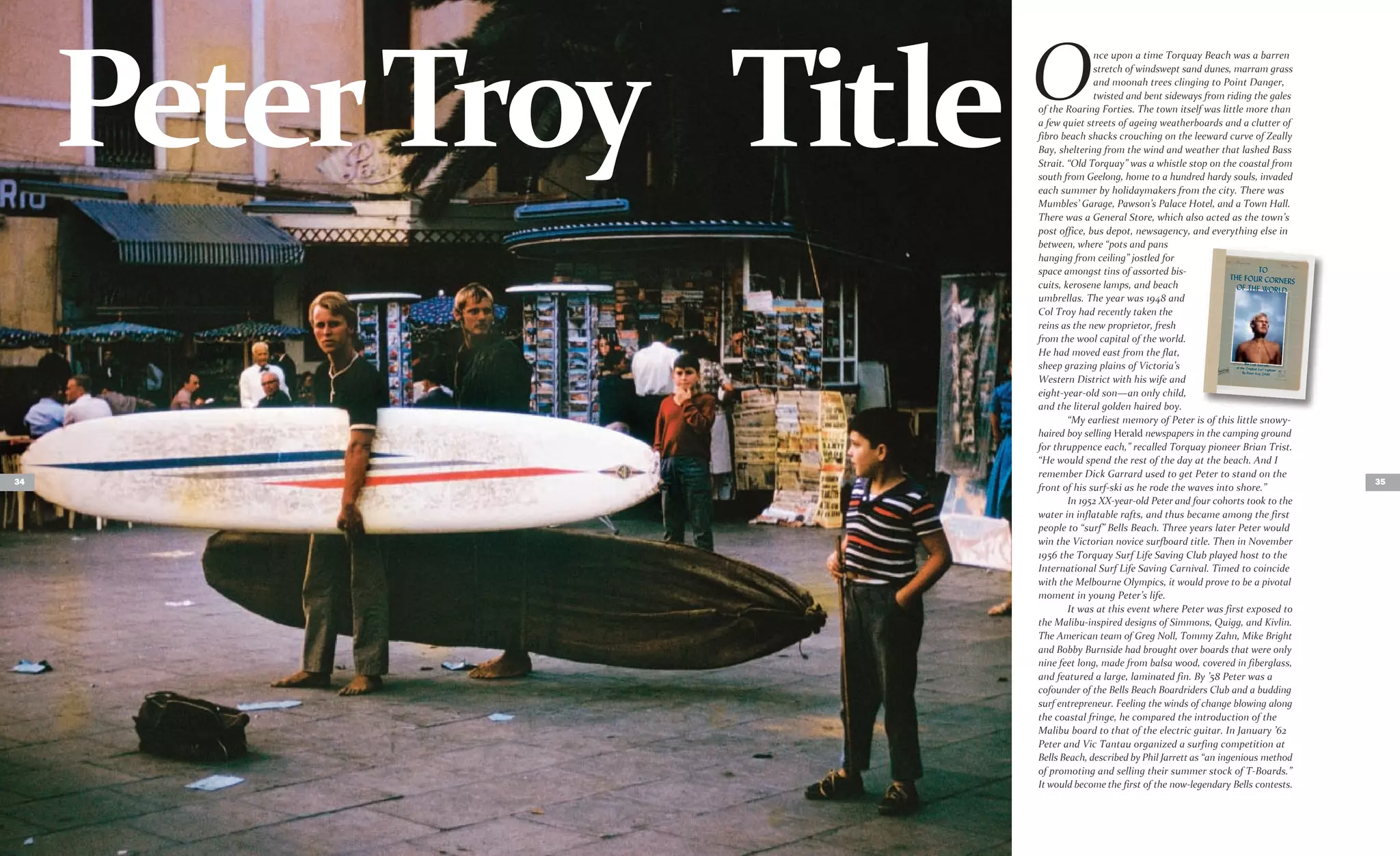
Once upon a time Torquay Beach was a barren
stretch of windswept sand dunes, marram grass
and moonah trees clinging to Point Danger,
twisted and bent sideways from riding the gales
of the Roaring Forties. The town itself was little more than
a few quiet streets of ageing weatherboards and a clutter of
fibro beach shacks crouching on the leeward curve of Zeally
Bay, sheltering from the wind and weather that lashed Bass
Strait. “Old Torquay” was a whistle stop on the coastal from
south from Geelong, home to a hundred hardy souls, invaded
each summer by holidaymakers from the city. There was
Mumbles’ Garage, Pawson’s Palace Hotel, and a Town Hall.
There was a General Store, which also acted as the town’s
post office, bus depot, newsagency, and everything else in
between, where “pots and pans
hanging from ceiling” jostled for
space amongst tins of assorted bis-
cuits, kerosene lamps, and beach
umbrellas. The year was 1948 and
Col Troy had recently taken the
reins as the new proprietor, fresh
from the wool capital of the world.
He had moved east from the flat,
sheep grazing plains of Victoria’s
Western District with his wife and
eight-year-old son—an only child,
and the literal golden haired boy.
“My earliest memory of Peter is of this little snowy-
haired boy selling Herald newspapers in the camping ground
for thruppence each,” recalled Torquay pioneer Brian Trist.
“He would spend the rest of the day at the beach. And I
remember Dick Garrard used to get Peter to stand on the
front of his surf-ski as he rode the waves into shore.”
In 1952 XX-year-old Peter and four cohorts took to the
water in inflatable rafts, and thus became among the first
people to “surf” Bells Beach. Three years later Peter would
win the Victorian novice surfboard title. Then in November
1956 the Torquay Surf Life Saving Club played host to the
International Surf Life Saving Carnival. Timed to coincide
with the Melbourne Olympics, it would prove to be a pivotal
moment in young Peter’s life.
It was at this event where Peter was first exposed to
the Malibu-inspired designs of Simmons, Quigg, and Kivlin.
The American team of Greg Noll, Tommy Zahn, Mike Bright
and Bobby Burnside had brought over boards that were only
nine feet long, made from balsa wood, covered in fiberglass,
and featured a large, laminated fin. By ’58 Peter was a
cofounder of the Bells Beach Boardriders Club and a budding
surf entrepreneur. Feeling the winds of change blowing along
the coastal fringe, he compared the introduction of the
Malibu board to that of the electric guitar. In January ’62
Peter and Vic Tantau organized a surfing competition at
Bells Beach, described by Phil Jarrett as “an ingenious method
of promoting and selling their summer stock of T-Boards.”
It would become the first of the now-legendary Bells contests.
35
PeterTroy Title
OOOOFF TTHHE WE WWORWORLLDD
TheThe LLo t Jo t JJourJourn lsn ls
line boat, and that vessel docked at the new international
wharf alongside the Quay (as we left, the sight of the ship
completely lit against the dark background of the night
and haloed by the bluish light of the illuminated Sydney
Harbour Bridge was a great sight).
Next step took me to Denny Keogh’s board shop. No
Keogh, but ‘Midget’ Farrelly was there shaping away on a
board. When Denny arrived, I borrowed a board from the
factory and we spent the afternoon travelling up the north
side from Manly to Palm Beach and eventually surfed at
Long Reef. 4 to 6 foot, smooth and good surf—I was quite
happy with my riding. We cleaned up generally and went
to meet ‘Snow’ McAllister and found that everything had
been organised for a farewell send off. By the way, Bill Davis
and Gaylord Wilcox never made it to Queensland so they
were also present.
Send off committee: Snow McAlister, Graeme Treloar,
‘Wheels’ Williams, Mick Hall, Denny Keogh, Midget Farrelly,
John Witzig (Paul’s younger brother) and two young femlins
—they are girl gremlins. Also a Californian by the name of
Joe who will be back home when we pass through America.
Quite a cabin party you could imagine. Bill stole the show
as the ship left by climbing the mast to the top without any
of the crew noticing, and the crowd, which did consist of
thousands, thought it a great act. Must sleep now and am
quite happy, no sea sickness or other grumbles to date and
feel I should put this on record. Bye now.
At Brisbane 8.30am. Perhaps towards Surfers
Paradise—it’s raining here.
Love,
Peter
July 1, 1963
17 Henniker Mews, Callow Street
Chelsea S.W. 3
Have had the best surf at Jersey for a year—been running
for almost one week and the wind for the whole of that time
has been directly offshore—a breeze until mid-afternoon
and then freshening towards the evening. I am presently
trying to collect a few photos and write up an article to send
home to Bob Evans as I feel the area warrants it. I have
changed my opinion of the surf here considerably after
seeing 6 to 8 foot, sometimes 10 foot, swells over a small
sand bank and peeling off to both the left and right. The
water very smooth and almost glassy, even at midday, and
the face of the wave really beautiful as the beach faces west
—in the early afternoon the face of the waves are dark, but
with this slight offshore wind lifting up the top and the
sunlight filtering through from behind the surf becomes
reminiscent of 6am on a quiet morning at home.
I went to a party here the other night and left at 5 am.
The personalities are rather strange—all chorus girl dancers,
male models, show business people, rock and roll singers
(a group called The Beatles were there and this group
currently have the top selling disk in the UK). Boy! Are these
types way out and certainly are queer. I was introduced to
one fellow who, I was previously told of, was a homosexual
and received money from other males, and then with this
money bought expensive clothes and a car and then took
out these rather attractive girls merely as a handsome male
companion. This, mind you, was his job. First time I have
encountered this type of activity and was he strange.
37
In ten years time he’d come a long way, but always eager
to take it one further, Peter wasn’t done yet.
“I had no desire to be an accountant, but I wasn’t sure
how to leave my job,” he said of his then occupation—the
surfing bit still was still more of a hobby than a career.
“When I saw my first Surfer magazine, I saw a glimmer of
hope…I realized that here was another way of life.”
And then he was gone. “Surfing with us one weekend,
off on his travels the next,” recounts long time friend Terry
Wall. Out into the world he went, in 1963 he set out on his
now mythic world-rounding adventure, bringing surfing to
nearly every coastline he landed on. France, Portugal, the
Canary Islands, Brazil, the first person to surf Nias, the list
goes on.
Many years later Peter would refer back to that
historic November day at Torquay in 1956. “When I met these
Americans, these guys who spoke English with a different
accent, I think that was when the wanderlust seed got planted
inside me—by those American lifeguards and their Malibu
boards.”
“One day he was sitting out the back at Bells, then
he just disappeared,” remembers Brian Trist. Well, he didn’t
exactly disappear. A diligent letter writer, Peter’s adventures
were meticulously documented in well-detailed accounts that
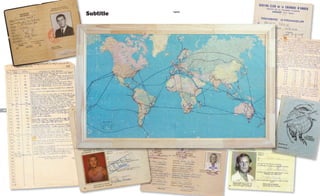
he sent back to “Mum and Dad.” The following collection
comprises some of those letters, the rest can be seen in Peter’s
posthumous new book To the Four Corners of the World
(edited by Brendan McAloon). Capturing his departure in
1963 and running all the way through a West African walk-
about in 1966, Peter Troy’s travels place him as surfing’s first
vagabond, and for that we all owe the man some gratitude.
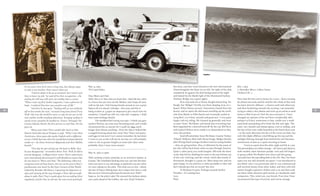
May 13, 1963
TN Castel Felice
Dear Mum and Dad,
Well, this is it! How did you both feel—Dad left the cabin
in a hurry but you were terrific Mother, and I hope all went
well on the pier. I feel having friends around us was a great
help to all as it doesn’t (whoops—first sway and this is
being written at 5.30pm on departure) give much time for
emotions. I myself am still very calm but I suppose, I shall
have some feelings shortly.
The handkerchief waving was tops—I think you gave
up first? But boy, my arms were becoming tired, and I would
recommend this to anyone for I could see that much
longer than almost anything—from the ship it looked like
a seagull hovering about the crowd. Hey! That’s real poetry
and I am on trial aren’t I as I cannot remember the last letter
I wrote to you so this will not be my best as I will probably
want to rise to greater heights at some later date; most
probably when I want more money!
May 16, 1963 12.15pm
Well, nothing written yesterday as we arrived in Sydney at
8.50am. The scheduled docking time was 7am but this later
time was more to our advantage as daybreak was just when
we were taking on the pilot. This ship was so tiny—about
the size of Yatey’s fishing boat, but I expect they have a craft
like our own Victorian pilot boat for heavier seas. Well I
hope so, for the pilot’s sake! We entered the harbour about
400 yards ahead of the Galileo, the new Lloyd Triestino
36
Caption
October 8, 1963
At sea, between Gibraltar and Tangiers
Dear Mum and Dad,
I am now a crew member aboard a 46 foot Ketch constructed
of teak in Djakarta—Tandjing Pruik, Indonesia. Our
proposed course, at present, appears to be Gibraltar,
Tangiers, Casablanca, Madeira (Portuguese archipelago),
Canary Islands, Puerto Rico, Barbados, West Indies,
Bahamas, Florida. This is subject to change as the captain’s
obligations are only that he has to be in Miami, Florida,
before February ’64 and that the yacht is continually kept
headed in this general direction. For me, this saves at least
$150 as that was the cheapest passage available to the USA
and also, of course, the luck of being taken on as a ship’s
hand without experience. Our food, expenses and trip are
paid for and the individual bears only personal expenses
and expenses he incurs whilst in port of a private nature.
On completion, I expect I can reasonably say I will have had
ocean yachting experience, and this will then, I feel sure,
open up other avenues for travel to such places as previously
would not have been feasible.
December 19, 1963
New Orleans
The two interesting features of the remainder of my stay
at Miami was a visit to a place called the Varsity Inn where
all the university clans met. They dance in semi darkness
on the bar counter top amongst the half-filled glasses to
the music of a six-piece jazz band. The behaviour near the
end of the night was quite something and the acts “pulled”
in the same line as those at Boot Hill with Yatey and his
cronies in the years gone by. Glasses were broken and kicked
off the counter by enthusiastic, semi drunk, writhing bodies,
with the whole proceedings being filmed by 16mm camera
mounted on a flashlight from the centre of the bar (I believe
they replay the Saturday night activities each Wednesday
with a film evening instead of dancing—thus enabling
the participants to view the frivolities of same preceding
Saturday’s activity). Quite some place and really in with
the young fraternity of Miami and district.
January 8, 1964
29279 Ke Nui Road
Sunset Beach, Oahu
Hawaii
Now I have to mention some bad news, which at this stage,
especially having written the first part of this letter on the
8th
received your letter from Bill Davis on 11th
and yet on the
10th
January at 11am, I “ate my lunch” (surfing term here for
a bad wipeout) at the Banzai Pipeline, so contradicting my
words in the previous paragraph. I expect those words and
thoughts were the product of fate. Well, this is it—I was
sucked over the falls and double dumped in 5 foot of water
with a bottom of razor sharp pointed coral described in our
surfing magazine as “jagged railway sleeper spikes”—and
thrown face first into the coral bed. The result is a badly
lacerated face with abrasions to the chin, nose and forehead
and two areas requiring suturing, the first area on the upper
lip and the second on my forehead slightly lower than the
39
August 28, 1963
Hotel Chez
Biarritz
Now in France where many people do not speak English and
one small traveller who does not speak French (that’s for
sure). I had to wait several hours in Dinard as the train left
at 4 pm and decided this was the best way as the fare was 81F
and my board freight for 4.80F, to arrive at Biarritz at approx.
10.30am on the Saturday. This was just as well because
immediately after I arrived in the town (after virtually 40
hours travelling) I made my way to the Grand Plage beach
and asked for Joel de Rosnay, the top person here. He wasn’t
at the beach but some others were, so I introduced myself
and we subsequently made our way to their clubhouse at
the Côte des Basques. Here we met others and we went to
La Barre to surf (near Bayonne).
To put the record straight my first surf in France was
6 foot peak surf, offshore wind, with a continuous left slide
towards a breakwater, where within 15 yards the wave
completely dies out due to the very strong run out. Boy, this
was great surf (for the information of the surf boys the
place strongly resembles Southside at Bells with the rock
reef being the stone pier and the lefts being comparable but
the ride three times the length at La Barre). It then happened
that the organisers of the contest decided to hold the
surfing championships on the same afternoon instead of
Sunday (only 5 hours after I had arrived on the scene and
after one surf of the area—also no sleep from Wednesday).
There were some very good surfers here and I didn’t fancy
my chances very much, but I seemed to have gained a
reputation from my morning surfing (also the name TROY
—Captain Troy on TV is a favourite in France with the
children and naturally the gremmies also). The stage was set
—Fox Movietone cameras in attendance, people, spectators,
fishermen etc. crowded on the pier and families, girls, and
others on the beach. Bill Davis did not get back here and
at present have lost him, but Gaylord Wilcox was here after
having been via Singapore, South Africa, Italy and Spain.
The surf was 8 foot for the contest and great conditions.
European Surfing Champion—P. Troy.
Per the cuttings and the position of last year’s winner, Mike
Hickey (he went to Hawaii and was the fellow who, with
John Severson, George Downing and Bob Pike, visited Peru),
and the position of Gaylord Wilcox (he made the final 10
in our contest at Bells Beach). The competition was hot and
I personally felt I rode well as all the waves I rode were lefts
and therefore “goofy”. The whole contest was recorded by
Fox Movietone and this evening we are all going to the
cinema to see the contest on the newsreel. Also film taken
on the beach with close-ups, etc.—a little embarrassing,
but I like it.
I am reading ‘Lord of the Flies’ by William Golding.
The first couple of chapters were rather hard to understand
but as the price on the book showed $1.25 I kept on reading
as I reasoned a book this expensive must be good. It is, but
a little too intellectual as the author uses a story about
children isolated on a desert island to bring out his theme
and conclusions concerning human frailty and the force
of sin in society in the form of a harrowing allegory.
38
Caption
40
Caption
Subtitle
July 27,1964
Apt 802 No 15 Rue Conselheiro Lafaiete
Copacabana, Rio de Janeiro
Brazil
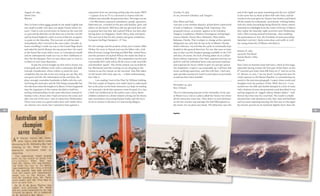
Within minutes I had changed, waxed up on one of these
boards with a candle I had bought over the street, and after
clambering over the rocks and past clusters of people
lounging on the rocks, launched myself. Now came the
problems. These boards didn’t float and sure behaved in
a different manner and every one of these Brazilians was
wearing large flippers whilst I wasn’t and the answer soon
became evident. They caught the waves here as it exploded
over a huge boulder at the end of the point by lying on the
end of the boards and then propelling themselves kicking
with these large fins onto the wave. Once having negotiated
the difficult drop down the face of the wave, here greatly
aided by the severe turn up in the nose of the surfboard,
they clambered to their feet and now standing rode across
the face of the wave in a corner until they were wiped-out in
the shorebreak down the beach. Now back to myself—with-
out fins I had little success, but managed to take-off on one
wave and successfully rode this strange board to the beach,
and so I came in due partly to failure at mastering this sport
and due partly to extremely tired muscles and the cold.
Within minutes many of the local surfers had
gathered around and had begun to ask questions about me,
for I was the first stranger they had met who had ever
surfed their style of board as successfully in a first attempt.
The whole sporting fraternity of Rio de Janeiro have
feted me with honours, invitations, hospitality, acceptance
and sacrifice (probably a lot more meaning in this last word).
I have been interviewed for magazines, newspapers, filmed
for TV and film newsreels, asked for autographs, photos,
etc., introduced to leading personalities and requested to
table opinions on life saving techniques, drawn crowds of
spectators to the beach, children, parents, grandparents,
etc., implored to give an exhibition of surfing, and in
general awarded the recognition one would expect of a
Stirling Moss or a Roy Emerson. The newspapers credit me
as “Campeäs Mundial” (world champion), give me front
page coverage with Miss Brazil, President De Gaulle and
football, and in general exaggerate to colour up my dull
achievements. I experience little things like when a small
child comes up to me and asks in faltering English “Is your
name Peter Troy?” I say that it is and he then mentions that
he saw my photo in the papers and that he has come with
his parents to see me surf, then rather proudly steps forward
and shakes my hand and runs off.
October 16,1964
M/N ‘Navarino’
Punta Arenas
Empresa Maritima dèl Estado Line
[Chile]
It was while we were between here and the Angostura
Inglesa that I first sampled the huge chorros (mussels).
I was invited by a small group of Chileans, who had bought
a sack of these mussels when we were at Grappler Canal,
from the divers, to sit in on a feast they were having. I was
not slow in joining the party and armed with a pocket–knife
43
hair line, each cut in the form of a star and each requiring
five stiches. Other effects were slight lacerations inside the
mouth, concussion and black eyes, but really no cause for
alarm as it may have been considerably worse.
May 18, 1964
Pension
136 Ayacucho Av
Santa Cruz
Bolivia
Even at 4am we sure were not early enough, for the best
“accommodation” we could find was a wagon with only
40 odd people already in it (they had all slept the night
there, rather in Victorian Football grand final-style). We
climbed aboard and encountered my first experience of how
to travel primitive style. In the carriage, better described
as a wagon, there were no seats or luggage racks—this was
just a freight truck like what cattle are trucked in, and this
is just what I and my Bolivian peasants and fellow travellers
became. With straw scattered on the floor to sleep on, a
bag of sugar to sit on, a branch of bananas to rest your head
on, and the door of the truck rolled open to give ventilation
against the stuffiness of 45 people sleeping and living in
this crowded space (one must visualise the size of such a
freight truck, then put luggage i.e. cases, food supplies
for three days, live animals such as dogs, cats, roosters
and hens, rabbits and pigs, etc. other sundry supplies like
bags of sugar, branches of bananas, animal skins, bags
of fruit, sides of meat, etc. and then 45 people). You may
already think that things were rather uncomfortable, but in
reply I say, what’s it matter? 2nd
class is only a little worse
than 1st
class, especially when a person in 1st
class (who I later
became a travelling companion with) has to share his seat
with a live rooster—even though this cock is a good alarm
clock beside your ear in the early morning, he is not the
best of travel companions one finds oneself sitting next to
in a 1st
class carriage.
So now you know what the conditions were like at
the commencement of this voyage, I ask you both now to
try and imagine what condition my mental and physical
being was at the completion of this trip—it taking 51¾ hrs to
travel the 652 kilometres (410 miles) to the final destination
of Corumbá (an average of 8 mph). As the sun rose in the
sky on the first day it became unbearably hot in the wagon
as the roof was sheet metal, so I became a roof-sitter like
about 100 others (most of whom I later found out did not
have a ticket, and found that here they could see the
ticket inspector coming, and by running along the roofs
of the carriages so evade being caught—I shall mention
here that I was later to become one of these individuals
myself, for when at Roboré I had insufficient cash to buy
a ticket for the remainder of the distance). This was not
unpleasant, except that the engine was an old type and
burnt wood, so you became rather dirty. Also many slept
the night on the roof as well because not only was it still
hot in the evenings, but also there was insufficient room
to lie down on the floor of the wagon—remember 45 of
us! The people who did sleep in the wagon then had to
sleep through the noises of many feet thundering along
the roof in evasion of the inspector or in the procedure of
halting the train.
42
Caption
such an unknown quantity—a shrieking madness—this
paragraph was written under candle lights whilst watching
the two girls and an English boy under the effect of LSD.
The second notation was made when I was invited to
a party and surely the strangest I’ve ever been to yet.
Tom toms! Clippity, clip, bong clap—it’s Trinidad,
Dadeo!! No man, play slow for that there white man, he no
understand; for we’re here, and here is a small plastered
room in white stuccato with natural wood beams, Spanish
shutters, wooden pegs protruding from the walls, axe edged
doors, plain wooden forms, hand constructed chairs of local
materials with hemp bound seats and a table with a pressure
lamp, candles, tea strainer, ‘vins tinto’, unsalted Spanish
bread, chocolate, earthenware pots, cigarettes, matches,
knife, orange peel and honey and a jagged torn condensed
milk can; but oh yes, people. That’s what makes this
gathering—our leading drummer is a dark skinned
American clad in gold-rimmed dark glasses with a black
straw hat completely warped into a character of its own;
beneath this is sincere, deep penetrating eyes which from
deep down inside, projected rhythm; an unkempt beard
and improbably to say the least, yet clasped between his
front teeth, a fragile pink flower! His vestments are an
Afghanistan sheepskin jacket, t-shirt and crumpled jeans
with yesteryear’s tennis shoes cast off onto feet that could
only belong to one such as he (Roger). But now to others;
there is no smoke, no haze, the air is clear but the atmos-
phere is intense; rhythm vibrating from the walls and off
the people’s faces yet still no sound emitted from those
silent players, also chess men formed into life’s stale mate;
these were our German host, a serene French ‘quaqan
type’ girl, five bearded and long haired boys of unknown
nationality, an outwardly normal girl, and a white faced
blonde out of New York clad discretely in a Tahitian
necklace and other clothing.
March 10, 1966
Ovamboland
South West Africa
Now northwards and at Vioolsdrif on the Orange River,
have entered the Republic of South Africa administrated
South West Africa. My first stopping place was Ludentz—
one of the two places where there is civilization on the
entire coast of this land. The Government of South Africa
have declared the complete coast of South West Africa as
prohibited area and any person found within this area is
guilty unless he can prove otherwise. So from the Orange
River to Ovanboland, no man can walk as his desires lead
him of course, no sensible person would want to visit these
areas either (discounting diamonds or other minerals and
semi precious stones) for here we are in the famous Namib
Desert and the world known and feared Skeleton Coast
where no single thing lives.
It’s a real story book come fairytale—dreamland—
you can hear stories of shipwrecks, heroism, miners fables,
espionage, wars, human endurance, luck and misfortune.
Probably the best story to capture the colour of this land
is ‘The Skeleton Coast’ by John H Marsh. He relates that
there is a ship still sitting completely upright, intact with
masts, funnels and hull, apparently sailing along in a sea
of sand over 6 miles in land.
45
I was soon sampling this cherished seafood of Chile. Here
I was, laying on the canvas cover of the aft hatch in the
peaceful twilight, surrounded by nature, bathed in glory
by the last warming rays of a waning sun, but soon to be
gowned in a silver sheen by a large rising full moon which
was slowly but surely crawling above a massive white
mountain peak, eating these chorros straight from the wet
shell and sprinkled with lemon. The food was grandly
supported by a large tasty loaf of bread and a bottle of mild,
white table wine. This is how to know a country!
May 5, 1965
c/- Dr Carlos Barreda
287 Atahualpa
Miraflores Lima
Peru
Dear Mum and Dad,
Some odd little snippets have happened the last month or
so, but as you both can realise that when you have become
part of the accepted crowd, you merely blend into the
mixture and life again becomes more or less an everyday
routine. Yet I’m sure that I’ll never in my life see again a
sportsman representing his country presented to the
President of the host country dressed in a pair of tennis
shoes—this took place when ‘Buffalo’ Richard Kealana
presented to President Balaunde in the Palace’s reception
hall during the recent World Surfing titles. There was
Buffalo, Hawaiian beach guard on Makaha Beach, in blazer
with pocket of Hawaii surf team, tie, white shirt, sports
trousers and sand shoes.
Then to surfing a new surf site here called Pacasmayo,
where one goes early in the morning complete with
tarpaulin, food and drink, surfboard, wax, nose cream and
other extras relevant to a surfer; for after leaving your car
parked on the paved section of the Pan American Highway
and guarded only by rock boulders placed on the road at
intervals before and after so that oncoming traffic will be
aware of this car’s presence; you descend to a rather deserted
beach. This beach is located at a place on Peru’s coastline
where the road crawls around what may be the world’s
biggest sand dune. The face of the dune is a 45º angle and
the going down is not easy. The surf’s great, as it would
need to be, for who want to climb back up that slipping
mass of sand to get a forgotten bottle opener?
November 22, 1965
Livorno, Italy
Maybe unfortunately, yet I should not judge, on this island
there is a small group of people endeavouring to understand
their mind and their inner self through ‘hash’, ‘weed’, heroin,
marijuana, and lysergic acid amongst others. Here were
odd fragments of humanity—Danes, Swedes, English,
Australians, Americans and others not to my way of
thinking, knowing what they seek, what their makeup is
or how to handle their emotions, their faults or how to live
to the rules of modern society. Maybe it’s interesting and
enlightening to be thrown against this environment, for
then if personal willpower of the emotions is sufficiently
strong, one can stand back and learn! The appearance is
tragic, the actions frightening, the inner body of the addict
44
Caption

20.3 Troy

  • 1.
    34 Once upon atime Torquay Beach was a barren stretch of windswept sand dunes, marram grass and moonah trees clinging to Point Danger, twisted and bent sideways from riding the gales of the Roaring Forties. The town itself was little more than a few quiet streets of ageing weatherboards and a clutter of fibro beach shacks crouching on the leeward curve of Zeally Bay, sheltering from the wind and weather that lashed Bass Strait. “Old Torquay” was a whistle stop on the coastal from south from Geelong, home to a hundred hardy souls, invaded each summer by holidaymakers from the city. There was Mumbles’ Garage, Pawson’s Palace Hotel, and a Town Hall. There was a General Store, which also acted as the town’s post office, bus depot, newsagency, and everything else in between, where “pots and pans hanging from ceiling” jostled for space amongst tins of assorted bis- cuits, kerosene lamps, and beach umbrellas. The year was 1948 and Col Troy had recently taken the reins as the new proprietor, fresh from the wool capital of the world. He had moved east from the flat, sheep grazing plains of Victoria’s Western District with his wife and eight-year-old son—an only child, and the literal golden haired boy. “My earliest memory of Peter is of this little snowy- haired boy selling Herald newspapers in the camping ground for thruppence each,” recalled Torquay pioneer Brian Trist. “He would spend the rest of the day at the beach. And I remember Dick Garrard used to get Peter to stand on the front of his surf-ski as he rode the waves into shore.” In 1952 XX-year-old Peter and four cohorts took to the water in inflatable rafts, and thus became among the first people to “surf” Bells Beach. Three years later Peter would win the Victorian novice surfboard title. Then in November 1956 the Torquay Surf Life Saving Club played host to the International Surf Life Saving Carnival. Timed to coincide with the Melbourne Olympics, it would prove to be a pivotal moment in young Peter’s life. It was at this event where Peter was first exposed to the Malibu-inspired designs of Simmons, Quigg, and Kivlin. The American team of Greg Noll, Tommy Zahn, Mike Bright and Bobby Burnside had brought over boards that were only nine feet long, made from balsa wood, covered in fiberglass, and featured a large, laminated fin. By ’58 Peter was a cofounder of the Bells Beach Boardriders Club and a budding surf entrepreneur. Feeling the winds of change blowing along the coastal fringe, he compared the introduction of the Malibu board to that of the electric guitar. In January ’62 Peter and Vic Tantau organized a surfing competition at Bells Beach, described by Phil Jarrett as “an ingenious method of promoting and selling their summer stock of T-Boards.” It would become the first of the now-legendary Bells contests. 35 PeterTroy Title OOOOFF TTHHE WE WWORWORLLDD TheThe LLo t Jo t JJourJourn lsn ls
  • 2.
    line boat, andthat vessel docked at the new international wharf alongside the Quay (as we left, the sight of the ship completely lit against the dark background of the night and haloed by the bluish light of the illuminated Sydney Harbour Bridge was a great sight). Next step took me to Denny Keogh’s board shop. No Keogh, but ‘Midget’ Farrelly was there shaping away on a board. When Denny arrived, I borrowed a board from the factory and we spent the afternoon travelling up the north side from Manly to Palm Beach and eventually surfed at Long Reef. 4 to 6 foot, smooth and good surf—I was quite happy with my riding. We cleaned up generally and went to meet ‘Snow’ McAllister and found that everything had been organised for a farewell send off. By the way, Bill Davis and Gaylord Wilcox never made it to Queensland so they were also present. Send off committee: Snow McAlister, Graeme Treloar, ‘Wheels’ Williams, Mick Hall, Denny Keogh, Midget Farrelly, John Witzig (Paul’s younger brother) and two young femlins —they are girl gremlins. Also a Californian by the name of Joe who will be back home when we pass through America. Quite a cabin party you could imagine. Bill stole the show as the ship left by climbing the mast to the top without any of the crew noticing, and the crowd, which did consist of thousands, thought it a great act. Must sleep now and am quite happy, no sea sickness or other grumbles to date and feel I should put this on record. Bye now. At Brisbane 8.30am. Perhaps towards Surfers Paradise—it’s raining here. Love, Peter July 1, 1963 17 Henniker Mews, Callow Street Chelsea S.W. 3 Have had the best surf at Jersey for a year—been running for almost one week and the wind for the whole of that time has been directly offshore—a breeze until mid-afternoon and then freshening towards the evening. I am presently trying to collect a few photos and write up an article to send home to Bob Evans as I feel the area warrants it. I have changed my opinion of the surf here considerably after seeing 6 to 8 foot, sometimes 10 foot, swells over a small sand bank and peeling off to both the left and right. The water very smooth and almost glassy, even at midday, and the face of the wave really beautiful as the beach faces west —in the early afternoon the face of the waves are dark, but with this slight offshore wind lifting up the top and the sunlight filtering through from behind the surf becomes reminiscent of 6am on a quiet morning at home. I went to a party here the other night and left at 5 am. The personalities are rather strange—all chorus girl dancers, male models, show business people, rock and roll singers (a group called The Beatles were there and this group currently have the top selling disk in the UK). Boy! Are these types way out and certainly are queer. I was introduced to one fellow who, I was previously told of, was a homosexual and received money from other males, and then with this money bought expensive clothes and a car and then took out these rather attractive girls merely as a handsome male companion. This, mind you, was his job. First time I have encountered this type of activity and was he strange. 37 In ten years time he’d come a long way, but always eager to take it one further, Peter wasn’t done yet. “I had no desire to be an accountant, but I wasn’t sure how to leave my job,” he said of his then occupation—the surfing bit still was still more of a hobby than a career. “When I saw my first Surfer magazine, I saw a glimmer of hope…I realized that here was another way of life.” And then he was gone. “Surfing with us one weekend, off on his travels the next,” recounts long time friend Terry Wall. Out into the world he went, in 1963 he set out on his now mythic world-rounding adventure, bringing surfing to nearly every coastline he landed on. France, Portugal, the Canary Islands, Brazil, the first person to surf Nias, the list goes on. Many years later Peter would refer back to that historic November day at Torquay in 1956. “When I met these Americans, these guys who spoke English with a different accent, I think that was when the wanderlust seed got planted inside me—by those American lifeguards and their Malibu boards.” “One day he was sitting out the back at Bells, then he just disappeared,” remembers Brian Trist. Well, he didn’t exactly disappear. A diligent letter writer, Peter’s adventures were meticulously documented in well-detailed accounts that he sent back to “Mum and Dad.” The following collection comprises some of those letters, the rest can be seen in Peter’s posthumous new book To the Four Corners of the World (edited by Brendan McAloon). Capturing his departure in 1963 and running all the way through a West African walk- about in 1966, Peter Troy’s travels place him as surfing’s first vagabond, and for that we all owe the man some gratitude. May 13, 1963 TN Castel Felice Dear Mum and Dad, Well, this is it! How did you both feel—Dad left the cabin in a hurry but you were terrific Mother, and I hope all went well on the pier. I feel having friends around us was a great help to all as it doesn’t (whoops—first sway and this is being written at 5.30pm on departure) give much time for emotions. I myself am still very calm but I suppose, I shall have some feelings shortly. The handkerchief waving was tops—I think you gave up first? But boy, my arms were becoming tired, and I would recommend this to anyone for I could see that much longer than almost anything—from the ship it looked like a seagull hovering about the crowd. Hey! That’s real poetry and I am on trial aren’t I as I cannot remember the last letter I wrote to you so this will not be my best as I will probably want to rise to greater heights at some later date; most probably when I want more money! May 16, 1963 12.15pm Well, nothing written yesterday as we arrived in Sydney at 8.50am. The scheduled docking time was 7am but this later time was more to our advantage as daybreak was just when we were taking on the pilot. This ship was so tiny—about the size of Yatey’s fishing boat, but I expect they have a craft like our own Victorian pilot boat for heavier seas. Well I hope so, for the pilot’s sake! We entered the harbour about 400 yards ahead of the Galileo, the new Lloyd Triestino 36 Caption
  • 3.
    October 8, 1963 Atsea, between Gibraltar and Tangiers Dear Mum and Dad, I am now a crew member aboard a 46 foot Ketch constructed of teak in Djakarta—Tandjing Pruik, Indonesia. Our proposed course, at present, appears to be Gibraltar, Tangiers, Casablanca, Madeira (Portuguese archipelago), Canary Islands, Puerto Rico, Barbados, West Indies, Bahamas, Florida. This is subject to change as the captain’s obligations are only that he has to be in Miami, Florida, before February ’64 and that the yacht is continually kept headed in this general direction. For me, this saves at least $150 as that was the cheapest passage available to the USA and also, of course, the luck of being taken on as a ship’s hand without experience. Our food, expenses and trip are paid for and the individual bears only personal expenses and expenses he incurs whilst in port of a private nature. On completion, I expect I can reasonably say I will have had ocean yachting experience, and this will then, I feel sure, open up other avenues for travel to such places as previously would not have been feasible. December 19, 1963 New Orleans The two interesting features of the remainder of my stay at Miami was a visit to a place called the Varsity Inn where all the university clans met. They dance in semi darkness on the bar counter top amongst the half-filled glasses to the music of a six-piece jazz band. The behaviour near the end of the night was quite something and the acts “pulled” in the same line as those at Boot Hill with Yatey and his cronies in the years gone by. Glasses were broken and kicked off the counter by enthusiastic, semi drunk, writhing bodies, with the whole proceedings being filmed by 16mm camera mounted on a flashlight from the centre of the bar (I believe they replay the Saturday night activities each Wednesday with a film evening instead of dancing—thus enabling the participants to view the frivolities of same preceding Saturday’s activity). Quite some place and really in with the young fraternity of Miami and district. January 8, 1964 29279 Ke Nui Road Sunset Beach, Oahu Hawaii Now I have to mention some bad news, which at this stage, especially having written the first part of this letter on the 8th received your letter from Bill Davis on 11th and yet on the 10th January at 11am, I “ate my lunch” (surfing term here for a bad wipeout) at the Banzai Pipeline, so contradicting my words in the previous paragraph. I expect those words and thoughts were the product of fate. Well, this is it—I was sucked over the falls and double dumped in 5 foot of water with a bottom of razor sharp pointed coral described in our surfing magazine as “jagged railway sleeper spikes”—and thrown face first into the coral bed. The result is a badly lacerated face with abrasions to the chin, nose and forehead and two areas requiring suturing, the first area on the upper lip and the second on my forehead slightly lower than the 39 August 28, 1963 Hotel Chez Biarritz Now in France where many people do not speak English and one small traveller who does not speak French (that’s for sure). I had to wait several hours in Dinard as the train left at 4 pm and decided this was the best way as the fare was 81F and my board freight for 4.80F, to arrive at Biarritz at approx. 10.30am on the Saturday. This was just as well because immediately after I arrived in the town (after virtually 40 hours travelling) I made my way to the Grand Plage beach and asked for Joel de Rosnay, the top person here. He wasn’t at the beach but some others were, so I introduced myself and we subsequently made our way to their clubhouse at the Côte des Basques. Here we met others and we went to La Barre to surf (near Bayonne). To put the record straight my first surf in France was 6 foot peak surf, offshore wind, with a continuous left slide towards a breakwater, where within 15 yards the wave completely dies out due to the very strong run out. Boy, this was great surf (for the information of the surf boys the place strongly resembles Southside at Bells with the rock reef being the stone pier and the lefts being comparable but the ride three times the length at La Barre). It then happened that the organisers of the contest decided to hold the surfing championships on the same afternoon instead of Sunday (only 5 hours after I had arrived on the scene and after one surf of the area—also no sleep from Wednesday). There were some very good surfers here and I didn’t fancy my chances very much, but I seemed to have gained a reputation from my morning surfing (also the name TROY —Captain Troy on TV is a favourite in France with the children and naturally the gremmies also). The stage was set —Fox Movietone cameras in attendance, people, spectators, fishermen etc. crowded on the pier and families, girls, and others on the beach. Bill Davis did not get back here and at present have lost him, but Gaylord Wilcox was here after having been via Singapore, South Africa, Italy and Spain. The surf was 8 foot for the contest and great conditions. European Surfing Champion—P. Troy. Per the cuttings and the position of last year’s winner, Mike Hickey (he went to Hawaii and was the fellow who, with John Severson, George Downing and Bob Pike, visited Peru), and the position of Gaylord Wilcox (he made the final 10 in our contest at Bells Beach). The competition was hot and I personally felt I rode well as all the waves I rode were lefts and therefore “goofy”. The whole contest was recorded by Fox Movietone and this evening we are all going to the cinema to see the contest on the newsreel. Also film taken on the beach with close-ups, etc.—a little embarrassing, but I like it. I am reading ‘Lord of the Flies’ by William Golding. The first couple of chapters were rather hard to understand but as the price on the book showed $1.25 I kept on reading as I reasoned a book this expensive must be good. It is, but a little too intellectual as the author uses a story about children isolated on a desert island to bring out his theme and conclusions concerning human frailty and the force of sin in society in the form of a harrowing allegory. 38 Caption
  • 4.
  • 5.
    July 27,1964 Apt 802No 15 Rue Conselheiro Lafaiete Copacabana, Rio de Janeiro Brazil Within minutes I had changed, waxed up on one of these boards with a candle I had bought over the street, and after clambering over the rocks and past clusters of people lounging on the rocks, launched myself. Now came the problems. These boards didn’t float and sure behaved in a different manner and every one of these Brazilians was wearing large flippers whilst I wasn’t and the answer soon became evident. They caught the waves here as it exploded over a huge boulder at the end of the point by lying on the end of the boards and then propelling themselves kicking with these large fins onto the wave. Once having negotiated the difficult drop down the face of the wave, here greatly aided by the severe turn up in the nose of the surfboard, they clambered to their feet and now standing rode across the face of the wave in a corner until they were wiped-out in the shorebreak down the beach. Now back to myself—with- out fins I had little success, but managed to take-off on one wave and successfully rode this strange board to the beach, and so I came in due partly to failure at mastering this sport and due partly to extremely tired muscles and the cold. Within minutes many of the local surfers had gathered around and had begun to ask questions about me, for I was the first stranger they had met who had ever surfed their style of board as successfully in a first attempt. The whole sporting fraternity of Rio de Janeiro have feted me with honours, invitations, hospitality, acceptance and sacrifice (probably a lot more meaning in this last word). I have been interviewed for magazines, newspapers, filmed for TV and film newsreels, asked for autographs, photos, etc., introduced to leading personalities and requested to table opinions on life saving techniques, drawn crowds of spectators to the beach, children, parents, grandparents, etc., implored to give an exhibition of surfing, and in general awarded the recognition one would expect of a Stirling Moss or a Roy Emerson. The newspapers credit me as “Campeäs Mundial” (world champion), give me front page coverage with Miss Brazil, President De Gaulle and football, and in general exaggerate to colour up my dull achievements. I experience little things like when a small child comes up to me and asks in faltering English “Is your name Peter Troy?” I say that it is and he then mentions that he saw my photo in the papers and that he has come with his parents to see me surf, then rather proudly steps forward and shakes my hand and runs off. October 16,1964 M/N ‘Navarino’ Punta Arenas Empresa Maritima dèl Estado Line [Chile] It was while we were between here and the Angostura Inglesa that I first sampled the huge chorros (mussels). I was invited by a small group of Chileans, who had bought a sack of these mussels when we were at Grappler Canal, from the divers, to sit in on a feast they were having. I was not slow in joining the party and armed with a pocket–knife 43 hair line, each cut in the form of a star and each requiring five stiches. Other effects were slight lacerations inside the mouth, concussion and black eyes, but really no cause for alarm as it may have been considerably worse. May 18, 1964 Pension 136 Ayacucho Av Santa Cruz Bolivia Even at 4am we sure were not early enough, for the best “accommodation” we could find was a wagon with only 40 odd people already in it (they had all slept the night there, rather in Victorian Football grand final-style). We climbed aboard and encountered my first experience of how to travel primitive style. In the carriage, better described as a wagon, there were no seats or luggage racks—this was just a freight truck like what cattle are trucked in, and this is just what I and my Bolivian peasants and fellow travellers became. With straw scattered on the floor to sleep on, a bag of sugar to sit on, a branch of bananas to rest your head on, and the door of the truck rolled open to give ventilation against the stuffiness of 45 people sleeping and living in this crowded space (one must visualise the size of such a freight truck, then put luggage i.e. cases, food supplies for three days, live animals such as dogs, cats, roosters and hens, rabbits and pigs, etc. other sundry supplies like bags of sugar, branches of bananas, animal skins, bags of fruit, sides of meat, etc. and then 45 people). You may already think that things were rather uncomfortable, but in reply I say, what’s it matter? 2nd class is only a little worse than 1st class, especially when a person in 1st class (who I later became a travelling companion with) has to share his seat with a live rooster—even though this cock is a good alarm clock beside your ear in the early morning, he is not the best of travel companions one finds oneself sitting next to in a 1st class carriage. So now you know what the conditions were like at the commencement of this voyage, I ask you both now to try and imagine what condition my mental and physical being was at the completion of this trip—it taking 51¾ hrs to travel the 652 kilometres (410 miles) to the final destination of Corumbá (an average of 8 mph). As the sun rose in the sky on the first day it became unbearably hot in the wagon as the roof was sheet metal, so I became a roof-sitter like about 100 others (most of whom I later found out did not have a ticket, and found that here they could see the ticket inspector coming, and by running along the roofs of the carriages so evade being caught—I shall mention here that I was later to become one of these individuals myself, for when at Roboré I had insufficient cash to buy a ticket for the remainder of the distance). This was not unpleasant, except that the engine was an old type and burnt wood, so you became rather dirty. Also many slept the night on the roof as well because not only was it still hot in the evenings, but also there was insufficient room to lie down on the floor of the wagon—remember 45 of us! The people who did sleep in the wagon then had to sleep through the noises of many feet thundering along the roof in evasion of the inspector or in the procedure of halting the train. 42 Caption
  • 6.
    such an unknownquantity—a shrieking madness—this paragraph was written under candle lights whilst watching the two girls and an English boy under the effect of LSD. The second notation was made when I was invited to a party and surely the strangest I’ve ever been to yet. Tom toms! Clippity, clip, bong clap—it’s Trinidad, Dadeo!! No man, play slow for that there white man, he no understand; for we’re here, and here is a small plastered room in white stuccato with natural wood beams, Spanish shutters, wooden pegs protruding from the walls, axe edged doors, plain wooden forms, hand constructed chairs of local materials with hemp bound seats and a table with a pressure lamp, candles, tea strainer, ‘vins tinto’, unsalted Spanish bread, chocolate, earthenware pots, cigarettes, matches, knife, orange peel and honey and a jagged torn condensed milk can; but oh yes, people. That’s what makes this gathering—our leading drummer is a dark skinned American clad in gold-rimmed dark glasses with a black straw hat completely warped into a character of its own; beneath this is sincere, deep penetrating eyes which from deep down inside, projected rhythm; an unkempt beard and improbably to say the least, yet clasped between his front teeth, a fragile pink flower! His vestments are an Afghanistan sheepskin jacket, t-shirt and crumpled jeans with yesteryear’s tennis shoes cast off onto feet that could only belong to one such as he (Roger). But now to others; there is no smoke, no haze, the air is clear but the atmos- phere is intense; rhythm vibrating from the walls and off the people’s faces yet still no sound emitted from those silent players, also chess men formed into life’s stale mate; these were our German host, a serene French ‘quaqan type’ girl, five bearded and long haired boys of unknown nationality, an outwardly normal girl, and a white faced blonde out of New York clad discretely in a Tahitian necklace and other clothing. March 10, 1966 Ovamboland South West Africa Now northwards and at Vioolsdrif on the Orange River, have entered the Republic of South Africa administrated South West Africa. My first stopping place was Ludentz— one of the two places where there is civilization on the entire coast of this land. The Government of South Africa have declared the complete coast of South West Africa as prohibited area and any person found within this area is guilty unless he can prove otherwise. So from the Orange River to Ovanboland, no man can walk as his desires lead him of course, no sensible person would want to visit these areas either (discounting diamonds or other minerals and semi precious stones) for here we are in the famous Namib Desert and the world known and feared Skeleton Coast where no single thing lives. It’s a real story book come fairytale—dreamland— you can hear stories of shipwrecks, heroism, miners fables, espionage, wars, human endurance, luck and misfortune. Probably the best story to capture the colour of this land is ‘The Skeleton Coast’ by John H Marsh. He relates that there is a ship still sitting completely upright, intact with masts, funnels and hull, apparently sailing along in a sea of sand over 6 miles in land. 45 I was soon sampling this cherished seafood of Chile. Here I was, laying on the canvas cover of the aft hatch in the peaceful twilight, surrounded by nature, bathed in glory by the last warming rays of a waning sun, but soon to be gowned in a silver sheen by a large rising full moon which was slowly but surely crawling above a massive white mountain peak, eating these chorros straight from the wet shell and sprinkled with lemon. The food was grandly supported by a large tasty loaf of bread and a bottle of mild, white table wine. This is how to know a country! May 5, 1965 c/- Dr Carlos Barreda 287 Atahualpa Miraflores Lima Peru Dear Mum and Dad, Some odd little snippets have happened the last month or so, but as you both can realise that when you have become part of the accepted crowd, you merely blend into the mixture and life again becomes more or less an everyday routine. Yet I’m sure that I’ll never in my life see again a sportsman representing his country presented to the President of the host country dressed in a pair of tennis shoes—this took place when ‘Buffalo’ Richard Kealana presented to President Balaunde in the Palace’s reception hall during the recent World Surfing titles. There was Buffalo, Hawaiian beach guard on Makaha Beach, in blazer with pocket of Hawaii surf team, tie, white shirt, sports trousers and sand shoes. Then to surfing a new surf site here called Pacasmayo, where one goes early in the morning complete with tarpaulin, food and drink, surfboard, wax, nose cream and other extras relevant to a surfer; for after leaving your car parked on the paved section of the Pan American Highway and guarded only by rock boulders placed on the road at intervals before and after so that oncoming traffic will be aware of this car’s presence; you descend to a rather deserted beach. This beach is located at a place on Peru’s coastline where the road crawls around what may be the world’s biggest sand dune. The face of the dune is a 45º angle and the going down is not easy. The surf’s great, as it would need to be, for who want to climb back up that slipping mass of sand to get a forgotten bottle opener? November 22, 1965 Livorno, Italy Maybe unfortunately, yet I should not judge, on this island there is a small group of people endeavouring to understand their mind and their inner self through ‘hash’, ‘weed’, heroin, marijuana, and lysergic acid amongst others. Here were odd fragments of humanity—Danes, Swedes, English, Australians, Americans and others not to my way of thinking, knowing what they seek, what their makeup is or how to handle their emotions, their faults or how to live to the rules of modern society. Maybe it’s interesting and enlightening to be thrown against this environment, for then if personal willpower of the emotions is sufficiently strong, one can stand back and learn! The appearance is tragic, the actions frightening, the inner body of the addict 44 Caption