FACULTY OF CIVIL LAW (1734)
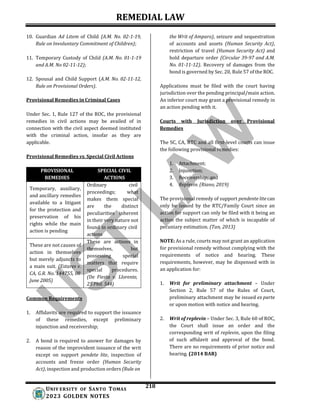
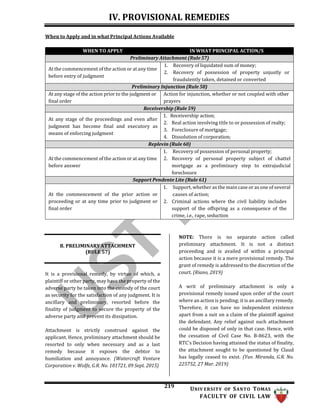
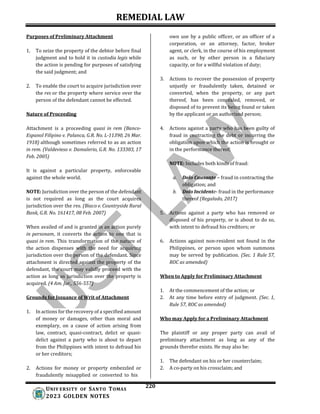
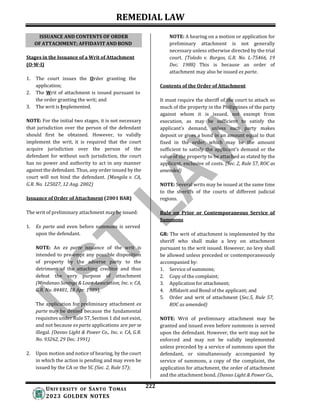
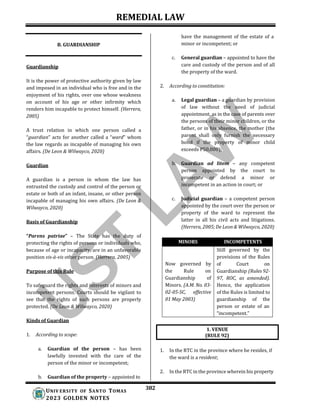
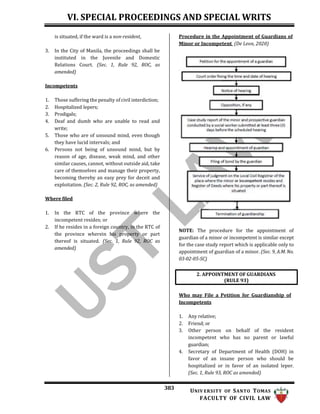
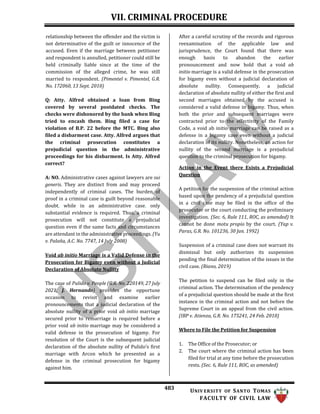
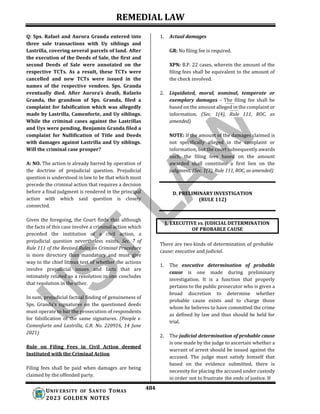
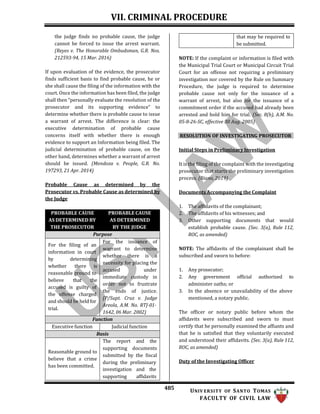
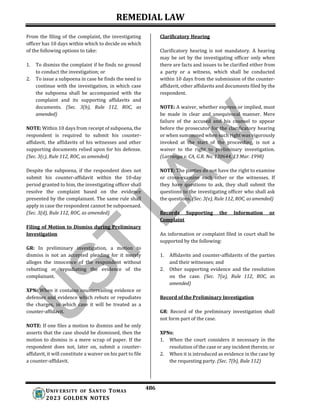
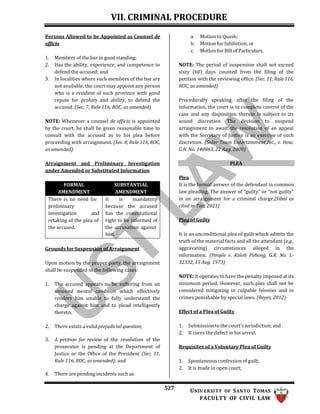
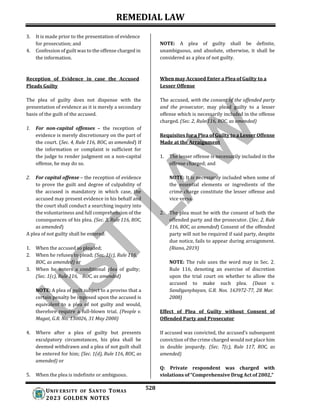
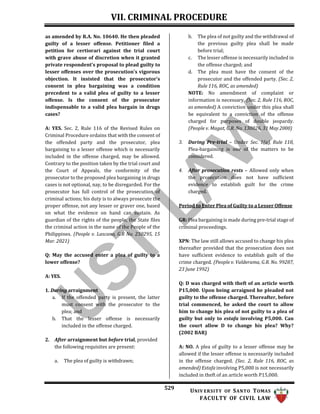
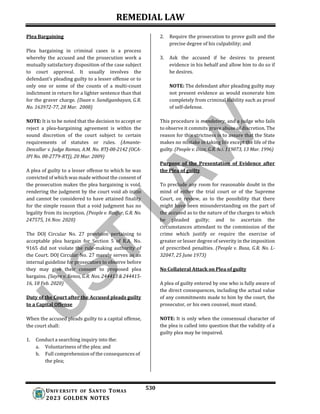
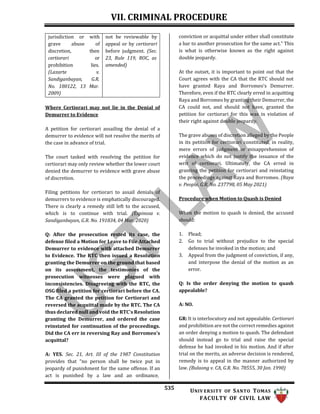
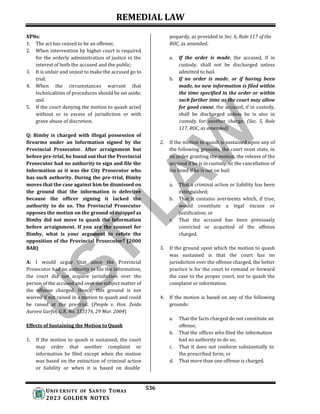
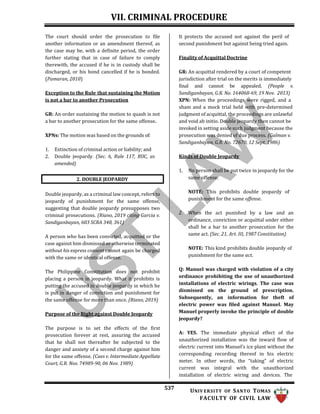
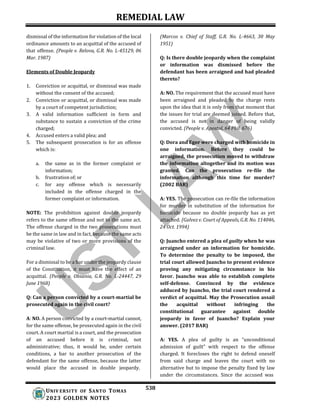
REMEDIAL LAW
2023 GOLDEN NOTES
FACULTY OF CIVIL LAW
UNIVERSITY OF SANTO TOMAS
MANILA
The UST GOLDEN NOTES is the annual student-edited bar review material of
the University of Santo Tomas, Faculty of Civil Law. Communications
regarding the Notes should be addressed to the Academics Committee of the
Team: Bar-Ops.
Address: Academics Committee
UST Bar Operations
Faculty of Civil Law
University of Santo Tomas
España, Manila 1008
Tel. No: (02) 8731-4027
(02) 8406-1611 loc. 8578
Academics Committee
Faculty of Civil Law
University of Santo Tomas
España, Manila 1008
All rights reserved by the Academics Committee of the Faculty of Civil Law of the Pontifical and Royal
University of Santo Tomas, the Catholic University of the Philippines.
2023 Edition.
No portion of this material may be copied or reproduced in books, pamphlets, outlines or notes,
whether printed, mimeographed, typewritten, copied in different electronic devises or in any other
form, for distribution or sale, without a written permission.
A copy of this material without the corresponding code either proceeds from an illegal source or is in
possession of one who has no authority to dispose the same.
Released in the Philippines, 2023.
FACULTY OF CIVIL LAW (1734)
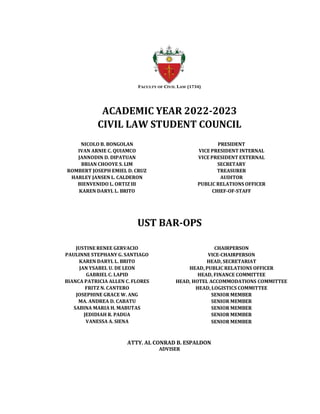
ACADEMIC YEAR 2022-2023
CIVIL LAW STUDENT COUNCIL
NICOLO B. BONGOLAN PRESIDENT
IVAN ARNIE C. QUIAMCO VICE PRESIDENT INTERNAL
JANNODIN D. DIPATUAN VICE PRESIDENT EXTERNAL
BRIAN CHOOYE S. LIM SECRETARY
ROMBERT JOSEPH EMIEL D. CRUZ TREASURER
HARLEY JANSEN L. CALDERON AUDITOR
BIENVENIDO L. ORTIZ III PUBLIC RELATIONS OFFICER
KAREN DARYL L. BRITO CHIEF-OF-STAFF
UST BAR-OPS
JUSTINE RENEE GERVACIO CHAIRPERSON
PAULINNE STEPHANY G. SANTIAGO VICE-CHAIRPERSON
KAREN DARYL L. BRITO HEAD, SECRETARIAT
JAN YSABEL U. DE LEON HEAD, PUBLIC RELATIONS OFFICER
GABRIEL C. LAPID HEAD, FINANCE COMMITTEE
BIANCA PATRICIA ALLEN C. FLORES HEAD, HOTEL ACCOMMODATIONS COMMITTEE
FRITZ N. CANTERO HEAD, LOGISTICS COMMITTEE
JOSEPHINE GRACE W. ANG SENIOR MEMBER
MA. ANDREA D. CABATU SENIOR MEMBER
SABINA MARIA H. MABUTAS SENIOR MEMBER
JEDIDIAH R. PADUA SENIOR MEMBER
VANESSA A. SIENA SENIOR MEMBER
ATTY. AL CONRAD B. ESPALDON
ADVISER
FACULTY OF CIVIL LAW (1734)
ACADEMICS COMMITTEE 2023
ANGELA BEATRICE S. PEÑA KATHERINE S. POLICARPIO
SECRETARIES-GENERAL
RON-SOPHIA NICOLE C. ANTONIO CRIMINAL LAW
HERLENE MAE D. CALILUNG LABOR LAW AND SOCIAL LEGISLATION
PATRISHA LOUISE E. DUMANIL
POLITICAL LAW AND
PUBLIC INTERNATIONAL LAW
ALEXANDRA MAUREEN B. GARCIA LEGAL AND JUDICIAL ETHICS WITH
PRACTICAL EXERCISES
HANNAH JOY C. IBARRA COMMERCIAL LAW
JEDIDIAH R. PADUA CIVIL LAW
PAULINNE STEPHANY G. SANTIAGO TAXATION LAW
DIANNE MICAH ANGELA D. YUMANG REMEDIAL LAW
EXECUTIVE COMMITTEE
PAULA ANDREA F. PEÑAFLOR COVER DESIGN ARTIST
FACULTY OF CIVIL LAW (1734)
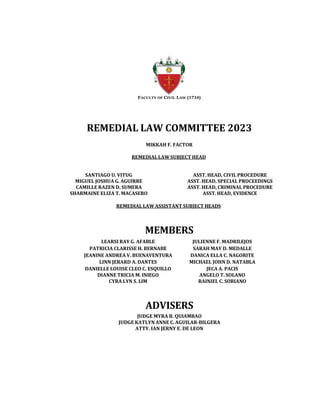
REMEDIAL LAW COMMITTEE 2023
MIKKAH F. FACTOR
REMEDIAL LAW SUBJECT HEAD
SANTIAGO U. VITUG ASST. HEAD, CIVIL PROCEDURE
MIGUEL JOSHUA G. AGUIRRE ASST. HEAD, SPECIAL PROCEEDINGS
CAMILLE RAZEN D. SUMERA ASST. HEAD, CRIMINAL PROCEDURE
SHARMAINE ELIZA T. MACASERO ASST. HEAD, EVIDENCE
REMEDIAL LAW ASSISTANT SUBJECT HEADS
MEMBERS
LEARSI RAY G. AFABLE JULIENNE F. MADRILEJOS
PATRICIA CLARISSE H. BERNABE SARAH MAY D. MEDALLE
JEANINE ANDREA V. BUENAVENTURA DANICA ELLA C. NAGORITE
LINN JERARD A. DANTES MICHAEL JOHN D. NATABLA
DANIELLE LOUISE CLEO C. ESQUILLO JECA A. PACIS
DIANNE TRICIA M. INIEGO ANGELO T. SOLANO
CYRA LYN S. LIM RAINIEL C. SORIANO
ADVISERS
JUDGE MYRA B. QUIAMBAO
JUDGE KATLYN ANNE C. AGUILAR-BILGERA
ATTY. IAN JERNY E. DE LEON
FACULTY OF CIVIL LAW (1734)
FACULTY OF CIVIL LAW
UNIVERSITY OF SANTO TOMAS
ACADEMIC OFFICIALS
ATTY. NILO T. DIVINA REV. FR. ISIDRO C. ABAÑO, O.P.
DEAN REGENT
ATTY. ARTHUR B. CAPILI
FACULTY SECRETARY
ATTY. ELGIN MICHAEL C. PEREZ
LEGAL COUNSEL
UST CHIEF JUSTICE ROBERTO CONCEPCION LEGAL AID CLINIC
JUDGE PHILIP A. AGUINALDO
SWDB COORDINATOR
LENY G. GADIANA, R.G.C.
GUIDANCE COUNSELOR
FACULTY OF CIVIL LAW (1734)
OUR DEEPEST APPRECIATION TO OUR
MENTORS AND INSPIRATION
Justice Roberto A. Abad Judge Gidget Rose V. Duque
Justice Maria Cristina J. Cornejo† Judge Leilani Marie D. Grimares
Justice Maria Filomena D. Singh Judge Gener M. Gito
Justice Magdangal M. De Leon Dean Jose I. Dela Rama
Justice Myra V. Fernandez Dean Lope E. Feble
Justice Oscar C. Herrera, Jr. Dean Ma. Soledad D. Mawis
Justice Amy Lazaro-Javier Dean Salvador N. Moya II
Justice Zenaida G. Laguilles Dean Carlos M. Ortega
Justice Carlito B. Calpatura Dean Willard B. Riano†
Justice Jose Lorenzo R. De La Rosa Dean Ferdinand A. Tan
Justice Georgina D. Hidalgo Atty. Irene D.T. Alogoc
Justice Ronald B. Moreno Atty. Ian Jerny E. De Leon
Justice Eduardo B. Peralta, Jr. Atty. Gregorio Gerry F. Fernandez
Justice Selma Palacio-Alaras Atty. Elmar B. Galacio
Justice Gabriel T. Robeniol Atty. Benigno G. Par, Jr.
Judge Myra B. Quiambao Atty. Christian G. Villasis
For being our guideposts in understanding the intricate sphere of Remedial Law.
– Academics Committee 2023
DISCLAIMER
THE RISK OF USE OF THIS BAR
REVIEW MATERIAL SHALL BE
BORNE BY THE USER
Table of Contents
I. GENERAL PRINCIPLES..............................................................................................................................................1
A. SUBSTANTIVE LAW vs. REMEDIAL LAW...................................................................................................1
B. RULE-MAKING POWER OF THE SUPREME COURT...............................................................................3
C. PRINCIPLE OF JUDICIAL HIERARCHY.........................................................................................................5
D. DOCTRINE OF NON-INTERFERENCE/ JUDICIAL STABILITY ..............................................................7
II. JURISDICTION............................................................................................................................................................9
A. CLASSIFICATION OF JURISDICTION............................................................................................................9
1. ORIGINAL vs. APPELLATE...................................................................................................................... 9
2. GENERAL vs. SPECIAL.............................................................................................................................. 9
3. EXCLUSIVE vs. CONCURRENT................................................................................................................ 9
B. DOCTRINES OF HIERARCHY OF COURTS AND ADHERENCE OF JURISDICTION..........................9
C. JURISDICTION OF VARIOUS PHILIPPINE COURTS AND TRIBUNALS............................................ 10
1. SUPREME COURT ....................................................................................................................................12
2. COURT OF APPEALS...............................................................................................................................14
3. COURT OF TAX APPEALS......................................................................................................................16
4. SANDIGANBAYAN....................................................................................................................................18
5. REGIONAL TRIAL COURTS...................................................................................................................19
6. FAMILY COURTS......................................................................................................................................22
7. METROPOLITAN TRIAL COURTS, MUNICIPAL TRIAL COURTS, MUNICIPAL TRIAL
COURTS IN CITIES, AND MUNICIPAL CIRCUIT TRIAL COURTS.....................................................23
D. ASPECTS OF JURISDICTION........................................................................................................................ 25
1. JURISDICTION OVER THE SUBJECT MATTER ...............................................................................25
2. JURISDICTION OVER THE PARTIES...................................................................................................25
3. JURISDICTION OVER THE ISSUES ......................................................................................................26
4. JURISDICTION OVER THE RES OR THE PROPERTY IN LITIGATION......................................27
E. JURISDICTION vs. EXERCISE OF JURISDICTION ................................................................................... 28
F. JURISDICTION vs. VENUE............................................................................................................................. 28
G. JURISDICTION OVER CASES COVERED BY BARANGAY CONCILIATION, AND CASES
COVERED BY THE RULES ON EXPEDITED PROCEDURES IN THE FIRST LEVEL COURTS ........... 30
III. CIVIL PROCEDURE (A.M. No. 19-10-20-SC)................................................................................................. 34
A. GENERAL PROVISIONS (RULE 1)............................................................................................................. 34
B. KINDS OF ACTION.......................................................................................................................................... 37
1. In Rem.........................................................................................................................................................37
2. In Personam..............................................................................................................................................37
3.Quasi in Rem..............................................................................................................................................37
C. CAUSE OF ACTION (RULE 2)...................................................................................................................... 40
D. PARTIES TO CIVIL ACTIONS (RULE 3)................................................................................................... 46
E. VENUE (RULE 4) ............................................................................................................................................ 60
F. PLEADINGS....................................................................................................................................................... 64
1. KINDS (RULE 6) ......................................................................................................................................64
2. PARTS OF A PLEADING (RULE 7)......................................................................................................74
3. MANNER OF MAKING ALLEGATIONS (RULE 8).............................................................................83
a) IN GENERAL..............................................................................................................................................83
b) ACTION OR DEFENSE BASED ON DOCUMENT...............................................................................83
c) SPECIFIC DENIAL ....................................................................................................................................84
d) AFFIRMATIVE DEFENSES.....................................................................................................................85
4. EFFECT OF FAILURE TO PLEAD (RULE 9)......................................................................................86
5. AMENDED AND SUPPLEMENTAL PLEADINGS (RULE 10)..........................................................87
6. WHEN TO FILE RESPONSIVE PLEADINGS (RULE 11)..................................................................90
G. FILING AND SERVICE (RULE 13)............................................................................................................... 91
1. RULES ON PAYMENT OF DOCKET FEES; EFFECT OF NON-PAYMENT....................................98
2. EFFICIENT USE OF PAPER RULE; E-FILING.....................................................................................99
H. SUMMONS (RULE 14).................................................................................................................................102
1. NATURE AND PURPOSE OF SUMMONS IN RELATION TO ACTIONS IN PERSONAM, IN
REM, AND QUASI IN REM..........................................................................................................................102
2. WHO MAY SERVE SUMMONS ............................................................................................................102
3. VALIDITY OF SUMMONS AND ISSUANCE OF ALIAS SUMMONS.............................................103
4. PERSONAL SERVICE .............................................................................................................................104
5. SUBSTITUTED SERVICE......................................................................................................................105
6. CONSTRUCTIVE SERVICE ...................................................................................................................106
7. EXTRATERRITORIAL SERVICE.........................................................................................................107
8. PROOF OF SERVICE ..............................................................................................................................109
I. MOTIONS (RULE 15)....................................................................................................................................109
1. IN GENERAL ............................................................................................................................................109
2. NON-LITIGIOUS MOTIONS .................................................................................................................111
3. LITIGIOUS MOTIONS............................................................................................................................111
4. PROHIBITED MOTIONS ......................................................................................................................111
5. MOTION FOR BILL OF PARTICULARS (RULE 12)..................................................................................112
J. DISMISSAL OF ACTIONS (RULE 17) ........................................................................................................115
1. WITH PREJUDICE vs. WITHOUT PREJUDICE................................................................................115
2. DISMISSALS WHICH HAVE AN EFFECT OF AN ADJUDICATION ON THE MERITS.............115
K. PRE-TRIAL (RULE 18)................................................................................................................................118
1. NATURE AND PURPOSE......................................................................................................................118
2. APPEARANCE OF PARTIES; EFFECTS OF FAILURE TO APPEAR ...........................................118
3. PRE-TRIAL BRIEF; EFFECT OF FAILURE TO FILE.......................................................................119
L INTERVENTION (RULE 19)........................................................................................................................120
M. SUBPOENA (RULE 21)...............................................................................................................................123
N. COMPUTATION OF TIME (RULE 22) .....................................................................................................125
O. MODES OF DISCOVERY..............................................................................................................................127
1. DEPOSITIONS (RULES 23 AND 24)..................................................................................................128
PEOPLE v. SERGIO......................................................................................................................................128
2. INTERROGATORIES TO PARTIES (RULE 25)...............................................................................136
3. ADMISSION BY ADVERSE PARTY (RULE 26) ...............................................................................139
4. PRODUCTION OR INSPECTION OF DOCUMENTS OR THINGS (RULE 27)...........................140
5. PHYSICAL AND MENTAL EXAMINATION OF PERSONS (RULE 28) ......................................141
6. REFUSAL TO COMPLY WITH MODES OF DISCOVERY (RULE 29)..........................................142
P. TRIAL (RULE 30)..........................................................................................................................................143
1. SCHEDULE OF TRIAL............................................................................................................................144
2. ADJOURNMENTS AND POSTPONEMENTS.....................................................................................144
3. REQUISITES OF MOTION TO POSTPONE TRIAL FOR ILLNESS OF PARTY OR COUNSEL
144
Q. CONSOLIDATION OR SEVERANCE (RULE 31) ....................................................................................145
R. DEMURRER TO EVIDENCE (RULE 33) ..................................................................................................146
1. GROUNDS.................................................................................................................................................147
2. EFFECT OF ORDER DENYING DEMURRER TO EVIDENCE.......................................................147
S. JUDGMENTS AND FINAL ORDERS...........................................................................................................149
1. JUDGMENT ON THE PLEADINGS (RULE 34) ............................................................................................150
a) GROUNDS................................................................................................................................................150
b) ACTION ON MOTION FOR JUDGMENT ON THE PLEADINGS..................................................150
2. SUMMARY JUDGMENTS (RULE 35).................................................................................................151
a) EFFECT OF ORDER DENYING A MOTION FOR SUMMARY JUDGMENT...............................154
3. RENDITION AND ENTRY OF JUDGMENTS AND FINAL ORDERS (RULE 36) ......................156
T. POST-JUDGMENT REMEDIES...................................................................................................................160
1. MOTION FOR NEW TRIAL OR RECONSIDERATION (RULE 37) ..............................................161
a) REMEDY AGAINST DENIAL................................................................................................................164
b) FRESH-PERIOD RULE..........................................................................................................................165
2. APPEALS ..................................................................................................................................................166
a) NATURE OF RIGHT TO APPEAL.......................................................................................................166
b) JUDGMENT AND FINAL ORDERS SUBJECT TO APPEAL ...........................................................167
c) MATTERS NOT APPEALABLE;...........................................................................................................167
d) DOCTRINE OF FINALITY/IMMUTABILITY OF JUDGMENT.....................................................167
e) MODES OF APPEAL (PERIOD, PERFECTION, ISSUES TO BE RAISED)..................................168
(1) APPEAL FROM MUNICIPAL TRIAL COURTS TO REGIONAL TRIAL
COURTS (RULE 40).................................................................................................168
(2) APPEAL FROM THE REGIONAL TRIAL COURTS (RULE 41)...............169
(3) PETITION FOR REVIEW FROM THE REGIONAL TRIAL COURT TO
THE COURT OF APPEALS (RULE 42) ................................................................171
(4) APPEALS FROM THE COURT OF TAX APPEALS, CIVIL SERVICE
COMMISSION, AND QUASI-JUDICIAL AGENCIES (RULE 43) ....................173
(5) APPEALS BY CERTIORARI TO THE SUPREME COURT (RULE 45)....177
(6) REVIEW OF JUDGMENTS OR FINAL ORDERS OF THE COMMISSION ON
AUDIT AND COMMISSION ON ELECTIONS (RULE 64).................................180
(7) DISMISSAL, REINSTATEMENT, AND WITHDRAWAL OF APPEAL ....181
3. PETITION FOR RELIEF FROM JUDGMENT (RULE 38) ...............................................................183
4. ANNULMENT OF JUDGMENT (RULE 47).......................................................................................186
5. COLLATERAL ATTACK ON JUDGMENTS ........................................................................................188
U. EXECUTION, SATISFACTION, AND EFFECT OF JUDGMENTS (RULE 39) ....................................189
IV. PROVISIONAL REMEDIES ................................................................................................................................216
A. NATURE, PURPOSE, AND JURISDICTION OVER PROVISIONAL REMEDIES..............................216
B. PRELIMINARY ATTACHMENT (RULE 57)...........................................................................................219
C. PRELIMINARY INJUNCTION (RULE 58)................................................................................................231
D. RECEIVERSHIP (RULE 59) .......................................................................................................................245
E. REPLEVIN (RULE 60) .................................................................................................................................248
V. SPECIAL CIVIL ACTIONS ....................................................................................................................................251
A. JURISDICTION AND VENUE.......................................................................................................................253
B. INTERPLEADER (RULE 62)......................................................................................................................255
C. DECLARATORY RELIEF AND SIMILAR REMEDIES (RULE 63) .....................................................256
D. CERTIORARI, PROHIBITION, AND MANDAMUS (RULE 65)...........................................................261
1. DEFINITION AND DISTINCTIONS.....................................................................................................261
2. REQUISITES, WHEN, AND WHERE TO FILE .................................................................................267
3. EXCEPTIONS TO FILING OF MOTION FOR RECONSIDERATION BEFORE FILING PETITION
283
E. QUO WARRANTO (RULE 66)...................................................................................................................284
F. EXPROPRIATION (RULE 67).....................................................................................................................287
1. TWO STAGES IN EVERY ACTION FOR EXPROPRIATION .........................................................289
2. ORDER OF EXPROPRIATION .............................................................................................................291
3. ASCERTAINMENT OF JUST COMPENSATION ...............................................................................292
4. RIGHTS OF PLAINTIFF UPON JUDGMENT AND PAYMENT.....................................................298
GUIDELINES FOR EXPROPRIATION PROCEEDINGS OF NATIONAL GOV’T INFRASTRUCTURE
PROJECTS...................................................................................................................................................................... 300
G. FORECLOSURE OF REAL ESTATE MORTGAGE ..................................................................................302
(RULE 68)............................................................................................................................................................302
1. JUDICIAL FORECLOSURE ...................................................................................................................304
2. EXTRAJUDICIAL FORECLOSURE......................................................................................................304
3. THE GENERAL BANKING LAW OF 2000.........................................................................................312
H. PARTITION (RULE 69)..............................................................................................................................314
I. FORCIBLE ENTRY AND UNLAWFUL DETAINER (RULE 70)............................................................318
1. DIFFERENTIATED FROM ACCION PUBLICIANA AND ACCION REIVINDICATORIA...............321
J. CONTEMPT (RULE 71)................................................................................................................................330
VI. SPECIAL PROCEEDINGS AND SPECIAL WRITS..........................................................................................339
A. SETTLEMENT OF ESTATE OF DECEASED PERSONS ........................................................................350
1. VENUE AND PROCESS (RULE 73)....................................................................................................350
2. SUMMARY SETTLEMENT OF ESTATES (RULE 74) ....................................................................355
3. ALLOWANCE AND DISALLOWANCE OF WILLS (RULE 76) ......................................................362
4. CLAIMS AGAINST THE ESTATE (RULE 86) ..................................................................................367
5. PAYMENT OF DEBTS OF THE ESTATE (RULE 88)......................................................................374
6. SALES, MORTGAGES, AND OTHER ENCUMBRANCES OF PROPERTY OF DECEDENT
(RULE 89).....................................................................................................................................................376
7. DISTRIBUTION AND PARTITION (RULE 90)...............................................................................378
B. GUARDIANSHIP............................................................................................................................................382
1. VENUE (RULE 92)..................................................................................................................................382
2. APPOINTMENT OF GUARDIANS (RULE 93)..................................................................................383
3. GENERAL POWERS AND DUTIES OF GUARDIANS (RULE 96)................................................385
4. TERMINATION OF GUARDIANSHIP (RULE 97) ...........................................................................387
C. WRIT OF HABEAS CORPUS (RULE 102) ...............................................................................................390
1. WRIT OF HABEAS CORPUS IN RELATION TO CUSTODY OF MINORS....................................407
D. CHANGE OF NAME (RULE 103)...............................................................................................................410
E. CANCELLATION OR CORRECTION OF ENTRIES IN THE CIVIL REGISTRY (RULE 108).........419
F. CLERICAL ERROR LAW...............................................................................................................................424
G. WRIT OF AMPARO.......................................................................................................................................427
H. WRIT OF HABEAS DATA ...........................................................................................................................437
I. RULES OF PROCEDURE FOR ENVIRONMENTAL CASES..................................................................441
1. TEMPORARY ENVIRONMENTAL PROTECTION ORDER (TEPO)............................................443
2. WRIT OF CONTINUING MANDAMUS................................................................................................444
3. WRIT OF KALIKASAN ...........................................................................................................................450
VII. CRIMINAL PROCEDURE..................................................................................................................................454
A. GENERAL CONCEPTS ..................................................................................................................................454
1. CRIMINAL JURISDICTION; CONCEPT AND REQUISITES FOR EXERCISE ............................454
2. WHEN INJUNCTION MAY BE FILED.................................................................................................461
B. PROSECUTION OF OFFENSES (RULE 110)...........................................................................................461
C. PROSECUTION OF CIVIL ACTION RULE 111........................................................................................477
D. PRELIMINARY INVESTIGATION (RULE 112)......................................................................................484
1. EXECUTIVE vs. JUDICIAL DETERMINATION OF PROBABLE CAUSE.....................................484
E. ARREST (RULE 113)....................................................................................................................................500
1. ARREST WITHOUT WARRANT, WHEN LAWFUL.......................................................................501
2. REQUISITES OF A VALID WARRANT OF ARREST......................................................................507
3. DETERMINATION OF PROBABLE CAUSE FOR ISSUANCE OF WARRANT OF ARREST 508
F. BAIL (RULE 114) ..........................................................................................................................................509
1. NATURE....................................................................................................................................................509
2. WHEN A MATTER OF RIGHT; EXCEPTIONS..................................................................................514
3. WHEN A MATTER OF DISCRETION .................................................................................................515
G. ARRAIGNMENT AND PLEA (RULE 116)................................................................................................525
1. SEARCHING INQUIRY...........................................................................................................................531
PEOPLE v. PAGAL.......................................................................................................................531
2. IMPROVIDENT PLEA............................................................................................................................532
H. MOTION TO QUASH (RULE 117)............................................................................................................533
1. GROUNDS.................................................................................................................................................533
2. DOUBLE JEOPARDY..............................................................................................................................537
3. PROVISIONAL DISMISSAL..................................................................................................................542
I. PRE-TRIAL (RULE 118)................................................................................................................................544
1. PRE-TRIAL AGREEMENT ....................................................................................................................547
2. NON-APPEARANCE DURING PRE-TRIAL.......................................................................................547
3. PRE-TRIAL ORDER ...............................................................................................................................547
J. TRIAL (RULE 119) ........................................................................................................................................549
1.TRIAL IN ABSENTIA ...............................................................................................................................555
2. EXAMINATION OF WITNESS FOR THE PROSECUTION............................................................556
PEOPLE v. SERGIO......................................................................................................................556
3. REQUISITES FOR DISCHARGE OF ACCUSED TO BECOME A STATE WITNESS..................557
4. EFFECTS OF DISCHARGE OF ACCUSED AS STATE WITNESS ..................................................558
5. DEMURRER TO EVIDENCE .................................................................................................................560
6. REVISED GUIDELINES ON CONTINUOUS TRIAL..........................................................................562
K. JUDGMENT (RULE 120).............................................................................................................................571
1. PROMULGATION OF JUDGMENT......................................................................................................574
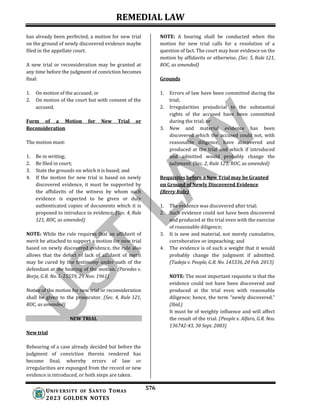
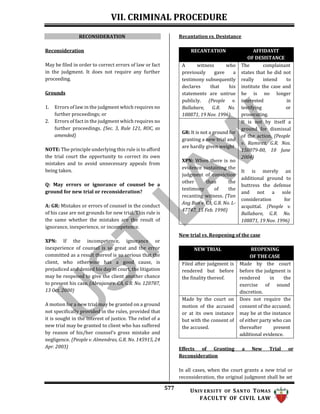
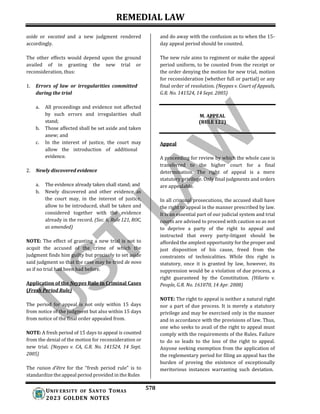
L. NEW TRIAL OR RECONSIDERATION (RULE 121)..............................................................................575
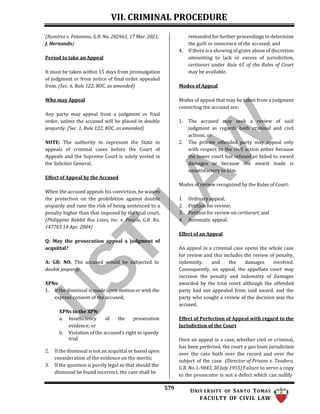
M. APPEAL (RULE 122)..................................................................................................................................578
N. SEARCH AND SEIZURE (RULE 126)........................................................................................................584
O. PROVISIONAL REMEDIES IN CRIMINAL CASES (RULE 127)..........................................................597
P. THE RULE ON CYBERCRIME WARRANTS.............................................................................................598
VIII. EVIDENCE (A.M. No. 19-08-15-SC).............................................................................................................608
A. GENERAL CONCEPTS ..................................................................................................................................608
1. PROOF vs. EVIDENCE ...........................................................................................................................609
2. BURDEN OF PROOF vs. BURDEN OF EVIDENCE ..........................................................................609
3. EQUIPOISE RULE ...................................................................................................................................610
B. ADMISSIBILITY OF EVIDENCE (RULE 128) .........................................................................................611
1. REQUISITES FOR ADMISSIBILITY OF EVIDENCE .......................................................................611
2. RELEVANCE OF EVIDENCE AND COLLATERAL MATTERS ......................................................611
3. MULTIPLE ADMISSIBILITY ................................................................................................................611
4. CONDITIONAL ADMISSIBILITY.........................................................................................................612
5. CURATIVE ADMISSIBILITY ................................................................................................................612
6. DIRECT AND CIRCUMSTANTIAL EVIDENCE .................................................................................612
7. POSITIVE AND NEGATIVE EVIDENCE.............................................................................................613
8. COMPETENT AND CREDIBLE EVIDENCE.......................................................................................614
C. JUDICIAL NOTICE AND JUDICIAL ADMISSIONS (RULE 129) ..........................................................615
D. OBJECT (REAL) EVIDENCE (RULE 130, A)..........................................................................................622
1. REQUISITES.............................................................................................................................................623
2. EXCLUSIONARY RULES........................................................................................................................624
E. DOCUMENTARY EVIDENCE (RULE 130, B).........................................................................................634
1. DEFINITION.............................................................................................................................................634
2. ORIGINAL DOCUMENT RULE.............................................................................................................635
3. SECONDARY EVIDENCE.......................................................................................................................638
4. PAROL EVIDENCE RULE......................................................................................................................644
F. TESTIMONIAL EVIDENCE (RULE 130, C)..............................................................................................648
1. QUALIFICATIONS OF WITNESSES...........................................................................................................648
2. DISQUALIFICATIONS OF WITNESSES.....................................................................................................650
a) DISQUALIFICATION BY REASON OF MARRIAGE...................................................651
b) DISQUALIFICATION BY REASON OF PRIVILEGED COMMUNICATIONS; RULE
ON THIRD PARTIES .............................................................................................................653
c) PARENTAL AND FILIAL PRIVILEGE RULE................................................................663
d) PRIVILEGE RELATING TO TRADE SECRETS ...........................................................665
3. TESTIMONIAL PRIVILEGE..................................................................................................................666
4. ADMISSIONS AND CONFESSIONS .....................................................................................................666
5. PREVIOUS CONDUCT AS EVIDENCE................................................................................................674
6. TESTIMONIAL KNOWLEDGE.............................................................................................................677
7. HEARSAY AND EXCEPTIONS TO THE HEARSAY RULE.............................................................677
8. OPINION RULE........................................................................................................................................695
9. CHARACTER EVIDENCE.......................................................................................................................698
G. BURDEN OF PROOF AND PRESUMPTIONS (RULE 131)..................................................................699
H. PRESENTATION OF EVIDENCE (RULE 132)........................................................................................707
1. EXAMINATION OF WITNESSES.........................................................................................................707
a) RIGHTS AND OBLIGATIONS OF A WITNESS ...........................................................709
b) LEADING AND MISLEADING QUESTIONS ................................................................714
c) IMPEACHMENT OF WITNESSES..................................................................................714
2. AUTHENTICATION AND PROOF OF DOCUMENTS....................................................................718
a) MEANING OF AUTHENTICATION ............................................................................... 718
b) CLASSES OF DOCUMENTS............................................................................................. 718
c) AUTHENTICATION OF A PRIVATE WRITING ......................................................... 719
d) PUBLIC DOCUMENTS AS EVIDENCE; PROOF OF OFFICIAL RECORD............. 721
3. OFFER AND OBJECTION......................................................................................................................725
a) WHEN TO MAKE AN OFFER ......................................................................................... 727
b) WHEN TO MAKE AN OBJECTION................................................................................ 728
c) TENDER OF EXCLUDED EVIDENCE............................................................................ 730
I. JUDICIAL AFFIDAVIT RULE........................................................................................................................ 732
J. WEIGHT AND SUFFICIENCY OF EVIDENCE (RULE 133) ................................................................... 737
K. RULES ON ELECTRONIC EVIDENCE ....................................................................................................... 750
I. GENERAL PRINCIPLES
1 UNIV ERSITY OF SANTO TOMAS
FACULTY OF CIVIL LAW
I. GENERAL PRINCIPLES
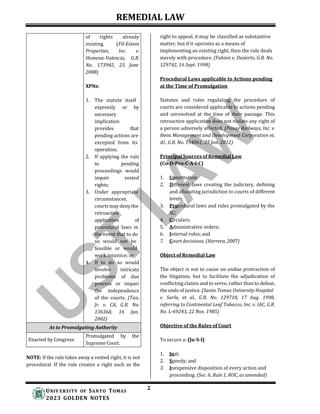
A. SUBSTANTIVE LAW vs. REMEDIAL LAW
Concepts in Remedial Law
Procedural laws are adjective laws which prescribe
rules and forms of procedure of enforcing rights or
obtaining redress for their invasion. They refer to
rules of procedure by which courts applying laws of
all kinds can properly administer justice. They
include rules of pleadings, practice, and evidence
(Tan, Jr. v. CA, G.R. No. 136368, 16 Jan. 2002) (2006
BAR)
Remedial law plays a vital role in the administration
of justice. It lies at the very core of procedural due
process, which means a law which hears before it
condemns, one which proceeds upon inquiry and
renders judgment only after trial and contemplates
an opportunity to be heard before judgment is
rendered. (Albert v. University Publishing, G.R. No. L-
19118, 30 Jan. 1965)
Nature of Remedial Law
Rules of Court, promulgated by authority of law,
have the force and effect of law; and Rules of Court
prescribing the time within which certain acts must
be done, or certain proceedings taken, are
considered absolutely indispensable to the
prevention of needless delays and to the orderly and
speedy discharge of judicial business. (Gonzales v.
Torres, A.M. No. MTJ-06-1653, 30 July 2007)
Strict compliance with the rules has been held
mandatory and imperative, so that failure to pay the
docket fee in the Supreme Court, within the period
fixed for that purpose, will cause the dismissal of the
appeal. (Alvero v. De La Rosa et. al., G.R. No. L-286, 29
Mar. 1946)
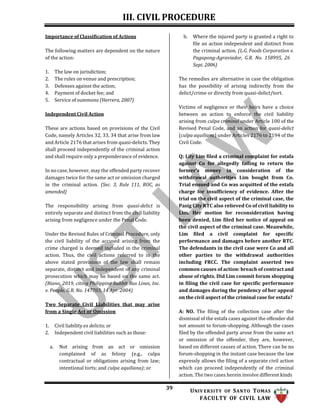
PART ONE: REMEDIAL LAW
SUBSTANTIVE LAW REMEDIAL LAW
As to the Definition
Part of the law which
Prescribes the methods
of enforcing those rights
and obligations created
by substantive law.
(Ibid.)
creates, defines or
regulates rights
concerning life, liberty
or property (Primicias v.
Ocampo, G.R. No. L-6120,
30 June 1953) or the
powers of agencies or
instrumentalities for
the administration of
public affairs, which
when violated gives rise
to a cause of action.
(Bustos v. Lucero, G.R.
No. L-2068, 20 Oct.
1948)
As to Creation of Vested Rights
Creates vested rights.
Does not create vested
rights.
As to Prospective Application
GR: May be applied
retroactively.
Generally prospective
in application.
Procedural laws may be
given retroactive effect
to actions pending and
undetermined at the
time of their passage,
there being no vested
rights in the rules of
procedure.
Amendments to
procedural rules are
procedural or remedial
in character as they do
not create new or
remove vested rights,
but only operate in
furtherance of the
remedy or confirmation
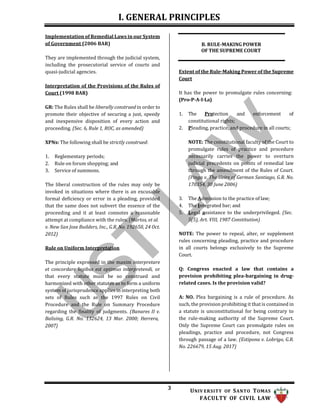
REMEDIAL LAW
2
UNIV ERSITY OF SANTO TOMAS
2023 GOLDEN NOTES
right to appeal, it may be classified as substantive
matter, but if it operates as a means of
implementing an existing right, then the rule deals
merely with procedure. (Fabian v. Desierto, G.R. No.
129742, 16 Sept. 1998)
Procedural Laws applicable to Actions pending
at the Time of Promulgation
Statutes and rules regulating the procedure of
courts are considered applicable to actions pending
and unresolved at the time of their passage. This
retroactive application does not violate any right of
a person adversely affected. (Panay Railways, Inc. v.
Heva Management and Development Corporation et.
Al., G.R. No. 154061, 25 Jan. 2012)
Principal Sources of Remedial Law
(Co-D-Pro-C-A-I-C)
1. Constitution;
2. Different laws creating the judiciary, defining
and allocating jurisdiction to courts of different
levels;
3. Procedural laws and rules promulgated by the
SC;
4. Circulars;
5. Administrative orders;
6. Internal rules; and
7. Court decisions. (Herrera, 2007)
Object of Remedial Law
NOTE: If the rule takes away a vested right, it is not
procedural. If the rule creates a right such as the
The object is not to cause an undue protraction of
the litigation, but to facilitate the adjudication of
conflicting claims and to serve, rather than to defeat,
the ends of justice. (Santo Tomas University Hospital
v. Surla, et al., G.R. No. 129718, 17 Aug. 1998,
referring to Continental Leaf Tobacco, Inc. v. IAC, G.R.
No. L-69243, 22 Nov. 1985)
Objective of the Rules of Court
To secure a: (Ju-S-I)
1. Just;
2. Speedy; and
3. Inexpensive disposition of every action and
proceeding. (Sec. 6, Rule 1, ROC, as amended)
of rights already
existing. (Fil-Estate
Properties, Inc. v.
Homena-Valencia, G.R.
No. 173942, 25 June
2008)
XPNs:
1. The statute itself
expressly or by
necessary
implication
provides that
pending actions are
excepted from its
operation;
2. If applying the rule
to pending
proceedings would
impair vested
rights;
3. Under appropriate
circumstances,
courts may deny the
retroactive
application of
procedural laws in
the event that to do
so would not be
feasible or would
work injustice; or
4. If to do so would
involve intricate
problems of due
process or impair
the independence
of the courts. (Tan,
Jr. v. CA, G.R. No.
136368, 16 Jan.
2002)
As to Promulgating Authority
Enacted by Congress.
Promulgated by the
Supreme Court.
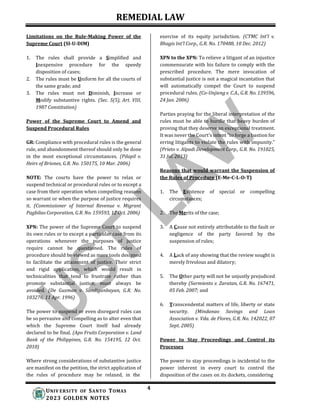
I. GENERAL PRINCIPLES
3 UNIV ERSITY OF SANTO TOMAS
FACULTY OF CIVIL LAW
Implementation of Remedial Laws in our System
of Government (2006 BAR)
They are implemented through the judicial system,
including the prosecutorial service of courts and
quasi-judicial agencies.
Interpretation of the Provisions of the Rules of
Court (1998 BAR)
GR: The Rules shall be liberally construed in order to
promote their objective of securing a just, speedy
and inexpensive disposition of every action and
proceeding. (Sec. 6, Rule 1, ROC, as amended)
XPNs: The following shall be strictly construed:
1. Reglementary periods;
2. Rule on forum shopping; and
3. Service of summons.
The liberal construction of the rules may only be
invoked in situations where there is an excusable
formal deficiency or error in a pleading, provided
that the same does not subvert the essence of the
proceeding and it at least connotes a reasonable
attempt at compliance with the rules. (Martos, et al.
v. New San Jose Builders, Inc., G.R. No. 192650, 24 Oct.
2012)
Rule on Uniform Interpretation
The principle expressed in the maxim interpretare
et concordare legibus est optimus interpretendi, or
that every statute must be so construed and
harmonized with other statutes as to form a uniform
system of jurisprudence applies in interpreting both
sets of Rules such as the 1997 Rules on Civil
Procedure and the Rule on Summary Procedure
regarding the finality of judgments. (Banares II v.
Balising, G.R. No. 132624, 13 Mar. 2000; Herrera,
2007)
B. RULE-MAKING POWER
OF THE SUPREME COURT
Extent of the Rule-Making Power of the Supreme
Court
It has the power to promulgate rules concerning:
(Pro-P-A-I-La)
1. The Protection and enforcement of
constitutional rights;
2. Pleading, practice, and procedure in all courts;
NOTE: The constitutional faculty of the Court to
promulgate rules of practice and procedure
necessarily carries the power to overturn
judicial precedents on points of remedial law
through the amendment of the Rules of Court.
(Pinga v. The Heirs of German Santiago, G.R. No.
170354, 30 June 2006)
3. The Admission to the practice of law;
4. The Integrated bar; and
5. Legal assistance to the underprivileged. (Sec.
5(5), Art. VIII, 1987 Constitution)
NOTE: The power to repeal, alter, or supplement
rules concerning pleading, practice and procedure
in all courts belongs exclusively to the Supreme
Court.
Q: Congress enacted a law that contains a
provision prohibiting plea-bargaining in drug-
related cases. Is the provision valid?
A: NO. Plea bargaining is a rule of procedure. As
such, the provision prohibiting it that is contained in
a statute is unconstitutional for being contrary to
the rule-making authority of the Supreme Court.
Only the Supreme Court can promulgate rules on
pleadings, practice and procedure, not Congress
through passage of a law. (Estipona v. Lobrigo, G.R.
No. 226679, 15 Aug. 2017)
REMEDIAL LAW
4
UNIV ERSITY OF SANTO TOMAS
2023 GOLDEN NOTES
Limitations on the Rule-Making Power of the
Supreme Court (SI-U-DIM)
1. The rules shall provide a Simplified and
Inexpensive procedure for the speedy
disposition of cases;
2. The rules must be Uniform for all the courts of
the same grade; and
3. The rules must not Diminish, Increase or
Modify substantive rights. (Sec. 5(5), Art. VIII,
1987 Constitution)
Power of the Supreme Court to Amend and
Suspend Procedural Rules
GR: Compliance with procedural rules is the general
rule, and abandonment thereof should only be done
in the most exceptional circumstances. (Pilapil v.
Heirs of Briones, G.R. No. 150175, 10 Mar. 2006)
NOTE: The courts have the power to relax or
suspend technical or procedural rules or to except a
case from their operation when compelling reasons
so warrant or when the purpose of justice requires
it. (Commissioner of Internal Revenue v. Migrant
Pagbilao Corporation, G.R. No. 159593, 12 Oct. 2006)
XPN: The power of the Supreme Court to suspend
its own rules or to except a particular case from its
operations whenever the purposes of justice
require cannot be questioned. The rules of
procedure should be viewed as mere tools designed
to facilitate the attainment of justice. Their strict
and rigid application, which would result in
technicalities that tend to frustrate rather than
promote substantial justice, must always be
avoided. (De Guzman v. Sandiganbayan, G.R. No.
103276, 11 Apr. 1996)
The power to suspend or even disregard rules can
be so pervasive and compelling as to alter even that
which the Supreme Court itself had already
declared to be final. (Apo Fruits Corporation v. Land
Bank of the Philippines, G.R. No. 154195, 12 Oct.
2010)
Where strong considerations of substantive justice
are manifest on the petition, the strict application of
the rules of procedure may be relaxed, in the
exercise of its equity jurisdiction. (CTMC Int’l v.
Bhagis Int’l Corp., G.R. No. 170488, 10 Dec. 2012)
XPN to the XPN: To relieve a litigant of an injustice
commensurate with his failure to comply with the
prescribed procedure. The mere invocation of
substantial justice is not a magical incantation that
will automatically compel the Court to suspend
procedural rules. (Co-Unjieng v. C.A., G.R. No. 139596,
24 Jan. 2006)
Parties praying for the liberal interpretation of the
rules must be able to hurdle that heavy burden of
proving that they deserve an exceptional treatment.
It was never the Court’s intent “to forge a bastion for
erring litigants to violate the rules with impunity.”
(Prieto v. Alpadi Development Corp., G.R. No. 191025,
31 Jul. 2013)
Reasons that would warrant the Suspension of
the Rules of Procedure (E-Me-C-L-O-T)
1. The Existence of special or compelling
circumstances;
2. The Merits of the case;
3. A Cause not entirely attributable to the fault or
negligence of the party favored by the
suspension of rules;
4. A Lack of any showing that the review sought is
merely frivolous and dilatory;
5. The Other party will not be unjustly prejudiced
thereby (Sarmiento v. Zaratan, G.R. No. 167471,
05 Feb. 2007; and
6. Transcendental matters of life, liberty or state
security. (Mindanao Savings and Loan
Association v. Vda. de Flores, G.R. No. 142022, 07
Sept. 2005)
Power to Stay Proceedings and Control its
Processes
The power to stay proceedings is incidental to the
power inherent in every court to control the
disposition of the cases on its dockets, considering
I. GENERAL PRINCIPLES
5 UNIV ERSITY OF SANTO TOMAS
FACULTY OF CIVIL LAW
its time and effort, and that of counsel and the
litigants. But if proceedings must be stayed, it must
be done in order to avoid multiplicity of suits and
prevent vexatious litigations, conflicting judgments,
and confusion between litigants and courts.
(Security Bank Corp. v. Judge Victorio, G.R. No.
155099, 31 Aug. 2005)
C. PRINCIPLE OF JUDICIAL HIERARCHY
The principle provides that lower courts shall
initially decide a case before it is considered by a
higher court. A higher court will not entertain direct
resort to it unless the redress desired cannot be
obtained in the appropriate courts. (Santiago v.
Vasquez, G.R. Nos. 99289-90, 27 Jan. 1993)
Pursuant to this principle, a case must be filed first
before the lowest court possible having the
appropriate jurisdiction, except if one can advance a
special reason which would allow a party a direct
resort to a higher court. (Riano, 2019)
Constitutional Imperative
This doctrine is not mere policy, rather, it is a
constitutional filtering mechanism designed to
enable the Court to focus on the more fundamental
and essential tasks assigned to it by the highest law
of the land. (Gios-Samar, Inc. v. Department of
Transportation and Communications and Civil
Aviation Authority of the Philippines, G.R. No. 217158,
12 Mar. 2019)
Strict observance of the doctrine of hierarchy of
courts should not be a matter of mere policy. It is a
constitutional imperative given:
1. The structure of our judicial system
The doctrine of hierarchy of courts recognizes the
various levels of courts in the country as they are
established under the Constitution and by law, their
ranking and effect of their rulings in relation with
one another, and how these different levels of court
interact with one another. It determines the venues
of appeals and the appropriate forum for the
issuance of extraordinary writs.
Accordingly, when litigants seek relief directly from
the Court, they bypass the judicial structure and
open themselves to the risk of presenting
incomplete or disputed facts. This consequently
hampers the resolution of controversies before the
Court. Without the necessary facts, the Court cannot
authoritatively determine the rights and obligations
of the parties. The case would then become another
addition to the Court's already congested dockets;
and
2. The requirements of due process
By directly filing a case before the Court, litigants
necessarily deprive themselves of the opportunity
to completely pursue or defend their causes of
actions. Their right to due process is effectively
undermined by their own doing. (Ibid.)
NOTE: The doctrine of hierarchy of courts ensure
that every level of the judiciary performs its
designated roles in an effective and efficient
manner. (Maza v. Turla, G.R. No. 187094, 15 Feb.
2017, citing The Diocese of Bacolod v. COMELEC, G.R.
No. 206728, 21 Jan. 2015)
Trial courts do not only determine the facts from the
evaluation of the evidence presented before them.
They are likewise competent to determine issues of
law which may include the validity of an ordinance,
statute, or even an executive issuance in relation to
the Constitution.
To effectively perform these functions, they are
territorially organized into regions and then into
branches. Their writs generally reach within those
territorial boundaries. Necessarily, they mostly
perform the all-important task of inferring the facts
from the evidence as these are physically presented
before them. In many instances, the facts occur
within their territorial jurisdiction, which properly
present the 'actual case' that makes ripe a
determination of the constitutionality of such
action. The consequences, of course, would be
national in scope. (Ha Datu Tawahig, et al v. Hon.
Cebu City Prosecutor I Lineth Lapinid, et al., G.R. No.
REMEDIAL LAW
6
UNIV ERSITY OF SANTO TOMAS
2023 GOLDEN NOTES
221139, 20 Mar. 2019, citing The Diocese of Bacolod
v. COMELEC)
Filtering Mechanism (In-O-De)
The doctrine of hierarchy of courts operates to:
1. Prevent Inordinate demands upon the Court's
time and attention which are better devoted to
those matters within its exclusive jurisdiction;
2. Prevent further Overcrowding of the Court's
docket;and
3. Prevent the inevitable and resultant Delay,
intended or otherwise, in the adjudication of
cases which often have to be remanded or
referred to the lower court as the proper forum
under the rules of procedure, or as the court
better equipped to resolve factual questions.
Exceptions to the Doctrine of Hierarchy of
Courts (2017 BAR)
In several cases, the court has allowed direct
invocation of the SC’s original jurisdiction on the
following grounds:
1. When there are genuine issues of
constitutionality that must be addressed at
the most immediate time; (The Diocese of
Bacolod v. COMELEC, supra)
NOTE: A direct resort to the Supreme Court
includes availing of the remedies
of certiorari and prohibition to assail the
constitutionality of actions of both legislative
and executive branches of the government.
2. When the issues involved are of
transcendental importance;
NOTE: In these cases, the imminence and
clarity of the threat to fundamental
constitutional rights outweigh the necessity
for prudence. The doctrine relating to
constitutional issues of transcendental
importance prevents courts from the
paralysis of procedural niceties when clearly
faced with the need for substantial
protection;
3. Cases of first impression (Ha Datu Tawahig, et
al v. Hon. Cebu City Prosecutor I Lineth Lapinid,
et al., supra.);
4. The constitutional issues raised are better
decided by the Supreme Court;
5. Exigency in certain situations or when time is
of the essence;
6. The filed petition reviews the act of a
constitutional organ;
7. No other plain, speedy, and adequate remedy
in the ordinary course of law;
8. The petition includes questions that are
dictated by public welfare and the
advancement of public policy, or demanded
by the broader interest of justice;
9. The orders complained of were found to be
patent nullities;
10. The appeal was considered as clearly an
inappropriate remedy; or
11. When analogous, exceptional and compelling
circumstances called for and justified the
immediate and direct handling of the case.
(Republic v. Caguioa, et al., G.R. No. 174385, 20
Feb. 2013)
Common Denominator
A careful examination of the jurisprudential bases of
the exceptions would reveal a common
denominator — the issues for resolution of the
Court are purely legal. (Gios-Samar, Inc. v.
Department of Transportation and Communications
and Civil Aviation Authority of the Philippines, supra.)
NOTE: The SC may disregard the principle of
hierarchy of courts if warranted by the nature and
importance of the issues raised in the interest of
I. GENERAL PRINCIPLES
7 UNIV ERSITY OF SANTO TOMAS
FACULTY OF CIVIL LAW
speedy justice and to avoid future litigations. (Riano,
2019)
Failure to Comply with the Doctrine
D. DOCTRINE OF NON-INTERFERENCE/
JUDICIAL STABILITY
Failure to comply with the Principle of Hierarchy of
Courts is sufficient cause for the dismissal of the
petition. (Gios-Samar, Inc. v. Department of
Transportation and Communications and Civil
Aviation Authority of the Philippines, supra.)
Q: Senator Angara filed a Complaint for Damages
against Palafox Jr. alleging that Palafox Jr.
authorized an unsigned letter containing
defamatory statements against him. Palafox Jr.
filed a motion to dismiss on the ground of
improper venue alleging that the Complaint was
filed in the RTC of Pasay City, instead of Makati
City where both parties reside. The Regional
Trial Court denied his motion and held that
venue was proper since the filing of a separate
civil action for damages where the public officer
holds office is allowed under Article 360.
Aggrieved, Palafox Jr., filed a Petition for
Certiorari before the Supreme Court assailing
the order of the RTC. Is the petition meritorious?
A: NO. The petition violates the hierarchy of courts.
The Court may only act when absolutely necessary
or when serious and important reasons exist to
justify an exception. Further, the Court held that
such serious and important reasons must be clearly
stated in the petition.
Here, Palafox, Jr. filed his Petition directly to the
Supreme Court despite the concurrent jurisdiction
of the appellate court. Significantly, he did not
bother to provide any reason or explanation to
justify his non-compliance to the rule on hierarchy
of courts. This constitutes a clear disregard of the
hierarchy of courts and merits the dismissal of the
Petition. (Felino A. Palafox, Jr. v. Francisco Mendiola,
G.R No. 209551, 15 Feb. 2021)
GR: Courts of equal and coordinate jurisdiction
cannot interfere with each other’s orders. (Riano,
2019, citing Lapu-Lapu Development and Housing
Corporation v. Group Management Corporation, G.R.
Nos. 167000 and 169971, 08 Jun. 2011)
The principle also bars a court from reviewing or
interfering with the judgment of a co-equal court
over which it has no appellate jurisdiction. (Riano,
2019)
No court can interfere by injunction with the
judgments or orders of another court of concurrent
jurisdiction. (Metro Rail Transit Development
Corporation v. Trackworks Rail Transit Advertising,
Vending and Promotions, Inc., G.R. No. 204452, 28
June 2021, J. Hernando, citing Barroso v. Omelio, G.R.
No. 184767, 14 Oct. 2015)
Even in case of concurrent jurisdiction, the court
first acquiring jurisdiction excludes the other
courts. (Pacific Ace Finance Ltd. [PAFIN] v. Eiji
Yanagisawa, G.R. No. 175303, 11 Apr. 2012)
XPN: The doctrine does not apply where a third-
party claimant is involved. This is in consonance
with the well-established principle that no man
shall be affected by any proceeding to which he is a
stranger. (Sps. Crisologo v. Omelio, A.M. No. RTJ-12-
2321, 03 Oct. 2012, citing Sec. 16, Rule 39, ROC, as
amended, and quoting Naguit v. CA, G.R. No. 137675,
05 Dec. 2000)
Rationale
The rule is founded on the concept of jurisdiction: a
court that acquires jurisdiction over the case and
renders judgment therein has jurisdiction over its
judgment, to the exclusion of all other coordinate
courts, for its execution and overall, its incidents,
and to control the conduct of ministerial officers
acting in connection with this judgment. (Metro Rail
Transit Development Corporation v. Trackworks Rail
Transit Advertising, Vending and Promotions, Inc.,
REMEDIAL LAW
8
UNIV ERSITY OF SANTO TOMAS
2023 GOLDEN NOTES
G.R. No. 204452, 28 June 2021, J. Hernando, citing
Barroso v. Omelio, G.R. No. 184767, 14 Oct. 2015)
NOTE: The doctrine of non-interference likewise
applies with equal force to administrative bodies.
(Philippine Sinter Corporation v. Cagayan Electric
Power and Light Co., Inc., G.R. No. 127371, 25 Apr.
2002)
II. JURISDICTION
9 UNIV ERSITY OF SANTO TOMAS
FACULTY OF CIVIL LAW
The power and authority of a court to try, hear,
decide a case and the power to enforce its
determination. (21 C.J.S., 9; Echagaray v. Secretary of
Justice, G.R. No. 132601, 19 Jan. 1999)
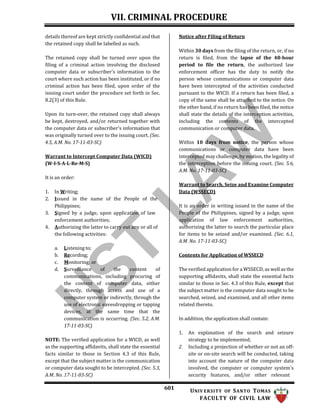
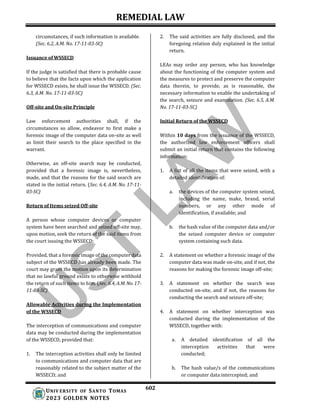
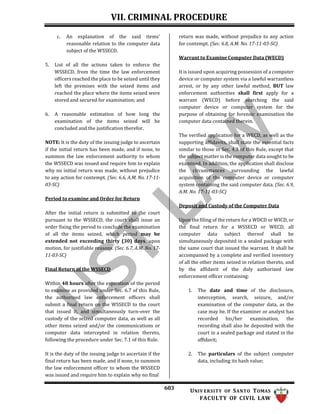
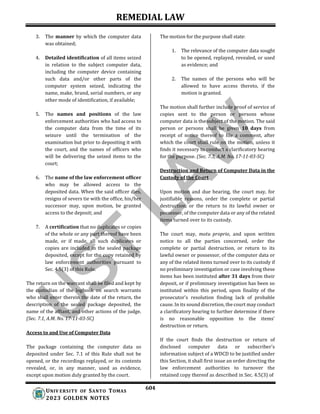
Jurisdiction is the power and authority conferred by
the Constitution and by the statute to hear and
decide a case. (Esico v. Alphaland Corp., G.R. No.
216716, 17 Nov. 2021, J. Hernando)
Jurisdiction is conferred by Substantive Law
Only jurisdiction over the subject matter is
conferred by substantive law. Jurisdiction over the
parties, issues and res is governed by procedural
laws. (Riano, 2019)
A. CLASSIFICATION OF JURISDICTION
Original jurisdiction is the power of the Court to
take judicial cognizance of a case instituted for
judicial action for the first time under conditions
provided by law. Appellate jurisdiction is the
authority of a Court higher in rank to re-examine the
final order or judgment of a lower Court which tried
the case now elevated for judicial review. (Garcia v.
De Jesus, G.R. Nos. 88158 & 97108-09, 04 Mar. 1992)
Courts of general jurisdiction are those with
competence to decide on their own jurisdiction and
take cognizance of all cases, civil and criminal, of a
particular nature, while courts of special
jurisdiction are those which have jurisdiction only
for a particular purpose or are clothed with special
powers for the performance of special duties
beyond which they have no authority of any kind.
(Riano, 2019)
Exclusive jurisdiction is that possessed by a court to
the exclusion of others, while concurrent
jurisdiction is the power of different courts to take
cognizance of the same subject matter. (Riano,
2019)
B. DOCTRINES OF HIERARCHY OF COURTS
AND ADHERENCE OF JURISDICTION
Doctrine of Hierarchy of Courts
General Rule: A case must be filed with the lowest
court possible having the appropriate jurisdiction.
For example, although the SC, CA, and the RTC have
concurrent jurisdiction over certiorari, prohibition,
and mandamus, a direct invocation of the SC is
improper. A petition must be first made to the
lowest court – the RTC. (Riano, 2019)
Exception: The Supreme Court may disregard
hierarchy of courts if warranted by the following
reasons:
1. Where special and important reasons are
present;
2. When dictated by public welfare and policy,
3. When demanded by interest of justice;
4. Where the challenged orders are patent
nullities;
5. Where compelling circumstances warrant;
and
6. Where genuine issues of constitutionality
must be immediately addressed. (Riano,
2019)
Adherence of Jurisdiction
GR: Jurisdiction, once attached, cannot be ousted by
subsequent happenings or events although of a
character which would have prevented jurisdiction
from attaching in the first instance, and the court
retains jurisdiction until it finally disposes of the
3. EXCLUSIVE vs. CONCURRENT
2. GENERAL vs. SPECIAL
1. ORIGINAL vs. APPELLATE
II. JURISDICTION
REMEDIAL LAW
10
UNIV ERSITY OF SANTO TOMAS
2023 GOLDEN NOTES
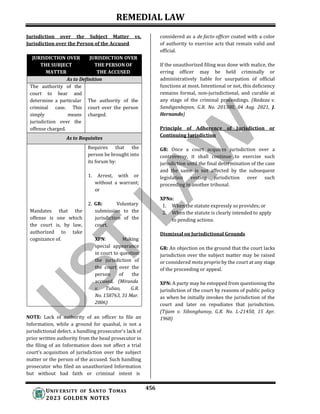
RTCs are courts of general jurisdiction.
NOTE: Since there is no legal provision specifically governing jurisdiction over
boundary disputes between a municipality and an independent component city
of the same province, it follows that RTCs have the power and authority to hear
and determine such controversy. (Municipality of Kananga v. Madrona, G.R. No.
141375, 30 Apr. 2003)
1. Boundary dispute
between
municipalities
case. (Aruego, Jr., v. CA, G.R. No. 112193, 13 Mar.
1996)
XPNs:
1. Where a subsequent statute expressly
prohibits the continued exercise of
jurisdiction;
2. Where the law penalizing an act which is
punishable is repealed by a subsequent law;
3. When accused is deprived of his constitutional
right such as where the court fails to provide
counsel for the accused who is unable to obtain
one and does not intelligently waive his
constitutional right;
NOTE: Where there is a violation of basic
constitutional rights, courts are ousted from
their jurisdiction. The violation of a party’s due
process raises a serious jurisdictional issue
which cannot be glossed over or disregarded at
will. Where the denial of the fundamental right
is apparent, a decision rendered in disregard of
that right is void for lack of jurisdiction. (Apo
Cement Corporation v. Mingson Industries
Corporation, G.R. No. 206728, 12 Nov. 2014)
4. Where the statute expressly provides, or is
construed to the effect that it is intended to
operate as to actions pending before its
enactment;
5. When the proceedings in the court acquiring
jurisdiction is terminated, abandoned or
declared void;
6. Once appeal has been perfected; and
7. Curative statutes. (Herrera, 2007)
NOTE: The rule of adherence of jurisdiction
until a cause is finally resolved or adjudicated
does not apply when the change in jurisdiction
is curative in character. (Abad, et al. v. RTC, G.R.
No. L-65505, 12 Oct. 1987)
Effect of Retroactivity of Laws on Jurisdiction
Jurisdiction being a matter of substantive law, the
established rule is that the statute in force at the
time of the commencement of the action determines
jurisdiction. (Herrera, 2007)
As a consequence, jurisdiction is not affected by a
new law placing a proceeding under the jurisdiction
of another tribunal.
XPNs:
1. Where there is an express provision in the
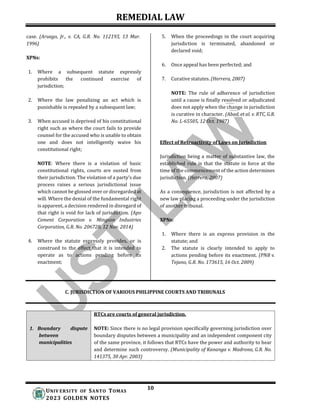
statute; and
2. The statute is clearly intended to apply to
actions pending before its enactment. (PNB v.
Tejano, G.R. No. 173615, 16 Oct. 2009)
C. JURISDICTION OF VARIOUS PHILIPPINE COURTS AND TRIBUNALS
II. JURISDICTION
11 UNIV ERSITY OF SANTO TOMAS
FACULTY OF CIVIL LAW
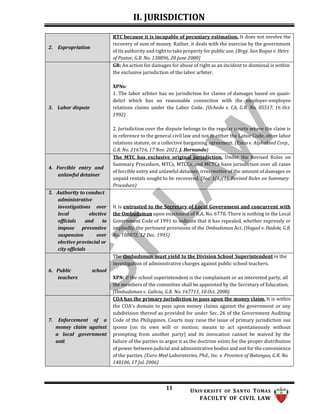
2. Expropriation
RTC because it is incapable of pecuniary estimation. It does not involve the
recovery of sum of money. Rather, it deals with the exercise by the government
of its authority and right to take property for public use. (Brgy. San Roque v. Heirs
of Pastor, G.R. No. 138896, 20 June 2000)
3. Labor dispute
GR: An action for damages for abuse of right as an incident to dismissal is within
the exclusive jurisdiction of the labor arbiter.
XPNs:
1. The labor arbiter has no jurisdiction for claims of damages based on quasi-
delict which has no reasonable connection with the employer-employee
relations claims under the Labor Code. (Ocheda v. CA, G.R. No. 85517, 16 Oct.
1992)
2. Jurisdiction over the dispute belongs to the regular courts where the claim is
in reference to the general civil law and not in either the Labor Code, other labor
relations statute, or a collective bargaining agreement. (Esico v. Alphaland Corp.,
G.R. No. 216716, 17 Nov. 2021, J. Hernando)
4. Forcible entry and
unlawful detainer
The MTC has exclusive original jurisdiction. Under the Revised Rules on
Summary Procedure, MTCs, MTCCs, and MCTCs have jurisdiction over all cases
of forcible entry and unlawful detainer, irrespective of the amount of damages or
unpaid rentals sought to be recovered. (Sec. 1(A)(1), Revised Rules on Summary
Procedure)
5. Authority to conduct
administrative
investigations over
local elective
officials and to
impose preventive
suspension over
elective provincial or
city officials
It is entrusted to the Secretary of Local Government and concurrent with
the Ombudsman upon enactment of R.A. No. 6770. There is nothing in the Local
Government Code of 1991 to indicate that it has repealed, whether expressly or
impliedly, the pertinent provisions of the Ombudsman Act. (Hagad v. Dadole, G.R.
No. 108072, 12 Dec. 1995)
6. Public school
teachers
The Ombudsman must yield to the Division School Superintendent in the
investigation of administrative charges against public school teachers.
XPN: If the school superintendent is the complainant or an interested party, all
the members of the committee shall be appointed by the Secretary of Education.
(Ombudsman v. Galicia, G.R. No. 167711, 10 Oct. 2008)
7. Enforcement of a
money claim against
a local government
unit
COA has the primary jurisdiction to pass upon the money claim. It is within
the COA's domain to pass upon money claims against the government or any
subdivision thereof as provided for under Sec. 26 of the Government Auditing
Code of the Philippines. Courts may raise the issue of primary jurisdiction sua
sponte (on its own will or motion; means to act spontaneously without
prompting from another party) and its invocation cannot be waived by the
failure of the parties to argue it as the doctrine exists for the proper distribution
of power between judicial and administrative bodies and not for the convenience
of the parties. (Euro-Med Laboratories, Phil., Inc. v. Province of Batangas, G.R. No.
148106, 17 Jul. 2006)
REMEDIAL LAW
12
UNIV ERSITY OF SANTO TOMAS
2023 GOLDEN NOTES
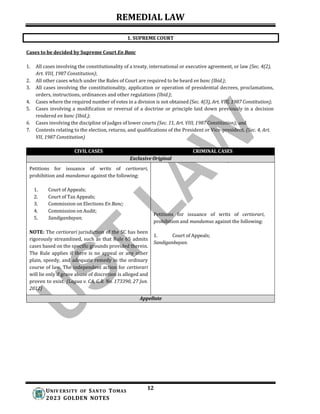
Cases to be decided by Supreme Court En Banc
1. All cases involving the constitutionality of a treaty, international or executive agreement, or law (Sec. 4(2),
Art. VIII, 1987 Constitution);
2. All other cases which under the Rules of Court are required to be heard en banc (Ibid.);
3. All cases involving the constitutionality, application or operation of presidential decrees, proclamations,
orders, instructions, ordinances and other regulations (Ibid.);
4. Cases where the required number of votes in a division is not obtained (Sec. 4(3), Art. VIII, 1987 Constitution);
5. Cases involving a modification or reversal of a doctrine or principle laid down previously in a decision
rendered en banc (Ibid.);
6. Cases involving the discipline of judges of lower courts (Sec. 11, Art. VIII, 1987 Constitution); and
7. Contests relating to the election, returns, and qualifications of the President or Vice-president. (Sec. 4, Art.
VII, 1987 Constitution)
CIVIL CASES CRIMINAL CASES
Exclusive Original
Petitions for issuance of writs of certiorari,
prohibition and mandamus against the following:
1. Court of Appeals;
2. Court of Tax Appeals;
3. Commission on Elections En Banc;
4. Commission on Audit;
5. Sandiganbayan.
NOTE: The certiorari jurisdiction of the SC has been
rigorously streamlined, such as that Rule 65 admits
cases based on the specific grounds provided therein.
The Rule applies if there is no appeal or any other
plain, speedy, and adequate remedy in the ordinary
course of law. The independent action for certiorari
will lie only if grave abuse of discretion is alleged and
proven to exist. (Lagua v. CA, G.R. No. 173390, 27 Jun.
2012)
Petitions for issuance of writs of certiorari,
prohibition and mandamus against the following:
1. Court of Appeals;
Sandiganbayan.
Appellate
1. SUPREME COURT
II. JURISDICTION
13 UNIV ERSITY OF SANTO TOMAS
FACULTY OF CIVIL LAW
1. Petitions for review on certiorari against:
a. CA;
b. CTA en banc (Sec. 11, R.A. No. 9282) (2006
BAR);
c. Sandiganbayan;
d. RTC, in cases involving:
i. If no question of fact is involved and
the case involves:
a) Constitutionality or validity of
treaty, international or executive
agreement, law, presidential
decree, proclamation, order,
instruction, ordinance or
regulation;
b) Legality of tax, impost,
assessments, or toll, or penalty in
relation thereto; or
c) Cases in which jurisdiction of
lower court is in issue;
ii. All cases in which only errors or
questions of law are involved;
Special civil action of certiorari – filed within 30 days
against the COMELEC/COA.
1. In cases where the CA imposes reclusion
perpetua, life imprisonment or a lesser penalty,
the judgment may be appealed to the SC by notice
of appeal filed with the CA;
2. Automatic review for cases of death penalty
rendered by the CA;
NOTE: Where the judgment also imposes a lesser
penalty for offenses committed on the same
occasion or which arose out of the same
occurrence that gave rise to the more severe
offense for which the penalty of death is imposed,
and the accused appeals, the automatic review
from the CA to the SC shall include such lesser
offense.
3. Petition for review on certiorari (Rule 45) from
the Sandiganbayan if penalty is less than death,
life imprisonment or reclusion perpetua in
criminal cases, and, in civil cases;
4. Notice of appeal from the Sandiganbayan if it
imposes life imprisonment or reclusion perpetua
or where a lesser penalty is imposed involving
offenses committed on the same occasion or
which arose out of the same occurrence that gave
rise to the more serious offense for which the
penalty of death, reclusion perpetua of life
imprisonment is imposed;
5. Automatic review of death penalty imposed by
the Sandiganbayan in the exercise of its original
jurisdiction;
6. Criminal cases from the Ombudsman are
appealable to the Supreme Court (Sec. 14, R.A.No.
6770) (2006 BAR);
7. Automatic review whenever the Sandiganbayan,
in the exercise of its appellate jurisdiction, finds
that the penalty of death, reclusion perpetua or
life imprisonment should be imposed; and
Appeals from RTC in which only errors or questions
of law are involved.
Concurrent with CA
REMEDIAL LAW
14
UNIV ERSITY OF SANTO TOMAS
2023 GOLDEN NOTES
COURT OF APPEALS
1. Petitions for issuance of writs of certiorari,
prohibition and mandamus against the following:
a. NLRC under the Labor Code;
NOTE: The petitions must first be filed
with the CA; otherwise, they shall be
dismissed (St. Martin Funeral Homes v.
CA, G.R. No. 130866, 16 Sept. 1998).
b. Civil Service Commission;
c. Quasi-judicial agencies (should be filed
with the CA first);
d. RTC and lower courts;
Petitions for issuance of writ of Kalikasan (Sec. 3, Rule
7, A.M. No. 09-6-8-SC)
Petitions for issuance of writs of certiorari,
prohibition and mandamus against the RTC and lower
courts.
Concurrent with CA and RTC
1. Petitions for habeas corpus and quo warranto; and
Petitions for issuance of writs of certiorari,
prohibition and mandamus against the lower courts
or bodies.
Petitions for issuance of writs of certiorari,
prohibition and mandamus against the lower courts
or bodies.
Concurrent with CA, SB, and RTC
1. Petitions for the issuance of writ of amparo;
and
2. Petitions for writ of habeas data, where the
action involves public data or government office.
Petitions for the issuance of writ of amparo and writ
of habeas data.
Concurrent with RTC
Actions affecting ambassadors and other public
ministers and consuls.
Concurrent with SB
Petitions for mandamus, prohibition, certiorari,
injunctions and ancillary writs in aid of its appellate
jurisdiction including quo warranto arising or that
may arise in cases filed under E.O. Nos. 1, 2, 14 and
14-A.
CIVIL CASES CRIMINAL CASES
Exclusive Original
Actions for annulment of judgments of RTC based
upon extrinsic fraud or lack of jurisdiction. (Sec. 9, B.P.
No. 129; Rule 47, ROC, as amended)
1. Actions for annulment of judgments of RTC
(Sec. 9, B.P. No. 129);
2. Crimes of Terrorism under the Human
Security Act of 2007 or
R.A. No. 9372.
II. JURISDICTION
15 UNIV ERSITY OF SANTO TOMAS
FACULTY OF CIVIL LAW
Appellate
1. Final judgments, decisions, resolutions, orders,
awards of:
a. RTC (original or appellate jurisdiction);
b. Family Courts; RTC on the questions of
constitutionality, validity of tax, jurisdiction
involving questions of fact, which should be
appealed first to the CA;
c. Appeals from RTC in cases appealed from
MTCs which are not a matter of right;
2. Appeal from MTC in the exercise of its delegated
jurisdiction (R.A. No. 7691);
3. Appeals from Civil Service Commission;
4. Appeals from quasi-judicial agencies under Rule
43;
5. Appeals from the National Commission on
Indigenous Peoples (NCIP); and
6. Appeals from the Office of the Ombudsman in
administrative disciplinary cases. (Mendoza-Arce
v. Office of the Ombudsman, G.R. No. 149148, 05
Apr. 2002) (2006 BAR)
Judgments or decisions of RTC via notice of appeal
(except those appealable to the SC or
Sandiganbayan):
1. Exercising its original jurisdiction;
2. Exercising its appellate jurisdiction; and
3. Where the imposable penalty is:
a. Life imprisonment or reclusion perpetua; or
b. A lesser penalty for offenses committed on
the same occasion or which arose from the
same occurrence that gave rise to the
offense punishable reclusion perpetua or life
imprisonment (Sec. 3, Rule 122, ROC, as
amended).
Automatic review in cases of death penalty rendered
by the RTC, in which case, it may decide on whether
or not to affirm the penalty of death. If it affirms the
penalty of death, it will render a decision but will not
enter the judgment because it will then be forwarded
to the SC.
NOTE: Death penalty imposed by the RTC is elevated
to the CA by automatic review while death penalty
imposed by the Sandiganbayan whether in its
original or appellate jurisdiction is elevated to the SC
for automatic review.
Concurrent with SC
1. Petitions for issuance of writs of certiorari,
prohibition and mandamus against the following:
a. NLRC under the Labor Code;
b. Civil Service Commission;
c. Quasi-judicial agencies; and
d. RTCs and other lower courts;
2. Petitions for issuance of writ of Kalikasan.
(Sec. 3, Rule 7, A.M. No. 09-6-8-SC)
Petitions for issuance of writs of certiorari,
prohibition and mandamus against the RTCs and
lower courts
Concurrent with SC and RTC
1. Petitions for habeas corpus and quo warranto; and
2. Petitions for the issuance of writs of certiorari,
prohibition and mandamus against the lower
courts.
Petitions for issuance of writs of certiorari,
prohibition and mandamus against the lower courts
or bodies
Concurrent with SC, SB and RTC
1. Petitions for the issuance of writ of amparo;
2. Petition for writ of habeas data, where the action
involves public data or government office.
Petitions for the issuance of writ of amparo and writ
of habeas data
REMEDIAL LAW
16
UNIV ERSITY OF SANTO TOMAS
2023 GOLDEN NOTES
TAX CASES CRIMINAL CASES
Exclusive Original
In tax collection cases involving final and executory
assessments for taxes, fees, charges and penalties
where the principal amount of taxes and fees,
exclusive of charges and penalties claimed is not less
than P1,000,000.
All criminal cases arising from violation of the NIRC,
of the Tariff and Customs Code and other laws, part
of laws, or special laws administered by the BIR or
the BOC where the principal amount of taxes and
fees, exclusive of charges and penalties claimed is
less that P1,000,000 or where there is no specified
amount claimed (the offenses or penalties shall be
tried by the regular courts and the jurisdiction of the
CTA shall be appellate).
Appellate
In tax collection cases involving final and executory
assessments for taxes, fees, charges and penalties
where the principal amount of taxes and fees,
exclusive of charges and penalties claimed is less than
P1,000,000 tried by the proper MTC, MeTC, and RTC.
1. Over appeals from the judgment, resolutions
or orders of the RTC in tax cases originally
decided by them, in their respective
territorial jurisdiction.
2. Over petitions for review of the judgments,
resolutions or orders of the RTC in the
exercise of their appellate jurisdiction over
tax cases originally decided by the MeTCs,
MTCs, and MCTCs in their respective
jurisdiction.
Exclusive Appellate Jurisdiction to Review by Appeal from Commissioner of Internal Revenue
1. Decisions in cases involving disputed assessments, refunds of internal revenue taxes, fees or other
charges, penalties in relation thereto, or other matters arising under the NIRC or other laws administered
by BIR;
2. Inaction by CIR in cases involving disputed assessments, refunds of IR taxes, fees or other charges,
penalties in relation thereto, or other matters arising under the NIRC or other laws administered by BIR,
where the NIRC or other applicable law provides a specific period of action, in which case the inaction
shall be deemed an implied denial via Petition for Review under Rule 42.
Exclusive Appellate Jurisdiction to Review by Appeal from RTC
Decisions, orders or resolutions in local tax cases originally decided or resolved by them in the exercise of
their original or appellate jurisdiction via Petition for Review under Rule 43.
Exclusive Appellate Jurisdiction to Review by Appeal from Commissioner of Customs
1. Decisions in cases involving liability for customs duties, fees or other charges, seizure, detention or
release of property affected, fines, forfeitures or other penalties in relation thereto; or
2. Other matters arising under the Customs Law or other laws, part of laws or special laws administered
by BOC (via Petition for Review under Rule 42, ROC, as amended).
Exclusive Appellate Jurisdiction to Review by Appeal from Central Board of Assessment Appeals
Decisions in the exercise of its appellate jurisdiction over cases involving the assessment and taxation of real
property originally decided by the provincial or city board of assessment appeals via Petition for Reviewunder
Rule 43.
Exclusive Appellate Jurisdiction to Review by Appeal from Secretary of Finance
3. COURT OF TAX APPEALS
II. JURISDICTION
17 UNIV ERSITY OF SANTO TOMAS
FACULTY OF CIVIL LAW
Decision on customs cases elevated to him automatically for review from decisions of the Commissioner of
Customs which are adverse to the government under Sec. 2315 of the TCC via Petition for Review under Rule
42.
Exclusive Appellate Jurisdiction to Review by Appeal from Secretary of Trade and Industry and the
Secretary of Agriculture
Decisions of Secretary of Trade and Industry in the case of non-agricultural product, commodity or article, and
the Secretary of Agriculture in the case of agricultural product, commodity or article, involving dumping duties
and countervailing duties under Secs. 301 and 302, respectively, of the TCC, and safeguard measures under
RA 8800, where either party may appeal the decision to impose or not to impose said duties (via Petition for
Review under Rule 42).
REMEDIAL LAW
18
UNIV ERSITY OF SANTO TOMAS
2023 GOLDEN NOTES
CRIMINAL CASES
Exclusive Original
A. Violations of Republic Act No. 3019, as amended, otherwise known as the Anti-Graft and Corrupt Practices
Act, Republic Act No. 1379, and Chapter II, Section 2, Title VII, Book II of the Revised Penal Code, where
one or more of the accused are officials occupying the following positions in the government, whether in
a permanent, acting or interim capacity, at the time of the commission of the offense:
1. Officials of the executive branch occupying the positions of regional director and higher, otherwise
classified as Grade ‘27’ and higher, of the Compensation and Position Classification Act of 1989 (R.A.
No. 6758), specifically including:
a. Provincial governors, vice-governors, members of the sangguniang panlalawigan, and provincial
treasurers, assessors, engineers, and other provincial department heads:
b. City mayors, vice-mayors, members of the sangguniang panlungsod, city treasurers, assessors,
engineers, and other city department heads;
c. Officials of the diplomatic service occupying the position of consul and higher;
d. Philippine Army and Air Force colonels, naval captains, and all officers of higher rank;
e. Officers of the Philippine National Police while occupying the position of provincial director and
those holding the rank of senior superintendent and higher;
f. City and provincial prosecutors and their assistants, and officials and prosecutors in the Office of
the Ombudsman and special prosecutor;
g. Presidents, directors or trustees, or managers of government-owned or controlled corporations,
state universities or educational institutions or foundations.
2. Members of Congress and officials thereof classified as Grade ‘27’ and higher under the Compensation
and Position Classification Act of 1989;
3. Members of the judiciary without prejudice to the provisions of the Constitution;
4. Chairmen and members of the Constitutional Commissions, without prejudice to the provisions of the
Constitution; and
5. All other national and local officials classified as Grade ‘27’ and higher under the Compensation and
Position Classification Act of 1989.
B. Other offenses or felonies whether simple or complexed with other crimes committed by the public
officials and employees mentioned in subsection a. of this section in relation to their office.
C. Civil and criminal cases filed pursuant to and in connection with Executive Order Nos. 1, 2, 14 and 14-A,
issued in 1986.
NOTE: RTC shall have exclusive original jurisdiction where the information:
a. Does not allege any damage to the government or any bribery; or
b. Alleges damage to the government or bribery arising from the same or closely related transactions
or acts in an amount not exceeding P1,000,000. (Sec. 4, P.D. 1606, as amended by R.A. No. 10660)
Exclusive original jurisdiction thereof shall be vested in the proper RTC, MeTC, MTC and MCTC, as the case
may be, in cases where none of the accused are occupying positions corresponding to Salary Grade ‘27’ or
higher, or military and PNP officers mentioned above. (Sec. 4, P.D. 1606, as amended by R.A No. 10660)
4. SANDIGANBAYAN
II. JURISDICTION
19 UNIV ERSITY OF SANTO TOMAS
FACULTY OF CIVIL LAW
5. REGIONAL TRIAL COURTS
Appellate
Final judgments, resolutions or orders of regional trial courts whether in the exercise of their own original
jurisdiction or of their appellate jurisdiction as herein provided.
Concurrent with SC
Petitions for mandamus, prohibition, certiorari, injunctions and ancillary writs in aid of its appellate
jurisdiction including quo warranto arising or that may arise in cases filed under E.O. Nos. 1, 2, 14 and 14-A.
Concurrent with SC, CA and RTC
Petitions for the issuance of writ of amparo and writ of habeas data.
CIVIL CASES CRIMINAL CASES
Exclusive Original
1. In all civil actions in which the
subject of the litigation is incapable
of pecuniary estimation;
2. In all civil actions which involve the
title to, or possession of, real
property, or any interest therein,
where the assessed value of the
property involved exceeds
P400,000 except actions for
forcible entry into and unlawful
detainer of lands or buildings,
original jurisdiction over which is
conferred upon the MeTCs, MTCs,
and MCTCs; (B.P. 129, as amended
by R.A. No. 11576)
3. In all actions in admiralty and
maritime jurisdiction where the
demand or claim exceeds
P2,000,000; (B.P. No. 129, as
amended by R.A. No. 11576)
4. In all matters of probate, both
testate and intestate, where the
gross value of the estate exceeds
P2,000,000; (B.P. No. 129, as
amended by R.A. No. 11576)
5. In all actions involving the contract
of marriage and marital relations;
6. In all cases not within the exclusive
jurisdiction of any court, tribunal,
person or body exercising
1. Criminal cases not within exclusive jurisdiction of any court,
tribunal or body (Sec. 20, B.P. No. 129):
a. Cases where the penalty provided by law exceeds 6
years imprisonment irrespective of the fine (R.A. No.
7691); and
b. Cases not falling within the exclusive original
jurisdiction of the Sandiganbayan where the
imposable penalty is imprisonment more than 6
years and none of the accused is occupying
positions classified as “Grade 27” and higher (Sec. 4,
P.D. No. 1606, as amended by R.A. No. 8249).
2. Cases where the only penalty provided by law is a fine
exceeding P4,000;
3. Other laws which specifically lodge jurisdiction in the RTC:
a. Law on written defamation or libel;
b. Decree on Intellectual Property; and
c. Violations of Dangerous Drugs Act regardless of the
imposable penalty except when the offender is
under 16 and there are Juvenile and Domestic
Relations Court in the province;
4. Cases falling under the Family Courts in areas where there are
no Family Courts (Sec. 24, B.P. No. 129); and
5. Election offenses (Omnibus Election Code) even if committed
by an official with salary grade of 27 or higher.
REMEDIAL LAW
20
UNIV ERSITY OF SANTO TOMAS
2023 GOLDEN NOTES
jurisdiction of any court, tribunal,
person or body exercising judicial
or quasi-judicial functions;
7. In all civil actions and special
proceedings falling within the
exclusive original jurisdiction of a
Juvenile and Domestic Relations
Court and of the Court of Agrarian
Relations as now provided by law;
and
8. In all other cases in which the
demand, exclusive of interest,
damages of whatever kind,
attorney’s fees, litigation expenses,
and costs or the value of the
property in controversy exceeds
P2,000,000. (B.P. No. 129, as
amended by R.A. No. 11576)
Appellate
GR: All cases decided by lower courts in their respective territorial jurisdictions.
XPN: Decisions of lower courts in the exercise of delegated jurisdiction. (Sec. 22, B.P. No. 129)
Concurrent with SC, SB and CA
1. Writ of amparo;
2. Writ of habeas data.
Petitions for the issuance of writs of amparo and habeas data.
Concurrent with SC
Actions affecting ambassadors and other
public ministers and consuls. (Sec. 21(2),
B.P. No. 129)
Concurrent with SC and CA
1. Certiorari, prohibition and
mandamus against lower courts and
bodies;
2. Habeas corpus and quo warranto.
Concurrent with MTC
Cases involving enforcement or
violations of environmental and other
related laws, rules and regulations. (Sec.
2, Rule 1, A.M. No. 09-6-8-SC)
Special Jurisdiction
Supreme Court may designate certain branches of RTC to try exclusively:
1. Criminal cases;
2. Juvenile and domestic relations cases;
3. Agrarian cases;
4. Urban land reform cases not falling within the jurisdiction of any quasi-judicial body; and
II. JURISDICTION
21 UNIV ERSITY OF SANTO TOMAS
FACULTY OF CIVIL LAW
5. Other special cases as the SC may determine in the interest of a speedy and efficient administration
of justice. (Sec. 23, B.P. No. 129)
Test to determine whether an Action is capable
of Pecuniary Estimation
The criterion is the nature of the principal action or
the remedy sought. If it is primarily for the recovery
of a sum of money, the claim is considered capable
of pecuniary estimation, and whether jurisdiction is
in the MTCs or in the RTCs would depend on the
amount of the claim.
However, where the basic issue is something other
than the right to recover a sum of money, where the
money claim is purely incidental to, or a
consequence of, the principal relief sought like
specific performance suits and in actions for
support, or for annulment of a judgment or
foreclosure of mortgage, such actions are incapable
of pecuniary estimation, and are cognizable
exclusively by the RTCs. (Barangay Piapi v. Talip,
G.R. No. 138248, 07 Sept. 2005)
Intra-corporate Controversies that are within
the Jurisdiction of the Special Commercial
Courts
4. Derivative suits; and
5. Inspection of corporate books. (Rule 1, IRR of
R.A. No. 8799).
1. Devices or schemes employed by, or any act of,
the board of directors, business associates,
officers or partners, amounting to fraud or
misrepresentation which may be detrimental to
the interest of the public and/or of the
stockholders, partners, or members of any
corporation, partnership, or association;
2. Controversies arising out of intra-corporate,
partnership, or association relations, between
and among stockholders, members, or
associates; and between, any or all of them and
the corporation, partnership, or association of
which they are stockholders, members, or
associates, respectively;
3. Controversies in the election or appointment of
directors, trustees, officers, or managers of
corporations, partnerships, or associations;
REMEDIAL LAW
22
UNIV ERSITY OF SANTO TOMAS
2023 GOLDEN NOTES
CIVIL CASES CRIMINAL CASES
Exclusive Original
1. Petitions for guardianship, custody of children,
habeas corpus in relation to minor;
2. Petitions for adoption of children and its
revocation;
3. Complaints for annulment and declaration of
nullity of marriage and those relating to marital
status and property relations of spouses or those
living together under different status and
agreements; and petitions for dissolution of
conjugal partnership of gains;
4. Petitions for support and/or acknowledgment;
5. Summary judicial proceedings under the Family
Code (FC) of the Philippines;
6. Petitions for declaration of status of children as
abandoned, dependent or neglected children,
petitions for voluntary or involuntary
commitment of children, the suspension,
termination, or restoration of parental authority
and other cases cognizable under P.D. No. 603, E.O.
No. 56 (Series of 1986) and other related laws; and
7. Petitions for the constitution of the family home
(rendered unnecessary by Art. 153, FC). (Sec. 5,
R.A. No. 8369)
1. Where one or more of the accused is/are below
18 years of age but not less than 9 years of age;
2. When one or more of the victims is a minor at the
time of the commission of the offense (R.A. No.
8369, Act Establishing the Family Courts);
3. Cases against minors cognizable under the
Dangerous Drugs Act, as amended;
4. Violations of R.A. No. 7610 or the Special
Protection of Children Against Child Abuse,
Exploitation and Discrimination Act, as amended
by R.A. No. 7658; and
5. Cases of domestic violence against:
a. Women – involving acts of gender-based
violence that result, or likely to result in
physical, sexual or psychological harm or
suffering to women; and other forms of
physical abuse and coercion which violate a
woman’s personhood, integrity and freedom
of movement; and
b. Children – which include the commission of
all forms of abuse, neglect, cruelty,
exploitation, violence and discrimination and
all other conditions prejudicial to their
development. (Sec. 5, R.A. No. 8369)
6. FAMILY COURTS
II. JURISDICTION
23 UNIV ERSITY OF SANTO TOMAS
FACULTY OF CIVIL LAW
CIVIL CASES CRIMINAL CASES
Exclusive Original
1. Actions involving personal property where the
value of the property does not exceed
P2,000,000; (B.P. 129, as amended by R.A. No.
11576)
2. Actions for claim of money where the demand
does not exceed P2,000,000; (B.P. 129, as
amended by R.A. No. 11576)
3. Probate proceedings, testate or intestate, where
the value of the estate does not exceed
P2,000,000
NOTE: In the foregoing, claim is exclusive of
interest, damages, attorney’s fees, litigation
expense, and cost. (B.P. 129, as amended by R.A.
No. 11576)
4. Actions involving title to or possession of real
property or any interest therein where the value
or amount does not exceed P400,000 exclusive of
interest damages, attorney’s fees, litigation
expense, and costs (2008 BAR); (B.P. 129, as
amended by R.A. No. 11576)
5. Maritime claims where the demand or claim does
not exceed P2,000,000 (B.P. 129, as amended by
R.A. No. 11576);
6. Inclusion or exclusion of voters (Sec. 138, B.P.
881);
7. Those covered by the Rules on Summary
Procedure:
8. Forcible entry and unlawful detainer;
9. Those covered by the Rules on Small Claims, i.e.,
actions for payment of money where the claim
does not exceed P1,000,000, exclusive of interest
and costs. (A.M. No. 08-8-7-SC)
1. All offenses punishable with imprisonment
not exceeding 6 years irrespective of the
amount of fine and regardless of other
imposable accessory or other penalties;
2. In offenses involving damage to property
through criminal negligence where the
imposable fine does not exceed P10,000
(Sec. 32, B.P. 129 as amended by R.A. No.
7691);
3. Where the only penalty provided by law is a
fine not exceeding P4,000 (Admin. Circular
No. 09-94, June 14, 1994);
4. Those covered by the Rules on Summary
Procedure, i.e.:
a. Violations of traffic laws, rules and
regulations;
b. Violations of the rental law;
c. Violations of municipal or city
ordinances;
d. Violations of B.P. 22 (A.M. No. 00-11-
01-SC); and
e. All other criminal cases where the
penalty is imprisonment not exceeding
6 months and/or a fine of P1,000
irrespective of other penalties or civil
liabilities arising therefrom;
5. All offenses committed by public officers
and employees in relation to their office,
including government-owned or –
controlled corporations, and by private
individuals charged as co-principals,
accomplices or accessories, punishable with
imprisonment not more than 6 years or
where none of the accused holds a position
classified as “Grade 27” and higher. (Sec. 4,
P.D. No. 1606, as amended by R.A. No. 8249)
7. METROPOLITAN TRIAL COURTS, MUNICIPAL TRIAL COURTS,
MUNICIPAL TRIAL COURTS IN CITIES, AND MUNICIPAL CIRCUIT TRIAL COURTS
(R.A. No. 11576, An Act Further Expanding the Jurisdiction of First-Level Courts)
REMEDIAL LAW
24
UNIV ERSITY OF SANTO TOMAS
2023 GOLDEN NOTES
Delegated
Cadastral or land registration cases covering lots
where:
1. There is no controversy or opposition;
2. Contested, but the value does not exceed
P100,000 (Sec. 34, B.P. 129, as amended by R.A. No.
7691)
NOTE: The value shall be ascertained by the affidavit
of the claimant or agreement of the respective
claimants. (Sec. 34, B.P. 129 as amended by R.A. No.
7691)
Special
Petition for habeas corpus in the absence of all RTC
judges in the province or city. (Sec. 35, B.P. 129)
Application for bail in the absence of all RTC judges
in the province or city.
with RTC
Cases involving enforcement or violations of
environmental and other related laws, rules and
regulations. (Sec. 2, Rule 1, A.M. No. 09-6-8-SC)
II. JURISDICTION
25 UNIV ERSITY OF SANTO TOMAS
FACULTY OF CIVIL LAW
2. JURISDICTION OVER THE PARTIES
D. ASPECTS OF JURISDICTION
Aspects of Jurisdiction (P-Su-I-P-R)
1. Jurisdiction over the Parties;
2. Jurisdiction over the Subject matter;
3. Jurisdiction over the Issues;
4. Jurisdiction over the res or Property in
litigation; and
5. Jurisdiction over the Remedies.
It is the power to hear and determine cases of the
general class to which the proceedings in question
belong. (Herrera, 2007)
GR: Jurisdiction over the subject matter cannot be
waived, enlarged or diminished by stipulation of the
parties. (Republic v. Estipular, G.R. No. 136588, 20 Jul.
2000)
XPN: Estoppel by laches, by failure to object to the
jurisdiction of the court for a long period of time and
by invoking its jurisdiction in obtaining affirmative
relief. (Tijam v. Sibonghanoy, G.R. No. L-21450, 15
Apr. 1968)
Q: BP BLG. 129, as amended states that if the
assessed value of the real property subject
matter of an action involving interest thereto is
P 20,000.00 and more, then the RTC can validly
take/assume jurisdiction over the case
otherwise it is the Metropolitan/Municipal Trial
Court. The subject lot in a Complaint for
Recovery of Real Estate Property and Recovery
of Possession has a total market assessed value
of P 11,120.00. 22 long years after the complaint
was filed, the petitioners raised the ground of
lack of jurisdiction before the SC. Is the
contention tenable?
A: NO. The circumstances attendant in the instance
case are actually much more grave than those
present in Tijam. Same as in Tijam, the petitioners
utterly failed to invoke the ground of lack of
jurisdiction despite having full knowledge of this
ground, considering that the assessed value of the
subject lot was plainly indicated in the Complaint, a
copy of which was fully furnished to the petitioners.
In fact, the petitioners filed an Answer and an
Amended Answer in response to the categorical
allegations in the Complaint. Yet, they totally
ignored the issue on jurisdiction in their responsive
pleadings.
Analogous to the factual circumstances in Tijam, the
petitioners were also able to file an appeal and
Motion for Reconsideration before the CA. Yet, even
before the CA, the ground for lack of jurisdiction was
never invoked. Therefore, the petitioners are
estopped from invoking the ground of lack of
jurisdiction. (Sps. Rebamonte v. Sps. Lucero, G.R. No.
237812, 02 Oct. 2019)
Jurisdiction over the person is the legal power of the
court to render a personal judgment against a party
to an action or proceeding. (Black’s, 5th Edition)
The manner by which the court acquires
jurisdiction over the parties depends on whether
the party is the plaintiff or the defendant.
How Jurisdiction over the Plaintiff and
Defendant is acquired
1. JURISDICTION OVER THE SUBJECT MATTER
PLAINTIFF DEFENDANT
Acquired when the
action is commenced
by the filing of the
complaint. This
presupposes payment
of the docket fees.
1. By his or her
voluntary
appearance in court
and his submission to
its authority; or
2. By valid service of
summons.
NOTE: Jurisdiction over
the defendant is not
essential in actions in rem
or quasi in rem as long as
the court has jurisdiction
over the res. (Herrera,
2007)
REMEDIAL LAW
26
UNIV ERSITY OF SANTO TOMAS
2023 GOLDEN NOTES
3. JURISDICTION OVER THE ISSUES
Voluntary Appearance
Voluntary appearance is any appearance of the
defendant in court, provided he or she does not
raise the question of lack of jurisdiction of the court.
(Flores v. Zurbito, G.R. No. L-12890. 08 Mar. 1918;
Carballo v. Encarnacion, G.R. No. L-5675, 27 Apr.
1953)
It is equivalent to service of summons. (Sec. 23, Rule
14, ROC, as amended)
The inclusion in a motion to dismiss of other
grounds aside from lack of jurisdiction over the
person of the defendant shall be deemed a voluntary
appearance. (Sec. 23, Rule 14, ROC, as amended)
An appearance in whatever form, without explicitly
objecting to the jurisdiction of the court over the
person, is a submission to the jurisdiction of the
court over the person. It may be made by simply
filing a formal motion, or plea or answer. If his
motion is for any other purpose than to object to the
jurisdiction of the court over his person, he thereby
submits himself to the jurisdiction of the court.
(Busuego v. CA, No. L-48955, June 30, 1987; La Naval
Drug Corp. v. CA, G.R. No. 103200, 31 Aug. 1994)
XPN: Special Appearance
When the defendant’s appearance is made precisely
to object to the jurisdiction of the court over his
person, it cannot be considered as appearance in
court. (French Oil Mill Machinery, Inc v. CA, G.R. No.
126477, 11 Sept. 1998)
An example is a special appearance in court
challenging the jurisdiction of the court on the
ground of invalid service of summons. (Go v.
Cordero, G.R. No. 164703, 04 May 2010)
NOTE: Special appearance operated as an exception
to the general rule on voluntary appearance.
Accordingly, objections to the jurisdiction of the
court over the person of the defendant must be
explicitly made, i.e., set forth in an equivocal
manner. Failure to do so constitutes voluntary
submission to the jurisdiction of the court. (Rapid
City Realty and Development Corp. v. Villa et. al., G.R.
No. 184197, 11 Feb. 2010)
Filing of Pleadings seeking Affirmative Reliefs
constitutes Voluntary Appearance
GR: Seeking affirmative relief constitutes voluntary
appearance, and the consequent submission of
one’s person to the jurisdiction of the court.
XPNs: In the case of pleadings whose prayer is
precisely for the avoidance of the jurisdiction of the
court, which only leads to a special appearance.
These pleadings are:
1. In civil cases, motions to dismiss on the ground
of lack of jurisdiction over the person of the
defendant;
NOTE: The inclusion in a motion to dismiss of
other grounds aside from lack of jurisdiction
over the person of the defendant shall be
deemed a voluntary appearance (Sec. 23, Rule
14, ROC, as amended);
2. In criminal cases, motions to quash an
Information on the ground of lack of
jurisdiction over the person of the accused; and
3. Motion to quash a warrant of arrest.
NOTE: The first two are consequences of the fact
that failure to file them would constitute a waiver of
the defense of lack of jurisdiction over the person.
The third is a consequence of the fact that it is the
very legality of the court process forcing the
submission of the person of the accused that is the
very issue in a motion to quash a warrant of arrest.
(Miranda v. Tuliao, G.R. No. 158763, 31 Mar. 2006)
Jurisdiction over the issues refers to the power of
the court to try and decide the issues raised in the
pleadings of the parties. (Reyes v. Diaz, G.R. No. L-
48754, 26 Nov. 1941)
II. JURISDICTION
27 UNIV ERSITY OF SANTO TOMAS
FACULTY OF CIVIL LAW
How Jurisdiction over the Issues Conferred
GR: It is conferred and determined by the pleadings
of the parties that present the issues to be tried and
determined whether or not the issues are of fact or
of law. (Riano, 2019)
XPNs: It may be conferred:
1. By stipulation of the parties, as when in the pre-
trial, the parties enter into stipulations of facts
and documents or enter into an agreement
simplifying the issues of the case. (Sec. 2(b), Rule
18, ROC, as amended);
2. By express or implied consent of the parties,
when issues not raised by the pleadings are
tried, such issues shall be treated in all respects
as if they had been raised in the pleadings. (Sec.
5, Rule 10, ROC, as amended)
It is proper for the court to render judgment on the
pleadings if the answer fails to tender an issue,
except in actions for declaration of nullity of
annulment of marriage or legal separation. (Sec. 1,
Rule 34, ROC, as amended).
Jurisdiction over the res refers to the court’s
jurisdiction over the thing or property which is the
subject of the action. (Riano, 2019)
Jurisdiction over the res or property in litigation is
acquired either by:
1. Actual or constructive seizure of the property
under legal process, whereby it is brought into
the custody of the law; or
2. As a result of the institution of legal
proceedings, in which the power of the court is
recognized and made effective. (Biaco v.
Philippine Countryside Rural Bank, G.R. No.
161417, 08 Feb. 2007)
If the action is in rem or quasi in rem, jurisdiction
over the person of the defendant is not required.
What is required is jurisdiction over the res,
although summons must be served upon the
defendant in order to satisfy the requirements of
due process. (Gomez v. CA, G.R. No. 127692, 10 Mar.
2004)
In cases where jurisdiction over the person of a
defendant cannot be acquired, the preliminary
seizure is to be considered necessary in order to
confer jurisdiction upon the court. In this case the
lien on the property is acquired by the seizure; and
the purpose of the proceedings is to subject the
property to that lien. (El Banco Español-Filipino v.
Palanca, G.R. No. L-11390, 26 Mar. 1918) In this
instance, the action is converted from one in
personam to one in rem. (Villareal v. CA, G.R. No.
107314, 17 Sept. 1998)
Jurisdiction over the Subject Matter vs.
Jurisdiction over the Person
JURISDICTION OVER
THE SUBJECT MATTER
JURISDICTION OVER
THE PERSON
GR: Determined by the
allegations of the
complaint. (Riano,
2019)
XPN: Where the real
issues are evident from
the record of the case,
jurisdiction over the
subject matter cannot
be made to depend on
how the parties word
or phrase their
pleadings (Herrera,
2007), e.g., in
ejectment cases in
which the defendant
averred the defense of
the existence of
tenancy relationship
between the parties.
(Ibid)
Acquired by the filing
of the petition in case
of the plaintiff or by
arrest (Rule 113, ROC,
as amended), by valid
service of summons or
voluntary submission
to the court’s authority
in case of the
defendant. (Ibid.)
Conferred by law
which may be either
It is sometimes made
to depend, indirectly at
4. JURISDICTION OVER THE RES
OR THE PROPERTY IN LITIGATION
REMEDIAL LAW
28
UNIV ERSITY OF SANTO TOMAS
2023 GOLDEN NOTES
JURISDICTION
the Constitution or a
statute.
least, on the party’s
volition
Q: Heirs of Ikang Paus represented by Elias Paus,
filed a petition for identification, delineation
and issuance of a Certificate of Ancestral Land
Title (CALT) with respondent NCIP. They sought
the confirmation of their right to the ancestral
land at Baguio City.
The Heirs of Mateo Cariño opposed the petition,
and prayed for its dismissal, cancellation and
revocation.
The said protest was dismissed for lack of merit.
OCT No. 0-CALT-37 covering the said lot in
Baguio City, was issued in the name of the Heirs
of Paus.
Republic, through the OSG, questioned OCT No.
0-CALT-37 in the name of private respondents,
and filed a suit for Reversion, Annulment of
Documents and Cancellation of Title with Prayer
for Issuance of Temporary Restraining Order
(TRO) and Writ of Preliminary Injunction. It
pointed out several irregularities in the
issuance of CALT in favor of Heirs of Paus.
Heirs of Paus answered the complaint denying
all its material allegations. As special and
affirmative defenses, they averred lack of
jurisdiction and lack of cause of action. They
pointed out that the complaint assailed the CALT
and the OCT issued on the basis of the CALT,
which under the IPRA, falls within the
jurisdiction of the NCIP, and not the regular
courts. They asserted that the RTC has no
jurisdiction over the subject matter of the
complaint; hence, the complaint must be
dismissed for lack of jurisdiction. Is the
contention correct?
A: NO. RTC has jurisdiction over cases for reversion
and cancellation of certificates of title. It is axiomatic
that the nature of an action and whether the
tribunal has jurisdiction over such action are to be
determined from the material allegations of the
complaint, the law in force at the time the complaint
is filed, and the character of the relief sought
irrespective of whether the plaintiff is entitled to all
or some of the claims averred. Jurisdiction is not
affected by the pleas or the theories set up by the
defendant in an answer to the complaint or a motion
to dismiss the same. (Republic v. Heirs of Paus, G.R.
No. 201273, 14 Aug. 2019)
E. JURISDICTION vs. EXERCISE OF
JURISDICTION
EXERCISE
OF JURISDICTION
It is the authority to
hear and decide
cases. It does not
depend upon the
regularity of the
exercise of that
power or upon the
rightfulness of the
decision made. (Lim,
et al. v. Hon. Felipe
Pacquing, et al., G.R.
No. 115044, 01 Sept.
1994)
It is any act of the court
pursuant to such
authority, which
includesmaking
decisions. If there is
jurisdiction over the
person and subject
matter, the resolution of
all other questions
arising in the case is but
an exercise of
jurisdiction. (Herrera v.
Baretto, G.R. No. 8692, 10
Sept. 1913; Palma v. Q&S,
Inc., G.R. No. L-20366, 16
May 1966)
F. JURISDICTION vs. VENUE
VENUE JURISDICTION
As to Definition
Refers to the place
where the case is to be
heard or tried. (Riano,
2019)
Refers to the authority
of the court to hear and
determine a case.
(Riano, 2019)
As to Law
It is a matter of
procedural law.
Hence, a wrong venue a
mere procedural
infirmity, not a
It is a matter of
substantive law.
(Riano, 2019)
II. JURISDICTION
29 UNIV ERSITY OF SANTO TOMAS
FACULTY OF CIVIL LAW
jurisdictional defect.
(Riano, 2019, citing
Pilipinas Shell
Petroleum Corporation
v. Royal Ferry Services,
Inc., G.R. No. 188146, 01
Feb. 2017)
As to Waivability
It may be waived if not
invoked either in a
motion to dismiss or in
the answer. (Riano,
2019, citing City of
Lapu-Lapu v. Philippine
Economic Zone
Authority, G.R. No.
184203, 26 Nov. 2014)
It cannot be waived.
(Riano, 2019)
As to Who or What Confers it
It may be conferred by
the act or agreement of
the parties. (Riano,
2019)
It is fixed by law and
cannot be conferred by
the parties. (Riano,
2019)
As to Proceedings
The court cannot
dismiss an action motu
proprio for improper
venue. (Riano, 2019)
The court may dismiss
an action motu proprio
in case of lack of
jurisidction over the
subject matter.
Jurisdiction over the
subject matter may be
raised at any stage of
the proceedings since
it is conferred by law,
although a party may
be barred from raising
it on the ground of
estoppel. (Riano, 2019,
citing La’o v. Republic,
G.R. No. 160719, 23 Jan.
2006)
REMEDIAL LAW
30
UNIV ERSITY OF SANTO TOMAS
2023 GOLDEN NOTES
G. JURISDICTION OVER CASES COVERED BY BARANGAY CONCILIATION,
AND CASES COVERED BY THE RULES ON EXPEDITED PROCEDURES IN THE FIRST LEVEL COURTS
(A.M. No. 08-8-7-SC, as amended, approved on March 1, 2022)
KATARUNGANG PAMBARANGAY LAW
RULE ON
SMALL CLAIMS CASES
RULES ON
SUMMARY PROCEDURE
Purpose/Object
Provides for the amicable settlement of
disputes at the barangay level, as a
compulsory alternative to the formal
adjudication of disputes. (Katarungang
Pambarangay Implementing Rules and
Regulations, Katarungang Pambarangay
Circular No. 1, 01 June 1992). (1999 BAR)
To provide a simpler and more
inexpensive and expeditious
means of settling disputes
involving purely money claims
than the regular civil process.
To achieve an expeditious and
inexpensive determination of
the cases defined to be
governed by the Rules on
Summary Procedure.
Where to file
1. For disputes between residents of
the same barangay: the dispute must
be brought for settlement in the said
barangay;
2. For disputes between residents of
different but adjoining barangays and
the parties agree to submit their
differences to amicable settlement:
within the same city or municipality
where any of the respondents reside
at the election of the complainant;
3. For disputes involving real property
or any interest when the parties
thereto agree to submit their
differences to amicable settlement by
an appropriate lupon therein shall be
brought in the barangay where the
real property or larger portion
thereof is situated; and
4. For disputes arising at the workplace
where the contending parties are
employed or at the institution where
such parties are enrolled for study
shall be brought in the barangay
where such workplace or institution
is located.
1. MeTC
2. MTCC
3. MTC
4. MCTC
1. MeTC
2. MTCC
3. MTC
4. MCTC
Civil Cases covered
II. JURISDICTION
31 UNIV ERSITY OF SANTO TOMAS
FACULTY OF CIVIL LAW
All disputes involving parties who
actually reside in the same city or
municipality may be the subject of the
proceedings for amicable settlement in
the barangay.
The requirement of undergoing
barangay conciliation proceedings
applies only to cases involving natural
persons, and not where any of the parties
is a juridical person such as a
corporation, partnership, corporation
sole, testate or intestate estate, etc. (Vda.
De Borromeo v. Pogoy, G.R. No. L-63277,
29 Nov. 1983)
If the only contending party is the
government or its instrumentality or
subdivision the case is exempted from
the requirement of barangay conciliation
proceedings but when it (government or
its instrumentality or subdivision) is only
one of the contending parties, a
confrontation should still be undertaken
among the other parties. (Gegare v. CA,
G.R. No. 83907, 13 Sept. 1989)
NOTE: Barangay conciliation process is
not a jurisdictional requirement, so that
non-compliance therewith cannot affect
the jurisdiction which the court has
otherwise acquired over the subject
matter or over the person of the
defendant. Such defense shall be raised
in the answer, otherwise, such objection
will be deemed waived. (Aquino v. Aure,
G.R. No. 153567, 18 Feb. 2008)
Cases not covered by Barangay
Conciliation
1. Where one party is the government
or any subdivision or
instrumentality thereof;
2. Where one party is a public officer or
employee, and the dispute relates to
the performance of his official
functions;
Purely civil in nature where the
claim or relief prayed for by the
plaintiff is for payment or
reimbursement of a sum of
money where the value of the
claim does not exceed
P1,000,000, exclusive of
interest and costs. (A.M. No. 08-
8-7-SC)
a. For money owed under any
of the following:
i. Contract of Lease;
ii. Contract of Loan and
other credit
accommodations;
iii. Contract of Services;
iv. Contract of Sale of
personal property,
excluding the recovery of
the personal property,
unless it is made the
subject of a compromise
agreement between the
parties; or
v. Contract of Mortgage
b. For liquidated damages
arising from contracts; and
c. The enforcement of a
barangay amicable
settlement or an arbitration
award involving a money
claim which does not
exceed P1,000,000.
a. All cases of forcible entry
and unlawful detainer
irrespective of the amount
of damages or unpaid
rentals sought to be
recovered. Where
attorney’s fees are
awarded, the same shall
not exceed P100,000;
b. All civil actions, except
probate proceedings,
admiralty and maritime
actions, and small claims
where the total amount of
the plaintiff’s claim does
not exceed P2,000,000.00
exclusive of interest
damages of whatever kind,
attorney’s fees, litigation
expenses and costs. (A.M.
No. 08-8-7-SC)
c. Complaints for damages
where the claims do not
exceed P2,000,000.00;
d. Cases for the enforcement
of barangay amicable
settlement agreements
and arbitration award
where money claim
exceeds P1,000,000.00,
provided that no execution
has been enforced within 6
months from the
settlement date or receipt
of award or the date when
the obligation becos due
and demandable;
e. Cases solely for the revival
of judgment of any first
level court;
f. The civil aspect of
violations of BP 22 if no
criminal action has been
instituted.
REMEDIAL LAW
32
UNIV ERSITY OF SANTO TOMAS
2023 GOLDEN NOTES
3. Offenses punishable by
imprisonment exceeding one (1)
year or a fine exceeding P5,000.00;
4. Offenses when there is no private
offended party;
5. Where the dispute involves real
properties located in different cities
or municipalities unless the parties
thereto agree to submit their
differences to amicable settlement
by an appropriate lupon;
6. Disputes involving parties who
actually reside in barangays of
different cities or municipalities,
except where such barangay units
adjoin each other and the parties
thereto agree to submit their
differences to amicable settlement
by an appropriate lupon;
7. Such other classes of disputes which
the President may determine in the
interest of justice or upon the
recommendation of the Secretary of
Justice (Sec. 408, Local Government
Code);
8. Any complaint by or against
corporations, partnerships, or
juridical entities, since only
individuals shall be parties to
barangay conciliation proceedings
either as complainants or
respondents;
9. Disputes where urgent legal action is
necessary to prevent injustice from
being committed or further
continued, specifically:
a. A criminal case where the
accused is under police custody
or detention
b. A petition for habeas corpus by a
person illegally detained or
II. JURISDICTION
33 UNIV ERSITY OF SANTO TOMAS
FACULTY OF CIVIL LAW
deprived of his liberty or one
acting on his behalf
c. Actions coupled with
provisional remedies, such as
preliminary injunction,
attachment, replevin, and
support pendent lite.
d. Where the action may be barred
by the Statute of Limitations.
10. Labor disputes or controversies
arising from employer-employee
relationship;
11. Where the dispute arises from the
CARL;
12. Actions to annul judgment upon a
compromise which may be directly
filed in court. (S.C. Administrative
Circular No. 14-93)
Criminal Cases covered
When punishable by imprisonment of
not more than 1 year or fine of not more
than P5,000. (Sec. 408, LGC)
1. Violations of traffic laws,
rules and regulations;
2. Violations of the rental
law;
3. Violations of municipal or
city ordinances;
4. Violations of B.P. 22 (A.M.
No. 00-11-01-SC, April 15,
2003);
5. All other criminal cases
imvolving penalty of
imprisonment not
exceeding one (1) year or
a fine not exceeding
P50,000.00 or both, and a
fine not exceeding
P150,000.00 for offenses ;
involving damage to
property through criminal
negligence.
REMEDIAL LAW
34
UNIV ERSITY OF SANTO TOMAS
2023 GOLDEN NOTES
It can be instituted by filing the complaint by
personal service, by registered mail, by accredited
courier, by electronic mail or other electronic means
as may be authorized by the Court. (Sec. 3, inrelation
to Section 14(a), Rule 13, ROC, as amended)
A. GENERAL PROVISIONS
(RULE 1)
Applicability
The Rules of Court shall apply in all the courts,
except as otherwise provided by the Supreme Court.
(Sec. 2, Rule 1, ROC, as amended)
Actions or Proceedings governed by the Rules of
Court
1. Civil actions;
2. Criminal actions; and
3. Special Proceedings. (Sec. 3, Rule 1, ROC, as
amended)
Actions or Proceedings NOT governed by the
Rules of Court
1. Election cases;
2. Land registration cases;
3. Cadastral cases;
4. Naturalization cases; and
5. Insolvency proceedings.
NOTE: The Rules may still apply to the cases above
by analogy or in suppletory character and whenever
practicable and convenient. (Sec. 5, Rule 1, ROC, as
amended)
Commencement of Civil Action
A civil action is commenced by the filing of the
original complaint in court. If an additional
defendant is impleaded in a later pleading, the
action is commenced with regard to him on the date
of the filing of such later pleading, irrespective of
whether the motion for its admission, if necessary,
is denied by the court. (Sec. 5, Rule 1, ROC, as
amended)
NOTE: It is not simply the filing of the complaint or
appropriate initiatory pleading, but the payment of
the prescribed docket fee that vests a trial court
with jurisdiction over the subject matter or nature
of the action. (Heirs of Hinog v. Melicor, G.R. No.
140954, 12 Apr. 2005)
Construction
The Rules shall be liberally construed in order to
promote their objective of securing a just, speedy
and inexpensive disposition of every action and
proceeding. (Sec. 6, Rule 1, ROC, as amended)
Ordinary Civil Actions
It is one in which a party sues another for the
enforcement or protection of a right or the
prevention or redress of a wrong. (Sec. 3(a), Rule 1,
ROC, as amended)
It is governed by ordinary rules. (Bouvier’s Law
Dictionary, 8th ed.; Words and Phrases, Vol. 2)
Subject Matter of an Action
It is the physical facts, the thing, real or personal, the
money, lands, chattels, and the like, in relation to
which the suit is prosecuted. (Iniego v. Purganan,
G.R. No. 166876, 24 Mar. 2006)
Special Civil Actions
It is one in which a party sues another for the
enforcement or protection of a right or the
prevention or redress of a wrong wherein it has
special features not found in ordinary civil actions.
It is governed by ordinary rules but subject to
specific rules prescribed under Rules 62-71. (Riano,
2019)
III. CIVIL PROCEDURE
(A.M. No. 19-10-20-SC)
III. CIVIL PROCEDURE
35 UNIV ERSITY OF SANTO TOMAS
FACULTY OF CIVIL LAW
Criminal Actions
It is one by which the State prosecutes a person for
an act or omission punishable by law. (Sec. 3(b), Rule
1, ROC, as amended)
Civil Actions vs. Special Proceedings
A civil action is one by which a party sues another
for the enforcement or protection of a right, or the
prevention or redress of a wrong. (Sec. 3(a), Rule 1,
ROC, as amended)
A special proceeding is a remedy by which a party
seeks to establish a status, a right, or a particular
fact. (Sec. 3(c), Rule 1, ROC, as amended)
Action vs. Special Proceeding (1999 BAR)
Real Action vs. Personal Action
ACTION
SPECIAL
PROCEEDING
As to Purpose
Civil action:
1. To protect a right;
or
2. To prevent or
redress a wrong.
Criminal action:
Prosecute a person for
an act or omission
punishable by law.
(Sec. 3, Rule 1, ROC, as
amended)
To establish a: (SRP)
1. Status;
2. Right; or
3. Particular fact.
(Sec. 3, Rule 1, ROC,
as amended)
Rules of special
proceedings are
provided for under
Sec. 1 of Rule 72 of the
Rules of Court (e.g.,
settlement of estate,
escheat, guardianship,
etc.). (Riano, 2019)
As to Governing Law
Ordinary rules
supplemented by
special rules.
Requires the
application of specific
rules as provided for
in the Rules of Court.
(Natcher v. CA, et al.,
G.R. No. 133000, 02 Oct.
2001)
As to Court
Heard by courts of
general jurisdiction.
Heard by courts of
limited jurisdiction.
REAL ACTION PERSONAL ACTION
As to Scope
Recovery of personal
When it affects title to
or possession of real
property, or interest
therein. (Sec. 1, Rule 4,
ROC, as amended)
property, the
enforcement of a
contract or the
recovery of damages.
(Chua v. TOPROS, G.R.
No. 152808, 30 Sept.
2005)
As to Basis
When it is founded
upon the privity of a
real estate. The realty
or interest therein is
the subject matter of
the action.
NOTE: It is important
that the matter in
litigation must also
involve any of the
following issues:
1. Title
2. Ownership
3. Possession
4. Partition
5. Condemnation
(Albano, 2017)
6. Foreclosure of
mortgage
7. Any interest in real
property (Riano,
2019)
Founded on privity of
contract such as
damages, claims of
money, etc. (Paper
Industries Corporation
of the Philippines v.
Samson, G.R. No. L-
30175, 28 Nov. 1975)
As to Venue
(Ching v. Rodriguez,
G.R. No. 192828, 28
Nov. 2011)
As to Procedure
Initiated by a pleading
and parties respond
through an answer.
Initiated by an
application and
parties respond
through an opposition.
REMEDIAL LAW
36
UNIV ERSITY OF SANTO TOMAS
2023 GOLDEN NOTES
A real action is “local” –
i.e., its venue depends
upon the location of the
property involved in
the litigation.
Venue of action shall be
commenced and tried
in the proper court
which has jurisdiction
over the area wherein
the real property
involved, or a portion
thereof is situated.
(Sec. 1, Rule 4, ROC, as
amended)
Venue of action is
transitory – i.e., the
place where the
plaintiff or any of the
principal plaintiffs
resides, or where the
defendant or any of
the principal
defendants resides, or
in the case of a non-
resident defendant
where he may be
found, at the election
of the plaintiff. (Sec. 2,
Rule 4, ROC, as
amended)
Importance of Distinction between Real and
Personal Actions
The distinction between a real action and a personal
action is important for the purpose of determining
the venue of action.
NOTE: Questions involving the propriety or
impropriety of a particular venue are resolved by
initially determining the nature of the action, i.e., if
the action is personal or real. (Riano, 2019)
Local Actions vs. Transitory Actions
LOCAL ACTIONS
TRANSITORY
ACTIONS
As to Venue
Must be brought in a
particular place where
the subject property is
located, unless there is
an agreement to the
contrary. (Sec. 4, Rule
4, ROC, as amended)
Dependent on the
place where the party
resides regardless of
where the cause of
action arose.
As to Privity of Contract
No privity of contract
and the action is
founded on privity of
estate only. (Riano,
2019)
Founded on privity of
contract between the
parties whether debt
or covenant. (Paper
Industries Corporation
of the Philippines v.
Samson, supra.)
III. CIVIL PROCEDURE
37 UNIV ERSITY OF SANTO TOMAS
FACULTY OF CIVIL LAW
Difference of Actions In Rem, In Personam, and Quasi in Rem
Quasi in Rem
1. In Rem
2. In Personam
B. KINDS OF ACTION
ACTIONS IN REM ACTIONS IN PERSONAM ACTIONS QUASI IN REM
As to their Nature
A proceeding to determine title,
status or condition of property
within its borders.
A proceeding to enforce personal
rights and obligations brought
against the person. (Riano, 2019)
A proceeding to subject the
property of the named defendant
or his interests therein to the
obligation or lien burdening the
property. (Riano, 2019, citing
Asiavest Limited v. CA, G.R. No.
128803, 25 Sept. 1998)
As to their Purpose
A proceeding to bar indifferently
all who might be minded to make
any objection against the right
sought to be enforced, hence the
judgment therein is binding
theoretically upon the whole
world.
To impose through the judgment
of a court, some responsibility or
liability directly upon the person
of the defendant. (Domagas v.
Jensen, G.R. No. 158407, 17 Jan.
2005)
Deals with the status, ownership
or liability of a particular property
but which are intended to operate
on these questions only as
between the particular parties to
the proceedings and not to
ascertain or cut-off the rights or
interests of all possible claimants.
(Domagas v. Jensen, supra)
As to their Scope
Directed against the thing itself
instead of against the person.
(Riano, 2019)
Directed against particular
persons. (Domagas v. Jensen,
supra)
Directed against particular
persons with respect to the res.
REMEDIAL LAW
38
UNIV ERSITY OF SANTO TOMAS
2023 GOLDEN NOTES
As to the Required Jurisdiction
Jurisdiction over the person of the
defendant is not required.
Jurisdiction over the res is
acquired either (1) by the seizure
of the property under legal
process; or (2) as a result of the
institution of legal proceedings.
(Biaco v. Philippine Countryside
Rural Bank, G.R. No. 161417, 08
Feb. 2007)
Jurisdiction over the person of the
defendant is required. (Biaco v.
Philippine Countryside Rural Bank,
supra.)
Jurisdiction over the person of the
defendant is not required as long
as jurisdiction over the res is
acquired. (Biaco v. Philippine
Countryside Rural Bank, supra)
NOTE: Summons must be served
upon the defendant in order to
satisfy due process requirements.
(Riano, 2019)
As to the Effect of Judgment
Judgment is binding upon the
whole world. (Muñoz v. Yabut, Jr.,
G.R. No. 142676 & 146718, 6 June
2011)
Judgment is binding only upon
parties impleaded or their
successors-in-interest, but not
upon strangers. (Muñoz v. Yabut,
Jr., supra)
Judgment will be binding only
upon the litigants, their privies,
and their successors-in-interest,
but the judgment shall be executed
against a particular property. The
res involved will answer for the
judgment.
Examples
1. Probate proceedings (Alaban
v. Court of Appeals, G.R. No.
156021, 23 Sept. 2005);
2. Cadastral proceedings (In re
Estate of Johnson, 39 Phil 156);
or
3. Land registration proceedings
(Republic v. Herbieto, G.R. No.
156117, 26 May 2005)
1. Action for specific
performance (Jose v. Boyon,
G.R. No. 147369, 23 Oct. 2005);
2. Action for breach of contract;
or
3. Action for a sum of money or
damages (Riano, 2019)
1. Action for partition;
2. Action for accounting (Riano,
2019, citing Valmonte v. CA, G.R.
No. 108538, 22 Jan. 1996);
3. Attachment; or
4. Foreclosure of mortgage
(Sahagun v. CA, G.R. No. 78328,
03 June 1991)
NOTE: The distinction between actions in rem, in personam, and quasi in rem is important in determining the
following:
1. Whether jurisdiction over the person of the defendant is required; and
2. The type of summons to be employed (Gomez v. CA, G.R. No. 127692, 10 Mar. 2004)
III. CIVIL PROCEDURE
39 UNIV ERSITY OF SANTO TOMAS
FACULTY OF CIVIL LAW
Importance of Classification of Actions
The following matters are dependent on the nature
of the action:
1. The law on jurisdiction;
2. The rules on venue and prescription;
3. Defenses against the action;
4. Payment of docket fee; and
5. Service of summons (Herrera, 2007)
Independent Civil Action
These are actions based on provisions of the Civil
Code, namely Articles 32, 33, 34 that arise from law
and Article 2176 that arises from quasi-delicts. They
shall proceed independently of the criminal action
and shall require only a preponderance of evidence.
In no case, however, may the offended party recover
damages twice for the same act or omission charged
in the criminal action. (Sec. 3, Rule 111, ROC, as
amended)
The responsibility arising from quasi-delict is
entirely separate and distinct from the civil liability
arising from negligence under the Penal Code.
Under the Revised Rules of Criminal Procedure, only
the civil liability of the accused arising from the
crime charged is deemed included in the criminal
action. Thus, the civil actions referred to in the
above stated provisions of the law shall remain
separate, distinct and independent of any criminal
prosecution which may be based on the same act.
(Riano, 2019, citing Philippine Rabbit Bus Lines, Inc.
v. People, G.R. No. 147703, 14 Apr. 2004)
Two Separate Civil Liabilities that may arise
from a Single Act or Omission
1. Civil liability ex delicto; or
2. Independent civil liabilities such as those:
a. Not arising from an act or omission
complained of as felony (e.g., culpa
contractual or obligations arising from law;
intentional torts; and culpa aquiliana); or
b. Where the injured party is granted a right to
file an action independent and distinct from
the criminal action. (L.G. Foods Corporation v.
Pagapong-Agraviador, G.R. No. 158995, 26
Sept. 2006)
The remedies are alternative in case the obligation
has the possibility of arising indirectly from the
delict/crime or directly from quasi-delict/tort.
Victims of negligence or their heirs have a choice
between an action to enforce the civil liability
arising from culpa criminal under Article 100 of the
Revised Penal Code, and an action for quasi-delict
(culpa aquiliana) under Articles 2176 to 2194 of the
Civil Code.
Q: Lily Lim filed a criminal complaint for estafa
against Co for allegedly failing to return the
former’s money in consideration of the
withdrawal authorities Lim bought from Co.
Trial ensued and Co was acquitted of the estafa
charge for insufficiency of evidence. After the
trial on the civil aspect of the criminal case, the
Pasig City RTC also relieved Co of civil liability to
Lim. Her motion for reconsideration having
been denied, Lim filed her notice of appeal on
the civil aspect of the criminal case. Meanwhile,
Lim filed a civil complaint for specific
performance and damages before another RTC.
The defendants in the civil case were Co and all
other parties to the withdrawal authorities
including FRCC. The complaint asserted two
common causes of action: breach of contract and
abuse of rights. Did Lim commit forum shopping
in filing the civil case for specific performance
and damages during the pendency of her appeal
on the civil aspect of the criminal case for estafa?
A: NO. The filing of the collection case after the
dismissal of the estafa cases against the offender did
not amount to forum-shopping. Although the cases
filed by the offended party arose from the same act
or omission of the offender, they are, however,
based on different causes of action. There can be no
forum-shopping in the instant case because the law
expressly allows the filing of a separate civil action
which can proceed independently of the criminal
action. The two cases herein involve different kinds
REMEDIAL LAW
40
UNIV ERSITY OF SANTO TOMAS
2023 GOLDEN NOTES
of civil obligations such that they can proceed
independently of each other. The civil complaint for
specific performance and damages involves only the
obligations arising from contract and from tort
(culpa contractual), whereas the appeal in the estafa
case involves only the civil obligations of Co arising
from the offense charged (civil action ex delicto).
The action filed by petitioner is an independent civil
action, which remains separate and distinct from
any criminal prosecution based on the same act. Not
being deemed instituted in the criminal action
based on culpa criminal, a ruling on the culpability
of the offender will have no bearing on said
independent civil action based on an entirely
different cause of action. (Lim v. Kou Co Ping, G.R. No.
175256, 23 Aug. 2012)
C. CAUSE OF ACTION
(RULE 2)
Meaning of Cause of Action
It is the act or omission by which a party violates a
right of another. (Sec. 2, Rule 2, ROC, as amended)
The question as to whether a plaintiff has a cause of
action is determined by the averments in the
pleadings pertaining to the acts of the defendant.
Whether such acts give him a right of action is
determined by substantive law. (Herrera, 2007)
It is axiomatic that the nature of an action and
whether the tribunal has jurisdiction over such
action are to be determined from the material
allegations of the complaint, the law in force at the
time of the complaint is filed, and the character of
the relief sought irrespective of whether the
plaintiff is entitled to all or some of the claims
averred. Jurisdiction is not affected by the pleas or
the theories set up by the defendant in an answer to
the complaint or a motion to dismiss the same.
(Republic v. Heirs of Paus, G.R. No. 201273, 14 Aug.
2019)
Every ordinary civil action must be based on a cause
of action. (Sec. 1, Rule 2, ROC, as amended)
Elements of a Cause of Action (L-C-A)
1. A Legal right in favor of the plaintiff;
2. A Correlative legal duty of the defendant to
respect such rights; and
3. An Act or omission on the part of such
defendant in violation of the right of the
plaintiff; or constituting a breach of the
obligation of the defendant to the plaintiff for
which the latter may maintain an action for
recovery of damages or other appropriate relief
with a resulting injury or damage which the
latter may maintain an action for the recovery
of relief from the defendant. (Riano, 2019, citing
Metropolitan Bank and Trust Company v. Ley
Construction and Development Corporation, G.R.
No. 185590, 3 Dec. 2014)
NOTE: A party may not institute more than one suit
for a single cause of action. Otherwise, there will be
splitting of a single cause of action, which is
prohibited. (Sec.4, Rule 2, ROC, as amended)
Cause of Action in Administrative Case
In an administrative case, the issue is not whether
the complainant has a cause of action against the
respondent, but whether the respondent has
breached the norms and standards of the office.
(Riano, 2019)
Cause of Action in Different Cases
CASE CAUSE OF ACTION
Breach of
Contract
a. The existence of a
contract; and
b. The breach thereof.
Liability of
Employer
based on the
Negligence of
his Employee
The employer’s liability is
presumed. (Art. 2180, NCC) It
shall only cease if the
employer successfully proves
the diligence required of a
good father of a family to
prevent damage.
Collection of
Sum of Money
based on a
a. Requires an allegation
that a debt exists; and
III. CIVIL PROCEDURE
41 UNIV ERSITY OF SANTO TOMAS
FACULTY OF CIVIL LAW
b. The criminal action
finally ended with an
acquittal;
c. In bringing the action, the
prosecutor acted without
probable cause; and
d. The prosecution was
impelled by legal malice –
that is, an improper or
sinister motive.
Environmental
Cases
a. Statement that it is an
environmental case; and
b. The law involved.
Right of Action vs. Cause of Action
CAUSE OF ACTION RIGHT OF ACTION
As to their definition
Right of a plaintiff to
It is the act or omission bring an action and to
by which a party prosecute that action
violates the rights of until final judgment.
another. (Sec. 2, Rule 2, (Marquez v. Varela, G.R.
ROC, as amended) No. L-4845, 24 Dec.
1952)
As to their requisites
1. The existence of a
legal right of the
plaintiff;
1. There must be a
good cause
(existence of a
cause of action);
2. A correlative duty
of the defendant to
respect one’s
right; and
3. An act or omission
of the defendant in
violation of the
plaintiff’s right.
(Agrarian Reform
Beneficiaries
Association v.
Nicolas, G.R. No.
168394, 6 Oct.
2008)
2. A compliance with
all the conditions
precedent to the
bringing of the
action; and
3. Right to bring and
maintain the
action must be in
the person
instituting it.
(Albano, Remedial
Law Reviewer,
2014)
As to their nature
Promissory
Note
b. That such debt is due and
demandable.
Unlawful
Detainer
a. Initially, the possession
of the property by the
defendant was by
contract with or by
tolerance of the plaintiff;
b. Eventually, such
possession became
illegal upon notice of the
plaintiff;
c. Thereafter, the defendant
remained in possession
of the property and
deprived the plaintiff of
the enjoyment thereof;
and
d. Within one (1) year from
the last demand on
defendant to vacate the
property, the plaintiff
instituted the complaint
for ejectment.
Forcible Entry
a. Prior physical possession
of the property;
b. Deprivation of
possession either by
Force, Intimidations,
Strategy, Threat, or
Stealth (F-I-S-T-S); and
c. The action must be filed
within one (1) year from
the time the owners or
legal possessors learned
of their deprivation of
physical possession of
the land or building.
Malicious
Prosecution
a. Prosecution did occur,
and the defendant was
himself the prosecutor or
that he instigated its
commencement;
REMEDIAL LAW
42
UNIV ERSITY OF SANTO TOMAS
2023 GOLDEN NOTES
NOTE: The rule is “there is no right of action where
there is no cause of action.” (Ibid.)
Failure to State a Cause of Action vs. Lack of
Cause of Action (2019 BAR)
FAILURE TO STATE
CAUSE OF ACTION
LACK OF CAUSE OF
ACTION
As to their definition
Insufficiency of Where the evidence
allegation in the does not sustain the
pleading. (Dabuco v. cause of action.
Court of Appeals, G.R. (Domondon v. Lopez,
No. 133775, 20 Jan. A.M. No. RTJ-02-1696,
2000) 20 June 2002)
As to how it is interposed
Raised in a demurrer
May be raised as an to evidence under Rule
affirmative defense in 33 after the plaintiff
the defendant’s has rested his case.
answer. (Sec. 12, Rule 8, (Enojas v. Comelec, G.R.
ROC, as amended) No. 129938, 12 Dec.
1997)
Effect of Lack of Cause of Action on the
Jurisdiction of the Court
Lack of cause of action does not affect the authority
of a court to hear and decide a given case, if the court
has jurisdiction over its subject matter, over the
parties therein, and, in an action in rem, over the res.
(Herrera, 2007)
Test of the Sufficiency of a Cause of Action
Whether or not admitting the facts alleged, the court
could render a valid verdict in accordance with the
prayer of the complaint. (Misamis Occidental II
Coop., Inc. v. David, G.R. No. 129928, 25 Aug. 2005)
It is predicated upon
substantive law on
quasi-delicts under the
NCC. (Riano, 2019)
It is procedural in
character and is the
consequence of the
violation of the right of
the plaintiff. (Riano,
2019)
As to their basis
Based on the
allegations of the
plaintiff in the
complaint.
Basis is the plaintiff’s
cause of action. There
is no right of action
where there is no
cause of action. (Ibid.)
As to the effect of their affirmative defense
May be taken away by
the running of the
statute of limitation,
Not affected by
affirmative defenses
(fraud, prescription,
estoppel, etc.)
estoppel or other
circumstances which
do not at all affect the
cause of action.
(Turner v. Lorenzo
Shipping Corporation,
G.R. No. 157479, 24
Nov. 2010)
As to how it was determined
Determined only from Resolved only on the
the allegations of the basis of the evidence
pleading and not from he presented in
evidentiary matters. support of his claim.
(Riano, 2019, citing (Riano, 2019 citing
Domondon v. Lopez, Domondon v. Lopez,
supra) supra)
As to when it is made
Made after questions
Can be made at the of fact have been
earliest stages of an resolved on the basis
action (Dabuco v. CA, of stipulations,
G.R. No. 133775, 20 Jan. admissions, or
2000), i.e., filed in an evidence presented.
answer. (Dabuco v. CA, G.R. No.
133775, 20 Jan. 2000)
As to whether dismissal amounts to res
judicata
No, dismissal due to
the failure to state a
cause of action does
not constitute res
judicata.
Dismissal of a
complaint for failure to
state a cause of action
does not bar the
subsequent re-filing of
the complaint. (Sec. 13,
Rule 15, ROC, as
amended)
Yes, because dismissal
on the ground of lack of
cause of action is a
decision on the merits.
III. CIVIL PROCEDURE
43 UNIV ERSITY OF SANTO TOMAS
FACULTY OF CIVIL LAW
SPLITTING A SINGLE CAUSE OF ACTION
AND ITS EFFECTS
GR: The sufficiency of the statement of cause of
action must appear on the face of the complaint, and
its existence is only determined by the allegations of
the complaint. (Viewmaster Construction Corp. v.
Roxas, G.R. No. 133576, 13 July 2000)
NOTE: Under the 2019 amendments to the ROC,
that every pleading shall contain not only the
statement of ultimate facts but including the
evidence on which a party relies for his or her claim.
(Sec. 1, Rule 8, ROC, as amended)
Moreover, documentary and object evidence in
support of the allegations must be contained in the
pleading. (Sec. 6, Rule 7, ROC, as amended)
XPN: In some cases, the Court considered, in
addition to the complaint, the appended annexes or
documents, other pleadings of the plaintiff, or
admissions in the records so that such annexes are
considered as parts of the complaint. (Riano, 2019,
citing Agrarian Reform Beneficiaries Association v.
Nicolas, G.R. No. 168394, 06 Oct. 2008; Sps. Zepeda v.
China Banking Corporation, G.R. No. 172175, 09 Oct.
2006)
NOTE: The truth or falsity of the allegations is
beside the point because the allegations in the
complaint are hypothetically admitted. (Riano,
2019, citing PNB v. Court of Appeals, G.R. No. 121251,
26 June 1998; Sta. Clara Homeowner’s Association v.
Gaston, G.R. No. 141961, 23 Jan. 2002)
Q: Spouses Bernabe and Rhodora Pamaran
owned adjacent lots respectively. Rosa Pamaran
built her residential house on these lots with the
consent of Rhodora and spouses Bernabe.
Rhodora and Spouses Bernabe constituted real
mortgages over their lots as security for loans
obtained from the Bank of Commerce
(Bankcom). Rosa claimed that Bankcom neither
included her house in determining the loan
amount nor obtained her consent to the real
estate mortgage. Later, Bankcom filed petitions
for issuance of writs of possession, which were
granted by the RTC of Muntinlupa City. Rosa
prayed that Bankcom be ordered to pay her
damages as she was dispossessed of her house
by reason of the writs. The RTC Olongapo
granted Bankcom’s motion to dismiss and
accordingly, dismissed the Complaint on the
grounds of lack of cause of action and of
improper venue. How should Bankcom’s Motion
to Dismiss be resolved?
A: Bankcom’s motion to dismiss must be resolved
with reference to the allegations in the Complaint
assuming them to be true. The RTC Olongapo does
not need to inquire on the truthfulness of these
allegations and declare them to be false. If it does,
such court would be denying the plaintiff of her
right to due process of law. In determining whether
a complaint states or does not state a cause of
action, the court must hypothetically admit the
truth of the allegations and determine if it may grant
the relief prayed for based on them. (Rosa Pamaran
v. Bank of Commerce, G.R. No. 205753, 04 July 2016)
Tests to ascertain whether Two Suits relate to a
Single or Common Cause of Action (E-D-E)
1. Evidence – Whether the same evidence would
support and sustain both the first and second
causes of action (Same Evidence Test);
2. Defenses – Whether the defenses in one case
may be used to substantiate the complaint in
the other; and
3. Existence – Whether the cause of action in the
second case existed at the time of the filing of
the first complaint (Umale v. Canoga Park
Development. Corporation, G.R. No. 167246, 20
July 2011)
Splitting of Cause of Action
It is the act of instituting two or more suits on the
basis of the same cause of action. (Sec. 4, Rule2, ROC,
as amended) It is the act of dividing a single or
indivisible cause of action into several parts or
claims and bringing several actions thereon. (Riano,
2019, citing Quadra v. Court of Appeals, G.R. No.
147593, 31 July 2006) This practice, which applies
REMEDIAL LAW
44
UNIV ERSITY OF SANTO TOMAS
2023 GOLDEN NOTES
not only to complaints but also to counterclaims and
crossclaims, is discouraged.
Rationale
1. Breeds multiplicity of suits;
2. Clogs the court dockets;
3. Leads to vexatious litigation;
4. Operates as an instrument of harassment; and
5. Generates unnecessary expenses to the parties.
(Riano, 2019) (1999, 2005 BAR)
NOTE: The rule against splitting causes of action is
not altogether one of original right but is one of
interposition based upon principles of public policy
and of equity to prevent the inconvenience and
hardship incident to repeated and unnecessary
litigation. (BPI Family Savings Bank, Inc. v. Vda de
Coscolluela, G.R. No. 167724, 27 June 2006)
Effect of Splitting a Cause of Action
If two or more suits are instituted on the basis of the
same cause of action, the filing of one or a judgment
upon the merits in any one is available as a ground
for the dismissal of the others. (Sec. 4, Rule 2, ROC, as
amended)
Remedies against Splitting Cause of Action
The defendant may file a motion to dismiss based on
either of the following grounds:
1. Litis pendentia – that there is another action
pending between the same parties for the same
cause; or
2. Res judicata – if the first action has already
been terminated – that the cause of action is
barred by a prior judgment or by the statute of
limitations. (Sec. 12(a), Rule 15, ROC, as
amended)
Rationale
1. Prevent repeated litigation between the same
parties in regard to the same subject or
controversy;
2. Protect the defendant from unnecessary
vexation. Nemo debet vexare pro una et eadem
causa (No man shall be twice vexed for one and
the same cause); and
3. Avoid the costs and expenses incident to
numerous suits. (City of Bacolod v. SM Brewery,
G.R. No. L-25134, 30 Oct. 1969)
NOTE: Litis pendentia and forum shopping have
similar elements, so it is best for the counsel to move
for the dismissal based on forum shopping under
Sec. 5, Rule 7 instead, and show that the party or his
counsel willfully and deliberately resorted to forum
shopping. This is because the effect is a dismissal
with prejudice, in addition to the sanction for direct
contempt as well as a cause for administrative
sanctions.
Joinder of Causes of Action (2005 BAR)
It is the assertion of as many causes of action a party
may have against another in one pleading alone.
(Sec. 5, Rule 2, ROC, as amended) It is the process of
uniting two or more demands or rights of action in
one action. (Riano, 2019, citing Unicapital, Inc. v.
Consing, Jr., G.R. No. 192073, 11 Sept. 2013)
Requisites of Joinder of Causes of Action
1. The party shall comply with the rules on joinder
of parties (Sec. 6, Rule 3, ROC, as amended):
a. Right to relief exists in favor of or against
several persons;
b. Right to relief arises out of the same
transaction or series of transaction; and
c. There is a common question of law of law
or fact.
2. The joinder shall not include special civil
actions governed by special rules;
3. Where the causes of action are between the
same parties but pertain to different venues or
jurisdictions, the joinder may be allowed in the
RTC provided one of the causes of action falls
within the jurisdiction of said court and venue
lies therein; and
III. CIVIL PROCEDURE
45 UNIV ERSITY OF SANTO TOMAS
FACULTY OF CIVIL LAW
4. Totality Test - Where claims in all causes of
action are principally for recovery of money, the
aggregate amount claimed shall be the test for
jurisdiction. (Sec. 5, Rule 2, ROC, as amended)
(2002 BAR)
NOTE: A joinder of causes of action is only
permissive, not compulsory; hence, a party may
desire to file a single suit for each of his claims.
(Riano, 2019)
Joinder of Claims in Small Claims cases
The plaintiff may join, in a single statement of claim,
one or more separate small claims against a
defendant provided that the total amount claimed,
exclusive of interest and costs, does not exceed
P1,000,000.00. (Rules on Expedited Procedures in
First Level Courts, A.M. No. 08-8-7-SC, as amended)
Misjoinder of Causes of Action
There is a misjoinder when two or more causes of
action were joined in one complaint when they
should not be so joined.
This is NOT a ground for dismissal of an action. A
misjoined cause of action may, on motion of a party
or on the initiative of the court, be severed and
proceeded with separately by filing a motion in
relation thereto. (Sec. 6, Rule 2, ROC, as amended)
There is no sanction against non-joinder of separate
causes of action.
However, if the plaintiff refuses to sever the
misjoined cause of action, the complaint may be
dismissed pursuant to Sec. 3, Rule 17. (ROC, as
amended)
Q: P sued A and B in one complaint in the RTC-
Manila, the cause of action against A being an
overdue promissory note for P300,000 and that
against B being an alleged balance of P300,00 on
the purchase of goods sold on credit. Does the
RTC-Manila have jurisdiction over the case?
(2002 BAR)
A: NO, the RTC-Manila has no jurisdiction over the
case. The joinder of the causes of action against A
and B is not proper. For a joinder of causes of action
against several defendants to be proper, the joinder
must comply with the rules on joinder of the parties
under Sec. 6 of Rule 3. This rule requires that the
causes of action joined should arise out of the same
transactions and there exists a question of law or
facts common to both. These requirements are not
met under the facts.
Since the causes of action cannot be joined, each
action must be the subject of a separate action. The
totality rule has no application under the facts of the
case. The amount of each claim falls within the
jurisdiction of the MTC. (Flores v. Mallare-Phillipps,
G.R. No. L-66620, 24 Sept. 1986)
Q: Can there be a valid judgment in case of
misjoined causes of action?
A: YES. Misjoinder of causes of action is not a ground
for dismissal. The courts have the power, acting
upon the motion of a party to the case or sua sponte,
to order the severance of the misjoined cause of
action to be proceeded with separately. However, if
there is no objection to the improper joinder or the
court did not motu proprio direct a severance, then
there exists no bar in the simultaneous adjudication
of all the erroneously joined causes of action.
The foregoing rule only applies if the court trying
the case has jurisdiction over all of the causes of
action therein notwithstanding the misjoinder of
the same. If the court trying the case has no
jurisdiction over a misjoined cause of action, then
such misjoined cause of action has to be severed,
any adjudication rendered by the court with respect
to the same would be a nullity. (Ada v. Baylon, G.R.
No. 182435, 13 Aug. 2012)
Splitting of Cause of Action vs. Joinder of Causes
of Action
SPLITTING OF CAUSE
OF ACTION
JOINDER OF CAUSES
OF ACTION
It is the practice of
dividing one cause of
action into different
parts and making each
part the subject of a
separate complaint.
Assertion of as many
causes of action as a
party may have against
another in one
pleading alone. (Sec. 5,
REMEDIAL LAW
46
UNIV ERSITY OF SANTO TOMAS
2023 GOLDEN NOTES
Merely
permissive, as
evidenced by
the use of the
word “may”
instead of
“shall.” (Sec. 5,
Rule 2, ROC, as
amended;
Riano, 2019)
(1999 BAR)
Indispensable parties –
required to be joined either as
plaintiffs or defendants. (Sec.
7, Rule 3, ROC, as amended)
Necessary party – one who is
not indispensable but ought to
be joined if complete relief is
to be accorded, or for a
complete determination or
settlement of the action. (Sec.
8, Rule 3, ROC, as amended)
D. PARTIES TO CIVIL ACTIONS
(RULE 3)
Who may be Parties to a Civil Action
1. Natural persons;
2. Juridical persons:
a. The State and its political subdivisions;
Joinder of Causes of Action vs. Joinder of Parties
JOINDER OF
CAUSES OF
ACTION
JOINDER OF PARTIES
It refers to the
procedural
device whereby
a party who It may be employed when
asserts various there are various causes of
claims against actions that accrue in favor of
the same or one or more plaintiffs against
several parties, one or more defendants i.e.,
file all his there is plurality of parties.
claims against
them in a single
complaint.
It will not
necessarily It may or may not be involved
involve a in a joinder of causes of
joinder of actions. (Riano, 2019)
parties.
b. Other corporations, institutions and
entities for public interest or purpose,
created by law; and
c. Corporations, partnerships and
associations for private interest or purpose
to which the law grants a juridical
personality, separate and distinct from that
of each shareholder, partner or member
(Art. 44, NCC);
3. Entities authorized by law:
a. Corporation by estoppel is precluded from
denying its existence and the members
thereof can be sued and be held liable as
general partners (Sec. 21, Corporation
Code);
b. A contract of partnership having a capital of
three thousand pesos or more but which
fails to comply with the registration
requirements is nevertheless liable as a
partnership to third persons (Art. 1772 in
relation to Art. 1768, NCC);
(Bachrach v. Icaringal,
G.R. No. L-45350, 29
May 1939)
Rule 2, ROC, as
amended)
Prohibited. A party
may not institute more
than one suit for a
single cause of action.
(Sec. 3, Rule 2, ROC, as
amended)
Encouraged. No
sanction against non-
joinder of separate
causes of action since a
plaintiff needs only a
single cause of action
to maintain an action.
It causes multiplicity of
suits and double
vexation on the part of
the defendant. (Riano,
2019)
It minimizes
multiplicity of suits
and inconvenience on
the parties.
The filing of one (litis
pendentia) or a
judgment upon the
merits in any one (res
judicata) is available as
a ground for the
dismissal of the others.
(Sec. 4, Rule 2, ROC, as
amended)
No adverse effect on
the action.
III. CIVIL PROCEDURE
47 UNIV ERSITY OF SANTO TOMAS
FACULTY OF CIVIL LAW
c. Estate of a deceased person (Limjoco v.
Intestate Estate of Fragante, G.R. No. L-770,
27 Apr. 1948);
d. A legitimate labor organization may sue
and be sued in its registered name (Art.
242(e), Labor Code of the Philippines);
e. The Roman Catholic Church may be a party
and as to its properties, the archbishop or
diocese to which they belong (Versoza v.
Hernandez, G.R. No. L-25264, 22 Nov. 1926);
and
f. A dissolved corporation may prosecute and
defend suits by or against it provided that
the suits:
i. Occur within three (3) years after its
dissolution; and
ii. The suits are in connection with the
settlement and closure of its affairs.
(Sec. 112, Corporation Code)
NOTE: A deceased person or his estate may not be
impleaded as defendant in a civil action as they lack
legal personality. When a person dies, his legal
personality ceases and he could no longer be
impleaded as respondent in an ordinary civil suit for
collection. (Gaffney v. Butler, G.R. No. 219408, 8 Nov.
2017)
Action if the Party Impleaded is NOT Authorized
to be a Party
It can be raised as an affirmative defense based on
the following grounds:
1. Plaintiff not authorized – the ground that “the
plaintiff has no legal capacity to sue.” (Sec.12(a),
Rule 8, ROC, as amended)
2. Defendant not authorized – the ground that
the “pleading asserting a claim states no cause
of action.” (Sec.12(a), Rule 8, ROC, as amended)
NOTE: A complaint cannot possibly state a cause of
action against one who cannot be a party to a civil
action. (Riano, 2019)
Lack of Legal Capacity to Sue vs. Lack of Legal
Personality to Sue
LACK OF LEGAL
CAPACITY TO SUE
LACK OF LEGAL
PERSONALITY
TO SUE
It refers to plaintiff’s
general disability to
sue such as on account
of minority, insanity,
incompetence, lack of
juridical personality or
any other general
disqualifications of a
party. (Columbia
Pictures, Inc. v. CA, G.R.
No. 110318, 28 Aug.
1996)
The plaintiff is not the
real party in interest.
(Columbia Pictures, Inc.
v. CA, supra.)
Remedy: File an
answer and raise as an
affirmative defense
lack of capacity to sue.
(Sec. 12, Rule 8, ROC, as
amended)
Remedy: File an
answer and raise as an
affirmative defense
that the complaint
states no cause of
action. (Sec. 12, Rule 8,
supra.)
Rules with regard to the Right of a Foreign
Corporation to bring Suit in Philippine Courts
1. If it does business in the Philippines with the
required license, it can sue before Philippine
courts on any transaction. (Agilent Technologies
v. Integrated Silicon, G.R. No. 154618, 14 Apr.
2004)
2. If it does business in the Philippines without a
license, it cannot sue before the Philippine
courts. (Id.)
3. If it is not doing business in the Philippines, it
needs no license to sue before Philippine courts
on an isolated transaction or on a cause of
action entirely independent of any business
transaction. (Id.)
4. If it is without license to do business and is not
doing business in the Philippines is not
disqualified from filing and prosecuting an
REMEDIAL LAW
48
UNIV ERSITY OF SANTO TOMAS
2023 GOLDEN NOTES
action for unfair competition and may be sued
for acts done against a person or persons in the
Philippines, or may be sued in Philippine
Courts.
5. If it does business in the Philippines without
license, a Philippine citizen or entity which has
contracted with said corporation may be
estopped from challenging the foreign
corporation’s corporate personality in a suit
brought before Philippine courts. (Herrera,
2007)
Rule on Spouses as Parties
GR: Husband and wife shall sue or be sued jointly,
except as provided by law. (Sec. 4, Rule 3, ROC, as
amended)
NOTE: Husband and wife shall sue and be sued
jointly inasmuch as both are co-administrators of
the community property under the system of
absolute community of property, as well as the
conjugal partnership property. (Feria & Noche,
2013)
XPNs:
1. Arts. 101 & 108, FC – A spouse without just
cause abandons the other or fails to comply
with his or her obligations to the family with
respect to marital, parental or property
relations;
2. Art. 111, FC – A spouse of age mortgages,
encumbers, alienates or otherwise disposes of
his or her exclusive property;
3. Art. 145, FC – The regime of separation of
property governs the property relations
between spouses.
NOTE: In the foregoing exceptions, the
presentation of the final judgment against the
guilty or absent spouse shall be sufficient basis
for the grant of the decree of judicial separation
of property.
Despite the separation of property, one spouse
may end up being sued and held answerable for
the liabilities incurred by the other spouse
because “the liability of the spouses to creditors
for family expenses, however, be solidary.”
(Riano, 2019, citing Art. 146, FC)
4. Art. 135 – Any of the following shall be
considered sufficient cause for judicial
separation of property:
a. That the spouse of the petitioner has been
sentenced to a penalty which carries with
it civil interdiction;
b. That the spouse of the petitioner has been
judicially declared an absentee;
c. That loss of parental authority of the
spouse of petitioner has been decreed by
the court;
d. That the spouse of the petitioner has
abandoned the latter or failed to comply
with his or her obligations to the family as
provided for in Art. 101;
e. That the spouse granted the power of
administration in the marriage
settlements has abused that power; and
f. That at the time of the petition, the spouses
have been separated in fact for at least one
year and reconciliation is highly
improbable.
5. 5. Art. 142 – The administration of all classes of
exclusive property of either spouse may be
transferred by the court to the other spouse:
a. When one spouse becomes the guardian of
the other;
b. When one spouse is judicially declared an
absentee;
c. When one spouse is sentenced to a penalty
which carries with it civil interdiction; or
d. When one spouse becomes a fugitive from
justice or is in hiding as an accused in a
criminal case.
III. CIVIL PROCEDURE
49 UNIV ERSITY OF SANTO TOMAS
FACULTY OF CIVIL LAW
NOTE: If the other spouse is not qualified by reason
of incompetence, conflict of interest, or any other
just cause, the court shall appoint a suitable person
to be the administrator. (Art. 142, Family Code)
Kinds of Parties in a Civil Action (R-I-R-N-I-P)
1. Real parties-in-interest;
2. Indispensable parties;
3. Representatives as parties;
4. Necessary parties;
5. Indigent parties; and
6. Pro-forma parties.
REAL PARTY-IN-INTEREST
He or she is the party who stands to be: (B-I-E)
1. Benefited;
2. Injured by the judgment in the suit; or
3. The party Entitled to the avails of the suit
(Sec. 2, Rule 3, ROC, as amended)
NOTE: The interest must be ‘real,’ which is a present
substantial interest as distinguished from a mere
expectancy or a future, contingent subordinate or
consequential interest. (Rayo v. Metrobank, G.R. No.
165142, 10 Dec. 2007) It is an interest that is
material and direct, as distinguished from a mere
incidental interest in the question. (Samaniego v.
Aguila, G.R. No. 125567, 27 June 2007)
Reasons why Actions should be filed under the
Name of the Real Party-in-Interest
1. To prevent the prosecution of actions by
persons without any right, title or interest in the
case;
2. To require that the actual party entitled to legal
relief be the one to prosecute the action;
3. To avoid multiplicity of suits; and
4. To discourage litigation and keep it within
certain bounds, pursuant to sound public
policy. (Albano, 2022, citing Oco v. Limbaring,
G.R. No. 161298, 31 Jan. 2006; Stronghold Ins. Co.,
v. Cuenca, G.R. No. 173297, 06 Mar. 2013)
NOTE: The mere failure to include the name of a
party in the title of the complaint is not fatal because
the Rules of Court requires the courts to pierce the
form and go into the substance and not be misled by
a false or wrong name in the pleadings. Hence, if the
body indicates the defendant as a party to the
action, his omission in the title is not fatal. (Vlason
Enterprises v. CA, 310 SCRA 26, 58-59, G.R. Nos.
121662-64, 06 July 1999)
Q: Miñoza is a duly licensed owner operator of a
cockpit. His temporary license to operate a new
cockpit was revoked. Thereafter, a public
bidding for a 25-year franchise of the cockpit
operation was opened. Among four of the
qualified parties that submitted their cash bids
were Marcelo Epe and Miñoz’s uncle, Jose Uy.
Miñoza did not personally join the bidding.
Marcelo won in the public bidding and was
granted the franchise. Miñoza filed a case to
annul the bidding process and grant of franchise
to Marcelo. The trial court dismissed the
complaint. Can Miñoza file the suit?
A: NO. Miñoza, not being one of the bidders clearly
has no personality to contest the alleged rigged
bidding and grant of the franchise to Marcelo. Every
action must be prosecuted or defended in the name
of the real party-in-interest, who stands to be
benefited or injured by the judgment in the suit, or
the party entitled to the avails of the suit. By real
interest is meant a present substantial interest, as
distinguished from a mere expectancy or a future,
contingent, subordinate, or consequential interest.”
(Miñoza v. Lopez, G.R. No. 170914, 13 Apr. 2011)
Q: The heirs of Hilaria and Elena affirmed the
waiver of rights over a property in favor of
Francisca. However, some of the heirs refused to
do so. This prompted Francisca to file an action
for quieting of title. Estanislao De Vera, not a
named defendant in the case, filed an answer,
presenting himself as the real party-in-interest
on the ground that some of the named
defendants executed a Deed of Renunciation of
Rights in his favor. The RTC admitted his answer
but, later on, set it aside and ordered him to file
a pleading-in-intervention. Can De Vera
REMEDIAL LAW
50
UNIV ERSITY OF SANTO TOMAS
2023 GOLDEN NOTES
participate in the case without filing a pleading-
in-intervention?
A: YES. De Vera is not a stranger to the action but a
transferee pendente lite. His interest cannot be
considered and tried separately from the interest of
the named defendants as his rights were derived
from them. De Vera’s interest is not independent of
the interest of the named defendants. There may be
no need for the transferee pendente lite to be
substituted or joined in the case because, in legal
contemplation, he is not really denied protection as
his interest is one and the same as his transferors,
who are already parties to the case. (Medrano v. De
Vera, G.R. No. 165770, 09 Aug. 2010)
Q: Respondent entered into an agreement with
Conpil Realty Corporation (Conpil) for the
purchase of a house and lot and issued two
checks in favor of the latter. When Conpil
deposited the checks, the same were dishonored
and stamped as "Account Closed."
On 04 Feb. 2000, a criminal complaint for
violation of B.P. 22 was filed before the MTC. The
criminal case was titled, “People of the
Philippines v. Mary Ann Resurreccion,” and was
docketed as Crim. Case No. 35066. Although the
checks were issued in favor of Conpil, the
criminal complaint for B.P. 22 was signed by
petitioner Alfredo C. Pili, Jr. (petitioner) as
“Complainant.” Petitioner was, at that time, the
President of Conpil.
After trial, the MTC rendered a judgment
acquitting respondent. However, it ordered
respondent to pay an amount by way of civil
indemnity.
Respondent appealed the MTC's ruling on her
civil liability to the RTC under Rule 122 in
relation to Rule 40 of the Rules of Court. The
appeal that respondent filed was titled, “People
of the Philippines v. Mary Ann Resurreccion”
and was docketed as Crim. Case No. 11-7661-
SPL. The RTC, however, affirmed the Judgment
of the MTC. Respondent filed a motion for
reconsideration, which was, however, likewise
denied.
Respondent thus filed a petition for review
under Rule 122, Section 3(b) in relation to Rule
42 of the Rules of Court with the CA, which was
docketed as CA-G.R. CR No. 35178. While the
criminal case was originally captioned, “People
of the Philippines v. Mary Ann Resurreccion,”
respondent’s petition for review was captioned
by her as “Mary Ann Resurreccion v. Alfredo Pili,
Jr.” Nevertheless, Paragraph 12 of petitioner’s
Memorandum filed with the CA in the petition
for review alleged that “Conpil authorized its
President to file cases for violation of BP 22” in
order to enforce its right. The CA held that the
criminal case was not prosecuted in the name of
the real party in interest as Conpil was not
included in the title of the case even if it was the
party: 1) that signed the contract and 2) in
whose favor the checks were issued. On the
other hand, it was petitioner who signed the
complaint and it was his name that appeared in
the title of the case, even though he was not a
party to any of the documents or checks. Is the
decision of the CA correct?
A: NO. It has long been settled that “in criminal
cases, the People is the real party-in-interest and
the private offended party is but a witness in the
prosecution of offenses, the interest of the private
offended party is limited only to the aspect of civil
liability.” While a judgment of acquittal is
immediately final and executory, either the
offended party or the accused may appeal the civil
aspect of the judgment despite the acquittal of the
accused. The real parties-in-interest in the civil
aspect of a decision are the offended party and the
accused.
There is no doubt that the People is the real party-
in-interest in criminal proceedings. As the criminal
complaint for violation of B.P. No. 22 was filed in the
MTC, necessarily the criminal case before it was
prosecuted “in the name of the People of the
Philippines.” This very basic understanding of what
transpired shows ineluctably the egregious error by
the CA in ruling that the Conpil should have been
“included in the title of the case.”
As discussed in Magallanes, the private complainant
is the real party-in-interest only as regards the civil
III. CIVIL PROCEDURE
51 UNIV ERSITY OF SANTO TOMAS
FACULTY OF CIVIL LAW
aspect arising from the crime. A review of the
records of the instant case unequivocally shows that
the civil aspect of the criminal case was, in fact,
appealed by respondent and that it was Conpil,
being the victim of the fraud, that was the private
complainant therein. (Pili, Jr. v. Resurreccion, G.R. No.
222798, 19 June 2019)
Sole Proprietorship has no Juridical Personality
Separate and Distinct from the Personality of
the Owner
The law merely recognizes the existence of a sole
proprietorship as a form of business organization
conducted for profit by a single individual and
requires its proprietor or owner to secure licenses
and permits, register its business name, and pay
taxes to the national government. The law does not
vest a separate legal personality on the sole
proprietorship or empower it to file or defend an
action in court. The proprietor or proprietress can
be considered as a real party-in-interest and has a
standing to file a case. (Stanley Fine Furniture, Elena
v. Gallano, G.R. No. 190486, 26 Nov. 2014)
Pro forma Party
One who is joined as a plaintiff or defendant, not
because such party has any real interest in the
subject matter or because any relief is demanded,
but merely because the technical rules of pleadings
require the presence of such party on the record.
(Samaniego v. Agulia, G.R. No. 125567, 27 June 2000)
is the authority to hear and determine a cause, the
right to act in a case. (Lotte Phil. Co., Inc. v. Dela Cruz,
et al., G.R. No. 166302, 28 July 2005) The absence of
an indispensable party renders all subsequent
actions of the court null and void for want of
authority to act, not only as to the absent parties but
even as to those present. (Riano, 2019)
The joinder of all indispensable parties is a
condition sine qua non for the exercise of judicial
power. While the failure to implead an
indispensable party is not per se a ground for the
dismissal of an action, the absence of an
indispensable party renders all subsequent actions
of the court null and void for want of authority to
act, not only as to the absent parties but even as to
those present. The judgment is vulnerable to attack
even when no appeal has been taken and does not
become final in the sense of depriving a party of his
right to question its validity. (TESDA v. Abragar, G.R.
No. 201022, 17 Mar. 2021)
Tests to determine whether a Party is an
Indispensable Party
1. Can relief be afforded to the plaintiff without
the presence of the other party?
2. Can the case be decided on its merits without
prejudicing the rights of the other party?
(Republic v. Sandiganbayan, G.R. No. 152154, 15
July 2003)
Unwilling Co-Plaintiff
INDISPENSABLE PARTY
Party in interest without whom no final
determination can be had of an action. (Sec. 7, Rule
3, ROC, as amended) An indispensable party is one
whose interest in the subject matter of the suit and
the relief sought are so inextricably intertwined
with other parties that his legal presence as a party
to the proceeding is an absolute necessity. (Riano,
2019, citing Benedicto-Muñoz v. Cacho-Olivares, G.R.
No. 179121, 09 Nov. 2015)
NOTE: The joinder of indispensable parties is
mandatory. The presence of indispensable parties is
necessary to vest the court with jurisdiction, which
A party who is supposed to be a plaintiff but whose
consent to be joined cannot be obtained, as when he
refuses to be a party to the action. He may be made
a defendant, and the reasons therefor shall be stated
in the complaint. (Sec. 10, Rule 3, ROC, as amended)
Q: Conrado Nobleza, Sr. owned a 313-square
meter parcel of land located in Iloilo City
covered by TCT No. T- 12255. Upon Conrado’s
death some of his children sold their respective
interests over the subject land to a certain
Santiago for a consideration of 447,695.66, as
embodied in a Deed of Extrajudicial Settlement
or Adjudication with Deed of Sale which was,
however, not signed by the other heirs who did
REMEDIAL LAW
52
UNIV ERSITY OF SANTO TOMAS
2023 GOLDEN NOTES
not sell their respective shares. Because of this,
he was not able to have TCT No. T-12255
cancelled and the subject document registered.
This prompted Santiago to file a Complaint for
judicial partition and for receivership. The RTC
ordered the partition of the subject land
between Santiago and the heirs of Conrado who
did not sign on the said Deed.
On appeal, the CA set aside the ruling of the RTC
and held that the heirs of Conrado who did not
sign on the said Deed are indispensable parties
to the judicial partition of the subject land and,
thus, their non-inclusion as defendants in
Santiago’s complaint would necessarily result in
its dismissal. Is the CA correct in dismissing
Santiago’s complaint for his failure to implead
all the heirs of Conrado?
A: NO. Although the heirs of Conrado who are not
impleaded in the complaint are indispensable
parties to the case, the non-joinder of indispensable
parties is not a ground for the dismissal of an action.
With regard to actions for partition, Section 1, Rule
69 of the Rules of Court requires that all persons
interested in the property shall be joined as
defendants. Thus, all the co-heirs and persons
having an interest in the property are indispensable
parties; as such, an action for partition will not lie
without the joinder of the said parties. However, the
CA erred in ordering the dismissal of the complaint
because of Santiago’s failure to implead all the
indispensable parties in his complaint. The Court
definitively explained that in instances of non-
joinder of indispensable parties, the proper remedy
is to implead them and not to dismiss the case.
(Divinagracia v. Parilla, et al., G.R. No. 196750, 11
Mar. 2015)
REPRESENTATIVE AS PARTIES
Where the action is allowed to be prosecuted and
defended by a representative or someone acting in
a fiduciary capacity, the beneficiary shall be
included in the title of the case and shall be deemed
to be the real property in interest. (Sec. 3, Rule 3,
ROC, as amended)
Who may be representatives:
1. A trustee of an express trust;
2. An executor or administrator; and
3. A party authorized by law or the Rules. (Ibid.)
NOTE: An agent acting in his own name and for the
benefit of an undisclosed principal may sue or be
sued without joining the principal except when the
contract involves things belonging to the principal.
NECESSARY PARTY
Those who are not indispensable but ought to be
joined as parties:
1. If complete relief is to be accorded to those
already parties; or
2. For a complete determination or settlement of
the claim subject of the action. (Sec. 8, Rule 3,
ROC, as amended)
NOTE: Whenever in any pleading in which a claim is
asserted a necessary party is not joined, the pleader
shall set forth his name, if known, and shall state
why he is omitted. (Sec 9, Rule 3, ROC, as amended)
Indispensable Party vs. Necessary Party
INDISPENSABLE
PARTY
NECESSARY PARTY
As to Joinder of Parties
Parties in interest
without whom no final
determination can be
had of an action shall
be joined either as
plaintiffs or
defendants. (Sec. 7,
Rule 3, ROC, as
amended)
Must be joined under
any and all conditions
because the court
cannot proceed
without him or her.
(Riano, 2019)
Necessary party is one
who is not
indispensable but who
ought to be joined as a
party if:
1. Complete relief is
to be accorded as
to those already
parties; or
2. For a complete
determination or
settlement of the
claim subject of
the action. (Sec. 8,
III. CIVIL PROCEDURE
53 UNIV ERSITY OF SANTO TOMAS
FACULTY OF CIVIL LAW
declaration of more than Php 300,000.00. (Sec.
19, Rule 141, as amended by A.M. No. 04-2-04-SC)
He or she is one who has no money or property
sufficient and available for food, shelter and
basic necessities for himself and his family. (Sec.
21, Rule 3, ROC, as amended)
NOTE: He or she shall be exempt from the
payment of legal fees.
For purposes of a suit in forma pauperis, an indigent
litigant is not really a pauper, but is properly a
person who is an indigent although not a public
charge, meaning that he has no property or income
sufficient for his support aside from his labor, even
if he is self-supporting when able to work and in
employment. (Tokio Marine Malaya v. Valdez, supra)
Rule on Indigent Litigants
Rule when the Defendant’s Name or Identity is
Unknown
He may be sued as the unknown owner, heir,
devisee, or by such other designation as the case
may require. However, when his identity or true
name is discovered, the pleading must be amended
accordingly. (Sec. 14, Rule 3, ROC, as amended)
INDIGENT PARTY (2016 BAR)
He or she is one:
1. Whose gross income and that of his immediate
family do not exceed an amount double the
monthly minimum wage of an employee; and
NOTE: The term “immediate family” includes
those members of the same household who are
bound together by ties of relationship but does
not include those who are living apart from the
particular household of which the individual is
a member. (Tokio Marine Malaya v. Valdez, G.R.
No. 150107-08, 28 Jan. 2008)
2. Who does not own real property with a fair
market value as stated in the current tax
If the applicant for exemption meets the salary and
property requirements under Sec. 19, Rule 141, then
the grant of the application is mandatory.
However, if the trial court finds that one or both
requirements have not been met, then it would set a
hearing to enable the applicant to prove that the
applicant has “no money or property sufficient and
available for food, shelter and basic necessities for
himself and his family,” as provided in Sec. 21, Rule
3. In that hearing, the adverse party may adduce
countervailing evidence to disprove the evidence
presented by the applicant; after which the trial
court will rule on the application depending on the
evidence adduced.
In addition, Sec. 21, Rule 3 also provides that the
adverse party may later still contest the grant of
such authority at any time before judgment is
rendered by the trial court. (Algura v. LGU of Naga,
G.R. No. 150135, 30 Oct. 2006)
Authority as an Indigent Party to litigate
includes an Exemption from the Payment of:
1. Docket fees and other lawful fees; and
2. Transcript of stenographic notes. (Sec. 21, Rule
3, ROC, as amended)
Rule 3, ROC, as
amended)
Necessary parties
should be joined
whenever possible;
however, the action
can proceed even in
their absence because
his interest is
separable from that of
indispensable party.
(Ibid.)
As to Judgment
No valid judgment if
they are not joined.
The case may be
determined in court
but the judgment
therein will not afford
a complete relief in
favor of the prevailing
party.
REMEDIAL LAW
54
UNIV ERSITY OF SANTO TOMAS
2023 GOLDEN NOTES
COMPULSORY AND PERMISSIVE
JOINDER OF PARTIES
NOTE: The amount of the docket and other lawful
fees which the indigent was exempted from paying
shall be a lien on any judgment rendered in the case
favorable to the indigent, unless otherwise
provided. (Sec. 21, Rule 3, ROC, as amended)
ALTERNATIVE DEFENDANTS
Where the plaintiff is uncertain against who of
several persons he is entitled to relief, he may join
any or all of the m in the alternative, although a right
to relief against one may be inconsistent with a right
to relief against the other. (Sec. 13, Rule 3, ROC, as
amended)
Compulsory Joinder of Parties (2009 BAR)
The joinder of parties becomes compulsory when
the one involved is an indispensable party. (Riano,
2019)
The plaintiff is mandated to implead all the
indispensable parties, considering that the absence
of one such party renders all subsequent action of
the court null and void for want of authority to act,
not only as to the absent parties but even as to those
present. One who is a party to a case is not bound by
any decision of the court; otherwise, he will be
deprived of his right to due process. (Sepulveda, Sr.
v. Pelaez, G.R. No. 152195, 31 Jan. 2005)
Effect of Failure to join an Indispensable Party
(2017, 2015 BAR)
The presence of indispensable parties is a condition
for the exercise of juridical power and when an
indispensable party is not before the court, the
action should be dismissed. (Riano, 2019, citing
Lucman v. Malawi, G.R. No. 159794, 19 Dec. 2006)
However, an outright dismissal is not the immediate
remedy authorized because, under the Rules,
misjoinder/non-joinder of parties is NOT a ground
for dismissal. It is when the order of the court to
implead an indispensable party goes unheeded may
the case be dismissed. In such a case, the court may
dismiss the complaint due to the fault of the plaintiff
as when he does not comply with any order of the
court (Sec. 3, Rule 17, ROC, as amended) such as an
order to join indispensable parties. (Riano, 2019,
citing Plasabas v. CA, G.R. No. 166519, 31 Mar. 2009)
Effect of Non-Joinder of a Necessary Party
1. The court may order the inclusion of the
omitted necessary party if jurisdiction over his
person may be obtained;
2. The failure to comply with the order for his
inclusion, without justifiable cause, shall be
deemed a waiver of the claim against such
party; and
3. The non-inclusion of a necessary party does not
prevent the court from proceeding in the action,
and the judgment rendered therein shall be
without prejudice to the rights of such
necessary party. (Sec. 9, Rule 3, ROC, as
amended)
Requisites of Permissive Joinder of Parties
(2002 BAR)
1. Right to relief arises out of the same transaction
or series of transactions (connected with the
same subject matter of the suit); and
2. There is a question of law or fact common to all
the plaintiffs or defendants.
NOTE: There is a question of law in a given case
when the doubt or difference arises as to what the
law is on a certain state of facts; there is a question
of fact when doubt arises as to the truth or the
falsehood of alleged facts. (Manila Bay Club Corp. v.
CA, et al., G.R. No. 110015, 11 Jan. 1995)
Rationale of Permissive Joinder of Parties
The purpose and aim of the principle is to have
controversies and the matters directly related
thereto settled once and for all once they are
brought to the courts for determination. Litigation
is costly both to litigants and to the State, and the
objective of procedure is to limit its number or
III. CIVIL PROCEDURE
55 UNIV ERSITY OF SANTO TOMAS
FACULTY OF CIVIL LAW
extent. In consonance with the above principle, we
have the rules against multiplicity of suits, the rule
of estoppel by judgment (Sec. 44, Rule 39, ROC, as
amended), and the rule of res judicata. (Sec. 45, Rule
39, ROC, as amended; Fajardo v. Bayano, G.R. No. L-
8314, 23 Mar. 1956)
Q: When may the court order the joinder of a
necessary party? (1998 BAR)
A: If the reason given for the non-joinder of the
necessary party is found by the court to be
unmeritorious, it may order the pleader to join the
omitted party if jurisdiction over his person may be
obtained. The failure to comply with the order of the
court to include a necessary party, without
justifiable cause, shall be deemed a waiver of the
claim against such party. (Sec. 9, Rule 3, ROC, as
amended)
MISJOINDER AND NON-JOINDER OF PARTIES
The Rules prohibit the dismissal of a suit on the
ground of non-joinder or misjoinder of parties and
allows the amendment of the complaint at any stage
of the proceedings, through motion or on order of
the court on its own initiative. (Sec. 11, Rule 3, ROC,
as amended; Republic. v. Sandiganbayan, G.R. No.
152154, 15 July 2003)
However, when the order of the court to implead an
indispensable party goes unheeded, the court may
order the dismissal of the case. The court is fully
clothed with the authority to dismiss a complaint
due to the fault of the plaintiff as when, among
others, he does not comply with the order of the
court. (Riano, 2019, citing Sec. 3, Rule 17, ROC, as
amended; Plasabas v. CA, G.R. No. 166519, 21 Mar.
2009)
As to Claims
Whenever in any
pleading in which a
claim is asserted, a
necessary party is not
If there is a claim
against a party
misjoined, the same
may be severed and
proceeded with
separately. (Sec. 11,
Rule 3, ROC, as
amended)
joined, the pleader
shall set forth his
name, if known, and
shall state why he is
omitted. Should the
court find the reason
unmeritorious, it may
order the inclusion of
the omitted necessary
party if jurisdiction
over his person may be
obtained. (Sec. 9, Rule
3, ROC, as amended)
NOTE: Neither misjoinder nor non-joinder of
parties is a ground for the dismissal of an action.
Parties may be dropped or added by the court on
motion of any party or motu proprio at any stage of
the action and on such terms as are just. (Sec. 11,
Rule 3, ROC, as amended) (2017, 2015 BAR)
However, even if neither is a ground for dismissal of
the action, the failure to obey the order of the court
to drop or add a party is a ground for the dismissal
of the complaint based on the failure of the plaintiff
to comply with a court order. (Sec. 3, Rule 17, ROC as
amended; Riano, 2019)
Q: Strauss filed a complaint against Wagner for
cancellation of title. Wagner moved to dismiss
the complaint because Grieg, to whom he
mortgaged the property as duly annotated in the
TCT, was not impleaded as defendant.
a. Should the complaint be dismissed?
A: NO. The complaint should not be dismissed. The
Supreme Court has held that non-joinder of an
indispensable party is not a ground of a motion to
dismiss. (Vesagas v. CA, G.R. No. 142924. 05 Dec.
2001) Here although Grieg, the registered
mortgagee, is an indispensable party (Metrobank v.
Alejo, G.R. No. 141970. 10 Sept. 2001), his non-
MISJOINDER
OF PARTIES
NON-JOINDER
OF PARTIES
As to their Concept
He or she is made a
party to an action
although he should not
be impleaded. (Riano,
2019)
He or she is supposed
to be joined but is not
impleaded in the
action. (Riano, 2019)
REMEDIAL LAW
56
UNIV ERSITY OF SANTO TOMAS
2023 GOLDEN NOTES
joinder does not warrant the dismissal of the
complaint.
b. If the case should proceed to trial without
Grieg being impleaded as a party to the case,
what is his remedy to protect his interest?
(2015 BAR)
A: The remedy of Grieg is to file a motion for leave
to intervene. Under Rule 19, a person who has a legal
interest in the matter in litigation may intervene in
the action. Here Grieg is a mortgagee and such fact
was annotated in the title. Hence, he has a legal
interest in the title subject-matter of the litigation
and may thus intervene in the case.
CLASS SUITS
It is an action where one or some of the parties may
sue for the benefit of all if the requisites for said
action are complied with. (Riano, 2019)
Requisites of Class Suit (S-I-N-Ben) (2005 BAR)
1. Subject matter of the controversy is one of
common or general interest to many persons;
2. Parties affected are so numerous that it is
Impracticable to bring them all before the
court;
3. Parties bringing the class suit are sufficiently
Numerous or representative of the class and
can fully protect the interests of all concerned;
and
4. Representatives sue or defend for the Benefit of
all. (Sec. 12, Rule 3; Sulo ng Bayan v. Araneta, G.R.
No. L-31061, 17 Aug. 1976)
A civil case instituted for the cancellation of existing
timber license agreements in the country by
petitioners on behalf of themselves and others who
are equally concerned about the preservation of the
country’s resources is indeed a class suit. The
subject matter of the complaint is of common and
general interest not just to several, but to all citizens
of the Philippines. (Oposa v. Factoran, G.R. No.
101083, 30 July 1993)
Instances where the Requisite of Common
Interest is NOT present:
1. Suit brought by a non-stock corporation to
recover property of its members (Sulo ng Bayan
v. Araneta, supra);
2. Recovery of damages for personal reputation,
i.e., in a libel case on behalf of a specific
individual (Newsweek, Inc. v. IAC G.R. No. L-
63559, 30 May 1986);
3. In an action for recovery of real property
individually held i.e., where each of the
defendants has an interest only in the particular
portion of the land he is actually occupying, and
not in the portions individually occupied by the
other defendants (Ortigas & Company, Limited
Partnership v. Hon. Vivencio M. Ruiz et. al., G.R.
No. L-33952, 9 Mar. 1987); and
4. When the interests of parties in the subject
matter are conflicting. (Riano, 2019)
In Ibañes v. Roman Catholic Church (G.R. No.
4695, 12 Dec. 1908), it was held that an action
brought by 17 residents of a town with a
population of 2,460 persons to recover
possession of a holy image was held not to
qualify as a class suit because the plaintiffs did
not represent the membership of the churches
they purport to represent and that the interests
of the plaintiffs conflict with those of other
inhabitants who were opposed to recovery.
(Riano, 2019)
NOTE: Even if the parties are numerous, there must
be a community of interest for a class suit because
the subject matter of the controversy must be of
common interest among all of them. If the class suit
is not proper, the remedy of the parties is either to
bring suit individually or join them all as parties
under the rule on permissive joinder of parties.
Class Suit is Improper for Claimants of Different
Portions of Land
A class suit would not lie because each of the
defendants had an interest only in the particular
portion of the land he was actually occupying, which
III. CIVIL PROCEDURE
57 UNIV ERSITY OF SANTO TOMAS
FACULTY OF CIVIL LAW
CLAIMS THAT SURVIVE VS. CLAIMS THAT DO
NOT SURVIVE
was completely different from the other portions
individually occupied by the other defendants.
(Valencia, et al. v. The City of Dumaguete, et al., G.R.
No. L-17799, 31 Aug. 1962, citing Berces v.
Villanueva, 25 Phil. 473)
A class suit does not lie in actions for the recovery of
real property where separate portions of the same
parcel are occupied and claimed individually by
different parties, to the exclusion of each other.
(Valencia, et al. v. The City of Dumaguete, et al., G.R.
No. L-17799, 31 Aug. 1962, citing Rallonza v.
Evangelists, 15 Phil. 531)
Examples of class suit are taxpayer’s suit and
stockholder’s derivative suit.
Suits against Entities without Juridical
Personality
When two or more persons not organized as an
entity with juridical personality enter into a
transaction, they may be sued under the name by
which they are generally or commonly known. In
the answer of such defendant, the names and
addresses of the persons composing said entity
must all be revealed. (Sec. 15, Rule 3, ROC, as
amended)
NOTE: Persons associated in an entity without
juridical personality, however, cannot sue under
such name, because, as stated in the Rules, its
authority to be a party is confined only to being a
defendant, as is evident from the words “they may
be sued.” (Riano, 2019)
Effect of the Death of a Party upon a Pending
Action (1999 BAR)
1. Purely personal action – the death of either of
the parties extinguishes the claim and the
action is dismissed.
2. Action that is not purely personal – claim is
not extinguished and the party should be
substituted by his heirs, executor or
administrator. In case of minor heirs, the court
may appoint a guardian ad litem for them.
3. Action for recovery of money arising from
contract and the defendant dies before entry
of final judgment – it shall not be dismissed but
shall instead be allowed to continue until entry
of judgment. A favorable judgment obtained by
the plaintiff shall be enforced in the manner
provided in the rules for prosecuting claims
against the estate of a deceased person as
rovided under Rule 86 of the Rules. (Sec. 20,
Rule 3, ROC, as amended)
NOTE: Since the action survives the death of the
defendant, the case shall not be dismissed and the
Court shall merely order the substitution of the
deceased defendant. (Atty. Sarsaba v. Vda. De Te, G.R.
No. 175910, 30 July 2009) (2014 BAR)
The substitute defendant need not be summoned.
The order of substitution shall be served upon the
parties substituted for the court to acquire
jurisdiction over the substitute party. (Riano, 2019)
If there is notice of death, the court should await the
appointment of a legal representative; otherwise,
subsequent proceedings are void. (1999 BAR)
Claims/Actions that Survive
1. Recovery of contractual money /claims (oral or
written) (1999 BAR);
2. Recovery/protection of property rights;
3. Recovery of real or personal property or
interest;
4. Enforcement of lien;
5. Recovery of damages for an injury to person or
property and suits by reason of the alleged
tortious acts of the defendant (Board of
Liquidators v. Kalaw, G.R. No. L-18805, 14 Aug.
1967);
6. Actions and obligations arising from delicts;
(Aguas v. Llemos, G.R. No. L-18107, 30 Aug.
1962); and
7. Ejectment case. (Tanhueco v. Aguilar, G.R. No. L-
30369, 29 May 1970)
REMEDIAL LAW
58
UNIV ERSITY OF SANTO TOMAS
2023 GOLDEN NOTES
Claims that Do Not Survive
1. Purely personal (e.g., legal separation);
2. Performance that cannot be purely delegated;
and
3. Claims that cannot be instituted by executor or
administrator.
NOTE: The question as to whether an action
survives or not depends on the nature of the action
and the damage sued for. In the causes of action
which survive, the wrong complained of affects
primarily and principally property and property
rights, the injuries to the person being merely
incidental, while in the causes of action which do not
survive, the injury complained of is to the person,
the property and rights of property affected being
incidental. (Cruz v. Cruz, G.R. No. 173292, 01 Sept.
2010)
Substitution of party in Sec. 16, Rule 3 of the ROC
only applies where the claim is thereby not
extinguished or actions that survived after the death
of the party.
Substitution of the Heir of the Deceased Party
The heirs of the deceased may be allowed to be
substituted for the deceased, without requiring the
appointment of an executor or administrator and
the court may appoint a guardian ad litem for the
minor heirs. (Sec. 16, Rule 3, ROC, as amended)
In San Juan v. Cruz (G.R. No. 167321, 31 July 2006), it
was held that an heir does not need to first secure
the appointment of an executor or administrator of
the estate of the deceased because, from the very
moment of death, he steps into the shoes of the
deceased and acquires his rights as devisee/legatee.
(Riano, 2019)
If no legal representative is named by the counsel
for the deceased party, or if the one so named shall
fail to appear within the specified period, the court
may order the opposing party, within a specified
time, to procure the appointment of an executor or
administrator for the estate of the deceased and the
latter shall immediately appear for and on behalf of
the deceased. The court charges in procuring such
appointment, if defrayed by the opposing party, may
be recovered as costs. (Sec. 16, Rule 3, ROC, as
amended)
Substitution of Heirs is a Requirement of Due
Process
The rule on substitution by heirs is not a matter of
jurisdiction, but a requirement of due process. The
rule on substitution was crafted to protect every
party's right to due process. It was designed to
ensure that the deceased party would continue to be
properly represented in the suit through his heirs or
the duly appointed legal representative of his estate.
Moreover, non-compliance with the Rules results in
the denial of the right to due process for the heirs
who, though not duly notified of the proceedings,
would be substantially affected by the decision
rendered therein. Thus, it is only when there is a
denial of due process, as when the deceased is not
represented by any legal representative or heir, that
the court nullifies the trial proceedings and the
resulting judgment therein. (Sarsaba v. Fe Vda. De
Te, G.R. No. 175910, 30 July 2009)
Estate of the Deceased cannot be a Party in a
Court Action
Neither a dead person nor his estate may be a party
plaintiff in a court action. A deceased person does
not have such legal entity as is necessary to bring
action so much so that a motion to substitute cannot
lie and should be denied by the court. An action
begun by a decedent’s estate cannot be said to have
been begun by a legal person, since an estate is not
a legal entity; such an action is a nullity and a motion
to amend the party plaintiff will not likewise lie,
there being nothing before the court to amend.
Considering that capacity to be sued is a correlative
of the capacity to sue, to the same extent, a decedent
does not have the capacity to be sued and may not
be named a party defendant in a court action.
(Ventura v. Militante, G.R. No. 63145, 05 October
1999)
NOTE: The deceased or his estate cannot be a party
in a civil action since they did not have any capacity
to be sued. Sec. 1, Rule 3, of the ROC as amended
clearly states that “only natural or juridical persons,
or entities authorized by law may be parties in a
civil action.”
III. CIVIL PROCEDURE
59 UNIV ERSITY OF SANTO TOMAS
FACULTY OF CIVIL LAW
Purpose of Non-Survival of Claims
The reason for the dismissal of the case is that upon
the death of the defendant a testate or intestate
proceeding shall be instituted in the proper court
wherein all his creditors must appear and file their
claims which shall be paid proportionately out of
the property left by the deceased. (Moran, 1979)
Duty of Counsel
Whenever a party to a pending action dies, it shall
be the duty of his counsel to inform the court within
thirty (30) days after such death of the fact thereof,
and to give the name and address of his legal
representative or representatives. Failure of
counsel to comply with his duty shall be a ground
for disciplinary action. (Rule 3, Section 16, ROC, as
amended)
Purpose and Importance of Substitution of the
Deceased (2014 BAR)
1. When the heirs themselves voluntarily
appeared, participated in the case and
presented evidence in defense of the deceased
defendant (Vda. De Salazar v. CA, G.R. No.
121510, 23 Nov. 1995); or
2. In ejectment cases, where the counsel fails to
inform the court of the death of his client and
thereby results in the non-substitution of the
deceased by his legal representatives.
NOTE: The decision of the court is binding upon the
successors-in-interest of the deceased. A judgment
in an ejectment case may be enforced not only
against defendants but also against the members of
their family, their relatives, or privies who derived
their right of possession from the deceased
defendant. (Vda. De Salazar v. CA, G.R. No. 121510,
November 23, 1995 23 Nov. 1995 citing Florendo Jr.
v. Coloma, G.R. No. L-60544, 19 May 1984)
Death of Counsel; Duty of Party Litigant
The purpose behind the rule on substitution of
parties is the protection of the right of every party
to due process. It is to ensure that the deceased
would continue to be properly represented in the
suit through the duly appointed legal representative
of the estate. (Torres v. CA, G.R. No. 120138, 5 Sept.
1997; Vda. De Salazar v. CA, G.R. No. 121510 23 Nov.
1995)
Effect of Non-Compliance with the Rules on
Substitution (1999 BAR)
GR: It renders the proceedings of the trial court
infirm because the court acquired no jurisdiction
over the person of the legal representative. (Brioso
v. Rili-Mariano, G.R. No. 132765, 31 Jan. 2003)
Non-compliance therewith results in the undeniable
violation of the right to due process of those who,
though not duly notified of the proceedings, are
substantially affected by the decision rendered
therein. (Vda. De Salazar v. CA, G.R. No. 121510, 23
Nov. 1995)
XPNs: Where the non-compliance does NOT deprive
the court of jurisdiction:
It is the party's duty to inform the court of its
counsel's demise, and failure to apprise the court of
such fact shall be considered negligence on the part
of said party. For failure of petitioner to notify the
CA of the death of its counsel of record and have said
counsel substituted, then service of the CA Decision
at the place or law office designated by its counsel
of record as his address, is sufficient notice. The case
then became final and executory when no motion
for reconsideration or appeal was filed within the
reglementary period therefor. (Ventanilla v. Tan,
G.R. No. 180325, 20 Feb. 2013 citing Mojar, et al. v.
Agro Commercial Security Service Agency, Inc.,)
Death or Separation of a Party who is a Public
Officer
The action may be continued and maintained by or
against the successor in the public office if the
following requisites are present:
1. The public officer is a party to an action in his
official capacity;
2. During the pendency of the action, he either
dies, resigns or ceases to hold office;
REMEDIAL LAW
60
UNIV ERSITY OF SANTO TOMAS
2023 GOLDEN NOTES
3. It is satisfactorily shown to the court by any
party, within 30 days after the successor takes
office, that there is a substantial need for
continuing or maintaining the action;
4. That the successor adopts or continues or
threatens to adopt or continue the action of his
predecessor; and
5. The party or officer affected has been given
reasonable notice of the application therefor
and accorded an opportunity to be heard. (Rule
3, Sec. 17, ROC, as amended)
Doctrine of Locus Standi
This doctrine requires a litigant to have a material
interest in the outcome of the case. It refers to a
personal and substantial interest in a case such that
the party has sustained or will sustain direct injury
because of the challenged governmental act. (Riano,
2019, citing Osmeña III v. Abaya, G.R. No. 211737, 13
Jan. 2016)
However, since the rule is a mere procedural
technicality, the Court has waived or relaxed the
rule, allowing persons who may not have been
personally injured by the operation of a law or a
governmental act. The Court has laid out the bare
minimum norm to extend the standing to sue to the
“non-traditional suiters” as such:
1. Taxpayers – there must be a claim of illegal
disbursement of public funds, or that the tax
measure is unconstitutional;
2. Voters – there must be a showing of obvious
interest in the validity of the law in question;
3. Concerned citizens – there must be a showing
that the issues raised are of transcendental
importance, which must be settled early; and
4. Legislators – there must be a claim that the
official action complained of infringes on their
prerogative as legislators. (Funa v. Agra, G.R. No.
191644, 19 Feb. 2013)
XPN: Where the transcendental importance of the
issue has been established despite petitioner failed
to show a direct injury. (Prof. David v. Pres.
Macapagal-Arroyo, G.R. No. 171396, 03 May 2006)
Determinants whether the issue is of
Transcendental Importance:
1. The character of the funds or other assets
involved in the case;
2. The presence of a clear case of disregard of a
constitutional or statutory prohibition by the
public respondent agency or instrumentality of
the government; and
3. The lack of any other party with a more direct
and specific interest in the questions being
raised. (CREBA v. ERC, G.R. No. 174697, 08 July
2010)
NOTE: The rule on standing will not be waived
where these determinants are not established.
(Advocates for Truth in Lending, Inc. v. Bangko
Sentral Monetary Board, G.R. No. 192986, 15 Jan.
2013, citing Anak Mindanao Party-List Group v. The
Executive Secretary, G.R. No. 166052, 29 Aug. 2007)
E. VENUE
(RULE 4)
Definition
Venue is the place, or geographical area, in which a
court with jurisdiction may hear and determine a
case. (Black’s Law Dictionary, 5th Ed., 1936)
Venue vs. Jurisdiction
See discussion under F. Jurisdiction vs. Venue on
page 28.
Purpose of Rules on Fixing Venue
The situs for bringing real and personal actions is
fixed by the rules to attain the greatest convenience
possible to the party litigants by taking into
consideration the maximum accessibility to them of
III. CIVIL PROCEDURE
61 UNIV ERSITY OF SANTO TOMAS
FACULTY OF CIVIL LAW
the courts of justice. (Bartiua v. CA, G.R. No. 100748,
03 Feb. 1997)
Q: Can a complaint be dismissed by the court
motu proprio based on improper venue?
A: NO. Improper venue is not one of the grounds
wherein the court may dismiss an action motu
proprio. (Universal Corp. v. Lim, G.R. No. 154338, 05
Oct. 2007) Improper venue is an affirmative defense
which the defendant may raise in his or her answer
seasonably, else it is deemed waived. (Sec. 12, Rule
8, ROC, as amended; Marcos-Araneta, et al. v. CA, G.R.
No. 154096, 22 Aug. 2008)
NOTE: In civil cases, venue is not a matter of
jurisdiction. (Heirs. of Lopez v. de Castro, G.R. No.
112905, 03 Feb. 2000)
Venue becomes jurisdictional only in a criminal
case. Where the Information is not filed in the place
where the offense was committed, the information
may be quashed for lack of jurisdiction over the
offense charged. (Sec. 3, Rule 117, ROC, as amended)
NOTE: For Philippine courts to have jurisdiction
when the abusive conduct or act of violence under
Section 5(i) of R.A. No. 9262 in relation to Section
3(a), Paragraph (C) was committed outside
Philippine territory, the victim be a resident of the
place where the complaint is filed in view of the
anguish suffered being a material element of the
offense. (AAA v. BBB, G.R. No. 212448, 11 Jan. 2018)
Venue of Real Actions (2008 BAR)
The venue is local; hence the venue is the place
where the real property involved or, any portion
thereof, is situated. (Sec. 1, Rule 4, ROC, as amended)
NOTE: An action for annulment of mortgage is a real
action if there has already been a foreclosure sale.
(Chua v. Total Office Products and Services, G.R. No.
152808, 30 Sept. 2005) (2016 BAR)
Venue of Personal Actions
The venue is transitory; hence the venue is the
residence of the plaintiff or defendant, at the option
of the plaintiff. (Sec. 2, Rule 4, ROC, as amended)
NOTE: The residence of a person must be his
personal, actual or physical habitation or his actual
residence or abode. It does not mean fixed
permanent residence to which when absent, one has
the intention of returning. Actual residence may in
some cases be the legal residence or domicile, but
for purposes of venue, actual residence is the place
of abode and not necessarily legal residence or
domicile. Actual residence signifies personal
residence, i.e., physical presence and actual stay
thereat. This physical presence, nonetheless, must
be more than temporary and must be with
continuity and consistency. (Jose Baritua v. CA, et al.
G.R. No. 108547, 03 Feb. 1997)
In personal actions, if the plaintiff does not reside in
the Philippines, the complaint in such case may only
be filed in the court of the place where the defendant
resides. There can be no election as to the venue of
the filing of a complaint when the plaintiff has no
residence in the Philippines. (Theodore and Nancy
Ang v. Spouses Alan and Em Ang G.R. No. 186993, 22
Aug. 2012)
Personal actions include those filed for recovery of
personal property, or for enforcement of contract or
recovery of damages for its breach, or for the
recovery of damages for injury committed to a
person or property. (Pamaran v. Bank of Commerce,
G.R. No. 205753, 04 July 2016)
Principal Residence
The venue of personal actions is the court where the
plaintiff or any of the principal plaintiffs resides, or
where the defendant or any of the principal
defendants resides, or in the case of a non-resident
defendant where he may be found, at the election of
the plaintiff. (Marcos-Araneta, et al. v. CA, G.R. No.
154096, 22 Aug. 2008, supra.)
Sec. 2 of Rule 4 indicates quite clearly that when
there is more than one plaintiff in a personal action
REMEDIAL LAW
62
UNIV ERSITY OF SANTO TOMAS
2023 GOLDEN NOTES
case, the residences of the principal parties should
be the basis for determining proper venue. (Ibid.)
Rationale for the Addition of the Word
‘Principal’
According to the late Justice Jose Y. Feria, “the word
‘principal’ has been added in order to prevent the
plaintiff from choosing the residence of a minor
plaintiff or defendant as the venue.” Eliminate the
qualifying term “principal” and the purpose of the
Rule would, to borrow from Justice Regalado, “be
defeated where a nominal or formal party is
impleaded in the action since the latter would not
have the degree of interest in the subject of the
action which would warrant and entail the desirably
active participation expected of litigants in a case.”
(Ibid.)
Venue of Actions against Non-Residents
1. Defendant does not reside but IS FOUND in the
Philippines
a. Personal actions: the venue is where
the plaintiff or any of the principal
plaintiffs resides, or where the non-
resident defendant may be found, at
the election of the plaintiff. (Riano,
2019, citing Sec. 2, Rule 4, ROC, as
amended)
b. Real actions: it shall be commenced
and tried in the proper court which
has jurisdiction over the area
wherein the real property involved,
or a portion thereof, is situated. (Id.
citing Sec. 1, Rule 4, ROC, as amended)
2. Defendant does not reside and IS NOT FOUND
in the Philippines
The action may be commenced and tried in the
court of the place where the plaintiff resides or
where the property or any portion thereof is
situated or found. (Sec. 3, Rule 4, ROC, as
amended)
NOTE: Unless the Court declares otherwise, it
is submitted that a liberal interpretation of Sec.
3, Rule 4—giving the plaintiff a choice of venue
in actions affecting any property of a non-
resident defendant who is not found in the
Philippines—would well serve the interest of a
resident plaintiff rather than of the possible
absconding non-resident defendant. (Riano,
2019)
RATIONALE: A more liberal interpretation of
the rule would save the plaintiff from going
through the rigors of travelling to a distant
place to file and prosecute the action. A
contrary interpretation would lead to an
unfortunate situation wherein the defendant
who refuses to pay a just debt would have the
capacity to cause so much inconvenience to an
aggrieved plaintiff. (Riano, 2019)
When the Rules on Venue do not apply
1. In cases where a specific rule or law provides
otherwise (e.g., an action for damages arising
from libel); or
2. Where the parties have validly agreed in
writing before the filing of the action on the
exclusive venue. (Sec. 4, Rule 4, ROC, as
amended)
NOTE: The venue, though technically wrong, may be
acceptable to the parties for whose convenience the
rules on venue had been devised. The trial court
cannot pre-empt the defendant’s prerogative to
object to the improper laying of the venue by motu
proprio dismissing the case. (Dacoycoy v.
Intermediate Appellate Court, G.R. No. 74854, 02 Apr.
1991)
EFFECTS OF STIPULATIONS ON VENUE
Stipulations on Venue (W-E-B)
The parties may stipulate on the venue as long as
the agreement is:
1. In Writing;
2. Exclusive as to the venue; and
3. Made Before the filing of the action. (Sec. 4(b),
Rule 4, ROC, as amended)
III. CIVIL PROCEDURE
63 UNIV ERSITY OF SANTO TOMAS
FACULTY OF CIVIL LAW
The parties may agree on a specific venue which
could be in a place where neither of them resides.
(Universal Robina Corp. v. Lim, G.R. No. 154338, 05
Oct. 2007)
NOTE: A stipulation on venue is void and
unenforceable when it is contrary to public policy.
(Sweet Lines v. Teves, G.R. No. 28324, 19 Nov. 1978)
Written Stipulations as to Venue are either
Mandatory or Permissive
In interpreting stipulations, an inquiry must be
made as to whether or not the agreement is
restrictive in the sense that the suit may be filed only
in the place agreed upon, or permissive in that the
parties may file their suits not only in the place
agreed upon, but also in the places fixed by the
Rules. (Supena v. De la Rosa, A.M. No. RTJ-93-1031,
28 Jan. 1997)
When Venue is Exclusive
Venue is exclusive when the stipulation clearly
indicates, through qualifying and restrictive words
that the parties deliberately exclude causes of
actions from the operation of the ordinary
permissive rules on venue and that they intended
contractually to designate a specific venue to the
exclusion of any other court also competent and
accessible to the parties under the ordinary rules on
venue of actions. (Philippine Banking Corp. v.
Tensuan, G.R. No. 106920, 10 Dec. 1993)
In the absence of restrictive words, the stipulation
should be deemed as merely an agreement on an
additional forum, not as limiting venue. While they
are considered valid and enforceable, venue
stipulations in a contract do not, as a rule, supersede
the general rule set forth in Rule 4 in the absence of
qualifying or restrictive words. If the language is
restrictive, the suit may be filed only in the place
agreed upon by the parties. (Spouses Lantin v.
Lantion, G.R. No. 160053, 28 Aug. 2006)
Example of Words with Restrictive Meaning
1. Only;
2. Solely;
3. Exclusively in this court;
4. In no other court save —;
5. Particularly;
6. Nowhere else but/except;
7. Words of similar import. (Pacific Consultants
International Asia, Inc. v. Schonfeld, G.R. No.
166920, 19 Feb. 2007)
NOTE: In cases where the complaint assails only the
terms, conditions, and/or coverage of a written
instrument and not its validity, the exclusive venue
stipulation contained therein shall still be binding
on the parties, and thus, the complaint may be
properly dismissed on the ground of improper
venue. (Briones v. Court of Appeals, G.R. No. 204444,
14 Jan. 2015)
Conversely, therefore, a complaint directly assailing
the validity of the written instrument itself should
not be bound by the exclusive venue stipulation
contained therein and should be filed in accordance
with the general rules on venue. To be sure, it would
be inherently consistent for a complaint of this
nature to recognize the exclusive venue stipulation
when it, in fact, precisely assails the validity of the
instrument in which such stipulation is contained.
(Ibid.)
NOTE: Although venue may be changed or
transferred from one province to another by
agreement of the parties in writing pursuant to the
Rules, such an agreement will not be held valid
where it practically negates the action of the
claimants. (Sweet Lines, Inc. v. Hon. Bernardo Teves,
GR. No. L-37750, 19 May 1978)
Q: Nutri-Asia purchased plastic containers from
Hygienic Packaging Corporation (Hygienic). The
sale was evidenced by Sales Invoice and
Purchase Orders signed by the employee of
Nutri-Asia.
Subsequently, Hygienic filed a complaint for
sum of money before the RTC of Manila pursuant
to the stipulation in the sales invoice that “any
action arising from the transaction should be
filed with the City of Manila.”
Nutri-Asia argued that the venue was
improperly laid since the complaint should have
REMEDIAL LAW
64
UNIV ERSITY OF SANTO TOMAS
2023 GOLDEN NOTES
1. KINDS
(RULE 6)
been filed either before the RTC of San Pedro,
Laguna or RTC of Pasig City where the principal
business of Hygienic and Nutri-Asia are located.
The venue stated in the Sales Invoice could not
bind Nutri-Asia since it did not give its express
conformity to the stipulation. Is the venue
improperly laid?
A: YES. There is lack of any written contract of sale
containing the specific terms and conditions agreed
upon by the parties. They failed to provide evidence
of any contract which could have contained
stipulations on the venue. The Court cannot
consider Sales Invoice and the Purchase Orders as
contracts that would bind the parties as to the venue
of the dispute resolution.
The signing of the Purchase Orders by Nutri-Asia’s
employee was limited to acknowledging Hygienics’s
order and facilitating the payment. Since there is no
contractual stipulation that can be enforced on the
venue, the rules on venue under the Rules of Court
shall govern. (Hygienic Packaging Corporation v.
Nutri-Asia, Inc., doing business under the name and
style of UFC Philippines, G.R. No. 201302, 23 Jan.
2019)
F. PLEADINGS
(Tantuico v. Republic, G.R. No. 89114, 2 Dec.
1991)
1. Complaint;
2. Answer;
3. Counterclaim;
4. Cross-claim;
5. Reply;
6. Rejoinder;
7. Third party (fourth-party etc.) complaint
Counter-claim;
8. Counter-cross-claim; and
9. Complaint-in-intervention.
COMPLAINT
Pleading alleging the plaintiff’s or claiming party’s
cause or cause of action. (Sec. 3, Rule 6, ROC, as
amended)
NOTE: The names and residences of the plaintiff
and defendant, if known, must be stated. (Sec. 3, Rule
6, ROC, as amended)
Evidentiary Facts
Definition
Pleadings are the written statements of the
respective claims and defenses of the parties
submitted to the court for appropriate judgment.
(Sec. 1, Rule 6, ROC, as amended) (2007 BAR)
Functions
1. To inform the defendant clearly and definitely
of the claims made against him so that he may
be prepared to meet the issues at trial;
2. To inform the defendant of all material facts on
which the plaintiff relies to support his demand;
and
3. To state the theory of a cause of action which
forms the bases of plaintiff’s claim of liability.
Those facts which are necessary for determination
of the ultimate facts; they are the premises upon
which conclusions of ultimate facts are based.
(Tantuico v. Republic, G.R. No. 89114, 02 Dec. 1991)
Ultimate Facts
It is the essential facts constituting the plaintiff's
cause of action. A fact is essential if it cannot be
stricken out without leaving the statement of the
cause of action insufficient. A pleading should state
the ultimate facts essential to the rights of action or
defense asserted, as distinguished from mere
conclusion of fact, or conclusion of law. An
allegation that a contract is valid, or void, as in the
instant case, is a mere conclusion of law. (Remitere
v. Yulo, G.R. No. L-19751, 28 Feb. 1966)
III. CIVIL PROCEDURE
65 UNIV ERSITY OF SANTO TOMAS
FACULTY OF CIVIL LAW
NOTE: The allegations of the complaint must be
based on the ultimate facts, including the evidence
on which the party pleading relies for his claims or
defenses which need to be attached to the
complaint. (Sec. 1, Rule 8, ROC, as amended)
NOTE: Basic is the rule that it is the allegations of
the complaint and not the prayer that determines
the basis of the plaintiff’s relief. In the same vein, the
prayer will not be construed as enlarging the
complaint so as to embrace a cause of action not
pleaded therein. (Republic v. Capital Resources Corp.,
G.R. No. 217210, 7 Nov. 2016)
ANSWER
It is the pleading in which the defending party sets
forth his or her affirmative or negative defenses.
(Sec. 4, Rule 6, ROC, as amended)
It may likewise be the response to a counterclaim or
a crossclaim. It may be an answer to the complaint,
an answer to a counterclaim, or an answer to a
cross-claim. (Riano, 2019)
Two Kinds of Defenses that may be set forth in
the Answer
1. Negative defenses; and
2. Affirmative defenses
NEGATIVE DEFENSES
The specific denial of the material fact or facts
alleged in the pleading of the claimant essential to
his or her cause or causes of action. (Sec. 5(a), Rule
6, ROC, as amended)
Kinds of Specific Denials
1. Absolute denial – the defendant specifies each
material allegation of fact the truth of which he
or she does not admit and, whenever
practicable, sets forth the substance of the
matters upon which he relies to support his
denial;
2. Partial denial – the defendant denies only a
part of the averment, whereby he or she
specifies that part the truth of which he admits
and denies only the remainder; and
3. Denial by disavowal of knowledge – the
defendant alleges that he or she is without
knowledge or information sufficient to form a
belief as to the truth of a material averment
made in the complaint. (Sec. 10, Rule 8, ROC, as
amended)
This form of denial must be availed of with sincerity
and good faith, not for the purpose of confusing the
other party, nor for purposes of delay. (Warner
Barnes v. Reyes, G.R. No. L-9531, 14 May 1958)
Insufficient Denials or Denials amounting to an
Admission
1. General denial – an admission of the material
averments in a pleading asserting a claim or
claims (Sec. 11, Rule 8, ROC, as amended);
2. Denial in the form of a negative pregnant;
(Riano, 2019) and
3. Denial not under oath regarding actionable
document. (Riano, 2019)
Negative Pregnant
It is a negative implying also an affirmative and
which, although is stated in negative form, really
admits the allegations to which it relates. (Riano,
2019) It is a form of a negative expression which
carries with it an affirmation or at least an
implication of some kind favorable to the adverse
party. (Valdez v. Dabon, A.C. No. 7353, 16 Nov. 2015)
NOTE: It does not qualify as a specific denial. It is
conceded to be actually an admission. Otherwise
stated, it refers to a denial which implies its
affirmative opposite by seeming to deny only a
qualification or an incidental aspect of the allegation
but not the main allegation itself. (Riano, 2019)
A denial in the form of a negative pregnant is an
ambiguous pleading, since it cannot be ascertained
whether it is the fact, or only the qualification that is
REMEDIAL LAW
66
UNIV ERSITY OF SANTO TOMAS
2023 GOLDEN NOTES
intended to be denied. (Galofa v. Nee Bon Sing, G.R.
No. L-22018, 17 Jan. 1968)
Example: An assertion of a defendant which
questions the amount of money involved in a bank
account but does not deny its existence, when such
is the issue in the case, is said to have admitted the
existence of such bank account. The denial of the
amount of money deposited is pregnant with an
admission of the existence of the bank account.
(Republic of the Philippines v. Sandiganbayan, G.R.
No. 152154, 15 July 2003)
AFFIRMATIVE DEFENSES
It is an allegation of a new matter which, while
hypothetically admitting the material allegations in
the pleading of the claimant, would nevertheless
prevent or bar recovery by him or her. (Sec. 5(b),
Rule 6, ROC, as amended)
An affirmative defense is an allegation of a new
matter which, while hypothetically admitting the
material allegations in the pleading of the claimant,
would nevertheless prevent or bar recovery by him.
The affirmative defenses include fraud, statute of
limitations, release, payment, illegality, statute of
frauds, estoppel, former recovery, discharge in
bankruptcy, and any other matter by way of
confession and avoidance. (Delgado v. GQ Realty
Development Corp., G.R. No. 241774, 25 Sept. 2019)
Kinds of Affirmative Defenses
A defendant shall raise his or her affirmative
defenses in his or her answer, which shall be limited
to the following
A. Under Sec. 5(b), Rule 6, 2019 Revised Rules on
Civil Procedure
1. Fraud;
2. Statute of Limitations;
3. Release;
4. Payment;
5. Illegality;
6. Statute of Frauds;
7. Estoppel;
8. Former Recovery;
9. Discharge of Bankruptcy;
10. Any other matter by way of confession or
avoidance; and
11. Grounds for the dismissal of the complaint:
a. The court has no jurisdiction over the
subject matter;
b. There is another action pending between
the same parties for the same cause; or
c. The action is barred by a prior judgment.
B. Under Sec. 12, Rule 8 of the 2019 Revised
Rules on Civil Procedure
1. The court has no jurisdiction over the person
of the defending party;
2. The venue is improperly laid;
3. The plaintiff has no legal capacity to sue;
4. That the pleading asserting the claim states
no cause of action; and
5. That a condition precedent for filing the claim
has not been complied with. (Sec. 12(a), Rule
8, ROC, as amended)
NOTE: Raising affirmative defenses does not
amount to acceptance of the jurisdiction of the
court, but praying for affirmative reliefs is
considered voluntary appearance and acquiescence
to the court’s jurisdiction. (NM Rothschild & Sons
Ltd. V. Lepanto Consolidated Mining Co., G.R. No.
175799, 28 Nov. 2011)
According to Rule 6, Section 5(b) of the Rules of
Court, an affirmative defense is an allegation of a
new matter which, while hypothetically admitting
the material allegations in the pleading of the
claimant, would nevertheless prevent or bar
recovery by him. The affirmative defenses include
fraud, statute of limitations, release, payment,
illegality, statute of frauds, estoppel, former
recovery, discharge in bankruptcy, and any other
matter by way of confession and avoidance.
(Francisco Delgado, represented by Jose Mari
Delgado v. GQ Realty Corp. G.R. No. 241774, 25 Sept.
2019)
COUNTERCLAIMS
It is any claim which a defending party may have
against an opposing party. (Sec. 6, Rule 6, ROC, as
amended) It partakes of a complaint by the
III. CIVIL PROCEDURE
67 UNIV ERSITY OF SANTO TOMAS
FACULTY OF CIVIL LAW
defendant against the plaintiff. (Pro-Line Sports Inc.
v. CA, G.R. No. 118192, 23 Oct. 1997) (1999 BAR)
NOTE: A counterclaim is in itself a distinct and
independent cause of action. When filed, there are
two simultaneous actions between the same parties.
(Riano, 2019, citing Padilla v. Globe Asiatique Realty
Holdings Corporation, G.R. No. 207376, 06 Aug. 2014)
Two Kinds of Counterclaims (2007 BAR)
COMPULSORY COUNTERCLAIM;
PERMISSIVE COUNTERCLAIM
COMPULSORY
COUNTERCLAIN
PERMISSIVE
COUNTERCLAIM
As to Definition
One which arises out of
It does not arise out of
nor is it necessarily
connected with the
subject matter of the
opposing party’s claim.
There is an absence of
a logical connection
with the subject matter
of the complaint.
or is necessarily
connected with the
transaction or
occurrence that is the
subject matter of the
opposing party’s claim.
(Sec. 7, Rule 6, ROC, as
amended) (1999,
2004 BAR)
As to Adjudication of the Presence
of Third Parties
It does not require for
its adjudication the It may require for its
presence of third adjudication the
parties of whom the presence of third
court cannot acquire parties over whom the
jurisdiction. (Sec. 4, court cannot acquire
Rule 6, ROC, as jurisdiction.
amended)
As to the Same Action
GR: Barred if not set up
in the same action.
(Sec. 7, Rule 6; Sec. 2,
Rule 9, ROC, as
amended) Not barred even if not
set up in the action.
XPN: Unless otherwise
allowed by the Rules
(Sec. 7, Rule 6, ROC, as
amended):
a. Counterclai
m arising
after answer
(Sec. 9, Rule
11, ROC, as
amended);
and
b. Omitted
counterclaim
. (Sec. 9, Rule
11, ROC, as
amended)
As to Answer
Need not be answered;
No default (Gojo v.
Goyala, G.R. No. L-
26768, 30 Oct. 1970)
Must be answered;
Otherwise, default
(Sarmiento v. Juan, G.R.
No. L-56605, 28 Jan.
1983)
As to Kind of Pleading
Not an initiatory
pleading.
An initiatory pleading
As to the Certification of Non-Forum Shopping
Need not be
accompanied by a
certification against
forum shopping and
certificate to file action
by the Lupong
Tagapamayapa.
Must be accompanied
by a certification
against forum
shopping and
whenever required by
law, also a certificate to
file action by the
Lupong
Tagapamayapa (Santo
Tomas University v.
Surla, G.R. No. 129718,
17 Aug. 1998)
As to the Court’s Jurisdiction
GR: The court has
jurisdiction to
entertain both as to the
amount and nature.
XPN: In an original
action before the RTC,
the counterclaim may
be considered
compulsory regardless
of the amount. (Sec. 7,
Rule 6, ROC, as
amended)
Must be within the
jurisdiction of the
court where the case is
pending and
cognizable by regular
courts of justice
otherwise, defendant
will have to file it in
separate proceeding
which requires
payment of docket fee.
REMEDIAL LAW
68
UNIV ERSITY OF SANTO TOMAS
2023 GOLDEN NOTES
Test to Determine whether the Counterclaim is
Compulsory (I-R-E-L)
1. Issues – Are the issues of fact and law raised by
the claim and the counterclaim largely the
same?
2. Res judicata – Would res judicata bar a
subsequent suit on the defendant’s claims,
absent the compulsory counterclaim rule?
3. Evidence – Will substantially the same evidence
support or refute the plaintiff’s claim, as well as
the defendant’s counterclaim?
4. Logical relation – Is there any logical relation
between the claim and the counterclaim?
A positive answer to all four questions would
indicate that the counterclaim is compulsory.
(Buncayao v. Fort Ilocandia Property, G.R. No.
170483, 19 Apr. 2010; GSIS v. Heirs of Caballero, G.R.
No. 158090, 04 Oct. 2010)
NOTE: The rule that a compulsory counterclaim not
set up is barred, when applied to the municipal trial
court, presupposes that the amount involved is
within the said court’s jurisdiction. Otherwise, there
would be an absurd situation where a claim must be
filed with the municipal court which it is prohibited
from taking cognizance of, being beyond its
jurisdiction. (Calo v. Ajax International, Inc., G.R. No.
L-22485, 13 Mar. 1968)
For, even if the counterclaim in excess of the amount
cognizable by the inferior court is set up, the
defendant cannot obtain positive relief. The Rules
allow this only for the defendant to prevent the
plaintiff from recovering from him. This means that
should the court find both plaintiff’s complaint and
defendant's counterclaim (for an amount exceeding
said court's jurisdiction) meritorious, it will simply
dismiss the complaint on the ground that defendant
has a bigger credit. Since the defendant still has to
institute a separate action for the remaining balance
of his counterclaim, the previous litigation did not
really settle all related controversies. (Ibid.)
Counterclaim Arising after the Answer
A counterclaim or a cross-claim which either
matured or was acquired by a party after serving his
or her pleading may, with the permission of the
court, be presented as a counterclaim or a cross-
claim by supplemental pleading before judgment.
(Sec. 9, Rule 11, ROC, as amended)
Period to Answer a Counterclaim
A counterclaim or cross-claim must be answered
within twenty (20) calendar days from service. (Sec.
4, Rule 11, ROC, as amended)
Effect on Counterclaim when Complaint is
Dismissed
Notwithstanding the dismissal of the action, the
counterclaim shall not be dismissed in the following
instances:
1. If a counterclaim has been pleaded by the
defendant prior to the service upon him or her
of the plaintiff’s motion to dismiss (Sec. 2, Rule
17, ROC, as amended); and
2. If the dismissal is due to the fault of the plaintiff.
(Sec. 3, Rule 17, ROC, as amended)
When Pleader Failed to Set up a Counterclaim
(Omitted Counterclaim)
When a pleader fails to set up a counterclaim or a
cross-claim through oversight, inadvertence, or
excusable neglect, or when justice requires, he or
she may, by leave of court, set up the counterclaim
or cross-claim by amendment before judgment.
(Sec. 10, Rule 11, ROC, as amended)
Defendant’s Options when he has Pleaded a
Counterclaim
If a counterclaim has been pleaded by a defendant
prior to the service upon him or her of the plaintiff’s
motion for dismissal, the dismissal shall be limited
to the complaint. The dismissal shall be without
prejudice to the right of the defendant to prosecute
his or her counterclaim in a separate action unless
within fifteen (15) calendar days from notice of the
III. CIVIL PROCEDURE
69 UNIV ERSITY OF SANTO TOMAS
FACULTY OF CIVIL LAW
motion he or she manifests his or her preference to
have his or her counterclaim resolved in the same
action. (Sec. 2, Rule 17, ROC, as amended)
CROSS-CLAIM
Any claim by one party against a co-party arising out
of the transaction or occurrence that is the subject
matter of either the original action, or a
counterclaim therein. Such crossclaim may cover all
or part of the original claim. (Sec. 8, Rule 6, ROC, as
amended)
Requisites of Cross-Claim (1999 BAR)
1. A claim by one party against a co-party;
2. It must arise out of the subject matter of the
complaint or of the counterclaim; and
3. The cross-claimant is prejudiced by the claim
against him by the opposing party. (Sec. 8, Rule
6, ROC, as amended)
Effect if a Cross-Claim was not Set Up
GR: Barred if not set up. (Sec. 2, Rule 9, ROC, as
amended)
XPN:
1. Crossclaim arising after answer (Sec. 9, Rule 11,
ROC, as amended); and
2. Omitted crossclaim. (Ibid.)
Counterclaim vs. Cross-Claim (1999 BAR)
Cross-Claim cannot be set up for the First Time
on Appeal
While a defendant may have a definite cause of
action against a co-defendant, it cannot succeed in
seeking judicial sanction against the latter if the
records disclose that no cross-claim was interposed,
nor was there a prayer that the co-defendant should
be liable for all claims that may be adjudged in favor
of the plaintiff. Under the Rules, a cross-claim not
set-up shall be barred. Thus, a cross-claim cannot be
set-up for the first time on appeal. (Riano, 2019,
citing Loadmasters Customs Services, Inc. v. Glodel
Brokerage Corporation, G.R. No. 179446, 10 Jan.
2011)
Setting up a Cross-Claim arising after the
Answer
A counterclaim or a cross-claim which either
matured or was acquired by a party after serving his
or her pleading may, with the permission of the
court, be presented as a counterclaim or a cross-
claim by supplemental pleading before judgment.
(Sec. 9, Rule 11, ROC, as amended)
Setting up an Omitted Cross-Claim
When a pleader fails to set up a counterclaim or a
cross-claim through oversight, inadvertence, or
excusable neglect, or when justice requires, he or
she may, by leave of court, set up the counterclaim
or cross-claim by amendment before judgment.
(Sec. 10, Rule 11, ROC, as amended)
THIRD (FOURTH, ETC.)-PARTY COMPLAINT
A third (fourth, etc.) party complaint is a claim that
a defending party may, with leave of court, file
against a person not a party to the action, called the
third (fourth, etc.) party defendant, for contribution,
indemnity, subrogation or any other relief, in
respect of his or her opponent's claim. (Sec. 11, Rule
6, ROC, as amended)
COUNTERCLAIM CROSS-CLAIM
As to Definition
It is a claim against an
opposing party, (Sec. 6,
Rule 6, ROC, as
amended)
It is a claim against a
co-party. (Sec. 8, Rule 6,
ROC, as amended)
As to the Subject Matter
It may or may not arise
out of the subject
matter of the
complaint, as it may be
permissive or
compulsory. (Sec. 7,
Rule 6, ROC, as
amended)
It must arise from the
transaction or
occurrence that is the
subject matter of the
original complaint.
(Sec. 8, Rule 6, ROC, as
amended)
REMEDIAL LAW
70
UNIV ERSITY OF SANTO TOMAS
2023 GOLDEN NOTES
Instances when Third-Party Complaint shall be
Denied and Separate Action must be Instituted
The complaint shall be denied and the defendant
should then institute a separate action, where:
a. The third (fourth, etc.)-party defendant cannot
be located within thirty (30) calendar days from
the grant of such leave;
b. Matters extraneous to the issue in the principal
case are raised; or
c. The effect would be to introduce a new and
separate controversy into the action. (Sec. 11,
Rule 6, ROC, as amended)
NOTE: Leave of court is necessary in order to
obviate delay in the resolution of the complaint,
such as when the third-party defendant cannot be
located, or when unnecessary issues may be
introduced, or when a new and separate
controversy is introduced. (Herrera, 2007)
When a third-party complaint is filed, it need not be
based on the same theory as that in the main
complaint. It can be a different theory altogether.
(Philtranco Service Enterprises v. CA, G.R. No. 161909,
25 Apr. 2012)
Tests to Determine whether the Third-Party
Complaint is in respect of Plaintiff’s Claim
1. Whether it arises out of the same transaction on
which the plaintiff’s claim is based, or, although
arising out of another or different transaction,
is connected with the plaintiff’s claim;
2. Whether the third-party defendant would be
liable to the plaintiff or to the defendant for all
or part of the plaintiff’s claim against the
original defendant; and
3. Whether the third-party defendant may assert
any defenses which the third-party plaintiff has
or may have to the plaintiff’s claim. (Capayas v.
CFI of Albay, G.R. No. L-475, 31 Aug. 1946)
NOTE: Where the trial court has jurisdiction over
the main case, it also has jurisdiction over the third-
party complaint, regardless of the amount involved
as a third-party complaint is merely auxiliary to and
is a continuation of the main action. (Republic v.
Central Surety & Insurance Co., G.R. No. L-27802, 26
Oct. 1968)
Q: Abby obtained a favorable judgment against
UNICAP for a sum of money. For failure to get full
payment, Abby went after UNICAP’s debtor, Ben.
Ben is a policy holder of Insular. The court’s
sheriff then served a notice of garnishment to
Insular over several account receivables due to
Ben. Insular refused to comply with the order
alleging adverse claims over the garnished
amounts. The trial court ordered Insular to
release to Abby the said account receivables of
Ben under the policies. Insular then filed a
petition for certiorari with the CA alleging that
the trial judge gravely abused his discretion
when he issued the garnishment order despite
its adverse claim on the garnished amounts. The
CA gave due course to the petition and annulled
the order of the trial court. Is the CA correct?
A: NO. Neither an appeal nor a petition for certiorari
is the proper remedy from the denial of a third-
party claim. Since the third-party claimant is not
one of the parties to the action, he could not, strictly
speak, appeal from the order denying its claim, but
should file a separate reinvindicatory action against
the execution creditor or a complaint for damages
against the bond filed by the judgment creditor in
favor of the sheriff. The rights of a third-party
claimant should be decided in a separate action to
be instituted by the third person. (Solidum v. CA, G.R.
No. 161647, 22 June 2006)
COMPLAINT-IN-INTERVENTION
It is a pleading filed for the purpose of asserting a
claim against either or all of the original parties.
(Sec. 3, Rule 19, 2019, ROC, as amended)
NOTE: Intervention is a remedy by which a third
party, not originally impleaded in a proceeding,
becomes a litigant therein to enable him to protect
or preserve a right or interest which may be affected
by such proceeding. (Restaurante Las Conchas v.
Llego, G.R. No. 119085, 09 Sept. 1999, citing First
III. CIVIL PROCEDURE
71 UNIV ERSITY OF SANTO TOMAS
FACULTY OF CIVIL LAW
Philippine Holdings Corporation v. Sandiganbayan,
G.R. No. 88345, 01 Feb. 1996)
Kinds of Pleadings-in-Intervention
1. Complaint-in-intervention – If intervenor
asserts a claim against either or all of the
original parties.
2. Answer-in-intervention – If intervenor unites
with the defending party in resisting a claim
against the latter (Sec. 3, Rule 19, ROC, as
amended)
NOTE: Intervention is never an independent action,
but is ancillary and supplemental to an existing
litigation, and in subordination to the main
proceeding. (Saw v. CA, G.R. No. 90580, 08 Apr. 1991)
An intervention is merely an interlocutory
proceeding dependent or subsidiary to the main
action. If the main action ceased to exist, there is no
pending proceeding wherein the intervention may
be based. A judgment approving a compromise
agreement is final and immediately executory.
Continuance of an intervention in this case would
serve no purpose at all. (Ordoñez v. Gustillo, G.R. No.
81835, 20 Dec. 1990)
Requisites for an Intervention by a Non-Party in
an Action pending in Court (2000 BAR)
1. There must be a motion for leave to intervene
filed before rendition of judgment by the trial
court.
2. Movant must show that he or she has a:
a. Legal interest in the matter in controversy;
b. Legal interest in the success of either of the
parties; or
c. Legal interest against both; or
d. So situated as to be adversely affected by a
distribution or other disposition of
property in the custody of the court or of an
officer thereof.
e. Intervention will not unduly delay or
prejudice the adjudication of the rights of
original parties; and
f. Intervenor’s rights may not be fully
protected in a separate proceeding. (Sec. 1,
Rule 19, ROC, as amended)
NOTE: In general, an independent controversy
cannot be injected into a suit by intervention, hence,
such intervention will not be allowed where it
would enlarge the issues in the action and expand
the scope of the remedies. It is not proper where
there are certain facts giving the intervenor’s case
an aspect peculiar to himself and differentiating it
clearly from that of the original parties; the proper
course is for the would-be intervenor to litigate his
claim in a separate suit. (Mactan-Cebu International
Airport Authority v. Heirs of Minoza, G.R. No. 186045,
02 Feb. 2011)
How to Intervene
1. With leave of court, the court shall consider the
requisites mentioned in Section 1, Rule 19;
2. Motion to intervene may be filed at any time
before rendition of judgment by the trial court
(Sec. 2, Rule 19, ROC, as amended); and
3. Copy of the pleadings-in-intervention shall be
attached to the motion and served on the
original parties. (Sec. 2, Rule 19, ROC, as
amended)
When to Intervene
GR: The motion to intervene must be filed at any
time before rendition of judgment by the trial court.
(Sec.2, Rule 19, ROC, as amended)
XPNs:
1. With respect to indispensable parties,
intervention may be allowed even on appeal
(Falcasantos v. Falcasantos, G.R. No. L-4627, 29
Mar. 1952);
2. When the intervenor is the Republic (Lim v.
Pacquing, G.R. No. 115044, 27 Jan. 1995); and
3. Intervention may be allowed after judgment
where necessary to protect some interest which
cannot otherwise be protected, and for the
purpose of preserving the intervenor’s right to
appeal. (Pinlac v. CA, G.R. No. 91486, 10 Sept.
2003)
Remedies for Denial of Motion for Intervention
Where the lower court’s denial of a motion for
intervention amounts to a final order, an appeal is
REMEDIAL LAW
72
UNIV ERSITY OF SANTO TOMAS
2023 GOLDEN NOTES
REPLY
PLEADINGS ALLOWED UNDER RULES ON
EXPEDITED PROCEDURES IN THE FIRST LEVEL
COURTS (A.M. NO. 08-8-7-SC, March 1,2022)
the proper remedy, as when the denial leaves the
intervenor without further remedy or resort to
judicial relief.
A prospective intervenor’s right to appeal applies
only to the denial of his intervention. Not being a
party to the case, a person whose intervention the
court denied has no standing to question the
decision of the court. (Foster-Gallego v. Sps. Galang,
G.R. No. 130228, 27 July 2004)
Answer to Complaint-in-Intervention
NOTE: New matters or material allegations in the
answer need not be denied because they are
deemed denied by the Rules for the plaintiff. (Riano,
2019)
When a Reply may be filed
The plaintiff may file a reply ONLY if the defending
party attaches an actionable document to his
answer. (Sec. 10, Rule 6, ROC)
Necessity of Filing a Reply under Oath
The original parties are required to file an answer to
the complaint-in-intervention within 15 days from
notice of the order admitting the same, unless a
different period is fixed by the court. (Sec. 4, Rule19,
ROC, as amended)
NOTE: Failure to file the required answer can give
rise to default. (Lim v. National Power Corporation,
G.R. No. 178789, 14 Nov. 2012)
A pleading, the office or function of which is to deny,
or allege facts in denial, or avoidance of new matters
alleged in, or relating to, said actionable document.
(Sec. 10, Rule 6, ROC, as amended)
It is a responsive pleading to an answer.
NOTE: All new matters alleged in the answer are
deemed controverted. If the plaintiff wishes to
interpose any claims arising out of the new matters
so alleged, such claims shall be set forth in an
amended or supplemental complaint. (Sec. 4, Rule
19, ROC, as amended)
Filing of Reply is not Mandatory
As a rule, the filing of a reply to the answer is not
mandatory and will not have an adverse effect on
the plaintiff. Under Sec. 10 of Rule 6, if a party does
not file such reply, all the new matters alleged in the
answer are deemed controverted or denied. No
admission follows from the failure to file a reply.
(Riano, 2019)
Where the defense in the answer is based on an
actionable document, a reply under oath pursuant
to Sec. 8 of Rule 8 may be made. Otherwise, the
genuineness and due execution of the document
shall be deemed admitted.
REJOINDER
A rejoinder is the defendant’s answer to the
plaintiff’s replication. (Bouvier, 6th ed., 1856)
When a Rejoinder may be filed
In the event of an actionable document attached to
the reply, the defendant may file a rejoinder if the
same is based solely on an actionable document.
(Sec. 10, Rule 6, ROC, as amended) Therefore, the
rejoinder is limited to said actionable document.
Pleadings allowed in Small Claims Cases
1. Statement of Claim with verification and
certification against forum shopping, splitting
a single cause of action, and multiplicity of suits
(Form 1-SSC) and duly certified photocopies of
the actionable document/s subject of the claim,
affidavits of witnesses, and other evidence to
support the claim, with as many copies thereof
as there are defendants. No evidence shall be
allowed during the hearing which was not
attached to the claim unless good cause is
III. CIVIL PROCEDURE
73 UNIV ERSITY OF SANTO TOMAS
FACULTY OF CIVIL LAW
shown for the admission of the evidence. (Sec.
4, A.M. No. 08-8-7-SC)
2. Response;
3. Counterclaim:
a. Compulsory counterclaim
i. Is within the coverage of the Rule,
exclusive of interest and costs;
ii. Arises out of the same transaction or
event that is the subject matter of the
plaintiff’s claim;
iii. Does not require for its adjudication
the joinder of third parties; and
iv. Is not a subject of another pending
action. (Sec. 15, A.M. No. 08-8-7-SC)
b. Permissive counterclaim
Counterclaim against the plaintiff that does not
arise out of the same transaction or occurrence,
provided that the amount and nature thereof
are within the coverage of the Rule and the
prescribed docket and other legal fees are paid.
(Sec. 15, A.M. No. 08-8-7-SC)
Civil Cases covered by the Rule on Small Claims
Claims or demands may be:
1. For money owed under any of following:
a. Contract of lease;
b. Contract of loan;
c. Contract of services;
d. Contract of sale; or
e. Contract of mortgage;
NOTE: On 01 Mar. 2022, A.M. No. 08-8-7-SC was
amended by the SC, which increases the amount
of small claims to P1,000,000, exclusive of
interest and costs. (A.M. No. 08-8-7-SC, as
amended)
2. For liquidated damages arising from contract;
and
3. For the enforcement of a barangay amicable
settlement or an arbitration award involving a
money claim covered by this rule pursuant to
Sec. 417 of the Local Gov’t Code. (Sec. 4, A.M. No.
08-8-7-SC)
Pleadings allowed in Cases covered by the Rules
on Summary Procedure
1. Complaint;
2. Compulsory counterclaim;
NOTE: While in small claims cases, permissive
counterclaim is allowed as long as the amount
and nature thereof are within the coverage of
the Rules of Procedure for Small Claims cases,
the same is not allowed under the Rules on
Summary Procedure.
3. Crossclaims pleaded in the answer; and
4. Reply.
Prohibited Pleadings, Motions and Petitions in
Small Claims and Summary Procedure
1. In civil cases, a Motion to Dismiss the complaint
or the statement of claim, and in criminal cases,
a motion to quash the complaint or information,
except on the ground of lack of jurisdiction over
the subject matter or failure to comply with the
requirement of barangay conciliation, pursuant
to Chapter VII, Title I, Book III of Republic Act
No. 7160;
In cases covered by small claims, a Motion to
Dismiss is a prohibited pleading which admits
no exceptions. (SC En Banc Resolution dated
October 27, 2009 in A.M. No. 08-8-7-SC)
2. Motion to hear and/or resolve affirmative
defenses;
3. Motion for a bill of particulars;
4. Motion for new trial, or for reconsideration of a
judgment, or for reopening of proceedings;
NOTE: Judgment referred herein is a judgment
on the merits.
5. Petition for relief from judgment;
6. Motion for extension of time to file pleadings,
affidavits, or any other paper;
7. Memoranda;
REMEDIAL LAW
74
UNIV ERSITY OF SANTO TOMAS
2023 GOLDEN NOTES
8. Petition for certiorari, mandamus, or
prohibition against any interlocutory order
issued by the court;
9. Motion to declare the defendant in default;
10. Dilatory motions for postponement. Any
motion for postponement shall be presumed
dilatory unless grounded on acts of God, force
majeure, or physical inability of a counsel or
witness to personally appear in court, as
supported by the requisite affidavit and medical
proof;
11. Rejoinder
12. Third-party complaints;
13. Motion for and Complaint in Intervention;
14. Motion to admit late judicial affidavit/s,
position papers, or other evidence, except on
the ground of force majeure or acts of God; and
15. Motion for judicial determination of probable
cause in criminal cases. (Sec. 2, Rule II, A.M. No.
08-8-7-SC)
1. Caption;
2. Body – sets forth its designation, the allegations
of the party’s claims or defenses, the relief
prayed for, and the date of the pleading:
a. Paragraphs;
b. Headings;
c. Relief; and
d. Date.
3. Signature and address;
4. Verification (whenever required);
5. Certification against forum shopping;
6. Names of witnesses who will be presented to
prove a party’s claim or defense;
7. Summary of the witnesses’ intended testimonies,
provided that the judicial affidavits of said
witnesses shall be attached to the pleading and
form an integral part thereof.
NOTE: Only witnesses whose judicial affidavits
are attached to the pleading shall be presented by
the parties during trial. Except if a party presents
meritorious reasons as basis for the admission of
additional witnesses, no other witness or affidavit
shall be heard or admitted by the court; and
8. Documentary and object evidence in support of
the allegations contained in the pleading. (Secs.
1-6, Rule 7, ROC, as amended)
CAPTION
The caption sets forth the: (N-T-D)
1. Name of the court;
2. Title of the action; and
3. Docket number, if assigned (Sec. 1, Rule 7, ROC,
as amended).
The title of the action indicates the names of the
parties. They shall all be named in the original
complaint or petition but in subsequent pleadings,
it shall be sufficient if the name of the first party on
each side be stated with an appropriate indication
when there are other parties. (Ibid.)
Their respective participation in the case shall be
indicated. (Ibid.)
BODY
Sets forth the pleading’s designation, the allegations
of party's claims or defenses, the relief prayed for,
and its date.
1. Paragraphs – The allegations in the body of a
pleading shall be divided into paragraphs so
numbered as to be readily identified, each of
which shall contain a statement of a single set of
circumstances so far as that can be done with
convenience. A paragraph may be referred to by
its number in all succeeding pleadings.
2. Headings
a. When two or more causes of action are
joined, the statement of the first shall
be prefaced by the words “first cause of
action,” of the second by “second cause
of action,” and so on for the others.
b. When one or more paragraphs in the
answer are addressed to one of several
causes of action in the complaint, they
2. PARTS OF A PLEADING
(RULE 7)
III. CIVIL PROCEDURE
75 UNIV ERSITY OF SANTO TOMAS
FACULTY OF CIVIL LAW
shall be prefaced by the words "answer
to the first cause of action" or "answer
to the second cause of action" and so
on; and when one or more paragraphs
of the answer are addressed to several
causes of action, they shall be prefaced
by words to that effect.
3. Relief – The pleading shall specify the relief
sought, but it may add a general prayer for such
further or other relief as may be deemed just or
equitable.
4. Date (Sec. 2, Rule 7, ROC, as amended)
SIGNATURE AND ADDRESS
Every pleading and other written submissions to
the court must be signed by the party or counsel
representing him or her. (Sec. 3, Rule 7, ROC, as
amended)
Effect of Counsel’s Signature
The signature of counsel constitutes a certificate by
him that:
1. He has read the pleading and document;
2. To the best of his knowledge, information, and
belief, formed after an inquiry reasonable
under the circumstances:
a. It is not being presented for any improper
purpose, such as to harass, cause
unnecessary delay, or needlessly increase
the cost of litigation;
b. The claims, defenses, and other legal
contentions are warranted by existing law
or jurisprudence, or by a nonfrivolous
argument for extending, modifying, or
reversing existing jurisprudence;
c. The factual contentions have evidentiary
support or, if specifically so identified, will
likely have evidentiary support after
availment of the modes of discovery under
these rules; and
d. The denials of factual contentions are
warranted on the evidence or, if specifically
so identified, are reasonably based on belief
or a lack of information. (Sec. 3, Rule 7, ROC,
as amended)
Effect of Violation of the Rule on Signature and
Address
If the court determines, on motion or motu proprio
and after notice and hearing, that this rule has been
violated, it may impose an appropriate sanction, on
any attorney, law firm, or party that violated the
rule, or is responsible for the violation. (Ibid.)
NOTE: Absent exceptional circumstances, a law firm
shall be held jointly and severally liable for a
violation committed by its partner, associate, or
employee. (Ibid.)
Sanctions for Non-Compliance
Sanction shall include, but shall not be limited to:
1. Non-monetary directive or sanction;
2. An order to pay a penalty in court; or
3. If imposed on motion and warranted for
effective deference, an order directing
payment to the movant of part or all the
reasonable attorney’s fees and other expenses
directly resulting from the violation, including
attorney’s fees for the filing of the motion for
sanction. (Sec. 3, Rule 7, ROC, as amended)
VERIFICATION
How Pleadings are Verified
It is verified by an affidavit of an affiant duly
authorized to sign said verification. The
authorization of the affiant to act on behalf of a
party, whether in the form of a secretary’s
certificate of special power of attorney, should be
attached to the pleading, and shall allege the
following attestations: (T-No-Fact)
1. The allegations in the pleading are True and
correct based on his or her personal
knowledge, or based on authentic documents;
REMEDIAL LAW
76
UNIV ERSITY OF SANTO TOMAS
2023 GOLDEN NOTES
2. The pleading is Not filed to harass, cause
unnecessary delay, or needlessly increase the
cost of litigation; and
3. The Factual allegations therein have
evidentiary support or, if specifically so
identified, will likewise have evidentiary
support after a reasonable opportunity for
discovery.
The signature of the affiant shall further serve as a
certification of the truthfulness of the allegations in
the pleading. (Sec. 4, Rule 7, ROC, as amended)
NOTE: Pleadings need not be under oath, verified or
accompanied by affidavit, except when so required
by law or a rule (Ibid.)
Significance of Verification
It is intended to secure an assurance that the
allegations in a pleading are true and correct and
not the product of the imagination or a matter of
speculation, and that the pleading is filed in good
faith. (Riano, 2019, citing Sarmiento v. Zaratan, G.R.
No. 167471, 05 Feb. 2007; BPI v. CA, G.R. No. 170625,
17 Oct. 2008)
Example of Pleadings that must be Verified
1. Petition for relief from judgment;
2. Petition for review from the RTCs to the CA;
3. Petition for review from the CTA and quasi-
judicial agencies to the CA;
4. Appeal by certiorari from the CA to the SC;
5. Petition for annulment of judgments or final
orders and resolutions;
6. Complaint for injunction;
7. Application for appointment of receiver;
8. Application for support pendente lite;
9. Petition for certiorari against the judgments,
final orders or resolutions of constitutional
commissions;
10. Petition for certiorari, prohibition, mandamus,
quo warranto
11. Complaint for expropriation;
12. Complaint for forcible entry or unlawful
detainer;
13. Petition for indirect contempt;
14. Petition for appointment of general guardian;
15. Petition for leave to sell or encumber property
of an estate by a guardian;
16. Petition for the declaration of competency of a
ward;
17. Petition for habeas corpus;
18. Petition for change of name;
19. Petition for voluntary judicial dissolution of a
corporation;
20. Petition for correction or cancellation of
entries in Civil Registry (Sec.1, Rule 108, ROC,as
amended); and
21. All other initiatory pleadings, e.g., Complaint
Effects of Lack of or Defective Verification
A pleading required to be verified that contains a
verification based on “information and belief,” or
upon “knowledge, information and belief,” or lacks
the proper verification shall have the following
effects:
1. It shall be treated as an unsigned pleading.
(Sec. 4, Rule 7, ROC, as amended)
2. It does not necessarily render the pleading
defective. (Datem, Inc. v. Alphaland Makati
Place, Inc., G.R. Nos. 242904-05, 10 Feb. 10,
2021)
3. The absence of verification may be corrected
by requiring an oath. The rule is in keeping
with the principle that rules of procedure are
established to secure substantial justice and
that technical requirements may be dispensed
with in meritorious cases. (Ibid.)
CERTIFICATION AGAINST FORUM SHOPPING
Forum Shopping (2006 BAR)
It is an act of a party against whom an adverse
judgment has been rendered in one forum, seeking
and possibly getting a favorable opinion in another
forum, other than by appeal or the special civil
action of certiorari. (Sps. Carpio v. Rural Bank of Sto.
Tomas Batangas, G.R. No. 153171, 04 May 2006)
III. CIVIL PROCEDURE
77 UNIV ERSITY OF SANTO TOMAS
FACULTY OF CIVIL LAW
Elements of Forum Shopping:
1. Identity of parties, or at least such parties
representing the same interests in both actions;
2. Identity of rights asserted and reliefs prayed for,
the relief being founded on the same facts; and
3. The identity of two preceding particulars, such
that any judgment rendered in the other action
will, regardless of which party is successful
amount to res judicata in the action under
consideration. (Buan v. Lopez, G.R. No. 75349, 13
Oct. 1986)
Q: Yu Han Yat filed a Petition for Quieting of Title
before the RTC of Quezon City. Bernas also filed
an Answer with Application for Injunctive Relief
to restrain Yu Han Yat from undertaking
development works on the subject property.
Respondent claims that petitioners violated the
rule against forum shopping when petitioner
Bernas failed to inform the Court that a similar
case was pending because Mejia had filed an
appeal of the assailed CA Decision subsequent to
the filing by Bernas. This failure supposedly
constitutes a violation of Section 5, Rule 7 of the
Rules of Court. In addition, respondent also
asserts that since the heirs of Esperanza Nava
(Heirs of Nava) did not appeal the CA Decision,
then the same constitutes res judicata as
regards petitioners Bernas and Mejia. Thus, the
case should be dismissed. Are the contentions
correct?
A: NO. There is forum shopping where there exist:
(a) identity of parties, or at least such parties as
represent the same interests in both actions; (b)
identity of rights asserted and relief prayed for, the
relief being founded on the same facts; and (c) the
identity of the two preceding particulars is such that
any judgment rendered in the pending case,
regardless of which party is successful would
amount to res judicata.
While there was identity of rights asserted and relief
prayed for, there was no identity of parties in the
case at bar. Granted that both Mejia and Bernas
trace their title from Nava, this does not, by itself,
make their interests identical. Bernas' and Mejia's
interests remain separate, and a judgment on one
will not amount to res judicata on the other as, for
instance, Bernas could, and did, raise the defense
that he was an innocent purchaser for value of the
subject property and thus should not be bound by
any adverse judgment should Mejia's title be found
defective.
The same reasoning applies to respondent's
assertion that Mejia's and Bernas' claims were now
barred by res judicata because the Heirs of Nava did
not appeal. The heirs of Nava hold an interest
separate from Mejia's and Bernas', and the latter
could not be adversely affected by the fact that the
Heirs of Nava no longer filed an appeal. (Jose A.
Bernas v. Estate of Felipe Yu Han Yat, G.R. No. 195908,
15 Aug. 2018)
Nature of the Certification against Forum
Shopping
It is a mandatory requirement in filing a complaint
and other initiatory pleadings asserting a claim or
relief. (Sec. 5, Rule 7, ROC, as amended)
NOTE: This rule also applies to special civil actions
since a special civil action is governed by the rules
for ordinary civil actions, subject to the specific
rules prescribed for special civil action. (Riano,
2019, citing Wacnang v. COMELEC, G.R. No. 178024,
17 Oct. 2008)
Res judicata may also be applied to decisions
rendered by agencies in judicial or quasi-judicial
proceedings and not to purely administrative
proceedings. Thus, shopping, in the concept of res
judicata, is applicable to judgments or decisions of
administrative agencies performing judicial or
quasi-judicial functions. (Malixi v. Baltazar, G.R. No.
208224, 22 Nov. 2017)
NOTE: The dismissal of all cases involved in forum
shopping is a punitive measure against the
deplorable practice of litigants resorting to different
fora to seek similar reliefs, so that their chances of
obtaining a favorable judgment is increased. This
results in the possibility of different competent
tribunals arriving at separate and contradictory
decisions. Moreover, it adds to the congestion of the
heavily burdened dockets of the courts. To avoid
REMEDIAL LAW
78
UNIV ERSITY OF SANTO TOMAS
2023 GOLDEN NOTES
this grave evil, the Court has held that the rules on
forum shopping must be strictly adhered to. (The
Heirs of Inocentes and Raymundo Mampo v. Josefina
Morada, G.R. No. 214526, 03 Nov. 2020)
Q: Department of Finance-Revenue Integrity
Protection Service (DOF-RIPS) filed a Joint
Complaint-Affidavit charging Emelita Maraasin
Braña with violation of Sections 7 and 8 of R.A.
No. 3019 and Section 8 of R.A. No. 6713, Articles
171 (4) and 183 of the RPC, Grave Misconduct,
and Serious Dishonesty. The DOF-RIPS alleged
that Braña acquired illegal wealth amounting to
P8,708,025.98 from the year 2001 to 2013,
which were disproportionate to her and her
husband's lawful income. The amount was
determined after DOF-RIPS found irregularities
in her SALN in which she failed to disclose
several real and personal properties and made
misleading and inconsistent declarations.
Braña, thereafter, filed several pleadings
assailing the Decision of the Office of
Ombudsman. Braña initially filed a Motion for
Reconsideration of the Decision on April 19,
2016 on grounds of errors of facts or law that are
prejudicial to her interest. Several days
thereafter, she filed a Petition for Injunction
(with Urgent Application for Issuance of
Temporary Restraining Order [TRO] or Status
Quo Ante Order and/or Writ of Preliminary
Injunction [WPI]) which sought to enjoin the
Ombudsman from implementing the Decision.
On April 28, 2016, the CA issued a Resolution
denying the Petition for Injunction by reason of
lack of jurisdiction. Undeterred, Braña filed a
Petition for Certiorari (with Urgent Application
for Issuance of TRO or Status Quo Ante Order
and/or WPI) under Rule 65, assailing the
implementation of the January 27, 2016
Decision, while her Motion for Reconsideration
was pending resolution. Is Braña’s fact of filing
of three successive petitions with the Court of
Appeals a violation of the rule against forum
shopping?
A: NO. Forum shopping is the act of a litigant who
repetitively availed of several judicial remedies in
different courts, simultaneously or successively, all
substantially founded on the same transactions and
the same essential facts and circumstances, and all
raising substantially the same issues, either pending
in or already resolved adversely by some other
court, to increase his chances of obtaining a
favorable decision if not in one court, then in
another.
The circumstances in the filing of the pleadings
negate forum shopping. Braña, in filing the Petition
for Certiorari, sought to prevent the
implementation of the assailed Decision of the
petitioner pending resolution of her Motion for
Reconsideration. The Petition for Review, on the
other hand, is an appeal on the assailed Order of the
Ombudsman which dismissed the Motion for
Reconsideration.
The reliefs sought for in the pleadings are dissimilar
such that the judgment in one of the petitions is not
a claim preclusion to the other. Furthermore, the CA,
upon consolidation of the petitions, dismissed the
Petition for Certiorari for being moot and academic;
thus, negating the existence of forum shopping.
(Office of the Ombudsman v. Emelita Brana, G.R.
238903, 24 Mar. 2021)
Q: Danes Sanchez filed a complaint for damages
against the University of Santo Tomas for their
refusal to release his Transcript of Records. UST
filed a motion to dismiss on the ground that
Danes Sanchez sought administrative recourse
before the Commission on Higher Education
(CHED), thus, it had primary jurisdiction to
resolve matters pertaining to school
controversies, and not the Regional Trial Court.
UST claims that Danes is guilty of forum
shopping as it sought recourse with both the
CHED and the RTC. Will UST’s claim prosper?
A: NO. There is no forum shopping in this case
because CHED is without quasi-judicial power and
cannot make any disposition of the case whether
favorable or otherwise. Forum shopping only exists
when a party seeks favorable opinion in another
court after an adverse decision or instituting two or
more actions grounded on the same case hoping for
a favorable decision. (University of Santo Tomas, et
al., v. Sanchez, G.R. No. 165569, 29 July 2010)
III. CIVIL PROCEDURE
79 UNIV ERSITY OF SANTO TOMAS
FACULTY OF CIVIL LAW
When the Execution of Certification against
Forum Shopping is required (2014 BAR)
The certification against forum shopping is only
required in a complaint or other initiatory pleading,
namely: Permissive counterclaim, Crossclaim, Third
(fourth, etc.) party complaint, and Complaint-in-
intervention. (Sec. 5, Rule 7, ROC, as amended;
Arquiza v. Court of Appeals, G.R. No. 160479, 08 June
2005) A petition for the issuance of the writ of
execution is not an initiatory pleading; it does not
require a certification against forum shopping.
Who Executes the Certification against Forum
Shopping
GR: It is the plaintiff or principal party who executes
the certification under oath. (Sec. 5, Rule 7, ROC, as
amended) The certification must be executed by the
party, not the attorney.
Reason: It is the petitioner and not the counsel who
is in the best position to know whether he or she or
it actually filed or caused the filing of a petition. (Far
Eastern Shipping Company v. Court of Appeals, G.R.
No. 130068, 01 Oct 1998)
Requirements of a Corporation executing the
Verification/Certification against Forum
Shopping; Rule when the Plaintiff is a Juridical
Person
A corporation exercises its powers through its
board of directors and/or its duly authorized
officers and agents. Physical act, like signing of
documents, can be performed only by natural
persons duly authorized for the purpose by
corporate by-laws or by a specific act of the board of
directors. (Mediserv, Inc. v. Court of Appeals, G.R. No.
161368, 05 Apr. 2010)
In the case of corporations, the physical act of
signing may be performed, on behalf of the
corporate entity, only by specifically authorized
individuals for the simple reason that corporations,
as artificial persons, cannot personally do the task
themselves. (Filipinas Eslon Manufacturing Corp. v.
Heirs of Basilio Llanes, et.al., G.R. No. 194114, 27 Mar.
2019)
GR: The certification against forum shopping where
the plaintiff is a juridical entity like a corporation,
may be executed by a properly authorized person.
This person may be a lawyer of a corporation. As
long as he or she is duly authorized by the
corporation and has personal knowledge of the facts
required to be disclosed in the certification, such
may be signed by the authorized lawyer. (Riano,
2019, citing National Steel Corporation v. CA, G.R. No.
134468, 29 Aug. 2002)
XPN: The following officers may sign the
verification and certification of non-forum shopping
on behalf of the corporation even in the absence of
a board resolution:
1. Chairperson of the Board of Directors;
2. President;
3. General Manager;
4. Personnel Officer; or
5. Employment Specialist in labor cases
These officers are in the position to verify the
truthfulness and correctness of the allegations in
the petition. (Mid Pasig Land and Development
Corporation v. Tablante, G.R. No. 162924, 04 Feb.
2010)
NOTE: The authorization of the affiant to act on
behalf of a party to execute the verification and/or
the certification against forum shopping, whether in
the form of a secretary’s certificate or a special
power of attorney, should be attached to the
pleading. (Secs. 4 and 5, Rule 7, ROC, as amended)
Q: Corporation XYZ is the petitioner in a civil
case. Alexander, president of corporation XYZ,
signed the certification against forum shopping
on behalf of said corporation without
presenting any proof of authority from the
corporation. Is the certification against forum
shopping valid? If not, how may it be cured?
A: NO. When the petitioner in a case is a
corporation, the certification against forum
shopping should be signed by its duly authorized
director or representative. The authorized director
or representative of the corporation should be
vested with authority by a valid board resolution. A
REMEDIAL LAW
80
UNIV ERSITY OF SANTO TOMAS
2023 GOLDEN NOTES
proof of said authority must be attached with the
certification. (PAL v. FASAP, G.R. No. 143088, 24 Jan.
2006)
Execution of Certificate against Forum Shopping
when there are Two or More Plaintiffs
GR: All of them must execute the certification of
non-forum shopping. (Loquias v. Office of the
Ombudsman, G.R. No. 139396, 15 Aug. 2000)
NOTE: Those who did not sign will be dropped as
parties to the case. (Vda. De Formoso v. Philippine
National Bank, G.R. No. 154704, 01 June 2011)
XPN: Under reasonable or justifiable circumstances,
as when all the plaintiffs or petitioners share a
common interest and invoke a common cause of
action or defense, the signature of only one of them
in the certification against forum shopping
substantially complies with the Rule. (Heirs of
Dinglasan v. Ayala Corp., G.R. No. 204378, 05 Aug.
2019)
Example: When the petitioners are husband and
wife, and the subject property in the case belongs to
the conjugal property of the said petitioners, the
Certificate of Non-Forum Shopping signed by one of
the spouses is deemed to constitute substantial
compliance with the Rules. (Docena v. Hon.
Lapesura, G.R. No. 140153, 28 Mar. 2001)
Substantial Compliance with the Filing of
Certification against Forum Shopping (2016
BAR)
GR: The rule is that the certificate of non-forum
shopping must be signed by all the petitioners or
plaintiffs in a case and the signing by only one of
them is insufficient.
XPN: Rules on forum shopping were designed to
promote and facilitate the orderly administration of
justice and should not be interpreted with such
absolute literalness as to subvert its own ultimate
and legitimate objective. The rule of substantial
compliance may be availed of with respect to the
contents of the certification. This is because the
requirement of strict compliance with the
provisions regarding the certification of non-forum
shopping merely underscores its mandatory nature
in that the certification cannot be altogether
dispensed with or its requirements completely
disregarded. It does not thereby interdict
substantial compliance with its provisions under
justifiable circumstances. (Cavile v. Heirs of Clarita
Cavile, G.R. No. 148635, 01 Apr. 2003)
Q: CGN and other residents of Baguio filed two
complaints to enjoin SMIC from cutting and/or
earth-balling trees. The RTC and the CA
dismissed their complaints. They, thus, filed a
petition for review on certiorari under Rule 45
but only 30 of the 202 petitioners signed the
Verification and Certification against Forum
Shopping. Should the petition be dismissed for
having a defective Verification and Certification
against Forum Shopping?
A: NO. The Court, as emphasized in Altres v. Empleo,
has consistently applied the substantial compliance
rule when it comes to a supposedly defective
verification and certification against forum
shopping attached to a petition. Altres, citing Tan v.
Ballena, mentioned that the purpose of a
verification was to assure this Court that a petition
contains allegations that are true, and that it was
filed in good faith. Thus, the signing of the
verification by some petitioners already served the
purpose contemplated by the verification. However,
when it comes to the certification against forum
shopping, Altres ruled that the non-signing
petitioners shall be dropped from the petition.
Nonetheless, there is an exception: when all
petitioners share a common interest, the signature
of one (1) petitioner in the certification against
forum shopping is enough to satisfy the substantial
compliance rule. Here, petitioners all share a
common interest, which is to declare the cutting or
earth-balling of the trees affected by the Expansion
Project illegal. Hence, the signature of 30 petitioners
to the certification against forum shopping amounts
to substantial compliance with the requirement
under Rule 45 of the Rules of Court. (Cordillera
Global Network, et al. v. Paje, et al., G.R. No. 215988,
10 Apr. 2019)
Q: Sharwin purchased a townhouse from Riel. A
notarized Deed of Absolute Sale was executed by
Riel in favor of Sharwin. The same was also
III. CIVIL PROCEDURE
81 UNIV ERSITY OF SANTO TOMAS
FACULTY OF CIVIL LAW
notarized and the purchase price was paid in
full. However, it was later found that all of the
documents that were in Sharwin's possession
were falsified. A case was then filed by Sharwin
against Riel which was dismissed by the RTC for
lack of merit. On appeal, the CA held that since a
notarized document enjoys the presumption of
regularity, and only clear, strong, and
convincing evidence can rebut such
presumption, the evidence presented by Riel
was not enough to refute the notarized Deed of
Absolute Sale. The Motion for Reconsideration
filed by Riel was also denied by the CA. Thus, a
petition was filed before the SC questioning the
CA’s decision.
a. Is the Certification of Non-Forum Shopping
attached to the instant Petition valid?
A. YES. According to Sec. 5, Rule 7 of the ROC, it is
the plaintiff or principal party who should execute
the certification of non-forum shopping under oath.
However, if, for reasonable or justifiable reasons,
the party-pleader is unable to sign the certification,
another person may be authorized to execute the
certification on his or her behalf through a Special
Power of Attorney.
Petitioner Riel claims that she, a senior citizen, was
suffering from sickness while in London, United
Kingdom at around the time of the filing of the
instant Petition, disabling her from traveling to the
Philippine Embassy to personally execute a
certification of non-forum shopping. She presented
a Medical Certificate to show that she was in poor
medical condition, preventing her from personally
executing the Certification at the Philippine
Embassy.
While it is true that at the time of the filing of the
instant Petition, a Special Power of Attorney
authorizing a representative to execute the
Certification was not attached, petitioner Riel was
able to belatedly submit before the Court a Special
Power of Attorney fully signed by petitioner Riel
and duly authenticated by the Philippine Embassy
in London. The Court has held that the belated
submission of an authorization for the execution of
a certificate of non- forum shopping constitutes
substantial compliance with Secs. 4 and 5, Rule 7 of
the ROC. (Dizon v. Matti, Jr., G.R. No. 215614, 17 Mar.
2019)
b. Is the CA correct in dismissing outright Riel’s
Motion for Reconsideration due to the fact
that the said pleading was left unsigned by
petitioner Riel's counsel?
A. NO. The CA held that every pleading must be
signed by the party or counsel representing him and
that an unsigned pleading produces no legal effect.
While the CA is correct in invoking the aforesaid
Rule, the rest of Section 3, Rule 7 elucidates that the
court may, in its discretion, allow such deficiency to
be remedied if it shall appear that the same was due
to mere inadvertence and not intended for delay. In
the instant case, the Court accepts petitioner Riel's
explanation that the failure of her counsel to affix his
signature in the Motion for Reconsideration was
due to an honest inadvertence without any
intention to delay the proceedings. (Ibid.)
c. Is the CA correct in upholding the sale on the
basis of the presumption of regularity of the
supposedly notarized Deed of Absolute
Sale?
A: NO. In Suntay v. Court of Appeals, the Court held
though the notarization of the deed of sale in
question vests in its favor the presumption of
regularity, it is not the intention nor the function of
the notary public to validate and make binding an
instrument never, in the first place, intended to have
any binding legal effect upon the parties thereto.
The intention of the parties still and always is the
primary consideration in determining the true
nature of a contract.
Notarization per se is not a guarantee of the validity
of the contents of a document. The presumption of
regularity of notarized documents cannot be made
to apply and may be overthrown by highly
questionable circumstances, as may be pointed out
by the trial court. (Ibid.)
REMEDIAL LAW
82
UNIV ERSITY OF SANTO TOMAS
2023 GOLDEN NOTES
Undertakings of a Party under the Certification
against Forum Shopping (2007 BAR)
1. That the party has not commenced or filed any
claim involving the same issues in any court,
tribunal, or quasi-judicial agency and, to the
best of his knowledge, no such other action or
claim is pending;
2. That if there is such other pending action or
claim, a complete statement of the present
status thereof; and
3. That if he or she should therefore learn that the
same or similar action or claim has been filed or
is pending, he or she shall report that fact within
five days therefrom to the court wherein his
aforesaid complaint or initiatory pleading has
been filed. (Sec. 5, Rule 7, ROC, as amended)
Defects and their Effects
1. Non-Compliance with any of the
requirements on Certification against Forum
Shopping (2000, 2006 BAR) – It is not curable
by mere amendment and shall be a cause for the
dismissal of the case without prejudice, unless
otherwise provided, upon motion and after
hearing. (Ibid.)
2. Submission of a False Certification – It shall
constitute indirect contempt of court, without
prejudice to the corresponding administrative
and criminal actions. (Ibid.)
3. Non-compliance with any of the
Undertakings – It shall constitute indirect
contempt of court, without prejudice to the
corresponding administrative and criminal
actions. (Ibid.; Sps. Oliveros v. Sison, A.M. NO. RTJ-
07-2050, 29 Oct. 2008)
4. Commission of Forum Shopping
a. If the forum shopping is not considered
willful and deliberate, the subsequent
case shall be dismissed without prejudice,
on the ground of either litis pendentia or
res judicata.
b. If the forum shopping is willful and
deliberate, both (or all, if there are more
than two) actions shall be dismissed with
prejudice. (Chua v. Metropolitan Bank &
Trust Co., G.R. No. 182311, 19 Aug. 2009) It
shall be a ground for the summary
dismissal of the action, and shall constitute
direct contempt, as well as cause for
administrative sanctions on the party of
the counsel. (Sec. 5, Rule 7, ROC, as
amended)
Belated Filing of Certification against Forum
Shopping
GR: The lack of certification against forum shopping
is generally not curable by the submission thereof
after the filing of the petition.
XPN: In certain exceptional circumstances, the
Court has allowed the belated filing of the
certification.
ILLUSTRATIVE CASES:
1. In Loyola v. CA, et al. (G.R. No. 117186, 29 June
1995), the Court considered the filing of the
certification one day after the filing of an
election protest as substantial compliance with
the requirement.
2. In Roadway Express, Inc. v. CA, et al. (G.R. No.
121488, 21 Nov. 1996), the Court allowed the
filing of the certification 14 days before the
dismissal of the petition.
3. In Uy v. LandBank (G.R. No. 136100, 24 July
2000), the Court had dismissed Uy’s petition
for lack of verification and certification against
non-forum shopping. However, it
subsequently reinstated the petition after Uy
submitted a motion to admit verification and
non-forum shopping certification.
In the foregoing cases, there were special
circumstances or compelling reasons that justified
the relaxation of the rule requiring verification and
certification on non-forum shopping.
III. CIVIL PROCEDURE
83 UNIV ERSITY OF SANTO TOMAS
FACULTY OF CIVIL LAW
NOTE: Any liberal application of the rule on
attachment of certification against forum shopping
has to be justified by ample and sufficient reasons
that maintain the integrity of, and do not detract
from, the mandatory character of the rule. (Bank of
the Philippine Islands v. CA, G.R. No., 168313, 06 Oct.
2010)
Period to Invoke Rule on Forum Shopping
GR: It should be raised at the earliest opportunity.
(Young v. Keng Seng, G.R. No.143464, 05 Mar. 2003)
XPNs: It may be invoked in later stages only if the
violation arises from or will result in:
1. The loss of jurisdiction over the subject matter;
2. The pendency of another action between the
same parties for the same cause;
3. Barring of the action by a prior judgment; or
4. The Statute of Limitations has been crossed.
(Ibid.)
Q: Mayor Miguel of Koronadal City filed an
action against RD Corporation for the
annulment of the deed of absolute sale over
several real properties of Koronadal City with
the RTC. He alleges irregularities thereto but the
RTC dismissed the petition because the
certification against forum shopping was signed
by the City Legal Officer of City of Koronadal and
not by Mayor Miguel. Is the RTC correct?
A: YES. It is the mayor, not the City Legal Officer,
who has the authority to file suits for the recovery
of funds and property on behalf of the city even
without the prior authorization from the
Sanggunian. Here, Mayor Miguel had the authority
to institute the action against RD Corporation.
However, being the proper party to file such suits,
Mayor Miguel must necessarily be the one to sign
the certification against forum-shopping, and not
the City Legal Officer, who, despite being an official
of the City, was merely its counsel and not a party to
the case. (City of Caloocan v. CA, G.R. No. 145004, 03
May 2006)
a) IN GENERAL
Every pleading shall contain in a methodical and
logical form a plain, concise, and direct statement of
the ultimate facts, including the evidence on which
the party pleading relies for his or her claim or
defense, as the case may be.
If a cause of action or defense relied on is based on
law, the pertinent provisions thereof and their
applicability to him or her shall be clearly and
concisely stated. (Sec. 1, Rule 8, ROC, as amended)
b) ACTION OR DEFENSE BASED ON DOCUMENT
Actionable Document
It is a written instrument or document which is the
basis of an action or a defense (e.g., a promissory
note in an action for collection of a sum of money).
Pleading an Actionable Document
Whenever an action or defense is based upon a
written instrument or document:
1. The substance of such instrument or document
shall be set forth in the pleading; and
2. The original or a copy thereof shall be attached
to the pleading as an exhibit, which shall be
deemed to be a part of the pleading. (Sec. 7,
Rule 8, ROC, as amended)
NOTE: A variance in the substance of the document
set forth in the pleading and the document annexed
thereto does not warrant the dismissal of the action.
(Convets, Inc. v. National Development Co., G.R. No. L-
10232, 28 Feb. 1958) However, the contents of the
document annexed are controlling.
Q: Gemma Ridao obtained a $4,000 loan, as
evidenced by a Promissory Note (PN), with
Handmade Credit and Loans, Inc., a corporation
engaged in the business of lending of money.
Ridao’s brother-in-law, Teofilo Manipon, was
the duly authorized representative of
3. MANNER OF MAKING ALLEGATIONS
(RULE 8)
REMEDIAL LAW
84
UNIV ERSITY OF SANTO TOMAS
2023 GOLDEN NOTES
Handmade Credit. Ridao obtained two
additional loans, evidenced by another PN. For
failing to pay, Handmade sent Ridao a Demand
Letter. Having received no response, Handmade
filed a Complaint for collection of sum of money
with damages against Ridao. Handmade
attached several annexes. Handmade
emphasized that Ridao had not paid a single
centavo.
In her Answer with Special and Affirmative
Defenses and Counterclaim, Ridao admitted that
she obtained a loan from Teofilo, but that she
had fully paid it through her husband Avelino,
who tendered payments to Teofilo. Ridao
attached Avelino’s payment record consisting of
a copy of a page of a ledger.
A Complaint was filed against Ridao. Ridao, then
contends that Handmade had impliedly
admitted the genuineness and due execution of
the ledger where payment had been
acknowledged by Handmade when Handmade
failed to file a Reply and specifically deny the
actionable document attached by Ridao in her
Answer.
a. Is Ridao correct?
A: NO. A document is actionable when an action or
defense is grounded upon such written instrument
or document. A copy of a page of a ledger is not an
actionable document. The ledger merely indicates
that money was received as payment, but it is not
evidence of the transaction between the parties. The
ledger does not provide for the terms and
conditions of the loan transaction from which a
right or obligation may be established.
b. Has Ridao fully paid her obligations?
A: YES. It is a settled rule in evidence that the one
who alleges payment has the burden of proving it.
The burden of proving that the debt had been
discharged by payment rests upon the debtor once
the debt's existence has been fully established by
the evidence on record. However, when the debtor
introduces some evidence of payment, the burden of
going forward with the evidence—as distinct from
the burden of proof—shifts to the creditor.
Consequently, the creditor has a duty to produce
evidence to show non-payment.
Here, Ridao readily disclosed that she had a loan
obligation with Teofilo and presented the ledger as
proof that through Avelino, she had fully paid for
her loan obligation. Since Ridao had shown evidence
of payment, upon presentation of Avelino's
payment record, then the burden to go forward with
the evidence and to prove non-payment shifted to
Handmade, which the latter failed to overcome.
(Gemma Ridao v. Handmade Credit and Loans, Inc.,
G.R. No. 236920, 03 Feb. 2021)
c) SPECIFIC DENIAL
Forms of Denials Amounting to Negative
Defenses
1. Absolute denial – The defendant specifies each
material allegation of fact the truth of which he
or she does not admit and, whenever
practicable, sets forth the substance of the
matters upon which he relies to support his
denial;
2. Partial denial – The defendant denies only a
part of an averment; and
3. Denial by disavowal of knowledge – the
defendant alleges that he or she is without
knowledge or information sufficient to form a
belief as to the truth of a material averment
made in the complaint (Riano, 2019, citing Sec.
10, Rule 8, ROC, as amended; Philippine Bank and
Communications v. Go, G.R. No. 175514, 14 Feb.
2011) (2004, 2005 BAR)
NOTE: If such matters are plainly and necessarily
within the defendant’s knowledge, a claim of
ignorance of information will not be considered a
specific denial. (Aquintey v. Tibong, G.R. No. 166704,
20 Dec. 2006)
Effect of Failure to Make Specific Denials
GR: Material averments not specifically denied are
deemed admitted.
III. CIVIL PROCEDURE
85 UNIV ERSITY OF SANTO TOMAS
FACULTY OF CIVIL LAW
NOTE: If the allegations are deemed admitted, there
is no more triable issue between the parties and if
the admissions appear in the answer of the
defendant, the plaintiff may file a motion for
judgment on the pleadings under Rule 34. (Riano,
2019)
XPN: Allegations as to the amount of unliquidated
damages, when not specifically denied, are not
deemed admitted.
NOTE: The mere statement in the Answer, i.e., that
they “specifically deny” the pertinent allegations of
the Complaint “for being self-serving and pure
conclusions intended to suit plaintiff’s
purposes,” does not constitute an effective specific
denial as contemplated by law. Verily, a denial is not
specific simply because it is so qualified by the
defendant. Stated otherwise, a general denial does
not become specific by the use of the word
“specifically.” Neither does it become so by the
simple expedient of coupling the same with a broad
conclusion of law that the allegations contested are
“self-serving” or are intended “to suit plaintiff’s
purposes.” (Go Tong Electrical Supply Co., Inc. and Go
v. BPI Family Savings Bank, Inc., G.R. No. 187487, 29
June 2015)
When a Specific Denial Requires an Oath
GR: A denial of due execution and genuineness of an
actionable document attached. (Sec. 8, Rule 8, ROC,
as amended) (2000 BAR)
XPNs: The requirement of an oath does not apply:
a. When the adverse party does not appear to be
a party to the instrument; or
b. When compliance with an order for an
inspection of the original instrument is
refused.
NOTE: An answer raising a specific denial
based on the above grounds is deemed to be
under oath if it contains verification.
d) AFFIRMATIVE DEFENSES
A defendant shall raise his or her affirmative
defenses in his or her answer, which shall be limited
to the following:
1. Under Sec. 5(b), Rule 6, 2019 Revised Rules on
Civil Procedure
a. Fraud;
b. Statute of Limitations;
c. Release;
d. Payment;
e. Illegality;
f. Statute of Frauds;
g. Estoppel;
h. Former Recovery;
i. Discharge of Bankruptcy;
j. Any other matter by way of confession or
avoidance; and
k. Grounds for the dismissal of the complaint:
i. The court has no jurisdiction over the
subject matter;
ii. There is another action pending
between the same parties for the
same cause; or
iii. The action is barred by a prior
judgment.
2. Under Sec. 12, Rule 8 of the 2019 Revised
Rules on Civil Procedure
a. The court has no jurisdiction over the
person of the defending party;
b. The venue is improperly laid;
c. The plaintiff has no legal capacity to sue;
d. That the pleading asserting the claim states
no cause of action; and
e. That a condition precedent for filing the
claim has not been complied with.
Action of the Court on the Affirmative Defenses
The court shall motu proprio resolve the above
affirmative defenses under Section 12 within thirty
(30) calendar days from the filing of the answer.
(Sec. 12 (c), Rule 8, ROC, as amended)
NOTE: It is not necessary for the Court to conduct a
hearing before it can resolve these grounds.
REMEDIAL LAW
86
UNIV ERSITY OF SANTO TOMAS
2023 GOLDEN NOTES
Waiver of Affirmative Defenses
Failure to raise the affirmative defenses at the
earliest opportunity shall constitute a waiver
thereof. (Sec. 12(b), Rule 8, ROC, as amended)
Summary Hearing for the Resolution of the
Affirmative Defense
The court may conduct a summary hearing within
fifteen (15) calendar days from the filing of the
answer regarding the following affirmative
defenses:
1. Fraud;
2. Statute of Limitations;
3. Release;
4. Payment;
5. Illegality;
6. Statute of Frauds;
7. Estoppel;
8. Former Recovery;
9. Discharge of Bankruptcy; and
10. Any other matter by way of confession or
avoidance. (Sec. 12(b), Rule 8, ROC, as
amended)
Such affirmative defenses shall be resolved by the
court within thirty (30) calendar days from the
termination of the summary hearing. (Sec. 12(d),
Rule 8, 2019 ROC, as amended)
Denial of Affirmative Defenses; Prohibitions
Denial of affirmative defenses shall not be the
subject of:
1. Motion for reconsideration;
2. Petition for Certiorari;
3. Petition for Prohibition; and
4. Petition for Mandamus.
NOTE: The order of denial of affirmative defense is
an interlocutory order.
Remedy on Denial of Affirmative Defenses
GR: Defenses not pleaded in a motion to dismiss or
in the answer are deemed waived. (Sec. 1, Rule 9)
XPNs: These defenses may be raised at any stage of
the proceedings even for the first time on appeal:
1. Lack of jurisdiction over the subject matter;
NOTE: It may, however, be barred by laches.
(Tijam v. Siboghanoy, G.R. No. L-21450, 15 Apr.
1968)
2. Litis pendentia (2010 BAR);
3. Res judicata; and
4. Statute of limitations. (Sec. 1, Rule 9, ROC, as
amended)
Failure to Plead a Compulsory Counterclaim and
Crossclaim
GR: A compulsory counterclaim or crossclaim not
set up in the answer is deemed barred. (Sec. 2, Rule
9, ROC, as amended)
XPNs:
1. A counterclaim or a crossclaim which either
matured or was acquired by a party after
serving his pleading may, with the permission
of the court, be presented as a counterclaim or
a crossclaim by supplemental pleading before
judgment. (Sec. 9, Rule 11, ROC, as amended)
2. Counterclaims or crossclaims omitted through
oversight, inadvertence, or excusable neglect or
when justice requires may be set up by
amendment before judgment. Leave of court is
necessary. (Sec. 10, Rule 11, ROC, as amended)
NOTE: A permissive counterclaim is not barred.
Assign the order of denial as among the matters to
be raised on appeal after a judgment on the merits.
4. EFFECT OF FAILURE TO PLEAD
(RULE 9)
III. CIVIL PROCEDURE
87 UNIV ERSITY OF SANTO TOMAS
FACULTY OF CIVIL LAW
How Pleadings are Amended
Pleadings may be amended in the following manner:
1. By adding or striking out an allegation or the
name of any party,
2. By correcting a mistake in the name of a party
3. By correcting a mistaken or inadequate
allegation; or
4. By correcting a description in any other respect.
(Sec. 1, Rule 10, ROC, as amended)
Amendments as a Matter of Right (2005, 2008
BAR)
1. Once, at any time before a responsive
pleading is served; or
2. In the case of a reply, at any time within ten
(10) calendar days after it is served. (Sec. 2,
Rule 10, ROC, as amended)
NOTE: It is settled that a motion to dismiss is not the
responsive pleading contemplated by the Rule. A
plaintiff may file an amended complaint even after
the original complaint was ordered dismissed,
provided that the order of dismissal is not yet final.
(Riano, 2019, citing Bautista v. Maya-Maya Cottages,
Inc., G.R. No. 148411, 29 Nov. 2005)
If the court refuses to admit an amended pleading
when its exercise is a matter of right, such error is
correctible by mandamus. (Alpine Lending Investors
vs. Corpuz, G.R. No. 157107, 24 Nov. 2006)
Amendment Made during the Pendency of a
Motion to Dismiss
If a motion to dismiss is filed, an amendment to the
complaint would still be a matter of right during the
pendency of the motion to dismiss. Such motion is
not a responsive pleading and its filing does not
preclude the exercise of the plaintiff’s right to
amend his complaint. (Riano, 2019, citing Paeste v.
Jaurigue, G.R. No. L-5711, 19 Dec. 1953; Republic v.
Ilao, G.R. No. L-16667, 30 Jan. 1962; Remington
Industrial Sales v. Court of Appeals, G.R. No. 133657,
29 May 2002)
Even if the motion to dismiss is granted by the court,
the plaintiff may still amend his complaint as a
matter of right before the dismissal becomes final as
long as no answer has yet been served. In the words,
the plaintiff, “may file an amended complaint even
after the original complaint was ordered dismissed,
provided that the order of dismissal is not yet final.”
(Riano, 2019, citing Bautista v. Maya-Maya Cottages,
Inc., G.R. No. 148361, 29 Nov. 2005)
AMENDMENTS BY LEAVE OF COURT
Substantial Amendments
Substantial amendments may be made only upon
leave of court upon a motion filed in court, after
notice to the adverse party, and after being given an
opportunity to be heard. (Sec. 3, Rule 10, ROC, as
amended)
NOTE: Leave of court for substantial amendment is
NOT required when it is made as a matter of right,
i.e., when it is made before a responsive pleading
had already been served. At this stage, a party has
the absolute right to amend his or her pleading
substantially as when he or she introduces a new
cause of action or a change in theory.
Amendments by Leave of Court (2003 BAR)
1. If the amendment is substantial (Sec. 3, Rule 10,
ROC, as amended); or
2. A responsive pleading had already been served
(Siasoco v. CA, G.R. No. 132753, 15 Feb. 1999)
When Refusal of Leave of Court to Amend is
Allowed
1. The motion is made to delay the action;
2. The motion is made to confer jurisdiction on
the court;
3. When it appears to the court that the pleading
stated no cause of action from the beginning
5. AMENDED AND SUPPLEMENTAL PLEADINGS
(RULE 10)
REMEDIAL LAW
88
UNIV ERSITY OF SANTO TOMAS
2023 GOLDEN NOTES
AMENDMENTS TO CONFORM TO
OR AUTHORIZE PRESENTATION OF EVIDENCE
which could be amended (Sec. 3, Rule 10, ROC,
as amended); or
4. The cause of action or defense is substantially
altered. (Guiang v. Nadayag, G.R. No. 82630, 30
Sept. 1992)
NOTE: An action of the court whether to grant or
refuse leave must be made upon motion, and after
notice to the adverse party, and an opportunity to
be heard. (Sec. 3, Rule 10, ROC, as amended)
Formal Amendments
A defect in the designation of the parties and other
clearly clerical or typographical errors may be
summarily corrected by the court at any stage of the
action, at its initiative or on motion, provided no
prejudice is caused thereby to the adverse party.
(Sec. 4, Rule 10, ROC, as amended)
No Amendment Necessary to Conform to or
Authorize Presentation of Evidence
When issues not raised by the pleadings are tried
with the express or implied consent of the parties,
they shall be treated in all respects as if they had
been raised in the pleadings. No amendment of such
pleadings deemed amended is necessary to cause
them to conform to the evidence. (Sec. 5, Rule 10,
ROC, as amended)
NOTE: It does not apply when the case was decided
on a stipulation of facts in which case the pleadings
are not deemed amended to conform to the
evidence. (MWSS v. CA, et al., G.R. No. 54526, 25 Aug.
1986)
The trial court should not be precluded from
awarding an amount higher than that claimed in the
pleadings notwithstanding the absence of the
required amendment, provided that the evidence of
such higher amount has been presented properly,
with full opportunity on the part of the opposing
parties to support their respective contentions and
to refute each other’s evidence. (Northern Cement
Corp. v. IAC, et al., G.R. No. 68636, 29 Feb. 1988)
Effect of Amended Pleading
An amended pleading supersedes the pleading it
amends. However, admissions in the superseded
pleading may be offered in evidence against the
pleader. Claims or defenses alleged therein but not
incorporated or reiterated in the amended pleading
are deemed waived. (Sec. 8, Rule 10, ROC, as
amended)
Effect of Amended Pleading on the Admissions
in the Original Pleading
They cease to be judicial admissions. Thus, they are
to be considered as extrajudicial admissions and
may be proved by the party relying thereon by
formal offer in evidence of such original pleading.
(Ching v. CA, G.R. No. 110844, 27 Apr. 2000)
Q: In 2013, the RTC granted the Motion for
Summary Judgment and dismissed Camcam’s
complaint. The RTC ruled that there is no longer
an issue demanding a full- blown trial as
Camcam’s admitted facts and documentary
evidence on record already confirmed
Vazquez’s ownership. Aggrieved, petitioners
appealed to the CA where they argued that the
disposition of the case was premature as they
were still seeking an amendment of their
complaint and that there were genuine issues in
the case necessitating a full-blown trial.
The CA, in CA-GR CV No. 103230 dated
September 16, 2016, held that the RTC did not
err in granting the Motion for Summary
Judgment despite the pendency before the
different division of a related case wherein
petitioners put in issue the propriety of the
amendment of the complaint.
In CA-GR SP No. 129738 dated August 28, 2014,
the CA decision directed the RTC to Admit the
Amended Complaint and to try the case with
dispatch. Was the CA correct in granting the
Motion for Summary Judgement in 2016?
III. CIVIL PROCEDURE
89 UNIV ERSITY OF SANTO TOMAS
FACULTY OF CIVIL LAW
A: NO. The Rules on Civil Procedure provide that the
amended complaint supersedes the complaint.
Thus, the grant of the Motion for Summary
Judgment, and even the Motion for Summary
Judgment itself, have no leg to stand on, as they were
both based on the superseded complaint. (De
Camcam and Bintanga v. Vazquez, G.R. No. 227258,
03 Feb. 2021)
NOTE: The settled rule is that the filing of an
amended pleading does not retroact to the date of
the filing of the original pleading; hence, the statute
of limitation runs until the submission of the
amendment. It is true that as an exception, this
Court has held that an amendment which merely
supplements and amplifies facts originally alleged
in the complaint relates back to the date of the
commencement of the action and is not barred by
the statute of limitations which expired after the
service of the original complaint. Thus, when the
amended complaint does not introduce new issues,
cause of action, or demands, the suit is deemed to
have commenced on the date the original complaint
was filed. (Alpha Plus International Enterprises Corp.
v. PCIC, G.R. No. 202761, 10 Feb. 2021)
Supplemental Pleadings (2008 BAR)
A supplemental pleading is one which sets forth
transactions, occurrences, or events which have
happened since the date of the pleading sought to be
supplemented. (Sec. 6, Rule 10, ROC, as amended)
NOTE: The cause of action stated in the
supplemental complaint must be the same as that
stated in the original complaint. Otherwise, the
court should not admit the supplemental complaint.
(Asset Privatization Trust v. CA, G.R. No. 121171, 29
Dec. 1998)
Supplemental complaints should only supply
deficiencies in aid of an original complaint. It should
only contain causes of action relevant and material
to the plaintiff’s right and which helps the plaintiff’s
right or defense. It cannot be used to try a new
matter or a new cause of action since it must be
based on matters arising subsequent to the original
complaint. (Leobrera v. CA, G.R. No. 80001, 27 Feb.
1989)
Purposes of Supplemental Pleading
1. It is to bring into the records new facts, which will
enlarge or change the kind of relief to which the
plaintiff is entitled; and
2. It is meant to supply deficiencies in aid of the
original pleading, not to entirely substitute the
latter. (Herrera, 2007)
NOTE: Filing an answer to a supplemental
complaint is not mandatory because of the use of the
word “may” in Sec. 7, Rule 11. This is bolstered by
the express provision of the Rules that the answer
to the original pleading shall serve as the answer to
the supplemental pleading if no new or
supplemental answer is filed. The Court cannot
declare the respondents in default simply because
the latter opted not to file their answer to the
supplemental petition. (Chan v. Chan, G.R. No.
150746, 15 Oct. 2008)
Amended Pleading vs. Supplemental Pleading
AMENDED PLEADING
SUPPLEMENTAL
PLEADING
As to the Facts of the Original Pleading
Refers to the facts
existing at the time of
filing of original
pleading.
Refers to facts
occurring after the
filing of the original
pleading.
As to Usage
Supersedes the
original.
Merely supplements
the original pleading.
As to Leave of Court
May be amended
without leave of court
before a responsive
pleading is filed.
Always with leave of
court.
As to Retroactivity
It has retroactive
application.
It sets forth
transactions,
occurrences or events
which have happened
since the date of the
pleading sought to be
supplemented.
REMEDIAL LAW
90
UNIV ERSITY OF SANTO TOMAS
2023 GOLDEN NOTES
As to Amendment
Amendment must be
appropriately marked.
There is no such
requirement in
supplemental
pleadings. (Herrera,
2007)
Period to File Responsive Pleadings
1. Answer to the Complaint – The defendant
shall file his answer to the complaint within
thirty (30) calendar days after service of
summons, unless a different period is fixed by
the court. (Sec. 1, Rule 11, ROC, as amended)
2. Answer of a Defendant Foreign Private
Juridical Entity – Where the defendant is a
foreign private juridical entity and service of
summons is made on the government official
designated by law to receive the same, the
answer shall be filed within sixty (60) calendar
days after receipt of summons by such entity.
3. Answer to Amended Complaint
i. When the plaintiff files an amended
complaint as a matter of right, the
defendant shall answer the same
within thirty (30) calendar days
after being served with a copy
thereof.
ii. Where its filing is not a matter of right, the
defendant shall answer the amended
complaint within fifteen (15) calendar
days from notice of the order admitting
the same. An answer earlier filed may
serve as the answer to the amended
complaint if no new answer is filed. (Sec.
3, Rule 11, ROC, as amended)
NOTE: This Rule shall apply to the answer
to an amended counterclaim, amended
crossclaim, amended third (fourth, etc.)-
party complaint, and amended complaint-
in-intervention.
4. Answer to Counterclaim or Cross-Claim – A
counterclaim or crossclaim must be answered
within twenty (20) calendar days from service.
(Sec. 4, Rule 11, ROC, as amended)
5. Answer to Third (Fourth, etc.)-Party
Complaint – The time to answer a third
(fourth, etc.)-party complaint shall be
governed by the same rule as the answer to the
complaint. (Sec. 5, Rule 11, ROC, as amended)
6. Reply – A reply, if allowed under Section 10,
Rule 6 hereof, may be filed within fifteen (15)
calendar days from service of the pleading
responded to. (Sec. 6, Rule 11, ROC, as amended)
7. Answer to Supplemental Complaint – A
supplemental complaint may be answered
within twenty (20) calendar days from notice
of the order admitting the same, unless a
different period is fixed by the court. The
answer to the complaint shall serve as the
answer to the supplemental complaint if no
new or supplemental answer is filed. (Sec. 7,
Rule 11, ROC, as amended)
8. Existing Counterclaim or Cross-Claim – A
compulsory counterclaim or a crossclaim that
a defending party has at the time he files his
answer shall be contained therein. (Sec. 8, Rule
11, ROC, as amended)
9. Counterclaim or Cross-Claim arising after
Answer – A counterclaim or a crossclaim
which either matured or was acquired by a
party after serving his pleading may, with the
permission of the court, be presented as a
counterclaim or a cross-claim by supplemental
pleading before judgment. (Sec. 9, Rule 11, ROC,
as amended)
10. Omitted Counterclaim or Cross-Claim –
When a pleader fails to set up a counterclaim
or a crossclaim through oversight,
inadvertence, or excusable neglect, or when
justice requires, he may, by leave of court, set
up the counterclaim or cross-claim by
amendment before judgment. (Sec. 10, Rule 11,
ROC, as amended)
6. WHEN TO FILE RESPONSIVE PLEADINGS
(RULE 11)
III. CIVIL PROCEDURE
91 UNIV ERSITY OF SANTO TOMAS
FACULTY OF CIVIL LAW
11. Extension of Time to File an Answer – A
defendant may, for meritorious reasons, be
granted an additional period of not more than
thirty (30) calendar days to file an answer. A
defendant is only allowed to file one (1) motion
for extension of time to file an answer. (Sec. 11,
Rule 11, ROC, as amended)
NOTE: A motion for extension to file any
pleading, other than an answer, is
prohibited and considered a mere scrap of
paper. The court, however, may allow any
other pleading to be filed after the time
fixed by these Rules. (Sec. 11, Rule 11, ROC,
as amended)
The date of the filing of the pleading is the date
of receipt of the court. (Miranda v. Miranda, G.R.
No. 179638, 08 July 2013)
2. Sending them by Registered mail;
3. Sending them by Accredited courier; or
NOTE: In both the second and third cases, the
date of mailing of motions, pleadings, and other
court submissions, and payments or deposits,
as shown by the post office stamp on the
envelope or the registry receipt, shall be
considered as the date of their filing, payment
or deposit in court. The envelope shall be
attached to the record of the case.
Filing
G. FILING AND SERVICE
(RULE 13)
NOTE: If the courier is not accredited by the
court (private letter-forwarding agency), the
date of filing of the pleading in court is the
actual date of receipt of the court of the
pleading, not the date of actual receipt by the
courier. (Miranda v. Miranda, ibid.)
It is the act of submitting the pleading or other
paper to the court. (Sec. 2, Rule 13, ROC, as amended)
Service
It is the act of providing a party with a copy of the
pleading or any other court submission. If a party
has appeared by counsel, service upon such party
shall be made upon his or her counsel or one of
them, unless service upon the party and the party’s
counsel is ordered by the court. (Sec. 2, Rule 13, ROC,
as amended)
Manner of Filing
The filing of pleadings and other court submissions
shall be made by: (Pe-R-A-E)
1. Submitting Personally the original thereof,
plainly indicated as such, to the court;
NOTE: The clerk of court shall endorse on the
pleading the date and hour of filing.
4. Transmitting them by Electronic mail or other
electronic means as may be authorized by the
Court in places where the court is electronically
equipped.
NOTE: The date of electronic transmission shall
be considered as the date of filing. (Sec. 3, Rule
13, ROC, as amended)
Modes of Service (P-A-R-E-F-O)
1. Personal service
2. Accredited courier
3. Registered mail or
4. Electronic Mail
5. Facsimile Transmission; and
6. Other electronic means (Sec. 5, Rule 13, ROC, as
amended)
NOTE: For purposes of electronic mail, facsimile
transmission or other electronic means, it has to be
with prior court approval and agreed upon by the
parties.
REMEDIAL LAW
92
UNIV ERSITY OF SANTO TOMAS
2023 GOLDEN NOTES
SERVICE BY ELECTRONIC MEANS AND
FACSIMILE
Ordinary mail and substituted service are also
included as a mode of serving a pleading. (Secs. 7
and 8, Rule 13, ROC, as amended)
PERSONAL SERVICE
Personal service is done by:
1. Delivering personally a copy to the party or to
the party’s counsel, or to their authorized
representative named in the appropriate
pleading or motion;
2. Leaving it in the counsel’s office with his or her
clerk or with a person having charge thereof; or
3. If no person is found in his or her office or his or
her office is not known, or he or she has no
office, by leaving the copy between the hours of
eight in the morning and six in the evening, at
the party’s or counsel’s residence, if known,
with a person of sufficient age and discretion
residing therein. (Sec. 6, Rule 13, ROC, as
amended)
SERVICE BY MAIL
1. Registered Mail – By depositing the copy in the
post office in a sealed envelope, plainly
addressed to the party or his or her counsel at
his or her office, if known, otherwise at his or
her residence, if known, with postage fully
prepaid, and with instructions to the
postmaster to return the mail to the sender
after 10 calendar days if undelivered; or
2. Ordinary Mail – if no registry service is
available in the locality of either the sender or
the addressee. (Sec. 7, Rule 13, ROC, as amended)
NOTE: Service and filing by mail may be done only
when personal service and filing is not practicable.
unknown, service may be made by delivering the
copy to the clerk of court, with proof of failure of
both personal service and service by mail. (Sec. 8,
Rule 13, ROC, as amended) (2009, 2004, 2002 BAR)
Service by electronic means and facsimile shall be
made if the party concerned consents to such modes
of service.
1. By Electronic Means – made by sending an e-
mail to the party’s or counsel’s electronic mail
address, or through other electronic means of
transmission as the parties may agree on, or
upon direction of the court.
2. By Facsimile – made by sending a facsimile
copy to the party’s or counsel’s given facsimile
number. (Sec. 9, Rule 13, ROC, as amended)
PRESUMPTIVE SERVICE OF COURT SETTING
Addressee is from the same Judicial Region of
the Court
There shall be presumptive notice to a party of a
court setting if such notice appears on the records
to have been mailed at least twenty (20) calendar
days prior to the scheduled date of hearing. (Sec. 10,
Rule 13, ROC, as amended)
Addressee is from Outside the Judicial Region
There shall be presumptive notice to a party of a
court setting if such notice appears on the records
to have been mailed at least thirty (30) calendar
days. (Ibid.)
SUBSTITUTED SERVICE
If service of pleadings, motions, notices, resolutions,
orders and other papers cannot be made through
personal service or by mail, the office and place of
residence of the party or his or her counsel being
Judgments, final orders and resolutions are served:
1. Personally; or
2. Registered mail.
SERVICE OF JUDGMENTS, FINAL ORDERS
OR RESOLUTIONS; SERVICE OF COURT-ISSUED
ORDERS AND OTHER DOCUMENTS
III. CIVIL PROCEDURE
93 UNIV ERSITY OF SANTO TOMAS
FACULTY OF CIVIL LAW
NOTE: Upon ex parte motion of any party in the
case, judgments, final orders, or Resolutions may
also be served through accredited courier at the
expense of such party.
When to Serve such Judgments, Final Orders or
Resolution by Publication
When a party summoned by publication failed to
appear in the action, judgments, final orders or
resolutions against him or her.
NOTE: It shall be at the expense of the prevailing
party. (Sec. 13, Rule 13, ROC, as amended)
Service of Court-Issued Orders and Other
Documents
The court may electronically serve orders and other
documents to all the parties in the case which shall
have the same effect and validity as provided in the
Rules. A paper copy of the order or other document
electronically served shall be retained and attached
to the record of the case. (Sec. 18, Rule 13, ROC, as
amended)
Conventional Service or Filing of Orders,
Pleadings and other Documents
There are pleadings and other documents which
must be filed or served personally or by registered
mail, and NOT electronically:
1. Initiatory pleadings and initial responsive
pleadings, such as an answer;
2. Subpoena, protection orders, and writs;
3. Appendices and exhibits to motions, or other
documents that are not readily amenable to
electronic scanning may, at the option of the
party filing such, be filed and served
conventionally; and
4. Sealed and confidential documents or records.
(Sec. 14, Rule 13, ROC, as amended)
NOTE: However, they may be filed or served
through other means, upon express permission
from the court.
Completeness of Service
1. Personal service – upon actual delivery;
2. Service by ordinary mail – upon expiration of
ten (10) calendar days after mailing, unless the
court otherwise provides;
3. Service by registered mail – upon actual
receipt by the addressee, or after five (5)
calendar days from the date he or she received
the first notice of the postmaster, whichever
date is earlier
4. Service by accredited courier – upon actual
receipt by the addressee, or after at least two
(2) attempts to deliver by the courier service, or
upon the expiration of five (5) calendar days
after the first attempt to deliver, whichever is
earlier;
5. Electronic Service – at the time of the electronic
transmission of the document or when
available, at the time that the electronic
notification of service of the document is sent;
NOTE: It is not effective if the party serving the
document learns that it did not reach the
addressee or person to be served.
6. Facsimile – upon receipt by other party as
indicated in the facsimile printout (Sec. 15, Rule
13, ROC, as amended); and
7. Substituted service – at the time of such
delivery. (Sec. 8, Rule 13, ROC, as amended)
Q: The Dolor Spouses filed against Gatmaytan
and Cammayo a Complaint for Reconveyance of
Property and Damages. The Quezon City RTC
rendered a Decision ordering Gatmaytan to
convey the lot to the Dolor Spouses which
prompted the former to file here Motion for
Reconsideration, which was however denied.
Gatmaytan then filed an Appeal with the CA
which, however, dismissed the appeal. It ruled
that the RTC’s Decision had already attained
finality as Gatmaytan filed her Motion for
Reconsideration beyond the requisite 15-day
REMEDIAL LAW
94
UNIV ERSITY OF SANTO TOMAS
2023 GOLDEN NOTES
period. Gatmaytan, however, insists that the
RTC’s Decision has not attained finality as the
April 14, 2006 service was made to her counsel's
former address (at No. 117 West Avenue,
Quezon City) as opposed to the address (at Unit
602, No. 42 Prince Jun Condominium, Timog
Avenue, Quezon City) that her counsel indicated
in a June 8, 2004 Notice of Change of
Address filed with the RTC which noted such
change in an Order of the same date, and
directed that, from then on, service of papers,
pleadings, and processes was to be made at her
counsel's updated address at Unit 602, No. 42
Prince Jun Condominium, Timog Avenue,
Quezon City. Has the RTC’s Decision already
attained finality thus, precluding the filing of
Gatmaytan's appeal with the CA?
A: YES. When a party's counsel serves a notice of
change in address upon a court, and the court
acknowledges this change, service of papers,
processes, and pleadings upon the counsel's former
address is ineffectual. Service is deemed completed
only when made at the updated address. Proof,
however, of ineffectual service at a counsel's former
address is not necessarily proof of a party's claim of
when service was made at the updated address. The
burden of proving the affirmative allegation of when
service was made is distinct from the burden of
proving the allegation of where service was or was
not made. A party who fails to discharge his or her
burden of proof is not entitled to the relief prayed
for.
In the case at hand, the service made on Gatmaytan’s
counsel's former address was ineffectual. However,
that Gatmaytan failed to discharge her burden of
proving the specific date—allegedly June 1, 2006—
in which service upon her counsel's updated
address was actually made.
In Cortes v. Valdellon, the Supreme Court noted the
following as acceptable proofs of mailing and
service by a court to a party:
(1) certifications from the official Post Office
record book and/or delivery book;
(2) the actual page of the postal delivery book
showing the acknowledgment of receipt;
(3) registry receipt; and
(4) return card.
Gatmaytan could have produced any of these
documents or other similar proof to establish her
claim. She did not. All she has relied on is her bare
allegation that delivery was made on 01 June 2006.
(Gatmaytan v. Dolor, G.R. No. 198120, 20 Feb. 2017)
PROOF OF FILING AND SERVICE
Proof of Filing
GR: Filing is proven by its existence in the record of
the case.
XPN: If it is not in the record, and:
1. If personally filed
Proven by the written or stamped
acknowledgement of its filing by the clerk of
court on a copy of the pleading or court
submission; or
2. If filed by registered mail
Proven by the registry receipt and the affidavit
of the person who did the mailing with a full
statement of:
a. The date and place of deposit of the
mail in the post office in a sealed
envelope addressed to the court;
b. With postage fully paid; and
c. With instructions to the postmaster to
return the mail to the sender after ten
(10) calendar days if undelivered.
3. If filed by accredited Courier Service
Proven by an affidavit of service of the person
who brought the pleading or other document to
the service provider, together with the courier’s
official receipt and document tracking number;
III. CIVIL PROCEDURE
95 UNIV ERSITY OF SANTO TOMAS
FACULTY OF CIVIL LAW
4. If filed by Electronic Mail
Proven by an affidavit of electronic filing of the
filing party accompanied by a paper copy of the
pleading or other document transmitted or a
written or stamped acknowledgement of its
filing by the clerk of court;
5. If filed by Other Authorized Electronic Means
Proven by an affidavit of electronic filing of the
filing party accompanied by a copy of the
electronic acknowledgment of its filing by the
court. (Sec. 16, Rule 13, ROC, as amended)
Proof of Service
1. Proof of personal service
a. Written admission of the party served;
b. Official return of the server; or
c. Affidavit of the party serving, containing
the date, place and manner of service;
2. Proof of service by ordinary mail
a. Affidavit of mailer stating the facts showing
compliance with Sec. 7 of Rule 13; and
b. Registry receipt issued by the mailing
officer;
3. Registered mail
a. Affidavit; and
b. Registry receipt issued by the mailing office
NOTE: The registry return card shall be filed
immediately upon its receipt by the sender, or
in lieu thereof the unclaimed letter together
with the certified or sworn copy of the notice
given by the postmaster to the addressee.
4. Accredited courier service
Affidavit of service by the person who brought
the pleading or paper to the service provider,
together with the courier's official receipt or
document tracking number.
5. Electronic mail, facsimile, or other
authorized electronic means of transmission
Affidavit of service by the person sending the e-
mail, facsimile, or other electronic
transmission, together with printed proof of
transmittal. (Sec. 17, Rule 13, ROC, as amended)
Notice of Lis Pendens
In an action affecting title or right of possession of
real property, the plaintiff and the defendant, when
affirmative relief is claimed in his or her answer,
may record in the office of the registry of deeds of
the province in which the property is situated a
notice of the pendency of the action. (Sec. 19, Rule
13, ROC, as amended)
NOTE: Only from the time of filing such notice for
record shall a purchaser, or encumbrancer of the
property affected thereby, be deemed to have
constructive notice of the pendency of the action,
and only of its pendency against the parties
designated by their real names. (Ibid.)
REMEDIAL LAW
96
UNIV ERSITY OF SANTO TOMAS
2023 GOLDEN NOTES
Summary of the Rules on Service
MANNER WHEN COMPLETE PROOF OF SERVICE
Personal Service
1. Delivering personally a copy to the party or
to the party’s counsel, or to their
authorized representative named in the
appropriate pleading or motion; or
2. Leaving it in the counsel’s office with his or
her clerk or with a person having charge
thereof; or
3. If no person is found in his or her office or
his or her office is not known, or he or she
has no office, then by leaving the copy
between the hours of eight (8) in the
morning and six (6) in the evening, at the
party’s or counsel’s residence, if known,
with a person of sufficient age and
discretion residing therein. (Sec. 6, Rule 13,
ROC, as amended)
Upon actual delivery.
(Sec. 15, Rule 13, ROC, as
amended)
1. Written admission of
the party served;
2. Official return of the
server; or
3. Affidavit of the party
serving, containing
the date, place and
manner of service.
(Sec. 17, Rule 13, ROC,
as amended)
Registered Mail
By depositing the copy in the post office in a sealed
envelope, plainly addressed to the party or his or her
counsel at his or her office, if known, otherwise at his
or her residence, if known, with postage fully prepaid,
and with instructions to the postmaster to return the
mail to the sender after ten (10) calendar days if
undelivered. (Sec. 7, Rule 13, ROC, as amended)
Upon actual receipt of
the addressee or five
(5) calendar days from
the date he or she
received the first notice
to the postmaster,
whichever date is
earlier (Sec. 15, Rule 13,
ROC, as amended); or
1. Affidavit; and
2. Registry receipt
issued by the mailing
office (Sec. 17, Rule 13,
ROC, as amended)
Ordinary Mail
III. CIVIL PROCEDURE
97 UNIV ERSITY OF SANTO TOMAS
FACULTY OF CIVIL LAW
If no registry service is available in the locality of
either the sender or the addressee, service may be
done by ordinary mail. (Sec. 7, Rule 13, ROC, as
amended)
Upon expiration of ten
(10) calendar days
after mailing, unless
the court otherwise
provides (Sec. 15, Rule
13, ROC, as amended)
1. Affidavit of mailer
stating the facts
showing compliance
with Sec. 7 of Rule 11;
and
2. Registry receipt
issued by the mailing
officer (Sec. 17, Rule
13, ROC, as amended)
Electronic Mail, Facsimile Other Electronic Means
. By Electronic Means – made by sending an e-mail to
the party’s or counsel’s electronic mail address, or
through other electronic means of transmission as
the parties may agree on, or upon direction of the
court.
. By Facsimile – made by sending a facsimile copy to
the party’s or counsel’s given facsimile number.
NOTE: Service by electronic means and facsimile shall
be made if the party concerned consents to such
modes of service.
. Electronic Service –
at the time of the
electronic
transmission of the
document or when
available, at the time
that the electronic
notification of service
of the document is
sent;
NOTE: It is not effective
if the party serving the
document learns that it
did not reach the
addressee or person to
be served.
. Facsimile – upon
receipt by other party
as indicated in the
facsimile printout
(Sec. 15, Rule 13, ROC,
as amended);
Affidavit of service by the
person sending the e-
mail, facsimile, or other
electronic transmission,
together with printed
proof of transmittal. (Sec.
17, Rule 13, ROC, as
amended)
Publication
When a party summoned by publication has failed to
appear in the action, judgments, final orders or
resolutions against him shall be served upon him also
by publication at the expense of the prevailing party.
REMEDIAL LAW
98
UNIV ERSITY OF SANTO TOMAS
2023 GOLDEN NOTES
Substituted Service
If service of pleadings, motions, notices, resolutions,
orders and other papers cannot be made through
personal service or by mail the office and place of
residence of the party or his or her counsel being
unknown, service may be made by delivering the copy
to the clerk of court, with proof of failure of both
personal service and service by mail. (Sec. 8, Rule 13,
ROC, as amended)
The service is complete
at the time of such
delivery. (Sec. 8, Rule
13, ROC, as amended)
It is not simply the filing of the complaint or
appropriate initiatory pleading but the payment of
the prescribed docket fee that vests a trial court
with jurisdiction over the subject matter or nature
of the action. (Rizal, et al., v. Nared, G.R. No. 151898,
14 Mar. 2012)
The payment of the docket and other legal fees
within the prescribed period is both mandatory
and jurisdictional. (Gonzales v. Pe, G.R. No. 167398,
09 Aug. 2011)
Rules regarding Payment of Docket Fees
1. In Manchester Development Corporation v.
CA, a court acquires jurisdiction only upon
payment of the prescribed docket fee. (G.R. No.
75919, 07 May 1987)
2. A defect in the original pleading resulting in the
underpayment of the docket fee cannot be
cured by amendment, such as the reduction of
the claim. This is because, for all legal purposes,
since there is no original complaint over which
the court has acquired jurisdiction. (Manchester
Development Corporation v. CA, G.R. No. 75919,
07 May 1987)
3. In Sun Insurance Office, Ltd v. Asuncion, while
the payment of prescribed docket fee is a
jurisdictional requirement, even its non-
payment at the time of filing does not
automatically cause the dismissal of the case, as
long as the fee is paid within the applicable
prescriptive or reglementary period, more so
when the party involved demonstrates a
willingness to abide by the rules prescribing
such payment. Thus, when insufficient filing
fees were initially paid by the plaintiffs and
there was no intention to defraud the
government, the Manchester rule does not
apply. (Heirs of Hinog v. Melico, G.R. No. 140954,
12 Apr. 2005, citing Sun Insurance Office, Ltd. v.
Asuncion, G.R. No. 79937-38, 13 Feb. 1989)
4. The same rule applies to permissive
counterclaims, third party claims and similar
pleadings, which shall not be considered filed
until and unless the filing fee prescribed
therefor is paid. The court may also allow
payment of said fee within a reasonable time
but also in no case beyond its applicable
prescriptive or reglementary period.
5. Where the trial court acquires jurisdiction over
a claim by the filing of the appropriate pleading
and payment of the prescribed filing fee but,
subsequently, the judgment awards a claim not
specified in the pleading, or if specified the
same has been left for determination by the
court, the additional filing fee therefor shall
constitute a lien on the judgment. It shall be the
responsibility of the Clerk of Court or his duly
authorized deputy to enforce said lien and
assess and collect the additional fee. (Sun
Insurance Office, Ltd. v. Asuncion, G.R. No. 79937-
38, 13 Feb. 1989)
1. RULES ON PAYMENT OF DOCKET FEES;
EFFECT OF NON-PAYMENT
III. CIVIL PROCEDURE
99 UNIV ERSITY OF SANTO TOMAS
FACULTY OF CIVIL LAW
6. Cooperatives can no longer invoke Republic Act
No. 6938, the Philippine Cooperative Act of
2008 (amended by Republic Act No. 9520), as
basis for exemption from the payment of legal
fees by virtue of the court’s fiscal independence.
(A.M. No. 12-2-03-0, 13 Mar. 2012)
7. If the plaintiff fails to comply with the
jurisdictional requirement of payment of the
docket fees, the defendant should timely raise
the issue of jurisdiction otherwise the latter
may be estopped. (National Steel Corporation v.
CA, G.R. No. 123215, 02 Feb. 1999)
NOTE: The Manchester Doctrine, on one hand,
applies when there is a deliberate, willful, and
intentional refusal, avoidance, or evasion to pay the
filing fee. The Sun Insurance, on the other hand,
applies if there is otherwise and that the
insufficiency of payment was brought about without
bad faith.
Manner of Transmittal
Electronic copies of all Supreme Court-bound
papers and their annexes must be submitted within
twenty-four (24) hours from the filing of the
hard copies (filed personally, by registered mail, or
by accredited courier) by transmitting them
through electronic mail.
Date and Time of Filing
NOTE: In the absence of the express permission
from the Court to file the foregoing online, the date
of filing shall be the date when the hard copy was
filed in person, sent by registered mail, or delivered
to the accredited courier.
Proof of Filing of Hard Copy
The electronic copy submitted should be the EXACT
COPY of the paper filed in Court personally, by
registered mail, by accredited courier, by e-mail or
other means of electronic transmission. The
following shall be considered as proof of filing:
1. For paper filed in person – the electronic
copy shall contain the:
i. official receiving stamp of the
docketing office, clearly showing the
date and time of filing of the
hard/paper copy; and
ii. must be duly signed by the receiving
clerk or records officer
2. For paper sent by registered mail or by
accredited courier – the electronic copy
2. EFFICIENT USE OF PAPER RULE; E-FILING
(A.M. No. 10-3-7-SC and A.M. No. 11-9-4-SC, as
revised, approved on February 22, 2022)
court submission is
made online (e.g.
by electronic mail
or other means
pursuant to Sec.
3(d), Rule 13, of the
2019 Amendments
to the 1997 Rules of
Civil Procedure
filing, provided that
express permission is
granted by the Court for
the online filing of the
following documents:
i. Initiatory
pleadings and
initial responsive
pleadings;
ii. Appendices and
exhibits to
motions or other
documents that
are not readily
amenable to
electronic
scanning; and
iii. Sealed and
confidential
documents or
records
Manner of Filing
When Deemed to have
been Filed
When the paper or
hard copy is filed in
person, by
registered mail, or
by accredited
courier
The same shall be deemed
to have been filed on the
date and time of filing of
the hard copy, not the
date and time of the
transmission of the
electronic copy.
When the manner
of filing of the
paper or other
The date of the electronic
transmission shall be
considered as the date of
REMEDIAL LAW
100
UNIV ERSITY OF SANTO TOMAS
2023 GOLDEN NOTES
shall include the scanned copy of the
following:
i. Proof of mailing clearly showing the
date and time of mailing or delivery to
the post office/accredited courier, and
ii. Proof of payment of fees, when
applicable
3. For paper filed online via electronic mail or
other electronic means pursuant to Section
3(d), Rule 13 of the 2019 Amendments to
the 1997 Rules of Procedure – the
electronic copy shall include the following
documents:
i. PDF copy of the Affidavit of Electronic
Filing of the Supreme Court-bound
paper and its annexes (if any), with an
undertaking that the filer will submit
the exact paper/hard copy to the Court
in person or by registered mail or by
accredited courier, within 24 hours
from the date of electronic
transmission;
ii. Express authority from the Court to
file the initiatory pleadings and initial
responsive pleadings, etc., in
compliance with Section 14, Rule 13 of
the 2019 Amendments to the 1997
Rules of Civil Procedure.
Electronic Copies submitted by E-Mail must be
addressed to the appropriate Docketing Office
NOTE: The above receiving/docketing offices shall
have the primary responsibility of ensuring that all
Supreme Court-bound papers have the
corresponding electronic copies.
Electronic File Format
Electronic copies must be:
1. In PDF format
2. Individually saved
3. Individually attached to the e-mail
NOTE: The filename of the electronic copy must be
the same as the document title. (e.g. Petition for
Review should be named “Petition for Review.pdf”)
the SC and its
decentralized
units (e.g.,
OCA, PHILJA,
JBC, MCLEO)
Administrativ
e complaints
and matters
involving the
Court of
Appeals,
Sandiganbaya
n, Court of Tax
Appeals and
lower courts,
its justices,
judges and
personnel
Judicial
Integrity
Board
(JIB)
cds_jib.sc@judiciar
y.gov.ph
Administrativ
e matters
involving the
SC and its
decentralized
units
Office of
the Clerk
of Court
En Banc
enbanc.sc@judicia
ry.gov.ph
Complaints
against
lawyers and
other bar
matters
Office of
the Bar
Confidant
(OBC)
efile_bar@sc.judici
ary.gov.ph
Case Type
Docketi
ng
Office
Email Address
Judicial cases
Judicial
Records
Office
(JRO)
efile_jro.sc@judicia
ry.gov.ph (personal
filing, registered
mail, or accredited
courier)
judicialrecordsoffi
ce.sc@judiciary.go
v.ph (online filing)
Administrativ Judicial
e complaints Integrity cds_jib.sc@judiciar
against Board y.gov.ph
personnel of (JIB)
III. CIVIL PROCEDURE
101 UNIV ERSITY OF SANTO TOMAS
FACULTY OF CIVIL LAW
Format of the E-mail
1. Address Bar
To: [e-mail address of the appropriate
docketing office]
From: [filer’s e-mail address]
2. Subject Bar
Subject: [Case Number or Docket Number AND
Case Title] – [Pleading or Document Title]
Example: G.R. No. 123456 or UDK No. 11111
(John Doe v. Juan dela Cruz) – Petition for
Review
3. Attachments
Attachments: [Petition for Review-G.R. No.
123456.pdf], [Annex A-Petition for Review-G.R.
No. 123456.pdf]
4. Body of the E-mail
(a) Manner of Filing: (choose one – personal
filing, registered mail, accredited courier, or
online filing)
(b) Date of Filing or Date of Electronic
Transmission: (indicate the date of filing if filed
personally, by registered mail, or by accredited
courier or indicate the date of electronic
transmission if filed online)
(c) Case Number: G.R. No. 123456
Case Title: John Doe vs. Juan dela Cruz
Name of Filing Party: John Doe
Contact Numbers: (02) 888-9900 (landline),
0900-1112233 (mobile)
Other e-mail address/es, if any: [filer’s other e-
mail address/es]
Title of Attached Documents:
1. Petition for Review on Certiorari
2. Annex A- [Court of Appeals Decision in
CA-G.R. SP No. xxxxx]
3. Annex B- [NLRC Decision in NLRC LAC
No. xxxxx]
NOTE: An e-mail should contain only electronic
documents pertaining to one case.
GR: All electronic copies of Supreme Court-bound
papers and their annexes pertaining to the same
case shall be attached to one e-mail.
XPN: In case the total file size of the electronic
documents exceeds the maximum size allowed for
uploading by the e-mail service provider being used
by the filer, the filer shall send the electronic
documents in several batches. BUT, each e-mail
must be clearly marked by indicating in the subject
of the e-mail the batch number of the e-mail and the
total batches of e-mail sent (e.g. batch 1 of 3).
Verified Declaration
The filer shall also attach to the e-mail a Verified
Declaration that the pleading and annexes
submitted electronically are complete and true
copies of the printed document and annexes filed
with the Supreme Court.
NOTE: The declaration attached to the e-mail must
be the PDF copy of the Verified Declaration attached
to the hard copy filed in Court.
REMEDIAL LAW
102
UNIV ERSITY OF SANTO TOMAS
2023 GOLDEN NOTES
H. SUMMONS
(RULE 14)
Nature of Summons
It is the writ by which the defendant is notified of
the action brought against him or her. (Gomez v. CA,
G.R. No. 127692, 10 Mar. 2004) An important part of
that notice is a direction to the defendant that he or
she must answer the complaint within the period
fixed by the Rules, and that unless he or she so
answers, plaintiff will take judgment by default and
may be granted the relief applied for. (Riano, 2019)
Summons in relation to Actions In Personam, In
Rem and Quasi In Rem
1. Actions in personam –
a. To acquire jurisdiction over the person of
the defendant; and
b. To give notice to the defendant that an
action has been commenced against him
(Umandap v. Sabio, Jr., G.R. No. 140244, 29
Aug. 2000)
2. Actions in rem and quasi in rem – not to
acquire jurisdiction over the defendant but
mainly to satisfy the constitutional
requirement of due process (Gomez v. CA, G.R.
No. 127692, 10 Mar. 2004)
The summons may be served by the:
1. Sheriff;
2. Deputy of the sheriff;
3. Other proper court officer; or
4. Plaintiff, provided:
a. There must be failure of service of
summons by the sheriff or his deputy;
b. Authorized by the court;
c. The summons is to be served outside the
judicial region of the court where the case
is pending. (Sec. 3, Rule 14, ROC, as
amended)
Q: Respondent Lagtapon instituted a civil suit
against petitioner Yap for a sum of money with
the RTC. Summons was issued and as per return
of service of summons dated 4 November 1997
prepared by the process server of the
respondent court in the person of Ray R.
Precioso, he served on November 4, 1997 the
summons on petitioner Yap who, however,
refused to acknowledge receipt thereof, thus,
compelling him to tender the same and left a
copy thereof for her. As no answer was filed,
respondent Lagtapon filed a motion to declare
petitioner Yap in default. The said motion was
granted by the respondent court declaring
[petitioner Yap] in default and allowing
respondent Lagtapon to present her evidence
ex-parte. The respondent court rendered the
challenged Decision in favor of respondent
Lagtapon and against petitioner Yap.
Respondent Lagtapon filed a motion for
execution which was favorably acted upon by
the respondent court.
Yap claimed that while she used to reside
therein, she had already moved out from the
said address sometime in June 1997 and started
leasing out the same on July 1998. Hence, the
Summons could not have been served on her on
November 4, 1997, as she had already vacated
from the said address by then. Thus, Yap filed a
Petition for Annulment with the CA, assailing the
RTC Decision on the ground that Summons was
not validly served on her, which thus prevented
the RTC from acquiring jurisdiction over her
person. Is Yap correct?
A: NO. A public official enjoys the presumption of
regularity in the discharge of one's official duties
and functions. Here, in the absence of clear indicia
of partiality or malice, the service of Summons on
petitioner Yap is perforce deemed regular and valid.
Correspondingly, the Return of Service of Precioso
as process server of the RTC constitutes prima facie
evidence of the facts set out therein.
1. NATURE AND PURPOSE OF SUMMONS
IN RELATION TO ACTIONS IN PERSONAM,
IN REM, AND QUASI IN REM
2. WHO MAY SERVE SUMMONS
III. CIVIL PROCEDURE
103 UNIV ERSITY OF SANTO TOMAS
FACULTY OF CIVIL LAW
Hence, as far as the circumstances attendant to the
service of Summons is concerned, the Court has the
right to rely on the factual representation of
Precioso that service had indeed been made on
petitioner Yap in person.
Yap makes much of the failure of Precioso to include
the place of service in his Return, contrary to Section
18, Rule 14 of the Rules of Court. Moreover, while
such detail was indeed lacking in the said Return,
the Court cannot ignore the fact that Precioso
subsequently executed an Affidavit supplying the
place of service, which, to the mind of this Court,
constitutes substantial compliance with the Rules.
Petitioner Yap's evidence does not constitute clear
and convincing evidence to overturn the
presumption of regularity attendant to the Return
of Service. (Yap v. Lagtapon, G.R. No. 196347, 23 Jan.
2017)
When Summons is issued
GR: The court shall, within five (5) calendar days
from receipt of the initiatory pleading and proof of
payment of the requisite legal fees, direct the clerk
of court to issue the corresponding summons to the
defendants. (Sec. 1, Rule 14, ROC, as amended)
NOTE: The issuance of summons is not
discretionary on the part of the court or the clerk of
court, but is a mandatory requirement. (Riano,
2019)
XPN: When complaint is on its face dismissible
under Sec. 1, Rule 9, i.e., when it appears on the face
of the complaint that the Court has no jurisdiction
over the subject matter and the action is barred by
res judicata, litis pendentia and prescription.
Alias Summons
The only time that alias summons may be issued by
the court is when summons has been lost or
destroyed. The issuance is upon motion. (Sec. 4,
Rule 14, ROC, as amended)
Summons shall remain valid until duly served.
(Ibid.)
Contents
1. Summons shall be:
a. Directed to the defendant; and
b. Signed by the clerk of court under seal.
2. Summons shall contain: (N-A-Di-N)
a. The Name of the court, and the names of the
parties to the action;
b. An Authorization for the plaintiff to serve
summons to the defendant, when
authorized by the court upon ex parte
motion;
c. A Direction that the defendant answer
within the time fixed by the Rules; and
d. A Notice that unless the defendant so
answers, plaintiff will take judgment by
default and may be granted the relief
applied for.
3. The following shall be attached to the original
and each copy of the summons:
a. A copy of the complaint, and
b. An order for appointment of guardian ad
litem, if any. (Sec. 2, Rule 14, ROC, as
amended)
Duty of Counsel of Record
Where the summons is improperly served and a
lawyer makes a special appearance on behalf of the
defendant to, among others, question the validity of
service of summons, the counsel shall be deputized
by the court to serve summons on his or her client.
(Sec.13, Rule 14, ROC, as amended)
Return
Within thirty (30) calendar days from issuance of
summons by the clerk of court and receipt thereof,
the sheriff or process server, or person authorized
by the court, shall complete its service. (Sec. 20, Rule
14, ROC, as amended)
3. VALIDITY OF SUMMONS
AND ISSUANCE OF ALIAS SUMMONS
REMEDIAL LAW
104
UNIV ERSITY OF SANTO TOMAS
2023 GOLDEN NOTES
Within five (5) calendar days from service of
summons, the server shall file with the court and
serve a copy of the return to the plaintiff’s counsel,
personally, by registered mail, or by electronic
means authorized by the Rules. (Ibid.)
Return in case of Substituted Service
Should substituted service have been effected, the
return shall state the following:
1. The impossibility of prompt personal service
within a period of thirty (30) calendar days
from issue and receipt of summons;
2. The date and time of the three (3) attempts on
at least two (2) different dates to cause personal
service and the details of the inquiries made to
locate the defendant residing thereat; and
3. The name of the person at least eighteen (18)
years of age and of sufficient discretion residing
thereat, name of competent person in charge of
the defendant’s office or regular place of
business, or name of the officer of the
homeowners’ association or condominium
corporation or its chief security officer in
charge of the community or building where the
defendant may be found. (Ibid.)
Regardless of the type of action—whether it is in
personam, in rem or quasi-in rem—the preferred
mode of service of summons is personal service. (De
Pedro v. Romasan Development Corp., G.R. No.
194751, 26 Nov. 2014)
Personal service of summons is the preferred mode
of service of summons. Thus, as a rule, summons
must be served personally upon the defendant or
respondent wherever he or she may be found. The
Rules, however, allow service of summons through
other modes, such as by substituted service, and by
publication.
Under Section 14, Rule 14 of the Rules then in force,
summons by publication may be effected, by leave
of court, when the whereabouts of the defendant is
unknown and cannot be ascertained with diligent
inquiry.
Thus, before summons by publication may be
allowed, the following requirements must be
satisfied:
1. there must be a written motion for leave of
court to effect service of summons by
publication, supported by affidavit of the
plaintiff or some person on his behalf, setting
forth the grounds for the application; and
2. there must be diligent efforts exerted by the
sheriff in ascertaining the whereabouts of the
defendant.
Absent compliance with the rigid requirements on
the service of summons, service by publication is
invalid.
Necessarily, the proceedings and any judgment,
including all issuances rendered are null and void.
(Titan Dragon Properties Corporation vs. Marlina
Veloso-Galenzoga, G.R. No. 246088, 28 Apr. 2021)
How effected
1. By handing a copy of the summons to the
defendant in person, and informing the
defendant that he or she is being served; or
2. If he or she refuses to receive and sign for it, by
leaving the summons within the view and in the
presence of the defendant. (Sec. 5, Rule 14, ROC,
as amended; Sps. Manuel v. Ong, G.R. No. 205249,
14 Oct. 2014)
Locus of the Service is not Controlling
Personal service of summons has nothing to do with
the location where summons is served. A
defendant’s address is inconsequential. The rule is
clear in what it requires; personally handing the
summons to the defendant (albeit tender is
sufficient should the defendant refuse to receive
and sign). What is determinative of the validity of
personal service is, therefore, the person of the
4. PERSONAL SERVICE
III. CIVIL PROCEDURE
105 UNIV ERSITY OF SANTO TOMAS
FACULTY OF CIVIL LAW
defendant, not the locus of the service. (Sps. Manuel
v. Ong, ibid.)
The rule does not require that the service of
summons on the defendant in person must be
effected only at the latter’s residence as stated in the
summons. On the contrary, said provision is crystal
clear that, whenever practicable, summons shall be
served by handing a copy thereof to the defendant;
or if he refuses to receive and sign for it, by
tendering it to him. Nothing more is required. The
service of the copy of the summons and the
complaint inside the courtroom was the most
practicable act under the circumstances, and the
process server need not wait for respondent to
reach their given address before he could serve on
the latter the summons and the copy of the
complaint. Due to the distance of the said address,
service therein would have been more costly and
would have entailed a longer delay on the part of the
process server in effecting the service of the
summons. (Sansio Philippines, Inc. v. Sps. Mogol, Jr.,
G.R. No. 177007, 14 July, 2009)
When allowed
It is allowed if, for justifiable causes, the defendant
cannot be served personally after at least 3 attempts
on 2 different dates. (Sec. 6, Rule 14, ROC, as
amended)
How effected
1. By leaving copies of the summons at the
defendant's residence to a person at least 18
years of age and of sufficient discretion residing
therein;
2. By leaving copies of the summons at the
defendant's office or regular place of business
with some competent person in charge thereof.
A competent person includes, but is not limited
to, one who customarily receives
correspondences for the defendant;
3. By leaving copies of the summons, if refused
entry upon making his or her authority and
purpose known, with any of the officers of the
homeowners’ association or condominium
corporation, or its chief security officer in charge
of the community or the building where the
defendant may be found; and
4. By sending an electronic mail to the defendant’s
electronic mail address, if allowed by the court.
(Ibid.)
Requisites
When resorting to substituted service, the following
statutory requirements must be strictly, faithfully,
and fully observed:
1. Indicate the impossibility of service of summons
within a reasonable time;
2. Specify the efforts exerted to locate the
defendant; and
3. State that the summons was served upon:
a. A person of sufficient age and discretion who
is residing in the address, or
b. A person in charge of the office or regular
place of business, of the defendant
4. It is likewise required that the pertinent facts
proving these circumstances be stated in the
proof of service or in the officer’s return.
NOTE: The sheriff’s return must show the
details of the efforts exerted to
personally serve summons upon
defendants or respondents, before
substituted service or service by
publication is availed. (De Pedro v. Romasan
Development Corp., supra.)
Failure to comply with this rule renders absolutely
void the substituted service along with the
proceedings taken thereafter for lack of jurisdiction
over the person of the defendant (Sandoval v. HRET,
G.R. No. 149380, 03 July, 2000).
5. SUBSTITUTED SERVICE
REMEDIAL LAW
106
UNIV ERSITY OF SANTO TOMAS
2023 GOLDEN NOTES
6. CONSTRUCTIVE SERVICE
Impossibility of Prompt Service (2017, 2016,
2013 BAR)
It is only when the defendant cannot be served
personally within a reasonable time that a
substituted service may be made. Impossibility of
prompt service should be shown by stating the
efforts made to find the defendant personally and
the fact that such efforts failed. This statement
should be made in the proof of service. (Galura v.
Math-Agro Corporation, G.R. No. 167230, 14 Aug.
2009)
Substituted Service of Pleadings and other
Papers vs. Substituted Service of Summons
SUBSTITUTED
SERVICE
OF PLEADINGS
AND OTHER PAPERS
SUBSTITUTED
SERVICE
OF SUMMONS
As to Purpose
Purpose is to provide a
copy of the pleading or
other papers to the
defendant in order for
him to be informed.
Purpose is to acquire
jurisdiction over the
person of the
defendant in actions in
personam.
When it can be availed
Availed of only when
there is failure to effect
service personally or
by mail. This failure
occurs when the office
and residence of the
party or counsel are
unknown. (Sec. 8, Rule
13, ROC, as amended)
Only if service in
person cannot be made
after at least three (3)
attempts on two (2)
different dates can the
process server resort
to substituted service.
(Sec. 6, Rule 14, ROC, as
amended)
How effected
Effected by delivering
the copy to the clerk of
court, with proof of
failure of both personal
service and service by
mail. (Sec. 8, Rule 13,
ROC, as amended)
Effected by leaving
copies of the summons:
1. At the
defendant’s
residence to
a person of
suitable age
and
discretion
residing
therein; or
2. By leaving copies
at the defendant’s
office or regular
place of business
with some
competent person
in charge thereof;
3. By leaving copies
of the summons, if
refused entry
upon making his
or her authority
and purpose
known, with any
of the officers of
the homeowners’
association or
condominium
corporation, or
chief security
officer in the
building of the
defendant; and
By sending an
electronic mail to the
defendant’s electronic
mail address, if
allowed by the court.
(Sec. 6, Rule 14, ROC, as
amended)
Summons by Publication
The rule in Sec. 16, Rule 14, ROC authorizes
summons by publication in any action and the rule
obviously does not distinguish whether the action is
in personam, in rem, or quasi in rem. The tenor of the
rule authorizes summons by publication whatever
the action may be as long as the identity or
whereabouts of the defendant is unknown. (Santos
v. PNOC Exploration, Corporation, G.R. No. 170943,
23 Sept. 2008)
Within ninety (90) calendar days from the
commencement of action, service may, by leave of
court, be effected upon him or her by publication in
the following situations:
III. CIVIL PROCEDURE
107 UNIV ERSITY OF SANTO TOMAS
FACULTY OF CIVIL LAW
7. EXTRATERRITORIAL SERVICE
1. The identity of the defendant is unknown;
2. The whereabouts of the defendants are
unknown and cannot be ascertained by diligent
inquiry; (Sec. 16, Rule 14, ROC, as amended)
3. The defendant is a resident of the Philippines
but is temporarily out of the country; or
4. In case the defendant does not reside and
cannot be found in the Philippines, the remedy
of the plaintiff in order to acquire jurisdiction to
try the case is to convert the action into a
proceeding in rem or quasi in rem by attaching
the property of the defendant. (Philippine
Commercial International Bank v. Alejandro, G.R.
No. 175587, 21 Sept. 2007)
NOTE: Those enumerated from 1 to 3 applies to any
action, which necessarily includes personal action.
(Riano, 2019)
Summons by publication may be made only with
leave of court.
Service of summons may be effected through
publication in a newspaper of general circulation
together with a registered mailing of a copy of the
summons and the order of the court to the last
known address of the defendant. (Riano, 2019) It
can be done as a complementary to service of
summons by publication, but it does not mean that
service by registered mail alone would suffice.
NOTE: There is no service of summons solely by
registered mail except as an additional requirement
to service by publication.
Service upon Defendant whose Identity or
Whereabouts is Unknown
In any action where the defendant is designated as
an unknown owner, or the like, or whenever his or
her whereabouts are unknown and cannot be
ascertained by diligent inquiry, within ninety (90)
calendar days from the commencement of the
action, service may, by leave of court, be effected
upon him or her by publication in a newspaper of
general circulation and in such places and for such
time as the court may order.
Any order granting such leave shall specify a
reasonable time, which shall not be less than sixty
(60) calendar days after notice, within which the
defendant must answer. (Sec. 16, Rule 14, ROC, as
amended)
Service upon Residents Temporarily Outside the
Philippines
When any action is commenced against a defendant
who ordinarily resides within the Philippines, but
who is temporarily outside, service may, by leave of
court, be also effected out of the Philippines, as
under Sec. 17 of Rule 14. (Sec. 18, Rule 14, ROC, as
amended)
NOTE: “Dwelling house” or “residence” refers to the
place where the defendant was living at the time
when the service was made, even though he was
temporarily out of the country. (Domagas v. Jensen,
G.R. No. 158407, 17 Jan. 2005)
Requisites of Extra-Territorial Service of
Summons (2009 BAR)
1. The defendant is a nonresident;
2. He or she is not found in the Philippines; and
3. The action against him is either in rem or quasi
in rem.
NOTE: There is no extraterritorial service of
summons in an action in personam. Hence,
extraterritorial service upon a nonresident in an
action for injunction which is in personam is not
proper. (Kawasaki Port Service Corp. v. Amores, G.R.
No. 58340, 16 July 1991; Banco Do Brasil v. CA, G.R.
No. 121576-78, 16 June 2000)
Instances when Extra-Territorial Service of
Summons is Allowed:
1. The action affects the personal status of the
plaintiff;
2. The action relates to, or the subject is the
property within the Philippines on which the
defendant has or claims a lien or interest, actual
or contingent;
REMEDIAL LAW
108
UNIV ERSITY OF SANTO TOMAS
2023 GOLDEN NOTES
3. The action in which the relief demanded
consists, wholly or in part, in excluding the
defendant from any interest therein (2016
BAR); and
4. When the property of the defendant has been
attached in the Philippines. (NM Rothschild &
Sons [Australia] Ltd. v. Lepanto Consolidated
Mining Co., G.R. No. 175799, 28 Nov. 2011)
Manner of Service of Summons in cases of Extra-
Territorial Service (P-I-P-O)
1. With leave of court served outside the
Philippines by Personal service;
2. As provided for in International conventions to
which the Philippines is a party;
3. With leave of court served by Publication in a
newspaper of general circulation, in which case
a copy of the summons and order of court must
also be sent by registered mail to the last known
address of defendant (2008 BAR); or
4. Any Other manner the court may deem
sufficient. (Sec. 17, Rule 14, ROC, as amended)
Hague Service Convention
Service Convention on the Service Abroad of
Judicial Documents in Civil and Commercial
Matters.
Central Authority
Central Authority refers to the receiving authority
in charge of receiving requests for service from
Requesting States and executing them or causing
them to be executed.
NOTE: The Central Authority may decline the
request for service if it does not comply with the
provisions of the Hague Service Convention, or
when compliance with the request would infringe
upon its sovereignty or security.
The Office of the Court Administrator (OCA) is
designated as the Central Authority in the
Philippines for judicial documents for purposes of
Art. 2 of the Hague Service Convention (Per SC
Resolution dated 04 Dec. 2018).
NOTE: For extrajudicial documents, the Central
Authority is the Integrated Bar of the Philippines,
thus, not covered by these guidelines.
Scope of the Guidelines
One international convention by which service of
summons in cases of extra-territorial service may
be effected is The Convention on the Service
Abroad of Judicial and Extrajudicial Documents
in Civil or Commercial Matters, also known as
the Hague Service Convention, which was
concluded on November 15, 1965. It:
1. Establishes a streamlined transmission of
judicial and extrajudicial documents from one
State party to another;
2. Provides transnational litigants with methods
for the service of documents abroad;
3. Simplifies and expedites the service of
documents abroad; and
4. Guarantees that service will be brought to the
notice of the recipient in sufficient time.
In relation thereto, the Supreme Court promulgated
Administrative Order No. 251-2020 or the
Guidelines in the Implementation of the Hague
The Guidelines shall govern the operation and
implementation of the Hague Service Convention in
the Philippines, insofar as they concern judicial
documents in civil or commercial matters.
Application of the Hague Service Convention
The Hague Service Convention shall apply in the
Philippines, provided the following conditions are
present:
1. A document is to be transmitted from one State
Party for service to another State Party;
2. The address of the intended recipient in the
receiving State Party is known;
3. The document to be served is a judicial
document; and
4. The document to be served relates to a civil or
commercial matter.
III. CIVIL PROCEDURE
109 UNIV ERSITY OF SANTO TOMAS
FACULTY OF CIVIL LAW
1. IN GENERAL
Outbound Request for Service
Upon motion for leave of court of a party in a civil or
commercial proceeding, the court shall determine
whether extraterritorial service through the Hague
Service Convention is necessary, in accordance with
Rules 13 and 14 of the Rules of Court, as amended.
If the court finds that extraterritorial service under
the Hague Service Convention is warranted, it shall
issue an Order to that effect.
Once all the requirements are submitted by the
party requesting the extraterritorial service
through the Hague Service Convention, the court
shall coordinate with the Central Authority of the
Requested State and transmit the following:
1. The Order granting the extraterritorial service;
2. The filled-out Request and Summary of
Document to be Served with Warning;
3. The blank Certificate (to be completed by the
Central Authority of the Requested State);
4. The documents sought to be served; and
5. Certified translations of the Model Form and all
accompanying documents, where necessary.
Inbound Request for Service
The Forwarding Authority of the Requesting State
from which the documents originated shall transmit
the request, together with all the documents,
including proof of payment, to the OCA.
Should the request, upon evaluation of the OCA, fails
to comply with any of the above-mentioned
requirements, or there are objections for the
execution of the request, the OCA shall inform the
Forwarding Authority, specifying the objection/s
thereto. If the objections are resolved, the
processing of the request shall proceed. Otherwise,
the request shall be denied, and all documents
relating thereto shall be returned to the Forwarding
Authority, along with a notice of objection or denial,
stating the reasons therefor.
When the request is sufficient in form, the OCA shall
forward the request to the court having jurisdiction
over the area where the intended recipient resides.
Proof of Service
1. Be made in writing by the server;
2. Set forth the manner, place, and date of service;
3. Specify any papers which have been served
with the same;
4. Be sworn to when made by a person other than
a sheriff or his deputy; and
5. If served by electronic mail, a printout of said e-
mail with a copy of summons, and affidavit of
the person mailing. (Sec. 21, Rule 14, ROC, as
amended)
NOTE: Absence in the sheriff’s return of a statement
about the impossibility of personal service is not
conclusive proof that the service is invalid. The
plaintiff may submit proof of prior attempts at
personal service during the hearing of any incident
assailing the validity of the substituted service. Also,
the impossibility of service may be established by
evidence.
Proof of Service by Publication
1. Affidavit of the publisher, editor business or
advertising manager, to which affidavit a copy
of the publication shall be attached; and
2. Affidavit showing the deposit of a copy of the
summons and order for publication in the post
office, postage prepaid, directed to the
defendant by registered mail to his or her last
known address. (Sec. 22, Rule 14, ROC, as
amended)
I. MOTIONS
(RULE 15)
Definition of a Motion
It is an application for relief other than by a
pleading. (Sec. 1, Rule 15, ROC, as amended) (2007
BAR)
8. PROOF OF SERVICE
REMEDIAL LAW
110
UNIV ERSITY OF SANTO TOMAS
2023 GOLDEN NOTES
Q: Alvin filed a Petition for Declaration of
Absolute Nullity of Marriage before the RTC on
the ground of psychological incapacity of his
wife Nailyn. The RTC declared their marriage
null and void. On July 27, 2010, the Republic,
through the OSG, filed a Motion for
Reconsideration (MR). However, the Notice of
Hearing annexed to the MR erroneously set the
same for hearing on July 6, 2010 (instead of
August 6, 2010 as the OSG later explained). The
RTC denied the Republic's MR through the
August 2010 RTC Order, on the ground that
under Rule 15 of the ROC, it is defective as to
when the instant motion should be heard. The
RTC treated it as one which is not set for hearing
and therefore, a mere scrap of paper, and as
such it presents no question which merits the
attention and consideration of the court. Is the
RTC correct in denying the Republic’s Motion for
Reconsideration?
A: NO. It is well settled that procedural rules may
be relaxed in the interest of substantial justice. The
“strict and rigid application of procedural rules
which would result in technicalities that tend to
frustrate rather than promote substantial justice,
must always be eschewed.” Here, the State’s policy
of upholding the sanctity of marriage takes
precedence over strict adherence to Rule 15, for the
finality of the RTC Decision necessarily entails the
permanent severance of Alvin and Nailyn's marital
ties. (Republic v. Dimarucot, G.R. No. 202069, 07 Mar.
2018)
Kinds of Motions
1. Non-Litigious Motion – One which does not
require that the parties be heard and which the
court may act upon without prejudicing the
rights of the other party; (Sec. 4, Rule 15, ROC, as
amended) (2002 BAR)
2. Litigious Motion – One which requires parties
to be heard before a ruling on the motion is
made by a court (e.g., motion to dismiss and
motion for summary judgment); (Riano, 2019)
3. Pro Forma Motion – One which does not satisfy
the requirements of the rules and one which
will be treated as a motion intended to delay the
proceedings. (Marikina Development
Corporation v. Flojo, G.R. No. 110801, 08 Dec.
1995)
Motions vs. Pleadings
MOTION PLEADING
A motion is an
application for
relief other than a
pleading. (Sec. 1,
Rule 15, ROC, as
amended)
It is a written
statement of the
respective claims and
defenses of the
parties submitted to
the court for
appropriate
judgment. (Sec. 1,
Rule 6, ROC, as
amended)
It may be in the form
of a complaint,
counterclaim,
crossclaim, third-
party complaint, or
complaint-in-
intervention, answer
or reply. (Sec. 2, Rule
6, ROC, as amended)
CONTENTS AND FORMS OF MOTIONS
Contents of a Motion
1. The relief sought to be obtained;
2. The ground upon which it is based; and
3. If required by the Rules or necessary to prove
facts alleged therein, shall be accompanied by
supporting affidavits and other papers. (Sec. 3,
Rule 15)
Motion for Judgment
GR: Not allowed.
XPNs: Motion for:
1. Judgment on the pleadings;
2. Similar judgment; or
3. Judgment on demurrer to evidence.
III. CIVIL PROCEDURE
111 UNIV ERSITY OF SANTO TOMAS
FACULTY OF CIVIL LAW
4. PROHIBITED MOTIONS
Motions which the court may act upon without
prejudicing the rights of adverse parties. These
motions shall not be set for hearing and shall be
resolved by the court within five (5) calendar days
from receipt thereof. (Sec. 4, Rule 15, ROC, as
amended)
Non-litigious motions include:
1. Motion for the issuance of an alias summons;
2. Motion for extension to file answer;
3. Motion for postponement;
4. Motion for the issuance of a writ of execution;
5. Motion for the issuance of an alias writ of
execution;
6. Motion for the issuance of an order directing
the sheriff to execute the final certificate of sale;
and
7. Other similar motions. (Ibid)
Litigious motions include:
1. Motion for bill of particulars;
2. Motion to dismiss;
3. Motion for new trial;
4. Motion for reconsideration;
5. Motion for execution pending appeal;
6. Motion to amend after a responsive pleading
has been filed;
7. Motion to cancel statutory lien;
8. Motion for an order to break in or for writ of
demolition;
9. Motion for intervention;
10. Motion for judgment on the pleadings;
11. Motion for summary judgment;
12. Demurrer to evidence;
13. Motion to declare defendant in default; and
14. Other similar motions. (Sec. 5(a), Rule 15, ROC,
as amended)
Resolution of Written Motions
All motions shall be served by:
1. Personal service;
2. Accredited private courier;
3. Registered mail; or
4. Electronic means so as to ensure their receipt
by the other party. (Sec. 5(c), Rule 15, ROC, as
amended)
NOTE: No written motion shall be acted upon by the
court without proof of service thereof. (Sec. 7, Rule
15, ROC, as amended)
The opposing party shall file his or her opposition to
a litigious motion within five (5) calendar days from
receipt thereof. No other submissions shall be
considered by the court in the resolution of the
motion.
The motion shall be resolved by the court within
fifteen (15) calendar days from its receipt of the
opposition thereto, or upon expiration of the period
to file such opposition. (Sec. 5(c), Rule 15, ROC, as
amended)
Hearing on litigious motions; discretionary
The court may, in the exercise of its discretion, and
if deemed necessary for its resolution, call a hearing
on the motion. Notice of hearing shall be addressed
to all parties concerned and shall specify date and
time of hearing. (Sec. 6, Rule 15, ROC, as amended)
The following motions shall not be allowed: [6M
(S-P-A-R-E-D)]
1. Motion to Suspend proceedings without a
temporary restraining order or injunction
issued by a higher court;
2. Motion for Postponement intended for delay
XPN: If it is based on:
a. Acts of God
b. Force Majeure; or
c. Physical inability of the witness to appear
and testify.
3. LITIGIOUS MOTIONS
2. NON-LITIGIOUS MOTIONS
REMEDIAL LAW
112
UNIV ERSITY OF SANTO TOMAS
2023 GOLDEN NOTES
5. MOTION FOR BILL OF PARTICULARS
(RULE 12)
NOTE: If the motion is granted based on such
exceptions, the moving party shall be warned
that the presentation of its evidence must still
be terminated on the dates previously agreed
upon.
3. Motion to hear Affirmative defenses
REASON: The court shall motu proprio resolve
the affirmative defenses within thirty (30)
calendar days from the filing of the answer. (Sec.
12(b), Rule 8, ROC, as amended);
NOTE: As to affirmative defenses under Sec.
5(b), Rule 6, the court may conduct a summary
hearing.
4. Motion for Reconsideration of the court’s action
on the affirmative defenses
NOTE: Affirmative defenses, if denied, shall not
be the subject of a motion for reconsideration
or petition for certiorari, prohibition or
mandamus, but may be among the matters to be
raised on appeal after a judgment on the merits.
(Sec. 12(e), Rule 8, ROC, as amended);
5. Motion for Extension of time to file pleadings,
affidavits or any other papers;
XPN: A motion for extension to file an answer
as provided by Sec. 11, Rule 11; and
6. Motion to Dismiss
XPNs (Grounds):
a. That the court has no jurisdiction over the
subject matter of the claim;
b. That there is another action pending
between the same parties for the same
cause; and
c. That the cause of action is barred by a prior
judgment or by the statute of limitations;
NOTE: The 2019 Amendments to the Rules of
Civil Procedure deleted the entire Rule on
Motion to Dismiss. Thus, motions to dismiss are
now generally prohibited, except the grounds
provided herein.
Aside from the allowed motion to dismiss on
the grounds enumerated under Sec. 12(a), Rule
15, there are also other grounds for dismissal of
actions, such as that in Rule 17 (upon notice by
plaintiff; upon motion of plaintiff; due to fault of
plaintiff) and that in Rule 33 (Demurrer to
evidence, which is, in effect, a motion to
dismiss). (Sec. 12, Rule 15, ROC, as amended)
Three Options available to the Defendant upon
receipt of the Complaint (B-A-D)
1. Filing of a motion for Bill of particulars;
2. Filing of an Answer to the complaint; or
3. Filing of a motion to Dismiss. (Riano, 2019)
Bill of Particulars
It is a more definite statement consisting of
amplification or more particularized outline of a
pleading and being in the nature of a more specific
allegation of the facts recited in the pleading. (Sec. 3,
Rule 12; Herrera, 2007)
PURPOSE AND WHEN APPLIED FOR
Purpose of a Bill of Particulars
Its purpose is to seek an order from the court
directing the pleader to submit a bill of particulars
which avers matters with “sufficient definiteness or
particularity” to enable the movant to properly
prepare his responsive pleading. In less technical
terms, a function of a bill of particulars is to clarify
the allegations in the pleading so an adverse party
may be informed with certainty of the exact
character of the cause of action or defense. (Riano,
2019)
NOTE: The purpose of the motion is not to enable
the movant to prepare for trial. Where the movant
is to enable him to prepare for trial, the appropriate
remedy is to avail of the discovery procedures from
III. CIVIL PROCEDURE
113 UNIV ERSITY OF SANTO TOMAS
FACULTY OF CIVIL LAW
Rules 23 to 29 and even of a pretrial under Rule 18.
(Riano, 2019)
Motion for a Bill of Particulars; when Available
(2003 BAR)
Before responding to a pleading, a party may move
for a definite statement or for a bill of particulars of
any matter which is not averred with sufficient
definiteness or particularity to enable him or her
properly to prepare his or her responsive pleading.
If the pleading is a reply, the motion must be filed
within ten (10) calendar days from service thereof.
(Sec. 1, Rule 12, ROC, as amended)
Instances when a Bill of Particulars is Allowed:
1. When the allegations are indefinite and
uncertain that the nature cannot be understood
therefrom;
2. When the allegations are so vague that they do
not appear therefrom in what capacity a party
sues or is issued;
3. When the allegations are uncertain as to time,
place, quantity, title, person, or any other
matter required to be pleaded with certainty;
4. When the allegations are faulty in duplication,
setting out two grounds for a single claim;
5. When denials are so indefinite and uncertain
that it cannot be understood what is denied and
what is admitted;
6. Particulars of details of computation of bank
account were allowed; technicalities are
frowned upon; or
7. Conclusions of law – deceit, machination, false
pretenses, misrepresentations and threats are
conclusions of law and mere allegations thereof
without a statement of the facts to which such
terms have references are not sufficient.
(Herrera, 2007)
When Bill of Particulars is Improper (2003 BAR)
1. Specified with particularity;
2. Within party’s knowledge;
3. Irrelevant to allegations of complaint; or
4. More properly ascertainable by discovery.
(Herrera, 2007)
Filing of Bill of Particulars
It may be filed either through a separate or an
amended pleading. (Sec. 3, Rule 12, ROC, as
amended)
Who can avail of Motion for Bill of Particulars
Both parties can avail of the Motion for Bill of
Particulars. It is a motion that applies to any
pleading which in the perception of the movant
contains matters which are not alleged with
sufficient definiteness or particularity. (Riano,
2019)
Requirements of Bill of Particulars
Aside from the requirements for a motion as set
forth in Rule 15, the motion shall point out:
1. The defects complained of;
2. The paragraphs wherein they are contained;
and
3. The details desired. (Sec. 1, Rule 12, ROC, as
amended)
Action of The Court (2008 Bar)
The court may either:
1. Deny it outright;
2. Grant it outright; or
3. Allow the parties the opportunity to be heard.
(Sec. 2, Rule 12)
REMEDIAL LAW
114
UNIV ERSITY OF SANTO TOMAS
2023 GOLDEN NOTES
EFFECT ON THE PERIOD TO FILE
A RESPONSIVE PLEADING
Motion granted
particulars, can the trial judge dismiss the
case if the plaintiff does not comply with the
order? (2008 BAR)
A:
If the motion is granted, either in whole or in part, it
must be effected within ten (10) calendar days from
notice of the order, unless a different period is fixed
by the court. The bill of particulars or a more
definite statement ordered by the court may be filed
in a separate or in an amended pleading, serving a
copy thereof on the adverse party. (Sec. 3, Rule 12,
ROC, as amended)
Non-Compliance with the Order of a Bill of
Particulars
1. If the order is not obeyed or in case of
insufficient compliance therewith, the court:
a. May order the striking out of the pleading
or the portion thereof to which the order is
directed; or
b. Make such order as it may deem just. (Sec.
4, Rule 12, ROC, as amended)
2. If plaintiff is disobedient, his or her complaint
will be stricken off and dismissed (Sec. 3, Rule
17, ROC, as amended);
3. If defendant is disobedient, his answer will be
stricken off and his counterclaim dismissed,
and he will be declared in default upon motion
of the plaintiff. (Sec. 4, Rule 17; Sec. 3, Rule 9,
ROC, as amended) (2003, 2008 BAR)
Q: Within the period for filing a responsive
pleading, the defendant filed a motion for a bill
of particulars that he set for hearing on a certain
date. However, the defendant was surprised to
find on the date set for hearing that the trial
court had already denied the motion on the day
of its filing, stating that the allegations of the
complaint were sufficiently made.
1. Did the judge gravely abuse his discretion in
acting on the motion without waiting for the
hearing set for the motion?
2. If the judge grants the motion and orders the
plaintiff to file and serve the bill of
1. NO. Sec. 2, Rule 12 authorizes the court to either
deny or grant said motion outright or allow the
parties an opportunity to be heard. The court is
not mandated to conduct a hearing.
2. YES. Sec. 4, Rule 12 authorizes the court to
order the striking out of the pleading affected,
hence the dismissal of the complaint. To the
same end is the provision of Sec. 3, Rule 17
when the plaintiff fails to comply for no
justifiable cause with any order of the court or
with the Rules.
After service of the bill of particulars or of a more
definite pleading, or after notice of denial of his or
her motion, the moving party may file his or her
responsive pleading within the period to which he
or her was entitled at the time of filing his or her
motion, which shall not be less than five (5)
calendar days in any event. (Sec. 5, Rule 12, ROC, as
amended)
COMPLIANCE WITH THE ORDER
AND EFFECT OF NON-COMPLIANCE
III. CIVIL PROCEDURE
115 UNIV ERSITY OF SANTO TOMAS
FACULTY OF CIVIL LAW
DISMISSALS WHICH HAVE AN EFFECT OF AN ADJUDICATION ON THE MERITS
1. WITH PREJUDICE vs. WITHOUT PREJUDICE
J. DISMISSAL OF ACTIONS
(RULE 17)
DISMISSAL WITH PREJUDICE DISMISSAL WITHOUT PREJUDICE
1. The notice of dismissal by the plaintiff provides that
the dismissal is with prejudice; OR
2. The plaintiff has previously dismissed the same case
in a court of competent jurisdiction based on or
including the same claim (Sec. 1, Rule 17, ROC, as
amended)
A dismissal made by the filing of a notice of
dismissal, i.e., the complaint can be refiled.
(Riano, 2019)
The dismissal shall have the effect of adjudication on the
merits, unless otherwise declared by the court. (AFP
Retirement and Separation Benefits System v. Republic, G.R.
No. 188956, 20 Mar. 2013)
DISMISSAL UPON NOTICE
BY THE PLAINTIFF;
TWO-DISMISSAL RULE
DISMISSAL UPON MOTION
OF PLAINTIFF;
EFFECT ON EXISTING
COUNTERCLAIM
DISMISSAL DUE TO THE FAULT
OF PLAINTIFF
A complaint may be dismissed by
the plaintiff by filing a notice of
dismissal at any time before
service of the answer or of a
motion for summary judgment.
Upon such notice being filed, the
court shall issue an order
confirming the dismissal. Unless
otherwise stated in the notice, the
dismissal is without prejudice,
except that a notice operates as
adjudication upon the merits
when filed by a plaintiff who has
once dismissed in a competent
court an action based on or
including the same claim. (Sec. 1,
Rule 17, ROC, as amended)
After service of the answer or a
motion for summary judgment by
the adverse party. (Sec. 2, Rule 17,
ROC, as amended) (2010 BAR)
1. If, for no justifiable cause, the
plaintiff fails to appear on the
date of the presentation of his
evidence in chief on the
complaint.
2. If the plaintiff fails to prosecute
his action for an unreasonable
length of time (nolle prosequi).
3. If the plaintiff fails to comply
with the Rules or any order of
the court. (Sec. 3, Rule 17, ROC,
as amended) (2008 BAR)
NOTE: The plaintiff’s failure to
appear at the trial after he has
presented his evidence and rested
his case does not warrant the
dismissal of the case on the ground
of failure to prosecute. It is merely
a waiver of his right to cross-
REMEDIAL LAW
116
UNIV ERSITY OF SANTO TOMAS
2023 GOLDEN NOTES
examine and to object to the
admissibility of evidence.
It is a matter of right.
GR: A dismissal without prejudice
i.e., the complaint can be re-filed
XPNs:
1. The notice of dismissal by the
plaintiff provides that the
dismissal is with prejudice; or
2. The plaintiff has once
dismissed in a competent
court an action based on or
including the same claim
(Two-Dismissal Rule) (Sec. 1,
Rule 17, ROC, as amended).
3. Even where the notice of
dismissal does not provide
that it is with prejudice but it
is premised on the fact of
payment by the defendant of
the claim involved (Serrano v.
Cabrera, G.R. No. L-5189, 21
Sept. 1953)
NOTE: The dismissal as a matter
of right ceases when an answer or
a motion for summary judgment
is served on the plaintiff and not
when the answer or motion is
filed with the court. Thus, if a
notice of dismissal is filed by the
plaintiff even after an answer has
been filed in court but before the
responsive pleading has been
served on the plaintiff, the notice
of dismissal is still a matter of
right.
A matter of discretion upon the
court. A complaint shall not be
dismissed at the plaintiff's
instance save upon approval of
the court and upon such terms
and conditions as the court deems
proper. (Sec. 2, Rule 17, ROC, as
amended) (2010 BAR)
GR: It is a dismissal without
prejudice.
XPN: If the order of dismissal
specifies that it is with prejudice.
(Sec. 2, Rule 17, ROC, as amended)
NOTE: A class suit shall not be
dismissed or compromised
without the approval of the court.
If a counterclaim has been
pleaded by a defendant prior to
the service upon him of the
plaintiff's motion for dismissal,
the dismissal shall be limited to
the complaint.
Matter of evidence.
GR: Dismissal is with prejudice
because it has an effect of an
adjudication on the merits.
XPN: Unless otherwise declared by
the court. (Sec. 3, Rule 17, ROC, as
amended)
Since there is no answer yet filed
by the adverse party, no
counterclaim is recoverable.
GR: It is without prejudice to the
right of defendant to prosecute
his counterclaim in a separate
action.
XPN: Unless within fifteen (15)
calendar days from notice of the
motion he manifests his
preference to have his
Dismissal upon motion of the
defendant or upon the court's own
motion is without prejudice to the
right of the defendant to prosecute
his counterclaim on the same or
separate action.
III. CIVIL PROCEDURE
117 UNIV ERSITY OF SANTO TOMAS
FACULTY OF CIVIL LAW
counterclaim resolved in the
same action.
NOTE: Failure of the plaintiff to appear at the pre-trial when so required shall cause for the dismissal of the
action. (Suico Industrial Corp. v. Lagura-Yap, G.R. No. 177711, 05 Sept. 2012
REMEDIAL LAW
118
UNIV ERSITY OF SANTO TOMAS
2023 GOLDEN NOTES
2. APPEARANCE OF PARTIES;
EFFECTS OF FAILURE TO APPEAR
K. PRE-TRIAL
(RULE 18)
Nature of Pre-Trial
It is mandatory and should be terminated promptly.
(Sec. 2, Rule 18, ROC, as amended)
It is not a mere technicality in court proceedings for
it serves a vital objective: the simplification,
abbreviation, and expedition of the trial, if not
indeed its dispensation. (The Philippine American
Life & General Insurance Co. v. Enario, G.R. No.
182075, 15 Sept. 2010)
Pre-Trial Conference
During the pre-trial, the judge shall be the one to ask
questions on issues raised by the parties and all
questions or comments by counsel or parties must
be directed to the judge. The purpose of this is to
avoid hostilities between the parties. (A.M. No. 03-1-
09-SC, July 13, 2004)
Purposes of Pre-Trial
The court shall consider the following purposes:
1. Possibility of an amicable settlement or of a
submission to alternative modes of dispute
resolution;
2. Simplification of the issues;
3. Possibility of obtaining stipulations or
admissions of facts and of documents to avoid
unnecessary proof;
4. Limitation of the number and identification of
witnesses and the setting of trial dates;
5. Advisability of a preliminary reference of issues
to a commissioner;
6. Propriety of rendering judgment on the
pleadings, or summary judgment, or of
dismissing the action should a valid ground
therefore be found to exist;
7. The requirement for the parties to:
a. Mark their respective evidence if not yet
marked in the judicial affidavits of their
witnesses;
b. Examine and make comparisons of the
adverse parties evidence vis-à-vis the
copies to be marked;
c. Manifest for the record stipulations
regarding the faithfulness of the
reproductions and the genuineness and
due execution of the adverse parties’
evidence;
d. Reserve evidence not available at the pre-
trial, but only in the following manner:
i. For testimonial evidence, by giving
the name or position and the nature of
the testimony of the proposed
witness;
ii. For documentary evidence and other
object evidence, by giving a particular
description of the evidence.
NOTE: No reservation shall be
allowed if not made in the manner
described above.
8. Such other matters as may aid in the prompt
disposition of the action. (Sec. 2, Rule 18, ROC, as
amended)
It shall be the duty of the parties and their counsel
to appear at:
a. Pre-trial,
b. Court-annexed mediation, and
c. Judicial dispute resolution, if necessary.
(Sec. 4, Rule 18, ROC, as amended)
NOTE: Both parties and their counsel are required
to attend. Appearance of either only the party or his
counsel counts as non-appearance, unless:
Excused Non-appearance
Appearance of a party and counsel may only
be excused for:
a. Acts of God,
1. NATURE AND PURPOSE
III. CIVIL PROCEDURE
119 UNIV ERSITY OF SANTO TOMAS
FACULTY OF CIVIL LAW
3. PRE-TRIAL BRIEF;
EFFECT OF FAILURE TO FILE
b. Force majeure, or
c. Duly substantiated physical inability. (Sec.
4, Rule 18, ROC, as amended)
Appearance by Representative
A representative may appear on behalf of a party,
but must be fully authorized in writing:
a. To enter into an amicable settlement,
b. To submit to alternative modes of dispute
resolution, and
d. To enter into stipulations or admissions of
facts and documents. (Sec. 4, Rule 18, ROC,
as amended)
NOTE: It is not sufficient for the written authority to
give to the representative the power to enter into
one of the matters mentioned in Sec. 4 of Rule 18, as
when the only authority granted is to enter into an
amicable settlement. The authority must also confer
upon the representative the power to enter into
alternative modes of dispute resolution and
stipulations and admissions of fact. An incomplete
authority does not satisfy the requirements of the
Rules and should be deemed the equivalent of
having no authority at all. (Riano, 2011)
Moreover, only the authorization is required in
order for a representative to appear on behalf of a
party. A ground for excused non-appearance need
not concur with the written authorization in order
to allow a representative to appear on behalf of the
party.
The written authorization must be in the form of a
special power of attorney as authority to enter into
amicable settlement must be in such form (Sec. 23,
Rule 138, ROC, as amended; Art. 1878(3), NCC)
Effect of Failure of a Party and Counsel to Appear
without Just Cause despite Notice
It shall result in a waiver of any objections to the
faithfulness of the reproductions marked, or their
genuineness and due execution. (Ibid.)
Effect of Failure without Just Cause of a Party
and Counsel to Bring the Evidence Required
It shall be deemed a waiver of the presentation of
such evidence. (Ibid.)
When Filed
The parties shall file their respective pre-trial briefs
in such a manner as shall ensure their receipt
thereof at least three (3) calendar days before the
date of the pre-trial. (Sec. 6, Rule 18, ROC, as
amended)
Contents of a Pre-Trial brief
1. A concise statement of the case and the reliefs
prayed for;
2. A summary of admitted facts and proposed
stipulation of facts;
3. The main factual and legal issues to be tried or
resolved;
4. The propriety of referral of factual issues to
commissioners;
5. The documents or other object evidence to be
marked, stating the purpose thereof;
6. The names of the witnesses, and the summary
of their respective testimonies; and
7. A brief statement of points of law and citation of
authorities. (Sec. 6, Rule 18, ROC, as amended)
NOTE: The parties are bound by the
representations and statements in their respective
pre-trial briefs. (A.M. 03-1-09-SC, 13 July 2004)
Hence, such representations and statements are in
the nature of judicial admissions in relation to Sec.
4, Rule 129.
Effect of Failure to File a Pre-Trial Brief
It shall have the same effect as failure to appear at
the pre-trial. (Sec. 6, Rule 18, ROC, as amended)
1. If plaintiff fails to file a pre-trial brief – such
failure shall be a cause for dismissal of the
action;
2. If defendant fails to do so – such failure shall
be a cause to allow the plaintiff to present his
REMEDIAL LAW
120
UNIV ERSITY OF SANTO TOMAS
2023 GOLDEN NOTES
evidence ex parte. (Sec. 5, Rule 18, ROC, as
amended)
L INTERVENTION
(RULE 19)
Intervention is a remedy by which a third party, not
originally impleaded in the proceedings, becomes a
litigant therein to enable him or her or it to protect
or preserve a right or interest which may be affected
by such proceedings. It is a proceeding in a suit or
action by which third person is permitted by the
court to make himself a party, either joining the
plaintiff in claiming what is sought by the complaint,
or uniting with the defendant in resisting the claims
of the plaintiff, or demanding something adverse
from both of them. (Mactan-Cebu International
Airport Authority v. Heirs of Minoza, G.R. No. 186045,
02 Feb. 2011)
In claiming the right to intervene, the intervenor
must comply with the requirements laid down by
Rule 19 of the Rules of Court. (Office of the
Ombudsman v. Samaniego, G.R. No. 175573, 11 Sept.
2008)
NOTE: Intervention is merely optional and
permissive. (Mabayo Farms, Inc. v. CA, G.R. No.
140058, 01 Aug. 2002) Hence, the court has the full
measure of discretion in permitting or disallowing
the same. (Yau v. Manila Banking Corporation, G.R.
No. 126731, 11 July 2002)
Q: Alejandria Benitez filed a petition for the
settlement, division, and partition of the
intestate estate of her husband Romeo Benitez
before the RTC of Batac, Ilocos Norte. Romeo left
several real estate properties including
properties located in Laoag City such as Lot No.
9398-B, and Lot No. 9400-C, covered by T-27844
and T-26828, respectively.
Meanwhile, Alejandria and Analiza filed a
petition for the issuance of new owner's
duplicate copies of TCT Nos. T-27844 and T-
26828 in the RTC of Laoag City, Branch 65
(cadastral court) claiming that said documents
were missing. In a Decision, the cadastral court
directed the issuance of new owner’s duplicate
copies of TCT Nos. T-27844 and T-26828.
Sps. Constantino allegedly purchased the lots
covered by TCT Nos. T-26828 and T- 27844 from
Ceazar Cu Benitez (Ceazar) who is the son of
Romeo and Lolita Cu (Lolita), both deceased.
After the purchase of the subject lots, Sps.
Constantino learned about the Decision of the
cadastral court. Sps. Constantino filed a petition
for annulment of judgment of the Decision of the
cadastral court. The Sps. Constantino also filed a
Motion for Intervention in the intestate court.
The CA opined that filing a motion for
intervention was the wrong remedy. For the CA,
Sps. Constantino should have filed a petition for
relief from judgment under Section 3, Rule 38 of
the Rules within 60 days from learning of the
judgment, final order, or other proceeding to be
set aside, but not more than six months after
such judgment or final order was entered, or
such proceeding was taken.
Did the Sps. Constantino correctly avail of the
proper remedy when it filed a Motion for
Intervention?
A: NO. The remedy availed of by the Sps.
Constantino is erroneous and cannot be given due
course.
Intervention is not an absolute right and may be
secured only in accordance with the Rules.
Noticeably, Sps. Constantino filed their motion for
intervention more than two years from the date the
Decision of the RTC of Batac granting the petition for
the settlement of Romeo's intestate estate became
final and executory.
In exceptional cases, the Court has previously
relaxed the rules on the timeliness of filing an
intervention. The permissive tenor of the provision
on intervention shows the intention of the Rules to
afford the court full discretion in permitting or
disallowing it. However, this discretion should be
exercised judiciously and only after consideration of
all the circumstances obtaining in the case. Here,
III. CIVIL PROCEDURE
121 UNIV ERSITY OF SANTO TOMAS
FACULTY OF CIVIL LAW
there is no reason to depart from the clear language
of Section 2, Rule 19 of the Rules.
In this case the Court can no longer allow Sps.
Constantino to intervene in the intestate proceeding
of Romeo's estate that had already been closed and
terminated more than two years before their
motion was filed. (Sps. Constantino v. Benitez, G.R.
No. 233507, 10 Feb. 2021)
Who may intervene?
a. A person who has a legal interest in the matter
in litigation;
b. or in the success of either of the parties,;
c. or an interest against both, or is so situated as to
be adversely affected by a distribution or other
disposition of property in the custody of the court
(Section 1, Rule 19, ROC, as amended)
Legal Interest
The legal interest must be actual, material, direct
and of an immediate character, not merely
contingent or expectant, so that the intervenor will
either gain or lose by the direct legal operation of
judgment.
Intervention vs. Interpleader
Factors in the approval of a motion to intervene
1. Whether or not the intervention will unduly
delay or prejudice the adjudication of the rights
of the original parties; and
2. Whether or not the intervenor’s right may be
duly protected in a separate proceeding. (Sec. 1,
Rule 19, ROC, as amended)
Requisites for Intervention
1. There must be a motion for intervention filed
before rendition of judgment by the trial court
(Sec. 1, Rule 19, ROC, as amended);
NOTE: A motion is necessary because leave of
court is required before a person may be
allowed to intervene. (Sec. 1, Rule 19, ROC, as
amended)
2. The movant must show in his or her motion that
he or she:
a. Has an immediate legal interest in the
matter in controversy, not merely
contingent;
b. Has legal interest in the success of either of
the parties in the action;
c. Has legal interest against both parties; or
d. Is so situated as to be adversely affected by
a distribution or other disposition of the
property in the custody of the court or of an
officer thereof (Sec. 1, Rule 19, ROC, as
amended) (2000 BAR);
4. He may be
adversely
affected by the
disposition or
distribution of the
property in the
custody of the
court or of an
officer thereof.
Defendants are already
original parties to the
pending suit
Defendants are being
sued precisely to
implead them.
INTERVENTION INTERPLEADER
An ancillary action An original action
Commenced by a
motion for leave to
intervene filed in a
pending case attaching
thereto the pleading-
in-intervention.
Commenced by the
filing of a complaint.
Filed by a person who
has a legal interest in
any of the following:
1. The subject
matter of the
litigation;
2. The success of
either parties;
3. An interest
against both; or
Filed by a person who
has no interest in the
subject matter of the
action, or if he has an
interest, the same is
not disputed by the
claimants.
REMEDIAL LAW
122
UNIV ERSITY OF SANTO TOMAS
2023 GOLDEN NOTES
3. Intervention will not unduly delay or prejudice
the adjudication of the rights of original parties;
and
4. Intervenor’s rights may not be fully protected in
a separate proceeding. (Mabayo Farms, Inc. v.
CA, G.R. No. 140058, 01 Aug. 2002)
NOTE: It is recognized that a judgment creditor who
has reduced his claim to judgment may be allowed
to intervene and a purchaser who acquires an
interest in property upon which an attachment has
been levied may intervene in the underlying action
in which the writ of attachment was issued for the
purpose of challenging the attachment. (Yau v.
Manila Banking Corp, G.R. No. 126731, 11 July 2002)
Intervention is NOT an Independent Proceeding
(2000 BAR)
It is not an independent proceeding but is ancillary
and supplemental to an existing litigation. (Saw v.
CA, G.R. No. 90580, 08 Apr. 1991)
Its purpose is to enable a stranger to an action to
become a party to protect his interest. (Santiago
Land Development Corporation v. CA, G.R. No.
106194, 07 Aug. 1997)
NOTE: Denial of a motion to intervene does not
constitute res judicata. The remedy of the
intervenor is to file a separate action.
Intervention cannot Alter Nature of Action
(2011 BAR)
An intervention cannot alter the nature of the
action, and the issues are already joined. (Castro v.
David, G.R. No. L-8508, 29 Nov. 1956)
Period to Intervene
The motion to intervene may be filed any time
before rendition of judgment by the trial court. A
copy of the pleading-in-intervention shall be
attached to the motion and served on the original
parties. (Sec. 2, Rule 19, ROC, as amended)
Procedure for Intervention
1. The intervenor shall file a motion for
intervention attaching thereto his pleading-in-
intervention. The following are the pleadings to
be filed depending upon the purpose of the
intervention:
a. If the purpose is to assert a claim against
either or all of the original parties – The
pleading shall be called a complaint-in-
intervention.
b. If the pleading seeks to unite with the
defending party in resisting a claim
against the latter – File an answer-in-
intervention. (Sec. 3, Rule 19, ROC, as
amended)
2. The motion and the pleading shall be served
upon the original parties.
3. The answer to the complaint-in-intervention
shall be filed within fifteen (15) calendar days
from notice of the order admitting the same,
unless a different period is fixed by the courts.
(Sec. 4, Rule 19, ROC, as amended)
NOTE: A change in theory of the defense is not a
proper intervention. Intervention should not alter
the theory of both parties.
Intervention may be Allowed after Judgment has
been Rendered by the Court
GR: After rendition of judgment, a motion to
intervene is barred, even if the judgment itself
recognizes the right of the movant. The motion to
intervene must be filed at any time before rendition
of judgment by the trial court. (Sec. 2, Rule 19, ROC,
as amended) Hence, intervention after trial and
decision can no longer be permitted. (Yau v. Manila
Banking Corporation, G.R. No. 126731, 11 July, 2002)
XPNs: Although Rule 19 is explicit on the period
when a motion to intervene may be filed, the
Supreme Court allowed exceptions in several cases
(Rodriguez v. CA, G.R. No. 184589, 13 June, 2013),
such as:
III. CIVIL PROCEDURE
123 UNIV ERSITY OF SANTO TOMAS
FACULTY OF CIVIL LAW
1. With respect to indispensable parties,
intervention may be allowed even on appeal
(Falcasantos v. Falcasantos, G.R. No. L-4627, 13
May. 1952);
2. When the intervenor is the Republic (Lim v.
Pacquing, G.R. No. 115044, 27 Jan. 1995)
NOTE: Prescription does not lie against the
State. The State is not estopped by the inaction
or mistakes of its agents.
3. Where necessary to protect some interest
which cannot otherwise be protected, and for
the purpose of preserving the intervenor’s right
to appeal (Pinlac v. CA, G.R. No. 91486, 10 Sept.
2003); or
4. May be allowed during the pendency of the
appeal, where the interest of justice so requires.
(Tahanan Dev. Corp. v. CA, G.R. No. L-55771, 15
Nov. 1982)
The allowance or disallowance of a motion for
intervention rests on the sound discretion of the
court after consideration of the appropriate
circumstances. The rule on intervention is a rule of
procedure in which the subject is to make the
powers of the court fully and completely available
for justice. Its purpose is not to hinder or delay, but
to facilitate and promote the administration of
justice.
Mandamus from the Order of the Court Allowing
or Disallowing Intervention
GR: The granting or refusal of a motion to intervene
is a matter of judicial discretion, and once exercised,
the decision of the court cannot be reviewed or
controlled by mandamus, however erroneous it may
be. (Otto Gmur, Inc. v. Revilla, G.R. No. L-34782, 13
Feb. 1931, Feria & Noche, 2013)
XPN: When there is an arbitrary abuse of that
discretion, in which case mandamus may issue if
there is no other adequate remedy, though the
result is that the court will be called upon to review
the exercise of a discretionary power. (Ibid.)
NOTE: A court’s power to allow or deny
intervention is circumscribed by the basic juridical
procedure that only a person with interest in an
action or proceeding may be allowed to intervene.
(Anonuevo v. Intestate Estate of Jalandoni, G.R. No.
178221, 01 Dec. 2010)
This discretion, however, must be exercised
judiciously and only after consideration of all the
circumstances obtaining in the case. Thus, where
substantial interest of the movant in the subject
matter is undisputed, a denial of a motion to
intervene is an injustice. (Mago v. CA, G.R. No.
115624, 25 Feb. 1999)
M. SUBPOENA
(RULE 21)
Definition
Subpoena is a Latin term which literally means
“under the pain of penalty.” (Black’s Law Dictionary)
Subpoena Duces Tecum
A process directed to a person requiring him or her
to bring with him or her any books, documents, or
other things under his control. (Sec. 1, Rule 21, ROC,
as amended)
Subpoena Ad Testificandum
It is a process directed to a person requiring him or
her to attend and to testify at the hearing or trial of
an action or at any investigation conducted by
competent authority or for the taking of his
deposition. (Ibid.)
Subpoena vs. Summons
SUBPOENA SUMMONS
An order to appear and
testify at the hearing or
for taking deposition
or to bring any books,
documents, and other
Writ notifying of action
brought against
defendant.
REMEDIAL LAW
124
UNIV ERSITY OF SANTO TOMAS
2023 GOLDEN NOTES
4. Any Justice of the SC or of the CA in any case or
investigation pending within the Philippines.
(Sec. 2, Rule 21, ROC, as amended)
Subpoena to a Prisoner
The judge or officer shall examine and study
carefully such application to determine whether the
same is made for a valid purpose. No prisoner
sentenced to death, reclusion perpetua or life
imprisonment and who is confined in any penal
institution shall be brought outside the said penal
institution for appearance or attendance in any
court unless authorized by the SC. (Ibid.)
When a Party may apply for the Issuance of
Subpoena Ad Testificandum or Duces Tecum
If the government employee or official, or the
requested witness, who is neither the (a) witness of
the adverse party nor a (b) hostile witness:
1. Unjustifiably declines to execute a judicial
affidavit; or
2. Refuses without just cause to make the relevant
books, documents, or other things under his
control available for copying, authentication,
and eventual production in court.
NOTE: The rules governing the issuance of a
subpoena to the witness in this case shall be the
same as when taking his deposition except that the
taking of a judicial affidavit shall be understood to
be ex parte. (Sec. 5, A.M. No. 12-8-8-SC or the Judicial
Affidavit Rule)
The Subpoena may be issued by any of the
following:
1. The court before whom the witness is required
to attend;
2. The court of the place where the deposition is
to be taken;
3. The officer or body authorized by law to do so
in connection with investigations conducted by
said officer or body; or
Form and Contents of Subpoena
The subpoena shall be directed to the person whose
attendance is required. It shall state the following:
1. The name of the court;
2. The title of the action or investigation,
3. A reasonable description of the books,
documents or things demanded, in case of a
subpoena duces tecum. (Sec. 3, Rule 21, ROC, as
amended)
Rule on Subpoena for Depositions
Proof of service of notice to take a deposition, as
provided in Secs. 15 and 25, Rule 23, shall constitute
sufficient authorization for the issuance of
subpoenas for the persons named in said notice by
the clerk of the court of the place in which the
deposition is to be taken. The clerk shall not,
however, issue a subpoena duces tecum to any such
person without an order of the court. (Sec. 5,Rule21,
ROC, as amended)
Service of Subpoena
It shall be made in the same manner as personal or
substituted service of summons.
The original shall be exhibited and a copy thereof
delivered to the person on whom it is served.
Costs for court attendance and production of
documents subject of the subpoena shall be
things under the
control of the person to
whom it is directed.
(Sec 1, Rule 21, ROC, as
amended)
May be served to a
non-party. (Sec. 1, Rule
21, ROC, as amended)
Served on the
defendant. (Sec. 2, Rule
14, ROC, as amended)
Needs tender of
kilometrage,
attendance fee and
reasonable cost of
production fee. (Sec. 6,
Rule 21, ROC, as
amended)
Does not need tender
of kilometrage and
other fees.
III. CIVIL PROCEDURE
125 UNIV ERSITY OF SANTO TOMAS
FACULTY OF CIVIL LAW
tendered or charged accordingly. (Sec. 6, Rule 21,
ROC, as amended)
Rationale for Service of Subpoena
The service must be made to allow the witness
reasonable time for preparation and travel to the
place of attendance. (Ibid.)
Personal Appearance in Court
A person present in court before a judicial officer
may be required to testify as if he or she were in
attendance upon a subpoena issued by such court or
officer. (Sec. 7, Rule 21, ROC, as amended)
Effect of Failure to Comply with Subpoena
GR: The court or judge which issued the subpoena,
upon proof of the service thereof and of the failure
of the witness, may issue a warrant for the arrest of
the witness and require him or her to pay the cost of
such warrant and seizure, if the court should
determine that his disobedience was willful and
without just cause.
The refusal to obey a subpoena without adequate
cause shall be deemed contempt of the court issuing
it. If the subpoena was not issued by a court,
disobedience thereto shall be punished in
accordance with the applicable law or Rule. (Secs. 8
and 9, Rule 21, ROC, as amended)
XPNs:
1. Viatory right – where the witness resides more
than 100 kms. from his or her residence to the
place where he or she is to testify by the
ordinary course of travel; or
2. When the permission of the court in which the
detention prisoner’s case is pending was not
obtained. (Sec. 10, Rule 21, ROC, as amended)
(2009 BAR)
QUASHING OF SUBPOENA
Grounds in Subpoena Duces Tecum:
Upon motion promptly made and, in any event, at or
before the time specified therein:
1. If it is unreasonable and oppressive;
2. The relevancy of the books, documents or
things does not appear;
3. If the person in whose behalf the subpoena is
issued fails to advance the reasonable cost of
the production thereof (Sec. 4, Rule 21, ROC, as
amended); or
4. That the witness fees and kilometrage allowed
by the Rules were not tendered when the
subpoena was served.
Grounds in Subpoena Ad Testificandum:
1. That the witness is not bound thereby; or
2. That the witness fees and kilometrage allowed
by the Rules were not tendered when the
subpoena was served. (Sec. 4, Rule 21, ROC, as
amended)
N. COMPUTATION OF TIME
(RULE 22)
Rule on Computation of Time
The day of the act or the event from which the
designated period begins to run is to be excluded
and the date of performance included. If the last day
falls on a Saturday, or a Sunday, or a legal holiday, in
the place where the court sits, the time shall not run
until the next working day.
The rule applies in computing any period
prescribed or allowed by the Rules, or by order of
the court or by any applicable statute. (Sec. 1, Rule
22, ROC, as amended)
Applicability of Art. 13 of the Civil Code
When the law speaks of years, months, days or
nights, it shall be understood that years are of three
hundred sixty-five (365) days; days of twenty-four
(24) hours; and nights from sunsets to sunrise.
If months are designated by names, they shall be
computed by the number of days which they
respectively have.
REMEDIAL LAW
126
UNIV ERSITY OF SANTO TOMAS
2023 GOLDEN NOTES
In computing a period, the first day shall be
excluded and the last day included.
Pretermission of Holidays
It is the rule which states that the exclusion of such
holidays in the computation of the period, whenever
the first two rules of Section 1 are present.
It does not apply to:
1. Those provided in the contract;
2. A specific date set for a court hearing or
foreclosure of sale; and
3. Prescriptive period (not reglementary)
provided by the Revised Penal Code.
Accordingly, in criminal cases the court cannot
lengthen the period fixed by law to prosecute
the offender. The waiver or loss of the right to
prosecute is automatic and by operation of law.
Where the last day to file an information falls on
a Sunday or legal holiday, the period cannot be
extended up to the next working day since
prescription has already set in.
It shall apply to:
1. A pleading filed on the last day of the
reglementary period but after office hours is
still considered as seasonably filed if duly
mailed; and
2. Period of redemption of real properties sold at
execution sale, thus, the redemption period is
actually 360 days.
Where the last day of doing any act required or
permitted by law falls on a Saturday, a Sunday or a
legal holiday in the place where the courts sits, the
time shall not run until the next working day.
Reckoning of 15-day Extension
the period regardless of the fact that the said due
date is a Saturday, Sunday, or legal holiday. (Luz v.
National Amnesty Commission, G.R. No. 159708, 24
Sept. 2004)
Calendar Month
It is a month designated in the calendar without
regard to the number of days it may contain. It is the
period of time running from the beginning of a
certain number of days up to, but not including, the
corresponding numbered day of the next month,
then up to and including the last day of that month.
Effect of Interruption
Should an act be done which effectively interrupts
the running of the period, the allowable period after
such interruption shall start to run on the day after
the notice of the cessation of the cause thereof. (Sec.
2, Rule 22, ROC, as amended)
The day of the act that caused the interruption shall
be excluded in the computation of the period.
The event referred to would include force majeure,
fortuitous events or calamities.
It should be tacked on the original period and
commence immediately after the expiration of such
period.
NOTE: Any extension of time to file the required
pleading should be counted from the expiration of
III. CIVIL PROCEDURE
127 UNIV ERSITY OF SANTO TOMAS
FACULTY OF CIVIL LAW
O. MODES OF DISCOVERY
Discovery
It is a device employed by a party to obtain
information about relevant matters on the case
from the adverse party in preparation for the trial.
(Riano, 2019)
NOTE: As contemplated by the Rules, the device
may be used by all the parties to the case. Rules of
Discovery also apply to special proceedings in
accordance with Sec. 2 Rule 72. (2008 BAR) (Ibid.)
Purposes of the Rules of Discovery
1. To enable a party to obtain knowledge of
material facts within the knowledge of the
adverse party or of third parties through
depositions;
2. To obtain knowledge of material facts or
admissions from the adverse party through
written interrogatories;
3. To obtain admissions from the adverse party
regarding the genuineness of relevant
documents or relevant matters of fact through
requests for admissions;
4. To inspect relevant documents or objects, and
lands or other property in the possession and
control of the adverse party; and
5. To determine the physical or mental condition
of a party when such is in controversy. (Koh v.
IAC, G.R. No. 71388, 23 Sept. 1986)
NOTE: The modes of discovery are designed to
serve as an additional device aside from a pre-trial,
to narrow and clarify the basic issues between the
parties, to ascertain the facts relative to the issues
and to enable the parties to obtain the fullest
possible knowledge of the issues and facts before
civil trials and thus prevent the said trials to be
carried on in the dark. It is intended to make certain
that all issues necessary to the disposition of a case
are properly raised. (Tinio v. Manzano, G.R. No.
132102, 19 May, 1999)
MODES OF DISCOVERY
Deposition
(Rule 23)
Pending Action
Upon ex parte motion of a party, the testimony of any person,
whether a party or not, may be taken by deposition upon oral
examination or written interrogatories. The attendance of witnesses
may be compelled by the use of a subpoena as provided in Rule 21.
Depositions shall be taken only in accordance with these Rules. The
deposition of a person confined in prison may be taken only by leave
of court on such terms as the court prescribes.
Depositions Before action or Pending
Appeal
(Rule 24)
A person who desires to perpetuate his or her own testimony or that
of another person regarding any matter that may be cognizable in
any court of the Philippines, may file a verified petition in the court
of the place of the residence of any expected adverse party.
Written Interrogatories to Adverse
Parties
(Rule 25)
Upon ex parte motion, any party desiring to elicit material and
relevant facts from any adverse party shall file and serve upon the
latter written interrogatories to be answered by the party served or,
if the party served is a public or private corporation or a partnership
or association, by any officer thereof competent to testify in its
behalf.
Admission
(Rule 26)
by Adverse Party At any time after issues have been joined, a party may file and serve
upon any other party a written request for the admission by the
REMEDIAL LAW
128
UNIV ERSITY OF SANTO TOMAS
2023 GOLDEN NOTES
1. DEPOSITIONS
(RULES 23 AND 24)
PEOPLE v. SERGIO
G.R. No. 240053, 09 Oct. 2019
latter of the genuineness of any material and relevant document or
of the truth of any material and relevant matter of fact.
Production or Inspection of
Documents or Things
(Rule 27)
Upon motion of any party showing good cause therefor, the court in
which an action is pending may order any party to produce and
permit the inspection and copying of any designated documents or
order any party to permit entry upon designated land or other
property in his possession or control for the purpose of inspecting
or photographing the property or any designated relevant object or
operation thereon. (2002, 2009 BAR)
Physical and Mental Examination of
Persons.
(Rule 28)
In an action in which the mental or physical condition of a party is in
controversy, the court in which the action is pending may in its
discretion order him or her to submit to a physical or mental
examination by a physician. (2005 BAR)
Meaning of Depositon
A deposition is the taking of the testimony of any
person, whether he be a party or not, but at the
instance of a party to the action. This testimony is
taken out of court.
When available
1. During a pending action (Rule 23) –
deposition de bene esse; or
2. Before action or pending appeal (Rule 24) –
deposition in perpetuam rei memoriam
DEPOSITIONS PENDING ACTIONS
Rule on Taking Depositions Pending Actions
Upon ex parte motion of a party, the testimony of
any person, whether a party or not, may be taken by
deposition. The attendance of witnesses may be
compelled using subpoena as provided in Rule 21.
Deposition may either be upon:
1. Oral examination; or
2. Written interrogatories.
NOTE: The deposition of a person confined in
prison may be taken only by leave of court. (Sec. 1,
Rule 23, ROC, as amended)
Q: In October 2010, the Supreme Court of
Indonesia affirmed the conviction of Mary Jane
for drug trafficking and sentenced her to death
by firing squad. Meanwhile, in the Philippines,
Cristina and Julius were arrested by the
operatives of the Anti-Human Trafficking
Division of the NBI, and were charged with
qualified trafficking in person and with the
crime of illegal recruitment. Upon arraignment,
Cristina and Julius entered a plea of “not guilty”
on all charges.
The PDEA, PNP Crime Laboratory, and the DFA
went to Wirugonan Prison to interview Mary
Jane. She executed a document known as
“Sinumpaang Salaysay ni Mary Jane Fiesta
Veloso,” where she maintained her innocence
and narrated how she was recruited by Cristina
and Julius. She alleged that while in Malaysia,
Cristina gave Mary Jane the luggage, which was
unusually heavy but, upon checking, she found
nothing inside. The luggage was the same bag
she used on her trip to Indonesia.
The Philippine Government requested the
Indonesian Government to suspend the
scheduled execution of Mary Jane as her
testimony is vital in the prosecution of Cristina
and Julius. The Indonesian authorities however
imposed some conditions relative to the taking
of Mary Jane’s testimony. Thereafter, the State,
III. CIVIL PROCEDURE
129 UNIV ERSITY OF SANTO TOMAS
FACULTY OF CIVIL LAW
through the OSG, filed a “Motion for Leave of
Court to Take the Testimony of Complainant
Mary Jane Veloso by Deposition Upon Written
Interrogatories under Rule 23 of the Rules of
Court.”
Cristina and Julius objected to the motion
asserting that such method of taking testimony
will violate their right to confront the witness,
Mary Jane, and that depositions under Rules 23
is limited only in civil cases. Can Mary Jane
Veloso, who was sentenced to death by the
Indonesian Government and who is presently
confined in a prison facility in Indonesia, testify
by way of deposition without violating the
constitutional right to confrontation of a witness
by the accused?
A. YES. It is true that Cristina and Julius have no
opportunity to confront Mary Jane face to face in
light of the prevailing circumstance. However, the
terms and conditions laid down by the trial court
ensure that they are given ample opportunity to
cross-examine Mary Jane by way of written
interrogatories so as not to defeat the first purpose
of their constitutional right. In this case, the trial
court required Cristina and Julius, through their
counsel, to file their comment and may raise
objections to the proposed questions in the written
interrogatories submitted by the prosecution. The
trial court judge shall promptly rule on the
objections. Thereafter, only the final questions
would be asked by the Consul of the Philippines in
Indonesia or his designated representative. Also,
the trial court judge will be present during the
conduct of written interrogatories on Mary Jane.
This will give her ample opportunity to observe and
to examine the demeanor of the witness closely.
Although the deposition is in writing, the trial court
judge can still carefully perceive the reaction and
deportment of Mary Jane as she answers each
question propounded to her both by the
prosecution and the defense. (People v. Sergio, G.R.
No. 240053, 09 Oct. 2019, J. Hernando)
NOTE: Although the rule on deposition by written
interrogatories is inscribed under Rule 23 of the
Rules on Civil Procedure, it may be applied
suppletorily in criminal proceedings so long as
there is a compelling reason. (Ibid.)
Effect of Substitution of Parties
It does not affect the right to use depositions
previously taken; and when an action has been
dismissed and another action involving the same
subject is afterward brought between the same
parties or their representatives or successors-in-
interest, all depositions lawfully taken and duly filed
in the former action may be used in the latter as if
originally taken therefor. (Sec. 5, Rule 23, ROC, as
amended)
Effect of taking Depositions
A party shall not be deemed to make a person his or
her own witness for any purpose by taking his or
her deposition. (Sec. 7, Rule 23, ROC, as amended)
Effect of using Depositions
GR: The introduction in evidence of the deposition,
or any part thereof, makes the deponent the witness
of the party introducing the deposition. (Sec. 8, Rule
23, ROC, as amended)
XPN: Introduction of deposition does not make the
deponent his or her witness:
1. If the deposition is used for impeaching or
contradicting the deponent (Sec. 8, Rule 23, ROC,
as amended); or
2. If the adverse party uses the deposition of the
other party (Sec. 4(b), Rule 23, ROC, as amended)
Rebutting a Deposition
At the trial or hearing, any party may rebut any
relevant evidence contained in a deposition
whether introduced by him or her or by any other
party. (Sec. 9, Rule 23, ROC, as amended)
Persons before whom Deposition may be taken
1. If within the Philippines
a. Any Judge;
b. Notary public (Sec. 10, Rule 23, ROC, as
amended); or
REMEDIAL LAW
130
UNIV ERSITY OF SANTO TOMAS
2023 GOLDEN NOTES
c. Any person authorized to administer oaths,
as stipulated by the parties in writing (Sec.
14, Rule 23, ROC, as amended)
2. If outside the Philippines
a. On notice, before a secretary of embassy or
legation, consul-general, consul, vice-
consul, or consular agent of the Philippines
(Sec. 11, Rule 23, ROC, as amended);
b. Before such person or officer as may be
appointed by commission or letters
rogatory; or
c. Any person authorized to administer oaths,
as stipulated by the parties in writing (Sec.
14, Rule 23, ROC, as amended)
Q: Thomas Cleary, an American citizen with
office address in California, filed a Complaint for
specific performance and damages against
Miranila Land Development Corporation,
Manuel S. Go, Ingrid Sala Santamaria, Astrid Sala
Boza, and Kathyrn Go-Perez before the RTC of
Cebu. Cleary moved for court authorization to
take deposition. He prayed that his deposition
be taken before the Consulate-General of the
Philippines in Los Angeles and be used as his
direct testimony. May the Court grant his Motion
for Court Authorization to Take Deposition?
A: YES. The taking of depositions has been allowed
as a departure from open-court testimony.
Depositions may be taken at any time after the
institution of any action, whenever necessary or
convenient. There is no rule that limits deposition-
taking only to the period of pre-trial or before it; no
prohibition against the taking of depositions after
pre-trial. There can be no valid objection to allowing
them during the process of executing final and
executory judgments, when the material issues of
fact have become numerous or complicated.
In keeping with the principle of promoting the just,
speedy and inexpensive disposition of every action
and proceeding, depositions are allowed as a
departure from the accepted and usual judicial
proceedings of examining witnesses in open court
where their demeanor could be observed by the
trial judge. Depositions are allowed, provided they
are taken in accordance with the provisions of the
Rules of Court (that is, with leave of court if the
summons have been served, without leave of court
if an answer has been submitted); and provided,
further, that a circumstance for their admissibility
exists. (Santamaria v. Cleary, G.R. No. 197122, 15
June 2016)
Issuance of Commissions or Letters Rogatory
A commission or letters rogatory shall be issued
only when necessary or convenient, on application
and notice, and on such terms and with such
direction as are just and appropriate. (Sec. 12, Rule
23, ROC, as amended)
Commission vs. Letters Rogatory
COMMISSION LETTERS ROGATORY
An instrument sent in
the name and by the
authority of a judge or
An instrument issued
court of another,
requesting the latter to
cause to be examined,
upon interrogatories
filed in a case pending
before the former, a
witness who is within
the jurisdiction of the
judge or court to whom
such letters are
addressed. (Dasmarinas
by a court of justice or
other competent
tribunal, directed to a
magistrate by his
official designation or to
an individual by name,
authorizing him to take
depositions of the
witness named therein
Garments, Inc. v. Reyes,
et al, G.R. No.108229, 24
Aug. 1993)
Directed to officials of
the issuing jurisdiction
Requests
tribunals
to foreign
The methods of
Taken in accordance procedure are under
with the rules laid down the control of foreign
by the court issuing the tribunal. (Dulay v.
commission Dulay, G.R. No. 158857,
11 Nov. 2005)
NOTE: Letters rogatory (letters request) may be
applied for and issued only after a commission has
been returned unexecuted. (Dasmarinas Garments,
Inc. v. Reyes, et al, G.R. No. 108229, 24 Aug. 1993)
III. CIVIL PROCEDURE
131 UNIV ERSITY OF SANTO TOMAS
FACULTY OF CIVIL LAW
Leave of court is not required when the deposition
is to be taken before a secretary of embassy or
legation, consul general, consul, vice-consul or
consular agent of the Republic of the Philippines
and the defendant’s answer has already been
served. However, if the deposition is to be taken in a
foreign country where the Philippines has no
secretary of embassy or legation, consul general,
consul, vice-consul or consular agent, it may be
taken only before such person or officer as may be
appointed by commission or under letters rogatory.
(Dulay v. Dulay, G.R. No. 158857, 11 Nov. 2005)
Disqualifications of a Deposition Officer
1. One who is related to the deponent within the
6th degree of consanguinity or affinity;
2. An employee or attorney of one of the parties;
3. One who is related to the attorney of the
deponent within the same degree or employee
of such attorney; and
4. One who is financially interested in the action.
(Sec. 13, Rule 23, ROC, as amended)
Stipulations regarding taking Depositions
If the parties so stipulate in writing, depositions
may be taken before any person authorized to
administer oaths, at any time or place (Sec. 14, Rule
23, ROC, as amended). However, they may not
stipulate as to the manner of taking depositions, as
such should be in accordance with the Rules. (Feria
& Noche, 2013)
Notice of Deposition upon Oral Examination
A party desiring to take the deposition of any person
upon oral examination shall give reasonable notice
in writing to every other party to the action. (Sec. 15,
Rule 23, ROC, as amended)
Contents of the Notice
It shall state the time and place for taking the
deposition and the name and address of each person
to be examined, if known, and if the name is not
known, a general description sufficient to identify
him or her or the particular class or group to which
he or she belongs (Sec. 15, Rule 23, ROC, as
amended).
NOTE: On motion of any party upon whom the
notice is served, the court may for cause shown
enlarge or shorten the time. (Ibid.)
Orders for the Protection of Parties and
Deponents
After notice is served for taking a deposition by oral
examination, upon motion seasonably made by any
party or by the person to be examined and for good
cause shown, the court in which the action is
pending may make any of the following orders for
the protection of parties and deponents:
1. That the deposition shall not be taken;
2. That it may be taken only at some designated
place other than that stated in the notice;
3. That it may be taken only on written
interrogatories;
4. That certain matters shall not be inquired into;
5. That the scope of the examination shall be held
with no one present except the parties to the
action and their officers or counsel;
6. That after being sealed, the deposition shall be
opened only by order of the court;
7. Those secret processes, developments,
research need not be closed;
8. That the parties shall simultaneously file
specified documents or information enclosed in
sealed envelopes to be opened as directed by
the court; or
9. The court may make any other order which
justice requires to protect the party or witness
from annoyance, embarrassment, or
oppression. (Sec. 16, Rule 23, ROC, as amended)
Certain Guidelines for Oral Depositions
1. The officer before whom the deposition is taken
shall put the witness on oath;
2. The officer shall personally, or by someone
acting under his direction and in his presence,
record the testimony of the witness;
3. The testimony shall be taken stenographically
unless the parties agree otherwise;
REMEDIAL LAW
132
UNIV ERSITY OF SANTO TOMAS
2023 GOLDEN NOTES
4. All objections made at the time of the
examination as to the:
a. qualifications of the officer taking the
deposition;
b. manner of taking it;
c. conduct of any party;
d. any other objection to the proceedings shall
be noted;
5. Evidence objected to shall be taken but subject
to the objections.
NOTE: A deposition officer has no authority to rule
on the objection. Evidence objected to shall be taken
subject to the objection, which will be ruled upon by
the court when the deposition is offered in evidence.
(Feria & Noche, 2013)
Option of parties in lieu of participating in the
oral examination
In lieu of participating in the oral examination,
parties served with notice of taking a deposition
may transmit written interrogatories to the officers,
who shall propound them to the witness and record
the answers verbatim. (Sec. 17, Rule 23, ROC, as
amended)
Submission of the Deposition to the Witness
When the testimony is fully transcribed, the
deposition shall be submitted to the witness for
examination and shall be read to or by him or her,
unless such examination and reading are waived by
the witness and by the parties. (Sec. 19, Rule 23, ROC,
as amended)
Changes in the Deposition which the Deponent
desires to make
Any changes in form or substance which the
deponent desires to make shall be entered upon the
deposition by the officer with a statement of the
reasons given by the witness for making them. (Sec.
19, Rule 23, ROC, as amended)
Signing Deposition
GR: The deposition shall be signed by the witness.
XPNs:
1. Parties by stipulation waive the signing;
2. Witness is ill;
3. Witness cannot be found; or
4. Witness refuses to sign (Sec. 19, Rule 23, ROC, as
amended)
NOTE: If the witness does not sign the deposition,
the officer shall sign it and state on the record the
fact of the waiver or of the illness or absence of the
witness or the fact of refusal to sign together with
the reason given therefor, if any, and the deposition
may then be used as fully as though signed, unless
on a motion to suppress under Sec. 29(f), Rule 23,
the court holds that the reasons given for the refusal
to sign require rejection of the deposition in whole
or in part. (Sec. 19, Rule 23, ROC, as amended)
Deposition upon Written Interrogatories
A party desiring to take the deposition of any person
upon written interrogatories shall serve them upon
every other party with a notice stating the name and
address of the person who is to answer them and
the name or descriptive title and address of the
officer before whom the deposition is to be taken.
Within ten (10) calendar days thereafter, a party so
served may serve cross-interrogatories upon the
party proposing to take the deposition. Within five
(5) calendar days thereafter, the latter may serve re-
direct interrogatories upon a party who has served
cross-interrogatories. Within three (3) calendar
days after being served with re-direct
interrogatories, a party may serve recross-
interrogatories upon the party proposing to take the
deposition. (Sec. 25, Rule 23, ROC, as amended)
NOTE: The duties of the officer under Secs. 17, 19,
20, 21 & 22 of Rule 23 shall also be followed on
deposition upon written interrogatories. (Secs. 26
and 27, Rule 23, ROC, as amended)
After the service of the interrogatories and prior to
the taking of the testimony of the deponent, the
court, on motion promptly made and for good cause
shown, may make:
III. CIVIL PROCEDURE
133 UNIV ERSITY OF SANTO TOMAS
FACULTY OF CIVIL LAW
1. Any order specified in Sections 15, 16 and 18 of
Rule 23;
2. An order that the deposition shall not be taken
before the officer designated in the notice; or
3. An order that the deposition shall not be taken
except upon oral examination. (Sec. 28, Rule 23,
ROC, as amended)
How Taken
Any person who wants to perpetuate his or her own
testimony or that of another person regarding any
matter that may be cognizable in any court of the
Philippines, may file a verified petition in the court
of the place of residence of any expected adverse
party. (Sec. 1, Rule 24, ROC, as amended)
Contents of the Petition
The petition shall be entitled in the name of the
petitioner and shall show that:
1. The petitioner expects to be a party to an action
in a court of the Philippines but is presently
unable to bring it or cause it to be brought;
2. The subject matter of the expected action and
his or her interest therein;
3. The facts which he or she desires to establish by
the proposed testimony and his or her reasons
for desiring to perpetuate it;
4. The names or a description of the persons he or
she expects will be adverse parties and their
addresses so far as known; and
5. The names and addresses of the persons to be
examined and the substance of the testimony
which he or she expects to elicit from each, and
shall ask for an order authorizing the petitioner
to take the depositions of the persons to be
examined named in the petition for the purpose
of perpetuating their testimony. (Sec. 2, Rule 24,
ROC, as amended)
Notices required before taking a Deposition
before Action
The petitioner shall serve a notice upon each person
named in the petition as an expected adverse party,
together with a copy of the petition, stating that the
petitioner will apply to the court, at a time and place
named therein, for the order described in the
petition. At least twenty (20) calendar days before
the date of the hearing, the court shall cause notice
thereof to be served on the parties and prospective
deponents in the manner provided for service of
summons. (Sec. 3, Rule 24, ROC, as amended)
How to take a Deposition pending Appeal
The party who desires to perpetuate the testimony
may make a motion in the said court for leave to
take the depositions, upon the same notice and
service thereof as if the action was pending therein.
The motion shall state:
1. The names and addresses of the persons to be
examined;
2. The substance of the testimony which he
expects to elicit from each; and
3. The reason for perpetuating their testimony
(Sec. 7, Rule 24, ROC, as amended)
USES; SCOPE OF EXAMINATION
Parties against whom Deposition may be Used
Any part or all of the deposition, so far as admissible
under the rules of evidence, may be used against:
1. Any party who was present or represented at
the taking of the deposition; or
2. One who had due notice of the deposition. (Sec.
4, Rule 23, ROC, as amended)
Examination and cross-examination of deponents
may proceed as permitted at the trial under Secs. 3
to 18 of Rule 132. (Sec. 3, Rule 23, ROC, as amended)
DEPOSITIONS BEFORE ACTION
OR PENDING APPEAL
REMEDIAL LAW
134
UNIV ERSITY OF SANTO TOMAS
2023 GOLDEN NOTES
Uses of Depositions pending Actions
1. Contradicting or impeaching the testimony of
the deponent as a witness;
2. Any purpose by the adverse party where the
deponent is a party or who at the time of taking
the deposition was an officer, director, or
managing agent of a public or private
corporation, partnership, or association which
is a party; or
3. Any purpose by any party if the court finds that:
(D-R-U-S-E)
a. The witness is Dead;
b. The witness Resides more than 100 kms.
from the place of trial or hearing or is out of
the Philippines. Unless it appears that his
absence was procured by the party offering
the deposition;
c. The witness is Unable to testify because of
age, sickness, infirmity or imprisonment;
d. The party offering the deposition has been
unable to procure the attendance of the
witness by Subpoena; or
e. Upon application and notice, that such
Exceptional circumstances exist as to make
it desirable in the interest of justice. (Sec. 4,
Rule 23)
NOTE: If only part of a deposition is offered in
evidence by a party, the adverse party may
require him or her to introduce all of it which is
relevant to the part introduced, and any party
may introduce any other parts. (Sec. 4, Rule 23,
ROC, as amended)
Use of Deposition Pending Appeal
prescribed under Rule 23. (Sec. 7, Rule 24, ROC, as
amended)
NOTE: The deposition taken under Rule 24 is
admissible in evidence in any action subsequently
brought involving the same subject matter. (Sec. 6,
Rule 24, ROC, as amended)
Scope of the Examination of the Deponent
Unless otherwise ordered by the court as provided
by Sec. 16 or 18, Rule 23, the deponent may be
examined regarding any matter, not privileged,
which is relevant to the subject of the pending
action, whether relating to the claim or defense of
any other party, including the:
1. Existence;
2. Description;
3. Nature;
4. Custody;
5. Condition;
6. Location of any books, documents, or other
tangible things; and
7. The identity and location of persons having
knowledge of relevant facts. (Sec. 2, Rule 23,
ROC, as amended)
NOTE: The depositions under Rules 23 and 25 of the
Rules of Court are not designed to replace the actual
testimony of the witness in open court and the use
thereof is confined only in civil cases. (People v.
Sergio, G.R. No. 240053, 09 Oct. 2019)
Depositions are taken pending appeal with the view
to their being used in the event of further
proceeding in the court of origin or appellate court.
(Sec. 7, Rule 24, ROC, as amended)
NOTE: If the court finds that the perpetuation of the
testimony is proper to avoid a failure or delay of
justice, it may make an order allowing the
depositions to be taken, and thereupon the
depositions may be taken and used in the same
manner and under the same conditions as are
Objections to Admissibility
Subject to the provisions of Sec. 29, Rule 23,
objection may be made at the trial or hearing to
receiving in evidence any deposition or part thereof
for any reason which would require the exclusion of
the evidence if the witness were then present and
testifying. (Sec. 6, Rule 23, ROC, as amended)
WHEN MAY OBJECTIONS
TO ADMISSIBILITY BE MADE
III. CIVIL PROCEDURE
135 UNIV ERSITY OF SANTO TOMAS
FACULTY OF CIVIL LAW
WHEN MAY TAKING OF DEPOSITION
BE TERMINATED OR ITS SCOPE LIMITED
Effect of Errors and Irregularities in Depositions
as stated under Sec. 29, Rule 23
1. As to notice – All errors and irregularities in the
notice for taking a deposition are waived unless
written objection is promptly served upon the
party giving the notice.
2. As to disqualification of officer – Objection to
taking a deposition because of disqualification
of the officer before whom it is to be taken is
waived unless made before the taking of the
deposition begins or as soon thereafter as the
disqualification becomes known or could be
discovered with reasonable diligence.
3. As to competency or relevancy of evidence –
Objections to the competency of witness or the
competency, relevancy, or materiality of
testimony are not waived by failure to make
them before or during the taking of the
deposition, unless the ground, of the objection
is one which might have been obviated or
removed if presented at that time.
4. As to oral examination and other particulars
– Errors and irregularities occurring at the oral
examination in the manner of taking the
deposition in the form of the questions or
answers, in the oath or affirmation, or in the
conduct of the parties and errors of any kind
which might be obviated, removed, or cured if
promptly prosecuted, are waived unless
reasonable objection thereto is made at the
taking of the deposition.
5. As to form of written interrogatories –
Objections to the form of written
interrogatories submitted under Secs. 25 and
26 are waived unless served in writing upon the
party propounding them within the time
allowed for serving succeeding cross or other
interrogatories and within 3 days after service
of the last interrogatories authorized.
6. As to manner of preparation – Errors and
irregularities in the manner in which the
testimony is transcribed or the deposition is
prepared, signed, certified, sealed, indorsed,
transmitted, filed, or otherwise dealt with by
the officer under Secs. 17, 19, 20 and 26 are
waived unless a motion to suppress the
deposition or some part thereof is made with
reasonable promptness after such defect is, or
with due diligence might have been,
ascertained. (Sec. 29, Rule 23, ROC, as amended)
Grounds for Termination of Deposition or
limiting the Scope of Examination
The court in which the action is pending or the RTC
of the place where the deposition is being taken may
order the termination or limit the scope and manner
of the taking of the deposition at any time during the
taking of the deposition, on motion or petition of
any party or of the deponent, and upon showing that
the examination is conducted in:
1. Bad faith;
2. Such manner as unreasonably to annoy,
embarrass, or oppress the deponent party (Sec.
18, Rule 23, ROC, as amended); or
3. When the constitutional privilege against self-
incrimination is invoked by deponent or his
counsel.
NOTE: If the order made terminates the
examination, it shall be resumed thereafter only
upon the order of the court in which the action is
pending. Upon demand of the objecting party or
deponent, the taking of the deposition shall be
suspended for the time necessary to make a notice
for an order. In granting or refusing such order, the
court may impose upon either party or upon the
witness the requirement to pay such costs or
expenses as the court may deem reasonable. (Sec.
18, Rule 23, ROC, as amended)
Protection Order vs. Motion to terminate or limit
Examination
PROTECTION
ORDER
(Sec. 16, Rule 23)
MOTION
TO TERMINATE OR
LIMIT EXAMINATION
(Sec. 18, Rule 23)
REMEDIAL LAW
136
UNIV ERSITY OF SANTO TOMAS
2023 GOLDEN NOTES
WRITTEN INTERROGATORIES
TO ADVERSE PARTIES
matters of proof which
may later be made a
part of the records of
evidence.
matters which define
the issues and become
a part of the pleadings.
NOTE: If a motion to a bill of particulars is denied, it
will not bar the party to avail of modes of discovery.
Q: Does an unsigned deposition have no force
and effect?
Purpose of Interrogatories to Parties
The framers of the new court rules intended that the
rules should provide ample facilities for discovery
of facts before trial so that surprise at the trial and
possible miscarriage of justice might be avoided. A
purpose of this rule was to obtain admissions and
thus limit subjects of controversy at trial and avoid
unnecessary testimony and waste of time in
preparation. (Feria & Noche, 2013)
NOTE: The answers may now be used as judicial
admissions of the adverse party. (Ibid.)
Interrogatories vs. Bill of particulars
A: A deposition not signed does not preclude its use
during the trial. A deponent’s signature to the
deposition is not in all events indispensable since
the presence of signature goes primarily to the form
of deposition. (Ayala Land v. Tagle, G.R. No. 153667,
11 Aug. 2005)
Depositions upon Written Interrogatories
under Sec. 25, Rule 23 vs. Interrogatories to
Parties under Rule 25
INTERROGATORIES
BILL
OF PARTICULARS
Interrogatories to
parties are not
directed to a particular
pleading. Instead, they
seek to disclose all
material and relevant
facts from a party. (Sec.
1, Rule 25, ROC, as
amended)
Designed to clarify
ambiguities in a
pleading or to state
with sufficient
definiteness
allegations in a
pleading. It is therefore
directed to a pleading.
(Sec. 1, Rule 12, ROC, as
amended)
A party may properly
seek disclosure of
A party may properly
seek disclosure only of
2. INTERROGATORIES TO PARTIES
(RULE 25)
Provides protection
to the party or
witness before the
taking of deposition.
Provides protection
during the taking of
deposition.
The Motion is filed
with the court in
which the action is
pending.
Motion or petition is
filed with the court in
which the action is
pending or the RTC of
the place where the
deposition is being
taken.
DEPOSITIONS
UPON WRITTEN
INTERROGATORIES
TO PARTIES
(Sec. 25, Rule 23)
INTERROGATORIES
TO PARTIES
(Rule 25)
Deponent
Party or ordinary
witness
Party only
Procedure
With intervention of
the officer authorized
by the Court to take
deposition
Not served upon the
adverse party directly.
They are instead
delivered to the officer
before whom the
deposition is to be
taken. (Sec. 26, Rule 23)
No intervention.
Written
interrogatories are
directed to the party
himself
Served directly upon
the adverse party. (Sec.
1, Rule 25)
Scope
Direct, cross, redirect,
re-cross
Only one set of
interrogatories
III. CIVIL PROCEDURE
137 UNIV ERSITY OF SANTO TOMAS
FACULTY OF CIVIL LAW
Necessity of Leave of Court before a Party may
be served with Written Interrogatories
Procedure in taking Interrogatories
The mode of discovery is availed of by a party, upon
ex parte motion, by filing and serving upon the
adverse party written interrogatories to be
answered by the party served. If the party is a
juridical entity, it shall be answered by any of its
officers competent to testify in its behalf. (Sec. 1,
Rule 25, ROC, as amended)
NOTE: No party may, without leave of court, serve
more than one set of interrogatories to be answered
by the same party. (Sec. 4, Rule 25, ROC, as amended)
How to answer Interrogatories
The interrogatories shall be answered fully in
writing and shall be signed and sworn to by the
person making them. The party upon whom the
interrogatories have been served shall file and serve
a copy of the answers on the party submitting the
interrogatories within fifteen (15) calendar days
after service thereof, unless the court, on motion
and for good cause shown, extends or shortens the
time. (Sec. 2, Rule 25, ROC, as amended)
NOTE: The party against whom it is directed may
make objections to the interrogatories. (Sec. 2, Rule
25, ROC, as amended)
Objections to the Interrogatories
Objections shall be presented to the court within ten
(10) calendar days after service of the
interrogatories. The filing of the objections shall
have the effect of deferring the filing and service of
the answer to the interrogatories. (Sec. 3, Rule 25,
ROC, as amended)
It is necessary before answer has been served
because, at that time, the issues are not yet joined
and the disputed facts are not yet clear. However, it
is not necessary after answer has been served, for
the first set of interrogatories.
Scope and Use of Interrogatories
Interrogatories may relate to any matters that can
be inquired into under Sec. 2 of Rule 23, and the
answers may be used for the same purposes
provided in Sec. 4 of the same Rule. (Sec. 5, Rule 25,
ROC, as amended)
CONSEQUENCES OF REFUSAL TO ANSWER
Modes of Discovery affected
1. A party or other deponent refuses to answer
any question upon oral examination; or
2. A party or witness refuses to answer deposition
upon written interrogatories under Section 23;
or
3. A party or witness refuses to answer written
interrogatories under Section 25.
Remedies
1. The examination may be completed on other
matters or adjourned as the proponent of the
question may prefer;
2. The proponent may thereafter apply to the
proper court of the place where the deposition
is being taken, for an order to compel an
answer.
a. If the application is granted – the court
shall require the refusing party or
deponent to answer the question or
interrogatory.
b. If the court also finds that the refusal to
answer was without substantial
justification – it may require the refusing
party or deponent or the counsel advising
Interrogatories
No fixed time
15 days to answer
unless extended or
reduced by the court
Binding Effect
Binding to anyone who
is present during the
deposition.
Binding only to the
parties.
REMEDIAL LAW
138
UNIV ERSITY OF SANTO TOMAS
2023 GOLDEN NOTES
the refusal, or both of them, to pay the
proponent the amount of the reasonable
expenses incurred in obtaining the order,
including attorney’s fees.
c. If the application is denied and the court
finds that it was filed without
substantial justification – the court may
require the proponent or the counsel
advising the filing of the application, or
both of them, to pay to the refusing party or
deponent the amount of the reasonable
expenses incurred in opposing the
application, including the attorney’s fees.
(Sec. 1, Rule 29)
Contempt of Court
If a party or other witness refuses to be sworn or
refuses to answer any question after being directed
to do so by the court of the place in which the
deposition is being taken, the refusal may be
considered a contempt of that court. (Sec. 2, Rule 29)
Other Consequences
the action in accordance with the claim of the
party obtaining the order;
2. An order refusing to allow the disobedient
party to support or oppose designated claims or
defenses or prohibiting him from introducing in
evidence designated documents or things or
items of testimony, or from introducing
evidence of physical or mental condition;
3. An order striking out pleadings or parts thereof,
or staying further proceedings until the order is
obeyed, or dismissing the action or proceeding
or any part thereof, or rendering a judgment by
default against the disobedient party; and
4. In lieu of any of the foregoing orders or in
addition thereto, an order directing the arrest
of any party or agent of a party for disobeying
any of such orders except an order to submit to
a physical or mental examination. (Sec. 3, Rule
29)
Effect of Failure to Serve Written
Interrogatories
If any party or an officer or managing agent of a
party refuses to obey:
1. An order made under Sec. 1 of Rule 29 requiring
him to answer designated questions;
2. An order under Rule 27 to produce any
document or other thing for inspection,
copying, or photographing or to permit it to be
done, or to permit entry upon land or other
property; or
3. An order made under Rule 28 requiring him to
submit to a physical or mental examination.
The court may make such orders in regard to the
refusal as are just, and among others the following:
1. An order that the matters regarding which the
questions were asked, or the character or
description of the thing or land, or the contents
of the paper, or the physical or mental condition
of the party, or any other designated facts shall
be taken to be established for the purposes of
GR: A party not served with written interrogatories
may not be compelled by the adverse party to give
testimony in open court, or to give a deposition
pending appeal.
XPN: When allowed by the court and there is good
cause shown and the same is necessary to prevent a
failure of justice. (Sec. 6, Rule 25, ROC, as amended)
Q: Spouses XY filed a complaint for nullification
of mortgage and foreclosure against XYZ Bank
before the trial court. Spouses XY filed a Motion
for Issuance of Subpoena Duces Tecum Ad
Testificandum to require XYZ Bank’s officers to
appear as Spouses XY’s initial witnesses during
a hearing for the presentation of their evidence-
in-chief, and to bring the documents relative to
their loan with Metrobank, as well as those
covering the extrajudicial foreclosure and sale
of Spouses XY’s land. XYZ Bank opposed arguing
that its officers may not be compelled to appear
and testify in court for the Spouses since they
were not initially served with written
III. CIVIL PROCEDURE
139 UNIV ERSITY OF SANTO TOMAS
FACULTY OF CIVIL LAW
IMPLIED ADMISSION BY ADVERSE PARTY;
CONSEQUENCES OF FAILURE TO ANSWER
REQUEST FOR ADMISSION
interrogatories. RTC denied the Motion for
Issuance of Subpoena Duces Tecum Ad
Testificandum ruling that XYZ Bank and its
officers are adverse parties who cannot be
summoned to testify unless written
interrogatories are first served upon them. Is
service of written interrogatories upon Bank’s
officers necessary before the latter can be
subpoenaed?
A: YES. As a rule, in civil cases, the procedure of
calling the adverse party to the witness stand is not
allowed, unless written interrogatories are first
served upon the latter. The rule aims to prevent
fishing expeditions and needless delays; it is there
to maintain order and facilitate the conduct of trial.
It will be presumed that a party who does not serve
written interrogatories on the adverse party
beforehand will most likely be unable to elicit facts
useful to its case if it later opts to call the adverse
party to the witness stand as its witness. (Sps.
Afulugencia v. Metropolitan Bank, G.R. No. 185145,
05 Feb. 2014)
At any time after issues have been joined, a party
may file and serve upon any other party a written
request for the admission by the latter. (Sec. 1, Rule
26, ROC, as amended)
GR: Each of the matters of which an admission is
requested shall be deemed admitted.
XPN: The request for admission must be served
directly upon the party; otherwise, the party to
whom the request is directed cannot be deemed to
have admitted the genuineness of any relevant
document described in and exhibited with the
request or relevant matters of fact set forth therein
on account of failure to answer the request for
admission. (Briboneria v. CA, G.R. No. 101682, 14 Dec.
1992)
Period within which to answer Request for
Admission
REQUEST FOR ADMISSION
Matters requested to be admitted by the
Adverse Party
1. Genuineness of any material and relevant
document described in and exhibited with the
request; or
2. Truth of any material and relevant matter of
fact set forth in the request. (Sec. 1, Rule 26, ROC,
as amended)
The answer to a request for admission properly
served which was signed and sworn to by the
counsel of the party so requested is sufficient
compliance with this rule, especially in the light of
counsel’s authority under Secs. 21 and 23, Rule 138.
(Nestle Philippines, Inc. v. CA, G.R. No. 102404, 01 Feb.
2002)
When Request for Admission is made
Under the Rules, each of the matters of which an
admission is requested shall be deemed admitted
unless within a period designated in the request
which shall not be less than fifteen (15) calendar
days after service thereof, or within such further
time as the court may allow on motion, the party to
whom the request is directed files and serves upon
the party requesting the admission a sworn
statement either denying specifically the matter of
which an admission is requested or setting forth in
detail the reason why he or she cannot truthfully
either admit or deny those matters. (Sec. 2, Rule 26,
ROC, as amended)
NOTE: Objections to any request for admission shall
be submitted to the court by the party requested
within the period for and prior to the filing of his or
her sworn statement as contemplated in the
preceding paragraph and his or her compliance
therewith shall be deferred until such objections are
resolved, which resolution shall be made as early as
practicable. (Ibid.)
3. ADMISSION BY ADVERSE PARTY
(RULE 26)
REMEDIAL LAW
140
UNIV ERSITY OF SANTO TOMAS
2023 GOLDEN NOTES
EFFECT OF ADMISSION
Any admission made by a party pursuant to such
request is for the purpose of the pending action only
and shall not constitute an admission by him or her
for any other purpose nor may the same be used
against him or her in any other proceeding. (Sec. 3,
Rule 26, ROC, as amended)
Objections to any Request for Admission
They shall be submitted to the court by the party
requested within the period for and prior to the
filing of his or her worn statement. The period for
compliance to the request for admission shall be
deferred until such objections are resolved, which
resolution shall be made as early as practicable.
(Sec. 2(b), Rule 26, ROC, as amended)
Withdrawal of Admission
The court may allow the party making the
admission to withdraw or amend the admission
upon such terms as may be just. (Sec. 4, Rule26,ROC,
as amended)
Effect of Failure to File and Serve Request for
Admission
Unless otherwise allowed by the court for good
cause shown and to prevent a failure of justice a
party who fails to file and serve a request for
admission on the adverse party of material and
relevant facts at issue which are, or ought to be,
within the personal knowledge of the latter, shall
not be permitted to present evidence on such facts.
(Sec. 5, Rule 26, ROC, as amended)
Court Order under this Mode of Discovery
Upon motion of any party showing good cause
therefor, the court in which an action is pending
may order any party to:
1. Produce and permit the inspection and copying
or photographing, by or on behalf of the moving
party, or of any designated documents, papers,
books, accounts, letters, photographs, objects
or tangible things, not privileged, which
constitute or contain evidence material to any
matter involved in the action and which are in
his or her possession, custody or control; or
2. Permit entry upon designated land or other
property in his or her possession or control for
the purpose of inspecting, measuring,
surveying, or photographing the property or
any designated relevant object or operation
thereon. (Sec. 1, Rule 27, ROC, as amended)
Limitations on the Request for Production or
Inspection of Documents or Things
1. Should not be privileged;
NOTE: On the ground of public policy, the rules
providing for production and inspection of
books and papers do not authorize the
production or inspection of privileged matter;
that is books and papers which, because of their
confidential and privileged character, could not
be received in evidence. (Riano, 2019)
2. Should constitute or contain evidence material
to any matter involved in the action and which
are in his (the party ordered) possession,
custody, or control (Sec. 1, Rule 27, ROC, as
amended); and
3. In the petition, the papers and documents to be
produced must be sufficiently described.
Production or Inspection of Documents or
Things under Rule 27 vs. Subpoena Duces Tecum
4. PRODUCTION OR INSPECTION
OF DOCUMENTS OR THINGS
(RULE 27)
PRODUCTION
OR INSPECTION
OF DOCUMENTS
OR THINGS
SUBPOENA DUCES
TECUM
Essentially a mode of
discovery.
Means of compelling
production of
evidence.
III. CIVIL PROCEDURE
141 UNIV ERSITY OF SANTO TOMAS
FACULTY OF CIVIL LAW
6. Such documents, etc., are in the Possession,
custody or control of the other party. (Solidbank
v. Gateway Electronics Corp., G.R. No. 164805, 30
April 2008).
NOTE: This mode of discovery does not authorize
the opposing party or the clerk of court or other
functionaries of the court to distrain the articles or
deprive the person who produced the same of their
possession, even temporarily. (Tanda v. Aldaya, G.R.
No. L-13423, 23 Nov. 1959)
Procedure to avail of the Production or
Inspection of Documents or Things
1. A motion must be filed by the party seeking the
production or inspection of documents and
things and the motion must show good cause
supporting the same; and
2. The order shall specify the time, place and
manner of making the inspection and taking
copies and photographs and may prescribe
such terms and conditions as are just. (Sec. 1,
Rule 27, ROC, as amended)
Requisites (FiMo-N-Des-C-P-P)
The requisites in order that a party may compel the
other party to produce or allow the inspection of
documents or things, viz:
1. The party must File a Motion for the production
or inspection of documents or things, showing
good cause therefor;
2. Notice of the motion must be served to all other
parties of the case;
3. The motion must Designate the documents,
papers, books, accounts, letters, photographs,
objects or tangible things which the party
wishes to be produced and inspected;
4. Such documents, etc., Constitute or contain
evidence material to any matter involved in the
action;
5. Such documents, etc., are not Privileged, and
When available
It may be ordered in an action in which the physical
or mental condition of a party is in controversy. (Sec.
1, Rule 28, ROC, as amended)
Examples:
1. An action for annulment of a contract where the
ground relied upon is insanity;
2. A petition for guardianship of a person alleged
to be insane; or
3. An action to recover damages for personal
injury where the issue is the extent of the
injuries of the plaintiff. (Riano, 2019)
Procedure to avail Physical and Mental
Examination of Persons
1. A motion must be filed showing good cause for
the examination, with notice to the other
parties as well aside from the party to be
examined; (Sec. 2, Rule 28, ROC, as amended)
2. The motion shall specify the time, place,
manner, conditions and scope of the
examination and by the person/s by whom it is
made; (Sec. 2, Rule 28, ROC, as amended)
3. The party examined may request the party
causing the examination to be made to deliver
to him a copy of a detailed written report of the
examining physician setting out his findings
and conclusions; (Sec. 3, Rule 28, ROC, as
amended) and
4. The party causing the examination to be made
shall be entitled upon request to receive from
the party examined a like report of any
examination, previously or thereafter made, of
the same mental or physical condition. (Sec. 3,
Rule 28, ROC, as amended)
5. PHYSICAL AND MENTAL
EXAMINATION OF PERSONS
(RULE 28)
Limited to the parties
to the action. (Sec. 1,
Rule 27, ROC, as
amended)
It may be directed to
any person whether a
party or not.
Issued only upon
motion with notice to
the adverse party.
Issued upon an ex
parte application.
REMEDIAL LAW
142
UNIV ERSITY OF SANTO TOMAS
2023 GOLDEN NOTES
Effect if the Party examined Requests and
obtains a Report on the Results of the
Examination
1. He has to furnish the other party a copy of the
report of any previous or subsequent
examination of the same physical and mental
condition; (Sec. 3, Rule 28, ROC, as amended)
2. He waives any privilege he may have in that
action or any other involving the same
controversy regarding the testimony of every
other person who has so examined or may
thereafter examine him. (Sec. 4, Rule 28, ROC, as
amended)
Effect of Refusal to Deliver the Report
If a party refuses to deliver the report upon request
to the person causing the examination to be made,
the court may require its delivery on such terms as
are just.
If the physician refuses or fails to make a report, the
court may exclude his testimony. (Sec. 3, Rule 28,
ROC, as amended)
8. Strike out all or any part of the pleading
of the disobedient party;
9. Stay further proceedings until order is
obeyed; or
10. Order the arrest of the refusing party.
REFUSAL TO PRODUCE DOCUMENT
OR THING FOR INSPECTION,
COPYING OR PHOTOGRAPHING
1. Designated facts shall be taken to be
established for the purposes of the
action in accordance with the claim of
the party obtaining the order;
2. Refuse to allow the disobedient party to
support or oppose claims or defenses;
3. Strike out all or any part of the
pleading of the disobedient party;
4. Dismiss the action or the proceeding;
5. Render a judgment by default against
the disobedient party;
6. Stay further proceedings until order is
obeyed;
7. Render a judgment by default against
the disobedient party; or
8. Order the arrest of the refusing party.
6. REFUSAL TO COMPLY
WITH MODES OF DISCOVERY
(RULE 29) REFUSAL TO SUBMIT
TO PHYSICAL OR MENTAL EXAMINATION
CONSEQUENCES OF REFUSAL TO COMPLY
WITH MODES OF DISCOVERY 1. Designated facts shall be taken to be
established for the purposes of the
action in accordance with the claim of
the party obtaining the order;
2. Prohibit the disobedient party to
introduce evidence of physical and
mental conditions;
REFUSAL TO ANSWER ANY QUESTION
UPON ORAL EXAMINATION
1. Order to compel an answer;
2. Contempt;
3. Require payment of reasonable fees
incurred by the proponent;
4. Designated facts shall be taken to be
established for the purposes of the
action in accordance with the claim of
the party obtaining the order.
5. Dismiss the action or the proceeding;
6. Render a judgment by default against
the disobedient party;
7. Refuse to allow the disobedient party to
support or oppose claims or defenses;
3. Strike out all or any part of the pleading
of the disobedient party;
4. Dismiss the action or the proceeding;
5. Render a judgment by default against
the disobedient party;
6. Stay further proceedings until order is
obeyed; or
7. Render a judgment by default against
the disobedient party.
REFUSAL TO THE REQUEST
III. CIVIL PROCEDURE
143 UNIV ERSITY OF SANTO TOMAS
FACULTY OF CIVIL LAW
during the pre-trial or while the trial is in
progress; (Rule 18, ROC, as amended; Art. 2028,
NCC)
4. Where the complaint has been dismissed with
prejudice; (Sec. 5, Rule 16; Sec. 3, Rule 17; Sec. 5,
Rule 7, ROC, as amended)
P. TRIAL
(RULE 30)
It is a judicial process of investigating and
determining the legal controversies starting with
the production of evidence by the plaintiff and
ending with his closing arguments. Should there be
no amicable settlement or a compromise forged
between the parties, the case will be set for trial.
(Riano, 2019)
Necessity of Trial
GR: Trial is necessary when an issue exists.
Decisions should not be made without trial.
XPN: There is no need for trial in the following
cases:
1. Where the pleadings of the parties tender no
issue at all, a judgment on the pleadings may be
directed by the court; (Rule 34, ROC, as
amended)
2. Where from the pleadings, affidavits,
depositions and other papers, there is actually
no genuine issue, the court may render a
summary judgment; (Rule 35, ROC, as amended)
3. Where the parties have entered into a
compromise or an amicable settlement either
5. Where the parties agree in writing, upon the
facts involved in the litigation, and submit the
case for judgment on the facts agreed upon,
without the introduction of evidence. If,
however, there is no agreement as to all the
facts in the case, trial may be held only as to the
disputed facts; (Sec. 6, Rule 30, ROC, as
amended)
6. Where the civil case falls under the operation of
the Rules on Summary Procedure; (Rule 17,
ROC, as amended) and
7. When the case falls under the Rule on Small
Claims.
Trial vs. Hearing
TRIAL HEARING
Reception of
evidence and other
processes.
Not confined to trial and
presentation of evidence
but embraces several
stages of litigation,
including pre-trial and
determination of granting
or denying a motion.
(Trocio v. Subido, et al., G.R.
No. L-23363, 31 May 1967)
The period for the
introduction of
evidence by both
parties.
Does not necessarily imply
presentation of evidence in
open court but the parties
are afforded the
opportunity to be heard.
Cases where the Clerk of Court gives Preference
in Scheduling of Cases
In calendaring cases, the clerk of court shall give
preference to:
1. Habeas corpus cases;
FOR ADMISSION BY ADVERSE PARTY
1. Require payment of reasonable fees
incurred by the proponent (Secs. 1-4,
Rule 26); and
2. Each of the matters of which an
admission is requested is deemed
admitted. (Sec. 5, Rule 26)
NOTE: The remedy of the party, in this case, is to
file a motion to be relieved of the consequences
of the implied admission. The amendment of the
complaint per se cannot set aside the legal effects
of the request for admission since its materiality
has not been affected by the amendment.
REMEDIAL LAW
144
UNIV ERSITY OF SANTO TOMAS
2023 GOLDEN NOTES
3. REQUISITES OF MOTION TO POSTPONE
TRIAL FOR ILLNESS OF PARTY OR COUNSEL
2. Election cases;
3. Special civil actions; and
4. Those so required by law to be preferred. (Sec.
1, Rule 20)
Within a period not exceeding ninety (90) calendar
days from the submission of the case for resolution,
the court shall decide and serve copies of its
decision to the parties, with or without memoranda.
(Sec. 1, Rule 30, ROC, as amended)
The parties shall strictly observe the scheduled
hearings as agreed upon and set forth in the pre-
trial order.
1. Initial presentation of plaintiff’s evidence –
not more than thirty (30) calendar days after
the termination of the pre-trial conference.
Within a period of three (3) months or ninety
(90) calendar days, plaintiff shall be allowed to
present its evidence. This shall include the date
if the judicial dispute resolution (JDR), if
necessary.
2. Initial presentation of defendant’s evidence –
not later than thirty (30) calendar days after the
court’s ruling on plaintiff’s formal offer of
evidence.
Within a period of three (3) months or ninety
(90) calendar days, defendant shall be allowed
to present its evidence.
3. Presentation of evidence on the third (fourth,
etc.)-party claim, counterclaim, or cross-
claim – determined by the court, the total which
shall not exceed ninety (90) calendar days.
4. Presentation of the parties’ respective
rebuttal evidence – completed within a period
of thirty (30) calendar days.
NOTE: The trial dates may be shortened depending
on the number of witnesses to be presented;
Provided, the presentation of evidence of all parties
shall be terminated within a period of ten (10)
months or three hundred (300) calendar days.
If there are no third (fourth, etc.)-party claim,
counterclaim, or crossclaim, presentation of
evidence shall be terminated within the period of six
(6) months or one hundred eighty (180) calendar
days.
The court may adjourn a trial from day to day, and
to any stated time, as the expeditious and
convenient transaction of business may require.
Limitations on the authority to adjourn
The court has no power to adjourn a trial for a
period longer than one (1) month from each
adjournment, nor more than three (3) months in all.
XPN: When authorized in writing by the Court
Administrator.
NOTE: The party who caused the postponement is
warned that the presentation of its evidence must
still be terminated on the remaining dates
previously agreed upon. (Sec. 2, Rule 30, ROC, as
amended)
For Illness of Party or Counsel
1. A motion for postponement must be filed;
2. The motion must be supported by an affidavit
or sworn certification showing:
a. The presence of the party or counsel at the
trial is indispensable; and
b. That the character of his or her illness is
such as to render his or her non-attendance
excusable. (Sec. 3, Rule 30, ROC, as
amended)
Q: Park granted a loan to Choi for which the
latter issued a check as payment. However, said
check was dishonored for having been drawn
against a closed account. With the loan still
2. ADJOURNMENTS AND POSTPONEMENTS
1. SCHEDULE OF TRIAL
III. CIVIL PROCEDURE
145 UNIV ERSITY OF SANTO TOMAS
FACULTY OF CIVIL LAW
unpaid despite several demands, Park filed a
case for Estafa and violation of BP 22 against
Choi. Choi filed a Demurrer to Evidence which
was granted by the MeTC. The MeTC ordered the
presentation of Choi’s evidence. However, in the
course of proceedings, Choi repeatedly moved
for several postponements, which led the MeTC
to issue its Order declaring that Choi had waived
his right to present evidence. Now, Choi
contends that he was deprived of due process. Is
Choi correct?
A: NO. The grant or denial of motion for
postponement is addressed to the sound discretion
of the court, which should always be predicated on
the consideration that the ends of justice and
fairness are served by the grant or denial of the
motion. In considering motions for postponement,
two things must be borne in mind: (1) the reason for
postponement and (2) the merits of the case of the
movant. Unless grave abuse of discretion is shown,
such discretion will not be interfered with either
mandamus or appeal. Because it is a matter of
privilege, not a right, a movant for postponement
should not assume beforehand that his motion will
be granted. In the absence of any clear and manifest
grave abuse of discretion resulting in lack or in
excess of jurisdiction, we cannot overturn the
decision of the court a quo. (Hun Hyung Park v. Eung
Won Choi, G.R. No. 220826, 27 Mar. 2019)
Q. CONSOLIDATION OR SEVERANCE
(RULE 31)
Consolidation vs. Severance
Consolidation
1. Actions involve a common question of law or
fact are pending before the court;
2. The court may order a joint hearing or trial of
any or all the matters in issue;
3. The court may order all the actions
consolidated and it may make orders
concerning proceedings as may tend to avoid
unnecessary costs or delay. (Sec. 1, Rule 31, ROC,
as amended)
Rationale on Consolidation
Consolidation is a procedural device granted to the
court as an aid in deciding how cases in its docket
are to be tried so that the business of the court may
be dispatched expeditiously and with economy
while providing justice to the parties. (Romulo Neri
v. Sandiganbayan Fifth Division, G.R. No. 202243, 08
May 2009)
Kinds of Consolidation of Cases
1. Quasi-consolidation – All, except one of several
actions are stayed until one is tried, in which
case the judgment in one trial is conclusive as to
the others.
2. Actual consolidation – Several actions are
combined into one. The cases lose their identity
and become a single action in which a single
judgment is rendered.
3. Consolidation for trial – Several actions are
ordered to be tried together, but each retains its
separate character and requires the entry of a
separate judgment.
Rule on Consolidation of Cases
GR: Consolidation is discretionary upon the court to
avoid multiplicity of suits, guard against oppression
or abuse, prevent delay, clear congested dockets,
and simplify the work of the trial court and save
unnecessary costs and expenses.
XPN: Consolidation becomes a matter of duty when:
CONSOLIDATION SEVERANCE
Involves several
actions having a
common question of
law or fact which may
be jointly tried. (Sec.1,
Rule 31)
Contemplates a single
action having a
number of claims,
counterclaims,
crossclaims, third-
party complaints, or
issues which may be
separately tried. (Sec.
2, Rule 31)
REMEDIAL LAW
146
UNIV ERSITY OF SANTO TOMAS
2023 GOLDEN NOTES
1. Two or more cases are pending before the same
judge; or
2. If cases are filed with the different branches of
the same RTC and one of such case has not been
partially tried. (Raymundo v. Felipe, G.R. No. L-
30887, 24 Dec. 1971)
Suspension of Civil Actions
1. If willingness to discuss a possible compromise
is expressed by one or both parties; or
2. If it appears that one of the parties, before the
commencement of the action or proceeding,
offered to discuss a possible compromise but
the other party refused the offer. (Sec. 8, Rule30,
ROC, as amended; Art. 2030, NCC)
Q: Doris filed a complaint for ejectment in the
MTC on the ground of non-payment of rentals
against Minda. After 2 days, Minda filed in the
RTC a complaint against Doris for specific
performance to enforce the option to purchase
the parcel of land subject of the ejectment case.
What is the effect of Minda's action on Doris'
complaint? Explain. (2000 BAR)
A: There is no effect. The ejectment case involves
possession de facto only. The action to enforce the
option to purchase will not suspend the action of
ejectment for non-payment of rentals. (Wilmon Auto
Supply Corp. v. CA, G.R. No. 97637, 10 Apr. 1992)
What and When to Hold Separate Trials
The court, in furtherance of convenience or to avoid
prejudice, may order a separate trial of any claim,
crossclaim, counterclaim, or third-party complaint,
or of any separate issue or of any number of claims,
cross-claims, counterclaims, third-party complaints
or issues. (Sec 2, Rule 31, ROC, as amended)
R. DEMURRER TO EVIDENCE
(RULE 33)
When to File Demurrer to Evidence
After the plaintiff has completed the presentation of
his or her evidence, the defendant may move for
dismissal on the ground that upon the facts and the
law the plaintiff has shown no right to relief. (Sec 1,
Rule 33, ROC, as amended)
Nature of Demurrer to Evidence
A demurrer to evidence is a motion to dismiss on the
ground of insufficiency of evidence and is presented
after the plaintiff rests his case. It is an objection by
one of the parties in an action, to the effect that the
evidence which his or her adversary produced is
insufficient in point of law, whether true or not, to
make out a case or sustain the issue. The evidence
contemplated by the rule on demurrer is that which
pertains to the merits of the case. (Gonzales v.
Bugaay, G.R. No. 173008, 22 Feb. 2012)
Q: ABS Co. is the operator of several buses. One
of the buses owned by ABS Co. rammed upon a
dump truck causing the instantaneous death of
Nilo, one of the passengers of the ill-fated bus.
Consequently, Nestor, son of Nilo, filed a
complaint against ABS Co. for damages. After
Nestor had rested his case, ABS Co. filed a
demurrer to evidence, contending that Nestor's
evidence is insufficient because it did not show
(1) that ABS Co. was negligent and (2) that such
negligence was the proximate cause of the
collision. Should the court grant or deny
defendant's demurrer to evidence? (2004 BAR)
A: NO. The court should not grant defendant’s
demurrer to evidence. Under the Rules of Court,
after the plaintiff has completed the presentation of
his evidence, the defendant may move for dismissal
on the ground that upon the facts and the law the
plaintiff has shown no right to relief. Here, Nestor
has shown that he is entitled to the relief he is asking
for. ABS Co. is a common carrier. Under Art.1756 of
the Civil Code, in case of death of or injuries to
III. CIVIL PROCEDURE
147 UNIV ERSITY OF SANTO TOMAS
FACULTY OF CIVIL LAW
passengers, common carriers are presumed to have
been at fault or to have acted negligently, unless
they prove that they observed extraordinary
diligence. Proof that the defendant was negligent
and that such negligence was the proximate cause of
the collision is not required. Thus, without proof
that ABS Co. has exercised extraordinary diligence,
the presumption of negligence stands.
make out a case or sustain an issue. The question in
a demurrer to evidence is whether the plaintiff, by
his evidence in chief, had been able to establish a
prima facie case. In a demurrer to evidence,
however, it is premature to speak of
“preponderance of evidence” because it is filed prior
to the defendant’s presentation of evidence. Hence,
what is crucial is the determination as to whether
the plaintiff’s evidence entitles it to the relief sought.
(Republic v. De Borja, G.R. No. 187448, 09 Jan. 2017)
The only ground for demurrer to evidence is upon
showing that upon the facts and the law, the plaintiff
has shown no right to relief. (Sec. 1, Rule 33, ROC, as
amended)
Q: Philippine National Oil Company would
regularly enter into charter agreements with
vessels and vessel owners would pay “address
commissions” to PNOC as charterer. Allegedly,
during the tenure of Velasco, no address
commissions were remitted to PNOC. Velasco
was likewise alleged to have diverted
government funds by entering into several
transactions and by reason of which he receives
bribes, kickbacks or commissions. A Complaint
was filed by petitioner Republic before the
Sandiganbayan (SB) for the recovery of ill-
gotten assets allegedly amassed by the
individual respondents during the
administration of the late President Marcos.
After the filing of the parties’ responsive
pleadings, trial on the merits ensued.
Subsequently, upon the conclusion of its
presentation of evidence, petitioner Republic
submitted its Formal Offer of Evidence.
Respondent Borja filed his Demurrer to
Evidence of even date. The SB found that the
evidence presented was insufficient to support a
claim for damages against Borja, thereby
granting Borja’s Demurrer to Evidence. Did the
SB correctly grant the Demurrer to Evidence?
A: YES. A demurrer to evidence is a motion to
dismiss on the ground of insufficiency of evidence.
It is a remedy available to the defendant, to the
effect that the evidence produced by the plaintiff is
insufficient in point of law, whether true or not, to
1. The defendant shall have the right to present
his or her evidence. (Sec. 1, Rule 33, ROC, as
amended) This means that the denial of the
demurrer to evidence does not deprive the
defendant the opportunity to adduce evidence
in his behalf.
2. The court shall set the date for the reception of
the defendant’s evidence-in-chief. It should not
proceed to grant the relief demanded by the
plaintiff. (Northwest Airlines, Inc. v. CA, G.R. No.
112573, 09 Feb. 1995)
3. An order denying a demurrer to evidence is not
appealable because it is interlocutory.
Denial of a Demurrer to Evidence in an Election
Case
A party who files a demurrer to evidence that is
subsequently denied in an election case cannot
insist on the right to present evidence. The
provision of the Rules governing demurrer to
evidence does not apply to an election case.
(Gementiza v. COMELEC G.R. No. 140884, 06 Mar.
2001) The Rules, under the express dictum in Sec. 4
of Rule 1 “shall not apply to election cases, land
registration, cadastral, naturalization and
insolvency proceeding.” (Riano, 2019)
Effect of Grant
The case shall be dismissed.
The plaintiff may file an appeal and if that appeal
was granted (reversed the order of dismissal); the
defendant loses his right to present evidence. (Sec.
2. EFFECT OF ORDER
DENYING DEMURRER TO EVIDENCE
1. GROUNDS
REMEDIAL LAW
148
UNIV ERSITY OF SANTO TOMAS
2023 GOLDEN NOTES
provisions of Rule 15.
1, Rule 33, ROC, as amended; Republic v. Tuvera, G.R.
No. 148246, 16 Feb. 2007)
NOTE: Upon appeal, the appellate court reversing
the order granting the demurrer should not remand
the case to the trial court. Instead, it should render
judgment based on the evidence submitted by the
plaintiff. (Radiowealth Finance Corporation v. Del
Rosario, G.R. No. 138739, 06 July 2000)
Waiver of Right to Present Evidence
If the demurrer is granted but on appeal the order
of dismissal is reversed, the defendant is deemed to
have waived his or her right to present evidence.
(Sec. 1, Rule 33, ROC, as amended)
MOTION FOR
DEMURRER DENIED
MOTION FOR
DEMURRER GRANTED
BUT REVERSED ON
APPEAL
Denial is interlocutory, Order of the court is
hence, not appealable. adjudication on the
Sec. 1, Rule 36, which merits. Hence, the
states “that judgment requirement in Sec. 1,
should state clearly and Rule 36 should be
distinctly the facts and complied with.
the law on which it is
based,” will not apply.
Action on Demurrer to Evidence
A demurrer to evidence shall be subject to the
NOTE: A demurrer to evidence should be served to
the other party, who may oppose the same. Further,
the court may call a hearing on the motion, if
deemed necessary for its resolution.
The order denying the demurrer to evidence shall
not be subject of an appeal or petition for certiorari,
prohibition or mandamus before judgment. (Sec. 2,
Rule 33, ROC, as amended)
DEMURRER TO EVIDENCE IN A CIVIL CASE vs.
DEMURRER TO EVIDENCE IN A CRIMINAL CASE
(1991, 1996, 2001, 2003, 2007 BAR)
CIVIL CASE CRIMINAL CASE
How filed
The court may dismiss
After the plaintiff the action on the
has completed the ground of insufficiency
presentation of his or of evidence (1) On its
her evidence, the own initiative after
defendant may move giving the prosecution
for dismissal on the the opportunity to be
ground that upon the heard or (2) Upon
facts and the law the demurrer to evidence
plaintiff has shown no filed by the accused
right to relief. (Sec. 1, with or without leave
Rule 33) of court. (Sec. 23, Rule
119)
Leave of court
Not required
With or Without (Sec.
23, Rule 119)
If granted
The plaintiff cannot
The plaintiff may
appeal from the order
of dismissal of the case.
(Sec. 1, Rule 33)
make an appeal from
the order of dismissal
due to the
constitutional
prohibition against
double jeopardy.
If denied
The defendant may
The defendant may
proceed to adduce his
evidence.
adduce his evidence
only if the demurrer is
filed with leave of
court.
If the plaintiff appeals from the order of
dismissal
If plaintiff appeals and If the court finds the
judgment is reversed prosecution’s
by the appellate court, evidence insufficient,
it will decide the case it will grant the
on the basis of the demurrer by
plaintiff’s evidence rendering judgment
with the consequence acquitting the accused.
that the defendant Judgment of acquittal
already loses his or her is not appealable
III. CIVIL PROCEDURE
149 UNIV ERSITY OF SANTO TOMAS
FACULTY OF CIVIL LAW
Action of Courts upon Facts and Issues not
pleaded by the Parties
S. JUDGMENTS AND FINAL ORDERS
Judgment
It is the final ruling by a court of competent
jurisdiction regarding the rights or other matters
submitted to it in an action or proceeding.
(Macahilig v. Heirs of Magalit, G.R. No. 141423, 15
Nov. 2000)
It is the court’s official and final consideration and
determination of the respective rights and
obligations of the parties. (46 AM Jur 2d, Judgments
SS1)
NOTE: “Judgment” is normally synonymous with
“decision.” (Tung Chin Hui v. Rodriguez, G.R. No.
141938, 02 Apr. 2001)
Judgment may be understood in 2 senses:
1. Judgment that disposes of a case in a manner
that leaves nothing more to be done by the
court in respect thereto – In this sense, a final
judgment is distinguished from an
interlocutory order which does not finally
terminate or dispose of the case. It has also the
effect of ending the litigation, and an aggrieved
party may then appeal from the judgment; and
2. Judgment that is no longer appealable and is
already capable of being executed because
the period for appeal has elapsed without a
party having perfected an appeal, or it has
already been resolved by a highest possible
tribunal – In this sense, the judgment is
commonly referred to as one that is final and
executory. (Riano, 2019)
It is vital to keep in mind that in the process of
rendering judgment or in resolving controversies,
courts can only consider facts and issued pleaded by
the parties. Courts, as well as magistrates presiding
over them are not omniscient. They can only act on
the facts and issues presented before their own
personal knowledge for evidence. Nor may they
take notice of matters except those expressly
provided as subjects of mandatory judicial notice.
(Social Justice Society v. Atienza, G.R. No. 156052, 13
Feb. 2008)
Requisites of a Valid Judgment
1. The court or tribunal must be clothed with
authority to hear and determine the matter
before it;
2. The court must have jurisdiction over the
parties and the subject matter;
3. The parties must have been given an
opportunity to adduce evidence in their behalf;
4. The evidence must have been considered by the
tribunal in deciding the case;
5. The judgment must be in writing, personally
and directly prepared by the judge; and
NOTE: A verbal judgment is, in contemplation
of law, not in esse, therefore, ineffective. (Corpuz
v. Sandiganbayan, G.R. No. 162214, 11 Nov.
2004)
6. The judgment must clearly state the facts and
the law on which it is based, signed by the judge
and filed with the clerk of court. (Sec. 1, Rule 36)
NOTE: This requirement refers to decisions and
final orders on the merits not to those resolving
incidental matters. (Pablo-Gualberto v.
Gualberto, G.R. No. 154994, 28 June 2005)
right to present because double
evidence. No res jeopardy sets in.
judicata in dismissal
due to demurrer.
REMEDIAL LAW
150
UNIV ERSITY OF SANTO TOMAS
2023 GOLDEN NOTES
b) ACTION ON MOTION FOR JUDGMENT
ON THE PLEADINGS
a) GROUNDS
Grounds for Judgment on the Pleadings (1999
BAR)
1. The answer fails to tender an issue because of:
a. General denial of the material allegations of
the complaint;
b. Insufficient denial of the material
allegations of the complaint;
2. The answer admits material allegations of the
adverse party’s pleadings. (Sec. 1, Rule 34, ROC,
as amended)
Instances when Judgment on the Pleadings is
not applicable
1. Actions for declaration of nullity of marriage,
annulment of marriage or for legal separation;
2. Unliquidated damages;
3. Insufficiency of fact – amendment is the
remedy.
Action on Motion for Judgment on the Pleadings
The court may motu proprio or on motion render
judgment on the pleadings if it is apparent that the
answer fails to tender an issue, or otherwise admits
the material allegations of the adverse party’s
pleadings. Otherwise, the motion shall be subject to
the provisions of Rule 15 of these Rules.
Any action of the court on a motion for judgment on
the pleadings shall not be subject of an appeal or
petition for certiorari, prohibition or mandamus.
(Sec. 2, Rule 34, ROC, as amended)
Effect when the Plaintiff Moves for Judgment on
the Pleadings and Defendant Interposes no
Objection
The latter is deemed to have admitted the truth of
the allegations of the complaint, so that there is no
longer any necessity for the plaintiff to submit
evidence of his claims. (Phil. Advertising Counselors,
Inc. v. Revilla, G.R. No. L-31869, 08 Aug. 1973)
NOTE: A motion for judgment on the pleadings may
be filed only by the plaintiff or the claimant. (2016
BAR)
Q: Sunbanun, owner of a residential house,
entered into a lease agreement with Go, which
the latter subleased. 3 months before the
expiration of the lease agreement, Sunbanun,
alleging that Go violated the agreement because
the latter subleases the premises, said that she
is terminating the lease. Thereafter, Go filed an
action for damages against Sunbanun. At the
pre-trial, Sunbanun moved for the case to be
submitted for judgment on the pleadings
considering that the only disagreement between
the parties was the correct interpretation of the
lease contract. Go did not object to the motion.
The trial court rendered judgment in favor of Go.
Is judgment on the pleadings proper?
A: YES. The trial court has the discretion to grant a
motion for judgment on the pleadings filed by a
party if there is no controverted matter in the case
after the answer is filed.
The instant case is unusual because it was
Sunbanun, and not the claimant Go, who moved for
a judgment on the pleadings during the pre-trial.
Sunbanun, in moving for a judgment on the
pleadings without offering proof as to the truth of
her own allegations and without giving Go the
opportunity to introduce evidence, is deemed to
have admitted the material and relevant averments
of the complaint, and to rest her motion for
judgment based on the pleadings of the parties.
(Sunbanun v. Go, G.R. No. 163280, 02 Feb. 2010)
NOTE: A motion for judgment on the pleadings is
the appropriate remedy where the defendant is
1. JUDGMENT ON THE PLEADINGS
(RULE 34)
III. CIVIL PROCEDURE
151 UNIV ERSITY OF SANTO TOMAS
FACULTY OF CIVIL LAW
2. SUMMARY JUDGMENTS
(RULE 35)
deemed to have admitted the matters contained in
the Request for Admission by the plaintiff. The
failure of the defendant to answer a request for
admission results in an implied admission of all the
matters which an admission is requested. (Rule 34
in connection with Sec. 2, Rule 26, ROC, as amended)
(2012 BAR)
Judgment on the Pleadings vs. Judgment by
Default
JUDGMENT
ON THE PLEADINGS
JUDGMENT
BY DEFAULT
As to the Filing of Answer
The defendant
answered but did not
tender an issue or
admitted the material
allegations in the
complaint.
The defendant did not
file an answer.
As to the Reception of Evidence
Evidence is not
received as the same is
based on the pleadings
alone.
Evidence is received.
As to the Basis of Decision
Decision is based on
the allegations in the
pleadings.
Decision is based on
the evidence
presented.
As to Availability
Generally available
only to the plaintiff,
unless the defendant
presents a
counterclaim.
Available to plaintiff.
When proper
It is proper where, upon motion filed after the issues
had been joined and on the basis of the pleadings
and papers filed, the court finds that there is no
genuine issue as to any material fact except as to the
amount of damages. (Ley Construction & Dev. Corp.
v. Union Bank of the Phil., G.R. No. 133801, 27 June
2000)
Summary judgments are sanctioned by the Rules of
Court as a device to simplify and expedite the
resolution of cases when, as shown by pleadings,
affidavits, depositions or admissions on the records,
there are no genuine issues which would entail an
expensive, lengthy and protracted trial. (Jose
Feliciano Loy, Jr., et al. v. San Miguel Corporation
Employees Union-Philippine Transport and General
Workers Organization, et al., G.R. No. 164886, 24 Nov.
2009)
NOTE: A claimant may at any time after the pleading
in answer thereto has been served, and the
defendant may, at any time, move with supporting
affidavits, depositions or admissions for a summary
judgment in his favor upon all or any part thereof.
(Secs. 1 and 2, Rule 35)
Genuine Issue on any Material Facts
An issue of material fact exists if the answer or
responsive pleading filed specifically denies the
material allegations of fact set forth in the complaint
or pleading. If the issue of fact requires the
presentation of evidence, it is a genuine issue of fact.
(Ibid.)
Fictitious or Sham Issue
Trial may be dispensed with and a summary
judgment rendered if the case can be resolved
judiciously by plain resort to the pleadings,
affidavits, depositions, and other papers filed by the
parties. (Olivarez Realty v. Castillo, G.R. No. 196251,
09 July 2014)
Requisites of Summary Judgment (2015 BAR)
1. The motion shall cite the supporting affidavits,
depositions or admissions, and the specific law
relied upon;
NOTE: The adverse party may file a comment
and serve opposing affidavits, depositions, or
admissions within a non-extendible period of
five (5) calendar days from receipt of the
REMEDIAL LAW
152
UNIV ERSITY OF SANTO TOMAS
2023 GOLDEN NOTES
motion. (Sec. 3, Rule 35, 2019 Amendments to the
Rules on Civil Procedure)
Any action of the court on a motion for
summary judgment shall not be subject of an
appeal or petition for certiorari, prohibition or
mandamus. (Ibid.)
2. The pleadings, supporting affidavits,
depositions, and admissions show no genuine
issue as to any material fact, except for the
amount of damages; and
NOTE: The court may still order the conduct of
a hearing.
3. The party presenting the motion for summary
judgment must be entitled to a judgment as a
matter of law.
Q: The Republic filed a complaint for recovery of
possession against Calubaquib, et al., who
allegedly entered a military reservation site
and, through strategy and stealth, took
possession of a five-hectare portion thereof.
Calubaquib, et al. then countered that their
predecessor-in-interest had been in open and
continuous possession of the property since the
early 1900s. While they acknowledge the
issuance of the Proclamation, they insist that the
subject property is excluded from its operation,
citing that the Proclamation itself said it was
“subject to private rights”. On the basis of the
foregoing admitted facts, the RTC rendered a
summary judgment, even without the motion of
either party. The RTC dismissed Calubaquib, et
al’s claim of possession of the property in the
concept of an owner. Was the summary
judgment proper?
A. NO. The remedy of summary judgment without a
motion being filed is in derogation of a party's right
to a plenary trial of his case; the trial court cannot
railroad the parties’ rights over their objections. A
summary judgment is permitted only if there is no
genuine issue as to any material fact and the moving
party is entitled to a judgment as a matter of law.
The filing of a motion and the conduct of a hearing
on the motion are important because these enable
the court to determine if the parties’ pleadings,
affidavits and exhibits in support of, or against, the
motion are sufficient to overcome the opposing
papers and adequately justify the finding that, as a
matter of law, the claim is clearly meritorious or
there is no defense to the action. The non-
observance of the procedural requirements of filing
a motion and conducting a hearing on the said
motion warrants the setting aside of the summary
judgment. Here, the trial court proceeded to render
summary judgment with neither of the parties filing
a motion therefor. (Calubaquib, et al. v. Republic, et
al., G.R. No. 170658, 22 June 2011)
Important Features of Rule 35
1. There is no limitation as to the type of action in
which the remedy is available (claim,
counterclaim, cross claim, declaratory relief);
2. The remedy is available to both parties alike;
and
3. The summary judgment procedure has been
coupled with deposition-discovery procedure
(Feria & Noche, 2013).
Q: Garcia, et al. filed a complaint for quieting of
title with writ of preliminary injunction with the
RTC against Eland Philippines, Inc. The latter
found out that the lot was the subject of a land
registration proceeding that had already been
decided by the same court. Eland thus filed a
motion to dismiss. The motion was denied and
the trial court enjoined Eland to file its answer.
Thereafter, Garcia, et.al. moved to declare Eland
in default which was granted and the former
were allowed to present evidence ex parte. After
the many motions initiated by Eland were
denied, Garcia, et al. moved for summary
judgment. The motion was granted and the trial
court decided in Garcia’s, et al. favor. Is
summary judgment proper?
A: NO. Trial courts have limited authority to render
summary judgments and may do so only when there
is clearly no genuine issue as to any material fact.
Eland is already the registered owner of the parcel
of land in question, pursuant to a decree of
registration based on the ruling of the same court
that granted the summary judgment. By granting
the summary judgment, the trial court has in effect
III. CIVIL PROCEDURE
153 UNIV ERSITY OF SANTO TOMAS
FACULTY OF CIVIL LAW
annulled its former ruling based on a claim of
possession and ownership of the same land for
more than 30 years without the benefit of a full-
blown trial. The fact that Garcia, et al. seek to nullify
the original certificate of title issued to Eland on the
claim that the former was in possession of the same
land for a number of years, is already a clear
indicium that a genuine issue of a material fact
exists. (Eland Philippines, Inc. v. Azucena Garcia et
al., G.R. No. 173289, 17 Feb. 2010)
FOR THE CLAIMANT
A party seeking to recover upon a claim,
counterclaim, or crossclaim or to obtain a
declaratory relief may, at any time after the pleading
in answer thereto has been served, move with
supporting affidavits, depositions or admissions for
a summary judgment in his or her favor upon all or
any part thereof. (Sec. 1, Rule 35, ROC, as amended)
FOR THE DEFENDANT
A party against whom a claim, counterclaim or
crossclaim is asserted or a declaratory relief is
sought may, at any time, move with supporting
affidavits, depositions or admissions for a summary
judgment in his or her favor as to all or any part
thereof. (Sec. 2, Rule 35, ROC, as amended)
Bases of Summary Judgment
1. Affidavits made on personal knowledge;
2. Depositions of the adverse party or a third
party under Rule 23;
3. Admissions of the adverse party under Rule 26;
and
4. Answers to interrogatories under Rule 25. All
intended to show that:
a. There is no genuine issue as to any material
fact, except damages which must always be
proved; and
b. The movant is entitled to a judgment as a
matter of law.
Burden of Demonstrating the Absence of
Genuine Issue of Fact
The party who moves for summary judgment has
the burden of demonstrating clearly that the issue
posed in the complaint is patently unsubstantial so
as not to constitute a genuine issue for trial. (Riano,
2019)
WHEN THE CASE NOT FULLY ADJUDICATED
Consequences when a Case is not fully
adjudicated; Partial Summary Judgment (2004,
2009 BAR)
If on motion, judgment is not rendered upon the
whole case or for all the reliefs sought and a trial is
necessary, the court may, by examining the
pleadings and the evidence before it and by
interrogating counsel, ascertain what material facts
exist without substantial controversy, including the
extent to which the amount of damages or other
relief is not in controversy, and direct such further
proceedings in the action as are just. The facts so
ascertained shall be deemed established, and the
trial shall be conducted on the controverted facts
accordingly. (Sec. 4, Rule 35, ROC, as amended)
NOTE: A partial summary judgment is not a final or
appealable judgment. (Province of Pangasinan v. CA,
G.R. No. 104266, 31 Mar. 1993)
Q: After Geoff has served and filed his answer to
John's complaint for damages, John served and
filed a motion for a summary judgment in his
favor upon all of his claims. Geoff served and
filed his opposition to the motion. After due
hearing, the court issued an order (1) stating
that the court has found no genuine issue as to
any material fact and thus concluded that John is
entitled to judgment in his favor as a matter of
law except as to the amount of damages
recoverable, and (2) accordingly ordering that
John shall have judgment summarily against
Geoff for such amount as may be found due John
for damages, to be ascertained by trial on
October 7, 2004, at 8:30 in the morning. May
Geoff properly take an appeal from said order?
Or may Geoff properly challenge said order thru
a special civil action for certiorari? (2004 BAR)
REMEDIAL LAW
154
UNIV ERSITY OF SANTO TOMAS
2023 GOLDEN NOTES
A: NO. The plaintiff may not properly take an appeal
from said order because it is an interlocutory order,
not a final and appealable order. It does not dispose
of the action or proceeding. Partial summary
judgments are interlocutory. There is still
something to be done, which is the trial for the
adjudication of damages, but the defendant may
properly challenge said order thru a special civil
action for certiorari under Rule 65 on the ground of
abuse of discretion amounting to lack or excess of
jurisdiction.
AFFIDAVITS AND ATTACHMENTS
Form
1. Supporting and opposing affidavits shall be
made on personal knowledge,
2. It shall set forth such facts as would be
admissible in evidence,
3. It shall show affirmatively that the affiant is
competent to testify to the matters stated
therein.
4. Certified true copies of all papers or parts
thereof referred to in the affidavit shall be
attached thereto or served therewith. (Sec. 5,
Rule 35, ROC, as amended)
Affidavit in Bad Faith
Should it appear to its satisfaction at any time that
any of the affidavits presented pursuant to the Rules
are presented in bad faith, or solely for the purpose
of delay.
Effect of Affidavits in Bad Faith
The court:
1. Shall forthwith order the offending party or
counsel to pay to the other party the amount of
reasonable expenses which the filing of the
affidavits caused him or her to incur, including
attorney’s fees;
2. May, after hearing, further adjudge the
offending party or counsel guilty of contempt.
(Sec. 6, Rule 35, ROC, as amended)
Any action of the court on a motion for summary
judgment shall not be subject of an appeal or
petition for certiorari, prohibition or mandamus.
(Sec. 3, Rule 35, ROC, as amended)
Judgment on the Pleadings Vs. Summary
a) EFFECT OF ORDER DENYING
A MOTION FOR SUMMARY JUDGMENT
Judgments (2016 BAR)
JUDGMENT ON THE
SUMMARY JUDGMENT
PLEADINGS
(Rule 35)
(Rule 34)
As to Basis
Based solely on the
pleadings.
Based on the pleadings,
depositions, admissions
and affidavits.
As to Availability
Generally available
only to the plaintiff,
unless the defendant
presents a
counterclaim.
Available to both
plaintiff and defendant.
As to Issue
The answer fails to
tender an issue or
there is an admission
of material allegations.
There is no genuine
issue between the
parties, i.e., there may
be issues but these are
irrelevant.
As to Notice
No notice to the
adverse party is
required.
No notice to the adverse
party is required.
However, the adverse
party may file a
comment and serve
opposing affidavits,
depositions, or
admissions within a
non-extendible period
of five (5) calendar days
from receipt of motion.
As to Merits
On the merits.
May be interlocutory
(i.e., partial summary
III. CIVIL PROCEDURE
155 UNIV ERSITY OF SANTO TOMAS
FACULTY OF CIVIL LAW
judgments) or on the
merits.
NOTE: Even if the answer does not tender an issue,
and therefore a judgment on the pleadings is not
proper, a summary judgment may still be rendered
if the issues tendered are not genuine, are shams,
fictitious, contrived up, set-up in bad faith, patently
unsubstantial. (Vergara v. Suelto, G.R. No. L-74766,
21 Dec. 1987)
Q: In a petition for judicial separation of
property instituted by Teofilo against his
estranged wife Fe, Teofilo filed a Request for
Admission of the genuineness of the complaint,
answer and decision in a separate civil case
wherein the trial court ruled that the subject
property constituted conjugal property albeit
said decision is on appeal before the CA. As Fe
failed to file her answer or response, Teofilo
filed a Motion for Judgment based on the
Pleadings which the trial court granted, treating
the same as a move to seek summary judgment.
Later, the CA ruled that the subject property
constituted Fe’s paraphernal property. Is the
filing of the Motion for Judgment based on the
Pleadings proper?
A: NO. In a proper case for judgment on the
pleadings, there is no ostensible issue at all because
of the failure of the defending party’s answer to
raise an issue. On the other hand, in the case of a
summary judgment, issues apparently exist – i.e.,
facts are asserted in the complaint regarding which
there is as yet no admission, disavowal or
qualification; or specific denials or affirmative
defenses are in truth set out in the answer-but the
issues thus arising from the pleadings are sham,
fictitious or not genuine, as shown by affidavits,
depositions, or admissions. Here, no valid resort can
be had to a motion for either judgment because the
decision of the trial court that the subject property
was conjugal was appealed to the CA. Until the
appeal is resolved by the CA, it would be premature
to render judgment on Teofilo’s motion. Both the
trial court and Teofilo may not preempt the appeal.
(Adolfo v. Adolfo, G.R. No. 201427, 18 Mar. 2015)
Q: Plaintiff sued defendant for collection of P1
million based on the latter's promissory note.
The complaint alleges, among others: 1)
Defendant borrowed P1 million from plaintiff as
evidenced by a duly executed promissory note.
The promissory note reads:
"Makati, Philippines (Dec. 30, 2014)
For value received from plaintiff, defendant
promises to pay plaintiff P1 million, twelve (12)
months from the above indicated date without
necessity of demand.
Signed
Defendant"
A copy of the promissory note is attached as
Annex "A." Defendant, in his verified answer,
alleged among others: 1) Defendant specifically
denies the allegation in paragraphs 1 and 2 of
the complaint, the truth being defendant did not
execute any promissory note in favor of plaintiff,
or 2) Defendant has paid the P1 million claimed
in the promissory note (Annex "A" of the
Complaint) as evidenced by an"
Acknowledgment Receipt" duly executed by
plaintiff on January 30, 2015 in Manila with his
spouse signing as witness. A copy of the
"Acknowledgment Receipt" is attached as Annex
"1" hereof. Plaintiff filed a motion for judgment
on the pleadings on the ground that defendant's
answer failed to tender an issue as the
allegations therein on his defenses are sham for
being inconsistent; hence, no defense at all.
Defendant filed an opposition claiming his
answer tendered an issue.
a. Is judgment on the pleadings proper?
Defendant filed a motion for summary
judgment on the ground that there are no
longer any triable genuine issues of facts.
A: NO. Under Section 2 of Rule 8, a party may set
forth two or more statements of a defense
alternatively or hypothetically. The Supreme Court
has held that inconsistent defenses may be pleaded
alternatively or hypothetically provided that each
defense is consistent with itself. (Baclayon v. Court
of Appeals, 26 Feb. 1990) Hence Plaintiff’s
contention that defendant’s answer failed to tender
REMEDIAL LAW
156
UNIV ERSITY OF SANTO TOMAS
2023 GOLDEN NOTES
an issue as his defenses are sham for being
inconsistent is without merit.
b. Should the court grant defendant's motion
for summary judgment? (2015 BAR)
A: YES. The court should grant Defendant’s motion
for summary judgment. Under Section 2 of Rule 35,
a defendant may at any time, move with supporting
admissions for a summary judgment in his favor.
Here, the Plaintiff had impliedly admitted the
genuineness and due execution of the
acknowledgment receipt, which was the basis of
Defendant’s defense, by failing to specifically deny it
under oath. Hence the Defendant may move for a
summary judgment on the basis that Plaintiff had
admitted that Defendant had already paid the P1
million obligation.
when the resolution on the said dispute was
promulgated by COMELEC en banc,
Commissioner Garci was no longer a member of
the COMELEC en banc. Mr. Palma contends that
the decision of the COMELEC en banc was null
and void because Commissioner Garci, who took
part in the resolution of the case, was no longer
connected with COMELEC. Is Mr. Palma correct?
A: NO. A decision becomes binding only after it is
validly promulgated. Consequently, if at the time of
the promulgation of a decision or resolution, a
member of the collegiate court who had earlier
signed or registered his vote has vacated his office,
his vote is automatically withdrawn or cancelled.
The Resolution, in this case, remains valid because
it is still supported by a majority of the COMELEC en
banc. (Benwaren v. COMELEC, G.R. No. 169393, 07
Apr. 2006)
Preparation of a Judgment (2004 BAR)
Rendition of Judgment (2004 BAR)
Rendition of judgment is the filing of the same with
the clerk of court. Even if the judgment has already
been put in writing and signed, it is still subject to
amendment if it has not yet been filed with the clerk
of court; and before its filing, it does not yet
constitute the real judgment of the court. (Ago v. CA,
G.R. No. L-17898, 31 Oct. 1962)
Promulgation
It is the process by which a decision is published,
officially announced, made known to the public or
delivered to the clerk of court for filing, coupled
with notice to the parties or their counsel.
NOTE: In civil cases, a judgment is rendered, while
in criminal cases and election cases, a judgment is
rendered and promulgated.
Q: In an election contest between Mr. Palma and
Mr. Monsod, the COMELEC en banc unanimously
resolved the dispute in favor of Monsod.
COMELEC Commissioner Garci participated at
the deliberation of the said resolution. However,
A judgment or final order determining the merits of
the case shall be in writing personally and directly
prepared by the judge, stating clearly and distinctly
the facts and the law on which it is based, signed by
him, and filed with the clerk of the court. (Sec. 1, Rule
36)
No Requirement to State in its Decision all the
Facts Found in the Records
While it is required that decisions, no matter how
concisely written, must distinctly and clearly set
forth the facts and the law upon which they are
based (Naguiat v. NLRC, G.R. No. 116123, 13 Mar.
1997), the rule however, does not require that the
court shall state in its decision all the facts found in
the records. (People v. Derpo, G.R. No. L-41040 &
43908-10, 14 Dec. 1988) A decision need not be a
complete recital of the evidence presented. So long
as the factual and legal basis is distinctly and clearly
set forth, the judgment is valid. (Chan v. CA, G.R. No.
159922, 28 Apr. 2005)
NOTE: A decision that does not clearly and
distinctly state the facts and the law on which it is
based leaves the parties in the dark as to how it was
reached and is especially prejudicial to the losing
3. RENDITION AND ENTRY OF JUDGMENTS
AND FINAL ORDERS
(RULE 36)
III. CIVIL PROCEDURE
157 UNIV ERSITY OF SANTO TOMAS
FACULTY OF CIVIL LAW
party, who is unable to pinpoint the possible errors
of the court for review by a higher. (Miguel v. JCT
Group, Inc., G.R. No. 157752, 16 Mar. 2005)
Rendition of a Judgment based on Issues not
Raised
GR: A judgment must conform to the pleading and
the theory of the action under which the case was
tried. A judgment going outside the issues and
purporting to adjudicate something on which the
parties were not heard is invalid. Therefore, where
a court enters a judgment or awards relief beyond
the prayer of the complaint or the scope of its
allegations the excessive relief is not merely
irregular but is void for want of jurisdiction and is
open to collateral attack.
XPN: Such issues were tried with the express or
implied consent of the parties.
Person to Decide a Case
Judgment may be penned by a Judge who did not
hear the Evidence
It is not necessary that the judge who heard the
evidence be the same judge who shall pen the
decision. The judge who originally tried the case
may die, resign, be disabled or transferred to
another. In such an eventuality, another judge has to
continue and finish the trial.
When Decision is Binding on the Parties
A judgment or order whether final or interlocutory
does not bind the parties until and unless notice
thereof is duly served on them by any of the modes
prescribed by law. This is so even if the order or
judgment has in fact been orally pronounced in the
presence of the parties or a draft thereof drawn up
and signed and/or copy thereof somehow read or
acquired by any party.
The Doctrine of Law of the Case
GR: A case once raffled to a branch belongs to that
branch unless re-raffled or otherwise transferred to
another branch in accordance with the established
procedure. When the Presiding Judge of that branch
to which a case has been raffled or assigned is
transferred to another station, he leaves behind all
the cases he tried with the branch to which they
belong. He does not take these cases with him even
if he tried them and the same were submitted to him
for decision. The judge who takes over this branch
inherits all these cases and assumes full
responsibility for them. He may decide them as they
are his cases.
XPN: Any of the parties moves that his case be
decided by the judge who substantially heard the
evidence and before whom the case was submitted
for decision. (Valentin v. Sta. Maria, G.R. No. L-30158,
17 Jan. 1974)
NOTE: A decision penned by a judge after his
retirement cannot be validly promulgated and
cannot acquire a binding effect. In like manner, a
decision penned by a judge during his incumbency
cannot be validly promulgated after his retirement.
(Nazareno v. CA, G.R. No. 111610, 27 Feb. 2002)
The Doctrine of Law of the Case simply means that
when an appellate court has once declared the law
in a case, its declaration continues to be the law of
that case even on a subsequent appeal,
notwithstanding that the rule thus laid down may
have been reversed in other cases. (DBP v. Guariña
Agricultural and Realty Development Corporation,
G.R. No. 160758, 15 Jan. 2014)
Law of the case has been defined as the opinion
delivered on a former appeal. More specifically, it
means that whatever is once irrevocably
established as the controlling legal rule or decision
between the same parties in the same case continues
to be the law of the case, whether correct on general
principles or not, so long as the facts on which such
decision was predicated continue to be the facts of the
case before the court. (Mercury Group of Companies,
Inc. v. Home Development Mutual Fund, G.R. No.
171438, 19 Dec. 2007)
It is merely a rule of procedure and does not go to
the power of the court and will not be adhered to
where its application will result in an unjust
decision. It relates entirely to questions of law and
REMEDIAL LAW
158
UNIV ERSITY OF SANTO TOMAS
2023 GOLDEN NOTES
is confined in its operation to subsequent
proceedings in the same case. (Ibid.)
NOTE: This rule does not apply to resolutions
rendered in connection with the case wherein no
rationale has been expounded on the merits of that
action.
Principle of Stare decisis et non quieta movere
It holds that a point of law, once established by the
SC, will generally be followed by the same court and
by all courts of lower rank in subsequent cases
involving a similar legal issue. This proceeds from
the legal principle that, in the absence of powerful
countervailing considerations, like cases ought to be
decided alike.
NOTE: It is founded on the necessity for securing
certainty and stability in the law and does not
require identity of or privity of parties.
Interlocutory Order (2006 BAR)
It is an order which decides some point or matter
between the commencement and end of the suit but
is not the final decision on the whole controversy. It
leaves something to be done by the court before the
case is finally decided on the merits.
Remedy to Question an Improvident
Interlocutory Order
File a petition for certiorari under Rule 65 not under
Rule 45. A petition for review under Rule 45 is the
proper mode of redress to question only final
judgments.
NOTE: One cannot appeal an interlocutory order.
ENTRY OF JUDGMENT AND FINAL ORDER
Entry of Judgment (2000 BAR)
It refers to the physical act performed by the clerk
of court in entering the dispositive portion of the
judgment in the book of entries of judgment and
after the same has become final and executory. The
record shall contain the dispositive portion of the
judgment or final order and shall be signed by the
clerk of court, with a certificate by said clerk that the
judgment has already become final and executor.
(Sec. 2, Rule 36, ROC, as amended)
When entered: If no appeal or motion for new trial
or reconsideration is filed within the time provided
in the Rules, the judgment or final order shall
forthwith be entered by the clerk in the book of
entries of judgments. (Sec. 2, Rule 36, ROC, as
amended)
There are some proceedings the filing of which is
reckoned from the date of the entry of judgment:
1. The execution of a judgment by motion is within
5 years from the entry of the judgment. (Sec. 6,
Rule 39, ROC, as amended)
2. The filing of a petition for relief must be filed not
more than 60 days from knowledge of the
judgment and not more than 6 months from the
entry of the judgment or final order. (Sec. 3,Rule
38, ROC, as amended)
Finality of Judgment
1. Upon lapse of the reglementary period to
appeal, with no appeal perfected within such
period, the decision becomes final and
executory (Sec. 1, Rule 39, Banco de Brasil v. CA,
G.R. Nos. 121576-78, 16 June 2000); and
2. Upon lapse of the reglementary period to file an
MR, decision rendered by the SC becomes final
and executory.
Q: Spouses Zulueta mortgaged several lots to the
GSIS, which eventually foreclosed the
mortgaged properties. Dela Merced filed a
complaint praying for the nullity of foreclosure
proceeding on the ground that he, not the
Zuluetas, was the owner of these lots at the time
of the foreclosure. Dela Merced died in 1988 and
was substituted by his heir. The court rendered
a decision in favor of Dela Merced who
thereafter filed a motion for execution.
Meanwhile, GSIS had already conveyed these
lots to Dimaguila and Victorino. GSIS opines that
the holders of the derivative titles (Dimaguila
and Victorino) are not bound by the judgment
III. CIVIL PROCEDURE
159 UNIV ERSITY OF SANTO TOMAS
FACULTY OF CIVIL LAW
against GSIS because these holders are
strangers to the action between GSIS and Dela
Merced. While both titles contain notices of lis
pendens carried over from GSIS’s title, the
Register of Deeds claimed that the writ of
execution must first be modified to include the
cancellation of derivative titles of the GSIS title.
Can the final and executory judgment against
GSIS be enforced against their successors-in-
interest or holders of derivative titles?
A: YES. A transferee pendente lite of registered land,
whose title bears a notice of a pending litigation
involving his transferor’s title to the said land, is
bound by the outcome of the litigation, whether it be
for or against his transferor. Given this principle, the
modification of the final decision against the
transferor in order to include the transferee
pendente lite does not violate the doctrine of
immutability of final judgments. His inclusion does
not add to or change the judgment; it is only a legal
consequence of the established doctrine that a final
judgment binds the privy of a litigating party. (Dela
Merced v. GSIS, G.R. No. 167140, 23 Nov. 2011)
Amended or Clarified Judgment vs.
Supplemental Decision
AMENDED
OR CLARIFIED
JUDGMENT
SUPPLEMENTAL
DECISION
It is an entirely new
decision and
supersedes the
original judgment.
Does not take the place
of or extinguish the
original judgment.
Court makes a
thorough study of the
original judgment and
renders the amended
and clarified judgment
only after considering
all the factual and legal
issues.
Serves to bolster or
add to the original
judgment. (Solidbank
Corporation v. CA, G.R.
No. 166581, December
7, 7 Dec. 2015)
Effect of Amendment of Judgment
The date of the amendment should be considered as
the date of the decision for the computation of the
period to perfect the appeal.
Collateral Attack on a Judgment
GR: The validity of a judgment or order of a court
cannot be collaterally attacked.
XPNs: It may be attacked collaterally on the
following grounds:
1. Lack of jurisdiction; or
2. The irregularity of its entry is apparent
from the face of the record.
Effect of Void Judgments (Doctrine of Total
Nullity)
A void judgment is in legal effect no judgment. By it
no rights are divested, no rights can be obtained.
Being worthless in itself, all proceeding founded
upon it are equally worthless. It neither binds nor
bars anyone. All acts performed under it and all
claims flowing out of it are void.
Q: Jayson, a career service officer, was illegally
dismissed from his position. Thus, Jayson filed a
complaint for illegal dismissal with the Career
Executive Service Board (CESB). While the said
complaint was pending before the CESB, Jayson
filed a petition for quo warranto with the CA
praying that he be reinstated to his former post.
The CESB rendered a decision finding that
Jayson was illegally dismissed. The CA found
that Jayson resigned and was not illegally
dismissed. Both decisions became final for
failure to appeal the same. Are the two decisions
immutable and unalterable in view of their
finality?
A: NO. As a rule, a decision that has acquired finality
becomes immutable and unalterable. A final
judgment may no longer be modified in any respect,
even if the modification is meant to correct
erroneous conclusions of fact and law; and whether
it be made by the court that rendered it or by the
highest court in the land. In this case, however, to
hold that both decisions are immutable and
unalterable would cause confusion and uncertainty.
(Collantes v. CA, G.R. No. 169604, 06 Mar. 2007)
REMEDIAL LAW
160
UNIV ERSITY OF SANTO TOMAS
2023 GOLDEN NOTES
Effect of a Judgment or Final Order of a Tribunal
of a Foreign Country having Jurisdiction to
render the Judgment or Final Order (2007 BAR)
1. If the judgment is on a specific thing, the
judgment is conclusive upon the title to the
thing; and
2. If the judgment is against a person, the
judgment is presumptive evidence of a right as
between the parties and their successor in
interest by a subsequent title. (Sec. 48, Rule 39,
ROC, as amended)
Grounds in assailing the Judgment or Final
Order of a Foreign Country (2007 BAR)
1. Evidence of want of jurisdiction;
2. Want of notice to the party;
3. Collusion;
4. Fraud; or
5. Clear mistake of fact or law.
T. POST-JUDGMENT REMEDIES
1. Before a judgment becomes final and executory,
the aggrieved party or losing party may avail of
the following remedies:
a. Motion for Reconsideration;
b. Motion for New Trial; and
c. Appeal.
2. After the judgment becomes executory, the
aggrieved party or losing party may avail of the
following:
a. Petition for relief from judgment;
b. Action to annul judgment;
c. Certiorari; and
d. Collateral attack of a judgment.
III. CIVIL PROCEDURE
UNIV ERSITY OF SANTO TOMAS
2023 GOLDEN NOTES
161
Motion for New Trial vs. Motion for Reconsideration
MOTION FOR NEW TRIAL (MNT) MOTION FOR RECONSIDERATION (MR)
Grounds
1. Extrinsic Fraud, Accident, Mistake or Excusable
negligence (F-A-M-E) which ordinary prudence could
not have guarded against and by reason of which the
rights of the aggrieved party were impaired; or
2. Newly discovered evidence, which could not with
reasonable diligence, have been discovered and
produced at the trial, and which if presented, would
probably alter the result. (Sec. 1, Rule 37, ROC, as
amended)
1. The damages awarded are
excessive;
2. The evidence is insufficient to
satisfy the decision or final order; or
3. The decision or final order is
contrary to law. (Sec. 1, Rule 37, ROC,
as amended)
Requisites
1. They shall be in writing, stating the ground or grounds
therefore, a written notice of which shall be served by
the movant on the adverse party (Sec. 2, Rule 37, ROC,
as amended);
2. Affidavit of merit setting forth the particular facts
claimed to constitute a meritorious cause of action in
case the ground relied upon is (F-A-M-E);
3. In case of newly discovered evidence:
a. Affidavit of new witness; and
b. Duly authenticated documents to be introduced
NOTE: The requirements are mandatory and non-compliance
therewith is fatal and renders the motion pro forma or a mere
scrap of paper and will not toll the reglementary period for
appeal.
1. They shall be in writing, stating the
ground or grounds therefore, a written
notice of which shall be served by the
movant on the adverse party (Sec. 2,
Rule 37, ROC, as amended);
2. Must point out specifically the
conclusion of judgment;
3. Express reference to testimonial or
documentary evidence or to provisions
of law.
When to file
Within the period for taking an appeal or within 15 days after notice to the appellant of the judgment or final
order appealed from. Where a record on appeal is required, the appellant shall file a notice of appeal and a
record on appeal within 30 days after notice of the judgment or final order. (Sec. 1, Rule 37, ROC, as amended)
The filing of a timely motion interrupts the period to appeal. (Sec. 2, Rule 40; Sec. 3, Rule 41, ROC, as amended)
NOTE: No motion for extension of time to file a Motion for New Trial or Motion for Reconsideration shall be
allowed. (Sec. 2, Rule 40, ROC, as amended)
1. MOTION FOR NEW TRIAL OR RECONSIDERATION
(RULE 37)
REMEDIAL LAW
162
UNIV ERSITY OF SANTO TOMAS
2023 GOLDEN NOTES
Limitations
GR: Single motion rule
No party shall be allowed a second motion
for reconsideration of a judgment or final
order. (Sec. 5, Rule 37, ROC, as amended)
Second motion may be allowed so long as based on grounds
not existing or available at the time the first motion was made.
(Sec. 5, Rule 37, ROC, as amended)
XPN: The SC may allow a second MR in the
higher interest of justice by the Court en
banc upon a vote of at least 2/3 of its actual
membership. There is reconsideration “in
the higher interest of justice” when the
assailed decision is not only legally
erroneous, but is likewise patently unjust
and potentially capable of causing
unwarranted and irremediable injury or
damage to the parties.
A second motion for reconsideration can
only be entertained before the ruling sought
to be reconsidered becomes final by
operation of law or by the Court’s
declaration.
In the Division, a vote of three Members
shall be required to elevate a second motion
for reconsideration to the Court En Banc.
(Sec. 3, Rule 15, A.M. No. 10-4-20-SC)
When to file
If denied, the remedy is to appeal from the judgment or final order. (Sec. 9, Rule 37, ROC, as amended)
Resolution
Both must be resolved within 30 days from the time it is submitted for resolution
Rule under Summary Procedure and Small Claims
Both are prohibited motions under Summary Procedure and Small Claims
III. CIVIL PROCEDURE
UNIV ERSITY OF SANTO TOMAS
2023 GOLDEN NOTES
163
Motion for New Trial
It is a motion for the trial court to set aside the
judgment or final order and grant a new trial.
(Riano, 2019)
Procedure in New Trial
Unless the court otherwise directs, the procedure in
the new trial shall be the same as that granted by a
Regional Trial Court.
NOTE: This is one instance wherein the Court of
Appeals can act as a trial court. (2008 BAR)
Requisites of Newly Discovered Evidence (Berry
Rule) (A-R-M)
1. The evidence was discovered After trial;
2. Such evidence could not have been
discovered and produced at the trial with
Reasonable diligence; and
3. Such evidence is Material, not merely
cumulative, corroborative or impeaching,
and is of such weight that if admitted would
probably change the judgment. (CIR v. A.
Soriano Corporation, G.R. No. 113703, 31
Jan. 1997)
NOTE: These requisites originated in the case of
Berry v. State of Georgia.
Newly Discovered Evidence Need NOT be Newly
Created Evidence
Newly discovered evidence need not be newly
created evidence. It may and does commonly refer
to evidence already in existence prior or during
trial, but which could not have been secured and
presented during the trial despite reasonable
diligence on the part of the litigant. (Tumang v. CA,
G.R. No. 82072, 17 Apr. 1989)
Newly Discovered Evidence vs. Forgotten
Evidence
NEWLY DISCOVERED
EVIDENCE
FORGOTTEN
EVIDENCE
Evidence was already
Evidence was not available to a party and
available to a party was not presented
during a trial and was through inadvertence
discovered only or negligence of the
thereafter. counsel; it is not a
ground for new trial.
Motion for New Trial vs. Motion for Reopening of
the Trial
MOTION FOR NEW
TRIAL
MOTION FOR
REOPENING OF TRIAL
As to Filing
A motion must be
filed.
The judge may act motu
propio.
As to Usage
May properly be
presented only after
Proper only after either or both parties
promulgation of have formally offered
judgment. and closed their
evidence before
judgment.
As to Grounds
Controlled by no other
than the paramount
Based upon specific
grounds mentioned in
Rule 37 in civil cases
and Rule 121 in
criminal cases.
interest of justice,
resting entirely on the
sound discretion of the
court, the exercise of
such shall not be
reviewable on appeal
UNLESS a clear abuse
thereof is shown.
Motion for Reconsideration (MR)
A motion for reconsideration under Rule 37 is one
that is directed against a judgment or a final order,
and not the motion for reconsideration of an
interlocutory order. (Riano, 2019)
REMEDIAL LAW
164
UNIV ERSITY OF SANTO TOMAS
2023 GOLDEN NOTES
Purpose of an MR
The purpose of an MR is precisely to request the
court or the quasi- judicial body to take a second
look at its earlier judgment and correct any errors it
may have committed therein. (Reyes v. Pearl Bank
Securities, G.R. No. 171435, 30 July 2008)
When Partial Reconsideration Allowed
If the court finds that a motion affects the issues of
the case as to only a part, or less than all of the
matters in controversy, or only one, or less than all,
of the parties to it, the order may grant a
reconsideration as to such issues if severable
without interfering with the judgment or final order
upon the rest. (Sec. 7, Rule 37, ROC, as amended)
Pro forma Motion
A pro forma motion is one which does not satisfy the
requirements of the rules and one which will be
treated as a motion intended to delay the
proceedings. (Marikina Development Corporation v.
Flojo, G.R. No. 110801, 08 Dec. 1995)
A pro forma motion for new trial shall not toll the
reglementary period of appeal. (Sec. 2, Rule 37, ROC,
as amended)
Q: FACOMA, represented by its Directors Belara
and Pagonzaga instituted an action for quieting
a title and recovery of ownership and
possession of a parcel of land, and damages
against respondents Heirs of Cabotaje and
Francisco Estrada. The RTC ruled in favor of the
plaintiffs. Thereafter, the respondent Heirs of
Cabotaje filed notice of appeal and the RTC
deemed their motion for reconsideration as a
pro forma motion, failing to toll the
reglementary period to file an appeal. However,
the CA found that the Motion for
Reconsideration filed by respondent Heirs of
Cabotaje is not a pro forma motion. Hence, the
Notice of Appeal filed by the latter was not filed
out of time. Is the CA correct?
A: YES. A Motion for Reconsideration is not a pro
forma motion just because it reiterated arguments
earlier passed upon and rejected by the appellate
court. A movant may raise the same arguments
precisely to convince the court that the ruling was
erroneous. The Court upholds the CA’s finding that
respondents Heirs of Cabotaje’s Motion for
Reconsideration on the RTC’s Decision is not a pro
forma motion that prevented the tolling of the
reglementary period to file an appeal. (Valencia
(Bukidnon) Farmers’ Cooperative Marketing
Association, Inc. v. Heirs of Cabotaje, G.R. No. 219984,
03 April 2019)
a) REMEDY AGAINST DENIAL
If a party wishes to challenge the denial of his or her
MNT or MR, he or she may include such denial in the
assignment of errors of the appeal from the
judgment or final order. The order denying an MNT
or MR is not appealable, the remedy being an appeal
from the judgment or final order. (Sec. 9, Rule 37,
ROC, as amended) The movant has a fresh period of
fifteen days from receipt or notice of the order
denying or dismissing the motion for
reconsideration within which to file a notice of
appeal. It is no longer assailable by certiorari. (Sec.
9, Rule 37, as amended by A.M. No. 07-7-12-SC)
GRANT OF THE MOTION; EFFECT
Effect if the MR is granted
The court may amend such judgment or final order
accordingly. (Sec. 3, Rule 37, ROC, as amended) The
amended judgment is in the nature of a new
judgment which supersedes the original judgment
and is not a mere supplemental decision. (Esquivel
v. Alegre, G.R. No. 79425, 17 Apr. 1989)
Effect if the MNT is granted
If the motion for new trial is granted in accordance
with the provisions of the rules, the original
judgment shall be vacated or set aside, and the
action shall stand for trial de novo; but the recorded
evidence taken upon the former trial so far as the
same is material and competent to establish the
issues, shall be used at the new trial without
retaking the same. (Sec. 6, Rule 37, ROC, as amended)
III. CIVIL PROCEDURE
165 UNIV ERSITY OF SANTO TOMAS
FACULTY OF CIVIL LAW
Effect of an Order Reversing the Grant of a New
Trial
Fresh-Period Rule does NOT apply to
Administrative Cases
Legally speaking, the effect of the order
withdrawing the grant of new trial is that the
original judgment shall be deemed as having been
repromulgated. In other words, since the original
judgment had already been vacated, the
reconsideration of the grant of new trial does not in
turn vacate the said grant, although the original
judgment is given a new life. (Pineda v. CA, G.R. No.
L-38196, 22 July 1975)
b) FRESH-PERIOD RULE
Fresh-Period Rule or Neypes Rule
To standardize the appeal periods provided in the
Rules and to afford litigants fair opportunity to
appeal their cases, the Court deems it practical to
allow a fresh period of 15 days within which to file
the notice of appeal, counted from the receipt of the
order dismissing a motion for new trial or motion
for reconsideration. (Neypes v. CA, G.R. No. 141524,
14 Sept. 2005)
Application of Fresh-Period Rule
It applies to:
1. Rule 40 – MTC to RTC
2. Rule 41 – Appeals from RTC
3. Rule 42 – Petition for Review from RTC to CA
4. Rule 43 – Appeals from quasi-judicial agencies
to CA
5. Rule 45 – Appeals by certiorari to the SC
Fresh-Period Rule applies to Criminal Cases
Although Neypes involved the period to appeal in
civil cases, the Court’s pronouncement of a “fresh
period” to appeal should equally apply to the period
for appeal in criminal cases under Section 6 of Rule
122 of the Revised Rules of Criminal Procedure.
(Judith Yu v. Samson- Tatad, G.R. No. 170979, 09 Feb.
2011)
It is settled that the fresh period rule in Neypes
applies only to judicial appeals and proceedings, not
to administrative appeals and proceedings.
(Panolino v. Tajala, G.R. No. 183616, 29 June 2010;
San Lorenzo Ruiz Builders & Dev. Corp., Inc. v.
Bayang, G.R. No. 194702, 20 Apr. 2015)
In the case wherein the court did not apply the
Neypes Rule to administrative decisions, the
specific administrative rules of procedure
applicable in such cases precluded the application of
the Fresh Period Rule. (Puerto del Sol Palawan, Inc.
v. Gabaen, G.R. No. 212607, 27 Mar. 2019)
Retroactive Application of the Fresh-Period
Rule
The fresh period rule may be applied retroactively
to cases where the period for appeal had lapsed
prior to 14 September 2005 when Neypes was
promulgated. Procedural laws may be given
retroactive effect to actions pending and
undetermined at the time of their passage, there
being no vested rights in the rules of procedure. (Fil-
Estate Properties, Inc. v. Homena-Valencia, G.R. No.
173942, 25 June 2008)
MR as a Requirement for Filing a Petition for
Certiorari under Rule 65
GR: MR is a condition sine qua non for filing a
petition for certiorari under Rule 65.
NOTE: Its purpose is to grant an opportunity for the
court to correct any actual or perceived error
attributed to it by re-examination of the legal and
factual circumstances of the case.
XPNs:
1. Where the order is a patent nullity, as where the
court a quo has no jurisdiction;
2. Where the questions raised in the certiorari
proceedings have been duly raised and passed
upon by the lower court, or are the same as
REMEDIAL LAW
166
UNIV ERSITY OF SANTO TOMAS
2023 GOLDEN NOTES
those raised and passed upon in the lower
court;
3. Where there is an urgent necessity for the
resolution of the question and any further delay
would prejudice the interests of the
Government or of the petitioner or the subject
matter of the action is perishable;
4. Where, under the circumstances, a motion for
reconsideration would be useless;
5. Where petitioner was deprived of due process
and there is extreme urgency for relief;
6. Where, in a criminal case, relief from an order
of arrest is urgent and the granting of such relief
by the trial court is improbable;
7. Where the proceedings in the lower court are a
nullity for lack of due process;
8. Where the proceeding was ex parte or in which
the petitioner had no opportunity to object; and
9. Where the issue raised is one purely of law or
where public interest is involved. (Rep. of the
Phils. v. Bayao, G.R. No. 179492, 05 June 2013)
a) NATURE OF RIGHT TO APPEAL
Appeal is the elevation by an aggrieved party of any
decision, order or award of a lower body to a higher
body, by means of a document which includes the
assignment of errors, memorandum of arguments in
support thereof, and the reliefs prayed for.
(Technogas Philippines Manufacturing Corporation
v. Clave, 08635-SP, 31 May 1979)
Constitutional Right to Appeal
It is not a constitutional or a natural right. (Canton v.
City of Cebu, G.R. No. 152898 12 Feb. 2007)
The right to appeal is not part of due process but a
mere statutory privilege that has to be exercised
only in the manner and in accordance with the
provisions of law. (Stolt-Nielsen v. NLRC, G.R. No.
147623, 13 Dec. 2005)
Basic Guidelines regarding Appeal
1. GR: No trial de novo (starting from the
beginning) shall be made. The appellate courts
must decide the case on the basis of the record.
XPNs:
a. When the proceedings were not duly
recorded as when there was absence of a
qualified stenographer (Sec. 22(d), BP 129;
Rule 21(d), Interim Rule);
b. Instances when the CA may act as a trial
court.
2. No new parties;
3. No change of theory (Naval v. CA, G.R. No.
167412, 22 Feb. 2006);
4. No new matters (Ondap v. Aubga, G.R. No. L-
24392, 28 Feb. 1979);
5. The amendment of pleadings allowed to
conform to the evidence submitted before the
trial court (Dayao v. Shel, G.R. No. L-32475, 30
Apr. 1980);
6. The liability of solidarity defendant who did not
appeal is not affected by appeal of solidarity
debtor (Mun. of Orion v. Concha, G.R. No. 26671,
17 Sept. 1927);
7. Appeal by guarantor does not inure to the
principal (Luzon Metal v. Manila Underwriter,
G.R. No. L-27863, 29 Aug. 1969);
8. In ejectment cases, the RTC cannot award to the
appellant on his counterclaim more than the
amount of damages beyond the jurisdiction of
the MTC (Agustin v. Bataclan, 135 SCRA 342); or
9. The appellate court cannot dismiss the
appealed case for failure to prosecute because
the case must be decided on the basis of the
record. (Rule 21, Interim Rules)
NOTE: Appeal is a speedy remedy, as an adverse
party can file its appeal from a final decision or
order immediately after receiving it. A party, who is
alleging that an appeal will not promptly relieve it
of the injurious effects of the judgment, should
establish facts to show how the appeal is not speedy
or adequate. (V.C Ponce Company Inc. v. Municipality
of Paranaque, G.R. No. 178431, 12 Nov. 2012)
2. APPEALS
III. CIVIL PROCEDURE
167 UNIV ERSITY OF SANTO TOMAS
FACULTY OF CIVIL LAW
d) DOCTRINE OF FINALITY/IMMUTABILITY
OF JUDGMENT
An appeal may be taken only from judgments or
final orders that completely dispose of the case, or
of a particular matter therein when declared by the
Rules of Court to be appealable. (Sec. 1, Rule 41,ROC,
as amended)
Judgment
The conclusion of the law upon the matters
contained in the record, or the application of the law
to the pleadings and to the facts, as found by the
court or admitted by the parties or deemed to exist
upon default in a course of judicial proceedings.
(Gotamco v. Chan Seng, G.R. No. 22737, 28 Nov. 1924)
Final Order
One that puts an end to the particular matter
resolved, leaving thereafter no substantial
proceedings to be had in connection therewith,
except its execution. (Bairan v. Tan Siu Lay, G.R. No.
L-19460, 28 Dec. 1966)
Interlocutory Order
It is an order which does not dispose the case but
leave something to be done by the trial court on the
merits of the case.
1. Order denying a petition for relief or any similar
motion seeking relief from judgment;
2. Interlocutory order;
3. Order disallowing or dismissing an appeal;
4. Order denying a motion to set aside a judgment
by consent, confession or compromise on the
ground of fraud, mistake or duress, or any other
ground vitiating consent;
5. Order of execution;
6. Judgment or final order for or against one or
more of several parties or in separate claims,
counterclaims, cross-claims and third-party
complaints, while the main case is pending,
unless the court allows an appeal therefrom;
7. Order dismissing an action without prejudice
(Sec. 1, Rule 41, ROC, as amended); and
8. A judgment based on compromise.
NOTE: An order denying a motion for new trial or a
motion for reconsideration is no longer appealable
as it is no longer part of the enumeration as of 27
December 2007, per A.M. No. 07-7-12-SC. (Riano,
2019)
Remedy against Judgment and Orders which are
not Appealable
In those instances where the judgment or final
order is not appealable, the aggrieved party may file
the appropriate special civil action under Rule 65.
(Sec. 1, Rule 41, ROC, as amended)
The most potent remedy against those judgments
and orders from which appeal cannot be taken is to
allege and prove that the same were issued without
jurisdiction, with grave abuse of discretion or in
excess of jurisdiction, all amounting to lack of
jurisdiction.
GR: The doctrine of finality of judgment or
immutability of judgment provides that a decision
that has acquired finality becomes immutable and
unalterable, and may no longer be modified in any
respect, even if the modification is meant to correct
erroneous conclusions of fact and law, and whether
it be made by the court that rendered it or by the
Highest Court of the land. Any act which violates this
principle must immediately be struck down. (Sps.
Valarao v. MSC and Company, G.R. No. 185331, 08
June 2016)
XPNs: This doctrine admits certain exceptions,
these are:
1. Correction of clerical errors;
2. The so-called nunc protunc entries which cause
no prejudice to any party;
3. Void judgments; and
4. Whenever circumstances transpire after the
finality of the decision rendering its execution
b) JUDGMENT AND FINAL ORDERS SUBJECT TO
APPEAL
c) MATTERS NOT APPEALABLE;
AVAILABLE REMEDIES
REMEDIAL LAW
168
UNIV ERSITY OF SANTO TOMAS
2023 GOLDEN NOTES
(1) APPEAL FROM MUNICIPAL TRIAL
COURTS TO REGIONAL TRIAL COURTS
(RULE 40)
Appeal the decision of the MTC by filing
notice of appeal within 15 days, or 30 days
where a record on appeal is required from
receipt of the judgment or final order.
Copies of the notice of appeal, and the
record on appeal where required, shall be
served on the adverse party.
unjust and inequitable. (Gadrinab v. Salamanca,
G.R. No. 194560, 11 June 2014)
Q: In a Complaint for Compulsory Recognition
and Enforcement of Successional Rights" filed by
Antonia Aruego, the Regional Trial Court
declared Antonia as an illegitimate daughter of
the deceased Aruego Sr. hence entitled to a
share in the latter’s estate. Among others, the
RTC rendered a Decision on June 15, 1992,
declaring what constitutes the estate of
deceased and affirmed the status of Antonia
Aruego as an illegitimate daughter of the
deceased hence the latter is entitled to one-half
of the share of the deceased’s legitimate
children. A Writ of Execution was issued by the
RTC. Petitioners filed a Motion for Partial
Reconsideration but they did not raise therein
the supposed error of the court in declaring the
properties enumerated in the dispositive
portion of the Decision as comprising the estate
of Aruego. Antonia filed a Motion for Partition
alleging the RTC Decision became final and
executory in view of the denial of the notice of
appeal filed by petitioners and the dismissal of
their Petition for Prohibition and Certiorari by
the CA and the subsequent denial of their appeal
to the Supreme Court. Can the Court review and
modify the RTC Decision?
A: NO. There is no ground to justify the modification
of the RTC Decision. When a final judgment is
executory, it becomes immutable and unalterable.
The only recognized exceptions to the general rule
on immutability of final judgments are the
correction of clerical errors, the so called nunc pro
tunc entries which cause no prejudice to any party,
void judgments, and whenever circumstances
transpire after the finality of the decision rendering
its execution unjust and inequitable. These
exceptions, however, are not present. What
petitioners seek is an order from the court to allow
them to present evidence with regard to the
properties comprising the estate of Aruego and the
heirs who are to share in the inheritance. The Court
cannot issue a writ of certiorari so as to allow the
petitioners to present evidence as the same should
have been raised by them during trial. (Torres, et al.
v. Aruego, G.R. No. 201271, 20 Sept. 2017)
Procedure of Appeal from Decisions of the MTC
to the RTC (Rule 40)
The MTC clerk shall transmit the original
record or the record on appeal, together
with the transcripts and exhibits to the RTC
within 15 days from perfection of appeal.
Upon receipt of the complete record or the
record on appeal, the RTC clerk shall notify
the parties of such fact.
1. Within 15 days from notice of appeal –
appellant shall submit a memorandum to
the RTC. Failure of appellant to file a
memorandum shall be a ground for
dismissal of the appeal.
2. Within 15 days from receipt of
appellant’s memorandum – appellee may
file his memorandum.
Dismissal of Case Without Trial or Without
Jurisdiction
1. If the lower court dismissed the case without
trial on the merits, RTC may:
a. Affirm – In such case, it is a declaration of
the merits of the dismissal;
b. Affirm and the ground of dismissal is lack
of jurisdiction over the subject matter –
The action of the RTC is a mere affirmation
of the dismissal. The RTC shall try the case
e) MODES OF APPEAL (PERIOD, PERFECTION,
ISSUES TO BE RAISED)
III. CIVIL PROCEDURE
169 UNIV ERSITY OF SANTO TOMAS
FACULTY OF CIVIL LAW
on the merits as if the case was originally
filed with it, if it has jurisdiction; or
c. Reverse – it shall remand the case for
further proceedings.
2. If the case was tried on the merits by the lower
court without jurisdiction over the subject
matter, the RTC shall not dismiss the case if it
has original jurisdiction, but shall decide the
case, and shall admit amended pleadings and
additional evidence. (Sec. 8, Rule 40, ROC, as
amended)
Duty of the Clerk of Court of RTC upon Receipt of
the Complete Record
The clerk of court of the RTC shall notify the parties
of such fact. (Sec. 7(a), Rule 40, ROC, as amended)
Duties of the Parties to whom Notice was given
by the Clerk of Court
1. Within 15 days from such notice, it shall be the
duty of the appellant to submit a memorandum
which shall briefly discuss the errors imputed
to the lower court, a copy of which shall be
furnished by him to the adverse party;
NOTE: Failure of the appellant to file a
memorandum shall be a ground for dismissal of
the appeal
2. Within 15 days from receipt of the appellant’s
memorandum, the appellee may file his
memorandum. (Sec. 7(a), Rule 40, ROC, as
amended)
When Case is Considered Submitted for Decision
Upon the filing of the memorandum of the appellee,
or the expiration of the period to do so, the case shall
be considered submitted for decision. The Regional
Trial Court shall decide the case on the basis of the
entire records of the proceedings had in the court of
origin and such memoranda as are filed. (Sec. 7(c),
Rule 40, ROC, as amended)
Three Modes of Appeal from the Decisions of the
RTC (2009, 2006, 2005, 2002 BAR)
1. Rule 41: Ordinary appeal or appeal by writ of
error – This presupposes that the RTC
rendered the judgment or final order in the civil
action or special proceeding in the exercise of
its original jurisdiction and appeal is taken to
the CA on questions of fact or mixed questions
of fact and law. The appeal is taken by notice of
appeal or by record on appeal.
NOTE: An appeal on pure questions of law
cannot be taken to the CA and such improper
appeal will be dismissed pursuant to Sec. 2, Rule
50. (Regalado, 2012)
2. Rule 42: Petition for review – The questioned
judgment or final order was rendered by RTC in
the exercise of its appellate jurisdiction over a
judgment or final order in a civil action or
special proceeding originally commenced in
and decided by a lower court. The appeal is
taken by a petition for review filed with CA on
questions of facts, of law or on mixed questions
of fact and law. (2009, 1998, 1990 BAR)
3. Rule 45: Petition for review on certiorari –
Taken to the SC only on questions of law from a
judgment or final order rendered in a civil
action or special proceeding by RTC in the
exercise of its original jurisdiction. The appeal
is taken by filing a petition for review on
certiorari with the SC. (Regalado, 2010)
Subject of an Appeal under Rule 41
GR: An appeal may be taken from:
1. A judgment or final order that completely
disposes of the case; or
2. A particular matter therein when declared by
the Rules to be appealable. (Sec. 1, Rule 41, ROC,
as amended)
XPNs: No appeal may be taken from:
(2) APPEAL FROM THE REGIONAL
TRIAL COURTS
(RULE 41)
REMEDIAL LAW
170
UNIV ERSITY OF SANTO TOMAS
2023 GOLDEN NOTES
1. An order denying a petition for relief or any
similar motion seeking relief from judgment;
2. An interlocutory order;
3. An order disallowing or dismissing an appeal;
4. An order denying a motion to set aside a
judgment by consent, confession or
compromise on the ground of fraud, mistake or
duress, or any other ground vitiating consent;
5. An order of execution;
6. A judgment or final order for or against one or
more of several parties or in separate claims,
counterclaims, cross-claims, and third-party
complaints, while the main case is pending,
unless the court allows an appeal therefrom;
and
7. An order dismissing an action without
prejudice. (2004 BAR)
NOTE: In any of the foregoing circumstances, the
aggrieved party may file an appropriate special civil
action as provided under Rule 65. (Ibid.)
Title of the Case when Appealed to the CA under
Rule 41
In all cases appealed to the CA under Rule 41, the
title of the case shall remain as it was in the court of
origin but the party appealing the case shall be
referred to as the appellant and the adverse party
appellee. (Sec. 1, Rule 44, ROC, as amended)
NOTE: It shall be the duty of the appellant to file
with the court, within 45 days from receipt of the
notice of the clerk that all the evidence, oral and
documentary, are attached to the record, 7 copies of
his legibly typewritten, mimeographed or printed
brief, with proof of service of 2 copies thereof upon
the appellee. (Sec. 7, Rule 44, ROC, as amended)
NOTE: Within 45 days from receipt of appellant’s
brief, the appellee shall file with the court 7 copies
of his legibly typewritten, mimeographed or printed
brief, with proof of service of 2 copies thereof upon
the appellant. (Sec. 8, Rule 44, ROC, as amended)
Purpose of an Appellant’s/Appellee’s Brief
To present to the court in a concise form the points
and question in controversy, and by fair argument
on the facts and law of the case, to assist the court in
arriving at a just and proper conclusion/decision.
(De Liano, et al., v. CA, G.R. No. 142316, 22 Nov. 2001)
NOTE: Extensions of time for the filing of briefs will
not be allowed except for good and sufficient cause
and only if the motion for extension is filed before
the expiration of the time sought to be extended.
(Sec. 12, Rule 44, ROC, as amended)
A litigant’s failure to furnish his opponent with a
copy of his appeal brief does not suffice to warrant
dismissal of that appeal. (Trinidad Go, et al., v.
Vicente Velez Chaves, G.R. No. 182341, 23 Apr. 2010)
Brief vs. Memorandum
BRIEF MEMORANDUM
As to Applicability
Ordinary appeals
Certiorari, prohibition,
mandamus, quo
warranto and habeas
corpus cases
As to Period of Filing
Filed within 45 days
from receipt of notice
issued by the clerk of
court that all the
evidence, oral and
documentary, is already
attached to the record
with proof of service of
2 copies upon the
appellant (or appellee);
The Appellant’s Reply
Brief is filed within 20
days from receipt of
appellee’s brief.
Filed within 30 days
from receipt of the
notice issued by the
clerk of court that all the
evidence, oral and
documentary, are
already attached to the
record. (Sec. 10, Rule 44,
ROC, as amended)
III. CIVIL PROCEDURE
171 UNIV ERSITY OF SANTO TOMAS
FACULTY OF CIVIL LAW
Q: The RTC affirmed the appealed decision of the
MTC. You are the counsel of the defeated party
and he tells you to appeal the RTC's decision.
a. What mode of appeal will you adopt?
A: The mode of appeal is by petition for review
under Rule 42 of the Rules of Court.
b. Within what time and in what court should
you file your appeal? (1998 BAR)
A: The period of appeal is within 15 days from
notice of the decision subject of the appeal or of the
denial of a motion for new trial or reconsideration
filed in due time to the CA.
Filing an Appeal under Rule 42
1. A party aggrieved by the decision of RTC in the
exercise of its appellate jurisdiction, may file a
verified petition for review with the CA;
2. At the same time, paying to the clerk of said
court the corresponding docket and other
lawful fees, depositing the amount of
Php500.00 for costs, and furnishing the RTC
and the adverse party with a copy of the
petition;
3. The petition shall be filed and served within 15
days from notice of the decision sought to be
reviewed or of the denial of petitioner’s MNT or
MR filed in due time after judgment;
4. Upon proper motion and the payment of the full
amount of the docket and other lawful fees and
the deposit for costs before the expiration of the
reglementary period, the CA may grant an
additional period of 15 days only within which
to file the petition for review;
5. No further extension shall be granted except for
the most compelling reason and in no case to
exceed 15 days. (Sec. 1, Rule 42, ROC, as
amended)
Contents of the Petition for Review
The petition shall be filed in 7 legible copies, with
the original copy intended for the court being
indicated as such by the petitioner, and shall:
1. State the full names of the parties to the case,
without impleading the lower courts or judges
thereof either as petitioners or respondents;
2. Indicate the specific material dates showing
that it was filed on time;
3. Set forth concisely a statement of the matters
involved, the issues raised, the specification of
errors of fact or law, or both, allegedly
committed by the Regional Trial Court, and the
reasons or arguments relied upon for the
allowance of the appeal;
4. Must be accompanied by clearly legible
duplicate originals or true copies of the
judgments or final orders of both lower courts,
certified correct by the clerk of court of the
Regional Trial Court, the requisite number of
plain copies thereof and of the pleadings and
other material portions of the record as would
support the allegations of the petition; and
5. There must be a certification against forum
shopping. (Sec. 2, Rule 42, ROC, as amended)
Effect of Failure to Comply with the
Requirements
(3) PETITION FOR REVIEW
FROM THE REGIONAL TRIAL COURT
TO THE COURT OF APPEALS
(RULE 42)
As to their Contents
Shorter, briefer, and
with only one issue
Contents specified by involved. There is no
Rules (Secs. 14-15, Rule subject index or
44, ROC, as amended) assignment of errors,
facts and applicable
laws.
REMEDIAL LAW
172
UNIV ERSITY OF SANTO TOMAS
2023 GOLDEN NOTES
The failure of the petitioner to comply with any of
the foregoing requirements regarding the payment
of the docket and other lawful fees, the deposit for
costs, proof of service of the petition, and the
contents of and the documents which should
accompany the petition shall be sufficient ground
for the dismissal thereof. (Sec. 3, Rule 42, ROC, as
amended)
Petition for Review NOT a Matter of Right
It is not a matter of right but discretionary on the CA.
It may only be given due course if it shows on its face
that the lower court has committed an error of fact
and/or law that will warrant a reversal or
modification of the decision or judgment sought to
be reviewed or dismiss the petition if it finds that it
is:
1. Patently without merit;
2. Prosecuted manifestly for delay; or
3. The questions raised therein are too
unsubstantial to require consideration. (Sec. 4,
Rule 42, ROC, as amended)
Actions the CA may take in acting upon the
Petition
1. The respondent may be required to file a
comment on the petition, not a motion to
dismiss, within 10 days from notice; or
2. The petition may be dismissed if the CA finds
the same to be patently without merit,
prosecuted manifestly for delay, or that the
questions raised therein are too unsubstantial
to require consideration. (Sec. 4, Rule 42, ROC, as
amended)
Contents of Comment on the Petition
1. State whether or not he accepts the statement
of matters involved in the petition;
2. Point out the insufficiencies or inaccuracies in
petitioner’s statement of facts and issues; and
3. State the reasons why the petition should be
denied or dismissed. (Sec. 5, Rule 42, ROC, as
amended)
Doctrine of Residual Jurisdiction applicable to
Appeals under Rule 42
However, such residual jurisdiction or power must
be exercised before the CA gives due course to the
petition. (Sec. 8, Rule 42, ROC, as amended)
Effect of an Appeal of the Judgment or Final
Order under Rule 42
Except in civil cases decided under the Rule on
Summary Procedure, the appeal, as a rule, shall stay
the judgment or final order; unless the CA, the law
or the rules shall provide otherwise.
Grounds for Dismissal of an Appeal by the CA
1. Failure of the record on appeal to show on its
face that the appeal was taken within the period
fixed by the Rules;
2. Failure to file the notice of appeal or the record
on appeal within the period prescribed by the
Rules;
3. Failure of the appellant to pay the docket and
other lawful fees as provided in Section 5 Rule
40 and Sec. 4 of Rule 41;
4. Unauthorized alterations, omissions or
additions in the approved record on appeal as
provided in Sec. 4 of Rule 44;
5. Failure of the appellant to serve and file the
required number of copies of his brief or
memorandum within the time provided by the
Rules;
6. Absence of specific assignment of errors in the
appellant’s brief, or of page references to the
record as required in Sec.13, paragraphs (a),
(c), (d) and (f) of Rule 44;
7. Failure of the appellant to take the necessary
steps for the correction or completion of the
record within the time limited by the court in its
order;
III. CIVIL PROCEDURE
173 UNIV ERSITY OF SANTO TOMAS
FACULTY OF CIVIL LAW
(4) APPEALS FROM THE COURT OF TAX
APPEALS, CIVIL SERVICE COMMISSION,
AND QUASI-JUDICIAL AGENCIES
(RULE 43)
8. Failure of the appellant to appear at the
preliminary conference under Rule 48 or to
comply with orders, circulars, or directives of
the court without justifiable cause; and
9. The fact that the order or judgment appealed
from is not appealable. (Sec. 1, Rule 50, ROC, as
amended)
NOTE: The grounds are discretionary upon the
appellate court. The very wording of the rule uses
the word “may” instead of “shall.” This indicates that
it is only directory and not mandatory. (Mercury
Drug Corporation v. De Leon, G.R. No. 165622, 17 Oct.
2008)
When Case Deemed Submitted for Decision
If the petition is given due course, the CA may set the
case for oral argument or require the parties to
submit memoranda within a period of 15 days from
notice. The case shall be deemed submitted for
decision upon the filing of the last pleading or
memorandum required by these Rules or by the
court itself. (Sec. 9, Rule 42, ROC, as amended)
Except in civil cases decided under the Rule on
Summary Procedure, the appeal shall stay the
judgment or final order unless the Court of Appeals,
the law, or these Rules shall provide otherwise. (Sec.
8(b), Rule 42, ROC, as amended)
Q: Can a case decided by the RTC in the exercise
of its appellate jurisdiction be appealed by way
of a petition for review on certiorari under Rule
45?
A: NO. Where a case is decided by the RTC in the
exercise of its appellate jurisdiction, regardless of
whether the appellant raises questions of fact, of
law or mixed questions of fact and law, the appeal
shall be brought to the CA by filing a petition for
review under Rule 42. (Quezon City v. ABS-CBN
Broadcasting Corporation, G.R. No. 166408, 06 Oct.
2008)
Appeals from Quasi-judicial Bodies NOT
Included under Rule 45
Under the present Rule 45, appeals may be brought
through a petition for review on certiorari but only
from judgments and final orders of the court
enumerated in Sec. 1 thereof. Appeals from
judgments and final orders of quasi-judicial
agencies are now required to be brought to the CA
on a verified petition for review, under the
requirements and conditions in Rule 43 which was
precisely formulated and adopted to provide for a
uniform rule of appellate procedure for quasi-
judicial agencies. (Fabian v. Desierto, G.R. No.
129742, 16 Sept. 1998)
NOTE: The mode of appeal under Rule 45 shall be
applicable to both civil and criminal cases, except in
criminal cases where the penalty imposed is death,
reclusion perpetua or life imprisonment. (Sec. 9, Rule
45, ROC, as amended)
Agencies Enumerated under Rule 43 (2006,
2009 BAR) (C4LOSIN2G-VEB2-SPADE)
1. Civil Service Commission;
2. Central Board of Assessment Appeals;
3. Civil Aeronautics Board;
4. Construction Industry Arbitration Commission;
5. Land Registration Authority;
6. Office of the President;
7. Securities and Exchange Commission;
8. Insurance Commission;
9. National Electrification Administration;
10. National Telecommunications Commission;
11. Government Service Insurance System;
12. Voluntary Arbitrators authorized by law;
13. Energy Regulatory Board;
14. Bureau of Patents, Trademarks and Technology
Transfer;
15. Board of Investments;
16. Social Security Commission;
17. Philippine Atomic Energy Commission;
18. Agricultural Inventions Board;
19. Department of Agrarian Reform under RA
6657; and
20. Employee Compensation Commission. (Sec. 1,
Rule 43, ROC, as amended)
REMEDIAL LAW
174
UNIV ERSITY OF SANTO TOMAS
2023 GOLDEN NOTES
NOTE: The list of quasi-judicial agencies
enumerated under Rule 43 is NOT exclusive. The
following are quasi-judicial agencies the judgments
and final orders of which are also covered by Rule
43:
a. Professional Regulation Commission
(Cayao-Lasam v. Sps. Ramolete, G.R. No.
159132, 18 Dec. 2008);
b. Bureau of Immigration (Tze Sun Wong v.
Wong, G.R. No. 180364, 03 Dec. 2014); and
c. Bangko Sentral ng Pilipinas (Monetary
Board v. Philippine Veterans Bank, G.R. No.
18957, 21 Jan. 2015)
NOTE: In the case of Global Medical Center of
Laguna v. Ross Systems International Inc., (G.R. No.
230112 & 230119, 11 May 2021) the Supreme Court
set the following guidelines on modes of judicial
review vis-à-vis CIAC arbitral awards:
1. For appeals from CIAC arbitral awards that
have already been filed and are currently
pending before the CA under Rule 43, the prior
availability of the appeal on matters of fact and
law thereon applies.
2. For future appeals from CIAC arbitral awards
that will be filed after the promulgation of the
Decision:
a. If the issue to be raised by the parties is a
pure question of law, the appeal should be
filed directly and exclusively with the Court
through a petition for review under Rule
45.
b. If the parties will appeal factual issues, the
appeal may be filed with the CA, but only on
the limited grounds that pertain to either a
challenge on the integrity of the CIAC
arbitral tribunal or an allegation that the
arbitral tribunal violated the Constitution
or positive law in the conduct of the arbitral
process, through the special civil action of a
petition for certiorari under Rule 65, on
grounds of grave abuse of discretion
amounting to lack or excess in jurisdiction.
The CA may conduct a factual review only
upon sufficient and demonstrable showing
that the integrity of the CIAC arbitral
tribunal had indeed been compromised, or
that it committed unconstitutional or illegal
acts in the conduct of the arbitration.
3. Under no other circumstances other than the
limited grounds provided may parties appeal to
the CA a CIAC arbitral award.
Where to Appeal from Judgments and Final
Orders of Quasi- judicial Bodies
Appeals from judgment and final orders of quasi-
judicial bodies or agencies enumerated in Rule 43
are now required to be brought to the CA under the
requirements and conditions set forth in Rule 43.
(Carpio v. Sulu Resource Dev. Corp., G.R. No. 148267,
08 Aug. 2002)
Issues raised on Appeal
The appeal under Rule 43 may raise issues involving
questions of fact, of law or mixed questions of fact
and law. (Sec. 3, Rule 43, ROC, as amended)
NOTE: Rule 43 is not applicable where the petition
alleges that the challenged resolution is patently
illegal and was issued with grave abuse of discretion
and beyond respondent’s jurisdiction. The
appropriate remedy is Rule 65 on certiorari.
Filing an Appeal from a Decision of the CTA
(2009 BAR)
An appeal from a decision or resolution of the CTA
in Division on an MNT or MR shall be taken to the
CTA En Banc by petition for review as provided in
Rule 43 of the Rules of Court. (Sec. 4, Rule 8, A.M. No.
05-11-07-CTA)
NOTE: The petition for review of a decision or
resolution of the Court in Division must be preceded
by the filing of a timely MR or new trial with the
Division before appealing to CTA En Banc in its
exercise of appellate jurisdiction. (Sec. 1, Rule 8, A.M.
No. 05-11-07-CTA)
III. CIVIL PROCEDURE
175 UNIV ERSITY OF SANTO TOMAS
FACULTY OF CIVIL LAW
Appeal to the SC by Petition for Review on
Certiorari (2006 BAR)
A party adversely affected by a decision or ruling of
the CTA en banc may appeal therefrom by filing with
the SC a verified petition for review on certiorari
within 15 days from receipt of a copy of the decision
or resolution, as provided in Rule 45 of the Rules of
Court. If such party has filed a MR or for new trial,
the period herein fixed shall run from the party’s
receipt of a copy of the resolution denying the
motion for reconsideration or for new trial. (Sec. 1,
Rule 16, A.M. No. 05-11-07-CTA)
Effect of Appeal
The MNT or MR filed before the Court shall be
deemed abandoned if, during its pendency, the
movant shall appeal to the SC. (Sec. 1, Rule 8, A.M.No.
05-11-07-CTA)
Q: Melissa filed with the BIR a complaint for
refund of taxes paid, but it was not acted upon.
So, she filed a similar complaint with the CTA
and was raffled to one of its divisions. Melissa's
complaint was dismissed. Thus, she filed with
the CA a petition for certiorari under Rule 65.
Does the CA have jurisdiction over Melissa's
petition? (2006 BAR)
A: NO. A decision of a division of the CTA is
appealable within 15 days to the CTA en banc. On
the other hand, a party adversely affected by a
decision or ruling of the CTA en banc may file with
the SC a verified petition for review on certiorari
pursuant to Rule 45 of the Rules. (Aichi Forging Co.
of Asia, Inc. v. Court of Tax Appeals (En Banc), G.R. No.
193625, 30 Aug. 2017)
NOTE: R.A. No. 9282 expanded the jurisdiction of
the CTA and elevated the same to the level of a
collegiate court equivalent to the rank of the CA.
Hence, the CA no longer has jurisdiction to review
the decisions of the CTA en banc.
Jurisdiction of CA to Review the Decisions in
Criminal and Administrative Cases of the
Ombudsman
1. In administrative disciplinary cases, the rulings
of the Office of the Ombudsman are appealable
to the CA under Rule 43.
2. Where the findings of the Ombudsman on the
existence of probable cause in criminal cases is
tainted with grave abuse of discretion
amounting to lack or excess of jurisdiction, the
aggrieved party may file a petition for certiorari
with the SC under Rule 65. (Enemecio v. Office of
the Ombudsman, G.R. No. 146731, 13 Jan. 2004)
3. In criminal cases, the ruling of the Ombudsman
shall be elevated to the SC by way of Rule 65.
Review of Final Judgments or Final Orders of the
NLRC
The remedy is to promptly move for the
reconsideration of the decision and if denied, to
timely file a special civil action of certiorari under
Rule 65 within 60 days from notice of the decision.
In observance of the doctrine of hierarchy of courts,
the petition for certiorari should be filed in the CA.
(St. Martin Funeral Homes v. NLRC, G.R. No. 130866,
16 Sept. 1998)
NOTE: Those judgments and final orders or
resolutions of the Employees Compensation
Commission should be brought to the CA through a
petition for review under Rule 43.
Review of Judgments or Final Orders of Quasi-
Judicial Agencies
It is an organ of the government other than a court
and other than a legislature, which affects the rights
of private parties either through adjudication or
rulemaking.
Q: Eliza voluntarily offered for sale to the
government, under Comprehensive Agrarian
Reform Program, a parcel of land. Pursuant to
E.O. No. 405, Landbank made a valuation of the
land. Eliza, thereafter, rejected Landbank’s
REMEDIAL LAW
176
UNIV ERSITY OF SANTO TOMAS
2023 GOLDEN NOTES
valuation. Thus, the matter was endorsed to the
Office of the Provincial Agrarian Reform
Adjudicator (PARAD) and then was transferred
to the Office of Regional Agrarian Reform
Adjudicator (RARAD). The Regional Adjudicator
(RA) fixed the compensation. Not satisfied,
Landbank filed a petition for just compensation
before the RTC, acting as Special Agrarian Court
(SAC). Eliza filed a Motion for Execution of
Judgment before the Office of the RA. The RA
granted the motion for execution and issued an
order directing the issuance of a writ of
execution and an alias writ of execution since
the former was returned unsatisfied. Landbank
sought from the SAC the quashal of the writ
which the SAC denied. Hence, it filed before the
Department of Agrarian Reform Adjudication
Board (DARAB) a petition for certiorari. DARAB
granted. Does DARAB has jurisdiction in
granting the petition for certiorari?
A: NO. Jurisprudence has settled that DARAB
possesses no power to issue writs of certiorari.
Jurisdiction, or the legal power to hear and
determine a cause or causes of action, must exist as
a matter of law. It is settled that the authority to
issue writs of certiorari, prohibition, and mandamus
involves the exercise of original jurisdiction which
must be expressly conferred by the Constitution or
by law.
As an administrative agency exercising quasi-
judicial but not consummate judicial power, DARAB
is inherently incapable of issuing writs of certiorari.
This is not merely a matter of statutorily stipulated
competence but a question that hearkens to the
separation of government's tripartite powers:
executive, legislative, and judicial. DARAB's exercise
of the innately judicial certiorari power is an
executive encroachment into the judiciary. It
violates the separation of powers; it is
unconstitutional. With or without a law enabling it,
DARAB has no power to rule on jurisdictional
controversies via petitions for certiorari. DARAB's
self-serving grant to itself of the power to issue
writs of certiorari in the 1994 DARAB New Rules of
Procedure is itself a grave abuse of discretion
amounting to lack or excess of jurisdiction. It must
be annulled for running afoul of the Constitution.
(Heirs of Eliza Q. Zoleta v. Landbank of the
Philippines, G.R. No. 205128, 09 Aug. 2017)
Effect of Appeal on the Award, Judgment, Final
Order or Resolution
The appeal shall not stay the award, judgment, final
order or resolution sought to be reviewed unless the
CA shall direct otherwise upon such terms as it may
deem just. (Sec. 12, Rule 43, ROC, as amended)
Remedy of a Party Aggrieved by the Decision of
a Quasi-judicial Agency
The aggrieved party must file a verified petition for
review under Rule 43 in 7 legible copies within 15
days from:
1. Notice of the award, judgment, final order or
resolution;
2. Date of publication, if publication is required by
law for its effectivity; or
3. Denial of petitioner’s MNT or MR. (Sec. 4, Rule
43, ROC, as amended)
Contents of Comment to the Petition
The comment shall:
1. Point out the insufficiencies or inaccuracies in
petitioner’s statement of facts and issues; and
2. State the reasons why the petition should be
denied or dismissed. (Sec. 9, Rule 43, ROC, as
amended)
NOTE: It shall be filed within 10 days from notice in
7 legible copies and accompanied by clearly legible
certified true copies of such material portions of the
record referred to therein together with other
supporting papers.
Extension of Time to file Petition for Review
Upon proper motion and the payment of the full
amount of the docket fee before the expiration of the
reglementary period, the CA may grant additional
period of 15 days only within which to file a petition
for review. No further extension shall be granted
except for the most compelling reason and in no
III. CIVIL PROCEDURE
177 UNIV ERSITY OF SANTO TOMAS
FACULTY OF CIVIL LAW
case to exceed 15 days. (Sec. 4, Rule 43, ROC, as
amended)
Appeal from RTC as Appellate Court under Rule
42 vs. Appeal from Quasi-Judicial Agencies
under Rule 43
RTC AS APPELLATE
COURT (Rule 42)
APPEAL FROM
QUASI-JUDICIAL
AGENCIES (Rule 43)
As to Effect
Decision is stayed by
an appeal.
GR: Decision is
immediately
executory. It is not
stayed by an appeal.
XPN: CA shall direct
otherwise upon such
terms as it may deem
just.
As to the Effect of the Factual Findings
Factual findings are Factual findings are
not conclusive to the conclusive upon the CA
CA. if supported by
substantial evidence.
Review by SC on the findings of fact of the CA
GR: CA’s findings of fact are final and conclusive and
cannot be reviewed on appeal to the SC. (Natividad
v. MTRCB, G.R. No. 161422, 13 Dec. 2007)
XPNs:
1. The conclusion of the CA is grounded entirely
on speculations, surmises and conjectures;
2. The inference made is manifestly mistaken,
absurd or impossible;
3. There is grave abuse of discretion;
4. The judgment is based on misapprehension of
facts;
5. The findings of facts are conflicting;
6. The CA in making its findings went beyond the
issues of the case and the same is contrary to
the admissions of both appellant and appellee;
7. The findings are contrary to those of the trial
court;
8. The findings of facts are conclusions without
citation of specific evidence on which they are
based;
9. The facts set forth in the petition as well as in
the petitioner’s main and reply briefs are not
disputed by the respondents;
10. The findings of fact of the CA are premised on
the supposed absence of evidence and
contradicted by the evidence on record; or
11. Those filed under Writs of amparo, habeas data,
or kalikasan.
Instances where the CA may act as a Trial Court
(2008 BAR)
1. In annulment of judgment under Secs. 5 and 6,
Rule 47. Should the CA find prima facie merit in
the petition, the same shall be given due course
and summons shall be served on the
respondent, after which trial will follow, where
the procedure in ordinary civil cases shall be
observed;
2. When a motion for new trial is granted by the
CA, the procedure in the new trial shall be the
same as that granted by a RTC (Sec. 4, Rule 53,
ROC, as amended);
3. A petition for habeas corpus shall be set for
hearing (Sec. 12, Rule 102, ROC, as amended);
4. In petition for writs of amparo and habeas data,
a hearing can be conducted;
5. Under Sec. 12, Rule 124 of the Rules of Criminal
Procedure, the CA has the power to try cases
and conduct hearings, receive evidence and
perform any and all acts necessary to resolve
factual issues which fall within its original and
appellate jurisdiction;
6. The CA can grant a new trial based on the
ground of newly-discovered evidence (Sec. 14,
Rule 124, ROC, as amended);
7. The CA under Sec. 6, Rule 46, whenever
necessary to resolve factual issues, may conduct
(5) APPEALS BY CERTIORARI
TO THE SUPREME COURT
(RULE 45)
REMEDIAL LAW
178
UNIV ERSITY OF SANTO TOMAS
2023 GOLDEN NOTES
hearing thereon or delegate the reception of the
evidence of such issues to any of its members or
to an appropriate agency or office; and
8. Human Security Act.
Appeal under Rule 45 NOT a Matter of Right
Appeal under Rule 45 is not a matter of right, but of
sound judicial discretion with the exception of cases
where the penalty of death, or reclusion perpetua
where the appeal is a matter of right leaving the
reviewing court without any discretion. (People v.
Flores, G.R. No. 170565, 31 Jan. 2006)
The following reasons may be considered in
allowing the petition:
1. When the court below has decided a question of
substance not yet determined by the SC;
2. When the court below decided a question of
substance in a way that is probably not in
accord with the law or with the applicable
decisions of the SC; or
3. When the court below has departed from the
accepted and usual course of judicial
proceedings or so far sanctioned such a
departure by a lower court, as to call for the
exercise of the power of supervision of the SC.
(Sec. 6, Rule 45, ROC, as amended)
Instances when an Appeal by Certiorari under
Rule 45 may apply
1. Appeal from a judgment or final order of the
RTC in cases where only questions of law are
raised or are involved and the case is one
decided by the said court in the exercise of its
original jurisdiction (Sec. 2(c), Rule 41, ROC, as
2. Appeal from the judgment, final order or
resolutions of the CA where the petition shall
raise only questions of law (Sec. 1, Rule 45, ROC,
as amended);
3. Appeal from the judgment, final order or
resolutions of the Sandiganbayan where the
petition shall raise only questions of law (Sec. 1,
Rule 45);
4. Appeals from the decision or ruling of the CTA
en banc (Sec. 11, R.A. No. 9282);
5. Appeals from a judgment or final order in a
petition for writ of amparo to the SC which may
raise questions of fact, questions of law or of
both fact and law (Sec. 19, AM No. 08-1-16-SC,
Rule on the writ of amparo, 24 Oct. 2007);
6. Appeal from judgment or final order in a
petition for the writ of habeas data. The appeal
may raise questions of fact or law or both (AM
No. 08-1-16-SC, Rule on the writ of Habeas data
(Sec. 19) 02 Feb. 2008);
7. Appeal from judgment or final order in a
petition for the writ of kalikasan where the
appeal may raise questions of fact or law or
both. (AM No. 09-6-8-SC, Rules of Procedure for
Environmental Cases, Part III, Rule 7)
Only Questions of Law under Rule 45
The SC is not a trier of facts, and is not to review or
calibrate the evidence on record. Moreover, the
findings of facts of the trial court, as affirmed on
appeal by the CA, are conclusive on the SC. (Boston
Bank of the Philippines v. Manalo, G.R. No. 158149, 09
Feb. 2006)
Question of Law vs. Question of Fact
amended);
QUESTION OF LAW QUESTION OF FACT
As the Subject Matter of Question
The doubt or
The doubt or
difference arises as to
the truth or falsehood
of facts; or
controversy concerns
the correct
application of law or
jurisprudence to a
certain given set of
facts; or
As to the Availability of Witness Examination
When the issue does When the query
not call for an invites the calibration
examination of the of the whole evidence
probative value of the considering mainly:
III. CIVIL PROCEDURE
179 UNIV ERSITY OF SANTO TOMAS
FACULTY OF CIVIL LAW
evidence presented,
the truth or falsehood
of facts being admitted.
(Irene Marcos-Araneta,
et al. v. CA, G.R. No.
154096, 22 Aug. 2008)
a. The credibility of
the witnesses;
b. The existence and
relevancy of specific
surrounding
circumstances, as well
as their relation to
each other and to the
whole; and
c. The probability of
the situation.
NOTE: The petition for review on certiorari may
include an application for a writ of preliminary
injunction or other provisional remedies and shall
raise only questions of law which must be distinctly
set forth. The petitioner may also seek the same
provisional remedies by verified motion filed in the
same action or proceeding at any time during its
pendency. (Sec. 1, Rule 45, ROC, as amended)
Petition for Review on Certiorari under Rule 45
vs. Certiorari under Rule 65
Motu Proprio Denial of the Petition for Review
by the SC
1. The appeal is without merit;
2. Prosecuted manifestly for delay; or
3. That the questions raised therein are too
unsubstantial to require consideration. (Sec. 5,
Rule 45, ROC, as amended)
final order or resolution
appealed from.
resolution sought to be
assailed, or from notice
of denial of an MR or
MNT.
As to Staying of Judgement Appealed From
Stays the judgment
sought to be appealed
Does not stay the
judgment or order
subject of the petition,
unless enjoined or
restrained.
As to the Requirement of a Prior Motion
for Reconsideration
Does not require a prior
motion for
reconsideration
Requires, as a general
rule, a prior motion for
reconsideration. (Bases
Conversion and
Development Authority
v. Uy, G.R. No. 144062, 02
Nov. 2006)
As to the Parties involved in the proceeding
The parties are the
original parties with the
appealing party as the
petitioner and the
adverse party as the
respondent, without
impleading the lower
court or its judge. (Sec.
4(a), Rule 45, ROC, as
amended)
The tribunal, board, or
officer exercising
judicial or quasi-
judicial functions is
impleaded as
respondent. (Sec. 5 Rule
65, ROC, as amended)
As to the Court which have Jurisdiction.
Filed with the SC. (Sec. 1,
Rule 45, ROC, as
amended)
Filed with the RTC (Sec.
21, B.P. 129);
With the CA (Sec. 9, B.P.
129); or
With the SC (Sec. 5(1),
Article VIII, 1987
Constitution)
PETITION FOR REVIEW
SPECIAL CIVIL
ON CERTIORARI
ACTION FOR
(Rule 45)
CERTIORARI
(Rule 65)
As to Nature
A special civil action
A mode of appeal which
seeks to review final
judgments and orders.
(Sec. 2, Rule 41, ROC, as
amended)
that is an original action
(Rule 65) directed
against an interlocutory
order or matters where
no appeal may be taken
from. (Sec. 1, Rule 41,
ROC, as amended)
As to Inclusion to the Appellate Process
A continuation of the Not part of the
appellate process over appellate process, it is
the original case. an independent action.
As to the Questions Raised
Raises questions of law Raises questions
jurisdiction
of
As to Time Period for Filing
Filed within 15 days
from notice of judgment,
Filed not later than 60
days from notice of
judgment, order or
REMEDIAL LAW
180
UNIV ERSITY OF SANTO TOMAS
2023 GOLDEN NOTES
(6) REVIEW OF JUDGMENTS OR FINAL
ORDERS OF THE COMMISSION ON AUDIT AND
COMMISSION ON ELECTIONS
(RULE 64)
Availment of Both Remedies under Rule 45 and
65
GR: The remedy of appeal under Rule 45 and an
original action for certiorari under Rule 65 are
mutually exclusive and not alternative or
cumulative. Thus, a party should not join both
petitions in one pleading. (NAMAPRI – SPFL v. CA,
G.R. Nos. 148839-49, 02 Nov. 2006)
XPN: The SC may set aside technicality for
justifiable reasons as when the petition before the
Court is clearly meritorious and filed on time both
under Rules 45 and 65. In accordance with the
liberal spirit which pervades the Rules of Court and
in the interest of justice, the Court may treat the
petition as having been filed under Rule 45.
(International Corporate Bank, Inc. v. CA, G.R. No.
129910, 05 Sept. 2006)
Appeal from Judgment or Final Order of the
Sandiganbayan
1. The appeal to the SC in criminal cases decided
by the Sandiganbayan in the exercise of its
original jurisdiction – by notice of appeal; and
2. The appeal to the SC in criminal cases decided
by the Sandiganbayan in the exercise of its
appellate jurisdiction – by petition for review
on certiorari under rule 45. (Sec. 1(a), Rule XI,
A.M. No. 13-7-05-SB, effective 16 Nov. 2018)
A judgment, resolution or final order of the
COMELEC and the COA may be brought by the
aggrieved party to the SC on certiorari under Rule
65 by filing the petition within 30 days from notice
of the judgment or final order. (Sec. 2, Rule 64, ROC,
as amended)
On the other hand, judgments, final orders or
resolutions of the CSC may be taken to the CA under
Rule 43 of the Rules of Court. (Secs. 1 & 3 Rule 43,
ROC, as amended)
Time to File Petition
The petition shall be filed within thirty (30) days
from notice of the judgment or final order or
resolution sought to be reviewed. The filing of a
motion for new trial or reconsideration of said
judgment or final order or resolution, if allowed
under the procedural rules of the Commission
concerned, shall interrupt the period herein fixed. If
the motion is denied, the aggrieved party may file
the petition within the remaining period, but which
shall not be less than five (5) days in any event,
reckoned from notice of denial. (Sec. 3, Rule 64, ROC,
as amended)
Form and Contents
1. The petition shall be verified and filed in
eighteen (18) legible copies.
2. The petition shall name the aggrieved party
as petitioner and shall join as respondents
the Commission concerned and the person or
persons interested in sustaining the
judgment, final order or resolution a quo.
3. The petition shall state the facts with
certainty, present clearly the issues involved,
set forth the grounds and brief arguments
relied upon for review, and pray for
judgment annulling or modifying the
questioned judgment, final order or
resolution.
4. Findings of fact of the Commission supported
by substantial evidence shall be final and
non-reviewable. (Sec. 5, Rule 64, ROC, as
amended)
Effect of Filing
The filing of a petition for certiorari shall not stay
the execution of the judgment or final order or
resolution sought to be reviewed, unless the
Supreme Court shall direct otherwise upon such
terms as it may deem just. (Sec. 8, Rule 64, ROC, as
amended)
III. CIVIL PROCEDURE
181 UNIV ERSITY OF SANTO TOMAS
FACULTY OF CIVIL LAW
Grounds for Dismissal of Appeal before the CA
An appeal may be dismissed by the Court of Appeals,
on its own motion or on that of the appellee, on the
following grounds:
a. Failure of the record on appeal to show on its
face that the appeal was taken within the period
fixed by these Rules;
b. Failure to file the notice of appeal or the record
on appeal within the period prescribed by these
Rules;
c. Failure of the appellant to pay the docket and
other lawful fees as provided in Sec. 5, Rule 40
and section 4 of Rule 41 (Bar Matter No. 803, 17
Feb. 1998);
d. Unauthorized alterations, omissions or
additions in the approved record on appeal as
provided in Sec. 4 of Rule 44;
e. Failure of the appellant to serve and file the
required number of copies of his brief or
memorandum within the time provided by
these Rules;
f. Absence of specific assignment of errors in the
appellant's brief, or of page references to the
record as required in Sec. 13, paragraphs (a),
(c), (d) and (f) of Rule 44;
g. Failure of the appellant to take the necessary
steps for the correction or completion of the
record within the time limited by the court in its
order;
h. Failure of the appellant to appear at the
preliminary conference under Rule 48 or to
comply with orders, circulars, or directives of
the court without justifiable cause; and
i. The fact that the order or judgment appealed
from is not appealable. (Sec. 1, Rule 50, ROC, as
amended)
Dismissal of Improper Appeal to the Court of
Appeals
An appeal under Rule 41 taken from the RTC to the
CA raising only questions of law shall be dismissed,
issues purely of law not being reviewable by said
court. Similarly, an appeal by notice of appeal
instead of by petition for review from the appellate
judgment of a RTC shall be dismissed.
An appeal erroneously taken to the CA shall not be
transferred to the appropriate court but shall be
dismissed outright. (Sec. 2, Rule 50, ROC, as
amended)
Prior to the transmittal of the original record or the
record on appeal to the appellate court, the trial
court, may motu proprio or on motion, dismiss the
appeal for having been taken out of time or for non-
payment of the docket and other lawful fees within
the reglementary period. (Sec. 13, Rule 41, ROC, as
amended)
Grounds for Dismissal of Appeal Before the SC
1. The appeal may be dismissed motu proprio or
on motion of the respondent on the following
grounds:
2. Failure to take the appeal within the
reglementary period;
3. Lack of merit in the petition;
4. Failure to pay the requisite docket fee and other
lawful fees or to make a deposit for costs;
5. Failure to comply with the requirements
regarding proof of service and contents of and
the documents which should accompany the
petition;
6. Failure to comply with any circular, directive or
order of the Supreme Court without justifiable
cause;
7. Error in the choice or mode of appeal; and
8. The fact that the case is not appealable to the
Supreme Court. (Sec. 5, Rule 56, ROC, as
amended)
Reinstatement of Appeal
The underlying consideration in this petition is that
the act of dismissing the notice of appeal, if done in
excess of the trial court's jurisdiction, amounts to an
undue denial of the petitioner's right to appeal. The
importance and real purpose of the remedy of
appeal has been emphasized in Castro v. Court of
Appeals where this Court ruled that an appeal is an
essential part of our judicial system and trial courts
are advised to proceed with caution so as not to
(7) DISMISSAL, REINSTATEMENT,
AND WITHDRAWAL OF APPEAL
REMEDIAL LAW
182
UNIV ERSITY OF SANTO TOMAS
2023 GOLDEN NOTES
deprive a party of the right to appeal and instructed
that every party-litigant should be afforded the
amplest opportunity for the proper and just
disposition of his cause, freed from the constraints
of technicalities. (Lazaro vs. Court of Appeals, G.R. No.
137761, 06 Apr. 2000)
Payment of Appellate Docket Fees
It is an established rule is that the payment in full of
the docket fees within the prescribed period is
mandatory. Nevertheless, this rule must be
qualified, to wit:
1. The failure to pay appellate court docket fee
within the reglementary period allows only
discretionary dismissal, not automatic
dismissal, of the appeal; and
2. Such power should be used in the exercise of
the Courts' sound discretion ‘in accordance
with the tenets of justice and fair "play and with
great deal of circumspection considering all
attendant circumstances.
Admittedly, the SC has allowed the filing of an
appeal in some cases where a stringent application
of the rules would have denied it, only when to do
so would serve the demands of justice and in the
exercise of the SC’s equity jurisdiction. (Sps.
Buenaflor vs. Court of Appeals, G.R. No. 142021, 29
Nov. 2000)
Withdrawal of Appeal
An appeal may be withdrawn as of right at any time
before the filing of the appellee's brief. Thereafter,
the withdrawal may be allowed in the discretion of
the court. (Sec. 3, Rule 50, ROC, as amended)
Ordinary Appeal from the RTC to the CA
In either case, prior to the transmittal of the original
record or the record on appeal, the court may x x x
allow withdrawal of the appeal. (Sec. 9, Rule 41, ROC,
as amended)
Petition for Review from the RTC to the CA
However, before the Court of Appeals gives due
course to the petition, the Regional Trial Court may
allow withdrawal of the appeal. (Sec. 8(a), Rule 42,
ROC, as amended)
DUAL FUNCTION OF APPELLATE COURT
Review for Correctness Function
This is the function of the appellate court to review
a case on appeal to assure that substantial justice
has been done and is concerned with the justice of
the particular case and with the doctrine of res
judicata.
Institutional Function
This is the function of the appellate court to
contribute to the progressive development of the
law for general application to the judicial system
and is concerned with the doctrine of stare decisis,
which refers to the precedential value which assists
in deciding future similar cases. (Bersamin, Appeal
and Review in the Philippines, 01 Jan. 2000)
The “Harmless Error Rule” in Appelate
Decisions
No error in either the admission or the exclusion of
evidence and no error or defect in any ruling or
order or in anything done or omitted by the trial
court or by any of the parties is ground for granting
a new trial or for setting aside, modifying, or
otherwise disturbing a judgment or order, unless
refusal to take such action appears to the court
inconsistent with substantial justice. The court at
every stage of the proceeding must disregard any
error or defect which does not affect the substantial
rights of the parties. (Sec. 6, Rule 51, ROC, as
amended)
In dealing with evidence improperly admitted in
trial, we examine its damaging quality and its
impact to the substantive rights of the litigant. If the
impact is slight and insignificant, we disregard the
error as it will not overcome the weight of the
properly admitted evidence against the prejudiced
III. CIVIL PROCEDURE
183 UNIV ERSITY OF SANTO TOMAS
FACULTY OF CIVIL LAW
party. (People v. Teehankee, Jr., G.R. No. 111206-08,
06 Oct. 1995)
Relief from Judgment or Final Orders and
Resolutions
It is a legal remedy whereby a party seeks to set
aside a judgment rendered against him by a court
whenever he was unjustly deprived of a hearing or
was prevented from taking an appeal because of
fraud, accident, mistake or excusable neglect. (Sec.
1, Rule 38, ROC, as amended; Quelnan v. VHF
Philippines, G.R. No. 138500, 16 Sept. 2005)
It is an equitable remedy that is allowed only in
exceptional cases when there is no other available
or adequate remedy. (Trust International Paper
Corp. v. Pelaez, G.R. No. 164871, 22 Aug. 2006)
Who may Avail
A petition for relief from judgment together with a
MNT and MR are remedies available only to parties
in the proceedings where the assailed judgment is
rendered. A person who was never a party to the
case, or even summoned to appear therein, cannot
avail of a petition for relief from judgment. (Alaban,
et. al. v. CA, G.R. No. 156201, 23 Sept. 2005)
Proceedings after an Answer is filed
1. After the filing of the answer or the expiration
of the period therefor, the court shall hear the
petition and if after such hearing, it finds that
the allegations thereof are not true, the petition
shall be dismissed.
2. If the allegations are true, the court shall set
aside the judgment, final order or proceeding
complained of upon such terms as may be just.
Thereafter, the case shall stand as if such
judgment, final order or proceedings had never
been rendered, issued or taken. The court shall
then proceed to hear and determine the case as
if a timely motion for new trial or
reconsideration had been granted by it. (Sec. 6,
Rule 38, ROC, as amended)
NOTE: Failure to file an answer to the petition for
relief does not constitute default, even without such
answer, the court will still have to hear the petition
and determine its merits. (Regalado, 2010)
Preliminary Injunction Available Pending the
Resolution of the Petition for Relief
The court may grant such preliminary injunction as
may be necessary for the preservation of the rights
of the parties upon the filing of a bond in favor of the
adverse party. (Sec. 5, Rule 38, ROC, as amended)
NOTE: The bond is conditioned that if the petition is
dismissed or the petitioner fails on the trial of the
case upon its merits, he will pay the adverse party
all damages and costs that may be awarded to him
by reason of issuance of such injunction or the other
proceedings following the petition. (Ibid.)
Lien Acquired over the Property is NOT
Discharged by a Subsequent Issuance of a Writ
of Preliminary Injunction
Where a writ of execution was already issued and
levy was made before the petition for relief was
filed, the lien that may have been acquired over the
property is not discharged by the subsequent
issuance of a writ of preliminary injunction.
Therefore, if the petition is denied, the court has the
power to reinstate the writ of execution. (Ayson v.
Ayson, G.R. No. L-10687, 24 May 1957)
Execution of the Judgment may Proceed even if
the Order Denying the Petition for Relief is
Pending Appeal
Unless a writ of preliminary injunction has been
issued, execution of the judgment shall proceed
even if the order denying the petition for relief is
pending appeal. Said writ may be sought either in
the trial or appellate courts. (Service Specialists, Inc.
v. Sheriff of Manila, et. al., G.R. No. 74586, 17 Oct.
1986)
3. PETITION FOR RELIEF FROM JUDGMENT
(RULE 38)
REMEDIAL LAW
184
UNIV ERSITY OF SANTO TOMAS
2023 GOLDEN NOTES
Order Granting Petition for Relief is
Interlocutory and Non-Appealable
An order granting petition for relief is interlocutory
and non-appealable. (Regalado, 2012)
Grounds for Availing of the Remedy
1. A judgment or final order is entered, or any
other proceeding is thereafter taken against a
party in any court through fraud, accident,
mistake, or excusable negligence (Sec. 1, Rule
38, ROC, as amended); or
2. The petitioner has been prevented from taking
an appeal by fraud, accident, mistake, or
excusable negligence. (Sec. 2, Rule 38, ROC, as
amended)
Fraud
Fraud as a ground for a petition for relief from
judgment pertains to extrinsic or collateral fraud.
(City of Dagupan v. Maramba, G.R. No. 174411, 02
July 2014)
NOTE: Where fraud is the ground, the fraud must be
extrinsic or collateral. The extrinsic or collateral
fraud that invalidates a final judgment must be such
that it prevented the unsuccessful party from fully
and fairly presenting his case or defense and the
losing party from having an adversarial trial of the
issue. There is extrinsic fraud when a party is
prevented from fully presenting his case to the court
as when the lawyer connives to defeat or corruptly
sells out his client’s interest. Extrinsic fraud can be
committed by a counsel against his client when the
latter is prevented from presenting his case to the
court. (Ibid.)
Mistake
Mistake as used in Rule 38 means mistake of fact
and not mistake of law. A wrong choice in legal
strategy or mode of procedure will not be
considered a mistake for purposes of granting a
petition for relief from judgment. Mistake as a
ground also “does not apply and was never intended
to apply to a judicial error which the court might
have committed in the trial since such error may be
corrected by means of an appeal.”
Mistake can be of such nature as to cause substantial
injustice to one of the parties. It may be so palpable
that it borders on extrinsic fraud. (Ibid.)
Excusable Negligence
Excusable negligence as a ground for a petition for
relief requires that the negligence be so gross that
ordinary diligence and prudence could not have
guarded against it. This excusable negligence must
also be imputable to the party-litigant and not to his
or her counsel whose negligence binds his or her
client. The binding effect of counsel’s negligence
ensures against the resulting uncertainty and
tentativeness of proceedings if clients were allowed
to merely disown their counsels’ conduct. (Ibid.)
Nevertheless, the Supreme Court has relaxed this
rule on several occasions such as:
1. Where the reckless or gross negligence of
counsel deprives the client of due process of
law;
2. When the rule’s application will result in
outright deprivation of the client’s liberty or
property; or
3. Where the interests of justice so require."
Certainly, excusable negligence must be proven.
(Ibid.)
NOTE:
1. If the petition is filed because of the first
ground, the petition shall be filed in such court
and in the same case (not in another or higher
court). The petition shall pray that the
judgment, order or proceeding be set aside.
(Sec. 1, Rule 38, ROC, as amended)
2. If the petition is filed under the second ground,
the petition shall likewise be filed in such court
and in the same case (not in another or higher
court) but the prayer this time is that the appeal
be given due course. (Sec. 2, Rule 38, ROC, as
amended)
III. CIVIL PROCEDURE
185 UNIV ERSITY OF SANTO TOMAS
FACULTY OF CIVIL LAW
When to File Petition
1. Within 60 days after the petitioner acquired
knowledge of the order, judgment, or
proceedings and not from the date he actually
read the same. (Perez v. Araneta, G.R. No. L-
11788, 16 May 1958)
2. Not more than 6 months from entry of such
judgment, order or other proceeding. (Sec. 3,
Rule 38, ROC, as amended)
NOTE: These two periods must concur and are also
not extendible and never interrupted. (Quijano v.
Tameta, G.R. No. L-16473, 20 Apr. 1961) These
periods cannot be subject to a condition or a
contingency as they are devised to meet a condition
or a contingency. (Vda. De Salvatierra v. Garlitos, 103
Phil. 157)
Q: May a defendant who has been declared in
default right away avail of a petition for relief
from the judgment subsequently rendered in
the case? (2007 BAR)
A: NO. The remedy of petition for relief from
judgment is available only when the judgment or
order in question is already final and executory, i.e.,
no longer appealable. It is an equitable remedy
allowed only in exceptional cases from final
judgments or orders where no other remedy is
available. (Palmares, et al. v. Jimenez, et al., G.R. No.
L-4513, 31 Jan. 1952) It will not be entertained when
the proper remedy is appeal or certiorari. (Fajardo
v. Bayona, et al., G.R. No. L-8314, 23 Mar. 1956)
Form and Contents of Petition for Relief
1. The petition for relief must be verified;
2. It must be supported by affidavit showing
FAME relied upon; and
3. The affidavit of merit accompanying the
petition must also show facts constituting the
petitioner’s good or substantial cause of action
or defense. (Sec. 3, Rule 38, ROC, as amended)
Issuance by the Court of the Order to Answer
When the petition is sufficient in form and
substance to justify relief, the court in which it is
filed, shall issue an order requiring the adverse
parties to answer the same within 15 days from the
receipt thereof. (Sec. 4, Rule 38, ROC, as amended)
NOTE: The order shall be served in such manner as
the court may direct, together with copies of the
petition and the accompanying affidavits. (Ibid.)
Motion for New Trial/Reconsideration vs.
Petition for Relief from Judgment (1990 BAR)
MOTION
FOR NEW TRIAL /
RECONSIDERATION
Rule 37
PETITION FOR
RELIEF FROM
JUDGMENT
Rule 38
As to Availability
Available before
judgment becomes final
and executory.
Available after
judgment has become
final and executory.
As to Applicability
Applies to judgments or
final orders only.
Applies to judgments,
final orders and other
proceedings.
REMEDIAL LAW
186
UNIV ERSITY OF SANTO TOMAS
2023 GOLDEN NOTES
4. ANNULMENT OF JUDGMENT
(RULE 47)
Motion need not be Petition must be
verified. verified.
NOTE: A party who has filed a timely motion for
new trial cannot file a petition for relief after the
former is denied. The two remedies are exclusive of
one another. (Sec. 9, Rule 38; Francisco v. Puno, G.R.
No. L-55694, 23 Oct. 1981)
Affidavit of Merit
It recites the nature and character of FAME on
which the motion is based. It serves as the
jurisdictional basis for the court to entertain a
petition for relief. However, it is not a fatal defect to
warrant denial of the petition so long as the facts
required to be set out also appear in the verified
petition.
NOTE: The absence of an affidavit of merit is a fatal
defect and warrants denial of the petition
(Fernandez v. Tan Tiong Tick, G.R. No. L-15877, 28
Apr. 1961), unless the facts required to be set out in
the affidavit of merits also appear in the verified
petition. (Fabar, Inc. v. Rodelas, G.R. No. L-46394, 26
Oct. 1977)
Nature of the Action
Annulment of a judgment is a remedy in equity
exceptional in character availed of only if other
remedies are wanting. It is granted provided that
the petitioner has failed to avail himself of the
ordinary or other appropriate remedies provided
by law without fault on his part. It is never resorted
to as a substitute for the petitioners or neglect in not
availing himself of the ordinary or other
appropriate remedies. (Sec. 1, Rule 47, ROC, as
amended; Aquino v. Tangkengko, G.R. No. 197356, 24
Aug. 2016; Riano, 2019)
Purpose
Annulment of judgment’s purpose is to have the
final and executory judgment set aside so that there
As to the Grounds
Grounds for motion for
new trial: (F-A-M-E-N)
a. Fraud, Accident,
Mistake or
Excusable
negligence; and
b. Newly discovered
evidence. (Sec. 1)
Grounds: (F-A-M-E)
Grounds for motion for
reconsideration:
1. The damages
awarded are
excessive;
2. That the evidence is
insufficient to justify
the decision or final
order, or
1. Fraud;
2. Accident;
3. Mistake; or
4. Excusable
negligence
That the decision or final
order is contrary to law.
(Sec. 1)
As to the Period of Filing
Filed within 60 days
from knowledge of
the judgment, final
order, or proceeding
Filed within the time to to be set aside and not
appeal. more than 6 months
from entry of
judgment, final order,
or such proceeding
was taken.
As to the Nature of the Remedy
Legal Remedy Equitable Remedy
As to the Available Remedy after its Denial
The order of denial is
not appealable; the
remedy is
appropriate special
civil action under
Rule 65.
not appealable. The
remedy is to appeal
from the judgment or
final order on the merits.
As to the Verification Requirement
III. CIVIL PROCEDURE
187 UNIV ERSITY OF SANTO TOMAS
FACULTY OF CIVIL LAW
is a renewal of litigation. (Yu v. Yu, G.R. No. 200072,
20 June 2016)
Differences to Other Actions
Annulment of judgment is different from motions
for reconsideration, appeal, or relief from judgment,
as those are continuations of the same case.
Annulment of judgment is an original action which
is separate and distinct and independent of the case
where the judgment sought to be annulled is
rendered. Regardless of the nature of the original
action in the decision sought to be annulled, the
respondent should be duly notified of the petition
seeking to annul the court’s decision over which the
respondent has a direct or indirect interest. (Frias v.
Alcayde, G.R. No. 194262, 28 Feb. 2018)
Where applicable
Annulment of Judgment shall be limited to:
1. Final Judgements;
2. Orders; and
3. Resolutions of the Regional Trial Court.
NOTE: Rule 47 does not apply to orders that are not
final, like writs of execution issued on real
properties. (Riano, 2019)
Who may File the Action
An action for annulment may be filed by one who
was not a party to the action from which the
judgment was assailed. It is a remedy in law
independent of the case where the judgment sought
to be annulled is promulgated. (Riano, 2019)
Grounds for Annulment
1. Extrinsic Fraud (Period: Four years from
discovery)
2. Lack of jurisdiction (Sec. 2, Rule 47, ROC, as
amended) (Period: before it is barred by laches
or estoppel, Sec. 3, Rule 47, ROC, as amended)
3. Denial of due process (Baclaran Marketing
Corp. v. Neiva, G.R. No. 189881, 19 Apr. 2018)
Period to file
1. Extrinsic Fraud – four years from discovery
2. Lack of jurisdiction – before it is barred by
laches or estoppel (Sec. 3, Rule 47, ROC, as
amended)
Extrinsic Fraud
As a ground for annulment of judgment, extrinsic
fraud must arise from an act of the adverse party,
and the fraud must be of such nature as to have
deprived the petitioner of its day in court. The fraud
is not extrinsic if the act was committed by the
petitioner’s own counsel.
Fraud is extrinsic when the unsuccessful party has
been prevented from fully exhibiting his case, by
fraud or deception practiced on him by his
opponent, as by keeping him away from court, a
false promise of a compromise; or where the
defendant never had knowledge of the suit, being
kept in ignorance by the acts of the plaintiff; or
where an attorney fraudulently or without
authority connives at his defeat; these and similar
cases which show that there has never been a real
contest in the trial or hearing of the case are reasons
for which a new suit may be sustained to set aside
and annul the former judgment and open the case
for a new and fair hearing. (Sibal v. Bouquet, G.R. No.
197825, 11 Jan. 2016)
Lack of Jurisdiction
Lack of jurisdiction as a ground for annulment of
judgment refers to either lack of jurisdiction over
the person of the defending party or over the subject
matter of the claim. Such must be an absolute lack of
authority. Lack of jurisdiction of the subject matter
presupposes that the court should not have taken
cognizance of the complaint because the law or the
constitution does not vest it with jurisdiction.
(Riano, 2019)
Effect of Judgment of Annulment
A Judgment of Annulment shall set aside the
questioned judgment or final order or resolution
and render the same null and void, without
REMEDIAL LAW
188
UNIV ERSITY OF SANTO TOMAS
2023 GOLDEN NOTES
prejudice to the original action being refiled in the
proper court. (Sec. 7, Rule 47, ROC, as amended)
The prescriptive period for the refiling of the
aforesaid original action shall be deemed
suspended from the filing of such original action
until the finality of the judgment of annulment.
However, the prescriptive period shall not be
suspended where the extrinsic fraud is attributable
to the plaintiff in the original action. (Sec. 8, Rule 47,
ROC, as amended)
Where the judgment or final order or resolution is
set aside on the ground of extrinsic fraud, the court
may on motion order the trial court to try the case
as if a timely motion for new trial had been granted
therein. (Sec. 7, Rule 47, ROC, as amended)
Application of Rule 47
Although Rule 47 applies to judgments or final
orders or resolutions in civil actions from the
Regional Trial Court, (Sec. 1, Rule 47, ROC, as
amended) Sections 2, 3, 4, 7, 8, and 9 of this rule shall
also apply to annulment of judgments or final orders
of a Municipal Trial Court by the Regional Trial
Court having jurisdiction over it, but shall be treated
as an ordinary action. (Sec. 10, Rule 47, ROC, as
amended)
It is made in another action to obtain a different
relief, an attack on the judgment is made as an
incident in said action. This is proper only when the
judgment, on its face is null and void, as where it is
patent that the court which rendered such judgment
has no jurisdiction. (Co v. CA, G.R. No. 93687, 06 May
1991)
Distinction between a Direct Attack and a
Collateral Attack
Q: Two years after receiving a copy of a decision
rendered by a Regional Trial Court, a party
engaged a counsel and asked them to work on
reopening the case. The party explained that it
took two years to find the best legal counsel
available, and that counsel had to await two
years to pass the #BestBarEver 2020-21.
After perusing the judgment and case records,
the counsel filed before the Court of Appeals a
petition for annulment of judgement under Rule
47 of the Rules of Civil Procedure, asserting that
the trial judge improperly assessed the evidence
and misapplied a doctrine long adopted by the
Supreme Court.
Will the petition for annulment of judgment
prosper? Explain briefly. (BAR 20-21)
A: NO. The petition for annulment of judgment will
not prosper.
Under the Rules of Civil Procedure, an action for
annulment of judgment may be based only on the
grounds of extrinsic fraud and lack of jurisdiction.
(Sec. 2, Rule 47, ROC, as amended)
Here, the grounds raised by the counsel in his
petition are the improper assessment of the
evidence and the misapplication of an abandoned
doctrine, which have nothing to do with extrinsic
fraud or lack of jurisdiction but are errors of
judgment which are proper subjects of an appeal.
Hence, the petition for annulment of judgment will
not prosper.
5. COLLATERAL ATTACK ON JUDGMENTS
aside or enjoin the is made as an incident
enforcement of such in said action. (Ibid.)
judgment if not yet
carried into effect; or if
the property has been
disposed of, the
aggrieved party may
sue for recovery. (Co v.
CA, G.R. No. 93687, 06
May 1991)
DIRECT ATTACK COLLATERAL ATTACK
As to nature and object
Made through an Made when, in another
action or proceeding action to obtain a
the main object of different relief, an
which is to annul, set attack on the judgment
III. CIVIL PROCEDURE
U. EXECUTION, SATISFACTION, AND EFFECT OF
JUDGMENTS (RULE 39)
Execution is a process provided by law for the
enforcement of a final judgment. It is the fruit and
end of suit. A judgment that is left unexecuted is
nothing but an empty victory for the prevailing part.
(Cagayan de Oro Coliseum v. CA, G.R. No. 129713, Dec.
15, 1999; Ayo v. Violago-Isani, A.M. No. RTJ-99-1445,
21 June 1999)
that does not finally dispose of the case and does not
end the Court’s task of adjudicating the parties’
contentions and determining their rights and
liabilities as regards each other, but obviously
indicates that other things remain to be done by the
Court, is “interlocutory.” (Heirs of Spouses Reterta v.
Spouses Lopez, G.R. No. 159941, 17 Aug. 2011)
Final Judgments for Purposes of Appeal vs. Final
Judgments for Purposes of Execution
Final Judgment
The term “final” is used in two senses depending on
whether it is used on the issue of appeal ability or
on the issue of binding effect. (Regalado, 2017)
1. For the purposes of appeal – it refers to a
judgment that disposes of a case in a manner
that leaves nothing more to be done by the
court in respect thereto. In this sense, a final
judgment is distinguished from an
interlocutory order which does not finally
terminate or dispose of the case. (Rudecon
Management Corp. v. Singson, G.R. No. 150798,
31 Mar. 2005)
2. For the purposes of binding effect – the word
“final” may refer to a judgment that is no longer
appealable and is already capable of being
executed because the period for appeal has
elapsed without a party having perfected an
appeal or if there has been appeal, it has already
been resolved by a highest possible tribunal.
(PCGG v. Sandiganbayan, G.R. Nos. 151809-12, 12
Apr. 2005) In this sense, the judgment is
commonly referred to as one that is final and
executory.
NOTE: A final judgment or order is one that finally
disposes of a case, leaving nothing more to be done
by the Court in respect thereto. Conversely, an order
UNIV ERSITY OF SANTO TOMAS
2023 GOLDEN NOTES
189
Part of the Judgment to be Executed
1. The dispositive portion (called “fallo”) of the
judgment is that part which is subject to
execution under Rule 39 of the Rules of Court.
2. Jurisprudence considers this portion of the
judgment as that which finally vests rights upon
the parties, sets conditions for the exercise of
those rights, and imposes the corresponding
duties and obligations. Hence, if there is a
conflict between the dispositive portion of the
decision and the body thereof, the dispositive
portion controls irrespective of what appears in
the body. (Globe Telecom, In. v. Florendo-Flores,
G.R. No. 150092, 27 Sept. 2002)
When Execution shall Issue
A final and executory judgment or order may be
executed on motion within five (5) years from the
date of its entry. After the lapse of such time, and
before it is barred by the statute of limitations, a
DIFFERENCE BETWEEN FINALITY
OF JUDGMENT FOR PURPOSES OF APPEAL
AND FOR PURPOSES OF EXECUTION
FINAL JUDGMENTS
FOR PURPOSES
OF APPEAL
FINAL JUDGMENTS
FOR PURPOSES
OF EXECUTION
Dispose of, adjudicate,
or determine the
rights of the parties.
Becomes final and
executory by operation
of law.
Still subject to appeal.
No further action can
be had when no appeal
was perfected until the
lapse of the period to
appeal
Execution of judgment
is not a matter of right.
Execution of judgment
is a matter of right.
REMEDIAL LAW
190
UNIV ERSITY OF SANTO TOMAS
2023 GOLDEN NOTES
judgment may be enforced by action. (Ting v. Heirs
of Diego Lirio, G.R. No. 16891, 14 Mar. 2007)
NOTE: No appeal may be taken from an order of
execution. (Sec. 1(e), Rule 41) A party desiring to
assail an order of execution may instead file an
appropriate special civil action under Rule 65 of the
Rules of Court. (Ibid.)
As a rule, parties are not allowed to object to the
execution of a final judgment. One exception is when
the terms of the judgment are not clear enough and
there remains room for interpretation. If the
exception applies, the adverse party may seek the
stay of execution or the quashal of the writ of
execution. (Orix Metro Leasing and Finance
Corporation v. Cardline, Inc., G.R. No. 201417, 13 Jan.
2016)
EXECUTION AS A MATTER OF RIGHT
Execution will issue as a matter of right when:
1. The judgment has become final and executory
(Sec. 1, Rule 39, ROC, as amended);
2. Judgment debtor has renounced or waived his
right to appeal;
3. The period for appeal has lapsed without an
appeal having been filed; or
4. Having been filed, the appeal has been resolved
and the records of the case have been returned
to the court of origin. (Florendo v. Paramount
Insurance Corp, now MAA General Insurance Inc.,
G.R. No. 167976, 20 Jan. 2010)
How Issued
Once a judgment becomes final and executory, the
prevailing party can have it executed as a matter of
right, and the issuance of a writ of execution
becomes the ministerial duty of the court. (Buaya v.
Stronghold Insurance Co., Inc., G.R. No. 139020, 11
Oct. 2000)
NOTE: A judgment becomes "final and executory"
by operation of law. Its finality becomes a fact when
the reglementary period to appeal lapses, and no
appeal is perfected within such period. (Viason
Enterprises Corporation v. Court of Appeals, G.R. Nos.
121662-64, 06 July 1999)
Execution shall issue upon motion. Even in
judgments which are immediately executory, there
must be a motion to that effect and a hearing called
for that purpose. A decision which is immediately
executory does not mean dispensing with 3-day
notice required by Sec. 10(c) of Rule 39 of ROC in
the implementation of a writ of execution. A sheriff
who enforces the writ without the required notice is
running afoul with the rules. (Calaunan v. Madolaria,
A.M. No. P-10-2810, 08 Feb. 2011)
A motion for the issuance of a writ of execution shall
contain a notice to the adverse party. A motion
which does not contain a notice of hearing of the
time and place for the hearing of the motion, as
required by Secs. 4 and 5 of Rule 15 of the ROC (now
Sec. 6, Rule 15 of 2019 Amendments to the Rules on
Civil Procedure), is a worthless piece of paper which
the clerk has no right to receive and which the court
has no authority to act upon. (Pallada v. Regional
Trial Court of Kalibo, Aklan, Br. 1, G.R. No. 129442, 10
Mar. 1999)
Refusal of the Court to Issue a Writ of Execution
GR: Execution of judgment is a matter of right on the
part of the winning party. The court cannot refuse
execution.
XPNs:
1. When execution is sought more than five (5)
years from its entry without the judgment
having been revived;
2. When the judgment has already been executed
by the voluntary compliance thereof by the
parties (Cunanan v. CA, G.R. No. L-25511, 28 Sept.
1968);
3. When the judgment has been novated by the
parties (Dormitorio v. Fernandez, G.R. No. L-
25897, 21 Aug. 1976);
NOTE: The parties, despite the existence of a
judgment, are at liberty to novate a judgment by
entering into a compromise. A compromise is a
III. CIVIL PROCEDURE
191 UNIV ERSITY OF SANTO TOMAS
FACULTY OF CIVIL LAW
contract recognized by substantive law. (Art.
2028, NCC)
4. When a petition for relief is filed and a
preliminary injunction is granted in accordance
with Sec. 5, Rule 38;
5. When the judgment sought to be executed is
conditional or incomplete (Cu Unjieng E Hijos v.
Mabalacat Sugar Co., et al., G.R. No. L-32644, 04
Oct. 1930; Del Rosario v. Villegas, G.R. No. L-
25726, 22 Nov. 1926);
6. When facts and circumstances transpire which
would render execution inequitable or unjust
(Bacharach Corp. v. CA, G.R. No. 128349, 25 Sept.
1998);
7. When execution is sought against property
exempt from execution under Sec. 13, Rule 39;
and
8. On equitable grounds, as when there has been
change in the situation of the parties which
makes execution inequitable. (Luna v. IAC, G.R.
No. 68374, 18 June 1985)
Remedy if a Motion for Execution is Denied
The remedy is mandamus. The issuance of writ of
execution is a ministerial duty of court under Sec. 1
of Rule 39, compellable by writ of mandamus.
(Greater Metropolitan Manila Solid Waste
Management Committee v. Jancom Environmental
Corporation, G.R. No. 163663, 30 June 2006)
DISCRETIONARY EXECUTION
It constitutes an exception to the rule that a
judgment cannot be executed before the lapse of the
period for appeal or during the pendency of an
appeal. The execution of a judgment under this
concept is addressed to the discretionary power of
the court and cannot be insisted upon. Discretionary
execution may only issue upon good reasons to be
stated in a special order after due hearing. (Sec. 2,
Rule 39, ROC, as amended)
NOTE: “Good reasons” have been held to consist of
compelling circumstances that justify immediate
execution lest the judgment becomes illusory.
Circumstances must be superior, outweighing the
injury or damages that might result should the
losing party secure a reversal of the judgment.
(Florendo v. Paramount Insurance Corp., G.R. No.
167976, 20 Jan. 2010)
Examples of Good Reasons that would Justify a
Discretionary Execution
1. The proven insolvency of the debtors (Lao et al.
v. Mencias et al., G.R. No. L-23554, 25 Nov. 1967);
2. The purpose of preventing irreparable injury
(Fortune Guarantee and Insurance Corp. v. Court
of Appeals, G.R. No. 110701, 12 March 2002);
3. The fact that the goods subject of the judgments
will perish or deteriorate during the pendency
of the appeal, a fact which would render the
judgment in favor of the prevailing party
ineffective (Federation of United NAMARCO
Distributors, Inc. v. Court of Appeals, G.R. No. L-
17819, 31 Mar. 1962);
4. The failure of an unlawful detainer case to make
the required periodic deposits to cover the
amount of rentals due under the contract or for
payment of the reasonable value of the use and
occupation of the premises, or the failure to
post a supersedeas bond may be good reasons
to allow execution pending appeal. (Sec. 19, Rule
70, ROC)
Examples that are NOT Good Reasons that would
Justify a Discretionary Execution
1. Where the sole reason given by the trial court in
allowing execution is that the appeal is frivolous
and dilatory (International School, Inc. Manila v.
Court of Appeals, GR No. 131109, 29 June 1999);
2. The mere filing of a bond by the successful party
(Ibid.); and
3. The fact that the prevailing party is in financial
distress. (Intramuros Tennis Club, Inc. v.
Philippine Tourism Authority, G.R. No. 135630,
REMEDIAL LAW
192
UNIV ERSITY OF SANTO TOMAS
2023 GOLDEN NOTES
26 Sept. 2000)
Requisites for Discretionary Execution
1. There must be a motion filed by the prevailing
party with notice to the adverse party;
2. There must be a hearing of the motion for
discretionary execution;
3. There must be good reasons to justify the
discretionary execution; and
4. The good reasons must be stated in a special
order. (Sec. 2, Rule 39, ROC, as amended)
Instances when Execution is Discretionary
1. Execution pending appeal;
2. While trial court has jurisdiction over the case
and is in possession of either the original record
or record on appeal;
3. When trial court has lost jurisdiction but has
not transmitted records of the case to the
appellate court;
4. When trial court has lost jurisdiction and has
transmitted records (motion for execution
pending appeal with appellate court); and
5. Execution of several, separate or partial
judgment. (Florendo v. Paramount Insurance
Corp, now MAA General Insurance Inc., G.R. No.
167976, 20 Jan. 2010)
Q: La Filipina Uygongco Corporation and
Philippine Foremost Milling Corporation
(collectively, La Filipina) are both engaged in
the importation of various products. On the
other hand, Harbour Centre operates a port in
the Manila Harbour Centre.
La Filipina and Harbour Centre executed a
Memorandum of Agreement (MOA) on berthing
and dredging, as well as port and cargo handling
charges. Thereafter, several of La Filipina's
vessels touched bottom. La Filipina filed a
complaint in the RTC for compliance with
maritime law, regulation and contract, specific
performance, and damages against Harbour
Centre for its failure to comply with the MOA. La
Filipina argued that Harbour Centre failed to
dredge regularly and maintain the required
depth of its navigational channel and berthing
area, which caused several of its vessels to touch
bottom. The RTC ruled in favor of La Filipina.
The RTC found that due to Harbour Centre's
failure to regularly dredge, La Filipina's vessels
touched bottom. The trial court also ruled that
Harbour Centre overcharged La Filipina for the
port and cargo rates, as Harbour Centre did not
follow the specified formula in the MOA for its
increase. The trial court also denied Harbour
Centre's claim for rental fees.
On November 2, 2011, Harbour Centre filed a
notice of appeal (Main Appeal). On November 9,
2011, La Filipina filed a Motion for Partial
Execution Pending Appeal. In any case, it
showed willingness to put up a bond to cover the
amounts that Harbour Centre will be entitled
should the Decision be reversed. The RTC
granted La Filipina's Motion for Partial
Execution Pending Appeal. On the same day, the
TC directed the Branch Clerk of Court to elevate
the records to the CA pursuant to Harbour
Centre's Notice of Appeal.
A writ of execution was issued. Pursuant to the
writ of execution, La Filipina filed before the
RTC a motion to authorize it to enter into a
contract with a dredging contractor, which in
turn was granted and became final and
executory. La Filipina entered into a contract for
dredging with FFFC Cruz. Thus, Harbour Centre
filed a Petition for Review on Certiorari before
the SC.
On December 3, 2015, La Filipina filed a Motion
to Dismiss Petition on the Ground of Forum
Shopping, alleging that petitioner willfully
engaged in forum shopping when it raised as an
issue in the Main Appeal the validity of the
partial execution pending appeal, despite the
pendency of this case. Petitioner pointed in its
Appellant's Brief that the execution was not
done in accordance with Rule 11 of Rule 39 of
the Rules of Court.
III. CIVIL PROCEDURE
193 UNIV ERSITY OF SANTO TOMAS
FACULTY OF CIVIL LAW
a. Is the granting of the motion for partial
execution pending appeal valid?
A: PARTIALLY VALID. The grant of the motion for
partial execution pending appeal and the issued
writ of execution is valid as to the immediate
dredging of the navigation channel and berthing
area of the Manila Harbour Centre to -11 .5 meters
MLLW. However, it is invalid as to the crediting of
the amounts paid to petitioner for port and cargo
handling charges and its release by the Office of the
Clerk of Court to respondent.
As a general rule, the execution of a judgment is
allowed only when it has been renounced or
waived; (2) the period for appeal has lapsed without
an appeal having been taken; or (3) the appeal has
been resolved and the records of the case have been
returned to the court of origin. In these instances,
execution shall issue as a matter of right.
However, an execution of a judgment or final order
may be allowed even before the expiration of the
period to appeal under Rule 39, Section 2(a) of the
Rules of Court.
A motion for execution pending appeal may be filed
before the Regional Trial Court while it still has
jurisdiction over the case and is still in possession of
the original record or the record on appeal at the
time the motion is filed.
Here, the motion for execution pending appeal was
also filed within the period for filing an appeal,
while a motion for partial reconsideration was
pending, and the case records were not yet
transmitted to the Court of Appeals. The records
were transmitted only after the motion for
execution pending appeal was granted. Thus, the
Regional Trial Court still had jurisdiction to hear the
motion.
Moreover, what is most essential for the grant of
execution pending appeal is “the existence of good
reasons.” Jurisprudence has established guidelines
to determine what constitutes as a good reason for
the grant of execution pending appeal.
First, they come close, if not synonymous, to
equitable considerations. This can mean that
execution is necessary not only to ensure that the
judgement creditor would be able to enjoy the fruits
of the trial court's decision, but also because there
are good policy reasons such as fairness or public
benefit associated with the discretionary grant
pending appeal.
Second, the question for consideration is whether
the immediate execution of a portion or all of the
judgment is more equitable to the judgment
creditor or the public in general, as compared with
a final ruling on the appeal.
Given these parameters, the credit and release of
the amounts for port and cargo handling charges to
respondent should not have been allowed. Since this
matter is still being contested in the Main Appeal, it
cannot yet be said that the amounts are already
fixed and definite. The amount due is still being
challenged.
Furthermore, the bond that respondent is willing to
post is not sufficient to be deemed as a good reason
for the grant of execution pending appeal. Thus, the
amounts for port and cargo handling charges should
not have yet been released to respondent. However,
this Court finds that the immediate execution of the
order to dredge is justified.
b. Is Harbour Centre Port guilty of forum
shopping?
A: NO, petitioner Harbour Centre Port Terminal is
not guilty of forum shopping.
Respondent contends that petitioner willfully
engaged in forum shopping when it raised as an
issue in the validity of the partial execution pending
appeal in its Appellant's Brief in the Main Appeal,
despite the pendency of this case. However,
petitioner's Appellant's Brief only raised as an issue
the manner by which the execution was done.
Petitioner points out that the execution was done in
accordance with Section 10 of Rule 39, instead of
Sec. 11 of Rule 39. It did not question the granting of
the Motion for Partial Execution by the RTC per se.
It questioned the manner by which the execution
was completed.
REMEDIAL LAW
194
UNIV ERSITY OF SANTO TOMAS
2023 GOLDEN NOTES
Here, the issue is the validity of the partial execution
pending appeal. On the other hand, the issue in the
Main Appeal is the finding of liability against
petitioner. Thus, there is no filing of multiple cases
based on the same cause of action asking for the
same prayer. Considering the issues raised in the
two cases are different, petitioner did not commit
forum shopping. (Harbour Centre Port Terminal, Inc.
v. Hon. Lyliha L. Abella-Aquino, as Presiding Judge of
RTC Branch 24, Manila, La Filipina Uygongco
Corporation, And Philippine Foremost Milling
Corporation, G.R. No. 213080, 03 May 2021)
Where to File an Application for Discretionary
Execution
1. The motion for discretionary execution shall be
filed with the trial court:
a. While it has jurisdiction over the case; and
b. While it is in possession of either the
original record or the record on appeal; or
2. After the trial court has lost jurisdiction, the
motion for execution pending appeal may be
filed in the appellate court. (Bangkok Republic
Company Limited v. Lee, G.R. No. 159806, 20 Jan.
2006)
NOTE: In either instance, and whether it is a regular
judgment or a special judgment such as several,
separate or partial judgment, the same procedure
and the requirement of a special order stating good
reasons for discretionary execution shall be
observed. (Regalado, 2017)
Instances when Judgment may Issue before
Judgment has become Executory and before the
Appeal was Perfected
1. Where the lapse of time would make the
ultimate judgment ineffective, as where the
debtors were withdrawing their business and
assets from the country;
2. Where the appeal is clearly dilatory;
3. Where the judgment is for support and the
beneficiary is in need thereof;
4. Where the articles subject of the case would
deteriorate;
5. Where the defendants are exhausting their
income and have no other property aside from
the proceeds of a property subject of the action;
6. Where the judgment debtor is in imminent
danger of insolvency or is actually insolvent;
7. Where the prevailing party is of advanced age
and in a precarious state of health, and the
obligation in the judgment is non-
transmissible; and
8. Where the case involved escrow deposits and
the prevailing party posts sufficient bond to
answer for damages in case of reversal of the
judgment. (Regalado, 2017)
Remedy when the Judgment is Reversed or
Annulled
The trial court may, on motion, issue such orders of
restitution or reparation of damages as equity and
justice may warrant under the circumstances. (Sec.
5, Rule 39, ROC)
NOTE: In Philippines Nails and Wire Corporation v.
Malayan Insurance Company, Inc. (G.R. No. 143933,
14 Feb. 2003), the Supreme Court held that one
party may validly question a decision in a regular
appeal and at the same time assail the execution
pending appeal via certiorari without violating the
rule against forum shopping. This is because the
merits of the case will not be addressed in the
petition dealing with the execution and vice versa.
The resolution or a favorable judgment in either will
not amount to res judicata in the subsequent
proceedings between the same parties.
Q: In a complaint filed by Granger for rescission
and damages, the RTC ruled against JP Latex,
defendant. On Aug. 5, 2006, Granger moved for
the execution pending appeal of the decision.
Upon receipt of the decision, JP Latex filed an
MR. The RTC granted the execution “pending
appeal” without acting on the motion for
III. CIVIL PROCEDURE
195 UNIV ERSITY OF SANTO TOMAS
FACULTY OF CIVIL LAW
reconsideration. Is the order of the trial court
correct?
A: NO. Discretionary execution is allowed only
when the period to appeal has commenced but
before the trial court loses jurisdiction over the
case. The period to appeal where a motion for
reconsideration has been filed commences only
upon the receipt of the order disposing of the MR.
The pendency of a MR, therefore, prevents the
running of the period to appeal.
The MR filed by JP Latex had not been acted upon by
the RTC before it ruled on the motion for execution
“pending appeal.” The pendency of the MR has
prevented the period to appeal from even
commencing. The period within which a party may
move for an execution pending appeal of the RTC’s
decision has not yet started. Thus, where there is
pending MR, an order of execution pending appeal
is improper and premature. (JP Latex Technology,
Inc. v. Ballons Granger Balloons, Inc., et al., G.R. No.
177121, 16 Mar. 2009)
NOTE: The reasons allowing execution pending
appeal must constitute superior circumstances
demanding urgency which will outweigh the injury
or damage should the losing party secure a reversal
of the judgment on appeal. (Jaca v. Davao Lumber
Company, G.R. No. L-25771, 29 Mar. 1982)
NOTE: Moral and exemplary damages may be the
subject of an execution pending appeal if they are
NOT dependent on other type of damages and that
there is a good reason to grant the execution
pending appeal. However, if they are dependent
upon the outcome of the case, they may not be
awarded. (2002 BAR)
Staying a Discretionary Execution
It may be stayed upon approval by the proper court
of a sufficient supersedeas bond filed by the party
against whom execution is directed, conditioned
upon the performance of the judgment or order
allowed to be executed in case it shall be finally
sustained in whole or in part. The bond thus given
may be proceeded against on motion with notice to
the surety. (Sec. 3, Rule 39, ROC)
REMEDIAL LAW
196
UNIV ERSITY OF SANTO TOMAS
2023 GOLDEN NOTES
Judgment is executed by motion within 5
years from date of its entry.
Execution is a matter
of right after
expiration of the
period to appeal and
no appeal is perfected.
Discretionary
execution upon good
reasons stated in a
special order after
due hearing.
If the winning party does
not move for execution
within 5 years but before 10
years from the date of entry
of judgment, the same can
only be revived by means of
new action / petition.
Sheriff executes writ of execution.
Losing party is made to indemnify thru:
Payment with interest;
Levy and sale of personal property;
Levy and sale of real property;
Delivery of personal and/or real property.
Modes of Execution of Final and Executory
Judgment or Order and Revived Judgment
1. Execution by motion – if the enforcement of the
judgment is sought within five (5) years from
the date of its entry; (2007 BAR) and
2. Execution by independent action – if the five
(5) year period has elapsed and before it is
barred by statute of limitations which is 10
years from the date entry under Art. 1144 (3) of
the New Civil Code. This action is a personal one
and not quasi in rem. (Sec. 6, Rule 39, ROC, as
amended)
NOTE: The date of finality of judgment or final order
shall be deemed to be the date of its entry. (No
longer based on the mechanical act of recording).
(2000 BAR)
However, if the judgment is based upon a
compromise which is immediately final and
executory, prescription runs from the date of its
rendition and not from date of entry. (Jacinto v. IAC,
G.R. No. 66478, 28 Aug. 1988)
NOTE: Once a judgment becomes final and
executory, the prevailing party can have it executed
as a matter of right, and the issuance of a Writ of
Execution becomes a ministerial duty of the court. It
is axiomatic that once a decision attains finality, it
becomes the law of the case regardless of any claim
that it is erroneous. The judgment may no longer be
altered even at the risk of occasional legal
infirmities or errors it may contain. (Buaya v.
Stronghold Insurance Co., Inc., G.R. No. 139020, 11
Oct. 2000)
Instances where the Five- and Ten-year Periods
do not apply
1. Special proceedings, e.g., land registration and
cadastral cases; and
HOW A JUDGMENT IS EXECUTED
EXECUTION BY MOTION
OR BY INDEPENDENT ACTION
III. CIVIL PROCEDURE
197 UNIV ERSITY OF SANTO TOMAS
FACULTY OF CIVIL LAW
2. Judgments for support.
Motion is Indispensable even if Judgment is
Immediately Executory
There must be a motion to that effect and a hearing
called for the purpose. (Lu v. Siapno, A.M. MTJ-99-
1199, 06 July 2000)
Execution by Motion after the Lapse of 5 years
GR: Execution of a judgment can no longer be
effected by filing a motion, after 5 years. The remedy
would be to file an independent action for the
revival of the judgment. When a writ of execution is
issued by motion after 5 years from the date of entry
of judgment, such motion is considered null and
void. (Tag Fibers, Inc. v. NLRC, G.R. No. 120931, 20
Oct. 2000; Terry v. People, G.R. No. 136203, 16 Sept.
1999)
XPNs: However, the court in certain instances
allowed execution of the judgment by mere motion
despite the lapse of the 5-year period where:
1. The delay in the execution of the judgment was
through causes attributable to the judgment
debtor; or
NOTE: Any interruption or delay occasioned by
the debtor will extend the time within which the
writ may be issued without scire facias
(Republic v. CA, G.R. No. L-43179, 27 June 1985).
2. When delay is incurred for his or her benefit;
and
3. The period may also be interrupted by the
agreement of the parties to suspend the
enforcement of the judgment. (Macias v. Lim,
G.R. No. 139284, 04 June 2004)
Q: The decision of the Court of Appeals (CA)
became final on November 1, 1998. Thereafter,
a writ of demolition was issued by the trial court
pursuant to the CA’s decision. However, the CA’s
decision was not executed due to multiple
petitions and motions filed by the respondents.
On July 12, 2010, the Heirs of Piedad filed a
motion praying that an order be issued to
resume the unfinished writ of execution and/or
writ of demolition. The motion was denied by
the trial court. The trial court opined that since
more than 12 years had passed since the CA
decision became final and executory, the
execution should have been pursued through a
petition for revival of judgment, not a mere
motion. Should the motion of the heirs be denied
since more than 12 years had passed since the
CA decision became final and executory?
A: NO. Under the rules, the prevailing party may
move for the execution of a final and executory
judgment as a matter of right within five (5) years
from the entry of judgment. If no motion is filed
within this period, the judgment is converted to a
mere right of action and can only be enforced by
instituting a complaint for the revival of judgment in
a regular court within 10 years from finality of
judgment. However, the Court, in a long line of cases,
has allowed for the execution of a final and
executory judgment even if prescription has already
set in, if the delay was caused by the judgment
obligor for his or her benefit or advantage. Here, it
is not disputed that CA decision became final and
executory as early as November 1, 1998. However,
due to respondents' schemes and maneuvers, they
managed for many years to prevent Piedad and his
heirs from enjoying what had already been decreed
to be rightfully theirs, leading to an empty victory
and petitioners' continued struggle for their rights.
Hence, the Court granted the petition of the heirs
and ordered the resumption of the execution
process against the respondents. (Piedad v. Bobilles,
G.R. No. 208614, 27 Nov. 2017)
Dormant Judgment
A dormant judgment is one which has not been
enforced by motion within 5 years after its entry
and is thus reduced to a mere right of action in favor
of judgment-obligee. It may be enforced by filing an
action for revival of judgment and enforcing the
decision therein. (Salvante v. Cruz, Salvante v. Cruz,
No. L-2531, 28 Feb. 1951)
REMEDIAL LAW
198
UNIV ERSITY OF SANTO TOMAS
2023 GOLDEN NOTES
Revival of Judgment
An action for revival of judgment is no more than a
procedural means of securing the execution of a
previous judgment which has become dormant
after the passage of five (5) years without it being
executed upon motion of the prevailing party. It is
not intended to re-open any issue affecting the
merits of the judgment debtor’s case nor the
propriety or correctness of the first judgment.
(Saligumba v. Palanog G.R. No. 143365, 04 Dec. 2008)
NOTE: An action to revive judgment is a personal
one.
A revived judgment is deemed a new judgment
separate and distinct from the original judgment. It
is not a continuation of the original judgment. The
action to revive the judgment is a new action and
results in a new judgment constituting a new cause
of action with a new period of limitations. (Riano,
2019)
When a judgment is revived, such revived judgment
may also be enforced by motion within 5 years from
the date of its entry and thereafter by action also
before it is barred by the statute of limitations. (Sec.
6, Rule 39, ROC, as amended)
NOTE: The 10-year period to revive the revived
judgment shall commence to run from the date of
the finality of the revived judgment and not from the
date of finality of the old, original judgment.
(Philippine National Bank v. Bondoc, G.R. No. L-
20236, 30 July 1965)
Q: On August 25, 2009, petitioners, The Malits,
filed a complaint for cancellation and
declaration of nullity of Free Patent and
Katibayan ng Orihinal na Titulo covering Lot No.
1298 of the Luba Cadastre, claiming that these
were procured by respondents through fraud.
The Malits alleged that they acquired ownership
of the subject land through inheritance from
their mother. The Malits' title over the subject
land was confirmed by the then CFI of Pampanga
dated October 28, 1959. Since then, Lot No. 1298
has been declared for taxation purposes in the
names of Orlando Malit (Orlando) and Manuel
Malit (Manuel).
Lot No. 1298 was the subject of a tenancy
relationship with Nicasio Flores, Sr. (Nicasio,
Sr.), and thereafter by Nicasio, Jr., as their
agricultural lessees. However, the respondents
applied for a free patent over the lot which
application was given due course by the CENRO
and was approved by the PENRO. In effect, the
Register Deeds of Pampanga issued a Katibayan
ng Orihinal na Titulo in the names of
respondents.
The RTC ruled in favor of the Malits. The CA
however reversed the RTC's judgment on the
ground of failure of the Malits' to assert their
right for an unreasonable and unexplained
length of time warranted the presumption that
they have either abandoned or declined to
assert it based on the grounds of public policy,
which requires the discouragement of stale
claims for the peace of society.
Is the CA correct in applying the doctrine of
laches against the Malits’ claim?
A: NO. Neither laches nor the statute of limitations
applies to a decision in a land registration case. The
fact that the Malits' ownership over Lot No. 1298
had been adjudicated several decades ago does not
give room for the application of the statute of
limitations or laches. In the landmark case of Sta.
Ana v. Menla, the Court expounded the raison d'etre
why the statute of limitations and Section 6, Rule 39
of the Rules of Court do not apply in land
registration proceedings, thus:
After the ownership has been proved and confirmed
by judicial declaration, no further proceeding to
enforce said ownership is necessary, except when
the adverse or losing party had been in possession
of the land and the winning party desires to oust
him therefrom.
Furthermore, there is no provision in the Land
Registration Act similar to Sec. 6, Rule 39, regarding
the execution of a judgment in a civil action, except
the proceedings to place the winner in possession
III. CIVIL PROCEDURE
199 UNIV ERSITY OF SANTO TOMAS
FACULTY OF CIVIL LAW
by virtue of a writ of possession. The decision in a
land registration case, unless the adverse or losing
party is in possession, becomes final without any
further action, upon the expiration of the period for
perfecting an appeal.
The Sta. Ana Doctrine on the inapplicability of the
rules on prescription and laches to land registration
cases has been repeatedly affirmed. Clearly, the
peculiar procedure provided in the Property
Registration Law from the time decisions in land
registration cases become final is complete in itself
and does not need to be filled in. From another
perspective, the judgment does not have to be
executed by motion or enforced by action within the
purview of Rule 39 of the Rules on Civil Procedure.
Unlike in ordinary civil actions governed by the
Rules on Civil Procedure, the intent of land
registration proceedings is to establish ownership
by a person of a parcel of land, consistent with the
purpose of such extraordinary proceedings to
declare by judicial fiat a status, condition, or fact.
Hence, upon the finality of a decision adjudicating
such ownership, no further step is required to
effectuate the decision and a ministerial duty exists
alike on the part of the land registration court to
order the issuance of, and the Land Registration
Authority (LA) to issue, the decree of registration.
Failure of the court or of the clerk to issue the decree
for the reason that no motion therefore has been
filed cannot prejudice the owner or the person in
whom the land is ordered to be registered. (Alberto
v. Spouses Flores, G.R. No. 237514, 10 Feb. 2021)
Proper Venue of Revival of Judgment
Effect of an Appeal to the Execution of the
Judgment
GR: An appeal perfected in due time stays the
execution of a judgment.
XPNs: There are judgments which by express
provision of law are not stayed by appeal:
1. Those judgments which by express provision of
the rules are immediately executory and are not
stayed by appeal (Sec. 4, Rule 39, ROC, as
amended such as judgment for injunction,
receivership, accounting and support unless the
court rules otherwise or the appellate court on
appeal suspends, modifies, restores or grants
the same. Judgments appealed under Rule 43
are not stayed unless ordered by the Court; or
2. Those judgments that have become the object
of discretionary execution. (Sec. 2, Rule 39, ROC,
as amended)
Judgments or Final Orders that are Immediately
Final and Executory
1. Judgments in summary judicial proceedings in
the family law (Art. 247, FC);
2. Compromise judgments;
3. Judgments of direct contempt (Sec. 2, Rule 71,
ROC, as amended); and
4. Judgments in cases covered by the Rule of
Procedure for Small Claims Cases (Sec. 23, A.M.
No. 08-8-7-SC)
Defenses Available in an Action for Enforcement
The proper venue depends on the determination of
whether the present action for revival of judgment
is a real action or a personal action. If the action for
revival of judgment affects title to or possession of
real property, or interest therein, then it is a real
action that must be filed with the court of the place
where the real property is located. If it is a personal
action, it may be filed with the court of the place
where the plaintiff or defendant resides. (Infante v.
Aran Builders, Inc. G.R. No. 156596, 24 Aug. 2007)
1. Prescription;
2. Satisfaction of claim; and
3. Counterclaims.
Issuance of Execution in case of Death of a Party
1. Death of an obligee – execution will issue in
any case, upon application of his or her
executor, administrator, or successor-in-
interest;
2. Death of an obligor
REMEDIAL LAW
200
UNIV ERSITY OF SANTO TOMAS
2023 GOLDEN NOTES
ISSUANCE AND CONTENTS
OF A WRIT OF EXECUTION
a. Death before levy:
i. Action for recovery of real or
personal property or enforcement
of any lien thereon – execution shall
issue against his or her executor or
administrator or successor-in-
interest; or
ii. Action for a sum of money –
execution will NOT issue. The
judgment obligee should file a claim
against the estate of the judgment
obligor under Rule 86;
b. Death after levy:
Execution will issue against his or her
executor, administrator, or successor-in-
interest because the property is already
separated from the estate of the deceased
and is deemed in custodia legis.
Writ of Execution
It is a judicial writ issued to an officer authorizing
him or her to execute the judgment of the court.
Execution is the fruit and end of the suit and is the
life of law. A judgment that is left unexecuted is
nothing but an empty victory for the prevailing
party. (Ayo. v. Judge Violago-Isnani, A.M. No. RTJ-99-
1445, 21 June 1999)
Under Supreme Court Circular No. 24-94, a Motion
for the Issuance of a Writ of Execution must contain
a notice to the adverse party. Execution shall issue
as a matter of right, on motion, upon a judgment or
order that disposes of the action or proceeding upon
the expiration of the period to appeal therefrom if
no appeal has been duly perfected. (Pallada v. RTC
of Kalibo, Aklan, G.R. No. 129442, 10 Mar. 1999)
By way of exception, execution pending appeal is
allowed on motion of the prevailing party with
notice to the adverse party; the court may, in its
discretion, order execution to issue even before the
expiration of the time to appeal, upon good reasons
to be stated in a special order. (Eudela v. CA, G.R. No.
89265, 17 July 1992)
Lifetime of a Writ of Execution
1. A final and executory judgment or order may be
executed on motion within five (5) years from
the date of its entry. After the lapse of such time,
and before it is barred by the statute of
limitations, a judgment may be enforced by
action.
2. The revived judgment may also be enforced by
motion within five (5) years from the date of its
entry and thereafter by action before it is
barred by the statute of limitations. (Sec. 6, Rule
39, ROC, as amended)
Contents of a Writ of Execution
The writ of execution is issued in the name of the
Philippines and shall state:
1. The name of the court which granted the
motion;
2. The case number;
3. The dispositive portion of the judgment or
order subject of the execution; and
4. A statement requiring the sheriff or other
proper officer to whom it is directed to enforce
the writ according to its terms, in the manner
hereinafter provided:
a. If the execution be against the property of
the judgment obligor, to satisfy the
judgment, with interest, out of the real or
personal property of such judgment
obligor;
b. If it be against real or personal property in
the hands of personal representatives,
heirs, devisees, legatees, tenants, or
trustees of the judgment obligor, to satisfy
the judgment, with interest, out of such
property;
c. If it be for the sale of real or personal
property, to sell such property, describing
it, and apply the proceeds in conformity
III. CIVIL PROCEDURE
201 UNIV ERSITY OF SANTO TOMAS
FACULTY OF CIVIL LAW
with the judgment, the material parts of
which shall be recited in the writ of
execution;
d. If it be for the delivery of the possession of
real or personal property, to deliver the
possession of the same, describing it, to the
party entitled thereto, and to satisfy any
costs, damages, rents, or profits covered by
the judgment out of the personal property
of the person against whom it was
rendered, and if sufficient personal
property cannot be found, then out of the
real property; and
e. In all cases, the writ of execution shall
specifically state the amount of the interest,
costs, damages, rents, or profits due as of
the date of the issuance of the writ, aside
from the principal obligation under the
judgment. For this purpose, the motion for
execution shall specify the amounts of the
foregoing reliefs sought by the movants.
(Sec. 8, Rule 39, ROC, as amended)
NOTE: The motion for execution and the writ of
execution must state specifically the amount of
interest, costs, damages, rents, or profits due as
of the date of issuance of the writ, aside from the
principal obligation.
Effect when the Writ of Execution does not
Conform to the Judgment
The general rule is that the writ of execution should
conform to the dispositive portion of the decision to
be executed, and that the execution is void if it is in
excess of and beyond the original judgment or
award. (Santos v. Commission on Elections, G.R. No.
235058, 04 Sept. 2018)
If the writ of execution is different from the
judgment or exceeds the terms of the judgment, it is
a nullity and may be quashed on motion. (Romero, et
al. v. CA, G.R. No. L-29659, 30 July 1971)
Cases where a Writ of Possession may be Issued
2. Extrajudicial foreclosure of a real estate
mortgage;
3. Judicial foreclosure of mortgage, (quasi in rem)
provided that the mortgagor is in possession of
the mortgaged realty and no third person, not a
party to the foreclosure suit, had intervened;
and
4. Execution sale (Mabale v. Apalisok, G.R. No. L-
46942, 06 Feb. 1979)
NOTE: An order granting the issuance of a writ of
execution of a final judgment is not appealable,
except when the order varies in term, vague, and a
wrong interpretation of judgment. (Socorro v. Ortiz,
G.R. No. L-23608, 24 Dec. 1964; Molina v. De la Riva,
8 Phil 571; JM Tuazon & Co., Inc. v. Estabillo, G.R. No.
L-20610, 10 Jan. 1975)
Grounds to Quash the Writ of Execution
1. When the writ of execution varies the
judgment;
2. When there has been a change in the situation
of the parties making the execution inequitable
or unjust;
3. When execution is sought to be enforced
against a property exempt from execution;
4. When it appears that the controversy has never
been submitted to the judgment of the court;
5. When the terms of the judgment are not clear
enough and there remains room for
interpretation thereof;
6. When it appears that the writ of execution has
been improvidently issued; and
7. When it appears that the writ of execution is
defective in substance, or is issued against the
wrong party, or that the judgment debt has
been paid or otherwise satisfied or the writ is
issued without authority. (Reburiano v. CA, G.R.
No. 102965, 21 Jan. 1999)
1. Land registration proceedings (in rem);
REMEDIAL LAW
202
UNIV ERSITY OF SANTO TOMAS
2023 GOLDEN NOTES
EXECUTION OF JUDGMENTS FOR MONEY
Three Ways to enforce a Judgment for Money
1. Immediate payment on demand;
2. Satisfaction by levy; and
3. Garnishment of debts and credits.
Steps in Executing a Judgment for Money
1. The officer shall demand from the obligor the
immediate payment of the full amount stated in
the judgment including the lawful fees in cash,
certified check payable to the judgment obligee
or any other form of payment acceptable to him.
2. If the judgment obligor cannot pay all or part of
the obligation in cash, certified check or other
mode of payment, the officer shall levy upon the
properties of the judgment obligor. The
judgment obligor shall have the option to
choose which property or part thereof may be
levied upon. If the judgment obligor does not
exercise the option, the officer shall first levy on
the personal properties, if any, and then on the
real properties if the personal properties are
insufficient to answer for the personal
judgment but the sheriff shall sell only so much
of the property that is sufficient to satisfy the
judgment and lawful fees.
3. The officer may levy on the debts due the
judgment debtor including bank deposits,
financial interests, royalties, commissions and
other personal property not capable of manual
delivery in the possession or control of third
parties. This is called garnishment. (Sec. 9, Rule
39, ROC)
Discretion to Choose which Property to Levy
The judgment obligor shall have the discretion to
choose which property to levy. Therefore, the
sheriff cannot and should not be the one to
determine which property to levy if the judgment
obligor cannot immediately pay because it is the
judgment obligor who is given the option to choose
which property or part thereof may be levied upon
to satisfy the judgment. The power of the court in
executing judgments extends only to properties
unquestionably belonging to the judgment debtor
alone. An execution can be issued only against a
party and not against one who did not have his day
in court. (Leachon v. Pascua, A.M. No. P-11-2972, 28
Sept. 2011)
Right to Choose may be Waived by the Judgment
Obligor
If the judgment obligor does not exercise the option,
he waives such right, and the sheriff shall levy first
on personal property, then on real property. The
sheriff shall only sell property sufficient to satisfy
the judgment and other lawful fees. (Villarin v.
Munasque, G.R. No. 169444, 17 Sept. 2008)
Levy (2010 BAR)
It is the act by which an officer sets apart or
appropriates a part or the whole of the property of
the judgment debtor for purposes of the execution
sale.
A lawful levy on execution is indispensable to a valid
sale on execution. A sale, unless preceded by a valid
levy, is void, and the purchaser acquires no title to
the property sold. Without a proper levy, the
property is not placed under the authority of the
court. The court does not acquire jurisdiction over
the property subject of execution; hence, it could not
transmit title thereto. (Cagayan de Oro Coliseum, Inc.
v. CA, G.R. No. 129713, 15 Dec. 1999)
Garnishment
Garnishment is a form of levy on the debts due the
debtor including bank deposits, financial interests,
royalties, commissions and other personal property
not capable of manual delivery in the possession or
control of third parties. (Riano, 2014)
Garnishment is a kind of attachment for reaching
credits belonging to the judgment debtor and owing
to him from a stranger to the litigation. A writ of
attachment is substantially a writ of execution
except that it emanates at the beginning, instead of
at the termination, of a suit. It places the attached
properties in custodia legis, obtaining pendente lite
a lien until the judgment of the proper tribunal on
III. CIVIL PROCEDURE
203 UNIV ERSITY OF SANTO TOMAS
FACULTY OF CIVIL LAW
EXECUTION OF JUDGMENTS
FOR SPECIFIC ACTS
the plaintiff’s claim is established, when the lien
becomes effective as of the date of the levy.
NOTE: The garnishee or the third person who is in
the possession of the property of the judgment
debtor is deemed a forced intervenor.
It is a settled rule that upon service of the writ of
garnishment, the garnishee becomes a “virtual
party” or “forced intervenor” to the case and the
trial court thereby acquires jurisdiction to bind the
garnishee to comply. (BPI v. Lee, G.R. No. 190144, 01
Aug. 2012)
Procedure in Garnishment
1. A notice is served upon the third person or
garnishee having in possession or control of the
credits in favor of the judgment obligor;
2. The garnishee shall make a written report to the
court within 5 days from service of notice of
garnishment stating whether or not the
judgment obligor has sufficient funds to satisfy
the judgment. If sufficient, the garnishee shall
deliver the amount in cash or certified check
issued in the name of the judgment obligee shall
be delivered directly to the judgment obligee
within 10 working days from service of notice
on garnishee;
3. The lawful fees shall be directly paid to the
court;
4. If the amount is insufficient, the garnishee shall
make a report as to the amount he holds for the
judgment creditor. (Sec. 9, Rule 39, ROC, as
amended)
Q: The writ of execution was returned
unsatisfied. The judgment obligee subsequently
received information that a bank holds a
substantial deposit belonging to the judgment
obligor. If the bank denies holding the deposit in
the name of the judgment obligor but your
client's informant is certain that the deposit
belongs to the judgment obligor under an
assumed name, what is your remedy to reach
the deposit? (2008 BAR)
A: A motion may be filed for a court order requiring
the proper bank officer to appear in court for
examination under oath as to such bank deposit,
and subsequently move for a court order
authorizing the filing of an action against such bank
for the recovery of the judgment obligor’s
deposit/interest therein and to forbid a transfer or
other disposition of such deposit/interest within
120 days from notice of the order. (Secs. 37 and 43,
Rule 39, ROC, as amended)
Implementation of Judgment if the Obligee is
Absent at the Time of Payment
When the judgment obligee is not present at the
time the judgment obligor makes the payment, the
sheriff is authorized to receive it. However, the
money received must be remitted to the clerk of
court within the same day or, if not practicable,
deposited in a fiduciary account with the nearest
government depository bank. Sheriffs are not
permitted to retain the money in their possession
beyond the day when the payment was made or to
deliver the money collected directly to the judgment
oblige. (Peña, Jr. v. Regalado II, A.M. No. P-10-2772,
16 Feb. 2010)
Specific Acts
1. Conveyance, delivery of deeds, or other specific
acts vesting title;
2. Sale of real or personal property;
3. Delivery or restitution of real property;
4. Removal of improvements on property subject
of execution; and
5. Judgments for the delivery of personal
property. (Sec. 10, Rule 39, ROC, as amended)
Remedy when a Party refuses to comply with the
Judgment
1. Vacate the property – The sheriff must oust the
party. A demolition order from the court is
required to effect removal of an improvement
constructed by the defeated party;
REMEDIAL LAW
204
UNIV ERSITY OF SANTO TOMAS
2023 GOLDEN NOTES
2. Deliver – The sheriff will take possession and
deliver it to the winning party; and
3. Comply – The court can appoint some other
person at the expense of the disobedient party
and the act shall have the same effect as if the
required party performed it.
Execution of Judgments for the Following
Specific Acts if the Judgment Debtor
Refuses/Fails to Comply
JUDGMENTS
FOR SPECIFIC
ACTS
Sec. 10
MANNER OF EXECUTION
Conveyance,
Court can appoint some other
person at the cost of the
disobedient party and the act
when so done shall have the
same effect as if done by the
required party.
delivery of
deeds, or other
specific acts,
vesting title.
Sale of real
and personal
property
Sell such property and apply
the proceeds in conformity
with the judgment.
The officer shall demand the
party to peaceably vacate the
property within three (3)
working days, and restore
possession to the judgment
obligee.
Delivery or
restitution of
real property
If the party refuses to vacate
property, the remedy is not
contempt. The sheriff must
oust the party. But if
demolition is involved, there
must be a special order. A
demolition order from the
court is required to effect
removal of an improvement
constructed by the defeated
party.
NOTE: A writ of execution
directing the sheriff to cause
the defendant to vacate is in
the nature of a habere facias
possesionem and authorizes
the sheriff to break open the
premises where there is no
occupant therein.
Removal of
improvements
on property
subject of
execution
The officer may destroy,
demolish or remove the
improvements upon special
order of the court, issued upon
motion of the judgment
obligee.
Delivery of
personal
property
The officer shall take
possession and deliver to the
party entitled thereto.
Contempt in case of Refusal to Comply with the
Judgment of the Court
GR: The judgment debtor cannot be cited in
contempt of court. Generally, it is not a remedy to
enforce a judgment.
XPNs:
1. Refusal to perform a particular act or special
judgments under Sec. 11, Rule 39 where he may
be cited in contempt.
2. In case of the provisional remedy of support
pendente lite under Rule 61, the judgment
debtor may still be cited for contempt even if
the decision is not a special judgment and
requires the latter judgment debtor to pay
money.
NOTE: If a judgment requires a person to perform a
specific act, said act must be performed, but if the
party fails to comply within the specified time, the
court may direct the act to be done by someone at
the cost of the disobedient party and the act when
so done shall have the effect as if done by the party.
(Riano, 2019)
In such case, the disobedient party incurs no
liability for contempt. (Regalado, 2017)
EXECUTION OF SPECIAL JUDGMENTS
Special Judgment
One which requires the performance of any act,
other than the payment of money or the sale or
III. CIVIL PROCEDURE
205 UNIV ERSITY OF SANTO TOMAS
FACULTY OF CIVIL LAW
delivery of real or personal property, which a party
must personally do because his personal
qualifications and circumstances have been taken
into consideration. (Sec. 11, Rule 39, ROC, as
amended; Regalado, 2017)
Effect of Failure to Comply with Special
Judgments
Failure to comply with special judgment under
Sec. 11 of ROC is punishable by imprisonment. (Sec.
11, Rule 39, ROC, as amended)
How Executed
When a judgment requires the performance of any
act other than those mentioned in the two preceding
sections, a certified copy of the judgment shall be
attached to the writ of execution and shall be served
by the officer upon the party against whom the same
is rendered, or upon any other person required
thereby, or by law, to obey the same, and such party
or person may be punished for contempt if he
disobeys such judgment. (Sec. 11, Rule 39, ROC, as
amended)
EFFECT OF LEVY ON THIRD PERSONS
The levy on execution creates a lien in favor of the
judgment obligee over the right, title and interest of
the judgment obligor in such property at the time of
the levy, subject to liens and encumbrances then
existing. (Sec. 12, Rule 39, ROC, as amended)
Encumbered Property may be Levied
For purposes of the levy, a property is deemed to
belong to the judgment debtor if he holds a
beneficial interest in such property that he can sell
or otherwise dispose of for value. In a contract of
mortgage, the debtor retains beneficial interest over
the property notwithstanding the encumbrance,
since the mortgage only serves to secure the
fulfillment of the principal obligation. Indeed, even
if the debtor defaults, this fact does not operate to
vest in the creditor the ownership of the property;
the creditor must still resort to foreclosure
proceedings. Thus, a mortgaged property may still
be levied upon by the sheriff to satisfy the judgment
debtor’s obligations. (Golden Sun Finance
Corporation v. Albano, A.M. No. P-11-2888, 27 July
2011)
Remedies Available to a Third-Party Claimant in
Levy of Real Property
1. Summary hearing before the court which
authorized the execution;
2. Terceria or a third-party claim filed with the
sheriff;
3. Action for damages on the bond posted by
judgment creditors; or
4. Independent reinvindicatory action. (Sec. 16,
Rule 39, ROC, as amended)
NOTE: The remedies are cumulative and may be
resorted to by the third-party claimant
independently of or separately from the others.
Availment of the terceria is not a condition sine qua
non to the institution of “separate action.” (Imani v.
Metropolitan Bank & Trust Company, G.R. No.
187023, 17 Nov. 2010)
The officer shall not be liable for damages for the
taking or keeping of the property, to any third-party
claimant if there is a bond filed by the winning party.
If there is no bond, the sale cannot proceed.
However, the judgment obligee can claim damages
against a third-party claimant who filed a frivolous
or plainly spurious claim, and such judgment
obligee can institute proceedings therefor in the
same or separate action.
Q: A obtained a money judgment against B. After
the finality of the decision, the court issued a
writ of execution for the enforcement thereof.
Conformably with the said writ, the sheriff
levied upon certain properties under B’s name.
C filed a third-party claim over said properties
claiming that B had already transferred the
same to him. A moved to deny the third-party
claim and to hold B and C jointly and severally
liable to him for the money judgment alleging
that B had transferred said properties to C to
defraud him. After due hearing, the court denied
the third-party claim and rendered an amended
decision declaring B and C jointly and severally
REMEDIAL LAW
206
UNIV ERSITY OF SANTO TOMAS
2023 GOLDEN NOTES
liable to A for the money judgment. Is the ruling
of the court correct? (2006 BAR)
A: NO. C has not been properly impleaded as a party
defendant. He cannot be held liable for the judgment
against A without a trial. In fact, since no bond was
filed by B, the sheriff is liable to C for damages. C can
file a separate action to enforce his third-party
claim. It is in that suit that A can properly raise the
ground of fraud against C. However, the execution
may proceed where there is a finding that the claim
is fraudulent. Besides, the judgment is already final.
PROPERTIES EXEMPT FROM EXECUTION
1. The judgment obligor’s family home as
provided by law, or the homestead in which he
resides, and land necessarily used in connection
therewith;
2. Ordinary tools and implements personally used
by him in his trade, employment or livelihood;
3. Three (3) horses, cows, or carabaos, or other
beasts of burden, such as the judgment obligor
may select necessarily used by him in his
ordinary occupation;
4. His necessary clothing and articles for ordinary
personal use, excluding jewelry;
5. Household furniture and utensils necessary for
housekeeping, and used for that purpose by the
judgment obligor and his family, such as the
judgment obligor may select, of a value not
exceeding Php 100,000;
6. Provisions for individual or family use sufficient
for four (4) months;
7. The professional libraries and equipment of
judges, lawyers, physicians, pharmacists,
dentists, engineers, surveyors, clergymen,
teachers, and other professionals, not
exceeding Php 300,000 in value;
8. One (1) fishing boat and accessories not
exceeding the total value of Php 100,000 owned
by a fisherman and by the lawful use of which
he earns his livelihood;
9. So much of the salaries, wages, or earnings of
the judgment obligor for his personal services
within the 4 months preceding the levy as are
necessary for the support of his family;
10. Lettered gravestones;
11. Monies, benefits, privileges, or annuities
accruing or in any manner growing out of any
life insurance;
12. The right to receive legal support, or money or
property obtained as such support, or any
pension or gratuity from the government; and
13. Properties specially exempted by law. (Sec. 13,
Rule 39, ROC, as amended)
NOTE: No article or species of property mentioned
above shall be exempt from execution issued upon a
judgment recovered for its price or upon a judgment
of foreclosure of a mortgage thereon. (Ibid.)
Otherwise stated, if the property mentioned in Sec.
13 of Rule 39 is the subject of execution because of
a judgment for the recovery of the price or upon a
judgment of foreclosure of a mortgage upon the
property, the property is not exempt from
execution. (Riano, 2019)
Judgment Obligor’s Family Home as provided by
Law
It is not sufficient that the person claiming
exemption merely alleges that such property is a
family home. This claim for exemption must be set
up and proved to the sheriff. Failure to do so would
estop the party from later claiming the exception.
(Sps. Versola v. CA, G.R. No. 164740, 31 July 2006)
Other Properties Exempt from Execution
Outside the Rules of Court
1. Property mortgaged to DBP (Sec. 26, C.A. No.
458);
III. CIVIL PROCEDURE
207 UNIV ERSITY OF SANTO TOMAS
FACULTY OF CIVIL LAW
2. Property taken over by Alien Property
Administration (Sec. 9(f), US Trading with the
Enemy Act);
3. Savings of national prisoners deposited with
the Postal Savings Bank (Act No. 2489);
4. Back pay of pre-war civilian employees (R.A. No.
304);
5. Philippine Government back pay to guerillas
(R.A. No. 897);
6. Produce, work animals, and farm implements of
agricultural lessees, subject to limitations (Sec.
21, R.A. No. 6389);
7. Benefits from private retirement systems of
companies and establishments, with limitations
(R.A. No. 4917);
8. Labor wages, except for debts incurred for food,
shelter, clothing, and medical attendance (Art.
1708, NCC);
9. Benefit payments from the SSS (Sec. 16, R.A. No.
1161 as amended by P.D. Nos. 24, 65, and 177);
10. Copyrights and other rights in intellectual
property under the former copyright law (P.D.
No. 49; Sec. 239.3, R.A. No. 8293); and
11. Bonds issued under R.A. No. 1000 (NASSCO v.
CIR. No. L-17874, 31, Aug. 1963; Regalado, 2017)
2. The claimant is a person other than the
judgment obligor or his agent;
3. The claimant makes an affidavit of his title
thereto or right to the possession thereof
stating the grounds of such right or title; and
4. The claimant serves the same upon the officer
making the levy and the judgment oblige. (Sec.
16, Rule 39, ROC, as amended)
Duty of the Officer if the Property sought to be
Levied on is Claimed by Another Person and
Proper Proof of Ownership or Possession is
Served such Officer
If the property levied on is claimed by any person
other than the judgment obligor or his agent, and
such person makes an affidavit of his title thereto or
right to the possession thereof, stating the grounds
of such right or title, and serves the same upon the
officer making the levy and a copy thereof upon the
judgment obligee, the officer in such a case shall not
be bound to keep the property, unless the judgment
obligee, on demand of the officer, files a bond
approved by the court to indemnify the third-party
claimant in a sum not less than the value of the
property levied on. In case of disagreement as to the
value, the same shall be determined by the court
issuing the writ of execution. No claim for damages
for the taking or keeping of the property may be
enforced against the bond unless the action therefor
is filed within 120 days from the date of the filing of
the bond. (Sec. 16, Rule 39, ROC, as amended)
Liability of the Officer for Damages for the
Taking or Keeping of the Property
When to File a Third-Party Claim
At any time, so long as the sheriff has the possession
of the property levied upon, or before the property
is sold under execution. (Sec. 14, Rule 57, ROC, as
amended)
Requisites for a Claim by a Third Person
(Terceria)
The officer shall not be liable for damages for the
taking or keeping of the property, to any third-party
claimant if such bond is filed. (Ibid)
Other Remedies of the Third-Party Claimant
Other remedies may also be availed of by the third-
party claimant because nothing contained in the
Rules shall prevent the claiming third person from
vindicating his or her claim to the property in a
separate action. (Riano, 2019)
1. The property is levied;
REMEDIES WHEN PROPERTY
IS CLAIMED BY THIRD PERSONS
REMEDIAL LAW
208
UNIV ERSITY OF SANTO TOMAS
2023 GOLDEN NOTES
IN RELATION TO THIRD-PARTY CLAIM
IN ATTACHMENT AND REPLEVIN
Remedy of the Judgment Obligee in case of a
Frivolous or Plainly Spurious Claim
The judgment obligee may claim damages in the
same or a separate action against a third-party
claimant who filed a frivolous or plainly spurious
claim.
Effect of a Writ of Execution is Issued in the
Name of the Republic of the Philippines
When the writ of execution is issued in favor of the
Republic of the Philippines, or any officer duly
representing it:
1. The filing of such bond shall not be required;
2. In case the sheriff or levying officer is sued for
damages as a result of the levy, he or she shall
be represented by the Solicitor General; and
3. If the sheriff or levying officer is held liable
therefor, the actual damages adjudged by the
court shall be paid by the National Treasurer
out of such funds as may be appropriated for
the purpose. (Ibid.)
Remedies available to a third person not party to the
action but whose property is the subject of
execution:
1. Terceria – By making an affidavit of his title
thereto or his right to possession thereof,
stating the grounds of such right or title. The
affidavit must be served upon the sheriff and
the attaching party (Sec. 14, Rule 57, ROC, as
amended). Upon service of the affidavit upon
him, the sheriff shall not be bound to keep the
property under attachment except if the
attaching party files a bond approved by the
court. The sheriff shall not be liable for damages
for the taking or keeping of the property, if such
bond shall be filed.
2. Exclusion or release of property – Upon
application of the third person through a
motion to set aside the levy on attachment, the
court shall order a summary hearing for the
purpose of determining whether the sheriff has
acted rightly or wrongly in the performance of
his duties in the execution of the writ of
attachment. The court may order the sheriff to
release the property from the erroneous levy
and to return the same to the third person. In
resolving the application, the court cannot pass
upon the question of title to the property with
any character of finality but only insofar as may
be necessary to decide if the sheriff has acted
correctly or not. (Ching v. CA, G.R. No. 124642, 23
Feb. 2004)
For the conjugal partnership to be liable for a
liability that should appertain to the husband
alone, there must be a showing that some
advantages accrued to the spouses. (Ibid.)
3. Intervention – This is possible because no
judgment has yet been rendered and under the
rules, a motion for intervention may be filed any
time before the rendition of the judgment by the
trial court. (Sec. 2, Rule 19, ROC, as amended)
4. Accion Reivindicatoria – The third-party
claimant is not precluded by Sec. 14, Rule 57
from vindicating his claim to the property in the
same or in a separate action. He may file a
separate action to nullify the levy with damages
resulting from the unlawful levy and seizure.
This action may be a totally distinct action from
the former case.
RULES ON REDEMPTION
Availability of the Right of Redemption
There is no right of redemption as to personal
properties for the sale is absolute. Such right is
available only to real properties. (Sec. 27, Rule 39,
ROC, as amended)
NOTE: The period of redemption is not suspended
by an action to annul the foreclosure sale. The
periods for redemption are not extendible.
However, the parties may agree on a longer period,
III. CIVIL PROCEDURE
209 UNIV ERSITY OF SANTO TOMAS
FACULTY OF CIVIL LAW
in a in such case, it would be a conventional
redemption.
Person/Party to Redeem the Real Property Sold
Real property sold, or any part thereof sold
separately, may be redeemed by the following
persons:
1. Judgment obligor
2. Judgment obligor’s, successor-in-interest in
the whole or any part of the property
3. Redemptioner – a creditor having a lien by
virtue of an attachment, judgment or mortgage
on the property sold, or on some part thereof,
subsequent to the lien under which the
property was sold. (Sec 27(b), Rule 39, ROC, as
amended)
NOTE: There is no right of redemption in
judicial foreclosure of mortgage under Rule 68.
The right of redemption exists only in execution
sales and extrajudicial foreclosures where
there is always a right of redemption. (Santos v.
Register of Deeds, G.R. No. L-26752, 19 Mar.
1971)
Judgment Obligor vs. Redemptioner
Rule 39, ROC, as
amended).
As to Period
1. Within 1 year from
the date of
registration of the
certificate of sale if
he is the first
redemptioner; or
Within 1 year from the
date of registration of
the certificate of sale.
2. Within 60 days
from the last
redemption, if he
be a subsequent
redemptioner,
provided that the
judgment debtor
has not exercised
his right of
redemption (Sec.
28, Rule 39, ROC, as
amended).
As to Effects
Once he or she
redeems, no further
redemption is allowed. Further redemption is
The person to whom allowed, even after
redemption was made lapse of 1 year, as long
must execute and as each redemption is
deliver to the made within 60 days
judgment obligor a after the last.
certificate of
redemption.
Successors-in-interest
The following are successors in interest:
1. One to whom the debtor has transferred his
interest;
2. One to whom the debtor has conveyed his
interest in the property for purposes of
redemption; or
3. One who succeeds in the interest of the
judgment obligor because of law. (Palicte v.
Ramolete, G.R. No. L-55076, 21 Sept. 1987)
JUDGMENT OBLIGOR REDEMPTIONER
As to Definition
Does not only refer to
judgment obligor. He
or her may be a
creditor having a lien
by virtue of an
Judgment obligor, or attachment, judgment
his or her successor in or mortgage on the
interest (e.g., property sold, or on
transferee, assignee, some part thereof,
heirs, joint debtors) subsequent to the lien
under which the
property was sold.
Such redeeming
creditor is termed a
redemptioner (Sec. 27,
REMEDIAL LAW
210
UNIV ERSITY OF SANTO TOMAS
2023 GOLDEN NOTES
Redemption Price
1. By judgment obligor or the first
redemptioner:
a. Purchase price;
b. One percent (1%) per month interest up to
the time of redemption;
c. Amount of any assessments or taxes which
the purchaser may have paid thereon after
purchase and interest on such last-named
amount at the same rate; and
d. If the purchaser is also a creditor having a
prior lien to that of a redemptioner, other
than the judgment under which such
purchase was made, the amount of such
other lien, also with interest. (Sec. 28, Rule
39, ROC)
2. By subsequent redemptioners:
a. Amount paid on last redemption;
b. Two percent (2%) interest thereon;
c. Any amount of assessments or taxes which
purchaser may have paid after purchase as
well as interest on such last named amount
at the same rate; and
d. The amount of any liens held by said last
redemptioner prior to his own, also with
interest. (Sec. 28, Rule 39, ROC, as amended)
Effect of Redemption by Judgment Obligor
The person to whom the redemption payment is
made must execute and deliver to the judgment
obligor a notarized certificate of redemption, which
is filed, registered, and annotated with the Register
of Deeds. (Sec. 29, Rule 39, ROC, as amended)
Rights Pending Redemption
A judgment obligee may apply for injunction to
restrain the commission or waste on the property.
(Sec. 31, Rule 39, ROC, as amended)
It is not waste for a person in possession of the
property at the time of the sale, or entitled to
possession afterwards, during the period allowed
for redemption to:
1. Continue to use it in the same manner in which
it was previously used;
2. Use it in the ordinary course of husbandry; or
3. Make the necessary repairs to buildings
thereon while he occupies the property. (Ibid.)
Rights of a Judgment Debtor
1. To remain in possession of the property until
the expiration of period of redemption;
2. To collect rents and profits until the expiration
of period of redemption (Sec. 32, Rule 39, ROC,
as amended);
3. To use the property in the same manner it was
previously used;
4. To make necessary repairs; and
5. Use it in the ordinary course of husbandry. (Sec.
31, Rule 39, ROC, as amended)
Purchaser Entitled to Possession and
Conveyance of the Property Sold on Execution
The purchaser is entitled to possession and
conveyance of the property if no redemption is
made within 1 year from the date of the registration
of the certificate of sale. (Sec. 33, Rule 39, ROC, as
amended)
NOTE: If so, redeemed whenever 60 days have
elapsed and no other redemption has been made,
and notice thereof given, and the time for
redemption has expired, the last redemptioner is
entitled to the conveyance and possession. (Ibid.)
NOTE: As a rule, upon the expiration of the right of
redemption, the purchaser or redemptioner shall be
substituted to and acquire all the rights, title,
interest and claim of the judgment obligor to the
property as of the time of the levy; the possession of
the property shall be given to the purchaser or last
redemptioner by the same officer.
As an exception, whenever a third party is actually
holding the property adversely to the judgment
obligor. (Ibid.)
III. CIVIL PROCEDURE
211 UNIV ERSITY OF SANTO TOMAS
FACULTY OF CIVIL LAW
Instances when the Purchaser may Recover the
Purchase Price from the Judgment Obligor
1. If the purchaser or his or her successor-in-
interest fails to recover possession of the
property sold on execution sale; or
2. Is evicted due to:
a. Irregularities in the proceedings
concerning the sale;
b. Reversal or setting aside of judgment;
c. The fact that the property was exempt from
execution; or
d. If a third person has vindicated his claim to
the property. (Sec. 34, Rule 39, ROC, as
amended)
Remedy of a Purchaser of Real Property sold on
Execution in instances when Purchaser may
recover the Purchase Price
1. Bring an action against the judgment creditor;
2. File a motion for revival of judgment in his
name against the judgment debtor; or
3. Bring an action to recover possession of
property. (Sec. 34, Rule 39, ROC, as amended)
Effect when the Judgment was Returned
Unsatisfied (2002, 2008 BAR)
1. The judgment creditor may cause examination
of the judgment debtor as to his or her property
and income (Sec. 36, Rule 39, ROC, as amended);
2. The judgment creditor may cause examination
of the debtors of the judgment debtor as to any
debt owed by him or her or to any property of
the judgment debtor in his or her possession
before the court or a commissioner appointed
by it, at a time and place within the province or
city where such debtor resides or is found (Sec.
37, Rule 39, ROC, as amended);
3. If the court finds, after examination, that there
is property of the judgment debtor either in his
or her own hands or that of any person, the
court may order the property applied to the
satisfaction of the judgment (Sec. 37, Rule 39,
ROC, as amended);
4. If the court finds the earnings of the judgment
debtor are more than sufficient for his or her
family’s needs, it may order payment in fixed
monthly installments (Sec. 40, Rule 39, ROC, as
amended);
5. The court may appoint a receiver for the
property of the judgment debtor not exempt
from execution or forbid a transfer or
disposition or interference with such property
(Sec. 41, Rule 39, ROC, as amended);
6. If the court finds that the judgment debtor has
an ascertainable interest in real property either
as mortgagor, mortgagee, or otherwise, and his
or her interest can be ascertained without
controversy, the court may order the sale of
such interest (Sec. 42, Rule 39, ROC, as
amended); and
7. If the person alleged to have the property of the
judgment debtor or be indebted to him or her,
claims an adverse interest in the property, or
denies the debt, the court may authorize, by an
order, the judgment creditor to institute an
action to recover the property, forbid its
transfer and may punish disobedience of such
order for contempt. (Sec. 43, Rule 39, ROC, as
amended)
Q: Anna, a Manila resident, sued Betsie, a
resident of Malolos, Bulacan, in the RTC Manila
for a sum of money. The trial court rendered
judgment holding Anna liable for the entire
amount prayed for in the complaint. After the
judgment had become final, a writ of execution
was issued by the court. As the writ was
returned unsatisfied, Anna filed a motion for an
order requiring Betsie to appear before it and be
examined regarding his property and income.
How should the court resolve the motion? (2002
BAR)
A: The RTC Manila should deny the motion. Betsie
resides in Malolos, Bulacan. When a writ of
EXAMINATION OF JUDGMENT OBLIGOR
WHEN JUDGMENT IS UNSATISFIED
REMEDIAL LAW
212
UNIV ERSITY OF SANTO TOMAS
2023 GOLDEN NOTES
EXAMINATION OF OBLIGOR
OF JUDGMENT OBLIGOR
execution is returned unsatisfied, the judgment
obligee, at any time after such return is made, shall
be entitled to an order from the court which
rendered the said judgment, requiring such
judgment obligor to appear and be examined
concerning his property and income before such
court or before a commissioner appointed by it.
However, no judgment obligor shall be so required
to appear before a court or commissioner outside
the province or city in which such obligor resides or
is found. (Sec. 36, Rule 39, ROC, as amended)
When the return of a writ of execution against the
property of a judgment obligor shows that the
judgment remains unsatisfied, in whole or in part,
and upon proof to the satisfaction of the court which
issued the writ, that a person, corporation, or other
judicial entity has property of such judgment
obligor or is indebted to him, the court may, by an
order, require such person, corporation, or other
juridical entity, or any officer or member thereof, to
appear before the court or a commissioner
appointed by it, at a time and place within the
province or city where such debtor resides or is
found, and be examined concerning the same. (Sec.
37, Rule 39, ROC, as amended) (2008 BAR)
NOTE: A party or other person may be compelled,
by an order of subpoena, to appear before the court
or commissioner to testify as provided in Secs. 36 &
37. Failure to obey may be punished by contempt. If
examination is before a commissioner, the
commissioner must put it in writing and certify it to
the court. All examinations and answers must be
under oath.
EFFECT OF JUDGMENTS OR FINAL ORDERS
1. If judgment or final order is on a specific thing –
the same is conclusive upon the title to thing;
2. If judgment or final order is in respect to the
probate of a will, or the administration of the
estate of a deceased person – the same is
conclusive upon the will or administration, but
the probate of the will or the granting of letters
of administration shall only be prima facie
evidence of the death of the testator or intestate
and not a conclusive presumption of death;
3. If judgment or final order is in respect to the
personal, political or legal condition or status of
a particular person or his relationship to
another – the judgment or final order is
conclusive upon the condition, status or
relationship;
4. In other cases, if the judgment be with respect
to the matter directly adjudged or as to any
other matter that could have been raised in
relation thereto – the judgment or final order is
conclusive between the parties and their
successors-in-interest by title subsequent to
the commencement of the action or special
proceeding, litigating for the same thing and
under the same title and in the same capacity,
relationship; and
5. In any other litigation between the same parties
or their successors-in-interest – that only is
deemed to be adjudged in a former judgment or
final order which appear upon its face to have
been adjudged, or which was actually and
necessarily included therein or necessary
thereto. (Sec. 47, Rule 39, ROC, as amended)
Refusal to Issue Writ of Execution after
Judgment has become Final
GR: The trial court has ministerial duty to order
execution of final and executory judgments. It
cannot refuse execution and is compellable by
mandamus.
XPNs: (Same as the grounds to quash a writ of
execution)
1. Change in the situation of the parties which
makes the execution inequitable or unjust;
2. Writ of execution varies judgment;
3. Controversy was never submitted to the
judgment of the court;
4. Execution is sought against property exempt
from execution;
III. CIVIL PROCEDURE
213 UNIV ERSITY OF SANTO TOMAS
FACULTY OF CIVIL LAW
5. Terms of the judgment are not clear and leaves
room for interpretation;
6. Writ of execution is improvidently issued;
7. Writ of execution is defective in substance;
8. Writ of execution is issued against the wrong
party;
9. Judgment debtor has been paid or otherwise
satisfied; and
10. Writ of execution was issued without authority.
NOTE: In the above exceptions, the proper remedy
is petition for certiorari under Rule 65.
Instances when Execution of Final and
Executory Judgment is Allowed
1. Upon filing of a petition for relief from
judgment;
2. Attack against a judgment which is void for lack
of jurisdiction, or obtained through fraud;
3. On equitable grounds; and
4. In cases falling under the 10 exceptions above.
Modifying Final and Executory Judgments
GR: Final and executory judgments cannot be
amended or modified. Any amendment which
substantially affects a final and executory judgment
is null and void for lack of jurisdiction.
XPN: Judgment may be modified as to:
1. Clerical errors or mistakes – errors which are
not the result of the exercise of judicial
functions;
2. To clarify ambiguity;
3. To enter nunc pro tunc orders – to make a
present record of an order which the court
rendered at a previous time but, by
inadvertence has not been entered; and
4. In judgments for support which can always be
amended from time to time, in light of the
circumstances of the parties. (Regalado, 2017)
Requisites of Res Judicata
1. Former judgment or order must be final and
executory;
2. Court has jurisdiction over subject matter and
parties;
3. Former judgment or order was rendered on
merits;
4. Identity of parties, subject matter, and cause of
action between first and second action (The
test is to determine identity of cause of action).
(FELS v. Province of Batangas, G.R. No. 168557,
19 Feb. 2007)
Two Aspects of Res Judicata
1. “Bar by prior judgment” or “estoppel by
verdict” – It is the effect of a judgment as a bar
to the prosecution of a second action upon the
same claim, demand or cause of action. (Sps.
Rasdas v. Estenor, G.R. No. 157605, 13 Dec. 2005).
Any right, fact or matter in issue directly
adjudicated or necessarily involved in the
determination of an action before a competent
court in which a judgment or decree is rendered
on the merits is conclusively settled by the
judgment therein and cannot again be litigated
between the parties and their privies whether
the claim or demand, purpose or subject matter
of the two suits is the same or not. (Prudential
Bank v. Mauricio, G.R. No. 183350, 18 Jan. 2012)
2. “Conclusiveness of judgment” or the “rule of
auter action pendant” – It ordains those issues
actually and directly resolved in a former suit
cannot again be raised in any future case
between the same parties involving a different
cause of action. It has the effect of preclusion of
issues only. (Sps. Rasdas v. Estenor, G.R. No.
157605, 13 Dec. 2005).
Q: On June 23, 2007, Agabin requested
permission to go on leave without pay from June
29, 2007 to September 15, 2007 as she needed
to work as an affiliate in Mariveles, Bataan as
part of her school requirement. On September
15, 2007, Agabin returned to AMHI. On
September 19, 2007, Villamayor berated Agabin
for coming in to work and told her to go home
and take a vacation. Villamayor also told Agabin
that she would not be compensated for her work
rendered on September 17 and 18, 2007.
Antiojo informed Agabin that as per
Villamayor's instructions, Agabin should not
REMEDIAL LAW
214
UNIV ERSITY OF SANTO TOMAS
2023 GOLDEN NOTES
report for work anymore. Thus, Agabin filed a
Complaint for illegal dismissal, separation pay,
backwages and other monetary claims.
The Arbiter found that Agabin was illegally
dismissed from her job. The NLRC affirmed the
ruling of the Arbiter. However, considering
Agabin's refusal to AMHI's offer for
reinstatement, the computation of her
separation pay and backwages was modified in
that it should be limited for the period
September 19, 2007 until January 16, 2008
while her separation pay should be computed
from September 1, 2002 up to January 16, 2008.
AMHI and Agabin both asked for a
reconsideration but the NLRC denied their
motions. Dismayed, AMHI filed a Petition for
Certiorari before the CA which was docketed as
CA-G.R. S.P. No. 113939 (SP No. 113939). Agabin
also filed a Petition for Certiorari which was
docketed as CA-G.R. S.P. No. 114001 (SP No.
114001).
AMHI mainly argues that the decision in SP No.
113939, which is already final and executory,
has the effect of res judicata upon SP No. 114001.
Agabin counters that the legal issues raised by
the parties in the separate Petitions for
Certiorari before the CA are entirely different
from each other. She clarifies that the question
in SP No. 114001 before the CA is the
computation of her monetary awards. Is there
bar by conclusiveness of judgment?
A: NO. Where there is identity of parties in the first
and second cases, but no identity of causes of action,
the first judgment is conclusive only as to those
matters actually and directly controverted and
determined and not as to the matters merely
involved therein. In SP No. 113939, while the
appellate court affirmed both the rulings of the
Arbiter and the NLRC as regards the issue of
Agabin's illegal dismissal, it did not delve into the
computation of separation pay and backwages. In
this regard, it cannot be said that there was a bar by
conclusiveness of judgment by virtue of the finality
of SP No. 113939 which would in turn bar Agabin
from further contesting the computation of her
monetary awards. As it stands, the said computation
can still be questioned since the CA in SP No. 113939
did not expressly make a definitive finding that the
NLRC's ruling in limiting the award prevailed over
the Arbiter's Decision to grant full backwages and
separation pay to Agabin. (AMHI v. Agabin, G.R. No.
202542, 09 Dec. 2020, J. Hernando)
Q. On appeal, the CA affirmed the NLRC’s finding
of illegal dismissal. Aggrieved, the defendant
employer filed a petition to set aside the
judgment only after the entry of judgment. Will
the petition prosper?
A. NO. Given that the case is already final and
executory, it can no longer be attacked by any
parties or be modified, even by the Supreme Court.
In its concept as a bar by prior judgment under
Section 47(b) of Rule 39 of the Rules of Court, res
judicata dictates that a judgment on the merits
rendered by a court of competent jurisdiction
operates as an absolute bar to a subsequent action
involving the same cause of action.
To apply this doctrine, the following essential
requisites should be satisfied: (1) finality of the
former judgment; (2) the court which rendered the
judgment had jurisdiction over the subject matter
and the parties; (3) it must be a judgment on the
merits; and (4) there must be, between the first and
second actions, identity of parties, subject matter
and causes of action. (BPI v. Coquia G.R. No. 167518,
23 Mar. 2011)
Q. Del Moral is a domestic family corporation
and the registered owner of several parcels of
land, which were originally tobacco farmlands,
situated in different municipalities in
Pangasinan. Thereafter, Del Moral's property
were later placed under the coverage of the
agrarian reform program under Presidential
Decree (P.D.) No. 27.
Pursuant to Section 2 of E.O. No. 228, the
Department of Agrarian Reform (DAR)
computed the just compensation to be paid to
Del Moral in the total amount of P342,917.81.
In 1992, petitioner Land Bank of the Philippines
(LBP) informed Del Moral of the approval of its
monetary claim and assigned the original total
valuation in the amount of P342,917.81 or
roughly P3,329.30 per hectare as just
compensation to Del Moral. However, Del Moral
found the assigned valuation made by the DAR
III. CIVIL PROCEDURE
215 UNIV ERSITY OF SANTO TOMAS
FACULTY OF CIVIL LAW
and the LBP to be grossly inadequate and
unreasonably low. Thus, Del Moral filed a
petition on April 26, 2002 before the RTC for the
proper determination of just compensation.
The RTC rendered its Decision computing the
just compensation based on the recent fair
market value of the property, instead of using
the prevailing factors at the time of the taking.
The Motion for Reconsideration that was filed
by the DAR and LBP. Did the ruling of the Court
already attained finality and thus can no longer
be disturbed?
A. YES. For a claim of res judicata to prosper, the
following requisites must concur: (1) there must be
a final judgment or order; (2) the court rendering it
must have jurisdiction over the subject matter and
the parties; (3) it must be a judgment or order on
the merits; and (4) there must be, between the two
cases, identity of parties, subject matter, and causes
of action. Applying the principle of res judicata or
bar by prior judgment, the present case becomes
dismissible. Sec. 47, Rule 39 of the Rules of Court
enunciates the rule of res judicata or bar by prior
judgment. (Land Bank of the Philippines v. Del Moral,
Inc., G.R. No. 187307, 14 Oct. 2020, J. Hernando)
Enforcement of a Judgment of a Foreign Court
(2007 BAR)
Judgment of foreign courts may only be enforced in
the Philippines through an action validly heard in an
RTC. Thus, it is actually the judgment of the
Philippine court enforcing the foreign judgment that
shall be executed.
Effect of a Foreign Order (2007 BAR)
1. Against a specific thing – conclusive upon title
to the thing
2. Against a person – presumptive evidence of a
right as between the parties and their
successors-in-interest by a subsequent title
(Sec. 48, Rule 39, ROC, as amended)
NOTE: In both instances, the judgment may be
repelled by evidence of want of jurisdiction, notice,
collusion, fraud, or clear mistake of law or fact.
ENFORCEMENT AND EFFECT
OF FOREIGN JUDGMENTS OR FINAL ORDERS
REMEDIAL LAW
216
UNIV ERSITY OF SANTO TOMAS
2023 GOLDEN NOTES
A. NATURE, PURPOSE, AND JURISDICTION
OVER PROVISIONAL REMEDIES
Provisional remedies are those writs and processes
which are temporary, auxiliary, and ancillary
remedies available to a litigant for the protection
and preservation of his rights until the final
disposition of a matter in litigation. Such writs and
processes are dependent for their application upon
the existence of a main action. (Riano, 2019)
They are temporary measures availed during the
pendency of the action and ancillary because they
are incidents and are dependent upon the result of
the main action. (Buyco v. Baraquia, G.R. No. 177486,
21 Dec. 2009)
Purpose of Provisional Remedies (1996 BAR)
1. To preserve or protect their rights or interests
while the main action is pending;
2. To secure the judgment;
3. To preserve the status quo; or
4. To preserve the subject matter of the action.
Q: CA Manila granted a writ of preliminary
mandatory injunction to UniAlloy. Pursuant to
RA No. 8246, the records of the case were
forwarded to CA CDO. However, in its decision,
CA CDO found that UniAlloy lost its rights to
remain in possession of the property after it
defaulted in the payment of lease and that it
could no longer avail the remedy of preliminary
injunction to regain the possession of the
disputed premises since it already vacated the
property three days prior to the filing of
complaint. Does the dismissal of a main action
carry with it the dissolution of any ancillary
relief previously granted therein?
A: YES. The dismissal of UniAlloy's main action
carries with it the dissolution of any ancillary relief
previously granted therein. Provisional remedies
(also known as ancillary or auxiliary remedies) are
writs and processes available during the pendency
of the action which may be resorted to by a litigant
to preserve and protect certain rights and interests
pending rendition, and for purposes of the ultimate
effects, of a final judgment in the case. They are
provisional because they constitute temporary
measures availed of during the pendency of the
action, and they are ancillary because they are mere
incidents in and are dependent upon the result of
the main action. (United Alloy v. UCPB, G.R. No.
179257, 23 Nov. 2015)
Q: PAP is a government agency charged with the
management and control of all ports in the
Philippines. On the other hand, NIASSI is a duly
organized Philippine corporation engaged in
the business of cargo handling. PAP accepted
bids for a 10- year contract to operate as the sole
cargo handler at the port of Nasipit, Agusan del
Norte. Subsequently, PAP issued a Notice of
Award in favor of NIASSI and the latter sent a
Notice confirming the same to the former.
Instead of formally executing a written contract,
NIASSI requested PAP to issue a Holdover
Authority in its favor in view of a pending
protest filed by the second highest bidder,
CASCOR. PAP granted the same and issued a HOA
dated 01 Aug. 2001 or until a cargo-handling
contract shall have been awarded, whichever
comes first. The HOA was extended several
times upon NIASSl's request. However, PAP
issued a letter revoking the extension and
relayed to NIASSI that PAP would take over the
cargo handling services at the Nasipit Port
beginning 10 Dec. 2004.
NIASSI filed with the RTC a Petition for
Injunction with Prayer for the Writ of
Preliminary Injunction and/or TRO. The
petition was later amended to a Petition for
Mandamus with Prayer for the Writ of
Preliminary Mandatory Injunction and/or TRO.
It prayed for the issuance of a writ of mandamus
directing PAP to formally execute a written
contract, and a writ of preliminary mandatory
injunction directing PAP to turn over the
management and operations of Nasipit Port's
IV. PROVISIONAL REMEDIES
217 UNIV ERSITY OF SANTO TOMAS
FACULTY OF CIVIL LAW
cargo handling services back to NIASSI. The RTC
granted NIASSI's petition for the Writ of
Preliminary Injunction, but was later quashed
upon motion of PAP. Hence, NIASSI filed a
petition for Certiorari before the CA and the
latter granted the same and found that the RTC
Order was tainted with irregularities and in the
process of resolving the petition of NIASSI ruled
upon the issue of the latter's continued
operations at Nasipit Port. The CA (CA-G.R. SP
No. 00214) held that there was a perfected
contract between NIASSI and PAP and that the
HO and its extensions constituted partial
fulfillment thereof. However, upon motion for
reconsideration of NIASSI, the CA issued its
Amended Decision directing PAP to execute a
cargo-handling contract in favor of NIASSI for a
full 10-year term from the finality of the RTC
Resolution. Hence, PAP filed the instance case
contending that the Amended Petition before
the RTC had been rendered moot and academic
by virtue of the CA decision (CA-G.R. SP No.
00214). On this basis, PAP concludes that it can
no longer be compelled to formally execute a
contract with NIASSI upon finality of the
Amended Decision, since the term of the
perfected contract already expired 10 years
after PPA received notice of NIASSI's conformity
to the Notice of Award. Is PAP correct?
A: YES. The CA's findings in C.A.-G.R. S.P. No. 00214
constitute the law of the case between the parties,
and are thus binding herein. In its decision in C.A.
G.R. S.P. No. 00214, the CA held that (i) the 10-year
cargo handling contract had already been perfected,
and (ii) the HOA and its subsequent extensions
constituted partial fulfillment thereof. In turn, the
Court’s decision became final and executory after
the lapse of 15 days from notice thereof to the
parties. From such time, the Court’s decision
became immutable and unalterable. The Court
notes that C.A.-G.R. S.P.No.00214 and the instant
Petition both stem from the Amended Petition, and
seek the same relief—the execution of a written
contract in accordance with the Notice of Award.
Moreover, both cases involve the same facts, parties
and arguments. For these reasons, the Court
believes that the doctrine of the law of the case is
applicable. The doctrine of the law of the case
precludes departure from a rule previously made by
an appellate court in a subsequent proceeding
essentially involving the same case. (Philippine Ports
Authority v. Nasipit Integrated Arrastre and
Stevedoring Services, Inc., G.R. No. 214864, 22 Mar.
2017)
Provisional Remedies in Civil Cases (A-I-R2-S)
1. Preliminary Attachment (Rule 57, ROC, as
amended);
2. Preliminary Injunction (Rule 58, ROC, as
amended);
3. Receivership (Rule 59, ROC, as amended);
4. Replevin (Rule 60, ROC, as amended); and
5. Support pendente lite. (Rule 61, ROC as
amended)
Other Provisional Remedies
1. Temporary Protection Order (TPO) (R.A. No.
9262, Anti-Violence Against Women and Their
Children Act; Rule on Writ of Amparo);
2. Witness Protection Order (WPO) (R.A. No. 6981;
Rule on the Writ of Amparo);
3. Inspection Order (IO) (A.M. No. 07-9-12, Rule on
Writ of Amparo);
4. Production Order (PO) (A.M. No 07-9-12, Rule on
Writ of Amparo);
5. Administration of Common Property (A.M. 02-
11-12, Rule on Provisional Orders);
6. Freeze Order under R.A. No. 9160 as amended
by R.A. No. 9194 (Anti-Money Laundering Act);
7. Stay Order (A.M. No. 00-8-10, Rules of Procedure
on Corporate Rehabilitation);
8. Hold Departure Order (Criminal cases under
Circular 39-97 and Family cases under A.M. No.
02-11-12);
9. Temporary Visitation Rights (A.M. No. 02-11-12,
Rule on Provisional Orders);
REMEDIAL LAW
218
UNIV ERSITY OF SANTO TOMAS
2023 GOLDEN NOTES
10. Guardian Ad Litem of Child (A.M. No. 02-1-19,
Rule on Involuntary Commitment of Children);
11. Temporary Custody of Child (A.M. No. 01-1-19
and A.M. No 02-11-12);
12. Spousal and Child Support (A.M. No. 02-11-12,
Rule on Provisional Orders).
Provisional Remedies in Criminal Cases
Under Sec. 1, Rule 127 of the ROC, the provisional
remedies in civil actions may be availed of in
connection with the civil aspect deemed instituted
with the criminal action, insofar as they are
applicable.
Provisional Remedies vs. Special Civil Actions
PROVISIONAL
REMEDIES
SPECIAL CIVIL
ACTIONS
Temporary, auxiliary,
and ancillary remedies
available to a litigant
for the protection and
preservation of his
rights while the main
action is pending
Ordinary civil
proceedings; what
makes them special
are the distinct
peculiarities inherent
in their very nature not
found in ordinary civil
actions
These are not causes of
action in themselves
but merely adjuncts to
a main suit. (Estares v.
CA, G.R. No. 144755, 08
June 2005)
These are actions in
themselves, but
possessing special
matters that require
special procedures.
(De Fiesta v. Llorente,
25 Phil. 544)
Common Requirements
1. Affidavits are required to support the issuance
of these remedies, except preliminary
injunction and receivership;
2. A bond is required to answer for damages by
reason of the improvident issuance of the writ
except on support pendete lite, inspection of
accounts and freeze order (Human Security
Act), inspection and production orders (Rule on
the Writ of Amparo), seizure and sequestration
of accounts and assets (Human Security Act),
restriction of travel (Human Security Act) and
hold departure order (Circular 39-97 and A.M.
No. 01-11-12). Recovery of damages from the
bond is governed by Sec. 20, Rule 57 of the ROC.
Applications must be filed with the court having
jurisdiction over the pending principal/main action.
An inferior court may grant a provisional remedy in
an action pending with it.
Courts with Jurisdiction over Provisional
Remedies
The SC, CA, RTC and all first-level courts can issue
the following provisional remedies:
1. Attachment;
2. Injunction;
3. Receivership; and
4. Replevin. (Riano, 2019)
The provisional remedy of support pendente litecan
only be issued by the RTC/Family Court since an
action for support can only be filed with it being an
action the subject matter of which is incapable of
pecuniary estimation. (Tan, 2013)
NOTE: As a rule, courts may not grant an application
for provisional remedy without complying with the
requirements of notice and hearing. These
requirements, however, may be dispensed with in
an application for:
1. Writ for preliminary attachment – Under
Section 2, Rule 57 of the Rules of Court,
preliminary attachment may be issued ex parte
or upon motion with notice and hearing.
2. Writ of replevin – Under Sec. 3, Rule 60 of ROC,
the Court shall issue an order and the
corresponding writ of replevin, upon the filing
of such affidavit and approval of the bond.
There are no requirements of prior notice and
hearing. (2014 BAR)
IV. PROVISIONAL REMEDIES
219 UNIV ERSITY OF SANTO TOMAS
FACULTY OF CIVIL LAW
When to Apply and in what Principal Actions Available
WHEN TO APPLY IN WHAT PRINCIPAL ACTION/S
Preliminary Attachment (Rule 57)
At the commencement of the action or at any time
before entry of judgment
1. Recovery of liquidated sum of money;
2. Recovery of possession of property unjustly or
fraudulently taken, detained or converted
Preliminary Injunction (Rule 58)
At any stage of the action prior to the judgment or
final order
Action for injunction, whether or not coupled with other
prayers
Receivership (Rule 59)
At any stage of the proceedings and even after
judgment has become final and executory as
means of enforcing judgment
1. Receivership action;
2. Real action involving title to or possession of realty;
3. Foreclosure of mortgage;
4. Dissolution of corporation;
Replevin (Rule 60)
At the commencement of the action or at any time
before answer
1. Recovery of possession of personal property;
2. Recovery of personal property subject of chattel
mortgage as a preliminary step to extrajudicial
foreclosure
Support Pendente Lite (Rule 61)
At the commencement of the prior action or
proceeding or at any time prior to judgment or
final order
1. Support, whether as the main case or as one of several
causes of action;
2. Criminal actions where the civil liability includes
support of the offspring as a consequence of the
crime, i.e., rape, seduction
B. PRELIMINARY ATTACHMENT
(RULE 57)
It is a provisional remedy, by virtue of which, a
plaintiff or other party, may have the property of the
adverse party be taken into the custody of the court
as security for the satisfaction of any judgment. It is
ancillary and preliminary, resorted before the
finality of judgment to secure the property of the
adverse party and prevent its dissipation.
Attachment is strictly construed against the
applicant. Hence, preliminary attachment should be
resorted to only when necessary and as a last
remedy because it exposes the debtor to
humiliation and annoyance. (Watercraft Venture
Corporation v. Wolfe, G.R. No. 181721, 09 Sept. 2015)
NOTE: There is no separate action called
preliminary attachment. It is not a distinct
proceeding and is availed of within a principal
action because it is a mere provisional remedy. The
grant of remedy is addressed to the discretion of the
court. (Riano, 2019)
A writ of preliminary attachment is only a
provisional remedy issued upon order of the court
where an action is pending; it is an ancillary remedy.
Therefore, it can have no independent existence
apart from a suit on a claim of the plaintiff against
the defendant. Any relief against such attachment
could be disposed of only in that case. Hence, with
the cessation of Civil Case No. B-8623, with the
RTC's Decision having attained the status of finality,
the attachment sought to be questioned by Claud
has legally ceased to exist. (Yuv. Miranda, G.R. No.
225752, 27 Mar. 2019)
REMEDIAL LAW
220
UNIV ERSITY OF SANTO TOMAS
2023 GOLDEN NOTES
Purposes of Preliminary Attachment
1. To seize the property of the debtor before final
judgment and to hold it in custodia legis while
the action is pending for purposes of satisfying
the said judgment; and
2. To enable the court to acquire jurisdiction over
the res or the property where service over the
person of the defendant cannot be effected.
Nature of Proceeding
Attachment is a proceeding quasi in rem (Banco-
Espanol Filipino v. Palanca, G.R. No. L-11390, 26 Mar.
1918) although sometimes referred to as an action
in rem. (Valdevieso v. Damalerio, G.R. No. 133303, 17
Feb. 2005)
It is against a particular property, enforceable
against the whole world.
NOTE: Jurisdiction over the person of the defendant
is not required as long as the court acquires
jurisdiction over the res. (Biaco v. Countryside Rural
Bank, G.R. No. 161417, 08 Feb. 2007)
When availed of and is granted in an action purely
in personam, it converts the action to one that is
quasi in rem. This transformation of the nature of
the action dispenses with the need for acquiring
jurisdiction over the person of the defendant. Since
attachment is directed against the property of the
defendant, the court may validly proceed with the
action as long as jurisdiction over the property is
acquired. (4 Am. Jur., 556-557)
Grounds for Issuance of Writ of Attachment
1. In actions for the recovery of a specified amount
of money or damages, other than moral and
exemplary, on a cause of action arising from
law, contract, quasi-contract, delict or quasi-
delict against a party who is about to depart
from the Philippines with intent to defraud his
or her creditors;
2. Actions for money or property embezzled or
fraudulently misapplied or converted to his
own use by a public officer, or an officer of a
corporation, or an attorney, factor, broker
agent, or clerk, in the course of his employment
as such, or by other person in a fiduciary
capacity, or for a willful violation of duty;
3. Actions to recover the possession of property
unjustly or fraudulently taken, detained or
converted, when the property, or any part
thereof, has been concealed, removed, or
disposed of to prevent its being found or taken
by the applicant or an authorized person;
4. Actions against a party who has been guilty of
fraud in contracting the debt or incurring the
obligation upon which the action is brought or
in the performance thereof;
NOTE: Includes both kinds of fraud:
a. Dolo Causante – fraud in contracting the
obligation; and
b. Dolo Incidente- fraud in the performance
thereof (Regalado, 2017)
5. Actions against a party who has removed or
disposed of his property, or is about to do so,
with intent to defraud his creditors; or
6. Actions against non-resident not found in the
Philippines, or person upon whom summons
may be served by publication. (Sec. 1 Rule 57,
ROC as amended)
When to Apply for Preliminary Attachment
1. At the commencement of the action; or
2. At any time before entry of judgment. (Sec. 1,
Rule 57, ROC as amended)
Who may Apply for a Preliminary Attachment
The plaintiff or any proper party can avail of
preliminary attachment as long as any of the
grounds therefor exists. He may also be:
1. The defendant on his or her counterclaim;
2. A co-party on his crossclaim; and
IV. PROVISIONAL REMEDIES
221 UNIV ERSITY OF SANTO TOMAS
FACULTY OF CIVIL LAW
3. A third-party plaintiff on his or her third-party
claim (Sec. 1, Rule 57, ROC as amended);
Regalado, 2017)
Q. Dumaran was operating gas stations. He
supplied Llamedo, Magallanes and Cubeta with
gasoline and diesel. The latter owed Dumaran
an amount more than Php7,000,000.00. The
check bounced. Dumaran was able to secure
writ of preliminary attachment from RTC but
the CA quashed the writ for failure to allege
specifics showing that at the beginning he was
defrauded into supplying them with gasoline
and diesel. Did the allegation of fraud in the
complaint and the affidavit meet the
requirements of the law to sustain the issuance
of a writ of attachment?
A. NO. The allegations of fraud in the complaint and
affidavit do not meet the requirements of the law to
sustain the issuance of a writ of attachment.
Non-payment of a debt or non-performance of an
obligation does not automatically equate to a
fraudulent act. Being a state of mind, fraud cannot
be merely inferred from a bare allegation of non-
payment of debt or non-performance of obligation.
In this case, the Complaint and Affidavit did not
specifically show wrongful and willful omissions
that Llamedo, Magallanes and Cubeta knowingly
committed to deceive Dumaran to enter into a
contract or to perform the obligation. The pleadings
filed lacked the particulars of time, persons and
places to support the serious assertions that
Llamedo, Magallanes and Cubeta were disposing of
their properties to defraud Dumaran. (Dumaran v.
Llamedo, G.R. No. 217583, 04 Aug. 2021, J.
Hernando)
Requisites for the Issuance of an Order of Writ of
Preliminary Attachment
1. An affidavit executed by the applicant, or of
some other person who personally knows the
facts.
The affidavit must show that:
a. A sufficient cause of action exists;
b. The case must be any of those where
preliminary attachment is proper as stated
in Sec. 1, Rule 57 of the ROC;
c. There is no sufficient security for the claim
sought to be enforced; and
d. The amount due to the applicant, or the
value of the property the possession of
which he is entitled to recover, is as much
as the sum for which the order is granted
above all legal counterclaims. (Sec. 3, Rule
57, ROC as amended)
2. Attachment bond – a bond executed in favor of
the adverse party in an amount to be fixed by
the judge, not exceeding the plaintiff’s claim,
conditioned that the latter will pay all the costs
which may be adjudged to the adverse party
and all damages which he may sustain by
reason of the attachment, if the court shall
finally adjudge that the applicant was not
entitled thereto. (Sec. 4, Rule 57, ROC as
amended) (2008 BAR)
Failure to allege matters required under Sec. 3,
Rule 57 renders the writ totally defective as the
judge issuing the writ acts in excess of
jurisdiction. (K.O Glass Construction Co., Inc. v.
Valenzuela, et al., G.R. No. L-48756, 11 Sept.
1982; Regalado, 2017)
NOTE: The application may be incorporated in the
verified complaint alleging all the grounds and
complying with all the requisites for the grant of the
application.
Effect of Existence of a Mortgage
The writ will not be issued if a real estate mortgage
exists to secure the obligation even if, instead of
filing an action for foreclosure, an action for a sum
of money was filed. Pursuant to Sec. 3, Rule 57 of the
Rules of Court, to justify the issuance of the writ of
preliminary attachment, it must be shown that the
security is insufficient to cover the claim. (Riano,
2019)
REMEDIAL LAW
222
UNIV ERSITY OF SANTO TOMAS
2023 GOLDEN NOTES
Stages in the Issuance of a Writ of Attachment
(O-W-I)
1. The court issues the Order granting the
application;
2. The Writ of attachment is issued pursuant to
the order granting the writ; and
3. The writ is Implemented.
NOTE: For the initial two stages, it is not necessary
that jurisdiction over the person of the defendant
should first be obtained. However, to validly
implement the writ, it is required that the court
acquire jurisdiction over the person of the
defendant for without such jurisdiction, the court
has no power and authority to act in any manner
against the defendant. Thus, any order issued by the
court will not bind the defendant. (Mangila v. CA,
G.R. No. 125027, 12 Aug. 2002)
Issuance of Order of Attachment (2001 BAR)
The writ of preliminary attachment may be issued:
1. Ex parte and even before summons is served
upon the defendant.
NOTE: An ex parte issuance of the writ is
intended to pre-empt any possible disposition
of property by the adverse party to the
detriment of the attaching creditor and thus
defeat the very purpose of attachment
(Mindanao Savings & Loan Association, Inc. v. CA,
G.R. No. 84481, 18 Apr. 1989).
The application for preliminary attachment ex
parte may be denied because the fundamental
requisites under Rule 57, Section 1 did not exist,
and not because ex parte applications are per se
illegal. (Davao Light & Power Co., Inc. v. CA, G.R.
No. 93262, 29 Dec. 1991)
2. Upon motion and notice of hearing, by the court
in which the action is pending and may even be
issued by the CA or the SC (Sec. 2, Rule 57);
NOTE: A hearing on a motion or application for
preliminary attachment is not generally
necessary unless otherwise directed by the trial
court. (Toledo v. Burgos, G.R. No. L-75466, 19
Dec. 1988) This is because an order of
attachment may also be issued ex parte.
Contents of the Order of Attachment
It must require the sheriff of the court to attach so
much of the property in the Philippines of the party
against whom it is issued, not exempt from
execution, as may be sufficient to satisfy the
applicant’s demand, unless such party makes
deposit or gives a bond in an amount equal to that
fixed in the order, which may be the amount
sufficient to satisfy the applicant’s demand or the
value of the property to be attached as stated by the
applicant, exclusive of costs. (Sec. 2, Rule 57, ROC as
amended)
NOTE: Several writs may be issued at the same time
to the sheriffs of the courts of different judicial
regions.
Rule on Prior or Contemporaneous Service of
Summons
GR: The writ of attachment is implemented by the
sheriff who shall make a levy on attachment
pursuant to the writ issued. However, no levy shall
be allowed unless preceded or contemporaneously
accompanied by:
1. Service of summons;
2. Copy of the complaint;
3. Application for attachment;
4. Affidavit and Bond of the applicant; and
5. Order and writ of attachment (Sec.5, Rule 57,
ROC as amended)
NOTE: Writ of preliminary attachment may be
granted and issued even before summons is served
upon the defendant. However, the writ may not be
enforced and may not be validly implemented
unless preceded by a service of summons upon the
defendant, or simultaneously accompanied by
service of summons, a copy of the complaint, the
application for attachment, the order of attachment
and the attachment bond. (Davao Light & Power Co.,
ISSUANCE AND CONTENTS OF ORDER
OF ATTACHMENT; AFFIDAVIT AND BOND
IV. PROVISIONAL REMEDIES
223 UNIV ERSITY OF SANTO TOMAS
FACULTY OF CIVIL LAW
Inc. v. CA, G.R. No. 93262, 29 Dec. 1991) (2012, 2014
BAR)
XPNs: Instances when prior or contemporaneous
service of summons does not find application (Pe-S-
Ta-N-RQ)
1. Summons could not be served Personally
despite diligent efforts
2. Summons could not be served by substituted
service despite diligent efforts
3. The defendant is a resident of the Philippines
Temporarily Absent therefrom
4. The defendant is a Non-resident of the
Philippines; or
5. The action is one in Rem or Quasi in rem (Sec. 5,
Rule 57, ROC as amended)
NOTE: Mere change in the name of the plaintiff in
the amended complaint does not affect the validity
of the attachment. (Tan, 2013)
Q: Alfred filed an action against Banjo for
collection of sum of money with an ex-parte
application for a writ of preliminary attachment
which was granted by the trial court. A notice of
garnishment was served by the sheriff upon the
bank and summons was subsequently served
upon Banjo. Banjo then filed a motion to
dissolve the writ of preliminary attachment on
the ground that the court did not acquire
jurisdiction over his person as the writ was
served ahead of the summons. Should the
motion be granted? (2005 BAR)
A: NO. The fact that the writ of preliminary
attachment was served ahead of the summons did
not affect the jurisdiction of the court over his
person. It makes the writ unenforceable; however,
all that is required is to re-serve the writ.
NOTE: Where the writ of preliminary attachment
had already been implemented, the subsequent
service of summons does not confer a retroactive
acquisition of jurisdiction over her person because
the law does not allow for retroactivity of a belated
service. (Torres v. Satsatin, G.R. No. 166759, 25 Nov.
2009)
Q: Katy filed an action against Tyrone for
collection of the sum of P1 Million in the
Regional Trial Court, with an ex-parte
application for a writ of preliminary
attachment. Upon posting of an attachment
bond, the court granted the application and
issued a writ of preliminary attachment.
Apprehensive that Tyrone might withdraw his
savings deposit with the bank, the sheriff
immediately served a notice of garnishment on
the bank to implement the writ of preliminary
attachment. The following day, the sheriff
proceeded to Tyrone's house and served him the
summons, with copies of the complaint
containing the application for writ of
preliminary attachment, Katy's affidavit, order
of attachment, writ of preliminary attachment
and attachment bond.
Within 15 days from service of the summons,
Tyrone filed a motion to dismiss and to dissolve
the writ of preliminary attachment on the
following grounds: (i) the court did not acquire
jurisdiction over his person because the writ
was served ahead of the summons; (ii) the writ
was improperly implemented; and (iii) said writ
was improvidently issued because the
obligation in question was already fully paid.
Resolve the motion with reasons. (2005 BAR)
A: The motion to dismiss and to dissolve the writ of
preliminary attachment should be denied.
1. The fact that the writ of attachment was served
ahead of the summons did not affect the
jurisdiction of the court over his person. It
makes the writ, unenforceable. (Sec. 5, Rule 57,
ROC as amended) However, all that is needed to
be done is to re-serve the writ. (Onate v.
Abrogar, G.R. No. 197393, 23 Feb. 1985)
2. The writ was improperly implemented. Serving
a notice of garnishment, particularly before
summons is served, is not proper. It should be a
copy of the writ of attachment that should be
served on the defendant, and a notice that the
bank deposits are attached pursuant to the writ.
(Sec. 7(d), Rule 57, ROC as amended)
REMEDIAL LAW
224
UNIV ERSITY OF SANTO TOMAS
2023 GOLDEN NOTES
MANNER OF ATTACHING REAL AND PERSONAL
PROPERTY; WHEN PROPERTY ATTACHED
IS CLAIMED BY THIRD PERSONS
3. The writ was improvidently issued if indeed it
can be shown that the obligation was already
fully paid. The writ is only ancillary to the main
action. (Sec. 13, Rule 57, ROC as amended)
The alleged payment of the account cannot serve as
a ground for resolving the improvident issuance of
the writ, because this matter delves into the merits
of the case and requires full-blown trial. Payment,
however, serves as a ground for a motion to dismiss.
Duty of Sheriff
The sheriff enforcing the writ shall without delay
and with all reasonable diligence attach, to await
judgment and execution in the action, only so much
of the property in the Philippines of the party
against whom the writ is issued, not exempt from
execution, as may be sufficient to satisfy the
applicant’s demand, unless the former makes a
deposit with the court from which the writ is issued,
or gives a counter-bond executed to the applicant, in
an amount equal to the bond fixed by the court in
the order of attachment or to the value of the
property to be attached, exclusive of costs.
NOTE: No levy on attachment pursuant to the writ
shall be enforced unless it is preceded, or
contemporaneously accompanied, by service of
summons, together with a copy of the complaint, the
application for attachment, the applicant’s affidavit
and bond, and the order and writ of attachment, on
the defendant within the Philippines. (Sec. 5, Rule
57, ROC as amended) (2005 BAR)
Manner of attaching real and personal property
Real and personal property shall be attached by the
sheriff executing the writ in the following manner:
1. Real property, growing crops thereon, or
interest therein –
a. By filing with the Registry of Deeds:
i. A copy of the order granting the
application;
i. A description of the property attached;
ii. A notice that it is attached, or that such
real property and any interest therein
held by or standing in the name of such
other person are attached; and
b. By leaving a copy of such order, description,
and notice with the occupant of the
property, if any, or with such other person
or his agent if found within the province.
(Sec. 7(a), Rule 57, ROC as amended) (2005,
2008 BAR)
NOTE: Where the property has been
brought under the operation of either the
Land Registration Act or the Property
Registration Decree, the notice shall
contain a reference to the number of the
certificate of title, the volume and page in
the registration book where the certificate
is registered, and the registered owner or
owners thereof. (Ibid.)
2. Personal property capable of manual
delivery –
By the sheriff taking into custody and safely
keeping the property after issuing the
corresponding receipt therefor.
3. Stocks, shares or interest in stocks or shares
of any corporation or company –
By leaving with the president or managing
agent thereof:
a. A copy of the writ; and
b. A notice stating that the stock or interest of
the party against whom the attachment is
issued, is attached in pursuance of such
writ;
4. Debts and credits, bank deposits, financial
interests, royalties, commission and other
personal property not capable of manual
delivery –
By leaving with the person owing debts or
having in his possession and control, such
IV. PROVISIONAL REMEDIES
225 UNIV ERSITY OF SANTO TOMAS
FACULTY OF CIVIL LAW
credits or other personal property, or with his
agent:
a. A copy of the writ; and
b. A notice that the debts owing by him to the
party against whom attachment is issued
and the credits and other personal
property in his possession, or under his
control, belonging to said party, are
attached in pursuance of such writ
5. Interest in the estate of a decedent –
By serving copy of writ and notice that the said
interest is attached upon the:
a. Executor or administrator of estate or
another personal representative of the
decedent;
b. Clerk of Court where estate is being settled;
and
c. Heir, devisee, or legatee;
6. Property in custodia legis (1999 BAR) –
A copy of the writ shall be filed with the proper
court or quasi-judicial agency and notice of the
attachment shall be served upon the custodian
of such property. (Sec. 7, Rule 57, ROC)
Salary subject of Attachment
It can only be attached at the end of the month or on
payday provided by contract or law, as prior
thereto; the same do not constitute money “due” to
the debtor from his employer. Furthermore, if the
employer is the Government, before payday, such
funds are public funds and are exempt from
attachment or execution. (Garcia v. Castillo, 43 Phil
364; Regalado, 2017)
Wages due to a Laborer
GR: The laborer’s wage shall not be subject to
execution or attachment. (Art. 1708, NCC)
XPN: For debts incurred for food, shelter, clothing
and medical attendance. (Gaa v. CA, G.R. No. L-44169,
03 Dec. 1985)
NOTE: Art. 1708 used the word “wage" and not
"salary" in relation to "laborer" when it declared
what are to be exempted from attachment and
execution. The term “wages” as distinguished from
“salary,” refers to the compensation for manual
labor, skilled or unskilled, paid at stated times, and
measured by the day, week, month, or season,
whereas the term “salary” denotes a higher degree
of employment, or a superior grade of services, and
implies a position of office. By contrast, the term
“wages” indicates considerable pay for a lower and
less responsible character of employment, while
“salary” is suggestive of a larger and more important
service. (35 Am. Jur., 496)
Government Funds
1. If government enters into commercial
business, it abandons its sovereign capacity
and is to be treated like any other corporation.
Consequently, its funds may be subject to a duly
issued writ of garnishment or writ of execution.
2. If intended for a public purpose, public funds
of a municipality are not subject to levy or
execution and such funds cannot be disbursed
without a lawful appropriation or statutory
authority as required by law. Even when the
immunity of state is relaxed, the power of the
court ends when judgment is rendered, and
state is at liberty to determine whether or not
to appropriate funds for the satisfaction of the
judgment. (Malong v. PNR, et al., G.R. No. L-
49930, 07 Aug. 1985; PNB v. CIR, G.R. No. L-
032667, 31 Jan. 1978; Regalado, 2017)
Q: In a case, the property of an incompetent
under guardianship was in custodia legis. Can it
be attached? Explain. (1999 BAR)
A: YES. In such case, a copy of the writ of attachment
shall be filed with the proper court and the notice of
the attachment shall be served upon the custodian
of such property.
REMEDIAL LAW
226
UNIV ERSITY OF SANTO TOMAS
2023 GOLDEN NOTES
Principle of Seniority of Liens
Where property attached by the judgment creditor
had previously been mortgaged, the judgment
creditor’s lien is inferior to that of the mortgagee,
which must first be satisfied in the event of
foreclosure. In reality, what was attached by the
judgment creditor was merely the judgment
debtor’s right or equity of redemption. (Top Rate
International Services, Inc. v. IAC, G.R. No. 67496, 07
July 1986)
Preference between duly registered Attachment
by Levy and Lis Pendens
Preference is given to a duly registered attachment
over a subsequent notice of lis pendens, even if the
beneficiary of the notice acquired the subject
property before registration of the attachment. Such
notice does not establish a lien or an encumbrance
on the property affected. As the name suggests, a
notice of lis pendens with respect to a disputed
property is intended merely to inform third persons
that any of their transactions in connection
therewith if entered into subsequent to the notation
would be subject to the result of the suit. (Du v.
Stronghold Insurance Co., Inc., G.R. No. 156580, 14
June 2004)
Preference between duly registered Attachment
by Levy and Prior Sale of Property
A levy on execution duly registered takes
preference over a prior unregistered sale; and that
even if the prior sale is subsequently registered
before the sale in execution but after the levy was
duly made, the validity of the execution sale should
be maintained, because it retroacts to the date of the
levy; otherwise, the preference created by the levy
would be meaningless and illusory. (Defensor v.
Brillo, G.R. No. L-7255, 21 Feb. 1956)
Remedies available if the Property is being
claimed by Third Person (T-I-I) (2000 BAR)
1. Terceria or third-party claim – The third
person whose property was levied on must
make an affidavit of his title thereto, or right to
the possession thereof stating the grounds of
such right and title and must serve such
affidavit upon the sheriff while the latter has
possession of the attached property and a copy
thereof upon the attaching property;
GR: The sheriff is not bound to keep the
property.
XPN: The sheriff is bound to keep the property
when the attaching party, on demand of the
sheriff, files a bond approved by the court to
indemnify the third-party claimant in a sum not
less than the value of the property levied upon.
NOTE: The timing of the filing of the third-party
claim is important because the timing
determines the remedies that a third party is
allowed to file. A third-party claimant under
Section 16 of Rule 39 may vindicate his claim to
the property in a separate action since
intervention is no longer allowed upon
rendition of judgment. A third-party claimant
under Section 14 of Rule 57, on the other hand,
may vindicate his claim to the property by
intervention because he has a legal interest in
the matter in litigation. (Fort Bonifacio
Development Corporation v. Yllas Lending
Corporation, G.R. No. 158997, 06 Oct. 2008)
2. Independent action to recover his property;
or
3. Motion for Intervention – which is available
only before judgment is rendered. (Ong v.
Tating, G.R. No. L-61042, 15 Apr. 1987)
Q: Andrei’s real property is being attached by
the sheriff in a civil action for damages against
Bernard. Andrei claims that he is not a party to
the case; that his property is not involved in said
case; and that he is the sole registered owner of
said property. Under the Rules of Court, what
must Andrei do to prevent the sheriff from
attaching his property? (2000 BAR)
A: If the real property has been attached, the
remedy is to file a third-party claim. The third-party
claimant should make an affidavit of his title to the
property attached stating the grounds of his title
IV. PROVISIONAL REMEDIES
227 UNIV ERSITY OF SANTO TOMAS
FACULTY OF CIVIL LAW
thereto and serve such affidavit upon the sheriff
while the latter has possession of the attached
property and a copy thereof upon the attaching
party. The third-party claimant may also intervene
or file a separate action to vindicate his claim to the
property involved and secure the necessary reliefs
such as preliminary injunction which will not be
considered as interference with a court of
coordinate jurisdiction. (Sec. 14, Rule 57 of the ROC,
as amended)
Claim for Damages may be enforced against the
Bond
The sheriff shall not be liable for damages for the
taking or keeping of such property, to any such
third-party claimant, if such bond shall be filed.
No claim for damages for the taking or keeping of
the property may be enforced against the bond
unless the action therefor is filed within 120 days
from the date of the filing of the bond.
The claimant or any third person is not prevented
from vindicating his claim to the property or
prevent the attaching party from claiming damages
against a third-party claimant who filed a frivolous
or plainly spurious claim, in the same or a separate
action.
Sale of Property covered by a Writ of
Preliminary Attachment before Entry of
Judgment
GR: Property may not be sold. A writ of preliminary
attachment is a provisional remedy, and its issuance
does not have the effect of a final judgment over the
property attached.
XPN: An attached property may be sold after levy on
attachment and before entry of judgment whenever
it shall be made to appear to the court in which the
action is pending, upon hearing with notice to both
parties, that the attached property is perishable or
that the interests of all the parties to the action will
be subserved by the sale of the attached property.
(Sec. 11, Rule 57, ROC as amended; China Banking
Corporation v. Asian Corporation and Development
Corporation, G.R. No. 158271, 08 Apr. 2008; Riano,
2019)
DISCHARGE AND THE COUNTER-BOND
A party whose property is sought to be attached
may prevent the enforcement of the writ of
attachment:
1. By depositing with the court from which the
writ was issued;
2. By giving a counter-bond executed to the
applicant, in an amount equal to the bond fixed
by the court in the order of attachment or to the
value of the property to be attached, exclusive
of costs (Sec. 5, Rule 57, ROC as amended); or
3. By raising the defense that the property
covered is exempt from execution. (Ibid.)
A Writ of Attachment already Enforced may be
Discharged in the Following Ways:
1. File a motion to discharge the attachment, make
a cash deposit and file a counter-bond executed
to the attaching party equal to the amount fixed
by the court in the order of attachment,
exclusive of the costs;
NOTE: If the discharge is sought with respect to
a particular property only, the counter-bond
shall be equal to the value of that property only
as determined by the court. A notice of the
deposit shall be served on the attaching party.
The court shall, after due notice and hearing,
order the discharge of attachment.
Should the counter-bond for any reason be
found to be or become insufficient, and the
party furnishing the same fail to file an
additional counter-bond, the attaching party
may apply for a new order of attachment.
2. By filing a motion to set aside or discharge the
bond without the need to file a counter-bond
based on the following grounds:
a. The attachment was improperly or
irregularly issued;
REMEDIAL LAW
228
UNIV ERSITY OF SANTO TOMAS
2023 GOLDEN NOTES
b. The bond is insufficient;
c. The attachment is excessive, wherein the
discharge shall be limited to the excess (Sec.
13, Rule 57, ROC as amended);
d. The property is exempt from execution; or
e. Judgment is rendered against the attaching
party. (Sec. 19, Rule 57, ROC as amended)
The motion may be filed (i) before levy, (ii) after
levy, or (iii) even after the release of the
attached property. If the motion be made on
affidavits on the part of the movant but not
otherwise, the attaching party may oppose the
motion by counter-affidavits or other evidence
in addition to that on which the attachment was
made. (Sec. 13, Rule 57, ROC as amended)
NOTE: After due notice and hearing, the court shall
order the setting aside or the corresponding
discharge of the attachment. (Sec. 13, Rule 57, ROCas
amended) An ex parte discharge or suspension of
the attachment is a disfavor to the orderly
administration of justice and nullifies the
underlying role and purpose of preliminary
attachment in preserving the rights of parties as an
ancillary remedy. (Peroxide Philippines Corp., v. CA,
et al., G.R. No. 92813, 21 July 1991)
Discharge of Order of Attachment on other
grounds
the attachment if it appears that it was
improperly or irregularly issued or enforced, or
that the bond is insufficient, or that the
attachment is excessive, and the defect is not
cured forthwith. (Sec. 13, Rule 57, ROC as
amended)
NOTE: Should the counter-bond for any reason be
found to be or become insufficient, and the party
furnishing the same fail to file an additional counter-
bond, the attaching party may apply for a new order
of attachment.
Counterbonds
Counterbonds are replacements of the property
formerly attached, and just as the latter, may be
levied upon after final judgment. (Security Pacific
Assurance Corporation v. Tria-Infante, G.R. No.
144740, 31 Aug. 2005)
NOTE: The mere posting of the counter-bond does
not automatically discharge the writ of attachment.
It is only after the hearing and after judge orders the
discharge of attachment that the same is properly
discharged. (Security Pacific Assurance Corporation
v. Tria-Infante, G.R. No. 144740, 31 Aug. 2005)
Effects if the Judgment was rendered in favor of
the Party against whom Attachment was issued
1. The party whose property has been ordered
attached may file a motion to quash the order by
filing a motion with the court in which the
action is pending, before or after levy or even
after the release of the attached property, for an
order to set aside or discharge the attachment
on the ground that the same was improperly or
irregularly issued or enforced, or that the bond
is insufficient. If the attachment is excessive, the
discharge shall be limited to the excess.
2. If the motion be made on affidavits on the part
of the movant but not otherwise, the attaching
party may oppose the motion by counter-
affidavits or other evidence in addition to that
on which the attachment was made. After due
notice and hearing, the court shall order the
setting aside or the corresponding discharge of
1. The order of attachment will be discharged and
all the proceeds of sales and money collected or
received by the sheriff, under the order of
attachment, and all property attached
remaining in any such officer’s hands, shall be
delivered to the party against whom
attachment was issued (Sec. 19, Rule 57, ROC as
amended);
2. The whole sum deposited must be refunded to
him or his assignee if the party against whom
attachment had been issued has deposited
money instead of giving counter-bond. (Sec. 18,
Rule 57, ROC as amended)
Q: Roy obtained a writ of preliminary
attachment upon a bond of P1 million. The writ
was levied on Ronald's property, but it was
IV. PROVISIONAL REMEDIES
229 UNIV ERSITY OF SANTO TOMAS
FACULTY OF CIVIL LAW
discharged upon the posting by Ronald of a
counter-bond in the same amount of P1 million.
After trial, the court rendered judgment finding
that Roy had no cause of action against Ronald
and that he had sued out the writ of attachment
maliciously. Accordingly, the court dismissed
the complaint and ordered Roy and its surety to
pay jointly to Ronald P1.5 million as actual
damages, P0.5 million as moral damages and
P0.5 million as exemplary damages. Evaluate
the soundness of the judgment from the point of
view of procedure. (2002 BAR)
A: The judgment against the surety is not sound if
due notice was not given to him of the application
for damages. Moreover, the judgment against the
surety cannot exceed the amount of its counterbond
of P1 million.
Duty of the Surety or Sureties on Counterbond
when the Judgment becomes executory
When the judgment has become executory, the
surety or sureties on any counter-bond given to
secure the payment of the judgment shall become
charged on such counter-bond and bound to pay the
judgment obligee upon demand the amount due
under the judgment, which amount may be
recovered from such surety or sureties after notice
and summary hearing in the same action. (Sec. 17,
Rule 57, ROC as amended)
Q: After his properties were attached, defendant
Porfirio filed a sufficient counterbond. The trial
court discharged the attachment. Nonetheless,
Porfirio suffered substantial prejudice due to
the unwarranted attachment. In the end, the
trial court rendered a judgment in Porfirio's
favor by ordering the plaintiff to pay damages
because the latter was not entitled to the
attachment. Porfirio moved to charge the
plaintiff's attachment bond. The plaintiff and his
sureties opposed the motion, claiming that the
filing of the counter-bond had relieved the
plaintiff's attachment bond from all liability for
damages. Should Porifio’s motion be granted?
A: YES, Porfirio’s motion to charge plaintiff’s
attachment bond is proper and can be granted. It is
not correct to contend that Porfirio’s filing of a
counterbond constitutes a waiver of his right to
proceed against the attachment bond for the
damages he suffered from the unwarranted
attachment. It is a condition inter alia of the
applicant’s attachment bond that he will pay all the
costs which may be adjudged to the adverse party
and all damages which the latter may sustain by
reason of the attachment, if the court shall finally
adjudge that the applicant was not entitled thereto.
(DM Wenceslao and Associates, Inc. v. Readycon
Trading and Construction Corp., G.R. No. 156104, 29
June 2004)
Damages for a wrongful Attachment
Damages may be awarded on account of improper,
irregular or excessive attachment.
The attachment defendant may recover actual
damages even without the proof that the
attachment plaintiff acted in bad faith in obtaining
the attachment. However, if it is alleged and
established that the attachment was not merely
wrongful but also malicious, the attachment
defendant may recover moral damages and
exemplary damages. (Sps. Yu v. Ngo Yet te, G.R. No.
155868, 06 Feb. 2007)
NOTE: Damages may be claimed even by the losing
party where the attachment caused him damage
because the attachment was improper, irregular or
excessive. An improper, irregular or excessive
attachment is not validated by the fact that the
attaching party prevailed in the main action. (1999,
2002 BAR)
Application for Damages
The application for damages must be filed:
1. Before the trial;
2. Before appeal is perfected; or
3. Before the judgment becomes executory.
If the case is on appeal and the judgment of the
appellate court is favorable to the party against
whom the attachment was issued, he must claim
damages sustained during the pendency of the
REMEDIAL LAW
230
UNIV ERSITY OF SANTO TOMAS
2023 GOLDEN NOTES
SATISFACTION OF JUDGMENT
OUT OF PROPERTY ATTACHED
PRELIMINARY ATTACHMENT COMPARED
WITH GARNISHMENT AND LEVY ON EXECUTION
appeal by filing an application with the appellate
court with due notice to the attaching party and his
surety of sureties. (Sec. 20, Rule 57, ROC as amended)
If judgment is in favor of the attaching party and
execution has issued thereon, the sheriff may cause
the judgment to be satisfied out of the property
attached, if it be sufficient for that purpose, in the
following manners:
1. Payment to judgment obligee the proceeds of
all sales of perishable or other property in
pursuance of the order of the court or so much
necessary to satisfy the judgment;
2. If any balance remains, selling so much of the
property, real or personal, as may be necessary
to satisfy the judgment;
3. Collecting from all persons having possession
of credits belonging to the judgment obligor or
debts belonging to the latter at the time of the
attachment and paying the proceeds to
judgment obligee (Sec. 15, Rule 57, ROC as
amended);
4. Ordinary execution (Sec. 16, Rule 57, ROC as
amended)
NOTE: If it remains unsatisfied, recovery may be
had on the counter-bond upon demand and notice
and hearing to surety. (Sec. 17, Rule 57, ROC as
amended)
When the Property Attached is not Sufficient to
Satisfy the Judgment
Any balance shall remain due and the sheriff must
proceed to collect such balance as upon ordinary
execution.
When there is Excess After Applying the
Proceeds thereof
Whenever judgment has been paid off, the sheriff,
upon reasonable demand, must return to the
judgment obligor the attached property remaining
in his hands, and any proceeds of the sale of the
property attached not applied to the judgment. (Sec.
16, Rule 57, ROC as amended)
When the Party against whom Attachment had
been issued deposited Money instead of giving
Counterbond
Where the party against whom attachment had
been issued has deposited money instead of giving
counter-bond, it shall be applied under the direction
of the court to the satisfaction of any judgment
rendered in favor of the attaching party, and after
satisfying the judgment, the balance shall be
refunded to the depositor or his assignee. (Sec. 18,
Rule 57, ROC as amended)
KINDS OF ATTACHMENT (2012 BAR)
Preliminary Attachment
It is one issued at the commencement of the
action or at any time before entry of the judgment
as security for the satisfaction of any judgment
that may be recovered in the cases provided for
by the rules. The court takes custody of the
property of the party against whom the
attachment is directed.
NOTE: This is the regular form of attachment
which refers to corporeal property in the
possession of the party. (Regalado, 2017)
Garnishment
A kind of attachment in which the attaching party
seeks to subject his claim either the property of
the adverse party in the hands of a third person
called the garnishee, or money which the third
person owes the adverse party.
NOTE: Garnishment does not involve the actual
seizure of the property which remains in the
hands of the garnishee. It refers to money, stocks,
credits and other incorporeal property which
belong to the party but are in the possession or
under control of a third person. Garnishment
does not lie against the funds of the regular
departments or offices of the Government, but
IV. PROVISIONAL REMEDIES
231 UNIV ERSITY OF SANTO TOMAS
FACULTY OF CIVIL LAW
1. Refrain from a particular act or acts
(Preliminary prohibitory injunction); or
2. To require the performance of a particular act
or acts. (Preliminary mandatory injunction)
(Sec. 1, Rule 58, ROC as amended)
Requisites for Issuance of Writ of Preliminary
Injunction whether Mandatory or Prohibitory
Injunction
Distinction between Attachment and
Garnishment (1999 BAR)
ATTACHMENT GARNISHMENT
A provisional remedy
that effects a levy on
property of a party as
security for the
satisfaction of any
judgment that may be
recovered.
A levy on debts due the
judgment obligor or
defendant and other
credits, including bank
deposits, royalties and
other personal
property not capable
of manual delivery
under a writ of
execution or a writ of
attachment.
Corporeal property in
the possession of the
judgment debtor.
Money, stocks, credits
and other incorporeal
properties which
belong to the judgment
debtor but are in the
possession or under
the control of a third
person.
C. PRELIMINARY INJUNCTION
(RULE 58)
PRELIMINARY INJUNCTION
It is an order granted at any stage of an action or
proceeding prior to the judgment or final order,
requiring a party or a court, agency or a person to:
1. The applicant must have a clear and
unmistakable right, that is a right in esse;
2. There is material and substantive invasion of
such right;
3. There is an urgent need to issue the writ in
order to prevent irreparable injury to the
applicant; and
4. No other ordinary, speedy, and adequate
remedy exists to prevent the infliction of
irreparable injury. (Ngo v. Allied Banking
Corporation, G.R. No. 177420, 06 Oct. 2010;
Marquez v. Sanchez, G.R. No. 141849, 13 Feb.
2007)
Nature of Preliminary Injunction (2006, 2009
BAR)
It is an ancillary or preventive remedy where a court
requires a person, a party or even a court or tribunal
either to refrain from (prohibitory) or to perform
(mandatory) particular acts during the pendency of
an action. It is merely a temporary remedy subject
to the final disposition of the principal action.
(Dungog v. Court of Appeals, G.R. No. 139767, 05 Aug.
2003)
NOTE: As a rule, courts cannot enjoin an agency
from performing an act within its prerogative,
except when in the exercise of its authority, it
gravely abused or exceeded its jurisdiction.
Administrative decisions on matters within the
executive jurisdiction can be set aside on proof of
grave abuse of discretion, fraud, or error of law, and
in such cases, injunction may be granted. (Republic
v. Principalia Management and Peronnel
Consultants. Inc., G.R. No. 198426, 02 Sept. 2015)
A petition for a preliminary injunction is an
equitable remedy, and one who comes to claim for
funds of public corporations are not exempt from
garnishment. (PNB v. Palaban, et al., G.R. No. L-
33112, 15 June 1978; Regalado, 2017)
Levy on execution
The process after judgment has become
executory by which the property of the judgment
obligor is taken into the custody of the court
before the sale of the property on execution for
the satisfaction of a final judgment.
Pursuant to a writ of execution, the sheriff or an
officer of the court appropriates the property of
the judgment debtor as a preliminary step to the
sale on execution of the property.
REMEDIAL LAW
232
UNIV ERSITY OF SANTO TOMAS
2023 GOLDEN NOTES
equity must do so with clean hands. (Palm Tree
Estates, Inc. and Belle Air Golf and Country Club, Inc.
v. PNB, G.R. No. 159370, 03 Oct. 2012)
NOTE: The action for injunction is distinct from the
ancillary remedy of preliminary injunction which
cannot exist except only as part of an incident of an
independent action or proceeding. As a matter of
course, in an action for injunction, the auxiliary
remedy of preliminary injunction, whether
prohibitory or mandatory, may issue. Under the
present state of the law, the main action of
injunction seeks a judgment embodying a final
injunction which is distinct from and should not be
confused with the provisional remedy of
preliminary injunction, the sole object of which is to
preserve the status quo until the merits can be
heard. (Urbanes v. CA, G.R. No. 117964, 28 Mar. 2001)
Purpose of Preliminary Injunction
To preserve and protect certain rights and interests
during the pendency of an action. Its objective is to
preserve the status quo until the merits of the case
can be fully heard. (Pineda v. CA, G.R. No. 105562 27
Sept. 1993; Castro v. Dela Cruz, G.R. No. 190122, 10
Jan. 2011)
It is to be resorted to only when there is a pressing
necessity to avoid injurious consequences which
cannot be remedied under any standard of
compensation. The application of the writ rests
upon an alleged existence of an emergency or of a
special reason for such an order before the case can
be regularly heard, and the essential conditions for
granting such temporary injunctive relief are that
the complaint alleges facts which appear to be
sufficient to constitute a cause of action for
injunction and that on the entire showing from both
sides, it appears, in view of all the circumstances,
that the injunction is reasonably necessary to
protect the legal rights of plaintiff pending the
litigation. (Sps. Estares v. Court of Appeals, G.R.
No.144755, 08 June 2005)
NOTE: Status quo is the last actual, peaceable and
uncontested status which precedes a controversy. It
is the situation existing at the time of the filing of the
case. (Riano, 2019; Preysler Jr. v. Court of Appeals,
G.R. No. 158141, 11 July 2006)
Showing of Clear Legal Right
A preliminary injunctive writ under Rule 58 issues
only upon a showing of the applicant’s “clear legal
right” being violated or under threat of violation by
the defendant. “Clear legal right,” within the
meaning of Rule 58, contemplates a right “clearly
founded in or granted by law.” (Executive Secretary
v. Forerunner Multi Resources, Inc., G.R. No. 199324,
07 Jan. 2013)
NOTE: A preliminary injunction may be granted
only where the plaintiff appears to be clearly
entitled to the relief sought and has substantial
interest in the right sought to be defended. While
the existence of the right need not be conclusively
established, it must be clear. (Power Sites and Signs,
Inc. v. United Neon G.R. No. 163406, 24 Nov. 2009)
Q: Rev. Cortez, a missionary, put up an
orphanage and school for indigenous people at
Palaui Island in Cagayan, cleared and developed
for agricultural purposes in order to support his
charitable, humanitarian and missionary works.
However, then President Marcos issued
Proclamation No. 201 reserving for military
purposes a parcel of the public domain situated
in Palaui Island. More than two decades later,
Proclamation No. 447 was issued by then
President Ramos declaring the whole Palaui
Island and the surrounding waters as marine
reserve. Rev. Cortez filed a Petition for
Injunction with Prayer for the Issuance of a Writ
of Preliminary Mandatory Injunction against the
Commanding Officer of the Philippine Naval
Command Cagayan for alleged disturbance of his
peaceful and lawful possession of the said 50-
hectare portion of Palaui Island when they were
ordered to vacate the area. In the application, it
was alleged that at the time, respondents had
been in open, continuous, exclusive and
notorious possession of the subject parcels of
land for at least thirty (30) years and became its
owners by prescription. Rev. Cortez merely
submitted a sketch map as evidence of his
claimed area. Should the writ be granted?
IV. PROVISIONAL REMEDIES
233 UNIV ERSITY OF SANTO TOMAS
FACULTY OF CIVIL LAW
A: NO. Rev. Cortez failed to conclusively establish
his claimed right over the subject portion of Palaui
Island as would entitle him to the issuance of a final
injunction. Two requisites must concur for
injunction to issue: (1) there must be a right to be
protected and (2) the acts against which the
injunction is to be directed are violative of said right.
There is no proof showing that the subject portion
of Palaui Island has been declared alienable and
disposable when Rev. Cortez started to occupy the
same, therefore, the land must be considered as still
inalienable public domain and therefore not a
proper subject of possession. Respondents merely
relied on such ‘recognition’ of possible private
rights. (Republic v. Cortez, GR. No. 197472, 07 Sept.
2015)
Quantum of Evidence required in a Preliminary
Injunction
Prima facie evidence is needed to establish the
applicant’s rights or interests in the subject matter
of the main action because the applicant is required
to show only that he has an ostensible right to the
final relief prayed for in his complaint. (Republic v.
Evangelista, G.R. No. 156015, 11 Aug. 2005)
NOTE: Findings of the trial court granting or
denying a petition for a writ of preliminary
injunction based on the evidence on record are
merely provisional until after the trial on the merits
of the case shall have been concluded. (Sps. Nisce v.
Equitable-PCI Bank, G.R. No. 167434, 19 Feb. 2007)
TEMPORARY RESTRAINING ORDER (TRO)
It is an interlocutory order issued as a restraint to
the defendant to preserve the status quo on the
ground of irreparable injury and is granted to a
party until the hearing of the application for
preliminary injunction which cannot be issued ex
parte. (Bacolod Water District v. Labayen, G.R. No.
157494, 10 Dec. 2004)
NOTE: The grant, denial or lifting of restraining
order does not in any way preempt the court’s
power to decide the issue in the main case. (DFA and
BSP v. Falcon and BCA Int’l Corp., G.R. No. 176657, 01
Sept. 2010)
Preliminary Injunction vs. TRO
PRELIMINARY INJUNCTION TEMPORARY RESTRAINING ORDER
Effective during the pendency of the action
unless earlier dissolved
NOTE: The trial court, the Court of
Appeals, the Sandiganbayan or the Court of
Tax Appeals that issued a writ of
preliminary injunction against a lower
court, board, officer, or quasi-judicial
agency shall decide the main case or
petition within 6 months from the issuance
of the writ. (Sec. 5, Rule 58, as amended by
A.M. No. 07-7-12-SC)
Duration is non-extendible (Sec. 5, Rule 58):
If issued by RTC/MTC – 20 days from service on the person
sought to be enjoined;
If issued by CA – 60 days from service on the party sought to be
enjoined which is non-extendible, (2006 BAR);
If issued by SC – Effective until further orders.
If the matter is of extreme urgency and the applicant will suffer
grave injustice and irreparable injury, the judge may issue an ex-
parte TRO effective for 72 hours from issuance but shall comply
with the rule on contemporaneous service of summons unless
the same could not be served personally or by substituted
service despite diligent efforts. The period may be extended for
a period not exceeding 20 days including the 72 hours already
given. (Sec.5, Rule 58)
REMEDIAL LAW
234
UNIV ERSITY OF SANTO TOMAS
2023 GOLDEN NOTES
NOTE: Prohibition against the renewal applies only if the same
is sought under and by reason of the same ground for which it
was originally issued. (Regalado, 2017)
Restrains or requires the performance of
particular acts.
Maintain status quo ante
Notice and hearing, which shall be
conducted within 24 hours after the
sheriff’s return of service (Sec 4(d), Rule
58), is always required. (Sec. 5, Rule 58)
(2001 BAR)
GR: Notice and hearing is required.
XPN: A TRO effective for 72 days from issuance, may be issued
ex-parte under the following instances:
If great or irreparable injury would result to the applicant
before the matter can be heard on notice;
If the matter is of extreme urgency and the applicant will suffer
grave injustice and irreparable injury.
Can be issued to compel the performance
of an act
Cannot be issued to compel the performance of an act
IV. PROVISIONAL REMEDIES
235 UNIV ERSITY OF SANTO TOMAS
FACULTY OF CIVIL LAW
Who may Grant Preliminary Injunction
1. Supreme Court in its original and appellate
jurisdiction;
2. Court of Appeals;
3. Trial Court in cases pending before it;
4. Sandiganbayan;
5. Court of Tax Appeals (Sec. 2, Rule 58, ROC, as
amended)
STATUS QUO ORDER (2006 BAR)
It is resorted to when the projected proceedings in
the case made the conservation of the status quo
desirable or essential but the affected party neither
sought such relief nor did the allegations in his
pleading sufficiently make out a case for a TRO.
TRO vs. Status Quo Order
TRO Status Quo Order
Summary hearing
Issued motu proprio on
equitable
considerations.
Prevents the doing of
an act.
In the nature of a cease
and desist order since it
neither directs the doing
or undoing of acts.
Requires the posting
of a bond, unless
exempted by court.
(Garcia v. Mojica, G.R.
No. 139043, 10 Sept.
1999)
Does not require the
posting of a bond. (Ibid.)
Requisites of Writ of Preliminary Injunction or
Temporary Restraining Order (2006, 2010 BAR)
1. Verified application stating the grounds for its
issuance (Sec. 4, Rule 58, ROC, as amended);
2. Applicant must establish: i) the existence of a
right that must be protected and ii) an urgent
and paramount necessity for the writ to prevent
serious damage;
3. Applicant must establish that there is a need to
restrain the commission or continuance of the
acts complained of and if not enjoined would
work injustice to the applicant;
4. Applicant must post a bond, unless exempted
by the court. This bond is executed in favor of
the person enjoined to answer for all damages
which the latter may sustain by reason of
injunction or restraining order if the court
should finally decide that the applicant was not
entitled to the writ or order; and
5. Notice and hearing are required.
GR: Contemporaneous service of summons;
XPNs:
a. Summons could not be served personally or
by substituted service;
b. Adverse party is a resident but is
temporarily absent from the Philippines; or
c. Adverse party is a non-resident of the
Philippines.
Q: May the RTC issue an injunction without the
posting of a bond? (2006 BAR)
A: YES. If the injunction issued is a final injunction.
Generally, however, a preliminary injunction may
not be issued without the posting of a bond, unless
exempted by the trial court or otherwise provided
for by law. (Sec. 4 (b), Rule 58, ROC, as amended)
Q: Reta is the owner and operator of Acquarius
Container Yard (ACY). ACY's operation as a
container yard outside the customs territory has
been approved by the BOC in 2006. On January
9, 2009, Reta entered into a Memorandum of
Agreement (MOA) with the BOC for the free use
of his container yard, ACY, located in Davao City
as the designated examination area for the
container vans in the Port of Davao for a period
of 25 years. The MOA also provided that the
parties may revoke it for cause at any time. BOC
claimed that on February 26, 2010, Reta closed
the container yard and barred customs
examiners from entering the premises. On the
same date, Atty. Castigador informed Reta,
through a letter, of his intention to conduct the
REMEDIAL LAW
236
UNIV ERSITY OF SANTO TOMAS
2023 GOLDEN NOTES
KINDS OF INJUNCTIONS; KINDS OF TEMPORARY
RESTRAINING ORDERS
examination of the container vans at the
Philippine Ports Authority (PPA) premises in
Sasa, Davao City, and to reexamine the MOA as
its purpose no longer exists. This prompted Reta
to file a Complaint with Application for
Preliminary Injunction and Prayer for a
Temporary Restraining Order against
petitioners. Reta claimed that after the BOC
agreed to use ACY as the designated
examination area, he invested in various
machineries and equipment for the examination
and inspection of container vans. He denied
closing the container yard; he alleged that it was
Atty. Castigador who directed the stoppage of
the hauling and scanning of the container vans
in ACY. The Executive Judge of the RTC issued a
temporary restraining order (TRO) prohibiting
the BOC from removing the container vans in
ACY and directing the BOC to resume its
operations inside ACY. Was it proper for the RTC
to issue the writ of preliminary injunction?
A: NO. A writ of preliminary injunction is a
preservative remedy for the protection of
substantial rights and interests. It is not a cause of
action itself, but a mere provisional remedy adjunct
to a main suit. It is granted at any stage of an action
or proceeding prior to the judgment or final order,
requiring a party or a court, agency or a person to
refrain from a particular act or acts; it may also
require the performance of a particular act or acts,
in which case it shall be known as a preliminary
mandatory injunction. It may be granted by the
court where the action or proceeding is pending.
The purpose of injunction is to prevent threatened
or continuous irremediable injury to the parties
before their claims can be thoroughly studied, and
its sole aim is to preserve the status quo until the
merits of the case are fully heard. The issuance of a
writ of preliminary injunction is governed by Rule
58 of the Rules of Court.
In the instant case, the requisites for the issuance of
a writ of preliminary injunction, as laid down, were
not met. First, Reta has no clear and unmistakable
right on the conduct of examination in ACY. The
conduct of examination in ACY premises is
governed by the MOA between Reta and the BOC. It
is undisputed any of the parties may revoke it for
cause at any time before the end of its term. On
March 5, 2010, BOC has already revoked the MOA
on the ground of strained relations due to Reta's
closure of the ACY premises. The revocation was
made before the issuance of the assailed RTC Order.
Second, it follows that there is no substantial or
material invasion of Reta's right. Third, the damage
or injury allegedly sustained by Reta is not
irreparable. As set out, the damages or injury
suffered by the party applying for injunction must
be unquantifiable. (Bureau of Customs, et al. v CA-
Cagayan de Oro, G.R. 192809, 26 Apr. 2021, J.
Hernando)
Preliminary Injunction vs. Final Injunction
PRELIMINARY
INJUNCTION
(Sec. 1, Rule 58)
FINAL INJUNCTION
(Sec. 9, Rule 58)
An order granted at
any stage of the action
prior to the judgment
or final order therein.
(Sec. 1, Rule 58, ROC, as
amended)
Issued in the judgment
in the case
permanently
restraining the
defendant or making
the preliminary
injunction permanent.
(Sec. 9, Rule 58, ROC, as
amended)
Preliminary Injunction vs. Main Action for
Injunction
PRELIMINARY
INJUNCTION
(ANCILLARY
REMEDY)
MAIN ACTION FOR
INJUNCTION
Provisional remedy;
It is not a cause of
action itself but merely
an adjunct to a main
suit.
Independent/Primary
Action
Seeks to preserve the
status quo until the
merits can be heard.
Perpetually
restraining or
commanding the
performance of an act
after trial.
IV. PROVISIONAL REMEDIES
237 UNIV ERSITY OF SANTO TOMAS
FACULTY OF CIVIL LAW
Mandatory Injunction vs. Mandamus
Kinds of Preliminary Injunction
PRELIMINARY
PROHIBITORY
INJUNCTION
PRELIMINARY
MANDATORY
INJUNCTION
To prevent a person
from the performance
of an act
To require a person to
perform a particular
act
The act has not yet
been performed
The act has already
been performed and
this act has violated
the rights of another
(Riano, 2019)
Status quo is preserved Status quo is restored
Prohibitory Injunction vs. Prohibition
PROHIBITORY
INJUNCTION
PROHIBITION
Provisional remedy,
Rule 58
Special Civil Action,
Rule 65
Directed against a
party litigant in the
action
Directed against a
court, tribunal or
person exercising
judicial powers
It does not involve the
jurisdiction of the
court
Prohibition may be on
the ground that the
court against whom the
writ is sought acted
without or in excess of
jurisdiction (Regalado,
2017)
MANDATORY
INJUNCTION
MANDAMUS
Provisional remedy,
Rule 58
Special Civil Action,
Rule 65
Directed to a party
litigant to perform an
act in order to restore
the last peaceable
uncontested status
preceding the
controversy.
Seeking a judgment
commanding a
tribunal, corporation,
board, officer or
person to perform a
ministerial duty
required to be
performed by law.
(Sec. 3, Rule 65, ROC, as
amended; Riano, 2019)
Injunction against acts already consummated
GR: Injunction pertains to acts that are being
committed or about to be committed. (Romulo v.
Yñiguez, G.R. No. 71908, 04 Feb. 1986)
XPN: If acts complained of are continuing in nature
and were in derogation of plaintiff’s rights at the
outset, preliminary mandatory injunction may be
availed of to restore the parties to the status quo.
(Regalado, 2017)
NOTE: It was settled that injunctive reliefs are
preservative remedies for the protection of
substantive rights and interest. Injunction is not a
cause of action in itself, but merely a provisional
remedy, an adjunct to a main suit. When the act
sought to be enjoined has become fait accompli, the
prayer for provisional remedy should be denied.
(Caneland Sugar Corporation v. Alon, G.R. No.
142896, 12 Sept. 2007)
Requisites of mandatory injunction
1. Material and substantial invasion of right;
2. Clear and unmistakable right of complainant;
3. Urgent and paramount necessity for the writ to
prevent serious damages (Bautista v. Barcelona,
G.R. No. 11885, 29 Mar. 1957); and
4. The effect would not be to create a new relation
between the parties. (Alvaro v. Zapata, G.R. No.
L-56025, 25 Nov. 1982; Regalado, 2017)
Instances when Mandatory Injunction does not
lie
1. To compel cohabitation (Arroyo v. Vasquez, G.R.
No. L-17014, 11 Aug. 1921);
2. Cancellation of attachment (Levy Hermanos v.
Lacson, G.R. No. L-47506, 14 Dec. 1940);
3. Release imported goods pending hearing
before the Commissioner of Customs
(Commissioner of Customs v. Cloribel, G.R. No. L-
19796, 31 Jan. 1967); and
4. To take property out of the possession or
control of one party and place it into that of
REMEDIAL LAW
238
UNIV ERSITY OF SANTO TOMAS
2023 GOLDEN NOTES
WHEN WRIT MAY BE ISSUED;
WHEN WRIT MAY NOT BE ISSUED
another whose title has not clearly been
established. (Pio v. Marcos, G.R. No. L-27980, 30
Apr. 1974)
Q: S.P. Corporation filed a complaint for
Recovery of Property with application for
temporary restraining order and/or
preliminary injunction against the heirs of Mr. B.
The case was then raffled to Branch 253 of RTC
of Las Piñas. Mr. G, one of the heirs of Mr. B, filed
an Omnibus Motion praying that another raffle
of the case be held because they were not able to
receive any notice of raffle to which S.P.
Corporation didn't oppose. S.P. Corporation
then filed a Motion for Service of Summons by
Publication on all the heirs of Mr. B except Mr. G
because the addresses could not be ascertained
despite diligent inquiry. On the day of the raffle
date requested by Mr. G, both counsels were
present. However, the counsel of Mr. G opposed
the said raffle for the reason that the other
defendants were not duly notified.
When the case reached the Supreme Court, Mr. G
contends that under Rule 58, a case may be
raffled only after notice to and in the presence of
the adverse party. These requisites according to
him are mandatory. Furthermore, he maintains
that the latter part of the rule, which allows
service of summons to be dispensed with in case
the adverse party cannot be located despite
diligent efforts, should not be isolated from
other related provisions. Decide the case.
A: Mr. G’s argument is incorrect. Under par. 2 and 4
Rule 58, the required prior or contemporaneous
service of summons may be dispensed with in the
following instances: (a) when the summons cannot
be served personally or by substituted service
despite diligent efforts, (b) when the adverse party
is a resident of the Philippines temporarily absent
therefrom, or (c) when such party is nonresident. In
such an event, the notice of raffle and the presence
of the adverse party must also be dispensed with.
The requirement of notice of the raffle to the party
whose whereabouts are unknown does not apply
because the case will have to be raffled first before
the court can act on the motion for leave to serve
summons by publication. (Gonzalo R. Gonzales v.
State Properties Corporation, G.R. No. 140765, 25 Jan.
2001)
Ex parte Writ of Preliminary Injunction
No preliminary injunction shall be granted without
hearing and prior notice to the party or person
sought to be enjoined. The reason is that a
preliminary injunction may cause grave and
irreparable injury to the party enjoined.
NOTE: If it shall appear from facts shown by
affidavits or by the verified application that great or
irreparable injury would result to the applicant
before the matter can be heard on notice, the court
may issue ex parte a TRO.
If the matter is of extreme urgency and the applicant
will suffer grave injustice and irreparable injury, the
executive judge of a multiple-sala court or the
presiding judge of a single-sala court may issue ex
parte a temporary restraining order effective for
only 72 hours from issuance but he shall
immediately comply with the provisions as to
service of summons and the documents to be served
therewith. Thereafter, within the aforesaid 72
hours, the judge before whom the case is pending
shall conduct a summary hearing to determine
whether the temporary restraining order shall be
extended until the application for preliminary
injunction can be heard. In no case shall the total
period of effectivity of the temporary restraining
order exceed 20 days, including the original
seventy-two (72) hours provided herein.
In the event that the application for preliminary
injunction is denied or not resolved within the said
period, the temporary restraining order is deemed
automatically vacated.
A trial court cannot issue a writ of preliminary
injunction based solely on the applicant’s evidence.
It commits grave abuse of discretion when it issues
such writ prior to the termination of the
presentation of evidence by the party against whom
the injunction shall be issued. The order to show
IV. PROVISIONAL REMEDIES
239 UNIV ERSITY OF SANTO TOMAS
FACULTY OF CIVIL LAW
cause why the injunction should not be granted as
stated in Sec. 5, Rule 58 of the Rules of Court is
precisely directed to such party, not on the
injunction’s applicant (Lee v. CA, G.R. No. 147191, 27
July 2006).
Q: A city road, connecting Barangay Cupang and
Marcos Highway, was to be constructed. Sunrise
Garden, one of the affected private landowners,
executed an Undertaking to construct the road
at its own expense subject to reimbursement
through tax credits. When Sunrise Garden’s
contractor was about to position its equipment,
armed guards, who were allegedly hired by
Hardrock Aggregates, prevented them from
using an access road to move the equipment.
Hence, the trial court, upon motion of Sunrise
Garden, issued a writ of Preliminary Injunction.
While the case was still pending, informal
settlers encroached the area which led to the
issuance of an Amended Writ of Injunction
which includes all other persons or groups
preventing the construction. Upon return to the
area, Sunrise Garden was again blocked by
armed guards, allegedly hired by First Alliance
Real Estate. A Motion to cite K-9 Security Agency
in contempt was filed by Sunrise Garden. The
respondents, K9 Security along with First
Alliance, opposed the Motion to cite them in
contempt, raising the defense of lack of
jurisdiction over their persons, since they were
not bound by the Amended Writ of Preliminary
Injunction. The trial court granted Sunrise
Garden Corporation's Motion. The Court of
Appeals, however, annulled the Amended Writ
of Preliminary Injunction issued by the trial
court. Is the contention of respondents correct?
A: YES. The court cited Sec. 5, Rule 58 which states
that “No preliminary injunction shall be granted
without hearing and prior notice to the party or
person sought to be enjoined. . .” Here, petitioner
was not only not impleaded as party to the case, but
that it was never given prior notice regarding the
writ of injunction. The assertion that notice was
already made to Hardrock Aggregates, Inc. is
specious. There is no showing at all as to the
relationship between Hardrock Aggregates, Inc. and
First Alliance. Absent any proof that they are one
and the same, they should be treated as separate
and distinct personalities. (Sunrise Corporation v.
First Alliance Real Estate, G.R. No. 158836, 30 Sept.
2015)
Instances when a Writ of Preliminary Injunction
may be issued
1. In petitions for relief from judgment entered
through FAME;
2. In petitions for certiorari, prohibition, and
mandamus;
3. In actions for annulment of judgments obtained
through fraud;
4. In actions for annulment of judgment which are
not patent nullity (i.e. want of jurisdiction, lack
of due process of law) (Banco Espanol v.
Palanca, 37 Phil. 921);
5. To restrain continued breach of valid negative
obligation;
6. To enjoin repeated trespass on land;
7. To restrain city from proceeding with
abatement of nuisance per accidens before it
has been judicially declared as such;
8. To restrain voting of disputed shares of stocks;
and
9. To restrain the sheriff from selling property on
execution not belonging to the judgment
debtor.
NOTE: A writ of preliminary mandatory injunction
will not be set aside unless it was issued with grave
abuse of discretion. (George S. H. Sy v. Autobus
Transport System Inc., G.R No. 176898, 03 Dec. 2012)
Q: Sometime in or before September 2014,
Spouses Tumon applied for a loan with
Radiowealth Finance Company, Inc. to finance
their tokwa business. Radiowealth granted
them a loan in the total amount of
P2,811,456.00, to be paid within 4 years.
However, they received only P1,500,000.00
after a processing fee/documentation expense
of P100,000.00 and interest of P1,311,456.00
were charged by Radiowealth; the loan was
secured by a real estate mortgage constituted
upon their real property covered by TCT No.
009-2010000083. Subsequently, the spouses
suffered losses due to intense market
REMEDIAL LAW
240
UNIV ERSITY OF SANTO TOMAS
2023 GOLDEN NOTES
competition and they failed to pay their monthly
amortizations. The 11 monthly amortizations
they paid from November 2014 to September
2015 totaled P644,292.00. Representatives of
Radiowealth came to their residence and
threatened that if they failed to pay 2
consecutive amortizations, Radiowealth would
have the right to take over their house, the
property subject of the mortgage. The spouses
asked Radiowealth to lower the monthly
amortization and to extend the payment period,
which they were promised; however,
representatives of Radiowealth asked
petitioners to sign a Deed of Sale under Pacto de
Retro instead. Based on the above allegations,
the spouses filed a complaint for Nullification of
Mortgage Documents, Promissory Note, and
Damages against Radiowealth Finance
Company, Inc. Radiowealth filed before the
Executive Judge of the RTC an Application for
Extrajudicial Foreclosure of Real Estate
Mortgage against the spouses' property. Thus,
spouses filed with the RTC an Application for the
Issuance of a Temporary Restraining Order
(TRO) and/or WPI to restrain Radiowealth and
any person acting in its behalf from foreclosing
and selling their real property. Is it proper to
dismiss Spouses Tumon's application for WPI?
A: YES. Section 3, Rule 58 of the Rules of Court
provides the grounds for the issuance of a
preliminary injunction. For a court to decide on the
propriety of issuing a TRO and/or a WPI, it must
only inquire into the existence of two things: (1) a
clear and unmistakable right that must be
protected; and (2) an urgent and paramount
necessity for the writ to prevent serious damage.
In addition to these requirements, the issuance of a
WPI in the context of a judicial or an extrajudicial
foreclosure of real estate mortgage requires
compliance with the additional rules in A.M. No. 99-
10-05-0, as amended. Rule 2 clearly states that, as a
rule, no TRO/WPI shall be issued against the
extrajudicial foreclosure of real estate mortgage on
the allegation that the interest on the loan is
unconscionable. However, a TRO/WPI may be
issued if the debtor pays the mortgagee the 12%
required interest on the principal obligation as
stated in the application for foreclosure sale, which
shall be updated monthly.
Accordingly, to be entitled to a TRO/WPI under Rule
2 of A.M. No. 99-10-05-0, as amended, petitioners
were required to pay at least 6% p.a. interest on the
principal obligation as stated in the application for
foreclosure sale. However, there was no showing
that petitioners had complied with this requirement
upon filing the application for TRO/WPI. (Sps.
Tumon v. Radiowealth Finance Company, G.R.
243999, 18 Mar. 2021)
Issuance of Writ of Injunction to enjoin Criminal
Prosecution
GR: A writ of injunction cannot be issued to
enjoin criminal prosecution. Public interest
requires that criminal acts be immediately
investigated and prosecuted for the protection of
society.
XPNs:
1. To afford adequate protection to the
constitutional rights of the accused (Hernandez
v. Albano, et al., G.R. No. L-19272, 25 Jan. 1967);
2. When necessary for the orderly administration
of justice or to avoid oppression or multiplicity
of actions (Dimayuga, et al. v. Fernandez, G.R. No.
L-18913, 15 Apr. 1922; Hernandez v. Albano,
supra; Fortun v. Labang, et al., G.R. No. L-38383,
27 May 1981);
3. When there is a prejudicial question which is
subjudice (De Leon v. Mabanag, 70 Phil. 202);
4. When the acts of the officer are without or in
excess of authority (Planas v. Gil, 67 Phil. 62);
5. Where the prosecution is under an invalid law,
ordinance or regulation (Young v. Rafferty, G.R.
No. 10951, 14 Feb. 1916; Yu Cong Eng v. Trinidad,
G.R. No. L-20479, 06 Feb. 1925);
6. When double jeopardy is clearly apparent
(Sangalang v. People and Avendia, G.R. No. L-
16160, 31 Oct. 1960);
IV. PROVISIONAL REMEDIES
241 UNIV ERSITY OF SANTO TOMAS
FACULTY OF CIVIL LAW
7. Where the court has no jurisdiction over the
offense (Lopez v. City Judge, G.R. No. L-25795, 29
Oct. 1966);
8. Where there is a case of persecution rather than
prosecution (Rustia v. Ocampo, CA-G.R. No. 4760,
25 Mar. 1960);
9. Where the charges are manifestly false and
motivated by the lust for vengeance (Guingona,
et al. v. City Fiscal, G.R. No. L-60033, 04 Apr.
1984);
10. When there is clearly no prima facie case
against the accused and a motion to quash on
that ground has been denied (Salonga v. Paño,
et al., G.R. No. L-59524, 18 Feb. 1985);
11. Preliminary injunction has been issued by the
SC when there is a need to prevent the
threatened unlawful arrest of petitioners.
(People of the Philippines v. Grey, G.R. No.
180109, 26 July 2010)
Second Application for Preliminary Injunction
A second application for injunction, which rests in
the sound discretion of the court, will ordinarily be
denied unless it is based on facts unknown at the
time of the first application. (Reyes v. Court of
Appeals and Sun Life Insurance Office, Ltd., G.R. No.
87647, 21 May 1990)
Actions where Preliminary Injunction will not
lie
1. Against the Department of Public Works and
Highways to stop government infrastructure
projects (Secs. 3 and 4, R.A. No. 8975; P.D. 1818);
XPNs:
a. Extreme urgency;
b. Matter involves a constitutional issue;
c. Grave injustice and irreparable injury will
arise;
d. When it is the SC which will issue the writ
of preliminary injunction.
NOTE: Only the SC may issue injunction
against the government, its officials or any
person or entity whether public or private
acting under the government direction, to
restrain, prohibit, or compel acts pursuant to
the implementation and completion of
infrastructure projects. (Sec. 3, R.A. No. 8975)
2. Act/s perpetrated outside the inferior courts’
territorial jurisdiction;
3. Against judgments of coordinate courts and
quasi-judicial bodies of equal rank;
4. Issuance will effectively dispose of the main
case without trial and/or due process
(Boncodin v. Nat’l Power Corporation Employees
Consolidated Union, G.R. No. 162716, 27 Sept.
2006);
5. Labor disputes;
6. In issuance of licenses, or concessions as to
disposition, exploitation, utilization,
exploration and/or development of natural
resources (Sec. 1, P.D. No. 605);
7. Implementation of Comprehensive Agrarian
Reform Program, collection of taxes, criminal
prosecutions;
8. GR: Mandatory foreclosure of a mortgage by a
government financial institution is a proper
subject of preliminary injunction. (Sec. 2, P.D.
No. 385);
XPN: When it is established after hearing that
20% of outstanding arrearages is paid after the
filing of the foreclosure proceedings,
preliminary injunction will not lie.
9. GR: Act/s sought to be enjoined already
consummated;
XPN: Acts which are continuing in nature and
were in derogation of plaintiff’s rights at the
outset, preliminary mandatory injunction may
be availed of to restore the parties to the status
REMEDIAL LAW
242
UNIV ERSITY OF SANTO TOMAS
2023 GOLDEN NOTES
GROUNDS FOR ISSUANCE
OF PRELIMINARY INJUNCTION
quo. (Dayrit v. De Los Santos, G.R. No. L-5005, 11
Jan. 1911)
10. GR: To transfer the property in litigation from
the possession of one party to another where
the legal title is in dispute and the party having
possession asserts ownership thereto (Almeida
v. CA and Sy, G.R. No. 159124, 17 Jan. 2005);
XPN: Forcible entry and unlawful detainer
cases – preliminary mandatory injunction may
be issued. (Sec. 15, Rule 70, ROC, as amended)
11. Generally, injunction will not be granted to take
property out of the possession of one party and
place it in another whose title not clearly
established;
12. When action for damages would adequately
compensate injuries caused (Golding v.
Balatbat, G.R. No. L-11130, 08 Oct. 1917);
13. To prevent directors from discharging their
offices and restoring former directors;
14. To restrain criminal prosecution where the
Ombudsman had authorized the Special
prosecutor to conduct a preliminary
investigation or to file an injunction;
15. To restrain the enforcement of a law alleged to
be unconstitutional except if it will result in
injury to rights in private property (J.M Tuazon
v. Co. et al., G.R. No. L-18128, 26 Dec. 1961);
16. GR: To restrain collection of taxes (Valley
Trading v. CFI of Isabela, G.R. No. L-49529, 31
Mar. 1989)
XPN: There are special circumstances that bear
the existence of irreparable injury. (Churchill &
Tait v. Ratterty, G.R. No. L-10572, 21 Dec. 1915)
A preliminary injunction may be granted when it is
established:
1. That the applicant is entitled to the relief
demanded, and the whole or part of such relief
consists in restraining the commission or
continuance of the act or acts complained of, or
in requiring the performance of an act or acts
either for a limited period or perpetually;
2. That the commission, continuance or non-
performance of the act or acts complained of
during the litigation would probably work
injustice to the applicant; or
3. That a party, court, agency or a person is doing,
threatening, or is attempting to do, or is
procuring or suffering to be done some act or
acts probably in violation of the rights of the
applicant respecting the subject of the action
or proceeding, and tending to render the
judgment ineffectual. (Sec. 3, Rule 58, ROC, as
amended)
Q: Reta entered into a Memorandum of
Agreement (MOA) with the BOC for the free use
of his container yard as the designated
examination area for the container vans in the
Port of Davao for a period of 25 years. The MOA
also provided that the parties may revoke it for
cause at any time.
BOC claimed that Reta closed the container yard
and barred customs examiners from entering
the premises. On the same date, Atty. Castigador
informed Reta, through a letter, of his intention
to conduct the examination of the container
vans and the Philippine Ports Authority (PPA)
premises and to reexamine the MOA as its
purpose no longer exists. Is there grave abuse of
discretion on the part of the RTC in issuing a writ
of preliminary injunction in favor of Reta?
A: YES. The requisites for the issuance of a writ of
preliminary injunction are as follows: (a) the
applicant must have a clear and unmistakable right
to be protected, that is a right in esse; (b) there is
material and substantial invasion of such rights; (c)
there is an urgent need for the writ to prevent
irreparable injury to the applicant; and (d) no other
ordinary, speedy and adequate remedy exists to
prevent the infliction of irreparable injury.
IV. PROVISIONAL REMEDIES
243 UNIV ERSITY OF SANTO TOMAS
FACULTY OF CIVIL LAW
In the instant case, the requisites for the issuance of
writ of preliminary injunction, as laid down, were
not met.
First, as the BOC is empowered to revoke the MOA,
Reta has no clear and unmistakable right on the
continuation of customs operations in ACY preises.
Second, it follows that there is no substantial or
material invasion of Reta’s right. A right does not
exist, there can be no substantial or material
invasion thereof.
Third, the damage or injury allegedly sustained by
Reta is not irreparable for the petition pointed out
that Reta was able to state in his Complaint an
amount (i.e., Php100,000.00) pertaining to the loss
of earnings he suffs for each day the BOC is not
conducting examinations in ACY. (Bureau of
Customs v. Court of Appeals – Cagayan de Oro Station,
G.R. No. 192809, 26 Apr. 2021, J. Hernando)
Dissolution of Writ of Preliminary Injunction or
Restraining Order
The party enjoined may file a motion to dissolve the
injunction or TRO with notice and hearing of the
motion upon showing by affidavits that the person
enjoined would suffer irreparable damage while the
applicant can be fully compensated for such
damages as he may suffer.
The movant must also file a bond conditioned upon
payment of all damages which the applicant may
suffer by the dissolution of the injunction or
restraining order. (Sec. 6, Rule 58, ROC, as amended)
Grounds for Objections or Dissolution of
Injunction or Restraining Order
1. Insufficiency of application for injunction or
restraining order. The application may be
considered insufficient if it is not verified and
supported by any of the grounds under Sec. 3,
Rule 58.
2. Issuance or continuance of injunction or
restraining order causes irreparable injury
while applicant may be fully compensated for
damages by the bond filed by the person sought
to be enjoined.
3. Extent of injunction or restraining order is too
great.
Effect: Modification (Sec. 6, Rule 58, ROC, as
amended)
4. Insufficiency or defective bond. (Sec. 7, Rule 58,
ROC, as amended)
NOTE: Filing of verified motion and bond as well as
hearing is required.
Duty of the Court within 20-day period:
1. The court must order said party or person to
show cause why the injunction should not be
granted.
2. The court shall determine whether the
preliminary injunction shall be granted and
then issue the corresponding order. (Australian
Professional, Inc. v. Municipality of Padre Garcia,
G.R. No. 183367, 14 Mar. 2012)
As a rule, the writ of prohibition will not lie to
enjoin acts already done. However, as an
exception to the rule on mootness, courts will
decide a question otherwise moot if it is capable
of repetition yet evading review. (UNICAN v.
National Electrification Administration, G.R. No.
187107, 31 Jan. 2012)
Q: An application for a writ of preliminary
injunction with a prayer for a TRO is included in
a complaint and filed in a multi-sala RTC
consisting of Branches 1, 2, 3, and 4. Being
urgent in nature, the Executive Judge, who was
sitting in Branch 1, upon the filing of the
application aforesaid, immediately raffled the
case in the presence of the judges of Branches 2,
3 and 4. The case was raffled to Branch 4 and the
GROUNDS FOR OBJECTION
TO, OR FOR THE DISSOLUTION OF INJUNCTION
OR RESTRAINING ORDER
REMEDIAL LAW
244
UNIV ERSITY OF SANTO TOMAS
2023 GOLDEN NOTES
IN RELATION TO R.A. NO. 8975 –
BAN ON ISSUANCE OF TRO OR WRIT
OF INJUNCTION IN CASES INVOLVING
GOVERNMENT INFRASTRUCTURE PROJECTS
judge thereof immediately issued a TRO. Is the
temporary restraining order valid? (2001 BAR)
A: NO. It is only the Executive Judge who can issue
immediately a TRO effective for 72 hours from
issuance. No other judge has the right or power to
issue a TRO ex parte. The judge to whom the case is
assigned will then conduct a summary hearing to
determine whether the TRO shall be extended, but
in no case beyond 20 days including the original 72-
hour period. (Sec. 5, Rule 58, ROC, as amended)
Preliminary Injunction or TRO in cases
involving Government Infrastructure Projects
1. The matter is of extreme urgency involving a
constitutional issue; and
2. Grave injustice and irreparable injury will arise
unless a temporary restraining order is issued.
In this case, the applicant shall file a bond in an
amount to fixed by court and which shall accrue
in favor of the government if the court should
finally decide that the applicant was not entitled
to the relief sought. (Sec. 3, Ibid.)
Sec. 6 of R.A. No. 8975 imposes a penalty on a judge
who issues a TRO in violation of Sec. 3 of R.A. No.
8975. In addition to any civil and criminal liability
he or she may incur, the judge may suffer the
penalty of suspension for at least 60 days without
pay.
Duration of Temporary Restraining Orders
GR: No court, except the Supreme Court shall issue
any TRO, preliminary injunction or preliminary
mandatory injunction against the government, or
any of its subdivisions, officials or any person or
entity, whether public or private acting under the
government direction, to restrain, prohibit or
compel the following acts:
1. Acquisition, clearance and development of the
right-of-way and/or site or location of any
national government project;
2. Bidding or awarding of contract/ project of the
national government as defined under Sec. 2 of
RA 8975;
3. Commencement prosecution, execution,
implementation, operation of any such contract
or project;
4. Termination or rescission of any such
contract/project; and
5. The undertaking or authorization of any other
lawful activity necessary for such
contract/project. (Sec. 3, R.A. No. 8975)
NOTE: The law further provides that any TRO or
preliminary injunction issued in violation of Sec. 3 is
void and of no force and effect. (Sec. 4, Ibid.)
XPNs: The prohibition does not apply when:
1. If issued by RTC/MTC – 20 days from service
on the person sought to be enjoined;
2. If issued by CA – 60 days from service on the
party sought to be enjoined which is non-
extendible (2006 BAR);
3. If issued by SC – Effective until further orders.
NOTE: If the matter is of extreme urgency and the
applicant will suffer grave injustice and irreparable
injury, the judge may issue an ex parte TRO effective
for 72 hours from issuance but shall comply with
the rule on contemporaneous service of summons
unless the same could not be served personally or
by substituted service despite diligent efforts. The
period may be extended for a period not exceeding
20 days including the 72 hours already given. (Sec.
5, Rule 58, ROC, as amended)
Prohibition against the renewal applies only if the
same is sought under and by reason of the same
ground for which it was originally issued. (Regalado,
2017)
Rule on Prior Or Contemporaneous Service of
Summons in relation to Attachment
GR: Just as in levy on preliminary attachment, there
must be proof of prior or contemporaneous service
of summons with a copy of the complaint or
IV. PROVISIONAL REMEDIES
245 UNIV ERSITY OF SANTO TOMAS
FACULTY OF CIVIL LAW
initiatory pleading and applicant’s affidavit and
bond on the adverse party. (Regalado, 2017)
XPN: When summons could not be served upon the
defendant either in person or by substituted service
despite diligent efforts or when the defendant is
temporarily out of the Philippines or when he or she
is a non-resident, the requirement of prior
contemporaneous service shall not apply.
laws and other rules or laws. Rule 59 presupposes
that there is an action wherein preservation is
needed for the subject property. (Riano, 2019)
When to File Receivership
1. At any stage of the proceedings;
2. Even after finality of judgment.
D. RECEIVERSHIP
(RULE 59) Receiver
It is a provisional remedy wherein the court
appoints a representative to preserve, administer,
dispose of and prevent the loss or dissipation of real
or personal property during the pendency of an
action. It can be availed of even after the judgment
has become final and executory as it may be applied
for to aid execution or carry judgment into effect.
(2001 BAR)
NOTE: Receivership, like injunction, may also be a
principal action as the one referred to in Sec. 4 of
Rule 39. Rule 59 is a receivership that is ancillary to
a main action. (Riano, 2019)
Purpose of Receivership
To prevent imminent danger to the property. If the
action does not require such protection or
preservation, the remedy is not receivership.
(Chavez v. CA, G.R. No. 174356, 20 Jan. 2010)
The purpose of receivership as a provisional
remedy is to protect and preserve the rights of the
parties during:
1. The pendency of the main action;
2. During the pendency of an appeal, or;
3. In the execution of judgment as when the writ
of execution has been returned unsatisfied.
(Sec. 1, Rule 59, ROC, as amended)
NOTE: The receivership under Rule 59 is directed to
the property which is the subject of the action—not
to the receivership authorized under the banking
A receiver is a person appointed by the court on
behalf of all the parties to the action for the purpose
of preserving and conserving the property in
litigation and of preventing its possible destruction
if it were left to any of the parties. (Commodities
Storage & Ice Plant Corporation v. CA, G.R. No.
125008, 19 June 1997)
NOTE: A party to an action may not be appointed as
a receiver unless consented to by all parties.
The appointment of a receiver is necessary since the
court is not provided with adequate machinery and
resources for dealing with the situation presented
by the appointment of a receiver and all the details
connected therewith. (Velasco v. Gochuico, G.R. No. L-
10173, 01 Feb. 1916)
Who may Appoint a Receiver
1. Court where action is pending;
2. Court of Appeals; or
3. Supreme Court or a member thereof. (Sec. 1,
Rule 59, ROC, as amended)
NOTE: During the pendency of an appeal, the
appellate court may allow an application for the
appointment of a receiver to be filed in and decided
by the court of origin and the receiver appointed to
be subject to the control of the latter court. (Sec. 1,
Rule 59, ROC, as amended)
CASES WHEREIN A RECEIVER
MAY BE APPOINTED
REMEDIAL LAW
246
UNIV ERSITY OF SANTO TOMAS
2023 GOLDEN NOTES
Cases that Justify when Receiver may be
Appointed
Effect of a Contract executed by a Receiver
without Court Approval
1. The applicant has an interest in the property or
fund subject of the proceeding and such
property is in danger of being lost, removed, or
materially injured.
2. In foreclosure of mortgage when the property is
in danger of being wasted, dissipated, or
materially injured, and that its value is probably
insufficient to discharge the mortgage debt or
that it has been agreed upon by the parties.
3. After judgment, to preserve the property during
the pendency of an appeal, or to dispose it
according to the judgment, or in aid of execution
when execution has remained unsatisfied.
4. In other cases, where the appointment of a
receiver is the most convenient and feasible
means of preserving, administering, or
disposing the property. (Sec. 1, Rule 59, ROC, as
amended)
Instances when Receivership will not lie
1. On a property in custodia legis (Lizarraga
Hermanos. v. Abada, G.R. No. 13910, 17 Sept.
1919). However, a receiver can be appointed
where a property in custody of an
administrator or executor is in danger of
imminent loss or injury (Dolor v. Sindian, G.R.
No. L-27631, 30 Apr. 1971);
2. Where the action is merely to obtain a money
judgment on unpaid credits and not to enforce
a lien upon specific property or funds in the
possession of the defendant (Bonaplata v.
Ambler, et al., G.R. No. 1278, 01 Aug. 1903;
Regalado, 2017);
3. In actions involving possession of or title to real
property, the appointment of receiver may be
made only if there is clear necessity to protect
the applicant from grave or irremediable
damages.
Such contract will constitute his personal
undertakings and obligations. (Pacific
Merchandising Corp. v. Consolacion Insurance &
Surety Co., G.R. No. L-30204, 29 Oct. 1976)
Liability of a Person who refuses or neglects to
deliver Property to the Receiver
Such person may be punished for contempt and
shall be liable to the receiver for the money or the
value of the property and other things so refused or
neglected to be surrendered, together with all
damages that may have been sustained by the party
or parties entitled thereto as a consequence of such
refusal or neglect. (Sec. 7, Rule 59, ROC, as amended)
REQUISITES
1. Party applying for receivership has an existing
interest in the property or funds subject of the
action and the property or funds is in danger of
being lost, wasted or dissipated;
2. Verified application filed at any stage of the
proceedings even after final judgment, prior to
the satisfaction of judgment (Sec. 1, Rule 59,
ROC, as amended);
3. The application must be with notice and
hearing;
4. The applicant must post a bond executed to the
party against whom the application is
presented (Sec. 2, Rule 59, ROC, as amended);
and
5. Receiver must be sworn to perform his duties
faithfully and shall file a bond. (Sec. 4, Rule 58,
ROC, as amended)
Requirements before issuance of an Order
appointing a Receiver
The applicant must file a bond executed to the party
against whom the application is presented in an
amount fixed by the court. The bond is undertaken
IV. PROVISIONAL REMEDIES
247 UNIV ERSITY OF SANTO TOMAS
FACULTY OF CIVIL LAW
to the effect that the applicant will pay the other
party damages that he or she may sustain by reason
of the appointment of the receiver.
NOTE: The court, in its discretion, may require an
additional bond for further security for damages.
(Sec. 2, Rule 59, ROC, as amended)
GENERAL POWERS OF A RECEIVER
1. Bring and defend in his or her capacity as a
receiver, actions in his or her own name;
2. Take and keep possession of the property in
controversy;
3. Receive rents;
4. Collect debts due to himself or herself as
receiver or to the fund, property, estate, person
or corporation of which he or she is a receiver;
5. Compound for and compromise debts collected;
6. Make transfers;
7. Pay outstanding debts;
8. Divide money and other property that shall
remain among the persons legally entitled to
receive the same;
9. Do such acts respecting the property as the
court may authorize; and
10. Invest funds in his or her hands only by order of
the court upon the written consent of all the
parties. (Sec. 6, Rule 59, ROC, as amended)
Two kinds of bonds in Receivership
1. Applicant’s Bond – the bond required before
the appointment of a receiver (Sec. 2, Rule 59,
ROC, as amended);
2. Receiver’s Bond – the bond required to be filed
by the receiver before entering upon his duties
as such to the effect that he or her will faithfully
discharge his duties in the action and to obey
the order of the court (Sec. 4, Rule 59, ROC, as
amended)
NOTE: A counterbond may be filed by the adverse
party executed to the applicant, in an amount to be
fixed by the court, to the effect that such party will
pay the applicant all damages he may suffer by
reason of the acts, omissions, or other matters
specified in the application as ground for such
appointment in which case, the application may be
denied, or the receiver discharged, when the
adverse party files a bond. (Sec. 3, Rule 59, ROC, as
amended)
TERMINATION OF RECEIVERSHIP
Grounds for the Discharge of Receiver
1. Posting of counterbond by adverse party (Sec.
3, Rule 59, ROC, as amended);
NOTE: Where counterbond is insufficient or
defective, receiver may be reappointed (Sec. 5,
Rule 59, ROC, as amended);
2. Appointment of receiver was made without
sufficient cause (Sec. 3, Rule 59, ROC, as
amended);
3. Insufficient or defective applicant’s bond (Sec.
5, Rule 59, ROC, as amended);
4. Insufficient or defective receiver’s bond (Sec. 5,
Rule 59, ROC, as amended); and
5. Receiver no longer necessary. (Sec. 8, Rule 59,
ROC, as amended)
Termination of Receivership
1. By the court motu proprio or on motion by
either party;
2. Based on the following grounds:
a. Necessity for receiver no longer exists; or
b. Receiver asserts ownership over the
property. (Martinez v. Graño, G.R. No. L-
25437, 14 Aug. 1926)
NOTE: The court, after due notice and hearing to all
interested parties, shall settle the accounts of the
receiver, direct the delivery of funds in his
possession to the person adjudged to be entitled to
receive them, and order the discharge of the
receiver. (Sec. 8, Rule 59, ROC, as amended)
Suits against a Receiver
REMEDIAL LAW
248
UNIV ERSITY OF SANTO TOMAS
2023 GOLDEN NOTES
No action may be filed against a receiver without
leave of the court which appointed him. (Sec. 6, Rule
59, ROC, as amended)
Any action filed against a receiver without the
requisite judicial authority may be dismissed upon
proper motion for failure to comply with a condition
precedent under Sec. 1(j), Rule 16 of the Rules of
Court. (Riano, 2019)
Q: Paula filed a complaint against Jolly for the
foreclosure of a mortgage of a furniture factory
with a large number of machinery and
equipment. During the pendency of the
foreclosure suit, Paula learned from reliable
sources that Jolly was quietly and gradually
disposing of some of his machinery and
equipment to a businessman friend who was
also engaged in furniture manufacturing such
that from confirmed reports Paula gathered, the
machinery and equipment left with Jolly were
no longer sufficient to answer for the latter's
mortgage indebtedness. In the meantime,
judgment was rendered by the court in favor of
Paula but the same is not yet final. Knowing
what Jolly has been doing, if you were Paula's
lawyer, what action would you take to preserve
whatever remaining machinery and equipment
are left with Jolly? Why? (2001 BAR)
A: Paula’s lawyer should file a verified application
for the appointment by the court of one or more
receivers. Receivership is proper in an action by the
mortgagee for the foreclosure of a mortgage when it
appears that the property is in danger of being
wasted or dissipated or materially injured and that
its value is probably insufficient to discharge the
mortgage debt. (Sec. 1, Rule 59, ROC, as amended)
E. REPLEVIN
(RULE 60)
Replevin may be a principal remedy or a provisional
relief.
1. As a main action – it seeks to regain the
possession of personal chattels being
wrongfully detained from the plaintiff.
2. As a provisional remedy – to allow the
plaintiff to retain the thing during the
pendency of the action and hold it pendente lite
(BA Finance Corp. v. CA, G.R. No. 102998, 05 July
1996)
Nature of an Action for Replevin
The action is primarily possessory in nature and
generally determines nothing more than the right of
possession. Replevin is so usually described as a
mixed action, being partly in rem and partly in
personam – in rem insofar as the recovery of specific
property is concerned, and in personam as regards
to damages involved. As an “action in rem,”, the gist
of the replevin action is the right of the plaintiff to
obtain possession of specific personal property by
reason of his or her being the owner or of his or her
having a special interest therein. (BA Finance
Corporation v. CA, G.R. No. 102998, 05 July 1996)
Q: To be able to secure financial
accommodations from Makati Leasing,
Wearever discounted and assigned several
receivables under a Receivable Purchase
Agreement. To secure the collection of the
receivables assigned, private respondent
executed a chattel mortgage over certain
machineries which were bolted to the ground.
Upon default, Makati Leasing move for
extrajudicial foreclosure of the mortgage
properties and filed an action for replevin which
was granted by the court. Can the machineries
bolted to the ground be a subject of replevin?
A: Machineries bolted to the ground are real
properties that may not be the subject to replevin.
(Makati Leasing and Finance Corporation v.
Wearever Textile Mills, Inc., G.R. No. L-58469, 16 May
1983)
WHEN MAY A WRIT OF REPLEVIN BE ISSUED
The writ of Replevin may only be obtained when the
defendant in the action has not yet filed his answer
to the complaint where it is necessary to:
IV. PROVISIONAL REMEDIES
249 UNIV ERSITY OF SANTO TOMAS
FACULTY OF CIVIL LAW
1. Protect plaintiff’s right of possession to
property; or
2. Prevent defendant from destroying, damaging
or disposing of the property.
NOTE: Under the Resolution of the Supreme Court
en banc dated January 11, 1983, a writ of replevin
like the one issued in the present case may be
served anywhere in the Philippines. (Fernandez v.
International Corporate Bank, now Union Bank of the
Philippines, G.R. No. 131283, 07 Oct. 1999)
REQUISITES
1. The application for the writ must be filed at the
commencement of the action or at any time
before the defendant answers (Sec. 1, Rule 60,
ROC, as amended) (1999 BAR);
2. The application must contain an affidavit where
the applicant particularly describes the
property that he is the owner of the property or
that he is entitled to the possession thereof;
NOTE: The affidavit must contain the following:
a. That the applicant is the owner of the
property claimed, particular description of
such entitlement to possession particularly
describing it, or is entitled to the possession
thereof;
b. That the property is wrongfully detained by
the adverse party, alleging the cause of
detention according to applicant’s
knowledge, information and belief;
c. That the property has not been distrained
or taken for tax assessment or fine, or
seized by writ of execution, preliminary
attachment, or placed in custodia legis, or if
so seized, that is exempt or should be
released from custody; and
d. Actual market value of the property. (Sec. 2,
Rule 60, ROC, as amended)
3. The applicant must give a bond, executed to the
adverse party in double the value of the
property as stated in the affidavit. (Sec. 2, Rule
60, ROC, as amended) (2010 BAR)
NOTE: The applicant need not be the owner of the
property. It is enough that he or she has a right to its
possession. (Yang v. Valdez, G.R. No. 102998, 05 July
1996)
Q: William alleges that he owns a Range Rover.
The vehicle was entrusted to Frankie, a second-
hand seller, for resale to buyers. Frankie failed
to remit the proceeds of the sale and also failed
to return the vehicle. The vehicle reached the
hands of Alvin and was registered in his name.
William then filed a case for recovery of
possession with writ of replevin against Alvin.
Alvin then filed a Motion to Quash the writ for
failure of William to establish his ownership
over the vehicle. Should the writ be issued?
A: NO. In a complaint for replevin, the claimant must
convincingly show that he is either the owner or
clearly entitled to the possession of the object
sought to be recovered. By entrusting the vehicle to
Frankie, William constituted the former his agent,
who by acting in the latter’s behalf, was able to sell
the vehicle. Since Frankie was able to sell the
subject vehicle, William thus ceased to be the owner
thereof. Nor is William entitled to the possession of
the vehicle; together with his ownership, William
lost his right of possession over the vehicle.
Considering that he was no longer the owner or
rightful possessor of the subject vehicle at the time
he filed the case, he may not seek a return of the
same through replevin. (Siy v. Tomlin, G.R. No.
205998, 24 Apr. 1997)
Replevin Bond
For the a) return of the property to the adverse
party if such return is adjudged; b) payment to the
adverse party of such sum as he may recover from
the applicant in the action. (Sec. 2, Rule 60, ROC, as
amended) It is intended to indemnify the defendant
against the loss that he may suffer by being
compelled to surrender the possession of the
property pending the action.
Redelivery Bond
If the adverse party objects to the sufficiency of the
applicant’s bond or of the surety, at any time before
REMEDIAL LAW
250
UNIV ERSITY OF SANTO TOMAS
2023 GOLDEN NOTES
SHERIFF’S DUTY IN THE IMPLEMENTATION
OF THE WRIT; WHEN PROPERTY
IS CLAIMED BY THIRD PARTY
the delivery of the property to the applicant, the
adverse party may file a redelivery bond executed to
the applicant, double the value of the property as
stated in the applicant’s affidavit to answer for the
return of property if adjudged and pay for such sum
as may be recovered against him. (Sec. 5, Rule 60,
ROC, as amended)
NOTE: It is required that the redelivery bond be
filed within the period of 5 days after the taking of
the property. (Yang v. Valdez, G.R. No. 102998, 05
July 1996)
Duties of the Sheriff upon receipt of the Court
Order
1. Sheriff must serve a copy of the writ on the
adverse party, together with a copy of the
application, affidavit and bond;
2. He or she must take the property, if it be in the
possession of the adverse party, or his agent,
and retain it in his custody;
3. If the property or any part thereof be concealed
in a building or enclosure, the sheriff must
demand its delivery, and if itis not delivered, he
or she must cause the building or enclosure to
be broken open and take the property into his
possession;
4. After the sheriff has taken possession of the
property as herein provided, he or she must
keep it in a secure place; and
5. Within (5) days from the taking of the property,
the sheriff shall wait for the move of the adverse
party. If the adverse party does not object or
fails to perform acts to effect the return to him
or her the property, the property shall be
delivered to the applicant. (Sec. 4, Rule 60, ROC,
as amended)
Return of the Property to Defendant
1. He or she seasonably posts a redelivery bond
(Ibid.);
2. Plaintiff’s bond is found to be insufficient or
defective and is not replaced with proper bond;
and
3. Property is not delivered to the plaintiff for any
reason. (Sec. 6, Rule 60, ROC, as amended)
When the Property is claimed by a Third Party
1. Third party shall file and serve affidavit upon
sheriff and applicant stating his or her
entitlement to possession and shall serve the
affidavit upon the sheriff while the latter has
possession of the property;
2. Sheriff shall return the property to third person
unless applicant files a bond in an amount equal
to the value of the property approved by court
to indemnify the third person; and
3. Claim for damages upon said bond must be filed
within 120 days from date of filing of the bond.
NOTE: When the bond is filed, the sheriff shall not
be liable for damages for the taking or keeping of
such property. The party-claimant is not precluded
from vindicating his claim and may maintain an
action and seek injunctive relief against the sheriff.
The applicant is likewise not precluded from
claiming damages against the third party who filed
a frivolous or spurious claim in the same or separate
action. (Sec. 7, Rule 60, ROC, as amended)
Writ issued in favor of the Republic
When the writ of replevin is issued in favor of the
Republic of the Philippines, or any officer duly
representing it, the filing of such bond shall not be
required, and in case the sheriff is sued for damages
as a result of replevin, he shall be represented by the
Solicitor General, and if held liable therefor, the
actual damages adjudged by the court shall be paid
by the National Treasurer out of the funds to be
appropriated for the purpose. (Sec. 7, Rule 60, ROC,
as amended)
V. SPECIAL CIVIL ACTIONS
251 UNIV ERSITY OF SANTO TOMAS
FACULTY OF CIVIL LAW
Nature of Special Civil Actions
Since a civil action, in general, is one by which a
party sues another for the enforcement or
protection of a right, or the prevention or redress of
a wrong (Sec. 3(a), Rule 1, ROC, as amended), a
special civil action is generally brought or filed for
the same purpose.
Special Civil Actions under the Rules of Court
1. Interpleader; (Rule 62)
2. Declaratory relief and similar remedies;
(Rule 63)
3. Review of judgments and final orders or
resolutions of the COMELEC and COA; (Rule
64)
4. Certiorari, Prohibition, and Mandamus; (Rule
65)
5. Quo Warranto; (Rule 66)
6. Expropriation; (Rule 67)
7. Foreclosure of Real Estate Mortgage; (Rule
68)
8. Partititon; (Rule 69)
9. Forcible entry and unlawful detainer; (Rule
70) and
10. Contempt (Rule 71). (Riano, 2022)
NOTE: Rule 64 is a new special civil action and
applies to judgments, final order, or resolutions of
two constitutional commissions (i.e., COMELEC and
COA). The Civil Service Commission (CSC) is not
treated under Rule 64. (Riano, 2022)
Ordinary Civil Actions vs. Special Civil Actions
How Special Civil Actions are Initiated or
Commenced
While ordinary civil actions are initiated by the
filing of the complaint, some special civil actions are
initiated by the filing of a petition. (Riano, 2022)
1. Commenced by a petition: (CDR-QC)
a. Declaratory relief and similar
remedies; (Rule 63)
b. Review of judgments and final
orders or resolutions of the
COMELEC and COA; (Rule 64)
c. Certiorari, Prohibition, and
Mandamus; (Rule 65)
d. Quo Warranto; (Rule 66); and
e. Contempt (Rule 71).
2. Initiated by filing of a complaint: (FIX-
PU)
a. Interplpeader; (Rule 62)
V. SPECIAL CIVIL ACTIONS
Cause of Action
It is based on a cause of
action (Sec. 1, Rule 2)
Not all special civil
actions are based on a
cause of action, i.e.
Declaratory relief
(Rule 63, ROC, as
amended); and
Interpleader (Rule 62,
ROC, as amended;
Riano, 2019)
Venue
If personal action –
residence of the
parties;
If real action – location
of the property.
(Secs. 1 and 2, Rule
4)
G.R.: Governed by the
general rules of
venues.
XPN: Otherwise
indicated by special
rules (Regalado, 2017)
Jurisdiction
May be filed initially in
either the Municipal
Trial Court or Regional
Trial Court depending
upon the jurisdictional
amount or nature of the
action involved. (Riano,
2019)
There are special civil
actions which can only
be filed in a Municipal
Trial Court. Some of
the exceptions to that
rules are petitions for
certiorari, prohibition
and mandamus. (Ibid.)
ORDINARY CIVIL
ACTION
SPECIAL CIVIL
ACTION
Governing Law
Governed by the
ordinary rules. (Sec. 3,
Rule 1)
Governed by ordinary
rules but subject to
specific rules
prescribed. (Sec 3, Rule
1)
252
UNIV ERSITY OF SANTO TOMAS
2023 GOLDEN NOTES
b. EXpropriation; (Rule 67)
c. Foreclosure of Real Estate
Mortgage; (Rule 68)
d. Partititon; (Rule 69)
e. Forcible entry and Unlawful
detainer. (Rule 70) (Riano, 2022)
V. SPECIAL CIVIL ACTIONS
253 UNIV ERSITY OF SANTO TOMAS
FACULTY OF CIVIL LAW
A. JURISDICTION AND VENUE
JURISDICTION VENUE
Interpleader (Rule 62)
MTC – where the value of the claim or the personal
property does not exceed P2,000,000or where the value
of the real property does not exceed P400,000
RTC – if the value exceeds the above amounts or if the
subject matter is exclusively within the jurisdiction of
the RTC. (Judiciary Act of 1980; Secs. 19(2) and 33(3), B.P.
129, as amended by R.A. No. 11576)
Where the plaintiff or any of the principal plaintiffs
resides or where the defendant or any of the
principal defendants resides at the option of the
plaintiff. (Sec. 2, Rule 4, ROC, as amended)
Declaratory Relief and Similar Reliefs (Rule 63)
Declaratory relief – RTC, since the subject in a petition
for declaratory relief is incapable of pecuniary
estimation
Similar reliefs under Sec. 1(2), Rule 63;
MTC - where the value of the real property does not
exceed P400,000.
RTC – if the value exceeds the above amounts or if the
subject matter is exclusively within the jurisdiction of
the RTC (Melana v. Tappa, G.R. No. 181303, 17 Sept.
2009)
NOTE: It would be an error to file the petition with the
SC which has no original jurisdiction to entertain a
petition for declaratory relief. (Tano v. Socrates, G.R. No.
110249, 14 Aug. 1997)
Where the petitioner or the respondent resides at the
election of the petitioner. (Sec. 2, Rule 4, ROC, as
amended)
Review of Judgments of COMELEC AND COA (Rule 64 in relation to Rule 65)
Supreme Court on certiorari under
Rule 65
Supreme Court
Certiorari, Prohibition, Mandamus (Rule 65)
RTC; CA; SC; Sandiganbayan, COMELEC in aid of their
appellate jurisdiction (A.M. No. 07-7-12-SC).
RTC, if it is directed against a municipal trial court,
corporation, board, an officer or a person;
CA or with the SB, whether or not the same is in aid of
the court’s appellate jurisdiction;
If the petition involves an act or an omission of a
quasi-judicial agency, unless otherwise provided by
law or the Rules, the petition shall be filed with and
be cognizable only by the Court of Appeals;
REMEDIAL LAW
254
UNIV ERSITY OF SANTO TOMAS
2023 GOLDEN NOTES
In election cases involving an act or omission of
MTC/RTC, it shall be filed exclusively with the
COMELEC, in aid of its appellate jurisdiction. (Sec. 4,
Rule 65, ROC, as amended)
Quo warranto
RTC, CA, Supreme Court (Sec. 7, Rule 66, ROC, as
amended)
Sandiganbayan in aid of its appellate jurisdiction (P.D.
1606, as amended by R.A. No. 8249)
Where the respondent or any of the respondents
resides. When the Solicitor General commences the
action, it may be brought in the RTC of the City of
Manila, in the CA, or in the SC. (Sec. 7, Rule 66, ROC,
as amended)
NOTE: Subject to the principle of Hierarchy of
Courts
Expropriation (Rule 67)
RTC since incapable of pecuniary estimation
(Barangay San Roque v. Heirs of Pastor, G.R. No. 138896,
20 June 2000)
Real Property: where the property is located
Personal property: the place where the plaintiff or
defendant resides, at the election of the plaintiff
(Sec. 2, Rule 4, ROC, as amended)
Foreclosure of REM (Rule 68)
RTC since incapable of pecuniary estimation.
(Barangay San Roque v. Heirs of Pastor, G.R. No. 138896,
20 June 2000)
Where the land or any part thereof is located. (Sec.
2, Rule 4, ROC, as amended)
Partition (Rule 69)
RTC since incapable of pecuniary estimation (2000
BAR, as cited in Riano, 2019)
Real property – where the property is located
Personal property – the place where the plaintiff or
defendant resides at the election of the plaintiff (Sec.
13, Rule 69, ROC, as amended)
Forcible Entry (Rule 70)
MTC, MTCCs, MCTC, MeTC; covered by Rule on
Summary Procedure (Sec. 1, Rule 4, ROC, as amended)
Where the property is located because it is a real
action. (Riano, 2019)
Unlawful Detainer (Rule 70)
MTC, MTCCs, MCTC, MeTC; covered by Rule on
Summary Procedure. (Sec. 1, Rule 4, ROC, as amended)
Where the property is located because it is a real
action. (Ibid.)
Contempt (Rule 71)
MTC, RTC, CA, Supreme Court
Where the charge for indirect contempt has been
committed against RTC or a court of equivalent or
higher rank, or against an officer appointed by it, the
charge may be filed with such court.
Where such contempt has been committed against a
lower court, the charge may be filed with the RTC of
the place in which the lower court is sitting; but the
proceedings may also be instituted in such lower
court subject to appeal to the RTC of such place. (Sec.
5, Rule 70, ROC, as amended)
V. SPECIAL CIVIL ACTIONS
255 UNIV ERSITY OF SANTO TOMAS
FACULTY OF CIVIL LAW
Special Civil Actions within the Jurisdiction of
the Inferior Courts (I-C-E)
1. Interpleader, provided the amount involved is
within its jurisdiction (Makati Development
Corp. v. Tanjuatco, et al., G.R. No. L-26443, 25
Mar. 1969);
2. Contempt (Secs. 1 and 4, Rule 71, ROC, as
amended); and
3. Ejectment Suits. (Sec. 88, R.A. No. 296; Rule 70,
ROC, as amended)
3. The conflicting claims are made against the
same person (plaintiff); and
4. The plaintiff has no claim upon the subject
matter of the adverse claims or if he has an
interest at all, such interest is not disputed by
the claimants. (Sec. 1, Rule 62; Riano, 2022)
NOTE: mere conflicting claims between or among
several persons is not sufficient to sustain an
interpleader action where such claims do not refer
to the same subject matter. (Riano, 2022)
When Interpleader is Proper (2018 BAR)
B. INTERPLEADER
(RULE 62)
Interpleader (1998 BAR)
It is a special civil remedy whereby a party who has
property in his possession but who claims no
interest in the subject, or whose interest, in whole
or in part, is not disputed by others, goes to court
and asks that conflicting claimants to the property
or obligation be required to litigate among
themselves in order to determine finally who is
entitled to the same. (Sec. 1, Rule 62, ROC, as
amended)
NOTE: The remedy is afforded not to protect a
person against double liability but to protect him
against double vexation in respect of one liability.
(Beltran v. People’s Homesite & Housing Corp., G.R.
No. L-25138, 28 Aug. 1969; Regalado, 2008 2017)
Requisites for Interpleader
An action for interpleader requires that: (2012
BAR)
1. There must be two or more claimants with
adverse or conflicting interests upon a subject
matter;
2. The conflicting claims involve the same subject
matter
The following are the situations when interpleader
is proper:
1. Where a person has property in his custody
over which he himself asserts no interest,
but several persons claim a right to the
property;
2. When one who has an obligation to perform
an act is confronted with conflicting claims
asserting the right to be entitled to the
benefits of the performance of the
obligation; or
3. When two or more persons claim a right to
collect from a debtor who admits his
liability but is uncertain as to who among
several claimants is entitled to payment.
(Riano, 2022)
GR: An action for interpleader must be filed within
a reasonable time after the dispute has arisen,
otherwise it may be barred by laches. (Wack Wack
Golf & Country Club Inc. v. Lee Won, et al., G.R. No. L-
23851, 26 Mar. 1976)
XPN: Where a stakeholder acts with reasonable
diligence in view of the environmental
circumstances, the remedy is not barred. (Wack
Wack Golf & Country Club Inc. v. Lee Won, et al., G.R.
No. L-23851, 26 Mar. 1976)
REMEDIAL LAW
256
UNIV ERSITY OF SANTO TOMAS
2023 GOLDEN NOTES
It is proper when the lessee, for instance, does not
know who is entitled to the payment of the rentals
due because of conflicting claims on the property.
In Pasricha v. Don Luis Dizon Realty, Inc. (G.R. No.
136409, 14 Mar. 2008), petitioners alleged that they
did not pay the rentals because they did not know to
whom payment should be made. The fact of non-
payment was clearly established by the facts. the
Court, however, ruled that this did not justify their
failure to pay because, if such were the case, they
were not without any remedy. They should have
availed of the provisions of the NCC on the
consignation of payment and the ROC on
interpleader. Such remedies were not availed of by
the petitioner. (Riano, 2022)
Who may File
It is filed by the person against whom the conflicting
claims are made. (Sec. 1, Rule 62, ROC, as amended)
The person who files the complaint shall pay the
docket fees and other lawful fees and shall bear the
costs and other litigation expenses even if he has no
interest in the subject matter of the action, unless
the court shall order otherwise. (Sec. 7, Rule 62, ROC,
as amended; Riano, 2019)
NOTE: The costs, expenses, and attorney’s fees
incurred by plaintiff in the action is recoverable
from the defendant who loses in the action and is
found by the court to have caused the unnecessary
litigation. (Menzi & Co. v. Bastida, G.R. No. L-35840,
31 Mar. 1933)
Summons shall be served upon the conflicting
claimants, together with a copy of the complaint and
order. (Sec. 3, Rule 62, ROC, as amended)
Grounds for Dismissal
1. Impropriety of Interpleader (Sec. 4, Rule 62,
ROC, as amended)
NOTE: Where the allegations in the complaint
do not show conflicting claims between or
among the persons required to interplead, the
complaint is subject to dismissal on the ground
of impropriety of the interpleader. The ground
to be invoked is not a failure to state a cause of
action, under Sec. 12, Rule 8, as amended,
because the meaning of a cause of action in
ordinary civil actions does not exactly apply to
an interpleader. (2022, Riano)
2. Grounds for a motion to dismiss
a. Lack of jurisdiction over the subject matter;
b. Litis pendentia;
c. Res judicata; and
d. Prescription. (Sec. 12(a), Rule 15, ROC, as
amended)
NOTE: The period to file an answer is interrupted or
tolled by the filing of a motion to dismiss. If the
motion is denied, the movant may file his answer
within the remaining period to answer, but which
shall not be less than 5 days in any event. This
period shall be counted from the notice of denial of
the motion. (Sec. 4, Rule 62, ROC, as amended; Riano,
2022)
C. DECLARATORY RELIEF
AND SIMILAR REMEDIES
(RULE 63)
Two types of action covered by Rule 63
1. Petition for declaratory relief; and
2. Similar remedies:
a. Action for reformation of an instrument;
b. Action to quiet title; and
c. Action to consolidate ownership under Art.
1607 NCC. (Riano, 2019)
NOTE: These 3 remedies are considered similar to
declaratory relief because they also result in the
adjudication of the legal rights of the litigants, often
without the need of execution to carry judgment
into effect.
In declaratory relief, the court is given the discretion
to act or not to act on the petition. It may choose not
to construe the instrument sought to be construed
or could refrain from declaring the rights of the
petitioner under the deed or the law:
V. SPECIAL CIVIL ACTIONS
257 UNIV ERSITY OF SANTO TOMAS
FACULTY OF CIVIL LAW
1. Where a decision would not terminate the
uncertainty or controversy which gave rise to
the action; or
2. Where the declaration or construction is not
necessary and proper under the
circumstances. (Sec. 5, Rule 63, ROC, as
amended)
NOTE: A refusal of the court to declare a right or
construe an instrument may be considered as the
functional equivalent of the dismissal of the
petition.
With respect to actions described as “similar
remedies,” the court cannot refuse to render a
judgment thereon. (Riano, 2012)
Declaratory Relief
It is a special civil action brought by a person
interested under a deed, will, contract or other
written instrument or whose rights are affected by
a statute, executive order or regulation, ordinance,
or any other governmental regulation before breach
or violation thereof, asking the court to determine
any question of construction or validity arising, and
for a declaration of his rights or duties thereunder.
(Sec. 1, Rule 63, ROC, as amended)
NOTE: Declaratory judgments are to be
distinguished from those which are advisory in
character, since they are res judicata and binding
upon the parties and those in privity with them, and
from decisions of abstract or moot questions since
they must involve a real controversy. (16 Am. Jur.
Declaratory Judgments)
The enumeration of subject matter is EXCLUSIVE,
subject to clear and unambiguous contract or
statute. (Riano, 2019)
Who may File
Any person: (I-A-C)
1. Interested under a deed, will, contract or other
written instrument (Sec. 1, Rule 63, ROC, as
amended);
2. Whose rights are Affected by a statute,
executive order or regulation, ordinance or any
other governmental regulation (Sec. 1, Rule 63,
ROC, as amended); and
3. The other parties are all persons who have or
Claim any interest which would be affected by
the declaration. (Sec. 2, Rule 63, ROC, as
amended)
NOTE: Notice shall be sent to the Solicitor General if
subject matter involves the validity of a statute, E.O.
or regulation, ordinance or any governmental
regulation.
In any action involving the validity of a local
government ordinance notice shall be sent to the
prosecutor or lawyer of the local government unit.
Requisites of an Action for Declaratory Relief
1. The subject-matter of the controversy must be
a deed, will, contract, or other written
instrument, statute, executive order or
regulation or ordinance;
2. The terms of said documents and validity
thereof are doubtful and require judicial
construction (Santos v. Aquino, et al., G.R. No. L-
5101. 28 Nov. 1953);
3. There must have been no breach of the
document in question (Teodoro v. Mirasol, 99
Phil. 150, 18 May 1956; Reparations Commission
v. Northern Line, Inc., G.R. No. L-24835, 31 July
1970). Otherwise, an ordinary civil action is the
remedy;
4. There must be an actual justiciable controversy
or ripening seeds of one between persons
whose interests are adverse;
5. The issue must be ripe for judicial
determination (Tolentino v. Board of
Accountancy, et al., G.R. No. L-3062, 28 Sept.
1951), as for example, where all administrative
remedies have been exhausted; and
6. Adequate relief is not available through other
means or other forms of action or proceedings.
REMEDIAL LAW
258
UNIV ERSITY OF SANTO TOMAS
2023 GOLDEN NOTES
(Ollada v. Central Bank, G.R. No. L-1357, 31 May
1962; Regalado, 2017)
When an Action for Declaratory Relief NOT
Available
1. To obtain judicial declaration of citizenship;
2. In actions to resolve political questions;
3. Those determinatives of the issues rather than
a construction of definite status, rights and
relations;
4. Terms of assailed ordinances are not
ambiguous or of doubtful meaning;
5. In a petition to seek relief from a moot and
academic question;
6. Where the contract or statute on which action
is based has been breached;
7. When the petition is based on the happening of
a contingent event;
8. When the petitioner is not the real party in
interest;
9. Where the administrative remedies have not
yet been exhausted;
10. If the decision does not terminate uncertainty
or controversy (Albano, 2010);
11. Action to assail judgment; and
12. Action to ask the court to declare filiation and
consequently hereditary rights. (Riano, 2019)
NOTE: Petition for declaratory relief is not proper
for the purpose of seeking enlightenment as to the
true import of a judgment. The remedy is to move
for a clarificatory judgment.
When may the Court Refuse to Make a Judicial
Declaration
GR: The court, motu proprio or upon motion, may
refuse to exercise the power to declare rights and to
construe instruments in any case:
1. Where a decision would not terminate the
uncertainty or controversy which gave rise to
the action; or
2. In any case where the declaration or
construction is not necessary and proper under
the circumstances. (Sec. 5, Rule 63, ROC, as
amended)
XPN: In actions falling under special remedies:
1. Action for reformation of an instrument
authorized under Arts. 1359 to 1369 of NCC;
2. Action to quiet title authorized by Arts. 476 to
481 of NCC; and
3. Action to consolidate ownership under Art.
1607 of NCC.
NOTE: Where the relief sought would be
determinative of issues rather than a construction
of definite stated rights, status, and other relations
commonly expressed in written instruments, the
case is not one for declaratory judgment.
Considering that in a proceeding for declaratory
judgment the relief which may be sought is limited
only to a declaration of rights and not a
determination or trial of issues, a declaratory relief
proceeding is unavailable where a judgment may be
made only after a judicial investigation of the issues.
(Kawasaki Port Services Corp., et al. v. Amores, et al.,
G.R. No. 58340, 16 July 1991)
Conversion to Ordinary Actions
If before the final termination of the case, a breach
or violation of an instrument, or a statute, executive
order or regulation, ordinance, or any other
governmental regulation should take place, the
action may be converted into an ordinary action.
(Sec. 6, Rule 63, ROC, as amended)
NOTE: The law does not require that there shall be
an actual pending case. It is sufficient that there is a
breach of law, an actionable violation, to bar a
complaint for declaratory relief. (Borja v. Villadolid,
G.R. No. L-1897, 28 Nov. 1949)
Third-party Complaint NOT PROPER in actions
for Declaratory Relief
A third-party complaint is supposed to seek
contribution, indemnity, subrogation or other relief
from the third-party defendant in respect to the
claim of the plaintiff against him, and hence it is
improper when the main case is for declaratory
relief which purpose is mere interpretation and
construction. (Comm. of Customs, et al. v. Cloribel, et
al. G.R. No. L-21036, 30 June 1977) A compulsory
V. SPECIAL CIVIL ACTIONS
259 UNIV ERSITY OF SANTO TOMAS
FACULTY OF CIVIL LAW
counterclaim may be set up. (Visayan Packing Corp.
v. Reparations Commission, G.R. No. L-20577, 31 May
1987)
There is nothing in the nature of a special civil action
for declaratory relief that proscribes the filing of a
counterclaim based on the same transaction, deed
or contract subject of the complaint. A special civil
action is after all not essentially different from an
ordinary civil action, except that the former deals
with a special subject matter which makes
necessary some special regulation. But the identity
between their fundamental nature is such that the
same rules governing ordinary civil suits may and
do apply to special civil actions if not inconsistent
with or if they may serve to supplement the
provisions of the peculiar rules governing special
civil actions. (Philippine Deposit Insurance
Corporation v. Court of Appeals, et al., G.R. No.
126911, 30 Apr. 2003)
Reformation of an Instrument
It is not an action brought to reform not the contract
but to reform the instrument evidencing the
contract. It presupposes that there is nothing wrong
with the contract. The contract is to be reformed
because despite the meeting of minds of the parties
as to the object and cause of the contract, the
instrument which is supposed to embody the
agreement of the parties does not reflect their true
agreement by reason of mistake, inequitable
conduct or accident. The action is brought so the
true intention of the parties may be expressed in the
instrument. (Art. 135, NCC; Riano, 2019)
When to Reform Instrument
1. When, there having been a meeting of the minds
of the parties to a contract, their true intention
is not expressed in the instrument purporting
to embody the agreement, by reason of mistake,
fraud, inequitable conduct or accident, one of
the parties may ask for the reformation of the
instrument to the end that such true intention
may be expressed (Art. 1359, NCC);
2. When a mutual mistake of the parties causes the
failure of the instrument to disclose their real
agreement, said instrument may be reformed.
(Art. 1361, NCC);
3. If one party was mistaken and the other acted
fraudulently or inequitably in such a way that
the instrument does not show their true
intention, the former may ask for the
reformation of the instrument (Art. 1362, NCC);
4. When one party was mistaken and the other
knew or believed that the instrument did not
state their real agreement, but concealed that
fact from the former, the instrument may be
reformed (Art. 1363, NCC);
5. When through the ignorance, lack of skill,
negligence or bad faith on the part of the person
drafting the instrument or of the clerk or typist,
the instrument does not express the true
intention of the parties, the courts may order
that the instrument be reformed (Art. 1364,
NCC);
6. If the parties agree upon the mortgage or pledge
of property, but the instrument states that the
property is sold absolutely or with a right of
repurchase, reformation of the instrument is
proper (Art. 1365, NCC); and
7. Reformation may be ordered at the instance of
either party or his successors in interest, if the
mistake was mutual; otherwise, upon petition
of the injured party, or his heirs and assigns.
(Art. 1368, NCC)
Remedy if the Consent of a Party to a Contract
has been procured by Fraud, Inequitable
Conduct, or Accident
Where the consent of a party to a contract has been
procured by fraud, inequitable conduct or accident,
and an instrument was executed by the parties in
accordance with the contract, what is defective is
the contract itself because of vitiation of consent.
The remedy is not to bring an action for reformation
PROCEEDINGS CONSIDERED
AS SIMILAR REMEDIES
REMEDIAL LAW
260
UNIV ERSITY OF SANTO TOMAS
2023 GOLDEN NOTES
of the instrument but to file an action for annulment
of the contract. (Art. 1359, NCC)
NOTE: Reformation of the instrument CANNOT be
brought to reform any of the following:
1. Simple donation inter vivos wherein no
condition is imposed;
2. Wills; or
3. When the real agreement is void. (Art. 1366,
NCC)
NOTE: When one of the parties has brought an
action to enforce the instrument, he cannot
subsequently ask for its reformation. (Art. 1367,
NCC)
Consolidation of Ownership
The action brought to consolidate ownership is not
for the purpose of consolidating the ownership of
the property in the person of the vendee or buyer
but for the registration of the property. Art. 1607
requires the filing of the petition to consolidate
ownership because the law precludes the
registration of the consolidated title without judicial
order. (Cruz v. Leis, G.R. No. 125233, 09 Mar. 2000)
NOTE: The concept of consolidation of ownership
under Art. 1607 of Civil Code, has its origin in the
substantive provisions of the law on sales. Under
the law, a contract of sale may be extinguished
either by legal redemption (Art. 1619, NCC) or
conventional redemption. (Art. 1601, NCC).
Redemption
1. Legal redemption (retracto legal) is a
statutory mandated redemption of a property
previously sold.
2. Conventional redemption (pacto de retro)
sale is one that is not mandated by the statute
but one which takes place because of the
stipulation of the parties to the sale.
The period of redemption may be fixed by the
parties in which case the period cannot exceed 10
years from the date of the contract. In the absence
of any agreement, the redemption period shall be 4
years from the date of the contract. (Art. 1606, NCC).
When the redemption is not made within the period
agreed upon, in case the subject matter of the sale is
a real property, Art. 1607 provides that the
consolidation of ownership in the vendee shall not
be recorded in the Registry of Property without a
judicial order, after the vendor has been duly heard.
Quieting of Title to Real Property
The action contemplates a situation where the
instrument or a record is apparently valid or
effective but is in truth and in fact invalid,
ineffective, voidable or unenforceable, and may be
prejudicial to said title to real property. This action
is then brought to remove a cloud on title to real
property or any interest therein. It may also be
brought as a preventive remedy to prevent a cloud
from being cast upon title to real property or any
interest therein. (Art. 476, NCC)
Court which has Jurisdiction
According to Section 3 of Republic Act No. 7691,
which amended the Judiciary Reorganization Act of
1980, which was further amended by R.A. No. 11576
(expanded jurisdiction of first level courts) MeTCs,
MTC, and MCTC shall exercise exclusive original
jurisdiction in all civil actions which involve title to,
or possession of, real property, or any interest
therein where the assessed value of the property or
interest therein does not exceed P400,000 exclusive
of interest, damages of whatever kind, attorney's
fees, litigation expenses and costs: Provided, That in
cases of land not declared for taxation purposes, the
value of such property shall be determined by the
assessed value of the adjacent lots.
V. SPECIAL CIVIL ACTIONS
261 UNIV ERSITY OF SANTO TOMAS
FACULTY OF CIVIL LAW
1. DEFINITION AND DISTINCTIONS
D. CERTIORARI, PROHIBITION, AND MANDAMUS
(RULE 65)
CERTIORARI PROHIBITION MANDAMUS
Definition
Certiorari is an extraordinary
writ annulling or modifying the
proceedings of a tribunal, board
or officer exercising judicial or
quasi-judicial functions when
such tribunal, board or officer
has acted without or in excess of
its or his jurisdiction, or with
grave abuse of discretion
amounting to lack or excess of
jurisdiction, there being no
appeal or any other plain,
speedy and adequate remedy in
the ordinary course of law. (Sec.
1, Rule 65, ROC, as amended)
Prohibition is an extraordinary
writ commanding a tribunal,
corporation, board or person,
whether exercising judicial,
quasi-judicial or ministerial
functions, to desist from further
proceedings when said
proceedings are without or in
excess of its jurisdiction, or with
abuse of its discretion, there
being no appeal or any other
plain, speedy and adequate
remedy in the ordinary course of
law. (Sec. 2, Rule 65, ROC, as
amended)
Mandamus is an extraordinary writ
commanding a tribunal, corporation,
board or person, to do an act
required to be done:
1. When he or she unlawfully
neglects the performance of an
act which the law specifically
enjoins as a duty, and there is
no other plain, speedy and
adequate remedy in the
ordinary course of law; or
2. When one unlawfully excludes
another from the use and
enjoyment of a right or office to
which the other is entitled.
(Sec. 3, Rule 65, ROC, as
amended)
Against whom
Directed against any tribunal,
board or officer exercising
judicial or quasi-judicial
function.
Directed against any tribunal,
corporation board officer or
person exercising judicial, quasi-
judicial or ministerial function.
Directed against any tribunal,
corporation board officer or person
exercising ministerial function.
Ground
The tribunal, board or officer is
alleged to have acted without
jurisdiction; in excess of
jurisdiction; or with grave abuse
of discretion amounting to lack
or excess of jurisdiction.
The tribunal, corporation board
officer or person is alleged to have
acted without jurisdiction; in
excess of jurisdiction; or with
grave abuse of discretion
amounting to lack or excess of
jurisdiction.
The tribunal, corporation board
officer or person is alleged to have
unlawfully neglected a ministerial
duty; or excluded another from the
use of a right or enjoyment of an
office.
REMEDIAL LAW
262
UNIV ERSITY OF SANTO TOMAS
2023 GOLDEN NOTES
Purpose
To annul or nullify a proceeding. To have respondent desist from
further proceeding.
Purpose is for respondent to:
1. Do the act required; and
2. To pay damage.
Nature
This remedy is corrective – to
correct usurpation of
jurisdiction. (Sec. 1, Rule 65, ROC,
as amended)
This remedy is preventive and
negative – to restrain or prevent
usurpation of jurisdiction. (Sec. 2,
Rule 65, ROC, as amended)
This remedy is affirmative or
positive (if the performance is
ordered) or it is negative (if ordered
to desist from excluding another
from a right or office). (Sec. 3, Rule
65, ROC, as amended)
Scope
Extends to discretionary acts. Extends to discretionary and
ministerial acts.
Only for ministerial acts.
V. SPECIAL CIVIL ACTIONS
263 UNIV ERSITY OF SANTO TOMAS
FACULTY OF CIVIL LAW
Instances when the Petitions for Certiorari,
Mandamus and Prohibition are NOT available
1. Rule on Summary Procedure as to interlocutory
order issued by the lower court (Sec. 19(g),
Rules on Summary Procedure);
2. Writ of Amparo against any interlocutory order
(Sec. 11(l), Rule on the Writ of Amparo);
3. Petition for writ of habeas data against any
interlocutory order (Sec. 1([l), A.M. No. 08-1-16);
4. Small claims cases against interlocutory order
issued by the lower court. (Sec. 14(g), A.M. No.
08-8-7-SC)
Q: On July 31, 1987, the PCGG instituted before
the Sandiganbayan Civil Case No. 0033 against
Eduardo M. Cojuangco, Jr. and other defendants
for the recovery of ill-gotten wealth. The
complaint was subdivided into eight complaints,
in which the six remained the active cases (the
subject cases). Relatedly, as early as 2003,
petitioner raised the issue of delay in the
proceedings of the cases against him,
particularly the fact that trial has not yet
commenced therein. Sometime in 2013,
petitioner reached out to PCGG reminding it of
his right to speedy disposition of cases. While
initially agreeing to proceed to trial, the PCGG
retracted, explaining that to go directly to trial
and to dispense with the filing of interlocutory
motions are not in the best interest of the
Republic. On February 2, 2018, petitioner filed a
manifestation and motion to include the subject
cases in the court calendar of the
Sandiganbayan. Accordingly, the subject cases
remained idle and trial never commenced
Frustrated, petitioner filed the instant Petition
for Prohibition on July 18, 2019 on the following
grounds: (1) The Sandiganbayan acted without
or in excess of its jurisdiction when it allowed
the subject cases to be pending for more than 32
years and must now be prohibited from acting
on the subject cases, and (2) the Court is duty-
bound to dismiss the subject cases for violation
of petitioner's constitutional rights to due
process and speedy disposition of cases. Is
petitioner entitled for the issuance of the Writ of
Prohibition?
A: YES. For writs of prohibition, the requisites are:
(1) it must be directed against a tribunal,
corporation, board, or person exercising
functions, judicial or ministerial;
(2) the tribunal, corporation, board, or person
has acted without or in excess of its jurisdiction,
or with grave abuse of discretion; and
(3) there is no appeal or any other plain, speedy,
and adequate remedy in the ordinary course of
law.
The Court finds that petitioner's constitutional
rights to due process and speedy disposition of
cases have been violated in the subject cases, in
which petitioner is the principal defendant, thereby
necessitating the dismissal of the same. Notably, the
inordinate delay attending the cases is primarily
due to the Sandiganbayan's vexatious, capricious,
and oppressive delays in the resolution of pending
motions in the subject cases and to its patently
unreasonable and baseless refusal to proceed to
trial in utter disregard of petitioner's constitutional
rights.
Such actions of the Sandiganbayan constitute grave
abuse of discretion and as a result, the said hearing
tribunal loses its jurisdiction to conduct further
proceedings in the subject cases, which petitioner
rightly prayed for in the present Petition for
Prohibition. (Eduardo M. Cojuangco, Jr. v.
Sandiganbayan and PCGG, G.R. No. 247982, 28 Apr.
2021)
REMEDIAL LAW
264
UNIV ERSITY OF SANTO TOMAS
2023 GOLDEN NOTES
Certiorari Distinguished from Appeal by Certiorari
RULE 65 (CERTIORARI)
RULE 45
(APPEAL BY CERTIORARI)
CERTIORARI UNDER ART. VIII,
SEC. 1 OF THE 1987
CONSTITUTION
As to Nature
A special civil action that is an original
and independent action and not a
mode of appeal
Mode of Appeal
As to Definition
The power to determine whether or
May be directed against an
interlocutory order or matters where
no appeal may be taken from
Seeks to review final
judgments or final orders
not there has been a grave abuse of
discretion amounting to lack or
excess of jurisdiction on the part of
any branch or instrumentality of
the Government.
As to Scope
GR: Involves questions of jurisdiction
GR: Involves question of law
XPN: When it is necessary to delve
into factual issues in order to resolve
allegations of grave abuse of
discretion as a ground. (Balba v. Peak
Development, Inc., et al, G.R. No.
148288, 12 Aug. 2005)
XPNs: In Writ of Amparo,
Habeas Data and Writ of
Kalikasan, it may involve both
questions of law and facts.
Involves questions of jurisdiction
Against what
Involves the review of the
judgment, final orders or
resolutions of the CA,
Sandiganbayan, CTA, RTC or
other courts.
Review of an act by any branch or
Directed against an interlocutory instrumentality of the Government,
order of a court or where there is no even if it does not exercise judicial,
appeal or any other plain, speedy or quasi-judicial or ministerial
adequate remedy. functions. (Araullo v. Aquino, G.R.
No. 209287, 01 July 2014)
As to How Filed
Filed not later than 60 days from
notice of judgment, order or
resolution sought to be assailed.
Filed within 15 days from
notice of judgment, final
order or resolution appealed
from.
As to Challenging the Proceedings
Unless a writ of preliminary injunction
or temporary restraining order is
issued, it does not stay the challenged
proceeding.
Stays the judgment or order
appealed from
As to the Parties
The judge, court, quasi-judicial The appellant and the
agency, tribunal, corporation, board, appellee are the original
officer or person shall be public parties to the action, and the
respondents who are impleaded in the lower court or quasi-judicial
action. agency is not impleaded.
V. SPECIAL CIVIL ACTIONS
265 UNIV ERSITY OF SANTO TOMAS
FACULTY OF CIVIL LAW
Prohibition and Mandamus Distinguished from Injunction
As to Motion for Reconsideration
As a general rule, motion for
reconsideration or for new trial is
required. If a motion for Motion for reconsideration is
reconsideration or new trial is filed, not required
another 60 days shall be given to the
petitioner. (A.M. No. 02-03-SC)
As to the Court which has Jurisdiction
Court exercises original jurisdiction,
and is filed with the RTC, CA,
Sandiganbayan or COMELEC.
The court is in the exercise of
its appellate jurisdiction and
power of review, and is filed
with the Supreme Court.
The court exercises original
jurisdiction and is filed with the
Supreme Court.
PROHIBITION MANDAMUS INJUNCTION
As to Definition
Prohibition is an extraordinary
writ commanding a tribunal,
corporation, board or person,
whether exercising judicial,
quasi-judicial or ministerial
functions, to desist from further
proceedings when said
proceedings are without or in
excess of its jurisdiction, or with
abuse of its discretion, there
being no appeal or any other
plain, speedy and adequate
remedy in the ordinary course
of law. (Sec. 2, Rule 65, ROC, as
amended)
Mandamus is an extraordinary
writ commanding a tribunal,
corporation, board or person, to
do an act required to be done:
1. When he unlawfully neglects
the performance of an act
which the law specifically
enjoins as a duty, and there is
no other plain, speedy and
adequate remedy in the
ordinary course of law; or
2. When one unlawfully excludes
another from the use and
enjoyment of a right or office
to which the other is entitled
(Sec. 3, Rule 65, ROC, as
amended)
Main action for injunction seeks
to enjoin the defendant from the
commission or continuance of a
specific act, or to compel a
particular act in violation of the
rights of the applicant.
Preliminary injunction is a
provisional remedy to preserve
the status quo and prevent
future wrongs in order to
preserve and protect certain
interests or rights during the
pendency of an action.
As to Nature
Special civil action Special civil action Ordinary civil action
As to Purpose
To prevent an encroachment,
excess, usurpation or
assumption of jurisdiction;
To compel the performance of a
ministerial and legal duty;
For the defendant either to
refrain from an act or to
perform not necessarily a legal
and ministerial duty
Against whom
May be directed against entities
exercising judicial or quasi-
judicial, or ministerial functions
May be directed against judicial
and non-judicial entities
Directed against a party
As to Scope
REMEDIAL LAW
266
UNIV ERSITY OF SANTO TOMAS
2023 GOLDEN NOTES
Extends to discretionary and
ministerial functions
Extends only to ministerial
functions
Does not necessarily extend to
ministerial, discretionary or
legal functions
As to How filed
Always the main action Always the main action
May be the main action or just a
provisional remedy
As to the Court which has jurisdiction
May be brought in the Supreme
Court, Court of Appeals,
Sandiganbayan, or in the
Regional Trial Court which has
jurisdiction over the territorial
area where respondent resides.
May be brought in the Supreme
Court, Court of Appeals,
Sandiganbayan, or in the Regional
Trial Court which has jurisdiction
over the territorial area where
respondent resides.
May be brought in the Regional
Trial Court which has
jurisdiction over the territorial
area where respondent resides.
V. SPECIAL CIVIL ACTIONS
267 UNIV ERSITY OF SANTO TOMAS
FACULTY OF CIVIL LAW
Requisites of a Valid Certiorari
1. The petition is directed against a tribunal,
board or officer exercising judicial or quasi-
judicial functions;
2. Such tribunal, board or officer has acted
without or in excess of jurisdiction or with
grave abuse of discretion; and
3. There is neither appeal nor any plain, speedy
and adequate remedy in the ordinary course of
law for the purpose of annulling or modifying
the proceeding. There must be capricious,
arbitrary and whimsical exercise of power for
it to prosper. (Sec. 1 Rule 65, ROC, as amended;
Aggabao v. Comelec, G.R. No. 163756, 26 Jan.
2005; Riano, 2019)
Requisites of a Valid Prohibition
1. The impugned act must be that of a tribunal,
corporation, board or person;
2. The respondent must be exercising judicial,
quasi-judicial functions or ministerial
functions;
3. Respondents acted without or in excess of its
jurisdiction or with grave abuse of discretion
amounting to lack of jurisdiction; and
4. There must be no appeal or other plain, speedy
and adequate remedy. (Sec. 2, Rule 65, ROC, as
amended)
Requisites of a Valid Mandamus
1. There must be a clear legal right to the act
demanded;
2. It must be the duty of the defendant to perform
the act because it is mandated by law;
3. The defendant:
a. unlawfully neglects the performance of
the duty enjoined by law; or
b. unlawfully excludes another from the use
and enjoyment of a right or office which
such other is entitled;
4. The act to be performed is ministerial, not
discretionary;
5. There is no appeal or other plain, speedy and
adequate remedy in the ordinary course of law.
(Sec. 3, Rule 65, ROC, as amended; Riano, 2019)
Where to File
1. Supreme Court – Subject to the doctrine of
hierarchy of courts and only when compelling
reasons exist for not filing the same with the
lower courts.
2. Court of Appeals only – If the petition involves
an act or an omission of a quasi-judicial agency,
unless otherwise provided by law or rules.
3. Court of Appeals and Sandiganbayan –
Whether or not in aid of appellate jurisdiction.
4. Regional Trial Court – If the petition relates to
an act or an omission of an MTC, corporation,
board, officer or person.
5. COMELEC – In election cases involving an act or
an omission of an MTC or RTC.
NOTE: If the petition relates to an act or an omission
of a municipal trial court or of a corporation, a
board, an officer or a person, it shall be filed with the
RTC exercising jurisdiction over the territorial area
as defined by the Supreme Court. It may also be filed
with the Court of Appeals or with the
Sandiganbayan, whether or not the same is in aid of
the courts appellate jurisdiction. If the petition
involves an act or an omission of a quasi-judicial
agency, unless otherwise provided by law or these
rules, the petition shall be filed with and be
cognizable only by the Court of Appeals. (Sec. 4, Rule
65, ROC, as amended by A.M. No. 07-7-12-SC)
NOTE: By virtue of the amendment introduced by
A.M. No. 07-7-12-SC to Sec. 4, Rule 65, a petition for
certiorari, prohibition or mandamus may not be
filed directly with the SC anymore.
2. REQUISITES, WHEN, AND WHERE TO FILE
REMEDIAL LAW
268
UNIV ERSITY OF SANTO TOMAS
2023 GOLDEN NOTES
When to File
The petition shall be filed not later than 60 days
from notice of the judgment, order or resolution. In
case a motion for reconsideration or new trial is
timely filed, whether such motion is required or not,
the petition shall be filed not later than 60 days
counted from the notice of the denial of the motion.
(Sec. 4, Rule 65, ROC, as amended by A.M. No. 07-7-12-
SC)
As a rule, a petition for certiorari must be filed
strictly within 60 days from notice of judgment or
from order denying a motion for reconsideration.
This is in accordance with the amendment
introduced by A.M. No. 07-7-12-C where no
provision for the filing of a motion for extension to
file a petition for certiorari exists, unlike in the
original section 4 of Rule 65 which allowed the filing
of such motion but only for compelling reasons and
in no case exceeding 15 days. (The Namaris
Philippines, Inc. v. Court of Appeals, G.R. No. 191215,
03 Feb. 2014)
NOTE: Under Sec. 4, Rule 65 of the Rules of Court
and as applied in Laguna Metts Corporation, the
general rule is that a petition for certiorari must be
filed within 60 days from notice of the judgment,
order or resolution sought to be assailed. Under
exceptional circumstances, however, and subject to
the sound discretion of the court, said period may
be extended pursuant to Domdom, Labao, abd Mid-
Islands Power cases.
The exceptions are:
1. To serve substantial justice; and
2. Safeguard strong public interest. (Republic v. St.
Vincent de Paul Colleges, Inc., G.R. No. 192908, 22
Aug. 2012)
Q: Heirs of Spouses Mauro Borja and Demetria
Bajao filed with the RTC of Butuan City a Petition
for Issuance of Original Certificate of Title over
Lot No. 798. On July 28, 2003, the RTC rendered
its Decision granting said petition and allowing
the Land Registration Authority to issue the
OCT.
On March 5, 2012, the trial court ordered the
execution of its July 28, 2003 Decision. OSG
received a copy of the March 5, 2012 Resolution
on March 19, 2012. On May 18, 2012, the OSG
filed a Motion for Extension, praying for an
additional 15 days within which to file the
Petition for Certiorari alleging that the lawyers
assigned to handle the case resigned on April 27,
2012, and that the Petition raises a matter of
strong public interest. Should the motion be
granted?
A: NO. It has been settled that the 60-day period
within which a petition for certiorari should be filed
is non-extendible, except in meritorious cases. The
circumstances in this case do not fall under any of
the exceptions to warrant a relaxation of the rule.
Petitioner invokes an understaffed office to justify
the extension of the 60-day period. This explanation
is unacceptable. It bears emphasizing that
petitioner is represented by the OSG, which
commands a battery of lawyers at its beck and call.
While the handling counsel resigned on April 27,
2012, the OSG had until May 18, 2012 within which
to file the Petition. The OSG thus had a good number
of days to file the Petition. Therefore, we find its
excuse that it was understaffed untenable. (Republic
v. Heirs of Borja, G.R. No. 195395, G.R. No. 207647, 11
Jan. 2021, J Hernando)
Effects of Filing a Petition for Certiorari,
Prohibition, or Mandamus to the Principal Case
It does not:
1. Interrupt the course of the principal action;
2. Affect the running of the reglementary periods
involved in the proceedings (Fuentes v.
Sandiganbayan, G.R. No. 164664, 20 July 2006);
3. Stay the execution of judgment, unless a TRO or
writ of preliminary injunction has been issued.
Acquisition of Jurisdiction over the Person of the
Respondent in original actions for Certiorari,
Prohibition and Mandamus
1. If the action is filed with the RTC – Follow the
rules on ordinary civil actions. Jurisdiction is
V. SPECIAL CIVIL ACTIONS
269 UNIV ERSITY OF SANTO TOMAS
FACULTY OF CIVIL LAW
acquired by the service of summons to the
respondent or by his voluntary appearance in
court.
2. If the action is filed with the CA or the SC – The
court acquires jurisdiction over the
respondents with the service on them of its
orders indicating its initial action on the
petition or by voluntary submission to such
jurisdiction.
Reliefs Petitioner is entitled to:
under Rules 139 and 139-B. (City of Davao v. Court
of Appeals, G.R. No. 200538, 13 Aug. 13, 2014)
The Court may impose motu proprio, based on res
ipsa loquitur, other disciplinary sanctions or
measures on erring lawyers for patently dilatory
and unmeritorious petitions for certiorari. (Sec. 8,
Rule 65, ROC, as amended by A.M. No. 07-7-12-SC)
CERTIORARI
Definition
1. Annulment;
2. Modification of the judgment, order, or
resolution or proceeding subject of the petition;
3. It may also include such other Incidental reliefs
as law and justice may require (Sec. 1, Rule 65,
ROC, as amended);
4. The court may also award damages in its
judgment and the execution of the award for
damages or costs shall follow the procedure in
Sec. 1 of Rule 39. (Sec. 9, Rule 65, ROC, as
amended)
Actions/Omissions of MTC/RTC In Election
Cases
In election cases involving an act or an omission of
a municipal or a regional trial court, the petition
shall be filed exclusively with the Commission on
Elections, in aid of its appellate jurisdiction. (Sec.4,
Rule 65, ROC, as amended by AM No. 07-7-12-SC, 12
Dec. 2007)
Effect of a Petition for Mandamus which is
Patently without Merit, Prosecuted Manifestly
for Delay, or Raises Questions which are too
Unsubstantial to Require Consideration
The Court may dismiss the petition if it finds the
same patently without merit or prosecuted
manifestly for delay, or if the questions raised
therein are too unsubstantial to require
consideration. In such event, the court may award in
favor of the respondent treble costs solidarily
against the petitioner and counsel, in addition to
subjecting counsel to administrative sanctions
It is a writ issued by a superior court to an inferior
court, board or officer exercising judicial or quasi-
judicial functions whereby the record of a particular
case is ordered to be elevated for review and
correction in matters of law.
NOTE: It is commenced by a verified petition
accompanied by a certified true copy of the
judgment, order or resolution subject thereof,
copies of all pleadings and documents relevant and
pertinent thereto, and a sworn certification of non-
forum shopping. (Sec. 1, Rule 65, ROC, as amended)
NOTE: In a petition for certiorari, the court will only
resolve errors of jurisdiction and not errors of
judgment.
An error of judgment is one which the court may
commit in the exercise of its jurisdiction. Such an
error does not deprive the court of jurisdiction and
is correctible only by appeal; whereas an error of
jurisdiction is one which the court acts without or in
excess of its jurisdiction. Such an error renders an
order or judgment void or voidable and is
correctible by the special civil action of certiorari.
(Artistica Ceramica, Inc. v Ciudad Del Carmen
Homeowner’s Association, Inc., G.R. Nos. 167583-84,
16 June 2010) (1989, 2012 BAR)
Certiorari is a remedy designed for the correction of
errors of jurisdiction, not errors of judgment. When
a court exercises its jurisdiction, an error
committed while so engaged does not deprive it of
the jurisdiction being exercised when the error was
committed. Otherwise, every error committed by a
court would deprive it of its jurisdiction and every
erroneous judgment would be a void judgment.
REMEDIAL LAW
270
UNIV ERSITY OF SANTO TOMAS
2023 GOLDEN NOTES
Consequently, an error of judgment that the court
may commit in the exercise of its jurisdiction is not
correctible through the original civil action of
certiorari. Even if the findings of the court are
incorrect, as long as it has jurisdiction over the case,
such correction is normally beyond the province of
certiorari. (Davao ACF Bus Lines, Inc v. Rogelio Ang,
G.R. No. 218516, 27 Mar. 2019)
Q: Spouses Rodriguez obtained an unfavorable
decision from the HLURB Board. Afterwards,
they filed a Motion for Reconsideration which
was afterwards denied. Without filing an appeal
before the Office of the President (OP), the Sps.
Rodriguez filed a Petition for Certiorari,
Prohibition, and Mandamus (Rule 65 Petition)
under Rule 65 of the Rules of Court before the CA
against the HLURB, the Sps. Santiago, Rogano,
and the Sps. Gamboa. The CA dismissed the
petition for failure to exhaust administrative
remedies. Is the ruling of the CA Correct?
A: YES. For a writ of certiorari to issue, a petitioner
must not only prove that the tribunal, board or
officer exercising judicial or quasi-judicial functions
has acted without or in excess of jurisdiction. He
must also show that there is no plain, speedy and
adequate remedy in the ordinary course of
law against what he perceives to be a legitimate
grievance. An available recourse affording prompt
relief from the injurious effects of the judgment or
acts of a lower court or tribunal is considered a
plain, speedy and adequate remedy.
To emphasize, under the Rules of Procedure of the
HLURB, “[a]ny party may, upon notice to the Board
and the other party, appeal a decision rendered by
the Board of Commissioners to the Office of the
President within fifteen (15) days from receipt
thereof, in accordance with P.D. 1344 and A.O. 18
Series of 1987.”
In the instant Petition, the Sps. Rodriguez failed to
provide any explanation whatsoever to justify their
failure to seek prior recourse before the OP. (Sps.
Rodriguez v. Housing and Land Use Regulatory
Board, G.R. No. 183324 & 209748, 19 June 2019)
Q: Acting on a petition for declaration of nullity
of marriage filed by Zenaida, the RTC then ruled
that the Marriage between Estrellita and
Tamano were void ab initio. Aggrieved,
Estrellita argued that RTC should have waited
for the decision of the SC regarding the petition
for certiorari she filed, questioning the
impropriety of the lower court denying her
motion to dismiss in another case which is
intertwined with the current action. Is RTC
wrong when it did not suspend its proceedings?
A: NO. An application for certiorari is an
independent action which is not part or a
continuation of the trial which resulted in the
rendition of the judgment complained of. Rule 65 of
the Rules of Court is explicit in stating that “the
petition shall not interrupt the course of the
principal case unless a temporary restraining order
or a writ of preliminary injunction has been issued
against the public respondent from further
proceeding in the case.” (Juliano-Llave v. Republic,
G.R. No. 169776, 30 Nov. 2011)
NOTE: The orders and rulings of a court on all
controversies pertaining to the case cannot be
corrected by certiorari if the court has jurisdiction
over the subject matter and over the person. (Sea
Lion Fishing Corp. v. People, G.R. No. 172678, 23 Mar.
2011)
Q: Mamansual, Nadar, Apil, and Makakua, were
charged with Malversation of Public Funds
under Article 217 and Removal, Concealment, or
Destruction of Documents under Article 226 of
the RPC. The complaint alleged that LBP checks
in the name of Nadar and signed by Mamansual
were drawn against the account of the Municipal
Government of Palimbang. OMB then found
probable cause to file Informations against
them. The accused filed a motion to quash and
claimed that there was an inordinate delay by
the conduct of OMB as it took the latter 6 years
in conducting preliminary investigation. The
Sandiganbayan denied the motion. The accused
then filed a Petition for Certiorari. However, the
OMB claimed that the petition has become moot
and academic as the Sandiganbayan has already
found probable cause and issued warrant of
V. SPECIAL CIVIL ACTIONS
271 UNIV ERSITY OF SANTO TOMAS
FACULTY OF CIVIL LAW
arrest against them. Is the contention OMB
correct?
A: NO. the contention of the OMB is incorrect.
Certiorari will lie when there is no other plain,
speedy, and adequate remedy, and where
allegations of grave abuse of discretion are made in
the petition. It is an exception to the general rule,
and it must be firmly grounded on compelling
reasons. (Mamansual v. Sandiganbayan, G.R. No.
240378-84, 03 Nov. 2020)
Grounds for Certiorari
That a tribunal, board or officer exercising judicial
or quasi-judicial functions acted:
1. Without or in excess of jurisdiction; or
2. In grave abuse of discretion amounting to lack
or excess of jurisdiction.
Q: Tumampos alleged that, through a
Confirmation for Waiver and Quitclaim, she
acquired subject property from the heirs of
Teodoro, the previous tax declarant and survey
claimant. On the other hand, Ang averred that
the subject property was registered in the name
of Julio. In 1978, Pongasi bought and registered
it in her name. Thereafter, Domosmog acquired
the same property. Domosmog’s heirs sold it to
Ang in 1994. Ang filed an application for judicial
titling of the property. Meanwhile, Tumampos
filed a free patent application over the property
with the DENR. Ang filed a formal protest against
it. DENR declared that it has jurisdiction over
the case because the land in question still forms
part of the land of public domain. It also decreed
that pursuant to the doctrine of primary
jurisdiction, it had jurisdiction over the case
because the claim over the disputed land may be
better addressed by an administrative body,
which has special competence over the
controversy. Ang filed a petition for Certiorari to
which the CA granted. The case now revolves on
the question as to whether or not the CA gravely
erred in giving due course to the Petition for
Certiorari?
A: YES. Sec. 1, Rule 65 of the Rules of Court provides
that a writ of certiorari shall issue in instances
where the respondent tribunal, board or officer
exercising judicial or quasi-judicial functions acted
without or in excess of jurisdiction or with grave
abuse of discretion amounting to lack or excess of
jurisdiction and there is no appeal, or any other
plain, adequate and speedy remedy in the ordinary
course of law that the aggrieved party might take.
Here, Ang has an available remedy to challenge the
adverse decision against her by the DENR, that is, by
filing an appeal before the DENR Secretary within
the 15-day reglementary period as above-cited.
However, instead of interposing an appeal, she filed
a Petition for Certiorari which is an improper
recourse. Ang failed to prove that the appeal with
the DENR Secretary will not promptly and fully
resolve her objections on the decision and order of
the DENR-VII. In addition, she cannot make use of
the certiorari petition as a substitute for a lost
appeal as she had evidently erred in her choice of
remedy. At the same time, because Ang failed to
timely file her appeal with the DENR Secretary, then
the DENR-VII Decision and Order had attained
finality. That the DENR-VII issuances were indeed
final and executory were noted by the CA itself when
it declared that an order of execution was already
issued on the DENR-VII Decision dated September
2, 2014. (Tumampos v. Ang., G.R. No. 23505, 16 June
2021)
NOTE:
1. Judicial function – where the tribunal or
person has the power to determine what the
law is, what the rights of the parties are, and
undertakes to determine these questions and
adjudicate upon the rights of the parties.
2. Without jurisdiction – where the respondent
does not have the legal power to determine the
case,
3. Excess of jurisdiction – where the respondent,
being clothed with the power to determine the
case, oversteps his authority as determined by
law.
REMEDIAL LAW
272
UNIV ERSITY OF SANTO TOMAS
2023 GOLDEN NOTES
4. Grave abuse of discretion – the abuse must be
grave as where the power is exercised in an
arbitrary or despotic manner by reason of
passion or personal hostility; or, it must be so
patent and gross as to amount to an evasion of
positive duty or to a virtual refusal to perform
the duty enjoined or to act at all in
contemplation of law. (Planters Products, Inc. v.
Court of Appeals, G.R. No. 10150, 15 Sept. 1993)
5. Plain, speedy and adequate remedy – one
which promptly relieves the petitioner from the
injurious effects of the judgment and the acts of
the lower court or agency. (Regalado, 2017)
Q: BDO, still as PCI Leasing & Finance, Inc., filed
a Petition for Certiorari under Rule 65 of the
Rules of Court (Certiorari Petition) before the
CA, arguing that the RTC committed grave abuse
of discretion in finding that respondent Great
Domestic’s liability on the counter-bond is only
5,000,000.00. The CA dismissed
the Certiorari Petition outright solely on
procedural grounds.
The CA found that petitioner BDO failed to
attach vital pleadings and documents needed in
deciding whether to grant
the Certiorari Petition. Important pleadings and
documents such as the Complaint, writ
of replevin, writ of execution, and other
issuances and orders of the RTC were not
attached.
Furthermore, the CA held that petitioner BDO
had no legal capacity to file
the Certiorari Petition, considering that when
PCI Leasing and Finance, Inc. changed its name
to BDO Leasing and Finance, Inc. Petitioner BDO
should have sued under its new name “in order
to avoid confusion and open door to frauds and
evasions and difficulties of administration and
supervision.” Is the denial of the petition valid?
A: NO. On the contention that petitioner BDO failed
to attach vital pleadings and documents needed in
deciding whether to grant the Certiorari Petition:
While it is a general rule that a petition lacking
copies of essential pleadings and portions of the
case record may be dismissed, such rule, however,
is not petrified. As the exact nature of the pleadings
and parts of the case record which must accompany
a petition is not specified, much discretion is left to
the appellate court to determine the necessity for
copies of pleading and other documents. The
documents that petitioner BDO failed to attach in its
Certiorari Petition, i.e., the Complaint, the Writ of
Replevin, and the Writ of Execution, are not
documents that will make out a prima facie case of
grave abuse of discretion. The instant case is
centered solely on the alleged grave abuse of
discretion committed by the RTC when it held that
the liability of respondent Great Domestic is only
P5,000,000 citing Sec. 20, Rule 57. Statements or
details found in the Complaint, the Writ of Replevin,
and the Writ of Execution will not determine
whether grave abuse of discretion was present.
Even if a document is relevant and pertinent to the
petition, it need not be appended if it is shown that
the contents thereof can also be found in another
document already attached to the petition. Thus, if
the material allegations in a position paper are
summarized in a questioned judgment, it will suffice
that only a certified true copy of the judgment is
attached. Here, the relevant portions of the
Complaint, the Writ of Replevin, the Writ of
Execution, and other issuances of the RTC have been
summarized and sufficiently detailed in the various
pleadings filed by both parties.
On the contention that BDO had no legal capacity to
file the Certiorari Petition, considering that when
PCI Leasing and Finance, Inc. changed its name to
BDO Leasing and Finance, Inc: The corporation,
upon such change in its name, is in no sense a new
corporation, nor the successor of the original
corporation. It is the same corporation with a
different name, and its character is in no respect
changed. A change in the corporate name does not
make a new corporation, and whether effected by
special act or under a general law, has no effect on
the identity of the corporation, or on its property,
rights, or liabilities. The corporation continues, as
before, responsible in its new name for all debts or
other liabilities which it had previously contracted
or incurred. (BDO Leasing & Finance, Inc. v. Great
Domestic Insurance Company of the Philippines, Inc.,
G.R. No. 205286. 19 June 2019)
V. SPECIAL CIVIL ACTIONS
273 UNIV ERSITY OF SANTO TOMAS
FACULTY OF CIVIL LAW
Question of Fact Raised in an Action for
Certiorari
GR: Only established or admitted facts can be
considered. (Rubio v. Reyes, G.R. No. 24581, 27 May
1968)
XPN: When it is necessary to delve into factual
issues in order to resolve allegations of grave abuse
of discretion as a ground for the special civil action
of certiorari and prohibition. (Balba v. Peak
Development, Inc., et al., G.R. No. 148288, 12 Aug.
2005; Regalado, 2017)
NOTE: In original actions for certiorari under Rule
65, the finding of facts of the CA is not conclusive or
binding upon the SC unlike the general rule in
appeals by certiorari under Rule 45. (Medran v. CA,
G.R. No. L-1350, 26 Mar. 1949)
Remedies of Appeal and Certiorari NOT
Exclusive
GR: Where the proper remedy is appeal, the action
for certiorari will not be entertained. Certiorari is
not a remedy for errors of judgment. Errors of
judgment are correctible by appeal; errors of
jurisdiction are reviewable by certiorari.
NOTE: While the SC said in St. Martin that a special
civil action under Rule 65 is proper to seek the
review of an NLRC decision, this remedy is, by no
means, intended to be an alternative to an appeal. It
is not a substitute for an appeal that was devised to
circumvent the absence of a statutory basis for the
remedy of appeal of NLRC decisions. It is not a
means to review the entire decision of the NLRC for
reversible errors on questions of fact and law.
(Philippine National Bank v. Gregorio, G.R. No,
194944, 18 Sept. 2017)
XPNs: A petition for certiorari may be allowed
despite the availability of the remedy of appeal
when:
1. Appeal does not constitute a speedy and
adequate remedy;
2. Orders were issued either in excess of or
without jurisdiction;
3. For certain special considerations as for public
policy or public welfare;
4. Order is a patent nullity;
5. Decision in the certiorari case will avoid future
litigation; or
6. In criminal actions, the court rejects rebuttal
evidence for the prosecution as, in case of
acquittal, there could be no remedy. (Regalado,
2017)
Q: The trial court rendered a decision
dismissing the complaint against respondents
on April 16, 2015, which became final and
executory. Petitioners filed a petition for
certiorari on September 28, 2015. Is petitioner’s
availment of the remedy of Petition for
Certiorari correct?
A: NO. An order of dismissal, whether correct or
not, is a final order. A final order is appealable, in
accordance with the final judgment rule enunciated
in Section 1, Rule 41 of the Rules of Court declaring
that an appeal may be taken from a judgment or
final order that completely disposes of the case, or
of a particular matter therein when declared by
these Rules to be appealable. It is settled that a
special civil action for certiorari under Rule 65 of the
Rules of Court is proper only when there is neither
an appeal, nor plain, speedy, and adequate remedy
in the ordinary course of law. In this case, there was
an available remedy but the same was not availed of
due to the inaction of petitioners. Furthermore,
absent any showing of grave abuse of discretion,
Petition for Certiorari under Rule 65 cannot be
availed of. (Heirs of Cabrera v. Heirs of Jurado, G.R.
No. 235308, 12 May 2021)
Q: What is the mode of appeal applicable to the
following cases, and what issues may be raised
before the reviewing court/tribunal? (2017
BAR)
The decision or final order of the National Labor
Relations Commission.
A: There is no mode of appeal from a decision or
final order of the NLRC, since such decision or final
order is final and executory pursuant to Art. 229 of
the Labor Code. The remedy of the aggrieved party
is to file a special civil action for certiorari with the
REMEDIAL LAW
274
UNIV ERSITY OF SANTO TOMAS
2023 GOLDEN NOTES
Court of Appeals. (St. Martin Funeral Home v. NLRC,
G.R. No. 130866, 16 Sept. 1998) Such special civil
action may raise questions both of fact and law.
(Aggabao v. COMELEC, G.R. No. 163756, 26 Jan. 26,
2005)
Modes of Certiorari (2006 BAR)
As a mode of appeal from the RTC or the CA to the
SC
A petition for review on certiorari under Rule 45 of
the Rules of Court is a mode of appeal on pure
questions of law as a general rule from a judgment
or final order or resolution of the CA or the RTC to
the SC.
As a special civil action from the RTC or the CA to
the SC
A special civil action for certiorari under Rule 65 of
the Rules of Court is an original action from the RTC
or the CA to the SC against any tribunal, board or
officer exercising judicial or quasi-judicial functions
raising the issue of lack or excess of jurisdiction or
grave abuse of discretion amounting to lack or
excess of jurisdiction, there being no appeal or any
plain, speedy and adequate remedy in the ordinary
course of law.
As a mode of review of the decisions of the
National Labor Relations Commission and the
Constitutional Commissions
The mode of review of the decision of the NLRC is
via a special civil action for certiorari under Rule 65,
but pursuant to the hierarchy of the courts
enunciated in the case of St. Martin’s Funeral Homes
v. NLRC (G.R. No. 130866, 16 Sept. 1998), the same
should be filed with the CA. The mode of review of
the decision of the COMELEC and the Commission on
Audit, as provided under Rule 64 of the Rules of
Court, is a special civil action for certiorari under
Rule 65. Decisions of the Civil Service Commission,
however, are reviewable by petition for review filed
with the CA under Rule 43 of the Rules of Court.
Petition for Review on Certiorari (appeal by
certiorari) and Petition for Certiorari are
Mutually Exclusive
A petition for review on certiorari under Rule 45
and a petition for certiorari under Rule 65 are
mutually exclusive remedies. Certiorari cannot co-
exist with an appeal or any other adequate remedy.
(Portillo v. Rudolf Lietz, Inc., G.R. No. 196539, 10 Oct.
2012)
Q: A number of employees of JLN Corporation
owned and managed by Napoles and her family,
claimed, witnessed and some even executed a
Sinumpaang Salaysay exposing JLN
Corporation’s illegal business practice. The
AMLC filed before the CA an ex parte application
praying for the issuance of an order to authorize
it to inquire into the bank accounts of those
charged in the informations, Senators Ramon
Revilla III, Juan Ponce Enrile, and Jinggoy
Estrada. The CA allowed a supplemental bank
inquiry on other persons who were revealed to
be connected to the earlier examined accounts.
The Republic filed a verified petition for civil
forfeiture against Ng before the RTC. The
Republic prayed for the issuance of a
Provisional Asset Preservation Order (PAPO)
against Ng, alleging that there is a strong and
convincing evidence concerning the
involvement of his subject account in the pork
barrel scam. The Republic also prayed for the
issuance of an Asset Preservation Order (APO)
to prevent funds from being removed,
transferred, concealed, or disposed. The RTC, on
September 19, 2016, denied the prayer and
granted Ng’s motion to lift the PAPO. On May 29,
2017, the Republic filed a Petition for Certiorari
before the CA, which the CA denied. The main
question now is whether or not the Republic
properly availed the remedy of petitioner for
certiorari under Rule 65.
A: YES. The Court rules on the argument raised by
Ng that the Orders dated September 19, 2016 and
May 29, 2017 attained finality when the Republic
filed a petition for certiorari instead of an appeal
before the CA. The Court explained that the remedy
against an interlocutory order is not an appeal, but
V. SPECIAL CIVIL ACTIONS
275 UNIV ERSITY OF SANTO TOMAS
FACULTY OF CIVIL LAW
a special civil action for certiorari under Rule 65 to
prevent multiple appeals in a single action that
would unnecessarily cause delay during the trial of
the case. A final judgment is appealable while an
interlocutory order is not. Hence, the Orders dated
September 19, 2016 and May 29, 2017 of the RTC
have not attained finality because the Republic
availed itself of the correct remedy before the CA.
(Republic v. Ng., G.R. No. 239047, 16 June 2021)
Q: Jovina filed a Complaint for Nullity of Deed of
Absolute Sale on the ground that her signature
therein is forged. The complaint was favorably
decided by the lower court, however the same
was reversed on appeal. Aggrieved, Jovina filed
a petition for certiorari under Rule 65 before the
Supreme Court to assail the CA’s decision. Is
Jovina’s action proper?
A: NO. The proper remedy of a party aggrieved by a
judgment, final order, or resolution of the CA is to
file with the Supreme Court a verified petition for
review on certiorari under Rule 45 within 15 days
from notice of the judgment, final order, or
resolution appealed from. Obviously, Jovina, in filing
a petition for certiorari under Rule 65 of the Rules
of Court, availed of the wrong remedy. Unlike a
petition for review on certiorari under Rule 45,
which is a continuation of the appellate process over
the original case, a special civil action for certiorari
under Rule 65 is an original or independent action
based on grave abuse of discretion amounting to
lack or excess of jurisdiction. It will lie only if there
is no appeal or any other plain, speedy, and
adequate remedy in the ordinary course of law. As
such, it cannot be a substitute for a lost appeal,
especially if such loss or lapse was due to one’s own
negligence or error in the choice of remedies.
(Dabon v. CA, G.R. No. 174937, 13 June 2012)
Q: The prosecutor filed a Motion to Withdraw
Information stating that there was lack of
probable cause to hold Carandang liable for
estafa. The RTC granted the Motion to Withdraw
Information. Personal Collection filed a petition
for certiorari with the CA arguing that the RTC
acted with grave abuse of discretion when it
issued the order granting the Motion to
Withdraw Information. The CA dismissed the
petition for certiorari for lack of merit. The CA
pointed out that the private offended party’s
interest in a criminal case was limited to its civil
aspect. It found that the petition for certiorari
already involved matters beyond the civil aspect
of the estafa case against Carandang. In praying
for annulment of the trial court orders, Personal
Collection was asking for the reinstatement of
the criminal case, which only the State, through
the Office of the Solicitor General, could do. Did
the CA correctly rule that the petition for
certiorari was improper, since it is only the State
which may pray for the reinstatement of the
criminal case?
A: YES. An order granting a motion to withdraw an
information and dismissing a criminal case is final
because it disposed of the case and terminated the
proceedings therein, leaving nothing to be done by
the court. Thus, the remedy to question this final
order is an appeal. It is elementary that the special
civil action of certiorari is not and cannot be a
substitute for an appeal, where the latter remedy is
available for an appeal, where the latter remedy is
available, as it was in this case. (Personal Collection
Direct Selling, Inc. v. Carandang, G.R. No. 206958, 08
Nov. 2017)
Certiorari is NOT a Substitute for a Lost Appeal
The filing of a petition for certiorari as a substitute
for a lost appeal is erroneous. Certiorari is not and
cannot be made a substitute for an appeal where the
latter remedy is available but was lost through fault
or negligence.
GR: Certiorari is not available when the period for
appeal has lapsed.
XPNs:
1. When public welfare and the advancement of
public policy dictates;
2. When the broader interest of justice so
requires;
3. When the writs issued are null and void; and
4. When the questioned order amounts to an
oppressive exercise of judicial authority.
REMEDIAL LAW
276
UNIV ERSITY OF SANTO TOMAS
2023 GOLDEN NOTES
Necessity for a Motion for Reconsideration
GR: As a general rule, a motion for reconsideration
is a prerequisite for the availment of a petition for
certiorari under Rule 65. (Chua v. People of the
Philippines, G.R. No. 195248, 22 Nov. 2017)
XPNS:
1. Where the order is a patent nullity, as where the
court a quo has no jurisdiction;
2. Where the questions raised in the certiorari
proceedings have been duly raised and passed
upon by the lower court, or are the same as
those raised and passed upon in the lower
court;
3. Where there is an urgent necessity for the
resolution of the question and any further delay
would prejudice the interests of the
Government or of the petitioner or the subject
matter of the action is perishable;
4. Where, under the circumstances, a motion for
reconsideration would be useless;
5. Where petitioner was deprived of due process
and there is extreme urgency for relief;
6. Where, in a criminal case, relief from an order
of arrest is urgent and the granting of such relief
by the trial court is improbable;
7. Where the proceedings in the lower court are a
nullity for lack of due process;
8. Where the proceeding was ex parte or in which
the petitioner had no opportunity to object; and
9. Where the issue raised is one purely of law or
where public interest is involved. (Republic of
the Philippines v. Bayao, G.R. No. 179492, 05 June
2013)
Material Dates in the Petition
Under the material date rule, the following material
dates must be stated in the petition:
1. When notice of the judgment, final order or
resolution subject of the petition was received;
2. When a motion for new trial or reconsideration
was filed, if any; and
3. When notice of the denial of the motion for new
trial or reconsideration was received. (Sec. 3,
Rule 46, ROC, as amended)
The requirement is for the purpose of determining
the timeliness of the petition. (Riano, 2016; Great
Southern Maritime Services Corporation v. Acuna,
G.R. No. 140189, 28 Feb. 2005)
The 60-day period starts to run from the date
petitioner receives the assailed judgment, final
order or resolution, or the denial of the motion for
reconsideration or new trial timely filed, whether
such motion is required or not. To establish the
timeliness of the petition for certiorari, the date of
receipt of the assailed judgment, final order or
resolution or the denial of the motion for
reconsideration or new trial must be stated in the
petition; otherwise, the petition for certiorari must
be dismissed. (Isabelita Vinuya, et al. v. Honorable
Executive Secretary Alberto Romulo, G.R. No. 162230,
28 Apr. 2010)
Offended Party in a Criminal Case
Procedural law basically mandates that all criminal
actions commenced by complaint or by information
shall be prosecuted under the direction and control
of a public prosecutor. In appeals of criminal cases
before the CA and before the SC, the OSG is the
appellate counsel of the People.
While there may be rare occasions when an
offended party may be allowed to pursue the
criminal action on his own behalf, it can only apply
when there is a denial of due process. (Jimenez v.
Sorsogon, G.R. No. 178607, 05 Dec. 2012)
Q: JMV granted an accommodation in favor of
Mandagan by allowing her to use its corporate
name and account for a car loan intended for her
personal use. Upon full payment of the car,
Mandagan would in turn purchase the same
from JMV Corporation. Thereafter, JMV
Corporation entered into a lease-to-own
arrangement with BPI. Under the arrangement,
BPI will remain the registered owner of the
vehicle until full payment by JMV Corporation.
Mandagan issued 34 postdated checks.
However, 11 checks were dishonored upon
deposit. BPI advised JMV every time the checks
were dishonored, who in turn immediately
communicated the dishonor of said checks to
Mandagan and demanded for payment which
V. SPECIAL CIVIL ACTIONS
277 UNIV ERSITY OF SANTO TOMAS
FACULTY OF CIVIL LAW
were all unheeded. JMV's counsel then
demanded from Mandagan the payment of the
11 checks that were dishonored or to return the
Kia vehicle, plus depreciation costs. Mandagan
was given 5 days to comply, but went unheeded.
Thus, JMV was constrained to institute the
corresponding legal action against Mandagan.
The City Prosecutor's Office filed informations
against Mandagan for 8 counts of Violation of
B.P. 22. The MeTC found Mandagan guilty of
eight counts of violation of BP 22. However, the
RTC reversed it and acquitted Mandagan of the
criminal charges against her. Nonetheless, the
RTC held Mandagan to be civilly liable to JMV.
Aggrieved, JMV filed a Petition for Certiorari. In
turn, the CA annulled the RTC decision and
reinstated the MeTC Decision. On review before
the Supreme Court under Rule 45, Mandagan
argued that CA committed grave abuse of
discretion when it annulled the RTC Decision
acquitting her. Will the petition prosper?
A: YES. In criminal cases, no rule is more settled
than that a judgment of acquittal is immediately
final and unappealable. Such rule proceeds from the
accused’s constitutionally enshrined right against
prosecution if the same would place him under
double jeopardy. Thus, a judgment in such cases,
once rendered, may no longer be recalled for
correction or amendment—regardless of any claim
of error or incorrectness. The Court is not unaware
that, in some situations, it had allowed a review
from a judgment of acquittal through the
extraordinary remedy of a Rule 65 petition
for certiorari. A survey of these exceptional
instances would, however, show that such review
was only allowed where the prosecution was
denied due process or where the trial was a sham.
However, there was nothing in the decision of the
RTC that would render it under the ambit of such
exceptional circumstances. (Mandagan v. Jose M.
Valero Corp., G.R. No. 215118. 19 June 2019)
PROHIBITION
Definition
It is a remedy to prevent inferior courts,
corporations, boards, or persons from usurping or
exercising a jurisdiction or power which they have
not been vested by law.
NOTE: It is commenced by a verified petition
accompanied by a certified true copy of the
judgment, order or resolution subject thereof,
copies of all pleadings and documents relevant and
pertinent thereto, and a sworn certification of non-
forum shopping. (Sec. 2, Rule 65, ROC, as amended)
When Issued
GR: Prohibition does not ordinarily lie to restrain an
act which is already fait accompli.
XPN: It will lie to prevent the creation of a new
province by those in the corridors of power who
could avoid judicial intervention and review by
merely speedily and stealthily completing the
commission of such illegality. (Tan v. COMELEC, G.R.
No. 73155, 11 July 1986)
NOTE: Prohibition, and not mandamus, is the
remedy where a motion to dismiss is wrongfully
denied. (Enriquez v. Macadaeg, G.R. No. L-2422, 30
Sept. 1949)
Q: A files a Complaint against B for recovery of
title and possession of land situated in Makati
with the RTC of Pasig. B files a Motion to Dismiss
for improper venue. The RTC Pasig Judge denies
B's Motion to Dismiss, which obviously was
incorrect. Alleging that the RTC Judge
“unlawfully neglected the performance of an act
which the law specifically enjoins as a duty
resulting from an office,” A files a Petition for
Mandamus against the judge. Will Mandamus
lie? Reasons. (2012 BAR)
A: NO, mandamus will not lie. The proper remedy is
a petition for prohibition. (Serena v. Sandiganbayan
G.R. No. 162059, 22 Jan. 2008) The dismissal of the
case based on improper venue is not a ministerial
duty. Mandamus does not lie to compel the
performance of a discretionary duty. (Nilo Paloma v.
Danilo Mora, G.R. No. 157783, 23 Sept. 2005)
Q: On July 31, 1987, the PCGG instituted before
the Sandiganbayan Civil Case No. 0033 against
REMEDIAL LAW
278
UNIV ERSITY OF SANTO TOMAS
2023 GOLDEN NOTES
Eduardo M. Cojuangco, Jr. and other defendants
for the recovery of ill-gotten wealth. The
complaint was subdivided into eight complaints,
in which the six remained the active cases (the
subject cases). Relatedly, as early as 2003,
petitioner raised the issue of delay in the
proceedings of the cases against him,
particularly the fact that trial has not yet
commenced therein. Sometime in 2013,
petitioner reached out to PCGG reminding it of
his right to speedy disposition of cases. While
initially agreeing to proceed to trial, the PCGG
retracted, explaining that to go directly to trial
and to dispense with the filing of interlocutory
motions are not in the best interest of the
Republic. On February 2, 2018, petitioner filed a
manifestation and motion to include the subject
cases in the court calendar of the
Sandiganbayan. Accordingly, the subject cases
remained idle and trial never commenced
Frustrated, petitioner filed the instant Petition
for Prohibition on July 18, 2019 on the following
grounds: (1)The Sandiganbayan acted without
or in excess of its jurisdiction when it allowed
the subject cases to be pending for more than 32
years and must now be prohibited from acting
on the subject cases, and (2)the Court is duty-
bound to dismiss the subject cases for violation
of petitioner’s constitutional rights to due
process and speedy disposition of cases. Is
petitioner entitled for the issuance of the Writ of
Prohibition?
A: YES. For writs of prohibition, the requisites are:
(1) it must be directed against a tribunal,
corporation, board, or person exercising functions,
judicial or ministerial; (2) the tribunal, corporation,
board, or person has acted without or in excess of
its jurisdiction, or with grave abuse of discretion;
and (3) there is no appeal or any other plain, speedy,
and adequate remedy in the ordinary course of law.
The Court finds that petitioner's constitutional
rights to due process and speedy disposition of
cases have been violated in the subject cases, in
which petitioner is the principal defendant, thereby
necessitating the dismissal of the same. Notably, the
inordinate delay attending the cases is primarily
due to the Sandiganbayan's vexatious, capricious,
and oppressive delays in the resolution of pending
motions in the subject cases and to its patently
unreasonable and baseless refusal to proceed to
trial in utter disregard of petitioner's constitutional
rights.
Such actions of the Sandiganbayan constitute grave
abuse of discretion and as a result, the said hearing
tribunal loses its jurisdiction to conduct further
proceedings in the subject cases, which petitioner
rightly prayed for in the present Petition for
Prohibition. (Eduardo M. Cojuangco, Jr. v.
Sandiganbayan and PCGG, G.R. No. 247982, 28 Apr.
28, 2021)
Exhaustion of Administrative Remedy
Necessary in order for an Action for Prohibition
In order for prohibition to lie against an executive
officer, the petitioner must first exhaust all
administrative remedies, as prohibition is available
only when there are no other plain, speedy and
adequate remedies in the ordinary course of law.
(Cabedo, et al. v. Dir. of Lands, et al., G.R. No. L-12777,
23 May 1961)
The availability of an administrative remedy via a
complaint filed before the NEA precludes
respondent from filing a petition for prohibition
before the court. It is settled that one of the
requisites for a writ of prohibition to issue is that
there is no plain, speedy, and adequate remedy in
the ordinary course of law. In order that prohibition
will lie, the petitioner must first exhaust all
administrative remedies. (Samar II Electric
Cooperative, Inc. v. Seludo, Jr., G.R. No. 173840, 25
Apr. 2012)
Prohibition vs. Injunction
PROHIBITION INJUNCTION
Directed to court itself,
commanding it to
cease from the exercise
of a jurisdiction to
which it has no legal
claim. (Esquivel v.
Ombudsman, GR No.
137237, 17 Sept. 2002)
Directed only to the
party litigants, without
in any manner
interfering with the
court. (De Los Angeles
v. CA, G.R. Nos. L-34317
& L-34335, 30 Sept.
1974)
V. SPECIAL CIVIL ACTIONS
279 UNIV ERSITY OF SANTO TOMAS
FACULTY OF CIVIL LAW
MANDAMUS
Definition
It is a writ issued in the name of the State, to an
inferior tribunal, corporation, board or person,
commanding the performance of an act which the
law enjoins as a duty resulting from an office, trust
or station.
NOTE: It is commenced by a verified petition
accompanied by a sworn certification of non-forum
shopping. (Sec. 3, Rule 65, ROC, as amended)
Grounds for Mandamus
1. When any tribunal, corporation, board, officer
or person unlawfully neglects the performance
of an act which the law specifically enjoins as a
duty resulting from an office, trust or station;
or
2. When any tribunal, corporation, board, officer
or person unlawfully excludes another from
the use and enjoyment of a right or office to
which the other is entitled. (Sec. 3, Rule65, ROC,
as amended)
Q: Roldan was charged with illegal possession of
shabu before the RTC. Although bail was
allowable under his indictment, he could not
afford to post bail, and so he remained in
detention at the City Jail. For various reasons,
the arraignment of Roldan was postponed 19
times over a period of 2 years. Twice during that
period, Roldan’s counsel filed motions to
dismiss, invoking the right of the accused to a
speedy trial. Both motions were denied by the
RTC. Can Roldan file a petition for mandamus?
Reason briefly. (2007 BAR)
A: YES. Roldan can file a petition for mandamus,
invoking the right to a speedy trial. Mandamus is a
proper recourse for citizens who seek to enforce a
public right and to compel the performance of a
public duty, most especially when the public right
involved is mandated by the Constitution. Besides,
it has long been established in this jurisdiction that
the writ of mandamus is available to the accused to
compel a dismissal of the case. Here, the
arraignment of Roldan was postponed 19 times
over a period of 2 years. Hence, the petition for
mandamus is proper in this case. (Symaco v. Aquino,
G.R. No. L-14535, 30 Jan. 1960)
Discretionary Acts NOT Compellable by
Mandamus
It is settled that mandamus is employed to compel
the performance, when refused, of a ministerial
duty, but not to compel the performance of a
discretionary duty.
However, even when the act sought to be performed
involves the exercise of discretion, the respondent
may be directed to act by mandamus, but this is not
to direct the exercise of judgment in a particular
manner.
NOTE: Generally, mandamus will not lie to enforce
purely private contract rights and will not lie
against an individual unless some obligation in the
nature of a public or quasi-public duty is imposed.
To preserve its prerogative character, mandamus is
not used for the redress of private wrongs, but only
in matters relating to the public. (Uy Kiao Eng v.
Nixon Lee, G.R. No. 176831, 15 Jan. 2010)
Q: Albert was appointed Election Registrar of
the Municipality of Sevilla supposedly to replace
the respondent Election Registrar Richard who
was transferred to another municipality
without his consent and who refused to accept
his aforesaid transfer, as in fact he continued to
occupy his aforesaid position and exercise his
functions thereto. Albert then filed a petition for
mandamus against Richard but the trial court
dismissed Albert's petition contending that quo
warranto is the proper remedy. Is the court
correct in its ruling? Why? (2001 BAR)
A: YES. Mandamus will not lie. This remedy applies
only where petitioner’s right is founded clearly in
law, not when it is doubtful. Richard was
transferred without his consent. It is tantamount to
removal without cause and is contrary to
fundamental guarantee on non-removal except for
cause. Considering that Richard continued to
REMEDIAL LAW
280
UNIV ERSITY OF SANTO TOMAS
2023 GOLDEN NOTES
occupy the position and exercise his functions
therein, the proper remedy is quo warranto and not
mandamus.
Q: Petitioner Lihayhay in pursuant to RA 2338
wrote two letters to Atty. Pitargue, giving
confidential information regarding the ill-
gotten wealth of the Marcoses. In these letters,
he also alleged that upon recovery he must be
given the informant’s fee upon recovery of such
ill-gotten wealth. Twenty (20) years thereafter,
the petitioner wrote to the CIR, President GMA
and the Department of Finance that he be
rewarded the 25% of the 18 billion pesos
recovered from the Marcoses from the
compromise agreement the Marcoses had with
the government. Without waiting for any action
on the part of the Department of finance, the
petitioner the present petition for mandamus
and damages, with a prayer for a writ of
garnishment insisting on his entitlement to
informer’s rewards amounting to 11 billion, and
that the DENR be ordered to transfer to him
several governmental lands, and that the
Governor of Bangko Sentral be ordered to
garnish in his favor 50 billion worth of jewelry
recovered from first lady Imelda Marcos. Is the
petitioner entitled to the writs he prayed for?
A: NO. The grant of an informer's reward for the
discovery, conviction, and punishment of tax
offenses is a discretionary quasi-judicial matter that
cannot be the subject of a writ of mandamus. It is not
a legally mandated ministerial duty. This reward
cannot be given to a person who only makes
sweeping averments about undisclosed wealth,
rather than specific tax offenses, and who fails to
show that the information which he or she supplied
was the undiscovered pivotal cause for the
revelation of a tax offense, the conviction and/or
punishment of the persons liable, and an actual
recovery made by the State. Indiscriminate,
expendable information negates a clear legal right
and further impugns the propriety of issuing a writ
of mandamus. A writ of mandamus is issued when
there is a concurrence between a clear legal right
accruing to petitioner and a correlative duty
incumbent upon respondents to perform an act, this
duty being imposed upon them by law and there is
no other plain, speedy and adequate remedy in the
ordinary course of law. (Lihayhay v. Treasurer of the
Philippines, G.R. No. 192223, 23 July 2018)
Q: By a Petition for Mandamus, Atty. Esmero
sought the issuance of a writ to compel
President Duterte to comply with his
constitutional duty to defend the national
territory, which includes the West Philippine
Sea, against Chinese incursions. Petitioner
submits that it is the ministerial duty of the
President, as part of his mandate to enforce the
laws and see to their faithful execution, to
"defend" the national territory by going before
the United Nations (UN) to ask the latter to send
"UN Patrol Boats x x x to protect our fishermen."
It is also petitioner's view that the Philippines
should “sue China with (sic) the International
Court of Justice [(ICJ)] and demand that China
should pay for the Kalayaan Islands which it
took from us for trillions of Dollars in damages.”
Is the filing of the Petition for Mandamus
proper?
A: NO. Section 3, Rule 65 of the Rules of Court
provides that a mandamus petition may be resorted
to when any tribunal, corporation, board, officer or
person unlawfully neglects the performance of an
act which the law specifically enjoins as a duty
resulting from an office, trust, or station.
Mandamus is used merely to compel action and to
coerce the performance of a pre-existing duty; it
does not lie to control discretion. For a petition
for mandamus to prosper, it must be shown that the
subject of the petition is a ministerial act or duty on
the part of the board, officer or person, and that the
petitioner has a well-defined, clear and certain right
to warrant the grant thereof. It falls on the
petitioner to show that his clear legal right to the
performance of the act, and a corresponding
compelling duty on the part of the respondent to
perform the act.
For all his posturing, however, petitioner has failed
to point to any law that specifically requires the
President to go to the UN or the ICJ to sue China for
its incursions into our exclusive economic zone
(EEZ). Neither has he shown a clear and
V. SPECIAL CIVIL ACTIONS
281 UNIV ERSITY OF SANTO TOMAS
FACULTY OF CIVIL LAW
unmistakable constitutional or statutory provision
which prescribes how the President is to respond to
any threat (actual or imminent) from another State
to our sovereignty or exercise of our sovereign
rights. (Atty. Esmero v. President Duterte, G.R. No.
256288, 29 June 2021)
Exhaustion of Administrative Remedies
GR: Mandamus will not issue when administrative
remedies are still available.
XPNs:
1. If the party is in estoppel (Vda. de Tan v.
Veterans Backpay Commission, G.R. No. L-
12944, 30 Mar. 1959); or
2. Only questions of law are raised. (Madrigal v.
Lecaroz, G.R. No. L-46218, 23 Oct. 1990)
Discretionary Duty
GR: Mandamus is only applicable to a ministerial
duty. However, mandamus can be used to the extent
of requiring the performance of a discretionary duty
to act but not to require performance of such duty
in a particular manner.
XPNs:
1. There has been gross abuse of discretion;
2. Manifest injustice; or
3. Palpable excess of authority. (Kant Wong v.
PCGG, G.R. No. 79484, 07 Dec. 1987)
Q: Marzan was appointed by Mayor Gordon of
Olongapo City as the City Government
Department Head II of OCPD. Subsequently, she
was appointed as the City Government
Department Head II of the CBO. Upon the
assumption of office of the new mayor, Mayor
Paulino, he appointed Balde to Marzan’s former
position. However, the CSC later disapproved
Marzan’s appointment as the City Government
Department Head II of the CBO. With this,
Barroga informed Marzan that the City of
Olongapo City will be terminating her service.
Marzan inquired to the CSC Regional Office III of
the effect of the disapproval of her appointment.
In the meantime, she still went to work.
However, six men and from the Civil Security
Service Unit and Balde was in her office one day.
Marzan was ordered to remove her things and
she was evicted. With this, Marzan filed a
petition for mandamus praying the court to
order the respondents to reinstate her to her
former position. Will mandamus lie in this case?
A: NO. The writ of mandamus shall only issue to
compel the performance of a ministerial act, or one
in which an officer or tribunal performs in a given
state of facts, in a prescribed manner, in obedience
to a mandate of legal authority, without regard to or
the exercise of his own judgment upon the propriety
or impropriety of an act done. Thus, mandamus will
not lie to compel the performance of a discretionary
act.
In the present case, Marzan's reinstatement to her
former position constitutes a discretionary act
which cannot be compelled through a writ of
mandamus. In this light, the Court finds no basis to
grant Marzan’s prayer for moral and exemplary
damages, litigation expenses and costs of suit.
(Marzan v. City of Olongapo, G.R. No. 232769, 03 Nov.
2020)
Q: The Ombudsman found probable cause to
charge with plunder the provincial governor,
vice governor, treasurer, budget officer, and
accountant. An Information for plunder was
filed with the Sandiganbayan against the
provincial officials except for the treasurer who
was granted immunity when he agreed to
cooperate with the Ombudsman in the
prosecution of the case. Immediately, the
governor filed with the Sandiganbayan a
petition for certiorari against the Ombudsman
claiming there was grave abuse of discretion in
excluding the treasurer from the Information.
Will the writ of mandamus lie to compel the
Ombudsman to include the treasurer in the
Information? (2015 BAR)
A: NO. Mandamus will not lie to compel the
Ombudsman to include the treasurer in the
Information. In matters involving exercise of
judgment and discretion, mandamus may only be
resorted to in order to compel respondent tribunal,
corporation, board, officer or person to take action,
but it cannot be used to direct the manner or
REMEDIAL LAW
282
UNIV ERSITY OF SANTO TOMAS
2023 GOLDEN NOTES
particular way discretion is to be exercised, or to
compel the retraction or reversal of an action
already taken in the exercise of judgment or
discretion. (Ampatuan, Jr. v. Secretary De Lima, G.R.
No. 197291, 03 Apr. 2013)
Prayer in a Petition for Mandamus
a. That judgment be rendered commanding the
respondent to do the act required to be done to
protect the rights of the petitioner; and
b. That the respondent pays the damages
sustained by the petitioner by reason of the
wrongful acts of the respondent. (Sec. 3, Rule65,
ROC, as amended; Riano, 2019)
Awards of Damages in Mandamus Proceedings
The CA, in resolving a petition for mandamus, is
authorized to award civil damages in the same
petition. (Vital-Gozon v. CA, G.R. No. 101428, 03 Aug.
1992)
Q: Can a mayor be compelled by mandamus to
issue a business permit?
A: NO. A mayor cannot be compelled by mandamus
to issue a business permit since the exercise of the
same is delegated police power hence, discretionary
in nature. Section 444(b)(3)(iv) of the Local
Government Code of 1991, is a manifestation of the
delegated police power of a municipal corporation.
Necessarily, the exercise thereof cannot be deemed
ministerial. As to the question of whether the power
is validly exercised, the matter is within the
province of a writ of certiorari, but certainly, not of
mandamus. (Rimando v. Naguilian Emission Testing
Center, Inc., G.R. No. 198860, 23 July 2012)
Q: Fotokina filed with the RTC a petition for
mandamus to compel the COMELEC to
implement a contract it had with the former
regarding the automation of the elections. The
Office of the Solicitor General (OSG),
representing COMELEC Chairman Go, opposed
the petition on the ground that mandamus does
not lie to enforce contractual obligations.
During the proceedings, the majority
Commissioners filed a manifestation that
Chairman Go was not authorized by the
COMELEC En Banc to oppose the petition.
Is a petition for mandamus an appropriate
remedy to enforce contractual obligations?
(2006 BAR)
A: NO. The COMELEC cannot be compelled by a writ
of mandamus to discharge a duty that involves the
exercise of judgment and discretion, especially
where disbursement of public funds is concerned.
(COMELEC v. Quijano-Padilla, G.R. No. 151992, 18
Sept. 2002)
Mandamus vs. Injunction
MANDAMUS INJUNCTION
Remedial; To perform
positive legal duty. It is
a special civil action.
Preventive; To prevent
an act to maintain
status quo between
parties. It is an
ordinary civil action.
To set in motion and to
compel action (active).
To restrain motion or
to enforce inaction
(conservative).
Directed against a
tribunal, corporation
board, or officer
Directed against a
litigant
Remedy of Public respondent if No Temporary
Restraining Order or Writ of Preliminary
Injunction was issued by the court hearing the
Petition for Certiorari, Prohibition, or
Mandamus
The public respondent shall proceed with the
principal case within 10 days from the filing of a
petition for certiorari with a higher court or
tribunal, absent a temporary restraining order or a
preliminary injunction, or upon its expiration.
Failure of the public respondent to proceed with the
principal case may be a ground for an
administrative charge. (Sec. 7, Rule 65, ROC, as
amended by A.M. No. 07-7-12-SC)
V. SPECIAL CIVIL ACTIONS
283 UNIV ERSITY OF SANTO TOMAS
FACULTY OF CIVIL LAW
3. EXCEPTIONS TO FILING OF MOTION FOR
RECONSIDERATION BEFORE FILING PETITION
INJUNCTIVE RELIEF
When Proper
The court in which the petition is filed may issue
orders expediting the proceedings, and it may also
grant a TRO or a writ of preliminary injunction for
the preservation of the rights of the parties pending
such proceedings. (Sec. 7, Rule 65, ROC, as amended)
The public respondent shall proceed with the
principal case within 10 days from the filing of a
petition for certiorari with a higher court or
tribunal, absent a TRO or a Writ of Preliminary
Injunction, or upon its expiration. (AM 07-7-12-SC,
12 Dec. 2007)
Q: In an action for specific performance in the
MTC, defendant Sarah filed a motion to dismiss
the action based on lack of jurisdiction over the
subject matter. Sarah’s motion to dismiss was
denied. Sarah filed a petition for certiorari with
the RTC. Vince then filed with the MTC a motion
to declare Sarah in default. The motion was
opposed by Sarah on the ground that his petition
for certiorari was still pending. Resolve the
motion to declare the defendant in default.
(2003 BAR)
A: The court can declare Sarah in default because
she did not obtain a writ of preliminary injunction
or a temporary restraining order from the RTC
prohibiting the judge from proceeding in the case
during the pendency of the petition for certiorari.
(Diaz v. Diaz, G.R. No. 135885, 28 Apr. 2000)
Q: A filed with the MTC of Manila an action for
specific performance against B, a resident of
Quezon City, to compel the latter to execute a
deed of conveyance covering a parcel of land
situated in Quezon City having an assessed value
of P19,000.00. B received the summons and a
copy of the Complaint of 02 January 2003. On 10
January 2003, B filed a Motion to Dismiss the
Complaint on the ground that the subject matter
of the suit was incapable of pecuniary
estimation. The court denied the motion. In due
time, B filed with the RTC a Petition for
Certiorari praying that the said Order be set
aside because the MTC has no jurisdiction over
the case. On 13 February 2003, A filed with the
MTC a Motion to declare B in default. The motion
was opposed by B on the ground that his Petition
for Certiorari was still pending. Resolve the
Motion to Declare the Defendant in Default.
(2012, 2003, 1997 BAR)
A: The Court could declare B in default because B
did not obtain a writ of preliminary injunction or a
temporary restraining order from the RTC
prohibiting the judge from proceeding in the case
during the pendency of the petition for certiorari.
(Sec. 7 Rule 65, ROC, as amended; Diaz v. Diaz, G.R.
No. 135885, 28 Apr. 2000)
GR: A motion for reconsideration must first be filed
with the lower court, agency, tribunal, board,
officer, corporation or person prior to resorting to
the extraordinary remedies of certiorari,
prohibition or mandamus, since a motion for
reconsideration may still be considered as a plain,
speedy, and adequate remedy in the ordinary
course of law. (Carpio-Morales v. Court of Appeals,
G.R. Nos. 217126-27, 10 Nov. 2015)
XPNs:
1. Where the order is a patent nullity, as where
the court a quo has no jurisdiction;
2. Where the questions raised in the certiorari
proceedings have been duly raised and
passed upon by the lower court, or are the
same as those raised and passed upon by the
lower court, or are the same as those raised
and passed upon in the lower court;
3. Where there is an urgent necessity for the
resolution of the question and any further
delay would prejudice the interests of
Government or of the petitioner, or the
subject matter of the action is perishable;
4. Where, under the circumstances, a motion
for reconsideration would be useless;
5. Where petitioner was deprived of due
process and there is extreme urgency of
relief;
REMEDIAL LAW
284
UNIV ERSITY OF SANTO TOMAS
2023 GOLDEN NOTES
6. Where, in a criminal case, relief from an order
of arrest is urgent and the granting of such
relief by the trial court is improbable;
7. Where the proceedings in the lower court are
a nullity for lack of due process;
8. Where the proceedings were ex parte or in
which the petitioner had no opportunity to
object; and
9. Where the issue raised is one purely of law or
where public interest is involved. (Señga,
2021)
E. QUO WARRANTO
(RULE 66)
Literally means “by what authority.” It is a
proceeding or writ issued by the court to determine
the right to use an office, position or franchise and
to oust the person holding or exercising such office,
position or franchise if his right is unfounded or if a
person performed acts considered as grounds for
forfeiture of said exercise of position, office, or
franchise.
NOTE: It is commenced by a verified petition
brought in the name of the Republic of the
Philippines or in the name of the person claiming to
be entitled to a public office or position usurped or
unlawfully held or exercised by another. (Sec. 1, Rule
66, ROC, as amended)
Quo Warranto under Rule 66 vs. Quo Warranto
under the Omnibus Election Code
QUO WARRANTO
UNDER RULE 66
QUO WARRANTO
IN ELECTORAL
PROCEEDINGS
As to the Issue Involved
Issue is legality of the
occupancy of the office
by virtue of a legal
appointment. (Riano,
2019)
Issue is eligibility of
the person elected.
(Riano, 2019)
As to the Grounds
Grounds:
forfeiture,
usurpation,
or illegal
Grounds: ineligibility
or disqualification to
association (Sec. 1,
Rule 66, ROC, as
amended)
hold the office (Sec.
253, Omnibus Election
Code)
As to Manner of Filing
Presupposes that the
respondent is already
actually holding office
and action must be
commenced within 1
year from cause of
ouster or from the time
the right of petitioner
to hold office arose.
Petition must be filed
within 10 days from
the proclamation of
the candidate. (Riano,
2019)
As to the Petitioner
Petitioner is a person
entitled to office.
(Riano, 2019)
Petitioner may be any
voter even if he is not
entitled to the office.
(Riano, 2019)
As to Court which has Jurisdiction
Filed before the
Supreme Court, CA or
RTC Manila if filed by
the Solicitor General.
Otherwise, RTC with
jurisdiction over the
territorial area where
respondent or any of
the respondents
resides, CA, or SC. (Sec.
7, Rule 66, ROC, as
amended)
Filed before the
COMELEC if filed
against the election
of a Member of
Congress, regional,
provincial or city
officer;
Filed before the
appropriate RTC or
MTC, if filed against
a municipal or
barangay official,
respectively.
As to Period of Filing
Should be filed within
one year after the
cause of such ouster, or
the right of the
petitioner to hold such
office or position
arose. (Sec. 11, Rule 66,
ROC, as amended)
Should be filed within
10 days after
proclamation of
results
As to Damages
Person adjudged
entitled to the office
may bring a separate
action against the
respondent to recover
Actual or
compensatory
damages are
recoverable in quo
warranto proceedings
V. SPECIAL CIVIL ACTIONS
285 UNIV ERSITY OF SANTO TOMAS
FACULTY OF CIVIL LAW
damage. (Sec 11, Rule
66, ROC, as amended)
under the Omnibus
Election Code.
NOTE: If the dispute is as to the counting of votes or
on matters connected with the conduct of the
election, quo warranto is not the proper remedy but
an election protest. (Cesar v. Garrido, G.R. No. 30705,
25 Mar. 1929)
When Government Commences an Action
against Individuals and Corporations
An action for the usurpation of a public office,
position or franchise may be commenced by a
verified petition brought in the name of the
Republic of the Philippines against:
1. A person who usurps, intrudes into, or
unlawfully holds or exercises a public office,
position or franchise;
2. A public officer who does or suffers an act
which, by the provision of law, constitutes a
ground for the forfeiture of his office; and
3. An association which acts as a corporation
within the Philippines without being legally
incorporated or without lawful authority so to
act. (de facto corporation) (Sec. 1, Rule 66,
ROC, as amended)
When directed by the President of the Philippines,
or when upon complaint or otherwise he or she has
good reason to believe that any case specified in the
Rules can be established by proof, the Solicitor
general or the public prosecutor must commence
the action. (Sec. 2, Rule 66, ROC, as amended)
NOTE: Actions of quo warranto against
corporations now fall under the jurisdiction of the
RTC acting as Special Commercial Courts. (Sec. 5.2,
Securities Regulations Code) Quo warranto will only
lie against de facto corporations.
When Individual may Commence an Action
A person claiming to be entitled to a public office or
position usurped or unlawfully held or exercised by
another may bring an action therefor in his own
name. (Sec. 5, Rule 66, ROC, as amended)
However, not any person may file the petition. The
person authorized to file the same is the one who
claims to be entitled to a public office or position
which was usurped or unlawfully held or exercised
by another person. (Sec. 6, Rule 66, ROC, as amended)
Such person may maintain action without the
intervention of the Solicitor General and without
need for any leave of court. He must show that he
has a clear right to the office allegedly being held by
another. (Cuevas v. Bacal, G.R. No. 139382, 06 Dec.
2000)
NOTE: The Solicitor General or public prosecutor
may commence the action at the instance of another
person. In this case, leave of court is necessary. (Sec.
3, Rule 66, ROC, as amended)
Who may Commence (S-P-I)
1. Solicitor General;
2. Public Prosecutor; or
3. Individuals claiming to be entitled to the office
or position usurped or unlawfully held or
exercised by another. (Sec. 5, Rule 66, ROC, as
amended)
NOTE: In order for a petition for quo warranto to be
successful, the suing private individual must show a
clear right to the contested office. His failure to
establish this right warrants the dismissal of the suit
for lack of cause of action; it is not even necessary to
pass upon the right of the defendant who, by virtue
of his appointment, continues in the undisturbed
possession of his office. (General v. Urro, G.R. No.
191560, 29 Mar. 2011)
NOTE: By analogy with provisions of Sec. 5, it has
been held that a public utility may bring a quo
warranto action against another public utility which
has usurped the rights of the former granted under
franchise. (Cui v. Cui, 60 Phil. 57, 31 Aug. 1964;
Regalado, 2010 2017)
Classifications of Quo warranto Proceedings
1. Mandatory – brought by the Solicitor General
or Public prosecutor when:
a. Directed by the President; or
REMEDIAL LAW
286
UNIV ERSITY OF SANTO TOMAS
2023 GOLDEN NOTES
b. Upon complaint or when he has reason to
believe that the cases for quo warranto can
be established by proof. (Sec. 2, Rule 66,
ROC, as amended)
2. Discretionary – brought by the Solicitor
General or a public prosecutor at the request
and upon the relation of another person,
provided there must be:
a. Leave of court;
b. At the request and upon the relation of
another person; and
c. Indemnity bond. (Sec. 3, Rule 66, ROC, as
amended)
Court which has Jurisdiction
warranto questioning and seeking to stop the
operations of Cars Co. The latter filed a motion
to dismiss the petition on the ground of
improper venue by claiming that its main office
and operations are in Cebu City and not in
Manila. Is the contention of Cars Co., correct?
Why? (2001 BAR)
A: NO. As expressly provided in the Rules, when the
Solicitor General commences the action for quo
warranto, it may be brought in a RTC in the City of
Manila, as in this case, in the Court of Appeals or in
the Supreme Court. (Sec. 7, Rule 66, ROC, as
amended)
Contents of a Petition for Quo warranto
1. It can be brought only in the SC, CA, or in RTC
exercising jurisdiction over the territorial area
where the respondent or any of the
respondents resides.
NOTE: The petition may be brought in the SB
in certain cases but when in aid of its appellate
jurisdiction. (Sec. 4, P.D. 1606, as amended by
R.A. No. 8249; Riano, 2019)
2. An action for quo warranto may be dismissed
at any stage when it becomes apparent that the
plaintiff is not entitled to the disputed public
office, position or franchise. Hence, the RTC is
not compelled to still proceed with the trial
when it is already apparent on the face of the
Petition for quo warranto that it is insufficient.
(Feliciano v. Villasin, G.R. No. 174929, 27 June
2008)
3. When the Solicitor General commences the
action, it may be brought in a RTC in the City of
Manila, in the CA, or in the SC. (Sec. 7, Rule 66,
ROC, as amended)
Q: A group of businessmen formed an
association in Cebu City calling itself Cars C. to
distribute/sell cars in said city. It did not
incorporate itself under the law nor did it have
any government permit or license to conduct its
business as such. The Solicitor General filed
before a RTC in Manila a verified petition for quo
1. The petition shall set forth the following:
2. The name of the person who claim to be entitled
thereto;
3. If any, with an averment of his right to the same
and that the respondent is unlawfully in
possession thereof; and
4. All persons who claim to be entitled to the
public office, position or franchise may be made
parties, and their respective rights to such
public office, position or franchise determined,
in the same action. (Sec. 6, Rule 66, ROC, as
amended)
Judgment in Quo Warranto Action
When the respondent is found guilty of usurping,
intruding into, or unlawfully holding or exercising a
public office, position or franchise, judgment shall
be rendered that such respondent be ousted and
altogether excluded therefrom, and that the
petitioner or relator, as the case may be, recover his
costs. Such further judgment may be rendered
determining the respective rights in and to the
public office, position or franchise of the parties to
the action as justice requires. (Sec. 9, Rule 66, ROC,
as amended)
The court may render judgment for costs against
either the petitioner, relator, respondent, relator, or
respondent, or the person or persons claiming to be
a corporation. The corporation may also apportion
V. SPECIAL CIVIL ACTIONS
287 UNIV ERSITY OF SANTO TOMAS
FACULTY OF CIVIL LAW
the costs, as justice requires. (Sec. 12, Rule 66, ROC,
as amended)
Rights of a Person Adjudged Entitled to Public
Office
If judgment be rendered in favor of the person
averred in the complaint to be entitled to the public
office, he may, after taking the oath of office and
executing any official bond required by law:
1. Take upon himself the execution of the office;
2. Immediately thereafter demand all the books
and papers in the respondent’s custody or
control appertaining to the office to which the
judgment relates; and
3. Bring an action against the respondent to
recover damages sustained by such persons by
reason of usurpation. (Sec. 10, Rule 66, ROC, as
amended)
NOTE: A quo warranto proceeding is one of the
instances where exhaustion of administrative
remedies is not required. (Celestial v. Cachopero, G.R.
No. 142595, 15 Oct. 2003)
LIMITATIONS
Period within which a Person Ousted from Office
must File a Petition for Quo Warranto
GR: An action for quo warranto must be commenced
within 1 year after the cause of such ouster, or the
right of the petitioner to hold such office or position,
arose. (Sec. 11, Rule 66, ROC, as amended) The failure
to institute the same within the reglementary
period constitutes more than a sufficient basis for
its dismissal (Alejo v. Marquez, G.R. No. L-40575, 28
Sept. 1987), since it is not proper that the title to a
public office be subjected to continued uncertainty.
(Villegas v. De la Cruz, G.R. No. L-23752, 31 Dec. 1965)
XPN:
1. If the failure to file the action can be attributed
to the acts of a responsible government officer
and not of the dismissed employee. (Conchita
Romualdez-Yap v. CSC, et al., G.R. No. 104226, 12
Aug. 1993)
2. When the action is filed by the Republic.
(Republic v. Sereno, G.R. No. 237428, 11 May
2018)
NOTE: The periods within which quo warranto
action should be brought are a condition precedent
to the existence of a cause of action.
The pendency of administrative remedies does not
operate to suspend the period of one year within
which a petition for quo warranto should be filed.
While it may be desirable that administrative
remedies be first resorted to, no one is compelled or
bound to do so, and as said remedies neither are
pre-requisite to nor bar the institution of quo
warranto proceedings, they should not be allowed
to suspend the period of one year. Public interest
requires that the right to a public office should be
determined as speedily as practicable. (Torres v.
Quintos, G.R. No. L-3304, 05 Apr. 1951)
The court may reduce the period provided by these
Rules for filing pleadings and for all other
proceedings in the action in order to secure the
most expeditious determination of the matters
involved therein consistent with the rights of the
parties. Such action may be given precedence over
any other civil matter pending in the court. (Sec. 8,
Rule 66, ROC, as amended)
Recovery of Damages against the Usurper of
Office Allowed
If the petitioner is adjudged to be entitled to the
office, he may sue for damages against the alleged
usurper within 1 year from entry of judgment
establishing his right to the office in question. (Sec.
11, Rule 66, ROC, as amended)
F. EXPROPRIATION
(RULE 67)
See discussion on Guidelines for Expropriation
Proceedings of National Government
Infrastructure Projects on page 300
REMEDIAL LAW
288
UNIV ERSITY OF SANTO TOMAS
2023 GOLDEN NOTES
MATTERS TO ALLEGE
IN COMPLAINT FOR EXPROPRIATION
Power of Eminent Domain
It is the right of the State to acquire private property
for public use upon the payment of just
compensation.
NOTE: The scope of the power of eminent domain
as exercised by the Congress is plenary and is as
broad as the police power. Such power however,
may also be delegated to local political subdivisions
and public utilities. (Riano, 2019)
Expropriation
It is the procedure for enforcing the right of eminent
domain.
NOTE: Expropriation is proper only when:
1. The owner refuses to sell; or
2. If the latter agrees, agreement as to the price
cannot be reached.
NOTE: It is the actual filing of complaint for
expropriation which binds the land, and not a mere
notice of the intent to expropriate. However, the
owner of the land may still dispose of said property,
despite the filing of the action, as the grantee would
merely be substituted in his place and holds the land
subject to the results of the action. (Regalado, 2017)
By reason of expediency, counterclaim, cross-claim
or third-party complaint shall be alleged or allowed
in the answer or any subsequent pleading.
Requisites of the Exercise of a Valid
Expropriation (D-C-P)
1. Due process of law;
2. Payment of just compensation; and
3. Taking must be for public use.
NOTE: In the context of the State's inherent power
of eminent domain, there is "taking" where the
owner is actually deprived or dispossessed of his
property; where there is a practical destruction or a
material impairment of the value of his property; or
when he is deprived of the ordinary use thereof. On
the other hand, just compensation refers to the just
and complete equivalent of the loss which the
owner of the thing expropriated has to suffer by
reason of the expropriation and is ordinarily
determined by referring to the value of the land and
its character at the time it was taken by the
expropriating authority. (Philippine Veterans Bank
v. Bases Conversion and Development Authority, G.R.
No. 217492, 04 Oct. 2021, J. Hernando)
Properties that are Subject to Expropriation
All properties can be expropriated, except money
and choses in action.
NOTE: Choses in action – A right to personal things
of which the owner has not the possession, but
merely a right of action for their possession. (Black’s
Law Dictionary, 2004)
Scope of Expropriation
Expropriation is not limited to the acquisition of
real property with a corresponding transfer of title
or possession. The right-of-way easement resulting
in a restriction or limitation on property rights over
the land traversed by transmission lines also falls
within the ambit of the term “expropriation.”
(National Power Corporation v. Vda. De Capin, G.R.
No. 175176, 17 Oct. 2008)
Court that has Jurisdiction
It is filed with RTC because it is an action incapable
of pecuniary estimation regardless of the value of
the subject property.
The right of eminent domain shall be exercised by
the filing of a verified complaint, which shall:
1. State with certainty the right and purpose of
expropriation;
2. Describe the real or personal property sought
to be expropriated;
3. Join as defendants all persons owning or
claiming to own, or occupying, any part thereof
or interest therein, showing, so far as
practicable, the separate interest of each
defendant; and
V. SPECIAL CIVIL ACTIONS
289 UNIV ERSITY OF SANTO TOMAS
FACULTY OF CIVIL LAW
4. If the title to any property sought to be
expropriated appears to be in the Republic of
the Philippines, although occupied by private
individuals, or if the title is otherwise obscure
or doubtful so that the plaintiff cannot with
accuracy or certainty specify who are the real
owners, averment to that effect shall be made in
the complaint. (Sec. 1, Rule 67, ROC, as amended)
Rule 67 outlines the procedure under which
eminent domain may be exercised by the
Government. Yet by no means does it serve at
present as the solitary guideline through which the
State may expropriate private property. For
example, Section 19 of the Local Government Code
(RA No. 7610) governs as to the exercise by local
government units of the power of eminent domain
through an enabling ordinance. There is RA No.
8974, which covers expropriation proceedings
intended for national government infrastructure
projects. (Republic of the Philippines v. Gingoyon, G.R.
No. 166429, 19 Dec. 2005)
1. First stage – the determination of the authority
of the plaintiff to expropriate. This
determination includes an inquiry into the
propriety of the expropriation – its necessity
and the public purpose.
NOTE: The first stage will end in the issuance of
an order of expropriation if the court finds for
plaintiff or in dismissal of the complaint if it
finds otherwise.
2. Second stage – the determination of just
compensation through the court-appointed
commissioners. (Riano, 2016)
GR: Just Compensation must be reckoned from
the time of taking or filing of the complaint,
whichever came first.
XPN: As a measure of simple justice and
ordinary fairness to them, therefore, reckoning
just compensation on the value at the time the
owners commenced these inverse
condemnation proceedings when:
1. Stealth is employed instead of complying
with the legal process of
expropriation. (National Power
Corporation v. Heirs of Macabangkit
Sangkay, G.R. No. 165828, 24 Aug. 2011)
2. There is no intention to pay the owners just
compensation. (National Power
Corporation v. Spouses Saludares, G.R. No.
189127, 25 Apr. 2012)
Q: The City of Iloilo (petitioner) represented by
Mayor Treñas filed a complaint for eminent
domain against Javellana seeking to expropriate
two parcels of land. Mayor Treñas filed a motion
for issuance of writ of possession alleging that it
had deposited 10% of the amount of
compensation. A writ of possession was
subsequently issued, and petitioner was able to
take physical possession of the properties.
Sixteen (16) years later, Javellana filed an ex
parte motion/manifestation, where he alleged
that when he sought to withdraw the money, he
discovered that no deposit was made.
Thereafter, Javellana filed a complaint for
recovery of possession, fixing and recovery of
rental and damages. The City of Iloilo argues
that Javellana could no longer bring an action
for recovery since the subject property was
already taken for public use. Javallena further
filed a motion that before a commission is
created, the trial court should first order the
condemnation of the property, in the
accordance with the rules of court. The RTC
denied this motion. The RTC further issued
three orders overturning its previous order for
the issuance of a writ of possession. The
petitioner argued that the trial court cannot
overturn its previous order issuing the writ of
possession because it was already final. Is the
order of expropriation final?
A: YES. An order of condemnation or dismissal is
final, resolving the question of whether or not the
plaintiff has properly and legally exercised its
power of eminent domain. Once the first order
becomes final and no appeal thereto is taken, the
1. TWO STAGES IN EVERY ACTION
FOR EXPROPRIATION
REMEDIAL LAW
290
UNIV ERSITY OF SANTO TOMAS
2023 GOLDEN NOTES
ENTRY OF PLAINTIFF
UPON DEPOSITING VALUE WITH
AUTHORIZED GOVERNMENT DEPOSITARY
authority to expropriate and its public use can no
longer be questioned. Here, Javellana did not appeal
from the RTC’s order issuing the writ of possession.
Thus, it has become final, and the petitioner’s right
to expropriate the property for a public use is no
longer subject to review. (City of Iloilo v. Hon. Lolita
Contreras-Besana, G.R. No. 168967, 12 Feb. 2010)
Q: May Congress enact a law providing that a
5,000 square meter lot, a part of the UST
compound in Sampaloc Manila, be expropriated
for the construction of a park in honor of former
City Mayor Arsenio Lacson? As compensation to
UST, the City of Manila shall deliver its 5-hectare
lot in Sta. Rosa, Laguna originally intended as a
residential subdivision for the Manila City Hall
employees. Explain. (2006 BAR)
A: YES, Congress may enact a law expropriating
property provided that it is for public use and with
just compensation. In this case, the construction of
a park is for public use (See: Sena v. Manila Railroad
Co, G.R. No. 15915, 07 Sept. 1921; Reyes v. NHA, G.R.
No. 147511, 24 Mar. 2003).
The planned compensation, however, is not legally
tenable as the determination of just compensation
is a judicial function. No statute, decree or executive
order can mandate that the determination of just
compensation by the executive or legislative
departments can prevail over the court’s findings
(Export Processing Zone Authority v. Dulay, G.R. No.
L-59603, 29 Apr. 1987; Secs. 5 to 8, Rule 67, ROC, as
amended).
In addition, compensation must be paid in money.
(Esteban v. Onorio, AM No. 00-4-166-RTC, 29 June
2001)
Requisites in order that Plaintiff may be
Authorized to Immediately Enter into Property
under Rule 67
Upon the:
1. Filing of complaint, serving notice to defendant
and after depositing the assessed value of
property for taxation purposes with the
authorized government depositary; (Sec. 2, Rule
67, ROC, as amended) and
2. Tender, or payment with legal interest from the
taking of possession of the property, of
compensation fixed by the judgment and
payment of costs by plaintiff. (Sec. 10, Rule 67,
ROC, as amended)
NOTE: Such deposit shall be in money, unless in lieu
thereof the court authorizes the deposit of a
certificate of deposit of a government bank of the
Republic of the Philippines payable on demand to
the authorized government depositary.
If personal property is involved, its value shall be
provisionally ascertained and the amount to be
deposited shall be promptly fixed by the court. (Sec.
2, Rule 67, ROC)
Once the preliminary deposit has been made, the
expropriator is entitled to a writ of possession as a
matter of right, and the issuance of said writ
becomes ministerial on the part of the trial court.
(Biglang-Awa v. Bacalla, G.R. Nos. 139927-36, 20 Nov.
2000) The defenses by the owner against immediate
possession can be considered during trial on the
merits. (NAPOCOR v. Jocson, G.R. Nos. 94193-99, 25
Feb. 1992)
Purposes of Preliminary Deposit
1. It serves as an advanced payment to the owner
of the property should the court decide in favor
of the plaintiff; and
2. It shall serve as indemnity against any damage
which the owner may have sustained. (Visayan
Refining Company v. Camus, G.R. No. 15870, 03
Dec. 1919)
NOTE: The preliminary deposit is only necessary if
the plaintiff desires entry on the land upon its
institution of the action. (Regalado, 2017)
V. SPECIAL CIVIL ACTIONS
291 UNIV ERSITY OF SANTO TOMAS
FACULTY OF CIVIL LAW
2. ORDER OF EXPROPRIATION
Defenses and Objections
1. If a defendant has any objection or defense to
the taking of his property:
a. He shall serve his answer. The answer shall
specifically designate or identify the
property in which he claims to have an
interest, state the nature and extent of the
interest claimed;
b. Thereafter, he shall be entitled to notice of
all proceedings affecting the same;
2. If there are no objections, he must file and serve
a notice of appearance and manifestation to
that effect. And thereafter, shall be entitled to
notice of all proceedings. (Sec. 3, Rule 67, ROC, as
amended)
Effect of Failure to File an Answer
The failure to file an answer does not produce all the
disastrous consequences of default in ordinary civil
actions, because the defendant may still present
evidence as to just compensation. (Robern
Development Corporation v. Quitain, G.R. No. 135042,
23 Sept. 1999)
Remedy of Defendant if Answer Omits Some
Defenses
If the answer omits some defenses, the remedy, in
order to prevent a waiver of those defenses not
alleged, is to seek leave to amend the answer within
10 days from the filing thereof. (Sec. 3, Rule 67, ROC,
as amended)
Duty of the Court if the Defendant Waives His
Defenses or Objections
If a defendant waives all defenses and objections not
so alleged, the court, in the interest of justice, may
permit amendments to the answer to be made not
later than 10 days from the filing thereof.
However, at the trial of the issue of just
compensation, whether a defendant has previously
appeared or answered, he may present evidence as
to the amount of the compensation to be paid for his
property, and he may share in the distribution of the
award. (Sec. 3, Rule 67, ROC, as amended)
Declaration of Default
The defendant cannot be declared in default.
However, failure to file an answer would not bar the
court from rendering judgment on the right to
expropriate, without prejudice to the defendant’s
right to present evidence on just compensation and
to share in the distribution of the award. (Sec. 3, Rule
67, ROC, as amended)
Effect of Non-Payment of Just Compensation
The non-payment of just compensation does not
entitle the private landowner to recover possession
of the expropriated lots, however, in cases where
the government failed to pay just
compensation within 5 years from the finality of the
judgment in the expropriation proceedings, the
owners concerned shall have the right to recover
possession of their property. This is in consonance
with the principle that the government cannot keep
the property and dishonor the judgment. (Republic
of the Philippines v. Lim, G.R. No. 161656, 29 June
2005)
An order of expropriation (or order of
condemnation) will be issued declaring that the
plaintiff has a lawful right to take the property.
It is issued when:
1. The objections to and the defenses against the
right of the plaintiff to expropriate the property
are overruled; and
2. No party appears to defend as required by this
Rule. (Sec. 4, Rule 67, ROC, as amended)
NOTE: After the rendition of such an order, the
plaintiff shall not be permitted to dismiss or
discontinue the proceeding except on such terms as
the court deems just and equitable.
After the rendition of the order of expropriation, the
plaintiff shall not be permitted to dismiss or
REMEDIAL LAW
292
UNIV ERSITY OF SANTO TOMAS
2023 GOLDEN NOTES
discontinue the proceeding except upon such terms
as the court deems just and equitable. (Sec. 4, Rule
67, ROC, as amended)
Appointment of Commissioner
Upon the rendition of the order of expropriation, the
court shall appoint not more than 3 competent and
disinterested persons as commissioners to
ascertain and report to the court the just
compensation for the property sought to be taken.
The order of appointment shall designate the time
and place of the first session of the hearing to be
held by the commissioners and specify the time
within which their report shall be submitted to the
court. (Sec. 5, Rule 67, ROC, as amended)
NOTE: Objections to the order of appointment must
be filed within 10 days from service of the order and
shall be resolved within 30 days after all the
commissioners received the copies of the
objections. (Sec. 5, Rule 67, ROC, as amended)
Q: Ropa Development, Robinson Yao, and Jovito
Yao were owners of two parcels of a land. The
Republic filed a Complaint with the Regional
Trial Court of Bacolod City, seeking to
expropriate a total of 32 square meters from the
properties. The land was to be used for the
construction of two transmission towers for the
Northern Negros Geothermal Project. It prayed
for the immediate issuance of a writ of
possession. However, Ropa Development,
Robinson, and Jovito opposed this. They
admitted to most of the allegations in the
Complaint, but alleged that it "failed to show
that a number of fruit bearing trees were
planted on the property." Thus, considering the
nature and effects of the construction of
transmission towers, they claim that they
should be paid not only for the portion actually
expropriated, but for the entire property as
well. Moreover, they said that the towers' power
lines will "substantially limit their use of the
land." The Regional Trial Court issued a writ of
possession in favor of the Republic. The CA
rendered a Decision on the Petition for
Certiorari, enjoining the enforcement and
implementation of the writ of possession. The
Supreme Court affirmed the ruling. The
Republic lodged an appeal, claiming that no
commissioners were appointed during the trial
in violation of the Rules of Court. Is the
Republic’s appeal meritorious?
A: YES. Gingoyon’s statement that the appointment
of commissioners may be resorted to, should not be
interpreted to mean that it was merely optional.
Such statement meant that the requirement by the
Rules of appointing commissioners did not
contradict Republic Act No. 8974 and was
permissible. There was no conflict in this regard, in
contrast with the patently different systems of
deposit and direct payment.
The Rules provide that the parties are given the
opportunity to introduce evidence before
commissioners, and that the commissioners are
empowered to “assess the consequential damages
to the property not taken.”
Indeed, Sec. 5(1) of Rule 67 requires the
appointment of commissioners in the
ascertainment of just compensation:
“SECTION 5. Ascertainment of compensation. –
Upon the rendition of the order of
expropriation, the court shall appoint not more
than three (3) competent and disinterested
persons as commissioners to ascertain and
report to the court the just compensation for
the property sought to be taken. The order of
appointment shall designate the time and place
of the first session of the hearing to be held by
the commissioners and specify the time within
which their report shall be submitted to the
court.”
The need to conduct proceedings before appointed
commissioners becomes more apparent, given the
necessity to compute for consequential damages.
(Republic v. Ropa Development Corp., G.R. No.
227614, 11 Jan. 2021)
3. ASCERTAINMENT OF JUST COMPENSATION
V. SPECIAL CIVIL ACTIONS
293 UNIV ERSITY OF SANTO TOMAS
FACULTY OF CIVIL LAW
Mandatory Requirement of Appointing
Commissioner
Appointment of commissioners to ascertain just
compensation for the property sought to be taken is
a mandatory requirement in expropriation cases.
Where the principal issue is the determination of
just compensation, a hearing before the
commissioners is indispensable to allow the parties
to present evidence on the issue of just
compensation.
While it is true that the findings of commissioners
may be disregarded and the trial court may
substitute its own estimate of the value, the latter
may only do so for valid reasons, that is, where the
commissioners have applied illegal principles to the
evidence submitted to them, where they have
disregarded a clear preponderance of evidence, or
where the amount allowed is either grossly
inadequate or excessive. (National Power
Corporation v. De la Cruz, G.R. No. 156093, 02 Feb.
2007)
Just Compensation
Just compensation is defined as the full and fair
equivalent of the property sought to be
expropriated. The measure is not the taker’s gain
but the owner’s loss. The compensation, to be just,
must be fair not only to the owner but also to the
taker. Even as undervaluation would deprive the
owner of his property without due process, so too
would its overvaluation unduly favor him to the
prejudice of the public. (National Power Corporation
v. De la Cruz, G.R. No. 156093, 02 Feb. 2007)
Just compensation means not only the correct
determination of the amount to be paid but also the
payment of the land within a reasonable time from
its taking. (Landbank v. Obias, G.R. No. 184406, 14
Mar. 2012)
Authority of the Court in Determining Just
Compensation
Q: Expedite is one of the heirs of the registered
owner of 24.3990 hectares parcel of land in
Calabanga, Camarines Sur. The DAR placed
24.0467 of the said land under the Compulsory
Acquisition scheme pursuant to the
Comprehensive Agrarian Reform Law. Land
Bank made an initial valuation of the property at
P272,347.63 Respondent rejected petitioner's
valuation. The PARAD of Camarines Sur, after
conducting summary administrative
proceedings, fixed the just compensation at
P1,555.084. Petitioner elevated it to the DARAB,
which reinstated Land Bank’s valuation.
Respondent received the DARAB Decision on
May 7, 2008. Thereafter, on May 20, 2008,
respondent moved for the reconsideration of
the DARAB Decision, but the same was denied by
the DARAB in its October 18, 2008 Order, which
was received by respondent on December 16,
2008. Thereafter, on January 5, 2009,
respondent filed with the RTC-SAC a complaint
praying that the trial court fix the valuation of
the land at P1,681,199. Land Bank argued that
respondent had no cause of action to file an
action for determination of just compensation
with the RTC-SAC considering that the case is
already barred by prior judgment of the DARAB,
and that the complaint was filed out of time.
Whether respondent’s complaint shall be
dismissed for being filed out of time?
A: NO. Considering that the determination of just
compensation is a judicial function, the 15-day
prescriptive period under the DARAB Rules is void
as it unduly undermined and impeded the original
and exclusive jurisdiction of the RTCs to determine
just compensation in accordance with Section 57 of
RA 6657. The jurisdiction of the RTC-SAC in actions
for determination of just compensation is original
and exclusive, and not merely appellate. Thus, the
Court cannot recognize a procedural rule of the
DARAB that requires the court to adjudge as
dismissible an action for having been filed beyond
the 15-day period provided in the DARAB Rules. In
amending Section 17 of RA 6657, Congress provided
that the factors and the resulting basic formula,
shall be 'subject to the final decision of the proper
court.' Congress thus clearly conceded that the
courts have the power to look into the 'justness' of
the use of a formula to determine just
compensation, and the 'justness' of the factors and
their weights chosen to flow into it. (Land Bank of
the Philippines v. Escaro, G.R. No. 204526, 10 Feb.
2021, J. Hernando)
REMEDIAL LAW
294
UNIV ERSITY OF SANTO TOMAS
2023 GOLDEN NOTES
How Court Determines Just Compensation
The trial court should first ascertain the market
value of the property, to which should be added the
consequential damages after deducting therefrom
the consequential benefits which may arise from the
expropriation. If the consequential benefits exceed
the consequential damages, these items should be
disregarded altogether as the basic value of the
property should be paid in every case. (Republic v.
CA, G.R. No. 160379, 14 Aug. 2009)
The market value of the property is the price that
may be agreed upon by parties willing but not
compelled to enter into the contract of sale. Not
unlikely, a buyer desperate to acquire a piece of
property would agree to pay more, and a seller in
urgent need of funds would agree to accept less,
than what it is actually worth. (Republic v. Heirs of
Sps. Bautista and Malabanan, G.R. No. 181218, 28 Jan.
2013)
NOTE: Among the factors to be considered in
arriving at the fair market value of the property are:
1. The cost of acquisition;
2. The current value of like properties;
3. Its actual or potential uses; and
4. In the particular case of lands, their size, shape,
location, and the tax declarations thereon.
(National Power Corporation v. Sps. De la Cruz,
G.R. No. 156093, 02 Feb. 2007)
Formula for the Determination of Just
Compensation
JC = FMV + CD – CB
If CB is more than CD, then
JC = FMV
JC – Just compensation
FMV – Fair market value
CD – Consequential damages
CB – Consequential benefits
NOTE: Sentimental value is NOT included.
Consequential Benefit
It refers to actual benefits derived by the owner on
the remaining portion of his land which are the
direct and proximate results of the improvements
consequent to the expropriation, and not the
general benefits which he receives in common with
community. (Regalado, 2017)
Q: The Republic sought to acquire the
respondents’ private property in relation to the
construction of the North Luzon Expressway
(NLEX) - Harbor Link Project (Segment 9) from
NLEX to MacArthur Highway, Valenzuela City.
The Republic offered to purchase the subject
property for an amount based on its Zonal Value
i.e., P2,100.00 per square meter or P457,800.00.
The offer was rejected by the respondents.
Hence, the Republic filed an action for
expropriation. The RTC found that "based on the
evidence on records, specifically the current
zonal valuation issued by the BIR, it is clearly
established that the amount of P 2,100.00 per
square meter or the total amount of P
457,800.00 is a just compensation for the
subject property with an area of 218 square
meters. The Republic filed a Motion for Partial
Reconsideration arguing that the RTC
committed an error in imposing consequential
damages. Is the Republic required to pay
consequential damages?
A: NO. The sheer fact that there is a remaining
portion of real property after the expropriation is
not enough, by and of itself, to be basis for the award
of consequential damages. To be sure, it must still be
proven by sufficient evidence that the remaining
portion suffers from an impairment or decrease in
value. As borne out by a perusal of the subject TCT,
total area of the subject property is 380 sq. m. As
readily admitted by the Republic, however, the
affected area of the expropriation undertaken was
only “218 sq. m.” out of the total area of 380 sq. m.
A careful review of the records of the instant case
reveals that the RTC's award of consequential
damages is not supported by any evidence
establishing that the remaining 162 sq. m. of the
subject property suffered from any impairment or
decrease in value. Therefore, the award of
consequential damages must be deleted. (Republic
V. SPECIAL CIVIL ACTIONS
295 UNIV ERSITY OF SANTO TOMAS
FACULTY OF CIVIL LAW
of the Philippines v. Juliana San Miguel Vda. De
Ramos, Et. Al., G.R. No. 211576, 19 Feb. 2020)
Reckoning Point for Determining Just
Compensation
The value of just compensation shall be determined
as of the date of the taking of the property or the
filing of the complaint, whichever came first. (Sec. 4,
Rule 67, ROC, as amended)
GR: When the taking of the property sought to be
expropriated coincides with the commencement of
the expropriation proceedings, or takes place
subsequent to the filing of the complaint for
eminent domain, the just compensation should be
determined as of the date of the filing of the
complaint. (City of Iloilo v. Hon. Lolita Contreras-
Besana, G.R. No. 168967, 12 Feb. 2010)
XPNs:
1. Grave injustice to the property owner – Air
Transportation Office cannot conveniently
invoke the right of eminent domain to take
advantage of the ridiculously low value of the
property at the time of taking that it arbitrarily
chooses to the prejudice of the land owners,
(Heirs of Mateo Pidacan & Romana Eigo v. Air
Transportation Office, G.R. No. 162779, 15 June
2007)
2. The taking did not have color of legal
authority – To allow NAPOCOR to use the date
it constructed the tunnels as the date of
valuation would be grossly unfair. First, it did
not enter the land under warrant or color of
legal authority or with intent to expropriate the
same. It did not bother to notify the owners and
wrongly assumed it had the right to dig those
tunnels under their property. Secondly, the
“improvements” introduced by NAPOCOR, the
tunnels, in no way contributed to an increase in
the value of the land. The trial court rightly
computed the valuation of the property as of
1992, when the owners discovered the
construction of the huge underground tunnels
beneath their lands and NAPOCOR confirmed
the same and started negotiations for their
purchase but no agreement could be reached.
(NAPOCOR v. Ibrahim, G.R. No. 168732, 29 June
2007)
3. The taking of the property was not initially
for expropriation – There was no taking of the
property in 1985 by Public Estates Authority
(PEA) for purposes of expropriation. As shown
by the records, PEA filed with the RTC its
petition for expropriation on September 22,
2003. The trial court was correct in ordering the
Republic, through PEA, upon the filing of its
complaint for expropriation, to pay Tan just
compensation on the basis of the BIR zonal
valuation of the subject property. (Tan v.
Republic, G.R. No. 170740, 25 May 2007)
4. The owner will be given undue increment
advantages because of the expropriation –
The value of the property in question was
greatly enhanced between the time when the
extension of the street was laid out and the date
when the condemnation proceedings were
filed. The owners of the land have no right to
recover damages for this unearned increment
resulting from the construction of the public
improvement for which the land was taken. To
permit them to do so would be to allow them to
recover more than the value of the land at the
time when it was taken, which is the true
measure of the damages, or just compensation,
and would discourage the construction of
important public improvements. (Provincial
Gov’t. of Rizal v. Caro de Araullo, G.R. No. L-
36096, 16 Aug. 1933)
NOTE: Under Sec. 19 of the Local Government Code,
the amount to be paid for the expropriation of the
expropriated property shall be determined based
on the fair market value at the time of the taking of
the property. (Riano, 2019)
Q: On 05 Sept. 1980, the Republic of the
Philippines (RP), through the OSG, filed a
Complaint for Expropriation before the CFI (now
RTC) of Dagupan City against respondents Jorge
Castillo (Jorge), Sofia Solis Achacoso (Sofia),
Alipio Fernandez, Sr. (Alipio), Emiliana
Fernandez, Casimera Fernandez, Concepcion
Fernandez, Benjamin Fernandez (Benjamin),
REMEDIAL LAW
296
UNIV ERSITY OF SANTO TOMAS
2023 GOLDEN NOTES
Juana Galvan (Juana), Estela Corpuz Fernandez
(Estela) and Germana Suarez, who are co-
owners of the subject property located in
Dagupan City. The parties were ordered to file
their respective pre-trial briefs. However, only
petitioner RP filed a pre-trial brief on 18 Jan.
1989. Also, on 02 Feb. 1989, petitioner RP filed
an Amended Complaint alleging that the
Dagupan City National High School (the school)
has been in continuous possession of the subject
property since 1947 and that the market value
of the said properties during that time was 50
centavos per sqm. The RTC rendered its
Decision fixing the just compensation in the
amount of P15,000 per sqm which was the
current fair market value as of 02 Feb. 1989, that
is, the date of the filing of the Amended
Complaint. The CA agreed with the RTC that the
just compensation shall be determined based on
the value of the property on 02 Feb. 1989, which
is the date of the filing of the Amended
Complaint and not on the date of taking in 1947
which had not been proven. Which is the
reckoning date of the computation of just
compensation:
(a) date of taking in 1947;
(b) date of the filing of the original Complaint
in 1980; or
(c) date of filing of the Amended Complaint in
1989?
A: (b) DATE OF THE FILING OF THE ORIGINAL
COMPLAINT IN 1980. As correctly observed by the
CA, other than the testimonial evidence of Perla, no
other evidence was presented by the petitioner RP
to establish that the taking of the subject property
was in 1947. On the other hand, the evidence of the
respondents, that is, the tax declaration, clearly
shows that until the year 1990, they religiously paid
the real property tax of the subject property which
means that they were not dispossessed of the use
thereof. Thus, there is no error in the appreciation
of facts by the CA. As between the filing of the
original Complaint and Amended Complaint, we
rule that the computation of just compensation
should be reckoned from the time of the filing of the
original Complaint, that is, on 05 Sept. 1980.
Evidently, there was no actual taking in this case
prior to the filing of the Complaint, thus, the time of
taking should be reckoned from the filing of the
Complaint. Hence, the value of the property at the
time of filing of the original Complaint on 05 Sept.
1980, and not the filing of the Amended Complaint
in 1989, should be considered in determining the
just compensation due to the respondents. Since the
expropriation proceedings in this case was initiated
by petitioner RP on 05 Sept. 1980, property values
on such month and year should be the basis for the
proper determination of just compensation. With
the aforementioned principles in mind, the case
should be remanded to the lower court for the
proper determination of just compensation, that is,
the full and fair equivalent of the property taken
from its owner by the expropriator which simply
means the property's fair market value at the time
of the filing of the complaint, or "that sum of money
which a person desirous but not compelled to buy,
and an owner willing but not compelled to sell,
would agree on as a price to be given and received
therefor." (Republic v. Castillo, G.R. No. 190453, 20
Feb. 2020, J. Hernando)
Mere Deposit to the Bank does NOT Satisfy Just
Compensation
It is settled that the requirement of just
compensation is not satisfied by the mere deposit
with any accessible bank of the provisional
compensation determined, and its subsequent
release to the landowner after compliance with the
legal requirements set forth by RA 6657. What is
material is the fact that the landowner remains
unpaid notwithstanding the taking of the property.
(Philippine Veterans Bank v. Bases Conversion and
Development Authority, G.R. No. 217492, 04 Oct.
2021, J. Hernando)
Effect of Non-Payment of Just Compensation
Non-payment of just compensation does not entitle
the private landowner to recover possession of the
expropriated lots. However, in case where the
government failed to pay just compensation within
5 years from the finality of judgment in the
expropriation proceedings, the owners concerned
shall have the right to recover possession of their
property. (Republic v. Lim, G.R. No. 161656, 29 June
2005)
V. SPECIAL CIVIL ACTIONS
297 UNIV ERSITY OF SANTO TOMAS
FACULTY OF CIVIL LAW
NOTE: If the compensation is not paid when the
property is taken, but is postponed to a later date,
the interest awarded is actually part of just
compensation, which takes into account such delay.
(Benguet Consolidated v. Republic, G.R. No. 712412,
15 Aug. 1986)
PROCEEDINGS BY COMMISSIONER
Taking of Oath
Before entering upon the performance of their
duties, the commissioners shall take and subscribe
an oath that they will faithfully perform their duties
as commissioners, which oath shall be filed in court
with the other proceedings in the case. (Sec. 6, Rule
67, ROC, as amended)
Introduction of Evidence
Evidence may be introduced by either party before
the commissioners who are authorized to
administer oaths on hearings before them. (Sec. 6,
Rule 67, ROC, as amended)
Duties of Commissioners
The commissioners, unless the parties consent to
the contrary, after due notice to the parties, shall:
1. Attend, view and examine the property sought
to be expropriated and its surroundings;
2. Measure the same, after which either party
may, by himself or counsel, argue the case;
3. Assess the consequential damages to the
property not taken; and
4. Deduct from such consequential damages the
consequential benefits to be derived by the
owner from the public use or purpose of the
property taken, the operation of its franchise by
the corporation or the carrying on of the
business of the corporation or person taking the
property.
NOTE: But in no case shall the consequential
benefits assessed exceed the consequential
damages assessed, or the owner be deprived of the
actual value of his property so taken. (Sec. 6, Rule67,
ROC, as amended)
Commissioner’s Report
As a rule, the commissioners shall make their report
within 60 days from the date they were notified of
their appointment. This period may be extended in
the discretion of the court.
Upon the filing of such report, the clerk of the court
shall serve copies thereof on all interested parties,
with notice that they are allowed 10 days within
which to file objections to the findings of the report,
if they so desire. (Sec. 7, Rule 67, ROC, as amended;
Riano, 2019)
The court may order the commissioners to report
when any particular portion of the real estate shall
have been passed upon by them, and may render
judgment upon such partial report, and direct the
commissioners to proceed with their work as to
subsequent portions of the property sought to be
expropriated, and may from time to time so deal
with such property. The commissioners shall make
a full and accurate report to the court of all their
proceedings, and such proceedings shall not be
effectual until the court shall have accepted their
report and rendered judgment in accordance with
their recommendations. (Sec. 7, Rule 67, ROC, as
amended)
Action upon Commissioner’s Report
Upon the expiration of the period of ten (10) days
referred to in the preceding section, or even before
the expiration of such period but after all the
interested parties have filed their objections to the
report or their statement of agreement therewith,
the court may, after hearing:
1. Accept the report and render judgment in
accordance therewith; or
2. For cause shown, it may recommit the same to
the commissioners for further report of facts;
or
3. Set aside the report and appoint new
commissioners, or
4. Accept the report in part and reject it in part;
and
5. It may make such order or render such
judgment as shall secure to the plaintiff of the
REMEDIAL LAW
298
UNIV ERSITY OF SANTO TOMAS
2023 GOLDEN NOTES
property essential to the exercise of his right of
expropriation, and to the defendant just
compensation for the property so taken. (Sec.8,
Rule 67, ROC, as amended)
Uncertain Ownership
The trial court may decide conflicting claims of
ownership in the same case. There is no need for an
independent action since the person entitled
thereto will be adjudged in the same proceeding.
However, the court may order any sum(s) awarded
as compensation for the property to be paid to the
court for the benefit of the person that will be
adjudged as entitled thereto. (Sec. 9, Rule 67, ROC, as
amended)
After payment of just compensation, as determined
in the judgment, the plaintiff shall have the right to:
1. Enter upon the property expropriated and to
appropriate the same for the public use or
purpose defined in the judgment; or
2. To retain possession already previously made
in accordance with Sec. 2 (Entry of plaintiff
upon depositing value with authorized
government depositary). (Sec. 10, Rule 67, ROC,
as amended)
When Defendant Declines to Receive the
Amount Tendered
If the defendant and his counsel absent themselves
from the court, or decline to receive the amount
tendered, the same shall be ordered to be deposited
in court and such deposit shall have the same effect
as actual payment thereof to the defendant or the
person ultimately adjudged entitled thereto. (Sec.
10, Rule 67, ROC, as amended)
NOTE: The payment shall involve the amount fixed
in the judgment and shall include legal interest from
the taking of possession of the property. (Sec. 10,
Rule 67, ROC, as amended)
Effect of Reversal
If on appeal the appellate court determines that the
plaintiff has no right of expropriation, judgment
shall be rendered ordering the Regional Trial Court
to enforce the restoration to the defendant of the
possession of the property, and to determine the
damages which the defendant sustained and may
recover by reason of the possession taken by the
plaintiff. (Sec. 11, Rule 67, ROC, as amended)
Appeal
The order of expropriation may be appealed by the
defendant by record on appeal. This is an instance
when multiple appeals are allowed because they
have separate and/or several judgments on
different issues, e.g., issue on the right to
expropriate or issue of just compensation.
An appeal does not delay the right of the plaintiff to
enter upon the property of the defendant and
appropriate the same for public use. (Sec. 11, Rule
67, ROC, as amended) An appeal from judgment shall
not prevent the court from determining the just
compensation to be paid. (Sec. 4, Rule 67, ROC, as
amended)
Multiple Appeals
Appeal must be made 30 days from the receipt of the
order as the proceedings in expropriation involve
multiple appeals.
Costs, by whom Paid
GR: All costs shall be paid by the plaintiff.
XPNs:
1. Those of rival claimants litigating their claims;
or
2. An appeal taken by the owner of the property
and if the judgment is affirmed, in which event
the costs of the appeal shall be paid by the
owner.
4. RIGHTS OF PLAINTIFF
UPON JUDGMENT AND PAYMENT
V. SPECIAL CIVIL ACTIONS
299 UNIV ERSITY OF SANTO TOMAS
FACULTY OF CIVIL LAW
NOTE: Fees of commissioners shall be taxed as part
of the costs of proceedings.
RECORDING JUDGMENT AND ITS EFFECT
The Judgment shall state:
1. An adequate description of the particular
property or interest therein expropriated; and
2. Nature of the public use or purpose for which
it is expropriated.
NOTE: When real estate is expropriated, a certified
copy of such judgment shall be recorded in the
registry of deeds of the place in which the property
is situated, and its effect shall be to vest in the
plaintiff the title to the real estate so described for
such public use or purpose. (Sec. 13, Rule 67, ROC, as
amended)
Discretionary Execution; does not apply in
Expropriation
The funds cannot be garnished and its properties,
being government properties, cannot be levied via a
writ of execution pursuant to a final judgment, then
the trial court likewise cannot grant discretionary
execution pending appeal, as it would run afoul of
the established jurisprudence that government
properties are exempt from execution. (NPC v. Heirs
of Rabie, G.R. No. 210218, 17 Aug. 2016)
Power of Guardian in such Proceedings
The guardian or guardian ad litem of a minor or of a
person judicially declared to be incompetent may,
with the approval of the court first had, do and
perform on behalf of his ward any act, matter, or
thing respecting the expropriation for public use or
purpose of property belonging to such minor or
person judicially declared to be incompetent, which
such minor or person judicially declared to be
incompetent could do in such proceedings if he
were of age or competent. (Sec. 14, Rule 67, ROC, as
amended)
Under R.A. No. 10752, whenever it is necessary to
acquire real property for the right-of-way or
location for any national government infrastructure
project through expropriation, the appropriate
implementing agency, through the Office of the
Solicitor General, the Office of the Government
Corporate Counsel, or their deputize government or
private legal counsel, shall initiate the expropriation
proceedings before the proper court under the
following guidelines:
1. Upon the filing of the complaint, and after due
notice to the defendant, the implementing
agency shall immediately pay the owner of the
property the amount equivalent to the sum of
100% of the value of the property based on the
current relevant zonal valuation of the BIR
issued not more than 3 years prior to the filing
of the expropriation complaint, the
replacement cost at current market, and the
value of the improvements and/or structures,
the current market value of crops and trees
located within the property;
2. In case the owner of the property cannot be
found, if unknown, or deceased in cases where
the estate has not been settled, after exerting
due diligence, or there are conflicting claims
over the ownership of the property and
improvements and structures thereon, the
implementing agency shall deposit the amount
equivalent to the sum provided for in the
preceding number;
3. In provinces, cities, municipalities, and other
areas where there is no land classification, the
city or municipal assessor is hereby mandated,
within the period of 60 days from the date of
filing of the expropriation case, to come up with
the required land classification and the
corresponding declaration of real property and
improvement for the area. In provinces, cities,
municipalities and other areas where there is
no zonal valuation, the BIR is hereby mandated
WHEN PLAINTIFF CAN IMMEDIATELY ENTER
INTO POSSESSION OF THE REAL PROPERTY,
IN RELATION TO R.A. NO. 10752
(THE RIGHT-OF-WAY ACT)
REMEDIAL LAW
300
UNIV ERSITY OF SANTO TOMAS
2023 GOLDEN NOTES
GUIDELINES FOR EXPROPRIATION
PROCEEDINGS OF NATIONAL GOVERNMENT
INFRASTRUCTURE PROJECTS
within the period of 60 days from the date of the
expropriation case, to come up with a zonal
valuation for said area; and
4. In case the completion of a government
infrastructure project is of utmost urgency and
importance, and there is no existing valuation of
the area concerned, the implementing agency
shall immediately pay the owner of the
property its proffered value taking into
consideration the standards prescribed by the
law.
Upon compliance with the guidelines
abovementioned, the court shall immediately issue
to the implementing agency an order to take
possession of the property and start the
implementation of the project. (Sec. 6, R.A. No.
10752)
In any of the cases abovementioned, upon its receipt
of the writ of possession issued by the court, the
implementing agency may take possession of the
property and start the implementation of the
project. (Sec. 6, R.A. No. 10752)
System of Deposit in Sec. 2, Rule 67 vs. R.A. No.
10752 (The Right-of-Way Act)
NOTE: If expropriation is engaged in by the national
government for purposes other than national
infrastructure projects, the assessed value standard
and the deposit mode prescribed in Rule 67
continues to apply. (Riano, 2019)
Sec. 4, R.A. No. 8974
Whenever it is necessary to acquire real property
for the right-of-way or location for any national
government infrastructure project through
expropriation, the appropriate implementing
agency shall initiate the expropriation proceedings
before the proper court under the following
guidelines:
a. Upon the filing of the complaint, and after
due notice to the defendant, the
implementing agency shall immediately
pay the owner of the property the amount
1. one hundred percent (100%) of
the value of the property based on
the current relevant zonal
equivalent to the sum of:
issued not more than
three (3) years prior to
the filing of the
expropriation
complaint, the
replacement cost at
current market value
of the improvements
and/or structures, the
current market value
of crops and trees
located within the
property. (Sec. 6, R.A.
No. 10752)
Applies to
expropriation by
Government for
purposes other than
national
infrastructure.
Applies to
expropriation by
Government for
purposes of national
infrastructure
projects.
SEC. 2, RULE 67
R.A. NO. 10752 (THE
RIGHT-OF-WAY ACT)
The government is The government is
required only to make required to make
an initial deposit with immediate payment to
an authorized the property owner
government upon filing of the
depositary to be complaint to be
entitled to a writ of entitled to a writ of
possession. possession.
The implementing
agency shall
The initial deposit is
equivalent to the
assessed value of the
property for the
purposes of taxation.
immediately pay the
owner of the property
the amount equivalent
to the sum of 100% of
the value of the
property based on the
current relevant zonal
valuation of the BIR
V. SPECIAL CIVIL ACTIONS
301 UNIV ERSITY OF SANTO TOMAS
FACULTY OF CIVIL LAW
valuation of the Bureau of Internal
Revenue (BIR); and
2. the value of the improvements
and/or structures as determined
under Section 7;
b. In provinces, cities, municipalities and
other areas where there is no zonal
valuation, the BIR is hereby mandated
within the period of sixty (60) days from
the date of the expropriation case, to come
up with a zonal valuation for said area; and
c. In case the completion of a government
infrastructure project is of utmost urgency
and importance, and there is no existing
valuation of the area concerned, the
implementing agency shall immediately
pay the owner of the property its proffered
value taking into consideration the
standards prescribed in Section 5 hereof.
Upon compliance with the guidelines
abovementioned, the court shall immediately issue
to the implementing agency an order to take
possession of the property and start the
implementation of the project.
Before the court can issue a Writ of Possession, the
implementing agency shall present to the court a
certificate of availability of funds from the proper
official concerned.
In the event that the owner of the property contests
the implementing agency’s proffered value, the
court shall determine the just compensation to be
paid the owner within sixty (60) days from the date
of filing of the expropriation case. When the
decision of the court becomes final and executory,
the implementing agency shall pay the owner the
difference between the amount already paid and the
just compensation as determined by the court.
Sec. 5, R.A. No. 8974
In order to facilitate the determination of just
compensation, the court may consider, among other
well-established factors, the following relevant
standards:
a. The classification and use for which the
property is suited;
b. The developmental costs for improving the
land;
c. The value declared by the owners;
d. The current selling price of similar lands in
the vicinity;
e. The reasonable disturbance compensation
for the removal and/or demolition of
certain improvement on the land and for
the value of improvements thereon;
f. This size, shape or location, tax declaration
and zonal valuation of the land;
g. The price of the land as manifested in the
ocular findings, oral as well as
documentary evidence presented; and
h. Such facts and events as to enable the
affected property owners to have sufficient
funds to acquire similarly-situated lands of
approximate areas as those required from
them by the government, and thereby
rehabilitate themselves as early as possible.
Factors to Consider in Facilitating the
Determination of Just Compensation
1. The classification and use for which the
property is suited;
2. The developmental costs for improving the
land;
3. The value declared by the owners;
4. The current selling price of similar lands in the
vicinity;
5. The reasonable disturbance compensation for
the removal and/or demolition of certain
improvement on the land and for the value of
improvements thereon;
6. This size, shape or location, tax declaration and
zonal valuation of the land;
7. The price of the land as manifested in the ocular
findings, oral as well as documentary evidence
presented; and
8. Such facts and events as to enable the affected
property owners to have sufficient funds to
acquire similarly situated lands of approximate
areas as those required from them by the
government, and thereby rehabilitate
themselves as early as possible.
REMEDIAL LAW
302
UNIV ERSITY OF SANTO TOMAS
2023 GOLDEN NOTES
G. FORECLOSURE
OF REAL ESTATE MORTGAGE
(RULE 68)
Real Estate Mortgage (REM)
To be a real estate mortgage, the contract must be
constituted on either immovable (real property) or
alienable real rights. If constituted on movables, the
contract is a chattel mortgage. (Riano, 2016 2019)
Nature of Action
An action to foreclose a real estate mortgage ay be
considered as an action involving interest in real
property, hence a real action. (Riano, 2016 2019)
Foreclosure of REM
It is the remedy used for the satisfaction of any
monetary obligation, which a person owes to
another, by proceeding against the property used to
secure said obligation.
When Foreclosure is Proper
Foreclosure of real estate mortgage presupposes
that the debtor failed to pay his debt despite
demand. The default of the debtor must first be
established. If demand was made and duly received
by the respondents and the latter still did not pay,
then they were already in default and foreclosure
was proper. (Riano, 2019)
NOTE: In case of default of the debtor, the creditor
has two alternatives: (1) to file an action for
collection of a sum of money; or (2) to foreclose the
mortgage, if one has been constituted. An election of
the first bars the recourse to the second (Riano,
2019).
The mere act of filing an ordinary action for
collection against the principal debtor, the creditor
is deemed to have elected a remedy, as a result of
which a waiver of the other must necessarily arise
(Bank of America, NT & SA v. American Realty
Corporation, G.R. No. 133876, 29 Dec. 1999).
Jurisdiction over Foreclosure of REM
Under B.P. No. 129, as amended, where the action is
one “involving title to, or possession of, real
property or any interest therein,” the determination
of jurisdiction shall be made by inquiring into the
assessed value of the property. From this point of
view, exclusive jurisdiction would fall either in the
MTC or the RTC depending on the assessed value of
the property involved. (Riano, 2019)
Kinds of Foreclosure
1. Judicial – Governed by Rule 68, ROC
2. Extrajudicial – The mortgagee is given a SPA to
sell the mortgaged property (Act No. 3135).
Judicial Foreclosure vs. Extrajudicial
Foreclosure
JUDICIAL
FORECLOSURE
EXTRAJUDICIAL
FORECLOSURE
As to Involvement
Involves the filing of an
independent action.
Does not require the
filing of an action.
As to Appealability of the Decision
Decisions
appealable.
are
Decisions not
appealable;
immediately
executory.
As to the Existence of Right of Redemption
There is only an equity
of redemption and no
right of redemption Right of redemption
except when the exists.
mortgagee is a banking
institution.
As to Deficiency Judgment
There could be a
There can be no
judgment for a
deficiency because
there is no judicial
proceeding although
recovery of deficiency
is allowed and through
an independent action.
deficiency judgment
rendered by the court
in the same
proceeding. Recovery
of deficiency is by
mere motion.
As to the need for SPA
V. SPECIAL CIVIL ACTIONS
303 UNIV ERSITY OF SANTO TOMAS
FACULTY OF CIVIL LAW
Procedure
No need for SPA.
SPA in favor of
mortgagee is essential.
As to the Governing Law
Governed by Rule 68.
Governed by Act No.
3135.
v. Estrada, G.R. 141809,
08 Apr. 2013)
Where to sell
Said sale cannot be
The place of sale may made legally outside of
be agreed upon by the the province in which
parties. In the absence the property sold is
of such agreement, situated; and in case the
the sale of real place within said
property shall be held province in which the
in the office of the sale is to be made is
clerk of court of the subject to stipulation,
RTC or MTC which such sale shall be made
issued the writ or in said place or in the
which was designated municipal building of
by the appellate court. the municipality in
(Sec. 3, Rule 8; Sec. 15, which the property or
Rule 39) part thereof is situated.
(Sec. 2, Act No. 3135)
Posting Requirement
Before the sale of real
property on
execution, notice
thereof must be given
by posting a similar
notice describing the
property and stating
where the property is
to be sold for 20 days
in 3 public places,
preferably in
conspicuous areas of
the municipal or city
hall, post office and
public market in the
municipality or city
where the sale is to
take place.
Notice shall be given by
posting notices of the
sale for not less than 20
days in at least three
public places of the
municipality or city
where the property is
situated.
NOTE: The failure to
post notice is not per se
a ground for
invalidating a
foreclosure sale
provided that the notice
thereof is duly
published in a
newspaper of general
circulation.
(Development Bank of
the Philippines v.
Aguirre, G.R. No.
144877, 03 Sept. 2007)
However, statutory
provisions governing
publication of notice of
mortgage foreclosure
sales must be strictly
JUDICIAL
FORECLOSURE
EXTRAJUDICIAL
FORECLOSURE
Where to file
The mortgagee should
file a petition for
judicial foreclosure in
the court which has
jurisdiction over the
area where the
property is situated.
NOTE: As foreclosure
of mortgage is a real
action, it is the
assessed value of the
property which
determines the
court's jurisdiction.
(Roldan v. Sps. Barrios,
G.R. No. 214803, 23
Apr. 2018)
All applications for
extra-judicial
foreclosure of
mortgage, whether
under the direction of
the Sheriff or a notary
public pursuant to Act.
No. 3135, as amended,
shall be filed with the
Executive Judge,
through the Clerk of
Court, who is also the
Ex-Officio Sheriff. (A.M.
No. 99-10-05-0, as
amended, 01 Mar. 2001)
NOTE: the orders of the
executive judge in such
proceedings, whether
they be to allow or
disallow the
extrajudicial
foreclosure of the
mortgage, are not
issued in the exercise of
a judicial function but
issued by the RTC
Executive Judge in the
exercise of his
administrative function
to supervise the
ministerial duty of the
Clerk of Court as Ex
Officio Sheriff in the
conduct of an
extrajudicial
foreclosure sale. (Ingles
REMEDIAL LAW
304
UNIV ERSITY OF SANTO TOMAS
2023 GOLDEN NOTES
3. Deficiency judgment as to the correctness of
the award. (Sec. 6, Rule 68, ROC)
These 3 stages culminate to a final judgment. Each
judgment or final order can be subject to an appeal
and the period of appeal is 30 days. A record on
appeal shall be submitted.
2. EXTRAJUDICIAL FORECLOSURE
(Act No. 3135, as amended)
1. JUDICIAL FORECLOSURE
Contents of a Complaint for Judicial Foreclosure
of REM
The complaint shall contain the following:
1. The date and due execution of the mortgage;
2. The assignments of the mortgage, if any;
3. The names and residences of the mortgagor and
the mortgagee;
4. A description of the mortgaged property;
5. Date of the note or other documentary evidence
of the obligation secured by the mortgage, the
amount claimed to be unpaid thereon; and
6. The names and residences of all persons having
or claiming an interest in the property
subordinate in right to that of the holder of the
mortgage. (Sec. 1, Rule 68, ROC)
Procedure of Foreclosure Proceedings
1. Judgment of Foreclosure; (Sec. 2, Rule 68, ROC)
2. Order confirming the foreclosure sale with
respect to the validity of the sale; and (Sec. 3,
Rule 68, ROC)
Extrajudicial foreclosure is the mode to be used if
there is a special power inserted in the real estate
mortgage contract allowing an extrajudicial
foreclosure sale. Where there is no such special
power, the foreclosure shall be done judicially
following Rule 68. (Riano, 2019)
Art. 1879 of the NCC provides that a special power
to sell excludes the special power to mortgage. A
special power to mortgage excludes the special
power to sell.
Act No. 3135 only provides for the requirements,
procedure, venue, and the mortgagor’s right to
redeem the property.
Rule 68 applies only to judicial foreclosures of real
estate mortgage. Thus, there is no such special
power in the contract.
Procedure
A foreclosure suit will proceed like an ordinary civil
action insofar as they are not inconsistent with Rule
68.
How initiated
Initiated by filing a Petition with the Executive Judge
through the Clerk of Court who is also the ex-officio
Sheriff of the City or Province where the property is
located. One filing fee shall be paid regardless of the
complied with and
slight deviations
therefrom will
invalidate the notice
and render the sale at
the very least voidable.
(Metrobank v. Nikko
Sources Corp., G.R.
178479, 23 Oct. 2009)
Publication Requirement
If the assessed value
of the property
exceeds P50,000, by If such property is
publishing a copy of worth more than Php
the notice once a 400, such notice shall
week for 2 also be published once a
consecutive weeks in week for at least three
one newspaper consecutive weeks in a
selected or that newspaper of general
having general circulation. (Sec. 3, Act
circulation in the No. 3135)
province or city. (Sec.
15(c), Rule 39)
V. SPECIAL CIVIL ACTIONS
305 UNIV ERSITY OF SANTO TOMAS
FACULTY OF CIVIL LAW
number of properties. The venue is where the
mortgaged property is located. (Aquino, 2021)
Notice and Publication
1. Posting of notices of sale in three public places;
2. Publication of the notice of sale in a newspaper
of general circulation.
NOTE: Without compliance to the formal
requirements of posting and publication, the
sale is null and void. The mortgagor may be
barred by estoppel or laches from claiming that
the requirements have not been complied with.
Posting in three public places doesn’t mean to
be in the place where the property is. If the
original date of the sale has been moved, the
requirements of notice and publication should
be done again, otherwise, the sale shall be
invalid.
Personal notice to the mortgagor-debtor is not
necessary for the validity of the extrajudicial
foreclosure proceedings, unless there is a
stipulation in the mortgage contract for the
same.
Notice is for the bidders and to prevent a
sacrifice of the property. There is no
requirement for the appraisal value, nor for
minimum bidding prices. (Riano, 2019)
NOTE: If the action is brought by the junior
encumbrancer, the first mortgagee or the senior one
need not be joined. A property is taken subject to the
first lien. What is now required by law is to implead
the junior mortgagee.
Judgment on Foreclosure for Payment or Sale
It is the judgment of the court ordering the debtor
to pay within a period not less than 90 days nor
more than 120 days from the entry of judgment
after ascertaining the amount due to the plaintiff. In
default of such payment the property shall be sold
at publication to satisfy judgment. (Sec. 2, Rule 68,
ROC, as amended)
Remedy of Debtor if Foreclosure is not proper
The judgment of the court is considered a final
adjudication of the case and hence, is subject to
challenge by the aggrieved party by appeal or by
other post judgment remedies. (Riano, 2019)
NOTE: The period given is not merely a procedural
requirement, it is a substantive right given to the
mortgage debtor as the last opportunity to pay the
debt and save his mortgaged property from final
disposition at the foreclosure sale.
Remedy of Debtor; Extrajudicial Foreclosure
Complaint in action for Foreclosure; Defendants
that must be joined
1. The persons obligated to pay the mortgage
debt;
2. The persons who own, occupy or control the
mortgaged premises;
3. The transferee or grantee of the property; and
4. The second mortgagee or junior encumbrancer,
or any person claiming a right or interest in the
property subordinate to the mortgage sought to
be foreclosed; but if the action is by the junior
encumbrancer, the first mortgagee may also be
joined as defendant. (Regalado, 2012 2017)
The debtor may, in the proceedings in which
possession was requested, but not later than thirty
days after the purchaser was given possession,
petition that the sale be set aside and the writ of
possession cancelled, specifying the damages
suffered by him, because the mortgage was not
violated or the sale was not made in accordance
with the provisions hereof, and the court shall take
cognizance of this petition in accordance with the
summary procedure. (Sec. 8, Act No. 3135)
Sale of Mortgaged Property; Effect
If the mortgagor fails to pay the sum due within the
period (90-120 days) stated by the court in its
FORECLOSURE PROCEEDINGS
REMEDIAL LAW
306
UNIV ERSITY OF SANTO TOMAS
2023 GOLDEN NOTES
judgment, upon motion of the mortgagee, the court
shall order the property to be sold in the manner
and under the provisions of Rule 39 and other
regulations governing sales of real estate under
execution. (Sec. 3, Rule 68, ROC, as amended)
The purchaser in a foreclosure sale is entitled to a
writ of possession and that, upon an ex parte motion
of the purchaser, it is ministerial upon the court to
issue writ of possession in his favor. He is not
required to bring a separate action for possession
after the redemption period has expired.
However, where the parties in possession claim
ownership thereof and, if there is some plausibility
in their claim, issue must first be ventilated in a
proper hearing of the merits thereof. (Regalado,
2017)
Notice of Sale
It is a well-settled rule that statutory provisions
governing publication of notice of mortgage
foreclosure sales must be strictly complied with and
that even slight deviations therefrom will invalidate
the notice. This is to inform the public of the nature
and condition of the property to be sold, and of the
time, place and terms of the sale. (Riano, 2019)
NOTE: The mortgagor is entitled to a notice of
hearing of the confirmation of the sale; otherwise,
the order is void. Due process requires that said
notice be given so that the mortgagor can resist the
motion and be informed that his right to redeem is
cut-off. (Tiglao v. Botones, G.R. No. L-3619, 29 Oct.
1951) The order of confirmation is appealable.
Effect of Order of Confirmation
It shall operate to divest the rights in the property
of all the parties to the action and to vest their rights
in the purchaser, subject to such rights of
redemption as may be allowed by law. (Sec. 3, Rule
68, ROC, as amended)
It is said that title vests in the purchaser upon a valid
confirmation of the sale and retroacts to the date of
the sale. (Binalgan Estate v. Gatuslao, 74 Phil 128, 26
Feb. 1943; Riano, 2019)
Remedy if the Mortgagor Refuses to Vacate
The purchaser may secure a writ of possession,
upon motion, from the court which ordered the
foreclosure unless a third party is actually holding
the same adversely to the judgment obligor. (Sec. 3,
Rule 68, ROC, as amended)
Q: Anita Marquez extended a loan to a certain
Benjamin Gutierrez which was secured by a real
estate mortgage over a parcel of land. Since
Gutierrez defaulted in payment, Anita sought
the extra-judicial foreclosure of the subject
property. Upon Gutierrez’s failure to redeem the
property within the prescribed period, the title
was consolidated in the name of Spouses
Marquez, which, however, bore an annotation of
adverse claim in the names of Spouses Alindog.
Spouses Alindog sought for the annulment of the
real estate mortgage and claimed that they have
purchased the property way back. Meanwhile,
Anita filed an ex-parte petition for the issuance
of a writ of possession over the property
claiming that it is ministerial on the part of the
court following the consolidation of their title
over the property. This was granted and the
Spouses Alindog were served notice to vacate.
Thereafter, RTC appreciated the initial evidence
adduced by Sps. Alindog, concluding that they
appear to have a right to be protected. Thus,
notwithstanding the consolidation of Sps.
Marquez’s title over the subject property, the
RTC granted Sps. Alindog’s prayer for injunctive
relief, holding that any further dispossession on
their part would cause them irreparable injury.
This was affirmed by the CA. Is the grant of
injunctive relief correct?
A: NO. It is an established rule that the purchaser in
an extra-judicial foreclosure sale is entitled to the
possession of the property and can demand that he
be placed in possession of the same either during
(with bond) or after the expiration (without bond)
of the redemption period therefor. The issuance of a
writ of possession to a purchaser in a public auction
is a ministerial act. That said, the RTC therefore
gravely abused its discretion when it issued the
injunctive writ which enjoined Sps. Marquez from
taking possession of the subject property. To be
V. SPECIAL CIVIL ACTIONS
307 UNIV ERSITY OF SANTO TOMAS
FACULTY OF CIVIL LAW
sure, grave abuse of discretion arises when a lower
court or tribunal patently violates the Constitution,
the law or existing jurisprudence. Here, while the
RTC had initially issued a writ of possession in favor
of Sps. Marquez, it defied existing jurisprudence
when it effectively rescinded the said writ by
subsequently granting Sps. Alindog's prayer for
injunctive relief. The RTC's finding anent the initial
evidence adduced by Sps. Alindog constitutes
improper basis to justify the issuance of the writ of
preliminary injunction in their favor since, in the
first place, it had no authority to exercise any
discretion in this respect. (Sps. Marquez v. Spouses
Alindog, G.R. No. 184045, 22 Jan. 2014)
Disposition of Proceeds of Sale
1. The proceeds of the sale of the mortgaged
property shall, after deducting the costs of the
sale, be paid to the person foreclosing the
mortgage;
2. When there is any balance or residue after
paying off the mortgage debt due, the same shall
be paid to junior encumbrances in the order of
their priority.
3. If there be any further balance after paying
them or if there be no junior encumbrances, the
same shall be paid to the mortgagor or any
person entitled thereto. (Sec. 4, Rule 68, ROC, as
amended)
How Sale Proceeds in case the Debt is not at all
due
If the debt for which the mortgage or encumbrance
was held is not all due as provided in the judgment,
as soon as a sufficient portion of the property has
been sold to pay the total amount and the costs due,
the sale shall terminate; and afterwards, as often as
more becomes due for principal or interest and
other valid charges, the court may, on motion, order
more to be sold.
But if the property cannot be sold in portions
without prejudice to the parties, the whole shall be
ordered to be sold in the first instance, and the
entire debt and costs shall be paid, if the proceeds of
the sale be sufficient therefor, there being a rebate
of interest where such rebate is proper. (Sec. 5, Rule
68, ROC)
As soon as the sufficient portion of the property has
been sold to pay the total amount that is due and the
cost thereon, the sale shall terminate because the
interest of the judgment debtor shall also be
protected.
Deficiency Judgment
It is the judgment rendered by the court holding the
defendant liable for any unpaid balance due to the
mortgagee if the proceeds from the foreclosure sale
do not satisfy the entire debt.
Recovery of Deficiency
If there is a balance due to the plaintiff after
applying the proceeds of the sale, the court, upon
motion, shall render judgment against the
defendant for any balance for which, by the record
of the case, he may be personally liable to the
plaintiff. Execution may issue immediately if the
balance is all due at the time of the rendition of the
judgment. If not due, the plaintiff shall be entitled to
execution at such time as the balance remaining
becomes due under the terms of the original
contract, which time shall be stated in the judgment.
(Sec. 6, Rule 68, ROC, as amended; Riano 2019)
NOTE: No independent action need be filed to
recover the deficiency from the defendant. The
judgement shall be rendered upon motion of the
mortgagee in the same action. The deficiency
judgement can be the subject of appeal.
Liability of a 3rd Party Mortgagor in case of
Deficiency Judgment
If such third person did not assume personal
liability for the payment of the debt, the extent of
recovery in the judgment of foreclosure shall be
limited to the purchase price at the foreclosure sale
and no deficiency judgment can be recovered
against said person. (Phil. Trust Co. v. Tan Suisa, 52
Phil 852, 28 Feb. 1943)
REMEDIAL LAW
308
UNIV ERSITY OF SANTO TOMAS
2023 GOLDEN NOTES
Deficiency Judgment, Immediately Executory
The deficiency judgment is immediately executory if
the balance is all due. If a third person merely
executed a mortgage and did not personally assume
the personal liability of the debt, the third-party
liability is only up to the extent of the mortgage.
There can be no sufficient judgment against the
third party.
Extrajudicial Foreclosure; not Res Judicata
In extrajudicial foreclosures under Act No. 3135,
there is no deficiency judgment because the
extrajudicial foreclosure is not a judicial procedure.
However, the mortgagee can recover by action any
deficiency in the mortgage account which was not
realized in the foreclosure sale. This will not violate
the res judicata rule because the petition for
extrajudicial foreclosure is not an action in court.
Instances when Court cannot Render Deficiency
Judgment
1. Case is covered by the Recto Law (Art. 1484,
NCC);
2. Mortgagor is a non-resident and who at the
time of the filing of the action for foreclosure
and during the pendency of the proceedings
was outside the Philippines, unless there is
attachment;
3. Mortgagor dies, the mortgagee may file his
claim with the probate court under Sec. 7, Rule
86; and
4. Mortgagee is a third person but not solidarily
liable with the debtor.
Q: Arlene borrowed P1 million from GAP Bank
(GAP) secured by the titled land of her friend
Gretchen who, however, did not assume
personal liability for the loan. Arlene defaulted
and GAP filed an action for judicial foreclosure
of the real estate mortgage impleading Arlene
and Gretchen as defendants. The court rendered
judgment directing Arlene to pay the
outstanding account of P1.5 million (principal
plus interest) to GAP. No appeal was taken by
Arlene. Arlene failed to pay the judgment debt
within the period specified in the decision. At
the foreclosure sale, the land was sold to GAP for
P1.2 million. The sale was confirmed by the
court, and the confirmation of the sale was
registered with the Registry of Deeds on January
5, 2002.
On January 10, 2003, GAP filed an ex-parte
motion with the court for the issuance of a writ
of possession to oust Gretchen from the land. It
also filed a deficiency claim for P800,000 against
Arlene and Gretchen. The deficiency claim was
opposed by Arlene and Gretchen.
a. Resolve the motion for the issuance of a writ
of possession.
A: In judicial foreclosure by banks such as GAP, the
mortgagor or debtor whose real property has been
sold on foreclosure has the right to redeem the
property within 1 year after the sale (or registration
of the sale). However, under Sec. 47 of the General
Banking Law of 2000, the purchaser at the auction
sale has the right to obtain a writ of possession after
the finality of the order confirming sale. The motion
for writ of possession, however, cannot be filed ex
parte. There must be a notice of hearing.
b. Resolve the deficiency claim of the bank.
(2003 BAR)
A: The deficiency claim of the bank may be enforced
against the mortgage debtor Arlene, but it cannot be
enforced against Gretchen, the owner of the
mortgaged property, who did not assume personal
liability of the loan.
Q: Is the buyer in the auction sale arising from
an extra-judicial foreclosure entitled to a writ of
possession even before the expiration of the
redemption period? If so, what is the action to be
taken?
A: YES. The buyer in the auction sale is entitled to a
writ of possession even before the expiration of the
redemption period upon the filing of the ex parte
petition for issuance of a writ of possession and
posting of the appropriate bond. Under section 7 of
Act No. 3135, as amended, the writ of possession
may be issued to the purchaser in a foreclosure sale
V. SPECIAL CIVIL ACTIONS
309 UNIV ERSITY OF SANTO TOMAS
FACULTY OF CIVIL LAW
either within the one-year redemption period upon
the filing of a bond, or after the lapse of the
redemption period, without need of a bond. (LZK
Holdings and Development Corporation v. Planters
Development Bank, G.R. No. 167998, 27 Apr. 2007)
Stated otherwise, Section 7 of Act No. 3135, as
amended, also refers to a situation wherein the
purchaser seeks possession of the foreclosed
property during the 12-month period for
redemption. Hence, upon the purchaser’s filing of
the ex parte petition and posting of the appropriate
bond, the RTC shall, as a matter of course, order the
issuance of the writ of possession in favour of the
purchaser. (Sps. Nicasio C. Marquez and Anita J.
Marquez v. Sps. Carlito Alindog and Carmen Alindog,
G.R. No. 184045, 22 Jan. 2014; Sps. Jose Gatuslao and
Ermila Gatuslao v. Leo Ray Yanson, G.R. No. 191540,
21 Jan. 2015)
Q: After the period of redemption has lapsed and
the title to the lot is consolidated in the name of
the auction buyer, is he entitled to the writ of
possession as a matter of right? If so, what is the
action to be take?
A: YES. The auction buyer is entitled to a writ of
possession as a matter of right. It is settled that the
buyer in a foreclosure sale becomes the absolute
owner of the property purchased if it is not
redeemed within a period of one year after the
registration of the certificate of sale. He is, therefore,
entitled to the possession of the property and can
demand it at any time following the consolidation of
ownership in his name and the issuance to him of a
new transfer certificate of title. In such a case, the
bond required in Section 7 of Act No. 3135 is no
longer necessary. Possession of the land then
becomes an absolute right of the purchases as
confirmed owner. Upon proper application and
proof of title, the issuance of the writ of possession
becomes a ministerial duty of the court. (LZK
Holdings and Development Corporation v. Planters
Development Bank, G.R. No. 167998, 27 Apr. 2007;
Sps. Marquez v. Sps. Alindog, G.R. No. 184045, 22 Jan.
2014; Sps. Gatuslao v. Leo Ray Yanson, G.R. No.
191540, 21 Jan. 2015)
Q: Suppose that after the title to the lot has been
consolidated in the name of the auction buyer,
said buyer sold the lot to a third party without
first getting a writ of possession. Can the
transferee exercise the right of the auction
buyer and claim that it is a ministerial duty of
the court to issue a writ of possession in his
favor? Briefly explain. (2016 BAR)
A: YES. The transferee can exercise the right of the
auction buyer. A transferee or successor-in-interest
of the auction buyer by virtue of the contract of sale
between them, is considered to have stepped into
the shoes of the auction buyer. As such, the
transferee is necessarily entitled to avail of the
provisions of Sec. 7 of Act No. 3135, as amended, as
if he is the auction buyer. (Sps. Gatuslao v. Yanson,
ibid.)
When the lot purchased at a foreclosure sale is in
turn sold or transferred, the right to the possession
thereof, along with all other rights of ownership,
transfers to its new owner. (Sps. Gallent v. Velasquez,
G.R. No. 203949, 06 Apr. 2016) Ergo, it is a ministerial
duty of the court to issue a writ of possession in
favor of the transferee of the auction buyer.
REGISTRATION
The buyer acquires title upon finality of the
confirmation sale. The certificate of sale cannot be
registered without the final order confirming the
sale. (Sec. 7, Rule 68, ROC, as amended)
Existence and Absence of Right of Redemption
1. When no right of redemption exists: the
certificate of title in the name of the mortgagor
shall be cancelled, and a new one issued in the
name of the purchaser.
2. When right of redemption exists: the
certificate of title in the name of the mortgagor
shall not be cancelled, but the certificate of sale
and the order confirming the sale shall be
registered and a brief memorandum thereof
made by the register of deeds upon the
certificate of title.
REMEDIAL LAW
310
UNIV ERSITY OF SANTO TOMAS
2023 GOLDEN NOTES
Effects of Redemption of Property
1. When property is redeemed: the deed of
redemption shall be registered with the registry
of deeds, and a brief memorandum thereof shall
be made by the registrar of deeds on said
certificate of title.
2. When the property is not redeemed, the final
deed of sale executed by the sheriff in favor of
the purchaser at the foreclosure sale shall be
registered with the registry of deeds;
whereupon the certificate of title in the name of
the mortgagor shall be cancelled and a new one
issued in the name of the purchaser.
REDEMPTION
Redemption is a transaction by which the
mortgagor reacquires or buys back the property
which may have passed under the mortgage or
divests the property of the lien which the mortgage
may have created.
Kinds of Redemption:
1. Equity of redemption – Right of mortgagor to
redeem the mortgaged property after his
default in the performance of the conditions of
the mortgage but before the sale of the
mortgaged property or confirmation of sale.
The mortgagor pays the secured debt within the
period specified.
Where applicable: Judicial foreclosure of real
estate mortgage; and Chattel mortgage
foreclosure
XPN: There is no right of redemption from a
judicial foreclosure sale after the confirmation
of the sale, except those granted by banks and
financial institutions as provided by the General
Banking Act. (GSIS v. CFI of Iloilo, G.R. No. 45322,
05 July 1989)
If the mortgagee is a bank, the mortgagor may
exercise a right of redemption and this rule
applies even if the foreclosure is judicial in
accordance with Rule 68 of the Rules of Court.
Period to exercise: within 90-120 days from
the date of the service of the order of
foreclosure or even thereafter but before the
order of confirmation of the sale.
2. Right of redemption – Right of the mortgagor
to redeem the mortgaged property within one
year from the date of registration of the
certificate of sale. It applies in case of
extrajudicial foreclosure.
Where applicable: Extrajudicial foreclosure
Period to exercise: within 1 year from the date
of registration of the certificate of sale. The right
of redemption, as long as within the period
prescribed, may be exercised regardless of
whether or not the mortgagee has subsequently
conveyed the property to some other party.
(Sta. Ignacia Rural Bank v. CA, G.R. No. 97812, 01
Mar. 1994)
NOTE: Notwithstanding Act No. 3135, juridical
persons whose property is being sold pursuant
to an extrajudicial foreclosure, shall have the
right to redeem the property in accordance
with Section 47 of the General Banking Act until,
but not after, the registration of the certificate
of sale with the applicable Register of Deeds
which in no case shall be more than 3 months
after foreclosure, whichever is earlier. Owners
of property that has been sold in a foreclosure
sale prior to the effectivity of this General
Banking Act shall retain their redemption rights
until their expiration. (Sec. 47, R.A. No. 8791)
EQUITY
OF REDEMPTION
RIGHT
OF REDEMPTION
Right of the defendant
mortgagor to
extinguish the
mortgage and retain
ownership of the
property by paying the
debt within a period of
not less than 90 nor
more than 120 days
from the entry of
Right of the debtor, his
successor in interest or
any judicial creditor or
judgment creditor of
said debtor or any
person having a lien on
the property
subsequent to the
mortgage or deed of
trust under which the
V. SPECIAL CIVIL ACTIONS
311 UNIV ERSITY OF SANTO TOMAS
FACULTY OF CIVIL LAW
taxes thereon, if any, paid by the purchaser with
the same rate of interest computed from the
date of registration of the sale;
Who may redeem
1. Mortgagor or one in privity of title with the
mortgagor; or
2. Successors-in-interest under Sec. 29, Rule 39,
ROC.
Amount of Redemption Price
1. When mortgagee is not a bank
a. Purchase price of the property;
b. 1% interest per month on the purchase
price from the date of registration of the
certificate up to the time of redemption;
c. Necessary expenses incurred by the
purchase for the improvements made by
him to preserve the property during the
period of redemption; and
d. Taxes paid and amount of purchaser’s prior
lien, if any, with the same rate of interest
computed from the date of registration of
sale, up to the time of redemption.
2. When mortgagee is a bank (Sec. 47, General
Banking Law, 2000):
a. Amount fixed by the court or amount due
under the mortgage deed;
b. Interest; and
c. Cost and expenses.
Requisites for valid Right of Redemption:
1. Must be made within twelve (12) months from
the time of the registration of the sale in the
Office of the Registry of Property;
2. Payment of the purchase price of the property
plus 1% interest per month together with the
3. Written notice of the redemption must be
served on the officer who made the sale and a
duplicate filed with the proper Register of
Deeds; (Rosales v. Yboa, G.R. No. L-42282, 28 Feb.
1983) and
4. Tender of payment within the prescribed
period to make the redemption for future
enforcement. (Sec. 26, Act No. 3135; Sec. 8, Rule
39, ROC, as amended)
NOTE: The filing of a court action to enforce
redemption, being equivalent to a formal offer to
redeem, would have the effect of “freezing” the
expiration of the one-year period. (Heirs of
Quisumbing v. PNB, G.R. No. 178242, 20 Jan. 2009)
Period of Redemption
1. Extrajudicial Foreclosure
a. Natural Person – one (1) year from
registration of the certificate of sale with
the Registry of Deeds.
NOTE: The statutory period of redemption
is only directory and can be extended by
agreement of the parties provided:
i. The agreement to extend is
voluntary; and
ii. The debtor commits to pay the
redemption price on a fixed date.
(Gojudo v. Traders Royal Bank, G.R.
No. 151098, 21 Mar. 2006)
b. Juridical Person – same rule as natural
person.
c. Juridical Person (mortgagor) and Bank
(mortgagee) – three (3) months after
foreclosure or before registration of
certificate of foreclosure whichever is
earlier. (Sec. 47, R.A. No. 8791)
judgment or even after
the foreclosure sale
but prior to
confirmation.
property is sold to
redeem the property
within 1 year from the
registration of the
Sheriff’s certificate of
foreclosure sale.
Governed by Rule 68.
Governed by Secs. 29-
31, Rule 39.
REMEDIAL LAW
312
UNIV ERSITY OF SANTO TOMAS
2023 GOLDEN NOTES
2. Judicial Foreclosure – within the period of 90-
120 days from the date of the service of the
order of foreclosure or even thereafter but
before the order of the confirmation of the sale.
(Secs. 2&3, Rule 28, ROC)
NOTE: Allowing redemption after the lapse of
the statutory period, when the buyer at the
foreclosure sale does not object but even
consents to the redemption, will uphold the
policy of the law which is to aid rather than
defeat the right of redemption (Ramirez v. CA,
G.R. No. 98147, 05 Mar. 1993)
3. THE GENERAL BANKING LAW OF 2000
(Sec. 47, R.A. No. 8791)
GR: Redemption period is one year from
registration of the certificate of sale.
XPN: Section 47 of the General Banking Law:
a. Juridical persons are allowed to exercise the
right of redemption until the registration, and
in no case more than three months after the
foreclosure sale, whichever comes first.
b. Section 47 did not divest juridical persons of
the right to redeem their foreclosed
properties but only modified the time for the
exercise of such right by reducing the one
provided for in R.A. No. 3135.
By an amendment by the General Banking Law of
2000, juridical mortgagors like partnerships and
corporations are barred from the right of
redemption of mortgaged property sold pursuant to
an extrajudicial foreclosure, after the registration of
the certificate of foreclosure with the applicable
Register of Deeds.
For purposes of reckoning the one-year redemption
period in case of individual mortgagors, or the
three-month reckoning period for juridical
persons/mortgagors the same shall be reckoned
from the date of confirmation of the auction sale
which is the date when the certificate of title is
issued. (BIR RMC No. 15-2008, 15 Aug. 2008)
Period of Redemption is not a Prescriptive
Period
The period of redemption is not a prescriptive
period but a condition precedent provided by law to
restrict the right of the person exercising
redemption.
If a person exercising the right of redemption has
offered to redeem the property within the period
fixed, he is considered to have complied with the
condition precedent prescribed by law and may
thereafter bring an action to enforce redemption. If,
on the other hand, the period is allowed to lapse
before the right of redemption is exercised, then the
action to enforce redemption will not prosper, even
if the action is brought within the ordinary
prescriptive period. (Sps. Maximo Landrito vs. CA,
G.R. No. 133079, 09 Aug. 2005)
Effect of Failure to Redeem
Act No. 3135 provides that if the mortgagor or
successors-in-interest failed to redeem within the
redemption period, the title over the property
consolidates in the purchaser. The consolidation
confirms the purchaser as the owner entitled to the
possession of the property. The mortgagor, by
failing to redeem loses all interest in the property.
(United Coconut Planters Bank v. Lumbo, G.R. No.
162757, 11 Dec. 2013)
Writ of Possession; Possession by Purchaser of
Foreclosed Property
GR: Upon the finality of the order of confirmation of
sale or upon the expiration of the period of
redemption allowed by law, the purchaser at the
auction sale or the last redemptioner, if any, shall be
entitled to the possession of the property.
XPN: A third party is actually holding the same
adversely to the judgment debtor. If so, the writ of
possession will not issue as a matter of course.
Ministerial Duty of the Court
The purchaser in a foreclosure sale is entitled to a
writ of possession upon the finality of the order of
V. SPECIAL CIVIL ACTIONS
313 UNIV ERSITY OF SANTO TOMAS
FACULTY OF CIVIL LAW
confirmation or expiration of the period of
redemption. That upon an ex parte motion of the
purchaser, it is the ministerial duty of the court to
issue the writ of possession unless a person is
occupying the property adverse to the interest of
the judgment debtor.
Therefore, the purchaser need not file a separate
action for possession to acquire possession of the
property after the redemption period has expired.
However, where the parties in possession claim
ownership thereof, and there may be possibility of
said claim, the issue of ownership must be
ventilated in a proper case in the merits. (Sps. Kho v.
VA, G.R. No. L-83498, 22 Oct. 1991)
Enforcement against Third Persons
If the purchaser is a third party who acquired the
property after the redemption period, a hearing
must be conducted to determine whether
possession over the subject property is still with the
mortgagor or is already in the possession of a third
party holding the same adversely to the defaulting
debtor or mortgagor. If the property is in the
possession of the mortgagor, a writ of possession
could thus be issued. Otherwise, the remedy of a
writ of possession is no longer available to such
purchaser, but he can wrest possession over the
property through an ordinary action of ejectment.
(Okabe v. Saturnino, G.R. No. 196040, 26 Aug. 2014)
Pendency of action for Annulment of Sale
Any question regarding the validity of the mortgage
or its foreclosure cannot be a legal ground for
refusing the issuance of a writ of execution. The
right of the purchaser to have possession of the
subject property would not be defeated
notwithstanding the pendency of a civil case seeking
the annulment of the mortgage or of the
extrajudicial foreclosure. (De Vera v. Agloro, G.R. No.
155673, 14 Jan. 2005)
When Writ of Possession NOT Available:
mortgagee has prior knowledge of the existence
and duration of the lease; (Ibasco v. Caguioa,
G.R. No. L62619, 19, Aug. 1986)
2. Where the mortgagor refuses to surrender
property sold. The remedy is to file an ordinary
action for the recovery of possession in order
that the mortgagor may be given opportunity to
be heard; and
3. When third party is in actual possession
adverse to the judgment debtor. (Sec. 36, Rule
39, ROC, as amended; Sec. 6, Act No. 3135)
Possession in Extrajudicial Foreclosure
The purchaser may petition the Court of First
Instance of the province or place where the
property or any part thereof is situated, to give him
possession thereof during the redemption period,
furnishing bond in an amount equivalent to the use
of the property for a period of twelve months, to
indemnify the debtor in case it be shown that the
sale was made without violating the mortgage or
without complying with the requirements of Act No.
3135. (Sec. 7, Act. No. 3135)
Petition for Annulment of Foreclosure
Proceedings
This petition contests the presumed right of
ownership of the buyer in a foreclosure sale and
puts in issue such presumed right of ownership
while an ex parte petition for issuance of a writ of
possession is a non-litigious proceeding.
Filing of a petition for nullification of foreclosure
proceedings with motion for consolidation is not
allowed as it will render nugatory the presumed
right of ownership, as well as the right of
possession, of a buyer in a foreclosure sale.
1. Where mortgaged property under lease
previously registered in the Registry of
Property or despite non-registration, the
REMEDIAL LAW
314
UNIV ERSITY OF SANTO TOMAS
2023 GOLDEN NOTES
H. PARTITION
(RULE 69)
It is a process of dividing and assigning property
owned in common among the various co-owners
thereof in proportion to their respective interests in
said property.
NOTE: It is commenced by a complaint. (Sec. 1, Rule
69)
The determination as to the existence of co-
ownership is necessary in the resolution of an
action for partition. (Lacbayan v. Samoy, G.R. No.
165427, March 21, 2011) An action for partition will
not lie if the claimant has no rightful interest in the
property. (Co Guik Lun v. Co, G.R. No. 184454, 03 Aug.
2011)
Nature of Partition
Partition and accounting under Rule 69 is in the
nature of an action quasi in rem. Such an action is
essentially for the purpose of affecting the
defendant’s interest in a specific property and not to
render judgment against him.
Kinds of Partition
1. Judicial partition; and
2. Extrajudicial partition
Jurisdiction over Partition
Since the action affects interest in real property,
jurisdiction shall be determined by inquiring into
the assessed value of the property. Hence an action
for partition may be filed in the MTC, if the assessed
value is not more than P400,000. If the subject
matter is personal property, an action should be
filed in the MTC if the value should not be more than
P2,000,000. (Sec. 33, B.P. 129, as amended by R.A. No.
11576)
Requisites of a valid Partition
1. Right to compel the partition;
2. Complaint must state the nature and extent of
plaintiff's title and a description of the real
estate of which partition is demanded; and
3. All other persons interested in the property
must be joined as defendants. (Sec. 1, Rule 69,
ROC, as amended)
Who may file
The action shall be brought by the person who has a
right to compel the partition of real estate (Sec. 1,
Rule 69, ROC, as amended) or of an estate composed
of personal property, or both real and personal
property. (Sec. 13, Rule 69, ROC, as amended)
The plaintiff is a person who is supposed to be a co-
owner of the property or estate sought to be
partitioned. The defendants are all the co-owners
who are indispensable parties. (Sepuveda v. Pelaez,
G.R. No. 152195, 31 Jan. 2005)
NOTE: All the co-owners are indispensable parties.
As such, an action for partition will not lie without
the joinder of the said parties. (Sepuveda v. Pelaez,
G.R. No. 152195, 31 Jan. 2005)
Non-inclusion of a Co-owner in an Action for
Partition
1. Before judgment – Not a ground for a motion
to dismiss. The remedy is to file a motion to
include the party.
2. After judgment – Makes the judgment therein
void because co-owners are indispensable
parties.
NOTE: Creditors or assignees of co-owners may
intervene and object to a partition affected without
their concurrence. But they cannot impugn a
partition already executed unless there has been
fraud or in case it was made notwithstanding a
formal opposition presented to prevent it. (Sec. 12,
Rule 69)
3. Subject Matter is Real Property: an action for
partition should be filed in the MTC or RTC of
the province where the property or part
thereof is situated.
V. SPECIAL CIVIL ACTIONS
315 UNIV ERSITY OF SANTO TOMAS
FACULTY OF CIVIL LAW
NOTE: If several distinct parcels of land are
situated in different provinces, venue may be
laid in the MTC or RTC of any of said provinces.
4. Subject Matter is Personal Property: in the
place where the plaintiff or the defendant
resides, at the election of the plaintiff.
Matters to allege in the Complaint for Partition
1. The nature and extent of his title;
2. An adequate description of the real estate of
which partition is demanded;
3. Shall join as defendants all other persons
interested in the property (Sec. 1, Rule 69, ROC,
as amended); and
4. Demand for the accounting of the rents, profits
and other income from the property which he
may be entitled to.
NOTE: When the allegations of the complaint allege
that the plaintiff asserts exclusive ownership of the
party sought to be partitioned, the nature of the
action is not one for partition. It is an action for
recovery of property. (De la Cruz v. Court of Appeals,
G.R. No. 139442, 06 Dec. 2006)
Issues to be resolved in an Action for Partition
1. Whether the plaintiff is indeed a co-owner of
the property sought to be partitioned.
2. How the property is to be divided between the
plaintiff and defendant or what portion should
go to each co-owner.
Two Stages in every Action for Partition
1. First stage/phase – determination of whether
or not a co-ownership in fact exists and a
partition is proper
NOTE: An action for partition is at once an
action for declaration of co-ownership and for
segregation and conveyance of a determinate
portion of the properties involved. If the trial
court should find after trial the existence of co
ownership among the parties, it may and should
order the partition of the properties in the same
action. (Vda. de Daffon v. Court of Appeals, G.R.
No. 129017, 20 Aug. 2002)
2. Second stage/phase – commences when it
appears that the parties are unable to agree
upon the partition directed by the court. (Riano,
2019)
Multiple Appeals
The judgment declaring the existence of a co-
ownership may be appealed. This is one of the
instances in which the Rules allow Multiple Appeals.
As such, the record on appeal is required to be
submitted. The period to appeal is 30 days.
When Court can issue the Order of Partition
During the trial, the court shall determine whether
or not the plaintiff is truly a co-owner of the
property, that there is indeed a co-ownership
among the parties, and that a partition i
2023-REMEDIAL-LAW-Golden-Notes (1).docx

2023-REMEDIAL-LAW-Golden-Notes (1).docx

  • 1.
    FACULTY OF CIVILLAW (1734) REMEDIAL LAW 2023 GOLDEN NOTES FACULTY OF CIVIL LAW UNIVERSITY OF SANTO TOMAS MANILA
  • 2.
    The UST GOLDENNOTES is the annual student-edited bar review material of the University of Santo Tomas, Faculty of Civil Law. Communications regarding the Notes should be addressed to the Academics Committee of the Team: Bar-Ops. Address: Academics Committee UST Bar Operations Faculty of Civil Law University of Santo Tomas España, Manila 1008 Tel. No: (02) 8731-4027 (02) 8406-1611 loc. 8578 Academics Committee Faculty of Civil Law University of Santo Tomas España, Manila 1008 All rights reserved by the Academics Committee of the Faculty of Civil Law of the Pontifical and Royal University of Santo Tomas, the Catholic University of the Philippines. 2023 Edition. No portion of this material may be copied or reproduced in books, pamphlets, outlines or notes, whether printed, mimeographed, typewritten, copied in different electronic devises or in any other form, for distribution or sale, without a written permission. A copy of this material without the corresponding code either proceeds from an illegal source or is in possession of one who has no authority to dispose the same. Released in the Philippines, 2023.
  • 3.
    FACULTY OF CIVILLAW (1734) ACADEMIC YEAR 2022-2023 CIVIL LAW STUDENT COUNCIL NICOLO B. BONGOLAN PRESIDENT IVAN ARNIE C. QUIAMCO VICE PRESIDENT INTERNAL JANNODIN D. DIPATUAN VICE PRESIDENT EXTERNAL BRIAN CHOOYE S. LIM SECRETARY ROMBERT JOSEPH EMIEL D. CRUZ TREASURER HARLEY JANSEN L. CALDERON AUDITOR BIENVENIDO L. ORTIZ III PUBLIC RELATIONS OFFICER KAREN DARYL L. BRITO CHIEF-OF-STAFF UST BAR-OPS JUSTINE RENEE GERVACIO CHAIRPERSON PAULINNE STEPHANY G. SANTIAGO VICE-CHAIRPERSON KAREN DARYL L. BRITO HEAD, SECRETARIAT JAN YSABEL U. DE LEON HEAD, PUBLIC RELATIONS OFFICER GABRIEL C. LAPID HEAD, FINANCE COMMITTEE BIANCA PATRICIA ALLEN C. FLORES HEAD, HOTEL ACCOMMODATIONS COMMITTEE FRITZ N. CANTERO HEAD, LOGISTICS COMMITTEE JOSEPHINE GRACE W. ANG SENIOR MEMBER MA. ANDREA D. CABATU SENIOR MEMBER SABINA MARIA H. MABUTAS SENIOR MEMBER JEDIDIAH R. PADUA SENIOR MEMBER VANESSA A. SIENA SENIOR MEMBER ATTY. AL CONRAD B. ESPALDON ADVISER
  • 4.
    FACULTY OF CIVILLAW (1734) ACADEMICS COMMITTEE 2023 ANGELA BEATRICE S. PEÑA KATHERINE S. POLICARPIO SECRETARIES-GENERAL RON-SOPHIA NICOLE C. ANTONIO CRIMINAL LAW HERLENE MAE D. CALILUNG LABOR LAW AND SOCIAL LEGISLATION PATRISHA LOUISE E. DUMANIL POLITICAL LAW AND PUBLIC INTERNATIONAL LAW ALEXANDRA MAUREEN B. GARCIA LEGAL AND JUDICIAL ETHICS WITH PRACTICAL EXERCISES HANNAH JOY C. IBARRA COMMERCIAL LAW JEDIDIAH R. PADUA CIVIL LAW PAULINNE STEPHANY G. SANTIAGO TAXATION LAW DIANNE MICAH ANGELA D. YUMANG REMEDIAL LAW EXECUTIVE COMMITTEE PAULA ANDREA F. PEÑAFLOR COVER DESIGN ARTIST
  • 5.
    FACULTY OF CIVILLAW (1734) REMEDIAL LAW COMMITTEE 2023 MIKKAH F. FACTOR REMEDIAL LAW SUBJECT HEAD SANTIAGO U. VITUG ASST. HEAD, CIVIL PROCEDURE MIGUEL JOSHUA G. AGUIRRE ASST. HEAD, SPECIAL PROCEEDINGS CAMILLE RAZEN D. SUMERA ASST. HEAD, CRIMINAL PROCEDURE SHARMAINE ELIZA T. MACASERO ASST. HEAD, EVIDENCE REMEDIAL LAW ASSISTANT SUBJECT HEADS MEMBERS LEARSI RAY G. AFABLE JULIENNE F. MADRILEJOS PATRICIA CLARISSE H. BERNABE SARAH MAY D. MEDALLE JEANINE ANDREA V. BUENAVENTURA DANICA ELLA C. NAGORITE LINN JERARD A. DANTES MICHAEL JOHN D. NATABLA DANIELLE LOUISE CLEO C. ESQUILLO JECA A. PACIS DIANNE TRICIA M. INIEGO ANGELO T. SOLANO CYRA LYN S. LIM RAINIEL C. SORIANO ADVISERS JUDGE MYRA B. QUIAMBAO JUDGE KATLYN ANNE C. AGUILAR-BILGERA ATTY. IAN JERNY E. DE LEON
  • 6.
    FACULTY OF CIVILLAW (1734) FACULTY OF CIVIL LAW UNIVERSITY OF SANTO TOMAS ACADEMIC OFFICIALS ATTY. NILO T. DIVINA REV. FR. ISIDRO C. ABAÑO, O.P. DEAN REGENT ATTY. ARTHUR B. CAPILI FACULTY SECRETARY ATTY. ELGIN MICHAEL C. PEREZ LEGAL COUNSEL UST CHIEF JUSTICE ROBERTO CONCEPCION LEGAL AID CLINIC JUDGE PHILIP A. AGUINALDO SWDB COORDINATOR LENY G. GADIANA, R.G.C. GUIDANCE COUNSELOR
  • 7.
    FACULTY OF CIVILLAW (1734) OUR DEEPEST APPRECIATION TO OUR MENTORS AND INSPIRATION Justice Roberto A. Abad Judge Gidget Rose V. Duque Justice Maria Cristina J. Cornejo† Judge Leilani Marie D. Grimares Justice Maria Filomena D. Singh Judge Gener M. Gito Justice Magdangal M. De Leon Dean Jose I. Dela Rama Justice Myra V. Fernandez Dean Lope E. Feble Justice Oscar C. Herrera, Jr. Dean Ma. Soledad D. Mawis Justice Amy Lazaro-Javier Dean Salvador N. Moya II Justice Zenaida G. Laguilles Dean Carlos M. Ortega Justice Carlito B. Calpatura Dean Willard B. Riano† Justice Jose Lorenzo R. De La Rosa Dean Ferdinand A. Tan Justice Georgina D. Hidalgo Atty. Irene D.T. Alogoc Justice Ronald B. Moreno Atty. Ian Jerny E. De Leon Justice Eduardo B. Peralta, Jr. Atty. Gregorio Gerry F. Fernandez Justice Selma Palacio-Alaras Atty. Elmar B. Galacio Justice Gabriel T. Robeniol Atty. Benigno G. Par, Jr. Judge Myra B. Quiambao Atty. Christian G. Villasis For being our guideposts in understanding the intricate sphere of Remedial Law. – Academics Committee 2023
  • 8.
    DISCLAIMER THE RISK OFUSE OF THIS BAR REVIEW MATERIAL SHALL BE BORNE BY THE USER
  • 9.
    Table of Contents I.GENERAL PRINCIPLES..............................................................................................................................................1 A. SUBSTANTIVE LAW vs. REMEDIAL LAW...................................................................................................1 B. RULE-MAKING POWER OF THE SUPREME COURT...............................................................................3 C. PRINCIPLE OF JUDICIAL HIERARCHY.........................................................................................................5 D. DOCTRINE OF NON-INTERFERENCE/ JUDICIAL STABILITY ..............................................................7 II. JURISDICTION............................................................................................................................................................9 A. CLASSIFICATION OF JURISDICTION............................................................................................................9 1. ORIGINAL vs. APPELLATE...................................................................................................................... 9 2. GENERAL vs. SPECIAL.............................................................................................................................. 9 3. EXCLUSIVE vs. CONCURRENT................................................................................................................ 9 B. DOCTRINES OF HIERARCHY OF COURTS AND ADHERENCE OF JURISDICTION..........................9 C. JURISDICTION OF VARIOUS PHILIPPINE COURTS AND TRIBUNALS............................................ 10 1. SUPREME COURT ....................................................................................................................................12 2. COURT OF APPEALS...............................................................................................................................14 3. COURT OF TAX APPEALS......................................................................................................................16 4. SANDIGANBAYAN....................................................................................................................................18 5. REGIONAL TRIAL COURTS...................................................................................................................19 6. FAMILY COURTS......................................................................................................................................22 7. METROPOLITAN TRIAL COURTS, MUNICIPAL TRIAL COURTS, MUNICIPAL TRIAL COURTS IN CITIES, AND MUNICIPAL CIRCUIT TRIAL COURTS.....................................................23 D. ASPECTS OF JURISDICTION........................................................................................................................ 25 1. JURISDICTION OVER THE SUBJECT MATTER ...............................................................................25 2. JURISDICTION OVER THE PARTIES...................................................................................................25 3. JURISDICTION OVER THE ISSUES ......................................................................................................26 4. JURISDICTION OVER THE RES OR THE PROPERTY IN LITIGATION......................................27 E. JURISDICTION vs. EXERCISE OF JURISDICTION ................................................................................... 28 F. JURISDICTION vs. VENUE............................................................................................................................. 28 G. JURISDICTION OVER CASES COVERED BY BARANGAY CONCILIATION, AND CASES COVERED BY THE RULES ON EXPEDITED PROCEDURES IN THE FIRST LEVEL COURTS ........... 30 III. CIVIL PROCEDURE (A.M. No. 19-10-20-SC)................................................................................................. 34 A. GENERAL PROVISIONS (RULE 1)............................................................................................................. 34 B. KINDS OF ACTION.......................................................................................................................................... 37 1. In Rem.........................................................................................................................................................37 2. In Personam..............................................................................................................................................37 3.Quasi in Rem..............................................................................................................................................37 C. CAUSE OF ACTION (RULE 2)...................................................................................................................... 40 D. PARTIES TO CIVIL ACTIONS (RULE 3)................................................................................................... 46 E. VENUE (RULE 4) ............................................................................................................................................ 60 F. PLEADINGS....................................................................................................................................................... 64 1. KINDS (RULE 6) ......................................................................................................................................64 2. PARTS OF A PLEADING (RULE 7)......................................................................................................74 3. MANNER OF MAKING ALLEGATIONS (RULE 8).............................................................................83 a) IN GENERAL..............................................................................................................................................83 b) ACTION OR DEFENSE BASED ON DOCUMENT...............................................................................83 c) SPECIFIC DENIAL ....................................................................................................................................84 d) AFFIRMATIVE DEFENSES.....................................................................................................................85 4. EFFECT OF FAILURE TO PLEAD (RULE 9)......................................................................................86 5. AMENDED AND SUPPLEMENTAL PLEADINGS (RULE 10)..........................................................87 6. WHEN TO FILE RESPONSIVE PLEADINGS (RULE 11)..................................................................90 G. FILING AND SERVICE (RULE 13)............................................................................................................... 91
  • 10.
    1. RULES ONPAYMENT OF DOCKET FEES; EFFECT OF NON-PAYMENT....................................98 2. EFFICIENT USE OF PAPER RULE; E-FILING.....................................................................................99 H. SUMMONS (RULE 14).................................................................................................................................102 1. NATURE AND PURPOSE OF SUMMONS IN RELATION TO ACTIONS IN PERSONAM, IN REM, AND QUASI IN REM..........................................................................................................................102 2. WHO MAY SERVE SUMMONS ............................................................................................................102 3. VALIDITY OF SUMMONS AND ISSUANCE OF ALIAS SUMMONS.............................................103 4. PERSONAL SERVICE .............................................................................................................................104 5. SUBSTITUTED SERVICE......................................................................................................................105 6. CONSTRUCTIVE SERVICE ...................................................................................................................106 7. EXTRATERRITORIAL SERVICE.........................................................................................................107 8. PROOF OF SERVICE ..............................................................................................................................109 I. MOTIONS (RULE 15)....................................................................................................................................109 1. IN GENERAL ............................................................................................................................................109 2. NON-LITIGIOUS MOTIONS .................................................................................................................111 3. LITIGIOUS MOTIONS............................................................................................................................111 4. PROHIBITED MOTIONS ......................................................................................................................111 5. MOTION FOR BILL OF PARTICULARS (RULE 12)..................................................................................112 J. DISMISSAL OF ACTIONS (RULE 17) ........................................................................................................115 1. WITH PREJUDICE vs. WITHOUT PREJUDICE................................................................................115 2. DISMISSALS WHICH HAVE AN EFFECT OF AN ADJUDICATION ON THE MERITS.............115 K. PRE-TRIAL (RULE 18)................................................................................................................................118 1. NATURE AND PURPOSE......................................................................................................................118 2. APPEARANCE OF PARTIES; EFFECTS OF FAILURE TO APPEAR ...........................................118 3. PRE-TRIAL BRIEF; EFFECT OF FAILURE TO FILE.......................................................................119 L INTERVENTION (RULE 19)........................................................................................................................120 M. SUBPOENA (RULE 21)...............................................................................................................................123 N. COMPUTATION OF TIME (RULE 22) .....................................................................................................125 O. MODES OF DISCOVERY..............................................................................................................................127 1. DEPOSITIONS (RULES 23 AND 24)..................................................................................................128 PEOPLE v. SERGIO......................................................................................................................................128 2. INTERROGATORIES TO PARTIES (RULE 25)...............................................................................136 3. ADMISSION BY ADVERSE PARTY (RULE 26) ...............................................................................139 4. PRODUCTION OR INSPECTION OF DOCUMENTS OR THINGS (RULE 27)...........................140 5. PHYSICAL AND MENTAL EXAMINATION OF PERSONS (RULE 28) ......................................141 6. REFUSAL TO COMPLY WITH MODES OF DISCOVERY (RULE 29)..........................................142 P. TRIAL (RULE 30)..........................................................................................................................................143 1. SCHEDULE OF TRIAL............................................................................................................................144 2. ADJOURNMENTS AND POSTPONEMENTS.....................................................................................144 3. REQUISITES OF MOTION TO POSTPONE TRIAL FOR ILLNESS OF PARTY OR COUNSEL 144 Q. CONSOLIDATION OR SEVERANCE (RULE 31) ....................................................................................145 R. DEMURRER TO EVIDENCE (RULE 33) ..................................................................................................146 1. GROUNDS.................................................................................................................................................147 2. EFFECT OF ORDER DENYING DEMURRER TO EVIDENCE.......................................................147 S. JUDGMENTS AND FINAL ORDERS...........................................................................................................149 1. JUDGMENT ON THE PLEADINGS (RULE 34) ............................................................................................150 a) GROUNDS................................................................................................................................................150 b) ACTION ON MOTION FOR JUDGMENT ON THE PLEADINGS..................................................150 2. SUMMARY JUDGMENTS (RULE 35).................................................................................................151 a) EFFECT OF ORDER DENYING A MOTION FOR SUMMARY JUDGMENT...............................154 3. RENDITION AND ENTRY OF JUDGMENTS AND FINAL ORDERS (RULE 36) ......................156 T. POST-JUDGMENT REMEDIES...................................................................................................................160 1. MOTION FOR NEW TRIAL OR RECONSIDERATION (RULE 37) ..............................................161 a) REMEDY AGAINST DENIAL................................................................................................................164 b) FRESH-PERIOD RULE..........................................................................................................................165 2. APPEALS ..................................................................................................................................................166 a) NATURE OF RIGHT TO APPEAL.......................................................................................................166
  • 11.
    b) JUDGMENT ANDFINAL ORDERS SUBJECT TO APPEAL ...........................................................167 c) MATTERS NOT APPEALABLE;...........................................................................................................167 d) DOCTRINE OF FINALITY/IMMUTABILITY OF JUDGMENT.....................................................167 e) MODES OF APPEAL (PERIOD, PERFECTION, ISSUES TO BE RAISED)..................................168 (1) APPEAL FROM MUNICIPAL TRIAL COURTS TO REGIONAL TRIAL COURTS (RULE 40).................................................................................................168 (2) APPEAL FROM THE REGIONAL TRIAL COURTS (RULE 41)...............169 (3) PETITION FOR REVIEW FROM THE REGIONAL TRIAL COURT TO THE COURT OF APPEALS (RULE 42) ................................................................171 (4) APPEALS FROM THE COURT OF TAX APPEALS, CIVIL SERVICE COMMISSION, AND QUASI-JUDICIAL AGENCIES (RULE 43) ....................173 (5) APPEALS BY CERTIORARI TO THE SUPREME COURT (RULE 45)....177 (6) REVIEW OF JUDGMENTS OR FINAL ORDERS OF THE COMMISSION ON AUDIT AND COMMISSION ON ELECTIONS (RULE 64).................................180 (7) DISMISSAL, REINSTATEMENT, AND WITHDRAWAL OF APPEAL ....181 3. PETITION FOR RELIEF FROM JUDGMENT (RULE 38) ...............................................................183 4. ANNULMENT OF JUDGMENT (RULE 47).......................................................................................186 5. COLLATERAL ATTACK ON JUDGMENTS ........................................................................................188 U. EXECUTION, SATISFACTION, AND EFFECT OF JUDGMENTS (RULE 39) ....................................189 IV. PROVISIONAL REMEDIES ................................................................................................................................216 A. NATURE, PURPOSE, AND JURISDICTION OVER PROVISIONAL REMEDIES..............................216 B. PRELIMINARY ATTACHMENT (RULE 57)...........................................................................................219 C. PRELIMINARY INJUNCTION (RULE 58)................................................................................................231 D. RECEIVERSHIP (RULE 59) .......................................................................................................................245 E. REPLEVIN (RULE 60) .................................................................................................................................248 V. SPECIAL CIVIL ACTIONS ....................................................................................................................................251 A. JURISDICTION AND VENUE.......................................................................................................................253 B. INTERPLEADER (RULE 62)......................................................................................................................255 C. DECLARATORY RELIEF AND SIMILAR REMEDIES (RULE 63) .....................................................256 D. CERTIORARI, PROHIBITION, AND MANDAMUS (RULE 65)...........................................................261 1. DEFINITION AND DISTINCTIONS.....................................................................................................261 2. REQUISITES, WHEN, AND WHERE TO FILE .................................................................................267 3. EXCEPTIONS TO FILING OF MOTION FOR RECONSIDERATION BEFORE FILING PETITION 283 E. QUO WARRANTO (RULE 66)...................................................................................................................284 F. EXPROPRIATION (RULE 67).....................................................................................................................287 1. TWO STAGES IN EVERY ACTION FOR EXPROPRIATION .........................................................289 2. ORDER OF EXPROPRIATION .............................................................................................................291 3. ASCERTAINMENT OF JUST COMPENSATION ...............................................................................292 4. RIGHTS OF PLAINTIFF UPON JUDGMENT AND PAYMENT.....................................................298 GUIDELINES FOR EXPROPRIATION PROCEEDINGS OF NATIONAL GOV’T INFRASTRUCTURE PROJECTS...................................................................................................................................................................... 300 G. FORECLOSURE OF REAL ESTATE MORTGAGE ..................................................................................302 (RULE 68)............................................................................................................................................................302 1. JUDICIAL FORECLOSURE ...................................................................................................................304 2. EXTRAJUDICIAL FORECLOSURE......................................................................................................304 3. THE GENERAL BANKING LAW OF 2000.........................................................................................312 H. PARTITION (RULE 69)..............................................................................................................................314 I. FORCIBLE ENTRY AND UNLAWFUL DETAINER (RULE 70)............................................................318 1. DIFFERENTIATED FROM ACCION PUBLICIANA AND ACCION REIVINDICATORIA...............321 J. CONTEMPT (RULE 71)................................................................................................................................330 VI. SPECIAL PROCEEDINGS AND SPECIAL WRITS..........................................................................................339
  • 12.
    A. SETTLEMENT OFESTATE OF DECEASED PERSONS ........................................................................350 1. VENUE AND PROCESS (RULE 73)....................................................................................................350 2. SUMMARY SETTLEMENT OF ESTATES (RULE 74) ....................................................................355 3. ALLOWANCE AND DISALLOWANCE OF WILLS (RULE 76) ......................................................362 4. CLAIMS AGAINST THE ESTATE (RULE 86) ..................................................................................367 5. PAYMENT OF DEBTS OF THE ESTATE (RULE 88)......................................................................374 6. SALES, MORTGAGES, AND OTHER ENCUMBRANCES OF PROPERTY OF DECEDENT (RULE 89).....................................................................................................................................................376 7. DISTRIBUTION AND PARTITION (RULE 90)...............................................................................378 B. GUARDIANSHIP............................................................................................................................................382 1. VENUE (RULE 92)..................................................................................................................................382 2. APPOINTMENT OF GUARDIANS (RULE 93)..................................................................................383 3. GENERAL POWERS AND DUTIES OF GUARDIANS (RULE 96)................................................385 4. TERMINATION OF GUARDIANSHIP (RULE 97) ...........................................................................387 C. WRIT OF HABEAS CORPUS (RULE 102) ...............................................................................................390 1. WRIT OF HABEAS CORPUS IN RELATION TO CUSTODY OF MINORS....................................407 D. CHANGE OF NAME (RULE 103)...............................................................................................................410 E. CANCELLATION OR CORRECTION OF ENTRIES IN THE CIVIL REGISTRY (RULE 108).........419 F. CLERICAL ERROR LAW...............................................................................................................................424 G. WRIT OF AMPARO.......................................................................................................................................427 H. WRIT OF HABEAS DATA ...........................................................................................................................437 I. RULES OF PROCEDURE FOR ENVIRONMENTAL CASES..................................................................441 1. TEMPORARY ENVIRONMENTAL PROTECTION ORDER (TEPO)............................................443 2. WRIT OF CONTINUING MANDAMUS................................................................................................444 3. WRIT OF KALIKASAN ...........................................................................................................................450 VII. CRIMINAL PROCEDURE..................................................................................................................................454 A. GENERAL CONCEPTS ..................................................................................................................................454 1. CRIMINAL JURISDICTION; CONCEPT AND REQUISITES FOR EXERCISE ............................454 2. WHEN INJUNCTION MAY BE FILED.................................................................................................461 B. PROSECUTION OF OFFENSES (RULE 110)...........................................................................................461 C. PROSECUTION OF CIVIL ACTION RULE 111........................................................................................477 D. PRELIMINARY INVESTIGATION (RULE 112)......................................................................................484 1. EXECUTIVE vs. JUDICIAL DETERMINATION OF PROBABLE CAUSE.....................................484 E. ARREST (RULE 113)....................................................................................................................................500 1. ARREST WITHOUT WARRANT, WHEN LAWFUL.......................................................................501 2. REQUISITES OF A VALID WARRANT OF ARREST......................................................................507 3. DETERMINATION OF PROBABLE CAUSE FOR ISSUANCE OF WARRANT OF ARREST 508 F. BAIL (RULE 114) ..........................................................................................................................................509 1. NATURE....................................................................................................................................................509 2. WHEN A MATTER OF RIGHT; EXCEPTIONS..................................................................................514 3. WHEN A MATTER OF DISCRETION .................................................................................................515 G. ARRAIGNMENT AND PLEA (RULE 116)................................................................................................525 1. SEARCHING INQUIRY...........................................................................................................................531 PEOPLE v. PAGAL.......................................................................................................................531 2. IMPROVIDENT PLEA............................................................................................................................532 H. MOTION TO QUASH (RULE 117)............................................................................................................533 1. GROUNDS.................................................................................................................................................533 2. DOUBLE JEOPARDY..............................................................................................................................537 3. PROVISIONAL DISMISSAL..................................................................................................................542 I. PRE-TRIAL (RULE 118)................................................................................................................................544 1. PRE-TRIAL AGREEMENT ....................................................................................................................547 2. NON-APPEARANCE DURING PRE-TRIAL.......................................................................................547 3. PRE-TRIAL ORDER ...............................................................................................................................547 J. TRIAL (RULE 119) ........................................................................................................................................549 1.TRIAL IN ABSENTIA ...............................................................................................................................555 2. EXAMINATION OF WITNESS FOR THE PROSECUTION............................................................556
  • 13.
    PEOPLE v. SERGIO......................................................................................................................556 3.REQUISITES FOR DISCHARGE OF ACCUSED TO BECOME A STATE WITNESS..................557 4. EFFECTS OF DISCHARGE OF ACCUSED AS STATE WITNESS ..................................................558 5. DEMURRER TO EVIDENCE .................................................................................................................560 6. REVISED GUIDELINES ON CONTINUOUS TRIAL..........................................................................562 K. JUDGMENT (RULE 120).............................................................................................................................571 1. PROMULGATION OF JUDGMENT......................................................................................................574 L. NEW TRIAL OR RECONSIDERATION (RULE 121)..............................................................................575 M. APPEAL (RULE 122)..................................................................................................................................578 N. SEARCH AND SEIZURE (RULE 126)........................................................................................................584 O. PROVISIONAL REMEDIES IN CRIMINAL CASES (RULE 127)..........................................................597 P. THE RULE ON CYBERCRIME WARRANTS.............................................................................................598 VIII. EVIDENCE (A.M. No. 19-08-15-SC).............................................................................................................608 A. GENERAL CONCEPTS ..................................................................................................................................608 1. PROOF vs. EVIDENCE ...........................................................................................................................609 2. BURDEN OF PROOF vs. BURDEN OF EVIDENCE ..........................................................................609 3. EQUIPOISE RULE ...................................................................................................................................610 B. ADMISSIBILITY OF EVIDENCE (RULE 128) .........................................................................................611 1. REQUISITES FOR ADMISSIBILITY OF EVIDENCE .......................................................................611 2. RELEVANCE OF EVIDENCE AND COLLATERAL MATTERS ......................................................611 3. MULTIPLE ADMISSIBILITY ................................................................................................................611 4. CONDITIONAL ADMISSIBILITY.........................................................................................................612 5. CURATIVE ADMISSIBILITY ................................................................................................................612 6. DIRECT AND CIRCUMSTANTIAL EVIDENCE .................................................................................612 7. POSITIVE AND NEGATIVE EVIDENCE.............................................................................................613 8. COMPETENT AND CREDIBLE EVIDENCE.......................................................................................614 C. JUDICIAL NOTICE AND JUDICIAL ADMISSIONS (RULE 129) ..........................................................615 D. OBJECT (REAL) EVIDENCE (RULE 130, A)..........................................................................................622 1. REQUISITES.............................................................................................................................................623 2. EXCLUSIONARY RULES........................................................................................................................624 E. DOCUMENTARY EVIDENCE (RULE 130, B).........................................................................................634 1. DEFINITION.............................................................................................................................................634 2. ORIGINAL DOCUMENT RULE.............................................................................................................635 3. SECONDARY EVIDENCE.......................................................................................................................638 4. PAROL EVIDENCE RULE......................................................................................................................644 F. TESTIMONIAL EVIDENCE (RULE 130, C)..............................................................................................648 1. QUALIFICATIONS OF WITNESSES...........................................................................................................648 2. DISQUALIFICATIONS OF WITNESSES.....................................................................................................650 a) DISQUALIFICATION BY REASON OF MARRIAGE...................................................651 b) DISQUALIFICATION BY REASON OF PRIVILEGED COMMUNICATIONS; RULE ON THIRD PARTIES .............................................................................................................653 c) PARENTAL AND FILIAL PRIVILEGE RULE................................................................663 d) PRIVILEGE RELATING TO TRADE SECRETS ...........................................................665 3. TESTIMONIAL PRIVILEGE..................................................................................................................666 4. ADMISSIONS AND CONFESSIONS .....................................................................................................666 5. PREVIOUS CONDUCT AS EVIDENCE................................................................................................674 6. TESTIMONIAL KNOWLEDGE.............................................................................................................677 7. HEARSAY AND EXCEPTIONS TO THE HEARSAY RULE.............................................................677 8. OPINION RULE........................................................................................................................................695 9. CHARACTER EVIDENCE.......................................................................................................................698 G. BURDEN OF PROOF AND PRESUMPTIONS (RULE 131)..................................................................699 H. PRESENTATION OF EVIDENCE (RULE 132)........................................................................................707 1. EXAMINATION OF WITNESSES.........................................................................................................707 a) RIGHTS AND OBLIGATIONS OF A WITNESS ...........................................................709 b) LEADING AND MISLEADING QUESTIONS ................................................................714 c) IMPEACHMENT OF WITNESSES..................................................................................714
  • 14.
    2. AUTHENTICATION ANDPROOF OF DOCUMENTS....................................................................718 a) MEANING OF AUTHENTICATION ............................................................................... 718 b) CLASSES OF DOCUMENTS............................................................................................. 718 c) AUTHENTICATION OF A PRIVATE WRITING ......................................................... 719 d) PUBLIC DOCUMENTS AS EVIDENCE; PROOF OF OFFICIAL RECORD............. 721 3. OFFER AND OBJECTION......................................................................................................................725 a) WHEN TO MAKE AN OFFER ......................................................................................... 727 b) WHEN TO MAKE AN OBJECTION................................................................................ 728 c) TENDER OF EXCLUDED EVIDENCE............................................................................ 730 I. JUDICIAL AFFIDAVIT RULE........................................................................................................................ 732 J. WEIGHT AND SUFFICIENCY OF EVIDENCE (RULE 133) ................................................................... 737 K. RULES ON ELECTRONIC EVIDENCE ....................................................................................................... 750
  • 17.
    I. GENERAL PRINCIPLES 1UNIV ERSITY OF SANTO TOMAS FACULTY OF CIVIL LAW I. GENERAL PRINCIPLES A. SUBSTANTIVE LAW vs. REMEDIAL LAW Concepts in Remedial Law Procedural laws are adjective laws which prescribe rules and forms of procedure of enforcing rights or obtaining redress for their invasion. They refer to rules of procedure by which courts applying laws of all kinds can properly administer justice. They include rules of pleadings, practice, and evidence (Tan, Jr. v. CA, G.R. No. 136368, 16 Jan. 2002) (2006 BAR) Remedial law plays a vital role in the administration of justice. It lies at the very core of procedural due process, which means a law which hears before it condemns, one which proceeds upon inquiry and renders judgment only after trial and contemplates an opportunity to be heard before judgment is rendered. (Albert v. University Publishing, G.R. No. L- 19118, 30 Jan. 1965) Nature of Remedial Law Rules of Court, promulgated by authority of law, have the force and effect of law; and Rules of Court prescribing the time within which certain acts must be done, or certain proceedings taken, are considered absolutely indispensable to the prevention of needless delays and to the orderly and speedy discharge of judicial business. (Gonzales v. Torres, A.M. No. MTJ-06-1653, 30 July 2007) Strict compliance with the rules has been held mandatory and imperative, so that failure to pay the docket fee in the Supreme Court, within the period fixed for that purpose, will cause the dismissal of the appeal. (Alvero v. De La Rosa et. al., G.R. No. L-286, 29 Mar. 1946) PART ONE: REMEDIAL LAW SUBSTANTIVE LAW REMEDIAL LAW As to the Definition Part of the law which Prescribes the methods of enforcing those rights and obligations created by substantive law. (Ibid.) creates, defines or regulates rights concerning life, liberty or property (Primicias v. Ocampo, G.R. No. L-6120, 30 June 1953) or the powers of agencies or instrumentalities for the administration of public affairs, which when violated gives rise to a cause of action. (Bustos v. Lucero, G.R. No. L-2068, 20 Oct. 1948) As to Creation of Vested Rights Creates vested rights. Does not create vested rights. As to Prospective Application GR: May be applied retroactively. Generally prospective in application. Procedural laws may be given retroactive effect to actions pending and undetermined at the time of their passage, there being no vested rights in the rules of procedure. Amendments to procedural rules are procedural or remedial in character as they do not create new or remove vested rights, but only operate in furtherance of the remedy or confirmation
  • 18.
    REMEDIAL LAW 2 UNIV ERSITYOF SANTO TOMAS 2023 GOLDEN NOTES right to appeal, it may be classified as substantive matter, but if it operates as a means of implementing an existing right, then the rule deals merely with procedure. (Fabian v. Desierto, G.R. No. 129742, 16 Sept. 1998) Procedural Laws applicable to Actions pending at the Time of Promulgation Statutes and rules regulating the procedure of courts are considered applicable to actions pending and unresolved at the time of their passage. This retroactive application does not violate any right of a person adversely affected. (Panay Railways, Inc. v. Heva Management and Development Corporation et. Al., G.R. No. 154061, 25 Jan. 2012) Principal Sources of Remedial Law (Co-D-Pro-C-A-I-C) 1. Constitution; 2. Different laws creating the judiciary, defining and allocating jurisdiction to courts of different levels; 3. Procedural laws and rules promulgated by the SC; 4. Circulars; 5. Administrative orders; 6. Internal rules; and 7. Court decisions. (Herrera, 2007) Object of Remedial Law NOTE: If the rule takes away a vested right, it is not procedural. If the rule creates a right such as the The object is not to cause an undue protraction of the litigation, but to facilitate the adjudication of conflicting claims and to serve, rather than to defeat, the ends of justice. (Santo Tomas University Hospital v. Surla, et al., G.R. No. 129718, 17 Aug. 1998, referring to Continental Leaf Tobacco, Inc. v. IAC, G.R. No. L-69243, 22 Nov. 1985) Objective of the Rules of Court To secure a: (Ju-S-I) 1. Just; 2. Speedy; and 3. Inexpensive disposition of every action and proceeding. (Sec. 6, Rule 1, ROC, as amended) of rights already existing. (Fil-Estate Properties, Inc. v. Homena-Valencia, G.R. No. 173942, 25 June 2008) XPNs: 1. The statute itself expressly or by necessary implication provides that pending actions are excepted from its operation; 2. If applying the rule to pending proceedings would impair vested rights; 3. Under appropriate circumstances, courts may deny the retroactive application of procedural laws in the event that to do so would not be feasible or would work injustice; or 4. If to do so would involve intricate problems of due process or impair the independence of the courts. (Tan, Jr. v. CA, G.R. No. 136368, 16 Jan. 2002) As to Promulgating Authority Enacted by Congress. Promulgated by the Supreme Court.
  • 19.
    I. GENERAL PRINCIPLES 3UNIV ERSITY OF SANTO TOMAS FACULTY OF CIVIL LAW Implementation of Remedial Laws in our System of Government (2006 BAR) They are implemented through the judicial system, including the prosecutorial service of courts and quasi-judicial agencies. Interpretation of the Provisions of the Rules of Court (1998 BAR) GR: The Rules shall be liberally construed in order to promote their objective of securing a just, speedy and inexpensive disposition of every action and proceeding. (Sec. 6, Rule 1, ROC, as amended) XPNs: The following shall be strictly construed: 1. Reglementary periods; 2. Rule on forum shopping; and 3. Service of summons. The liberal construction of the rules may only be invoked in situations where there is an excusable formal deficiency or error in a pleading, provided that the same does not subvert the essence of the proceeding and it at least connotes a reasonable attempt at compliance with the rules. (Martos, et al. v. New San Jose Builders, Inc., G.R. No. 192650, 24 Oct. 2012) Rule on Uniform Interpretation The principle expressed in the maxim interpretare et concordare legibus est optimus interpretendi, or that every statute must be so construed and harmonized with other statutes as to form a uniform system of jurisprudence applies in interpreting both sets of Rules such as the 1997 Rules on Civil Procedure and the Rule on Summary Procedure regarding the finality of judgments. (Banares II v. Balising, G.R. No. 132624, 13 Mar. 2000; Herrera, 2007) B. RULE-MAKING POWER OF THE SUPREME COURT Extent of the Rule-Making Power of the Supreme Court It has the power to promulgate rules concerning: (Pro-P-A-I-La) 1. The Protection and enforcement of constitutional rights; 2. Pleading, practice, and procedure in all courts; NOTE: The constitutional faculty of the Court to promulgate rules of practice and procedure necessarily carries the power to overturn judicial precedents on points of remedial law through the amendment of the Rules of Court. (Pinga v. The Heirs of German Santiago, G.R. No. 170354, 30 June 2006) 3. The Admission to the practice of law; 4. The Integrated bar; and 5. Legal assistance to the underprivileged. (Sec. 5(5), Art. VIII, 1987 Constitution) NOTE: The power to repeal, alter, or supplement rules concerning pleading, practice and procedure in all courts belongs exclusively to the Supreme Court. Q: Congress enacted a law that contains a provision prohibiting plea-bargaining in drug- related cases. Is the provision valid? A: NO. Plea bargaining is a rule of procedure. As such, the provision prohibiting it that is contained in a statute is unconstitutional for being contrary to the rule-making authority of the Supreme Court. Only the Supreme Court can promulgate rules on pleadings, practice and procedure, not Congress through passage of a law. (Estipona v. Lobrigo, G.R. No. 226679, 15 Aug. 2017)
  • 20.
    REMEDIAL LAW 4 UNIV ERSITYOF SANTO TOMAS 2023 GOLDEN NOTES Limitations on the Rule-Making Power of the Supreme Court (SI-U-DIM) 1. The rules shall provide a Simplified and Inexpensive procedure for the speedy disposition of cases; 2. The rules must be Uniform for all the courts of the same grade; and 3. The rules must not Diminish, Increase or Modify substantive rights. (Sec. 5(5), Art. VIII, 1987 Constitution) Power of the Supreme Court to Amend and Suspend Procedural Rules GR: Compliance with procedural rules is the general rule, and abandonment thereof should only be done in the most exceptional circumstances. (Pilapil v. Heirs of Briones, G.R. No. 150175, 10 Mar. 2006) NOTE: The courts have the power to relax or suspend technical or procedural rules or to except a case from their operation when compelling reasons so warrant or when the purpose of justice requires it. (Commissioner of Internal Revenue v. Migrant Pagbilao Corporation, G.R. No. 159593, 12 Oct. 2006) XPN: The power of the Supreme Court to suspend its own rules or to except a particular case from its operations whenever the purposes of justice require cannot be questioned. The rules of procedure should be viewed as mere tools designed to facilitate the attainment of justice. Their strict and rigid application, which would result in technicalities that tend to frustrate rather than promote substantial justice, must always be avoided. (De Guzman v. Sandiganbayan, G.R. No. 103276, 11 Apr. 1996) The power to suspend or even disregard rules can be so pervasive and compelling as to alter even that which the Supreme Court itself had already declared to be final. (Apo Fruits Corporation v. Land Bank of the Philippines, G.R. No. 154195, 12 Oct. 2010) Where strong considerations of substantive justice are manifest on the petition, the strict application of the rules of procedure may be relaxed, in the exercise of its equity jurisdiction. (CTMC Int’l v. Bhagis Int’l Corp., G.R. No. 170488, 10 Dec. 2012) XPN to the XPN: To relieve a litigant of an injustice commensurate with his failure to comply with the prescribed procedure. The mere invocation of substantial justice is not a magical incantation that will automatically compel the Court to suspend procedural rules. (Co-Unjieng v. C.A., G.R. No. 139596, 24 Jan. 2006) Parties praying for the liberal interpretation of the rules must be able to hurdle that heavy burden of proving that they deserve an exceptional treatment. It was never the Court’s intent “to forge a bastion for erring litigants to violate the rules with impunity.” (Prieto v. Alpadi Development Corp., G.R. No. 191025, 31 Jul. 2013) Reasons that would warrant the Suspension of the Rules of Procedure (E-Me-C-L-O-T) 1. The Existence of special or compelling circumstances; 2. The Merits of the case; 3. A Cause not entirely attributable to the fault or negligence of the party favored by the suspension of rules; 4. A Lack of any showing that the review sought is merely frivolous and dilatory; 5. The Other party will not be unjustly prejudiced thereby (Sarmiento v. Zaratan, G.R. No. 167471, 05 Feb. 2007; and 6. Transcendental matters of life, liberty or state security. (Mindanao Savings and Loan Association v. Vda. de Flores, G.R. No. 142022, 07 Sept. 2005) Power to Stay Proceedings and Control its Processes The power to stay proceedings is incidental to the power inherent in every court to control the disposition of the cases on its dockets, considering
  • 21.
    I. GENERAL PRINCIPLES 5UNIV ERSITY OF SANTO TOMAS FACULTY OF CIVIL LAW its time and effort, and that of counsel and the litigants. But if proceedings must be stayed, it must be done in order to avoid multiplicity of suits and prevent vexatious litigations, conflicting judgments, and confusion between litigants and courts. (Security Bank Corp. v. Judge Victorio, G.R. No. 155099, 31 Aug. 2005) C. PRINCIPLE OF JUDICIAL HIERARCHY The principle provides that lower courts shall initially decide a case before it is considered by a higher court. A higher court will not entertain direct resort to it unless the redress desired cannot be obtained in the appropriate courts. (Santiago v. Vasquez, G.R. Nos. 99289-90, 27 Jan. 1993) Pursuant to this principle, a case must be filed first before the lowest court possible having the appropriate jurisdiction, except if one can advance a special reason which would allow a party a direct resort to a higher court. (Riano, 2019) Constitutional Imperative This doctrine is not mere policy, rather, it is a constitutional filtering mechanism designed to enable the Court to focus on the more fundamental and essential tasks assigned to it by the highest law of the land. (Gios-Samar, Inc. v. Department of Transportation and Communications and Civil Aviation Authority of the Philippines, G.R. No. 217158, 12 Mar. 2019) Strict observance of the doctrine of hierarchy of courts should not be a matter of mere policy. It is a constitutional imperative given: 1. The structure of our judicial system The doctrine of hierarchy of courts recognizes the various levels of courts in the country as they are established under the Constitution and by law, their ranking and effect of their rulings in relation with one another, and how these different levels of court interact with one another. It determines the venues of appeals and the appropriate forum for the issuance of extraordinary writs. Accordingly, when litigants seek relief directly from the Court, they bypass the judicial structure and open themselves to the risk of presenting incomplete or disputed facts. This consequently hampers the resolution of controversies before the Court. Without the necessary facts, the Court cannot authoritatively determine the rights and obligations of the parties. The case would then become another addition to the Court's already congested dockets; and 2. The requirements of due process By directly filing a case before the Court, litigants necessarily deprive themselves of the opportunity to completely pursue or defend their causes of actions. Their right to due process is effectively undermined by their own doing. (Ibid.) NOTE: The doctrine of hierarchy of courts ensure that every level of the judiciary performs its designated roles in an effective and efficient manner. (Maza v. Turla, G.R. No. 187094, 15 Feb. 2017, citing The Diocese of Bacolod v. COMELEC, G.R. No. 206728, 21 Jan. 2015) Trial courts do not only determine the facts from the evaluation of the evidence presented before them. They are likewise competent to determine issues of law which may include the validity of an ordinance, statute, or even an executive issuance in relation to the Constitution. To effectively perform these functions, they are territorially organized into regions and then into branches. Their writs generally reach within those territorial boundaries. Necessarily, they mostly perform the all-important task of inferring the facts from the evidence as these are physically presented before them. In many instances, the facts occur within their territorial jurisdiction, which properly present the 'actual case' that makes ripe a determination of the constitutionality of such action. The consequences, of course, would be national in scope. (Ha Datu Tawahig, et al v. Hon. Cebu City Prosecutor I Lineth Lapinid, et al., G.R. No.
  • 22.
    REMEDIAL LAW 6 UNIV ERSITYOF SANTO TOMAS 2023 GOLDEN NOTES 221139, 20 Mar. 2019, citing The Diocese of Bacolod v. COMELEC) Filtering Mechanism (In-O-De) The doctrine of hierarchy of courts operates to: 1. Prevent Inordinate demands upon the Court's time and attention which are better devoted to those matters within its exclusive jurisdiction; 2. Prevent further Overcrowding of the Court's docket;and 3. Prevent the inevitable and resultant Delay, intended or otherwise, in the adjudication of cases which often have to be remanded or referred to the lower court as the proper forum under the rules of procedure, or as the court better equipped to resolve factual questions. Exceptions to the Doctrine of Hierarchy of Courts (2017 BAR) In several cases, the court has allowed direct invocation of the SC’s original jurisdiction on the following grounds: 1. When there are genuine issues of constitutionality that must be addressed at the most immediate time; (The Diocese of Bacolod v. COMELEC, supra) NOTE: A direct resort to the Supreme Court includes availing of the remedies of certiorari and prohibition to assail the constitutionality of actions of both legislative and executive branches of the government. 2. When the issues involved are of transcendental importance; NOTE: In these cases, the imminence and clarity of the threat to fundamental constitutional rights outweigh the necessity for prudence. The doctrine relating to constitutional issues of transcendental importance prevents courts from the paralysis of procedural niceties when clearly faced with the need for substantial protection; 3. Cases of first impression (Ha Datu Tawahig, et al v. Hon. Cebu City Prosecutor I Lineth Lapinid, et al., supra.); 4. The constitutional issues raised are better decided by the Supreme Court; 5. Exigency in certain situations or when time is of the essence; 6. The filed petition reviews the act of a constitutional organ; 7. No other plain, speedy, and adequate remedy in the ordinary course of law; 8. The petition includes questions that are dictated by public welfare and the advancement of public policy, or demanded by the broader interest of justice; 9. The orders complained of were found to be patent nullities; 10. The appeal was considered as clearly an inappropriate remedy; or 11. When analogous, exceptional and compelling circumstances called for and justified the immediate and direct handling of the case. (Republic v. Caguioa, et al., G.R. No. 174385, 20 Feb. 2013) Common Denominator A careful examination of the jurisprudential bases of the exceptions would reveal a common denominator — the issues for resolution of the Court are purely legal. (Gios-Samar, Inc. v. Department of Transportation and Communications and Civil Aviation Authority of the Philippines, supra.) NOTE: The SC may disregard the principle of hierarchy of courts if warranted by the nature and importance of the issues raised in the interest of
  • 23.
    I. GENERAL PRINCIPLES 7UNIV ERSITY OF SANTO TOMAS FACULTY OF CIVIL LAW speedy justice and to avoid future litigations. (Riano, 2019) Failure to Comply with the Doctrine D. DOCTRINE OF NON-INTERFERENCE/ JUDICIAL STABILITY Failure to comply with the Principle of Hierarchy of Courts is sufficient cause for the dismissal of the petition. (Gios-Samar, Inc. v. Department of Transportation and Communications and Civil Aviation Authority of the Philippines, supra.) Q: Senator Angara filed a Complaint for Damages against Palafox Jr. alleging that Palafox Jr. authorized an unsigned letter containing defamatory statements against him. Palafox Jr. filed a motion to dismiss on the ground of improper venue alleging that the Complaint was filed in the RTC of Pasay City, instead of Makati City where both parties reside. The Regional Trial Court denied his motion and held that venue was proper since the filing of a separate civil action for damages where the public officer holds office is allowed under Article 360. Aggrieved, Palafox Jr., filed a Petition for Certiorari before the Supreme Court assailing the order of the RTC. Is the petition meritorious? A: NO. The petition violates the hierarchy of courts. The Court may only act when absolutely necessary or when serious and important reasons exist to justify an exception. Further, the Court held that such serious and important reasons must be clearly stated in the petition. Here, Palafox, Jr. filed his Petition directly to the Supreme Court despite the concurrent jurisdiction of the appellate court. Significantly, he did not bother to provide any reason or explanation to justify his non-compliance to the rule on hierarchy of courts. This constitutes a clear disregard of the hierarchy of courts and merits the dismissal of the Petition. (Felino A. Palafox, Jr. v. Francisco Mendiola, G.R No. 209551, 15 Feb. 2021) GR: Courts of equal and coordinate jurisdiction cannot interfere with each other’s orders. (Riano, 2019, citing Lapu-Lapu Development and Housing Corporation v. Group Management Corporation, G.R. Nos. 167000 and 169971, 08 Jun. 2011) The principle also bars a court from reviewing or interfering with the judgment of a co-equal court over which it has no appellate jurisdiction. (Riano, 2019) No court can interfere by injunction with the judgments or orders of another court of concurrent jurisdiction. (Metro Rail Transit Development Corporation v. Trackworks Rail Transit Advertising, Vending and Promotions, Inc., G.R. No. 204452, 28 June 2021, J. Hernando, citing Barroso v. Omelio, G.R. No. 184767, 14 Oct. 2015) Even in case of concurrent jurisdiction, the court first acquiring jurisdiction excludes the other courts. (Pacific Ace Finance Ltd. [PAFIN] v. Eiji Yanagisawa, G.R. No. 175303, 11 Apr. 2012) XPN: The doctrine does not apply where a third- party claimant is involved. This is in consonance with the well-established principle that no man shall be affected by any proceeding to which he is a stranger. (Sps. Crisologo v. Omelio, A.M. No. RTJ-12- 2321, 03 Oct. 2012, citing Sec. 16, Rule 39, ROC, as amended, and quoting Naguit v. CA, G.R. No. 137675, 05 Dec. 2000) Rationale The rule is founded on the concept of jurisdiction: a court that acquires jurisdiction over the case and renders judgment therein has jurisdiction over its judgment, to the exclusion of all other coordinate courts, for its execution and overall, its incidents, and to control the conduct of ministerial officers acting in connection with this judgment. (Metro Rail Transit Development Corporation v. Trackworks Rail Transit Advertising, Vending and Promotions, Inc.,
  • 24.
    REMEDIAL LAW 8 UNIV ERSITYOF SANTO TOMAS 2023 GOLDEN NOTES G.R. No. 204452, 28 June 2021, J. Hernando, citing Barroso v. Omelio, G.R. No. 184767, 14 Oct. 2015) NOTE: The doctrine of non-interference likewise applies with equal force to administrative bodies. (Philippine Sinter Corporation v. Cagayan Electric Power and Light Co., Inc., G.R. No. 127371, 25 Apr. 2002)
  • 25.
    II. JURISDICTION 9 UNIVERSITY OF SANTO TOMAS FACULTY OF CIVIL LAW The power and authority of a court to try, hear, decide a case and the power to enforce its determination. (21 C.J.S., 9; Echagaray v. Secretary of Justice, G.R. No. 132601, 19 Jan. 1999) Jurisdiction is the power and authority conferred by the Constitution and by the statute to hear and decide a case. (Esico v. Alphaland Corp., G.R. No. 216716, 17 Nov. 2021, J. Hernando) Jurisdiction is conferred by Substantive Law Only jurisdiction over the subject matter is conferred by substantive law. Jurisdiction over the parties, issues and res is governed by procedural laws. (Riano, 2019) A. CLASSIFICATION OF JURISDICTION Original jurisdiction is the power of the Court to take judicial cognizance of a case instituted for judicial action for the first time under conditions provided by law. Appellate jurisdiction is the authority of a Court higher in rank to re-examine the final order or judgment of a lower Court which tried the case now elevated for judicial review. (Garcia v. De Jesus, G.R. Nos. 88158 & 97108-09, 04 Mar. 1992) Courts of general jurisdiction are those with competence to decide on their own jurisdiction and take cognizance of all cases, civil and criminal, of a particular nature, while courts of special jurisdiction are those which have jurisdiction only for a particular purpose or are clothed with special powers for the performance of special duties beyond which they have no authority of any kind. (Riano, 2019) Exclusive jurisdiction is that possessed by a court to the exclusion of others, while concurrent jurisdiction is the power of different courts to take cognizance of the same subject matter. (Riano, 2019) B. DOCTRINES OF HIERARCHY OF COURTS AND ADHERENCE OF JURISDICTION Doctrine of Hierarchy of Courts General Rule: A case must be filed with the lowest court possible having the appropriate jurisdiction. For example, although the SC, CA, and the RTC have concurrent jurisdiction over certiorari, prohibition, and mandamus, a direct invocation of the SC is improper. A petition must be first made to the lowest court – the RTC. (Riano, 2019) Exception: The Supreme Court may disregard hierarchy of courts if warranted by the following reasons: 1. Where special and important reasons are present; 2. When dictated by public welfare and policy, 3. When demanded by interest of justice; 4. Where the challenged orders are patent nullities; 5. Where compelling circumstances warrant; and 6. Where genuine issues of constitutionality must be immediately addressed. (Riano, 2019) Adherence of Jurisdiction GR: Jurisdiction, once attached, cannot be ousted by subsequent happenings or events although of a character which would have prevented jurisdiction from attaching in the first instance, and the court retains jurisdiction until it finally disposes of the 3. EXCLUSIVE vs. CONCURRENT 2. GENERAL vs. SPECIAL 1. ORIGINAL vs. APPELLATE II. JURISDICTION
  • 26.
    REMEDIAL LAW 10 UNIV ERSITYOF SANTO TOMAS 2023 GOLDEN NOTES RTCs are courts of general jurisdiction. NOTE: Since there is no legal provision specifically governing jurisdiction over boundary disputes between a municipality and an independent component city of the same province, it follows that RTCs have the power and authority to hear and determine such controversy. (Municipality of Kananga v. Madrona, G.R. No. 141375, 30 Apr. 2003) 1. Boundary dispute between municipalities case. (Aruego, Jr., v. CA, G.R. No. 112193, 13 Mar. 1996) XPNs: 1. Where a subsequent statute expressly prohibits the continued exercise of jurisdiction; 2. Where the law penalizing an act which is punishable is repealed by a subsequent law; 3. When accused is deprived of his constitutional right such as where the court fails to provide counsel for the accused who is unable to obtain one and does not intelligently waive his constitutional right; NOTE: Where there is a violation of basic constitutional rights, courts are ousted from their jurisdiction. The violation of a party’s due process raises a serious jurisdictional issue which cannot be glossed over or disregarded at will. Where the denial of the fundamental right is apparent, a decision rendered in disregard of that right is void for lack of jurisdiction. (Apo Cement Corporation v. Mingson Industries Corporation, G.R. No. 206728, 12 Nov. 2014) 4. Where the statute expressly provides, or is construed to the effect that it is intended to operate as to actions pending before its enactment; 5. When the proceedings in the court acquiring jurisdiction is terminated, abandoned or declared void; 6. Once appeal has been perfected; and 7. Curative statutes. (Herrera, 2007) NOTE: The rule of adherence of jurisdiction until a cause is finally resolved or adjudicated does not apply when the change in jurisdiction is curative in character. (Abad, et al. v. RTC, G.R. No. L-65505, 12 Oct. 1987) Effect of Retroactivity of Laws on Jurisdiction Jurisdiction being a matter of substantive law, the established rule is that the statute in force at the time of the commencement of the action determines jurisdiction. (Herrera, 2007) As a consequence, jurisdiction is not affected by a new law placing a proceeding under the jurisdiction of another tribunal. XPNs: 1. Where there is an express provision in the statute; and 2. The statute is clearly intended to apply to actions pending before its enactment. (PNB v. Tejano, G.R. No. 173615, 16 Oct. 2009) C. JURISDICTION OF VARIOUS PHILIPPINE COURTS AND TRIBUNALS
  • 27.
    II. JURISDICTION 11 UNIVERSITY OF SANTO TOMAS FACULTY OF CIVIL LAW 2. Expropriation RTC because it is incapable of pecuniary estimation. It does not involve the recovery of sum of money. Rather, it deals with the exercise by the government of its authority and right to take property for public use. (Brgy. San Roque v. Heirs of Pastor, G.R. No. 138896, 20 June 2000) 3. Labor dispute GR: An action for damages for abuse of right as an incident to dismissal is within the exclusive jurisdiction of the labor arbiter. XPNs: 1. The labor arbiter has no jurisdiction for claims of damages based on quasi- delict which has no reasonable connection with the employer-employee relations claims under the Labor Code. (Ocheda v. CA, G.R. No. 85517, 16 Oct. 1992) 2. Jurisdiction over the dispute belongs to the regular courts where the claim is in reference to the general civil law and not in either the Labor Code, other labor relations statute, or a collective bargaining agreement. (Esico v. Alphaland Corp., G.R. No. 216716, 17 Nov. 2021, J. Hernando) 4. Forcible entry and unlawful detainer The MTC has exclusive original jurisdiction. Under the Revised Rules on Summary Procedure, MTCs, MTCCs, and MCTCs have jurisdiction over all cases of forcible entry and unlawful detainer, irrespective of the amount of damages or unpaid rentals sought to be recovered. (Sec. 1(A)(1), Revised Rules on Summary Procedure) 5. Authority to conduct administrative investigations over local elective officials and to impose preventive suspension over elective provincial or city officials It is entrusted to the Secretary of Local Government and concurrent with the Ombudsman upon enactment of R.A. No. 6770. There is nothing in the Local Government Code of 1991 to indicate that it has repealed, whether expressly or impliedly, the pertinent provisions of the Ombudsman Act. (Hagad v. Dadole, G.R. No. 108072, 12 Dec. 1995) 6. Public school teachers The Ombudsman must yield to the Division School Superintendent in the investigation of administrative charges against public school teachers. XPN: If the school superintendent is the complainant or an interested party, all the members of the committee shall be appointed by the Secretary of Education. (Ombudsman v. Galicia, G.R. No. 167711, 10 Oct. 2008) 7. Enforcement of a money claim against a local government unit COA has the primary jurisdiction to pass upon the money claim. It is within the COA's domain to pass upon money claims against the government or any subdivision thereof as provided for under Sec. 26 of the Government Auditing Code of the Philippines. Courts may raise the issue of primary jurisdiction sua sponte (on its own will or motion; means to act spontaneously without prompting from another party) and its invocation cannot be waived by the failure of the parties to argue it as the doctrine exists for the proper distribution of power between judicial and administrative bodies and not for the convenience of the parties. (Euro-Med Laboratories, Phil., Inc. v. Province of Batangas, G.R. No. 148106, 17 Jul. 2006)
  • 28.
    REMEDIAL LAW 12 UNIV ERSITYOF SANTO TOMAS 2023 GOLDEN NOTES Cases to be decided by Supreme Court En Banc 1. All cases involving the constitutionality of a treaty, international or executive agreement, or law (Sec. 4(2), Art. VIII, 1987 Constitution); 2. All other cases which under the Rules of Court are required to be heard en banc (Ibid.); 3. All cases involving the constitutionality, application or operation of presidential decrees, proclamations, orders, instructions, ordinances and other regulations (Ibid.); 4. Cases where the required number of votes in a division is not obtained (Sec. 4(3), Art. VIII, 1987 Constitution); 5. Cases involving a modification or reversal of a doctrine or principle laid down previously in a decision rendered en banc (Ibid.); 6. Cases involving the discipline of judges of lower courts (Sec. 11, Art. VIII, 1987 Constitution); and 7. Contests relating to the election, returns, and qualifications of the President or Vice-president. (Sec. 4, Art. VII, 1987 Constitution) CIVIL CASES CRIMINAL CASES Exclusive Original Petitions for issuance of writs of certiorari, prohibition and mandamus against the following: 1. Court of Appeals; 2. Court of Tax Appeals; 3. Commission on Elections En Banc; 4. Commission on Audit; 5. Sandiganbayan. NOTE: The certiorari jurisdiction of the SC has been rigorously streamlined, such as that Rule 65 admits cases based on the specific grounds provided therein. The Rule applies if there is no appeal or any other plain, speedy, and adequate remedy in the ordinary course of law. The independent action for certiorari will lie only if grave abuse of discretion is alleged and proven to exist. (Lagua v. CA, G.R. No. 173390, 27 Jun. 2012) Petitions for issuance of writs of certiorari, prohibition and mandamus against the following: 1. Court of Appeals; Sandiganbayan. Appellate 1. SUPREME COURT
  • 29.
    II. JURISDICTION 13 UNIVERSITY OF SANTO TOMAS FACULTY OF CIVIL LAW 1. Petitions for review on certiorari against: a. CA; b. CTA en banc (Sec. 11, R.A. No. 9282) (2006 BAR); c. Sandiganbayan; d. RTC, in cases involving: i. If no question of fact is involved and the case involves: a) Constitutionality or validity of treaty, international or executive agreement, law, presidential decree, proclamation, order, instruction, ordinance or regulation; b) Legality of tax, impost, assessments, or toll, or penalty in relation thereto; or c) Cases in which jurisdiction of lower court is in issue; ii. All cases in which only errors or questions of law are involved; Special civil action of certiorari – filed within 30 days against the COMELEC/COA. 1. In cases where the CA imposes reclusion perpetua, life imprisonment or a lesser penalty, the judgment may be appealed to the SC by notice of appeal filed with the CA; 2. Automatic review for cases of death penalty rendered by the CA; NOTE: Where the judgment also imposes a lesser penalty for offenses committed on the same occasion or which arose out of the same occurrence that gave rise to the more severe offense for which the penalty of death is imposed, and the accused appeals, the automatic review from the CA to the SC shall include such lesser offense. 3. Petition for review on certiorari (Rule 45) from the Sandiganbayan if penalty is less than death, life imprisonment or reclusion perpetua in criminal cases, and, in civil cases; 4. Notice of appeal from the Sandiganbayan if it imposes life imprisonment or reclusion perpetua or where a lesser penalty is imposed involving offenses committed on the same occasion or which arose out of the same occurrence that gave rise to the more serious offense for which the penalty of death, reclusion perpetua of life imprisonment is imposed; 5. Automatic review of death penalty imposed by the Sandiganbayan in the exercise of its original jurisdiction; 6. Criminal cases from the Ombudsman are appealable to the Supreme Court (Sec. 14, R.A.No. 6770) (2006 BAR); 7. Automatic review whenever the Sandiganbayan, in the exercise of its appellate jurisdiction, finds that the penalty of death, reclusion perpetua or life imprisonment should be imposed; and Appeals from RTC in which only errors or questions of law are involved. Concurrent with CA
  • 30.
    REMEDIAL LAW 14 UNIV ERSITYOF SANTO TOMAS 2023 GOLDEN NOTES COURT OF APPEALS 1. Petitions for issuance of writs of certiorari, prohibition and mandamus against the following: a. NLRC under the Labor Code; NOTE: The petitions must first be filed with the CA; otherwise, they shall be dismissed (St. Martin Funeral Homes v. CA, G.R. No. 130866, 16 Sept. 1998). b. Civil Service Commission; c. Quasi-judicial agencies (should be filed with the CA first); d. RTC and lower courts; Petitions for issuance of writ of Kalikasan (Sec. 3, Rule 7, A.M. No. 09-6-8-SC) Petitions for issuance of writs of certiorari, prohibition and mandamus against the RTC and lower courts. Concurrent with CA and RTC 1. Petitions for habeas corpus and quo warranto; and Petitions for issuance of writs of certiorari, prohibition and mandamus against the lower courts or bodies. Petitions for issuance of writs of certiorari, prohibition and mandamus against the lower courts or bodies. Concurrent with CA, SB, and RTC 1. Petitions for the issuance of writ of amparo; and 2. Petitions for writ of habeas data, where the action involves public data or government office. Petitions for the issuance of writ of amparo and writ of habeas data. Concurrent with RTC Actions affecting ambassadors and other public ministers and consuls. Concurrent with SB Petitions for mandamus, prohibition, certiorari, injunctions and ancillary writs in aid of its appellate jurisdiction including quo warranto arising or that may arise in cases filed under E.O. Nos. 1, 2, 14 and 14-A. CIVIL CASES CRIMINAL CASES Exclusive Original Actions for annulment of judgments of RTC based upon extrinsic fraud or lack of jurisdiction. (Sec. 9, B.P. No. 129; Rule 47, ROC, as amended) 1. Actions for annulment of judgments of RTC (Sec. 9, B.P. No. 129); 2. Crimes of Terrorism under the Human Security Act of 2007 or R.A. No. 9372.
  • 31.
    II. JURISDICTION 15 UNIVERSITY OF SANTO TOMAS FACULTY OF CIVIL LAW Appellate 1. Final judgments, decisions, resolutions, orders, awards of: a. RTC (original or appellate jurisdiction); b. Family Courts; RTC on the questions of constitutionality, validity of tax, jurisdiction involving questions of fact, which should be appealed first to the CA; c. Appeals from RTC in cases appealed from MTCs which are not a matter of right; 2. Appeal from MTC in the exercise of its delegated jurisdiction (R.A. No. 7691); 3. Appeals from Civil Service Commission; 4. Appeals from quasi-judicial agencies under Rule 43; 5. Appeals from the National Commission on Indigenous Peoples (NCIP); and 6. Appeals from the Office of the Ombudsman in administrative disciplinary cases. (Mendoza-Arce v. Office of the Ombudsman, G.R. No. 149148, 05 Apr. 2002) (2006 BAR) Judgments or decisions of RTC via notice of appeal (except those appealable to the SC or Sandiganbayan): 1. Exercising its original jurisdiction; 2. Exercising its appellate jurisdiction; and 3. Where the imposable penalty is: a. Life imprisonment or reclusion perpetua; or b. A lesser penalty for offenses committed on the same occasion or which arose from the same occurrence that gave rise to the offense punishable reclusion perpetua or life imprisonment (Sec. 3, Rule 122, ROC, as amended). Automatic review in cases of death penalty rendered by the RTC, in which case, it may decide on whether or not to affirm the penalty of death. If it affirms the penalty of death, it will render a decision but will not enter the judgment because it will then be forwarded to the SC. NOTE: Death penalty imposed by the RTC is elevated to the CA by automatic review while death penalty imposed by the Sandiganbayan whether in its original or appellate jurisdiction is elevated to the SC for automatic review. Concurrent with SC 1. Petitions for issuance of writs of certiorari, prohibition and mandamus against the following: a. NLRC under the Labor Code; b. Civil Service Commission; c. Quasi-judicial agencies; and d. RTCs and other lower courts; 2. Petitions for issuance of writ of Kalikasan. (Sec. 3, Rule 7, A.M. No. 09-6-8-SC) Petitions for issuance of writs of certiorari, prohibition and mandamus against the RTCs and lower courts Concurrent with SC and RTC 1. Petitions for habeas corpus and quo warranto; and 2. Petitions for the issuance of writs of certiorari, prohibition and mandamus against the lower courts. Petitions for issuance of writs of certiorari, prohibition and mandamus against the lower courts or bodies Concurrent with SC, SB and RTC 1. Petitions for the issuance of writ of amparo; 2. Petition for writ of habeas data, where the action involves public data or government office. Petitions for the issuance of writ of amparo and writ of habeas data
  • 32.
    REMEDIAL LAW 16 UNIV ERSITYOF SANTO TOMAS 2023 GOLDEN NOTES TAX CASES CRIMINAL CASES Exclusive Original In tax collection cases involving final and executory assessments for taxes, fees, charges and penalties where the principal amount of taxes and fees, exclusive of charges and penalties claimed is not less than P1,000,000. All criminal cases arising from violation of the NIRC, of the Tariff and Customs Code and other laws, part of laws, or special laws administered by the BIR or the BOC where the principal amount of taxes and fees, exclusive of charges and penalties claimed is less that P1,000,000 or where there is no specified amount claimed (the offenses or penalties shall be tried by the regular courts and the jurisdiction of the CTA shall be appellate). Appellate In tax collection cases involving final and executory assessments for taxes, fees, charges and penalties where the principal amount of taxes and fees, exclusive of charges and penalties claimed is less than P1,000,000 tried by the proper MTC, MeTC, and RTC. 1. Over appeals from the judgment, resolutions or orders of the RTC in tax cases originally decided by them, in their respective territorial jurisdiction. 2. Over petitions for review of the judgments, resolutions or orders of the RTC in the exercise of their appellate jurisdiction over tax cases originally decided by the MeTCs, MTCs, and MCTCs in their respective jurisdiction. Exclusive Appellate Jurisdiction to Review by Appeal from Commissioner of Internal Revenue 1. Decisions in cases involving disputed assessments, refunds of internal revenue taxes, fees or other charges, penalties in relation thereto, or other matters arising under the NIRC or other laws administered by BIR; 2. Inaction by CIR in cases involving disputed assessments, refunds of IR taxes, fees or other charges, penalties in relation thereto, or other matters arising under the NIRC or other laws administered by BIR, where the NIRC or other applicable law provides a specific period of action, in which case the inaction shall be deemed an implied denial via Petition for Review under Rule 42. Exclusive Appellate Jurisdiction to Review by Appeal from RTC Decisions, orders or resolutions in local tax cases originally decided or resolved by them in the exercise of their original or appellate jurisdiction via Petition for Review under Rule 43. Exclusive Appellate Jurisdiction to Review by Appeal from Commissioner of Customs 1. Decisions in cases involving liability for customs duties, fees or other charges, seizure, detention or release of property affected, fines, forfeitures or other penalties in relation thereto; or 2. Other matters arising under the Customs Law or other laws, part of laws or special laws administered by BOC (via Petition for Review under Rule 42, ROC, as amended). Exclusive Appellate Jurisdiction to Review by Appeal from Central Board of Assessment Appeals Decisions in the exercise of its appellate jurisdiction over cases involving the assessment and taxation of real property originally decided by the provincial or city board of assessment appeals via Petition for Reviewunder Rule 43. Exclusive Appellate Jurisdiction to Review by Appeal from Secretary of Finance 3. COURT OF TAX APPEALS
  • 33.
    II. JURISDICTION 17 UNIVERSITY OF SANTO TOMAS FACULTY OF CIVIL LAW Decision on customs cases elevated to him automatically for review from decisions of the Commissioner of Customs which are adverse to the government under Sec. 2315 of the TCC via Petition for Review under Rule 42. Exclusive Appellate Jurisdiction to Review by Appeal from Secretary of Trade and Industry and the Secretary of Agriculture Decisions of Secretary of Trade and Industry in the case of non-agricultural product, commodity or article, and the Secretary of Agriculture in the case of agricultural product, commodity or article, involving dumping duties and countervailing duties under Secs. 301 and 302, respectively, of the TCC, and safeguard measures under RA 8800, where either party may appeal the decision to impose or not to impose said duties (via Petition for Review under Rule 42).
  • 34.
    REMEDIAL LAW 18 UNIV ERSITYOF SANTO TOMAS 2023 GOLDEN NOTES CRIMINAL CASES Exclusive Original A. Violations of Republic Act No. 3019, as amended, otherwise known as the Anti-Graft and Corrupt Practices Act, Republic Act No. 1379, and Chapter II, Section 2, Title VII, Book II of the Revised Penal Code, where one or more of the accused are officials occupying the following positions in the government, whether in a permanent, acting or interim capacity, at the time of the commission of the offense: 1. Officials of the executive branch occupying the positions of regional director and higher, otherwise classified as Grade ‘27’ and higher, of the Compensation and Position Classification Act of 1989 (R.A. No. 6758), specifically including: a. Provincial governors, vice-governors, members of the sangguniang panlalawigan, and provincial treasurers, assessors, engineers, and other provincial department heads: b. City mayors, vice-mayors, members of the sangguniang panlungsod, city treasurers, assessors, engineers, and other city department heads; c. Officials of the diplomatic service occupying the position of consul and higher; d. Philippine Army and Air Force colonels, naval captains, and all officers of higher rank; e. Officers of the Philippine National Police while occupying the position of provincial director and those holding the rank of senior superintendent and higher; f. City and provincial prosecutors and their assistants, and officials and prosecutors in the Office of the Ombudsman and special prosecutor; g. Presidents, directors or trustees, or managers of government-owned or controlled corporations, state universities or educational institutions or foundations. 2. Members of Congress and officials thereof classified as Grade ‘27’ and higher under the Compensation and Position Classification Act of 1989; 3. Members of the judiciary without prejudice to the provisions of the Constitution; 4. Chairmen and members of the Constitutional Commissions, without prejudice to the provisions of the Constitution; and 5. All other national and local officials classified as Grade ‘27’ and higher under the Compensation and Position Classification Act of 1989. B. Other offenses or felonies whether simple or complexed with other crimes committed by the public officials and employees mentioned in subsection a. of this section in relation to their office. C. Civil and criminal cases filed pursuant to and in connection with Executive Order Nos. 1, 2, 14 and 14-A, issued in 1986. NOTE: RTC shall have exclusive original jurisdiction where the information: a. Does not allege any damage to the government or any bribery; or b. Alleges damage to the government or bribery arising from the same or closely related transactions or acts in an amount not exceeding P1,000,000. (Sec. 4, P.D. 1606, as amended by R.A. No. 10660) Exclusive original jurisdiction thereof shall be vested in the proper RTC, MeTC, MTC and MCTC, as the case may be, in cases where none of the accused are occupying positions corresponding to Salary Grade ‘27’ or higher, or military and PNP officers mentioned above. (Sec. 4, P.D. 1606, as amended by R.A No. 10660) 4. SANDIGANBAYAN
  • 35.
    II. JURISDICTION 19 UNIVERSITY OF SANTO TOMAS FACULTY OF CIVIL LAW 5. REGIONAL TRIAL COURTS Appellate Final judgments, resolutions or orders of regional trial courts whether in the exercise of their own original jurisdiction or of their appellate jurisdiction as herein provided. Concurrent with SC Petitions for mandamus, prohibition, certiorari, injunctions and ancillary writs in aid of its appellate jurisdiction including quo warranto arising or that may arise in cases filed under E.O. Nos. 1, 2, 14 and 14-A. Concurrent with SC, CA and RTC Petitions for the issuance of writ of amparo and writ of habeas data. CIVIL CASES CRIMINAL CASES Exclusive Original 1. In all civil actions in which the subject of the litigation is incapable of pecuniary estimation; 2. In all civil actions which involve the title to, or possession of, real property, or any interest therein, where the assessed value of the property involved exceeds P400,000 except actions for forcible entry into and unlawful detainer of lands or buildings, original jurisdiction over which is conferred upon the MeTCs, MTCs, and MCTCs; (B.P. 129, as amended by R.A. No. 11576) 3. In all actions in admiralty and maritime jurisdiction where the demand or claim exceeds P2,000,000; (B.P. No. 129, as amended by R.A. No. 11576) 4. In all matters of probate, both testate and intestate, where the gross value of the estate exceeds P2,000,000; (B.P. No. 129, as amended by R.A. No. 11576) 5. In all actions involving the contract of marriage and marital relations; 6. In all cases not within the exclusive jurisdiction of any court, tribunal, person or body exercising 1. Criminal cases not within exclusive jurisdiction of any court, tribunal or body (Sec. 20, B.P. No. 129): a. Cases where the penalty provided by law exceeds 6 years imprisonment irrespective of the fine (R.A. No. 7691); and b. Cases not falling within the exclusive original jurisdiction of the Sandiganbayan where the imposable penalty is imprisonment more than 6 years and none of the accused is occupying positions classified as “Grade 27” and higher (Sec. 4, P.D. No. 1606, as amended by R.A. No. 8249). 2. Cases where the only penalty provided by law is a fine exceeding P4,000; 3. Other laws which specifically lodge jurisdiction in the RTC: a. Law on written defamation or libel; b. Decree on Intellectual Property; and c. Violations of Dangerous Drugs Act regardless of the imposable penalty except when the offender is under 16 and there are Juvenile and Domestic Relations Court in the province; 4. Cases falling under the Family Courts in areas where there are no Family Courts (Sec. 24, B.P. No. 129); and 5. Election offenses (Omnibus Election Code) even if committed by an official with salary grade of 27 or higher.
  • 36.
    REMEDIAL LAW 20 UNIV ERSITYOF SANTO TOMAS 2023 GOLDEN NOTES jurisdiction of any court, tribunal, person or body exercising judicial or quasi-judicial functions; 7. In all civil actions and special proceedings falling within the exclusive original jurisdiction of a Juvenile and Domestic Relations Court and of the Court of Agrarian Relations as now provided by law; and 8. In all other cases in which the demand, exclusive of interest, damages of whatever kind, attorney’s fees, litigation expenses, and costs or the value of the property in controversy exceeds P2,000,000. (B.P. No. 129, as amended by R.A. No. 11576) Appellate GR: All cases decided by lower courts in their respective territorial jurisdictions. XPN: Decisions of lower courts in the exercise of delegated jurisdiction. (Sec. 22, B.P. No. 129) Concurrent with SC, SB and CA 1. Writ of amparo; 2. Writ of habeas data. Petitions for the issuance of writs of amparo and habeas data. Concurrent with SC Actions affecting ambassadors and other public ministers and consuls. (Sec. 21(2), B.P. No. 129) Concurrent with SC and CA 1. Certiorari, prohibition and mandamus against lower courts and bodies; 2. Habeas corpus and quo warranto. Concurrent with MTC Cases involving enforcement or violations of environmental and other related laws, rules and regulations. (Sec. 2, Rule 1, A.M. No. 09-6-8-SC) Special Jurisdiction Supreme Court may designate certain branches of RTC to try exclusively: 1. Criminal cases; 2. Juvenile and domestic relations cases; 3. Agrarian cases; 4. Urban land reform cases not falling within the jurisdiction of any quasi-judicial body; and
  • 37.
    II. JURISDICTION 21 UNIVERSITY OF SANTO TOMAS FACULTY OF CIVIL LAW 5. Other special cases as the SC may determine in the interest of a speedy and efficient administration of justice. (Sec. 23, B.P. No. 129) Test to determine whether an Action is capable of Pecuniary Estimation The criterion is the nature of the principal action or the remedy sought. If it is primarily for the recovery of a sum of money, the claim is considered capable of pecuniary estimation, and whether jurisdiction is in the MTCs or in the RTCs would depend on the amount of the claim. However, where the basic issue is something other than the right to recover a sum of money, where the money claim is purely incidental to, or a consequence of, the principal relief sought like specific performance suits and in actions for support, or for annulment of a judgment or foreclosure of mortgage, such actions are incapable of pecuniary estimation, and are cognizable exclusively by the RTCs. (Barangay Piapi v. Talip, G.R. No. 138248, 07 Sept. 2005) Intra-corporate Controversies that are within the Jurisdiction of the Special Commercial Courts 4. Derivative suits; and 5. Inspection of corporate books. (Rule 1, IRR of R.A. No. 8799). 1. Devices or schemes employed by, or any act of, the board of directors, business associates, officers or partners, amounting to fraud or misrepresentation which may be detrimental to the interest of the public and/or of the stockholders, partners, or members of any corporation, partnership, or association; 2. Controversies arising out of intra-corporate, partnership, or association relations, between and among stockholders, members, or associates; and between, any or all of them and the corporation, partnership, or association of which they are stockholders, members, or associates, respectively; 3. Controversies in the election or appointment of directors, trustees, officers, or managers of corporations, partnerships, or associations;
  • 38.
    REMEDIAL LAW 22 UNIV ERSITYOF SANTO TOMAS 2023 GOLDEN NOTES CIVIL CASES CRIMINAL CASES Exclusive Original 1. Petitions for guardianship, custody of children, habeas corpus in relation to minor; 2. Petitions for adoption of children and its revocation; 3. Complaints for annulment and declaration of nullity of marriage and those relating to marital status and property relations of spouses or those living together under different status and agreements; and petitions for dissolution of conjugal partnership of gains; 4. Petitions for support and/or acknowledgment; 5. Summary judicial proceedings under the Family Code (FC) of the Philippines; 6. Petitions for declaration of status of children as abandoned, dependent or neglected children, petitions for voluntary or involuntary commitment of children, the suspension, termination, or restoration of parental authority and other cases cognizable under P.D. No. 603, E.O. No. 56 (Series of 1986) and other related laws; and 7. Petitions for the constitution of the family home (rendered unnecessary by Art. 153, FC). (Sec. 5, R.A. No. 8369) 1. Where one or more of the accused is/are below 18 years of age but not less than 9 years of age; 2. When one or more of the victims is a minor at the time of the commission of the offense (R.A. No. 8369, Act Establishing the Family Courts); 3. Cases against minors cognizable under the Dangerous Drugs Act, as amended; 4. Violations of R.A. No. 7610 or the Special Protection of Children Against Child Abuse, Exploitation and Discrimination Act, as amended by R.A. No. 7658; and 5. Cases of domestic violence against: a. Women – involving acts of gender-based violence that result, or likely to result in physical, sexual or psychological harm or suffering to women; and other forms of physical abuse and coercion which violate a woman’s personhood, integrity and freedom of movement; and b. Children – which include the commission of all forms of abuse, neglect, cruelty, exploitation, violence and discrimination and all other conditions prejudicial to their development. (Sec. 5, R.A. No. 8369) 6. FAMILY COURTS
  • 39.
    II. JURISDICTION 23 UNIVERSITY OF SANTO TOMAS FACULTY OF CIVIL LAW CIVIL CASES CRIMINAL CASES Exclusive Original 1. Actions involving personal property where the value of the property does not exceed P2,000,000; (B.P. 129, as amended by R.A. No. 11576) 2. Actions for claim of money where the demand does not exceed P2,000,000; (B.P. 129, as amended by R.A. No. 11576) 3. Probate proceedings, testate or intestate, where the value of the estate does not exceed P2,000,000 NOTE: In the foregoing, claim is exclusive of interest, damages, attorney’s fees, litigation expense, and cost. (B.P. 129, as amended by R.A. No. 11576) 4. Actions involving title to or possession of real property or any interest therein where the value or amount does not exceed P400,000 exclusive of interest damages, attorney’s fees, litigation expense, and costs (2008 BAR); (B.P. 129, as amended by R.A. No. 11576) 5. Maritime claims where the demand or claim does not exceed P2,000,000 (B.P. 129, as amended by R.A. No. 11576); 6. Inclusion or exclusion of voters (Sec. 138, B.P. 881); 7. Those covered by the Rules on Summary Procedure: 8. Forcible entry and unlawful detainer; 9. Those covered by the Rules on Small Claims, i.e., actions for payment of money where the claim does not exceed P1,000,000, exclusive of interest and costs. (A.M. No. 08-8-7-SC) 1. All offenses punishable with imprisonment not exceeding 6 years irrespective of the amount of fine and regardless of other imposable accessory or other penalties; 2. In offenses involving damage to property through criminal negligence where the imposable fine does not exceed P10,000 (Sec. 32, B.P. 129 as amended by R.A. No. 7691); 3. Where the only penalty provided by law is a fine not exceeding P4,000 (Admin. Circular No. 09-94, June 14, 1994); 4. Those covered by the Rules on Summary Procedure, i.e.: a. Violations of traffic laws, rules and regulations; b. Violations of the rental law; c. Violations of municipal or city ordinances; d. Violations of B.P. 22 (A.M. No. 00-11- 01-SC); and e. All other criminal cases where the penalty is imprisonment not exceeding 6 months and/or a fine of P1,000 irrespective of other penalties or civil liabilities arising therefrom; 5. All offenses committed by public officers and employees in relation to their office, including government-owned or – controlled corporations, and by private individuals charged as co-principals, accomplices or accessories, punishable with imprisonment not more than 6 years or where none of the accused holds a position classified as “Grade 27” and higher. (Sec. 4, P.D. No. 1606, as amended by R.A. No. 8249) 7. METROPOLITAN TRIAL COURTS, MUNICIPAL TRIAL COURTS, MUNICIPAL TRIAL COURTS IN CITIES, AND MUNICIPAL CIRCUIT TRIAL COURTS (R.A. No. 11576, An Act Further Expanding the Jurisdiction of First-Level Courts)
  • 40.
    REMEDIAL LAW 24 UNIV ERSITYOF SANTO TOMAS 2023 GOLDEN NOTES Delegated Cadastral or land registration cases covering lots where: 1. There is no controversy or opposition; 2. Contested, but the value does not exceed P100,000 (Sec. 34, B.P. 129, as amended by R.A. No. 7691) NOTE: The value shall be ascertained by the affidavit of the claimant or agreement of the respective claimants. (Sec. 34, B.P. 129 as amended by R.A. No. 7691) Special Petition for habeas corpus in the absence of all RTC judges in the province or city. (Sec. 35, B.P. 129) Application for bail in the absence of all RTC judges in the province or city. with RTC Cases involving enforcement or violations of environmental and other related laws, rules and regulations. (Sec. 2, Rule 1, A.M. No. 09-6-8-SC)
  • 41.
    II. JURISDICTION 25 UNIVERSITY OF SANTO TOMAS FACULTY OF CIVIL LAW 2. JURISDICTION OVER THE PARTIES D. ASPECTS OF JURISDICTION Aspects of Jurisdiction (P-Su-I-P-R) 1. Jurisdiction over the Parties; 2. Jurisdiction over the Subject matter; 3. Jurisdiction over the Issues; 4. Jurisdiction over the res or Property in litigation; and 5. Jurisdiction over the Remedies. It is the power to hear and determine cases of the general class to which the proceedings in question belong. (Herrera, 2007) GR: Jurisdiction over the subject matter cannot be waived, enlarged or diminished by stipulation of the parties. (Republic v. Estipular, G.R. No. 136588, 20 Jul. 2000) XPN: Estoppel by laches, by failure to object to the jurisdiction of the court for a long period of time and by invoking its jurisdiction in obtaining affirmative relief. (Tijam v. Sibonghanoy, G.R. No. L-21450, 15 Apr. 1968) Q: BP BLG. 129, as amended states that if the assessed value of the real property subject matter of an action involving interest thereto is P 20,000.00 and more, then the RTC can validly take/assume jurisdiction over the case otherwise it is the Metropolitan/Municipal Trial Court. The subject lot in a Complaint for Recovery of Real Estate Property and Recovery of Possession has a total market assessed value of P 11,120.00. 22 long years after the complaint was filed, the petitioners raised the ground of lack of jurisdiction before the SC. Is the contention tenable? A: NO. The circumstances attendant in the instance case are actually much more grave than those present in Tijam. Same as in Tijam, the petitioners utterly failed to invoke the ground of lack of jurisdiction despite having full knowledge of this ground, considering that the assessed value of the subject lot was plainly indicated in the Complaint, a copy of which was fully furnished to the petitioners. In fact, the petitioners filed an Answer and an Amended Answer in response to the categorical allegations in the Complaint. Yet, they totally ignored the issue on jurisdiction in their responsive pleadings. Analogous to the factual circumstances in Tijam, the petitioners were also able to file an appeal and Motion for Reconsideration before the CA. Yet, even before the CA, the ground for lack of jurisdiction was never invoked. Therefore, the petitioners are estopped from invoking the ground of lack of jurisdiction. (Sps. Rebamonte v. Sps. Lucero, G.R. No. 237812, 02 Oct. 2019) Jurisdiction over the person is the legal power of the court to render a personal judgment against a party to an action or proceeding. (Black’s, 5th Edition) The manner by which the court acquires jurisdiction over the parties depends on whether the party is the plaintiff or the defendant. How Jurisdiction over the Plaintiff and Defendant is acquired 1. JURISDICTION OVER THE SUBJECT MATTER PLAINTIFF DEFENDANT Acquired when the action is commenced by the filing of the complaint. This presupposes payment of the docket fees. 1. By his or her voluntary appearance in court and his submission to its authority; or 2. By valid service of summons. NOTE: Jurisdiction over the defendant is not essential in actions in rem or quasi in rem as long as the court has jurisdiction over the res. (Herrera, 2007)
  • 42.
    REMEDIAL LAW 26 UNIV ERSITYOF SANTO TOMAS 2023 GOLDEN NOTES 3. JURISDICTION OVER THE ISSUES Voluntary Appearance Voluntary appearance is any appearance of the defendant in court, provided he or she does not raise the question of lack of jurisdiction of the court. (Flores v. Zurbito, G.R. No. L-12890. 08 Mar. 1918; Carballo v. Encarnacion, G.R. No. L-5675, 27 Apr. 1953) It is equivalent to service of summons. (Sec. 23, Rule 14, ROC, as amended) The inclusion in a motion to dismiss of other grounds aside from lack of jurisdiction over the person of the defendant shall be deemed a voluntary appearance. (Sec. 23, Rule 14, ROC, as amended) An appearance in whatever form, without explicitly objecting to the jurisdiction of the court over the person, is a submission to the jurisdiction of the court over the person. It may be made by simply filing a formal motion, or plea or answer. If his motion is for any other purpose than to object to the jurisdiction of the court over his person, he thereby submits himself to the jurisdiction of the court. (Busuego v. CA, No. L-48955, June 30, 1987; La Naval Drug Corp. v. CA, G.R. No. 103200, 31 Aug. 1994) XPN: Special Appearance When the defendant’s appearance is made precisely to object to the jurisdiction of the court over his person, it cannot be considered as appearance in court. (French Oil Mill Machinery, Inc v. CA, G.R. No. 126477, 11 Sept. 1998) An example is a special appearance in court challenging the jurisdiction of the court on the ground of invalid service of summons. (Go v. Cordero, G.R. No. 164703, 04 May 2010) NOTE: Special appearance operated as an exception to the general rule on voluntary appearance. Accordingly, objections to the jurisdiction of the court over the person of the defendant must be explicitly made, i.e., set forth in an equivocal manner. Failure to do so constitutes voluntary submission to the jurisdiction of the court. (Rapid City Realty and Development Corp. v. Villa et. al., G.R. No. 184197, 11 Feb. 2010) Filing of Pleadings seeking Affirmative Reliefs constitutes Voluntary Appearance GR: Seeking affirmative relief constitutes voluntary appearance, and the consequent submission of one’s person to the jurisdiction of the court. XPNs: In the case of pleadings whose prayer is precisely for the avoidance of the jurisdiction of the court, which only leads to a special appearance. These pleadings are: 1. In civil cases, motions to dismiss on the ground of lack of jurisdiction over the person of the defendant; NOTE: The inclusion in a motion to dismiss of other grounds aside from lack of jurisdiction over the person of the defendant shall be deemed a voluntary appearance (Sec. 23, Rule 14, ROC, as amended); 2. In criminal cases, motions to quash an Information on the ground of lack of jurisdiction over the person of the accused; and 3. Motion to quash a warrant of arrest. NOTE: The first two are consequences of the fact that failure to file them would constitute a waiver of the defense of lack of jurisdiction over the person. The third is a consequence of the fact that it is the very legality of the court process forcing the submission of the person of the accused that is the very issue in a motion to quash a warrant of arrest. (Miranda v. Tuliao, G.R. No. 158763, 31 Mar. 2006) Jurisdiction over the issues refers to the power of the court to try and decide the issues raised in the pleadings of the parties. (Reyes v. Diaz, G.R. No. L- 48754, 26 Nov. 1941)
  • 43.
    II. JURISDICTION 27 UNIVERSITY OF SANTO TOMAS FACULTY OF CIVIL LAW How Jurisdiction over the Issues Conferred GR: It is conferred and determined by the pleadings of the parties that present the issues to be tried and determined whether or not the issues are of fact or of law. (Riano, 2019) XPNs: It may be conferred: 1. By stipulation of the parties, as when in the pre- trial, the parties enter into stipulations of facts and documents or enter into an agreement simplifying the issues of the case. (Sec. 2(b), Rule 18, ROC, as amended); 2. By express or implied consent of the parties, when issues not raised by the pleadings are tried, such issues shall be treated in all respects as if they had been raised in the pleadings. (Sec. 5, Rule 10, ROC, as amended) It is proper for the court to render judgment on the pleadings if the answer fails to tender an issue, except in actions for declaration of nullity of annulment of marriage or legal separation. (Sec. 1, Rule 34, ROC, as amended). Jurisdiction over the res refers to the court’s jurisdiction over the thing or property which is the subject of the action. (Riano, 2019) Jurisdiction over the res or property in litigation is acquired either by: 1. Actual or constructive seizure of the property under legal process, whereby it is brought into the custody of the law; or 2. As a result of the institution of legal proceedings, in which the power of the court is recognized and made effective. (Biaco v. Philippine Countryside Rural Bank, G.R. No. 161417, 08 Feb. 2007) If the action is in rem or quasi in rem, jurisdiction over the person of the defendant is not required. What is required is jurisdiction over the res, although summons must be served upon the defendant in order to satisfy the requirements of due process. (Gomez v. CA, G.R. No. 127692, 10 Mar. 2004) In cases where jurisdiction over the person of a defendant cannot be acquired, the preliminary seizure is to be considered necessary in order to confer jurisdiction upon the court. In this case the lien on the property is acquired by the seizure; and the purpose of the proceedings is to subject the property to that lien. (El Banco Español-Filipino v. Palanca, G.R. No. L-11390, 26 Mar. 1918) In this instance, the action is converted from one in personam to one in rem. (Villareal v. CA, G.R. No. 107314, 17 Sept. 1998) Jurisdiction over the Subject Matter vs. Jurisdiction over the Person JURISDICTION OVER THE SUBJECT MATTER JURISDICTION OVER THE PERSON GR: Determined by the allegations of the complaint. (Riano, 2019) XPN: Where the real issues are evident from the record of the case, jurisdiction over the subject matter cannot be made to depend on how the parties word or phrase their pleadings (Herrera, 2007), e.g., in ejectment cases in which the defendant averred the defense of the existence of tenancy relationship between the parties. (Ibid) Acquired by the filing of the petition in case of the plaintiff or by arrest (Rule 113, ROC, as amended), by valid service of summons or voluntary submission to the court’s authority in case of the defendant. (Ibid.) Conferred by law which may be either It is sometimes made to depend, indirectly at 4. JURISDICTION OVER THE RES OR THE PROPERTY IN LITIGATION
  • 44.
    REMEDIAL LAW 28 UNIV ERSITYOF SANTO TOMAS 2023 GOLDEN NOTES JURISDICTION the Constitution or a statute. least, on the party’s volition Q: Heirs of Ikang Paus represented by Elias Paus, filed a petition for identification, delineation and issuance of a Certificate of Ancestral Land Title (CALT) with respondent NCIP. They sought the confirmation of their right to the ancestral land at Baguio City. The Heirs of Mateo Cariño opposed the petition, and prayed for its dismissal, cancellation and revocation. The said protest was dismissed for lack of merit. OCT No. 0-CALT-37 covering the said lot in Baguio City, was issued in the name of the Heirs of Paus. Republic, through the OSG, questioned OCT No. 0-CALT-37 in the name of private respondents, and filed a suit for Reversion, Annulment of Documents and Cancellation of Title with Prayer for Issuance of Temporary Restraining Order (TRO) and Writ of Preliminary Injunction. It pointed out several irregularities in the issuance of CALT in favor of Heirs of Paus. Heirs of Paus answered the complaint denying all its material allegations. As special and affirmative defenses, they averred lack of jurisdiction and lack of cause of action. They pointed out that the complaint assailed the CALT and the OCT issued on the basis of the CALT, which under the IPRA, falls within the jurisdiction of the NCIP, and not the regular courts. They asserted that the RTC has no jurisdiction over the subject matter of the complaint; hence, the complaint must be dismissed for lack of jurisdiction. Is the contention correct? A: NO. RTC has jurisdiction over cases for reversion and cancellation of certificates of title. It is axiomatic that the nature of an action and whether the tribunal has jurisdiction over such action are to be determined from the material allegations of the complaint, the law in force at the time the complaint is filed, and the character of the relief sought irrespective of whether the plaintiff is entitled to all or some of the claims averred. Jurisdiction is not affected by the pleas or the theories set up by the defendant in an answer to the complaint or a motion to dismiss the same. (Republic v. Heirs of Paus, G.R. No. 201273, 14 Aug. 2019) E. JURISDICTION vs. EXERCISE OF JURISDICTION EXERCISE OF JURISDICTION It is the authority to hear and decide cases. It does not depend upon the regularity of the exercise of that power or upon the rightfulness of the decision made. (Lim, et al. v. Hon. Felipe Pacquing, et al., G.R. No. 115044, 01 Sept. 1994) It is any act of the court pursuant to such authority, which includesmaking decisions. If there is jurisdiction over the person and subject matter, the resolution of all other questions arising in the case is but an exercise of jurisdiction. (Herrera v. Baretto, G.R. No. 8692, 10 Sept. 1913; Palma v. Q&S, Inc., G.R. No. L-20366, 16 May 1966) F. JURISDICTION vs. VENUE VENUE JURISDICTION As to Definition Refers to the place where the case is to be heard or tried. (Riano, 2019) Refers to the authority of the court to hear and determine a case. (Riano, 2019) As to Law It is a matter of procedural law. Hence, a wrong venue a mere procedural infirmity, not a It is a matter of substantive law. (Riano, 2019)
  • 45.
    II. JURISDICTION 29 UNIVERSITY OF SANTO TOMAS FACULTY OF CIVIL LAW jurisdictional defect. (Riano, 2019, citing Pilipinas Shell Petroleum Corporation v. Royal Ferry Services, Inc., G.R. No. 188146, 01 Feb. 2017) As to Waivability It may be waived if not invoked either in a motion to dismiss or in the answer. (Riano, 2019, citing City of Lapu-Lapu v. Philippine Economic Zone Authority, G.R. No. 184203, 26 Nov. 2014) It cannot be waived. (Riano, 2019) As to Who or What Confers it It may be conferred by the act or agreement of the parties. (Riano, 2019) It is fixed by law and cannot be conferred by the parties. (Riano, 2019) As to Proceedings The court cannot dismiss an action motu proprio for improper venue. (Riano, 2019) The court may dismiss an action motu proprio in case of lack of jurisidction over the subject matter. Jurisdiction over the subject matter may be raised at any stage of the proceedings since it is conferred by law, although a party may be barred from raising it on the ground of estoppel. (Riano, 2019, citing La’o v. Republic, G.R. No. 160719, 23 Jan. 2006)
  • 46.
    REMEDIAL LAW 30 UNIV ERSITYOF SANTO TOMAS 2023 GOLDEN NOTES G. JURISDICTION OVER CASES COVERED BY BARANGAY CONCILIATION, AND CASES COVERED BY THE RULES ON EXPEDITED PROCEDURES IN THE FIRST LEVEL COURTS (A.M. No. 08-8-7-SC, as amended, approved on March 1, 2022) KATARUNGANG PAMBARANGAY LAW RULE ON SMALL CLAIMS CASES RULES ON SUMMARY PROCEDURE Purpose/Object Provides for the amicable settlement of disputes at the barangay level, as a compulsory alternative to the formal adjudication of disputes. (Katarungang Pambarangay Implementing Rules and Regulations, Katarungang Pambarangay Circular No. 1, 01 June 1992). (1999 BAR) To provide a simpler and more inexpensive and expeditious means of settling disputes involving purely money claims than the regular civil process. To achieve an expeditious and inexpensive determination of the cases defined to be governed by the Rules on Summary Procedure. Where to file 1. For disputes between residents of the same barangay: the dispute must be brought for settlement in the said barangay; 2. For disputes between residents of different but adjoining barangays and the parties agree to submit their differences to amicable settlement: within the same city or municipality where any of the respondents reside at the election of the complainant; 3. For disputes involving real property or any interest when the parties thereto agree to submit their differences to amicable settlement by an appropriate lupon therein shall be brought in the barangay where the real property or larger portion thereof is situated; and 4. For disputes arising at the workplace where the contending parties are employed or at the institution where such parties are enrolled for study shall be brought in the barangay where such workplace or institution is located. 1. MeTC 2. MTCC 3. MTC 4. MCTC 1. MeTC 2. MTCC 3. MTC 4. MCTC Civil Cases covered
  • 47.
    II. JURISDICTION 31 UNIVERSITY OF SANTO TOMAS FACULTY OF CIVIL LAW All disputes involving parties who actually reside in the same city or municipality may be the subject of the proceedings for amicable settlement in the barangay. The requirement of undergoing barangay conciliation proceedings applies only to cases involving natural persons, and not where any of the parties is a juridical person such as a corporation, partnership, corporation sole, testate or intestate estate, etc. (Vda. De Borromeo v. Pogoy, G.R. No. L-63277, 29 Nov. 1983) If the only contending party is the government or its instrumentality or subdivision the case is exempted from the requirement of barangay conciliation proceedings but when it (government or its instrumentality or subdivision) is only one of the contending parties, a confrontation should still be undertaken among the other parties. (Gegare v. CA, G.R. No. 83907, 13 Sept. 1989) NOTE: Barangay conciliation process is not a jurisdictional requirement, so that non-compliance therewith cannot affect the jurisdiction which the court has otherwise acquired over the subject matter or over the person of the defendant. Such defense shall be raised in the answer, otherwise, such objection will be deemed waived. (Aquino v. Aure, G.R. No. 153567, 18 Feb. 2008) Cases not covered by Barangay Conciliation 1. Where one party is the government or any subdivision or instrumentality thereof; 2. Where one party is a public officer or employee, and the dispute relates to the performance of his official functions; Purely civil in nature where the claim or relief prayed for by the plaintiff is for payment or reimbursement of a sum of money where the value of the claim does not exceed P1,000,000, exclusive of interest and costs. (A.M. No. 08- 8-7-SC) a. For money owed under any of the following: i. Contract of Lease; ii. Contract of Loan and other credit accommodations; iii. Contract of Services; iv. Contract of Sale of personal property, excluding the recovery of the personal property, unless it is made the subject of a compromise agreement between the parties; or v. Contract of Mortgage b. For liquidated damages arising from contracts; and c. The enforcement of a barangay amicable settlement or an arbitration award involving a money claim which does not exceed P1,000,000. a. All cases of forcible entry and unlawful detainer irrespective of the amount of damages or unpaid rentals sought to be recovered. Where attorney’s fees are awarded, the same shall not exceed P100,000; b. All civil actions, except probate proceedings, admiralty and maritime actions, and small claims where the total amount of the plaintiff’s claim does not exceed P2,000,000.00 exclusive of interest damages of whatever kind, attorney’s fees, litigation expenses and costs. (A.M. No. 08-8-7-SC) c. Complaints for damages where the claims do not exceed P2,000,000.00; d. Cases for the enforcement of barangay amicable settlement agreements and arbitration award where money claim exceeds P1,000,000.00, provided that no execution has been enforced within 6 months from the settlement date or receipt of award or the date when the obligation becos due and demandable; e. Cases solely for the revival of judgment of any first level court; f. The civil aspect of violations of BP 22 if no criminal action has been instituted.
  • 48.
    REMEDIAL LAW 32 UNIV ERSITYOF SANTO TOMAS 2023 GOLDEN NOTES 3. Offenses punishable by imprisonment exceeding one (1) year or a fine exceeding P5,000.00; 4. Offenses when there is no private offended party; 5. Where the dispute involves real properties located in different cities or municipalities unless the parties thereto agree to submit their differences to amicable settlement by an appropriate lupon; 6. Disputes involving parties who actually reside in barangays of different cities or municipalities, except where such barangay units adjoin each other and the parties thereto agree to submit their differences to amicable settlement by an appropriate lupon; 7. Such other classes of disputes which the President may determine in the interest of justice or upon the recommendation of the Secretary of Justice (Sec. 408, Local Government Code); 8. Any complaint by or against corporations, partnerships, or juridical entities, since only individuals shall be parties to barangay conciliation proceedings either as complainants or respondents; 9. Disputes where urgent legal action is necessary to prevent injustice from being committed or further continued, specifically: a. A criminal case where the accused is under police custody or detention b. A petition for habeas corpus by a person illegally detained or
  • 49.
    II. JURISDICTION 33 UNIVERSITY OF SANTO TOMAS FACULTY OF CIVIL LAW deprived of his liberty or one acting on his behalf c. Actions coupled with provisional remedies, such as preliminary injunction, attachment, replevin, and support pendent lite. d. Where the action may be barred by the Statute of Limitations. 10. Labor disputes or controversies arising from employer-employee relationship; 11. Where the dispute arises from the CARL; 12. Actions to annul judgment upon a compromise which may be directly filed in court. (S.C. Administrative Circular No. 14-93) Criminal Cases covered When punishable by imprisonment of not more than 1 year or fine of not more than P5,000. (Sec. 408, LGC) 1. Violations of traffic laws, rules and regulations; 2. Violations of the rental law; 3. Violations of municipal or city ordinances; 4. Violations of B.P. 22 (A.M. No. 00-11-01-SC, April 15, 2003); 5. All other criminal cases imvolving penalty of imprisonment not exceeding one (1) year or a fine not exceeding P50,000.00 or both, and a fine not exceeding P150,000.00 for offenses ; involving damage to property through criminal negligence.
  • 50.
    REMEDIAL LAW 34 UNIV ERSITYOF SANTO TOMAS 2023 GOLDEN NOTES It can be instituted by filing the complaint by personal service, by registered mail, by accredited courier, by electronic mail or other electronic means as may be authorized by the Court. (Sec. 3, inrelation to Section 14(a), Rule 13, ROC, as amended) A. GENERAL PROVISIONS (RULE 1) Applicability The Rules of Court shall apply in all the courts, except as otherwise provided by the Supreme Court. (Sec. 2, Rule 1, ROC, as amended) Actions or Proceedings governed by the Rules of Court 1. Civil actions; 2. Criminal actions; and 3. Special Proceedings. (Sec. 3, Rule 1, ROC, as amended) Actions or Proceedings NOT governed by the Rules of Court 1. Election cases; 2. Land registration cases; 3. Cadastral cases; 4. Naturalization cases; and 5. Insolvency proceedings. NOTE: The Rules may still apply to the cases above by analogy or in suppletory character and whenever practicable and convenient. (Sec. 5, Rule 1, ROC, as amended) Commencement of Civil Action A civil action is commenced by the filing of the original complaint in court. If an additional defendant is impleaded in a later pleading, the action is commenced with regard to him on the date of the filing of such later pleading, irrespective of whether the motion for its admission, if necessary, is denied by the court. (Sec. 5, Rule 1, ROC, as amended) NOTE: It is not simply the filing of the complaint or appropriate initiatory pleading, but the payment of the prescribed docket fee that vests a trial court with jurisdiction over the subject matter or nature of the action. (Heirs of Hinog v. Melicor, G.R. No. 140954, 12 Apr. 2005) Construction The Rules shall be liberally construed in order to promote their objective of securing a just, speedy and inexpensive disposition of every action and proceeding. (Sec. 6, Rule 1, ROC, as amended) Ordinary Civil Actions It is one in which a party sues another for the enforcement or protection of a right or the prevention or redress of a wrong. (Sec. 3(a), Rule 1, ROC, as amended) It is governed by ordinary rules. (Bouvier’s Law Dictionary, 8th ed.; Words and Phrases, Vol. 2) Subject Matter of an Action It is the physical facts, the thing, real or personal, the money, lands, chattels, and the like, in relation to which the suit is prosecuted. (Iniego v. Purganan, G.R. No. 166876, 24 Mar. 2006) Special Civil Actions It is one in which a party sues another for the enforcement or protection of a right or the prevention or redress of a wrong wherein it has special features not found in ordinary civil actions. It is governed by ordinary rules but subject to specific rules prescribed under Rules 62-71. (Riano, 2019) III. CIVIL PROCEDURE (A.M. No. 19-10-20-SC)
  • 51.
    III. CIVIL PROCEDURE 35UNIV ERSITY OF SANTO TOMAS FACULTY OF CIVIL LAW Criminal Actions It is one by which the State prosecutes a person for an act or omission punishable by law. (Sec. 3(b), Rule 1, ROC, as amended) Civil Actions vs. Special Proceedings A civil action is one by which a party sues another for the enforcement or protection of a right, or the prevention or redress of a wrong. (Sec. 3(a), Rule 1, ROC, as amended) A special proceeding is a remedy by which a party seeks to establish a status, a right, or a particular fact. (Sec. 3(c), Rule 1, ROC, as amended) Action vs. Special Proceeding (1999 BAR) Real Action vs. Personal Action ACTION SPECIAL PROCEEDING As to Purpose Civil action: 1. To protect a right; or 2. To prevent or redress a wrong. Criminal action: Prosecute a person for an act or omission punishable by law. (Sec. 3, Rule 1, ROC, as amended) To establish a: (SRP) 1. Status; 2. Right; or 3. Particular fact. (Sec. 3, Rule 1, ROC, as amended) Rules of special proceedings are provided for under Sec. 1 of Rule 72 of the Rules of Court (e.g., settlement of estate, escheat, guardianship, etc.). (Riano, 2019) As to Governing Law Ordinary rules supplemented by special rules. Requires the application of specific rules as provided for in the Rules of Court. (Natcher v. CA, et al., G.R. No. 133000, 02 Oct. 2001) As to Court Heard by courts of general jurisdiction. Heard by courts of limited jurisdiction. REAL ACTION PERSONAL ACTION As to Scope Recovery of personal When it affects title to or possession of real property, or interest therein. (Sec. 1, Rule 4, ROC, as amended) property, the enforcement of a contract or the recovery of damages. (Chua v. TOPROS, G.R. No. 152808, 30 Sept. 2005) As to Basis When it is founded upon the privity of a real estate. The realty or interest therein is the subject matter of the action. NOTE: It is important that the matter in litigation must also involve any of the following issues: 1. Title 2. Ownership 3. Possession 4. Partition 5. Condemnation (Albano, 2017) 6. Foreclosure of mortgage 7. Any interest in real property (Riano, 2019) Founded on privity of contract such as damages, claims of money, etc. (Paper Industries Corporation of the Philippines v. Samson, G.R. No. L- 30175, 28 Nov. 1975) As to Venue (Ching v. Rodriguez, G.R. No. 192828, 28 Nov. 2011) As to Procedure Initiated by a pleading and parties respond through an answer. Initiated by an application and parties respond through an opposition.
  • 52.
    REMEDIAL LAW 36 UNIV ERSITYOF SANTO TOMAS 2023 GOLDEN NOTES A real action is “local” – i.e., its venue depends upon the location of the property involved in the litigation. Venue of action shall be commenced and tried in the proper court which has jurisdiction over the area wherein the real property involved, or a portion thereof is situated. (Sec. 1, Rule 4, ROC, as amended) Venue of action is transitory – i.e., the place where the plaintiff or any of the principal plaintiffs resides, or where the defendant or any of the principal defendants resides, or in the case of a non- resident defendant where he may be found, at the election of the plaintiff. (Sec. 2, Rule 4, ROC, as amended) Importance of Distinction between Real and Personal Actions The distinction between a real action and a personal action is important for the purpose of determining the venue of action. NOTE: Questions involving the propriety or impropriety of a particular venue are resolved by initially determining the nature of the action, i.e., if the action is personal or real. (Riano, 2019) Local Actions vs. Transitory Actions LOCAL ACTIONS TRANSITORY ACTIONS As to Venue Must be brought in a particular place where the subject property is located, unless there is an agreement to the contrary. (Sec. 4, Rule 4, ROC, as amended) Dependent on the place where the party resides regardless of where the cause of action arose. As to Privity of Contract No privity of contract and the action is founded on privity of estate only. (Riano, 2019) Founded on privity of contract between the parties whether debt or covenant. (Paper Industries Corporation of the Philippines v. Samson, supra.)
  • 53.
    III. CIVIL PROCEDURE 37UNIV ERSITY OF SANTO TOMAS FACULTY OF CIVIL LAW Difference of Actions In Rem, In Personam, and Quasi in Rem Quasi in Rem 1. In Rem 2. In Personam B. KINDS OF ACTION ACTIONS IN REM ACTIONS IN PERSONAM ACTIONS QUASI IN REM As to their Nature A proceeding to determine title, status or condition of property within its borders. A proceeding to enforce personal rights and obligations brought against the person. (Riano, 2019) A proceeding to subject the property of the named defendant or his interests therein to the obligation or lien burdening the property. (Riano, 2019, citing Asiavest Limited v. CA, G.R. No. 128803, 25 Sept. 1998) As to their Purpose A proceeding to bar indifferently all who might be minded to make any objection against the right sought to be enforced, hence the judgment therein is binding theoretically upon the whole world. To impose through the judgment of a court, some responsibility or liability directly upon the person of the defendant. (Domagas v. Jensen, G.R. No. 158407, 17 Jan. 2005) Deals with the status, ownership or liability of a particular property but which are intended to operate on these questions only as between the particular parties to the proceedings and not to ascertain or cut-off the rights or interests of all possible claimants. (Domagas v. Jensen, supra) As to their Scope Directed against the thing itself instead of against the person. (Riano, 2019) Directed against particular persons. (Domagas v. Jensen, supra) Directed against particular persons with respect to the res.
  • 54.
    REMEDIAL LAW 38 UNIV ERSITYOF SANTO TOMAS 2023 GOLDEN NOTES As to the Required Jurisdiction Jurisdiction over the person of the defendant is not required. Jurisdiction over the res is acquired either (1) by the seizure of the property under legal process; or (2) as a result of the institution of legal proceedings. (Biaco v. Philippine Countryside Rural Bank, G.R. No. 161417, 08 Feb. 2007) Jurisdiction over the person of the defendant is required. (Biaco v. Philippine Countryside Rural Bank, supra.) Jurisdiction over the person of the defendant is not required as long as jurisdiction over the res is acquired. (Biaco v. Philippine Countryside Rural Bank, supra) NOTE: Summons must be served upon the defendant in order to satisfy due process requirements. (Riano, 2019) As to the Effect of Judgment Judgment is binding upon the whole world. (Muñoz v. Yabut, Jr., G.R. No. 142676 & 146718, 6 June 2011) Judgment is binding only upon parties impleaded or their successors-in-interest, but not upon strangers. (Muñoz v. Yabut, Jr., supra) Judgment will be binding only upon the litigants, their privies, and their successors-in-interest, but the judgment shall be executed against a particular property. The res involved will answer for the judgment. Examples 1. Probate proceedings (Alaban v. Court of Appeals, G.R. No. 156021, 23 Sept. 2005); 2. Cadastral proceedings (In re Estate of Johnson, 39 Phil 156); or 3. Land registration proceedings (Republic v. Herbieto, G.R. No. 156117, 26 May 2005) 1. Action for specific performance (Jose v. Boyon, G.R. No. 147369, 23 Oct. 2005); 2. Action for breach of contract; or 3. Action for a sum of money or damages (Riano, 2019) 1. Action for partition; 2. Action for accounting (Riano, 2019, citing Valmonte v. CA, G.R. No. 108538, 22 Jan. 1996); 3. Attachment; or 4. Foreclosure of mortgage (Sahagun v. CA, G.R. No. 78328, 03 June 1991) NOTE: The distinction between actions in rem, in personam, and quasi in rem is important in determining the following: 1. Whether jurisdiction over the person of the defendant is required; and 2. The type of summons to be employed (Gomez v. CA, G.R. No. 127692, 10 Mar. 2004)
  • 55.
    III. CIVIL PROCEDURE 39UNIV ERSITY OF SANTO TOMAS FACULTY OF CIVIL LAW Importance of Classification of Actions The following matters are dependent on the nature of the action: 1. The law on jurisdiction; 2. The rules on venue and prescription; 3. Defenses against the action; 4. Payment of docket fee; and 5. Service of summons (Herrera, 2007) Independent Civil Action These are actions based on provisions of the Civil Code, namely Articles 32, 33, 34 that arise from law and Article 2176 that arises from quasi-delicts. They shall proceed independently of the criminal action and shall require only a preponderance of evidence. In no case, however, may the offended party recover damages twice for the same act or omission charged in the criminal action. (Sec. 3, Rule 111, ROC, as amended) The responsibility arising from quasi-delict is entirely separate and distinct from the civil liability arising from negligence under the Penal Code. Under the Revised Rules of Criminal Procedure, only the civil liability of the accused arising from the crime charged is deemed included in the criminal action. Thus, the civil actions referred to in the above stated provisions of the law shall remain separate, distinct and independent of any criminal prosecution which may be based on the same act. (Riano, 2019, citing Philippine Rabbit Bus Lines, Inc. v. People, G.R. No. 147703, 14 Apr. 2004) Two Separate Civil Liabilities that may arise from a Single Act or Omission 1. Civil liability ex delicto; or 2. Independent civil liabilities such as those: a. Not arising from an act or omission complained of as felony (e.g., culpa contractual or obligations arising from law; intentional torts; and culpa aquiliana); or b. Where the injured party is granted a right to file an action independent and distinct from the criminal action. (L.G. Foods Corporation v. Pagapong-Agraviador, G.R. No. 158995, 26 Sept. 2006) The remedies are alternative in case the obligation has the possibility of arising indirectly from the delict/crime or directly from quasi-delict/tort. Victims of negligence or their heirs have a choice between an action to enforce the civil liability arising from culpa criminal under Article 100 of the Revised Penal Code, and an action for quasi-delict (culpa aquiliana) under Articles 2176 to 2194 of the Civil Code. Q: Lily Lim filed a criminal complaint for estafa against Co for allegedly failing to return the former’s money in consideration of the withdrawal authorities Lim bought from Co. Trial ensued and Co was acquitted of the estafa charge for insufficiency of evidence. After the trial on the civil aspect of the criminal case, the Pasig City RTC also relieved Co of civil liability to Lim. Her motion for reconsideration having been denied, Lim filed her notice of appeal on the civil aspect of the criminal case. Meanwhile, Lim filed a civil complaint for specific performance and damages before another RTC. The defendants in the civil case were Co and all other parties to the withdrawal authorities including FRCC. The complaint asserted two common causes of action: breach of contract and abuse of rights. Did Lim commit forum shopping in filing the civil case for specific performance and damages during the pendency of her appeal on the civil aspect of the criminal case for estafa? A: NO. The filing of the collection case after the dismissal of the estafa cases against the offender did not amount to forum-shopping. Although the cases filed by the offended party arose from the same act or omission of the offender, they are, however, based on different causes of action. There can be no forum-shopping in the instant case because the law expressly allows the filing of a separate civil action which can proceed independently of the criminal action. The two cases herein involve different kinds
  • 56.
    REMEDIAL LAW 40 UNIV ERSITYOF SANTO TOMAS 2023 GOLDEN NOTES of civil obligations such that they can proceed independently of each other. The civil complaint for specific performance and damages involves only the obligations arising from contract and from tort (culpa contractual), whereas the appeal in the estafa case involves only the civil obligations of Co arising from the offense charged (civil action ex delicto). The action filed by petitioner is an independent civil action, which remains separate and distinct from any criminal prosecution based on the same act. Not being deemed instituted in the criminal action based on culpa criminal, a ruling on the culpability of the offender will have no bearing on said independent civil action based on an entirely different cause of action. (Lim v. Kou Co Ping, G.R. No. 175256, 23 Aug. 2012) C. CAUSE OF ACTION (RULE 2) Meaning of Cause of Action It is the act or omission by which a party violates a right of another. (Sec. 2, Rule 2, ROC, as amended) The question as to whether a plaintiff has a cause of action is determined by the averments in the pleadings pertaining to the acts of the defendant. Whether such acts give him a right of action is determined by substantive law. (Herrera, 2007) It is axiomatic that the nature of an action and whether the tribunal has jurisdiction over such action are to be determined from the material allegations of the complaint, the law in force at the time of the complaint is filed, and the character of the relief sought irrespective of whether the plaintiff is entitled to all or some of the claims averred. Jurisdiction is not affected by the pleas or the theories set up by the defendant in an answer to the complaint or a motion to dismiss the same. (Republic v. Heirs of Paus, G.R. No. 201273, 14 Aug. 2019) Every ordinary civil action must be based on a cause of action. (Sec. 1, Rule 2, ROC, as amended) Elements of a Cause of Action (L-C-A) 1. A Legal right in favor of the plaintiff; 2. A Correlative legal duty of the defendant to respect such rights; and 3. An Act or omission on the part of such defendant in violation of the right of the plaintiff; or constituting a breach of the obligation of the defendant to the plaintiff for which the latter may maintain an action for recovery of damages or other appropriate relief with a resulting injury or damage which the latter may maintain an action for the recovery of relief from the defendant. (Riano, 2019, citing Metropolitan Bank and Trust Company v. Ley Construction and Development Corporation, G.R. No. 185590, 3 Dec. 2014) NOTE: A party may not institute more than one suit for a single cause of action. Otherwise, there will be splitting of a single cause of action, which is prohibited. (Sec.4, Rule 2, ROC, as amended) Cause of Action in Administrative Case In an administrative case, the issue is not whether the complainant has a cause of action against the respondent, but whether the respondent has breached the norms and standards of the office. (Riano, 2019) Cause of Action in Different Cases CASE CAUSE OF ACTION Breach of Contract a. The existence of a contract; and b. The breach thereof. Liability of Employer based on the Negligence of his Employee The employer’s liability is presumed. (Art. 2180, NCC) It shall only cease if the employer successfully proves the diligence required of a good father of a family to prevent damage. Collection of Sum of Money based on a a. Requires an allegation that a debt exists; and
  • 57.
    III. CIVIL PROCEDURE 41UNIV ERSITY OF SANTO TOMAS FACULTY OF CIVIL LAW b. The criminal action finally ended with an acquittal; c. In bringing the action, the prosecutor acted without probable cause; and d. The prosecution was impelled by legal malice – that is, an improper or sinister motive. Environmental Cases a. Statement that it is an environmental case; and b. The law involved. Right of Action vs. Cause of Action CAUSE OF ACTION RIGHT OF ACTION As to their definition Right of a plaintiff to It is the act or omission bring an action and to by which a party prosecute that action violates the rights of until final judgment. another. (Sec. 2, Rule 2, (Marquez v. Varela, G.R. ROC, as amended) No. L-4845, 24 Dec. 1952) As to their requisites 1. The existence of a legal right of the plaintiff; 1. There must be a good cause (existence of a cause of action); 2. A correlative duty of the defendant to respect one’s right; and 3. An act or omission of the defendant in violation of the plaintiff’s right. (Agrarian Reform Beneficiaries Association v. Nicolas, G.R. No. 168394, 6 Oct. 2008) 2. A compliance with all the conditions precedent to the bringing of the action; and 3. Right to bring and maintain the action must be in the person instituting it. (Albano, Remedial Law Reviewer, 2014) As to their nature Promissory Note b. That such debt is due and demandable. Unlawful Detainer a. Initially, the possession of the property by the defendant was by contract with or by tolerance of the plaintiff; b. Eventually, such possession became illegal upon notice of the plaintiff; c. Thereafter, the defendant remained in possession of the property and deprived the plaintiff of the enjoyment thereof; and d. Within one (1) year from the last demand on defendant to vacate the property, the plaintiff instituted the complaint for ejectment. Forcible Entry a. Prior physical possession of the property; b. Deprivation of possession either by Force, Intimidations, Strategy, Threat, or Stealth (F-I-S-T-S); and c. The action must be filed within one (1) year from the time the owners or legal possessors learned of their deprivation of physical possession of the land or building. Malicious Prosecution a. Prosecution did occur, and the defendant was himself the prosecutor or that he instigated its commencement;
  • 58.
    REMEDIAL LAW 42 UNIV ERSITYOF SANTO TOMAS 2023 GOLDEN NOTES NOTE: The rule is “there is no right of action where there is no cause of action.” (Ibid.) Failure to State a Cause of Action vs. Lack of Cause of Action (2019 BAR) FAILURE TO STATE CAUSE OF ACTION LACK OF CAUSE OF ACTION As to their definition Insufficiency of Where the evidence allegation in the does not sustain the pleading. (Dabuco v. cause of action. Court of Appeals, G.R. (Domondon v. Lopez, No. 133775, 20 Jan. A.M. No. RTJ-02-1696, 2000) 20 June 2002) As to how it is interposed Raised in a demurrer May be raised as an to evidence under Rule affirmative defense in 33 after the plaintiff the defendant’s has rested his case. answer. (Sec. 12, Rule 8, (Enojas v. Comelec, G.R. ROC, as amended) No. 129938, 12 Dec. 1997) Effect of Lack of Cause of Action on the Jurisdiction of the Court Lack of cause of action does not affect the authority of a court to hear and decide a given case, if the court has jurisdiction over its subject matter, over the parties therein, and, in an action in rem, over the res. (Herrera, 2007) Test of the Sufficiency of a Cause of Action Whether or not admitting the facts alleged, the court could render a valid verdict in accordance with the prayer of the complaint. (Misamis Occidental II Coop., Inc. v. David, G.R. No. 129928, 25 Aug. 2005) It is predicated upon substantive law on quasi-delicts under the NCC. (Riano, 2019) It is procedural in character and is the consequence of the violation of the right of the plaintiff. (Riano, 2019) As to their basis Based on the allegations of the plaintiff in the complaint. Basis is the plaintiff’s cause of action. There is no right of action where there is no cause of action. (Ibid.) As to the effect of their affirmative defense May be taken away by the running of the statute of limitation, Not affected by affirmative defenses (fraud, prescription, estoppel, etc.) estoppel or other circumstances which do not at all affect the cause of action. (Turner v. Lorenzo Shipping Corporation, G.R. No. 157479, 24 Nov. 2010) As to how it was determined Determined only from Resolved only on the the allegations of the basis of the evidence pleading and not from he presented in evidentiary matters. support of his claim. (Riano, 2019, citing (Riano, 2019 citing Domondon v. Lopez, Domondon v. Lopez, supra) supra) As to when it is made Made after questions Can be made at the of fact have been earliest stages of an resolved on the basis action (Dabuco v. CA, of stipulations, G.R. No. 133775, 20 Jan. admissions, or 2000), i.e., filed in an evidence presented. answer. (Dabuco v. CA, G.R. No. 133775, 20 Jan. 2000) As to whether dismissal amounts to res judicata No, dismissal due to the failure to state a cause of action does not constitute res judicata. Dismissal of a complaint for failure to state a cause of action does not bar the subsequent re-filing of the complaint. (Sec. 13, Rule 15, ROC, as amended) Yes, because dismissal on the ground of lack of cause of action is a decision on the merits.
  • 59.
    III. CIVIL PROCEDURE 43UNIV ERSITY OF SANTO TOMAS FACULTY OF CIVIL LAW SPLITTING A SINGLE CAUSE OF ACTION AND ITS EFFECTS GR: The sufficiency of the statement of cause of action must appear on the face of the complaint, and its existence is only determined by the allegations of the complaint. (Viewmaster Construction Corp. v. Roxas, G.R. No. 133576, 13 July 2000) NOTE: Under the 2019 amendments to the ROC, that every pleading shall contain not only the statement of ultimate facts but including the evidence on which a party relies for his or her claim. (Sec. 1, Rule 8, ROC, as amended) Moreover, documentary and object evidence in support of the allegations must be contained in the pleading. (Sec. 6, Rule 7, ROC, as amended) XPN: In some cases, the Court considered, in addition to the complaint, the appended annexes or documents, other pleadings of the plaintiff, or admissions in the records so that such annexes are considered as parts of the complaint. (Riano, 2019, citing Agrarian Reform Beneficiaries Association v. Nicolas, G.R. No. 168394, 06 Oct. 2008; Sps. Zepeda v. China Banking Corporation, G.R. No. 172175, 09 Oct. 2006) NOTE: The truth or falsity of the allegations is beside the point because the allegations in the complaint are hypothetically admitted. (Riano, 2019, citing PNB v. Court of Appeals, G.R. No. 121251, 26 June 1998; Sta. Clara Homeowner’s Association v. Gaston, G.R. No. 141961, 23 Jan. 2002) Q: Spouses Bernabe and Rhodora Pamaran owned adjacent lots respectively. Rosa Pamaran built her residential house on these lots with the consent of Rhodora and spouses Bernabe. Rhodora and Spouses Bernabe constituted real mortgages over their lots as security for loans obtained from the Bank of Commerce (Bankcom). Rosa claimed that Bankcom neither included her house in determining the loan amount nor obtained her consent to the real estate mortgage. Later, Bankcom filed petitions for issuance of writs of possession, which were granted by the RTC of Muntinlupa City. Rosa prayed that Bankcom be ordered to pay her damages as she was dispossessed of her house by reason of the writs. The RTC Olongapo granted Bankcom’s motion to dismiss and accordingly, dismissed the Complaint on the grounds of lack of cause of action and of improper venue. How should Bankcom’s Motion to Dismiss be resolved? A: Bankcom’s motion to dismiss must be resolved with reference to the allegations in the Complaint assuming them to be true. The RTC Olongapo does not need to inquire on the truthfulness of these allegations and declare them to be false. If it does, such court would be denying the plaintiff of her right to due process of law. In determining whether a complaint states or does not state a cause of action, the court must hypothetically admit the truth of the allegations and determine if it may grant the relief prayed for based on them. (Rosa Pamaran v. Bank of Commerce, G.R. No. 205753, 04 July 2016) Tests to ascertain whether Two Suits relate to a Single or Common Cause of Action (E-D-E) 1. Evidence – Whether the same evidence would support and sustain both the first and second causes of action (Same Evidence Test); 2. Defenses – Whether the defenses in one case may be used to substantiate the complaint in the other; and 3. Existence – Whether the cause of action in the second case existed at the time of the filing of the first complaint (Umale v. Canoga Park Development. Corporation, G.R. No. 167246, 20 July 2011) Splitting of Cause of Action It is the act of instituting two or more suits on the basis of the same cause of action. (Sec. 4, Rule2, ROC, as amended) It is the act of dividing a single or indivisible cause of action into several parts or claims and bringing several actions thereon. (Riano, 2019, citing Quadra v. Court of Appeals, G.R. No. 147593, 31 July 2006) This practice, which applies
  • 60.
    REMEDIAL LAW 44 UNIV ERSITYOF SANTO TOMAS 2023 GOLDEN NOTES not only to complaints but also to counterclaims and crossclaims, is discouraged. Rationale 1. Breeds multiplicity of suits; 2. Clogs the court dockets; 3. Leads to vexatious litigation; 4. Operates as an instrument of harassment; and 5. Generates unnecessary expenses to the parties. (Riano, 2019) (1999, 2005 BAR) NOTE: The rule against splitting causes of action is not altogether one of original right but is one of interposition based upon principles of public policy and of equity to prevent the inconvenience and hardship incident to repeated and unnecessary litigation. (BPI Family Savings Bank, Inc. v. Vda de Coscolluela, G.R. No. 167724, 27 June 2006) Effect of Splitting a Cause of Action If two or more suits are instituted on the basis of the same cause of action, the filing of one or a judgment upon the merits in any one is available as a ground for the dismissal of the others. (Sec. 4, Rule 2, ROC, as amended) Remedies against Splitting Cause of Action The defendant may file a motion to dismiss based on either of the following grounds: 1. Litis pendentia – that there is another action pending between the same parties for the same cause; or 2. Res judicata – if the first action has already been terminated – that the cause of action is barred by a prior judgment or by the statute of limitations. (Sec. 12(a), Rule 15, ROC, as amended) Rationale 1. Prevent repeated litigation between the same parties in regard to the same subject or controversy; 2. Protect the defendant from unnecessary vexation. Nemo debet vexare pro una et eadem causa (No man shall be twice vexed for one and the same cause); and 3. Avoid the costs and expenses incident to numerous suits. (City of Bacolod v. SM Brewery, G.R. No. L-25134, 30 Oct. 1969) NOTE: Litis pendentia and forum shopping have similar elements, so it is best for the counsel to move for the dismissal based on forum shopping under Sec. 5, Rule 7 instead, and show that the party or his counsel willfully and deliberately resorted to forum shopping. This is because the effect is a dismissal with prejudice, in addition to the sanction for direct contempt as well as a cause for administrative sanctions. Joinder of Causes of Action (2005 BAR) It is the assertion of as many causes of action a party may have against another in one pleading alone. (Sec. 5, Rule 2, ROC, as amended) It is the process of uniting two or more demands or rights of action in one action. (Riano, 2019, citing Unicapital, Inc. v. Consing, Jr., G.R. No. 192073, 11 Sept. 2013) Requisites of Joinder of Causes of Action 1. The party shall comply with the rules on joinder of parties (Sec. 6, Rule 3, ROC, as amended): a. Right to relief exists in favor of or against several persons; b. Right to relief arises out of the same transaction or series of transaction; and c. There is a common question of law of law or fact. 2. The joinder shall not include special civil actions governed by special rules; 3. Where the causes of action are between the same parties but pertain to different venues or jurisdictions, the joinder may be allowed in the RTC provided one of the causes of action falls within the jurisdiction of said court and venue lies therein; and
  • 61.
    III. CIVIL PROCEDURE 45UNIV ERSITY OF SANTO TOMAS FACULTY OF CIVIL LAW 4. Totality Test - Where claims in all causes of action are principally for recovery of money, the aggregate amount claimed shall be the test for jurisdiction. (Sec. 5, Rule 2, ROC, as amended) (2002 BAR) NOTE: A joinder of causes of action is only permissive, not compulsory; hence, a party may desire to file a single suit for each of his claims. (Riano, 2019) Joinder of Claims in Small Claims cases The plaintiff may join, in a single statement of claim, one or more separate small claims against a defendant provided that the total amount claimed, exclusive of interest and costs, does not exceed P1,000,000.00. (Rules on Expedited Procedures in First Level Courts, A.M. No. 08-8-7-SC, as amended) Misjoinder of Causes of Action There is a misjoinder when two or more causes of action were joined in one complaint when they should not be so joined. This is NOT a ground for dismissal of an action. A misjoined cause of action may, on motion of a party or on the initiative of the court, be severed and proceeded with separately by filing a motion in relation thereto. (Sec. 6, Rule 2, ROC, as amended) There is no sanction against non-joinder of separate causes of action. However, if the plaintiff refuses to sever the misjoined cause of action, the complaint may be dismissed pursuant to Sec. 3, Rule 17. (ROC, as amended) Q: P sued A and B in one complaint in the RTC- Manila, the cause of action against A being an overdue promissory note for P300,000 and that against B being an alleged balance of P300,00 on the purchase of goods sold on credit. Does the RTC-Manila have jurisdiction over the case? (2002 BAR) A: NO, the RTC-Manila has no jurisdiction over the case. The joinder of the causes of action against A and B is not proper. For a joinder of causes of action against several defendants to be proper, the joinder must comply with the rules on joinder of the parties under Sec. 6 of Rule 3. This rule requires that the causes of action joined should arise out of the same transactions and there exists a question of law or facts common to both. These requirements are not met under the facts. Since the causes of action cannot be joined, each action must be the subject of a separate action. The totality rule has no application under the facts of the case. The amount of each claim falls within the jurisdiction of the MTC. (Flores v. Mallare-Phillipps, G.R. No. L-66620, 24 Sept. 1986) Q: Can there be a valid judgment in case of misjoined causes of action? A: YES. Misjoinder of causes of action is not a ground for dismissal. The courts have the power, acting upon the motion of a party to the case or sua sponte, to order the severance of the misjoined cause of action to be proceeded with separately. However, if there is no objection to the improper joinder or the court did not motu proprio direct a severance, then there exists no bar in the simultaneous adjudication of all the erroneously joined causes of action. The foregoing rule only applies if the court trying the case has jurisdiction over all of the causes of action therein notwithstanding the misjoinder of the same. If the court trying the case has no jurisdiction over a misjoined cause of action, then such misjoined cause of action has to be severed, any adjudication rendered by the court with respect to the same would be a nullity. (Ada v. Baylon, G.R. No. 182435, 13 Aug. 2012) Splitting of Cause of Action vs. Joinder of Causes of Action SPLITTING OF CAUSE OF ACTION JOINDER OF CAUSES OF ACTION It is the practice of dividing one cause of action into different parts and making each part the subject of a separate complaint. Assertion of as many causes of action as a party may have against another in one pleading alone. (Sec. 5,
  • 62.
    REMEDIAL LAW 46 UNIV ERSITYOF SANTO TOMAS 2023 GOLDEN NOTES Merely permissive, as evidenced by the use of the word “may” instead of “shall.” (Sec. 5, Rule 2, ROC, as amended; Riano, 2019) (1999 BAR) Indispensable parties – required to be joined either as plaintiffs or defendants. (Sec. 7, Rule 3, ROC, as amended) Necessary party – one who is not indispensable but ought to be joined if complete relief is to be accorded, or for a complete determination or settlement of the action. (Sec. 8, Rule 3, ROC, as amended) D. PARTIES TO CIVIL ACTIONS (RULE 3) Who may be Parties to a Civil Action 1. Natural persons; 2. Juridical persons: a. The State and its political subdivisions; Joinder of Causes of Action vs. Joinder of Parties JOINDER OF CAUSES OF ACTION JOINDER OF PARTIES It refers to the procedural device whereby a party who It may be employed when asserts various there are various causes of claims against actions that accrue in favor of the same or one or more plaintiffs against several parties, one or more defendants i.e., file all his there is plurality of parties. claims against them in a single complaint. It will not necessarily It may or may not be involved involve a in a joinder of causes of joinder of actions. (Riano, 2019) parties. b. Other corporations, institutions and entities for public interest or purpose, created by law; and c. Corporations, partnerships and associations for private interest or purpose to which the law grants a juridical personality, separate and distinct from that of each shareholder, partner or member (Art. 44, NCC); 3. Entities authorized by law: a. Corporation by estoppel is precluded from denying its existence and the members thereof can be sued and be held liable as general partners (Sec. 21, Corporation Code); b. A contract of partnership having a capital of three thousand pesos or more but which fails to comply with the registration requirements is nevertheless liable as a partnership to third persons (Art. 1772 in relation to Art. 1768, NCC); (Bachrach v. Icaringal, G.R. No. L-45350, 29 May 1939) Rule 2, ROC, as amended) Prohibited. A party may not institute more than one suit for a single cause of action. (Sec. 3, Rule 2, ROC, as amended) Encouraged. No sanction against non- joinder of separate causes of action since a plaintiff needs only a single cause of action to maintain an action. It causes multiplicity of suits and double vexation on the part of the defendant. (Riano, 2019) It minimizes multiplicity of suits and inconvenience on the parties. The filing of one (litis pendentia) or a judgment upon the merits in any one (res judicata) is available as a ground for the dismissal of the others. (Sec. 4, Rule 2, ROC, as amended) No adverse effect on the action.
  • 63.
    III. CIVIL PROCEDURE 47UNIV ERSITY OF SANTO TOMAS FACULTY OF CIVIL LAW c. Estate of a deceased person (Limjoco v. Intestate Estate of Fragante, G.R. No. L-770, 27 Apr. 1948); d. A legitimate labor organization may sue and be sued in its registered name (Art. 242(e), Labor Code of the Philippines); e. The Roman Catholic Church may be a party and as to its properties, the archbishop or diocese to which they belong (Versoza v. Hernandez, G.R. No. L-25264, 22 Nov. 1926); and f. A dissolved corporation may prosecute and defend suits by or against it provided that the suits: i. Occur within three (3) years after its dissolution; and ii. The suits are in connection with the settlement and closure of its affairs. (Sec. 112, Corporation Code) NOTE: A deceased person or his estate may not be impleaded as defendant in a civil action as they lack legal personality. When a person dies, his legal personality ceases and he could no longer be impleaded as respondent in an ordinary civil suit for collection. (Gaffney v. Butler, G.R. No. 219408, 8 Nov. 2017) Action if the Party Impleaded is NOT Authorized to be a Party It can be raised as an affirmative defense based on the following grounds: 1. Plaintiff not authorized – the ground that “the plaintiff has no legal capacity to sue.” (Sec.12(a), Rule 8, ROC, as amended) 2. Defendant not authorized – the ground that the “pleading asserting a claim states no cause of action.” (Sec.12(a), Rule 8, ROC, as amended) NOTE: A complaint cannot possibly state a cause of action against one who cannot be a party to a civil action. (Riano, 2019) Lack of Legal Capacity to Sue vs. Lack of Legal Personality to Sue LACK OF LEGAL CAPACITY TO SUE LACK OF LEGAL PERSONALITY TO SUE It refers to plaintiff’s general disability to sue such as on account of minority, insanity, incompetence, lack of juridical personality or any other general disqualifications of a party. (Columbia Pictures, Inc. v. CA, G.R. No. 110318, 28 Aug. 1996) The plaintiff is not the real party in interest. (Columbia Pictures, Inc. v. CA, supra.) Remedy: File an answer and raise as an affirmative defense lack of capacity to sue. (Sec. 12, Rule 8, ROC, as amended) Remedy: File an answer and raise as an affirmative defense that the complaint states no cause of action. (Sec. 12, Rule 8, supra.) Rules with regard to the Right of a Foreign Corporation to bring Suit in Philippine Courts 1. If it does business in the Philippines with the required license, it can sue before Philippine courts on any transaction. (Agilent Technologies v. Integrated Silicon, G.R. No. 154618, 14 Apr. 2004) 2. If it does business in the Philippines without a license, it cannot sue before the Philippine courts. (Id.) 3. If it is not doing business in the Philippines, it needs no license to sue before Philippine courts on an isolated transaction or on a cause of action entirely independent of any business transaction. (Id.) 4. If it is without license to do business and is not doing business in the Philippines is not disqualified from filing and prosecuting an
  • 64.
    REMEDIAL LAW 48 UNIV ERSITYOF SANTO TOMAS 2023 GOLDEN NOTES action for unfair competition and may be sued for acts done against a person or persons in the Philippines, or may be sued in Philippine Courts. 5. If it does business in the Philippines without license, a Philippine citizen or entity which has contracted with said corporation may be estopped from challenging the foreign corporation’s corporate personality in a suit brought before Philippine courts. (Herrera, 2007) Rule on Spouses as Parties GR: Husband and wife shall sue or be sued jointly, except as provided by law. (Sec. 4, Rule 3, ROC, as amended) NOTE: Husband and wife shall sue and be sued jointly inasmuch as both are co-administrators of the community property under the system of absolute community of property, as well as the conjugal partnership property. (Feria & Noche, 2013) XPNs: 1. Arts. 101 & 108, FC – A spouse without just cause abandons the other or fails to comply with his or her obligations to the family with respect to marital, parental or property relations; 2. Art. 111, FC – A spouse of age mortgages, encumbers, alienates or otherwise disposes of his or her exclusive property; 3. Art. 145, FC – The regime of separation of property governs the property relations between spouses. NOTE: In the foregoing exceptions, the presentation of the final judgment against the guilty or absent spouse shall be sufficient basis for the grant of the decree of judicial separation of property. Despite the separation of property, one spouse may end up being sued and held answerable for the liabilities incurred by the other spouse because “the liability of the spouses to creditors for family expenses, however, be solidary.” (Riano, 2019, citing Art. 146, FC) 4. Art. 135 – Any of the following shall be considered sufficient cause for judicial separation of property: a. That the spouse of the petitioner has been sentenced to a penalty which carries with it civil interdiction; b. That the spouse of the petitioner has been judicially declared an absentee; c. That loss of parental authority of the spouse of petitioner has been decreed by the court; d. That the spouse of the petitioner has abandoned the latter or failed to comply with his or her obligations to the family as provided for in Art. 101; e. That the spouse granted the power of administration in the marriage settlements has abused that power; and f. That at the time of the petition, the spouses have been separated in fact for at least one year and reconciliation is highly improbable. 5. 5. Art. 142 – The administration of all classes of exclusive property of either spouse may be transferred by the court to the other spouse: a. When one spouse becomes the guardian of the other; b. When one spouse is judicially declared an absentee; c. When one spouse is sentenced to a penalty which carries with it civil interdiction; or d. When one spouse becomes a fugitive from justice or is in hiding as an accused in a criminal case.
  • 65.
    III. CIVIL PROCEDURE 49UNIV ERSITY OF SANTO TOMAS FACULTY OF CIVIL LAW NOTE: If the other spouse is not qualified by reason of incompetence, conflict of interest, or any other just cause, the court shall appoint a suitable person to be the administrator. (Art. 142, Family Code) Kinds of Parties in a Civil Action (R-I-R-N-I-P) 1. Real parties-in-interest; 2. Indispensable parties; 3. Representatives as parties; 4. Necessary parties; 5. Indigent parties; and 6. Pro-forma parties. REAL PARTY-IN-INTEREST He or she is the party who stands to be: (B-I-E) 1. Benefited; 2. Injured by the judgment in the suit; or 3. The party Entitled to the avails of the suit (Sec. 2, Rule 3, ROC, as amended) NOTE: The interest must be ‘real,’ which is a present substantial interest as distinguished from a mere expectancy or a future, contingent subordinate or consequential interest. (Rayo v. Metrobank, G.R. No. 165142, 10 Dec. 2007) It is an interest that is material and direct, as distinguished from a mere incidental interest in the question. (Samaniego v. Aguila, G.R. No. 125567, 27 June 2007) Reasons why Actions should be filed under the Name of the Real Party-in-Interest 1. To prevent the prosecution of actions by persons without any right, title or interest in the case; 2. To require that the actual party entitled to legal relief be the one to prosecute the action; 3. To avoid multiplicity of suits; and 4. To discourage litigation and keep it within certain bounds, pursuant to sound public policy. (Albano, 2022, citing Oco v. Limbaring, G.R. No. 161298, 31 Jan. 2006; Stronghold Ins. Co., v. Cuenca, G.R. No. 173297, 06 Mar. 2013) NOTE: The mere failure to include the name of a party in the title of the complaint is not fatal because the Rules of Court requires the courts to pierce the form and go into the substance and not be misled by a false or wrong name in the pleadings. Hence, if the body indicates the defendant as a party to the action, his omission in the title is not fatal. (Vlason Enterprises v. CA, 310 SCRA 26, 58-59, G.R. Nos. 121662-64, 06 July 1999) Q: Miñoza is a duly licensed owner operator of a cockpit. His temporary license to operate a new cockpit was revoked. Thereafter, a public bidding for a 25-year franchise of the cockpit operation was opened. Among four of the qualified parties that submitted their cash bids were Marcelo Epe and Miñoz’s uncle, Jose Uy. Miñoza did not personally join the bidding. Marcelo won in the public bidding and was granted the franchise. Miñoza filed a case to annul the bidding process and grant of franchise to Marcelo. The trial court dismissed the complaint. Can Miñoza file the suit? A: NO. Miñoza, not being one of the bidders clearly has no personality to contest the alleged rigged bidding and grant of the franchise to Marcelo. Every action must be prosecuted or defended in the name of the real party-in-interest, who stands to be benefited or injured by the judgment in the suit, or the party entitled to the avails of the suit. By real interest is meant a present substantial interest, as distinguished from a mere expectancy or a future, contingent, subordinate, or consequential interest.” (Miñoza v. Lopez, G.R. No. 170914, 13 Apr. 2011) Q: The heirs of Hilaria and Elena affirmed the waiver of rights over a property in favor of Francisca. However, some of the heirs refused to do so. This prompted Francisca to file an action for quieting of title. Estanislao De Vera, not a named defendant in the case, filed an answer, presenting himself as the real party-in-interest on the ground that some of the named defendants executed a Deed of Renunciation of Rights in his favor. The RTC admitted his answer but, later on, set it aside and ordered him to file a pleading-in-intervention. Can De Vera
  • 66.
    REMEDIAL LAW 50 UNIV ERSITYOF SANTO TOMAS 2023 GOLDEN NOTES participate in the case without filing a pleading- in-intervention? A: YES. De Vera is not a stranger to the action but a transferee pendente lite. His interest cannot be considered and tried separately from the interest of the named defendants as his rights were derived from them. De Vera’s interest is not independent of the interest of the named defendants. There may be no need for the transferee pendente lite to be substituted or joined in the case because, in legal contemplation, he is not really denied protection as his interest is one and the same as his transferors, who are already parties to the case. (Medrano v. De Vera, G.R. No. 165770, 09 Aug. 2010) Q: Respondent entered into an agreement with Conpil Realty Corporation (Conpil) for the purchase of a house and lot and issued two checks in favor of the latter. When Conpil deposited the checks, the same were dishonored and stamped as "Account Closed." On 04 Feb. 2000, a criminal complaint for violation of B.P. 22 was filed before the MTC. The criminal case was titled, “People of the Philippines v. Mary Ann Resurreccion,” and was docketed as Crim. Case No. 35066. Although the checks were issued in favor of Conpil, the criminal complaint for B.P. 22 was signed by petitioner Alfredo C. Pili, Jr. (petitioner) as “Complainant.” Petitioner was, at that time, the President of Conpil. After trial, the MTC rendered a judgment acquitting respondent. However, it ordered respondent to pay an amount by way of civil indemnity. Respondent appealed the MTC's ruling on her civil liability to the RTC under Rule 122 in relation to Rule 40 of the Rules of Court. The appeal that respondent filed was titled, “People of the Philippines v. Mary Ann Resurreccion” and was docketed as Crim. Case No. 11-7661- SPL. The RTC, however, affirmed the Judgment of the MTC. Respondent filed a motion for reconsideration, which was, however, likewise denied. Respondent thus filed a petition for review under Rule 122, Section 3(b) in relation to Rule 42 of the Rules of Court with the CA, which was docketed as CA-G.R. CR No. 35178. While the criminal case was originally captioned, “People of the Philippines v. Mary Ann Resurreccion,” respondent’s petition for review was captioned by her as “Mary Ann Resurreccion v. Alfredo Pili, Jr.” Nevertheless, Paragraph 12 of petitioner’s Memorandum filed with the CA in the petition for review alleged that “Conpil authorized its President to file cases for violation of BP 22” in order to enforce its right. The CA held that the criminal case was not prosecuted in the name of the real party in interest as Conpil was not included in the title of the case even if it was the party: 1) that signed the contract and 2) in whose favor the checks were issued. On the other hand, it was petitioner who signed the complaint and it was his name that appeared in the title of the case, even though he was not a party to any of the documents or checks. Is the decision of the CA correct? A: NO. It has long been settled that “in criminal cases, the People is the real party-in-interest and the private offended party is but a witness in the prosecution of offenses, the interest of the private offended party is limited only to the aspect of civil liability.” While a judgment of acquittal is immediately final and executory, either the offended party or the accused may appeal the civil aspect of the judgment despite the acquittal of the accused. The real parties-in-interest in the civil aspect of a decision are the offended party and the accused. There is no doubt that the People is the real party- in-interest in criminal proceedings. As the criminal complaint for violation of B.P. No. 22 was filed in the MTC, necessarily the criminal case before it was prosecuted “in the name of the People of the Philippines.” This very basic understanding of what transpired shows ineluctably the egregious error by the CA in ruling that the Conpil should have been “included in the title of the case.” As discussed in Magallanes, the private complainant is the real party-in-interest only as regards the civil
  • 67.
    III. CIVIL PROCEDURE 51UNIV ERSITY OF SANTO TOMAS FACULTY OF CIVIL LAW aspect arising from the crime. A review of the records of the instant case unequivocally shows that the civil aspect of the criminal case was, in fact, appealed by respondent and that it was Conpil, being the victim of the fraud, that was the private complainant therein. (Pili, Jr. v. Resurreccion, G.R. No. 222798, 19 June 2019) Sole Proprietorship has no Juridical Personality Separate and Distinct from the Personality of the Owner The law merely recognizes the existence of a sole proprietorship as a form of business organization conducted for profit by a single individual and requires its proprietor or owner to secure licenses and permits, register its business name, and pay taxes to the national government. The law does not vest a separate legal personality on the sole proprietorship or empower it to file or defend an action in court. The proprietor or proprietress can be considered as a real party-in-interest and has a standing to file a case. (Stanley Fine Furniture, Elena v. Gallano, G.R. No. 190486, 26 Nov. 2014) Pro forma Party One who is joined as a plaintiff or defendant, not because such party has any real interest in the subject matter or because any relief is demanded, but merely because the technical rules of pleadings require the presence of such party on the record. (Samaniego v. Agulia, G.R. No. 125567, 27 June 2000) is the authority to hear and determine a cause, the right to act in a case. (Lotte Phil. Co., Inc. v. Dela Cruz, et al., G.R. No. 166302, 28 July 2005) The absence of an indispensable party renders all subsequent actions of the court null and void for want of authority to act, not only as to the absent parties but even as to those present. (Riano, 2019) The joinder of all indispensable parties is a condition sine qua non for the exercise of judicial power. While the failure to implead an indispensable party is not per se a ground for the dismissal of an action, the absence of an indispensable party renders all subsequent actions of the court null and void for want of authority to act, not only as to the absent parties but even as to those present. The judgment is vulnerable to attack even when no appeal has been taken and does not become final in the sense of depriving a party of his right to question its validity. (TESDA v. Abragar, G.R. No. 201022, 17 Mar. 2021) Tests to determine whether a Party is an Indispensable Party 1. Can relief be afforded to the plaintiff without the presence of the other party? 2. Can the case be decided on its merits without prejudicing the rights of the other party? (Republic v. Sandiganbayan, G.R. No. 152154, 15 July 2003) Unwilling Co-Plaintiff INDISPENSABLE PARTY Party in interest without whom no final determination can be had of an action. (Sec. 7, Rule 3, ROC, as amended) An indispensable party is one whose interest in the subject matter of the suit and the relief sought are so inextricably intertwined with other parties that his legal presence as a party to the proceeding is an absolute necessity. (Riano, 2019, citing Benedicto-Muñoz v. Cacho-Olivares, G.R. No. 179121, 09 Nov. 2015) NOTE: The joinder of indispensable parties is mandatory. The presence of indispensable parties is necessary to vest the court with jurisdiction, which A party who is supposed to be a plaintiff but whose consent to be joined cannot be obtained, as when he refuses to be a party to the action. He may be made a defendant, and the reasons therefor shall be stated in the complaint. (Sec. 10, Rule 3, ROC, as amended) Q: Conrado Nobleza, Sr. owned a 313-square meter parcel of land located in Iloilo City covered by TCT No. T- 12255. Upon Conrado’s death some of his children sold their respective interests over the subject land to a certain Santiago for a consideration of 447,695.66, as embodied in a Deed of Extrajudicial Settlement or Adjudication with Deed of Sale which was, however, not signed by the other heirs who did
  • 68.
    REMEDIAL LAW 52 UNIV ERSITYOF SANTO TOMAS 2023 GOLDEN NOTES not sell their respective shares. Because of this, he was not able to have TCT No. T-12255 cancelled and the subject document registered. This prompted Santiago to file a Complaint for judicial partition and for receivership. The RTC ordered the partition of the subject land between Santiago and the heirs of Conrado who did not sign on the said Deed. On appeal, the CA set aside the ruling of the RTC and held that the heirs of Conrado who did not sign on the said Deed are indispensable parties to the judicial partition of the subject land and, thus, their non-inclusion as defendants in Santiago’s complaint would necessarily result in its dismissal. Is the CA correct in dismissing Santiago’s complaint for his failure to implead all the heirs of Conrado? A: NO. Although the heirs of Conrado who are not impleaded in the complaint are indispensable parties to the case, the non-joinder of indispensable parties is not a ground for the dismissal of an action. With regard to actions for partition, Section 1, Rule 69 of the Rules of Court requires that all persons interested in the property shall be joined as defendants. Thus, all the co-heirs and persons having an interest in the property are indispensable parties; as such, an action for partition will not lie without the joinder of the said parties. However, the CA erred in ordering the dismissal of the complaint because of Santiago’s failure to implead all the indispensable parties in his complaint. The Court definitively explained that in instances of non- joinder of indispensable parties, the proper remedy is to implead them and not to dismiss the case. (Divinagracia v. Parilla, et al., G.R. No. 196750, 11 Mar. 2015) REPRESENTATIVE AS PARTIES Where the action is allowed to be prosecuted and defended by a representative or someone acting in a fiduciary capacity, the beneficiary shall be included in the title of the case and shall be deemed to be the real property in interest. (Sec. 3, Rule 3, ROC, as amended) Who may be representatives: 1. A trustee of an express trust; 2. An executor or administrator; and 3. A party authorized by law or the Rules. (Ibid.) NOTE: An agent acting in his own name and for the benefit of an undisclosed principal may sue or be sued without joining the principal except when the contract involves things belonging to the principal. NECESSARY PARTY Those who are not indispensable but ought to be joined as parties: 1. If complete relief is to be accorded to those already parties; or 2. For a complete determination or settlement of the claim subject of the action. (Sec. 8, Rule 3, ROC, as amended) NOTE: Whenever in any pleading in which a claim is asserted a necessary party is not joined, the pleader shall set forth his name, if known, and shall state why he is omitted. (Sec 9, Rule 3, ROC, as amended) Indispensable Party vs. Necessary Party INDISPENSABLE PARTY NECESSARY PARTY As to Joinder of Parties Parties in interest without whom no final determination can be had of an action shall be joined either as plaintiffs or defendants. (Sec. 7, Rule 3, ROC, as amended) Must be joined under any and all conditions because the court cannot proceed without him or her. (Riano, 2019) Necessary party is one who is not indispensable but who ought to be joined as a party if: 1. Complete relief is to be accorded as to those already parties; or 2. For a complete determination or settlement of the claim subject of the action. (Sec. 8,
  • 69.
    III. CIVIL PROCEDURE 53UNIV ERSITY OF SANTO TOMAS FACULTY OF CIVIL LAW declaration of more than Php 300,000.00. (Sec. 19, Rule 141, as amended by A.M. No. 04-2-04-SC) He or she is one who has no money or property sufficient and available for food, shelter and basic necessities for himself and his family. (Sec. 21, Rule 3, ROC, as amended) NOTE: He or she shall be exempt from the payment of legal fees. For purposes of a suit in forma pauperis, an indigent litigant is not really a pauper, but is properly a person who is an indigent although not a public charge, meaning that he has no property or income sufficient for his support aside from his labor, even if he is self-supporting when able to work and in employment. (Tokio Marine Malaya v. Valdez, supra) Rule on Indigent Litigants Rule when the Defendant’s Name or Identity is Unknown He may be sued as the unknown owner, heir, devisee, or by such other designation as the case may require. However, when his identity or true name is discovered, the pleading must be amended accordingly. (Sec. 14, Rule 3, ROC, as amended) INDIGENT PARTY (2016 BAR) He or she is one: 1. Whose gross income and that of his immediate family do not exceed an amount double the monthly minimum wage of an employee; and NOTE: The term “immediate family” includes those members of the same household who are bound together by ties of relationship but does not include those who are living apart from the particular household of which the individual is a member. (Tokio Marine Malaya v. Valdez, G.R. No. 150107-08, 28 Jan. 2008) 2. Who does not own real property with a fair market value as stated in the current tax If the applicant for exemption meets the salary and property requirements under Sec. 19, Rule 141, then the grant of the application is mandatory. However, if the trial court finds that one or both requirements have not been met, then it would set a hearing to enable the applicant to prove that the applicant has “no money or property sufficient and available for food, shelter and basic necessities for himself and his family,” as provided in Sec. 21, Rule 3. In that hearing, the adverse party may adduce countervailing evidence to disprove the evidence presented by the applicant; after which the trial court will rule on the application depending on the evidence adduced. In addition, Sec. 21, Rule 3 also provides that the adverse party may later still contest the grant of such authority at any time before judgment is rendered by the trial court. (Algura v. LGU of Naga, G.R. No. 150135, 30 Oct. 2006) Authority as an Indigent Party to litigate includes an Exemption from the Payment of: 1. Docket fees and other lawful fees; and 2. Transcript of stenographic notes. (Sec. 21, Rule 3, ROC, as amended) Rule 3, ROC, as amended) Necessary parties should be joined whenever possible; however, the action can proceed even in their absence because his interest is separable from that of indispensable party. (Ibid.) As to Judgment No valid judgment if they are not joined. The case may be determined in court but the judgment therein will not afford a complete relief in favor of the prevailing party.
  • 70.
    REMEDIAL LAW 54 UNIV ERSITYOF SANTO TOMAS 2023 GOLDEN NOTES COMPULSORY AND PERMISSIVE JOINDER OF PARTIES NOTE: The amount of the docket and other lawful fees which the indigent was exempted from paying shall be a lien on any judgment rendered in the case favorable to the indigent, unless otherwise provided. (Sec. 21, Rule 3, ROC, as amended) ALTERNATIVE DEFENDANTS Where the plaintiff is uncertain against who of several persons he is entitled to relief, he may join any or all of the m in the alternative, although a right to relief against one may be inconsistent with a right to relief against the other. (Sec. 13, Rule 3, ROC, as amended) Compulsory Joinder of Parties (2009 BAR) The joinder of parties becomes compulsory when the one involved is an indispensable party. (Riano, 2019) The plaintiff is mandated to implead all the indispensable parties, considering that the absence of one such party renders all subsequent action of the court null and void for want of authority to act, not only as to the absent parties but even as to those present. One who is a party to a case is not bound by any decision of the court; otherwise, he will be deprived of his right to due process. (Sepulveda, Sr. v. Pelaez, G.R. No. 152195, 31 Jan. 2005) Effect of Failure to join an Indispensable Party (2017, 2015 BAR) The presence of indispensable parties is a condition for the exercise of juridical power and when an indispensable party is not before the court, the action should be dismissed. (Riano, 2019, citing Lucman v. Malawi, G.R. No. 159794, 19 Dec. 2006) However, an outright dismissal is not the immediate remedy authorized because, under the Rules, misjoinder/non-joinder of parties is NOT a ground for dismissal. It is when the order of the court to implead an indispensable party goes unheeded may the case be dismissed. In such a case, the court may dismiss the complaint due to the fault of the plaintiff as when he does not comply with any order of the court (Sec. 3, Rule 17, ROC, as amended) such as an order to join indispensable parties. (Riano, 2019, citing Plasabas v. CA, G.R. No. 166519, 31 Mar. 2009) Effect of Non-Joinder of a Necessary Party 1. The court may order the inclusion of the omitted necessary party if jurisdiction over his person may be obtained; 2. The failure to comply with the order for his inclusion, without justifiable cause, shall be deemed a waiver of the claim against such party; and 3. The non-inclusion of a necessary party does not prevent the court from proceeding in the action, and the judgment rendered therein shall be without prejudice to the rights of such necessary party. (Sec. 9, Rule 3, ROC, as amended) Requisites of Permissive Joinder of Parties (2002 BAR) 1. Right to relief arises out of the same transaction or series of transactions (connected with the same subject matter of the suit); and 2. There is a question of law or fact common to all the plaintiffs or defendants. NOTE: There is a question of law in a given case when the doubt or difference arises as to what the law is on a certain state of facts; there is a question of fact when doubt arises as to the truth or the falsehood of alleged facts. (Manila Bay Club Corp. v. CA, et al., G.R. No. 110015, 11 Jan. 1995) Rationale of Permissive Joinder of Parties The purpose and aim of the principle is to have controversies and the matters directly related thereto settled once and for all once they are brought to the courts for determination. Litigation is costly both to litigants and to the State, and the objective of procedure is to limit its number or
  • 71.
    III. CIVIL PROCEDURE 55UNIV ERSITY OF SANTO TOMAS FACULTY OF CIVIL LAW extent. In consonance with the above principle, we have the rules against multiplicity of suits, the rule of estoppel by judgment (Sec. 44, Rule 39, ROC, as amended), and the rule of res judicata. (Sec. 45, Rule 39, ROC, as amended; Fajardo v. Bayano, G.R. No. L- 8314, 23 Mar. 1956) Q: When may the court order the joinder of a necessary party? (1998 BAR) A: If the reason given for the non-joinder of the necessary party is found by the court to be unmeritorious, it may order the pleader to join the omitted party if jurisdiction over his person may be obtained. The failure to comply with the order of the court to include a necessary party, without justifiable cause, shall be deemed a waiver of the claim against such party. (Sec. 9, Rule 3, ROC, as amended) MISJOINDER AND NON-JOINDER OF PARTIES The Rules prohibit the dismissal of a suit on the ground of non-joinder or misjoinder of parties and allows the amendment of the complaint at any stage of the proceedings, through motion or on order of the court on its own initiative. (Sec. 11, Rule 3, ROC, as amended; Republic. v. Sandiganbayan, G.R. No. 152154, 15 July 2003) However, when the order of the court to implead an indispensable party goes unheeded, the court may order the dismissal of the case. The court is fully clothed with the authority to dismiss a complaint due to the fault of the plaintiff as when, among others, he does not comply with the order of the court. (Riano, 2019, citing Sec. 3, Rule 17, ROC, as amended; Plasabas v. CA, G.R. No. 166519, 21 Mar. 2009) As to Claims Whenever in any pleading in which a claim is asserted, a necessary party is not If there is a claim against a party misjoined, the same may be severed and proceeded with separately. (Sec. 11, Rule 3, ROC, as amended) joined, the pleader shall set forth his name, if known, and shall state why he is omitted. Should the court find the reason unmeritorious, it may order the inclusion of the omitted necessary party if jurisdiction over his person may be obtained. (Sec. 9, Rule 3, ROC, as amended) NOTE: Neither misjoinder nor non-joinder of parties is a ground for the dismissal of an action. Parties may be dropped or added by the court on motion of any party or motu proprio at any stage of the action and on such terms as are just. (Sec. 11, Rule 3, ROC, as amended) (2017, 2015 BAR) However, even if neither is a ground for dismissal of the action, the failure to obey the order of the court to drop or add a party is a ground for the dismissal of the complaint based on the failure of the plaintiff to comply with a court order. (Sec. 3, Rule 17, ROC as amended; Riano, 2019) Q: Strauss filed a complaint against Wagner for cancellation of title. Wagner moved to dismiss the complaint because Grieg, to whom he mortgaged the property as duly annotated in the TCT, was not impleaded as defendant. a. Should the complaint be dismissed? A: NO. The complaint should not be dismissed. The Supreme Court has held that non-joinder of an indispensable party is not a ground of a motion to dismiss. (Vesagas v. CA, G.R. No. 142924. 05 Dec. 2001) Here although Grieg, the registered mortgagee, is an indispensable party (Metrobank v. Alejo, G.R. No. 141970. 10 Sept. 2001), his non- MISJOINDER OF PARTIES NON-JOINDER OF PARTIES As to their Concept He or she is made a party to an action although he should not be impleaded. (Riano, 2019) He or she is supposed to be joined but is not impleaded in the action. (Riano, 2019)
  • 72.
    REMEDIAL LAW 56 UNIV ERSITYOF SANTO TOMAS 2023 GOLDEN NOTES joinder does not warrant the dismissal of the complaint. b. If the case should proceed to trial without Grieg being impleaded as a party to the case, what is his remedy to protect his interest? (2015 BAR) A: The remedy of Grieg is to file a motion for leave to intervene. Under Rule 19, a person who has a legal interest in the matter in litigation may intervene in the action. Here Grieg is a mortgagee and such fact was annotated in the title. Hence, he has a legal interest in the title subject-matter of the litigation and may thus intervene in the case. CLASS SUITS It is an action where one or some of the parties may sue for the benefit of all if the requisites for said action are complied with. (Riano, 2019) Requisites of Class Suit (S-I-N-Ben) (2005 BAR) 1. Subject matter of the controversy is one of common or general interest to many persons; 2. Parties affected are so numerous that it is Impracticable to bring them all before the court; 3. Parties bringing the class suit are sufficiently Numerous or representative of the class and can fully protect the interests of all concerned; and 4. Representatives sue or defend for the Benefit of all. (Sec. 12, Rule 3; Sulo ng Bayan v. Araneta, G.R. No. L-31061, 17 Aug. 1976) A civil case instituted for the cancellation of existing timber license agreements in the country by petitioners on behalf of themselves and others who are equally concerned about the preservation of the country’s resources is indeed a class suit. The subject matter of the complaint is of common and general interest not just to several, but to all citizens of the Philippines. (Oposa v. Factoran, G.R. No. 101083, 30 July 1993) Instances where the Requisite of Common Interest is NOT present: 1. Suit brought by a non-stock corporation to recover property of its members (Sulo ng Bayan v. Araneta, supra); 2. Recovery of damages for personal reputation, i.e., in a libel case on behalf of a specific individual (Newsweek, Inc. v. IAC G.R. No. L- 63559, 30 May 1986); 3. In an action for recovery of real property individually held i.e., where each of the defendants has an interest only in the particular portion of the land he is actually occupying, and not in the portions individually occupied by the other defendants (Ortigas & Company, Limited Partnership v. Hon. Vivencio M. Ruiz et. al., G.R. No. L-33952, 9 Mar. 1987); and 4. When the interests of parties in the subject matter are conflicting. (Riano, 2019) In Ibañes v. Roman Catholic Church (G.R. No. 4695, 12 Dec. 1908), it was held that an action brought by 17 residents of a town with a population of 2,460 persons to recover possession of a holy image was held not to qualify as a class suit because the plaintiffs did not represent the membership of the churches they purport to represent and that the interests of the plaintiffs conflict with those of other inhabitants who were opposed to recovery. (Riano, 2019) NOTE: Even if the parties are numerous, there must be a community of interest for a class suit because the subject matter of the controversy must be of common interest among all of them. If the class suit is not proper, the remedy of the parties is either to bring suit individually or join them all as parties under the rule on permissive joinder of parties. Class Suit is Improper for Claimants of Different Portions of Land A class suit would not lie because each of the defendants had an interest only in the particular portion of the land he was actually occupying, which
  • 73.
    III. CIVIL PROCEDURE 57UNIV ERSITY OF SANTO TOMAS FACULTY OF CIVIL LAW CLAIMS THAT SURVIVE VS. CLAIMS THAT DO NOT SURVIVE was completely different from the other portions individually occupied by the other defendants. (Valencia, et al. v. The City of Dumaguete, et al., G.R. No. L-17799, 31 Aug. 1962, citing Berces v. Villanueva, 25 Phil. 473) A class suit does not lie in actions for the recovery of real property where separate portions of the same parcel are occupied and claimed individually by different parties, to the exclusion of each other. (Valencia, et al. v. The City of Dumaguete, et al., G.R. No. L-17799, 31 Aug. 1962, citing Rallonza v. Evangelists, 15 Phil. 531) Examples of class suit are taxpayer’s suit and stockholder’s derivative suit. Suits against Entities without Juridical Personality When two or more persons not organized as an entity with juridical personality enter into a transaction, they may be sued under the name by which they are generally or commonly known. In the answer of such defendant, the names and addresses of the persons composing said entity must all be revealed. (Sec. 15, Rule 3, ROC, as amended) NOTE: Persons associated in an entity without juridical personality, however, cannot sue under such name, because, as stated in the Rules, its authority to be a party is confined only to being a defendant, as is evident from the words “they may be sued.” (Riano, 2019) Effect of the Death of a Party upon a Pending Action (1999 BAR) 1. Purely personal action – the death of either of the parties extinguishes the claim and the action is dismissed. 2. Action that is not purely personal – claim is not extinguished and the party should be substituted by his heirs, executor or administrator. In case of minor heirs, the court may appoint a guardian ad litem for them. 3. Action for recovery of money arising from contract and the defendant dies before entry of final judgment – it shall not be dismissed but shall instead be allowed to continue until entry of judgment. A favorable judgment obtained by the plaintiff shall be enforced in the manner provided in the rules for prosecuting claims against the estate of a deceased person as rovided under Rule 86 of the Rules. (Sec. 20, Rule 3, ROC, as amended) NOTE: Since the action survives the death of the defendant, the case shall not be dismissed and the Court shall merely order the substitution of the deceased defendant. (Atty. Sarsaba v. Vda. De Te, G.R. No. 175910, 30 July 2009) (2014 BAR) The substitute defendant need not be summoned. The order of substitution shall be served upon the parties substituted for the court to acquire jurisdiction over the substitute party. (Riano, 2019) If there is notice of death, the court should await the appointment of a legal representative; otherwise, subsequent proceedings are void. (1999 BAR) Claims/Actions that Survive 1. Recovery of contractual money /claims (oral or written) (1999 BAR); 2. Recovery/protection of property rights; 3. Recovery of real or personal property or interest; 4. Enforcement of lien; 5. Recovery of damages for an injury to person or property and suits by reason of the alleged tortious acts of the defendant (Board of Liquidators v. Kalaw, G.R. No. L-18805, 14 Aug. 1967); 6. Actions and obligations arising from delicts; (Aguas v. Llemos, G.R. No. L-18107, 30 Aug. 1962); and 7. Ejectment case. (Tanhueco v. Aguilar, G.R. No. L- 30369, 29 May 1970)
  • 74.
    REMEDIAL LAW 58 UNIV ERSITYOF SANTO TOMAS 2023 GOLDEN NOTES Claims that Do Not Survive 1. Purely personal (e.g., legal separation); 2. Performance that cannot be purely delegated; and 3. Claims that cannot be instituted by executor or administrator. NOTE: The question as to whether an action survives or not depends on the nature of the action and the damage sued for. In the causes of action which survive, the wrong complained of affects primarily and principally property and property rights, the injuries to the person being merely incidental, while in the causes of action which do not survive, the injury complained of is to the person, the property and rights of property affected being incidental. (Cruz v. Cruz, G.R. No. 173292, 01 Sept. 2010) Substitution of party in Sec. 16, Rule 3 of the ROC only applies where the claim is thereby not extinguished or actions that survived after the death of the party. Substitution of the Heir of the Deceased Party The heirs of the deceased may be allowed to be substituted for the deceased, without requiring the appointment of an executor or administrator and the court may appoint a guardian ad litem for the minor heirs. (Sec. 16, Rule 3, ROC, as amended) In San Juan v. Cruz (G.R. No. 167321, 31 July 2006), it was held that an heir does not need to first secure the appointment of an executor or administrator of the estate of the deceased because, from the very moment of death, he steps into the shoes of the deceased and acquires his rights as devisee/legatee. (Riano, 2019) If no legal representative is named by the counsel for the deceased party, or if the one so named shall fail to appear within the specified period, the court may order the opposing party, within a specified time, to procure the appointment of an executor or administrator for the estate of the deceased and the latter shall immediately appear for and on behalf of the deceased. The court charges in procuring such appointment, if defrayed by the opposing party, may be recovered as costs. (Sec. 16, Rule 3, ROC, as amended) Substitution of Heirs is a Requirement of Due Process The rule on substitution by heirs is not a matter of jurisdiction, but a requirement of due process. The rule on substitution was crafted to protect every party's right to due process. It was designed to ensure that the deceased party would continue to be properly represented in the suit through his heirs or the duly appointed legal representative of his estate. Moreover, non-compliance with the Rules results in the denial of the right to due process for the heirs who, though not duly notified of the proceedings, would be substantially affected by the decision rendered therein. Thus, it is only when there is a denial of due process, as when the deceased is not represented by any legal representative or heir, that the court nullifies the trial proceedings and the resulting judgment therein. (Sarsaba v. Fe Vda. De Te, G.R. No. 175910, 30 July 2009) Estate of the Deceased cannot be a Party in a Court Action Neither a dead person nor his estate may be a party plaintiff in a court action. A deceased person does not have such legal entity as is necessary to bring action so much so that a motion to substitute cannot lie and should be denied by the court. An action begun by a decedent’s estate cannot be said to have been begun by a legal person, since an estate is not a legal entity; such an action is a nullity and a motion to amend the party plaintiff will not likewise lie, there being nothing before the court to amend. Considering that capacity to be sued is a correlative of the capacity to sue, to the same extent, a decedent does not have the capacity to be sued and may not be named a party defendant in a court action. (Ventura v. Militante, G.R. No. 63145, 05 October 1999) NOTE: The deceased or his estate cannot be a party in a civil action since they did not have any capacity to be sued. Sec. 1, Rule 3, of the ROC as amended clearly states that “only natural or juridical persons, or entities authorized by law may be parties in a civil action.”
  • 75.
    III. CIVIL PROCEDURE 59UNIV ERSITY OF SANTO TOMAS FACULTY OF CIVIL LAW Purpose of Non-Survival of Claims The reason for the dismissal of the case is that upon the death of the defendant a testate or intestate proceeding shall be instituted in the proper court wherein all his creditors must appear and file their claims which shall be paid proportionately out of the property left by the deceased. (Moran, 1979) Duty of Counsel Whenever a party to a pending action dies, it shall be the duty of his counsel to inform the court within thirty (30) days after such death of the fact thereof, and to give the name and address of his legal representative or representatives. Failure of counsel to comply with his duty shall be a ground for disciplinary action. (Rule 3, Section 16, ROC, as amended) Purpose and Importance of Substitution of the Deceased (2014 BAR) 1. When the heirs themselves voluntarily appeared, participated in the case and presented evidence in defense of the deceased defendant (Vda. De Salazar v. CA, G.R. No. 121510, 23 Nov. 1995); or 2. In ejectment cases, where the counsel fails to inform the court of the death of his client and thereby results in the non-substitution of the deceased by his legal representatives. NOTE: The decision of the court is binding upon the successors-in-interest of the deceased. A judgment in an ejectment case may be enforced not only against defendants but also against the members of their family, their relatives, or privies who derived their right of possession from the deceased defendant. (Vda. De Salazar v. CA, G.R. No. 121510, November 23, 1995 23 Nov. 1995 citing Florendo Jr. v. Coloma, G.R. No. L-60544, 19 May 1984) Death of Counsel; Duty of Party Litigant The purpose behind the rule on substitution of parties is the protection of the right of every party to due process. It is to ensure that the deceased would continue to be properly represented in the suit through the duly appointed legal representative of the estate. (Torres v. CA, G.R. No. 120138, 5 Sept. 1997; Vda. De Salazar v. CA, G.R. No. 121510 23 Nov. 1995) Effect of Non-Compliance with the Rules on Substitution (1999 BAR) GR: It renders the proceedings of the trial court infirm because the court acquired no jurisdiction over the person of the legal representative. (Brioso v. Rili-Mariano, G.R. No. 132765, 31 Jan. 2003) Non-compliance therewith results in the undeniable violation of the right to due process of those who, though not duly notified of the proceedings, are substantially affected by the decision rendered therein. (Vda. De Salazar v. CA, G.R. No. 121510, 23 Nov. 1995) XPNs: Where the non-compliance does NOT deprive the court of jurisdiction: It is the party's duty to inform the court of its counsel's demise, and failure to apprise the court of such fact shall be considered negligence on the part of said party. For failure of petitioner to notify the CA of the death of its counsel of record and have said counsel substituted, then service of the CA Decision at the place or law office designated by its counsel of record as his address, is sufficient notice. The case then became final and executory when no motion for reconsideration or appeal was filed within the reglementary period therefor. (Ventanilla v. Tan, G.R. No. 180325, 20 Feb. 2013 citing Mojar, et al. v. Agro Commercial Security Service Agency, Inc.,) Death or Separation of a Party who is a Public Officer The action may be continued and maintained by or against the successor in the public office if the following requisites are present: 1. The public officer is a party to an action in his official capacity; 2. During the pendency of the action, he either dies, resigns or ceases to hold office;
  • 76.
    REMEDIAL LAW 60 UNIV ERSITYOF SANTO TOMAS 2023 GOLDEN NOTES 3. It is satisfactorily shown to the court by any party, within 30 days after the successor takes office, that there is a substantial need for continuing or maintaining the action; 4. That the successor adopts or continues or threatens to adopt or continue the action of his predecessor; and 5. The party or officer affected has been given reasonable notice of the application therefor and accorded an opportunity to be heard. (Rule 3, Sec. 17, ROC, as amended) Doctrine of Locus Standi This doctrine requires a litigant to have a material interest in the outcome of the case. It refers to a personal and substantial interest in a case such that the party has sustained or will sustain direct injury because of the challenged governmental act. (Riano, 2019, citing Osmeña III v. Abaya, G.R. No. 211737, 13 Jan. 2016) However, since the rule is a mere procedural technicality, the Court has waived or relaxed the rule, allowing persons who may not have been personally injured by the operation of a law or a governmental act. The Court has laid out the bare minimum norm to extend the standing to sue to the “non-traditional suiters” as such: 1. Taxpayers – there must be a claim of illegal disbursement of public funds, or that the tax measure is unconstitutional; 2. Voters – there must be a showing of obvious interest in the validity of the law in question; 3. Concerned citizens – there must be a showing that the issues raised are of transcendental importance, which must be settled early; and 4. Legislators – there must be a claim that the official action complained of infringes on their prerogative as legislators. (Funa v. Agra, G.R. No. 191644, 19 Feb. 2013) XPN: Where the transcendental importance of the issue has been established despite petitioner failed to show a direct injury. (Prof. David v. Pres. Macapagal-Arroyo, G.R. No. 171396, 03 May 2006) Determinants whether the issue is of Transcendental Importance: 1. The character of the funds or other assets involved in the case; 2. The presence of a clear case of disregard of a constitutional or statutory prohibition by the public respondent agency or instrumentality of the government; and 3. The lack of any other party with a more direct and specific interest in the questions being raised. (CREBA v. ERC, G.R. No. 174697, 08 July 2010) NOTE: The rule on standing will not be waived where these determinants are not established. (Advocates for Truth in Lending, Inc. v. Bangko Sentral Monetary Board, G.R. No. 192986, 15 Jan. 2013, citing Anak Mindanao Party-List Group v. The Executive Secretary, G.R. No. 166052, 29 Aug. 2007) E. VENUE (RULE 4) Definition Venue is the place, or geographical area, in which a court with jurisdiction may hear and determine a case. (Black’s Law Dictionary, 5th Ed., 1936) Venue vs. Jurisdiction See discussion under F. Jurisdiction vs. Venue on page 28. Purpose of Rules on Fixing Venue The situs for bringing real and personal actions is fixed by the rules to attain the greatest convenience possible to the party litigants by taking into consideration the maximum accessibility to them of
  • 77.
    III. CIVIL PROCEDURE 61UNIV ERSITY OF SANTO TOMAS FACULTY OF CIVIL LAW the courts of justice. (Bartiua v. CA, G.R. No. 100748, 03 Feb. 1997) Q: Can a complaint be dismissed by the court motu proprio based on improper venue? A: NO. Improper venue is not one of the grounds wherein the court may dismiss an action motu proprio. (Universal Corp. v. Lim, G.R. No. 154338, 05 Oct. 2007) Improper venue is an affirmative defense which the defendant may raise in his or her answer seasonably, else it is deemed waived. (Sec. 12, Rule 8, ROC, as amended; Marcos-Araneta, et al. v. CA, G.R. No. 154096, 22 Aug. 2008) NOTE: In civil cases, venue is not a matter of jurisdiction. (Heirs. of Lopez v. de Castro, G.R. No. 112905, 03 Feb. 2000) Venue becomes jurisdictional only in a criminal case. Where the Information is not filed in the place where the offense was committed, the information may be quashed for lack of jurisdiction over the offense charged. (Sec. 3, Rule 117, ROC, as amended) NOTE: For Philippine courts to have jurisdiction when the abusive conduct or act of violence under Section 5(i) of R.A. No. 9262 in relation to Section 3(a), Paragraph (C) was committed outside Philippine territory, the victim be a resident of the place where the complaint is filed in view of the anguish suffered being a material element of the offense. (AAA v. BBB, G.R. No. 212448, 11 Jan. 2018) Venue of Real Actions (2008 BAR) The venue is local; hence the venue is the place where the real property involved or, any portion thereof, is situated. (Sec. 1, Rule 4, ROC, as amended) NOTE: An action for annulment of mortgage is a real action if there has already been a foreclosure sale. (Chua v. Total Office Products and Services, G.R. No. 152808, 30 Sept. 2005) (2016 BAR) Venue of Personal Actions The venue is transitory; hence the venue is the residence of the plaintiff or defendant, at the option of the plaintiff. (Sec. 2, Rule 4, ROC, as amended) NOTE: The residence of a person must be his personal, actual or physical habitation or his actual residence or abode. It does not mean fixed permanent residence to which when absent, one has the intention of returning. Actual residence may in some cases be the legal residence or domicile, but for purposes of venue, actual residence is the place of abode and not necessarily legal residence or domicile. Actual residence signifies personal residence, i.e., physical presence and actual stay thereat. This physical presence, nonetheless, must be more than temporary and must be with continuity and consistency. (Jose Baritua v. CA, et al. G.R. No. 108547, 03 Feb. 1997) In personal actions, if the plaintiff does not reside in the Philippines, the complaint in such case may only be filed in the court of the place where the defendant resides. There can be no election as to the venue of the filing of a complaint when the plaintiff has no residence in the Philippines. (Theodore and Nancy Ang v. Spouses Alan and Em Ang G.R. No. 186993, 22 Aug. 2012) Personal actions include those filed for recovery of personal property, or for enforcement of contract or recovery of damages for its breach, or for the recovery of damages for injury committed to a person or property. (Pamaran v. Bank of Commerce, G.R. No. 205753, 04 July 2016) Principal Residence The venue of personal actions is the court where the plaintiff or any of the principal plaintiffs resides, or where the defendant or any of the principal defendants resides, or in the case of a non-resident defendant where he may be found, at the election of the plaintiff. (Marcos-Araneta, et al. v. CA, G.R. No. 154096, 22 Aug. 2008, supra.) Sec. 2 of Rule 4 indicates quite clearly that when there is more than one plaintiff in a personal action
  • 78.
    REMEDIAL LAW 62 UNIV ERSITYOF SANTO TOMAS 2023 GOLDEN NOTES case, the residences of the principal parties should be the basis for determining proper venue. (Ibid.) Rationale for the Addition of the Word ‘Principal’ According to the late Justice Jose Y. Feria, “the word ‘principal’ has been added in order to prevent the plaintiff from choosing the residence of a minor plaintiff or defendant as the venue.” Eliminate the qualifying term “principal” and the purpose of the Rule would, to borrow from Justice Regalado, “be defeated where a nominal or formal party is impleaded in the action since the latter would not have the degree of interest in the subject of the action which would warrant and entail the desirably active participation expected of litigants in a case.” (Ibid.) Venue of Actions against Non-Residents 1. Defendant does not reside but IS FOUND in the Philippines a. Personal actions: the venue is where the plaintiff or any of the principal plaintiffs resides, or where the non- resident defendant may be found, at the election of the plaintiff. (Riano, 2019, citing Sec. 2, Rule 4, ROC, as amended) b. Real actions: it shall be commenced and tried in the proper court which has jurisdiction over the area wherein the real property involved, or a portion thereof, is situated. (Id. citing Sec. 1, Rule 4, ROC, as amended) 2. Defendant does not reside and IS NOT FOUND in the Philippines The action may be commenced and tried in the court of the place where the plaintiff resides or where the property or any portion thereof is situated or found. (Sec. 3, Rule 4, ROC, as amended) NOTE: Unless the Court declares otherwise, it is submitted that a liberal interpretation of Sec. 3, Rule 4—giving the plaintiff a choice of venue in actions affecting any property of a non- resident defendant who is not found in the Philippines—would well serve the interest of a resident plaintiff rather than of the possible absconding non-resident defendant. (Riano, 2019) RATIONALE: A more liberal interpretation of the rule would save the plaintiff from going through the rigors of travelling to a distant place to file and prosecute the action. A contrary interpretation would lead to an unfortunate situation wherein the defendant who refuses to pay a just debt would have the capacity to cause so much inconvenience to an aggrieved plaintiff. (Riano, 2019) When the Rules on Venue do not apply 1. In cases where a specific rule or law provides otherwise (e.g., an action for damages arising from libel); or 2. Where the parties have validly agreed in writing before the filing of the action on the exclusive venue. (Sec. 4, Rule 4, ROC, as amended) NOTE: The venue, though technically wrong, may be acceptable to the parties for whose convenience the rules on venue had been devised. The trial court cannot pre-empt the defendant’s prerogative to object to the improper laying of the venue by motu proprio dismissing the case. (Dacoycoy v. Intermediate Appellate Court, G.R. No. 74854, 02 Apr. 1991) EFFECTS OF STIPULATIONS ON VENUE Stipulations on Venue (W-E-B) The parties may stipulate on the venue as long as the agreement is: 1. In Writing; 2. Exclusive as to the venue; and 3. Made Before the filing of the action. (Sec. 4(b), Rule 4, ROC, as amended)
  • 79.
    III. CIVIL PROCEDURE 63UNIV ERSITY OF SANTO TOMAS FACULTY OF CIVIL LAW The parties may agree on a specific venue which could be in a place where neither of them resides. (Universal Robina Corp. v. Lim, G.R. No. 154338, 05 Oct. 2007) NOTE: A stipulation on venue is void and unenforceable when it is contrary to public policy. (Sweet Lines v. Teves, G.R. No. 28324, 19 Nov. 1978) Written Stipulations as to Venue are either Mandatory or Permissive In interpreting stipulations, an inquiry must be made as to whether or not the agreement is restrictive in the sense that the suit may be filed only in the place agreed upon, or permissive in that the parties may file their suits not only in the place agreed upon, but also in the places fixed by the Rules. (Supena v. De la Rosa, A.M. No. RTJ-93-1031, 28 Jan. 1997) When Venue is Exclusive Venue is exclusive when the stipulation clearly indicates, through qualifying and restrictive words that the parties deliberately exclude causes of actions from the operation of the ordinary permissive rules on venue and that they intended contractually to designate a specific venue to the exclusion of any other court also competent and accessible to the parties under the ordinary rules on venue of actions. (Philippine Banking Corp. v. Tensuan, G.R. No. 106920, 10 Dec. 1993) In the absence of restrictive words, the stipulation should be deemed as merely an agreement on an additional forum, not as limiting venue. While they are considered valid and enforceable, venue stipulations in a contract do not, as a rule, supersede the general rule set forth in Rule 4 in the absence of qualifying or restrictive words. If the language is restrictive, the suit may be filed only in the place agreed upon by the parties. (Spouses Lantin v. Lantion, G.R. No. 160053, 28 Aug. 2006) Example of Words with Restrictive Meaning 1. Only; 2. Solely; 3. Exclusively in this court; 4. In no other court save —; 5. Particularly; 6. Nowhere else but/except; 7. Words of similar import. (Pacific Consultants International Asia, Inc. v. Schonfeld, G.R. No. 166920, 19 Feb. 2007) NOTE: In cases where the complaint assails only the terms, conditions, and/or coverage of a written instrument and not its validity, the exclusive venue stipulation contained therein shall still be binding on the parties, and thus, the complaint may be properly dismissed on the ground of improper venue. (Briones v. Court of Appeals, G.R. No. 204444, 14 Jan. 2015) Conversely, therefore, a complaint directly assailing the validity of the written instrument itself should not be bound by the exclusive venue stipulation contained therein and should be filed in accordance with the general rules on venue. To be sure, it would be inherently consistent for a complaint of this nature to recognize the exclusive venue stipulation when it, in fact, precisely assails the validity of the instrument in which such stipulation is contained. (Ibid.) NOTE: Although venue may be changed or transferred from one province to another by agreement of the parties in writing pursuant to the Rules, such an agreement will not be held valid where it practically negates the action of the claimants. (Sweet Lines, Inc. v. Hon. Bernardo Teves, GR. No. L-37750, 19 May 1978) Q: Nutri-Asia purchased plastic containers from Hygienic Packaging Corporation (Hygienic). The sale was evidenced by Sales Invoice and Purchase Orders signed by the employee of Nutri-Asia. Subsequently, Hygienic filed a complaint for sum of money before the RTC of Manila pursuant to the stipulation in the sales invoice that “any action arising from the transaction should be filed with the City of Manila.” Nutri-Asia argued that the venue was improperly laid since the complaint should have
  • 80.
    REMEDIAL LAW 64 UNIV ERSITYOF SANTO TOMAS 2023 GOLDEN NOTES 1. KINDS (RULE 6) been filed either before the RTC of San Pedro, Laguna or RTC of Pasig City where the principal business of Hygienic and Nutri-Asia are located. The venue stated in the Sales Invoice could not bind Nutri-Asia since it did not give its express conformity to the stipulation. Is the venue improperly laid? A: YES. There is lack of any written contract of sale containing the specific terms and conditions agreed upon by the parties. They failed to provide evidence of any contract which could have contained stipulations on the venue. The Court cannot consider Sales Invoice and the Purchase Orders as contracts that would bind the parties as to the venue of the dispute resolution. The signing of the Purchase Orders by Nutri-Asia’s employee was limited to acknowledging Hygienics’s order and facilitating the payment. Since there is no contractual stipulation that can be enforced on the venue, the rules on venue under the Rules of Court shall govern. (Hygienic Packaging Corporation v. Nutri-Asia, Inc., doing business under the name and style of UFC Philippines, G.R. No. 201302, 23 Jan. 2019) F. PLEADINGS (Tantuico v. Republic, G.R. No. 89114, 2 Dec. 1991) 1. Complaint; 2. Answer; 3. Counterclaim; 4. Cross-claim; 5. Reply; 6. Rejoinder; 7. Third party (fourth-party etc.) complaint Counter-claim; 8. Counter-cross-claim; and 9. Complaint-in-intervention. COMPLAINT Pleading alleging the plaintiff’s or claiming party’s cause or cause of action. (Sec. 3, Rule 6, ROC, as amended) NOTE: The names and residences of the plaintiff and defendant, if known, must be stated. (Sec. 3, Rule 6, ROC, as amended) Evidentiary Facts Definition Pleadings are the written statements of the respective claims and defenses of the parties submitted to the court for appropriate judgment. (Sec. 1, Rule 6, ROC, as amended) (2007 BAR) Functions 1. To inform the defendant clearly and definitely of the claims made against him so that he may be prepared to meet the issues at trial; 2. To inform the defendant of all material facts on which the plaintiff relies to support his demand; and 3. To state the theory of a cause of action which forms the bases of plaintiff’s claim of liability. Those facts which are necessary for determination of the ultimate facts; they are the premises upon which conclusions of ultimate facts are based. (Tantuico v. Republic, G.R. No. 89114, 02 Dec. 1991) Ultimate Facts It is the essential facts constituting the plaintiff's cause of action. A fact is essential if it cannot be stricken out without leaving the statement of the cause of action insufficient. A pleading should state the ultimate facts essential to the rights of action or defense asserted, as distinguished from mere conclusion of fact, or conclusion of law. An allegation that a contract is valid, or void, as in the instant case, is a mere conclusion of law. (Remitere v. Yulo, G.R. No. L-19751, 28 Feb. 1966)
  • 81.
    III. CIVIL PROCEDURE 65UNIV ERSITY OF SANTO TOMAS FACULTY OF CIVIL LAW NOTE: The allegations of the complaint must be based on the ultimate facts, including the evidence on which the party pleading relies for his claims or defenses which need to be attached to the complaint. (Sec. 1, Rule 8, ROC, as amended) NOTE: Basic is the rule that it is the allegations of the complaint and not the prayer that determines the basis of the plaintiff’s relief. In the same vein, the prayer will not be construed as enlarging the complaint so as to embrace a cause of action not pleaded therein. (Republic v. Capital Resources Corp., G.R. No. 217210, 7 Nov. 2016) ANSWER It is the pleading in which the defending party sets forth his or her affirmative or negative defenses. (Sec. 4, Rule 6, ROC, as amended) It may likewise be the response to a counterclaim or a crossclaim. It may be an answer to the complaint, an answer to a counterclaim, or an answer to a cross-claim. (Riano, 2019) Two Kinds of Defenses that may be set forth in the Answer 1. Negative defenses; and 2. Affirmative defenses NEGATIVE DEFENSES The specific denial of the material fact or facts alleged in the pleading of the claimant essential to his or her cause or causes of action. (Sec. 5(a), Rule 6, ROC, as amended) Kinds of Specific Denials 1. Absolute denial – the defendant specifies each material allegation of fact the truth of which he or she does not admit and, whenever practicable, sets forth the substance of the matters upon which he relies to support his denial; 2. Partial denial – the defendant denies only a part of the averment, whereby he or she specifies that part the truth of which he admits and denies only the remainder; and 3. Denial by disavowal of knowledge – the defendant alleges that he or she is without knowledge or information sufficient to form a belief as to the truth of a material averment made in the complaint. (Sec. 10, Rule 8, ROC, as amended) This form of denial must be availed of with sincerity and good faith, not for the purpose of confusing the other party, nor for purposes of delay. (Warner Barnes v. Reyes, G.R. No. L-9531, 14 May 1958) Insufficient Denials or Denials amounting to an Admission 1. General denial – an admission of the material averments in a pleading asserting a claim or claims (Sec. 11, Rule 8, ROC, as amended); 2. Denial in the form of a negative pregnant; (Riano, 2019) and 3. Denial not under oath regarding actionable document. (Riano, 2019) Negative Pregnant It is a negative implying also an affirmative and which, although is stated in negative form, really admits the allegations to which it relates. (Riano, 2019) It is a form of a negative expression which carries with it an affirmation or at least an implication of some kind favorable to the adverse party. (Valdez v. Dabon, A.C. No. 7353, 16 Nov. 2015) NOTE: It does not qualify as a specific denial. It is conceded to be actually an admission. Otherwise stated, it refers to a denial which implies its affirmative opposite by seeming to deny only a qualification or an incidental aspect of the allegation but not the main allegation itself. (Riano, 2019) A denial in the form of a negative pregnant is an ambiguous pleading, since it cannot be ascertained whether it is the fact, or only the qualification that is
  • 82.
    REMEDIAL LAW 66 UNIV ERSITYOF SANTO TOMAS 2023 GOLDEN NOTES intended to be denied. (Galofa v. Nee Bon Sing, G.R. No. L-22018, 17 Jan. 1968) Example: An assertion of a defendant which questions the amount of money involved in a bank account but does not deny its existence, when such is the issue in the case, is said to have admitted the existence of such bank account. The denial of the amount of money deposited is pregnant with an admission of the existence of the bank account. (Republic of the Philippines v. Sandiganbayan, G.R. No. 152154, 15 July 2003) AFFIRMATIVE DEFENSES It is an allegation of a new matter which, while hypothetically admitting the material allegations in the pleading of the claimant, would nevertheless prevent or bar recovery by him or her. (Sec. 5(b), Rule 6, ROC, as amended) An affirmative defense is an allegation of a new matter which, while hypothetically admitting the material allegations in the pleading of the claimant, would nevertheless prevent or bar recovery by him. The affirmative defenses include fraud, statute of limitations, release, payment, illegality, statute of frauds, estoppel, former recovery, discharge in bankruptcy, and any other matter by way of confession and avoidance. (Delgado v. GQ Realty Development Corp., G.R. No. 241774, 25 Sept. 2019) Kinds of Affirmative Defenses A defendant shall raise his or her affirmative defenses in his or her answer, which shall be limited to the following A. Under Sec. 5(b), Rule 6, 2019 Revised Rules on Civil Procedure 1. Fraud; 2. Statute of Limitations; 3. Release; 4. Payment; 5. Illegality; 6. Statute of Frauds; 7. Estoppel; 8. Former Recovery; 9. Discharge of Bankruptcy; 10. Any other matter by way of confession or avoidance; and 11. Grounds for the dismissal of the complaint: a. The court has no jurisdiction over the subject matter; b. There is another action pending between the same parties for the same cause; or c. The action is barred by a prior judgment. B. Under Sec. 12, Rule 8 of the 2019 Revised Rules on Civil Procedure 1. The court has no jurisdiction over the person of the defending party; 2. The venue is improperly laid; 3. The plaintiff has no legal capacity to sue; 4. That the pleading asserting the claim states no cause of action; and 5. That a condition precedent for filing the claim has not been complied with. (Sec. 12(a), Rule 8, ROC, as amended) NOTE: Raising affirmative defenses does not amount to acceptance of the jurisdiction of the court, but praying for affirmative reliefs is considered voluntary appearance and acquiescence to the court’s jurisdiction. (NM Rothschild & Sons Ltd. V. Lepanto Consolidated Mining Co., G.R. No. 175799, 28 Nov. 2011) According to Rule 6, Section 5(b) of the Rules of Court, an affirmative defense is an allegation of a new matter which, while hypothetically admitting the material allegations in the pleading of the claimant, would nevertheless prevent or bar recovery by him. The affirmative defenses include fraud, statute of limitations, release, payment, illegality, statute of frauds, estoppel, former recovery, discharge in bankruptcy, and any other matter by way of confession and avoidance. (Francisco Delgado, represented by Jose Mari Delgado v. GQ Realty Corp. G.R. No. 241774, 25 Sept. 2019) COUNTERCLAIMS It is any claim which a defending party may have against an opposing party. (Sec. 6, Rule 6, ROC, as amended) It partakes of a complaint by the
  • 83.
    III. CIVIL PROCEDURE 67UNIV ERSITY OF SANTO TOMAS FACULTY OF CIVIL LAW defendant against the plaintiff. (Pro-Line Sports Inc. v. CA, G.R. No. 118192, 23 Oct. 1997) (1999 BAR) NOTE: A counterclaim is in itself a distinct and independent cause of action. When filed, there are two simultaneous actions between the same parties. (Riano, 2019, citing Padilla v. Globe Asiatique Realty Holdings Corporation, G.R. No. 207376, 06 Aug. 2014) Two Kinds of Counterclaims (2007 BAR) COMPULSORY COUNTERCLAIM; PERMISSIVE COUNTERCLAIM COMPULSORY COUNTERCLAIN PERMISSIVE COUNTERCLAIM As to Definition One which arises out of It does not arise out of nor is it necessarily connected with the subject matter of the opposing party’s claim. There is an absence of a logical connection with the subject matter of the complaint. or is necessarily connected with the transaction or occurrence that is the subject matter of the opposing party’s claim. (Sec. 7, Rule 6, ROC, as amended) (1999, 2004 BAR) As to Adjudication of the Presence of Third Parties It does not require for its adjudication the It may require for its presence of third adjudication the parties of whom the presence of third court cannot acquire parties over whom the jurisdiction. (Sec. 4, court cannot acquire Rule 6, ROC, as jurisdiction. amended) As to the Same Action GR: Barred if not set up in the same action. (Sec. 7, Rule 6; Sec. 2, Rule 9, ROC, as amended) Not barred even if not set up in the action. XPN: Unless otherwise allowed by the Rules (Sec. 7, Rule 6, ROC, as amended): a. Counterclai m arising after answer (Sec. 9, Rule 11, ROC, as amended); and b. Omitted counterclaim . (Sec. 9, Rule 11, ROC, as amended) As to Answer Need not be answered; No default (Gojo v. Goyala, G.R. No. L- 26768, 30 Oct. 1970) Must be answered; Otherwise, default (Sarmiento v. Juan, G.R. No. L-56605, 28 Jan. 1983) As to Kind of Pleading Not an initiatory pleading. An initiatory pleading As to the Certification of Non-Forum Shopping Need not be accompanied by a certification against forum shopping and certificate to file action by the Lupong Tagapamayapa. Must be accompanied by a certification against forum shopping and whenever required by law, also a certificate to file action by the Lupong Tagapamayapa (Santo Tomas University v. Surla, G.R. No. 129718, 17 Aug. 1998) As to the Court’s Jurisdiction GR: The court has jurisdiction to entertain both as to the amount and nature. XPN: In an original action before the RTC, the counterclaim may be considered compulsory regardless of the amount. (Sec. 7, Rule 6, ROC, as amended) Must be within the jurisdiction of the court where the case is pending and cognizable by regular courts of justice otherwise, defendant will have to file it in separate proceeding which requires payment of docket fee.
  • 84.
    REMEDIAL LAW 68 UNIV ERSITYOF SANTO TOMAS 2023 GOLDEN NOTES Test to Determine whether the Counterclaim is Compulsory (I-R-E-L) 1. Issues – Are the issues of fact and law raised by the claim and the counterclaim largely the same? 2. Res judicata – Would res judicata bar a subsequent suit on the defendant’s claims, absent the compulsory counterclaim rule? 3. Evidence – Will substantially the same evidence support or refute the plaintiff’s claim, as well as the defendant’s counterclaim? 4. Logical relation – Is there any logical relation between the claim and the counterclaim? A positive answer to all four questions would indicate that the counterclaim is compulsory. (Buncayao v. Fort Ilocandia Property, G.R. No. 170483, 19 Apr. 2010; GSIS v. Heirs of Caballero, G.R. No. 158090, 04 Oct. 2010) NOTE: The rule that a compulsory counterclaim not set up is barred, when applied to the municipal trial court, presupposes that the amount involved is within the said court’s jurisdiction. Otherwise, there would be an absurd situation where a claim must be filed with the municipal court which it is prohibited from taking cognizance of, being beyond its jurisdiction. (Calo v. Ajax International, Inc., G.R. No. L-22485, 13 Mar. 1968) For, even if the counterclaim in excess of the amount cognizable by the inferior court is set up, the defendant cannot obtain positive relief. The Rules allow this only for the defendant to prevent the plaintiff from recovering from him. This means that should the court find both plaintiff’s complaint and defendant's counterclaim (for an amount exceeding said court's jurisdiction) meritorious, it will simply dismiss the complaint on the ground that defendant has a bigger credit. Since the defendant still has to institute a separate action for the remaining balance of his counterclaim, the previous litigation did not really settle all related controversies. (Ibid.) Counterclaim Arising after the Answer A counterclaim or a cross-claim which either matured or was acquired by a party after serving his or her pleading may, with the permission of the court, be presented as a counterclaim or a cross- claim by supplemental pleading before judgment. (Sec. 9, Rule 11, ROC, as amended) Period to Answer a Counterclaim A counterclaim or cross-claim must be answered within twenty (20) calendar days from service. (Sec. 4, Rule 11, ROC, as amended) Effect on Counterclaim when Complaint is Dismissed Notwithstanding the dismissal of the action, the counterclaim shall not be dismissed in the following instances: 1. If a counterclaim has been pleaded by the defendant prior to the service upon him or her of the plaintiff’s motion to dismiss (Sec. 2, Rule 17, ROC, as amended); and 2. If the dismissal is due to the fault of the plaintiff. (Sec. 3, Rule 17, ROC, as amended) When Pleader Failed to Set up a Counterclaim (Omitted Counterclaim) When a pleader fails to set up a counterclaim or a cross-claim through oversight, inadvertence, or excusable neglect, or when justice requires, he or she may, by leave of court, set up the counterclaim or cross-claim by amendment before judgment. (Sec. 10, Rule 11, ROC, as amended) Defendant’s Options when he has Pleaded a Counterclaim If a counterclaim has been pleaded by a defendant prior to the service upon him or her of the plaintiff’s motion for dismissal, the dismissal shall be limited to the complaint. The dismissal shall be without prejudice to the right of the defendant to prosecute his or her counterclaim in a separate action unless within fifteen (15) calendar days from notice of the
  • 85.
    III. CIVIL PROCEDURE 69UNIV ERSITY OF SANTO TOMAS FACULTY OF CIVIL LAW motion he or she manifests his or her preference to have his or her counterclaim resolved in the same action. (Sec. 2, Rule 17, ROC, as amended) CROSS-CLAIM Any claim by one party against a co-party arising out of the transaction or occurrence that is the subject matter of either the original action, or a counterclaim therein. Such crossclaim may cover all or part of the original claim. (Sec. 8, Rule 6, ROC, as amended) Requisites of Cross-Claim (1999 BAR) 1. A claim by one party against a co-party; 2. It must arise out of the subject matter of the complaint or of the counterclaim; and 3. The cross-claimant is prejudiced by the claim against him by the opposing party. (Sec. 8, Rule 6, ROC, as amended) Effect if a Cross-Claim was not Set Up GR: Barred if not set up. (Sec. 2, Rule 9, ROC, as amended) XPN: 1. Crossclaim arising after answer (Sec. 9, Rule 11, ROC, as amended); and 2. Omitted crossclaim. (Ibid.) Counterclaim vs. Cross-Claim (1999 BAR) Cross-Claim cannot be set up for the First Time on Appeal While a defendant may have a definite cause of action against a co-defendant, it cannot succeed in seeking judicial sanction against the latter if the records disclose that no cross-claim was interposed, nor was there a prayer that the co-defendant should be liable for all claims that may be adjudged in favor of the plaintiff. Under the Rules, a cross-claim not set-up shall be barred. Thus, a cross-claim cannot be set-up for the first time on appeal. (Riano, 2019, citing Loadmasters Customs Services, Inc. v. Glodel Brokerage Corporation, G.R. No. 179446, 10 Jan. 2011) Setting up a Cross-Claim arising after the Answer A counterclaim or a cross-claim which either matured or was acquired by a party after serving his or her pleading may, with the permission of the court, be presented as a counterclaim or a cross- claim by supplemental pleading before judgment. (Sec. 9, Rule 11, ROC, as amended) Setting up an Omitted Cross-Claim When a pleader fails to set up a counterclaim or a cross-claim through oversight, inadvertence, or excusable neglect, or when justice requires, he or she may, by leave of court, set up the counterclaim or cross-claim by amendment before judgment. (Sec. 10, Rule 11, ROC, as amended) THIRD (FOURTH, ETC.)-PARTY COMPLAINT A third (fourth, etc.) party complaint is a claim that a defending party may, with leave of court, file against a person not a party to the action, called the third (fourth, etc.) party defendant, for contribution, indemnity, subrogation or any other relief, in respect of his or her opponent's claim. (Sec. 11, Rule 6, ROC, as amended) COUNTERCLAIM CROSS-CLAIM As to Definition It is a claim against an opposing party, (Sec. 6, Rule 6, ROC, as amended) It is a claim against a co-party. (Sec. 8, Rule 6, ROC, as amended) As to the Subject Matter It may or may not arise out of the subject matter of the complaint, as it may be permissive or compulsory. (Sec. 7, Rule 6, ROC, as amended) It must arise from the transaction or occurrence that is the subject matter of the original complaint. (Sec. 8, Rule 6, ROC, as amended)
  • 86.
    REMEDIAL LAW 70 UNIV ERSITYOF SANTO TOMAS 2023 GOLDEN NOTES Instances when Third-Party Complaint shall be Denied and Separate Action must be Instituted The complaint shall be denied and the defendant should then institute a separate action, where: a. The third (fourth, etc.)-party defendant cannot be located within thirty (30) calendar days from the grant of such leave; b. Matters extraneous to the issue in the principal case are raised; or c. The effect would be to introduce a new and separate controversy into the action. (Sec. 11, Rule 6, ROC, as amended) NOTE: Leave of court is necessary in order to obviate delay in the resolution of the complaint, such as when the third-party defendant cannot be located, or when unnecessary issues may be introduced, or when a new and separate controversy is introduced. (Herrera, 2007) When a third-party complaint is filed, it need not be based on the same theory as that in the main complaint. It can be a different theory altogether. (Philtranco Service Enterprises v. CA, G.R. No. 161909, 25 Apr. 2012) Tests to Determine whether the Third-Party Complaint is in respect of Plaintiff’s Claim 1. Whether it arises out of the same transaction on which the plaintiff’s claim is based, or, although arising out of another or different transaction, is connected with the plaintiff’s claim; 2. Whether the third-party defendant would be liable to the plaintiff or to the defendant for all or part of the plaintiff’s claim against the original defendant; and 3. Whether the third-party defendant may assert any defenses which the third-party plaintiff has or may have to the plaintiff’s claim. (Capayas v. CFI of Albay, G.R. No. L-475, 31 Aug. 1946) NOTE: Where the trial court has jurisdiction over the main case, it also has jurisdiction over the third- party complaint, regardless of the amount involved as a third-party complaint is merely auxiliary to and is a continuation of the main action. (Republic v. Central Surety & Insurance Co., G.R. No. L-27802, 26 Oct. 1968) Q: Abby obtained a favorable judgment against UNICAP for a sum of money. For failure to get full payment, Abby went after UNICAP’s debtor, Ben. Ben is a policy holder of Insular. The court’s sheriff then served a notice of garnishment to Insular over several account receivables due to Ben. Insular refused to comply with the order alleging adverse claims over the garnished amounts. The trial court ordered Insular to release to Abby the said account receivables of Ben under the policies. Insular then filed a petition for certiorari with the CA alleging that the trial judge gravely abused his discretion when he issued the garnishment order despite its adverse claim on the garnished amounts. The CA gave due course to the petition and annulled the order of the trial court. Is the CA correct? A: NO. Neither an appeal nor a petition for certiorari is the proper remedy from the denial of a third- party claim. Since the third-party claimant is not one of the parties to the action, he could not, strictly speak, appeal from the order denying its claim, but should file a separate reinvindicatory action against the execution creditor or a complaint for damages against the bond filed by the judgment creditor in favor of the sheriff. The rights of a third-party claimant should be decided in a separate action to be instituted by the third person. (Solidum v. CA, G.R. No. 161647, 22 June 2006) COMPLAINT-IN-INTERVENTION It is a pleading filed for the purpose of asserting a claim against either or all of the original parties. (Sec. 3, Rule 19, 2019, ROC, as amended) NOTE: Intervention is a remedy by which a third party, not originally impleaded in a proceeding, becomes a litigant therein to enable him to protect or preserve a right or interest which may be affected by such proceeding. (Restaurante Las Conchas v. Llego, G.R. No. 119085, 09 Sept. 1999, citing First
  • 87.
    III. CIVIL PROCEDURE 71UNIV ERSITY OF SANTO TOMAS FACULTY OF CIVIL LAW Philippine Holdings Corporation v. Sandiganbayan, G.R. No. 88345, 01 Feb. 1996) Kinds of Pleadings-in-Intervention 1. Complaint-in-intervention – If intervenor asserts a claim against either or all of the original parties. 2. Answer-in-intervention – If intervenor unites with the defending party in resisting a claim against the latter (Sec. 3, Rule 19, ROC, as amended) NOTE: Intervention is never an independent action, but is ancillary and supplemental to an existing litigation, and in subordination to the main proceeding. (Saw v. CA, G.R. No. 90580, 08 Apr. 1991) An intervention is merely an interlocutory proceeding dependent or subsidiary to the main action. If the main action ceased to exist, there is no pending proceeding wherein the intervention may be based. A judgment approving a compromise agreement is final and immediately executory. Continuance of an intervention in this case would serve no purpose at all. (Ordoñez v. Gustillo, G.R. No. 81835, 20 Dec. 1990) Requisites for an Intervention by a Non-Party in an Action pending in Court (2000 BAR) 1. There must be a motion for leave to intervene filed before rendition of judgment by the trial court. 2. Movant must show that he or she has a: a. Legal interest in the matter in controversy; b. Legal interest in the success of either of the parties; or c. Legal interest against both; or d. So situated as to be adversely affected by a distribution or other disposition of property in the custody of the court or of an officer thereof. e. Intervention will not unduly delay or prejudice the adjudication of the rights of original parties; and f. Intervenor’s rights may not be fully protected in a separate proceeding. (Sec. 1, Rule 19, ROC, as amended) NOTE: In general, an independent controversy cannot be injected into a suit by intervention, hence, such intervention will not be allowed where it would enlarge the issues in the action and expand the scope of the remedies. It is not proper where there are certain facts giving the intervenor’s case an aspect peculiar to himself and differentiating it clearly from that of the original parties; the proper course is for the would-be intervenor to litigate his claim in a separate suit. (Mactan-Cebu International Airport Authority v. Heirs of Minoza, G.R. No. 186045, 02 Feb. 2011) How to Intervene 1. With leave of court, the court shall consider the requisites mentioned in Section 1, Rule 19; 2. Motion to intervene may be filed at any time before rendition of judgment by the trial court (Sec. 2, Rule 19, ROC, as amended); and 3. Copy of the pleadings-in-intervention shall be attached to the motion and served on the original parties. (Sec. 2, Rule 19, ROC, as amended) When to Intervene GR: The motion to intervene must be filed at any time before rendition of judgment by the trial court. (Sec.2, Rule 19, ROC, as amended) XPNs: 1. With respect to indispensable parties, intervention may be allowed even on appeal (Falcasantos v. Falcasantos, G.R. No. L-4627, 29 Mar. 1952); 2. When the intervenor is the Republic (Lim v. Pacquing, G.R. No. 115044, 27 Jan. 1995); and 3. Intervention may be allowed after judgment where necessary to protect some interest which cannot otherwise be protected, and for the purpose of preserving the intervenor’s right to appeal. (Pinlac v. CA, G.R. No. 91486, 10 Sept. 2003) Remedies for Denial of Motion for Intervention Where the lower court’s denial of a motion for intervention amounts to a final order, an appeal is
  • 88.
    REMEDIAL LAW 72 UNIV ERSITYOF SANTO TOMAS 2023 GOLDEN NOTES REPLY PLEADINGS ALLOWED UNDER RULES ON EXPEDITED PROCEDURES IN THE FIRST LEVEL COURTS (A.M. NO. 08-8-7-SC, March 1,2022) the proper remedy, as when the denial leaves the intervenor without further remedy or resort to judicial relief. A prospective intervenor’s right to appeal applies only to the denial of his intervention. Not being a party to the case, a person whose intervention the court denied has no standing to question the decision of the court. (Foster-Gallego v. Sps. Galang, G.R. No. 130228, 27 July 2004) Answer to Complaint-in-Intervention NOTE: New matters or material allegations in the answer need not be denied because they are deemed denied by the Rules for the plaintiff. (Riano, 2019) When a Reply may be filed The plaintiff may file a reply ONLY if the defending party attaches an actionable document to his answer. (Sec. 10, Rule 6, ROC) Necessity of Filing a Reply under Oath The original parties are required to file an answer to the complaint-in-intervention within 15 days from notice of the order admitting the same, unless a different period is fixed by the court. (Sec. 4, Rule19, ROC, as amended) NOTE: Failure to file the required answer can give rise to default. (Lim v. National Power Corporation, G.R. No. 178789, 14 Nov. 2012) A pleading, the office or function of which is to deny, or allege facts in denial, or avoidance of new matters alleged in, or relating to, said actionable document. (Sec. 10, Rule 6, ROC, as amended) It is a responsive pleading to an answer. NOTE: All new matters alleged in the answer are deemed controverted. If the plaintiff wishes to interpose any claims arising out of the new matters so alleged, such claims shall be set forth in an amended or supplemental complaint. (Sec. 4, Rule 19, ROC, as amended) Filing of Reply is not Mandatory As a rule, the filing of a reply to the answer is not mandatory and will not have an adverse effect on the plaintiff. Under Sec. 10 of Rule 6, if a party does not file such reply, all the new matters alleged in the answer are deemed controverted or denied. No admission follows from the failure to file a reply. (Riano, 2019) Where the defense in the answer is based on an actionable document, a reply under oath pursuant to Sec. 8 of Rule 8 may be made. Otherwise, the genuineness and due execution of the document shall be deemed admitted. REJOINDER A rejoinder is the defendant’s answer to the plaintiff’s replication. (Bouvier, 6th ed., 1856) When a Rejoinder may be filed In the event of an actionable document attached to the reply, the defendant may file a rejoinder if the same is based solely on an actionable document. (Sec. 10, Rule 6, ROC, as amended) Therefore, the rejoinder is limited to said actionable document. Pleadings allowed in Small Claims Cases 1. Statement of Claim with verification and certification against forum shopping, splitting a single cause of action, and multiplicity of suits (Form 1-SSC) and duly certified photocopies of the actionable document/s subject of the claim, affidavits of witnesses, and other evidence to support the claim, with as many copies thereof as there are defendants. No evidence shall be allowed during the hearing which was not attached to the claim unless good cause is
  • 89.
    III. CIVIL PROCEDURE 73UNIV ERSITY OF SANTO TOMAS FACULTY OF CIVIL LAW shown for the admission of the evidence. (Sec. 4, A.M. No. 08-8-7-SC) 2. Response; 3. Counterclaim: a. Compulsory counterclaim i. Is within the coverage of the Rule, exclusive of interest and costs; ii. Arises out of the same transaction or event that is the subject matter of the plaintiff’s claim; iii. Does not require for its adjudication the joinder of third parties; and iv. Is not a subject of another pending action. (Sec. 15, A.M. No. 08-8-7-SC) b. Permissive counterclaim Counterclaim against the plaintiff that does not arise out of the same transaction or occurrence, provided that the amount and nature thereof are within the coverage of the Rule and the prescribed docket and other legal fees are paid. (Sec. 15, A.M. No. 08-8-7-SC) Civil Cases covered by the Rule on Small Claims Claims or demands may be: 1. For money owed under any of following: a. Contract of lease; b. Contract of loan; c. Contract of services; d. Contract of sale; or e. Contract of mortgage; NOTE: On 01 Mar. 2022, A.M. No. 08-8-7-SC was amended by the SC, which increases the amount of small claims to P1,000,000, exclusive of interest and costs. (A.M. No. 08-8-7-SC, as amended) 2. For liquidated damages arising from contract; and 3. For the enforcement of a barangay amicable settlement or an arbitration award involving a money claim covered by this rule pursuant to Sec. 417 of the Local Gov’t Code. (Sec. 4, A.M. No. 08-8-7-SC) Pleadings allowed in Cases covered by the Rules on Summary Procedure 1. Complaint; 2. Compulsory counterclaim; NOTE: While in small claims cases, permissive counterclaim is allowed as long as the amount and nature thereof are within the coverage of the Rules of Procedure for Small Claims cases, the same is not allowed under the Rules on Summary Procedure. 3. Crossclaims pleaded in the answer; and 4. Reply. Prohibited Pleadings, Motions and Petitions in Small Claims and Summary Procedure 1. In civil cases, a Motion to Dismiss the complaint or the statement of claim, and in criminal cases, a motion to quash the complaint or information, except on the ground of lack of jurisdiction over the subject matter or failure to comply with the requirement of barangay conciliation, pursuant to Chapter VII, Title I, Book III of Republic Act No. 7160; In cases covered by small claims, a Motion to Dismiss is a prohibited pleading which admits no exceptions. (SC En Banc Resolution dated October 27, 2009 in A.M. No. 08-8-7-SC) 2. Motion to hear and/or resolve affirmative defenses; 3. Motion for a bill of particulars; 4. Motion for new trial, or for reconsideration of a judgment, or for reopening of proceedings; NOTE: Judgment referred herein is a judgment on the merits. 5. Petition for relief from judgment; 6. Motion for extension of time to file pleadings, affidavits, or any other paper; 7. Memoranda;
  • 90.
    REMEDIAL LAW 74 UNIV ERSITYOF SANTO TOMAS 2023 GOLDEN NOTES 8. Petition for certiorari, mandamus, or prohibition against any interlocutory order issued by the court; 9. Motion to declare the defendant in default; 10. Dilatory motions for postponement. Any motion for postponement shall be presumed dilatory unless grounded on acts of God, force majeure, or physical inability of a counsel or witness to personally appear in court, as supported by the requisite affidavit and medical proof; 11. Rejoinder 12. Third-party complaints; 13. Motion for and Complaint in Intervention; 14. Motion to admit late judicial affidavit/s, position papers, or other evidence, except on the ground of force majeure or acts of God; and 15. Motion for judicial determination of probable cause in criminal cases. (Sec. 2, Rule II, A.M. No. 08-8-7-SC) 1. Caption; 2. Body – sets forth its designation, the allegations of the party’s claims or defenses, the relief prayed for, and the date of the pleading: a. Paragraphs; b. Headings; c. Relief; and d. Date. 3. Signature and address; 4. Verification (whenever required); 5. Certification against forum shopping; 6. Names of witnesses who will be presented to prove a party’s claim or defense; 7. Summary of the witnesses’ intended testimonies, provided that the judicial affidavits of said witnesses shall be attached to the pleading and form an integral part thereof. NOTE: Only witnesses whose judicial affidavits are attached to the pleading shall be presented by the parties during trial. Except if a party presents meritorious reasons as basis for the admission of additional witnesses, no other witness or affidavit shall be heard or admitted by the court; and 8. Documentary and object evidence in support of the allegations contained in the pleading. (Secs. 1-6, Rule 7, ROC, as amended) CAPTION The caption sets forth the: (N-T-D) 1. Name of the court; 2. Title of the action; and 3. Docket number, if assigned (Sec. 1, Rule 7, ROC, as amended). The title of the action indicates the names of the parties. They shall all be named in the original complaint or petition but in subsequent pleadings, it shall be sufficient if the name of the first party on each side be stated with an appropriate indication when there are other parties. (Ibid.) Their respective participation in the case shall be indicated. (Ibid.) BODY Sets forth the pleading’s designation, the allegations of party's claims or defenses, the relief prayed for, and its date. 1. Paragraphs – The allegations in the body of a pleading shall be divided into paragraphs so numbered as to be readily identified, each of which shall contain a statement of a single set of circumstances so far as that can be done with convenience. A paragraph may be referred to by its number in all succeeding pleadings. 2. Headings a. When two or more causes of action are joined, the statement of the first shall be prefaced by the words “first cause of action,” of the second by “second cause of action,” and so on for the others. b. When one or more paragraphs in the answer are addressed to one of several causes of action in the complaint, they 2. PARTS OF A PLEADING (RULE 7)
  • 91.
    III. CIVIL PROCEDURE 75UNIV ERSITY OF SANTO TOMAS FACULTY OF CIVIL LAW shall be prefaced by the words "answer to the first cause of action" or "answer to the second cause of action" and so on; and when one or more paragraphs of the answer are addressed to several causes of action, they shall be prefaced by words to that effect. 3. Relief – The pleading shall specify the relief sought, but it may add a general prayer for such further or other relief as may be deemed just or equitable. 4. Date (Sec. 2, Rule 7, ROC, as amended) SIGNATURE AND ADDRESS Every pleading and other written submissions to the court must be signed by the party or counsel representing him or her. (Sec. 3, Rule 7, ROC, as amended) Effect of Counsel’s Signature The signature of counsel constitutes a certificate by him that: 1. He has read the pleading and document; 2. To the best of his knowledge, information, and belief, formed after an inquiry reasonable under the circumstances: a. It is not being presented for any improper purpose, such as to harass, cause unnecessary delay, or needlessly increase the cost of litigation; b. The claims, defenses, and other legal contentions are warranted by existing law or jurisprudence, or by a nonfrivolous argument for extending, modifying, or reversing existing jurisprudence; c. The factual contentions have evidentiary support or, if specifically so identified, will likely have evidentiary support after availment of the modes of discovery under these rules; and d. The denials of factual contentions are warranted on the evidence or, if specifically so identified, are reasonably based on belief or a lack of information. (Sec. 3, Rule 7, ROC, as amended) Effect of Violation of the Rule on Signature and Address If the court determines, on motion or motu proprio and after notice and hearing, that this rule has been violated, it may impose an appropriate sanction, on any attorney, law firm, or party that violated the rule, or is responsible for the violation. (Ibid.) NOTE: Absent exceptional circumstances, a law firm shall be held jointly and severally liable for a violation committed by its partner, associate, or employee. (Ibid.) Sanctions for Non-Compliance Sanction shall include, but shall not be limited to: 1. Non-monetary directive or sanction; 2. An order to pay a penalty in court; or 3. If imposed on motion and warranted for effective deference, an order directing payment to the movant of part or all the reasonable attorney’s fees and other expenses directly resulting from the violation, including attorney’s fees for the filing of the motion for sanction. (Sec. 3, Rule 7, ROC, as amended) VERIFICATION How Pleadings are Verified It is verified by an affidavit of an affiant duly authorized to sign said verification. The authorization of the affiant to act on behalf of a party, whether in the form of a secretary’s certificate of special power of attorney, should be attached to the pleading, and shall allege the following attestations: (T-No-Fact) 1. The allegations in the pleading are True and correct based on his or her personal knowledge, or based on authentic documents;
  • 92.
    REMEDIAL LAW 76 UNIV ERSITYOF SANTO TOMAS 2023 GOLDEN NOTES 2. The pleading is Not filed to harass, cause unnecessary delay, or needlessly increase the cost of litigation; and 3. The Factual allegations therein have evidentiary support or, if specifically so identified, will likewise have evidentiary support after a reasonable opportunity for discovery. The signature of the affiant shall further serve as a certification of the truthfulness of the allegations in the pleading. (Sec. 4, Rule 7, ROC, as amended) NOTE: Pleadings need not be under oath, verified or accompanied by affidavit, except when so required by law or a rule (Ibid.) Significance of Verification It is intended to secure an assurance that the allegations in a pleading are true and correct and not the product of the imagination or a matter of speculation, and that the pleading is filed in good faith. (Riano, 2019, citing Sarmiento v. Zaratan, G.R. No. 167471, 05 Feb. 2007; BPI v. CA, G.R. No. 170625, 17 Oct. 2008) Example of Pleadings that must be Verified 1. Petition for relief from judgment; 2. Petition for review from the RTCs to the CA; 3. Petition for review from the CTA and quasi- judicial agencies to the CA; 4. Appeal by certiorari from the CA to the SC; 5. Petition for annulment of judgments or final orders and resolutions; 6. Complaint for injunction; 7. Application for appointment of receiver; 8. Application for support pendente lite; 9. Petition for certiorari against the judgments, final orders or resolutions of constitutional commissions; 10. Petition for certiorari, prohibition, mandamus, quo warranto 11. Complaint for expropriation; 12. Complaint for forcible entry or unlawful detainer; 13. Petition for indirect contempt; 14. Petition for appointment of general guardian; 15. Petition for leave to sell or encumber property of an estate by a guardian; 16. Petition for the declaration of competency of a ward; 17. Petition for habeas corpus; 18. Petition for change of name; 19. Petition for voluntary judicial dissolution of a corporation; 20. Petition for correction or cancellation of entries in Civil Registry (Sec.1, Rule 108, ROC,as amended); and 21. All other initiatory pleadings, e.g., Complaint Effects of Lack of or Defective Verification A pleading required to be verified that contains a verification based on “information and belief,” or upon “knowledge, information and belief,” or lacks the proper verification shall have the following effects: 1. It shall be treated as an unsigned pleading. (Sec. 4, Rule 7, ROC, as amended) 2. It does not necessarily render the pleading defective. (Datem, Inc. v. Alphaland Makati Place, Inc., G.R. Nos. 242904-05, 10 Feb. 10, 2021) 3. The absence of verification may be corrected by requiring an oath. The rule is in keeping with the principle that rules of procedure are established to secure substantial justice and that technical requirements may be dispensed with in meritorious cases. (Ibid.) CERTIFICATION AGAINST FORUM SHOPPING Forum Shopping (2006 BAR) It is an act of a party against whom an adverse judgment has been rendered in one forum, seeking and possibly getting a favorable opinion in another forum, other than by appeal or the special civil action of certiorari. (Sps. Carpio v. Rural Bank of Sto. Tomas Batangas, G.R. No. 153171, 04 May 2006)
  • 93.
    III. CIVIL PROCEDURE 77UNIV ERSITY OF SANTO TOMAS FACULTY OF CIVIL LAW Elements of Forum Shopping: 1. Identity of parties, or at least such parties representing the same interests in both actions; 2. Identity of rights asserted and reliefs prayed for, the relief being founded on the same facts; and 3. The identity of two preceding particulars, such that any judgment rendered in the other action will, regardless of which party is successful amount to res judicata in the action under consideration. (Buan v. Lopez, G.R. No. 75349, 13 Oct. 1986) Q: Yu Han Yat filed a Petition for Quieting of Title before the RTC of Quezon City. Bernas also filed an Answer with Application for Injunctive Relief to restrain Yu Han Yat from undertaking development works on the subject property. Respondent claims that petitioners violated the rule against forum shopping when petitioner Bernas failed to inform the Court that a similar case was pending because Mejia had filed an appeal of the assailed CA Decision subsequent to the filing by Bernas. This failure supposedly constitutes a violation of Section 5, Rule 7 of the Rules of Court. In addition, respondent also asserts that since the heirs of Esperanza Nava (Heirs of Nava) did not appeal the CA Decision, then the same constitutes res judicata as regards petitioners Bernas and Mejia. Thus, the case should be dismissed. Are the contentions correct? A: NO. There is forum shopping where there exist: (a) identity of parties, or at least such parties as represent the same interests in both actions; (b) identity of rights asserted and relief prayed for, the relief being founded on the same facts; and (c) the identity of the two preceding particulars is such that any judgment rendered in the pending case, regardless of which party is successful would amount to res judicata. While there was identity of rights asserted and relief prayed for, there was no identity of parties in the case at bar. Granted that both Mejia and Bernas trace their title from Nava, this does not, by itself, make their interests identical. Bernas' and Mejia's interests remain separate, and a judgment on one will not amount to res judicata on the other as, for instance, Bernas could, and did, raise the defense that he was an innocent purchaser for value of the subject property and thus should not be bound by any adverse judgment should Mejia's title be found defective. The same reasoning applies to respondent's assertion that Mejia's and Bernas' claims were now barred by res judicata because the Heirs of Nava did not appeal. The heirs of Nava hold an interest separate from Mejia's and Bernas', and the latter could not be adversely affected by the fact that the Heirs of Nava no longer filed an appeal. (Jose A. Bernas v. Estate of Felipe Yu Han Yat, G.R. No. 195908, 15 Aug. 2018) Nature of the Certification against Forum Shopping It is a mandatory requirement in filing a complaint and other initiatory pleadings asserting a claim or relief. (Sec. 5, Rule 7, ROC, as amended) NOTE: This rule also applies to special civil actions since a special civil action is governed by the rules for ordinary civil actions, subject to the specific rules prescribed for special civil action. (Riano, 2019, citing Wacnang v. COMELEC, G.R. No. 178024, 17 Oct. 2008) Res judicata may also be applied to decisions rendered by agencies in judicial or quasi-judicial proceedings and not to purely administrative proceedings. Thus, shopping, in the concept of res judicata, is applicable to judgments or decisions of administrative agencies performing judicial or quasi-judicial functions. (Malixi v. Baltazar, G.R. No. 208224, 22 Nov. 2017) NOTE: The dismissal of all cases involved in forum shopping is a punitive measure against the deplorable practice of litigants resorting to different fora to seek similar reliefs, so that their chances of obtaining a favorable judgment is increased. This results in the possibility of different competent tribunals arriving at separate and contradictory decisions. Moreover, it adds to the congestion of the heavily burdened dockets of the courts. To avoid
  • 94.
    REMEDIAL LAW 78 UNIV ERSITYOF SANTO TOMAS 2023 GOLDEN NOTES this grave evil, the Court has held that the rules on forum shopping must be strictly adhered to. (The Heirs of Inocentes and Raymundo Mampo v. Josefina Morada, G.R. No. 214526, 03 Nov. 2020) Q: Department of Finance-Revenue Integrity Protection Service (DOF-RIPS) filed a Joint Complaint-Affidavit charging Emelita Maraasin Braña with violation of Sections 7 and 8 of R.A. No. 3019 and Section 8 of R.A. No. 6713, Articles 171 (4) and 183 of the RPC, Grave Misconduct, and Serious Dishonesty. The DOF-RIPS alleged that Braña acquired illegal wealth amounting to P8,708,025.98 from the year 2001 to 2013, which were disproportionate to her and her husband's lawful income. The amount was determined after DOF-RIPS found irregularities in her SALN in which she failed to disclose several real and personal properties and made misleading and inconsistent declarations. Braña, thereafter, filed several pleadings assailing the Decision of the Office of Ombudsman. Braña initially filed a Motion for Reconsideration of the Decision on April 19, 2016 on grounds of errors of facts or law that are prejudicial to her interest. Several days thereafter, she filed a Petition for Injunction (with Urgent Application for Issuance of Temporary Restraining Order [TRO] or Status Quo Ante Order and/or Writ of Preliminary Injunction [WPI]) which sought to enjoin the Ombudsman from implementing the Decision. On April 28, 2016, the CA issued a Resolution denying the Petition for Injunction by reason of lack of jurisdiction. Undeterred, Braña filed a Petition for Certiorari (with Urgent Application for Issuance of TRO or Status Quo Ante Order and/or WPI) under Rule 65, assailing the implementation of the January 27, 2016 Decision, while her Motion for Reconsideration was pending resolution. Is Braña’s fact of filing of three successive petitions with the Court of Appeals a violation of the rule against forum shopping? A: NO. Forum shopping is the act of a litigant who repetitively availed of several judicial remedies in different courts, simultaneously or successively, all substantially founded on the same transactions and the same essential facts and circumstances, and all raising substantially the same issues, either pending in or already resolved adversely by some other court, to increase his chances of obtaining a favorable decision if not in one court, then in another. The circumstances in the filing of the pleadings negate forum shopping. Braña, in filing the Petition for Certiorari, sought to prevent the implementation of the assailed Decision of the petitioner pending resolution of her Motion for Reconsideration. The Petition for Review, on the other hand, is an appeal on the assailed Order of the Ombudsman which dismissed the Motion for Reconsideration. The reliefs sought for in the pleadings are dissimilar such that the judgment in one of the petitions is not a claim preclusion to the other. Furthermore, the CA, upon consolidation of the petitions, dismissed the Petition for Certiorari for being moot and academic; thus, negating the existence of forum shopping. (Office of the Ombudsman v. Emelita Brana, G.R. 238903, 24 Mar. 2021) Q: Danes Sanchez filed a complaint for damages against the University of Santo Tomas for their refusal to release his Transcript of Records. UST filed a motion to dismiss on the ground that Danes Sanchez sought administrative recourse before the Commission on Higher Education (CHED), thus, it had primary jurisdiction to resolve matters pertaining to school controversies, and not the Regional Trial Court. UST claims that Danes is guilty of forum shopping as it sought recourse with both the CHED and the RTC. Will UST’s claim prosper? A: NO. There is no forum shopping in this case because CHED is without quasi-judicial power and cannot make any disposition of the case whether favorable or otherwise. Forum shopping only exists when a party seeks favorable opinion in another court after an adverse decision or instituting two or more actions grounded on the same case hoping for a favorable decision. (University of Santo Tomas, et al., v. Sanchez, G.R. No. 165569, 29 July 2010)
  • 95.
    III. CIVIL PROCEDURE 79UNIV ERSITY OF SANTO TOMAS FACULTY OF CIVIL LAW When the Execution of Certification against Forum Shopping is required (2014 BAR) The certification against forum shopping is only required in a complaint or other initiatory pleading, namely: Permissive counterclaim, Crossclaim, Third (fourth, etc.) party complaint, and Complaint-in- intervention. (Sec. 5, Rule 7, ROC, as amended; Arquiza v. Court of Appeals, G.R. No. 160479, 08 June 2005) A petition for the issuance of the writ of execution is not an initiatory pleading; it does not require a certification against forum shopping. Who Executes the Certification against Forum Shopping GR: It is the plaintiff or principal party who executes the certification under oath. (Sec. 5, Rule 7, ROC, as amended) The certification must be executed by the party, not the attorney. Reason: It is the petitioner and not the counsel who is in the best position to know whether he or she or it actually filed or caused the filing of a petition. (Far Eastern Shipping Company v. Court of Appeals, G.R. No. 130068, 01 Oct 1998) Requirements of a Corporation executing the Verification/Certification against Forum Shopping; Rule when the Plaintiff is a Juridical Person A corporation exercises its powers through its board of directors and/or its duly authorized officers and agents. Physical act, like signing of documents, can be performed only by natural persons duly authorized for the purpose by corporate by-laws or by a specific act of the board of directors. (Mediserv, Inc. v. Court of Appeals, G.R. No. 161368, 05 Apr. 2010) In the case of corporations, the physical act of signing may be performed, on behalf of the corporate entity, only by specifically authorized individuals for the simple reason that corporations, as artificial persons, cannot personally do the task themselves. (Filipinas Eslon Manufacturing Corp. v. Heirs of Basilio Llanes, et.al., G.R. No. 194114, 27 Mar. 2019) GR: The certification against forum shopping where the plaintiff is a juridical entity like a corporation, may be executed by a properly authorized person. This person may be a lawyer of a corporation. As long as he or she is duly authorized by the corporation and has personal knowledge of the facts required to be disclosed in the certification, such may be signed by the authorized lawyer. (Riano, 2019, citing National Steel Corporation v. CA, G.R. No. 134468, 29 Aug. 2002) XPN: The following officers may sign the verification and certification of non-forum shopping on behalf of the corporation even in the absence of a board resolution: 1. Chairperson of the Board of Directors; 2. President; 3. General Manager; 4. Personnel Officer; or 5. Employment Specialist in labor cases These officers are in the position to verify the truthfulness and correctness of the allegations in the petition. (Mid Pasig Land and Development Corporation v. Tablante, G.R. No. 162924, 04 Feb. 2010) NOTE: The authorization of the affiant to act on behalf of a party to execute the verification and/or the certification against forum shopping, whether in the form of a secretary’s certificate or a special power of attorney, should be attached to the pleading. (Secs. 4 and 5, Rule 7, ROC, as amended) Q: Corporation XYZ is the petitioner in a civil case. Alexander, president of corporation XYZ, signed the certification against forum shopping on behalf of said corporation without presenting any proof of authority from the corporation. Is the certification against forum shopping valid? If not, how may it be cured? A: NO. When the petitioner in a case is a corporation, the certification against forum shopping should be signed by its duly authorized director or representative. The authorized director or representative of the corporation should be vested with authority by a valid board resolution. A
  • 96.
    REMEDIAL LAW 80 UNIV ERSITYOF SANTO TOMAS 2023 GOLDEN NOTES proof of said authority must be attached with the certification. (PAL v. FASAP, G.R. No. 143088, 24 Jan. 2006) Execution of Certificate against Forum Shopping when there are Two or More Plaintiffs GR: All of them must execute the certification of non-forum shopping. (Loquias v. Office of the Ombudsman, G.R. No. 139396, 15 Aug. 2000) NOTE: Those who did not sign will be dropped as parties to the case. (Vda. De Formoso v. Philippine National Bank, G.R. No. 154704, 01 June 2011) XPN: Under reasonable or justifiable circumstances, as when all the plaintiffs or petitioners share a common interest and invoke a common cause of action or defense, the signature of only one of them in the certification against forum shopping substantially complies with the Rule. (Heirs of Dinglasan v. Ayala Corp., G.R. No. 204378, 05 Aug. 2019) Example: When the petitioners are husband and wife, and the subject property in the case belongs to the conjugal property of the said petitioners, the Certificate of Non-Forum Shopping signed by one of the spouses is deemed to constitute substantial compliance with the Rules. (Docena v. Hon. Lapesura, G.R. No. 140153, 28 Mar. 2001) Substantial Compliance with the Filing of Certification against Forum Shopping (2016 BAR) GR: The rule is that the certificate of non-forum shopping must be signed by all the petitioners or plaintiffs in a case and the signing by only one of them is insufficient. XPN: Rules on forum shopping were designed to promote and facilitate the orderly administration of justice and should not be interpreted with such absolute literalness as to subvert its own ultimate and legitimate objective. The rule of substantial compliance may be availed of with respect to the contents of the certification. This is because the requirement of strict compliance with the provisions regarding the certification of non-forum shopping merely underscores its mandatory nature in that the certification cannot be altogether dispensed with or its requirements completely disregarded. It does not thereby interdict substantial compliance with its provisions under justifiable circumstances. (Cavile v. Heirs of Clarita Cavile, G.R. No. 148635, 01 Apr. 2003) Q: CGN and other residents of Baguio filed two complaints to enjoin SMIC from cutting and/or earth-balling trees. The RTC and the CA dismissed their complaints. They, thus, filed a petition for review on certiorari under Rule 45 but only 30 of the 202 petitioners signed the Verification and Certification against Forum Shopping. Should the petition be dismissed for having a defective Verification and Certification against Forum Shopping? A: NO. The Court, as emphasized in Altres v. Empleo, has consistently applied the substantial compliance rule when it comes to a supposedly defective verification and certification against forum shopping attached to a petition. Altres, citing Tan v. Ballena, mentioned that the purpose of a verification was to assure this Court that a petition contains allegations that are true, and that it was filed in good faith. Thus, the signing of the verification by some petitioners already served the purpose contemplated by the verification. However, when it comes to the certification against forum shopping, Altres ruled that the non-signing petitioners shall be dropped from the petition. Nonetheless, there is an exception: when all petitioners share a common interest, the signature of one (1) petitioner in the certification against forum shopping is enough to satisfy the substantial compliance rule. Here, petitioners all share a common interest, which is to declare the cutting or earth-balling of the trees affected by the Expansion Project illegal. Hence, the signature of 30 petitioners to the certification against forum shopping amounts to substantial compliance with the requirement under Rule 45 of the Rules of Court. (Cordillera Global Network, et al. v. Paje, et al., G.R. No. 215988, 10 Apr. 2019) Q: Sharwin purchased a townhouse from Riel. A notarized Deed of Absolute Sale was executed by Riel in favor of Sharwin. The same was also
  • 97.
    III. CIVIL PROCEDURE 81UNIV ERSITY OF SANTO TOMAS FACULTY OF CIVIL LAW notarized and the purchase price was paid in full. However, it was later found that all of the documents that were in Sharwin's possession were falsified. A case was then filed by Sharwin against Riel which was dismissed by the RTC for lack of merit. On appeal, the CA held that since a notarized document enjoys the presumption of regularity, and only clear, strong, and convincing evidence can rebut such presumption, the evidence presented by Riel was not enough to refute the notarized Deed of Absolute Sale. The Motion for Reconsideration filed by Riel was also denied by the CA. Thus, a petition was filed before the SC questioning the CA’s decision. a. Is the Certification of Non-Forum Shopping attached to the instant Petition valid? A. YES. According to Sec. 5, Rule 7 of the ROC, it is the plaintiff or principal party who should execute the certification of non-forum shopping under oath. However, if, for reasonable or justifiable reasons, the party-pleader is unable to sign the certification, another person may be authorized to execute the certification on his or her behalf through a Special Power of Attorney. Petitioner Riel claims that she, a senior citizen, was suffering from sickness while in London, United Kingdom at around the time of the filing of the instant Petition, disabling her from traveling to the Philippine Embassy to personally execute a certification of non-forum shopping. She presented a Medical Certificate to show that she was in poor medical condition, preventing her from personally executing the Certification at the Philippine Embassy. While it is true that at the time of the filing of the instant Petition, a Special Power of Attorney authorizing a representative to execute the Certification was not attached, petitioner Riel was able to belatedly submit before the Court a Special Power of Attorney fully signed by petitioner Riel and duly authenticated by the Philippine Embassy in London. The Court has held that the belated submission of an authorization for the execution of a certificate of non- forum shopping constitutes substantial compliance with Secs. 4 and 5, Rule 7 of the ROC. (Dizon v. Matti, Jr., G.R. No. 215614, 17 Mar. 2019) b. Is the CA correct in dismissing outright Riel’s Motion for Reconsideration due to the fact that the said pleading was left unsigned by petitioner Riel's counsel? A. NO. The CA held that every pleading must be signed by the party or counsel representing him and that an unsigned pleading produces no legal effect. While the CA is correct in invoking the aforesaid Rule, the rest of Section 3, Rule 7 elucidates that the court may, in its discretion, allow such deficiency to be remedied if it shall appear that the same was due to mere inadvertence and not intended for delay. In the instant case, the Court accepts petitioner Riel's explanation that the failure of her counsel to affix his signature in the Motion for Reconsideration was due to an honest inadvertence without any intention to delay the proceedings. (Ibid.) c. Is the CA correct in upholding the sale on the basis of the presumption of regularity of the supposedly notarized Deed of Absolute Sale? A: NO. In Suntay v. Court of Appeals, the Court held though the notarization of the deed of sale in question vests in its favor the presumption of regularity, it is not the intention nor the function of the notary public to validate and make binding an instrument never, in the first place, intended to have any binding legal effect upon the parties thereto. The intention of the parties still and always is the primary consideration in determining the true nature of a contract. Notarization per se is not a guarantee of the validity of the contents of a document. The presumption of regularity of notarized documents cannot be made to apply and may be overthrown by highly questionable circumstances, as may be pointed out by the trial court. (Ibid.)
  • 98.
    REMEDIAL LAW 82 UNIV ERSITYOF SANTO TOMAS 2023 GOLDEN NOTES Undertakings of a Party under the Certification against Forum Shopping (2007 BAR) 1. That the party has not commenced or filed any claim involving the same issues in any court, tribunal, or quasi-judicial agency and, to the best of his knowledge, no such other action or claim is pending; 2. That if there is such other pending action or claim, a complete statement of the present status thereof; and 3. That if he or she should therefore learn that the same or similar action or claim has been filed or is pending, he or she shall report that fact within five days therefrom to the court wherein his aforesaid complaint or initiatory pleading has been filed. (Sec. 5, Rule 7, ROC, as amended) Defects and their Effects 1. Non-Compliance with any of the requirements on Certification against Forum Shopping (2000, 2006 BAR) – It is not curable by mere amendment and shall be a cause for the dismissal of the case without prejudice, unless otherwise provided, upon motion and after hearing. (Ibid.) 2. Submission of a False Certification – It shall constitute indirect contempt of court, without prejudice to the corresponding administrative and criminal actions. (Ibid.) 3. Non-compliance with any of the Undertakings – It shall constitute indirect contempt of court, without prejudice to the corresponding administrative and criminal actions. (Ibid.; Sps. Oliveros v. Sison, A.M. NO. RTJ- 07-2050, 29 Oct. 2008) 4. Commission of Forum Shopping a. If the forum shopping is not considered willful and deliberate, the subsequent case shall be dismissed without prejudice, on the ground of either litis pendentia or res judicata. b. If the forum shopping is willful and deliberate, both (or all, if there are more than two) actions shall be dismissed with prejudice. (Chua v. Metropolitan Bank & Trust Co., G.R. No. 182311, 19 Aug. 2009) It shall be a ground for the summary dismissal of the action, and shall constitute direct contempt, as well as cause for administrative sanctions on the party of the counsel. (Sec. 5, Rule 7, ROC, as amended) Belated Filing of Certification against Forum Shopping GR: The lack of certification against forum shopping is generally not curable by the submission thereof after the filing of the petition. XPN: In certain exceptional circumstances, the Court has allowed the belated filing of the certification. ILLUSTRATIVE CASES: 1. In Loyola v. CA, et al. (G.R. No. 117186, 29 June 1995), the Court considered the filing of the certification one day after the filing of an election protest as substantial compliance with the requirement. 2. In Roadway Express, Inc. v. CA, et al. (G.R. No. 121488, 21 Nov. 1996), the Court allowed the filing of the certification 14 days before the dismissal of the petition. 3. In Uy v. LandBank (G.R. No. 136100, 24 July 2000), the Court had dismissed Uy’s petition for lack of verification and certification against non-forum shopping. However, it subsequently reinstated the petition after Uy submitted a motion to admit verification and non-forum shopping certification. In the foregoing cases, there were special circumstances or compelling reasons that justified the relaxation of the rule requiring verification and certification on non-forum shopping.
  • 99.
    III. CIVIL PROCEDURE 83UNIV ERSITY OF SANTO TOMAS FACULTY OF CIVIL LAW NOTE: Any liberal application of the rule on attachment of certification against forum shopping has to be justified by ample and sufficient reasons that maintain the integrity of, and do not detract from, the mandatory character of the rule. (Bank of the Philippine Islands v. CA, G.R. No., 168313, 06 Oct. 2010) Period to Invoke Rule on Forum Shopping GR: It should be raised at the earliest opportunity. (Young v. Keng Seng, G.R. No.143464, 05 Mar. 2003) XPNs: It may be invoked in later stages only if the violation arises from or will result in: 1. The loss of jurisdiction over the subject matter; 2. The pendency of another action between the same parties for the same cause; 3. Barring of the action by a prior judgment; or 4. The Statute of Limitations has been crossed. (Ibid.) Q: Mayor Miguel of Koronadal City filed an action against RD Corporation for the annulment of the deed of absolute sale over several real properties of Koronadal City with the RTC. He alleges irregularities thereto but the RTC dismissed the petition because the certification against forum shopping was signed by the City Legal Officer of City of Koronadal and not by Mayor Miguel. Is the RTC correct? A: YES. It is the mayor, not the City Legal Officer, who has the authority to file suits for the recovery of funds and property on behalf of the city even without the prior authorization from the Sanggunian. Here, Mayor Miguel had the authority to institute the action against RD Corporation. However, being the proper party to file such suits, Mayor Miguel must necessarily be the one to sign the certification against forum-shopping, and not the City Legal Officer, who, despite being an official of the City, was merely its counsel and not a party to the case. (City of Caloocan v. CA, G.R. No. 145004, 03 May 2006) a) IN GENERAL Every pleading shall contain in a methodical and logical form a plain, concise, and direct statement of the ultimate facts, including the evidence on which the party pleading relies for his or her claim or defense, as the case may be. If a cause of action or defense relied on is based on law, the pertinent provisions thereof and their applicability to him or her shall be clearly and concisely stated. (Sec. 1, Rule 8, ROC, as amended) b) ACTION OR DEFENSE BASED ON DOCUMENT Actionable Document It is a written instrument or document which is the basis of an action or a defense (e.g., a promissory note in an action for collection of a sum of money). Pleading an Actionable Document Whenever an action or defense is based upon a written instrument or document: 1. The substance of such instrument or document shall be set forth in the pleading; and 2. The original or a copy thereof shall be attached to the pleading as an exhibit, which shall be deemed to be a part of the pleading. (Sec. 7, Rule 8, ROC, as amended) NOTE: A variance in the substance of the document set forth in the pleading and the document annexed thereto does not warrant the dismissal of the action. (Convets, Inc. v. National Development Co., G.R. No. L- 10232, 28 Feb. 1958) However, the contents of the document annexed are controlling. Q: Gemma Ridao obtained a $4,000 loan, as evidenced by a Promissory Note (PN), with Handmade Credit and Loans, Inc., a corporation engaged in the business of lending of money. Ridao’s brother-in-law, Teofilo Manipon, was the duly authorized representative of 3. MANNER OF MAKING ALLEGATIONS (RULE 8)
  • 100.
    REMEDIAL LAW 84 UNIV ERSITYOF SANTO TOMAS 2023 GOLDEN NOTES Handmade Credit. Ridao obtained two additional loans, evidenced by another PN. For failing to pay, Handmade sent Ridao a Demand Letter. Having received no response, Handmade filed a Complaint for collection of sum of money with damages against Ridao. Handmade attached several annexes. Handmade emphasized that Ridao had not paid a single centavo. In her Answer with Special and Affirmative Defenses and Counterclaim, Ridao admitted that she obtained a loan from Teofilo, but that she had fully paid it through her husband Avelino, who tendered payments to Teofilo. Ridao attached Avelino’s payment record consisting of a copy of a page of a ledger. A Complaint was filed against Ridao. Ridao, then contends that Handmade had impliedly admitted the genuineness and due execution of the ledger where payment had been acknowledged by Handmade when Handmade failed to file a Reply and specifically deny the actionable document attached by Ridao in her Answer. a. Is Ridao correct? A: NO. A document is actionable when an action or defense is grounded upon such written instrument or document. A copy of a page of a ledger is not an actionable document. The ledger merely indicates that money was received as payment, but it is not evidence of the transaction between the parties. The ledger does not provide for the terms and conditions of the loan transaction from which a right or obligation may be established. b. Has Ridao fully paid her obligations? A: YES. It is a settled rule in evidence that the one who alleges payment has the burden of proving it. The burden of proving that the debt had been discharged by payment rests upon the debtor once the debt's existence has been fully established by the evidence on record. However, when the debtor introduces some evidence of payment, the burden of going forward with the evidence—as distinct from the burden of proof—shifts to the creditor. Consequently, the creditor has a duty to produce evidence to show non-payment. Here, Ridao readily disclosed that she had a loan obligation with Teofilo and presented the ledger as proof that through Avelino, she had fully paid for her loan obligation. Since Ridao had shown evidence of payment, upon presentation of Avelino's payment record, then the burden to go forward with the evidence and to prove non-payment shifted to Handmade, which the latter failed to overcome. (Gemma Ridao v. Handmade Credit and Loans, Inc., G.R. No. 236920, 03 Feb. 2021) c) SPECIFIC DENIAL Forms of Denials Amounting to Negative Defenses 1. Absolute denial – The defendant specifies each material allegation of fact the truth of which he or she does not admit and, whenever practicable, sets forth the substance of the matters upon which he relies to support his denial; 2. Partial denial – The defendant denies only a part of an averment; and 3. Denial by disavowal of knowledge – the defendant alleges that he or she is without knowledge or information sufficient to form a belief as to the truth of a material averment made in the complaint (Riano, 2019, citing Sec. 10, Rule 8, ROC, as amended; Philippine Bank and Communications v. Go, G.R. No. 175514, 14 Feb. 2011) (2004, 2005 BAR) NOTE: If such matters are plainly and necessarily within the defendant’s knowledge, a claim of ignorance of information will not be considered a specific denial. (Aquintey v. Tibong, G.R. No. 166704, 20 Dec. 2006) Effect of Failure to Make Specific Denials GR: Material averments not specifically denied are deemed admitted.
  • 101.
    III. CIVIL PROCEDURE 85UNIV ERSITY OF SANTO TOMAS FACULTY OF CIVIL LAW NOTE: If the allegations are deemed admitted, there is no more triable issue between the parties and if the admissions appear in the answer of the defendant, the plaintiff may file a motion for judgment on the pleadings under Rule 34. (Riano, 2019) XPN: Allegations as to the amount of unliquidated damages, when not specifically denied, are not deemed admitted. NOTE: The mere statement in the Answer, i.e., that they “specifically deny” the pertinent allegations of the Complaint “for being self-serving and pure conclusions intended to suit plaintiff’s purposes,” does not constitute an effective specific denial as contemplated by law. Verily, a denial is not specific simply because it is so qualified by the defendant. Stated otherwise, a general denial does not become specific by the use of the word “specifically.” Neither does it become so by the simple expedient of coupling the same with a broad conclusion of law that the allegations contested are “self-serving” or are intended “to suit plaintiff’s purposes.” (Go Tong Electrical Supply Co., Inc. and Go v. BPI Family Savings Bank, Inc., G.R. No. 187487, 29 June 2015) When a Specific Denial Requires an Oath GR: A denial of due execution and genuineness of an actionable document attached. (Sec. 8, Rule 8, ROC, as amended) (2000 BAR) XPNs: The requirement of an oath does not apply: a. When the adverse party does not appear to be a party to the instrument; or b. When compliance with an order for an inspection of the original instrument is refused. NOTE: An answer raising a specific denial based on the above grounds is deemed to be under oath if it contains verification. d) AFFIRMATIVE DEFENSES A defendant shall raise his or her affirmative defenses in his or her answer, which shall be limited to the following: 1. Under Sec. 5(b), Rule 6, 2019 Revised Rules on Civil Procedure a. Fraud; b. Statute of Limitations; c. Release; d. Payment; e. Illegality; f. Statute of Frauds; g. Estoppel; h. Former Recovery; i. Discharge of Bankruptcy; j. Any other matter by way of confession or avoidance; and k. Grounds for the dismissal of the complaint: i. The court has no jurisdiction over the subject matter; ii. There is another action pending between the same parties for the same cause; or iii. The action is barred by a prior judgment. 2. Under Sec. 12, Rule 8 of the 2019 Revised Rules on Civil Procedure a. The court has no jurisdiction over the person of the defending party; b. The venue is improperly laid; c. The plaintiff has no legal capacity to sue; d. That the pleading asserting the claim states no cause of action; and e. That a condition precedent for filing the claim has not been complied with. Action of the Court on the Affirmative Defenses The court shall motu proprio resolve the above affirmative defenses under Section 12 within thirty (30) calendar days from the filing of the answer. (Sec. 12 (c), Rule 8, ROC, as amended) NOTE: It is not necessary for the Court to conduct a hearing before it can resolve these grounds.
  • 102.
    REMEDIAL LAW 86 UNIV ERSITYOF SANTO TOMAS 2023 GOLDEN NOTES Waiver of Affirmative Defenses Failure to raise the affirmative defenses at the earliest opportunity shall constitute a waiver thereof. (Sec. 12(b), Rule 8, ROC, as amended) Summary Hearing for the Resolution of the Affirmative Defense The court may conduct a summary hearing within fifteen (15) calendar days from the filing of the answer regarding the following affirmative defenses: 1. Fraud; 2. Statute of Limitations; 3. Release; 4. Payment; 5. Illegality; 6. Statute of Frauds; 7. Estoppel; 8. Former Recovery; 9. Discharge of Bankruptcy; and 10. Any other matter by way of confession or avoidance. (Sec. 12(b), Rule 8, ROC, as amended) Such affirmative defenses shall be resolved by the court within thirty (30) calendar days from the termination of the summary hearing. (Sec. 12(d), Rule 8, 2019 ROC, as amended) Denial of Affirmative Defenses; Prohibitions Denial of affirmative defenses shall not be the subject of: 1. Motion for reconsideration; 2. Petition for Certiorari; 3. Petition for Prohibition; and 4. Petition for Mandamus. NOTE: The order of denial of affirmative defense is an interlocutory order. Remedy on Denial of Affirmative Defenses GR: Defenses not pleaded in a motion to dismiss or in the answer are deemed waived. (Sec. 1, Rule 9) XPNs: These defenses may be raised at any stage of the proceedings even for the first time on appeal: 1. Lack of jurisdiction over the subject matter; NOTE: It may, however, be barred by laches. (Tijam v. Siboghanoy, G.R. No. L-21450, 15 Apr. 1968) 2. Litis pendentia (2010 BAR); 3. Res judicata; and 4. Statute of limitations. (Sec. 1, Rule 9, ROC, as amended) Failure to Plead a Compulsory Counterclaim and Crossclaim GR: A compulsory counterclaim or crossclaim not set up in the answer is deemed barred. (Sec. 2, Rule 9, ROC, as amended) XPNs: 1. A counterclaim or a crossclaim which either matured or was acquired by a party after serving his pleading may, with the permission of the court, be presented as a counterclaim or a crossclaim by supplemental pleading before judgment. (Sec. 9, Rule 11, ROC, as amended) 2. Counterclaims or crossclaims omitted through oversight, inadvertence, or excusable neglect or when justice requires may be set up by amendment before judgment. Leave of court is necessary. (Sec. 10, Rule 11, ROC, as amended) NOTE: A permissive counterclaim is not barred. Assign the order of denial as among the matters to be raised on appeal after a judgment on the merits. 4. EFFECT OF FAILURE TO PLEAD (RULE 9)
  • 103.
    III. CIVIL PROCEDURE 87UNIV ERSITY OF SANTO TOMAS FACULTY OF CIVIL LAW How Pleadings are Amended Pleadings may be amended in the following manner: 1. By adding or striking out an allegation or the name of any party, 2. By correcting a mistake in the name of a party 3. By correcting a mistaken or inadequate allegation; or 4. By correcting a description in any other respect. (Sec. 1, Rule 10, ROC, as amended) Amendments as a Matter of Right (2005, 2008 BAR) 1. Once, at any time before a responsive pleading is served; or 2. In the case of a reply, at any time within ten (10) calendar days after it is served. (Sec. 2, Rule 10, ROC, as amended) NOTE: It is settled that a motion to dismiss is not the responsive pleading contemplated by the Rule. A plaintiff may file an amended complaint even after the original complaint was ordered dismissed, provided that the order of dismissal is not yet final. (Riano, 2019, citing Bautista v. Maya-Maya Cottages, Inc., G.R. No. 148411, 29 Nov. 2005) If the court refuses to admit an amended pleading when its exercise is a matter of right, such error is correctible by mandamus. (Alpine Lending Investors vs. Corpuz, G.R. No. 157107, 24 Nov. 2006) Amendment Made during the Pendency of a Motion to Dismiss If a motion to dismiss is filed, an amendment to the complaint would still be a matter of right during the pendency of the motion to dismiss. Such motion is not a responsive pleading and its filing does not preclude the exercise of the plaintiff’s right to amend his complaint. (Riano, 2019, citing Paeste v. Jaurigue, G.R. No. L-5711, 19 Dec. 1953; Republic v. Ilao, G.R. No. L-16667, 30 Jan. 1962; Remington Industrial Sales v. Court of Appeals, G.R. No. 133657, 29 May 2002) Even if the motion to dismiss is granted by the court, the plaintiff may still amend his complaint as a matter of right before the dismissal becomes final as long as no answer has yet been served. In the words, the plaintiff, “may file an amended complaint even after the original complaint was ordered dismissed, provided that the order of dismissal is not yet final.” (Riano, 2019, citing Bautista v. Maya-Maya Cottages, Inc., G.R. No. 148361, 29 Nov. 2005) AMENDMENTS BY LEAVE OF COURT Substantial Amendments Substantial amendments may be made only upon leave of court upon a motion filed in court, after notice to the adverse party, and after being given an opportunity to be heard. (Sec. 3, Rule 10, ROC, as amended) NOTE: Leave of court for substantial amendment is NOT required when it is made as a matter of right, i.e., when it is made before a responsive pleading had already been served. At this stage, a party has the absolute right to amend his or her pleading substantially as when he or she introduces a new cause of action or a change in theory. Amendments by Leave of Court (2003 BAR) 1. If the amendment is substantial (Sec. 3, Rule 10, ROC, as amended); or 2. A responsive pleading had already been served (Siasoco v. CA, G.R. No. 132753, 15 Feb. 1999) When Refusal of Leave of Court to Amend is Allowed 1. The motion is made to delay the action; 2. The motion is made to confer jurisdiction on the court; 3. When it appears to the court that the pleading stated no cause of action from the beginning 5. AMENDED AND SUPPLEMENTAL PLEADINGS (RULE 10)
  • 104.
    REMEDIAL LAW 88 UNIV ERSITYOF SANTO TOMAS 2023 GOLDEN NOTES AMENDMENTS TO CONFORM TO OR AUTHORIZE PRESENTATION OF EVIDENCE which could be amended (Sec. 3, Rule 10, ROC, as amended); or 4. The cause of action or defense is substantially altered. (Guiang v. Nadayag, G.R. No. 82630, 30 Sept. 1992) NOTE: An action of the court whether to grant or refuse leave must be made upon motion, and after notice to the adverse party, and an opportunity to be heard. (Sec. 3, Rule 10, ROC, as amended) Formal Amendments A defect in the designation of the parties and other clearly clerical or typographical errors may be summarily corrected by the court at any stage of the action, at its initiative or on motion, provided no prejudice is caused thereby to the adverse party. (Sec. 4, Rule 10, ROC, as amended) No Amendment Necessary to Conform to or Authorize Presentation of Evidence When issues not raised by the pleadings are tried with the express or implied consent of the parties, they shall be treated in all respects as if they had been raised in the pleadings. No amendment of such pleadings deemed amended is necessary to cause them to conform to the evidence. (Sec. 5, Rule 10, ROC, as amended) NOTE: It does not apply when the case was decided on a stipulation of facts in which case the pleadings are not deemed amended to conform to the evidence. (MWSS v. CA, et al., G.R. No. 54526, 25 Aug. 1986) The trial court should not be precluded from awarding an amount higher than that claimed in the pleadings notwithstanding the absence of the required amendment, provided that the evidence of such higher amount has been presented properly, with full opportunity on the part of the opposing parties to support their respective contentions and to refute each other’s evidence. (Northern Cement Corp. v. IAC, et al., G.R. No. 68636, 29 Feb. 1988) Effect of Amended Pleading An amended pleading supersedes the pleading it amends. However, admissions in the superseded pleading may be offered in evidence against the pleader. Claims or defenses alleged therein but not incorporated or reiterated in the amended pleading are deemed waived. (Sec. 8, Rule 10, ROC, as amended) Effect of Amended Pleading on the Admissions in the Original Pleading They cease to be judicial admissions. Thus, they are to be considered as extrajudicial admissions and may be proved by the party relying thereon by formal offer in evidence of such original pleading. (Ching v. CA, G.R. No. 110844, 27 Apr. 2000) Q: In 2013, the RTC granted the Motion for Summary Judgment and dismissed Camcam’s complaint. The RTC ruled that there is no longer an issue demanding a full- blown trial as Camcam’s admitted facts and documentary evidence on record already confirmed Vazquez’s ownership. Aggrieved, petitioners appealed to the CA where they argued that the disposition of the case was premature as they were still seeking an amendment of their complaint and that there were genuine issues in the case necessitating a full-blown trial. The CA, in CA-GR CV No. 103230 dated September 16, 2016, held that the RTC did not err in granting the Motion for Summary Judgment despite the pendency before the different division of a related case wherein petitioners put in issue the propriety of the amendment of the complaint. In CA-GR SP No. 129738 dated August 28, 2014, the CA decision directed the RTC to Admit the Amended Complaint and to try the case with dispatch. Was the CA correct in granting the Motion for Summary Judgement in 2016?
  • 105.
    III. CIVIL PROCEDURE 89UNIV ERSITY OF SANTO TOMAS FACULTY OF CIVIL LAW A: NO. The Rules on Civil Procedure provide that the amended complaint supersedes the complaint. Thus, the grant of the Motion for Summary Judgment, and even the Motion for Summary Judgment itself, have no leg to stand on, as they were both based on the superseded complaint. (De Camcam and Bintanga v. Vazquez, G.R. No. 227258, 03 Feb. 2021) NOTE: The settled rule is that the filing of an amended pleading does not retroact to the date of the filing of the original pleading; hence, the statute of limitation runs until the submission of the amendment. It is true that as an exception, this Court has held that an amendment which merely supplements and amplifies facts originally alleged in the complaint relates back to the date of the commencement of the action and is not barred by the statute of limitations which expired after the service of the original complaint. Thus, when the amended complaint does not introduce new issues, cause of action, or demands, the suit is deemed to have commenced on the date the original complaint was filed. (Alpha Plus International Enterprises Corp. v. PCIC, G.R. No. 202761, 10 Feb. 2021) Supplemental Pleadings (2008 BAR) A supplemental pleading is one which sets forth transactions, occurrences, or events which have happened since the date of the pleading sought to be supplemented. (Sec. 6, Rule 10, ROC, as amended) NOTE: The cause of action stated in the supplemental complaint must be the same as that stated in the original complaint. Otherwise, the court should not admit the supplemental complaint. (Asset Privatization Trust v. CA, G.R. No. 121171, 29 Dec. 1998) Supplemental complaints should only supply deficiencies in aid of an original complaint. It should only contain causes of action relevant and material to the plaintiff’s right and which helps the plaintiff’s right or defense. It cannot be used to try a new matter or a new cause of action since it must be based on matters arising subsequent to the original complaint. (Leobrera v. CA, G.R. No. 80001, 27 Feb. 1989) Purposes of Supplemental Pleading 1. It is to bring into the records new facts, which will enlarge or change the kind of relief to which the plaintiff is entitled; and 2. It is meant to supply deficiencies in aid of the original pleading, not to entirely substitute the latter. (Herrera, 2007) NOTE: Filing an answer to a supplemental complaint is not mandatory because of the use of the word “may” in Sec. 7, Rule 11. This is bolstered by the express provision of the Rules that the answer to the original pleading shall serve as the answer to the supplemental pleading if no new or supplemental answer is filed. The Court cannot declare the respondents in default simply because the latter opted not to file their answer to the supplemental petition. (Chan v. Chan, G.R. No. 150746, 15 Oct. 2008) Amended Pleading vs. Supplemental Pleading AMENDED PLEADING SUPPLEMENTAL PLEADING As to the Facts of the Original Pleading Refers to the facts existing at the time of filing of original pleading. Refers to facts occurring after the filing of the original pleading. As to Usage Supersedes the original. Merely supplements the original pleading. As to Leave of Court May be amended without leave of court before a responsive pleading is filed. Always with leave of court. As to Retroactivity It has retroactive application. It sets forth transactions, occurrences or events which have happened since the date of the pleading sought to be supplemented.
  • 106.
    REMEDIAL LAW 90 UNIV ERSITYOF SANTO TOMAS 2023 GOLDEN NOTES As to Amendment Amendment must be appropriately marked. There is no such requirement in supplemental pleadings. (Herrera, 2007) Period to File Responsive Pleadings 1. Answer to the Complaint – The defendant shall file his answer to the complaint within thirty (30) calendar days after service of summons, unless a different period is fixed by the court. (Sec. 1, Rule 11, ROC, as amended) 2. Answer of a Defendant Foreign Private Juridical Entity – Where the defendant is a foreign private juridical entity and service of summons is made on the government official designated by law to receive the same, the answer shall be filed within sixty (60) calendar days after receipt of summons by such entity. 3. Answer to Amended Complaint i. When the plaintiff files an amended complaint as a matter of right, the defendant shall answer the same within thirty (30) calendar days after being served with a copy thereof. ii. Where its filing is not a matter of right, the defendant shall answer the amended complaint within fifteen (15) calendar days from notice of the order admitting the same. An answer earlier filed may serve as the answer to the amended complaint if no new answer is filed. (Sec. 3, Rule 11, ROC, as amended) NOTE: This Rule shall apply to the answer to an amended counterclaim, amended crossclaim, amended third (fourth, etc.)- party complaint, and amended complaint- in-intervention. 4. Answer to Counterclaim or Cross-Claim – A counterclaim or crossclaim must be answered within twenty (20) calendar days from service. (Sec. 4, Rule 11, ROC, as amended) 5. Answer to Third (Fourth, etc.)-Party Complaint – The time to answer a third (fourth, etc.)-party complaint shall be governed by the same rule as the answer to the complaint. (Sec. 5, Rule 11, ROC, as amended) 6. Reply – A reply, if allowed under Section 10, Rule 6 hereof, may be filed within fifteen (15) calendar days from service of the pleading responded to. (Sec. 6, Rule 11, ROC, as amended) 7. Answer to Supplemental Complaint – A supplemental complaint may be answered within twenty (20) calendar days from notice of the order admitting the same, unless a different period is fixed by the court. The answer to the complaint shall serve as the answer to the supplemental complaint if no new or supplemental answer is filed. (Sec. 7, Rule 11, ROC, as amended) 8. Existing Counterclaim or Cross-Claim – A compulsory counterclaim or a crossclaim that a defending party has at the time he files his answer shall be contained therein. (Sec. 8, Rule 11, ROC, as amended) 9. Counterclaim or Cross-Claim arising after Answer – A counterclaim or a crossclaim which either matured or was acquired by a party after serving his pleading may, with the permission of the court, be presented as a counterclaim or a cross-claim by supplemental pleading before judgment. (Sec. 9, Rule 11, ROC, as amended) 10. Omitted Counterclaim or Cross-Claim – When a pleader fails to set up a counterclaim or a crossclaim through oversight, inadvertence, or excusable neglect, or when justice requires, he may, by leave of court, set up the counterclaim or cross-claim by amendment before judgment. (Sec. 10, Rule 11, ROC, as amended) 6. WHEN TO FILE RESPONSIVE PLEADINGS (RULE 11)
  • 107.
    III. CIVIL PROCEDURE 91UNIV ERSITY OF SANTO TOMAS FACULTY OF CIVIL LAW 11. Extension of Time to File an Answer – A defendant may, for meritorious reasons, be granted an additional period of not more than thirty (30) calendar days to file an answer. A defendant is only allowed to file one (1) motion for extension of time to file an answer. (Sec. 11, Rule 11, ROC, as amended) NOTE: A motion for extension to file any pleading, other than an answer, is prohibited and considered a mere scrap of paper. The court, however, may allow any other pleading to be filed after the time fixed by these Rules. (Sec. 11, Rule 11, ROC, as amended) The date of the filing of the pleading is the date of receipt of the court. (Miranda v. Miranda, G.R. No. 179638, 08 July 2013) 2. Sending them by Registered mail; 3. Sending them by Accredited courier; or NOTE: In both the second and third cases, the date of mailing of motions, pleadings, and other court submissions, and payments or deposits, as shown by the post office stamp on the envelope or the registry receipt, shall be considered as the date of their filing, payment or deposit in court. The envelope shall be attached to the record of the case. Filing G. FILING AND SERVICE (RULE 13) NOTE: If the courier is not accredited by the court (private letter-forwarding agency), the date of filing of the pleading in court is the actual date of receipt of the court of the pleading, not the date of actual receipt by the courier. (Miranda v. Miranda, ibid.) It is the act of submitting the pleading or other paper to the court. (Sec. 2, Rule 13, ROC, as amended) Service It is the act of providing a party with a copy of the pleading or any other court submission. If a party has appeared by counsel, service upon such party shall be made upon his or her counsel or one of them, unless service upon the party and the party’s counsel is ordered by the court. (Sec. 2, Rule 13, ROC, as amended) Manner of Filing The filing of pleadings and other court submissions shall be made by: (Pe-R-A-E) 1. Submitting Personally the original thereof, plainly indicated as such, to the court; NOTE: The clerk of court shall endorse on the pleading the date and hour of filing. 4. Transmitting them by Electronic mail or other electronic means as may be authorized by the Court in places where the court is electronically equipped. NOTE: The date of electronic transmission shall be considered as the date of filing. (Sec. 3, Rule 13, ROC, as amended) Modes of Service (P-A-R-E-F-O) 1. Personal service 2. Accredited courier 3. Registered mail or 4. Electronic Mail 5. Facsimile Transmission; and 6. Other electronic means (Sec. 5, Rule 13, ROC, as amended) NOTE: For purposes of electronic mail, facsimile transmission or other electronic means, it has to be with prior court approval and agreed upon by the parties.
  • 108.
    REMEDIAL LAW 92 UNIV ERSITYOF SANTO TOMAS 2023 GOLDEN NOTES SERVICE BY ELECTRONIC MEANS AND FACSIMILE Ordinary mail and substituted service are also included as a mode of serving a pleading. (Secs. 7 and 8, Rule 13, ROC, as amended) PERSONAL SERVICE Personal service is done by: 1. Delivering personally a copy to the party or to the party’s counsel, or to their authorized representative named in the appropriate pleading or motion; 2. Leaving it in the counsel’s office with his or her clerk or with a person having charge thereof; or 3. If no person is found in his or her office or his or her office is not known, or he or she has no office, by leaving the copy between the hours of eight in the morning and six in the evening, at the party’s or counsel’s residence, if known, with a person of sufficient age and discretion residing therein. (Sec. 6, Rule 13, ROC, as amended) SERVICE BY MAIL 1. Registered Mail – By depositing the copy in the post office in a sealed envelope, plainly addressed to the party or his or her counsel at his or her office, if known, otherwise at his or her residence, if known, with postage fully prepaid, and with instructions to the postmaster to return the mail to the sender after 10 calendar days if undelivered; or 2. Ordinary Mail – if no registry service is available in the locality of either the sender or the addressee. (Sec. 7, Rule 13, ROC, as amended) NOTE: Service and filing by mail may be done only when personal service and filing is not practicable. unknown, service may be made by delivering the copy to the clerk of court, with proof of failure of both personal service and service by mail. (Sec. 8, Rule 13, ROC, as amended) (2009, 2004, 2002 BAR) Service by electronic means and facsimile shall be made if the party concerned consents to such modes of service. 1. By Electronic Means – made by sending an e- mail to the party’s or counsel’s electronic mail address, or through other electronic means of transmission as the parties may agree on, or upon direction of the court. 2. By Facsimile – made by sending a facsimile copy to the party’s or counsel’s given facsimile number. (Sec. 9, Rule 13, ROC, as amended) PRESUMPTIVE SERVICE OF COURT SETTING Addressee is from the same Judicial Region of the Court There shall be presumptive notice to a party of a court setting if such notice appears on the records to have been mailed at least twenty (20) calendar days prior to the scheduled date of hearing. (Sec. 10, Rule 13, ROC, as amended) Addressee is from Outside the Judicial Region There shall be presumptive notice to a party of a court setting if such notice appears on the records to have been mailed at least thirty (30) calendar days. (Ibid.) SUBSTITUTED SERVICE If service of pleadings, motions, notices, resolutions, orders and other papers cannot be made through personal service or by mail, the office and place of residence of the party or his or her counsel being Judgments, final orders and resolutions are served: 1. Personally; or 2. Registered mail. SERVICE OF JUDGMENTS, FINAL ORDERS OR RESOLUTIONS; SERVICE OF COURT-ISSUED ORDERS AND OTHER DOCUMENTS
  • 109.
    III. CIVIL PROCEDURE 93UNIV ERSITY OF SANTO TOMAS FACULTY OF CIVIL LAW NOTE: Upon ex parte motion of any party in the case, judgments, final orders, or Resolutions may also be served through accredited courier at the expense of such party. When to Serve such Judgments, Final Orders or Resolution by Publication When a party summoned by publication failed to appear in the action, judgments, final orders or resolutions against him or her. NOTE: It shall be at the expense of the prevailing party. (Sec. 13, Rule 13, ROC, as amended) Service of Court-Issued Orders and Other Documents The court may electronically serve orders and other documents to all the parties in the case which shall have the same effect and validity as provided in the Rules. A paper copy of the order or other document electronically served shall be retained and attached to the record of the case. (Sec. 18, Rule 13, ROC, as amended) Conventional Service or Filing of Orders, Pleadings and other Documents There are pleadings and other documents which must be filed or served personally or by registered mail, and NOT electronically: 1. Initiatory pleadings and initial responsive pleadings, such as an answer; 2. Subpoena, protection orders, and writs; 3. Appendices and exhibits to motions, or other documents that are not readily amenable to electronic scanning may, at the option of the party filing such, be filed and served conventionally; and 4. Sealed and confidential documents or records. (Sec. 14, Rule 13, ROC, as amended) NOTE: However, they may be filed or served through other means, upon express permission from the court. Completeness of Service 1. Personal service – upon actual delivery; 2. Service by ordinary mail – upon expiration of ten (10) calendar days after mailing, unless the court otherwise provides; 3. Service by registered mail – upon actual receipt by the addressee, or after five (5) calendar days from the date he or she received the first notice of the postmaster, whichever date is earlier 4. Service by accredited courier – upon actual receipt by the addressee, or after at least two (2) attempts to deliver by the courier service, or upon the expiration of five (5) calendar days after the first attempt to deliver, whichever is earlier; 5. Electronic Service – at the time of the electronic transmission of the document or when available, at the time that the electronic notification of service of the document is sent; NOTE: It is not effective if the party serving the document learns that it did not reach the addressee or person to be served. 6. Facsimile – upon receipt by other party as indicated in the facsimile printout (Sec. 15, Rule 13, ROC, as amended); and 7. Substituted service – at the time of such delivery. (Sec. 8, Rule 13, ROC, as amended) Q: The Dolor Spouses filed against Gatmaytan and Cammayo a Complaint for Reconveyance of Property and Damages. The Quezon City RTC rendered a Decision ordering Gatmaytan to convey the lot to the Dolor Spouses which prompted the former to file here Motion for Reconsideration, which was however denied. Gatmaytan then filed an Appeal with the CA which, however, dismissed the appeal. It ruled that the RTC’s Decision had already attained finality as Gatmaytan filed her Motion for Reconsideration beyond the requisite 15-day
  • 110.
    REMEDIAL LAW 94 UNIV ERSITYOF SANTO TOMAS 2023 GOLDEN NOTES period. Gatmaytan, however, insists that the RTC’s Decision has not attained finality as the April 14, 2006 service was made to her counsel's former address (at No. 117 West Avenue, Quezon City) as opposed to the address (at Unit 602, No. 42 Prince Jun Condominium, Timog Avenue, Quezon City) that her counsel indicated in a June 8, 2004 Notice of Change of Address filed with the RTC which noted such change in an Order of the same date, and directed that, from then on, service of papers, pleadings, and processes was to be made at her counsel's updated address at Unit 602, No. 42 Prince Jun Condominium, Timog Avenue, Quezon City. Has the RTC’s Decision already attained finality thus, precluding the filing of Gatmaytan's appeal with the CA? A: YES. When a party's counsel serves a notice of change in address upon a court, and the court acknowledges this change, service of papers, processes, and pleadings upon the counsel's former address is ineffectual. Service is deemed completed only when made at the updated address. Proof, however, of ineffectual service at a counsel's former address is not necessarily proof of a party's claim of when service was made at the updated address. The burden of proving the affirmative allegation of when service was made is distinct from the burden of proving the allegation of where service was or was not made. A party who fails to discharge his or her burden of proof is not entitled to the relief prayed for. In the case at hand, the service made on Gatmaytan’s counsel's former address was ineffectual. However, that Gatmaytan failed to discharge her burden of proving the specific date—allegedly June 1, 2006— in which service upon her counsel's updated address was actually made. In Cortes v. Valdellon, the Supreme Court noted the following as acceptable proofs of mailing and service by a court to a party: (1) certifications from the official Post Office record book and/or delivery book; (2) the actual page of the postal delivery book showing the acknowledgment of receipt; (3) registry receipt; and (4) return card. Gatmaytan could have produced any of these documents or other similar proof to establish her claim. She did not. All she has relied on is her bare allegation that delivery was made on 01 June 2006. (Gatmaytan v. Dolor, G.R. No. 198120, 20 Feb. 2017) PROOF OF FILING AND SERVICE Proof of Filing GR: Filing is proven by its existence in the record of the case. XPN: If it is not in the record, and: 1. If personally filed Proven by the written or stamped acknowledgement of its filing by the clerk of court on a copy of the pleading or court submission; or 2. If filed by registered mail Proven by the registry receipt and the affidavit of the person who did the mailing with a full statement of: a. The date and place of deposit of the mail in the post office in a sealed envelope addressed to the court; b. With postage fully paid; and c. With instructions to the postmaster to return the mail to the sender after ten (10) calendar days if undelivered. 3. If filed by accredited Courier Service Proven by an affidavit of service of the person who brought the pleading or other document to the service provider, together with the courier’s official receipt and document tracking number;
  • 111.
    III. CIVIL PROCEDURE 95UNIV ERSITY OF SANTO TOMAS FACULTY OF CIVIL LAW 4. If filed by Electronic Mail Proven by an affidavit of electronic filing of the filing party accompanied by a paper copy of the pleading or other document transmitted or a written or stamped acknowledgement of its filing by the clerk of court; 5. If filed by Other Authorized Electronic Means Proven by an affidavit of electronic filing of the filing party accompanied by a copy of the electronic acknowledgment of its filing by the court. (Sec. 16, Rule 13, ROC, as amended) Proof of Service 1. Proof of personal service a. Written admission of the party served; b. Official return of the server; or c. Affidavit of the party serving, containing the date, place and manner of service; 2. Proof of service by ordinary mail a. Affidavit of mailer stating the facts showing compliance with Sec. 7 of Rule 13; and b. Registry receipt issued by the mailing officer; 3. Registered mail a. Affidavit; and b. Registry receipt issued by the mailing office NOTE: The registry return card shall be filed immediately upon its receipt by the sender, or in lieu thereof the unclaimed letter together with the certified or sworn copy of the notice given by the postmaster to the addressee. 4. Accredited courier service Affidavit of service by the person who brought the pleading or paper to the service provider, together with the courier's official receipt or document tracking number. 5. Electronic mail, facsimile, or other authorized electronic means of transmission Affidavit of service by the person sending the e- mail, facsimile, or other electronic transmission, together with printed proof of transmittal. (Sec. 17, Rule 13, ROC, as amended) Notice of Lis Pendens In an action affecting title or right of possession of real property, the plaintiff and the defendant, when affirmative relief is claimed in his or her answer, may record in the office of the registry of deeds of the province in which the property is situated a notice of the pendency of the action. (Sec. 19, Rule 13, ROC, as amended) NOTE: Only from the time of filing such notice for record shall a purchaser, or encumbrancer of the property affected thereby, be deemed to have constructive notice of the pendency of the action, and only of its pendency against the parties designated by their real names. (Ibid.)
  • 112.
    REMEDIAL LAW 96 UNIV ERSITYOF SANTO TOMAS 2023 GOLDEN NOTES Summary of the Rules on Service MANNER WHEN COMPLETE PROOF OF SERVICE Personal Service 1. Delivering personally a copy to the party or to the party’s counsel, or to their authorized representative named in the appropriate pleading or motion; or 2. Leaving it in the counsel’s office with his or her clerk or with a person having charge thereof; or 3. If no person is found in his or her office or his or her office is not known, or he or she has no office, then by leaving the copy between the hours of eight (8) in the morning and six (6) in the evening, at the party’s or counsel’s residence, if known, with a person of sufficient age and discretion residing therein. (Sec. 6, Rule 13, ROC, as amended) Upon actual delivery. (Sec. 15, Rule 13, ROC, as amended) 1. Written admission of the party served; 2. Official return of the server; or 3. Affidavit of the party serving, containing the date, place and manner of service. (Sec. 17, Rule 13, ROC, as amended) Registered Mail By depositing the copy in the post office in a sealed envelope, plainly addressed to the party or his or her counsel at his or her office, if known, otherwise at his or her residence, if known, with postage fully prepaid, and with instructions to the postmaster to return the mail to the sender after ten (10) calendar days if undelivered. (Sec. 7, Rule 13, ROC, as amended) Upon actual receipt of the addressee or five (5) calendar days from the date he or she received the first notice to the postmaster, whichever date is earlier (Sec. 15, Rule 13, ROC, as amended); or 1. Affidavit; and 2. Registry receipt issued by the mailing office (Sec. 17, Rule 13, ROC, as amended) Ordinary Mail
  • 113.
    III. CIVIL PROCEDURE 97UNIV ERSITY OF SANTO TOMAS FACULTY OF CIVIL LAW If no registry service is available in the locality of either the sender or the addressee, service may be done by ordinary mail. (Sec. 7, Rule 13, ROC, as amended) Upon expiration of ten (10) calendar days after mailing, unless the court otherwise provides (Sec. 15, Rule 13, ROC, as amended) 1. Affidavit of mailer stating the facts showing compliance with Sec. 7 of Rule 11; and 2. Registry receipt issued by the mailing officer (Sec. 17, Rule 13, ROC, as amended) Electronic Mail, Facsimile Other Electronic Means . By Electronic Means – made by sending an e-mail to the party’s or counsel’s electronic mail address, or through other electronic means of transmission as the parties may agree on, or upon direction of the court. . By Facsimile – made by sending a facsimile copy to the party’s or counsel’s given facsimile number. NOTE: Service by electronic means and facsimile shall be made if the party concerned consents to such modes of service. . Electronic Service – at the time of the electronic transmission of the document or when available, at the time that the electronic notification of service of the document is sent; NOTE: It is not effective if the party serving the document learns that it did not reach the addressee or person to be served. . Facsimile – upon receipt by other party as indicated in the facsimile printout (Sec. 15, Rule 13, ROC, as amended); Affidavit of service by the person sending the e- mail, facsimile, or other electronic transmission, together with printed proof of transmittal. (Sec. 17, Rule 13, ROC, as amended) Publication When a party summoned by publication has failed to appear in the action, judgments, final orders or resolutions against him shall be served upon him also by publication at the expense of the prevailing party.
  • 114.
    REMEDIAL LAW 98 UNIV ERSITYOF SANTO TOMAS 2023 GOLDEN NOTES Substituted Service If service of pleadings, motions, notices, resolutions, orders and other papers cannot be made through personal service or by mail the office and place of residence of the party or his or her counsel being unknown, service may be made by delivering the copy to the clerk of court, with proof of failure of both personal service and service by mail. (Sec. 8, Rule 13, ROC, as amended) The service is complete at the time of such delivery. (Sec. 8, Rule 13, ROC, as amended) It is not simply the filing of the complaint or appropriate initiatory pleading but the payment of the prescribed docket fee that vests a trial court with jurisdiction over the subject matter or nature of the action. (Rizal, et al., v. Nared, G.R. No. 151898, 14 Mar. 2012) The payment of the docket and other legal fees within the prescribed period is both mandatory and jurisdictional. (Gonzales v. Pe, G.R. No. 167398, 09 Aug. 2011) Rules regarding Payment of Docket Fees 1. In Manchester Development Corporation v. CA, a court acquires jurisdiction only upon payment of the prescribed docket fee. (G.R. No. 75919, 07 May 1987) 2. A defect in the original pleading resulting in the underpayment of the docket fee cannot be cured by amendment, such as the reduction of the claim. This is because, for all legal purposes, since there is no original complaint over which the court has acquired jurisdiction. (Manchester Development Corporation v. CA, G.R. No. 75919, 07 May 1987) 3. In Sun Insurance Office, Ltd v. Asuncion, while the payment of prescribed docket fee is a jurisdictional requirement, even its non- payment at the time of filing does not automatically cause the dismissal of the case, as long as the fee is paid within the applicable prescriptive or reglementary period, more so when the party involved demonstrates a willingness to abide by the rules prescribing such payment. Thus, when insufficient filing fees were initially paid by the plaintiffs and there was no intention to defraud the government, the Manchester rule does not apply. (Heirs of Hinog v. Melico, G.R. No. 140954, 12 Apr. 2005, citing Sun Insurance Office, Ltd. v. Asuncion, G.R. No. 79937-38, 13 Feb. 1989) 4. The same rule applies to permissive counterclaims, third party claims and similar pleadings, which shall not be considered filed until and unless the filing fee prescribed therefor is paid. The court may also allow payment of said fee within a reasonable time but also in no case beyond its applicable prescriptive or reglementary period. 5. Where the trial court acquires jurisdiction over a claim by the filing of the appropriate pleading and payment of the prescribed filing fee but, subsequently, the judgment awards a claim not specified in the pleading, or if specified the same has been left for determination by the court, the additional filing fee therefor shall constitute a lien on the judgment. It shall be the responsibility of the Clerk of Court or his duly authorized deputy to enforce said lien and assess and collect the additional fee. (Sun Insurance Office, Ltd. v. Asuncion, G.R. No. 79937- 38, 13 Feb. 1989) 1. RULES ON PAYMENT OF DOCKET FEES; EFFECT OF NON-PAYMENT
  • 115.
    III. CIVIL PROCEDURE 99UNIV ERSITY OF SANTO TOMAS FACULTY OF CIVIL LAW 6. Cooperatives can no longer invoke Republic Act No. 6938, the Philippine Cooperative Act of 2008 (amended by Republic Act No. 9520), as basis for exemption from the payment of legal fees by virtue of the court’s fiscal independence. (A.M. No. 12-2-03-0, 13 Mar. 2012) 7. If the plaintiff fails to comply with the jurisdictional requirement of payment of the docket fees, the defendant should timely raise the issue of jurisdiction otherwise the latter may be estopped. (National Steel Corporation v. CA, G.R. No. 123215, 02 Feb. 1999) NOTE: The Manchester Doctrine, on one hand, applies when there is a deliberate, willful, and intentional refusal, avoidance, or evasion to pay the filing fee. The Sun Insurance, on the other hand, applies if there is otherwise and that the insufficiency of payment was brought about without bad faith. Manner of Transmittal Electronic copies of all Supreme Court-bound papers and their annexes must be submitted within twenty-four (24) hours from the filing of the hard copies (filed personally, by registered mail, or by accredited courier) by transmitting them through electronic mail. Date and Time of Filing NOTE: In the absence of the express permission from the Court to file the foregoing online, the date of filing shall be the date when the hard copy was filed in person, sent by registered mail, or delivered to the accredited courier. Proof of Filing of Hard Copy The electronic copy submitted should be the EXACT COPY of the paper filed in Court personally, by registered mail, by accredited courier, by e-mail or other means of electronic transmission. The following shall be considered as proof of filing: 1. For paper filed in person – the electronic copy shall contain the: i. official receiving stamp of the docketing office, clearly showing the date and time of filing of the hard/paper copy; and ii. must be duly signed by the receiving clerk or records officer 2. For paper sent by registered mail or by accredited courier – the electronic copy 2. EFFICIENT USE OF PAPER RULE; E-FILING (A.M. No. 10-3-7-SC and A.M. No. 11-9-4-SC, as revised, approved on February 22, 2022) court submission is made online (e.g. by electronic mail or other means pursuant to Sec. 3(d), Rule 13, of the 2019 Amendments to the 1997 Rules of Civil Procedure filing, provided that express permission is granted by the Court for the online filing of the following documents: i. Initiatory pleadings and initial responsive pleadings; ii. Appendices and exhibits to motions or other documents that are not readily amenable to electronic scanning; and iii. Sealed and confidential documents or records Manner of Filing When Deemed to have been Filed When the paper or hard copy is filed in person, by registered mail, or by accredited courier The same shall be deemed to have been filed on the date and time of filing of the hard copy, not the date and time of the transmission of the electronic copy. When the manner of filing of the paper or other The date of the electronic transmission shall be considered as the date of
  • 116.
    REMEDIAL LAW 100 UNIV ERSITYOF SANTO TOMAS 2023 GOLDEN NOTES shall include the scanned copy of the following: i. Proof of mailing clearly showing the date and time of mailing or delivery to the post office/accredited courier, and ii. Proof of payment of fees, when applicable 3. For paper filed online via electronic mail or other electronic means pursuant to Section 3(d), Rule 13 of the 2019 Amendments to the 1997 Rules of Procedure – the electronic copy shall include the following documents: i. PDF copy of the Affidavit of Electronic Filing of the Supreme Court-bound paper and its annexes (if any), with an undertaking that the filer will submit the exact paper/hard copy to the Court in person or by registered mail or by accredited courier, within 24 hours from the date of electronic transmission; ii. Express authority from the Court to file the initiatory pleadings and initial responsive pleadings, etc., in compliance with Section 14, Rule 13 of the 2019 Amendments to the 1997 Rules of Civil Procedure. Electronic Copies submitted by E-Mail must be addressed to the appropriate Docketing Office NOTE: The above receiving/docketing offices shall have the primary responsibility of ensuring that all Supreme Court-bound papers have the corresponding electronic copies. Electronic File Format Electronic copies must be: 1. In PDF format 2. Individually saved 3. Individually attached to the e-mail NOTE: The filename of the electronic copy must be the same as the document title. (e.g. Petition for Review should be named “Petition for Review.pdf”) the SC and its decentralized units (e.g., OCA, PHILJA, JBC, MCLEO) Administrativ e complaints and matters involving the Court of Appeals, Sandiganbaya n, Court of Tax Appeals and lower courts, its justices, judges and personnel Judicial Integrity Board (JIB) cds_jib.sc@judiciar y.gov.ph Administrativ e matters involving the SC and its decentralized units Office of the Clerk of Court En Banc enbanc.sc@judicia ry.gov.ph Complaints against lawyers and other bar matters Office of the Bar Confidant (OBC) efile_bar@sc.judici ary.gov.ph Case Type Docketi ng Office Email Address Judicial cases Judicial Records Office (JRO) efile_jro.sc@judicia ry.gov.ph (personal filing, registered mail, or accredited courier) judicialrecordsoffi ce.sc@judiciary.go v.ph (online filing) Administrativ Judicial e complaints Integrity cds_jib.sc@judiciar against Board y.gov.ph personnel of (JIB)
  • 117.
    III. CIVIL PROCEDURE 101UNIV ERSITY OF SANTO TOMAS FACULTY OF CIVIL LAW Format of the E-mail 1. Address Bar To: [e-mail address of the appropriate docketing office] From: [filer’s e-mail address] 2. Subject Bar Subject: [Case Number or Docket Number AND Case Title] – [Pleading or Document Title] Example: G.R. No. 123456 or UDK No. 11111 (John Doe v. Juan dela Cruz) – Petition for Review 3. Attachments Attachments: [Petition for Review-G.R. No. 123456.pdf], [Annex A-Petition for Review-G.R. No. 123456.pdf] 4. Body of the E-mail (a) Manner of Filing: (choose one – personal filing, registered mail, accredited courier, or online filing) (b) Date of Filing or Date of Electronic Transmission: (indicate the date of filing if filed personally, by registered mail, or by accredited courier or indicate the date of electronic transmission if filed online) (c) Case Number: G.R. No. 123456 Case Title: John Doe vs. Juan dela Cruz Name of Filing Party: John Doe Contact Numbers: (02) 888-9900 (landline), 0900-1112233 (mobile) Other e-mail address/es, if any: [filer’s other e- mail address/es] Title of Attached Documents: 1. Petition for Review on Certiorari 2. Annex A- [Court of Appeals Decision in CA-G.R. SP No. xxxxx] 3. Annex B- [NLRC Decision in NLRC LAC No. xxxxx] NOTE: An e-mail should contain only electronic documents pertaining to one case. GR: All electronic copies of Supreme Court-bound papers and their annexes pertaining to the same case shall be attached to one e-mail. XPN: In case the total file size of the electronic documents exceeds the maximum size allowed for uploading by the e-mail service provider being used by the filer, the filer shall send the electronic documents in several batches. BUT, each e-mail must be clearly marked by indicating in the subject of the e-mail the batch number of the e-mail and the total batches of e-mail sent (e.g. batch 1 of 3). Verified Declaration The filer shall also attach to the e-mail a Verified Declaration that the pleading and annexes submitted electronically are complete and true copies of the printed document and annexes filed with the Supreme Court. NOTE: The declaration attached to the e-mail must be the PDF copy of the Verified Declaration attached to the hard copy filed in Court.
  • 118.
    REMEDIAL LAW 102 UNIV ERSITYOF SANTO TOMAS 2023 GOLDEN NOTES H. SUMMONS (RULE 14) Nature of Summons It is the writ by which the defendant is notified of the action brought against him or her. (Gomez v. CA, G.R. No. 127692, 10 Mar. 2004) An important part of that notice is a direction to the defendant that he or she must answer the complaint within the period fixed by the Rules, and that unless he or she so answers, plaintiff will take judgment by default and may be granted the relief applied for. (Riano, 2019) Summons in relation to Actions In Personam, In Rem and Quasi In Rem 1. Actions in personam – a. To acquire jurisdiction over the person of the defendant; and b. To give notice to the defendant that an action has been commenced against him (Umandap v. Sabio, Jr., G.R. No. 140244, 29 Aug. 2000) 2. Actions in rem and quasi in rem – not to acquire jurisdiction over the defendant but mainly to satisfy the constitutional requirement of due process (Gomez v. CA, G.R. No. 127692, 10 Mar. 2004) The summons may be served by the: 1. Sheriff; 2. Deputy of the sheriff; 3. Other proper court officer; or 4. Plaintiff, provided: a. There must be failure of service of summons by the sheriff or his deputy; b. Authorized by the court; c. The summons is to be served outside the judicial region of the court where the case is pending. (Sec. 3, Rule 14, ROC, as amended) Q: Respondent Lagtapon instituted a civil suit against petitioner Yap for a sum of money with the RTC. Summons was issued and as per return of service of summons dated 4 November 1997 prepared by the process server of the respondent court in the person of Ray R. Precioso, he served on November 4, 1997 the summons on petitioner Yap who, however, refused to acknowledge receipt thereof, thus, compelling him to tender the same and left a copy thereof for her. As no answer was filed, respondent Lagtapon filed a motion to declare petitioner Yap in default. The said motion was granted by the respondent court declaring [petitioner Yap] in default and allowing respondent Lagtapon to present her evidence ex-parte. The respondent court rendered the challenged Decision in favor of respondent Lagtapon and against petitioner Yap. Respondent Lagtapon filed a motion for execution which was favorably acted upon by the respondent court. Yap claimed that while she used to reside therein, she had already moved out from the said address sometime in June 1997 and started leasing out the same on July 1998. Hence, the Summons could not have been served on her on November 4, 1997, as she had already vacated from the said address by then. Thus, Yap filed a Petition for Annulment with the CA, assailing the RTC Decision on the ground that Summons was not validly served on her, which thus prevented the RTC from acquiring jurisdiction over her person. Is Yap correct? A: NO. A public official enjoys the presumption of regularity in the discharge of one's official duties and functions. Here, in the absence of clear indicia of partiality or malice, the service of Summons on petitioner Yap is perforce deemed regular and valid. Correspondingly, the Return of Service of Precioso as process server of the RTC constitutes prima facie evidence of the facts set out therein. 1. NATURE AND PURPOSE OF SUMMONS IN RELATION TO ACTIONS IN PERSONAM, IN REM, AND QUASI IN REM 2. WHO MAY SERVE SUMMONS
  • 119.
    III. CIVIL PROCEDURE 103UNIV ERSITY OF SANTO TOMAS FACULTY OF CIVIL LAW Hence, as far as the circumstances attendant to the service of Summons is concerned, the Court has the right to rely on the factual representation of Precioso that service had indeed been made on petitioner Yap in person. Yap makes much of the failure of Precioso to include the place of service in his Return, contrary to Section 18, Rule 14 of the Rules of Court. Moreover, while such detail was indeed lacking in the said Return, the Court cannot ignore the fact that Precioso subsequently executed an Affidavit supplying the place of service, which, to the mind of this Court, constitutes substantial compliance with the Rules. Petitioner Yap's evidence does not constitute clear and convincing evidence to overturn the presumption of regularity attendant to the Return of Service. (Yap v. Lagtapon, G.R. No. 196347, 23 Jan. 2017) When Summons is issued GR: The court shall, within five (5) calendar days from receipt of the initiatory pleading and proof of payment of the requisite legal fees, direct the clerk of court to issue the corresponding summons to the defendants. (Sec. 1, Rule 14, ROC, as amended) NOTE: The issuance of summons is not discretionary on the part of the court or the clerk of court, but is a mandatory requirement. (Riano, 2019) XPN: When complaint is on its face dismissible under Sec. 1, Rule 9, i.e., when it appears on the face of the complaint that the Court has no jurisdiction over the subject matter and the action is barred by res judicata, litis pendentia and prescription. Alias Summons The only time that alias summons may be issued by the court is when summons has been lost or destroyed. The issuance is upon motion. (Sec. 4, Rule 14, ROC, as amended) Summons shall remain valid until duly served. (Ibid.) Contents 1. Summons shall be: a. Directed to the defendant; and b. Signed by the clerk of court under seal. 2. Summons shall contain: (N-A-Di-N) a. The Name of the court, and the names of the parties to the action; b. An Authorization for the plaintiff to serve summons to the defendant, when authorized by the court upon ex parte motion; c. A Direction that the defendant answer within the time fixed by the Rules; and d. A Notice that unless the defendant so answers, plaintiff will take judgment by default and may be granted the relief applied for. 3. The following shall be attached to the original and each copy of the summons: a. A copy of the complaint, and b. An order for appointment of guardian ad litem, if any. (Sec. 2, Rule 14, ROC, as amended) Duty of Counsel of Record Where the summons is improperly served and a lawyer makes a special appearance on behalf of the defendant to, among others, question the validity of service of summons, the counsel shall be deputized by the court to serve summons on his or her client. (Sec.13, Rule 14, ROC, as amended) Return Within thirty (30) calendar days from issuance of summons by the clerk of court and receipt thereof, the sheriff or process server, or person authorized by the court, shall complete its service. (Sec. 20, Rule 14, ROC, as amended) 3. VALIDITY OF SUMMONS AND ISSUANCE OF ALIAS SUMMONS
  • 120.
    REMEDIAL LAW 104 UNIV ERSITYOF SANTO TOMAS 2023 GOLDEN NOTES Within five (5) calendar days from service of summons, the server shall file with the court and serve a copy of the return to the plaintiff’s counsel, personally, by registered mail, or by electronic means authorized by the Rules. (Ibid.) Return in case of Substituted Service Should substituted service have been effected, the return shall state the following: 1. The impossibility of prompt personal service within a period of thirty (30) calendar days from issue and receipt of summons; 2. The date and time of the three (3) attempts on at least two (2) different dates to cause personal service and the details of the inquiries made to locate the defendant residing thereat; and 3. The name of the person at least eighteen (18) years of age and of sufficient discretion residing thereat, name of competent person in charge of the defendant’s office or regular place of business, or name of the officer of the homeowners’ association or condominium corporation or its chief security officer in charge of the community or building where the defendant may be found. (Ibid.) Regardless of the type of action—whether it is in personam, in rem or quasi-in rem—the preferred mode of service of summons is personal service. (De Pedro v. Romasan Development Corp., G.R. No. 194751, 26 Nov. 2014) Personal service of summons is the preferred mode of service of summons. Thus, as a rule, summons must be served personally upon the defendant or respondent wherever he or she may be found. The Rules, however, allow service of summons through other modes, such as by substituted service, and by publication. Under Section 14, Rule 14 of the Rules then in force, summons by publication may be effected, by leave of court, when the whereabouts of the defendant is unknown and cannot be ascertained with diligent inquiry. Thus, before summons by publication may be allowed, the following requirements must be satisfied: 1. there must be a written motion for leave of court to effect service of summons by publication, supported by affidavit of the plaintiff or some person on his behalf, setting forth the grounds for the application; and 2. there must be diligent efforts exerted by the sheriff in ascertaining the whereabouts of the defendant. Absent compliance with the rigid requirements on the service of summons, service by publication is invalid. Necessarily, the proceedings and any judgment, including all issuances rendered are null and void. (Titan Dragon Properties Corporation vs. Marlina Veloso-Galenzoga, G.R. No. 246088, 28 Apr. 2021) How effected 1. By handing a copy of the summons to the defendant in person, and informing the defendant that he or she is being served; or 2. If he or she refuses to receive and sign for it, by leaving the summons within the view and in the presence of the defendant. (Sec. 5, Rule 14, ROC, as amended; Sps. Manuel v. Ong, G.R. No. 205249, 14 Oct. 2014) Locus of the Service is not Controlling Personal service of summons has nothing to do with the location where summons is served. A defendant’s address is inconsequential. The rule is clear in what it requires; personally handing the summons to the defendant (albeit tender is sufficient should the defendant refuse to receive and sign). What is determinative of the validity of personal service is, therefore, the person of the 4. PERSONAL SERVICE
  • 121.
    III. CIVIL PROCEDURE 105UNIV ERSITY OF SANTO TOMAS FACULTY OF CIVIL LAW defendant, not the locus of the service. (Sps. Manuel v. Ong, ibid.) The rule does not require that the service of summons on the defendant in person must be effected only at the latter’s residence as stated in the summons. On the contrary, said provision is crystal clear that, whenever practicable, summons shall be served by handing a copy thereof to the defendant; or if he refuses to receive and sign for it, by tendering it to him. Nothing more is required. The service of the copy of the summons and the complaint inside the courtroom was the most practicable act under the circumstances, and the process server need not wait for respondent to reach their given address before he could serve on the latter the summons and the copy of the complaint. Due to the distance of the said address, service therein would have been more costly and would have entailed a longer delay on the part of the process server in effecting the service of the summons. (Sansio Philippines, Inc. v. Sps. Mogol, Jr., G.R. No. 177007, 14 July, 2009) When allowed It is allowed if, for justifiable causes, the defendant cannot be served personally after at least 3 attempts on 2 different dates. (Sec. 6, Rule 14, ROC, as amended) How effected 1. By leaving copies of the summons at the defendant's residence to a person at least 18 years of age and of sufficient discretion residing therein; 2. By leaving copies of the summons at the defendant's office or regular place of business with some competent person in charge thereof. A competent person includes, but is not limited to, one who customarily receives correspondences for the defendant; 3. By leaving copies of the summons, if refused entry upon making his or her authority and purpose known, with any of the officers of the homeowners’ association or condominium corporation, or its chief security officer in charge of the community or the building where the defendant may be found; and 4. By sending an electronic mail to the defendant’s electronic mail address, if allowed by the court. (Ibid.) Requisites When resorting to substituted service, the following statutory requirements must be strictly, faithfully, and fully observed: 1. Indicate the impossibility of service of summons within a reasonable time; 2. Specify the efforts exerted to locate the defendant; and 3. State that the summons was served upon: a. A person of sufficient age and discretion who is residing in the address, or b. A person in charge of the office or regular place of business, of the defendant 4. It is likewise required that the pertinent facts proving these circumstances be stated in the proof of service or in the officer’s return. NOTE: The sheriff’s return must show the details of the efforts exerted to personally serve summons upon defendants or respondents, before substituted service or service by publication is availed. (De Pedro v. Romasan Development Corp., supra.) Failure to comply with this rule renders absolutely void the substituted service along with the proceedings taken thereafter for lack of jurisdiction over the person of the defendant (Sandoval v. HRET, G.R. No. 149380, 03 July, 2000). 5. SUBSTITUTED SERVICE
  • 122.
    REMEDIAL LAW 106 UNIV ERSITYOF SANTO TOMAS 2023 GOLDEN NOTES 6. CONSTRUCTIVE SERVICE Impossibility of Prompt Service (2017, 2016, 2013 BAR) It is only when the defendant cannot be served personally within a reasonable time that a substituted service may be made. Impossibility of prompt service should be shown by stating the efforts made to find the defendant personally and the fact that such efforts failed. This statement should be made in the proof of service. (Galura v. Math-Agro Corporation, G.R. No. 167230, 14 Aug. 2009) Substituted Service of Pleadings and other Papers vs. Substituted Service of Summons SUBSTITUTED SERVICE OF PLEADINGS AND OTHER PAPERS SUBSTITUTED SERVICE OF SUMMONS As to Purpose Purpose is to provide a copy of the pleading or other papers to the defendant in order for him to be informed. Purpose is to acquire jurisdiction over the person of the defendant in actions in personam. When it can be availed Availed of only when there is failure to effect service personally or by mail. This failure occurs when the office and residence of the party or counsel are unknown. (Sec. 8, Rule 13, ROC, as amended) Only if service in person cannot be made after at least three (3) attempts on two (2) different dates can the process server resort to substituted service. (Sec. 6, Rule 14, ROC, as amended) How effected Effected by delivering the copy to the clerk of court, with proof of failure of both personal service and service by mail. (Sec. 8, Rule 13, ROC, as amended) Effected by leaving copies of the summons: 1. At the defendant’s residence to a person of suitable age and discretion residing therein; or 2. By leaving copies at the defendant’s office or regular place of business with some competent person in charge thereof; 3. By leaving copies of the summons, if refused entry upon making his or her authority and purpose known, with any of the officers of the homeowners’ association or condominium corporation, or chief security officer in the building of the defendant; and By sending an electronic mail to the defendant’s electronic mail address, if allowed by the court. (Sec. 6, Rule 14, ROC, as amended) Summons by Publication The rule in Sec. 16, Rule 14, ROC authorizes summons by publication in any action and the rule obviously does not distinguish whether the action is in personam, in rem, or quasi in rem. The tenor of the rule authorizes summons by publication whatever the action may be as long as the identity or whereabouts of the defendant is unknown. (Santos v. PNOC Exploration, Corporation, G.R. No. 170943, 23 Sept. 2008) Within ninety (90) calendar days from the commencement of action, service may, by leave of court, be effected upon him or her by publication in the following situations:
  • 123.
    III. CIVIL PROCEDURE 107UNIV ERSITY OF SANTO TOMAS FACULTY OF CIVIL LAW 7. EXTRATERRITORIAL SERVICE 1. The identity of the defendant is unknown; 2. The whereabouts of the defendants are unknown and cannot be ascertained by diligent inquiry; (Sec. 16, Rule 14, ROC, as amended) 3. The defendant is a resident of the Philippines but is temporarily out of the country; or 4. In case the defendant does not reside and cannot be found in the Philippines, the remedy of the plaintiff in order to acquire jurisdiction to try the case is to convert the action into a proceeding in rem or quasi in rem by attaching the property of the defendant. (Philippine Commercial International Bank v. Alejandro, G.R. No. 175587, 21 Sept. 2007) NOTE: Those enumerated from 1 to 3 applies to any action, which necessarily includes personal action. (Riano, 2019) Summons by publication may be made only with leave of court. Service of summons may be effected through publication in a newspaper of general circulation together with a registered mailing of a copy of the summons and the order of the court to the last known address of the defendant. (Riano, 2019) It can be done as a complementary to service of summons by publication, but it does not mean that service by registered mail alone would suffice. NOTE: There is no service of summons solely by registered mail except as an additional requirement to service by publication. Service upon Defendant whose Identity or Whereabouts is Unknown In any action where the defendant is designated as an unknown owner, or the like, or whenever his or her whereabouts are unknown and cannot be ascertained by diligent inquiry, within ninety (90) calendar days from the commencement of the action, service may, by leave of court, be effected upon him or her by publication in a newspaper of general circulation and in such places and for such time as the court may order. Any order granting such leave shall specify a reasonable time, which shall not be less than sixty (60) calendar days after notice, within which the defendant must answer. (Sec. 16, Rule 14, ROC, as amended) Service upon Residents Temporarily Outside the Philippines When any action is commenced against a defendant who ordinarily resides within the Philippines, but who is temporarily outside, service may, by leave of court, be also effected out of the Philippines, as under Sec. 17 of Rule 14. (Sec. 18, Rule 14, ROC, as amended) NOTE: “Dwelling house” or “residence” refers to the place where the defendant was living at the time when the service was made, even though he was temporarily out of the country. (Domagas v. Jensen, G.R. No. 158407, 17 Jan. 2005) Requisites of Extra-Territorial Service of Summons (2009 BAR) 1. The defendant is a nonresident; 2. He or she is not found in the Philippines; and 3. The action against him is either in rem or quasi in rem. NOTE: There is no extraterritorial service of summons in an action in personam. Hence, extraterritorial service upon a nonresident in an action for injunction which is in personam is not proper. (Kawasaki Port Service Corp. v. Amores, G.R. No. 58340, 16 July 1991; Banco Do Brasil v. CA, G.R. No. 121576-78, 16 June 2000) Instances when Extra-Territorial Service of Summons is Allowed: 1. The action affects the personal status of the plaintiff; 2. The action relates to, or the subject is the property within the Philippines on which the defendant has or claims a lien or interest, actual or contingent;
  • 124.
    REMEDIAL LAW 108 UNIV ERSITYOF SANTO TOMAS 2023 GOLDEN NOTES 3. The action in which the relief demanded consists, wholly or in part, in excluding the defendant from any interest therein (2016 BAR); and 4. When the property of the defendant has been attached in the Philippines. (NM Rothschild & Sons [Australia] Ltd. v. Lepanto Consolidated Mining Co., G.R. No. 175799, 28 Nov. 2011) Manner of Service of Summons in cases of Extra- Territorial Service (P-I-P-O) 1. With leave of court served outside the Philippines by Personal service; 2. As provided for in International conventions to which the Philippines is a party; 3. With leave of court served by Publication in a newspaper of general circulation, in which case a copy of the summons and order of court must also be sent by registered mail to the last known address of defendant (2008 BAR); or 4. Any Other manner the court may deem sufficient. (Sec. 17, Rule 14, ROC, as amended) Hague Service Convention Service Convention on the Service Abroad of Judicial Documents in Civil and Commercial Matters. Central Authority Central Authority refers to the receiving authority in charge of receiving requests for service from Requesting States and executing them or causing them to be executed. NOTE: The Central Authority may decline the request for service if it does not comply with the provisions of the Hague Service Convention, or when compliance with the request would infringe upon its sovereignty or security. The Office of the Court Administrator (OCA) is designated as the Central Authority in the Philippines for judicial documents for purposes of Art. 2 of the Hague Service Convention (Per SC Resolution dated 04 Dec. 2018). NOTE: For extrajudicial documents, the Central Authority is the Integrated Bar of the Philippines, thus, not covered by these guidelines. Scope of the Guidelines One international convention by which service of summons in cases of extra-territorial service may be effected is The Convention on the Service Abroad of Judicial and Extrajudicial Documents in Civil or Commercial Matters, also known as the Hague Service Convention, which was concluded on November 15, 1965. It: 1. Establishes a streamlined transmission of judicial and extrajudicial documents from one State party to another; 2. Provides transnational litigants with methods for the service of documents abroad; 3. Simplifies and expedites the service of documents abroad; and 4. Guarantees that service will be brought to the notice of the recipient in sufficient time. In relation thereto, the Supreme Court promulgated Administrative Order No. 251-2020 or the Guidelines in the Implementation of the Hague The Guidelines shall govern the operation and implementation of the Hague Service Convention in the Philippines, insofar as they concern judicial documents in civil or commercial matters. Application of the Hague Service Convention The Hague Service Convention shall apply in the Philippines, provided the following conditions are present: 1. A document is to be transmitted from one State Party for service to another State Party; 2. The address of the intended recipient in the receiving State Party is known; 3. The document to be served is a judicial document; and 4. The document to be served relates to a civil or commercial matter.
  • 125.
    III. CIVIL PROCEDURE 109UNIV ERSITY OF SANTO TOMAS FACULTY OF CIVIL LAW 1. IN GENERAL Outbound Request for Service Upon motion for leave of court of a party in a civil or commercial proceeding, the court shall determine whether extraterritorial service through the Hague Service Convention is necessary, in accordance with Rules 13 and 14 of the Rules of Court, as amended. If the court finds that extraterritorial service under the Hague Service Convention is warranted, it shall issue an Order to that effect. Once all the requirements are submitted by the party requesting the extraterritorial service through the Hague Service Convention, the court shall coordinate with the Central Authority of the Requested State and transmit the following: 1. The Order granting the extraterritorial service; 2. The filled-out Request and Summary of Document to be Served with Warning; 3. The blank Certificate (to be completed by the Central Authority of the Requested State); 4. The documents sought to be served; and 5. Certified translations of the Model Form and all accompanying documents, where necessary. Inbound Request for Service The Forwarding Authority of the Requesting State from which the documents originated shall transmit the request, together with all the documents, including proof of payment, to the OCA. Should the request, upon evaluation of the OCA, fails to comply with any of the above-mentioned requirements, or there are objections for the execution of the request, the OCA shall inform the Forwarding Authority, specifying the objection/s thereto. If the objections are resolved, the processing of the request shall proceed. Otherwise, the request shall be denied, and all documents relating thereto shall be returned to the Forwarding Authority, along with a notice of objection or denial, stating the reasons therefor. When the request is sufficient in form, the OCA shall forward the request to the court having jurisdiction over the area where the intended recipient resides. Proof of Service 1. Be made in writing by the server; 2. Set forth the manner, place, and date of service; 3. Specify any papers which have been served with the same; 4. Be sworn to when made by a person other than a sheriff or his deputy; and 5. If served by electronic mail, a printout of said e- mail with a copy of summons, and affidavit of the person mailing. (Sec. 21, Rule 14, ROC, as amended) NOTE: Absence in the sheriff’s return of a statement about the impossibility of personal service is not conclusive proof that the service is invalid. The plaintiff may submit proof of prior attempts at personal service during the hearing of any incident assailing the validity of the substituted service. Also, the impossibility of service may be established by evidence. Proof of Service by Publication 1. Affidavit of the publisher, editor business or advertising manager, to which affidavit a copy of the publication shall be attached; and 2. Affidavit showing the deposit of a copy of the summons and order for publication in the post office, postage prepaid, directed to the defendant by registered mail to his or her last known address. (Sec. 22, Rule 14, ROC, as amended) I. MOTIONS (RULE 15) Definition of a Motion It is an application for relief other than by a pleading. (Sec. 1, Rule 15, ROC, as amended) (2007 BAR) 8. PROOF OF SERVICE
  • 126.
    REMEDIAL LAW 110 UNIV ERSITYOF SANTO TOMAS 2023 GOLDEN NOTES Q: Alvin filed a Petition for Declaration of Absolute Nullity of Marriage before the RTC on the ground of psychological incapacity of his wife Nailyn. The RTC declared their marriage null and void. On July 27, 2010, the Republic, through the OSG, filed a Motion for Reconsideration (MR). However, the Notice of Hearing annexed to the MR erroneously set the same for hearing on July 6, 2010 (instead of August 6, 2010 as the OSG later explained). The RTC denied the Republic's MR through the August 2010 RTC Order, on the ground that under Rule 15 of the ROC, it is defective as to when the instant motion should be heard. The RTC treated it as one which is not set for hearing and therefore, a mere scrap of paper, and as such it presents no question which merits the attention and consideration of the court. Is the RTC correct in denying the Republic’s Motion for Reconsideration? A: NO. It is well settled that procedural rules may be relaxed in the interest of substantial justice. The “strict and rigid application of procedural rules which would result in technicalities that tend to frustrate rather than promote substantial justice, must always be eschewed.” Here, the State’s policy of upholding the sanctity of marriage takes precedence over strict adherence to Rule 15, for the finality of the RTC Decision necessarily entails the permanent severance of Alvin and Nailyn's marital ties. (Republic v. Dimarucot, G.R. No. 202069, 07 Mar. 2018) Kinds of Motions 1. Non-Litigious Motion – One which does not require that the parties be heard and which the court may act upon without prejudicing the rights of the other party; (Sec. 4, Rule 15, ROC, as amended) (2002 BAR) 2. Litigious Motion – One which requires parties to be heard before a ruling on the motion is made by a court (e.g., motion to dismiss and motion for summary judgment); (Riano, 2019) 3. Pro Forma Motion – One which does not satisfy the requirements of the rules and one which will be treated as a motion intended to delay the proceedings. (Marikina Development Corporation v. Flojo, G.R. No. 110801, 08 Dec. 1995) Motions vs. Pleadings MOTION PLEADING A motion is an application for relief other than a pleading. (Sec. 1, Rule 15, ROC, as amended) It is a written statement of the respective claims and defenses of the parties submitted to the court for appropriate judgment. (Sec. 1, Rule 6, ROC, as amended) It may be in the form of a complaint, counterclaim, crossclaim, third- party complaint, or complaint-in- intervention, answer or reply. (Sec. 2, Rule 6, ROC, as amended) CONTENTS AND FORMS OF MOTIONS Contents of a Motion 1. The relief sought to be obtained; 2. The ground upon which it is based; and 3. If required by the Rules or necessary to prove facts alleged therein, shall be accompanied by supporting affidavits and other papers. (Sec. 3, Rule 15) Motion for Judgment GR: Not allowed. XPNs: Motion for: 1. Judgment on the pleadings; 2. Similar judgment; or 3. Judgment on demurrer to evidence.
  • 127.
    III. CIVIL PROCEDURE 111UNIV ERSITY OF SANTO TOMAS FACULTY OF CIVIL LAW 4. PROHIBITED MOTIONS Motions which the court may act upon without prejudicing the rights of adverse parties. These motions shall not be set for hearing and shall be resolved by the court within five (5) calendar days from receipt thereof. (Sec. 4, Rule 15, ROC, as amended) Non-litigious motions include: 1. Motion for the issuance of an alias summons; 2. Motion for extension to file answer; 3. Motion for postponement; 4. Motion for the issuance of a writ of execution; 5. Motion for the issuance of an alias writ of execution; 6. Motion for the issuance of an order directing the sheriff to execute the final certificate of sale; and 7. Other similar motions. (Ibid) Litigious motions include: 1. Motion for bill of particulars; 2. Motion to dismiss; 3. Motion for new trial; 4. Motion for reconsideration; 5. Motion for execution pending appeal; 6. Motion to amend after a responsive pleading has been filed; 7. Motion to cancel statutory lien; 8. Motion for an order to break in or for writ of demolition; 9. Motion for intervention; 10. Motion for judgment on the pleadings; 11. Motion for summary judgment; 12. Demurrer to evidence; 13. Motion to declare defendant in default; and 14. Other similar motions. (Sec. 5(a), Rule 15, ROC, as amended) Resolution of Written Motions All motions shall be served by: 1. Personal service; 2. Accredited private courier; 3. Registered mail; or 4. Electronic means so as to ensure their receipt by the other party. (Sec. 5(c), Rule 15, ROC, as amended) NOTE: No written motion shall be acted upon by the court without proof of service thereof. (Sec. 7, Rule 15, ROC, as amended) The opposing party shall file his or her opposition to a litigious motion within five (5) calendar days from receipt thereof. No other submissions shall be considered by the court in the resolution of the motion. The motion shall be resolved by the court within fifteen (15) calendar days from its receipt of the opposition thereto, or upon expiration of the period to file such opposition. (Sec. 5(c), Rule 15, ROC, as amended) Hearing on litigious motions; discretionary The court may, in the exercise of its discretion, and if deemed necessary for its resolution, call a hearing on the motion. Notice of hearing shall be addressed to all parties concerned and shall specify date and time of hearing. (Sec. 6, Rule 15, ROC, as amended) The following motions shall not be allowed: [6M (S-P-A-R-E-D)] 1. Motion to Suspend proceedings without a temporary restraining order or injunction issued by a higher court; 2. Motion for Postponement intended for delay XPN: If it is based on: a. Acts of God b. Force Majeure; or c. Physical inability of the witness to appear and testify. 3. LITIGIOUS MOTIONS 2. NON-LITIGIOUS MOTIONS
  • 128.
    REMEDIAL LAW 112 UNIV ERSITYOF SANTO TOMAS 2023 GOLDEN NOTES 5. MOTION FOR BILL OF PARTICULARS (RULE 12) NOTE: If the motion is granted based on such exceptions, the moving party shall be warned that the presentation of its evidence must still be terminated on the dates previously agreed upon. 3. Motion to hear Affirmative defenses REASON: The court shall motu proprio resolve the affirmative defenses within thirty (30) calendar days from the filing of the answer. (Sec. 12(b), Rule 8, ROC, as amended); NOTE: As to affirmative defenses under Sec. 5(b), Rule 6, the court may conduct a summary hearing. 4. Motion for Reconsideration of the court’s action on the affirmative defenses NOTE: Affirmative defenses, if denied, shall not be the subject of a motion for reconsideration or petition for certiorari, prohibition or mandamus, but may be among the matters to be raised on appeal after a judgment on the merits. (Sec. 12(e), Rule 8, ROC, as amended); 5. Motion for Extension of time to file pleadings, affidavits or any other papers; XPN: A motion for extension to file an answer as provided by Sec. 11, Rule 11; and 6. Motion to Dismiss XPNs (Grounds): a. That the court has no jurisdiction over the subject matter of the claim; b. That there is another action pending between the same parties for the same cause; and c. That the cause of action is barred by a prior judgment or by the statute of limitations; NOTE: The 2019 Amendments to the Rules of Civil Procedure deleted the entire Rule on Motion to Dismiss. Thus, motions to dismiss are now generally prohibited, except the grounds provided herein. Aside from the allowed motion to dismiss on the grounds enumerated under Sec. 12(a), Rule 15, there are also other grounds for dismissal of actions, such as that in Rule 17 (upon notice by plaintiff; upon motion of plaintiff; due to fault of plaintiff) and that in Rule 33 (Demurrer to evidence, which is, in effect, a motion to dismiss). (Sec. 12, Rule 15, ROC, as amended) Three Options available to the Defendant upon receipt of the Complaint (B-A-D) 1. Filing of a motion for Bill of particulars; 2. Filing of an Answer to the complaint; or 3. Filing of a motion to Dismiss. (Riano, 2019) Bill of Particulars It is a more definite statement consisting of amplification or more particularized outline of a pleading and being in the nature of a more specific allegation of the facts recited in the pleading. (Sec. 3, Rule 12; Herrera, 2007) PURPOSE AND WHEN APPLIED FOR Purpose of a Bill of Particulars Its purpose is to seek an order from the court directing the pleader to submit a bill of particulars which avers matters with “sufficient definiteness or particularity” to enable the movant to properly prepare his responsive pleading. In less technical terms, a function of a bill of particulars is to clarify the allegations in the pleading so an adverse party may be informed with certainty of the exact character of the cause of action or defense. (Riano, 2019) NOTE: The purpose of the motion is not to enable the movant to prepare for trial. Where the movant is to enable him to prepare for trial, the appropriate remedy is to avail of the discovery procedures from
  • 129.
    III. CIVIL PROCEDURE 113UNIV ERSITY OF SANTO TOMAS FACULTY OF CIVIL LAW Rules 23 to 29 and even of a pretrial under Rule 18. (Riano, 2019) Motion for a Bill of Particulars; when Available (2003 BAR) Before responding to a pleading, a party may move for a definite statement or for a bill of particulars of any matter which is not averred with sufficient definiteness or particularity to enable him or her properly to prepare his or her responsive pleading. If the pleading is a reply, the motion must be filed within ten (10) calendar days from service thereof. (Sec. 1, Rule 12, ROC, as amended) Instances when a Bill of Particulars is Allowed: 1. When the allegations are indefinite and uncertain that the nature cannot be understood therefrom; 2. When the allegations are so vague that they do not appear therefrom in what capacity a party sues or is issued; 3. When the allegations are uncertain as to time, place, quantity, title, person, or any other matter required to be pleaded with certainty; 4. When the allegations are faulty in duplication, setting out two grounds for a single claim; 5. When denials are so indefinite and uncertain that it cannot be understood what is denied and what is admitted; 6. Particulars of details of computation of bank account were allowed; technicalities are frowned upon; or 7. Conclusions of law – deceit, machination, false pretenses, misrepresentations and threats are conclusions of law and mere allegations thereof without a statement of the facts to which such terms have references are not sufficient. (Herrera, 2007) When Bill of Particulars is Improper (2003 BAR) 1. Specified with particularity; 2. Within party’s knowledge; 3. Irrelevant to allegations of complaint; or 4. More properly ascertainable by discovery. (Herrera, 2007) Filing of Bill of Particulars It may be filed either through a separate or an amended pleading. (Sec. 3, Rule 12, ROC, as amended) Who can avail of Motion for Bill of Particulars Both parties can avail of the Motion for Bill of Particulars. It is a motion that applies to any pleading which in the perception of the movant contains matters which are not alleged with sufficient definiteness or particularity. (Riano, 2019) Requirements of Bill of Particulars Aside from the requirements for a motion as set forth in Rule 15, the motion shall point out: 1. The defects complained of; 2. The paragraphs wherein they are contained; and 3. The details desired. (Sec. 1, Rule 12, ROC, as amended) Action of The Court (2008 Bar) The court may either: 1. Deny it outright; 2. Grant it outright; or 3. Allow the parties the opportunity to be heard. (Sec. 2, Rule 12)
  • 130.
    REMEDIAL LAW 114 UNIV ERSITYOF SANTO TOMAS 2023 GOLDEN NOTES EFFECT ON THE PERIOD TO FILE A RESPONSIVE PLEADING Motion granted particulars, can the trial judge dismiss the case if the plaintiff does not comply with the order? (2008 BAR) A: If the motion is granted, either in whole or in part, it must be effected within ten (10) calendar days from notice of the order, unless a different period is fixed by the court. The bill of particulars or a more definite statement ordered by the court may be filed in a separate or in an amended pleading, serving a copy thereof on the adverse party. (Sec. 3, Rule 12, ROC, as amended) Non-Compliance with the Order of a Bill of Particulars 1. If the order is not obeyed or in case of insufficient compliance therewith, the court: a. May order the striking out of the pleading or the portion thereof to which the order is directed; or b. Make such order as it may deem just. (Sec. 4, Rule 12, ROC, as amended) 2. If plaintiff is disobedient, his or her complaint will be stricken off and dismissed (Sec. 3, Rule 17, ROC, as amended); 3. If defendant is disobedient, his answer will be stricken off and his counterclaim dismissed, and he will be declared in default upon motion of the plaintiff. (Sec. 4, Rule 17; Sec. 3, Rule 9, ROC, as amended) (2003, 2008 BAR) Q: Within the period for filing a responsive pleading, the defendant filed a motion for a bill of particulars that he set for hearing on a certain date. However, the defendant was surprised to find on the date set for hearing that the trial court had already denied the motion on the day of its filing, stating that the allegations of the complaint were sufficiently made. 1. Did the judge gravely abuse his discretion in acting on the motion without waiting for the hearing set for the motion? 2. If the judge grants the motion and orders the plaintiff to file and serve the bill of 1. NO. Sec. 2, Rule 12 authorizes the court to either deny or grant said motion outright or allow the parties an opportunity to be heard. The court is not mandated to conduct a hearing. 2. YES. Sec. 4, Rule 12 authorizes the court to order the striking out of the pleading affected, hence the dismissal of the complaint. To the same end is the provision of Sec. 3, Rule 17 when the plaintiff fails to comply for no justifiable cause with any order of the court or with the Rules. After service of the bill of particulars or of a more definite pleading, or after notice of denial of his or her motion, the moving party may file his or her responsive pleading within the period to which he or her was entitled at the time of filing his or her motion, which shall not be less than five (5) calendar days in any event. (Sec. 5, Rule 12, ROC, as amended) COMPLIANCE WITH THE ORDER AND EFFECT OF NON-COMPLIANCE
  • 131.
    III. CIVIL PROCEDURE 115UNIV ERSITY OF SANTO TOMAS FACULTY OF CIVIL LAW DISMISSALS WHICH HAVE AN EFFECT OF AN ADJUDICATION ON THE MERITS 1. WITH PREJUDICE vs. WITHOUT PREJUDICE J. DISMISSAL OF ACTIONS (RULE 17) DISMISSAL WITH PREJUDICE DISMISSAL WITHOUT PREJUDICE 1. The notice of dismissal by the plaintiff provides that the dismissal is with prejudice; OR 2. The plaintiff has previously dismissed the same case in a court of competent jurisdiction based on or including the same claim (Sec. 1, Rule 17, ROC, as amended) A dismissal made by the filing of a notice of dismissal, i.e., the complaint can be refiled. (Riano, 2019) The dismissal shall have the effect of adjudication on the merits, unless otherwise declared by the court. (AFP Retirement and Separation Benefits System v. Republic, G.R. No. 188956, 20 Mar. 2013) DISMISSAL UPON NOTICE BY THE PLAINTIFF; TWO-DISMISSAL RULE DISMISSAL UPON MOTION OF PLAINTIFF; EFFECT ON EXISTING COUNTERCLAIM DISMISSAL DUE TO THE FAULT OF PLAINTIFF A complaint may be dismissed by the plaintiff by filing a notice of dismissal at any time before service of the answer or of a motion for summary judgment. Upon such notice being filed, the court shall issue an order confirming the dismissal. Unless otherwise stated in the notice, the dismissal is without prejudice, except that a notice operates as adjudication upon the merits when filed by a plaintiff who has once dismissed in a competent court an action based on or including the same claim. (Sec. 1, Rule 17, ROC, as amended) After service of the answer or a motion for summary judgment by the adverse party. (Sec. 2, Rule 17, ROC, as amended) (2010 BAR) 1. If, for no justifiable cause, the plaintiff fails to appear on the date of the presentation of his evidence in chief on the complaint. 2. If the plaintiff fails to prosecute his action for an unreasonable length of time (nolle prosequi). 3. If the plaintiff fails to comply with the Rules or any order of the court. (Sec. 3, Rule 17, ROC, as amended) (2008 BAR) NOTE: The plaintiff’s failure to appear at the trial after he has presented his evidence and rested his case does not warrant the dismissal of the case on the ground of failure to prosecute. It is merely a waiver of his right to cross-
  • 132.
    REMEDIAL LAW 116 UNIV ERSITYOF SANTO TOMAS 2023 GOLDEN NOTES examine and to object to the admissibility of evidence. It is a matter of right. GR: A dismissal without prejudice i.e., the complaint can be re-filed XPNs: 1. The notice of dismissal by the plaintiff provides that the dismissal is with prejudice; or 2. The plaintiff has once dismissed in a competent court an action based on or including the same claim (Two-Dismissal Rule) (Sec. 1, Rule 17, ROC, as amended). 3. Even where the notice of dismissal does not provide that it is with prejudice but it is premised on the fact of payment by the defendant of the claim involved (Serrano v. Cabrera, G.R. No. L-5189, 21 Sept. 1953) NOTE: The dismissal as a matter of right ceases when an answer or a motion for summary judgment is served on the plaintiff and not when the answer or motion is filed with the court. Thus, if a notice of dismissal is filed by the plaintiff even after an answer has been filed in court but before the responsive pleading has been served on the plaintiff, the notice of dismissal is still a matter of right. A matter of discretion upon the court. A complaint shall not be dismissed at the plaintiff's instance save upon approval of the court and upon such terms and conditions as the court deems proper. (Sec. 2, Rule 17, ROC, as amended) (2010 BAR) GR: It is a dismissal without prejudice. XPN: If the order of dismissal specifies that it is with prejudice. (Sec. 2, Rule 17, ROC, as amended) NOTE: A class suit shall not be dismissed or compromised without the approval of the court. If a counterclaim has been pleaded by a defendant prior to the service upon him of the plaintiff's motion for dismissal, the dismissal shall be limited to the complaint. Matter of evidence. GR: Dismissal is with prejudice because it has an effect of an adjudication on the merits. XPN: Unless otherwise declared by the court. (Sec. 3, Rule 17, ROC, as amended) Since there is no answer yet filed by the adverse party, no counterclaim is recoverable. GR: It is without prejudice to the right of defendant to prosecute his counterclaim in a separate action. XPN: Unless within fifteen (15) calendar days from notice of the motion he manifests his preference to have his Dismissal upon motion of the defendant or upon the court's own motion is without prejudice to the right of the defendant to prosecute his counterclaim on the same or separate action.
  • 133.
    III. CIVIL PROCEDURE 117UNIV ERSITY OF SANTO TOMAS FACULTY OF CIVIL LAW counterclaim resolved in the same action. NOTE: Failure of the plaintiff to appear at the pre-trial when so required shall cause for the dismissal of the action. (Suico Industrial Corp. v. Lagura-Yap, G.R. No. 177711, 05 Sept. 2012
  • 134.
    REMEDIAL LAW 118 UNIV ERSITYOF SANTO TOMAS 2023 GOLDEN NOTES 2. APPEARANCE OF PARTIES; EFFECTS OF FAILURE TO APPEAR K. PRE-TRIAL (RULE 18) Nature of Pre-Trial It is mandatory and should be terminated promptly. (Sec. 2, Rule 18, ROC, as amended) It is not a mere technicality in court proceedings for it serves a vital objective: the simplification, abbreviation, and expedition of the trial, if not indeed its dispensation. (The Philippine American Life & General Insurance Co. v. Enario, G.R. No. 182075, 15 Sept. 2010) Pre-Trial Conference During the pre-trial, the judge shall be the one to ask questions on issues raised by the parties and all questions or comments by counsel or parties must be directed to the judge. The purpose of this is to avoid hostilities between the parties. (A.M. No. 03-1- 09-SC, July 13, 2004) Purposes of Pre-Trial The court shall consider the following purposes: 1. Possibility of an amicable settlement or of a submission to alternative modes of dispute resolution; 2. Simplification of the issues; 3. Possibility of obtaining stipulations or admissions of facts and of documents to avoid unnecessary proof; 4. Limitation of the number and identification of witnesses and the setting of trial dates; 5. Advisability of a preliminary reference of issues to a commissioner; 6. Propriety of rendering judgment on the pleadings, or summary judgment, or of dismissing the action should a valid ground therefore be found to exist; 7. The requirement for the parties to: a. Mark their respective evidence if not yet marked in the judicial affidavits of their witnesses; b. Examine and make comparisons of the adverse parties evidence vis-à-vis the copies to be marked; c. Manifest for the record stipulations regarding the faithfulness of the reproductions and the genuineness and due execution of the adverse parties’ evidence; d. Reserve evidence not available at the pre- trial, but only in the following manner: i. For testimonial evidence, by giving the name or position and the nature of the testimony of the proposed witness; ii. For documentary evidence and other object evidence, by giving a particular description of the evidence. NOTE: No reservation shall be allowed if not made in the manner described above. 8. Such other matters as may aid in the prompt disposition of the action. (Sec. 2, Rule 18, ROC, as amended) It shall be the duty of the parties and their counsel to appear at: a. Pre-trial, b. Court-annexed mediation, and c. Judicial dispute resolution, if necessary. (Sec. 4, Rule 18, ROC, as amended) NOTE: Both parties and their counsel are required to attend. Appearance of either only the party or his counsel counts as non-appearance, unless: Excused Non-appearance Appearance of a party and counsel may only be excused for: a. Acts of God, 1. NATURE AND PURPOSE
  • 135.
    III. CIVIL PROCEDURE 119UNIV ERSITY OF SANTO TOMAS FACULTY OF CIVIL LAW 3. PRE-TRIAL BRIEF; EFFECT OF FAILURE TO FILE b. Force majeure, or c. Duly substantiated physical inability. (Sec. 4, Rule 18, ROC, as amended) Appearance by Representative A representative may appear on behalf of a party, but must be fully authorized in writing: a. To enter into an amicable settlement, b. To submit to alternative modes of dispute resolution, and d. To enter into stipulations or admissions of facts and documents. (Sec. 4, Rule 18, ROC, as amended) NOTE: It is not sufficient for the written authority to give to the representative the power to enter into one of the matters mentioned in Sec. 4 of Rule 18, as when the only authority granted is to enter into an amicable settlement. The authority must also confer upon the representative the power to enter into alternative modes of dispute resolution and stipulations and admissions of fact. An incomplete authority does not satisfy the requirements of the Rules and should be deemed the equivalent of having no authority at all. (Riano, 2011) Moreover, only the authorization is required in order for a representative to appear on behalf of a party. A ground for excused non-appearance need not concur with the written authorization in order to allow a representative to appear on behalf of the party. The written authorization must be in the form of a special power of attorney as authority to enter into amicable settlement must be in such form (Sec. 23, Rule 138, ROC, as amended; Art. 1878(3), NCC) Effect of Failure of a Party and Counsel to Appear without Just Cause despite Notice It shall result in a waiver of any objections to the faithfulness of the reproductions marked, or their genuineness and due execution. (Ibid.) Effect of Failure without Just Cause of a Party and Counsel to Bring the Evidence Required It shall be deemed a waiver of the presentation of such evidence. (Ibid.) When Filed The parties shall file their respective pre-trial briefs in such a manner as shall ensure their receipt thereof at least three (3) calendar days before the date of the pre-trial. (Sec. 6, Rule 18, ROC, as amended) Contents of a Pre-Trial brief 1. A concise statement of the case and the reliefs prayed for; 2. A summary of admitted facts and proposed stipulation of facts; 3. The main factual and legal issues to be tried or resolved; 4. The propriety of referral of factual issues to commissioners; 5. The documents or other object evidence to be marked, stating the purpose thereof; 6. The names of the witnesses, and the summary of their respective testimonies; and 7. A brief statement of points of law and citation of authorities. (Sec. 6, Rule 18, ROC, as amended) NOTE: The parties are bound by the representations and statements in their respective pre-trial briefs. (A.M. 03-1-09-SC, 13 July 2004) Hence, such representations and statements are in the nature of judicial admissions in relation to Sec. 4, Rule 129. Effect of Failure to File a Pre-Trial Brief It shall have the same effect as failure to appear at the pre-trial. (Sec. 6, Rule 18, ROC, as amended) 1. If plaintiff fails to file a pre-trial brief – such failure shall be a cause for dismissal of the action; 2. If defendant fails to do so – such failure shall be a cause to allow the plaintiff to present his
  • 136.
    REMEDIAL LAW 120 UNIV ERSITYOF SANTO TOMAS 2023 GOLDEN NOTES evidence ex parte. (Sec. 5, Rule 18, ROC, as amended) L INTERVENTION (RULE 19) Intervention is a remedy by which a third party, not originally impleaded in the proceedings, becomes a litigant therein to enable him or her or it to protect or preserve a right or interest which may be affected by such proceedings. It is a proceeding in a suit or action by which third person is permitted by the court to make himself a party, either joining the plaintiff in claiming what is sought by the complaint, or uniting with the defendant in resisting the claims of the plaintiff, or demanding something adverse from both of them. (Mactan-Cebu International Airport Authority v. Heirs of Minoza, G.R. No. 186045, 02 Feb. 2011) In claiming the right to intervene, the intervenor must comply with the requirements laid down by Rule 19 of the Rules of Court. (Office of the Ombudsman v. Samaniego, G.R. No. 175573, 11 Sept. 2008) NOTE: Intervention is merely optional and permissive. (Mabayo Farms, Inc. v. CA, G.R. No. 140058, 01 Aug. 2002) Hence, the court has the full measure of discretion in permitting or disallowing the same. (Yau v. Manila Banking Corporation, G.R. No. 126731, 11 July 2002) Q: Alejandria Benitez filed a petition for the settlement, division, and partition of the intestate estate of her husband Romeo Benitez before the RTC of Batac, Ilocos Norte. Romeo left several real estate properties including properties located in Laoag City such as Lot No. 9398-B, and Lot No. 9400-C, covered by T-27844 and T-26828, respectively. Meanwhile, Alejandria and Analiza filed a petition for the issuance of new owner's duplicate copies of TCT Nos. T-27844 and T- 26828 in the RTC of Laoag City, Branch 65 (cadastral court) claiming that said documents were missing. In a Decision, the cadastral court directed the issuance of new owner’s duplicate copies of TCT Nos. T-27844 and T-26828. Sps. Constantino allegedly purchased the lots covered by TCT Nos. T-26828 and T- 27844 from Ceazar Cu Benitez (Ceazar) who is the son of Romeo and Lolita Cu (Lolita), both deceased. After the purchase of the subject lots, Sps. Constantino learned about the Decision of the cadastral court. Sps. Constantino filed a petition for annulment of judgment of the Decision of the cadastral court. The Sps. Constantino also filed a Motion for Intervention in the intestate court. The CA opined that filing a motion for intervention was the wrong remedy. For the CA, Sps. Constantino should have filed a petition for relief from judgment under Section 3, Rule 38 of the Rules within 60 days from learning of the judgment, final order, or other proceeding to be set aside, but not more than six months after such judgment or final order was entered, or such proceeding was taken. Did the Sps. Constantino correctly avail of the proper remedy when it filed a Motion for Intervention? A: NO. The remedy availed of by the Sps. Constantino is erroneous and cannot be given due course. Intervention is not an absolute right and may be secured only in accordance with the Rules. Noticeably, Sps. Constantino filed their motion for intervention more than two years from the date the Decision of the RTC of Batac granting the petition for the settlement of Romeo's intestate estate became final and executory. In exceptional cases, the Court has previously relaxed the rules on the timeliness of filing an intervention. The permissive tenor of the provision on intervention shows the intention of the Rules to afford the court full discretion in permitting or disallowing it. However, this discretion should be exercised judiciously and only after consideration of all the circumstances obtaining in the case. Here,
  • 137.
    III. CIVIL PROCEDURE 121UNIV ERSITY OF SANTO TOMAS FACULTY OF CIVIL LAW there is no reason to depart from the clear language of Section 2, Rule 19 of the Rules. In this case the Court can no longer allow Sps. Constantino to intervene in the intestate proceeding of Romeo's estate that had already been closed and terminated more than two years before their motion was filed. (Sps. Constantino v. Benitez, G.R. No. 233507, 10 Feb. 2021) Who may intervene? a. A person who has a legal interest in the matter in litigation; b. or in the success of either of the parties,; c. or an interest against both, or is so situated as to be adversely affected by a distribution or other disposition of property in the custody of the court (Section 1, Rule 19, ROC, as amended) Legal Interest The legal interest must be actual, material, direct and of an immediate character, not merely contingent or expectant, so that the intervenor will either gain or lose by the direct legal operation of judgment. Intervention vs. Interpleader Factors in the approval of a motion to intervene 1. Whether or not the intervention will unduly delay or prejudice the adjudication of the rights of the original parties; and 2. Whether or not the intervenor’s right may be duly protected in a separate proceeding. (Sec. 1, Rule 19, ROC, as amended) Requisites for Intervention 1. There must be a motion for intervention filed before rendition of judgment by the trial court (Sec. 1, Rule 19, ROC, as amended); NOTE: A motion is necessary because leave of court is required before a person may be allowed to intervene. (Sec. 1, Rule 19, ROC, as amended) 2. The movant must show in his or her motion that he or she: a. Has an immediate legal interest in the matter in controversy, not merely contingent; b. Has legal interest in the success of either of the parties in the action; c. Has legal interest against both parties; or d. Is so situated as to be adversely affected by a distribution or other disposition of the property in the custody of the court or of an officer thereof (Sec. 1, Rule 19, ROC, as amended) (2000 BAR); 4. He may be adversely affected by the disposition or distribution of the property in the custody of the court or of an officer thereof. Defendants are already original parties to the pending suit Defendants are being sued precisely to implead them. INTERVENTION INTERPLEADER An ancillary action An original action Commenced by a motion for leave to intervene filed in a pending case attaching thereto the pleading- in-intervention. Commenced by the filing of a complaint. Filed by a person who has a legal interest in any of the following: 1. The subject matter of the litigation; 2. The success of either parties; 3. An interest against both; or Filed by a person who has no interest in the subject matter of the action, or if he has an interest, the same is not disputed by the claimants.
  • 138.
    REMEDIAL LAW 122 UNIV ERSITYOF SANTO TOMAS 2023 GOLDEN NOTES 3. Intervention will not unduly delay or prejudice the adjudication of the rights of original parties; and 4. Intervenor’s rights may not be fully protected in a separate proceeding. (Mabayo Farms, Inc. v. CA, G.R. No. 140058, 01 Aug. 2002) NOTE: It is recognized that a judgment creditor who has reduced his claim to judgment may be allowed to intervene and a purchaser who acquires an interest in property upon which an attachment has been levied may intervene in the underlying action in which the writ of attachment was issued for the purpose of challenging the attachment. (Yau v. Manila Banking Corp, G.R. No. 126731, 11 July 2002) Intervention is NOT an Independent Proceeding (2000 BAR) It is not an independent proceeding but is ancillary and supplemental to an existing litigation. (Saw v. CA, G.R. No. 90580, 08 Apr. 1991) Its purpose is to enable a stranger to an action to become a party to protect his interest. (Santiago Land Development Corporation v. CA, G.R. No. 106194, 07 Aug. 1997) NOTE: Denial of a motion to intervene does not constitute res judicata. The remedy of the intervenor is to file a separate action. Intervention cannot Alter Nature of Action (2011 BAR) An intervention cannot alter the nature of the action, and the issues are already joined. (Castro v. David, G.R. No. L-8508, 29 Nov. 1956) Period to Intervene The motion to intervene may be filed any time before rendition of judgment by the trial court. A copy of the pleading-in-intervention shall be attached to the motion and served on the original parties. (Sec. 2, Rule 19, ROC, as amended) Procedure for Intervention 1. The intervenor shall file a motion for intervention attaching thereto his pleading-in- intervention. The following are the pleadings to be filed depending upon the purpose of the intervention: a. If the purpose is to assert a claim against either or all of the original parties – The pleading shall be called a complaint-in- intervention. b. If the pleading seeks to unite with the defending party in resisting a claim against the latter – File an answer-in- intervention. (Sec. 3, Rule 19, ROC, as amended) 2. The motion and the pleading shall be served upon the original parties. 3. The answer to the complaint-in-intervention shall be filed within fifteen (15) calendar days from notice of the order admitting the same, unless a different period is fixed by the courts. (Sec. 4, Rule 19, ROC, as amended) NOTE: A change in theory of the defense is not a proper intervention. Intervention should not alter the theory of both parties. Intervention may be Allowed after Judgment has been Rendered by the Court GR: After rendition of judgment, a motion to intervene is barred, even if the judgment itself recognizes the right of the movant. The motion to intervene must be filed at any time before rendition of judgment by the trial court. (Sec. 2, Rule 19, ROC, as amended) Hence, intervention after trial and decision can no longer be permitted. (Yau v. Manila Banking Corporation, G.R. No. 126731, 11 July, 2002) XPNs: Although Rule 19 is explicit on the period when a motion to intervene may be filed, the Supreme Court allowed exceptions in several cases (Rodriguez v. CA, G.R. No. 184589, 13 June, 2013), such as:
  • 139.
    III. CIVIL PROCEDURE 123UNIV ERSITY OF SANTO TOMAS FACULTY OF CIVIL LAW 1. With respect to indispensable parties, intervention may be allowed even on appeal (Falcasantos v. Falcasantos, G.R. No. L-4627, 13 May. 1952); 2. When the intervenor is the Republic (Lim v. Pacquing, G.R. No. 115044, 27 Jan. 1995) NOTE: Prescription does not lie against the State. The State is not estopped by the inaction or mistakes of its agents. 3. Where necessary to protect some interest which cannot otherwise be protected, and for the purpose of preserving the intervenor’s right to appeal (Pinlac v. CA, G.R. No. 91486, 10 Sept. 2003); or 4. May be allowed during the pendency of the appeal, where the interest of justice so requires. (Tahanan Dev. Corp. v. CA, G.R. No. L-55771, 15 Nov. 1982) The allowance or disallowance of a motion for intervention rests on the sound discretion of the court after consideration of the appropriate circumstances. The rule on intervention is a rule of procedure in which the subject is to make the powers of the court fully and completely available for justice. Its purpose is not to hinder or delay, but to facilitate and promote the administration of justice. Mandamus from the Order of the Court Allowing or Disallowing Intervention GR: The granting or refusal of a motion to intervene is a matter of judicial discretion, and once exercised, the decision of the court cannot be reviewed or controlled by mandamus, however erroneous it may be. (Otto Gmur, Inc. v. Revilla, G.R. No. L-34782, 13 Feb. 1931, Feria & Noche, 2013) XPN: When there is an arbitrary abuse of that discretion, in which case mandamus may issue if there is no other adequate remedy, though the result is that the court will be called upon to review the exercise of a discretionary power. (Ibid.) NOTE: A court’s power to allow or deny intervention is circumscribed by the basic juridical procedure that only a person with interest in an action or proceeding may be allowed to intervene. (Anonuevo v. Intestate Estate of Jalandoni, G.R. No. 178221, 01 Dec. 2010) This discretion, however, must be exercised judiciously and only after consideration of all the circumstances obtaining in the case. Thus, where substantial interest of the movant in the subject matter is undisputed, a denial of a motion to intervene is an injustice. (Mago v. CA, G.R. No. 115624, 25 Feb. 1999) M. SUBPOENA (RULE 21) Definition Subpoena is a Latin term which literally means “under the pain of penalty.” (Black’s Law Dictionary) Subpoena Duces Tecum A process directed to a person requiring him or her to bring with him or her any books, documents, or other things under his control. (Sec. 1, Rule 21, ROC, as amended) Subpoena Ad Testificandum It is a process directed to a person requiring him or her to attend and to testify at the hearing or trial of an action or at any investigation conducted by competent authority or for the taking of his deposition. (Ibid.) Subpoena vs. Summons SUBPOENA SUMMONS An order to appear and testify at the hearing or for taking deposition or to bring any books, documents, and other Writ notifying of action brought against defendant.
  • 140.
    REMEDIAL LAW 124 UNIV ERSITYOF SANTO TOMAS 2023 GOLDEN NOTES 4. Any Justice of the SC or of the CA in any case or investigation pending within the Philippines. (Sec. 2, Rule 21, ROC, as amended) Subpoena to a Prisoner The judge or officer shall examine and study carefully such application to determine whether the same is made for a valid purpose. No prisoner sentenced to death, reclusion perpetua or life imprisonment and who is confined in any penal institution shall be brought outside the said penal institution for appearance or attendance in any court unless authorized by the SC. (Ibid.) When a Party may apply for the Issuance of Subpoena Ad Testificandum or Duces Tecum If the government employee or official, or the requested witness, who is neither the (a) witness of the adverse party nor a (b) hostile witness: 1. Unjustifiably declines to execute a judicial affidavit; or 2. Refuses without just cause to make the relevant books, documents, or other things under his control available for copying, authentication, and eventual production in court. NOTE: The rules governing the issuance of a subpoena to the witness in this case shall be the same as when taking his deposition except that the taking of a judicial affidavit shall be understood to be ex parte. (Sec. 5, A.M. No. 12-8-8-SC or the Judicial Affidavit Rule) The Subpoena may be issued by any of the following: 1. The court before whom the witness is required to attend; 2. The court of the place where the deposition is to be taken; 3. The officer or body authorized by law to do so in connection with investigations conducted by said officer or body; or Form and Contents of Subpoena The subpoena shall be directed to the person whose attendance is required. It shall state the following: 1. The name of the court; 2. The title of the action or investigation, 3. A reasonable description of the books, documents or things demanded, in case of a subpoena duces tecum. (Sec. 3, Rule 21, ROC, as amended) Rule on Subpoena for Depositions Proof of service of notice to take a deposition, as provided in Secs. 15 and 25, Rule 23, shall constitute sufficient authorization for the issuance of subpoenas for the persons named in said notice by the clerk of the court of the place in which the deposition is to be taken. The clerk shall not, however, issue a subpoena duces tecum to any such person without an order of the court. (Sec. 5,Rule21, ROC, as amended) Service of Subpoena It shall be made in the same manner as personal or substituted service of summons. The original shall be exhibited and a copy thereof delivered to the person on whom it is served. Costs for court attendance and production of documents subject of the subpoena shall be things under the control of the person to whom it is directed. (Sec 1, Rule 21, ROC, as amended) May be served to a non-party. (Sec. 1, Rule 21, ROC, as amended) Served on the defendant. (Sec. 2, Rule 14, ROC, as amended) Needs tender of kilometrage, attendance fee and reasonable cost of production fee. (Sec. 6, Rule 21, ROC, as amended) Does not need tender of kilometrage and other fees.
  • 141.
    III. CIVIL PROCEDURE 125UNIV ERSITY OF SANTO TOMAS FACULTY OF CIVIL LAW tendered or charged accordingly. (Sec. 6, Rule 21, ROC, as amended) Rationale for Service of Subpoena The service must be made to allow the witness reasonable time for preparation and travel to the place of attendance. (Ibid.) Personal Appearance in Court A person present in court before a judicial officer may be required to testify as if he or she were in attendance upon a subpoena issued by such court or officer. (Sec. 7, Rule 21, ROC, as amended) Effect of Failure to Comply with Subpoena GR: The court or judge which issued the subpoena, upon proof of the service thereof and of the failure of the witness, may issue a warrant for the arrest of the witness and require him or her to pay the cost of such warrant and seizure, if the court should determine that his disobedience was willful and without just cause. The refusal to obey a subpoena without adequate cause shall be deemed contempt of the court issuing it. If the subpoena was not issued by a court, disobedience thereto shall be punished in accordance with the applicable law or Rule. (Secs. 8 and 9, Rule 21, ROC, as amended) XPNs: 1. Viatory right – where the witness resides more than 100 kms. from his or her residence to the place where he or she is to testify by the ordinary course of travel; or 2. When the permission of the court in which the detention prisoner’s case is pending was not obtained. (Sec. 10, Rule 21, ROC, as amended) (2009 BAR) QUASHING OF SUBPOENA Grounds in Subpoena Duces Tecum: Upon motion promptly made and, in any event, at or before the time specified therein: 1. If it is unreasonable and oppressive; 2. The relevancy of the books, documents or things does not appear; 3. If the person in whose behalf the subpoena is issued fails to advance the reasonable cost of the production thereof (Sec. 4, Rule 21, ROC, as amended); or 4. That the witness fees and kilometrage allowed by the Rules were not tendered when the subpoena was served. Grounds in Subpoena Ad Testificandum: 1. That the witness is not bound thereby; or 2. That the witness fees and kilometrage allowed by the Rules were not tendered when the subpoena was served. (Sec. 4, Rule 21, ROC, as amended) N. COMPUTATION OF TIME (RULE 22) Rule on Computation of Time The day of the act or the event from which the designated period begins to run is to be excluded and the date of performance included. If the last day falls on a Saturday, or a Sunday, or a legal holiday, in the place where the court sits, the time shall not run until the next working day. The rule applies in computing any period prescribed or allowed by the Rules, or by order of the court or by any applicable statute. (Sec. 1, Rule 22, ROC, as amended) Applicability of Art. 13 of the Civil Code When the law speaks of years, months, days or nights, it shall be understood that years are of three hundred sixty-five (365) days; days of twenty-four (24) hours; and nights from sunsets to sunrise. If months are designated by names, they shall be computed by the number of days which they respectively have.
  • 142.
    REMEDIAL LAW 126 UNIV ERSITYOF SANTO TOMAS 2023 GOLDEN NOTES In computing a period, the first day shall be excluded and the last day included. Pretermission of Holidays It is the rule which states that the exclusion of such holidays in the computation of the period, whenever the first two rules of Section 1 are present. It does not apply to: 1. Those provided in the contract; 2. A specific date set for a court hearing or foreclosure of sale; and 3. Prescriptive period (not reglementary) provided by the Revised Penal Code. Accordingly, in criminal cases the court cannot lengthen the period fixed by law to prosecute the offender. The waiver or loss of the right to prosecute is automatic and by operation of law. Where the last day to file an information falls on a Sunday or legal holiday, the period cannot be extended up to the next working day since prescription has already set in. It shall apply to: 1. A pleading filed on the last day of the reglementary period but after office hours is still considered as seasonably filed if duly mailed; and 2. Period of redemption of real properties sold at execution sale, thus, the redemption period is actually 360 days. Where the last day of doing any act required or permitted by law falls on a Saturday, a Sunday or a legal holiday in the place where the courts sits, the time shall not run until the next working day. Reckoning of 15-day Extension the period regardless of the fact that the said due date is a Saturday, Sunday, or legal holiday. (Luz v. National Amnesty Commission, G.R. No. 159708, 24 Sept. 2004) Calendar Month It is a month designated in the calendar without regard to the number of days it may contain. It is the period of time running from the beginning of a certain number of days up to, but not including, the corresponding numbered day of the next month, then up to and including the last day of that month. Effect of Interruption Should an act be done which effectively interrupts the running of the period, the allowable period after such interruption shall start to run on the day after the notice of the cessation of the cause thereof. (Sec. 2, Rule 22, ROC, as amended) The day of the act that caused the interruption shall be excluded in the computation of the period. The event referred to would include force majeure, fortuitous events or calamities. It should be tacked on the original period and commence immediately after the expiration of such period. NOTE: Any extension of time to file the required pleading should be counted from the expiration of
  • 143.
    III. CIVIL PROCEDURE 127UNIV ERSITY OF SANTO TOMAS FACULTY OF CIVIL LAW O. MODES OF DISCOVERY Discovery It is a device employed by a party to obtain information about relevant matters on the case from the adverse party in preparation for the trial. (Riano, 2019) NOTE: As contemplated by the Rules, the device may be used by all the parties to the case. Rules of Discovery also apply to special proceedings in accordance with Sec. 2 Rule 72. (2008 BAR) (Ibid.) Purposes of the Rules of Discovery 1. To enable a party to obtain knowledge of material facts within the knowledge of the adverse party or of third parties through depositions; 2. To obtain knowledge of material facts or admissions from the adverse party through written interrogatories; 3. To obtain admissions from the adverse party regarding the genuineness of relevant documents or relevant matters of fact through requests for admissions; 4. To inspect relevant documents or objects, and lands or other property in the possession and control of the adverse party; and 5. To determine the physical or mental condition of a party when such is in controversy. (Koh v. IAC, G.R. No. 71388, 23 Sept. 1986) NOTE: The modes of discovery are designed to serve as an additional device aside from a pre-trial, to narrow and clarify the basic issues between the parties, to ascertain the facts relative to the issues and to enable the parties to obtain the fullest possible knowledge of the issues and facts before civil trials and thus prevent the said trials to be carried on in the dark. It is intended to make certain that all issues necessary to the disposition of a case are properly raised. (Tinio v. Manzano, G.R. No. 132102, 19 May, 1999) MODES OF DISCOVERY Deposition (Rule 23) Pending Action Upon ex parte motion of a party, the testimony of any person, whether a party or not, may be taken by deposition upon oral examination or written interrogatories. The attendance of witnesses may be compelled by the use of a subpoena as provided in Rule 21. Depositions shall be taken only in accordance with these Rules. The deposition of a person confined in prison may be taken only by leave of court on such terms as the court prescribes. Depositions Before action or Pending Appeal (Rule 24) A person who desires to perpetuate his or her own testimony or that of another person regarding any matter that may be cognizable in any court of the Philippines, may file a verified petition in the court of the place of the residence of any expected adverse party. Written Interrogatories to Adverse Parties (Rule 25) Upon ex parte motion, any party desiring to elicit material and relevant facts from any adverse party shall file and serve upon the latter written interrogatories to be answered by the party served or, if the party served is a public or private corporation or a partnership or association, by any officer thereof competent to testify in its behalf. Admission (Rule 26) by Adverse Party At any time after issues have been joined, a party may file and serve upon any other party a written request for the admission by the
  • 144.
    REMEDIAL LAW 128 UNIV ERSITYOF SANTO TOMAS 2023 GOLDEN NOTES 1. DEPOSITIONS (RULES 23 AND 24) PEOPLE v. SERGIO G.R. No. 240053, 09 Oct. 2019 latter of the genuineness of any material and relevant document or of the truth of any material and relevant matter of fact. Production or Inspection of Documents or Things (Rule 27) Upon motion of any party showing good cause therefor, the court in which an action is pending may order any party to produce and permit the inspection and copying of any designated documents or order any party to permit entry upon designated land or other property in his possession or control for the purpose of inspecting or photographing the property or any designated relevant object or operation thereon. (2002, 2009 BAR) Physical and Mental Examination of Persons. (Rule 28) In an action in which the mental or physical condition of a party is in controversy, the court in which the action is pending may in its discretion order him or her to submit to a physical or mental examination by a physician. (2005 BAR) Meaning of Depositon A deposition is the taking of the testimony of any person, whether he be a party or not, but at the instance of a party to the action. This testimony is taken out of court. When available 1. During a pending action (Rule 23) – deposition de bene esse; or 2. Before action or pending appeal (Rule 24) – deposition in perpetuam rei memoriam DEPOSITIONS PENDING ACTIONS Rule on Taking Depositions Pending Actions Upon ex parte motion of a party, the testimony of any person, whether a party or not, may be taken by deposition. The attendance of witnesses may be compelled using subpoena as provided in Rule 21. Deposition may either be upon: 1. Oral examination; or 2. Written interrogatories. NOTE: The deposition of a person confined in prison may be taken only by leave of court. (Sec. 1, Rule 23, ROC, as amended) Q: In October 2010, the Supreme Court of Indonesia affirmed the conviction of Mary Jane for drug trafficking and sentenced her to death by firing squad. Meanwhile, in the Philippines, Cristina and Julius were arrested by the operatives of the Anti-Human Trafficking Division of the NBI, and were charged with qualified trafficking in person and with the crime of illegal recruitment. Upon arraignment, Cristina and Julius entered a plea of “not guilty” on all charges. The PDEA, PNP Crime Laboratory, and the DFA went to Wirugonan Prison to interview Mary Jane. She executed a document known as “Sinumpaang Salaysay ni Mary Jane Fiesta Veloso,” where she maintained her innocence and narrated how she was recruited by Cristina and Julius. She alleged that while in Malaysia, Cristina gave Mary Jane the luggage, which was unusually heavy but, upon checking, she found nothing inside. The luggage was the same bag she used on her trip to Indonesia. The Philippine Government requested the Indonesian Government to suspend the scheduled execution of Mary Jane as her testimony is vital in the prosecution of Cristina and Julius. The Indonesian authorities however imposed some conditions relative to the taking of Mary Jane’s testimony. Thereafter, the State,
  • 145.
    III. CIVIL PROCEDURE 129UNIV ERSITY OF SANTO TOMAS FACULTY OF CIVIL LAW through the OSG, filed a “Motion for Leave of Court to Take the Testimony of Complainant Mary Jane Veloso by Deposition Upon Written Interrogatories under Rule 23 of the Rules of Court.” Cristina and Julius objected to the motion asserting that such method of taking testimony will violate their right to confront the witness, Mary Jane, and that depositions under Rules 23 is limited only in civil cases. Can Mary Jane Veloso, who was sentenced to death by the Indonesian Government and who is presently confined in a prison facility in Indonesia, testify by way of deposition without violating the constitutional right to confrontation of a witness by the accused? A. YES. It is true that Cristina and Julius have no opportunity to confront Mary Jane face to face in light of the prevailing circumstance. However, the terms and conditions laid down by the trial court ensure that they are given ample opportunity to cross-examine Mary Jane by way of written interrogatories so as not to defeat the first purpose of their constitutional right. In this case, the trial court required Cristina and Julius, through their counsel, to file their comment and may raise objections to the proposed questions in the written interrogatories submitted by the prosecution. The trial court judge shall promptly rule on the objections. Thereafter, only the final questions would be asked by the Consul of the Philippines in Indonesia or his designated representative. Also, the trial court judge will be present during the conduct of written interrogatories on Mary Jane. This will give her ample opportunity to observe and to examine the demeanor of the witness closely. Although the deposition is in writing, the trial court judge can still carefully perceive the reaction and deportment of Mary Jane as she answers each question propounded to her both by the prosecution and the defense. (People v. Sergio, G.R. No. 240053, 09 Oct. 2019, J. Hernando) NOTE: Although the rule on deposition by written interrogatories is inscribed under Rule 23 of the Rules on Civil Procedure, it may be applied suppletorily in criminal proceedings so long as there is a compelling reason. (Ibid.) Effect of Substitution of Parties It does not affect the right to use depositions previously taken; and when an action has been dismissed and another action involving the same subject is afterward brought between the same parties or their representatives or successors-in- interest, all depositions lawfully taken and duly filed in the former action may be used in the latter as if originally taken therefor. (Sec. 5, Rule 23, ROC, as amended) Effect of taking Depositions A party shall not be deemed to make a person his or her own witness for any purpose by taking his or her deposition. (Sec. 7, Rule 23, ROC, as amended) Effect of using Depositions GR: The introduction in evidence of the deposition, or any part thereof, makes the deponent the witness of the party introducing the deposition. (Sec. 8, Rule 23, ROC, as amended) XPN: Introduction of deposition does not make the deponent his or her witness: 1. If the deposition is used for impeaching or contradicting the deponent (Sec. 8, Rule 23, ROC, as amended); or 2. If the adverse party uses the deposition of the other party (Sec. 4(b), Rule 23, ROC, as amended) Rebutting a Deposition At the trial or hearing, any party may rebut any relevant evidence contained in a deposition whether introduced by him or her or by any other party. (Sec. 9, Rule 23, ROC, as amended) Persons before whom Deposition may be taken 1. If within the Philippines a. Any Judge; b. Notary public (Sec. 10, Rule 23, ROC, as amended); or
  • 146.
    REMEDIAL LAW 130 UNIV ERSITYOF SANTO TOMAS 2023 GOLDEN NOTES c. Any person authorized to administer oaths, as stipulated by the parties in writing (Sec. 14, Rule 23, ROC, as amended) 2. If outside the Philippines a. On notice, before a secretary of embassy or legation, consul-general, consul, vice- consul, or consular agent of the Philippines (Sec. 11, Rule 23, ROC, as amended); b. Before such person or officer as may be appointed by commission or letters rogatory; or c. Any person authorized to administer oaths, as stipulated by the parties in writing (Sec. 14, Rule 23, ROC, as amended) Q: Thomas Cleary, an American citizen with office address in California, filed a Complaint for specific performance and damages against Miranila Land Development Corporation, Manuel S. Go, Ingrid Sala Santamaria, Astrid Sala Boza, and Kathyrn Go-Perez before the RTC of Cebu. Cleary moved for court authorization to take deposition. He prayed that his deposition be taken before the Consulate-General of the Philippines in Los Angeles and be used as his direct testimony. May the Court grant his Motion for Court Authorization to Take Deposition? A: YES. The taking of depositions has been allowed as a departure from open-court testimony. Depositions may be taken at any time after the institution of any action, whenever necessary or convenient. There is no rule that limits deposition- taking only to the period of pre-trial or before it; no prohibition against the taking of depositions after pre-trial. There can be no valid objection to allowing them during the process of executing final and executory judgments, when the material issues of fact have become numerous or complicated. In keeping with the principle of promoting the just, speedy and inexpensive disposition of every action and proceeding, depositions are allowed as a departure from the accepted and usual judicial proceedings of examining witnesses in open court where their demeanor could be observed by the trial judge. Depositions are allowed, provided they are taken in accordance with the provisions of the Rules of Court (that is, with leave of court if the summons have been served, without leave of court if an answer has been submitted); and provided, further, that a circumstance for their admissibility exists. (Santamaria v. Cleary, G.R. No. 197122, 15 June 2016) Issuance of Commissions or Letters Rogatory A commission or letters rogatory shall be issued only when necessary or convenient, on application and notice, and on such terms and with such direction as are just and appropriate. (Sec. 12, Rule 23, ROC, as amended) Commission vs. Letters Rogatory COMMISSION LETTERS ROGATORY An instrument sent in the name and by the authority of a judge or An instrument issued court of another, requesting the latter to cause to be examined, upon interrogatories filed in a case pending before the former, a witness who is within the jurisdiction of the judge or court to whom such letters are addressed. (Dasmarinas by a court of justice or other competent tribunal, directed to a magistrate by his official designation or to an individual by name, authorizing him to take depositions of the witness named therein Garments, Inc. v. Reyes, et al, G.R. No.108229, 24 Aug. 1993) Directed to officials of the issuing jurisdiction Requests tribunals to foreign The methods of Taken in accordance procedure are under with the rules laid down the control of foreign by the court issuing the tribunal. (Dulay v. commission Dulay, G.R. No. 158857, 11 Nov. 2005) NOTE: Letters rogatory (letters request) may be applied for and issued only after a commission has been returned unexecuted. (Dasmarinas Garments, Inc. v. Reyes, et al, G.R. No. 108229, 24 Aug. 1993)
  • 147.
    III. CIVIL PROCEDURE 131UNIV ERSITY OF SANTO TOMAS FACULTY OF CIVIL LAW Leave of court is not required when the deposition is to be taken before a secretary of embassy or legation, consul general, consul, vice-consul or consular agent of the Republic of the Philippines and the defendant’s answer has already been served. However, if the deposition is to be taken in a foreign country where the Philippines has no secretary of embassy or legation, consul general, consul, vice-consul or consular agent, it may be taken only before such person or officer as may be appointed by commission or under letters rogatory. (Dulay v. Dulay, G.R. No. 158857, 11 Nov. 2005) Disqualifications of a Deposition Officer 1. One who is related to the deponent within the 6th degree of consanguinity or affinity; 2. An employee or attorney of one of the parties; 3. One who is related to the attorney of the deponent within the same degree or employee of such attorney; and 4. One who is financially interested in the action. (Sec. 13, Rule 23, ROC, as amended) Stipulations regarding taking Depositions If the parties so stipulate in writing, depositions may be taken before any person authorized to administer oaths, at any time or place (Sec. 14, Rule 23, ROC, as amended). However, they may not stipulate as to the manner of taking depositions, as such should be in accordance with the Rules. (Feria & Noche, 2013) Notice of Deposition upon Oral Examination A party desiring to take the deposition of any person upon oral examination shall give reasonable notice in writing to every other party to the action. (Sec. 15, Rule 23, ROC, as amended) Contents of the Notice It shall state the time and place for taking the deposition and the name and address of each person to be examined, if known, and if the name is not known, a general description sufficient to identify him or her or the particular class or group to which he or she belongs (Sec. 15, Rule 23, ROC, as amended). NOTE: On motion of any party upon whom the notice is served, the court may for cause shown enlarge or shorten the time. (Ibid.) Orders for the Protection of Parties and Deponents After notice is served for taking a deposition by oral examination, upon motion seasonably made by any party or by the person to be examined and for good cause shown, the court in which the action is pending may make any of the following orders for the protection of parties and deponents: 1. That the deposition shall not be taken; 2. That it may be taken only at some designated place other than that stated in the notice; 3. That it may be taken only on written interrogatories; 4. That certain matters shall not be inquired into; 5. That the scope of the examination shall be held with no one present except the parties to the action and their officers or counsel; 6. That after being sealed, the deposition shall be opened only by order of the court; 7. Those secret processes, developments, research need not be closed; 8. That the parties shall simultaneously file specified documents or information enclosed in sealed envelopes to be opened as directed by the court; or 9. The court may make any other order which justice requires to protect the party or witness from annoyance, embarrassment, or oppression. (Sec. 16, Rule 23, ROC, as amended) Certain Guidelines for Oral Depositions 1. The officer before whom the deposition is taken shall put the witness on oath; 2. The officer shall personally, or by someone acting under his direction and in his presence, record the testimony of the witness; 3. The testimony shall be taken stenographically unless the parties agree otherwise;
  • 148.
    REMEDIAL LAW 132 UNIV ERSITYOF SANTO TOMAS 2023 GOLDEN NOTES 4. All objections made at the time of the examination as to the: a. qualifications of the officer taking the deposition; b. manner of taking it; c. conduct of any party; d. any other objection to the proceedings shall be noted; 5. Evidence objected to shall be taken but subject to the objections. NOTE: A deposition officer has no authority to rule on the objection. Evidence objected to shall be taken subject to the objection, which will be ruled upon by the court when the deposition is offered in evidence. (Feria & Noche, 2013) Option of parties in lieu of participating in the oral examination In lieu of participating in the oral examination, parties served with notice of taking a deposition may transmit written interrogatories to the officers, who shall propound them to the witness and record the answers verbatim. (Sec. 17, Rule 23, ROC, as amended) Submission of the Deposition to the Witness When the testimony is fully transcribed, the deposition shall be submitted to the witness for examination and shall be read to or by him or her, unless such examination and reading are waived by the witness and by the parties. (Sec. 19, Rule 23, ROC, as amended) Changes in the Deposition which the Deponent desires to make Any changes in form or substance which the deponent desires to make shall be entered upon the deposition by the officer with a statement of the reasons given by the witness for making them. (Sec. 19, Rule 23, ROC, as amended) Signing Deposition GR: The deposition shall be signed by the witness. XPNs: 1. Parties by stipulation waive the signing; 2. Witness is ill; 3. Witness cannot be found; or 4. Witness refuses to sign (Sec. 19, Rule 23, ROC, as amended) NOTE: If the witness does not sign the deposition, the officer shall sign it and state on the record the fact of the waiver or of the illness or absence of the witness or the fact of refusal to sign together with the reason given therefor, if any, and the deposition may then be used as fully as though signed, unless on a motion to suppress under Sec. 29(f), Rule 23, the court holds that the reasons given for the refusal to sign require rejection of the deposition in whole or in part. (Sec. 19, Rule 23, ROC, as amended) Deposition upon Written Interrogatories A party desiring to take the deposition of any person upon written interrogatories shall serve them upon every other party with a notice stating the name and address of the person who is to answer them and the name or descriptive title and address of the officer before whom the deposition is to be taken. Within ten (10) calendar days thereafter, a party so served may serve cross-interrogatories upon the party proposing to take the deposition. Within five (5) calendar days thereafter, the latter may serve re- direct interrogatories upon a party who has served cross-interrogatories. Within three (3) calendar days after being served with re-direct interrogatories, a party may serve recross- interrogatories upon the party proposing to take the deposition. (Sec. 25, Rule 23, ROC, as amended) NOTE: The duties of the officer under Secs. 17, 19, 20, 21 & 22 of Rule 23 shall also be followed on deposition upon written interrogatories. (Secs. 26 and 27, Rule 23, ROC, as amended) After the service of the interrogatories and prior to the taking of the testimony of the deponent, the court, on motion promptly made and for good cause shown, may make:
  • 149.
    III. CIVIL PROCEDURE 133UNIV ERSITY OF SANTO TOMAS FACULTY OF CIVIL LAW 1. Any order specified in Sections 15, 16 and 18 of Rule 23; 2. An order that the deposition shall not be taken before the officer designated in the notice; or 3. An order that the deposition shall not be taken except upon oral examination. (Sec. 28, Rule 23, ROC, as amended) How Taken Any person who wants to perpetuate his or her own testimony or that of another person regarding any matter that may be cognizable in any court of the Philippines, may file a verified petition in the court of the place of residence of any expected adverse party. (Sec. 1, Rule 24, ROC, as amended) Contents of the Petition The petition shall be entitled in the name of the petitioner and shall show that: 1. The petitioner expects to be a party to an action in a court of the Philippines but is presently unable to bring it or cause it to be brought; 2. The subject matter of the expected action and his or her interest therein; 3. The facts which he or she desires to establish by the proposed testimony and his or her reasons for desiring to perpetuate it; 4. The names or a description of the persons he or she expects will be adverse parties and their addresses so far as known; and 5. The names and addresses of the persons to be examined and the substance of the testimony which he or she expects to elicit from each, and shall ask for an order authorizing the petitioner to take the depositions of the persons to be examined named in the petition for the purpose of perpetuating their testimony. (Sec. 2, Rule 24, ROC, as amended) Notices required before taking a Deposition before Action The petitioner shall serve a notice upon each person named in the petition as an expected adverse party, together with a copy of the petition, stating that the petitioner will apply to the court, at a time and place named therein, for the order described in the petition. At least twenty (20) calendar days before the date of the hearing, the court shall cause notice thereof to be served on the parties and prospective deponents in the manner provided for service of summons. (Sec. 3, Rule 24, ROC, as amended) How to take a Deposition pending Appeal The party who desires to perpetuate the testimony may make a motion in the said court for leave to take the depositions, upon the same notice and service thereof as if the action was pending therein. The motion shall state: 1. The names and addresses of the persons to be examined; 2. The substance of the testimony which he expects to elicit from each; and 3. The reason for perpetuating their testimony (Sec. 7, Rule 24, ROC, as amended) USES; SCOPE OF EXAMINATION Parties against whom Deposition may be Used Any part or all of the deposition, so far as admissible under the rules of evidence, may be used against: 1. Any party who was present or represented at the taking of the deposition; or 2. One who had due notice of the deposition. (Sec. 4, Rule 23, ROC, as amended) Examination and cross-examination of deponents may proceed as permitted at the trial under Secs. 3 to 18 of Rule 132. (Sec. 3, Rule 23, ROC, as amended) DEPOSITIONS BEFORE ACTION OR PENDING APPEAL
  • 150.
    REMEDIAL LAW 134 UNIV ERSITYOF SANTO TOMAS 2023 GOLDEN NOTES Uses of Depositions pending Actions 1. Contradicting or impeaching the testimony of the deponent as a witness; 2. Any purpose by the adverse party where the deponent is a party or who at the time of taking the deposition was an officer, director, or managing agent of a public or private corporation, partnership, or association which is a party; or 3. Any purpose by any party if the court finds that: (D-R-U-S-E) a. The witness is Dead; b. The witness Resides more than 100 kms. from the place of trial or hearing or is out of the Philippines. Unless it appears that his absence was procured by the party offering the deposition; c. The witness is Unable to testify because of age, sickness, infirmity or imprisonment; d. The party offering the deposition has been unable to procure the attendance of the witness by Subpoena; or e. Upon application and notice, that such Exceptional circumstances exist as to make it desirable in the interest of justice. (Sec. 4, Rule 23) NOTE: If only part of a deposition is offered in evidence by a party, the adverse party may require him or her to introduce all of it which is relevant to the part introduced, and any party may introduce any other parts. (Sec. 4, Rule 23, ROC, as amended) Use of Deposition Pending Appeal prescribed under Rule 23. (Sec. 7, Rule 24, ROC, as amended) NOTE: The deposition taken under Rule 24 is admissible in evidence in any action subsequently brought involving the same subject matter. (Sec. 6, Rule 24, ROC, as amended) Scope of the Examination of the Deponent Unless otherwise ordered by the court as provided by Sec. 16 or 18, Rule 23, the deponent may be examined regarding any matter, not privileged, which is relevant to the subject of the pending action, whether relating to the claim or defense of any other party, including the: 1. Existence; 2. Description; 3. Nature; 4. Custody; 5. Condition; 6. Location of any books, documents, or other tangible things; and 7. The identity and location of persons having knowledge of relevant facts. (Sec. 2, Rule 23, ROC, as amended) NOTE: The depositions under Rules 23 and 25 of the Rules of Court are not designed to replace the actual testimony of the witness in open court and the use thereof is confined only in civil cases. (People v. Sergio, G.R. No. 240053, 09 Oct. 2019) Depositions are taken pending appeal with the view to their being used in the event of further proceeding in the court of origin or appellate court. (Sec. 7, Rule 24, ROC, as amended) NOTE: If the court finds that the perpetuation of the testimony is proper to avoid a failure or delay of justice, it may make an order allowing the depositions to be taken, and thereupon the depositions may be taken and used in the same manner and under the same conditions as are Objections to Admissibility Subject to the provisions of Sec. 29, Rule 23, objection may be made at the trial or hearing to receiving in evidence any deposition or part thereof for any reason which would require the exclusion of the evidence if the witness were then present and testifying. (Sec. 6, Rule 23, ROC, as amended) WHEN MAY OBJECTIONS TO ADMISSIBILITY BE MADE
  • 151.
    III. CIVIL PROCEDURE 135UNIV ERSITY OF SANTO TOMAS FACULTY OF CIVIL LAW WHEN MAY TAKING OF DEPOSITION BE TERMINATED OR ITS SCOPE LIMITED Effect of Errors and Irregularities in Depositions as stated under Sec. 29, Rule 23 1. As to notice – All errors and irregularities in the notice for taking a deposition are waived unless written objection is promptly served upon the party giving the notice. 2. As to disqualification of officer – Objection to taking a deposition because of disqualification of the officer before whom it is to be taken is waived unless made before the taking of the deposition begins or as soon thereafter as the disqualification becomes known or could be discovered with reasonable diligence. 3. As to competency or relevancy of evidence – Objections to the competency of witness or the competency, relevancy, or materiality of testimony are not waived by failure to make them before or during the taking of the deposition, unless the ground, of the objection is one which might have been obviated or removed if presented at that time. 4. As to oral examination and other particulars – Errors and irregularities occurring at the oral examination in the manner of taking the deposition in the form of the questions or answers, in the oath or affirmation, or in the conduct of the parties and errors of any kind which might be obviated, removed, or cured if promptly prosecuted, are waived unless reasonable objection thereto is made at the taking of the deposition. 5. As to form of written interrogatories – Objections to the form of written interrogatories submitted under Secs. 25 and 26 are waived unless served in writing upon the party propounding them within the time allowed for serving succeeding cross or other interrogatories and within 3 days after service of the last interrogatories authorized. 6. As to manner of preparation – Errors and irregularities in the manner in which the testimony is transcribed or the deposition is prepared, signed, certified, sealed, indorsed, transmitted, filed, or otherwise dealt with by the officer under Secs. 17, 19, 20 and 26 are waived unless a motion to suppress the deposition or some part thereof is made with reasonable promptness after such defect is, or with due diligence might have been, ascertained. (Sec. 29, Rule 23, ROC, as amended) Grounds for Termination of Deposition or limiting the Scope of Examination The court in which the action is pending or the RTC of the place where the deposition is being taken may order the termination or limit the scope and manner of the taking of the deposition at any time during the taking of the deposition, on motion or petition of any party or of the deponent, and upon showing that the examination is conducted in: 1. Bad faith; 2. Such manner as unreasonably to annoy, embarrass, or oppress the deponent party (Sec. 18, Rule 23, ROC, as amended); or 3. When the constitutional privilege against self- incrimination is invoked by deponent or his counsel. NOTE: If the order made terminates the examination, it shall be resumed thereafter only upon the order of the court in which the action is pending. Upon demand of the objecting party or deponent, the taking of the deposition shall be suspended for the time necessary to make a notice for an order. In granting or refusing such order, the court may impose upon either party or upon the witness the requirement to pay such costs or expenses as the court may deem reasonable. (Sec. 18, Rule 23, ROC, as amended) Protection Order vs. Motion to terminate or limit Examination PROTECTION ORDER (Sec. 16, Rule 23) MOTION TO TERMINATE OR LIMIT EXAMINATION (Sec. 18, Rule 23)
  • 152.
    REMEDIAL LAW 136 UNIV ERSITYOF SANTO TOMAS 2023 GOLDEN NOTES WRITTEN INTERROGATORIES TO ADVERSE PARTIES matters of proof which may later be made a part of the records of evidence. matters which define the issues and become a part of the pleadings. NOTE: If a motion to a bill of particulars is denied, it will not bar the party to avail of modes of discovery. Q: Does an unsigned deposition have no force and effect? Purpose of Interrogatories to Parties The framers of the new court rules intended that the rules should provide ample facilities for discovery of facts before trial so that surprise at the trial and possible miscarriage of justice might be avoided. A purpose of this rule was to obtain admissions and thus limit subjects of controversy at trial and avoid unnecessary testimony and waste of time in preparation. (Feria & Noche, 2013) NOTE: The answers may now be used as judicial admissions of the adverse party. (Ibid.) Interrogatories vs. Bill of particulars A: A deposition not signed does not preclude its use during the trial. A deponent’s signature to the deposition is not in all events indispensable since the presence of signature goes primarily to the form of deposition. (Ayala Land v. Tagle, G.R. No. 153667, 11 Aug. 2005) Depositions upon Written Interrogatories under Sec. 25, Rule 23 vs. Interrogatories to Parties under Rule 25 INTERROGATORIES BILL OF PARTICULARS Interrogatories to parties are not directed to a particular pleading. Instead, they seek to disclose all material and relevant facts from a party. (Sec. 1, Rule 25, ROC, as amended) Designed to clarify ambiguities in a pleading or to state with sufficient definiteness allegations in a pleading. It is therefore directed to a pleading. (Sec. 1, Rule 12, ROC, as amended) A party may properly seek disclosure of A party may properly seek disclosure only of 2. INTERROGATORIES TO PARTIES (RULE 25) Provides protection to the party or witness before the taking of deposition. Provides protection during the taking of deposition. The Motion is filed with the court in which the action is pending. Motion or petition is filed with the court in which the action is pending or the RTC of the place where the deposition is being taken. DEPOSITIONS UPON WRITTEN INTERROGATORIES TO PARTIES (Sec. 25, Rule 23) INTERROGATORIES TO PARTIES (Rule 25) Deponent Party or ordinary witness Party only Procedure With intervention of the officer authorized by the Court to take deposition Not served upon the adverse party directly. They are instead delivered to the officer before whom the deposition is to be taken. (Sec. 26, Rule 23) No intervention. Written interrogatories are directed to the party himself Served directly upon the adverse party. (Sec. 1, Rule 25) Scope Direct, cross, redirect, re-cross Only one set of interrogatories
  • 153.
    III. CIVIL PROCEDURE 137UNIV ERSITY OF SANTO TOMAS FACULTY OF CIVIL LAW Necessity of Leave of Court before a Party may be served with Written Interrogatories Procedure in taking Interrogatories The mode of discovery is availed of by a party, upon ex parte motion, by filing and serving upon the adverse party written interrogatories to be answered by the party served. If the party is a juridical entity, it shall be answered by any of its officers competent to testify in its behalf. (Sec. 1, Rule 25, ROC, as amended) NOTE: No party may, without leave of court, serve more than one set of interrogatories to be answered by the same party. (Sec. 4, Rule 25, ROC, as amended) How to answer Interrogatories The interrogatories shall be answered fully in writing and shall be signed and sworn to by the person making them. The party upon whom the interrogatories have been served shall file and serve a copy of the answers on the party submitting the interrogatories within fifteen (15) calendar days after service thereof, unless the court, on motion and for good cause shown, extends or shortens the time. (Sec. 2, Rule 25, ROC, as amended) NOTE: The party against whom it is directed may make objections to the interrogatories. (Sec. 2, Rule 25, ROC, as amended) Objections to the Interrogatories Objections shall be presented to the court within ten (10) calendar days after service of the interrogatories. The filing of the objections shall have the effect of deferring the filing and service of the answer to the interrogatories. (Sec. 3, Rule 25, ROC, as amended) It is necessary before answer has been served because, at that time, the issues are not yet joined and the disputed facts are not yet clear. However, it is not necessary after answer has been served, for the first set of interrogatories. Scope and Use of Interrogatories Interrogatories may relate to any matters that can be inquired into under Sec. 2 of Rule 23, and the answers may be used for the same purposes provided in Sec. 4 of the same Rule. (Sec. 5, Rule 25, ROC, as amended) CONSEQUENCES OF REFUSAL TO ANSWER Modes of Discovery affected 1. A party or other deponent refuses to answer any question upon oral examination; or 2. A party or witness refuses to answer deposition upon written interrogatories under Section 23; or 3. A party or witness refuses to answer written interrogatories under Section 25. Remedies 1. The examination may be completed on other matters or adjourned as the proponent of the question may prefer; 2. The proponent may thereafter apply to the proper court of the place where the deposition is being taken, for an order to compel an answer. a. If the application is granted – the court shall require the refusing party or deponent to answer the question or interrogatory. b. If the court also finds that the refusal to answer was without substantial justification – it may require the refusing party or deponent or the counsel advising Interrogatories No fixed time 15 days to answer unless extended or reduced by the court Binding Effect Binding to anyone who is present during the deposition. Binding only to the parties.
  • 154.
    REMEDIAL LAW 138 UNIV ERSITYOF SANTO TOMAS 2023 GOLDEN NOTES the refusal, or both of them, to pay the proponent the amount of the reasonable expenses incurred in obtaining the order, including attorney’s fees. c. If the application is denied and the court finds that it was filed without substantial justification – the court may require the proponent or the counsel advising the filing of the application, or both of them, to pay to the refusing party or deponent the amount of the reasonable expenses incurred in opposing the application, including the attorney’s fees. (Sec. 1, Rule 29) Contempt of Court If a party or other witness refuses to be sworn or refuses to answer any question after being directed to do so by the court of the place in which the deposition is being taken, the refusal may be considered a contempt of that court. (Sec. 2, Rule 29) Other Consequences the action in accordance with the claim of the party obtaining the order; 2. An order refusing to allow the disobedient party to support or oppose designated claims or defenses or prohibiting him from introducing in evidence designated documents or things or items of testimony, or from introducing evidence of physical or mental condition; 3. An order striking out pleadings or parts thereof, or staying further proceedings until the order is obeyed, or dismissing the action or proceeding or any part thereof, or rendering a judgment by default against the disobedient party; and 4. In lieu of any of the foregoing orders or in addition thereto, an order directing the arrest of any party or agent of a party for disobeying any of such orders except an order to submit to a physical or mental examination. (Sec. 3, Rule 29) Effect of Failure to Serve Written Interrogatories If any party or an officer or managing agent of a party refuses to obey: 1. An order made under Sec. 1 of Rule 29 requiring him to answer designated questions; 2. An order under Rule 27 to produce any document or other thing for inspection, copying, or photographing or to permit it to be done, or to permit entry upon land or other property; or 3. An order made under Rule 28 requiring him to submit to a physical or mental examination. The court may make such orders in regard to the refusal as are just, and among others the following: 1. An order that the matters regarding which the questions were asked, or the character or description of the thing or land, or the contents of the paper, or the physical or mental condition of the party, or any other designated facts shall be taken to be established for the purposes of GR: A party not served with written interrogatories may not be compelled by the adverse party to give testimony in open court, or to give a deposition pending appeal. XPN: When allowed by the court and there is good cause shown and the same is necessary to prevent a failure of justice. (Sec. 6, Rule 25, ROC, as amended) Q: Spouses XY filed a complaint for nullification of mortgage and foreclosure against XYZ Bank before the trial court. Spouses XY filed a Motion for Issuance of Subpoena Duces Tecum Ad Testificandum to require XYZ Bank’s officers to appear as Spouses XY’s initial witnesses during a hearing for the presentation of their evidence- in-chief, and to bring the documents relative to their loan with Metrobank, as well as those covering the extrajudicial foreclosure and sale of Spouses XY’s land. XYZ Bank opposed arguing that its officers may not be compelled to appear and testify in court for the Spouses since they were not initially served with written
  • 155.
    III. CIVIL PROCEDURE 139UNIV ERSITY OF SANTO TOMAS FACULTY OF CIVIL LAW IMPLIED ADMISSION BY ADVERSE PARTY; CONSEQUENCES OF FAILURE TO ANSWER REQUEST FOR ADMISSION interrogatories. RTC denied the Motion for Issuance of Subpoena Duces Tecum Ad Testificandum ruling that XYZ Bank and its officers are adverse parties who cannot be summoned to testify unless written interrogatories are first served upon them. Is service of written interrogatories upon Bank’s officers necessary before the latter can be subpoenaed? A: YES. As a rule, in civil cases, the procedure of calling the adverse party to the witness stand is not allowed, unless written interrogatories are first served upon the latter. The rule aims to prevent fishing expeditions and needless delays; it is there to maintain order and facilitate the conduct of trial. It will be presumed that a party who does not serve written interrogatories on the adverse party beforehand will most likely be unable to elicit facts useful to its case if it later opts to call the adverse party to the witness stand as its witness. (Sps. Afulugencia v. Metropolitan Bank, G.R. No. 185145, 05 Feb. 2014) At any time after issues have been joined, a party may file and serve upon any other party a written request for the admission by the latter. (Sec. 1, Rule 26, ROC, as amended) GR: Each of the matters of which an admission is requested shall be deemed admitted. XPN: The request for admission must be served directly upon the party; otherwise, the party to whom the request is directed cannot be deemed to have admitted the genuineness of any relevant document described in and exhibited with the request or relevant matters of fact set forth therein on account of failure to answer the request for admission. (Briboneria v. CA, G.R. No. 101682, 14 Dec. 1992) Period within which to answer Request for Admission REQUEST FOR ADMISSION Matters requested to be admitted by the Adverse Party 1. Genuineness of any material and relevant document described in and exhibited with the request; or 2. Truth of any material and relevant matter of fact set forth in the request. (Sec. 1, Rule 26, ROC, as amended) The answer to a request for admission properly served which was signed and sworn to by the counsel of the party so requested is sufficient compliance with this rule, especially in the light of counsel’s authority under Secs. 21 and 23, Rule 138. (Nestle Philippines, Inc. v. CA, G.R. No. 102404, 01 Feb. 2002) When Request for Admission is made Under the Rules, each of the matters of which an admission is requested shall be deemed admitted unless within a period designated in the request which shall not be less than fifteen (15) calendar days after service thereof, or within such further time as the court may allow on motion, the party to whom the request is directed files and serves upon the party requesting the admission a sworn statement either denying specifically the matter of which an admission is requested or setting forth in detail the reason why he or she cannot truthfully either admit or deny those matters. (Sec. 2, Rule 26, ROC, as amended) NOTE: Objections to any request for admission shall be submitted to the court by the party requested within the period for and prior to the filing of his or her sworn statement as contemplated in the preceding paragraph and his or her compliance therewith shall be deferred until such objections are resolved, which resolution shall be made as early as practicable. (Ibid.) 3. ADMISSION BY ADVERSE PARTY (RULE 26)
  • 156.
    REMEDIAL LAW 140 UNIV ERSITYOF SANTO TOMAS 2023 GOLDEN NOTES EFFECT OF ADMISSION Any admission made by a party pursuant to such request is for the purpose of the pending action only and shall not constitute an admission by him or her for any other purpose nor may the same be used against him or her in any other proceeding. (Sec. 3, Rule 26, ROC, as amended) Objections to any Request for Admission They shall be submitted to the court by the party requested within the period for and prior to the filing of his or her worn statement. The period for compliance to the request for admission shall be deferred until such objections are resolved, which resolution shall be made as early as practicable. (Sec. 2(b), Rule 26, ROC, as amended) Withdrawal of Admission The court may allow the party making the admission to withdraw or amend the admission upon such terms as may be just. (Sec. 4, Rule26,ROC, as amended) Effect of Failure to File and Serve Request for Admission Unless otherwise allowed by the court for good cause shown and to prevent a failure of justice a party who fails to file and serve a request for admission on the adverse party of material and relevant facts at issue which are, or ought to be, within the personal knowledge of the latter, shall not be permitted to present evidence on such facts. (Sec. 5, Rule 26, ROC, as amended) Court Order under this Mode of Discovery Upon motion of any party showing good cause therefor, the court in which an action is pending may order any party to: 1. Produce and permit the inspection and copying or photographing, by or on behalf of the moving party, or of any designated documents, papers, books, accounts, letters, photographs, objects or tangible things, not privileged, which constitute or contain evidence material to any matter involved in the action and which are in his or her possession, custody or control; or 2. Permit entry upon designated land or other property in his or her possession or control for the purpose of inspecting, measuring, surveying, or photographing the property or any designated relevant object or operation thereon. (Sec. 1, Rule 27, ROC, as amended) Limitations on the Request for Production or Inspection of Documents or Things 1. Should not be privileged; NOTE: On the ground of public policy, the rules providing for production and inspection of books and papers do not authorize the production or inspection of privileged matter; that is books and papers which, because of their confidential and privileged character, could not be received in evidence. (Riano, 2019) 2. Should constitute or contain evidence material to any matter involved in the action and which are in his (the party ordered) possession, custody, or control (Sec. 1, Rule 27, ROC, as amended); and 3. In the petition, the papers and documents to be produced must be sufficiently described. Production or Inspection of Documents or Things under Rule 27 vs. Subpoena Duces Tecum 4. PRODUCTION OR INSPECTION OF DOCUMENTS OR THINGS (RULE 27) PRODUCTION OR INSPECTION OF DOCUMENTS OR THINGS SUBPOENA DUCES TECUM Essentially a mode of discovery. Means of compelling production of evidence.
  • 157.
    III. CIVIL PROCEDURE 141UNIV ERSITY OF SANTO TOMAS FACULTY OF CIVIL LAW 6. Such documents, etc., are in the Possession, custody or control of the other party. (Solidbank v. Gateway Electronics Corp., G.R. No. 164805, 30 April 2008). NOTE: This mode of discovery does not authorize the opposing party or the clerk of court or other functionaries of the court to distrain the articles or deprive the person who produced the same of their possession, even temporarily. (Tanda v. Aldaya, G.R. No. L-13423, 23 Nov. 1959) Procedure to avail of the Production or Inspection of Documents or Things 1. A motion must be filed by the party seeking the production or inspection of documents and things and the motion must show good cause supporting the same; and 2. The order shall specify the time, place and manner of making the inspection and taking copies and photographs and may prescribe such terms and conditions as are just. (Sec. 1, Rule 27, ROC, as amended) Requisites (FiMo-N-Des-C-P-P) The requisites in order that a party may compel the other party to produce or allow the inspection of documents or things, viz: 1. The party must File a Motion for the production or inspection of documents or things, showing good cause therefor; 2. Notice of the motion must be served to all other parties of the case; 3. The motion must Designate the documents, papers, books, accounts, letters, photographs, objects or tangible things which the party wishes to be produced and inspected; 4. Such documents, etc., Constitute or contain evidence material to any matter involved in the action; 5. Such documents, etc., are not Privileged, and When available It may be ordered in an action in which the physical or mental condition of a party is in controversy. (Sec. 1, Rule 28, ROC, as amended) Examples: 1. An action for annulment of a contract where the ground relied upon is insanity; 2. A petition for guardianship of a person alleged to be insane; or 3. An action to recover damages for personal injury where the issue is the extent of the injuries of the plaintiff. (Riano, 2019) Procedure to avail Physical and Mental Examination of Persons 1. A motion must be filed showing good cause for the examination, with notice to the other parties as well aside from the party to be examined; (Sec. 2, Rule 28, ROC, as amended) 2. The motion shall specify the time, place, manner, conditions and scope of the examination and by the person/s by whom it is made; (Sec. 2, Rule 28, ROC, as amended) 3. The party examined may request the party causing the examination to be made to deliver to him a copy of a detailed written report of the examining physician setting out his findings and conclusions; (Sec. 3, Rule 28, ROC, as amended) and 4. The party causing the examination to be made shall be entitled upon request to receive from the party examined a like report of any examination, previously or thereafter made, of the same mental or physical condition. (Sec. 3, Rule 28, ROC, as amended) 5. PHYSICAL AND MENTAL EXAMINATION OF PERSONS (RULE 28) Limited to the parties to the action. (Sec. 1, Rule 27, ROC, as amended) It may be directed to any person whether a party or not. Issued only upon motion with notice to the adverse party. Issued upon an ex parte application.
  • 158.
    REMEDIAL LAW 142 UNIV ERSITYOF SANTO TOMAS 2023 GOLDEN NOTES Effect if the Party examined Requests and obtains a Report on the Results of the Examination 1. He has to furnish the other party a copy of the report of any previous or subsequent examination of the same physical and mental condition; (Sec. 3, Rule 28, ROC, as amended) 2. He waives any privilege he may have in that action or any other involving the same controversy regarding the testimony of every other person who has so examined or may thereafter examine him. (Sec. 4, Rule 28, ROC, as amended) Effect of Refusal to Deliver the Report If a party refuses to deliver the report upon request to the person causing the examination to be made, the court may require its delivery on such terms as are just. If the physician refuses or fails to make a report, the court may exclude his testimony. (Sec. 3, Rule 28, ROC, as amended) 8. Strike out all or any part of the pleading of the disobedient party; 9. Stay further proceedings until order is obeyed; or 10. Order the arrest of the refusing party. REFUSAL TO PRODUCE DOCUMENT OR THING FOR INSPECTION, COPYING OR PHOTOGRAPHING 1. Designated facts shall be taken to be established for the purposes of the action in accordance with the claim of the party obtaining the order; 2. Refuse to allow the disobedient party to support or oppose claims or defenses; 3. Strike out all or any part of the pleading of the disobedient party; 4. Dismiss the action or the proceeding; 5. Render a judgment by default against the disobedient party; 6. Stay further proceedings until order is obeyed; 7. Render a judgment by default against the disobedient party; or 8. Order the arrest of the refusing party. 6. REFUSAL TO COMPLY WITH MODES OF DISCOVERY (RULE 29) REFUSAL TO SUBMIT TO PHYSICAL OR MENTAL EXAMINATION CONSEQUENCES OF REFUSAL TO COMPLY WITH MODES OF DISCOVERY 1. Designated facts shall be taken to be established for the purposes of the action in accordance with the claim of the party obtaining the order; 2. Prohibit the disobedient party to introduce evidence of physical and mental conditions; REFUSAL TO ANSWER ANY QUESTION UPON ORAL EXAMINATION 1. Order to compel an answer; 2. Contempt; 3. Require payment of reasonable fees incurred by the proponent; 4. Designated facts shall be taken to be established for the purposes of the action in accordance with the claim of the party obtaining the order. 5. Dismiss the action or the proceeding; 6. Render a judgment by default against the disobedient party; 7. Refuse to allow the disobedient party to support or oppose claims or defenses; 3. Strike out all or any part of the pleading of the disobedient party; 4. Dismiss the action or the proceeding; 5. Render a judgment by default against the disobedient party; 6. Stay further proceedings until order is obeyed; or 7. Render a judgment by default against the disobedient party. REFUSAL TO THE REQUEST
  • 159.
    III. CIVIL PROCEDURE 143UNIV ERSITY OF SANTO TOMAS FACULTY OF CIVIL LAW during the pre-trial or while the trial is in progress; (Rule 18, ROC, as amended; Art. 2028, NCC) 4. Where the complaint has been dismissed with prejudice; (Sec. 5, Rule 16; Sec. 3, Rule 17; Sec. 5, Rule 7, ROC, as amended) P. TRIAL (RULE 30) It is a judicial process of investigating and determining the legal controversies starting with the production of evidence by the plaintiff and ending with his closing arguments. Should there be no amicable settlement or a compromise forged between the parties, the case will be set for trial. (Riano, 2019) Necessity of Trial GR: Trial is necessary when an issue exists. Decisions should not be made without trial. XPN: There is no need for trial in the following cases: 1. Where the pleadings of the parties tender no issue at all, a judgment on the pleadings may be directed by the court; (Rule 34, ROC, as amended) 2. Where from the pleadings, affidavits, depositions and other papers, there is actually no genuine issue, the court may render a summary judgment; (Rule 35, ROC, as amended) 3. Where the parties have entered into a compromise or an amicable settlement either 5. Where the parties agree in writing, upon the facts involved in the litigation, and submit the case for judgment on the facts agreed upon, without the introduction of evidence. If, however, there is no agreement as to all the facts in the case, trial may be held only as to the disputed facts; (Sec. 6, Rule 30, ROC, as amended) 6. Where the civil case falls under the operation of the Rules on Summary Procedure; (Rule 17, ROC, as amended) and 7. When the case falls under the Rule on Small Claims. Trial vs. Hearing TRIAL HEARING Reception of evidence and other processes. Not confined to trial and presentation of evidence but embraces several stages of litigation, including pre-trial and determination of granting or denying a motion. (Trocio v. Subido, et al., G.R. No. L-23363, 31 May 1967) The period for the introduction of evidence by both parties. Does not necessarily imply presentation of evidence in open court but the parties are afforded the opportunity to be heard. Cases where the Clerk of Court gives Preference in Scheduling of Cases In calendaring cases, the clerk of court shall give preference to: 1. Habeas corpus cases; FOR ADMISSION BY ADVERSE PARTY 1. Require payment of reasonable fees incurred by the proponent (Secs. 1-4, Rule 26); and 2. Each of the matters of which an admission is requested is deemed admitted. (Sec. 5, Rule 26) NOTE: The remedy of the party, in this case, is to file a motion to be relieved of the consequences of the implied admission. The amendment of the complaint per se cannot set aside the legal effects of the request for admission since its materiality has not been affected by the amendment.
  • 160.
    REMEDIAL LAW 144 UNIV ERSITYOF SANTO TOMAS 2023 GOLDEN NOTES 3. REQUISITES OF MOTION TO POSTPONE TRIAL FOR ILLNESS OF PARTY OR COUNSEL 2. Election cases; 3. Special civil actions; and 4. Those so required by law to be preferred. (Sec. 1, Rule 20) Within a period not exceeding ninety (90) calendar days from the submission of the case for resolution, the court shall decide and serve copies of its decision to the parties, with or without memoranda. (Sec. 1, Rule 30, ROC, as amended) The parties shall strictly observe the scheduled hearings as agreed upon and set forth in the pre- trial order. 1. Initial presentation of plaintiff’s evidence – not more than thirty (30) calendar days after the termination of the pre-trial conference. Within a period of three (3) months or ninety (90) calendar days, plaintiff shall be allowed to present its evidence. This shall include the date if the judicial dispute resolution (JDR), if necessary. 2. Initial presentation of defendant’s evidence – not later than thirty (30) calendar days after the court’s ruling on plaintiff’s formal offer of evidence. Within a period of three (3) months or ninety (90) calendar days, defendant shall be allowed to present its evidence. 3. Presentation of evidence on the third (fourth, etc.)-party claim, counterclaim, or cross- claim – determined by the court, the total which shall not exceed ninety (90) calendar days. 4. Presentation of the parties’ respective rebuttal evidence – completed within a period of thirty (30) calendar days. NOTE: The trial dates may be shortened depending on the number of witnesses to be presented; Provided, the presentation of evidence of all parties shall be terminated within a period of ten (10) months or three hundred (300) calendar days. If there are no third (fourth, etc.)-party claim, counterclaim, or crossclaim, presentation of evidence shall be terminated within the period of six (6) months or one hundred eighty (180) calendar days. The court may adjourn a trial from day to day, and to any stated time, as the expeditious and convenient transaction of business may require. Limitations on the authority to adjourn The court has no power to adjourn a trial for a period longer than one (1) month from each adjournment, nor more than three (3) months in all. XPN: When authorized in writing by the Court Administrator. NOTE: The party who caused the postponement is warned that the presentation of its evidence must still be terminated on the remaining dates previously agreed upon. (Sec. 2, Rule 30, ROC, as amended) For Illness of Party or Counsel 1. A motion for postponement must be filed; 2. The motion must be supported by an affidavit or sworn certification showing: a. The presence of the party or counsel at the trial is indispensable; and b. That the character of his or her illness is such as to render his or her non-attendance excusable. (Sec. 3, Rule 30, ROC, as amended) Q: Park granted a loan to Choi for which the latter issued a check as payment. However, said check was dishonored for having been drawn against a closed account. With the loan still 2. ADJOURNMENTS AND POSTPONEMENTS 1. SCHEDULE OF TRIAL
  • 161.
    III. CIVIL PROCEDURE 145UNIV ERSITY OF SANTO TOMAS FACULTY OF CIVIL LAW unpaid despite several demands, Park filed a case for Estafa and violation of BP 22 against Choi. Choi filed a Demurrer to Evidence which was granted by the MeTC. The MeTC ordered the presentation of Choi’s evidence. However, in the course of proceedings, Choi repeatedly moved for several postponements, which led the MeTC to issue its Order declaring that Choi had waived his right to present evidence. Now, Choi contends that he was deprived of due process. Is Choi correct? A: NO. The grant or denial of motion for postponement is addressed to the sound discretion of the court, which should always be predicated on the consideration that the ends of justice and fairness are served by the grant or denial of the motion. In considering motions for postponement, two things must be borne in mind: (1) the reason for postponement and (2) the merits of the case of the movant. Unless grave abuse of discretion is shown, such discretion will not be interfered with either mandamus or appeal. Because it is a matter of privilege, not a right, a movant for postponement should not assume beforehand that his motion will be granted. In the absence of any clear and manifest grave abuse of discretion resulting in lack or in excess of jurisdiction, we cannot overturn the decision of the court a quo. (Hun Hyung Park v. Eung Won Choi, G.R. No. 220826, 27 Mar. 2019) Q. CONSOLIDATION OR SEVERANCE (RULE 31) Consolidation vs. Severance Consolidation 1. Actions involve a common question of law or fact are pending before the court; 2. The court may order a joint hearing or trial of any or all the matters in issue; 3. The court may order all the actions consolidated and it may make orders concerning proceedings as may tend to avoid unnecessary costs or delay. (Sec. 1, Rule 31, ROC, as amended) Rationale on Consolidation Consolidation is a procedural device granted to the court as an aid in deciding how cases in its docket are to be tried so that the business of the court may be dispatched expeditiously and with economy while providing justice to the parties. (Romulo Neri v. Sandiganbayan Fifth Division, G.R. No. 202243, 08 May 2009) Kinds of Consolidation of Cases 1. Quasi-consolidation – All, except one of several actions are stayed until one is tried, in which case the judgment in one trial is conclusive as to the others. 2. Actual consolidation – Several actions are combined into one. The cases lose their identity and become a single action in which a single judgment is rendered. 3. Consolidation for trial – Several actions are ordered to be tried together, but each retains its separate character and requires the entry of a separate judgment. Rule on Consolidation of Cases GR: Consolidation is discretionary upon the court to avoid multiplicity of suits, guard against oppression or abuse, prevent delay, clear congested dockets, and simplify the work of the trial court and save unnecessary costs and expenses. XPN: Consolidation becomes a matter of duty when: CONSOLIDATION SEVERANCE Involves several actions having a common question of law or fact which may be jointly tried. (Sec.1, Rule 31) Contemplates a single action having a number of claims, counterclaims, crossclaims, third- party complaints, or issues which may be separately tried. (Sec. 2, Rule 31)
  • 162.
    REMEDIAL LAW 146 UNIV ERSITYOF SANTO TOMAS 2023 GOLDEN NOTES 1. Two or more cases are pending before the same judge; or 2. If cases are filed with the different branches of the same RTC and one of such case has not been partially tried. (Raymundo v. Felipe, G.R. No. L- 30887, 24 Dec. 1971) Suspension of Civil Actions 1. If willingness to discuss a possible compromise is expressed by one or both parties; or 2. If it appears that one of the parties, before the commencement of the action or proceeding, offered to discuss a possible compromise but the other party refused the offer. (Sec. 8, Rule30, ROC, as amended; Art. 2030, NCC) Q: Doris filed a complaint for ejectment in the MTC on the ground of non-payment of rentals against Minda. After 2 days, Minda filed in the RTC a complaint against Doris for specific performance to enforce the option to purchase the parcel of land subject of the ejectment case. What is the effect of Minda's action on Doris' complaint? Explain. (2000 BAR) A: There is no effect. The ejectment case involves possession de facto only. The action to enforce the option to purchase will not suspend the action of ejectment for non-payment of rentals. (Wilmon Auto Supply Corp. v. CA, G.R. No. 97637, 10 Apr. 1992) What and When to Hold Separate Trials The court, in furtherance of convenience or to avoid prejudice, may order a separate trial of any claim, crossclaim, counterclaim, or third-party complaint, or of any separate issue or of any number of claims, cross-claims, counterclaims, third-party complaints or issues. (Sec 2, Rule 31, ROC, as amended) R. DEMURRER TO EVIDENCE (RULE 33) When to File Demurrer to Evidence After the plaintiff has completed the presentation of his or her evidence, the defendant may move for dismissal on the ground that upon the facts and the law the plaintiff has shown no right to relief. (Sec 1, Rule 33, ROC, as amended) Nature of Demurrer to Evidence A demurrer to evidence is a motion to dismiss on the ground of insufficiency of evidence and is presented after the plaintiff rests his case. It is an objection by one of the parties in an action, to the effect that the evidence which his or her adversary produced is insufficient in point of law, whether true or not, to make out a case or sustain the issue. The evidence contemplated by the rule on demurrer is that which pertains to the merits of the case. (Gonzales v. Bugaay, G.R. No. 173008, 22 Feb. 2012) Q: ABS Co. is the operator of several buses. One of the buses owned by ABS Co. rammed upon a dump truck causing the instantaneous death of Nilo, one of the passengers of the ill-fated bus. Consequently, Nestor, son of Nilo, filed a complaint against ABS Co. for damages. After Nestor had rested his case, ABS Co. filed a demurrer to evidence, contending that Nestor's evidence is insufficient because it did not show (1) that ABS Co. was negligent and (2) that such negligence was the proximate cause of the collision. Should the court grant or deny defendant's demurrer to evidence? (2004 BAR) A: NO. The court should not grant defendant’s demurrer to evidence. Under the Rules of Court, after the plaintiff has completed the presentation of his evidence, the defendant may move for dismissal on the ground that upon the facts and the law the plaintiff has shown no right to relief. Here, Nestor has shown that he is entitled to the relief he is asking for. ABS Co. is a common carrier. Under Art.1756 of the Civil Code, in case of death of or injuries to
  • 163.
    III. CIVIL PROCEDURE 147UNIV ERSITY OF SANTO TOMAS FACULTY OF CIVIL LAW passengers, common carriers are presumed to have been at fault or to have acted negligently, unless they prove that they observed extraordinary diligence. Proof that the defendant was negligent and that such negligence was the proximate cause of the collision is not required. Thus, without proof that ABS Co. has exercised extraordinary diligence, the presumption of negligence stands. make out a case or sustain an issue. The question in a demurrer to evidence is whether the plaintiff, by his evidence in chief, had been able to establish a prima facie case. In a demurrer to evidence, however, it is premature to speak of “preponderance of evidence” because it is filed prior to the defendant’s presentation of evidence. Hence, what is crucial is the determination as to whether the plaintiff’s evidence entitles it to the relief sought. (Republic v. De Borja, G.R. No. 187448, 09 Jan. 2017) The only ground for demurrer to evidence is upon showing that upon the facts and the law, the plaintiff has shown no right to relief. (Sec. 1, Rule 33, ROC, as amended) Q: Philippine National Oil Company would regularly enter into charter agreements with vessels and vessel owners would pay “address commissions” to PNOC as charterer. Allegedly, during the tenure of Velasco, no address commissions were remitted to PNOC. Velasco was likewise alleged to have diverted government funds by entering into several transactions and by reason of which he receives bribes, kickbacks or commissions. A Complaint was filed by petitioner Republic before the Sandiganbayan (SB) for the recovery of ill- gotten assets allegedly amassed by the individual respondents during the administration of the late President Marcos. After the filing of the parties’ responsive pleadings, trial on the merits ensued. Subsequently, upon the conclusion of its presentation of evidence, petitioner Republic submitted its Formal Offer of Evidence. Respondent Borja filed his Demurrer to Evidence of even date. The SB found that the evidence presented was insufficient to support a claim for damages against Borja, thereby granting Borja’s Demurrer to Evidence. Did the SB correctly grant the Demurrer to Evidence? A: YES. A demurrer to evidence is a motion to dismiss on the ground of insufficiency of evidence. It is a remedy available to the defendant, to the effect that the evidence produced by the plaintiff is insufficient in point of law, whether true or not, to 1. The defendant shall have the right to present his or her evidence. (Sec. 1, Rule 33, ROC, as amended) This means that the denial of the demurrer to evidence does not deprive the defendant the opportunity to adduce evidence in his behalf. 2. The court shall set the date for the reception of the defendant’s evidence-in-chief. It should not proceed to grant the relief demanded by the plaintiff. (Northwest Airlines, Inc. v. CA, G.R. No. 112573, 09 Feb. 1995) 3. An order denying a demurrer to evidence is not appealable because it is interlocutory. Denial of a Demurrer to Evidence in an Election Case A party who files a demurrer to evidence that is subsequently denied in an election case cannot insist on the right to present evidence. The provision of the Rules governing demurrer to evidence does not apply to an election case. (Gementiza v. COMELEC G.R. No. 140884, 06 Mar. 2001) The Rules, under the express dictum in Sec. 4 of Rule 1 “shall not apply to election cases, land registration, cadastral, naturalization and insolvency proceeding.” (Riano, 2019) Effect of Grant The case shall be dismissed. The plaintiff may file an appeal and if that appeal was granted (reversed the order of dismissal); the defendant loses his right to present evidence. (Sec. 2. EFFECT OF ORDER DENYING DEMURRER TO EVIDENCE 1. GROUNDS
  • 164.
    REMEDIAL LAW 148 UNIV ERSITYOF SANTO TOMAS 2023 GOLDEN NOTES provisions of Rule 15. 1, Rule 33, ROC, as amended; Republic v. Tuvera, G.R. No. 148246, 16 Feb. 2007) NOTE: Upon appeal, the appellate court reversing the order granting the demurrer should not remand the case to the trial court. Instead, it should render judgment based on the evidence submitted by the plaintiff. (Radiowealth Finance Corporation v. Del Rosario, G.R. No. 138739, 06 July 2000) Waiver of Right to Present Evidence If the demurrer is granted but on appeal the order of dismissal is reversed, the defendant is deemed to have waived his or her right to present evidence. (Sec. 1, Rule 33, ROC, as amended) MOTION FOR DEMURRER DENIED MOTION FOR DEMURRER GRANTED BUT REVERSED ON APPEAL Denial is interlocutory, Order of the court is hence, not appealable. adjudication on the Sec. 1, Rule 36, which merits. Hence, the states “that judgment requirement in Sec. 1, should state clearly and Rule 36 should be distinctly the facts and complied with. the law on which it is based,” will not apply. Action on Demurrer to Evidence A demurrer to evidence shall be subject to the NOTE: A demurrer to evidence should be served to the other party, who may oppose the same. Further, the court may call a hearing on the motion, if deemed necessary for its resolution. The order denying the demurrer to evidence shall not be subject of an appeal or petition for certiorari, prohibition or mandamus before judgment. (Sec. 2, Rule 33, ROC, as amended) DEMURRER TO EVIDENCE IN A CIVIL CASE vs. DEMURRER TO EVIDENCE IN A CRIMINAL CASE (1991, 1996, 2001, 2003, 2007 BAR) CIVIL CASE CRIMINAL CASE How filed The court may dismiss After the plaintiff the action on the has completed the ground of insufficiency presentation of his or of evidence (1) On its her evidence, the own initiative after defendant may move giving the prosecution for dismissal on the the opportunity to be ground that upon the heard or (2) Upon facts and the law the demurrer to evidence plaintiff has shown no filed by the accused right to relief. (Sec. 1, with or without leave Rule 33) of court. (Sec. 23, Rule 119) Leave of court Not required With or Without (Sec. 23, Rule 119) If granted The plaintiff cannot The plaintiff may appeal from the order of dismissal of the case. (Sec. 1, Rule 33) make an appeal from the order of dismissal due to the constitutional prohibition against double jeopardy. If denied The defendant may The defendant may proceed to adduce his evidence. adduce his evidence only if the demurrer is filed with leave of court. If the plaintiff appeals from the order of dismissal If plaintiff appeals and If the court finds the judgment is reversed prosecution’s by the appellate court, evidence insufficient, it will decide the case it will grant the on the basis of the demurrer by plaintiff’s evidence rendering judgment with the consequence acquitting the accused. that the defendant Judgment of acquittal already loses his or her is not appealable
  • 165.
    III. CIVIL PROCEDURE 149UNIV ERSITY OF SANTO TOMAS FACULTY OF CIVIL LAW Action of Courts upon Facts and Issues not pleaded by the Parties S. JUDGMENTS AND FINAL ORDERS Judgment It is the final ruling by a court of competent jurisdiction regarding the rights or other matters submitted to it in an action or proceeding. (Macahilig v. Heirs of Magalit, G.R. No. 141423, 15 Nov. 2000) It is the court’s official and final consideration and determination of the respective rights and obligations of the parties. (46 AM Jur 2d, Judgments SS1) NOTE: “Judgment” is normally synonymous with “decision.” (Tung Chin Hui v. Rodriguez, G.R. No. 141938, 02 Apr. 2001) Judgment may be understood in 2 senses: 1. Judgment that disposes of a case in a manner that leaves nothing more to be done by the court in respect thereto – In this sense, a final judgment is distinguished from an interlocutory order which does not finally terminate or dispose of the case. It has also the effect of ending the litigation, and an aggrieved party may then appeal from the judgment; and 2. Judgment that is no longer appealable and is already capable of being executed because the period for appeal has elapsed without a party having perfected an appeal, or it has already been resolved by a highest possible tribunal – In this sense, the judgment is commonly referred to as one that is final and executory. (Riano, 2019) It is vital to keep in mind that in the process of rendering judgment or in resolving controversies, courts can only consider facts and issued pleaded by the parties. Courts, as well as magistrates presiding over them are not omniscient. They can only act on the facts and issues presented before their own personal knowledge for evidence. Nor may they take notice of matters except those expressly provided as subjects of mandatory judicial notice. (Social Justice Society v. Atienza, G.R. No. 156052, 13 Feb. 2008) Requisites of a Valid Judgment 1. The court or tribunal must be clothed with authority to hear and determine the matter before it; 2. The court must have jurisdiction over the parties and the subject matter; 3. The parties must have been given an opportunity to adduce evidence in their behalf; 4. The evidence must have been considered by the tribunal in deciding the case; 5. The judgment must be in writing, personally and directly prepared by the judge; and NOTE: A verbal judgment is, in contemplation of law, not in esse, therefore, ineffective. (Corpuz v. Sandiganbayan, G.R. No. 162214, 11 Nov. 2004) 6. The judgment must clearly state the facts and the law on which it is based, signed by the judge and filed with the clerk of court. (Sec. 1, Rule 36) NOTE: This requirement refers to decisions and final orders on the merits not to those resolving incidental matters. (Pablo-Gualberto v. Gualberto, G.R. No. 154994, 28 June 2005) right to present because double evidence. No res jeopardy sets in. judicata in dismissal due to demurrer.
  • 166.
    REMEDIAL LAW 150 UNIV ERSITYOF SANTO TOMAS 2023 GOLDEN NOTES b) ACTION ON MOTION FOR JUDGMENT ON THE PLEADINGS a) GROUNDS Grounds for Judgment on the Pleadings (1999 BAR) 1. The answer fails to tender an issue because of: a. General denial of the material allegations of the complaint; b. Insufficient denial of the material allegations of the complaint; 2. The answer admits material allegations of the adverse party’s pleadings. (Sec. 1, Rule 34, ROC, as amended) Instances when Judgment on the Pleadings is not applicable 1. Actions for declaration of nullity of marriage, annulment of marriage or for legal separation; 2. Unliquidated damages; 3. Insufficiency of fact – amendment is the remedy. Action on Motion for Judgment on the Pleadings The court may motu proprio or on motion render judgment on the pleadings if it is apparent that the answer fails to tender an issue, or otherwise admits the material allegations of the adverse party’s pleadings. Otherwise, the motion shall be subject to the provisions of Rule 15 of these Rules. Any action of the court on a motion for judgment on the pleadings shall not be subject of an appeal or petition for certiorari, prohibition or mandamus. (Sec. 2, Rule 34, ROC, as amended) Effect when the Plaintiff Moves for Judgment on the Pleadings and Defendant Interposes no Objection The latter is deemed to have admitted the truth of the allegations of the complaint, so that there is no longer any necessity for the plaintiff to submit evidence of his claims. (Phil. Advertising Counselors, Inc. v. Revilla, G.R. No. L-31869, 08 Aug. 1973) NOTE: A motion for judgment on the pleadings may be filed only by the plaintiff or the claimant. (2016 BAR) Q: Sunbanun, owner of a residential house, entered into a lease agreement with Go, which the latter subleased. 3 months before the expiration of the lease agreement, Sunbanun, alleging that Go violated the agreement because the latter subleases the premises, said that she is terminating the lease. Thereafter, Go filed an action for damages against Sunbanun. At the pre-trial, Sunbanun moved for the case to be submitted for judgment on the pleadings considering that the only disagreement between the parties was the correct interpretation of the lease contract. Go did not object to the motion. The trial court rendered judgment in favor of Go. Is judgment on the pleadings proper? A: YES. The trial court has the discretion to grant a motion for judgment on the pleadings filed by a party if there is no controverted matter in the case after the answer is filed. The instant case is unusual because it was Sunbanun, and not the claimant Go, who moved for a judgment on the pleadings during the pre-trial. Sunbanun, in moving for a judgment on the pleadings without offering proof as to the truth of her own allegations and without giving Go the opportunity to introduce evidence, is deemed to have admitted the material and relevant averments of the complaint, and to rest her motion for judgment based on the pleadings of the parties. (Sunbanun v. Go, G.R. No. 163280, 02 Feb. 2010) NOTE: A motion for judgment on the pleadings is the appropriate remedy where the defendant is 1. JUDGMENT ON THE PLEADINGS (RULE 34)
  • 167.
    III. CIVIL PROCEDURE 151UNIV ERSITY OF SANTO TOMAS FACULTY OF CIVIL LAW 2. SUMMARY JUDGMENTS (RULE 35) deemed to have admitted the matters contained in the Request for Admission by the plaintiff. The failure of the defendant to answer a request for admission results in an implied admission of all the matters which an admission is requested. (Rule 34 in connection with Sec. 2, Rule 26, ROC, as amended) (2012 BAR) Judgment on the Pleadings vs. Judgment by Default JUDGMENT ON THE PLEADINGS JUDGMENT BY DEFAULT As to the Filing of Answer The defendant answered but did not tender an issue or admitted the material allegations in the complaint. The defendant did not file an answer. As to the Reception of Evidence Evidence is not received as the same is based on the pleadings alone. Evidence is received. As to the Basis of Decision Decision is based on the allegations in the pleadings. Decision is based on the evidence presented. As to Availability Generally available only to the plaintiff, unless the defendant presents a counterclaim. Available to plaintiff. When proper It is proper where, upon motion filed after the issues had been joined and on the basis of the pleadings and papers filed, the court finds that there is no genuine issue as to any material fact except as to the amount of damages. (Ley Construction & Dev. Corp. v. Union Bank of the Phil., G.R. No. 133801, 27 June 2000) Summary judgments are sanctioned by the Rules of Court as a device to simplify and expedite the resolution of cases when, as shown by pleadings, affidavits, depositions or admissions on the records, there are no genuine issues which would entail an expensive, lengthy and protracted trial. (Jose Feliciano Loy, Jr., et al. v. San Miguel Corporation Employees Union-Philippine Transport and General Workers Organization, et al., G.R. No. 164886, 24 Nov. 2009) NOTE: A claimant may at any time after the pleading in answer thereto has been served, and the defendant may, at any time, move with supporting affidavits, depositions or admissions for a summary judgment in his favor upon all or any part thereof. (Secs. 1 and 2, Rule 35) Genuine Issue on any Material Facts An issue of material fact exists if the answer or responsive pleading filed specifically denies the material allegations of fact set forth in the complaint or pleading. If the issue of fact requires the presentation of evidence, it is a genuine issue of fact. (Ibid.) Fictitious or Sham Issue Trial may be dispensed with and a summary judgment rendered if the case can be resolved judiciously by plain resort to the pleadings, affidavits, depositions, and other papers filed by the parties. (Olivarez Realty v. Castillo, G.R. No. 196251, 09 July 2014) Requisites of Summary Judgment (2015 BAR) 1. The motion shall cite the supporting affidavits, depositions or admissions, and the specific law relied upon; NOTE: The adverse party may file a comment and serve opposing affidavits, depositions, or admissions within a non-extendible period of five (5) calendar days from receipt of the
  • 168.
    REMEDIAL LAW 152 UNIV ERSITYOF SANTO TOMAS 2023 GOLDEN NOTES motion. (Sec. 3, Rule 35, 2019 Amendments to the Rules on Civil Procedure) Any action of the court on a motion for summary judgment shall not be subject of an appeal or petition for certiorari, prohibition or mandamus. (Ibid.) 2. The pleadings, supporting affidavits, depositions, and admissions show no genuine issue as to any material fact, except for the amount of damages; and NOTE: The court may still order the conduct of a hearing. 3. The party presenting the motion for summary judgment must be entitled to a judgment as a matter of law. Q: The Republic filed a complaint for recovery of possession against Calubaquib, et al., who allegedly entered a military reservation site and, through strategy and stealth, took possession of a five-hectare portion thereof. Calubaquib, et al. then countered that their predecessor-in-interest had been in open and continuous possession of the property since the early 1900s. While they acknowledge the issuance of the Proclamation, they insist that the subject property is excluded from its operation, citing that the Proclamation itself said it was “subject to private rights”. On the basis of the foregoing admitted facts, the RTC rendered a summary judgment, even without the motion of either party. The RTC dismissed Calubaquib, et al’s claim of possession of the property in the concept of an owner. Was the summary judgment proper? A. NO. The remedy of summary judgment without a motion being filed is in derogation of a party's right to a plenary trial of his case; the trial court cannot railroad the parties’ rights over their objections. A summary judgment is permitted only if there is no genuine issue as to any material fact and the moving party is entitled to a judgment as a matter of law. The filing of a motion and the conduct of a hearing on the motion are important because these enable the court to determine if the parties’ pleadings, affidavits and exhibits in support of, or against, the motion are sufficient to overcome the opposing papers and adequately justify the finding that, as a matter of law, the claim is clearly meritorious or there is no defense to the action. The non- observance of the procedural requirements of filing a motion and conducting a hearing on the said motion warrants the setting aside of the summary judgment. Here, the trial court proceeded to render summary judgment with neither of the parties filing a motion therefor. (Calubaquib, et al. v. Republic, et al., G.R. No. 170658, 22 June 2011) Important Features of Rule 35 1. There is no limitation as to the type of action in which the remedy is available (claim, counterclaim, cross claim, declaratory relief); 2. The remedy is available to both parties alike; and 3. The summary judgment procedure has been coupled with deposition-discovery procedure (Feria & Noche, 2013). Q: Garcia, et al. filed a complaint for quieting of title with writ of preliminary injunction with the RTC against Eland Philippines, Inc. The latter found out that the lot was the subject of a land registration proceeding that had already been decided by the same court. Eland thus filed a motion to dismiss. The motion was denied and the trial court enjoined Eland to file its answer. Thereafter, Garcia, et.al. moved to declare Eland in default which was granted and the former were allowed to present evidence ex parte. After the many motions initiated by Eland were denied, Garcia, et al. moved for summary judgment. The motion was granted and the trial court decided in Garcia’s, et al. favor. Is summary judgment proper? A: NO. Trial courts have limited authority to render summary judgments and may do so only when there is clearly no genuine issue as to any material fact. Eland is already the registered owner of the parcel of land in question, pursuant to a decree of registration based on the ruling of the same court that granted the summary judgment. By granting the summary judgment, the trial court has in effect
  • 169.
    III. CIVIL PROCEDURE 153UNIV ERSITY OF SANTO TOMAS FACULTY OF CIVIL LAW annulled its former ruling based on a claim of possession and ownership of the same land for more than 30 years without the benefit of a full- blown trial. The fact that Garcia, et al. seek to nullify the original certificate of title issued to Eland on the claim that the former was in possession of the same land for a number of years, is already a clear indicium that a genuine issue of a material fact exists. (Eland Philippines, Inc. v. Azucena Garcia et al., G.R. No. 173289, 17 Feb. 2010) FOR THE CLAIMANT A party seeking to recover upon a claim, counterclaim, or crossclaim or to obtain a declaratory relief may, at any time after the pleading in answer thereto has been served, move with supporting affidavits, depositions or admissions for a summary judgment in his or her favor upon all or any part thereof. (Sec. 1, Rule 35, ROC, as amended) FOR THE DEFENDANT A party against whom a claim, counterclaim or crossclaim is asserted or a declaratory relief is sought may, at any time, move with supporting affidavits, depositions or admissions for a summary judgment in his or her favor as to all or any part thereof. (Sec. 2, Rule 35, ROC, as amended) Bases of Summary Judgment 1. Affidavits made on personal knowledge; 2. Depositions of the adverse party or a third party under Rule 23; 3. Admissions of the adverse party under Rule 26; and 4. Answers to interrogatories under Rule 25. All intended to show that: a. There is no genuine issue as to any material fact, except damages which must always be proved; and b. The movant is entitled to a judgment as a matter of law. Burden of Demonstrating the Absence of Genuine Issue of Fact The party who moves for summary judgment has the burden of demonstrating clearly that the issue posed in the complaint is patently unsubstantial so as not to constitute a genuine issue for trial. (Riano, 2019) WHEN THE CASE NOT FULLY ADJUDICATED Consequences when a Case is not fully adjudicated; Partial Summary Judgment (2004, 2009 BAR) If on motion, judgment is not rendered upon the whole case or for all the reliefs sought and a trial is necessary, the court may, by examining the pleadings and the evidence before it and by interrogating counsel, ascertain what material facts exist without substantial controversy, including the extent to which the amount of damages or other relief is not in controversy, and direct such further proceedings in the action as are just. The facts so ascertained shall be deemed established, and the trial shall be conducted on the controverted facts accordingly. (Sec. 4, Rule 35, ROC, as amended) NOTE: A partial summary judgment is not a final or appealable judgment. (Province of Pangasinan v. CA, G.R. No. 104266, 31 Mar. 1993) Q: After Geoff has served and filed his answer to John's complaint for damages, John served and filed a motion for a summary judgment in his favor upon all of his claims. Geoff served and filed his opposition to the motion. After due hearing, the court issued an order (1) stating that the court has found no genuine issue as to any material fact and thus concluded that John is entitled to judgment in his favor as a matter of law except as to the amount of damages recoverable, and (2) accordingly ordering that John shall have judgment summarily against Geoff for such amount as may be found due John for damages, to be ascertained by trial on October 7, 2004, at 8:30 in the morning. May Geoff properly take an appeal from said order? Or may Geoff properly challenge said order thru a special civil action for certiorari? (2004 BAR)
  • 170.
    REMEDIAL LAW 154 UNIV ERSITYOF SANTO TOMAS 2023 GOLDEN NOTES A: NO. The plaintiff may not properly take an appeal from said order because it is an interlocutory order, not a final and appealable order. It does not dispose of the action or proceeding. Partial summary judgments are interlocutory. There is still something to be done, which is the trial for the adjudication of damages, but the defendant may properly challenge said order thru a special civil action for certiorari under Rule 65 on the ground of abuse of discretion amounting to lack or excess of jurisdiction. AFFIDAVITS AND ATTACHMENTS Form 1. Supporting and opposing affidavits shall be made on personal knowledge, 2. It shall set forth such facts as would be admissible in evidence, 3. It shall show affirmatively that the affiant is competent to testify to the matters stated therein. 4. Certified true copies of all papers or parts thereof referred to in the affidavit shall be attached thereto or served therewith. (Sec. 5, Rule 35, ROC, as amended) Affidavit in Bad Faith Should it appear to its satisfaction at any time that any of the affidavits presented pursuant to the Rules are presented in bad faith, or solely for the purpose of delay. Effect of Affidavits in Bad Faith The court: 1. Shall forthwith order the offending party or counsel to pay to the other party the amount of reasonable expenses which the filing of the affidavits caused him or her to incur, including attorney’s fees; 2. May, after hearing, further adjudge the offending party or counsel guilty of contempt. (Sec. 6, Rule 35, ROC, as amended) Any action of the court on a motion for summary judgment shall not be subject of an appeal or petition for certiorari, prohibition or mandamus. (Sec. 3, Rule 35, ROC, as amended) Judgment on the Pleadings Vs. Summary a) EFFECT OF ORDER DENYING A MOTION FOR SUMMARY JUDGMENT Judgments (2016 BAR) JUDGMENT ON THE SUMMARY JUDGMENT PLEADINGS (Rule 35) (Rule 34) As to Basis Based solely on the pleadings. Based on the pleadings, depositions, admissions and affidavits. As to Availability Generally available only to the plaintiff, unless the defendant presents a counterclaim. Available to both plaintiff and defendant. As to Issue The answer fails to tender an issue or there is an admission of material allegations. There is no genuine issue between the parties, i.e., there may be issues but these are irrelevant. As to Notice No notice to the adverse party is required. No notice to the adverse party is required. However, the adverse party may file a comment and serve opposing affidavits, depositions, or admissions within a non-extendible period of five (5) calendar days from receipt of motion. As to Merits On the merits. May be interlocutory (i.e., partial summary
  • 171.
    III. CIVIL PROCEDURE 155UNIV ERSITY OF SANTO TOMAS FACULTY OF CIVIL LAW judgments) or on the merits. NOTE: Even if the answer does not tender an issue, and therefore a judgment on the pleadings is not proper, a summary judgment may still be rendered if the issues tendered are not genuine, are shams, fictitious, contrived up, set-up in bad faith, patently unsubstantial. (Vergara v. Suelto, G.R. No. L-74766, 21 Dec. 1987) Q: In a petition for judicial separation of property instituted by Teofilo against his estranged wife Fe, Teofilo filed a Request for Admission of the genuineness of the complaint, answer and decision in a separate civil case wherein the trial court ruled that the subject property constituted conjugal property albeit said decision is on appeal before the CA. As Fe failed to file her answer or response, Teofilo filed a Motion for Judgment based on the Pleadings which the trial court granted, treating the same as a move to seek summary judgment. Later, the CA ruled that the subject property constituted Fe’s paraphernal property. Is the filing of the Motion for Judgment based on the Pleadings proper? A: NO. In a proper case for judgment on the pleadings, there is no ostensible issue at all because of the failure of the defending party’s answer to raise an issue. On the other hand, in the case of a summary judgment, issues apparently exist – i.e., facts are asserted in the complaint regarding which there is as yet no admission, disavowal or qualification; or specific denials or affirmative defenses are in truth set out in the answer-but the issues thus arising from the pleadings are sham, fictitious or not genuine, as shown by affidavits, depositions, or admissions. Here, no valid resort can be had to a motion for either judgment because the decision of the trial court that the subject property was conjugal was appealed to the CA. Until the appeal is resolved by the CA, it would be premature to render judgment on Teofilo’s motion. Both the trial court and Teofilo may not preempt the appeal. (Adolfo v. Adolfo, G.R. No. 201427, 18 Mar. 2015) Q: Plaintiff sued defendant for collection of P1 million based on the latter's promissory note. The complaint alleges, among others: 1) Defendant borrowed P1 million from plaintiff as evidenced by a duly executed promissory note. The promissory note reads: "Makati, Philippines (Dec. 30, 2014) For value received from plaintiff, defendant promises to pay plaintiff P1 million, twelve (12) months from the above indicated date without necessity of demand. Signed Defendant" A copy of the promissory note is attached as Annex "A." Defendant, in his verified answer, alleged among others: 1) Defendant specifically denies the allegation in paragraphs 1 and 2 of the complaint, the truth being defendant did not execute any promissory note in favor of plaintiff, or 2) Defendant has paid the P1 million claimed in the promissory note (Annex "A" of the Complaint) as evidenced by an" Acknowledgment Receipt" duly executed by plaintiff on January 30, 2015 in Manila with his spouse signing as witness. A copy of the "Acknowledgment Receipt" is attached as Annex "1" hereof. Plaintiff filed a motion for judgment on the pleadings on the ground that defendant's answer failed to tender an issue as the allegations therein on his defenses are sham for being inconsistent; hence, no defense at all. Defendant filed an opposition claiming his answer tendered an issue. a. Is judgment on the pleadings proper? Defendant filed a motion for summary judgment on the ground that there are no longer any triable genuine issues of facts. A: NO. Under Section 2 of Rule 8, a party may set forth two or more statements of a defense alternatively or hypothetically. The Supreme Court has held that inconsistent defenses may be pleaded alternatively or hypothetically provided that each defense is consistent with itself. (Baclayon v. Court of Appeals, 26 Feb. 1990) Hence Plaintiff’s contention that defendant’s answer failed to tender
  • 172.
    REMEDIAL LAW 156 UNIV ERSITYOF SANTO TOMAS 2023 GOLDEN NOTES an issue as his defenses are sham for being inconsistent is without merit. b. Should the court grant defendant's motion for summary judgment? (2015 BAR) A: YES. The court should grant Defendant’s motion for summary judgment. Under Section 2 of Rule 35, a defendant may at any time, move with supporting admissions for a summary judgment in his favor. Here, the Plaintiff had impliedly admitted the genuineness and due execution of the acknowledgment receipt, which was the basis of Defendant’s defense, by failing to specifically deny it under oath. Hence the Defendant may move for a summary judgment on the basis that Plaintiff had admitted that Defendant had already paid the P1 million obligation. when the resolution on the said dispute was promulgated by COMELEC en banc, Commissioner Garci was no longer a member of the COMELEC en banc. Mr. Palma contends that the decision of the COMELEC en banc was null and void because Commissioner Garci, who took part in the resolution of the case, was no longer connected with COMELEC. Is Mr. Palma correct? A: NO. A decision becomes binding only after it is validly promulgated. Consequently, if at the time of the promulgation of a decision or resolution, a member of the collegiate court who had earlier signed or registered his vote has vacated his office, his vote is automatically withdrawn or cancelled. The Resolution, in this case, remains valid because it is still supported by a majority of the COMELEC en banc. (Benwaren v. COMELEC, G.R. No. 169393, 07 Apr. 2006) Preparation of a Judgment (2004 BAR) Rendition of Judgment (2004 BAR) Rendition of judgment is the filing of the same with the clerk of court. Even if the judgment has already been put in writing and signed, it is still subject to amendment if it has not yet been filed with the clerk of court; and before its filing, it does not yet constitute the real judgment of the court. (Ago v. CA, G.R. No. L-17898, 31 Oct. 1962) Promulgation It is the process by which a decision is published, officially announced, made known to the public or delivered to the clerk of court for filing, coupled with notice to the parties or their counsel. NOTE: In civil cases, a judgment is rendered, while in criminal cases and election cases, a judgment is rendered and promulgated. Q: In an election contest between Mr. Palma and Mr. Monsod, the COMELEC en banc unanimously resolved the dispute in favor of Monsod. COMELEC Commissioner Garci participated at the deliberation of the said resolution. However, A judgment or final order determining the merits of the case shall be in writing personally and directly prepared by the judge, stating clearly and distinctly the facts and the law on which it is based, signed by him, and filed with the clerk of the court. (Sec. 1, Rule 36) No Requirement to State in its Decision all the Facts Found in the Records While it is required that decisions, no matter how concisely written, must distinctly and clearly set forth the facts and the law upon which they are based (Naguiat v. NLRC, G.R. No. 116123, 13 Mar. 1997), the rule however, does not require that the court shall state in its decision all the facts found in the records. (People v. Derpo, G.R. No. L-41040 & 43908-10, 14 Dec. 1988) A decision need not be a complete recital of the evidence presented. So long as the factual and legal basis is distinctly and clearly set forth, the judgment is valid. (Chan v. CA, G.R. No. 159922, 28 Apr. 2005) NOTE: A decision that does not clearly and distinctly state the facts and the law on which it is based leaves the parties in the dark as to how it was reached and is especially prejudicial to the losing 3. RENDITION AND ENTRY OF JUDGMENTS AND FINAL ORDERS (RULE 36)
  • 173.
    III. CIVIL PROCEDURE 157UNIV ERSITY OF SANTO TOMAS FACULTY OF CIVIL LAW party, who is unable to pinpoint the possible errors of the court for review by a higher. (Miguel v. JCT Group, Inc., G.R. No. 157752, 16 Mar. 2005) Rendition of a Judgment based on Issues not Raised GR: A judgment must conform to the pleading and the theory of the action under which the case was tried. A judgment going outside the issues and purporting to adjudicate something on which the parties were not heard is invalid. Therefore, where a court enters a judgment or awards relief beyond the prayer of the complaint or the scope of its allegations the excessive relief is not merely irregular but is void for want of jurisdiction and is open to collateral attack. XPN: Such issues were tried with the express or implied consent of the parties. Person to Decide a Case Judgment may be penned by a Judge who did not hear the Evidence It is not necessary that the judge who heard the evidence be the same judge who shall pen the decision. The judge who originally tried the case may die, resign, be disabled or transferred to another. In such an eventuality, another judge has to continue and finish the trial. When Decision is Binding on the Parties A judgment or order whether final or interlocutory does not bind the parties until and unless notice thereof is duly served on them by any of the modes prescribed by law. This is so even if the order or judgment has in fact been orally pronounced in the presence of the parties or a draft thereof drawn up and signed and/or copy thereof somehow read or acquired by any party. The Doctrine of Law of the Case GR: A case once raffled to a branch belongs to that branch unless re-raffled or otherwise transferred to another branch in accordance with the established procedure. When the Presiding Judge of that branch to which a case has been raffled or assigned is transferred to another station, he leaves behind all the cases he tried with the branch to which they belong. He does not take these cases with him even if he tried them and the same were submitted to him for decision. The judge who takes over this branch inherits all these cases and assumes full responsibility for them. He may decide them as they are his cases. XPN: Any of the parties moves that his case be decided by the judge who substantially heard the evidence and before whom the case was submitted for decision. (Valentin v. Sta. Maria, G.R. No. L-30158, 17 Jan. 1974) NOTE: A decision penned by a judge after his retirement cannot be validly promulgated and cannot acquire a binding effect. In like manner, a decision penned by a judge during his incumbency cannot be validly promulgated after his retirement. (Nazareno v. CA, G.R. No. 111610, 27 Feb. 2002) The Doctrine of Law of the Case simply means that when an appellate court has once declared the law in a case, its declaration continues to be the law of that case even on a subsequent appeal, notwithstanding that the rule thus laid down may have been reversed in other cases. (DBP v. Guariña Agricultural and Realty Development Corporation, G.R. No. 160758, 15 Jan. 2014) Law of the case has been defined as the opinion delivered on a former appeal. More specifically, it means that whatever is once irrevocably established as the controlling legal rule or decision between the same parties in the same case continues to be the law of the case, whether correct on general principles or not, so long as the facts on which such decision was predicated continue to be the facts of the case before the court. (Mercury Group of Companies, Inc. v. Home Development Mutual Fund, G.R. No. 171438, 19 Dec. 2007) It is merely a rule of procedure and does not go to the power of the court and will not be adhered to where its application will result in an unjust decision. It relates entirely to questions of law and
  • 174.
    REMEDIAL LAW 158 UNIV ERSITYOF SANTO TOMAS 2023 GOLDEN NOTES is confined in its operation to subsequent proceedings in the same case. (Ibid.) NOTE: This rule does not apply to resolutions rendered in connection with the case wherein no rationale has been expounded on the merits of that action. Principle of Stare decisis et non quieta movere It holds that a point of law, once established by the SC, will generally be followed by the same court and by all courts of lower rank in subsequent cases involving a similar legal issue. This proceeds from the legal principle that, in the absence of powerful countervailing considerations, like cases ought to be decided alike. NOTE: It is founded on the necessity for securing certainty and stability in the law and does not require identity of or privity of parties. Interlocutory Order (2006 BAR) It is an order which decides some point or matter between the commencement and end of the suit but is not the final decision on the whole controversy. It leaves something to be done by the court before the case is finally decided on the merits. Remedy to Question an Improvident Interlocutory Order File a petition for certiorari under Rule 65 not under Rule 45. A petition for review under Rule 45 is the proper mode of redress to question only final judgments. NOTE: One cannot appeal an interlocutory order. ENTRY OF JUDGMENT AND FINAL ORDER Entry of Judgment (2000 BAR) It refers to the physical act performed by the clerk of court in entering the dispositive portion of the judgment in the book of entries of judgment and after the same has become final and executory. The record shall contain the dispositive portion of the judgment or final order and shall be signed by the clerk of court, with a certificate by said clerk that the judgment has already become final and executor. (Sec. 2, Rule 36, ROC, as amended) When entered: If no appeal or motion for new trial or reconsideration is filed within the time provided in the Rules, the judgment or final order shall forthwith be entered by the clerk in the book of entries of judgments. (Sec. 2, Rule 36, ROC, as amended) There are some proceedings the filing of which is reckoned from the date of the entry of judgment: 1. The execution of a judgment by motion is within 5 years from the entry of the judgment. (Sec. 6, Rule 39, ROC, as amended) 2. The filing of a petition for relief must be filed not more than 60 days from knowledge of the judgment and not more than 6 months from the entry of the judgment or final order. (Sec. 3,Rule 38, ROC, as amended) Finality of Judgment 1. Upon lapse of the reglementary period to appeal, with no appeal perfected within such period, the decision becomes final and executory (Sec. 1, Rule 39, Banco de Brasil v. CA, G.R. Nos. 121576-78, 16 June 2000); and 2. Upon lapse of the reglementary period to file an MR, decision rendered by the SC becomes final and executory. Q: Spouses Zulueta mortgaged several lots to the GSIS, which eventually foreclosed the mortgaged properties. Dela Merced filed a complaint praying for the nullity of foreclosure proceeding on the ground that he, not the Zuluetas, was the owner of these lots at the time of the foreclosure. Dela Merced died in 1988 and was substituted by his heir. The court rendered a decision in favor of Dela Merced who thereafter filed a motion for execution. Meanwhile, GSIS had already conveyed these lots to Dimaguila and Victorino. GSIS opines that the holders of the derivative titles (Dimaguila and Victorino) are not bound by the judgment
  • 175.
    III. CIVIL PROCEDURE 159UNIV ERSITY OF SANTO TOMAS FACULTY OF CIVIL LAW against GSIS because these holders are strangers to the action between GSIS and Dela Merced. While both titles contain notices of lis pendens carried over from GSIS’s title, the Register of Deeds claimed that the writ of execution must first be modified to include the cancellation of derivative titles of the GSIS title. Can the final and executory judgment against GSIS be enforced against their successors-in- interest or holders of derivative titles? A: YES. A transferee pendente lite of registered land, whose title bears a notice of a pending litigation involving his transferor’s title to the said land, is bound by the outcome of the litigation, whether it be for or against his transferor. Given this principle, the modification of the final decision against the transferor in order to include the transferee pendente lite does not violate the doctrine of immutability of final judgments. His inclusion does not add to or change the judgment; it is only a legal consequence of the established doctrine that a final judgment binds the privy of a litigating party. (Dela Merced v. GSIS, G.R. No. 167140, 23 Nov. 2011) Amended or Clarified Judgment vs. Supplemental Decision AMENDED OR CLARIFIED JUDGMENT SUPPLEMENTAL DECISION It is an entirely new decision and supersedes the original judgment. Does not take the place of or extinguish the original judgment. Court makes a thorough study of the original judgment and renders the amended and clarified judgment only after considering all the factual and legal issues. Serves to bolster or add to the original judgment. (Solidbank Corporation v. CA, G.R. No. 166581, December 7, 7 Dec. 2015) Effect of Amendment of Judgment The date of the amendment should be considered as the date of the decision for the computation of the period to perfect the appeal. Collateral Attack on a Judgment GR: The validity of a judgment or order of a court cannot be collaterally attacked. XPNs: It may be attacked collaterally on the following grounds: 1. Lack of jurisdiction; or 2. The irregularity of its entry is apparent from the face of the record. Effect of Void Judgments (Doctrine of Total Nullity) A void judgment is in legal effect no judgment. By it no rights are divested, no rights can be obtained. Being worthless in itself, all proceeding founded upon it are equally worthless. It neither binds nor bars anyone. All acts performed under it and all claims flowing out of it are void. Q: Jayson, a career service officer, was illegally dismissed from his position. Thus, Jayson filed a complaint for illegal dismissal with the Career Executive Service Board (CESB). While the said complaint was pending before the CESB, Jayson filed a petition for quo warranto with the CA praying that he be reinstated to his former post. The CESB rendered a decision finding that Jayson was illegally dismissed. The CA found that Jayson resigned and was not illegally dismissed. Both decisions became final for failure to appeal the same. Are the two decisions immutable and unalterable in view of their finality? A: NO. As a rule, a decision that has acquired finality becomes immutable and unalterable. A final judgment may no longer be modified in any respect, even if the modification is meant to correct erroneous conclusions of fact and law; and whether it be made by the court that rendered it or by the highest court in the land. In this case, however, to hold that both decisions are immutable and unalterable would cause confusion and uncertainty. (Collantes v. CA, G.R. No. 169604, 06 Mar. 2007)
  • 176.
    REMEDIAL LAW 160 UNIV ERSITYOF SANTO TOMAS 2023 GOLDEN NOTES Effect of a Judgment or Final Order of a Tribunal of a Foreign Country having Jurisdiction to render the Judgment or Final Order (2007 BAR) 1. If the judgment is on a specific thing, the judgment is conclusive upon the title to the thing; and 2. If the judgment is against a person, the judgment is presumptive evidence of a right as between the parties and their successor in interest by a subsequent title. (Sec. 48, Rule 39, ROC, as amended) Grounds in assailing the Judgment or Final Order of a Foreign Country (2007 BAR) 1. Evidence of want of jurisdiction; 2. Want of notice to the party; 3. Collusion; 4. Fraud; or 5. Clear mistake of fact or law. T. POST-JUDGMENT REMEDIES 1. Before a judgment becomes final and executory, the aggrieved party or losing party may avail of the following remedies: a. Motion for Reconsideration; b. Motion for New Trial; and c. Appeal. 2. After the judgment becomes executory, the aggrieved party or losing party may avail of the following: a. Petition for relief from judgment; b. Action to annul judgment; c. Certiorari; and d. Collateral attack of a judgment.
  • 177.
    III. CIVIL PROCEDURE UNIVERSITY OF SANTO TOMAS 2023 GOLDEN NOTES 161 Motion for New Trial vs. Motion for Reconsideration MOTION FOR NEW TRIAL (MNT) MOTION FOR RECONSIDERATION (MR) Grounds 1. Extrinsic Fraud, Accident, Mistake or Excusable negligence (F-A-M-E) which ordinary prudence could not have guarded against and by reason of which the rights of the aggrieved party were impaired; or 2. Newly discovered evidence, which could not with reasonable diligence, have been discovered and produced at the trial, and which if presented, would probably alter the result. (Sec. 1, Rule 37, ROC, as amended) 1. The damages awarded are excessive; 2. The evidence is insufficient to satisfy the decision or final order; or 3. The decision or final order is contrary to law. (Sec. 1, Rule 37, ROC, as amended) Requisites 1. They shall be in writing, stating the ground or grounds therefore, a written notice of which shall be served by the movant on the adverse party (Sec. 2, Rule 37, ROC, as amended); 2. Affidavit of merit setting forth the particular facts claimed to constitute a meritorious cause of action in case the ground relied upon is (F-A-M-E); 3. In case of newly discovered evidence: a. Affidavit of new witness; and b. Duly authenticated documents to be introduced NOTE: The requirements are mandatory and non-compliance therewith is fatal and renders the motion pro forma or a mere scrap of paper and will not toll the reglementary period for appeal. 1. They shall be in writing, stating the ground or grounds therefore, a written notice of which shall be served by the movant on the adverse party (Sec. 2, Rule 37, ROC, as amended); 2. Must point out specifically the conclusion of judgment; 3. Express reference to testimonial or documentary evidence or to provisions of law. When to file Within the period for taking an appeal or within 15 days after notice to the appellant of the judgment or final order appealed from. Where a record on appeal is required, the appellant shall file a notice of appeal and a record on appeal within 30 days after notice of the judgment or final order. (Sec. 1, Rule 37, ROC, as amended) The filing of a timely motion interrupts the period to appeal. (Sec. 2, Rule 40; Sec. 3, Rule 41, ROC, as amended) NOTE: No motion for extension of time to file a Motion for New Trial or Motion for Reconsideration shall be allowed. (Sec. 2, Rule 40, ROC, as amended) 1. MOTION FOR NEW TRIAL OR RECONSIDERATION (RULE 37)
  • 178.
    REMEDIAL LAW 162 UNIV ERSITYOF SANTO TOMAS 2023 GOLDEN NOTES Limitations GR: Single motion rule No party shall be allowed a second motion for reconsideration of a judgment or final order. (Sec. 5, Rule 37, ROC, as amended) Second motion may be allowed so long as based on grounds not existing or available at the time the first motion was made. (Sec. 5, Rule 37, ROC, as amended) XPN: The SC may allow a second MR in the higher interest of justice by the Court en banc upon a vote of at least 2/3 of its actual membership. There is reconsideration “in the higher interest of justice” when the assailed decision is not only legally erroneous, but is likewise patently unjust and potentially capable of causing unwarranted and irremediable injury or damage to the parties. A second motion for reconsideration can only be entertained before the ruling sought to be reconsidered becomes final by operation of law or by the Court’s declaration. In the Division, a vote of three Members shall be required to elevate a second motion for reconsideration to the Court En Banc. (Sec. 3, Rule 15, A.M. No. 10-4-20-SC) When to file If denied, the remedy is to appeal from the judgment or final order. (Sec. 9, Rule 37, ROC, as amended) Resolution Both must be resolved within 30 days from the time it is submitted for resolution Rule under Summary Procedure and Small Claims Both are prohibited motions under Summary Procedure and Small Claims
  • 179.
    III. CIVIL PROCEDURE UNIVERSITY OF SANTO TOMAS 2023 GOLDEN NOTES 163 Motion for New Trial It is a motion for the trial court to set aside the judgment or final order and grant a new trial. (Riano, 2019) Procedure in New Trial Unless the court otherwise directs, the procedure in the new trial shall be the same as that granted by a Regional Trial Court. NOTE: This is one instance wherein the Court of Appeals can act as a trial court. (2008 BAR) Requisites of Newly Discovered Evidence (Berry Rule) (A-R-M) 1. The evidence was discovered After trial; 2. Such evidence could not have been discovered and produced at the trial with Reasonable diligence; and 3. Such evidence is Material, not merely cumulative, corroborative or impeaching, and is of such weight that if admitted would probably change the judgment. (CIR v. A. Soriano Corporation, G.R. No. 113703, 31 Jan. 1997) NOTE: These requisites originated in the case of Berry v. State of Georgia. Newly Discovered Evidence Need NOT be Newly Created Evidence Newly discovered evidence need not be newly created evidence. It may and does commonly refer to evidence already in existence prior or during trial, but which could not have been secured and presented during the trial despite reasonable diligence on the part of the litigant. (Tumang v. CA, G.R. No. 82072, 17 Apr. 1989) Newly Discovered Evidence vs. Forgotten Evidence NEWLY DISCOVERED EVIDENCE FORGOTTEN EVIDENCE Evidence was already Evidence was not available to a party and available to a party was not presented during a trial and was through inadvertence discovered only or negligence of the thereafter. counsel; it is not a ground for new trial. Motion for New Trial vs. Motion for Reopening of the Trial MOTION FOR NEW TRIAL MOTION FOR REOPENING OF TRIAL As to Filing A motion must be filed. The judge may act motu propio. As to Usage May properly be presented only after Proper only after either or both parties promulgation of have formally offered judgment. and closed their evidence before judgment. As to Grounds Controlled by no other than the paramount Based upon specific grounds mentioned in Rule 37 in civil cases and Rule 121 in criminal cases. interest of justice, resting entirely on the sound discretion of the court, the exercise of such shall not be reviewable on appeal UNLESS a clear abuse thereof is shown. Motion for Reconsideration (MR) A motion for reconsideration under Rule 37 is one that is directed against a judgment or a final order, and not the motion for reconsideration of an interlocutory order. (Riano, 2019)
  • 180.
    REMEDIAL LAW 164 UNIV ERSITYOF SANTO TOMAS 2023 GOLDEN NOTES Purpose of an MR The purpose of an MR is precisely to request the court or the quasi- judicial body to take a second look at its earlier judgment and correct any errors it may have committed therein. (Reyes v. Pearl Bank Securities, G.R. No. 171435, 30 July 2008) When Partial Reconsideration Allowed If the court finds that a motion affects the issues of the case as to only a part, or less than all of the matters in controversy, or only one, or less than all, of the parties to it, the order may grant a reconsideration as to such issues if severable without interfering with the judgment or final order upon the rest. (Sec. 7, Rule 37, ROC, as amended) Pro forma Motion A pro forma motion is one which does not satisfy the requirements of the rules and one which will be treated as a motion intended to delay the proceedings. (Marikina Development Corporation v. Flojo, G.R. No. 110801, 08 Dec. 1995) A pro forma motion for new trial shall not toll the reglementary period of appeal. (Sec. 2, Rule 37, ROC, as amended) Q: FACOMA, represented by its Directors Belara and Pagonzaga instituted an action for quieting a title and recovery of ownership and possession of a parcel of land, and damages against respondents Heirs of Cabotaje and Francisco Estrada. The RTC ruled in favor of the plaintiffs. Thereafter, the respondent Heirs of Cabotaje filed notice of appeal and the RTC deemed their motion for reconsideration as a pro forma motion, failing to toll the reglementary period to file an appeal. However, the CA found that the Motion for Reconsideration filed by respondent Heirs of Cabotaje is not a pro forma motion. Hence, the Notice of Appeal filed by the latter was not filed out of time. Is the CA correct? A: YES. A Motion for Reconsideration is not a pro forma motion just because it reiterated arguments earlier passed upon and rejected by the appellate court. A movant may raise the same arguments precisely to convince the court that the ruling was erroneous. The Court upholds the CA’s finding that respondents Heirs of Cabotaje’s Motion for Reconsideration on the RTC’s Decision is not a pro forma motion that prevented the tolling of the reglementary period to file an appeal. (Valencia (Bukidnon) Farmers’ Cooperative Marketing Association, Inc. v. Heirs of Cabotaje, G.R. No. 219984, 03 April 2019) a) REMEDY AGAINST DENIAL If a party wishes to challenge the denial of his or her MNT or MR, he or she may include such denial in the assignment of errors of the appeal from the judgment or final order. The order denying an MNT or MR is not appealable, the remedy being an appeal from the judgment or final order. (Sec. 9, Rule 37, ROC, as amended) The movant has a fresh period of fifteen days from receipt or notice of the order denying or dismissing the motion for reconsideration within which to file a notice of appeal. It is no longer assailable by certiorari. (Sec. 9, Rule 37, as amended by A.M. No. 07-7-12-SC) GRANT OF THE MOTION; EFFECT Effect if the MR is granted The court may amend such judgment or final order accordingly. (Sec. 3, Rule 37, ROC, as amended) The amended judgment is in the nature of a new judgment which supersedes the original judgment and is not a mere supplemental decision. (Esquivel v. Alegre, G.R. No. 79425, 17 Apr. 1989) Effect if the MNT is granted If the motion for new trial is granted in accordance with the provisions of the rules, the original judgment shall be vacated or set aside, and the action shall stand for trial de novo; but the recorded evidence taken upon the former trial so far as the same is material and competent to establish the issues, shall be used at the new trial without retaking the same. (Sec. 6, Rule 37, ROC, as amended)
  • 181.
    III. CIVIL PROCEDURE 165UNIV ERSITY OF SANTO TOMAS FACULTY OF CIVIL LAW Effect of an Order Reversing the Grant of a New Trial Fresh-Period Rule does NOT apply to Administrative Cases Legally speaking, the effect of the order withdrawing the grant of new trial is that the original judgment shall be deemed as having been repromulgated. In other words, since the original judgment had already been vacated, the reconsideration of the grant of new trial does not in turn vacate the said grant, although the original judgment is given a new life. (Pineda v. CA, G.R. No. L-38196, 22 July 1975) b) FRESH-PERIOD RULE Fresh-Period Rule or Neypes Rule To standardize the appeal periods provided in the Rules and to afford litigants fair opportunity to appeal their cases, the Court deems it practical to allow a fresh period of 15 days within which to file the notice of appeal, counted from the receipt of the order dismissing a motion for new trial or motion for reconsideration. (Neypes v. CA, G.R. No. 141524, 14 Sept. 2005) Application of Fresh-Period Rule It applies to: 1. Rule 40 – MTC to RTC 2. Rule 41 – Appeals from RTC 3. Rule 42 – Petition for Review from RTC to CA 4. Rule 43 – Appeals from quasi-judicial agencies to CA 5. Rule 45 – Appeals by certiorari to the SC Fresh-Period Rule applies to Criminal Cases Although Neypes involved the period to appeal in civil cases, the Court’s pronouncement of a “fresh period” to appeal should equally apply to the period for appeal in criminal cases under Section 6 of Rule 122 of the Revised Rules of Criminal Procedure. (Judith Yu v. Samson- Tatad, G.R. No. 170979, 09 Feb. 2011) It is settled that the fresh period rule in Neypes applies only to judicial appeals and proceedings, not to administrative appeals and proceedings. (Panolino v. Tajala, G.R. No. 183616, 29 June 2010; San Lorenzo Ruiz Builders & Dev. Corp., Inc. v. Bayang, G.R. No. 194702, 20 Apr. 2015) In the case wherein the court did not apply the Neypes Rule to administrative decisions, the specific administrative rules of procedure applicable in such cases precluded the application of the Fresh Period Rule. (Puerto del Sol Palawan, Inc. v. Gabaen, G.R. No. 212607, 27 Mar. 2019) Retroactive Application of the Fresh-Period Rule The fresh period rule may be applied retroactively to cases where the period for appeal had lapsed prior to 14 September 2005 when Neypes was promulgated. Procedural laws may be given retroactive effect to actions pending and undetermined at the time of their passage, there being no vested rights in the rules of procedure. (Fil- Estate Properties, Inc. v. Homena-Valencia, G.R. No. 173942, 25 June 2008) MR as a Requirement for Filing a Petition for Certiorari under Rule 65 GR: MR is a condition sine qua non for filing a petition for certiorari under Rule 65. NOTE: Its purpose is to grant an opportunity for the court to correct any actual or perceived error attributed to it by re-examination of the legal and factual circumstances of the case. XPNs: 1. Where the order is a patent nullity, as where the court a quo has no jurisdiction; 2. Where the questions raised in the certiorari proceedings have been duly raised and passed upon by the lower court, or are the same as
  • 182.
    REMEDIAL LAW 166 UNIV ERSITYOF SANTO TOMAS 2023 GOLDEN NOTES those raised and passed upon in the lower court; 3. Where there is an urgent necessity for the resolution of the question and any further delay would prejudice the interests of the Government or of the petitioner or the subject matter of the action is perishable; 4. Where, under the circumstances, a motion for reconsideration would be useless; 5. Where petitioner was deprived of due process and there is extreme urgency for relief; 6. Where, in a criminal case, relief from an order of arrest is urgent and the granting of such relief by the trial court is improbable; 7. Where the proceedings in the lower court are a nullity for lack of due process; 8. Where the proceeding was ex parte or in which the petitioner had no opportunity to object; and 9. Where the issue raised is one purely of law or where public interest is involved. (Rep. of the Phils. v. Bayao, G.R. No. 179492, 05 June 2013) a) NATURE OF RIGHT TO APPEAL Appeal is the elevation by an aggrieved party of any decision, order or award of a lower body to a higher body, by means of a document which includes the assignment of errors, memorandum of arguments in support thereof, and the reliefs prayed for. (Technogas Philippines Manufacturing Corporation v. Clave, 08635-SP, 31 May 1979) Constitutional Right to Appeal It is not a constitutional or a natural right. (Canton v. City of Cebu, G.R. No. 152898 12 Feb. 2007) The right to appeal is not part of due process but a mere statutory privilege that has to be exercised only in the manner and in accordance with the provisions of law. (Stolt-Nielsen v. NLRC, G.R. No. 147623, 13 Dec. 2005) Basic Guidelines regarding Appeal 1. GR: No trial de novo (starting from the beginning) shall be made. The appellate courts must decide the case on the basis of the record. XPNs: a. When the proceedings were not duly recorded as when there was absence of a qualified stenographer (Sec. 22(d), BP 129; Rule 21(d), Interim Rule); b. Instances when the CA may act as a trial court. 2. No new parties; 3. No change of theory (Naval v. CA, G.R. No. 167412, 22 Feb. 2006); 4. No new matters (Ondap v. Aubga, G.R. No. L- 24392, 28 Feb. 1979); 5. The amendment of pleadings allowed to conform to the evidence submitted before the trial court (Dayao v. Shel, G.R. No. L-32475, 30 Apr. 1980); 6. The liability of solidarity defendant who did not appeal is not affected by appeal of solidarity debtor (Mun. of Orion v. Concha, G.R. No. 26671, 17 Sept. 1927); 7. Appeal by guarantor does not inure to the principal (Luzon Metal v. Manila Underwriter, G.R. No. L-27863, 29 Aug. 1969); 8. In ejectment cases, the RTC cannot award to the appellant on his counterclaim more than the amount of damages beyond the jurisdiction of the MTC (Agustin v. Bataclan, 135 SCRA 342); or 9. The appellate court cannot dismiss the appealed case for failure to prosecute because the case must be decided on the basis of the record. (Rule 21, Interim Rules) NOTE: Appeal is a speedy remedy, as an adverse party can file its appeal from a final decision or order immediately after receiving it. A party, who is alleging that an appeal will not promptly relieve it of the injurious effects of the judgment, should establish facts to show how the appeal is not speedy or adequate. (V.C Ponce Company Inc. v. Municipality of Paranaque, G.R. No. 178431, 12 Nov. 2012) 2. APPEALS
  • 183.
    III. CIVIL PROCEDURE 167UNIV ERSITY OF SANTO TOMAS FACULTY OF CIVIL LAW d) DOCTRINE OF FINALITY/IMMUTABILITY OF JUDGMENT An appeal may be taken only from judgments or final orders that completely dispose of the case, or of a particular matter therein when declared by the Rules of Court to be appealable. (Sec. 1, Rule 41,ROC, as amended) Judgment The conclusion of the law upon the matters contained in the record, or the application of the law to the pleadings and to the facts, as found by the court or admitted by the parties or deemed to exist upon default in a course of judicial proceedings. (Gotamco v. Chan Seng, G.R. No. 22737, 28 Nov. 1924) Final Order One that puts an end to the particular matter resolved, leaving thereafter no substantial proceedings to be had in connection therewith, except its execution. (Bairan v. Tan Siu Lay, G.R. No. L-19460, 28 Dec. 1966) Interlocutory Order It is an order which does not dispose the case but leave something to be done by the trial court on the merits of the case. 1. Order denying a petition for relief or any similar motion seeking relief from judgment; 2. Interlocutory order; 3. Order disallowing or dismissing an appeal; 4. Order denying a motion to set aside a judgment by consent, confession or compromise on the ground of fraud, mistake or duress, or any other ground vitiating consent; 5. Order of execution; 6. Judgment or final order for or against one or more of several parties or in separate claims, counterclaims, cross-claims and third-party complaints, while the main case is pending, unless the court allows an appeal therefrom; 7. Order dismissing an action without prejudice (Sec. 1, Rule 41, ROC, as amended); and 8. A judgment based on compromise. NOTE: An order denying a motion for new trial or a motion for reconsideration is no longer appealable as it is no longer part of the enumeration as of 27 December 2007, per A.M. No. 07-7-12-SC. (Riano, 2019) Remedy against Judgment and Orders which are not Appealable In those instances where the judgment or final order is not appealable, the aggrieved party may file the appropriate special civil action under Rule 65. (Sec. 1, Rule 41, ROC, as amended) The most potent remedy against those judgments and orders from which appeal cannot be taken is to allege and prove that the same were issued without jurisdiction, with grave abuse of discretion or in excess of jurisdiction, all amounting to lack of jurisdiction. GR: The doctrine of finality of judgment or immutability of judgment provides that a decision that has acquired finality becomes immutable and unalterable, and may no longer be modified in any respect, even if the modification is meant to correct erroneous conclusions of fact and law, and whether it be made by the court that rendered it or by the Highest Court of the land. Any act which violates this principle must immediately be struck down. (Sps. Valarao v. MSC and Company, G.R. No. 185331, 08 June 2016) XPNs: This doctrine admits certain exceptions, these are: 1. Correction of clerical errors; 2. The so-called nunc protunc entries which cause no prejudice to any party; 3. Void judgments; and 4. Whenever circumstances transpire after the finality of the decision rendering its execution b) JUDGMENT AND FINAL ORDERS SUBJECT TO APPEAL c) MATTERS NOT APPEALABLE; AVAILABLE REMEDIES
  • 184.
    REMEDIAL LAW 168 UNIV ERSITYOF SANTO TOMAS 2023 GOLDEN NOTES (1) APPEAL FROM MUNICIPAL TRIAL COURTS TO REGIONAL TRIAL COURTS (RULE 40) Appeal the decision of the MTC by filing notice of appeal within 15 days, or 30 days where a record on appeal is required from receipt of the judgment or final order. Copies of the notice of appeal, and the record on appeal where required, shall be served on the adverse party. unjust and inequitable. (Gadrinab v. Salamanca, G.R. No. 194560, 11 June 2014) Q: In a Complaint for Compulsory Recognition and Enforcement of Successional Rights" filed by Antonia Aruego, the Regional Trial Court declared Antonia as an illegitimate daughter of the deceased Aruego Sr. hence entitled to a share in the latter’s estate. Among others, the RTC rendered a Decision on June 15, 1992, declaring what constitutes the estate of deceased and affirmed the status of Antonia Aruego as an illegitimate daughter of the deceased hence the latter is entitled to one-half of the share of the deceased’s legitimate children. A Writ of Execution was issued by the RTC. Petitioners filed a Motion for Partial Reconsideration but they did not raise therein the supposed error of the court in declaring the properties enumerated in the dispositive portion of the Decision as comprising the estate of Aruego. Antonia filed a Motion for Partition alleging the RTC Decision became final and executory in view of the denial of the notice of appeal filed by petitioners and the dismissal of their Petition for Prohibition and Certiorari by the CA and the subsequent denial of their appeal to the Supreme Court. Can the Court review and modify the RTC Decision? A: NO. There is no ground to justify the modification of the RTC Decision. When a final judgment is executory, it becomes immutable and unalterable. The only recognized exceptions to the general rule on immutability of final judgments are the correction of clerical errors, the so called nunc pro tunc entries which cause no prejudice to any party, void judgments, and whenever circumstances transpire after the finality of the decision rendering its execution unjust and inequitable. These exceptions, however, are not present. What petitioners seek is an order from the court to allow them to present evidence with regard to the properties comprising the estate of Aruego and the heirs who are to share in the inheritance. The Court cannot issue a writ of certiorari so as to allow the petitioners to present evidence as the same should have been raised by them during trial. (Torres, et al. v. Aruego, G.R. No. 201271, 20 Sept. 2017) Procedure of Appeal from Decisions of the MTC to the RTC (Rule 40) The MTC clerk shall transmit the original record or the record on appeal, together with the transcripts and exhibits to the RTC within 15 days from perfection of appeal. Upon receipt of the complete record or the record on appeal, the RTC clerk shall notify the parties of such fact. 1. Within 15 days from notice of appeal – appellant shall submit a memorandum to the RTC. Failure of appellant to file a memorandum shall be a ground for dismissal of the appeal. 2. Within 15 days from receipt of appellant’s memorandum – appellee may file his memorandum. Dismissal of Case Without Trial or Without Jurisdiction 1. If the lower court dismissed the case without trial on the merits, RTC may: a. Affirm – In such case, it is a declaration of the merits of the dismissal; b. Affirm and the ground of dismissal is lack of jurisdiction over the subject matter – The action of the RTC is a mere affirmation of the dismissal. The RTC shall try the case e) MODES OF APPEAL (PERIOD, PERFECTION, ISSUES TO BE RAISED)
  • 185.
    III. CIVIL PROCEDURE 169UNIV ERSITY OF SANTO TOMAS FACULTY OF CIVIL LAW on the merits as if the case was originally filed with it, if it has jurisdiction; or c. Reverse – it shall remand the case for further proceedings. 2. If the case was tried on the merits by the lower court without jurisdiction over the subject matter, the RTC shall not dismiss the case if it has original jurisdiction, but shall decide the case, and shall admit amended pleadings and additional evidence. (Sec. 8, Rule 40, ROC, as amended) Duty of the Clerk of Court of RTC upon Receipt of the Complete Record The clerk of court of the RTC shall notify the parties of such fact. (Sec. 7(a), Rule 40, ROC, as amended) Duties of the Parties to whom Notice was given by the Clerk of Court 1. Within 15 days from such notice, it shall be the duty of the appellant to submit a memorandum which shall briefly discuss the errors imputed to the lower court, a copy of which shall be furnished by him to the adverse party; NOTE: Failure of the appellant to file a memorandum shall be a ground for dismissal of the appeal 2. Within 15 days from receipt of the appellant’s memorandum, the appellee may file his memorandum. (Sec. 7(a), Rule 40, ROC, as amended) When Case is Considered Submitted for Decision Upon the filing of the memorandum of the appellee, or the expiration of the period to do so, the case shall be considered submitted for decision. The Regional Trial Court shall decide the case on the basis of the entire records of the proceedings had in the court of origin and such memoranda as are filed. (Sec. 7(c), Rule 40, ROC, as amended) Three Modes of Appeal from the Decisions of the RTC (2009, 2006, 2005, 2002 BAR) 1. Rule 41: Ordinary appeal or appeal by writ of error – This presupposes that the RTC rendered the judgment or final order in the civil action or special proceeding in the exercise of its original jurisdiction and appeal is taken to the CA on questions of fact or mixed questions of fact and law. The appeal is taken by notice of appeal or by record on appeal. NOTE: An appeal on pure questions of law cannot be taken to the CA and such improper appeal will be dismissed pursuant to Sec. 2, Rule 50. (Regalado, 2012) 2. Rule 42: Petition for review – The questioned judgment or final order was rendered by RTC in the exercise of its appellate jurisdiction over a judgment or final order in a civil action or special proceeding originally commenced in and decided by a lower court. The appeal is taken by a petition for review filed with CA on questions of facts, of law or on mixed questions of fact and law. (2009, 1998, 1990 BAR) 3. Rule 45: Petition for review on certiorari – Taken to the SC only on questions of law from a judgment or final order rendered in a civil action or special proceeding by RTC in the exercise of its original jurisdiction. The appeal is taken by filing a petition for review on certiorari with the SC. (Regalado, 2010) Subject of an Appeal under Rule 41 GR: An appeal may be taken from: 1. A judgment or final order that completely disposes of the case; or 2. A particular matter therein when declared by the Rules to be appealable. (Sec. 1, Rule 41, ROC, as amended) XPNs: No appeal may be taken from: (2) APPEAL FROM THE REGIONAL TRIAL COURTS (RULE 41)
  • 186.
    REMEDIAL LAW 170 UNIV ERSITYOF SANTO TOMAS 2023 GOLDEN NOTES 1. An order denying a petition for relief or any similar motion seeking relief from judgment; 2. An interlocutory order; 3. An order disallowing or dismissing an appeal; 4. An order denying a motion to set aside a judgment by consent, confession or compromise on the ground of fraud, mistake or duress, or any other ground vitiating consent; 5. An order of execution; 6. A judgment or final order for or against one or more of several parties or in separate claims, counterclaims, cross-claims, and third-party complaints, while the main case is pending, unless the court allows an appeal therefrom; and 7. An order dismissing an action without prejudice. (2004 BAR) NOTE: In any of the foregoing circumstances, the aggrieved party may file an appropriate special civil action as provided under Rule 65. (Ibid.) Title of the Case when Appealed to the CA under Rule 41 In all cases appealed to the CA under Rule 41, the title of the case shall remain as it was in the court of origin but the party appealing the case shall be referred to as the appellant and the adverse party appellee. (Sec. 1, Rule 44, ROC, as amended) NOTE: It shall be the duty of the appellant to file with the court, within 45 days from receipt of the notice of the clerk that all the evidence, oral and documentary, are attached to the record, 7 copies of his legibly typewritten, mimeographed or printed brief, with proof of service of 2 copies thereof upon the appellee. (Sec. 7, Rule 44, ROC, as amended) NOTE: Within 45 days from receipt of appellant’s brief, the appellee shall file with the court 7 copies of his legibly typewritten, mimeographed or printed brief, with proof of service of 2 copies thereof upon the appellant. (Sec. 8, Rule 44, ROC, as amended) Purpose of an Appellant’s/Appellee’s Brief To present to the court in a concise form the points and question in controversy, and by fair argument on the facts and law of the case, to assist the court in arriving at a just and proper conclusion/decision. (De Liano, et al., v. CA, G.R. No. 142316, 22 Nov. 2001) NOTE: Extensions of time for the filing of briefs will not be allowed except for good and sufficient cause and only if the motion for extension is filed before the expiration of the time sought to be extended. (Sec. 12, Rule 44, ROC, as amended) A litigant’s failure to furnish his opponent with a copy of his appeal brief does not suffice to warrant dismissal of that appeal. (Trinidad Go, et al., v. Vicente Velez Chaves, G.R. No. 182341, 23 Apr. 2010) Brief vs. Memorandum BRIEF MEMORANDUM As to Applicability Ordinary appeals Certiorari, prohibition, mandamus, quo warranto and habeas corpus cases As to Period of Filing Filed within 45 days from receipt of notice issued by the clerk of court that all the evidence, oral and documentary, is already attached to the record with proof of service of 2 copies upon the appellant (or appellee); The Appellant’s Reply Brief is filed within 20 days from receipt of appellee’s brief. Filed within 30 days from receipt of the notice issued by the clerk of court that all the evidence, oral and documentary, are already attached to the record. (Sec. 10, Rule 44, ROC, as amended)
  • 187.
    III. CIVIL PROCEDURE 171UNIV ERSITY OF SANTO TOMAS FACULTY OF CIVIL LAW Q: The RTC affirmed the appealed decision of the MTC. You are the counsel of the defeated party and he tells you to appeal the RTC's decision. a. What mode of appeal will you adopt? A: The mode of appeal is by petition for review under Rule 42 of the Rules of Court. b. Within what time and in what court should you file your appeal? (1998 BAR) A: The period of appeal is within 15 days from notice of the decision subject of the appeal or of the denial of a motion for new trial or reconsideration filed in due time to the CA. Filing an Appeal under Rule 42 1. A party aggrieved by the decision of RTC in the exercise of its appellate jurisdiction, may file a verified petition for review with the CA; 2. At the same time, paying to the clerk of said court the corresponding docket and other lawful fees, depositing the amount of Php500.00 for costs, and furnishing the RTC and the adverse party with a copy of the petition; 3. The petition shall be filed and served within 15 days from notice of the decision sought to be reviewed or of the denial of petitioner’s MNT or MR filed in due time after judgment; 4. Upon proper motion and the payment of the full amount of the docket and other lawful fees and the deposit for costs before the expiration of the reglementary period, the CA may grant an additional period of 15 days only within which to file the petition for review; 5. No further extension shall be granted except for the most compelling reason and in no case to exceed 15 days. (Sec. 1, Rule 42, ROC, as amended) Contents of the Petition for Review The petition shall be filed in 7 legible copies, with the original copy intended for the court being indicated as such by the petitioner, and shall: 1. State the full names of the parties to the case, without impleading the lower courts or judges thereof either as petitioners or respondents; 2. Indicate the specific material dates showing that it was filed on time; 3. Set forth concisely a statement of the matters involved, the issues raised, the specification of errors of fact or law, or both, allegedly committed by the Regional Trial Court, and the reasons or arguments relied upon for the allowance of the appeal; 4. Must be accompanied by clearly legible duplicate originals or true copies of the judgments or final orders of both lower courts, certified correct by the clerk of court of the Regional Trial Court, the requisite number of plain copies thereof and of the pleadings and other material portions of the record as would support the allegations of the petition; and 5. There must be a certification against forum shopping. (Sec. 2, Rule 42, ROC, as amended) Effect of Failure to Comply with the Requirements (3) PETITION FOR REVIEW FROM THE REGIONAL TRIAL COURT TO THE COURT OF APPEALS (RULE 42) As to their Contents Shorter, briefer, and with only one issue Contents specified by involved. There is no Rules (Secs. 14-15, Rule subject index or 44, ROC, as amended) assignment of errors, facts and applicable laws.
  • 188.
    REMEDIAL LAW 172 UNIV ERSITYOF SANTO TOMAS 2023 GOLDEN NOTES The failure of the petitioner to comply with any of the foregoing requirements regarding the payment of the docket and other lawful fees, the deposit for costs, proof of service of the petition, and the contents of and the documents which should accompany the petition shall be sufficient ground for the dismissal thereof. (Sec. 3, Rule 42, ROC, as amended) Petition for Review NOT a Matter of Right It is not a matter of right but discretionary on the CA. It may only be given due course if it shows on its face that the lower court has committed an error of fact and/or law that will warrant a reversal or modification of the decision or judgment sought to be reviewed or dismiss the petition if it finds that it is: 1. Patently without merit; 2. Prosecuted manifestly for delay; or 3. The questions raised therein are too unsubstantial to require consideration. (Sec. 4, Rule 42, ROC, as amended) Actions the CA may take in acting upon the Petition 1. The respondent may be required to file a comment on the petition, not a motion to dismiss, within 10 days from notice; or 2. The petition may be dismissed if the CA finds the same to be patently without merit, prosecuted manifestly for delay, or that the questions raised therein are too unsubstantial to require consideration. (Sec. 4, Rule 42, ROC, as amended) Contents of Comment on the Petition 1. State whether or not he accepts the statement of matters involved in the petition; 2. Point out the insufficiencies or inaccuracies in petitioner’s statement of facts and issues; and 3. State the reasons why the petition should be denied or dismissed. (Sec. 5, Rule 42, ROC, as amended) Doctrine of Residual Jurisdiction applicable to Appeals under Rule 42 However, such residual jurisdiction or power must be exercised before the CA gives due course to the petition. (Sec. 8, Rule 42, ROC, as amended) Effect of an Appeal of the Judgment or Final Order under Rule 42 Except in civil cases decided under the Rule on Summary Procedure, the appeal, as a rule, shall stay the judgment or final order; unless the CA, the law or the rules shall provide otherwise. Grounds for Dismissal of an Appeal by the CA 1. Failure of the record on appeal to show on its face that the appeal was taken within the period fixed by the Rules; 2. Failure to file the notice of appeal or the record on appeal within the period prescribed by the Rules; 3. Failure of the appellant to pay the docket and other lawful fees as provided in Section 5 Rule 40 and Sec. 4 of Rule 41; 4. Unauthorized alterations, omissions or additions in the approved record on appeal as provided in Sec. 4 of Rule 44; 5. Failure of the appellant to serve and file the required number of copies of his brief or memorandum within the time provided by the Rules; 6. Absence of specific assignment of errors in the appellant’s brief, or of page references to the record as required in Sec.13, paragraphs (a), (c), (d) and (f) of Rule 44; 7. Failure of the appellant to take the necessary steps for the correction or completion of the record within the time limited by the court in its order;
  • 189.
    III. CIVIL PROCEDURE 173UNIV ERSITY OF SANTO TOMAS FACULTY OF CIVIL LAW (4) APPEALS FROM THE COURT OF TAX APPEALS, CIVIL SERVICE COMMISSION, AND QUASI-JUDICIAL AGENCIES (RULE 43) 8. Failure of the appellant to appear at the preliminary conference under Rule 48 or to comply with orders, circulars, or directives of the court without justifiable cause; and 9. The fact that the order or judgment appealed from is not appealable. (Sec. 1, Rule 50, ROC, as amended) NOTE: The grounds are discretionary upon the appellate court. The very wording of the rule uses the word “may” instead of “shall.” This indicates that it is only directory and not mandatory. (Mercury Drug Corporation v. De Leon, G.R. No. 165622, 17 Oct. 2008) When Case Deemed Submitted for Decision If the petition is given due course, the CA may set the case for oral argument or require the parties to submit memoranda within a period of 15 days from notice. The case shall be deemed submitted for decision upon the filing of the last pleading or memorandum required by these Rules or by the court itself. (Sec. 9, Rule 42, ROC, as amended) Except in civil cases decided under the Rule on Summary Procedure, the appeal shall stay the judgment or final order unless the Court of Appeals, the law, or these Rules shall provide otherwise. (Sec. 8(b), Rule 42, ROC, as amended) Q: Can a case decided by the RTC in the exercise of its appellate jurisdiction be appealed by way of a petition for review on certiorari under Rule 45? A: NO. Where a case is decided by the RTC in the exercise of its appellate jurisdiction, regardless of whether the appellant raises questions of fact, of law or mixed questions of fact and law, the appeal shall be brought to the CA by filing a petition for review under Rule 42. (Quezon City v. ABS-CBN Broadcasting Corporation, G.R. No. 166408, 06 Oct. 2008) Appeals from Quasi-judicial Bodies NOT Included under Rule 45 Under the present Rule 45, appeals may be brought through a petition for review on certiorari but only from judgments and final orders of the court enumerated in Sec. 1 thereof. Appeals from judgments and final orders of quasi-judicial agencies are now required to be brought to the CA on a verified petition for review, under the requirements and conditions in Rule 43 which was precisely formulated and adopted to provide for a uniform rule of appellate procedure for quasi- judicial agencies. (Fabian v. Desierto, G.R. No. 129742, 16 Sept. 1998) NOTE: The mode of appeal under Rule 45 shall be applicable to both civil and criminal cases, except in criminal cases where the penalty imposed is death, reclusion perpetua or life imprisonment. (Sec. 9, Rule 45, ROC, as amended) Agencies Enumerated under Rule 43 (2006, 2009 BAR) (C4LOSIN2G-VEB2-SPADE) 1. Civil Service Commission; 2. Central Board of Assessment Appeals; 3. Civil Aeronautics Board; 4. Construction Industry Arbitration Commission; 5. Land Registration Authority; 6. Office of the President; 7. Securities and Exchange Commission; 8. Insurance Commission; 9. National Electrification Administration; 10. National Telecommunications Commission; 11. Government Service Insurance System; 12. Voluntary Arbitrators authorized by law; 13. Energy Regulatory Board; 14. Bureau of Patents, Trademarks and Technology Transfer; 15. Board of Investments; 16. Social Security Commission; 17. Philippine Atomic Energy Commission; 18. Agricultural Inventions Board; 19. Department of Agrarian Reform under RA 6657; and 20. Employee Compensation Commission. (Sec. 1, Rule 43, ROC, as amended)
  • 190.
    REMEDIAL LAW 174 UNIV ERSITYOF SANTO TOMAS 2023 GOLDEN NOTES NOTE: The list of quasi-judicial agencies enumerated under Rule 43 is NOT exclusive. The following are quasi-judicial agencies the judgments and final orders of which are also covered by Rule 43: a. Professional Regulation Commission (Cayao-Lasam v. Sps. Ramolete, G.R. No. 159132, 18 Dec. 2008); b. Bureau of Immigration (Tze Sun Wong v. Wong, G.R. No. 180364, 03 Dec. 2014); and c. Bangko Sentral ng Pilipinas (Monetary Board v. Philippine Veterans Bank, G.R. No. 18957, 21 Jan. 2015) NOTE: In the case of Global Medical Center of Laguna v. Ross Systems International Inc., (G.R. No. 230112 & 230119, 11 May 2021) the Supreme Court set the following guidelines on modes of judicial review vis-à-vis CIAC arbitral awards: 1. For appeals from CIAC arbitral awards that have already been filed and are currently pending before the CA under Rule 43, the prior availability of the appeal on matters of fact and law thereon applies. 2. For future appeals from CIAC arbitral awards that will be filed after the promulgation of the Decision: a. If the issue to be raised by the parties is a pure question of law, the appeal should be filed directly and exclusively with the Court through a petition for review under Rule 45. b. If the parties will appeal factual issues, the appeal may be filed with the CA, but only on the limited grounds that pertain to either a challenge on the integrity of the CIAC arbitral tribunal or an allegation that the arbitral tribunal violated the Constitution or positive law in the conduct of the arbitral process, through the special civil action of a petition for certiorari under Rule 65, on grounds of grave abuse of discretion amounting to lack or excess in jurisdiction. The CA may conduct a factual review only upon sufficient and demonstrable showing that the integrity of the CIAC arbitral tribunal had indeed been compromised, or that it committed unconstitutional or illegal acts in the conduct of the arbitration. 3. Under no other circumstances other than the limited grounds provided may parties appeal to the CA a CIAC arbitral award. Where to Appeal from Judgments and Final Orders of Quasi- judicial Bodies Appeals from judgment and final orders of quasi- judicial bodies or agencies enumerated in Rule 43 are now required to be brought to the CA under the requirements and conditions set forth in Rule 43. (Carpio v. Sulu Resource Dev. Corp., G.R. No. 148267, 08 Aug. 2002) Issues raised on Appeal The appeal under Rule 43 may raise issues involving questions of fact, of law or mixed questions of fact and law. (Sec. 3, Rule 43, ROC, as amended) NOTE: Rule 43 is not applicable where the petition alleges that the challenged resolution is patently illegal and was issued with grave abuse of discretion and beyond respondent’s jurisdiction. The appropriate remedy is Rule 65 on certiorari. Filing an Appeal from a Decision of the CTA (2009 BAR) An appeal from a decision or resolution of the CTA in Division on an MNT or MR shall be taken to the CTA En Banc by petition for review as provided in Rule 43 of the Rules of Court. (Sec. 4, Rule 8, A.M. No. 05-11-07-CTA) NOTE: The petition for review of a decision or resolution of the Court in Division must be preceded by the filing of a timely MR or new trial with the Division before appealing to CTA En Banc in its exercise of appellate jurisdiction. (Sec. 1, Rule 8, A.M. No. 05-11-07-CTA)
  • 191.
    III. CIVIL PROCEDURE 175UNIV ERSITY OF SANTO TOMAS FACULTY OF CIVIL LAW Appeal to the SC by Petition for Review on Certiorari (2006 BAR) A party adversely affected by a decision or ruling of the CTA en banc may appeal therefrom by filing with the SC a verified petition for review on certiorari within 15 days from receipt of a copy of the decision or resolution, as provided in Rule 45 of the Rules of Court. If such party has filed a MR or for new trial, the period herein fixed shall run from the party’s receipt of a copy of the resolution denying the motion for reconsideration or for new trial. (Sec. 1, Rule 16, A.M. No. 05-11-07-CTA) Effect of Appeal The MNT or MR filed before the Court shall be deemed abandoned if, during its pendency, the movant shall appeal to the SC. (Sec. 1, Rule 8, A.M.No. 05-11-07-CTA) Q: Melissa filed with the BIR a complaint for refund of taxes paid, but it was not acted upon. So, she filed a similar complaint with the CTA and was raffled to one of its divisions. Melissa's complaint was dismissed. Thus, she filed with the CA a petition for certiorari under Rule 65. Does the CA have jurisdiction over Melissa's petition? (2006 BAR) A: NO. A decision of a division of the CTA is appealable within 15 days to the CTA en banc. On the other hand, a party adversely affected by a decision or ruling of the CTA en banc may file with the SC a verified petition for review on certiorari pursuant to Rule 45 of the Rules. (Aichi Forging Co. of Asia, Inc. v. Court of Tax Appeals (En Banc), G.R. No. 193625, 30 Aug. 2017) NOTE: R.A. No. 9282 expanded the jurisdiction of the CTA and elevated the same to the level of a collegiate court equivalent to the rank of the CA. Hence, the CA no longer has jurisdiction to review the decisions of the CTA en banc. Jurisdiction of CA to Review the Decisions in Criminal and Administrative Cases of the Ombudsman 1. In administrative disciplinary cases, the rulings of the Office of the Ombudsman are appealable to the CA under Rule 43. 2. Where the findings of the Ombudsman on the existence of probable cause in criminal cases is tainted with grave abuse of discretion amounting to lack or excess of jurisdiction, the aggrieved party may file a petition for certiorari with the SC under Rule 65. (Enemecio v. Office of the Ombudsman, G.R. No. 146731, 13 Jan. 2004) 3. In criminal cases, the ruling of the Ombudsman shall be elevated to the SC by way of Rule 65. Review of Final Judgments or Final Orders of the NLRC The remedy is to promptly move for the reconsideration of the decision and if denied, to timely file a special civil action of certiorari under Rule 65 within 60 days from notice of the decision. In observance of the doctrine of hierarchy of courts, the petition for certiorari should be filed in the CA. (St. Martin Funeral Homes v. NLRC, G.R. No. 130866, 16 Sept. 1998) NOTE: Those judgments and final orders or resolutions of the Employees Compensation Commission should be brought to the CA through a petition for review under Rule 43. Review of Judgments or Final Orders of Quasi- Judicial Agencies It is an organ of the government other than a court and other than a legislature, which affects the rights of private parties either through adjudication or rulemaking. Q: Eliza voluntarily offered for sale to the government, under Comprehensive Agrarian Reform Program, a parcel of land. Pursuant to E.O. No. 405, Landbank made a valuation of the land. Eliza, thereafter, rejected Landbank’s
  • 192.
    REMEDIAL LAW 176 UNIV ERSITYOF SANTO TOMAS 2023 GOLDEN NOTES valuation. Thus, the matter was endorsed to the Office of the Provincial Agrarian Reform Adjudicator (PARAD) and then was transferred to the Office of Regional Agrarian Reform Adjudicator (RARAD). The Regional Adjudicator (RA) fixed the compensation. Not satisfied, Landbank filed a petition for just compensation before the RTC, acting as Special Agrarian Court (SAC). Eliza filed a Motion for Execution of Judgment before the Office of the RA. The RA granted the motion for execution and issued an order directing the issuance of a writ of execution and an alias writ of execution since the former was returned unsatisfied. Landbank sought from the SAC the quashal of the writ which the SAC denied. Hence, it filed before the Department of Agrarian Reform Adjudication Board (DARAB) a petition for certiorari. DARAB granted. Does DARAB has jurisdiction in granting the petition for certiorari? A: NO. Jurisprudence has settled that DARAB possesses no power to issue writs of certiorari. Jurisdiction, or the legal power to hear and determine a cause or causes of action, must exist as a matter of law. It is settled that the authority to issue writs of certiorari, prohibition, and mandamus involves the exercise of original jurisdiction which must be expressly conferred by the Constitution or by law. As an administrative agency exercising quasi- judicial but not consummate judicial power, DARAB is inherently incapable of issuing writs of certiorari. This is not merely a matter of statutorily stipulated competence but a question that hearkens to the separation of government's tripartite powers: executive, legislative, and judicial. DARAB's exercise of the innately judicial certiorari power is an executive encroachment into the judiciary. It violates the separation of powers; it is unconstitutional. With or without a law enabling it, DARAB has no power to rule on jurisdictional controversies via petitions for certiorari. DARAB's self-serving grant to itself of the power to issue writs of certiorari in the 1994 DARAB New Rules of Procedure is itself a grave abuse of discretion amounting to lack or excess of jurisdiction. It must be annulled for running afoul of the Constitution. (Heirs of Eliza Q. Zoleta v. Landbank of the Philippines, G.R. No. 205128, 09 Aug. 2017) Effect of Appeal on the Award, Judgment, Final Order or Resolution The appeal shall not stay the award, judgment, final order or resolution sought to be reviewed unless the CA shall direct otherwise upon such terms as it may deem just. (Sec. 12, Rule 43, ROC, as amended) Remedy of a Party Aggrieved by the Decision of a Quasi-judicial Agency The aggrieved party must file a verified petition for review under Rule 43 in 7 legible copies within 15 days from: 1. Notice of the award, judgment, final order or resolution; 2. Date of publication, if publication is required by law for its effectivity; or 3. Denial of petitioner’s MNT or MR. (Sec. 4, Rule 43, ROC, as amended) Contents of Comment to the Petition The comment shall: 1. Point out the insufficiencies or inaccuracies in petitioner’s statement of facts and issues; and 2. State the reasons why the petition should be denied or dismissed. (Sec. 9, Rule 43, ROC, as amended) NOTE: It shall be filed within 10 days from notice in 7 legible copies and accompanied by clearly legible certified true copies of such material portions of the record referred to therein together with other supporting papers. Extension of Time to file Petition for Review Upon proper motion and the payment of the full amount of the docket fee before the expiration of the reglementary period, the CA may grant additional period of 15 days only within which to file a petition for review. No further extension shall be granted except for the most compelling reason and in no
  • 193.
    III. CIVIL PROCEDURE 177UNIV ERSITY OF SANTO TOMAS FACULTY OF CIVIL LAW case to exceed 15 days. (Sec. 4, Rule 43, ROC, as amended) Appeal from RTC as Appellate Court under Rule 42 vs. Appeal from Quasi-Judicial Agencies under Rule 43 RTC AS APPELLATE COURT (Rule 42) APPEAL FROM QUASI-JUDICIAL AGENCIES (Rule 43) As to Effect Decision is stayed by an appeal. GR: Decision is immediately executory. It is not stayed by an appeal. XPN: CA shall direct otherwise upon such terms as it may deem just. As to the Effect of the Factual Findings Factual findings are Factual findings are not conclusive to the conclusive upon the CA CA. if supported by substantial evidence. Review by SC on the findings of fact of the CA GR: CA’s findings of fact are final and conclusive and cannot be reviewed on appeal to the SC. (Natividad v. MTRCB, G.R. No. 161422, 13 Dec. 2007) XPNs: 1. The conclusion of the CA is grounded entirely on speculations, surmises and conjectures; 2. The inference made is manifestly mistaken, absurd or impossible; 3. There is grave abuse of discretion; 4. The judgment is based on misapprehension of facts; 5. The findings of facts are conflicting; 6. The CA in making its findings went beyond the issues of the case and the same is contrary to the admissions of both appellant and appellee; 7. The findings are contrary to those of the trial court; 8. The findings of facts are conclusions without citation of specific evidence on which they are based; 9. The facts set forth in the petition as well as in the petitioner’s main and reply briefs are not disputed by the respondents; 10. The findings of fact of the CA are premised on the supposed absence of evidence and contradicted by the evidence on record; or 11. Those filed under Writs of amparo, habeas data, or kalikasan. Instances where the CA may act as a Trial Court (2008 BAR) 1. In annulment of judgment under Secs. 5 and 6, Rule 47. Should the CA find prima facie merit in the petition, the same shall be given due course and summons shall be served on the respondent, after which trial will follow, where the procedure in ordinary civil cases shall be observed; 2. When a motion for new trial is granted by the CA, the procedure in the new trial shall be the same as that granted by a RTC (Sec. 4, Rule 53, ROC, as amended); 3. A petition for habeas corpus shall be set for hearing (Sec. 12, Rule 102, ROC, as amended); 4. In petition for writs of amparo and habeas data, a hearing can be conducted; 5. Under Sec. 12, Rule 124 of the Rules of Criminal Procedure, the CA has the power to try cases and conduct hearings, receive evidence and perform any and all acts necessary to resolve factual issues which fall within its original and appellate jurisdiction; 6. The CA can grant a new trial based on the ground of newly-discovered evidence (Sec. 14, Rule 124, ROC, as amended); 7. The CA under Sec. 6, Rule 46, whenever necessary to resolve factual issues, may conduct (5) APPEALS BY CERTIORARI TO THE SUPREME COURT (RULE 45)
  • 194.
    REMEDIAL LAW 178 UNIV ERSITYOF SANTO TOMAS 2023 GOLDEN NOTES hearing thereon or delegate the reception of the evidence of such issues to any of its members or to an appropriate agency or office; and 8. Human Security Act. Appeal under Rule 45 NOT a Matter of Right Appeal under Rule 45 is not a matter of right, but of sound judicial discretion with the exception of cases where the penalty of death, or reclusion perpetua where the appeal is a matter of right leaving the reviewing court without any discretion. (People v. Flores, G.R. No. 170565, 31 Jan. 2006) The following reasons may be considered in allowing the petition: 1. When the court below has decided a question of substance not yet determined by the SC; 2. When the court below decided a question of substance in a way that is probably not in accord with the law or with the applicable decisions of the SC; or 3. When the court below has departed from the accepted and usual course of judicial proceedings or so far sanctioned such a departure by a lower court, as to call for the exercise of the power of supervision of the SC. (Sec. 6, Rule 45, ROC, as amended) Instances when an Appeal by Certiorari under Rule 45 may apply 1. Appeal from a judgment or final order of the RTC in cases where only questions of law are raised or are involved and the case is one decided by the said court in the exercise of its original jurisdiction (Sec. 2(c), Rule 41, ROC, as 2. Appeal from the judgment, final order or resolutions of the CA where the petition shall raise only questions of law (Sec. 1, Rule 45, ROC, as amended); 3. Appeal from the judgment, final order or resolutions of the Sandiganbayan where the petition shall raise only questions of law (Sec. 1, Rule 45); 4. Appeals from the decision or ruling of the CTA en banc (Sec. 11, R.A. No. 9282); 5. Appeals from a judgment or final order in a petition for writ of amparo to the SC which may raise questions of fact, questions of law or of both fact and law (Sec. 19, AM No. 08-1-16-SC, Rule on the writ of amparo, 24 Oct. 2007); 6. Appeal from judgment or final order in a petition for the writ of habeas data. The appeal may raise questions of fact or law or both (AM No. 08-1-16-SC, Rule on the writ of Habeas data (Sec. 19) 02 Feb. 2008); 7. Appeal from judgment or final order in a petition for the writ of kalikasan where the appeal may raise questions of fact or law or both. (AM No. 09-6-8-SC, Rules of Procedure for Environmental Cases, Part III, Rule 7) Only Questions of Law under Rule 45 The SC is not a trier of facts, and is not to review or calibrate the evidence on record. Moreover, the findings of facts of the trial court, as affirmed on appeal by the CA, are conclusive on the SC. (Boston Bank of the Philippines v. Manalo, G.R. No. 158149, 09 Feb. 2006) Question of Law vs. Question of Fact amended); QUESTION OF LAW QUESTION OF FACT As the Subject Matter of Question The doubt or The doubt or difference arises as to the truth or falsehood of facts; or controversy concerns the correct application of law or jurisprudence to a certain given set of facts; or As to the Availability of Witness Examination When the issue does When the query not call for an invites the calibration examination of the of the whole evidence probative value of the considering mainly:
  • 195.
    III. CIVIL PROCEDURE 179UNIV ERSITY OF SANTO TOMAS FACULTY OF CIVIL LAW evidence presented, the truth or falsehood of facts being admitted. (Irene Marcos-Araneta, et al. v. CA, G.R. No. 154096, 22 Aug. 2008) a. The credibility of the witnesses; b. The existence and relevancy of specific surrounding circumstances, as well as their relation to each other and to the whole; and c. The probability of the situation. NOTE: The petition for review on certiorari may include an application for a writ of preliminary injunction or other provisional remedies and shall raise only questions of law which must be distinctly set forth. The petitioner may also seek the same provisional remedies by verified motion filed in the same action or proceeding at any time during its pendency. (Sec. 1, Rule 45, ROC, as amended) Petition for Review on Certiorari under Rule 45 vs. Certiorari under Rule 65 Motu Proprio Denial of the Petition for Review by the SC 1. The appeal is without merit; 2. Prosecuted manifestly for delay; or 3. That the questions raised therein are too unsubstantial to require consideration. (Sec. 5, Rule 45, ROC, as amended) final order or resolution appealed from. resolution sought to be assailed, or from notice of denial of an MR or MNT. As to Staying of Judgement Appealed From Stays the judgment sought to be appealed Does not stay the judgment or order subject of the petition, unless enjoined or restrained. As to the Requirement of a Prior Motion for Reconsideration Does not require a prior motion for reconsideration Requires, as a general rule, a prior motion for reconsideration. (Bases Conversion and Development Authority v. Uy, G.R. No. 144062, 02 Nov. 2006) As to the Parties involved in the proceeding The parties are the original parties with the appealing party as the petitioner and the adverse party as the respondent, without impleading the lower court or its judge. (Sec. 4(a), Rule 45, ROC, as amended) The tribunal, board, or officer exercising judicial or quasi- judicial functions is impleaded as respondent. (Sec. 5 Rule 65, ROC, as amended) As to the Court which have Jurisdiction. Filed with the SC. (Sec. 1, Rule 45, ROC, as amended) Filed with the RTC (Sec. 21, B.P. 129); With the CA (Sec. 9, B.P. 129); or With the SC (Sec. 5(1), Article VIII, 1987 Constitution) PETITION FOR REVIEW SPECIAL CIVIL ON CERTIORARI ACTION FOR (Rule 45) CERTIORARI (Rule 65) As to Nature A special civil action A mode of appeal which seeks to review final judgments and orders. (Sec. 2, Rule 41, ROC, as amended) that is an original action (Rule 65) directed against an interlocutory order or matters where no appeal may be taken from. (Sec. 1, Rule 41, ROC, as amended) As to Inclusion to the Appellate Process A continuation of the Not part of the appellate process over appellate process, it is the original case. an independent action. As to the Questions Raised Raises questions of law Raises questions jurisdiction of As to Time Period for Filing Filed within 15 days from notice of judgment, Filed not later than 60 days from notice of judgment, order or
  • 196.
    REMEDIAL LAW 180 UNIV ERSITYOF SANTO TOMAS 2023 GOLDEN NOTES (6) REVIEW OF JUDGMENTS OR FINAL ORDERS OF THE COMMISSION ON AUDIT AND COMMISSION ON ELECTIONS (RULE 64) Availment of Both Remedies under Rule 45 and 65 GR: The remedy of appeal under Rule 45 and an original action for certiorari under Rule 65 are mutually exclusive and not alternative or cumulative. Thus, a party should not join both petitions in one pleading. (NAMAPRI – SPFL v. CA, G.R. Nos. 148839-49, 02 Nov. 2006) XPN: The SC may set aside technicality for justifiable reasons as when the petition before the Court is clearly meritorious and filed on time both under Rules 45 and 65. In accordance with the liberal spirit which pervades the Rules of Court and in the interest of justice, the Court may treat the petition as having been filed under Rule 45. (International Corporate Bank, Inc. v. CA, G.R. No. 129910, 05 Sept. 2006) Appeal from Judgment or Final Order of the Sandiganbayan 1. The appeal to the SC in criminal cases decided by the Sandiganbayan in the exercise of its original jurisdiction – by notice of appeal; and 2. The appeal to the SC in criminal cases decided by the Sandiganbayan in the exercise of its appellate jurisdiction – by petition for review on certiorari under rule 45. (Sec. 1(a), Rule XI, A.M. No. 13-7-05-SB, effective 16 Nov. 2018) A judgment, resolution or final order of the COMELEC and the COA may be brought by the aggrieved party to the SC on certiorari under Rule 65 by filing the petition within 30 days from notice of the judgment or final order. (Sec. 2, Rule 64, ROC, as amended) On the other hand, judgments, final orders or resolutions of the CSC may be taken to the CA under Rule 43 of the Rules of Court. (Secs. 1 & 3 Rule 43, ROC, as amended) Time to File Petition The petition shall be filed within thirty (30) days from notice of the judgment or final order or resolution sought to be reviewed. The filing of a motion for new trial or reconsideration of said judgment or final order or resolution, if allowed under the procedural rules of the Commission concerned, shall interrupt the period herein fixed. If the motion is denied, the aggrieved party may file the petition within the remaining period, but which shall not be less than five (5) days in any event, reckoned from notice of denial. (Sec. 3, Rule 64, ROC, as amended) Form and Contents 1. The petition shall be verified and filed in eighteen (18) legible copies. 2. The petition shall name the aggrieved party as petitioner and shall join as respondents the Commission concerned and the person or persons interested in sustaining the judgment, final order or resolution a quo. 3. The petition shall state the facts with certainty, present clearly the issues involved, set forth the grounds and brief arguments relied upon for review, and pray for judgment annulling or modifying the questioned judgment, final order or resolution. 4. Findings of fact of the Commission supported by substantial evidence shall be final and non-reviewable. (Sec. 5, Rule 64, ROC, as amended) Effect of Filing The filing of a petition for certiorari shall not stay the execution of the judgment or final order or resolution sought to be reviewed, unless the Supreme Court shall direct otherwise upon such terms as it may deem just. (Sec. 8, Rule 64, ROC, as amended)
  • 197.
    III. CIVIL PROCEDURE 181UNIV ERSITY OF SANTO TOMAS FACULTY OF CIVIL LAW Grounds for Dismissal of Appeal before the CA An appeal may be dismissed by the Court of Appeals, on its own motion or on that of the appellee, on the following grounds: a. Failure of the record on appeal to show on its face that the appeal was taken within the period fixed by these Rules; b. Failure to file the notice of appeal or the record on appeal within the period prescribed by these Rules; c. Failure of the appellant to pay the docket and other lawful fees as provided in Sec. 5, Rule 40 and section 4 of Rule 41 (Bar Matter No. 803, 17 Feb. 1998); d. Unauthorized alterations, omissions or additions in the approved record on appeal as provided in Sec. 4 of Rule 44; e. Failure of the appellant to serve and file the required number of copies of his brief or memorandum within the time provided by these Rules; f. Absence of specific assignment of errors in the appellant's brief, or of page references to the record as required in Sec. 13, paragraphs (a), (c), (d) and (f) of Rule 44; g. Failure of the appellant to take the necessary steps for the correction or completion of the record within the time limited by the court in its order; h. Failure of the appellant to appear at the preliminary conference under Rule 48 or to comply with orders, circulars, or directives of the court without justifiable cause; and i. The fact that the order or judgment appealed from is not appealable. (Sec. 1, Rule 50, ROC, as amended) Dismissal of Improper Appeal to the Court of Appeals An appeal under Rule 41 taken from the RTC to the CA raising only questions of law shall be dismissed, issues purely of law not being reviewable by said court. Similarly, an appeal by notice of appeal instead of by petition for review from the appellate judgment of a RTC shall be dismissed. An appeal erroneously taken to the CA shall not be transferred to the appropriate court but shall be dismissed outright. (Sec. 2, Rule 50, ROC, as amended) Prior to the transmittal of the original record or the record on appeal to the appellate court, the trial court, may motu proprio or on motion, dismiss the appeal for having been taken out of time or for non- payment of the docket and other lawful fees within the reglementary period. (Sec. 13, Rule 41, ROC, as amended) Grounds for Dismissal of Appeal Before the SC 1. The appeal may be dismissed motu proprio or on motion of the respondent on the following grounds: 2. Failure to take the appeal within the reglementary period; 3. Lack of merit in the petition; 4. Failure to pay the requisite docket fee and other lawful fees or to make a deposit for costs; 5. Failure to comply with the requirements regarding proof of service and contents of and the documents which should accompany the petition; 6. Failure to comply with any circular, directive or order of the Supreme Court without justifiable cause; 7. Error in the choice or mode of appeal; and 8. The fact that the case is not appealable to the Supreme Court. (Sec. 5, Rule 56, ROC, as amended) Reinstatement of Appeal The underlying consideration in this petition is that the act of dismissing the notice of appeal, if done in excess of the trial court's jurisdiction, amounts to an undue denial of the petitioner's right to appeal. The importance and real purpose of the remedy of appeal has been emphasized in Castro v. Court of Appeals where this Court ruled that an appeal is an essential part of our judicial system and trial courts are advised to proceed with caution so as not to (7) DISMISSAL, REINSTATEMENT, AND WITHDRAWAL OF APPEAL
  • 198.
    REMEDIAL LAW 182 UNIV ERSITYOF SANTO TOMAS 2023 GOLDEN NOTES deprive a party of the right to appeal and instructed that every party-litigant should be afforded the amplest opportunity for the proper and just disposition of his cause, freed from the constraints of technicalities. (Lazaro vs. Court of Appeals, G.R. No. 137761, 06 Apr. 2000) Payment of Appellate Docket Fees It is an established rule is that the payment in full of the docket fees within the prescribed period is mandatory. Nevertheless, this rule must be qualified, to wit: 1. The failure to pay appellate court docket fee within the reglementary period allows only discretionary dismissal, not automatic dismissal, of the appeal; and 2. Such power should be used in the exercise of the Courts' sound discretion ‘in accordance with the tenets of justice and fair "play and with great deal of circumspection considering all attendant circumstances. Admittedly, the SC has allowed the filing of an appeal in some cases where a stringent application of the rules would have denied it, only when to do so would serve the demands of justice and in the exercise of the SC’s equity jurisdiction. (Sps. Buenaflor vs. Court of Appeals, G.R. No. 142021, 29 Nov. 2000) Withdrawal of Appeal An appeal may be withdrawn as of right at any time before the filing of the appellee's brief. Thereafter, the withdrawal may be allowed in the discretion of the court. (Sec. 3, Rule 50, ROC, as amended) Ordinary Appeal from the RTC to the CA In either case, prior to the transmittal of the original record or the record on appeal, the court may x x x allow withdrawal of the appeal. (Sec. 9, Rule 41, ROC, as amended) Petition for Review from the RTC to the CA However, before the Court of Appeals gives due course to the petition, the Regional Trial Court may allow withdrawal of the appeal. (Sec. 8(a), Rule 42, ROC, as amended) DUAL FUNCTION OF APPELLATE COURT Review for Correctness Function This is the function of the appellate court to review a case on appeal to assure that substantial justice has been done and is concerned with the justice of the particular case and with the doctrine of res judicata. Institutional Function This is the function of the appellate court to contribute to the progressive development of the law for general application to the judicial system and is concerned with the doctrine of stare decisis, which refers to the precedential value which assists in deciding future similar cases. (Bersamin, Appeal and Review in the Philippines, 01 Jan. 2000) The “Harmless Error Rule” in Appelate Decisions No error in either the admission or the exclusion of evidence and no error or defect in any ruling or order or in anything done or omitted by the trial court or by any of the parties is ground for granting a new trial or for setting aside, modifying, or otherwise disturbing a judgment or order, unless refusal to take such action appears to the court inconsistent with substantial justice. The court at every stage of the proceeding must disregard any error or defect which does not affect the substantial rights of the parties. (Sec. 6, Rule 51, ROC, as amended) In dealing with evidence improperly admitted in trial, we examine its damaging quality and its impact to the substantive rights of the litigant. If the impact is slight and insignificant, we disregard the error as it will not overcome the weight of the properly admitted evidence against the prejudiced
  • 199.
    III. CIVIL PROCEDURE 183UNIV ERSITY OF SANTO TOMAS FACULTY OF CIVIL LAW party. (People v. Teehankee, Jr., G.R. No. 111206-08, 06 Oct. 1995) Relief from Judgment or Final Orders and Resolutions It is a legal remedy whereby a party seeks to set aside a judgment rendered against him by a court whenever he was unjustly deprived of a hearing or was prevented from taking an appeal because of fraud, accident, mistake or excusable neglect. (Sec. 1, Rule 38, ROC, as amended; Quelnan v. VHF Philippines, G.R. No. 138500, 16 Sept. 2005) It is an equitable remedy that is allowed only in exceptional cases when there is no other available or adequate remedy. (Trust International Paper Corp. v. Pelaez, G.R. No. 164871, 22 Aug. 2006) Who may Avail A petition for relief from judgment together with a MNT and MR are remedies available only to parties in the proceedings where the assailed judgment is rendered. A person who was never a party to the case, or even summoned to appear therein, cannot avail of a petition for relief from judgment. (Alaban, et. al. v. CA, G.R. No. 156201, 23 Sept. 2005) Proceedings after an Answer is filed 1. After the filing of the answer or the expiration of the period therefor, the court shall hear the petition and if after such hearing, it finds that the allegations thereof are not true, the petition shall be dismissed. 2. If the allegations are true, the court shall set aside the judgment, final order or proceeding complained of upon such terms as may be just. Thereafter, the case shall stand as if such judgment, final order or proceedings had never been rendered, issued or taken. The court shall then proceed to hear and determine the case as if a timely motion for new trial or reconsideration had been granted by it. (Sec. 6, Rule 38, ROC, as amended) NOTE: Failure to file an answer to the petition for relief does not constitute default, even without such answer, the court will still have to hear the petition and determine its merits. (Regalado, 2010) Preliminary Injunction Available Pending the Resolution of the Petition for Relief The court may grant such preliminary injunction as may be necessary for the preservation of the rights of the parties upon the filing of a bond in favor of the adverse party. (Sec. 5, Rule 38, ROC, as amended) NOTE: The bond is conditioned that if the petition is dismissed or the petitioner fails on the trial of the case upon its merits, he will pay the adverse party all damages and costs that may be awarded to him by reason of issuance of such injunction or the other proceedings following the petition. (Ibid.) Lien Acquired over the Property is NOT Discharged by a Subsequent Issuance of a Writ of Preliminary Injunction Where a writ of execution was already issued and levy was made before the petition for relief was filed, the lien that may have been acquired over the property is not discharged by the subsequent issuance of a writ of preliminary injunction. Therefore, if the petition is denied, the court has the power to reinstate the writ of execution. (Ayson v. Ayson, G.R. No. L-10687, 24 May 1957) Execution of the Judgment may Proceed even if the Order Denying the Petition for Relief is Pending Appeal Unless a writ of preliminary injunction has been issued, execution of the judgment shall proceed even if the order denying the petition for relief is pending appeal. Said writ may be sought either in the trial or appellate courts. (Service Specialists, Inc. v. Sheriff of Manila, et. al., G.R. No. 74586, 17 Oct. 1986) 3. PETITION FOR RELIEF FROM JUDGMENT (RULE 38)
  • 200.
    REMEDIAL LAW 184 UNIV ERSITYOF SANTO TOMAS 2023 GOLDEN NOTES Order Granting Petition for Relief is Interlocutory and Non-Appealable An order granting petition for relief is interlocutory and non-appealable. (Regalado, 2012) Grounds for Availing of the Remedy 1. A judgment or final order is entered, or any other proceeding is thereafter taken against a party in any court through fraud, accident, mistake, or excusable negligence (Sec. 1, Rule 38, ROC, as amended); or 2. The petitioner has been prevented from taking an appeal by fraud, accident, mistake, or excusable negligence. (Sec. 2, Rule 38, ROC, as amended) Fraud Fraud as a ground for a petition for relief from judgment pertains to extrinsic or collateral fraud. (City of Dagupan v. Maramba, G.R. No. 174411, 02 July 2014) NOTE: Where fraud is the ground, the fraud must be extrinsic or collateral. The extrinsic or collateral fraud that invalidates a final judgment must be such that it prevented the unsuccessful party from fully and fairly presenting his case or defense and the losing party from having an adversarial trial of the issue. There is extrinsic fraud when a party is prevented from fully presenting his case to the court as when the lawyer connives to defeat or corruptly sells out his client’s interest. Extrinsic fraud can be committed by a counsel against his client when the latter is prevented from presenting his case to the court. (Ibid.) Mistake Mistake as used in Rule 38 means mistake of fact and not mistake of law. A wrong choice in legal strategy or mode of procedure will not be considered a mistake for purposes of granting a petition for relief from judgment. Mistake as a ground also “does not apply and was never intended to apply to a judicial error which the court might have committed in the trial since such error may be corrected by means of an appeal.” Mistake can be of such nature as to cause substantial injustice to one of the parties. It may be so palpable that it borders on extrinsic fraud. (Ibid.) Excusable Negligence Excusable negligence as a ground for a petition for relief requires that the negligence be so gross that ordinary diligence and prudence could not have guarded against it. This excusable negligence must also be imputable to the party-litigant and not to his or her counsel whose negligence binds his or her client. The binding effect of counsel’s negligence ensures against the resulting uncertainty and tentativeness of proceedings if clients were allowed to merely disown their counsels’ conduct. (Ibid.) Nevertheless, the Supreme Court has relaxed this rule on several occasions such as: 1. Where the reckless or gross negligence of counsel deprives the client of due process of law; 2. When the rule’s application will result in outright deprivation of the client’s liberty or property; or 3. Where the interests of justice so require." Certainly, excusable negligence must be proven. (Ibid.) NOTE: 1. If the petition is filed because of the first ground, the petition shall be filed in such court and in the same case (not in another or higher court). The petition shall pray that the judgment, order or proceeding be set aside. (Sec. 1, Rule 38, ROC, as amended) 2. If the petition is filed under the second ground, the petition shall likewise be filed in such court and in the same case (not in another or higher court) but the prayer this time is that the appeal be given due course. (Sec. 2, Rule 38, ROC, as amended)
  • 201.
    III. CIVIL PROCEDURE 185UNIV ERSITY OF SANTO TOMAS FACULTY OF CIVIL LAW When to File Petition 1. Within 60 days after the petitioner acquired knowledge of the order, judgment, or proceedings and not from the date he actually read the same. (Perez v. Araneta, G.R. No. L- 11788, 16 May 1958) 2. Not more than 6 months from entry of such judgment, order or other proceeding. (Sec. 3, Rule 38, ROC, as amended) NOTE: These two periods must concur and are also not extendible and never interrupted. (Quijano v. Tameta, G.R. No. L-16473, 20 Apr. 1961) These periods cannot be subject to a condition or a contingency as they are devised to meet a condition or a contingency. (Vda. De Salvatierra v. Garlitos, 103 Phil. 157) Q: May a defendant who has been declared in default right away avail of a petition for relief from the judgment subsequently rendered in the case? (2007 BAR) A: NO. The remedy of petition for relief from judgment is available only when the judgment or order in question is already final and executory, i.e., no longer appealable. It is an equitable remedy allowed only in exceptional cases from final judgments or orders where no other remedy is available. (Palmares, et al. v. Jimenez, et al., G.R. No. L-4513, 31 Jan. 1952) It will not be entertained when the proper remedy is appeal or certiorari. (Fajardo v. Bayona, et al., G.R. No. L-8314, 23 Mar. 1956) Form and Contents of Petition for Relief 1. The petition for relief must be verified; 2. It must be supported by affidavit showing FAME relied upon; and 3. The affidavit of merit accompanying the petition must also show facts constituting the petitioner’s good or substantial cause of action or defense. (Sec. 3, Rule 38, ROC, as amended) Issuance by the Court of the Order to Answer When the petition is sufficient in form and substance to justify relief, the court in which it is filed, shall issue an order requiring the adverse parties to answer the same within 15 days from the receipt thereof. (Sec. 4, Rule 38, ROC, as amended) NOTE: The order shall be served in such manner as the court may direct, together with copies of the petition and the accompanying affidavits. (Ibid.) Motion for New Trial/Reconsideration vs. Petition for Relief from Judgment (1990 BAR) MOTION FOR NEW TRIAL / RECONSIDERATION Rule 37 PETITION FOR RELIEF FROM JUDGMENT Rule 38 As to Availability Available before judgment becomes final and executory. Available after judgment has become final and executory. As to Applicability Applies to judgments or final orders only. Applies to judgments, final orders and other proceedings.
  • 202.
    REMEDIAL LAW 186 UNIV ERSITYOF SANTO TOMAS 2023 GOLDEN NOTES 4. ANNULMENT OF JUDGMENT (RULE 47) Motion need not be Petition must be verified. verified. NOTE: A party who has filed a timely motion for new trial cannot file a petition for relief after the former is denied. The two remedies are exclusive of one another. (Sec. 9, Rule 38; Francisco v. Puno, G.R. No. L-55694, 23 Oct. 1981) Affidavit of Merit It recites the nature and character of FAME on which the motion is based. It serves as the jurisdictional basis for the court to entertain a petition for relief. However, it is not a fatal defect to warrant denial of the petition so long as the facts required to be set out also appear in the verified petition. NOTE: The absence of an affidavit of merit is a fatal defect and warrants denial of the petition (Fernandez v. Tan Tiong Tick, G.R. No. L-15877, 28 Apr. 1961), unless the facts required to be set out in the affidavit of merits also appear in the verified petition. (Fabar, Inc. v. Rodelas, G.R. No. L-46394, 26 Oct. 1977) Nature of the Action Annulment of a judgment is a remedy in equity exceptional in character availed of only if other remedies are wanting. It is granted provided that the petitioner has failed to avail himself of the ordinary or other appropriate remedies provided by law without fault on his part. It is never resorted to as a substitute for the petitioners or neglect in not availing himself of the ordinary or other appropriate remedies. (Sec. 1, Rule 47, ROC, as amended; Aquino v. Tangkengko, G.R. No. 197356, 24 Aug. 2016; Riano, 2019) Purpose Annulment of judgment’s purpose is to have the final and executory judgment set aside so that there As to the Grounds Grounds for motion for new trial: (F-A-M-E-N) a. Fraud, Accident, Mistake or Excusable negligence; and b. Newly discovered evidence. (Sec. 1) Grounds: (F-A-M-E) Grounds for motion for reconsideration: 1. The damages awarded are excessive; 2. That the evidence is insufficient to justify the decision or final order, or 1. Fraud; 2. Accident; 3. Mistake; or 4. Excusable negligence That the decision or final order is contrary to law. (Sec. 1) As to the Period of Filing Filed within 60 days from knowledge of the judgment, final order, or proceeding Filed within the time to to be set aside and not appeal. more than 6 months from entry of judgment, final order, or such proceeding was taken. As to the Nature of the Remedy Legal Remedy Equitable Remedy As to the Available Remedy after its Denial The order of denial is The order of denial is not appealable; the remedy is appropriate special civil action under Rule 65. not appealable. The remedy is to appeal from the judgment or final order on the merits. As to the Verification Requirement
  • 203.
    III. CIVIL PROCEDURE 187UNIV ERSITY OF SANTO TOMAS FACULTY OF CIVIL LAW is a renewal of litigation. (Yu v. Yu, G.R. No. 200072, 20 June 2016) Differences to Other Actions Annulment of judgment is different from motions for reconsideration, appeal, or relief from judgment, as those are continuations of the same case. Annulment of judgment is an original action which is separate and distinct and independent of the case where the judgment sought to be annulled is rendered. Regardless of the nature of the original action in the decision sought to be annulled, the respondent should be duly notified of the petition seeking to annul the court’s decision over which the respondent has a direct or indirect interest. (Frias v. Alcayde, G.R. No. 194262, 28 Feb. 2018) Where applicable Annulment of Judgment shall be limited to: 1. Final Judgements; 2. Orders; and 3. Resolutions of the Regional Trial Court. NOTE: Rule 47 does not apply to orders that are not final, like writs of execution issued on real properties. (Riano, 2019) Who may File the Action An action for annulment may be filed by one who was not a party to the action from which the judgment was assailed. It is a remedy in law independent of the case where the judgment sought to be annulled is promulgated. (Riano, 2019) Grounds for Annulment 1. Extrinsic Fraud (Period: Four years from discovery) 2. Lack of jurisdiction (Sec. 2, Rule 47, ROC, as amended) (Period: before it is barred by laches or estoppel, Sec. 3, Rule 47, ROC, as amended) 3. Denial of due process (Baclaran Marketing Corp. v. Neiva, G.R. No. 189881, 19 Apr. 2018) Period to file 1. Extrinsic Fraud – four years from discovery 2. Lack of jurisdiction – before it is barred by laches or estoppel (Sec. 3, Rule 47, ROC, as amended) Extrinsic Fraud As a ground for annulment of judgment, extrinsic fraud must arise from an act of the adverse party, and the fraud must be of such nature as to have deprived the petitioner of its day in court. The fraud is not extrinsic if the act was committed by the petitioner’s own counsel. Fraud is extrinsic when the unsuccessful party has been prevented from fully exhibiting his case, by fraud or deception practiced on him by his opponent, as by keeping him away from court, a false promise of a compromise; or where the defendant never had knowledge of the suit, being kept in ignorance by the acts of the plaintiff; or where an attorney fraudulently or without authority connives at his defeat; these and similar cases which show that there has never been a real contest in the trial or hearing of the case are reasons for which a new suit may be sustained to set aside and annul the former judgment and open the case for a new and fair hearing. (Sibal v. Bouquet, G.R. No. 197825, 11 Jan. 2016) Lack of Jurisdiction Lack of jurisdiction as a ground for annulment of judgment refers to either lack of jurisdiction over the person of the defending party or over the subject matter of the claim. Such must be an absolute lack of authority. Lack of jurisdiction of the subject matter presupposes that the court should not have taken cognizance of the complaint because the law or the constitution does not vest it with jurisdiction. (Riano, 2019) Effect of Judgment of Annulment A Judgment of Annulment shall set aside the questioned judgment or final order or resolution and render the same null and void, without
  • 204.
    REMEDIAL LAW 188 UNIV ERSITYOF SANTO TOMAS 2023 GOLDEN NOTES prejudice to the original action being refiled in the proper court. (Sec. 7, Rule 47, ROC, as amended) The prescriptive period for the refiling of the aforesaid original action shall be deemed suspended from the filing of such original action until the finality of the judgment of annulment. However, the prescriptive period shall not be suspended where the extrinsic fraud is attributable to the plaintiff in the original action. (Sec. 8, Rule 47, ROC, as amended) Where the judgment or final order or resolution is set aside on the ground of extrinsic fraud, the court may on motion order the trial court to try the case as if a timely motion for new trial had been granted therein. (Sec. 7, Rule 47, ROC, as amended) Application of Rule 47 Although Rule 47 applies to judgments or final orders or resolutions in civil actions from the Regional Trial Court, (Sec. 1, Rule 47, ROC, as amended) Sections 2, 3, 4, 7, 8, and 9 of this rule shall also apply to annulment of judgments or final orders of a Municipal Trial Court by the Regional Trial Court having jurisdiction over it, but shall be treated as an ordinary action. (Sec. 10, Rule 47, ROC, as amended) It is made in another action to obtain a different relief, an attack on the judgment is made as an incident in said action. This is proper only when the judgment, on its face is null and void, as where it is patent that the court which rendered such judgment has no jurisdiction. (Co v. CA, G.R. No. 93687, 06 May 1991) Distinction between a Direct Attack and a Collateral Attack Q: Two years after receiving a copy of a decision rendered by a Regional Trial Court, a party engaged a counsel and asked them to work on reopening the case. The party explained that it took two years to find the best legal counsel available, and that counsel had to await two years to pass the #BestBarEver 2020-21. After perusing the judgment and case records, the counsel filed before the Court of Appeals a petition for annulment of judgement under Rule 47 of the Rules of Civil Procedure, asserting that the trial judge improperly assessed the evidence and misapplied a doctrine long adopted by the Supreme Court. Will the petition for annulment of judgment prosper? Explain briefly. (BAR 20-21) A: NO. The petition for annulment of judgment will not prosper. Under the Rules of Civil Procedure, an action for annulment of judgment may be based only on the grounds of extrinsic fraud and lack of jurisdiction. (Sec. 2, Rule 47, ROC, as amended) Here, the grounds raised by the counsel in his petition are the improper assessment of the evidence and the misapplication of an abandoned doctrine, which have nothing to do with extrinsic fraud or lack of jurisdiction but are errors of judgment which are proper subjects of an appeal. Hence, the petition for annulment of judgment will not prosper. 5. COLLATERAL ATTACK ON JUDGMENTS aside or enjoin the is made as an incident enforcement of such in said action. (Ibid.) judgment if not yet carried into effect; or if the property has been disposed of, the aggrieved party may sue for recovery. (Co v. CA, G.R. No. 93687, 06 May 1991) DIRECT ATTACK COLLATERAL ATTACK As to nature and object Made through an Made when, in another action or proceeding action to obtain a the main object of different relief, an which is to annul, set attack on the judgment
  • 205.
    III. CIVIL PROCEDURE U.EXECUTION, SATISFACTION, AND EFFECT OF JUDGMENTS (RULE 39) Execution is a process provided by law for the enforcement of a final judgment. It is the fruit and end of suit. A judgment that is left unexecuted is nothing but an empty victory for the prevailing part. (Cagayan de Oro Coliseum v. CA, G.R. No. 129713, Dec. 15, 1999; Ayo v. Violago-Isani, A.M. No. RTJ-99-1445, 21 June 1999) that does not finally dispose of the case and does not end the Court’s task of adjudicating the parties’ contentions and determining their rights and liabilities as regards each other, but obviously indicates that other things remain to be done by the Court, is “interlocutory.” (Heirs of Spouses Reterta v. Spouses Lopez, G.R. No. 159941, 17 Aug. 2011) Final Judgments for Purposes of Appeal vs. Final Judgments for Purposes of Execution Final Judgment The term “final” is used in two senses depending on whether it is used on the issue of appeal ability or on the issue of binding effect. (Regalado, 2017) 1. For the purposes of appeal – it refers to a judgment that disposes of a case in a manner that leaves nothing more to be done by the court in respect thereto. In this sense, a final judgment is distinguished from an interlocutory order which does not finally terminate or dispose of the case. (Rudecon Management Corp. v. Singson, G.R. No. 150798, 31 Mar. 2005) 2. For the purposes of binding effect – the word “final” may refer to a judgment that is no longer appealable and is already capable of being executed because the period for appeal has elapsed without a party having perfected an appeal or if there has been appeal, it has already been resolved by a highest possible tribunal. (PCGG v. Sandiganbayan, G.R. Nos. 151809-12, 12 Apr. 2005) In this sense, the judgment is commonly referred to as one that is final and executory. NOTE: A final judgment or order is one that finally disposes of a case, leaving nothing more to be done by the Court in respect thereto. Conversely, an order UNIV ERSITY OF SANTO TOMAS 2023 GOLDEN NOTES 189 Part of the Judgment to be Executed 1. The dispositive portion (called “fallo”) of the judgment is that part which is subject to execution under Rule 39 of the Rules of Court. 2. Jurisprudence considers this portion of the judgment as that which finally vests rights upon the parties, sets conditions for the exercise of those rights, and imposes the corresponding duties and obligations. Hence, if there is a conflict between the dispositive portion of the decision and the body thereof, the dispositive portion controls irrespective of what appears in the body. (Globe Telecom, In. v. Florendo-Flores, G.R. No. 150092, 27 Sept. 2002) When Execution shall Issue A final and executory judgment or order may be executed on motion within five (5) years from the date of its entry. After the lapse of such time, and before it is barred by the statute of limitations, a DIFFERENCE BETWEEN FINALITY OF JUDGMENT FOR PURPOSES OF APPEAL AND FOR PURPOSES OF EXECUTION FINAL JUDGMENTS FOR PURPOSES OF APPEAL FINAL JUDGMENTS FOR PURPOSES OF EXECUTION Dispose of, adjudicate, or determine the rights of the parties. Becomes final and executory by operation of law. Still subject to appeal. No further action can be had when no appeal was perfected until the lapse of the period to appeal Execution of judgment is not a matter of right. Execution of judgment is a matter of right.
  • 206.
    REMEDIAL LAW 190 UNIV ERSITYOF SANTO TOMAS 2023 GOLDEN NOTES judgment may be enforced by action. (Ting v. Heirs of Diego Lirio, G.R. No. 16891, 14 Mar. 2007) NOTE: No appeal may be taken from an order of execution. (Sec. 1(e), Rule 41) A party desiring to assail an order of execution may instead file an appropriate special civil action under Rule 65 of the Rules of Court. (Ibid.) As a rule, parties are not allowed to object to the execution of a final judgment. One exception is when the terms of the judgment are not clear enough and there remains room for interpretation. If the exception applies, the adverse party may seek the stay of execution or the quashal of the writ of execution. (Orix Metro Leasing and Finance Corporation v. Cardline, Inc., G.R. No. 201417, 13 Jan. 2016) EXECUTION AS A MATTER OF RIGHT Execution will issue as a matter of right when: 1. The judgment has become final and executory (Sec. 1, Rule 39, ROC, as amended); 2. Judgment debtor has renounced or waived his right to appeal; 3. The period for appeal has lapsed without an appeal having been filed; or 4. Having been filed, the appeal has been resolved and the records of the case have been returned to the court of origin. (Florendo v. Paramount Insurance Corp, now MAA General Insurance Inc., G.R. No. 167976, 20 Jan. 2010) How Issued Once a judgment becomes final and executory, the prevailing party can have it executed as a matter of right, and the issuance of a writ of execution becomes the ministerial duty of the court. (Buaya v. Stronghold Insurance Co., Inc., G.R. No. 139020, 11 Oct. 2000) NOTE: A judgment becomes "final and executory" by operation of law. Its finality becomes a fact when the reglementary period to appeal lapses, and no appeal is perfected within such period. (Viason Enterprises Corporation v. Court of Appeals, G.R. Nos. 121662-64, 06 July 1999) Execution shall issue upon motion. Even in judgments which are immediately executory, there must be a motion to that effect and a hearing called for that purpose. A decision which is immediately executory does not mean dispensing with 3-day notice required by Sec. 10(c) of Rule 39 of ROC in the implementation of a writ of execution. A sheriff who enforces the writ without the required notice is running afoul with the rules. (Calaunan v. Madolaria, A.M. No. P-10-2810, 08 Feb. 2011) A motion for the issuance of a writ of execution shall contain a notice to the adverse party. A motion which does not contain a notice of hearing of the time and place for the hearing of the motion, as required by Secs. 4 and 5 of Rule 15 of the ROC (now Sec. 6, Rule 15 of 2019 Amendments to the Rules on Civil Procedure), is a worthless piece of paper which the clerk has no right to receive and which the court has no authority to act upon. (Pallada v. Regional Trial Court of Kalibo, Aklan, Br. 1, G.R. No. 129442, 10 Mar. 1999) Refusal of the Court to Issue a Writ of Execution GR: Execution of judgment is a matter of right on the part of the winning party. The court cannot refuse execution. XPNs: 1. When execution is sought more than five (5) years from its entry without the judgment having been revived; 2. When the judgment has already been executed by the voluntary compliance thereof by the parties (Cunanan v. CA, G.R. No. L-25511, 28 Sept. 1968); 3. When the judgment has been novated by the parties (Dormitorio v. Fernandez, G.R. No. L- 25897, 21 Aug. 1976); NOTE: The parties, despite the existence of a judgment, are at liberty to novate a judgment by entering into a compromise. A compromise is a
  • 207.
    III. CIVIL PROCEDURE 191UNIV ERSITY OF SANTO TOMAS FACULTY OF CIVIL LAW contract recognized by substantive law. (Art. 2028, NCC) 4. When a petition for relief is filed and a preliminary injunction is granted in accordance with Sec. 5, Rule 38; 5. When the judgment sought to be executed is conditional or incomplete (Cu Unjieng E Hijos v. Mabalacat Sugar Co., et al., G.R. No. L-32644, 04 Oct. 1930; Del Rosario v. Villegas, G.R. No. L- 25726, 22 Nov. 1926); 6. When facts and circumstances transpire which would render execution inequitable or unjust (Bacharach Corp. v. CA, G.R. No. 128349, 25 Sept. 1998); 7. When execution is sought against property exempt from execution under Sec. 13, Rule 39; and 8. On equitable grounds, as when there has been change in the situation of the parties which makes execution inequitable. (Luna v. IAC, G.R. No. 68374, 18 June 1985) Remedy if a Motion for Execution is Denied The remedy is mandamus. The issuance of writ of execution is a ministerial duty of court under Sec. 1 of Rule 39, compellable by writ of mandamus. (Greater Metropolitan Manila Solid Waste Management Committee v. Jancom Environmental Corporation, G.R. No. 163663, 30 June 2006) DISCRETIONARY EXECUTION It constitutes an exception to the rule that a judgment cannot be executed before the lapse of the period for appeal or during the pendency of an appeal. The execution of a judgment under this concept is addressed to the discretionary power of the court and cannot be insisted upon. Discretionary execution may only issue upon good reasons to be stated in a special order after due hearing. (Sec. 2, Rule 39, ROC, as amended) NOTE: “Good reasons” have been held to consist of compelling circumstances that justify immediate execution lest the judgment becomes illusory. Circumstances must be superior, outweighing the injury or damages that might result should the losing party secure a reversal of the judgment. (Florendo v. Paramount Insurance Corp., G.R. No. 167976, 20 Jan. 2010) Examples of Good Reasons that would Justify a Discretionary Execution 1. The proven insolvency of the debtors (Lao et al. v. Mencias et al., G.R. No. L-23554, 25 Nov. 1967); 2. The purpose of preventing irreparable injury (Fortune Guarantee and Insurance Corp. v. Court of Appeals, G.R. No. 110701, 12 March 2002); 3. The fact that the goods subject of the judgments will perish or deteriorate during the pendency of the appeal, a fact which would render the judgment in favor of the prevailing party ineffective (Federation of United NAMARCO Distributors, Inc. v. Court of Appeals, G.R. No. L- 17819, 31 Mar. 1962); 4. The failure of an unlawful detainer case to make the required periodic deposits to cover the amount of rentals due under the contract or for payment of the reasonable value of the use and occupation of the premises, or the failure to post a supersedeas bond may be good reasons to allow execution pending appeal. (Sec. 19, Rule 70, ROC) Examples that are NOT Good Reasons that would Justify a Discretionary Execution 1. Where the sole reason given by the trial court in allowing execution is that the appeal is frivolous and dilatory (International School, Inc. Manila v. Court of Appeals, GR No. 131109, 29 June 1999); 2. The mere filing of a bond by the successful party (Ibid.); and 3. The fact that the prevailing party is in financial distress. (Intramuros Tennis Club, Inc. v. Philippine Tourism Authority, G.R. No. 135630,
  • 208.
    REMEDIAL LAW 192 UNIV ERSITYOF SANTO TOMAS 2023 GOLDEN NOTES 26 Sept. 2000) Requisites for Discretionary Execution 1. There must be a motion filed by the prevailing party with notice to the adverse party; 2. There must be a hearing of the motion for discretionary execution; 3. There must be good reasons to justify the discretionary execution; and 4. The good reasons must be stated in a special order. (Sec. 2, Rule 39, ROC, as amended) Instances when Execution is Discretionary 1. Execution pending appeal; 2. While trial court has jurisdiction over the case and is in possession of either the original record or record on appeal; 3. When trial court has lost jurisdiction but has not transmitted records of the case to the appellate court; 4. When trial court has lost jurisdiction and has transmitted records (motion for execution pending appeal with appellate court); and 5. Execution of several, separate or partial judgment. (Florendo v. Paramount Insurance Corp, now MAA General Insurance Inc., G.R. No. 167976, 20 Jan. 2010) Q: La Filipina Uygongco Corporation and Philippine Foremost Milling Corporation (collectively, La Filipina) are both engaged in the importation of various products. On the other hand, Harbour Centre operates a port in the Manila Harbour Centre. La Filipina and Harbour Centre executed a Memorandum of Agreement (MOA) on berthing and dredging, as well as port and cargo handling charges. Thereafter, several of La Filipina's vessels touched bottom. La Filipina filed a complaint in the RTC for compliance with maritime law, regulation and contract, specific performance, and damages against Harbour Centre for its failure to comply with the MOA. La Filipina argued that Harbour Centre failed to dredge regularly and maintain the required depth of its navigational channel and berthing area, which caused several of its vessels to touch bottom. The RTC ruled in favor of La Filipina. The RTC found that due to Harbour Centre's failure to regularly dredge, La Filipina's vessels touched bottom. The trial court also ruled that Harbour Centre overcharged La Filipina for the port and cargo rates, as Harbour Centre did not follow the specified formula in the MOA for its increase. The trial court also denied Harbour Centre's claim for rental fees. On November 2, 2011, Harbour Centre filed a notice of appeal (Main Appeal). On November 9, 2011, La Filipina filed a Motion for Partial Execution Pending Appeal. In any case, it showed willingness to put up a bond to cover the amounts that Harbour Centre will be entitled should the Decision be reversed. The RTC granted La Filipina's Motion for Partial Execution Pending Appeal. On the same day, the TC directed the Branch Clerk of Court to elevate the records to the CA pursuant to Harbour Centre's Notice of Appeal. A writ of execution was issued. Pursuant to the writ of execution, La Filipina filed before the RTC a motion to authorize it to enter into a contract with a dredging contractor, which in turn was granted and became final and executory. La Filipina entered into a contract for dredging with FFFC Cruz. Thus, Harbour Centre filed a Petition for Review on Certiorari before the SC. On December 3, 2015, La Filipina filed a Motion to Dismiss Petition on the Ground of Forum Shopping, alleging that petitioner willfully engaged in forum shopping when it raised as an issue in the Main Appeal the validity of the partial execution pending appeal, despite the pendency of this case. Petitioner pointed in its Appellant's Brief that the execution was not done in accordance with Rule 11 of Rule 39 of the Rules of Court.
  • 209.
    III. CIVIL PROCEDURE 193UNIV ERSITY OF SANTO TOMAS FACULTY OF CIVIL LAW a. Is the granting of the motion for partial execution pending appeal valid? A: PARTIALLY VALID. The grant of the motion for partial execution pending appeal and the issued writ of execution is valid as to the immediate dredging of the navigation channel and berthing area of the Manila Harbour Centre to -11 .5 meters MLLW. However, it is invalid as to the crediting of the amounts paid to petitioner for port and cargo handling charges and its release by the Office of the Clerk of Court to respondent. As a general rule, the execution of a judgment is allowed only when it has been renounced or waived; (2) the period for appeal has lapsed without an appeal having been taken; or (3) the appeal has been resolved and the records of the case have been returned to the court of origin. In these instances, execution shall issue as a matter of right. However, an execution of a judgment or final order may be allowed even before the expiration of the period to appeal under Rule 39, Section 2(a) of the Rules of Court. A motion for execution pending appeal may be filed before the Regional Trial Court while it still has jurisdiction over the case and is still in possession of the original record or the record on appeal at the time the motion is filed. Here, the motion for execution pending appeal was also filed within the period for filing an appeal, while a motion for partial reconsideration was pending, and the case records were not yet transmitted to the Court of Appeals. The records were transmitted only after the motion for execution pending appeal was granted. Thus, the Regional Trial Court still had jurisdiction to hear the motion. Moreover, what is most essential for the grant of execution pending appeal is “the existence of good reasons.” Jurisprudence has established guidelines to determine what constitutes as a good reason for the grant of execution pending appeal. First, they come close, if not synonymous, to equitable considerations. This can mean that execution is necessary not only to ensure that the judgement creditor would be able to enjoy the fruits of the trial court's decision, but also because there are good policy reasons such as fairness or public benefit associated with the discretionary grant pending appeal. Second, the question for consideration is whether the immediate execution of a portion or all of the judgment is more equitable to the judgment creditor or the public in general, as compared with a final ruling on the appeal. Given these parameters, the credit and release of the amounts for port and cargo handling charges to respondent should not have been allowed. Since this matter is still being contested in the Main Appeal, it cannot yet be said that the amounts are already fixed and definite. The amount due is still being challenged. Furthermore, the bond that respondent is willing to post is not sufficient to be deemed as a good reason for the grant of execution pending appeal. Thus, the amounts for port and cargo handling charges should not have yet been released to respondent. However, this Court finds that the immediate execution of the order to dredge is justified. b. Is Harbour Centre Port guilty of forum shopping? A: NO, petitioner Harbour Centre Port Terminal is not guilty of forum shopping. Respondent contends that petitioner willfully engaged in forum shopping when it raised as an issue in the validity of the partial execution pending appeal in its Appellant's Brief in the Main Appeal, despite the pendency of this case. However, petitioner's Appellant's Brief only raised as an issue the manner by which the execution was done. Petitioner points out that the execution was done in accordance with Section 10 of Rule 39, instead of Sec. 11 of Rule 39. It did not question the granting of the Motion for Partial Execution by the RTC per se. It questioned the manner by which the execution was completed.
  • 210.
    REMEDIAL LAW 194 UNIV ERSITYOF SANTO TOMAS 2023 GOLDEN NOTES Here, the issue is the validity of the partial execution pending appeal. On the other hand, the issue in the Main Appeal is the finding of liability against petitioner. Thus, there is no filing of multiple cases based on the same cause of action asking for the same prayer. Considering the issues raised in the two cases are different, petitioner did not commit forum shopping. (Harbour Centre Port Terminal, Inc. v. Hon. Lyliha L. Abella-Aquino, as Presiding Judge of RTC Branch 24, Manila, La Filipina Uygongco Corporation, And Philippine Foremost Milling Corporation, G.R. No. 213080, 03 May 2021) Where to File an Application for Discretionary Execution 1. The motion for discretionary execution shall be filed with the trial court: a. While it has jurisdiction over the case; and b. While it is in possession of either the original record or the record on appeal; or 2. After the trial court has lost jurisdiction, the motion for execution pending appeal may be filed in the appellate court. (Bangkok Republic Company Limited v. Lee, G.R. No. 159806, 20 Jan. 2006) NOTE: In either instance, and whether it is a regular judgment or a special judgment such as several, separate or partial judgment, the same procedure and the requirement of a special order stating good reasons for discretionary execution shall be observed. (Regalado, 2017) Instances when Judgment may Issue before Judgment has become Executory and before the Appeal was Perfected 1. Where the lapse of time would make the ultimate judgment ineffective, as where the debtors were withdrawing their business and assets from the country; 2. Where the appeal is clearly dilatory; 3. Where the judgment is for support and the beneficiary is in need thereof; 4. Where the articles subject of the case would deteriorate; 5. Where the defendants are exhausting their income and have no other property aside from the proceeds of a property subject of the action; 6. Where the judgment debtor is in imminent danger of insolvency or is actually insolvent; 7. Where the prevailing party is of advanced age and in a precarious state of health, and the obligation in the judgment is non- transmissible; and 8. Where the case involved escrow deposits and the prevailing party posts sufficient bond to answer for damages in case of reversal of the judgment. (Regalado, 2017) Remedy when the Judgment is Reversed or Annulled The trial court may, on motion, issue such orders of restitution or reparation of damages as equity and justice may warrant under the circumstances. (Sec. 5, Rule 39, ROC) NOTE: In Philippines Nails and Wire Corporation v. Malayan Insurance Company, Inc. (G.R. No. 143933, 14 Feb. 2003), the Supreme Court held that one party may validly question a decision in a regular appeal and at the same time assail the execution pending appeal via certiorari without violating the rule against forum shopping. This is because the merits of the case will not be addressed in the petition dealing with the execution and vice versa. The resolution or a favorable judgment in either will not amount to res judicata in the subsequent proceedings between the same parties. Q: In a complaint filed by Granger for rescission and damages, the RTC ruled against JP Latex, defendant. On Aug. 5, 2006, Granger moved for the execution pending appeal of the decision. Upon receipt of the decision, JP Latex filed an MR. The RTC granted the execution “pending appeal” without acting on the motion for
  • 211.
    III. CIVIL PROCEDURE 195UNIV ERSITY OF SANTO TOMAS FACULTY OF CIVIL LAW reconsideration. Is the order of the trial court correct? A: NO. Discretionary execution is allowed only when the period to appeal has commenced but before the trial court loses jurisdiction over the case. The period to appeal where a motion for reconsideration has been filed commences only upon the receipt of the order disposing of the MR. The pendency of a MR, therefore, prevents the running of the period to appeal. The MR filed by JP Latex had not been acted upon by the RTC before it ruled on the motion for execution “pending appeal.” The pendency of the MR has prevented the period to appeal from even commencing. The period within which a party may move for an execution pending appeal of the RTC’s decision has not yet started. Thus, where there is pending MR, an order of execution pending appeal is improper and premature. (JP Latex Technology, Inc. v. Ballons Granger Balloons, Inc., et al., G.R. No. 177121, 16 Mar. 2009) NOTE: The reasons allowing execution pending appeal must constitute superior circumstances demanding urgency which will outweigh the injury or damage should the losing party secure a reversal of the judgment on appeal. (Jaca v. Davao Lumber Company, G.R. No. L-25771, 29 Mar. 1982) NOTE: Moral and exemplary damages may be the subject of an execution pending appeal if they are NOT dependent on other type of damages and that there is a good reason to grant the execution pending appeal. However, if they are dependent upon the outcome of the case, they may not be awarded. (2002 BAR) Staying a Discretionary Execution It may be stayed upon approval by the proper court of a sufficient supersedeas bond filed by the party against whom execution is directed, conditioned upon the performance of the judgment or order allowed to be executed in case it shall be finally sustained in whole or in part. The bond thus given may be proceeded against on motion with notice to the surety. (Sec. 3, Rule 39, ROC)
  • 212.
    REMEDIAL LAW 196 UNIV ERSITYOF SANTO TOMAS 2023 GOLDEN NOTES Judgment is executed by motion within 5 years from date of its entry. Execution is a matter of right after expiration of the period to appeal and no appeal is perfected. Discretionary execution upon good reasons stated in a special order after due hearing. If the winning party does not move for execution within 5 years but before 10 years from the date of entry of judgment, the same can only be revived by means of new action / petition. Sheriff executes writ of execution. Losing party is made to indemnify thru: Payment with interest; Levy and sale of personal property; Levy and sale of real property; Delivery of personal and/or real property. Modes of Execution of Final and Executory Judgment or Order and Revived Judgment 1. Execution by motion – if the enforcement of the judgment is sought within five (5) years from the date of its entry; (2007 BAR) and 2. Execution by independent action – if the five (5) year period has elapsed and before it is barred by statute of limitations which is 10 years from the date entry under Art. 1144 (3) of the New Civil Code. This action is a personal one and not quasi in rem. (Sec. 6, Rule 39, ROC, as amended) NOTE: The date of finality of judgment or final order shall be deemed to be the date of its entry. (No longer based on the mechanical act of recording). (2000 BAR) However, if the judgment is based upon a compromise which is immediately final and executory, prescription runs from the date of its rendition and not from date of entry. (Jacinto v. IAC, G.R. No. 66478, 28 Aug. 1988) NOTE: Once a judgment becomes final and executory, the prevailing party can have it executed as a matter of right, and the issuance of a Writ of Execution becomes a ministerial duty of the court. It is axiomatic that once a decision attains finality, it becomes the law of the case regardless of any claim that it is erroneous. The judgment may no longer be altered even at the risk of occasional legal infirmities or errors it may contain. (Buaya v. Stronghold Insurance Co., Inc., G.R. No. 139020, 11 Oct. 2000) Instances where the Five- and Ten-year Periods do not apply 1. Special proceedings, e.g., land registration and cadastral cases; and HOW A JUDGMENT IS EXECUTED EXECUTION BY MOTION OR BY INDEPENDENT ACTION
  • 213.
    III. CIVIL PROCEDURE 197UNIV ERSITY OF SANTO TOMAS FACULTY OF CIVIL LAW 2. Judgments for support. Motion is Indispensable even if Judgment is Immediately Executory There must be a motion to that effect and a hearing called for the purpose. (Lu v. Siapno, A.M. MTJ-99- 1199, 06 July 2000) Execution by Motion after the Lapse of 5 years GR: Execution of a judgment can no longer be effected by filing a motion, after 5 years. The remedy would be to file an independent action for the revival of the judgment. When a writ of execution is issued by motion after 5 years from the date of entry of judgment, such motion is considered null and void. (Tag Fibers, Inc. v. NLRC, G.R. No. 120931, 20 Oct. 2000; Terry v. People, G.R. No. 136203, 16 Sept. 1999) XPNs: However, the court in certain instances allowed execution of the judgment by mere motion despite the lapse of the 5-year period where: 1. The delay in the execution of the judgment was through causes attributable to the judgment debtor; or NOTE: Any interruption or delay occasioned by the debtor will extend the time within which the writ may be issued without scire facias (Republic v. CA, G.R. No. L-43179, 27 June 1985). 2. When delay is incurred for his or her benefit; and 3. The period may also be interrupted by the agreement of the parties to suspend the enforcement of the judgment. (Macias v. Lim, G.R. No. 139284, 04 June 2004) Q: The decision of the Court of Appeals (CA) became final on November 1, 1998. Thereafter, a writ of demolition was issued by the trial court pursuant to the CA’s decision. However, the CA’s decision was not executed due to multiple petitions and motions filed by the respondents. On July 12, 2010, the Heirs of Piedad filed a motion praying that an order be issued to resume the unfinished writ of execution and/or writ of demolition. The motion was denied by the trial court. The trial court opined that since more than 12 years had passed since the CA decision became final and executory, the execution should have been pursued through a petition for revival of judgment, not a mere motion. Should the motion of the heirs be denied since more than 12 years had passed since the CA decision became final and executory? A: NO. Under the rules, the prevailing party may move for the execution of a final and executory judgment as a matter of right within five (5) years from the entry of judgment. If no motion is filed within this period, the judgment is converted to a mere right of action and can only be enforced by instituting a complaint for the revival of judgment in a regular court within 10 years from finality of judgment. However, the Court, in a long line of cases, has allowed for the execution of a final and executory judgment even if prescription has already set in, if the delay was caused by the judgment obligor for his or her benefit or advantage. Here, it is not disputed that CA decision became final and executory as early as November 1, 1998. However, due to respondents' schemes and maneuvers, they managed for many years to prevent Piedad and his heirs from enjoying what had already been decreed to be rightfully theirs, leading to an empty victory and petitioners' continued struggle for their rights. Hence, the Court granted the petition of the heirs and ordered the resumption of the execution process against the respondents. (Piedad v. Bobilles, G.R. No. 208614, 27 Nov. 2017) Dormant Judgment A dormant judgment is one which has not been enforced by motion within 5 years after its entry and is thus reduced to a mere right of action in favor of judgment-obligee. It may be enforced by filing an action for revival of judgment and enforcing the decision therein. (Salvante v. Cruz, Salvante v. Cruz, No. L-2531, 28 Feb. 1951)
  • 214.
    REMEDIAL LAW 198 UNIV ERSITYOF SANTO TOMAS 2023 GOLDEN NOTES Revival of Judgment An action for revival of judgment is no more than a procedural means of securing the execution of a previous judgment which has become dormant after the passage of five (5) years without it being executed upon motion of the prevailing party. It is not intended to re-open any issue affecting the merits of the judgment debtor’s case nor the propriety or correctness of the first judgment. (Saligumba v. Palanog G.R. No. 143365, 04 Dec. 2008) NOTE: An action to revive judgment is a personal one. A revived judgment is deemed a new judgment separate and distinct from the original judgment. It is not a continuation of the original judgment. The action to revive the judgment is a new action and results in a new judgment constituting a new cause of action with a new period of limitations. (Riano, 2019) When a judgment is revived, such revived judgment may also be enforced by motion within 5 years from the date of its entry and thereafter by action also before it is barred by the statute of limitations. (Sec. 6, Rule 39, ROC, as amended) NOTE: The 10-year period to revive the revived judgment shall commence to run from the date of the finality of the revived judgment and not from the date of finality of the old, original judgment. (Philippine National Bank v. Bondoc, G.R. No. L- 20236, 30 July 1965) Q: On August 25, 2009, petitioners, The Malits, filed a complaint for cancellation and declaration of nullity of Free Patent and Katibayan ng Orihinal na Titulo covering Lot No. 1298 of the Luba Cadastre, claiming that these were procured by respondents through fraud. The Malits alleged that they acquired ownership of the subject land through inheritance from their mother. The Malits' title over the subject land was confirmed by the then CFI of Pampanga dated October 28, 1959. Since then, Lot No. 1298 has been declared for taxation purposes in the names of Orlando Malit (Orlando) and Manuel Malit (Manuel). Lot No. 1298 was the subject of a tenancy relationship with Nicasio Flores, Sr. (Nicasio, Sr.), and thereafter by Nicasio, Jr., as their agricultural lessees. However, the respondents applied for a free patent over the lot which application was given due course by the CENRO and was approved by the PENRO. In effect, the Register Deeds of Pampanga issued a Katibayan ng Orihinal na Titulo in the names of respondents. The RTC ruled in favor of the Malits. The CA however reversed the RTC's judgment on the ground of failure of the Malits' to assert their right for an unreasonable and unexplained length of time warranted the presumption that they have either abandoned or declined to assert it based on the grounds of public policy, which requires the discouragement of stale claims for the peace of society. Is the CA correct in applying the doctrine of laches against the Malits’ claim? A: NO. Neither laches nor the statute of limitations applies to a decision in a land registration case. The fact that the Malits' ownership over Lot No. 1298 had been adjudicated several decades ago does not give room for the application of the statute of limitations or laches. In the landmark case of Sta. Ana v. Menla, the Court expounded the raison d'etre why the statute of limitations and Section 6, Rule 39 of the Rules of Court do not apply in land registration proceedings, thus: After the ownership has been proved and confirmed by judicial declaration, no further proceeding to enforce said ownership is necessary, except when the adverse or losing party had been in possession of the land and the winning party desires to oust him therefrom. Furthermore, there is no provision in the Land Registration Act similar to Sec. 6, Rule 39, regarding the execution of a judgment in a civil action, except the proceedings to place the winner in possession
  • 215.
    III. CIVIL PROCEDURE 199UNIV ERSITY OF SANTO TOMAS FACULTY OF CIVIL LAW by virtue of a writ of possession. The decision in a land registration case, unless the adverse or losing party is in possession, becomes final without any further action, upon the expiration of the period for perfecting an appeal. The Sta. Ana Doctrine on the inapplicability of the rules on prescription and laches to land registration cases has been repeatedly affirmed. Clearly, the peculiar procedure provided in the Property Registration Law from the time decisions in land registration cases become final is complete in itself and does not need to be filled in. From another perspective, the judgment does not have to be executed by motion or enforced by action within the purview of Rule 39 of the Rules on Civil Procedure. Unlike in ordinary civil actions governed by the Rules on Civil Procedure, the intent of land registration proceedings is to establish ownership by a person of a parcel of land, consistent with the purpose of such extraordinary proceedings to declare by judicial fiat a status, condition, or fact. Hence, upon the finality of a decision adjudicating such ownership, no further step is required to effectuate the decision and a ministerial duty exists alike on the part of the land registration court to order the issuance of, and the Land Registration Authority (LA) to issue, the decree of registration. Failure of the court or of the clerk to issue the decree for the reason that no motion therefore has been filed cannot prejudice the owner or the person in whom the land is ordered to be registered. (Alberto v. Spouses Flores, G.R. No. 237514, 10 Feb. 2021) Proper Venue of Revival of Judgment Effect of an Appeal to the Execution of the Judgment GR: An appeal perfected in due time stays the execution of a judgment. XPNs: There are judgments which by express provision of law are not stayed by appeal: 1. Those judgments which by express provision of the rules are immediately executory and are not stayed by appeal (Sec. 4, Rule 39, ROC, as amended such as judgment for injunction, receivership, accounting and support unless the court rules otherwise or the appellate court on appeal suspends, modifies, restores or grants the same. Judgments appealed under Rule 43 are not stayed unless ordered by the Court; or 2. Those judgments that have become the object of discretionary execution. (Sec. 2, Rule 39, ROC, as amended) Judgments or Final Orders that are Immediately Final and Executory 1. Judgments in summary judicial proceedings in the family law (Art. 247, FC); 2. Compromise judgments; 3. Judgments of direct contempt (Sec. 2, Rule 71, ROC, as amended); and 4. Judgments in cases covered by the Rule of Procedure for Small Claims Cases (Sec. 23, A.M. No. 08-8-7-SC) Defenses Available in an Action for Enforcement The proper venue depends on the determination of whether the present action for revival of judgment is a real action or a personal action. If the action for revival of judgment affects title to or possession of real property, or interest therein, then it is a real action that must be filed with the court of the place where the real property is located. If it is a personal action, it may be filed with the court of the place where the plaintiff or defendant resides. (Infante v. Aran Builders, Inc. G.R. No. 156596, 24 Aug. 2007) 1. Prescription; 2. Satisfaction of claim; and 3. Counterclaims. Issuance of Execution in case of Death of a Party 1. Death of an obligee – execution will issue in any case, upon application of his or her executor, administrator, or successor-in- interest; 2. Death of an obligor
  • 216.
    REMEDIAL LAW 200 UNIV ERSITYOF SANTO TOMAS 2023 GOLDEN NOTES ISSUANCE AND CONTENTS OF A WRIT OF EXECUTION a. Death before levy: i. Action for recovery of real or personal property or enforcement of any lien thereon – execution shall issue against his or her executor or administrator or successor-in- interest; or ii. Action for a sum of money – execution will NOT issue. The judgment obligee should file a claim against the estate of the judgment obligor under Rule 86; b. Death after levy: Execution will issue against his or her executor, administrator, or successor-in- interest because the property is already separated from the estate of the deceased and is deemed in custodia legis. Writ of Execution It is a judicial writ issued to an officer authorizing him or her to execute the judgment of the court. Execution is the fruit and end of the suit and is the life of law. A judgment that is left unexecuted is nothing but an empty victory for the prevailing party. (Ayo. v. Judge Violago-Isnani, A.M. No. RTJ-99- 1445, 21 June 1999) Under Supreme Court Circular No. 24-94, a Motion for the Issuance of a Writ of Execution must contain a notice to the adverse party. Execution shall issue as a matter of right, on motion, upon a judgment or order that disposes of the action or proceeding upon the expiration of the period to appeal therefrom if no appeal has been duly perfected. (Pallada v. RTC of Kalibo, Aklan, G.R. No. 129442, 10 Mar. 1999) By way of exception, execution pending appeal is allowed on motion of the prevailing party with notice to the adverse party; the court may, in its discretion, order execution to issue even before the expiration of the time to appeal, upon good reasons to be stated in a special order. (Eudela v. CA, G.R. No. 89265, 17 July 1992) Lifetime of a Writ of Execution 1. A final and executory judgment or order may be executed on motion within five (5) years from the date of its entry. After the lapse of such time, and before it is barred by the statute of limitations, a judgment may be enforced by action. 2. The revived judgment may also be enforced by motion within five (5) years from the date of its entry and thereafter by action before it is barred by the statute of limitations. (Sec. 6, Rule 39, ROC, as amended) Contents of a Writ of Execution The writ of execution is issued in the name of the Philippines and shall state: 1. The name of the court which granted the motion; 2. The case number; 3. The dispositive portion of the judgment or order subject of the execution; and 4. A statement requiring the sheriff or other proper officer to whom it is directed to enforce the writ according to its terms, in the manner hereinafter provided: a. If the execution be against the property of the judgment obligor, to satisfy the judgment, with interest, out of the real or personal property of such judgment obligor; b. If it be against real or personal property in the hands of personal representatives, heirs, devisees, legatees, tenants, or trustees of the judgment obligor, to satisfy the judgment, with interest, out of such property; c. If it be for the sale of real or personal property, to sell such property, describing it, and apply the proceeds in conformity
  • 217.
    III. CIVIL PROCEDURE 201UNIV ERSITY OF SANTO TOMAS FACULTY OF CIVIL LAW with the judgment, the material parts of which shall be recited in the writ of execution; d. If it be for the delivery of the possession of real or personal property, to deliver the possession of the same, describing it, to the party entitled thereto, and to satisfy any costs, damages, rents, or profits covered by the judgment out of the personal property of the person against whom it was rendered, and if sufficient personal property cannot be found, then out of the real property; and e. In all cases, the writ of execution shall specifically state the amount of the interest, costs, damages, rents, or profits due as of the date of the issuance of the writ, aside from the principal obligation under the judgment. For this purpose, the motion for execution shall specify the amounts of the foregoing reliefs sought by the movants. (Sec. 8, Rule 39, ROC, as amended) NOTE: The motion for execution and the writ of execution must state specifically the amount of interest, costs, damages, rents, or profits due as of the date of issuance of the writ, aside from the principal obligation. Effect when the Writ of Execution does not Conform to the Judgment The general rule is that the writ of execution should conform to the dispositive portion of the decision to be executed, and that the execution is void if it is in excess of and beyond the original judgment or award. (Santos v. Commission on Elections, G.R. No. 235058, 04 Sept. 2018) If the writ of execution is different from the judgment or exceeds the terms of the judgment, it is a nullity and may be quashed on motion. (Romero, et al. v. CA, G.R. No. L-29659, 30 July 1971) Cases where a Writ of Possession may be Issued 2. Extrajudicial foreclosure of a real estate mortgage; 3. Judicial foreclosure of mortgage, (quasi in rem) provided that the mortgagor is in possession of the mortgaged realty and no third person, not a party to the foreclosure suit, had intervened; and 4. Execution sale (Mabale v. Apalisok, G.R. No. L- 46942, 06 Feb. 1979) NOTE: An order granting the issuance of a writ of execution of a final judgment is not appealable, except when the order varies in term, vague, and a wrong interpretation of judgment. (Socorro v. Ortiz, G.R. No. L-23608, 24 Dec. 1964; Molina v. De la Riva, 8 Phil 571; JM Tuazon & Co., Inc. v. Estabillo, G.R. No. L-20610, 10 Jan. 1975) Grounds to Quash the Writ of Execution 1. When the writ of execution varies the judgment; 2. When there has been a change in the situation of the parties making the execution inequitable or unjust; 3. When execution is sought to be enforced against a property exempt from execution; 4. When it appears that the controversy has never been submitted to the judgment of the court; 5. When the terms of the judgment are not clear enough and there remains room for interpretation thereof; 6. When it appears that the writ of execution has been improvidently issued; and 7. When it appears that the writ of execution is defective in substance, or is issued against the wrong party, or that the judgment debt has been paid or otherwise satisfied or the writ is issued without authority. (Reburiano v. CA, G.R. No. 102965, 21 Jan. 1999) 1. Land registration proceedings (in rem);
  • 218.
    REMEDIAL LAW 202 UNIV ERSITYOF SANTO TOMAS 2023 GOLDEN NOTES EXECUTION OF JUDGMENTS FOR MONEY Three Ways to enforce a Judgment for Money 1. Immediate payment on demand; 2. Satisfaction by levy; and 3. Garnishment of debts and credits. Steps in Executing a Judgment for Money 1. The officer shall demand from the obligor the immediate payment of the full amount stated in the judgment including the lawful fees in cash, certified check payable to the judgment obligee or any other form of payment acceptable to him. 2. If the judgment obligor cannot pay all or part of the obligation in cash, certified check or other mode of payment, the officer shall levy upon the properties of the judgment obligor. The judgment obligor shall have the option to choose which property or part thereof may be levied upon. If the judgment obligor does not exercise the option, the officer shall first levy on the personal properties, if any, and then on the real properties if the personal properties are insufficient to answer for the personal judgment but the sheriff shall sell only so much of the property that is sufficient to satisfy the judgment and lawful fees. 3. The officer may levy on the debts due the judgment debtor including bank deposits, financial interests, royalties, commissions and other personal property not capable of manual delivery in the possession or control of third parties. This is called garnishment. (Sec. 9, Rule 39, ROC) Discretion to Choose which Property to Levy The judgment obligor shall have the discretion to choose which property to levy. Therefore, the sheriff cannot and should not be the one to determine which property to levy if the judgment obligor cannot immediately pay because it is the judgment obligor who is given the option to choose which property or part thereof may be levied upon to satisfy the judgment. The power of the court in executing judgments extends only to properties unquestionably belonging to the judgment debtor alone. An execution can be issued only against a party and not against one who did not have his day in court. (Leachon v. Pascua, A.M. No. P-11-2972, 28 Sept. 2011) Right to Choose may be Waived by the Judgment Obligor If the judgment obligor does not exercise the option, he waives such right, and the sheriff shall levy first on personal property, then on real property. The sheriff shall only sell property sufficient to satisfy the judgment and other lawful fees. (Villarin v. Munasque, G.R. No. 169444, 17 Sept. 2008) Levy (2010 BAR) It is the act by which an officer sets apart or appropriates a part or the whole of the property of the judgment debtor for purposes of the execution sale. A lawful levy on execution is indispensable to a valid sale on execution. A sale, unless preceded by a valid levy, is void, and the purchaser acquires no title to the property sold. Without a proper levy, the property is not placed under the authority of the court. The court does not acquire jurisdiction over the property subject of execution; hence, it could not transmit title thereto. (Cagayan de Oro Coliseum, Inc. v. CA, G.R. No. 129713, 15 Dec. 1999) Garnishment Garnishment is a form of levy on the debts due the debtor including bank deposits, financial interests, royalties, commissions and other personal property not capable of manual delivery in the possession or control of third parties. (Riano, 2014) Garnishment is a kind of attachment for reaching credits belonging to the judgment debtor and owing to him from a stranger to the litigation. A writ of attachment is substantially a writ of execution except that it emanates at the beginning, instead of at the termination, of a suit. It places the attached properties in custodia legis, obtaining pendente lite a lien until the judgment of the proper tribunal on
  • 219.
    III. CIVIL PROCEDURE 203UNIV ERSITY OF SANTO TOMAS FACULTY OF CIVIL LAW EXECUTION OF JUDGMENTS FOR SPECIFIC ACTS the plaintiff’s claim is established, when the lien becomes effective as of the date of the levy. NOTE: The garnishee or the third person who is in the possession of the property of the judgment debtor is deemed a forced intervenor. It is a settled rule that upon service of the writ of garnishment, the garnishee becomes a “virtual party” or “forced intervenor” to the case and the trial court thereby acquires jurisdiction to bind the garnishee to comply. (BPI v. Lee, G.R. No. 190144, 01 Aug. 2012) Procedure in Garnishment 1. A notice is served upon the third person or garnishee having in possession or control of the credits in favor of the judgment obligor; 2. The garnishee shall make a written report to the court within 5 days from service of notice of garnishment stating whether or not the judgment obligor has sufficient funds to satisfy the judgment. If sufficient, the garnishee shall deliver the amount in cash or certified check issued in the name of the judgment obligee shall be delivered directly to the judgment obligee within 10 working days from service of notice on garnishee; 3. The lawful fees shall be directly paid to the court; 4. If the amount is insufficient, the garnishee shall make a report as to the amount he holds for the judgment creditor. (Sec. 9, Rule 39, ROC, as amended) Q: The writ of execution was returned unsatisfied. The judgment obligee subsequently received information that a bank holds a substantial deposit belonging to the judgment obligor. If the bank denies holding the deposit in the name of the judgment obligor but your client's informant is certain that the deposit belongs to the judgment obligor under an assumed name, what is your remedy to reach the deposit? (2008 BAR) A: A motion may be filed for a court order requiring the proper bank officer to appear in court for examination under oath as to such bank deposit, and subsequently move for a court order authorizing the filing of an action against such bank for the recovery of the judgment obligor’s deposit/interest therein and to forbid a transfer or other disposition of such deposit/interest within 120 days from notice of the order. (Secs. 37 and 43, Rule 39, ROC, as amended) Implementation of Judgment if the Obligee is Absent at the Time of Payment When the judgment obligee is not present at the time the judgment obligor makes the payment, the sheriff is authorized to receive it. However, the money received must be remitted to the clerk of court within the same day or, if not practicable, deposited in a fiduciary account with the nearest government depository bank. Sheriffs are not permitted to retain the money in their possession beyond the day when the payment was made or to deliver the money collected directly to the judgment oblige. (Peña, Jr. v. Regalado II, A.M. No. P-10-2772, 16 Feb. 2010) Specific Acts 1. Conveyance, delivery of deeds, or other specific acts vesting title; 2. Sale of real or personal property; 3. Delivery or restitution of real property; 4. Removal of improvements on property subject of execution; and 5. Judgments for the delivery of personal property. (Sec. 10, Rule 39, ROC, as amended) Remedy when a Party refuses to comply with the Judgment 1. Vacate the property – The sheriff must oust the party. A demolition order from the court is required to effect removal of an improvement constructed by the defeated party;
  • 220.
    REMEDIAL LAW 204 UNIV ERSITYOF SANTO TOMAS 2023 GOLDEN NOTES 2. Deliver – The sheriff will take possession and deliver it to the winning party; and 3. Comply – The court can appoint some other person at the expense of the disobedient party and the act shall have the same effect as if the required party performed it. Execution of Judgments for the Following Specific Acts if the Judgment Debtor Refuses/Fails to Comply JUDGMENTS FOR SPECIFIC ACTS Sec. 10 MANNER OF EXECUTION Conveyance, Court can appoint some other person at the cost of the disobedient party and the act when so done shall have the same effect as if done by the required party. delivery of deeds, or other specific acts, vesting title. Sale of real and personal property Sell such property and apply the proceeds in conformity with the judgment. The officer shall demand the party to peaceably vacate the property within three (3) working days, and restore possession to the judgment obligee. Delivery or restitution of real property If the party refuses to vacate property, the remedy is not contempt. The sheriff must oust the party. But if demolition is involved, there must be a special order. A demolition order from the court is required to effect removal of an improvement constructed by the defeated party. NOTE: A writ of execution directing the sheriff to cause the defendant to vacate is in the nature of a habere facias possesionem and authorizes the sheriff to break open the premises where there is no occupant therein. Removal of improvements on property subject of execution The officer may destroy, demolish or remove the improvements upon special order of the court, issued upon motion of the judgment obligee. Delivery of personal property The officer shall take possession and deliver to the party entitled thereto. Contempt in case of Refusal to Comply with the Judgment of the Court GR: The judgment debtor cannot be cited in contempt of court. Generally, it is not a remedy to enforce a judgment. XPNs: 1. Refusal to perform a particular act or special judgments under Sec. 11, Rule 39 where he may be cited in contempt. 2. In case of the provisional remedy of support pendente lite under Rule 61, the judgment debtor may still be cited for contempt even if the decision is not a special judgment and requires the latter judgment debtor to pay money. NOTE: If a judgment requires a person to perform a specific act, said act must be performed, but if the party fails to comply within the specified time, the court may direct the act to be done by someone at the cost of the disobedient party and the act when so done shall have the effect as if done by the party. (Riano, 2019) In such case, the disobedient party incurs no liability for contempt. (Regalado, 2017) EXECUTION OF SPECIAL JUDGMENTS Special Judgment One which requires the performance of any act, other than the payment of money or the sale or
  • 221.
    III. CIVIL PROCEDURE 205UNIV ERSITY OF SANTO TOMAS FACULTY OF CIVIL LAW delivery of real or personal property, which a party must personally do because his personal qualifications and circumstances have been taken into consideration. (Sec. 11, Rule 39, ROC, as amended; Regalado, 2017) Effect of Failure to Comply with Special Judgments Failure to comply with special judgment under Sec. 11 of ROC is punishable by imprisonment. (Sec. 11, Rule 39, ROC, as amended) How Executed When a judgment requires the performance of any act other than those mentioned in the two preceding sections, a certified copy of the judgment shall be attached to the writ of execution and shall be served by the officer upon the party against whom the same is rendered, or upon any other person required thereby, or by law, to obey the same, and such party or person may be punished for contempt if he disobeys such judgment. (Sec. 11, Rule 39, ROC, as amended) EFFECT OF LEVY ON THIRD PERSONS The levy on execution creates a lien in favor of the judgment obligee over the right, title and interest of the judgment obligor in such property at the time of the levy, subject to liens and encumbrances then existing. (Sec. 12, Rule 39, ROC, as amended) Encumbered Property may be Levied For purposes of the levy, a property is deemed to belong to the judgment debtor if he holds a beneficial interest in such property that he can sell or otherwise dispose of for value. In a contract of mortgage, the debtor retains beneficial interest over the property notwithstanding the encumbrance, since the mortgage only serves to secure the fulfillment of the principal obligation. Indeed, even if the debtor defaults, this fact does not operate to vest in the creditor the ownership of the property; the creditor must still resort to foreclosure proceedings. Thus, a mortgaged property may still be levied upon by the sheriff to satisfy the judgment debtor’s obligations. (Golden Sun Finance Corporation v. Albano, A.M. No. P-11-2888, 27 July 2011) Remedies Available to a Third-Party Claimant in Levy of Real Property 1. Summary hearing before the court which authorized the execution; 2. Terceria or a third-party claim filed with the sheriff; 3. Action for damages on the bond posted by judgment creditors; or 4. Independent reinvindicatory action. (Sec. 16, Rule 39, ROC, as amended) NOTE: The remedies are cumulative and may be resorted to by the third-party claimant independently of or separately from the others. Availment of the terceria is not a condition sine qua non to the institution of “separate action.” (Imani v. Metropolitan Bank & Trust Company, G.R. No. 187023, 17 Nov. 2010) The officer shall not be liable for damages for the taking or keeping of the property, to any third-party claimant if there is a bond filed by the winning party. If there is no bond, the sale cannot proceed. However, the judgment obligee can claim damages against a third-party claimant who filed a frivolous or plainly spurious claim, and such judgment obligee can institute proceedings therefor in the same or separate action. Q: A obtained a money judgment against B. After the finality of the decision, the court issued a writ of execution for the enforcement thereof. Conformably with the said writ, the sheriff levied upon certain properties under B’s name. C filed a third-party claim over said properties claiming that B had already transferred the same to him. A moved to deny the third-party claim and to hold B and C jointly and severally liable to him for the money judgment alleging that B had transferred said properties to C to defraud him. After due hearing, the court denied the third-party claim and rendered an amended decision declaring B and C jointly and severally
  • 222.
    REMEDIAL LAW 206 UNIV ERSITYOF SANTO TOMAS 2023 GOLDEN NOTES liable to A for the money judgment. Is the ruling of the court correct? (2006 BAR) A: NO. C has not been properly impleaded as a party defendant. He cannot be held liable for the judgment against A without a trial. In fact, since no bond was filed by B, the sheriff is liable to C for damages. C can file a separate action to enforce his third-party claim. It is in that suit that A can properly raise the ground of fraud against C. However, the execution may proceed where there is a finding that the claim is fraudulent. Besides, the judgment is already final. PROPERTIES EXEMPT FROM EXECUTION 1. The judgment obligor’s family home as provided by law, or the homestead in which he resides, and land necessarily used in connection therewith; 2. Ordinary tools and implements personally used by him in his trade, employment or livelihood; 3. Three (3) horses, cows, or carabaos, or other beasts of burden, such as the judgment obligor may select necessarily used by him in his ordinary occupation; 4. His necessary clothing and articles for ordinary personal use, excluding jewelry; 5. Household furniture and utensils necessary for housekeeping, and used for that purpose by the judgment obligor and his family, such as the judgment obligor may select, of a value not exceeding Php 100,000; 6. Provisions for individual or family use sufficient for four (4) months; 7. The professional libraries and equipment of judges, lawyers, physicians, pharmacists, dentists, engineers, surveyors, clergymen, teachers, and other professionals, not exceeding Php 300,000 in value; 8. One (1) fishing boat and accessories not exceeding the total value of Php 100,000 owned by a fisherman and by the lawful use of which he earns his livelihood; 9. So much of the salaries, wages, or earnings of the judgment obligor for his personal services within the 4 months preceding the levy as are necessary for the support of his family; 10. Lettered gravestones; 11. Monies, benefits, privileges, or annuities accruing or in any manner growing out of any life insurance; 12. The right to receive legal support, or money or property obtained as such support, or any pension or gratuity from the government; and 13. Properties specially exempted by law. (Sec. 13, Rule 39, ROC, as amended) NOTE: No article or species of property mentioned above shall be exempt from execution issued upon a judgment recovered for its price or upon a judgment of foreclosure of a mortgage thereon. (Ibid.) Otherwise stated, if the property mentioned in Sec. 13 of Rule 39 is the subject of execution because of a judgment for the recovery of the price or upon a judgment of foreclosure of a mortgage upon the property, the property is not exempt from execution. (Riano, 2019) Judgment Obligor’s Family Home as provided by Law It is not sufficient that the person claiming exemption merely alleges that such property is a family home. This claim for exemption must be set up and proved to the sheriff. Failure to do so would estop the party from later claiming the exception. (Sps. Versola v. CA, G.R. No. 164740, 31 July 2006) Other Properties Exempt from Execution Outside the Rules of Court 1. Property mortgaged to DBP (Sec. 26, C.A. No. 458);
  • 223.
    III. CIVIL PROCEDURE 207UNIV ERSITY OF SANTO TOMAS FACULTY OF CIVIL LAW 2. Property taken over by Alien Property Administration (Sec. 9(f), US Trading with the Enemy Act); 3. Savings of national prisoners deposited with the Postal Savings Bank (Act No. 2489); 4. Back pay of pre-war civilian employees (R.A. No. 304); 5. Philippine Government back pay to guerillas (R.A. No. 897); 6. Produce, work animals, and farm implements of agricultural lessees, subject to limitations (Sec. 21, R.A. No. 6389); 7. Benefits from private retirement systems of companies and establishments, with limitations (R.A. No. 4917); 8. Labor wages, except for debts incurred for food, shelter, clothing, and medical attendance (Art. 1708, NCC); 9. Benefit payments from the SSS (Sec. 16, R.A. No. 1161 as amended by P.D. Nos. 24, 65, and 177); 10. Copyrights and other rights in intellectual property under the former copyright law (P.D. No. 49; Sec. 239.3, R.A. No. 8293); and 11. Bonds issued under R.A. No. 1000 (NASSCO v. CIR. No. L-17874, 31, Aug. 1963; Regalado, 2017) 2. The claimant is a person other than the judgment obligor or his agent; 3. The claimant makes an affidavit of his title thereto or right to the possession thereof stating the grounds of such right or title; and 4. The claimant serves the same upon the officer making the levy and the judgment oblige. (Sec. 16, Rule 39, ROC, as amended) Duty of the Officer if the Property sought to be Levied on is Claimed by Another Person and Proper Proof of Ownership or Possession is Served such Officer If the property levied on is claimed by any person other than the judgment obligor or his agent, and such person makes an affidavit of his title thereto or right to the possession thereof, stating the grounds of such right or title, and serves the same upon the officer making the levy and a copy thereof upon the judgment obligee, the officer in such a case shall not be bound to keep the property, unless the judgment obligee, on demand of the officer, files a bond approved by the court to indemnify the third-party claimant in a sum not less than the value of the property levied on. In case of disagreement as to the value, the same shall be determined by the court issuing the writ of execution. No claim for damages for the taking or keeping of the property may be enforced against the bond unless the action therefor is filed within 120 days from the date of the filing of the bond. (Sec. 16, Rule 39, ROC, as amended) Liability of the Officer for Damages for the Taking or Keeping of the Property When to File a Third-Party Claim At any time, so long as the sheriff has the possession of the property levied upon, or before the property is sold under execution. (Sec. 14, Rule 57, ROC, as amended) Requisites for a Claim by a Third Person (Terceria) The officer shall not be liable for damages for the taking or keeping of the property, to any third-party claimant if such bond is filed. (Ibid) Other Remedies of the Third-Party Claimant Other remedies may also be availed of by the third- party claimant because nothing contained in the Rules shall prevent the claiming third person from vindicating his or her claim to the property in a separate action. (Riano, 2019) 1. The property is levied; REMEDIES WHEN PROPERTY IS CLAIMED BY THIRD PERSONS
  • 224.
    REMEDIAL LAW 208 UNIV ERSITYOF SANTO TOMAS 2023 GOLDEN NOTES IN RELATION TO THIRD-PARTY CLAIM IN ATTACHMENT AND REPLEVIN Remedy of the Judgment Obligee in case of a Frivolous or Plainly Spurious Claim The judgment obligee may claim damages in the same or a separate action against a third-party claimant who filed a frivolous or plainly spurious claim. Effect of a Writ of Execution is Issued in the Name of the Republic of the Philippines When the writ of execution is issued in favor of the Republic of the Philippines, or any officer duly representing it: 1. The filing of such bond shall not be required; 2. In case the sheriff or levying officer is sued for damages as a result of the levy, he or she shall be represented by the Solicitor General; and 3. If the sheriff or levying officer is held liable therefor, the actual damages adjudged by the court shall be paid by the National Treasurer out of such funds as may be appropriated for the purpose. (Ibid.) Remedies available to a third person not party to the action but whose property is the subject of execution: 1. Terceria – By making an affidavit of his title thereto or his right to possession thereof, stating the grounds of such right or title. The affidavit must be served upon the sheriff and the attaching party (Sec. 14, Rule 57, ROC, as amended). Upon service of the affidavit upon him, the sheriff shall not be bound to keep the property under attachment except if the attaching party files a bond approved by the court. The sheriff shall not be liable for damages for the taking or keeping of the property, if such bond shall be filed. 2. Exclusion or release of property – Upon application of the third person through a motion to set aside the levy on attachment, the court shall order a summary hearing for the purpose of determining whether the sheriff has acted rightly or wrongly in the performance of his duties in the execution of the writ of attachment. The court may order the sheriff to release the property from the erroneous levy and to return the same to the third person. In resolving the application, the court cannot pass upon the question of title to the property with any character of finality but only insofar as may be necessary to decide if the sheriff has acted correctly or not. (Ching v. CA, G.R. No. 124642, 23 Feb. 2004) For the conjugal partnership to be liable for a liability that should appertain to the husband alone, there must be a showing that some advantages accrued to the spouses. (Ibid.) 3. Intervention – This is possible because no judgment has yet been rendered and under the rules, a motion for intervention may be filed any time before the rendition of the judgment by the trial court. (Sec. 2, Rule 19, ROC, as amended) 4. Accion Reivindicatoria – The third-party claimant is not precluded by Sec. 14, Rule 57 from vindicating his claim to the property in the same or in a separate action. He may file a separate action to nullify the levy with damages resulting from the unlawful levy and seizure. This action may be a totally distinct action from the former case. RULES ON REDEMPTION Availability of the Right of Redemption There is no right of redemption as to personal properties for the sale is absolute. Such right is available only to real properties. (Sec. 27, Rule 39, ROC, as amended) NOTE: The period of redemption is not suspended by an action to annul the foreclosure sale. The periods for redemption are not extendible. However, the parties may agree on a longer period,
  • 225.
    III. CIVIL PROCEDURE 209UNIV ERSITY OF SANTO TOMAS FACULTY OF CIVIL LAW in a in such case, it would be a conventional redemption. Person/Party to Redeem the Real Property Sold Real property sold, or any part thereof sold separately, may be redeemed by the following persons: 1. Judgment obligor 2. Judgment obligor’s, successor-in-interest in the whole or any part of the property 3. Redemptioner – a creditor having a lien by virtue of an attachment, judgment or mortgage on the property sold, or on some part thereof, subsequent to the lien under which the property was sold. (Sec 27(b), Rule 39, ROC, as amended) NOTE: There is no right of redemption in judicial foreclosure of mortgage under Rule 68. The right of redemption exists only in execution sales and extrajudicial foreclosures where there is always a right of redemption. (Santos v. Register of Deeds, G.R. No. L-26752, 19 Mar. 1971) Judgment Obligor vs. Redemptioner Rule 39, ROC, as amended). As to Period 1. Within 1 year from the date of registration of the certificate of sale if he is the first redemptioner; or Within 1 year from the date of registration of the certificate of sale. 2. Within 60 days from the last redemption, if he be a subsequent redemptioner, provided that the judgment debtor has not exercised his right of redemption (Sec. 28, Rule 39, ROC, as amended). As to Effects Once he or she redeems, no further redemption is allowed. Further redemption is The person to whom allowed, even after redemption was made lapse of 1 year, as long must execute and as each redemption is deliver to the made within 60 days judgment obligor a after the last. certificate of redemption. Successors-in-interest The following are successors in interest: 1. One to whom the debtor has transferred his interest; 2. One to whom the debtor has conveyed his interest in the property for purposes of redemption; or 3. One who succeeds in the interest of the judgment obligor because of law. (Palicte v. Ramolete, G.R. No. L-55076, 21 Sept. 1987) JUDGMENT OBLIGOR REDEMPTIONER As to Definition Does not only refer to judgment obligor. He or her may be a creditor having a lien by virtue of an Judgment obligor, or attachment, judgment his or her successor in or mortgage on the interest (e.g., property sold, or on transferee, assignee, some part thereof, heirs, joint debtors) subsequent to the lien under which the property was sold. Such redeeming creditor is termed a redemptioner (Sec. 27,
  • 226.
    REMEDIAL LAW 210 UNIV ERSITYOF SANTO TOMAS 2023 GOLDEN NOTES Redemption Price 1. By judgment obligor or the first redemptioner: a. Purchase price; b. One percent (1%) per month interest up to the time of redemption; c. Amount of any assessments or taxes which the purchaser may have paid thereon after purchase and interest on such last-named amount at the same rate; and d. If the purchaser is also a creditor having a prior lien to that of a redemptioner, other than the judgment under which such purchase was made, the amount of such other lien, also with interest. (Sec. 28, Rule 39, ROC) 2. By subsequent redemptioners: a. Amount paid on last redemption; b. Two percent (2%) interest thereon; c. Any amount of assessments or taxes which purchaser may have paid after purchase as well as interest on such last named amount at the same rate; and d. The amount of any liens held by said last redemptioner prior to his own, also with interest. (Sec. 28, Rule 39, ROC, as amended) Effect of Redemption by Judgment Obligor The person to whom the redemption payment is made must execute and deliver to the judgment obligor a notarized certificate of redemption, which is filed, registered, and annotated with the Register of Deeds. (Sec. 29, Rule 39, ROC, as amended) Rights Pending Redemption A judgment obligee may apply for injunction to restrain the commission or waste on the property. (Sec. 31, Rule 39, ROC, as amended) It is not waste for a person in possession of the property at the time of the sale, or entitled to possession afterwards, during the period allowed for redemption to: 1. Continue to use it in the same manner in which it was previously used; 2. Use it in the ordinary course of husbandry; or 3. Make the necessary repairs to buildings thereon while he occupies the property. (Ibid.) Rights of a Judgment Debtor 1. To remain in possession of the property until the expiration of period of redemption; 2. To collect rents and profits until the expiration of period of redemption (Sec. 32, Rule 39, ROC, as amended); 3. To use the property in the same manner it was previously used; 4. To make necessary repairs; and 5. Use it in the ordinary course of husbandry. (Sec. 31, Rule 39, ROC, as amended) Purchaser Entitled to Possession and Conveyance of the Property Sold on Execution The purchaser is entitled to possession and conveyance of the property if no redemption is made within 1 year from the date of the registration of the certificate of sale. (Sec. 33, Rule 39, ROC, as amended) NOTE: If so, redeemed whenever 60 days have elapsed and no other redemption has been made, and notice thereof given, and the time for redemption has expired, the last redemptioner is entitled to the conveyance and possession. (Ibid.) NOTE: As a rule, upon the expiration of the right of redemption, the purchaser or redemptioner shall be substituted to and acquire all the rights, title, interest and claim of the judgment obligor to the property as of the time of the levy; the possession of the property shall be given to the purchaser or last redemptioner by the same officer. As an exception, whenever a third party is actually holding the property adversely to the judgment obligor. (Ibid.)
  • 227.
    III. CIVIL PROCEDURE 211UNIV ERSITY OF SANTO TOMAS FACULTY OF CIVIL LAW Instances when the Purchaser may Recover the Purchase Price from the Judgment Obligor 1. If the purchaser or his or her successor-in- interest fails to recover possession of the property sold on execution sale; or 2. Is evicted due to: a. Irregularities in the proceedings concerning the sale; b. Reversal or setting aside of judgment; c. The fact that the property was exempt from execution; or d. If a third person has vindicated his claim to the property. (Sec. 34, Rule 39, ROC, as amended) Remedy of a Purchaser of Real Property sold on Execution in instances when Purchaser may recover the Purchase Price 1. Bring an action against the judgment creditor; 2. File a motion for revival of judgment in his name against the judgment debtor; or 3. Bring an action to recover possession of property. (Sec. 34, Rule 39, ROC, as amended) Effect when the Judgment was Returned Unsatisfied (2002, 2008 BAR) 1. The judgment creditor may cause examination of the judgment debtor as to his or her property and income (Sec. 36, Rule 39, ROC, as amended); 2. The judgment creditor may cause examination of the debtors of the judgment debtor as to any debt owed by him or her or to any property of the judgment debtor in his or her possession before the court or a commissioner appointed by it, at a time and place within the province or city where such debtor resides or is found (Sec. 37, Rule 39, ROC, as amended); 3. If the court finds, after examination, that there is property of the judgment debtor either in his or her own hands or that of any person, the court may order the property applied to the satisfaction of the judgment (Sec. 37, Rule 39, ROC, as amended); 4. If the court finds the earnings of the judgment debtor are more than sufficient for his or her family’s needs, it may order payment in fixed monthly installments (Sec. 40, Rule 39, ROC, as amended); 5. The court may appoint a receiver for the property of the judgment debtor not exempt from execution or forbid a transfer or disposition or interference with such property (Sec. 41, Rule 39, ROC, as amended); 6. If the court finds that the judgment debtor has an ascertainable interest in real property either as mortgagor, mortgagee, or otherwise, and his or her interest can be ascertained without controversy, the court may order the sale of such interest (Sec. 42, Rule 39, ROC, as amended); and 7. If the person alleged to have the property of the judgment debtor or be indebted to him or her, claims an adverse interest in the property, or denies the debt, the court may authorize, by an order, the judgment creditor to institute an action to recover the property, forbid its transfer and may punish disobedience of such order for contempt. (Sec. 43, Rule 39, ROC, as amended) Q: Anna, a Manila resident, sued Betsie, a resident of Malolos, Bulacan, in the RTC Manila for a sum of money. The trial court rendered judgment holding Anna liable for the entire amount prayed for in the complaint. After the judgment had become final, a writ of execution was issued by the court. As the writ was returned unsatisfied, Anna filed a motion for an order requiring Betsie to appear before it and be examined regarding his property and income. How should the court resolve the motion? (2002 BAR) A: The RTC Manila should deny the motion. Betsie resides in Malolos, Bulacan. When a writ of EXAMINATION OF JUDGMENT OBLIGOR WHEN JUDGMENT IS UNSATISFIED
  • 228.
    REMEDIAL LAW 212 UNIV ERSITYOF SANTO TOMAS 2023 GOLDEN NOTES EXAMINATION OF OBLIGOR OF JUDGMENT OBLIGOR execution is returned unsatisfied, the judgment obligee, at any time after such return is made, shall be entitled to an order from the court which rendered the said judgment, requiring such judgment obligor to appear and be examined concerning his property and income before such court or before a commissioner appointed by it. However, no judgment obligor shall be so required to appear before a court or commissioner outside the province or city in which such obligor resides or is found. (Sec. 36, Rule 39, ROC, as amended) When the return of a writ of execution against the property of a judgment obligor shows that the judgment remains unsatisfied, in whole or in part, and upon proof to the satisfaction of the court which issued the writ, that a person, corporation, or other judicial entity has property of such judgment obligor or is indebted to him, the court may, by an order, require such person, corporation, or other juridical entity, or any officer or member thereof, to appear before the court or a commissioner appointed by it, at a time and place within the province or city where such debtor resides or is found, and be examined concerning the same. (Sec. 37, Rule 39, ROC, as amended) (2008 BAR) NOTE: A party or other person may be compelled, by an order of subpoena, to appear before the court or commissioner to testify as provided in Secs. 36 & 37. Failure to obey may be punished by contempt. If examination is before a commissioner, the commissioner must put it in writing and certify it to the court. All examinations and answers must be under oath. EFFECT OF JUDGMENTS OR FINAL ORDERS 1. If judgment or final order is on a specific thing – the same is conclusive upon the title to thing; 2. If judgment or final order is in respect to the probate of a will, or the administration of the estate of a deceased person – the same is conclusive upon the will or administration, but the probate of the will or the granting of letters of administration shall only be prima facie evidence of the death of the testator or intestate and not a conclusive presumption of death; 3. If judgment or final order is in respect to the personal, political or legal condition or status of a particular person or his relationship to another – the judgment or final order is conclusive upon the condition, status or relationship; 4. In other cases, if the judgment be with respect to the matter directly adjudged or as to any other matter that could have been raised in relation thereto – the judgment or final order is conclusive between the parties and their successors-in-interest by title subsequent to the commencement of the action or special proceeding, litigating for the same thing and under the same title and in the same capacity, relationship; and 5. In any other litigation between the same parties or their successors-in-interest – that only is deemed to be adjudged in a former judgment or final order which appear upon its face to have been adjudged, or which was actually and necessarily included therein or necessary thereto. (Sec. 47, Rule 39, ROC, as amended) Refusal to Issue Writ of Execution after Judgment has become Final GR: The trial court has ministerial duty to order execution of final and executory judgments. It cannot refuse execution and is compellable by mandamus. XPNs: (Same as the grounds to quash a writ of execution) 1. Change in the situation of the parties which makes the execution inequitable or unjust; 2. Writ of execution varies judgment; 3. Controversy was never submitted to the judgment of the court; 4. Execution is sought against property exempt from execution;
  • 229.
    III. CIVIL PROCEDURE 213UNIV ERSITY OF SANTO TOMAS FACULTY OF CIVIL LAW 5. Terms of the judgment are not clear and leaves room for interpretation; 6. Writ of execution is improvidently issued; 7. Writ of execution is defective in substance; 8. Writ of execution is issued against the wrong party; 9. Judgment debtor has been paid or otherwise satisfied; and 10. Writ of execution was issued without authority. NOTE: In the above exceptions, the proper remedy is petition for certiorari under Rule 65. Instances when Execution of Final and Executory Judgment is Allowed 1. Upon filing of a petition for relief from judgment; 2. Attack against a judgment which is void for lack of jurisdiction, or obtained through fraud; 3. On equitable grounds; and 4. In cases falling under the 10 exceptions above. Modifying Final and Executory Judgments GR: Final and executory judgments cannot be amended or modified. Any amendment which substantially affects a final and executory judgment is null and void for lack of jurisdiction. XPN: Judgment may be modified as to: 1. Clerical errors or mistakes – errors which are not the result of the exercise of judicial functions; 2. To clarify ambiguity; 3. To enter nunc pro tunc orders – to make a present record of an order which the court rendered at a previous time but, by inadvertence has not been entered; and 4. In judgments for support which can always be amended from time to time, in light of the circumstances of the parties. (Regalado, 2017) Requisites of Res Judicata 1. Former judgment or order must be final and executory; 2. Court has jurisdiction over subject matter and parties; 3. Former judgment or order was rendered on merits; 4. Identity of parties, subject matter, and cause of action between first and second action (The test is to determine identity of cause of action). (FELS v. Province of Batangas, G.R. No. 168557, 19 Feb. 2007) Two Aspects of Res Judicata 1. “Bar by prior judgment” or “estoppel by verdict” – It is the effect of a judgment as a bar to the prosecution of a second action upon the same claim, demand or cause of action. (Sps. Rasdas v. Estenor, G.R. No. 157605, 13 Dec. 2005). Any right, fact or matter in issue directly adjudicated or necessarily involved in the determination of an action before a competent court in which a judgment or decree is rendered on the merits is conclusively settled by the judgment therein and cannot again be litigated between the parties and their privies whether the claim or demand, purpose or subject matter of the two suits is the same or not. (Prudential Bank v. Mauricio, G.R. No. 183350, 18 Jan. 2012) 2. “Conclusiveness of judgment” or the “rule of auter action pendant” – It ordains those issues actually and directly resolved in a former suit cannot again be raised in any future case between the same parties involving a different cause of action. It has the effect of preclusion of issues only. (Sps. Rasdas v. Estenor, G.R. No. 157605, 13 Dec. 2005). Q: On June 23, 2007, Agabin requested permission to go on leave without pay from June 29, 2007 to September 15, 2007 as she needed to work as an affiliate in Mariveles, Bataan as part of her school requirement. On September 15, 2007, Agabin returned to AMHI. On September 19, 2007, Villamayor berated Agabin for coming in to work and told her to go home and take a vacation. Villamayor also told Agabin that she would not be compensated for her work rendered on September 17 and 18, 2007. Antiojo informed Agabin that as per Villamayor's instructions, Agabin should not
  • 230.
    REMEDIAL LAW 214 UNIV ERSITYOF SANTO TOMAS 2023 GOLDEN NOTES report for work anymore. Thus, Agabin filed a Complaint for illegal dismissal, separation pay, backwages and other monetary claims. The Arbiter found that Agabin was illegally dismissed from her job. The NLRC affirmed the ruling of the Arbiter. However, considering Agabin's refusal to AMHI's offer for reinstatement, the computation of her separation pay and backwages was modified in that it should be limited for the period September 19, 2007 until January 16, 2008 while her separation pay should be computed from September 1, 2002 up to January 16, 2008. AMHI and Agabin both asked for a reconsideration but the NLRC denied their motions. Dismayed, AMHI filed a Petition for Certiorari before the CA which was docketed as CA-G.R. S.P. No. 113939 (SP No. 113939). Agabin also filed a Petition for Certiorari which was docketed as CA-G.R. S.P. No. 114001 (SP No. 114001). AMHI mainly argues that the decision in SP No. 113939, which is already final and executory, has the effect of res judicata upon SP No. 114001. Agabin counters that the legal issues raised by the parties in the separate Petitions for Certiorari before the CA are entirely different from each other. She clarifies that the question in SP No. 114001 before the CA is the computation of her monetary awards. Is there bar by conclusiveness of judgment? A: NO. Where there is identity of parties in the first and second cases, but no identity of causes of action, the first judgment is conclusive only as to those matters actually and directly controverted and determined and not as to the matters merely involved therein. In SP No. 113939, while the appellate court affirmed both the rulings of the Arbiter and the NLRC as regards the issue of Agabin's illegal dismissal, it did not delve into the computation of separation pay and backwages. In this regard, it cannot be said that there was a bar by conclusiveness of judgment by virtue of the finality of SP No. 113939 which would in turn bar Agabin from further contesting the computation of her monetary awards. As it stands, the said computation can still be questioned since the CA in SP No. 113939 did not expressly make a definitive finding that the NLRC's ruling in limiting the award prevailed over the Arbiter's Decision to grant full backwages and separation pay to Agabin. (AMHI v. Agabin, G.R. No. 202542, 09 Dec. 2020, J. Hernando) Q. On appeal, the CA affirmed the NLRC’s finding of illegal dismissal. Aggrieved, the defendant employer filed a petition to set aside the judgment only after the entry of judgment. Will the petition prosper? A. NO. Given that the case is already final and executory, it can no longer be attacked by any parties or be modified, even by the Supreme Court. In its concept as a bar by prior judgment under Section 47(b) of Rule 39 of the Rules of Court, res judicata dictates that a judgment on the merits rendered by a court of competent jurisdiction operates as an absolute bar to a subsequent action involving the same cause of action. To apply this doctrine, the following essential requisites should be satisfied: (1) finality of the former judgment; (2) the court which rendered the judgment had jurisdiction over the subject matter and the parties; (3) it must be a judgment on the merits; and (4) there must be, between the first and second actions, identity of parties, subject matter and causes of action. (BPI v. Coquia G.R. No. 167518, 23 Mar. 2011) Q. Del Moral is a domestic family corporation and the registered owner of several parcels of land, which were originally tobacco farmlands, situated in different municipalities in Pangasinan. Thereafter, Del Moral's property were later placed under the coverage of the agrarian reform program under Presidential Decree (P.D.) No. 27. Pursuant to Section 2 of E.O. No. 228, the Department of Agrarian Reform (DAR) computed the just compensation to be paid to Del Moral in the total amount of P342,917.81. In 1992, petitioner Land Bank of the Philippines (LBP) informed Del Moral of the approval of its monetary claim and assigned the original total valuation in the amount of P342,917.81 or roughly P3,329.30 per hectare as just compensation to Del Moral. However, Del Moral found the assigned valuation made by the DAR
  • 231.
    III. CIVIL PROCEDURE 215UNIV ERSITY OF SANTO TOMAS FACULTY OF CIVIL LAW and the LBP to be grossly inadequate and unreasonably low. Thus, Del Moral filed a petition on April 26, 2002 before the RTC for the proper determination of just compensation. The RTC rendered its Decision computing the just compensation based on the recent fair market value of the property, instead of using the prevailing factors at the time of the taking. The Motion for Reconsideration that was filed by the DAR and LBP. Did the ruling of the Court already attained finality and thus can no longer be disturbed? A. YES. For a claim of res judicata to prosper, the following requisites must concur: (1) there must be a final judgment or order; (2) the court rendering it must have jurisdiction over the subject matter and the parties; (3) it must be a judgment or order on the merits; and (4) there must be, between the two cases, identity of parties, subject matter, and causes of action. Applying the principle of res judicata or bar by prior judgment, the present case becomes dismissible. Sec. 47, Rule 39 of the Rules of Court enunciates the rule of res judicata or bar by prior judgment. (Land Bank of the Philippines v. Del Moral, Inc., G.R. No. 187307, 14 Oct. 2020, J. Hernando) Enforcement of a Judgment of a Foreign Court (2007 BAR) Judgment of foreign courts may only be enforced in the Philippines through an action validly heard in an RTC. Thus, it is actually the judgment of the Philippine court enforcing the foreign judgment that shall be executed. Effect of a Foreign Order (2007 BAR) 1. Against a specific thing – conclusive upon title to the thing 2. Against a person – presumptive evidence of a right as between the parties and their successors-in-interest by a subsequent title (Sec. 48, Rule 39, ROC, as amended) NOTE: In both instances, the judgment may be repelled by evidence of want of jurisdiction, notice, collusion, fraud, or clear mistake of law or fact. ENFORCEMENT AND EFFECT OF FOREIGN JUDGMENTS OR FINAL ORDERS
  • 232.
    REMEDIAL LAW 216 UNIV ERSITYOF SANTO TOMAS 2023 GOLDEN NOTES A. NATURE, PURPOSE, AND JURISDICTION OVER PROVISIONAL REMEDIES Provisional remedies are those writs and processes which are temporary, auxiliary, and ancillary remedies available to a litigant for the protection and preservation of his rights until the final disposition of a matter in litigation. Such writs and processes are dependent for their application upon the existence of a main action. (Riano, 2019) They are temporary measures availed during the pendency of the action and ancillary because they are incidents and are dependent upon the result of the main action. (Buyco v. Baraquia, G.R. No. 177486, 21 Dec. 2009) Purpose of Provisional Remedies (1996 BAR) 1. To preserve or protect their rights or interests while the main action is pending; 2. To secure the judgment; 3. To preserve the status quo; or 4. To preserve the subject matter of the action. Q: CA Manila granted a writ of preliminary mandatory injunction to UniAlloy. Pursuant to RA No. 8246, the records of the case were forwarded to CA CDO. However, in its decision, CA CDO found that UniAlloy lost its rights to remain in possession of the property after it defaulted in the payment of lease and that it could no longer avail the remedy of preliminary injunction to regain the possession of the disputed premises since it already vacated the property three days prior to the filing of complaint. Does the dismissal of a main action carry with it the dissolution of any ancillary relief previously granted therein? A: YES. The dismissal of UniAlloy's main action carries with it the dissolution of any ancillary relief previously granted therein. Provisional remedies (also known as ancillary or auxiliary remedies) are writs and processes available during the pendency of the action which may be resorted to by a litigant to preserve and protect certain rights and interests pending rendition, and for purposes of the ultimate effects, of a final judgment in the case. They are provisional because they constitute temporary measures availed of during the pendency of the action, and they are ancillary because they are mere incidents in and are dependent upon the result of the main action. (United Alloy v. UCPB, G.R. No. 179257, 23 Nov. 2015) Q: PAP is a government agency charged with the management and control of all ports in the Philippines. On the other hand, NIASSI is a duly organized Philippine corporation engaged in the business of cargo handling. PAP accepted bids for a 10- year contract to operate as the sole cargo handler at the port of Nasipit, Agusan del Norte. Subsequently, PAP issued a Notice of Award in favor of NIASSI and the latter sent a Notice confirming the same to the former. Instead of formally executing a written contract, NIASSI requested PAP to issue a Holdover Authority in its favor in view of a pending protest filed by the second highest bidder, CASCOR. PAP granted the same and issued a HOA dated 01 Aug. 2001 or until a cargo-handling contract shall have been awarded, whichever comes first. The HOA was extended several times upon NIASSl's request. However, PAP issued a letter revoking the extension and relayed to NIASSI that PAP would take over the cargo handling services at the Nasipit Port beginning 10 Dec. 2004. NIASSI filed with the RTC a Petition for Injunction with Prayer for the Writ of Preliminary Injunction and/or TRO. The petition was later amended to a Petition for Mandamus with Prayer for the Writ of Preliminary Mandatory Injunction and/or TRO. It prayed for the issuance of a writ of mandamus directing PAP to formally execute a written contract, and a writ of preliminary mandatory injunction directing PAP to turn over the management and operations of Nasipit Port's IV. PROVISIONAL REMEDIES
  • 233.
    IV. PROVISIONAL REMEDIES 217UNIV ERSITY OF SANTO TOMAS FACULTY OF CIVIL LAW cargo handling services back to NIASSI. The RTC granted NIASSI's petition for the Writ of Preliminary Injunction, but was later quashed upon motion of PAP. Hence, NIASSI filed a petition for Certiorari before the CA and the latter granted the same and found that the RTC Order was tainted with irregularities and in the process of resolving the petition of NIASSI ruled upon the issue of the latter's continued operations at Nasipit Port. The CA (CA-G.R. SP No. 00214) held that there was a perfected contract between NIASSI and PAP and that the HO and its extensions constituted partial fulfillment thereof. However, upon motion for reconsideration of NIASSI, the CA issued its Amended Decision directing PAP to execute a cargo-handling contract in favor of NIASSI for a full 10-year term from the finality of the RTC Resolution. Hence, PAP filed the instance case contending that the Amended Petition before the RTC had been rendered moot and academic by virtue of the CA decision (CA-G.R. SP No. 00214). On this basis, PAP concludes that it can no longer be compelled to formally execute a contract with NIASSI upon finality of the Amended Decision, since the term of the perfected contract already expired 10 years after PPA received notice of NIASSI's conformity to the Notice of Award. Is PAP correct? A: YES. The CA's findings in C.A.-G.R. S.P. No. 00214 constitute the law of the case between the parties, and are thus binding herein. In its decision in C.A. G.R. S.P. No. 00214, the CA held that (i) the 10-year cargo handling contract had already been perfected, and (ii) the HOA and its subsequent extensions constituted partial fulfillment thereof. In turn, the Court’s decision became final and executory after the lapse of 15 days from notice thereof to the parties. From such time, the Court’s decision became immutable and unalterable. The Court notes that C.A.-G.R. S.P.No.00214 and the instant Petition both stem from the Amended Petition, and seek the same relief—the execution of a written contract in accordance with the Notice of Award. Moreover, both cases involve the same facts, parties and arguments. For these reasons, the Court believes that the doctrine of the law of the case is applicable. The doctrine of the law of the case precludes departure from a rule previously made by an appellate court in a subsequent proceeding essentially involving the same case. (Philippine Ports Authority v. Nasipit Integrated Arrastre and Stevedoring Services, Inc., G.R. No. 214864, 22 Mar. 2017) Provisional Remedies in Civil Cases (A-I-R2-S) 1. Preliminary Attachment (Rule 57, ROC, as amended); 2. Preliminary Injunction (Rule 58, ROC, as amended); 3. Receivership (Rule 59, ROC, as amended); 4. Replevin (Rule 60, ROC, as amended); and 5. Support pendente lite. (Rule 61, ROC as amended) Other Provisional Remedies 1. Temporary Protection Order (TPO) (R.A. No. 9262, Anti-Violence Against Women and Their Children Act; Rule on Writ of Amparo); 2. Witness Protection Order (WPO) (R.A. No. 6981; Rule on the Writ of Amparo); 3. Inspection Order (IO) (A.M. No. 07-9-12, Rule on Writ of Amparo); 4. Production Order (PO) (A.M. No 07-9-12, Rule on Writ of Amparo); 5. Administration of Common Property (A.M. 02- 11-12, Rule on Provisional Orders); 6. Freeze Order under R.A. No. 9160 as amended by R.A. No. 9194 (Anti-Money Laundering Act); 7. Stay Order (A.M. No. 00-8-10, Rules of Procedure on Corporate Rehabilitation); 8. Hold Departure Order (Criminal cases under Circular 39-97 and Family cases under A.M. No. 02-11-12); 9. Temporary Visitation Rights (A.M. No. 02-11-12, Rule on Provisional Orders);
  • 234.
    REMEDIAL LAW 218 UNIV ERSITYOF SANTO TOMAS 2023 GOLDEN NOTES 10. Guardian Ad Litem of Child (A.M. No. 02-1-19, Rule on Involuntary Commitment of Children); 11. Temporary Custody of Child (A.M. No. 01-1-19 and A.M. No 02-11-12); 12. Spousal and Child Support (A.M. No. 02-11-12, Rule on Provisional Orders). Provisional Remedies in Criminal Cases Under Sec. 1, Rule 127 of the ROC, the provisional remedies in civil actions may be availed of in connection with the civil aspect deemed instituted with the criminal action, insofar as they are applicable. Provisional Remedies vs. Special Civil Actions PROVISIONAL REMEDIES SPECIAL CIVIL ACTIONS Temporary, auxiliary, and ancillary remedies available to a litigant for the protection and preservation of his rights while the main action is pending Ordinary civil proceedings; what makes them special are the distinct peculiarities inherent in their very nature not found in ordinary civil actions These are not causes of action in themselves but merely adjuncts to a main suit. (Estares v. CA, G.R. No. 144755, 08 June 2005) These are actions in themselves, but possessing special matters that require special procedures. (De Fiesta v. Llorente, 25 Phil. 544) Common Requirements 1. Affidavits are required to support the issuance of these remedies, except preliminary injunction and receivership; 2. A bond is required to answer for damages by reason of the improvident issuance of the writ except on support pendete lite, inspection of accounts and freeze order (Human Security Act), inspection and production orders (Rule on the Writ of Amparo), seizure and sequestration of accounts and assets (Human Security Act), restriction of travel (Human Security Act) and hold departure order (Circular 39-97 and A.M. No. 01-11-12). Recovery of damages from the bond is governed by Sec. 20, Rule 57 of the ROC. Applications must be filed with the court having jurisdiction over the pending principal/main action. An inferior court may grant a provisional remedy in an action pending with it. Courts with Jurisdiction over Provisional Remedies The SC, CA, RTC and all first-level courts can issue the following provisional remedies: 1. Attachment; 2. Injunction; 3. Receivership; and 4. Replevin. (Riano, 2019) The provisional remedy of support pendente litecan only be issued by the RTC/Family Court since an action for support can only be filed with it being an action the subject matter of which is incapable of pecuniary estimation. (Tan, 2013) NOTE: As a rule, courts may not grant an application for provisional remedy without complying with the requirements of notice and hearing. These requirements, however, may be dispensed with in an application for: 1. Writ for preliminary attachment – Under Section 2, Rule 57 of the Rules of Court, preliminary attachment may be issued ex parte or upon motion with notice and hearing. 2. Writ of replevin – Under Sec. 3, Rule 60 of ROC, the Court shall issue an order and the corresponding writ of replevin, upon the filing of such affidavit and approval of the bond. There are no requirements of prior notice and hearing. (2014 BAR)
  • 235.
    IV. PROVISIONAL REMEDIES 219UNIV ERSITY OF SANTO TOMAS FACULTY OF CIVIL LAW When to Apply and in what Principal Actions Available WHEN TO APPLY IN WHAT PRINCIPAL ACTION/S Preliminary Attachment (Rule 57) At the commencement of the action or at any time before entry of judgment 1. Recovery of liquidated sum of money; 2. Recovery of possession of property unjustly or fraudulently taken, detained or converted Preliminary Injunction (Rule 58) At any stage of the action prior to the judgment or final order Action for injunction, whether or not coupled with other prayers Receivership (Rule 59) At any stage of the proceedings and even after judgment has become final and executory as means of enforcing judgment 1. Receivership action; 2. Real action involving title to or possession of realty; 3. Foreclosure of mortgage; 4. Dissolution of corporation; Replevin (Rule 60) At the commencement of the action or at any time before answer 1. Recovery of possession of personal property; 2. Recovery of personal property subject of chattel mortgage as a preliminary step to extrajudicial foreclosure Support Pendente Lite (Rule 61) At the commencement of the prior action or proceeding or at any time prior to judgment or final order 1. Support, whether as the main case or as one of several causes of action; 2. Criminal actions where the civil liability includes support of the offspring as a consequence of the crime, i.e., rape, seduction B. PRELIMINARY ATTACHMENT (RULE 57) It is a provisional remedy, by virtue of which, a plaintiff or other party, may have the property of the adverse party be taken into the custody of the court as security for the satisfaction of any judgment. It is ancillary and preliminary, resorted before the finality of judgment to secure the property of the adverse party and prevent its dissipation. Attachment is strictly construed against the applicant. Hence, preliminary attachment should be resorted to only when necessary and as a last remedy because it exposes the debtor to humiliation and annoyance. (Watercraft Venture Corporation v. Wolfe, G.R. No. 181721, 09 Sept. 2015) NOTE: There is no separate action called preliminary attachment. It is not a distinct proceeding and is availed of within a principal action because it is a mere provisional remedy. The grant of remedy is addressed to the discretion of the court. (Riano, 2019) A writ of preliminary attachment is only a provisional remedy issued upon order of the court where an action is pending; it is an ancillary remedy. Therefore, it can have no independent existence apart from a suit on a claim of the plaintiff against the defendant. Any relief against such attachment could be disposed of only in that case. Hence, with the cessation of Civil Case No. B-8623, with the RTC's Decision having attained the status of finality, the attachment sought to be questioned by Claud has legally ceased to exist. (Yuv. Miranda, G.R. No. 225752, 27 Mar. 2019)
  • 236.
    REMEDIAL LAW 220 UNIV ERSITYOF SANTO TOMAS 2023 GOLDEN NOTES Purposes of Preliminary Attachment 1. To seize the property of the debtor before final judgment and to hold it in custodia legis while the action is pending for purposes of satisfying the said judgment; and 2. To enable the court to acquire jurisdiction over the res or the property where service over the person of the defendant cannot be effected. Nature of Proceeding Attachment is a proceeding quasi in rem (Banco- Espanol Filipino v. Palanca, G.R. No. L-11390, 26 Mar. 1918) although sometimes referred to as an action in rem. (Valdevieso v. Damalerio, G.R. No. 133303, 17 Feb. 2005) It is against a particular property, enforceable against the whole world. NOTE: Jurisdiction over the person of the defendant is not required as long as the court acquires jurisdiction over the res. (Biaco v. Countryside Rural Bank, G.R. No. 161417, 08 Feb. 2007) When availed of and is granted in an action purely in personam, it converts the action to one that is quasi in rem. This transformation of the nature of the action dispenses with the need for acquiring jurisdiction over the person of the defendant. Since attachment is directed against the property of the defendant, the court may validly proceed with the action as long as jurisdiction over the property is acquired. (4 Am. Jur., 556-557) Grounds for Issuance of Writ of Attachment 1. In actions for the recovery of a specified amount of money or damages, other than moral and exemplary, on a cause of action arising from law, contract, quasi-contract, delict or quasi- delict against a party who is about to depart from the Philippines with intent to defraud his or her creditors; 2. Actions for money or property embezzled or fraudulently misapplied or converted to his own use by a public officer, or an officer of a corporation, or an attorney, factor, broker agent, or clerk, in the course of his employment as such, or by other person in a fiduciary capacity, or for a willful violation of duty; 3. Actions to recover the possession of property unjustly or fraudulently taken, detained or converted, when the property, or any part thereof, has been concealed, removed, or disposed of to prevent its being found or taken by the applicant or an authorized person; 4. Actions against a party who has been guilty of fraud in contracting the debt or incurring the obligation upon which the action is brought or in the performance thereof; NOTE: Includes both kinds of fraud: a. Dolo Causante – fraud in contracting the obligation; and b. Dolo Incidente- fraud in the performance thereof (Regalado, 2017) 5. Actions against a party who has removed or disposed of his property, or is about to do so, with intent to defraud his creditors; or 6. Actions against non-resident not found in the Philippines, or person upon whom summons may be served by publication. (Sec. 1 Rule 57, ROC as amended) When to Apply for Preliminary Attachment 1. At the commencement of the action; or 2. At any time before entry of judgment. (Sec. 1, Rule 57, ROC as amended) Who may Apply for a Preliminary Attachment The plaintiff or any proper party can avail of preliminary attachment as long as any of the grounds therefor exists. He may also be: 1. The defendant on his or her counterclaim; 2. A co-party on his crossclaim; and
  • 237.
    IV. PROVISIONAL REMEDIES 221UNIV ERSITY OF SANTO TOMAS FACULTY OF CIVIL LAW 3. A third-party plaintiff on his or her third-party claim (Sec. 1, Rule 57, ROC as amended); Regalado, 2017) Q. Dumaran was operating gas stations. He supplied Llamedo, Magallanes and Cubeta with gasoline and diesel. The latter owed Dumaran an amount more than Php7,000,000.00. The check bounced. Dumaran was able to secure writ of preliminary attachment from RTC but the CA quashed the writ for failure to allege specifics showing that at the beginning he was defrauded into supplying them with gasoline and diesel. Did the allegation of fraud in the complaint and the affidavit meet the requirements of the law to sustain the issuance of a writ of attachment? A. NO. The allegations of fraud in the complaint and affidavit do not meet the requirements of the law to sustain the issuance of a writ of attachment. Non-payment of a debt or non-performance of an obligation does not automatically equate to a fraudulent act. Being a state of mind, fraud cannot be merely inferred from a bare allegation of non- payment of debt or non-performance of obligation. In this case, the Complaint and Affidavit did not specifically show wrongful and willful omissions that Llamedo, Magallanes and Cubeta knowingly committed to deceive Dumaran to enter into a contract or to perform the obligation. The pleadings filed lacked the particulars of time, persons and places to support the serious assertions that Llamedo, Magallanes and Cubeta were disposing of their properties to defraud Dumaran. (Dumaran v. Llamedo, G.R. No. 217583, 04 Aug. 2021, J. Hernando) Requisites for the Issuance of an Order of Writ of Preliminary Attachment 1. An affidavit executed by the applicant, or of some other person who personally knows the facts. The affidavit must show that: a. A sufficient cause of action exists; b. The case must be any of those where preliminary attachment is proper as stated in Sec. 1, Rule 57 of the ROC; c. There is no sufficient security for the claim sought to be enforced; and d. The amount due to the applicant, or the value of the property the possession of which he is entitled to recover, is as much as the sum for which the order is granted above all legal counterclaims. (Sec. 3, Rule 57, ROC as amended) 2. Attachment bond – a bond executed in favor of the adverse party in an amount to be fixed by the judge, not exceeding the plaintiff’s claim, conditioned that the latter will pay all the costs which may be adjudged to the adverse party and all damages which he may sustain by reason of the attachment, if the court shall finally adjudge that the applicant was not entitled thereto. (Sec. 4, Rule 57, ROC as amended) (2008 BAR) Failure to allege matters required under Sec. 3, Rule 57 renders the writ totally defective as the judge issuing the writ acts in excess of jurisdiction. (K.O Glass Construction Co., Inc. v. Valenzuela, et al., G.R. No. L-48756, 11 Sept. 1982; Regalado, 2017) NOTE: The application may be incorporated in the verified complaint alleging all the grounds and complying with all the requisites for the grant of the application. Effect of Existence of a Mortgage The writ will not be issued if a real estate mortgage exists to secure the obligation even if, instead of filing an action for foreclosure, an action for a sum of money was filed. Pursuant to Sec. 3, Rule 57 of the Rules of Court, to justify the issuance of the writ of preliminary attachment, it must be shown that the security is insufficient to cover the claim. (Riano, 2019)
  • 238.
    REMEDIAL LAW 222 UNIV ERSITYOF SANTO TOMAS 2023 GOLDEN NOTES Stages in the Issuance of a Writ of Attachment (O-W-I) 1. The court issues the Order granting the application; 2. The Writ of attachment is issued pursuant to the order granting the writ; and 3. The writ is Implemented. NOTE: For the initial two stages, it is not necessary that jurisdiction over the person of the defendant should first be obtained. However, to validly implement the writ, it is required that the court acquire jurisdiction over the person of the defendant for without such jurisdiction, the court has no power and authority to act in any manner against the defendant. Thus, any order issued by the court will not bind the defendant. (Mangila v. CA, G.R. No. 125027, 12 Aug. 2002) Issuance of Order of Attachment (2001 BAR) The writ of preliminary attachment may be issued: 1. Ex parte and even before summons is served upon the defendant. NOTE: An ex parte issuance of the writ is intended to pre-empt any possible disposition of property by the adverse party to the detriment of the attaching creditor and thus defeat the very purpose of attachment (Mindanao Savings & Loan Association, Inc. v. CA, G.R. No. 84481, 18 Apr. 1989). The application for preliminary attachment ex parte may be denied because the fundamental requisites under Rule 57, Section 1 did not exist, and not because ex parte applications are per se illegal. (Davao Light & Power Co., Inc. v. CA, G.R. No. 93262, 29 Dec. 1991) 2. Upon motion and notice of hearing, by the court in which the action is pending and may even be issued by the CA or the SC (Sec. 2, Rule 57); NOTE: A hearing on a motion or application for preliminary attachment is not generally necessary unless otherwise directed by the trial court. (Toledo v. Burgos, G.R. No. L-75466, 19 Dec. 1988) This is because an order of attachment may also be issued ex parte. Contents of the Order of Attachment It must require the sheriff of the court to attach so much of the property in the Philippines of the party against whom it is issued, not exempt from execution, as may be sufficient to satisfy the applicant’s demand, unless such party makes deposit or gives a bond in an amount equal to that fixed in the order, which may be the amount sufficient to satisfy the applicant’s demand or the value of the property to be attached as stated by the applicant, exclusive of costs. (Sec. 2, Rule 57, ROC as amended) NOTE: Several writs may be issued at the same time to the sheriffs of the courts of different judicial regions. Rule on Prior or Contemporaneous Service of Summons GR: The writ of attachment is implemented by the sheriff who shall make a levy on attachment pursuant to the writ issued. However, no levy shall be allowed unless preceded or contemporaneously accompanied by: 1. Service of summons; 2. Copy of the complaint; 3. Application for attachment; 4. Affidavit and Bond of the applicant; and 5. Order and writ of attachment (Sec.5, Rule 57, ROC as amended) NOTE: Writ of preliminary attachment may be granted and issued even before summons is served upon the defendant. However, the writ may not be enforced and may not be validly implemented unless preceded by a service of summons upon the defendant, or simultaneously accompanied by service of summons, a copy of the complaint, the application for attachment, the order of attachment and the attachment bond. (Davao Light & Power Co., ISSUANCE AND CONTENTS OF ORDER OF ATTACHMENT; AFFIDAVIT AND BOND
  • 239.
    IV. PROVISIONAL REMEDIES 223UNIV ERSITY OF SANTO TOMAS FACULTY OF CIVIL LAW Inc. v. CA, G.R. No. 93262, 29 Dec. 1991) (2012, 2014 BAR) XPNs: Instances when prior or contemporaneous service of summons does not find application (Pe-S- Ta-N-RQ) 1. Summons could not be served Personally despite diligent efforts 2. Summons could not be served by substituted service despite diligent efforts 3. The defendant is a resident of the Philippines Temporarily Absent therefrom 4. The defendant is a Non-resident of the Philippines; or 5. The action is one in Rem or Quasi in rem (Sec. 5, Rule 57, ROC as amended) NOTE: Mere change in the name of the plaintiff in the amended complaint does not affect the validity of the attachment. (Tan, 2013) Q: Alfred filed an action against Banjo for collection of sum of money with an ex-parte application for a writ of preliminary attachment which was granted by the trial court. A notice of garnishment was served by the sheriff upon the bank and summons was subsequently served upon Banjo. Banjo then filed a motion to dissolve the writ of preliminary attachment on the ground that the court did not acquire jurisdiction over his person as the writ was served ahead of the summons. Should the motion be granted? (2005 BAR) A: NO. The fact that the writ of preliminary attachment was served ahead of the summons did not affect the jurisdiction of the court over his person. It makes the writ unenforceable; however, all that is required is to re-serve the writ. NOTE: Where the writ of preliminary attachment had already been implemented, the subsequent service of summons does not confer a retroactive acquisition of jurisdiction over her person because the law does not allow for retroactivity of a belated service. (Torres v. Satsatin, G.R. No. 166759, 25 Nov. 2009) Q: Katy filed an action against Tyrone for collection of the sum of P1 Million in the Regional Trial Court, with an ex-parte application for a writ of preliminary attachment. Upon posting of an attachment bond, the court granted the application and issued a writ of preliminary attachment. Apprehensive that Tyrone might withdraw his savings deposit with the bank, the sheriff immediately served a notice of garnishment on the bank to implement the writ of preliminary attachment. The following day, the sheriff proceeded to Tyrone's house and served him the summons, with copies of the complaint containing the application for writ of preliminary attachment, Katy's affidavit, order of attachment, writ of preliminary attachment and attachment bond. Within 15 days from service of the summons, Tyrone filed a motion to dismiss and to dissolve the writ of preliminary attachment on the following grounds: (i) the court did not acquire jurisdiction over his person because the writ was served ahead of the summons; (ii) the writ was improperly implemented; and (iii) said writ was improvidently issued because the obligation in question was already fully paid. Resolve the motion with reasons. (2005 BAR) A: The motion to dismiss and to dissolve the writ of preliminary attachment should be denied. 1. The fact that the writ of attachment was served ahead of the summons did not affect the jurisdiction of the court over his person. It makes the writ, unenforceable. (Sec. 5, Rule 57, ROC as amended) However, all that is needed to be done is to re-serve the writ. (Onate v. Abrogar, G.R. No. 197393, 23 Feb. 1985) 2. The writ was improperly implemented. Serving a notice of garnishment, particularly before summons is served, is not proper. It should be a copy of the writ of attachment that should be served on the defendant, and a notice that the bank deposits are attached pursuant to the writ. (Sec. 7(d), Rule 57, ROC as amended)
  • 240.
    REMEDIAL LAW 224 UNIV ERSITYOF SANTO TOMAS 2023 GOLDEN NOTES MANNER OF ATTACHING REAL AND PERSONAL PROPERTY; WHEN PROPERTY ATTACHED IS CLAIMED BY THIRD PERSONS 3. The writ was improvidently issued if indeed it can be shown that the obligation was already fully paid. The writ is only ancillary to the main action. (Sec. 13, Rule 57, ROC as amended) The alleged payment of the account cannot serve as a ground for resolving the improvident issuance of the writ, because this matter delves into the merits of the case and requires full-blown trial. Payment, however, serves as a ground for a motion to dismiss. Duty of Sheriff The sheriff enforcing the writ shall without delay and with all reasonable diligence attach, to await judgment and execution in the action, only so much of the property in the Philippines of the party against whom the writ is issued, not exempt from execution, as may be sufficient to satisfy the applicant’s demand, unless the former makes a deposit with the court from which the writ is issued, or gives a counter-bond executed to the applicant, in an amount equal to the bond fixed by the court in the order of attachment or to the value of the property to be attached, exclusive of costs. NOTE: No levy on attachment pursuant to the writ shall be enforced unless it is preceded, or contemporaneously accompanied, by service of summons, together with a copy of the complaint, the application for attachment, the applicant’s affidavit and bond, and the order and writ of attachment, on the defendant within the Philippines. (Sec. 5, Rule 57, ROC as amended) (2005 BAR) Manner of attaching real and personal property Real and personal property shall be attached by the sheriff executing the writ in the following manner: 1. Real property, growing crops thereon, or interest therein – a. By filing with the Registry of Deeds: i. A copy of the order granting the application; i. A description of the property attached; ii. A notice that it is attached, or that such real property and any interest therein held by or standing in the name of such other person are attached; and b. By leaving a copy of such order, description, and notice with the occupant of the property, if any, or with such other person or his agent if found within the province. (Sec. 7(a), Rule 57, ROC as amended) (2005, 2008 BAR) NOTE: Where the property has been brought under the operation of either the Land Registration Act or the Property Registration Decree, the notice shall contain a reference to the number of the certificate of title, the volume and page in the registration book where the certificate is registered, and the registered owner or owners thereof. (Ibid.) 2. Personal property capable of manual delivery – By the sheriff taking into custody and safely keeping the property after issuing the corresponding receipt therefor. 3. Stocks, shares or interest in stocks or shares of any corporation or company – By leaving with the president or managing agent thereof: a. A copy of the writ; and b. A notice stating that the stock or interest of the party against whom the attachment is issued, is attached in pursuance of such writ; 4. Debts and credits, bank deposits, financial interests, royalties, commission and other personal property not capable of manual delivery – By leaving with the person owing debts or having in his possession and control, such
  • 241.
    IV. PROVISIONAL REMEDIES 225UNIV ERSITY OF SANTO TOMAS FACULTY OF CIVIL LAW credits or other personal property, or with his agent: a. A copy of the writ; and b. A notice that the debts owing by him to the party against whom attachment is issued and the credits and other personal property in his possession, or under his control, belonging to said party, are attached in pursuance of such writ 5. Interest in the estate of a decedent – By serving copy of writ and notice that the said interest is attached upon the: a. Executor or administrator of estate or another personal representative of the decedent; b. Clerk of Court where estate is being settled; and c. Heir, devisee, or legatee; 6. Property in custodia legis (1999 BAR) – A copy of the writ shall be filed with the proper court or quasi-judicial agency and notice of the attachment shall be served upon the custodian of such property. (Sec. 7, Rule 57, ROC) Salary subject of Attachment It can only be attached at the end of the month or on payday provided by contract or law, as prior thereto; the same do not constitute money “due” to the debtor from his employer. Furthermore, if the employer is the Government, before payday, such funds are public funds and are exempt from attachment or execution. (Garcia v. Castillo, 43 Phil 364; Regalado, 2017) Wages due to a Laborer GR: The laborer’s wage shall not be subject to execution or attachment. (Art. 1708, NCC) XPN: For debts incurred for food, shelter, clothing and medical attendance. (Gaa v. CA, G.R. No. L-44169, 03 Dec. 1985) NOTE: Art. 1708 used the word “wage" and not "salary" in relation to "laborer" when it declared what are to be exempted from attachment and execution. The term “wages” as distinguished from “salary,” refers to the compensation for manual labor, skilled or unskilled, paid at stated times, and measured by the day, week, month, or season, whereas the term “salary” denotes a higher degree of employment, or a superior grade of services, and implies a position of office. By contrast, the term “wages” indicates considerable pay for a lower and less responsible character of employment, while “salary” is suggestive of a larger and more important service. (35 Am. Jur., 496) Government Funds 1. If government enters into commercial business, it abandons its sovereign capacity and is to be treated like any other corporation. Consequently, its funds may be subject to a duly issued writ of garnishment or writ of execution. 2. If intended for a public purpose, public funds of a municipality are not subject to levy or execution and such funds cannot be disbursed without a lawful appropriation or statutory authority as required by law. Even when the immunity of state is relaxed, the power of the court ends when judgment is rendered, and state is at liberty to determine whether or not to appropriate funds for the satisfaction of the judgment. (Malong v. PNR, et al., G.R. No. L- 49930, 07 Aug. 1985; PNB v. CIR, G.R. No. L- 032667, 31 Jan. 1978; Regalado, 2017) Q: In a case, the property of an incompetent under guardianship was in custodia legis. Can it be attached? Explain. (1999 BAR) A: YES. In such case, a copy of the writ of attachment shall be filed with the proper court and the notice of the attachment shall be served upon the custodian of such property.
  • 242.
    REMEDIAL LAW 226 UNIV ERSITYOF SANTO TOMAS 2023 GOLDEN NOTES Principle of Seniority of Liens Where property attached by the judgment creditor had previously been mortgaged, the judgment creditor’s lien is inferior to that of the mortgagee, which must first be satisfied in the event of foreclosure. In reality, what was attached by the judgment creditor was merely the judgment debtor’s right or equity of redemption. (Top Rate International Services, Inc. v. IAC, G.R. No. 67496, 07 July 1986) Preference between duly registered Attachment by Levy and Lis Pendens Preference is given to a duly registered attachment over a subsequent notice of lis pendens, even if the beneficiary of the notice acquired the subject property before registration of the attachment. Such notice does not establish a lien or an encumbrance on the property affected. As the name suggests, a notice of lis pendens with respect to a disputed property is intended merely to inform third persons that any of their transactions in connection therewith if entered into subsequent to the notation would be subject to the result of the suit. (Du v. Stronghold Insurance Co., Inc., G.R. No. 156580, 14 June 2004) Preference between duly registered Attachment by Levy and Prior Sale of Property A levy on execution duly registered takes preference over a prior unregistered sale; and that even if the prior sale is subsequently registered before the sale in execution but after the levy was duly made, the validity of the execution sale should be maintained, because it retroacts to the date of the levy; otherwise, the preference created by the levy would be meaningless and illusory. (Defensor v. Brillo, G.R. No. L-7255, 21 Feb. 1956) Remedies available if the Property is being claimed by Third Person (T-I-I) (2000 BAR) 1. Terceria or third-party claim – The third person whose property was levied on must make an affidavit of his title thereto, or right to the possession thereof stating the grounds of such right and title and must serve such affidavit upon the sheriff while the latter has possession of the attached property and a copy thereof upon the attaching property; GR: The sheriff is not bound to keep the property. XPN: The sheriff is bound to keep the property when the attaching party, on demand of the sheriff, files a bond approved by the court to indemnify the third-party claimant in a sum not less than the value of the property levied upon. NOTE: The timing of the filing of the third-party claim is important because the timing determines the remedies that a third party is allowed to file. A third-party claimant under Section 16 of Rule 39 may vindicate his claim to the property in a separate action since intervention is no longer allowed upon rendition of judgment. A third-party claimant under Section 14 of Rule 57, on the other hand, may vindicate his claim to the property by intervention because he has a legal interest in the matter in litigation. (Fort Bonifacio Development Corporation v. Yllas Lending Corporation, G.R. No. 158997, 06 Oct. 2008) 2. Independent action to recover his property; or 3. Motion for Intervention – which is available only before judgment is rendered. (Ong v. Tating, G.R. No. L-61042, 15 Apr. 1987) Q: Andrei’s real property is being attached by the sheriff in a civil action for damages against Bernard. Andrei claims that he is not a party to the case; that his property is not involved in said case; and that he is the sole registered owner of said property. Under the Rules of Court, what must Andrei do to prevent the sheriff from attaching his property? (2000 BAR) A: If the real property has been attached, the remedy is to file a third-party claim. The third-party claimant should make an affidavit of his title to the property attached stating the grounds of his title
  • 243.
    IV. PROVISIONAL REMEDIES 227UNIV ERSITY OF SANTO TOMAS FACULTY OF CIVIL LAW thereto and serve such affidavit upon the sheriff while the latter has possession of the attached property and a copy thereof upon the attaching party. The third-party claimant may also intervene or file a separate action to vindicate his claim to the property involved and secure the necessary reliefs such as preliminary injunction which will not be considered as interference with a court of coordinate jurisdiction. (Sec. 14, Rule 57 of the ROC, as amended) Claim for Damages may be enforced against the Bond The sheriff shall not be liable for damages for the taking or keeping of such property, to any such third-party claimant, if such bond shall be filed. No claim for damages for the taking or keeping of the property may be enforced against the bond unless the action therefor is filed within 120 days from the date of the filing of the bond. The claimant or any third person is not prevented from vindicating his claim to the property or prevent the attaching party from claiming damages against a third-party claimant who filed a frivolous or plainly spurious claim, in the same or a separate action. Sale of Property covered by a Writ of Preliminary Attachment before Entry of Judgment GR: Property may not be sold. A writ of preliminary attachment is a provisional remedy, and its issuance does not have the effect of a final judgment over the property attached. XPN: An attached property may be sold after levy on attachment and before entry of judgment whenever it shall be made to appear to the court in which the action is pending, upon hearing with notice to both parties, that the attached property is perishable or that the interests of all the parties to the action will be subserved by the sale of the attached property. (Sec. 11, Rule 57, ROC as amended; China Banking Corporation v. Asian Corporation and Development Corporation, G.R. No. 158271, 08 Apr. 2008; Riano, 2019) DISCHARGE AND THE COUNTER-BOND A party whose property is sought to be attached may prevent the enforcement of the writ of attachment: 1. By depositing with the court from which the writ was issued; 2. By giving a counter-bond executed to the applicant, in an amount equal to the bond fixed by the court in the order of attachment or to the value of the property to be attached, exclusive of costs (Sec. 5, Rule 57, ROC as amended); or 3. By raising the defense that the property covered is exempt from execution. (Ibid.) A Writ of Attachment already Enforced may be Discharged in the Following Ways: 1. File a motion to discharge the attachment, make a cash deposit and file a counter-bond executed to the attaching party equal to the amount fixed by the court in the order of attachment, exclusive of the costs; NOTE: If the discharge is sought with respect to a particular property only, the counter-bond shall be equal to the value of that property only as determined by the court. A notice of the deposit shall be served on the attaching party. The court shall, after due notice and hearing, order the discharge of attachment. Should the counter-bond for any reason be found to be or become insufficient, and the party furnishing the same fail to file an additional counter-bond, the attaching party may apply for a new order of attachment. 2. By filing a motion to set aside or discharge the bond without the need to file a counter-bond based on the following grounds: a. The attachment was improperly or irregularly issued;
  • 244.
    REMEDIAL LAW 228 UNIV ERSITYOF SANTO TOMAS 2023 GOLDEN NOTES b. The bond is insufficient; c. The attachment is excessive, wherein the discharge shall be limited to the excess (Sec. 13, Rule 57, ROC as amended); d. The property is exempt from execution; or e. Judgment is rendered against the attaching party. (Sec. 19, Rule 57, ROC as amended) The motion may be filed (i) before levy, (ii) after levy, or (iii) even after the release of the attached property. If the motion be made on affidavits on the part of the movant but not otherwise, the attaching party may oppose the motion by counter-affidavits or other evidence in addition to that on which the attachment was made. (Sec. 13, Rule 57, ROC as amended) NOTE: After due notice and hearing, the court shall order the setting aside or the corresponding discharge of the attachment. (Sec. 13, Rule 57, ROCas amended) An ex parte discharge or suspension of the attachment is a disfavor to the orderly administration of justice and nullifies the underlying role and purpose of preliminary attachment in preserving the rights of parties as an ancillary remedy. (Peroxide Philippines Corp., v. CA, et al., G.R. No. 92813, 21 July 1991) Discharge of Order of Attachment on other grounds the attachment if it appears that it was improperly or irregularly issued or enforced, or that the bond is insufficient, or that the attachment is excessive, and the defect is not cured forthwith. (Sec. 13, Rule 57, ROC as amended) NOTE: Should the counter-bond for any reason be found to be or become insufficient, and the party furnishing the same fail to file an additional counter- bond, the attaching party may apply for a new order of attachment. Counterbonds Counterbonds are replacements of the property formerly attached, and just as the latter, may be levied upon after final judgment. (Security Pacific Assurance Corporation v. Tria-Infante, G.R. No. 144740, 31 Aug. 2005) NOTE: The mere posting of the counter-bond does not automatically discharge the writ of attachment. It is only after the hearing and after judge orders the discharge of attachment that the same is properly discharged. (Security Pacific Assurance Corporation v. Tria-Infante, G.R. No. 144740, 31 Aug. 2005) Effects if the Judgment was rendered in favor of the Party against whom Attachment was issued 1. The party whose property has been ordered attached may file a motion to quash the order by filing a motion with the court in which the action is pending, before or after levy or even after the release of the attached property, for an order to set aside or discharge the attachment on the ground that the same was improperly or irregularly issued or enforced, or that the bond is insufficient. If the attachment is excessive, the discharge shall be limited to the excess. 2. If the motion be made on affidavits on the part of the movant but not otherwise, the attaching party may oppose the motion by counter- affidavits or other evidence in addition to that on which the attachment was made. After due notice and hearing, the court shall order the setting aside or the corresponding discharge of 1. The order of attachment will be discharged and all the proceeds of sales and money collected or received by the sheriff, under the order of attachment, and all property attached remaining in any such officer’s hands, shall be delivered to the party against whom attachment was issued (Sec. 19, Rule 57, ROC as amended); 2. The whole sum deposited must be refunded to him or his assignee if the party against whom attachment had been issued has deposited money instead of giving counter-bond. (Sec. 18, Rule 57, ROC as amended) Q: Roy obtained a writ of preliminary attachment upon a bond of P1 million. The writ was levied on Ronald's property, but it was
  • 245.
    IV. PROVISIONAL REMEDIES 229UNIV ERSITY OF SANTO TOMAS FACULTY OF CIVIL LAW discharged upon the posting by Ronald of a counter-bond in the same amount of P1 million. After trial, the court rendered judgment finding that Roy had no cause of action against Ronald and that he had sued out the writ of attachment maliciously. Accordingly, the court dismissed the complaint and ordered Roy and its surety to pay jointly to Ronald P1.5 million as actual damages, P0.5 million as moral damages and P0.5 million as exemplary damages. Evaluate the soundness of the judgment from the point of view of procedure. (2002 BAR) A: The judgment against the surety is not sound if due notice was not given to him of the application for damages. Moreover, the judgment against the surety cannot exceed the amount of its counterbond of P1 million. Duty of the Surety or Sureties on Counterbond when the Judgment becomes executory When the judgment has become executory, the surety or sureties on any counter-bond given to secure the payment of the judgment shall become charged on such counter-bond and bound to pay the judgment obligee upon demand the amount due under the judgment, which amount may be recovered from such surety or sureties after notice and summary hearing in the same action. (Sec. 17, Rule 57, ROC as amended) Q: After his properties were attached, defendant Porfirio filed a sufficient counterbond. The trial court discharged the attachment. Nonetheless, Porfirio suffered substantial prejudice due to the unwarranted attachment. In the end, the trial court rendered a judgment in Porfirio's favor by ordering the plaintiff to pay damages because the latter was not entitled to the attachment. Porfirio moved to charge the plaintiff's attachment bond. The plaintiff and his sureties opposed the motion, claiming that the filing of the counter-bond had relieved the plaintiff's attachment bond from all liability for damages. Should Porifio’s motion be granted? A: YES, Porfirio’s motion to charge plaintiff’s attachment bond is proper and can be granted. It is not correct to contend that Porfirio’s filing of a counterbond constitutes a waiver of his right to proceed against the attachment bond for the damages he suffered from the unwarranted attachment. It is a condition inter alia of the applicant’s attachment bond that he will pay all the costs which may be adjudged to the adverse party and all damages which the latter may sustain by reason of the attachment, if the court shall finally adjudge that the applicant was not entitled thereto. (DM Wenceslao and Associates, Inc. v. Readycon Trading and Construction Corp., G.R. No. 156104, 29 June 2004) Damages for a wrongful Attachment Damages may be awarded on account of improper, irregular or excessive attachment. The attachment defendant may recover actual damages even without the proof that the attachment plaintiff acted in bad faith in obtaining the attachment. However, if it is alleged and established that the attachment was not merely wrongful but also malicious, the attachment defendant may recover moral damages and exemplary damages. (Sps. Yu v. Ngo Yet te, G.R. No. 155868, 06 Feb. 2007) NOTE: Damages may be claimed even by the losing party where the attachment caused him damage because the attachment was improper, irregular or excessive. An improper, irregular or excessive attachment is not validated by the fact that the attaching party prevailed in the main action. (1999, 2002 BAR) Application for Damages The application for damages must be filed: 1. Before the trial; 2. Before appeal is perfected; or 3. Before the judgment becomes executory. If the case is on appeal and the judgment of the appellate court is favorable to the party against whom the attachment was issued, he must claim damages sustained during the pendency of the
  • 246.
    REMEDIAL LAW 230 UNIV ERSITYOF SANTO TOMAS 2023 GOLDEN NOTES SATISFACTION OF JUDGMENT OUT OF PROPERTY ATTACHED PRELIMINARY ATTACHMENT COMPARED WITH GARNISHMENT AND LEVY ON EXECUTION appeal by filing an application with the appellate court with due notice to the attaching party and his surety of sureties. (Sec. 20, Rule 57, ROC as amended) If judgment is in favor of the attaching party and execution has issued thereon, the sheriff may cause the judgment to be satisfied out of the property attached, if it be sufficient for that purpose, in the following manners: 1. Payment to judgment obligee the proceeds of all sales of perishable or other property in pursuance of the order of the court or so much necessary to satisfy the judgment; 2. If any balance remains, selling so much of the property, real or personal, as may be necessary to satisfy the judgment; 3. Collecting from all persons having possession of credits belonging to the judgment obligor or debts belonging to the latter at the time of the attachment and paying the proceeds to judgment obligee (Sec. 15, Rule 57, ROC as amended); 4. Ordinary execution (Sec. 16, Rule 57, ROC as amended) NOTE: If it remains unsatisfied, recovery may be had on the counter-bond upon demand and notice and hearing to surety. (Sec. 17, Rule 57, ROC as amended) When the Property Attached is not Sufficient to Satisfy the Judgment Any balance shall remain due and the sheriff must proceed to collect such balance as upon ordinary execution. When there is Excess After Applying the Proceeds thereof Whenever judgment has been paid off, the sheriff, upon reasonable demand, must return to the judgment obligor the attached property remaining in his hands, and any proceeds of the sale of the property attached not applied to the judgment. (Sec. 16, Rule 57, ROC as amended) When the Party against whom Attachment had been issued deposited Money instead of giving Counterbond Where the party against whom attachment had been issued has deposited money instead of giving counter-bond, it shall be applied under the direction of the court to the satisfaction of any judgment rendered in favor of the attaching party, and after satisfying the judgment, the balance shall be refunded to the depositor or his assignee. (Sec. 18, Rule 57, ROC as amended) KINDS OF ATTACHMENT (2012 BAR) Preliminary Attachment It is one issued at the commencement of the action or at any time before entry of the judgment as security for the satisfaction of any judgment that may be recovered in the cases provided for by the rules. The court takes custody of the property of the party against whom the attachment is directed. NOTE: This is the regular form of attachment which refers to corporeal property in the possession of the party. (Regalado, 2017) Garnishment A kind of attachment in which the attaching party seeks to subject his claim either the property of the adverse party in the hands of a third person called the garnishee, or money which the third person owes the adverse party. NOTE: Garnishment does not involve the actual seizure of the property which remains in the hands of the garnishee. It refers to money, stocks, credits and other incorporeal property which belong to the party but are in the possession or under control of a third person. Garnishment does not lie against the funds of the regular departments or offices of the Government, but
  • 247.
    IV. PROVISIONAL REMEDIES 231UNIV ERSITY OF SANTO TOMAS FACULTY OF CIVIL LAW 1. Refrain from a particular act or acts (Preliminary prohibitory injunction); or 2. To require the performance of a particular act or acts. (Preliminary mandatory injunction) (Sec. 1, Rule 58, ROC as amended) Requisites for Issuance of Writ of Preliminary Injunction whether Mandatory or Prohibitory Injunction Distinction between Attachment and Garnishment (1999 BAR) ATTACHMENT GARNISHMENT A provisional remedy that effects a levy on property of a party as security for the satisfaction of any judgment that may be recovered. A levy on debts due the judgment obligor or defendant and other credits, including bank deposits, royalties and other personal property not capable of manual delivery under a writ of execution or a writ of attachment. Corporeal property in the possession of the judgment debtor. Money, stocks, credits and other incorporeal properties which belong to the judgment debtor but are in the possession or under the control of a third person. C. PRELIMINARY INJUNCTION (RULE 58) PRELIMINARY INJUNCTION It is an order granted at any stage of an action or proceeding prior to the judgment or final order, requiring a party or a court, agency or a person to: 1. The applicant must have a clear and unmistakable right, that is a right in esse; 2. There is material and substantive invasion of such right; 3. There is an urgent need to issue the writ in order to prevent irreparable injury to the applicant; and 4. No other ordinary, speedy, and adequate remedy exists to prevent the infliction of irreparable injury. (Ngo v. Allied Banking Corporation, G.R. No. 177420, 06 Oct. 2010; Marquez v. Sanchez, G.R. No. 141849, 13 Feb. 2007) Nature of Preliminary Injunction (2006, 2009 BAR) It is an ancillary or preventive remedy where a court requires a person, a party or even a court or tribunal either to refrain from (prohibitory) or to perform (mandatory) particular acts during the pendency of an action. It is merely a temporary remedy subject to the final disposition of the principal action. (Dungog v. Court of Appeals, G.R. No. 139767, 05 Aug. 2003) NOTE: As a rule, courts cannot enjoin an agency from performing an act within its prerogative, except when in the exercise of its authority, it gravely abused or exceeded its jurisdiction. Administrative decisions on matters within the executive jurisdiction can be set aside on proof of grave abuse of discretion, fraud, or error of law, and in such cases, injunction may be granted. (Republic v. Principalia Management and Peronnel Consultants. Inc., G.R. No. 198426, 02 Sept. 2015) A petition for a preliminary injunction is an equitable remedy, and one who comes to claim for funds of public corporations are not exempt from garnishment. (PNB v. Palaban, et al., G.R. No. L- 33112, 15 June 1978; Regalado, 2017) Levy on execution The process after judgment has become executory by which the property of the judgment obligor is taken into the custody of the court before the sale of the property on execution for the satisfaction of a final judgment. Pursuant to a writ of execution, the sheriff or an officer of the court appropriates the property of the judgment debtor as a preliminary step to the sale on execution of the property.
  • 248.
    REMEDIAL LAW 232 UNIV ERSITYOF SANTO TOMAS 2023 GOLDEN NOTES equity must do so with clean hands. (Palm Tree Estates, Inc. and Belle Air Golf and Country Club, Inc. v. PNB, G.R. No. 159370, 03 Oct. 2012) NOTE: The action for injunction is distinct from the ancillary remedy of preliminary injunction which cannot exist except only as part of an incident of an independent action or proceeding. As a matter of course, in an action for injunction, the auxiliary remedy of preliminary injunction, whether prohibitory or mandatory, may issue. Under the present state of the law, the main action of injunction seeks a judgment embodying a final injunction which is distinct from and should not be confused with the provisional remedy of preliminary injunction, the sole object of which is to preserve the status quo until the merits can be heard. (Urbanes v. CA, G.R. No. 117964, 28 Mar. 2001) Purpose of Preliminary Injunction To preserve and protect certain rights and interests during the pendency of an action. Its objective is to preserve the status quo until the merits of the case can be fully heard. (Pineda v. CA, G.R. No. 105562 27 Sept. 1993; Castro v. Dela Cruz, G.R. No. 190122, 10 Jan. 2011) It is to be resorted to only when there is a pressing necessity to avoid injurious consequences which cannot be remedied under any standard of compensation. The application of the writ rests upon an alleged existence of an emergency or of a special reason for such an order before the case can be regularly heard, and the essential conditions for granting such temporary injunctive relief are that the complaint alleges facts which appear to be sufficient to constitute a cause of action for injunction and that on the entire showing from both sides, it appears, in view of all the circumstances, that the injunction is reasonably necessary to protect the legal rights of plaintiff pending the litigation. (Sps. Estares v. Court of Appeals, G.R. No.144755, 08 June 2005) NOTE: Status quo is the last actual, peaceable and uncontested status which precedes a controversy. It is the situation existing at the time of the filing of the case. (Riano, 2019; Preysler Jr. v. Court of Appeals, G.R. No. 158141, 11 July 2006) Showing of Clear Legal Right A preliminary injunctive writ under Rule 58 issues only upon a showing of the applicant’s “clear legal right” being violated or under threat of violation by the defendant. “Clear legal right,” within the meaning of Rule 58, contemplates a right “clearly founded in or granted by law.” (Executive Secretary v. Forerunner Multi Resources, Inc., G.R. No. 199324, 07 Jan. 2013) NOTE: A preliminary injunction may be granted only where the plaintiff appears to be clearly entitled to the relief sought and has substantial interest in the right sought to be defended. While the existence of the right need not be conclusively established, it must be clear. (Power Sites and Signs, Inc. v. United Neon G.R. No. 163406, 24 Nov. 2009) Q: Rev. Cortez, a missionary, put up an orphanage and school for indigenous people at Palaui Island in Cagayan, cleared and developed for agricultural purposes in order to support his charitable, humanitarian and missionary works. However, then President Marcos issued Proclamation No. 201 reserving for military purposes a parcel of the public domain situated in Palaui Island. More than two decades later, Proclamation No. 447 was issued by then President Ramos declaring the whole Palaui Island and the surrounding waters as marine reserve. Rev. Cortez filed a Petition for Injunction with Prayer for the Issuance of a Writ of Preliminary Mandatory Injunction against the Commanding Officer of the Philippine Naval Command Cagayan for alleged disturbance of his peaceful and lawful possession of the said 50- hectare portion of Palaui Island when they were ordered to vacate the area. In the application, it was alleged that at the time, respondents had been in open, continuous, exclusive and notorious possession of the subject parcels of land for at least thirty (30) years and became its owners by prescription. Rev. Cortez merely submitted a sketch map as evidence of his claimed area. Should the writ be granted?
  • 249.
    IV. PROVISIONAL REMEDIES 233UNIV ERSITY OF SANTO TOMAS FACULTY OF CIVIL LAW A: NO. Rev. Cortez failed to conclusively establish his claimed right over the subject portion of Palaui Island as would entitle him to the issuance of a final injunction. Two requisites must concur for injunction to issue: (1) there must be a right to be protected and (2) the acts against which the injunction is to be directed are violative of said right. There is no proof showing that the subject portion of Palaui Island has been declared alienable and disposable when Rev. Cortez started to occupy the same, therefore, the land must be considered as still inalienable public domain and therefore not a proper subject of possession. Respondents merely relied on such ‘recognition’ of possible private rights. (Republic v. Cortez, GR. No. 197472, 07 Sept. 2015) Quantum of Evidence required in a Preliminary Injunction Prima facie evidence is needed to establish the applicant’s rights or interests in the subject matter of the main action because the applicant is required to show only that he has an ostensible right to the final relief prayed for in his complaint. (Republic v. Evangelista, G.R. No. 156015, 11 Aug. 2005) NOTE: Findings of the trial court granting or denying a petition for a writ of preliminary injunction based on the evidence on record are merely provisional until after the trial on the merits of the case shall have been concluded. (Sps. Nisce v. Equitable-PCI Bank, G.R. No. 167434, 19 Feb. 2007) TEMPORARY RESTRAINING ORDER (TRO) It is an interlocutory order issued as a restraint to the defendant to preserve the status quo on the ground of irreparable injury and is granted to a party until the hearing of the application for preliminary injunction which cannot be issued ex parte. (Bacolod Water District v. Labayen, G.R. No. 157494, 10 Dec. 2004) NOTE: The grant, denial or lifting of restraining order does not in any way preempt the court’s power to decide the issue in the main case. (DFA and BSP v. Falcon and BCA Int’l Corp., G.R. No. 176657, 01 Sept. 2010) Preliminary Injunction vs. TRO PRELIMINARY INJUNCTION TEMPORARY RESTRAINING ORDER Effective during the pendency of the action unless earlier dissolved NOTE: The trial court, the Court of Appeals, the Sandiganbayan or the Court of Tax Appeals that issued a writ of preliminary injunction against a lower court, board, officer, or quasi-judicial agency shall decide the main case or petition within 6 months from the issuance of the writ. (Sec. 5, Rule 58, as amended by A.M. No. 07-7-12-SC) Duration is non-extendible (Sec. 5, Rule 58): If issued by RTC/MTC – 20 days from service on the person sought to be enjoined; If issued by CA – 60 days from service on the party sought to be enjoined which is non-extendible, (2006 BAR); If issued by SC – Effective until further orders. If the matter is of extreme urgency and the applicant will suffer grave injustice and irreparable injury, the judge may issue an ex- parte TRO effective for 72 hours from issuance but shall comply with the rule on contemporaneous service of summons unless the same could not be served personally or by substituted service despite diligent efforts. The period may be extended for a period not exceeding 20 days including the 72 hours already given. (Sec.5, Rule 58)
  • 250.
    REMEDIAL LAW 234 UNIV ERSITYOF SANTO TOMAS 2023 GOLDEN NOTES NOTE: Prohibition against the renewal applies only if the same is sought under and by reason of the same ground for which it was originally issued. (Regalado, 2017) Restrains or requires the performance of particular acts. Maintain status quo ante Notice and hearing, which shall be conducted within 24 hours after the sheriff’s return of service (Sec 4(d), Rule 58), is always required. (Sec. 5, Rule 58) (2001 BAR) GR: Notice and hearing is required. XPN: A TRO effective for 72 days from issuance, may be issued ex-parte under the following instances: If great or irreparable injury would result to the applicant before the matter can be heard on notice; If the matter is of extreme urgency and the applicant will suffer grave injustice and irreparable injury. Can be issued to compel the performance of an act Cannot be issued to compel the performance of an act
  • 251.
    IV. PROVISIONAL REMEDIES 235UNIV ERSITY OF SANTO TOMAS FACULTY OF CIVIL LAW Who may Grant Preliminary Injunction 1. Supreme Court in its original and appellate jurisdiction; 2. Court of Appeals; 3. Trial Court in cases pending before it; 4. Sandiganbayan; 5. Court of Tax Appeals (Sec. 2, Rule 58, ROC, as amended) STATUS QUO ORDER (2006 BAR) It is resorted to when the projected proceedings in the case made the conservation of the status quo desirable or essential but the affected party neither sought such relief nor did the allegations in his pleading sufficiently make out a case for a TRO. TRO vs. Status Quo Order TRO Status Quo Order Summary hearing Issued motu proprio on equitable considerations. Prevents the doing of an act. In the nature of a cease and desist order since it neither directs the doing or undoing of acts. Requires the posting of a bond, unless exempted by court. (Garcia v. Mojica, G.R. No. 139043, 10 Sept. 1999) Does not require the posting of a bond. (Ibid.) Requisites of Writ of Preliminary Injunction or Temporary Restraining Order (2006, 2010 BAR) 1. Verified application stating the grounds for its issuance (Sec. 4, Rule 58, ROC, as amended); 2. Applicant must establish: i) the existence of a right that must be protected and ii) an urgent and paramount necessity for the writ to prevent serious damage; 3. Applicant must establish that there is a need to restrain the commission or continuance of the acts complained of and if not enjoined would work injustice to the applicant; 4. Applicant must post a bond, unless exempted by the court. This bond is executed in favor of the person enjoined to answer for all damages which the latter may sustain by reason of injunction or restraining order if the court should finally decide that the applicant was not entitled to the writ or order; and 5. Notice and hearing are required. GR: Contemporaneous service of summons; XPNs: a. Summons could not be served personally or by substituted service; b. Adverse party is a resident but is temporarily absent from the Philippines; or c. Adverse party is a non-resident of the Philippines. Q: May the RTC issue an injunction without the posting of a bond? (2006 BAR) A: YES. If the injunction issued is a final injunction. Generally, however, a preliminary injunction may not be issued without the posting of a bond, unless exempted by the trial court or otherwise provided for by law. (Sec. 4 (b), Rule 58, ROC, as amended) Q: Reta is the owner and operator of Acquarius Container Yard (ACY). ACY's operation as a container yard outside the customs territory has been approved by the BOC in 2006. On January 9, 2009, Reta entered into a Memorandum of Agreement (MOA) with the BOC for the free use of his container yard, ACY, located in Davao City as the designated examination area for the container vans in the Port of Davao for a period of 25 years. The MOA also provided that the parties may revoke it for cause at any time. BOC claimed that on February 26, 2010, Reta closed the container yard and barred customs examiners from entering the premises. On the same date, Atty. Castigador informed Reta, through a letter, of his intention to conduct the
  • 252.
    REMEDIAL LAW 236 UNIV ERSITYOF SANTO TOMAS 2023 GOLDEN NOTES KINDS OF INJUNCTIONS; KINDS OF TEMPORARY RESTRAINING ORDERS examination of the container vans at the Philippine Ports Authority (PPA) premises in Sasa, Davao City, and to reexamine the MOA as its purpose no longer exists. This prompted Reta to file a Complaint with Application for Preliminary Injunction and Prayer for a Temporary Restraining Order against petitioners. Reta claimed that after the BOC agreed to use ACY as the designated examination area, he invested in various machineries and equipment for the examination and inspection of container vans. He denied closing the container yard; he alleged that it was Atty. Castigador who directed the stoppage of the hauling and scanning of the container vans in ACY. The Executive Judge of the RTC issued a temporary restraining order (TRO) prohibiting the BOC from removing the container vans in ACY and directing the BOC to resume its operations inside ACY. Was it proper for the RTC to issue the writ of preliminary injunction? A: NO. A writ of preliminary injunction is a preservative remedy for the protection of substantial rights and interests. It is not a cause of action itself, but a mere provisional remedy adjunct to a main suit. It is granted at any stage of an action or proceeding prior to the judgment or final order, requiring a party or a court, agency or a person to refrain from a particular act or acts; it may also require the performance of a particular act or acts, in which case it shall be known as a preliminary mandatory injunction. It may be granted by the court where the action or proceeding is pending. The purpose of injunction is to prevent threatened or continuous irremediable injury to the parties before their claims can be thoroughly studied, and its sole aim is to preserve the status quo until the merits of the case are fully heard. The issuance of a writ of preliminary injunction is governed by Rule 58 of the Rules of Court. In the instant case, the requisites for the issuance of a writ of preliminary injunction, as laid down, were not met. First, Reta has no clear and unmistakable right on the conduct of examination in ACY. The conduct of examination in ACY premises is governed by the MOA between Reta and the BOC. It is undisputed any of the parties may revoke it for cause at any time before the end of its term. On March 5, 2010, BOC has already revoked the MOA on the ground of strained relations due to Reta's closure of the ACY premises. The revocation was made before the issuance of the assailed RTC Order. Second, it follows that there is no substantial or material invasion of Reta's right. Third, the damage or injury allegedly sustained by Reta is not irreparable. As set out, the damages or injury suffered by the party applying for injunction must be unquantifiable. (Bureau of Customs, et al. v CA- Cagayan de Oro, G.R. 192809, 26 Apr. 2021, J. Hernando) Preliminary Injunction vs. Final Injunction PRELIMINARY INJUNCTION (Sec. 1, Rule 58) FINAL INJUNCTION (Sec. 9, Rule 58) An order granted at any stage of the action prior to the judgment or final order therein. (Sec. 1, Rule 58, ROC, as amended) Issued in the judgment in the case permanently restraining the defendant or making the preliminary injunction permanent. (Sec. 9, Rule 58, ROC, as amended) Preliminary Injunction vs. Main Action for Injunction PRELIMINARY INJUNCTION (ANCILLARY REMEDY) MAIN ACTION FOR INJUNCTION Provisional remedy; It is not a cause of action itself but merely an adjunct to a main suit. Independent/Primary Action Seeks to preserve the status quo until the merits can be heard. Perpetually restraining or commanding the performance of an act after trial.
  • 253.
    IV. PROVISIONAL REMEDIES 237UNIV ERSITY OF SANTO TOMAS FACULTY OF CIVIL LAW Mandatory Injunction vs. Mandamus Kinds of Preliminary Injunction PRELIMINARY PROHIBITORY INJUNCTION PRELIMINARY MANDATORY INJUNCTION To prevent a person from the performance of an act To require a person to perform a particular act The act has not yet been performed The act has already been performed and this act has violated the rights of another (Riano, 2019) Status quo is preserved Status quo is restored Prohibitory Injunction vs. Prohibition PROHIBITORY INJUNCTION PROHIBITION Provisional remedy, Rule 58 Special Civil Action, Rule 65 Directed against a party litigant in the action Directed against a court, tribunal or person exercising judicial powers It does not involve the jurisdiction of the court Prohibition may be on the ground that the court against whom the writ is sought acted without or in excess of jurisdiction (Regalado, 2017) MANDATORY INJUNCTION MANDAMUS Provisional remedy, Rule 58 Special Civil Action, Rule 65 Directed to a party litigant to perform an act in order to restore the last peaceable uncontested status preceding the controversy. Seeking a judgment commanding a tribunal, corporation, board, officer or person to perform a ministerial duty required to be performed by law. (Sec. 3, Rule 65, ROC, as amended; Riano, 2019) Injunction against acts already consummated GR: Injunction pertains to acts that are being committed or about to be committed. (Romulo v. Yñiguez, G.R. No. 71908, 04 Feb. 1986) XPN: If acts complained of are continuing in nature and were in derogation of plaintiff’s rights at the outset, preliminary mandatory injunction may be availed of to restore the parties to the status quo. (Regalado, 2017) NOTE: It was settled that injunctive reliefs are preservative remedies for the protection of substantive rights and interest. Injunction is not a cause of action in itself, but merely a provisional remedy, an adjunct to a main suit. When the act sought to be enjoined has become fait accompli, the prayer for provisional remedy should be denied. (Caneland Sugar Corporation v. Alon, G.R. No. 142896, 12 Sept. 2007) Requisites of mandatory injunction 1. Material and substantial invasion of right; 2. Clear and unmistakable right of complainant; 3. Urgent and paramount necessity for the writ to prevent serious damages (Bautista v. Barcelona, G.R. No. 11885, 29 Mar. 1957); and 4. The effect would not be to create a new relation between the parties. (Alvaro v. Zapata, G.R. No. L-56025, 25 Nov. 1982; Regalado, 2017) Instances when Mandatory Injunction does not lie 1. To compel cohabitation (Arroyo v. Vasquez, G.R. No. L-17014, 11 Aug. 1921); 2. Cancellation of attachment (Levy Hermanos v. Lacson, G.R. No. L-47506, 14 Dec. 1940); 3. Release imported goods pending hearing before the Commissioner of Customs (Commissioner of Customs v. Cloribel, G.R. No. L- 19796, 31 Jan. 1967); and 4. To take property out of the possession or control of one party and place it into that of
  • 254.
    REMEDIAL LAW 238 UNIV ERSITYOF SANTO TOMAS 2023 GOLDEN NOTES WHEN WRIT MAY BE ISSUED; WHEN WRIT MAY NOT BE ISSUED another whose title has not clearly been established. (Pio v. Marcos, G.R. No. L-27980, 30 Apr. 1974) Q: S.P. Corporation filed a complaint for Recovery of Property with application for temporary restraining order and/or preliminary injunction against the heirs of Mr. B. The case was then raffled to Branch 253 of RTC of Las Piñas. Mr. G, one of the heirs of Mr. B, filed an Omnibus Motion praying that another raffle of the case be held because they were not able to receive any notice of raffle to which S.P. Corporation didn't oppose. S.P. Corporation then filed a Motion for Service of Summons by Publication on all the heirs of Mr. B except Mr. G because the addresses could not be ascertained despite diligent inquiry. On the day of the raffle date requested by Mr. G, both counsels were present. However, the counsel of Mr. G opposed the said raffle for the reason that the other defendants were not duly notified. When the case reached the Supreme Court, Mr. G contends that under Rule 58, a case may be raffled only after notice to and in the presence of the adverse party. These requisites according to him are mandatory. Furthermore, he maintains that the latter part of the rule, which allows service of summons to be dispensed with in case the adverse party cannot be located despite diligent efforts, should not be isolated from other related provisions. Decide the case. A: Mr. G’s argument is incorrect. Under par. 2 and 4 Rule 58, the required prior or contemporaneous service of summons may be dispensed with in the following instances: (a) when the summons cannot be served personally or by substituted service despite diligent efforts, (b) when the adverse party is a resident of the Philippines temporarily absent therefrom, or (c) when such party is nonresident. In such an event, the notice of raffle and the presence of the adverse party must also be dispensed with. The requirement of notice of the raffle to the party whose whereabouts are unknown does not apply because the case will have to be raffled first before the court can act on the motion for leave to serve summons by publication. (Gonzalo R. Gonzales v. State Properties Corporation, G.R. No. 140765, 25 Jan. 2001) Ex parte Writ of Preliminary Injunction No preliminary injunction shall be granted without hearing and prior notice to the party or person sought to be enjoined. The reason is that a preliminary injunction may cause grave and irreparable injury to the party enjoined. NOTE: If it shall appear from facts shown by affidavits or by the verified application that great or irreparable injury would result to the applicant before the matter can be heard on notice, the court may issue ex parte a TRO. If the matter is of extreme urgency and the applicant will suffer grave injustice and irreparable injury, the executive judge of a multiple-sala court or the presiding judge of a single-sala court may issue ex parte a temporary restraining order effective for only 72 hours from issuance but he shall immediately comply with the provisions as to service of summons and the documents to be served therewith. Thereafter, within the aforesaid 72 hours, the judge before whom the case is pending shall conduct a summary hearing to determine whether the temporary restraining order shall be extended until the application for preliminary injunction can be heard. In no case shall the total period of effectivity of the temporary restraining order exceed 20 days, including the original seventy-two (72) hours provided herein. In the event that the application for preliminary injunction is denied or not resolved within the said period, the temporary restraining order is deemed automatically vacated. A trial court cannot issue a writ of preliminary injunction based solely on the applicant’s evidence. It commits grave abuse of discretion when it issues such writ prior to the termination of the presentation of evidence by the party against whom the injunction shall be issued. The order to show
  • 255.
    IV. PROVISIONAL REMEDIES 239UNIV ERSITY OF SANTO TOMAS FACULTY OF CIVIL LAW cause why the injunction should not be granted as stated in Sec. 5, Rule 58 of the Rules of Court is precisely directed to such party, not on the injunction’s applicant (Lee v. CA, G.R. No. 147191, 27 July 2006). Q: A city road, connecting Barangay Cupang and Marcos Highway, was to be constructed. Sunrise Garden, one of the affected private landowners, executed an Undertaking to construct the road at its own expense subject to reimbursement through tax credits. When Sunrise Garden’s contractor was about to position its equipment, armed guards, who were allegedly hired by Hardrock Aggregates, prevented them from using an access road to move the equipment. Hence, the trial court, upon motion of Sunrise Garden, issued a writ of Preliminary Injunction. While the case was still pending, informal settlers encroached the area which led to the issuance of an Amended Writ of Injunction which includes all other persons or groups preventing the construction. Upon return to the area, Sunrise Garden was again blocked by armed guards, allegedly hired by First Alliance Real Estate. A Motion to cite K-9 Security Agency in contempt was filed by Sunrise Garden. The respondents, K9 Security along with First Alliance, opposed the Motion to cite them in contempt, raising the defense of lack of jurisdiction over their persons, since they were not bound by the Amended Writ of Preliminary Injunction. The trial court granted Sunrise Garden Corporation's Motion. The Court of Appeals, however, annulled the Amended Writ of Preliminary Injunction issued by the trial court. Is the contention of respondents correct? A: YES. The court cited Sec. 5, Rule 58 which states that “No preliminary injunction shall be granted without hearing and prior notice to the party or person sought to be enjoined. . .” Here, petitioner was not only not impleaded as party to the case, but that it was never given prior notice regarding the writ of injunction. The assertion that notice was already made to Hardrock Aggregates, Inc. is specious. There is no showing at all as to the relationship between Hardrock Aggregates, Inc. and First Alliance. Absent any proof that they are one and the same, they should be treated as separate and distinct personalities. (Sunrise Corporation v. First Alliance Real Estate, G.R. No. 158836, 30 Sept. 2015) Instances when a Writ of Preliminary Injunction may be issued 1. In petitions for relief from judgment entered through FAME; 2. In petitions for certiorari, prohibition, and mandamus; 3. In actions for annulment of judgments obtained through fraud; 4. In actions for annulment of judgment which are not patent nullity (i.e. want of jurisdiction, lack of due process of law) (Banco Espanol v. Palanca, 37 Phil. 921); 5. To restrain continued breach of valid negative obligation; 6. To enjoin repeated trespass on land; 7. To restrain city from proceeding with abatement of nuisance per accidens before it has been judicially declared as such; 8. To restrain voting of disputed shares of stocks; and 9. To restrain the sheriff from selling property on execution not belonging to the judgment debtor. NOTE: A writ of preliminary mandatory injunction will not be set aside unless it was issued with grave abuse of discretion. (George S. H. Sy v. Autobus Transport System Inc., G.R No. 176898, 03 Dec. 2012) Q: Sometime in or before September 2014, Spouses Tumon applied for a loan with Radiowealth Finance Company, Inc. to finance their tokwa business. Radiowealth granted them a loan in the total amount of P2,811,456.00, to be paid within 4 years. However, they received only P1,500,000.00 after a processing fee/documentation expense of P100,000.00 and interest of P1,311,456.00 were charged by Radiowealth; the loan was secured by a real estate mortgage constituted upon their real property covered by TCT No. 009-2010000083. Subsequently, the spouses suffered losses due to intense market
  • 256.
    REMEDIAL LAW 240 UNIV ERSITYOF SANTO TOMAS 2023 GOLDEN NOTES competition and they failed to pay their monthly amortizations. The 11 monthly amortizations they paid from November 2014 to September 2015 totaled P644,292.00. Representatives of Radiowealth came to their residence and threatened that if they failed to pay 2 consecutive amortizations, Radiowealth would have the right to take over their house, the property subject of the mortgage. The spouses asked Radiowealth to lower the monthly amortization and to extend the payment period, which they were promised; however, representatives of Radiowealth asked petitioners to sign a Deed of Sale under Pacto de Retro instead. Based on the above allegations, the spouses filed a complaint for Nullification of Mortgage Documents, Promissory Note, and Damages against Radiowealth Finance Company, Inc. Radiowealth filed before the Executive Judge of the RTC an Application for Extrajudicial Foreclosure of Real Estate Mortgage against the spouses' property. Thus, spouses filed with the RTC an Application for the Issuance of a Temporary Restraining Order (TRO) and/or WPI to restrain Radiowealth and any person acting in its behalf from foreclosing and selling their real property. Is it proper to dismiss Spouses Tumon's application for WPI? A: YES. Section 3, Rule 58 of the Rules of Court provides the grounds for the issuance of a preliminary injunction. For a court to decide on the propriety of issuing a TRO and/or a WPI, it must only inquire into the existence of two things: (1) a clear and unmistakable right that must be protected; and (2) an urgent and paramount necessity for the writ to prevent serious damage. In addition to these requirements, the issuance of a WPI in the context of a judicial or an extrajudicial foreclosure of real estate mortgage requires compliance with the additional rules in A.M. No. 99- 10-05-0, as amended. Rule 2 clearly states that, as a rule, no TRO/WPI shall be issued against the extrajudicial foreclosure of real estate mortgage on the allegation that the interest on the loan is unconscionable. However, a TRO/WPI may be issued if the debtor pays the mortgagee the 12% required interest on the principal obligation as stated in the application for foreclosure sale, which shall be updated monthly. Accordingly, to be entitled to a TRO/WPI under Rule 2 of A.M. No. 99-10-05-0, as amended, petitioners were required to pay at least 6% p.a. interest on the principal obligation as stated in the application for foreclosure sale. However, there was no showing that petitioners had complied with this requirement upon filing the application for TRO/WPI. (Sps. Tumon v. Radiowealth Finance Company, G.R. 243999, 18 Mar. 2021) Issuance of Writ of Injunction to enjoin Criminal Prosecution GR: A writ of injunction cannot be issued to enjoin criminal prosecution. Public interest requires that criminal acts be immediately investigated and prosecuted for the protection of society. XPNs: 1. To afford adequate protection to the constitutional rights of the accused (Hernandez v. Albano, et al., G.R. No. L-19272, 25 Jan. 1967); 2. When necessary for the orderly administration of justice or to avoid oppression or multiplicity of actions (Dimayuga, et al. v. Fernandez, G.R. No. L-18913, 15 Apr. 1922; Hernandez v. Albano, supra; Fortun v. Labang, et al., G.R. No. L-38383, 27 May 1981); 3. When there is a prejudicial question which is subjudice (De Leon v. Mabanag, 70 Phil. 202); 4. When the acts of the officer are without or in excess of authority (Planas v. Gil, 67 Phil. 62); 5. Where the prosecution is under an invalid law, ordinance or regulation (Young v. Rafferty, G.R. No. 10951, 14 Feb. 1916; Yu Cong Eng v. Trinidad, G.R. No. L-20479, 06 Feb. 1925); 6. When double jeopardy is clearly apparent (Sangalang v. People and Avendia, G.R. No. L- 16160, 31 Oct. 1960);
  • 257.
    IV. PROVISIONAL REMEDIES 241UNIV ERSITY OF SANTO TOMAS FACULTY OF CIVIL LAW 7. Where the court has no jurisdiction over the offense (Lopez v. City Judge, G.R. No. L-25795, 29 Oct. 1966); 8. Where there is a case of persecution rather than prosecution (Rustia v. Ocampo, CA-G.R. No. 4760, 25 Mar. 1960); 9. Where the charges are manifestly false and motivated by the lust for vengeance (Guingona, et al. v. City Fiscal, G.R. No. L-60033, 04 Apr. 1984); 10. When there is clearly no prima facie case against the accused and a motion to quash on that ground has been denied (Salonga v. Paño, et al., G.R. No. L-59524, 18 Feb. 1985); 11. Preliminary injunction has been issued by the SC when there is a need to prevent the threatened unlawful arrest of petitioners. (People of the Philippines v. Grey, G.R. No. 180109, 26 July 2010) Second Application for Preliminary Injunction A second application for injunction, which rests in the sound discretion of the court, will ordinarily be denied unless it is based on facts unknown at the time of the first application. (Reyes v. Court of Appeals and Sun Life Insurance Office, Ltd., G.R. No. 87647, 21 May 1990) Actions where Preliminary Injunction will not lie 1. Against the Department of Public Works and Highways to stop government infrastructure projects (Secs. 3 and 4, R.A. No. 8975; P.D. 1818); XPNs: a. Extreme urgency; b. Matter involves a constitutional issue; c. Grave injustice and irreparable injury will arise; d. When it is the SC which will issue the writ of preliminary injunction. NOTE: Only the SC may issue injunction against the government, its officials or any person or entity whether public or private acting under the government direction, to restrain, prohibit, or compel acts pursuant to the implementation and completion of infrastructure projects. (Sec. 3, R.A. No. 8975) 2. Act/s perpetrated outside the inferior courts’ territorial jurisdiction; 3. Against judgments of coordinate courts and quasi-judicial bodies of equal rank; 4. Issuance will effectively dispose of the main case without trial and/or due process (Boncodin v. Nat’l Power Corporation Employees Consolidated Union, G.R. No. 162716, 27 Sept. 2006); 5. Labor disputes; 6. In issuance of licenses, or concessions as to disposition, exploitation, utilization, exploration and/or development of natural resources (Sec. 1, P.D. No. 605); 7. Implementation of Comprehensive Agrarian Reform Program, collection of taxes, criminal prosecutions; 8. GR: Mandatory foreclosure of a mortgage by a government financial institution is a proper subject of preliminary injunction. (Sec. 2, P.D. No. 385); XPN: When it is established after hearing that 20% of outstanding arrearages is paid after the filing of the foreclosure proceedings, preliminary injunction will not lie. 9. GR: Act/s sought to be enjoined already consummated; XPN: Acts which are continuing in nature and were in derogation of plaintiff’s rights at the outset, preliminary mandatory injunction may be availed of to restore the parties to the status
  • 258.
    REMEDIAL LAW 242 UNIV ERSITYOF SANTO TOMAS 2023 GOLDEN NOTES GROUNDS FOR ISSUANCE OF PRELIMINARY INJUNCTION quo. (Dayrit v. De Los Santos, G.R. No. L-5005, 11 Jan. 1911) 10. GR: To transfer the property in litigation from the possession of one party to another where the legal title is in dispute and the party having possession asserts ownership thereto (Almeida v. CA and Sy, G.R. No. 159124, 17 Jan. 2005); XPN: Forcible entry and unlawful detainer cases – preliminary mandatory injunction may be issued. (Sec. 15, Rule 70, ROC, as amended) 11. Generally, injunction will not be granted to take property out of the possession of one party and place it in another whose title not clearly established; 12. When action for damages would adequately compensate injuries caused (Golding v. Balatbat, G.R. No. L-11130, 08 Oct. 1917); 13. To prevent directors from discharging their offices and restoring former directors; 14. To restrain criminal prosecution where the Ombudsman had authorized the Special prosecutor to conduct a preliminary investigation or to file an injunction; 15. To restrain the enforcement of a law alleged to be unconstitutional except if it will result in injury to rights in private property (J.M Tuazon v. Co. et al., G.R. No. L-18128, 26 Dec. 1961); 16. GR: To restrain collection of taxes (Valley Trading v. CFI of Isabela, G.R. No. L-49529, 31 Mar. 1989) XPN: There are special circumstances that bear the existence of irreparable injury. (Churchill & Tait v. Ratterty, G.R. No. L-10572, 21 Dec. 1915) A preliminary injunction may be granted when it is established: 1. That the applicant is entitled to the relief demanded, and the whole or part of such relief consists in restraining the commission or continuance of the act or acts complained of, or in requiring the performance of an act or acts either for a limited period or perpetually; 2. That the commission, continuance or non- performance of the act or acts complained of during the litigation would probably work injustice to the applicant; or 3. That a party, court, agency or a person is doing, threatening, or is attempting to do, or is procuring or suffering to be done some act or acts probably in violation of the rights of the applicant respecting the subject of the action or proceeding, and tending to render the judgment ineffectual. (Sec. 3, Rule 58, ROC, as amended) Q: Reta entered into a Memorandum of Agreement (MOA) with the BOC for the free use of his container yard as the designated examination area for the container vans in the Port of Davao for a period of 25 years. The MOA also provided that the parties may revoke it for cause at any time. BOC claimed that Reta closed the container yard and barred customs examiners from entering the premises. On the same date, Atty. Castigador informed Reta, through a letter, of his intention to conduct the examination of the container vans and the Philippine Ports Authority (PPA) premises and to reexamine the MOA as its purpose no longer exists. Is there grave abuse of discretion on the part of the RTC in issuing a writ of preliminary injunction in favor of Reta? A: YES. The requisites for the issuance of a writ of preliminary injunction are as follows: (a) the applicant must have a clear and unmistakable right to be protected, that is a right in esse; (b) there is material and substantial invasion of such rights; (c) there is an urgent need for the writ to prevent irreparable injury to the applicant; and (d) no other ordinary, speedy and adequate remedy exists to prevent the infliction of irreparable injury.
  • 259.
    IV. PROVISIONAL REMEDIES 243UNIV ERSITY OF SANTO TOMAS FACULTY OF CIVIL LAW In the instant case, the requisites for the issuance of writ of preliminary injunction, as laid down, were not met. First, as the BOC is empowered to revoke the MOA, Reta has no clear and unmistakable right on the continuation of customs operations in ACY preises. Second, it follows that there is no substantial or material invasion of Reta’s right. A right does not exist, there can be no substantial or material invasion thereof. Third, the damage or injury allegedly sustained by Reta is not irreparable for the petition pointed out that Reta was able to state in his Complaint an amount (i.e., Php100,000.00) pertaining to the loss of earnings he suffs for each day the BOC is not conducting examinations in ACY. (Bureau of Customs v. Court of Appeals – Cagayan de Oro Station, G.R. No. 192809, 26 Apr. 2021, J. Hernando) Dissolution of Writ of Preliminary Injunction or Restraining Order The party enjoined may file a motion to dissolve the injunction or TRO with notice and hearing of the motion upon showing by affidavits that the person enjoined would suffer irreparable damage while the applicant can be fully compensated for such damages as he may suffer. The movant must also file a bond conditioned upon payment of all damages which the applicant may suffer by the dissolution of the injunction or restraining order. (Sec. 6, Rule 58, ROC, as amended) Grounds for Objections or Dissolution of Injunction or Restraining Order 1. Insufficiency of application for injunction or restraining order. The application may be considered insufficient if it is not verified and supported by any of the grounds under Sec. 3, Rule 58. 2. Issuance or continuance of injunction or restraining order causes irreparable injury while applicant may be fully compensated for damages by the bond filed by the person sought to be enjoined. 3. Extent of injunction or restraining order is too great. Effect: Modification (Sec. 6, Rule 58, ROC, as amended) 4. Insufficiency or defective bond. (Sec. 7, Rule 58, ROC, as amended) NOTE: Filing of verified motion and bond as well as hearing is required. Duty of the Court within 20-day period: 1. The court must order said party or person to show cause why the injunction should not be granted. 2. The court shall determine whether the preliminary injunction shall be granted and then issue the corresponding order. (Australian Professional, Inc. v. Municipality of Padre Garcia, G.R. No. 183367, 14 Mar. 2012) As a rule, the writ of prohibition will not lie to enjoin acts already done. However, as an exception to the rule on mootness, courts will decide a question otherwise moot if it is capable of repetition yet evading review. (UNICAN v. National Electrification Administration, G.R. No. 187107, 31 Jan. 2012) Q: An application for a writ of preliminary injunction with a prayer for a TRO is included in a complaint and filed in a multi-sala RTC consisting of Branches 1, 2, 3, and 4. Being urgent in nature, the Executive Judge, who was sitting in Branch 1, upon the filing of the application aforesaid, immediately raffled the case in the presence of the judges of Branches 2, 3 and 4. The case was raffled to Branch 4 and the GROUNDS FOR OBJECTION TO, OR FOR THE DISSOLUTION OF INJUNCTION OR RESTRAINING ORDER
  • 260.
    REMEDIAL LAW 244 UNIV ERSITYOF SANTO TOMAS 2023 GOLDEN NOTES IN RELATION TO R.A. NO. 8975 – BAN ON ISSUANCE OF TRO OR WRIT OF INJUNCTION IN CASES INVOLVING GOVERNMENT INFRASTRUCTURE PROJECTS judge thereof immediately issued a TRO. Is the temporary restraining order valid? (2001 BAR) A: NO. It is only the Executive Judge who can issue immediately a TRO effective for 72 hours from issuance. No other judge has the right or power to issue a TRO ex parte. The judge to whom the case is assigned will then conduct a summary hearing to determine whether the TRO shall be extended, but in no case beyond 20 days including the original 72- hour period. (Sec. 5, Rule 58, ROC, as amended) Preliminary Injunction or TRO in cases involving Government Infrastructure Projects 1. The matter is of extreme urgency involving a constitutional issue; and 2. Grave injustice and irreparable injury will arise unless a temporary restraining order is issued. In this case, the applicant shall file a bond in an amount to fixed by court and which shall accrue in favor of the government if the court should finally decide that the applicant was not entitled to the relief sought. (Sec. 3, Ibid.) Sec. 6 of R.A. No. 8975 imposes a penalty on a judge who issues a TRO in violation of Sec. 3 of R.A. No. 8975. In addition to any civil and criminal liability he or she may incur, the judge may suffer the penalty of suspension for at least 60 days without pay. Duration of Temporary Restraining Orders GR: No court, except the Supreme Court shall issue any TRO, preliminary injunction or preliminary mandatory injunction against the government, or any of its subdivisions, officials or any person or entity, whether public or private acting under the government direction, to restrain, prohibit or compel the following acts: 1. Acquisition, clearance and development of the right-of-way and/or site or location of any national government project; 2. Bidding or awarding of contract/ project of the national government as defined under Sec. 2 of RA 8975; 3. Commencement prosecution, execution, implementation, operation of any such contract or project; 4. Termination or rescission of any such contract/project; and 5. The undertaking or authorization of any other lawful activity necessary for such contract/project. (Sec. 3, R.A. No. 8975) NOTE: The law further provides that any TRO or preliminary injunction issued in violation of Sec. 3 is void and of no force and effect. (Sec. 4, Ibid.) XPNs: The prohibition does not apply when: 1. If issued by RTC/MTC – 20 days from service on the person sought to be enjoined; 2. If issued by CA – 60 days from service on the party sought to be enjoined which is non- extendible (2006 BAR); 3. If issued by SC – Effective until further orders. NOTE: If the matter is of extreme urgency and the applicant will suffer grave injustice and irreparable injury, the judge may issue an ex parte TRO effective for 72 hours from issuance but shall comply with the rule on contemporaneous service of summons unless the same could not be served personally or by substituted service despite diligent efforts. The period may be extended for a period not exceeding 20 days including the 72 hours already given. (Sec. 5, Rule 58, ROC, as amended) Prohibition against the renewal applies only if the same is sought under and by reason of the same ground for which it was originally issued. (Regalado, 2017) Rule on Prior Or Contemporaneous Service of Summons in relation to Attachment GR: Just as in levy on preliminary attachment, there must be proof of prior or contemporaneous service of summons with a copy of the complaint or
  • 261.
    IV. PROVISIONAL REMEDIES 245UNIV ERSITY OF SANTO TOMAS FACULTY OF CIVIL LAW initiatory pleading and applicant’s affidavit and bond on the adverse party. (Regalado, 2017) XPN: When summons could not be served upon the defendant either in person or by substituted service despite diligent efforts or when the defendant is temporarily out of the Philippines or when he or she is a non-resident, the requirement of prior contemporaneous service shall not apply. laws and other rules or laws. Rule 59 presupposes that there is an action wherein preservation is needed for the subject property. (Riano, 2019) When to File Receivership 1. At any stage of the proceedings; 2. Even after finality of judgment. D. RECEIVERSHIP (RULE 59) Receiver It is a provisional remedy wherein the court appoints a representative to preserve, administer, dispose of and prevent the loss or dissipation of real or personal property during the pendency of an action. It can be availed of even after the judgment has become final and executory as it may be applied for to aid execution or carry judgment into effect. (2001 BAR) NOTE: Receivership, like injunction, may also be a principal action as the one referred to in Sec. 4 of Rule 39. Rule 59 is a receivership that is ancillary to a main action. (Riano, 2019) Purpose of Receivership To prevent imminent danger to the property. If the action does not require such protection or preservation, the remedy is not receivership. (Chavez v. CA, G.R. No. 174356, 20 Jan. 2010) The purpose of receivership as a provisional remedy is to protect and preserve the rights of the parties during: 1. The pendency of the main action; 2. During the pendency of an appeal, or; 3. In the execution of judgment as when the writ of execution has been returned unsatisfied. (Sec. 1, Rule 59, ROC, as amended) NOTE: The receivership under Rule 59 is directed to the property which is the subject of the action—not to the receivership authorized under the banking A receiver is a person appointed by the court on behalf of all the parties to the action for the purpose of preserving and conserving the property in litigation and of preventing its possible destruction if it were left to any of the parties. (Commodities Storage & Ice Plant Corporation v. CA, G.R. No. 125008, 19 June 1997) NOTE: A party to an action may not be appointed as a receiver unless consented to by all parties. The appointment of a receiver is necessary since the court is not provided with adequate machinery and resources for dealing with the situation presented by the appointment of a receiver and all the details connected therewith. (Velasco v. Gochuico, G.R. No. L- 10173, 01 Feb. 1916) Who may Appoint a Receiver 1. Court where action is pending; 2. Court of Appeals; or 3. Supreme Court or a member thereof. (Sec. 1, Rule 59, ROC, as amended) NOTE: During the pendency of an appeal, the appellate court may allow an application for the appointment of a receiver to be filed in and decided by the court of origin and the receiver appointed to be subject to the control of the latter court. (Sec. 1, Rule 59, ROC, as amended) CASES WHEREIN A RECEIVER MAY BE APPOINTED
  • 262.
    REMEDIAL LAW 246 UNIV ERSITYOF SANTO TOMAS 2023 GOLDEN NOTES Cases that Justify when Receiver may be Appointed Effect of a Contract executed by a Receiver without Court Approval 1. The applicant has an interest in the property or fund subject of the proceeding and such property is in danger of being lost, removed, or materially injured. 2. In foreclosure of mortgage when the property is in danger of being wasted, dissipated, or materially injured, and that its value is probably insufficient to discharge the mortgage debt or that it has been agreed upon by the parties. 3. After judgment, to preserve the property during the pendency of an appeal, or to dispose it according to the judgment, or in aid of execution when execution has remained unsatisfied. 4. In other cases, where the appointment of a receiver is the most convenient and feasible means of preserving, administering, or disposing the property. (Sec. 1, Rule 59, ROC, as amended) Instances when Receivership will not lie 1. On a property in custodia legis (Lizarraga Hermanos. v. Abada, G.R. No. 13910, 17 Sept. 1919). However, a receiver can be appointed where a property in custody of an administrator or executor is in danger of imminent loss or injury (Dolor v. Sindian, G.R. No. L-27631, 30 Apr. 1971); 2. Where the action is merely to obtain a money judgment on unpaid credits and not to enforce a lien upon specific property or funds in the possession of the defendant (Bonaplata v. Ambler, et al., G.R. No. 1278, 01 Aug. 1903; Regalado, 2017); 3. In actions involving possession of or title to real property, the appointment of receiver may be made only if there is clear necessity to protect the applicant from grave or irremediable damages. Such contract will constitute his personal undertakings and obligations. (Pacific Merchandising Corp. v. Consolacion Insurance & Surety Co., G.R. No. L-30204, 29 Oct. 1976) Liability of a Person who refuses or neglects to deliver Property to the Receiver Such person may be punished for contempt and shall be liable to the receiver for the money or the value of the property and other things so refused or neglected to be surrendered, together with all damages that may have been sustained by the party or parties entitled thereto as a consequence of such refusal or neglect. (Sec. 7, Rule 59, ROC, as amended) REQUISITES 1. Party applying for receivership has an existing interest in the property or funds subject of the action and the property or funds is in danger of being lost, wasted or dissipated; 2. Verified application filed at any stage of the proceedings even after final judgment, prior to the satisfaction of judgment (Sec. 1, Rule 59, ROC, as amended); 3. The application must be with notice and hearing; 4. The applicant must post a bond executed to the party against whom the application is presented (Sec. 2, Rule 59, ROC, as amended); and 5. Receiver must be sworn to perform his duties faithfully and shall file a bond. (Sec. 4, Rule 58, ROC, as amended) Requirements before issuance of an Order appointing a Receiver The applicant must file a bond executed to the party against whom the application is presented in an amount fixed by the court. The bond is undertaken
  • 263.
    IV. PROVISIONAL REMEDIES 247UNIV ERSITY OF SANTO TOMAS FACULTY OF CIVIL LAW to the effect that the applicant will pay the other party damages that he or she may sustain by reason of the appointment of the receiver. NOTE: The court, in its discretion, may require an additional bond for further security for damages. (Sec. 2, Rule 59, ROC, as amended) GENERAL POWERS OF A RECEIVER 1. Bring and defend in his or her capacity as a receiver, actions in his or her own name; 2. Take and keep possession of the property in controversy; 3. Receive rents; 4. Collect debts due to himself or herself as receiver or to the fund, property, estate, person or corporation of which he or she is a receiver; 5. Compound for and compromise debts collected; 6. Make transfers; 7. Pay outstanding debts; 8. Divide money and other property that shall remain among the persons legally entitled to receive the same; 9. Do such acts respecting the property as the court may authorize; and 10. Invest funds in his or her hands only by order of the court upon the written consent of all the parties. (Sec. 6, Rule 59, ROC, as amended) Two kinds of bonds in Receivership 1. Applicant’s Bond – the bond required before the appointment of a receiver (Sec. 2, Rule 59, ROC, as amended); 2. Receiver’s Bond – the bond required to be filed by the receiver before entering upon his duties as such to the effect that he or her will faithfully discharge his duties in the action and to obey the order of the court (Sec. 4, Rule 59, ROC, as amended) NOTE: A counterbond may be filed by the adverse party executed to the applicant, in an amount to be fixed by the court, to the effect that such party will pay the applicant all damages he may suffer by reason of the acts, omissions, or other matters specified in the application as ground for such appointment in which case, the application may be denied, or the receiver discharged, when the adverse party files a bond. (Sec. 3, Rule 59, ROC, as amended) TERMINATION OF RECEIVERSHIP Grounds for the Discharge of Receiver 1. Posting of counterbond by adverse party (Sec. 3, Rule 59, ROC, as amended); NOTE: Where counterbond is insufficient or defective, receiver may be reappointed (Sec. 5, Rule 59, ROC, as amended); 2. Appointment of receiver was made without sufficient cause (Sec. 3, Rule 59, ROC, as amended); 3. Insufficient or defective applicant’s bond (Sec. 5, Rule 59, ROC, as amended); 4. Insufficient or defective receiver’s bond (Sec. 5, Rule 59, ROC, as amended); and 5. Receiver no longer necessary. (Sec. 8, Rule 59, ROC, as amended) Termination of Receivership 1. By the court motu proprio or on motion by either party; 2. Based on the following grounds: a. Necessity for receiver no longer exists; or b. Receiver asserts ownership over the property. (Martinez v. Graño, G.R. No. L- 25437, 14 Aug. 1926) NOTE: The court, after due notice and hearing to all interested parties, shall settle the accounts of the receiver, direct the delivery of funds in his possession to the person adjudged to be entitled to receive them, and order the discharge of the receiver. (Sec. 8, Rule 59, ROC, as amended) Suits against a Receiver
  • 264.
    REMEDIAL LAW 248 UNIV ERSITYOF SANTO TOMAS 2023 GOLDEN NOTES No action may be filed against a receiver without leave of the court which appointed him. (Sec. 6, Rule 59, ROC, as amended) Any action filed against a receiver without the requisite judicial authority may be dismissed upon proper motion for failure to comply with a condition precedent under Sec. 1(j), Rule 16 of the Rules of Court. (Riano, 2019) Q: Paula filed a complaint against Jolly for the foreclosure of a mortgage of a furniture factory with a large number of machinery and equipment. During the pendency of the foreclosure suit, Paula learned from reliable sources that Jolly was quietly and gradually disposing of some of his machinery and equipment to a businessman friend who was also engaged in furniture manufacturing such that from confirmed reports Paula gathered, the machinery and equipment left with Jolly were no longer sufficient to answer for the latter's mortgage indebtedness. In the meantime, judgment was rendered by the court in favor of Paula but the same is not yet final. Knowing what Jolly has been doing, if you were Paula's lawyer, what action would you take to preserve whatever remaining machinery and equipment are left with Jolly? Why? (2001 BAR) A: Paula’s lawyer should file a verified application for the appointment by the court of one or more receivers. Receivership is proper in an action by the mortgagee for the foreclosure of a mortgage when it appears that the property is in danger of being wasted or dissipated or materially injured and that its value is probably insufficient to discharge the mortgage debt. (Sec. 1, Rule 59, ROC, as amended) E. REPLEVIN (RULE 60) Replevin may be a principal remedy or a provisional relief. 1. As a main action – it seeks to regain the possession of personal chattels being wrongfully detained from the plaintiff. 2. As a provisional remedy – to allow the plaintiff to retain the thing during the pendency of the action and hold it pendente lite (BA Finance Corp. v. CA, G.R. No. 102998, 05 July 1996) Nature of an Action for Replevin The action is primarily possessory in nature and generally determines nothing more than the right of possession. Replevin is so usually described as a mixed action, being partly in rem and partly in personam – in rem insofar as the recovery of specific property is concerned, and in personam as regards to damages involved. As an “action in rem,”, the gist of the replevin action is the right of the plaintiff to obtain possession of specific personal property by reason of his or her being the owner or of his or her having a special interest therein. (BA Finance Corporation v. CA, G.R. No. 102998, 05 July 1996) Q: To be able to secure financial accommodations from Makati Leasing, Wearever discounted and assigned several receivables under a Receivable Purchase Agreement. To secure the collection of the receivables assigned, private respondent executed a chattel mortgage over certain machineries which were bolted to the ground. Upon default, Makati Leasing move for extrajudicial foreclosure of the mortgage properties and filed an action for replevin which was granted by the court. Can the machineries bolted to the ground be a subject of replevin? A: Machineries bolted to the ground are real properties that may not be the subject to replevin. (Makati Leasing and Finance Corporation v. Wearever Textile Mills, Inc., G.R. No. L-58469, 16 May 1983) WHEN MAY A WRIT OF REPLEVIN BE ISSUED The writ of Replevin may only be obtained when the defendant in the action has not yet filed his answer to the complaint where it is necessary to:
  • 265.
    IV. PROVISIONAL REMEDIES 249UNIV ERSITY OF SANTO TOMAS FACULTY OF CIVIL LAW 1. Protect plaintiff’s right of possession to property; or 2. Prevent defendant from destroying, damaging or disposing of the property. NOTE: Under the Resolution of the Supreme Court en banc dated January 11, 1983, a writ of replevin like the one issued in the present case may be served anywhere in the Philippines. (Fernandez v. International Corporate Bank, now Union Bank of the Philippines, G.R. No. 131283, 07 Oct. 1999) REQUISITES 1. The application for the writ must be filed at the commencement of the action or at any time before the defendant answers (Sec. 1, Rule 60, ROC, as amended) (1999 BAR); 2. The application must contain an affidavit where the applicant particularly describes the property that he is the owner of the property or that he is entitled to the possession thereof; NOTE: The affidavit must contain the following: a. That the applicant is the owner of the property claimed, particular description of such entitlement to possession particularly describing it, or is entitled to the possession thereof; b. That the property is wrongfully detained by the adverse party, alleging the cause of detention according to applicant’s knowledge, information and belief; c. That the property has not been distrained or taken for tax assessment or fine, or seized by writ of execution, preliminary attachment, or placed in custodia legis, or if so seized, that is exempt or should be released from custody; and d. Actual market value of the property. (Sec. 2, Rule 60, ROC, as amended) 3. The applicant must give a bond, executed to the adverse party in double the value of the property as stated in the affidavit. (Sec. 2, Rule 60, ROC, as amended) (2010 BAR) NOTE: The applicant need not be the owner of the property. It is enough that he or she has a right to its possession. (Yang v. Valdez, G.R. No. 102998, 05 July 1996) Q: William alleges that he owns a Range Rover. The vehicle was entrusted to Frankie, a second- hand seller, for resale to buyers. Frankie failed to remit the proceeds of the sale and also failed to return the vehicle. The vehicle reached the hands of Alvin and was registered in his name. William then filed a case for recovery of possession with writ of replevin against Alvin. Alvin then filed a Motion to Quash the writ for failure of William to establish his ownership over the vehicle. Should the writ be issued? A: NO. In a complaint for replevin, the claimant must convincingly show that he is either the owner or clearly entitled to the possession of the object sought to be recovered. By entrusting the vehicle to Frankie, William constituted the former his agent, who by acting in the latter’s behalf, was able to sell the vehicle. Since Frankie was able to sell the subject vehicle, William thus ceased to be the owner thereof. Nor is William entitled to the possession of the vehicle; together with his ownership, William lost his right of possession over the vehicle. Considering that he was no longer the owner or rightful possessor of the subject vehicle at the time he filed the case, he may not seek a return of the same through replevin. (Siy v. Tomlin, G.R. No. 205998, 24 Apr. 1997) Replevin Bond For the a) return of the property to the adverse party if such return is adjudged; b) payment to the adverse party of such sum as he may recover from the applicant in the action. (Sec. 2, Rule 60, ROC, as amended) It is intended to indemnify the defendant against the loss that he may suffer by being compelled to surrender the possession of the property pending the action. Redelivery Bond If the adverse party objects to the sufficiency of the applicant’s bond or of the surety, at any time before
  • 266.
    REMEDIAL LAW 250 UNIV ERSITYOF SANTO TOMAS 2023 GOLDEN NOTES SHERIFF’S DUTY IN THE IMPLEMENTATION OF THE WRIT; WHEN PROPERTY IS CLAIMED BY THIRD PARTY the delivery of the property to the applicant, the adverse party may file a redelivery bond executed to the applicant, double the value of the property as stated in the applicant’s affidavit to answer for the return of property if adjudged and pay for such sum as may be recovered against him. (Sec. 5, Rule 60, ROC, as amended) NOTE: It is required that the redelivery bond be filed within the period of 5 days after the taking of the property. (Yang v. Valdez, G.R. No. 102998, 05 July 1996) Duties of the Sheriff upon receipt of the Court Order 1. Sheriff must serve a copy of the writ on the adverse party, together with a copy of the application, affidavit and bond; 2. He or she must take the property, if it be in the possession of the adverse party, or his agent, and retain it in his custody; 3. If the property or any part thereof be concealed in a building or enclosure, the sheriff must demand its delivery, and if itis not delivered, he or she must cause the building or enclosure to be broken open and take the property into his possession; 4. After the sheriff has taken possession of the property as herein provided, he or she must keep it in a secure place; and 5. Within (5) days from the taking of the property, the sheriff shall wait for the move of the adverse party. If the adverse party does not object or fails to perform acts to effect the return to him or her the property, the property shall be delivered to the applicant. (Sec. 4, Rule 60, ROC, as amended) Return of the Property to Defendant 1. He or she seasonably posts a redelivery bond (Ibid.); 2. Plaintiff’s bond is found to be insufficient or defective and is not replaced with proper bond; and 3. Property is not delivered to the plaintiff for any reason. (Sec. 6, Rule 60, ROC, as amended) When the Property is claimed by a Third Party 1. Third party shall file and serve affidavit upon sheriff and applicant stating his or her entitlement to possession and shall serve the affidavit upon the sheriff while the latter has possession of the property; 2. Sheriff shall return the property to third person unless applicant files a bond in an amount equal to the value of the property approved by court to indemnify the third person; and 3. Claim for damages upon said bond must be filed within 120 days from date of filing of the bond. NOTE: When the bond is filed, the sheriff shall not be liable for damages for the taking or keeping of such property. The party-claimant is not precluded from vindicating his claim and may maintain an action and seek injunctive relief against the sheriff. The applicant is likewise not precluded from claiming damages against the third party who filed a frivolous or spurious claim in the same or separate action. (Sec. 7, Rule 60, ROC, as amended) Writ issued in favor of the Republic When the writ of replevin is issued in favor of the Republic of the Philippines, or any officer duly representing it, the filing of such bond shall not be required, and in case the sheriff is sued for damages as a result of replevin, he shall be represented by the Solicitor General, and if held liable therefor, the actual damages adjudged by the court shall be paid by the National Treasurer out of the funds to be appropriated for the purpose. (Sec. 7, Rule 60, ROC, as amended)
  • 267.
    V. SPECIAL CIVILACTIONS 251 UNIV ERSITY OF SANTO TOMAS FACULTY OF CIVIL LAW Nature of Special Civil Actions Since a civil action, in general, is one by which a party sues another for the enforcement or protection of a right, or the prevention or redress of a wrong (Sec. 3(a), Rule 1, ROC, as amended), a special civil action is generally brought or filed for the same purpose. Special Civil Actions under the Rules of Court 1. Interpleader; (Rule 62) 2. Declaratory relief and similar remedies; (Rule 63) 3. Review of judgments and final orders or resolutions of the COMELEC and COA; (Rule 64) 4. Certiorari, Prohibition, and Mandamus; (Rule 65) 5. Quo Warranto; (Rule 66) 6. Expropriation; (Rule 67) 7. Foreclosure of Real Estate Mortgage; (Rule 68) 8. Partititon; (Rule 69) 9. Forcible entry and unlawful detainer; (Rule 70) and 10. Contempt (Rule 71). (Riano, 2022) NOTE: Rule 64 is a new special civil action and applies to judgments, final order, or resolutions of two constitutional commissions (i.e., COMELEC and COA). The Civil Service Commission (CSC) is not treated under Rule 64. (Riano, 2022) Ordinary Civil Actions vs. Special Civil Actions How Special Civil Actions are Initiated or Commenced While ordinary civil actions are initiated by the filing of the complaint, some special civil actions are initiated by the filing of a petition. (Riano, 2022) 1. Commenced by a petition: (CDR-QC) a. Declaratory relief and similar remedies; (Rule 63) b. Review of judgments and final orders or resolutions of the COMELEC and COA; (Rule 64) c. Certiorari, Prohibition, and Mandamus; (Rule 65) d. Quo Warranto; (Rule 66); and e. Contempt (Rule 71). 2. Initiated by filing of a complaint: (FIX- PU) a. Interplpeader; (Rule 62) V. SPECIAL CIVIL ACTIONS Cause of Action It is based on a cause of action (Sec. 1, Rule 2) Not all special civil actions are based on a cause of action, i.e. Declaratory relief (Rule 63, ROC, as amended); and Interpleader (Rule 62, ROC, as amended; Riano, 2019) Venue If personal action – residence of the parties; If real action – location of the property. (Secs. 1 and 2, Rule 4) G.R.: Governed by the general rules of venues. XPN: Otherwise indicated by special rules (Regalado, 2017) Jurisdiction May be filed initially in either the Municipal Trial Court or Regional Trial Court depending upon the jurisdictional amount or nature of the action involved. (Riano, 2019) There are special civil actions which can only be filed in a Municipal Trial Court. Some of the exceptions to that rules are petitions for certiorari, prohibition and mandamus. (Ibid.) ORDINARY CIVIL ACTION SPECIAL CIVIL ACTION Governing Law Governed by the ordinary rules. (Sec. 3, Rule 1) Governed by ordinary rules but subject to specific rules prescribed. (Sec 3, Rule 1)
  • 268.
    252 UNIV ERSITY OFSANTO TOMAS 2023 GOLDEN NOTES b. EXpropriation; (Rule 67) c. Foreclosure of Real Estate Mortgage; (Rule 68) d. Partititon; (Rule 69) e. Forcible entry and Unlawful detainer. (Rule 70) (Riano, 2022)
  • 269.
    V. SPECIAL CIVILACTIONS 253 UNIV ERSITY OF SANTO TOMAS FACULTY OF CIVIL LAW A. JURISDICTION AND VENUE JURISDICTION VENUE Interpleader (Rule 62) MTC – where the value of the claim or the personal property does not exceed P2,000,000or where the value of the real property does not exceed P400,000 RTC – if the value exceeds the above amounts or if the subject matter is exclusively within the jurisdiction of the RTC. (Judiciary Act of 1980; Secs. 19(2) and 33(3), B.P. 129, as amended by R.A. No. 11576) Where the plaintiff or any of the principal plaintiffs resides or where the defendant or any of the principal defendants resides at the option of the plaintiff. (Sec. 2, Rule 4, ROC, as amended) Declaratory Relief and Similar Reliefs (Rule 63) Declaratory relief – RTC, since the subject in a petition for declaratory relief is incapable of pecuniary estimation Similar reliefs under Sec. 1(2), Rule 63; MTC - where the value of the real property does not exceed P400,000. RTC – if the value exceeds the above amounts or if the subject matter is exclusively within the jurisdiction of the RTC (Melana v. Tappa, G.R. No. 181303, 17 Sept. 2009) NOTE: It would be an error to file the petition with the SC which has no original jurisdiction to entertain a petition for declaratory relief. (Tano v. Socrates, G.R. No. 110249, 14 Aug. 1997) Where the petitioner or the respondent resides at the election of the petitioner. (Sec. 2, Rule 4, ROC, as amended) Review of Judgments of COMELEC AND COA (Rule 64 in relation to Rule 65) Supreme Court on certiorari under Rule 65 Supreme Court Certiorari, Prohibition, Mandamus (Rule 65) RTC; CA; SC; Sandiganbayan, COMELEC in aid of their appellate jurisdiction (A.M. No. 07-7-12-SC). RTC, if it is directed against a municipal trial court, corporation, board, an officer or a person; CA or with the SB, whether or not the same is in aid of the court’s appellate jurisdiction; If the petition involves an act or an omission of a quasi-judicial agency, unless otherwise provided by law or the Rules, the petition shall be filed with and be cognizable only by the Court of Appeals;
  • 270.
    REMEDIAL LAW 254 UNIV ERSITYOF SANTO TOMAS 2023 GOLDEN NOTES In election cases involving an act or omission of MTC/RTC, it shall be filed exclusively with the COMELEC, in aid of its appellate jurisdiction. (Sec. 4, Rule 65, ROC, as amended) Quo warranto RTC, CA, Supreme Court (Sec. 7, Rule 66, ROC, as amended) Sandiganbayan in aid of its appellate jurisdiction (P.D. 1606, as amended by R.A. No. 8249) Where the respondent or any of the respondents resides. When the Solicitor General commences the action, it may be brought in the RTC of the City of Manila, in the CA, or in the SC. (Sec. 7, Rule 66, ROC, as amended) NOTE: Subject to the principle of Hierarchy of Courts Expropriation (Rule 67) RTC since incapable of pecuniary estimation (Barangay San Roque v. Heirs of Pastor, G.R. No. 138896, 20 June 2000) Real Property: where the property is located Personal property: the place where the plaintiff or defendant resides, at the election of the plaintiff (Sec. 2, Rule 4, ROC, as amended) Foreclosure of REM (Rule 68) RTC since incapable of pecuniary estimation. (Barangay San Roque v. Heirs of Pastor, G.R. No. 138896, 20 June 2000) Where the land or any part thereof is located. (Sec. 2, Rule 4, ROC, as amended) Partition (Rule 69) RTC since incapable of pecuniary estimation (2000 BAR, as cited in Riano, 2019) Real property – where the property is located Personal property – the place where the plaintiff or defendant resides at the election of the plaintiff (Sec. 13, Rule 69, ROC, as amended) Forcible Entry (Rule 70) MTC, MTCCs, MCTC, MeTC; covered by Rule on Summary Procedure (Sec. 1, Rule 4, ROC, as amended) Where the property is located because it is a real action. (Riano, 2019) Unlawful Detainer (Rule 70) MTC, MTCCs, MCTC, MeTC; covered by Rule on Summary Procedure. (Sec. 1, Rule 4, ROC, as amended) Where the property is located because it is a real action. (Ibid.) Contempt (Rule 71) MTC, RTC, CA, Supreme Court Where the charge for indirect contempt has been committed against RTC or a court of equivalent or higher rank, or against an officer appointed by it, the charge may be filed with such court. Where such contempt has been committed against a lower court, the charge may be filed with the RTC of the place in which the lower court is sitting; but the proceedings may also be instituted in such lower court subject to appeal to the RTC of such place. (Sec. 5, Rule 70, ROC, as amended)
  • 271.
    V. SPECIAL CIVILACTIONS 255 UNIV ERSITY OF SANTO TOMAS FACULTY OF CIVIL LAW Special Civil Actions within the Jurisdiction of the Inferior Courts (I-C-E) 1. Interpleader, provided the amount involved is within its jurisdiction (Makati Development Corp. v. Tanjuatco, et al., G.R. No. L-26443, 25 Mar. 1969); 2. Contempt (Secs. 1 and 4, Rule 71, ROC, as amended); and 3. Ejectment Suits. (Sec. 88, R.A. No. 296; Rule 70, ROC, as amended) 3. The conflicting claims are made against the same person (plaintiff); and 4. The plaintiff has no claim upon the subject matter of the adverse claims or if he has an interest at all, such interest is not disputed by the claimants. (Sec. 1, Rule 62; Riano, 2022) NOTE: mere conflicting claims between or among several persons is not sufficient to sustain an interpleader action where such claims do not refer to the same subject matter. (Riano, 2022) When Interpleader is Proper (2018 BAR) B. INTERPLEADER (RULE 62) Interpleader (1998 BAR) It is a special civil remedy whereby a party who has property in his possession but who claims no interest in the subject, or whose interest, in whole or in part, is not disputed by others, goes to court and asks that conflicting claimants to the property or obligation be required to litigate among themselves in order to determine finally who is entitled to the same. (Sec. 1, Rule 62, ROC, as amended) NOTE: The remedy is afforded not to protect a person against double liability but to protect him against double vexation in respect of one liability. (Beltran v. People’s Homesite & Housing Corp., G.R. No. L-25138, 28 Aug. 1969; Regalado, 2008 2017) Requisites for Interpleader An action for interpleader requires that: (2012 BAR) 1. There must be two or more claimants with adverse or conflicting interests upon a subject matter; 2. The conflicting claims involve the same subject matter The following are the situations when interpleader is proper: 1. Where a person has property in his custody over which he himself asserts no interest, but several persons claim a right to the property; 2. When one who has an obligation to perform an act is confronted with conflicting claims asserting the right to be entitled to the benefits of the performance of the obligation; or 3. When two or more persons claim a right to collect from a debtor who admits his liability but is uncertain as to who among several claimants is entitled to payment. (Riano, 2022) GR: An action for interpleader must be filed within a reasonable time after the dispute has arisen, otherwise it may be barred by laches. (Wack Wack Golf & Country Club Inc. v. Lee Won, et al., G.R. No. L- 23851, 26 Mar. 1976) XPN: Where a stakeholder acts with reasonable diligence in view of the environmental circumstances, the remedy is not barred. (Wack Wack Golf & Country Club Inc. v. Lee Won, et al., G.R. No. L-23851, 26 Mar. 1976)
  • 272.
    REMEDIAL LAW 256 UNIV ERSITYOF SANTO TOMAS 2023 GOLDEN NOTES It is proper when the lessee, for instance, does not know who is entitled to the payment of the rentals due because of conflicting claims on the property. In Pasricha v. Don Luis Dizon Realty, Inc. (G.R. No. 136409, 14 Mar. 2008), petitioners alleged that they did not pay the rentals because they did not know to whom payment should be made. The fact of non- payment was clearly established by the facts. the Court, however, ruled that this did not justify their failure to pay because, if such were the case, they were not without any remedy. They should have availed of the provisions of the NCC on the consignation of payment and the ROC on interpleader. Such remedies were not availed of by the petitioner. (Riano, 2022) Who may File It is filed by the person against whom the conflicting claims are made. (Sec. 1, Rule 62, ROC, as amended) The person who files the complaint shall pay the docket fees and other lawful fees and shall bear the costs and other litigation expenses even if he has no interest in the subject matter of the action, unless the court shall order otherwise. (Sec. 7, Rule 62, ROC, as amended; Riano, 2019) NOTE: The costs, expenses, and attorney’s fees incurred by plaintiff in the action is recoverable from the defendant who loses in the action and is found by the court to have caused the unnecessary litigation. (Menzi & Co. v. Bastida, G.R. No. L-35840, 31 Mar. 1933) Summons shall be served upon the conflicting claimants, together with a copy of the complaint and order. (Sec. 3, Rule 62, ROC, as amended) Grounds for Dismissal 1. Impropriety of Interpleader (Sec. 4, Rule 62, ROC, as amended) NOTE: Where the allegations in the complaint do not show conflicting claims between or among the persons required to interplead, the complaint is subject to dismissal on the ground of impropriety of the interpleader. The ground to be invoked is not a failure to state a cause of action, under Sec. 12, Rule 8, as amended, because the meaning of a cause of action in ordinary civil actions does not exactly apply to an interpleader. (2022, Riano) 2. Grounds for a motion to dismiss a. Lack of jurisdiction over the subject matter; b. Litis pendentia; c. Res judicata; and d. Prescription. (Sec. 12(a), Rule 15, ROC, as amended) NOTE: The period to file an answer is interrupted or tolled by the filing of a motion to dismiss. If the motion is denied, the movant may file his answer within the remaining period to answer, but which shall not be less than 5 days in any event. This period shall be counted from the notice of denial of the motion. (Sec. 4, Rule 62, ROC, as amended; Riano, 2022) C. DECLARATORY RELIEF AND SIMILAR REMEDIES (RULE 63) Two types of action covered by Rule 63 1. Petition for declaratory relief; and 2. Similar remedies: a. Action for reformation of an instrument; b. Action to quiet title; and c. Action to consolidate ownership under Art. 1607 NCC. (Riano, 2019) NOTE: These 3 remedies are considered similar to declaratory relief because they also result in the adjudication of the legal rights of the litigants, often without the need of execution to carry judgment into effect. In declaratory relief, the court is given the discretion to act or not to act on the petition. It may choose not to construe the instrument sought to be construed or could refrain from declaring the rights of the petitioner under the deed or the law:
  • 273.
    V. SPECIAL CIVILACTIONS 257 UNIV ERSITY OF SANTO TOMAS FACULTY OF CIVIL LAW 1. Where a decision would not terminate the uncertainty or controversy which gave rise to the action; or 2. Where the declaration or construction is not necessary and proper under the circumstances. (Sec. 5, Rule 63, ROC, as amended) NOTE: A refusal of the court to declare a right or construe an instrument may be considered as the functional equivalent of the dismissal of the petition. With respect to actions described as “similar remedies,” the court cannot refuse to render a judgment thereon. (Riano, 2012) Declaratory Relief It is a special civil action brought by a person interested under a deed, will, contract or other written instrument or whose rights are affected by a statute, executive order or regulation, ordinance, or any other governmental regulation before breach or violation thereof, asking the court to determine any question of construction or validity arising, and for a declaration of his rights or duties thereunder. (Sec. 1, Rule 63, ROC, as amended) NOTE: Declaratory judgments are to be distinguished from those which are advisory in character, since they are res judicata and binding upon the parties and those in privity with them, and from decisions of abstract or moot questions since they must involve a real controversy. (16 Am. Jur. Declaratory Judgments) The enumeration of subject matter is EXCLUSIVE, subject to clear and unambiguous contract or statute. (Riano, 2019) Who may File Any person: (I-A-C) 1. Interested under a deed, will, contract or other written instrument (Sec. 1, Rule 63, ROC, as amended); 2. Whose rights are Affected by a statute, executive order or regulation, ordinance or any other governmental regulation (Sec. 1, Rule 63, ROC, as amended); and 3. The other parties are all persons who have or Claim any interest which would be affected by the declaration. (Sec. 2, Rule 63, ROC, as amended) NOTE: Notice shall be sent to the Solicitor General if subject matter involves the validity of a statute, E.O. or regulation, ordinance or any governmental regulation. In any action involving the validity of a local government ordinance notice shall be sent to the prosecutor or lawyer of the local government unit. Requisites of an Action for Declaratory Relief 1. The subject-matter of the controversy must be a deed, will, contract, or other written instrument, statute, executive order or regulation or ordinance; 2. The terms of said documents and validity thereof are doubtful and require judicial construction (Santos v. Aquino, et al., G.R. No. L- 5101. 28 Nov. 1953); 3. There must have been no breach of the document in question (Teodoro v. Mirasol, 99 Phil. 150, 18 May 1956; Reparations Commission v. Northern Line, Inc., G.R. No. L-24835, 31 July 1970). Otherwise, an ordinary civil action is the remedy; 4. There must be an actual justiciable controversy or ripening seeds of one between persons whose interests are adverse; 5. The issue must be ripe for judicial determination (Tolentino v. Board of Accountancy, et al., G.R. No. L-3062, 28 Sept. 1951), as for example, where all administrative remedies have been exhausted; and 6. Adequate relief is not available through other means or other forms of action or proceedings.
  • 274.
    REMEDIAL LAW 258 UNIV ERSITYOF SANTO TOMAS 2023 GOLDEN NOTES (Ollada v. Central Bank, G.R. No. L-1357, 31 May 1962; Regalado, 2017) When an Action for Declaratory Relief NOT Available 1. To obtain judicial declaration of citizenship; 2. In actions to resolve political questions; 3. Those determinatives of the issues rather than a construction of definite status, rights and relations; 4. Terms of assailed ordinances are not ambiguous or of doubtful meaning; 5. In a petition to seek relief from a moot and academic question; 6. Where the contract or statute on which action is based has been breached; 7. When the petition is based on the happening of a contingent event; 8. When the petitioner is not the real party in interest; 9. Where the administrative remedies have not yet been exhausted; 10. If the decision does not terminate uncertainty or controversy (Albano, 2010); 11. Action to assail judgment; and 12. Action to ask the court to declare filiation and consequently hereditary rights. (Riano, 2019) NOTE: Petition for declaratory relief is not proper for the purpose of seeking enlightenment as to the true import of a judgment. The remedy is to move for a clarificatory judgment. When may the Court Refuse to Make a Judicial Declaration GR: The court, motu proprio or upon motion, may refuse to exercise the power to declare rights and to construe instruments in any case: 1. Where a decision would not terminate the uncertainty or controversy which gave rise to the action; or 2. In any case where the declaration or construction is not necessary and proper under the circumstances. (Sec. 5, Rule 63, ROC, as amended) XPN: In actions falling under special remedies: 1. Action for reformation of an instrument authorized under Arts. 1359 to 1369 of NCC; 2. Action to quiet title authorized by Arts. 476 to 481 of NCC; and 3. Action to consolidate ownership under Art. 1607 of NCC. NOTE: Where the relief sought would be determinative of issues rather than a construction of definite stated rights, status, and other relations commonly expressed in written instruments, the case is not one for declaratory judgment. Considering that in a proceeding for declaratory judgment the relief which may be sought is limited only to a declaration of rights and not a determination or trial of issues, a declaratory relief proceeding is unavailable where a judgment may be made only after a judicial investigation of the issues. (Kawasaki Port Services Corp., et al. v. Amores, et al., G.R. No. 58340, 16 July 1991) Conversion to Ordinary Actions If before the final termination of the case, a breach or violation of an instrument, or a statute, executive order or regulation, ordinance, or any other governmental regulation should take place, the action may be converted into an ordinary action. (Sec. 6, Rule 63, ROC, as amended) NOTE: The law does not require that there shall be an actual pending case. It is sufficient that there is a breach of law, an actionable violation, to bar a complaint for declaratory relief. (Borja v. Villadolid, G.R. No. L-1897, 28 Nov. 1949) Third-party Complaint NOT PROPER in actions for Declaratory Relief A third-party complaint is supposed to seek contribution, indemnity, subrogation or other relief from the third-party defendant in respect to the claim of the plaintiff against him, and hence it is improper when the main case is for declaratory relief which purpose is mere interpretation and construction. (Comm. of Customs, et al. v. Cloribel, et al. G.R. No. L-21036, 30 June 1977) A compulsory
  • 275.
    V. SPECIAL CIVILACTIONS 259 UNIV ERSITY OF SANTO TOMAS FACULTY OF CIVIL LAW counterclaim may be set up. (Visayan Packing Corp. v. Reparations Commission, G.R. No. L-20577, 31 May 1987) There is nothing in the nature of a special civil action for declaratory relief that proscribes the filing of a counterclaim based on the same transaction, deed or contract subject of the complaint. A special civil action is after all not essentially different from an ordinary civil action, except that the former deals with a special subject matter which makes necessary some special regulation. But the identity between their fundamental nature is such that the same rules governing ordinary civil suits may and do apply to special civil actions if not inconsistent with or if they may serve to supplement the provisions of the peculiar rules governing special civil actions. (Philippine Deposit Insurance Corporation v. Court of Appeals, et al., G.R. No. 126911, 30 Apr. 2003) Reformation of an Instrument It is not an action brought to reform not the contract but to reform the instrument evidencing the contract. It presupposes that there is nothing wrong with the contract. The contract is to be reformed because despite the meeting of minds of the parties as to the object and cause of the contract, the instrument which is supposed to embody the agreement of the parties does not reflect their true agreement by reason of mistake, inequitable conduct or accident. The action is brought so the true intention of the parties may be expressed in the instrument. (Art. 135, NCC; Riano, 2019) When to Reform Instrument 1. When, there having been a meeting of the minds of the parties to a contract, their true intention is not expressed in the instrument purporting to embody the agreement, by reason of mistake, fraud, inequitable conduct or accident, one of the parties may ask for the reformation of the instrument to the end that such true intention may be expressed (Art. 1359, NCC); 2. When a mutual mistake of the parties causes the failure of the instrument to disclose their real agreement, said instrument may be reformed. (Art. 1361, NCC); 3. If one party was mistaken and the other acted fraudulently or inequitably in such a way that the instrument does not show their true intention, the former may ask for the reformation of the instrument (Art. 1362, NCC); 4. When one party was mistaken and the other knew or believed that the instrument did not state their real agreement, but concealed that fact from the former, the instrument may be reformed (Art. 1363, NCC); 5. When through the ignorance, lack of skill, negligence or bad faith on the part of the person drafting the instrument or of the clerk or typist, the instrument does not express the true intention of the parties, the courts may order that the instrument be reformed (Art. 1364, NCC); 6. If the parties agree upon the mortgage or pledge of property, but the instrument states that the property is sold absolutely or with a right of repurchase, reformation of the instrument is proper (Art. 1365, NCC); and 7. Reformation may be ordered at the instance of either party or his successors in interest, if the mistake was mutual; otherwise, upon petition of the injured party, or his heirs and assigns. (Art. 1368, NCC) Remedy if the Consent of a Party to a Contract has been procured by Fraud, Inequitable Conduct, or Accident Where the consent of a party to a contract has been procured by fraud, inequitable conduct or accident, and an instrument was executed by the parties in accordance with the contract, what is defective is the contract itself because of vitiation of consent. The remedy is not to bring an action for reformation PROCEEDINGS CONSIDERED AS SIMILAR REMEDIES
  • 276.
    REMEDIAL LAW 260 UNIV ERSITYOF SANTO TOMAS 2023 GOLDEN NOTES of the instrument but to file an action for annulment of the contract. (Art. 1359, NCC) NOTE: Reformation of the instrument CANNOT be brought to reform any of the following: 1. Simple donation inter vivos wherein no condition is imposed; 2. Wills; or 3. When the real agreement is void. (Art. 1366, NCC) NOTE: When one of the parties has brought an action to enforce the instrument, he cannot subsequently ask for its reformation. (Art. 1367, NCC) Consolidation of Ownership The action brought to consolidate ownership is not for the purpose of consolidating the ownership of the property in the person of the vendee or buyer but for the registration of the property. Art. 1607 requires the filing of the petition to consolidate ownership because the law precludes the registration of the consolidated title without judicial order. (Cruz v. Leis, G.R. No. 125233, 09 Mar. 2000) NOTE: The concept of consolidation of ownership under Art. 1607 of Civil Code, has its origin in the substantive provisions of the law on sales. Under the law, a contract of sale may be extinguished either by legal redemption (Art. 1619, NCC) or conventional redemption. (Art. 1601, NCC). Redemption 1. Legal redemption (retracto legal) is a statutory mandated redemption of a property previously sold. 2. Conventional redemption (pacto de retro) sale is one that is not mandated by the statute but one which takes place because of the stipulation of the parties to the sale. The period of redemption may be fixed by the parties in which case the period cannot exceed 10 years from the date of the contract. In the absence of any agreement, the redemption period shall be 4 years from the date of the contract. (Art. 1606, NCC). When the redemption is not made within the period agreed upon, in case the subject matter of the sale is a real property, Art. 1607 provides that the consolidation of ownership in the vendee shall not be recorded in the Registry of Property without a judicial order, after the vendor has been duly heard. Quieting of Title to Real Property The action contemplates a situation where the instrument or a record is apparently valid or effective but is in truth and in fact invalid, ineffective, voidable or unenforceable, and may be prejudicial to said title to real property. This action is then brought to remove a cloud on title to real property or any interest therein. It may also be brought as a preventive remedy to prevent a cloud from being cast upon title to real property or any interest therein. (Art. 476, NCC) Court which has Jurisdiction According to Section 3 of Republic Act No. 7691, which amended the Judiciary Reorganization Act of 1980, which was further amended by R.A. No. 11576 (expanded jurisdiction of first level courts) MeTCs, MTC, and MCTC shall exercise exclusive original jurisdiction in all civil actions which involve title to, or possession of, real property, or any interest therein where the assessed value of the property or interest therein does not exceed P400,000 exclusive of interest, damages of whatever kind, attorney's fees, litigation expenses and costs: Provided, That in cases of land not declared for taxation purposes, the value of such property shall be determined by the assessed value of the adjacent lots.
  • 277.
    V. SPECIAL CIVILACTIONS 261 UNIV ERSITY OF SANTO TOMAS FACULTY OF CIVIL LAW 1. DEFINITION AND DISTINCTIONS D. CERTIORARI, PROHIBITION, AND MANDAMUS (RULE 65) CERTIORARI PROHIBITION MANDAMUS Definition Certiorari is an extraordinary writ annulling or modifying the proceedings of a tribunal, board or officer exercising judicial or quasi-judicial functions when such tribunal, board or officer has acted without or in excess of its or his jurisdiction, or with grave abuse of discretion amounting to lack or excess of jurisdiction, there being no appeal or any other plain, speedy and adequate remedy in the ordinary course of law. (Sec. 1, Rule 65, ROC, as amended) Prohibition is an extraordinary writ commanding a tribunal, corporation, board or person, whether exercising judicial, quasi-judicial or ministerial functions, to desist from further proceedings when said proceedings are without or in excess of its jurisdiction, or with abuse of its discretion, there being no appeal or any other plain, speedy and adequate remedy in the ordinary course of law. (Sec. 2, Rule 65, ROC, as amended) Mandamus is an extraordinary writ commanding a tribunal, corporation, board or person, to do an act required to be done: 1. When he or she unlawfully neglects the performance of an act which the law specifically enjoins as a duty, and there is no other plain, speedy and adequate remedy in the ordinary course of law; or 2. When one unlawfully excludes another from the use and enjoyment of a right or office to which the other is entitled. (Sec. 3, Rule 65, ROC, as amended) Against whom Directed against any tribunal, board or officer exercising judicial or quasi-judicial function. Directed against any tribunal, corporation board officer or person exercising judicial, quasi- judicial or ministerial function. Directed against any tribunal, corporation board officer or person exercising ministerial function. Ground The tribunal, board or officer is alleged to have acted without jurisdiction; in excess of jurisdiction; or with grave abuse of discretion amounting to lack or excess of jurisdiction. The tribunal, corporation board officer or person is alleged to have acted without jurisdiction; in excess of jurisdiction; or with grave abuse of discretion amounting to lack or excess of jurisdiction. The tribunal, corporation board officer or person is alleged to have unlawfully neglected a ministerial duty; or excluded another from the use of a right or enjoyment of an office.
  • 278.
    REMEDIAL LAW 262 UNIV ERSITYOF SANTO TOMAS 2023 GOLDEN NOTES Purpose To annul or nullify a proceeding. To have respondent desist from further proceeding. Purpose is for respondent to: 1. Do the act required; and 2. To pay damage. Nature This remedy is corrective – to correct usurpation of jurisdiction. (Sec. 1, Rule 65, ROC, as amended) This remedy is preventive and negative – to restrain or prevent usurpation of jurisdiction. (Sec. 2, Rule 65, ROC, as amended) This remedy is affirmative or positive (if the performance is ordered) or it is negative (if ordered to desist from excluding another from a right or office). (Sec. 3, Rule 65, ROC, as amended) Scope Extends to discretionary acts. Extends to discretionary and ministerial acts. Only for ministerial acts.
  • 279.
    V. SPECIAL CIVILACTIONS 263 UNIV ERSITY OF SANTO TOMAS FACULTY OF CIVIL LAW Instances when the Petitions for Certiorari, Mandamus and Prohibition are NOT available 1. Rule on Summary Procedure as to interlocutory order issued by the lower court (Sec. 19(g), Rules on Summary Procedure); 2. Writ of Amparo against any interlocutory order (Sec. 11(l), Rule on the Writ of Amparo); 3. Petition for writ of habeas data against any interlocutory order (Sec. 1([l), A.M. No. 08-1-16); 4. Small claims cases against interlocutory order issued by the lower court. (Sec. 14(g), A.M. No. 08-8-7-SC) Q: On July 31, 1987, the PCGG instituted before the Sandiganbayan Civil Case No. 0033 against Eduardo M. Cojuangco, Jr. and other defendants for the recovery of ill-gotten wealth. The complaint was subdivided into eight complaints, in which the six remained the active cases (the subject cases). Relatedly, as early as 2003, petitioner raised the issue of delay in the proceedings of the cases against him, particularly the fact that trial has not yet commenced therein. Sometime in 2013, petitioner reached out to PCGG reminding it of his right to speedy disposition of cases. While initially agreeing to proceed to trial, the PCGG retracted, explaining that to go directly to trial and to dispense with the filing of interlocutory motions are not in the best interest of the Republic. On February 2, 2018, petitioner filed a manifestation and motion to include the subject cases in the court calendar of the Sandiganbayan. Accordingly, the subject cases remained idle and trial never commenced Frustrated, petitioner filed the instant Petition for Prohibition on July 18, 2019 on the following grounds: (1) The Sandiganbayan acted without or in excess of its jurisdiction when it allowed the subject cases to be pending for more than 32 years and must now be prohibited from acting on the subject cases, and (2) the Court is duty- bound to dismiss the subject cases for violation of petitioner's constitutional rights to due process and speedy disposition of cases. Is petitioner entitled for the issuance of the Writ of Prohibition? A: YES. For writs of prohibition, the requisites are: (1) it must be directed against a tribunal, corporation, board, or person exercising functions, judicial or ministerial; (2) the tribunal, corporation, board, or person has acted without or in excess of its jurisdiction, or with grave abuse of discretion; and (3) there is no appeal or any other plain, speedy, and adequate remedy in the ordinary course of law. The Court finds that petitioner's constitutional rights to due process and speedy disposition of cases have been violated in the subject cases, in which petitioner is the principal defendant, thereby necessitating the dismissal of the same. Notably, the inordinate delay attending the cases is primarily due to the Sandiganbayan's vexatious, capricious, and oppressive delays in the resolution of pending motions in the subject cases and to its patently unreasonable and baseless refusal to proceed to trial in utter disregard of petitioner's constitutional rights. Such actions of the Sandiganbayan constitute grave abuse of discretion and as a result, the said hearing tribunal loses its jurisdiction to conduct further proceedings in the subject cases, which petitioner rightly prayed for in the present Petition for Prohibition. (Eduardo M. Cojuangco, Jr. v. Sandiganbayan and PCGG, G.R. No. 247982, 28 Apr. 2021)
  • 280.
    REMEDIAL LAW 264 UNIV ERSITYOF SANTO TOMAS 2023 GOLDEN NOTES Certiorari Distinguished from Appeal by Certiorari RULE 65 (CERTIORARI) RULE 45 (APPEAL BY CERTIORARI) CERTIORARI UNDER ART. VIII, SEC. 1 OF THE 1987 CONSTITUTION As to Nature A special civil action that is an original and independent action and not a mode of appeal Mode of Appeal As to Definition The power to determine whether or May be directed against an interlocutory order or matters where no appeal may be taken from Seeks to review final judgments or final orders not there has been a grave abuse of discretion amounting to lack or excess of jurisdiction on the part of any branch or instrumentality of the Government. As to Scope GR: Involves questions of jurisdiction GR: Involves question of law XPN: When it is necessary to delve into factual issues in order to resolve allegations of grave abuse of discretion as a ground. (Balba v. Peak Development, Inc., et al, G.R. No. 148288, 12 Aug. 2005) XPNs: In Writ of Amparo, Habeas Data and Writ of Kalikasan, it may involve both questions of law and facts. Involves questions of jurisdiction Against what Involves the review of the judgment, final orders or resolutions of the CA, Sandiganbayan, CTA, RTC or other courts. Review of an act by any branch or Directed against an interlocutory instrumentality of the Government, order of a court or where there is no even if it does not exercise judicial, appeal or any other plain, speedy or quasi-judicial or ministerial adequate remedy. functions. (Araullo v. Aquino, G.R. No. 209287, 01 July 2014) As to How Filed Filed not later than 60 days from notice of judgment, order or resolution sought to be assailed. Filed within 15 days from notice of judgment, final order or resolution appealed from. As to Challenging the Proceedings Unless a writ of preliminary injunction or temporary restraining order is issued, it does not stay the challenged proceeding. Stays the judgment or order appealed from As to the Parties The judge, court, quasi-judicial The appellant and the agency, tribunal, corporation, board, appellee are the original officer or person shall be public parties to the action, and the respondents who are impleaded in the lower court or quasi-judicial action. agency is not impleaded.
  • 281.
    V. SPECIAL CIVILACTIONS 265 UNIV ERSITY OF SANTO TOMAS FACULTY OF CIVIL LAW Prohibition and Mandamus Distinguished from Injunction As to Motion for Reconsideration As a general rule, motion for reconsideration or for new trial is required. If a motion for Motion for reconsideration is reconsideration or new trial is filed, not required another 60 days shall be given to the petitioner. (A.M. No. 02-03-SC) As to the Court which has Jurisdiction Court exercises original jurisdiction, and is filed with the RTC, CA, Sandiganbayan or COMELEC. The court is in the exercise of its appellate jurisdiction and power of review, and is filed with the Supreme Court. The court exercises original jurisdiction and is filed with the Supreme Court. PROHIBITION MANDAMUS INJUNCTION As to Definition Prohibition is an extraordinary writ commanding a tribunal, corporation, board or person, whether exercising judicial, quasi-judicial or ministerial functions, to desist from further proceedings when said proceedings are without or in excess of its jurisdiction, or with abuse of its discretion, there being no appeal or any other plain, speedy and adequate remedy in the ordinary course of law. (Sec. 2, Rule 65, ROC, as amended) Mandamus is an extraordinary writ commanding a tribunal, corporation, board or person, to do an act required to be done: 1. When he unlawfully neglects the performance of an act which the law specifically enjoins as a duty, and there is no other plain, speedy and adequate remedy in the ordinary course of law; or 2. When one unlawfully excludes another from the use and enjoyment of a right or office to which the other is entitled (Sec. 3, Rule 65, ROC, as amended) Main action for injunction seeks to enjoin the defendant from the commission or continuance of a specific act, or to compel a particular act in violation of the rights of the applicant. Preliminary injunction is a provisional remedy to preserve the status quo and prevent future wrongs in order to preserve and protect certain interests or rights during the pendency of an action. As to Nature Special civil action Special civil action Ordinary civil action As to Purpose To prevent an encroachment, excess, usurpation or assumption of jurisdiction; To compel the performance of a ministerial and legal duty; For the defendant either to refrain from an act or to perform not necessarily a legal and ministerial duty Against whom May be directed against entities exercising judicial or quasi- judicial, or ministerial functions May be directed against judicial and non-judicial entities Directed against a party As to Scope
  • 282.
    REMEDIAL LAW 266 UNIV ERSITYOF SANTO TOMAS 2023 GOLDEN NOTES Extends to discretionary and ministerial functions Extends only to ministerial functions Does not necessarily extend to ministerial, discretionary or legal functions As to How filed Always the main action Always the main action May be the main action or just a provisional remedy As to the Court which has jurisdiction May be brought in the Supreme Court, Court of Appeals, Sandiganbayan, or in the Regional Trial Court which has jurisdiction over the territorial area where respondent resides. May be brought in the Supreme Court, Court of Appeals, Sandiganbayan, or in the Regional Trial Court which has jurisdiction over the territorial area where respondent resides. May be brought in the Regional Trial Court which has jurisdiction over the territorial area where respondent resides.
  • 283.
    V. SPECIAL CIVILACTIONS 267 UNIV ERSITY OF SANTO TOMAS FACULTY OF CIVIL LAW Requisites of a Valid Certiorari 1. The petition is directed against a tribunal, board or officer exercising judicial or quasi- judicial functions; 2. Such tribunal, board or officer has acted without or in excess of jurisdiction or with grave abuse of discretion; and 3. There is neither appeal nor any plain, speedy and adequate remedy in the ordinary course of law for the purpose of annulling or modifying the proceeding. There must be capricious, arbitrary and whimsical exercise of power for it to prosper. (Sec. 1 Rule 65, ROC, as amended; Aggabao v. Comelec, G.R. No. 163756, 26 Jan. 2005; Riano, 2019) Requisites of a Valid Prohibition 1. The impugned act must be that of a tribunal, corporation, board or person; 2. The respondent must be exercising judicial, quasi-judicial functions or ministerial functions; 3. Respondents acted without or in excess of its jurisdiction or with grave abuse of discretion amounting to lack of jurisdiction; and 4. There must be no appeal or other plain, speedy and adequate remedy. (Sec. 2, Rule 65, ROC, as amended) Requisites of a Valid Mandamus 1. There must be a clear legal right to the act demanded; 2. It must be the duty of the defendant to perform the act because it is mandated by law; 3. The defendant: a. unlawfully neglects the performance of the duty enjoined by law; or b. unlawfully excludes another from the use and enjoyment of a right or office which such other is entitled; 4. The act to be performed is ministerial, not discretionary; 5. There is no appeal or other plain, speedy and adequate remedy in the ordinary course of law. (Sec. 3, Rule 65, ROC, as amended; Riano, 2019) Where to File 1. Supreme Court – Subject to the doctrine of hierarchy of courts and only when compelling reasons exist for not filing the same with the lower courts. 2. Court of Appeals only – If the petition involves an act or an omission of a quasi-judicial agency, unless otherwise provided by law or rules. 3. Court of Appeals and Sandiganbayan – Whether or not in aid of appellate jurisdiction. 4. Regional Trial Court – If the petition relates to an act or an omission of an MTC, corporation, board, officer or person. 5. COMELEC – In election cases involving an act or an omission of an MTC or RTC. NOTE: If the petition relates to an act or an omission of a municipal trial court or of a corporation, a board, an officer or a person, it shall be filed with the RTC exercising jurisdiction over the territorial area as defined by the Supreme Court. It may also be filed with the Court of Appeals or with the Sandiganbayan, whether or not the same is in aid of the courts appellate jurisdiction. If the petition involves an act or an omission of a quasi-judicial agency, unless otherwise provided by law or these rules, the petition shall be filed with and be cognizable only by the Court of Appeals. (Sec. 4, Rule 65, ROC, as amended by A.M. No. 07-7-12-SC) NOTE: By virtue of the amendment introduced by A.M. No. 07-7-12-SC to Sec. 4, Rule 65, a petition for certiorari, prohibition or mandamus may not be filed directly with the SC anymore. 2. REQUISITES, WHEN, AND WHERE TO FILE
  • 284.
    REMEDIAL LAW 268 UNIV ERSITYOF SANTO TOMAS 2023 GOLDEN NOTES When to File The petition shall be filed not later than 60 days from notice of the judgment, order or resolution. In case a motion for reconsideration or new trial is timely filed, whether such motion is required or not, the petition shall be filed not later than 60 days counted from the notice of the denial of the motion. (Sec. 4, Rule 65, ROC, as amended by A.M. No. 07-7-12- SC) As a rule, a petition for certiorari must be filed strictly within 60 days from notice of judgment or from order denying a motion for reconsideration. This is in accordance with the amendment introduced by A.M. No. 07-7-12-C where no provision for the filing of a motion for extension to file a petition for certiorari exists, unlike in the original section 4 of Rule 65 which allowed the filing of such motion but only for compelling reasons and in no case exceeding 15 days. (The Namaris Philippines, Inc. v. Court of Appeals, G.R. No. 191215, 03 Feb. 2014) NOTE: Under Sec. 4, Rule 65 of the Rules of Court and as applied in Laguna Metts Corporation, the general rule is that a petition for certiorari must be filed within 60 days from notice of the judgment, order or resolution sought to be assailed. Under exceptional circumstances, however, and subject to the sound discretion of the court, said period may be extended pursuant to Domdom, Labao, abd Mid- Islands Power cases. The exceptions are: 1. To serve substantial justice; and 2. Safeguard strong public interest. (Republic v. St. Vincent de Paul Colleges, Inc., G.R. No. 192908, 22 Aug. 2012) Q: Heirs of Spouses Mauro Borja and Demetria Bajao filed with the RTC of Butuan City a Petition for Issuance of Original Certificate of Title over Lot No. 798. On July 28, 2003, the RTC rendered its Decision granting said petition and allowing the Land Registration Authority to issue the OCT. On March 5, 2012, the trial court ordered the execution of its July 28, 2003 Decision. OSG received a copy of the March 5, 2012 Resolution on March 19, 2012. On May 18, 2012, the OSG filed a Motion for Extension, praying for an additional 15 days within which to file the Petition for Certiorari alleging that the lawyers assigned to handle the case resigned on April 27, 2012, and that the Petition raises a matter of strong public interest. Should the motion be granted? A: NO. It has been settled that the 60-day period within which a petition for certiorari should be filed is non-extendible, except in meritorious cases. The circumstances in this case do not fall under any of the exceptions to warrant a relaxation of the rule. Petitioner invokes an understaffed office to justify the extension of the 60-day period. This explanation is unacceptable. It bears emphasizing that petitioner is represented by the OSG, which commands a battery of lawyers at its beck and call. While the handling counsel resigned on April 27, 2012, the OSG had until May 18, 2012 within which to file the Petition. The OSG thus had a good number of days to file the Petition. Therefore, we find its excuse that it was understaffed untenable. (Republic v. Heirs of Borja, G.R. No. 195395, G.R. No. 207647, 11 Jan. 2021, J Hernando) Effects of Filing a Petition for Certiorari, Prohibition, or Mandamus to the Principal Case It does not: 1. Interrupt the course of the principal action; 2. Affect the running of the reglementary periods involved in the proceedings (Fuentes v. Sandiganbayan, G.R. No. 164664, 20 July 2006); 3. Stay the execution of judgment, unless a TRO or writ of preliminary injunction has been issued. Acquisition of Jurisdiction over the Person of the Respondent in original actions for Certiorari, Prohibition and Mandamus 1. If the action is filed with the RTC – Follow the rules on ordinary civil actions. Jurisdiction is
  • 285.
    V. SPECIAL CIVILACTIONS 269 UNIV ERSITY OF SANTO TOMAS FACULTY OF CIVIL LAW acquired by the service of summons to the respondent or by his voluntary appearance in court. 2. If the action is filed with the CA or the SC – The court acquires jurisdiction over the respondents with the service on them of its orders indicating its initial action on the petition or by voluntary submission to such jurisdiction. Reliefs Petitioner is entitled to: under Rules 139 and 139-B. (City of Davao v. Court of Appeals, G.R. No. 200538, 13 Aug. 13, 2014) The Court may impose motu proprio, based on res ipsa loquitur, other disciplinary sanctions or measures on erring lawyers for patently dilatory and unmeritorious petitions for certiorari. (Sec. 8, Rule 65, ROC, as amended by A.M. No. 07-7-12-SC) CERTIORARI Definition 1. Annulment; 2. Modification of the judgment, order, or resolution or proceeding subject of the petition; 3. It may also include such other Incidental reliefs as law and justice may require (Sec. 1, Rule 65, ROC, as amended); 4. The court may also award damages in its judgment and the execution of the award for damages or costs shall follow the procedure in Sec. 1 of Rule 39. (Sec. 9, Rule 65, ROC, as amended) Actions/Omissions of MTC/RTC In Election Cases In election cases involving an act or an omission of a municipal or a regional trial court, the petition shall be filed exclusively with the Commission on Elections, in aid of its appellate jurisdiction. (Sec.4, Rule 65, ROC, as amended by AM No. 07-7-12-SC, 12 Dec. 2007) Effect of a Petition for Mandamus which is Patently without Merit, Prosecuted Manifestly for Delay, or Raises Questions which are too Unsubstantial to Require Consideration The Court may dismiss the petition if it finds the same patently without merit or prosecuted manifestly for delay, or if the questions raised therein are too unsubstantial to require consideration. In such event, the court may award in favor of the respondent treble costs solidarily against the petitioner and counsel, in addition to subjecting counsel to administrative sanctions It is a writ issued by a superior court to an inferior court, board or officer exercising judicial or quasi- judicial functions whereby the record of a particular case is ordered to be elevated for review and correction in matters of law. NOTE: It is commenced by a verified petition accompanied by a certified true copy of the judgment, order or resolution subject thereof, copies of all pleadings and documents relevant and pertinent thereto, and a sworn certification of non- forum shopping. (Sec. 1, Rule 65, ROC, as amended) NOTE: In a petition for certiorari, the court will only resolve errors of jurisdiction and not errors of judgment. An error of judgment is one which the court may commit in the exercise of its jurisdiction. Such an error does not deprive the court of jurisdiction and is correctible only by appeal; whereas an error of jurisdiction is one which the court acts without or in excess of its jurisdiction. Such an error renders an order or judgment void or voidable and is correctible by the special civil action of certiorari. (Artistica Ceramica, Inc. v Ciudad Del Carmen Homeowner’s Association, Inc., G.R. Nos. 167583-84, 16 June 2010) (1989, 2012 BAR) Certiorari is a remedy designed for the correction of errors of jurisdiction, not errors of judgment. When a court exercises its jurisdiction, an error committed while so engaged does not deprive it of the jurisdiction being exercised when the error was committed. Otherwise, every error committed by a court would deprive it of its jurisdiction and every erroneous judgment would be a void judgment.
  • 286.
    REMEDIAL LAW 270 UNIV ERSITYOF SANTO TOMAS 2023 GOLDEN NOTES Consequently, an error of judgment that the court may commit in the exercise of its jurisdiction is not correctible through the original civil action of certiorari. Even if the findings of the court are incorrect, as long as it has jurisdiction over the case, such correction is normally beyond the province of certiorari. (Davao ACF Bus Lines, Inc v. Rogelio Ang, G.R. No. 218516, 27 Mar. 2019) Q: Spouses Rodriguez obtained an unfavorable decision from the HLURB Board. Afterwards, they filed a Motion for Reconsideration which was afterwards denied. Without filing an appeal before the Office of the President (OP), the Sps. Rodriguez filed a Petition for Certiorari, Prohibition, and Mandamus (Rule 65 Petition) under Rule 65 of the Rules of Court before the CA against the HLURB, the Sps. Santiago, Rogano, and the Sps. Gamboa. The CA dismissed the petition for failure to exhaust administrative remedies. Is the ruling of the CA Correct? A: YES. For a writ of certiorari to issue, a petitioner must not only prove that the tribunal, board or officer exercising judicial or quasi-judicial functions has acted without or in excess of jurisdiction. He must also show that there is no plain, speedy and adequate remedy in the ordinary course of law against what he perceives to be a legitimate grievance. An available recourse affording prompt relief from the injurious effects of the judgment or acts of a lower court or tribunal is considered a plain, speedy and adequate remedy. To emphasize, under the Rules of Procedure of the HLURB, “[a]ny party may, upon notice to the Board and the other party, appeal a decision rendered by the Board of Commissioners to the Office of the President within fifteen (15) days from receipt thereof, in accordance with P.D. 1344 and A.O. 18 Series of 1987.” In the instant Petition, the Sps. Rodriguez failed to provide any explanation whatsoever to justify their failure to seek prior recourse before the OP. (Sps. Rodriguez v. Housing and Land Use Regulatory Board, G.R. No. 183324 & 209748, 19 June 2019) Q: Acting on a petition for declaration of nullity of marriage filed by Zenaida, the RTC then ruled that the Marriage between Estrellita and Tamano were void ab initio. Aggrieved, Estrellita argued that RTC should have waited for the decision of the SC regarding the petition for certiorari she filed, questioning the impropriety of the lower court denying her motion to dismiss in another case which is intertwined with the current action. Is RTC wrong when it did not suspend its proceedings? A: NO. An application for certiorari is an independent action which is not part or a continuation of the trial which resulted in the rendition of the judgment complained of. Rule 65 of the Rules of Court is explicit in stating that “the petition shall not interrupt the course of the principal case unless a temporary restraining order or a writ of preliminary injunction has been issued against the public respondent from further proceeding in the case.” (Juliano-Llave v. Republic, G.R. No. 169776, 30 Nov. 2011) NOTE: The orders and rulings of a court on all controversies pertaining to the case cannot be corrected by certiorari if the court has jurisdiction over the subject matter and over the person. (Sea Lion Fishing Corp. v. People, G.R. No. 172678, 23 Mar. 2011) Q: Mamansual, Nadar, Apil, and Makakua, were charged with Malversation of Public Funds under Article 217 and Removal, Concealment, or Destruction of Documents under Article 226 of the RPC. The complaint alleged that LBP checks in the name of Nadar and signed by Mamansual were drawn against the account of the Municipal Government of Palimbang. OMB then found probable cause to file Informations against them. The accused filed a motion to quash and claimed that there was an inordinate delay by the conduct of OMB as it took the latter 6 years in conducting preliminary investigation. The Sandiganbayan denied the motion. The accused then filed a Petition for Certiorari. However, the OMB claimed that the petition has become moot and academic as the Sandiganbayan has already found probable cause and issued warrant of
  • 287.
    V. SPECIAL CIVILACTIONS 271 UNIV ERSITY OF SANTO TOMAS FACULTY OF CIVIL LAW arrest against them. Is the contention OMB correct? A: NO. the contention of the OMB is incorrect. Certiorari will lie when there is no other plain, speedy, and adequate remedy, and where allegations of grave abuse of discretion are made in the petition. It is an exception to the general rule, and it must be firmly grounded on compelling reasons. (Mamansual v. Sandiganbayan, G.R. No. 240378-84, 03 Nov. 2020) Grounds for Certiorari That a tribunal, board or officer exercising judicial or quasi-judicial functions acted: 1. Without or in excess of jurisdiction; or 2. In grave abuse of discretion amounting to lack or excess of jurisdiction. Q: Tumampos alleged that, through a Confirmation for Waiver and Quitclaim, she acquired subject property from the heirs of Teodoro, the previous tax declarant and survey claimant. On the other hand, Ang averred that the subject property was registered in the name of Julio. In 1978, Pongasi bought and registered it in her name. Thereafter, Domosmog acquired the same property. Domosmog’s heirs sold it to Ang in 1994. Ang filed an application for judicial titling of the property. Meanwhile, Tumampos filed a free patent application over the property with the DENR. Ang filed a formal protest against it. DENR declared that it has jurisdiction over the case because the land in question still forms part of the land of public domain. It also decreed that pursuant to the doctrine of primary jurisdiction, it had jurisdiction over the case because the claim over the disputed land may be better addressed by an administrative body, which has special competence over the controversy. Ang filed a petition for Certiorari to which the CA granted. The case now revolves on the question as to whether or not the CA gravely erred in giving due course to the Petition for Certiorari? A: YES. Sec. 1, Rule 65 of the Rules of Court provides that a writ of certiorari shall issue in instances where the respondent tribunal, board or officer exercising judicial or quasi-judicial functions acted without or in excess of jurisdiction or with grave abuse of discretion amounting to lack or excess of jurisdiction and there is no appeal, or any other plain, adequate and speedy remedy in the ordinary course of law that the aggrieved party might take. Here, Ang has an available remedy to challenge the adverse decision against her by the DENR, that is, by filing an appeal before the DENR Secretary within the 15-day reglementary period as above-cited. However, instead of interposing an appeal, she filed a Petition for Certiorari which is an improper recourse. Ang failed to prove that the appeal with the DENR Secretary will not promptly and fully resolve her objections on the decision and order of the DENR-VII. In addition, she cannot make use of the certiorari petition as a substitute for a lost appeal as she had evidently erred in her choice of remedy. At the same time, because Ang failed to timely file her appeal with the DENR Secretary, then the DENR-VII Decision and Order had attained finality. That the DENR-VII issuances were indeed final and executory were noted by the CA itself when it declared that an order of execution was already issued on the DENR-VII Decision dated September 2, 2014. (Tumampos v. Ang., G.R. No. 23505, 16 June 2021) NOTE: 1. Judicial function – where the tribunal or person has the power to determine what the law is, what the rights of the parties are, and undertakes to determine these questions and adjudicate upon the rights of the parties. 2. Without jurisdiction – where the respondent does not have the legal power to determine the case, 3. Excess of jurisdiction – where the respondent, being clothed with the power to determine the case, oversteps his authority as determined by law.
  • 288.
    REMEDIAL LAW 272 UNIV ERSITYOF SANTO TOMAS 2023 GOLDEN NOTES 4. Grave abuse of discretion – the abuse must be grave as where the power is exercised in an arbitrary or despotic manner by reason of passion or personal hostility; or, it must be so patent and gross as to amount to an evasion of positive duty or to a virtual refusal to perform the duty enjoined or to act at all in contemplation of law. (Planters Products, Inc. v. Court of Appeals, G.R. No. 10150, 15 Sept. 1993) 5. Plain, speedy and adequate remedy – one which promptly relieves the petitioner from the injurious effects of the judgment and the acts of the lower court or agency. (Regalado, 2017) Q: BDO, still as PCI Leasing & Finance, Inc., filed a Petition for Certiorari under Rule 65 of the Rules of Court (Certiorari Petition) before the CA, arguing that the RTC committed grave abuse of discretion in finding that respondent Great Domestic’s liability on the counter-bond is only 5,000,000.00. The CA dismissed the Certiorari Petition outright solely on procedural grounds. The CA found that petitioner BDO failed to attach vital pleadings and documents needed in deciding whether to grant the Certiorari Petition. Important pleadings and documents such as the Complaint, writ of replevin, writ of execution, and other issuances and orders of the RTC were not attached. Furthermore, the CA held that petitioner BDO had no legal capacity to file the Certiorari Petition, considering that when PCI Leasing and Finance, Inc. changed its name to BDO Leasing and Finance, Inc. Petitioner BDO should have sued under its new name “in order to avoid confusion and open door to frauds and evasions and difficulties of administration and supervision.” Is the denial of the petition valid? A: NO. On the contention that petitioner BDO failed to attach vital pleadings and documents needed in deciding whether to grant the Certiorari Petition: While it is a general rule that a petition lacking copies of essential pleadings and portions of the case record may be dismissed, such rule, however, is not petrified. As the exact nature of the pleadings and parts of the case record which must accompany a petition is not specified, much discretion is left to the appellate court to determine the necessity for copies of pleading and other documents. The documents that petitioner BDO failed to attach in its Certiorari Petition, i.e., the Complaint, the Writ of Replevin, and the Writ of Execution, are not documents that will make out a prima facie case of grave abuse of discretion. The instant case is centered solely on the alleged grave abuse of discretion committed by the RTC when it held that the liability of respondent Great Domestic is only P5,000,000 citing Sec. 20, Rule 57. Statements or details found in the Complaint, the Writ of Replevin, and the Writ of Execution will not determine whether grave abuse of discretion was present. Even if a document is relevant and pertinent to the petition, it need not be appended if it is shown that the contents thereof can also be found in another document already attached to the petition. Thus, if the material allegations in a position paper are summarized in a questioned judgment, it will suffice that only a certified true copy of the judgment is attached. Here, the relevant portions of the Complaint, the Writ of Replevin, the Writ of Execution, and other issuances of the RTC have been summarized and sufficiently detailed in the various pleadings filed by both parties. On the contention that BDO had no legal capacity to file the Certiorari Petition, considering that when PCI Leasing and Finance, Inc. changed its name to BDO Leasing and Finance, Inc: The corporation, upon such change in its name, is in no sense a new corporation, nor the successor of the original corporation. It is the same corporation with a different name, and its character is in no respect changed. A change in the corporate name does not make a new corporation, and whether effected by special act or under a general law, has no effect on the identity of the corporation, or on its property, rights, or liabilities. The corporation continues, as before, responsible in its new name for all debts or other liabilities which it had previously contracted or incurred. (BDO Leasing & Finance, Inc. v. Great Domestic Insurance Company of the Philippines, Inc., G.R. No. 205286. 19 June 2019)
  • 289.
    V. SPECIAL CIVILACTIONS 273 UNIV ERSITY OF SANTO TOMAS FACULTY OF CIVIL LAW Question of Fact Raised in an Action for Certiorari GR: Only established or admitted facts can be considered. (Rubio v. Reyes, G.R. No. 24581, 27 May 1968) XPN: When it is necessary to delve into factual issues in order to resolve allegations of grave abuse of discretion as a ground for the special civil action of certiorari and prohibition. (Balba v. Peak Development, Inc., et al., G.R. No. 148288, 12 Aug. 2005; Regalado, 2017) NOTE: In original actions for certiorari under Rule 65, the finding of facts of the CA is not conclusive or binding upon the SC unlike the general rule in appeals by certiorari under Rule 45. (Medran v. CA, G.R. No. L-1350, 26 Mar. 1949) Remedies of Appeal and Certiorari NOT Exclusive GR: Where the proper remedy is appeal, the action for certiorari will not be entertained. Certiorari is not a remedy for errors of judgment. Errors of judgment are correctible by appeal; errors of jurisdiction are reviewable by certiorari. NOTE: While the SC said in St. Martin that a special civil action under Rule 65 is proper to seek the review of an NLRC decision, this remedy is, by no means, intended to be an alternative to an appeal. It is not a substitute for an appeal that was devised to circumvent the absence of a statutory basis for the remedy of appeal of NLRC decisions. It is not a means to review the entire decision of the NLRC for reversible errors on questions of fact and law. (Philippine National Bank v. Gregorio, G.R. No, 194944, 18 Sept. 2017) XPNs: A petition for certiorari may be allowed despite the availability of the remedy of appeal when: 1. Appeal does not constitute a speedy and adequate remedy; 2. Orders were issued either in excess of or without jurisdiction; 3. For certain special considerations as for public policy or public welfare; 4. Order is a patent nullity; 5. Decision in the certiorari case will avoid future litigation; or 6. In criminal actions, the court rejects rebuttal evidence for the prosecution as, in case of acquittal, there could be no remedy. (Regalado, 2017) Q: The trial court rendered a decision dismissing the complaint against respondents on April 16, 2015, which became final and executory. Petitioners filed a petition for certiorari on September 28, 2015. Is petitioner’s availment of the remedy of Petition for Certiorari correct? A: NO. An order of dismissal, whether correct or not, is a final order. A final order is appealable, in accordance with the final judgment rule enunciated in Section 1, Rule 41 of the Rules of Court declaring that an appeal may be taken from a judgment or final order that completely disposes of the case, or of a particular matter therein when declared by these Rules to be appealable. It is settled that a special civil action for certiorari under Rule 65 of the Rules of Court is proper only when there is neither an appeal, nor plain, speedy, and adequate remedy in the ordinary course of law. In this case, there was an available remedy but the same was not availed of due to the inaction of petitioners. Furthermore, absent any showing of grave abuse of discretion, Petition for Certiorari under Rule 65 cannot be availed of. (Heirs of Cabrera v. Heirs of Jurado, G.R. No. 235308, 12 May 2021) Q: What is the mode of appeal applicable to the following cases, and what issues may be raised before the reviewing court/tribunal? (2017 BAR) The decision or final order of the National Labor Relations Commission. A: There is no mode of appeal from a decision or final order of the NLRC, since such decision or final order is final and executory pursuant to Art. 229 of the Labor Code. The remedy of the aggrieved party is to file a special civil action for certiorari with the
  • 290.
    REMEDIAL LAW 274 UNIV ERSITYOF SANTO TOMAS 2023 GOLDEN NOTES Court of Appeals. (St. Martin Funeral Home v. NLRC, G.R. No. 130866, 16 Sept. 1998) Such special civil action may raise questions both of fact and law. (Aggabao v. COMELEC, G.R. No. 163756, 26 Jan. 26, 2005) Modes of Certiorari (2006 BAR) As a mode of appeal from the RTC or the CA to the SC A petition for review on certiorari under Rule 45 of the Rules of Court is a mode of appeal on pure questions of law as a general rule from a judgment or final order or resolution of the CA or the RTC to the SC. As a special civil action from the RTC or the CA to the SC A special civil action for certiorari under Rule 65 of the Rules of Court is an original action from the RTC or the CA to the SC against any tribunal, board or officer exercising judicial or quasi-judicial functions raising the issue of lack or excess of jurisdiction or grave abuse of discretion amounting to lack or excess of jurisdiction, there being no appeal or any plain, speedy and adequate remedy in the ordinary course of law. As a mode of review of the decisions of the National Labor Relations Commission and the Constitutional Commissions The mode of review of the decision of the NLRC is via a special civil action for certiorari under Rule 65, but pursuant to the hierarchy of the courts enunciated in the case of St. Martin’s Funeral Homes v. NLRC (G.R. No. 130866, 16 Sept. 1998), the same should be filed with the CA. The mode of review of the decision of the COMELEC and the Commission on Audit, as provided under Rule 64 of the Rules of Court, is a special civil action for certiorari under Rule 65. Decisions of the Civil Service Commission, however, are reviewable by petition for review filed with the CA under Rule 43 of the Rules of Court. Petition for Review on Certiorari (appeal by certiorari) and Petition for Certiorari are Mutually Exclusive A petition for review on certiorari under Rule 45 and a petition for certiorari under Rule 65 are mutually exclusive remedies. Certiorari cannot co- exist with an appeal or any other adequate remedy. (Portillo v. Rudolf Lietz, Inc., G.R. No. 196539, 10 Oct. 2012) Q: A number of employees of JLN Corporation owned and managed by Napoles and her family, claimed, witnessed and some even executed a Sinumpaang Salaysay exposing JLN Corporation’s illegal business practice. The AMLC filed before the CA an ex parte application praying for the issuance of an order to authorize it to inquire into the bank accounts of those charged in the informations, Senators Ramon Revilla III, Juan Ponce Enrile, and Jinggoy Estrada. The CA allowed a supplemental bank inquiry on other persons who were revealed to be connected to the earlier examined accounts. The Republic filed a verified petition for civil forfeiture against Ng before the RTC. The Republic prayed for the issuance of a Provisional Asset Preservation Order (PAPO) against Ng, alleging that there is a strong and convincing evidence concerning the involvement of his subject account in the pork barrel scam. The Republic also prayed for the issuance of an Asset Preservation Order (APO) to prevent funds from being removed, transferred, concealed, or disposed. The RTC, on September 19, 2016, denied the prayer and granted Ng’s motion to lift the PAPO. On May 29, 2017, the Republic filed a Petition for Certiorari before the CA, which the CA denied. The main question now is whether or not the Republic properly availed the remedy of petitioner for certiorari under Rule 65. A: YES. The Court rules on the argument raised by Ng that the Orders dated September 19, 2016 and May 29, 2017 attained finality when the Republic filed a petition for certiorari instead of an appeal before the CA. The Court explained that the remedy against an interlocutory order is not an appeal, but
  • 291.
    V. SPECIAL CIVILACTIONS 275 UNIV ERSITY OF SANTO TOMAS FACULTY OF CIVIL LAW a special civil action for certiorari under Rule 65 to prevent multiple appeals in a single action that would unnecessarily cause delay during the trial of the case. A final judgment is appealable while an interlocutory order is not. Hence, the Orders dated September 19, 2016 and May 29, 2017 of the RTC have not attained finality because the Republic availed itself of the correct remedy before the CA. (Republic v. Ng., G.R. No. 239047, 16 June 2021) Q: Jovina filed a Complaint for Nullity of Deed of Absolute Sale on the ground that her signature therein is forged. The complaint was favorably decided by the lower court, however the same was reversed on appeal. Aggrieved, Jovina filed a petition for certiorari under Rule 65 before the Supreme Court to assail the CA’s decision. Is Jovina’s action proper? A: NO. The proper remedy of a party aggrieved by a judgment, final order, or resolution of the CA is to file with the Supreme Court a verified petition for review on certiorari under Rule 45 within 15 days from notice of the judgment, final order, or resolution appealed from. Obviously, Jovina, in filing a petition for certiorari under Rule 65 of the Rules of Court, availed of the wrong remedy. Unlike a petition for review on certiorari under Rule 45, which is a continuation of the appellate process over the original case, a special civil action for certiorari under Rule 65 is an original or independent action based on grave abuse of discretion amounting to lack or excess of jurisdiction. It will lie only if there is no appeal or any other plain, speedy, and adequate remedy in the ordinary course of law. As such, it cannot be a substitute for a lost appeal, especially if such loss or lapse was due to one’s own negligence or error in the choice of remedies. (Dabon v. CA, G.R. No. 174937, 13 June 2012) Q: The prosecutor filed a Motion to Withdraw Information stating that there was lack of probable cause to hold Carandang liable for estafa. The RTC granted the Motion to Withdraw Information. Personal Collection filed a petition for certiorari with the CA arguing that the RTC acted with grave abuse of discretion when it issued the order granting the Motion to Withdraw Information. The CA dismissed the petition for certiorari for lack of merit. The CA pointed out that the private offended party’s interest in a criminal case was limited to its civil aspect. It found that the petition for certiorari already involved matters beyond the civil aspect of the estafa case against Carandang. In praying for annulment of the trial court orders, Personal Collection was asking for the reinstatement of the criminal case, which only the State, through the Office of the Solicitor General, could do. Did the CA correctly rule that the petition for certiorari was improper, since it is only the State which may pray for the reinstatement of the criminal case? A: YES. An order granting a motion to withdraw an information and dismissing a criminal case is final because it disposed of the case and terminated the proceedings therein, leaving nothing to be done by the court. Thus, the remedy to question this final order is an appeal. It is elementary that the special civil action of certiorari is not and cannot be a substitute for an appeal, where the latter remedy is available for an appeal, where the latter remedy is available, as it was in this case. (Personal Collection Direct Selling, Inc. v. Carandang, G.R. No. 206958, 08 Nov. 2017) Certiorari is NOT a Substitute for a Lost Appeal The filing of a petition for certiorari as a substitute for a lost appeal is erroneous. Certiorari is not and cannot be made a substitute for an appeal where the latter remedy is available but was lost through fault or negligence. GR: Certiorari is not available when the period for appeal has lapsed. XPNs: 1. When public welfare and the advancement of public policy dictates; 2. When the broader interest of justice so requires; 3. When the writs issued are null and void; and 4. When the questioned order amounts to an oppressive exercise of judicial authority.
  • 292.
    REMEDIAL LAW 276 UNIV ERSITYOF SANTO TOMAS 2023 GOLDEN NOTES Necessity for a Motion for Reconsideration GR: As a general rule, a motion for reconsideration is a prerequisite for the availment of a petition for certiorari under Rule 65. (Chua v. People of the Philippines, G.R. No. 195248, 22 Nov. 2017) XPNS: 1. Where the order is a patent nullity, as where the court a quo has no jurisdiction; 2. Where the questions raised in the certiorari proceedings have been duly raised and passed upon by the lower court, or are the same as those raised and passed upon in the lower court; 3. Where there is an urgent necessity for the resolution of the question and any further delay would prejudice the interests of the Government or of the petitioner or the subject matter of the action is perishable; 4. Where, under the circumstances, a motion for reconsideration would be useless; 5. Where petitioner was deprived of due process and there is extreme urgency for relief; 6. Where, in a criminal case, relief from an order of arrest is urgent and the granting of such relief by the trial court is improbable; 7. Where the proceedings in the lower court are a nullity for lack of due process; 8. Where the proceeding was ex parte or in which the petitioner had no opportunity to object; and 9. Where the issue raised is one purely of law or where public interest is involved. (Republic of the Philippines v. Bayao, G.R. No. 179492, 05 June 2013) Material Dates in the Petition Under the material date rule, the following material dates must be stated in the petition: 1. When notice of the judgment, final order or resolution subject of the petition was received; 2. When a motion for new trial or reconsideration was filed, if any; and 3. When notice of the denial of the motion for new trial or reconsideration was received. (Sec. 3, Rule 46, ROC, as amended) The requirement is for the purpose of determining the timeliness of the petition. (Riano, 2016; Great Southern Maritime Services Corporation v. Acuna, G.R. No. 140189, 28 Feb. 2005) The 60-day period starts to run from the date petitioner receives the assailed judgment, final order or resolution, or the denial of the motion for reconsideration or new trial timely filed, whether such motion is required or not. To establish the timeliness of the petition for certiorari, the date of receipt of the assailed judgment, final order or resolution or the denial of the motion for reconsideration or new trial must be stated in the petition; otherwise, the petition for certiorari must be dismissed. (Isabelita Vinuya, et al. v. Honorable Executive Secretary Alberto Romulo, G.R. No. 162230, 28 Apr. 2010) Offended Party in a Criminal Case Procedural law basically mandates that all criminal actions commenced by complaint or by information shall be prosecuted under the direction and control of a public prosecutor. In appeals of criminal cases before the CA and before the SC, the OSG is the appellate counsel of the People. While there may be rare occasions when an offended party may be allowed to pursue the criminal action on his own behalf, it can only apply when there is a denial of due process. (Jimenez v. Sorsogon, G.R. No. 178607, 05 Dec. 2012) Q: JMV granted an accommodation in favor of Mandagan by allowing her to use its corporate name and account for a car loan intended for her personal use. Upon full payment of the car, Mandagan would in turn purchase the same from JMV Corporation. Thereafter, JMV Corporation entered into a lease-to-own arrangement with BPI. Under the arrangement, BPI will remain the registered owner of the vehicle until full payment by JMV Corporation. Mandagan issued 34 postdated checks. However, 11 checks were dishonored upon deposit. BPI advised JMV every time the checks were dishonored, who in turn immediately communicated the dishonor of said checks to Mandagan and demanded for payment which
  • 293.
    V. SPECIAL CIVILACTIONS 277 UNIV ERSITY OF SANTO TOMAS FACULTY OF CIVIL LAW were all unheeded. JMV's counsel then demanded from Mandagan the payment of the 11 checks that were dishonored or to return the Kia vehicle, plus depreciation costs. Mandagan was given 5 days to comply, but went unheeded. Thus, JMV was constrained to institute the corresponding legal action against Mandagan. The City Prosecutor's Office filed informations against Mandagan for 8 counts of Violation of B.P. 22. The MeTC found Mandagan guilty of eight counts of violation of BP 22. However, the RTC reversed it and acquitted Mandagan of the criminal charges against her. Nonetheless, the RTC held Mandagan to be civilly liable to JMV. Aggrieved, JMV filed a Petition for Certiorari. In turn, the CA annulled the RTC decision and reinstated the MeTC Decision. On review before the Supreme Court under Rule 45, Mandagan argued that CA committed grave abuse of discretion when it annulled the RTC Decision acquitting her. Will the petition prosper? A: YES. In criminal cases, no rule is more settled than that a judgment of acquittal is immediately final and unappealable. Such rule proceeds from the accused’s constitutionally enshrined right against prosecution if the same would place him under double jeopardy. Thus, a judgment in such cases, once rendered, may no longer be recalled for correction or amendment—regardless of any claim of error or incorrectness. The Court is not unaware that, in some situations, it had allowed a review from a judgment of acquittal through the extraordinary remedy of a Rule 65 petition for certiorari. A survey of these exceptional instances would, however, show that such review was only allowed where the prosecution was denied due process or where the trial was a sham. However, there was nothing in the decision of the RTC that would render it under the ambit of such exceptional circumstances. (Mandagan v. Jose M. Valero Corp., G.R. No. 215118. 19 June 2019) PROHIBITION Definition It is a remedy to prevent inferior courts, corporations, boards, or persons from usurping or exercising a jurisdiction or power which they have not been vested by law. NOTE: It is commenced by a verified petition accompanied by a certified true copy of the judgment, order or resolution subject thereof, copies of all pleadings and documents relevant and pertinent thereto, and a sworn certification of non- forum shopping. (Sec. 2, Rule 65, ROC, as amended) When Issued GR: Prohibition does not ordinarily lie to restrain an act which is already fait accompli. XPN: It will lie to prevent the creation of a new province by those in the corridors of power who could avoid judicial intervention and review by merely speedily and stealthily completing the commission of such illegality. (Tan v. COMELEC, G.R. No. 73155, 11 July 1986) NOTE: Prohibition, and not mandamus, is the remedy where a motion to dismiss is wrongfully denied. (Enriquez v. Macadaeg, G.R. No. L-2422, 30 Sept. 1949) Q: A files a Complaint against B for recovery of title and possession of land situated in Makati with the RTC of Pasig. B files a Motion to Dismiss for improper venue. The RTC Pasig Judge denies B's Motion to Dismiss, which obviously was incorrect. Alleging that the RTC Judge “unlawfully neglected the performance of an act which the law specifically enjoins as a duty resulting from an office,” A files a Petition for Mandamus against the judge. Will Mandamus lie? Reasons. (2012 BAR) A: NO, mandamus will not lie. The proper remedy is a petition for prohibition. (Serena v. Sandiganbayan G.R. No. 162059, 22 Jan. 2008) The dismissal of the case based on improper venue is not a ministerial duty. Mandamus does not lie to compel the performance of a discretionary duty. (Nilo Paloma v. Danilo Mora, G.R. No. 157783, 23 Sept. 2005) Q: On July 31, 1987, the PCGG instituted before the Sandiganbayan Civil Case No. 0033 against
  • 294.
    REMEDIAL LAW 278 UNIV ERSITYOF SANTO TOMAS 2023 GOLDEN NOTES Eduardo M. Cojuangco, Jr. and other defendants for the recovery of ill-gotten wealth. The complaint was subdivided into eight complaints, in which the six remained the active cases (the subject cases). Relatedly, as early as 2003, petitioner raised the issue of delay in the proceedings of the cases against him, particularly the fact that trial has not yet commenced therein. Sometime in 2013, petitioner reached out to PCGG reminding it of his right to speedy disposition of cases. While initially agreeing to proceed to trial, the PCGG retracted, explaining that to go directly to trial and to dispense with the filing of interlocutory motions are not in the best interest of the Republic. On February 2, 2018, petitioner filed a manifestation and motion to include the subject cases in the court calendar of the Sandiganbayan. Accordingly, the subject cases remained idle and trial never commenced Frustrated, petitioner filed the instant Petition for Prohibition on July 18, 2019 on the following grounds: (1)The Sandiganbayan acted without or in excess of its jurisdiction when it allowed the subject cases to be pending for more than 32 years and must now be prohibited from acting on the subject cases, and (2)the Court is duty- bound to dismiss the subject cases for violation of petitioner’s constitutional rights to due process and speedy disposition of cases. Is petitioner entitled for the issuance of the Writ of Prohibition? A: YES. For writs of prohibition, the requisites are: (1) it must be directed against a tribunal, corporation, board, or person exercising functions, judicial or ministerial; (2) the tribunal, corporation, board, or person has acted without or in excess of its jurisdiction, or with grave abuse of discretion; and (3) there is no appeal or any other plain, speedy, and adequate remedy in the ordinary course of law. The Court finds that petitioner's constitutional rights to due process and speedy disposition of cases have been violated in the subject cases, in which petitioner is the principal defendant, thereby necessitating the dismissal of the same. Notably, the inordinate delay attending the cases is primarily due to the Sandiganbayan's vexatious, capricious, and oppressive delays in the resolution of pending motions in the subject cases and to its patently unreasonable and baseless refusal to proceed to trial in utter disregard of petitioner's constitutional rights. Such actions of the Sandiganbayan constitute grave abuse of discretion and as a result, the said hearing tribunal loses its jurisdiction to conduct further proceedings in the subject cases, which petitioner rightly prayed for in the present Petition for Prohibition. (Eduardo M. Cojuangco, Jr. v. Sandiganbayan and PCGG, G.R. No. 247982, 28 Apr. 28, 2021) Exhaustion of Administrative Remedy Necessary in order for an Action for Prohibition In order for prohibition to lie against an executive officer, the petitioner must first exhaust all administrative remedies, as prohibition is available only when there are no other plain, speedy and adequate remedies in the ordinary course of law. (Cabedo, et al. v. Dir. of Lands, et al., G.R. No. L-12777, 23 May 1961) The availability of an administrative remedy via a complaint filed before the NEA precludes respondent from filing a petition for prohibition before the court. It is settled that one of the requisites for a writ of prohibition to issue is that there is no plain, speedy, and adequate remedy in the ordinary course of law. In order that prohibition will lie, the petitioner must first exhaust all administrative remedies. (Samar II Electric Cooperative, Inc. v. Seludo, Jr., G.R. No. 173840, 25 Apr. 2012) Prohibition vs. Injunction PROHIBITION INJUNCTION Directed to court itself, commanding it to cease from the exercise of a jurisdiction to which it has no legal claim. (Esquivel v. Ombudsman, GR No. 137237, 17 Sept. 2002) Directed only to the party litigants, without in any manner interfering with the court. (De Los Angeles v. CA, G.R. Nos. L-34317 & L-34335, 30 Sept. 1974)
  • 295.
    V. SPECIAL CIVILACTIONS 279 UNIV ERSITY OF SANTO TOMAS FACULTY OF CIVIL LAW MANDAMUS Definition It is a writ issued in the name of the State, to an inferior tribunal, corporation, board or person, commanding the performance of an act which the law enjoins as a duty resulting from an office, trust or station. NOTE: It is commenced by a verified petition accompanied by a sworn certification of non-forum shopping. (Sec. 3, Rule 65, ROC, as amended) Grounds for Mandamus 1. When any tribunal, corporation, board, officer or person unlawfully neglects the performance of an act which the law specifically enjoins as a duty resulting from an office, trust or station; or 2. When any tribunal, corporation, board, officer or person unlawfully excludes another from the use and enjoyment of a right or office to which the other is entitled. (Sec. 3, Rule65, ROC, as amended) Q: Roldan was charged with illegal possession of shabu before the RTC. Although bail was allowable under his indictment, he could not afford to post bail, and so he remained in detention at the City Jail. For various reasons, the arraignment of Roldan was postponed 19 times over a period of 2 years. Twice during that period, Roldan’s counsel filed motions to dismiss, invoking the right of the accused to a speedy trial. Both motions were denied by the RTC. Can Roldan file a petition for mandamus? Reason briefly. (2007 BAR) A: YES. Roldan can file a petition for mandamus, invoking the right to a speedy trial. Mandamus is a proper recourse for citizens who seek to enforce a public right and to compel the performance of a public duty, most especially when the public right involved is mandated by the Constitution. Besides, it has long been established in this jurisdiction that the writ of mandamus is available to the accused to compel a dismissal of the case. Here, the arraignment of Roldan was postponed 19 times over a period of 2 years. Hence, the petition for mandamus is proper in this case. (Symaco v. Aquino, G.R. No. L-14535, 30 Jan. 1960) Discretionary Acts NOT Compellable by Mandamus It is settled that mandamus is employed to compel the performance, when refused, of a ministerial duty, but not to compel the performance of a discretionary duty. However, even when the act sought to be performed involves the exercise of discretion, the respondent may be directed to act by mandamus, but this is not to direct the exercise of judgment in a particular manner. NOTE: Generally, mandamus will not lie to enforce purely private contract rights and will not lie against an individual unless some obligation in the nature of a public or quasi-public duty is imposed. To preserve its prerogative character, mandamus is not used for the redress of private wrongs, but only in matters relating to the public. (Uy Kiao Eng v. Nixon Lee, G.R. No. 176831, 15 Jan. 2010) Q: Albert was appointed Election Registrar of the Municipality of Sevilla supposedly to replace the respondent Election Registrar Richard who was transferred to another municipality without his consent and who refused to accept his aforesaid transfer, as in fact he continued to occupy his aforesaid position and exercise his functions thereto. Albert then filed a petition for mandamus against Richard but the trial court dismissed Albert's petition contending that quo warranto is the proper remedy. Is the court correct in its ruling? Why? (2001 BAR) A: YES. Mandamus will not lie. This remedy applies only where petitioner’s right is founded clearly in law, not when it is doubtful. Richard was transferred without his consent. It is tantamount to removal without cause and is contrary to fundamental guarantee on non-removal except for cause. Considering that Richard continued to
  • 296.
    REMEDIAL LAW 280 UNIV ERSITYOF SANTO TOMAS 2023 GOLDEN NOTES occupy the position and exercise his functions therein, the proper remedy is quo warranto and not mandamus. Q: Petitioner Lihayhay in pursuant to RA 2338 wrote two letters to Atty. Pitargue, giving confidential information regarding the ill- gotten wealth of the Marcoses. In these letters, he also alleged that upon recovery he must be given the informant’s fee upon recovery of such ill-gotten wealth. Twenty (20) years thereafter, the petitioner wrote to the CIR, President GMA and the Department of Finance that he be rewarded the 25% of the 18 billion pesos recovered from the Marcoses from the compromise agreement the Marcoses had with the government. Without waiting for any action on the part of the Department of finance, the petitioner the present petition for mandamus and damages, with a prayer for a writ of garnishment insisting on his entitlement to informer’s rewards amounting to 11 billion, and that the DENR be ordered to transfer to him several governmental lands, and that the Governor of Bangko Sentral be ordered to garnish in his favor 50 billion worth of jewelry recovered from first lady Imelda Marcos. Is the petitioner entitled to the writs he prayed for? A: NO. The grant of an informer's reward for the discovery, conviction, and punishment of tax offenses is a discretionary quasi-judicial matter that cannot be the subject of a writ of mandamus. It is not a legally mandated ministerial duty. This reward cannot be given to a person who only makes sweeping averments about undisclosed wealth, rather than specific tax offenses, and who fails to show that the information which he or she supplied was the undiscovered pivotal cause for the revelation of a tax offense, the conviction and/or punishment of the persons liable, and an actual recovery made by the State. Indiscriminate, expendable information negates a clear legal right and further impugns the propriety of issuing a writ of mandamus. A writ of mandamus is issued when there is a concurrence between a clear legal right accruing to petitioner and a correlative duty incumbent upon respondents to perform an act, this duty being imposed upon them by law and there is no other plain, speedy and adequate remedy in the ordinary course of law. (Lihayhay v. Treasurer of the Philippines, G.R. No. 192223, 23 July 2018) Q: By a Petition for Mandamus, Atty. Esmero sought the issuance of a writ to compel President Duterte to comply with his constitutional duty to defend the national territory, which includes the West Philippine Sea, against Chinese incursions. Petitioner submits that it is the ministerial duty of the President, as part of his mandate to enforce the laws and see to their faithful execution, to "defend" the national territory by going before the United Nations (UN) to ask the latter to send "UN Patrol Boats x x x to protect our fishermen." It is also petitioner's view that the Philippines should “sue China with (sic) the International Court of Justice [(ICJ)] and demand that China should pay for the Kalayaan Islands which it took from us for trillions of Dollars in damages.” Is the filing of the Petition for Mandamus proper? A: NO. Section 3, Rule 65 of the Rules of Court provides that a mandamus petition may be resorted to when any tribunal, corporation, board, officer or person unlawfully neglects the performance of an act which the law specifically enjoins as a duty resulting from an office, trust, or station. Mandamus is used merely to compel action and to coerce the performance of a pre-existing duty; it does not lie to control discretion. For a petition for mandamus to prosper, it must be shown that the subject of the petition is a ministerial act or duty on the part of the board, officer or person, and that the petitioner has a well-defined, clear and certain right to warrant the grant thereof. It falls on the petitioner to show that his clear legal right to the performance of the act, and a corresponding compelling duty on the part of the respondent to perform the act. For all his posturing, however, petitioner has failed to point to any law that specifically requires the President to go to the UN or the ICJ to sue China for its incursions into our exclusive economic zone (EEZ). Neither has he shown a clear and
  • 297.
    V. SPECIAL CIVILACTIONS 281 UNIV ERSITY OF SANTO TOMAS FACULTY OF CIVIL LAW unmistakable constitutional or statutory provision which prescribes how the President is to respond to any threat (actual or imminent) from another State to our sovereignty or exercise of our sovereign rights. (Atty. Esmero v. President Duterte, G.R. No. 256288, 29 June 2021) Exhaustion of Administrative Remedies GR: Mandamus will not issue when administrative remedies are still available. XPNs: 1. If the party is in estoppel (Vda. de Tan v. Veterans Backpay Commission, G.R. No. L- 12944, 30 Mar. 1959); or 2. Only questions of law are raised. (Madrigal v. Lecaroz, G.R. No. L-46218, 23 Oct. 1990) Discretionary Duty GR: Mandamus is only applicable to a ministerial duty. However, mandamus can be used to the extent of requiring the performance of a discretionary duty to act but not to require performance of such duty in a particular manner. XPNs: 1. There has been gross abuse of discretion; 2. Manifest injustice; or 3. Palpable excess of authority. (Kant Wong v. PCGG, G.R. No. 79484, 07 Dec. 1987) Q: Marzan was appointed by Mayor Gordon of Olongapo City as the City Government Department Head II of OCPD. Subsequently, she was appointed as the City Government Department Head II of the CBO. Upon the assumption of office of the new mayor, Mayor Paulino, he appointed Balde to Marzan’s former position. However, the CSC later disapproved Marzan’s appointment as the City Government Department Head II of the CBO. With this, Barroga informed Marzan that the City of Olongapo City will be terminating her service. Marzan inquired to the CSC Regional Office III of the effect of the disapproval of her appointment. In the meantime, she still went to work. However, six men and from the Civil Security Service Unit and Balde was in her office one day. Marzan was ordered to remove her things and she was evicted. With this, Marzan filed a petition for mandamus praying the court to order the respondents to reinstate her to her former position. Will mandamus lie in this case? A: NO. The writ of mandamus shall only issue to compel the performance of a ministerial act, or one in which an officer or tribunal performs in a given state of facts, in a prescribed manner, in obedience to a mandate of legal authority, without regard to or the exercise of his own judgment upon the propriety or impropriety of an act done. Thus, mandamus will not lie to compel the performance of a discretionary act. In the present case, Marzan's reinstatement to her former position constitutes a discretionary act which cannot be compelled through a writ of mandamus. In this light, the Court finds no basis to grant Marzan’s prayer for moral and exemplary damages, litigation expenses and costs of suit. (Marzan v. City of Olongapo, G.R. No. 232769, 03 Nov. 2020) Q: The Ombudsman found probable cause to charge with plunder the provincial governor, vice governor, treasurer, budget officer, and accountant. An Information for plunder was filed with the Sandiganbayan against the provincial officials except for the treasurer who was granted immunity when he agreed to cooperate with the Ombudsman in the prosecution of the case. Immediately, the governor filed with the Sandiganbayan a petition for certiorari against the Ombudsman claiming there was grave abuse of discretion in excluding the treasurer from the Information. Will the writ of mandamus lie to compel the Ombudsman to include the treasurer in the Information? (2015 BAR) A: NO. Mandamus will not lie to compel the Ombudsman to include the treasurer in the Information. In matters involving exercise of judgment and discretion, mandamus may only be resorted to in order to compel respondent tribunal, corporation, board, officer or person to take action, but it cannot be used to direct the manner or
  • 298.
    REMEDIAL LAW 282 UNIV ERSITYOF SANTO TOMAS 2023 GOLDEN NOTES particular way discretion is to be exercised, or to compel the retraction or reversal of an action already taken in the exercise of judgment or discretion. (Ampatuan, Jr. v. Secretary De Lima, G.R. No. 197291, 03 Apr. 2013) Prayer in a Petition for Mandamus a. That judgment be rendered commanding the respondent to do the act required to be done to protect the rights of the petitioner; and b. That the respondent pays the damages sustained by the petitioner by reason of the wrongful acts of the respondent. (Sec. 3, Rule65, ROC, as amended; Riano, 2019) Awards of Damages in Mandamus Proceedings The CA, in resolving a petition for mandamus, is authorized to award civil damages in the same petition. (Vital-Gozon v. CA, G.R. No. 101428, 03 Aug. 1992) Q: Can a mayor be compelled by mandamus to issue a business permit? A: NO. A mayor cannot be compelled by mandamus to issue a business permit since the exercise of the same is delegated police power hence, discretionary in nature. Section 444(b)(3)(iv) of the Local Government Code of 1991, is a manifestation of the delegated police power of a municipal corporation. Necessarily, the exercise thereof cannot be deemed ministerial. As to the question of whether the power is validly exercised, the matter is within the province of a writ of certiorari, but certainly, not of mandamus. (Rimando v. Naguilian Emission Testing Center, Inc., G.R. No. 198860, 23 July 2012) Q: Fotokina filed with the RTC a petition for mandamus to compel the COMELEC to implement a contract it had with the former regarding the automation of the elections. The Office of the Solicitor General (OSG), representing COMELEC Chairman Go, opposed the petition on the ground that mandamus does not lie to enforce contractual obligations. During the proceedings, the majority Commissioners filed a manifestation that Chairman Go was not authorized by the COMELEC En Banc to oppose the petition. Is a petition for mandamus an appropriate remedy to enforce contractual obligations? (2006 BAR) A: NO. The COMELEC cannot be compelled by a writ of mandamus to discharge a duty that involves the exercise of judgment and discretion, especially where disbursement of public funds is concerned. (COMELEC v. Quijano-Padilla, G.R. No. 151992, 18 Sept. 2002) Mandamus vs. Injunction MANDAMUS INJUNCTION Remedial; To perform positive legal duty. It is a special civil action. Preventive; To prevent an act to maintain status quo between parties. It is an ordinary civil action. To set in motion and to compel action (active). To restrain motion or to enforce inaction (conservative). Directed against a tribunal, corporation board, or officer Directed against a litigant Remedy of Public respondent if No Temporary Restraining Order or Writ of Preliminary Injunction was issued by the court hearing the Petition for Certiorari, Prohibition, or Mandamus The public respondent shall proceed with the principal case within 10 days from the filing of a petition for certiorari with a higher court or tribunal, absent a temporary restraining order or a preliminary injunction, or upon its expiration. Failure of the public respondent to proceed with the principal case may be a ground for an administrative charge. (Sec. 7, Rule 65, ROC, as amended by A.M. No. 07-7-12-SC)
  • 299.
    V. SPECIAL CIVILACTIONS 283 UNIV ERSITY OF SANTO TOMAS FACULTY OF CIVIL LAW 3. EXCEPTIONS TO FILING OF MOTION FOR RECONSIDERATION BEFORE FILING PETITION INJUNCTIVE RELIEF When Proper The court in which the petition is filed may issue orders expediting the proceedings, and it may also grant a TRO or a writ of preliminary injunction for the preservation of the rights of the parties pending such proceedings. (Sec. 7, Rule 65, ROC, as amended) The public respondent shall proceed with the principal case within 10 days from the filing of a petition for certiorari with a higher court or tribunal, absent a TRO or a Writ of Preliminary Injunction, or upon its expiration. (AM 07-7-12-SC, 12 Dec. 2007) Q: In an action for specific performance in the MTC, defendant Sarah filed a motion to dismiss the action based on lack of jurisdiction over the subject matter. Sarah’s motion to dismiss was denied. Sarah filed a petition for certiorari with the RTC. Vince then filed with the MTC a motion to declare Sarah in default. The motion was opposed by Sarah on the ground that his petition for certiorari was still pending. Resolve the motion to declare the defendant in default. (2003 BAR) A: The court can declare Sarah in default because she did not obtain a writ of preliminary injunction or a temporary restraining order from the RTC prohibiting the judge from proceeding in the case during the pendency of the petition for certiorari. (Diaz v. Diaz, G.R. No. 135885, 28 Apr. 2000) Q: A filed with the MTC of Manila an action for specific performance against B, a resident of Quezon City, to compel the latter to execute a deed of conveyance covering a parcel of land situated in Quezon City having an assessed value of P19,000.00. B received the summons and a copy of the Complaint of 02 January 2003. On 10 January 2003, B filed a Motion to Dismiss the Complaint on the ground that the subject matter of the suit was incapable of pecuniary estimation. The court denied the motion. In due time, B filed with the RTC a Petition for Certiorari praying that the said Order be set aside because the MTC has no jurisdiction over the case. On 13 February 2003, A filed with the MTC a Motion to declare B in default. The motion was opposed by B on the ground that his Petition for Certiorari was still pending. Resolve the Motion to Declare the Defendant in Default. (2012, 2003, 1997 BAR) A: The Court could declare B in default because B did not obtain a writ of preliminary injunction or a temporary restraining order from the RTC prohibiting the judge from proceeding in the case during the pendency of the petition for certiorari. (Sec. 7 Rule 65, ROC, as amended; Diaz v. Diaz, G.R. No. 135885, 28 Apr. 2000) GR: A motion for reconsideration must first be filed with the lower court, agency, tribunal, board, officer, corporation or person prior to resorting to the extraordinary remedies of certiorari, prohibition or mandamus, since a motion for reconsideration may still be considered as a plain, speedy, and adequate remedy in the ordinary course of law. (Carpio-Morales v. Court of Appeals, G.R. Nos. 217126-27, 10 Nov. 2015) XPNs: 1. Where the order is a patent nullity, as where the court a quo has no jurisdiction; 2. Where the questions raised in the certiorari proceedings have been duly raised and passed upon by the lower court, or are the same as those raised and passed upon by the lower court, or are the same as those raised and passed upon in the lower court; 3. Where there is an urgent necessity for the resolution of the question and any further delay would prejudice the interests of Government or of the petitioner, or the subject matter of the action is perishable; 4. Where, under the circumstances, a motion for reconsideration would be useless; 5. Where petitioner was deprived of due process and there is extreme urgency of relief;
  • 300.
    REMEDIAL LAW 284 UNIV ERSITYOF SANTO TOMAS 2023 GOLDEN NOTES 6. Where, in a criminal case, relief from an order of arrest is urgent and the granting of such relief by the trial court is improbable; 7. Where the proceedings in the lower court are a nullity for lack of due process; 8. Where the proceedings were ex parte or in which the petitioner had no opportunity to object; and 9. Where the issue raised is one purely of law or where public interest is involved. (Señga, 2021) E. QUO WARRANTO (RULE 66) Literally means “by what authority.” It is a proceeding or writ issued by the court to determine the right to use an office, position or franchise and to oust the person holding or exercising such office, position or franchise if his right is unfounded or if a person performed acts considered as grounds for forfeiture of said exercise of position, office, or franchise. NOTE: It is commenced by a verified petition brought in the name of the Republic of the Philippines or in the name of the person claiming to be entitled to a public office or position usurped or unlawfully held or exercised by another. (Sec. 1, Rule 66, ROC, as amended) Quo Warranto under Rule 66 vs. Quo Warranto under the Omnibus Election Code QUO WARRANTO UNDER RULE 66 QUO WARRANTO IN ELECTORAL PROCEEDINGS As to the Issue Involved Issue is legality of the occupancy of the office by virtue of a legal appointment. (Riano, 2019) Issue is eligibility of the person elected. (Riano, 2019) As to the Grounds Grounds: forfeiture, usurpation, or illegal Grounds: ineligibility or disqualification to association (Sec. 1, Rule 66, ROC, as amended) hold the office (Sec. 253, Omnibus Election Code) As to Manner of Filing Presupposes that the respondent is already actually holding office and action must be commenced within 1 year from cause of ouster or from the time the right of petitioner to hold office arose. Petition must be filed within 10 days from the proclamation of the candidate. (Riano, 2019) As to the Petitioner Petitioner is a person entitled to office. (Riano, 2019) Petitioner may be any voter even if he is not entitled to the office. (Riano, 2019) As to Court which has Jurisdiction Filed before the Supreme Court, CA or RTC Manila if filed by the Solicitor General. Otherwise, RTC with jurisdiction over the territorial area where respondent or any of the respondents resides, CA, or SC. (Sec. 7, Rule 66, ROC, as amended) Filed before the COMELEC if filed against the election of a Member of Congress, regional, provincial or city officer; Filed before the appropriate RTC or MTC, if filed against a municipal or barangay official, respectively. As to Period of Filing Should be filed within one year after the cause of such ouster, or the right of the petitioner to hold such office or position arose. (Sec. 11, Rule 66, ROC, as amended) Should be filed within 10 days after proclamation of results As to Damages Person adjudged entitled to the office may bring a separate action against the respondent to recover Actual or compensatory damages are recoverable in quo warranto proceedings
  • 301.
    V. SPECIAL CIVILACTIONS 285 UNIV ERSITY OF SANTO TOMAS FACULTY OF CIVIL LAW damage. (Sec 11, Rule 66, ROC, as amended) under the Omnibus Election Code. NOTE: If the dispute is as to the counting of votes or on matters connected with the conduct of the election, quo warranto is not the proper remedy but an election protest. (Cesar v. Garrido, G.R. No. 30705, 25 Mar. 1929) When Government Commences an Action against Individuals and Corporations An action for the usurpation of a public office, position or franchise may be commenced by a verified petition brought in the name of the Republic of the Philippines against: 1. A person who usurps, intrudes into, or unlawfully holds or exercises a public office, position or franchise; 2. A public officer who does or suffers an act which, by the provision of law, constitutes a ground for the forfeiture of his office; and 3. An association which acts as a corporation within the Philippines without being legally incorporated or without lawful authority so to act. (de facto corporation) (Sec. 1, Rule 66, ROC, as amended) When directed by the President of the Philippines, or when upon complaint or otherwise he or she has good reason to believe that any case specified in the Rules can be established by proof, the Solicitor general or the public prosecutor must commence the action. (Sec. 2, Rule 66, ROC, as amended) NOTE: Actions of quo warranto against corporations now fall under the jurisdiction of the RTC acting as Special Commercial Courts. (Sec. 5.2, Securities Regulations Code) Quo warranto will only lie against de facto corporations. When Individual may Commence an Action A person claiming to be entitled to a public office or position usurped or unlawfully held or exercised by another may bring an action therefor in his own name. (Sec. 5, Rule 66, ROC, as amended) However, not any person may file the petition. The person authorized to file the same is the one who claims to be entitled to a public office or position which was usurped or unlawfully held or exercised by another person. (Sec. 6, Rule 66, ROC, as amended) Such person may maintain action without the intervention of the Solicitor General and without need for any leave of court. He must show that he has a clear right to the office allegedly being held by another. (Cuevas v. Bacal, G.R. No. 139382, 06 Dec. 2000) NOTE: The Solicitor General or public prosecutor may commence the action at the instance of another person. In this case, leave of court is necessary. (Sec. 3, Rule 66, ROC, as amended) Who may Commence (S-P-I) 1. Solicitor General; 2. Public Prosecutor; or 3. Individuals claiming to be entitled to the office or position usurped or unlawfully held or exercised by another. (Sec. 5, Rule 66, ROC, as amended) NOTE: In order for a petition for quo warranto to be successful, the suing private individual must show a clear right to the contested office. His failure to establish this right warrants the dismissal of the suit for lack of cause of action; it is not even necessary to pass upon the right of the defendant who, by virtue of his appointment, continues in the undisturbed possession of his office. (General v. Urro, G.R. No. 191560, 29 Mar. 2011) NOTE: By analogy with provisions of Sec. 5, it has been held that a public utility may bring a quo warranto action against another public utility which has usurped the rights of the former granted under franchise. (Cui v. Cui, 60 Phil. 57, 31 Aug. 1964; Regalado, 2010 2017) Classifications of Quo warranto Proceedings 1. Mandatory – brought by the Solicitor General or Public prosecutor when: a. Directed by the President; or
  • 302.
    REMEDIAL LAW 286 UNIV ERSITYOF SANTO TOMAS 2023 GOLDEN NOTES b. Upon complaint or when he has reason to believe that the cases for quo warranto can be established by proof. (Sec. 2, Rule 66, ROC, as amended) 2. Discretionary – brought by the Solicitor General or a public prosecutor at the request and upon the relation of another person, provided there must be: a. Leave of court; b. At the request and upon the relation of another person; and c. Indemnity bond. (Sec. 3, Rule 66, ROC, as amended) Court which has Jurisdiction warranto questioning and seeking to stop the operations of Cars Co. The latter filed a motion to dismiss the petition on the ground of improper venue by claiming that its main office and operations are in Cebu City and not in Manila. Is the contention of Cars Co., correct? Why? (2001 BAR) A: NO. As expressly provided in the Rules, when the Solicitor General commences the action for quo warranto, it may be brought in a RTC in the City of Manila, as in this case, in the Court of Appeals or in the Supreme Court. (Sec. 7, Rule 66, ROC, as amended) Contents of a Petition for Quo warranto 1. It can be brought only in the SC, CA, or in RTC exercising jurisdiction over the territorial area where the respondent or any of the respondents resides. NOTE: The petition may be brought in the SB in certain cases but when in aid of its appellate jurisdiction. (Sec. 4, P.D. 1606, as amended by R.A. No. 8249; Riano, 2019) 2. An action for quo warranto may be dismissed at any stage when it becomes apparent that the plaintiff is not entitled to the disputed public office, position or franchise. Hence, the RTC is not compelled to still proceed with the trial when it is already apparent on the face of the Petition for quo warranto that it is insufficient. (Feliciano v. Villasin, G.R. No. 174929, 27 June 2008) 3. When the Solicitor General commences the action, it may be brought in a RTC in the City of Manila, in the CA, or in the SC. (Sec. 7, Rule 66, ROC, as amended) Q: A group of businessmen formed an association in Cebu City calling itself Cars C. to distribute/sell cars in said city. It did not incorporate itself under the law nor did it have any government permit or license to conduct its business as such. The Solicitor General filed before a RTC in Manila a verified petition for quo 1. The petition shall set forth the following: 2. The name of the person who claim to be entitled thereto; 3. If any, with an averment of his right to the same and that the respondent is unlawfully in possession thereof; and 4. All persons who claim to be entitled to the public office, position or franchise may be made parties, and their respective rights to such public office, position or franchise determined, in the same action. (Sec. 6, Rule 66, ROC, as amended) Judgment in Quo Warranto Action When the respondent is found guilty of usurping, intruding into, or unlawfully holding or exercising a public office, position or franchise, judgment shall be rendered that such respondent be ousted and altogether excluded therefrom, and that the petitioner or relator, as the case may be, recover his costs. Such further judgment may be rendered determining the respective rights in and to the public office, position or franchise of the parties to the action as justice requires. (Sec. 9, Rule 66, ROC, as amended) The court may render judgment for costs against either the petitioner, relator, respondent, relator, or respondent, or the person or persons claiming to be a corporation. The corporation may also apportion
  • 303.
    V. SPECIAL CIVILACTIONS 287 UNIV ERSITY OF SANTO TOMAS FACULTY OF CIVIL LAW the costs, as justice requires. (Sec. 12, Rule 66, ROC, as amended) Rights of a Person Adjudged Entitled to Public Office If judgment be rendered in favor of the person averred in the complaint to be entitled to the public office, he may, after taking the oath of office and executing any official bond required by law: 1. Take upon himself the execution of the office; 2. Immediately thereafter demand all the books and papers in the respondent’s custody or control appertaining to the office to which the judgment relates; and 3. Bring an action against the respondent to recover damages sustained by such persons by reason of usurpation. (Sec. 10, Rule 66, ROC, as amended) NOTE: A quo warranto proceeding is one of the instances where exhaustion of administrative remedies is not required. (Celestial v. Cachopero, G.R. No. 142595, 15 Oct. 2003) LIMITATIONS Period within which a Person Ousted from Office must File a Petition for Quo Warranto GR: An action for quo warranto must be commenced within 1 year after the cause of such ouster, or the right of the petitioner to hold such office or position, arose. (Sec. 11, Rule 66, ROC, as amended) The failure to institute the same within the reglementary period constitutes more than a sufficient basis for its dismissal (Alejo v. Marquez, G.R. No. L-40575, 28 Sept. 1987), since it is not proper that the title to a public office be subjected to continued uncertainty. (Villegas v. De la Cruz, G.R. No. L-23752, 31 Dec. 1965) XPN: 1. If the failure to file the action can be attributed to the acts of a responsible government officer and not of the dismissed employee. (Conchita Romualdez-Yap v. CSC, et al., G.R. No. 104226, 12 Aug. 1993) 2. When the action is filed by the Republic. (Republic v. Sereno, G.R. No. 237428, 11 May 2018) NOTE: The periods within which quo warranto action should be brought are a condition precedent to the existence of a cause of action. The pendency of administrative remedies does not operate to suspend the period of one year within which a petition for quo warranto should be filed. While it may be desirable that administrative remedies be first resorted to, no one is compelled or bound to do so, and as said remedies neither are pre-requisite to nor bar the institution of quo warranto proceedings, they should not be allowed to suspend the period of one year. Public interest requires that the right to a public office should be determined as speedily as practicable. (Torres v. Quintos, G.R. No. L-3304, 05 Apr. 1951) The court may reduce the period provided by these Rules for filing pleadings and for all other proceedings in the action in order to secure the most expeditious determination of the matters involved therein consistent with the rights of the parties. Such action may be given precedence over any other civil matter pending in the court. (Sec. 8, Rule 66, ROC, as amended) Recovery of Damages against the Usurper of Office Allowed If the petitioner is adjudged to be entitled to the office, he may sue for damages against the alleged usurper within 1 year from entry of judgment establishing his right to the office in question. (Sec. 11, Rule 66, ROC, as amended) F. EXPROPRIATION (RULE 67) See discussion on Guidelines for Expropriation Proceedings of National Government Infrastructure Projects on page 300
  • 304.
    REMEDIAL LAW 288 UNIV ERSITYOF SANTO TOMAS 2023 GOLDEN NOTES MATTERS TO ALLEGE IN COMPLAINT FOR EXPROPRIATION Power of Eminent Domain It is the right of the State to acquire private property for public use upon the payment of just compensation. NOTE: The scope of the power of eminent domain as exercised by the Congress is plenary and is as broad as the police power. Such power however, may also be delegated to local political subdivisions and public utilities. (Riano, 2019) Expropriation It is the procedure for enforcing the right of eminent domain. NOTE: Expropriation is proper only when: 1. The owner refuses to sell; or 2. If the latter agrees, agreement as to the price cannot be reached. NOTE: It is the actual filing of complaint for expropriation which binds the land, and not a mere notice of the intent to expropriate. However, the owner of the land may still dispose of said property, despite the filing of the action, as the grantee would merely be substituted in his place and holds the land subject to the results of the action. (Regalado, 2017) By reason of expediency, counterclaim, cross-claim or third-party complaint shall be alleged or allowed in the answer or any subsequent pleading. Requisites of the Exercise of a Valid Expropriation (D-C-P) 1. Due process of law; 2. Payment of just compensation; and 3. Taking must be for public use. NOTE: In the context of the State's inherent power of eminent domain, there is "taking" where the owner is actually deprived or dispossessed of his property; where there is a practical destruction or a material impairment of the value of his property; or when he is deprived of the ordinary use thereof. On the other hand, just compensation refers to the just and complete equivalent of the loss which the owner of the thing expropriated has to suffer by reason of the expropriation and is ordinarily determined by referring to the value of the land and its character at the time it was taken by the expropriating authority. (Philippine Veterans Bank v. Bases Conversion and Development Authority, G.R. No. 217492, 04 Oct. 2021, J. Hernando) Properties that are Subject to Expropriation All properties can be expropriated, except money and choses in action. NOTE: Choses in action – A right to personal things of which the owner has not the possession, but merely a right of action for their possession. (Black’s Law Dictionary, 2004) Scope of Expropriation Expropriation is not limited to the acquisition of real property with a corresponding transfer of title or possession. The right-of-way easement resulting in a restriction or limitation on property rights over the land traversed by transmission lines also falls within the ambit of the term “expropriation.” (National Power Corporation v. Vda. De Capin, G.R. No. 175176, 17 Oct. 2008) Court that has Jurisdiction It is filed with RTC because it is an action incapable of pecuniary estimation regardless of the value of the subject property. The right of eminent domain shall be exercised by the filing of a verified complaint, which shall: 1. State with certainty the right and purpose of expropriation; 2. Describe the real or personal property sought to be expropriated; 3. Join as defendants all persons owning or claiming to own, or occupying, any part thereof or interest therein, showing, so far as practicable, the separate interest of each defendant; and
  • 305.
    V. SPECIAL CIVILACTIONS 289 UNIV ERSITY OF SANTO TOMAS FACULTY OF CIVIL LAW 4. If the title to any property sought to be expropriated appears to be in the Republic of the Philippines, although occupied by private individuals, or if the title is otherwise obscure or doubtful so that the plaintiff cannot with accuracy or certainty specify who are the real owners, averment to that effect shall be made in the complaint. (Sec. 1, Rule 67, ROC, as amended) Rule 67 outlines the procedure under which eminent domain may be exercised by the Government. Yet by no means does it serve at present as the solitary guideline through which the State may expropriate private property. For example, Section 19 of the Local Government Code (RA No. 7610) governs as to the exercise by local government units of the power of eminent domain through an enabling ordinance. There is RA No. 8974, which covers expropriation proceedings intended for national government infrastructure projects. (Republic of the Philippines v. Gingoyon, G.R. No. 166429, 19 Dec. 2005) 1. First stage – the determination of the authority of the plaintiff to expropriate. This determination includes an inquiry into the propriety of the expropriation – its necessity and the public purpose. NOTE: The first stage will end in the issuance of an order of expropriation if the court finds for plaintiff or in dismissal of the complaint if it finds otherwise. 2. Second stage – the determination of just compensation through the court-appointed commissioners. (Riano, 2016) GR: Just Compensation must be reckoned from the time of taking or filing of the complaint, whichever came first. XPN: As a measure of simple justice and ordinary fairness to them, therefore, reckoning just compensation on the value at the time the owners commenced these inverse condemnation proceedings when: 1. Stealth is employed instead of complying with the legal process of expropriation. (National Power Corporation v. Heirs of Macabangkit Sangkay, G.R. No. 165828, 24 Aug. 2011) 2. There is no intention to pay the owners just compensation. (National Power Corporation v. Spouses Saludares, G.R. No. 189127, 25 Apr. 2012) Q: The City of Iloilo (petitioner) represented by Mayor Treñas filed a complaint for eminent domain against Javellana seeking to expropriate two parcels of land. Mayor Treñas filed a motion for issuance of writ of possession alleging that it had deposited 10% of the amount of compensation. A writ of possession was subsequently issued, and petitioner was able to take physical possession of the properties. Sixteen (16) years later, Javellana filed an ex parte motion/manifestation, where he alleged that when he sought to withdraw the money, he discovered that no deposit was made. Thereafter, Javellana filed a complaint for recovery of possession, fixing and recovery of rental and damages. The City of Iloilo argues that Javellana could no longer bring an action for recovery since the subject property was already taken for public use. Javallena further filed a motion that before a commission is created, the trial court should first order the condemnation of the property, in the accordance with the rules of court. The RTC denied this motion. The RTC further issued three orders overturning its previous order for the issuance of a writ of possession. The petitioner argued that the trial court cannot overturn its previous order issuing the writ of possession because it was already final. Is the order of expropriation final? A: YES. An order of condemnation or dismissal is final, resolving the question of whether or not the plaintiff has properly and legally exercised its power of eminent domain. Once the first order becomes final and no appeal thereto is taken, the 1. TWO STAGES IN EVERY ACTION FOR EXPROPRIATION
  • 306.
    REMEDIAL LAW 290 UNIV ERSITYOF SANTO TOMAS 2023 GOLDEN NOTES ENTRY OF PLAINTIFF UPON DEPOSITING VALUE WITH AUTHORIZED GOVERNMENT DEPOSITARY authority to expropriate and its public use can no longer be questioned. Here, Javellana did not appeal from the RTC’s order issuing the writ of possession. Thus, it has become final, and the petitioner’s right to expropriate the property for a public use is no longer subject to review. (City of Iloilo v. Hon. Lolita Contreras-Besana, G.R. No. 168967, 12 Feb. 2010) Q: May Congress enact a law providing that a 5,000 square meter lot, a part of the UST compound in Sampaloc Manila, be expropriated for the construction of a park in honor of former City Mayor Arsenio Lacson? As compensation to UST, the City of Manila shall deliver its 5-hectare lot in Sta. Rosa, Laguna originally intended as a residential subdivision for the Manila City Hall employees. Explain. (2006 BAR) A: YES, Congress may enact a law expropriating property provided that it is for public use and with just compensation. In this case, the construction of a park is for public use (See: Sena v. Manila Railroad Co, G.R. No. 15915, 07 Sept. 1921; Reyes v. NHA, G.R. No. 147511, 24 Mar. 2003). The planned compensation, however, is not legally tenable as the determination of just compensation is a judicial function. No statute, decree or executive order can mandate that the determination of just compensation by the executive or legislative departments can prevail over the court’s findings (Export Processing Zone Authority v. Dulay, G.R. No. L-59603, 29 Apr. 1987; Secs. 5 to 8, Rule 67, ROC, as amended). In addition, compensation must be paid in money. (Esteban v. Onorio, AM No. 00-4-166-RTC, 29 June 2001) Requisites in order that Plaintiff may be Authorized to Immediately Enter into Property under Rule 67 Upon the: 1. Filing of complaint, serving notice to defendant and after depositing the assessed value of property for taxation purposes with the authorized government depositary; (Sec. 2, Rule 67, ROC, as amended) and 2. Tender, or payment with legal interest from the taking of possession of the property, of compensation fixed by the judgment and payment of costs by plaintiff. (Sec. 10, Rule 67, ROC, as amended) NOTE: Such deposit shall be in money, unless in lieu thereof the court authorizes the deposit of a certificate of deposit of a government bank of the Republic of the Philippines payable on demand to the authorized government depositary. If personal property is involved, its value shall be provisionally ascertained and the amount to be deposited shall be promptly fixed by the court. (Sec. 2, Rule 67, ROC) Once the preliminary deposit has been made, the expropriator is entitled to a writ of possession as a matter of right, and the issuance of said writ becomes ministerial on the part of the trial court. (Biglang-Awa v. Bacalla, G.R. Nos. 139927-36, 20 Nov. 2000) The defenses by the owner against immediate possession can be considered during trial on the merits. (NAPOCOR v. Jocson, G.R. Nos. 94193-99, 25 Feb. 1992) Purposes of Preliminary Deposit 1. It serves as an advanced payment to the owner of the property should the court decide in favor of the plaintiff; and 2. It shall serve as indemnity against any damage which the owner may have sustained. (Visayan Refining Company v. Camus, G.R. No. 15870, 03 Dec. 1919) NOTE: The preliminary deposit is only necessary if the plaintiff desires entry on the land upon its institution of the action. (Regalado, 2017)
  • 307.
    V. SPECIAL CIVILACTIONS 291 UNIV ERSITY OF SANTO TOMAS FACULTY OF CIVIL LAW 2. ORDER OF EXPROPRIATION Defenses and Objections 1. If a defendant has any objection or defense to the taking of his property: a. He shall serve his answer. The answer shall specifically designate or identify the property in which he claims to have an interest, state the nature and extent of the interest claimed; b. Thereafter, he shall be entitled to notice of all proceedings affecting the same; 2. If there are no objections, he must file and serve a notice of appearance and manifestation to that effect. And thereafter, shall be entitled to notice of all proceedings. (Sec. 3, Rule 67, ROC, as amended) Effect of Failure to File an Answer The failure to file an answer does not produce all the disastrous consequences of default in ordinary civil actions, because the defendant may still present evidence as to just compensation. (Robern Development Corporation v. Quitain, G.R. No. 135042, 23 Sept. 1999) Remedy of Defendant if Answer Omits Some Defenses If the answer omits some defenses, the remedy, in order to prevent a waiver of those defenses not alleged, is to seek leave to amend the answer within 10 days from the filing thereof. (Sec. 3, Rule 67, ROC, as amended) Duty of the Court if the Defendant Waives His Defenses or Objections If a defendant waives all defenses and objections not so alleged, the court, in the interest of justice, may permit amendments to the answer to be made not later than 10 days from the filing thereof. However, at the trial of the issue of just compensation, whether a defendant has previously appeared or answered, he may present evidence as to the amount of the compensation to be paid for his property, and he may share in the distribution of the award. (Sec. 3, Rule 67, ROC, as amended) Declaration of Default The defendant cannot be declared in default. However, failure to file an answer would not bar the court from rendering judgment on the right to expropriate, without prejudice to the defendant’s right to present evidence on just compensation and to share in the distribution of the award. (Sec. 3, Rule 67, ROC, as amended) Effect of Non-Payment of Just Compensation The non-payment of just compensation does not entitle the private landowner to recover possession of the expropriated lots, however, in cases where the government failed to pay just compensation within 5 years from the finality of the judgment in the expropriation proceedings, the owners concerned shall have the right to recover possession of their property. This is in consonance with the principle that the government cannot keep the property and dishonor the judgment. (Republic of the Philippines v. Lim, G.R. No. 161656, 29 June 2005) An order of expropriation (or order of condemnation) will be issued declaring that the plaintiff has a lawful right to take the property. It is issued when: 1. The objections to and the defenses against the right of the plaintiff to expropriate the property are overruled; and 2. No party appears to defend as required by this Rule. (Sec. 4, Rule 67, ROC, as amended) NOTE: After the rendition of such an order, the plaintiff shall not be permitted to dismiss or discontinue the proceeding except on such terms as the court deems just and equitable. After the rendition of the order of expropriation, the plaintiff shall not be permitted to dismiss or
  • 308.
    REMEDIAL LAW 292 UNIV ERSITYOF SANTO TOMAS 2023 GOLDEN NOTES discontinue the proceeding except upon such terms as the court deems just and equitable. (Sec. 4, Rule 67, ROC, as amended) Appointment of Commissioner Upon the rendition of the order of expropriation, the court shall appoint not more than 3 competent and disinterested persons as commissioners to ascertain and report to the court the just compensation for the property sought to be taken. The order of appointment shall designate the time and place of the first session of the hearing to be held by the commissioners and specify the time within which their report shall be submitted to the court. (Sec. 5, Rule 67, ROC, as amended) NOTE: Objections to the order of appointment must be filed within 10 days from service of the order and shall be resolved within 30 days after all the commissioners received the copies of the objections. (Sec. 5, Rule 67, ROC, as amended) Q: Ropa Development, Robinson Yao, and Jovito Yao were owners of two parcels of a land. The Republic filed a Complaint with the Regional Trial Court of Bacolod City, seeking to expropriate a total of 32 square meters from the properties. The land was to be used for the construction of two transmission towers for the Northern Negros Geothermal Project. It prayed for the immediate issuance of a writ of possession. However, Ropa Development, Robinson, and Jovito opposed this. They admitted to most of the allegations in the Complaint, but alleged that it "failed to show that a number of fruit bearing trees were planted on the property." Thus, considering the nature and effects of the construction of transmission towers, they claim that they should be paid not only for the portion actually expropriated, but for the entire property as well. Moreover, they said that the towers' power lines will "substantially limit their use of the land." The Regional Trial Court issued a writ of possession in favor of the Republic. The CA rendered a Decision on the Petition for Certiorari, enjoining the enforcement and implementation of the writ of possession. The Supreme Court affirmed the ruling. The Republic lodged an appeal, claiming that no commissioners were appointed during the trial in violation of the Rules of Court. Is the Republic’s appeal meritorious? A: YES. Gingoyon’s statement that the appointment of commissioners may be resorted to, should not be interpreted to mean that it was merely optional. Such statement meant that the requirement by the Rules of appointing commissioners did not contradict Republic Act No. 8974 and was permissible. There was no conflict in this regard, in contrast with the patently different systems of deposit and direct payment. The Rules provide that the parties are given the opportunity to introduce evidence before commissioners, and that the commissioners are empowered to “assess the consequential damages to the property not taken.” Indeed, Sec. 5(1) of Rule 67 requires the appointment of commissioners in the ascertainment of just compensation: “SECTION 5. Ascertainment of compensation. – Upon the rendition of the order of expropriation, the court shall appoint not more than three (3) competent and disinterested persons as commissioners to ascertain and report to the court the just compensation for the property sought to be taken. The order of appointment shall designate the time and place of the first session of the hearing to be held by the commissioners and specify the time within which their report shall be submitted to the court.” The need to conduct proceedings before appointed commissioners becomes more apparent, given the necessity to compute for consequential damages. (Republic v. Ropa Development Corp., G.R. No. 227614, 11 Jan. 2021) 3. ASCERTAINMENT OF JUST COMPENSATION
  • 309.
    V. SPECIAL CIVILACTIONS 293 UNIV ERSITY OF SANTO TOMAS FACULTY OF CIVIL LAW Mandatory Requirement of Appointing Commissioner Appointment of commissioners to ascertain just compensation for the property sought to be taken is a mandatory requirement in expropriation cases. Where the principal issue is the determination of just compensation, a hearing before the commissioners is indispensable to allow the parties to present evidence on the issue of just compensation. While it is true that the findings of commissioners may be disregarded and the trial court may substitute its own estimate of the value, the latter may only do so for valid reasons, that is, where the commissioners have applied illegal principles to the evidence submitted to them, where they have disregarded a clear preponderance of evidence, or where the amount allowed is either grossly inadequate or excessive. (National Power Corporation v. De la Cruz, G.R. No. 156093, 02 Feb. 2007) Just Compensation Just compensation is defined as the full and fair equivalent of the property sought to be expropriated. The measure is not the taker’s gain but the owner’s loss. The compensation, to be just, must be fair not only to the owner but also to the taker. Even as undervaluation would deprive the owner of his property without due process, so too would its overvaluation unduly favor him to the prejudice of the public. (National Power Corporation v. De la Cruz, G.R. No. 156093, 02 Feb. 2007) Just compensation means not only the correct determination of the amount to be paid but also the payment of the land within a reasonable time from its taking. (Landbank v. Obias, G.R. No. 184406, 14 Mar. 2012) Authority of the Court in Determining Just Compensation Q: Expedite is one of the heirs of the registered owner of 24.3990 hectares parcel of land in Calabanga, Camarines Sur. The DAR placed 24.0467 of the said land under the Compulsory Acquisition scheme pursuant to the Comprehensive Agrarian Reform Law. Land Bank made an initial valuation of the property at P272,347.63 Respondent rejected petitioner's valuation. The PARAD of Camarines Sur, after conducting summary administrative proceedings, fixed the just compensation at P1,555.084. Petitioner elevated it to the DARAB, which reinstated Land Bank’s valuation. Respondent received the DARAB Decision on May 7, 2008. Thereafter, on May 20, 2008, respondent moved for the reconsideration of the DARAB Decision, but the same was denied by the DARAB in its October 18, 2008 Order, which was received by respondent on December 16, 2008. Thereafter, on January 5, 2009, respondent filed with the RTC-SAC a complaint praying that the trial court fix the valuation of the land at P1,681,199. Land Bank argued that respondent had no cause of action to file an action for determination of just compensation with the RTC-SAC considering that the case is already barred by prior judgment of the DARAB, and that the complaint was filed out of time. Whether respondent’s complaint shall be dismissed for being filed out of time? A: NO. Considering that the determination of just compensation is a judicial function, the 15-day prescriptive period under the DARAB Rules is void as it unduly undermined and impeded the original and exclusive jurisdiction of the RTCs to determine just compensation in accordance with Section 57 of RA 6657. The jurisdiction of the RTC-SAC in actions for determination of just compensation is original and exclusive, and not merely appellate. Thus, the Court cannot recognize a procedural rule of the DARAB that requires the court to adjudge as dismissible an action for having been filed beyond the 15-day period provided in the DARAB Rules. In amending Section 17 of RA 6657, Congress provided that the factors and the resulting basic formula, shall be 'subject to the final decision of the proper court.' Congress thus clearly conceded that the courts have the power to look into the 'justness' of the use of a formula to determine just compensation, and the 'justness' of the factors and their weights chosen to flow into it. (Land Bank of the Philippines v. Escaro, G.R. No. 204526, 10 Feb. 2021, J. Hernando)
  • 310.
    REMEDIAL LAW 294 UNIV ERSITYOF SANTO TOMAS 2023 GOLDEN NOTES How Court Determines Just Compensation The trial court should first ascertain the market value of the property, to which should be added the consequential damages after deducting therefrom the consequential benefits which may arise from the expropriation. If the consequential benefits exceed the consequential damages, these items should be disregarded altogether as the basic value of the property should be paid in every case. (Republic v. CA, G.R. No. 160379, 14 Aug. 2009) The market value of the property is the price that may be agreed upon by parties willing but not compelled to enter into the contract of sale. Not unlikely, a buyer desperate to acquire a piece of property would agree to pay more, and a seller in urgent need of funds would agree to accept less, than what it is actually worth. (Republic v. Heirs of Sps. Bautista and Malabanan, G.R. No. 181218, 28 Jan. 2013) NOTE: Among the factors to be considered in arriving at the fair market value of the property are: 1. The cost of acquisition; 2. The current value of like properties; 3. Its actual or potential uses; and 4. In the particular case of lands, their size, shape, location, and the tax declarations thereon. (National Power Corporation v. Sps. De la Cruz, G.R. No. 156093, 02 Feb. 2007) Formula for the Determination of Just Compensation JC = FMV + CD – CB If CB is more than CD, then JC = FMV JC – Just compensation FMV – Fair market value CD – Consequential damages CB – Consequential benefits NOTE: Sentimental value is NOT included. Consequential Benefit It refers to actual benefits derived by the owner on the remaining portion of his land which are the direct and proximate results of the improvements consequent to the expropriation, and not the general benefits which he receives in common with community. (Regalado, 2017) Q: The Republic sought to acquire the respondents’ private property in relation to the construction of the North Luzon Expressway (NLEX) - Harbor Link Project (Segment 9) from NLEX to MacArthur Highway, Valenzuela City. The Republic offered to purchase the subject property for an amount based on its Zonal Value i.e., P2,100.00 per square meter or P457,800.00. The offer was rejected by the respondents. Hence, the Republic filed an action for expropriation. The RTC found that "based on the evidence on records, specifically the current zonal valuation issued by the BIR, it is clearly established that the amount of P 2,100.00 per square meter or the total amount of P 457,800.00 is a just compensation for the subject property with an area of 218 square meters. The Republic filed a Motion for Partial Reconsideration arguing that the RTC committed an error in imposing consequential damages. Is the Republic required to pay consequential damages? A: NO. The sheer fact that there is a remaining portion of real property after the expropriation is not enough, by and of itself, to be basis for the award of consequential damages. To be sure, it must still be proven by sufficient evidence that the remaining portion suffers from an impairment or decrease in value. As borne out by a perusal of the subject TCT, total area of the subject property is 380 sq. m. As readily admitted by the Republic, however, the affected area of the expropriation undertaken was only “218 sq. m.” out of the total area of 380 sq. m. A careful review of the records of the instant case reveals that the RTC's award of consequential damages is not supported by any evidence establishing that the remaining 162 sq. m. of the subject property suffered from any impairment or decrease in value. Therefore, the award of consequential damages must be deleted. (Republic
  • 311.
    V. SPECIAL CIVILACTIONS 295 UNIV ERSITY OF SANTO TOMAS FACULTY OF CIVIL LAW of the Philippines v. Juliana San Miguel Vda. De Ramos, Et. Al., G.R. No. 211576, 19 Feb. 2020) Reckoning Point for Determining Just Compensation The value of just compensation shall be determined as of the date of the taking of the property or the filing of the complaint, whichever came first. (Sec. 4, Rule 67, ROC, as amended) GR: When the taking of the property sought to be expropriated coincides with the commencement of the expropriation proceedings, or takes place subsequent to the filing of the complaint for eminent domain, the just compensation should be determined as of the date of the filing of the complaint. (City of Iloilo v. Hon. Lolita Contreras- Besana, G.R. No. 168967, 12 Feb. 2010) XPNs: 1. Grave injustice to the property owner – Air Transportation Office cannot conveniently invoke the right of eminent domain to take advantage of the ridiculously low value of the property at the time of taking that it arbitrarily chooses to the prejudice of the land owners, (Heirs of Mateo Pidacan & Romana Eigo v. Air Transportation Office, G.R. No. 162779, 15 June 2007) 2. The taking did not have color of legal authority – To allow NAPOCOR to use the date it constructed the tunnels as the date of valuation would be grossly unfair. First, it did not enter the land under warrant or color of legal authority or with intent to expropriate the same. It did not bother to notify the owners and wrongly assumed it had the right to dig those tunnels under their property. Secondly, the “improvements” introduced by NAPOCOR, the tunnels, in no way contributed to an increase in the value of the land. The trial court rightly computed the valuation of the property as of 1992, when the owners discovered the construction of the huge underground tunnels beneath their lands and NAPOCOR confirmed the same and started negotiations for their purchase but no agreement could be reached. (NAPOCOR v. Ibrahim, G.R. No. 168732, 29 June 2007) 3. The taking of the property was not initially for expropriation – There was no taking of the property in 1985 by Public Estates Authority (PEA) for purposes of expropriation. As shown by the records, PEA filed with the RTC its petition for expropriation on September 22, 2003. The trial court was correct in ordering the Republic, through PEA, upon the filing of its complaint for expropriation, to pay Tan just compensation on the basis of the BIR zonal valuation of the subject property. (Tan v. Republic, G.R. No. 170740, 25 May 2007) 4. The owner will be given undue increment advantages because of the expropriation – The value of the property in question was greatly enhanced between the time when the extension of the street was laid out and the date when the condemnation proceedings were filed. The owners of the land have no right to recover damages for this unearned increment resulting from the construction of the public improvement for which the land was taken. To permit them to do so would be to allow them to recover more than the value of the land at the time when it was taken, which is the true measure of the damages, or just compensation, and would discourage the construction of important public improvements. (Provincial Gov’t. of Rizal v. Caro de Araullo, G.R. No. L- 36096, 16 Aug. 1933) NOTE: Under Sec. 19 of the Local Government Code, the amount to be paid for the expropriation of the expropriated property shall be determined based on the fair market value at the time of the taking of the property. (Riano, 2019) Q: On 05 Sept. 1980, the Republic of the Philippines (RP), through the OSG, filed a Complaint for Expropriation before the CFI (now RTC) of Dagupan City against respondents Jorge Castillo (Jorge), Sofia Solis Achacoso (Sofia), Alipio Fernandez, Sr. (Alipio), Emiliana Fernandez, Casimera Fernandez, Concepcion Fernandez, Benjamin Fernandez (Benjamin),
  • 312.
    REMEDIAL LAW 296 UNIV ERSITYOF SANTO TOMAS 2023 GOLDEN NOTES Juana Galvan (Juana), Estela Corpuz Fernandez (Estela) and Germana Suarez, who are co- owners of the subject property located in Dagupan City. The parties were ordered to file their respective pre-trial briefs. However, only petitioner RP filed a pre-trial brief on 18 Jan. 1989. Also, on 02 Feb. 1989, petitioner RP filed an Amended Complaint alleging that the Dagupan City National High School (the school) has been in continuous possession of the subject property since 1947 and that the market value of the said properties during that time was 50 centavos per sqm. The RTC rendered its Decision fixing the just compensation in the amount of P15,000 per sqm which was the current fair market value as of 02 Feb. 1989, that is, the date of the filing of the Amended Complaint. The CA agreed with the RTC that the just compensation shall be determined based on the value of the property on 02 Feb. 1989, which is the date of the filing of the Amended Complaint and not on the date of taking in 1947 which had not been proven. Which is the reckoning date of the computation of just compensation: (a) date of taking in 1947; (b) date of the filing of the original Complaint in 1980; or (c) date of filing of the Amended Complaint in 1989? A: (b) DATE OF THE FILING OF THE ORIGINAL COMPLAINT IN 1980. As correctly observed by the CA, other than the testimonial evidence of Perla, no other evidence was presented by the petitioner RP to establish that the taking of the subject property was in 1947. On the other hand, the evidence of the respondents, that is, the tax declaration, clearly shows that until the year 1990, they religiously paid the real property tax of the subject property which means that they were not dispossessed of the use thereof. Thus, there is no error in the appreciation of facts by the CA. As between the filing of the original Complaint and Amended Complaint, we rule that the computation of just compensation should be reckoned from the time of the filing of the original Complaint, that is, on 05 Sept. 1980. Evidently, there was no actual taking in this case prior to the filing of the Complaint, thus, the time of taking should be reckoned from the filing of the Complaint. Hence, the value of the property at the time of filing of the original Complaint on 05 Sept. 1980, and not the filing of the Amended Complaint in 1989, should be considered in determining the just compensation due to the respondents. Since the expropriation proceedings in this case was initiated by petitioner RP on 05 Sept. 1980, property values on such month and year should be the basis for the proper determination of just compensation. With the aforementioned principles in mind, the case should be remanded to the lower court for the proper determination of just compensation, that is, the full and fair equivalent of the property taken from its owner by the expropriator which simply means the property's fair market value at the time of the filing of the complaint, or "that sum of money which a person desirous but not compelled to buy, and an owner willing but not compelled to sell, would agree on as a price to be given and received therefor." (Republic v. Castillo, G.R. No. 190453, 20 Feb. 2020, J. Hernando) Mere Deposit to the Bank does NOT Satisfy Just Compensation It is settled that the requirement of just compensation is not satisfied by the mere deposit with any accessible bank of the provisional compensation determined, and its subsequent release to the landowner after compliance with the legal requirements set forth by RA 6657. What is material is the fact that the landowner remains unpaid notwithstanding the taking of the property. (Philippine Veterans Bank v. Bases Conversion and Development Authority, G.R. No. 217492, 04 Oct. 2021, J. Hernando) Effect of Non-Payment of Just Compensation Non-payment of just compensation does not entitle the private landowner to recover possession of the expropriated lots. However, in case where the government failed to pay just compensation within 5 years from the finality of judgment in the expropriation proceedings, the owners concerned shall have the right to recover possession of their property. (Republic v. Lim, G.R. No. 161656, 29 June 2005)
  • 313.
    V. SPECIAL CIVILACTIONS 297 UNIV ERSITY OF SANTO TOMAS FACULTY OF CIVIL LAW NOTE: If the compensation is not paid when the property is taken, but is postponed to a later date, the interest awarded is actually part of just compensation, which takes into account such delay. (Benguet Consolidated v. Republic, G.R. No. 712412, 15 Aug. 1986) PROCEEDINGS BY COMMISSIONER Taking of Oath Before entering upon the performance of their duties, the commissioners shall take and subscribe an oath that they will faithfully perform their duties as commissioners, which oath shall be filed in court with the other proceedings in the case. (Sec. 6, Rule 67, ROC, as amended) Introduction of Evidence Evidence may be introduced by either party before the commissioners who are authorized to administer oaths on hearings before them. (Sec. 6, Rule 67, ROC, as amended) Duties of Commissioners The commissioners, unless the parties consent to the contrary, after due notice to the parties, shall: 1. Attend, view and examine the property sought to be expropriated and its surroundings; 2. Measure the same, after which either party may, by himself or counsel, argue the case; 3. Assess the consequential damages to the property not taken; and 4. Deduct from such consequential damages the consequential benefits to be derived by the owner from the public use or purpose of the property taken, the operation of its franchise by the corporation or the carrying on of the business of the corporation or person taking the property. NOTE: But in no case shall the consequential benefits assessed exceed the consequential damages assessed, or the owner be deprived of the actual value of his property so taken. (Sec. 6, Rule67, ROC, as amended) Commissioner’s Report As a rule, the commissioners shall make their report within 60 days from the date they were notified of their appointment. This period may be extended in the discretion of the court. Upon the filing of such report, the clerk of the court shall serve copies thereof on all interested parties, with notice that they are allowed 10 days within which to file objections to the findings of the report, if they so desire. (Sec. 7, Rule 67, ROC, as amended; Riano, 2019) The court may order the commissioners to report when any particular portion of the real estate shall have been passed upon by them, and may render judgment upon such partial report, and direct the commissioners to proceed with their work as to subsequent portions of the property sought to be expropriated, and may from time to time so deal with such property. The commissioners shall make a full and accurate report to the court of all their proceedings, and such proceedings shall not be effectual until the court shall have accepted their report and rendered judgment in accordance with their recommendations. (Sec. 7, Rule 67, ROC, as amended) Action upon Commissioner’s Report Upon the expiration of the period of ten (10) days referred to in the preceding section, or even before the expiration of such period but after all the interested parties have filed their objections to the report or their statement of agreement therewith, the court may, after hearing: 1. Accept the report and render judgment in accordance therewith; or 2. For cause shown, it may recommit the same to the commissioners for further report of facts; or 3. Set aside the report and appoint new commissioners, or 4. Accept the report in part and reject it in part; and 5. It may make such order or render such judgment as shall secure to the plaintiff of the
  • 314.
    REMEDIAL LAW 298 UNIV ERSITYOF SANTO TOMAS 2023 GOLDEN NOTES property essential to the exercise of his right of expropriation, and to the defendant just compensation for the property so taken. (Sec.8, Rule 67, ROC, as amended) Uncertain Ownership The trial court may decide conflicting claims of ownership in the same case. There is no need for an independent action since the person entitled thereto will be adjudged in the same proceeding. However, the court may order any sum(s) awarded as compensation for the property to be paid to the court for the benefit of the person that will be adjudged as entitled thereto. (Sec. 9, Rule 67, ROC, as amended) After payment of just compensation, as determined in the judgment, the plaintiff shall have the right to: 1. Enter upon the property expropriated and to appropriate the same for the public use or purpose defined in the judgment; or 2. To retain possession already previously made in accordance with Sec. 2 (Entry of plaintiff upon depositing value with authorized government depositary). (Sec. 10, Rule 67, ROC, as amended) When Defendant Declines to Receive the Amount Tendered If the defendant and his counsel absent themselves from the court, or decline to receive the amount tendered, the same shall be ordered to be deposited in court and such deposit shall have the same effect as actual payment thereof to the defendant or the person ultimately adjudged entitled thereto. (Sec. 10, Rule 67, ROC, as amended) NOTE: The payment shall involve the amount fixed in the judgment and shall include legal interest from the taking of possession of the property. (Sec. 10, Rule 67, ROC, as amended) Effect of Reversal If on appeal the appellate court determines that the plaintiff has no right of expropriation, judgment shall be rendered ordering the Regional Trial Court to enforce the restoration to the defendant of the possession of the property, and to determine the damages which the defendant sustained and may recover by reason of the possession taken by the plaintiff. (Sec. 11, Rule 67, ROC, as amended) Appeal The order of expropriation may be appealed by the defendant by record on appeal. This is an instance when multiple appeals are allowed because they have separate and/or several judgments on different issues, e.g., issue on the right to expropriate or issue of just compensation. An appeal does not delay the right of the plaintiff to enter upon the property of the defendant and appropriate the same for public use. (Sec. 11, Rule 67, ROC, as amended) An appeal from judgment shall not prevent the court from determining the just compensation to be paid. (Sec. 4, Rule 67, ROC, as amended) Multiple Appeals Appeal must be made 30 days from the receipt of the order as the proceedings in expropriation involve multiple appeals. Costs, by whom Paid GR: All costs shall be paid by the plaintiff. XPNs: 1. Those of rival claimants litigating their claims; or 2. An appeal taken by the owner of the property and if the judgment is affirmed, in which event the costs of the appeal shall be paid by the owner. 4. RIGHTS OF PLAINTIFF UPON JUDGMENT AND PAYMENT
  • 315.
    V. SPECIAL CIVILACTIONS 299 UNIV ERSITY OF SANTO TOMAS FACULTY OF CIVIL LAW NOTE: Fees of commissioners shall be taxed as part of the costs of proceedings. RECORDING JUDGMENT AND ITS EFFECT The Judgment shall state: 1. An adequate description of the particular property or interest therein expropriated; and 2. Nature of the public use or purpose for which it is expropriated. NOTE: When real estate is expropriated, a certified copy of such judgment shall be recorded in the registry of deeds of the place in which the property is situated, and its effect shall be to vest in the plaintiff the title to the real estate so described for such public use or purpose. (Sec. 13, Rule 67, ROC, as amended) Discretionary Execution; does not apply in Expropriation The funds cannot be garnished and its properties, being government properties, cannot be levied via a writ of execution pursuant to a final judgment, then the trial court likewise cannot grant discretionary execution pending appeal, as it would run afoul of the established jurisprudence that government properties are exempt from execution. (NPC v. Heirs of Rabie, G.R. No. 210218, 17 Aug. 2016) Power of Guardian in such Proceedings The guardian or guardian ad litem of a minor or of a person judicially declared to be incompetent may, with the approval of the court first had, do and perform on behalf of his ward any act, matter, or thing respecting the expropriation for public use or purpose of property belonging to such minor or person judicially declared to be incompetent, which such minor or person judicially declared to be incompetent could do in such proceedings if he were of age or competent. (Sec. 14, Rule 67, ROC, as amended) Under R.A. No. 10752, whenever it is necessary to acquire real property for the right-of-way or location for any national government infrastructure project through expropriation, the appropriate implementing agency, through the Office of the Solicitor General, the Office of the Government Corporate Counsel, or their deputize government or private legal counsel, shall initiate the expropriation proceedings before the proper court under the following guidelines: 1. Upon the filing of the complaint, and after due notice to the defendant, the implementing agency shall immediately pay the owner of the property the amount equivalent to the sum of 100% of the value of the property based on the current relevant zonal valuation of the BIR issued not more than 3 years prior to the filing of the expropriation complaint, the replacement cost at current market, and the value of the improvements and/or structures, the current market value of crops and trees located within the property; 2. In case the owner of the property cannot be found, if unknown, or deceased in cases where the estate has not been settled, after exerting due diligence, or there are conflicting claims over the ownership of the property and improvements and structures thereon, the implementing agency shall deposit the amount equivalent to the sum provided for in the preceding number; 3. In provinces, cities, municipalities, and other areas where there is no land classification, the city or municipal assessor is hereby mandated, within the period of 60 days from the date of filing of the expropriation case, to come up with the required land classification and the corresponding declaration of real property and improvement for the area. In provinces, cities, municipalities and other areas where there is no zonal valuation, the BIR is hereby mandated WHEN PLAINTIFF CAN IMMEDIATELY ENTER INTO POSSESSION OF THE REAL PROPERTY, IN RELATION TO R.A. NO. 10752 (THE RIGHT-OF-WAY ACT)
  • 316.
    REMEDIAL LAW 300 UNIV ERSITYOF SANTO TOMAS 2023 GOLDEN NOTES GUIDELINES FOR EXPROPRIATION PROCEEDINGS OF NATIONAL GOVERNMENT INFRASTRUCTURE PROJECTS within the period of 60 days from the date of the expropriation case, to come up with a zonal valuation for said area; and 4. In case the completion of a government infrastructure project is of utmost urgency and importance, and there is no existing valuation of the area concerned, the implementing agency shall immediately pay the owner of the property its proffered value taking into consideration the standards prescribed by the law. Upon compliance with the guidelines abovementioned, the court shall immediately issue to the implementing agency an order to take possession of the property and start the implementation of the project. (Sec. 6, R.A. No. 10752) In any of the cases abovementioned, upon its receipt of the writ of possession issued by the court, the implementing agency may take possession of the property and start the implementation of the project. (Sec. 6, R.A. No. 10752) System of Deposit in Sec. 2, Rule 67 vs. R.A. No. 10752 (The Right-of-Way Act) NOTE: If expropriation is engaged in by the national government for purposes other than national infrastructure projects, the assessed value standard and the deposit mode prescribed in Rule 67 continues to apply. (Riano, 2019) Sec. 4, R.A. No. 8974 Whenever it is necessary to acquire real property for the right-of-way or location for any national government infrastructure project through expropriation, the appropriate implementing agency shall initiate the expropriation proceedings before the proper court under the following guidelines: a. Upon the filing of the complaint, and after due notice to the defendant, the implementing agency shall immediately pay the owner of the property the amount 1. one hundred percent (100%) of the value of the property based on the current relevant zonal equivalent to the sum of: issued not more than three (3) years prior to the filing of the expropriation complaint, the replacement cost at current market value of the improvements and/or structures, the current market value of crops and trees located within the property. (Sec. 6, R.A. No. 10752) Applies to expropriation by Government for purposes other than national infrastructure. Applies to expropriation by Government for purposes of national infrastructure projects. SEC. 2, RULE 67 R.A. NO. 10752 (THE RIGHT-OF-WAY ACT) The government is The government is required only to make required to make an initial deposit with immediate payment to an authorized the property owner government upon filing of the depositary to be complaint to be entitled to a writ of entitled to a writ of possession. possession. The implementing agency shall The initial deposit is equivalent to the assessed value of the property for the purposes of taxation. immediately pay the owner of the property the amount equivalent to the sum of 100% of the value of the property based on the current relevant zonal valuation of the BIR
  • 317.
    V. SPECIAL CIVILACTIONS 301 UNIV ERSITY OF SANTO TOMAS FACULTY OF CIVIL LAW valuation of the Bureau of Internal Revenue (BIR); and 2. the value of the improvements and/or structures as determined under Section 7; b. In provinces, cities, municipalities and other areas where there is no zonal valuation, the BIR is hereby mandated within the period of sixty (60) days from the date of the expropriation case, to come up with a zonal valuation for said area; and c. In case the completion of a government infrastructure project is of utmost urgency and importance, and there is no existing valuation of the area concerned, the implementing agency shall immediately pay the owner of the property its proffered value taking into consideration the standards prescribed in Section 5 hereof. Upon compliance with the guidelines abovementioned, the court shall immediately issue to the implementing agency an order to take possession of the property and start the implementation of the project. Before the court can issue a Writ of Possession, the implementing agency shall present to the court a certificate of availability of funds from the proper official concerned. In the event that the owner of the property contests the implementing agency’s proffered value, the court shall determine the just compensation to be paid the owner within sixty (60) days from the date of filing of the expropriation case. When the decision of the court becomes final and executory, the implementing agency shall pay the owner the difference between the amount already paid and the just compensation as determined by the court. Sec. 5, R.A. No. 8974 In order to facilitate the determination of just compensation, the court may consider, among other well-established factors, the following relevant standards: a. The classification and use for which the property is suited; b. The developmental costs for improving the land; c. The value declared by the owners; d. The current selling price of similar lands in the vicinity; e. The reasonable disturbance compensation for the removal and/or demolition of certain improvement on the land and for the value of improvements thereon; f. This size, shape or location, tax declaration and zonal valuation of the land; g. The price of the land as manifested in the ocular findings, oral as well as documentary evidence presented; and h. Such facts and events as to enable the affected property owners to have sufficient funds to acquire similarly-situated lands of approximate areas as those required from them by the government, and thereby rehabilitate themselves as early as possible. Factors to Consider in Facilitating the Determination of Just Compensation 1. The classification and use for which the property is suited; 2. The developmental costs for improving the land; 3. The value declared by the owners; 4. The current selling price of similar lands in the vicinity; 5. The reasonable disturbance compensation for the removal and/or demolition of certain improvement on the land and for the value of improvements thereon; 6. This size, shape or location, tax declaration and zonal valuation of the land; 7. The price of the land as manifested in the ocular findings, oral as well as documentary evidence presented; and 8. Such facts and events as to enable the affected property owners to have sufficient funds to acquire similarly situated lands of approximate areas as those required from them by the government, and thereby rehabilitate themselves as early as possible.
  • 318.
    REMEDIAL LAW 302 UNIV ERSITYOF SANTO TOMAS 2023 GOLDEN NOTES G. FORECLOSURE OF REAL ESTATE MORTGAGE (RULE 68) Real Estate Mortgage (REM) To be a real estate mortgage, the contract must be constituted on either immovable (real property) or alienable real rights. If constituted on movables, the contract is a chattel mortgage. (Riano, 2016 2019) Nature of Action An action to foreclose a real estate mortgage ay be considered as an action involving interest in real property, hence a real action. (Riano, 2016 2019) Foreclosure of REM It is the remedy used for the satisfaction of any monetary obligation, which a person owes to another, by proceeding against the property used to secure said obligation. When Foreclosure is Proper Foreclosure of real estate mortgage presupposes that the debtor failed to pay his debt despite demand. The default of the debtor must first be established. If demand was made and duly received by the respondents and the latter still did not pay, then they were already in default and foreclosure was proper. (Riano, 2019) NOTE: In case of default of the debtor, the creditor has two alternatives: (1) to file an action for collection of a sum of money; or (2) to foreclose the mortgage, if one has been constituted. An election of the first bars the recourse to the second (Riano, 2019). The mere act of filing an ordinary action for collection against the principal debtor, the creditor is deemed to have elected a remedy, as a result of which a waiver of the other must necessarily arise (Bank of America, NT & SA v. American Realty Corporation, G.R. No. 133876, 29 Dec. 1999). Jurisdiction over Foreclosure of REM Under B.P. No. 129, as amended, where the action is one “involving title to, or possession of, real property or any interest therein,” the determination of jurisdiction shall be made by inquiring into the assessed value of the property. From this point of view, exclusive jurisdiction would fall either in the MTC or the RTC depending on the assessed value of the property involved. (Riano, 2019) Kinds of Foreclosure 1. Judicial – Governed by Rule 68, ROC 2. Extrajudicial – The mortgagee is given a SPA to sell the mortgaged property (Act No. 3135). Judicial Foreclosure vs. Extrajudicial Foreclosure JUDICIAL FORECLOSURE EXTRAJUDICIAL FORECLOSURE As to Involvement Involves the filing of an independent action. Does not require the filing of an action. As to Appealability of the Decision Decisions appealable. are Decisions not appealable; immediately executory. As to the Existence of Right of Redemption There is only an equity of redemption and no right of redemption Right of redemption except when the exists. mortgagee is a banking institution. As to Deficiency Judgment There could be a There can be no judgment for a deficiency because there is no judicial proceeding although recovery of deficiency is allowed and through an independent action. deficiency judgment rendered by the court in the same proceeding. Recovery of deficiency is by mere motion. As to the need for SPA
  • 319.
    V. SPECIAL CIVILACTIONS 303 UNIV ERSITY OF SANTO TOMAS FACULTY OF CIVIL LAW Procedure No need for SPA. SPA in favor of mortgagee is essential. As to the Governing Law Governed by Rule 68. Governed by Act No. 3135. v. Estrada, G.R. 141809, 08 Apr. 2013) Where to sell Said sale cannot be The place of sale may made legally outside of be agreed upon by the the province in which parties. In the absence the property sold is of such agreement, situated; and in case the the sale of real place within said property shall be held province in which the in the office of the sale is to be made is clerk of court of the subject to stipulation, RTC or MTC which such sale shall be made issued the writ or in said place or in the which was designated municipal building of by the appellate court. the municipality in (Sec. 3, Rule 8; Sec. 15, which the property or Rule 39) part thereof is situated. (Sec. 2, Act No. 3135) Posting Requirement Before the sale of real property on execution, notice thereof must be given by posting a similar notice describing the property and stating where the property is to be sold for 20 days in 3 public places, preferably in conspicuous areas of the municipal or city hall, post office and public market in the municipality or city where the sale is to take place. Notice shall be given by posting notices of the sale for not less than 20 days in at least three public places of the municipality or city where the property is situated. NOTE: The failure to post notice is not per se a ground for invalidating a foreclosure sale provided that the notice thereof is duly published in a newspaper of general circulation. (Development Bank of the Philippines v. Aguirre, G.R. No. 144877, 03 Sept. 2007) However, statutory provisions governing publication of notice of mortgage foreclosure sales must be strictly JUDICIAL FORECLOSURE EXTRAJUDICIAL FORECLOSURE Where to file The mortgagee should file a petition for judicial foreclosure in the court which has jurisdiction over the area where the property is situated. NOTE: As foreclosure of mortgage is a real action, it is the assessed value of the property which determines the court's jurisdiction. (Roldan v. Sps. Barrios, G.R. No. 214803, 23 Apr. 2018) All applications for extra-judicial foreclosure of mortgage, whether under the direction of the Sheriff or a notary public pursuant to Act. No. 3135, as amended, shall be filed with the Executive Judge, through the Clerk of Court, who is also the Ex-Officio Sheriff. (A.M. No. 99-10-05-0, as amended, 01 Mar. 2001) NOTE: the orders of the executive judge in such proceedings, whether they be to allow or disallow the extrajudicial foreclosure of the mortgage, are not issued in the exercise of a judicial function but issued by the RTC Executive Judge in the exercise of his administrative function to supervise the ministerial duty of the Clerk of Court as Ex Officio Sheriff in the conduct of an extrajudicial foreclosure sale. (Ingles
  • 320.
    REMEDIAL LAW 304 UNIV ERSITYOF SANTO TOMAS 2023 GOLDEN NOTES 3. Deficiency judgment as to the correctness of the award. (Sec. 6, Rule 68, ROC) These 3 stages culminate to a final judgment. Each judgment or final order can be subject to an appeal and the period of appeal is 30 days. A record on appeal shall be submitted. 2. EXTRAJUDICIAL FORECLOSURE (Act No. 3135, as amended) 1. JUDICIAL FORECLOSURE Contents of a Complaint for Judicial Foreclosure of REM The complaint shall contain the following: 1. The date and due execution of the mortgage; 2. The assignments of the mortgage, if any; 3. The names and residences of the mortgagor and the mortgagee; 4. A description of the mortgaged property; 5. Date of the note or other documentary evidence of the obligation secured by the mortgage, the amount claimed to be unpaid thereon; and 6. The names and residences of all persons having or claiming an interest in the property subordinate in right to that of the holder of the mortgage. (Sec. 1, Rule 68, ROC) Procedure of Foreclosure Proceedings 1. Judgment of Foreclosure; (Sec. 2, Rule 68, ROC) 2. Order confirming the foreclosure sale with respect to the validity of the sale; and (Sec. 3, Rule 68, ROC) Extrajudicial foreclosure is the mode to be used if there is a special power inserted in the real estate mortgage contract allowing an extrajudicial foreclosure sale. Where there is no such special power, the foreclosure shall be done judicially following Rule 68. (Riano, 2019) Art. 1879 of the NCC provides that a special power to sell excludes the special power to mortgage. A special power to mortgage excludes the special power to sell. Act No. 3135 only provides for the requirements, procedure, venue, and the mortgagor’s right to redeem the property. Rule 68 applies only to judicial foreclosures of real estate mortgage. Thus, there is no such special power in the contract. Procedure A foreclosure suit will proceed like an ordinary civil action insofar as they are not inconsistent with Rule 68. How initiated Initiated by filing a Petition with the Executive Judge through the Clerk of Court who is also the ex-officio Sheriff of the City or Province where the property is located. One filing fee shall be paid regardless of the complied with and slight deviations therefrom will invalidate the notice and render the sale at the very least voidable. (Metrobank v. Nikko Sources Corp., G.R. 178479, 23 Oct. 2009) Publication Requirement If the assessed value of the property exceeds P50,000, by If such property is publishing a copy of worth more than Php the notice once a 400, such notice shall week for 2 also be published once a consecutive weeks in week for at least three one newspaper consecutive weeks in a selected or that newspaper of general having general circulation. (Sec. 3, Act circulation in the No. 3135) province or city. (Sec. 15(c), Rule 39)
  • 321.
    V. SPECIAL CIVILACTIONS 305 UNIV ERSITY OF SANTO TOMAS FACULTY OF CIVIL LAW number of properties. The venue is where the mortgaged property is located. (Aquino, 2021) Notice and Publication 1. Posting of notices of sale in three public places; 2. Publication of the notice of sale in a newspaper of general circulation. NOTE: Without compliance to the formal requirements of posting and publication, the sale is null and void. The mortgagor may be barred by estoppel or laches from claiming that the requirements have not been complied with. Posting in three public places doesn’t mean to be in the place where the property is. If the original date of the sale has been moved, the requirements of notice and publication should be done again, otherwise, the sale shall be invalid. Personal notice to the mortgagor-debtor is not necessary for the validity of the extrajudicial foreclosure proceedings, unless there is a stipulation in the mortgage contract for the same. Notice is for the bidders and to prevent a sacrifice of the property. There is no requirement for the appraisal value, nor for minimum bidding prices. (Riano, 2019) NOTE: If the action is brought by the junior encumbrancer, the first mortgagee or the senior one need not be joined. A property is taken subject to the first lien. What is now required by law is to implead the junior mortgagee. Judgment on Foreclosure for Payment or Sale It is the judgment of the court ordering the debtor to pay within a period not less than 90 days nor more than 120 days from the entry of judgment after ascertaining the amount due to the plaintiff. In default of such payment the property shall be sold at publication to satisfy judgment. (Sec. 2, Rule 68, ROC, as amended) Remedy of Debtor if Foreclosure is not proper The judgment of the court is considered a final adjudication of the case and hence, is subject to challenge by the aggrieved party by appeal or by other post judgment remedies. (Riano, 2019) NOTE: The period given is not merely a procedural requirement, it is a substantive right given to the mortgage debtor as the last opportunity to pay the debt and save his mortgaged property from final disposition at the foreclosure sale. Remedy of Debtor; Extrajudicial Foreclosure Complaint in action for Foreclosure; Defendants that must be joined 1. The persons obligated to pay the mortgage debt; 2. The persons who own, occupy or control the mortgaged premises; 3. The transferee or grantee of the property; and 4. The second mortgagee or junior encumbrancer, or any person claiming a right or interest in the property subordinate to the mortgage sought to be foreclosed; but if the action is by the junior encumbrancer, the first mortgagee may also be joined as defendant. (Regalado, 2012 2017) The debtor may, in the proceedings in which possession was requested, but not later than thirty days after the purchaser was given possession, petition that the sale be set aside and the writ of possession cancelled, specifying the damages suffered by him, because the mortgage was not violated or the sale was not made in accordance with the provisions hereof, and the court shall take cognizance of this petition in accordance with the summary procedure. (Sec. 8, Act No. 3135) Sale of Mortgaged Property; Effect If the mortgagor fails to pay the sum due within the period (90-120 days) stated by the court in its FORECLOSURE PROCEEDINGS
  • 322.
    REMEDIAL LAW 306 UNIV ERSITYOF SANTO TOMAS 2023 GOLDEN NOTES judgment, upon motion of the mortgagee, the court shall order the property to be sold in the manner and under the provisions of Rule 39 and other regulations governing sales of real estate under execution. (Sec. 3, Rule 68, ROC, as amended) The purchaser in a foreclosure sale is entitled to a writ of possession and that, upon an ex parte motion of the purchaser, it is ministerial upon the court to issue writ of possession in his favor. He is not required to bring a separate action for possession after the redemption period has expired. However, where the parties in possession claim ownership thereof and, if there is some plausibility in their claim, issue must first be ventilated in a proper hearing of the merits thereof. (Regalado, 2017) Notice of Sale It is a well-settled rule that statutory provisions governing publication of notice of mortgage foreclosure sales must be strictly complied with and that even slight deviations therefrom will invalidate the notice. This is to inform the public of the nature and condition of the property to be sold, and of the time, place and terms of the sale. (Riano, 2019) NOTE: The mortgagor is entitled to a notice of hearing of the confirmation of the sale; otherwise, the order is void. Due process requires that said notice be given so that the mortgagor can resist the motion and be informed that his right to redeem is cut-off. (Tiglao v. Botones, G.R. No. L-3619, 29 Oct. 1951) The order of confirmation is appealable. Effect of Order of Confirmation It shall operate to divest the rights in the property of all the parties to the action and to vest their rights in the purchaser, subject to such rights of redemption as may be allowed by law. (Sec. 3, Rule 68, ROC, as amended) It is said that title vests in the purchaser upon a valid confirmation of the sale and retroacts to the date of the sale. (Binalgan Estate v. Gatuslao, 74 Phil 128, 26 Feb. 1943; Riano, 2019) Remedy if the Mortgagor Refuses to Vacate The purchaser may secure a writ of possession, upon motion, from the court which ordered the foreclosure unless a third party is actually holding the same adversely to the judgment obligor. (Sec. 3, Rule 68, ROC, as amended) Q: Anita Marquez extended a loan to a certain Benjamin Gutierrez which was secured by a real estate mortgage over a parcel of land. Since Gutierrez defaulted in payment, Anita sought the extra-judicial foreclosure of the subject property. Upon Gutierrez’s failure to redeem the property within the prescribed period, the title was consolidated in the name of Spouses Marquez, which, however, bore an annotation of adverse claim in the names of Spouses Alindog. Spouses Alindog sought for the annulment of the real estate mortgage and claimed that they have purchased the property way back. Meanwhile, Anita filed an ex-parte petition for the issuance of a writ of possession over the property claiming that it is ministerial on the part of the court following the consolidation of their title over the property. This was granted and the Spouses Alindog were served notice to vacate. Thereafter, RTC appreciated the initial evidence adduced by Sps. Alindog, concluding that they appear to have a right to be protected. Thus, notwithstanding the consolidation of Sps. Marquez’s title over the subject property, the RTC granted Sps. Alindog’s prayer for injunctive relief, holding that any further dispossession on their part would cause them irreparable injury. This was affirmed by the CA. Is the grant of injunctive relief correct? A: NO. It is an established rule that the purchaser in an extra-judicial foreclosure sale is entitled to the possession of the property and can demand that he be placed in possession of the same either during (with bond) or after the expiration (without bond) of the redemption period therefor. The issuance of a writ of possession to a purchaser in a public auction is a ministerial act. That said, the RTC therefore gravely abused its discretion when it issued the injunctive writ which enjoined Sps. Marquez from taking possession of the subject property. To be
  • 323.
    V. SPECIAL CIVILACTIONS 307 UNIV ERSITY OF SANTO TOMAS FACULTY OF CIVIL LAW sure, grave abuse of discretion arises when a lower court or tribunal patently violates the Constitution, the law or existing jurisprudence. Here, while the RTC had initially issued a writ of possession in favor of Sps. Marquez, it defied existing jurisprudence when it effectively rescinded the said writ by subsequently granting Sps. Alindog's prayer for injunctive relief. The RTC's finding anent the initial evidence adduced by Sps. Alindog constitutes improper basis to justify the issuance of the writ of preliminary injunction in their favor since, in the first place, it had no authority to exercise any discretion in this respect. (Sps. Marquez v. Spouses Alindog, G.R. No. 184045, 22 Jan. 2014) Disposition of Proceeds of Sale 1. The proceeds of the sale of the mortgaged property shall, after deducting the costs of the sale, be paid to the person foreclosing the mortgage; 2. When there is any balance or residue after paying off the mortgage debt due, the same shall be paid to junior encumbrances in the order of their priority. 3. If there be any further balance after paying them or if there be no junior encumbrances, the same shall be paid to the mortgagor or any person entitled thereto. (Sec. 4, Rule 68, ROC, as amended) How Sale Proceeds in case the Debt is not at all due If the debt for which the mortgage or encumbrance was held is not all due as provided in the judgment, as soon as a sufficient portion of the property has been sold to pay the total amount and the costs due, the sale shall terminate; and afterwards, as often as more becomes due for principal or interest and other valid charges, the court may, on motion, order more to be sold. But if the property cannot be sold in portions without prejudice to the parties, the whole shall be ordered to be sold in the first instance, and the entire debt and costs shall be paid, if the proceeds of the sale be sufficient therefor, there being a rebate of interest where such rebate is proper. (Sec. 5, Rule 68, ROC) As soon as the sufficient portion of the property has been sold to pay the total amount that is due and the cost thereon, the sale shall terminate because the interest of the judgment debtor shall also be protected. Deficiency Judgment It is the judgment rendered by the court holding the defendant liable for any unpaid balance due to the mortgagee if the proceeds from the foreclosure sale do not satisfy the entire debt. Recovery of Deficiency If there is a balance due to the plaintiff after applying the proceeds of the sale, the court, upon motion, shall render judgment against the defendant for any balance for which, by the record of the case, he may be personally liable to the plaintiff. Execution may issue immediately if the balance is all due at the time of the rendition of the judgment. If not due, the plaintiff shall be entitled to execution at such time as the balance remaining becomes due under the terms of the original contract, which time shall be stated in the judgment. (Sec. 6, Rule 68, ROC, as amended; Riano 2019) NOTE: No independent action need be filed to recover the deficiency from the defendant. The judgement shall be rendered upon motion of the mortgagee in the same action. The deficiency judgement can be the subject of appeal. Liability of a 3rd Party Mortgagor in case of Deficiency Judgment If such third person did not assume personal liability for the payment of the debt, the extent of recovery in the judgment of foreclosure shall be limited to the purchase price at the foreclosure sale and no deficiency judgment can be recovered against said person. (Phil. Trust Co. v. Tan Suisa, 52 Phil 852, 28 Feb. 1943)
  • 324.
    REMEDIAL LAW 308 UNIV ERSITYOF SANTO TOMAS 2023 GOLDEN NOTES Deficiency Judgment, Immediately Executory The deficiency judgment is immediately executory if the balance is all due. If a third person merely executed a mortgage and did not personally assume the personal liability of the debt, the third-party liability is only up to the extent of the mortgage. There can be no sufficient judgment against the third party. Extrajudicial Foreclosure; not Res Judicata In extrajudicial foreclosures under Act No. 3135, there is no deficiency judgment because the extrajudicial foreclosure is not a judicial procedure. However, the mortgagee can recover by action any deficiency in the mortgage account which was not realized in the foreclosure sale. This will not violate the res judicata rule because the petition for extrajudicial foreclosure is not an action in court. Instances when Court cannot Render Deficiency Judgment 1. Case is covered by the Recto Law (Art. 1484, NCC); 2. Mortgagor is a non-resident and who at the time of the filing of the action for foreclosure and during the pendency of the proceedings was outside the Philippines, unless there is attachment; 3. Mortgagor dies, the mortgagee may file his claim with the probate court under Sec. 7, Rule 86; and 4. Mortgagee is a third person but not solidarily liable with the debtor. Q: Arlene borrowed P1 million from GAP Bank (GAP) secured by the titled land of her friend Gretchen who, however, did not assume personal liability for the loan. Arlene defaulted and GAP filed an action for judicial foreclosure of the real estate mortgage impleading Arlene and Gretchen as defendants. The court rendered judgment directing Arlene to pay the outstanding account of P1.5 million (principal plus interest) to GAP. No appeal was taken by Arlene. Arlene failed to pay the judgment debt within the period specified in the decision. At the foreclosure sale, the land was sold to GAP for P1.2 million. The sale was confirmed by the court, and the confirmation of the sale was registered with the Registry of Deeds on January 5, 2002. On January 10, 2003, GAP filed an ex-parte motion with the court for the issuance of a writ of possession to oust Gretchen from the land. It also filed a deficiency claim for P800,000 against Arlene and Gretchen. The deficiency claim was opposed by Arlene and Gretchen. a. Resolve the motion for the issuance of a writ of possession. A: In judicial foreclosure by banks such as GAP, the mortgagor or debtor whose real property has been sold on foreclosure has the right to redeem the property within 1 year after the sale (or registration of the sale). However, under Sec. 47 of the General Banking Law of 2000, the purchaser at the auction sale has the right to obtain a writ of possession after the finality of the order confirming sale. The motion for writ of possession, however, cannot be filed ex parte. There must be a notice of hearing. b. Resolve the deficiency claim of the bank. (2003 BAR) A: The deficiency claim of the bank may be enforced against the mortgage debtor Arlene, but it cannot be enforced against Gretchen, the owner of the mortgaged property, who did not assume personal liability of the loan. Q: Is the buyer in the auction sale arising from an extra-judicial foreclosure entitled to a writ of possession even before the expiration of the redemption period? If so, what is the action to be taken? A: YES. The buyer in the auction sale is entitled to a writ of possession even before the expiration of the redemption period upon the filing of the ex parte petition for issuance of a writ of possession and posting of the appropriate bond. Under section 7 of Act No. 3135, as amended, the writ of possession may be issued to the purchaser in a foreclosure sale
  • 325.
    V. SPECIAL CIVILACTIONS 309 UNIV ERSITY OF SANTO TOMAS FACULTY OF CIVIL LAW either within the one-year redemption period upon the filing of a bond, or after the lapse of the redemption period, without need of a bond. (LZK Holdings and Development Corporation v. Planters Development Bank, G.R. No. 167998, 27 Apr. 2007) Stated otherwise, Section 7 of Act No. 3135, as amended, also refers to a situation wherein the purchaser seeks possession of the foreclosed property during the 12-month period for redemption. Hence, upon the purchaser’s filing of the ex parte petition and posting of the appropriate bond, the RTC shall, as a matter of course, order the issuance of the writ of possession in favour of the purchaser. (Sps. Nicasio C. Marquez and Anita J. Marquez v. Sps. Carlito Alindog and Carmen Alindog, G.R. No. 184045, 22 Jan. 2014; Sps. Jose Gatuslao and Ermila Gatuslao v. Leo Ray Yanson, G.R. No. 191540, 21 Jan. 2015) Q: After the period of redemption has lapsed and the title to the lot is consolidated in the name of the auction buyer, is he entitled to the writ of possession as a matter of right? If so, what is the action to be take? A: YES. The auction buyer is entitled to a writ of possession as a matter of right. It is settled that the buyer in a foreclosure sale becomes the absolute owner of the property purchased if it is not redeemed within a period of one year after the registration of the certificate of sale. He is, therefore, entitled to the possession of the property and can demand it at any time following the consolidation of ownership in his name and the issuance to him of a new transfer certificate of title. In such a case, the bond required in Section 7 of Act No. 3135 is no longer necessary. Possession of the land then becomes an absolute right of the purchases as confirmed owner. Upon proper application and proof of title, the issuance of the writ of possession becomes a ministerial duty of the court. (LZK Holdings and Development Corporation v. Planters Development Bank, G.R. No. 167998, 27 Apr. 2007; Sps. Marquez v. Sps. Alindog, G.R. No. 184045, 22 Jan. 2014; Sps. Gatuslao v. Leo Ray Yanson, G.R. No. 191540, 21 Jan. 2015) Q: Suppose that after the title to the lot has been consolidated in the name of the auction buyer, said buyer sold the lot to a third party without first getting a writ of possession. Can the transferee exercise the right of the auction buyer and claim that it is a ministerial duty of the court to issue a writ of possession in his favor? Briefly explain. (2016 BAR) A: YES. The transferee can exercise the right of the auction buyer. A transferee or successor-in-interest of the auction buyer by virtue of the contract of sale between them, is considered to have stepped into the shoes of the auction buyer. As such, the transferee is necessarily entitled to avail of the provisions of Sec. 7 of Act No. 3135, as amended, as if he is the auction buyer. (Sps. Gatuslao v. Yanson, ibid.) When the lot purchased at a foreclosure sale is in turn sold or transferred, the right to the possession thereof, along with all other rights of ownership, transfers to its new owner. (Sps. Gallent v. Velasquez, G.R. No. 203949, 06 Apr. 2016) Ergo, it is a ministerial duty of the court to issue a writ of possession in favor of the transferee of the auction buyer. REGISTRATION The buyer acquires title upon finality of the confirmation sale. The certificate of sale cannot be registered without the final order confirming the sale. (Sec. 7, Rule 68, ROC, as amended) Existence and Absence of Right of Redemption 1. When no right of redemption exists: the certificate of title in the name of the mortgagor shall be cancelled, and a new one issued in the name of the purchaser. 2. When right of redemption exists: the certificate of title in the name of the mortgagor shall not be cancelled, but the certificate of sale and the order confirming the sale shall be registered and a brief memorandum thereof made by the register of deeds upon the certificate of title.
  • 326.
    REMEDIAL LAW 310 UNIV ERSITYOF SANTO TOMAS 2023 GOLDEN NOTES Effects of Redemption of Property 1. When property is redeemed: the deed of redemption shall be registered with the registry of deeds, and a brief memorandum thereof shall be made by the registrar of deeds on said certificate of title. 2. When the property is not redeemed, the final deed of sale executed by the sheriff in favor of the purchaser at the foreclosure sale shall be registered with the registry of deeds; whereupon the certificate of title in the name of the mortgagor shall be cancelled and a new one issued in the name of the purchaser. REDEMPTION Redemption is a transaction by which the mortgagor reacquires or buys back the property which may have passed under the mortgage or divests the property of the lien which the mortgage may have created. Kinds of Redemption: 1. Equity of redemption – Right of mortgagor to redeem the mortgaged property after his default in the performance of the conditions of the mortgage but before the sale of the mortgaged property or confirmation of sale. The mortgagor pays the secured debt within the period specified. Where applicable: Judicial foreclosure of real estate mortgage; and Chattel mortgage foreclosure XPN: There is no right of redemption from a judicial foreclosure sale after the confirmation of the sale, except those granted by banks and financial institutions as provided by the General Banking Act. (GSIS v. CFI of Iloilo, G.R. No. 45322, 05 July 1989) If the mortgagee is a bank, the mortgagor may exercise a right of redemption and this rule applies even if the foreclosure is judicial in accordance with Rule 68 of the Rules of Court. Period to exercise: within 90-120 days from the date of the service of the order of foreclosure or even thereafter but before the order of confirmation of the sale. 2. Right of redemption – Right of the mortgagor to redeem the mortgaged property within one year from the date of registration of the certificate of sale. It applies in case of extrajudicial foreclosure. Where applicable: Extrajudicial foreclosure Period to exercise: within 1 year from the date of registration of the certificate of sale. The right of redemption, as long as within the period prescribed, may be exercised regardless of whether or not the mortgagee has subsequently conveyed the property to some other party. (Sta. Ignacia Rural Bank v. CA, G.R. No. 97812, 01 Mar. 1994) NOTE: Notwithstanding Act No. 3135, juridical persons whose property is being sold pursuant to an extrajudicial foreclosure, shall have the right to redeem the property in accordance with Section 47 of the General Banking Act until, but not after, the registration of the certificate of sale with the applicable Register of Deeds which in no case shall be more than 3 months after foreclosure, whichever is earlier. Owners of property that has been sold in a foreclosure sale prior to the effectivity of this General Banking Act shall retain their redemption rights until their expiration. (Sec. 47, R.A. No. 8791) EQUITY OF REDEMPTION RIGHT OF REDEMPTION Right of the defendant mortgagor to extinguish the mortgage and retain ownership of the property by paying the debt within a period of not less than 90 nor more than 120 days from the entry of Right of the debtor, his successor in interest or any judicial creditor or judgment creditor of said debtor or any person having a lien on the property subsequent to the mortgage or deed of trust under which the
  • 327.
    V. SPECIAL CIVILACTIONS 311 UNIV ERSITY OF SANTO TOMAS FACULTY OF CIVIL LAW taxes thereon, if any, paid by the purchaser with the same rate of interest computed from the date of registration of the sale; Who may redeem 1. Mortgagor or one in privity of title with the mortgagor; or 2. Successors-in-interest under Sec. 29, Rule 39, ROC. Amount of Redemption Price 1. When mortgagee is not a bank a. Purchase price of the property; b. 1% interest per month on the purchase price from the date of registration of the certificate up to the time of redemption; c. Necessary expenses incurred by the purchase for the improvements made by him to preserve the property during the period of redemption; and d. Taxes paid and amount of purchaser’s prior lien, if any, with the same rate of interest computed from the date of registration of sale, up to the time of redemption. 2. When mortgagee is a bank (Sec. 47, General Banking Law, 2000): a. Amount fixed by the court or amount due under the mortgage deed; b. Interest; and c. Cost and expenses. Requisites for valid Right of Redemption: 1. Must be made within twelve (12) months from the time of the registration of the sale in the Office of the Registry of Property; 2. Payment of the purchase price of the property plus 1% interest per month together with the 3. Written notice of the redemption must be served on the officer who made the sale and a duplicate filed with the proper Register of Deeds; (Rosales v. Yboa, G.R. No. L-42282, 28 Feb. 1983) and 4. Tender of payment within the prescribed period to make the redemption for future enforcement. (Sec. 26, Act No. 3135; Sec. 8, Rule 39, ROC, as amended) NOTE: The filing of a court action to enforce redemption, being equivalent to a formal offer to redeem, would have the effect of “freezing” the expiration of the one-year period. (Heirs of Quisumbing v. PNB, G.R. No. 178242, 20 Jan. 2009) Period of Redemption 1. Extrajudicial Foreclosure a. Natural Person – one (1) year from registration of the certificate of sale with the Registry of Deeds. NOTE: The statutory period of redemption is only directory and can be extended by agreement of the parties provided: i. The agreement to extend is voluntary; and ii. The debtor commits to pay the redemption price on a fixed date. (Gojudo v. Traders Royal Bank, G.R. No. 151098, 21 Mar. 2006) b. Juridical Person – same rule as natural person. c. Juridical Person (mortgagor) and Bank (mortgagee) – three (3) months after foreclosure or before registration of certificate of foreclosure whichever is earlier. (Sec. 47, R.A. No. 8791) judgment or even after the foreclosure sale but prior to confirmation. property is sold to redeem the property within 1 year from the registration of the Sheriff’s certificate of foreclosure sale. Governed by Rule 68. Governed by Secs. 29- 31, Rule 39.
  • 328.
    REMEDIAL LAW 312 UNIV ERSITYOF SANTO TOMAS 2023 GOLDEN NOTES 2. Judicial Foreclosure – within the period of 90- 120 days from the date of the service of the order of foreclosure or even thereafter but before the order of the confirmation of the sale. (Secs. 2&3, Rule 28, ROC) NOTE: Allowing redemption after the lapse of the statutory period, when the buyer at the foreclosure sale does not object but even consents to the redemption, will uphold the policy of the law which is to aid rather than defeat the right of redemption (Ramirez v. CA, G.R. No. 98147, 05 Mar. 1993) 3. THE GENERAL BANKING LAW OF 2000 (Sec. 47, R.A. No. 8791) GR: Redemption period is one year from registration of the certificate of sale. XPN: Section 47 of the General Banking Law: a. Juridical persons are allowed to exercise the right of redemption until the registration, and in no case more than three months after the foreclosure sale, whichever comes first. b. Section 47 did not divest juridical persons of the right to redeem their foreclosed properties but only modified the time for the exercise of such right by reducing the one provided for in R.A. No. 3135. By an amendment by the General Banking Law of 2000, juridical mortgagors like partnerships and corporations are barred from the right of redemption of mortgaged property sold pursuant to an extrajudicial foreclosure, after the registration of the certificate of foreclosure with the applicable Register of Deeds. For purposes of reckoning the one-year redemption period in case of individual mortgagors, or the three-month reckoning period for juridical persons/mortgagors the same shall be reckoned from the date of confirmation of the auction sale which is the date when the certificate of title is issued. (BIR RMC No. 15-2008, 15 Aug. 2008) Period of Redemption is not a Prescriptive Period The period of redemption is not a prescriptive period but a condition precedent provided by law to restrict the right of the person exercising redemption. If a person exercising the right of redemption has offered to redeem the property within the period fixed, he is considered to have complied with the condition precedent prescribed by law and may thereafter bring an action to enforce redemption. If, on the other hand, the period is allowed to lapse before the right of redemption is exercised, then the action to enforce redemption will not prosper, even if the action is brought within the ordinary prescriptive period. (Sps. Maximo Landrito vs. CA, G.R. No. 133079, 09 Aug. 2005) Effect of Failure to Redeem Act No. 3135 provides that if the mortgagor or successors-in-interest failed to redeem within the redemption period, the title over the property consolidates in the purchaser. The consolidation confirms the purchaser as the owner entitled to the possession of the property. The mortgagor, by failing to redeem loses all interest in the property. (United Coconut Planters Bank v. Lumbo, G.R. No. 162757, 11 Dec. 2013) Writ of Possession; Possession by Purchaser of Foreclosed Property GR: Upon the finality of the order of confirmation of sale or upon the expiration of the period of redemption allowed by law, the purchaser at the auction sale or the last redemptioner, if any, shall be entitled to the possession of the property. XPN: A third party is actually holding the same adversely to the judgment debtor. If so, the writ of possession will not issue as a matter of course. Ministerial Duty of the Court The purchaser in a foreclosure sale is entitled to a writ of possession upon the finality of the order of
  • 329.
    V. SPECIAL CIVILACTIONS 313 UNIV ERSITY OF SANTO TOMAS FACULTY OF CIVIL LAW confirmation or expiration of the period of redemption. That upon an ex parte motion of the purchaser, it is the ministerial duty of the court to issue the writ of possession unless a person is occupying the property adverse to the interest of the judgment debtor. Therefore, the purchaser need not file a separate action for possession to acquire possession of the property after the redemption period has expired. However, where the parties in possession claim ownership thereof, and there may be possibility of said claim, the issue of ownership must be ventilated in a proper case in the merits. (Sps. Kho v. VA, G.R. No. L-83498, 22 Oct. 1991) Enforcement against Third Persons If the purchaser is a third party who acquired the property after the redemption period, a hearing must be conducted to determine whether possession over the subject property is still with the mortgagor or is already in the possession of a third party holding the same adversely to the defaulting debtor or mortgagor. If the property is in the possession of the mortgagor, a writ of possession could thus be issued. Otherwise, the remedy of a writ of possession is no longer available to such purchaser, but he can wrest possession over the property through an ordinary action of ejectment. (Okabe v. Saturnino, G.R. No. 196040, 26 Aug. 2014) Pendency of action for Annulment of Sale Any question regarding the validity of the mortgage or its foreclosure cannot be a legal ground for refusing the issuance of a writ of execution. The right of the purchaser to have possession of the subject property would not be defeated notwithstanding the pendency of a civil case seeking the annulment of the mortgage or of the extrajudicial foreclosure. (De Vera v. Agloro, G.R. No. 155673, 14 Jan. 2005) When Writ of Possession NOT Available: mortgagee has prior knowledge of the existence and duration of the lease; (Ibasco v. Caguioa, G.R. No. L62619, 19, Aug. 1986) 2. Where the mortgagor refuses to surrender property sold. The remedy is to file an ordinary action for the recovery of possession in order that the mortgagor may be given opportunity to be heard; and 3. When third party is in actual possession adverse to the judgment debtor. (Sec. 36, Rule 39, ROC, as amended; Sec. 6, Act No. 3135) Possession in Extrajudicial Foreclosure The purchaser may petition the Court of First Instance of the province or place where the property or any part thereof is situated, to give him possession thereof during the redemption period, furnishing bond in an amount equivalent to the use of the property for a period of twelve months, to indemnify the debtor in case it be shown that the sale was made without violating the mortgage or without complying with the requirements of Act No. 3135. (Sec. 7, Act. No. 3135) Petition for Annulment of Foreclosure Proceedings This petition contests the presumed right of ownership of the buyer in a foreclosure sale and puts in issue such presumed right of ownership while an ex parte petition for issuance of a writ of possession is a non-litigious proceeding. Filing of a petition for nullification of foreclosure proceedings with motion for consolidation is not allowed as it will render nugatory the presumed right of ownership, as well as the right of possession, of a buyer in a foreclosure sale. 1. Where mortgaged property under lease previously registered in the Registry of Property or despite non-registration, the
  • 330.
    REMEDIAL LAW 314 UNIV ERSITYOF SANTO TOMAS 2023 GOLDEN NOTES H. PARTITION (RULE 69) It is a process of dividing and assigning property owned in common among the various co-owners thereof in proportion to their respective interests in said property. NOTE: It is commenced by a complaint. (Sec. 1, Rule 69) The determination as to the existence of co- ownership is necessary in the resolution of an action for partition. (Lacbayan v. Samoy, G.R. No. 165427, March 21, 2011) An action for partition will not lie if the claimant has no rightful interest in the property. (Co Guik Lun v. Co, G.R. No. 184454, 03 Aug. 2011) Nature of Partition Partition and accounting under Rule 69 is in the nature of an action quasi in rem. Such an action is essentially for the purpose of affecting the defendant’s interest in a specific property and not to render judgment against him. Kinds of Partition 1. Judicial partition; and 2. Extrajudicial partition Jurisdiction over Partition Since the action affects interest in real property, jurisdiction shall be determined by inquiring into the assessed value of the property. Hence an action for partition may be filed in the MTC, if the assessed value is not more than P400,000. If the subject matter is personal property, an action should be filed in the MTC if the value should not be more than P2,000,000. (Sec. 33, B.P. 129, as amended by R.A. No. 11576) Requisites of a valid Partition 1. Right to compel the partition; 2. Complaint must state the nature and extent of plaintiff's title and a description of the real estate of which partition is demanded; and 3. All other persons interested in the property must be joined as defendants. (Sec. 1, Rule 69, ROC, as amended) Who may file The action shall be brought by the person who has a right to compel the partition of real estate (Sec. 1, Rule 69, ROC, as amended) or of an estate composed of personal property, or both real and personal property. (Sec. 13, Rule 69, ROC, as amended) The plaintiff is a person who is supposed to be a co- owner of the property or estate sought to be partitioned. The defendants are all the co-owners who are indispensable parties. (Sepuveda v. Pelaez, G.R. No. 152195, 31 Jan. 2005) NOTE: All the co-owners are indispensable parties. As such, an action for partition will not lie without the joinder of the said parties. (Sepuveda v. Pelaez, G.R. No. 152195, 31 Jan. 2005) Non-inclusion of a Co-owner in an Action for Partition 1. Before judgment – Not a ground for a motion to dismiss. The remedy is to file a motion to include the party. 2. After judgment – Makes the judgment therein void because co-owners are indispensable parties. NOTE: Creditors or assignees of co-owners may intervene and object to a partition affected without their concurrence. But they cannot impugn a partition already executed unless there has been fraud or in case it was made notwithstanding a formal opposition presented to prevent it. (Sec. 12, Rule 69) 3. Subject Matter is Real Property: an action for partition should be filed in the MTC or RTC of the province where the property or part thereof is situated.
  • 331.
    V. SPECIAL CIVILACTIONS 315 UNIV ERSITY OF SANTO TOMAS FACULTY OF CIVIL LAW NOTE: If several distinct parcels of land are situated in different provinces, venue may be laid in the MTC or RTC of any of said provinces. 4. Subject Matter is Personal Property: in the place where the plaintiff or the defendant resides, at the election of the plaintiff. Matters to allege in the Complaint for Partition 1. The nature and extent of his title; 2. An adequate description of the real estate of which partition is demanded; 3. Shall join as defendants all other persons interested in the property (Sec. 1, Rule 69, ROC, as amended); and 4. Demand for the accounting of the rents, profits and other income from the property which he may be entitled to. NOTE: When the allegations of the complaint allege that the plaintiff asserts exclusive ownership of the party sought to be partitioned, the nature of the action is not one for partition. It is an action for recovery of property. (De la Cruz v. Court of Appeals, G.R. No. 139442, 06 Dec. 2006) Issues to be resolved in an Action for Partition 1. Whether the plaintiff is indeed a co-owner of the property sought to be partitioned. 2. How the property is to be divided between the plaintiff and defendant or what portion should go to each co-owner. Two Stages in every Action for Partition 1. First stage/phase – determination of whether or not a co-ownership in fact exists and a partition is proper NOTE: An action for partition is at once an action for declaration of co-ownership and for segregation and conveyance of a determinate portion of the properties involved. If the trial court should find after trial the existence of co ownership among the parties, it may and should order the partition of the properties in the same action. (Vda. de Daffon v. Court of Appeals, G.R. No. 129017, 20 Aug. 2002) 2. Second stage/phase – commences when it appears that the parties are unable to agree upon the partition directed by the court. (Riano, 2019) Multiple Appeals The judgment declaring the existence of a co- ownership may be appealed. This is one of the instances in which the Rules allow Multiple Appeals. As such, the record on appeal is required to be submitted. The period to appeal is 30 days. When Court can issue the Order of Partition During the trial, the court shall determine whether or not the plaintiff is truly a co-owner of the property, that there is indeed a co-ownership among the parties, and that a partition i