1
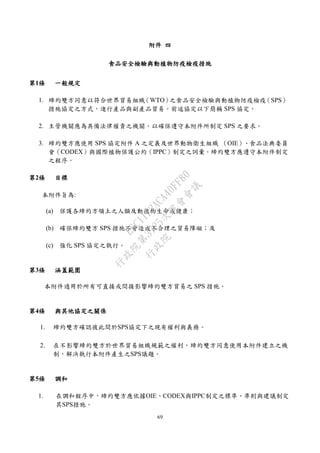
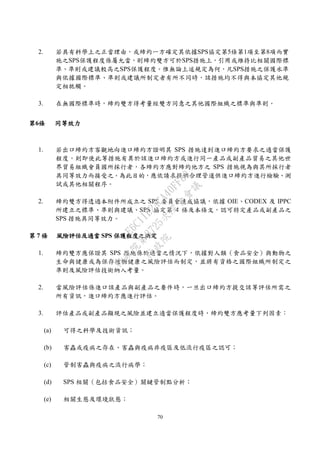
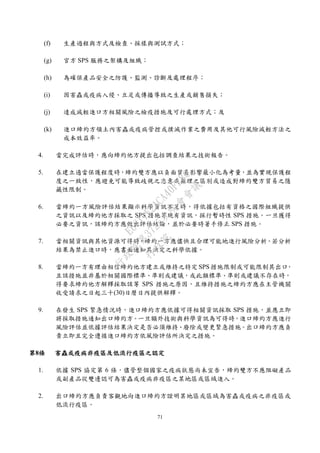
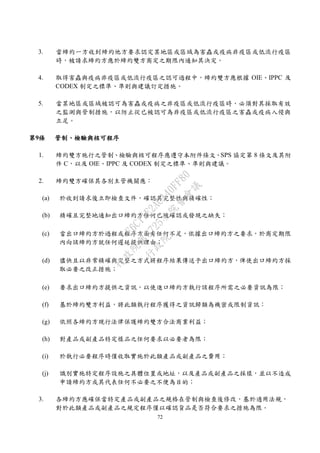
行政院 第 3725 次會議
民國 109 年 11 月 5 日
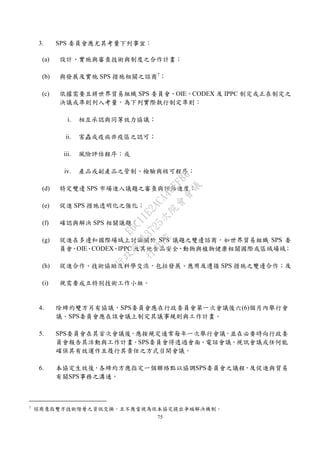
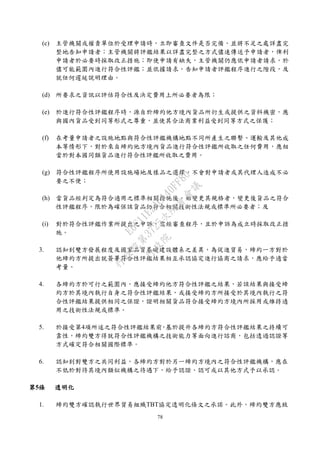
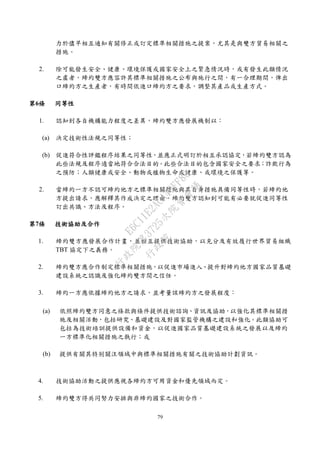
討論事項(一)
經濟部、財政部與外交部會銜函送「中華民國(臺灣)政府與
貝里斯政府經濟合作協定」,請核轉立法院審議案。
說明:
一、經濟部、財政部與外交部會銜函以,貝里斯巴洛總理去
(108)年 8 月間致函蔡總統表達盼與我方洽簽雙邊貿
易協定,雙方部長並簽署合作意向書。案經鄧政務委員
振中邀集外交部、財政部、農委會及經濟部等相關部會
會商並與產業溝通,以及綜合評估經濟、財政、外交等
因素,經與貝方完成諮商,雙方爰擬簽署「中華民國
行
政
院
行
政
院
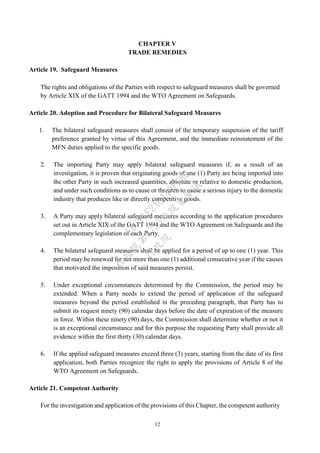
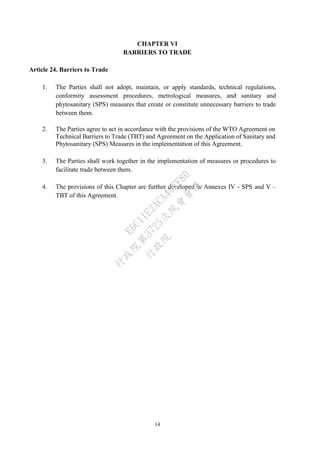
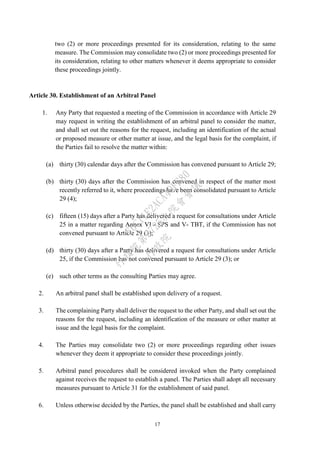
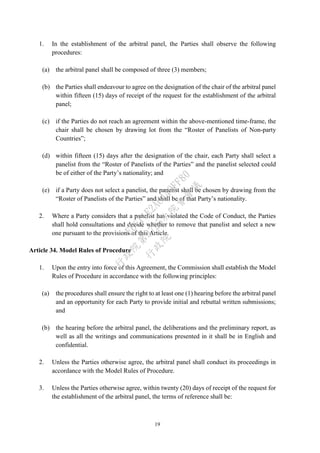
第
3725次
院
會
會
議
E6C11E2ACA40FF80
2
(臺灣)政府與貝里斯政府經濟合作協定」,前經報奉
鈞院復准辦理在案,並由經濟部部長王美花及貝國投
資、貿易及商務部部長 Tracy Panton 完成異地簽署。
檢附該協定,請核示。
二、本協定包含關稅與非關稅措施、原產地規則、關務合作
與貿易便捷化、貿易救濟、貿易障礙、爭端解決、協定
之行政管理、投資促進與合作、雙邊合作等 11 個章
節,以及雙方降稅清單、原產地規則、食品安全檢驗及
動植物防疫檢疫措施、標準等 5 個附件。
三、茲以本協定內容涉及經濟上利益等國家重要事項,符合
「條約締結法」規定之條約性質,爰依該法第 8 條規
定,於簽署後 30 日內報請本院核轉立法院審議。本案
行
政
院
行
政
院
第
3725次
院
會
會
議
E6C11E2ACA40FF80
3
擬請討論通過後,由院送請立法院審議,提請
核議
附件如附
行
政
院
行
政
院
第
3725次
院
會
會
議
E6C11E2ACA40FF80
1
中華民國(臺灣)政府
與貝里斯政府經濟合作協定
前言
中華民國(臺灣)政府和貝里斯政府,以下合稱為「締約雙方」;
同意透過涵蓋特定貨品合作和貿易之經濟合作協定,正式建立中華民國(臺灣)與
貝里斯間之貿易關係;
考量締約雙方皆為世界貿易組織(WTO)之成員;
尊重貝里斯依據查加拉瑪斯修正條約所成立加勒比共同體(CARICOM)下之權利和
義務,包括加勒比共同體之單一市場和經濟;
考量到在互惠基礎上建立持續發展及平衡經貿關係之必要性,並考量到各自經濟規
模之差異,特別是貝里斯於加勒比共同體低度開發國家之地位及依據聯合國定義下
小島嶼發展中國家(SIDS)之地位;
認識到區域和次區域整合程序對締約雙方在促進國際貿易發展和競爭力之重要性;
認知貿易和經濟合作係加強雙邊關係以及促進和保護投資之重大和必要因素;
致力於加強締約雙方間現有之友好和文化關係;
同意以下條款:
行
政
院
行
政
院
第
3725次
院
會
會
議
E6C11E2ACA40FF80
2
第一章
初始條款
第1條 目標
本協定旨在透過以下方式加強締約雙方間之商業和經濟關係:
(a) 透過分階段降低和取消關稅、避免非關稅貿易障礙以及建立關於技術、衛生和食品
安全檢驗與動植物防疫檢疫措施之明確規定,給予關稅優惠,以促進、提升、多樣
化和擴大來自締約雙方之原產貨品貿易;
(b) 發展促進投資之機制並使現有雙邊投資條約(BIT)現代化,作為投資之法律架構;
(c) 在技術性法規、標準和符合性評鑑程序、衛生和食品安全檢驗與動植物防疫檢疫措
施、創新、生產、科技、分配、行銷和金融以及在締約雙方可能相互接受之任何其
他領域之技術合作及能力建構活動;
(d) 支持促進貝里斯投資和私營部門活動之條件以及支持增強貝里斯供應能力、競爭
力和經濟增長之條件;
(e) 建立有效、透明和有效能之制度,以解決因本協定所規範活動而引起之貿易爭端。
行
政
院
行
政
院
第
3725次
院
會
會
議
E6C11E2ACA40FF80
3
第二章
關稅措施和非關稅措施
第2條 定義
依本協定目的,適用以下定義:
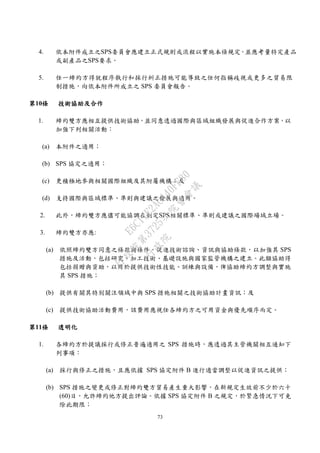
(a) 本協定係指締約雙方於二○二○年九月三十日簽署之經濟合作協定;
(b) 關稅包括進口關稅以及各締約方依據其國家法律中定義之所有「其他關稅和規
費」而收取或與進口相關之費用,但不包括:
i. 符合一九九四年關稅暨貿易總協定(GATT 1994)第3條第2項規定以及
其他相關規定而課徵之內地稅;
ii. 任何反傾銷或平衡稅;
iii. 與提供服務相當之任何進口相關費用或其他規費;及
iv. 在管理定量進口限制和關稅配額上,因任何招標制度而對進口貨品提供
或收取之任何溢價。
(c) 原產貨品係指符合本協定附件三原產地規則所訂定合格要件之貨品;
(d) 限制係指所有可能防止或使從締約一方進出口貨品至締約他方有困難之措施,
但排除一九九四年關稅暨貿易總協定及其他相關世界貿易組織協定所允許之措
施。
第3條 國民待遇
1. 各締約方應依一九九四年關稅暨貿易總協定第3條之規定,包括該條之解釋性說
明,給予締約他方貨品國民待遇。
2. 前項關於國民待遇之規定,係指締約一方就締約他方之任何同類、有直接競爭關
係或有可替代性貨品之待遇不得少於最優惠待遇。
第4條 特殊和差別待遇
於本協定中,特殊和差別待遇應指一項原則之適用,該原則允許締約雙方同等分
享本協定之利益,且考量到締約雙方經濟規模之差異,顧及貝里斯於加勒比共同
體中低度開發國家之地位及依據聯合國定義下小島嶼發展中國家(SIDS)之地位,
並提共予較小經濟體非同等之待遇。
第5條 關稅減免
行
政
院
行
政
院
第
3725次
院
會
會
議
E6C11E2ACA40FF80
4
1. 當貨品符合原產地標準時,締約雙方同意減少或免除與本協定附件一(中華民國
(臺灣)給予貝里斯之關稅優惠)和附件二(貝里斯給予中華民國(臺灣)之關
稅優惠)所列貨品進口相關之關稅。
2. 各締約方同意依據下列類型給予締約他方生產之貨品優先市場進入:
(a) 類型「A」:
標註於類型A中之原產貨品應完全免除其關稅,且於本經濟合作協定生效
後,此些貨品應立即免稅。
(b) 類型「B」:
標註於類型B中之原產貨品關稅,於本經濟合作協定生效之日起,應於三
(3)個相等之年度階段中免除,且自第3年1月1日起,此些貨品應為免稅。
(c) 類型「C」:
標註於類型C中之原產貨品關稅,於本經濟合作協定生效之日起,應於五
(5)個相等之年度階段中免除,自第5年1月1日起,此些貨品應為免稅。
(d) 類型「D」:
標註於類型D中之原產貨品關稅,於本經濟合作協定生效之日起,應於十
(10)個相等之年度階段中免除,自第10年1月1日起,此些貨品應為免稅。
(e) 類型「E」:
標註於此類型之原產貨品關稅應依據市場進入或關稅減讓之特定要件加
以識別。
3. 締約雙方不得就附件一和附件二所列貨品之進口徵收其他關稅和規費。
4. 縱有有本條第3項之規定,然因貝里斯對國際貿易稅收有高度之收入依賴性,當
符合其於烏拉圭回合之承諾,並考量其於一九四七年關稅暨貿易總協定第2條第
1項第b款執行瞭解備忘錄下之權利,貝里斯得徵收其他關稅和規費。
5. 關稅減免應基於談判開始之日有效之最惠國進口稅率。
第6條 非關稅貿易障礙之排除
除一九九四年關稅暨貿易總協定第20條和第21條所認可之規範外,締約雙方不得就附件
一和附件二所確認之貨品進出口實施非關稅貿易障礙。
第7條 關稅優惠之修正
行
政
院
行
政
院
第
3725次
院
會
會
議
E6C11E2ACA40FF80
5
締約雙方可隨時同意檢視、修正或擴大本協定附件一和附件二之貨品清單及其關稅優惠。
第8條 關稅優惠之保持
認知到國際商品統一分類制度(HS)之定期更新,締約雙方同意,儘管在國際商品統一分
類制度更新版本中,任何核可之修訂可能導致與本協定不同之約定匯率,本協定依據2017國際
商品統一分類制度之基礎所達成之關稅優惠仍屬有效。
第9條 關稅優惠之撤回
本協定生效後,各締約方皆不得單方面修正已同意之關稅優惠,除係為實施反傾銷或
平衡稅,亦或為採取本協定所允許之防衛措施或暫停授予利益。
行
政
院
行
政
院
第
3725次
院
會
會
議
E6C11E2ACA40FF80
6
第三章
原產地規則
第10條 成立原產地規則委員會
1. 締約雙方應成立原產地規則委員會,各指派二(2)名成員,條件如下:
(a) 就貝里斯,一(1)名成員屬於稅務局,另一(1)名成員屬於外貿部;及
(b) 就中華民國(臺灣),一(1)名成員屬於經濟部,另一(1)名成員屬於財政部
關務署。
2. 委員會成員負責處理與本協定原產地規則相關之事務,並提出必要建議提交行
政委員會核准。
第11條 原產地規則
1. 為決定享有本協定關稅優惠之原產貨品,締約雙方同意採行附件三所定原產地規
則。
2. 本協定所規範之優惠關稅及其他優惠措施僅適用附件一及附件二所列之原產貨
品。
3. 原產地規則委員會於必要時得就下列原產地規則項目之適用向行政管理委員會提
出建議:
(a) 更新原產地規則以順應締約雙方技術發展及生產架構與製程之改變;
(b) 採行必要規則及程序以確保原產地規則之有效執行與適用;
(c) 建立、修正、暫停實施或廢除特定原產地規則;及
(d) 處理締約雙方可能認為與原產地規則之解釋與適用相關之任何其他事
項。
第12條 關稅估價
締約雙方就關稅估價事項應承諾遵守一九九四年關稅暨貿易總協定第7條之規定。
行
政
院
行
政
院
第
3725次
院
會
會
議
E6C11E2ACA40FF80
7
第四章
關務合作與貿易便捷化
第13條 關務與行政合作範圍
1. 締約雙方認知關務及貿易便捷化在持續發展之全球貿易環境,以及在締約雙方間達
成雙邊協定之重要性。
2. 締約雙方同意於該領域內加強合作,以確保相關法規與程序,以及主管機關之行政
能力,以達成有效管控和促進貿易便捷化之目標,並協助促進締約雙方區域整合及
發展。
3. 締約雙方認知,於執行本章條款時,不得以任何方式損害包括安全和防止欺詐在內
之合法公共政策目標。
第14條 關務與行政合作
為確保執行本章條款及第13條所列之原則及目標,締約雙方應:
(a) 於共同商定之領域發展聯合倡議;
(b) 儘可能在與關務相關之國際組織,如世界貿易組織(WTO),建立共同立
場;及
(c) 促進相關機關間之協調工作。
第15條 資訊交換
1. 締約雙方同意,基於締約一方之請求,交換與關務流程、程序、法規及其他一般資訊
相關之資訊。
2. 對一般資訊之請求應以紙本或電子書面方式直接向締約他方之海關機構提出,並附帶
提供有助於達成該請求之資訊。各締約方之關務機構應針對此目的設置聯絡窗口。
3. 視情況所需,得以口頭方式提出請求,惟應於提出請求後七(7)日內以紙本或電子書面
方式確認之。
4. 基本資訊之請求應包含下列項目:
(a) 相關事項之簡短描述;
(b) 請求資訊之類型;及
(c) 請求之緣由。
行
政
院
行
政
院
第
3725次
院
會
會
議
E6C11E2ACA40FF80
8
5. 若請求締約方無法依據第 2 項、第 3 項及第 4 項行事,則締約一方得拒絕締約他方交
換一般資訊之請求。
6. 締約雙方同意依據本條取得之基本資訊,僅供關務機構提出請求時所表述之緣由用途
使用。
7. 締約雙方同意對依據本條取得之基本資訊均應予以保密,且遵守與各締約方有關揭露
資訊之相關適用法律或行政規定。締約雙方之關務機構應就與該揭露相關之任何適
用法律或行政規定事先給予通知,並獲得提供該資訊締約方之同意。
8. 締約雙方就依據本協定所取得與關務相關之交換資訊,應採取必要保全措施,防
止未經授權之取得、揭露、修改或散布。
第16條 關務立法及程序
1. 締約雙方同意,其各自之貿易和關務立法、法規及程序應適用相關領域之國際文件
和標準,包括修正版京都公約中有關簡化和統一關務程序之實質性內容、世界關務
組織全球貿易安全與便捷標準架構、世界關務組織資料集及國際商品統一分類制度
國際公約。
2. 締約雙方同意其各自之貿易和關務立法、法規及程序應基於:
(a) 透過執行及遵守法律規範以保護及便捷化貿易之需求,並為法遵程度較高廠商提
供額外便捷之需求;
(b) 確保對一般企業或優質企業之要求係合理、非歧視及防止欺詐之需求,不針對輕微
違反關務法規或程序要求之行為課以過度處罰;
(c) 應用現代關務技術之需求,包括風險評估、簡化進出口程序、放行後管控以及對具
認證資格廠商之客觀程序。相關程序應透明、有效並簡化,以降低成本及提高可預
測性;
(d) 對貨品進出口及過境之程序不加歧視之需求,然依據客觀風險評估標準,可對貨品
進行不同之處理;
(e) 透明化之需求。締約雙方同意依據各自立法原則,就關務事務,特別是稅則分類和
原產地規則,實施具約束力之制度;
(f) 逐步開發系統(包含資訊技術系統)之需求,以促進廠商、關務及相關機關間電子資
料交換;
(g) 便捷過境運輸之需求;
行
政
院
行
政
院
第
3725次
院
會
會
議
E6C11E2ACA40FF80
9
(h) 有關報關業許可及不強制要求使用獨立報關業之透明化和非歧視性規則;及
(i) 在不影響世界貿易組織裝運前檢驗協定所規範之權利和義務下,避免強制使用裝
運前檢驗或類似檢驗之需求。締約雙方應就此事進行討論,其後可同意放棄執行強
制裝運前檢驗或類似檢驗之可能性。
3. 為改善作業方法,並確保非歧視性、透明化、效率、完整性和可責性之運作,締約
雙方應:
(a) 採取進一步措施以減少、簡化和標準化資料及文件;
(b) 盡可能簡化貨品通關放行之要求和手續;
(c) 提供有效、迅速、非歧視性和易於使用之程序,確保可就影響貨品進出口或轉運
之關務處分及裁決提出上訴。任何費用應相稱於上訴程序費用;及
(d) 透過採取與該領域相關之國際公約及文件等措施,確保維持最高廉正標準。
第17條 與企業界之互動
締約雙方同意:
(a) 確保所有立法、程序、費用、懲處以及相關解釋儘可能透過電子方式公開發布;
(b) 確保就與關務及貿易程序相關之立法提案及時並定期與企業界進行對話;
(c) 公開發布(包含透過網際網路)關務法律、法規、一般行政措施及準則,且於情況允
許下,提前公告擬欲實施之關務通用管理法規,並給予利害關係人於法規實施前
提出意見之機會。締約雙方應安排或維持一個或多個諮詢窗口,以回答利害關係
人對於關務事務之疑問,並應於網路公開該諮詢管道之相關資訊;
(d) 透過使用如瞭解備忘錄之非任意且可公開取得之程序,強化與企業界及相關行政
組織之合作,以促進公平競爭,並參考世界關務組織之規範;
(e) 與企業界合作之目的在於對抗非法行為、維護公民安全及確保國課;
(f) 確保各締約方之關務及相關要求和程序係遵循最佳做法,並維持最小限度之貿易
限制。
第18條 合作
1. 締約雙方認知為達成本協定之目標,就關務及貿易便捷化措施進行合作之重要性。
行
政
院
行
政
院
第
3725次
院
會
會
議
E6C11E2ACA40FF80
10
2. 締約雙方同意透過包含便捷化輔助、能力建構及技術性協助等方式於下列領域中進
行合作:
(a) 現代關務技術之運用,包含風險管理、具約束力之預審機制、貨品通關放行程序
簡化、放行後管控措施及公司稽核方式;
(b) 引進最具可行程度之作業程序及國際通用之關務及貿易規章與標準,包含世界貿
易組織規範、世界關務組織規章及標準、修正版京都公約有關簡化及調和關務程
序、世界關務組織全球貿易安全與便捷化標準架構等;及
(c) 關務及其他貿易程序之自動化。
行
政
院
行
政
院
第
3725次
院
會
會
議
E6C11E2ACA40FF80
11
第五章
貿易救濟
第19條 防衛措施
締約雙方關於防衛措施之權利與義務應受一九九四年關稅暨貿易總協定第19條和世界貿
易組織防衛協定之拘束。
第20條 雙邊防衛措施之採行和程序
1. 雙邊防衛措施應包括暫時中止依據本協定給予之關稅優惠,並立即恢復適用於特定
貨品之最惠國關稅。
2. 若經調查證明締約一方之原產貨品以絕對或相對於國內生產之增加數量進口至締
約他方,並於此情況下,對生產同類或直接競爭貨品之國內產業造成嚴重損害或有
嚴重損害之虞者,則進口締約方可採行雙邊防衛措施。
3. 締約一方可依據一九九四年關稅暨貿易總協定第19條、世界貿易組織防衛協定及各
締約方補充法規中規定之適用程序,採行雙邊防衛措施。
4. 雙邊防衛措施有效期最長為一(1)年。若促使採行上述防衛措施之原因持續存在,則
可以連續延長該期間不超過一(1)年。
5. 在行政委員會確認之特殊情況下,得延長該期限。當締約一方需延長防衛措施之實
施期限至超過前款所規定之期限時,該締約方必須於現行措施屆滿前九十(90)日曆
日,提交其請求。於此九十(90)日曆日內,行政委員會應確認該請求是否為特殊情
況,為此目的,請求締約方應於前三十(30)日內提供所有證據。
6. 若所採行之防衛措施自首次實施之日起超過三(3)年,則締約雙方均認知適用世界
貿易組織防衛協定第8條規定之權利。
第21條 主管機關
基於本章調查和適用之規定,主管機關應為:
(a) 就中華民國(臺灣),為經濟部和財政部或承接其業務機關;及
(b) 就貝里斯,為負責對外貿易之部會。
第22條 通知
各締約方同意透過其各自之主管機關及時通知締約他方:
行
政
院
行
政
院
第
3725次
院
會
會
議
E6C11E2ACA40FF80
12
(a) 發動雙邊防衛措施之調查;
(b) 該調查之初步決議和最終結論;
(c) 臨時或最終雙邊防衛措施之採行;
(d) 於適用之情況下,於本協定生效後締約雙方就法規進行之任何修改或修正;或
(e) 任何主管機關之變更。
第23條 反傾銷與平衡稅
於實施反傾銷或平衡措施以及補貼方面,締約雙方應受拘束於一九九四年關稅暨貿
易總協定第6條和第16條、一九九四年關稅暨貿易總協定第6條之執行協定、世界貿易
組織補貼及平衡措施協定及各締約方之補充法規。
行
政
院
行
政
院
第
3725次
院
會
會
議
E6C11E2ACA40FF80
13
第六章
貿易障礙
第24條 貿易障礙
1. 締約雙方不得採行、維持或實施會造成或導致彼此間不必要貿易障礙之標準、
技術性法規、符合性評鑑程序、度量衡措施以及食品安全檢驗與動植物防疫檢
疫(SPS)措施。
2. 締約雙方同意本協定之執行須依照世界貿易組織技術性貿易障礙(TBT)協定
及食品安全檢驗與動植物防疫檢疫措施(SPS)協定之規範。
3. 締約雙方應共同努力執行措施或程序,以促進雙方間之貿易。
4. 本章之規定進一步規範於本協定附件四-SPS和附件五-TBT之中。
行
政
院
行
政
院
第
3725次
院
會
會
議
E6C11E2ACA40FF80
14
第七章
爭端解決
第25條 諮商
1. 締約一方得就其認為可能影響本協定實施之任何實際或擬訂措施或任何其他事
項,如第27條所述,以書面形式請求與締約他方進行諮商。
2. 該締約方應將請求提交予締約他方,並應提出請求之理由,包括確認實際或擬訂
採取之措施或其他有爭議之事項以及控訴之法律依據。
3. 諮商雙方應盡一切努力透過依據本條款或本協定其他諮商規定所進行之諮商,以
達成相互滿意之解決方案。
有鑑於此,締約雙方應:
(a) 提供資訊以利全面審查實際或擬訂之措施或其他事項可能如何影響本協定之
運作和適用;及
(b) 對諮商過程中交換之任何機密資訊應與提供該資訊之締約方同等對待之。
第26條 合作
締約雙方應隨時致力就本協定之解釋和/或適用取得共識,並盡力透過合作與諮商,就
任何可能影響本協定運作之事項達成相互滿意之解決方案。
第27條 適用範圍
除本協定另有規定外,本章之爭端解決規定應適用於:
(a) 關於防止或解決締約雙方間有關本協定解釋和/或適用之所有爭議; 和/或
(b) 當締約一方認為締約他方之實際或擬訂措施與本協定之義務相牴觸或將與本協
議之義務相牴觸,亦或締約他方未能履行其於本協定下之義務時。
第28條 爭端解決場域之選擇
1. 爭端若涉及與本協定之條款及世界貿易組織協定或依據世界貿易組織協定談判
所達成協定之條款,經締約雙方共同商定,得於上述場域之一解決爭端。
2. 若締約一方要求依據第30條成立仲裁小組,或依據世界貿易組織協定爭端解決規
則和程序瞭解書第6條要求成立小組時,應使用選定之場域而排除其他。
行
政
院
行
政
院
第
3725次
院
會
會
議
E6C11E2ACA40FF80
15
第29條 行政委員會–斡旋、調解及調停
1. 任一諮商締約方得1
以書面要求依據本協定第41條成立之行政委員會召開會議,
若締約雙方未能於下列情況中依據第25條或附件四-SPS和附件五-TBT之規定解
決爭端:
(a) 於提出諮商請求後三十(30)日內;及
(b) 締約雙方可能同意之其他要件。
2. 請求締約方應將其請求交付予締約他方,並應說明請求之原因,包括確認系爭措
施或其他有爭議之事項以及控訴之法律依據和任何其他相關資訊。
3. 除另有決議,行政委員會應於請求提出後十五(15)日曆日內召開會議,並應致力
迅速解決爭端。行政委員會得:
(a) 視需要召集技術顧問或成立工作小組或專家小組;
(b) 採取斡旋、調解及調停或其他爭端解決程序;或
(c) 提出建議,以協助諮商締約雙方達成相互滿意之爭端解決方案。
4. 除另有決議,依據本條規定,若涉及同一措施,行政委員會應合併二(2)個或多
個程序以供其審議。當行政委員會認為適當時,得合併二(2)個或多個與其他事
項相關之訴訟程序,以供其審議。
第30條 成立仲裁小組
1. 依據第29條要求召開行政委員會會議之任一締約方,得以書面請求成立仲裁小
組審議該爭端,然應說明提出請求之理由,包括確認實際或擬訂採取之措施或
其他有爭議之事項以及控訴之法律依據,若締約雙方未能於下列期限內解決爭
端:
(a) 依據第29條召開行政委員會會議後三十(30)日曆日內;
(b) 當依據第29條第4項對訴訟進行合併,就最近移交之爭端召開行政委員會
會議後三十(30)日內;
(c) 當締約一方就與附件四-SPS和附件五-TBT相關之爭端依據第25條提出諮
商請求後十五(15)日內,若行政委員會未依據第29條第3項召開會議時;
1
此不應視為是依據第 30 條申請成立仲裁小組所需要的初步階段。
行
政
院
行
政
院
第
3725次
院
會
會
議
E6C11E2ACA40FF80
16
(d) 當締約一方依據第25條提出諮商請求後三十(30)日內,若行政委員會未依
據第29條第3項召開會議時;或
(e) 諮商締約雙方得同意之其他要件。
2. 仲裁小組應於提出請求後成立。
3. 控訴締約方應將請求交付予締約他方,並應說明提出請求之原因,包括確認系
爭措施或其他有爭議之事項以及控訴之法律依據。
4. 在締約雙方認為適當可共同審議程序時,得合併考量與其他爭端相關之二(2)個
或多個程序。
5. 當被控訴之締約方收到成立小組之請求時,應被視為啟動仲裁小組程序。締約
雙方應依據第31條採取一切必要措施,成立該小組。
6. 除締約雙方另有決議,否則應成立小組,並應依照本章之規定履行其職責。
7. 縱有第1項之規定,仍有可能無法成立仲裁小組以審查擬訂之措施。
第31條 仲裁小組成員名冊
1. 於本協定生效之日起六(6)個月內,締約雙方應建立並維持至多二十(20)人之自然
人名冊,此些自然人應具備擔任仲裁小組成員之資格。該名冊應由「締約雙方小
組成員名冊」和「非締約雙方國家小組成員名冊」組成。各締約方可指定五(5)名
國家小組成員組成「締約雙方小組成員名冊」,以及五(5)名非締約方國家小組成
員組成「非締約雙方國家小組成員名冊」。
2. 小組成員名冊得每三(3)年進行修正。
3. 縱有第2項之規定,行政委員會得應締約一方之要求於三(3)年期限屆滿前修改小組
成員名冊。
4. 小組成員名冊應符合第32條規定之資格。
第32條 小組成員資格
1. 小組成員應符合下列資格:
(a) 於法律、國際貿易、本協定涵蓋之其他事項或國際貿易協定下引起之爭端解
決方面具有專業知識或經驗;
行
政
院
行
政
院
第
3725次
院
會
會
議
E6C11E2ACA40FF80
17
(b) 其選擇須嚴格基於客觀性、可靠性和合理之判斷;
(c) 獨立於任一締約方,且不隸屬於或受指示於任一締約方;及
(d) 遵守行政委員會所制定之行為準則。
2. 已依據第29條參與爭端之自然人不得擔任仲裁小組成員。
第33條 仲裁小組之組成
1. 締約雙方在成立仲裁小組時應遵守下列程序:
(a) 仲裁小組應由三(3)名成員組成;
(b) 締約雙方應於收到成立仲裁小組之請求後十五(15)日內,致力於就仲裁小組主
席之任命達成協議;
(c) 若締約雙方於上述期限內無法達成協議,則應從「非締約雙方國家小組成員名
冊」中抽籤決定主席;
(d) 於確認主席後之十五(15)日內,各締約方應從「締約雙方小組成員名冊」中選任
一(1)名小組成員,該小組成員可具有任一締約方之國籍;及
(e) 若一締約方未能選任小組成員,則該小組成員應從「締約雙方小組成員名冊」
中抽籤選出,且應具有該締約方之國籍。
2. 當締約一方認為有小組成員違反「行為守則」,則締約雙方應進行諮商,並決定
是否應解除該小組成員之職務,並依本條規定選任新小組成員。
第34條 標準程序規則
1. 本協定生效後,行政委員會應依據下列原則制定標準程序規則:
(a) 程序應確保在仲裁小組前進行至少一(1)次聽證之權利,並確保各締約方有機會
提供初步和反駁之書面陳述;及
(b) 仲裁小組舉行之聽證會、審議和初步報告,以及仲裁期間提出之所有書面和溝
通,均應以英文進行,並視為機密。
2. 除締約雙方另有協議,仲裁小組應依據本標準程序規則進行程序。
3. 除締約雙方另有協議,於收到成立仲裁小組請求後二十(20)日內,其職權範圍應
行
政
院
行
政
院
第
3725次
院
會
會
議
E6C11E2ACA40FF80
18
為:
「依據本協定之規定,審查提交其審議之事項,並根據第36條第2項和第37條之
規定做出調查結果、決定和建議。」
第35條 專家職能
依據締約一方之請求或依其職權,仲裁小組得依本標準程序規則,向其認為適當之任
何個人或機構蒐集資訊和技術建議。
第36條 初步報告
1. 除締約雙方另有協議,仲裁小組應依據締約雙方提出之陳述和論點、本協定之相
關規定以及依據第35條所接收之資訊,作為其初步報告之基礎。
2. 除締約雙方另有協議,仲裁小組應於最後一名仲裁成員選定後九十(90)日內,向
締約雙方提出初步報告,其內容應包括:
(a) 事實調查結果,包括依據第30條所提出要求之任何調查結果;
(b) 關於系爭措施是否或可能與本協定下之義務相牴觸之決定,或其職權範圍中
要求之任何其他決定;及
(c) 對於解決爭端可能之建議。
3. 任一締約方得於提出初步報告後十四(14)日內,向仲裁小組就其初步報告提出書
面意見。於考量對初步報告之任何書面意見後,應締約一方之請求或依其職權,
仲裁小組得:
(a) 重新考量其報告;或
(b) 採取任何適當之措施。
第37條 最終報告
1. 於提交初步報告後三十(30)日內,除締約雙方另有協議,仲裁小組應將其最終報
告通知締約雙方。
2. 除締約雙方另有協議,締約雙方應於通知最終報告後十五(15)日內公布該報告。
第38條 最終報告之履行
行
政
院
行
政
院
第
3725次
院
會
會
議
E6C11E2ACA40FF80
19
1. 仲裁小組之最終報告,就締約雙方履行其所載之條款和條件而言,應為強制性的。
除締約雙方另有協議,履行期限自最終報告通知締約雙方之日起不超過六(6)個月。
仲裁小組最終報告不得上訴。
2. 當仲裁小組最終報告認定某項措施不符合締約一方依據本協定所承擔之義務時,
被控訴締約方不得執行該措施或應移除該不符合措施。
第39條 遵守決議和暫停授予利益
1. 若被控訴締約方於發布最終報告之日起三十(30)日曆日內,或於締約雙方合意之
任何其他期限內,未能遵守仲裁小組之決議,則控訴締約方得暫停授予締約他
方依據本協定享有之利益,其程度需與被控訴之締約方造成之損害相同。
2. 當被控訴締約方無法遵守最終報告時,於仲裁小組提交最終報告後三十(30)日內,
該締約方得要求與控訴締約方進行諮商,就補償控訴締約方之替代措施達成協
議。
3. 若未就替代措施達成協議,縱有第1項和第2項所規範之條款,控訴締約方仍可
暫停授予利益,以說服被控訴締約方遵守最終報告。在適用本條之規定時,將考
量締約雙方發展程度之差異性。
第40條 費用與支出
1. 除締約雙方另有協議,仲裁小組之費用和與仲裁程序相關之其他支出應由締約雙
方平均負擔。
2. 各締約方應於仲裁程序中各自負擔其法律費用與支出。
行
政
院
行
政
院
第
3725次
院
會
會
議
E6C11E2ACA40FF80
20
第八章
協定之行政管理
第41條 成立行政管理委員會
締約雙方據此設立行政管理委員會(「行政委員會」),其統籌者為:
(a) 就中華民國(臺灣),為經濟部部長;及
(b) 就貝里斯,為負責對外貿易部部長;
該統籌者應當任命其各自代表團之成員。
第42條 行政委員會會議
(a) 行政委員會應於初始三(3)年中每年召開一(1)次會議,此後每兩(2)年或依需要或
應任一締約方之要求舉行會議。締約雙方應以書面商定第一次會議之日期與地
點,該會議應於協定簽署後六(6)個月內召開。
(b) 行政委員會會議應於中華民國(臺灣)和貝里斯交互舉行。
(c) 締約雙方應於每次會議日期至少十五(15)日曆日前,就該會議之議程達成書面
協議。
第43條 行政委員會之職能
締約雙方同意行政委員會之職能應包括下列內容:
(a) 認可並通過其議事規則以及行政委員會認為與有效執行本協定相關之其他議事
規則,此些規則應作為本協定之附件七和附件八;
(b) 監督締約雙方管理、執行和遵守本協定之規定,並建議採取適當之措施和機制;
(c) 檢視本協定附件一和附件二之貨品清單,並提出修正建議,包括擴大貨品清單;
(d) 依據本協定第七章(爭端解決),審查和解決提交行政委員會之爭端;
(e) 作為就本協定相關防衛措施之實施進行諮商之場域;
(f) 當就促進本協定適當執行為必要時,向締約雙方建議對本協定條文之任何修正;
(g) 於其第一次會議上,運作所有依據本協定成立之委員會;
行
政
院
行
政
院
第
3725次
院
會
會
議
E6C11E2ACA40FF80
21
(h) 視需要設立其他技術小組,其中得包括委員會和專案小組,以協助行政委員會
履行職能並支持其有效執行本協定之規定;
(i) 定期檢視本協定之執行情況並撰寫評估報告,並向締約雙方建議其認為必要之
措施,以改善和擴大雙方間之貿易關係;
(j) 促進締約雙方私營部門間之業務往來,以改善相互間之雙邊貿易關係;及
(k) 履行依據本協定下之任何其他職能,或履行締約雙方為促進有效執行本協定得
同意之職能。
第44條 行政委員會之決議
除另有協議,行政委員會所有決議均應以共識決之方式為之。
行
政
院
行
政
院
第
3725次
院
會
會
議
E6C11E2ACA40FF80
22
第九章
投資促進與合作
締約雙方認知到投資對其經濟之重要性,並注意到促進和保護各締約方投資者之投資已涵蓋
於1999年簽署之中華民國政府與貝里斯政府投資促進暨保護協定。
締約雙方同意對上述協定進行檢視,以期於本協定生效之日起一(1)年內更新該協定。
第45條 投資促進與合作
認知到促進跨境投資和技術轉讓作為實現經濟增長和發展方式之重要性,且為增加投資,
締約雙方應:
(a) 合作透過資訊交流以促進投資,包括潛在行業和投資機會、法律及法規,以提高
對各自投資環境之認識;
(b) 鼓勵和支持投資促進活動、建立投資促進計畫、協助進行正式商務訪問並安排投
資交易大會或展覽;
(c) 於本協定生效後一(1)年內,檢視並現代化雙方間已存在之雙邊投資條約(BIT);
(d) 於本協定生效後一(1)年內達成避免雙重課稅協定;及
(e) 建立私部門依據商業考量和任何其他領域進行投資之機制。
行
政
院
行
政
院
第
3725次
院
會
會
議
E6C11E2ACA40FF80
23
第十章
雙邊合作
第46條 經濟及技術合作
1. 締約雙方認知經濟及技術合作係實踐本協定第1條所揭目標之基本要件。
2. 經濟及技術合作應關注於下列領域:
(a) 強化貝里斯之技術及研究能力,以促進其發展符合國際認可之食品安全檢驗與
動植物防疫檢疫措施及技術標準;
(b) 鼓勵旨在識別潛在投資產業之研究,以發展農工業活動集群;
(c) 提供人員及組織建構之技術協助,以提升貝里斯落實本協定之能力;及
(d) 提供旨在促進私部門及企業發展之協助性措施,尤其是針對中、小型企業,以
提升其國際競爭力及多元化之發展。
第47條 技術及經濟合作機制
締約雙方同意由各自代表組成技術及經濟合作委員會(以下稱TEC委員會),以建立貿易
及技術合作機制。該委員會應由貝里斯投資、貿易及商務部首長或其指定代理人,及中
華民國(臺灣)經濟部首長或其指定代理人組成。雙方代表團應包含相關技術人員,並研
議私部門與會討論之可能。
1. 技術及經濟合作委員會會議:
委員會每年將定期輪流在貝里斯或中華民國(臺灣)召開年度會議並由締約雙方代表
共同主持。年會日期及議程應透過外交管道正式知會。若情況所需,締約雙方可召開
特別會議,且於必要時得以電子通訊方式進行溝通。
2. 技術及經濟合作委員會職能:
TEC委員會應特別具有以下職能::
(a) 協助行政委員會執行與本協定相關之經濟發展合作事項;
(b) 監督執行本協定明定之合作條款;
行
政
院
行
政
院
第
3725次
院
會
會
議
E6C11E2ACA40FF80
24
(c) 確認執行本協定第 46 條所列雙邊合作計畫之共同利益範疇;執行該等計畫所
需之可用資源應源自締約雙方既有之雙邊合作架構。
(d) 必要時,就已提審或已執行之計畫提出所需之修正。
行
政
院
行
政
院
第
3725次
院
會
會
議
E6C11E2ACA40FF80
25
第十一章
最終條款
第48條 生效
1. 本協定自締約雙方交換書面通知證明其已完成各自內部法律要求之日起生效。
2. 本協定簽署後,其內容及宗旨即不應受到損害;除符合第50條退出程序之情況下,
各締約方不得終止本協定。
第49條 期限
本協定應為無限期。
第50條 協定之退出
1. 締約一方於本協定生效第一(1)年年底後始得退出本協定。
2. 本協定應持續有效,直至締約一方將退出決定通知以書面交付予締約他方為止。
除締約雙方另有協議,上述退出決定應自締約他方收到通知之日起六(6)個月後生
效。
第51條 附件
本協定之附件應構成本協定之一部分。
第52條 修正
1. 本協定可依締約雙方相互同意進行修正。上述修正應由締約雙方依據其各自必要
之內部法律要求予以批准。
2. 任何修正均應成為本協定之附加文件。
3. 任何修正之生效應符合本協定第48條(生效)之規定。
第53條 國際收支平衡
締約雙方在適用本協定之規定時,同意遵守雙方於一九九四年關稅暨貿易總協定中
之權利和義務,特別是第18條第B節,以及一九九四年關稅暨貿易總協定之國際收支
條款瞭解書。
第54條 保留
行
政
院
行
政
院
第
3725次
院
會
會
議
E6C11E2ACA40FF80
行
政
院
行
政
院
第
3725次
院
會
會
議
E6C11E2ACA40FF80
27
附件一
中華民國(臺灣)給予貝里斯之關稅優惠
中華民國(臺灣)產品清單
稅則號別 產品描述 類型 備註
01069000 其他活動物 A
02011010
特殊品級屠體及半片屠體牛肉,生鮮或冷
藏
A
02011090 其他屠體及半片屠體牛肉,生鮮或冷藏 A
02012010
特殊品級帶骨四分之一屠體牛肉及切割肉
排(胸側肉、背脊肉、腰脊肉、上腿
肉),生鮮或冷藏
A
02012020
特選級或精選級肉牛切割之帶骨牛腩、牛
腱,生鮮或冷藏
A
02012090 其他帶骨切割牛肉,生鮮或冷藏 A
02013010
特殊品級去骨四分之一屠體牛肉及切割肉
排(胸側肉、背脊肉、腰脊肉、上腿
肉),生鮮或冷藏
A
02013020
特選級或精選級肉牛切割之去骨牛腩、牛
腱,生鮮或冷藏
A
02013090 其他去骨牛肉,生鮮或冷藏 A
02021010 特殊品級冷凍屠體及半片屠體牛肉 A
02021090 其他冷凍屠體及半片屠體牛肉 A
02022010
特殊品級冷凍帶骨四分之一屠體牛肉及切
割肉排(胸側肉、背脊肉、腰脊肉、上腿
肉)
A
02022020
特選級或精選級肉牛切割之冷凍帶骨牛
腩、牛腱
A
02022090 其他冷凍帶骨切割牛肉 A
02023010
特殊品級冷凍去骨四分之一屠體牛肉及切
割肉排(胸側肉、背脊肉、腰脊肉、上腿
肉)
A
02023020
特選級或精選級肉牛切割之冷凍去骨牛
腩、牛腱
A
02023090 其他冷凍去骨牛肉 A
02031100 屠體及半片屠體豬肉,生鮮或冷藏 B
請見備
註1
02031200
帶骨之豬腿肉、肩肉及其切割肉,生鮮或
冷藏
B
02031919 其他去骨豬肉,生鮮或冷藏 B
02031999 其他帶骨豬肉,生鮮或冷藏 B
02032100 冷凍屠體及半片屠體豬肉 B
行
政
院
行
政
院
第
3725次
院
會
會
議
E6C11E2ACA40FF80
28
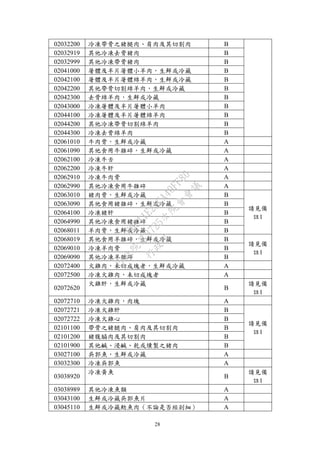
02032200 冷凍帶骨之豬腿肉、肩肉及其切割肉 B
02032919 其他冷凍去骨豬肉 B
02032999 其他冷凍帶骨豬肉 B
02041000 屠體及半片屠體小羊肉,生鮮或冷藏 B
02042100 屠體及半片屠體綿羊肉,生鮮或冷藏 B
02042200 其他帶骨切割綿羊肉,生鮮或冷藏 B
02042300 去骨綿羊肉,生鮮或冷藏 B
02043000 冷凍屠體及半片屠體小羊肉 B
02044100 冷凍屠體及半片屠體綿羊肉 B
02044200 其他冷凍帶骨切割綿羊肉 B
02044300 冷凍去骨綿羊肉 B
02061010 牛肉骨,生鮮或冷藏 A
02061090 其他食用牛雜碎,生鮮或冷藏 A
02062100 冷凍牛舌 A
02062200 冷凍牛肝 A
02062910 冷凍牛肉骨 A
02062990 其他冷凍食用牛雜碎 A
02063010 豬肉骨,生鮮或冷藏 B
請見備
註1
02063090 其他食用豬雜碎,生鮮或冷藏 B
02064100 冷凍豬肝 B
02064990 其他冷凍食用豬雜碎 B
02068011 羊肉骨,生鮮或冷藏 B
02068019 其他食用羊雜碎,生鮮或冷藏 B
請見備
註1
02069010 冷凍羊肉骨 B
02069090 其他冷凍羊雜碎 B
02072400 火雞肉,未切成塊者,生鮮或冷藏 A
02072500 冷凍火雞肉,未切成塊者 A
02072620
火雞肝,生鮮或冷藏
B
請見備
註1
02072710 冷凍火雞肉,肉塊 A
02072721 冷凍火雞肝 B
請見備
註1
02072722 冷凍火雞心 B
02101100 帶骨之豬腿肉、肩肉及其切割肉 B
02101200 豬腹脇肉及其切割肉 B
02101900 其他鹹、浸鹹、乾或燻製之豬肉 B
03027100 吳郭魚,生鮮或冷藏 A
03032300 冷凍吳郭魚 A
03038920
冷凍黃魚
B
請見備
註1
03038989 其他冷凍魚類 A
03043100 生鮮或冷藏吳郭魚片 A
03045110 生鮮或冷藏鯰魚肉(不論是否經剁細) A
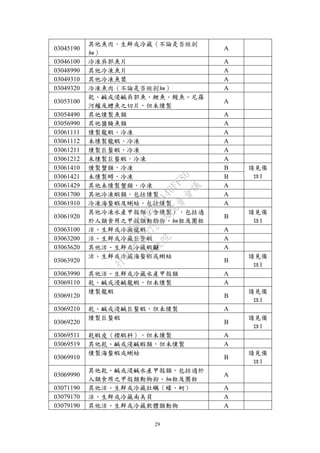
行
政
院
行
政
院
第
3725次
院
會
會
議
E6C11E2ACA40FF80
29
03045190
其他魚肉,生鮮或冷藏(不論是否經剁
細)
A
03046100 冷凍吳郭魚片 A
03048990 其他冷凍魚片 A
03049310 其他冷凍魚漿 A
03049320 冷凍魚肉(不論是否經剁細) A
03053100
乾、鹹或浸鹹吳郭魚、鯉魚、鰻魚、尼羅
河鱸及鱧魚之切片,但未燻製
A
03054490 其他燻製魚類 A
03056990 其他鹽醃魚類 A
03061111 燻製龍蝦,冷凍 A
03061112 未燻製龍蝦,冷凍 A
03061211 燻製巨螯蝦,冷凍 A
03061212 未燻製巨螯蝦,冷凍 A
03061410 燻製蟹類,冷凍 B 請見備
註103061421 未燻製蟳,冷凍 B
03061429 其他未燻製蟹類,冷凍 A
03061700 其他冷凍蝦類,包括燻製 A
03061910 冷凍海螯蝦及蝲蛄,包括燻製 A
03061920
其他冷凍水產甲殼類(含燻製),包括適
於人類食用之甲殼類動物粉、細粒及團粒
B
請見備
註1
03063100 活、生鮮或冷藏龍蝦 A
03063200 活、生鮮或冷藏巨螯蝦 A
03063620 其他活、生鮮或冷藏蝦類 A
03063920
活、生鮮或冷藏海螯蝦或蝲蛄
B
請見備
註1
03063990 其他活、生鮮或冷藏水產甲殼類 A
03069110 乾、鹹或浸鹹龍蝦,但未燻製 A
03069120
燻製龍蝦
B
請見備
註1
03069210 乾、鹹或浸鹹巨螯蝦,但未燻製 A
03069220
燻製巨螯蝦
B
請見備
註1
03069511 乾蝦皮(櫻蝦科),但未燻製 A
03069519 其他乾、鹹或浸鹹蝦類,但未燻製 A
03069910
燻製海螯蝦或蝲蛄
B
請見備
註1
03069990
其他乾、鹹或浸鹹水產甲殼類,包括適於
人類食用之甲殼類動物粉、細粒及團粒
A
03071190 其他活、生鮮或冷藏牡蠣(蠔、蚵) A
03079170 活、生鮮或冷藏南美貝 A
03079190 其他活、生鮮或冷藏軟體類動物 A
行
政
院
行
政
院
第
3725次
院
會
會
議
E6C11E2ACA40FF80
30
03079959
其他乾、鹹或浸鹹軟體類動物,包括適於
人類食用之軟體類動物粉、細粒及團粒,
但未燻製
B
請見備
註1
04062000 磨碎或粉狀之各類乾酪 A
04063000 加工乾酪,非磨碎或非粉狀者 A
04069000 其他乾酪 A
04090000
天然蜜
B
請見備
註1
05080011 珊瑚及其類似物質 A
07082000 豇豆、菜豆,生鮮或冷藏 A
07099990 其他蔬菜,生鮮或冷藏 B 請見備
註107102200 冷凍菜豆、豇豆 B
07133390 其他乾菜豆(四季豆、敏豆),包括白豆 A
07133990 其他菜豆、豇豆類 A
08044000 酪梨,鮮或乾 B
請見備
註1
08071990 其他鮮瓜類 B
08119039
其他未加糖或未加甜味料之冷凍果實及堅
果
B
08134090 其他乾果 A
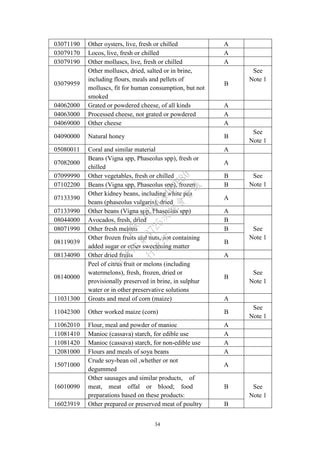
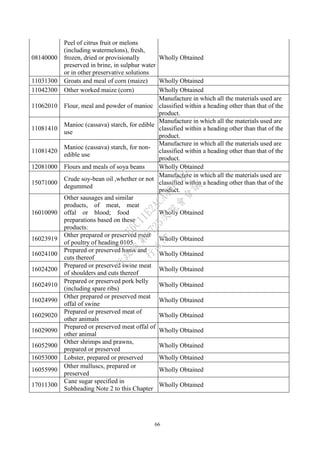
08140000
柑橘或瓜(包括西瓜)之外皮,鮮、冷
凍、乾或暫時漬存於鹽水、硫磺水或其他
浸漬溶液者均在內
B
請見備
註1
11031300 粗碾去殼之玉米及其細粒 A
11042300
其他加工之玉米
B
請見備
註1
11062010 樹薯粉、細粒及細粉 A
11081410 食用樹薯澱粉 A
11081420 非食用樹薯澱粉 A
12081000 大豆(黃豆)粉及細粒 A
15071000 粗製大豆(黃豆)油,不論是否去膠質者 A
16010090
其他肉、雜碎或血製成之臘腸及其類似
品;以上述產品製成之調製食品
B
請見備
註1
16023919 其他第0105節家禽之已調製或保藏肉 B
16024100 已調製或保藏之火腿及已切割者 B
16024200 已調製或保藏之豬肩肉及其已切割者 B
16024910 已調製或保藏之豬腹脇肉(包括腩排) B
請見備
註1
16024990 其他已調製或保藏之豬雜碎 B
16029020 已調製或保藏之其他動物肉 B
16029090 已調製或保藏之其他動物雜碎 B
16052900 其他已調製或保藏蝦類 B
16053000 已調製或保藏之巨螯蝦 B
16055990 其他軟體類動物之調製或保藏品 B
行
政
院
行
政
院
第
3725次
院
會
會
議
E6C11E2ACA40FF80
31
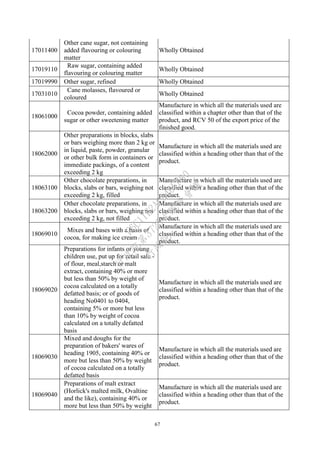
17011300 符合本章目註2規定之甘蔗糖
E
請見備
註2
17011400 其他甘蔗糖,不含添加香料或色素者
17019110 粗製糖,含有添加之香料或色素者
17019990 其他精製糖
17031010 甘蔗糖蜜,已加香料或著色者 A
18061000 可可粉,加糖或其他甜味料者 A
18062000
其他調製品成塊狀、板狀或棒狀重量超過
2公斤者或液狀、膏狀、粉狀、粒狀或其
他散裝在其容器內或內包裝內之容量超過
2公斤者
A
18063100
其他巧克力調製品,呈塊、條狀或棒狀,
重量不超過2公斤,有填塞物
A
18063200
其他巧克力調製品,呈塊、條狀、或棒
狀,重量不超過2公斤,無填塞物
A
18069010
以可可為基礎之製冰淇淋用的混合料及基
料
A
18069020
嬰兒或幼童調製品,供零售用-由粉、細
粒、澱粉或麥芽精製成者,含可可重量
(以完全脫脂可可為基礎計算)在40%或
以上但低於50%;或以第0401至0404節物
品製成者,含可可重量(以完全脫脂可可
為基礎計算)在5%或以上但低於10%者
A
18069030
供製作第1905節烘製食品用之混合料及麵
糰,含可可重量(以完全脫脂可可為基礎
計算)在40%或以上但低於50%者
A
18069040
麥芽精調製品(好立克、阿華田及類似品
在內),含可可重量(以完全脫脂可可為
基礎計算)在40%或以上但低於50%者
A
18069051
調製奶粉,含可可重量(以完全脫脂可可
為基礎計算)在5%或以上但低於10%者
A
18069052
調製奶皮,含可可重量(以完全脫脂可可
為基礎計算)在5%或以上但低於10%者
B
請見備
註1
18069054
調製奶水,含可可重量(以完全脫脂可可
為基礎計算)在5%或以上但低於10%者,
未加糖或未含其他甜味料者
B
18069059
其他調製奶品,含可可重量(以完全脫脂
可可為基礎計算)在5%或以上但低於10%
B
18069069
其他預煮或以其他方式調製之粒狀、片狀
或其他加工(粉及細粒除外)之未列名穀
類〔玉蜀黍(玉米)除外〕產品,含可可
重量(以完全脫脂可可為基礎計算)超過
6%但未逾8%者
A
行
政
院
行
政
院
第
3725次
院
會
會
議
E6C11E2ACA40FF80
32
18069079
其他膨潤或焙製之穀類調製食品(例如:
玉米片),含可可重量(以完全脫脂可可
為基礎計算)6%但未逾8%者
B
請見備
註1
18069091
其他由粉、細粒、澱粉或麥芽精製成之未
列名調製食品,含可可重量(以完全脫脂
可可為基礎計算)在40%或以上低於
50%;其他以第0401至0404節物品製成之
未列名調製食品,含可可重量(以完全脫
脂可可為基礎計算)在5%或以上但低於
10%
A
18069099 其他第1806節所屬之貨品 A
19030010
樹薯澱粉製品,片狀、粒狀、珍珠狀或其
類似形狀者
A
20021000 酸漬除外之調製或保藏番茄,整粒或片塊 A
20079190
其他柑橘類之水果經熬煮所得之果醬、果
凍、橘皮果凍、果泥及果糊
B
請見備
註1
20079990 其他屬第2007節之貨品 B
20081120 花生醬 B
20083000 其他方式調製或保藏之柑橘類水果 B
20089930 其他方式調製或保藏之芒果 B
20089991
未列名經其他方式調製或保藏之果實及植
物其他可食之部分,不論是否加糖或含其
他甜味料
A
20091110
未發酵及未加酒精之天然柑橘汁,冷凍者
B
請見備
註1
20091121
未發酵及未加酒精之濃縮柑橘汁,冷凍
者,每包重量在18公斤及以上
A
20091122
未發酵及未加酒精之濃縮柑橘汁,冷凍
者,每包重量在18公斤以下
A
20091210
未發酵及未加酒精之天然柑橘汁,未冷凍
者,糖度值不超過20
B
請見備
註1
20091221
未發酵及未加酒精之濃縮柑橘汁,未冷凍
者,糖度值不超過20,每包重量在18公斤
及以上者
A
20091222
未發酵及未加酒精之濃縮柑橘汁,未冷凍
者,糖度值不超過20,每包重量在18公斤
以下者
A
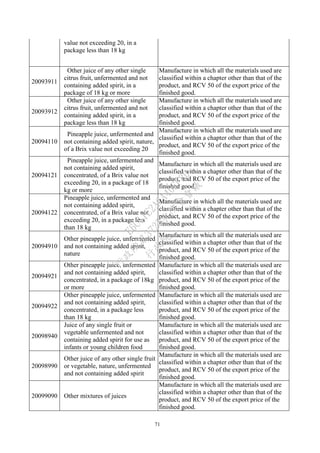
20091910
其他未發酵及未加酒精之天然柑橘汁,未
冷凍者
B
請見備
註1
20091921
其他未發酵及未加酒精之濃縮柑橘汁,未
冷凍者,每包重量在18公斤及以上者
A
20091922 其他未發酵及未加酒精之濃縮柑橘汁,未 A
行
政
院
行
政
院
第
3725次
院
會
會
議
E6C11E2ACA40FF80
33
冷凍者,每包重量在18公斤以下者
20092111
未發酵及未加酒精之葡萄柚汁,糖度值不
超過20,每包重量在18公斤及以上者
B
請見備
註1
20092112
未發酵及未加酒精之葡萄柚汁,糖度值不
超過20,每包重量在18公斤以下者
A
20092911
其他未發酵及未加酒精之葡萄柚汁,每包
重量在18公斤及以上者
B
請見備
註1
20092912
其他未發酵及未加酒精之葡萄柚汁,每包
重量在18公斤以下
A
20093111
其他未發酵及未加酒精之任何單一柑橘類
果汁,糖度值不超過20,每包重量在18公
斤及以上者
B
請見備
註1
20093112
其他未發酵及未加酒精之任何單一柑橘類
果汁,糖度值不超過20,每包重量在18公
斤及以上者
B
20093911
其他未發酵及未加酒精之任何單一柑橘類
果汁,每包重量在18公斤及以上者
B
20093912
其他未發酵及未加酒精之任何單一柑橘類
果汁,每包重量在18公斤以下者
B
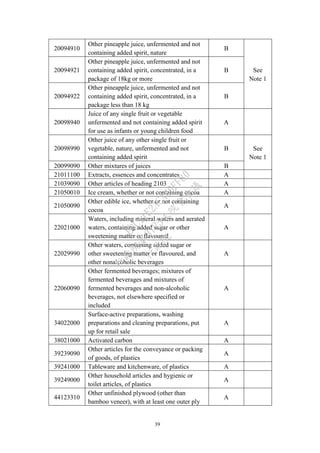
20094110
未發酵及未加酒精之天然鳳梨汁,糖度值
不超過20
B
20094121
未發酵及未加酒精之濃縮鳳梨汁,糖度值
不超過20,每包重量在18公斤及以上者
B
20094122
未發酵及未加酒精之濃縮鳳梨汁,糖度值
不超過20,每包重量在18公斤以下者
B
20094910 其他未發酵及未加酒精之天然鳳梨汁 B
請見備
註1
20094921
其他未發酵及未加酒精之濃縮鳳梨汁,每
包重量在18公斤及以上者
B
20094922
其他未發酵及未加酒精之濃縮鳳梨汁,每
包重量在18公斤以下者
B
20098940
供嬰兒或幼童食用之未發酵及未加酒精之
任何單一果汁
A
20098990
其他未發酵及未加酒精之其他任何單一之
天然果汁或蔬菜汁
B 請見備
註1
20099090 其他混合汁 B
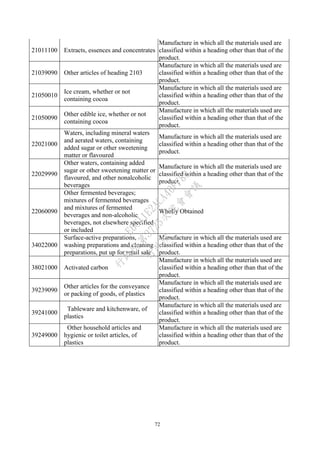
21011100 咖啡之萃取物、精、濃縮物 A
21039090 其他第2103節所屬之貨品 A
21050010 冰淇淋,不論是否含可可者 A
21050090 其他可食用冰,不論是否含可可者 A
22021000
水,包括礦泉水及汽水(碳酸水),含糖
或其他甜味料或香料者
A
22029990 其他飲料,含糖或其他甜味料或香料及其 A
行
政
院
行
政
院
第
3725次
院
會
會
議
E6C11E2ACA40FF80
34
他未含酒精飲料
22060090
其他釀造飲料;未列名釀造飲料混合品或
釀造飲料與未含酒精成分之飲料混合品
A
34022000
零售包裝界面活性製劑、洗滌製劑及清潔
製劑
A
38021000 活性碳 A
39239090 其他供輸送或包裝貨品之塑膠製品 A
39241000 塑膠製餐桌用餐具及廚房用具 A
39249000
其他塑膠製家庭用製品及衛生保健或盥洗
用具
A
44123310
其他素面合板(未含有竹製單板者),至
少有一外層屬榿木類、梣木類、山毛櫸
類、樺木類、櫻桃木類、栗木類、榆木
類、桉樹類、山核桃類、七葉樹類、椴木
類、槭木類、橡木類、懸鈴木類、楊樹類
及白楊樹類、刺槐類、鵝掌楸類或胡桃木
類等非針葉樹類製成,每層厚度不超過6
公厘者
A
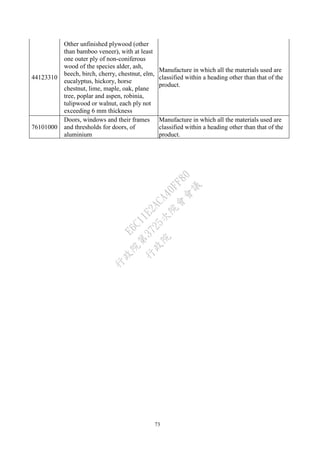
76101000 鋁製門、窗及其框架及門檻 A
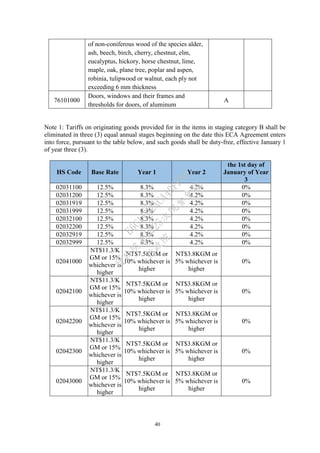
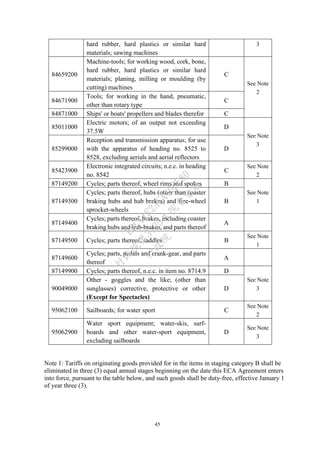
備註1:依據下表,於本經濟合作協定生效之日起,列為B類型產品項目之關稅,應於三
(3)個相等之年度階段中免除,且自第3年1月1日起,此些貨品應為免稅。
稅則號別 關稅稅率 第1年 第2年 第3年1月1日起
02031100 12.5% 8.3% 4.2% 0%
02031200 12.5% 8.3% 4.2% 0%
02031919 12.5% 8.3% 4.2% 0%
02031999 12.5% 8.3% 4.2% 0%
02032100 12.5% 8.3% 4.2% 0%
02032200 12.5% 8.3% 4.2% 0%
02032919 12.5% 8.3% 4.2% 0%
02032999 12.5% 8.3% 4.2% 0%
02041000
新臺幣11.3
元/公斤或
15%從高徵
稅
新臺幣7.5元/公
斤或10%從高徵
稅
新臺幣3.8元/公
斤或5%從高徵稅
0%
02042100
新臺幣11.3
元/公斤或
15%從高徵
稅
新臺幣7.5元/公
斤或10%從高徵
稅
新臺幣3.8元/公
斤或5%從高徵稅
0%
行
政
院
行
政
院
第
3725次
院
會
會
議
E6C11E2ACA40FF80
35
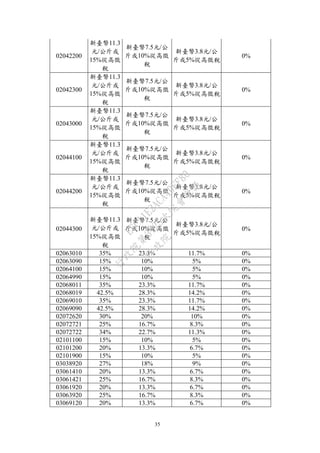
02042200
新臺幣11.3
元/公斤或
15%從高徵
稅
新臺幣7.5元/公
斤或10%從高徵
稅
新臺幣3.8元/公
斤或5%從高徵稅
0%
02042300
新臺幣11.3
元/公斤或
15%從高徵
稅
新臺幣7.5元/公
斤或10%從高徵
稅
新臺幣3.8元/公
斤或5%從高徵稅
0%
02043000
新臺幣11.3
元/公斤或
15%從高徵
稅
新臺幣7.5元/公
斤或10%從高徵
稅
新臺幣3.8元/公
斤或5%從高徵稅
0%
02044100
新臺幣11.3
元/公斤或
15%從高徵
稅
新臺幣7.5元/公
斤或10%從高徵
稅
新臺幣3.8元/公
斤或5%從高徵稅
0%
02044200
新臺幣11.3
元/公斤或
15%從高徵
稅
新臺幣7.5元/公
斤或10%從高徵
稅
新臺幣3.8元/公
斤或5%從高徵稅
0%
02044300
新臺幣11.3
元/公斤或
15%從高徵
稅
新臺幣7.5元/公
斤或10%從高徵
稅
新臺幣3.8元/公
斤或5%從高徵稅
0%
02063010 35% 23.3% 11.7% 0%
02063090 15% 10% 5% 0%
02064100 15% 10% 5% 0%
02064990 15% 10% 5% 0%
02068011 35% 23.3% 11.7% 0%
02068019 42.5% 28.3% 14.2% 0%
02069010 35% 23.3% 11.7% 0%
02069090 42.5% 28.3% 14.2% 0%
02072620 30% 20% 10% 0%
02072721 25% 16.7% 8.3% 0%
02072722 34% 22.7% 11.3% 0%
02101100 15% 10% 5% 0%
02101200 20% 13.3% 6.7% 0%
02101900 15% 10% 5% 0%
03038920 27% 18% 9% 0%
03061410 20% 13.3% 6.7% 0%
03061421 25% 16.7% 8.3% 0%
03061920 20% 13.3% 6.7% 0%
03063920 25% 16.7% 8.3% 0%
03069120 20% 13.3% 6.7% 0%
行
政
院
行
政
院
第
3725次
院
會
會
議
E6C11E2ACA40FF80
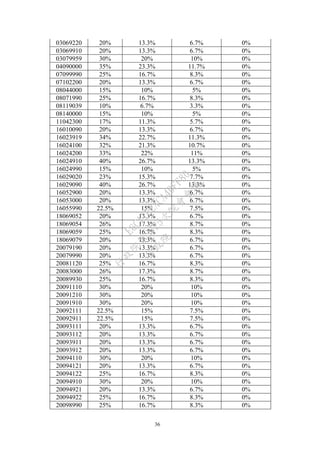
36
03069220 20% 13.3% 6.7% 0%
03069910 20% 13.3% 6.7% 0%
03079959 30% 20% 10% 0%
04090000 35% 23.3% 11.7% 0%
07099990 25% 16.7% 8.3% 0%
07102200 20% 13.3% 6.7% 0%
08044000 15% 10% 5% 0%
08071990 25% 16.7% 8.3% 0%
08119039 10% 6.7% 3.3% 0%
08140000 15% 10% 5% 0%
11042300 17% 11.3% 5.7% 0%
16010090 20% 13.3% 6.7% 0%
16023919 34% 22.7% 11.3% 0%
16024100 32% 21.3% 10.7% 0%
16024200 33% 22% 11% 0%
16024910 40% 26.7% 13.3% 0%
16024990 15% 10% 5% 0%
16029020 23% 15.3% 7.7% 0%
16029090 40% 26.7% 13.3% 0%
16052900 20% 13.3% 6.7% 0%
16053000 20% 13.3% 6.7% 0%
16055990 22.5% 15% 7.5% 0%
18069052 20% 13.3% 6.7% 0%
18069054 26% 17.3% 8.7% 0%
18069059 25% 16.7% 8.3% 0%
18069079 20% 13.3% 6.7% 0%
20079190 20% 13.3% 6.7% 0%
20079990 20% 13.3% 6.7% 0%
20081120 25% 16.7% 8.3% 0%
20083000 26% 17.3% 8.7% 0%
20089930 25% 16.7% 8.3% 0%
20091110 30% 20% 10% 0%
20091210 30% 20% 10% 0%
20091910 30% 20% 10% 0%
20092111 22.5% 15% 7.5% 0%
20092911 22.5% 15% 7.5% 0%
20093111 20% 13.3% 6.7% 0%
20093112 20% 13.3% 6.7% 0%
20093911 20% 13.3% 6.7% 0%
20093912 20% 13.3% 6.7% 0%
20094110 30% 20% 10% 0%
20094121 20% 13.3% 6.7% 0%
20094122 25% 16.7% 8.3% 0%
20094910 30% 20% 10% 0%
20094921 20% 13.3% 6.7% 0%
20094922 25% 16.7% 8.3% 0%
20098990 25% 16.7% 8.3% 0%
行
政
院
行
政
院
第
3725次
院
會
會
議
E6C11E2ACA40FF80
37
20099090 25% 16.7% 8.3% 0%
備註2:糖類產品之市場進入要件如下:
1. 中華民國(臺灣)應對原產於貝里斯之粗製糖和精製糖實施免稅(0%)配額。就
糖類之免稅(0%)配額,中華民國(臺灣)將要求出示由貝里斯授權機構所簽發
之原產地證明書和關稅配額證明書(TQC)。
2. 年度總配額將為三萬五千(35,000)公噸。配額將分別為粗製糖(稅則號別包括
17011300、17011400 和 17019110)和精製糖(稅則號別包括 17019990)兩類。意
即,配額之數量應定為粗製糖每年二萬五千(25,000)公噸,精製糖每年一萬(10,000)
公噸。然貝里斯可選擇出口粗製糖而非精製糖,粗製糖最多可占總配額之 100%。
行
政
院
行
政
院
第
3725次
院
會
會
議
E6C11E2ACA40FF80
38
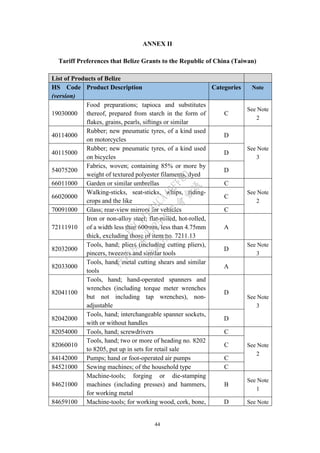
附件二
貝里斯給予中華民國(臺灣)之關稅優惠
貝里斯產品清單
稅則號別 產品描述 類型 備註
19030000
由澱粉製成之粉片狀、粒狀、珍珠狀,經篩
濾之粉狀或類似形狀之樹薯粉及其代用品
C
請見備
註2
40114000 新橡膠氣胎,機器腳踏車用 D
請見備
註3
40115000 新橡膠氣胎,腳踏車用 D
54075200
其他染色梭織物,含聚酯加工絲重量在85%
及以上者
D
66011000 庭園用傘 C
請見備
註2
66020000 手杖、座凳式手杖、鞭、馬鞭及類似品 C
70091000 車輛之玻璃後視鏡 C
72111910
第7211.13目外之熱軋鐵或非合金鋼扁軋製
品,寬度小於600公厘,厚度未達4.75公厘者
A
82032000
鉗(包括剪鉗)、手鉗、鑷子及類似工具
D
請見備
註3
82033000 剪金屬用剪刀及類似工具 A
82041100 手操作扳手及扳鉗,不可調整者 D 請見備
註382042000 有或無把手之可互換板手套筒 D
82054000 螺絲起子 C
請見備
註2
82060010
第8202節至8205節之工具由兩件或以上配
合成套供零售者
C
84142000 手或腳操作之空氣泵 C
84521000 家用縫紉機 C
84621000
鍛造機或模壓衝製機(包括壓床)及鎚造機
B
請見備
註1
84659100
木材、軟木、骨材、硬質橡膠、硬質塑膠或
類似之硬質材料加工用鋸床
D
請見備
註3
84659200
木材、軟木、骨材、硬質橡膠、硬質塑膠或
類似之硬質材料加工用刨床、銑床或模製
(切削製作)機
C
請見備
註2
84671900 其他非旋轉式手提氣動工具 C
84871000 船舶推進器及其葉片 C
85011000 電動機輸出未超過37.5瓦者 D
請見備
註385299000
其他用於第8525至8528節所屬器具之零
件,不包括天線及天線反射器
D
85423900
其他積體電路
C
請見備
註2
87149200 腳踏車用輪圈及輪幅 B 請見備
行
政
院
行
政
院
第
3725次
院
會
會
議
E6C11E2ACA40FF80
39
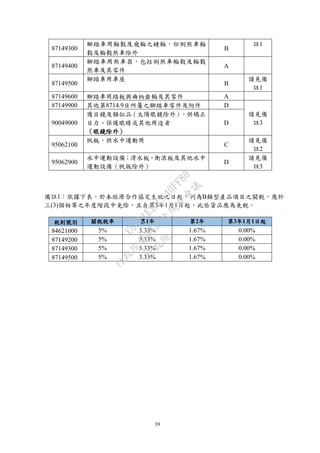
87149300
腳踏車用輪轂及飛輪之鏈輪,但倒煞車輪
轂及輪轂煞車除外
B
註1
87149400
腳踏車用煞車器,包括倒煞車輪轂及輪轂
煞車及其零件
A
87149500
腳踏車用車座
B
請見備
註1
87149600 腳踏車用踏板與曲柄齒輪及其零件 A
87149900 其他第8714.9目所屬之腳踏車零件及附件 D
請見備
註390049000
護目鏡及類似品(太陽眼鏡除外),供矯正
目力、保護眼睛或其他用途者
(眼鏡除外)
D
95062100
帆板,供水中運動用
C
請見備
註2
95062900
水中運動設備;滑水板、衝浪板及其他水中
運動設備(帆版除外)
D
請見備
註3
備註1:依據下表,於本經濟合作協定生效之日起,列為B類型產品項目之關稅,應於
三(3)個相等之年度階段中免除,且自第3年1月1日起,此些貨品應為免稅。
稅則號別 關稅稅率 第1年 第2年 第3年1月1日起
84621000 5% 3.33% 1.67% 0.00%
87149200 5% 3.33% 1.67% 0.00%
87149300 5% 3.33% 1.67% 0.00%
87149500 5% 3.33% 1.67% 0.00%
行
政
院
行
政
院
第
3725次
院
會
會
議
E6C11E2ACA40FF80
40
備註2:依據下表,於本經濟合作協定生效之日起,列為C類型產品項目之關稅,應於
五(5)個相等之年度階段中免除,且自第5年1月1日起,此些貨品應為免稅。
備註3:依據下表,於本經濟合作協定生效之日起,列為D類型產品項目之關稅,應於
十(10)個相等之年度階段中免除,且自第10年1月1日起,此些貨品應為免稅。
稅則號別
關稅稅
率
第1年 第2年 第3年 第4年
第5年1月1
日起
19030000 15% 12% 9% 6% 3.00% 0.00%
66020000 20% 16% 12% 8% 4.00% 0.00%
70091000 10% 8% 6% 4% 2.00% 0.00%
72107010 15% 12% 9% 6% 3.00% 0.00%
82054000 5% 4% 3% 2% 1.00% 0.00%
82060010 20% 16% 12% 8% 4.00% 0.00%
84142000 5% 4% 3% 2% 1.00% 0.00%
84521000 5% 4% 3% 2% 1.00% 0.00%
84659200 5% 4% 3% 2% 1.00% 0.00%
84671900 5% 4% 3% 2% 1.00% 0.00%
84871000 5% 4% 3% 2% 1.00% 0.00%
85423900 5% 4% 3% 2% 1.00% 0.00%
95062100 10% 8.00% 6% 4% 2.00% 0.00%
稅則號別
關稅
稅率
第1
年
第2
年
第3
年
第4
年
第5
年
第6
年
第7
年
第8
年
第9
年
第10年1月
1日起
40114000 5% 4.5% 4% 3.5% 3% 2.5% 2% 1.5% 1% 0.5% 0.00%
40115000 5% 4.5% 4% 3.5% 3% 2.5% 2% 1.5% 1% 0.5% 0.00%
54075200 5% 4.5% 4% 3.5% 3% 2.5% 2% 1.5% 1% 0.5% 0.00%
82032000 5% 4.5% 4% 3.5% 3% 2.5% 2% 1.5% 1% 0.5% 0.00%
82041100 5% 4.5% 4% 3.5% 3% 2.5% 2% 1.5% 1% 0.5% 0.00%
82042000 5% 4.5% 4% 3.5% 3% 2.5% 2% 1.5% 1% 0.5% 0.00%
84659100 5% 4.5% 4% 3.5% 3% 2.5% 2% 1.5% 1% 0.5% 0.00%
85011000 5% 4.5% 4% 3.5% 3% 2.5% 2% 1.5% 1% 0.5% 0.00%
85299000 5% 4.5% 4% 3.5% 3% 2.5% 2% 1.5% 1% 0.5% 0.00%
87149900 5% 4.5% 4% 3.5% 3% 2.5% 2% 1.5% 1% 0.5% 0.00%
90049000 20% 18% 16% 14% 12% 10% 8% 6% 4% 2% 0.00%
95062900 10% 9% 8% 7% 6% 5% 4% 3% 2% 1% 0.00%
行
政
院
行
政
院
第
3725次
院
會
會
議
E6C11E2ACA40FF80
41
附件三
原產地規則
第一節
一般性條款
第1條 定義
就本附件而言:
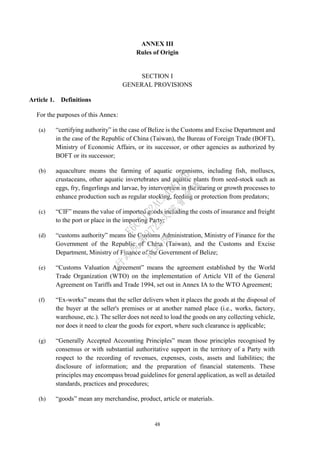
(a) 「認證機構」就貝里斯係指稅務局,且就中華民國(臺灣)係指經濟部國際貿易
局、其繼任機關或由經濟部國際貿易局或其繼任機關所授權之機關;
(b) 水產養殖係指對水生生物之養殖,包括魚、軟體動物、甲殼動物、其他水生無脊
椎動物及水生植物等,從卵、魚苗、魚種及幼體等幼種開始,於飼養或培植過程
中透過諸如定期放養、餵食或為其防範掠食者等介入方式,以提高產量;
(c) 「CIF」係指進口貨品之價格,包括貨品運至進口締約方港口或進口地之保險費
及運費;
(d) 「海關」係指中華民國(臺灣)政府財政部關務署,及貝里斯政府財政部稅務局;
(e) 「關稅估價協定」係指世界貿易組織為執行一九九四年關稅暨貿易總協定第 7 條
之內容,於世界貿易組織協定附件 1A所建立之執行協定。
(f) 「Ex-works」係指當賣方在其所在地或其他指定的地點(如工場、工廠或倉庫)
將貨物交給買方處置時,即完成交貨,賣方不辦理出口清關手續或將貨物裝上任
何運輸工具。
(g) 「一般公認會計原則」係指經締約一方有關記錄收益、支出、成本、資產與負債、
揭露資訊以及編製財務報表方面公認之實質上具有權威性之會計準則。上述原則
得包括普遍適用之概括性指引、詳細之標準、慣例及程序。
(h) 「貨品」係指所有商品、產品、物品或材料;
(i) 「國際商品統一分類制度」係指世界海關組織編制之國際商品統一分類制度;
(j) 「節」係指國際商品統一分類制度使用之 4 位碼;
(k) 「同樣貨品」指其物理特性、品質及商譽皆相同之貨品,外觀之微小差異不影響
對同樣貨品之認定;
(l) 「製造」係指實施勞作或加工,包括組裝;
(m) 「材料」係指製造產品時所使用之任何成分、原料或零配件;
(n) 「非原產材料」或「非原產零件」係指不符合本附件所定義之原產材料或零件;
行
政
院
行
政
院
第
3725次
院
會
會
議
E6C11E2ACA40FF80
42
(o) 「原產材料」或「原產零件」係指符合本附件所定義之原產材料或零件;
(p) 「生產者」係指進行生產貨品之人;
(q) 「生產」係指包括種植、培育、養育、開採、收穫、捕撈、育種、提取、水產養
殖、製造或加工之作業;以及
(r) 「交易價格」係指貨品出口銷售之實付或應付價格,或依據關稅估價協定所決定
之其他價格。
第 2 條 解釋與適用
1. 為利本協定原產地規則之適用及/或解釋,締約雙方應採行調和制度之稅則分類,
包括節、目、對應之稅號、類註、章註及目註,並採用其一般解釋準則。
2. 締約雙方應檢視各自稅則分類制度,以因應調和制度之修正。
3. 締約雙方除應於國際貿易採行關稅估價協定規則以決定貨品原產地外,於其國內
交易亦應依據實際狀況,採行關稅估價協定之規定。
第二節
原產貨品
第 3 條 一般要求
就本協定之目的,符合下列情況之貨品應認定為原產於締約一方:
(a) 依據本附件第 4 條規定,在締約一方屬完全取得者;
(b) 完全使用原產於締約一方材料所生產者,及
(c) 使用非原產材料於締約一方或締約雙方領域內生產,該材料符合本協定第六條規
範之充分生產或加工,且該產品符合本附件一切其他條件之要求。
第 4 條 完全取得貨品
下列貨品應視為於締約一方之完全取得:
(a) 於其領域內土壤、水域、海床或海底採掘之礦物及其他天然生成物質;
(b) 於其領域內種植與採收之植物及植物產品;
行
政
院
行
政
院
第
3725次
院
會
會
議
E6C11E2ACA40FF80
43
(c) 於其領域內出生且飼養之活動物;
(d) 於其領域內飼養之活動物取得之產品;
(e) 於其領域內出生飼養動物之宰體取得之產品;
(f) 於其領域內狩獵、誘捕、捕撈2
、或水產養殖3
取得之產品;
(g) 於其領域內製造過程所產生之廢料,已無法供原用途使用,而僅適於原材料
之回收;
(h) 於其領域內回收之舊品,已無法供原用途使用,而僅適於原材料之回收;或
(i) 締約一方完全由第(a)款至(h)款所述產品或其衍生物所取得或生產之產品。
第 5 條 貨品特定原產地規則
1. 締約雙方同意就附件一及附件二所列貨品訂定特定原產地規則,並規範於附件三-A
(特定原產地規則)。
2. 締約雙方同意視需要於未來談判中,為彼此同意之貨品訂定產品特定原產地規則。
3. 任締約一方得請求修訂附件三-A 之原產條件,提出請求之締約方須建議修改內容,
並說明可適用之原產條件。
4. 特定原產地規則應優先適用於本附件第 3 條規定。
第 6 條 充分生產或加工產品
1. 為了第3條條文之目的,非屬完全取得之產品,只要符合附件III-A規範之原產條件,
即應被視為充分生產或加工。
2. 對於本協定所涵蓋之全部產品,上述第1項條文指稱之原產條件,係指生產過程中使
用非原產材料之生產或加工,相關規範亦僅適用於這些非原產材料。因此,倘某項
產品因符合附件III-A規範之條件而取得原產資格,這項產品又被使用來製造組裝其
他產品時,則僅最終產品需適用附件III-A規範之原產條件,至於已取得原產資格之
產品原來所使用之非原產材料比例應不予考量。
3. 即使有上述第1項條文規定,未符合附件III-A規範原產條件之非原產材料,倘其所有
的價格總計不超過最終產品的出廠價格10%,則仍然可以使用於生產,且該最終產
品仍應視為原產貨品。
4. 除第7條規範之情形外,第1至第3項條文應適用。
2
不得超出其專屬經濟區。
3
不得超出其專屬經濟區。
行
政
院
行
政
院
第
3725次
院
會
會
議
E6C11E2ACA40FF80
44
第 7 條 微末生產或加工作業
1. 在不影響第 2 項規定之前提下,下列微末生產或加工作業無論是否符合第 4 條所定
義之內容,皆不足以影響產品之原產地:
(a) 為確保產品在運輸或儲藏期間處於良好狀態而進行之保存作業;
(b) 改變包裝、拆包或包裝等作業;
(c) 洗滌、清潔、除塵、去除氧化物、除油、去漆以及去除其他塗層;
(d) 紡織品之熨燙或壓平;
(e) 上漆及磨光作業;
(f) 穀物與稻米之去殼、部分或完全之漂白、拋光及上光;
(g) 對糖進行上色、調味或形成糖塊之操作;對結晶糖進行部分或全部之研磨4
;
(h) 水果、堅果及蔬菜之去皮、去核及去殼;
(i) 銳化、簡單之研磨、分離或簡單切割;
(j) 過濾、篩選、挑選、分類、分級、搭配(包括成套貨品之組合);
(k) 簡單之裝瓶、裝罐、裝壺、裝袋、裝箱、裝盒、固定於紙板或木板及其他簡單
之包裝作業;
(l) 在產品或其包裝上黏貼或印刷標誌、標籤、標識及其他類似之區別標記;
(m) 產品之簡單混合,無論是否為不同種類;糖與任何材料之混合5
;
(n) 將非原產配件構成完整產品之簡單組裝,或將產品拆卸為配件;
(o) 簡單之添加水、稀釋、脫水或變性;
(p) 將(a)至(o)款規定之二個(2)或多個作業之結合;及
4
此需理解為以磨碎或研磨方式縮減糖塊之體積。
5
依據本款適用第 5 條之特定原產地規則時,雙方同意第 7 條第 2 項之規定意指在貨品製造國一種或多種原產
材料之使用隱含在貨品製造國已進行超越微末加工程度之加工作業。
行
政
院
行
政
院
第
3725次
院
會
會
議
E6C11E2ACA40FF80
45
(q) 動物屠宰。
2. 決定貨品之生產或加工過程是否符合第 1 項規定而未改變其原產狀態時,在中華
民國(臺灣)及貝里斯進行之一切作業皆應納入考量。
第 8 條 原產之雙邊累積
除第3條規定外,締約一方之原產材料與原產產品於締約他方進行生產或加工作業,倘
符合本附件規定已完成充分生產或加工程序,應視為締約他方之原產貨品。
第 9 條 區域產值含量
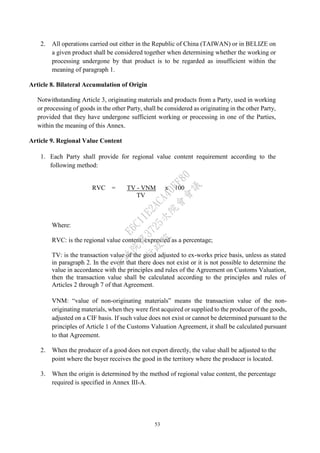
1. 各締約方應依據下列公式計算區域產值含量:
RVC = TV - VNM
TV
x 100
定義如下:
RVC:係指區域產值含量,以百分比表示。
TV:係指貨品之交易價格,除第 2 項另有規定外,該價格應調整至以工廠交貨價格為
基礎。若該價格不存在或無法依關稅估價協定第 1 條之原則及規定認定時,則應依
該協定第 2 條至第 7 條規定之原則與規則計算之。
VNM:「非原產材料價格」係指貨品生產者首次購置或取得非原產材料之交易價格,
該價格應調整至以起岸價格為基礎。若該價格不存在或無法依關稅估價協定第 1 條
規定認定時,則應依該協定規則計算之。
2. 若貨品非由該貨品生產者直接出口時,其價格應調整到以買方在生產者所在領域內
收到貨品時之價格。
3. 若以區域產值含量認定貨品之原產地時,應符合附件三-A特定原產地規則要求之百
分比。
4. 計算區域產值含量之各項成本紀錄,應依生產該貨品締約方領域內之一般公認會計
原則予以登錄並保存。
第 10 條 直接運輸與轉運
1. 締約ㄧ方之貨品應直接運往締約他方,始得享有優惠關稅待遇。
行
政
院
行
政
院
第
3725次
院
會
會
議
E6C11E2ACA40FF80
46
2. 不受上述第 1 項規定限制,凡貨品基於地理或運輸相關之因素而運經非本協定
締約方之其他國家領域時,倘該貨品在轉運期間,包括暫時之存放,均受海關
之監管。
3. 原產貨品經其他非本協定締約方之國家領域進行轉運,應保有原產貨品資格,
倘:
i 係基於地理物流或交通工具考量等原因;
ii 貨品在轉運期間非預計使用於貿易或其他用途,亦未被交易或被使用;且
iii 該貨品在運輸或存放過程中,除使貨品保持良好狀態之處理,包括裝卸作業
外,未進行其他任何作業。
第11條 展覽品
1. 由締約一方運至非本協定之國家或領域展覽之原產貨品,於展覽後售予締約之一方
或他方,於符合下列海關要求時,得享有本協定之進口優惠措施:
(a) 貨品由出口商自締約一方運往展覽進行之第三國並於該國展覽;
(b) 貨品由該出口商出售或交由締約一方或他方人員處理;
(c) 貨品於展覽期間或結束後立即自展覽國家運出;且
(d) 貨品自運往展覽國起,除展覽目的外未做其他用途。
2. 於通常之情況下,應向進口地海關出具原產地證明,並於該證明上敘明展覽名稱及
地址,必要時應檢具其他該貨品係用於展覽之書面證明。
3. 第1項規定於商家基於私人因素或位於企業營運處所,以銷售國外貨品為目地以外
之所有貿易、工業、農業或藝品展覽會場或類似公共展示場所之展覽適用之,展覽
品全程仍應受海關監管。
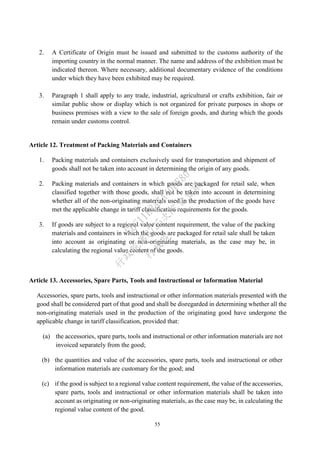
第 12 條 包裝材料及容器之處理
1. 在認定貨品之原產地時,用於貨品運送及包裝之材料及容器應不予列入考量。
2. 與零售用貨品共同歸列稅號之包裝材料與容器,在認定貨品使用之非原產材料是
否符合稅則分類變更規定時,應不予列入考量。
3. 若貨品適用區域產值含量規定,在計算該貨品之區域產值含量時,零售用貨品包
裝材料與容器之價值,應視實際情況認定為原產材料或非原產材料後納入計算。
行
政
院
行
政
院
第
3725次
院
會
會
議
E6C11E2ACA40FF80
47
第 13 條 配件、備用零件、工具及說明書或資訊資料
附隨貨品之配件、備用零件、工具、說明書或其他資訊材料於符合下列條件時,應視為該
貨品之一部分,並在認定用於生產原產貨品之所有非原產材料是否經歷稅則號別變更時,
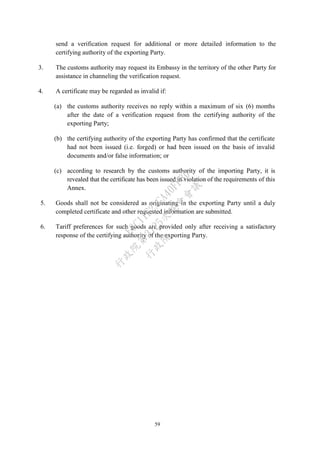
不予列入考量,當:
(a) 該配件、備用零件、工具、說明書或其他資訊材料未單獨開立發票;
(b) 該配件、備用零件、工具、說明書或其他資訊材料之數量及價值符合該貨品正常所
需;及
(c) 原產貨品於適用區域產值含量時,附隨貨品之配件、備用零件、工具、說明書或其
他資訊材料的價值,應依實際情況認定其為原產材料或非原產材料後納入計算。
第三節
原產地之關務程序
第 14 條 產地證明書
1. 為本附件規定之適用,締約雙方應設計單一格式之產地證明書,於本協定生效之
日起適用,且其格式之修正應取得締約雙方同意。
2. 第 1 項產地證明書應用於證明自締約一方領土出口至締約他方領土之貨品為原
產貨品。
3. 各締約方簽證機構應要求出口商或製造商就每一筆出口貨品以英文書面填寫證
明書、簽名並填具日期,締約他方之進口商則據以申請優惠關稅待遇。
4. 原產地證明書應由出口締約方之簽證機構簽證,為此目的,簽證機構應確認該貨
品適用且符合本協定第三章及附件三第 5 條之相關規定。
5. 若貨品依據本協定第三章及附件三第 5 條相關規定視為原產者,各締約方應要求
由出口締約方簽證機構出具原產地證明書,並加以彌封或章戳、簽名及填具日期,
且應加註流水號以利查證。
6. 各締約國之簽證機構應依據出口商或製造商提供之資訊,對原產地證書書所涵蓋
之貨品來源進行認證,該出口商或製造商應對於其所提供資料之真實性及依此申
請之證明書負責。當原產地證明所依據之情況或事實未變更時,該原產地證明書
應視為有效。
7. 出口締約方之簽證機構應:
(a) 維持由其出口商或製造商填寫及簽名之原產地認證行政管理程序;
行
政
院
行
政
院
第
3725次
院
會
會
議
E6C11E2ACA40FF80
48
(b) 於進口締約方海關要求時,提供適用進口締約方優惠關稅待遇之貨品產地
資訊;及
(c) 於本協定生效時,以書面通知原產地證明書簽證機構官員之姓名、職稱、簽
名及其使用之封緘或章戳。就相關資訊之修改應即刻以書面通知締約他方,
並於該方收到修改通知之日起三十(30)日後生效。
8. 各締約方應要求由出口商完成及簽名之原產地證明書僅能適用於單項或多項貨
品之單一輸入行為。
9. 各締約方應要求自其簽證機構簽發原產地證明書之日起一百八十(180)日曆日內,
進口締約方海關應接受該證書為有效。
10. 若原產地證明書遺失,應依據出口商文件核發官方認證之副本。
11. 當進口締約方海關認為原產地證明書未符合本附件之規範時,應與出口締約方之
簽證機構聯繫,俾利該簽證機關就產地進行查證程序。
12. 對原產地證明書之真實性有疑慮或認為未正確敘明本協定所規範之原產條件時,
進口締約方得要求提供補充證明文件,然不得阻礙該貨品之進口。
第 15 條 原產地證明書及文件之保存
1. 各締約方應要求簽證機構保存已簽發並蓋有章戳、簽名及填具日期之原產地證明
書副本,最低保存期限依其各自法規規範。
2. 各締約國應要求自證明書簽證之日起,填寫及簽署原產地證明書之出口商或最終
製造商應保存與原產貨品相關之所有單據及文件,最低保存期限依依其各自法規
規範。
第16條 查證貨品產地之程序
1. 進口締約方於必要時得要求提供原產地證明書所聲明內容之佐證文件。
2. 進口締約方不得僅基於補件之要求禁止進口商領取貨品,然得要求就應付稅額或
其他費用提供擔保。倘該貨品為禁止或管制進口貨品,則不適用擔保後交貨之規
定。
3. 當締約一方依據本條第1項規定請求佐證文件時,締約他方之利害關係人應提供佐
證文件予其簽證機構。該簽證機構應於詳細查核佐證文件後,提供適當查證報告
予進口締約方。
4. 當進口締約方依據法規規定而有查證原產地之需求時,得將其海關欲自締約他方
之利害關係人查證之內容告知出口締約方,請其提供進一步證據,出口締約方於
完成完整之查證程序後,應提交適當報告予進口締約方。
行
政
院
行
政
院
第
3725次
院
會
會
議
E6C11E2ACA40FF80
49
5. 倘進口締約方欲確認其所取得證據之真實性,得向出口締約方之相關單位提出要
求。
6. 進口締約方依據本條規定所取得之資訊應予以保密。
第 17 條 保密
1. 締約雙方同意,依據本附件提供之任何資訊均應予以保密,且遵守與各締約方有
關揭露資訊之任何相關適用法律或行政規定。締約雙方之海關機構應就與揭露相
關之任何適用法律或行政規定事先給予通知,並獲得提供資訊締約方就該揭露之
同意。
2. 締約雙方就依據本附件取得之資訊,應採取必要保全措施,防止未經授權之取得、
揭露、修改或散布。
第 18 條 行政合作
1. 各締約方應通知締約他方授權簽證機構之名稱、地址及彌封或章戳樣式。
2. 若進口締約方海關對證明書之真實性和所載資料,或證明書所列貨品之原產地
標準有合理懷疑時,得向出口締約方簽證機構提出查證請求,請其提供額外或
更詳細之資訊。
3. 海關就前項查證請求,得向其在他締約方領域之大使館請求協助。
4. 於下列情況下,證明書得視為無效:
(a) 海關提出查證請求之日起六(6)個月內未收到出口締約方簽證機構之回復;
(b) 出口締約方簽證機構確認未核發證明書(即偽造)或係依據無效文件及/或
虛假資料核發者;或
(c) 依據進口締約方海關調查,該證明書之核發已違反本附件相關規定。
5. 於提交完整之證明書和其他必要資料前,貨品不得視為原產於出口締約方。
6. 於接獲出口締約方授權簽證機構答復合於規定後,該等貨品始得適用貨品之
優惠關稅。
行
政
院
行
政
院
第
3725次
院
會
會
議
E6C11E2ACA40FF80
50
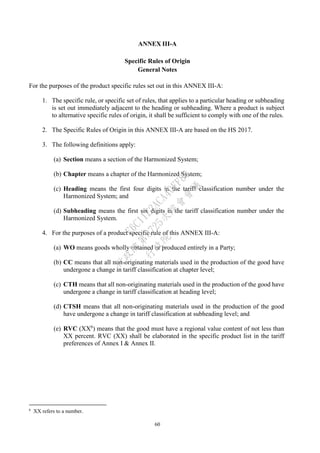
附件三-A
特定原產地規則 一般說明
就本附件三-A之產品特定原產地規則:
1. 針對特定節或特定目所適用之特定原產地規則應與該節或該目並列。若一產品得適
用兩(2)種以上之特定原產地規則,得擇一適用之。
2. 本附件三-A 之特定原產地規則係以國際商品統一分類制度 2017 年版為基準。
3. 本附件適用以下定義:
(a) 類係指國際商品統一分類制度之類;
(b) 章係指國際商品統一分類制度之章;
(c) 節係指國際商品統一分類制度下之稅則號列前 4 碼;
(d) 目係指國際商品統一分類制度下之稅則號列前 6 碼。
4. 就本附件三-A 之產品特定原產地規則:
(a) WO 係指貨品於締約之一方完全取得;
(b) CC(從其他章改變至此)係指用於貨品製造過程之所有非原產材料,其稅則號列
業經國際商品統一分類制度章之轉換;
(c) CTH(從其他節改變至此)係指用於貨品製造過程之所有非原產材料,其稅則號
列業經國際商品統一分類制度節之轉換;
(d) CTSH(從其他目改變至此)係指用於貨品製造過程之所有非原產材料,其稅則號
列業經國際商品統一分類制度目的轉換;
(e) RVC(XX6
)(區域產值含量)係指貨品之區域產值含量不得少於 XX 百分比;區
域產值含量(XX)應規範於附件一及附件二適用特定關稅優惠清單內。
6
XX 係指一組數字。
行
政
院
行
政
院
第
3725次
院
會
會
議
E6C11E2ACA40FF80
51
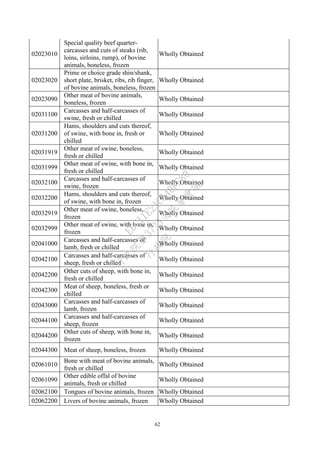
附件三-A-1 適用於中華民國(臺灣)之特定原產地規則
中華民國(臺灣)之產品清單
稅則8位
碼
貨名 特定原產地規則
01069000 其他活動物 完全取得
02011010
特殊品級屠體及半片屠體牛肉,
生鮮或冷藏
完全取得
02011090
其他屠體及半片屠體牛肉,生鮮
或冷藏
完全取得
02012010
特殊品級帶骨四分之一屠體牛肉
及切割肉排(胸側肉、背脊肉、
腰脊肉、上腿肉),生鮮或冷藏
完全取得
02012020
特選級或精選級肉牛切割之帶骨
牛腩、牛腱,生鮮或冷藏
完全取得
02012090 其他帶骨切割牛肉,生鮮或冷藏 完全取得
02013010
特殊品級去骨四分之一屠體牛肉
及切割肉排(胸側肉、背脊肉、
腰脊肉、上腿肉),生鮮或冷藏
完全取得
02013020
特選級或精選級肉牛切割之去骨
牛腩、牛腱,生鮮或冷藏
完全取得
02013090 其他去骨牛肉,生鮮或冷藏 完全取得
02021010
特殊品級冷凍屠體及半片屠體牛
肉
完全取得
02021090 其他冷凍屠體及半片屠體牛肉 完全取得
02022010
特殊品級冷凍帶骨四分之一屠體
牛肉及切割肉排(胸側肉、背脊
肉、腰脊肉、上腿肉)
完全取得
02022020
特選級或精選級肉牛切割之冷凍
帶骨牛腩、牛腱
完全取得
02022090 其他冷凍帶骨切割牛肉 完全取得
02023010
特殊品級冷凍去骨四分之一屠體
牛肉及切割肉排(胸側肉、背脊
肉、腰脊肉、上腿肉)
完全取得
02023020
特選級或精選級肉牛切割之冷凍
去骨牛腩、牛腱
完全取得
02023090 其他冷凍去骨牛肉 完全取得
行
政
院
行
政
院
第
3725次
院
會
會
議
E6C11E2ACA40FF80
52
02031100
屠體及半片屠體豬肉,生鮮或冷
藏
完全取得
02031200
帶骨之豬腿肉、肩肉及其切割
肉,生鮮或冷藏
完全取得
02031919 其他去骨豬肉,生鮮或冷藏 完全取得
02031999 其他帶骨豬肉,生鮮或冷藏 完全取得
02032100 冷凍屠體及半片屠體豬肉 完全取得
02032200
冷凍帶骨之豬腿肉、肩肉及其切
割肉
完全取得
02032919 其他冷凍去骨豬肉 完全取得
02032999 其他冷凍帶骨豬肉 完全取得
02041000
屠體及半片屠體小羊肉,生鮮或
冷藏
完全取得
02042100
屠體及半片屠體綿羊肉,生鮮或
冷藏
完全取得
02042200
其他帶骨切割綿羊肉,生鮮或冷
藏
完全取得
02042300 去骨綿羊肉,生鮮或冷藏 完全取得
02043000 冷凍屠體及半片屠體小羊肉 完全取得
02044100 冷凍屠體及半片屠體綿羊肉 完全取得
02044200 其他冷凍帶骨切割綿羊肉 完全取得
02044300 冷凍去骨綿羊肉 完全取得
02061010 牛肉骨,生鮮或冷藏 完全取得
02061090 其他食用牛雜碎,生鮮或冷藏 完全取得
02062100 冷凍牛舌 完全取得
02062200 冷凍牛肝 完全取得
02062910 冷凍牛肉骨 完全取得
02062990 其他冷凍食用牛雜碎 完全取得
02063010 豬肉骨,生鮮或冷藏 完全取得
02063090 其他食用豬雜碎,生鮮或冷藏 完全取得
02064100 冷凍豬肝 完全取得
02064990 其他冷凍食用豬雜碎 完全取得
02068011 羊肉骨,生鮮或冷藏 完全取得
02068019 其他食用羊雜碎,生鮮或冷藏 完全取得
行
政
院
行
政
院
第
3725次
院
會
會
議
E6C11E2ACA40FF80
53
02069010 冷凍羊肉骨 完全取得
02069090 其他冷凍羊雜碎 完全取得
02072400
火雞肉,未切成塊者,生鮮或冷
藏
完全取得
02072500 冷凍火雞肉,未切成塊者 完全取得
02072620 火雞肝,生鮮或冷藏 完全取得
02072710 冷凍火雞肉,肉塊 完全取得
02072721 冷凍火雞肝 完全取得
02072722 冷凍火雞心 完全取得
02101100 帶骨之豬腿肉、肩肉及其切割肉 完全取得
02101200 豬腹脇肉及其切割肉 完全取得
02101900 其他鹹、浸鹹、乾或燻製之豬肉 完全取得
03027100 吳郭魚,生鮮或冷藏 完全取得
03032300 冷凍吳郭魚 完全取得
03038920 冷凍黃魚 完全取得
03038989 其他冷凍魚類 完全取得
03043100 生鮮或冷藏吳郭魚片 完全取得
03045110
生鮮或冷藏鯰魚肉(不論是否經
剁細)
完全取得
03045190
其他魚肉,生鮮或冷藏(不論是
否經剁細)
完全取得
03046100 冷凍吳郭魚片 完全取得
03048990 其他冷凍魚片 完全取得
03049310 其他冷凍魚漿 完全取得
03049320 冷凍魚肉(不論是否經剁細) 完全取得
03053100
乾、鹹或浸鹹吳郭魚、鯉魚、鰻
魚、尼羅河鱸及鱧魚之切片,但
未燻製
完全取得
03054490 其他燻製魚類 完全取得
03056990 其他鹽醃魚類 完全取得
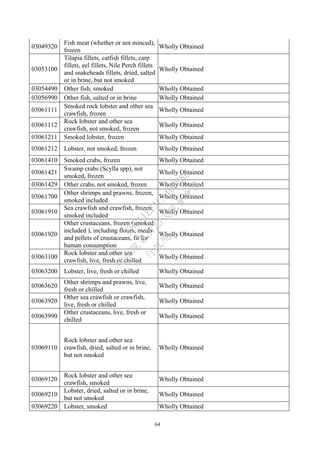
03061111 燻製龍蝦,冷凍 完全取得
03061112 未燻製龍蝦,冷凍 完全取得
03061211 燻製巨螯蝦,冷凍 完全取得
03061212 未燻製巨螯蝦,冷凍 完全取得
03061410 燻製蟹類,冷凍 完全取得
03061421 未燻製蟳,冷凍 完全取得
03061429 其他未燻製蟹類,冷凍 完全取得
行
政
院
行
政
院
第
3725次
院
會
會
議
E6C11E2ACA40FF80
54
03061700 其他冷凍蝦類,包括燻製 完全取得
03061910 冷凍海螯蝦及蝲蛄,包括燻製 完全取得
03061920
其他冷凍水產甲殼類(含燻
製),包括適於人類食用之甲殼
類動物粉、細粒及團粒
完全取得
03063100 活、生鮮或冷藏龍蝦 完全取得
03063200 活、生鮮或冷藏巨螯蝦 完全取得
03063620 其他活、生鮮或冷藏蝦類 完全取得
03063920 活、生鮮或冷藏海螯蝦或蝲蛄 完全取得
03063990 其他活、生鮮或冷藏水產甲殼類 完全取得
03069110 乾、鹹或浸鹹龍蝦,但未燻製 完全取得
03069120 燻製龍蝦 完全取得
03069210 乾、鹹或浸鹹巨螯蝦,但未燻製 完全取得
03069220 燻製巨螯蝦 完全取得
03069511 乾蝦皮(櫻蝦科),但未燻製 完全取得
03069519
其他乾、鹹或浸鹹蝦類,但未燻
製
完全取得
03069910 燻製海螯蝦或蝲蛄 完全取得
03069990
其他乾、鹹或浸鹹水產甲殼類,
包括適於人類食用之甲殼類動物
粉、細粒及團粒
完全取得
03071190
其他活、生鮮或冷藏牡蠣(蠔、
蚵)
完全取得
03079170 活、生鮮或冷藏南美貝 完全取得
03079190 其他活、生鮮或冷藏軟體類動物 完全取得
03079959
其他乾、鹹或浸鹹軟體類動物,
包括適於人類食用之軟體類動物
粉、細粒及團粒,但未燻製
完全取得
04062000 磨碎或粉狀之各類乾酪 完全取得
04063000 加工乾酪,非磨碎或非粉狀者 完全取得
04069000 其他乾酪 完全取得
04090000 天然蜜 完全取得
05080011 珊瑚及其類似物質 完全取得
07082000 豇豆、菜豆,生鮮或冷藏 完全取得
07099990 其他蔬菜,生鮮或冷藏 完全取得
行
政
院
行
政
院
第
3725次
院
會
會
議
E6C11E2ACA40FF80
55
07102200 冷凍菜豆、豇豆 完全取得
07133390
其他乾菜豆(四季豆、敏豆),
包括白豆
完全取得
07133990 其他菜豆、豇豆類 完全取得
08044000 酪梨,鮮或乾 完全取得
08071990 其他鮮瓜類 完全取得
08119039
其他未加糖或未加甜味料之冷凍
果實及堅果
完全取得
08134090 其他乾果 完全取得
08140000
柑橘或瓜(包括西瓜)之外皮,
鮮、冷凍、乾或暫時漬存於鹽
水、硫磺水或其他浸漬溶液者均
在內
完全取得
11031300 粗碾去殼之玉米及其細粒 完全取得
11042300 其他加工之玉米 完全取得
11062010 樹薯粉、細粒及細粉 從其他節改變至此
11081410 食用樹薯澱粉 從其他節改變至此
11081420 非食用樹薯澱粉 從其他節改變至此
12081000 大豆(黃豆)粉及細粒 完全取得
15071000
粗製大豆(黃豆)油,不論是否
去膠質者
從其他節改變至此
16010090
其他肉、雜碎或血製成之臘腸及
其類似品;以上述產品製成之調
製食品
完全取得
16023919
其他第0105節家禽之已調製或保
藏肉
完全取得
16024100 已調製或保藏之火腿及已切割者 完全取得
16024200
已調製或保藏之豬肩肉及其已切
割者
完全取得
16024910
已調製或保藏之豬腹脇肉(包括
腩排)
完全取得
16024990 其他已調製或保藏之豬雜碎 完全取得
16029020 已調製或保藏之其他動物肉 完全取得
16029090 已調製或保藏之其他動物雜碎 完全取得
16052900 其他已調製或保藏蝦類 完全取得
16053000 已調製或保藏之巨螯蝦 完全取得
16055990 其他軟體類動物之調製或保藏品 完全取得
行
政
院
行
政
院
第
3725次
院
會
會
議
E6C11E2ACA40FF80
56
17011300 符合本章目註2規定之甘蔗糖 完全取得
17011400
其他甘蔗糖,不含添加香料或色
素者
完全取得
17019110
粗製糖,含有添加之香料或色素
者
完全取得
17019990 其他精製糖 完全取得
17031010 甘蔗糖蜜,已加香料或著色者 完全取得
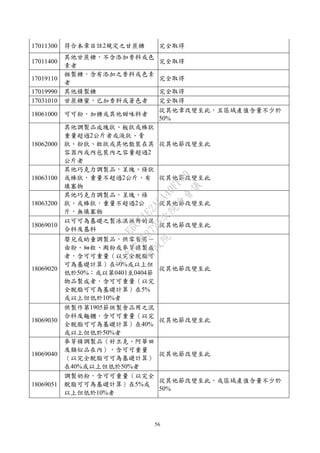
18061000 可可粉,加糖或其他甜味料者
從其他章改變至此,且區域產值含量不少於
50%
18062000
其他調製品成塊狀、板狀或棒狀
重量超過2公斤者或液狀、膏
狀、粉狀、粒狀或其他散裝在其
容器內或內包裝內之容量超過2
公斤者
從其他節改變至此
18063100
其他巧克力調製品,呈塊、條狀
或棒狀,重量不超過2公斤,有
填塞物
從其他節改變至此
18063200
其他巧克力調製品,呈塊、條
狀、或棒狀,重量不超過2公
斤,無填塞物
從其他節改變至此
18069010
以可可為基礎之製冰淇淋用的混
合料及基料
從其他節改變至此
18069020
嬰兒或幼童調製品,供零售用-
由粉、細粒、澱粉或麥芽精製成
者,含可可重量(以完全脫脂可
可為基礎計算)在40%或以上但
低於50%;或以第0401至0404節
物品製成者,含可可重量(以完
全脫脂可可為基礎計算)在5%
或以上但低於10%者
從其他節改變至此
18069030
供製作第1905節烘製食品用之混
合料及麵糰,含可可重量(以完
全脫脂可可為基礎計算)在40%
或以上但低於50%者
從其他節改變至此
18069040
麥芽精調製品(好立克、阿華田
及類似品在內),含可可重量
(以完全脫脂可可為基礎計算)
在40%或以上但低於50%者
從其他節改變至此
18069051
調製奶粉,含可可重量(以完全
脫脂可可為基礎計算)在5%或
以上但低於10%者
從其他節改變至此,或區域產值含量不少於
50%
行
政
院
行
政
院
第
3725次
院
會
會
議
E6C11E2ACA40FF80
57
18069052
調製奶皮,含可可重量(以完全
脫脂可可為基礎計算)在5%或
以上但低於10%者
從其他節改變至此,或區域產值含量不少於
50%
18069054
調製奶水,含可可重量(以完全
脫脂可可為基礎計算)在5%或
以上但低於10%者,未加糖或未
含其他甜味料者
從其他節改變至此,或區域產值含量不少於
50%
18069059
其他調製奶品,含可可重量(以
完全脫脂可可為基礎計算)在
5%或以上但低於10%
從其他節改變至此,或區域產值含量不少於
50%
18069069
其他預煮或以其他方式調製之粒
狀、片狀或其他加工(粉及細粒
除外)之未列名穀類〔玉蜀黍
(玉米)除外〕產品,含可可重
量(以完全脫脂可可為基礎計
算)超過6%但未逾8%者
從其他章改變至此,且區域產值含量不少於
50%
18069079
其他膨潤或焙製之穀類調製食品
(例如:玉米片),含可可重量
(以完全脫脂可可為基礎計算)
6%但未逾8%者
從其他章改變至此,且區域產值含量不少於
50%
18069091
其他由粉、細粒、澱粉或麥芽精
製成之未列名調製食品,含可可
重量(以完全脫脂可可為基礎計
算)在40%或以上低於50%;其
他以第0401至0404節物品製成之
未列名調製食品,含可可重量
(以完全脫脂可可為基礎計算)
在5%或以上但低於10%
從其他節改變至此
18069099 其他第1806節所屬之貨品 從其他節改變至此
19030010
樹薯澱粉製品,片狀、粒狀、珍
珠狀或其類似形狀者
從其他章改變至19.03節,10.06節(稻米)除外
20021000
酸漬除外之調製或保藏番茄,整
粒或片塊
完全取得
20079190
其他柑橘類之水果經熬煮所得之
果醬、果凍、橘皮果凍、果泥及
果糊
完全取得
20079990 其他屬第2007節之貨品 完全取得
20081120 花生醬 完全取得
行
政
院
行
政
院
第
3725次
院
會
會
議
E6C11E2ACA40FF80
58
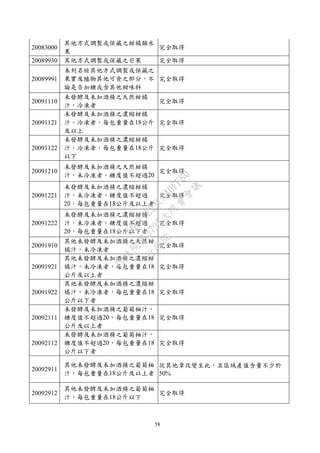
20083000
其他方式調製或保藏之柑橘類水
果
完全取得
20089930 其他方式調製或保藏之芒果 完全取得
20089991
未列名經其他方式調製或保藏之
果實及植物其他可食之部分,不
論是否加糖或含其他甜味料
完全取得
20091110
未發酵及未加酒精之天然柑橘
汁,冷凍者
完全取得
20091121
未發酵及未加酒精之濃縮柑橘
汁,冷凍者,每包重量在18公斤
及以上
完全取得
20091122
未發酵及未加酒精之濃縮柑橘
汁,冷凍者,每包重量在18公斤
以下
完全取得
20091210
未發酵及未加酒精之天然柑橘
汁,未冷凍者,糖度值不超過20
完全取得
20091221
未發酵及未加酒精之濃縮柑橘
汁,未冷凍者,糖度值不超過
20,每包重量在18公斤及以上者
完全取得
20091222
未發酵及未加酒精之濃縮柑橘
汁,未冷凍者,糖度值不超過
20,每包重量在18公斤以下者
完全取得
20091910
其他未發酵及未加酒精之天然柑
橘汁,未冷凍者
完全取得
20091921
其他未發酵及未加酒精之濃縮柑
橘汁,未冷凍者,每包重量在18
公斤及以上者
完全取得
20091922
其他未發酵及未加酒精之濃縮柑
橘汁,未冷凍者,每包重量在18
公斤以下者
完全取得
20092111
未發酵及未加酒精之葡萄柚汁,
糖度值不超過20,每包重量在18
公斤及以上者
完全取得
20092112
未發酵及未加酒精之葡萄柚汁,
糖度值不超過20,每包重量在18
公斤以下者
完全取得
20092911
其他未發酵及未加酒精之葡萄柚
汁,每包重量在18公斤及以上者
從其他章改變至此,且區域產值含量不少於
50%
20092912
其他未發酵及未加酒精之葡萄柚
汁,每包重量在18公斤以下
完全取得
行
政
院
行
政
院
第
3725次
院
會
會
議
E6C11E2ACA40FF80
59
20093111
其他未發酵及未加酒精之任何單
一柑橘類果汁,糖度值不超過
20,每包重量在18公斤及以上者
從其他章改變至此,且區域產值含量不少於
50%
20093112
其他未發酵及未加酒精之任何單
一柑橘類果汁,糖度值不超過
20,每包重量在18公斤及以上者
從其他章改變至此,且區域產值含量不少於
50%
20093911
其他未發酵及未加酒精之任何單
一柑橘類果汁,每包重量在18公
斤及以上者
從其他章改變至此,且區域產值含量不少於
50%
20093912
其他未發酵及未加酒精之任何單
一柑橘類果汁,每包重量在18公
斤以下者
從其他章改變至此,且區域產值含量不少於
50%
20094110
未發酵及未加酒精之天然鳳梨
汁,糖度值不超過20
從其他章改變至此,且區域產值含量不少於
50%
20094121
未發酵及未加酒精之濃縮鳳梨
汁,糖度值不超過20,每包重量
在18公斤及以上者
從其他章改變至此,且區域產值含量不少於
50%
20094122
未發酵及未加酒精之濃縮鳳梨
汁,糖度值不超過20,每包重量
在18公斤以下者
從其他章改變至此,且區域產值含量不少於
50%
20094910
其他未發酵及未加酒精之天然鳳
梨汁
從其他章改變至此,且區域產值含量不少於
50%
20094921
其他未發酵及未加酒精之濃縮鳳
梨汁,每包重量在18公斤及以上
者
從其他章改變至此,且區域產值含量不少於
50%
20094922
其他未發酵及未加酒精之濃縮鳳
梨汁,每包重量在18公斤以下者
從其他章改變至此,且區域產值含量不少於
50%
20098940
供嬰兒或幼童食用之未發酵及未
加酒精之任何單一果汁
從其他章改變至此,且區域產值含量不少於
50%
20098990
其他未發酵及未加酒精之其他任
何單一之天然果汁或蔬菜汁
從其他章改變至此,且區域產值含量不少於
50%
20099090 其他混合汁
從其他章改變至此,且區域產值含量不少於
50%
21011100 咖啡之萃取物、精、濃縮物 從其他節改變至此
行
政
院
行
政
院
第
3725次
院
會
會
議
E6C11E2ACA40FF80
60
21039090 其他第2103節所屬之貨品 從其他節改變至此
21050010 冰淇淋,不論是否含可可者 從其他節改變至此
21050090
其他可食用冰,不論是否含可可
者
從其他節改變至此
22021000
水,包括礦泉水及汽水(碳酸
水),含糖或其他甜味料或香料
者
從其他節改變至此
22029990
其他飲料,含糖或其他甜味料或
香料及其他未含酒精飲料
從其他節改變至此
22060090
其他釀造飲料;未列名釀造飲料
混合品或釀造飲料與未含酒精成
分之飲料混合品
完全取得
34022000
零售包裝界面活性製劑、洗滌製
劑及清潔製劑
從其他節改變至此
38021000 活性碳 從其他節改變至此
39239090
其他供輸送或包裝貨品之塑膠製
品
從其他節改變至此
39241000 塑膠製餐桌用餐具及廚房用具 從其他節改變至此
39249000
其他塑膠製家庭用製品及衛生保
健或盥洗用具
從其他節改變至此
44123310
其他素面合板(未含有竹製單板
者),至少有一外層屬榿木類、
梣木類、山毛櫸類、樺木類、櫻
桃木類、栗木類、榆木類、桉樹
類、山核桃類、七葉樹類、椴木
類、槭木類、橡木類、懸鈴木
類、楊樹類及白楊樹類、刺槐
類、鵝掌楸類或胡桃木類等非針
葉樹類製成,每層厚度不超過6
公厘者
從其他節改變至此
76101000 鋁製門、窗及其框架及門檻 從其他節改變至此
行
政
院
行
政
院
第
3725次
院
會
會
議
E6C11E2ACA40FF80
61
附件三-A-2 適用於貝里斯之特定原產地規則
貝里斯產品清單
稅則8位碼 貨名 特定原產地規則
19030000
由澱粉製成之粉片狀、粒狀、珍珠狀,
經篩濾之粉狀或類似形狀之樹薯粉及其
代用品
從其他章改變至第19.03節,第10.06節(稻
米)除外
40114000 新橡膠氣胎,機器腳踏車用
從其他節改變至此或區域產值含量不少於
40%
40115000 新橡膠氣胎,腳踏車用
從其他節改變至此或區域產值含量不少於
40%
54075200
其他染色梭織物,含聚酯加工絲重量在
85%及以上者
區域產值含量不少於70%
66011000 庭園用傘 從其他章改變至此
66020000 手杖、座凳式手杖、鞭、馬鞭及類似品 從其他章改變至此
70091000 車輛之玻璃後視鏡 從其他目改變至此
72111910
第7211.13目外之熱軋鐵或非合金鋼扁
軋製品,寬度小於600公厘,厚度未達
4.75公厘者
從錠或7206或7207節之初級/半成品材料
產製者
82032000
鉗(包括剪鉗)、手鉗、鑷子及類似工
具
從其他節改變至此
82033000 剪金屬用剪刀及類似工具 從其他節改變至此
82041100 手操作扳手及扳鉗,不可調整者 從其他節改變至此
82042000 有或無把手之可互換板手套筒 從其他節改變至此
82054000 螺絲起子 從其他節改變至此
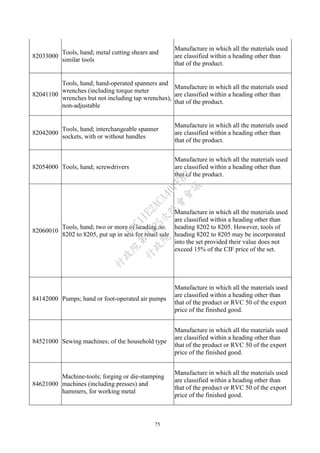
82060010
第8202節至8205節之工具由兩件或以上
配合成套供零售者
從其他節改變至此,第8202至8205節除
外。倘8205至8205節之工具價值未逾整體
工具組起岸價格之15%,則該工具得併入
整組認定產地
84142000 手或腳操作之空氣泵
從其他節改變至此,或區域產值含量不少
於50%
行
政
院
行
政
院
第
3725次
院
會
會
議
E6C11E2ACA40FF80
62
84521000 家用縫紉機
從其他節改變至此,或區域產值含量不少
於50%
84621000
鍛造機或模壓衝製機(包括壓床)及鎚
造機
從其他節改變至此,或區域產值含量不少
於50%
84659100
木材、軟木、骨材、硬質橡膠、硬質塑
膠或類似之硬質材料加工用鋸床
從其他節改變至此,或區域產值含量不少
於50%
84659200
木材、軟木、骨材、硬質橡膠、硬質塑
膠或類似之硬質材料加工用刨床、銑床
或模製(切削製作)機
從其他節改變至此,或區域產值含量不少
於50%
84671900 其他非旋轉式手提氣動工具
從其他節改變至此,或區域產值含量不少
於50%
84871000 船舶推進器及其葉片
從其他節改變至此,或區域產值含量不少
於50%
85011000 電動機輸出未超過37.5瓦者
從其他節改變至此,或區域產值含量不少
於50%
85299000
其他用於第8525至8528節所屬器具之零
件,不包括天線及天線反射器
區域產值含量不少於50%
85423900 其他積體電路 區域產值含量不少於50%
87149200 腳踏車用輪圈及輪幅 區域產值含量不少於50%
87149300
腳踏車用輪轂及飛輪之鏈輪,但倒煞車
輪轂及輪轂煞車除外
區域產值含量不少於50%
87149400
腳踏車用煞車器,包括倒煞車輪轂及輪
轂煞車及其零件
區域產值含量不少於50%
87149500 腳踏車用車座 區域產值含量不少於50%
87149600 腳踏車用踏板與曲柄齒輪及其零件 區域產值含量不少於50%
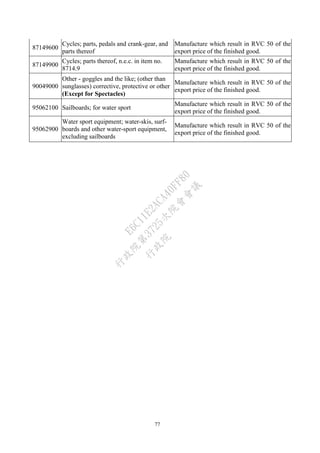
87149900
其他第8714.9目所屬之腳踏車零件及附
件
區域產值含量不少於50%
90049000
護目鏡及類似品(太陽眼鏡除外),供
矯正目力、保護眼睛或其他用途者
(眼鏡除外)
區域產值含量不少於50%
95062100 帆板,供水中運動用 區域產值含量不少於50%
95062900
水中運動設備;滑水板、衝浪板及其他
水中運動設備(帆版除外)
區域產值含量不少於50%
行
政
院
行
政
院
第
3725次
院
會
會
議
E6C11E2ACA40FF80
63
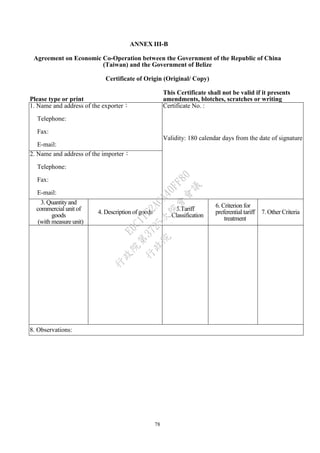
附件三-B
中華民國(臺灣)政府與貝里斯政府經濟合作協定
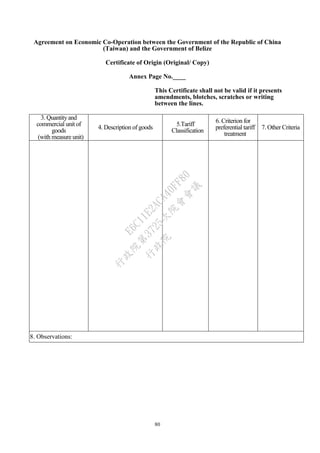
原產地證明書(正本/副本)
請用打字或列印
本證明書若有任何塗改、毀損與填寫不清將導致
本證明書失效。
1. 出口商名稱及地址:
電話:
傳真:
電子郵件:
產證編號 :
有效期限:本證明書簽發之日起180天日曆日
2.進口商名稱及地址:
電話:
傳真:
電子郵件:
3. 貨品數量及商用單位
(包括量測單位)
4. 貨品名稱 5. 稅則分類
6. 優惠關稅認定
標準
7. 其他標準
行
政
院
行
政
院
第
3725次
院
會
會
議
E6C11E2ACA40FF80
64
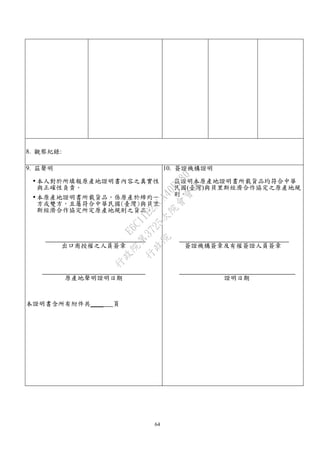
8. 觀察紀錄:
9. 茲聲明
 本人對於所填報原產地證明書內容之真實性
與正確性負責。
 本原產地證明書所載貨品,係原產於締約一
方或雙方,且屬符合中華民國(臺灣)與貝里
斯經濟合作協定所定原產地規則之貨品。
出口商授權之人員簽章
原產地聲明證明日期
本證明書含所有附件共____ 頁
10. 簽證機構證明
茲證明本原產地證明書所載貨品均符合中華
民國(臺灣)與貝里斯經濟合作協定之原產地規
則。
簽證機構簽章及有權簽證人員簽章
證明日期
行
政
院
行
政
院
第
3725次
院
會
會
議
E6C11E2ACA40FF80
65
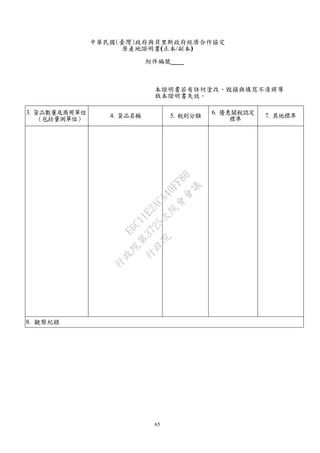
中華民國(臺灣)政府與貝里斯政府經濟合作協定
原產地證明書(正本/副本)
附件編號____
本證明書若有任何塗改、毀損與填寫不清將導
致本證明書失效。
3. 貨品數量及商用單位
(包括量測單位)
4. 貨品名稱 5. 稅則分類
6. 優惠關稅認定
標準
7. 其他標準
8. 觀察紀錄
行
政
院
行
政
院
第
3725次
院
會
會
議
E6C11E2ACA40FF80
66
9. 茲聲明
本人對於所填報原產地證明書內容之真實性
與正確性負責。
本原產地證明書所載貨品,係原產於締約一
方或雙方,且屬符合中華民國(臺灣)與貝里
斯經濟合作協定所定原產地規則之貨品。
__________________________________
__________________________________
出口商授權之人員簽章
__________________________________
簽署日期
10. 簽證機構證明
茲證明本原產地證明書所載貨品均屬符合中
華民國(臺灣)與貝里斯經濟合作協定之原產地
規則。
_____________________________________
簽證機構簽章及有權簽證人員簽章
__________________________________
證明日期
行
政
院
行
政
院
第
3725次
院
會
會
議
E6C11E2ACA40FF80
67
原產地證明書填表須知
為取得優惠關稅待遇,本證明書應由貨品出口商在法定格式上填寫,不得有任何
塗改、損毀與填寫不清;進口商應與進口報單一倂提示;請用打字或列印本證明
書資訊,如需額外空間請使用本證明書之附件,格式應依其相關性之方式加以編
號。
本證明書應由貨品出口商以英文填寫,並應印有證明書編號,以資辨認
本證明書之編號欄位僅限由證明機構使用。
第1欄:填列出口商登記名稱、商號名稱、地址(包括完整地址、城市及國家)、
電話號碼、電傳號碼、電子郵件。
第2欄:填寫進口商登記名稱、商號名稱、地址(包括完整地址、城市及國家)、
電話號碼、電傳號碼、電子郵件。
第3欄:詳細填寫每一項出口貨品之數量及商用單位,應與出口報單所述相同。
第4欄:逐項就發票上所載各項貨品詳細填寫其完整名稱,及海關進口稅則相對
應之貨名。當本證明書僅包含單一進口貨品時,應填寫發票號碼,如不知發票號
碼,應填寫其他參考號碼,如裝運單號碼、訂單號碼或其他足以辨識貨品之號碼。
第5欄:針對第4欄每一項貨品,依照本協定中附件一(中華民國(臺灣)之產品清單)
或二(貝里斯之產品清單)填寫之海關進口稅則前8位碼號別。
第6欄:填寫第4欄每一項貨品適用之原產地認定標準(從A到C),原產地規則
係指本協定附件三之原產地規則。如欲享有優惠關稅待遇,每一項貨品至少需符
合一種或一種以上之下列認定標準:
優惠關稅待遇之標準:
(a) 依據協定附件三第4條規定,完全於締約一方領域內取得或生產之貨品;
(b) 完全於締約方之一方或締約雙方領域內生產,且以本協定附件三第3條所認
定之原產材料生產之貨品;或
(c) 於締約方之一方或締約雙方領域內生產,使用非原產材料所生產之貨品,並
符合本協定附件三-A之特定原產地規則。
第7欄:為認定貨品之原產地,使用本協定附件三中為獲取原產地所確立之選項,
此些選項填寫方式如下:
ACU:累積
DMI:微量條款
IG:同樣貨品
不適用者:無
行
政
院
行
政
院
第
3725次
院
會
會
議
E6C11E2ACA40FF80
68
第8欄:此欄位僅當某觀察紀錄與本證明書相關時才需填寫,例如該貨品之發票
為第三國或非締約國營運人所開立者,出口商或生產者應填寫該營運人之姓名、
商號名稱、地址(包括完整地址、城市及國家)。
第9欄:此欄位應由出口商授權之人員簽署及填寫日期。
第10欄:此欄位應由出口締約方簽證機構簽章及有權簽證人員簽署,並加蓋本證
明書簽發日期。
行
政
院
行
政
院
第
3725次
院
會
會
議
E6C11E2ACA40FF80
69
附件 四
食品安全檢驗與動植物防疫檢疫措施
第1條 一般規定
1. 締約雙方同意以符合世界貿易組織(WTO)之食品安全檢驗與動植物防疫檢疫(SPS)
措施協定之方式,進行產品與副產品貿易。前述協定以下簡稱 SPS 協定。
2. 主管機關應為具備法律權責之機關,以確保遵守本附件所制定 SPS 之要求。
3. 締約雙方應使用 SPS 協定附件 A 之定義及世界動物衛生組織 (OIE)、食品法典委員
會(CODEX)與國際植物保護公約(IPPC)制定之詞彙。締約雙方應遵守本附件制定
之程序。
第2條 目標
本附件旨為:
(a) 保護各締約方領土之人類及動植物生命或健康;
(b) 確保締約雙方 SPS 措施不會造成不合理之貿易障礙;及
(c) 強化 SPS 協定之執行。
第3條 涵蓋範圍
本附件適用於所有可直接或間接影響締約雙方貿易之 SPS 措施。
第4條 與其他協定之關係
1. 締約雙方確認彼此間於SPS協定下之現有權利與義務。
2. 在不影響締約雙方於世界貿易組織規範之權利,締約雙方同意使用本附件建立之機
制,解決執行本附件產生之SPS議題。
第5條 調和
1. 在調和程序中,締約雙方應依據OIE、CODEX與IPPC制定之標準、準則與建議制定
其SPS措施。
行
政
院
行
政
院
第
3725次
院
會
會
議
E6C11E2ACA40FF80
70
2. 若具有科學上之正當理由,或締約一方確定其依據SPS協定第5條第1項至第8項而實
施之SPS保護程度係屬允當,則締約雙方可於SPS措施上,引用或維持比相關國際標
準、準則或建議較高之SPS保護程度。惟無論上述規定為何,凡SPS措施之保護水準
與依據國際標準、準則或建議所制定者有所不同時,該措施均不得與本協定其他規
定相牴觸。
3. 在無國際標準時,締約雙方得考量經雙方同意之其他國際組織之標準與準則。
第6條 同等效力
1. 若出口締約方客觀地向進口締約方證明其 SPS 措施達到進口締約方要求之適當保護
程度,則即使此等措施有異於該進口締約方或進行同一產品或副產品貿易之其他世
界貿易組織會員國所採行者,各締約方應對締約他方之 SPS 措施視為與其所採行者
具同等效力而接受之。為此目的,應依請求提供合理管道供進口締約方進行檢驗、測
試或其他相關程序。
2. 締約雙方得透過本附件所成立之 SPS 委員會達成協議,依據 OIE、CODEX 及 IPPC
所建立之標準、準則與建議、SPS 協定第 4 條及本條文,認可特定產品或副產品之
SPS 措施具同等效力。
第 7 條 風險評估及適當 SPS 保護程度之決定
1. 締約雙方應保證其 SPS 措施係於適當之情況下,依據對人類(食品安全)與動物之
生命與健康或為保存植物健康之風險評估而制定,並將有資格之國際組織所制定之
準則及風險評估技術納入考量。
2. 當風險評估係進口該產品與副產品之要件時,一旦出口締約方提交該等評估所需之
所有資訊,進口締約方應進行評估。
3. 評估產品或副產品顯現之風險並建立適當保護程度時,締約雙方應考量下列因素:
(a) 可得之科學及技術資訊;
(b) 害蟲或疫病之存在、害蟲與疫病非疫區及低流行疫區之認可;
(c) 管制害蟲與疫病之流行病學;
(d) SPS 相關(包括食品安全)關鍵管制點分析;
(e) 相關生態及環境狀態;
行
政
院
行
政
院
第
3725次
院
會
會
議
E6C11E2ACA40FF80
71
(f) 生產過程與方式及檢查、採樣與測試方式;
(g) 官方 SPS 服務之架構及組織;
(h) 為確保產品安全之防護、監測、診斷及處理程序;
(i) 因害蟲或疫病入侵、立足或傳播導致之生產或銷售損失;
(j) 達成減輕進口方相關風險之檢疫措施及可行處理方式;及
(k) 進口締約方領土內害蟲或疫病管控或撲滅作業之費用及其他可行風險減輕方法之
成本效益率。
4. 當完成評估時,應向締約他方提出包括調查結果之技術報告。
5. 在建立適當保護程度時,締約雙方應以負面貿易影響最小化為考量,並為實現保護程
度之一致性,應避免可能導致歧視之恣意或無理之區別或造成對締約雙方貿易之隱
藏性限制。
6. 當締約一方風險評估結果顯示科學資訊不足時,得依據包括有資格之國際組織提供
之資訊以及締約他方採取之 SPS 措施等現有資訊,採行暫時性 SPS 措施。一旦獲得
必要之資訊,該締約方應做出評估結論,並於必要時著手修正 SPS 措施。
7. 當相關資訊與其他資源可得時,締約一方應儘快且合理可能地進行風險分析。若分析
結果為禁止進口時,應書面通知其決定之科學依據。
8. 當締約一方有理由相信締約他方建立或維持之特定 SPS 措施限制或可能限制其出口,
且該措施並非基於相關國際標準、準則或建議,或此類標準、準則或建議不存在時,
得要求締約他方解釋採取該等 SPS 措施之原因,且維持措施之締約方應在主管機關
收受請求之日起三十(30)日曆日內提供解釋。
9. 在發生 SPS 緊急情況時,進口締約方應依據可得相關資訊採取 SPS 措施,並應立即
將採取措施通知出口締約方。一旦額外技術與科學資訊為可得時,進口締約方應進行
風險評估並依據評估結果決定是否必須維持、廢除或變更緊急措施。出口締約方應負
責立即且完全遵循進口締約方依風險評估所決定之措施。
第8條 害蟲或疫病非疫區及低流行疫區之認定
1. 依據 SPS 協定第 6 條,儘管整個國家之疫病狀態尚未宣告,締約雙方不應阻礙產品
或副產品從雙邊認可為害蟲或疫病非疫區之某地區或區域進入。
2. 出口締約方應負責客觀地向進口締約方證明某地區或區域為害蟲或疫病之非疫區或
低流行疫區。
行
政
院
行
政
院
第
3725次
院
會
會
議
E6C11E2ACA40FF80
72
3. 當締約一方收到締約他方要求認定某地區或區域為害蟲或疫病非疫區或低流行疫區
時,被請求締約方應於締約雙方商定之期限內通知其決定。
4. 取得害蟲與疫病非疫區或低流行疫區之認可過程中,締約雙方應根據 OIE、IPPC 及
CODEX 制定之標準、準則與建議訂定措施。
5. 當某地區或區域被認可為害蟲或疫病之非疫區或低流行疫區時,必須對其採取有效
之監測與管制措施,以防止從已被認可為非疫區或低流行疫區之害蟲或疫病入侵與
立足。
第9條 管制、檢驗與核可程序
1. 締約雙方施行之管制、檢驗與核可程序應遵守本附件條文、SPS 協定第 8 條文及其附
件 C,以及 OIE、IPPC 及 CODEX 制定之標準、準則與建議。
2. 締約雙方確保其各別主管機關應:
(a) 於收到請求後立即檢查文件,確認其完整性與精確性;
(b) 精確且完整地通知出口締約方任何已被確認或發現之缺失;
(c) 當出口締約方於過程或程序方面有任何不足,依據出口締約方之要求,於商定期限
內向該締約方就任何遲延提供理由;
(d) 儘快且以非常精確與完整之方式將程序結果傳送予出口締約方,俾使出口締約方採
取必要之改正措施;
(e) 要求出口締約方提供之資訊,以使進口締約方執行該程序所需之必要資訊為限;
(f) 基於締約雙方利益,將此類執行程序獲得之資訊歸類為機密或限制資訊;
(g) 依照各締約方現行法律保護締約雙方合法商業利益;
(h) 對產品或副產品特定樣品之任何要求以必要者為限;
(i) 於執行必要程序時僅收取實施於此類產品或副產品之費用;
(j) 識別實施特定程序設施之具體位置或地址,以及產品或副產品之採樣,並以不造成
申請締約方或其代表任何不必要之不便為目的;
3. 各締約方應確保當特定產品或副產品之規格在管制與檢查後修改,基於適用法規,
對於此類產品或副產品之規定程序僅以確認貨品是否符合要求之措施為限。
行
政
院
行
政
院
第
3725次
院
會
會
議
E6C11E2ACA40FF80
73
4. 依本附件成立之SPS委員會應建立正式規則或流程以實施本條規定,並應考量特定產品
或副產品之SPS要求。
5. 任一締約方得就程序執行和採行糾正措施可能導致之任何指稱歧視或更多之貿易限
制措施,向依本附件所成立之 SPS 委員會報告。
第10條 技術協助及合作
1. 締約雙方應相互提供技術協助,並同意透過國際與區域組織發展與促進合作方案,以
加強下列相關活動:
(a) 本附件之適用;
(b) SPS 協定之適用;
(c) 更積極地參與相關國際組織及其附屬機構;及
(d) 支持國際與區域標準、準則與建議之發展與適用。
2. 此外,締約雙方應儘可能協調在制定SPS相關標準、準則或建議之國際場域立場。
3. 締約雙方亦應:
(a) 依照締約雙方同意之條款與條件,促進技術諮詢、資訊與協助條款,以加強其 SPS
措施及活動,包括研究、加工技術、基礎設施與國家監管機構之建立。此類協助得
包括捐贈與資助,以用於提供技術性技能、訓練與設備,俾協助締約方調整與實施
其 SPS 措施;
(b) 提供有關其特別關注領域中與 SPS 措施相關之技術協助計畫資訊;及
(c) 提供技術協助活動費用,該費用應視任各締約方之可用資金與優先順序而定。
第11條 透明化
1. 各締約方於提議採行或修正普遍適用之 SPS 措施時,應透過其主管機關相互通知下
列事項:
(a) 採行與修正之措施,且應依據 SPS 協定附件 B 進行適當調整以促進資訊之提供;
(b) SPS 措施之變更或修正對締約雙方貿易產生重大影響,在新規定生效前不少於六十
(60)日,允許締約他方提出評論。依據 SPS 協定附件 B 之規定,於緊急情況下可免
除此期限;
行
政
院
行
政
院
第
3725次
院
會
會
議
E6C11E2ACA40FF80
74
(c) 就動物健康領域之變化及發生外來疫病與 OIE 所列疫病時,於偵測問題後二十四
(24)小時內進行通知。
(d) 就植物健康領域之變化,例如出現檢疫害蟲或官方管控之害蟲擴散,於驗證後七十
二(72)小時內進行通知;及
(e) 就流行病學重要發現以及(c)或(d)未包括但可能影響雙方貿易之疫病與害蟲有
關之重大變化,最長於十(10)天內進行通知。
2. 締約雙方應使用 SPS 協定建立之通知與資訊中心作為溝通管道。當採取緊急行動時,
締約雙方同意立即以書面通知對方,並簡要說明該措施之目的與合理性及問題之本
質。
3. 各締約方應依照SPS協定附件B第3項建立之原則,彼此提供各自聯絡點之名稱、官
方地址與聯繫資訊,且應透過此些聯絡點回應締約他方之合理要求與提供相關文件。
第12條 食品安全檢驗與動植物防疫檢疫措施委員會
1. 締約雙方據此設立食品安全檢驗與動植物防疫檢疫措施委員會,以下簡稱 SPS 委員
會,由締約雙方負責 SPS 事務之貿易與法規機構、部會或其他機構之代表組成。
2. SPS 委員會應由下列締約雙方代表組成:
(a) 就貝里斯:
i. 衛生部;
ii. 貝里斯農業衛生局;
iii. 國際貿易總局或負責國際貿易部會;及
iv. 貝里斯標準局。
(b) 就中華民國(臺灣):
i. 行政院農業委員會動植物防疫檢疫局;
ii. 衛生福利部食品藥物管理署;及
iii. 經濟部國際貿易局。
行
政
院
行
政
院
第
3725次
院
會
會
議
E6C11E2ACA40FF80
75
3. SPS 委員會應尤其考量下列事宜:
(a) 設計、實施與審查技術與制度之合作計畫;
(b) 與發展及實施 SPS 措施相關之諮商7
;
(c) 依據需要且將世界貿易組織 SPS 委員會、OIE、CODEX 及 IPPC 制定或正在制定之
決議或準則列入考量,為下列實際執行制定準則:
i. 相互承認與同等效力協議;
ii. 害蟲或疫病非疫區之認可;
iii. 風險評估程序;或
iv. 產品或副產品之管制、檢驗與核可程序;
(d) 特定雙邊 SPS 市場進入議題之審查與評估進度;
(e) 促進 SPS 措施透明化之強化;
(f) 確認與解決 SPS 相關議題;
(g) 促進在多邊和國際場域上討論關於 SPS 議題之雙邊諮商,如世界貿易組織 SPS 委
員會、OIE、CODEX、IPPC 及其他食品安全、動物與植物健康相關國際或區域場域;
(h) 促進合作、技術協助及科學交流,包括發展、應用及遵循 SPS 措施之雙邊合作;及
(i) 視需要成立特別技術工作小組。
4. 除締約雙方另有協議,SPS委員會應在行政委員會第一次會議後六(6)個月內舉行會
議。SPS委員會應在該會議上制定其議事規則與工作計畫。
5. SPS委員會在其首次會議後,應按規定通常每年一次舉行會議,並在必要時向行政委
員會報告其活動與工作計畫。SPS委員會得透過會面、電話會議、視訊會議或任何能
確保其有效運作且履行其責任之方式召開會議。
6. 本協定生效後,各締約方應指定一個聯絡點以協調SPS委員會之議程,及促進與貿易
有關SPS事務之溝通。
7
諮商意指雙方技術階層之資訊交換,且不應當視為依本協定提出爭端解決機制。
行
政
院
行
政
院
第
3725次
院
會
會
議
E6C11E2ACA40FF80
76
第13條 SPS相關爭議之避免及解決
在不影響締約雙方依據SPS協定及本協定第七章(爭端解決)所享有之權利與義務下,特此
建立下列機制以避免及解決SPS爭議。
1. 締約雙方同意為解決與SPS相關之任何特定貿易議題迅速展開工作,並為此目的致力
於進行必要之技術層面討論,以解決任何問題,包括評估系爭措施之科學基礎。
2. 締約雙方同意透過下列方式舉行技術階層討論以避免及解決SPS爭議:
(a) 會面討論;
(b) 使用科技方式(透過電話會議、視訊會議);及
(c) 利用國際場域可能之機會。
3. 倘締約雙方無法透過技術階層討論迅速解決議題,締約一方得將該議題提交至SPS委
員會。SPS委員會應當儘可能快速處理相關事宜。
4. 依據第3項,若SPS委員會無法迅速解決議題,則SPS委員會應締約一方之請求,應立
即向行政委員會報告此事項。
5. 若締約雙方合意,任何提交至行政委員會之報告得構成爭端解決下之諮商。
行
政
院
行
政
院
第
3725次
院
會
會
議
E6C11E2ACA40FF80
77
附件五
標準相關措施
第1條 定義
就本附件之目的
國際標準係指國際標準化機構所採納且公開之一種標準、指南或建議;
國家品質基礎建設系統係指標準化、度量衡、符合性評鑑及認證;及
標準相關措施係指標準、技術性法規或符合性評鑑程序。
第2條 一般條文
就本附件目的,世界貿易組織技術性貿易障礙協定(WTO TBT 協定)附件一之名詞定義
適用本附件。
第3條 一般性目標及原則
1. 締約雙方同意遵守世界貿易組織 TBT 協定之條文,並同意支持國際標準之發展與適
用。
2. 本附件條文旨在避免締約雙方所採取與標準相關之措施及其適用造成非必要之技術
性貿易障礙。
3. 締約雙方同意依據相關國際標準組織在前述領域所訂定之建議,強化並引導其標準
相關措施之活動。
第4條 符合性評鑑程序
1. 符合性評鑑程序之擬訂、採行及適用,在相類似之情況下,應以不低於對待本國或
非締約雙方同類貨品供應商之條件,給予源自締約他方貨品之市場進入。
2. 關於其符合性評鑑程序,各締約方應確保:
(a) 程序應以非歧視性之順序儘速展開及完成;
(b) 每項此類程序之一般處理時間應予以公告,或在申請者提出請求時告知預期之處理
時間;
行
政
院
行
政
院
第
3725次
院
會
會
議
E6C11E2ACA40FF80
78
(c) 主管機關或權責單位於受理申請時,立即審查文件是否完備,並將不足之處詳盡完
整地告知申請者;主管機關將評鑑結果以詳盡完整之方式儘速傳送予申請者,俾利
申請者於必要時採取改正措施;即使申請有缺失,主管機關仍應依申請者請求,於
儘可能範圍內進行符合性評鑑;並依據請求,告知申請者評鑑程序進行之階段,及
就任何遲延說明理由。
(d) 所要求之資訊以評估符合性及決定費用上所必要者為限;
(e) 於進行符合性評鑑程序時,源自於締約他方境內貨品所衍生或提供之資料機密,應
與國內貨品受到同等形式之尊重,並使其合法商業利益受到同等方式之保護;
(f) 在考量申請者之設施地點與符合性評鑑機構地點不同所產生之聯繫、運輸及其他成
本等情形下,對於來自締約他方境內貨品進行符合性評鑑所收取之任何費用,應相
當於對本國同類貨品進行符合性評鑑所收取之費用。
(g) 符合性評鑑程序所使用設施場地及樣品之選擇,不會對申請者或其代理人造成不必
要之不便;
(h) 當貨品經判定為符合適用之標準相關措施後,始變更其規格者,變更後貨品之符合
性評鑑程序,限於為確保該貨品仍符合相關技術性法規或標準所必要者;及
(i) 對於符合性評鑑作業所提出之申訴,需經審查程序,且於申訴為成立時採取改正措
施。
3. 認知到雙方發展程度及國家品質基礎建設體系之差異,為促進貿易,締約一方對於
他締約方所提出就簽署符合性評鑑結果相互承認協定進行協商之請求,應給予適當
考量。
4. 各締約方於可行之範圍內,應接受締約他方符合性評鑑之結果,若該結果與接受締
約方於其境內執行自身之符合性評鑑結果,或接受締約方所接受於其境內執行之符
合性評鑑結果提供相同之保證,證明相關貨品符合接受締約方境內所採用或維持適
用之技術性法規或標準。
5. 於接受第4項所述之符合性評鑑結果前,基於提升各締約方符合性評鑑結果之持續可
靠性,締約雙方得就符合性評鑑機構之技術能力等面向進行諮商,包括透過認證等
方式確定符合相關國際標準。
6. 認知到對雙方之共同利益,各締約方對於另一締約方境內之符合性評鑑機構,應在
不低於對待其境內類似機構之待遇下,給予認證、認可或以其他方式予以承認。
第5條 透明化
1. 締約雙方確認執行世界貿易組織TBT協定透明化條文之承諾。此外,締約雙方應致
行
政
院
行
政
院
第
3725次
院
會
會
議
E6C11E2ACA40FF80
79
力於儘早相互通知有關修正或訂定標準相關措施之提案,尤其是與雙方貿易相關之
措施。
2. 除可能發生安全、健康、環境保護或國家安全上之緊急情況時,或有發生此類情況
之虞者,締約雙方應容許其標準相關措施之公布與施行之間,有一合理期間,俾出
口締約方之生產者,有時間依進口締約方之要求,調整其產品或生產方式。
第6條 同等性
1. 認知到各自機構能力程度之差異,締約雙方應發展機制以:
(a) 決定技術性法規之同等性;
(b) 促進符合性評鑑程序結果之同等性,並應正式明訂於相互承認協定,若締約雙方認為
此些法規及程序適當地符合合法目的。此些合法目的包含國家安全之要求;詐欺行為
之預防;人類健康或安全、動物或植物生命或健康、或環境之保護等。
2. 當締約一方不認可締約他方之標準相關措施與其自身措施具備同等性時,若締約他
方提出請求,應解釋其作成決定之理由。締約雙方認知到可能有必要就促進同等性
訂出共識、方法及程序。
第7條 技術協助及合作
1. 締約雙方應發展合作計畫,並相互提供技術協助,以充分及有效履行世界貿易組織
TBT 協定下之義務。
2. 締約雙方應合作制定標準相關措施,以促進市場進入、提升對締約他方國家品質基礎
建設系統之認識及強化締約雙方間之信任。
3. 締約一方應依據締約他方之請求,並考量該締約方之發展程度:
(a) 依照締約雙方同意之條款與條件提供技術諮詢、資訊及協助,以強化其標準相關措
施及相關活動,包括研究、基礎建設及對國家監管機構之建設和強化。此類協助可
包括為技術培訓提供設備和資金,以促進國家品質基礎建設系統之發展以及締約
一方標準化相關措施之執行;或
(b) 提供有關其特別關注領域中與標準相關措施有關之技術協助計劃資訊。
4. 技術協助活動之提供應視各締約方可用資金和優先領域而定。
5. 締約雙方得共同努力安排與非締約國家之技術合作。
行
政
院
行
政
院
第
3725次
院
會
會
議
E6C11E2ACA40FF80
80
第8條 技術性貿易障礙委員會
1. 締約雙方據此成立技術性貿易障礙委員會(TBT 委員會),委員會應由各締約方之代
表組成。
2. 此些代表指定如下:
(a) 就中華民國(臺灣):
i. 經濟部(MOEA)標準檢驗局;及
ii. 經濟部(MOEA)國際貿易局。
(b) 就貝里斯:
i. 對外貿易總署或貿易主管部門;
ii. 貝里斯農業衛生主管部門;
iii. 衛生主管部門(MOH);及
iv. 貝里斯標準局(BBS)。
委員會得邀請其他相關機構之代表參與 TBT 相關之議題。
第9條 技術性貿易障礙委員會之職能
TBT委員會職能應包括:
(a) 確認、監督及向行政委員會提出建議,以永久消除不必要之貿易障礙;
(b) 確認締約雙方依據條文第6條第1項第b款協商相互承認協議需考慮之原則及其他相
關議題,以促進協商進程;
(c) 監督符合性評鑑程序,以便申請案件以迅速透明之方式進行;
(d) 確保依據國際標準執行與標準化相關之活動及符合性評鑑程序;
(e) 促進人員之合作與技術交流,包括在度量衡、標準及符合性評鑑程序之發展與應用
方面之合作;
(f) 依需求成立臨時技術工作小組;
行
政
院
行
政
院
第
3725次
院
會
會
議
E6C11E2ACA40FF80
81
(g) 儘可能依據國際度量衡局(BIPM)和國際法定計量組織(OIML)之建議確保締約
雙方度量衡標準之可追溯性;
(h) 當締約一方認為標準相關措施係非必要之貿易障礙時,分析該措施之解釋與適用所
衍生之特定議題及關切,並向行政委員會提出建議,包括提供技術性協助;
(i) 當任締約一方就本附件之解釋或適用產生疑慮時,考量因標準相關措施或任何其他
相關措施之適用而產生之任何特定問題,包括提供非強制性技術諮詢與建議;以及
(j) 每年向行政委員會報告本附件條文適用情況,並應至少每年召開一次會議,或由締
約雙方另行商定會議召開時間。
第10條 技術性貿易障礙 ─ 爭議之避免與解決
在不影響締約雙方於世界貿易組織TBT協定下之權利與義務,建立下列機制,以避免及解決
與貿易相關之技術性障礙問題:
1. 締約雙方應迅速解決任何與特定貿易相關問題之技術性障礙,為達此目的,承諾進行
必要之技術層級討論,以解決任何與標準相關措施有關之問題。
2. 締約雙方同意以下列方式進行技術層級討論,以避免及解決標準相關措施之問題:
(a) 會面討論,
(b) 使用科技方式(透過電話會議、視訊會議)及
(c) 利用國際論壇中可能之機會。
3. 若締約雙方無法透過技術層級討論迅速解決某項問題,締約一方得將該議題以書面
形式提交 TBT 委員會,TBT 委員會應儘速考量任何提交之事項。
4. 若 TBT 委員會無法依據前述第 3 項規定迅速解決某項議題,TBT 委員會應依據締約
一方之請求,立即將該事項提交至行政委員會。
5. 若經締約雙方合意,任何提交於行政委員會之報告得構成(爭端解決)諮商。
行
政
院
行
政
院
第
3725次
院
會
會
議
E6C11E2ACA40FF80
1
AGREEMENT ON ECONOMIC CO-OPERATION BETWEEN
THE GOVERNMENT OF THE REPUBLIC OF CHINA (TAIWAN)
AND THE GOVERNMENT OF BELIZE
PREAMBLE
The Government of the Republic of China (Taiwan) and the Government of Belize,
hereinafter referred to collectively as “the Parties”;
AGREEING to formalize trade relations between the Republic of China (Taiwan) and
Belize, by entering into an Agreement on Economic Co-operation covering co-operation
and trade in selected goods;
CONSIDERING that the Parties are members of the World Trade Organization (WTO);
HAVING REGARD to the rights and obligations of Belize under the Revised Treaty of
Chaguaramas Establishing the Caribbean Community (CARICOM) including the
CARICOM Single Market and Economy;
CONSIDERING the desirability of dynamic and balanced economic and trade relations
based on mutual benefits and taking into account the differences in the size of their
respective economies, in particular, Belize’s status as a Less Developed Country in
CARICOM and a Small Island Developing State (SIDS) as defined by the United Nations;
ACKNOWLEDGING the importance attached by the Parties to the regional and sub-
regional integration processes aimed at facilitating their development and competitiveness
in international trade;
RECOGNISING that trade and economic co-operation are important and necessary
elements for reinforcing bilateral relations and for promoting and protecting investments;
COMMITTED to strengthening the existing friendly and cultural relations between them;
HAVE AGREED as follows:
行
政
院
行
政
院
第
3725次
院
會
會
議
E6C11E2ACA40FF80
2
CHAPTER I
INITIAL PROVISIONS
Article 1. Objectives
The objective of this Agreement is to strengthen the commercial and economic relations
between the Parties through:
(a) the facilitation, promotion, diversification and expansion of trade in originating goods
from the Parties by granting tariff preferences through phased reduction and elimination
of tariffs, avoidance of non-tariff barriers to trade, and establishing clear regulations on
technical, sanitary and phytosanitary measures;
(b) the development of mechanisms for the promotion of investments and modernizing the
existing Bilateral Investment Treaty (BIT) as the legal framework for investments;
(c) the technical co-operation and capacity building activities in technical regulations,
standards and conformity assessment, sanitary and phytosanitary measures, innovation,
production, technology, distribution, marketing and financing, and any other area that
may be mutually acceptable by the Parties;
(d) support of the conditions for increasing investment and private sector initiatives and
enhancing supply capacity, competitiveness and economic growth in Belize;
(e) the establishment of an efficient, transparent and effective system to resolve trade disputes
arising from activities provided for under this Agreement.
行
政
院
行
政
院
第
3725次
院
會
會
議
E6C11E2ACA40FF80
3
CHAPTER II
TARIFF MEASURES AND NON-TARIFF MEASURES
Article 2. Definitions
For the purposes of this Agreement, the following definitions shall apply:
(a) Agreement means the Agreement on Economic Co-operation entered into by the
Parties, signed on the thirtieth day of September, 2020;
(b) customs duties include import duties and all “other duties and charges” as defined in
the national legislation of each Party collected on, or in connection with the
importation of goods, but does not include:
i. charges equivalent to an internal tax imposed consistently with paragraph 2 of
Article III and the other relevant provisions of the General Agreement on
Tariffs and Trade of 1994 (GATT 1994);
ii. any antidumping or countervailing duty;
iii. any fee or other charges related to imports which are equivalent to the costs of
services rendered; and
iv. any premium offered or collected on an imported good arising out of any
tendering system in respect of the administration of quantitative import
restrictions and tariff rate quotas.
(c) originating goods mean goods that meet the qualifying conditions under the rules of
origin, as provided for in Annex III of this Agreement;
(d) restrictions mean all measures that have the effect of preventing or making it difficult
to import or export goods from one Party into the other Party, except those allowed
under GATT 1994 and other relevant WTO agreements.
Article 3. National Treatment
1. Each Party shall accord national treatment to the goods of the other Party in accordance
with Article III of GATT 1994, including its interpretative notes.
2. The provisions of the preceding paragraph regarding national treatment shall mean a
treatment not less favorable than the most favorable treatment that a Party accords to
any like, directly competitive, or substitutable goods of the other Party.
Article 4. Special and Differential Treatment
In this Agreement, special and differential treatment shall mean the application of a
行
政
院
行
政
院
第
3725次
院
會
會
議
E6C11E2ACA40FF80
4
principle which allows both Parties to have an equitable share of the benefits of this
Agreement, taking into account the difference in the size of their respective economies,
considering Belize’s status as a Less Developed Country in CARICOM and Small
Island Developing State as defined by the United Nations, and granting asymmetrical
treatment to the smaller economy.
Article 5. Tariff Elimination
1. The Parties agree to reduce or eliminate customs duties imposed in connection with the
importation of goods listed in Annex I (Tariff Preferences that the Republic of China
(Taiwan) Grants to Belize) and Annex II (Tariff Preferences that Belize Grants to the
Republic of China (Taiwan)) of this Agreement, when the good complies with the origin
criteria.
2. Each Party agrees to grant goods produced in the other Party preferential access to its
market in the following categories:
(a) Category “A”:
tariffs on originating goods provided for in the items in staging category A shall
be eliminated entirely and such goods shall be duty-free as the ECA Agreement
enters into force;
(b) Category “B”:
tariffs on originating goods provided for in the items in staging category B shall
be eliminated in three (3) equal annual stages beginning on the date this ECA
Agreement enters into force, and such goods shall be duty-free, effective
January 1 of year three (3);
(c) Category “C”:
tariffs on originating goods provided for in the items in staging category C shall
be eliminated in five (5) equal annual stages beginning on the date this ECA
Agreement enters into force, and such goods shall be duty-free, effective
January 1 of year five (5);
(d) Category “D”:
tariffs on originating goods provided for in the items in staging category D shall
be eliminated in ten (10) equal annual stages beginning on the date this ECA
Agreement enters into force, and such goods shall be duty-free, effective January
1 of year ten (10);
(e) Category “E”:
the originating goods under this category shall be identified with specific
conditions for market access or tariff concessions.
3. The Parties shall not apply other duties and charges in connection with imports of goods
listed in Annexes I and II.
行
政
院
行
政
院
第
3725次
院
會
會
議
E6C11E2ACA40FF80
5
4. Notwithstanding the provisions of paragraph 3 of this Article, due to its high revenue
dependency from taxes on international trade, Belize shall be entitled to apply Other
Duties and Charges in conformity with its Uruguay Round commitments, taking into
account its rights under the Understanding on Implementation of Article II:1(b) of the
GATT 1947.
5. Tariff reduction or elimination shall be based on the MFN rates of import duty in effect
on the date negotiation commences.
Article 6. Elimination of Non-Tariff Barriers
The Parties shall not apply non-tariff barriers to the importation or exportation of the goods
established in Annexes I and II, except those recognized in Articles XX and XXI of the
GATT 1994.
Article 7. Modifications of the Tariff Preference
The Parties may agree, at any time, to review, modify or expand the list of goods and their
tariff preference, as set out in Annexes I and II of this Agreement.
Article8. PreservationofTariffPreferences
Recognizing the periodic updating of the Harmonized System (HS), the Parties agree that the
tariff preferences agreed to under this Agreement on the basis of the HS 2017 shall remain in
effect notwithstanding any approved amendments in a later version of the HS which may
result in a different rate than that agreed to under this Agreement.
Article 9. Withdrawal of Concessions
After the entry into force of this Agreement, neither Party may unilaterally modify the tariff
preferences already agreed, except where this is done as a consequence of the application of
anti-dumping or countervailing duties or the application of a safeguard measure or the
suspension of benefits, as permitted under this Agreement.
行
政
院
行
政
院
第
3725次
院
會
會
議
E6C11E2ACA40FF80
6
CHAPTER III
RULES OF ORIGIN
Article 10. Establishment of the Rules of Origin Committee
1. The Parties hereby establish the Committee on Rules of Origin. Each Party shall
designate two (2) members, as follows:
(a) in the case of Belize, one (1) from the Customs and Excise Department and the
other from the Ministry with responsibility for Foreign Trade; and
(b) in the case of the Republic of China (Taiwan), one (1) from the Ministry of
Economic Affairs and the other from Customs Administration, Ministry of
Finance.
2. The Committee shall be responsible for dealing with all matters relating to the rules
of origin established under this Agreement and for making the necessary
recommendations to the Commission for its approval.
Article 11. Rules of Origin
1. For the determination of the origin of the goods benefiting under this Agreement, the
Parties agree to adopt the rules of origin regime established in Annex III.
2. The tariff preference and all other benefits established under this Agreement shall apply
exclusively to originating goods of the Parties as listed in Annexes I andII.
3. The Committee may, when necessary, make recommendation to the Administration
Commission for the adoption of rules of origin regarding:
(a) updating the rules of origin to adapt to the advances in technology and changes
in the production structures and processes of the Parties;
(b) ensuring the effective administration and application of the rules of origin by
adopting the necessary regulations and procedures;
(c) establishing, modifying, suspending or eliminating specific rules of origin; and
(d) dealing with any other matter that the Parties may consider necessary in
relation to the interpretation and application of the rules of origin.
Article 12 Customs Valuation
In the matter of customs valuation, the Parties shall be governed by their commitments under
Article VII of the GATT 1994.
行
政
院
行
政
院
第
3725次
院
會
會
議
E6C11E2ACA40FF80
7
CHAPTER IV
CUSTOMS CO-OPERATION AND TRADE FACILITATION
Article 13. Scope of Customs and Administrative Co-operation
1. The Parties recognize the importance of customs and trade facilitation in the evolving
global trading environment and in the development of bilateral agreement between the
Parties.
2. The Parties agree to reinforce co-operation in this area with a view to ensuring that the
relevant legislation and procedures, as well as the administrative capacity of the relevant
administrations, fulfil the objectives of effective control and the promotion of trade
facilitation, and help promote the development and regional integration of the Parties.
3. The Parties recognize that, in implementing this Chapter, legitimate public policy
objectives, including those in relation to security and the prevention of fraud, shall not be
compromised in any way.
Article 14. Customs and Administrative Co-operation
In order to ensure compliance with the provisions of this Chapter, and the principles and
objectives laid down in Article 13, the Parties shall:
(a) develop joint initiatives in mutually agreed areas;
(b) establish wherever possible, common positions in international organizations in
the field of customs such as the World Trade Organization (WTO); and
(c) promote coordination among related agencies.
Article 15. Exchange of Information
1. The Parties agree to exchange information related to customs procedures, processes, laws,
regulations and other general information upon the request of either Party.
2. Requests for general information shall be addressed directly to the Customs administration
of the other Party and shall be made in writing or electronically and accompanied by any
information deemed useful for the purpose of complying with such request. Each Customs
administration of the Parties shall designate a contact point for this purpose.
3. Where the circumstances so require, requests may be made verbally provided that such
requests shall be confirmed in writing or electronically within seven (7) days of such request.
行
政
院
行
政
院
第
3725次
院
會
會
議
E6C11E2ACA40FF80
8
4. Requests for general information shall include the following:
(a) a brief description of the matter at issue;
(b) the type of information requested; and
(c) reasons for request.
5. A Party may decline a request for exchange of general information by the other Party if the
requesting Party has failed to act in accordance with paragraphs 2, 3 and 4.
6. The Parties agree that any general information received under this Article shall be used only
by the Customs administration of the Parties solely for the purpose specified in the Party’s
request.
7. The Parties agree that any general information received under this Article shall be treated as
confidential subject to any applicable legal or administrative provisions relating to disclosure
of either Party. The Customs administration of the Parties shall give advance notice of any
applicable legal or administrative provisions relating to the disclosure and obtain approval
for such disclosure from the Party giving the information.
8. The Parties shall adopt and maintain the necessary security measures to protect customs
related information exchanged under this Agreement from unauthorized access, disclosure,
amendment, or dissemination.
Article 16. Customs Legislation and Procedures
1. The Parties agree that their respective trade and customs legislation, provisions and
procedures shall draw upon international instruments and standards applicable in the field
of customs and trade, including the substantive elements of the Revised Kyoto Convention
on the simplification and harmonization of customs procedures, the WCO Framework of
Standards to Secure and Facilitate Global Trade, the WCO data set, and the Harmonized
Commodity Description and Coding System (HS) Convention.
2. The Parties agree that their respective trade and customs legislation, provisions and
procedures shall be based upon:
(a) the need to protect and facilitate trade through enforcement of and compliance with
legislative requirements and the need to provide for additional facilitation for traders with
a high level of compliance;
(b) the need to ensure that requirements for economic operators/trusted traders are reasonable,
non-discriminatory, safeguard against fraud and do not lead to the application of
excessive penalties for minor breaches of customs regulations or procedural requirements;
(c) the need to apply modern customs techniques, including risk assessment, simplified
行
政
院
行
政
院
第
3725次
院
會
會
議
E6C11E2ACA40FF80
9
procedures at import and export, post release controls and objective procedures for
authorized traders. Procedures should be transparent, efficient and simplified, in order to
reduce costs and increase predictability;
(d) the need for non-discrimination in terms of requirements and procedures applicable to
import, export and goods in transit, though it is accepted that consignments might be
treated differently according to objective risk assessment criteria;
(e) the need for transparency. To this end, the Parties agree to implement a system of binding
rulings on customs matters, notably on tariff classification and rules of origin, in
accordance with rules laid down in their respective legislation;
(f) the need for the progressive development of systems, including those based upon
Information Technology, to facilitate the electronic exchange of data among traders,
customs administrations and related agencies;
(g) the need to facilitate transit movements;
(h) transparent and non-discriminatory rules in respect of the licensing of customs brokers,
as well as the non-requirement for the mandatory use of independent customs brokers;
and
(i) the need to avoid the mandatory use of pre-shipment inspections or their equivalent,
without prejudice to their rights and obligations pursuant to the WTO Agreement on Pre-
Shipment Inspections. The Parties shall discuss the matter and may subsequently agree
to renounce the possibility of using mandatory pre-shipment inspections or their
equivalent.
3. In order to improve working methods, as well as to ensure non-discrimination,
transparency, efficiency, integrity and accountability of operations, the Parties shall:
(a) take further steps towards the reduction, simplification and standardization of data and
documentation;
(b) simplify requirements and formalities wherever possible, in respect of the rapid release
and clearance of goods;
(c) provide effective, prompt, non-discriminatory and easily accessible procedures enabling
the right of appeal against customs administrative actions, rulings and decisions affecting
imports, exports or goods in transit. Any charges shall be commensurate with the cost of
the appeal procedures; and
(d) ensure that the highest standards of integrity be maintained, through the application of
行
政
院
行
政
院
第
3725次
院
會
會
議
E6C11E2ACA40FF80
10
measures reflecting the principles of the relevant international conventions and
instruments in this field.
Article 17. Relations with the Business Community
The Parties agree:
(a) to ensure that all legislations, procedures, fees, charges, as well as whenever possible the
relevant explanations are made publicly available, as far as possible through electronic
mean;
(b) to ensure timely and regular dialogue with the trading community on legislative
proposals related to customs and trade procedures;
(c) to make publicly available, including online, its customs laws, regulations and general
administrative procedures and guidelines and to the extent possible; publish in advance
regulations of general application governing customs matters that it proposes to adopt
and shall provide interested persons the opportunity to comment before adopting the
regulation. The Parties shall designate or maintain one or more enquiry points to address
enquiries from interested persons concerning customs matters and shall make
information concerning the procedures for making such enquiries publicly available
online;
(d) to foster co-operation between the trading community and relevant administrations, and
promote fair competition, via the use of non-arbitrary and publicly accessible procedures,
such as Memoranda of Understanding, making appropriate use of those promulgated by
the WCO;
(e) that this co-operation should also be aimed at fighting against illicit practices and
protecting the security and safety of the citizen, as well as the collection of public
revenues;
(f) to ensure that their respective customs and related requirements and procedures follow
best practices, and remain least trade-restrictive.
Article 18. Co-operation
1. The Parties recognize the importance of co-operation as regards customs and trade
facilitation measures in order to achieve the objectives of this Agreement.
2. The Parties agree to cooperate, including by facilitating support, through capacity building
and technical assistance in the following areas:
行
政
院
行
政
院
第
3725次
院
會
會
議
E6C11E2ACA40FF80
11
(a) the application of modern customs techniques, including risk assessment, advance
binding rulings, simplified procedures for entry and release of goods, post release
controls and company audit methods;
(b) introduction of procedures and practices which reflect as far as practicable, international
instruments and standards applicable in the field of customs and trade, including WTO
rules and WCO instruments and standards, inter alia the Revised Kyoto Convention on
the simplification and harmonization of customs procedures and the WCO Framework of
Standards to Secure and Facilitate Global Trade; and
(c) the automation of customs and other trade procedures.
行
政
院
行
政
院
第
3725次
院
會
會
議
E6C11E2ACA40FF80
12
CHAPTER V
TRADE REMEDIES
Article 19. Safeguard Measures
The rights and obligations of the Parties with respect to safeguard measures shall be governed
by Article XIX of the GATT 1994 and the WTO Agreement on Safeguards.
Article 20. Adoption and Procedure for Bilateral Safeguard Measures
1. The bilateral safeguard measures shall consist of the temporary suspension of the tariff
preference granted by virtue of this Agreement, and the immediate reinstatement of the
MFN duties applied to the specific goods.
2. The importing Party may apply bilateral safeguard measures if, as a result of an
investigation, it is proven that originating goods of one (1) Party are being imported into
the other Party in such increased quantities, absolute or relative to domestic production,
and under such conditions as to cause or threaten to cause a serious injury to the domestic
industry that produces like or directly competitive goods.
3. A Party may apply bilateral safeguard measures according to the application procedures
set out in Article XIX of the GATT 1994 and the WTO Agreement on Safeguards and the
complementary legislation of each Party.
4. The bilateral safeguard measures shall be applied for a period of up to one (1) year. This
period may be renewed for not more than one (1) additional consecutive year if the causes
that motivated the imposition of said measures persist.
5. Under exceptional circumstances determined by the Commission, the period may be
extended. When a Party needs to extend the period of application of the safeguard
measures beyond the period established in the preceding paragraph, that Party has to
submit its request ninety (90) calendar days before the date of expiration of the measure
in force. Within these ninety (90) days, the Commission shall determine whether or not it
is an exceptional circumstance and for this purpose the requesting Party shall provide all
evidence within the first thirty (30) calendar days.
6. If the applied safeguard measures exceed three (3) years, starting from the date of its first
application, both Parties recognize the right to apply the provisions of Article 8 of the
WTO Agreement on Safeguards.
Article 21. Competent Authority
For the investigation and application of the provisions of this Chapter, the competent authority
行
政
院
行
政
院
第
3725次
院
會
會
議
E6C11E2ACA40FF80
13
shall be:
(a) in the case of the Republic of China (Taiwan), the Ministry of Economic Affairs and
the Ministry of Finance or their successors; and
(b) in the case of Belize, the Ministry with responsibility for Foreign Trade.
Article 22. Notifications
Each Party agrees to promptly notify the other Party, through their respective competent
authorities of:
(a) the initiation of bilateral safeguard measure investigations;
(b) the preliminary determination, and final conclusion of such investigations;
(c) the application of provisional or definitive bilateral safeguard measures;
(d) where applicable, any amendment or modification to the legislation of the Party
subsequent to the entry into force of this Agreement; or
(e) any change in the competent authority.
Article 23. Anti-dumping and Countervailing Duties
In the application of anti-dumping or countervailing measures and with respect to subsidies,
the Parties shall be governed by Articles VI and XVI of the GATT 1994, the Agreement on
the implementation of Article VI of the GATT 1994, the WTO Agreement on Subsidies and
Countervailing Measures and the complementary legislation of each Party.
行
政
院
行
政
院
第
3725次
院
會
會
議
E6C11E2ACA40FF80
14
CHAPTER VI
BARRIERS TO TRADE
Article 24. Barriers to Trade
1. The Parties shall not adopt, maintain, or apply standards, technical regulations,
conformity assessment procedures, metrological measures, and sanitary and
phytosanitary (SPS) measures that create or constitute unnecessary barriers to trade
between them.
2. The Parties agree to act in accordance with the provisions of the WTO Agreement on
Technical Barriers to Trade (TBT) and Agreement on the Application of Sanitary and
Phytosanitary (SPS) Measures in the implementation of this Agreement.
3. The Parties shall work together in the implementation of measures or procedures to
facilitate trade between them.
4. The provisions of this Chapter are further developed in Annexes IV - SPS and V –
TBT of this Agreement.
行
政
院
行
政
院
第
3725次
院
會
會
議
E6C11E2ACA40FF80
15
CHAPTER VII
DISPUTE SETTLEMENT
Article 25. Consultations
1. A Party may request in writing consultations with the other Party with respect to any
actual or proposed measure or any other matter that it considers might affect the
operation of this Agreement, as referred to in Article 27.
2. The Party shall deliver the request to the other Party, and shall set out the reasons for
the request, including an identification of the actual or proposed measure or other matter
at issue, and the legal basis for the complaint.
3. The consulting Parties shall make every attempt to arrive at a mutually satisfactory
resolution of any matter through consultations under this Article or other consultative
provisions of this Agreement.
To this end, the Parties shall:
(a) provide information to enable a full examination of how the actual or proposed
measure or other matter might affect the operation and application of this Agreement;
and
(b) treat any confidential information exchanged in the course of consultations on the
same basis as the Party providing the information.
Article 26. Co-operation
The Parties shall at all times endeavour to agree on the interpretation and/or application of
this Agreement, and shall make every attempt through co-operation and consultations to
arrive at a mutually satisfactory resolution of any matter that might affect its operation.
Article 27. Scope of Application
Except as otherwise provided in this Agreement, the dispute settlement provisions of this
Chapter shall apply:
(a) with respect to the prevention or settlement of all disputes between the Parties
regarding the interpretation and/or application of this Agreement; and/or
(b) wherever a Party considers that an actual or proposed measure of the other Party is or
would be inconsistent with the obligations of this Agreement or that the other Party
行
政
院
行
政
院
第
3725次
院
會
會
議
E6C11E2ACA40FF80
16
has otherwise failed to carry out its obligations under this Agreement.
Article 28. Choice of Forum
1. The disputes arising in connection with the provisions of this Agreement and the WTO
Agreement or agreements negotiated in accordance with the WTO Agreement may be
settled in one (1) of those fora, as mutually agreed by the Parties.
2. Where a Party has requested the establishment of the arbitral panel under Article 30, or
has requested the establishment of a panel under Article 6 of the Understanding on
Rules and Procedures Governing the Settlement of Disputes of the WTO Agreement,
the forum chosen shall be used to the exclusion of the other.
Article 29. Commission – Good Offices, Conciliation and Mediation
1. Any consulting Party may 1
request in writing a meeting of the Administrative
Commission established under Article 41 of this Agreement, if the Parties fail to resolve
a matter pursuant to Article 25 or Annexes IV- SPS and V-TBT within:
(a) thirty (30) days of delivery of a request for consultations; and
(b) such other terms as they may agree.
2. The requesting Party shall deliver the request to the other Party and shall set out the
reasons for the request, including an identification of the measure or other matter at
issue, and the legal basis for the complaint and any other relevant information.
3. Unless it decides otherwise, the Commission shall convene within fifteen (15) calendar
days of delivery of the request and shall endeavour to resolve the dispute promptly. The
Commission may:
(a) call on technical advisers or create working groups or expert groups as it deems
necessary;
(b) resort to good offices, conciliation, mediation or other dispute resolution procedures;
or
(c) make recommendations, in order to assist the consulting Parties in reaching a
mutually satisfactory resolution of the dispute.
4. Unless otherwise decided, pursuant to this Article, the Commission shall consolidate
1
This shall not be understood as a preliminary step needed to request the establishment of an arbitral panel, pursuant
to Article 30.
行
政
院
行
政
院
第
3725次
院
會
會
議
E6C11E2ACA40FF80
17
two (2) or more proceedings presented for its consideration, relating to the same
measure. The Commission may consolidate two (2) or more proceedings presented for
its consideration, relating to other matters whenever it deems appropriate to consider
these proceedings jointly.
Article 30. Establishment of an Arbitral Panel
1. Any Party that requested a meeting of the Commission in accordance with Article 29
may request in writing the establishment of an arbitral panel to consider the matter,
and shall set out the reasons for the request, including an identification of the actual
or proposed measure or other matter at issue, and the legal basis for the complaint, if
the Parties fail to resolve the matter within:
(a) thirty (30) calendar days after the Commission has convened pursuant to Article 29;
(b) thirty (30) days after the Commission has convened in respect of the matter most
recently referred to it, where proceedings have been consolidated pursuant to Article
29 (4);
(c) fifteen (15) days after a Party has delivered a request for consultations under Article
25 in a matter regarding Annex VI - SPS and V- TBT, if the Commission has not
convened pursuant to Article 29 (3);
(d) thirty (30) days after a Party has delivered a request for consultations under Article
25, if the Commission has not convened pursuant to Article 29 (3); or
(e) such other terms as the consulting Parties may agree.
2. An arbitral panel shall be established upon delivery of a request.
3. The complaining Party shall deliver the request to the other Party, and shall set out the
reasons for the request, including an identification of the measure or other matter at
issue and the legal basis for the complaint.
4. The Parties may consolidate two (2) or more proceedings regarding other issues
whenever they deem it appropriate to consider these proceedings jointly.
5. Arbitral panel procedures shall be considered invoked when the Party complained
against receives the request to establish a panel. The Parties shall adopt all necessary
measures pursuant to Article 31 for the establishment of said panel.
6. Unless otherwise decided by the Parties, the panel shall be established and shall carry
行
政
院
行
政
院
第
3725次
院
會
會
議
E6C11E2ACA40FF80
18
out its functions in consistency with the provisions of this Chapter.
7. Notwithstanding paragraph 1, an arbitral panel may not be established to review a
proposed measure.
Article 31. Roster
1. Within six (6) months of the date of entry into force of this Agreement, the Parties shall
establish and maintain a roster of up to twenty (20) individual with the required
qualification to serve as panelists. Said roster shall be composed of the “Roster Panelist
of the Parties” and the “Roster of Panelist of Non-Party Countries”. Each Party may
designate five (5) national panelists to form the “Roster of Panelists of the Parties”, and
five (5) panelists of Non-Party countries to form the “Roster Panelists of Non-Party
Countries”.
2. The roster of panelists may be modified every three (3) years.
3. Notwithstanding paragraph 2, the Commission may revise, by request of a Party, the
roster of panelists before the expiration of the three (3) year period.
4. The members of the roster of panelists shall meet the qualifications set forth in Article
32.
Article 32. Qualifications of the Panelists
1. The panelists shall meet the following qualifications:
(a) have expertise or experience in law, international trade, other matters covered by
this Agreement, or the resolution of disputes arising under international trade
agreements;
(b) be chosen strictly on the basis of objectivity, reliability, and sound judgment;
(c) be independent of, and not be affiliated with or take instructions from, any Party;
and
(d) comply with a Code of Conduct to be established by the Commission.
2. Individuals may not serve as panelists for a dispute in which they have participated
pursuant to Article 29.
Article 33. Composition of Arbitral Panel
行
政
院
行
政
院
第
3725次
院
會
會
議
E6C11E2ACA40FF80
19
1. In the establishment of the arbitral panel, the Parties shall observe the following
procedures:
(a) the arbitral panel shall be composed of three (3) members;
(b) the Parties shall endeavour to agree on the designation of the chair of the arbitral panel
within fifteen (15) days of receipt of the request for the establishment of the arbitral
panel;
(c) if the Parties do not reach an agreement within the above-mentioned time-frame, the
chair shall be chosen by drawing lot from the “Roster of Panelists of Non-party
Countries”;
(d) within fifteen (15) days after the designation of the chair, each Party shall select a
panelist from the “Roster of Panelists of the Parties” and the panelist selected could
be of either of the Party’s nationality; and
(e) if a Party does not select a panelist, the panelist shall be chosen by drawing from the
“Roster of Panelists of the Parties” and shall be of that Party’s nationality.
2. Where a Party considers that a panelist has violated the Code of Conduct, the Parties
shall hold consultations and decide whether to remove that panelist and select a new
one pursuant to the provisions of this Article.
Article 34. Model Rules of Procedure
1. Upon the entry into force of this Agreement, the Commission shall establish the Model
Rules of Procedure in accordance with the following principles:
(a) the procedures shall ensure the right to at least one (1) hearing before the arbitral panel
and an opportunity for each Party to provide initial and rebuttal written submissions;
and
(b) the hearing before the arbitral panel, the deliberations and the preliminary report, as
well as all the writings and communications presented in it shall be in English and
confidential.
2. Unless the Parties otherwise agree, the arbitral panel shall conduct its proceedings in
accordance with the Model Rules of Procedure.
3. Unless the Parties otherwise agree, within twenty (20) days of receipt of the request for
the establishment of the arbitral panel, the terms of reference shall be:
行
政
院
行
政
院
第
3725次
院
會
會
議
E6C11E2ACA40FF80
20
"To examine, in the light of the provisions of this Agreement, the matters submitted
for its consideration and to make findings, decisions, and recommendations as provided
in Articles 36 (2) and 37”.
Article 35. Role of Experts
Upon request of a Party, or ex officio, the arbitral panel may seek information and technical
advice from any persons or institutions that it deems appropriate under the Model Rules of
Procedure.
Article 36. Preliminary Report
1. Unless the Parties otherwise agree, the arbitral panel shall base its preliminary report on
the communications and arguments presented by the Parties, as well as the relevant
provisions of this Agreement and any information received, pursuant to Article 35.
2. Unless the Parties otherwise agree, within ninety (90) days after the last panelist is
selected, the arbitral panel shall present to the Parties a preliminary report containing:
(a) findings of fact, including any findings pursuant to a request under Article 30;
(b) a decision about whether the measure in question is or could be inconsistent with the
obligations arising from this Agreement, or any other decision requested in the terms
of reference; and
(c) its recommendations, if any, to settle the dispute.
3. Either Party may submit written comments to the arbitral panel on its preliminary report
within fourteen (14) days of presentation of the report. After considering any written
comments on the preliminary report, the arbitral panel upon request of a Party, or ex
officio, may:
(a) reconsider its report; or
(b) take any steps deemed appropriate.
Article 37. Final Report
1. Within thirty (30) days of the presentation of the preliminary report, unless the Parties
otherwise agree, the arbitral panel shall notify the Parties of its final report.
2. Unless the Parties otherwise agree, the Parties shall release the final report to the public
行
政
院
行
政
院
第
3725次
院
會
會
議
E6C11E2ACA40FF80
21
within fifteen (15) days of its notification to the Parties.
Article 38. Implementation of the Final Report
1. The final report of the arbitral panel shall be compulsory for the Parties to implement
under the terms and conditions specified in it. The term of implementation shall not
exceed six (6) months from the date on which the final report was notified to the Parties,
unless the Parties otherwise agree. The final report of an arbitral panel shall not be
subject to appeal.
2. When the final report of arbitral panel determines that a measure has not conformed to
a Party’s obligations under this Agreement, the Party complained against shall be
prevented from implementing the measure or shall eliminate the non-conformity.
Article 39. Compliance with Decisions and Suspension of Benefits
1. If the Party complained against fails to comply with a decision of the Arbitral Panel
within thirty (30) calendar days from the date of the final report released, or within any
other time-frame agreed upon by the Parties, the complaining Party may withhold from
the other Party benefits afforded under this Agreement to the same extent as the injury
caused to the complaining Party.
2. When the Party complained against cannot comply with the final report, within thirty
(30) days after the arbitral panel submits the final report, the said Party may request
consultations with the complaining Party to reach an agreement on alternative
measures to compensate the complaining Party.
3. If an agreement on alternative measures is not reached, the complaining Party may
suspend the benefits, notwithstanding the provisions established in paragraphs 1, and
2, to the extent necessary to persuade the Party complained against to comply with the
final report. In the application of this provision, the difference in the development
levels of the Parties will be taken into consideration.
Article 40 Costs and Expenses
1. Unless the Parties otherwise agree, the costs of the arbitral panel and other expenses
associated with the conduct of its proceedings shall be borne in equal parts by the Parties.
2. Each Party shall bear its own legal costs and expenses in the arbitral proceedings.
行
政
院
行
政
院
第
3725次
院
會
會
議
E6C11E2ACA40FF80
22
CHAPTER VIII
ADMINISTRATION OF THE AGREEMENT
Article 41. Establishment of the Administrative Commission
The Parties hereby establish an Administrative Commission (“the Commission”), which shall
be headed by:
(a) in the case of the Republic of China (Taiwan), the Minister of Economic Affairs; and
(b) in the case of Belize, the Minister with responsibility for Foreign Trade;
who shall appoint the members of their respective delegations.
Article 42. Meetings of the Commission
(a) The Commission shall meet once a year for the first three years and thereafter every
two years or as needed, or upon request of one of the Parties. The Parties shall agree
in writing the date and place of the first meeting which shall occur six (6) months after
the signature of the Agreement.
(b) The meetings of the Commission shall be held alternately in the Republic of China
(Taiwan) and in Belize.
(c) The Parties shall agree in writing on the agenda of each meeting, at least fifteen (15)
calendar days prior to the date of such meeting.
Article 43. Functions of the Commission
The Parties agree that the functions of the Commission shall include the following:
(a) to approve and adopt its rules of procedure and others it considers pertinent for the
effective implementation of this Agreement, which shall be attached as Annexes VII
and VIII to this Agreement;
(b) to supervise the administration, implementation, and compliance with the provisions
of this Agreement by both Parties, and to recommend the adoption of suitable
measures and mechanisms thereof;
(c) to review the list of goods in Annexes I and II of this Agreement and to recommend
modifications, including the expansion of the list of goods;
(d) pursuant to Chapter VII (Dispute Settlement) of this Agreement, to examine and
行
政
院
行
政
院
第
3725次
院
會
會
議
E6C11E2ACA40FF80
23
resolve the disputes referred to the Commission;
(e) to serve as a forum of consultation in relation to the application of safeguard measures
contemplated under this Agreement;
(f) to recommend to the Parties any amendment to the provisions of the present
Agreement which it deems necessary for the facilitation of the proper implementation
thereof;
(g) to operationalize all Committees established by this Agreement at their first meeting;
(h) to establish as necessary other technical groups, which may include committees and
task force, to assist it in the performance of its functions and to support it in the
effective implementation of the provisions of this Agreement;
(i) to periodically review the operation of this Agreement and prepare an evaluation
report and to recommend to the Parties the measures it considers necessary to improve
and expand trade relations between them;
(j) to promote business encounters between the private sector of the Parties with the aim
of improving bilateral trade between them; and
(k) to carry out any other function established under this Agreement or those which may
be agreed upon by the Parties to facilitate the effective implementation of this
Agreement.
Article 44. Decisions of the Commission
All decisions of the Commission shall be taken by consensus, unless it agrees otherwise.
行
政
院
行
政
院
第
3725次
院
會
會
議
E6C11E2ACA40FF80
24
CHAPTER IX
INVESTMENT PROMOTION AND CO-OPERATION
The Parties recognize the importance of investment in their economies and note that the promotion
and protection of investment of investors of either Party is covered in the 1999 Agreement Between
the Government of the Republic of China and the Government of Belize on the Promotion and
Reciprocal Protection of Investments.
The Parties agree to review said Agreement with a view to its update within one (1) year of the date
of entry into force of this Agreement.
Article 45. Investment Promotion and Co-operation
Recognizing the importance of promoting cross-border investment flows and technology
transfers as means for achieving economic growth and development, and in order to increase
investment flows, the Parties shall:
(a) cooperate to promote investments through information exchanges, including potential
sectors and investment opportunities, laws and regulations, so as to increase awareness
on their investment environment;
(b) encourage and support investment promotion activities, establish investment promotion
programmes, facilitate official business missions and organize investment fairs or
exhibitions;
(c) review and modernize the Bilateral Investment Treaty (BIT) that exists between them
within one (1) year after the entry into force of this Agreement;
(d) pursue an Agreement on the Avoidance of Double Taxation within one (1) year after
entry into force; and
(e) develop mechanisms for investments conducted by the private sector on the basis of
commercial considerations and in any other areas.
行
政
院
行
政
院
第
3725次
院
會
會
議
E6C11E2ACA40FF80
25
CHAPTER X
BILATERAL CO-OPERATION
Article 46 Economic and Technical Co-operation
1. The Parties recognize that economic and technical co-operation is a fundamental element
for the realization of the objectives of this Agreement as laid out in Article 1.
2. Economic and technical co-operation shall be focused on the following areas:
(a) enhancing the technological and research capabilities of Belize in order to facilitate
the development of and compliance with internationally recognized sanitary and
phytosanitary measures and technical standards;
(b) encouraging studies aiming at identifying potential investment sectors to develop
clusters on agro-industrial activities;
(c) the provision of technical assistance to build human, and institutional capacity to
facilitate Belize’s ability to implement this Agreement; and
(d) the provision of support measures directed at promoting private sector and enterprise
development in particular among small, and medium sized enterprises thereby
enhancing international competitiveness and diversification.
Article 47 Mechanisms for Technical and Economic Co-operation
The Parties agree to establish a mechanism for trade and technical co-operation through the
creation of a Technical and Economic Co-operation Committee hereinafter referred to as the
TEC Committee, comprising representatives of the two Parties. The Committee shall be headed
by the Minister of the Ministry with responsibility for Investment, Trade and Commerce or his
designate, in the case of Belize; and by the Minister of the Ministry of Economic Affairs or his
designate, in the case of the Republic of China (Taiwan). The respective national delegations
shall be comprised of their relevant technical personnel. Both Parties will consider the
relevance of allowing the participation of their respective private sector in the meetings.
1. Meetings of the Technical and Economic Co-operation Committee:
The Committee will meet in ordinary session annually, alternating in Belize and the
Republic of China (Taiwan) and shall be chaired by a representative of each Party. Meeting
dates and agenda shall be sent via diplomatic channels. The Parties can meet in extraordinary
行
政
院
行
政
院
第
3725次
院
會
會
議
E6C11E2ACA40FF80
26
sessions whenever the circumstances so require it, and can communicate via electronic
means as may be deemed necessary.
2. Functions of the Technical and Economic Co-operation Committee:
The TEC Committee shall have, in particular, the following functions:
(a) assisting the Administrative Commission in the performance of its functions
regarding economic development co-operation matters of this Agreement;
(b) monitoring the implementation of the co-operation provisions specified in the
Agreement;
(c) identifying the areas of common interest for the implementation of specific bilateral
co-operation projects listed in Article 46; the available resources needed for the
implementation of such projects shall originate from the existing bilateral co-
operation framework between the Parties.
(d) proposing, when necessary, the required amendments to the projects that are
presented for approval, and those that are being implemented.
行
政
院
行
政
院
第
3725次
院
會
會
議
E6C11E2ACA40FF80
27
CHAPTER XI
FINAL PROVISIONS
Article 48. Entry into Force
1. This Agreement shall enter into force from the date on which the Parties exchange written
notifications certifying that they have completed their respective internal legal
requirements.
2. The object and the purpose of this Agreement shall not be prejudiced upon signature
whereby no Party will be allowed to terminate the Agreement without being subject to
the withdrawal procedure as laid out in Article 50.
Article 49. Duration
The present Agreement shall be of indefinite duration.
Article 50. Withdrawal
1. A Party may withdraw from this Agreement only after the end of the first year of its
entry into force.
2. The present Agreement shall continue in force until one of the Parties gives written
notification to the other Party of its decision to withdraw. Said withdrawal shall take
effect after six (6) months from the date of receipt of the notification by the other Party,
unless otherwise agreed upon by the Parties.
Article 51. Annexes
The Annexes to this Agreement shall constitute an integral part thereof.
Article 52. Amendments
1. This Agreement may be amended by mutual agreement of the Parties. Said amendments
shall be subject to ratification by the Parties in accordance with their respective
necessary internal legal requirements.
2. Any amendment shall be formalized through an additional instrument to this Agreement.
行
政
院
行
政
院
第
3725次
院
會
會
議
E6C11E2ACA40FF80
28
3. Any amendment shall enter into force in accordance with Article 48 (Entry into Force)
of the present Agreement.
Article 53. Balance of Payments
In the application of the provisions of this Agreement, the Parties agree to comply with their
rights and obligations under the GATT1994, in particular, Section B of Article XVIII, and
with the Understanding on the Balance-of-Payments Provisions of the GATT 1994.
Article 54. Reservations
No reservation may be made to this Agreement.
Article 55. Authentic Texts
The Chinese and English texts of this Agreement are equally authentic. In the event of any
discrepancy in the interpretation of this Agreement, the English version shall prevail.
行
政
院
行
政
院
第
3725次
院
會
會
議
E6C11E2ACA40FF80
行
政
院
行
政
院
第
3725次
院
會
會
議
E6C11E2ACA40FF80
30
ANNEX I
Tariff Preferences that the Republic of China (Taiwan) Grants to Belize
List of Products of the Republic of China (Taiwan)
HS Code
(version)
Product Description Categories Note
01069000 Other live animals A
02011010
Special quality carcasses and half-carcasses
of bovine animals, fresh or chilled
A
02011090
Other carcasses and half- carcasses of bovine
animals, fresh or chilled
A
02012010
Special quality beef quarter-carcasses and
cuts of steaks (rib, loins, sirloins, rump), of
bovine animals, with bone in, fresh or chilled
A
02012020
Prime or choice grade shin/shank, short
plate, brisket, ribs, rib finger, of bovine
animals, with bone in, fresh or chilled
A
02012090
Other cuts of bovine animals, with bone in,
fresh or chilled
A
02013010
Special quality beef quarter-carcasses and
cuts of steaks (rib, loins, sirloins, rump), of
bovine animals, boneless, fresh or chilled
A
02013020
Prime or choice grade shin/shank, short
plate, brisket, ribs, rib finger, of bovine
animals, boneless, fresh or chilled
A
02013090
Other meat of bovine animals, boneless,
fresh or chilled
A
02021010
Special quality carcasses and half-carcasses
of bovine animals, frozen
A
02021090
Other carcasses and half-carcasses of bovine
animals, frozen
A
02022010
Special quality beef quarter-carcasses and
cuts of steaks (rib, loins, sirloins, rump), of
bovine animals, with bone in, frozen
A
02022020
Prime or choice grade shin/shank, short
plate, brisket, ribs, rib finger, of bovine
animals, with bone in, frozen
A
02022090
Other cuts of bovine animals, with bone in,
frozen
A
02023010
Special quality beef quarter-carcasses and
cuts of steaks (rib, loins, sirloins, rump), of
bovine animals, boneless, frozen
A
行
政
院
行
政
院
第
3725次
院
會
會
議
E6C11E2ACA40FF80
31
02023020
Prime or choice grade shin/shank, short
plate, brisket, ribs, rib finger, of bovine
animals, boneless, frozen
A
02023090
Other meat of bovine animals, boneless,
frozen
A
02031100
Carcasses and half-carcasses of swine, fresh
or chilled
B
See
Note 1
02031200
Hams, shoulders and cuts thereof, of swine,
with bone in, fresh or chilled
B
02031919
Other meat of swine, boneless, fresh or
chilled
B
02031999
Other meat of swine, with bone in, fresh or
chilled
B
02032100 Carcasses and half-carcasses of swine, frozen B
02032200
Hams, shoulders and cuts thereof, of swine,
with bone in, frozen
B
02032919 Other meat of swine, boneless, frozen B
02032999 Other meat of swine, with bone in, frozen B
02041000
Carcasses and half-carcasses of lamb, fresh
or chilled
B
02042100
Carcasses and half-carcasses of sheep, fresh
or chilled
B
02042200
Other cuts of sheep, with bone in, fresh or
chilled
B
02042300 Meat of sheep, boneless, fresh or chilled B
02043000 Carcasses and half-carcasses of lamb, frozen B
02044100 Carcasses and half-carcasses of sheep, frozen B
02044200 Other cuts of sheep, with bone in, frozen B
02044300 Meat of sheep, boneless, frozen B
02061010
Bone with meat of bovine animals, fresh or
chilled
A
02061090
Other edible offal of bovine animals, fresh or
chilled
A
02062100 Tongues of bovine animals, frozen A
02062200 Livers of bovine animals, frozen A
02062910 Bone with meat of bovine animals, frozen A
02062990 Other edible offal of bovine animals, frozen A
02063010 Bone with meat of swine, fresh or chilled B
See
Note 1
02063090 Other edible offal of swine, fresh or chilled B
02064100 Livers of swine, frozen B
02064990 Other edible offals of swine, frozen B
02068011 Bone with meat of sheep, lambs and goats, B
行
政
院
行
政
院
第
3725次
院
會
會
議
E6C11E2ACA40FF80
32
fresh or chilled
02068019
Other edible offal of sheep, lambs and goats,
fresh or chilled
B
See
Note 1
02069010
Bone with meat of sheep, lambs and goats,
frozen
B
02069090
Other edible offal of sheep, lambs and goats,
frozen
B
02072400
Meat of turkeys, not cut in pieces, fresh or
chilled
A
02072500 Meat of turkeys, not cut in pieces, frozen A
02072620 Livers of turkeys, fresh or chilled B
See
Note 1
02072710 Meat of turkeys, cut in pieces, frozen A
02072721 Liver of turkeys, frozen B
See
Note 1
02072722 Heart of turkeys, frozen B
02101100
Hams, shoulders and cuts thereof of swine,
with bone in
B
02101200 Bellies (streaky) and cuts thereof, of swine B
02101900
Other meat of swine, salted, in brine, dried or
smoked
B
03027100 Tilapias, fresh or chilled A
03032300 Tilapias, frozen A
03038920
Yellow croaker (Larimichthys crocea),
frozen
B
See
Note 1
03038989 Other fish, frozen A
03043100 Tilapia fillets, fresh or chilled A
03045110
Catfish meat (whether or not minced), fresh
or chilled
A
03045190
Other fish meat (whether or not minced),
fresh or chilled
A
03046100 Tilapias fillets, frozen A
03048990 Other fish fillets, frozen A
03049310 Other fish, minced (surimi) frozen A
03049320 Fish meat (whether or not minced), frozen A
03053100
Tilapia fillets, catfish fillets, carp fillets, eel
fillets, Nile Perch fillets and snakeheads
fillets, dried, salted or in brine, but not
smoked
A
03054490 Other fish, smoked A
03056990 Other fish, salted or in brine A
03061111
Smoked rock lobster and other sea crawfish,
frozen
A
行
政
院
行
政
院
第
3725次
院
會
會
議
E6C11E2ACA40FF80
33
03061112
Rock lobster and other sea crawfish, not
smoked, frozen
A
03061211 Smoked lobster, frozen A
03061212 Lobster, not smoked, frozen A
03061410 Smoked crabs, frozen B See
Note 1
03061421
Swamp crabs (Scylla spp), not smoked,
frozen
B
03061429 Other crabs, not smoked, frozen A
03061700
Other shrimps and prawns, frozen, smoked
included
A
03061910
Sea crawfish and crawfish, frozen, smoked
included
A
03061920
Other crustaceans, frozen (smoked
included ), including flours, meals and
pellets of crustaceans, fit for human
consumption
B
See
Note 1
03063100
Rock lobster and other sea crawfish, live,
fresh or chilled
A
03063200 Lobster, live, fresh or chilled A
03063620
Other shrimps and prawns, live, fresh or
chilled
A
03063920
Other sea crawfish or crawfish, live, fresh or
chilled
B
See
Note 1
03063990 Other crustaceans, live, fresh or chilled A
03069110
Rock lobster and other sea crawfish, dried,
salted or in brine, but not smoked
A
03069120 Rock lobster and other sea crawfish, smoked B
See
Note 1
03069210
Lobster, dried, salted or in brine, but not
smoked
A
03069220 Lobster, smoked B
See
Note 1
03069511
Shrimp skin (Sergestidae), dried but not
smoked
A
03069519
Other shrimps and prawns, dried, salted or in
brine, but not smoked
A
03069910 Sea crawfish or crawfish, smoked B
See
Note 1
03069990
Other crustaceans, dried, salted or in brine
(smoked included), including flours, meals
and pellets of crustaceans, fit for human
consumption
A
行
政
院
行
政
院
第
3725次
院
會
會
議
E6C11E2ACA40FF80
34
03071190 Other oysters, live, fresh or chilled A
03079170 Locos, live, fresh or chilled A
03079190 Other molluscs, live, fresh or chilled A
03079959
Other molluscs, dried, salted or in brine,
including flours, meals and pellets of
molluscs, fit for human consumption, but not
smoked
B
See
Note 1
04062000 Grated or powdered cheese, of all kinds A
04063000 Processed cheese, not grated or powdered A
04069000 Other cheese A
04090000 Natural honey B
See
Note 1
05080011 Coral and similar material A
07082000
Beans (Vigna spp, Phaseolus spp), fresh or
chilled
A
07099990 Other vegetables, fresh or chilled B See
Note 107102200 Beans (Vigna spp, Phaseolus spp), frozen B
07133390
Other kidney beans, including white pea
beans (phaseolus vulgaris), dried
A
07133990 Other beans (Vigna spp, Phaseolus spp) A
08044000 Avocados, fresh, dried B
See
Note 1
08071990 Other fresh melons B
08119039
Other frozen fruits and nuts, not containing
added sugar or other sweetening matter
B
08134090 Other dried fruits A
08140000
Peel of citrus fruit or melons (including
watermelons), fresh, frozen, dried or
provisionally preserved in brine, in sulphur
water or in other preservative solutions
B
See
Note 1
11031300 Groats and meal of corn (maize) A
11042300 Other worked maize (corn) B
See
Note 1
11062010 Flour, meal and powder of manioc A
11081410 Manioc (cassava) starch, for edible use A
11081420 Manioc (cassava) starch, for non-edible use A
12081000 Flours and meals of soya beans A
15071000
Crude soy-bean oil ,whether or not
degummed
A
16010090
Other sausages and similar products, of
meat, meat offal or blood; food
preparations based on these products:
B See
Note 1
16023919 Other prepared or preserved meat of poultry B
行
政
院
行
政
院
第
3725次
院
會
會
議
E6C11E2ACA40FF80
35
of heading 0105
16024100 Prepared or preserved hams and cuts thereof B
16024200
Prepared or preserved swine meat of
shoulders and cuts thereof
B
16024910
Prepared or preserved pork belly (including
spare ribs)
B
See
Note 1
16024990
Other prepared or preserved meat offal of
swine
B
16029020 Prepared or preserved meat of other animals B
16029090
Prepared or preserved meat offal of other
animal
B
16052900
Other shrimps and prawns, prepared or
preserved
B
16053000 Lobster, prepared or preserved B
16055990 Other mulluscs, prepared or preserved B
17011300
Cane sugar specified in Subheading Note 2
to this Chapter
E
See
Note 2
17011400
Other cane sugar, not containing added
flavouring or colouring matter
17019110
Raw sugar, containing added flavouring or
colouring matter
17019990 Other sugar, refined
17031010 Cane molasses, flavoured or coloured A
18061000
Cocoa powder, containing added sugar or
other sweetening matter
A
18062000
Other preparations in blocks, slabs or bars
weighing more than 2 kg or in liquid, paste,
powder, granular or other bulk form in
containers or immediate packings, of a
content exceeding 2 kg
A
18063100
Other chocolate preparations, in blocks, slabs
or bars, weighing not exceeding 2 kg, filled
A
18063200
Other chocolate preparations, in blocks, slabs
or bars, weighing not exceeding 2 kg, not
filled
A
18069010
Mixes and bases with a basis of cocoa, for
making ice cream
A
18069020
Preparations for infants or young children
use, put up for retail sale - of flour,
meal,starch or malt extract, containing 40%
or more but less than 50% by weight of
cocoa calculated on a totally defatted basis;
A
行
政
院
行
政
院
第
3725次
院
會
會
議
E6C11E2ACA40FF80
36
or of goods of heading No0401 to 0404,
containing 5% or more but less than 10% by
weight of cocoa calculated on a totally
defatted basis
18069030
Mixed and doughs for the preparation of
bakers' wares of heading 1905, containing
40% or more but less than 50% by weight of
cocoa calculated on a totally defatted basis
A
18069040
Preparations of malt extract (Horlick's
malted milk, Ovaltine and the like),
containing 40% or more but less than 50%
by weight of cocoa calculated on a totally
defatted basis
A
18069051
Milk powder, prepared, containing 5% or
more but less than 10% by weight of cocoa
calculated on a totally defatted basis
A
18069052
Cream, evaporated or sterilized, containing
5% or more but less than 10% by weight of
cocoa calculated on a totally defatted basis
B
See
Note 1
18069054
Prepared milk, containing 5% or more but
less than 10% by weight of cocoa calculated
on a totally defatted basis, not containing
added sugar or other sweetening matter
B
18069059
Other milk, prepared, containing 5% or more
but less than 10% by weight of cocoa
calculated on a totally defatted basis
B
18069069
Other cereals (other than maize (corn)) in
grain form or in the form of flakes or other
worked grains (except flour and meal),
precooked or otherwise prepared, not
elsewhere specified or included, containing
more than 6% but not more than 8% by
weight of cocoa calculated on a totally
defatted basis
A
18069079
Other prepared foods obtained by swelling or
roasting of cereals or cereal products (for
example, corn flakes), containing more than
6% but not more than 8% by weight of cocoa
calculated on a totally defatted basis
B
See
Note 1
18069091
Other food preparations of flour, meal, starch
or malt extract, containing 40% or more but
less than 50% by weight of cocoa calculated
on a defatted basis, not elsewhere specified
A
行
政
院
行
政
院
第
3725次
院
會
會
議
E6C11E2ACA40FF80
37
or included; other food preparations of goods
of heading Nos0401 to 0404, containing 5%
or more but less than 10% by weight of
cocoa calculated on a defatted basis
18069099 Other articles of heading 1806 A
19030010
Products prepared from manioc starch
(tapioca), in the form of flakes, grains,
pearls, or in similar forms
A
20021000
Tomatoes prepared or preserved otherwise
than by vinegar or acetic acid, whole or in
pieces
A
20079190
Other citrus fruit jams, fruit jellies,
marmalades, fruit or nut puree and fruit or
nut pastes, being cooked preparations
B
See
Note 1
20079990 Other articles of heading No2007 B
20081120 Peanut Butter B
20083000 Citrus fruit, otherwise prepared or preserved B
20089930 Mangoes, otherwise prepared or preserved B
20089991
Fruit, and other edible parts of plants,
otherwise prepared or preserved, whether or
not containing added sugar or other
sweetening matter
A
20091110
Orange juice, unfermented and not
containing added spirit, nature, frozen
B
See
Note 1
20091121
Other juice, unfermented and not containing
added spirit, concentrated, in a package of 18
kg or more, frozen
A
20091122
Orange juice, unfermented and not
containing added spirit, concentrated, in a
package less than 18 kg, frozen
A
20091210
Orange juice, unfermented and not
containing added spirit, nature, not frozen, of
a Brix value not exceeding 20
B
See
Note 1
20091221
Orange juice, unfermented and not
containing added spirit, concentrated, in a
package of 18 kg or more, not frozen, Brix
value not exceeding 20
A
20091222
Orange juice, unfermented and not
containing added spirit, concentrated, in a
package less than 18 kg, not frozen, of a Brix
value not exceeding 20
A
20091910
Other orange juice, unfermented and not
containing added spirit, nature, not frozen
B
See
Note 1
行
政
院
行
政
院
第
3725次
院
會
會
議
E6C11E2ACA40FF80
38
20091921
Other orange juice, unfermented and not
containing added spirit, concentrated, in a
package of 18 kg or more, not frozen
A
20091922
Other orange juice, unfermented and not
containing added spirit, concentrated, in a
package less than 18 kg, not frozen
A
20092111
Grapefruit juice, unfermented and not
containing added spirit, of a Brix value not
exceeding 20, in a package of 18kg or more
B
See
Note 1
20092112
Grapefruit juice, unfermented and not
containing added spirit, of a Brix value not
exceeding 20, in a package less than 18 kg
A
20092911
Other grapefruit juice, unfermented and not
containing added spirit, in a package of 18 kg
or more
B
See
Note 1
20092912
Other grapefruit juice, unfermented and not
containing added spirit, in a package less
than 18 kg
A
20093111
Juice of any other single citrus fruit,
unfermented and not containing added spirit,
of a Brix value not exceeding 20, in a
package of 18 kg or more
B
See
Note 1
20093112
Juice of any other single citrus fruit,
unfermented and not containing added spirit,
of a Brix value not exceeding 20, in a
package less than 18 kg
B
20093911
Other juice of any other single citrus fruit,
unfermented and not containing added spirit,
in a package of 18 kg or more
B
20093912
Other juice of any other single citrus fruit,
unfermented and not containing added spirit,
in a package less than 18 kg
B
20094110
Pineapple juice, unfermented and not
containing added spirit, nature, of a Brix
value not exceeding 20
B
20094121
Pineapple juice, unfermented and not
containing added spirit, concentrated, of a
Brix value not exceeding 20, in a package of
18 kg or more
B
20094122
Pineapple juice, unfermented and not
containing added spirit, concentrated, of a
Brix value not exceeding 20, in a package
less than 18 kg
B
行
政
院
行
政
院
第
3725次
院
會
會
議
E6C11E2ACA40FF80
39
20094910
Other pineapple juice, unfermented and not
containing added spirit, nature
B
See
Note 1
20094921
Other pineapple juice, unfermented and not
containing added spirit, concentrated, in a
package of 18kg or more
B
20094922
Other pineapple juice, unfermented and not
containing added spirit, concentrated, in a
package less than 18 kg
B
20098940
Juice of any single fruit or vegetable
unfermented and not containing added spirit
for use as infants or young children food
A
20098990
Other juice of any other single fruit or
vegetable, nature, unfermented and not
containing added spirit
B See
Note 1
20099090 Other mixtures of juices B
21011100 Extracts, essences and concentrates A
21039090 Other articles of heading 2103 A
21050010 Ice cream, whether or not containing cocoa A
21050090
Other edible ice, whether or not containing
cocoa
A
22021000
Waters, including mineral waters and aerated
waters, containing added sugar or other
sweetening matter or flavoured
A
22029990
Other waters, containing added sugar or
other sweetening matter or flavoured, and
other nonalcoholic beverages
A
22060090
Other fermented beverages; mixtures of
fermented beverages and mixtures of
fermented beverages and non-alcoholic
beverages, not elsewhere specified or
included
A
34022000
Surface-active preparations, washing
preparations and cleaning preparations, put
up for retail sale
A
38021000 Activated carbon A
39239090
Other articles for the conveyance or packing
of goods, of plastics
A
39241000 Tableware and kitchenware, of plastics A
39249000
Other household articles and hygienic or
toilet articles, of plastics
A
44123310
Other unfinished plywood (other than
bamboo veneer), with at least one outer ply
A
行
政
院
行
政
院
第
3725次
院
會
會
議
E6C11E2ACA40FF80
40
of non-coniferous wood of the species alder,
ash, beech, birch, cherry, chestnut, elm,
eucalyptus, hickory, horse chestnut, lime,
maple, oak, plane tree, poplar and aspen,
robinia, tulipwood or walnut, each ply not
exceeding 6 mm thickness
76101000
Doors, windows and their frames and
thresholds for doors, of aluminum
A
Note 1: Tariffs on originating goods provided for in the items in staging category B shall be
eliminated in three (3) equal annual stages beginning on the date this ECA Agreement enters
into force, pursuant to the table below, and such goods shall be duty-free, effective January 1
of year three (3).
HS Code Base Rate Year 1 Year 2
the 1st day of
January of Year
3
02031100 12.5% 8.3% 4.2% 0%
02031200 12.5% 8.3% 4.2% 0%
02031919 12.5% 8.3% 4.2% 0%
02031999 12.5% 8.3% 4.2% 0%
02032100 12.5% 8.3% 4.2% 0%
02032200 12.5% 8.3% 4.2% 0%
02032919 12.5% 8.3% 4.2% 0%
02032999 12.5% 8.3% 4.2% 0%
02041000
NT$11.3/K
GM or 15%
whichever is
higher
NT$7.5KGM or
10% whichever is
higher
NT$3.8KGM or
5% whichever is
higher
0%
02042100
NT$11.3/K
GM or 15%
whichever is
higher
NT$7.5KGM or
10% whichever is
higher
NT$3.8KGM or
5% whichever is
higher
0%
02042200
NT$11.3/K
GM or 15%
whichever is
higher
NT$7.5KGM or
10% whichever is
higher
NT$3.8KGM or
5% whichever is
higher
0%
02042300
NT$11.3/K
GM or 15%
whichever is
higher
NT$7.5KGM or
10% whichever is
higher
NT$3.8KGM or
5% whichever is
higher
0%
02043000
NT$11.3/K
GM or 15%
whichever is
higher
NT$7.5KGM or
10% whichever is
higher
NT$3.8KGM or
5% whichever is
higher
0%
行
政
院
行
政
院
第
3725次
院
會
會
議
E6C11E2ACA40FF80
41
02044100
NT$11.3/K
GM or 15%
whichever is
higher
NT$7.5KGM or
10% whichever is
higher
NT$3.8KGM or
5% whichever is
higher
0%
02044200
NT$11.3/K
GM or 15%
whichever is
higher
NT$7.5KGM or
10% whichever is
higher
NT$3.8KGM or
5% whichever is
higher
0%
02044300
NT$11.3/K
GM or 15%
whichever is
higher
NT$7.5KGM or
10% whichever is
higher
NT$3.8KGM or
5% whichever is
higher
0%
02063010 35% 23.3% 11.7% 0%
02063090 15% 10% 5% 0%
02064100 15% 10% 5% 0%
02064990 15% 10% 5% 0%
02068011 35% 23.3% 11.7% 0%
02068019 42.5% 28.3% 14.2% 0%
02069010 35% 23.3% 11.7% 0%
02069090 42.5% 28.3% 14.2% 0%
02072620 30% 20% 10% 0%
02072721 25% 16.7% 8.3% 0%
02072722 34% 22.7% 11.3% 0%
02101100 15% 10% 5% 0%
02101200 20% 13.3% 6.7% 0%
02101900 15% 10% 5% 0%
03038920 27% 18% 9% 0%
03061410 20% 13.3% 6.7% 0%
03061421 25% 16.7% 8.3% 0%
03061920 20% 13.3% 6.7% 0%
03063920 25% 16.7% 8.3% 0%
03069120 20% 13.3% 6.7% 0%
03069220 20% 13.3% 6.7% 0%
03069910 20% 13.3% 6.7% 0%
03079959 30% 20% 10% 0%
04090000 35% 23.3% 11.7% 0%
07099990 25% 16.7% 8.3% 0%
07102200 20% 13.3% 6.7% 0%
08044000 15% 10% 5% 0%
08071990 25% 16.7% 8.3% 0%
08119039 10% 6.7% 3.3% 0%
08140000 15% 10% 5% 0%
11042300 17% 11.3% 5.7% 0%
16010090 20% 13.3% 6.7% 0%
16023919 34% 22.7% 11.3% 0%
16024100 32% 21.3% 10.7% 0%
16024200 33% 22% 11% 0%
16024910 40% 26.7% 13.3% 0%
行
政
院
行
政
院
第
3725次
院
會
會
議
E6C11E2ACA40FF80
42
16024990 15% 10% 5% 0%
16029020 23% 15.3% 7.7% 0%
16029090 40% 26.7% 13.3% 0%
16052900 20% 13.3% 6.7% 0%
16053000 20% 13.3% 6.7% 0%
16055990 22.5% 15% 7.5% 0%
18069052 20% 13.3% 6.7% 0%
18069054 26% 17.3% 8.7% 0%
18069059 25% 16.7% 8.3% 0%
18069079 20% 13.3% 6.7% 0%
20079190 20% 13.3% 6.7% 0%
20079990 20% 13.3% 6.7% 0%
20081120 25% 16.7% 8.3% 0%
20083000 26% 17.3% 8.7% 0%
20089930 25% 16.7% 8.3% 0%
20091110 30% 20% 10% 0%
20091210 30% 20% 10% 0%
20091910 30% 20% 10% 0%
20092111 22.5% 15% 7.5% 0%
20092911 22.5% 15% 7.5% 0%
20093111 20% 13.3% 6.7% 0%
20093112 20% 13.3% 6.7% 0%
20093911 20% 13.3% 6.7% 0%
20093912 20% 13.3% 6.7% 0%
20094110 30% 20% 10% 0%
20094121 20% 13.3% 6.7% 0%
20094122 25% 16.7% 8.3% 0%
20094910 30% 20% 10% 0%
20094921 20% 13.3% 6.7% 0%
20094922 25% 16.7% 8.3% 0%
20098990 25% 16.7% 8.3% 0%
20099090 25% 16.7% 8.3% 0%
Note 2: The market access conditions for the product of sugar are described below:
1. The Republic of China (Taiwan) shall implement a duty-free (0%) quota for raw sugar
and refined sugar originating in Belize. For the sugar included in the duty-free (0%) quota,
the Republic of China (Taiwan) will require the certificate of origin and Tariff Quota
Certificate (TQC) issued by the authorized entity of Belize.
2. The total annual quota level will be set at 35,000 metric tons. The quota will be subdivided
into two categories for raw sugar (tariff lines of which include 17011300, 17011400 and
17019110) and refined sugar (tariff line of which includes 17019990) respectively. That
is, the quota quantity shall be set at 25,000 metric tons for raw sugar annually and 10,000
metric tons for refined sugar annually. However, Belize may choose to export raw sugar
行
政
院
行
政
院
第
3725次
院
會
會
議
E6C11E2ACA40FF80
43
instead of refined sugar, up to 100% of the total quota.
行
政
院
行
政
院
第
3725次
院
會
會
議
E6C11E2ACA40FF80
44
ANNEX II
Tariff Preferences that Belize Grants to the Republic of China (Taiwan)
List of Products of Belize
HS Code
(version)
Product Description Categories Note
19030000
Food preparations; tapioca and substitutes
thereof, prepared from starch in the form of
flakes, grains, pearls, siftings or similar
C
See Note
2
40114000
Rubber; new pneumatic tyres, of a kind used
on motorcycles
D
See Note
3
40115000
Rubber; new pneumatic tyres, of a kind used
on bicycles
D
54075200
Fabrics, woven; containing 85% or more by
weight of textured polyester filaments, dyed
D
66011000 Garden or similar umbrellas C
See Note
2
66020000
Walking-sticks, seat-sticks, whips, riding-
crops and the like
C
70091000 Glass; rear-view mirrors for vehicles C
72111910
Iron or non-alloy steel; flat-rolled, hot-rolled,
of a width less than 600mm, less than 4.75mm
thick, excluding those of item no. 7211.13
A
82032000
Tools, hand; pliers (including cutting pliers),
pincers, tweezers and similar tools
D
See Note
3
82033000
Tools, hand; metal cutting shears and similar
tools
A
82041100
Tools, hand; hand-operated spanners and
wrenches (including torque meter wrenches
but not including tap wrenches), non-
adjustable
D
See Note
3
82042000
Tools, hand; interchangeable spanner sockets,
with or without handles
D
82054000 Tools, hand; screwdrivers C
See Note
2
82060010
Tools, hand; two or more of heading no. 8202
to 8205, put up in sets for retail sale
C
84142000 Pumps; hand or foot-operated air pumps C
84521000 Sewing machines; of the household type C
84621000
Machine-tools; forging or die-stamping
machines (including presses) and hammers,
for working metal
B
See Note
1
84659100 Machine-tools; for working wood, cork, bone, D See Note
行
政
院
行
政
院
第
3725次
院
會
會
議
E6C11E2ACA40FF80
45
hard rubber, hard plastics or similar hard
materials; sawing machines
3
84659200
Machine-tools; for working wood, cork, bone,
hard rubber, hard plastics or similar hard
materials; planing, milling or moulding (by
cutting) machines
C
See Note
2
84671900
Tools; for working in the hand, pneumatic,
other than rotary type
C
84871000 Ships' or boats' propellers and blades therefor C
85011000
Electric motors; of an output not exceeding
37.5W
D
See Note
3
85299000
Reception and transmission apparatus; for use
with the apparatus of heading no. 8525 to
8528, excluding aerials and aerial reflectors
D
85423900
Electronic integrated circuits; n.e.c. in heading
no. 8542
C
See Note
2
87149200 Cycles; parts thereof, wheel rims and spokes B
See Note
187149300
Cycles; parts thereof, hubs (other than coaster
braking hubs and hub brakes) and free-wheel
sprocket-wheels
B
87149400
Cycles; parts thereof, brakes, including coaster
braking hubs and hub-brakes, and parts thereof
A
87149500 Cycles; parts thereof, saddles B
See Note
1
87149600
Cycles; parts, pedals and crank-gear, and parts
thereof
A
87149900 Cycles; parts thereof, n.e.c. in item no. 8714.9 D
See Note
390049000
Other - goggles and the like; (other than
sunglasses) corrective, protective or other
(Except for Spectacles)
D
95062100 Sailboards; for water sport C
See Note
2
95062900
Water sport equipment; water-skis, surf-
boards and other water-sport equipment,
excluding sailboards
D
See Note
3
Note 1: Tariffs on originating goods provided for in the items in staging category B shall be
eliminated in three (3) equal annual stages beginning on the date this ECA Agreement enters
into force, pursuant to the table below, and such goods shall be duty-free, effective January 1
of year three (3).
行
政
院
行
政
院
第
3725次
院
會
會
議
E6C11E2ACA40FF80
46
HS Code Base Rate Year 1 Year 2
the 1st day of
January of Year
3
84621000 5% 3.33% 1.67% 0.00%
87149200 5% 3.33% 1.67% 0.00%
87149300 5% 3.33% 1.67% 0.00%
87149500 5% 3.33% 1.67% 0.00%
Note 2: tariffs on originating goods provided for in the items in staging category C shall be
eliminated in five (5) equal annual stages beginning on the date this ECA Agreement enters
into force, pursuant to the table below, and such goods shall be duty-free, effective January 1
of year five (5).
Note 3: Tariffs on originating goods provided for in the items in staging category D shall be
eliminated in ten (10) equal annual stages beginning on the date this ECA Agreement enters
into force, pursuant to the table below, and such goods shall be duty-free, effective January 1 of
year ten (10).
HS Code
Base
Rate
Year
1
Year
2
Year
3
Year
4
Year
5
Year
6
Year
7
Year
8
Year
9
the 1st day
of January
of Year 10
40114000 5% 4.5% 4% 3.5% 3% 2.5% 2% 1.5% 1% 0.5% 0.00%
40115000 5% 4.5% 4% 3.5% 3% 2.5% 2% 1.5% 1% 0.5% 0.00%
54075200 5% 4.5% 4% 3.5% 3% 2.5% 2% 1.5% 1% 0.5% 0.00%
82032000 5% 4.5% 4% 3.5% 3% 2.5% 2% 1.5% 1% 0.5% 0.00%
82041100 5% 4.5% 4% 3.5% 3% 2.5% 2% 1.5% 1% 0.5% 0.00%
82042000 5% 4.5% 4% 3.5% 3% 2.5% 2% 1.5% 1% 0.5% 0.00%
84659100 5% 4.5% 4% 3.5% 3% 2.5% 2% 1.5% 1% 0.5% 0.00%
85011000 5% 4.5% 4% 3.5% 3% 2.5% 2% 1.5% 1% 0.5% 0.00%
85299000 5% 4.5% 4% 3.5% 3% 2.5% 2% 1.5% 1% 0.5% 0.00%
87149900 5% 4.5% 4% 3.5% 3% 2.5% 2% 1.5% 1% 0.5% 0.00%
HS Code
Base
Rate
Year 1 Year 2 Year 3 Year 4
the 1st day
of January
of Year 5
19030000 15% 12% 9% 6% 3.00% 0.00%
66011000 20% 16% 12% 8% 4.00% 0.00%
66020000 20% 16% 12% 8% 4.00% 0.00%
70091000 10% 8% 6% 4% 2.00% 0.00%
82054000 5% 4% 3% 2% 1.00% 0.00%
82060010 20% 16% 12% 8% 4.00% 0.00%
84142000 5% 4% 3% 2% 1.00% 0.00%
84521000 5% 4% 3% 2% 1.00% 0.00%
84659200 5% 4% 3% 2% 1.00% 0.00%
84671900 5% 4% 3% 2% 1.00% 0.00%
84871000 5% 4% 3% 2% 1.00% 0.00%
85423900 5% 4% 3% 2% 1.00% 0.00%
95062100 10% 8.00% 6% 4% 2.00% 0.00%
行
政
院
行
政
院
第
3725次
院
會
會
議
E6C11E2ACA40FF80
47
90049000 20% 18% 16% 14% 12% 10% 8% 6% 4% 2% 0.00%
95062900 10% 9% 8% 7% 6% 5% 4% 3% 2% 1% 0.00%
行
政
院
行
政
院
第
3725次
院
會
會
議
E6C11E2ACA40FF80
48
ANNEX III
Rules of Origin
SECTION I
GENERAL PROVISIONS
Article 1. Definitions
For the purposes of this Annex:
(a) “certifying authority” in the case of Belize is the Customs and Excise Department and
in the case of the Republic of China (Taiwan), the Bureau of Foreign Trade (BOFT),
Ministry of Economic Affairs, or its successor, or other agencies as authorized by
BOFT or its successor;
(b) aquaculture means the farming of aquatic organisms, including fish, molluscs,
crustaceans, other aquatic invertebrates and aquatic plants from seed-stock such as
eggs, fry, fingerlings and larvae, by intervention in the rearing or growth processes to
enhance production such as regular stocking, feeding or protection from predators;
(c) “CIF” means the value of imported goods including the costs of insurance and freight
to the port or place in the importing Party;
(d) “customs authority” means the Customs Administration, Ministry of Finance for the
Government of the Republic of China (Taiwan), and the Customs and Excise
Department, Ministry of Finance of the Government of Belize;
(e) “Customs Valuation Agreement” means the agreement established by the World
Trade Organization (WTO) on the implementation of Article VII of the General
Agreement on Tariffs and Trade 1994, set out in Annex IA to the WTO Agreement;
(f) “Ex-works” means that the seller delivers when it places the goods at the disposal of
the buyer at the seller's premises or at another named place (i.e., works, factory,
warehouse, etc.). The seller does not need to load the goods on any collecting vehicle,
nor does it need to clear the goods for export, where such clearance is applicable;
(g) “Generally Accepted Accounting Principles” mean those principles recognised by
consensus or with substantial authoritative support in the territory of a Party with
respect to the recording of revenues, expenses, costs, assets and liabilities; the
disclosure of information; and the preparation of financial statements. These
principles may encompass broad guidelines for general application, as well as detailed
standards, practices and procedures;
(h) “goods” mean any merchandise, product, article or materials.
行
政
院
行
政
院
第
3725次
院
會
會
議
E6C11E2ACA40FF80
49
(i) “harmonized system” means the Harmonized Commodity Description and Coding
System;
(j) “heading” means the first four digits of classification of the Harmonized Commodity
Description and Coding System;
(k) “identical goods” mean goods which are the same in all respects, including physical
characteristic, quality and reputation. Minor differences in appearance would not
preclude goods otherwise conforming to the definition from being regarded as
identical;
(l) “manufacture” means working or processing, including assembling;
(m) “material” means any ingredient, raw material, component or part used in the
manufacture of a product;
(n) “non-originating material” or “non-originating part” means a material or part that does
not qualify as originating in accordance with this Annex;
(o) “originating good” or “originating material” means a good or material that qualifies
as originating in accordance with this Annex;
(p) “producer” means a person who engages in the production of a good;
(q) “production” means operations including growing, cultivating, raising, mining,
harvesting, fishing, breeding, extracting, aquaculture, manufacturing, or processing;
and
(r) “transaction value” means the price actually paid or payable for the good when sold
for export or other value determined in accordance with the Customs Valuation
Agreement.
Article 2. Interpretation and application
1. The Parties shall use, for the application and/or interpretation of the rules of origin of
this Agreement, the nomenclature of the harmonized system, including the headings,
sub-headings, corresponding numerical codes, notes to the sections, chapters and sub-
headings, as well as the general rules for the interpretation.
2. The Parties shall review their respective tariff nomenclature with the aim of adapting
it with any revised version of the harmonized system.
3. The Parties shall apply the rules of the Customs Valuation Agreement to domestic
transactions, with the modifications required by the circumstances, as they should
apply to international transactions when determining the origin of a good.
行
政
院
行
政
院
第
3725次
院
會
會
議
E6C11E2ACA40FF80
50
SECTION II
ORIGIN DETERMINATION
Article 3. General Requirements
For the purposes of this Agreement, a good shall be considered as originating in a Party if it has
been:
(a) wholly obtained in a Party, in accordance with Article 4 of this Annex;
(b) produced in a Party exclusively from materials originating in the Party; and
(c) produced in the territory of one or both Parties from non-originating materials providing
that such material have undergone sufficient working or processing within the meaning
of Article 6 and the good satisfies all the other applicable requirements of this Annex.
Article 4. Wholly Obtained Goods
The following goods shall be considered as wholly obtained in a Party:
(a) minerals and other naturally occurring substances extracted or taken from its soil,
waters, seabed or beneath the seabed there;
(b) plant and plant products grown and harvested there;
(c) live animals born and raised there;
(d) products from live animals, raised there;
(e) products from slaughtered animals born and raised there;
(f) products obtained by hunting, trapping, fishing 2
or aquaculture including
mariculture3
conducted there;
(g) waste and scrap resulting from manufacturing operations conducted there fit only
for the recovery of raw materials and not for their original purpose;
(h) used products collected there fit only for the recovery of raw materials and not for
their original purpose; or
(i) products obtained or produced in a Party solely from products referred to in
subparagraphs (a) to (h) or from their derivatives.
2
Not beyond the outer limits of the Exclusive Economic Zone.
3
Not beyond the outer limits of the Exclusive Economic Zone.
行
政
院
行
政
院
第
3725次
院
會
會
議
E6C11E2ACA40FF80
51
Article 5. Specific Rules of Origin
1. The Parties agree to establish specific rules of origin for the qualification of the goods
contained in Annexes I and II, which are included in Annex III-A (specific rules of origin).
2. The Parties agree to establish, in future negotiations, as deemed necessary, specific rules of
origin to be applied to goods agreed upon.
3. Any Party may request the revision of the origin requirements established in Annex III-A.
The request must propose the changes, and explain the applicable requirements for the
goods.
4. The specific rules of origin shall take precedence over the general criteria established under
Article 3 of this Annex.
Article 6. Sufficiently worked or processed goods
1. For the purposes of Article 3, goods which are not wholly obtained are considered to
be sufficiently worked or processed when the conditions set out in Annex III-A are
fulfilled.
2. The conditions referred to in paragraph 1 above indicate, for all goods covered by the
Agreement, the working or processing which must be carried out on non-originating
materials used in manufacturing and apply only in relation to such materials.
Accordingly, it follows that if a good, which has acquired originating status by fulfilling
the conditions set out in Annex III-A, is used in the manufacture of another good, the
conditions applicable to the good in which it is incorporated do not apply to it, and no
account shall be taken of the non-originating materials which may have been used in
its manufacture.
3. Notwithstanding paragraph 1, non-originating materials which, according to the
conditions set out in Annex III-A should not be used in the manufacture of a given good
may nevertheless be used, provided that their total value does not exceed 10 per cent of
the ex-works price of the good;
4. Paragraphs 1 to 3 shall apply except as provided in Article 7.
Article 7. Minimal operations or processes
行
政
院
行
政
院
第
3725次
院
會
會
議
E6C11E2ACA40FF80
52
1. Without prejudice to paragraph 2, the following minimal operations or processes shall
be considered as insufficient to confer the status of originating products, whether or not
the requirements of Article 3 (c) are satisfied:
(a) preserving operations to ensure that the products remain in good condition during
transport and storage;
(b) changing of packaging and breaking-up and assembly of packages;
(c) washing, cleaning, the removal of dust, oxide, oil, paint or other coverings;
(d) ironing or pressing of textiles;
(e) painting and polishing operations;
(f) husking, partial or total bleaching, polishing, and glazing of cereals and rice;
(g) operations to colour or flavour sugar or form sugar lumps; partial or total milling of
crystal sugar4
;
(h) peeling, stoning and shelling, of fruits, nuts and vegetables;
(i) sharpening, simple grinding, separating or simple cutting;
(j) sifting, screening, sorting, classifying, grading, matching; (including the making-up
of sets of articles);
(k) simple placing in bottles, cans, flasks, bags, cases, boxes, fixing on cards or boards
and all other simple packaging operations;
(l) affixing or printing marks, labels, logos and other similar signs on products or their
packaging;
(m) simple mixing of products, whether or not of different kinds; mixing of sugar with
any material5
;
(n) simple assembly of non-originating parts to constitute a complete product or
disassembly of products into parts;
(o) simple addition of water or dilution or dehydration or denaturation of products;
(p) a combination of two or more operations specified in subparagraphs (a) to (o); and
(q) slaughtering of animals.
4
This is understood to mean the reduction of the size of the sugar particles as a result of grinding or milling.
5
For the purpose of applying this subparagraph and in relation to Article 5 (Specific Rules of Origin), the Parties agree
that paragraph 2 of Article 7 means that the use of one or more materials already originating in the country of manufacture
implies that a processing going beyond a "minimal operation" has already been carried out in that country of manufacture.
行
政
院
行
政
院
第
3725次
院
會
會
議
E6C11E2ACA40FF80
53
2. All operations carried out either in the Republic of China (TAIWAN) or in BELIZE on
a given product shall be considered together when determining whether the working or
processing undergone by that product is to be regarded as insufficient within the
meaning of paragraph 1.
Article 8. Bilateral Accumulation of Origin
Notwithstanding Article 3, originating materials and products from a Party, used in working
or processing of goods in the other Party, shall be considered as originating in the other Party,
provided that they have undergone sufficient working or processing in one of the Parties,
within the meaning of this Annex.
Article 9. Regional Value Content
1. Each Party shall provide for regional value content requirement according to the
following method:
RVC = TV - VNM
TV
x 100
Where:
RVC: is the regional value content, expressed as a percentage;
TV: is the transaction value of the good adjusted to ex-works price basis, unless as stated
in paragraph 2. In the event that there does not exist or it is not possible to determine the
value in accordance with the principles and rules of the Agreement on Customs Valuation,
then the transaction value shall be calculated according to the principles and rules of
Articles 2 through 7 of that Agreement.
VNM: “value of non-originating materials” means the transaction value of the non-
originating materials, when they were first acquired or supplied to the producer of the goods,
adjusted on a CIF basis. If such value does not exist or cannot be determined pursuant to the
principles of Article 1 of the Customs Valuation Agreement, it shall be calculated pursuant
to that Agreement.
2. When the producer of a good does not export directly, the value shall be adjusted to the
point where the buyer receives the good in the territory where the producer is located.
3. When the origin is determined by the method of regional value content, the percentage
required is specified in Annex III-A.
行
政
院
行
政
院
第
3725次
院
會
會
議
E6C11E2ACA40FF80
54
4. All the records of costs considered for the calculation of regional value content shall be
registered and maintained according to the generally accepted accounting principles
applicable in the territory of the Party from where the good is produced.
Article 10. Direct Consignment and Transshipment
1. In order for goods to benefit from the preferential treatment, such goods must be
directly consigned from one Party to the other.
2. Notwithstanding paragraph 1, goods shall be considered as directly consigned if
transported through the territories of other countries not party to this Agreement due
to geographic or transport-related reasons and provided that such goods remain under
customs control, including during any temporary storage of the goods during
transshipment.
3. Originating goods that are transshipped through territory of another country not party
to this Agreement, shall retain their status as originating goods, if-
i. the transshipment is justified by reasons of geographical logistics or by
considerations related to transportation requirements;
ii. the goods are not destined for trade or use during transshipment and are
not traded or used during transshipment; and
iii. during transportation or storage, the goods do not undergo any operation
other than operations to keep them in good condition or ensure their
conservation, including loading or unloading.
Article 11. Exhibitions
1. Originating goods, sent from one Party to the other for exhibition in a country or territory
not under the Agreement and sold after the exhibition for importation into one Party or the
other shall benefit on importation from the provisions of the Agreement provided it is
shown to the satisfaction of the customs authority that:
(a) an exporter has consigned these goods from one Party to the other country in which the
exhibition is held and has exhibited them there;
(b) the goods have been sold or otherwise disposed of by that exporter to a person in one
Party or the other;
(c) the goods have been consigned during the exhibition or immediately thereafter in the
state in which they were sent for exhibition; and
(d) the goods have not, since they were consigned for exhibition, been used for any purpose
other than demonstration at the exhibition.
行
政
院
行
政
院
第
3725次
院
會
會
議
E6C11E2ACA40FF80
55
2. A Certificate of Origin must be issued and submitted to the customs authority of the
importing country in the normal manner. The name and address of the exhibition must be
indicated thereon. Where necessary, additional documentary evidence of the conditions
under which they have been exhibited may be required.
3. Paragraph 1 shall apply to any trade, industrial, agricultural or crafts exhibition, fair or
similar public show or display which is not organized for private purposes in shops or
business premises with a view to the sale of foreign goods, and during which the goods
remain under customs control.
Article 12. Treatment of Packing Materials and Containers
1. Packing materials and containers exclusively used for transportation and shipment of
goods shall not be taken into account in determining the origin of any goods.
2. Packing materials and containers in which goods are packaged for retail sale, when
classified together with those goods, shall not be taken into account in determining
whether all of the non-originating materials used in the production of the goods have
met the applicable change in tariff classification requirements for the goods.
3. If goods are subject to a regional value content requirement, the value of the packing
materials and containers in which the goods are packaged for retail sale shall be taken
into account as originating or non-originating materials, as the case may be, in
calculating the regional value content of the goods.
Article 13. Accessories, Spare Parts, Tools and Instructional or Information Material
Accessories, spare parts, tools and instructional or other information materials presented with the
good shall be considered part of that good and shall be disregarded in determining whether all the
non-originating materials used in the production of the originating good have undergone the
applicable change in tariff classification, provided that:
(a) the accessories, spare parts, tools and instructional or other information materials are not
invoiced separately from the good;
(b) the quantities and value of the accessories, spare parts, tools and instructional or other
information materials are customary for the good; and
(c) if the good is subject to a regional value content requirement, the value of the accessories,
spare parts, tools and instructional or other information materials shall be taken into
account as originating or non-originating materials, as the case may be, in calculating the
regional value content of the good.
行
政
院
行
政
院
第
3725次
院
會
會
議
E6C11E2ACA40FF80
56
SECTION III
Customs Procedures on rules of origin
Article 14. Certificate of Origin
1. For the purposes of this Annex, the Parties shall establish a single format of Certificate
of Origin, which shall enter into force on the same day as this Agreement and may be
modified by mutual consent.
2. The Certificate of Origin established in paragraph 1 shall be used to certify that a good
being exported from the territory of a Party into the territory of the other Party qualifies
as originating.
3. The certifying authority of each Party shall require its exporters or producers to
complete the certificate, in writing, in the English language, sign and date such
Certificate of Origin for each export of goods for which an importer of the other Party
may claim preferential tariff treatment.
4. The Certificate of Origin shall be certified by the certifying authority of the exporting
Party. For this purpose the certifying authority shall ensure that the goods to which a
Certificate of Origin is applicable, satisfies the requirements established in Chapter III
of this Agreement and in Article 5 of Annex III .
5. Each Party shall require the Certificate of Origin be sealed or stamped, signed and dated
by the certifying authority of the exporting Party, when the goods may be considered
originating according to the requirement established in Chapter III and in article 5 of
Annex III. The Certificate of Origin shall also carry a serial number allowing its
identification.
6. The certifying authority of each Party shall certify the origin of the goods covered by a
Certificate of Origin, based on the information provided by the exporter or producer of
the good, who shall be responsible for the veracity of the information provided and for
those established in the Certificate of Origin. The certification shall be valid, while the
circumstances or facts on which the certification is based do not change.
7. The certifying authority of the exporting Party shall:
(a) maintain the administrative procedures for certification of the Certificate of
Origin that its producer or exporter completed and signed;
(b) provide, if requested by the customs authority of the importing Party, information
about the origin of the imported goods with preferential tariff treatment; and
行
政
院
行
政
院
第
3725次
院
會
會
議
E6C11E2ACA40FF80
57
(c) notify in writing upon entry into force of this Agreement, the list of the names,
designations, signatures and corresponding seal or stamp of officials authorized
to certify the certificate of origin. Modifications to this list shall be notified
immediately in writing to the other Party and shall enter into force thirty (30) days
after the date on which that Party receives that notification of the modification.
8. Each Party shall require that the Certificate of Origin be completed and signed by the
exporter applicable to a single importation of one or more goods.
9. Each Party shall require that the Certificate of Origin be accepted by the customs
authority of the importing Party for a period of one hundred eighty (180) calendar days
from the signature date of the certifying authority.
10. In case of loss of the certificate, an officially certified duplicate shall be issued on the
basis of the exporter documents in their possession.
11. When a Party considers that Certificate of Origin presented to the customs authority in
the importing country does not fulfill the provisions of this Annex, the customs
authority of the importing Party shall communicate with the certifying authority of the
exporting Party, so that the latter can perform verification procedures.
12. In case of a doubt regarding the authenticity of the Certificate of Origin, or of a
presumption that the origin requirements are not being correctly stated in accordance
with this Agreement, the importing Party may request additional proof, but shall not
stop the importation of the goods.
Article 15. Preservation of Certificates and Documents
1. Each Party shall require the certifying authority to maintain the sealed or stamped, signed
and dated copy of the issued Certificate of Origin for a minimum period under their
respective laws and regulations.
2. Each Party shall require the exporter or the final producer who completes and signs a
Certificate of Origin to keep all records and documents pertaining to the origin of the
goods for a minimum period under their respective laws and regulations from the date of
the issuance of the certificate.
Article 16. Procedures for the Verification of the Origin of Goods
1. The importing Party, may where necessary, require further evidence to support any
declaration or Certificate of Origin to be furnished.
行
政
院
行
政
院
第
3725次
院
會
會
議
E6C11E2ACA40FF80
58
2. The importing Party shall not prevent the importer from taking delivery of the goods
solely on the grounds that it requires such further evidence, but may require security for
any duty or other charge which may be payable; provided that where goods are subject
to any import restrictions or prohibitions, the stipulation for delivery under security shall
not apply.
3. Where, under paragraph 1 of this Article, a Party has required further evidence to be
furnished, those concerned in the other Party shall be free to produce it to a certifying
authority of the latter Party, who shall, after thorough verification of the evidence, furnish
an appropriate report to the importing Party.
4. Where it is necessary to do so by reason of its legislation, a Party may prescribe that
requests by the customs authority of the importing Party for further evidence from those
concerned in the other Party, who shall after thorough verification of the evidence furnish
an appropriate report to the importing Party.
5. If the importing Party wishes an investigation to be instituted into the accuracy of the
evidence which it has received, it may make a request to that effect to the other Party
concerned.
6. Information obtained under the provisions of this Article by the importing Party shall be
treated as confidential.
Article 17. Confidentiality
1. The Parties agree that any information provided under this Annex shall be treated as
confidential subject to any applicable legal or administrative provisions relating to
disclosure of either Party. The Customs authority of the Parties shall give advance
notice of any applicable legal or administrative provisions relating to the disclosure
and obtain approval for such disclosure from the Party providing the information.
2. The Parties shall adopt and maintain the necessary security measures to protect
information provided under this Annex from unauthorized access, disclosure,
amendment or dissemination.
Article 18. Administrative Co-operation
1. Each Party shall inform the other Party the names, addresses and specimen
impressions of seals or stamps of each certifying authority designated to issue
certificates.
2. Where the customs authority of the importing Party has reasonable doubt about the
authenticity of a certificate and the information contained therein or an issue with the
compliance of the goods covered by the certificate, with the origin criteria, they may
行
政
院
行
政
院
第
3725次
院
會
會
議
E6C11E2ACA40FF80
59
send a verification request for additional or more detailed information to the
certifying authority of the exporting Party.
3. The customs authority may request its Embassy in the territory of the other Party for
assistance in channeling the verification request.
4. A certificate may be regarded as invalid if:
(a) the customs authority receives no reply within a maximum of six (6) months
after the date of a verification request from the certifying authority of the
exporting Party;
(b) the certifying authority of the exporting Party has confirmed that the certificate
had not been issued (i.e. forged) or had been issued on the basis of invalid
documents and/or false information; or
(c) according to research by the customs authority of the importing Party, it is
revealed that the certificate has been issued in violation of the requirements of this
Annex.
5. Goods shall not be considered as originating in the exporting Party until a duly
completed certificate and other requested information are submitted.
6. Tariff preferences for such goods are provided only after receiving a satisfactory
response of the certifying authority of the exporting Party.
行
政
院
行
政
院
第
3725次
院
會
會
議
E6C11E2ACA40FF80
60
ANNEX III-A
Specific Rules of Origin
General Notes
For the purposes of the product specific rules set out in this ANNEX III-A:
1. The specific rule, or specific set of rules, that applies to a particular heading or subheading
is set out immediately adjacent to the heading or subheading. Where a product is subject
to alternative specific rules of origin, it shall be sufficient to comply with one of the rules.
2. The Specific Rules of Origin in this ANNEX III-A are based on the HS 2017.
3. The following definitions apply:
(a) Section means a section of the Harmonized System;
(b) Chapter means a chapter of the Harmonized System;
(c) Heading means the first four digits in the tariff classification number under the
Harmonized System; and
(d) Subheading means the first six digits in the tariff classification number under the
Harmonized System.
4. For the purposes of a product specific rule of this ANNEX III-A:
(a) WO means goods wholly obtained or produced entirely in a Party;
(b) CC means that all non-originating materials used in the production of the good have
undergone a change in tariff classification at chapter level;
(c) CTH means that all non-originating materials used in the production of the good have
undergone a change in tariff classification at heading level;
(d) CTSH means that all non-originating materials used in the production of the good
have undergone a change in tariff classification at subheading level; and
(e) RVC (XX6
) means that the good must have a regional value content of not less than
XX percent. RVC (XX) shall be elaborated in the specific product list in the tariff
preferences of Annex I & Annex II.
6
XX refers to a number.
行
政
院
行
政
院
第
3725次
院
會
會
議
E6C11E2ACA40FF80
61
Annex III-A-1 Specific Rules of Origin of the Republic of China (Taiwan)
List of Products of the Republic of China (Taiwan)
8-digit HS
Code
Description of Goods Specific Rules of Origin
01069000 Other live animals Wholly Obtained
02011010
Special quality carcasses and half-
carcasses of bovine animals, fresh
or chilled
Wholly Obtained
02011090
Other carcasses and half- carcasses
of bovine animals, fresh or chilled
Wholly Obtained
02012010
Special quality beef quarter-
carcasses and cuts of steaks (rib,
loins, sirloins, rump), of bovine
animals, with bone in, fresh or
chilled
Wholly Obtained
02012020
Prime or choice grade shin/shank,
short plate, brisket, ribs, rib finger,
of bovine animals, with bone in,
fresh or chilled
Wholly Obtained
02012090
Other cuts of bovine animals, with
bone in, fresh or chilled
Wholly Obtained
02013010
Special quality beef quarter-
carcasses and cuts of steaks (rib,
loins, sirloins, rump), of bovine
animals, boneless, fresh or chilled
Wholly Obtained
02013020
Prime or choice grade shin/shank,
short plate, brisket, ribs, rib finger,
of bovine animals, boneless, fresh
or chilled
Wholly Obtained
02013090
Other meat of bovine animals,
boneless, fresh or chilled
Wholly Obtained
02021010
Special quality carcasses and half-
carcasses of bovine animals, frozen
Wholly Obtained
02021090
Other carcasses and half-carcasses
of bovine animals, frozen
Wholly Obtained
02022010
Special quality beef quarter-
carcasses and cuts of steaks (rib,
loins, sirloins, rump), of bovine
animals, with bone in, frozen
Wholly Obtained
02022020
Prime or choice grade shin/shank,
short plate, brisket, ribs, rib finger,
of bovine animals, with bone in,
frozen
Wholly Obtained
02022090
Other cuts of bovine animals, with
bone in, frozen
Wholly Obtained
行
政
院
行
政
院
第
3725次
院
會
會
議
E6C11E2ACA40FF80
62
02023010
Special quality beef quarter-
carcasses and cuts of steaks (rib,
loins, sirloins, rump), of bovine
animals, boneless, frozen
Wholly Obtained
02023020
Prime or choice grade shin/shank,
short plate, brisket, ribs, rib finger,
of bovine animals, boneless, frozen
Wholly Obtained
02023090
Other meat of bovine animals,
boneless, frozen
Wholly Obtained
02031100
Carcasses and half-carcasses of
swine, fresh or chilled
Wholly Obtained
02031200
Hams, shoulders and cuts thereof,
of swine, with bone in, fresh or
chilled
Wholly Obtained
02031919
Other meat of swine, boneless,
fresh or chilled
Wholly Obtained
02031999
Other meat of swine, with bone in,
fresh or chilled
Wholly Obtained
02032100
Carcasses and half-carcasses of
swine, frozen
Wholly Obtained
02032200
Hams, shoulders and cuts thereof,
of swine, with bone in, frozen
Wholly Obtained
02032919
Other meat of swine, boneless,
frozen
Wholly Obtained
02032999
Other meat of swine, with bone in,
frozen
Wholly Obtained
02041000
Carcasses and half-carcasses of
lamb, fresh or chilled
Wholly Obtained
02042100
Carcasses and half-carcasses of
sheep, fresh or chilled
Wholly Obtained
02042200
Other cuts of sheep, with bone in,
fresh or chilled
Wholly Obtained
02042300
Meat of sheep, boneless, fresh or
chilled
Wholly Obtained
02043000
Carcasses and half-carcasses of
lamb, frozen
Wholly Obtained
02044100
Carcasses and half-carcasses of
sheep, frozen
Wholly Obtained
02044200
Other cuts of sheep, with bone in,
frozen
Wholly Obtained
02044300 Meat of sheep, boneless, frozen Wholly Obtained
02061010
Bone with meat of bovine animals,
fresh or chilled
Wholly Obtained
02061090
Other edible offal of bovine
animals, fresh or chilled
Wholly Obtained
02062100 Tongues of bovine animals, frozen Wholly Obtained
02062200 Livers of bovine animals, frozen Wholly Obtained
行
政
院
行
政
院
第
3725次
院
會
會
議
E6C11E2ACA40FF80
63
02062910
Bone with meat of bovine animals,
frozen
Wholly Obtained
02062990
Other edible offal of bovine
animals, frozen
Wholly Obtained
02063010
Bone with meat of swine, fresh or
chilled
Wholly Obtained
02063090
Other edible offal of swine, fresh
or chilled
Wholly Obtained
02064100 Livers of swine, frozen Wholly Obtained
02064990 Other edible offals of swine, frozen Wholly Obtained
02068011
Bone with meat of sheep, lambs
and goats, fresh or chilled
Wholly Obtained
02068019
Other edible offal of sheep, lambs
and goats, fresh or chilled
Wholly Obtained
02069010
Bone with meat of sheep, lambs
and goats, frozen
Wholly Obtained
02069090
Other edible offal of sheep, lambs
and goats, frozen
Wholly Obtained
02072400
Meat of turkeys, not cut in pieces,
fresh or chilled
Wholly Obtained
02072500
Meat of turkeys, not cut in pieces,
frozen
Wholly Obtained
02072620 Livers of turkeys, fresh or chilled Wholly Obtained
02072710
Meat of turkeys, cut in pieces,
frozen
Wholly Obtained
02072721 Liver of turkeys, frozen Wholly Obtained
02072722 Heart of turkeys, frozen Wholly Obtained
02101100
Hams, shoulders and cuts thereof
of swine, with bone in
Wholly Obtained
02101200
Bellies (streaky) and cuts thereof,
of swine
Wholly Obtained
02101900
Other meat of swine, salted, in
brine, dried or smoked
Wholly Obtained
03027100 Tilapias, fresh or chilled Wholly Obtained
03032300 Tilapias, frozen Wholly Obtained
03038920
Yellow croaker (Larimichthys
crocea), frozen
Wholly Obtained
03038989 Other fish, frozen Wholly Obtained
03043100 Tilapia fillets, fresh or chilled Wholly Obtained
03045110
Catfish meat (whether or not
minced), fresh or chilled
Wholly Obtained
03045190
Other fish meat (whether or not
minced), fresh or chilled
Wholly Obtained
03046100 Tilapias fillets, frozen Wholly Obtained
03048990 Other fish fillets, frozen Wholly Obtained
03049310 Other fish, minced (surimi) frozen Wholly Obtained
行
政
院
行
政
院
第
3725次
院
會
會
議
E6C11E2ACA40FF80
64
03049320
Fish meat (whether or not minced),
frozen
Wholly Obtained
03053100
Tilapia fillets, catfish fillets, carp
fillets, eel fillets, Nile Perch fillets
and snakeheads fillets, dried, salted
or in brine, but not smoked
Wholly Obtained
03054490 Other fish, smoked Wholly Obtained
03056990 Other fish, salted or in brine Wholly Obtained
03061111
Smoked rock lobster and other sea
crawfish, frozen
Wholly Obtained
03061112
Rock lobster and other sea
crawfish, not smoked, frozen
Wholly Obtained
03061211 Smoked lobster, frozen Wholly Obtained
03061212 Lobster, not smoked, frozen Wholly Obtained
03061410 Smoked crabs, frozen Wholly Obtained
03061421
Swamp crabs (Scylla spp), not
smoked, frozen
Wholly Obtained
03061429 Other crabs, not smoked, frozen Wholly Obtained
03061700
Other shrimps and prawns, frozen,
smoked included
Wholly Obtained
03061910
Sea crawfish and crawfish, frozen,
smoked included
Wholly Obtained
03061920
Other crustaceans, frozen (smoked
included ), including flours, meals
and pellets of crustaceans, fit for
human consumption
Wholly Obtained
03063100
Rock lobster and other sea
crawfish, live, fresh or chilled
Wholly Obtained
03063200 Lobster, live, fresh or chilled Wholly Obtained
03063620
Other shrimps and prawns, live,
fresh or chilled
Wholly Obtained
03063920
Other sea crawfish or crawfish,
live, fresh or chilled
Wholly Obtained
03063990
Other crustaceans, live, fresh or
chilled
Wholly Obtained
03069110
Rock lobster and other sea
crawfish, dried, salted or in brine,
but not smoked
Wholly Obtained
03069120
Rock lobster and other sea
crawfish, smoked
Wholly Obtained
03069210
Lobster, dried, salted or in brine,
but not smoked
Wholly Obtained
03069220 Lobster, smoked Wholly Obtained
行
政
院
行
政
院
第
3725次
院
會
會
議
E6C11E2ACA40FF80
65
03069511
Shrimp skin (Sergestidae), dried
but not smoked
Wholly Obtained
03069519
Other shrimps and prawns, dried,
salted or in brine, but not smoked
Wholly Obtained
03069910 Sea crawfish or crawfish, smoked Wholly Obtained
03069990
Other crustaceans, dried, salted or
in brine (smoked included),
including flours, meals and pellets
of crustaceans, fit for human
consumption
Wholly Obtained
03071190 Other oysters, live, fresh or chilled Wholly Obtained
03079170 Locos, live, fresh or chilled Wholly Obtained
03079190
Other molluscs, live, fresh or
chilled
Wholly Obtained
03079959
Other molluscs, dried, salted or in
brine, including flours, meals and
pellets of molluscs, fit for human
consumption, but not smoked
Wholly Obtained
04062000
Grated or powdered cheese, of all
kinds
Wholly Obtained
04063000
Processed cheese, not grated or
powdered
Wholly Obtained
04069000 Other cheese Wholly Obtained
04090000 Natural honey Wholly Obtained
05080011 Coral and similar material Wholly Obtained
07082000
Beans (Vigna spp, Phaseolus spp),
fresh or chilled
Wholly Obtained
07099990 Other vegetables, fresh or chilled Wholly Obtained
07102200
Beans (Vigna spp, Phaseolus spp),
frozen
Wholly Obtained
07133390
Other kidney beans, including
white pea beans (phaseolus
vulgaris), dried
Wholly Obtained
07133990
Other beans (Vigna spp, Phaseolus
spp)
Wholly Obtained
08044000 Avocados, fresh, dried Wholly Obtained
08071990 Other fresh melons Wholly Obtained
08119039
Other frozen fruits and nuts, not
containing added sugar or other
sweetening matter
Wholly Obtained
08134090 Other dried fruits Wholly Obtained
行
政
院
行
政
院
第
3725次
院
會
會
議
E6C11E2ACA40FF80
66
08140000
Peel of citrus fruit or melons
(including watermelons), fresh,
frozen, dried or provisionally
preserved in brine, in sulphur water
or in other preservative solutions
Wholly Obtained
11031300 Groats and meal of corn (maize) Wholly Obtained
11042300 Other worked maize (corn) Wholly Obtained
11062010 Flour, meal and powder of manioc
Manufacture in which all the materials used are
classified within a heading other than that of the
product.
11081410
Manioc (cassava) starch, for edible
use
Manufacture in which all the materials used are
classified within a heading other than that of the
product.
11081420
Manioc (cassava) starch, for non-
edible use
Manufacture in which all the materials used are
classified within a heading other than that of the
product.
12081000 Flours and meals of soya beans Wholly Obtained
15071000
Crude soy-bean oil ,whether or not
degummed
Manufacture in which all the materials used are
classified within a heading other than that of the
product.
16010090
Other sausages and similar
products, of meat, meat
offal or blood; food
preparations based on these
products:
Wholly Obtained
16023919
Other prepared or preserved meat
of poultry of heading 0105
Wholly Obtained
16024100
Prepared or preserved hams and
cuts thereof
Wholly Obtained
16024200
Prepared or preserved swine meat
of shoulders and cuts thereof
Wholly Obtained
16024910
Prepared or preserved pork belly
(including spare ribs)
Wholly Obtained
16024990
Other prepared or preserved meat
offal of swine
Wholly Obtained
16029020
Prepared or preserved meat of
other animals
Wholly Obtained
16029090
Prepared or preserved meat offal of
other animal
Wholly Obtained
16052900
Other shrimps and prawns,
prepared or preserved
Wholly Obtained
16053000 Lobster, prepared or preserved Wholly Obtained
16055990
Other mulluscs, prepared or
preserved
Wholly Obtained
17011300
Cane sugar specified in
Subheading Note 2 to this Chapter
Wholly Obtained
行
政
院
行
政
院
第
3725次
院
會
會
議
E6C11E2ACA40FF80
67
17011400
Other cane sugar, not containing
added flavouring or colouring
matter
Wholly Obtained
17019110
Raw sugar, containing added
flavouring or colouring matter
Wholly Obtained
17019990 Other sugar, refined Wholly Obtained
17031010
Cane molasses, flavoured or
coloured
Wholly Obtained
18061000
Cocoa powder, containing added
sugar or other sweetening matter
Manufacture in which all the materials used are
classified within a chapter other than that of the
product, and RCV 50 of the export price of the
finished good.
18062000
Other preparations in blocks, slabs
or bars weighing more than 2 kg or
in liquid, paste, powder, granular
or other bulk form in containers or
immediate packings, of a content
exceeding 2 kg
Manufacture in which all the materials used are
classified within a heading other than that of the
product.
18063100
Other chocolate preparations, in
blocks, slabs or bars, weighing not
exceeding 2 kg, filled
Manufacture in which all the materials used are
classified within a heading other than that of the
product.
18063200
Other chocolate preparations, in
blocks, slabs or bars, weighing not
exceeding 2 kg, not filled
Manufacture in which all the materials used are
classified within a heading other than that of the
product.
18069010
Mixes and bases with a basis of
cocoa, for making ice cream
Manufacture in which all the materials used are
classified within a heading other than that of the
product.
18069020
Preparations for infants or young
children use, put up for retail sale -
of flour, meal,starch or malt
extract, containing 40% or more
but less than 50% by weight of
cocoa calculated on a totally
defatted basis; or of goods of
heading No0401 to 0404,
containing 5% or more but less
than 10% by weight of cocoa
calculated on a totally defatted
basis
Manufacture in which all the materials used are
classified within a heading other than that of the
product.
18069030
Mixed and doughs for the
preparation of bakers' wares of
heading 1905, containing 40% or
more but less than 50% by weight
of cocoa calculated on a totally
defatted basis
Manufacture in which all the materials used are
classified within a heading other than that of the
product.
18069040
Preparations of malt extract
(Horlick's malted milk, Ovaltine
and the like), containing 40% or
more but less than 50% by weight
Manufacture in which all the materials used are
classified within a heading other than that of the
product.
行
政
院
行
政
院
第
3725次
院
會
會
議
E6C11E2ACA40FF80
68
of cocoa calculated on a totally
defatted basis
18069051
Milk powder, prepared, containing
5% or more but less than 10% by
weight of cocoa calculated on a
totally defatted basis
Manufacture in which all the materials used are
classified within a heading other than that of the
product, or RCV 50 of the export price of the
finished good.
18069052
Cream, evaporated or sterilized,
containing 5% or more but less
than 10% by weight of cocoa
calculated on a totally defatted
basis
Manufacture in which all the materials used are
classified within a heading other than that of the
product, or RCV 50 of the export price of the
finished good.
18069054
Prepared milk, containing 5% or
more but less than 10% by weight
of cocoa calculated on a totally
defatted basis, not containing
added sugar or other sweetening
matter
Manufacture in which all the materials used are
classified within a heading other than that of the
product, or RCV 50 of the export price of the
finished good.
18069059
Other milk, prepared, containing
5% or more but less than 10% by
weight of cocoa calculated on a
totally defatted basis
Manufacture in which all the materials used are
classified within a heading other than that of the
product, or RCV 50 of the export price of the
finished good.
18069069
Other cereals (other than maize
(corn)) in grain form or in the form
of flakes or other worked grains
(except flour and meal), precooked
or otherwise prepared, not
elsewhere specified or included,
containing more than 6% but not
more than 8% by weight of cocoa
calculated on a totally defatted
basis
Manufacture in which all the materials used are
classified within a chapter other than that of the
product, and RCV 50 of the export price of the
finished good.
18069079
Other prepared foods obtained by
swelling or roasting of cereals or
cereal products (for example, corn
flakes), containing more than 6%
but not more than 8% by weight of
cocoa calculated on a totally
defatted basis
Manufacture in which all the materials used are
classified within a chapter other than that of the
product, and RCV 50 of the export price of the
finished good.
18069091
Other food preparations of flour,
meal, starch or malt extract,
containing 40% or more but less
than 50% by weight of cocoa
calculated on a defatted basis, not
elsewhere specified or included;
other food preparations of goods of
heading Nos0401 to 0404,
containing 5% or more but less
Manufacture in which all the materials used are
classified within a heading other than that of the
product.
行
政
院
行
政
院
第
3725次
院
會
會
議
E6C11E2ACA40FF80
69
than 10% by weight of cocoa
calculated on a defatted basis
18069099 Other articles of heading 1806
Manufacture in which all the materials used are
classified within a heading other than that of the
product.
19030010
Products prepared from manioc
starch (tapioca), in the form of
flakes, grains, pearls, or in similar
forms
A change to heading 19.03 from any other
chapter, except from heading 10.06(Rice)
20021000
Tomatoes prepared or preserved
otherwise than by vinegar or acetic
acid, whole or in pieces
Wholly Obtained
20079190
Other citrus fruit jams, fruit jellies,
marmalades, fruit or nut puree and
fruit or nut pastes, being cooked
preparations
Wholly Obtained
20079990 Other articles of heading No2007 Wholly Obtained
20081120 Peanut Butter Wholly Obtained
20083000
Citrus fruit, otherwise prepared or
preserved
Wholly Obtained
20089930
Mangoes, otherwise prepared or
preserved
Wholly Obtained
20089991
Fruit, and other edible parts of
plants, otherwise prepared or
preserved, whether or not
containing added sugar or other
sweetening matter
Wholly Obtained
20091110
Orange juice, unfermented and not
containing added spirit, nature,
frozen
Wholly Obtained
20091121
Other juice, unfermented and not
containing added spirit,
concentrated, in a package of 18 kg
or more, froze
Wholly Obtained
20091122
Orange juice, unfermented and not
containing added spirit,
concentrated, in a package less
than 18 kg, frozen
Wholly Obtained
行
政
院
行
政
院
第
3725次
院
會
會
議
E6C11E2ACA40FF80
70
20091210
Orange juice, unfermented and not
containing added spirit, nature, not
frozen, of a Brix value not
exceeding 20
Wholly Obtained
20091221
Orange juice, unfermented and
not containing added spirit,
concentrated, in a package of 18 kg
or more, not frozen, Brix value not
exceeding 20
Wholly Obtained
20091222
Orange juice, unfermented and
not containing added spirit,
concentrated, in a package less
than 18 kg, not frozen, of a Brix
value not exceeding 20
Wholly Obtained
20091910
Other orange juice, unfermented
and not containing added spirit,
nature, not frozen
Wholly Obtained
20091921
Other orange juice, unfermented
and not containing added spirit,
concentrated, in a package of 18 kg
or more, not frozen
Wholly Obtained
20091922
Other orange juice, unfermented
and not containing added spirit,
concentrated, in a package less
than 18 kg, not frozen
Wholly Obtained
20092111
Grapefruit juice, unfermented and
not containing added spirit, of a
Brix value not exceeding 20, in a
package of 18kg or more
Wholly Obtained
20092112
Grapefruit juice, unfermented and
not containing added spirit, of a
Brix value not exceeding 20, in a
package less than 18 kg
Wholly Obtained
20092911
Other grapefruit juice ,
unfermented and not containing
added spirit , in a package of 18 kg
or more
Manufacture in which all the materials used are
classified within a chapter other than that of the
product, and RCV 50 of the export price of the
finished good.
20092912
Other grapefruit juice ,
unfermented and not containing
added spirit , in a package less
than 18 kg
Wholly Obtained
20093111
Juice of any other single citrus
fruit, unfermented and not
containing added spirit, of a Brix
value not exceeding 20, in a
package of 18 kg or more
Manufacture in which all the materials used are
classified within a chapter other than that of the
product, and RCV 50 of the export price of the
finished good.
20093112
Juice of any other single citrus
fruit, unfermented and not
containing added spirit, of a Brix
Manufacture in which all the materials used are
classified within a chapter other than that of the
product, and RCV 50 of the export price of the
finished good.
行
政
院
行
政
院
第
3725次
院
會
會
議
E6C11E2ACA40FF80
71
value not exceeding 20, in a
package less than 18 kg
20093911
Other juice of any other single
citrus fruit, unfermented and not
containing added spirit, in a
package of 18 kg or more
Manufacture in which all the materials used are
classified within a chapter other than that of the
product, and RCV 50 of the export price of the
finished good.
20093912
Other juice of any other single
citrus fruit, unfermented and not
containing added spirit, in a
package less than 18 kg
Manufacture in which all the materials used are
classified within a chapter other than that of the
product, and RCV 50 of the export price of the
finished good.
20094110
Pineapple juice, unfermented and
not containing added spirit, nature,
of a Brix value not exceeding 20
Manufacture in which all the materials used are
classified within a chapter other than that of the
product, and RCV 50 of the export price of the
finished good.
20094121
Pineapple juice, unfermented and
not containing added spirit,
concentrated, of a Brix value not
exceeding 20, in a package of 18
kg or more
Manufacture in which all the materials used are
classified within a chapter other than that of the
product, and RCV 50 of the export price of the
finished good.
20094122
Pineapple juice, unfermented and
not containing added spirit,
concentrated, of a Brix value not
exceeding 20, in a package less
than 18 kg
Manufacture in which all the materials used are
classified within a chapter other than that of the
product, and RCV 50 of the export price of the
finished good.
20094910
Other pineapple juice, unfermented
and not containing added spirit,
nature
Manufacture in which all the materials used are
classified within a chapter other than that of the
product, and RCV 50 of the export price of the
finished good.
20094921
Other pineapple juice, unfermented
and not containing added spirit,
concentrated, in a package of 18kg
or more
Manufacture in which all the materials used are
classified within a chapter other than that of the
product, and RCV 50 of the export price of the
finished good.
20094922
Other pineapple juice, unfermented
and not containing added spirit,
concentrated, in a package less
than 18 kg
Manufacture in which all the materials used are
classified within a chapter other than that of the
product, and RCV 50 of the export price of the
finished good.
20098940
Juice of any single fruit or
vegetable unfermented and not
containing added spirit for use as
infants or young children food
Manufacture in which all the materials used are
classified within a chapter other than that of the
product, and RCV 50 of the export price of the
finished good.
20098990
Other juice of any other single fruit
or vegetable, nature, unfermented
and not containing added spirit
Manufacture in which all the materials used are
classified within a chapter other than that of the
product, and RCV 50 of the export price of the
finished good.
20099090 Other mixtures of juices
Manufacture in which all the materials used are
classified within a chapter other than that of the
product, and RCV 50 of the export price of the
finished good.
行
政
院
行
政
院
第
3725次
院
會
會
議
E6C11E2ACA40FF80
72
21011100 Extracts, essences and concentrates
Manufacture in which all the materials used are
classified within a heading other than that of the
product.
21039090 Other articles of heading 2103
Manufacture in which all the materials used are
classified within a heading other than that of the
product.
21050010
Ice cream, whether or not
containing cocoa
Manufacture in which all the materials used are
classified within a heading other than that of the
product.
21050090
Other edible ice, whether or not
containing cocoa
Manufacture in which all the materials used are
classified within a heading other than that of the
product.
22021000
Waters, including mineral waters
and aerated waters, containing
added sugar or other sweetening
matter or flavoured
Manufacture in which all the materials used are
classified within a heading other than that of the
product.
22029990
Other waters, containing added
sugar or other sweetening matter or
flavoured, and other nonalcoholic
beverages
Manufacture in which all the materials used are
classified within a heading other than that of the
product.
22060090
Other fermented beverages;
mixtures of fermented beverages
and mixtures of fermented
beverages and non-alcoholic
beverages, not elsewhere specified
or included
Wholly Obtained
34022000
Surface-active preparations,
washing preparations and cleaning
preparations, put up for retail sale
Manufacture in which all the materials used are
classified within a heading other than that of the
product.
38021000 Activated carbon
Manufacture in which all the materials used are
classified within a heading other than that of the
product.
39239090
Other articles for the conveyance
or packing of goods, of plastics
Manufacture in which all the materials used are
classified within a heading other than that of the
product.
39241000
Tableware and kitchenware, of
plastics
Manufacture in which all the materials used are
classified within a heading other than that of the
product.
39249000
Other household articles and
hygienic or toilet articles, of
plastics
Manufacture in which all the materials used are
classified within a heading other than that of the
product.
行
政
院
行
政
院
第
3725次
院
會
會
議
E6C11E2ACA40FF80
73
44123310
Other unfinished plywood (other
than bamboo veneer), with at least
one outer ply of non-coniferous
wood of the species alder, ash,
beech, birch, cherry, chestnut, elm,
eucalyptus, hickory, horse
chestnut, lime, maple, oak, plane
tree, poplar and aspen, robinia,
tulipwood or walnut, each ply not
exceeding 6 mm thickness
Manufacture in which all the materials used are
classified within a heading other than that of the
product.
76101000
Doors, windows and their frames
and thresholds for doors, of
aluminium
Manufacture in which all the materials used are
classified within a heading other than that of the
product.
行
政
院
行
政
院
第
3725次
院
會
會
議
E6C11E2ACA40FF80
74
Annex III-A-2 Specific Rules of Origin of Belize
List of Products of Belize
8-digit HS
Code
Description of Goods Specific Rules of Origin
19030000
Food preparations; tapioca and substitutes
thereof, prepared from starch in the form
of flakes, grains, pearls, siftings or similar
A change to heading 19.03 from any other
chapter, except from heading 10.06. (Rice)
40114000
Rubber; new pneumatic tyres, of a kind
used on motorcycles
Manufacture in which all the materials used
are classified within a heading other than
that of the product or RVC 40 of the export
price of the finished good.
40115000
Rubber; new pneumatic tyres, of a kind
used on bicycles
Manufacture in which all the materials used
are classified within a heading other than
that of the product or RVC 40 of the export
price of the finished good.
54075200
Fabrics, woven; containing 85% or more
by weight of textured polyester filaments,
dyed
Manufacture which result in RVC 70 of the
export price of the finished good.
66011000 Garden or similar umbrellas
Manufacture in which all the materials used
are classified within a chapter other than that
of the product.
66020000
Walking-sticks, seat-sticks, whips, riding-
crops and the like
Manufacture in which all the materials used
are classified within a chapter other than that
of the product.
70091000 Glass; rear-view mirrors for vehicles
Manufacture in which all the materials used
are classified within a subheading other than
that of the product.
72111910
Iron or non-alloy steel; flat-rolled, hot-
rolled, of a width less than 600mm, less
than 4.75mm thick, excluding those of
item no. 7211.13
Manufacture from ingots or other primary
forms or semi-finished materials of headings
7206 or 7207.
82032000
Tools, hand; pliers (including cutting
pliers), pincers, tweezers and similar tools
Manufacture in which all the materials used
are classified within a heading other than
that of the product.
行
政
院
行
政
院
第
3725次
院
會
會
議
E6C11E2ACA40FF80
75
82033000
Tools, hand; metal cutting shears and
similar tools
Manufacture in which all the materials used
are classified within a heading other than
that of the product.
82041100
Tools, hand; hand-operated spanners and
wrenches (including torque meter
wrenches but not including tap wrenches),
non-adjustable
Manufacture in which all the materials used
are classified within a heading other than
that of the product.
82042000
Tools, hand; interchangeable spanner
sockets, with or without handles
Manufacture in which all the materials used
are classified within a heading other than
that of the product.
82054000 Tools, hand; screwdrivers
Manufacture in which all the materials used
are classified within a heading other than
that of the product.
82060010
Tools, hand; two or more of heading no.
8202 to 8205, put up in sets for retail sale
Manufacture in which all the materials used
are classified within a heading other than
heading 8202 to 8205. However, tools of
heading 8202 to 8205 may be incorporated
into the set provided their value does not
exceed 15% of the CIF price of the set.
84142000 Pumps; hand or foot-operated air pumps
Manufacture in which all the materials used
are classified within a heading other than
that of the product or RVC 50 of the export
price of the finished good.
84521000 Sewing machines; of the household type
Manufacture in which all the materials used
are classified within a heading other than
that of the product or RVC 50 of the export
price of the finished good.
84621000
Machine-tools; forging or die-stamping
machines (including presses) and
hammers, for working metal
Manufacture in which all the materials used
are classified within a heading other than
that of the product or RVC 50 of the export
price of the finished good.
行
政
院
行
政
院
第
3725次
院
會
會
議
E6C11E2ACA40FF80
76
84659100
Machine-tools; for working wood, cork,
bone, hard rubber, hard plastics or similar
hard materials; sawing machines
Manufacture in which all the materials used
are classified within a heading other than
that of the product or RVC 50 of the export
price of the finished good.
84659200
Machine-tools; for working wood, cork,
bone, hard rubber, hard plastics or similar
hard materials; planing, milling or
moulding (by cutting) machines
Manufacture in which all the materials used
are classified within a heading other than
that of the product or RVC 50 of the export
price of the finished good.
84671900
Tools; for working in the hand, pneumatic,
other than rotary type
Manufacture in which all the materials used
are classified within a heading other than
that of the product or RVC 50 of the export
price of the finished good.
84871000
Ships' or boats' propellers and blades
therefor
Manufacture in which all the materials used
are classified within a heading other than
that of the product or RVC 50 of the export
price of the finished good.
85011000
Electric motors; of an output not
exceeding 37.5W
Manufacture in which all the materials used
are classified within a heading other than
that of the product or RVC 50 of the export
price of the finished good.
85299000
Reception and transmission apparatus; for
use with the apparatus of heading no. 8525
to 8528, excluding aerials and aerial
reflectors
Manufacture which result in RVC 50 of the
export price of the finished good.
85423900
Electronic integrated circuits; n.e.c. in
heading no. 8542
Manufacture which result in RVC 50 of the
export price of the finished good.
87149200
Cycles; parts thereof, wheel rims and
spokes
Manufacture which result in RVC 50 of the
export price of the finished good.
87149300
Cycles; parts thereof, hubs (other than
coaster braking hubs and hub brakes) and
free-wheel sprocket-wheels
Manufacture which result in RVC 50 of the
export price of the finished good.
87149400
Cycles; parts thereof, brakes, including
coaster braking hubs and hub-brakes, and
parts thereof
Manufacture which result in RVC 50 of the
export price of the finished good.
87149500 Cycles; parts thereof, saddles
Manufacture which result in RVC 50 of the
export price of the finished good.
行
政
院
行
政
院
第
3725次
院
會
會
議
E6C11E2ACA40FF80
77
87149600
Cycles; parts, pedals and crank-gear, and
parts thereof
Manufacture which result in RVC 50 of the
export price of the finished good.
87149900
Cycles; parts thereof, n.e.c. in item no.
8714.9
Manufacture which result in RVC 50 of the
export price of the finished good.
90049000
Other - goggles and the like; (other than
sunglasses) corrective, protective or other
(Except for Spectacles)
Manufacture which result in RVC 50 of the
export price of the finished good.
95062100 Sailboards; for water sport
Manufacture which result in RVC 50 of the
export price of the finished good.
95062900
Water sport equipment; water-skis, surf-
boards and other water-sport equipment,
excluding sailboards
Manufacture which result in RVC 50 of the
export price of the finished good.
行
政
院
行
政
院
第
3725次
院
會
會
議
E6C11E2ACA40FF80
78
ANNEX III-B
Agreement on Economic Co-Operation between the Government of the Republic of China
(Taiwan) and the Government of Belize
Certificate of Origin (Original/ Copy)
Please type or print
This Certificate shall not be valid if it presents
amendments, blotches, scratches or writing
between the lines.1. Name and address of the exporter:
Telephone:
Fax:
E-mail:
Certificate No. :
Validity: 180 calendar days from the date of signature
2. Name and address of the importer:
Telephone:
Fax:
E-mail:
3. Quantityand
commercial unit of
goods
(with measure unit)
4. Description of goods
5.Tariff
Classification
6. Criterion for
preferential tariff
treatment
7. Other Criteria
8. Observations:
行
政
院
行
政
院
第
3725次
院
會
會
議
E6C11E2ACA40FF80
79
9. I declare that:
the information on this document is true and
accurate and I assume the responsibility for
proving such representations.
the goods covered under this Certificate of
Origin are originating in the territory of one or
both of the parties, and comply with the origin
requirements specified for those goods in the
Agreement between the Republic of China
(Taiwan) and Belize.
__________________________________
Signature of authorized person from the enterprise
__________________________________
Date of Certification of Declaration of Origin
This Certificate consists of pages, including
all its annexes.
10. Certification from Certifying Authority:
It is certified that the goods covered under this
Certificate of Origin comply with the Rules of
Origin established in the Agreement between the
Republic of China (Taiwan) and Belize.
_____________________________________
Authorized Signature and Seal or Stamp from the
Certifying Authority
__________________________________
Date of Certification
行
政
院
行
政
院
第
3725次
院
會
會
議
E6C11E2ACA40FF80
80
Agreement on Economic Co-Operation between the Government of the Republic of China
(Taiwan) and the Government of Belize
Certificate of Origin (Original/ Copy)
Annex Page No.____
This Certificate shall not be valid if it presents
amendments, blotches, scratches or writing
between the lines.
3. Quantityand
commercial unit of
goods
(with measure unit)
4. Description of goods
5.Tariff
Classification
6. Criterion for
preferential tariff
treatment
7. Other Criteria
8. Observations:
行
政
院
行
政
院
第
3725次
院
會
會
議
E6C11E2ACA40FF80
81
9. I declare that:
the information on this document is true and
accurate and I assume the responsibility for
proving such representations.
the goods covered under this Certificate of
Origin are originating in the territory of one or
both of the parties, and comply with the origin
requirements specified for those goods in the
Agreement between the Republic of China
(Taiwan) and Belize.
__________________________________
Signature of authorized person from the enterprise
__________________________________
Date of Certification of Declaration of Origin
10. Certification from certifying authority:
It is certified that the goods covered under this
Certificate of Origin comply with the Rules of
Origin established in the Agreement between the
Republic of China (Taiwan) and Belize.
_____________________________________
Authorized Signature and Seal or Stamp from the
Certifying Authority
__________________________________
Date of Certification
行
政
院
行
政
院
第
3725次
院
會
會
議
E6C11E2ACA40FF80
82
INSTRUCTIONS FOR FILLING THE CERTIFICATE OF ORIGIN
For purposes to obtain preferential tariff treatment, this document shall be filled in
legible form and completed by the exporter of the good or goods, without scratches,
blotches, amendments or writing between the lines. The importer shall provide the
certificate to the importing Customs at the time of presenting the import declaration.
Please type or print the information. In case of requiring additional space, you shall use
the annex page of the Certificate of Origin and the form must be numbered in a
correlative manner.
The Certificate of Origin shall be completed by the exporter in English. In addition each
Certificate of Origin shall carry a serial number allowing its identification.
The space provided for the Certificate No. is exclusively for the use of the Certifying
Authority.
Field 01: Indicate the full legal name, the denomination or trade name, the residency
(including the address, the city and the country), the telephone number, the fax number,
and the electronic mail of the exporter.
Field 02: Indicate the full legal name, the denomination or trade name, the residency
(including the address, the city and the country), the telephone number, the fax number,
and the electronic mail of the importer.
Field 03: Specify the quantity and commercial unit to be exported and the unit set out
in the invoice for each item of goods as shown on the Customs declaration thereof.
Field 04: Provide a full description of each good. The description shall be sufficiently
detailed to relate it to the description of the good contained in the invoice, as well as
with the description that corresponds to it in the HS. In case the certificate covers a
single import of goods, the invoice number shall be indicated, as it appears in the
commercial invoice. In case it is not known, another unique reference number shall be
indicated, as the shipping order number, the order of purchase order number or any
other number that is able to identify the goods.
Field 05: For each good described in Field 04, identify the eight digits corresponding
to the HS tariff classification of the List of Products of the Republic of China (Taiwan)
prescribed in Annex I or the List of Products of Belize in Annex II of the Agreement.
Field 06: For each good described in Field 04, indicate the applicable criterion (from A
to C). The rules of origin are contained in Annex III (Rules of Origins) of the Agreement.
In order to take advantage of the preferential tariff treatment, each good must fulfill one
or more of the following criteria:
Criteria for Preferential Tariff Treatment
(a) the good is wholly obtained or produced entirely in the territory of a Party
according to Article 4 of Annex III;
行
政
院
行
政
院
第
3725次
院
會
會
議
E6C11E2ACA40FF80
83
(b) the good is produced entirely in the territory of one or both Parties exclusively
from originating materials according to Article 3 of Annex III; or
(c) the good is produced in the territory of one or both Parties from non-originating
materials that satisfies the specific rules of origin set out in Annex III-A of the
Agreement;
Field 07: For determining the origin of the good, some of the options to acquire origin
established in Annex III of the Agreement were used, indicate:
ACU: Accumulation.
DMI: De Minimis.
IG: Identical goods.
Where inapplicable indicate "NO".
Field 08: This field shall only be used when some observations exist in relation to this
certificate, among others, in case the good is invoiced by an operator of a third Party or
non-Party country, the producer or exporter of the country of origin shall indicate the
name, the denomination or trade name and residency (including the address, the city
and the country) of this operator.
Field 09: In this field there shall be the signature of the authorized person from the
exporter in its representation, and the date the Certificate was completed and signed.
Field 10: In this field there shall be the signature of the authorized official and the seal
or stamp from the certifying authority of the exporting Party, as well as the date of issue
of the Certificate of Origin.
行
政
院
行
政
院
第
3725次
院
會
會
議
E6C11E2ACA40FF80
84
ANNEX IV
SANITARY AND PHYTOSANITARY MEASURES
Article 1. General Provisions
1. The Parties agree to act in accordance with the provisions of the Agreement on the Application
of Sanitary and Phytosanitary (SPS) Measures of the World Trade Organization (WTO) when
trading products or by-products. The said Agreement hereinafter referred to as the SPS
Agreement.
2. The competent authorities shall be the authorities with legal responsibility for ensuring
compliance with the SPS requirements established in this Annex.
3. The Parties shall use the definitions of Annex A of the SPS Agreement, as well as the glossary
of terms established by the World Organisation for Animal Health (OIE), Codex Alimentarius
Commission (CODEX) and the International Plant Protection Convention (IPPC). Both
Parties shall comply with the procedures established in this Annex.
Article 2: Objectives
The objectives of this Chapter are to:
(a) protect human, animal and plant life or health in the territory of each Party;
(b) ensure that the Parties’ SPS measures do not create unjustified barriers to trade; and
(c) enhance the implementation of the SPS Agreement.
Article 3: Scope and Coverage
This Annex applies to all SPS measures that may, directly or indirectly, affect trade between the
Parties.
Article 4: Relation to other Agreements
1. The Parties affirm their existing rights and obligations with respect to each other under the
SPS Agreement.
2 Without prejudice to the rights of the Parties under the WTO, the Parties agree to use the
mechanisms established in this Annex for the resolution of SPS issues arising out of the
implementation of this Annex.
行
政
院
行
政
院
第
3725次
院
會
會
議
E6C11E2ACA40FF80
85
Article 5. Harmonization
1. In the harmonization process, the Parties shall base their SPS measures on the standards,
guidelines and recommendations established by the OIE, CODEX and the IPPC.
2. The Parties may introduce or maintain SPS measures which result in a higher level of
sanitary or phytosanitary protection than would be achieved by measures based on the
relevant international standards and guidelines or recommendations, if there is a scientific
justification, or as a consequence of the level of sanitary or phytosanitary protection a Party
determines to be appropriate in accordance with the relevant provisions of paragraph 1
through 8 of Article 5 of the SPS Agreement. Notwithstanding the above, all measures
which result in a level of sanitary or phytosanitary protection different from that which
would be achieved by measures based on international standards, guidelines or
recommendations shall not be inconsistent with any other provision of this Agreement.
3. In the absence of international standards, the Parties may also take into consideration the
standards and guidelines of other international organizations agreed upon by both Parties.
Article 6. Equivalence
1. Each Party shall accept the SPS measures of the other Party as equivalent, even if these
measures differ from their own or from those used by other WTO Members trading in the
same products or by-products, if the exporting Party objectively demonstrates to the
importing Party that its measures achieve the importing Party’s appropriate level of SPS
protection. For this purpose, reasonable access shall be given, upon request, to the
importing Party for inspection, testing and other relevant procedures.
2. The Parties, through the SPS Committee established under this Annex, may reach
agreements of recognition of equivalence SPS measures for a given product or by-product,
in accordance with the standards, guidelines and recommendations of the OIE, CODEX and
IPPC, in accordance with Article 4 of the SPS Agreement and this Article.
Article 7. Risk Assessment and determination of the appropriate level of sanitary and
phytosanitary protection
1. The Parties shall ensure that their SPS measures are based on an adequate assessment, as
appropriate to the circumstances, of the risks to human (food safety) and animal life and
health or to the preservation of plant health, taking into account the guidelines and risk
assessment techniques established by the competent international organizations.
2. When a risk assessment is required to allow the importation of a product or by-product, the
importing Party shall proceed with the evaluation once the exporting Party has provided all
the information required for such assessment.
行
政
院
行
政
院
第
3725次
院
會
會
議
E6C11E2ACA40FF80
86
3. In assessing the risk posed by a product or by-product and establishing the appropriate levels
of protection, the Parties shall take into account factors such as the following:
(a) the scientific and technical information available;
(b) the existence of pests or diseases and the recognition of pest- and disease-free areas and
areas of low pest and disease prevalence;
(c) the epidemiology of regulated pests and diseases;
(d) an analysis of critical control points for sanitary (food safety) and phytosanitary aspects;
(e) the pertinent ecological and environmental conditions;
(f) the production processes and methods, and inspection, sampling and testing methods;
(g) the structure and organization of SPS services;
(h) the protection, surveillance, diagnosis and treatment procedures to ensure product safety;
(i) the production or sales losses in the event of a pest or disease entering, taking root or
propagating;
(j) the quarantine measures and applicable treatments to satisfy the importing Party with
respect to risk mitigation; and
(k) the pest or disease control or eradication costs in the territory of the importing Party and
the cost-effectiveness ratio of other possible risk reduction methods.
4. Upon completion of the assessment, a technical report with the findings shall be presented
to the other Party.
5. In establishing their appropriate level of protection, the Parties shall take into account the
objective of minimizing the negative effects on trade and, with the purpose of achieving
consistency in protection levels, shall avoid arbitrary or unjustifiable distinctions that could
lead to discrimination or which constitute a disguised restriction on trade among the Parties.
6. Where a Party performs a risk assessment and concludes that the scientific information is
insufficient, it may adopt a provisional sanitary or phytosanitary measure on the basis of
available information, including information from the competent international organizations
and the sanitary or phytosanitary measures applied by another Party. Once the necessary
行
政
院
行
政
院
第
3725次
院
會
會
議
E6C11E2ACA40FF80
87
information becomes available, the Party shall conclude the assessment and, when warranted,
shall proceed to modify the sanitary or phytosanitary measure.
7. A risk analysis conducted by a Party shall be performed as quickly as reasonably possible
given the availability of pertinent information and other resources. If the results of the
analysis indicate refusal of the importation, the scientific basis for the decision shall be
notified in writing.
8. When a Party has reason to believe that a specific SPS measure established or maintained
by another Party restricts or may restrict its exports and that measure is not based on
pertinent international standards, guidelines or recommendations, or such standards,
guidelines or recommendations do not exist, it may ask for an explanation of the reasons for
those SPS measures and the Party that maintains the measures shall provide an explanation
within thirty (30) calendar days after the date on which the competent authority receives the
request.
9. In an SPS emergency, the importing Party shall adopt SPS measures on the basis of available
pertinent information and shall immediately notify the exporting Party of the measures
adopted. Once additional technical and scientific information becomes available, the
importing Party shall conduct a risk assessment to determine whether emergency measures
must be maintained, eliminated or changed, depending on the findings of such assessment.
The exporting Party shall be responsible for prompt and full compliance with the measures
as determined by the risk assessment by the importing Party.
Article 8. Recognition of Pest- or Disease- Free Areas, and Areas of Low Pest or Disease
Prevalence
1. Based on Article 6 of the SPS Agreement, the Parties shall not impede the access of a product
or by-product, from an area or zone that has been bilaterally recognized as a pest or disease
free area or an area of low pest or disease prevalence, although the entire country has not
been so declared.
2. The exporting Party shall be responsible of objectively demonstrating to the importing Party
the status of an area or zone as pest or disease free or an area of low pest or disease
prevalence.
3. When a Party receives a request from the other Party for the recognition of an area or zone
as pest or disease free or an area of low pest or disease prevalence, the requested Party shall
communicate its decision within the timeframe agreed upon by the Parties.
行
政
院
行
政
院
第
3725次
院
會
會
議
E6C11E2ACA40FF80
88
4. In the process of acquiring recognition of pest and disease free areas or zones or areas of
low pest or disease prevalence, the Parties shall base their measures on the standards,
guidelines and recommendations as established by OIE, IPPC and CODEX.
5. When an area or zone is recognized as a pest or disease free area or as an area of low pest
or disease prevalence, it must be subjected to effective monitoring measures and control
against the introduction and establishment of pest or disease from which it was recognized
as free of or of low pest prevalence.
Article 9. Control, Inspection and Approval Procedures
1. Control, inspection and approval procedures applied by the Parties shall comply with the
provisions of this Annex and Article 8 and Annex C of the SPS Agreement and standards,
guidelines and recommendations established by the OIE, IPPC and CODEX.
2. Each Party shall ensure that their respective competent authorities:
(a) examine, without delay, upon receipt of the request, the documentation to ensure that it is
complete and precise;
(b) notify the exporting Party, in a precise and complete manner, any deficiency that may have
been identified or detected;
(c) provide the exporting Party upon its request, in accordance with the agreed timeframes,
the reasons for any delay, when the exporting Party has any deficiencies regarding
processes or procedures;
(d) transmit to the exporting Party, as soon as possible, the results of the procedure in a very
precise and complete manner, such that the exporting Party may be able to apply necessary
corrective actions;
(e) limit requests for information from the exporting Party to only what is necessary in order
for the importing Party to carry out the procedure;
(f) categorize as confidential or restricted, the information derived from the conduct of such
procedures, for the good of both Parties;
(g) protect the legitimate commercial interests of both Parties in conformity with the current
legislation of each Party;
(h) limit, to the extent necessary, any requirement for a specific sample of a product or by-
product;
行
政
院
行
政
院
第
3725次
院
會
會
議
E6C11E2ACA40FF80
89
(i) apply fees that are only applicable to such products or by-products when carrying out the
necessary procedures;
(j) identify the specific location or address of the facilities where the particular procedures are
to be applied, as well as the sampling of the products or by-products, with the objective of
not creating any unnecessary inconveniences to the requesting Party or his representative;
3. Each Party shall ensure when the specification of a product or by-product is modified after
control and inspection, based on the applicable regulation, the prescribed procedure for
such product or by-product is subject to only whatever is necessary to determine if the good
is compliant with required measures.
4. The SPS Committee established under this Annex shall develop formal protocols or
procedures for implementing the provisions of this Article and shall consider the SPS
requirements of a specific product, or by-products.
5. Any Party may report to the SPS Committee established under this Annex, any alleged
discrimination or more trade restrictive measures which may result from the conduct of the
procedure and for the adoption of corrective measures when such allegation is justified.
Article 10. Technical Assistance and Co-operation
1. The Parties shall provide each other with technical assistance and agree to develop and
promote co-operation programmes through international and regional organizations to
strengthen activities related to:
(a) the application of this Annex;
(b) the application of the SPS Agreement;
(c) a more active participation in the relevant international organizations and their auxiliary
bodies; and
(d) supporting the development and application of international and regional standards,
guidelines and recommendations.
2. In addition, the Parties shall, wherever possible, co-ordinate positions in those international
fora where SPS-related standards, guidelines or recommendations are developed.
3. The Parties shall also:
行
政
院
行
政
院
第
3725次
院
會
會
議
E6C11E2ACA40FF80
90
(a) facilitate the provision of technical advice, information and assistance, on terms and
conditions mutually agreed to in order to strengthen their SPS measures, as well as their
activities, including research, processing technology, infrastructure and the establishment
of national regulatory bodies. Such assistance may include donations and funds for the
acquisition of technical skills, training and equipment that facilitates adjustment and
implementation of a SPS measure of a Party;
(b) provide information on its programmes of technical assistance relating to SPS measures in
areas of particular interest; and
(c) cover the costs of technical assistance activities, which shall be subject to the availability
of funding and priority areas for each Party.
Article 11. Transparency
1. Each Party, when proposing the adoption or modification of a SPS measure of general
application, shall notify each other through its competent authorities of:
(a) the adoption and modification of such measures. It shall also facilitate information on them,
in accordance with Annex B of the SPS Agreement, making the appropriate adaptations;
(b) the changes or modifications in SPS measures with a significant effect on trade among the
Parties, no less than sixty (60) days prior to the entry into force of the new provision, to
permit another Party to comment. In emergency situations the term shall be waived, in
accordance with Annex B of the SPS Agreement;
(c) the changes in the field of animal health and the appearance of exotic diseases and listed
diseases of the OIE, within twenty-four (24) hours after detection of the problem;
(d) the changes in the field of plant health, such as the appearance of quarantine pests or the
spread of pests under official control, within seventy-two (72) hours after verification; and
(e) the findings of epidemiological importance and significant changes in relation to diseases
and pests not included in (c) or (d) that could affect trade among the Parties, within a
maximum of ten (10) days.
2. Parties shall use the notification and information centres established in the SPS Agreement
as channels of communication. In the event of emergency actions, the Parties agree to notify
each other in writing immediately, briefly indicating the objective and justification of the
measure, and the nature of the problem.
3. Each Party shall provide each other with the name, official address and contact information
of their respective contact points through whom they shall respond to reasonable requests
行
政
院
行
政
院
第
3725次
院
會
會
議
E6C11E2ACA40FF80
91
for information from another Party and provide the pertinent documentation, in accordance
with the principles established in Annex B, paragraph 3, of the SPS Agreement.
Article 12: Committee on Sanitary and Phytosanitary Measures
1. The Parties hereby establish a Committee on Sanitary and Phytosanitary Measures, hereafter
referred to as the SPS Committee, comprising of representatives of each Party from the
relevant trade and regulatory agencies, ministries or other institutions who have
responsibilities for SPS matters.
2. The SPS Committee shall be comprised of representatives from the Parties as follows:
(a) For Belize:
i. The Ministry of Health;
ii. The Belize Agricultural Health Authority;
iii. The Directorate General for Foreign Trade or the Ministry with responsibility for
Foreign Trade; and
iv. The Belize Bureau of Standards.
(b) For the Republic of China (Taiwan):
i. Bureau of Animal and Plant Health Inspection and Quarantine, Council of Agriculture;
ii. Food and Drug Administration, Ministry of Health and Welfare; and
iii. Bureau of Foreign Trade, Ministry of Economic Affairs.
3. The SPS Committee shall consider, inter alia:
(a) the design, implementation and review of technical and institutional co-operation programs;
(b) the consultations7
related to the development and application of SPS measures;
(c) as needed and taking into account decisions or guidelines developed or being developed
by the WTO Committee on Sanitary and Phytosanitary Measures, the OIE, CODEX and
IPPC, the development of guidelines for the practical implementation of:
i. mutual recognition and equivalence agreements;
ii. the recognition of pest-or disease-free areas;
iii. risk assessment procedures; or
iv. product or by-product control, inspection and approval procedures;
(d) the review and assessment of progress of specific bilateral SPS market access issues;
7
Consultations in this context entail an exchange of information at the technical level between the Parties and should not
be considered as invoking the dispute settlement mechanism within this Agreement.
行
政
院
行
政
院
第
3725次
院
會
會
議
E6C11E2ACA40FF80
92
(e) the promotion of enhanced transparency of SPS measures;
(f) the identification and resolution of SPS-related issues;
(g) the promotion of bilateral consultations on SPS issues under discussion in the multilateral
and international fora such as the WTO SPS Committee, the OIE, CODEX and IPPC, and
other international or regional fora on food safety, animal, and plant health;
(h) the promotion of co-operation, technical assistance and scientific exchanges, including co-
operation in the development, application and compliance with SPS measures; and
(i) the establishment of ad hoc technical working groups, as needed.
4. Unless the Parties otherwise agree, the SPS Committee shall meet no later than six (6)
months following the first meeting of the Administrative Commission. The SPS Committee
shall establish its rules of procedures and work program at that meeting.
5. Following its initial meeting, the SPS Committee shall meet as required, normally on an
annual basis, and report on its activities and work program to the Commission as necessary.
The SPS Committee may meet in person, through teleconference, videoconference, or by
any other means that ensures its effective operation and the fulfillment of its responsibilities.
6. Upon entry into force of this Agreement, each Party shall designate a Contact Point to
coordinate the SPS Committee’s agenda and to facilitate communications on trade-related
SPS matters.
Article 13: Sanitary and Phytosanitary Issue Avoidance and Resolution
Without prejudice to the Parties’ rights and obligations under the SPS Agreement and Chapter VII
(Dispute Settlement) of this Agreement, the following mechanism is hereby established for SPS
issue avoidance and resolution.
1. The Parties agree to work expeditiously to resolve any specific SPS-related trade issues and,
to this end, commit to carry out the necessary technical level discussions to resolve any such
issue including an assessment of the scientific basis of the measure at issue.
2. The Parties agree to hold technical level discussions to avoid and resolve SPS issues by the
following means:
(a) meeting in person;
(b) using technological means (via teleconference, videoconference); and
行
政
院
行
政
院
第
3725次
院
會
會
議
E6C11E2ACA40FF80
93
(c) utilizing opportunities that may arise in international fora.
3. In the event that the Parties are unable to resolve an issue expeditiously by technical level
discussions, a Party may refer the issue to the SPS Committee. The SPS Committee should
consider any matter referred to it as expeditiously as possible.
4. Pursuant to paragraph 3, in the event that the SPS Committee is unable to resolve an issue
expeditiously, the SPS Committee shall, upon request of a Party, report promptly to the
Commission on the matter.
5. Any report submitted to the Commission may constitute consultations under dispute
settlement if mutually agreed to by both Parties.
行
政
院
行
政
院
第
3725次
院
會
會
議
E6C11E2ACA40FF80
94
ANNEX V
STANDARDS - RELATED MEASURES
Article 1. Definitions
For the purpose of this Annex:
international standard means a standard, a guide or a recommendation adopted by an international
standardizing body and made available to the public;
national quality infrastructure systems mean standardization, metrology, conformity assessment
and accreditation; and
standards-related measure means a standard, technical regulation or conformity assessment
procedure.
Article 2. General Provisions
For the purposes of this Annex, the meaning of the terms given in Annex 1 of the World Trade
Organization Agreement on Technical Barriers to Trade (WTO TBT Agreement), shall apply.
Article 3. General Objectives and Principles
1. The Parties agree to act in accordance with the provisions of WTO TBT Agreement and
agree to support the development and application of international standards.
2. The objective of the provisions of this Annex is to prevent standards-related measures of the
Parties, and their application, from creating unnecessary technical barriers to trade.
3. The Parties agree to strengthen and guide their activities related to standards-related
measures based on the recommendations of the relevant international organisations in the
aforementioned areas.
Article 4. Conformity Assessment Procedures
1. Conformity assessment procedures shall be prepared, adopted and applied so as to grant
access for goods originating in the territory of the other Party under conditions no less
favourable than those accorded to suppliers of like good of the Party or of a non-Party in a
comparable situation.
2. With respect to its conformity assessment procedures, each Party shall ensure that:
行
政
院
行
政
院
第
3725次
院
會
會
議
E6C11E2ACA40FF80
95
(a) the procedures are initiated and completed as expeditiously as possible, in non-
discriminatory order;
(b) the normal processing period for each such procedure is published or the anticipated
processing period is communicated to the applicant upon request;
(c) when receiving an application, the competent body or authority promptly examines the
completeness of the documentation and informs the applicant in a precise and complete
manner of all deficiencies; the competent body transmits as soon as possible the results of
the assessment in a precise and complete manner to the applicant so that corrective action
may be taken if necessary; even when the application has deficiencies, the competent body
proceeds as far as practicable with the conformity assessment if the applicant so requests;
and that, upon request, the applicant is informed of the stage of the procedure, with any
delay being explained;
(d) the information requirements are limited to what is necessary to assess conformity and
determine fees;
(e) the confidentiality of information about a good originating in the territory of the other Party
arising from or supplied in connection with such conformity assessment procedures is
respected in the same way as for a domestic good and in such a manner that legitimate
commercial interests are protected;
(f) any fees imposed for assessing the conformity of a good originating in the territory of the
other Party are equitable in relation to any fees chargeable for assessing the conformity of
like goods of national origin, taking into account communication, transportation and other
costs arising from differences between the location of facilities of the applicant and the
conformity assessment body;
(g) the siting of facilities used in conformity assessment procedures and the selection of
samples are not such as to cause unnecessary inconvenience to applicants or their agents;
(h) whenever specifications of a good are changed subsequent to the determination of its
conformity to the applicable standards-related measures for the modified good is limited to
what is necessary to determine whether adequate confidence exists that the good still meets
the technical regulations or standards concerned; and
(i) a procedure exists to review complaints concerning the operation of a conformity
assessment procedure and to take corrective action when a complaint is justified.
3. To facilitate trade, a Party shall give due consideration to a request by the other Party to
negotiate agreements for the mutual recognition of the results of their respective conformity
assessment procedures recognizing differences in levels of development and national
行
政
院
行
政
院
第
3725次
院
會
會
議
E6C11E2ACA40FF80
96
quality infrastructure systems.
4. Each Party shall, as far as practicable, accept the results of conformity assessment
procedures in the other Party, provided they offer satisfactory guarantees, equivalent to
those provided by the procedures carried out by the accepting Party in its territory or which
are carried out in its territory and whose results it accepts, that the pertinent good conforms
to the applicable technical regulation or standard adopted or maintained in the territory of
that Party.
5. Before accepting the results of a conformity assessment procedure, as provided in
paragraph 4, and with the aim of enhancing the sustained reliability of the results of the
conformity assessment of each Party, the Parties may consult on aspects such as the
technical capacity of conformity assessment bodies, including verified conformity with
relevant international standards through methods such as accreditation.
6. Recognizing that this should be to the mutual advantage of the Parties, each Party shall
accredit, approve or otherwise recognize the conformity assessment bodies in the territory
of the other Party under conditions no less favourable than it accords to such bodies in its
territory.
Article 5. Transparency
1. The Parties confirm their commitment to implementing the transparency provisions set out
in the WTO TBT Agreement. In addition, the Parties shall endeavour to inform each other
at an early stage of proposals to modify or introduce standards-related measures that are
especially relevant to trade between them.
2. The Parties shall, except in those urgent circumstances relating to safety, health,
environmental protection or national security, which may arise or threaten to arise, allow,
a reasonable interval between the publication of standard-related measure and their entry
into force, in order to allow time for producers in the exporting Party, to adapt their
products or methods of production to the requirements of the importing Party.
Article 6. Equivalence
1. The Parties, recognizing the differences in the respective levels of institutional capacity shall
develop mechanisms to:
(a) determine the equivalence of technical regulations; and
(b) promote the equivalence of the results of conformity assessment procedures which shall be
formalized in mutual recognition agreements provided they are satisfied that these
行
政
院
行
政
院
第
3725次
院
會
會
議
E6C11E2ACA40FF80
97
regulations and procedures adequately fulfill the legitimate objectives taking into account,
inter alia: national security requirements; the prevention of deceptive practices; protection
of human health or safety, animal or plant life or health, or the environment.
2. When a Party does not accept a standards-related measure of the other Party as equivalent
to its own, it shall explain its decision at the request of the other Party. The Parties recognize
that it may be necessary to develop common views, methods and procedures to facilitate
the use of equivalency.
Article 7. Technical Assistance and Co-operation
1. The Parties shall develop co-operation programmes and provide technical assistance to each
other with the aim of achieving full and effective compliance with their obligations under
the WTO TBT Agreement.
2. The Parties shall co-operate in the development of standards-related measures with the aim
to facilitate market access, increase knowledge on the national quality infrastructure systems
of the other Party and strengthen confidence between the Parties.
3. A Party shall upon request of the other Party and taking into consideration the level of
development of that other Party:
(a) facilitate the provision of technical advice, information and assistance on terms and
conditions mutually agreed to in order to strengthen their standard-related measures and
related activities including research, infrastructure, and the establishment and
strengthening of national regulatory authorities. Such assistance may include provision
of equipment and funding for technical training that facilitates the development of the
national quality infrastructure systems, and the implementation of standards-related
measures of a Party; or
(b) provide information on its programs of technical assistance relating to
standards-related measures in areas of particular interest.
4. The provision of technical assistance activities shall be subject to the availability of funding
and priority areas for each Party.
5. The Parties may make joint efforts to arrange for technical-co-operation from non-Party
countries.
Article 8. Committee on Technical Barriers to Trade
1. The Parties hereby establish the Committee on Technical Barriers to Trade (TBT
Committee), which shall be comprised of the representatives of each Party.
行
政
院
行
政
院
第
3725次
院
會
會
議
E6C11E2ACA40FF80
98
2. These representatives shall be designated as follows:
(a) in the case of The Republic of China (Taiwan):
i. Bureau of Standards, Metrology and Inspection, Ministry of Economic
Affairs (MOEA); and
ii. Bureau of Foreign Trade, Ministry of Economic Affairs (MOEA).
(b) in the case of Belize:
i. The Directorate General for Foreign Trade or the Ministry with
responsibility for Trade;
ii. The Belize Agricultural Health Authority;
iii. The Ministry responsible for Health (MOH); and
iv. The Belize Bureau of Standards (BBS).
Provided that the Committee may invite representation of other related agencies to participate in
matters related to TBT.
Article 9. Functions of the Committee on Technical Barriers to Trade
The functions of the TBT Committee shall include:
(a) to identify, monitor and make recommendations to the Commission for the permanent
elimination of unnecessary obstacles to trade;
(b) to facilitate the process by determining the principles and other related issues to be
considered by the Parties in negotiating Mutual Recognition Agreements as provided for in
Article 6.1(b);
(c) to monitor conformity assessment procedures so that their application is conducted in an
expeditious and transparent manner;
(d) to ensure activities related to standardization and procedures for assessment of conformity
are conducted in accordance with the international standards;
(e) to promote co-operation and technical exchanges of personnel, including co-operation in
the development and application of metrology, standards and conformity assessment
procedures;
(f) to establish ad hoc technical working groups, as needed;
(g) to the extent possible, guarantee traceability of the Parties’ metrological standards, in
行
政
院
行
政
院
第
3725次
院
會
會
議
E6C11E2ACA40FF80
99
accordance with the recommendations of the International Bureau of Weights and
Measures (BIPM) and the International Organization for Legal Metrology (OIML);
(h) to analyse specific issues and concerns arising from the interpretation and application of
standards-related measures which one Party considers to be unnecessary barriers to trade
and make recommendations to the Commission, including the provision of technical
assistance;
(i) to consider any specific matter arising from the application of standards-related measures
or any other related measures, whenever any Party has any doubts on the interpretation or
application of this Annex, including the provision of non-mandatory technical advice and
recommendations; and
(j) to report annually to the Commission on the application of the provisions of this Annex and
shall meet at least once a year, or as otherwise agreed upon by the Parties.
Article 10. Technical Barriers to Trade - Issue Avoidance and Resolution
Without prejudice to the Parties’ rights and obligations under the WTO TBT Agreement, the
following mechanisms are hereby established for avoiding and resolving technical barriers to trade-
related issue:
1. The Parties shall work expeditiously to resolve any specific technical barriers to trade-related
issues and, to this end, commit to carry out the necessary technical level discussions to resolve
any such issue relating to standards-related measures at issue.
2. The Parties agree to hold technical level discussions to avoid and resolve standards-related
measures at issue by the following means:
(a) meeting in person,
(b) using technological means (via teleconference, video conference) and
(c) utilizing opportunities that may arise in international fora.
3. In the event that the Parties are unable to resolve an issue expeditiously by technical level
discussions, a Party may refer the issue to the TBT Committee in writing and the TBT
Committee shall consider any matter referred to it as expeditiously as possible.
4. In the event that the TBT Committee is unable to resolve an issue expeditiously pursuant to
paragraph 3, the TBT Committee shall upon the request of a Party, refer the matter promptly
to the Commission.
5. Any report submitted to the Commission may constitute consultations under (dispute
settlement) if mutually agreed to by both Parties.
行
政
院
行
政
院
第
3725次
院
會
會
議
E6C11E2ACA40FF80

【法條】20201105經濟部、財政部與外交部「中華民國(臺灣)政府與貝里斯政府經濟合作協定」

  • 1.
    1 行政院 第 3725次會議 民國 109 年 11 月 5 日 討論事項(一) 經濟部、財政部與外交部會銜函送「中華民國(臺灣)政府與 貝里斯政府經濟合作協定」,請核轉立法院審議案。 說明: 一、經濟部、財政部與外交部會銜函以,貝里斯巴洛總理去 (108)年 8 月間致函蔡總統表達盼與我方洽簽雙邊貿 易協定,雙方部長並簽署合作意向書。案經鄧政務委員 振中邀集外交部、財政部、農委會及經濟部等相關部會 會商並與產業溝通,以及綜合評估經濟、財政、外交等 因素,經與貝方完成諮商,雙方爰擬簽署「中華民國 行 政 院 行 政 院 第 3725次 院 會 會 議 E6C11E2ACA40FF80
  • 2.
    2 (臺灣)政府與貝里斯政府經濟合作協定」,前經報奉 鈞院復准辦理在案,並由經濟部部長王美花及貝國投 資、貿易及商務部部長 Tracy Panton完成異地簽署。 檢附該協定,請核示。 二、本協定包含關稅與非關稅措施、原產地規則、關務合作 與貿易便捷化、貿易救濟、貿易障礙、爭端解決、協定 之行政管理、投資促進與合作、雙邊合作等 11 個章 節,以及雙方降稅清單、原產地規則、食品安全檢驗及 動植物防疫檢疫措施、標準等 5 個附件。 三、茲以本協定內容涉及經濟上利益等國家重要事項,符合 「條約締結法」規定之條約性質,爰依該法第 8 條規 定,於簽署後 30 日內報請本院核轉立法院審議。本案 行 政 院 行 政 院 第 3725次 院 會 會 議 E6C11E2ACA40FF80
  • 3.
  • 4.
    1 中華民國(臺灣)政府 與貝里斯政府經濟合作協定 前言 中華民國(臺灣)政府和貝里斯政府,以下合稱為「締約雙方」; 同意透過涵蓋特定貨品合作和貿易之經濟合作協定,正式建立中華民國(臺灣)與 貝里斯間之貿易關係; 考量締約雙方皆為世界貿易組織(WTO)之成員; 尊重貝里斯依據查加拉瑪斯修正條約所成立加勒比共同體(CARICOM)下之權利和 義務,包括加勒比共同體之單一市場和經濟; 考量到在互惠基礎上建立持續發展及平衡經貿關係之必要性,並考量到各自經濟規 模之差異,特別是貝里斯於加勒比共同體低度開發國家之地位及依據聯合國定義下 小島嶼發展中國家(SIDS)之地位; 認識到區域和次區域整合程序對締約雙方在促進國際貿易發展和競爭力之重要性; 認知貿易和經濟合作係加強雙邊關係以及促進和保護投資之重大和必要因素; 致力於加強締約雙方間現有之友好和文化關係; 同意以下條款: 行 政 院 行 政 院 第 3725次 院 會 會 議 E6C11E2ACA40FF80
  • 5.
    2 第一章 初始條款 第1條 目標 本協定旨在透過以下方式加強締約雙方間之商業和經濟關係: (a) 透過分階段降低和取消關稅、避免非關稅貿易障礙以及建立關於技術、衛生和食品 安全檢驗與動植物防疫檢疫措施之明確規定,給予關稅優惠,以促進、提升、多樣 化和擴大來自締約雙方之原產貨品貿易; (b)發展促進投資之機制並使現有雙邊投資條約(BIT)現代化,作為投資之法律架構; (c) 在技術性法規、標準和符合性評鑑程序、衛生和食品安全檢驗與動植物防疫檢疫措 施、創新、生產、科技、分配、行銷和金融以及在締約雙方可能相互接受之任何其 他領域之技術合作及能力建構活動; (d) 支持促進貝里斯投資和私營部門活動之條件以及支持增強貝里斯供應能力、競爭 力和經濟增長之條件; (e) 建立有效、透明和有效能之制度,以解決因本協定所規範活動而引起之貿易爭端。 行 政 院 行 政 院 第 3725次 院 會 會 議 E6C11E2ACA40FF80
  • 6.
    3 第二章 關稅措施和非關稅措施 第2條 定義 依本協定目的,適用以下定義: (a) 本協定係指締約雙方於二○二○年九月三十日簽署之經濟合作協定; (b)關稅包括進口關稅以及各締約方依據其國家法律中定義之所有「其他關稅和規 費」而收取或與進口相關之費用,但不包括: i. 符合一九九四年關稅暨貿易總協定(GATT 1994)第3條第2項規定以及 其他相關規定而課徵之內地稅; ii. 任何反傾銷或平衡稅; iii. 與提供服務相當之任何進口相關費用或其他規費;及 iv. 在管理定量進口限制和關稅配額上,因任何招標制度而對進口貨品提供 或收取之任何溢價。 (c) 原產貨品係指符合本協定附件三原產地規則所訂定合格要件之貨品; (d) 限制係指所有可能防止或使從締約一方進出口貨品至締約他方有困難之措施, 但排除一九九四年關稅暨貿易總協定及其他相關世界貿易組織協定所允許之措 施。 第3條 國民待遇 1. 各締約方應依一九九四年關稅暨貿易總協定第3條之規定,包括該條之解釋性說 明,給予締約他方貨品國民待遇。 2. 前項關於國民待遇之規定,係指締約一方就締約他方之任何同類、有直接競爭關 係或有可替代性貨品之待遇不得少於最優惠待遇。 第4條 特殊和差別待遇 於本協定中,特殊和差別待遇應指一項原則之適用,該原則允許締約雙方同等分 享本協定之利益,且考量到締約雙方經濟規模之差異,顧及貝里斯於加勒比共同 體中低度開發國家之地位及依據聯合國定義下小島嶼發展中國家(SIDS)之地位, 並提共予較小經濟體非同等之待遇。 第5條 關稅減免 行 政 院 行 政 院 第 3725次 院 會 會 議 E6C11E2ACA40FF80
  • 7.
    4 1. 當貨品符合原產地標準時,締約雙方同意減少或免除與本協定附件一(中華民國 (臺灣)給予貝里斯之關稅優惠)和附件二(貝里斯給予中華民國(臺灣)之關 稅優惠)所列貨品進口相關之關稅。 2. 各締約方同意依據下列類型給予締約他方生產之貨品優先市場進入: (a)類型「A」: 標註於類型A中之原產貨品應完全免除其關稅,且於本經濟合作協定生效 後,此些貨品應立即免稅。 (b) 類型「B」: 標註於類型B中之原產貨品關稅,於本經濟合作協定生效之日起,應於三 (3)個相等之年度階段中免除,且自第3年1月1日起,此些貨品應為免稅。 (c) 類型「C」: 標註於類型C中之原產貨品關稅,於本經濟合作協定生效之日起,應於五 (5)個相等之年度階段中免除,自第5年1月1日起,此些貨品應為免稅。 (d) 類型「D」: 標註於類型D中之原產貨品關稅,於本經濟合作協定生效之日起,應於十 (10)個相等之年度階段中免除,自第10年1月1日起,此些貨品應為免稅。 (e) 類型「E」: 標註於此類型之原產貨品關稅應依據市場進入或關稅減讓之特定要件加 以識別。 3. 締約雙方不得就附件一和附件二所列貨品之進口徵收其他關稅和規費。 4. 縱有有本條第3項之規定,然因貝里斯對國際貿易稅收有高度之收入依賴性,當 符合其於烏拉圭回合之承諾,並考量其於一九四七年關稅暨貿易總協定第2條第 1項第b款執行瞭解備忘錄下之權利,貝里斯得徵收其他關稅和規費。 5. 關稅減免應基於談判開始之日有效之最惠國進口稅率。 第6條 非關稅貿易障礙之排除 除一九九四年關稅暨貿易總協定第20條和第21條所認可之規範外,締約雙方不得就附件 一和附件二所確認之貨品進出口實施非關稅貿易障礙。 第7條 關稅優惠之修正 行 政 院 行 政 院 第 3725次 院 會 會 議 E6C11E2ACA40FF80
  • 8.
  • 9.
    6 第三章 原產地規則 第10條 成立原產地規則委員會 1. 締約雙方應成立原產地規則委員會,各指派二(2)名成員,條件如下: (a)就貝里斯,一(1)名成員屬於稅務局,另一(1)名成員屬於外貿部;及 (b) 就中華民國(臺灣),一(1)名成員屬於經濟部,另一(1)名成員屬於財政部 關務署。 2. 委員會成員負責處理與本協定原產地規則相關之事務,並提出必要建議提交行 政委員會核准。 第11條 原產地規則 1. 為決定享有本協定關稅優惠之原產貨品,締約雙方同意採行附件三所定原產地規 則。 2. 本協定所規範之優惠關稅及其他優惠措施僅適用附件一及附件二所列之原產貨 品。 3. 原產地規則委員會於必要時得就下列原產地規則項目之適用向行政管理委員會提 出建議: (a) 更新原產地規則以順應締約雙方技術發展及生產架構與製程之改變; (b) 採行必要規則及程序以確保原產地規則之有效執行與適用; (c) 建立、修正、暫停實施或廢除特定原產地規則;及 (d) 處理締約雙方可能認為與原產地規則之解釋與適用相關之任何其他事 項。 第12條 關稅估價 締約雙方就關稅估價事項應承諾遵守一九九四年關稅暨貿易總協定第7條之規定。 行 政 院 行 政 院 第 3725次 院 會 會 議 E6C11E2ACA40FF80
  • 10.
    7 第四章 關務合作與貿易便捷化 第13條 關務與行政合作範圍 1. 締約雙方認知關務及貿易便捷化在持續發展之全球貿易環境,以及在締約雙方間達 成雙邊協定之重要性。 2.締約雙方同意於該領域內加強合作,以確保相關法規與程序,以及主管機關之行政 能力,以達成有效管控和促進貿易便捷化之目標,並協助促進締約雙方區域整合及 發展。 3. 締約雙方認知,於執行本章條款時,不得以任何方式損害包括安全和防止欺詐在內 之合法公共政策目標。 第14條 關務與行政合作 為確保執行本章條款及第13條所列之原則及目標,締約雙方應: (a) 於共同商定之領域發展聯合倡議; (b) 儘可能在與關務相關之國際組織,如世界貿易組織(WTO),建立共同立 場;及 (c) 促進相關機關間之協調工作。 第15條 資訊交換 1. 締約雙方同意,基於締約一方之請求,交換與關務流程、程序、法規及其他一般資訊 相關之資訊。 2. 對一般資訊之請求應以紙本或電子書面方式直接向締約他方之海關機構提出,並附帶 提供有助於達成該請求之資訊。各締約方之關務機構應針對此目的設置聯絡窗口。 3. 視情況所需,得以口頭方式提出請求,惟應於提出請求後七(7)日內以紙本或電子書面 方式確認之。 4. 基本資訊之請求應包含下列項目: (a) 相關事項之簡短描述; (b) 請求資訊之類型;及 (c) 請求之緣由。 行 政 院 行 政 院 第 3725次 院 會 會 議 E6C11E2ACA40FF80
  • 11.
    8 5. 若請求締約方無法依據第 2項、第 3 項及第 4 項行事,則締約一方得拒絕締約他方交 換一般資訊之請求。 6. 締約雙方同意依據本條取得之基本資訊,僅供關務機構提出請求時所表述之緣由用途 使用。 7. 締約雙方同意對依據本條取得之基本資訊均應予以保密,且遵守與各締約方有關揭露 資訊之相關適用法律或行政規定。締約雙方之關務機構應就與該揭露相關之任何適 用法律或行政規定事先給予通知,並獲得提供該資訊締約方之同意。 8. 締約雙方就依據本協定所取得與關務相關之交換資訊,應採取必要保全措施,防 止未經授權之取得、揭露、修改或散布。 第16條 關務立法及程序 1. 締約雙方同意,其各自之貿易和關務立法、法規及程序應適用相關領域之國際文件 和標準,包括修正版京都公約中有關簡化和統一關務程序之實質性內容、世界關務 組織全球貿易安全與便捷標準架構、世界關務組織資料集及國際商品統一分類制度 國際公約。 2. 締約雙方同意其各自之貿易和關務立法、法規及程序應基於: (a) 透過執行及遵守法律規範以保護及便捷化貿易之需求,並為法遵程度較高廠商提 供額外便捷之需求; (b) 確保對一般企業或優質企業之要求係合理、非歧視及防止欺詐之需求,不針對輕微 違反關務法規或程序要求之行為課以過度處罰; (c) 應用現代關務技術之需求,包括風險評估、簡化進出口程序、放行後管控以及對具 認證資格廠商之客觀程序。相關程序應透明、有效並簡化,以降低成本及提高可預 測性; (d) 對貨品進出口及過境之程序不加歧視之需求,然依據客觀風險評估標準,可對貨品 進行不同之處理; (e) 透明化之需求。締約雙方同意依據各自立法原則,就關務事務,特別是稅則分類和 原產地規則,實施具約束力之制度; (f) 逐步開發系統(包含資訊技術系統)之需求,以促進廠商、關務及相關機關間電子資 料交換; (g) 便捷過境運輸之需求; 行 政 院 行 政 院 第 3725次 院 會 會 議 E6C11E2ACA40FF80
  • 12.
    9 (h) 有關報關業許可及不強制要求使用獨立報關業之透明化和非歧視性規則;及 (i) 在不影響世界貿易組織裝運前檢驗協定所規範之權利和義務下,避免強制使用裝 運前檢驗或類似檢驗之需求。締約雙方應就此事進行討論,其後可同意放棄執行強 制裝運前檢驗或類似檢驗之可能性。 3.為改善作業方法,並確保非歧視性、透明化、效率、完整性和可責性之運作,締約 雙方應: (a) 採取進一步措施以減少、簡化和標準化資料及文件; (b) 盡可能簡化貨品通關放行之要求和手續; (c) 提供有效、迅速、非歧視性和易於使用之程序,確保可就影響貨品進出口或轉運 之關務處分及裁決提出上訴。任何費用應相稱於上訴程序費用;及 (d) 透過採取與該領域相關之國際公約及文件等措施,確保維持最高廉正標準。 第17條 與企業界之互動 締約雙方同意: (a) 確保所有立法、程序、費用、懲處以及相關解釋儘可能透過電子方式公開發布; (b) 確保就與關務及貿易程序相關之立法提案及時並定期與企業界進行對話; (c) 公開發布(包含透過網際網路)關務法律、法規、一般行政措施及準則,且於情況允 許下,提前公告擬欲實施之關務通用管理法規,並給予利害關係人於法規實施前 提出意見之機會。締約雙方應安排或維持一個或多個諮詢窗口,以回答利害關係 人對於關務事務之疑問,並應於網路公開該諮詢管道之相關資訊; (d) 透過使用如瞭解備忘錄之非任意且可公開取得之程序,強化與企業界及相關行政 組織之合作,以促進公平競爭,並參考世界關務組織之規範; (e) 與企業界合作之目的在於對抗非法行為、維護公民安全及確保國課; (f) 確保各締約方之關務及相關要求和程序係遵循最佳做法,並維持最小限度之貿易 限制。 第18條 合作 1. 締約雙方認知為達成本協定之目標,就關務及貿易便捷化措施進行合作之重要性。 行 政 院 行 政 院 第 3725次 院 會 會 議 E6C11E2ACA40FF80
  • 13.
    10 2. 締約雙方同意透過包含便捷化輔助、能力建構及技術性協助等方式於下列領域中進 行合作: (a) 現代關務技術之運用,包含風險管理、具約束力之預審機制、貨品通關放行程序 簡化、放行後管控措施及公司稽核方式; (b)引進最具可行程度之作業程序及國際通用之關務及貿易規章與標準,包含世界貿 易組織規範、世界關務組織規章及標準、修正版京都公約有關簡化及調和關務程 序、世界關務組織全球貿易安全與便捷化標準架構等;及 (c) 關務及其他貿易程序之自動化。 行 政 院 行 政 院 第 3725次 院 會 會 議 E6C11E2ACA40FF80
  • 14.
    11 第五章 貿易救濟 第19條 防衛措施 締約雙方關於防衛措施之權利與義務應受一九九四年關稅暨貿易總協定第19條和世界貿 易組織防衛協定之拘束。 第20條 雙邊防衛措施之採行和程序 1.雙邊防衛措施應包括暫時中止依據本協定給予之關稅優惠,並立即恢復適用於特定 貨品之最惠國關稅。 2. 若經調查證明締約一方之原產貨品以絕對或相對於國內生產之增加數量進口至締 約他方,並於此情況下,對生產同類或直接競爭貨品之國內產業造成嚴重損害或有 嚴重損害之虞者,則進口締約方可採行雙邊防衛措施。 3. 締約一方可依據一九九四年關稅暨貿易總協定第19條、世界貿易組織防衛協定及各 締約方補充法規中規定之適用程序,採行雙邊防衛措施。 4. 雙邊防衛措施有效期最長為一(1)年。若促使採行上述防衛措施之原因持續存在,則 可以連續延長該期間不超過一(1)年。 5. 在行政委員會確認之特殊情況下,得延長該期限。當締約一方需延長防衛措施之實 施期限至超過前款所規定之期限時,該締約方必須於現行措施屆滿前九十(90)日曆 日,提交其請求。於此九十(90)日曆日內,行政委員會應確認該請求是否為特殊情 況,為此目的,請求締約方應於前三十(30)日內提供所有證據。 6. 若所採行之防衛措施自首次實施之日起超過三(3)年,則締約雙方均認知適用世界 貿易組織防衛協定第8條規定之權利。 第21條 主管機關 基於本章調查和適用之規定,主管機關應為: (a) 就中華民國(臺灣),為經濟部和財政部或承接其業務機關;及 (b) 就貝里斯,為負責對外貿易之部會。 第22條 通知 各締約方同意透過其各自之主管機關及時通知締約他方: 行 政 院 行 政 院 第 3725次 院 會 會 議 E6C11E2ACA40FF80
  • 15.
    12 (a) 發動雙邊防衛措施之調查; (b) 該調查之初步決議和最終結論; (c)臨時或最終雙邊防衛措施之採行; (d) 於適用之情況下,於本協定生效後締約雙方就法規進行之任何修改或修正;或 (e) 任何主管機關之變更。 第23條 反傾銷與平衡稅 於實施反傾銷或平衡措施以及補貼方面,締約雙方應受拘束於一九九四年關稅暨貿 易總協定第6條和第16條、一九九四年關稅暨貿易總協定第6條之執行協定、世界貿易 組織補貼及平衡措施協定及各締約方之補充法規。 行 政 院 行 政 院 第 3725次 院 會 會 議 E6C11E2ACA40FF80
  • 16.
    13 第六章 貿易障礙 第24條 貿易障礙 1. 締約雙方不得採行、維持或實施會造成或導致彼此間不必要貿易障礙之標準、 技術性法規、符合性評鑑程序、度量衡措施以及食品安全檢驗與動植物防疫檢 疫(SPS)措施。 2.締約雙方同意本協定之執行須依照世界貿易組織技術性貿易障礙(TBT)協定 及食品安全檢驗與動植物防疫檢疫措施(SPS)協定之規範。 3. 締約雙方應共同努力執行措施或程序,以促進雙方間之貿易。 4. 本章之規定進一步規範於本協定附件四-SPS和附件五-TBT之中。 行 政 院 行 政 院 第 3725次 院 會 會 議 E6C11E2ACA40FF80
  • 17.
    14 第七章 爭端解決 第25條 諮商 1. 締約一方得就其認為可能影響本協定實施之任何實際或擬訂措施或任何其他事 項,如第27條所述,以書面形式請求與締約他方進行諮商。 2.該締約方應將請求提交予締約他方,並應提出請求之理由,包括確認實際或擬訂 採取之措施或其他有爭議之事項以及控訴之法律依據。 3. 諮商雙方應盡一切努力透過依據本條款或本協定其他諮商規定所進行之諮商,以 達成相互滿意之解決方案。 有鑑於此,締約雙方應: (a) 提供資訊以利全面審查實際或擬訂之措施或其他事項可能如何影響本協定之 運作和適用;及 (b) 對諮商過程中交換之任何機密資訊應與提供該資訊之締約方同等對待之。 第26條 合作 締約雙方應隨時致力就本協定之解釋和/或適用取得共識,並盡力透過合作與諮商,就 任何可能影響本協定運作之事項達成相互滿意之解決方案。 第27條 適用範圍 除本協定另有規定外,本章之爭端解決規定應適用於: (a) 關於防止或解決締約雙方間有關本協定解釋和/或適用之所有爭議; 和/或 (b) 當締約一方認為締約他方之實際或擬訂措施與本協定之義務相牴觸或將與本協 議之義務相牴觸,亦或締約他方未能履行其於本協定下之義務時。 第28條 爭端解決場域之選擇 1. 爭端若涉及與本協定之條款及世界貿易組織協定或依據世界貿易組織協定談判 所達成協定之條款,經締約雙方共同商定,得於上述場域之一解決爭端。 2. 若締約一方要求依據第30條成立仲裁小組,或依據世界貿易組織協定爭端解決規 則和程序瞭解書第6條要求成立小組時,應使用選定之場域而排除其他。 行 政 院 行 政 院 第 3725次 院 會 會 議 E6C11E2ACA40FF80
  • 18.
    15 第29條 行政委員會–斡旋、調解及調停 1. 任一諮商締約方得1 以書面要求依據本協定第41條成立之行政委員會召開會議, 若締約雙方未能於下列情況中依據第25條或附件四-SPS和附件五-TBT之規定解 決爭端: (a)於提出諮商請求後三十(30)日內;及 (b) 締約雙方可能同意之其他要件。 2. 請求締約方應將其請求交付予締約他方,並應說明請求之原因,包括確認系爭措 施或其他有爭議之事項以及控訴之法律依據和任何其他相關資訊。 3. 除另有決議,行政委員會應於請求提出後十五(15)日曆日內召開會議,並應致力 迅速解決爭端。行政委員會得: (a) 視需要召集技術顧問或成立工作小組或專家小組; (b) 採取斡旋、調解及調停或其他爭端解決程序;或 (c) 提出建議,以協助諮商締約雙方達成相互滿意之爭端解決方案。 4. 除另有決議,依據本條規定,若涉及同一措施,行政委員會應合併二(2)個或多 個程序以供其審議。當行政委員會認為適當時,得合併二(2)個或多個與其他事 項相關之訴訟程序,以供其審議。 第30條 成立仲裁小組 1. 依據第29條要求召開行政委員會會議之任一締約方,得以書面請求成立仲裁小 組審議該爭端,然應說明提出請求之理由,包括確認實際或擬訂採取之措施或 其他有爭議之事項以及控訴之法律依據,若締約雙方未能於下列期限內解決爭 端: (a) 依據第29條召開行政委員會會議後三十(30)日曆日內; (b) 當依據第29條第4項對訴訟進行合併,就最近移交之爭端召開行政委員會 會議後三十(30)日內; (c) 當締約一方就與附件四-SPS和附件五-TBT相關之爭端依據第25條提出諮 商請求後十五(15)日內,若行政委員會未依據第29條第3項召開會議時; 1 此不應視為是依據第 30 條申請成立仲裁小組所需要的初步階段。 行 政 院 行 政 院 第 3725次 院 會 會 議 E6C11E2ACA40FF80
  • 19.
    16 (d) 當締約一方依據第25條提出諮商請求後三十(30)日內,若行政委員會未依 據第29條第3項召開會議時;或 (e) 諮商締約雙方得同意之其他要件。 2.仲裁小組應於提出請求後成立。 3. 控訴締約方應將請求交付予締約他方,並應說明提出請求之原因,包括確認系 爭措施或其他有爭議之事項以及控訴之法律依據。 4. 在締約雙方認為適當可共同審議程序時,得合併考量與其他爭端相關之二(2)個 或多個程序。 5. 當被控訴之締約方收到成立小組之請求時,應被視為啟動仲裁小組程序。締約 雙方應依據第31條採取一切必要措施,成立該小組。 6. 除締約雙方另有決議,否則應成立小組,並應依照本章之規定履行其職責。 7. 縱有第1項之規定,仍有可能無法成立仲裁小組以審查擬訂之措施。 第31條 仲裁小組成員名冊 1. 於本協定生效之日起六(6)個月內,締約雙方應建立並維持至多二十(20)人之自然 人名冊,此些自然人應具備擔任仲裁小組成員之資格。該名冊應由「締約雙方小 組成員名冊」和「非締約雙方國家小組成員名冊」組成。各締約方可指定五(5)名 國家小組成員組成「締約雙方小組成員名冊」,以及五(5)名非締約方國家小組成 員組成「非締約雙方國家小組成員名冊」。 2. 小組成員名冊得每三(3)年進行修正。 3. 縱有第2項之規定,行政委員會得應締約一方之要求於三(3)年期限屆滿前修改小組 成員名冊。 4. 小組成員名冊應符合第32條規定之資格。 第32條 小組成員資格 1. 小組成員應符合下列資格: (a) 於法律、國際貿易、本協定涵蓋之其他事項或國際貿易協定下引起之爭端解 決方面具有專業知識或經驗; 行 政 院 行 政 院 第 3725次 院 會 會 議 E6C11E2ACA40FF80
  • 20.
    17 (b) 其選擇須嚴格基於客觀性、可靠性和合理之判斷; (c) 獨立於任一締約方,且不隸屬於或受指示於任一締約方;及 (d)遵守行政委員會所制定之行為準則。 2. 已依據第29條參與爭端之自然人不得擔任仲裁小組成員。 第33條 仲裁小組之組成 1. 締約雙方在成立仲裁小組時應遵守下列程序: (a) 仲裁小組應由三(3)名成員組成; (b) 締約雙方應於收到成立仲裁小組之請求後十五(15)日內,致力於就仲裁小組主 席之任命達成協議; (c) 若締約雙方於上述期限內無法達成協議,則應從「非締約雙方國家小組成員名 冊」中抽籤決定主席; (d) 於確認主席後之十五(15)日內,各締約方應從「締約雙方小組成員名冊」中選任 一(1)名小組成員,該小組成員可具有任一締約方之國籍;及 (e) 若一締約方未能選任小組成員,則該小組成員應從「締約雙方小組成員名冊」 中抽籤選出,且應具有該締約方之國籍。 2. 當締約一方認為有小組成員違反「行為守則」,則締約雙方應進行諮商,並決定 是否應解除該小組成員之職務,並依本條規定選任新小組成員。 第34條 標準程序規則 1. 本協定生效後,行政委員會應依據下列原則制定標準程序規則: (a) 程序應確保在仲裁小組前進行至少一(1)次聽證之權利,並確保各締約方有機會 提供初步和反駁之書面陳述;及 (b) 仲裁小組舉行之聽證會、審議和初步報告,以及仲裁期間提出之所有書面和溝 通,均應以英文進行,並視為機密。 2. 除締約雙方另有協議,仲裁小組應依據本標準程序規則進行程序。 3. 除締約雙方另有協議,於收到成立仲裁小組請求後二十(20)日內,其職權範圍應 行 政 院 行 政 院 第 3725次 院 會 會 議 E6C11E2ACA40FF80
  • 21.
    18 為: 「依據本協定之規定,審查提交其審議之事項,並根據第36條第2項和第37條之 規定做出調查結果、決定和建議。」 第35條 專家職能 依據締約一方之請求或依其職權,仲裁小組得依本標準程序規則,向其認為適當之任 何個人或機構蒐集資訊和技術建議。 第36條 初步報告 1.除締約雙方另有協議,仲裁小組應依據締約雙方提出之陳述和論點、本協定之相 關規定以及依據第35條所接收之資訊,作為其初步報告之基礎。 2. 除締約雙方另有協議,仲裁小組應於最後一名仲裁成員選定後九十(90)日內,向 締約雙方提出初步報告,其內容應包括: (a) 事實調查結果,包括依據第30條所提出要求之任何調查結果; (b) 關於系爭措施是否或可能與本協定下之義務相牴觸之決定,或其職權範圍中 要求之任何其他決定;及 (c) 對於解決爭端可能之建議。 3. 任一締約方得於提出初步報告後十四(14)日內,向仲裁小組就其初步報告提出書 面意見。於考量對初步報告之任何書面意見後,應締約一方之請求或依其職權, 仲裁小組得: (a) 重新考量其報告;或 (b) 採取任何適當之措施。 第37條 最終報告 1. 於提交初步報告後三十(30)日內,除締約雙方另有協議,仲裁小組應將其最終報 告通知締約雙方。 2. 除締約雙方另有協議,締約雙方應於通知最終報告後十五(15)日內公布該報告。 第38條 最終報告之履行 行 政 院 行 政 院 第 3725次 院 會 會 議 E6C11E2ACA40FF80
  • 22.
    19 1. 仲裁小組之最終報告,就締約雙方履行其所載之條款和條件而言,應為強制性的。 除締約雙方另有協議,履行期限自最終報告通知締約雙方之日起不超過六(6)個月。 仲裁小組最終報告不得上訴。 2. 當仲裁小組最終報告認定某項措施不符合締約一方依據本協定所承擔之義務時, 被控訴締約方不得執行該措施或應移除該不符合措施。 第39條遵守決議和暫停授予利益 1. 若被控訴締約方於發布最終報告之日起三十(30)日曆日內,或於締約雙方合意之 任何其他期限內,未能遵守仲裁小組之決議,則控訴締約方得暫停授予締約他 方依據本協定享有之利益,其程度需與被控訴之締約方造成之損害相同。 2. 當被控訴締約方無法遵守最終報告時,於仲裁小組提交最終報告後三十(30)日內, 該締約方得要求與控訴締約方進行諮商,就補償控訴締約方之替代措施達成協 議。 3. 若未就替代措施達成協議,縱有第1項和第2項所規範之條款,控訴締約方仍可 暫停授予利益,以說服被控訴締約方遵守最終報告。在適用本條之規定時,將考 量締約雙方發展程度之差異性。 第40條 費用與支出 1. 除締約雙方另有協議,仲裁小組之費用和與仲裁程序相關之其他支出應由締約雙 方平均負擔。 2. 各締約方應於仲裁程序中各自負擔其法律費用與支出。 行 政 院 行 政 院 第 3725次 院 會 會 議 E6C11E2ACA40FF80
  • 23.
    20 第八章 協定之行政管理 第41條 成立行政管理委員會 締約雙方據此設立行政管理委員會(「行政委員會」),其統籌者為: (a) 就中華民國(臺灣),為經濟部部長;及 (b)就貝里斯,為負責對外貿易部部長; 該統籌者應當任命其各自代表團之成員。 第42條 行政委員會會議 (a) 行政委員會應於初始三(3)年中每年召開一(1)次會議,此後每兩(2)年或依需要或 應任一締約方之要求舉行會議。締約雙方應以書面商定第一次會議之日期與地 點,該會議應於協定簽署後六(6)個月內召開。 (b) 行政委員會會議應於中華民國(臺灣)和貝里斯交互舉行。 (c) 締約雙方應於每次會議日期至少十五(15)日曆日前,就該會議之議程達成書面 協議。 第43條 行政委員會之職能 締約雙方同意行政委員會之職能應包括下列內容: (a) 認可並通過其議事規則以及行政委員會認為與有效執行本協定相關之其他議事 規則,此些規則應作為本協定之附件七和附件八; (b) 監督締約雙方管理、執行和遵守本協定之規定,並建議採取適當之措施和機制; (c) 檢視本協定附件一和附件二之貨品清單,並提出修正建議,包括擴大貨品清單; (d) 依據本協定第七章(爭端解決),審查和解決提交行政委員會之爭端; (e) 作為就本協定相關防衛措施之實施進行諮商之場域; (f) 當就促進本協定適當執行為必要時,向締約雙方建議對本協定條文之任何修正; (g) 於其第一次會議上,運作所有依據本協定成立之委員會; 行 政 院 行 政 院 第 3725次 院 會 會 議 E6C11E2ACA40FF80
  • 24.
    21 (h) 視需要設立其他技術小組,其中得包括委員會和專案小組,以協助行政委員會 履行職能並支持其有效執行本協定之規定; (i) 定期檢視本協定之執行情況並撰寫評估報告,並向締約雙方建議其認為必要之 措施,以改善和擴大雙方間之貿易關係; (j)促進締約雙方私營部門間之業務往來,以改善相互間之雙邊貿易關係;及 (k) 履行依據本協定下之任何其他職能,或履行締約雙方為促進有效執行本協定得 同意之職能。 第44條 行政委員會之決議 除另有協議,行政委員會所有決議均應以共識決之方式為之。 行 政 院 行 政 院 第 3725次 院 會 會 議 E6C11E2ACA40FF80
  • 25.
    22 第九章 投資促進與合作 締約雙方認知到投資對其經濟之重要性,並注意到促進和保護各締約方投資者之投資已涵蓋 於1999年簽署之中華民國政府與貝里斯政府投資促進暨保護協定。 締約雙方同意對上述協定進行檢視,以期於本協定生效之日起一(1)年內更新該協定。 第45條 投資促進與合作 認知到促進跨境投資和技術轉讓作為實現經濟增長和發展方式之重要性,且為增加投資, 締約雙方應: (a) 合作透過資訊交流以促進投資,包括潛在行業和投資機會、法律及法規,以提高 對各自投資環境之認識; (b)鼓勵和支持投資促進活動、建立投資促進計畫、協助進行正式商務訪問並安排投 資交易大會或展覽; (c) 於本協定生效後一(1)年內,檢視並現代化雙方間已存在之雙邊投資條約(BIT); (d) 於本協定生效後一(1)年內達成避免雙重課稅協定;及 (e) 建立私部門依據商業考量和任何其他領域進行投資之機制。 行 政 院 行 政 院 第 3725次 院 會 會 議 E6C11E2ACA40FF80
  • 26.
    23 第十章 雙邊合作 第46條 經濟及技術合作 1. 締約雙方認知經濟及技術合作係實踐本協定第1條所揭目標之基本要件。 2.經濟及技術合作應關注於下列領域: (a) 強化貝里斯之技術及研究能力,以促進其發展符合國際認可之食品安全檢驗與 動植物防疫檢疫措施及技術標準; (b) 鼓勵旨在識別潛在投資產業之研究,以發展農工業活動集群; (c) 提供人員及組織建構之技術協助,以提升貝里斯落實本協定之能力;及 (d) 提供旨在促進私部門及企業發展之協助性措施,尤其是針對中、小型企業,以 提升其國際競爭力及多元化之發展。 第47條 技術及經濟合作機制 締約雙方同意由各自代表組成技術及經濟合作委員會(以下稱TEC委員會),以建立貿易 及技術合作機制。該委員會應由貝里斯投資、貿易及商務部首長或其指定代理人,及中 華民國(臺灣)經濟部首長或其指定代理人組成。雙方代表團應包含相關技術人員,並研 議私部門與會討論之可能。 1. 技術及經濟合作委員會會議: 委員會每年將定期輪流在貝里斯或中華民國(臺灣)召開年度會議並由締約雙方代表 共同主持。年會日期及議程應透過外交管道正式知會。若情況所需,締約雙方可召開 特別會議,且於必要時得以電子通訊方式進行溝通。 2. 技術及經濟合作委員會職能: TEC委員會應特別具有以下職能:: (a) 協助行政委員會執行與本協定相關之經濟發展合作事項; (b) 監督執行本協定明定之合作條款; 行 政 院 行 政 院 第 3725次 院 會 會 議 E6C11E2ACA40FF80
  • 27.
    24 (c) 確認執行本協定第 46條所列雙邊合作計畫之共同利益範疇;執行該等計畫所 需之可用資源應源自締約雙方既有之雙邊合作架構。 (d) 必要時,就已提審或已執行之計畫提出所需之修正。 行 政 院 行 政 院 第 3725次 院 會 會 議 E6C11E2ACA40FF80
  • 28.
    25 第十一章 最終條款 第48條 生效 1. 本協定自締約雙方交換書面通知證明其已完成各自內部法律要求之日起生效。 2.本協定簽署後,其內容及宗旨即不應受到損害;除符合第50條退出程序之情況下, 各締約方不得終止本協定。 第49條 期限 本協定應為無限期。 第50條 協定之退出 1. 締約一方於本協定生效第一(1)年年底後始得退出本協定。 2. 本協定應持續有效,直至締約一方將退出決定通知以書面交付予締約他方為止。 除締約雙方另有協議,上述退出決定應自締約他方收到通知之日起六(6)個月後生 效。 第51條 附件 本協定之附件應構成本協定之一部分。 第52條 修正 1. 本協定可依締約雙方相互同意進行修正。上述修正應由締約雙方依據其各自必要 之內部法律要求予以批准。 2. 任何修正均應成為本協定之附加文件。 3. 任何修正之生效應符合本協定第48條(生效)之規定。 第53條 國際收支平衡 締約雙方在適用本協定之規定時,同意遵守雙方於一九九四年關稅暨貿易總協定中 之權利和義務,特別是第18條第B節,以及一九九四年關稅暨貿易總協定之國際收支 條款瞭解書。 第54條 保留 行 政 院 行 政 院 第 3725次 院 會 會 議 E6C11E2ACA40FF80
  • 29.
  • 30.
    27 附件一 中華民國(臺灣)給予貝里斯之關稅優惠 中華民國(臺灣)產品清單 稅則號別 產品描述 類型備註 01069000 其他活動物 A 02011010 特殊品級屠體及半片屠體牛肉,生鮮或冷 藏 A 02011090 其他屠體及半片屠體牛肉,生鮮或冷藏 A 02012010 特殊品級帶骨四分之一屠體牛肉及切割肉 排(胸側肉、背脊肉、腰脊肉、上腿 肉),生鮮或冷藏 A 02012020 特選級或精選級肉牛切割之帶骨牛腩、牛 腱,生鮮或冷藏 A 02012090 其他帶骨切割牛肉,生鮮或冷藏 A 02013010 特殊品級去骨四分之一屠體牛肉及切割肉 排(胸側肉、背脊肉、腰脊肉、上腿 肉),生鮮或冷藏 A 02013020 特選級或精選級肉牛切割之去骨牛腩、牛 腱,生鮮或冷藏 A 02013090 其他去骨牛肉,生鮮或冷藏 A 02021010 特殊品級冷凍屠體及半片屠體牛肉 A 02021090 其他冷凍屠體及半片屠體牛肉 A 02022010 特殊品級冷凍帶骨四分之一屠體牛肉及切 割肉排(胸側肉、背脊肉、腰脊肉、上腿 肉) A 02022020 特選級或精選級肉牛切割之冷凍帶骨牛 腩、牛腱 A 02022090 其他冷凍帶骨切割牛肉 A 02023010 特殊品級冷凍去骨四分之一屠體牛肉及切 割肉排(胸側肉、背脊肉、腰脊肉、上腿 肉) A 02023020 特選級或精選級肉牛切割之冷凍去骨牛 腩、牛腱 A 02023090 其他冷凍去骨牛肉 A 02031100 屠體及半片屠體豬肉,生鮮或冷藏 B 請見備 註1 02031200 帶骨之豬腿肉、肩肉及其切割肉,生鮮或 冷藏 B 02031919 其他去骨豬肉,生鮮或冷藏 B 02031999 其他帶骨豬肉,生鮮或冷藏 B 02032100 冷凍屠體及半片屠體豬肉 B 行 政 院 行 政 院 第 3725次 院 會 會 議 E6C11E2ACA40FF80
  • 31.
    28 02032200 冷凍帶骨之豬腿肉、肩肉及其切割肉 B 02032919其他冷凍去骨豬肉 B 02032999 其他冷凍帶骨豬肉 B 02041000 屠體及半片屠體小羊肉,生鮮或冷藏 B 02042100 屠體及半片屠體綿羊肉,生鮮或冷藏 B 02042200 其他帶骨切割綿羊肉,生鮮或冷藏 B 02042300 去骨綿羊肉,生鮮或冷藏 B 02043000 冷凍屠體及半片屠體小羊肉 B 02044100 冷凍屠體及半片屠體綿羊肉 B 02044200 其他冷凍帶骨切割綿羊肉 B 02044300 冷凍去骨綿羊肉 B 02061010 牛肉骨,生鮮或冷藏 A 02061090 其他食用牛雜碎,生鮮或冷藏 A 02062100 冷凍牛舌 A 02062200 冷凍牛肝 A 02062910 冷凍牛肉骨 A 02062990 其他冷凍食用牛雜碎 A 02063010 豬肉骨,生鮮或冷藏 B 請見備 註1 02063090 其他食用豬雜碎,生鮮或冷藏 B 02064100 冷凍豬肝 B 02064990 其他冷凍食用豬雜碎 B 02068011 羊肉骨,生鮮或冷藏 B 02068019 其他食用羊雜碎,生鮮或冷藏 B 請見備 註1 02069010 冷凍羊肉骨 B 02069090 其他冷凍羊雜碎 B 02072400 火雞肉,未切成塊者,生鮮或冷藏 A 02072500 冷凍火雞肉,未切成塊者 A 02072620 火雞肝,生鮮或冷藏 B 請見備 註1 02072710 冷凍火雞肉,肉塊 A 02072721 冷凍火雞肝 B 請見備 註1 02072722 冷凍火雞心 B 02101100 帶骨之豬腿肉、肩肉及其切割肉 B 02101200 豬腹脇肉及其切割肉 B 02101900 其他鹹、浸鹹、乾或燻製之豬肉 B 03027100 吳郭魚,生鮮或冷藏 A 03032300 冷凍吳郭魚 A 03038920 冷凍黃魚 B 請見備 註1 03038989 其他冷凍魚類 A 03043100 生鮮或冷藏吳郭魚片 A 03045110 生鮮或冷藏鯰魚肉(不論是否經剁細) A 行 政 院 行 政 院 第 3725次 院 會 會 議 E6C11E2ACA40FF80
  • 32.
    29 03045190 其他魚肉,生鮮或冷藏(不論是否經剁 細) A 03046100 冷凍吳郭魚片 A 03048990其他冷凍魚片 A 03049310 其他冷凍魚漿 A 03049320 冷凍魚肉(不論是否經剁細) A 03053100 乾、鹹或浸鹹吳郭魚、鯉魚、鰻魚、尼羅 河鱸及鱧魚之切片,但未燻製 A 03054490 其他燻製魚類 A 03056990 其他鹽醃魚類 A 03061111 燻製龍蝦,冷凍 A 03061112 未燻製龍蝦,冷凍 A 03061211 燻製巨螯蝦,冷凍 A 03061212 未燻製巨螯蝦,冷凍 A 03061410 燻製蟹類,冷凍 B 請見備 註103061421 未燻製蟳,冷凍 B 03061429 其他未燻製蟹類,冷凍 A 03061700 其他冷凍蝦類,包括燻製 A 03061910 冷凍海螯蝦及蝲蛄,包括燻製 A 03061920 其他冷凍水產甲殼類(含燻製),包括適 於人類食用之甲殼類動物粉、細粒及團粒 B 請見備 註1 03063100 活、生鮮或冷藏龍蝦 A 03063200 活、生鮮或冷藏巨螯蝦 A 03063620 其他活、生鮮或冷藏蝦類 A 03063920 活、生鮮或冷藏海螯蝦或蝲蛄 B 請見備 註1 03063990 其他活、生鮮或冷藏水產甲殼類 A 03069110 乾、鹹或浸鹹龍蝦,但未燻製 A 03069120 燻製龍蝦 B 請見備 註1 03069210 乾、鹹或浸鹹巨螯蝦,但未燻製 A 03069220 燻製巨螯蝦 B 請見備 註1 03069511 乾蝦皮(櫻蝦科),但未燻製 A 03069519 其他乾、鹹或浸鹹蝦類,但未燻製 A 03069910 燻製海螯蝦或蝲蛄 B 請見備 註1 03069990 其他乾、鹹或浸鹹水產甲殼類,包括適於 人類食用之甲殼類動物粉、細粒及團粒 A 03071190 其他活、生鮮或冷藏牡蠣(蠔、蚵) A 03079170 活、生鮮或冷藏南美貝 A 03079190 其他活、生鮮或冷藏軟體類動物 A 行 政 院 行 政 院 第 3725次 院 會 會 議 E6C11E2ACA40FF80
  • 33.
    30 03079959 其他乾、鹹或浸鹹軟體類動物,包括適於 人類食用之軟體類動物粉、細粒及團粒, 但未燻製 B 請見備 註1 04062000 磨碎或粉狀之各類乾酪 A 04063000加工乾酪,非磨碎或非粉狀者 A 04069000 其他乾酪 A 04090000 天然蜜 B 請見備 註1 05080011 珊瑚及其類似物質 A 07082000 豇豆、菜豆,生鮮或冷藏 A 07099990 其他蔬菜,生鮮或冷藏 B 請見備 註107102200 冷凍菜豆、豇豆 B 07133390 其他乾菜豆(四季豆、敏豆),包括白豆 A 07133990 其他菜豆、豇豆類 A 08044000 酪梨,鮮或乾 B 請見備 註1 08071990 其他鮮瓜類 B 08119039 其他未加糖或未加甜味料之冷凍果實及堅 果 B 08134090 其他乾果 A 08140000 柑橘或瓜(包括西瓜)之外皮,鮮、冷 凍、乾或暫時漬存於鹽水、硫磺水或其他 浸漬溶液者均在內 B 請見備 註1 11031300 粗碾去殼之玉米及其細粒 A 11042300 其他加工之玉米 B 請見備 註1 11062010 樹薯粉、細粒及細粉 A 11081410 食用樹薯澱粉 A 11081420 非食用樹薯澱粉 A 12081000 大豆(黃豆)粉及細粒 A 15071000 粗製大豆(黃豆)油,不論是否去膠質者 A 16010090 其他肉、雜碎或血製成之臘腸及其類似 品;以上述產品製成之調製食品 B 請見備 註1 16023919 其他第0105節家禽之已調製或保藏肉 B 16024100 已調製或保藏之火腿及已切割者 B 16024200 已調製或保藏之豬肩肉及其已切割者 B 16024910 已調製或保藏之豬腹脇肉(包括腩排) B 請見備 註1 16024990 其他已調製或保藏之豬雜碎 B 16029020 已調製或保藏之其他動物肉 B 16029090 已調製或保藏之其他動物雜碎 B 16052900 其他已調製或保藏蝦類 B 16053000 已調製或保藏之巨螯蝦 B 16055990 其他軟體類動物之調製或保藏品 B 行 政 院 行 政 院 第 3725次 院 會 會 議 E6C11E2ACA40FF80
  • 34.
    31 17011300 符合本章目註2規定之甘蔗糖 E 請見備 註2 17011400 其他甘蔗糖,不含添加香料或色素者 17019110粗製糖,含有添加之香料或色素者 17019990 其他精製糖 17031010 甘蔗糖蜜,已加香料或著色者 A 18061000 可可粉,加糖或其他甜味料者 A 18062000 其他調製品成塊狀、板狀或棒狀重量超過 2公斤者或液狀、膏狀、粉狀、粒狀或其 他散裝在其容器內或內包裝內之容量超過 2公斤者 A 18063100 其他巧克力調製品,呈塊、條狀或棒狀, 重量不超過2公斤,有填塞物 A 18063200 其他巧克力調製品,呈塊、條狀、或棒 狀,重量不超過2公斤,無填塞物 A 18069010 以可可為基礎之製冰淇淋用的混合料及基 料 A 18069020 嬰兒或幼童調製品,供零售用-由粉、細 粒、澱粉或麥芽精製成者,含可可重量 (以完全脫脂可可為基礎計算)在40%或 以上但低於50%;或以第0401至0404節物 品製成者,含可可重量(以完全脫脂可可 為基礎計算)在5%或以上但低於10%者 A 18069030 供製作第1905節烘製食品用之混合料及麵 糰,含可可重量(以完全脫脂可可為基礎 計算)在40%或以上但低於50%者 A 18069040 麥芽精調製品(好立克、阿華田及類似品 在內),含可可重量(以完全脫脂可可為 基礎計算)在40%或以上但低於50%者 A 18069051 調製奶粉,含可可重量(以完全脫脂可可 為基礎計算)在5%或以上但低於10%者 A 18069052 調製奶皮,含可可重量(以完全脫脂可可 為基礎計算)在5%或以上但低於10%者 B 請見備 註1 18069054 調製奶水,含可可重量(以完全脫脂可可 為基礎計算)在5%或以上但低於10%者, 未加糖或未含其他甜味料者 B 18069059 其他調製奶品,含可可重量(以完全脫脂 可可為基礎計算)在5%或以上但低於10% B 18069069 其他預煮或以其他方式調製之粒狀、片狀 或其他加工(粉及細粒除外)之未列名穀 類〔玉蜀黍(玉米)除外〕產品,含可可 重量(以完全脫脂可可為基礎計算)超過 6%但未逾8%者 A 行 政 院 行 政 院 第 3725次 院 會 會 議 E6C11E2ACA40FF80
  • 35.
    32 18069079 其他膨潤或焙製之穀類調製食品(例如: 玉米片),含可可重量(以完全脫脂可可 為基礎計算)6%但未逾8%者 B 請見備 註1 18069091 其他由粉、細粒、澱粉或麥芽精製成之未 列名調製食品,含可可重量(以完全脫脂 可可為基礎計算)在40%或以上低於 50%;其他以第0401至0404節物品製成之 未列名調製食品,含可可重量(以完全脫 脂可可為基礎計算)在5%或以上但低於 10% A 18069099 其他第1806節所屬之貨品 A 19030010 樹薯澱粉製品,片狀、粒狀、珍珠狀或其 類似形狀者 A 20021000酸漬除外之調製或保藏番茄,整粒或片塊 A 20079190 其他柑橘類之水果經熬煮所得之果醬、果 凍、橘皮果凍、果泥及果糊 B 請見備 註1 20079990 其他屬第2007節之貨品 B 20081120 花生醬 B 20083000 其他方式調製或保藏之柑橘類水果 B 20089930 其他方式調製或保藏之芒果 B 20089991 未列名經其他方式調製或保藏之果實及植 物其他可食之部分,不論是否加糖或含其 他甜味料 A 20091110 未發酵及未加酒精之天然柑橘汁,冷凍者 B 請見備 註1 20091121 未發酵及未加酒精之濃縮柑橘汁,冷凍 者,每包重量在18公斤及以上 A 20091122 未發酵及未加酒精之濃縮柑橘汁,冷凍 者,每包重量在18公斤以下 A 20091210 未發酵及未加酒精之天然柑橘汁,未冷凍 者,糖度值不超過20 B 請見備 註1 20091221 未發酵及未加酒精之濃縮柑橘汁,未冷凍 者,糖度值不超過20,每包重量在18公斤 及以上者 A 20091222 未發酵及未加酒精之濃縮柑橘汁,未冷凍 者,糖度值不超過20,每包重量在18公斤 以下者 A 20091910 其他未發酵及未加酒精之天然柑橘汁,未 冷凍者 B 請見備 註1 20091921 其他未發酵及未加酒精之濃縮柑橘汁,未 冷凍者,每包重量在18公斤及以上者 A 20091922 其他未發酵及未加酒精之濃縮柑橘汁,未 A 行 政 院 行 政 院 第 3725次 院 會 會 議 E6C11E2ACA40FF80
  • 36.
    33 冷凍者,每包重量在18公斤以下者 20092111 未發酵及未加酒精之葡萄柚汁,糖度值不 超過20,每包重量在18公斤及以上者 B 請見備 註1 20092112 未發酵及未加酒精之葡萄柚汁,糖度值不 超過20,每包重量在18公斤以下者 A 20092911 其他未發酵及未加酒精之葡萄柚汁,每包 重量在18公斤及以上者 B 請見備 註1 20092912 其他未發酵及未加酒精之葡萄柚汁,每包 重量在18公斤以下 A 20093111 其他未發酵及未加酒精之任何單一柑橘類 果汁,糖度值不超過20,每包重量在18公 斤及以上者 B 請見備 註1 20093112 其他未發酵及未加酒精之任何單一柑橘類 果汁,糖度值不超過20,每包重量在18公 斤及以上者 B 20093911 其他未發酵及未加酒精之任何單一柑橘類 果汁,每包重量在18公斤及以上者 B 20093912 其他未發酵及未加酒精之任何單一柑橘類 果汁,每包重量在18公斤以下者 B 20094110 未發酵及未加酒精之天然鳳梨汁,糖度值 不超過20 B 20094121 未發酵及未加酒精之濃縮鳳梨汁,糖度值 不超過20,每包重量在18公斤及以上者 B 20094122 未發酵及未加酒精之濃縮鳳梨汁,糖度值 不超過20,每包重量在18公斤以下者 B 20094910 其他未發酵及未加酒精之天然鳳梨汁 B 請見備 註1 20094921 其他未發酵及未加酒精之濃縮鳳梨汁,每 包重量在18公斤及以上者 B 20094922 其他未發酵及未加酒精之濃縮鳳梨汁,每 包重量在18公斤以下者 B 20098940 供嬰兒或幼童食用之未發酵及未加酒精之 任何單一果汁 A 20098990 其他未發酵及未加酒精之其他任何單一之 天然果汁或蔬菜汁 B請見備 註1 20099090 其他混合汁 B 21011100 咖啡之萃取物、精、濃縮物 A 21039090 其他第2103節所屬之貨品 A 21050010 冰淇淋,不論是否含可可者 A 21050090 其他可食用冰,不論是否含可可者 A 22021000 水,包括礦泉水及汽水(碳酸水),含糖 或其他甜味料或香料者 A 22029990 其他飲料,含糖或其他甜味料或香料及其 A 行 政 院 行 政 院 第 3725次 院 會 會 議 E6C11E2ACA40FF80
  • 37.
    34 他未含酒精飲料 22060090 其他釀造飲料;未列名釀造飲料混合品或 釀造飲料與未含酒精成分之飲料混合品 A 34022000 零售包裝界面活性製劑、洗滌製劑及清潔 製劑 A 38021000 活性碳 A 39239090其他供輸送或包裝貨品之塑膠製品 A 39241000 塑膠製餐桌用餐具及廚房用具 A 39249000 其他塑膠製家庭用製品及衛生保健或盥洗 用具 A 44123310 其他素面合板(未含有竹製單板者),至 少有一外層屬榿木類、梣木類、山毛櫸 類、樺木類、櫻桃木類、栗木類、榆木 類、桉樹類、山核桃類、七葉樹類、椴木 類、槭木類、橡木類、懸鈴木類、楊樹類 及白楊樹類、刺槐類、鵝掌楸類或胡桃木 類等非針葉樹類製成,每層厚度不超過6 公厘者 A 76101000 鋁製門、窗及其框架及門檻 A 備註1:依據下表,於本經濟合作協定生效之日起,列為B類型產品項目之關稅,應於三 (3)個相等之年度階段中免除,且自第3年1月1日起,此些貨品應為免稅。 稅則號別 關稅稅率 第1年 第2年 第3年1月1日起 02031100 12.5% 8.3% 4.2% 0% 02031200 12.5% 8.3% 4.2% 0% 02031919 12.5% 8.3% 4.2% 0% 02031999 12.5% 8.3% 4.2% 0% 02032100 12.5% 8.3% 4.2% 0% 02032200 12.5% 8.3% 4.2% 0% 02032919 12.5% 8.3% 4.2% 0% 02032999 12.5% 8.3% 4.2% 0% 02041000 新臺幣11.3 元/公斤或 15%從高徵 稅 新臺幣7.5元/公 斤或10%從高徵 稅 新臺幣3.8元/公 斤或5%從高徵稅 0% 02042100 新臺幣11.3 元/公斤或 15%從高徵 稅 新臺幣7.5元/公 斤或10%從高徵 稅 新臺幣3.8元/公 斤或5%從高徵稅 0% 行 政 院 行 政 院 第 3725次 院 會 會 議 E6C11E2ACA40FF80
  • 38.
    35 02042200 新臺幣11.3 元/公斤或 15%從高徵 稅 新臺幣7.5元/公 斤或10%從高徵 稅 新臺幣3.8元/公 斤或5%從高徵稅 0% 02042300 新臺幣11.3 元/公斤或 15%從高徵 稅 新臺幣7.5元/公 斤或10%從高徵 稅 新臺幣3.8元/公 斤或5%從高徵稅 0% 02043000 新臺幣11.3 元/公斤或 15%從高徵 稅 新臺幣7.5元/公 斤或10%從高徵 稅 新臺幣3.8元/公 斤或5%從高徵稅 0% 02044100 新臺幣11.3 元/公斤或 15%從高徵 稅 新臺幣7.5元/公 斤或10%從高徵 稅 新臺幣3.8元/公 斤或5%從高徵稅 0% 02044200 新臺幣11.3 元/公斤或 15%從高徵 稅 新臺幣7.5元/公 斤或10%從高徵 稅 新臺幣3.8元/公 斤或5%從高徵稅 0% 02044300 新臺幣11.3 元/公斤或 15%從高徵 稅 新臺幣7.5元/公 斤或10%從高徵 稅 新臺幣3.8元/公 斤或5%從高徵稅 0% 02063010 35% 23.3%11.7% 0% 02063090 15% 10% 5% 0% 02064100 15% 10% 5% 0% 02064990 15% 10% 5% 0% 02068011 35% 23.3% 11.7% 0% 02068019 42.5% 28.3% 14.2% 0% 02069010 35% 23.3% 11.7% 0% 02069090 42.5% 28.3% 14.2% 0% 02072620 30% 20% 10% 0% 02072721 25% 16.7% 8.3% 0% 02072722 34% 22.7% 11.3% 0% 02101100 15% 10% 5% 0% 02101200 20% 13.3% 6.7% 0% 02101900 15% 10% 5% 0% 03038920 27% 18% 9% 0% 03061410 20% 13.3% 6.7% 0% 03061421 25% 16.7% 8.3% 0% 03061920 20% 13.3% 6.7% 0% 03063920 25% 16.7% 8.3% 0% 03069120 20% 13.3% 6.7% 0% 行 政 院 行 政 院 第 3725次 院 會 會 議 E6C11E2ACA40FF80
  • 39.
    36 03069220 20% 13.3%6.7% 0% 03069910 20% 13.3% 6.7% 0% 03079959 30% 20% 10% 0% 04090000 35% 23.3% 11.7% 0% 07099990 25% 16.7% 8.3% 0% 07102200 20% 13.3% 6.7% 0% 08044000 15% 10% 5% 0% 08071990 25% 16.7% 8.3% 0% 08119039 10% 6.7% 3.3% 0% 08140000 15% 10% 5% 0% 11042300 17% 11.3% 5.7% 0% 16010090 20% 13.3% 6.7% 0% 16023919 34% 22.7% 11.3% 0% 16024100 32% 21.3% 10.7% 0% 16024200 33% 22% 11% 0% 16024910 40% 26.7% 13.3% 0% 16024990 15% 10% 5% 0% 16029020 23% 15.3% 7.7% 0% 16029090 40% 26.7% 13.3% 0% 16052900 20% 13.3% 6.7% 0% 16053000 20% 13.3% 6.7% 0% 16055990 22.5% 15% 7.5% 0% 18069052 20% 13.3% 6.7% 0% 18069054 26% 17.3% 8.7% 0% 18069059 25% 16.7% 8.3% 0% 18069079 20% 13.3% 6.7% 0% 20079190 20% 13.3% 6.7% 0% 20079990 20% 13.3% 6.7% 0% 20081120 25% 16.7% 8.3% 0% 20083000 26% 17.3% 8.7% 0% 20089930 25% 16.7% 8.3% 0% 20091110 30% 20% 10% 0% 20091210 30% 20% 10% 0% 20091910 30% 20% 10% 0% 20092111 22.5% 15% 7.5% 0% 20092911 22.5% 15% 7.5% 0% 20093111 20% 13.3% 6.7% 0% 20093112 20% 13.3% 6.7% 0% 20093911 20% 13.3% 6.7% 0% 20093912 20% 13.3% 6.7% 0% 20094110 30% 20% 10% 0% 20094121 20% 13.3% 6.7% 0% 20094122 25% 16.7% 8.3% 0% 20094910 30% 20% 10% 0% 20094921 20% 13.3% 6.7% 0% 20094922 25% 16.7% 8.3% 0% 20098990 25% 16.7% 8.3% 0% 行 政 院 行 政 院 第 3725次 院 會 會 議 E6C11E2ACA40FF80
  • 40.
    37 20099090 25% 16.7%8.3% 0% 備註2:糖類產品之市場進入要件如下: 1. 中華民國(臺灣)應對原產於貝里斯之粗製糖和精製糖實施免稅(0%)配額。就 糖類之免稅(0%)配額,中華民國(臺灣)將要求出示由貝里斯授權機構所簽發 之原產地證明書和關稅配額證明書(TQC)。 2. 年度總配額將為三萬五千(35,000)公噸。配額將分別為粗製糖(稅則號別包括 17011300、17011400 和 17019110)和精製糖(稅則號別包括 17019990)兩類。意 即,配額之數量應定為粗製糖每年二萬五千(25,000)公噸,精製糖每年一萬(10,000) 公噸。然貝里斯可選擇出口粗製糖而非精製糖,粗製糖最多可占總配額之 100%。 行 政 院 行 政 院 第 3725次 院 會 會 議 E6C11E2ACA40FF80
  • 41.
    38 附件二 貝里斯給予中華民國(臺灣)之關稅優惠 貝里斯產品清單 稅則號別 產品描述 類型備註 19030000 由澱粉製成之粉片狀、粒狀、珍珠狀,經篩 濾之粉狀或類似形狀之樹薯粉及其代用品 C 請見備 註2 40114000 新橡膠氣胎,機器腳踏車用 D 請見備 註3 40115000 新橡膠氣胎,腳踏車用 D 54075200 其他染色梭織物,含聚酯加工絲重量在85% 及以上者 D 66011000 庭園用傘 C 請見備 註2 66020000 手杖、座凳式手杖、鞭、馬鞭及類似品 C 70091000 車輛之玻璃後視鏡 C 72111910 第7211.13目外之熱軋鐵或非合金鋼扁軋製 品,寬度小於600公厘,厚度未達4.75公厘者 A 82032000 鉗(包括剪鉗)、手鉗、鑷子及類似工具 D 請見備 註3 82033000 剪金屬用剪刀及類似工具 A 82041100 手操作扳手及扳鉗,不可調整者 D 請見備 註382042000 有或無把手之可互換板手套筒 D 82054000 螺絲起子 C 請見備 註2 82060010 第8202節至8205節之工具由兩件或以上配 合成套供零售者 C 84142000 手或腳操作之空氣泵 C 84521000 家用縫紉機 C 84621000 鍛造機或模壓衝製機(包括壓床)及鎚造機 B 請見備 註1 84659100 木材、軟木、骨材、硬質橡膠、硬質塑膠或 類似之硬質材料加工用鋸床 D 請見備 註3 84659200 木材、軟木、骨材、硬質橡膠、硬質塑膠或 類似之硬質材料加工用刨床、銑床或模製 (切削製作)機 C 請見備 註2 84671900 其他非旋轉式手提氣動工具 C 84871000 船舶推進器及其葉片 C 85011000 電動機輸出未超過37.5瓦者 D 請見備 註385299000 其他用於第8525至8528節所屬器具之零 件,不包括天線及天線反射器 D 85423900 其他積體電路 C 請見備 註2 87149200 腳踏車用輪圈及輪幅 B 請見備 行 政 院 行 政 院 第 3725次 院 會 會 議 E6C11E2ACA40FF80
  • 42.
    39 87149300 腳踏車用輪轂及飛輪之鏈輪,但倒煞車輪 轂及輪轂煞車除外 B 註1 87149400 腳踏車用煞車器,包括倒煞車輪轂及輪轂 煞車及其零件 A 87149500 腳踏車用車座 B 請見備 註1 87149600 腳踏車用踏板與曲柄齒輪及其零件 A 87149900其他第8714.9目所屬之腳踏車零件及附件 D 請見備 註390049000 護目鏡及類似品(太陽眼鏡除外),供矯正 目力、保護眼睛或其他用途者 (眼鏡除外) D 95062100 帆板,供水中運動用 C 請見備 註2 95062900 水中運動設備;滑水板、衝浪板及其他水中 運動設備(帆版除外) D 請見備 註3 備註1:依據下表,於本經濟合作協定生效之日起,列為B類型產品項目之關稅,應於 三(3)個相等之年度階段中免除,且自第3年1月1日起,此些貨品應為免稅。 稅則號別 關稅稅率 第1年 第2年 第3年1月1日起 84621000 5% 3.33% 1.67% 0.00% 87149200 5% 3.33% 1.67% 0.00% 87149300 5% 3.33% 1.67% 0.00% 87149500 5% 3.33% 1.67% 0.00% 行 政 院 行 政 院 第 3725次 院 會 會 議 E6C11E2ACA40FF80
  • 43.
    40 備註2:依據下表,於本經濟合作協定生效之日起,列為C類型產品項目之關稅,應於 五(5)個相等之年度階段中免除,且自第5年1月1日起,此些貨品應為免稅。 備註3:依據下表,於本經濟合作協定生效之日起,列為D類型產品項目之關稅,應於 十(10)個相等之年度階段中免除,且自第10年1月1日起,此些貨品應為免稅。 稅則號別 關稅稅 率 第1年 第2年 第3年第4年 第5年1月1 日起 19030000 15% 12% 9% 6% 3.00% 0.00% 66020000 20% 16% 12% 8% 4.00% 0.00% 70091000 10% 8% 6% 4% 2.00% 0.00% 72107010 15% 12% 9% 6% 3.00% 0.00% 82054000 5% 4% 3% 2% 1.00% 0.00% 82060010 20% 16% 12% 8% 4.00% 0.00% 84142000 5% 4% 3% 2% 1.00% 0.00% 84521000 5% 4% 3% 2% 1.00% 0.00% 84659200 5% 4% 3% 2% 1.00% 0.00% 84671900 5% 4% 3% 2% 1.00% 0.00% 84871000 5% 4% 3% 2% 1.00% 0.00% 85423900 5% 4% 3% 2% 1.00% 0.00% 95062100 10% 8.00% 6% 4% 2.00% 0.00% 稅則號別 關稅 稅率 第1 年 第2 年 第3 年 第4 年 第5 年 第6 年 第7 年 第8 年 第9 年 第10年1月 1日起 40114000 5% 4.5% 4% 3.5% 3% 2.5% 2% 1.5% 1% 0.5% 0.00% 40115000 5% 4.5% 4% 3.5% 3% 2.5% 2% 1.5% 1% 0.5% 0.00% 54075200 5% 4.5% 4% 3.5% 3% 2.5% 2% 1.5% 1% 0.5% 0.00% 82032000 5% 4.5% 4% 3.5% 3% 2.5% 2% 1.5% 1% 0.5% 0.00% 82041100 5% 4.5% 4% 3.5% 3% 2.5% 2% 1.5% 1% 0.5% 0.00% 82042000 5% 4.5% 4% 3.5% 3% 2.5% 2% 1.5% 1% 0.5% 0.00% 84659100 5% 4.5% 4% 3.5% 3% 2.5% 2% 1.5% 1% 0.5% 0.00% 85011000 5% 4.5% 4% 3.5% 3% 2.5% 2% 1.5% 1% 0.5% 0.00% 85299000 5% 4.5% 4% 3.5% 3% 2.5% 2% 1.5% 1% 0.5% 0.00% 87149900 5% 4.5% 4% 3.5% 3% 2.5% 2% 1.5% 1% 0.5% 0.00% 90049000 20% 18% 16% 14% 12% 10% 8% 6% 4% 2% 0.00% 95062900 10% 9% 8% 7% 6% 5% 4% 3% 2% 1% 0.00% 行 政 院 行 政 院 第 3725次 院 會 會 議 E6C11E2ACA40FF80
  • 44.
    41 附件三 原產地規則 第一節 一般性條款 第1條 定義 就本附件而言: (a) 「認證機構」就貝里斯係指稅務局,且就中華民國(臺灣)係指經濟部國際貿易 局、其繼任機關或由經濟部國際貿易局或其繼任機關所授權之機關; (b)水產養殖係指對水生生物之養殖,包括魚、軟體動物、甲殼動物、其他水生無脊 椎動物及水生植物等,從卵、魚苗、魚種及幼體等幼種開始,於飼養或培植過程 中透過諸如定期放養、餵食或為其防範掠食者等介入方式,以提高產量; (c) 「CIF」係指進口貨品之價格,包括貨品運至進口締約方港口或進口地之保險費 及運費; (d) 「海關」係指中華民國(臺灣)政府財政部關務署,及貝里斯政府財政部稅務局; (e) 「關稅估價協定」係指世界貿易組織為執行一九九四年關稅暨貿易總協定第 7 條 之內容,於世界貿易組織協定附件 1A所建立之執行協定。 (f) 「Ex-works」係指當賣方在其所在地或其他指定的地點(如工場、工廠或倉庫) 將貨物交給買方處置時,即完成交貨,賣方不辦理出口清關手續或將貨物裝上任 何運輸工具。 (g) 「一般公認會計原則」係指經締約一方有關記錄收益、支出、成本、資產與負債、 揭露資訊以及編製財務報表方面公認之實質上具有權威性之會計準則。上述原則 得包括普遍適用之概括性指引、詳細之標準、慣例及程序。 (h) 「貨品」係指所有商品、產品、物品或材料; (i) 「國際商品統一分類制度」係指世界海關組織編制之國際商品統一分類制度; (j) 「節」係指國際商品統一分類制度使用之 4 位碼; (k) 「同樣貨品」指其物理特性、品質及商譽皆相同之貨品,外觀之微小差異不影響 對同樣貨品之認定; (l) 「製造」係指實施勞作或加工,包括組裝; (m) 「材料」係指製造產品時所使用之任何成分、原料或零配件; (n) 「非原產材料」或「非原產零件」係指不符合本附件所定義之原產材料或零件; 行 政 院 行 政 院 第 3725次 院 會 會 議 E6C11E2ACA40FF80
  • 45.
    42 (o) 「原產材料」或「原產零件」係指符合本附件所定義之原產材料或零件; (p) 「生產者」係指進行生產貨品之人; (q)「生產」係指包括種植、培育、養育、開採、收穫、捕撈、育種、提取、水產養 殖、製造或加工之作業;以及 (r) 「交易價格」係指貨品出口銷售之實付或應付價格,或依據關稅估價協定所決定 之其他價格。 第 2 條 解釋與適用 1. 為利本協定原產地規則之適用及/或解釋,締約雙方應採行調和制度之稅則分類, 包括節、目、對應之稅號、類註、章註及目註,並採用其一般解釋準則。 2. 締約雙方應檢視各自稅則分類制度,以因應調和制度之修正。 3. 締約雙方除應於國際貿易採行關稅估價協定規則以決定貨品原產地外,於其國內 交易亦應依據實際狀況,採行關稅估價協定之規定。 第二節 原產貨品 第 3 條 一般要求 就本協定之目的,符合下列情況之貨品應認定為原產於締約一方: (a) 依據本附件第 4 條規定,在締約一方屬完全取得者; (b) 完全使用原產於締約一方材料所生產者,及 (c) 使用非原產材料於締約一方或締約雙方領域內生產,該材料符合本協定第六條規 範之充分生產或加工,且該產品符合本附件一切其他條件之要求。 第 4 條 完全取得貨品 下列貨品應視為於締約一方之完全取得: (a) 於其領域內土壤、水域、海床或海底採掘之礦物及其他天然生成物質; (b) 於其領域內種植與採收之植物及植物產品; 行 政 院 行 政 院 第 3725次 院 會 會 議 E6C11E2ACA40FF80
  • 46.
    43 (c) 於其領域內出生且飼養之活動物; (d) 於其領域內飼養之活動物取得之產品; (e)於其領域內出生飼養動物之宰體取得之產品; (f) 於其領域內狩獵、誘捕、捕撈2 、或水產養殖3 取得之產品; (g) 於其領域內製造過程所產生之廢料,已無法供原用途使用,而僅適於原材料 之回收; (h) 於其領域內回收之舊品,已無法供原用途使用,而僅適於原材料之回收;或 (i) 締約一方完全由第(a)款至(h)款所述產品或其衍生物所取得或生產之產品。 第 5 條 貨品特定原產地規則 1. 締約雙方同意就附件一及附件二所列貨品訂定特定原產地規則,並規範於附件三-A (特定原產地規則)。 2. 締約雙方同意視需要於未來談判中,為彼此同意之貨品訂定產品特定原產地規則。 3. 任締約一方得請求修訂附件三-A 之原產條件,提出請求之締約方須建議修改內容, 並說明可適用之原產條件。 4. 特定原產地規則應優先適用於本附件第 3 條規定。 第 6 條 充分生產或加工產品 1. 為了第3條條文之目的,非屬完全取得之產品,只要符合附件III-A規範之原產條件, 即應被視為充分生產或加工。 2. 對於本協定所涵蓋之全部產品,上述第1項條文指稱之原產條件,係指生產過程中使 用非原產材料之生產或加工,相關規範亦僅適用於這些非原產材料。因此,倘某項 產品因符合附件III-A規範之條件而取得原產資格,這項產品又被使用來製造組裝其 他產品時,則僅最終產品需適用附件III-A規範之原產條件,至於已取得原產資格之 產品原來所使用之非原產材料比例應不予考量。 3. 即使有上述第1項條文規定,未符合附件III-A規範原產條件之非原產材料,倘其所有 的價格總計不超過最終產品的出廠價格10%,則仍然可以使用於生產,且該最終產 品仍應視為原產貨品。 4. 除第7條規範之情形外,第1至第3項條文應適用。 2 不得超出其專屬經濟區。 3 不得超出其專屬經濟區。 行 政 院 行 政 院 第 3725次 院 會 會 議 E6C11E2ACA40FF80
  • 47.
    44 第 7 條微末生產或加工作業 1. 在不影響第 2 項規定之前提下,下列微末生產或加工作業無論是否符合第 4 條所定 義之內容,皆不足以影響產品之原產地: (a) 為確保產品在運輸或儲藏期間處於良好狀態而進行之保存作業; (b) 改變包裝、拆包或包裝等作業; (c) 洗滌、清潔、除塵、去除氧化物、除油、去漆以及去除其他塗層; (d) 紡織品之熨燙或壓平; (e) 上漆及磨光作業; (f) 穀物與稻米之去殼、部分或完全之漂白、拋光及上光; (g) 對糖進行上色、調味或形成糖塊之操作;對結晶糖進行部分或全部之研磨4 ; (h) 水果、堅果及蔬菜之去皮、去核及去殼; (i) 銳化、簡單之研磨、分離或簡單切割; (j) 過濾、篩選、挑選、分類、分級、搭配(包括成套貨品之組合); (k) 簡單之裝瓶、裝罐、裝壺、裝袋、裝箱、裝盒、固定於紙板或木板及其他簡單 之包裝作業; (l) 在產品或其包裝上黏貼或印刷標誌、標籤、標識及其他類似之區別標記; (m) 產品之簡單混合,無論是否為不同種類;糖與任何材料之混合5 ; (n) 將非原產配件構成完整產品之簡單組裝,或將產品拆卸為配件; (o) 簡單之添加水、稀釋、脫水或變性; (p) 將(a)至(o)款規定之二個(2)或多個作業之結合;及 4 此需理解為以磨碎或研磨方式縮減糖塊之體積。 5 依據本款適用第 5 條之特定原產地規則時,雙方同意第 7 條第 2 項之規定意指在貨品製造國一種或多種原產 材料之使用隱含在貨品製造國已進行超越微末加工程度之加工作業。 行 政 院 行 政 院 第 3725次 院 會 會 議 E6C11E2ACA40FF80
  • 48.
    45 (q) 動物屠宰。 2. 決定貨品之生產或加工過程是否符合第1 項規定而未改變其原產狀態時,在中華 民國(臺灣)及貝里斯進行之一切作業皆應納入考量。 第 8 條 原產之雙邊累積 除第3條規定外,締約一方之原產材料與原產產品於締約他方進行生產或加工作業,倘 符合本附件規定已完成充分生產或加工程序,應視為締約他方之原產貨品。 第 9 條 區域產值含量 1. 各締約方應依據下列公式計算區域產值含量: RVC = TV - VNM TV x 100 定義如下: RVC:係指區域產值含量,以百分比表示。 TV:係指貨品之交易價格,除第 2 項另有規定外,該價格應調整至以工廠交貨價格為 基礎。若該價格不存在或無法依關稅估價協定第 1 條之原則及規定認定時,則應依 該協定第 2 條至第 7 條規定之原則與規則計算之。 VNM:「非原產材料價格」係指貨品生產者首次購置或取得非原產材料之交易價格, 該價格應調整至以起岸價格為基礎。若該價格不存在或無法依關稅估價協定第 1 條 規定認定時,則應依該協定規則計算之。 2. 若貨品非由該貨品生產者直接出口時,其價格應調整到以買方在生產者所在領域內 收到貨品時之價格。 3. 若以區域產值含量認定貨品之原產地時,應符合附件三-A特定原產地規則要求之百 分比。 4. 計算區域產值含量之各項成本紀錄,應依生產該貨品締約方領域內之一般公認會計 原則予以登錄並保存。 第 10 條 直接運輸與轉運 1. 締約ㄧ方之貨品應直接運往締約他方,始得享有優惠關稅待遇。 行 政 院 行 政 院 第 3725次 院 會 會 議 E6C11E2ACA40FF80
  • 49.
    46 2. 不受上述第 1項規定限制,凡貨品基於地理或運輸相關之因素而運經非本協定 締約方之其他國家領域時,倘該貨品在轉運期間,包括暫時之存放,均受海關 之監管。 3. 原產貨品經其他非本協定締約方之國家領域進行轉運,應保有原產貨品資格, 倘: i 係基於地理物流或交通工具考量等原因; ii 貨品在轉運期間非預計使用於貿易或其他用途,亦未被交易或被使用;且 iii 該貨品在運輸或存放過程中,除使貨品保持良好狀態之處理,包括裝卸作業 外,未進行其他任何作業。 第11條 展覽品 1. 由締約一方運至非本協定之國家或領域展覽之原產貨品,於展覽後售予締約之一方 或他方,於符合下列海關要求時,得享有本協定之進口優惠措施: (a) 貨品由出口商自締約一方運往展覽進行之第三國並於該國展覽; (b) 貨品由該出口商出售或交由締約一方或他方人員處理; (c) 貨品於展覽期間或結束後立即自展覽國家運出;且 (d) 貨品自運往展覽國起,除展覽目的外未做其他用途。 2. 於通常之情況下,應向進口地海關出具原產地證明,並於該證明上敘明展覽名稱及 地址,必要時應檢具其他該貨品係用於展覽之書面證明。 3. 第1項規定於商家基於私人因素或位於企業營運處所,以銷售國外貨品為目地以外 之所有貿易、工業、農業或藝品展覽會場或類似公共展示場所之展覽適用之,展覽 品全程仍應受海關監管。 第 12 條 包裝材料及容器之處理 1. 在認定貨品之原產地時,用於貨品運送及包裝之材料及容器應不予列入考量。 2. 與零售用貨品共同歸列稅號之包裝材料與容器,在認定貨品使用之非原產材料是 否符合稅則分類變更規定時,應不予列入考量。 3. 若貨品適用區域產值含量規定,在計算該貨品之區域產值含量時,零售用貨品包 裝材料與容器之價值,應視實際情況認定為原產材料或非原產材料後納入計算。 行 政 院 行 政 院 第 3725次 院 會 會 議 E6C11E2ACA40FF80
  • 50.
    47 第 13 條配件、備用零件、工具及說明書或資訊資料 附隨貨品之配件、備用零件、工具、說明書或其他資訊材料於符合下列條件時,應視為該 貨品之一部分,並在認定用於生產原產貨品之所有非原產材料是否經歷稅則號別變更時, 不予列入考量,當: (a) 該配件、備用零件、工具、說明書或其他資訊材料未單獨開立發票; (b) 該配件、備用零件、工具、說明書或其他資訊材料之數量及價值符合該貨品正常所 需;及 (c) 原產貨品於適用區域產值含量時,附隨貨品之配件、備用零件、工具、說明書或其 他資訊材料的價值,應依實際情況認定其為原產材料或非原產材料後納入計算。 第三節 原產地之關務程序 第 14 條 產地證明書 1. 為本附件規定之適用,締約雙方應設計單一格式之產地證明書,於本協定生效之 日起適用,且其格式之修正應取得締約雙方同意。 2. 第 1 項產地證明書應用於證明自締約一方領土出口至締約他方領土之貨品為原 產貨品。 3. 各締約方簽證機構應要求出口商或製造商就每一筆出口貨品以英文書面填寫證 明書、簽名並填具日期,締約他方之進口商則據以申請優惠關稅待遇。 4. 原產地證明書應由出口締約方之簽證機構簽證,為此目的,簽證機構應確認該貨 品適用且符合本協定第三章及附件三第 5 條之相關規定。 5. 若貨品依據本協定第三章及附件三第 5 條相關規定視為原產者,各締約方應要求 由出口締約方簽證機構出具原產地證明書,並加以彌封或章戳、簽名及填具日期, 且應加註流水號以利查證。 6. 各締約國之簽證機構應依據出口商或製造商提供之資訊,對原產地證書書所涵蓋 之貨品來源進行認證,該出口商或製造商應對於其所提供資料之真實性及依此申 請之證明書負責。當原產地證明所依據之情況或事實未變更時,該原產地證明書 應視為有效。 7. 出口締約方之簽證機構應: (a) 維持由其出口商或製造商填寫及簽名之原產地認證行政管理程序; 行 政 院 行 政 院 第 3725次 院 會 會 議 E6C11E2ACA40FF80
  • 51.
    48 (b) 於進口締約方海關要求時,提供適用進口締約方優惠關稅待遇之貨品產地 資訊;及 (c) 於本協定生效時,以書面通知原產地證明書簽證機構官員之姓名、職稱、簽 名及其使用之封緘或章戳。就相關資訊之修改應即刻以書面通知締約他方, 並於該方收到修改通知之日起三十(30)日後生效。 8.各締約方應要求由出口商完成及簽名之原產地證明書僅能適用於單項或多項貨 品之單一輸入行為。 9. 各締約方應要求自其簽證機構簽發原產地證明書之日起一百八十(180)日曆日內, 進口締約方海關應接受該證書為有效。 10. 若原產地證明書遺失,應依據出口商文件核發官方認證之副本。 11. 當進口締約方海關認為原產地證明書未符合本附件之規範時,應與出口締約方之 簽證機構聯繫,俾利該簽證機關就產地進行查證程序。 12. 對原產地證明書之真實性有疑慮或認為未正確敘明本協定所規範之原產條件時, 進口締約方得要求提供補充證明文件,然不得阻礙該貨品之進口。 第 15 條 原產地證明書及文件之保存 1. 各締約方應要求簽證機構保存已簽發並蓋有章戳、簽名及填具日期之原產地證明 書副本,最低保存期限依其各自法規規範。 2. 各締約國應要求自證明書簽證之日起,填寫及簽署原產地證明書之出口商或最終 製造商應保存與原產貨品相關之所有單據及文件,最低保存期限依依其各自法規 規範。 第16條 查證貨品產地之程序 1. 進口締約方於必要時得要求提供原產地證明書所聲明內容之佐證文件。 2. 進口締約方不得僅基於補件之要求禁止進口商領取貨品,然得要求就應付稅額或 其他費用提供擔保。倘該貨品為禁止或管制進口貨品,則不適用擔保後交貨之規 定。 3. 當締約一方依據本條第1項規定請求佐證文件時,締約他方之利害關係人應提供佐 證文件予其簽證機構。該簽證機構應於詳細查核佐證文件後,提供適當查證報告 予進口締約方。 4. 當進口締約方依據法規規定而有查證原產地之需求時,得將其海關欲自締約他方 之利害關係人查證之內容告知出口締約方,請其提供進一步證據,出口締約方於 完成完整之查證程序後,應提交適當報告予進口締約方。 行 政 院 行 政 院 第 3725次 院 會 會 議 E6C11E2ACA40FF80
  • 52.
    49 5. 倘進口締約方欲確認其所取得證據之真實性,得向出口締約方之相關單位提出要 求。 6. 進口締約方依據本條規定所取得之資訊應予以保密。 第17 條 保密 1. 締約雙方同意,依據本附件提供之任何資訊均應予以保密,且遵守與各締約方有 關揭露資訊之任何相關適用法律或行政規定。締約雙方之海關機構應就與揭露相 關之任何適用法律或行政規定事先給予通知,並獲得提供資訊締約方就該揭露之 同意。 2. 締約雙方就依據本附件取得之資訊,應採取必要保全措施,防止未經授權之取得、 揭露、修改或散布。 第 18 條 行政合作 1. 各締約方應通知締約他方授權簽證機構之名稱、地址及彌封或章戳樣式。 2. 若進口締約方海關對證明書之真實性和所載資料,或證明書所列貨品之原產地 標準有合理懷疑時,得向出口締約方簽證機構提出查證請求,請其提供額外或 更詳細之資訊。 3. 海關就前項查證請求,得向其在他締約方領域之大使館請求協助。 4. 於下列情況下,證明書得視為無效: (a) 海關提出查證請求之日起六(6)個月內未收到出口締約方簽證機構之回復; (b) 出口締約方簽證機構確認未核發證明書(即偽造)或係依據無效文件及/或 虛假資料核發者;或 (c) 依據進口締約方海關調查,該證明書之核發已違反本附件相關規定。 5. 於提交完整之證明書和其他必要資料前,貨品不得視為原產於出口締約方。 6. 於接獲出口締約方授權簽證機構答復合於規定後,該等貨品始得適用貨品之 優惠關稅。 行 政 院 行 政 院 第 3725次 院 會 會 議 E6C11E2ACA40FF80
  • 53.
    50 附件三-A 特定原產地規則 一般說明 就本附件三-A之產品特定原產地規則: 1. 針對特定節或特定目所適用之特定原產地規則應與該節或該目並列。若一產品得適 用兩(2)種以上之特定原產地規則,得擇一適用之。 2.本附件三-A 之特定原產地規則係以國際商品統一分類制度 2017 年版為基準。 3. 本附件適用以下定義: (a) 類係指國際商品統一分類制度之類; (b) 章係指國際商品統一分類制度之章; (c) 節係指國際商品統一分類制度下之稅則號列前 4 碼; (d) 目係指國際商品統一分類制度下之稅則號列前 6 碼。 4. 就本附件三-A 之產品特定原產地規則: (a) WO 係指貨品於締約之一方完全取得; (b) CC(從其他章改變至此)係指用於貨品製造過程之所有非原產材料,其稅則號列 業經國際商品統一分類制度章之轉換; (c) CTH(從其他節改變至此)係指用於貨品製造過程之所有非原產材料,其稅則號 列業經國際商品統一分類制度節之轉換; (d) CTSH(從其他目改變至此)係指用於貨品製造過程之所有非原產材料,其稅則號 列業經國際商品統一分類制度目的轉換; (e) RVC(XX6 )(區域產值含量)係指貨品之區域產值含量不得少於 XX 百分比;區 域產值含量(XX)應規範於附件一及附件二適用特定關稅優惠清單內。 6 XX 係指一組數字。 行 政 院 行 政 院 第 3725次 院 會 會 議 E6C11E2ACA40FF80
  • 54.
    51 附件三-A-1 適用於中華民國(臺灣)之特定原產地規則 中華民國(臺灣)之產品清單 稅則8位 碼 貨名 特定原產地規則 01069000其他活動物 完全取得 02011010 特殊品級屠體及半片屠體牛肉, 生鮮或冷藏 完全取得 02011090 其他屠體及半片屠體牛肉,生鮮 或冷藏 完全取得 02012010 特殊品級帶骨四分之一屠體牛肉 及切割肉排(胸側肉、背脊肉、 腰脊肉、上腿肉),生鮮或冷藏 完全取得 02012020 特選級或精選級肉牛切割之帶骨 牛腩、牛腱,生鮮或冷藏 完全取得 02012090 其他帶骨切割牛肉,生鮮或冷藏 完全取得 02013010 特殊品級去骨四分之一屠體牛肉 及切割肉排(胸側肉、背脊肉、 腰脊肉、上腿肉),生鮮或冷藏 完全取得 02013020 特選級或精選級肉牛切割之去骨 牛腩、牛腱,生鮮或冷藏 完全取得 02013090 其他去骨牛肉,生鮮或冷藏 完全取得 02021010 特殊品級冷凍屠體及半片屠體牛 肉 完全取得 02021090 其他冷凍屠體及半片屠體牛肉 完全取得 02022010 特殊品級冷凍帶骨四分之一屠體 牛肉及切割肉排(胸側肉、背脊 肉、腰脊肉、上腿肉) 完全取得 02022020 特選級或精選級肉牛切割之冷凍 帶骨牛腩、牛腱 完全取得 02022090 其他冷凍帶骨切割牛肉 完全取得 02023010 特殊品級冷凍去骨四分之一屠體 牛肉及切割肉排(胸側肉、背脊 肉、腰脊肉、上腿肉) 完全取得 02023020 特選級或精選級肉牛切割之冷凍 去骨牛腩、牛腱 完全取得 02023090 其他冷凍去骨牛肉 完全取得 行 政 院 行 政 院 第 3725次 院 會 會 議 E6C11E2ACA40FF80
  • 55.
    52 02031100 屠體及半片屠體豬肉,生鮮或冷 藏 完全取得 02031200 帶骨之豬腿肉、肩肉及其切割 肉,生鮮或冷藏 完全取得 02031919 其他去骨豬肉,生鮮或冷藏 完全取得 02031999其他帶骨豬肉,生鮮或冷藏 完全取得 02032100 冷凍屠體及半片屠體豬肉 完全取得 02032200 冷凍帶骨之豬腿肉、肩肉及其切 割肉 完全取得 02032919 其他冷凍去骨豬肉 完全取得 02032999 其他冷凍帶骨豬肉 完全取得 02041000 屠體及半片屠體小羊肉,生鮮或 冷藏 完全取得 02042100 屠體及半片屠體綿羊肉,生鮮或 冷藏 完全取得 02042200 其他帶骨切割綿羊肉,生鮮或冷 藏 完全取得 02042300 去骨綿羊肉,生鮮或冷藏 完全取得 02043000 冷凍屠體及半片屠體小羊肉 完全取得 02044100 冷凍屠體及半片屠體綿羊肉 完全取得 02044200 其他冷凍帶骨切割綿羊肉 完全取得 02044300 冷凍去骨綿羊肉 完全取得 02061010 牛肉骨,生鮮或冷藏 完全取得 02061090 其他食用牛雜碎,生鮮或冷藏 完全取得 02062100 冷凍牛舌 完全取得 02062200 冷凍牛肝 完全取得 02062910 冷凍牛肉骨 完全取得 02062990 其他冷凍食用牛雜碎 完全取得 02063010 豬肉骨,生鮮或冷藏 完全取得 02063090 其他食用豬雜碎,生鮮或冷藏 完全取得 02064100 冷凍豬肝 完全取得 02064990 其他冷凍食用豬雜碎 完全取得 02068011 羊肉骨,生鮮或冷藏 完全取得 02068019 其他食用羊雜碎,生鮮或冷藏 完全取得 行 政 院 行 政 院 第 3725次 院 會 會 議 E6C11E2ACA40FF80
  • 56.
    53 02069010 冷凍羊肉骨 完全取得 02069090其他冷凍羊雜碎 完全取得 02072400 火雞肉,未切成塊者,生鮮或冷 藏 完全取得 02072500 冷凍火雞肉,未切成塊者 完全取得 02072620 火雞肝,生鮮或冷藏 完全取得 02072710 冷凍火雞肉,肉塊 完全取得 02072721 冷凍火雞肝 完全取得 02072722 冷凍火雞心 完全取得 02101100 帶骨之豬腿肉、肩肉及其切割肉 完全取得 02101200 豬腹脇肉及其切割肉 完全取得 02101900 其他鹹、浸鹹、乾或燻製之豬肉 完全取得 03027100 吳郭魚,生鮮或冷藏 完全取得 03032300 冷凍吳郭魚 完全取得 03038920 冷凍黃魚 完全取得 03038989 其他冷凍魚類 完全取得 03043100 生鮮或冷藏吳郭魚片 完全取得 03045110 生鮮或冷藏鯰魚肉(不論是否經 剁細) 完全取得 03045190 其他魚肉,生鮮或冷藏(不論是 否經剁細) 完全取得 03046100 冷凍吳郭魚片 完全取得 03048990 其他冷凍魚片 完全取得 03049310 其他冷凍魚漿 完全取得 03049320 冷凍魚肉(不論是否經剁細) 完全取得 03053100 乾、鹹或浸鹹吳郭魚、鯉魚、鰻 魚、尼羅河鱸及鱧魚之切片,但 未燻製 完全取得 03054490 其他燻製魚類 完全取得 03056990 其他鹽醃魚類 完全取得 03061111 燻製龍蝦,冷凍 完全取得 03061112 未燻製龍蝦,冷凍 完全取得 03061211 燻製巨螯蝦,冷凍 完全取得 03061212 未燻製巨螯蝦,冷凍 完全取得 03061410 燻製蟹類,冷凍 完全取得 03061421 未燻製蟳,冷凍 完全取得 03061429 其他未燻製蟹類,冷凍 完全取得 行 政 院 行 政 院 第 3725次 院 會 會 議 E6C11E2ACA40FF80
  • 57.
    54 03061700 其他冷凍蝦類,包括燻製 完全取得 03061910冷凍海螯蝦及蝲蛄,包括燻製 完全取得 03061920 其他冷凍水產甲殼類(含燻 製),包括適於人類食用之甲殼 類動物粉、細粒及團粒 完全取得 03063100 活、生鮮或冷藏龍蝦 完全取得 03063200 活、生鮮或冷藏巨螯蝦 完全取得 03063620 其他活、生鮮或冷藏蝦類 完全取得 03063920 活、生鮮或冷藏海螯蝦或蝲蛄 完全取得 03063990 其他活、生鮮或冷藏水產甲殼類 完全取得 03069110 乾、鹹或浸鹹龍蝦,但未燻製 完全取得 03069120 燻製龍蝦 完全取得 03069210 乾、鹹或浸鹹巨螯蝦,但未燻製 完全取得 03069220 燻製巨螯蝦 完全取得 03069511 乾蝦皮(櫻蝦科),但未燻製 完全取得 03069519 其他乾、鹹或浸鹹蝦類,但未燻 製 完全取得 03069910 燻製海螯蝦或蝲蛄 完全取得 03069990 其他乾、鹹或浸鹹水產甲殼類, 包括適於人類食用之甲殼類動物 粉、細粒及團粒 完全取得 03071190 其他活、生鮮或冷藏牡蠣(蠔、 蚵) 完全取得 03079170 活、生鮮或冷藏南美貝 完全取得 03079190 其他活、生鮮或冷藏軟體類動物 完全取得 03079959 其他乾、鹹或浸鹹軟體類動物, 包括適於人類食用之軟體類動物 粉、細粒及團粒,但未燻製 完全取得 04062000 磨碎或粉狀之各類乾酪 完全取得 04063000 加工乾酪,非磨碎或非粉狀者 完全取得 04069000 其他乾酪 完全取得 04090000 天然蜜 完全取得 05080011 珊瑚及其類似物質 完全取得 07082000 豇豆、菜豆,生鮮或冷藏 完全取得 07099990 其他蔬菜,生鮮或冷藏 完全取得 行 政 院 行 政 院 第 3725次 院 會 會 議 E6C11E2ACA40FF80
  • 58.
    55 07102200 冷凍菜豆、豇豆 完全取得 07133390 其他乾菜豆(四季豆、敏豆), 包括白豆 完全取得 07133990其他菜豆、豇豆類 完全取得 08044000 酪梨,鮮或乾 完全取得 08071990 其他鮮瓜類 完全取得 08119039 其他未加糖或未加甜味料之冷凍 果實及堅果 完全取得 08134090 其他乾果 完全取得 08140000 柑橘或瓜(包括西瓜)之外皮, 鮮、冷凍、乾或暫時漬存於鹽 水、硫磺水或其他浸漬溶液者均 在內 完全取得 11031300 粗碾去殼之玉米及其細粒 完全取得 11042300 其他加工之玉米 完全取得 11062010 樹薯粉、細粒及細粉 從其他節改變至此 11081410 食用樹薯澱粉 從其他節改變至此 11081420 非食用樹薯澱粉 從其他節改變至此 12081000 大豆(黃豆)粉及細粒 完全取得 15071000 粗製大豆(黃豆)油,不論是否 去膠質者 從其他節改變至此 16010090 其他肉、雜碎或血製成之臘腸及 其類似品;以上述產品製成之調 製食品 完全取得 16023919 其他第0105節家禽之已調製或保 藏肉 完全取得 16024100 已調製或保藏之火腿及已切割者 完全取得 16024200 已調製或保藏之豬肩肉及其已切 割者 完全取得 16024910 已調製或保藏之豬腹脇肉(包括 腩排) 完全取得 16024990 其他已調製或保藏之豬雜碎 完全取得 16029020 已調製或保藏之其他動物肉 完全取得 16029090 已調製或保藏之其他動物雜碎 完全取得 16052900 其他已調製或保藏蝦類 完全取得 16053000 已調製或保藏之巨螯蝦 完全取得 16055990 其他軟體類動物之調製或保藏品 完全取得 行 政 院 行 政 院 第 3725次 院 會 會 議 E6C11E2ACA40FF80
  • 59.
    56 17011300 符合本章目註2規定之甘蔗糖 完全取得 17011400 其他甘蔗糖,不含添加香料或色 素者 完全取得 17019110 粗製糖,含有添加之香料或色素 者 完全取得 17019990其他精製糖 完全取得 17031010 甘蔗糖蜜,已加香料或著色者 完全取得 18061000 可可粉,加糖或其他甜味料者 從其他章改變至此,且區域產值含量不少於 50% 18062000 其他調製品成塊狀、板狀或棒狀 重量超過2公斤者或液狀、膏 狀、粉狀、粒狀或其他散裝在其 容器內或內包裝內之容量超過2 公斤者 從其他節改變至此 18063100 其他巧克力調製品,呈塊、條狀 或棒狀,重量不超過2公斤,有 填塞物 從其他節改變至此 18063200 其他巧克力調製品,呈塊、條 狀、或棒狀,重量不超過2公 斤,無填塞物 從其他節改變至此 18069010 以可可為基礎之製冰淇淋用的混 合料及基料 從其他節改變至此 18069020 嬰兒或幼童調製品,供零售用- 由粉、細粒、澱粉或麥芽精製成 者,含可可重量(以完全脫脂可 可為基礎計算)在40%或以上但 低於50%;或以第0401至0404節 物品製成者,含可可重量(以完 全脫脂可可為基礎計算)在5% 或以上但低於10%者 從其他節改變至此 18069030 供製作第1905節烘製食品用之混 合料及麵糰,含可可重量(以完 全脫脂可可為基礎計算)在40% 或以上但低於50%者 從其他節改變至此 18069040 麥芽精調製品(好立克、阿華田 及類似品在內),含可可重量 (以完全脫脂可可為基礎計算) 在40%或以上但低於50%者 從其他節改變至此 18069051 調製奶粉,含可可重量(以完全 脫脂可可為基礎計算)在5%或 以上但低於10%者 從其他節改變至此,或區域產值含量不少於 50% 行 政 院 行 政 院 第 3725次 院 會 會 議 E6C11E2ACA40FF80
  • 60.
    57 18069052 調製奶皮,含可可重量(以完全 脫脂可可為基礎計算)在5%或 以上但低於10%者 從其他節改變至此,或區域產值含量不少於 50% 18069054 調製奶水,含可可重量(以完全 脫脂可可為基礎計算)在5%或 以上但低於10%者,未加糖或未 含其他甜味料者 從其他節改變至此,或區域產值含量不少於 50% 18069059 其他調製奶品,含可可重量(以 完全脫脂可可為基礎計算)在 5%或以上但低於10% 從其他節改變至此,或區域產值含量不少於 50% 18069069 其他預煮或以其他方式調製之粒 狀、片狀或其他加工(粉及細粒 除外)之未列名穀類〔玉蜀黍 (玉米)除外〕產品,含可可重 量(以完全脫脂可可為基礎計 算)超過6%但未逾8%者 從其他章改變至此,且區域產值含量不少於 50% 18069079 其他膨潤或焙製之穀類調製食品 (例如:玉米片),含可可重量 (以完全脫脂可可為基礎計算) 6%但未逾8%者 從其他章改變至此,且區域產值含量不少於 50% 18069091 其他由粉、細粒、澱粉或麥芽精 製成之未列名調製食品,含可可 重量(以完全脫脂可可為基礎計 算)在40%或以上低於50%;其 他以第0401至0404節物品製成之 未列名調製食品,含可可重量 (以完全脫脂可可為基礎計算) 在5%或以上但低於10% 從其他節改變至此 18069099 其他第1806節所屬之貨品 從其他節改變至此 19030010 樹薯澱粉製品,片狀、粒狀、珍 珠狀或其類似形狀者 從其他章改變至19.03節,10.06節(稻米)除外 20021000 酸漬除外之調製或保藏番茄,整 粒或片塊 完全取得 20079190 其他柑橘類之水果經熬煮所得之 果醬、果凍、橘皮果凍、果泥及 果糊 完全取得 20079990其他屬第2007節之貨品 完全取得 20081120 花生醬 完全取得 行 政 院 行 政 院 第 3725次 院 會 會 議 E6C11E2ACA40FF80
  • 61.
    58 20083000 其他方式調製或保藏之柑橘類水 果 完全取得 20089930 其他方式調製或保藏之芒果 完全取得 20089991 未列名經其他方式調製或保藏之 果實及植物其他可食之部分,不 論是否加糖或含其他甜味料 完全取得 20091110 未發酵及未加酒精之天然柑橘 汁,冷凍者 完全取得 20091121 未發酵及未加酒精之濃縮柑橘 汁,冷凍者,每包重量在18公斤 及以上 完全取得 20091122 未發酵及未加酒精之濃縮柑橘 汁,冷凍者,每包重量在18公斤 以下 完全取得 20091210 未發酵及未加酒精之天然柑橘 汁,未冷凍者,糖度值不超過20 完全取得 20091221 未發酵及未加酒精之濃縮柑橘 汁,未冷凍者,糖度值不超過 20,每包重量在18公斤及以上者 完全取得 20091222 未發酵及未加酒精之濃縮柑橘 汁,未冷凍者,糖度值不超過 20,每包重量在18公斤以下者 完全取得 20091910 其他未發酵及未加酒精之天然柑 橘汁,未冷凍者 完全取得 20091921 其他未發酵及未加酒精之濃縮柑 橘汁,未冷凍者,每包重量在18 公斤及以上者 完全取得 20091922 其他未發酵及未加酒精之濃縮柑 橘汁,未冷凍者,每包重量在18 公斤以下者 完全取得 20092111 未發酵及未加酒精之葡萄柚汁, 糖度值不超過20,每包重量在18 公斤及以上者 完全取得 20092112 未發酵及未加酒精之葡萄柚汁, 糖度值不超過20,每包重量在18 公斤以下者 完全取得 20092911 其他未發酵及未加酒精之葡萄柚 汁,每包重量在18公斤及以上者 從其他章改變至此,且區域產值含量不少於 50% 20092912 其他未發酵及未加酒精之葡萄柚 汁,每包重量在18公斤以下 完全取得 行 政 院 行 政 院 第 3725次 院 會 會 議 E6C11E2ACA40FF80
  • 62.
    59 20093111 其他未發酵及未加酒精之任何單 一柑橘類果汁,糖度值不超過 20,每包重量在18公斤及以上者 從其他章改變至此,且區域產值含量不少於 50% 20093112 其他未發酵及未加酒精之任何單 一柑橘類果汁,糖度值不超過 20,每包重量在18公斤及以上者 從其他章改變至此,且區域產值含量不少於 50% 20093911 其他未發酵及未加酒精之任何單 一柑橘類果汁,每包重量在18公 斤及以上者 從其他章改變至此,且區域產值含量不少於 50% 20093912 其他未發酵及未加酒精之任何單 一柑橘類果汁,每包重量在18公 斤以下者 從其他章改變至此,且區域產值含量不少於 50% 20094110 未發酵及未加酒精之天然鳳梨 汁,糖度值不超過20 從其他章改變至此,且區域產值含量不少於 50% 20094121 未發酵及未加酒精之濃縮鳳梨 汁,糖度值不超過20,每包重量 在18公斤及以上者 從其他章改變至此,且區域產值含量不少於 50% 20094122 未發酵及未加酒精之濃縮鳳梨 汁,糖度值不超過20,每包重量 在18公斤以下者 從其他章改變至此,且區域產值含量不少於 50% 20094910 其他未發酵及未加酒精之天然鳳 梨汁 從其他章改變至此,且區域產值含量不少於 50% 20094921 其他未發酵及未加酒精之濃縮鳳 梨汁,每包重量在18公斤及以上 者 從其他章改變至此,且區域產值含量不少於 50% 20094922 其他未發酵及未加酒精之濃縮鳳 梨汁,每包重量在18公斤以下者 從其他章改變至此,且區域產值含量不少於 50% 20098940 供嬰兒或幼童食用之未發酵及未 加酒精之任何單一果汁 從其他章改變至此,且區域產值含量不少於 50% 20098990 其他未發酵及未加酒精之其他任 何單一之天然果汁或蔬菜汁 從其他章改變至此,且區域產值含量不少於 50% 20099090 其他混合汁 從其他章改變至此,且區域產值含量不少於 50% 21011100 咖啡之萃取物、精、濃縮物從其他節改變至此 行 政 院 行 政 院 第 3725次 院 會 會 議 E6C11E2ACA40FF80
  • 63.
    60 21039090 其他第2103節所屬之貨品 從其他節改變至此 21050010冰淇淋,不論是否含可可者 從其他節改變至此 21050090 其他可食用冰,不論是否含可可 者 從其他節改變至此 22021000 水,包括礦泉水及汽水(碳酸 水),含糖或其他甜味料或香料 者 從其他節改變至此 22029990 其他飲料,含糖或其他甜味料或 香料及其他未含酒精飲料 從其他節改變至此 22060090 其他釀造飲料;未列名釀造飲料 混合品或釀造飲料與未含酒精成 分之飲料混合品 完全取得 34022000 零售包裝界面活性製劑、洗滌製 劑及清潔製劑 從其他節改變至此 38021000 活性碳 從其他節改變至此 39239090 其他供輸送或包裝貨品之塑膠製 品 從其他節改變至此 39241000 塑膠製餐桌用餐具及廚房用具 從其他節改變至此 39249000 其他塑膠製家庭用製品及衛生保 健或盥洗用具 從其他節改變至此 44123310 其他素面合板(未含有竹製單板 者),至少有一外層屬榿木類、 梣木類、山毛櫸類、樺木類、櫻 桃木類、栗木類、榆木類、桉樹 類、山核桃類、七葉樹類、椴木 類、槭木類、橡木類、懸鈴木 類、楊樹類及白楊樹類、刺槐 類、鵝掌楸類或胡桃木類等非針 葉樹類製成,每層厚度不超過6 公厘者 從其他節改變至此 76101000 鋁製門、窗及其框架及門檻 從其他節改變至此 行 政 院 行 政 院 第 3725次 院 會 會 議 E6C11E2ACA40FF80
  • 64.
    61 附件三-A-2 適用於貝里斯之特定原產地規則 貝里斯產品清單 稅則8位碼 貨名特定原產地規則 19030000 由澱粉製成之粉片狀、粒狀、珍珠狀, 經篩濾之粉狀或類似形狀之樹薯粉及其 代用品 從其他章改變至第19.03節,第10.06節(稻 米)除外 40114000 新橡膠氣胎,機器腳踏車用 從其他節改變至此或區域產值含量不少於 40% 40115000 新橡膠氣胎,腳踏車用 從其他節改變至此或區域產值含量不少於 40% 54075200 其他染色梭織物,含聚酯加工絲重量在 85%及以上者 區域產值含量不少於70% 66011000 庭園用傘 從其他章改變至此 66020000 手杖、座凳式手杖、鞭、馬鞭及類似品 從其他章改變至此 70091000 車輛之玻璃後視鏡 從其他目改變至此 72111910 第7211.13目外之熱軋鐵或非合金鋼扁 軋製品,寬度小於600公厘,厚度未達 4.75公厘者 從錠或7206或7207節之初級/半成品材料 產製者 82032000 鉗(包括剪鉗)、手鉗、鑷子及類似工 具 從其他節改變至此 82033000 剪金屬用剪刀及類似工具 從其他節改變至此 82041100 手操作扳手及扳鉗,不可調整者 從其他節改變至此 82042000 有或無把手之可互換板手套筒 從其他節改變至此 82054000 螺絲起子 從其他節改變至此 82060010 第8202節至8205節之工具由兩件或以上 配合成套供零售者 從其他節改變至此,第8202至8205節除 外。倘8205至8205節之工具價值未逾整體 工具組起岸價格之15%,則該工具得併入 整組認定產地 84142000 手或腳操作之空氣泵 從其他節改變至此,或區域產值含量不少 於50% 行 政 院 行 政 院 第 3725次 院 會 會 議 E6C11E2ACA40FF80
  • 65.
    62 84521000 家用縫紉機 從其他節改變至此,或區域產值含量不少 於50% 84621000 鍛造機或模壓衝製機(包括壓床)及鎚 造機 從其他節改變至此,或區域產值含量不少 於50% 84659100 木材、軟木、骨材、硬質橡膠、硬質塑 膠或類似之硬質材料加工用鋸床 從其他節改變至此,或區域產值含量不少 於50% 84659200 木材、軟木、骨材、硬質橡膠、硬質塑 膠或類似之硬質材料加工用刨床、銑床 或模製(切削製作)機 從其他節改變至此,或區域產值含量不少 於50% 84671900 其他非旋轉式手提氣動工具 從其他節改變至此,或區域產值含量不少 於50% 84871000船舶推進器及其葉片 從其他節改變至此,或區域產值含量不少 於50% 85011000 電動機輸出未超過37.5瓦者 從其他節改變至此,或區域產值含量不少 於50% 85299000 其他用於第8525至8528節所屬器具之零 件,不包括天線及天線反射器 區域產值含量不少於50% 85423900 其他積體電路 區域產值含量不少於50% 87149200 腳踏車用輪圈及輪幅 區域產值含量不少於50% 87149300 腳踏車用輪轂及飛輪之鏈輪,但倒煞車 輪轂及輪轂煞車除外 區域產值含量不少於50% 87149400 腳踏車用煞車器,包括倒煞車輪轂及輪 轂煞車及其零件 區域產值含量不少於50% 87149500 腳踏車用車座 區域產值含量不少於50% 87149600 腳踏車用踏板與曲柄齒輪及其零件 區域產值含量不少於50% 87149900 其他第8714.9目所屬之腳踏車零件及附 件 區域產值含量不少於50% 90049000 護目鏡及類似品(太陽眼鏡除外),供 矯正目力、保護眼睛或其他用途者 (眼鏡除外) 區域產值含量不少於50% 95062100 帆板,供水中運動用 區域產值含量不少於50% 95062900 水中運動設備;滑水板、衝浪板及其他 水中運動設備(帆版除外) 區域產值含量不少於50% 行 政 院 行 政 院 第 3725次 院 會 會 議 E6C11E2ACA40FF80
  • 66.
  • 67.
    64 8. 觀察紀錄: 9. 茲聲明 本人對於所填報原產地證明書內容之真實性 與正確性負責。  本原產地證明書所載貨品,係原產於締約一 方或雙方,且屬符合中華民國(臺灣)與貝里 斯經濟合作協定所定原產地規則之貨品。 出口商授權之人員簽章 原產地聲明證明日期 本證明書含所有附件共____ 頁 10. 簽證機構證明 茲證明本原產地證明書所載貨品均符合中華 民國(臺灣)與貝里斯經濟合作協定之原產地規 則。 簽證機構簽章及有權簽證人員簽章 證明日期 行 政 院 行 政 院 第 3725次 院 會 會 議 E6C11E2ACA40FF80
  • 68.
  • 69.
  • 70.
    67 原產地證明書填表須知 為取得優惠關稅待遇,本證明書應由貨品出口商在法定格式上填寫,不得有任何 塗改、損毀與填寫不清;進口商應與進口報單一倂提示;請用打字或列印本證明 書資訊,如需額外空間請使用本證明書之附件,格式應依其相關性之方式加以編 號。 本證明書應由貨品出口商以英文填寫,並應印有證明書編號,以資辨認 本證明書之編號欄位僅限由證明機構使用。 第1欄:填列出口商登記名稱、商號名稱、地址(包括完整地址、城市及國家)、 電話號碼、電傳號碼、電子郵件。 第2欄:填寫進口商登記名稱、商號名稱、地址(包括完整地址、城市及國家)、 電話號碼、電傳號碼、電子郵件。 第3欄:詳細填寫每一項出口貨品之數量及商用單位,應與出口報單所述相同。 第4欄:逐項就發票上所載各項貨品詳細填寫其完整名稱,及海關進口稅則相對 應之貨名。當本證明書僅包含單一進口貨品時,應填寫發票號碼,如不知發票號 碼,應填寫其他參考號碼,如裝運單號碼、訂單號碼或其他足以辨識貨品之號碼。 第5欄:針對第4欄每一項貨品,依照本協定中附件一(中華民國(臺灣)之產品清單) 或二(貝里斯之產品清單)填寫之海關進口稅則前8位碼號別。 第6欄:填寫第4欄每一項貨品適用之原產地認定標準(從A到C),原產地規則 係指本協定附件三之原產地規則。如欲享有優惠關稅待遇,每一項貨品至少需符 合一種或一種以上之下列認定標準: 優惠關稅待遇之標準: (a) 依據協定附件三第4條規定,完全於締約一方領域內取得或生產之貨品; (b) 完全於締約方之一方或締約雙方領域內生產,且以本協定附件三第3條所認 定之原產材料生產之貨品;或 (c)於締約方之一方或締約雙方領域內生產,使用非原產材料所生產之貨品,並 符合本協定附件三-A之特定原產地規則。 第7欄:為認定貨品之原產地,使用本協定附件三中為獲取原產地所確立之選項, 此些選項填寫方式如下: ACU:累積 DMI:微量條款 IG:同樣貨品 不適用者:無 行 政 院 行 政 院 第 3725次 院 會 會 議 E6C11E2ACA40FF80
  • 71.
  • 72.
    69 附件 四 食品安全檢驗與動植物防疫檢疫措施 第1條 一般規定 1.締約雙方同意以符合世界貿易組織(WTO)之食品安全檢驗與動植物防疫檢疫(SPS) 措施協定之方式,進行產品與副產品貿易。前述協定以下簡稱 SPS 協定。 2. 主管機關應為具備法律權責之機關,以確保遵守本附件所制定 SPS 之要求。 3. 締約雙方應使用 SPS 協定附件 A 之定義及世界動物衛生組織 (OIE)、食品法典委員 會(CODEX)與國際植物保護公約(IPPC)制定之詞彙。締約雙方應遵守本附件制定 之程序。 第2條 目標 本附件旨為: (a) 保護各締約方領土之人類及動植物生命或健康; (b) 確保締約雙方 SPS 措施不會造成不合理之貿易障礙;及 (c) 強化 SPS 協定之執行。 第3條 涵蓋範圍 本附件適用於所有可直接或間接影響締約雙方貿易之 SPS 措施。 第4條 與其他協定之關係 1. 締約雙方確認彼此間於SPS協定下之現有權利與義務。 2. 在不影響締約雙方於世界貿易組織規範之權利,締約雙方同意使用本附件建立之機 制,解決執行本附件產生之SPS議題。 第5條 調和 1. 在調和程序中,締約雙方應依據OIE、CODEX與IPPC制定之標準、準則與建議制定 其SPS措施。 行 政 院 行 政 院 第 3725次 院 會 會 議 E6C11E2ACA40FF80
  • 73.
    70 2. 若具有科學上之正當理由,或締約一方確定其依據SPS協定第5條第1項至第8項而實 施之SPS保護程度係屬允當,則締約雙方可於SPS措施上,引用或維持比相關國際標 準、準則或建議較高之SPS保護程度。惟無論上述規定為何,凡SPS措施之保護水準 與依據國際標準、準則或建議所制定者有所不同時,該措施均不得與本協定其他規 定相牴觸。 3. 在無國際標準時,締約雙方得考量經雙方同意之其他國際組織之標準與準則。 第6條同等效力 1. 若出口締約方客觀地向進口締約方證明其 SPS 措施達到進口締約方要求之適當保護 程度,則即使此等措施有異於該進口締約方或進行同一產品或副產品貿易之其他世 界貿易組織會員國所採行者,各締約方應對締約他方之 SPS 措施視為與其所採行者 具同等效力而接受之。為此目的,應依請求提供合理管道供進口締約方進行檢驗、測 試或其他相關程序。 2. 締約雙方得透過本附件所成立之 SPS 委員會達成協議,依據 OIE、CODEX 及 IPPC 所建立之標準、準則與建議、SPS 協定第 4 條及本條文,認可特定產品或副產品之 SPS 措施具同等效力。 第 7 條 風險評估及適當 SPS 保護程度之決定 1. 締約雙方應保證其 SPS 措施係於適當之情況下,依據對人類(食品安全)與動物之 生命與健康或為保存植物健康之風險評估而制定,並將有資格之國際組織所制定之 準則及風險評估技術納入考量。 2. 當風險評估係進口該產品與副產品之要件時,一旦出口締約方提交該等評估所需之 所有資訊,進口締約方應進行評估。 3. 評估產品或副產品顯現之風險並建立適當保護程度時,締約雙方應考量下列因素: (a) 可得之科學及技術資訊; (b) 害蟲或疫病之存在、害蟲與疫病非疫區及低流行疫區之認可; (c) 管制害蟲與疫病之流行病學; (d) SPS 相關(包括食品安全)關鍵管制點分析; (e) 相關生態及環境狀態; 行 政 院 行 政 院 第 3725次 院 會 會 議 E6C11E2ACA40FF80
  • 74.
    71 (f) 生產過程與方式及檢查、採樣與測試方式; (g) 官方SPS 服務之架構及組織; (h) 為確保產品安全之防護、監測、診斷及處理程序; (i) 因害蟲或疫病入侵、立足或傳播導致之生產或銷售損失; (j) 達成減輕進口方相關風險之檢疫措施及可行處理方式;及 (k) 進口締約方領土內害蟲或疫病管控或撲滅作業之費用及其他可行風險減輕方法之 成本效益率。 4. 當完成評估時,應向締約他方提出包括調查結果之技術報告。 5. 在建立適當保護程度時,締約雙方應以負面貿易影響最小化為考量,並為實現保護程 度之一致性,應避免可能導致歧視之恣意或無理之區別或造成對締約雙方貿易之隱 藏性限制。 6. 當締約一方風險評估結果顯示科學資訊不足時,得依據包括有資格之國際組織提供 之資訊以及締約他方採取之 SPS 措施等現有資訊,採行暫時性 SPS 措施。一旦獲得 必要之資訊,該締約方應做出評估結論,並於必要時著手修正 SPS 措施。 7. 當相關資訊與其他資源可得時,締約一方應儘快且合理可能地進行風險分析。若分析 結果為禁止進口時,應書面通知其決定之科學依據。 8. 當締約一方有理由相信締約他方建立或維持之特定 SPS 措施限制或可能限制其出口, 且該措施並非基於相關國際標準、準則或建議,或此類標準、準則或建議不存在時, 得要求締約他方解釋採取該等 SPS 措施之原因,且維持措施之締約方應在主管機關 收受請求之日起三十(30)日曆日內提供解釋。 9. 在發生 SPS 緊急情況時,進口締約方應依據可得相關資訊採取 SPS 措施,並應立即 將採取措施通知出口締約方。一旦額外技術與科學資訊為可得時,進口締約方應進行 風險評估並依據評估結果決定是否必須維持、廢除或變更緊急措施。出口締約方應負 責立即且完全遵循進口締約方依風險評估所決定之措施。 第8條 害蟲或疫病非疫區及低流行疫區之認定 1. 依據 SPS 協定第 6 條,儘管整個國家之疫病狀態尚未宣告,締約雙方不應阻礙產品 或副產品從雙邊認可為害蟲或疫病非疫區之某地區或區域進入。 2. 出口締約方應負責客觀地向進口締約方證明某地區或區域為害蟲或疫病之非疫區或 低流行疫區。 行 政 院 行 政 院 第 3725次 院 會 會 議 E6C11E2ACA40FF80
  • 75.
    72 3. 當締約一方收到締約他方要求認定某地區或區域為害蟲或疫病非疫區或低流行疫區 時,被請求締約方應於締約雙方商定之期限內通知其決定。 4. 取得害蟲與疫病非疫區或低流行疫區之認可過程中,締約雙方應根據OIE、IPPC 及 CODEX 制定之標準、準則與建議訂定措施。 5. 當某地區或區域被認可為害蟲或疫病之非疫區或低流行疫區時,必須對其採取有效 之監測與管制措施,以防止從已被認可為非疫區或低流行疫區之害蟲或疫病入侵與 立足。 第9條 管制、檢驗與核可程序 1. 締約雙方施行之管制、檢驗與核可程序應遵守本附件條文、SPS 協定第 8 條文及其附 件 C,以及 OIE、IPPC 及 CODEX 制定之標準、準則與建議。 2. 締約雙方確保其各別主管機關應: (a) 於收到請求後立即檢查文件,確認其完整性與精確性; (b) 精確且完整地通知出口締約方任何已被確認或發現之缺失; (c) 當出口締約方於過程或程序方面有任何不足,依據出口締約方之要求,於商定期限 內向該締約方就任何遲延提供理由; (d) 儘快且以非常精確與完整之方式將程序結果傳送予出口締約方,俾使出口締約方採 取必要之改正措施; (e) 要求出口締約方提供之資訊,以使進口締約方執行該程序所需之必要資訊為限; (f) 基於締約雙方利益,將此類執行程序獲得之資訊歸類為機密或限制資訊; (g) 依照各締約方現行法律保護締約雙方合法商業利益; (h) 對產品或副產品特定樣品之任何要求以必要者為限; (i) 於執行必要程序時僅收取實施於此類產品或副產品之費用; (j) 識別實施特定程序設施之具體位置或地址,以及產品或副產品之採樣,並以不造成 申請締約方或其代表任何不必要之不便為目的; 3. 各締約方應確保當特定產品或副產品之規格在管制與檢查後修改,基於適用法規, 對於此類產品或副產品之規定程序僅以確認貨品是否符合要求之措施為限。 行 政 院 行 政 院 第 3725次 院 會 會 議 E6C11E2ACA40FF80
  • 76.
    73 4. 依本附件成立之SPS委員會應建立正式規則或流程以實施本條規定,並應考量特定產品 或副產品之SPS要求。 5. 任一締約方得就程序執行和採行糾正措施可能導致之任何指稱歧視或更多之貿易限 制措施,向依本附件所成立之SPS 委員會報告。 第10條 技術協助及合作 1. 締約雙方應相互提供技術協助,並同意透過國際與區域組織發展與促進合作方案,以 加強下列相關活動: (a) 本附件之適用; (b) SPS 協定之適用; (c) 更積極地參與相關國際組織及其附屬機構;及 (d) 支持國際與區域標準、準則與建議之發展與適用。 2. 此外,締約雙方應儘可能協調在制定SPS相關標準、準則或建議之國際場域立場。 3. 締約雙方亦應: (a) 依照締約雙方同意之條款與條件,促進技術諮詢、資訊與協助條款,以加強其 SPS 措施及活動,包括研究、加工技術、基礎設施與國家監管機構之建立。此類協助得 包括捐贈與資助,以用於提供技術性技能、訓練與設備,俾協助締約方調整與實施 其 SPS 措施; (b) 提供有關其特別關注領域中與 SPS 措施相關之技術協助計畫資訊;及 (c) 提供技術協助活動費用,該費用應視任各締約方之可用資金與優先順序而定。 第11條 透明化 1. 各締約方於提議採行或修正普遍適用之 SPS 措施時,應透過其主管機關相互通知下 列事項: (a) 採行與修正之措施,且應依據 SPS 協定附件 B 進行適當調整以促進資訊之提供; (b) SPS 措施之變更或修正對締約雙方貿易產生重大影響,在新規定生效前不少於六十 (60)日,允許締約他方提出評論。依據 SPS 協定附件 B 之規定,於緊急情況下可免 除此期限; 行 政 院 行 政 院 第 3725次 院 會 會 議 E6C11E2ACA40FF80
  • 77.
    74 (c) 就動物健康領域之變化及發生外來疫病與 OIE所列疫病時,於偵測問題後二十四 (24)小時內進行通知。 (d) 就植物健康領域之變化,例如出現檢疫害蟲或官方管控之害蟲擴散,於驗證後七十 二(72)小時內進行通知;及 (e) 就流行病學重要發現以及(c)或(d)未包括但可能影響雙方貿易之疫病與害蟲有 關之重大變化,最長於十(10)天內進行通知。 2. 締約雙方應使用 SPS 協定建立之通知與資訊中心作為溝通管道。當採取緊急行動時, 締約雙方同意立即以書面通知對方,並簡要說明該措施之目的與合理性及問題之本 質。 3. 各締約方應依照SPS協定附件B第3項建立之原則,彼此提供各自聯絡點之名稱、官 方地址與聯繫資訊,且應透過此些聯絡點回應締約他方之合理要求與提供相關文件。 第12條 食品安全檢驗與動植物防疫檢疫措施委員會 1. 締約雙方據此設立食品安全檢驗與動植物防疫檢疫措施委員會,以下簡稱 SPS 委員 會,由締約雙方負責 SPS 事務之貿易與法規機構、部會或其他機構之代表組成。 2. SPS 委員會應由下列締約雙方代表組成: (a) 就貝里斯: i. 衛生部; ii. 貝里斯農業衛生局; iii. 國際貿易總局或負責國際貿易部會;及 iv. 貝里斯標準局。 (b) 就中華民國(臺灣): i. 行政院農業委員會動植物防疫檢疫局; ii. 衛生福利部食品藥物管理署;及 iii. 經濟部國際貿易局。 行 政 院 行 政 院 第 3725次 院 會 會 議 E6C11E2ACA40FF80
  • 78.
    75 3. SPS 委員會應尤其考量下列事宜: (a)設計、實施與審查技術與制度之合作計畫; (b) 與發展及實施 SPS 措施相關之諮商7 ; (c) 依據需要且將世界貿易組織 SPS 委員會、OIE、CODEX 及 IPPC 制定或正在制定之 決議或準則列入考量,為下列實際執行制定準則: i. 相互承認與同等效力協議; ii. 害蟲或疫病非疫區之認可; iii. 風險評估程序;或 iv. 產品或副產品之管制、檢驗與核可程序; (d) 特定雙邊 SPS 市場進入議題之審查與評估進度; (e) 促進 SPS 措施透明化之強化; (f) 確認與解決 SPS 相關議題; (g) 促進在多邊和國際場域上討論關於 SPS 議題之雙邊諮商,如世界貿易組織 SPS 委 員會、OIE、CODEX、IPPC 及其他食品安全、動物與植物健康相關國際或區域場域; (h) 促進合作、技術協助及科學交流,包括發展、應用及遵循 SPS 措施之雙邊合作;及 (i) 視需要成立特別技術工作小組。 4. 除締約雙方另有協議,SPS委員會應在行政委員會第一次會議後六(6)個月內舉行會 議。SPS委員會應在該會議上制定其議事規則與工作計畫。 5. SPS委員會在其首次會議後,應按規定通常每年一次舉行會議,並在必要時向行政委 員會報告其活動與工作計畫。SPS委員會得透過會面、電話會議、視訊會議或任何能 確保其有效運作且履行其責任之方式召開會議。 6. 本協定生效後,各締約方應指定一個聯絡點以協調SPS委員會之議程,及促進與貿易 有關SPS事務之溝通。 7 諮商意指雙方技術階層之資訊交換,且不應當視為依本協定提出爭端解決機制。 行 政 院 行 政 院 第 3725次 院 會 會 議 E6C11E2ACA40FF80
  • 79.
    76 第13條 SPS相關爭議之避免及解決 在不影響締約雙方依據SPS協定及本協定第七章(爭端解決)所享有之權利與義務下,特此 建立下列機制以避免及解決SPS爭議。 1. 締約雙方同意為解決與SPS相關之任何特定貿易議題迅速展開工作,並為此目的致力 於進行必要之技術層面討論,以解決任何問題,包括評估系爭措施之科學基礎。 2.締約雙方同意透過下列方式舉行技術階層討論以避免及解決SPS爭議: (a) 會面討論; (b) 使用科技方式(透過電話會議、視訊會議);及 (c) 利用國際場域可能之機會。 3. 倘締約雙方無法透過技術階層討論迅速解決議題,締約一方得將該議題提交至SPS委 員會。SPS委員會應當儘可能快速處理相關事宜。 4. 依據第3項,若SPS委員會無法迅速解決議題,則SPS委員會應締約一方之請求,應立 即向行政委員會報告此事項。 5. 若締約雙方合意,任何提交至行政委員會之報告得構成爭端解決下之諮商。 行 政 院 行 政 院 第 3725次 院 會 會 議 E6C11E2ACA40FF80
  • 80.
    77 附件五 標準相關措施 第1條 定義 就本附件之目的 國際標準係指國際標準化機構所採納且公開之一種標準、指南或建議; 國家品質基礎建設系統係指標準化、度量衡、符合性評鑑及認證;及 標準相關措施係指標準、技術性法規或符合性評鑑程序。 第2條 一般條文 就本附件目的,世界貿易組織技術性貿易障礙協定(WTOTBT 協定)附件一之名詞定義 適用本附件。 第3條 一般性目標及原則 1. 締約雙方同意遵守世界貿易組織 TBT 協定之條文,並同意支持國際標準之發展與適 用。 2. 本附件條文旨在避免締約雙方所採取與標準相關之措施及其適用造成非必要之技術 性貿易障礙。 3. 締約雙方同意依據相關國際標準組織在前述領域所訂定之建議,強化並引導其標準 相關措施之活動。 第4條 符合性評鑑程序 1. 符合性評鑑程序之擬訂、採行及適用,在相類似之情況下,應以不低於對待本國或 非締約雙方同類貨品供應商之條件,給予源自締約他方貨品之市場進入。 2. 關於其符合性評鑑程序,各締約方應確保: (a) 程序應以非歧視性之順序儘速展開及完成; (b) 每項此類程序之一般處理時間應予以公告,或在申請者提出請求時告知預期之處理 時間; 行 政 院 行 政 院 第 3725次 院 會 會 議 E6C11E2ACA40FF80
  • 81.
    78 (c) 主管機關或權責單位於受理申請時,立即審查文件是否完備,並將不足之處詳盡完 整地告知申請者;主管機關將評鑑結果以詳盡完整之方式儘速傳送予申請者,俾利 申請者於必要時採取改正措施;即使申請有缺失,主管機關仍應依申請者請求,於 儘可能範圍內進行符合性評鑑;並依據請求,告知申請者評鑑程序進行之階段,及 就任何遲延說明理由。 (d) 所要求之資訊以評估符合性及決定費用上所必要者為限; (e)於進行符合性評鑑程序時,源自於締約他方境內貨品所衍生或提供之資料機密,應 與國內貨品受到同等形式之尊重,並使其合法商業利益受到同等方式之保護; (f) 在考量申請者之設施地點與符合性評鑑機構地點不同所產生之聯繫、運輸及其他成 本等情形下,對於來自締約他方境內貨品進行符合性評鑑所收取之任何費用,應相 當於對本國同類貨品進行符合性評鑑所收取之費用。 (g) 符合性評鑑程序所使用設施場地及樣品之選擇,不會對申請者或其代理人造成不必 要之不便; (h) 當貨品經判定為符合適用之標準相關措施後,始變更其規格者,變更後貨品之符合 性評鑑程序,限於為確保該貨品仍符合相關技術性法規或標準所必要者;及 (i) 對於符合性評鑑作業所提出之申訴,需經審查程序,且於申訴為成立時採取改正措 施。 3. 認知到雙方發展程度及國家品質基礎建設體系之差異,為促進貿易,締約一方對於 他締約方所提出就簽署符合性評鑑結果相互承認協定進行協商之請求,應給予適當 考量。 4. 各締約方於可行之範圍內,應接受締約他方符合性評鑑之結果,若該結果與接受締 約方於其境內執行自身之符合性評鑑結果,或接受締約方所接受於其境內執行之符 合性評鑑結果提供相同之保證,證明相關貨品符合接受締約方境內所採用或維持適 用之技術性法規或標準。 5. 於接受第4項所述之符合性評鑑結果前,基於提升各締約方符合性評鑑結果之持續可 靠性,締約雙方得就符合性評鑑機構之技術能力等面向進行諮商,包括透過認證等 方式確定符合相關國際標準。 6. 認知到對雙方之共同利益,各締約方對於另一締約方境內之符合性評鑑機構,應在 不低於對待其境內類似機構之待遇下,給予認證、認可或以其他方式予以承認。 第5條 透明化 1. 締約雙方確認執行世界貿易組織TBT協定透明化條文之承諾。此外,締約雙方應致 行 政 院 行 政 院 第 3725次 院 會 會 議 E6C11E2ACA40FF80
  • 82.
    79 力於儘早相互通知有關修正或訂定標準相關措施之提案,尤其是與雙方貿易相關之 措施。 2. 除可能發生安全、健康、環境保護或國家安全上之緊急情況時,或有發生此類情況 之虞者,締約雙方應容許其標準相關措施之公布與施行之間,有一合理期間,俾出 口締約方之生產者,有時間依進口締約方之要求,調整其產品或生產方式。 第6條 同等性 1.認知到各自機構能力程度之差異,締約雙方應發展機制以: (a) 決定技術性法規之同等性; (b) 促進符合性評鑑程序結果之同等性,並應正式明訂於相互承認協定,若締約雙方認為 此些法規及程序適當地符合合法目的。此些合法目的包含國家安全之要求;詐欺行為 之預防;人類健康或安全、動物或植物生命或健康、或環境之保護等。 2. 當締約一方不認可締約他方之標準相關措施與其自身措施具備同等性時,若締約他 方提出請求,應解釋其作成決定之理由。締約雙方認知到可能有必要就促進同等性 訂出共識、方法及程序。 第7條 技術協助及合作 1. 締約雙方應發展合作計畫,並相互提供技術協助,以充分及有效履行世界貿易組織 TBT 協定下之義務。 2. 締約雙方應合作制定標準相關措施,以促進市場進入、提升對締約他方國家品質基礎 建設系統之認識及強化締約雙方間之信任。 3. 締約一方應依據締約他方之請求,並考量該締約方之發展程度: (a) 依照締約雙方同意之條款與條件提供技術諮詢、資訊及協助,以強化其標準相關措 施及相關活動,包括研究、基礎建設及對國家監管機構之建設和強化。此類協助可 包括為技術培訓提供設備和資金,以促進國家品質基礎建設系統之發展以及締約 一方標準化相關措施之執行;或 (b) 提供有關其特別關注領域中與標準相關措施有關之技術協助計劃資訊。 4. 技術協助活動之提供應視各締約方可用資金和優先領域而定。 5. 締約雙方得共同努力安排與非締約國家之技術合作。 行 政 院 行 政 院 第 3725次 院 會 會 議 E6C11E2ACA40FF80
  • 83.
    80 第8條 技術性貿易障礙委員會 1. 締約雙方據此成立技術性貿易障礙委員會(TBT委員會),委員會應由各締約方之代 表組成。 2. 此些代表指定如下: (a) 就中華民國(臺灣): i. 經濟部(MOEA)標準檢驗局;及 ii. 經濟部(MOEA)國際貿易局。 (b) 就貝里斯: i. 對外貿易總署或貿易主管部門; ii. 貝里斯農業衛生主管部門; iii. 衛生主管部門(MOH);及 iv. 貝里斯標準局(BBS)。 委員會得邀請其他相關機構之代表參與 TBT 相關之議題。 第9條 技術性貿易障礙委員會之職能 TBT委員會職能應包括: (a) 確認、監督及向行政委員會提出建議,以永久消除不必要之貿易障礙; (b) 確認締約雙方依據條文第6條第1項第b款協商相互承認協議需考慮之原則及其他相 關議題,以促進協商進程; (c) 監督符合性評鑑程序,以便申請案件以迅速透明之方式進行; (d) 確保依據國際標準執行與標準化相關之活動及符合性評鑑程序; (e) 促進人員之合作與技術交流,包括在度量衡、標準及符合性評鑑程序之發展與應用 方面之合作; (f) 依需求成立臨時技術工作小組; 行 政 院 行 政 院 第 3725次 院 會 會 議 E6C11E2ACA40FF80
  • 84.
    81 (g) 儘可能依據國際度量衡局(BIPM)和國際法定計量組織(OIML)之建議確保締約 雙方度量衡標準之可追溯性; (h) 當締約一方認為標準相關措施係非必要之貿易障礙時,分析該措施之解釋與適用所 衍生之特定議題及關切,並向行政委員會提出建議,包括提供技術性協助; (i)當任締約一方就本附件之解釋或適用產生疑慮時,考量因標準相關措施或任何其他 相關措施之適用而產生之任何特定問題,包括提供非強制性技術諮詢與建議;以及 (j) 每年向行政委員會報告本附件條文適用情況,並應至少每年召開一次會議,或由締 約雙方另行商定會議召開時間。 第10條 技術性貿易障礙 ─ 爭議之避免與解決 在不影響締約雙方於世界貿易組織TBT協定下之權利與義務,建立下列機制,以避免及解決 與貿易相關之技術性障礙問題: 1. 締約雙方應迅速解決任何與特定貿易相關問題之技術性障礙,為達此目的,承諾進行 必要之技術層級討論,以解決任何與標準相關措施有關之問題。 2. 締約雙方同意以下列方式進行技術層級討論,以避免及解決標準相關措施之問題: (a) 會面討論, (b) 使用科技方式(透過電話會議、視訊會議)及 (c) 利用國際論壇中可能之機會。 3. 若締約雙方無法透過技術層級討論迅速解決某項問題,締約一方得將該議題以書面 形式提交 TBT 委員會,TBT 委員會應儘速考量任何提交之事項。 4. 若 TBT 委員會無法依據前述第 3 項規定迅速解決某項議題,TBT 委員會應依據締約 一方之請求,立即將該事項提交至行政委員會。 5. 若經締約雙方合意,任何提交於行政委員會之報告得構成(爭端解決)諮商。 行 政 院 行 政 院 第 3725次 院 會 會 議 E6C11E2ACA40FF80
  • 85.
    1 AGREEMENT ON ECONOMICCO-OPERATION BETWEEN THE GOVERNMENT OF THE REPUBLIC OF CHINA (TAIWAN) AND THE GOVERNMENT OF BELIZE PREAMBLE The Government of the Republic of China (Taiwan) and the Government of Belize, hereinafter referred to collectively as “the Parties”; AGREEING to formalize trade relations between the Republic of China (Taiwan) and Belize, by entering into an Agreement on Economic Co-operation covering co-operation and trade in selected goods; CONSIDERING that the Parties are members of the World Trade Organization (WTO); HAVING REGARD to the rights and obligations of Belize under the Revised Treaty of Chaguaramas Establishing the Caribbean Community (CARICOM) including the CARICOM Single Market and Economy; CONSIDERING the desirability of dynamic and balanced economic and trade relations based on mutual benefits and taking into account the differences in the size of their respective economies, in particular, Belize’s status as a Less Developed Country in CARICOM and a Small Island Developing State (SIDS) as defined by the United Nations; ACKNOWLEDGING the importance attached by the Parties to the regional and sub- regional integration processes aimed at facilitating their development and competitiveness in international trade; RECOGNISING that trade and economic co-operation are important and necessary elements for reinforcing bilateral relations and for promoting and protecting investments; COMMITTED to strengthening the existing friendly and cultural relations between them; HAVE AGREED as follows: 行 政 院 行 政 院 第 3725次 院 會 會 議 E6C11E2ACA40FF80
  • 86.
    2 CHAPTER I INITIAL PROVISIONS Article1. Objectives The objective of this Agreement is to strengthen the commercial and economic relations between the Parties through: (a) the facilitation, promotion, diversification and expansion of trade in originating goods from the Parties by granting tariff preferences through phased reduction and elimination of tariffs, avoidance of non-tariff barriers to trade, and establishing clear regulations on technical, sanitary and phytosanitary measures; (b) the development of mechanisms for the promotion of investments and modernizing the existing Bilateral Investment Treaty (BIT) as the legal framework for investments; (c) the technical co-operation and capacity building activities in technical regulations, standards and conformity assessment, sanitary and phytosanitary measures, innovation, production, technology, distribution, marketing and financing, and any other area that may be mutually acceptable by the Parties; (d) support of the conditions for increasing investment and private sector initiatives and enhancing supply capacity, competitiveness and economic growth in Belize; (e) the establishment of an efficient, transparent and effective system to resolve trade disputes arising from activities provided for under this Agreement. 行 政 院 行 政 院 第 3725次 院 會 會 議 E6C11E2ACA40FF80
  • 87.
    3 CHAPTER II TARIFF MEASURESAND NON-TARIFF MEASURES Article 2. Definitions For the purposes of this Agreement, the following definitions shall apply: (a) Agreement means the Agreement on Economic Co-operation entered into by the Parties, signed on the thirtieth day of September, 2020; (b) customs duties include import duties and all “other duties and charges” as defined in the national legislation of each Party collected on, or in connection with the importation of goods, but does not include: i. charges equivalent to an internal tax imposed consistently with paragraph 2 of Article III and the other relevant provisions of the General Agreement on Tariffs and Trade of 1994 (GATT 1994); ii. any antidumping or countervailing duty; iii. any fee or other charges related to imports which are equivalent to the costs of services rendered; and iv. any premium offered or collected on an imported good arising out of any tendering system in respect of the administration of quantitative import restrictions and tariff rate quotas. (c) originating goods mean goods that meet the qualifying conditions under the rules of origin, as provided for in Annex III of this Agreement; (d) restrictions mean all measures that have the effect of preventing or making it difficult to import or export goods from one Party into the other Party, except those allowed under GATT 1994 and other relevant WTO agreements. Article 3. National Treatment 1. Each Party shall accord national treatment to the goods of the other Party in accordance with Article III of GATT 1994, including its interpretative notes. 2. The provisions of the preceding paragraph regarding national treatment shall mean a treatment not less favorable than the most favorable treatment that a Party accords to any like, directly competitive, or substitutable goods of the other Party. Article 4. Special and Differential Treatment In this Agreement, special and differential treatment shall mean the application of a 行 政 院 行 政 院 第 3725次 院 會 會 議 E6C11E2ACA40FF80
  • 88.
    4 principle which allowsboth Parties to have an equitable share of the benefits of this Agreement, taking into account the difference in the size of their respective economies, considering Belize’s status as a Less Developed Country in CARICOM and Small Island Developing State as defined by the United Nations, and granting asymmetrical treatment to the smaller economy. Article 5. Tariff Elimination 1. The Parties agree to reduce or eliminate customs duties imposed in connection with the importation of goods listed in Annex I (Tariff Preferences that the Republic of China (Taiwan) Grants to Belize) and Annex II (Tariff Preferences that Belize Grants to the Republic of China (Taiwan)) of this Agreement, when the good complies with the origin criteria. 2. Each Party agrees to grant goods produced in the other Party preferential access to its market in the following categories: (a) Category “A”: tariffs on originating goods provided for in the items in staging category A shall be eliminated entirely and such goods shall be duty-free as the ECA Agreement enters into force; (b) Category “B”: tariffs on originating goods provided for in the items in staging category B shall be eliminated in three (3) equal annual stages beginning on the date this ECA Agreement enters into force, and such goods shall be duty-free, effective January 1 of year three (3); (c) Category “C”: tariffs on originating goods provided for in the items in staging category C shall be eliminated in five (5) equal annual stages beginning on the date this ECA Agreement enters into force, and such goods shall be duty-free, effective January 1 of year five (5); (d) Category “D”: tariffs on originating goods provided for in the items in staging category D shall be eliminated in ten (10) equal annual stages beginning on the date this ECA Agreement enters into force, and such goods shall be duty-free, effective January 1 of year ten (10); (e) Category “E”: the originating goods under this category shall be identified with specific conditions for market access or tariff concessions. 3. The Parties shall not apply other duties and charges in connection with imports of goods listed in Annexes I and II. 行 政 院 行 政 院 第 3725次 院 會 會 議 E6C11E2ACA40FF80
  • 89.
    5 4. Notwithstanding theprovisions of paragraph 3 of this Article, due to its high revenue dependency from taxes on international trade, Belize shall be entitled to apply Other Duties and Charges in conformity with its Uruguay Round commitments, taking into account its rights under the Understanding on Implementation of Article II:1(b) of the GATT 1947. 5. Tariff reduction or elimination shall be based on the MFN rates of import duty in effect on the date negotiation commences. Article 6. Elimination of Non-Tariff Barriers The Parties shall not apply non-tariff barriers to the importation or exportation of the goods established in Annexes I and II, except those recognized in Articles XX and XXI of the GATT 1994. Article 7. Modifications of the Tariff Preference The Parties may agree, at any time, to review, modify or expand the list of goods and their tariff preference, as set out in Annexes I and II of this Agreement. Article8. PreservationofTariffPreferences Recognizing the periodic updating of the Harmonized System (HS), the Parties agree that the tariff preferences agreed to under this Agreement on the basis of the HS 2017 shall remain in effect notwithstanding any approved amendments in a later version of the HS which may result in a different rate than that agreed to under this Agreement. Article 9. Withdrawal of Concessions After the entry into force of this Agreement, neither Party may unilaterally modify the tariff preferences already agreed, except where this is done as a consequence of the application of anti-dumping or countervailing duties or the application of a safeguard measure or the suspension of benefits, as permitted under this Agreement. 行 政 院 行 政 院 第 3725次 院 會 會 議 E6C11E2ACA40FF80
  • 90.
    6 CHAPTER III RULES OFORIGIN Article 10. Establishment of the Rules of Origin Committee 1. The Parties hereby establish the Committee on Rules of Origin. Each Party shall designate two (2) members, as follows: (a) in the case of Belize, one (1) from the Customs and Excise Department and the other from the Ministry with responsibility for Foreign Trade; and (b) in the case of the Republic of China (Taiwan), one (1) from the Ministry of Economic Affairs and the other from Customs Administration, Ministry of Finance. 2. The Committee shall be responsible for dealing with all matters relating to the rules of origin established under this Agreement and for making the necessary recommendations to the Commission for its approval. Article 11. Rules of Origin 1. For the determination of the origin of the goods benefiting under this Agreement, the Parties agree to adopt the rules of origin regime established in Annex III. 2. The tariff preference and all other benefits established under this Agreement shall apply exclusively to originating goods of the Parties as listed in Annexes I andII. 3. The Committee may, when necessary, make recommendation to the Administration Commission for the adoption of rules of origin regarding: (a) updating the rules of origin to adapt to the advances in technology and changes in the production structures and processes of the Parties; (b) ensuring the effective administration and application of the rules of origin by adopting the necessary regulations and procedures; (c) establishing, modifying, suspending or eliminating specific rules of origin; and (d) dealing with any other matter that the Parties may consider necessary in relation to the interpretation and application of the rules of origin. Article 12 Customs Valuation In the matter of customs valuation, the Parties shall be governed by their commitments under Article VII of the GATT 1994. 行 政 院 行 政 院 第 3725次 院 會 會 議 E6C11E2ACA40FF80
  • 91.
    7 CHAPTER IV CUSTOMS CO-OPERATIONAND TRADE FACILITATION Article 13. Scope of Customs and Administrative Co-operation 1. The Parties recognize the importance of customs and trade facilitation in the evolving global trading environment and in the development of bilateral agreement between the Parties. 2. The Parties agree to reinforce co-operation in this area with a view to ensuring that the relevant legislation and procedures, as well as the administrative capacity of the relevant administrations, fulfil the objectives of effective control and the promotion of trade facilitation, and help promote the development and regional integration of the Parties. 3. The Parties recognize that, in implementing this Chapter, legitimate public policy objectives, including those in relation to security and the prevention of fraud, shall not be compromised in any way. Article 14. Customs and Administrative Co-operation In order to ensure compliance with the provisions of this Chapter, and the principles and objectives laid down in Article 13, the Parties shall: (a) develop joint initiatives in mutually agreed areas; (b) establish wherever possible, common positions in international organizations in the field of customs such as the World Trade Organization (WTO); and (c) promote coordination among related agencies. Article 15. Exchange of Information 1. The Parties agree to exchange information related to customs procedures, processes, laws, regulations and other general information upon the request of either Party. 2. Requests for general information shall be addressed directly to the Customs administration of the other Party and shall be made in writing or electronically and accompanied by any information deemed useful for the purpose of complying with such request. Each Customs administration of the Parties shall designate a contact point for this purpose. 3. Where the circumstances so require, requests may be made verbally provided that such requests shall be confirmed in writing or electronically within seven (7) days of such request. 行 政 院 行 政 院 第 3725次 院 會 會 議 E6C11E2ACA40FF80
  • 92.
    8 4. Requests forgeneral information shall include the following: (a) a brief description of the matter at issue; (b) the type of information requested; and (c) reasons for request. 5. A Party may decline a request for exchange of general information by the other Party if the requesting Party has failed to act in accordance with paragraphs 2, 3 and 4. 6. The Parties agree that any general information received under this Article shall be used only by the Customs administration of the Parties solely for the purpose specified in the Party’s request. 7. The Parties agree that any general information received under this Article shall be treated as confidential subject to any applicable legal or administrative provisions relating to disclosure of either Party. The Customs administration of the Parties shall give advance notice of any applicable legal or administrative provisions relating to the disclosure and obtain approval for such disclosure from the Party giving the information. 8. The Parties shall adopt and maintain the necessary security measures to protect customs related information exchanged under this Agreement from unauthorized access, disclosure, amendment, or dissemination. Article 16. Customs Legislation and Procedures 1. The Parties agree that their respective trade and customs legislation, provisions and procedures shall draw upon international instruments and standards applicable in the field of customs and trade, including the substantive elements of the Revised Kyoto Convention on the simplification and harmonization of customs procedures, the WCO Framework of Standards to Secure and Facilitate Global Trade, the WCO data set, and the Harmonized Commodity Description and Coding System (HS) Convention. 2. The Parties agree that their respective trade and customs legislation, provisions and procedures shall be based upon: (a) the need to protect and facilitate trade through enforcement of and compliance with legislative requirements and the need to provide for additional facilitation for traders with a high level of compliance; (b) the need to ensure that requirements for economic operators/trusted traders are reasonable, non-discriminatory, safeguard against fraud and do not lead to the application of excessive penalties for minor breaches of customs regulations or procedural requirements; (c) the need to apply modern customs techniques, including risk assessment, simplified 行 政 院 行 政 院 第 3725次 院 會 會 議 E6C11E2ACA40FF80
  • 93.
    9 procedures at importand export, post release controls and objective procedures for authorized traders. Procedures should be transparent, efficient and simplified, in order to reduce costs and increase predictability; (d) the need for non-discrimination in terms of requirements and procedures applicable to import, export and goods in transit, though it is accepted that consignments might be treated differently according to objective risk assessment criteria; (e) the need for transparency. To this end, the Parties agree to implement a system of binding rulings on customs matters, notably on tariff classification and rules of origin, in accordance with rules laid down in their respective legislation; (f) the need for the progressive development of systems, including those based upon Information Technology, to facilitate the electronic exchange of data among traders, customs administrations and related agencies; (g) the need to facilitate transit movements; (h) transparent and non-discriminatory rules in respect of the licensing of customs brokers, as well as the non-requirement for the mandatory use of independent customs brokers; and (i) the need to avoid the mandatory use of pre-shipment inspections or their equivalent, without prejudice to their rights and obligations pursuant to the WTO Agreement on Pre- Shipment Inspections. The Parties shall discuss the matter and may subsequently agree to renounce the possibility of using mandatory pre-shipment inspections or their equivalent. 3. In order to improve working methods, as well as to ensure non-discrimination, transparency, efficiency, integrity and accountability of operations, the Parties shall: (a) take further steps towards the reduction, simplification and standardization of data and documentation; (b) simplify requirements and formalities wherever possible, in respect of the rapid release and clearance of goods; (c) provide effective, prompt, non-discriminatory and easily accessible procedures enabling the right of appeal against customs administrative actions, rulings and decisions affecting imports, exports or goods in transit. Any charges shall be commensurate with the cost of the appeal procedures; and (d) ensure that the highest standards of integrity be maintained, through the application of 行 政 院 行 政 院 第 3725次 院 會 會 議 E6C11E2ACA40FF80
  • 94.
    10 measures reflecting theprinciples of the relevant international conventions and instruments in this field. Article 17. Relations with the Business Community The Parties agree: (a) to ensure that all legislations, procedures, fees, charges, as well as whenever possible the relevant explanations are made publicly available, as far as possible through electronic mean; (b) to ensure timely and regular dialogue with the trading community on legislative proposals related to customs and trade procedures; (c) to make publicly available, including online, its customs laws, regulations and general administrative procedures and guidelines and to the extent possible; publish in advance regulations of general application governing customs matters that it proposes to adopt and shall provide interested persons the opportunity to comment before adopting the regulation. The Parties shall designate or maintain one or more enquiry points to address enquiries from interested persons concerning customs matters and shall make information concerning the procedures for making such enquiries publicly available online; (d) to foster co-operation between the trading community and relevant administrations, and promote fair competition, via the use of non-arbitrary and publicly accessible procedures, such as Memoranda of Understanding, making appropriate use of those promulgated by the WCO; (e) that this co-operation should also be aimed at fighting against illicit practices and protecting the security and safety of the citizen, as well as the collection of public revenues; (f) to ensure that their respective customs and related requirements and procedures follow best practices, and remain least trade-restrictive. Article 18. Co-operation 1. The Parties recognize the importance of co-operation as regards customs and trade facilitation measures in order to achieve the objectives of this Agreement. 2. The Parties agree to cooperate, including by facilitating support, through capacity building and technical assistance in the following areas: 行 政 院 行 政 院 第 3725次 院 會 會 議 E6C11E2ACA40FF80
  • 95.
    11 (a) the applicationof modern customs techniques, including risk assessment, advance binding rulings, simplified procedures for entry and release of goods, post release controls and company audit methods; (b) introduction of procedures and practices which reflect as far as practicable, international instruments and standards applicable in the field of customs and trade, including WTO rules and WCO instruments and standards, inter alia the Revised Kyoto Convention on the simplification and harmonization of customs procedures and the WCO Framework of Standards to Secure and Facilitate Global Trade; and (c) the automation of customs and other trade procedures. 行 政 院 行 政 院 第 3725次 院 會 會 議 E6C11E2ACA40FF80
  • 96.
    12 CHAPTER V TRADE REMEDIES Article19. Safeguard Measures The rights and obligations of the Parties with respect to safeguard measures shall be governed by Article XIX of the GATT 1994 and the WTO Agreement on Safeguards. Article 20. Adoption and Procedure for Bilateral Safeguard Measures 1. The bilateral safeguard measures shall consist of the temporary suspension of the tariff preference granted by virtue of this Agreement, and the immediate reinstatement of the MFN duties applied to the specific goods. 2. The importing Party may apply bilateral safeguard measures if, as a result of an investigation, it is proven that originating goods of one (1) Party are being imported into the other Party in such increased quantities, absolute or relative to domestic production, and under such conditions as to cause or threaten to cause a serious injury to the domestic industry that produces like or directly competitive goods. 3. A Party may apply bilateral safeguard measures according to the application procedures set out in Article XIX of the GATT 1994 and the WTO Agreement on Safeguards and the complementary legislation of each Party. 4. The bilateral safeguard measures shall be applied for a period of up to one (1) year. This period may be renewed for not more than one (1) additional consecutive year if the causes that motivated the imposition of said measures persist. 5. Under exceptional circumstances determined by the Commission, the period may be extended. When a Party needs to extend the period of application of the safeguard measures beyond the period established in the preceding paragraph, that Party has to submit its request ninety (90) calendar days before the date of expiration of the measure in force. Within these ninety (90) days, the Commission shall determine whether or not it is an exceptional circumstance and for this purpose the requesting Party shall provide all evidence within the first thirty (30) calendar days. 6. If the applied safeguard measures exceed three (3) years, starting from the date of its first application, both Parties recognize the right to apply the provisions of Article 8 of the WTO Agreement on Safeguards. Article 21. Competent Authority For the investigation and application of the provisions of this Chapter, the competent authority 行 政 院 行 政 院 第 3725次 院 會 會 議 E6C11E2ACA40FF80
  • 97.
    13 shall be: (a) inthe case of the Republic of China (Taiwan), the Ministry of Economic Affairs and the Ministry of Finance or their successors; and (b) in the case of Belize, the Ministry with responsibility for Foreign Trade. Article 22. Notifications Each Party agrees to promptly notify the other Party, through their respective competent authorities of: (a) the initiation of bilateral safeguard measure investigations; (b) the preliminary determination, and final conclusion of such investigations; (c) the application of provisional or definitive bilateral safeguard measures; (d) where applicable, any amendment or modification to the legislation of the Party subsequent to the entry into force of this Agreement; or (e) any change in the competent authority. Article 23. Anti-dumping and Countervailing Duties In the application of anti-dumping or countervailing measures and with respect to subsidies, the Parties shall be governed by Articles VI and XVI of the GATT 1994, the Agreement on the implementation of Article VI of the GATT 1994, the WTO Agreement on Subsidies and Countervailing Measures and the complementary legislation of each Party. 行 政 院 行 政 院 第 3725次 院 會 會 議 E6C11E2ACA40FF80
  • 98.
    14 CHAPTER VI BARRIERS TOTRADE Article 24. Barriers to Trade 1. The Parties shall not adopt, maintain, or apply standards, technical regulations, conformity assessment procedures, metrological measures, and sanitary and phytosanitary (SPS) measures that create or constitute unnecessary barriers to trade between them. 2. The Parties agree to act in accordance with the provisions of the WTO Agreement on Technical Barriers to Trade (TBT) and Agreement on the Application of Sanitary and Phytosanitary (SPS) Measures in the implementation of this Agreement. 3. The Parties shall work together in the implementation of measures or procedures to facilitate trade between them. 4. The provisions of this Chapter are further developed in Annexes IV - SPS and V – TBT of this Agreement. 行 政 院 行 政 院 第 3725次 院 會 會 議 E6C11E2ACA40FF80
  • 99.
    15 CHAPTER VII DISPUTE SETTLEMENT Article25. Consultations 1. A Party may request in writing consultations with the other Party with respect to any actual or proposed measure or any other matter that it considers might affect the operation of this Agreement, as referred to in Article 27. 2. The Party shall deliver the request to the other Party, and shall set out the reasons for the request, including an identification of the actual or proposed measure or other matter at issue, and the legal basis for the complaint. 3. The consulting Parties shall make every attempt to arrive at a mutually satisfactory resolution of any matter through consultations under this Article or other consultative provisions of this Agreement. To this end, the Parties shall: (a) provide information to enable a full examination of how the actual or proposed measure or other matter might affect the operation and application of this Agreement; and (b) treat any confidential information exchanged in the course of consultations on the same basis as the Party providing the information. Article 26. Co-operation The Parties shall at all times endeavour to agree on the interpretation and/or application of this Agreement, and shall make every attempt through co-operation and consultations to arrive at a mutually satisfactory resolution of any matter that might affect its operation. Article 27. Scope of Application Except as otherwise provided in this Agreement, the dispute settlement provisions of this Chapter shall apply: (a) with respect to the prevention or settlement of all disputes between the Parties regarding the interpretation and/or application of this Agreement; and/or (b) wherever a Party considers that an actual or proposed measure of the other Party is or would be inconsistent with the obligations of this Agreement or that the other Party 行 政 院 行 政 院 第 3725次 院 會 會 議 E6C11E2ACA40FF80
  • 100.
    16 has otherwise failedto carry out its obligations under this Agreement. Article 28. Choice of Forum 1. The disputes arising in connection with the provisions of this Agreement and the WTO Agreement or agreements negotiated in accordance with the WTO Agreement may be settled in one (1) of those fora, as mutually agreed by the Parties. 2. Where a Party has requested the establishment of the arbitral panel under Article 30, or has requested the establishment of a panel under Article 6 of the Understanding on Rules and Procedures Governing the Settlement of Disputes of the WTO Agreement, the forum chosen shall be used to the exclusion of the other. Article 29. Commission – Good Offices, Conciliation and Mediation 1. Any consulting Party may 1 request in writing a meeting of the Administrative Commission established under Article 41 of this Agreement, if the Parties fail to resolve a matter pursuant to Article 25 or Annexes IV- SPS and V-TBT within: (a) thirty (30) days of delivery of a request for consultations; and (b) such other terms as they may agree. 2. The requesting Party shall deliver the request to the other Party and shall set out the reasons for the request, including an identification of the measure or other matter at issue, and the legal basis for the complaint and any other relevant information. 3. Unless it decides otherwise, the Commission shall convene within fifteen (15) calendar days of delivery of the request and shall endeavour to resolve the dispute promptly. The Commission may: (a) call on technical advisers or create working groups or expert groups as it deems necessary; (b) resort to good offices, conciliation, mediation or other dispute resolution procedures; or (c) make recommendations, in order to assist the consulting Parties in reaching a mutually satisfactory resolution of the dispute. 4. Unless otherwise decided, pursuant to this Article, the Commission shall consolidate 1 This shall not be understood as a preliminary step needed to request the establishment of an arbitral panel, pursuant to Article 30. 行 政 院 行 政 院 第 3725次 院 會 會 議 E6C11E2ACA40FF80
  • 101.
    17 two (2) ormore proceedings presented for its consideration, relating to the same measure. The Commission may consolidate two (2) or more proceedings presented for its consideration, relating to other matters whenever it deems appropriate to consider these proceedings jointly. Article 30. Establishment of an Arbitral Panel 1. Any Party that requested a meeting of the Commission in accordance with Article 29 may request in writing the establishment of an arbitral panel to consider the matter, and shall set out the reasons for the request, including an identification of the actual or proposed measure or other matter at issue, and the legal basis for the complaint, if the Parties fail to resolve the matter within: (a) thirty (30) calendar days after the Commission has convened pursuant to Article 29; (b) thirty (30) days after the Commission has convened in respect of the matter most recently referred to it, where proceedings have been consolidated pursuant to Article 29 (4); (c) fifteen (15) days after a Party has delivered a request for consultations under Article 25 in a matter regarding Annex VI - SPS and V- TBT, if the Commission has not convened pursuant to Article 29 (3); (d) thirty (30) days after a Party has delivered a request for consultations under Article 25, if the Commission has not convened pursuant to Article 29 (3); or (e) such other terms as the consulting Parties may agree. 2. An arbitral panel shall be established upon delivery of a request. 3. The complaining Party shall deliver the request to the other Party, and shall set out the reasons for the request, including an identification of the measure or other matter at issue and the legal basis for the complaint. 4. The Parties may consolidate two (2) or more proceedings regarding other issues whenever they deem it appropriate to consider these proceedings jointly. 5. Arbitral panel procedures shall be considered invoked when the Party complained against receives the request to establish a panel. The Parties shall adopt all necessary measures pursuant to Article 31 for the establishment of said panel. 6. Unless otherwise decided by the Parties, the panel shall be established and shall carry 行 政 院 行 政 院 第 3725次 院 會 會 議 E6C11E2ACA40FF80
  • 102.
    18 out its functionsin consistency with the provisions of this Chapter. 7. Notwithstanding paragraph 1, an arbitral panel may not be established to review a proposed measure. Article 31. Roster 1. Within six (6) months of the date of entry into force of this Agreement, the Parties shall establish and maintain a roster of up to twenty (20) individual with the required qualification to serve as panelists. Said roster shall be composed of the “Roster Panelist of the Parties” and the “Roster of Panelist of Non-Party Countries”. Each Party may designate five (5) national panelists to form the “Roster of Panelists of the Parties”, and five (5) panelists of Non-Party countries to form the “Roster Panelists of Non-Party Countries”. 2. The roster of panelists may be modified every three (3) years. 3. Notwithstanding paragraph 2, the Commission may revise, by request of a Party, the roster of panelists before the expiration of the three (3) year period. 4. The members of the roster of panelists shall meet the qualifications set forth in Article 32. Article 32. Qualifications of the Panelists 1. The panelists shall meet the following qualifications: (a) have expertise or experience in law, international trade, other matters covered by this Agreement, or the resolution of disputes arising under international trade agreements; (b) be chosen strictly on the basis of objectivity, reliability, and sound judgment; (c) be independent of, and not be affiliated with or take instructions from, any Party; and (d) comply with a Code of Conduct to be established by the Commission. 2. Individuals may not serve as panelists for a dispute in which they have participated pursuant to Article 29. Article 33. Composition of Arbitral Panel 行 政 院 行 政 院 第 3725次 院 會 會 議 E6C11E2ACA40FF80
  • 103.
    19 1. In theestablishment of the arbitral panel, the Parties shall observe the following procedures: (a) the arbitral panel shall be composed of three (3) members; (b) the Parties shall endeavour to agree on the designation of the chair of the arbitral panel within fifteen (15) days of receipt of the request for the establishment of the arbitral panel; (c) if the Parties do not reach an agreement within the above-mentioned time-frame, the chair shall be chosen by drawing lot from the “Roster of Panelists of Non-party Countries”; (d) within fifteen (15) days after the designation of the chair, each Party shall select a panelist from the “Roster of Panelists of the Parties” and the panelist selected could be of either of the Party’s nationality; and (e) if a Party does not select a panelist, the panelist shall be chosen by drawing from the “Roster of Panelists of the Parties” and shall be of that Party’s nationality. 2. Where a Party considers that a panelist has violated the Code of Conduct, the Parties shall hold consultations and decide whether to remove that panelist and select a new one pursuant to the provisions of this Article. Article 34. Model Rules of Procedure 1. Upon the entry into force of this Agreement, the Commission shall establish the Model Rules of Procedure in accordance with the following principles: (a) the procedures shall ensure the right to at least one (1) hearing before the arbitral panel and an opportunity for each Party to provide initial and rebuttal written submissions; and (b) the hearing before the arbitral panel, the deliberations and the preliminary report, as well as all the writings and communications presented in it shall be in English and confidential. 2. Unless the Parties otherwise agree, the arbitral panel shall conduct its proceedings in accordance with the Model Rules of Procedure. 3. Unless the Parties otherwise agree, within twenty (20) days of receipt of the request for the establishment of the arbitral panel, the terms of reference shall be: 行 政 院 行 政 院 第 3725次 院 會 會 議 E6C11E2ACA40FF80
  • 104.
    20 "To examine, inthe light of the provisions of this Agreement, the matters submitted for its consideration and to make findings, decisions, and recommendations as provided in Articles 36 (2) and 37”. Article 35. Role of Experts Upon request of a Party, or ex officio, the arbitral panel may seek information and technical advice from any persons or institutions that it deems appropriate under the Model Rules of Procedure. Article 36. Preliminary Report 1. Unless the Parties otherwise agree, the arbitral panel shall base its preliminary report on the communications and arguments presented by the Parties, as well as the relevant provisions of this Agreement and any information received, pursuant to Article 35. 2. Unless the Parties otherwise agree, within ninety (90) days after the last panelist is selected, the arbitral panel shall present to the Parties a preliminary report containing: (a) findings of fact, including any findings pursuant to a request under Article 30; (b) a decision about whether the measure in question is or could be inconsistent with the obligations arising from this Agreement, or any other decision requested in the terms of reference; and (c) its recommendations, if any, to settle the dispute. 3. Either Party may submit written comments to the arbitral panel on its preliminary report within fourteen (14) days of presentation of the report. After considering any written comments on the preliminary report, the arbitral panel upon request of a Party, or ex officio, may: (a) reconsider its report; or (b) take any steps deemed appropriate. Article 37. Final Report 1. Within thirty (30) days of the presentation of the preliminary report, unless the Parties otherwise agree, the arbitral panel shall notify the Parties of its final report. 2. Unless the Parties otherwise agree, the Parties shall release the final report to the public 行 政 院 行 政 院 第 3725次 院 會 會 議 E6C11E2ACA40FF80
  • 105.
    21 within fifteen (15)days of its notification to the Parties. Article 38. Implementation of the Final Report 1. The final report of the arbitral panel shall be compulsory for the Parties to implement under the terms and conditions specified in it. The term of implementation shall not exceed six (6) months from the date on which the final report was notified to the Parties, unless the Parties otherwise agree. The final report of an arbitral panel shall not be subject to appeal. 2. When the final report of arbitral panel determines that a measure has not conformed to a Party’s obligations under this Agreement, the Party complained against shall be prevented from implementing the measure or shall eliminate the non-conformity. Article 39. Compliance with Decisions and Suspension of Benefits 1. If the Party complained against fails to comply with a decision of the Arbitral Panel within thirty (30) calendar days from the date of the final report released, or within any other time-frame agreed upon by the Parties, the complaining Party may withhold from the other Party benefits afforded under this Agreement to the same extent as the injury caused to the complaining Party. 2. When the Party complained against cannot comply with the final report, within thirty (30) days after the arbitral panel submits the final report, the said Party may request consultations with the complaining Party to reach an agreement on alternative measures to compensate the complaining Party. 3. If an agreement on alternative measures is not reached, the complaining Party may suspend the benefits, notwithstanding the provisions established in paragraphs 1, and 2, to the extent necessary to persuade the Party complained against to comply with the final report. In the application of this provision, the difference in the development levels of the Parties will be taken into consideration. Article 40 Costs and Expenses 1. Unless the Parties otherwise agree, the costs of the arbitral panel and other expenses associated with the conduct of its proceedings shall be borne in equal parts by the Parties. 2. Each Party shall bear its own legal costs and expenses in the arbitral proceedings. 行 政 院 行 政 院 第 3725次 院 會 會 議 E6C11E2ACA40FF80
  • 106.
    22 CHAPTER VIII ADMINISTRATION OFTHE AGREEMENT Article 41. Establishment of the Administrative Commission The Parties hereby establish an Administrative Commission (“the Commission”), which shall be headed by: (a) in the case of the Republic of China (Taiwan), the Minister of Economic Affairs; and (b) in the case of Belize, the Minister with responsibility for Foreign Trade; who shall appoint the members of their respective delegations. Article 42. Meetings of the Commission (a) The Commission shall meet once a year for the first three years and thereafter every two years or as needed, or upon request of one of the Parties. The Parties shall agree in writing the date and place of the first meeting which shall occur six (6) months after the signature of the Agreement. (b) The meetings of the Commission shall be held alternately in the Republic of China (Taiwan) and in Belize. (c) The Parties shall agree in writing on the agenda of each meeting, at least fifteen (15) calendar days prior to the date of such meeting. Article 43. Functions of the Commission The Parties agree that the functions of the Commission shall include the following: (a) to approve and adopt its rules of procedure and others it considers pertinent for the effective implementation of this Agreement, which shall be attached as Annexes VII and VIII to this Agreement; (b) to supervise the administration, implementation, and compliance with the provisions of this Agreement by both Parties, and to recommend the adoption of suitable measures and mechanisms thereof; (c) to review the list of goods in Annexes I and II of this Agreement and to recommend modifications, including the expansion of the list of goods; (d) pursuant to Chapter VII (Dispute Settlement) of this Agreement, to examine and 行 政 院 行 政 院 第 3725次 院 會 會 議 E6C11E2ACA40FF80
  • 107.
    23 resolve the disputesreferred to the Commission; (e) to serve as a forum of consultation in relation to the application of safeguard measures contemplated under this Agreement; (f) to recommend to the Parties any amendment to the provisions of the present Agreement which it deems necessary for the facilitation of the proper implementation thereof; (g) to operationalize all Committees established by this Agreement at their first meeting; (h) to establish as necessary other technical groups, which may include committees and task force, to assist it in the performance of its functions and to support it in the effective implementation of the provisions of this Agreement; (i) to periodically review the operation of this Agreement and prepare an evaluation report and to recommend to the Parties the measures it considers necessary to improve and expand trade relations between them; (j) to promote business encounters between the private sector of the Parties with the aim of improving bilateral trade between them; and (k) to carry out any other function established under this Agreement or those which may be agreed upon by the Parties to facilitate the effective implementation of this Agreement. Article 44. Decisions of the Commission All decisions of the Commission shall be taken by consensus, unless it agrees otherwise. 行 政 院 行 政 院 第 3725次 院 會 會 議 E6C11E2ACA40FF80
  • 108.
    24 CHAPTER IX INVESTMENT PROMOTIONAND CO-OPERATION The Parties recognize the importance of investment in their economies and note that the promotion and protection of investment of investors of either Party is covered in the 1999 Agreement Between the Government of the Republic of China and the Government of Belize on the Promotion and Reciprocal Protection of Investments. The Parties agree to review said Agreement with a view to its update within one (1) year of the date of entry into force of this Agreement. Article 45. Investment Promotion and Co-operation Recognizing the importance of promoting cross-border investment flows and technology transfers as means for achieving economic growth and development, and in order to increase investment flows, the Parties shall: (a) cooperate to promote investments through information exchanges, including potential sectors and investment opportunities, laws and regulations, so as to increase awareness on their investment environment; (b) encourage and support investment promotion activities, establish investment promotion programmes, facilitate official business missions and organize investment fairs or exhibitions; (c) review and modernize the Bilateral Investment Treaty (BIT) that exists between them within one (1) year after the entry into force of this Agreement; (d) pursue an Agreement on the Avoidance of Double Taxation within one (1) year after entry into force; and (e) develop mechanisms for investments conducted by the private sector on the basis of commercial considerations and in any other areas. 行 政 院 行 政 院 第 3725次 院 會 會 議 E6C11E2ACA40FF80
  • 109.
    25 CHAPTER X BILATERAL CO-OPERATION Article46 Economic and Technical Co-operation 1. The Parties recognize that economic and technical co-operation is a fundamental element for the realization of the objectives of this Agreement as laid out in Article 1. 2. Economic and technical co-operation shall be focused on the following areas: (a) enhancing the technological and research capabilities of Belize in order to facilitate the development of and compliance with internationally recognized sanitary and phytosanitary measures and technical standards; (b) encouraging studies aiming at identifying potential investment sectors to develop clusters on agro-industrial activities; (c) the provision of technical assistance to build human, and institutional capacity to facilitate Belize’s ability to implement this Agreement; and (d) the provision of support measures directed at promoting private sector and enterprise development in particular among small, and medium sized enterprises thereby enhancing international competitiveness and diversification. Article 47 Mechanisms for Technical and Economic Co-operation The Parties agree to establish a mechanism for trade and technical co-operation through the creation of a Technical and Economic Co-operation Committee hereinafter referred to as the TEC Committee, comprising representatives of the two Parties. The Committee shall be headed by the Minister of the Ministry with responsibility for Investment, Trade and Commerce or his designate, in the case of Belize; and by the Minister of the Ministry of Economic Affairs or his designate, in the case of the Republic of China (Taiwan). The respective national delegations shall be comprised of their relevant technical personnel. Both Parties will consider the relevance of allowing the participation of their respective private sector in the meetings. 1. Meetings of the Technical and Economic Co-operation Committee: The Committee will meet in ordinary session annually, alternating in Belize and the Republic of China (Taiwan) and shall be chaired by a representative of each Party. Meeting dates and agenda shall be sent via diplomatic channels. The Parties can meet in extraordinary 行 政 院 行 政 院 第 3725次 院 會 會 議 E6C11E2ACA40FF80
  • 110.
    26 sessions whenever thecircumstances so require it, and can communicate via electronic means as may be deemed necessary. 2. Functions of the Technical and Economic Co-operation Committee: The TEC Committee shall have, in particular, the following functions: (a) assisting the Administrative Commission in the performance of its functions regarding economic development co-operation matters of this Agreement; (b) monitoring the implementation of the co-operation provisions specified in the Agreement; (c) identifying the areas of common interest for the implementation of specific bilateral co-operation projects listed in Article 46; the available resources needed for the implementation of such projects shall originate from the existing bilateral co- operation framework between the Parties. (d) proposing, when necessary, the required amendments to the projects that are presented for approval, and those that are being implemented. 行 政 院 行 政 院 第 3725次 院 會 會 議 E6C11E2ACA40FF80
  • 111.
    27 CHAPTER XI FINAL PROVISIONS Article48. Entry into Force 1. This Agreement shall enter into force from the date on which the Parties exchange written notifications certifying that they have completed their respective internal legal requirements. 2. The object and the purpose of this Agreement shall not be prejudiced upon signature whereby no Party will be allowed to terminate the Agreement without being subject to the withdrawal procedure as laid out in Article 50. Article 49. Duration The present Agreement shall be of indefinite duration. Article 50. Withdrawal 1. A Party may withdraw from this Agreement only after the end of the first year of its entry into force. 2. The present Agreement shall continue in force until one of the Parties gives written notification to the other Party of its decision to withdraw. Said withdrawal shall take effect after six (6) months from the date of receipt of the notification by the other Party, unless otherwise agreed upon by the Parties. Article 51. Annexes The Annexes to this Agreement shall constitute an integral part thereof. Article 52. Amendments 1. This Agreement may be amended by mutual agreement of the Parties. Said amendments shall be subject to ratification by the Parties in accordance with their respective necessary internal legal requirements. 2. Any amendment shall be formalized through an additional instrument to this Agreement. 行 政 院 行 政 院 第 3725次 院 會 會 議 E6C11E2ACA40FF80
  • 112.
    28 3. Any amendmentshall enter into force in accordance with Article 48 (Entry into Force) of the present Agreement. Article 53. Balance of Payments In the application of the provisions of this Agreement, the Parties agree to comply with their rights and obligations under the GATT1994, in particular, Section B of Article XVIII, and with the Understanding on the Balance-of-Payments Provisions of the GATT 1994. Article 54. Reservations No reservation may be made to this Agreement. Article 55. Authentic Texts The Chinese and English texts of this Agreement are equally authentic. In the event of any discrepancy in the interpretation of this Agreement, the English version shall prevail. 行 政 院 行 政 院 第 3725次 院 會 會 議 E6C11E2ACA40FF80
  • 113.
  • 114.
    30 ANNEX I Tariff Preferencesthat the Republic of China (Taiwan) Grants to Belize List of Products of the Republic of China (Taiwan) HS Code (version) Product Description Categories Note 01069000 Other live animals A 02011010 Special quality carcasses and half-carcasses of bovine animals, fresh or chilled A 02011090 Other carcasses and half- carcasses of bovine animals, fresh or chilled A 02012010 Special quality beef quarter-carcasses and cuts of steaks (rib, loins, sirloins, rump), of bovine animals, with bone in, fresh or chilled A 02012020 Prime or choice grade shin/shank, short plate, brisket, ribs, rib finger, of bovine animals, with bone in, fresh or chilled A 02012090 Other cuts of bovine animals, with bone in, fresh or chilled A 02013010 Special quality beef quarter-carcasses and cuts of steaks (rib, loins, sirloins, rump), of bovine animals, boneless, fresh or chilled A 02013020 Prime or choice grade shin/shank, short plate, brisket, ribs, rib finger, of bovine animals, boneless, fresh or chilled A 02013090 Other meat of bovine animals, boneless, fresh or chilled A 02021010 Special quality carcasses and half-carcasses of bovine animals, frozen A 02021090 Other carcasses and half-carcasses of bovine animals, frozen A 02022010 Special quality beef quarter-carcasses and cuts of steaks (rib, loins, sirloins, rump), of bovine animals, with bone in, frozen A 02022020 Prime or choice grade shin/shank, short plate, brisket, ribs, rib finger, of bovine animals, with bone in, frozen A 02022090 Other cuts of bovine animals, with bone in, frozen A 02023010 Special quality beef quarter-carcasses and cuts of steaks (rib, loins, sirloins, rump), of bovine animals, boneless, frozen A 行 政 院 行 政 院 第 3725次 院 會 會 議 E6C11E2ACA40FF80
  • 115.
    31 02023020 Prime or choicegrade shin/shank, short plate, brisket, ribs, rib finger, of bovine animals, boneless, frozen A 02023090 Other meat of bovine animals, boneless, frozen A 02031100 Carcasses and half-carcasses of swine, fresh or chilled B See Note 1 02031200 Hams, shoulders and cuts thereof, of swine, with bone in, fresh or chilled B 02031919 Other meat of swine, boneless, fresh or chilled B 02031999 Other meat of swine, with bone in, fresh or chilled B 02032100 Carcasses and half-carcasses of swine, frozen B 02032200 Hams, shoulders and cuts thereof, of swine, with bone in, frozen B 02032919 Other meat of swine, boneless, frozen B 02032999 Other meat of swine, with bone in, frozen B 02041000 Carcasses and half-carcasses of lamb, fresh or chilled B 02042100 Carcasses and half-carcasses of sheep, fresh or chilled B 02042200 Other cuts of sheep, with bone in, fresh or chilled B 02042300 Meat of sheep, boneless, fresh or chilled B 02043000 Carcasses and half-carcasses of lamb, frozen B 02044100 Carcasses and half-carcasses of sheep, frozen B 02044200 Other cuts of sheep, with bone in, frozen B 02044300 Meat of sheep, boneless, frozen B 02061010 Bone with meat of bovine animals, fresh or chilled A 02061090 Other edible offal of bovine animals, fresh or chilled A 02062100 Tongues of bovine animals, frozen A 02062200 Livers of bovine animals, frozen A 02062910 Bone with meat of bovine animals, frozen A 02062990 Other edible offal of bovine animals, frozen A 02063010 Bone with meat of swine, fresh or chilled B See Note 1 02063090 Other edible offal of swine, fresh or chilled B 02064100 Livers of swine, frozen B 02064990 Other edible offals of swine, frozen B 02068011 Bone with meat of sheep, lambs and goats, B 行 政 院 行 政 院 第 3725次 院 會 會 議 E6C11E2ACA40FF80
  • 116.
    32 fresh or chilled 02068019 Otheredible offal of sheep, lambs and goats, fresh or chilled B See Note 1 02069010 Bone with meat of sheep, lambs and goats, frozen B 02069090 Other edible offal of sheep, lambs and goats, frozen B 02072400 Meat of turkeys, not cut in pieces, fresh or chilled A 02072500 Meat of turkeys, not cut in pieces, frozen A 02072620 Livers of turkeys, fresh or chilled B See Note 1 02072710 Meat of turkeys, cut in pieces, frozen A 02072721 Liver of turkeys, frozen B See Note 1 02072722 Heart of turkeys, frozen B 02101100 Hams, shoulders and cuts thereof of swine, with bone in B 02101200 Bellies (streaky) and cuts thereof, of swine B 02101900 Other meat of swine, salted, in brine, dried or smoked B 03027100 Tilapias, fresh or chilled A 03032300 Tilapias, frozen A 03038920 Yellow croaker (Larimichthys crocea), frozen B See Note 1 03038989 Other fish, frozen A 03043100 Tilapia fillets, fresh or chilled A 03045110 Catfish meat (whether or not minced), fresh or chilled A 03045190 Other fish meat (whether or not minced), fresh or chilled A 03046100 Tilapias fillets, frozen A 03048990 Other fish fillets, frozen A 03049310 Other fish, minced (surimi) frozen A 03049320 Fish meat (whether or not minced), frozen A 03053100 Tilapia fillets, catfish fillets, carp fillets, eel fillets, Nile Perch fillets and snakeheads fillets, dried, salted or in brine, but not smoked A 03054490 Other fish, smoked A 03056990 Other fish, salted or in brine A 03061111 Smoked rock lobster and other sea crawfish, frozen A 行 政 院 行 政 院 第 3725次 院 會 會 議 E6C11E2ACA40FF80
  • 117.
    33 03061112 Rock lobster andother sea crawfish, not smoked, frozen A 03061211 Smoked lobster, frozen A 03061212 Lobster, not smoked, frozen A 03061410 Smoked crabs, frozen B See Note 1 03061421 Swamp crabs (Scylla spp), not smoked, frozen B 03061429 Other crabs, not smoked, frozen A 03061700 Other shrimps and prawns, frozen, smoked included A 03061910 Sea crawfish and crawfish, frozen, smoked included A 03061920 Other crustaceans, frozen (smoked included ), including flours, meals and pellets of crustaceans, fit for human consumption B See Note 1 03063100 Rock lobster and other sea crawfish, live, fresh or chilled A 03063200 Lobster, live, fresh or chilled A 03063620 Other shrimps and prawns, live, fresh or chilled A 03063920 Other sea crawfish or crawfish, live, fresh or chilled B See Note 1 03063990 Other crustaceans, live, fresh or chilled A 03069110 Rock lobster and other sea crawfish, dried, salted or in brine, but not smoked A 03069120 Rock lobster and other sea crawfish, smoked B See Note 1 03069210 Lobster, dried, salted or in brine, but not smoked A 03069220 Lobster, smoked B See Note 1 03069511 Shrimp skin (Sergestidae), dried but not smoked A 03069519 Other shrimps and prawns, dried, salted or in brine, but not smoked A 03069910 Sea crawfish or crawfish, smoked B See Note 1 03069990 Other crustaceans, dried, salted or in brine (smoked included), including flours, meals and pellets of crustaceans, fit for human consumption A 行 政 院 行 政 院 第 3725次 院 會 會 議 E6C11E2ACA40FF80
  • 118.
    34 03071190 Other oysters,live, fresh or chilled A 03079170 Locos, live, fresh or chilled A 03079190 Other molluscs, live, fresh or chilled A 03079959 Other molluscs, dried, salted or in brine, including flours, meals and pellets of molluscs, fit for human consumption, but not smoked B See Note 1 04062000 Grated or powdered cheese, of all kinds A 04063000 Processed cheese, not grated or powdered A 04069000 Other cheese A 04090000 Natural honey B See Note 1 05080011 Coral and similar material A 07082000 Beans (Vigna spp, Phaseolus spp), fresh or chilled A 07099990 Other vegetables, fresh or chilled B See Note 107102200 Beans (Vigna spp, Phaseolus spp), frozen B 07133390 Other kidney beans, including white pea beans (phaseolus vulgaris), dried A 07133990 Other beans (Vigna spp, Phaseolus spp) A 08044000 Avocados, fresh, dried B See Note 1 08071990 Other fresh melons B 08119039 Other frozen fruits and nuts, not containing added sugar or other sweetening matter B 08134090 Other dried fruits A 08140000 Peel of citrus fruit or melons (including watermelons), fresh, frozen, dried or provisionally preserved in brine, in sulphur water or in other preservative solutions B See Note 1 11031300 Groats and meal of corn (maize) A 11042300 Other worked maize (corn) B See Note 1 11062010 Flour, meal and powder of manioc A 11081410 Manioc (cassava) starch, for edible use A 11081420 Manioc (cassava) starch, for non-edible use A 12081000 Flours and meals of soya beans A 15071000 Crude soy-bean oil ,whether or not degummed A 16010090 Other sausages and similar products, of meat, meat offal or blood; food preparations based on these products: B See Note 1 16023919 Other prepared or preserved meat of poultry B 行 政 院 行 政 院 第 3725次 院 會 會 議 E6C11E2ACA40FF80
  • 119.
    35 of heading 0105 16024100Prepared or preserved hams and cuts thereof B 16024200 Prepared or preserved swine meat of shoulders and cuts thereof B 16024910 Prepared or preserved pork belly (including spare ribs) B See Note 1 16024990 Other prepared or preserved meat offal of swine B 16029020 Prepared or preserved meat of other animals B 16029090 Prepared or preserved meat offal of other animal B 16052900 Other shrimps and prawns, prepared or preserved B 16053000 Lobster, prepared or preserved B 16055990 Other mulluscs, prepared or preserved B 17011300 Cane sugar specified in Subheading Note 2 to this Chapter E See Note 2 17011400 Other cane sugar, not containing added flavouring or colouring matter 17019110 Raw sugar, containing added flavouring or colouring matter 17019990 Other sugar, refined 17031010 Cane molasses, flavoured or coloured A 18061000 Cocoa powder, containing added sugar or other sweetening matter A 18062000 Other preparations in blocks, slabs or bars weighing more than 2 kg or in liquid, paste, powder, granular or other bulk form in containers or immediate packings, of a content exceeding 2 kg A 18063100 Other chocolate preparations, in blocks, slabs or bars, weighing not exceeding 2 kg, filled A 18063200 Other chocolate preparations, in blocks, slabs or bars, weighing not exceeding 2 kg, not filled A 18069010 Mixes and bases with a basis of cocoa, for making ice cream A 18069020 Preparations for infants or young children use, put up for retail sale - of flour, meal,starch or malt extract, containing 40% or more but less than 50% by weight of cocoa calculated on a totally defatted basis; A 行 政 院 行 政 院 第 3725次 院 會 會 議 E6C11E2ACA40FF80
  • 120.
    36 or of goodsof heading No0401 to 0404, containing 5% or more but less than 10% by weight of cocoa calculated on a totally defatted basis 18069030 Mixed and doughs for the preparation of bakers' wares of heading 1905, containing 40% or more but less than 50% by weight of cocoa calculated on a totally defatted basis A 18069040 Preparations of malt extract (Horlick's malted milk, Ovaltine and the like), containing 40% or more but less than 50% by weight of cocoa calculated on a totally defatted basis A 18069051 Milk powder, prepared, containing 5% or more but less than 10% by weight of cocoa calculated on a totally defatted basis A 18069052 Cream, evaporated or sterilized, containing 5% or more but less than 10% by weight of cocoa calculated on a totally defatted basis B See Note 1 18069054 Prepared milk, containing 5% or more but less than 10% by weight of cocoa calculated on a totally defatted basis, not containing added sugar or other sweetening matter B 18069059 Other milk, prepared, containing 5% or more but less than 10% by weight of cocoa calculated on a totally defatted basis B 18069069 Other cereals (other than maize (corn)) in grain form or in the form of flakes or other worked grains (except flour and meal), precooked or otherwise prepared, not elsewhere specified or included, containing more than 6% but not more than 8% by weight of cocoa calculated on a totally defatted basis A 18069079 Other prepared foods obtained by swelling or roasting of cereals or cereal products (for example, corn flakes), containing more than 6% but not more than 8% by weight of cocoa calculated on a totally defatted basis B See Note 1 18069091 Other food preparations of flour, meal, starch or malt extract, containing 40% or more but less than 50% by weight of cocoa calculated on a defatted basis, not elsewhere specified A 行 政 院 行 政 院 第 3725次 院 會 會 議 E6C11E2ACA40FF80
  • 121.
    37 or included; otherfood preparations of goods of heading Nos0401 to 0404, containing 5% or more but less than 10% by weight of cocoa calculated on a defatted basis 18069099 Other articles of heading 1806 A 19030010 Products prepared from manioc starch (tapioca), in the form of flakes, grains, pearls, or in similar forms A 20021000 Tomatoes prepared or preserved otherwise than by vinegar or acetic acid, whole or in pieces A 20079190 Other citrus fruit jams, fruit jellies, marmalades, fruit or nut puree and fruit or nut pastes, being cooked preparations B See Note 1 20079990 Other articles of heading No2007 B 20081120 Peanut Butter B 20083000 Citrus fruit, otherwise prepared or preserved B 20089930 Mangoes, otherwise prepared or preserved B 20089991 Fruit, and other edible parts of plants, otherwise prepared or preserved, whether or not containing added sugar or other sweetening matter A 20091110 Orange juice, unfermented and not containing added spirit, nature, frozen B See Note 1 20091121 Other juice, unfermented and not containing added spirit, concentrated, in a package of 18 kg or more, frozen A 20091122 Orange juice, unfermented and not containing added spirit, concentrated, in a package less than 18 kg, frozen A 20091210 Orange juice, unfermented and not containing added spirit, nature, not frozen, of a Brix value not exceeding 20 B See Note 1 20091221 Orange juice, unfermented and not containing added spirit, concentrated, in a package of 18 kg or more, not frozen, Brix value not exceeding 20 A 20091222 Orange juice, unfermented and not containing added spirit, concentrated, in a package less than 18 kg, not frozen, of a Brix value not exceeding 20 A 20091910 Other orange juice, unfermented and not containing added spirit, nature, not frozen B See Note 1 行 政 院 行 政 院 第 3725次 院 會 會 議 E6C11E2ACA40FF80
  • 122.
    38 20091921 Other orange juice,unfermented and not containing added spirit, concentrated, in a package of 18 kg or more, not frozen A 20091922 Other orange juice, unfermented and not containing added spirit, concentrated, in a package less than 18 kg, not frozen A 20092111 Grapefruit juice, unfermented and not containing added spirit, of a Brix value not exceeding 20, in a package of 18kg or more B See Note 1 20092112 Grapefruit juice, unfermented and not containing added spirit, of a Brix value not exceeding 20, in a package less than 18 kg A 20092911 Other grapefruit juice, unfermented and not containing added spirit, in a package of 18 kg or more B See Note 1 20092912 Other grapefruit juice, unfermented and not containing added spirit, in a package less than 18 kg A 20093111 Juice of any other single citrus fruit, unfermented and not containing added spirit, of a Brix value not exceeding 20, in a package of 18 kg or more B See Note 1 20093112 Juice of any other single citrus fruit, unfermented and not containing added spirit, of a Brix value not exceeding 20, in a package less than 18 kg B 20093911 Other juice of any other single citrus fruit, unfermented and not containing added spirit, in a package of 18 kg or more B 20093912 Other juice of any other single citrus fruit, unfermented and not containing added spirit, in a package less than 18 kg B 20094110 Pineapple juice, unfermented and not containing added spirit, nature, of a Brix value not exceeding 20 B 20094121 Pineapple juice, unfermented and not containing added spirit, concentrated, of a Brix value not exceeding 20, in a package of 18 kg or more B 20094122 Pineapple juice, unfermented and not containing added spirit, concentrated, of a Brix value not exceeding 20, in a package less than 18 kg B 行 政 院 行 政 院 第 3725次 院 會 會 議 E6C11E2ACA40FF80
  • 123.
    39 20094910 Other pineapple juice,unfermented and not containing added spirit, nature B See Note 1 20094921 Other pineapple juice, unfermented and not containing added spirit, concentrated, in a package of 18kg or more B 20094922 Other pineapple juice, unfermented and not containing added spirit, concentrated, in a package less than 18 kg B 20098940 Juice of any single fruit or vegetable unfermented and not containing added spirit for use as infants or young children food A 20098990 Other juice of any other single fruit or vegetable, nature, unfermented and not containing added spirit B See Note 1 20099090 Other mixtures of juices B 21011100 Extracts, essences and concentrates A 21039090 Other articles of heading 2103 A 21050010 Ice cream, whether or not containing cocoa A 21050090 Other edible ice, whether or not containing cocoa A 22021000 Waters, including mineral waters and aerated waters, containing added sugar or other sweetening matter or flavoured A 22029990 Other waters, containing added sugar or other sweetening matter or flavoured, and other nonalcoholic beverages A 22060090 Other fermented beverages; mixtures of fermented beverages and mixtures of fermented beverages and non-alcoholic beverages, not elsewhere specified or included A 34022000 Surface-active preparations, washing preparations and cleaning preparations, put up for retail sale A 38021000 Activated carbon A 39239090 Other articles for the conveyance or packing of goods, of plastics A 39241000 Tableware and kitchenware, of plastics A 39249000 Other household articles and hygienic or toilet articles, of plastics A 44123310 Other unfinished plywood (other than bamboo veneer), with at least one outer ply A 行 政 院 行 政 院 第 3725次 院 會 會 議 E6C11E2ACA40FF80
  • 124.
    40 of non-coniferous woodof the species alder, ash, beech, birch, cherry, chestnut, elm, eucalyptus, hickory, horse chestnut, lime, maple, oak, plane tree, poplar and aspen, robinia, tulipwood or walnut, each ply not exceeding 6 mm thickness 76101000 Doors, windows and their frames and thresholds for doors, of aluminum A Note 1: Tariffs on originating goods provided for in the items in staging category B shall be eliminated in three (3) equal annual stages beginning on the date this ECA Agreement enters into force, pursuant to the table below, and such goods shall be duty-free, effective January 1 of year three (3). HS Code Base Rate Year 1 Year 2 the 1st day of January of Year 3 02031100 12.5% 8.3% 4.2% 0% 02031200 12.5% 8.3% 4.2% 0% 02031919 12.5% 8.3% 4.2% 0% 02031999 12.5% 8.3% 4.2% 0% 02032100 12.5% 8.3% 4.2% 0% 02032200 12.5% 8.3% 4.2% 0% 02032919 12.5% 8.3% 4.2% 0% 02032999 12.5% 8.3% 4.2% 0% 02041000 NT$11.3/K GM or 15% whichever is higher NT$7.5KGM or 10% whichever is higher NT$3.8KGM or 5% whichever is higher 0% 02042100 NT$11.3/K GM or 15% whichever is higher NT$7.5KGM or 10% whichever is higher NT$3.8KGM or 5% whichever is higher 0% 02042200 NT$11.3/K GM or 15% whichever is higher NT$7.5KGM or 10% whichever is higher NT$3.8KGM or 5% whichever is higher 0% 02042300 NT$11.3/K GM or 15% whichever is higher NT$7.5KGM or 10% whichever is higher NT$3.8KGM or 5% whichever is higher 0% 02043000 NT$11.3/K GM or 15% whichever is higher NT$7.5KGM or 10% whichever is higher NT$3.8KGM or 5% whichever is higher 0% 行 政 院 行 政 院 第 3725次 院 會 會 議 E6C11E2ACA40FF80
  • 125.
    41 02044100 NT$11.3/K GM or 15% whicheveris higher NT$7.5KGM or 10% whichever is higher NT$3.8KGM or 5% whichever is higher 0% 02044200 NT$11.3/K GM or 15% whichever is higher NT$7.5KGM or 10% whichever is higher NT$3.8KGM or 5% whichever is higher 0% 02044300 NT$11.3/K GM or 15% whichever is higher NT$7.5KGM or 10% whichever is higher NT$3.8KGM or 5% whichever is higher 0% 02063010 35% 23.3% 11.7% 0% 02063090 15% 10% 5% 0% 02064100 15% 10% 5% 0% 02064990 15% 10% 5% 0% 02068011 35% 23.3% 11.7% 0% 02068019 42.5% 28.3% 14.2% 0% 02069010 35% 23.3% 11.7% 0% 02069090 42.5% 28.3% 14.2% 0% 02072620 30% 20% 10% 0% 02072721 25% 16.7% 8.3% 0% 02072722 34% 22.7% 11.3% 0% 02101100 15% 10% 5% 0% 02101200 20% 13.3% 6.7% 0% 02101900 15% 10% 5% 0% 03038920 27% 18% 9% 0% 03061410 20% 13.3% 6.7% 0% 03061421 25% 16.7% 8.3% 0% 03061920 20% 13.3% 6.7% 0% 03063920 25% 16.7% 8.3% 0% 03069120 20% 13.3% 6.7% 0% 03069220 20% 13.3% 6.7% 0% 03069910 20% 13.3% 6.7% 0% 03079959 30% 20% 10% 0% 04090000 35% 23.3% 11.7% 0% 07099990 25% 16.7% 8.3% 0% 07102200 20% 13.3% 6.7% 0% 08044000 15% 10% 5% 0% 08071990 25% 16.7% 8.3% 0% 08119039 10% 6.7% 3.3% 0% 08140000 15% 10% 5% 0% 11042300 17% 11.3% 5.7% 0% 16010090 20% 13.3% 6.7% 0% 16023919 34% 22.7% 11.3% 0% 16024100 32% 21.3% 10.7% 0% 16024200 33% 22% 11% 0% 16024910 40% 26.7% 13.3% 0% 行 政 院 行 政 院 第 3725次 院 會 會 議 E6C11E2ACA40FF80
  • 126.
    42 16024990 15% 10%5% 0% 16029020 23% 15.3% 7.7% 0% 16029090 40% 26.7% 13.3% 0% 16052900 20% 13.3% 6.7% 0% 16053000 20% 13.3% 6.7% 0% 16055990 22.5% 15% 7.5% 0% 18069052 20% 13.3% 6.7% 0% 18069054 26% 17.3% 8.7% 0% 18069059 25% 16.7% 8.3% 0% 18069079 20% 13.3% 6.7% 0% 20079190 20% 13.3% 6.7% 0% 20079990 20% 13.3% 6.7% 0% 20081120 25% 16.7% 8.3% 0% 20083000 26% 17.3% 8.7% 0% 20089930 25% 16.7% 8.3% 0% 20091110 30% 20% 10% 0% 20091210 30% 20% 10% 0% 20091910 30% 20% 10% 0% 20092111 22.5% 15% 7.5% 0% 20092911 22.5% 15% 7.5% 0% 20093111 20% 13.3% 6.7% 0% 20093112 20% 13.3% 6.7% 0% 20093911 20% 13.3% 6.7% 0% 20093912 20% 13.3% 6.7% 0% 20094110 30% 20% 10% 0% 20094121 20% 13.3% 6.7% 0% 20094122 25% 16.7% 8.3% 0% 20094910 30% 20% 10% 0% 20094921 20% 13.3% 6.7% 0% 20094922 25% 16.7% 8.3% 0% 20098990 25% 16.7% 8.3% 0% 20099090 25% 16.7% 8.3% 0% Note 2: The market access conditions for the product of sugar are described below: 1. The Republic of China (Taiwan) shall implement a duty-free (0%) quota for raw sugar and refined sugar originating in Belize. For the sugar included in the duty-free (0%) quota, the Republic of China (Taiwan) will require the certificate of origin and Tariff Quota Certificate (TQC) issued by the authorized entity of Belize. 2. The total annual quota level will be set at 35,000 metric tons. The quota will be subdivided into two categories for raw sugar (tariff lines of which include 17011300, 17011400 and 17019110) and refined sugar (tariff line of which includes 17019990) respectively. That is, the quota quantity shall be set at 25,000 metric tons for raw sugar annually and 10,000 metric tons for refined sugar annually. However, Belize may choose to export raw sugar 行 政 院 行 政 院 第 3725次 院 會 會 議 E6C11E2ACA40FF80
  • 127.
    43 instead of refinedsugar, up to 100% of the total quota. 行 政 院 行 政 院 第 3725次 院 會 會 議 E6C11E2ACA40FF80
  • 128.
    44 ANNEX II Tariff Preferencesthat Belize Grants to the Republic of China (Taiwan) List of Products of Belize HS Code (version) Product Description Categories Note 19030000 Food preparations; tapioca and substitutes thereof, prepared from starch in the form of flakes, grains, pearls, siftings or similar C See Note 2 40114000 Rubber; new pneumatic tyres, of a kind used on motorcycles D See Note 3 40115000 Rubber; new pneumatic tyres, of a kind used on bicycles D 54075200 Fabrics, woven; containing 85% or more by weight of textured polyester filaments, dyed D 66011000 Garden or similar umbrellas C See Note 2 66020000 Walking-sticks, seat-sticks, whips, riding- crops and the like C 70091000 Glass; rear-view mirrors for vehicles C 72111910 Iron or non-alloy steel; flat-rolled, hot-rolled, of a width less than 600mm, less than 4.75mm thick, excluding those of item no. 7211.13 A 82032000 Tools, hand; pliers (including cutting pliers), pincers, tweezers and similar tools D See Note 3 82033000 Tools, hand; metal cutting shears and similar tools A 82041100 Tools, hand; hand-operated spanners and wrenches (including torque meter wrenches but not including tap wrenches), non- adjustable D See Note 3 82042000 Tools, hand; interchangeable spanner sockets, with or without handles D 82054000 Tools, hand; screwdrivers C See Note 2 82060010 Tools, hand; two or more of heading no. 8202 to 8205, put up in sets for retail sale C 84142000 Pumps; hand or foot-operated air pumps C 84521000 Sewing machines; of the household type C 84621000 Machine-tools; forging or die-stamping machines (including presses) and hammers, for working metal B See Note 1 84659100 Machine-tools; for working wood, cork, bone, D See Note 行 政 院 行 政 院 第 3725次 院 會 會 議 E6C11E2ACA40FF80
  • 129.
    45 hard rubber, hardplastics or similar hard materials; sawing machines 3 84659200 Machine-tools; for working wood, cork, bone, hard rubber, hard plastics or similar hard materials; planing, milling or moulding (by cutting) machines C See Note 2 84671900 Tools; for working in the hand, pneumatic, other than rotary type C 84871000 Ships' or boats' propellers and blades therefor C 85011000 Electric motors; of an output not exceeding 37.5W D See Note 3 85299000 Reception and transmission apparatus; for use with the apparatus of heading no. 8525 to 8528, excluding aerials and aerial reflectors D 85423900 Electronic integrated circuits; n.e.c. in heading no. 8542 C See Note 2 87149200 Cycles; parts thereof, wheel rims and spokes B See Note 187149300 Cycles; parts thereof, hubs (other than coaster braking hubs and hub brakes) and free-wheel sprocket-wheels B 87149400 Cycles; parts thereof, brakes, including coaster braking hubs and hub-brakes, and parts thereof A 87149500 Cycles; parts thereof, saddles B See Note 1 87149600 Cycles; parts, pedals and crank-gear, and parts thereof A 87149900 Cycles; parts thereof, n.e.c. in item no. 8714.9 D See Note 390049000 Other - goggles and the like; (other than sunglasses) corrective, protective or other (Except for Spectacles) D 95062100 Sailboards; for water sport C See Note 2 95062900 Water sport equipment; water-skis, surf- boards and other water-sport equipment, excluding sailboards D See Note 3 Note 1: Tariffs on originating goods provided for in the items in staging category B shall be eliminated in three (3) equal annual stages beginning on the date this ECA Agreement enters into force, pursuant to the table below, and such goods shall be duty-free, effective January 1 of year three (3). 行 政 院 行 政 院 第 3725次 院 會 會 議 E6C11E2ACA40FF80
  • 130.
    46 HS Code BaseRate Year 1 Year 2 the 1st day of January of Year 3 84621000 5% 3.33% 1.67% 0.00% 87149200 5% 3.33% 1.67% 0.00% 87149300 5% 3.33% 1.67% 0.00% 87149500 5% 3.33% 1.67% 0.00% Note 2: tariffs on originating goods provided for in the items in staging category C shall be eliminated in five (5) equal annual stages beginning on the date this ECA Agreement enters into force, pursuant to the table below, and such goods shall be duty-free, effective January 1 of year five (5). Note 3: Tariffs on originating goods provided for in the items in staging category D shall be eliminated in ten (10) equal annual stages beginning on the date this ECA Agreement enters into force, pursuant to the table below, and such goods shall be duty-free, effective January 1 of year ten (10). HS Code Base Rate Year 1 Year 2 Year 3 Year 4 Year 5 Year 6 Year 7 Year 8 Year 9 the 1st day of January of Year 10 40114000 5% 4.5% 4% 3.5% 3% 2.5% 2% 1.5% 1% 0.5% 0.00% 40115000 5% 4.5% 4% 3.5% 3% 2.5% 2% 1.5% 1% 0.5% 0.00% 54075200 5% 4.5% 4% 3.5% 3% 2.5% 2% 1.5% 1% 0.5% 0.00% 82032000 5% 4.5% 4% 3.5% 3% 2.5% 2% 1.5% 1% 0.5% 0.00% 82041100 5% 4.5% 4% 3.5% 3% 2.5% 2% 1.5% 1% 0.5% 0.00% 82042000 5% 4.5% 4% 3.5% 3% 2.5% 2% 1.5% 1% 0.5% 0.00% 84659100 5% 4.5% 4% 3.5% 3% 2.5% 2% 1.5% 1% 0.5% 0.00% 85011000 5% 4.5% 4% 3.5% 3% 2.5% 2% 1.5% 1% 0.5% 0.00% 85299000 5% 4.5% 4% 3.5% 3% 2.5% 2% 1.5% 1% 0.5% 0.00% 87149900 5% 4.5% 4% 3.5% 3% 2.5% 2% 1.5% 1% 0.5% 0.00% HS Code Base Rate Year 1 Year 2 Year 3 Year 4 the 1st day of January of Year 5 19030000 15% 12% 9% 6% 3.00% 0.00% 66011000 20% 16% 12% 8% 4.00% 0.00% 66020000 20% 16% 12% 8% 4.00% 0.00% 70091000 10% 8% 6% 4% 2.00% 0.00% 82054000 5% 4% 3% 2% 1.00% 0.00% 82060010 20% 16% 12% 8% 4.00% 0.00% 84142000 5% 4% 3% 2% 1.00% 0.00% 84521000 5% 4% 3% 2% 1.00% 0.00% 84659200 5% 4% 3% 2% 1.00% 0.00% 84671900 5% 4% 3% 2% 1.00% 0.00% 84871000 5% 4% 3% 2% 1.00% 0.00% 85423900 5% 4% 3% 2% 1.00% 0.00% 95062100 10% 8.00% 6% 4% 2.00% 0.00% 行 政 院 行 政 院 第 3725次 院 會 會 議 E6C11E2ACA40FF80
  • 131.
    47 90049000 20% 18%16% 14% 12% 10% 8% 6% 4% 2% 0.00% 95062900 10% 9% 8% 7% 6% 5% 4% 3% 2% 1% 0.00% 行 政 院 行 政 院 第 3725次 院 會 會 議 E6C11E2ACA40FF80
  • 132.
    48 ANNEX III Rules ofOrigin SECTION I GENERAL PROVISIONS Article 1. Definitions For the purposes of this Annex: (a) “certifying authority” in the case of Belize is the Customs and Excise Department and in the case of the Republic of China (Taiwan), the Bureau of Foreign Trade (BOFT), Ministry of Economic Affairs, or its successor, or other agencies as authorized by BOFT or its successor; (b) aquaculture means the farming of aquatic organisms, including fish, molluscs, crustaceans, other aquatic invertebrates and aquatic plants from seed-stock such as eggs, fry, fingerlings and larvae, by intervention in the rearing or growth processes to enhance production such as regular stocking, feeding or protection from predators; (c) “CIF” means the value of imported goods including the costs of insurance and freight to the port or place in the importing Party; (d) “customs authority” means the Customs Administration, Ministry of Finance for the Government of the Republic of China (Taiwan), and the Customs and Excise Department, Ministry of Finance of the Government of Belize; (e) “Customs Valuation Agreement” means the agreement established by the World Trade Organization (WTO) on the implementation of Article VII of the General Agreement on Tariffs and Trade 1994, set out in Annex IA to the WTO Agreement; (f) “Ex-works” means that the seller delivers when it places the goods at the disposal of the buyer at the seller's premises or at another named place (i.e., works, factory, warehouse, etc.). The seller does not need to load the goods on any collecting vehicle, nor does it need to clear the goods for export, where such clearance is applicable; (g) “Generally Accepted Accounting Principles” mean those principles recognised by consensus or with substantial authoritative support in the territory of a Party with respect to the recording of revenues, expenses, costs, assets and liabilities; the disclosure of information; and the preparation of financial statements. These principles may encompass broad guidelines for general application, as well as detailed standards, practices and procedures; (h) “goods” mean any merchandise, product, article or materials. 行 政 院 行 政 院 第 3725次 院 會 會 議 E6C11E2ACA40FF80
  • 133.
    49 (i) “harmonized system”means the Harmonized Commodity Description and Coding System; (j) “heading” means the first four digits of classification of the Harmonized Commodity Description and Coding System; (k) “identical goods” mean goods which are the same in all respects, including physical characteristic, quality and reputation. Minor differences in appearance would not preclude goods otherwise conforming to the definition from being regarded as identical; (l) “manufacture” means working or processing, including assembling; (m) “material” means any ingredient, raw material, component or part used in the manufacture of a product; (n) “non-originating material” or “non-originating part” means a material or part that does not qualify as originating in accordance with this Annex; (o) “originating good” or “originating material” means a good or material that qualifies as originating in accordance with this Annex; (p) “producer” means a person who engages in the production of a good; (q) “production” means operations including growing, cultivating, raising, mining, harvesting, fishing, breeding, extracting, aquaculture, manufacturing, or processing; and (r) “transaction value” means the price actually paid or payable for the good when sold for export or other value determined in accordance with the Customs Valuation Agreement. Article 2. Interpretation and application 1. The Parties shall use, for the application and/or interpretation of the rules of origin of this Agreement, the nomenclature of the harmonized system, including the headings, sub-headings, corresponding numerical codes, notes to the sections, chapters and sub- headings, as well as the general rules for the interpretation. 2. The Parties shall review their respective tariff nomenclature with the aim of adapting it with any revised version of the harmonized system. 3. The Parties shall apply the rules of the Customs Valuation Agreement to domestic transactions, with the modifications required by the circumstances, as they should apply to international transactions when determining the origin of a good. 行 政 院 行 政 院 第 3725次 院 會 會 議 E6C11E2ACA40FF80
  • 134.
    50 SECTION II ORIGIN DETERMINATION Article3. General Requirements For the purposes of this Agreement, a good shall be considered as originating in a Party if it has been: (a) wholly obtained in a Party, in accordance with Article 4 of this Annex; (b) produced in a Party exclusively from materials originating in the Party; and (c) produced in the territory of one or both Parties from non-originating materials providing that such material have undergone sufficient working or processing within the meaning of Article 6 and the good satisfies all the other applicable requirements of this Annex. Article 4. Wholly Obtained Goods The following goods shall be considered as wholly obtained in a Party: (a) minerals and other naturally occurring substances extracted or taken from its soil, waters, seabed or beneath the seabed there; (b) plant and plant products grown and harvested there; (c) live animals born and raised there; (d) products from live animals, raised there; (e) products from slaughtered animals born and raised there; (f) products obtained by hunting, trapping, fishing 2 or aquaculture including mariculture3 conducted there; (g) waste and scrap resulting from manufacturing operations conducted there fit only for the recovery of raw materials and not for their original purpose; (h) used products collected there fit only for the recovery of raw materials and not for their original purpose; or (i) products obtained or produced in a Party solely from products referred to in subparagraphs (a) to (h) or from their derivatives. 2 Not beyond the outer limits of the Exclusive Economic Zone. 3 Not beyond the outer limits of the Exclusive Economic Zone. 行 政 院 行 政 院 第 3725次 院 會 會 議 E6C11E2ACA40FF80
  • 135.
    51 Article 5. SpecificRules of Origin 1. The Parties agree to establish specific rules of origin for the qualification of the goods contained in Annexes I and II, which are included in Annex III-A (specific rules of origin). 2. The Parties agree to establish, in future negotiations, as deemed necessary, specific rules of origin to be applied to goods agreed upon. 3. Any Party may request the revision of the origin requirements established in Annex III-A. The request must propose the changes, and explain the applicable requirements for the goods. 4. The specific rules of origin shall take precedence over the general criteria established under Article 3 of this Annex. Article 6. Sufficiently worked or processed goods 1. For the purposes of Article 3, goods which are not wholly obtained are considered to be sufficiently worked or processed when the conditions set out in Annex III-A are fulfilled. 2. The conditions referred to in paragraph 1 above indicate, for all goods covered by the Agreement, the working or processing which must be carried out on non-originating materials used in manufacturing and apply only in relation to such materials. Accordingly, it follows that if a good, which has acquired originating status by fulfilling the conditions set out in Annex III-A, is used in the manufacture of another good, the conditions applicable to the good in which it is incorporated do not apply to it, and no account shall be taken of the non-originating materials which may have been used in its manufacture. 3. Notwithstanding paragraph 1, non-originating materials which, according to the conditions set out in Annex III-A should not be used in the manufacture of a given good may nevertheless be used, provided that their total value does not exceed 10 per cent of the ex-works price of the good; 4. Paragraphs 1 to 3 shall apply except as provided in Article 7. Article 7. Minimal operations or processes 行 政 院 行 政 院 第 3725次 院 會 會 議 E6C11E2ACA40FF80
  • 136.
    52 1. Without prejudiceto paragraph 2, the following minimal operations or processes shall be considered as insufficient to confer the status of originating products, whether or not the requirements of Article 3 (c) are satisfied: (a) preserving operations to ensure that the products remain in good condition during transport and storage; (b) changing of packaging and breaking-up and assembly of packages; (c) washing, cleaning, the removal of dust, oxide, oil, paint or other coverings; (d) ironing or pressing of textiles; (e) painting and polishing operations; (f) husking, partial or total bleaching, polishing, and glazing of cereals and rice; (g) operations to colour or flavour sugar or form sugar lumps; partial or total milling of crystal sugar4 ; (h) peeling, stoning and shelling, of fruits, nuts and vegetables; (i) sharpening, simple grinding, separating or simple cutting; (j) sifting, screening, sorting, classifying, grading, matching; (including the making-up of sets of articles); (k) simple placing in bottles, cans, flasks, bags, cases, boxes, fixing on cards or boards and all other simple packaging operations; (l) affixing or printing marks, labels, logos and other similar signs on products or their packaging; (m) simple mixing of products, whether or not of different kinds; mixing of sugar with any material5 ; (n) simple assembly of non-originating parts to constitute a complete product or disassembly of products into parts; (o) simple addition of water or dilution or dehydration or denaturation of products; (p) a combination of two or more operations specified in subparagraphs (a) to (o); and (q) slaughtering of animals. 4 This is understood to mean the reduction of the size of the sugar particles as a result of grinding or milling. 5 For the purpose of applying this subparagraph and in relation to Article 5 (Specific Rules of Origin), the Parties agree that paragraph 2 of Article 7 means that the use of one or more materials already originating in the country of manufacture implies that a processing going beyond a "minimal operation" has already been carried out in that country of manufacture. 行 政 院 行 政 院 第 3725次 院 會 會 議 E6C11E2ACA40FF80
  • 137.
    53 2. All operationscarried out either in the Republic of China (TAIWAN) or in BELIZE on a given product shall be considered together when determining whether the working or processing undergone by that product is to be regarded as insufficient within the meaning of paragraph 1. Article 8. Bilateral Accumulation of Origin Notwithstanding Article 3, originating materials and products from a Party, used in working or processing of goods in the other Party, shall be considered as originating in the other Party, provided that they have undergone sufficient working or processing in one of the Parties, within the meaning of this Annex. Article 9. Regional Value Content 1. Each Party shall provide for regional value content requirement according to the following method: RVC = TV - VNM TV x 100 Where: RVC: is the regional value content, expressed as a percentage; TV: is the transaction value of the good adjusted to ex-works price basis, unless as stated in paragraph 2. In the event that there does not exist or it is not possible to determine the value in accordance with the principles and rules of the Agreement on Customs Valuation, then the transaction value shall be calculated according to the principles and rules of Articles 2 through 7 of that Agreement. VNM: “value of non-originating materials” means the transaction value of the non- originating materials, when they were first acquired or supplied to the producer of the goods, adjusted on a CIF basis. If such value does not exist or cannot be determined pursuant to the principles of Article 1 of the Customs Valuation Agreement, it shall be calculated pursuant to that Agreement. 2. When the producer of a good does not export directly, the value shall be adjusted to the point where the buyer receives the good in the territory where the producer is located. 3. When the origin is determined by the method of regional value content, the percentage required is specified in Annex III-A. 行 政 院 行 政 院 第 3725次 院 會 會 議 E6C11E2ACA40FF80
  • 138.
    54 4. All therecords of costs considered for the calculation of regional value content shall be registered and maintained according to the generally accepted accounting principles applicable in the territory of the Party from where the good is produced. Article 10. Direct Consignment and Transshipment 1. In order for goods to benefit from the preferential treatment, such goods must be directly consigned from one Party to the other. 2. Notwithstanding paragraph 1, goods shall be considered as directly consigned if transported through the territories of other countries not party to this Agreement due to geographic or transport-related reasons and provided that such goods remain under customs control, including during any temporary storage of the goods during transshipment. 3. Originating goods that are transshipped through territory of another country not party to this Agreement, shall retain their status as originating goods, if- i. the transshipment is justified by reasons of geographical logistics or by considerations related to transportation requirements; ii. the goods are not destined for trade or use during transshipment and are not traded or used during transshipment; and iii. during transportation or storage, the goods do not undergo any operation other than operations to keep them in good condition or ensure their conservation, including loading or unloading. Article 11. Exhibitions 1. Originating goods, sent from one Party to the other for exhibition in a country or territory not under the Agreement and sold after the exhibition for importation into one Party or the other shall benefit on importation from the provisions of the Agreement provided it is shown to the satisfaction of the customs authority that: (a) an exporter has consigned these goods from one Party to the other country in which the exhibition is held and has exhibited them there; (b) the goods have been sold or otherwise disposed of by that exporter to a person in one Party or the other; (c) the goods have been consigned during the exhibition or immediately thereafter in the state in which they were sent for exhibition; and (d) the goods have not, since they were consigned for exhibition, been used for any purpose other than demonstration at the exhibition. 行 政 院 行 政 院 第 3725次 院 會 會 議 E6C11E2ACA40FF80
  • 139.
    55 2. A Certificateof Origin must be issued and submitted to the customs authority of the importing country in the normal manner. The name and address of the exhibition must be indicated thereon. Where necessary, additional documentary evidence of the conditions under which they have been exhibited may be required. 3. Paragraph 1 shall apply to any trade, industrial, agricultural or crafts exhibition, fair or similar public show or display which is not organized for private purposes in shops or business premises with a view to the sale of foreign goods, and during which the goods remain under customs control. Article 12. Treatment of Packing Materials and Containers 1. Packing materials and containers exclusively used for transportation and shipment of goods shall not be taken into account in determining the origin of any goods. 2. Packing materials and containers in which goods are packaged for retail sale, when classified together with those goods, shall not be taken into account in determining whether all of the non-originating materials used in the production of the goods have met the applicable change in tariff classification requirements for the goods. 3. If goods are subject to a regional value content requirement, the value of the packing materials and containers in which the goods are packaged for retail sale shall be taken into account as originating or non-originating materials, as the case may be, in calculating the regional value content of the goods. Article 13. Accessories, Spare Parts, Tools and Instructional or Information Material Accessories, spare parts, tools and instructional or other information materials presented with the good shall be considered part of that good and shall be disregarded in determining whether all the non-originating materials used in the production of the originating good have undergone the applicable change in tariff classification, provided that: (a) the accessories, spare parts, tools and instructional or other information materials are not invoiced separately from the good; (b) the quantities and value of the accessories, spare parts, tools and instructional or other information materials are customary for the good; and (c) if the good is subject to a regional value content requirement, the value of the accessories, spare parts, tools and instructional or other information materials shall be taken into account as originating or non-originating materials, as the case may be, in calculating the regional value content of the good. 行 政 院 行 政 院 第 3725次 院 會 會 議 E6C11E2ACA40FF80
  • 140.
    56 SECTION III Customs Procedureson rules of origin Article 14. Certificate of Origin 1. For the purposes of this Annex, the Parties shall establish a single format of Certificate of Origin, which shall enter into force on the same day as this Agreement and may be modified by mutual consent. 2. The Certificate of Origin established in paragraph 1 shall be used to certify that a good being exported from the territory of a Party into the territory of the other Party qualifies as originating. 3. The certifying authority of each Party shall require its exporters or producers to complete the certificate, in writing, in the English language, sign and date such Certificate of Origin for each export of goods for which an importer of the other Party may claim preferential tariff treatment. 4. The Certificate of Origin shall be certified by the certifying authority of the exporting Party. For this purpose the certifying authority shall ensure that the goods to which a Certificate of Origin is applicable, satisfies the requirements established in Chapter III of this Agreement and in Article 5 of Annex III . 5. Each Party shall require the Certificate of Origin be sealed or stamped, signed and dated by the certifying authority of the exporting Party, when the goods may be considered originating according to the requirement established in Chapter III and in article 5 of Annex III. The Certificate of Origin shall also carry a serial number allowing its identification. 6. The certifying authority of each Party shall certify the origin of the goods covered by a Certificate of Origin, based on the information provided by the exporter or producer of the good, who shall be responsible for the veracity of the information provided and for those established in the Certificate of Origin. The certification shall be valid, while the circumstances or facts on which the certification is based do not change. 7. The certifying authority of the exporting Party shall: (a) maintain the administrative procedures for certification of the Certificate of Origin that its producer or exporter completed and signed; (b) provide, if requested by the customs authority of the importing Party, information about the origin of the imported goods with preferential tariff treatment; and 行 政 院 行 政 院 第 3725次 院 會 會 議 E6C11E2ACA40FF80
  • 141.
    57 (c) notify inwriting upon entry into force of this Agreement, the list of the names, designations, signatures and corresponding seal or stamp of officials authorized to certify the certificate of origin. Modifications to this list shall be notified immediately in writing to the other Party and shall enter into force thirty (30) days after the date on which that Party receives that notification of the modification. 8. Each Party shall require that the Certificate of Origin be completed and signed by the exporter applicable to a single importation of one or more goods. 9. Each Party shall require that the Certificate of Origin be accepted by the customs authority of the importing Party for a period of one hundred eighty (180) calendar days from the signature date of the certifying authority. 10. In case of loss of the certificate, an officially certified duplicate shall be issued on the basis of the exporter documents in their possession. 11. When a Party considers that Certificate of Origin presented to the customs authority in the importing country does not fulfill the provisions of this Annex, the customs authority of the importing Party shall communicate with the certifying authority of the exporting Party, so that the latter can perform verification procedures. 12. In case of a doubt regarding the authenticity of the Certificate of Origin, or of a presumption that the origin requirements are not being correctly stated in accordance with this Agreement, the importing Party may request additional proof, but shall not stop the importation of the goods. Article 15. Preservation of Certificates and Documents 1. Each Party shall require the certifying authority to maintain the sealed or stamped, signed and dated copy of the issued Certificate of Origin for a minimum period under their respective laws and regulations. 2. Each Party shall require the exporter or the final producer who completes and signs a Certificate of Origin to keep all records and documents pertaining to the origin of the goods for a minimum period under their respective laws and regulations from the date of the issuance of the certificate. Article 16. Procedures for the Verification of the Origin of Goods 1. The importing Party, may where necessary, require further evidence to support any declaration or Certificate of Origin to be furnished. 行 政 院 行 政 院 第 3725次 院 會 會 議 E6C11E2ACA40FF80
  • 142.
    58 2. The importingParty shall not prevent the importer from taking delivery of the goods solely on the grounds that it requires such further evidence, but may require security for any duty or other charge which may be payable; provided that where goods are subject to any import restrictions or prohibitions, the stipulation for delivery under security shall not apply. 3. Where, under paragraph 1 of this Article, a Party has required further evidence to be furnished, those concerned in the other Party shall be free to produce it to a certifying authority of the latter Party, who shall, after thorough verification of the evidence, furnish an appropriate report to the importing Party. 4. Where it is necessary to do so by reason of its legislation, a Party may prescribe that requests by the customs authority of the importing Party for further evidence from those concerned in the other Party, who shall after thorough verification of the evidence furnish an appropriate report to the importing Party. 5. If the importing Party wishes an investigation to be instituted into the accuracy of the evidence which it has received, it may make a request to that effect to the other Party concerned. 6. Information obtained under the provisions of this Article by the importing Party shall be treated as confidential. Article 17. Confidentiality 1. The Parties agree that any information provided under this Annex shall be treated as confidential subject to any applicable legal or administrative provisions relating to disclosure of either Party. The Customs authority of the Parties shall give advance notice of any applicable legal or administrative provisions relating to the disclosure and obtain approval for such disclosure from the Party providing the information. 2. The Parties shall adopt and maintain the necessary security measures to protect information provided under this Annex from unauthorized access, disclosure, amendment or dissemination. Article 18. Administrative Co-operation 1. Each Party shall inform the other Party the names, addresses and specimen impressions of seals or stamps of each certifying authority designated to issue certificates. 2. Where the customs authority of the importing Party has reasonable doubt about the authenticity of a certificate and the information contained therein or an issue with the compliance of the goods covered by the certificate, with the origin criteria, they may 行 政 院 行 政 院 第 3725次 院 會 會 議 E6C11E2ACA40FF80
  • 143.
    59 send a verificationrequest for additional or more detailed information to the certifying authority of the exporting Party. 3. The customs authority may request its Embassy in the territory of the other Party for assistance in channeling the verification request. 4. A certificate may be regarded as invalid if: (a) the customs authority receives no reply within a maximum of six (6) months after the date of a verification request from the certifying authority of the exporting Party; (b) the certifying authority of the exporting Party has confirmed that the certificate had not been issued (i.e. forged) or had been issued on the basis of invalid documents and/or false information; or (c) according to research by the customs authority of the importing Party, it is revealed that the certificate has been issued in violation of the requirements of this Annex. 5. Goods shall not be considered as originating in the exporting Party until a duly completed certificate and other requested information are submitted. 6. Tariff preferences for such goods are provided only after receiving a satisfactory response of the certifying authority of the exporting Party. 行 政 院 行 政 院 第 3725次 院 會 會 議 E6C11E2ACA40FF80
  • 144.
    60 ANNEX III-A Specific Rulesof Origin General Notes For the purposes of the product specific rules set out in this ANNEX III-A: 1. The specific rule, or specific set of rules, that applies to a particular heading or subheading is set out immediately adjacent to the heading or subheading. Where a product is subject to alternative specific rules of origin, it shall be sufficient to comply with one of the rules. 2. The Specific Rules of Origin in this ANNEX III-A are based on the HS 2017. 3. The following definitions apply: (a) Section means a section of the Harmonized System; (b) Chapter means a chapter of the Harmonized System; (c) Heading means the first four digits in the tariff classification number under the Harmonized System; and (d) Subheading means the first six digits in the tariff classification number under the Harmonized System. 4. For the purposes of a product specific rule of this ANNEX III-A: (a) WO means goods wholly obtained or produced entirely in a Party; (b) CC means that all non-originating materials used in the production of the good have undergone a change in tariff classification at chapter level; (c) CTH means that all non-originating materials used in the production of the good have undergone a change in tariff classification at heading level; (d) CTSH means that all non-originating materials used in the production of the good have undergone a change in tariff classification at subheading level; and (e) RVC (XX6 ) means that the good must have a regional value content of not less than XX percent. RVC (XX) shall be elaborated in the specific product list in the tariff preferences of Annex I & Annex II. 6 XX refers to a number. 行 政 院 行 政 院 第 3725次 院 會 會 議 E6C11E2ACA40FF80
  • 145.
    61 Annex III-A-1 SpecificRules of Origin of the Republic of China (Taiwan) List of Products of the Republic of China (Taiwan) 8-digit HS Code Description of Goods Specific Rules of Origin 01069000 Other live animals Wholly Obtained 02011010 Special quality carcasses and half- carcasses of bovine animals, fresh or chilled Wholly Obtained 02011090 Other carcasses and half- carcasses of bovine animals, fresh or chilled Wholly Obtained 02012010 Special quality beef quarter- carcasses and cuts of steaks (rib, loins, sirloins, rump), of bovine animals, with bone in, fresh or chilled Wholly Obtained 02012020 Prime or choice grade shin/shank, short plate, brisket, ribs, rib finger, of bovine animals, with bone in, fresh or chilled Wholly Obtained 02012090 Other cuts of bovine animals, with bone in, fresh or chilled Wholly Obtained 02013010 Special quality beef quarter- carcasses and cuts of steaks (rib, loins, sirloins, rump), of bovine animals, boneless, fresh or chilled Wholly Obtained 02013020 Prime or choice grade shin/shank, short plate, brisket, ribs, rib finger, of bovine animals, boneless, fresh or chilled Wholly Obtained 02013090 Other meat of bovine animals, boneless, fresh or chilled Wholly Obtained 02021010 Special quality carcasses and half- carcasses of bovine animals, frozen Wholly Obtained 02021090 Other carcasses and half-carcasses of bovine animals, frozen Wholly Obtained 02022010 Special quality beef quarter- carcasses and cuts of steaks (rib, loins, sirloins, rump), of bovine animals, with bone in, frozen Wholly Obtained 02022020 Prime or choice grade shin/shank, short plate, brisket, ribs, rib finger, of bovine animals, with bone in, frozen Wholly Obtained 02022090 Other cuts of bovine animals, with bone in, frozen Wholly Obtained 行 政 院 行 政 院 第 3725次 院 會 會 議 E6C11E2ACA40FF80
  • 146.
    62 02023010 Special quality beefquarter- carcasses and cuts of steaks (rib, loins, sirloins, rump), of bovine animals, boneless, frozen Wholly Obtained 02023020 Prime or choice grade shin/shank, short plate, brisket, ribs, rib finger, of bovine animals, boneless, frozen Wholly Obtained 02023090 Other meat of bovine animals, boneless, frozen Wholly Obtained 02031100 Carcasses and half-carcasses of swine, fresh or chilled Wholly Obtained 02031200 Hams, shoulders and cuts thereof, of swine, with bone in, fresh or chilled Wholly Obtained 02031919 Other meat of swine, boneless, fresh or chilled Wholly Obtained 02031999 Other meat of swine, with bone in, fresh or chilled Wholly Obtained 02032100 Carcasses and half-carcasses of swine, frozen Wholly Obtained 02032200 Hams, shoulders and cuts thereof, of swine, with bone in, frozen Wholly Obtained 02032919 Other meat of swine, boneless, frozen Wholly Obtained 02032999 Other meat of swine, with bone in, frozen Wholly Obtained 02041000 Carcasses and half-carcasses of lamb, fresh or chilled Wholly Obtained 02042100 Carcasses and half-carcasses of sheep, fresh or chilled Wholly Obtained 02042200 Other cuts of sheep, with bone in, fresh or chilled Wholly Obtained 02042300 Meat of sheep, boneless, fresh or chilled Wholly Obtained 02043000 Carcasses and half-carcasses of lamb, frozen Wholly Obtained 02044100 Carcasses and half-carcasses of sheep, frozen Wholly Obtained 02044200 Other cuts of sheep, with bone in, frozen Wholly Obtained 02044300 Meat of sheep, boneless, frozen Wholly Obtained 02061010 Bone with meat of bovine animals, fresh or chilled Wholly Obtained 02061090 Other edible offal of bovine animals, fresh or chilled Wholly Obtained 02062100 Tongues of bovine animals, frozen Wholly Obtained 02062200 Livers of bovine animals, frozen Wholly Obtained 行 政 院 行 政 院 第 3725次 院 會 會 議 E6C11E2ACA40FF80
  • 147.
    63 02062910 Bone with meatof bovine animals, frozen Wholly Obtained 02062990 Other edible offal of bovine animals, frozen Wholly Obtained 02063010 Bone with meat of swine, fresh or chilled Wholly Obtained 02063090 Other edible offal of swine, fresh or chilled Wholly Obtained 02064100 Livers of swine, frozen Wholly Obtained 02064990 Other edible offals of swine, frozen Wholly Obtained 02068011 Bone with meat of sheep, lambs and goats, fresh or chilled Wholly Obtained 02068019 Other edible offal of sheep, lambs and goats, fresh or chilled Wholly Obtained 02069010 Bone with meat of sheep, lambs and goats, frozen Wholly Obtained 02069090 Other edible offal of sheep, lambs and goats, frozen Wholly Obtained 02072400 Meat of turkeys, not cut in pieces, fresh or chilled Wholly Obtained 02072500 Meat of turkeys, not cut in pieces, frozen Wholly Obtained 02072620 Livers of turkeys, fresh or chilled Wholly Obtained 02072710 Meat of turkeys, cut in pieces, frozen Wholly Obtained 02072721 Liver of turkeys, frozen Wholly Obtained 02072722 Heart of turkeys, frozen Wholly Obtained 02101100 Hams, shoulders and cuts thereof of swine, with bone in Wholly Obtained 02101200 Bellies (streaky) and cuts thereof, of swine Wholly Obtained 02101900 Other meat of swine, salted, in brine, dried or smoked Wholly Obtained 03027100 Tilapias, fresh or chilled Wholly Obtained 03032300 Tilapias, frozen Wholly Obtained 03038920 Yellow croaker (Larimichthys crocea), frozen Wholly Obtained 03038989 Other fish, frozen Wholly Obtained 03043100 Tilapia fillets, fresh or chilled Wholly Obtained 03045110 Catfish meat (whether or not minced), fresh or chilled Wholly Obtained 03045190 Other fish meat (whether or not minced), fresh or chilled Wholly Obtained 03046100 Tilapias fillets, frozen Wholly Obtained 03048990 Other fish fillets, frozen Wholly Obtained 03049310 Other fish, minced (surimi) frozen Wholly Obtained 行 政 院 行 政 院 第 3725次 院 會 會 議 E6C11E2ACA40FF80
  • 148.
    64 03049320 Fish meat (whetheror not minced), frozen Wholly Obtained 03053100 Tilapia fillets, catfish fillets, carp fillets, eel fillets, Nile Perch fillets and snakeheads fillets, dried, salted or in brine, but not smoked Wholly Obtained 03054490 Other fish, smoked Wholly Obtained 03056990 Other fish, salted or in brine Wholly Obtained 03061111 Smoked rock lobster and other sea crawfish, frozen Wholly Obtained 03061112 Rock lobster and other sea crawfish, not smoked, frozen Wholly Obtained 03061211 Smoked lobster, frozen Wholly Obtained 03061212 Lobster, not smoked, frozen Wholly Obtained 03061410 Smoked crabs, frozen Wholly Obtained 03061421 Swamp crabs (Scylla spp), not smoked, frozen Wholly Obtained 03061429 Other crabs, not smoked, frozen Wholly Obtained 03061700 Other shrimps and prawns, frozen, smoked included Wholly Obtained 03061910 Sea crawfish and crawfish, frozen, smoked included Wholly Obtained 03061920 Other crustaceans, frozen (smoked included ), including flours, meals and pellets of crustaceans, fit for human consumption Wholly Obtained 03063100 Rock lobster and other sea crawfish, live, fresh or chilled Wholly Obtained 03063200 Lobster, live, fresh or chilled Wholly Obtained 03063620 Other shrimps and prawns, live, fresh or chilled Wholly Obtained 03063920 Other sea crawfish or crawfish, live, fresh or chilled Wholly Obtained 03063990 Other crustaceans, live, fresh or chilled Wholly Obtained 03069110 Rock lobster and other sea crawfish, dried, salted or in brine, but not smoked Wholly Obtained 03069120 Rock lobster and other sea crawfish, smoked Wholly Obtained 03069210 Lobster, dried, salted or in brine, but not smoked Wholly Obtained 03069220 Lobster, smoked Wholly Obtained 行 政 院 行 政 院 第 3725次 院 會 會 議 E6C11E2ACA40FF80
  • 149.
    65 03069511 Shrimp skin (Sergestidae),dried but not smoked Wholly Obtained 03069519 Other shrimps and prawns, dried, salted or in brine, but not smoked Wholly Obtained 03069910 Sea crawfish or crawfish, smoked Wholly Obtained 03069990 Other crustaceans, dried, salted or in brine (smoked included), including flours, meals and pellets of crustaceans, fit for human consumption Wholly Obtained 03071190 Other oysters, live, fresh or chilled Wholly Obtained 03079170 Locos, live, fresh or chilled Wholly Obtained 03079190 Other molluscs, live, fresh or chilled Wholly Obtained 03079959 Other molluscs, dried, salted or in brine, including flours, meals and pellets of molluscs, fit for human consumption, but not smoked Wholly Obtained 04062000 Grated or powdered cheese, of all kinds Wholly Obtained 04063000 Processed cheese, not grated or powdered Wholly Obtained 04069000 Other cheese Wholly Obtained 04090000 Natural honey Wholly Obtained 05080011 Coral and similar material Wholly Obtained 07082000 Beans (Vigna spp, Phaseolus spp), fresh or chilled Wholly Obtained 07099990 Other vegetables, fresh or chilled Wholly Obtained 07102200 Beans (Vigna spp, Phaseolus spp), frozen Wholly Obtained 07133390 Other kidney beans, including white pea beans (phaseolus vulgaris), dried Wholly Obtained 07133990 Other beans (Vigna spp, Phaseolus spp) Wholly Obtained 08044000 Avocados, fresh, dried Wholly Obtained 08071990 Other fresh melons Wholly Obtained 08119039 Other frozen fruits and nuts, not containing added sugar or other sweetening matter Wholly Obtained 08134090 Other dried fruits Wholly Obtained 行 政 院 行 政 院 第 3725次 院 會 會 議 E6C11E2ACA40FF80
  • 150.
    66 08140000 Peel of citrusfruit or melons (including watermelons), fresh, frozen, dried or provisionally preserved in brine, in sulphur water or in other preservative solutions Wholly Obtained 11031300 Groats and meal of corn (maize) Wholly Obtained 11042300 Other worked maize (corn) Wholly Obtained 11062010 Flour, meal and powder of manioc Manufacture in which all the materials used are classified within a heading other than that of the product. 11081410 Manioc (cassava) starch, for edible use Manufacture in which all the materials used are classified within a heading other than that of the product. 11081420 Manioc (cassava) starch, for non- edible use Manufacture in which all the materials used are classified within a heading other than that of the product. 12081000 Flours and meals of soya beans Wholly Obtained 15071000 Crude soy-bean oil ,whether or not degummed Manufacture in which all the materials used are classified within a heading other than that of the product. 16010090 Other sausages and similar products, of meat, meat offal or blood; food preparations based on these products: Wholly Obtained 16023919 Other prepared or preserved meat of poultry of heading 0105 Wholly Obtained 16024100 Prepared or preserved hams and cuts thereof Wholly Obtained 16024200 Prepared or preserved swine meat of shoulders and cuts thereof Wholly Obtained 16024910 Prepared or preserved pork belly (including spare ribs) Wholly Obtained 16024990 Other prepared or preserved meat offal of swine Wholly Obtained 16029020 Prepared or preserved meat of other animals Wholly Obtained 16029090 Prepared or preserved meat offal of other animal Wholly Obtained 16052900 Other shrimps and prawns, prepared or preserved Wholly Obtained 16053000 Lobster, prepared or preserved Wholly Obtained 16055990 Other mulluscs, prepared or preserved Wholly Obtained 17011300 Cane sugar specified in Subheading Note 2 to this Chapter Wholly Obtained 行 政 院 行 政 院 第 3725次 院 會 會 議 E6C11E2ACA40FF80
  • 151.
    67 17011400 Other cane sugar,not containing added flavouring or colouring matter Wholly Obtained 17019110 Raw sugar, containing added flavouring or colouring matter Wholly Obtained 17019990 Other sugar, refined Wholly Obtained 17031010 Cane molasses, flavoured or coloured Wholly Obtained 18061000 Cocoa powder, containing added sugar or other sweetening matter Manufacture in which all the materials used are classified within a chapter other than that of the product, and RCV 50 of the export price of the finished good. 18062000 Other preparations in blocks, slabs or bars weighing more than 2 kg or in liquid, paste, powder, granular or other bulk form in containers or immediate packings, of a content exceeding 2 kg Manufacture in which all the materials used are classified within a heading other than that of the product. 18063100 Other chocolate preparations, in blocks, slabs or bars, weighing not exceeding 2 kg, filled Manufacture in which all the materials used are classified within a heading other than that of the product. 18063200 Other chocolate preparations, in blocks, slabs or bars, weighing not exceeding 2 kg, not filled Manufacture in which all the materials used are classified within a heading other than that of the product. 18069010 Mixes and bases with a basis of cocoa, for making ice cream Manufacture in which all the materials used are classified within a heading other than that of the product. 18069020 Preparations for infants or young children use, put up for retail sale - of flour, meal,starch or malt extract, containing 40% or more but less than 50% by weight of cocoa calculated on a totally defatted basis; or of goods of heading No0401 to 0404, containing 5% or more but less than 10% by weight of cocoa calculated on a totally defatted basis Manufacture in which all the materials used are classified within a heading other than that of the product. 18069030 Mixed and doughs for the preparation of bakers' wares of heading 1905, containing 40% or more but less than 50% by weight of cocoa calculated on a totally defatted basis Manufacture in which all the materials used are classified within a heading other than that of the product. 18069040 Preparations of malt extract (Horlick's malted milk, Ovaltine and the like), containing 40% or more but less than 50% by weight Manufacture in which all the materials used are classified within a heading other than that of the product. 行 政 院 行 政 院 第 3725次 院 會 會 議 E6C11E2ACA40FF80
  • 152.
    68 of cocoa calculatedon a totally defatted basis 18069051 Milk powder, prepared, containing 5% or more but less than 10% by weight of cocoa calculated on a totally defatted basis Manufacture in which all the materials used are classified within a heading other than that of the product, or RCV 50 of the export price of the finished good. 18069052 Cream, evaporated or sterilized, containing 5% or more but less than 10% by weight of cocoa calculated on a totally defatted basis Manufacture in which all the materials used are classified within a heading other than that of the product, or RCV 50 of the export price of the finished good. 18069054 Prepared milk, containing 5% or more but less than 10% by weight of cocoa calculated on a totally defatted basis, not containing added sugar or other sweetening matter Manufacture in which all the materials used are classified within a heading other than that of the product, or RCV 50 of the export price of the finished good. 18069059 Other milk, prepared, containing 5% or more but less than 10% by weight of cocoa calculated on a totally defatted basis Manufacture in which all the materials used are classified within a heading other than that of the product, or RCV 50 of the export price of the finished good. 18069069 Other cereals (other than maize (corn)) in grain form or in the form of flakes or other worked grains (except flour and meal), precooked or otherwise prepared, not elsewhere specified or included, containing more than 6% but not more than 8% by weight of cocoa calculated on a totally defatted basis Manufacture in which all the materials used are classified within a chapter other than that of the product, and RCV 50 of the export price of the finished good. 18069079 Other prepared foods obtained by swelling or roasting of cereals or cereal products (for example, corn flakes), containing more than 6% but not more than 8% by weight of cocoa calculated on a totally defatted basis Manufacture in which all the materials used are classified within a chapter other than that of the product, and RCV 50 of the export price of the finished good. 18069091 Other food preparations of flour, meal, starch or malt extract, containing 40% or more but less than 50% by weight of cocoa calculated on a defatted basis, not elsewhere specified or included; other food preparations of goods of heading Nos0401 to 0404, containing 5% or more but less Manufacture in which all the materials used are classified within a heading other than that of the product. 行 政 院 行 政 院 第 3725次 院 會 會 議 E6C11E2ACA40FF80
  • 153.
    69 than 10% byweight of cocoa calculated on a defatted basis 18069099 Other articles of heading 1806 Manufacture in which all the materials used are classified within a heading other than that of the product. 19030010 Products prepared from manioc starch (tapioca), in the form of flakes, grains, pearls, or in similar forms A change to heading 19.03 from any other chapter, except from heading 10.06(Rice) 20021000 Tomatoes prepared or preserved otherwise than by vinegar or acetic acid, whole or in pieces Wholly Obtained 20079190 Other citrus fruit jams, fruit jellies, marmalades, fruit or nut puree and fruit or nut pastes, being cooked preparations Wholly Obtained 20079990 Other articles of heading No2007 Wholly Obtained 20081120 Peanut Butter Wholly Obtained 20083000 Citrus fruit, otherwise prepared or preserved Wholly Obtained 20089930 Mangoes, otherwise prepared or preserved Wholly Obtained 20089991 Fruit, and other edible parts of plants, otherwise prepared or preserved, whether or not containing added sugar or other sweetening matter Wholly Obtained 20091110 Orange juice, unfermented and not containing added spirit, nature, frozen Wholly Obtained 20091121 Other juice, unfermented and not containing added spirit, concentrated, in a package of 18 kg or more, froze Wholly Obtained 20091122 Orange juice, unfermented and not containing added spirit, concentrated, in a package less than 18 kg, frozen Wholly Obtained 行 政 院 行 政 院 第 3725次 院 會 會 議 E6C11E2ACA40FF80
  • 154.
    70 20091210 Orange juice, unfermentedand not containing added spirit, nature, not frozen, of a Brix value not exceeding 20 Wholly Obtained 20091221 Orange juice, unfermented and not containing added spirit, concentrated, in a package of 18 kg or more, not frozen, Brix value not exceeding 20 Wholly Obtained 20091222 Orange juice, unfermented and not containing added spirit, concentrated, in a package less than 18 kg, not frozen, of a Brix value not exceeding 20 Wholly Obtained 20091910 Other orange juice, unfermented and not containing added spirit, nature, not frozen Wholly Obtained 20091921 Other orange juice, unfermented and not containing added spirit, concentrated, in a package of 18 kg or more, not frozen Wholly Obtained 20091922 Other orange juice, unfermented and not containing added spirit, concentrated, in a package less than 18 kg, not frozen Wholly Obtained 20092111 Grapefruit juice, unfermented and not containing added spirit, of a Brix value not exceeding 20, in a package of 18kg or more Wholly Obtained 20092112 Grapefruit juice, unfermented and not containing added spirit, of a Brix value not exceeding 20, in a package less than 18 kg Wholly Obtained 20092911 Other grapefruit juice , unfermented and not containing added spirit , in a package of 18 kg or more Manufacture in which all the materials used are classified within a chapter other than that of the product, and RCV 50 of the export price of the finished good. 20092912 Other grapefruit juice , unfermented and not containing added spirit , in a package less than 18 kg Wholly Obtained 20093111 Juice of any other single citrus fruit, unfermented and not containing added spirit, of a Brix value not exceeding 20, in a package of 18 kg or more Manufacture in which all the materials used are classified within a chapter other than that of the product, and RCV 50 of the export price of the finished good. 20093112 Juice of any other single citrus fruit, unfermented and not containing added spirit, of a Brix Manufacture in which all the materials used are classified within a chapter other than that of the product, and RCV 50 of the export price of the finished good. 行 政 院 行 政 院 第 3725次 院 會 會 議 E6C11E2ACA40FF80
  • 155.
    71 value not exceeding20, in a package less than 18 kg 20093911 Other juice of any other single citrus fruit, unfermented and not containing added spirit, in a package of 18 kg or more Manufacture in which all the materials used are classified within a chapter other than that of the product, and RCV 50 of the export price of the finished good. 20093912 Other juice of any other single citrus fruit, unfermented and not containing added spirit, in a package less than 18 kg Manufacture in which all the materials used are classified within a chapter other than that of the product, and RCV 50 of the export price of the finished good. 20094110 Pineapple juice, unfermented and not containing added spirit, nature, of a Brix value not exceeding 20 Manufacture in which all the materials used are classified within a chapter other than that of the product, and RCV 50 of the export price of the finished good. 20094121 Pineapple juice, unfermented and not containing added spirit, concentrated, of a Brix value not exceeding 20, in a package of 18 kg or more Manufacture in which all the materials used are classified within a chapter other than that of the product, and RCV 50 of the export price of the finished good. 20094122 Pineapple juice, unfermented and not containing added spirit, concentrated, of a Brix value not exceeding 20, in a package less than 18 kg Manufacture in which all the materials used are classified within a chapter other than that of the product, and RCV 50 of the export price of the finished good. 20094910 Other pineapple juice, unfermented and not containing added spirit, nature Manufacture in which all the materials used are classified within a chapter other than that of the product, and RCV 50 of the export price of the finished good. 20094921 Other pineapple juice, unfermented and not containing added spirit, concentrated, in a package of 18kg or more Manufacture in which all the materials used are classified within a chapter other than that of the product, and RCV 50 of the export price of the finished good. 20094922 Other pineapple juice, unfermented and not containing added spirit, concentrated, in a package less than 18 kg Manufacture in which all the materials used are classified within a chapter other than that of the product, and RCV 50 of the export price of the finished good. 20098940 Juice of any single fruit or vegetable unfermented and not containing added spirit for use as infants or young children food Manufacture in which all the materials used are classified within a chapter other than that of the product, and RCV 50 of the export price of the finished good. 20098990 Other juice of any other single fruit or vegetable, nature, unfermented and not containing added spirit Manufacture in which all the materials used are classified within a chapter other than that of the product, and RCV 50 of the export price of the finished good. 20099090 Other mixtures of juices Manufacture in which all the materials used are classified within a chapter other than that of the product, and RCV 50 of the export price of the finished good. 行 政 院 行 政 院 第 3725次 院 會 會 議 E6C11E2ACA40FF80
  • 156.
    72 21011100 Extracts, essencesand concentrates Manufacture in which all the materials used are classified within a heading other than that of the product. 21039090 Other articles of heading 2103 Manufacture in which all the materials used are classified within a heading other than that of the product. 21050010 Ice cream, whether or not containing cocoa Manufacture in which all the materials used are classified within a heading other than that of the product. 21050090 Other edible ice, whether or not containing cocoa Manufacture in which all the materials used are classified within a heading other than that of the product. 22021000 Waters, including mineral waters and aerated waters, containing added sugar or other sweetening matter or flavoured Manufacture in which all the materials used are classified within a heading other than that of the product. 22029990 Other waters, containing added sugar or other sweetening matter or flavoured, and other nonalcoholic beverages Manufacture in which all the materials used are classified within a heading other than that of the product. 22060090 Other fermented beverages; mixtures of fermented beverages and mixtures of fermented beverages and non-alcoholic beverages, not elsewhere specified or included Wholly Obtained 34022000 Surface-active preparations, washing preparations and cleaning preparations, put up for retail sale Manufacture in which all the materials used are classified within a heading other than that of the product. 38021000 Activated carbon Manufacture in which all the materials used are classified within a heading other than that of the product. 39239090 Other articles for the conveyance or packing of goods, of plastics Manufacture in which all the materials used are classified within a heading other than that of the product. 39241000 Tableware and kitchenware, of plastics Manufacture in which all the materials used are classified within a heading other than that of the product. 39249000 Other household articles and hygienic or toilet articles, of plastics Manufacture in which all the materials used are classified within a heading other than that of the product. 行 政 院 行 政 院 第 3725次 院 會 會 議 E6C11E2ACA40FF80
  • 157.
    73 44123310 Other unfinished plywood(other than bamboo veneer), with at least one outer ply of non-coniferous wood of the species alder, ash, beech, birch, cherry, chestnut, elm, eucalyptus, hickory, horse chestnut, lime, maple, oak, plane tree, poplar and aspen, robinia, tulipwood or walnut, each ply not exceeding 6 mm thickness Manufacture in which all the materials used are classified within a heading other than that of the product. 76101000 Doors, windows and their frames and thresholds for doors, of aluminium Manufacture in which all the materials used are classified within a heading other than that of the product. 行 政 院 行 政 院 第 3725次 院 會 會 議 E6C11E2ACA40FF80
  • 158.
    74 Annex III-A-2 SpecificRules of Origin of Belize List of Products of Belize 8-digit HS Code Description of Goods Specific Rules of Origin 19030000 Food preparations; tapioca and substitutes thereof, prepared from starch in the form of flakes, grains, pearls, siftings or similar A change to heading 19.03 from any other chapter, except from heading 10.06. (Rice) 40114000 Rubber; new pneumatic tyres, of a kind used on motorcycles Manufacture in which all the materials used are classified within a heading other than that of the product or RVC 40 of the export price of the finished good. 40115000 Rubber; new pneumatic tyres, of a kind used on bicycles Manufacture in which all the materials used are classified within a heading other than that of the product or RVC 40 of the export price of the finished good. 54075200 Fabrics, woven; containing 85% or more by weight of textured polyester filaments, dyed Manufacture which result in RVC 70 of the export price of the finished good. 66011000 Garden or similar umbrellas Manufacture in which all the materials used are classified within a chapter other than that of the product. 66020000 Walking-sticks, seat-sticks, whips, riding- crops and the like Manufacture in which all the materials used are classified within a chapter other than that of the product. 70091000 Glass; rear-view mirrors for vehicles Manufacture in which all the materials used are classified within a subheading other than that of the product. 72111910 Iron or non-alloy steel; flat-rolled, hot- rolled, of a width less than 600mm, less than 4.75mm thick, excluding those of item no. 7211.13 Manufacture from ingots or other primary forms or semi-finished materials of headings 7206 or 7207. 82032000 Tools, hand; pliers (including cutting pliers), pincers, tweezers and similar tools Manufacture in which all the materials used are classified within a heading other than that of the product. 行 政 院 行 政 院 第 3725次 院 會 會 議 E6C11E2ACA40FF80
  • 159.
    75 82033000 Tools, hand; metalcutting shears and similar tools Manufacture in which all the materials used are classified within a heading other than that of the product. 82041100 Tools, hand; hand-operated spanners and wrenches (including torque meter wrenches but not including tap wrenches), non-adjustable Manufacture in which all the materials used are classified within a heading other than that of the product. 82042000 Tools, hand; interchangeable spanner sockets, with or without handles Manufacture in which all the materials used are classified within a heading other than that of the product. 82054000 Tools, hand; screwdrivers Manufacture in which all the materials used are classified within a heading other than that of the product. 82060010 Tools, hand; two or more of heading no. 8202 to 8205, put up in sets for retail sale Manufacture in which all the materials used are classified within a heading other than heading 8202 to 8205. However, tools of heading 8202 to 8205 may be incorporated into the set provided their value does not exceed 15% of the CIF price of the set. 84142000 Pumps; hand or foot-operated air pumps Manufacture in which all the materials used are classified within a heading other than that of the product or RVC 50 of the export price of the finished good. 84521000 Sewing machines; of the household type Manufacture in which all the materials used are classified within a heading other than that of the product or RVC 50 of the export price of the finished good. 84621000 Machine-tools; forging or die-stamping machines (including presses) and hammers, for working metal Manufacture in which all the materials used are classified within a heading other than that of the product or RVC 50 of the export price of the finished good. 行 政 院 行 政 院 第 3725次 院 會 會 議 E6C11E2ACA40FF80
  • 160.
    76 84659100 Machine-tools; for workingwood, cork, bone, hard rubber, hard plastics or similar hard materials; sawing machines Manufacture in which all the materials used are classified within a heading other than that of the product or RVC 50 of the export price of the finished good. 84659200 Machine-tools; for working wood, cork, bone, hard rubber, hard plastics or similar hard materials; planing, milling or moulding (by cutting) machines Manufacture in which all the materials used are classified within a heading other than that of the product or RVC 50 of the export price of the finished good. 84671900 Tools; for working in the hand, pneumatic, other than rotary type Manufacture in which all the materials used are classified within a heading other than that of the product or RVC 50 of the export price of the finished good. 84871000 Ships' or boats' propellers and blades therefor Manufacture in which all the materials used are classified within a heading other than that of the product or RVC 50 of the export price of the finished good. 85011000 Electric motors; of an output not exceeding 37.5W Manufacture in which all the materials used are classified within a heading other than that of the product or RVC 50 of the export price of the finished good. 85299000 Reception and transmission apparatus; for use with the apparatus of heading no. 8525 to 8528, excluding aerials and aerial reflectors Manufacture which result in RVC 50 of the export price of the finished good. 85423900 Electronic integrated circuits; n.e.c. in heading no. 8542 Manufacture which result in RVC 50 of the export price of the finished good. 87149200 Cycles; parts thereof, wheel rims and spokes Manufacture which result in RVC 50 of the export price of the finished good. 87149300 Cycles; parts thereof, hubs (other than coaster braking hubs and hub brakes) and free-wheel sprocket-wheels Manufacture which result in RVC 50 of the export price of the finished good. 87149400 Cycles; parts thereof, brakes, including coaster braking hubs and hub-brakes, and parts thereof Manufacture which result in RVC 50 of the export price of the finished good. 87149500 Cycles; parts thereof, saddles Manufacture which result in RVC 50 of the export price of the finished good. 行 政 院 行 政 院 第 3725次 院 會 會 議 E6C11E2ACA40FF80
  • 161.
    77 87149600 Cycles; parts, pedalsand crank-gear, and parts thereof Manufacture which result in RVC 50 of the export price of the finished good. 87149900 Cycles; parts thereof, n.e.c. in item no. 8714.9 Manufacture which result in RVC 50 of the export price of the finished good. 90049000 Other - goggles and the like; (other than sunglasses) corrective, protective or other (Except for Spectacles) Manufacture which result in RVC 50 of the export price of the finished good. 95062100 Sailboards; for water sport Manufacture which result in RVC 50 of the export price of the finished good. 95062900 Water sport equipment; water-skis, surf- boards and other water-sport equipment, excluding sailboards Manufacture which result in RVC 50 of the export price of the finished good. 行 政 院 行 政 院 第 3725次 院 會 會 議 E6C11E2ACA40FF80
  • 162.
    78 ANNEX III-B Agreement onEconomic Co-Operation between the Government of the Republic of China (Taiwan) and the Government of Belize Certificate of Origin (Original/ Copy) Please type or print This Certificate shall not be valid if it presents amendments, blotches, scratches or writing between the lines.1. Name and address of the exporter: Telephone: Fax: E-mail: Certificate No. : Validity: 180 calendar days from the date of signature 2. Name and address of the importer: Telephone: Fax: E-mail: 3. Quantityand commercial unit of goods (with measure unit) 4. Description of goods 5.Tariff Classification 6. Criterion for preferential tariff treatment 7. Other Criteria 8. Observations: 行 政 院 行 政 院 第 3725次 院 會 會 議 E6C11E2ACA40FF80
  • 163.
    79 9. I declarethat: the information on this document is true and accurate and I assume the responsibility for proving such representations. the goods covered under this Certificate of Origin are originating in the territory of one or both of the parties, and comply with the origin requirements specified for those goods in the Agreement between the Republic of China (Taiwan) and Belize. __________________________________ Signature of authorized person from the enterprise __________________________________ Date of Certification of Declaration of Origin This Certificate consists of pages, including all its annexes. 10. Certification from Certifying Authority: It is certified that the goods covered under this Certificate of Origin comply with the Rules of Origin established in the Agreement between the Republic of China (Taiwan) and Belize. _____________________________________ Authorized Signature and Seal or Stamp from the Certifying Authority __________________________________ Date of Certification 行 政 院 行 政 院 第 3725次 院 會 會 議 E6C11E2ACA40FF80
  • 164.
    80 Agreement on EconomicCo-Operation between the Government of the Republic of China (Taiwan) and the Government of Belize Certificate of Origin (Original/ Copy) Annex Page No.____ This Certificate shall not be valid if it presents amendments, blotches, scratches or writing between the lines. 3. Quantityand commercial unit of goods (with measure unit) 4. Description of goods 5.Tariff Classification 6. Criterion for preferential tariff treatment 7. Other Criteria 8. Observations: 行 政 院 行 政 院 第 3725次 院 會 會 議 E6C11E2ACA40FF80
  • 165.
    81 9. I declarethat: the information on this document is true and accurate and I assume the responsibility for proving such representations. the goods covered under this Certificate of Origin are originating in the territory of one or both of the parties, and comply with the origin requirements specified for those goods in the Agreement between the Republic of China (Taiwan) and Belize. __________________________________ Signature of authorized person from the enterprise __________________________________ Date of Certification of Declaration of Origin 10. Certification from certifying authority: It is certified that the goods covered under this Certificate of Origin comply with the Rules of Origin established in the Agreement between the Republic of China (Taiwan) and Belize. _____________________________________ Authorized Signature and Seal or Stamp from the Certifying Authority __________________________________ Date of Certification 行 政 院 行 政 院 第 3725次 院 會 會 議 E6C11E2ACA40FF80
  • 166.
    82 INSTRUCTIONS FOR FILLINGTHE CERTIFICATE OF ORIGIN For purposes to obtain preferential tariff treatment, this document shall be filled in legible form and completed by the exporter of the good or goods, without scratches, blotches, amendments or writing between the lines. The importer shall provide the certificate to the importing Customs at the time of presenting the import declaration. Please type or print the information. In case of requiring additional space, you shall use the annex page of the Certificate of Origin and the form must be numbered in a correlative manner. The Certificate of Origin shall be completed by the exporter in English. In addition each Certificate of Origin shall carry a serial number allowing its identification. The space provided for the Certificate No. is exclusively for the use of the Certifying Authority. Field 01: Indicate the full legal name, the denomination or trade name, the residency (including the address, the city and the country), the telephone number, the fax number, and the electronic mail of the exporter. Field 02: Indicate the full legal name, the denomination or trade name, the residency (including the address, the city and the country), the telephone number, the fax number, and the electronic mail of the importer. Field 03: Specify the quantity and commercial unit to be exported and the unit set out in the invoice for each item of goods as shown on the Customs declaration thereof. Field 04: Provide a full description of each good. The description shall be sufficiently detailed to relate it to the description of the good contained in the invoice, as well as with the description that corresponds to it in the HS. In case the certificate covers a single import of goods, the invoice number shall be indicated, as it appears in the commercial invoice. In case it is not known, another unique reference number shall be indicated, as the shipping order number, the order of purchase order number or any other number that is able to identify the goods. Field 05: For each good described in Field 04, identify the eight digits corresponding to the HS tariff classification of the List of Products of the Republic of China (Taiwan) prescribed in Annex I or the List of Products of Belize in Annex II of the Agreement. Field 06: For each good described in Field 04, indicate the applicable criterion (from A to C). The rules of origin are contained in Annex III (Rules of Origins) of the Agreement. In order to take advantage of the preferential tariff treatment, each good must fulfill one or more of the following criteria: Criteria for Preferential Tariff Treatment (a) the good is wholly obtained or produced entirely in the territory of a Party according to Article 4 of Annex III; 行 政 院 行 政 院 第 3725次 院 會 會 議 E6C11E2ACA40FF80
  • 167.
    83 (b) the goodis produced entirely in the territory of one or both Parties exclusively from originating materials according to Article 3 of Annex III; or (c) the good is produced in the territory of one or both Parties from non-originating materials that satisfies the specific rules of origin set out in Annex III-A of the Agreement; Field 07: For determining the origin of the good, some of the options to acquire origin established in Annex III of the Agreement were used, indicate: ACU: Accumulation. DMI: De Minimis. IG: Identical goods. Where inapplicable indicate "NO". Field 08: This field shall only be used when some observations exist in relation to this certificate, among others, in case the good is invoiced by an operator of a third Party or non-Party country, the producer or exporter of the country of origin shall indicate the name, the denomination or trade name and residency (including the address, the city and the country) of this operator. Field 09: In this field there shall be the signature of the authorized person from the exporter in its representation, and the date the Certificate was completed and signed. Field 10: In this field there shall be the signature of the authorized official and the seal or stamp from the certifying authority of the exporting Party, as well as the date of issue of the Certificate of Origin. 行 政 院 行 政 院 第 3725次 院 會 會 議 E6C11E2ACA40FF80
  • 168.
    84 ANNEX IV SANITARY ANDPHYTOSANITARY MEASURES Article 1. General Provisions 1. The Parties agree to act in accordance with the provisions of the Agreement on the Application of Sanitary and Phytosanitary (SPS) Measures of the World Trade Organization (WTO) when trading products or by-products. The said Agreement hereinafter referred to as the SPS Agreement. 2. The competent authorities shall be the authorities with legal responsibility for ensuring compliance with the SPS requirements established in this Annex. 3. The Parties shall use the definitions of Annex A of the SPS Agreement, as well as the glossary of terms established by the World Organisation for Animal Health (OIE), Codex Alimentarius Commission (CODEX) and the International Plant Protection Convention (IPPC). Both Parties shall comply with the procedures established in this Annex. Article 2: Objectives The objectives of this Chapter are to: (a) protect human, animal and plant life or health in the territory of each Party; (b) ensure that the Parties’ SPS measures do not create unjustified barriers to trade; and (c) enhance the implementation of the SPS Agreement. Article 3: Scope and Coverage This Annex applies to all SPS measures that may, directly or indirectly, affect trade between the Parties. Article 4: Relation to other Agreements 1. The Parties affirm their existing rights and obligations with respect to each other under the SPS Agreement. 2 Without prejudice to the rights of the Parties under the WTO, the Parties agree to use the mechanisms established in this Annex for the resolution of SPS issues arising out of the implementation of this Annex. 行 政 院 行 政 院 第 3725次 院 會 會 議 E6C11E2ACA40FF80
  • 169.
    85 Article 5. Harmonization 1.In the harmonization process, the Parties shall base their SPS measures on the standards, guidelines and recommendations established by the OIE, CODEX and the IPPC. 2. The Parties may introduce or maintain SPS measures which result in a higher level of sanitary or phytosanitary protection than would be achieved by measures based on the relevant international standards and guidelines or recommendations, if there is a scientific justification, or as a consequence of the level of sanitary or phytosanitary protection a Party determines to be appropriate in accordance with the relevant provisions of paragraph 1 through 8 of Article 5 of the SPS Agreement. Notwithstanding the above, all measures which result in a level of sanitary or phytosanitary protection different from that which would be achieved by measures based on international standards, guidelines or recommendations shall not be inconsistent with any other provision of this Agreement. 3. In the absence of international standards, the Parties may also take into consideration the standards and guidelines of other international organizations agreed upon by both Parties. Article 6. Equivalence 1. Each Party shall accept the SPS measures of the other Party as equivalent, even if these measures differ from their own or from those used by other WTO Members trading in the same products or by-products, if the exporting Party objectively demonstrates to the importing Party that its measures achieve the importing Party’s appropriate level of SPS protection. For this purpose, reasonable access shall be given, upon request, to the importing Party for inspection, testing and other relevant procedures. 2. The Parties, through the SPS Committee established under this Annex, may reach agreements of recognition of equivalence SPS measures for a given product or by-product, in accordance with the standards, guidelines and recommendations of the OIE, CODEX and IPPC, in accordance with Article 4 of the SPS Agreement and this Article. Article 7. Risk Assessment and determination of the appropriate level of sanitary and phytosanitary protection 1. The Parties shall ensure that their SPS measures are based on an adequate assessment, as appropriate to the circumstances, of the risks to human (food safety) and animal life and health or to the preservation of plant health, taking into account the guidelines and risk assessment techniques established by the competent international organizations. 2. When a risk assessment is required to allow the importation of a product or by-product, the importing Party shall proceed with the evaluation once the exporting Party has provided all the information required for such assessment. 行 政 院 行 政 院 第 3725次 院 會 會 議 E6C11E2ACA40FF80
  • 170.
    86 3. In assessingthe risk posed by a product or by-product and establishing the appropriate levels of protection, the Parties shall take into account factors such as the following: (a) the scientific and technical information available; (b) the existence of pests or diseases and the recognition of pest- and disease-free areas and areas of low pest and disease prevalence; (c) the epidemiology of regulated pests and diseases; (d) an analysis of critical control points for sanitary (food safety) and phytosanitary aspects; (e) the pertinent ecological and environmental conditions; (f) the production processes and methods, and inspection, sampling and testing methods; (g) the structure and organization of SPS services; (h) the protection, surveillance, diagnosis and treatment procedures to ensure product safety; (i) the production or sales losses in the event of a pest or disease entering, taking root or propagating; (j) the quarantine measures and applicable treatments to satisfy the importing Party with respect to risk mitigation; and (k) the pest or disease control or eradication costs in the territory of the importing Party and the cost-effectiveness ratio of other possible risk reduction methods. 4. Upon completion of the assessment, a technical report with the findings shall be presented to the other Party. 5. In establishing their appropriate level of protection, the Parties shall take into account the objective of minimizing the negative effects on trade and, with the purpose of achieving consistency in protection levels, shall avoid arbitrary or unjustifiable distinctions that could lead to discrimination or which constitute a disguised restriction on trade among the Parties. 6. Where a Party performs a risk assessment and concludes that the scientific information is insufficient, it may adopt a provisional sanitary or phytosanitary measure on the basis of available information, including information from the competent international organizations and the sanitary or phytosanitary measures applied by another Party. Once the necessary 行 政 院 行 政 院 第 3725次 院 會 會 議 E6C11E2ACA40FF80
  • 171.
    87 information becomes available,the Party shall conclude the assessment and, when warranted, shall proceed to modify the sanitary or phytosanitary measure. 7. A risk analysis conducted by a Party shall be performed as quickly as reasonably possible given the availability of pertinent information and other resources. If the results of the analysis indicate refusal of the importation, the scientific basis for the decision shall be notified in writing. 8. When a Party has reason to believe that a specific SPS measure established or maintained by another Party restricts or may restrict its exports and that measure is not based on pertinent international standards, guidelines or recommendations, or such standards, guidelines or recommendations do not exist, it may ask for an explanation of the reasons for those SPS measures and the Party that maintains the measures shall provide an explanation within thirty (30) calendar days after the date on which the competent authority receives the request. 9. In an SPS emergency, the importing Party shall adopt SPS measures on the basis of available pertinent information and shall immediately notify the exporting Party of the measures adopted. Once additional technical and scientific information becomes available, the importing Party shall conduct a risk assessment to determine whether emergency measures must be maintained, eliminated or changed, depending on the findings of such assessment. The exporting Party shall be responsible for prompt and full compliance with the measures as determined by the risk assessment by the importing Party. Article 8. Recognition of Pest- or Disease- Free Areas, and Areas of Low Pest or Disease Prevalence 1. Based on Article 6 of the SPS Agreement, the Parties shall not impede the access of a product or by-product, from an area or zone that has been bilaterally recognized as a pest or disease free area or an area of low pest or disease prevalence, although the entire country has not been so declared. 2. The exporting Party shall be responsible of objectively demonstrating to the importing Party the status of an area or zone as pest or disease free or an area of low pest or disease prevalence. 3. When a Party receives a request from the other Party for the recognition of an area or zone as pest or disease free or an area of low pest or disease prevalence, the requested Party shall communicate its decision within the timeframe agreed upon by the Parties. 行 政 院 行 政 院 第 3725次 院 會 會 議 E6C11E2ACA40FF80
  • 172.
    88 4. In theprocess of acquiring recognition of pest and disease free areas or zones or areas of low pest or disease prevalence, the Parties shall base their measures on the standards, guidelines and recommendations as established by OIE, IPPC and CODEX. 5. When an area or zone is recognized as a pest or disease free area or as an area of low pest or disease prevalence, it must be subjected to effective monitoring measures and control against the introduction and establishment of pest or disease from which it was recognized as free of or of low pest prevalence. Article 9. Control, Inspection and Approval Procedures 1. Control, inspection and approval procedures applied by the Parties shall comply with the provisions of this Annex and Article 8 and Annex C of the SPS Agreement and standards, guidelines and recommendations established by the OIE, IPPC and CODEX. 2. Each Party shall ensure that their respective competent authorities: (a) examine, without delay, upon receipt of the request, the documentation to ensure that it is complete and precise; (b) notify the exporting Party, in a precise and complete manner, any deficiency that may have been identified or detected; (c) provide the exporting Party upon its request, in accordance with the agreed timeframes, the reasons for any delay, when the exporting Party has any deficiencies regarding processes or procedures; (d) transmit to the exporting Party, as soon as possible, the results of the procedure in a very precise and complete manner, such that the exporting Party may be able to apply necessary corrective actions; (e) limit requests for information from the exporting Party to only what is necessary in order for the importing Party to carry out the procedure; (f) categorize as confidential or restricted, the information derived from the conduct of such procedures, for the good of both Parties; (g) protect the legitimate commercial interests of both Parties in conformity with the current legislation of each Party; (h) limit, to the extent necessary, any requirement for a specific sample of a product or by- product; 行 政 院 行 政 院 第 3725次 院 會 會 議 E6C11E2ACA40FF80
  • 173.
    89 (i) apply feesthat are only applicable to such products or by-products when carrying out the necessary procedures; (j) identify the specific location or address of the facilities where the particular procedures are to be applied, as well as the sampling of the products or by-products, with the objective of not creating any unnecessary inconveniences to the requesting Party or his representative; 3. Each Party shall ensure when the specification of a product or by-product is modified after control and inspection, based on the applicable regulation, the prescribed procedure for such product or by-product is subject to only whatever is necessary to determine if the good is compliant with required measures. 4. The SPS Committee established under this Annex shall develop formal protocols or procedures for implementing the provisions of this Article and shall consider the SPS requirements of a specific product, or by-products. 5. Any Party may report to the SPS Committee established under this Annex, any alleged discrimination or more trade restrictive measures which may result from the conduct of the procedure and for the adoption of corrective measures when such allegation is justified. Article 10. Technical Assistance and Co-operation 1. The Parties shall provide each other with technical assistance and agree to develop and promote co-operation programmes through international and regional organizations to strengthen activities related to: (a) the application of this Annex; (b) the application of the SPS Agreement; (c) a more active participation in the relevant international organizations and their auxiliary bodies; and (d) supporting the development and application of international and regional standards, guidelines and recommendations. 2. In addition, the Parties shall, wherever possible, co-ordinate positions in those international fora where SPS-related standards, guidelines or recommendations are developed. 3. The Parties shall also: 行 政 院 行 政 院 第 3725次 院 會 會 議 E6C11E2ACA40FF80
  • 174.
    90 (a) facilitate theprovision of technical advice, information and assistance, on terms and conditions mutually agreed to in order to strengthen their SPS measures, as well as their activities, including research, processing technology, infrastructure and the establishment of national regulatory bodies. Such assistance may include donations and funds for the acquisition of technical skills, training and equipment that facilitates adjustment and implementation of a SPS measure of a Party; (b) provide information on its programmes of technical assistance relating to SPS measures in areas of particular interest; and (c) cover the costs of technical assistance activities, which shall be subject to the availability of funding and priority areas for each Party. Article 11. Transparency 1. Each Party, when proposing the adoption or modification of a SPS measure of general application, shall notify each other through its competent authorities of: (a) the adoption and modification of such measures. It shall also facilitate information on them, in accordance with Annex B of the SPS Agreement, making the appropriate adaptations; (b) the changes or modifications in SPS measures with a significant effect on trade among the Parties, no less than sixty (60) days prior to the entry into force of the new provision, to permit another Party to comment. In emergency situations the term shall be waived, in accordance with Annex B of the SPS Agreement; (c) the changes in the field of animal health and the appearance of exotic diseases and listed diseases of the OIE, within twenty-four (24) hours after detection of the problem; (d) the changes in the field of plant health, such as the appearance of quarantine pests or the spread of pests under official control, within seventy-two (72) hours after verification; and (e) the findings of epidemiological importance and significant changes in relation to diseases and pests not included in (c) or (d) that could affect trade among the Parties, within a maximum of ten (10) days. 2. Parties shall use the notification and information centres established in the SPS Agreement as channels of communication. In the event of emergency actions, the Parties agree to notify each other in writing immediately, briefly indicating the objective and justification of the measure, and the nature of the problem. 3. Each Party shall provide each other with the name, official address and contact information of their respective contact points through whom they shall respond to reasonable requests 行 政 院 行 政 院 第 3725次 院 會 會 議 E6C11E2ACA40FF80
  • 175.
    91 for information fromanother Party and provide the pertinent documentation, in accordance with the principles established in Annex B, paragraph 3, of the SPS Agreement. Article 12: Committee on Sanitary and Phytosanitary Measures 1. The Parties hereby establish a Committee on Sanitary and Phytosanitary Measures, hereafter referred to as the SPS Committee, comprising of representatives of each Party from the relevant trade and regulatory agencies, ministries or other institutions who have responsibilities for SPS matters. 2. The SPS Committee shall be comprised of representatives from the Parties as follows: (a) For Belize: i. The Ministry of Health; ii. The Belize Agricultural Health Authority; iii. The Directorate General for Foreign Trade or the Ministry with responsibility for Foreign Trade; and iv. The Belize Bureau of Standards. (b) For the Republic of China (Taiwan): i. Bureau of Animal and Plant Health Inspection and Quarantine, Council of Agriculture; ii. Food and Drug Administration, Ministry of Health and Welfare; and iii. Bureau of Foreign Trade, Ministry of Economic Affairs. 3. The SPS Committee shall consider, inter alia: (a) the design, implementation and review of technical and institutional co-operation programs; (b) the consultations7 related to the development and application of SPS measures; (c) as needed and taking into account decisions or guidelines developed or being developed by the WTO Committee on Sanitary and Phytosanitary Measures, the OIE, CODEX and IPPC, the development of guidelines for the practical implementation of: i. mutual recognition and equivalence agreements; ii. the recognition of pest-or disease-free areas; iii. risk assessment procedures; or iv. product or by-product control, inspection and approval procedures; (d) the review and assessment of progress of specific bilateral SPS market access issues; 7 Consultations in this context entail an exchange of information at the technical level between the Parties and should not be considered as invoking the dispute settlement mechanism within this Agreement. 行 政 院 行 政 院 第 3725次 院 會 會 議 E6C11E2ACA40FF80
  • 176.
    92 (e) the promotionof enhanced transparency of SPS measures; (f) the identification and resolution of SPS-related issues; (g) the promotion of bilateral consultations on SPS issues under discussion in the multilateral and international fora such as the WTO SPS Committee, the OIE, CODEX and IPPC, and other international or regional fora on food safety, animal, and plant health; (h) the promotion of co-operation, technical assistance and scientific exchanges, including co- operation in the development, application and compliance with SPS measures; and (i) the establishment of ad hoc technical working groups, as needed. 4. Unless the Parties otherwise agree, the SPS Committee shall meet no later than six (6) months following the first meeting of the Administrative Commission. The SPS Committee shall establish its rules of procedures and work program at that meeting. 5. Following its initial meeting, the SPS Committee shall meet as required, normally on an annual basis, and report on its activities and work program to the Commission as necessary. The SPS Committee may meet in person, through teleconference, videoconference, or by any other means that ensures its effective operation and the fulfillment of its responsibilities. 6. Upon entry into force of this Agreement, each Party shall designate a Contact Point to coordinate the SPS Committee’s agenda and to facilitate communications on trade-related SPS matters. Article 13: Sanitary and Phytosanitary Issue Avoidance and Resolution Without prejudice to the Parties’ rights and obligations under the SPS Agreement and Chapter VII (Dispute Settlement) of this Agreement, the following mechanism is hereby established for SPS issue avoidance and resolution. 1. The Parties agree to work expeditiously to resolve any specific SPS-related trade issues and, to this end, commit to carry out the necessary technical level discussions to resolve any such issue including an assessment of the scientific basis of the measure at issue. 2. The Parties agree to hold technical level discussions to avoid and resolve SPS issues by the following means: (a) meeting in person; (b) using technological means (via teleconference, videoconference); and 行 政 院 行 政 院 第 3725次 院 會 會 議 E6C11E2ACA40FF80
  • 177.
    93 (c) utilizing opportunitiesthat may arise in international fora. 3. In the event that the Parties are unable to resolve an issue expeditiously by technical level discussions, a Party may refer the issue to the SPS Committee. The SPS Committee should consider any matter referred to it as expeditiously as possible. 4. Pursuant to paragraph 3, in the event that the SPS Committee is unable to resolve an issue expeditiously, the SPS Committee shall, upon request of a Party, report promptly to the Commission on the matter. 5. Any report submitted to the Commission may constitute consultations under dispute settlement if mutually agreed to by both Parties. 行 政 院 行 政 院 第 3725次 院 會 會 議 E6C11E2ACA40FF80
  • 178.
    94 ANNEX V STANDARDS -RELATED MEASURES Article 1. Definitions For the purpose of this Annex: international standard means a standard, a guide or a recommendation adopted by an international standardizing body and made available to the public; national quality infrastructure systems mean standardization, metrology, conformity assessment and accreditation; and standards-related measure means a standard, technical regulation or conformity assessment procedure. Article 2. General Provisions For the purposes of this Annex, the meaning of the terms given in Annex 1 of the World Trade Organization Agreement on Technical Barriers to Trade (WTO TBT Agreement), shall apply. Article 3. General Objectives and Principles 1. The Parties agree to act in accordance with the provisions of WTO TBT Agreement and agree to support the development and application of international standards. 2. The objective of the provisions of this Annex is to prevent standards-related measures of the Parties, and their application, from creating unnecessary technical barriers to trade. 3. The Parties agree to strengthen and guide their activities related to standards-related measures based on the recommendations of the relevant international organisations in the aforementioned areas. Article 4. Conformity Assessment Procedures 1. Conformity assessment procedures shall be prepared, adopted and applied so as to grant access for goods originating in the territory of the other Party under conditions no less favourable than those accorded to suppliers of like good of the Party or of a non-Party in a comparable situation. 2. With respect to its conformity assessment procedures, each Party shall ensure that: 行 政 院 行 政 院 第 3725次 院 會 會 議 E6C11E2ACA40FF80
  • 179.
    95 (a) the proceduresare initiated and completed as expeditiously as possible, in non- discriminatory order; (b) the normal processing period for each such procedure is published or the anticipated processing period is communicated to the applicant upon request; (c) when receiving an application, the competent body or authority promptly examines the completeness of the documentation and informs the applicant in a precise and complete manner of all deficiencies; the competent body transmits as soon as possible the results of the assessment in a precise and complete manner to the applicant so that corrective action may be taken if necessary; even when the application has deficiencies, the competent body proceeds as far as practicable with the conformity assessment if the applicant so requests; and that, upon request, the applicant is informed of the stage of the procedure, with any delay being explained; (d) the information requirements are limited to what is necessary to assess conformity and determine fees; (e) the confidentiality of information about a good originating in the territory of the other Party arising from or supplied in connection with such conformity assessment procedures is respected in the same way as for a domestic good and in such a manner that legitimate commercial interests are protected; (f) any fees imposed for assessing the conformity of a good originating in the territory of the other Party are equitable in relation to any fees chargeable for assessing the conformity of like goods of national origin, taking into account communication, transportation and other costs arising from differences between the location of facilities of the applicant and the conformity assessment body; (g) the siting of facilities used in conformity assessment procedures and the selection of samples are not such as to cause unnecessary inconvenience to applicants or their agents; (h) whenever specifications of a good are changed subsequent to the determination of its conformity to the applicable standards-related measures for the modified good is limited to what is necessary to determine whether adequate confidence exists that the good still meets the technical regulations or standards concerned; and (i) a procedure exists to review complaints concerning the operation of a conformity assessment procedure and to take corrective action when a complaint is justified. 3. To facilitate trade, a Party shall give due consideration to a request by the other Party to negotiate agreements for the mutual recognition of the results of their respective conformity assessment procedures recognizing differences in levels of development and national 行 政 院 行 政 院 第 3725次 院 會 會 議 E6C11E2ACA40FF80
  • 180.
    96 quality infrastructure systems. 4.Each Party shall, as far as practicable, accept the results of conformity assessment procedures in the other Party, provided they offer satisfactory guarantees, equivalent to those provided by the procedures carried out by the accepting Party in its territory or which are carried out in its territory and whose results it accepts, that the pertinent good conforms to the applicable technical regulation or standard adopted or maintained in the territory of that Party. 5. Before accepting the results of a conformity assessment procedure, as provided in paragraph 4, and with the aim of enhancing the sustained reliability of the results of the conformity assessment of each Party, the Parties may consult on aspects such as the technical capacity of conformity assessment bodies, including verified conformity with relevant international standards through methods such as accreditation. 6. Recognizing that this should be to the mutual advantage of the Parties, each Party shall accredit, approve or otherwise recognize the conformity assessment bodies in the territory of the other Party under conditions no less favourable than it accords to such bodies in its territory. Article 5. Transparency 1. The Parties confirm their commitment to implementing the transparency provisions set out in the WTO TBT Agreement. In addition, the Parties shall endeavour to inform each other at an early stage of proposals to modify or introduce standards-related measures that are especially relevant to trade between them. 2. The Parties shall, except in those urgent circumstances relating to safety, health, environmental protection or national security, which may arise or threaten to arise, allow, a reasonable interval between the publication of standard-related measure and their entry into force, in order to allow time for producers in the exporting Party, to adapt their products or methods of production to the requirements of the importing Party. Article 6. Equivalence 1. The Parties, recognizing the differences in the respective levels of institutional capacity shall develop mechanisms to: (a) determine the equivalence of technical regulations; and (b) promote the equivalence of the results of conformity assessment procedures which shall be formalized in mutual recognition agreements provided they are satisfied that these 行 政 院 行 政 院 第 3725次 院 會 會 議 E6C11E2ACA40FF80
  • 181.
    97 regulations and proceduresadequately fulfill the legitimate objectives taking into account, inter alia: national security requirements; the prevention of deceptive practices; protection of human health or safety, animal or plant life or health, or the environment. 2. When a Party does not accept a standards-related measure of the other Party as equivalent to its own, it shall explain its decision at the request of the other Party. The Parties recognize that it may be necessary to develop common views, methods and procedures to facilitate the use of equivalency. Article 7. Technical Assistance and Co-operation 1. The Parties shall develop co-operation programmes and provide technical assistance to each other with the aim of achieving full and effective compliance with their obligations under the WTO TBT Agreement. 2. The Parties shall co-operate in the development of standards-related measures with the aim to facilitate market access, increase knowledge on the national quality infrastructure systems of the other Party and strengthen confidence between the Parties. 3. A Party shall upon request of the other Party and taking into consideration the level of development of that other Party: (a) facilitate the provision of technical advice, information and assistance on terms and conditions mutually agreed to in order to strengthen their standard-related measures and related activities including research, infrastructure, and the establishment and strengthening of national regulatory authorities. Such assistance may include provision of equipment and funding for technical training that facilitates the development of the national quality infrastructure systems, and the implementation of standards-related measures of a Party; or (b) provide information on its programs of technical assistance relating to standards-related measures in areas of particular interest. 4. The provision of technical assistance activities shall be subject to the availability of funding and priority areas for each Party. 5. The Parties may make joint efforts to arrange for technical-co-operation from non-Party countries. Article 8. Committee on Technical Barriers to Trade 1. The Parties hereby establish the Committee on Technical Barriers to Trade (TBT Committee), which shall be comprised of the representatives of each Party. 行 政 院 行 政 院 第 3725次 院 會 會 議 E6C11E2ACA40FF80
  • 182.
    98 2. These representativesshall be designated as follows: (a) in the case of The Republic of China (Taiwan): i. Bureau of Standards, Metrology and Inspection, Ministry of Economic Affairs (MOEA); and ii. Bureau of Foreign Trade, Ministry of Economic Affairs (MOEA). (b) in the case of Belize: i. The Directorate General for Foreign Trade or the Ministry with responsibility for Trade; ii. The Belize Agricultural Health Authority; iii. The Ministry responsible for Health (MOH); and iv. The Belize Bureau of Standards (BBS). Provided that the Committee may invite representation of other related agencies to participate in matters related to TBT. Article 9. Functions of the Committee on Technical Barriers to Trade The functions of the TBT Committee shall include: (a) to identify, monitor and make recommendations to the Commission for the permanent elimination of unnecessary obstacles to trade; (b) to facilitate the process by determining the principles and other related issues to be considered by the Parties in negotiating Mutual Recognition Agreements as provided for in Article 6.1(b); (c) to monitor conformity assessment procedures so that their application is conducted in an expeditious and transparent manner; (d) to ensure activities related to standardization and procedures for assessment of conformity are conducted in accordance with the international standards; (e) to promote co-operation and technical exchanges of personnel, including co-operation in the development and application of metrology, standards and conformity assessment procedures; (f) to establish ad hoc technical working groups, as needed; (g) to the extent possible, guarantee traceability of the Parties’ metrological standards, in 行 政 院 行 政 院 第 3725次 院 會 會 議 E6C11E2ACA40FF80
  • 183.
    99 accordance with therecommendations of the International Bureau of Weights and Measures (BIPM) and the International Organization for Legal Metrology (OIML); (h) to analyse specific issues and concerns arising from the interpretation and application of standards-related measures which one Party considers to be unnecessary barriers to trade and make recommendations to the Commission, including the provision of technical assistance; (i) to consider any specific matter arising from the application of standards-related measures or any other related measures, whenever any Party has any doubts on the interpretation or application of this Annex, including the provision of non-mandatory technical advice and recommendations; and (j) to report annually to the Commission on the application of the provisions of this Annex and shall meet at least once a year, or as otherwise agreed upon by the Parties. Article 10. Technical Barriers to Trade - Issue Avoidance and Resolution Without prejudice to the Parties’ rights and obligations under the WTO TBT Agreement, the following mechanisms are hereby established for avoiding and resolving technical barriers to trade- related issue: 1. The Parties shall work expeditiously to resolve any specific technical barriers to trade-related issues and, to this end, commit to carry out the necessary technical level discussions to resolve any such issue relating to standards-related measures at issue. 2. The Parties agree to hold technical level discussions to avoid and resolve standards-related measures at issue by the following means: (a) meeting in person, (b) using technological means (via teleconference, video conference) and (c) utilizing opportunities that may arise in international fora. 3. In the event that the Parties are unable to resolve an issue expeditiously by technical level discussions, a Party may refer the issue to the TBT Committee in writing and the TBT Committee shall consider any matter referred to it as expeditiously as possible. 4. In the event that the TBT Committee is unable to resolve an issue expeditiously pursuant to paragraph 3, the TBT Committee shall upon the request of a Party, refer the matter promptly to the Commission. 5. Any report submitted to the Commission may constitute consultations under (dispute settlement) if mutually agreed to by both Parties. 行 政 院 行 政 院 第 3725次 院 會 會 議 E6C11E2ACA40FF80