RMIREPORT|1
V O L U M E 2 4 | S U M M E R 2 0 1 5
A Publication of the Department of Risk Management and Insurance
V O L U M E 2 4 | S U M M E R 2 0 1 5
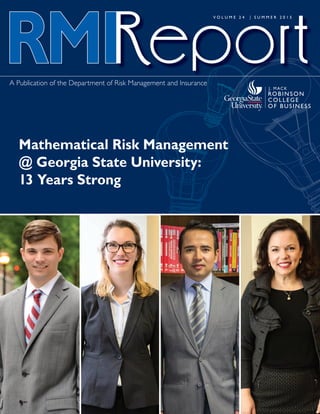
Mathematical Risk Management
@ Georgia State University:
13 Years Strong
rmi.robinson.gsu.edu|2
It has been an outstanding year in the
Department of Risk Management and
Insurance! Once again, we are ranked
among the top five programs in the
nation, by U.S. News & World Report, and
have been ranked in the top ten since
1999. The department’s designation as a
Center for Actuarial Excellence has been
renewed by the Society of Actuaries.
Furthermore, our Mathematical Risk
Management (MRM) program is
accredited by the Professional Risk
Managers’ International Association
(PRMIA) – read about some outstanding
MRM students and alums on page 4. I
am proud of the fact that we remain the
only RMI department in the world to
have all three of these distinctions!
We had an amazing recruiting season
this year, and hired four outstanding new
faculty members, who will formally join
us starting next fall:
•	 Enrico Biffis, who received his
Ph.D. from the University of Trieste,
is joining us from the Imperial
College in London, where he is an
Associate Professor of Actuarial
Science and a specialist in financial
risks
•	 Alejandro Del Valle, who will
be receiving his Ph.D. from the
University of Paris later this year, is
a specialist in the public provision
of health insurance and disaster
insurance
•	 Deepa Varadarajan, who holds
a J.D. from Yale, will be teaching
legal studies and is an expert on
intellectual property, comes to us
from St. Johns University
•	 Ryan Grelecki will also be teaching
legal studies and is an expert on law
and business. He holds a J.D. from
Florida State University and comes
to us from private practice.
Liang Peng, who received his Ph.D. in
statistics from Rotterdam and joined
the RMI faculty last year as a specialist
in long-tail risk, was appointed as holder
of the Thomas P. Bowles, Jr. Chair of
Actuarial Science.
Nancy Mansfield, professor of legal
studies in the RMI Department,
retired last year from the faculty
after 33 years of service to the
university. She was appointed by the
Office of the Provost as Director
of Women Lead, an undergraduate
leadership program of the J. Mack
Robinson College of Business, whose
mission is to empower female
students to aspire to leadership
positions across various sectors of
the economy. Read the story on
page 14.
In other faculty news, former RMI
Department Chair Richard Phillips
became Dean of the Robinson
College of Business. Another former
RMI Chair, Sanjay Srivastava, is
now Robinson’s Associate Dean
for Strategy and Special Projects.
Stephen Shore, Associate Professor
of Risk Management and Insurance
received tenure. Susan Willey was
promoted to Clinical Professor of
Legal Studies. Perry Binder was
promoted to Clinical Associate
Professor of Legal Studies. Daniel
Bauer was promoted to Associate
Professor of Actuarial Science and
received tenure. Hal Weston was
also promoted to Clinical Associate
Professor of Risk Management.
The RMI Department was
well represented in this year’s
GSU Undergraduate Research
Conference, where six RMI students
(the only ones from Robinson to
participate) presented findings on
using text data mining to assess
risks found in companies SEC Form
10ks. The students – Kelly Duncan,
Brandon Trieu, Manuela Rincon,
and Rwanda Smith – are all part
of the Honors College and have
been working with me for the last
two years on research projects.
In addition, Haley Tipsord, also
and Honors College student and
actuarial science major, worked with
me on an assessment on how tort
reform is associated with higher and
lower rates of accidents.
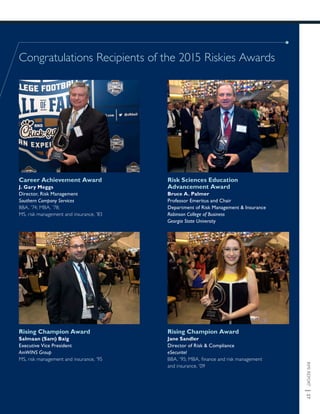
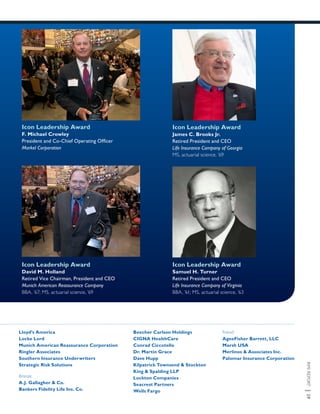
In May of this year, the RMI
Department’s fundraising arm, GSU Risk
Management Foundation, successfully
held it’s first ever Georgia State
University Risk Science and Insurance
Leadership Awards, affectionately
known as The Riskies, at the College
Football Hall of Fame. Eleven risk
management professionals and one
academic were honored in five award
categories (read the full story on page
26). We congratulate each of you!
By its nature, most of the work done in
risk management is behind the scenes
and there are few opportunities to
recognize the leaders in this dynamic
field. The RMF Board seized the idea
that the time had come to start a
recognition event. The Riskies were
the brainchild of Brian Casey, who
conceived the event and was the
driving force behind this effort. Brian
worked with RMF Chair Jim Shevlin
and Board members Kyle Frigon and
Paul Sparks to guide the project. Our
very own public relations specialist Ellie
Diaz named the event “The Riskies.”
RMF Director David Buechner and
the administrative staff, Marie Graham
and student assistant Jomuelle Anicet,
worked tirelessly to create and produce
the event.
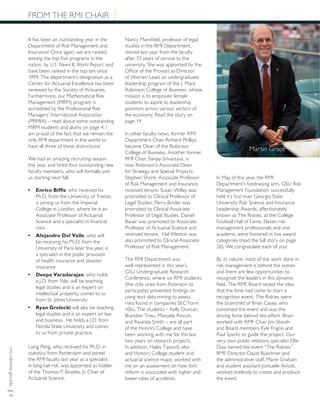
Martin Grace
FROM THE RMI CHAIR
RMIREPORT|3
The reaction to The Riskies from
the Atlanta business community
was outstanding. I am very pleased
that such a breath of risk related
companies were represented. We
thank all of our sponsors who have
created this event, especially the
presenting sponsors who took the
initiative to launch the effort. They
are recognized on page 27. Next
year’s Riskies event will include a Hall
of Fame component honoring the
risk industry’s historical movers and
shakers.
R. Means Davis Jr., RMI alum and
long-time friend of the department,
was honored by his daughter Tarasa
Davis with the establishment of the
R. Means Davis Jr., CPCU Endowed
Professorship (the full story appears
on page 30). We are currently
searching for the inaugural holder
and should have an announcement
by the end of summer. We thank the
Davis family for their generosity.
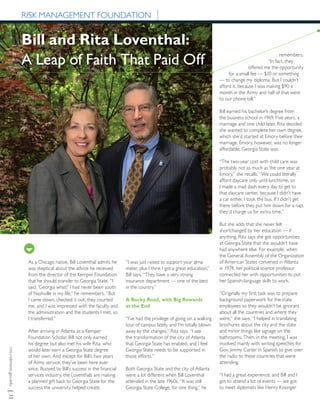
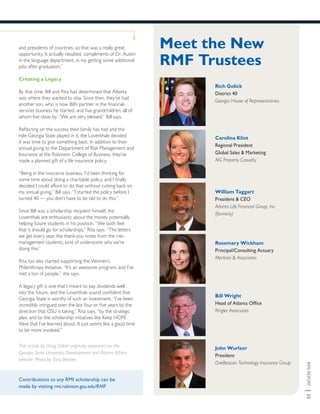
We also thank Bill and Rita Loventhal
(who are both GSU alums; Bill
is an RMI alumnus). In addition
to their annual giving to the RMI
Department, they’ve made a planned
gift of a life insurance policy, which
will undoubtedly help countless
students in the future (the full story
appears on page 32).
Finally, I want to thank everyone
who contributed to the RMI
Department in any way last year
– be it financially or through their
service or participation in any of our
activities. Because of your generous
contributions and support, we have
the most innovative and, surely,
interesting department in the world!
Martin F. Grace
Chair, Department of Risk
Management & James S. Kemper
Professor
Features
MRM@GSU: 13 Years Strong
RMI’s 2014-15 Scholarship
Recipients
Professional MBA with a
Concentration in Risk Management
PACE and Risk Clinic Initiatives
Initiatives in Bermuda
RMI Panthers on Wall Street
Nancy Mansfield Retires
2014 RMI/RMF Golf Tournament
Meet the New RMI Faculty
Faculty News Bits
Robinson Harnesses
the Power of Big Data
Risk Management
Foundation News
The 2015 Riskies
Awards & Recipients
R. Means and Tarasa Davis:
A Daughter Honors Her Father’s
Legacy and Begins One of Her Own
RMF Board of Trustees
Bill and Rita Loventhal:
A Leap of Faith That Paid Off
RMF Board Welcomes
New Members
Thanks to Our 2014 Donors
2015 Honors Day Award Recipients
Research
FACULTY RESEARCH:
Employment Relationships
as Legal and Economic
Risk for Both Workers and
Employers
CEAR Update
CEAR Signature Projects
CEAR takes Control of the
GSU CRO Risk Index
CEAR Conferences
and Workshops
Copenhagen Business
School Partners with CEAR
4
9
10
11
11
12
14
15
16
17
19
24
26
30
31
32
33
34
36
18
20
21
21
22
23
RMI Report | Volume 24 | Summer 2015
PUBLISHER:
Department of Risk Management and Insurance
EDITOR:
Ellie M. Diaz | ediaz@gsu.edu
REGULAR CONTRIBUTORS:
Barry Wood | bwood@gsu.edu
David Buechner | dbuechner@gsu.edu
ADDRESS CHANGES:
Ednisha Riley | RMIalumni@gsu.edu
STORY IDEAS & SUBMISSIONS:
Ellie M. Diaz | ediaz@gsu.edu
O: 404.413.7500 | F: 404.413.7499
rmi.robinson.gsu.edu
Contents
rmi.robinson.gsu.edu|4
HEADLINES
Mathematical Risk Management
@ GSU: 13 Years Strong
Over the past 20 years, risk professionals and academic
researchers have dramatically transformed the risk
management field. This transformation was bolstered by the
recognition among a growing number of industry leaders
that addressing contemporary risk management issues
required the understanding, development, and application of
complex quantitative models to effectively measure different
risk exposures.
Another crucial aspect of this transformation was the
acknowledgement that efficient risk management requires
a broad and integrated view of risk. Such diverse areas as
insurance, asset management, and the treasury function
of global corporations require professionals to have a
common set of skills drawn from a variety of disciplines such
as economics, finance, accounting, and risk management.
Indeed, innovation within contemporary financial
institutions is being guided by professionals with strong
mathematical and analytical skills, as well as a comprehensive,
multidisciplinary view of risk.
Early on, the leadership and faculty of Georgia State
University’s Department of Risk Management and
Insurance recognized both the quantification of risk, as
well as the need for a broader, multidisciplinary view of
risk. The department positioned itself to be a leader in this
transformation by hiring some of the best, brightest and
most innovative young researchers to its faculty. Additionally,
the department realigned its undergraduate, graduate, and
doctoral programs to be consistent with this quantitative,
multidisciplinary view of risk management.
RMI Department leaders responded to the increasing need
for risk management professionals with more specialized
skills, by developing and introducing its Master of Science
in Risk Management and Insurance with a Specialization in
Mathematical Risk Management (MRM) in 2002. This was
followed by its dual degree option, affording students the
opportunity to earn both a Masters in Actuarial Science and
an MRM degree, in an accelerated time frame.
Thirteen years later, emphasis within the MRM program
is still placed on the diagnosis, analysis, pricing, and
customization of solutions to risk management problems,
broadly defined to include both financial and operational
risk exposures. The program prepares students for
analytical and technical positions within financial institutions,
risk management advisory organizations, and the treasury
departments of non-financial corporations.
Placement rates for Georgia State’s MRM degree holders
have been strong since the program’s launch. According to
the most recent statistics tracked by the RMI Department,
93% of MRM students who graduated between 2011
and 2013 had a job prior to or within three months
of graduation. These numbers are indeed remarkable
considering that the United States is just now emerging
from its economic crisis. Recents graduates have been
placed at KPMG, Intercontinental Exchange (ICE), Regions
Bank, LexisNexis, Discover Financial Services, Wells Fargo,
among others.
Robinson College Dean Richard Phillips, former chair
of the RMI Department and first-ever MRM program
director, commented on the programs success: “In 2002
we launched MRM with a dream to create a world class
quantitative risk management program. Since that time,
close to 200 students completed MRM and many have
gone on to have amazing careers all around the world. I
am very proud to have been part of the start of MRM,
to have had the privilege of working with the world class
faculty members who have delivered the program over
the years, and so pleased to know that we not only made
a difference in the careers of so many graduates, but also
proud to know these professionals helped guide their
institutions through one of the worst financial crises in
recent history.
Since it’s inception, the MRM program has attracted
many outstanding quantitatively-minded students, who,
upon graduation, are well on their way to becoming
accomplished leaders in the revolutionized risk
management industry.
This issue of the RMI Report features stories on three
exceptionally talented MRM students and one successful
alumnus. Virginia Baxter, Seph Mard, Edwin Riveros and
Kristin Taylor represent the future of risk management, as
envisioned by the department 13 years ago.
RMIREPORT|5
Today, these three exceptionally talented students and one successful alum represent
the future of risk management, as envisioned by the RMI Department 13 years ago.
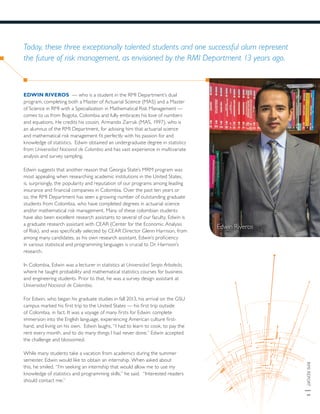
Edwin Riveros
EDWIN RIVEROS — who is a student in the RMI Department’s dual
program, completing both a Master of Actuarial Science (MAS) and a Master
of Science in RMI with a Specialization in Mathematical Risk Management —
comes to us from Bogota, Colombia and fully embraces his love of numbers
and equations. He credits his cousin, Armando Zarruk (MAS, 1997), who is
an alumnus of the RMI Department, for advising him that actuarial science
and mathematical risk management fit perfectly with his passion for and
knowledge of statistics. Edwin obtained an undergraduate degree in statistics
from Universidad Nacional de Colombia and has vast experience in multivariate
analysis and survey sampling.
Edwin suggests that another reason that Georgia State’s MRM program was
most appealing when researching academic institutions in the United States,
is, surprisingly, the popularity and reputation of our programs among leading
insurance and financial companies in Colombia. Over the past ten years or
so, the RMI Department has seen a growing number of outstanding graduate
students from Colombia, who have completed degrees in actuarial science
and/or mathematical risk management. Many of these colombian students
have also been excellent research assistants to several of our faculty. Edwin is
a graduate research assistant with CEAR (Center for the Economic Analysis
of Risk), and was specifically selected by CEAR Director Glenn Harrison, from
among many candidates, as his own research assistant. Edwin’s proficiency
in various statistical and programming languages is crucial to Dr. Harrison’s
research.
In Colombia, Edwin was a lecturer in statistics at Universidad Sergio Arboleda,
where he taught probability and mathematical statistics courses for business
and engineering students. Prior to that, he was a survey design assistant at
Universidad Nacional de Colombia.
For Edwin, who began his graduate studies in fall 2013, his arrival on the GSU
campus marked his first trip to the United States — his first trip outside
of Colombia, in fact. It was a voyage of many firsts for Edwin: complete
immersion into the English language, experiencing American culture first-
hand, and living on his own. Edwin laughs, “I had to learn to cook, to pay the
rent every month, and to do many things I had never done.” Edwin accepted
the challenge and blossomed.
While many students take a vacation from academics during the summer
semester, Edwin would like to obtain an internship. When asked about
this, he smiled. “I’m seeking an internship that would allow me to use my
knowledge of statistics and programming skills,” he said. “Interested readers
should contact me.”
rmi.robinson.gsu.edu|6
MRM@GSU (continued from page 5)
HEADLINES
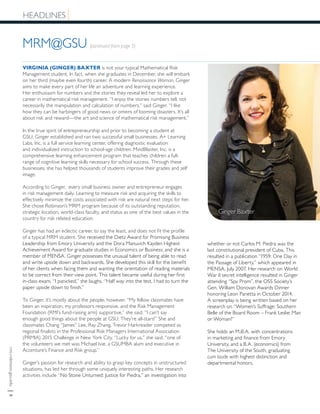
VIRGINIA (GINGER) BAXTER is not your typical Mathematical Risk
Management student. In fact, when she graduates in December, she will embark
on her third (maybe even fourth) career. A modern Renaissance Woman, Ginger
aims to make every part of her life an adventure and learning experience.
Her enthusiasm for numbers and the stories they reveal led her to explore a
career in mathematical risk management. “I enjoy the stories numbers tell, not
necessarily the manipulation and calculation of numbers,” said Ginger. “I like
how they can be harbingers of good news or omens of looming disasters. It’s all
about risk and reward—the art and science of mathematical risk management.”
In the true spirit of entrepreneurship and prior to becoming a student at
GSU, Ginger established and ran two successful small businesses. A+ Learning
Labs, Inc. is a full service learning center, offering diagnostic evaluation
and individualized instruction to school-age children. MindBlaster, Inc. is a
comprehensive learning enhancement program that teaches children a full-
range of cognitive learning skills necessary for school success. Through these
businesses, she has helped thousands of students improve their grades and self
image.
According to Ginger, every small business owner and entrepreneur engages
in risk management daily. Learning to measure risk and acquiring the skills to
effectively minimize the costs associated with risk are natural next steps for her.
She chose Robinson’s MRM program because of its outstanding reputation,
strategic location, world-class faculty, and status as one of the best values in the
country for risk related education.
Ginger has had an eclectic career, to say the least, and does not fit the profile
of a typical MRM student. She received the Dietz Award for Promising Business
Leadership from Emory University and the Dora Manuvich Kayden Highest
Achievement Award for graduate studies in Economics or Business; and she is a
member of MENSA. Ginger possesses the unusual talent of being able to read
and write upside down and backwards. She developed this skill for the benefit
of her clients when facing them and wanting the orientation of reading materials
to be correct from their view point. This talent became useful during her first
in-class exam. “I panicked,” she laughs. “Half way into the test, I had to turn the
paper upside down to finish.”
To Ginger, it’s mostly about the people, however. “My fellow classmates have
been an inspiration, my professors responsive, and the Risk Management
Foundation (RMI’s fund-raising arm) supportive,” she said. “I can’t say
enough good things about the people at GSU. They’re all-stars!” She and
classmates Chang “James” Lee, Ray Zhang, Trevor Harkreader competed as
regional finalists in the Professional Risk Managers International Association
(PRMIA) 2015 Challenge in New York City. “Lucky for us,” she said, “one of
the volunteers we met was Michael Ivie, a GSUMBA alum and executive in
Accenture’s Finance and Risk group.”
Ginger’s passion for research and ability to grasp key concepts in unstructured
situations, has led her through some uniquely interesting paths. Her research
activities include “No Stone Unturned: Justice for Piedra,” an investigation into
whether or not Carlos M. Piedra was the
last constitutional president of Cuba. This
resulted in a publication “1959: One Day in
the Passage of Liberty,” which appeared in
MENSA, July 2007. Her research on World
War II secret intelligence resulted in Ginger
attending “Spy Prom”, the OSS Society’s
Gen. William Donovan Awards Dinner
honoring Leon Panetta in October 2014.
A screenplay is being written based on her
research on “Women’s Suffrage: Southern
Belle of the Board Room – Frank Leslie: Man
or Woman?”
She holds an M.B.A. with concentrations
in marketing and finance from Emory
University, and a B.A. (economics) from
The University of the South, graduating
cum laude with highest distinction and
departmental honors.
Ginger Baxter
RMIREPORT|7
KRISTEN TAYLOR — who is completing both a Master of Actuarial Science
(MAS) and a Master of Science in RMI with a Specialization in Mathematical Risk
Management (MRM) as a student in the dual degree program — did not always
know that she wanted to be an actuary. In fact, she first learned about the career
in 2010 while finishing her undergraduate degree. “It sounded like an exciting and
well-respected career with high job security,” said Kristen. Feeling that she had
not taken the appropriate coursework to begin the process of being an actuary,
she worked as a performance analyst with Credigy Solutions Inc. for two and
a half years after graduation. It was then that she decided to go back to school
full-time and chose Georgia State University’s programs. “After researching
programs, I found that Georgia State was a very well-recognized school for these
specialties,” said Kristen. “I was fortunate enough to already live in Atlanta, so it
was a very easy decision.” She chose the dual degree option because it offered
her many more career opportunities without investing a great deal of extra time.
Kristen, who is also a graduate research assistant for CEAR (Center for the
Economic Analysis of Risk) — has been surprised by the scope and breadth of
coverage of her classes. “I could never imagine that I would be learning about
so many different subjects within this dual program. It has really exposed me to
areas and ideas that I do not believe I would have been exposed to elsewhere.”
She finds that the classes are academically rigorous and are taught at a swift pace,
but is invigorated by the challenge. “It is sometimes easy to be overwhelmed
but I know that my degrees are truly valuable based on the vast amounts of
information that I have been exposed to,” said Kristen.
Despite her challenging class schedule and research work with CEAR, Kristen
enjoys hiking, reading, gardening, live music, watching baseball and working with
kids. She’s also an avid runner and has participated in six half marathons in three
different cities, since starting graduate school. Kristen enjoys travelling abroad,
having visited Mexico, Brazil, Honduras, and Ecuador. These trips were more than
simple leisure activities, as she delighted in the life-changing opportunity to help
build houses and churches for underprivileged individuals in those countries. “I
was able to see what life was like in these impoverished places and to still learn
about the origins of true happiness,” said Kristen. “With little to no possessions,
the people I met on these trips were often filled with more joy than the ones I
encounter on a daily basis.”
When asked to reflect on some of the best aspects of the MAS and MRM
programs, Kristen did not hesitate to mention the people. “The best thing would
be the people,” she said. “The students and professors are very intelligent and
approachable. I like being able to come to the 11th floor of the RCB building [RMI
Department offices] and feel like I am among family. Georgia State’s programs are
very challenging. Students will learn more than they expected to learn and will
graduate prepared to begin careers in the risk management and actuarial fields.”
Kristen Taylor
rmi.robinson.gsu.edu|8
HEADLINES
MRM@GSU (continued from page 7)
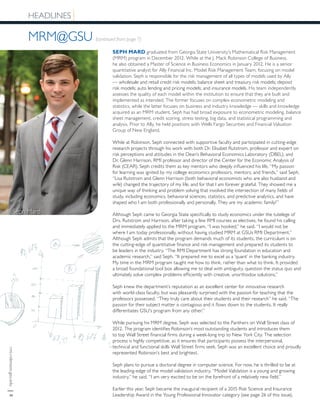
SEPH MARD graduated from Georgia State University’s Mathematical Risk Management
(MRM) program in December 2012. While at the J. Mack Robinson College of Business,
he also obtained a Master of Science in Business Economics in January 2012. He is a senior
quantitative analyst for Ally Financial Inc. Model Risk Management Team, focusing on model
validation. Seph is responsible for the risk management of all types of models used by Ally
— wholesale and retail credit risk models; balance sheet and treasury risk models; deposit
risk models; auto lending and pricing models; and insurance models. His team independently
assesses the quality of each model within the institution to ensure that they are built and
implemented as intended. The former focuses on complex econometric modeling and
statistics, while the latter focuses on business and industry knowledge — skills and knowledge
acquired as an MRM student. Seph has had broad exposure to econometric modeling, balance
sheet management, credit scoring, stress testing, big data, and statistical programming and
analysis. Prior to Ally, he held positions with Wells Fargo Securities and Financial Valuation
Group of New England.
While at Robinson, Seph connected with supportive faculty and participated in cutting-edge
research projects through his work with both Dr. Elisabet Rutstrom, professor and expert on
risk perceptions and attitudes in the Dean’s Behavioral Economics Laboratory (DBEL), and
Dr. Glenn Harrison, RMI professor and director of the Center for the Economic Analysis of
Risk (CEAR). Seph credits them as key mentors who deeply influenced his life. “My passion
for learning was ignited by my college economics professors, mentors, and friends,” said Seph.
“Lisa Rutstrom and Glenn Harrison (both behavioral economists who are also husband and
wife) changed the trajectory of my life, and for that I am forever grateful. They showed me a
unique way of thinking and problem solving that involved the intersection of many fields of
study, including economics, behavioral sciences, statistics, and predictive analytics, and have
shaped who I am both professionally and personally. They are my academic family!”
Although Seph came to Georgia State specifically to study economics under the tutelege of
Drs. Rutstrom and Harrison, after taking a few RMI courses as electives, he found his calling
and immediately applied to the MRM program. “I was hooked,” he said. “I would not be
where I am today professionally, without having studied MRM at GSUs RMI Department.”
Although Seph admits that the program demands much of its students, the curriculum is on
the cutting-edge of quantitative finance and risk management and prepared its students to
be leaders in the industry. “The RMI Department has strong foundation in education and
academic research,” said Seph. “It prepared me to excel as a ‘quant’ in the banking industry.
My time in the MRM program taught me how to think, rather than what to think. It provided
a broad foundational tool box allowing me to deal with ambiguity, question the status quo and
ultimately solve complex problems efficiently with creative, unorthodox solutions.”
Seph knew the department’s reputation as an excellent center for innovative research
with world-class faculty, but was pleasantly surprised with the passion for teaching that the
professors possessed. “They truly care about their students and their research” he said. “The
passion for their subject matter is contagious and it flows down to the students. It really
differentiates GSU’s program from any other.”
While pursuing his MRM degree, Seph was selected to the Panthers on Wall Street class of
2012. The program identifies Robinson’s most outstanding students and introduces them
to top Wall Street financial firms during a week-long trip to New York City. The selection
process is highly competitive, as it ensures that participants possess the interpersonal,
technical and functional skills Wall Street firms seek. Seph was an excellent choice and proudly
represented Robinson’s best and brightest.
Seph plans to pursue a doctoral degree in computer science. For now, he is thrilled to be at
the leading-edge of the model validation industry. “Model Validation is a young and growing
industry,” he said. “I am very excited to be on the forefront of a relatively new field.”
Earlier this year, Seph became the inaugural recipient of a 2015 Risk Science and Insurance
Leadership Award in the Young Professional Innovator category (see page 26 of this issue).
Seph Mard
RMIREPORT|9
ACE Charitable Foundation Scholarship
Xu Cao
Laura Frisbie
Edwin Riveros Briceno
Aon Scholarship
Raynold Gilles
Anqi Jiao
Assurant Group Scholarship
Parisa Hervani
Robert Smith
Atlanta Claims Association Scholarship
Chau Nguyen
Bermuda Foundation for
Insurance Studies/GSU Scholarship
Tare Brangman
Shane Hollis
Dejuan Seymour
Jacree Smith
Deondre Trott
Catlin Group Limited Graduate Scholarship
Virginia Baxter
Anders Graham
Trevor Harkreader
Bowei Zhan
C.V. Starr Scholarship
Anqi Jiao
Zishen Wei
FAME Scholarship
Oluwatoni Apatira
Sunmi Hirata
Helen C. Leith Scholarship
Philippe d’Astous
Yiling Deng
Qiheng Guo
Hongjun Ha
Jia Min Ng
Daniel Quiggin
Huebner Founation Scholarship
Philippe d’Astous
Yiling Deng
Xing Deng
Qiheng Guo
Hongjun Ha
Jia Min Ng
Eun Dong Oh
Xiaohu Ping
Daniel Quiggin
Jinjing Wang
James W. Morton Jr. Scholarship
Shen Gong
John W. Hall Scholarship
Rianna Misha Cohen
Kristen Taylor
Iliana Uzunova
Jinglei Zhou
Congratulations to RMI’s
2014-15 Scholarship Recipients
John W. Morgan Scholarship
Xu Cao
Sarran Marie Deigna
Adrian Lopez
Leyton Hunter Fellowship
Xing Deng
Eun Dong Oh
Isariya Suttakulpiboon
Risk and Insurance Management
Society (Atlanta Chapter) Scholarship
Christopher Drummond
Robin Gillman
Adrian Lopez
Patience Numetu
Fernando Ponce-Icaza
Michael Samuel
Haley Tipsord
Sam & Joyce Turner Scholarship
Juan Jerez
Shan Liu
Kristen Taylor
Sam Baig (AmWINS) Scholarship
Xu Cao
Sarran Marie Deigna
Anqi Jiao
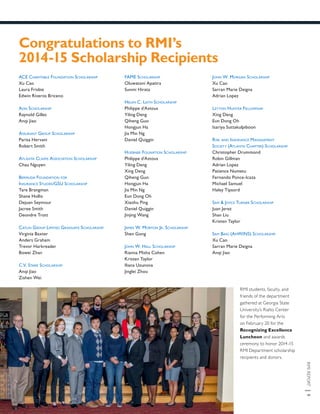
RMI students, faculty, and
friends of the department
gathered at Georgia State
University’s Rialto Center
for the Performing Arts
on February 20 for the
Recognizing Excellence
Luncheon and awards
ceremony to honor 2014-15
RMI Department scholarship
recipients and donors.
rmi.robinson.gsu.edu|10
HEADLINES
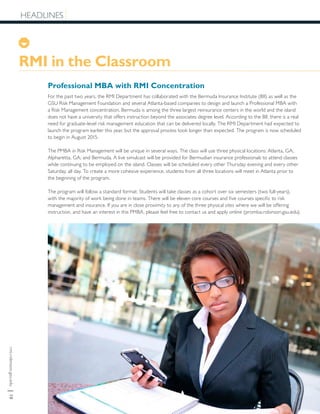
Professional MBA with RMI Concentration
For the past two years, the RMI Department has collaborated with the Bermuda Insurance Institute (BII) as well as the
GSU Risk Management Foundation and several Atlanta-based companies to design and launch a Professional MBA with
a Risk Management concentration. Bermuda is among the three largest reinsurance centers in the world and the island
does not have a university that offers instruction beyond the associates degree level. According to the BII, there is a real
need for graduate-level risk management education that can be delivered locally. The RMI Department had expected to
launch the program earlier this year, but the approval process took longer than expected. The program is now scheduled
to begin in August 2015.
The PMBA in Risk Management will be unique in several ways. The class will use three physical locations: Atlanta, GA;
Alpharetta, GA; and Bermuda. A live simulcast will be provided for Bermudian insurance professionals to attend classes
while continuing to be employed on the island. Classes will be scheduled every other Thursday evening and every other
Saturday, all day. To create a more cohesive experience, students from all three locations will meet in Atlanta prior to
the beginning of the program.
The program will follow a standard format: Students will take classes as a cohort over six semesters (two full-years),
with the majority of work being done in teams. There will be eleven core courses and five courses specific to risk
management and insurance. If you are in close proximity to any of the three physical sites where we will be offering
instruction, and have an interest in this PMBA, please feel free to contact us and apply online (promba.robinson.gsu.edu).
HEADLINES
RMI in the Classroom
RMIREPORT|11
PACE and Risk Clinic Initiatives
Provide Students with
Real World Business Experience
At the urging of the Robinson College of Business Board of
Advisors, the Panther’s Accelerated Consulting Experience
(PACE) was developed and offered last summer to high-
achieving senior undergraduate students, as a Signature
Experience class. GSU’s most current strategic plan calls for the development and implementation of undergraduate signature
experiences to achieve its goal of becoming a national model for undergraduate education. Barry Wood, academic professional
in the RMI Department, was tapped to teach the inaugural class, which focused on various business-related topics.
Each The eight students who qualified to take the PACE class – chosen from among a large group of applicants -- had a GPA
of at least 3.5 and completed their junior core business classes. The capstone-like experience took the form of a consulting
assignment for real companies and was designed so that the students could apply the body of knowledge they obtained through
their studies. By all accounts, the experience was overwhelmingly positive for the students, as well as for their clients, many
of whom are in the process of implementing several of the students’ recommendations. The overwhelming success of the
inaugural class prompted Robinson to make PACE a regular offering in their curriculum.
At the same time that PACE was being launched and tested, the RMI Department implemented the Risk Clinic for students in
the Risk Analysis major. The Risk Clinic is a capstone course taught by Martin Grace, the department’s interim chair. The class
places a team of students in a consulting role for a semester. In this case, the client is an entity specifically within the risk and
insurance arena. Because the design of both PACE and Risk Clinic classes are so similar, the classes were combined during the
spring semester, giving all participating students the benefit of learning from each others’ projects.
Initiatives in Bermuda
Given the significance of Bermuda to the global insurance and reinsurance community, the RMI Department continues to be a
major presence on the island, establishing linkages between Georgia State University and Bermudian academic institutions.
Distance Learning
In August 2014, the Distance Learning Program went live.
The program is designed for Bermuda College (a Bermuda-
based junior college) graduates who seek to complete a
four-year degree in finance, risk management and insurance,
or both at Georgia State University. The concept is that
interested students apply to GSU and can complete their
BBA from a local classroom in Bermuda. We now have such
a classroom located at Bermuda College. A live simulcast
from a downtown Atlanta classroom is sent to the Bermuda
College classroom so that Bermuda-based students can
participate in real time instruction. Students can ask
questions, be called on, and fully participate as if they were
taking these classes in Atlanta.
Bermuda College 2 + 2 Program
The number of Bermudian students that are studying at Robinson
has grown to ten. Most of these students came to Georgia State
through the 2+2 Program created in 2011. Under this program,
students with at least 60 credits from Bermuda College and a
minimum GPA of 3.0 can come to Atlanta and finish their BBA.
They also enjoy the benefit of paying tuition at in-state Georgia
rates, which saves them up to $28,000 per year.
The 2 + 2 Program allows students to choose any major, not just
risk management or actuarial science. The majority of students,
however, seem to gravitate towards the RMI Department,
as they understand that the best jobs on the island are in the
insurance industry, and a risk related degree can only help.
rmi.robinson.gsu.edu|12
New York may be “the city that never sleeps,” but at 6 a.m.
on a Monday, it’s not exactly wide awake yet, either. Other
than public-works trucks and police cars, the streets are
mostly empty. Lights are on in a few restaurants and coffee
shops, but none are serving more than a handful of sleepy-
eyed customers.
Oddly enough, the people most awake and alert at this hour
aren’t New Yorkers at all, but Southerners — 18 Robinson
College of Business students and five faculty/staff advisors
who comprise this year’s Panthers on Wall Street contingent.
Over the next three days, this group will visit the offices of 11
different financial companies, meeting executives at some of
the world’s largest and best known corporations face to face.
That may sound like a strenuous pace — not to mention a lot
of pressure — for a New York trip, but it’s by design. Jason
Aldrich, executive director of Robinson’s Career Management
Center and leader of the PWS trips, sums it up simply in a
prep meeting a few days before departure: “This is not your
high school field trip to New York City. This is a business trip.”
Students are expected to maintain the highest standards of
professionalism, from wardrobe choices to handshakes, and
the window for sightseeing is slim indeed. The payoff, though,
includes a chance to network with executives who can open
the door to careers in the world’s financial capital. For some
students, that door will open even before they’re back in the
classroom in Atlanta.
First-Hand Look at a Business Student’s
Dream
The students’ taste of the fast-moving New York lifestyle
begins the minute they assemble in the lobby of their hotel
on Central Park South. Aldrich and Brent Winner, career and
employment specialist at the Career Management Center,
brief them thoroughly on what to do (keep up with the group,
make eye contact with their hosts) and what not to do (lean
back in their chairs and fall asleep during a presentation). Once
they’re out the door, Barry Wood, the director of external
relations for Robinson’s Department of Risk Management and
Insurance and a two-decade veteran of New York’s financial
scene, keeps up a pace so brisk many of the students are
practically jogging to keep up. If you can hit all the traffic lights
at the right time like the cars do, Wood explains, you can get
places very quickly, even on foot. Regardless, it’s pretty intense
for first thing on a Monday morning.
But it’s a testament to the students’ seriousness and dedication
that, in spite of getting such a strenuous workout this early, they
still speak of their first stop as one of the best things they did on
the entire trip. At the investment banking firm Keefe, Bruyette &
Woods, they sit in on the “morning call” of Jefferson Haralson,
KBW’s associate director of research, as analysts from San
Francisco to London take turns prepping him on the developments
and opportunities he’ll be dealing with in the coming week.
For most people, the talk of balance sheets and market
capitalization would be barely comprehensible. For the students,
though — all of whom are sitting up straight on the edges of their
chairs, just as they’ve been instructed — it’s a fascinating look at
what a career in the New York financial world really entails.
Of course, it helps that — in addition to being upbeat and
energetic even at 7 a.m. — Haralson is a Georgia State grad
himself. “It’s such a joy to see the students engage, especially in
such an interactive setting like New York, and I’m thrilled they got
so much out of it,” he says. “It’s really neat to put them in a new
environment and watch them thrive. The primary reason for the
trip is to get the students financial jobs in New York, and we’ve had
some success there, but I also think it’s great for the faculty and the
people involved in the program to see the bond they form with
each other — it’s formed almost a fraternity or sorority of students
who have gone on the trip. That’s one of the neatest elements of
the whole thing.”
Yesterday’s Alums Setting Today’s Up for Success
That “fraternity” becomes evident as the group works its way
through an agenda packed with financial titans such as Capital
One, Accenture, PricewaterhouseCoopers and Bank of America.
At more than half of their destinations, they meet people who
were once Georgia State business students like them. And more
than a few of those Robinson alumni are PWS alumni as well, now
working to give a leg up to the students following in their footsteps.
At Accenture, for example, the students get a presentation from
Michael Ivie, who did the PWS trip himself as an MBA student
in 2010, and only four years later is a manager specializing in risk
management, finance, strategy and technology. Before the students
had so much as packed their bags for the New York trip, though,
Ivie came down to Atlanta to prep them — both for how they
should interact with New York’s financial bigwigs and what they
need to do to turn those interactions into job offers.
RMI Panthers
on Wall Street
HEADLINES
RMIREPORT|13
“I spent about eight hours with them, and maybe 60 percent or
so of that was talking about the actual products that banks trade,”
Ivie recalls. “Some people want to analyze products, some people
want to do sales, some people want to be the risk managers, so
we looked at what the different jobs do, what their real business
implications are. We talked about it in the classroom, but it’s very
rare that you get to see it in a real-world context.”
Ivie knows firsthand how essential that exposure is. “In the College
of Business, [PWS] is considered one of the more elite programs,
because there are so many benefits — the interviewing and the
social experience that come from it, the networking skills that
you’re able to develop,” he says. “The communication element is so
important in your ability to land a job.”
Andrew Haskell, a senior product manager the group meets on its
visit to Capital One, says it was a “strange feeling” to be offering
career advice to Georgia State students barely a year after earning
his own MBA at the Robinson College. “And it’s very humbling,
too, when people ask me, ‘Oh, how did you do this? How did you
get here?’ because I was in that position not that long ago,” he says.
Haskell isn’t technically a PWS alum — he just missed the
application deadline for the 2012 trip, but joined the group on his
own dime so that he could schedule some informal meetings and
network. But he, along with Ivie and numerous other alums who’ve
experienced PWS, believe in the program and are committed to
its future success. So committed, in fact, that the program now
sustains itself entirely on the
financial support of program
alums and other friends
of RCB who want to “pay
it forward” so that future
participants can achieve their
dreams.
Emboldened to Take
the Next Step
Panthers on Wall Street
doesn’t accept just any
student. The application
process is as rigorous
as any job interview: It
involves résumés, letters
of reference, and face-to-
face interviews, including a
“mocktail” reception where
guest alumni observe the
students’ communication and
networking skills.
But the intensity of that
process is reflected in a
group of students who are
as poised and professional
as the executives they’re
meeting. The students receive
numerous compliments both on the knowledge they display
and the questions they ask. And far from seeming overwhelmed
by the pace and intensity of New York, most of them seem
emboldened.
Seeing so many fellow Panthers occupying so many different roles
in New York — and being successful at them — definitely builds
confidence. “I never really thought of using Atlanta as ‘We’re
different,’” says Alex Joslin, who earned bachelor’s degrees in both
finance and risk management at Robinson and is now in the joint
MBA/JD program. “I always thought of myself as having to prove
that I was ‘up to’ New York, but instead it really seems like there
are opportunities to show how we’re different from the students
who are going to school in the Northeast. And a lot of the
companies seem to want to show a little diversity.”
Laura Frisbie, who’s pursuing dual master’s degrees in actuarial
science and mathematical risk management, agrees. “One of the
general assumptions that was broken for me was this idea of Wall
Street as a cutthroat place,” she says. “The companies seemed
a lot more friendly than that, Capital One being one example.
The culture was refreshingly open and authentic. To hear people
describe New York, you’d think it was just a bunch of white,
upper-class guys from Ivy League schools, to be honest, but we’ve
met a lot of people from different backgrounds.”
Many of the students also discovered paths to New York that
they’d never considered before. “I came up here looking for a job
in investment banking,” says Brian Burch, who is just a few months
away from earning bachelor’s degrees in finance and actuarial
science, “but literally every company we’ve visited has shown
us something new and interesting. It’s awesome. Like, when we
came to PWC, I thought, ‘Well, I’m not interested in accounting.’
But after hearing from some of the people who worked there, I
realized that what they do encompasses so much more than that.
It makes you realize just how many opportunities there are up
here.”
For some, those opportunities will present themselves sooner
rather than later — a few members of this year’s PWS class have
actual job interviews scheduled during the trip, and one, junior
Camilo Benitez, will receive an internship offer from JP Morgan
within days of returning to Atlanta. Even senior accounting major
Sabahat Jindani — who, a week before leaving for New York, got
a job offer from Ernst & Young — describes the Panthers on Wall
Street experience as an important confidence boost.
“The speed of the life in New York was, at first, very intimidating,”
she says. “But I think this trip actually reversed that for me. It
made me more open to it, more excited about it. It was just this
feeling in the air — like everyone was telling us, ‘Yeah, you can do
this! This is a real possibility!’ It’s not far-reaching or thinking really
far into the future. We can make this happen. It’s right in our
hands.”
This article has been excerpted from an article by Doug Gillett that
appeared on the Georgia State University Development and Alumni
Affairs website.
Laura Frisbie
rmi.robinson.gsu.edu|14
HEADLINES
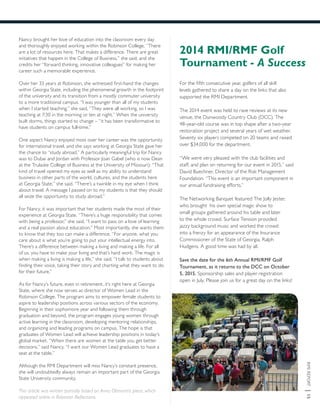
Nancy Mansfield Retires
After 33 Years of Service to GSU
After 33 years of distinguished service to Georgia State University and the
Department of Risk Management and Insurance at the J. Mack Robinson College
of Business, Nancy Mansfield, Professor of Legal Studies, retired from the faculty.
Although officially retired, she remains an active member of the university
community and was tapped by the Office of the Provost to head Women
Lead, a Georgia State University Signature Experience. The program provides
undergraduate students access to faculty, research, community partners, leadership
skills, networking and strategic career development to encourage young women to
strive for top leadership positions across various sectors.
With a stellar academic record and professional experience, Nancy was a bright
spot among Robinson’s award-winning faculty. Throughout her tenure, she
received numerous teaching, research, and service awards, including: Outstanding
Merit Award for Teaching (1988); Faculty Award for Teaching Excellence (1995);
Holmes-Cardozo Award for Excellence in Research, Academy of Legal Studies in
Business (1997); Charles M. Hewitt Award for Excellence in Teaching, Academy
of Legal Studies in Business (1997); Kemper Award for Best Risk Management and
Insurance Research Feature Article (1999-2000); Outstanding Service to Students
Award (GSU, May 2003); Ralph Bunche Award for Outstanding International
Paper, Academy of Legal Studies in Business (2009); Distinguished Faculty Award
for Service to the Robinson College of Business (2009); Best Paper Award for Best
Conference Paper, Mid-Atlantic Academy of Legal Studies in Business (2009); Best
Paper Award for Best Conference Paper, Southeastern Academy of Legal Studies
in Business (2012); Best Paper Award for Faculty/Student Collaborative Research,
Academy of Business Disciplines Annual Meeting (November 2012); and Ralph C.
Hoeber Outstanding Article Award, Journal of Legal Studies Education, Academy of
Legal Studies in Business (August 2013).
When Nancy graduated from the University of North Carolina, Chapel Hill, with a
bachelor’s degree in political science, she was unsure of what she wanted to do. She
attended the University of Georgia School of Law and became one of 40 women in
her class of 200 students. “We really were trailblazers in law school,” she said.
Although Nancy enjoyed law school, she was undecided about practicing law, so
when she was offered a graduate research assistant position in the Terry College
of Business at UGA during her third year, she jumped at the opportunity. There
she was mentored by Professor Lee Reed, who first encouraged her to consider
teaching. “I remember he said to me, ‘being a professor is a very privileged life,’ and
I’ve repeated that often,” she said. She certainly found her calling in teaching.
She accepted a position at Georgia State in 1981, where she became one of the
first women in the RMI Department. During her tenure on the faculty, Nancy
filled numerous positions both as professor teaching legal studies and health
administration courses, and as the faculty advisor to scholars within the Honors
College. “I’m guessing I’m one of the few people at Robinson who has had the same
job for 33 years,” she said. Nancy Mansfield instructs a group of Honors College students
RMIREPORT|15
Nancy brought her love of education into the classroom every day
and thoroughly enjoyed working within the Robinson College. “There
are a lot of resources here. That makes a difference. There are great
initiatives that happen in the College of Business,” she said, and she
credits her “forward thinking, innovative colleagues” for making her
career such a memorable experience.
Over her 33 years at Robinson, she witnessed first-hand the changes
within Georgia State, including the phenomenal growth in the footprint
of the university and its transition from a mostly commuter university
to a more traditional campus. “I was younger than all of my students
when I started teaching,” she said, “They were all working, so I was
teaching at 7:30 in the morning or ten at night.” When the university
built dorms, things started to change – “it has been transformative to
have students on campus full-time.”
One aspect Nancy enjoyed most over her career was the opportunity
for international travel, and she says working at Georgia State gave her
the chance to “study abroad.” A particularly meaningful trip for Nancy
was to Dubai and Jordan with Professor Joan Gabel (who is now Dean
at the Trulaske College of Business at the University of Missouri): “That
kind of travel opened my eyes as well as my ability to understand
business in other parts of the world, cultures, and the students here
at Georgia State,” she said. “There’s a twinkle in my eye when I think
about travel. A message I passed on to my students is that they should
all seize the opportunity to study abroad.”
For Nancy, it was important that her students made the most of their
experience at Georgia State. “There’s a huge responsibility that comes
with being a professor,” she said. “I want to pass on a love of learning
and a real passion about education.” Most importantly, she wants them
to know that they too can make a difference. “For anyone, what you
care about is what you’re going to put your intellectual energy into.
There’s a difference between making a living and making a life. For all
of us, you have to make your living and that’s hard work. The magic is
when making a living is making a life,” she said. “I talk to students about
finding their voice, taking their story and charting what they want to do
for their future.”
As for Nancy’s future, even in retirement, it’s right here at Georgia
State, where she now serves as director of Women Lead in the
Robinson College. The program aims to empower female students to
aspire to leadership positions across various sectors of the economy.
Beginning in their sophomore year and following them through
graduation and beyond, the program engages young women through
active learning in the classroom, developing mentoring relationships,
and organizing and leading programs on campus. The hope is that
graduates of Women Lead will achieve leadership positions in today’s
global market. “When there are women at the table you get better
decisions,” said Nancy. “I want our Women Lead graduates to have a
seat at the table.”
Although the RMI Department will miss Nancy’s constant presence,
she will undoubtedly always remain an important part of the Georgia
State University community.
This article was written partially based on Anna Oltmann’s piece, which
appeared online in Robinson Reflections.
For the fifth consecutive year, golfers of all skill
levels gathered to share a day on the links that also
supported the RMI Department.
The 2014 event was held to rave reviews at its new
venue, the Dunwoody Country Club (DCC). The
48-year-old course was in top shape after a two-year
restoration project and several years of wet weather.
Seventy six players competed on 20 teams and raised
over $34,000 for the department.
“We were very pleased with the club facilities and
staff, and plan on returning for our event in 2015,” said
David Buechner, Director of the Risk Management
Foundation. “This event is an important component in
our annual fundraising efforts.”
The Networking Banquet featured The Jolly Jester,
who brought his own special magic show to
small groups gathered around his table and later
to the whole crowd. Surface Tension provided
jazzy background music and worked the crowd
into a frenzy for an appearance of the Insurance
Commissioner of the State of Georgia, Ralph
Hudgens. A good time was had by all.
Save the date for the 6th Annual RMI/RMF Golf
Tournament, as it returns to the DCC on October
5, 2015. Sponsorship sales and player registration
open in July. Please join us for a great day on the links!
2014 RMI/RMF Golf
Tournament - A Success
rmi.robinson.gsu.edu|16
FACULTY NEWS
Meet the New RMI Faculty...
ur years later i
AHMAD PEIVANDI joined the RMI faculty in August as an assistant professor, after
obtaining a PhD in Economics from Nothwestern University. His doctoral dissertation
is titled “Participation and Unbiased Pricing in the CDS Settlement Mechanism.”
Professor Peivandi’s research interests are focused on security market design, market
design, mechanism design, and game theory. He also holds an MA in Economics from
Northwestern University and a BA degree from Sharif University of Technology in
Tehran, Iran, his home country.
ur years later i
With an extensive research record to his credit, LIANG PENG joined the RMI faculty
last fall as a full professor. He is a fellow of both the Institute of Mathematical Statistics
and the American Statistical Association. His research interests include extreme
value theory in finance and environmental sciences, nonparametric statistics and time
series analysis with particular applications in finance, insurance and risk management.
Professor Peng received his PhD in statistics at Erasmus University Rotterdam,
the Netherlands in 1998; an MS in probability from Peking University; and a BS in
mathematics from Zhejiang University. He currently serves on the editorial boards of
the Scandinavian Journal of Statistics and the Journal of Mathematical Studies. Prior to
joining Georgia State, he was a professor of Mathematics at the Georgia Institute of
Technology.
RAMSI WOODCOCK became a member of the RMI faculty as an associate professor.
He writes primarily on antitrust, law and economics, and the law of remedies, and has
additional interests in property law, including intellectual property, and the philosophy
of law. After law school, he practiced corporate law in New York City and antitrust
law in Washington, D.C. During this time, he worked on antitrust-related matters
associated with the Intel/FTC, Apple/Samsung, Southeastern Milk, American Airlines/
Travelport, and Japanese auto parts cartel investigations or litigations. He clerked for
Judge Thomas Ambro of the United States Court of Appeals for the Third Circuit and
studied in the economics Ph.D. program at American University. Professor Woodcock
graduated magna cum laude from Harvard Law School in 2006, where he served
on the editorial boards of the Harvard International Law Journal and Unbound: The
Harvard Journal of the Legal Left. He graduated summa cum laude from Yale University,
earning a BA in philosophy with a focus on the writings of Friedrich Nietzsche.
RMIREPORT|17
Faculty News Items
The Centers of Actuarial Excellence (CAE)
of the Society of Actuaries awarded a
research grant to the RMI Department for
a proposal, “New Trends in Longevity,”
submitted by MARTIN GRACE, the
department’s interim chair. CAE grants
allow universities to make significant
investments in their programs, research
and the profession.
DANIEL BAUER , associate professor,
coauthored (with N. Zhu) “A Cautionary
Note on Natural Hedging of Longevity,”
which appeared in the North American
Actuarial Journal 18: 104-115 (2014).
FLORIN BIDIAN, coauthored “Martingale
Properties of Self-Enforcing Debt” (with
C. Bejan), which is forthcoming in Economic
Theory.
PERRY BINDER, clinical associate professor
of legal studies, was appointed to the GSU
Law School’s Intellectual Property Advisory
Board (Dec. 2014). He co-founded
the Georgia IP Think Tank, bringing
practitioners together with academics.
CONRAD CICCOTELLO, associate
professor, coauthored “Unbundling and
Measuring Tunneling” (with V. Atanasov
and B. Black), which appeared in the
University of Illinois Law Review 2014 (5),
1697-1738 (issue honoring Larry Ribstein).
He also coauthored “Does the Location of
Directors Matter? Information Acquisition
and Decisions by the Board” (with Z.
Alam, M. Chen and H. Ryan), which
appeared in the Journal of Financial and
Quantitative Analysis 49 (1), 131-164, 2014
(featured in the 2013 Harvard Law School
Forum on Corporate Governance and
Financial Regulation).
SAMUEL COX, Professor Emeritus at
GSU, rejoined the RMI Department as a
visiting professor and is teaching actuarial
science courses during the spring and
fall semesters. He retired from the
department in 2007.
STEPHEN SHORE, associate professor,
organized the first annual CEAR/Huebner
Summer Risk Institute, which brought
Hanming Fang (University of Pennsylvania)
and Christian Gollier (Toulouse School
of Economics) to Atlanta for a multi-day
series of risk-related lectures. Attendees
included faculty and Ph.D. students from
institutions throughout the U.S. and U.K.
He also organized a CEAR workshop
on “Income Dynamics, Income Risk, and
Income Risk-Sharing” which brought
together researchers from schools across
the U.S. to present and discuss their work.
LIANG PENG, profesor, was appointed
as holder of the Thomas P. Bowles, Jr.
Chair of Actuarial Science.
SUSAN WILLEY, was promoted to
Clinical Full Professor of Legal Studies.
Faculty Promotions
DANIEL BAUER was promoted to
associate professor and received tenure.
STEPHEN SHORE received tenure.
PERRY BINDER was promoted to clinical
associate professor.
SUSAN WILLEY was promoted to clinical
professor.
HAROLD WESTON was promoted to
clinical associate professor.
Former RMI Chair Now
Leads Robinson
Former RMI Department Chair RICHARD PHILLIPS assumes the role of dean with
overwhelming support of the search committee, college faculty and staff, and other key
stakeholders. A risk management scholar, Phillips joined Robinson in 1994 as an assistant
professor and became chair of the Department of Risk Management and Insurance in
2006. Under his leadership the department shifted from an insurance-centric focus to a
broader study of risk dedicated to understanding, quantifying and developing strategies
for managing risks faced by individuals, organizations and society. He has served on many
college-wide initiatives, including as chair of the task force that laid the foundation for the
college’s Vision 2020 strategic plan.
rmi.robinson.gsu.edu|18
Employment Relationships as
Legal and Economic Risk for
Both Workers and Employers
My research focuses on the employment relationship as
a source of legal and economic risk for both workers and
employers. In particular, I am interested in the decisions that
workers make in choosing whether and how to challenge
unsafe or illegal working conditions and the incentive structures
built into the law that are designed (but perhaps fail) to
encourage workers to become enforcers of their rights. I also
use empirical methods to study trends in employment litigation,
employers’ perceptions of their employment litigation risk,
and the changes that employers make to their policies and
practices in response. At bottom, whether I am focusing on
the employee or the employer, my work investigates the ways
in which workplace problems convert into legal claims and the
consequences of employees’ claiming choices for both parties
to the employment relationship.
Two of my works in progress approach the question of risk
in the employment relationship from different angles. One,
an ongoing data collection project with funding from the
RMI Department’s Center for the Economic Analysis of Risk
(CEAR), seeks to describe and understand the recent boom
in lawsuits filed under the Fair Labor Standards Act (FLSA),
the federal minimum wage and overtime statute. Between
2000 and 2011, the number of FLSA cases filed in federal court
per year has risen by over 250%, and in some jurisdictions,
these wage and hour lawsuits have overtaken employment
discrimination cases by wide margins as the employment claim
type experienced most often by employers. This spike in FLSA
litigation has prompted follow-on changes in the EPLI market,
revisions in employers’ pay practices, and calls by employers
for reform of wage and hour law. However, there has been
no comprehensive empirical study to date on the drivers of
the boom, the profiles of the workers and the industries most
affected, and the outcome of the cases. With CEAR funding, I
have assembled a set of over 54,000 FLSA cases filed in federal
court since 2000 and coded a variety of information from a
sample. When data cleaning and analysis is complete, I will be
able to present the first comprehensive picture of trends in
federal FLSA litigation, providing both workers and employers
a clear sense of what is happening in the courts in this very hot
area of employment law.
A second work in progress is theoretical. In addition to
focusing on cases once they have been filed in court, as my
FLSA litigation project does, I am interested in the conditions
necessary for triggering a worker, regulator, or outside actor
such as an investor or consumer to engage in an enforcement
or market response to workplace problems. In other words,
once it is revealed that a worker is exposed to a toxin on the
job, for example, what else does she need to know in order
to engage in rights enforcement (complaining to a regulatory
agency) or a market response (leaving the unsafe job for a
safer one)? What also, beyond the facts on the ground, do
regulators, investors, and consumers need to know to take
regulatory or market action? Much of the law and economics
literature on information in the workplace, most notably by Kip
Viscusi and his co-authors, focuses on disclosure mandates that
reveal firm-specific information about the hidden conditions of
work, i.e. a worker’s otherwise unobserved chemical exposure.
I theorize that this sort of information, alone, is insufficient to
prompt a regulatory or market response. Instead, workers,
regulators, investors, and consumers need information
about context (conditions at other firms or the substantive
requirements of the law), process (how to engage in market
discipline or rights enforcement), and incentives (the costs and
benefits of market or rights-enforcing actions). By developing a
typology of different types of necessary workplace information,
I seek to extend Viscusi’s scholarship and construct a more
accurate model of information’s role in regulatory and market
responses to workplace problems.
CHARLOTTE ALEXANDER is an assistant professor of legal studies in the Robinson College of Business
at Georgia State University, with a secondary appointment at the College of Law. Her scholarly work
focuses on employment, immigration, and risk. She is interested in the decisions that workers make in
choosing whether to challenge unsafe or illegal conditions at work and the incentive structures built into
the law that are designed (but perhaps fail) to encourage workers to become enforcers of their own
rights. She also uses empirical methods to study the civil justice system, focusing on the “boom” in wage
and hour litigation and issues around private law enforcement and access to justice. She received her
B.A., magna cum laude, from Columbia University and her J.D., cum laude, from Harvard Law School.
RESEARCH
RMIREPORT|19
Robinson Harnesses
the Power of Big Data
Last fall, Robinson launced the new Master of Science in
Analytics (MSA). The 16-month, full-time program was
developed in response to escalating demand for professionals
with the skills to model and manage so-called “big data” –
large, complex volumes of information too great to process
with traditional tools.
These data-driven challenges lie in connecting mathematics
with life sciences, social sciences and engineering to solve
business and societal problems. The rigorous, research-
oriented MSA program prepares students to master
mathematical methods -- both programming skills and
analytical modeling -- and broad applications in business.
Whereas typical modeling-based masters programs teach
students to manage data and build models, Robinson’s MSA
emphasizes the need for graduates to formulate executable
business actions.
Robinson’s MSA program will prepare graduates for data-
driven positions such as credit risk analyst, data scientist,
health information, predictive modeler, quantitative marketing
analyst, and web analyst. For detailed information about the
program visit specialized.robinson.gsu.edu/msa/
Masters in Analytics Institute for Insight
The Institute for Insight is a unique,
university-wide initiative to bring together
students, researchers, local entrepreneurs
and industry partners, to learn, build
interesting research, and create innovative
new ideas for improving business and
society with data and analytics.
The Lab is a portal into Big Data Analytics
and Insight, designed for collaborative
engagement, where students, researchers,
entrepreneurs, institutions and industry
partners can determine, develop,
and prototype the empirical strategies
necessary to discover new insights that
solve problems and create opportunities in
business and society.
rmi.robinson.gsu.edu|20
JIA MIN NG – CEAR Scholar and
doctoral candidate in the RMI Department
– was a discussant at the CEAR-MRIC
Behavioral Insurance Workshop in Munich,
Germany, December 15, 2014, for a paper
presented by Céline Grislain-Letrémy,
CREST & Université Paris-Dauphine,
titled “Natural Disasters: Exposure and
Underinsurance.”
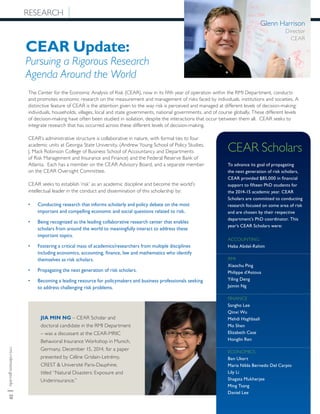
The Center for the Economic Analysis of Risk (CEAR), now in its fifth year of operation within the RMI Department, conducts
and promotes economic research on the measurement and management of risks faced by individuals, institutions and societies. A
distinctive feature of CEAR is the attention given to the way risk is perceived and managed at different levels of decision-making:
individuals, households, villages, local and state governments, national governments, and of course globally. These different levels
of decision-making have often been studied in isolation, despite the interactions that occur between them all. CEAR seeks to
integrate research that has occurred across these different levels of decision-making.
CEAR Update:
Pursuing a Rigorous Research
Agenda Around the World
CEAR Scholars
To advance its goal of propagating
the next generation of risk scholars,
CEAR provided $85,000 in financial
support to fifteen PhD students for
the 2014-15 academic year. CEAR
Scholars are committed to conducting
research focused on some area of risk
and are chosen by their respective
department’s PhD coordinator. This
year’s CEAR Scholars were:
ACCOUNTING
Heba Abdel-Rahim
RMI
Xiaochu Ping
Philippe d’Astous
Yiling Deng
Jaimin Ng
FINANCE
Sangho Lee
Qinxi Wu
Mehdi Haghbaali
Mo Shen
Elizabeth Case
Honglin Ren
ECONOMICS
Ben Ukert
Maria Nilda Bernedo Del Carpio
Lily Li
Shagata Mukherjee
Ming Tsang
Daniel Lee
RESEARCH
Glenn Harrison
Director
CEAR
CEAR’s administrative structure is collaborative in nature, with formal ties to four
academic units at Georgia State University, (Andrew Young School of Policy Studies,
J. Mack Robinson College of Business School of Accountancy and Departments
of Risk Management and Insurance and Finance) and the Federal Reserve Bank of
Atlanta. Each has a member on the CEAR Advisory Board, and a separate member
on the CEAR Oversight Committee.
CEAR seeks to establish ‘risk’ as an academic discipline and become the world’s
intellectual leader in the conduct and dissemination of this scholarship by:
•	 Conducting research that informs scholarly and policy debate on the most
important and compelling economic and social questions related to risk.
•	 Being recognized as the leading collaborative research center that enables
scholars from around the world to meaningfully interact to address these
important topics.
•	 Fostering a critical mass of academics/researchers from multiple disciplines
including economics, accounting, finance, law and mathematics who identify
themselves as risk scholars.
•	 Propagating the next generation of risk scholars.
•	 Becoming a leading resource for policymakers and business professionals seeking
to address challenging risk problems.
RMIREPORT|21
CEAR
Signature Projects:
CEAR takes Control of the GSU CRO Risk Index
CEAR has taken over the operations of the Georgia State University Chief Risk Officer (GSU CRO)
Index in 2015, and will be collaborating with leading risk professionals to capture and study their
subjective beliefs of future risks. The GSU CRO Risk Index seeks to aggregate the subjective opinions
of global risk professionals regarding significant movements in financial markets and general economic
conditions. The vision behind this project is that the 2008 financial meltdown could have been avoided
had management paid more attention to risk professionals that knew about the real estate bubble and
subsequent financial collapse. Each month, global risk professionals (chief risk officers, chief actuaries,
senior risk managers, etc.) from diversified financial companies are surveyed about their views on a
number of major financial risks. Their beliefs are aggregated and reported as the GSU CRO Risk Index.
The GSU CRO Risk Index measures the direction of the subjective beliefs of these risk managers. It
also measures the strength and precision of their beliefs on particular risks. We evaluate the extent
of agreement or disagreement, across these risk managers. Finally, we compare the pooled subjective
beliefs of risk managers with a state-of-the-art statistical forecasting model. Are these risk managers,
as “canaries in the cave” of financial risks, telling us anything different than the standard statistical
equipment? See more at gsucroriskindex.org.
Poverty and Risk Management: Portfolios of the Atlanta Poor
The vision of the Portfolios of the Atlanta Poor (PAP) project is to improve the understanding of the risks and
uncertainties facing poor and low-income households in Atlanta, with the goal of identifying institutional changes and
new products and services that would increase the efficiency by which members of these households can fulfill their
aspirations to prosperity. The goal of PAP is to improve the understanding of preferences that poor and low-income
households hold over various aspects of prosperity, including economic and financial, health and nutrition, safety and
security, family and social networks, and self-fulfillment and personal growth.
Elicitation of Subjective Risk Perceptions
Before risk can be managed it has to be defined. And most of the risks that individuals, households, corporations and
societies deal with involve subjective risks. This might seem counter-intuitive in some classical fields of financial risk
management, but even actuaries rely on subjective judgments about future trends. And before we can evaluate if
someone is making good or bad decisions towards risk, we need to know what risk they perceive. It could be that it is the
perception of risk that causes bad decisions, and not attitudes towards risk. Or it could be that risk perceptions are not
correctly updated as new information arrives, leading to bad decisions over time.
Microinsurance
Microinsurance products are essentially specialized insurance contracts designed for the poor, particularly the poor in
developing countries. These contracts need to recognize the difficulties of defining and measuring risks in this context,
the variety of risks faced on a daily basis, problems collecting premia, and the lack of trust in institutions. A central feature
of any research is to evaluate the expected welfare gain or loss from product take-up decisions. Once measured, we can
test out new miscroinsurance products and information designed to reduce welfare losses and ensure welfare gain.
rmi.robinson.gsu.edu|22
In support of its goal to be recognized as the leading collaborative research center that enables scholars from around
the world to meaningfully interact to address important topics, CEAR hosted and/or sponsored these events:
CEAR Workshops & Conferences
The Economics of Gambling
Cape Town, South Africa | January 27-29, 2014
Field Experiments, Risk, and Uncertainty in Development
Cape Town, South Africa | February 3-7, 2014
CEAR/rCITI Workshop – Risk in Transportation Systems
Sydney, Australia | March 20-21, 2014
Corporate Control Mechanisms and Risk
Georgia State University | April 4-5, 2014
Longevity Risks
Georgia State University | April 10-11, 2014
6th Annual Meeting on the Economics of Risky Behaviors
(AMERB)
Medellin, Columbia | May 8-10, 2014
CEAR Family Grows By One Member
THOMAS KELLY joined CEAR in early September as the new Business Affairs Coordinator. He
was a strategic hire to allow for further expansion of the center’s core activities and is responsible
for coordinating, processing, and maintaining most of the business affairs and the internal
administrative at CEAR central. Thomas graduated from Georgia State University in 2013 with a
Bachelor of Interdisciplinary Studies.
RESEARCH
CEAR Co-Sponsors First Annual Huebner
Summer Risk Institute
As a collaborative partnership with the Huebner Institute for
Insurance Education, the first ever CEAR/Huebner Summer Risk
Institute took place July 28-31. Doctoral students and faculty
interested in risk and uncertainty were exposed to relevant
cutting-edge models, tools, and theory. Our audience was primarily
comprised of faculty and PhD students interested in the economics
of risk who are located at colleges and universities that do not have
access to specialized seminars and courses in these areas. There will
be a 2015 CEAR/Huebner Summer Risk Institute as well. Visit
cear.gsu.edu for more information.
The Family Inequality Network (FINET), the Center for the
Economic Analysis of Risk (CEAR) and the Institute for Fiscal
Studies (IFS) workshop on Risk and Family Economics
London, England | July 28-31, 2014
2014 CEAR–Huebner Summer Risk Institute
Georgia State University | July 28-31, 2014
Income Dynamics, Income Risk, and Income Risk-Sharing
Georgia State University | September 26-28, 2014
Nonbank Financial Firms and Financial Stability
Federal Reserve Bank of Atlanta | November 6-7, 2014
10th International Microinsurance Conference
Mexico City, Mexico | November 10-13, 2014
CEAR/MRIC Behavioral Insurance Workshop
Munich, Germany | December 15-16, 2014
The Welfare Evaluation of Risk Preferences
Rome, Italy | March 19-20, 2015
RMIREPORT|23
The Center for the Economic Analysis of Risk (CEAR) and Copenhagen Business School (CBS) agreed to
co-finance the development of software at Statistics Denmark that will allow researchers to undertake
customized surveys and/or experiments using subjects drawn from the Danish Registry. The Danish
Registry is a collection of administrative records on individuals spanning economic, medical, social, criminal
and financial information, among many other things. The Registry has been widely used in landmark
epidemiological research for decades, and allows linkages of individuals over time as well as within families.
The software will allow Statistics Denmark (SD) to contact potential respondents by several means, and
handle calls and contacts by potential respondents by mail, e-mail or phone call. Samples for surveys and
experiments can be drawn from the Registry, using information already in the Registry, with some common-
sense restrictions. All survey instruments and experiments must be run on servers housed by SD or at
facilities managed by SD, and no individual data may be removed. CEAR researchers wanting to use this
facility must be regular academic faculty at one of the affiliated research units of CEAR, or be recognized
CEAR Fellows. All funding for a research project, other than the costs of establishing the software
infrastructure, must be provided by the researchers involved. The data contained in the Registry are vast
and diverse, and vary in terms of the documentation provided. In practice, one must have an experienced
Danish researcher on any project involving the Registry.
Copenhagen Business School
Partners with CEAR
to establish the GSU CEAR-CBS Infrastructure
for Registry-Based Surveys and Experiments
Existing projects to have used the Registry include studies of risk
and time preferences of the adult Danish population, published
in Econometrica, European Economic Review, and Economica.
Ongoing research involves the assessment of risk preferences
and subjective risk perceptions for each of the individuals within
Danish households, and comparison to the “household
preference and perception;” the assessment of risk and
time preferences of known criminals in Denmark using
a mix of internet and in-person experiments; and the
evaluation of survey instruments measuring
“problem gambling” in the Danish population.
rmi.robinson.gsu.edu|24
From the
RMF Director
The high demand for students
who graduate with degrees in risk
management (and related fields) is
changing the dynamics of the Risk
Management Foundation’s efforts to
support the overall needs of the RMI
Department at Georgia State University.
In the months since I assumed my duties
as director, the economy has slowly
and steadily grown, reversing losses
that were sustained over the previous
five years. Since the depths of the
financial crisis, the structure of insurance
business and other related disciplines has
changed, thus creating an unprecedented
opportunity for current students in
the RMI Department. Because of the
effects of consolidation of the insurance
industry, the ranks of management have
been thinned, resulting in an older core
of senior managers. It is estimated
that 25% of these employees are 55 or
older. This suggests that there will be
unprecedented opportunity for career
growth in the next ten years, as the
effects of attrition and industry growth
play out. The Atlanta area is well
positioned to take advantage of these
dynamics, and is becoming a hub for the
national operations of several leading
companies.
Georgia State’s RMI Department is
responding to these changes in several
ways. Martin Grace, Interim Department
Chair, has set forth a goal of increasing
the number of undergraduate RMI
majors by 100 students. We hope
that this dramatic increase in the
undergraduate population begins to
meet the increasing demand that is seen
in the industry over the next few years.
As a premier research institution, the
RMI Department seeks to hire world-
class faculty. The demand for high-
profile research faculty has increased
everywhere, and as a result, the market
has become progressively competitive
and compensation levels have
dramatically increased over the past few
years. In addition, the research budgets
of current faculty members in the
department have increased accordingly.
This is beginning to put a strain on the
department’s resources.
Student support activities help guide
the student experience, from declaring
a major to career management, and
everything in between. RMI staff
members are the liaisons between the
students and the university, and between
RISK MANAGEMENT FOUNDATION
David Buechner
recruiting companies and the students.
With the increasing demand for qualified
employees, companies are stepping up
recruiting efforts on campus and offering
more internships. The RMI staff works
diligently to ensure success.
One of the consistent factors propelling
the excellence that the RMI Department
has achieved over its 62 years in
existence, has been supplemental
resources. Forward-thinking leaders and
their organizations have endowed chairs
and professorships, providing crucial
sources of permanent funding for RMI
Department initiatives and programs.
We are extremely grateful for this
funding and need more of it. Simply put,
there are budgetary pressures on every
part of the RMI Department and the
need for additional resources is ever
increasing. Funding for the future will
come from several sources, including
general support, project support,
scholarships and endowments, and so
forth. Financial growth, of all types,
is crucial to meeting the increasing
demands of the RMI Department and
the marketplace.
“Financial growth, of all types, is crucial to
meeting the increasing demands of the RMI
Department and the marketplace."
RMIREPORT|25
Jim Shevlin
From the
RMF Board Chair
My journey in the insurance industry
began some 30 years ago. From my
beginnings in handling personal lines
insurance for employees of corporations
in Massachusetts, to my current role as
the regional leader for ACE USA in the
southeast region, I have many interesting
stories to share. Each stop along the
way has allowed me to gain a unique
perspective from all of my experiences.
It is from my daily responsibilities and
travels that I have been very fortunate to
work with some of the most interesting
companies, and – more importantly –
people. In all stops along this journey,
I have been entrusted with identifying,
analyzing and insuring risk, and now do
this on a global basis for some of the most
recognized companies in the world.
Along this journey there has been one
common theme that defines success, and
this theme is heightened even more in
today’s world. One of the biggest challenges
that faces the insurance industry today, is
our ability to attract and retain talent.
As defined in the dictionary:
talent (noun): a person or group
of people with a special ability to do
something well : a talented person or
group
Talent management is essential for our
industry and one that has seen even
more importance placed on us over the
past several years. I see it first hand in
the Atlanta area, but know it extends
beyond our regional borders. There is
unprecedented demand for qualified
candidates.
The last ten years has seemingly put a
strain on the bench strength of talent
for our industry. There is a need for us
as an industry to identify quality talent
and rebuild our bench strengths for the
present and more importantly for years
to come. This is simply accomplished
through effective recruitment of talented
and dedicated college students looking
for a career in the insurance industry.
As we see unprecedented demand,
it translates into unprecedented
opportunity within our industry. It is
bestowed upon all of us to focus and
build the talent pool for the long run and
effectively identify and recruit the most
talented individuals. It also translates into
unprecedented opportunity for Georgia
State’s RMI Department and their ability
to generate and foster the talented
graduates that we need in today’s risk
management industry.
Today, the RMI Department is redefining
risk education by expanding the
borders of risk science to include, not
only numbers and other quantitative
components, but also consider
behavioral, cultural, environmental and
other such factors. The department’s
world-class research faculty reflects this
broad spectrum in thier respective areas
of specialization. GSU’s RMI graduates
benefit greatly under the instruction and
guidance of these thought leaders.
“Talent management is essential for our industry
and one that has seen even more importance
placed on us over the past several years."
rmi.robinson.gsu.edu|26
RISK MANAGEMENT FOUNDATION
A Resounding Success – The
Georgia State University
Risk Science and Insurance
Leadership Awards
Affectionately known as
“The Riskies”
rmi.robinson.gsu.edu/riskies
College Football Hall of Fame
Atlanta, GA
May 14, 2015
The Risk Management Foundation, the development arm of the Department of Risk
Management & Insurance at the J. Mack Robinson College of Business, recently held
the first-ever Riskies – the Risk Science and Insurance Leadership Awards. Held
at the College Football Hall of Fame, the program honored high-achieving industry
professionals who have positively impacted the risk science and insurance industry or
Robinson’s risk management & insurance department. Many of the award recipients
hold degrees from Robinson.
Most insurance professionals conduct work that spans the entire spectrum of business
but occurs outside the public eye, offering little opportunity for them to be recognized
and connect with one another. “Everybody tends to go in different directions and
get pulled into their own little silos, because that’s where their compatriots are,” says
David Buechner, director of the Risk Management Foundation. “[The Riskies] is a way
for the greater risk community to recognize some of its own and build a network.”
An award committee of retired executives and Robinson faculty received nominations
from the RMF Board of Trustees, as well as alumni and friends of the department.
Andrea Sellars, GSU alumna and RMF Trustee, chaired the awards committee.
Next year’s Riskies event will include a Hall of Fame component saluting the risk
industry’s historical movers and shakers. “There was a huge appetite for this,”
Buechner says. “This was a baby step that turned out to be a giant step.”
Based on an article by Bobbin Wages that appeared on robinson.gsu.edu.
RMIREPORT|27
Congratulations Recipients of the 2015 Riskies Awards
Career Achievement Award
J. Gary Meggs
Director, Risk Management
Southern Company Services
BBA, ’74; MBA, ’78;
MS, risk management and insurance, ’83
Risk Sciences Education
Advancement Award
Bruce A. Palmer
Professor Emeritus and Chair
Department of Risk Management & Insurance
Robinson College of Business
Georgia State University
Rising Champion Award
Salmaan (Sam) Baig
Executive Vice President
AmWINS Group
MS, risk management and insurance, ’95
Rising Champion Award
Jane Sandler
Director of Risk & Compliance
eSecuritel
BBA, ’95; MBA, finance and risk management
and insurance, ’09
rmi.robinson.gsu.edu|28
RISK MANAGEMENT FOUNDATION
Platinum Level Host Sponsor:
McGriff, Seibels, Williams
Gold Level Host Sponsor:
ACE Group
Silver Level Underwriters: 	
Aon
Delta Air Lines
FIS
State Farm
Presenting Sponsors Supporting Sponsors
Gold
AIG
Chubb
Silver:
Assurant Solutions
Crawford & Company
Federal Home Loan Bank of Atlanta
Insurance House
InsureTrust
Johnson Lambert LLC
Icon Leadership Award
Mike Anderson
Chief Operating Officer
Assurant Solutions
Icon Leadership Award
Jeffrey T. Bowman
President and CEO
Crawford & Company
Young Professional Innovator Award
M. Seph Mard
Senior Model Validation Analyst
Ally Financial Inc.
MS, mathematical risk management, ’12
Congratulations Recipients
of the 2015 Riskies Awards
RMIREPORT|29
Icon Leadership Award
James C. Brooks Jr.
Retired President and CEO
Life Insurance Company of Georgia
MS, actuarial science, ’69
Icon Leadership Award
F. Michael Crowley
President and Co-Chief Operating Officer
Markel Corporation
Icon Leadership Award
David M. Holland
Retired Vice Chairman, President and CEO
Munich American Reassurance Company
BBA, ’67; MS, actuarial science, ’69
Icon Leadership Award
Samuel H. Turner
Retired President and CEO
Life Insurance Company of Virginia
BBA, ’61; MS, actuarial science, ’63
Lloyd’s America
Locke Lord
Munich American Reassurance Corporation
Ringler Associates
Southern Insurance Underwriters
Strategic Risk Solutions
Bronze:
A.J. Gallagher & Co.
Bankers Fidelity Life Ins. Co.
Beecher Carlson Holdings
CIGNA HealthCare
Conrad Ciccotello
Dr. Martin Grace
Dave Hupp
Kilpatrick Townsend & Stockton
King & Spalding LLP
Lockton Companies
Seacrest Partners
Wells Fargo
Friend:
AgeeFisher Barrett, LLC
Marsh USA
Merlinos & Associates Inc.
Palomar Insurance Corporation
rmi.robinson.gsu.edu|30
RISK MANAGEMENT FOUNDATION
From the moment they walk into a room, it is obvious R.
Means Davis Jr. and Tarasa Davis are father and daughter.
As they talk about their shared interests, it is obvious they
are also lifelong friends.
Sailing is one of those passions, which Means passed down
to Tarasa when she was only five. “I got my son [R. Means
Davis V] a boat and I thought, ‘Oh, how cute, Tarasa
can crew for him,’” Means recalls. The first time they
competed in a race together, “I won the race, and they
came in dead last. My son was down with the boat, and
Tarasa came up to me and folded her arms and said, ‘Dad,
I want my own boat.’ There was never any doubt — it
wasn’t a request, it was a statement.”
Means, who was one of the first to earn a degree from
Georgia State’s Department of Risk Management and
Insurance in 1970, also passed along his affinity for
the business world — Tarasa is now a consultant with
Accenture — and for Georgia State. And just as she did
with sailing, Tarasa is making a name for herself as both
a businesswoman and a Georgia State supporter. Fifteen
years after Means helped to establish the Kenneth Black Jr.
Chair of Insurance to honor one of his mentors and role
models, Tarasa has created the R. Means Davis Jr., CPCU
Endowed Professorship to honor one of hers.
“I see Georgia State trying to address the same issues
I see in consulting, where we try to get ahead of the
market,” she explains. “Georgia State, in a very practical
manner, is trying to get ahead of the curve to educate and
train its students. It impresses me that they’re not stuck in
a rut teaching the same old thing — they’re thinking ahead
and trying to see where the market’s going. I think that’s
great."
This article by Doug Gillett originally appeared on the Georgia
State University Development and Alumni Affairs website.
Photo by Jason Fobart.
R. Means and Tarasa Davis:
A Daughter Honors Her Father’s Legacy
and Begins One of Her Own
RMIREPORT|31
Members
Brian T. Casey, Partner, Locke Lord Bissell & Liddell LLP
Mike DeKoning, President and CEO, Munich American Reassurance Co.
John Fenton, Principal, Towers Watson
Kyle Frigon, Vice President, Cherry Bekaert Benefit Consulting
Rich Golick, District 40, Georgia House of Representatives
Stephen Haase, Chief Executive Officer, INSUREtrust.com
Richard Hoehne, Global Solution Director, IBM Insurance Business Solutions
Dave Hupp, Retired, AIG
Jim Kinkade, Vice President Agency/Sales, State Farm Insurance
Carolina Klint, Regional President, Global Sales & Marketing, AIG Property Casualty
Emanuel V. Lauria Jr., Executive Vice President, Global Sales & Marketing, Crawford & Company
Adam H. Litke, Chief Risk Strategist and Head of Enterprise Risk Services, Bloomberg LP
Greg Montana, Chief Risk Officer Enterprise Risk Management, Fidelity National Information Services
John E. Pallat III, Director Product Development, Solon Capital LLC
Todd Perkins, Director, Enterprise Risk, Southern Company
Andrea Sellars, Retired, Buck Consultants
Kavin Smith, Partner & Client Executive, Seacrest Partners
William Taggart, President & CEO, Atlanta Life Financial Group, Inc. (formerly)
Rosemary Wickham, Principal/Consulting Actuary, Merlinos & Associates
Bill Wright, Head of Atlanta Office, Ringler Associates
John Wurlzer, President, OneBeacon Technology Insurance Group
J. Brady Young, President, Strategic Risk Solutions
Executive Committee
Jim Shevlin, Chair, Board of Trustees;
SVP, Regional Executive Officer, ACE USA, Southeast Region
Laurie J. Champion, Vice Chair, Board of Trustees
Committee Chair, Strategic Fundraising
Managing Director, Aon Risk Solutions
David Connor, Committee Chair, Finance
Sr. Vice President, Solutions Risk Management, Assurant Solutions
Wes Duesenberg Jr., Treasurer
President, Southern Insurance Underwriters, Inc.
Paul E. Sparks, Committee Chair, Board Development
Senior Vice President, McGriff, Seibels & Williams
Rodney Smith, Committee Chair, Fundraising
Southeast Region – Director, Lloyd’s America Inc.
Ken Yoo, Committee Chair, Advancing Success Teams
Chief Risk Officer, Federal Home Loan Bank of Atlanta
Martin Grace, RMF Executive Director
Chair, Department of Risk Management & Insurance
Georgia State University
David Buechner, Director
GSU Risk Management Foundation
Barry Wood, Director of External Relations, RMI Department
Georgia State University
B. Scott Burton, Counsel
Sutherland, Asbill & Brennan, LLP
RMF Board of Trustees (from July 1, 2014 to June 30, 2015)
rmi.robinson.gsu.edu|32
Bill and Rita Loventhal:
A Leap of Faith That Paid Off
As a Chicago native, Bill Loventhal admits he
was skeptical about the advice he received
from the director of the Kemper Foundation
that he should transfer to Georgia State. “I
said, ‘Georgia what?’ I had never been south
of Nashville in my life,” he remembers. “But
I came down, checked it out, they courted
me, and I was impressed with the faculty and
the administration and the students I met, so
I transferred.”
After arriving in Atlanta as a Kemper
Foundation Scholar, Bill not only earned
his degree but also met his wife Rita, who
would later earn a Georgia State degree
of her own. And except for Bill’s two years
of Army service, they’ve been here ever
since. Buoyed by Bill’s success in the financial
services industry, the Loventhals are making
a planned gift back to Georgia State for the
success the university helped create.
“I was just raised to support your alma
mater, plus I think I got a great education,”
Bill says. “They have a very strong
insurance department — one of the best
in the country.”
A Rocky Road, with Big Rewards
at the End
“I’ve had the privilege of going on a walking
tour of campus lately, and I’m totally blown
away by the changes,” Rita says. “I see
the transformation of the city of Atlanta
that Georgia State has enabled, and I feel
Georgia State needs to be supported in
those efforts.”
Both Georgia State and the city of Atlanta
were a lot different when Bill Loventhal
attended in the late 1960s. “It was still
Georgia State College, for one thing,” he
RISK MANAGEMENT FOUNDATION
remembers.
“In fact, they
offered me the opportunity
for a small fee — $10 or something
— to change my diploma. But I couldn’t
afford it, because I was making $90 a
month in the Army and half of that went
to our phone bill.”
Bill earned his bachelor’s degree from
the business school in 1969. Five years, a
marriage and one child later, Rita decided
she wanted to complete her own degree,
which she’d started at Emory before their
marriage. Emory, however, was no longer
affordable; Georgia State was.
“The two-year cost with child care was
probably not as much as the one year at
Emory,” she recalls. “We could literally
afford daycare only until lunchtime, so
I made a mad dash every day to get to
that daycare center, because I didn’t have
a car either. I took the bus. If I didn’t get
there before they put him down for a nap,
they’d charge us for extra time.”
But she adds that she never felt
shortchanged by her education — if
anything, Rita says she got opportunities
at Georgia State that she wouldn’t have
had anywhere else. For example, when
the General Assembly of the Organization
of American States convened in Atlanta
in 1974, her political science professor
connected her with opportunities to put
her Spanish-language skills to work.
“Originally my first task was to prepare
background paperwork for the state
employees so they wouldn’t be ignorant
about all the countries and where they
were,” she says. “I helped in translating
brochures about the city and the state
and minor things like signage on the
bathrooms. Then, in the meeting, I was
involved mainly with writing speeches for
Gov. Jimmy Carter in Spanish to give over
the radio to these countries that were
attending.
“I had a great experience, and Bill and I
got to attend a lot of events — we got
to meet diplomats like Henry Kissinger
RMIREPORT|33
Contributions to any RMI scholarship can be
made by visiting rmi.robinson.gsu.edu/RMF
This article by Doug Gillett originally appeared on the
Georgia State University Development and Alumni Affairs
website. Photo by Tony Benner.
and presidents of countries, so that was a really great
opportunity. It actually resulted, compliments of Dr. Austin
in the language department, in my getting some additional
jobs after graduation.”
Creating a Legacy
By that time, Bill and Rita had determined that Atlanta
was where they wanted to stay. Since then, they’ve had
another son, who is now Bill’s partner in the financial-
services business he started, and five grandchildren, all of
whom live close by. “We are very blessed,” Bill says.
Reflecting on the success their family has had and the
role Georgia State played in it, the Loventhals decided
it was time to give something back. In addition to their
annual giving to the Department of Risk Management and
Insurance at the Robinson College of Business, they’ve
made a planned gift of a life insurance policy.
“Being in the insurance business, I’d been thinking for
some time about doing a charitable policy, and I finally
decided I could afford to do that without cutting back on
my annual giving,” Bill says. “I started the policy before I
turned 40 — you don’t have to be old to do this.”
Since Bill was a scholarship recipient himself, the
Loventhals are enthusiastic about the money potentially
helping future students in his position. “We both feel
that it should go for scholarships,” Rita says. “The letters
we get every year, the thank-you notes from the risk-
management students, kind of underscore why we’re
doing this.”
Rita has also started supporting the Women’s
Philanthropy Initiative. “It’s an awesome program, and I’ve
met a ton of people,” she says.
A legacy gift is one that’s meant to pay dividends well
into the future, and the Loventhals sound confident that
Georgia State is worthy of such an investment. “I’ve been
incredibly intrigued over the last four or five years by the
direction that GSU is taking,” Rita says, “by the strategic
plan, and by the scholarship initiatives like Keep HOPE
Alive that I’ve learned about. It just seems like a good time
to be more involved.”
Meet the New
RMF Trustees
Rich Golick
District 40
Georgia House of Representatives
Carolina Klint
Regional President
Global Sales & Marketing
AIG Property Casualty
William Taggart
President & CEO
Atlanta Life Financial Group, Inc.
(formerly)
Rosemary Wickham
Principal/Consulting Actuary
Merlinos & Associates
Bill Wright
Head of Atlanta Office
Ringler Associates
John Wurlzer
President
OneBeacon Technology Insurance Group
rmi.robinson.gsu.edu|34
$24,999 – $50,000
James Brooks, Jr.
Risk & Insurance Management Society, Inc.
(Atlanta)
$10,000 – $24,999
ACE Charitable Foundation
Catlin Group Limited
Equinox Financial Solutions
FAME, Inc.
Fidelity National Information Services Foundation
Lloyd’s America, Inc.
Munich American Reassurance Company
Munich Reinsurance America, Inc.
$5,000 – $9,999
AIG Property Casualty
AmWINS Brokerage
Aon Group
Assurant
Emanuel Lauria, Jr.
Genuine Parts Company
Mark Olson, FCA, FSA, MAAA
RSUI Indemnity Company
Southern Company Services, Inc.
$1,000 – $4,999
ACE USA Southeast
AIG Property Casualty
Allied World Assurance Company
Anthony P Burger
ARGO Group
Associated Physicians Captive, Inc.
Atlanta Chapter CPCU
Atlanta Claims Association
Axis Captial Holdings Limited
BB&T Insurance Holdings, Inc.
Beazley USA Services, Inc.
Brady Young
Brian Casey
Bruce Palmer
Many Thanks to Our 2014 Donors
Charles Timmons, Jr.
CNA Foundation
Conrad Ciccotello
Dan Donovan
David Holland, FSA, MAAA
David Hupp
Energy Insurance Mutual
Fulcro Insurance
Greg McCollister
H. Wade Reece
Harbor Wealth Advisors
Harold Skipper, Jr.
INSUREtrust, LLC
J. Gary Meggs
Jackson National Life Insurance Co.
James Douglas Buchanan
Jim Shevlin
John Fenton, FSA, MAAA
John Pallat III
Joseph Bleth
Julius Napoles, II
Kavin Smith, CPCU
Kenneth K Yoo
Laurie Champion
Layton Outerbridge
LexisNexis
Locke, Lord, Bissell & Liddell,LLP
Mark Brown
McGriff, Seibels & Williams of Georgia, Inc.
Michael DeKoning
Munich American Reassurance Company
OneBeacon Technology Insurance
Paul Sparks
Ringler Associates
Robert Spurling
Safeonline LLP
Scott Goodell
Seacrest Partners
Southern Insurance Underwriters, Inc.
Steve Haase
Strategic Risk Solutions
Sutherland Asbill & Brennan LLP
TechInsurance Group, LLC
The Leavitt Group of Atlanta
Towers Watson
Trevor Ferguson
W.R. Berkley Corporation
Wesley Duesenberg, C.I.W., Jr.
William Rauschenberg, Jr.
$500 – $999
ACE Foundation - Bermuda
Adam Litke
Andrea Sellars, FSA
Colin Kelley
David Conner
Deirdre Lohan
Dorn Swerdlin
Dugald W. Hudson Charitable Trust
Greg Montana
John Elger
Lloyd’s America, Inc.
Martin Grace
Michael DeKoning
Nancy Mansfield
Richard D. Phillips
Shepherd Foundation, Inc.
Strategic Risk Solutions
Susan Willey
Thomas Bishop
Thomas Postol
Todd Perkins
Travelers Insurance
William Loventhal III
$100 – $499
Ahmed Moinuddin
Alwyn Powell, ASA, MAAA
Andrea Sellars, FSA
Annemarie E Tobin
Barry Wood
Britt Smith
Charles H Montange
Charles Tucker
Charlotte Alexander
David Buechner
David Hupp
David Lockett
Discover Financial Matching Gift Fund
Douglas Foley
Frank Shoppe, CPCU
Gary Pauline, FSA, MAAA
Gregory Lukens
Hae Won (Henny) Jung
Harold Cohen, FSA, MAAA
Harold Weston
RMIREPORT|35
Contributions received between July 1, 2013 and June 30, 2014
You can make a huge
difference today by giving
to the Department of Risk
Management and Insurance.
Your gift provides scholarships to
students, teaching and research
support to faculty, and keeps
adding value to your Georgia
State University degree long
after you’ve graduated. Visit
rmi.gsu.edu/rmf and make a
difference.
Heritage Charity Auction and Awards
HSBC Philanthropic Programs
J. Smith Harrison and Teresa B. Harrison, Jr.
Jim Shevlin
John Fenton, FSA, MAAA
Joshua Jones
Kavin Smith, CPCU
Larry and Deborah Gaunt
Laughton Sherman
Laura Rhodes
Lesly Senker
Li Li
Lisa Fink Burkard
Mark Newsome
Mark Swank
Markel Corporation
Matthew P. Merlino
Michael Slater, ASA, EA, MAAA
Midland National Life Insurance Company
Mike Farley
Molly Lenz
Nan Ma
Once For All Inc
Peter Lloyd
Richard D. Phillips
Robert Price, Jr., EA, FSA, MAAA
Seph Mard
Silvia Wyckoff
Stephen Shore
Thomas and Susan S. Tredway
Vivek Kumar Mishra
W. Barry Dawson
Wells Fargo Foundation Ed.Matching Gift
Prog.
William Pritchard, Jr.
Yushu Hu
Up to $99
Bernard Webb
Cheryl Price
Cynthia Skaggs
David Buechner
David Haas
Davin Millholland
Deborah Webb
Elizabeth Brown
Frank Noyes
Kevin Healey
Lingling Huang
Micheal and Eloise Spetko
Perry Binder
rmi.robinson.gsu.edu|36
DEPARTMENT OF RISK MANAGEMENT AND INSURANCE
P.O. Box 4036
Atlanta, GA 30302-4036
Congratulations 2015 Honors Day Award Recipients
Outstanding Risk Management and Insurance Undergraduate Student of the Year Award
YOUNGIN CHO
Outstanding Mathematical Risk Management Graduate Student of the Year Award
LAURA FRISBIE
Outstanding Risk Management and Insurance Graduate Student of the Year Award
ANDREW GOLUB
Robert W. Batten Actuarial Science Award
JOO HYUN HA
Floyd S. Harper Actuarial Science Award
ELAINA McGANN
Eli A. Zubay Actuarial Science Award
TIMOTHY GEIST
Student Organization Leadership Awards
CHANG LEE
ALLISON WEDEGIS
Student Organization Service Awards
ALI ASHTIGO
FORREST BLUE
DERICO BROWN
JOEL MATHEW
KININ KONE
SARA SHAHGHOLAMI
LII TAN
Elaina McGann
Laura Frisbie
Georgia State University is an equal opportunity educational institution and an equal opportunity/affirmative action employer. Not printed at state expense.
rmi.robinson.gsu.edu

2015RMIReport_WEB

  • 1.
    RMIREPORT|1 V O LU M E 2 4 | S U M M E R 2 0 1 5 A Publication of the Department of Risk Management and Insurance V O L U M E 2 4 | S U M M E R 2 0 1 5 Mathematical Risk Management @ Georgia State University: 13 Years Strong
  • 2.
    rmi.robinson.gsu.edu|2 It has beenan outstanding year in the Department of Risk Management and Insurance! Once again, we are ranked among the top five programs in the nation, by U.S. News & World Report, and have been ranked in the top ten since 1999. The department’s designation as a Center for Actuarial Excellence has been renewed by the Society of Actuaries. Furthermore, our Mathematical Risk Management (MRM) program is accredited by the Professional Risk Managers’ International Association (PRMIA) – read about some outstanding MRM students and alums on page 4. I am proud of the fact that we remain the only RMI department in the world to have all three of these distinctions! We had an amazing recruiting season this year, and hired four outstanding new faculty members, who will formally join us starting next fall: • Enrico Biffis, who received his Ph.D. from the University of Trieste, is joining us from the Imperial College in London, where he is an Associate Professor of Actuarial Science and a specialist in financial risks • Alejandro Del Valle, who will be receiving his Ph.D. from the University of Paris later this year, is a specialist in the public provision of health insurance and disaster insurance • Deepa Varadarajan, who holds a J.D. from Yale, will be teaching legal studies and is an expert on intellectual property, comes to us from St. Johns University • Ryan Grelecki will also be teaching legal studies and is an expert on law and business. He holds a J.D. from Florida State University and comes to us from private practice. Liang Peng, who received his Ph.D. in statistics from Rotterdam and joined the RMI faculty last year as a specialist in long-tail risk, was appointed as holder of the Thomas P. Bowles, Jr. Chair of Actuarial Science. Nancy Mansfield, professor of legal studies in the RMI Department, retired last year from the faculty after 33 years of service to the university. She was appointed by the Office of the Provost as Director of Women Lead, an undergraduate leadership program of the J. Mack Robinson College of Business, whose mission is to empower female students to aspire to leadership positions across various sectors of the economy. Read the story on page 14. In other faculty news, former RMI Department Chair Richard Phillips became Dean of the Robinson College of Business. Another former RMI Chair, Sanjay Srivastava, is now Robinson’s Associate Dean for Strategy and Special Projects. Stephen Shore, Associate Professor of Risk Management and Insurance received tenure. Susan Willey was promoted to Clinical Professor of Legal Studies. Perry Binder was promoted to Clinical Associate Professor of Legal Studies. Daniel Bauer was promoted to Associate Professor of Actuarial Science and received tenure. Hal Weston was also promoted to Clinical Associate Professor of Risk Management. The RMI Department was well represented in this year’s GSU Undergraduate Research Conference, where six RMI students (the only ones from Robinson to participate) presented findings on using text data mining to assess risks found in companies SEC Form 10ks. The students – Kelly Duncan, Brandon Trieu, Manuela Rincon, and Rwanda Smith – are all part of the Honors College and have been working with me for the last two years on research projects. In addition, Haley Tipsord, also and Honors College student and actuarial science major, worked with me on an assessment on how tort reform is associated with higher and lower rates of accidents. In May of this year, the RMI Department’s fundraising arm, GSU Risk Management Foundation, successfully held it’s first ever Georgia State University Risk Science and Insurance Leadership Awards, affectionately known as The Riskies, at the College Football Hall of Fame. Eleven risk management professionals and one academic were honored in five award categories (read the full story on page 26). We congratulate each of you! By its nature, most of the work done in risk management is behind the scenes and there are few opportunities to recognize the leaders in this dynamic field. The RMF Board seized the idea that the time had come to start a recognition event. The Riskies were the brainchild of Brian Casey, who conceived the event and was the driving force behind this effort. Brian worked with RMF Chair Jim Shevlin and Board members Kyle Frigon and Paul Sparks to guide the project. Our very own public relations specialist Ellie Diaz named the event “The Riskies.” RMF Director David Buechner and the administrative staff, Marie Graham and student assistant Jomuelle Anicet, worked tirelessly to create and produce the event. Martin Grace FROM THE RMI CHAIR
  • 3.
    RMIREPORT|3 The reaction toThe Riskies from the Atlanta business community was outstanding. I am very pleased that such a breath of risk related companies were represented. We thank all of our sponsors who have created this event, especially the presenting sponsors who took the initiative to launch the effort. They are recognized on page 27. Next year’s Riskies event will include a Hall of Fame component honoring the risk industry’s historical movers and shakers. R. Means Davis Jr., RMI alum and long-time friend of the department, was honored by his daughter Tarasa Davis with the establishment of the R. Means Davis Jr., CPCU Endowed Professorship (the full story appears on page 30). We are currently searching for the inaugural holder and should have an announcement by the end of summer. We thank the Davis family for their generosity. We also thank Bill and Rita Loventhal (who are both GSU alums; Bill is an RMI alumnus). In addition to their annual giving to the RMI Department, they’ve made a planned gift of a life insurance policy, which will undoubtedly help countless students in the future (the full story appears on page 32). Finally, I want to thank everyone who contributed to the RMI Department in any way last year – be it financially or through their service or participation in any of our activities. Because of your generous contributions and support, we have the most innovative and, surely, interesting department in the world! Martin F. Grace Chair, Department of Risk Management & James S. Kemper Professor Features MRM@GSU: 13 Years Strong RMI’s 2014-15 Scholarship Recipients Professional MBA with a Concentration in Risk Management PACE and Risk Clinic Initiatives Initiatives in Bermuda RMI Panthers on Wall Street Nancy Mansfield Retires 2014 RMI/RMF Golf Tournament Meet the New RMI Faculty Faculty News Bits Robinson Harnesses the Power of Big Data Risk Management Foundation News The 2015 Riskies Awards & Recipients R. Means and Tarasa Davis: A Daughter Honors Her Father’s Legacy and Begins One of Her Own RMF Board of Trustees Bill and Rita Loventhal: A Leap of Faith That Paid Off RMF Board Welcomes New Members Thanks to Our 2014 Donors 2015 Honors Day Award Recipients Research FACULTY RESEARCH: Employment Relationships as Legal and Economic Risk for Both Workers and Employers CEAR Update CEAR Signature Projects CEAR takes Control of the GSU CRO Risk Index CEAR Conferences and Workshops Copenhagen Business School Partners with CEAR 4 9 10 11 11 12 14 15 16 17 19 24 26 30 31 32 33 34 36 18 20 21 21 22 23 RMI Report | Volume 24 | Summer 2015 PUBLISHER: Department of Risk Management and Insurance EDITOR: Ellie M. Diaz | ediaz@gsu.edu REGULAR CONTRIBUTORS: Barry Wood | bwood@gsu.edu David Buechner | dbuechner@gsu.edu ADDRESS CHANGES: Ednisha Riley | RMIalumni@gsu.edu STORY IDEAS & SUBMISSIONS: Ellie M. Diaz | ediaz@gsu.edu O: 404.413.7500 | F: 404.413.7499 rmi.robinson.gsu.edu Contents
  • 4.
    rmi.robinson.gsu.edu|4 HEADLINES Mathematical Risk Management @GSU: 13 Years Strong Over the past 20 years, risk professionals and academic researchers have dramatically transformed the risk management field. This transformation was bolstered by the recognition among a growing number of industry leaders that addressing contemporary risk management issues required the understanding, development, and application of complex quantitative models to effectively measure different risk exposures. Another crucial aspect of this transformation was the acknowledgement that efficient risk management requires a broad and integrated view of risk. Such diverse areas as insurance, asset management, and the treasury function of global corporations require professionals to have a common set of skills drawn from a variety of disciplines such as economics, finance, accounting, and risk management. Indeed, innovation within contemporary financial institutions is being guided by professionals with strong mathematical and analytical skills, as well as a comprehensive, multidisciplinary view of risk. Early on, the leadership and faculty of Georgia State University’s Department of Risk Management and Insurance recognized both the quantification of risk, as well as the need for a broader, multidisciplinary view of risk. The department positioned itself to be a leader in this transformation by hiring some of the best, brightest and most innovative young researchers to its faculty. Additionally, the department realigned its undergraduate, graduate, and doctoral programs to be consistent with this quantitative, multidisciplinary view of risk management. RMI Department leaders responded to the increasing need for risk management professionals with more specialized skills, by developing and introducing its Master of Science in Risk Management and Insurance with a Specialization in Mathematical Risk Management (MRM) in 2002. This was followed by its dual degree option, affording students the opportunity to earn both a Masters in Actuarial Science and an MRM degree, in an accelerated time frame. Thirteen years later, emphasis within the MRM program is still placed on the diagnosis, analysis, pricing, and customization of solutions to risk management problems, broadly defined to include both financial and operational risk exposures. The program prepares students for analytical and technical positions within financial institutions, risk management advisory organizations, and the treasury departments of non-financial corporations. Placement rates for Georgia State’s MRM degree holders have been strong since the program’s launch. According to the most recent statistics tracked by the RMI Department, 93% of MRM students who graduated between 2011 and 2013 had a job prior to or within three months of graduation. These numbers are indeed remarkable considering that the United States is just now emerging from its economic crisis. Recents graduates have been placed at KPMG, Intercontinental Exchange (ICE), Regions Bank, LexisNexis, Discover Financial Services, Wells Fargo, among others. Robinson College Dean Richard Phillips, former chair of the RMI Department and first-ever MRM program director, commented on the programs success: “In 2002 we launched MRM with a dream to create a world class quantitative risk management program. Since that time, close to 200 students completed MRM and many have gone on to have amazing careers all around the world. I am very proud to have been part of the start of MRM, to have had the privilege of working with the world class faculty members who have delivered the program over the years, and so pleased to know that we not only made a difference in the careers of so many graduates, but also proud to know these professionals helped guide their institutions through one of the worst financial crises in recent history. Since it’s inception, the MRM program has attracted many outstanding quantitatively-minded students, who, upon graduation, are well on their way to becoming accomplished leaders in the revolutionized risk management industry. This issue of the RMI Report features stories on three exceptionally talented MRM students and one successful alumnus. Virginia Baxter, Seph Mard, Edwin Riveros and Kristin Taylor represent the future of risk management, as envisioned by the department 13 years ago.
  • 5.
    RMIREPORT|5 Today, these threeexceptionally talented students and one successful alum represent the future of risk management, as envisioned by the RMI Department 13 years ago. Edwin Riveros EDWIN RIVEROS — who is a student in the RMI Department’s dual program, completing both a Master of Actuarial Science (MAS) and a Master of Science in RMI with a Specialization in Mathematical Risk Management — comes to us from Bogota, Colombia and fully embraces his love of numbers and equations. He credits his cousin, Armando Zarruk (MAS, 1997), who is an alumnus of the RMI Department, for advising him that actuarial science and mathematical risk management fit perfectly with his passion for and knowledge of statistics. Edwin obtained an undergraduate degree in statistics from Universidad Nacional de Colombia and has vast experience in multivariate analysis and survey sampling. Edwin suggests that another reason that Georgia State’s MRM program was most appealing when researching academic institutions in the United States, is, surprisingly, the popularity and reputation of our programs among leading insurance and financial companies in Colombia. Over the past ten years or so, the RMI Department has seen a growing number of outstanding graduate students from Colombia, who have completed degrees in actuarial science and/or mathematical risk management. Many of these colombian students have also been excellent research assistants to several of our faculty. Edwin is a graduate research assistant with CEAR (Center for the Economic Analysis of Risk), and was specifically selected by CEAR Director Glenn Harrison, from among many candidates, as his own research assistant. Edwin’s proficiency in various statistical and programming languages is crucial to Dr. Harrison’s research. In Colombia, Edwin was a lecturer in statistics at Universidad Sergio Arboleda, where he taught probability and mathematical statistics courses for business and engineering students. Prior to that, he was a survey design assistant at Universidad Nacional de Colombia. For Edwin, who began his graduate studies in fall 2013, his arrival on the GSU campus marked his first trip to the United States — his first trip outside of Colombia, in fact. It was a voyage of many firsts for Edwin: complete immersion into the English language, experiencing American culture first- hand, and living on his own. Edwin laughs, “I had to learn to cook, to pay the rent every month, and to do many things I had never done.” Edwin accepted the challenge and blossomed. While many students take a vacation from academics during the summer semester, Edwin would like to obtain an internship. When asked about this, he smiled. “I’m seeking an internship that would allow me to use my knowledge of statistics and programming skills,” he said. “Interested readers should contact me.”
  • 6.
    rmi.robinson.gsu.edu|6 MRM@GSU (continued frompage 5) HEADLINES VIRGINIA (GINGER) BAXTER is not your typical Mathematical Risk Management student. In fact, when she graduates in December, she will embark on her third (maybe even fourth) career. A modern Renaissance Woman, Ginger aims to make every part of her life an adventure and learning experience. Her enthusiasm for numbers and the stories they reveal led her to explore a career in mathematical risk management. “I enjoy the stories numbers tell, not necessarily the manipulation and calculation of numbers,” said Ginger. “I like how they can be harbingers of good news or omens of looming disasters. It’s all about risk and reward—the art and science of mathematical risk management.” In the true spirit of entrepreneurship and prior to becoming a student at GSU, Ginger established and ran two successful small businesses. A+ Learning Labs, Inc. is a full service learning center, offering diagnostic evaluation and individualized instruction to school-age children. MindBlaster, Inc. is a comprehensive learning enhancement program that teaches children a full- range of cognitive learning skills necessary for school success. Through these businesses, she has helped thousands of students improve their grades and self image. According to Ginger, every small business owner and entrepreneur engages in risk management daily. Learning to measure risk and acquiring the skills to effectively minimize the costs associated with risk are natural next steps for her. She chose Robinson’s MRM program because of its outstanding reputation, strategic location, world-class faculty, and status as one of the best values in the country for risk related education. Ginger has had an eclectic career, to say the least, and does not fit the profile of a typical MRM student. She received the Dietz Award for Promising Business Leadership from Emory University and the Dora Manuvich Kayden Highest Achievement Award for graduate studies in Economics or Business; and she is a member of MENSA. Ginger possesses the unusual talent of being able to read and write upside down and backwards. She developed this skill for the benefit of her clients when facing them and wanting the orientation of reading materials to be correct from their view point. This talent became useful during her first in-class exam. “I panicked,” she laughs. “Half way into the test, I had to turn the paper upside down to finish.” To Ginger, it’s mostly about the people, however. “My fellow classmates have been an inspiration, my professors responsive, and the Risk Management Foundation (RMI’s fund-raising arm) supportive,” she said. “I can’t say enough good things about the people at GSU. They’re all-stars!” She and classmates Chang “James” Lee, Ray Zhang, Trevor Harkreader competed as regional finalists in the Professional Risk Managers International Association (PRMIA) 2015 Challenge in New York City. “Lucky for us,” she said, “one of the volunteers we met was Michael Ivie, a GSUMBA alum and executive in Accenture’s Finance and Risk group.” Ginger’s passion for research and ability to grasp key concepts in unstructured situations, has led her through some uniquely interesting paths. Her research activities include “No Stone Unturned: Justice for Piedra,” an investigation into whether or not Carlos M. Piedra was the last constitutional president of Cuba. This resulted in a publication “1959: One Day in the Passage of Liberty,” which appeared in MENSA, July 2007. Her research on World War II secret intelligence resulted in Ginger attending “Spy Prom”, the OSS Society’s Gen. William Donovan Awards Dinner honoring Leon Panetta in October 2014. A screenplay is being written based on her research on “Women’s Suffrage: Southern Belle of the Board Room – Frank Leslie: Man or Woman?” She holds an M.B.A. with concentrations in marketing and finance from Emory University, and a B.A. (economics) from The University of the South, graduating cum laude with highest distinction and departmental honors. Ginger Baxter
  • 7.
    RMIREPORT|7 KRISTEN TAYLOR —who is completing both a Master of Actuarial Science (MAS) and a Master of Science in RMI with a Specialization in Mathematical Risk Management (MRM) as a student in the dual degree program — did not always know that she wanted to be an actuary. In fact, she first learned about the career in 2010 while finishing her undergraduate degree. “It sounded like an exciting and well-respected career with high job security,” said Kristen. Feeling that she had not taken the appropriate coursework to begin the process of being an actuary, she worked as a performance analyst with Credigy Solutions Inc. for two and a half years after graduation. It was then that she decided to go back to school full-time and chose Georgia State University’s programs. “After researching programs, I found that Georgia State was a very well-recognized school for these specialties,” said Kristen. “I was fortunate enough to already live in Atlanta, so it was a very easy decision.” She chose the dual degree option because it offered her many more career opportunities without investing a great deal of extra time. Kristen, who is also a graduate research assistant for CEAR (Center for the Economic Analysis of Risk) — has been surprised by the scope and breadth of coverage of her classes. “I could never imagine that I would be learning about so many different subjects within this dual program. It has really exposed me to areas and ideas that I do not believe I would have been exposed to elsewhere.” She finds that the classes are academically rigorous and are taught at a swift pace, but is invigorated by the challenge. “It is sometimes easy to be overwhelmed but I know that my degrees are truly valuable based on the vast amounts of information that I have been exposed to,” said Kristen. Despite her challenging class schedule and research work with CEAR, Kristen enjoys hiking, reading, gardening, live music, watching baseball and working with kids. She’s also an avid runner and has participated in six half marathons in three different cities, since starting graduate school. Kristen enjoys travelling abroad, having visited Mexico, Brazil, Honduras, and Ecuador. These trips were more than simple leisure activities, as she delighted in the life-changing opportunity to help build houses and churches for underprivileged individuals in those countries. “I was able to see what life was like in these impoverished places and to still learn about the origins of true happiness,” said Kristen. “With little to no possessions, the people I met on these trips were often filled with more joy than the ones I encounter on a daily basis.” When asked to reflect on some of the best aspects of the MAS and MRM programs, Kristen did not hesitate to mention the people. “The best thing would be the people,” she said. “The students and professors are very intelligent and approachable. I like being able to come to the 11th floor of the RCB building [RMI Department offices] and feel like I am among family. Georgia State’s programs are very challenging. Students will learn more than they expected to learn and will graduate prepared to begin careers in the risk management and actuarial fields.” Kristen Taylor
  • 8.
    rmi.robinson.gsu.edu|8 HEADLINES MRM@GSU (continued frompage 7) SEPH MARD graduated from Georgia State University’s Mathematical Risk Management (MRM) program in December 2012. While at the J. Mack Robinson College of Business, he also obtained a Master of Science in Business Economics in January 2012. He is a senior quantitative analyst for Ally Financial Inc. Model Risk Management Team, focusing on model validation. Seph is responsible for the risk management of all types of models used by Ally — wholesale and retail credit risk models; balance sheet and treasury risk models; deposit risk models; auto lending and pricing models; and insurance models. His team independently assesses the quality of each model within the institution to ensure that they are built and implemented as intended. The former focuses on complex econometric modeling and statistics, while the latter focuses on business and industry knowledge — skills and knowledge acquired as an MRM student. Seph has had broad exposure to econometric modeling, balance sheet management, credit scoring, stress testing, big data, and statistical programming and analysis. Prior to Ally, he held positions with Wells Fargo Securities and Financial Valuation Group of New England. While at Robinson, Seph connected with supportive faculty and participated in cutting-edge research projects through his work with both Dr. Elisabet Rutstrom, professor and expert on risk perceptions and attitudes in the Dean’s Behavioral Economics Laboratory (DBEL), and Dr. Glenn Harrison, RMI professor and director of the Center for the Economic Analysis of Risk (CEAR). Seph credits them as key mentors who deeply influenced his life. “My passion for learning was ignited by my college economics professors, mentors, and friends,” said Seph. “Lisa Rutstrom and Glenn Harrison (both behavioral economists who are also husband and wife) changed the trajectory of my life, and for that I am forever grateful. They showed me a unique way of thinking and problem solving that involved the intersection of many fields of study, including economics, behavioral sciences, statistics, and predictive analytics, and have shaped who I am both professionally and personally. They are my academic family!” Although Seph came to Georgia State specifically to study economics under the tutelege of Drs. Rutstrom and Harrison, after taking a few RMI courses as electives, he found his calling and immediately applied to the MRM program. “I was hooked,” he said. “I would not be where I am today professionally, without having studied MRM at GSUs RMI Department.” Although Seph admits that the program demands much of its students, the curriculum is on the cutting-edge of quantitative finance and risk management and prepared its students to be leaders in the industry. “The RMI Department has strong foundation in education and academic research,” said Seph. “It prepared me to excel as a ‘quant’ in the banking industry. My time in the MRM program taught me how to think, rather than what to think. It provided a broad foundational tool box allowing me to deal with ambiguity, question the status quo and ultimately solve complex problems efficiently with creative, unorthodox solutions.” Seph knew the department’s reputation as an excellent center for innovative research with world-class faculty, but was pleasantly surprised with the passion for teaching that the professors possessed. “They truly care about their students and their research” he said. “The passion for their subject matter is contagious and it flows down to the students. It really differentiates GSU’s program from any other.” While pursuing his MRM degree, Seph was selected to the Panthers on Wall Street class of 2012. The program identifies Robinson’s most outstanding students and introduces them to top Wall Street financial firms during a week-long trip to New York City. The selection process is highly competitive, as it ensures that participants possess the interpersonal, technical and functional skills Wall Street firms seek. Seph was an excellent choice and proudly represented Robinson’s best and brightest. Seph plans to pursue a doctoral degree in computer science. For now, he is thrilled to be at the leading-edge of the model validation industry. “Model Validation is a young and growing industry,” he said. “I am very excited to be on the forefront of a relatively new field.” Earlier this year, Seph became the inaugural recipient of a 2015 Risk Science and Insurance Leadership Award in the Young Professional Innovator category (see page 26 of this issue). Seph Mard
  • 9.
    RMIREPORT|9 ACE Charitable FoundationScholarship Xu Cao Laura Frisbie Edwin Riveros Briceno Aon Scholarship Raynold Gilles Anqi Jiao Assurant Group Scholarship Parisa Hervani Robert Smith Atlanta Claims Association Scholarship Chau Nguyen Bermuda Foundation for Insurance Studies/GSU Scholarship Tare Brangman Shane Hollis Dejuan Seymour Jacree Smith Deondre Trott Catlin Group Limited Graduate Scholarship Virginia Baxter Anders Graham Trevor Harkreader Bowei Zhan C.V. Starr Scholarship Anqi Jiao Zishen Wei FAME Scholarship Oluwatoni Apatira Sunmi Hirata Helen C. Leith Scholarship Philippe d’Astous Yiling Deng Qiheng Guo Hongjun Ha Jia Min Ng Daniel Quiggin Huebner Founation Scholarship Philippe d’Astous Yiling Deng Xing Deng Qiheng Guo Hongjun Ha Jia Min Ng Eun Dong Oh Xiaohu Ping Daniel Quiggin Jinjing Wang James W. Morton Jr. Scholarship Shen Gong John W. Hall Scholarship Rianna Misha Cohen Kristen Taylor Iliana Uzunova Jinglei Zhou Congratulations to RMI’s 2014-15 Scholarship Recipients John W. Morgan Scholarship Xu Cao Sarran Marie Deigna Adrian Lopez Leyton Hunter Fellowship Xing Deng Eun Dong Oh Isariya Suttakulpiboon Risk and Insurance Management Society (Atlanta Chapter) Scholarship Christopher Drummond Robin Gillman Adrian Lopez Patience Numetu Fernando Ponce-Icaza Michael Samuel Haley Tipsord Sam & Joyce Turner Scholarship Juan Jerez Shan Liu Kristen Taylor Sam Baig (AmWINS) Scholarship Xu Cao Sarran Marie Deigna Anqi Jiao RMI students, faculty, and friends of the department gathered at Georgia State University’s Rialto Center for the Performing Arts on February 20 for the Recognizing Excellence Luncheon and awards ceremony to honor 2014-15 RMI Department scholarship recipients and donors.
  • 10.
    rmi.robinson.gsu.edu|10 HEADLINES Professional MBA withRMI Concentration For the past two years, the RMI Department has collaborated with the Bermuda Insurance Institute (BII) as well as the GSU Risk Management Foundation and several Atlanta-based companies to design and launch a Professional MBA with a Risk Management concentration. Bermuda is among the three largest reinsurance centers in the world and the island does not have a university that offers instruction beyond the associates degree level. According to the BII, there is a real need for graduate-level risk management education that can be delivered locally. The RMI Department had expected to launch the program earlier this year, but the approval process took longer than expected. The program is now scheduled to begin in August 2015. The PMBA in Risk Management will be unique in several ways. The class will use three physical locations: Atlanta, GA; Alpharetta, GA; and Bermuda. A live simulcast will be provided for Bermudian insurance professionals to attend classes while continuing to be employed on the island. Classes will be scheduled every other Thursday evening and every other Saturday, all day. To create a more cohesive experience, students from all three locations will meet in Atlanta prior to the beginning of the program. The program will follow a standard format: Students will take classes as a cohort over six semesters (two full-years), with the majority of work being done in teams. There will be eleven core courses and five courses specific to risk management and insurance. If you are in close proximity to any of the three physical sites where we will be offering instruction, and have an interest in this PMBA, please feel free to contact us and apply online (promba.robinson.gsu.edu). HEADLINES RMI in the Classroom
  • 11.
    RMIREPORT|11 PACE and RiskClinic Initiatives Provide Students with Real World Business Experience At the urging of the Robinson College of Business Board of Advisors, the Panther’s Accelerated Consulting Experience (PACE) was developed and offered last summer to high- achieving senior undergraduate students, as a Signature Experience class. GSU’s most current strategic plan calls for the development and implementation of undergraduate signature experiences to achieve its goal of becoming a national model for undergraduate education. Barry Wood, academic professional in the RMI Department, was tapped to teach the inaugural class, which focused on various business-related topics. Each The eight students who qualified to take the PACE class – chosen from among a large group of applicants -- had a GPA of at least 3.5 and completed their junior core business classes. The capstone-like experience took the form of a consulting assignment for real companies and was designed so that the students could apply the body of knowledge they obtained through their studies. By all accounts, the experience was overwhelmingly positive for the students, as well as for their clients, many of whom are in the process of implementing several of the students’ recommendations. The overwhelming success of the inaugural class prompted Robinson to make PACE a regular offering in their curriculum. At the same time that PACE was being launched and tested, the RMI Department implemented the Risk Clinic for students in the Risk Analysis major. The Risk Clinic is a capstone course taught by Martin Grace, the department’s interim chair. The class places a team of students in a consulting role for a semester. In this case, the client is an entity specifically within the risk and insurance arena. Because the design of both PACE and Risk Clinic classes are so similar, the classes were combined during the spring semester, giving all participating students the benefit of learning from each others’ projects. Initiatives in Bermuda Given the significance of Bermuda to the global insurance and reinsurance community, the RMI Department continues to be a major presence on the island, establishing linkages between Georgia State University and Bermudian academic institutions. Distance Learning In August 2014, the Distance Learning Program went live. The program is designed for Bermuda College (a Bermuda- based junior college) graduates who seek to complete a four-year degree in finance, risk management and insurance, or both at Georgia State University. The concept is that interested students apply to GSU and can complete their BBA from a local classroom in Bermuda. We now have such a classroom located at Bermuda College. A live simulcast from a downtown Atlanta classroom is sent to the Bermuda College classroom so that Bermuda-based students can participate in real time instruction. Students can ask questions, be called on, and fully participate as if they were taking these classes in Atlanta. Bermuda College 2 + 2 Program The number of Bermudian students that are studying at Robinson has grown to ten. Most of these students came to Georgia State through the 2+2 Program created in 2011. Under this program, students with at least 60 credits from Bermuda College and a minimum GPA of 3.0 can come to Atlanta and finish their BBA. They also enjoy the benefit of paying tuition at in-state Georgia rates, which saves them up to $28,000 per year. The 2 + 2 Program allows students to choose any major, not just risk management or actuarial science. The majority of students, however, seem to gravitate towards the RMI Department, as they understand that the best jobs on the island are in the insurance industry, and a risk related degree can only help.
  • 12.
    rmi.robinson.gsu.edu|12 New York maybe “the city that never sleeps,” but at 6 a.m. on a Monday, it’s not exactly wide awake yet, either. Other than public-works trucks and police cars, the streets are mostly empty. Lights are on in a few restaurants and coffee shops, but none are serving more than a handful of sleepy- eyed customers. Oddly enough, the people most awake and alert at this hour aren’t New Yorkers at all, but Southerners — 18 Robinson College of Business students and five faculty/staff advisors who comprise this year’s Panthers on Wall Street contingent. Over the next three days, this group will visit the offices of 11 different financial companies, meeting executives at some of the world’s largest and best known corporations face to face. That may sound like a strenuous pace — not to mention a lot of pressure — for a New York trip, but it’s by design. Jason Aldrich, executive director of Robinson’s Career Management Center and leader of the PWS trips, sums it up simply in a prep meeting a few days before departure: “This is not your high school field trip to New York City. This is a business trip.” Students are expected to maintain the highest standards of professionalism, from wardrobe choices to handshakes, and the window for sightseeing is slim indeed. The payoff, though, includes a chance to network with executives who can open the door to careers in the world’s financial capital. For some students, that door will open even before they’re back in the classroom in Atlanta. First-Hand Look at a Business Student’s Dream The students’ taste of the fast-moving New York lifestyle begins the minute they assemble in the lobby of their hotel on Central Park South. Aldrich and Brent Winner, career and employment specialist at the Career Management Center, brief them thoroughly on what to do (keep up with the group, make eye contact with their hosts) and what not to do (lean back in their chairs and fall asleep during a presentation). Once they’re out the door, Barry Wood, the director of external relations for Robinson’s Department of Risk Management and Insurance and a two-decade veteran of New York’s financial scene, keeps up a pace so brisk many of the students are practically jogging to keep up. If you can hit all the traffic lights at the right time like the cars do, Wood explains, you can get places very quickly, even on foot. Regardless, it’s pretty intense for first thing on a Monday morning. But it’s a testament to the students’ seriousness and dedication that, in spite of getting such a strenuous workout this early, they still speak of their first stop as one of the best things they did on the entire trip. At the investment banking firm Keefe, Bruyette & Woods, they sit in on the “morning call” of Jefferson Haralson, KBW’s associate director of research, as analysts from San Francisco to London take turns prepping him on the developments and opportunities he’ll be dealing with in the coming week. For most people, the talk of balance sheets and market capitalization would be barely comprehensible. For the students, though — all of whom are sitting up straight on the edges of their chairs, just as they’ve been instructed — it’s a fascinating look at what a career in the New York financial world really entails. Of course, it helps that — in addition to being upbeat and energetic even at 7 a.m. — Haralson is a Georgia State grad himself. “It’s such a joy to see the students engage, especially in such an interactive setting like New York, and I’m thrilled they got so much out of it,” he says. “It’s really neat to put them in a new environment and watch them thrive. The primary reason for the trip is to get the students financial jobs in New York, and we’ve had some success there, but I also think it’s great for the faculty and the people involved in the program to see the bond they form with each other — it’s formed almost a fraternity or sorority of students who have gone on the trip. That’s one of the neatest elements of the whole thing.” Yesterday’s Alums Setting Today’s Up for Success That “fraternity” becomes evident as the group works its way through an agenda packed with financial titans such as Capital One, Accenture, PricewaterhouseCoopers and Bank of America. At more than half of their destinations, they meet people who were once Georgia State business students like them. And more than a few of those Robinson alumni are PWS alumni as well, now working to give a leg up to the students following in their footsteps. At Accenture, for example, the students get a presentation from Michael Ivie, who did the PWS trip himself as an MBA student in 2010, and only four years later is a manager specializing in risk management, finance, strategy and technology. Before the students had so much as packed their bags for the New York trip, though, Ivie came down to Atlanta to prep them — both for how they should interact with New York’s financial bigwigs and what they need to do to turn those interactions into job offers. RMI Panthers on Wall Street HEADLINES
  • 13.
    RMIREPORT|13 “I spent abouteight hours with them, and maybe 60 percent or so of that was talking about the actual products that banks trade,” Ivie recalls. “Some people want to analyze products, some people want to do sales, some people want to be the risk managers, so we looked at what the different jobs do, what their real business implications are. We talked about it in the classroom, but it’s very rare that you get to see it in a real-world context.” Ivie knows firsthand how essential that exposure is. “In the College of Business, [PWS] is considered one of the more elite programs, because there are so many benefits — the interviewing and the social experience that come from it, the networking skills that you’re able to develop,” he says. “The communication element is so important in your ability to land a job.” Andrew Haskell, a senior product manager the group meets on its visit to Capital One, says it was a “strange feeling” to be offering career advice to Georgia State students barely a year after earning his own MBA at the Robinson College. “And it’s very humbling, too, when people ask me, ‘Oh, how did you do this? How did you get here?’ because I was in that position not that long ago,” he says. Haskell isn’t technically a PWS alum — he just missed the application deadline for the 2012 trip, but joined the group on his own dime so that he could schedule some informal meetings and network. But he, along with Ivie and numerous other alums who’ve experienced PWS, believe in the program and are committed to its future success. So committed, in fact, that the program now sustains itself entirely on the financial support of program alums and other friends of RCB who want to “pay it forward” so that future participants can achieve their dreams. Emboldened to Take the Next Step Panthers on Wall Street doesn’t accept just any student. The application process is as rigorous as any job interview: It involves résumés, letters of reference, and face-to- face interviews, including a “mocktail” reception where guest alumni observe the students’ communication and networking skills. But the intensity of that process is reflected in a group of students who are as poised and professional as the executives they’re meeting. The students receive numerous compliments both on the knowledge they display and the questions they ask. And far from seeming overwhelmed by the pace and intensity of New York, most of them seem emboldened. Seeing so many fellow Panthers occupying so many different roles in New York — and being successful at them — definitely builds confidence. “I never really thought of using Atlanta as ‘We’re different,’” says Alex Joslin, who earned bachelor’s degrees in both finance and risk management at Robinson and is now in the joint MBA/JD program. “I always thought of myself as having to prove that I was ‘up to’ New York, but instead it really seems like there are opportunities to show how we’re different from the students who are going to school in the Northeast. And a lot of the companies seem to want to show a little diversity.” Laura Frisbie, who’s pursuing dual master’s degrees in actuarial science and mathematical risk management, agrees. “One of the general assumptions that was broken for me was this idea of Wall Street as a cutthroat place,” she says. “The companies seemed a lot more friendly than that, Capital One being one example. The culture was refreshingly open and authentic. To hear people describe New York, you’d think it was just a bunch of white, upper-class guys from Ivy League schools, to be honest, but we’ve met a lot of people from different backgrounds.” Many of the students also discovered paths to New York that they’d never considered before. “I came up here looking for a job in investment banking,” says Brian Burch, who is just a few months away from earning bachelor’s degrees in finance and actuarial science, “but literally every company we’ve visited has shown us something new and interesting. It’s awesome. Like, when we came to PWC, I thought, ‘Well, I’m not interested in accounting.’ But after hearing from some of the people who worked there, I realized that what they do encompasses so much more than that. It makes you realize just how many opportunities there are up here.” For some, those opportunities will present themselves sooner rather than later — a few members of this year’s PWS class have actual job interviews scheduled during the trip, and one, junior Camilo Benitez, will receive an internship offer from JP Morgan within days of returning to Atlanta. Even senior accounting major Sabahat Jindani — who, a week before leaving for New York, got a job offer from Ernst & Young — describes the Panthers on Wall Street experience as an important confidence boost. “The speed of the life in New York was, at first, very intimidating,” she says. “But I think this trip actually reversed that for me. It made me more open to it, more excited about it. It was just this feeling in the air — like everyone was telling us, ‘Yeah, you can do this! This is a real possibility!’ It’s not far-reaching or thinking really far into the future. We can make this happen. It’s right in our hands.” This article has been excerpted from an article by Doug Gillett that appeared on the Georgia State University Development and Alumni Affairs website. Laura Frisbie
  • 14.
    rmi.robinson.gsu.edu|14 HEADLINES Nancy Mansfield Retires After33 Years of Service to GSU After 33 years of distinguished service to Georgia State University and the Department of Risk Management and Insurance at the J. Mack Robinson College of Business, Nancy Mansfield, Professor of Legal Studies, retired from the faculty. Although officially retired, she remains an active member of the university community and was tapped by the Office of the Provost to head Women Lead, a Georgia State University Signature Experience. The program provides undergraduate students access to faculty, research, community partners, leadership skills, networking and strategic career development to encourage young women to strive for top leadership positions across various sectors. With a stellar academic record and professional experience, Nancy was a bright spot among Robinson’s award-winning faculty. Throughout her tenure, she received numerous teaching, research, and service awards, including: Outstanding Merit Award for Teaching (1988); Faculty Award for Teaching Excellence (1995); Holmes-Cardozo Award for Excellence in Research, Academy of Legal Studies in Business (1997); Charles M. Hewitt Award for Excellence in Teaching, Academy of Legal Studies in Business (1997); Kemper Award for Best Risk Management and Insurance Research Feature Article (1999-2000); Outstanding Service to Students Award (GSU, May 2003); Ralph Bunche Award for Outstanding International Paper, Academy of Legal Studies in Business (2009); Distinguished Faculty Award for Service to the Robinson College of Business (2009); Best Paper Award for Best Conference Paper, Mid-Atlantic Academy of Legal Studies in Business (2009); Best Paper Award for Best Conference Paper, Southeastern Academy of Legal Studies in Business (2012); Best Paper Award for Faculty/Student Collaborative Research, Academy of Business Disciplines Annual Meeting (November 2012); and Ralph C. Hoeber Outstanding Article Award, Journal of Legal Studies Education, Academy of Legal Studies in Business (August 2013). When Nancy graduated from the University of North Carolina, Chapel Hill, with a bachelor’s degree in political science, she was unsure of what she wanted to do. She attended the University of Georgia School of Law and became one of 40 women in her class of 200 students. “We really were trailblazers in law school,” she said. Although Nancy enjoyed law school, she was undecided about practicing law, so when she was offered a graduate research assistant position in the Terry College of Business at UGA during her third year, she jumped at the opportunity. There she was mentored by Professor Lee Reed, who first encouraged her to consider teaching. “I remember he said to me, ‘being a professor is a very privileged life,’ and I’ve repeated that often,” she said. She certainly found her calling in teaching. She accepted a position at Georgia State in 1981, where she became one of the first women in the RMI Department. During her tenure on the faculty, Nancy filled numerous positions both as professor teaching legal studies and health administration courses, and as the faculty advisor to scholars within the Honors College. “I’m guessing I’m one of the few people at Robinson who has had the same job for 33 years,” she said. Nancy Mansfield instructs a group of Honors College students
  • 15.
    RMIREPORT|15 Nancy brought herlove of education into the classroom every day and thoroughly enjoyed working within the Robinson College. “There are a lot of resources here. That makes a difference. There are great initiatives that happen in the College of Business,” she said, and she credits her “forward thinking, innovative colleagues” for making her career such a memorable experience. Over her 33 years at Robinson, she witnessed first-hand the changes within Georgia State, including the phenomenal growth in the footprint of the university and its transition from a mostly commuter university to a more traditional campus. “I was younger than all of my students when I started teaching,” she said, “They were all working, so I was teaching at 7:30 in the morning or ten at night.” When the university built dorms, things started to change – “it has been transformative to have students on campus full-time.” One aspect Nancy enjoyed most over her career was the opportunity for international travel, and she says working at Georgia State gave her the chance to “study abroad.” A particularly meaningful trip for Nancy was to Dubai and Jordan with Professor Joan Gabel (who is now Dean at the Trulaske College of Business at the University of Missouri): “That kind of travel opened my eyes as well as my ability to understand business in other parts of the world, cultures, and the students here at Georgia State,” she said. “There’s a twinkle in my eye when I think about travel. A message I passed on to my students is that they should all seize the opportunity to study abroad.” For Nancy, it was important that her students made the most of their experience at Georgia State. “There’s a huge responsibility that comes with being a professor,” she said. “I want to pass on a love of learning and a real passion about education.” Most importantly, she wants them to know that they too can make a difference. “For anyone, what you care about is what you’re going to put your intellectual energy into. There’s a difference between making a living and making a life. For all of us, you have to make your living and that’s hard work. The magic is when making a living is making a life,” she said. “I talk to students about finding their voice, taking their story and charting what they want to do for their future.” As for Nancy’s future, even in retirement, it’s right here at Georgia State, where she now serves as director of Women Lead in the Robinson College. The program aims to empower female students to aspire to leadership positions across various sectors of the economy. Beginning in their sophomore year and following them through graduation and beyond, the program engages young women through active learning in the classroom, developing mentoring relationships, and organizing and leading programs on campus. The hope is that graduates of Women Lead will achieve leadership positions in today’s global market. “When there are women at the table you get better decisions,” said Nancy. “I want our Women Lead graduates to have a seat at the table.” Although the RMI Department will miss Nancy’s constant presence, she will undoubtedly always remain an important part of the Georgia State University community. This article was written partially based on Anna Oltmann’s piece, which appeared online in Robinson Reflections. For the fifth consecutive year, golfers of all skill levels gathered to share a day on the links that also supported the RMI Department. The 2014 event was held to rave reviews at its new venue, the Dunwoody Country Club (DCC). The 48-year-old course was in top shape after a two-year restoration project and several years of wet weather. Seventy six players competed on 20 teams and raised over $34,000 for the department. “We were very pleased with the club facilities and staff, and plan on returning for our event in 2015,” said David Buechner, Director of the Risk Management Foundation. “This event is an important component in our annual fundraising efforts.” The Networking Banquet featured The Jolly Jester, who brought his own special magic show to small groups gathered around his table and later to the whole crowd. Surface Tension provided jazzy background music and worked the crowd into a frenzy for an appearance of the Insurance Commissioner of the State of Georgia, Ralph Hudgens. A good time was had by all. Save the date for the 6th Annual RMI/RMF Golf Tournament, as it returns to the DCC on October 5, 2015. Sponsorship sales and player registration open in July. Please join us for a great day on the links! 2014 RMI/RMF Golf Tournament - A Success
  • 16.
    rmi.robinson.gsu.edu|16 FACULTY NEWS Meet theNew RMI Faculty... ur years later i AHMAD PEIVANDI joined the RMI faculty in August as an assistant professor, after obtaining a PhD in Economics from Nothwestern University. His doctoral dissertation is titled “Participation and Unbiased Pricing in the CDS Settlement Mechanism.” Professor Peivandi’s research interests are focused on security market design, market design, mechanism design, and game theory. He also holds an MA in Economics from Northwestern University and a BA degree from Sharif University of Technology in Tehran, Iran, his home country. ur years later i With an extensive research record to his credit, LIANG PENG joined the RMI faculty last fall as a full professor. He is a fellow of both the Institute of Mathematical Statistics and the American Statistical Association. His research interests include extreme value theory in finance and environmental sciences, nonparametric statistics and time series analysis with particular applications in finance, insurance and risk management. Professor Peng received his PhD in statistics at Erasmus University Rotterdam, the Netherlands in 1998; an MS in probability from Peking University; and a BS in mathematics from Zhejiang University. He currently serves on the editorial boards of the Scandinavian Journal of Statistics and the Journal of Mathematical Studies. Prior to joining Georgia State, he was a professor of Mathematics at the Georgia Institute of Technology. RAMSI WOODCOCK became a member of the RMI faculty as an associate professor. He writes primarily on antitrust, law and economics, and the law of remedies, and has additional interests in property law, including intellectual property, and the philosophy of law. After law school, he practiced corporate law in New York City and antitrust law in Washington, D.C. During this time, he worked on antitrust-related matters associated with the Intel/FTC, Apple/Samsung, Southeastern Milk, American Airlines/ Travelport, and Japanese auto parts cartel investigations or litigations. He clerked for Judge Thomas Ambro of the United States Court of Appeals for the Third Circuit and studied in the economics Ph.D. program at American University. Professor Woodcock graduated magna cum laude from Harvard Law School in 2006, where he served on the editorial boards of the Harvard International Law Journal and Unbound: The Harvard Journal of the Legal Left. He graduated summa cum laude from Yale University, earning a BA in philosophy with a focus on the writings of Friedrich Nietzsche.
  • 17.
    RMIREPORT|17 Faculty News Items TheCenters of Actuarial Excellence (CAE) of the Society of Actuaries awarded a research grant to the RMI Department for a proposal, “New Trends in Longevity,” submitted by MARTIN GRACE, the department’s interim chair. CAE grants allow universities to make significant investments in their programs, research and the profession. DANIEL BAUER , associate professor, coauthored (with N. Zhu) “A Cautionary Note on Natural Hedging of Longevity,” which appeared in the North American Actuarial Journal 18: 104-115 (2014). FLORIN BIDIAN, coauthored “Martingale Properties of Self-Enforcing Debt” (with C. Bejan), which is forthcoming in Economic Theory. PERRY BINDER, clinical associate professor of legal studies, was appointed to the GSU Law School’s Intellectual Property Advisory Board (Dec. 2014). He co-founded the Georgia IP Think Tank, bringing practitioners together with academics. CONRAD CICCOTELLO, associate professor, coauthored “Unbundling and Measuring Tunneling” (with V. Atanasov and B. Black), which appeared in the University of Illinois Law Review 2014 (5), 1697-1738 (issue honoring Larry Ribstein). He also coauthored “Does the Location of Directors Matter? Information Acquisition and Decisions by the Board” (with Z. Alam, M. Chen and H. Ryan), which appeared in the Journal of Financial and Quantitative Analysis 49 (1), 131-164, 2014 (featured in the 2013 Harvard Law School Forum on Corporate Governance and Financial Regulation). SAMUEL COX, Professor Emeritus at GSU, rejoined the RMI Department as a visiting professor and is teaching actuarial science courses during the spring and fall semesters. He retired from the department in 2007. STEPHEN SHORE, associate professor, organized the first annual CEAR/Huebner Summer Risk Institute, which brought Hanming Fang (University of Pennsylvania) and Christian Gollier (Toulouse School of Economics) to Atlanta for a multi-day series of risk-related lectures. Attendees included faculty and Ph.D. students from institutions throughout the U.S. and U.K. He also organized a CEAR workshop on “Income Dynamics, Income Risk, and Income Risk-Sharing” which brought together researchers from schools across the U.S. to present and discuss their work. LIANG PENG, profesor, was appointed as holder of the Thomas P. Bowles, Jr. Chair of Actuarial Science. SUSAN WILLEY, was promoted to Clinical Full Professor of Legal Studies. Faculty Promotions DANIEL BAUER was promoted to associate professor and received tenure. STEPHEN SHORE received tenure. PERRY BINDER was promoted to clinical associate professor. SUSAN WILLEY was promoted to clinical professor. HAROLD WESTON was promoted to clinical associate professor. Former RMI Chair Now Leads Robinson Former RMI Department Chair RICHARD PHILLIPS assumes the role of dean with overwhelming support of the search committee, college faculty and staff, and other key stakeholders. A risk management scholar, Phillips joined Robinson in 1994 as an assistant professor and became chair of the Department of Risk Management and Insurance in 2006. Under his leadership the department shifted from an insurance-centric focus to a broader study of risk dedicated to understanding, quantifying and developing strategies for managing risks faced by individuals, organizations and society. He has served on many college-wide initiatives, including as chair of the task force that laid the foundation for the college’s Vision 2020 strategic plan.
  • 18.
    rmi.robinson.gsu.edu|18 Employment Relationships as Legaland Economic Risk for Both Workers and Employers My research focuses on the employment relationship as a source of legal and economic risk for both workers and employers. In particular, I am interested in the decisions that workers make in choosing whether and how to challenge unsafe or illegal working conditions and the incentive structures built into the law that are designed (but perhaps fail) to encourage workers to become enforcers of their rights. I also use empirical methods to study trends in employment litigation, employers’ perceptions of their employment litigation risk, and the changes that employers make to their policies and practices in response. At bottom, whether I am focusing on the employee or the employer, my work investigates the ways in which workplace problems convert into legal claims and the consequences of employees’ claiming choices for both parties to the employment relationship. Two of my works in progress approach the question of risk in the employment relationship from different angles. One, an ongoing data collection project with funding from the RMI Department’s Center for the Economic Analysis of Risk (CEAR), seeks to describe and understand the recent boom in lawsuits filed under the Fair Labor Standards Act (FLSA), the federal minimum wage and overtime statute. Between 2000 and 2011, the number of FLSA cases filed in federal court per year has risen by over 250%, and in some jurisdictions, these wage and hour lawsuits have overtaken employment discrimination cases by wide margins as the employment claim type experienced most often by employers. This spike in FLSA litigation has prompted follow-on changes in the EPLI market, revisions in employers’ pay practices, and calls by employers for reform of wage and hour law. However, there has been no comprehensive empirical study to date on the drivers of the boom, the profiles of the workers and the industries most affected, and the outcome of the cases. With CEAR funding, I have assembled a set of over 54,000 FLSA cases filed in federal court since 2000 and coded a variety of information from a sample. When data cleaning and analysis is complete, I will be able to present the first comprehensive picture of trends in federal FLSA litigation, providing both workers and employers a clear sense of what is happening in the courts in this very hot area of employment law. A second work in progress is theoretical. In addition to focusing on cases once they have been filed in court, as my FLSA litigation project does, I am interested in the conditions necessary for triggering a worker, regulator, or outside actor such as an investor or consumer to engage in an enforcement or market response to workplace problems. In other words, once it is revealed that a worker is exposed to a toxin on the job, for example, what else does she need to know in order to engage in rights enforcement (complaining to a regulatory agency) or a market response (leaving the unsafe job for a safer one)? What also, beyond the facts on the ground, do regulators, investors, and consumers need to know to take regulatory or market action? Much of the law and economics literature on information in the workplace, most notably by Kip Viscusi and his co-authors, focuses on disclosure mandates that reveal firm-specific information about the hidden conditions of work, i.e. a worker’s otherwise unobserved chemical exposure. I theorize that this sort of information, alone, is insufficient to prompt a regulatory or market response. Instead, workers, regulators, investors, and consumers need information about context (conditions at other firms or the substantive requirements of the law), process (how to engage in market discipline or rights enforcement), and incentives (the costs and benefits of market or rights-enforcing actions). By developing a typology of different types of necessary workplace information, I seek to extend Viscusi’s scholarship and construct a more accurate model of information’s role in regulatory and market responses to workplace problems. CHARLOTTE ALEXANDER is an assistant professor of legal studies in the Robinson College of Business at Georgia State University, with a secondary appointment at the College of Law. Her scholarly work focuses on employment, immigration, and risk. She is interested in the decisions that workers make in choosing whether to challenge unsafe or illegal conditions at work and the incentive structures built into the law that are designed (but perhaps fail) to encourage workers to become enforcers of their own rights. She also uses empirical methods to study the civil justice system, focusing on the “boom” in wage and hour litigation and issues around private law enforcement and access to justice. She received her B.A., magna cum laude, from Columbia University and her J.D., cum laude, from Harvard Law School. RESEARCH
  • 19.
    RMIREPORT|19 Robinson Harnesses the Powerof Big Data Last fall, Robinson launced the new Master of Science in Analytics (MSA). The 16-month, full-time program was developed in response to escalating demand for professionals with the skills to model and manage so-called “big data” – large, complex volumes of information too great to process with traditional tools. These data-driven challenges lie in connecting mathematics with life sciences, social sciences and engineering to solve business and societal problems. The rigorous, research- oriented MSA program prepares students to master mathematical methods -- both programming skills and analytical modeling -- and broad applications in business. Whereas typical modeling-based masters programs teach students to manage data and build models, Robinson’s MSA emphasizes the need for graduates to formulate executable business actions. Robinson’s MSA program will prepare graduates for data- driven positions such as credit risk analyst, data scientist, health information, predictive modeler, quantitative marketing analyst, and web analyst. For detailed information about the program visit specialized.robinson.gsu.edu/msa/ Masters in Analytics Institute for Insight The Institute for Insight is a unique, university-wide initiative to bring together students, researchers, local entrepreneurs and industry partners, to learn, build interesting research, and create innovative new ideas for improving business and society with data and analytics. The Lab is a portal into Big Data Analytics and Insight, designed for collaborative engagement, where students, researchers, entrepreneurs, institutions and industry partners can determine, develop, and prototype the empirical strategies necessary to discover new insights that solve problems and create opportunities in business and society.
  • 20.
    rmi.robinson.gsu.edu|20 JIA MIN NG– CEAR Scholar and doctoral candidate in the RMI Department – was a discussant at the CEAR-MRIC Behavioral Insurance Workshop in Munich, Germany, December 15, 2014, for a paper presented by Céline Grislain-Letrémy, CREST & Université Paris-Dauphine, titled “Natural Disasters: Exposure and Underinsurance.” The Center for the Economic Analysis of Risk (CEAR), now in its fifth year of operation within the RMI Department, conducts and promotes economic research on the measurement and management of risks faced by individuals, institutions and societies. A distinctive feature of CEAR is the attention given to the way risk is perceived and managed at different levels of decision-making: individuals, households, villages, local and state governments, national governments, and of course globally. These different levels of decision-making have often been studied in isolation, despite the interactions that occur between them all. CEAR seeks to integrate research that has occurred across these different levels of decision-making. CEAR Update: Pursuing a Rigorous Research Agenda Around the World CEAR Scholars To advance its goal of propagating the next generation of risk scholars, CEAR provided $85,000 in financial support to fifteen PhD students for the 2014-15 academic year. CEAR Scholars are committed to conducting research focused on some area of risk and are chosen by their respective department’s PhD coordinator. This year’s CEAR Scholars were: ACCOUNTING Heba Abdel-Rahim RMI Xiaochu Ping Philippe d’Astous Yiling Deng Jaimin Ng FINANCE Sangho Lee Qinxi Wu Mehdi Haghbaali Mo Shen Elizabeth Case Honglin Ren ECONOMICS Ben Ukert Maria Nilda Bernedo Del Carpio Lily Li Shagata Mukherjee Ming Tsang Daniel Lee RESEARCH Glenn Harrison Director CEAR CEAR’s administrative structure is collaborative in nature, with formal ties to four academic units at Georgia State University, (Andrew Young School of Policy Studies, J. Mack Robinson College of Business School of Accountancy and Departments of Risk Management and Insurance and Finance) and the Federal Reserve Bank of Atlanta. Each has a member on the CEAR Advisory Board, and a separate member on the CEAR Oversight Committee. CEAR seeks to establish ‘risk’ as an academic discipline and become the world’s intellectual leader in the conduct and dissemination of this scholarship by: • Conducting research that informs scholarly and policy debate on the most important and compelling economic and social questions related to risk. • Being recognized as the leading collaborative research center that enables scholars from around the world to meaningfully interact to address these important topics. • Fostering a critical mass of academics/researchers from multiple disciplines including economics, accounting, finance, law and mathematics who identify themselves as risk scholars. • Propagating the next generation of risk scholars. • Becoming a leading resource for policymakers and business professionals seeking to address challenging risk problems.
  • 21.
    RMIREPORT|21 CEAR Signature Projects: CEAR takesControl of the GSU CRO Risk Index CEAR has taken over the operations of the Georgia State University Chief Risk Officer (GSU CRO) Index in 2015, and will be collaborating with leading risk professionals to capture and study their subjective beliefs of future risks. The GSU CRO Risk Index seeks to aggregate the subjective opinions of global risk professionals regarding significant movements in financial markets and general economic conditions. The vision behind this project is that the 2008 financial meltdown could have been avoided had management paid more attention to risk professionals that knew about the real estate bubble and subsequent financial collapse. Each month, global risk professionals (chief risk officers, chief actuaries, senior risk managers, etc.) from diversified financial companies are surveyed about their views on a number of major financial risks. Their beliefs are aggregated and reported as the GSU CRO Risk Index. The GSU CRO Risk Index measures the direction of the subjective beliefs of these risk managers. It also measures the strength and precision of their beliefs on particular risks. We evaluate the extent of agreement or disagreement, across these risk managers. Finally, we compare the pooled subjective beliefs of risk managers with a state-of-the-art statistical forecasting model. Are these risk managers, as “canaries in the cave” of financial risks, telling us anything different than the standard statistical equipment? See more at gsucroriskindex.org. Poverty and Risk Management: Portfolios of the Atlanta Poor The vision of the Portfolios of the Atlanta Poor (PAP) project is to improve the understanding of the risks and uncertainties facing poor and low-income households in Atlanta, with the goal of identifying institutional changes and new products and services that would increase the efficiency by which members of these households can fulfill their aspirations to prosperity. The goal of PAP is to improve the understanding of preferences that poor and low-income households hold over various aspects of prosperity, including economic and financial, health and nutrition, safety and security, family and social networks, and self-fulfillment and personal growth. Elicitation of Subjective Risk Perceptions Before risk can be managed it has to be defined. And most of the risks that individuals, households, corporations and societies deal with involve subjective risks. This might seem counter-intuitive in some classical fields of financial risk management, but even actuaries rely on subjective judgments about future trends. And before we can evaluate if someone is making good or bad decisions towards risk, we need to know what risk they perceive. It could be that it is the perception of risk that causes bad decisions, and not attitudes towards risk. Or it could be that risk perceptions are not correctly updated as new information arrives, leading to bad decisions over time. Microinsurance Microinsurance products are essentially specialized insurance contracts designed for the poor, particularly the poor in developing countries. These contracts need to recognize the difficulties of defining and measuring risks in this context, the variety of risks faced on a daily basis, problems collecting premia, and the lack of trust in institutions. A central feature of any research is to evaluate the expected welfare gain or loss from product take-up decisions. Once measured, we can test out new miscroinsurance products and information designed to reduce welfare losses and ensure welfare gain.
  • 22.
    rmi.robinson.gsu.edu|22 In support ofits goal to be recognized as the leading collaborative research center that enables scholars from around the world to meaningfully interact to address important topics, CEAR hosted and/or sponsored these events: CEAR Workshops & Conferences The Economics of Gambling Cape Town, South Africa | January 27-29, 2014 Field Experiments, Risk, and Uncertainty in Development Cape Town, South Africa | February 3-7, 2014 CEAR/rCITI Workshop – Risk in Transportation Systems Sydney, Australia | March 20-21, 2014 Corporate Control Mechanisms and Risk Georgia State University | April 4-5, 2014 Longevity Risks Georgia State University | April 10-11, 2014 6th Annual Meeting on the Economics of Risky Behaviors (AMERB) Medellin, Columbia | May 8-10, 2014 CEAR Family Grows By One Member THOMAS KELLY joined CEAR in early September as the new Business Affairs Coordinator. He was a strategic hire to allow for further expansion of the center’s core activities and is responsible for coordinating, processing, and maintaining most of the business affairs and the internal administrative at CEAR central. Thomas graduated from Georgia State University in 2013 with a Bachelor of Interdisciplinary Studies. RESEARCH CEAR Co-Sponsors First Annual Huebner Summer Risk Institute As a collaborative partnership with the Huebner Institute for Insurance Education, the first ever CEAR/Huebner Summer Risk Institute took place July 28-31. Doctoral students and faculty interested in risk and uncertainty were exposed to relevant cutting-edge models, tools, and theory. Our audience was primarily comprised of faculty and PhD students interested in the economics of risk who are located at colleges and universities that do not have access to specialized seminars and courses in these areas. There will be a 2015 CEAR/Huebner Summer Risk Institute as well. Visit cear.gsu.edu for more information. The Family Inequality Network (FINET), the Center for the Economic Analysis of Risk (CEAR) and the Institute for Fiscal Studies (IFS) workshop on Risk and Family Economics London, England | July 28-31, 2014 2014 CEAR–Huebner Summer Risk Institute Georgia State University | July 28-31, 2014 Income Dynamics, Income Risk, and Income Risk-Sharing Georgia State University | September 26-28, 2014 Nonbank Financial Firms and Financial Stability Federal Reserve Bank of Atlanta | November 6-7, 2014 10th International Microinsurance Conference Mexico City, Mexico | November 10-13, 2014 CEAR/MRIC Behavioral Insurance Workshop Munich, Germany | December 15-16, 2014 The Welfare Evaluation of Risk Preferences Rome, Italy | March 19-20, 2015
  • 23.
    RMIREPORT|23 The Center forthe Economic Analysis of Risk (CEAR) and Copenhagen Business School (CBS) agreed to co-finance the development of software at Statistics Denmark that will allow researchers to undertake customized surveys and/or experiments using subjects drawn from the Danish Registry. The Danish Registry is a collection of administrative records on individuals spanning economic, medical, social, criminal and financial information, among many other things. The Registry has been widely used in landmark epidemiological research for decades, and allows linkages of individuals over time as well as within families. The software will allow Statistics Denmark (SD) to contact potential respondents by several means, and handle calls and contacts by potential respondents by mail, e-mail or phone call. Samples for surveys and experiments can be drawn from the Registry, using information already in the Registry, with some common- sense restrictions. All survey instruments and experiments must be run on servers housed by SD or at facilities managed by SD, and no individual data may be removed. CEAR researchers wanting to use this facility must be regular academic faculty at one of the affiliated research units of CEAR, or be recognized CEAR Fellows. All funding for a research project, other than the costs of establishing the software infrastructure, must be provided by the researchers involved. The data contained in the Registry are vast and diverse, and vary in terms of the documentation provided. In practice, one must have an experienced Danish researcher on any project involving the Registry. Copenhagen Business School Partners with CEAR to establish the GSU CEAR-CBS Infrastructure for Registry-Based Surveys and Experiments Existing projects to have used the Registry include studies of risk and time preferences of the adult Danish population, published in Econometrica, European Economic Review, and Economica. Ongoing research involves the assessment of risk preferences and subjective risk perceptions for each of the individuals within Danish households, and comparison to the “household preference and perception;” the assessment of risk and time preferences of known criminals in Denmark using a mix of internet and in-person experiments; and the evaluation of survey instruments measuring “problem gambling” in the Danish population.
  • 24.
    rmi.robinson.gsu.edu|24 From the RMF Director Thehigh demand for students who graduate with degrees in risk management (and related fields) is changing the dynamics of the Risk Management Foundation’s efforts to support the overall needs of the RMI Department at Georgia State University. In the months since I assumed my duties as director, the economy has slowly and steadily grown, reversing losses that were sustained over the previous five years. Since the depths of the financial crisis, the structure of insurance business and other related disciplines has changed, thus creating an unprecedented opportunity for current students in the RMI Department. Because of the effects of consolidation of the insurance industry, the ranks of management have been thinned, resulting in an older core of senior managers. It is estimated that 25% of these employees are 55 or older. This suggests that there will be unprecedented opportunity for career growth in the next ten years, as the effects of attrition and industry growth play out. The Atlanta area is well positioned to take advantage of these dynamics, and is becoming a hub for the national operations of several leading companies. Georgia State’s RMI Department is responding to these changes in several ways. Martin Grace, Interim Department Chair, has set forth a goal of increasing the number of undergraduate RMI majors by 100 students. We hope that this dramatic increase in the undergraduate population begins to meet the increasing demand that is seen in the industry over the next few years. As a premier research institution, the RMI Department seeks to hire world- class faculty. The demand for high- profile research faculty has increased everywhere, and as a result, the market has become progressively competitive and compensation levels have dramatically increased over the past few years. In addition, the research budgets of current faculty members in the department have increased accordingly. This is beginning to put a strain on the department’s resources. Student support activities help guide the student experience, from declaring a major to career management, and everything in between. RMI staff members are the liaisons between the students and the university, and between RISK MANAGEMENT FOUNDATION David Buechner recruiting companies and the students. With the increasing demand for qualified employees, companies are stepping up recruiting efforts on campus and offering more internships. The RMI staff works diligently to ensure success. One of the consistent factors propelling the excellence that the RMI Department has achieved over its 62 years in existence, has been supplemental resources. Forward-thinking leaders and their organizations have endowed chairs and professorships, providing crucial sources of permanent funding for RMI Department initiatives and programs. We are extremely grateful for this funding and need more of it. Simply put, there are budgetary pressures on every part of the RMI Department and the need for additional resources is ever increasing. Funding for the future will come from several sources, including general support, project support, scholarships and endowments, and so forth. Financial growth, of all types, is crucial to meeting the increasing demands of the RMI Department and the marketplace. “Financial growth, of all types, is crucial to meeting the increasing demands of the RMI Department and the marketplace."
  • 25.
    RMIREPORT|25 Jim Shevlin From the RMFBoard Chair My journey in the insurance industry began some 30 years ago. From my beginnings in handling personal lines insurance for employees of corporations in Massachusetts, to my current role as the regional leader for ACE USA in the southeast region, I have many interesting stories to share. Each stop along the way has allowed me to gain a unique perspective from all of my experiences. It is from my daily responsibilities and travels that I have been very fortunate to work with some of the most interesting companies, and – more importantly – people. In all stops along this journey, I have been entrusted with identifying, analyzing and insuring risk, and now do this on a global basis for some of the most recognized companies in the world. Along this journey there has been one common theme that defines success, and this theme is heightened even more in today’s world. One of the biggest challenges that faces the insurance industry today, is our ability to attract and retain talent. As defined in the dictionary: talent (noun): a person or group of people with a special ability to do something well : a talented person or group Talent management is essential for our industry and one that has seen even more importance placed on us over the past several years. I see it first hand in the Atlanta area, but know it extends beyond our regional borders. There is unprecedented demand for qualified candidates. The last ten years has seemingly put a strain on the bench strength of talent for our industry. There is a need for us as an industry to identify quality talent and rebuild our bench strengths for the present and more importantly for years to come. This is simply accomplished through effective recruitment of talented and dedicated college students looking for a career in the insurance industry. As we see unprecedented demand, it translates into unprecedented opportunity within our industry. It is bestowed upon all of us to focus and build the talent pool for the long run and effectively identify and recruit the most talented individuals. It also translates into unprecedented opportunity for Georgia State’s RMI Department and their ability to generate and foster the talented graduates that we need in today’s risk management industry. Today, the RMI Department is redefining risk education by expanding the borders of risk science to include, not only numbers and other quantitative components, but also consider behavioral, cultural, environmental and other such factors. The department’s world-class research faculty reflects this broad spectrum in thier respective areas of specialization. GSU’s RMI graduates benefit greatly under the instruction and guidance of these thought leaders. “Talent management is essential for our industry and one that has seen even more importance placed on us over the past several years."
  • 26.
    rmi.robinson.gsu.edu|26 RISK MANAGEMENT FOUNDATION AResounding Success – The Georgia State University Risk Science and Insurance Leadership Awards Affectionately known as “The Riskies” rmi.robinson.gsu.edu/riskies College Football Hall of Fame Atlanta, GA May 14, 2015 The Risk Management Foundation, the development arm of the Department of Risk Management & Insurance at the J. Mack Robinson College of Business, recently held the first-ever Riskies – the Risk Science and Insurance Leadership Awards. Held at the College Football Hall of Fame, the program honored high-achieving industry professionals who have positively impacted the risk science and insurance industry or Robinson’s risk management & insurance department. Many of the award recipients hold degrees from Robinson. Most insurance professionals conduct work that spans the entire spectrum of business but occurs outside the public eye, offering little opportunity for them to be recognized and connect with one another. “Everybody tends to go in different directions and get pulled into their own little silos, because that’s where their compatriots are,” says David Buechner, director of the Risk Management Foundation. “[The Riskies] is a way for the greater risk community to recognize some of its own and build a network.” An award committee of retired executives and Robinson faculty received nominations from the RMF Board of Trustees, as well as alumni and friends of the department. Andrea Sellars, GSU alumna and RMF Trustee, chaired the awards committee. Next year’s Riskies event will include a Hall of Fame component saluting the risk industry’s historical movers and shakers. “There was a huge appetite for this,” Buechner says. “This was a baby step that turned out to be a giant step.” Based on an article by Bobbin Wages that appeared on robinson.gsu.edu.
  • 27.
    RMIREPORT|27 Congratulations Recipients ofthe 2015 Riskies Awards Career Achievement Award J. Gary Meggs Director, Risk Management Southern Company Services BBA, ’74; MBA, ’78; MS, risk management and insurance, ’83 Risk Sciences Education Advancement Award Bruce A. Palmer Professor Emeritus and Chair Department of Risk Management & Insurance Robinson College of Business Georgia State University Rising Champion Award Salmaan (Sam) Baig Executive Vice President AmWINS Group MS, risk management and insurance, ’95 Rising Champion Award Jane Sandler Director of Risk & Compliance eSecuritel BBA, ’95; MBA, finance and risk management and insurance, ’09
  • 28.
    rmi.robinson.gsu.edu|28 RISK MANAGEMENT FOUNDATION PlatinumLevel Host Sponsor: McGriff, Seibels, Williams Gold Level Host Sponsor: ACE Group Silver Level Underwriters: Aon Delta Air Lines FIS State Farm Presenting Sponsors Supporting Sponsors Gold AIG Chubb Silver: Assurant Solutions Crawford & Company Federal Home Loan Bank of Atlanta Insurance House InsureTrust Johnson Lambert LLC Icon Leadership Award Mike Anderson Chief Operating Officer Assurant Solutions Icon Leadership Award Jeffrey T. Bowman President and CEO Crawford & Company Young Professional Innovator Award M. Seph Mard Senior Model Validation Analyst Ally Financial Inc. MS, mathematical risk management, ’12 Congratulations Recipients of the 2015 Riskies Awards
  • 29.
    RMIREPORT|29 Icon Leadership Award JamesC. Brooks Jr. Retired President and CEO Life Insurance Company of Georgia MS, actuarial science, ’69 Icon Leadership Award F. Michael Crowley President and Co-Chief Operating Officer Markel Corporation Icon Leadership Award David M. Holland Retired Vice Chairman, President and CEO Munich American Reassurance Company BBA, ’67; MS, actuarial science, ’69 Icon Leadership Award Samuel H. Turner Retired President and CEO Life Insurance Company of Virginia BBA, ’61; MS, actuarial science, ’63 Lloyd’s America Locke Lord Munich American Reassurance Corporation Ringler Associates Southern Insurance Underwriters Strategic Risk Solutions Bronze: A.J. Gallagher & Co. Bankers Fidelity Life Ins. Co. Beecher Carlson Holdings CIGNA HealthCare Conrad Ciccotello Dr. Martin Grace Dave Hupp Kilpatrick Townsend & Stockton King & Spalding LLP Lockton Companies Seacrest Partners Wells Fargo Friend: AgeeFisher Barrett, LLC Marsh USA Merlinos & Associates Inc. Palomar Insurance Corporation
  • 30.
    rmi.robinson.gsu.edu|30 RISK MANAGEMENT FOUNDATION Fromthe moment they walk into a room, it is obvious R. Means Davis Jr. and Tarasa Davis are father and daughter. As they talk about their shared interests, it is obvious they are also lifelong friends. Sailing is one of those passions, which Means passed down to Tarasa when she was only five. “I got my son [R. Means Davis V] a boat and I thought, ‘Oh, how cute, Tarasa can crew for him,’” Means recalls. The first time they competed in a race together, “I won the race, and they came in dead last. My son was down with the boat, and Tarasa came up to me and folded her arms and said, ‘Dad, I want my own boat.’ There was never any doubt — it wasn’t a request, it was a statement.” Means, who was one of the first to earn a degree from Georgia State’s Department of Risk Management and Insurance in 1970, also passed along his affinity for the business world — Tarasa is now a consultant with Accenture — and for Georgia State. And just as she did with sailing, Tarasa is making a name for herself as both a businesswoman and a Georgia State supporter. Fifteen years after Means helped to establish the Kenneth Black Jr. Chair of Insurance to honor one of his mentors and role models, Tarasa has created the R. Means Davis Jr., CPCU Endowed Professorship to honor one of hers. “I see Georgia State trying to address the same issues I see in consulting, where we try to get ahead of the market,” she explains. “Georgia State, in a very practical manner, is trying to get ahead of the curve to educate and train its students. It impresses me that they’re not stuck in a rut teaching the same old thing — they’re thinking ahead and trying to see where the market’s going. I think that’s great." This article by Doug Gillett originally appeared on the Georgia State University Development and Alumni Affairs website. Photo by Jason Fobart. R. Means and Tarasa Davis: A Daughter Honors Her Father’s Legacy and Begins One of Her Own
  • 31.
    RMIREPORT|31 Members Brian T. Casey,Partner, Locke Lord Bissell & Liddell LLP Mike DeKoning, President and CEO, Munich American Reassurance Co. John Fenton, Principal, Towers Watson Kyle Frigon, Vice President, Cherry Bekaert Benefit Consulting Rich Golick, District 40, Georgia House of Representatives Stephen Haase, Chief Executive Officer, INSUREtrust.com Richard Hoehne, Global Solution Director, IBM Insurance Business Solutions Dave Hupp, Retired, AIG Jim Kinkade, Vice President Agency/Sales, State Farm Insurance Carolina Klint, Regional President, Global Sales & Marketing, AIG Property Casualty Emanuel V. Lauria Jr., Executive Vice President, Global Sales & Marketing, Crawford & Company Adam H. Litke, Chief Risk Strategist and Head of Enterprise Risk Services, Bloomberg LP Greg Montana, Chief Risk Officer Enterprise Risk Management, Fidelity National Information Services John E. Pallat III, Director Product Development, Solon Capital LLC Todd Perkins, Director, Enterprise Risk, Southern Company Andrea Sellars, Retired, Buck Consultants Kavin Smith, Partner & Client Executive, Seacrest Partners William Taggart, President & CEO, Atlanta Life Financial Group, Inc. (formerly) Rosemary Wickham, Principal/Consulting Actuary, Merlinos & Associates Bill Wright, Head of Atlanta Office, Ringler Associates John Wurlzer, President, OneBeacon Technology Insurance Group J. Brady Young, President, Strategic Risk Solutions Executive Committee Jim Shevlin, Chair, Board of Trustees; SVP, Regional Executive Officer, ACE USA, Southeast Region Laurie J. Champion, Vice Chair, Board of Trustees Committee Chair, Strategic Fundraising Managing Director, Aon Risk Solutions David Connor, Committee Chair, Finance Sr. Vice President, Solutions Risk Management, Assurant Solutions Wes Duesenberg Jr., Treasurer President, Southern Insurance Underwriters, Inc. Paul E. Sparks, Committee Chair, Board Development Senior Vice President, McGriff, Seibels & Williams Rodney Smith, Committee Chair, Fundraising Southeast Region – Director, Lloyd’s America Inc. Ken Yoo, Committee Chair, Advancing Success Teams Chief Risk Officer, Federal Home Loan Bank of Atlanta Martin Grace, RMF Executive Director Chair, Department of Risk Management & Insurance Georgia State University David Buechner, Director GSU Risk Management Foundation Barry Wood, Director of External Relations, RMI Department Georgia State University B. Scott Burton, Counsel Sutherland, Asbill & Brennan, LLP RMF Board of Trustees (from July 1, 2014 to June 30, 2015)
  • 32.
    rmi.robinson.gsu.edu|32 Bill and RitaLoventhal: A Leap of Faith That Paid Off As a Chicago native, Bill Loventhal admits he was skeptical about the advice he received from the director of the Kemper Foundation that he should transfer to Georgia State. “I said, ‘Georgia what?’ I had never been south of Nashville in my life,” he remembers. “But I came down, checked it out, they courted me, and I was impressed with the faculty and the administration and the students I met, so I transferred.” After arriving in Atlanta as a Kemper Foundation Scholar, Bill not only earned his degree but also met his wife Rita, who would later earn a Georgia State degree of her own. And except for Bill’s two years of Army service, they’ve been here ever since. Buoyed by Bill’s success in the financial services industry, the Loventhals are making a planned gift back to Georgia State for the success the university helped create. “I was just raised to support your alma mater, plus I think I got a great education,” Bill says. “They have a very strong insurance department — one of the best in the country.” A Rocky Road, with Big Rewards at the End “I’ve had the privilege of going on a walking tour of campus lately, and I’m totally blown away by the changes,” Rita says. “I see the transformation of the city of Atlanta that Georgia State has enabled, and I feel Georgia State needs to be supported in those efforts.” Both Georgia State and the city of Atlanta were a lot different when Bill Loventhal attended in the late 1960s. “It was still Georgia State College, for one thing,” he RISK MANAGEMENT FOUNDATION remembers. “In fact, they offered me the opportunity for a small fee — $10 or something — to change my diploma. But I couldn’t afford it, because I was making $90 a month in the Army and half of that went to our phone bill.” Bill earned his bachelor’s degree from the business school in 1969. Five years, a marriage and one child later, Rita decided she wanted to complete her own degree, which she’d started at Emory before their marriage. Emory, however, was no longer affordable; Georgia State was. “The two-year cost with child care was probably not as much as the one year at Emory,” she recalls. “We could literally afford daycare only until lunchtime, so I made a mad dash every day to get to that daycare center, because I didn’t have a car either. I took the bus. If I didn’t get there before they put him down for a nap, they’d charge us for extra time.” But she adds that she never felt shortchanged by her education — if anything, Rita says she got opportunities at Georgia State that she wouldn’t have had anywhere else. For example, when the General Assembly of the Organization of American States convened in Atlanta in 1974, her political science professor connected her with opportunities to put her Spanish-language skills to work. “Originally my first task was to prepare background paperwork for the state employees so they wouldn’t be ignorant about all the countries and where they were,” she says. “I helped in translating brochures about the city and the state and minor things like signage on the bathrooms. Then, in the meeting, I was involved mainly with writing speeches for Gov. Jimmy Carter in Spanish to give over the radio to these countries that were attending. “I had a great experience, and Bill and I got to attend a lot of events — we got to meet diplomats like Henry Kissinger
  • 33.
    RMIREPORT|33 Contributions to anyRMI scholarship can be made by visiting rmi.robinson.gsu.edu/RMF This article by Doug Gillett originally appeared on the Georgia State University Development and Alumni Affairs website. Photo by Tony Benner. and presidents of countries, so that was a really great opportunity. It actually resulted, compliments of Dr. Austin in the language department, in my getting some additional jobs after graduation.” Creating a Legacy By that time, Bill and Rita had determined that Atlanta was where they wanted to stay. Since then, they’ve had another son, who is now Bill’s partner in the financial- services business he started, and five grandchildren, all of whom live close by. “We are very blessed,” Bill says. Reflecting on the success their family has had and the role Georgia State played in it, the Loventhals decided it was time to give something back. In addition to their annual giving to the Department of Risk Management and Insurance at the Robinson College of Business, they’ve made a planned gift of a life insurance policy. “Being in the insurance business, I’d been thinking for some time about doing a charitable policy, and I finally decided I could afford to do that without cutting back on my annual giving,” Bill says. “I started the policy before I turned 40 — you don’t have to be old to do this.” Since Bill was a scholarship recipient himself, the Loventhals are enthusiastic about the money potentially helping future students in his position. “We both feel that it should go for scholarships,” Rita says. “The letters we get every year, the thank-you notes from the risk- management students, kind of underscore why we’re doing this.” Rita has also started supporting the Women’s Philanthropy Initiative. “It’s an awesome program, and I’ve met a ton of people,” she says. A legacy gift is one that’s meant to pay dividends well into the future, and the Loventhals sound confident that Georgia State is worthy of such an investment. “I’ve been incredibly intrigued over the last four or five years by the direction that GSU is taking,” Rita says, “by the strategic plan, and by the scholarship initiatives like Keep HOPE Alive that I’ve learned about. It just seems like a good time to be more involved.” Meet the New RMF Trustees Rich Golick District 40 Georgia House of Representatives Carolina Klint Regional President Global Sales & Marketing AIG Property Casualty William Taggart President & CEO Atlanta Life Financial Group, Inc. (formerly) Rosemary Wickham Principal/Consulting Actuary Merlinos & Associates Bill Wright Head of Atlanta Office Ringler Associates John Wurlzer President OneBeacon Technology Insurance Group
  • 34.
    rmi.robinson.gsu.edu|34 $24,999 – $50,000 JamesBrooks, Jr. Risk & Insurance Management Society, Inc. (Atlanta) $10,000 – $24,999 ACE Charitable Foundation Catlin Group Limited Equinox Financial Solutions FAME, Inc. Fidelity National Information Services Foundation Lloyd’s America, Inc. Munich American Reassurance Company Munich Reinsurance America, Inc. $5,000 – $9,999 AIG Property Casualty AmWINS Brokerage Aon Group Assurant Emanuel Lauria, Jr. Genuine Parts Company Mark Olson, FCA, FSA, MAAA RSUI Indemnity Company Southern Company Services, Inc. $1,000 – $4,999 ACE USA Southeast AIG Property Casualty Allied World Assurance Company Anthony P Burger ARGO Group Associated Physicians Captive, Inc. Atlanta Chapter CPCU Atlanta Claims Association Axis Captial Holdings Limited BB&T Insurance Holdings, Inc. Beazley USA Services, Inc. Brady Young Brian Casey Bruce Palmer Many Thanks to Our 2014 Donors Charles Timmons, Jr. CNA Foundation Conrad Ciccotello Dan Donovan David Holland, FSA, MAAA David Hupp Energy Insurance Mutual Fulcro Insurance Greg McCollister H. Wade Reece Harbor Wealth Advisors Harold Skipper, Jr. INSUREtrust, LLC J. Gary Meggs Jackson National Life Insurance Co. James Douglas Buchanan Jim Shevlin John Fenton, FSA, MAAA John Pallat III Joseph Bleth Julius Napoles, II Kavin Smith, CPCU Kenneth K Yoo Laurie Champion Layton Outerbridge LexisNexis Locke, Lord, Bissell & Liddell,LLP Mark Brown McGriff, Seibels & Williams of Georgia, Inc. Michael DeKoning Munich American Reassurance Company OneBeacon Technology Insurance Paul Sparks Ringler Associates Robert Spurling Safeonline LLP Scott Goodell Seacrest Partners Southern Insurance Underwriters, Inc. Steve Haase Strategic Risk Solutions Sutherland Asbill & Brennan LLP TechInsurance Group, LLC The Leavitt Group of Atlanta Towers Watson Trevor Ferguson W.R. Berkley Corporation Wesley Duesenberg, C.I.W., Jr. William Rauschenberg, Jr. $500 – $999 ACE Foundation - Bermuda Adam Litke Andrea Sellars, FSA Colin Kelley David Conner Deirdre Lohan Dorn Swerdlin Dugald W. Hudson Charitable Trust Greg Montana John Elger Lloyd’s America, Inc. Martin Grace Michael DeKoning Nancy Mansfield Richard D. Phillips Shepherd Foundation, Inc. Strategic Risk Solutions Susan Willey Thomas Bishop Thomas Postol Todd Perkins Travelers Insurance William Loventhal III $100 – $499 Ahmed Moinuddin Alwyn Powell, ASA, MAAA Andrea Sellars, FSA Annemarie E Tobin Barry Wood Britt Smith Charles H Montange Charles Tucker Charlotte Alexander David Buechner David Hupp David Lockett Discover Financial Matching Gift Fund Douglas Foley Frank Shoppe, CPCU Gary Pauline, FSA, MAAA Gregory Lukens Hae Won (Henny) Jung Harold Cohen, FSA, MAAA Harold Weston
  • 35.
    RMIREPORT|35 Contributions received betweenJuly 1, 2013 and June 30, 2014 You can make a huge difference today by giving to the Department of Risk Management and Insurance. Your gift provides scholarships to students, teaching and research support to faculty, and keeps adding value to your Georgia State University degree long after you’ve graduated. Visit rmi.gsu.edu/rmf and make a difference. Heritage Charity Auction and Awards HSBC Philanthropic Programs J. Smith Harrison and Teresa B. Harrison, Jr. Jim Shevlin John Fenton, FSA, MAAA Joshua Jones Kavin Smith, CPCU Larry and Deborah Gaunt Laughton Sherman Laura Rhodes Lesly Senker Li Li Lisa Fink Burkard Mark Newsome Mark Swank Markel Corporation Matthew P. Merlino Michael Slater, ASA, EA, MAAA Midland National Life Insurance Company Mike Farley Molly Lenz Nan Ma Once For All Inc Peter Lloyd Richard D. Phillips Robert Price, Jr., EA, FSA, MAAA Seph Mard Silvia Wyckoff Stephen Shore Thomas and Susan S. Tredway Vivek Kumar Mishra W. Barry Dawson Wells Fargo Foundation Ed.Matching Gift Prog. William Pritchard, Jr. Yushu Hu Up to $99 Bernard Webb Cheryl Price Cynthia Skaggs David Buechner David Haas Davin Millholland Deborah Webb Elizabeth Brown Frank Noyes Kevin Healey Lingling Huang Micheal and Eloise Spetko Perry Binder
  • 36.
    rmi.robinson.gsu.edu|36 DEPARTMENT OF RISKMANAGEMENT AND INSURANCE P.O. Box 4036 Atlanta, GA 30302-4036 Congratulations 2015 Honors Day Award Recipients Outstanding Risk Management and Insurance Undergraduate Student of the Year Award YOUNGIN CHO Outstanding Mathematical Risk Management Graduate Student of the Year Award LAURA FRISBIE Outstanding Risk Management and Insurance Graduate Student of the Year Award ANDREW GOLUB Robert W. Batten Actuarial Science Award JOO HYUN HA Floyd S. Harper Actuarial Science Award ELAINA McGANN Eli A. Zubay Actuarial Science Award TIMOTHY GEIST Student Organization Leadership Awards CHANG LEE ALLISON WEDEGIS Student Organization Service Awards ALI ASHTIGO FORREST BLUE DERICO BROWN JOEL MATHEW KININ KONE SARA SHAHGHOLAMI LII TAN Elaina McGann Laura Frisbie Georgia State University is an equal opportunity educational institution and an equal opportunity/affirmative action employer. Not printed at state expense. rmi.robinson.gsu.edu