Do not copy or share without permission
Innovation Process Management
at Different Stages of R&D
Madhav Kulkarni
17-Jan-2015
GIPC, 2015
Do not copy or share without permission
Contents
• Innovation
• The Dilemma
• Innovation Process
• Elements in R&D
• Effective IP Management
• Systematic Innovation
• Summary
2 of 16
Do not copy or share without permission
Innovation
• Innovation is for Business Value
– Create
– Add
• timely, systematic & cost effective
• Business Value for competitive advantage
• Competitive advantage for Monetization
– Make money
– Save money
3 of 16
Do not copy or share without permission
Innovation
• Idea to Monetization involves
– Product/Service
– Process (internal)
– People
• Managing 3P essential for successful innovation & monetization
• The global innovation success average, across all geographies and
all industries, was only 4 percent (According to a Doblin Group report , Business Week)
• 2 Types of innovations
– Breakthrough Innovation
– Incremental Innovation (efficiency improvement, cost reduction, improved quality,
etc.)
4 of 16
Do not copy or share without permission
The Dilemma
• Big companies are poor innovators
– Fixed Business Models
• Less risk in following the same
– Process Driven (too much/many)
• Approvals (rise of bureaucracy)
• Complicated processes & complex IT interfaces
– Impatience
• To try something creative
• To failure
– If adventure is dangerous, try routine (Kodak, Nokia)
• INCREMENTAL INNOVATIONS
• Breakthrough innovations?
– Curiosity and creativity needs extreme of security (Google) or
insecurity (Startups)
5 of 16
Do not copy or share without permission
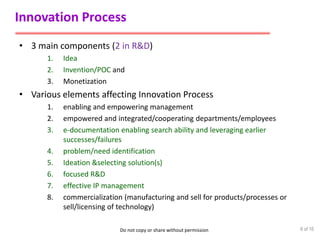
Innovation Process
• 3 main components (2 in R&D)
1. Idea
2. Invention/POC and
3. Monetization
• Various elements affecting Innovation Process
1. enabling and empowering management
2. empowered and integrated/cooperating departments/employees
3. e-documentation enabling search ability and leveraging earlier
successes/failures
4. problem/need identification
5. Ideation &selecting solution(s)
6. focused R&D
7. effective IP management
8. commercialization (manufacturing and sell for products/processes or
sell/licensing of technology)
6 of 16
Do not copy or share without permission
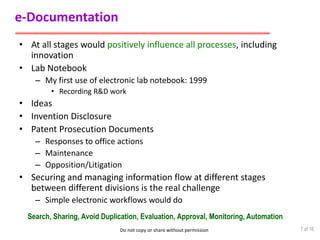
e-Documentation
• At all stages would positively influence all processes, including
innovation
• Lab Notebook
– My first use of electronic lab notebook: 1999
• Recording R&D work
• Ideas
• Invention Disclosure
• Patent Prosecution Documents
– Responses to office actions
– Maintenance
– Opposition/Litigation
• Securing and managing information flow at different stages
between different divisions is the real challenge
– Simple electronic workflows would do
7 of 16
Search, Sharing, Avoid Duplication, Evaluation, Approval, Monitoring, Automation
Do not copy or share without permission
Problem/Need Identification
• Why innovate?
– Solve/cater to current or future Problem/Need
• Feedback from end-user
• Feedback from Industry (Customer)
• Trend identification from market and/or IP analysis
• Vision
• Define exact Defect/Need
8 of 16
Do not copy or share without permission
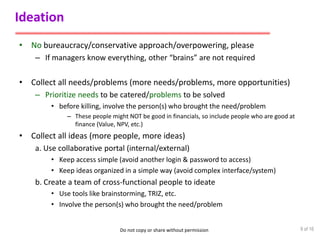
Ideation
• No bureaucracy/conservative approach/overpowering, please
– If managers know everything, other “brains” are not required
• Collect all needs/problems (more needs/problems, more opportunities)
– Prioritize needs to be catered/problems to be solved
• before killing, involve the person(s) who brought the need/problem
– These people might NOT be good in financials, so include people who are good at
finance (Value, NPV, etc.)
• Collect all ideas (more people, more ideas)
a. Use collaborative portal (internal/external)
• Keep access simple (avoid another login & password to access)
• Keep ideas organized in a simple way (avoid complex interface/system)
b. Create a team of cross-functional people to ideate
• Use tools like brainstorming, TRIZ, etc.
• Involve the person(s) who brought the need/problem
9 of 16
Do not copy or share without permission
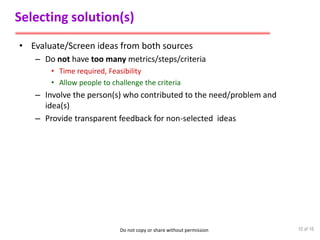
Selecting solution(s)
• Evaluate/Screen ideas from both sources
– Do not have too many metrics/steps/criteria
• Time required, Feasibility
• Allow people to challenge the criteria
– Involve the person(s) who contributed to the need/problem and
idea(s)
– Provide transparent feedback for non-selected ideas
10 of 16
Do not copy or share without permission
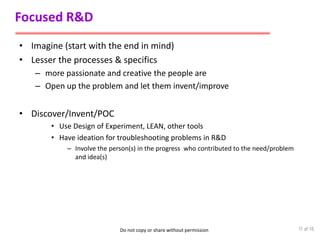
Focused R&D
• Imagine (start with the end in mind)
• Lesser the processes & specifics
– more passionate and creative the people are
– Open up the problem and let them invent/improve
• Discover/Invent/POC
• Use Design of Experiment, LEAN, other tools
• Have ideation for troubleshooting problems in R&D
– Involve the person(s) in the progress who contributed to the need/problem
and idea(s)
11 of 16
Do not copy or share without permission
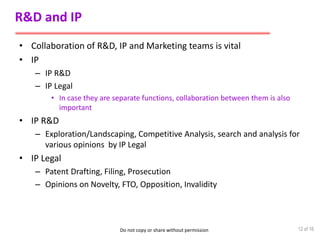
R&D and IP
• Collaboration of R&D, IP and Marketing teams is vital
• IP
– IP R&D
– IP Legal
• In case they are separate functions, collaboration between them is also
important
• IP R&D
– Exploration/Landscaping, Competitive Analysis, search and analysis for
various opinions by IP Legal
• IP Legal
– Patent Drafting, Filing, Prosecution
– Opinions on Novelty, FTO, Opposition, Invalidity
12 of 16
Do not copy or share without permission
Effective IP Management
• Ideation
– Providing prior art/landscape/blocked space before ideation
• Allow people to contemplate and think over the need and possible
solutions
• R&D
– Prior art searches for selected ideas/solutions
• Non-infringement
• Novelty
• Troubleshoot problems in R&D
• Patentability and/or non-infringement of working solution(s)
• Disclosure, Patent Application & Prosecution, Maintenance
– Automate steps/reminders
• Finding infringements/potential licensee
13 of 16
Do not copy or share without permission
Systematic Innovation
• Timely, Systematic (?) & Cost-effective
• Systematic innovation
– Balance between creativity and process discipline
– Systematic processes should provide platform to foster creativity
• The processes should be
– Simple (user friendly)
– Transparent (non-demotivating for people) and
– Flexible (fostering creativity)
14 of 16
Do not copy or share without permission
SUMMARY
• Have simple & elegant process(es)
• Use information technology (only) for
– Recording
– Knowledge sharing
– Smooth workflow
• Foster collaboration through information and credit sharing
• Define the defect (problem/need)
• Generate ideas and select potential solutions
• Optimize R&D stages (use DOE, Lean)
• Protect IP (wherever possible)
• Monetize
• IP team may effectively facilitate the whole innovation process
– Timely inputs at each stage
15 of 16
Do not copy or share without permission
If the innovation process at each stage is not managed well..
..incremental innovations, loss of opportunities and attrition is inevitable.
Happy Breakthrough Innovations!!!
16 of 16

20150101_GIPC-Madhav_1

  • 1.
    Do not copyor share without permission Innovation Process Management at Different Stages of R&D Madhav Kulkarni 17-Jan-2015 GIPC, 2015
  • 2.
    Do not copyor share without permission Contents • Innovation • The Dilemma • Innovation Process • Elements in R&D • Effective IP Management • Systematic Innovation • Summary 2 of 16
  • 3.
    Do not copyor share without permission Innovation • Innovation is for Business Value – Create – Add • timely, systematic & cost effective • Business Value for competitive advantage • Competitive advantage for Monetization – Make money – Save money 3 of 16
  • 4.
    Do not copyor share without permission Innovation • Idea to Monetization involves – Product/Service – Process (internal) – People • Managing 3P essential for successful innovation & monetization • The global innovation success average, across all geographies and all industries, was only 4 percent (According to a Doblin Group report , Business Week) • 2 Types of innovations – Breakthrough Innovation – Incremental Innovation (efficiency improvement, cost reduction, improved quality, etc.) 4 of 16
  • 5.
    Do not copyor share without permission The Dilemma • Big companies are poor innovators – Fixed Business Models • Less risk in following the same – Process Driven (too much/many) • Approvals (rise of bureaucracy) • Complicated processes & complex IT interfaces – Impatience • To try something creative • To failure – If adventure is dangerous, try routine (Kodak, Nokia) • INCREMENTAL INNOVATIONS • Breakthrough innovations? – Curiosity and creativity needs extreme of security (Google) or insecurity (Startups) 5 of 16
  • 6.
    Do not copyor share without permission Innovation Process • 3 main components (2 in R&D) 1. Idea 2. Invention/POC and 3. Monetization • Various elements affecting Innovation Process 1. enabling and empowering management 2. empowered and integrated/cooperating departments/employees 3. e-documentation enabling search ability and leveraging earlier successes/failures 4. problem/need identification 5. Ideation &selecting solution(s) 6. focused R&D 7. effective IP management 8. commercialization (manufacturing and sell for products/processes or sell/licensing of technology) 6 of 16
  • 7.
    Do not copyor share without permission e-Documentation • At all stages would positively influence all processes, including innovation • Lab Notebook – My first use of electronic lab notebook: 1999 • Recording R&D work • Ideas • Invention Disclosure • Patent Prosecution Documents – Responses to office actions – Maintenance – Opposition/Litigation • Securing and managing information flow at different stages between different divisions is the real challenge – Simple electronic workflows would do 7 of 16 Search, Sharing, Avoid Duplication, Evaluation, Approval, Monitoring, Automation
  • 8.
    Do not copyor share without permission Problem/Need Identification • Why innovate? – Solve/cater to current or future Problem/Need • Feedback from end-user • Feedback from Industry (Customer) • Trend identification from market and/or IP analysis • Vision • Define exact Defect/Need 8 of 16
  • 9.
    Do not copyor share without permission Ideation • No bureaucracy/conservative approach/overpowering, please – If managers know everything, other “brains” are not required • Collect all needs/problems (more needs/problems, more opportunities) – Prioritize needs to be catered/problems to be solved • before killing, involve the person(s) who brought the need/problem – These people might NOT be good in financials, so include people who are good at finance (Value, NPV, etc.) • Collect all ideas (more people, more ideas) a. Use collaborative portal (internal/external) • Keep access simple (avoid another login & password to access) • Keep ideas organized in a simple way (avoid complex interface/system) b. Create a team of cross-functional people to ideate • Use tools like brainstorming, TRIZ, etc. • Involve the person(s) who brought the need/problem 9 of 16
  • 10.
    Do not copyor share without permission Selecting solution(s) • Evaluate/Screen ideas from both sources – Do not have too many metrics/steps/criteria • Time required, Feasibility • Allow people to challenge the criteria – Involve the person(s) who contributed to the need/problem and idea(s) – Provide transparent feedback for non-selected ideas 10 of 16
  • 11.
    Do not copyor share without permission Focused R&D • Imagine (start with the end in mind) • Lesser the processes & specifics – more passionate and creative the people are – Open up the problem and let them invent/improve • Discover/Invent/POC • Use Design of Experiment, LEAN, other tools • Have ideation for troubleshooting problems in R&D – Involve the person(s) in the progress who contributed to the need/problem and idea(s) 11 of 16
  • 12.
    Do not copyor share without permission R&D and IP • Collaboration of R&D, IP and Marketing teams is vital • IP – IP R&D – IP Legal • In case they are separate functions, collaboration between them is also important • IP R&D – Exploration/Landscaping, Competitive Analysis, search and analysis for various opinions by IP Legal • IP Legal – Patent Drafting, Filing, Prosecution – Opinions on Novelty, FTO, Opposition, Invalidity 12 of 16
  • 13.
    Do not copyor share without permission Effective IP Management • Ideation – Providing prior art/landscape/blocked space before ideation • Allow people to contemplate and think over the need and possible solutions • R&D – Prior art searches for selected ideas/solutions • Non-infringement • Novelty • Troubleshoot problems in R&D • Patentability and/or non-infringement of working solution(s) • Disclosure, Patent Application & Prosecution, Maintenance – Automate steps/reminders • Finding infringements/potential licensee 13 of 16
  • 14.
    Do not copyor share without permission Systematic Innovation • Timely, Systematic (?) & Cost-effective • Systematic innovation – Balance between creativity and process discipline – Systematic processes should provide platform to foster creativity • The processes should be – Simple (user friendly) – Transparent (non-demotivating for people) and – Flexible (fostering creativity) 14 of 16
  • 15.
    Do not copyor share without permission SUMMARY • Have simple & elegant process(es) • Use information technology (only) for – Recording – Knowledge sharing – Smooth workflow • Foster collaboration through information and credit sharing • Define the defect (problem/need) • Generate ideas and select potential solutions • Optimize R&D stages (use DOE, Lean) • Protect IP (wherever possible) • Monetize • IP team may effectively facilitate the whole innovation process – Timely inputs at each stage 15 of 16
  • 16.
    Do not copyor share without permission If the innovation process at each stage is not managed well.. ..incremental innovations, loss of opportunities and attrition is inevitable. Happy Breakthrough Innovations!!! 16 of 16