Week 1 Wrangle Problems
Naay´e´e’ Neegh´an´ı (Monster Slayers) vs. T´o’baj´ıshch´ın´ı (Born for Water)
1. One January day, two cars drive on I-40 in opposite directions. Each car drives at a constant speed. One
leaves Flagstaff at 11:00 am and arrives in Albuquerque at 4:00 pm; the other one leaves Albuquerque
at noon and arrives in Flagstaff at 5:00 pm. When do the cars pass each other?
2. Solve the following cryptarithm:
BAA + BAA = EWE.
3. What is the value of the sum:
1 + 2 + 3 + 4 + · · · + 98 + 99 + 100 + 99 + 98 + · · · + 4 + 3 + 2 + 1.
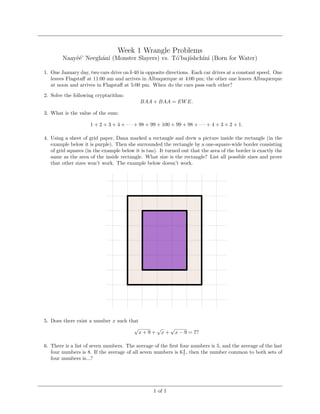
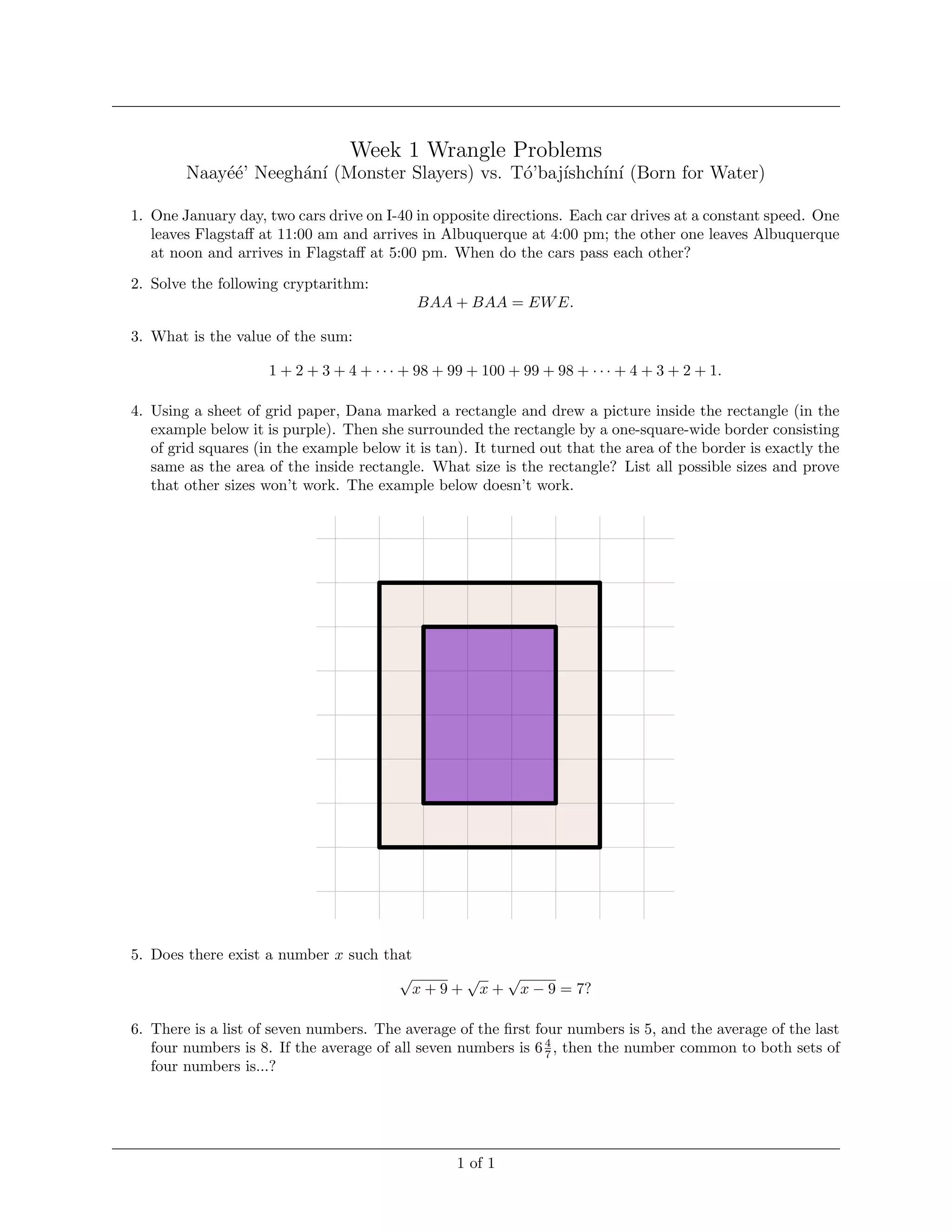
4. Using a sheet of grid paper, Dana marked a rectangle and drew a picture inside the rectangle (in the
example below it is purple). Then she surrounded the rectangle by a one-square-wide border consisting
of grid squares (in the example below it is tan). It turned out that the area of the border is exactly the
same as the area of the inside rectangle. What size is the rectangle? List all possible sizes and prove
that other sizes won’t work. The example below doesn’t work.
5. Does there exist a number x such that
√
x + 9 +
√
x +
√
x − 9 = 7?
6. There is a list of seven numbers. The average of the first four numbers is 5, and the average of the last
four numbers is 8. If the average of all seven numbers is 64
7 , then the number common to both sets of
four numbers is...?
1 of 1

2015 wrangle 1

  • 1.
    Week 1 WrangleProblems Naay´e´e’ Neegh´an´ı (Monster Slayers) vs. T´o’baj´ıshch´ın´ı (Born for Water) 1. One January day, two cars drive on I-40 in opposite directions. Each car drives at a constant speed. One leaves Flagstaff at 11:00 am and arrives in Albuquerque at 4:00 pm; the other one leaves Albuquerque at noon and arrives in Flagstaff at 5:00 pm. When do the cars pass each other? 2. Solve the following cryptarithm: BAA + BAA = EWE. 3. What is the value of the sum: 1 + 2 + 3 + 4 + · · · + 98 + 99 + 100 + 99 + 98 + · · · + 4 + 3 + 2 + 1. 4. Using a sheet of grid paper, Dana marked a rectangle and drew a picture inside the rectangle (in the example below it is purple). Then she surrounded the rectangle by a one-square-wide border consisting of grid squares (in the example below it is tan). It turned out that the area of the border is exactly the same as the area of the inside rectangle. What size is the rectangle? List all possible sizes and prove that other sizes won’t work. The example below doesn’t work. 5. Does there exist a number x such that √ x + 9 + √ x + √ x − 9 = 7? 6. There is a list of seven numbers. The average of the first four numbers is 5, and the average of the last four numbers is 8. If the average of all seven numbers is 64 7 , then the number common to both sets of four numbers is...? 1 of 1