Financial institutions
Energy
Infrastructure, mining and commodities
Transport
Technology and innovation
Life sciences and healthcare
2015 Litigation Trends
Annual Survey
Norton Rose Fulbright
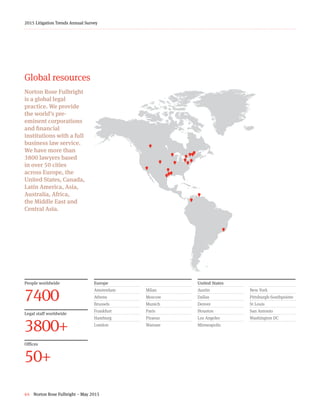
Norton Rose Fulbright is a global legal practice. We provide the world’s preeminent
corporations	and	fi	nancial	institutions	with	a	full	business	law	service.	We	have	more	than	
3800	lawyers	and	other	legal	staff		based	in	more	than	50	cities	across	Europe,	the	United	
States,	Canada,	Latin	America,	Asia,	Australia,	Africa,	the	Middle	East	and	Central	Asia.
Recognized	for	our	industry	focus,	we	are	strong	across	all	the	key	industry	sectors:	fi	nancial	
institutions;	energy;	infrastructure,	mining	and	commodities;	transport;	technology	and	
innovation;	and	life	sciences	and	healthcare.
Wherever	we	are,	we	operate	in	accordance	with	our	global	business	principles	of	quality,	
unity	and	integrity.	We	aim	to	provide	the	highest	possible	standard	of	legal	service	in	each	of	
our	offi		ces	and	to	maintain	that	level	of	quality	at	every	point	of	contact.
Norton	Rose	Fulbright	US	LLP,	Norton	Rose	Fulbright	LLP,	Norton	Rose	Fulbright	Australia,	
Norton	Rose	Fulbright	Canada	LLP	and	Norton	Rose	Fulbright	South	Africa	Inc	are	separate	
legal	entities	and	all	of	them	are	members	of	Norton	Rose	Fulbright	Verein,	a	Swiss	verein.	
Norton	Rose	Fulbright	Verein	helps	coordinate	the	activities	of	the	members	but	does	not	
itself	provide	legal	services	to	clients.
References	to	‘Norton	Rose	Fulbright’,	‘the	law	fi	rm’,	and	‘legal	practice’	are	to	one	or	more	of	the	Norton	Rose	Fulbright	members	or	to	one	of	their	
respective	affi		liates	(together	‘Norton	Rose	Fulbright	entity/entities’).	The	principal	offi		ce	of	Norton	Rose	Fulbright	US	LLP	in	Texas	is	in	Houston.	
Save	that	exclusively	for	the	purposes	of	compliance	with	US	bar	rules,	where	James	W.	Repass	will	be	responsible	for	the	content	of	this	publication,	
no	individual	who	is	a	member,	partner,	shareholder,	director,	employee	or	consultant	of,	in	or	to	any	Norton	Rose	Fulbright	entity	(whether	or	not	
such	individual	is	described	as	a	‘partner’)	accepts	or	assumes	responsibility,	or	has	any	liability,	to	any	person	in	respect	of	this	communication.	
Any	reference	to	a	partner	or	director	is	to	a	member,	employee	or	consultant	with	equivalent	standing	and	qualifi	cations	of	the	relevant	Norton	Rose	
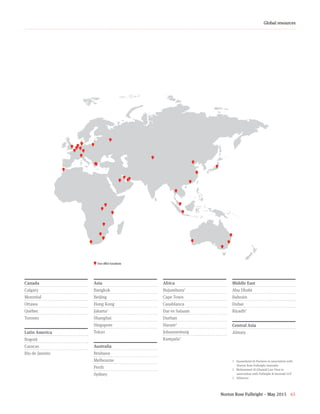
More than 50 locations, including Houston, New York, London,
Toronto, Hong Kong, Singapore, Sydney, Johannesburg, Dubai.
Attorney advertising
05	 Respondent profile
07	 Litigation overview
17	 Litigation costs and disputes trends
24	 Alternative fee arrangements
30	 Legal process outsourcing (LPO)
33	 Government and regulatory matters
38	 Electronic discovery
43	 International arbitration
48	 Class actions
51	 Intellectual property
59	 Forward-looking trends
Contents
The 2015 Litigation Trends Annual Survey commissioned by Norton Rose Fulbright
collects and presents the experiences and opinions of corporate counsel regarding
various aspects of litigation and disputes-related matters. An independent
research firm surveyed 803 participants working for companies headquartered
in 26 countries worldwide.1
The data is analyzed by geographic region, industry, company size in annual gross
revenues, amount of litigation spend and, where previous data points are available,
comparisons are drawn to historical survey findings (US year-end 2013 and UK year-
end 2012). All monetary values are stated in US dollars, unless otherwise noted.
Though in its eleventh year, in many ways this survey represents a new benchmark
for Litigation Trends. In addition to US and UK data, as in prior years, the survey also
includes responses from Australia, Canada, France, Germany and Asia, making this
the most far reaching survey of corporate counsel we have ever conducted. We look
forward to building on this new foundation next year and beyond.
1	 As with any survey, not all participants answered every question. The sum of percentages may total more or less than 100% due to rounding and/or respondents being given more than one option.
Norton Rose Fulbright – May 2015 03
04 Norton Rose Fulbright – May 2015
2015 Litigation trends annual survey
This year’s Litigation Trends Survey – our 11th annual – is the most extensive in our
history and truly represents a global outlook. More than 800 corporate counsel from
26 countries participated, giving us unique insights into the litigation issues and trends
that are affecting businesses around the world, from the most common types of cases
companies face to the approach they take in managing disputes.
Gerry Pecht
Global Head of Dispute Resolution and Litigation, United States
Tel +1 713 651 5243
gerard.pecht@nortonrosefulbright.com
While each country or region surveyed is unique, one common
theme comes through loud and clear – corporate counsel
around the world see the growing litigiousness of the business
environment as an important trend that bears watching.
This is especially true with regard to regulatory investigations
and class action lawsuits, both of which are increasing in scope
and frequency.
When asked to choose the top three to five types of legal
disputes that are of greatest concern to their company,
39 percent of respondents to this year’s survey selected
“Regulatory/Investigations,” more than any other option.
In addition, half of all respondents to this year’s survey
said they had spent more time during the last three years
addressing regulatory requests or enforcement proceedings.
“The regulatory environment is becoming increasingly tough
and therefore we are expecting more and more challenges in
this area,” said one general counsel from the UK.
This same sentiment is shared in the US. One US-based
general counsel said, “The federal government has added
a lot of additional regulatory requirements on us, and I see
an increase in external entities coming to our campus to
investigate our compliance.”
The increase in lawsuits and potential lawsuits faced by
companies worldwide, along with the trend toward more
regulatory oversight and investigations, results in higher
litigation budgets and more time and attention required on
behalf of legal departments and senior executives.
As one respondent – the general counsel for an Australian
company – said: “A lot of times these lawsuits are without
foundation, and you end up tackling them just to avoid the
ongoing cost of being involved in the process.”
Some of this is driven by technology, which is making it easier
and less expensive than ever before to develop a class action,
regardless of whether or not there is actually harm. The growth
in class actions is adding to an already substantial array of
legal and regulatory challenges that firms face as they do
business in a more complex world.
Looking forward, approximately 25 percent said they believe
the number of legal disputes their company will face in
the next 12 months will increase. These trends have a real-
world impact on the way companies will interact with the
marketplace, and with each other, in the years to come.
This year’s white paper contains a great deal of interesting
information and insight, with analysis broken down by
country/region and by industry. It provides a fascinating look
at the state of corporate litigation today, and will give us a
unique data set to benchmark against for future surveys.
Norton Rose Fulbright – May 2015 05
01
Chapter 1
Respondent profile
06 Norton Rose Fulbright – May 2015
2015 Litigation Trends Annual Survey
* 	 Europe includes primarily Germany and France but also includes organizations headquartered in Switzerland, The Netherlands,
Norway, Spain and elsewhere.
† 	 Asia includes organizations headquartered in Hong Kong, Singapore, Japan and China.
†† 	 Among the larger companies, 41% have revenues of $5 billion or more.
Respondent profile
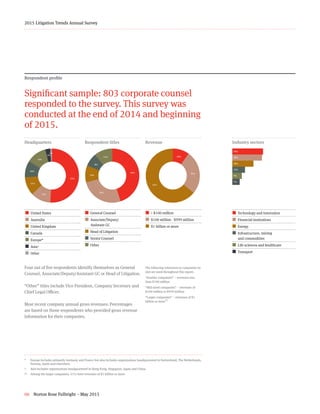
Significant sample: 803 corporate counsel
responded to the survey. This survey was
conducted at the end of 2014 and beginning
of 2015.
51+12+11+10+12+3+1+z¢  United States
¢  Australia
¢  United Kingdom
¢ Canada
¢  Europe*
¢  Asia†
¢  Other
Headquarters
Four out of five respondents identify themselves as General
Counsel, Associate/Deputy/Assistant GC or Head of Litigation.
“Other” titles include Vice President, Company Secretary and
Chief Legal Officer.
Most recent company annual gross revenues: Percentages
are based on those respondents who provided gross revenue
information for their companies.
45+26+10+8+11+z¢  General Counsel
¢  Associate/Deputy/
       Assistant GC
¢  Head of Litigation
¢ Senior Counsel
¢  Other
Respondent titles
10+26+64+z¢  < $100 million
¢ $100 million - $999 million
¢  $1 billion or more
Revenue
The following references to companies by
size are used throughout this report:
“Smaller companies” – revenues less
than $100 million
“Mid-sized companies” – revenues of
$100 million to $999 million
“Larger companies” – revenues of $1
billion or more††
Industry sectors
29+28+20+12+9+7¢  Technology and innovation
¢ Financial institutions
¢  Energy
¢ Infrastructure, mining
and commodities
¢  Life sciences and healthcare
¢  Transport
29%
28%
20%
12%
9%
7%
1%
3%
52%
12%
11%
10%
12%
46%
26%
10%
8%
11% 10%
26%
65%
Norton Rose Fulbright – May 2015 07
02
Chapter 2
Litigation overview
08 Norton Rose Fulbright – May 2015
2015 Litigation Trends Annual Survey
Litigation overview
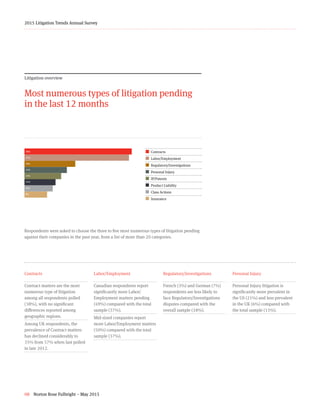
Most numerous types of litigation pending
in the last 12 months
Contracts
Contract matters are the most
numerous type of litigation
among all respondents polled
(38%), with no significant
differences reported among
geographic regions.
Among UK respondents, the
prevalence of Contract matters
has declined considerably to
35% from 57% when last polled
in late 2012.
Labor/Employment
Canadian respondents report
significantly more Labor/
Employment matters pending
(49%) compared with the total
sample (37%).
Mid-sized companies report
more Labor/Employment matters
(50%) compared with the total
sample (37%).
Regulatory/Investigations
French (3%) and German (7%)
respondents are less likely to
face Regulatory/Investigations
disputes compared with the
overall sample (18%).
Personal Injury
Personal Injury litigation is
significantly more prevalent in
the US (21%) and less prevalent
in the UK (6%) compared with
the total sample (15%).  
38+37+18+15+13+11+10+8¢  Contracts
¢  Labor/Employment
¢  Regulatory/Investigations
¢ Personal Injury
¢  IP/Patents
¢  Product Liability
¢  Class Actions
¢  Insurance
Respondents were asked to choose the three to five most numerous types of litigation pending
against their companies in the past year, from a list of more than 20 categories.  
38%
37%
18%
15%
13%
11%
10%
8%
Norton Rose Fulbright – May 2015 09
Litigation overview
IP/Patents
IP/Patents litigation is
more common among US
respondents (18%) than among
all respondents (13%), while
it is less common among UK
(7%) and Australian (6%)
respondents.
IP/Patents are more prevalent
among Life sciences and
healthcare respondents (34%)
than for the total sample (13%).
Larger organizations encounter
more IP/Patents (18%) compared
with all respondents (13%).
Product Liability
The prominence of Product
Liability cases among
respondents (11%) is driven
primarily by the US, where 17%
report these among their most
numerous pending matters.
Far fewer Australian (3%),
Canadian (4%) and British (3%)
respondents report such matters
as among the most numerous.
Life sciences and healthcare
respondents list Product Liability
as among the most prevalent
disputes far more often (30%)
than for the total base (11%).
Larger organizations are more
likely to experience Product
Liability (17%) disputes
compared with all
respondents (11%).
Class/Group Actions
Only 4% of respondents in
Australia list Class/Group
Action cases as among the most
common, compared with 10% for
the total sample.
Banking/Finance
In the UK, Banking/Finance
disputes (16%) are much more
common than for the total
sample (7%).
Insurance
Financial institutions (19%) are
more likely to face Insurance
litigation compared with their
peers (8%).
Other litigation types
Energy companies experience
Environmental/Toxic Tort
litigation as a top dispute
type more often (21%) than
reported by all respondents
(7%). Company/Commercial
Construction litigation is
more prevalent in Canada
(15%) compared with all
respondents (5%).
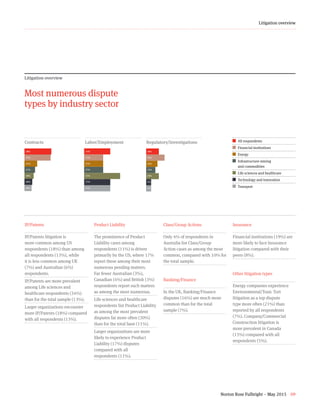
Litigation overview
Most numerous dispute
types by industry sector
Contracts
38+37+18+15+13+11+10
¢  All respondents
¢ Financial institutions
¢  Energy
¢ Infrastructure mining
and commodities
¢  Life sciences and healthcare
¢  Technology and innovation
¢  Transport
Labor/Employment
37+27+27+27+51+37+37
Regulatory/Investigations
18+26+16+13+18+7+738%
31%
47%
57%
18%
40%
40%
%
37%
27%
27%
27%
51%
37%
37%
%
18%
26%
16%
13%
18%
5%
5%
%
10 Norton Rose Fulbright – May 2015
2015 Litigation Trends Annual Survey
Litigation overview
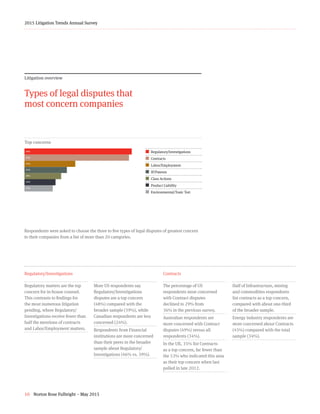
Types of legal disputes that
most concern companies
Regulatory/Investigations
Regulatory matters are the top
concern for in-house counsel.  
This contrasts to findings for
the most numerous litigation
pending, where Regulatory/
Investigations receive fewer than
half the mentions of contracts
and Labor/Employment matters.
More US respondents say
Regulatory/Investigations
disputes are a top concern
(48%) compared with the
broader sample (39%), while
Canadian respondents are less
concerned (24%).
Respondents from Financial
institutions are more concerned
than their peers in the broader
sample about Regulatory/
Investigations (46% vs. 39%).
Contracts
The percentage of US
respondents most concerned
with Contract disputes
declined to 29% from
36% in the previous survey.
Australian respondents are
more concerned with Contract
disputes (49%) versus all
respondents (34%).
In the UK, 35% list Contracts
as a top concern, far fewer than
the 53% who indicated this area
as their top concern when last
polled in late 2012.
Half of Infrastructure, mining
and commodities respondents
list contracts as a top concern,
compared with about one-third
of the broader sample.
Energy industry respondents are
more concerned about Contracts
(45%) compared with the total
sample (34%).
Top concerns
38+37+18+15+13+11+10+¢  Regulatory/Investigations
¢  Contracts
¢  Labor/Employment
¢ IP/Patents
¢  Class Actions
¢  Product Liability
¢  Environmental/Toxic Tort
Respondents were asked to choose the three to five types of legal disputes of greatest concern
to their companies from a list of more than 20 categories.
39%
34%
33%
21%
18%
14%
13%
%
Norton Rose Fulbright – May 2015 11
Litigation overview
Labor/Employment
On Labor/Employment matters,
Canadians are most concerned
(45%), while UK respondents
were less so (21%), compared
with the entire sample (33%).
Technology and innovation
respondents are more concerned
with Labor/Employment
(44%) compared with their
peers  (33%).
IP/Patents
IP/Patents disputes are of
greater concern in the US (30%)
compared with all respondents
(21%). Only about one in ten
respondents in Australia, Canada
and the UK list IP/Patents among
their top dispute concerns.
Life sciences and healthcare
(45%) and Technology and
innovation respondents are more
concerned with IP/Patents (37%)
compared with the broader
sample (21%).
Class Actions
More US respondents list Class
Actions as a top concern (25%)
compared with the total sample
(18%).  In the UK, the proportion
of respondents concerned with
Class Actions fell to 10% from
27% when polled two years ago.
Product Liability
Concern over Product Liability
disputes varies greatly by
region: US respondents are
most concerned (18%),
while UK respondents are less
concerned (8%) about Product
liability compared with all
respondents (14%).
Life sciences and healthcare
counsel are more concerned with
Product Liability (32% vs. 14%).
Environmental/Toxic Tort
Energy industry respondents
are more concerned about
Environmental/Toxic Tort
(38%) compared with the
total sample (13%).
Other litigation types
Banking/Finance disputes are of
concern to more UK respondents
(21%) compared with the total
sample (9%).
Company/Commercial
Construction is of concern
to more Australian (14%)
and Canadian (17%) survey
respondents compared with the
overall sample (6%).
Respondents from Financial
institutions are more concerned
than their peers in the broader
sample about Securities
Litigation/Enforcement (20% vs.
11%), Banking/Finance disputes
(28% vs. 9%) and Insurance
disputes (22% vs. 8%)
Mining and Commodities
respondents are more concerned
about Company/Commercial
Construction (21%) than their
peers (8%).
Life sciences and healthcare
counsel are more concerned with
Professional Malpractice (29%)
compared with the broader
sample (7%).
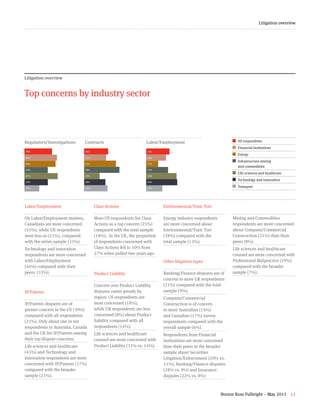
Litigation overview
Top concerns by industry sector
Regulatory/Investigations
39+46+44+33+47+33+21
¢  All respondents
¢ Financial institutions
¢  Energy
¢ Infrastructure mining
and commodities
¢  Life sciences and healthcare
¢  Technology and innovation
¢  Transport
Contracts
34+31+45+50+22+30+33
Labor/Employment
33+28+17+31+43+44+2339%
46%
44%
33%
47%
33%
21%
%
34%
31%
45%
50%
22%
30%
33%
%
33%
28%
17%
31%
43%
44%
23%
%
12 Norton Rose Fulbright – May 2015
2015 Litigation Trends Annual Survey
Litigation overview
Lawsuits/proceedings commenced against
companies in the last 12 months
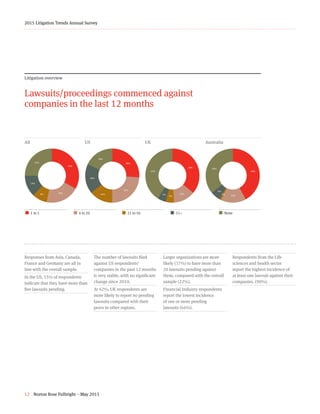
33+20+9+13+25+z
All
26+24+14+18+18+z
US
Responses from Asia, Canada,
France and Germany are all in
line with the overall sample.
In the US, 55% of respondents
indicate that they have more than
five lawsuits pending.
The number of lawsuits filed
against US respondents’
companies in the past 12 months
is very stable, with no significant
change since 2010.
At 42%, UK respondents are
more likely to report no pending
lawsuits compared with their
peers in other regions.
Larger organizations are more
likely (37%) to have more than
20 lawsuits pending against
them, compared with the overall
sample (22%).
Financial Industry respondents
report the lowest incidence
of one or more pending
lawsuits (66%).
Respondents from the Life
sciences and health sector
report the highest incidence of
at least one lawsuit against their
companies. (90%).
¢  1 to 5 ¢  6 to 20 ¢  21 to 50 ¢ 51+ ¢ None
36+13+5+5+41+z
UK
42+15+1+6+36+z
Australia
33%
20%9%
13%
25% 26%
24%
14%
18%
18%
36%
13%
5%
5%
42%
36%
43%
15%
6%
1%
Norton Rose Fulbright – May 2015 13
Litigation overview
Litigation overview
Lawsuits with $20M+ at issue
against respondent companies
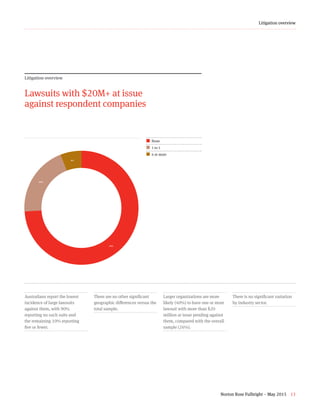
74+20+6+zAustralians report the lowest
incidence of large lawsuits
against them, with 90%
reporting no such suits and
the remaining 10% reporting
five or fewer.
There are no other significant
geographic differences versus the
total sample.
Larger organizations are more
likely (40%) to have one or more
lawsuit with more than $20
million at issue pending against
them, compared with the overall
sample (26%).
There is no significant variation
by industry sector.
¢ None
¢  1 to 5
¢  6 or more
74%
6%
20%
14 Norton Rose Fulbright – May 2015
2015 Litigation Trends Annual Survey
Litigation overview
Lawsuits commenced by companies
in the last 12 months
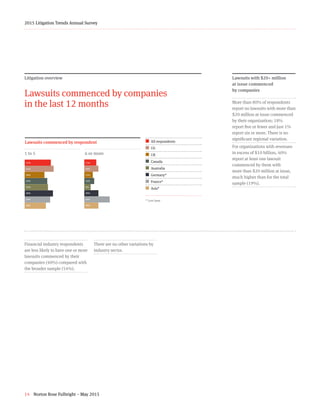
Financial industry respondents
are less likely to have one or more
lawsuits commenced by their
companies (40%) compared with
the broader sample (54%).
There are no other variations by
industry sector.
Lawsuits commenced by respondent
37+41+28+32+33+40+36+30
¢  All respondents
¢  US
¢  UK
¢ Canada
¢  Australia
¢  Germany*
¢ France*
¢  Asia*
17+20+12+14+9+20+36+20
* Low base
1 to 5 6 or more
Lawsuits with $20+ million
at issue commenced
by companies
More than 80% of respondents
report no lawsuits with more than
$20 million at issue commenced
by their organization; 18%
report five or fewer and just 1%
report six or more. There is no
significant regional variation.
For organizations with revenues
in excess of $10 billion, 40%
report at least one lawsuit
commenced by them with
more than $20 million at issue,
much higher than for the total
sample (19%).
17%
20%
12%
14%
9%
20%
36%
20%
37%
41%
28%
32%
33%
40%
36%
30%
Norton Rose Fulbright – May 2015 15
Litigation overview
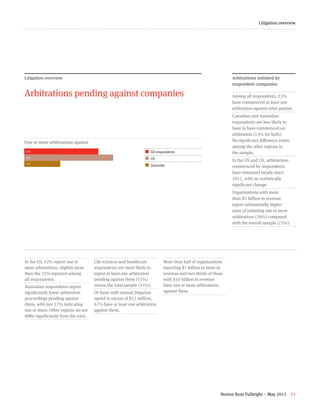
In the US, 42% report one or
more arbitrations, slightly more
than the 35% reported among
all respondents.
Australian respondents report
significantly fewer arbitration
proceedings pending against
them, with just 17% indicating
one or more. Other regions do not
differ significantly from the total.
Life sciences and healthcare
respondents are more likely to
report at least one arbitration
pending against them (51%)
versus the total sample (35%).
Of those with annual litigation
spend in excess of $15 million,
67% have at least one arbitration
against them.
More than half of organizations
reporting $1 billion or more in
revenue and two-thirds of those
with $10 billion in revenue
have one or more arbitrations
against them.
Litigation overview
Arbitrations pending against companies
One or more arbitrations against
35+42+17¢  All respondents
¢  US
¢  Australia
Arbitrations initiated by
respondent companies
Among all respondents, 23%
have commenced at least one
arbitration against other parties.
Canadian and Australian
respondents are less likely to
have to have commenced an
arbitration (13% for both).
No significant difference exists
among the other regions in
the sample.
In the US and UK, arbitrations
commenced by respondents
have remained steady since
2011, with no statistically
significant change.
Organizations with more
than $1 billion in revenue
report substantially higher
rates of initiating one or more
arbitrations (38%) compared
with the overall sample (23%).
35%
42%
17%
16 Norton Rose Fulbright – May 2015
2015 Litigation Trends Annual Survey
Litigation overview
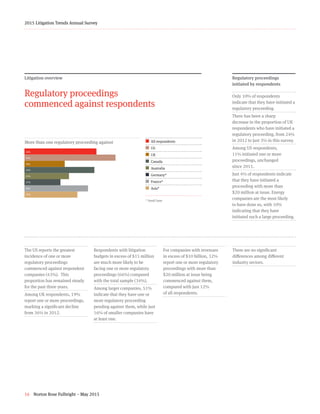
Regulatory proceedings
commenced against respondents
The US reports the greatest
incidence of one or more
regulatory proceedings
commenced against respondent
companies (43%).  This
proportion has remained steady
for the past three years.
Among UK respondents, 19%
report one or more proceedings,
marking a significant decline
from 36% in 2012.
Respondents with litigation
budgets in excess of $15 million
are much more likely to be
facing one or more regulatory
proceedings (66%) compared
with the total sample (34%).
Among larger companies, 51%
indicate that they have one or
more regulatory proceeding
pending against them, while just
16% of smaller companies have
at least one.
For companies with revenues
in excess of $10 billion, 32%
report one or more regulatory
proceedings with more than
$20 million at issue being
commenced against them,
compared with just 12%
of all respondents.
There are no significant
differences among different
industry sectors.
More than one regulatory proceeding against
34+43+19+33+21+17+30+25¢  All respondents
¢  US
¢  UK
¢ Canada
¢  Australia
¢  Germany*
¢ France*
¢  Asia*
* Small base
Regulatory proceedings
initiated by respondents
Only 10% of respondents
indicate that they have initiated a
regulatory proceeding.
There has been a sharp
decrease in the proportion of UK
respondents who have initiated a
regulatory proceeding, from 24%
in 2012 to just 3% in this survey.
Among US respondents,
11% initiated one or more
proceedings, unchanged
since 2011.
Just 4% of respondents indicate
that they have initiated a
proceeding with more than
$20 million at issue. Energy
companies are the most likely
to have done so, with 10%
indicating that they have
initiated such a large proceeding.
34%
43%
19%
33%
21%
17%
30%
25%
Norton Rose Fulbright – May 2015 17
03
Chapter 3
Litigation costs and disputes trends
18 Norton Rose Fulbright – May 2015
2015 Litigation Trends Annual Survey
Litigation costs and disputes trends
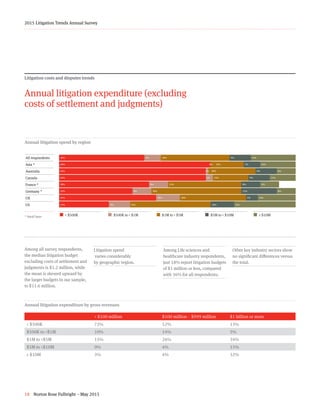
Annual litigation expenditure (excluding
costs of settlement and judgments)
Annual litigation spend by region
10081724336¢  < $500K ¢  $500K to < $1M ¢  $1M to < $5M ¢ $5M to < $10M ¢  ≥ $10M
10085784364100928363621008172433610089806562938577463810092773931100847951411008172433610074643021All respondents
Asia *
Australia
Canada
France *
Germany *
UK
US
* Small base
Litigation spend
varies considerably
by geographic region.
Among Life sciences and
healthcare industry respondents,
just 18% report litigation budgets
of $1 million or less, compared
with 36% for all respondents.
Other key industry sectors show
no significant differences versus
the total.
Among all survey respondents,
the median litigation budget
excluding costs of settlement and
judgments is $1.2 million, while
the mean is skewed upward by
the larger budgets in our sample,
to $11.6 million.
Annual litigation expenditure by gross revenues
< $100 million $100 million -  $999 million $1 billion or more
< $500K 72% 52% 13%
$500K to <$1M 10% 14% 5%
$1M to <$5M 15% 26% 34%
$5M to <$10M 0% 4% 15%
≥ $10M 3% 4% 32%
36%
64%
62%
62%
38%
31%
41%
21%
7%
0%
2%
4%
8%
8%
10%
9%
9%
7%
9%
9%
8%
15%
5%
10%
19%
14%
8%
11%
8%
8%
16%
25%
29%
14%
20%
15%
31%
38%
28%
34%
Norton Rose Fulbright – May 2015 19
Litigation costs and disputes trends
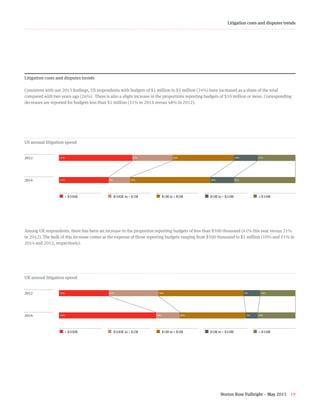
US annual litigation spend
10084744831¢  < $500K ¢  $500K to < $1M ¢  $1M to < $5M ¢ $5M to < $10M ¢  ≥ $10M
100746430212012
2014
31%
21%
Consistent with our 2013 findings, US respondents with budgets of $1 million to $5 million (34%) have increased as a share of the total
compared with two years ago (26%).  There is also a slight increase in the proportions reporting budgets of $10 million or more. Corresponding
decreases are reported for budgets less than $1 million (31% in 2014 versus 48% in 2012).
Among UK respondents, there has been an increase in the proportion reporting budgets of less than $500 thousand (41% this year versus 21%
in 2012). The bulk of this increase comes at the expense of those reporting budgets ranging from $500 thousand to $1 million (10% and 21% in
2014 and 2012, respectively).
17%
9%
26%
34%
10%
10%
17%
25%
UK annual litigation spend
10085784221
¢  < $500K ¢  $500K to < $1M ¢  $1M to < $5M ¢ $5M to < $10M ¢  ≥ $10M
10084795141
2012
2014
21%
41%
21%
10%
36%
28%
7%
5%
14%
16%
20 Norton Rose Fulbright – May 2015
2015 Litigation Trends Annual Survey
Litigation costs and disputes trends
Do you expect the number of legal disputes your company will face
in the next 12 months to increase, decrease or stay the same?
25+59+14+2+z
All respondents
¢  Increase
¢ Stay the same
¢  Decrease
¢ None pending
There are no significant
differences by region,
industry sector or
company size.
Sentiments in the US and UK
are unchanged since 2012,
the last time this question
was posed.
Why do you expect an increase?
23+17+12+8¢  Company is expanding / growing (incl. M&A)
¢  Aware of disputes that are likely to emerge
¢  Increasingly litigious environment /
       impact of high profile settlements
¢ Economic climate
“As we acquire more assets, that necessarily brings more
opportunity for disputes.” – US Energy Company GC
“We have got a few matters that are on the horizon that
we can see already.” – UK Energy AGC
“I think [Australia is] becoming a more litigious
environment.” – Australian Transport Company GC
“We all are expecting a softer economy next year and
that usually will bring about more disputes.” – US
Finance AGC
“Because relations with suppliers, or with partners,
are more and more tense. Negotiations getting more
complicated.” – French Technology & Innovation GC
“Increasing appetite of external regulators to
bring FCPA/UK Bribery Act enforcement claims.” –
Asia-based Chief Compliance Officer of US Technology
& Innovation company
Why do you expect a decrease?
33+23+21+10
¢  Current disputes will be resolved
¢  Do not anticipate new disputes / cases arising
¢  Better management / prevention /
       more proactive (inc. contacts)
¢ Higher number of disputes than normal this year /
      disputes will decline / revert to usual level
“Because what we have pending right now is probably
going to be resolved by the end of the year.” – US
Technology & Innovation Company GC
“We have implemented some new procedures for our
front-line personnel so that we are addressing disputes
before they become litigious.” - Canadian Infrastructure,
mining and commodities industry GC
“We are just getting tighter on our legal spend, and
probably will be looking for ways to keep control of it.”	
- Chinese Financial Institution GC
25%
59%
14%
2%
23%
17%
12%
8%
33%
23%
21%
10%
Norton Rose Fulbright – May 2015 21
Litigation costs and disputes trends
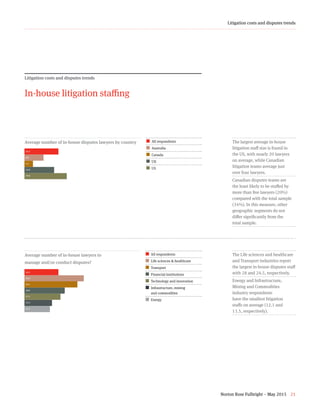
In-house litigation staffing
The largest average in-house
litigation staff size is found in
the US, with nearly 20 lawyers
on average, while Canadian
litigation teams average just
over four lawyers.
Canadian disputes teams are
the least likely to be staffed by
more than five lawyers (20%)
compared with the total sample
(34%). In this measure, other
geographic segments do not
differ significantly from the
total sample.
Average number of in-house disputes lawyers by country
16+9+4+14+20¢  All respondents
¢  Australia
¢  Canada
¢ UK
¢  US
The Life sciences and healthcare
and Transport industries report
the largest in-house disputes staff
with 28 and 24.5, respectively.
Energy and Infrastructure,
Mining and Commodities
industry respondents
have the smallest litigation
staffs on average (12.1 and
13.5, respectively).
Average number of in-house lawyers to
manage and/or conduct disputes?
16+28+25+19+17+13+12
¢  All respondents
¢  Life sciences & healthcare
¢  Transport
¢ Financial institutions
¢  Technology and innovation
¢  Infrastructure, mining
and commodities
¢  Energy
16.3
8.8
4.3
14.0
19.8
%
%
%
16.3
28.0
24.5
18.9
17.5
13.5
12.1
%
22 Norton Rose Fulbright – May 2015
2015 Litigation Trends Annual Survey
Litigation costs and disputes trends
During the next 12 months, do you expect
the number of in-house lawyers within your
company who manage and/or conduct
disputes to increase, decrease or stay the same?
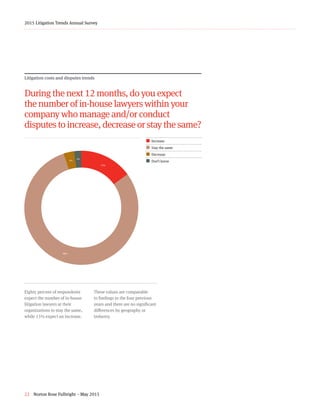
15+80+3+2+zEighty percent of respondents
expect the number of in-house
litigation lawyers at their
organizations to stay the same,
while 15% expect an increase.  
These values are comparable
to findings in the four previous
years and there are no significant
differences by geography or
industry.
¢  Increase
¢ Stay the same
¢  Decrease
¢  Don’t know
80%
15%
2%
3%
Norton Rose Fulbright – May 2015 23
Litigation costs and disputes trends
Over the past 12 months, has the number
of law firms on your outside counsel
disputes roster increased, decreased
or stayed the same?
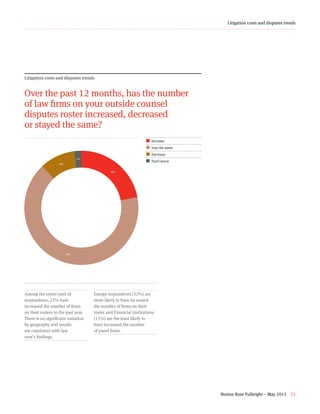
22+66+10+2+zAmong the entire pool of
respondents, 22% have
increased the number of firms
on their rosters in the past year.
There is no significant variation
by geography and results
are consistent with last
year’s findings.
Energy respondents (32%) are
more likely to have increased
the number of firms on their
roster and Financial institutions
(15%) are the least likely to
have increased the number
of panel firms.
¢  Increase
¢ Stay the same
¢  Decrease
¢  Don’t know
66%
22%
2%
10%
24 Norton Rose Fulbright – May 2015
04
Chapter 4
Alternative fee arrangements
Norton Rose Fulbright – May 2015 25
Alternative fee arrangements
Does your company use alternative fee
arrangements (AFAs)?
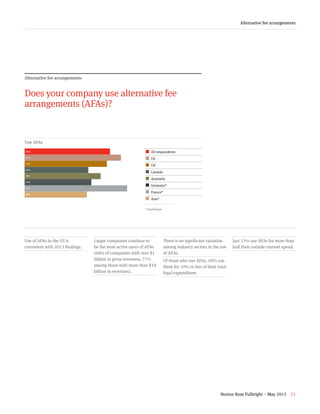
Use of AFAs in the US is
consistent with 2013 findings.
Larger companies continue to
be the most active users of AFAs
(68% of companies with over $1
billion in gross revenues; 77%
among those with more than $10
billion in revenues).
There is no significant variation
among industry sectors in the use
of AFAs.
Of those who use AFAs, 40% use
them for 10% or less of their total
legal expenditure.
Just 13% use AFAs for more than
half their outside counsel spend.
Use AFAs
55+62+53+41+49+43+66+40
¢  All respondents
¢  US
¢  UK
¢ Canada
¢  Australia
¢  Germany*
¢ France*
¢  Asia*
* Small base
56%
62%
53%
41%
49%
43%
66%
40%
26 Norton Rose Fulbright – May 2015
2015 Litigation Trends Annual Survey
Alternative fee arrangements
Most used types of AFAs
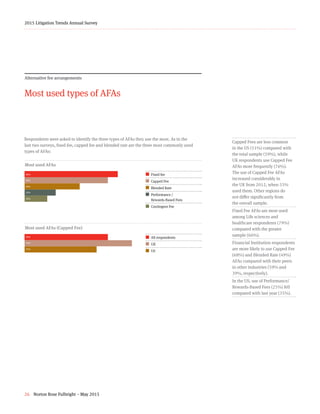
Capped Fees are less common
in the US (51%) compared with
the total sample (59%), while
UK respondents use Capped Fee
AFAs more frequently (76%).
The use of Capped Fee AFAs
increased considerably in
the UK from 2012, when 55%
used them. Other regions do
not differ significantly from
the overall sample.
Fixed Fee AFAs are most used
among Life sciences and
healthcare respondents (79%)
compared with the greater
sample (66%).
Financial Institution respondents
are more likely to use Capped Fee
(68%) and Blended Rate (49%)
AFAs compared with their peers
in other industries (59% and
39%, respectively).
In the US, use of Performance/
Rewards-Based Fees (25%) fell
compared with last year (35%).
Most used AFAs
66+59+39+22+16
¢  Fixed fee
¢  Capped Fee
¢  Blended Rate
¢ Performance /
       Rewards-Based Fees
¢  Contingent Fee
Respondents were asked to identify the three types of AFAs they use the most. As in the
last two surveys, fixed fee, capped fee and blended rate are the three most commonly used
types of AFAs:
Most used AFAs (Capped Fee)
59+76+51
¢  All respondents
¢  UK
¢  US
66%
59%
39%
22%
16%
%
%
%
59%
76%
51%
%
%
%
%
%
Norton Rose Fulbright – May 2015 27
Alternative fee arrangements
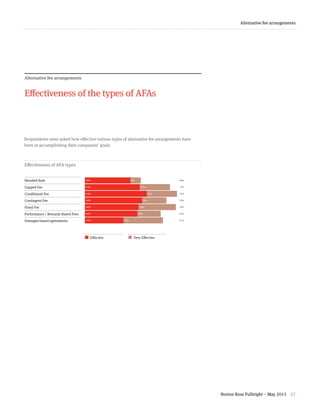
Effectiveness of the types of AFAs
Respondents were asked how effective various types of alternative fee arrangements have
been in accomplishing their companies’ goals.
Effectiveness of AFA types
4839
¢  Effective ¢  Very Effective
734779537049784665456733
Blended Rate
Capped Fee
Conditional Fee
Contingent Fee
Fixed Fee
Performance / Rewards-Based Fees
Damages-based agreements
39%
47%
53%
49%
46%
45%
33%
9%
27%
26%
20%
32%
20%
33%
48%
73%
79%
70%
78%
65%
67%
28 Norton Rose Fulbright – May 2015
2015 Litigation Trends Annual Survey
41+57+2+z
Expectations of an increase in AFA use ¢  Increase
¢ Stay the same
¢  Decrease
Alternative fee arrangements
Expectations of an increase in AFA use
Respondents were asked if they expect their use of AFAs to increase, decrease or stay the
same over the next 12 months.
Why are respondents expecting
to increase use of AFAs?
“These arrangements lower legal
spend generally. They also tend
to speed transactions by limiting
‘make work’ advisor behaviour.” –
Australia-based GC of a Hong
Kong Transport Company
“Success in alternative fee billing is an
extremely effective way of measuring
just how good (1) the in-house legal
department is, and (2) how well
external counsel is performing.” –
Canadian Energy Company GC
“Because a fixed price, for example,
could in some cases be of more
interest than an agreed hourly rate
– easier to calculate.” – German
Financial Industry Senior Counsel
“Just to be able to go to [our board of
directors] and say ‘a second opinion
on this will cost ten thousand pounds
or twenty thousand pounds’ is just so
helpful. So I suspect that having had
the positive experience… it’s likely that
we will do it more.” – UK Financial
Industry Senior Counsel
“We want to move to value-based
arrangements because we think that is
a better alignment of incentives – for
both the corporation and law firm.” –
US Technology & Innovation AGC
Among US and UK respondents,
there was no change versus 2012
and 2013 surveys.
There are no significant
differences among regional
or industry segments.
41%
57%
2%
Norton Rose Fulbright – May 2015 29
Alternative fee arrangements
Perhaps not surprisingly, large organizations are more likely to expect an increase in their use
of AFAs in 2015.
Alternative fee arrangements
Company size is a good predictor
of rising use of AFAs:
Expect to increase use of AFAs by company revenue
24+36+48¢  < $100 million
¢  $100 million - $999 million
¢  $1 billion or more
Experience with AFAs
More than 97% of respondents
who have experience with AFAs
are satisfied with the work
performed under Alternative
Fee Arrangements.
24%
36%
48%
30 Norton Rose Fulbright – May 2015
05
Chapter 5
Legal Process Outsourcing (LPO)
Norton Rose Fulbright – May 2015 31
Legal Process Outsourcing (LPO)
Have you employed any of the following
strategies in the last 12 months?
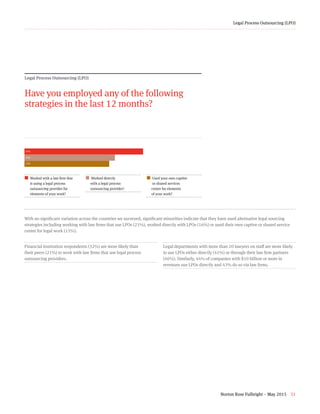
Financial Institution respondents (32%) are more likely than
their peers (21%) to work with law firms that use legal process
outsourcing providers.
Legal departments with more than 20 lawyers on staff are more likely
to use LPOs either directly (41%) or through their law firm partners
(46%). Similarly, 44% of companies with $10 billion or more in
revenues use LPOs directly and 43% do so via law firms.
21+16+15¢  Worked with a law firm that
is using a legal process
       outsourcing provider for
       elements of your work?
¢  Worked directly
with a legal process
      outsourcing provider?
¢  Used your own captive
or shared services
      center for elements
      of your work?
With no significant variation across the countries we surveyed, significant minorities indicate that they have used alternative legal sourcing
strategies including working with law firms that use LPOs (21%), worked directly with LPOs (16%) or used their own captive or shared service
center for legal work (15%).
21%
16%
15%
32 Norton Rose Fulbright – May 2015
2015 Litigation Trends Annual Survey
Legal Process Outsourcing (LPO)
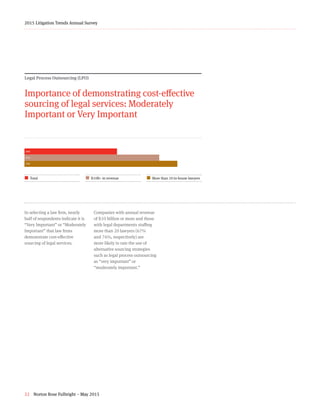
Importance of demonstrating cost-effective
sourcing of legal services: Moderately
Important or Very Important
46+67+76
¢  Total ¢  $10B+ in revenue ¢  More than 20 in-house lawyers
In selecting a law firm, nearly
half of respondents indicate it is
“Very Important” or “Moderately
Important” that law firms
demonstrate cost-effective
sourcing of legal services.
Companies with annual revenue
of $10 billion or more and those
with legal departments staffing
more than 20 lawyers (67%
and 76%, respectively) are
more likely to rate the use of
alternative sourcing strategies
such as legal process outsourcing
as “very important” or
“moderately important.”
46%
67%
76%
Norton Rose Fulbright – May 2015 33
06
Chapter 6
Government and regulatory matters
34 Norton Rose Fulbright – May 2015
2015 Litigation Trends Annual Survey
Government and regulatory matters
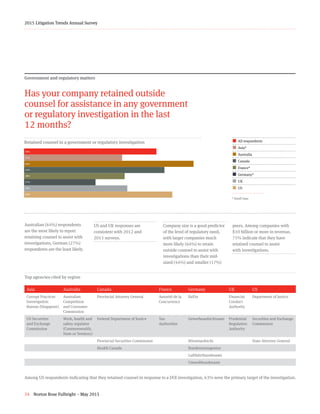
Has your company retained outside
counsel for assistance in any government
or regulatory investigation in the last
12 months?
US and UK responses are
consistent with 2012 and
2013 surveys.
Company size is a good predictor
of the level of regulatory need,
with larger companies much
more likely (64%) to retain
outside counsel to assist with
investigations than their mid-
sized (44%) and smaller (17%)
peers. Among companies with
$10 billion or more in revenue,
75% indicate that they have
retained counsel to assist
with investigations.
Australian (64%) respondents
are the most likely to report
retaining counsel to assist with
investigations, German (27%)
respondents are the least likely.
Top agencies cited by region
Retained counsel in a government or regulatory investigation ¢  All respondents
¢  Asia*
¢  Australia
¢ Canada
¢ France*
¢  Germany*
¢  UK
¢  US
* Small base
Among US respondents indicating that they retained counsel in response to a DOJ investigation, 63% were the primary target of the investigation.
Asia Australia Canada France Germany UK US
Corrupt Practices
Investigation
Bureau (Singapore)
Australian
Competition
and Consumer
Commission
Provincial Attorney General Autorité de la
Concurrence
BaFin Financial
Conduct
Authority
Department of Justice
US Securities
and Exchange
Commission
Work, health and
safety regulator
(Commonwealth,
State or Territory)
Federal Department of Justice Tax
Authorities
Gewerbeaufsichtsamt Prudential
Regulation
Authority
Securities and Exchange
Commission
Provincial Securities Commission Börsenaufsicht State Attorney General
Health Canada Bundesnetzagentur
Luftfahrtbundesamt
Umweltbundesamt
50+37+64+53+38+27+39+565
50%
37%
64%
53%
38%
27%
39%
56%
Norton Rose Fulbright – May 2015 35
Government and regulatory matters
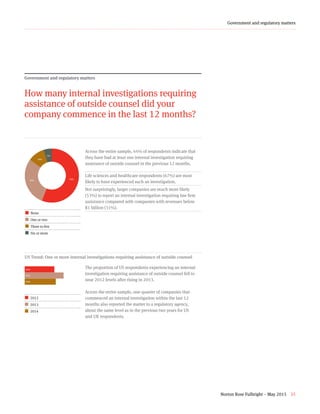
How many internal investigations requiring
assistance of outside counsel did your
company commence in the last 12 months?
56+29+10+5+z¢ None
¢  One or two
¢  Three to five
¢ Six or more
Across the entire sample, 44% of respondents indicate that
they have had at least one internal investigation requiring
assistance of outside counsel in the previous 12 months.
Life sciences and healthcare respondents (67%) are most
likely to have experienced such an investigation.
Not surprisingly, larger companies are much more likely
(53%) to report an internal investigation requiring law firm
assistance compared with companies with revenues below
$1 billion (31%).
US Trend: One or more internal investigations requiring assistance of outside counsel
42+55+44
¢  2012
¢  2013
¢  2014
The proportion of US respondents experiencing an internal
investigation requiring assistance of outside counsel fell to
near 2012 levels after rising in 2013.
Across the entire sample, one-quarter of companies that
commenced an internal investigation within the last 12
months also reported the matter to a regulatory agency,
about the same level as in the previous two years for US
and UK respondents.
56%
29%
10%
5%
42%
55%
44%
36 Norton Rose Fulbright – May 2015
2015 Litigation Trends Annual Survey
Government and regulatory matters
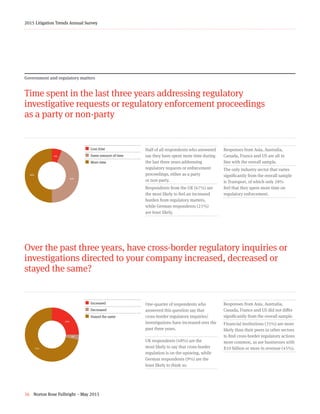
Time spent in the last three years addressing regulatory
investigative requests or regulatory enforcement proceedings
as a party or non-party
6+44+50+z
¢  Less time
¢  Same amount of time
¢  More time
Half of all respondents who answered
say they have spent more time during
the last three years addressing
regulatory requests or enforcement
proceedings, either as a party
or non-party.
Respondents from the UK (67%) are
the most likely to feel an increased
burden from regulatory matters,
while German respondents (21%)
are least likely.
Responses from Asia, Australia,
Canada, France and US are all in
line with the overall sample.
The only industry sector that varies
significantly from the overall sample
is Transport, of which only 28%
feel that they spent more time on
regulatory enforcement.
Over the past three years, have cross-border regulatory inquiries or
investigations directed to your company increased, decreased or
stayed the same?
25+3+72+z
¢  Increased
¢  Decreased
¢ Stayed the same
One-quarter of respondents who
answered this question say that
cross-border regulatory inquiries/
investigations have increased over the
past three years.
UK respondents (48%) are the
most likely to say that cross-border
regulation is on the upswing, while
German respondents (9%) are the
least likely to think so.
Responses from Asia, Australia,
Canada, France and US did not differ
significantly from the overall sample.
Financial institutions (35%) are more
likely than their peers in other sectors
to find cross-border regulatory actions
more common, as are businesses with
$10 billion or more in revenue (45%).
44%
50%
6%
25%
3%
71%
Norton Rose Fulbright – May 2015 37
Government and regulatory matters
Where you have a cross-border dispute or
regulatory investigation, do you prefer using
a single law firm?
Reasons for preferring
a single firm:
1. Consistency/continuity
2. Centralized/single point
     of contact
3. Coordination/logistics
4. Efficiency/more
     efficient service
5. Cost effective
“Uniform flow of information and
process handling.” – German
conglomerate GC
“[A single firm may] act almost as
our outsourced in-house counsel
function.” - Australian Financial
Institution GC
“I prefer to use large firms with
multiple international offices so that
they can address all of the concerns
in one place.” – US Technology and
innovation GC
“Coordinating law firms—or rather
lack of coordination between different
firms—can often be a problem.” – UK
Financial Institution GC
“Because for us to be efficient, the
law firm needs a thorough knowledge
of our business, so with several law
firms, we would need to repeat the
same thing several times, and we’d
also have to pay each time.” – French
Technology and innovation CEO
73+27+zNearly three-quarters of
respondents prefer to use a single
law firm when facing cross-
border disputes or investigations.
¢  Yes
¢ No
German (95%) and Australian
(90%) respondents are
most likely to use one firm
across borders.
Responses from Asia, Canada,
France, UK and US do not
differ significantly from the
overall sample.
Mid-sized companies (90%) and
those with litigation budgets of
$1 million -$3 million (92%) are
more likely than their larger and
smaller peers to favor using one
law firm.
Energy industry respondents
(55%) are the least inclined to
prefer using a single firm.
73%
27%
38 Norton Rose Fulbright – May 2015
Chapter 7
Electronic discovery
07
Norton Rose Fulbright – May 2015 39
Electronic discovery
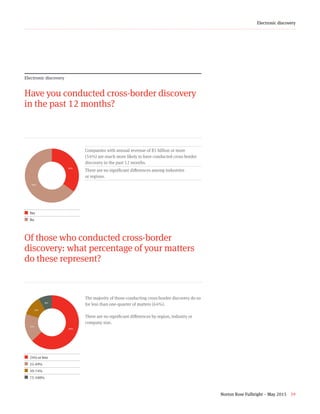
Have you conducted cross-border discovery
in the past 12 months?
35+65+z¢  Yes
¢ No
Companies with annual revenue of $5 billion or more
(54%) are much more likely to have conducted cross-border
discovery in the past 12 months.
There are no significant differences among industries
or regions.
Of those who conducted cross-border
discovery: what percentage of your matters
do these represent?
63+17+12+8+z¢  24% or less
¢  25-49%
¢  50-74%
¢ 75-100%
The majority of those conducting cross-border discovery do so
for less than one-quarter of matters (64%).
There are no significant differences by region, industry or
company size.
35%
65%
64%
17%
12%
8%
40 Norton Rose Fulbright – May 2015
2015 Litigation Trends Annual Survey
Electronic discovery
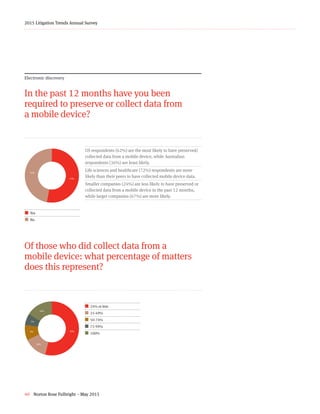
In the past 12 months have you been
required to preserve or collect data from
a mobile device?
53+47+z¢  Yes
¢ No
US respondents (62%) are the most likely to have preserved/
collected data from a mobile device, while Australian
respondents (36%) are least likely.
Life sciences and healthcare (72%) respondents are more
likely than their peers to have collected mobile device data.
Smaller companies (24%) are less likely to have preserved or
collected data from a mobile device in the past 12 months,
while larger companies (67%) are more likely.
Of those who did collect data from a
mobile device: what percentage of matters
does this represent?
54+14+9+7+16+z
¢  24% or less
¢  25-49%
¢  50-74%
¢ 75-99%
¢ 100%
53%
47%
54%
16%
7%
9%
14%
Norton Rose Fulbright – May 2015 41
Electronic discovery
In what percentage of cases do you primarily
rely upon self-preservation?
26+9+5+12+19+29+z¢ None
¢  1-24%
¢  25-49%
¢ 50-74%
¢ 75-99%
¢ 100%
Life sciences and healthcare respondents (88%) are the most
likely to rely on self-preservation for at least some matters,
compared with the total sample (74%).
There are no other significant differences among regions,
industry or company size.
62+35+22
¢  IT collects data
¢  Company maintains data sources that prevent modifications
¢  Discovery vendor collects data
Top reasons respondents do not
rely on self-preservation
1. Cannot always rely on/
trust individuals
2. Greater certainty/
     defensibility, lower risk
3. IT is more effective
4. Automatic storage/back-up
     of data
“We can’t rely upon our employees
to know what is relevant, what is
not.” – Canadian Technology and
innovation GC
“Employees don’t understand the
impact of spoliation.” - US GC
“[Self-preservation] is not as reliable
as if you’re using an automated
system.” – UK GC
“We have a disaster recovery centre so
everything’s backed up.” – Australian
Technology and innovation GC
When you don’t rely on self-preservation,
how do you preserve potentially
relevant documents?
26%
9%
5%
12%
19%
29%
62%
35%
22%
42 Norton Rose Fulbright – May 2015
2015 Litigation Trends Annual Survey
Electronic discovery
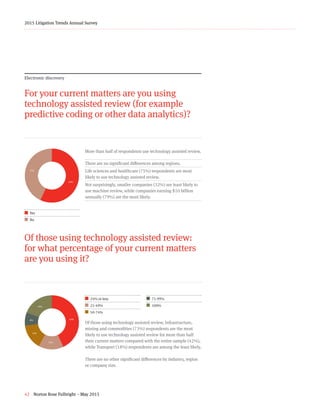
For your current matters are you using
technology assisted review (for example
predictive coding or other data analytics)?
57+43+z¢  Yes
¢ No
More than half of respondents use technology assisted review.
There are no significant differences among regions.
Life sciences and healthcare (75%) respondents are most
likely to use technology assisted review.
Not surprisingly, smaller companies (32%) are least likely to
use machine review, while companies earning $10 billion
annually (79%) are the most likely.
Of those using technology assisted review:
for what percentage of your current matters
are you using it?
43+15+15+8+19+z
¢  24% or less
¢  25-49%
¢  50-74%
¢ 75-99%
¢ 100%
Of those using technology assisted review, Infrastructure,
mining and commodities (73%) respondents are the most
likely to use technology assisted review for more than half
their current matters compared with the entire sample (42%),
while Transport (18%) respondents are among the least likely.  
There are no other significant differences by industry, region
or company size.
43%
57%
43%
15%
15%
8%
19%
Norton Rose Fulbright – May 2015 43
Chapter 8
International arbitration
08
44 Norton Rose Fulbright – May 2015
2015 Litigation Trends Annual Survey
1007548
¢ Arbitration ¢  It depends ¢  Litigation
1009043
All Respondents
Germany
48%
43%
International arbitration
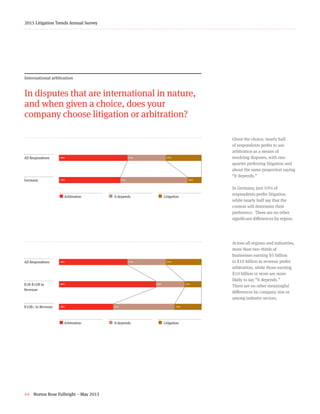
In disputes that are international in nature,
and when given a choice, does your
company choose litigation or arbitration?
Given the choice, nearly half
of respondents prefer to use
arbitration as a means of
resolving disputes, with one-
quarter preferring litigation and
about the same proportion saying
“it depends.”
In Germany, just 10% of
respondents prefer litigation
while nearly half say that the
context will determine their
preference.  There are no other
significant differences by region.
27%
47%
25%
10%
1007548
¢ Arbitration ¢  It depends ¢  Litigation
1008868
All Respondents
$5B-$10B in
Revenue
$10B+ in Revenue
48%
68%
27%
20%
25%
12%
1008138
38% 43% 19%
Across all regions and industries,
more than two-thirds of
businesses earning $5 billion
to $10 billion in revenue prefer
arbitration, while those earning
$10 billion or more are more
likely to say “it depends.”  
There are no other meaningful
differences by company size or
among industry sectors.
Norton Rose Fulbright – May 2015 45
International arbitration
Why does your company choose
arbitration for international disputes?
47+39+35+33+28+26+19+10¢  Confidential process
¢ Speed
¢  Enforceability of awards
¢ Cost-effective
¢ Right to appoint an arbitrator
¢  Limited disclosure
¢  Avoidance of injury
¢  Claim under an
investment treaty
47%
39%
35%
33%
28%
26%
19%
10%
46 Norton Rose Fulbright – May 2015
2015 Litigation Trends Annual Survey
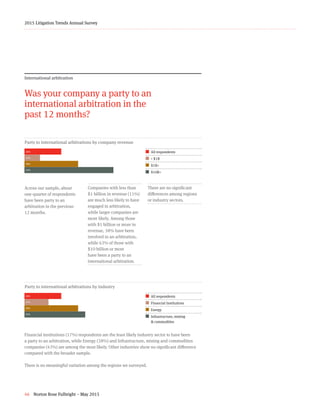
Was your company a party to an
international arbitration in the
past 12 months?
Party to international arbitrations by company revenue
26+11+38+63
¢  All respondents
¢  < $1B
¢  $1B+
¢ $10B+
International arbitration
Across our sample, about
one-quarter of respondents
have been party to an
arbitration in the previous
12 months.
Party to international arbitrations by industry
26+17+38+43
¢  All respondents
¢  Financial Institutions
¢  Energy
¢ Infrastructure, mining
       & commodities
Companies with less than
$1 billion in revenue (11%)
are much less likely to have
engaged in arbitration,
while larger companies are
more likely. Among those
with $1 billion or more in
revenue, 38% have been
involved in an arbitration,
while 63% of those with
$10 billion or more
have been a party to an
international arbitration.
There are no significant
differences among regions
or industry sectors.
Financial institutions (17%) respondents are the least likely industry sector to have been
a party to an arbitration, while Energy (38%) and Infrastructure, mining and commodities
companies (43%) are among the most likely. Other industries show no significant difference
compared with the broader sample.
There is no meaningful variation among the regions we surveyed.
26%
11%
38%
63%
26%
17%
38%
43%
Norton Rose Fulbright – May 2015 47
International arbitration
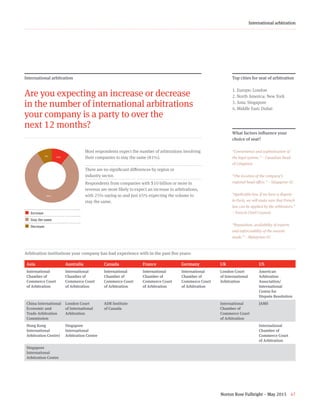
Are you expecting an increase or decrease
in the number of international arbitrations
your company is a party to over the
next 12 months?
11+80+9+z¢  Increase
¢ Stay the same
¢  Decrease
Most respondents expect the number of arbitrations involving
their companies to stay the same (81%).
There are no significant differences by region or
industry sector.
Respondents from companies with $10 billion or more in
revenue are more likely to expect an increase in arbitrations,
with 25% saying so and just 65% expecting the volume to
stay the same.
Top cities for seat of arbitration
1. Europe: London
2. North America: New York
3. Asia: Singapore
4. Middle East: Dubai
What factors influence your
choice of seat?
“Convenience and sophistication of
the legal system.” – Canadian Head
of Litigation
“The location of the company’s
regional head office.” – Singapore GC
“Applicable law. If we have a dispute
in Paris, we will make sure that French
law can be applied by the arbitrators.”
– French Chief Counsel
“Reputation, availability of experts
and enforceability of the awards
made.” – Malaysian GC
Arbitration institutions your company has had experience with in the past five years:
Asia Australia Canada France Germany UK US
International
Chamber of
Commerce Court
of Arbitration
International
Chamber of
Commerce Court
of Arbitration
International
Chamber of
Commerce Court
of Arbitration
International
Chamber of
Commerce Court
of Arbitration
International
Chamber of
Commerce Court
of Arbitration
London Court
of International
Arbitration
American
Arbitration
Association/
International
Centre for
Dispute Resolution
China International
Economic and
Trade Arbitration
Commission
London Court
of International
Arbitration
ADR Institute
of Canada
International
Chamber of
Commerce Court
of Arbitration
JAMS
Hong Kong
International
Arbitration Centre)
Singapore
International
Arbitration Centre
International
Chamber of
Commerce Court
of Arbitration
Singapore
International
Arbitration Centre
11%9%
81%
48 Norton Rose Fulbright – May 2015
09
Chapter 9
Class actions
Norton Rose Fulbright – May 2015 49
Class actions
Class actions
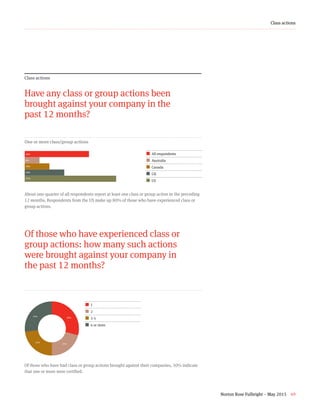
Have any class or group actions been
brought against your company in the
past 12 months?
29+21+23+27+z
¢ 1
¢  2
¢  3-5
¢ 6 or more
Of those who have had class or group actions brought against their companies, 30% indicate
that one or more were certified.
One or more class/group actions
26+6+10+16+37¢  All respondents
¢  Australia
¢  Canada
¢  UK
¢  US
About one-quarter of all respondents report at least one class or group action in the preceding
12 months. Respondents from the US make up 80% of those who have experienced class or
group actions.
Of those who have experienced class or
group actions: how many such actions
were brought against your company in
the past 12 months?
29%
21%
21%
27%
26%
6%
10%
16%
37%
50 Norton Rose Fulbright – May 2015
2015 Litigation Trends Annual Survey
Class actions
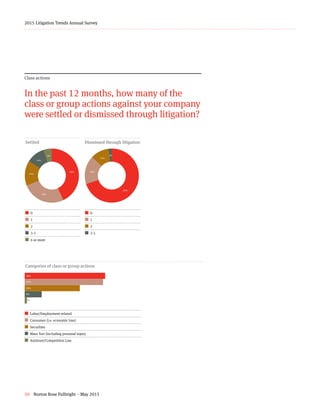
In the past 12 months, how many of the
class or group actions against your company
were settled or dismissed through litigation?
43+26+15+11+5+z¢ 0
¢ 1
¢  2
¢ 3-5
¢ 6 or more
Settled
38+37+26+8+1
¢  Labor/Employment-related
¢  Consumer (i.e. economic loss)
¢ Securities
¢ Mass Tort (including personal injury
¢ Antitrust/Competition Law
Categories of class or group actions
70+17+11+2+z
Dismissed through litigation
¢ 0
¢ 1
¢  2
¢ 3-5
69%
16%
11%
2%
43%
26%
15%
11%
5%
38%
37%
26%
8%
1%
Norton Rose Fulbright – May 2015 51
Chapter 10
Intellectual property
10
52 Norton Rose Fulbright – May 2015
2015 Litigation Trends Annual Survey
Intellectual property
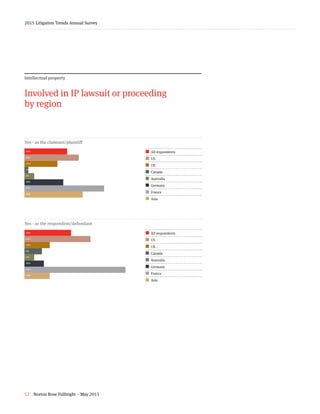
Involved in IP lawsuit or proceeding
by region
Yes - as the claimant/plaintiff
22+28+17+2+5+20+41+30¢  All respondents
¢  US
¢  UK
¢ Canada
¢  Australia
¢  Germany
¢ France
¢ Asia
Yes - as the respondent/defendant
24+34+13+9+5+10+52+13
¢  All respondents
¢  US
¢  UK
¢ Canada
¢  Australia
¢  Germany
¢ France
¢ Asia
22%
28%
17%
2%
5%
20%
41%
30%
24%
34%
13%
9%
5%
10%
52%
13%
Norton Rose Fulbright – May 2015 53
Intellectual property
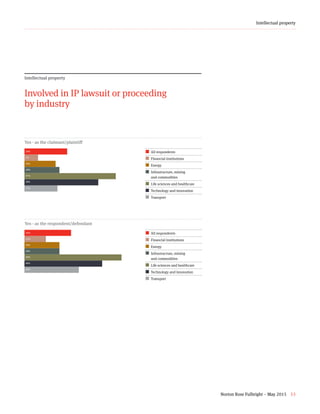
Involved in IP lawsuit or proceeding
by industry
Yes - as the claimant/plaintiff
22+7+16+18+47+38+17¢  All respondents
¢ Financial institutions
¢  Energy
¢ Infrastructure, mining
and commodities
¢  Life sciences and healthcare
¢  Technology and innovation
¢  Transport
Yes - as the respondent/defendant
24+11+18+18+50+40+28
¢  All respondents
¢ Financial institutions
¢  Energy
¢ Infrastructure, mining
and commodities
¢  Life sciences and healthcare
¢  Technology and innovation
¢  Transport
22%
7%
16%
18%
47%
38%
17%
%
24%
11%
18%
18%
50%
40%
28%
%
54 Norton Rose Fulbright – May 2015
2015 Litigation Trends Annual Survey
Percentage of respondents reporting one or more matters
Intellectual property
For each type of lawsuit or proceeding listed, do you expect
the number of matters to increase, decrease or stay the same
during the next 12 months as the claimant/plaintiff, or as the
respondent/defendant?
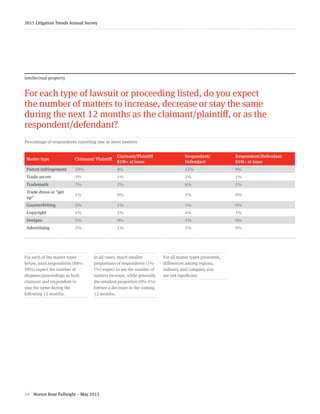
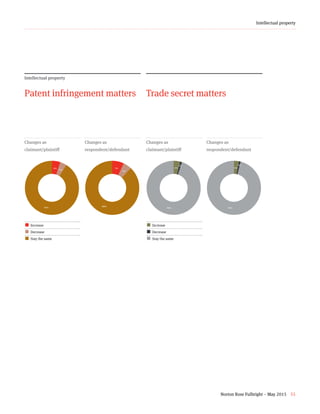
For each of the matter types
below, most respondents (88%-
98%) expect the number of
disputes/proceedings as both
claimant and respondent to
stay the same during the
following 12 months.
In all cases, much smaller
proportions of respondents (1%-
7%) expect to see the number of
matters increase, while generally
the smallest proportion (0%-5%)
foresee a decrease in the coming
12 months.
For all matter types presented,
differences among regions,
industry and company size
are not significant.
Matter type Claimant/ Plaintiff
Claimant/Plaintiff
$5M+ at issue
Respondent/
Defendant
Respondent/Defendant
$5M+ at issue
Patent infringement 10% 8% 15% 9%
Trade secret 3% 1% 2% 1%
Trademark 7% 2% 6% 1%
Trade dress or "get
up"
1% 0% 1% 0%
Counterfeiting 2% 1% 1% 0%
Copyright 1% 1% 4% 1%
Designs 1% 0% 1% 0%
Advertising 2% 1% 1% 0%
Norton Rose Fulbright – May 2015 55
Intellectual property
Patent infringement matters
5+4+91+z
Changes as
claimant/plaintiff
7+5+88+z
Changes as
respondent/defendant
¢  Increase
¢  Decrease
¢ Stay the same
Trade secret matters
4+1+95+z
Changes as
claimant/plaintiff
3+1+96+z
Changes as
respondent/defendant
¢  Increase
¢  Decrease
¢ Stay the same
91%
5%
4%
7%
5%
88%
2%
1%
96%
4%
1%
95%
56 Norton Rose Fulbright – May 2015
2015 Litigation Trends Annual Survey
Intellectual property
Trademark matters
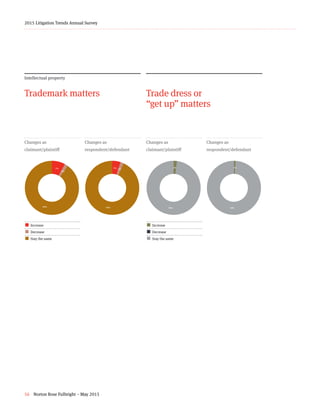
8+2+90+z
Changes as
claimant/plaintiff
5+2+93+z
Changes as
respondent/defendant
¢  Increase
¢  Decrease
¢ Stay the same
Trade dress or
“get up” matters
2+98+z
Changes as
claimant/plaintiff
1+99+z
Changes as
respondent/defendant
¢  Increase
¢  Decrease
¢ Stay the same
7%
2%
90%
5% 2%
94%
2%
98%
1%
98%
Norton Rose Fulbright – May 2015 57
Intellectual property
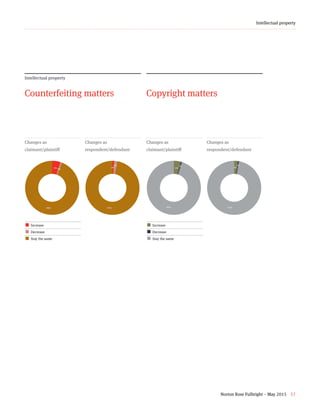
Counterfeiting matters
5+1+94+z
Changes as
claimant/plaintiff
1+2+97+z
Changes as
respondent/defendant
¢  Increase
¢  Decrease
¢ Stay the same
Copyright matters
4+1+95+z
Changes as
claimant/plaintiff
2+1+97+z
Changes as
respondent/defendant
¢  Increase
¢  Decrease
¢ Stay the same
5%
1%
94%
1%
2%
97%
4%
1%
95%
2%
1%
97%
58 Norton Rose Fulbright – May 2015
2015 Litigation Trends Annual Survey
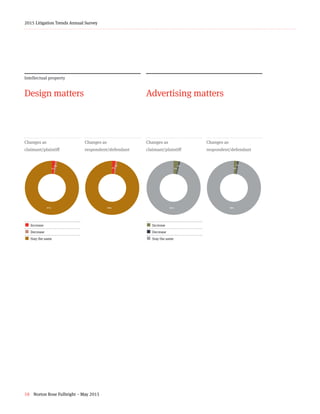
Intellectual property
Design matters
2+1+97+z
Changes as
claimant/plaintiff
2+1+97+z
Changes as
respondent/defendant
¢  Increase
¢  Decrease
¢ Stay the same
Advertising matters
3+1+96+z
Changes as
claimant/plaintiff
2+1+97+z
Changes as
respondent/defendant
¢  Increase
¢  Decrease
¢ Stay the same
2%
1%
97% 98% 96% 98%
2%
1%
3%
1%
2%
1%
Norton Rose Fulbright – May 2015 59
Chapter 11
Forward-looking trends
11
60 Norton Rose Fulbright – May 2015
2015 Litigation Trends Annual Survey
Forward-looking trends
In the next 12 months, in which jurisdictions
do you expect to be litigating?
Not surprisingly, most respondents expect foremost to be litigating in their own regions.
Asia Australia Canada France Germany UK US
Hong Kong (30%)
Australia (non-
specific) (44%)
Canada (non-
specific) (47%)
France (50%) Germany (37%) UK (46%)
US (most/several
states) (35%)
China (27%)
New South
Wales (17%)
US (most/several
states) (23%)
US (most/several
states) (14%)
UK (17%)
US (most/several
states) (26%)
Texas (28%)
US (all/most/
several states)
(13%)
Victoria (11%) Ontario (19%)
US (most/ several
states) (13%)
New York (14%) California (23%)
Alberta (17%) Germany (11%) New York (15%)
France (10%)
Norton Rose Fulbright – May 2015 61
Forward-looking trends
In your view, what is the most important
issue or trend in litigation impacting
your company?
Across our sample, the most cited
issue is an increasing number of
class actions.
Other top concerns include:
Employment/Labor issues
Increased oversight/scrutiny
by regulators
Costs of litigation
Increasingly litigious
environment
Intellectual property/patent
troll litigation
Increased/changing regulation
E-Discovery cost
Geographical region Trends
US Class actions and employment
UK Litigious environment and labor matters
Canada Class actions and changing legislation/court decisions
Australia
Class actions, increasing legal costs and a more
litigious environment
Germany
Increasing use of Alternative Dispute Resolution and increasing
class action volume
France
Class actions, higher litigation volume and more
contract litigation
Asia Increasing cost of time-consuming, sometimes frivolous litigation
Important trends
from respondents
“We are seeing class actions brought
where there is no harm and we are
starting to see courts allow this and it
creates substantial potential liability,
where there should be none.” – US
Technology and innovation company
Head of Litigation
“How easy it is for individuals to
bring lawsuits online, which I think
makes people more litigious.” – UK
Technology and innovation company
Chief Legal Officer
“The recent Supreme Court of
Canada's decision on good faith
obligation in contracts.” – Canadian
Energy company GC
“I think it is probably the class action
litigation particularly in the US. A lot
of the times it is without foundation,
you end up tackling it just to avoid the
ongoing cost of being involved in the
process, it is a pretty unsatisfactory
global system for class action in that
regard.” – Australian Technology and
innovation company GC
“The environment is getting tense.
Companies, when they have trouble
paying, will search in their contract
for a way not to [pay].” – French
Technology and innovation
company GC
“The trend in litigation will lead to
arbitration… [increasingly] in a third
country. It is happening more often
that neither of the two [parties] is
prepared to concede to the other
that they use their own country.” –
German Life sciences and healthcare
industry GC
“Frivolous legal actions claiming
extortionate amounts - a sign of a
more litigious society.” – Malaysian
Infrastructure, mining and
commodities industry GC
 
62 Norton Rose Fulbright – May 2015
Key industry sectors
Our strategy is driven by our focus on six global industries. Our progress in each is
determined by our ability to deliver advice that goes beyond just legal. And we remain
at the forefront not just through advising on some of the biggest deals going, but also by
seeking out pioneering work that will take us into new areas.
Financial institutions
Our reach in this sector is
global, as is our regulatory
knowledge and experience
of acting on high-profile,
cross-border transactions and
disputes. With 1,100 dedicated
lawyers worldwide, we have
strong relationships with
the world’s leading financial
institutions, providing advice
across the full range of their
legal requirements.
Energy
We have one of the largest
global energy practices in the
world, with over 850 energy
lawyers in every major energy
market. Our team works
together to deliver sophisticated
and forward-thinking advice
worldwide – tackling complex
issues in areas such as climate
change, oil and gas, power
and renewables.
Infrastructure, mining
and commodities
We work on major
infrastructure, mining and
commodities projects in almost
every country in the world,
including emerging markets
such as Africa and Latin
America. We have worked on
some of the largest and most
innovative deals in recent years.
Norton Rose Fulbright – May 2015 63
Transport
We have a leading reputation
in the transport sector. Our 350
transport lawyers concentrate
on aviation, rail and shipping,
and we focus on making
sustainable connections
between transport, energy
and infrastructure. Transport
is diverse, so our work ranges
from asset finance and M&A to
dispute resolution and
private equity.
Technology and innovation
Our global technology and
innovation group advises a
number of the world’s leading
corporations throughout the
technology, business services,
communications, media,
entertainment and consumer
markets sectors. With 450
lawyers worldwide, we provide
a truly global service to clients
in both established and
emerging markets.
Life sciences and healthcare
We act for global
pharmaceutical, bioscience
and technology companies in
every stage of the product life
cycle, from intellectual property
protections to commercial
transactions, and mergers and
acquisitions. It is no surprise
that many of our life sciences
and healthcare lawyers have
degrees and advanced degrees
in science and technology.
64 Norton Rose Fulbright – May 2015
2015 Litigation Trends Annual Survey
People worldwide
7400
Legal staff worldwide
3800+
Offices
50+
Europe
Amsterdam
Athens
Brussels
Frankfurt
Hamburg
London
Milan
Moscow
Munich
Paris
Piraeus
Warsaw
Global resources
United States
Austin
Dallas
Denver
Houston
Los Angeles
Minneapolis
New York
Pittsburgh-Southpointe
St Louis
San Antonio
Washington DC
Norton Rose Fulbright
is a global legal
practice. We provide
the world’s pre-
eminent corporations
and financial
institutions with a full
business law service.
We have more than
3800 lawyers based
in over 50 cities
across Europe, the
United States, Canada,
Latin America, Asia,
Australia, Africa,
the Middle East and
Central Asia.
Norton Rose Fulbright – May 2015 65
Global resources
Our office locations
1	 Susandarini & Partners in association with
Norton Rose Fulbright Australia
2	 Mohammed Al-Ghamdi Law Firm in
association with Fulbright & Jaworski LLP
3	 Alliances
Canada
Calgary
Montréal
Ottawa
Québec
Toronto
Latin America
Bogotá
Caracas
Rio de Janeiro
Asia
Bangkok
Beijing
Hong Kong
Jakarta1
Shanghai
Singapore
Tokyo
Australia
Brisbane
Melbourne
Perth
Sydney
Africa
Bujumbura3
Cape Town
Casablanca
Dar es Salaam
Durban
Harare3
Johannesburg
Kampala3
Middle East
Abu Dhabi
Bahrain
Dubai
Riyadh2
Central Asia
Almaty
66 Norton Rose Fulbright – May 2015
2015 Litigation Trends Annual Survey
Lawyers
1200
Dispute resolution and litigation
We have one of the largest dispute resolution and litigation practices in the world, with experience
of handling and resolving multi-jurisdictional mandates and international arbitration across all
industry sectors. We advise many of the world’s largest companies on complex, high-value disputes.
Our lawyers both prevent and resolve disputes by giving practical, creative advice that focuses on our
clients’ strategic and commercial objectives.
Contact
Gerry Pecht
+1 713 651 5243
gerard.pecht@nortonrosefulbright.com
‘Among the top global dispute
resolution practices.’
Chambers Global 2014
Antitrust and competition
Appellate
Catastrophic and mass disaster disputes
Class actions
Commercial disputes
Construction and engineering
Data protection, privacy and
access to information
eDiscovery and information governance
Employment and labor
Energy
Environmental
International arbitration
Life sciences and healthcare
Marine casualty, admiralty and shipping
Mass tort and toxic tort disputes
Patent litigation
Pharmaceutical medical device disputes
Product liability
Professional liability
Qui Tam/False Claims Act
Real estate
Regulatory and governmental
investigations
Securities litigation, investigations
and SEC enforcement
Transnational litigation
White collar crime
Our practice covers
Norton Rose Fulbright
Norton Rose Fulbright is a global legal practice. We provide the world’s preeminent
corporations	and	fi	nancial	institutions	with	a	full	business	law	service.	We	have	more	than	
3800	lawyers	and	other	legal	staff		based	in	more	than	50	cities	across	Europe,	the	United	
States,	Canada,	Latin	America,	Asia,	Australia,	Africa,	the	Middle	East	and	Central	Asia.
Recognized	for	our	industry	focus,	we	are	strong	across	all	the	key	industry	sectors:	fi	nancial	
institutions;	energy;	infrastructure,	mining	and	commodities;	transport;	technology	and	
innovation;	and	life	sciences	and	healthcare.
Wherever	we	are,	we	operate	in	accordance	with	our	global	business	principles	of	quality,	
unity	and	integrity.	We	aim	to	provide	the	highest	possible	standard	of	legal	service	in	each	of	
our	offi		ces	and	to	maintain	that	level	of	quality	at	every	point	of	contact.
Norton	Rose	Fulbright	US	LLP,	Norton	Rose	Fulbright	LLP,	Norton	Rose	Fulbright	Australia,	
Norton	Rose	Fulbright	Canada	LLP	and	Norton	Rose	Fulbright	South	Africa	Inc	are	separate	
legal	entities	and	all	of	them	are	members	of	Norton	Rose	Fulbright	Verein,	a	Swiss	verein.	
Norton	Rose	Fulbright	Verein	helps	coordinate	the	activities	of	the	members	but	does	not	
itself	provide	legal	services	to	clients.
References	to	‘Norton	Rose	Fulbright’,	‘the	law	fi	rm’,	and	‘legal	practice’	are	to	one	or	more	of	the	Norton	Rose	Fulbright	members	or	to	one	of	their	
respective	affi		liates	(together	‘Norton	Rose	Fulbright	entity/entities’).	The	principal	offi		ce	of	Norton	Rose	Fulbright	US	LLP	in	Texas	is	in	Houston.	
Save	that	exclusively	for	the	purposes	of	compliance	with	US	bar	rules,	where	James	W.	Repass	will	be	responsible	for	the	content	of	this	publication,	
no	individual	who	is	a	member,	partner,	shareholder,	director,	employee	or	consultant	of,	in	or	to	any	Norton	Rose	Fulbright	entity	(whether	or	not	
such	individual	is	described	as	a	‘partner’)	accepts	or	assumes	responsibility,	or	has	any	liability,	to	any	person	in	respect	of	this	communication.	
Any	reference	to	a	partner	or	director	is	to	a	member,	employee	or	consultant	with	equivalent	standing	and	qualifi	cations	of	the	relevant	Norton	Rose	
Fulbright	entity.	The	purpose	of	this	communication	is	to	provide	information	as	to	developments	in	the	law.	It	does	not	contain	a	full	analysis	of	the	
law	nor	does	it	constitute	an	opinion	of	any	Norton	Rose	Fulbright	entity	on	the	points	of	law	discussed.	You	must	take	specifi	c	legal	advice	on	any	
particular	matter	which	concerns	you.	If	you	require	any	advice	or	further	information,	please	speak	to	your	usual	contact	at	Norton	Rose	Fulbright.
More than 50 locations, including Houston, New York, London,
Toronto, Hong Kong, Singapore, Sydney, Johannesburg, Dubai.
Attorney advertising
© Norton Rose Fulbright US LLP   05/14 (US/mo)  
Extracts may be copied provided their source is acknowledged.
Norton Rose Fulbright
Norton Rose Fulbright is a global legal practice. We provide the world’s preeminent
corporations	and	fi	nancial	institutions	with	a	full	business	law	service.	We	have	more	than	
3800	lawyers	and	other	legal	staff		based	in	more	than	50	cities	across	Europe,	the	United	
States,	Canada,	Latin	America,	Asia,	Australia,	Africa,	the	Middle	East	and	Central	Asia.
Recognized	for	our	industry	focus,	we	are	strong	across	all	the	key	industry	sectors:	fi	nancial	
institutions;	energy;	infrastructure,	mining	and	commodities;	transport;	technology	and	
innovation;	and	life	sciences	and	healthcare.
Wherever	we	are,	we	operate	in	accordance	with	our	global	business	principles	of	quality,	
unity	and	integrity.	We	aim	to	provide	the	highest	possible	standard	of	legal	service	in	each	of	
our	offi		ces	and	to	maintain	that	level	of	quality	at	every	point	of	contact.
Norton	Rose	Fulbright	US	LLP,	Norton	Rose	Fulbright	LLP,	Norton	Rose	Fulbright	Australia,	
Norton	Rose	Fulbright	Canada	LLP	and	Norton	Rose	Fulbright	South	Africa	Inc	are	separate	
legal	entities	and	all	of	them	are	members	of	Norton	Rose	Fulbright	Verein,	a	Swiss	verein.	
Norton	Rose	Fulbright	Verein	helps	coordinate	the	activities	of	the	members	but	does	not	
itself	provide	legal	services	to	clients.
References	to	‘Norton	Rose	Fulbright’,	‘the	law	fi	rm’,	and	‘legal	practice’	are	to	one	or	more	of	the	Norton	Rose	Fulbright	members	or	to	one	of	their	
respective	affi		liates	(together	‘Norton	Rose	Fulbright	entity/entities’).	The	principal	offi		ce	of	Norton	Rose	Fulbright	US	LLP	in	Texas	is	in	Houston.	
Save	that	exclusively	for	the	purposes	of	compliance	with	US	bar	rules,	where	James	W.	Repass	will	be	responsible	for	the	content	of	this	publication,	
no	individual	who	is	a	member,	partner,	shareholder,	director,	employee	or	consultant	of,	in	or	to	any	Norton	Rose	Fulbright	entity	(whether	or	not	
such	individual	is	described	as	a	‘partner’)	accepts	or	assumes	responsibility,	or	has	any	liability,	to	any	person	in	respect	of	this	communication.	
Any	reference	to	a	partner	or	director	is	to	a	member,	employee	or	consultant	with	equivalent	standing	and	qualifi	cations	of	the	relevant	Norton	Rose	
Fulbright	entity.	The	purpose	of	this	communication	is	to	provide	information	as	to	developments	in	the	law.	It	does	not	contain	a	full	analysis	of	the	
law	nor	does	it	constitute	an	opinion	of	any	Norton	Rose	Fulbright	entity	on	the	points	of	law	discussed.	You	must	take	specifi	c	legal	advice	on	any	
particular	matter	which	concerns	you.	If	you	require	any	advice	or	further	information,	please	speak	to	your	usual	contact	at	Norton	Rose	Fulbright.
More than 50 locations, including Houston, New York, London,
Toronto, Hong Kong, Singapore, Sydney, Johannesburg, Dubai.
Attorney advertising
Law around the world
nortonrosefulbright.com

2015 Litigation Trends Survey - LTS v22

  • 1.
    Financial institutions Energy Infrastructure, miningand commodities Transport Technology and innovation Life sciences and healthcare 2015 Litigation Trends Annual Survey
  • 2.
    Norton Rose Fulbright NortonRose Fulbright is a global legal practice. We provide the world’s preeminent corporations and fi nancial institutions with a full business law service. We have more than 3800 lawyers and other legal staff based in more than 50 cities across Europe, the United States, Canada, Latin America, Asia, Australia, Africa, the Middle East and Central Asia. Recognized for our industry focus, we are strong across all the key industry sectors: fi nancial institutions; energy; infrastructure, mining and commodities; transport; technology and innovation; and life sciences and healthcare. Wherever we are, we operate in accordance with our global business principles of quality, unity and integrity. We aim to provide the highest possible standard of legal service in each of our offi ces and to maintain that level of quality at every point of contact. Norton Rose Fulbright US LLP, Norton Rose Fulbright LLP, Norton Rose Fulbright Australia, Norton Rose Fulbright Canada LLP and Norton Rose Fulbright South Africa Inc are separate legal entities and all of them are members of Norton Rose Fulbright Verein, a Swiss verein. Norton Rose Fulbright Verein helps coordinate the activities of the members but does not itself provide legal services to clients. References to ‘Norton Rose Fulbright’, ‘the law fi rm’, and ‘legal practice’ are to one or more of the Norton Rose Fulbright members or to one of their respective affi liates (together ‘Norton Rose Fulbright entity/entities’). The principal offi ce of Norton Rose Fulbright US LLP in Texas is in Houston. Save that exclusively for the purposes of compliance with US bar rules, where James W. Repass will be responsible for the content of this publication, no individual who is a member, partner, shareholder, director, employee or consultant of, in or to any Norton Rose Fulbright entity (whether or not such individual is described as a ‘partner’) accepts or assumes responsibility, or has any liability, to any person in respect of this communication. Any reference to a partner or director is to a member, employee or consultant with equivalent standing and qualifi cations of the relevant Norton Rose More than 50 locations, including Houston, New York, London, Toronto, Hong Kong, Singapore, Sydney, Johannesburg, Dubai. Attorney advertising 05 Respondent profile 07 Litigation overview 17 Litigation costs and disputes trends 24 Alternative fee arrangements 30 Legal process outsourcing (LPO) 33 Government and regulatory matters 38 Electronic discovery 43 International arbitration 48 Class actions 51 Intellectual property 59 Forward-looking trends Contents
  • 3.
    The 2015 LitigationTrends Annual Survey commissioned by Norton Rose Fulbright collects and presents the experiences and opinions of corporate counsel regarding various aspects of litigation and disputes-related matters. An independent research firm surveyed 803 participants working for companies headquartered in 26 countries worldwide.1 The data is analyzed by geographic region, industry, company size in annual gross revenues, amount of litigation spend and, where previous data points are available, comparisons are drawn to historical survey findings (US year-end 2013 and UK year- end 2012). All monetary values are stated in US dollars, unless otherwise noted. Though in its eleventh year, in many ways this survey represents a new benchmark for Litigation Trends. In addition to US and UK data, as in prior years, the survey also includes responses from Australia, Canada, France, Germany and Asia, making this the most far reaching survey of corporate counsel we have ever conducted. We look forward to building on this new foundation next year and beyond. 1 As with any survey, not all participants answered every question. The sum of percentages may total more or less than 100% due to rounding and/or respondents being given more than one option. Norton Rose Fulbright – May 2015 03
  • 4.
    04 Norton RoseFulbright – May 2015 2015 Litigation trends annual survey This year’s Litigation Trends Survey – our 11th annual – is the most extensive in our history and truly represents a global outlook. More than 800 corporate counsel from 26 countries participated, giving us unique insights into the litigation issues and trends that are affecting businesses around the world, from the most common types of cases companies face to the approach they take in managing disputes. Gerry Pecht Global Head of Dispute Resolution and Litigation, United States Tel +1 713 651 5243 gerard.pecht@nortonrosefulbright.com While each country or region surveyed is unique, one common theme comes through loud and clear – corporate counsel around the world see the growing litigiousness of the business environment as an important trend that bears watching. This is especially true with regard to regulatory investigations and class action lawsuits, both of which are increasing in scope and frequency. When asked to choose the top three to five types of legal disputes that are of greatest concern to their company, 39 percent of respondents to this year’s survey selected “Regulatory/Investigations,” more than any other option. In addition, half of all respondents to this year’s survey said they had spent more time during the last three years addressing regulatory requests or enforcement proceedings. “The regulatory environment is becoming increasingly tough and therefore we are expecting more and more challenges in this area,” said one general counsel from the UK. This same sentiment is shared in the US. One US-based general counsel said, “The federal government has added a lot of additional regulatory requirements on us, and I see an increase in external entities coming to our campus to investigate our compliance.” The increase in lawsuits and potential lawsuits faced by companies worldwide, along with the trend toward more regulatory oversight and investigations, results in higher litigation budgets and more time and attention required on behalf of legal departments and senior executives. As one respondent – the general counsel for an Australian company – said: “A lot of times these lawsuits are without foundation, and you end up tackling them just to avoid the ongoing cost of being involved in the process.” Some of this is driven by technology, which is making it easier and less expensive than ever before to develop a class action, regardless of whether or not there is actually harm. The growth in class actions is adding to an already substantial array of legal and regulatory challenges that firms face as they do business in a more complex world. Looking forward, approximately 25 percent said they believe the number of legal disputes their company will face in the next 12 months will increase. These trends have a real- world impact on the way companies will interact with the marketplace, and with each other, in the years to come. This year’s white paper contains a great deal of interesting information and insight, with analysis broken down by country/region and by industry. It provides a fascinating look at the state of corporate litigation today, and will give us a unique data set to benchmark against for future surveys.
  • 5.
    Norton Rose Fulbright– May 2015 05 01 Chapter 1 Respondent profile
  • 6.
    06 Norton RoseFulbright – May 2015 2015 Litigation Trends Annual Survey * Europe includes primarily Germany and France but also includes organizations headquartered in Switzerland, The Netherlands, Norway, Spain and elsewhere. † Asia includes organizations headquartered in Hong Kong, Singapore, Japan and China. †† Among the larger companies, 41% have revenues of $5 billion or more. Respondent profile Significant sample: 803 corporate counsel responded to the survey. This survey was conducted at the end of 2014 and beginning of 2015. 51+12+11+10+12+3+1+z¢ United States ¢ Australia ¢ United Kingdom ¢ Canada ¢ Europe* ¢ Asia† ¢ Other Headquarters Four out of five respondents identify themselves as General Counsel, Associate/Deputy/Assistant GC or Head of Litigation. “Other” titles include Vice President, Company Secretary and Chief Legal Officer. Most recent company annual gross revenues: Percentages are based on those respondents who provided gross revenue information for their companies. 45+26+10+8+11+z¢ General Counsel ¢ Associate/Deputy/ Assistant GC ¢ Head of Litigation ¢ Senior Counsel ¢ Other Respondent titles 10+26+64+z¢ < $100 million ¢ $100 million - $999 million ¢ $1 billion or more Revenue The following references to companies by size are used throughout this report: “Smaller companies” – revenues less than $100 million “Mid-sized companies” – revenues of $100 million to $999 million “Larger companies” – revenues of $1 billion or more†† Industry sectors 29+28+20+12+9+7¢ Technology and innovation ¢ Financial institutions ¢ Energy ¢ Infrastructure, mining and commodities ¢ Life sciences and healthcare ¢ Transport 29% 28% 20% 12% 9% 7% 1% 3% 52% 12% 11% 10% 12% 46% 26% 10% 8% 11% 10% 26% 65%
  • 7.
    Norton Rose Fulbright– May 2015 07 02 Chapter 2 Litigation overview
  • 8.
    08 Norton RoseFulbright – May 2015 2015 Litigation Trends Annual Survey Litigation overview Most numerous types of litigation pending in the last 12 months Contracts Contract matters are the most numerous type of litigation among all respondents polled (38%), with no significant differences reported among geographic regions. Among UK respondents, the prevalence of Contract matters has declined considerably to 35% from 57% when last polled in late 2012. Labor/Employment Canadian respondents report significantly more Labor/ Employment matters pending (49%) compared with the total sample (37%). Mid-sized companies report more Labor/Employment matters (50%) compared with the total sample (37%). Regulatory/Investigations French (3%) and German (7%) respondents are less likely to face Regulatory/Investigations disputes compared with the overall sample (18%). Personal Injury Personal Injury litigation is significantly more prevalent in the US (21%) and less prevalent in the UK (6%) compared with the total sample (15%). 38+37+18+15+13+11+10+8¢ Contracts ¢ Labor/Employment ¢ Regulatory/Investigations ¢ Personal Injury ¢ IP/Patents ¢ Product Liability ¢ Class Actions ¢ Insurance Respondents were asked to choose the three to five most numerous types of litigation pending against their companies in the past year, from a list of more than 20 categories. 38% 37% 18% 15% 13% 11% 10% 8%
  • 9.
    Norton Rose Fulbright– May 2015 09 Litigation overview IP/Patents IP/Patents litigation is more common among US respondents (18%) than among all respondents (13%), while it is less common among UK (7%) and Australian (6%) respondents. IP/Patents are more prevalent among Life sciences and healthcare respondents (34%) than for the total sample (13%). Larger organizations encounter more IP/Patents (18%) compared with all respondents (13%). Product Liability The prominence of Product Liability cases among respondents (11%) is driven primarily by the US, where 17% report these among their most numerous pending matters. Far fewer Australian (3%), Canadian (4%) and British (3%) respondents report such matters as among the most numerous. Life sciences and healthcare respondents list Product Liability as among the most prevalent disputes far more often (30%) than for the total base (11%). Larger organizations are more likely to experience Product Liability (17%) disputes compared with all respondents (11%). Class/Group Actions Only 4% of respondents in Australia list Class/Group Action cases as among the most common, compared with 10% for the total sample. Banking/Finance In the UK, Banking/Finance disputes (16%) are much more common than for the total sample (7%). Insurance Financial institutions (19%) are more likely to face Insurance litigation compared with their peers (8%). Other litigation types Energy companies experience Environmental/Toxic Tort litigation as a top dispute type more often (21%) than reported by all respondents (7%). Company/Commercial Construction litigation is more prevalent in Canada (15%) compared with all respondents (5%). Litigation overview Most numerous dispute types by industry sector Contracts 38+37+18+15+13+11+10 ¢ All respondents ¢ Financial institutions ¢ Energy ¢ Infrastructure mining and commodities ¢ Life sciences and healthcare ¢ Technology and innovation ¢ Transport Labor/Employment 37+27+27+27+51+37+37 Regulatory/Investigations 18+26+16+13+18+7+738% 31% 47% 57% 18% 40% 40% % 37% 27% 27% 27% 51% 37% 37% % 18% 26% 16% 13% 18% 5% 5% %
  • 10.
    10 Norton RoseFulbright – May 2015 2015 Litigation Trends Annual Survey Litigation overview Types of legal disputes that most concern companies Regulatory/Investigations Regulatory matters are the top concern for in-house counsel. This contrasts to findings for the most numerous litigation pending, where Regulatory/ Investigations receive fewer than half the mentions of contracts and Labor/Employment matters. More US respondents say Regulatory/Investigations disputes are a top concern (48%) compared with the broader sample (39%), while Canadian respondents are less concerned (24%). Respondents from Financial institutions are more concerned than their peers in the broader sample about Regulatory/ Investigations (46% vs. 39%). Contracts The percentage of US respondents most concerned with Contract disputes declined to 29% from 36% in the previous survey. Australian respondents are more concerned with Contract disputes (49%) versus all respondents (34%). In the UK, 35% list Contracts as a top concern, far fewer than the 53% who indicated this area as their top concern when last polled in late 2012. Half of Infrastructure, mining and commodities respondents list contracts as a top concern, compared with about one-third of the broader sample. Energy industry respondents are more concerned about Contracts (45%) compared with the total sample (34%). Top concerns 38+37+18+15+13+11+10+¢ Regulatory/Investigations ¢ Contracts ¢ Labor/Employment ¢ IP/Patents ¢ Class Actions ¢ Product Liability ¢ Environmental/Toxic Tort Respondents were asked to choose the three to five types of legal disputes of greatest concern to their companies from a list of more than 20 categories. 39% 34% 33% 21% 18% 14% 13% %
  • 11.
    Norton Rose Fulbright– May 2015 11 Litigation overview Labor/Employment On Labor/Employment matters, Canadians are most concerned (45%), while UK respondents were less so (21%), compared with the entire sample (33%). Technology and innovation respondents are more concerned with Labor/Employment (44%) compared with their peers (33%). IP/Patents IP/Patents disputes are of greater concern in the US (30%) compared with all respondents (21%). Only about one in ten respondents in Australia, Canada and the UK list IP/Patents among their top dispute concerns. Life sciences and healthcare (45%) and Technology and innovation respondents are more concerned with IP/Patents (37%) compared with the broader sample (21%). Class Actions More US respondents list Class Actions as a top concern (25%) compared with the total sample (18%). In the UK, the proportion of respondents concerned with Class Actions fell to 10% from 27% when polled two years ago. Product Liability Concern over Product Liability disputes varies greatly by region: US respondents are most concerned (18%), while UK respondents are less concerned (8%) about Product liability compared with all respondents (14%). Life sciences and healthcare counsel are more concerned with Product Liability (32% vs. 14%). Environmental/Toxic Tort Energy industry respondents are more concerned about Environmental/Toxic Tort (38%) compared with the total sample (13%). Other litigation types Banking/Finance disputes are of concern to more UK respondents (21%) compared with the total sample (9%). Company/Commercial Construction is of concern to more Australian (14%) and Canadian (17%) survey respondents compared with the overall sample (6%). Respondents from Financial institutions are more concerned than their peers in the broader sample about Securities Litigation/Enforcement (20% vs. 11%), Banking/Finance disputes (28% vs. 9%) and Insurance disputes (22% vs. 8%) Mining and Commodities respondents are more concerned about Company/Commercial Construction (21%) than their peers (8%). Life sciences and healthcare counsel are more concerned with Professional Malpractice (29%) compared with the broader sample (7%). Litigation overview Top concerns by industry sector Regulatory/Investigations 39+46+44+33+47+33+21 ¢ All respondents ¢ Financial institutions ¢ Energy ¢ Infrastructure mining and commodities ¢ Life sciences and healthcare ¢ Technology and innovation ¢ Transport Contracts 34+31+45+50+22+30+33 Labor/Employment 33+28+17+31+43+44+2339% 46% 44% 33% 47% 33% 21% % 34% 31% 45% 50% 22% 30% 33% % 33% 28% 17% 31% 43% 44% 23% %
  • 12.
    12 Norton RoseFulbright – May 2015 2015 Litigation Trends Annual Survey Litigation overview Lawsuits/proceedings commenced against companies in the last 12 months 33+20+9+13+25+z All 26+24+14+18+18+z US Responses from Asia, Canada, France and Germany are all in line with the overall sample. In the US, 55% of respondents indicate that they have more than five lawsuits pending. The number of lawsuits filed against US respondents’ companies in the past 12 months is very stable, with no significant change since 2010. At 42%, UK respondents are more likely to report no pending lawsuits compared with their peers in other regions. Larger organizations are more likely (37%) to have more than 20 lawsuits pending against them, compared with the overall sample (22%). Financial Industry respondents report the lowest incidence of one or more pending lawsuits (66%). Respondents from the Life sciences and health sector report the highest incidence of at least one lawsuit against their companies. (90%). ¢ 1 to 5 ¢ 6 to 20 ¢ 21 to 50 ¢ 51+ ¢ None 36+13+5+5+41+z UK 42+15+1+6+36+z Australia 33% 20%9% 13% 25% 26% 24% 14% 18% 18% 36% 13% 5% 5% 42% 36% 43% 15% 6% 1%
  • 13.
    Norton Rose Fulbright– May 2015 13 Litigation overview Litigation overview Lawsuits with $20M+ at issue against respondent companies 74+20+6+zAustralians report the lowest incidence of large lawsuits against them, with 90% reporting no such suits and the remaining 10% reporting five or fewer. There are no other significant geographic differences versus the total sample. Larger organizations are more likely (40%) to have one or more lawsuit with more than $20 million at issue pending against them, compared with the overall sample (26%). There is no significant variation by industry sector. ¢ None ¢ 1 to 5 ¢ 6 or more 74% 6% 20%
  • 14.
    14 Norton RoseFulbright – May 2015 2015 Litigation Trends Annual Survey Litigation overview Lawsuits commenced by companies in the last 12 months Financial industry respondents are less likely to have one or more lawsuits commenced by their companies (40%) compared with the broader sample (54%). There are no other variations by industry sector. Lawsuits commenced by respondent 37+41+28+32+33+40+36+30 ¢ All respondents ¢ US ¢ UK ¢ Canada ¢ Australia ¢ Germany* ¢ France* ¢ Asia* 17+20+12+14+9+20+36+20 * Low base 1 to 5 6 or more Lawsuits with $20+ million at issue commenced by companies More than 80% of respondents report no lawsuits with more than $20 million at issue commenced by their organization; 18% report five or fewer and just 1% report six or more. There is no significant regional variation. For organizations with revenues in excess of $10 billion, 40% report at least one lawsuit commenced by them with more than $20 million at issue, much higher than for the total sample (19%). 17% 20% 12% 14% 9% 20% 36% 20% 37% 41% 28% 32% 33% 40% 36% 30%
  • 15.
    Norton Rose Fulbright– May 2015 15 Litigation overview In the US, 42% report one or more arbitrations, slightly more than the 35% reported among all respondents. Australian respondents report significantly fewer arbitration proceedings pending against them, with just 17% indicating one or more. Other regions do not differ significantly from the total. Life sciences and healthcare respondents are more likely to report at least one arbitration pending against them (51%) versus the total sample (35%). Of those with annual litigation spend in excess of $15 million, 67% have at least one arbitration against them. More than half of organizations reporting $1 billion or more in revenue and two-thirds of those with $10 billion in revenue have one or more arbitrations against them. Litigation overview Arbitrations pending against companies One or more arbitrations against 35+42+17¢ All respondents ¢ US ¢ Australia Arbitrations initiated by respondent companies Among all respondents, 23% have commenced at least one arbitration against other parties. Canadian and Australian respondents are less likely to have to have commenced an arbitration (13% for both). No significant difference exists among the other regions in the sample. In the US and UK, arbitrations commenced by respondents have remained steady since 2011, with no statistically significant change. Organizations with more than $1 billion in revenue report substantially higher rates of initiating one or more arbitrations (38%) compared with the overall sample (23%). 35% 42% 17%
  • 16.
    16 Norton RoseFulbright – May 2015 2015 Litigation Trends Annual Survey Litigation overview Regulatory proceedings commenced against respondents The US reports the greatest incidence of one or more regulatory proceedings commenced against respondent companies (43%). This proportion has remained steady for the past three years. Among UK respondents, 19% report one or more proceedings, marking a significant decline from 36% in 2012. Respondents with litigation budgets in excess of $15 million are much more likely to be facing one or more regulatory proceedings (66%) compared with the total sample (34%). Among larger companies, 51% indicate that they have one or more regulatory proceeding pending against them, while just 16% of smaller companies have at least one. For companies with revenues in excess of $10 billion, 32% report one or more regulatory proceedings with more than $20 million at issue being commenced against them, compared with just 12% of all respondents. There are no significant differences among different industry sectors. More than one regulatory proceeding against 34+43+19+33+21+17+30+25¢ All respondents ¢ US ¢ UK ¢ Canada ¢ Australia ¢ Germany* ¢ France* ¢ Asia* * Small base Regulatory proceedings initiated by respondents Only 10% of respondents indicate that they have initiated a regulatory proceeding. There has been a sharp decrease in the proportion of UK respondents who have initiated a regulatory proceeding, from 24% in 2012 to just 3% in this survey. Among US respondents, 11% initiated one or more proceedings, unchanged since 2011. Just 4% of respondents indicate that they have initiated a proceeding with more than $20 million at issue. Energy companies are the most likely to have done so, with 10% indicating that they have initiated such a large proceeding. 34% 43% 19% 33% 21% 17% 30% 25%
  • 17.
    Norton Rose Fulbright– May 2015 17 03 Chapter 3 Litigation costs and disputes trends
  • 18.
    18 Norton RoseFulbright – May 2015 2015 Litigation Trends Annual Survey Litigation costs and disputes trends Annual litigation expenditure (excluding costs of settlement and judgments) Annual litigation spend by region 10081724336¢ < $500K ¢ $500K to < $1M ¢ $1M to < $5M ¢ $5M to < $10M ¢ ≥ $10M 10085784364100928363621008172433610089806562938577463810092773931100847951411008172433610074643021All respondents Asia * Australia Canada France * Germany * UK US * Small base Litigation spend varies considerably by geographic region. Among Life sciences and healthcare industry respondents, just 18% report litigation budgets of $1 million or less, compared with 36% for all respondents. Other key industry sectors show no significant differences versus the total. Among all survey respondents, the median litigation budget excluding costs of settlement and judgments is $1.2 million, while the mean is skewed upward by the larger budgets in our sample, to $11.6 million. Annual litigation expenditure by gross revenues < $100 million $100 million - $999 million $1 billion or more < $500K 72% 52% 13% $500K to <$1M 10% 14% 5% $1M to <$5M 15% 26% 34% $5M to <$10M 0% 4% 15% ≥ $10M 3% 4% 32% 36% 64% 62% 62% 38% 31% 41% 21% 7% 0% 2% 4% 8% 8% 10% 9% 9% 7% 9% 9% 8% 15% 5% 10% 19% 14% 8% 11% 8% 8% 16% 25% 29% 14% 20% 15% 31% 38% 28% 34%
  • 19.
    Norton Rose Fulbright– May 2015 19 Litigation costs and disputes trends Litigation costs and disputes trends US annual litigation spend 10084744831¢ < $500K ¢ $500K to < $1M ¢ $1M to < $5M ¢ $5M to < $10M ¢ ≥ $10M 100746430212012 2014 31% 21% Consistent with our 2013 findings, US respondents with budgets of $1 million to $5 million (34%) have increased as a share of the total compared with two years ago (26%). There is also a slight increase in the proportions reporting budgets of $10 million or more. Corresponding decreases are reported for budgets less than $1 million (31% in 2014 versus 48% in 2012). Among UK respondents, there has been an increase in the proportion reporting budgets of less than $500 thousand (41% this year versus 21% in 2012). The bulk of this increase comes at the expense of those reporting budgets ranging from $500 thousand to $1 million (10% and 21% in 2014 and 2012, respectively). 17% 9% 26% 34% 10% 10% 17% 25% UK annual litigation spend 10085784221 ¢ < $500K ¢ $500K to < $1M ¢ $1M to < $5M ¢ $5M to < $10M ¢ ≥ $10M 10084795141 2012 2014 21% 41% 21% 10% 36% 28% 7% 5% 14% 16%
  • 20.
    20 Norton RoseFulbright – May 2015 2015 Litigation Trends Annual Survey Litigation costs and disputes trends Do you expect the number of legal disputes your company will face in the next 12 months to increase, decrease or stay the same? 25+59+14+2+z All respondents ¢ Increase ¢ Stay the same ¢ Decrease ¢ None pending There are no significant differences by region, industry sector or company size. Sentiments in the US and UK are unchanged since 2012, the last time this question was posed. Why do you expect an increase? 23+17+12+8¢ Company is expanding / growing (incl. M&A) ¢ Aware of disputes that are likely to emerge ¢ Increasingly litigious environment / impact of high profile settlements ¢ Economic climate “As we acquire more assets, that necessarily brings more opportunity for disputes.” – US Energy Company GC “We have got a few matters that are on the horizon that we can see already.” – UK Energy AGC “I think [Australia is] becoming a more litigious environment.” – Australian Transport Company GC “We all are expecting a softer economy next year and that usually will bring about more disputes.” – US Finance AGC “Because relations with suppliers, or with partners, are more and more tense. Negotiations getting more complicated.” – French Technology & Innovation GC “Increasing appetite of external regulators to bring FCPA/UK Bribery Act enforcement claims.” – Asia-based Chief Compliance Officer of US Technology & Innovation company Why do you expect a decrease? 33+23+21+10 ¢ Current disputes will be resolved ¢ Do not anticipate new disputes / cases arising ¢ Better management / prevention / more proactive (inc. contacts) ¢ Higher number of disputes than normal this year / disputes will decline / revert to usual level “Because what we have pending right now is probably going to be resolved by the end of the year.” – US Technology & Innovation Company GC “We have implemented some new procedures for our front-line personnel so that we are addressing disputes before they become litigious.” - Canadian Infrastructure, mining and commodities industry GC “We are just getting tighter on our legal spend, and probably will be looking for ways to keep control of it.” - Chinese Financial Institution GC 25% 59% 14% 2% 23% 17% 12% 8% 33% 23% 21% 10%
  • 21.
    Norton Rose Fulbright– May 2015 21 Litigation costs and disputes trends Litigation costs and disputes trends In-house litigation staffing The largest average in-house litigation staff size is found in the US, with nearly 20 lawyers on average, while Canadian litigation teams average just over four lawyers. Canadian disputes teams are the least likely to be staffed by more than five lawyers (20%) compared with the total sample (34%). In this measure, other geographic segments do not differ significantly from the total sample. Average number of in-house disputes lawyers by country 16+9+4+14+20¢ All respondents ¢ Australia ¢ Canada ¢ UK ¢ US The Life sciences and healthcare and Transport industries report the largest in-house disputes staff with 28 and 24.5, respectively. Energy and Infrastructure, Mining and Commodities industry respondents have the smallest litigation staffs on average (12.1 and 13.5, respectively). Average number of in-house lawyers to manage and/or conduct disputes? 16+28+25+19+17+13+12 ¢ All respondents ¢ Life sciences & healthcare ¢ Transport ¢ Financial institutions ¢ Technology and innovation ¢ Infrastructure, mining and commodities ¢ Energy 16.3 8.8 4.3 14.0 19.8 % % % 16.3 28.0 24.5 18.9 17.5 13.5 12.1 %
  • 22.
    22 Norton RoseFulbright – May 2015 2015 Litigation Trends Annual Survey Litigation costs and disputes trends During the next 12 months, do you expect the number of in-house lawyers within your company who manage and/or conduct disputes to increase, decrease or stay the same? 15+80+3+2+zEighty percent of respondents expect the number of in-house litigation lawyers at their organizations to stay the same, while 15% expect an increase. These values are comparable to findings in the four previous years and there are no significant differences by geography or industry. ¢ Increase ¢ Stay the same ¢ Decrease ¢ Don’t know 80% 15% 2% 3%
  • 23.
    Norton Rose Fulbright– May 2015 23 Litigation costs and disputes trends Litigation costs and disputes trends Over the past 12 months, has the number of law firms on your outside counsel disputes roster increased, decreased or stayed the same? 22+66+10+2+zAmong the entire pool of respondents, 22% have increased the number of firms on their rosters in the past year. There is no significant variation by geography and results are consistent with last year’s findings. Energy respondents (32%) are more likely to have increased the number of firms on their roster and Financial institutions (15%) are the least likely to have increased the number of panel firms. ¢ Increase ¢ Stay the same ¢ Decrease ¢ Don’t know 66% 22% 2% 10%
  • 24.
    24 Norton RoseFulbright – May 2015 04 Chapter 4 Alternative fee arrangements
  • 25.
    Norton Rose Fulbright– May 2015 25 Alternative fee arrangements Alternative fee arrangements Does your company use alternative fee arrangements (AFAs)? Use of AFAs in the US is consistent with 2013 findings. Larger companies continue to be the most active users of AFAs (68% of companies with over $1 billion in gross revenues; 77% among those with more than $10 billion in revenues). There is no significant variation among industry sectors in the use of AFAs. Of those who use AFAs, 40% use them for 10% or less of their total legal expenditure. Just 13% use AFAs for more than half their outside counsel spend. Use AFAs 55+62+53+41+49+43+66+40 ¢ All respondents ¢ US ¢ UK ¢ Canada ¢ Australia ¢ Germany* ¢ France* ¢ Asia* * Small base 56% 62% 53% 41% 49% 43% 66% 40%
  • 26.
    26 Norton RoseFulbright – May 2015 2015 Litigation Trends Annual Survey Alternative fee arrangements Most used types of AFAs Capped Fees are less common in the US (51%) compared with the total sample (59%), while UK respondents use Capped Fee AFAs more frequently (76%). The use of Capped Fee AFAs increased considerably in the UK from 2012, when 55% used them. Other regions do not differ significantly from the overall sample. Fixed Fee AFAs are most used among Life sciences and healthcare respondents (79%) compared with the greater sample (66%). Financial Institution respondents are more likely to use Capped Fee (68%) and Blended Rate (49%) AFAs compared with their peers in other industries (59% and 39%, respectively). In the US, use of Performance/ Rewards-Based Fees (25%) fell compared with last year (35%). Most used AFAs 66+59+39+22+16 ¢ Fixed fee ¢ Capped Fee ¢ Blended Rate ¢ Performance / Rewards-Based Fees ¢ Contingent Fee Respondents were asked to identify the three types of AFAs they use the most. As in the last two surveys, fixed fee, capped fee and blended rate are the three most commonly used types of AFAs: Most used AFAs (Capped Fee) 59+76+51 ¢ All respondents ¢ UK ¢ US 66% 59% 39% 22% 16% % % % 59% 76% 51% % % % % %
  • 27.
    Norton Rose Fulbright– May 2015 27 Alternative fee arrangements Alternative fee arrangements Effectiveness of the types of AFAs Respondents were asked how effective various types of alternative fee arrangements have been in accomplishing their companies’ goals. Effectiveness of AFA types 4839 ¢ Effective ¢ Very Effective 734779537049784665456733 Blended Rate Capped Fee Conditional Fee Contingent Fee Fixed Fee Performance / Rewards-Based Fees Damages-based agreements 39% 47% 53% 49% 46% 45% 33% 9% 27% 26% 20% 32% 20% 33% 48% 73% 79% 70% 78% 65% 67%
  • 28.
    28 Norton RoseFulbright – May 2015 2015 Litigation Trends Annual Survey 41+57+2+z Expectations of an increase in AFA use ¢ Increase ¢ Stay the same ¢ Decrease Alternative fee arrangements Expectations of an increase in AFA use Respondents were asked if they expect their use of AFAs to increase, decrease or stay the same over the next 12 months. Why are respondents expecting to increase use of AFAs? “These arrangements lower legal spend generally. They also tend to speed transactions by limiting ‘make work’ advisor behaviour.” – Australia-based GC of a Hong Kong Transport Company “Success in alternative fee billing is an extremely effective way of measuring just how good (1) the in-house legal department is, and (2) how well external counsel is performing.” – Canadian Energy Company GC “Because a fixed price, for example, could in some cases be of more interest than an agreed hourly rate – easier to calculate.” – German Financial Industry Senior Counsel “Just to be able to go to [our board of directors] and say ‘a second opinion on this will cost ten thousand pounds or twenty thousand pounds’ is just so helpful. So I suspect that having had the positive experience… it’s likely that we will do it more.” – UK Financial Industry Senior Counsel “We want to move to value-based arrangements because we think that is a better alignment of incentives – for both the corporation and law firm.” – US Technology & Innovation AGC Among US and UK respondents, there was no change versus 2012 and 2013 surveys. There are no significant differences among regional or industry segments. 41% 57% 2%
  • 29.
    Norton Rose Fulbright– May 2015 29 Alternative fee arrangements Perhaps not surprisingly, large organizations are more likely to expect an increase in their use of AFAs in 2015. Alternative fee arrangements Company size is a good predictor of rising use of AFAs: Expect to increase use of AFAs by company revenue 24+36+48¢ < $100 million ¢ $100 million - $999 million ¢ $1 billion or more Experience with AFAs More than 97% of respondents who have experience with AFAs are satisfied with the work performed under Alternative Fee Arrangements. 24% 36% 48%
  • 30.
    30 Norton RoseFulbright – May 2015 05 Chapter 5 Legal Process Outsourcing (LPO)
  • 31.
    Norton Rose Fulbright– May 2015 31 Legal Process Outsourcing (LPO) Legal Process Outsourcing (LPO) Have you employed any of the following strategies in the last 12 months? Financial Institution respondents (32%) are more likely than their peers (21%) to work with law firms that use legal process outsourcing providers. Legal departments with more than 20 lawyers on staff are more likely to use LPOs either directly (41%) or through their law firm partners (46%). Similarly, 44% of companies with $10 billion or more in revenues use LPOs directly and 43% do so via law firms. 21+16+15¢ Worked with a law firm that is using a legal process outsourcing provider for elements of your work? ¢ Worked directly with a legal process outsourcing provider? ¢ Used your own captive or shared services center for elements of your work? With no significant variation across the countries we surveyed, significant minorities indicate that they have used alternative legal sourcing strategies including working with law firms that use LPOs (21%), worked directly with LPOs (16%) or used their own captive or shared service center for legal work (15%). 21% 16% 15%
  • 32.
    32 Norton RoseFulbright – May 2015 2015 Litigation Trends Annual Survey Legal Process Outsourcing (LPO) Importance of demonstrating cost-effective sourcing of legal services: Moderately Important or Very Important 46+67+76 ¢ Total ¢ $10B+ in revenue ¢ More than 20 in-house lawyers In selecting a law firm, nearly half of respondents indicate it is “Very Important” or “Moderately Important” that law firms demonstrate cost-effective sourcing of legal services. Companies with annual revenue of $10 billion or more and those with legal departments staffing more than 20 lawyers (67% and 76%, respectively) are more likely to rate the use of alternative sourcing strategies such as legal process outsourcing as “very important” or “moderately important.” 46% 67% 76%
  • 33.
    Norton Rose Fulbright– May 2015 33 06 Chapter 6 Government and regulatory matters
  • 34.
    34 Norton RoseFulbright – May 2015 2015 Litigation Trends Annual Survey Government and regulatory matters Has your company retained outside counsel for assistance in any government or regulatory investigation in the last 12 months? US and UK responses are consistent with 2012 and 2013 surveys. Company size is a good predictor of the level of regulatory need, with larger companies much more likely (64%) to retain outside counsel to assist with investigations than their mid- sized (44%) and smaller (17%) peers. Among companies with $10 billion or more in revenue, 75% indicate that they have retained counsel to assist with investigations. Australian (64%) respondents are the most likely to report retaining counsel to assist with investigations, German (27%) respondents are the least likely. Top agencies cited by region Retained counsel in a government or regulatory investigation ¢ All respondents ¢ Asia* ¢ Australia ¢ Canada ¢ France* ¢ Germany* ¢ UK ¢ US * Small base Among US respondents indicating that they retained counsel in response to a DOJ investigation, 63% were the primary target of the investigation. Asia Australia Canada France Germany UK US Corrupt Practices Investigation Bureau (Singapore) Australian Competition and Consumer Commission Provincial Attorney General Autorité de la Concurrence BaFin Financial Conduct Authority Department of Justice US Securities and Exchange Commission Work, health and safety regulator (Commonwealth, State or Territory) Federal Department of Justice Tax Authorities Gewerbeaufsichtsamt Prudential Regulation Authority Securities and Exchange Commission Provincial Securities Commission Börsenaufsicht State Attorney General Health Canada Bundesnetzagentur Luftfahrtbundesamt Umweltbundesamt 50+37+64+53+38+27+39+565 50% 37% 64% 53% 38% 27% 39% 56%
  • 35.
    Norton Rose Fulbright– May 2015 35 Government and regulatory matters Government and regulatory matters How many internal investigations requiring assistance of outside counsel did your company commence in the last 12 months? 56+29+10+5+z¢ None ¢ One or two ¢ Three to five ¢ Six or more Across the entire sample, 44% of respondents indicate that they have had at least one internal investigation requiring assistance of outside counsel in the previous 12 months. Life sciences and healthcare respondents (67%) are most likely to have experienced such an investigation. Not surprisingly, larger companies are much more likely (53%) to report an internal investigation requiring law firm assistance compared with companies with revenues below $1 billion (31%). US Trend: One or more internal investigations requiring assistance of outside counsel 42+55+44 ¢ 2012 ¢ 2013 ¢ 2014 The proportion of US respondents experiencing an internal investigation requiring assistance of outside counsel fell to near 2012 levels after rising in 2013. Across the entire sample, one-quarter of companies that commenced an internal investigation within the last 12 months also reported the matter to a regulatory agency, about the same level as in the previous two years for US and UK respondents. 56% 29% 10% 5% 42% 55% 44%
  • 36.
    36 Norton RoseFulbright – May 2015 2015 Litigation Trends Annual Survey Government and regulatory matters Time spent in the last three years addressing regulatory investigative requests or regulatory enforcement proceedings as a party or non-party 6+44+50+z ¢ Less time ¢ Same amount of time ¢ More time Half of all respondents who answered say they have spent more time during the last three years addressing regulatory requests or enforcement proceedings, either as a party or non-party. Respondents from the UK (67%) are the most likely to feel an increased burden from regulatory matters, while German respondents (21%) are least likely. Responses from Asia, Australia, Canada, France and US are all in line with the overall sample. The only industry sector that varies significantly from the overall sample is Transport, of which only 28% feel that they spent more time on regulatory enforcement. Over the past three years, have cross-border regulatory inquiries or investigations directed to your company increased, decreased or stayed the same? 25+3+72+z ¢ Increased ¢ Decreased ¢ Stayed the same One-quarter of respondents who answered this question say that cross-border regulatory inquiries/ investigations have increased over the past three years. UK respondents (48%) are the most likely to say that cross-border regulation is on the upswing, while German respondents (9%) are the least likely to think so. Responses from Asia, Australia, Canada, France and US did not differ significantly from the overall sample. Financial institutions (35%) are more likely than their peers in other sectors to find cross-border regulatory actions more common, as are businesses with $10 billion or more in revenue (45%). 44% 50% 6% 25% 3% 71%
  • 37.
    Norton Rose Fulbright– May 2015 37 Government and regulatory matters Government and regulatory matters Where you have a cross-border dispute or regulatory investigation, do you prefer using a single law firm? Reasons for preferring a single firm: 1. Consistency/continuity 2. Centralized/single point of contact 3. Coordination/logistics 4. Efficiency/more efficient service 5. Cost effective “Uniform flow of information and process handling.” – German conglomerate GC “[A single firm may] act almost as our outsourced in-house counsel function.” - Australian Financial Institution GC “I prefer to use large firms with multiple international offices so that they can address all of the concerns in one place.” – US Technology and innovation GC “Coordinating law firms—or rather lack of coordination between different firms—can often be a problem.” – UK Financial Institution GC “Because for us to be efficient, the law firm needs a thorough knowledge of our business, so with several law firms, we would need to repeat the same thing several times, and we’d also have to pay each time.” – French Technology and innovation CEO 73+27+zNearly three-quarters of respondents prefer to use a single law firm when facing cross- border disputes or investigations. ¢ Yes ¢ No German (95%) and Australian (90%) respondents are most likely to use one firm across borders. Responses from Asia, Canada, France, UK and US do not differ significantly from the overall sample. Mid-sized companies (90%) and those with litigation budgets of $1 million -$3 million (92%) are more likely than their larger and smaller peers to favor using one law firm. Energy industry respondents (55%) are the least inclined to prefer using a single firm. 73% 27%
  • 38.
    38 Norton RoseFulbright – May 2015 Chapter 7 Electronic discovery 07
  • 39.
    Norton Rose Fulbright– May 2015 39 Electronic discovery Electronic discovery Have you conducted cross-border discovery in the past 12 months? 35+65+z¢ Yes ¢ No Companies with annual revenue of $5 billion or more (54%) are much more likely to have conducted cross-border discovery in the past 12 months. There are no significant differences among industries or regions. Of those who conducted cross-border discovery: what percentage of your matters do these represent? 63+17+12+8+z¢ 24% or less ¢ 25-49% ¢ 50-74% ¢ 75-100% The majority of those conducting cross-border discovery do so for less than one-quarter of matters (64%). There are no significant differences by region, industry or company size. 35% 65% 64% 17% 12% 8%
  • 40.
    40 Norton RoseFulbright – May 2015 2015 Litigation Trends Annual Survey Electronic discovery In the past 12 months have you been required to preserve or collect data from a mobile device? 53+47+z¢ Yes ¢ No US respondents (62%) are the most likely to have preserved/ collected data from a mobile device, while Australian respondents (36%) are least likely. Life sciences and healthcare (72%) respondents are more likely than their peers to have collected mobile device data. Smaller companies (24%) are less likely to have preserved or collected data from a mobile device in the past 12 months, while larger companies (67%) are more likely. Of those who did collect data from a mobile device: what percentage of matters does this represent? 54+14+9+7+16+z ¢ 24% or less ¢ 25-49% ¢ 50-74% ¢ 75-99% ¢ 100% 53% 47% 54% 16% 7% 9% 14%
  • 41.
    Norton Rose Fulbright– May 2015 41 Electronic discovery Electronic discovery In what percentage of cases do you primarily rely upon self-preservation? 26+9+5+12+19+29+z¢ None ¢ 1-24% ¢ 25-49% ¢ 50-74% ¢ 75-99% ¢ 100% Life sciences and healthcare respondents (88%) are the most likely to rely on self-preservation for at least some matters, compared with the total sample (74%). There are no other significant differences among regions, industry or company size. 62+35+22 ¢ IT collects data ¢ Company maintains data sources that prevent modifications ¢ Discovery vendor collects data Top reasons respondents do not rely on self-preservation 1. Cannot always rely on/ trust individuals 2. Greater certainty/ defensibility, lower risk 3. IT is more effective 4. Automatic storage/back-up of data “We can’t rely upon our employees to know what is relevant, what is not.” – Canadian Technology and innovation GC “Employees don’t understand the impact of spoliation.” - US GC “[Self-preservation] is not as reliable as if you’re using an automated system.” – UK GC “We have a disaster recovery centre so everything’s backed up.” – Australian Technology and innovation GC When you don’t rely on self-preservation, how do you preserve potentially relevant documents? 26% 9% 5% 12% 19% 29% 62% 35% 22%
  • 42.
    42 Norton RoseFulbright – May 2015 2015 Litigation Trends Annual Survey Electronic discovery For your current matters are you using technology assisted review (for example predictive coding or other data analytics)? 57+43+z¢ Yes ¢ No More than half of respondents use technology assisted review. There are no significant differences among regions. Life sciences and healthcare (75%) respondents are most likely to use technology assisted review. Not surprisingly, smaller companies (32%) are least likely to use machine review, while companies earning $10 billion annually (79%) are the most likely. Of those using technology assisted review: for what percentage of your current matters are you using it? 43+15+15+8+19+z ¢ 24% or less ¢ 25-49% ¢ 50-74% ¢ 75-99% ¢ 100% Of those using technology assisted review, Infrastructure, mining and commodities (73%) respondents are the most likely to use technology assisted review for more than half their current matters compared with the entire sample (42%), while Transport (18%) respondents are among the least likely. There are no other significant differences by industry, region or company size. 43% 57% 43% 15% 15% 8% 19%
  • 43.
    Norton Rose Fulbright– May 2015 43 Chapter 8 International arbitration 08
  • 44.
    44 Norton RoseFulbright – May 2015 2015 Litigation Trends Annual Survey 1007548 ¢ Arbitration ¢ It depends ¢ Litigation 1009043 All Respondents Germany 48% 43% International arbitration In disputes that are international in nature, and when given a choice, does your company choose litigation or arbitration? Given the choice, nearly half of respondents prefer to use arbitration as a means of resolving disputes, with one- quarter preferring litigation and about the same proportion saying “it depends.” In Germany, just 10% of respondents prefer litigation while nearly half say that the context will determine their preference. There are no other significant differences by region. 27% 47% 25% 10% 1007548 ¢ Arbitration ¢ It depends ¢ Litigation 1008868 All Respondents $5B-$10B in Revenue $10B+ in Revenue 48% 68% 27% 20% 25% 12% 1008138 38% 43% 19% Across all regions and industries, more than two-thirds of businesses earning $5 billion to $10 billion in revenue prefer arbitration, while those earning $10 billion or more are more likely to say “it depends.” There are no other meaningful differences by company size or among industry sectors.
  • 45.
    Norton Rose Fulbright– May 2015 45 International arbitration International arbitration Why does your company choose arbitration for international disputes? 47+39+35+33+28+26+19+10¢ Confidential process ¢ Speed ¢ Enforceability of awards ¢ Cost-effective ¢ Right to appoint an arbitrator ¢ Limited disclosure ¢ Avoidance of injury ¢ Claim under an investment treaty 47% 39% 35% 33% 28% 26% 19% 10%
  • 46.
    46 Norton RoseFulbright – May 2015 2015 Litigation Trends Annual Survey Was your company a party to an international arbitration in the past 12 months? Party to international arbitrations by company revenue 26+11+38+63 ¢ All respondents ¢ < $1B ¢ $1B+ ¢ $10B+ International arbitration Across our sample, about one-quarter of respondents have been party to an arbitration in the previous 12 months. Party to international arbitrations by industry 26+17+38+43 ¢ All respondents ¢ Financial Institutions ¢ Energy ¢ Infrastructure, mining & commodities Companies with less than $1 billion in revenue (11%) are much less likely to have engaged in arbitration, while larger companies are more likely. Among those with $1 billion or more in revenue, 38% have been involved in an arbitration, while 63% of those with $10 billion or more have been a party to an international arbitration. There are no significant differences among regions or industry sectors. Financial institutions (17%) respondents are the least likely industry sector to have been a party to an arbitration, while Energy (38%) and Infrastructure, mining and commodities companies (43%) are among the most likely. Other industries show no significant difference compared with the broader sample. There is no meaningful variation among the regions we surveyed. 26% 11% 38% 63% 26% 17% 38% 43%
  • 47.
    Norton Rose Fulbright– May 2015 47 International arbitration International arbitration Are you expecting an increase or decrease in the number of international arbitrations your company is a party to over the next 12 months? 11+80+9+z¢ Increase ¢ Stay the same ¢ Decrease Most respondents expect the number of arbitrations involving their companies to stay the same (81%). There are no significant differences by region or industry sector. Respondents from companies with $10 billion or more in revenue are more likely to expect an increase in arbitrations, with 25% saying so and just 65% expecting the volume to stay the same. Top cities for seat of arbitration 1. Europe: London 2. North America: New York 3. Asia: Singapore 4. Middle East: Dubai What factors influence your choice of seat? “Convenience and sophistication of the legal system.” – Canadian Head of Litigation “The location of the company’s regional head office.” – Singapore GC “Applicable law. If we have a dispute in Paris, we will make sure that French law can be applied by the arbitrators.” – French Chief Counsel “Reputation, availability of experts and enforceability of the awards made.” – Malaysian GC Arbitration institutions your company has had experience with in the past five years: Asia Australia Canada France Germany UK US International Chamber of Commerce Court of Arbitration International Chamber of Commerce Court of Arbitration International Chamber of Commerce Court of Arbitration International Chamber of Commerce Court of Arbitration International Chamber of Commerce Court of Arbitration London Court of International Arbitration American Arbitration Association/ International Centre for Dispute Resolution China International Economic and Trade Arbitration Commission London Court of International Arbitration ADR Institute of Canada International Chamber of Commerce Court of Arbitration JAMS Hong Kong International Arbitration Centre) Singapore International Arbitration Centre International Chamber of Commerce Court of Arbitration Singapore International Arbitration Centre 11%9% 81%
  • 48.
    48 Norton RoseFulbright – May 2015 09 Chapter 9 Class actions
  • 49.
    Norton Rose Fulbright– May 2015 49 Class actions Class actions Have any class or group actions been brought against your company in the past 12 months? 29+21+23+27+z ¢ 1 ¢ 2 ¢ 3-5 ¢ 6 or more Of those who have had class or group actions brought against their companies, 30% indicate that one or more were certified. One or more class/group actions 26+6+10+16+37¢ All respondents ¢ Australia ¢ Canada ¢ UK ¢ US About one-quarter of all respondents report at least one class or group action in the preceding 12 months. Respondents from the US make up 80% of those who have experienced class or group actions. Of those who have experienced class or group actions: how many such actions were brought against your company in the past 12 months? 29% 21% 21% 27% 26% 6% 10% 16% 37%
  • 50.
    50 Norton RoseFulbright – May 2015 2015 Litigation Trends Annual Survey Class actions In the past 12 months, how many of the class or group actions against your company were settled or dismissed through litigation? 43+26+15+11+5+z¢ 0 ¢ 1 ¢ 2 ¢ 3-5 ¢ 6 or more Settled 38+37+26+8+1 ¢ Labor/Employment-related ¢ Consumer (i.e. economic loss) ¢ Securities ¢ Mass Tort (including personal injury ¢ Antitrust/Competition Law Categories of class or group actions 70+17+11+2+z Dismissed through litigation ¢ 0 ¢ 1 ¢ 2 ¢ 3-5 69% 16% 11% 2% 43% 26% 15% 11% 5% 38% 37% 26% 8% 1%
  • 51.
    Norton Rose Fulbright– May 2015 51 Chapter 10 Intellectual property 10
  • 52.
    52 Norton RoseFulbright – May 2015 2015 Litigation Trends Annual Survey Intellectual property Involved in IP lawsuit or proceeding by region Yes - as the claimant/plaintiff 22+28+17+2+5+20+41+30¢ All respondents ¢ US ¢ UK ¢ Canada ¢ Australia ¢ Germany ¢ France ¢ Asia Yes - as the respondent/defendant 24+34+13+9+5+10+52+13 ¢ All respondents ¢ US ¢ UK ¢ Canada ¢ Australia ¢ Germany ¢ France ¢ Asia 22% 28% 17% 2% 5% 20% 41% 30% 24% 34% 13% 9% 5% 10% 52% 13%
  • 53.
    Norton Rose Fulbright– May 2015 53 Intellectual property Intellectual property Involved in IP lawsuit or proceeding by industry Yes - as the claimant/plaintiff 22+7+16+18+47+38+17¢ All respondents ¢ Financial institutions ¢ Energy ¢ Infrastructure, mining and commodities ¢ Life sciences and healthcare ¢ Technology and innovation ¢ Transport Yes - as the respondent/defendant 24+11+18+18+50+40+28 ¢ All respondents ¢ Financial institutions ¢ Energy ¢ Infrastructure, mining and commodities ¢ Life sciences and healthcare ¢ Technology and innovation ¢ Transport 22% 7% 16% 18% 47% 38% 17% % 24% 11% 18% 18% 50% 40% 28% %
  • 54.
    54 Norton RoseFulbright – May 2015 2015 Litigation Trends Annual Survey Percentage of respondents reporting one or more matters Intellectual property For each type of lawsuit or proceeding listed, do you expect the number of matters to increase, decrease or stay the same during the next 12 months as the claimant/plaintiff, or as the respondent/defendant? For each of the matter types below, most respondents (88%- 98%) expect the number of disputes/proceedings as both claimant and respondent to stay the same during the following 12 months. In all cases, much smaller proportions of respondents (1%- 7%) expect to see the number of matters increase, while generally the smallest proportion (0%-5%) foresee a decrease in the coming 12 months. For all matter types presented, differences among regions, industry and company size are not significant. Matter type Claimant/ Plaintiff Claimant/Plaintiff $5M+ at issue Respondent/ Defendant Respondent/Defendant $5M+ at issue Patent infringement 10% 8% 15% 9% Trade secret 3% 1% 2% 1% Trademark 7% 2% 6% 1% Trade dress or "get up" 1% 0% 1% 0% Counterfeiting 2% 1% 1% 0% Copyright 1% 1% 4% 1% Designs 1% 0% 1% 0% Advertising 2% 1% 1% 0%
  • 55.
    Norton Rose Fulbright– May 2015 55 Intellectual property Intellectual property Patent infringement matters 5+4+91+z Changes as claimant/plaintiff 7+5+88+z Changes as respondent/defendant ¢ Increase ¢ Decrease ¢ Stay the same Trade secret matters 4+1+95+z Changes as claimant/plaintiff 3+1+96+z Changes as respondent/defendant ¢ Increase ¢ Decrease ¢ Stay the same 91% 5% 4% 7% 5% 88% 2% 1% 96% 4% 1% 95%
  • 56.
    56 Norton RoseFulbright – May 2015 2015 Litigation Trends Annual Survey Intellectual property Trademark matters 8+2+90+z Changes as claimant/plaintiff 5+2+93+z Changes as respondent/defendant ¢ Increase ¢ Decrease ¢ Stay the same Trade dress or “get up” matters 2+98+z Changes as claimant/plaintiff 1+99+z Changes as respondent/defendant ¢ Increase ¢ Decrease ¢ Stay the same 7% 2% 90% 5% 2% 94% 2% 98% 1% 98%
  • 57.
    Norton Rose Fulbright– May 2015 57 Intellectual property Intellectual property Counterfeiting matters 5+1+94+z Changes as claimant/plaintiff 1+2+97+z Changes as respondent/defendant ¢ Increase ¢ Decrease ¢ Stay the same Copyright matters 4+1+95+z Changes as claimant/plaintiff 2+1+97+z Changes as respondent/defendant ¢ Increase ¢ Decrease ¢ Stay the same 5% 1% 94% 1% 2% 97% 4% 1% 95% 2% 1% 97%
  • 58.
    58 Norton RoseFulbright – May 2015 2015 Litigation Trends Annual Survey Intellectual property Design matters 2+1+97+z Changes as claimant/plaintiff 2+1+97+z Changes as respondent/defendant ¢ Increase ¢ Decrease ¢ Stay the same Advertising matters 3+1+96+z Changes as claimant/plaintiff 2+1+97+z Changes as respondent/defendant ¢ Increase ¢ Decrease ¢ Stay the same 2% 1% 97% 98% 96% 98% 2% 1% 3% 1% 2% 1%
  • 59.
    Norton Rose Fulbright– May 2015 59 Chapter 11 Forward-looking trends 11
  • 60.
    60 Norton RoseFulbright – May 2015 2015 Litigation Trends Annual Survey Forward-looking trends In the next 12 months, in which jurisdictions do you expect to be litigating? Not surprisingly, most respondents expect foremost to be litigating in their own regions. Asia Australia Canada France Germany UK US Hong Kong (30%) Australia (non- specific) (44%) Canada (non- specific) (47%) France (50%) Germany (37%) UK (46%) US (most/several states) (35%) China (27%) New South Wales (17%) US (most/several states) (23%) US (most/several states) (14%) UK (17%) US (most/several states) (26%) Texas (28%) US (all/most/ several states) (13%) Victoria (11%) Ontario (19%) US (most/ several states) (13%) New York (14%) California (23%) Alberta (17%) Germany (11%) New York (15%) France (10%)
  • 61.
    Norton Rose Fulbright– May 2015 61 Forward-looking trends Forward-looking trends In your view, what is the most important issue or trend in litigation impacting your company? Across our sample, the most cited issue is an increasing number of class actions. Other top concerns include: Employment/Labor issues Increased oversight/scrutiny by regulators Costs of litigation Increasingly litigious environment Intellectual property/patent troll litigation Increased/changing regulation E-Discovery cost Geographical region Trends US Class actions and employment UK Litigious environment and labor matters Canada Class actions and changing legislation/court decisions Australia Class actions, increasing legal costs and a more litigious environment Germany Increasing use of Alternative Dispute Resolution and increasing class action volume France Class actions, higher litigation volume and more contract litigation Asia Increasing cost of time-consuming, sometimes frivolous litigation Important trends from respondents “We are seeing class actions brought where there is no harm and we are starting to see courts allow this and it creates substantial potential liability, where there should be none.” – US Technology and innovation company Head of Litigation “How easy it is for individuals to bring lawsuits online, which I think makes people more litigious.” – UK Technology and innovation company Chief Legal Officer “The recent Supreme Court of Canada's decision on good faith obligation in contracts.” – Canadian Energy company GC “I think it is probably the class action litigation particularly in the US. A lot of the times it is without foundation, you end up tackling it just to avoid the ongoing cost of being involved in the process, it is a pretty unsatisfactory global system for class action in that regard.” – Australian Technology and innovation company GC “The environment is getting tense. Companies, when they have trouble paying, will search in their contract for a way not to [pay].” – French Technology and innovation company GC “The trend in litigation will lead to arbitration… [increasingly] in a third country. It is happening more often that neither of the two [parties] is prepared to concede to the other that they use their own country.” – German Life sciences and healthcare industry GC “Frivolous legal actions claiming extortionate amounts - a sign of a more litigious society.” – Malaysian Infrastructure, mining and commodities industry GC  
  • 62.
    62 Norton RoseFulbright – May 2015 Key industry sectors Our strategy is driven by our focus on six global industries. Our progress in each is determined by our ability to deliver advice that goes beyond just legal. And we remain at the forefront not just through advising on some of the biggest deals going, but also by seeking out pioneering work that will take us into new areas. Financial institutions Our reach in this sector is global, as is our regulatory knowledge and experience of acting on high-profile, cross-border transactions and disputes. With 1,100 dedicated lawyers worldwide, we have strong relationships with the world’s leading financial institutions, providing advice across the full range of their legal requirements. Energy We have one of the largest global energy practices in the world, with over 850 energy lawyers in every major energy market. Our team works together to deliver sophisticated and forward-thinking advice worldwide – tackling complex issues in areas such as climate change, oil and gas, power and renewables. Infrastructure, mining and commodities We work on major infrastructure, mining and commodities projects in almost every country in the world, including emerging markets such as Africa and Latin America. We have worked on some of the largest and most innovative deals in recent years.
  • 63.
    Norton Rose Fulbright– May 2015 63 Transport We have a leading reputation in the transport sector. Our 350 transport lawyers concentrate on aviation, rail and shipping, and we focus on making sustainable connections between transport, energy and infrastructure. Transport is diverse, so our work ranges from asset finance and M&A to dispute resolution and private equity. Technology and innovation Our global technology and innovation group advises a number of the world’s leading corporations throughout the technology, business services, communications, media, entertainment and consumer markets sectors. With 450 lawyers worldwide, we provide a truly global service to clients in both established and emerging markets. Life sciences and healthcare We act for global pharmaceutical, bioscience and technology companies in every stage of the product life cycle, from intellectual property protections to commercial transactions, and mergers and acquisitions. It is no surprise that many of our life sciences and healthcare lawyers have degrees and advanced degrees in science and technology.
  • 64.
    64 Norton RoseFulbright – May 2015 2015 Litigation Trends Annual Survey People worldwide 7400 Legal staff worldwide 3800+ Offices 50+ Europe Amsterdam Athens Brussels Frankfurt Hamburg London Milan Moscow Munich Paris Piraeus Warsaw Global resources United States Austin Dallas Denver Houston Los Angeles Minneapolis New York Pittsburgh-Southpointe St Louis San Antonio Washington DC Norton Rose Fulbright is a global legal practice. We provide the world’s pre- eminent corporations and financial institutions with a full business law service. We have more than 3800 lawyers based in over 50 cities across Europe, the United States, Canada, Latin America, Asia, Australia, Africa, the Middle East and Central Asia.
  • 65.
    Norton Rose Fulbright– May 2015 65 Global resources Our office locations 1 Susandarini & Partners in association with Norton Rose Fulbright Australia 2 Mohammed Al-Ghamdi Law Firm in association with Fulbright & Jaworski LLP 3 Alliances Canada Calgary Montréal Ottawa Québec Toronto Latin America Bogotá Caracas Rio de Janeiro Asia Bangkok Beijing Hong Kong Jakarta1 Shanghai Singapore Tokyo Australia Brisbane Melbourne Perth Sydney Africa Bujumbura3 Cape Town Casablanca Dar es Salaam Durban Harare3 Johannesburg Kampala3 Middle East Abu Dhabi Bahrain Dubai Riyadh2 Central Asia Almaty
  • 66.
    66 Norton RoseFulbright – May 2015 2015 Litigation Trends Annual Survey Lawyers 1200 Dispute resolution and litigation We have one of the largest dispute resolution and litigation practices in the world, with experience of handling and resolving multi-jurisdictional mandates and international arbitration across all industry sectors. We advise many of the world’s largest companies on complex, high-value disputes. Our lawyers both prevent and resolve disputes by giving practical, creative advice that focuses on our clients’ strategic and commercial objectives. Contact Gerry Pecht +1 713 651 5243 gerard.pecht@nortonrosefulbright.com ‘Among the top global dispute resolution practices.’ Chambers Global 2014 Antitrust and competition Appellate Catastrophic and mass disaster disputes Class actions Commercial disputes Construction and engineering Data protection, privacy and access to information eDiscovery and information governance Employment and labor Energy Environmental International arbitration Life sciences and healthcare Marine casualty, admiralty and shipping Mass tort and toxic tort disputes Patent litigation Pharmaceutical medical device disputes Product liability Professional liability Qui Tam/False Claims Act Real estate Regulatory and governmental investigations Securities litigation, investigations and SEC enforcement Transnational litigation White collar crime Our practice covers
  • 67.
    Norton Rose Fulbright NortonRose Fulbright is a global legal practice. We provide the world’s preeminent corporations and fi nancial institutions with a full business law service. We have more than 3800 lawyers and other legal staff based in more than 50 cities across Europe, the United States, Canada, Latin America, Asia, Australia, Africa, the Middle East and Central Asia. Recognized for our industry focus, we are strong across all the key industry sectors: fi nancial institutions; energy; infrastructure, mining and commodities; transport; technology and innovation; and life sciences and healthcare. Wherever we are, we operate in accordance with our global business principles of quality, unity and integrity. We aim to provide the highest possible standard of legal service in each of our offi ces and to maintain that level of quality at every point of contact. Norton Rose Fulbright US LLP, Norton Rose Fulbright LLP, Norton Rose Fulbright Australia, Norton Rose Fulbright Canada LLP and Norton Rose Fulbright South Africa Inc are separate legal entities and all of them are members of Norton Rose Fulbright Verein, a Swiss verein. Norton Rose Fulbright Verein helps coordinate the activities of the members but does not itself provide legal services to clients. References to ‘Norton Rose Fulbright’, ‘the law fi rm’, and ‘legal practice’ are to one or more of the Norton Rose Fulbright members or to one of their respective affi liates (together ‘Norton Rose Fulbright entity/entities’). The principal offi ce of Norton Rose Fulbright US LLP in Texas is in Houston. Save that exclusively for the purposes of compliance with US bar rules, where James W. Repass will be responsible for the content of this publication, no individual who is a member, partner, shareholder, director, employee or consultant of, in or to any Norton Rose Fulbright entity (whether or not such individual is described as a ‘partner’) accepts or assumes responsibility, or has any liability, to any person in respect of this communication. Any reference to a partner or director is to a member, employee or consultant with equivalent standing and qualifi cations of the relevant Norton Rose Fulbright entity. The purpose of this communication is to provide information as to developments in the law. It does not contain a full analysis of the law nor does it constitute an opinion of any Norton Rose Fulbright entity on the points of law discussed. You must take specifi c legal advice on any particular matter which concerns you. If you require any advice or further information, please speak to your usual contact at Norton Rose Fulbright. More than 50 locations, including Houston, New York, London, Toronto, Hong Kong, Singapore, Sydney, Johannesburg, Dubai. Attorney advertising © Norton Rose Fulbright US LLP 05/14 (US/mo) Extracts may be copied provided their source is acknowledged. Norton Rose Fulbright Norton Rose Fulbright is a global legal practice. We provide the world’s preeminent corporations and fi nancial institutions with a full business law service. We have more than 3800 lawyers and other legal staff based in more than 50 cities across Europe, the United States, Canada, Latin America, Asia, Australia, Africa, the Middle East and Central Asia. Recognized for our industry focus, we are strong across all the key industry sectors: fi nancial institutions; energy; infrastructure, mining and commodities; transport; technology and innovation; and life sciences and healthcare. Wherever we are, we operate in accordance with our global business principles of quality, unity and integrity. We aim to provide the highest possible standard of legal service in each of our offi ces and to maintain that level of quality at every point of contact. Norton Rose Fulbright US LLP, Norton Rose Fulbright LLP, Norton Rose Fulbright Australia, Norton Rose Fulbright Canada LLP and Norton Rose Fulbright South Africa Inc are separate legal entities and all of them are members of Norton Rose Fulbright Verein, a Swiss verein. Norton Rose Fulbright Verein helps coordinate the activities of the members but does not itself provide legal services to clients. References to ‘Norton Rose Fulbright’, ‘the law fi rm’, and ‘legal practice’ are to one or more of the Norton Rose Fulbright members or to one of their respective affi liates (together ‘Norton Rose Fulbright entity/entities’). The principal offi ce of Norton Rose Fulbright US LLP in Texas is in Houston. Save that exclusively for the purposes of compliance with US bar rules, where James W. Repass will be responsible for the content of this publication, no individual who is a member, partner, shareholder, director, employee or consultant of, in or to any Norton Rose Fulbright entity (whether or not such individual is described as a ‘partner’) accepts or assumes responsibility, or has any liability, to any person in respect of this communication. Any reference to a partner or director is to a member, employee or consultant with equivalent standing and qualifi cations of the relevant Norton Rose Fulbright entity. The purpose of this communication is to provide information as to developments in the law. It does not contain a full analysis of the law nor does it constitute an opinion of any Norton Rose Fulbright entity on the points of law discussed. You must take specifi c legal advice on any particular matter which concerns you. If you require any advice or further information, please speak to your usual contact at Norton Rose Fulbright. More than 50 locations, including Houston, New York, London, Toronto, Hong Kong, Singapore, Sydney, Johannesburg, Dubai. Attorney advertising
  • 68.
    Law around theworld nortonrosefulbright.com