Nutrition Resource Guide

         2011
PREFACE


To the Servicemember: The nutrition resource guide was developed to provide a
compiled list and location of available nutrition resource available to Navy members and
their families. Refer to the following resources to assist in improving your personal
nutrition.


To Fitness Enhancement Participants. This guide is provided to increase your
awareness of available resources to assist you with increasing performance and/or
achieving a healthy body weight.


To the Command Fitness Leader. This guide is to be used with your Command
Fitness Enhancement Program. Distribution of the Nutrition Resource Guide is
mandatory for all Fitness Enhancement Program participants. Ensure you and your
ACFLs are aware of these resource as well as other local resources. While you are not
trained to provide diets or nutrition counseling, knowing how to align resources with a
person’s needs will greatly assist with the nutrition component of fitness.
Section 1 – Nutrition Resources
Whether you are looking to improve performance, body composition, or general well-
being, the following tools may be used to put any program or meal plan into perspective.
These tools convert scientific evidence into practical applications to improve eating
choices.

1. National Nutrition Guidelines
   a. The 2010 Dietary Guidelines for Americans. Released 31 January 2011, the
updated. Guidelines (located at http://www.health.gov/DietaryGuidelines/ ) focus on
improving the diet and preventing obesity. Key messages include:

     (1) Balance Calories to Manage Weight

        (a) Enjoy your food, but eat less

        (b) Avoid oversized portions

     (2) Food to Increase

        (a) Make half your plate fruits and vegetables

        (b) Make half of all grains “whole” grains. Replace refined grains.

        (c) Switch to fat-free or low fat milk (1%)

     (3) Foods to Reduce

         (a) Compare sodium in foods like soup, bread, and frozen meals – and choose
   the foods with lower numbers

        (b) Drink water instead of sugary drinks

     (4) Building Healthy Eating Patterns

        (a) Select an eating pattern that meets nutritional needs over time

          (b) Account for all food and beverage consumed and assess how they fit within
a total healthy eating pattern

    b. ChooseMyPlate.gov. This free web-based program (located at
http://www.choosemyplate.gov/) provides sound advice on what and how much to eat.
Utilize this website for a personalized meal plan. Other websites may be appealing for
tracking food intake, however many are inaccurate in calculating nutrition needs
2. Navy Nutrition Program/Tools
    a. Shipshape. An evidence based, behavioral health program
specifically designed for members who exceed BCA standards. This program meets for
approximately one-hour once a week in a group setting. Topics include basic nutrition,
stress management, physical activity, and behavior modification to promote lifestyle
changes that support healthy eating and activity.

       (1) The CFL is the liaison with the MTF Health Promotion Director and refers
members to ShipShape as needed. After successful program completion, CFLs must
record completion in PRIMS. Program information, locations, and quota request forms
to be completed by the CFL are located at
http://www.nmcphc.med.navy.mil/Healthy_Living/Weight_Management/shipshape_over
view.as

       (2) ShipShape is highly recommended for members who fail to meet weight
standards or are in jeopardy of failing. It is also recommended for adult family members
in support of family readiness. It is not a mandatory program and should not be treated
as such by commands. All FEP participants are encouraged to attend the first class to
learn more about the program.

        (3) ShipShape is available at all Military Treatment Facilities (MTFs) including
branch clinics. Any members interested in becoming a course facilitator, especially
those that have decreased their body fat through lifestyle modifications, are encouraged
to attend the facilitator course.

   b. Mission Nutrition. A standardized, science-based nutrition education course
designed to help educate Sailors, family members, and retirees on various nutrition
topics. Check with your local MWR Fitness Center for more information.

   c. Registered Dietitians (RD). The food and nutrition expert who translates the
science of nutrition into practical solutions for healthy living. RDs use their nutrition
expertise to help individuals make unique, positive lifestyle changes. Many RDs also
have board certifications as certified sports specialists in dietetics (CSSD). A Navy
Dietitian locator is available on the Physical Readiness Program website at
http://www.public.navy.mil/bupers-npc/support/physical/Pages/default2.aspx

       (1) RDs are the only person authorized to provide individualized diets.

        (2) To put this in perspective, by law in the United States, non-Registered
Dietitians (e.g. Personal Trainers, CFL’s, “nutritionists,” exercise enthusiasts) are only
authorized to provide general dietary advice based on national guidelines
(www.ChooseMyPlate.gov and Dietary Guidelines for Americans).
A health/fitness professional can explain the basic principles of weight loss but is not
required to have the training to be able to calculate, outline and counsel, or prescribe an
individualized weight management plan. This becomes even more critical if the
individual being counseled has medical complications associated with obesity, such as
diabetes, heart disease, or hypertension.

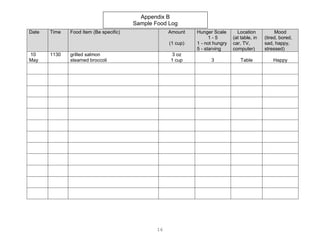
       (3) Members will need to complete a 3-day food log (2 week days and one
weekend day), prior to the scheduled appointment with the Dietitian. Your MTF may
have specific guidelines or members may complete the food diary at the end of this
guide.

        (4) How is an RD different than a Nutritionist? RDs are credentialed providers
and meet minimum education, examination, and continuing education requirements.
There is no legal definition of a Nutritionist, therefore anyone may call themselves a
nutritionist whether they have qualifications or not.

   d. The military Nutrition Environment Enhancement Tool (m-NEAT) is a
commander’s tool to assess how well the command/community supports healthy eating,
an important element of any physical fitness program. The survey assesses the
community’s environment and policies related to promoting and supporting healthy
eating and the access to healthy foods within the workplace, community, and school
settings. By completing m-NEAT, commands receive feedback about the extent to
which they make it easy for people to eat healthfully. Completing this assessment
offers ideas about changes and improvements communities can make to promote a
healthier lifestyle. The action plan section allows communities to reflect on what they
learned in completing the m-NEAT and to identify possible next steps based on the
assessment results combined with their own ideas about what would best serve the
community. A team approach that includes key stakeholders is the best approach to
completing the assessment and action plan. The tool is available on the Navy and
Marine Corps Public Health Website. Put website here

   e. The Navy Operational Fitness and Fueling Series (NOFFS) is designed to provide
the Navy with a "world-class" performance training resource. The Fueling Series and
the Meal Builder of this resource provide members with the tools required to make
healthy nutrition choices and individualized meal plans in both shore-based and
operational environments. Go to navyfitness.org to access NOFFS.

   f. "Galley Go Green" is a program which classifies the nutrient density of foods
offered in the Shore and Ship Galleys by a Green, Yellow or Red identification poster,
table-tent or sticker. Classification of foods is based on calories, total fat, cholesterol,
and sodium. For more information or supplies, contact your local Galley Program
Manager.

3. Navy/DoD Websites
The following websites are credible sources for nutrition information. There is a lot of
information on the web, be cautious when selecting your resources.
a. Health Promotion. Navy and Marine Corps Public Health Center Website (located
at http://www.nmcphc.med.navy.mil/Healthy_Living/) is a clearinghouse for Navy
wellness material, resources and links. Utilize this website to gain access to reliable
nutrition resources, including educational material/handouts on nutrition, weight
management, and fitness challenges for your command.

    b. Performance Nutrition. The Navy Operational Fueling education tool is a 10-
page, double-sided PDF developed specifically for Navy members. It provides nutrition
information and a meal builder to assist in creating a solid foundational diet and
choosing optimal fuel for optimal performance. The electronic version resides at
http://www.navyfitness.org/nutrition/noffs_fueling_series/.

   c. Supplements. Choose your supplements wisely. The Human Performance
Resource Center (located at http://www.humanperformanceresourcecenter.com/)
provides information on safety and efficacy of supplements. Search the website by
supplement product or ingredient to make informed decisions about dietary
supplements and ergogenic aids.

   d. Healthy Habits Coaching. All active duty, reservist and family members are
eligible for benefits from the Military One source located at
https://www.leadetohealth.com/healthsite.php?healthtag=s+4u+1t+2n+dc0e7b2473347
e7ceaded6494031ac4c462fcc&sponsor=navy . Login to the website and search for the
Healthy Habits Coaching Program to learn more information on working with a health
coach online or via telephone.
Section 2 - Guide for Achieving a Healthy Body Weight
1. A healthy body weight takes body fat composition, waist circumference and disease
risk into consideration. For decreased risk of disease, abdominal circumference goals
are 40 inches or less for males and 35 inches or less for females. A successful
individual program utilizes reliable information, referrals to appropriate resources, and
incorporates the below elements.

   a. A Balanced Diet. An optimal diet has a variety of foods, regular meals/snacks,
and meets calorie needs to support a healthy weight. Creating a calorie deficit between
250 - 1000 calories per day should promote 1/2 to 2 pound weight loss per week.
Calorie deficit should not place daily calories below 1200 for females and 1500 for
males.

    b. Regular Physical Activity. Daily activity of at least 30 minutes per day is
recommended for general health. Calories burned during activity contribute to a total
calorie deficit.

    c. Behavior Change. In order to promote lasting changes, one must identify what is
keeping them from achieving their goals and make permanent changes. In addition to
eating habits, activity, stress, and sleep patterns also need to be addressed.

       (1) Self-monitoring. Keeping a daily food and activity log significantly increases
chances of success. Accountability and self-awareness are key results from this often
tedious, but highly beneficial activity.

        (2) Stimulus Control. Different events may trigger eating unhealthy food or
portions. A balanced diet means having desirable foods in moderation over the course
of the day to prevent binge eating at a later time.

        (3) Cognitive Restructuring. Replacing one untrue fact with a more beneficial
one can greatly affect behaviors. If someone can see themselves losing weight or
exercising on a daily basis, they are more likely to succeed. If they think “I blew my diet
already today, I might as well just give up,” they most likely will. An example of
replacing this thought is, “I had more cookies than I planned. “Maybe I can go for an
extra walk” or “Maybe I will have a little less at dinner.”

        (4) Stress Management. Some stress is normal and can assist in performance,
but high-stress levels are a strong predictor of weight regain. Stress produces the
hormone cortisol which promotes fat storage. Stress must be addressed and controlled.
Some stress relieving options include regular exercise, getting adequate sleep,
relaxation techniques, and professional counseling or therapy. Navy resources are
located on NMCPHC website
http://www.nmcphc.med.navy.mil/Healthy_Living/Psychological_Health/Stress_Manage
ment/operandcombatstress.aspx.
(5) Social Support. The most successful Commands are the ones that provide
a network (e.g., friends, family, and/or command members) to help support the member
with their new eating habits and exercise habits. This help and encouragement has
shown to not only increase weight loss, but to help maintain losses by enhancing
feelings of control and confidence.

2. Barriers to Success

   a. Diet Modification. The environment creates a major obstacle with high calorie,
inexpensive foods readily available. Members need to plan to ensure healthy food
options are available. Serving on the Menu Review Board for the galley and providing
input into geedunk items also assists in creating a successful eating environment.
   b. Activity. Many members need to find motivation beyond three days of FEP PT per
week. Long-term weight loss will require a lifelong commitment to physical activity.
Finding enjoyable activities and different activity options may help build a habit of
regular activity.
  c. Behavior Strategies. Lack of self-confidence is a major barrier to change.
Whether it is basic nutrition knowledge, cooking, shopping, exercise techniques, stress
management, resources are available.
    d. Medical Conditions. In rare cases, an undiagnosed medical condition or
particular medication may cause weight gain. Any member experiencing unexplained
weight gain or inability to lose weight, despite consistent efforts, needs to see their PCM
for evaluation. Know your weight and know when to seek help. CFLs/ACFLs are
available for courtesy weigh-ins and BCA measurements.

3. Why Members Fail to Meet their Weight Loss/Maintenance Goals

Losing and keeping weight off requires a lifestyle change. “Diets” need to be avoided
since they do not promote permanent weight loss. Diets that promote rapid weight loss
also cause decreases in metabolism, which leads to regaining all, if not more weight.
Members with regular weight fluctuations between PFA cycles should be referred to a
Dietitian and/or ShipShape as soon as possible, even if they meet BCA standards by
weigh-in. The weight cycling needs to be broken before overall health is affected.
Some common examples of ineffective weight loss methods are provided:

   a. The Low-fat/Fat-free Label Reader. Does not watch calories and eats anything as
long it is low-fat or fat-free. Result: Calorie intake will exceed calorie needs since these
foods tend to be high in simple carbohydrates or sugar. These sugars are burned off in
1-2 hours, leaving the member wanting more food. Recommendation: Fat is a healthy
part of any diet and assists with feeling full and decreasing overall calorie intake. Focus
on moderate portions of healthy fats from plant sources (nuts, seeds, oils).

   b. The Non-exercise Dieter. Watches both calories and fat, but does not perform
regular exercise. Result: Metabolism will lower with a decrease in calorie intake.
Weight will "plateau" after initial weight loss due to the body's adaptive process.
Recommendation: The combination of decreased calories and exercise provides the
most effective weight loss strategy. Safe fat loss is 1-2 pounds per week for the
average person. Claims that you can lose 5 or more “pounds” in a week are
misleading. When somebody does lose this much weight this quickly, the loss is mostly
from fluid , not fat loss.

    c. The High-activity/Low-calorie Dieter. Greatly increases activity and reduces
calories at the same time. This is very common with FEP members following a BCA
failure as the next cycle PFA nears. Result: Member is eating too little, calories do not
support the metabolic needs of the body and weight loss stops. Recommendation:
Exercise and/or calories need to be adjusted. If activity level is adequate, member will
need to gradually increase calories until weight loss resumes. Keep a food log/activity
log to determine if calories are within a deficit of 250 to 1000 of estimated needs.

   d. The Carbo-phobic Dieter. Believes all carbohydrates cause weight gain and
avoids foods containing carbohydrates. Result: Rapid fluid loss due to depletion of
glycogen (glucose) stores. Energy is compromised as a result of low muscle glycogen
that supplies energy for exercise. Lack of alertness and poor attention occurs.
Recommendation: Carbohydrates are an important element of the diet, especially
during exercise. Focus on unprocessed carbohydrates (whole wheat bread, brown rice,
oatmeal, beans and fruit) to provide optimal fuel for the body.

   e. The Fad-diet Follower. Follows the latest craze in weight loss ranging from very
low calories to eliminating important food groups to high intakes of dietary supplements.
Result: Weight cycling. Short term weight loss occurs, which is regained to starting
weight or higher once the diet is stopped. Recommendation: Use sound resources.
Be wary of fad diets. They come and go because they tend to be easy to follow at first,
but do not maintain results in the long run.

4. Realistic Weight-loss Goals

It is important to set goals, both short-term and long-term. A realistic weight-loss goal is
1 - 2 pounds or 1/2 percent body fat per week. Any weight loss beyond 2 pounds per
week after the first month should be addressed. Unrealistic goals are an invitation for
failure.

Goals need to be SMART (Specific, Measureable, Attainable, Realistic and Time-
sensitive). It is best to not only set weight -loss goals (lose 5 pounds per month), but to
also include dietary changes that will facilitate weight loss and lifestyle change. For
example: Keep a daily food log with a goal of eating 5 fruits and vegetables daily.

5. Quick Facts for Weight Management

There is no one program that works for everyone. An effective weight management
plan is one that fits your lifestyle and you are able to sustain. The following list is taken
from the National Weight Loss Registry and includes seven secrets to success that are
consistently found in those who lose and maintain their weight loss.

      a. Sleep 7-8 hours per day (as often as possible). When you can choose to turn
off the TV or computer, do so and get some much needed rest.

     b. Eat breakfast every day. What are you eating after morning PT? This is an
important time to refuel the body during weight-loss efforts. The goal is to refuel the
body within 15 to 60 minutes with a balanced intake of carbohydrates, protein, and
healthy fat.

     c. Walk briskly. Daily activity outside of the gym can be just as important in
burning calories. Walking is an easy way to get that additional 30-60 minutes a day to
promote weight loss. Encourage walking anywhere possible.

    d. Maintain a daily food log. A daily food log increases likelihood of success.
Keep your log simple and manageable.

      e. Weigh regularly. FEP members are weighed weekly to track progress and
address plateaus or weight gain early on. Limit weighing yourself to no more than one
time per day and in the morning if possible. Body weight fluctuates during the day
based on fluid and food intake and only leads to frustration. An exception is weighing
before and after activity to determine fluid needs.

      f. Find support. Members need a support system. Commands that work
together experience the greatest success.

      g. Never give up! Members who play an active role in improving their fitness and
seek out resources

6. Food Guidance

How much should I eat? Choose MyPlate.gov and the Navy Operational Fueling Series
are different tools that can guide you in appropriate food quantities. The following is
general guidance on portion sizes:

     a. Grains. 6 to 8 oz daily for adults. Eat at least 3 oz of whole grain bread,
cereal, crackers, rice, or pasta every day. Look for the word “whole” as the first
ingredient. “Enriched” is never a whole grain.

     b. Vegetables. 2½ to 3 cups daily for adults. The more color, the better. Choose
dark green, red, purple, or blue and orange vegetables when possible.

      c. Fruit. 1½ to 2 cups daily for adults. Choose a variety of fruits each day.
Choose fresh, frozen, canned (in its own juices instead of heavy syrup), or dried fruit.
Go easy on fruit juice, the calories are comparable to soda and always choose 100%
juice.
d. Milk/Dairy products. 2 to 3 cups daily for adults. Choose fat free or 1 percent.
If you don’t or can’t consume milk, choose lactose free products or other calcium source
including yogurt, tofu, soy milk and fortified cereals and orange juice.

     e. Meats and Beans. 5 to 6½ oz for adults daily. Choose low fat or lean meats
and poultry. Bake, broil, or grill. Vary your protein choices with more fish, beans, peas,
nuts, and seeds.

    f. Oil. 5 to 7 teaspoons for adults daily. Choose fat sources from fish, nuts, or
vegetable oil. Limit solid fats like butter, margarine, and shortening.

      g. Empty Calories. An discretionary calorie level of approximately 10 percent of
total calories per day (150-300) allows you to choose foods outside of the above food
groups. It is okay to indulge once in a while. If you indulge on a high calorie item, you
can make it up by selecting lower calorie food and/or beverages or adding additional
activity. Losing weight with the foods you enjoy will assist in keeping weight off. Never
having sweets or savory items is unrealistic, but you must establish limits.

    h. Size up Servings and Calories. Check serving sizes and number of servings on
packages to accurately complete a food log. Be aware that servings listed on the
Nutrition Fact Label are set by manufacturers and may be different than
ChooseMyPlate.gov.

7. Nutrition and Activity

There are three main reasons why increasing exercise can lead to weight plateau or
increased weight gain. Being more aware will help you identify and adjust accordingly.

      a. Exercising makes you hungrier. Make sure the food you eat will fill you up by
choosing nutrient dense foods (protein, fiber, healthy fat) vice calorie dense foods (high
fat, high sugar items with few nutrients). Our bodies are designed not to starve. If you
do not choose lower calorie, filling food, you will naturally compensate for the extra
calories burned from exercise. Try filling up on vegetables before or as part of your
meal.

      b. Exercising can give you a sense of entitlement. “I worked out, so I can
have/deserve ___.” Activity helps you burn calories, but only if you do not eat all of
those calories back. Track your food intake to ensure you are maintaining a calorie
deficit to promote your goals. See the following examples:

       * jogging 60 min =    470 calories = kid size buttered movie theatre popcorn
       * elliptical 45 min = 500 calories = store bought muffin
       * kickboxing 25 min = 275 calories = a tall whole milk latte or 3.5” cookie

     c. Calories need to meet minimum requirements. Make sure calories are not
decreased below the minimum needed to support your metabolism (approximately 1500
calories for males and 1200 calories for female), because it is very difficult to sustain. A
very low calorie diet will ultimately slow your metabolism and weight loss and will
encourage rapid weight regain when higher calorie consumption is resumed.

8. Weight Gain Prevention

Preventing excess weight gain and weight regain is the best weight management
approach. The current environment promotes over consumption of calories and under
consumption of nutrients. Environments are sustained based on demand. Seek out
nutrition information to become a more informed consumer and take actions to set up
your environment to help you succeed at your nutrition goals:

   a. Speak with those that can assist in keeping spaces (the home, office, or other
space) with healthful foods readily available.

    b. Keep unwanted foods out of sight. Actions such as moving a candy bowl out
of reach or sight will significantly decrease calorie intake.

    c. Plan your meals and snacks. Whether eating at the galley, a restaurant, or
 preparing your own meals, plan what fuel you will need. Do not wait until hunger sets
in and then use the excuse that there was nothing else available. Make an attempt to
have it available. Keep foods handy, find restaurant nutrition information online, or use
apps to make informed food and beverage choices.

9. Vulnerable Periods.

Prepare to offset excess calories to prevent excess weight gain. There are certain
times when members are most prone to gain weight.

    a. Leave Periods. Taking 30 days or more and eating home cooking with little
activity will cause weight gain for most. Try to have favorite foods in moderation,
combine with some lower calorie foods, and find time for activity.

    b. On Deployment. With outside food choices limited, dining facilities offer more
options. Plan well and always try to follow the 80/20 rule. Eat well 80% of the time and
have favorite high-calorie foods and beverages no more than 20% of the time. This can
equate to 3 meals per week or using your empty calories daily.

    c. Return from Deployment. Returning home to favorite foods and more time with
family and friends tends to leave less time for PT. Remember to include activity in your
daily routine.

   d. High-stress Times. Increased stress can lead to over consuming foods as a
temporary relief. If you do not manage the stress more effectively, the overeating will
continue. Seek ways to manage your stress. PT is one way.
Section 3 - Nutrition for Weight Gain

Utilize the Navy Operational Fueling Series Meal Builder to assist in creating a meal
plan that will promote healthy weight gain. Consuming nutrient-dense foods (high
calories with high nutrients) vice low nutrient-dense foods (high calories with low
nutrients) along with a well planned cardiovascular and resistance exercise program will
assist in increasing desirable lean muscle gain while promoting good health. Nutrient
dense foods include nuts, healthy fats (plant oils such as olive oil), olives, and peanut
butter.

Access the Navy Operational Fueling System Meal Builder:

http://www.navyfitness.org/nutrition/noffs_fueling_series/
Appendix


   14
Appendix A

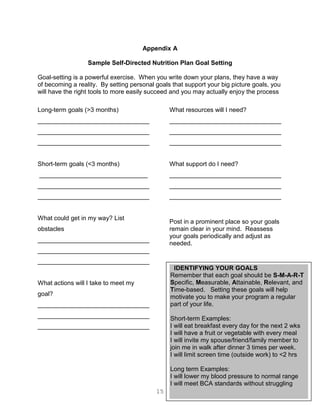
                  Sample Self-Directed Nutrition Plan Goal Setting

Goal-setting is a powerful exercise. When you write down your plans, they have a way
of becoming a reality. By setting personal goals that support your big picture goals, you
will have the right tools to more easily succeed and you may actually enjoy the process

Long-term goals (>3 months)                     What resources will I need?
________________________________                ________________________________
________________________________                ________________________________
________________________________                ________________________________


Short-term goals (<3 months)                    What support do I need?
_______________________________                 ________________________________
________________________________                ________________________________
________________________________                ________________________________


What could get in my way? List
                                                Post in a prominent place so your goals
obstacles                                       remain clear in your mind. Reassess
                                                your goals periodically and adjust as
________________________________
                                                needed.
________________________________
________________________________
                                                 IDENTIFYING YOUR GOALS
                                                Remember that each goal should be S-M-A-R-T
What actions will I take to meet my             Specific, Measurable, Attainable, Relevant, and
                                                Time-based. Setting these goals will help
goal?                                           motivate you to make your program a regular
________________________________                part of your life.
________________________________                Short-term Examples:
________________________________                I will eat breakfast every day for the next 2 wks
                                                I will have a fruit or vegetable with every meal
                                                I will invite my spouse/friend/family member to
                                                join me in walk after dinner 3 times per week.
                                                I will limit screen time (outside work) to <2 hrs

                                                Long term Examples:
                                                I will lower my blood pressure to normal range
                                                I will meet BCA standards without struggling
                                           15
Appendix B
                                        Sample Food Log
Date   Time   Food Item (Be specific)                Amount    Hunger Scale       Location           Mood
                                                                     1-5        (at table, in   (tired, bored,
                                                     (1 cup)   1 - not hungry   car, TV,        sad, happy,
                                                               5 - starving     computer)       stressed)
10     1130   grilled salmon                          3 oz
May           steamed broccoli                       1 cup           3              Table           Happy


                                                16
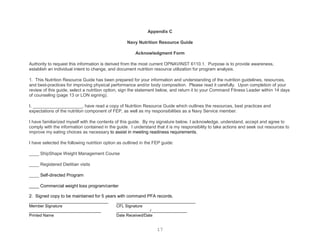
Appendix C

                                                   Navy Nutrition Resource Guide

                                                        Acknowledgment Form

Authority to request this information is derived from the most current OPNAVINST 6110.1. Purpose is to provide awareness,
establish an individual intent to change, and document nutrition resource utilization for program analysis.

1. This Nutrition Resource Guide has been prepared for your information and understanding of the nutrition guidelines, resources,
and best-practices for improving physical performance and/or body composition. Please read it carefully. Upon completion of your
review of this guide, select a nutrition option, sign the statement below, and return it to your Command Fitness Leader within 14 days
of counseling (page 13 or LON signing).

I, ____________________, have read a copy of Nutrition Resource Guide which outlines the resources, best practices and
expectations of the nutrition component of FEP, as well as my responsibilities as a Navy Service member.

I have familiarized myself with the contents of this guide. By my signature below, I acknowledge, understand, accept and agree to
comply with the information contained in the guide. I understand that it is my responsibility to take actions and seek out resources to
improve my eating choices as necessary to assist in meeting readiness requirements.

I have selected the following nutrition option as outlined in the FEP guide:

____ ShipShape Weight Management Course

____ Registered Dietitian visits

____ Self-directed Program

____ Commercial weight loss program/center

2. Signed copy to be maintained for 5 years with command PFA records.
________________________________           ________________________________
Member Signature                             CFL Signature
________________________________             _______________/________________
Printed Name                                 Date Received/Date


                                                                   17

2011 Nutrition Resource Guide

  • 1.
  • 2.
    PREFACE To the Servicemember:The nutrition resource guide was developed to provide a compiled list and location of available nutrition resource available to Navy members and their families. Refer to the following resources to assist in improving your personal nutrition. To Fitness Enhancement Participants. This guide is provided to increase your awareness of available resources to assist you with increasing performance and/or achieving a healthy body weight. To the Command Fitness Leader. This guide is to be used with your Command Fitness Enhancement Program. Distribution of the Nutrition Resource Guide is mandatory for all Fitness Enhancement Program participants. Ensure you and your ACFLs are aware of these resource as well as other local resources. While you are not trained to provide diets or nutrition counseling, knowing how to align resources with a person’s needs will greatly assist with the nutrition component of fitness.
  • 3.
    Section 1 –Nutrition Resources Whether you are looking to improve performance, body composition, or general well- being, the following tools may be used to put any program or meal plan into perspective. These tools convert scientific evidence into practical applications to improve eating choices. 1. National Nutrition Guidelines a. The 2010 Dietary Guidelines for Americans. Released 31 January 2011, the updated. Guidelines (located at http://www.health.gov/DietaryGuidelines/ ) focus on improving the diet and preventing obesity. Key messages include: (1) Balance Calories to Manage Weight (a) Enjoy your food, but eat less (b) Avoid oversized portions (2) Food to Increase (a) Make half your plate fruits and vegetables (b) Make half of all grains “whole” grains. Replace refined grains. (c) Switch to fat-free or low fat milk (1%) (3) Foods to Reduce (a) Compare sodium in foods like soup, bread, and frozen meals – and choose the foods with lower numbers (b) Drink water instead of sugary drinks (4) Building Healthy Eating Patterns (a) Select an eating pattern that meets nutritional needs over time (b) Account for all food and beverage consumed and assess how they fit within a total healthy eating pattern b. ChooseMyPlate.gov. This free web-based program (located at http://www.choosemyplate.gov/) provides sound advice on what and how much to eat. Utilize this website for a personalized meal plan. Other websites may be appealing for tracking food intake, however many are inaccurate in calculating nutrition needs
  • 4.
    2. Navy NutritionProgram/Tools a. Shipshape. An evidence based, behavioral health program specifically designed for members who exceed BCA standards. This program meets for approximately one-hour once a week in a group setting. Topics include basic nutrition, stress management, physical activity, and behavior modification to promote lifestyle changes that support healthy eating and activity. (1) The CFL is the liaison with the MTF Health Promotion Director and refers members to ShipShape as needed. After successful program completion, CFLs must record completion in PRIMS. Program information, locations, and quota request forms to be completed by the CFL are located at http://www.nmcphc.med.navy.mil/Healthy_Living/Weight_Management/shipshape_over view.as (2) ShipShape is highly recommended for members who fail to meet weight standards or are in jeopardy of failing. It is also recommended for adult family members in support of family readiness. It is not a mandatory program and should not be treated as such by commands. All FEP participants are encouraged to attend the first class to learn more about the program. (3) ShipShape is available at all Military Treatment Facilities (MTFs) including branch clinics. Any members interested in becoming a course facilitator, especially those that have decreased their body fat through lifestyle modifications, are encouraged to attend the facilitator course. b. Mission Nutrition. A standardized, science-based nutrition education course designed to help educate Sailors, family members, and retirees on various nutrition topics. Check with your local MWR Fitness Center for more information. c. Registered Dietitians (RD). The food and nutrition expert who translates the science of nutrition into practical solutions for healthy living. RDs use their nutrition expertise to help individuals make unique, positive lifestyle changes. Many RDs also have board certifications as certified sports specialists in dietetics (CSSD). A Navy Dietitian locator is available on the Physical Readiness Program website at http://www.public.navy.mil/bupers-npc/support/physical/Pages/default2.aspx (1) RDs are the only person authorized to provide individualized diets. (2) To put this in perspective, by law in the United States, non-Registered Dietitians (e.g. Personal Trainers, CFL’s, “nutritionists,” exercise enthusiasts) are only authorized to provide general dietary advice based on national guidelines (www.ChooseMyPlate.gov and Dietary Guidelines for Americans). A health/fitness professional can explain the basic principles of weight loss but is not required to have the training to be able to calculate, outline and counsel, or prescribe an individualized weight management plan. This becomes even more critical if the
  • 5.
    individual being counseledhas medical complications associated with obesity, such as diabetes, heart disease, or hypertension. (3) Members will need to complete a 3-day food log (2 week days and one weekend day), prior to the scheduled appointment with the Dietitian. Your MTF may have specific guidelines or members may complete the food diary at the end of this guide. (4) How is an RD different than a Nutritionist? RDs are credentialed providers and meet minimum education, examination, and continuing education requirements. There is no legal definition of a Nutritionist, therefore anyone may call themselves a nutritionist whether they have qualifications or not. d. The military Nutrition Environment Enhancement Tool (m-NEAT) is a commander’s tool to assess how well the command/community supports healthy eating, an important element of any physical fitness program. The survey assesses the community’s environment and policies related to promoting and supporting healthy eating and the access to healthy foods within the workplace, community, and school settings. By completing m-NEAT, commands receive feedback about the extent to which they make it easy for people to eat healthfully. Completing this assessment offers ideas about changes and improvements communities can make to promote a healthier lifestyle. The action plan section allows communities to reflect on what they learned in completing the m-NEAT and to identify possible next steps based on the assessment results combined with their own ideas about what would best serve the community. A team approach that includes key stakeholders is the best approach to completing the assessment and action plan. The tool is available on the Navy and Marine Corps Public Health Website. Put website here e. The Navy Operational Fitness and Fueling Series (NOFFS) is designed to provide the Navy with a "world-class" performance training resource. The Fueling Series and the Meal Builder of this resource provide members with the tools required to make healthy nutrition choices and individualized meal plans in both shore-based and operational environments. Go to navyfitness.org to access NOFFS. f. "Galley Go Green" is a program which classifies the nutrient density of foods offered in the Shore and Ship Galleys by a Green, Yellow or Red identification poster, table-tent or sticker. Classification of foods is based on calories, total fat, cholesterol, and sodium. For more information or supplies, contact your local Galley Program Manager. 3. Navy/DoD Websites The following websites are credible sources for nutrition information. There is a lot of information on the web, be cautious when selecting your resources.
  • 6.
    a. Health Promotion.Navy and Marine Corps Public Health Center Website (located at http://www.nmcphc.med.navy.mil/Healthy_Living/) is a clearinghouse for Navy wellness material, resources and links. Utilize this website to gain access to reliable nutrition resources, including educational material/handouts on nutrition, weight management, and fitness challenges for your command. b. Performance Nutrition. The Navy Operational Fueling education tool is a 10- page, double-sided PDF developed specifically for Navy members. It provides nutrition information and a meal builder to assist in creating a solid foundational diet and choosing optimal fuel for optimal performance. The electronic version resides at http://www.navyfitness.org/nutrition/noffs_fueling_series/. c. Supplements. Choose your supplements wisely. The Human Performance Resource Center (located at http://www.humanperformanceresourcecenter.com/) provides information on safety and efficacy of supplements. Search the website by supplement product or ingredient to make informed decisions about dietary supplements and ergogenic aids. d. Healthy Habits Coaching. All active duty, reservist and family members are eligible for benefits from the Military One source located at https://www.leadetohealth.com/healthsite.php?healthtag=s+4u+1t+2n+dc0e7b2473347 e7ceaded6494031ac4c462fcc&sponsor=navy . Login to the website and search for the Healthy Habits Coaching Program to learn more information on working with a health coach online or via telephone.
  • 7.
    Section 2 -Guide for Achieving a Healthy Body Weight 1. A healthy body weight takes body fat composition, waist circumference and disease risk into consideration. For decreased risk of disease, abdominal circumference goals are 40 inches or less for males and 35 inches or less for females. A successful individual program utilizes reliable information, referrals to appropriate resources, and incorporates the below elements. a. A Balanced Diet. An optimal diet has a variety of foods, regular meals/snacks, and meets calorie needs to support a healthy weight. Creating a calorie deficit between 250 - 1000 calories per day should promote 1/2 to 2 pound weight loss per week. Calorie deficit should not place daily calories below 1200 for females and 1500 for males. b. Regular Physical Activity. Daily activity of at least 30 minutes per day is recommended for general health. Calories burned during activity contribute to a total calorie deficit. c. Behavior Change. In order to promote lasting changes, one must identify what is keeping them from achieving their goals and make permanent changes. In addition to eating habits, activity, stress, and sleep patterns also need to be addressed. (1) Self-monitoring. Keeping a daily food and activity log significantly increases chances of success. Accountability and self-awareness are key results from this often tedious, but highly beneficial activity. (2) Stimulus Control. Different events may trigger eating unhealthy food or portions. A balanced diet means having desirable foods in moderation over the course of the day to prevent binge eating at a later time. (3) Cognitive Restructuring. Replacing one untrue fact with a more beneficial one can greatly affect behaviors. If someone can see themselves losing weight or exercising on a daily basis, they are more likely to succeed. If they think “I blew my diet already today, I might as well just give up,” they most likely will. An example of replacing this thought is, “I had more cookies than I planned. “Maybe I can go for an extra walk” or “Maybe I will have a little less at dinner.” (4) Stress Management. Some stress is normal and can assist in performance, but high-stress levels are a strong predictor of weight regain. Stress produces the hormone cortisol which promotes fat storage. Stress must be addressed and controlled. Some stress relieving options include regular exercise, getting adequate sleep, relaxation techniques, and professional counseling or therapy. Navy resources are located on NMCPHC website http://www.nmcphc.med.navy.mil/Healthy_Living/Psychological_Health/Stress_Manage ment/operandcombatstress.aspx.
  • 8.
    (5) Social Support.The most successful Commands are the ones that provide a network (e.g., friends, family, and/or command members) to help support the member with their new eating habits and exercise habits. This help and encouragement has shown to not only increase weight loss, but to help maintain losses by enhancing feelings of control and confidence. 2. Barriers to Success a. Diet Modification. The environment creates a major obstacle with high calorie, inexpensive foods readily available. Members need to plan to ensure healthy food options are available. Serving on the Menu Review Board for the galley and providing input into geedunk items also assists in creating a successful eating environment. b. Activity. Many members need to find motivation beyond three days of FEP PT per week. Long-term weight loss will require a lifelong commitment to physical activity. Finding enjoyable activities and different activity options may help build a habit of regular activity. c. Behavior Strategies. Lack of self-confidence is a major barrier to change. Whether it is basic nutrition knowledge, cooking, shopping, exercise techniques, stress management, resources are available. d. Medical Conditions. In rare cases, an undiagnosed medical condition or particular medication may cause weight gain. Any member experiencing unexplained weight gain or inability to lose weight, despite consistent efforts, needs to see their PCM for evaluation. Know your weight and know when to seek help. CFLs/ACFLs are available for courtesy weigh-ins and BCA measurements. 3. Why Members Fail to Meet their Weight Loss/Maintenance Goals Losing and keeping weight off requires a lifestyle change. “Diets” need to be avoided since they do not promote permanent weight loss. Diets that promote rapid weight loss also cause decreases in metabolism, which leads to regaining all, if not more weight. Members with regular weight fluctuations between PFA cycles should be referred to a Dietitian and/or ShipShape as soon as possible, even if they meet BCA standards by weigh-in. The weight cycling needs to be broken before overall health is affected. Some common examples of ineffective weight loss methods are provided: a. The Low-fat/Fat-free Label Reader. Does not watch calories and eats anything as long it is low-fat or fat-free. Result: Calorie intake will exceed calorie needs since these foods tend to be high in simple carbohydrates or sugar. These sugars are burned off in 1-2 hours, leaving the member wanting more food. Recommendation: Fat is a healthy part of any diet and assists with feeling full and decreasing overall calorie intake. Focus on moderate portions of healthy fats from plant sources (nuts, seeds, oils). b. The Non-exercise Dieter. Watches both calories and fat, but does not perform regular exercise. Result: Metabolism will lower with a decrease in calorie intake. Weight will "plateau" after initial weight loss due to the body's adaptive process.
  • 9.
    Recommendation: The combinationof decreased calories and exercise provides the most effective weight loss strategy. Safe fat loss is 1-2 pounds per week for the average person. Claims that you can lose 5 or more “pounds” in a week are misleading. When somebody does lose this much weight this quickly, the loss is mostly from fluid , not fat loss. c. The High-activity/Low-calorie Dieter. Greatly increases activity and reduces calories at the same time. This is very common with FEP members following a BCA failure as the next cycle PFA nears. Result: Member is eating too little, calories do not support the metabolic needs of the body and weight loss stops. Recommendation: Exercise and/or calories need to be adjusted. If activity level is adequate, member will need to gradually increase calories until weight loss resumes. Keep a food log/activity log to determine if calories are within a deficit of 250 to 1000 of estimated needs. d. The Carbo-phobic Dieter. Believes all carbohydrates cause weight gain and avoids foods containing carbohydrates. Result: Rapid fluid loss due to depletion of glycogen (glucose) stores. Energy is compromised as a result of low muscle glycogen that supplies energy for exercise. Lack of alertness and poor attention occurs. Recommendation: Carbohydrates are an important element of the diet, especially during exercise. Focus on unprocessed carbohydrates (whole wheat bread, brown rice, oatmeal, beans and fruit) to provide optimal fuel for the body. e. The Fad-diet Follower. Follows the latest craze in weight loss ranging from very low calories to eliminating important food groups to high intakes of dietary supplements. Result: Weight cycling. Short term weight loss occurs, which is regained to starting weight or higher once the diet is stopped. Recommendation: Use sound resources. Be wary of fad diets. They come and go because they tend to be easy to follow at first, but do not maintain results in the long run. 4. Realistic Weight-loss Goals It is important to set goals, both short-term and long-term. A realistic weight-loss goal is 1 - 2 pounds or 1/2 percent body fat per week. Any weight loss beyond 2 pounds per week after the first month should be addressed. Unrealistic goals are an invitation for failure. Goals need to be SMART (Specific, Measureable, Attainable, Realistic and Time- sensitive). It is best to not only set weight -loss goals (lose 5 pounds per month), but to also include dietary changes that will facilitate weight loss and lifestyle change. For example: Keep a daily food log with a goal of eating 5 fruits and vegetables daily. 5. Quick Facts for Weight Management There is no one program that works for everyone. An effective weight management plan is one that fits your lifestyle and you are able to sustain. The following list is taken from the National Weight Loss Registry and includes seven secrets to success that are
  • 10.
    consistently found inthose who lose and maintain their weight loss. a. Sleep 7-8 hours per day (as often as possible). When you can choose to turn off the TV or computer, do so and get some much needed rest. b. Eat breakfast every day. What are you eating after morning PT? This is an important time to refuel the body during weight-loss efforts. The goal is to refuel the body within 15 to 60 minutes with a balanced intake of carbohydrates, protein, and healthy fat. c. Walk briskly. Daily activity outside of the gym can be just as important in burning calories. Walking is an easy way to get that additional 30-60 minutes a day to promote weight loss. Encourage walking anywhere possible. d. Maintain a daily food log. A daily food log increases likelihood of success. Keep your log simple and manageable. e. Weigh regularly. FEP members are weighed weekly to track progress and address plateaus or weight gain early on. Limit weighing yourself to no more than one time per day and in the morning if possible. Body weight fluctuates during the day based on fluid and food intake and only leads to frustration. An exception is weighing before and after activity to determine fluid needs. f. Find support. Members need a support system. Commands that work together experience the greatest success. g. Never give up! Members who play an active role in improving their fitness and seek out resources 6. Food Guidance How much should I eat? Choose MyPlate.gov and the Navy Operational Fueling Series are different tools that can guide you in appropriate food quantities. The following is general guidance on portion sizes: a. Grains. 6 to 8 oz daily for adults. Eat at least 3 oz of whole grain bread, cereal, crackers, rice, or pasta every day. Look for the word “whole” as the first ingredient. “Enriched” is never a whole grain. b. Vegetables. 2½ to 3 cups daily for adults. The more color, the better. Choose dark green, red, purple, or blue and orange vegetables when possible. c. Fruit. 1½ to 2 cups daily for adults. Choose a variety of fruits each day. Choose fresh, frozen, canned (in its own juices instead of heavy syrup), or dried fruit. Go easy on fruit juice, the calories are comparable to soda and always choose 100% juice.
  • 11.
    d. Milk/Dairy products.2 to 3 cups daily for adults. Choose fat free or 1 percent. If you don’t or can’t consume milk, choose lactose free products or other calcium source including yogurt, tofu, soy milk and fortified cereals and orange juice. e. Meats and Beans. 5 to 6½ oz for adults daily. Choose low fat or lean meats and poultry. Bake, broil, or grill. Vary your protein choices with more fish, beans, peas, nuts, and seeds. f. Oil. 5 to 7 teaspoons for adults daily. Choose fat sources from fish, nuts, or vegetable oil. Limit solid fats like butter, margarine, and shortening. g. Empty Calories. An discretionary calorie level of approximately 10 percent of total calories per day (150-300) allows you to choose foods outside of the above food groups. It is okay to indulge once in a while. If you indulge on a high calorie item, you can make it up by selecting lower calorie food and/or beverages or adding additional activity. Losing weight with the foods you enjoy will assist in keeping weight off. Never having sweets or savory items is unrealistic, but you must establish limits. h. Size up Servings and Calories. Check serving sizes and number of servings on packages to accurately complete a food log. Be aware that servings listed on the Nutrition Fact Label are set by manufacturers and may be different than ChooseMyPlate.gov. 7. Nutrition and Activity There are three main reasons why increasing exercise can lead to weight plateau or increased weight gain. Being more aware will help you identify and adjust accordingly. a. Exercising makes you hungrier. Make sure the food you eat will fill you up by choosing nutrient dense foods (protein, fiber, healthy fat) vice calorie dense foods (high fat, high sugar items with few nutrients). Our bodies are designed not to starve. If you do not choose lower calorie, filling food, you will naturally compensate for the extra calories burned from exercise. Try filling up on vegetables before or as part of your meal. b. Exercising can give you a sense of entitlement. “I worked out, so I can have/deserve ___.” Activity helps you burn calories, but only if you do not eat all of those calories back. Track your food intake to ensure you are maintaining a calorie deficit to promote your goals. See the following examples: * jogging 60 min = 470 calories = kid size buttered movie theatre popcorn * elliptical 45 min = 500 calories = store bought muffin * kickboxing 25 min = 275 calories = a tall whole milk latte or 3.5” cookie c. Calories need to meet minimum requirements. Make sure calories are not decreased below the minimum needed to support your metabolism (approximately 1500
  • 12.
    calories for malesand 1200 calories for female), because it is very difficult to sustain. A very low calorie diet will ultimately slow your metabolism and weight loss and will encourage rapid weight regain when higher calorie consumption is resumed. 8. Weight Gain Prevention Preventing excess weight gain and weight regain is the best weight management approach. The current environment promotes over consumption of calories and under consumption of nutrients. Environments are sustained based on demand. Seek out nutrition information to become a more informed consumer and take actions to set up your environment to help you succeed at your nutrition goals: a. Speak with those that can assist in keeping spaces (the home, office, or other space) with healthful foods readily available. b. Keep unwanted foods out of sight. Actions such as moving a candy bowl out of reach or sight will significantly decrease calorie intake. c. Plan your meals and snacks. Whether eating at the galley, a restaurant, or preparing your own meals, plan what fuel you will need. Do not wait until hunger sets in and then use the excuse that there was nothing else available. Make an attempt to have it available. Keep foods handy, find restaurant nutrition information online, or use apps to make informed food and beverage choices. 9. Vulnerable Periods. Prepare to offset excess calories to prevent excess weight gain. There are certain times when members are most prone to gain weight. a. Leave Periods. Taking 30 days or more and eating home cooking with little activity will cause weight gain for most. Try to have favorite foods in moderation, combine with some lower calorie foods, and find time for activity. b. On Deployment. With outside food choices limited, dining facilities offer more options. Plan well and always try to follow the 80/20 rule. Eat well 80% of the time and have favorite high-calorie foods and beverages no more than 20% of the time. This can equate to 3 meals per week or using your empty calories daily. c. Return from Deployment. Returning home to favorite foods and more time with family and friends tends to leave less time for PT. Remember to include activity in your daily routine. d. High-stress Times. Increased stress can lead to over consuming foods as a temporary relief. If you do not manage the stress more effectively, the overeating will continue. Seek ways to manage your stress. PT is one way.
  • 13.
    Section 3 -Nutrition for Weight Gain Utilize the Navy Operational Fueling Series Meal Builder to assist in creating a meal plan that will promote healthy weight gain. Consuming nutrient-dense foods (high calories with high nutrients) vice low nutrient-dense foods (high calories with low nutrients) along with a well planned cardiovascular and resistance exercise program will assist in increasing desirable lean muscle gain while promoting good health. Nutrient dense foods include nuts, healthy fats (plant oils such as olive oil), olives, and peanut butter. Access the Navy Operational Fueling System Meal Builder: http://www.navyfitness.org/nutrition/noffs_fueling_series/
  • 14.
  • 15.
    Appendix A Sample Self-Directed Nutrition Plan Goal Setting Goal-setting is a powerful exercise. When you write down your plans, they have a way of becoming a reality. By setting personal goals that support your big picture goals, you will have the right tools to more easily succeed and you may actually enjoy the process Long-term goals (>3 months) What resources will I need? ________________________________ ________________________________ ________________________________ ________________________________ ________________________________ ________________________________ Short-term goals (<3 months) What support do I need? _______________________________ ________________________________ ________________________________ ________________________________ ________________________________ ________________________________ What could get in my way? List Post in a prominent place so your goals obstacles remain clear in your mind. Reassess your goals periodically and adjust as ________________________________ needed. ________________________________ ________________________________ IDENTIFYING YOUR GOALS Remember that each goal should be S-M-A-R-T What actions will I take to meet my Specific, Measurable, Attainable, Relevant, and Time-based. Setting these goals will help goal? motivate you to make your program a regular ________________________________ part of your life. ________________________________ Short-term Examples: ________________________________ I will eat breakfast every day for the next 2 wks I will have a fruit or vegetable with every meal I will invite my spouse/friend/family member to join me in walk after dinner 3 times per week. I will limit screen time (outside work) to <2 hrs Long term Examples: I will lower my blood pressure to normal range I will meet BCA standards without struggling 15
  • 16.
    Appendix B Sample Food Log Date Time Food Item (Be specific) Amount Hunger Scale Location Mood 1-5 (at table, in (tired, bored, (1 cup) 1 - not hungry car, TV, sad, happy, 5 - starving computer) stressed) 10 1130 grilled salmon 3 oz May steamed broccoli 1 cup 3 Table Happy 16
  • 17.
    Appendix C Navy Nutrition Resource Guide Acknowledgment Form Authority to request this information is derived from the most current OPNAVINST 6110.1. Purpose is to provide awareness, establish an individual intent to change, and document nutrition resource utilization for program analysis. 1. This Nutrition Resource Guide has been prepared for your information and understanding of the nutrition guidelines, resources, and best-practices for improving physical performance and/or body composition. Please read it carefully. Upon completion of your review of this guide, select a nutrition option, sign the statement below, and return it to your Command Fitness Leader within 14 days of counseling (page 13 or LON signing). I, ____________________, have read a copy of Nutrition Resource Guide which outlines the resources, best practices and expectations of the nutrition component of FEP, as well as my responsibilities as a Navy Service member. I have familiarized myself with the contents of this guide. By my signature below, I acknowledge, understand, accept and agree to comply with the information contained in the guide. I understand that it is my responsibility to take actions and seek out resources to improve my eating choices as necessary to assist in meeting readiness requirements. I have selected the following nutrition option as outlined in the FEP guide: ____ ShipShape Weight Management Course ____ Registered Dietitian visits ____ Self-directed Program ____ Commercial weight loss program/center 2. Signed copy to be maintained for 5 years with command PFA records. ________________________________ ________________________________ Member Signature CFL Signature ________________________________ _______________/________________ Printed Name Date Received/Date 17