2010  Power Smart Pricing  Summer Readiness Workshop
Summer Readiness Workshop - CNT Energy - Power Smart Pricing - Low-cost/no-cost energy saving tips - DIY home energy investigation - Resources
CNT Energy A nonprofit organization dedicated to helping people save energy and money Dynamic Pricing and Smart Grid Ameren Power Smart Pricing ComEd Residential Real-time Pricing Program Energy Efficient Buildings Multifamily Single-family Commercial and municipal buildings Regional Energy Planning
Power Smart Pricing   An hourly electricity pricing program available to Ameren Illinois residential customers
Power Smart Pricing   How can it help you save on your electricity bills?
Most pay a  flat rate. No matter when you use electricity it costs a certain amount.
With Power Smart Pricing The price goes  up and down  depending on the demand for electricity.
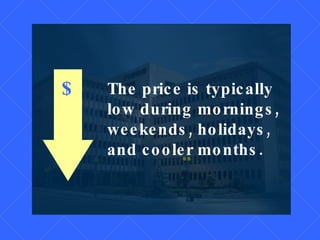
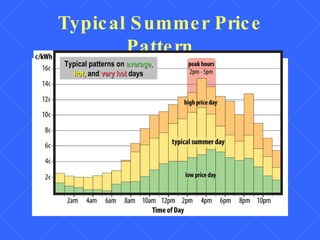
$ The price is typically low during mornings, weekends, holidays, and cooler months.
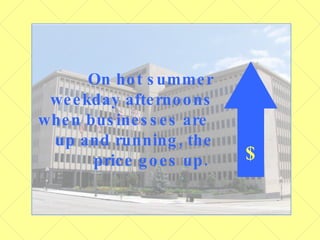
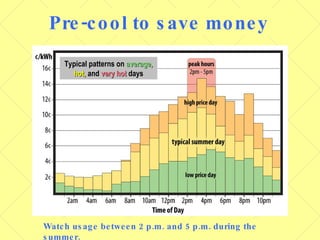
On hot summer weekday afternoons when businesses are  up and running, the price goes up.   $
 
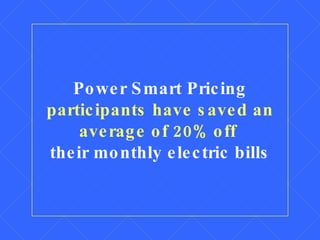
Power Smart Pricing  participants have saved an average of 20% off   their monthly electric bills
How can I save by shifting my usage to lower priced times?
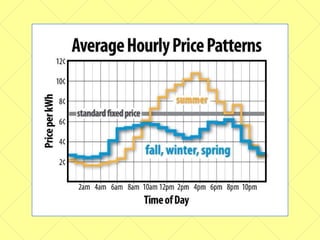
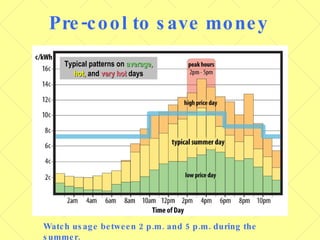
Typical Summer Price Pattern Typical patterns on  average,   hot,  and  very hot  days Watch usage between 2 p.m. and 5 p.m. during the summer.   Typical patterns on  average,   hot,  and  very hot  days
Avoid high price times Prices are available  everyday online or by phone Day ahead notification of any hour that has a price above 13 cents Receive high price notifications by telephone, e-mail and even Twitter
Avoid high price times Wait to wash Unplug chargers Fire up the grill Feast on cold foods Head to the pool or the library
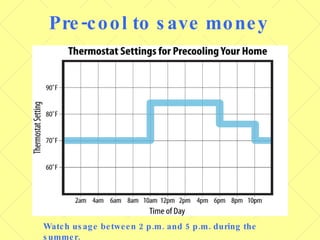
Pre-cool to save money Typical patterns on  average,   hot,  and  very hot  days Watch usage between 2 p.m. and 5 p.m. during the summer.   Typical patterns on  average,   hot,  and  very hot  days
Pre-cool to save money Watch usage between 2 p.m. and 5 p.m. during the summer.
Typical patterns on  average,   hot,  and  very hot  days Pre-cool to save money Watch usage between 2 p.m. and 5 p.m. during the summer.
How can I  check my results?
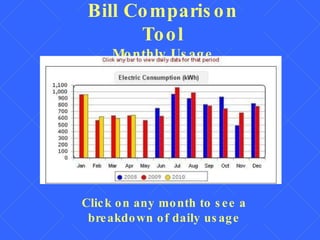
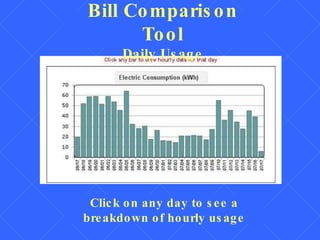
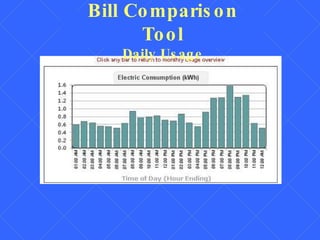
Bill Comparison Tool See your total and monthly savings  A detailed breakdown of the line items on your bill View and download your monthly, weekly and daily electricity usage
Bill Comparison Tool Monthly Usage Click on any month to see a breakdown of daily usage
Bill Comparison Tool Daily Usage Click on any day to see a breakdown of hourly usage
Bill Comparison Tool Daily Usage
Where do my energy dollars go?
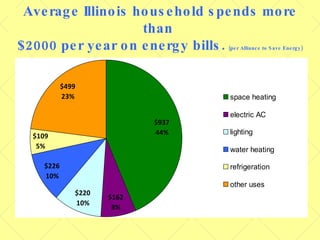
Average Illinois household spends more than  $2000 per year on energy bills.   (per Alliance to Save Energy)
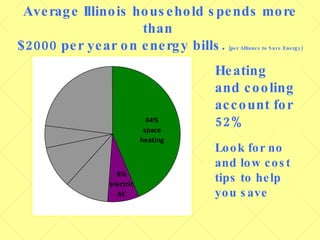
Heating and cooling account for 52% Look for no and low cost tips to help you save Average Illinois household spends more than  $2000 per year on energy bills.   (per Alliance to Save Energy)
What can I do to start saving on energy right away without spending a lot of money?
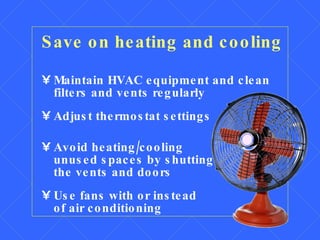
Save on heating and cooling Maintain HVAC equipment and clean filters and vents regularly  Adjust thermostat settings Avoid heating/cooling  unused spaces by shutting  the vents and doors Use fans with or instead  of air conditioning
Cut energy use of appliances Refrigeration Clean coils in back of refrigerator Make sure door seals are tight Recycle old refrigerators and freezers Water heating Install low flow shower heads and faucet aerators Insulate hot water pipes
Cut energy use of appliances Laundry Wash full loads Use cold water Make sure dryer stops when clothes are dry Dishwasher Wash full loads Use the energy-saver or “no-heat dry” function
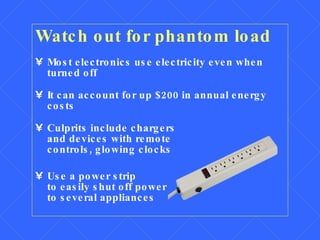
Watch out for phantom load Most electronics use electricity even when  turned off It can account for up $200 in annual energy costs Culprits include chargers  and devices with remote  controls, glowing clocks Use a power strip  to easily shut off power  to several appliances
How do I find ways  to save even more energy and money?
5-Step Home Energy Investigation
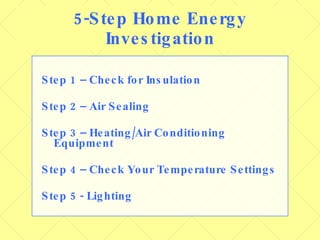
5-Step Home Energy Investigation Step 1 – Check for Insulation Step 2 – Air Sealing Step 3 – Heating/Air Conditioning Equipment Step 4 – Check Your Temperature Settings Step 5 - Lighting
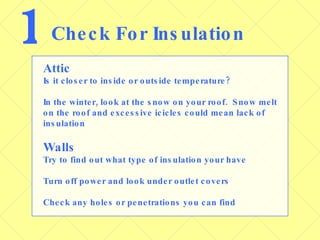
1 Check For Insulation Attic Is it closer to inside or outside temperature? In the winter, look at the snow on your roof.  Snow melt on the roof and excessive icicles could mean lack of insulation Walls Try to find out what type of insulation your have Turn off power and look under outlet covers Check any holes or penetrations you can find
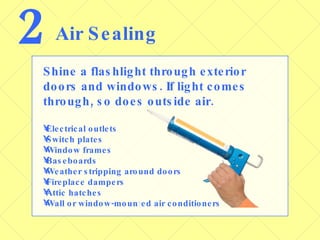
2 Air Sealing Shine a flashlight through exterior doors and windows. If light comes through, so does outside air. Electrical outlets Switch plates Window frames Baseboards Weather stripping around doors Fireplace dampers Attic hatches Wall or window-mounted air conditioners
3 Heating/Air Conditioning Air Conditioner Look on your Air Conditioning unit to find its SEER rating.  In Illinois, an efficient AC unit has a SEER rating of 14.  Furnace Look on your furnace to find it’s Average Fuel Usage Efficiency.  Look for air vent registers in unoccupied areas such as guest rooms, storage space
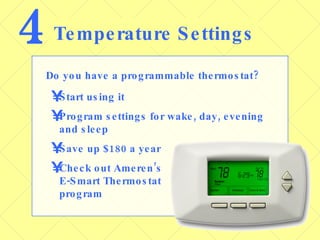
4 Temperature Settings Do you have a programmable thermostat? Start using it Program settings for wake, day, evening and sleep Save up $180 a year Check out Ameren’s  E-Smart Thermostat  program
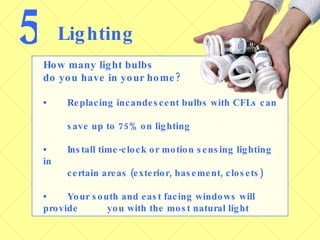
5 Lighting How many light bulbs  do you have in your home? • Replacing incandescent bulbs with CFLs can  save up to 75% on lighting • Install time-clock or motion sensing lighting in  certain areas (exterior, basement, closets) • Your south and east facing windows will provide  you with the most natural light
Incentives for Efficiency Act On Energy:  www.ActOnEnergy.com Tax Incentives Assistance Project:  www.energytaxincentives.org Database of State Incentives for Renewables & Efficiency:  www.dsireusa.org U.S. DOE, Energy Efficiency and Renewable Energy:   www1.eere.energy.gov/financing/consumers.html Alliance to Save Energy:    ase.org/content/article/detail/2654
Recommended Resources Power Smart Pricing:  www.PowerSmartPricing.org CNT Energy:  www.CNTenergy.org Energy Star:  www.ENERGYSTAR.gov USDOE, Energy Savers:  www.energysavers.gov USDOE, Energy Efficiency and Renewable Energy:  www.eere.energy.gov American Council for an Energy-Efficient Economy:  www.aceee.org Midwest Energy Efficiency Alliance:  www.mwalliance.org

2010 PSP Summer Readiness Workshop Presentation

  • 1.
    2010 PowerSmart Pricing Summer Readiness Workshop
  • 2.
    Summer Readiness Workshop- CNT Energy - Power Smart Pricing - Low-cost/no-cost energy saving tips - DIY home energy investigation - Resources
  • 3.
    CNT Energy Anonprofit organization dedicated to helping people save energy and money Dynamic Pricing and Smart Grid Ameren Power Smart Pricing ComEd Residential Real-time Pricing Program Energy Efficient Buildings Multifamily Single-family Commercial and municipal buildings Regional Energy Planning
  • 4.
    Power Smart Pricing An hourly electricity pricing program available to Ameren Illinois residential customers
  • 5.
    Power Smart Pricing How can it help you save on your electricity bills?
  • 6.
    Most pay a flat rate. No matter when you use electricity it costs a certain amount.
  • 7.
    With Power SmartPricing The price goes up and down depending on the demand for electricity.
  • 8.
    $ The priceis typically low during mornings, weekends, holidays, and cooler months.
  • 9.
    On hot summerweekday afternoons when businesses are up and running, the price goes up. $
  • 10.
  • 11.
    Power Smart Pricing participants have saved an average of 20% off their monthly electric bills
  • 12.
    How can Isave by shifting my usage to lower priced times?
  • 13.
    Typical Summer PricePattern Typical patterns on average, hot, and very hot days Watch usage between 2 p.m. and 5 p.m. during the summer. Typical patterns on average, hot, and very hot days
  • 14.
    Avoid high pricetimes Prices are available everyday online or by phone Day ahead notification of any hour that has a price above 13 cents Receive high price notifications by telephone, e-mail and even Twitter
  • 15.
    Avoid high pricetimes Wait to wash Unplug chargers Fire up the grill Feast on cold foods Head to the pool or the library
  • 16.
    Pre-cool to savemoney Typical patterns on average, hot, and very hot days Watch usage between 2 p.m. and 5 p.m. during the summer. Typical patterns on average, hot, and very hot days
  • 17.
    Pre-cool to savemoney Watch usage between 2 p.m. and 5 p.m. during the summer.
  • 18.
    Typical patterns on average, hot, and very hot days Pre-cool to save money Watch usage between 2 p.m. and 5 p.m. during the summer.
  • 19.
    How can I check my results?
  • 20.
    Bill Comparison ToolSee your total and monthly savings A detailed breakdown of the line items on your bill View and download your monthly, weekly and daily electricity usage
  • 21.
    Bill Comparison ToolMonthly Usage Click on any month to see a breakdown of daily usage
  • 22.
    Bill Comparison ToolDaily Usage Click on any day to see a breakdown of hourly usage
  • 23.
  • 24.
    Where do myenergy dollars go?
  • 25.
    Average Illinois householdspends more than $2000 per year on energy bills. (per Alliance to Save Energy)
  • 26.
    Heating and coolingaccount for 52% Look for no and low cost tips to help you save Average Illinois household spends more than $2000 per year on energy bills. (per Alliance to Save Energy)
  • 27.
    What can Ido to start saving on energy right away without spending a lot of money?
  • 28.
    Save on heatingand cooling Maintain HVAC equipment and clean filters and vents regularly Adjust thermostat settings Avoid heating/cooling unused spaces by shutting the vents and doors Use fans with or instead of air conditioning
  • 29.
    Cut energy useof appliances Refrigeration Clean coils in back of refrigerator Make sure door seals are tight Recycle old refrigerators and freezers Water heating Install low flow shower heads and faucet aerators Insulate hot water pipes
  • 30.
    Cut energy useof appliances Laundry Wash full loads Use cold water Make sure dryer stops when clothes are dry Dishwasher Wash full loads Use the energy-saver or “no-heat dry” function
  • 31.
    Watch out forphantom load Most electronics use electricity even when turned off It can account for up $200 in annual energy costs Culprits include chargers and devices with remote controls, glowing clocks Use a power strip to easily shut off power to several appliances
  • 32.
    How do Ifind ways to save even more energy and money?
  • 33.
    5-Step Home EnergyInvestigation
  • 34.
    5-Step Home EnergyInvestigation Step 1 – Check for Insulation Step 2 – Air Sealing Step 3 – Heating/Air Conditioning Equipment Step 4 – Check Your Temperature Settings Step 5 - Lighting
  • 35.
    1 Check ForInsulation Attic Is it closer to inside or outside temperature? In the winter, look at the snow on your roof. Snow melt on the roof and excessive icicles could mean lack of insulation Walls Try to find out what type of insulation your have Turn off power and look under outlet covers Check any holes or penetrations you can find
  • 36.
    2 Air SealingShine a flashlight through exterior doors and windows. If light comes through, so does outside air. Electrical outlets Switch plates Window frames Baseboards Weather stripping around doors Fireplace dampers Attic hatches Wall or window-mounted air conditioners
  • 37.
    3 Heating/Air ConditioningAir Conditioner Look on your Air Conditioning unit to find its SEER rating. In Illinois, an efficient AC unit has a SEER rating of 14. Furnace Look on your furnace to find it’s Average Fuel Usage Efficiency. Look for air vent registers in unoccupied areas such as guest rooms, storage space
  • 38.
    4 Temperature SettingsDo you have a programmable thermostat? Start using it Program settings for wake, day, evening and sleep Save up $180 a year Check out Ameren’s E-Smart Thermostat program
  • 39.
    5 Lighting Howmany light bulbs do you have in your home? • Replacing incandescent bulbs with CFLs can save up to 75% on lighting • Install time-clock or motion sensing lighting in certain areas (exterior, basement, closets) • Your south and east facing windows will provide you with the most natural light
  • 40.
    Incentives for EfficiencyAct On Energy: www.ActOnEnergy.com Tax Incentives Assistance Project: www.energytaxincentives.org Database of State Incentives for Renewables & Efficiency: www.dsireusa.org U.S. DOE, Energy Efficiency and Renewable Energy: www1.eere.energy.gov/financing/consumers.html Alliance to Save Energy: ase.org/content/article/detail/2654
  • 41.
    Recommended Resources PowerSmart Pricing: www.PowerSmartPricing.org CNT Energy: www.CNTenergy.org Energy Star: www.ENERGYSTAR.gov USDOE, Energy Savers: www.energysavers.gov USDOE, Energy Efficiency and Renewable Energy: www.eere.energy.gov American Council for an Energy-Efficient Economy: www.aceee.org Midwest Energy Efficiency Alliance: www.mwalliance.org

Editor's Notes

  • #2 Intro about CNTenergy.
  • #26 Click one of the shapes to reveal what it is, and its cost.
  • #29 http://www.energysavers.gov/your_home/energy_audits/index.cfm/mytopic=11170
  • #34 http://www.energysavers.gov/your_home/energy_audits/index.cfm/mytopic=11170
  • #35 http://www.energysavers.gov/your_home/energy_audits/index.cfm/mytopic=11170
  • #36 http://www.energysavers.gov/your_home/energy_audits/index.cfm/mytopic=11170
  • #37 http://www.energysavers.gov/your_home/energy_audits/index.cfm/mytopic=11170
  • #38 http://www.energysavers.gov/your_home/energy_audits/index.cfm/mytopic=11170
  • #39 http://www.energysavers.gov/your_home/energy_audits/index.cfm/mytopic=11170
  • #40 http://www.energysavers.gov/your_home/energy_audits/index.cfm/mytopic=11170