Working with Abstraction
Software University
http://softuni.bg
SoftUni Team
Technical Trainers
Architecture, Refactoring and Enumerations
Table of Contents
1. Project Architecture
 Methods
 Classes
 Projects
2. Code Refactoring
3. Enumerations
4. Static Keyword
5. Java Packages
2
sli.do
#java-advanced
Have a Question?
Project Architecture
Splitting Code into Logical Parts
 We use methods to split code into functional blocks
 Improves code readability
 Allows for easier debugging
Splitting Code into Methods (1)
5
for (char move : moves){
for (int r = 0; r < room.length; r++)
for (int c = 0; c < room[r].length; c++)
if (room[row][col] == 'b')
…
}
for (char move : moves) {
moveEnemies();
killerCheck();
movePlayer(move);
}
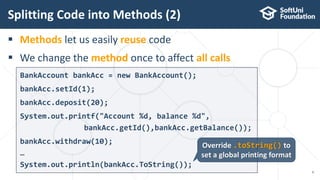
 Methods let us easily reuse code
 We change the method once to affect all calls
Splitting Code into Methods (2)
6
BankAccount bankAcc = new BankAccount();
bankAcc.setId(1);
bankAcc.deposit(20);
System.out.printf("Account %d, balance %d",
bankAcc.getId(),bankAcc.getBalance());
bankAcc.withdraw(10);
…
System.out.println(bankAcc.ToString());
Override .toString() to
set a global printing format
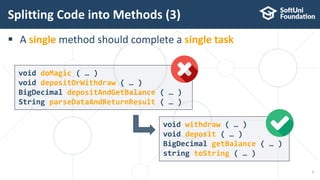
 A single method should complete a single task
void withdraw ( … )
void deposit ( … )
BigDecimal getBalance ( … )
string toString ( … )
Splitting Code into Methods (3)
7
void doMagic ( … )
void depositOrWithdraw ( … )
BigDecimal depositAndGetBalance ( … )
String parseDataAndReturnResult ( … )
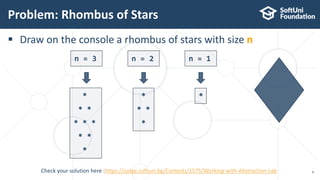
 Draw on the console a rhombus of stars with size n
Problem: Rhombus of Stars
8
*
* *
* * *
* *
*
n = 3
*
* *
*
n = 2
*
n = 1
Check your solution here :https://judge.softuni.bg/Contests/1575/Working-with-Abstraction-Lab
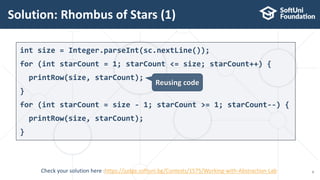
Solution: Rhombus of Stars (1)
9
int size = Integer.parseInt(sc.nextLine());
for (int starCount = 1; starCount <= size; starCount++) {
printRow(size, starCount);
}
for (int starCount = size - 1; starCount >= 1; starCount--) {
printRow(size, starCount);
}
Reusing code
Check your solution here :https://judge.softuni.bg/Contests/1575/Working-with-Abstraction-Lab
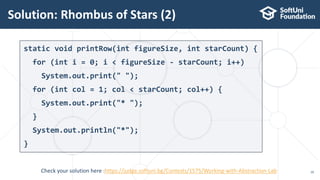
Solution: Rhombus of Stars (2)
10
static void printRow(int figureSize, int starCount) {
for (int i = 0; i < figureSize - starCount; i++)
System.out.print(" ");
for (int col = 1; col < starCount; col++) {
System.out.print("* ");
}
System.out.println("*");
}
Check your solution here :https://judge.softuni.bg/Contests/1575/Working-with-Abstraction-Lab
Splitting Code into Classes (1)
 Just like methods, classes should not
know or do too much
11
GodMode master = new GodMode();
int[] numbers = master.parseAny(input);
...
int[] numbers2 = master.copyAny(numbers);
master.printToConsole(master.getDate());
master.printToConsole(numbers);
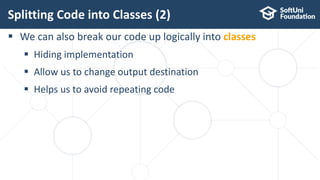
 We can also break our code up logically into classes
 Hiding implementation
 Allow us to change output destination
 Helps us to avoid repeating code
Splitting Code into Classes (2)
12
Splitting Code into Classes (3)
13
List<Integer> input = Arrays.stream(
sc.nextLine().split(" "))
.map(Integer::parseInt)
.collect(Collectors.toList());
...
String result = input.stream()
.map(String::valueOf)
.collect(Collectors.joining(", "));
System.out.println(result);
ArrayParser parser = new ArrayParser();
OuputWriter printer = new OuputWriter();
int[] numbers = parser.integersParse(args);
int[] coordinates = parser.integerParse(args1);
printer.printToConsole(numbers);
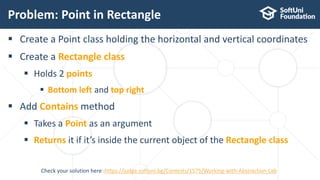
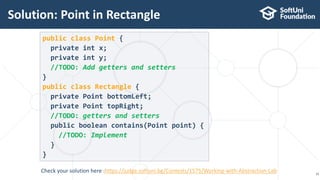
 Create a Point class holding the horizontal and vertical coordinates
 Create a Rectangle class
 Holds 2 points
 Bottom left and top right
 Add Contains method
 Takes a Point as an argument
 Returns it if it’s inside the current object of the Rectangle class
Problem: Point in Rectangle
14
Check your solution here :https://judge.softuni.bg/Contests/1575/Working-with-Abstraction-Lab
Solution: Point in Rectangle
15
public class Point {
private int x;
private int y;
//TODO: Add getters and setters
}
public class Rectangle {
private Point bottomLeft;
private Point topRight;
//TODO: getters and setters
public boolean contains(Point point) {
//TODO: Implement
}
}
Check your solution here :https://judge.softuni.bg/Contests/1575/Working-with-Abstraction-Lab
Solution: Point in Rectangle (2)
16
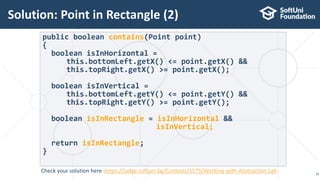
public boolean contains(Point point)
{
boolean isInHorizontal =
this.bottomLeft.getX() <= point.getX() &&
this.topRight.getX() >= point.getX();
boolean isInVertical =
this.bottomLeft.getY() <= point.getY() &&
this.topRight.getY() >= point.getY();
boolean isInRectangle = isInHorizontal &&
isInVertical;
return isInRectangle;
}
Check your solution here :https://judge.softuni.bg/Contests/1575/Working-with-Abstraction-Lab
Refactoring
Restructuring and Organizing Code
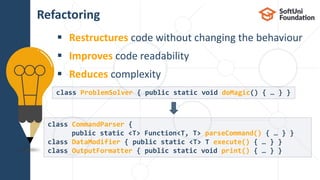
 Restructures code without changing the behaviour
 Improves code readability
 Reduces complexity
Refactoring
18
class ProblemSolver { public static void doMagic() { … } }
class CommandParser {
public static <T> Function<T, T> parseCommand() { … } }
class DataModifier { public static <T> T execute() { … } }
class OutputFormatter { public static void print() { … } }
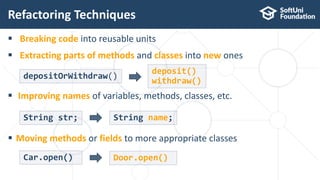
 Breaking code into reusable units
 Extracting parts of methods and classes into new ones
Refactoring Techniques
19
depositOrWithdraw()
 Improving names of variables, methods, classes, etc.
deposit()
withdraw()
 Moving methods or fields to more appropriate classes
String str; String name;
Car.open() Door.open()
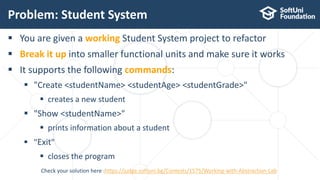
 You are given a working Student System project to refactor
 Break it up into smaller functional units and make sure it works
 It supports the following commands:
 "Create <studentName> <studentAge> <studentGrade>"
 creates a new student
 "Show <studentName>"
 prints information about a student
 "Exit"
 closes the program
Problem: Student System
20
Check your solution here :https://judge.softuni.bg/Contests/1575/Working-with-Abstraction-Lab
Enumerations
Syntax and Usage
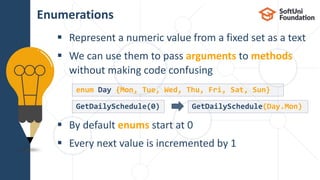
 Represent a numeric value from a fixed set as a text
 We can use them to pass arguments to methods
without making code confusing
 By default enums start at 0
 Every next value is incremented by 1
Enumerations
22
GetDailySchedule(0) GetDailySchedule(Day.Mon)
enum Day {Mon, Tue, Wed, Thu, Fri, Sat, Sun}
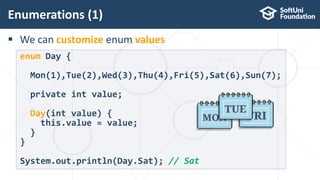
 We can customize enum values
Enumerations (1)
23
enum Day {
Mon(1),Tue(2),Wed(3),Thu(4),Fri(5),Sat(6),Sun(7);
private int value;
Day(int value) {
this.value = value;
}
}
System.out.println(Day.Sat); // Sat
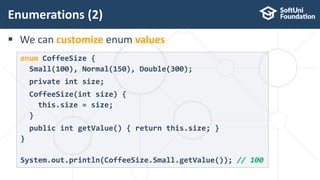
 We can customize enum values
Enumerations (2)
24
enum CoffeeSize {
Small(100), Normal(150), Double(300);
private int size;
CoffeeSize(int size) {
this.size = size;
}
public int getValue() { return this.size; }
}
System.out.println(CoffeeSize.Small.getValue()); // 100
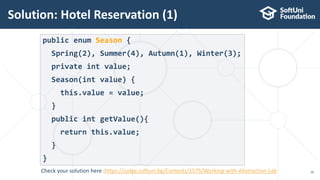
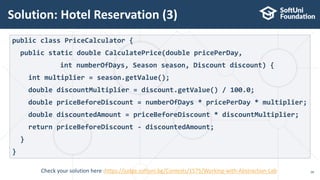
 Create a class PriceCalculator that calculates the total price of a holiday,
by given price per day, number of days, the season and a discount type
 The discount type and season
should be enums
 The price multipliers will be:
 1x for Autumn, 2x for Spring, etc.
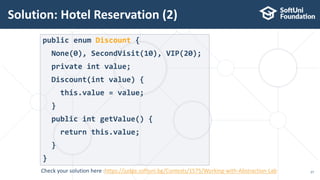
 The discount types will be:
 None – 0%
 SecondVisit – 10%
 VIP – 20%
Problem: Hotel Reservation
25Check your solution here :https://judge.softuni.bg/Contests/1575/Working-with-Abstraction-Lab
Solution: Hotel Reservation (1)
26
public enum Season {
Spring(2), Summer(4), Autumn(1), Winter(3);
private int value;
Season(int value) {
this.value = value;
}
public int getValue(){
return this.value;
}
}
Check your solution here :https://judge.softuni.bg/Contests/1575/Working-with-Abstraction-Lab
Solution: Hotel Reservation (2)
27
public enum Discount {
None(0), SecondVisit(10), VIP(20);
private int value;
Discount(int value) {
this.value = value;
}
public int getValue() {
return this.value;
}
}
Check your solution here :https://judge.softuni.bg/Contests/1575/Working-with-Abstraction-Lab
Solution: Hotel Reservation (3)
28
public class PriceCalculator {
public static double CalculatePrice(double pricePerDay,
int numberOfDays, Season season, Discount discount) {
int multiplier = season.getValue();
double discountMultiplier = discount.getValue() / 100.0;
double priceBeforeDiscount = numberOfDays * pricePerDay * multiplier;
double discountedAmount = priceBeforeDiscount * discountMultiplier;
return priceBeforeDiscount - discountedAmount;
}
}
Check your solution here :https://judge.softuni.bg/Contests/1575/Working-with-Abstraction-Lab
Static Keyword in Java
Static Class, Variable, Method and Block
29
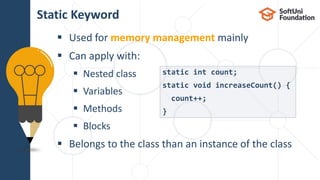
 Used for memory management mainly
 Can apply with:
 Nested class
 Variables
 Methods
 Blocks
 Belongs to the class than an instance of the class
Static Keyword
static int count;
static void increaseCount() {
count++;
}
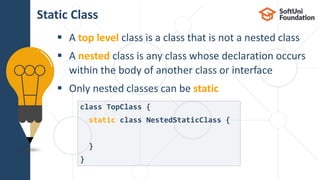
 A top level class is a class that is not a nested class
 A nested class is any class whose declaration occurs
within the body of another class or interface
 Only nested classes can be static
Static Class
class TopClass {
static class NestedStaticClass {
}
}
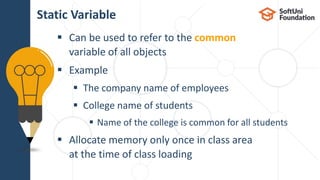
 Can be used to refer to the common
variable of all objects
 Еxample
 The company name of employees
 College name of students
 Name of the college is common for all students
 Allocate memory only once in class area
at the time of class loading
Static Variable
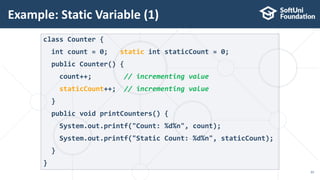
Example: Static Variable (1)
33
class Counter {
int count = 0; static int staticCount = 0;
public Counter() {
count++; // incrementing value
staticCount++; // incrementing value
}
public void printCounters() {
System.out.printf("Count: %d%n", count);
System.out.printf("Static Count: %d%n", staticCount);
}
}
Example: Static Variable (2)
34
// Inside the Main Class
public static void main(String[] args) {
Counter c1 = new Counter();
c1.printCounters();
Counter c2 = new Counter();
c2.printCounters();
Counter c3 = new Counter();
c3.printCounters();
int counter = Counter.staticCount; // 3
}
Count: 1
Static Count: 1
Count: 1
Static Count: 2
Count: 1
Static Count: 3
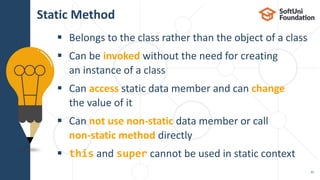
 Belongs to the class rather than the object of a class
 Can be invoked without the need for creating
an instance of a class
 Can access static data member and can change
the value of it
 Can not use non-static data member or call
non-static method directly
 this and super cannot be used in static context
Static Method
35
class Calculate {
static int cube(int x) { return x * x * x; }
public static void main(String args[]) {
int result = Calculate.cube(5);
System.out.println(result); // 125
System.out.println(Math.pow(2, 3)); // 8.0
}
}
Example: Static Method
36
 A set of statements, which will be executed by the
JVM before execution of main method
 Executing static block is at the time of class loading
 A class can take any number of static block but all
blocks will be executed from top to bottom
Static Block
37
class Main {
static int n;
public static void main(String[] args) {
System.out.println("From main");
System.out.println(n);
}
static {
System.out.println("From static block");
n = 10;
}
}
Example: Static Block
38
From static block
From main
10
Packages
Built-In and User-Defined Packages
39
 Used to group related classes
 Like a folder in a file directory
 Use packages to avoid name conflicts and to write a
better maintainable code
 Packages are divided into two categories:
 Built-in Packages (packages from the Java API)
 User-defined Packages (create own packages)
Packages in Java
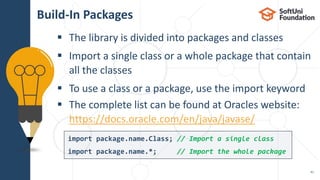
 The library is divided into packages and classes
 Import a single class or a whole package that contain
all the classes
 To use a class or a package, use the import keyword
 The complete list can be found at Oracles website:
https://docs.oracle.com/en/java/javase/
Build-In Packages
41
import package.name.Class; // Import a single class
import package.name.*; // Import the whole package
 …
 …
 …
Summary
42
 Well organized code is easier to work with
 We can reduce complexity using
Methods, Classes and Projects
 We can refactor existing code by
breaking code down
 Enumerations define a fixed set of constants
 Represent numeric values
 We can easily cast enums to numeric types
 Static members and Packages
 https://softuni.bg/modules/59/java-advanced
SoftUni Diamond Partners
SoftUni Organizational Partners
 Software University – High-Quality Education and
Employment Opportunities
 softuni.bg
 Software University Foundation
 http://softuni.foundation/
 Software University @ Facebook
 facebook.com/SoftwareUniversity
 Software University Forums
 forum.softuni.bg
Trainings @ Software University (SoftUni)
 This course (slides, examples, demos, videos, homework, etc.)
is licensed under the "Creative Commons Attribution-
NonCommercial-ShareAlike 4.0 International" license
License
47

20.1 Java working with abstraction

  • 1.
    Working with Abstraction SoftwareUniversity http://softuni.bg SoftUni Team Technical Trainers Architecture, Refactoring and Enumerations
  • 2.
    Table of Contents 1.Project Architecture  Methods  Classes  Projects 2. Code Refactoring 3. Enumerations 4. Static Keyword 5. Java Packages 2
  • 3.
  • 4.
  • 5.
     We usemethods to split code into functional blocks  Improves code readability  Allows for easier debugging Splitting Code into Methods (1) 5 for (char move : moves){ for (int r = 0; r < room.length; r++) for (int c = 0; c < room[r].length; c++) if (room[row][col] == 'b') … } for (char move : moves) { moveEnemies(); killerCheck(); movePlayer(move); }
  • 6.
     Methods letus easily reuse code  We change the method once to affect all calls Splitting Code into Methods (2) 6 BankAccount bankAcc = new BankAccount(); bankAcc.setId(1); bankAcc.deposit(20); System.out.printf("Account %d, balance %d", bankAcc.getId(),bankAcc.getBalance()); bankAcc.withdraw(10); … System.out.println(bankAcc.ToString()); Override .toString() to set a global printing format
  • 7.
     A singlemethod should complete a single task void withdraw ( … ) void deposit ( … ) BigDecimal getBalance ( … ) string toString ( … ) Splitting Code into Methods (3) 7 void doMagic ( … ) void depositOrWithdraw ( … ) BigDecimal depositAndGetBalance ( … ) String parseDataAndReturnResult ( … )
  • 8.
     Draw onthe console a rhombus of stars with size n Problem: Rhombus of Stars 8 * * * * * * * * * n = 3 * * * * n = 2 * n = 1 Check your solution here :https://judge.softuni.bg/Contests/1575/Working-with-Abstraction-Lab
  • 9.
    Solution: Rhombus ofStars (1) 9 int size = Integer.parseInt(sc.nextLine()); for (int starCount = 1; starCount <= size; starCount++) { printRow(size, starCount); } for (int starCount = size - 1; starCount >= 1; starCount--) { printRow(size, starCount); } Reusing code Check your solution here :https://judge.softuni.bg/Contests/1575/Working-with-Abstraction-Lab
  • 10.
    Solution: Rhombus ofStars (2) 10 static void printRow(int figureSize, int starCount) { for (int i = 0; i < figureSize - starCount; i++) System.out.print(" "); for (int col = 1; col < starCount; col++) { System.out.print("* "); } System.out.println("*"); } Check your solution here :https://judge.softuni.bg/Contests/1575/Working-with-Abstraction-Lab
  • 11.
    Splitting Code intoClasses (1)  Just like methods, classes should not know or do too much 11 GodMode master = new GodMode(); int[] numbers = master.parseAny(input); ... int[] numbers2 = master.copyAny(numbers); master.printToConsole(master.getDate()); master.printToConsole(numbers);
  • 12.
     We canalso break our code up logically into classes  Hiding implementation  Allow us to change output destination  Helps us to avoid repeating code Splitting Code into Classes (2) 12
  • 13.
    Splitting Code intoClasses (3) 13 List<Integer> input = Arrays.stream( sc.nextLine().split(" ")) .map(Integer::parseInt) .collect(Collectors.toList()); ... String result = input.stream() .map(String::valueOf) .collect(Collectors.joining(", ")); System.out.println(result); ArrayParser parser = new ArrayParser(); OuputWriter printer = new OuputWriter(); int[] numbers = parser.integersParse(args); int[] coordinates = parser.integerParse(args1); printer.printToConsole(numbers);
  • 14.
     Create aPoint class holding the horizontal and vertical coordinates  Create a Rectangle class  Holds 2 points  Bottom left and top right  Add Contains method  Takes a Point as an argument  Returns it if it’s inside the current object of the Rectangle class Problem: Point in Rectangle 14 Check your solution here :https://judge.softuni.bg/Contests/1575/Working-with-Abstraction-Lab
  • 15.
    Solution: Point inRectangle 15 public class Point { private int x; private int y; //TODO: Add getters and setters } public class Rectangle { private Point bottomLeft; private Point topRight; //TODO: getters and setters public boolean contains(Point point) { //TODO: Implement } } Check your solution here :https://judge.softuni.bg/Contests/1575/Working-with-Abstraction-Lab
  • 16.
    Solution: Point inRectangle (2) 16 public boolean contains(Point point) { boolean isInHorizontal = this.bottomLeft.getX() <= point.getX() && this.topRight.getX() >= point.getX(); boolean isInVertical = this.bottomLeft.getY() <= point.getY() && this.topRight.getY() >= point.getY(); boolean isInRectangle = isInHorizontal && isInVertical; return isInRectangle; } Check your solution here :https://judge.softuni.bg/Contests/1575/Working-with-Abstraction-Lab
  • 17.
  • 18.
     Restructures codewithout changing the behaviour  Improves code readability  Reduces complexity Refactoring 18 class ProblemSolver { public static void doMagic() { … } } class CommandParser { public static <T> Function<T, T> parseCommand() { … } } class DataModifier { public static <T> T execute() { … } } class OutputFormatter { public static void print() { … } }
  • 19.
     Breaking codeinto reusable units  Extracting parts of methods and classes into new ones Refactoring Techniques 19 depositOrWithdraw()  Improving names of variables, methods, classes, etc. deposit() withdraw()  Moving methods or fields to more appropriate classes String str; String name; Car.open() Door.open()
  • 20.
     You aregiven a working Student System project to refactor  Break it up into smaller functional units and make sure it works  It supports the following commands:  "Create <studentName> <studentAge> <studentGrade>"  creates a new student  "Show <studentName>"  prints information about a student  "Exit"  closes the program Problem: Student System 20 Check your solution here :https://judge.softuni.bg/Contests/1575/Working-with-Abstraction-Lab
  • 21.
  • 22.
     Represent anumeric value from a fixed set as a text  We can use them to pass arguments to methods without making code confusing  By default enums start at 0  Every next value is incremented by 1 Enumerations 22 GetDailySchedule(0) GetDailySchedule(Day.Mon) enum Day {Mon, Tue, Wed, Thu, Fri, Sat, Sun}
  • 23.
     We cancustomize enum values Enumerations (1) 23 enum Day { Mon(1),Tue(2),Wed(3),Thu(4),Fri(5),Sat(6),Sun(7); private int value; Day(int value) { this.value = value; } } System.out.println(Day.Sat); // Sat
  • 24.
     We cancustomize enum values Enumerations (2) 24 enum CoffeeSize { Small(100), Normal(150), Double(300); private int size; CoffeeSize(int size) { this.size = size; } public int getValue() { return this.size; } } System.out.println(CoffeeSize.Small.getValue()); // 100
  • 25.
     Create aclass PriceCalculator that calculates the total price of a holiday, by given price per day, number of days, the season and a discount type  The discount type and season should be enums  The price multipliers will be:  1x for Autumn, 2x for Spring, etc.  The discount types will be:  None – 0%  SecondVisit – 10%  VIP – 20% Problem: Hotel Reservation 25Check your solution here :https://judge.softuni.bg/Contests/1575/Working-with-Abstraction-Lab
  • 26.
    Solution: Hotel Reservation(1) 26 public enum Season { Spring(2), Summer(4), Autumn(1), Winter(3); private int value; Season(int value) { this.value = value; } public int getValue(){ return this.value; } } Check your solution here :https://judge.softuni.bg/Contests/1575/Working-with-Abstraction-Lab
  • 27.
    Solution: Hotel Reservation(2) 27 public enum Discount { None(0), SecondVisit(10), VIP(20); private int value; Discount(int value) { this.value = value; } public int getValue() { return this.value; } } Check your solution here :https://judge.softuni.bg/Contests/1575/Working-with-Abstraction-Lab
  • 28.
    Solution: Hotel Reservation(3) 28 public class PriceCalculator { public static double CalculatePrice(double pricePerDay, int numberOfDays, Season season, Discount discount) { int multiplier = season.getValue(); double discountMultiplier = discount.getValue() / 100.0; double priceBeforeDiscount = numberOfDays * pricePerDay * multiplier; double discountedAmount = priceBeforeDiscount * discountMultiplier; return priceBeforeDiscount - discountedAmount; } } Check your solution here :https://judge.softuni.bg/Contests/1575/Working-with-Abstraction-Lab
  • 29.
    Static Keyword inJava Static Class, Variable, Method and Block 29
  • 30.
     Used formemory management mainly  Can apply with:  Nested class  Variables  Methods  Blocks  Belongs to the class than an instance of the class Static Keyword static int count; static void increaseCount() { count++; }
  • 31.
     A toplevel class is a class that is not a nested class  A nested class is any class whose declaration occurs within the body of another class or interface  Only nested classes can be static Static Class class TopClass { static class NestedStaticClass { } }
  • 32.
     Can beused to refer to the common variable of all objects  Еxample  The company name of employees  College name of students  Name of the college is common for all students  Allocate memory only once in class area at the time of class loading Static Variable
  • 33.
    Example: Static Variable(1) 33 class Counter { int count = 0; static int staticCount = 0; public Counter() { count++; // incrementing value staticCount++; // incrementing value } public void printCounters() { System.out.printf("Count: %d%n", count); System.out.printf("Static Count: %d%n", staticCount); } }
  • 34.
    Example: Static Variable(2) 34 // Inside the Main Class public static void main(String[] args) { Counter c1 = new Counter(); c1.printCounters(); Counter c2 = new Counter(); c2.printCounters(); Counter c3 = new Counter(); c3.printCounters(); int counter = Counter.staticCount; // 3 } Count: 1 Static Count: 1 Count: 1 Static Count: 2 Count: 1 Static Count: 3
  • 35.
     Belongs tothe class rather than the object of a class  Can be invoked without the need for creating an instance of a class  Can access static data member and can change the value of it  Can not use non-static data member or call non-static method directly  this and super cannot be used in static context Static Method 35
  • 36.
    class Calculate { staticint cube(int x) { return x * x * x; } public static void main(String args[]) { int result = Calculate.cube(5); System.out.println(result); // 125 System.out.println(Math.pow(2, 3)); // 8.0 } } Example: Static Method 36
  • 37.
     A setof statements, which will be executed by the JVM before execution of main method  Executing static block is at the time of class loading  A class can take any number of static block but all blocks will be executed from top to bottom Static Block 37
  • 38.
    class Main { staticint n; public static void main(String[] args) { System.out.println("From main"); System.out.println(n); } static { System.out.println("From static block"); n = 10; } } Example: Static Block 38 From static block From main 10
  • 39.
  • 40.
     Used togroup related classes  Like a folder in a file directory  Use packages to avoid name conflicts and to write a better maintainable code  Packages are divided into two categories:  Built-in Packages (packages from the Java API)  User-defined Packages (create own packages) Packages in Java
  • 41.
     The libraryis divided into packages and classes  Import a single class or a whole package that contain all the classes  To use a class or a package, use the import keyword  The complete list can be found at Oracles website: https://docs.oracle.com/en/java/javase/ Build-In Packages 41 import package.name.Class; // Import a single class import package.name.*; // Import the whole package
  • 42.
     …  … … Summary 42  Well organized code is easier to work with  We can reduce complexity using Methods, Classes and Projects  We can refactor existing code by breaking code down  Enumerations define a fixed set of constants  Represent numeric values  We can easily cast enums to numeric types  Static members and Packages
  • 43.
  • 44.
  • 45.
  • 46.
     Software University– High-Quality Education and Employment Opportunities  softuni.bg  Software University Foundation  http://softuni.foundation/  Software University @ Facebook  facebook.com/SoftwareUniversity  Software University Forums  forum.softuni.bg Trainings @ Software University (SoftUni)
  • 47.
     This course(slides, examples, demos, videos, homework, etc.) is licensed under the "Creative Commons Attribution- NonCommercial-ShareAlike 4.0 International" license License 47

Editor's Notes

  • #3 (c) 2007 National Academy for Software Development - http://academy.devbg.org. All rights reserved. Unauthorized copying or re-distribution is strictly prohibited.*