Object-oriented programming
in Java
Data structure
Fall 2023
Hashemite University
Dr. Mohammad Al-hammouri
Overview
• Object-Oriented Programming (OOP): attributes, instance variables
and methods
We analyze together a complex computer system, such as School system
application to identify the main objects, their attributes and behaviors, as well
as the associations between these objects. We discover together that the
object-oriented programming makes concrete an abstract activity.
• Abstractions is a process of hiding the implementation details from
the user and showing only the functionality to the user.
• We often compare an abstraction to a “black box” It can be used
without worrying about its content.
Object-Oriented Design Principles
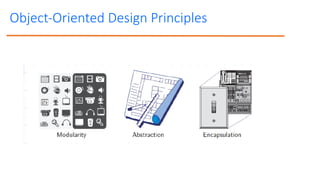
• Abstractions is to distill a system to its most fundamental parts.
(i.e., specifies the type of data stored, the operations supported on
them, and the types of parameters of the operations)
• Abstractions specifies what each operation does, but not how it does it.
• Modularity: concept of breaking down a software system into smaller,
self-contained modules or components. Each module contains related
functions, variables, classes.
• Encapsulation: bundling of data (attributes) and methods (functions)
that operate on the data into a single unit known as a class
• Encapsulation allows the internal representation of an object to be hidden
from the outside world and restricts direct access to some of its components
Object-oriented programming
• The central concept of object-oriented programming is the object!
• An object has:
• Properties (attributes) that define its state
• Behaviours (methods)
• Java is object-oriented.
• The programmer defines new data types using classes and objects.
• e.g. class Account; Account myAccount
• A class defines the characteristics (properties and behaviours) that are
common to a set of objects.
Class
• Class is a data type (reference data type)
• A “class” can be used as a template to create objects with identical
sets of attributes.
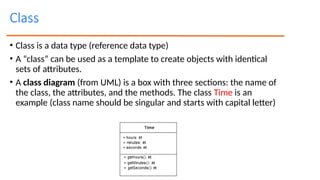
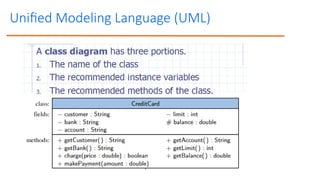
• A class diagram (from UML) is a box with three sections: the name of
the class, the attributes, and the methods. The class Time is an
example (class name should be singular and starts with capital letter)
Creating and Using Objects
• In Java, a new object is created by using the new operator followed
by a call to a constructor for the desired class.
• Example: Time _time = new Time()
• A constructor is a method that always shares the same name as its
class. The new operator returns a reference to the newly created
instance; the returned reference is typically assigned to a variable for
further use.
• One of the primary uses of an object reference variable is to access
the members of the class for this object.
• This access is performed with the dot “.” operator.
• Example: _time.hours , _time.getHours()
Class Access Control
• The public class modifier indicates that all classes may access the
defined member (attribute/method).
• The private class modifier indicates that access to a defined member
of a class be granted only to code within that class.
• The protected class modifier indicates that access to the defined
member is only granted to classes that are designated as subclasses
of the given class through inheritance.
Unified Modeling Language (UML)
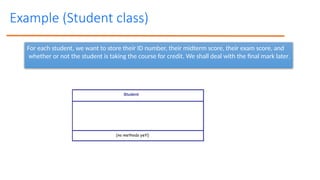
Example (Student class)
For each student, we want to store their ID number, their midterm score, their exam score, and
whether or not the student is taking the course for credit. We shall deal with the final mark later.
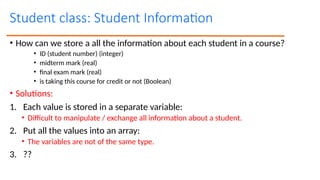
Student class: Student Information
• How can we store a all the information about each student in a course?
• ID (student number) (integer)
• midterm mark (real)
• final exam mark (real)
• is taking this course for credit or not (Boolean)
• Solutions:
1. Each value is stored in a separate variable:
• Difficult to manipulate / exchange all information about a student.
2. Put all the values into an array:
• The variables are not of the same type.
3. ??
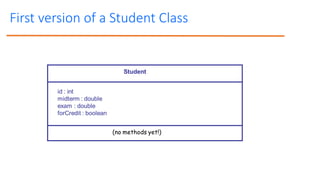
First version of a Student Class
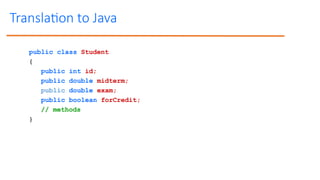
Translation to Java
public class Student
{
public int id;
public double midterm;
public double exam;
public boolean forCredit;
// methods
}
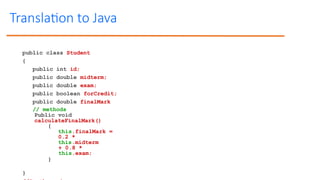
public class Student
{
public int id;
public double midterm;
public double exam;
public boolean forCredit;
public double finalMark
// methods
Public void
calculateFinalMark()
{
this.finalMark =
0.2 *
this.midterm
+ 0.8 *
this.exam;
}
}
Translation to Java
14
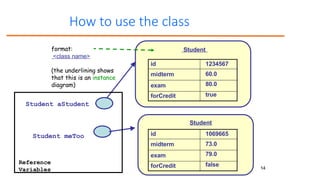
How to use the class
Student
Student aStudent
Student meToo
Reference
Variables
Student .
id 1234567
midterm 60.0
exam 80.0
forCredit true
id 1069665
midterm 73.0
exam 79.0
forCredit false
format:
<class name>
(the underlining shows
that this is an instance
diagram)
Information hiding...Step 1
• Suppose we want to modify the Student class to keep the
course final mark, which is 20% of the midterm mark plus
80% of the final mark.
– We could add a field finalMark to our class.
• We want to make sure that
finalMark = (0.2 × midterm + 0.8 × exam)
is always true for consistency.
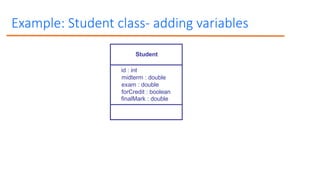
Example: Student class- adding variables
Student
id : int
midterm : double
exam : double
forCredit : boolean
finalMark : double
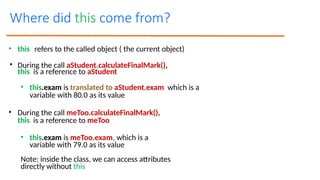
• this refers to the called object ( the current object)
• During the call aStudent.calculateFinalMark(),
this is a reference to aStudent
• this.exam is translated to aStudent.exam which is a
variable with 80.0 as its value
• During the call meToo.calculateFinalMark(),
this is a reference to meToo
• this.exam is meToo.exam, which is a
variable with 79.0 as its value
Note: inside the class, we can access attributes
directly without this
Where did this come from?
Information
hiding
.....
• Now suppose we want to make sure that only the
finalMark to be changed only if the midterm and
the finalmarks are changed? And we don’t want to
allow the main program to change it directly
through the dot operator aStudent.finalMark=100
21
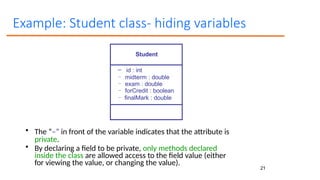
Example: Student class- hiding variables
• The “–” in front of the variable indicates that the attribute is
private.
• By declaring a field to be private, only methods declared
inside the class are allowed access to the field value (either
for viewing the value, or changing the value).
Student
– id : int
– midterm : double
– exam : double
– forCredit : boolean
– finalMark : double
Creating the Student Class
public class Student
{
// were previously public
private int id;
private double midterm;
private double exam;
private boolean forCredit;
private double finalMark;
// methods
}
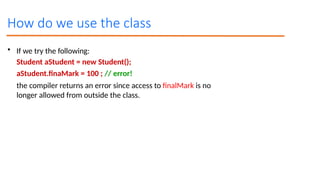
How do we use the class
• If we try the following:
Student aStudent = new Student();
aStudent.finaMark = 100 ; // error!
the compiler returns an error since access to finalMark is no
longer allowed from outside the class.
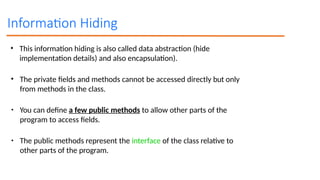
Information Hiding
• This information hiding is also called data abstraction (hide
implementation details) and also encapsulation).
• The private fields and methods cannot be accessed directly but only
from methods in the class.
• You can define a few public methods to allow other parts of the
program to access fields.
• The public methods represent the interface of the class relative to
other parts of the program.
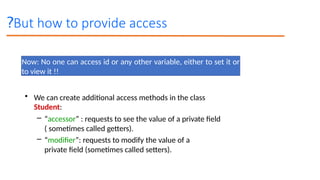
But how to provide access
?
Now: No one can access id or any other variable, either to set it or
to view it !!
• We can create additional access methods in the class
Student:
– “accessor” : requests to see the value of a private field
( sometimes called getters).
– “modifier”: requests to modify the value of a
private field (sometimes called setters).
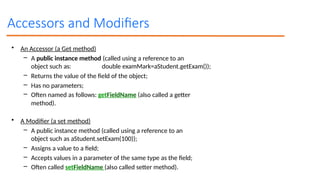
Accessors and Modifiers
• An Accessor (a Get method)
– A public instance method (called using a reference to an
object such as: double examMark=aStudent.getExam());
– Returns the value of the field of the object;
– Has no parameters;
– Often named as follows: getFieldName (also called a getter
method).
• A Modifier (a set method)
– A public instance method (called using a reference to an
object such as aStudent.setExam(100));
– Assigns a value to a field;
– Accepts values in a parameter of the same type as the field;
– Often called setFieldName (also called setter method).
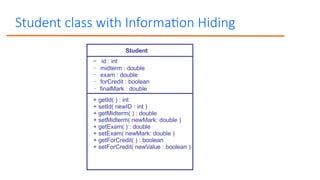
Student class with Information Hiding
Student
– id : int
– midterm : double
– exam : double
– forCredit : boolean
– finalMark : double
+ getId( ) : int
+ setId( newID : int )
+ getMidterm( ) : double
+ setMidterm( newMark: double )
+ getExam( ) : double
+ setExam( newMark: double )
+ getForCredit( ) : boolean
+ setForCredit( newValue : boolean )
29
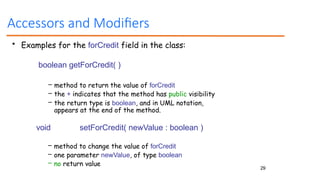
Accessors and Modifiers
• Examples for the forCredit field in the class:
boolean getForCredit( )
– method to return the value of forCredit
– the + indicates that the method has public visibility
– the return type is boolean, and in UML notation,
appears at the end of the method.
void setForCredit( newValue : boolean )
– method to change the value of forCredit
– one parameter newValue, of type boolean
– no return value
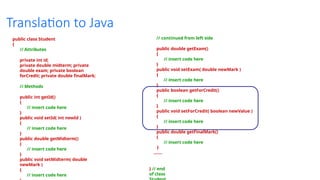
Translation to Java
public class Student
{
// Attributes
private int id;
private double midterm; private
double exam; private boolean
forCredit; private double finalMark;
// Methods
public int getId()
{
// insert code here
}
public void setId( int newId )
{
// insert code here
}
public double getMidterm()
{
// insert code here
}
public void setMidterm( double
newMark )
{
// insert code here
// continued from left side
public double getExam()
{
// insert code here
}
public void setExam( double newMark )
{
// insert code here
}
public boolean getForCredit()
{
// insert code here
}
public void setForCredit( boolean newValue )
{
// insert code here
}
public double getFinalMark()
{
// insert code here
}
.......
} // end
of class
31
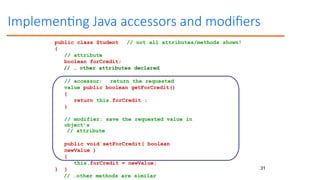
Implementing Java accessors and modifiers
// not all attributes/methods shown!
public class Student
{
// attribute
boolean forCredit;
// … other attributes declared
// accessor: return the requested
value public boolean getForCredit()
{
return this.forCredit ;
}
// modifier: save the requested value in
object’s
// attribute
public void setForCredit( boolean
newValue )
{
this.forCredit = newValue;
}
// …other methods are similar
}
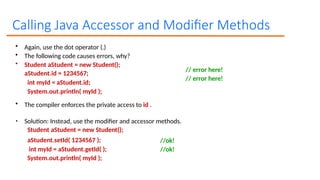
Calling Java Accessor and Modifier Methods
// error here!
// error here!
• Again, use the dot operator (.)
• The following code causes errors, why?
• Student aStudent = new Student();
aStudent.id = 1234567;
int myId = aStudent.id;
System.out.println( myId );
• The compiler enforces the private access to id .
• Solution: Instead, use the modifier and accessor methods.
Student aStudent = new Student();
//ok!
//ok!
aStudent.setId( 1234567 );
int myId = aStudent.getId( );
System.out.println( myId );
35
Back to Information Hiding
• To implement our strategy of hiding the finalMark field, we can
do the following:
1. Set the variable as private
2. We will provide an accessor method for finalMark, but NOT
a modifier method.
3. We can provide a method calculateFinalMark() to recalculate
the final mark if the midterm or exam marks are changed.
4. The modifier methods setMidterm() and setExam() will call
calculateFinalMark() so that they automatically update the
final mark.
5. We should also restrict access to calculateFinalMark()
because it isn’t meant for use outside the class.
Implementing Information Hiding
• The following implements our strategy where the final mark can only be changed by
modifying the midterm or exam values.
public class Student
{ ………
// attributes and other methods would go here
public void setMidterm(double newValue )
{ this.midterm = newValue;
this.calculateFinalMark( );
}
public void setExam( double newValue)
{ this.exam = newValue;
this.calculateFinalMark();
}
public void calculateFinalMark(){
this.finalMark = 0.2 * this.midterm + 0.8 *
this.exam;
}
}
Implementing Information Hiding
• The following implements our strategy where the final mark can only be changed by
modifying the midterm or exam values.
public class Student
{
// attributes and other methods would go here
public void setMidterm( double newValue )
{ this.midterm = newValue;
this.calculateFinalMark( );
}
public void setExam( double newValue )
{ this.exam = newValue;
this.calculateFinalMark();
}
private void calculateFinalMark(){
this.finalMark = 0.2 * this.midterm + 0.8 *
this.exam;
}
}
38
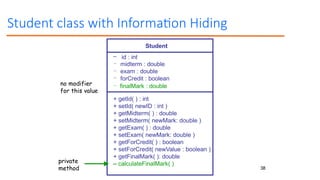
Student class with Information Hiding
Student
– id : int
– midterm : double
– exam : double
– forCredit : boolean
– finalMark : double
+ getId( ) : int
+ setId( newID : int )
+ getMidterm( ) : double
+ setMidterm( newMark: double )
+ getExam( ) : double
+ setExam( newMark: double )
+ getForCredit( ) : boolean
+ setForCredit( newValue : boolean )
+ getFinalMark( ): double
– calculateFinalMark( )
private
method
no modifier
for this value
39
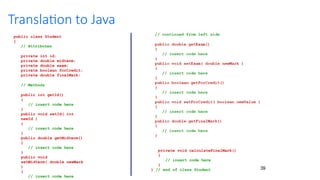
Translation to Java
public class Student
{
// Attributes
private int id;
private double midterm;
private double exam;
private boolean forCredit;
private double finalMark;
// Methods
public int getId()
{
// insert code here
}
public void setId( int
newId )
{
// insert code here
}
public double getMidterm()
{
// insert code here
}
public void
setMidterm( double newMark
)
{
// insert code here
private void calculateFinalMark()
{
// insert code here
}
} // end of class Student
40
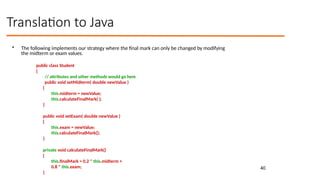
Translation to Java
• The following implements our strategy where the final mark can only be changed by modifying
the midterm or exam values.
public class Student
{
// attributes and other methods would go here
public void setMidterm( double newValue )
{
this.midterm = newValue;
this.calculateFinalMark( );
}
public void setExam( double newValue )
{
this.exam = newValue;
this.calculateFinalMark();
}
private void calculateFinalMark()
{
this.finalMark = 0.2 * this.midterm +
0.8 * this.exam;
}
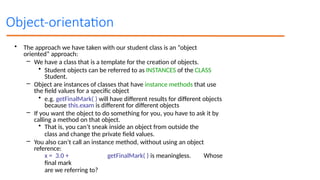
Object-orientation
• The approach we have taken with our student class is an “object
oriented” approach:
– We have a class that is a template for the creation of objects.
• Student objects can be referred to as INSTANCES of the CLASS
Student.
– Object are instances of classes that have instance methods that use
the field values for a specific object
• e.g. getFinalMark( ) will have different results for different objects
because this.exam is different for different objects
– If you want the object to do something for you, you have to ask it by
calling a method on that object.
• That is, you can’t sneak inside an object from outside the
class and change the private field values.
– You also can’t call an instance method, without using an object
reference:
x = 3.0 + getFinalMark( ) is meaningless. Whose
final mark
are we referring to?
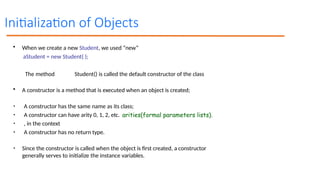
Initialization of Objects
• When we create a new Student, we used “new”
aStudent = new Student( );
The method Student() is called the default constructor of the class
• A constructor is a method that is executed when an object is created;
• A constructor has the same name as its class;
• A constructor can have arity 0, 1, 2, etc.
• , in the context
• A constructor has no return type.
• Since the constructor is called when the object is first created, a constructor
generally serves to initialize the instance variables.
arities(formal parameters lists).
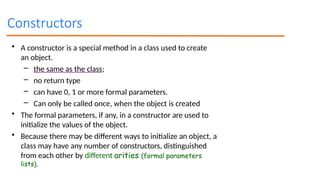
Constructors
• A constructor is a special method in a class used to create
an object.
– the same as the class;
– no return type
– can have 0, 1 or more formal parameters.
– Can only be called once, when the object is created
• The formal parameters, if any, in a constructor are used to
initialize the values of the object.
• Because there may be different ways to initialize an object, a
class may have any number of constructors, distinguished
from each other by different arities (formal parameters
lists).
Implementation in Java
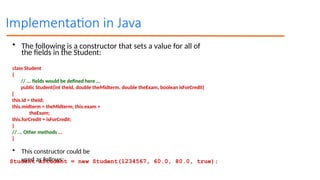
• The following is a constructor that sets a value for all of
the fields in the Student:
class Student
{
// ... fields would be defined here ...
public Student(int theId, double theMidterm, double theExam, boolean isForCredit)
{
this.id = theId;
this.midterm = theMidterm; this.exam =
theExam;
this.forCredit = isForCredit;
}
// ... Other methods ...
}
• This constructor could be
used as follows:
Student aStudent = new Student(1234567, 60.0, 80.0, true);
48
Constructors of class Student
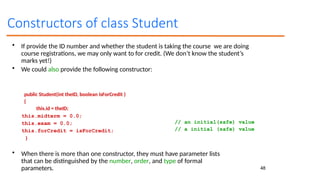
• If provide the ID number and whether the student is taking the course we are doing
course registrations, we may only want to for credit. (We don’t know the student’s
marks yet!)
• We could also provide the following constructor:
public Student(int theID, boolean isForCredit )
{
this.id = theID;
this.midterm = 0.0;
this.exam = 0.0;
this.forCredit = isForCredit;
}
// an initial(safe) value
// a initial (safe) value
• When there is more than one constructor, they must have parameter lists
that can be distinguished by the number, order, and type of formal
parameters.
Array Fields in Classes
public class Student
{
private int id ;
private double midterm ;
private double exam ;
private boolean forCredit;
private double[] assignments;
// methods
}
• The array reference variable assignments contains the value
null.
Array field initialization
• Here is a constructor that creates and initializes an array in
an object. The constructor has a parameter that is the
number of assignments.
public Student( int numberOfAssignments )
{
this.id = 0;
this.midterm = 0.0; this.exam
= 0.0 ; this.forCredit = false;
this.assignments = new
double[numberOfAssignment
s];
// loop to initialize each item in array int index;
for ( index=0; index < numberOfAssignments; index
= index+1 )
{
this.assignments[index] = 0.0;
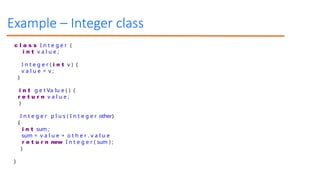
Example – Integer class
c l a s s I n t e g e r {
i n t v a l u e ;
I n t e g e r ( i n t v ) {
v a l u e = v ;
}
i n t g e t Va lu e ( ) {
r e t u r n v a l u e ;
}
I n t e g e r p l u s ( I n t e g e r other)
{
i n t sum ;
sum = v a l u e + o t h e r . v a l u e
r e t u r n new I n t e g e r ( sum ) ;
}
}
Example – Integer class
p u b l i c c l a s s Test {
p u b l i c s t a t i c void main ( S t r i n g [ ] a r g s ) {
I n t e g e r a , b , c ;
a = new I n t e g e r ( 1 0 ) ;
b = new I n t e g e r ( 5 ) ;
c = a . p l u s ( b ) ;
System . out . p r i n t l n ( c . g e t Va lu e ( ) ) ;
}
}
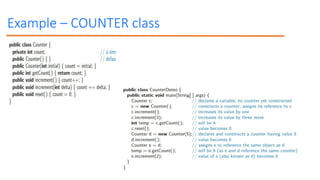
Example – COUNTER class
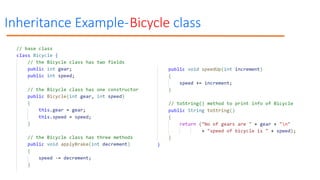
Inheritance
• A mechanism for a modular and hierarchical organization
• This allows a new class to be defined based upon an existing class as the starting
point.
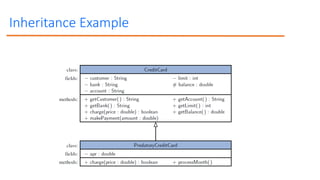
• The existing class is typically described as the base class, parent class, or
superclass, while the newly defined class is known as the subclass or child class.
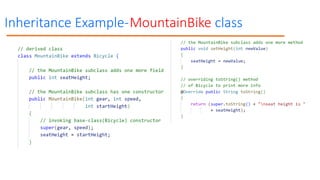
• There are two ways in which a subclass can differentiate itself from its superclass:
• A subclass may specialize an existing behavior by providing a new
implementation that overrides an existing method.
• A subclass may also extend its superclass by providing brand new methods.
Inheritance
• A mechanism for a modular and hierarchical organization
• This allows a new class to be defined based upon an existing class as the starting
point.
• The existing class is typically described as the base class, parent class, or
superclass, while the newly defined class is known as the subclass or child class.
• There are two ways in which a subclass can differentiate itself from its superclass:
• A subclass may specialize an existing behavior by providing a new
implementation that overrides an existing method.
• A subclass may also extend its superclass by providing brand new methods.
Inheritance Example
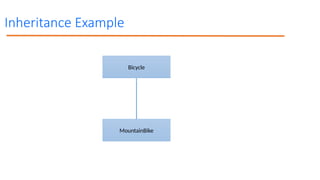
Inheritance Example
Bicycle
MountainBike
Inheritance Example-Bicycle class
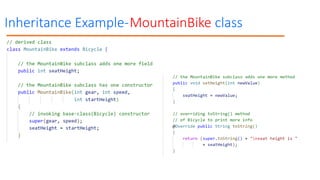
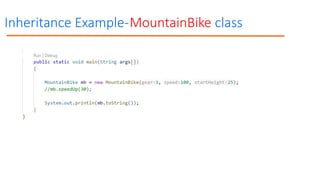
Inheritance Example-MountainBike class
Java Exceptions
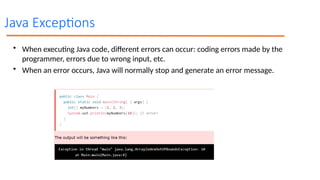
• When executing Java code, different errors can occur: coding errors made by the
programmer, errors due to wrong input, etc.
• When an error occurs, Java will normally stop and generate an error message.
Java Exceptions
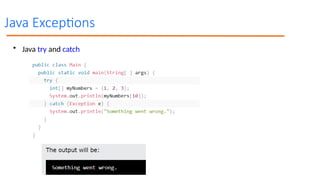
• Java try and catch
Java Exceptions
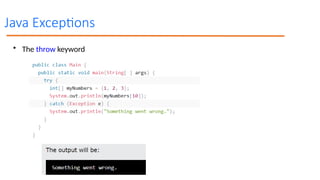
• The throw keyword
Generics
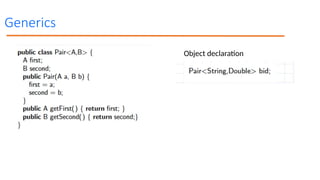
• Java includes support for writing generic classes and methods that can operate on
a variety of data types while often avoiding the need for explicit casts.
• Using Generics, it is possible to create classes that work with different data types
class Test<T> {
// An object of type T is declared
T obj;
Test(T obj) { this.obj = obj; }
// constructor
public T getObject() { return this.obj;
}
}
public static void main(String[] args)
{
// instance of Integer type
Test<Integer> iObj = new
Test<Integer>(15);
System.out.println(iObj.getObject());
// instance of String type
Test<String> sObj
= new Test<String>("GeeksForGeeks");
System.out.println(sObj.getObject());
}
Generics
Object declaration

2 Object-oriented programghgrtrdwwe.pptx

  • 1.
    Object-oriented programming in Java Datastructure Fall 2023 Hashemite University Dr. Mohammad Al-hammouri
  • 2.
    Overview • Object-Oriented Programming(OOP): attributes, instance variables and methods We analyze together a complex computer system, such as School system application to identify the main objects, their attributes and behaviors, as well as the associations between these objects. We discover together that the object-oriented programming makes concrete an abstract activity. • Abstractions is a process of hiding the implementation details from the user and showing only the functionality to the user. • We often compare an abstraction to a “black box” It can be used without worrying about its content.
  • 3.
  • 4.
    Object-Oriented Design Principles •Abstractions is to distill a system to its most fundamental parts. (i.e., specifies the type of data stored, the operations supported on them, and the types of parameters of the operations) • Abstractions specifies what each operation does, but not how it does it. • Modularity: concept of breaking down a software system into smaller, self-contained modules or components. Each module contains related functions, variables, classes. • Encapsulation: bundling of data (attributes) and methods (functions) that operate on the data into a single unit known as a class • Encapsulation allows the internal representation of an object to be hidden from the outside world and restricts direct access to some of its components
  • 5.
    Object-oriented programming • Thecentral concept of object-oriented programming is the object! • An object has: • Properties (attributes) that define its state • Behaviours (methods) • Java is object-oriented. • The programmer defines new data types using classes and objects. • e.g. class Account; Account myAccount • A class defines the characteristics (properties and behaviours) that are common to a set of objects.
  • 6.
    Class • Class isa data type (reference data type) • A “class” can be used as a template to create objects with identical sets of attributes. • A class diagram (from UML) is a box with three sections: the name of the class, the attributes, and the methods. The class Time is an example (class name should be singular and starts with capital letter)
  • 7.
    Creating and UsingObjects • In Java, a new object is created by using the new operator followed by a call to a constructor for the desired class. • Example: Time _time = new Time() • A constructor is a method that always shares the same name as its class. The new operator returns a reference to the newly created instance; the returned reference is typically assigned to a variable for further use. • One of the primary uses of an object reference variable is to access the members of the class for this object. • This access is performed with the dot “.” operator. • Example: _time.hours , _time.getHours()
  • 8.
    Class Access Control •The public class modifier indicates that all classes may access the defined member (attribute/method). • The private class modifier indicates that access to a defined member of a class be granted only to code within that class. • The protected class modifier indicates that access to the defined member is only granted to classes that are designated as subclasses of the given class through inheritance.
  • 9.
  • 10.
    Example (Student class) Foreach student, we want to store their ID number, their midterm score, their exam score, and whether or not the student is taking the course for credit. We shall deal with the final mark later.
  • 11.
    Student class: StudentInformation • How can we store a all the information about each student in a course? • ID (student number) (integer) • midterm mark (real) • final exam mark (real) • is taking this course for credit or not (Boolean) • Solutions: 1. Each value is stored in a separate variable: • Difficult to manipulate / exchange all information about a student. 2. Put all the values into an array: • The variables are not of the same type. 3. ??
  • 12.
    First version ofa Student Class
  • 13.
    Translation to Java publicclass Student { public int id; public double midterm; public double exam; public boolean forCredit; // methods }
  • 14.
    public class Student { publicint id; public double midterm; public double exam; public boolean forCredit; public double finalMark // methods Public void calculateFinalMark() { this.finalMark = 0.2 * this.midterm + 0.8 * this.exam; } } Translation to Java
  • 15.
    14 How to usethe class Student Student aStudent Student meToo Reference Variables Student . id 1234567 midterm 60.0 exam 80.0 forCredit true id 1069665 midterm 73.0 exam 79.0 forCredit false format: <class name> (the underlining shows that this is an instance diagram)
  • 16.
    Information hiding...Step 1 •Suppose we want to modify the Student class to keep the course final mark, which is 20% of the midterm mark plus 80% of the final mark. – We could add a field finalMark to our class. • We want to make sure that finalMark = (0.2 × midterm + 0.8 × exam) is always true for consistency.
  • 17.
    Example: Student class-adding variables Student id : int midterm : double exam : double forCredit : boolean finalMark : double
  • 18.
    • this refersto the called object ( the current object) • During the call aStudent.calculateFinalMark(), this is a reference to aStudent • this.exam is translated to aStudent.exam which is a variable with 80.0 as its value • During the call meToo.calculateFinalMark(), this is a reference to meToo • this.exam is meToo.exam, which is a variable with 79.0 as its value Note: inside the class, we can access attributes directly without this Where did this come from?
  • 19.
    Information hiding ..... • Now supposewe want to make sure that only the finalMark to be changed only if the midterm and the finalmarks are changed? And we don’t want to allow the main program to change it directly through the dot operator aStudent.finalMark=100
  • 20.
    21 Example: Student class-hiding variables • The “–” in front of the variable indicates that the attribute is private. • By declaring a field to be private, only methods declared inside the class are allowed access to the field value (either for viewing the value, or changing the value). Student – id : int – midterm : double – exam : double – forCredit : boolean – finalMark : double
  • 21.
    Creating the StudentClass public class Student { // were previously public private int id; private double midterm; private double exam; private boolean forCredit; private double finalMark; // methods }
  • 22.
    How do weuse the class • If we try the following: Student aStudent = new Student(); aStudent.finaMark = 100 ; // error! the compiler returns an error since access to finalMark is no longer allowed from outside the class.
  • 23.
    Information Hiding • Thisinformation hiding is also called data abstraction (hide implementation details) and also encapsulation). • The private fields and methods cannot be accessed directly but only from methods in the class. • You can define a few public methods to allow other parts of the program to access fields. • The public methods represent the interface of the class relative to other parts of the program.
  • 24.
    But how toprovide access ? Now: No one can access id or any other variable, either to set it or to view it !! • We can create additional access methods in the class Student: – “accessor” : requests to see the value of a private field ( sometimes called getters). – “modifier”: requests to modify the value of a private field (sometimes called setters).
  • 25.
    Accessors and Modifiers •An Accessor (a Get method) – A public instance method (called using a reference to an object such as: double examMark=aStudent.getExam()); – Returns the value of the field of the object; – Has no parameters; – Often named as follows: getFieldName (also called a getter method). • A Modifier (a set method) – A public instance method (called using a reference to an object such as aStudent.setExam(100)); – Assigns a value to a field; – Accepts values in a parameter of the same type as the field; – Often called setFieldName (also called setter method).
  • 26.
    Student class withInformation Hiding Student – id : int – midterm : double – exam : double – forCredit : boolean – finalMark : double + getId( ) : int + setId( newID : int ) + getMidterm( ) : double + setMidterm( newMark: double ) + getExam( ) : double + setExam( newMark: double ) + getForCredit( ) : boolean + setForCredit( newValue : boolean )
  • 27.
    29 Accessors and Modifiers •Examples for the forCredit field in the class: boolean getForCredit( ) – method to return the value of forCredit – the + indicates that the method has public visibility – the return type is boolean, and in UML notation, appears at the end of the method. void setForCredit( newValue : boolean ) – method to change the value of forCredit – one parameter newValue, of type boolean – no return value
  • 28.
    Translation to Java publicclass Student { // Attributes private int id; private double midterm; private double exam; private boolean forCredit; private double finalMark; // Methods public int getId() { // insert code here } public void setId( int newId ) { // insert code here } public double getMidterm() { // insert code here } public void setMidterm( double newMark ) { // insert code here // continued from left side public double getExam() { // insert code here } public void setExam( double newMark ) { // insert code here } public boolean getForCredit() { // insert code here } public void setForCredit( boolean newValue ) { // insert code here } public double getFinalMark() { // insert code here } ....... } // end of class
  • 29.
    31 Implementing Java accessorsand modifiers // not all attributes/methods shown! public class Student { // attribute boolean forCredit; // … other attributes declared // accessor: return the requested value public boolean getForCredit() { return this.forCredit ; } // modifier: save the requested value in object’s // attribute public void setForCredit( boolean newValue ) { this.forCredit = newValue; } // …other methods are similar }
  • 30.
    Calling Java Accessorand Modifier Methods // error here! // error here! • Again, use the dot operator (.) • The following code causes errors, why? • Student aStudent = new Student(); aStudent.id = 1234567; int myId = aStudent.id; System.out.println( myId ); • The compiler enforces the private access to id . • Solution: Instead, use the modifier and accessor methods. Student aStudent = new Student(); //ok! //ok! aStudent.setId( 1234567 ); int myId = aStudent.getId( ); System.out.println( myId );
  • 31.
    35 Back to InformationHiding • To implement our strategy of hiding the finalMark field, we can do the following: 1. Set the variable as private 2. We will provide an accessor method for finalMark, but NOT a modifier method. 3. We can provide a method calculateFinalMark() to recalculate the final mark if the midterm or exam marks are changed. 4. The modifier methods setMidterm() and setExam() will call calculateFinalMark() so that they automatically update the final mark. 5. We should also restrict access to calculateFinalMark() because it isn’t meant for use outside the class.
  • 32.
    Implementing Information Hiding •The following implements our strategy where the final mark can only be changed by modifying the midterm or exam values. public class Student { ……… // attributes and other methods would go here public void setMidterm(double newValue ) { this.midterm = newValue; this.calculateFinalMark( ); } public void setExam( double newValue) { this.exam = newValue; this.calculateFinalMark(); } public void calculateFinalMark(){ this.finalMark = 0.2 * this.midterm + 0.8 * this.exam; } }
  • 33.
    Implementing Information Hiding •The following implements our strategy where the final mark can only be changed by modifying the midterm or exam values. public class Student { // attributes and other methods would go here public void setMidterm( double newValue ) { this.midterm = newValue; this.calculateFinalMark( ); } public void setExam( double newValue ) { this.exam = newValue; this.calculateFinalMark(); } private void calculateFinalMark(){ this.finalMark = 0.2 * this.midterm + 0.8 * this.exam; } }
  • 34.
    38 Student class withInformation Hiding Student – id : int – midterm : double – exam : double – forCredit : boolean – finalMark : double + getId( ) : int + setId( newID : int ) + getMidterm( ) : double + setMidterm( newMark: double ) + getExam( ) : double + setExam( newMark: double ) + getForCredit( ) : boolean + setForCredit( newValue : boolean ) + getFinalMark( ): double – calculateFinalMark( ) private method no modifier for this value
  • 35.
    39 Translation to Java publicclass Student { // Attributes private int id; private double midterm; private double exam; private boolean forCredit; private double finalMark; // Methods public int getId() { // insert code here } public void setId( int newId ) { // insert code here } public double getMidterm() { // insert code here } public void setMidterm( double newMark ) { // insert code here private void calculateFinalMark() { // insert code here } } // end of class Student
  • 36.
    40 Translation to Java •The following implements our strategy where the final mark can only be changed by modifying the midterm or exam values. public class Student { // attributes and other methods would go here public void setMidterm( double newValue ) { this.midterm = newValue; this.calculateFinalMark( ); } public void setExam( double newValue ) { this.exam = newValue; this.calculateFinalMark(); } private void calculateFinalMark() { this.finalMark = 0.2 * this.midterm + 0.8 * this.exam; }
  • 37.
    Object-orientation • The approachwe have taken with our student class is an “object oriented” approach: – We have a class that is a template for the creation of objects. • Student objects can be referred to as INSTANCES of the CLASS Student. – Object are instances of classes that have instance methods that use the field values for a specific object • e.g. getFinalMark( ) will have different results for different objects because this.exam is different for different objects – If you want the object to do something for you, you have to ask it by calling a method on that object. • That is, you can’t sneak inside an object from outside the class and change the private field values. – You also can’t call an instance method, without using an object reference: x = 3.0 + getFinalMark( ) is meaningless. Whose final mark are we referring to?
  • 38.
    Initialization of Objects •When we create a new Student, we used “new” aStudent = new Student( ); The method Student() is called the default constructor of the class • A constructor is a method that is executed when an object is created; • A constructor has the same name as its class; • A constructor can have arity 0, 1, 2, etc. • , in the context • A constructor has no return type. • Since the constructor is called when the object is first created, a constructor generally serves to initialize the instance variables. arities(formal parameters lists).
  • 39.
    Constructors • A constructoris a special method in a class used to create an object. – the same as the class; – no return type – can have 0, 1 or more formal parameters. – Can only be called once, when the object is created • The formal parameters, if any, in a constructor are used to initialize the values of the object. • Because there may be different ways to initialize an object, a class may have any number of constructors, distinguished from each other by different arities (formal parameters lists).
  • 40.
    Implementation in Java •The following is a constructor that sets a value for all of the fields in the Student: class Student { // ... fields would be defined here ... public Student(int theId, double theMidterm, double theExam, boolean isForCredit) { this.id = theId; this.midterm = theMidterm; this.exam = theExam; this.forCredit = isForCredit; } // ... Other methods ... } • This constructor could be used as follows: Student aStudent = new Student(1234567, 60.0, 80.0, true);
  • 41.
    48 Constructors of classStudent • If provide the ID number and whether the student is taking the course we are doing course registrations, we may only want to for credit. (We don’t know the student’s marks yet!) • We could also provide the following constructor: public Student(int theID, boolean isForCredit ) { this.id = theID; this.midterm = 0.0; this.exam = 0.0; this.forCredit = isForCredit; } // an initial(safe) value // a initial (safe) value • When there is more than one constructor, they must have parameter lists that can be distinguished by the number, order, and type of formal parameters.
  • 42.
    Array Fields inClasses public class Student { private int id ; private double midterm ; private double exam ; private boolean forCredit; private double[] assignments; // methods } • The array reference variable assignments contains the value null.
  • 43.
    Array field initialization •Here is a constructor that creates and initializes an array in an object. The constructor has a parameter that is the number of assignments. public Student( int numberOfAssignments ) { this.id = 0; this.midterm = 0.0; this.exam = 0.0 ; this.forCredit = false; this.assignments = new double[numberOfAssignment s]; // loop to initialize each item in array int index; for ( index=0; index < numberOfAssignments; index = index+1 ) { this.assignments[index] = 0.0;
  • 44.
    Example – Integerclass c l a s s I n t e g e r { i n t v a l u e ; I n t e g e r ( i n t v ) { v a l u e = v ; } i n t g e t Va lu e ( ) { r e t u r n v a l u e ; } I n t e g e r p l u s ( I n t e g e r other) { i n t sum ; sum = v a l u e + o t h e r . v a l u e r e t u r n new I n t e g e r ( sum ) ; } }
  • 45.
    Example – Integerclass p u b l i c c l a s s Test { p u b l i c s t a t i c void main ( S t r i n g [ ] a r g s ) { I n t e g e r a , b , c ; a = new I n t e g e r ( 1 0 ) ; b = new I n t e g e r ( 5 ) ; c = a . p l u s ( b ) ; System . out . p r i n t l n ( c . g e t Va lu e ( ) ) ; } }
  • 46.
  • 47.
    Inheritance • A mechanismfor a modular and hierarchical organization • This allows a new class to be defined based upon an existing class as the starting point. • The existing class is typically described as the base class, parent class, or superclass, while the newly defined class is known as the subclass or child class. • There are two ways in which a subclass can differentiate itself from its superclass: • A subclass may specialize an existing behavior by providing a new implementation that overrides an existing method. • A subclass may also extend its superclass by providing brand new methods.
  • 48.
    Inheritance • A mechanismfor a modular and hierarchical organization • This allows a new class to be defined based upon an existing class as the starting point. • The existing class is typically described as the base class, parent class, or superclass, while the newly defined class is known as the subclass or child class. • There are two ways in which a subclass can differentiate itself from its superclass: • A subclass may specialize an existing behavior by providing a new implementation that overrides an existing method. • A subclass may also extend its superclass by providing brand new methods.
  • 49.
  • 50.
  • 51.
  • 52.
  • 53.
  • 54.
  • 55.
    Java Exceptions • Whenexecuting Java code, different errors can occur: coding errors made by the programmer, errors due to wrong input, etc. • When an error occurs, Java will normally stop and generate an error message.
  • 56.
  • 57.
  • 58.
    Generics • Java includessupport for writing generic classes and methods that can operate on a variety of data types while often avoiding the need for explicit casts. • Using Generics, it is possible to create classes that work with different data types class Test<T> { // An object of type T is declared T obj; Test(T obj) { this.obj = obj; } // constructor public T getObject() { return this.obj; } } public static void main(String[] args) { // instance of Integer type Test<Integer> iObj = new Test<Integer>(15); System.out.println(iObj.getObject()); // instance of String type Test<String> sObj = new Test<String>("GeeksForGeeks"); System.out.println(sObj.getObject()); }
  • 59.