GENERAL ADAPTATION,
CELL INJURY & CELL DEATH
Md. Sakhawat Hossain
Senior Lecturer
Department of Pharmacy
Daffodil International University
Cell adaptation
Definition:
Adaptation is the reversible structural and functional change of the cell due to some pathologic
stimuli or severe physiologic stress and the cell can continue to survive and function by
achieving new steady state.
The adaptive responses are - change to the number, size, phenotype, metabolic activity or
functions of cell. These changes cause –
- Modulation of functioning of cells
- Increase viability of cells
When the stress is removed, the cell can return to the original steady state without any harmful
consequences
Types of Cell Adaptation
1. Physiologic adaptations: Responses of cell to normal stimulation usually by
hormones or other endogenous ligands. Cells must constantly adapt to changes in their
environment, even under normal conditions.
2. Pathologic adaptations: Responses of cell to abnormal/noxious stimulation
that provide the ability to survive in the changed environment and perhaps avoid injury
Forms of Adaptation
■Adaptation may occur in several distinct forms –
1. Hyperplasia
2. Hepertrophy
3. Atrophy
4. Metaplasia
5. Dystrophy:
6. Dysplasia: Disorderly proliferation of cells where cells have lost uniformity and
architectural orientation in tissue. This is not cancer.
Hyperplasia
■ Hyperplasia is the adaptive process where the number of cells in an organ or tissue
increases resulting in increased volume of the organ or tissue.
■Why hyperplasia occurs?
- Increased workload
- Increased physiologic requirements
- For wound healing
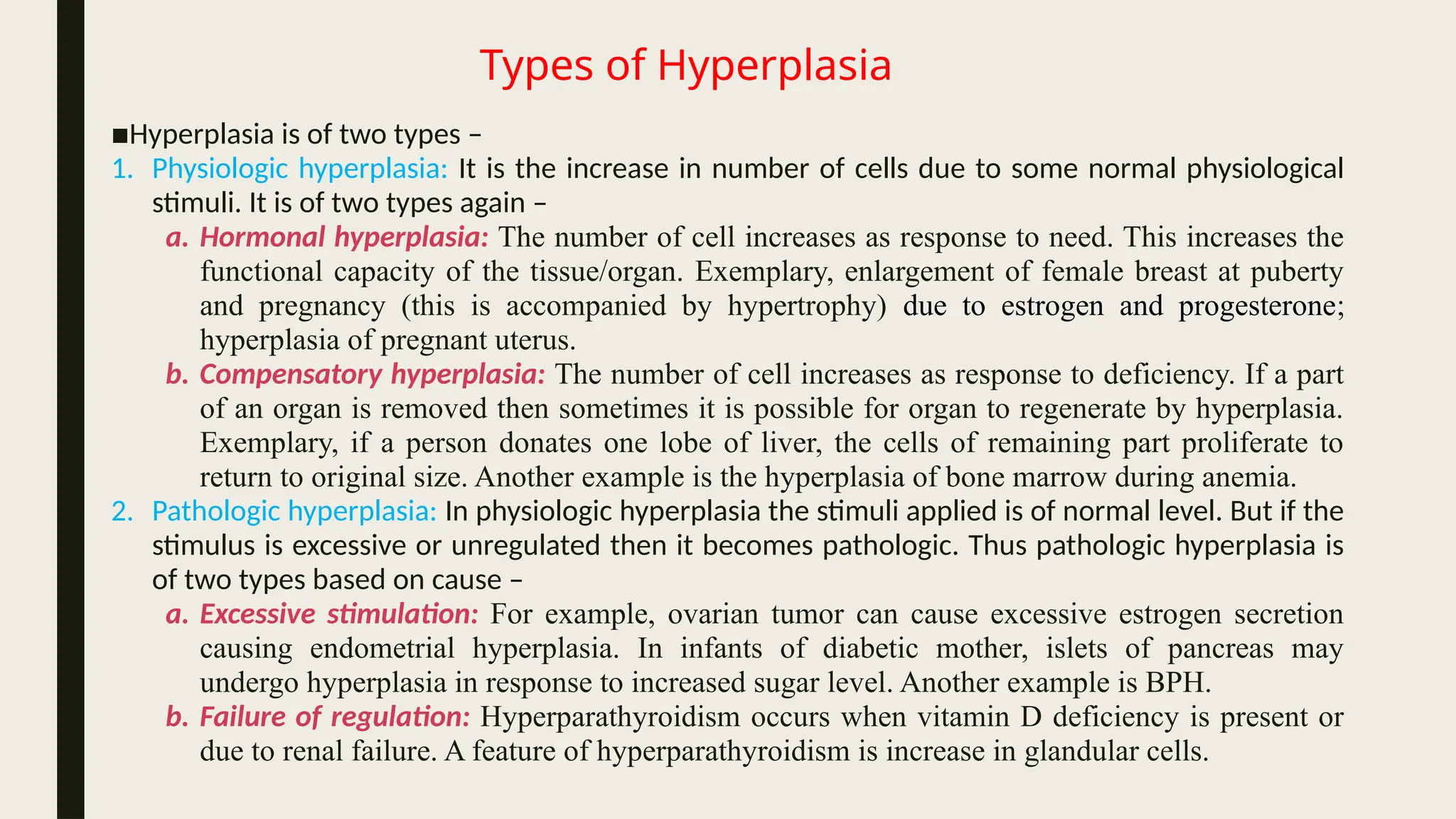
■Hyperplasia is of two types –
1. Physiologic hyperplasia: It is the increase in number of cells due to some normal physiological
stimuli. It is of two types again –
a. Hormonal hyperplasia: The number of cell increases as response to need. This increases the
functional capacity of the tissue/organ. Exemplary, enlargement of female breast at puberty
and pregnancy (this is accompanied by hypertrophy) due to estrogen and progesterone;
hyperplasia of pregnant uterus.
b. Compensatory hyperplasia: The number of cell increases as response to deficiency. If a part
of an organ is removed then sometimes it is possible for organ to regenerate by hyperplasia.
Exemplary, if a person donates one lobe of liver, the cells of remaining part proliferate to
return to original size. Another example is the hyperplasia of bone marrow during anemia.
2. Pathologic hyperplasia: In physiologic hyperplasia the stimuli applied is of normal level. But if the
stimulus is excessive or unregulated then it becomes pathologic. Thus pathologic hyperplasia is
of two types based on cause –
a. Excessive stimulation: For example, ovarian tumor can cause excessive estrogen secretion
causing endometrial hyperplasia. In infants of diabetic mother, islets of pancreas may
undergo hyperplasia in response to increased sugar level. Another example is BPH.
b. Failure of regulation: Hyperparathyroidism occurs when vitamin D deficiency is present or
due to renal failure. A feature of hyperparathyroidism is increase in glandular cells.
Types of Hyperplasia
Mechanism of hyperplasia
Hyperplasia occurs usually due to combined effects of following –
1. Increased local production of growth factor
2. Increased production of growth factor receptor (GFR) in responding cell
3. Activation of intracellular pathway of transcription factor synthesis.
■ Hyperplasia is mainly caused by growth factor-driven proliferation or by increased cell
production from the tissue stem cells (unipotent). For example, in liver regeneration, the
process is mostly paracrine signaled growth factor-driven proliferation.
Hyperplasia is a controlled process in the sense that when the stimuli are removed the cell returns to
normal state. This is true for even pathologic hyperplasia. On the other hand, in cancer, the growth can’t
be controlled. Hence, hyperplasia is different from cancer but hyperplasia may give support to cancerous
proliferation (patients with endometrial hyperplasia are at risk of endometrial cancer
Hypertrophy
■Definition:
It is the adaptive process in which the size of cell is increased in response to stimuli
resulting in increase of the organ/tissue.
Why hypertrophy occurs?
Hypertrophy is triggered by
- Mechanical stress/workload (e.g. in cardiac and
skeletal muscle)
- Trophic factors such as increased nutritional supply,
vasoactive agents (endothelin-1, angiotensin II, α-
adrenergic agonists) and growth factors (e.g. Insulin
like growth factor, IGF-1; TGF-β Fibroblast growth
factors), .
Types of Hypertrophy
Hypertrophy is of two types –
1. Physiologic hypertrophy: This is physiologic growth of cells to
meet increased functional demand. E.g. estrogen induced growth of
uterus during pregnancy, bulging of muscles of bodybuilders etc.
2. Pathologic hypertrophy: Pathologic condition causes increased
functional demand which result in hypertrophy. E.g. hypertrophy
of heart due to chronic hemodynamic overload. The chronic
hemodynamic overload is due to hypertension or faulty heart
valves. Here, the myofilaments are increased in number, hence each
myocyte is enlarged. So each myocyte can generate more force
resulting in greater work capacity of muscle. If the demand
surpasses the capacity of muscle to enlarge then, cardiac failure
ensues
Mechanism of hypertrophy
Atrophy
■Definition:
It is the adaptive process of cell to a stimulus where are cell shrink in
size by loss of cellular substances.
Atrophy is the reduced size of an organ or tissue due to decrease in cell
size and number.
Why atrophy occurs?
■ Decreased workload
■ Loss of innervation
■ Diminished blood supply
■ Inadequate nutrition
■ Loss of endocrine stimulation
■ Pressure
■ Aging
Types of Atrophy
Atrophy is also of two types –
1. Physiologic atrophy: e.g. decrease in size of uterus after parturition,
atrophy of the notochord and some other embryonic structures during
fetal development. Such atrophy is normal physiologic process and not
due to any disease conditions.
2. Pathologic atrophy: This may be localized or generalized. Example
include, muscle atrophy in marasmus.
Mechanism of atrophy
The main reason for atrophy is protein degradation. If the degradation rate increased and
synthesis is decreased atrophy will occur. Followings are possible protein degradation paths –
1. Lysosomes: It contains proteolytic enzymes. For example acid hydrolase – cathepsins. These
enzymes degrade extracellular protein (when endocytosed) as well as cytosolic proteins.
2. Ubiquitin-proteasome pathway: This pathway is thought to be responsible for the accelerated
proteolysis seen in a variety of catabolic conditions.
■ Hormones e.g. (glucocorticoids and thyroid hormone) and cytokines (TNF) stimulate this
mechanism while insulin opposes it.
3. Autophagic vacuoles: When nutrient shortage occurs, the intracellular organelles and portion
of cytosol are first sequestered in vacuoles which are then bound to membrane. Eventually the
vacuoles are fused with lysosome forming lysophagosome. Thus the cellular components are
digested and used as nutrients
Metaplasia
■Definition:
Metaplasia is a reversible change in which one adult cell type is
replaced by another adult cell type.
In this manner, the cells which are more susceptible to the stress is
replaced by cells which are less susceptible in an attempt to adapt to
the stress.
Causes of metaplasia
1.Changes in the environment: e.g. stones in excretory
ducts of salivary glands, pancreas or bile duct may
cause columner cells being replaced by stratified
squamus cells.
2.Irritation or inflammation: In chronic irritation e.g.
habitual cigarette smokers, the columner epithelial
cells respiratory tract are replaced by stratified
squamus epithelial cells.
3.Nutritional: Vitamin A (retinoic acid) deficiency
causes squamus metaplasia in respiratory tract.
Cell injury
■Definition:
Cell injury is the state of cell when cell is stressed so
severely that it can’t adapt to the stress.
Such stress can result from extrinsic factors or intrinsic
abnormalities or inherently damaging agents. Injury
may progress through reversible stage and culminate in
cell death
Types of cell injury
Injury is of two types –
1. Reversible injury: If injurious stimulus is mild and short-lasting
then the cell can return to normal state. Such injury is termed
reversible injury.
2. Irreversible injury: When the injurious stimulus is severe and
also continuous, the cell can’t recover and eventually dies. This
type of injury is termed irreversible injury.
Causes of cell injury
■ Oxygen deprivation
■ Physical agents
■ Chemical agents and drugs
■ Infectious agents:
■ Immunologic reactions
■ Genetic derangement
■ Nutritional imbalances
Mechanism of cell injury
■Factors affecting cell injury:
1. Type, duration and severity of injury. These determine the cellular
response.
2. Type, state and adaptability of the responding cell.
3. The biochemical pathways affected.
■Common targets affected by injurious stimuli:
1. ATP production
2. Plasma membrane integrity which control ionic and osmotic
homeostasis of cell and its organelles.
3. Cytoskeleton
4. Protein synthesis
5. The integrity of the genetic apparatus of the cell
Cell death
■Introduction:
Cell death is the most crucial event in the development of disease. It is the end result of
progressive injury. It results from diverse causes e.g.
- Ischemia
- Infection
- Toxins etc.
■Cell death is a normal and essential process in –
- Embryogenesis
- Development of organs
- Maintenance of homeostasis.
■Two principle path of cellular death are necrosis and apoptosis.
Necrosis
■ Simply necrosis is the pathologic death of cells
■The mechanism and path of necrosis differs from cell type to cell type. But the process –
1. Is always pathological
2. Culminates irreversible injury
3. Cell swelling occurs
4. Nuclear change occurs
5. Inflammation is possible
Mechanism of Necrosis
Patterns of necrosis
1. Coagulative necrosis: In such case, the architecture of the dead tissue is preserved in the
necrotic area for a long time. This is probably due to denaturation of the proteolytic
enzymes.
2. Liquefactive necrosis: The cellular contents are digested by enzymes to form a liquid
mass.
3. Caseous necrosis: Here the contents of lysed cells are enclosed in a specific inflammatory
border. This is encountered most commonly in tuberculosis.
Apoptosis
■Introduction:
Apoptosis is defined as the programmed death of cells.
■ It is a normal phenomenon used to eliminate unnecessary or incorrect cells. It is also
used to remove cells which are injured beyond repair. Thus apoptosis can be physiologic
or pathologic
Mechanism of apoptosis
Differences between necrosis and apoptosis
Feature Necrosis Apoptosis
Control Uncontrolled pathological
death of cells.
Controlled death of cells.
May be physiologic or
pathologic.
Cell size Enlarged. Reduced/shrinkage.
Cell lysis Yes. No. fragmentation into
apoptic bodies.
Cellular content Enzymatic digestion.
Leakage
Intact. Present in apoptic
bodies.
Nucleus Fragmentation into
nucleosome-sized
fragments.
Enzyme participation Phospholipase and proteases
are important.
Caspases are activated.
Inflammation Frequent. Completely absent.
Phagocytic clearance Usually no. Yes.
Karyolysis
is
Karryorhex
Pyknosis 

Pathologic calcification
■Definition:
Pathologic calcification is the abnormal (macroscopic) deposition of calcium salts along
iron, magnesium and other mineral salts in the tissue.
■The calcium salts are deposited as fine, gritty, white granules or clumps. The main deposit
is crystalline calcium phosphate in the form of an apatite similar to hydroxyapatite of bone.
■This deposition may be intracellular, extracellular or both.
Types
Dystrophic calcification Metastatic calcification
Occurs locally in dying
tissues.
Occurs in normal tissues.
May occur at normal
serum level of Ca.
Results from
hypercalcemia or
problems of calcium
metabolism.
Thank You

2. General Adaptation, Cell injury and cell death.pptx

  • 1.
    GENERAL ADAPTATION, CELL INJURY& CELL DEATH Md. Sakhawat Hossain Senior Lecturer Department of Pharmacy Daffodil International University
  • 3.
    Cell adaptation Definition: Adaptation isthe reversible structural and functional change of the cell due to some pathologic stimuli or severe physiologic stress and the cell can continue to survive and function by achieving new steady state. The adaptive responses are - change to the number, size, phenotype, metabolic activity or functions of cell. These changes cause – - Modulation of functioning of cells - Increase viability of cells When the stress is removed, the cell can return to the original steady state without any harmful consequences
  • 4.
    Types of CellAdaptation 1. Physiologic adaptations: Responses of cell to normal stimulation usually by hormones or other endogenous ligands. Cells must constantly adapt to changes in their environment, even under normal conditions. 2. Pathologic adaptations: Responses of cell to abnormal/noxious stimulation that provide the ability to survive in the changed environment and perhaps avoid injury
  • 5.
    Forms of Adaptation ■Adaptationmay occur in several distinct forms – 1. Hyperplasia 2. Hepertrophy 3. Atrophy 4. Metaplasia 5. Dystrophy: 6. Dysplasia: Disorderly proliferation of cells where cells have lost uniformity and architectural orientation in tissue. This is not cancer.
  • 6.
    Hyperplasia ■ Hyperplasia isthe adaptive process where the number of cells in an organ or tissue increases resulting in increased volume of the organ or tissue. ■Why hyperplasia occurs? - Increased workload - Increased physiologic requirements - For wound healing
  • 7.
    ■Hyperplasia is oftwo types – 1. Physiologic hyperplasia: It is the increase in number of cells due to some normal physiological stimuli. It is of two types again – a. Hormonal hyperplasia: The number of cell increases as response to need. This increases the functional capacity of the tissue/organ. Exemplary, enlargement of female breast at puberty and pregnancy (this is accompanied by hypertrophy) due to estrogen and progesterone; hyperplasia of pregnant uterus. b. Compensatory hyperplasia: The number of cell increases as response to deficiency. If a part of an organ is removed then sometimes it is possible for organ to regenerate by hyperplasia. Exemplary, if a person donates one lobe of liver, the cells of remaining part proliferate to return to original size. Another example is the hyperplasia of bone marrow during anemia. 2. Pathologic hyperplasia: In physiologic hyperplasia the stimuli applied is of normal level. But if the stimulus is excessive or unregulated then it becomes pathologic. Thus pathologic hyperplasia is of two types based on cause – a. Excessive stimulation: For example, ovarian tumor can cause excessive estrogen secretion causing endometrial hyperplasia. In infants of diabetic mother, islets of pancreas may undergo hyperplasia in response to increased sugar level. Another example is BPH. b. Failure of regulation: Hyperparathyroidism occurs when vitamin D deficiency is present or due to renal failure. A feature of hyperparathyroidism is increase in glandular cells. Types of Hyperplasia
  • 8.
    Mechanism of hyperplasia Hyperplasiaoccurs usually due to combined effects of following – 1. Increased local production of growth factor 2. Increased production of growth factor receptor (GFR) in responding cell 3. Activation of intracellular pathway of transcription factor synthesis. ■ Hyperplasia is mainly caused by growth factor-driven proliferation or by increased cell production from the tissue stem cells (unipotent). For example, in liver regeneration, the process is mostly paracrine signaled growth factor-driven proliferation.
  • 9.
    Hyperplasia is acontrolled process in the sense that when the stimuli are removed the cell returns to normal state. This is true for even pathologic hyperplasia. On the other hand, in cancer, the growth can’t be controlled. Hence, hyperplasia is different from cancer but hyperplasia may give support to cancerous proliferation (patients with endometrial hyperplasia are at risk of endometrial cancer
  • 10.
    Hypertrophy ■Definition: It is theadaptive process in which the size of cell is increased in response to stimuli resulting in increase of the organ/tissue.
  • 11.
    Why hypertrophy occurs? Hypertrophyis triggered by - Mechanical stress/workload (e.g. in cardiac and skeletal muscle) - Trophic factors such as increased nutritional supply, vasoactive agents (endothelin-1, angiotensin II, α- adrenergic agonists) and growth factors (e.g. Insulin like growth factor, IGF-1; TGF-β Fibroblast growth factors), .
  • 12.
    Types of Hypertrophy Hypertrophyis of two types – 1. Physiologic hypertrophy: This is physiologic growth of cells to meet increased functional demand. E.g. estrogen induced growth of uterus during pregnancy, bulging of muscles of bodybuilders etc. 2. Pathologic hypertrophy: Pathologic condition causes increased functional demand which result in hypertrophy. E.g. hypertrophy of heart due to chronic hemodynamic overload. The chronic hemodynamic overload is due to hypertension or faulty heart valves. Here, the myofilaments are increased in number, hence each myocyte is enlarged. So each myocyte can generate more force resulting in greater work capacity of muscle. If the demand surpasses the capacity of muscle to enlarge then, cardiac failure ensues
  • 13.
  • 14.
    Atrophy ■Definition: It is theadaptive process of cell to a stimulus where are cell shrink in size by loss of cellular substances. Atrophy is the reduced size of an organ or tissue due to decrease in cell size and number.
  • 15.
    Why atrophy occurs? ■Decreased workload ■ Loss of innervation ■ Diminished blood supply ■ Inadequate nutrition ■ Loss of endocrine stimulation ■ Pressure ■ Aging
  • 16.
    Types of Atrophy Atrophyis also of two types – 1. Physiologic atrophy: e.g. decrease in size of uterus after parturition, atrophy of the notochord and some other embryonic structures during fetal development. Such atrophy is normal physiologic process and not due to any disease conditions. 2. Pathologic atrophy: This may be localized or generalized. Example include, muscle atrophy in marasmus.
  • 17.
    Mechanism of atrophy Themain reason for atrophy is protein degradation. If the degradation rate increased and synthesis is decreased atrophy will occur. Followings are possible protein degradation paths – 1. Lysosomes: It contains proteolytic enzymes. For example acid hydrolase – cathepsins. These enzymes degrade extracellular protein (when endocytosed) as well as cytosolic proteins. 2. Ubiquitin-proteasome pathway: This pathway is thought to be responsible for the accelerated proteolysis seen in a variety of catabolic conditions. ■ Hormones e.g. (glucocorticoids and thyroid hormone) and cytokines (TNF) stimulate this mechanism while insulin opposes it. 3. Autophagic vacuoles: When nutrient shortage occurs, the intracellular organelles and portion of cytosol are first sequestered in vacuoles which are then bound to membrane. Eventually the vacuoles are fused with lysosome forming lysophagosome. Thus the cellular components are digested and used as nutrients
  • 18.
    Metaplasia ■Definition: Metaplasia is areversible change in which one adult cell type is replaced by another adult cell type. In this manner, the cells which are more susceptible to the stress is replaced by cells which are less susceptible in an attempt to adapt to the stress.
  • 19.
    Causes of metaplasia 1.Changesin the environment: e.g. stones in excretory ducts of salivary glands, pancreas or bile duct may cause columner cells being replaced by stratified squamus cells. 2.Irritation or inflammation: In chronic irritation e.g. habitual cigarette smokers, the columner epithelial cells respiratory tract are replaced by stratified squamus epithelial cells. 3.Nutritional: Vitamin A (retinoic acid) deficiency causes squamus metaplasia in respiratory tract.
  • 20.
    Cell injury ■Definition: Cell injuryis the state of cell when cell is stressed so severely that it can’t adapt to the stress. Such stress can result from extrinsic factors or intrinsic abnormalities or inherently damaging agents. Injury may progress through reversible stage and culminate in cell death
  • 21.
    Types of cellinjury Injury is of two types – 1. Reversible injury: If injurious stimulus is mild and short-lasting then the cell can return to normal state. Such injury is termed reversible injury. 2. Irreversible injury: When the injurious stimulus is severe and also continuous, the cell can’t recover and eventually dies. This type of injury is termed irreversible injury.
  • 22.
    Causes of cellinjury ■ Oxygen deprivation ■ Physical agents ■ Chemical agents and drugs ■ Infectious agents: ■ Immunologic reactions ■ Genetic derangement ■ Nutritional imbalances
  • 23.
  • 24.
    ■Factors affecting cellinjury: 1. Type, duration and severity of injury. These determine the cellular response. 2. Type, state and adaptability of the responding cell. 3. The biochemical pathways affected. ■Common targets affected by injurious stimuli: 1. ATP production 2. Plasma membrane integrity which control ionic and osmotic homeostasis of cell and its organelles. 3. Cytoskeleton 4. Protein synthesis 5. The integrity of the genetic apparatus of the cell
  • 25.
    Cell death ■Introduction: Cell deathis the most crucial event in the development of disease. It is the end result of progressive injury. It results from diverse causes e.g. - Ischemia - Infection - Toxins etc. ■Cell death is a normal and essential process in – - Embryogenesis - Development of organs - Maintenance of homeostasis. ■Two principle path of cellular death are necrosis and apoptosis.
  • 26.
    Necrosis ■ Simply necrosisis the pathologic death of cells ■The mechanism and path of necrosis differs from cell type to cell type. But the process – 1. Is always pathological 2. Culminates irreversible injury 3. Cell swelling occurs 4. Nuclear change occurs 5. Inflammation is possible
  • 27.
  • 28.
    Patterns of necrosis 1.Coagulative necrosis: In such case, the architecture of the dead tissue is preserved in the necrotic area for a long time. This is probably due to denaturation of the proteolytic enzymes. 2. Liquefactive necrosis: The cellular contents are digested by enzymes to form a liquid mass. 3. Caseous necrosis: Here the contents of lysed cells are enclosed in a specific inflammatory border. This is encountered most commonly in tuberculosis.
  • 29.
    Apoptosis ■Introduction: Apoptosis is definedas the programmed death of cells. ■ It is a normal phenomenon used to eliminate unnecessary or incorrect cells. It is also used to remove cells which are injured beyond repair. Thus apoptosis can be physiologic or pathologic
  • 30.
  • 31.
    Differences between necrosisand apoptosis Feature Necrosis Apoptosis Control Uncontrolled pathological death of cells. Controlled death of cells. May be physiologic or pathologic. Cell size Enlarged. Reduced/shrinkage. Cell lysis Yes. No. fragmentation into apoptic bodies. Cellular content Enzymatic digestion. Leakage Intact. Present in apoptic bodies. Nucleus Fragmentation into nucleosome-sized fragments. Enzyme participation Phospholipase and proteases are important. Caspases are activated. Inflammation Frequent. Completely absent. Phagocytic clearance Usually no. Yes. Karyolysis is Karryorhex Pyknosis  
  • 32.
    Pathologic calcification ■Definition: Pathologic calcificationis the abnormal (macroscopic) deposition of calcium salts along iron, magnesium and other mineral salts in the tissue. ■The calcium salts are deposited as fine, gritty, white granules or clumps. The main deposit is crystalline calcium phosphate in the form of an apatite similar to hydroxyapatite of bone. ■This deposition may be intracellular, extracellular or both.
  • 33.
    Types Dystrophic calcification Metastaticcalcification Occurs locally in dying tissues. Occurs in normal tissues. May occur at normal serum level of Ca. Results from hypercalcemia or problems of calcium metabolism.
  • 34.