Экономика Конспект лекций 1st Edition Андрей Иванович Салов
Экономика Конспект лекций 1st Edition Андрей Иванович Салов
Экономика Конспект лекций 1st Edition Андрей Иванович Салов
Экономика Конспект лекций 1st Edition Андрей Иванович Салов
Экономика Конспект лекций 1st Edition Андрей Иванович Салов
1.
Экономика Конспект лекций1st Edition Андрей
Иванович Салов install download
https://ebookstep.com/download/ebook-53977476/
Download more ebook from https://ebookstep.com
2.
We believe theseproducts will be a great fit for you. Click
the link to download now, or visit ebookstep.com
to discover even more!
Giáo trình Be Internet Awesome 1st Edition Google
http://ebookstep.com/product/giao-trinh-be-internet-awesome-1st-
edition-google/
I ll Be Your Wife Jho Hyo-Eun
http://ebookstep.com/product/i-ll-be-your-wife-jho-hyo-eun/
Marry Me or Be My Wife Ally Jane
http://ebookstep.com/product/marry-me-or-be-my-wife-ally-jane/
The Way I Used to Be 1st Edition Amber Smith
http://ebookstep.com/product/the-way-i-used-to-be-1st-edition-
amber-smith/
3.
Orgia dos loucos1st Edition Ungulani Ba Ka Khosa
http://ebookstep.com/product/orgia-dos-loucos-1st-edition-
ungulani-ba-ka-khosa/
Osez être trois Dare to be Three Dare Ménage 3 1st
Edition Jeanne St James
http://ebookstep.com/product/osez-etre-trois-dare-to-be-three-
dare-menage-3-1st-edition-jeanne-st-james/
Asuhan Kebidanan Pada Kehamilan Buku Ajar Bd Yulizawati
Sst M Keb Dr Detty Iryani M Kes M Pd Ked Aif Bd Lusiana
Elsinta B Sst M Keb Aldina Ayunda Insani S Keb Bd M Keb
Feni Andriani S Keb Bd M Keb
http://ebookstep.com/product/asuhan-kebidanan-pada-kehamilan-
buku-ajar-bd-yulizawati-sst-m-keb-dr-detty-iryani-m-kes-m-pd-ked-
aif-bd-lusiana-elsinta-b-sst-m-keb-aldina-ayunda-insani-s-keb-bd-
m-keb-feni-andriani-s-keb-bd-m-keb/
Power Negara Syarifurohmat Pratama Santoso S Ip
Christine Anggi Sidjabat Ba Ir M Han
http://ebookstep.com/product/power-negara-syarifurohmat-pratama-
santoso-s-ip-christine-anggi-sidjabat-ba-ir-m-han/
Ein Mord erster Klasse Smiley Bd 2 1st Edition John Le
Carré
http://ebookstep.com/product/ein-mord-erster-klasse-smiley-
bd-2-1st-edition-john-le-carre/
5.
Annotation
Непосредственной сдаче экзаменаили зачета по любой
учебной дисциплине всегда предшествует достаточно краткий
период, когда студент должен сосредоточиться,
систематизировать свои знания. Выражаясь компьютерным
языком, он должен «вывести информацию из долговременной
памяти в оперативную», сделать ее готовой к немедленному и
эффективному использованию. Специфика периода подготовки к
экзамену или зачету заключается в том, что студент уже ничего
не изучает (для этого просто нет времени): он лишь вспоминает
и систематизирует изученное.
Предлагаемое пособие поможет студентам в решении
именно этой задачи применительно к курсу «Экономика».
Содержание и структура пособия соответствуют
требованиям Государственного образовательного стандарта
высшего профессионального образования.
Издание предназначено студентам высших учебных
заведений.
А. И. Салов
Тема 1. МИР БЛАГ, ОКРУЖАЮЩИЙ ЧЕЛОВЕКА
Тема 2. ПОТРЕБНОСТИ КАК ОСНОВНОЙ МОТИВ
ДЕЯТЕЛЬНОСТИ ЛЮДЕЙ
Тема 3. РЕСУРСЫ ХОЗЯЙСТВЕННОЙ ДЕЯТЕЛЬНОСТИ
Тема 4. ЭКОНОМИЧЕСКИЙ ВЫБОР И ГРАНИЦЫ
ПРОИЗВОДСТВЕННЫХ ВОЗМОЖНОСТЕЙ
Тема 5. ЭКОНОМИЧЕСКИЕ ОТНОШЕНИЯ МЕЖДУ
ЛЮДЬМИ
6.
Тема 6. ВИДЫИ МОДЕЛИ ЭКОНОМИЧЕСКИХ СИСТЕМ
Тема 7. ЭВОЛЮЦИЯ ИДЕЙ В ТЕОРЕТИЧЕСКОЙ
ЭКОНОМИЧЕСКОЙ НАУКЕ
Тема 8. ПРЕДМЕТ ЭКОНОМИЧЕСКОЙ ТЕОРИИ. МЕТОДЫ
ИССЛЕДОВАНИЯ И АНАЛИЗА ЭКОНОМИЧЕСКИХ
ПРОЦЕССОВ
Тема 9. РЫНОК КАК ЭКОНОМИЧЕСКАЯ КАТЕГОРИЯ
Тема 10. СПРОС И ПРЕДЛОЖЕНИЕ
Тема 11. ПОВЕДЕНИЕ ПРОДАВЦОВ И ПОКУПАТЕЛЕЙ НА
РЫНКЕ
Тема 12. ПОТРЕБИТЕЛЬСКИЕ ПРЕДПОЧТЕНИЯ НА РЫНКЕ
И ЗАКОН УБЫВАЮЩЕЙ ПРЕДЕЛЬНОЙ ПОЛЕЗНОСТИ
Тема 13. РЕАКЦИЯ ПОТРЕБИТЕЛЯ НА ИЗМЕНЕНИЕ ЕГО
ДОХОДА И ЦЕНЫ ПРИОБРЕТЕНИЯ БЛАГ
Тема 14. ЭЛАСТИЧНОСТЬ СПРОСА И ПРЕДЛОЖЕНИЯ
Тема 15. ЗАКОН УБЫВАЮЩЕЙ ПРЕДЕЛЬНОЙ
ПРОИЗВОДИТЕЛЬНОСТИ
Тема 16. ИЗОКВАНТА И ИЗОКОСТА. РАВНОВЕСИЕ
ПРОИЗВОДИТЕЛЯ. ЭФФЕКТ МАСШТАБА
Тема 17. ОРГАНИЗАЦИЯ ПРЕДПРИНИМАТЕЛЬСКОЙ
ДЕЯТЕЛЬНОСТИ. ФИРМА
Тема 18. ИЗДЕРЖКИ ПРОИЗВОДСТВА: ИХ ВИДЫ,
ДИНАМИКА
7.
Тема 19. ВЫРУЧКАИ ПРИБЫЛЬ
Тема 20. ПРИНЦИПЫ МАКСИМИЗАЦИИ ПРИБЫЛИ
Тема 21. РЫНОЧНАЯ ВЛАСТЬ: МОНОПОЛИЯ
Тема 22. РЫНОЧНАЯ ВЛАСТЬ: МОНОПОЛИСТИЧЕСКАЯ
КОНКУРЕНЦИЯ (ПОЛИПОЛИЯ)
Тема 24. АНТИМОНОПОЛЬНОЕ РЕГУЛИРОВАНИЕ РЫНКА
Тема 25. СПРОС НА ФАКТОРЫ ПРОИЗВОДСТВА
Тема 26. РЫНОК ТРУДА
Тема 27. ЗАРАБОТНАЯ ПЛАТА И ЗАНЯТОСТЬ
Тема 28. РЫНОК КАПИТАЛА
Тема 29. ПРОЦЕНТНАЯ СТАВКА И ИНВЕСТИЦИИ
Тема 30. РЫНОК ЗЕМЛИ
Тема 31. ЗЕМЕЛЬНАЯ РЕНТА
Тема 32. ОБЩЕЕ РАВНОВЕСИЕ И БЛАГОСОСТОЯНИЕ
Тема 33. РАСПРЕДЕЛЕНИЕ ДОХОДОВ И НЕРАВЕНСТВО
Тема 34. ВНЕШНИЕ ЭФФЕКТЫ И ОБЩЕСТВЕННЫЕ БЛАГА
Тема 35. НАЦИОНАЛЬНАЯ ЭКОНОМИКА КАК ЦЕЛОЕ
Тема 36. КРУГООБОРОТ ДОХОДОВ И ПРОДУКТОВ
8.
Тема 37. ВАЛОВОЙНАЦИОНАЛЬНЫЙ ПРОДУКТ И
СПОСОБЫ ЕГО ИЗМЕРЕНИЯ
Тема 38. НАЦИОНАЛЬНЫЙ ДОХОД
Тема 39. РАСПОЛАГАЕМЫЙ ЛИЧНЫЙ ДОХОД
Тема 40. ИНДЕКСЫ ЦЕН
Тема 41. БЕЗРАБОТИЦА И ЕЕ ФОРМЫ
Тема 42. ИНФЛЯЦИЯ И ЕЕ ВИДЫ
Тема 43. ЦИКЛИЧНОСТЬ ЭКОНОМИЧЕСКОГО РАЗВИТИЯ
Тема 44. МАКРОЭКОНОМИЧЕСКОЕ РАВНОВЕСИЕ В
НАРОДНОМ ХОЗЯЙСТВЕ
Тема 45. СОВОКУПНЫЙ СПРОС И СОВОКУПНОЕ
ПРЕДЛОЖЕНИЕ
Тема 46. СТАБИЛИЗАЦИОННАЯ ПОЛИТИКА
Тема 47. ПОТРЕБЛЕНИЕ И СБЕРЕЖЕНИЯ
Тема 48. ФУНКЦИОНАЛЬНАЯ РОЛЬ ИНВЕСТИЦИЙ В
ЭКОНОМИКЕ
Тема 49. ТЕОРИЯ МУЛЬТИПЛИКАТОРА
Тема 50. ГОСУДАРСТВЕННЫЙ БЮДЖЕТ И НАЛОГИ
Тема 51. БЮДЖЕТНО-НАЛОГОВАЯ ПОЛИТИКА
Тема 52. ДЕНЬГИ И ИХ ФУНКЦИИ
9.
Тема 53. ПРОПОРЦИИДЕНЕЖНОГО СЕКТОРА
ЭКОНОМИКИ И ДЕНЕЖНЫЙ МУЛЬТИПЛИКАТОР
Тема 54. РАВНОВЕСИЕ НА ДЕНЕЖНОМ РЫНКЕ
Тема 55. БАНКОВСКАЯ СИСТЕМА
Тема 56. ДЕНЕЖНО-КРЕДИТНАЯ ПОЛИТИКА
РЕГУЛИРОВАНИЯ РЫНОЧНОЙ ЭКОНОМИКИ
Тема 57. ЭКОНОМИЧЕСКИЙ РОСТ И РАЗВИТИЕ
Тема 58. МЕЖДУНАРОДНЫЕ ЭКОНОМИЧЕСКИЕ
ОТНОШЕНИЯ
Тема 59. ВНЕШНЯЯ ТОРГОВЛЯ И ТОРГОВАЯ ПОЛИТИКА
Тема 60. ПЛАТЕЖНЫЙ БАЛАНС
Тема 61. ВАЛЮТНЫЙ КУРС
Литература
Тема 1. МИРБЛАГ,
ОКРУЖАЮЩИЙ ЧЕЛОВЕКА
Особой разновидностью благ являются услуги, которые
формируют отдельный экономический сектор – сферу услуг
1. Понятие блага. Блага– это все то, что удовлетворяет
естественные потребности людей.
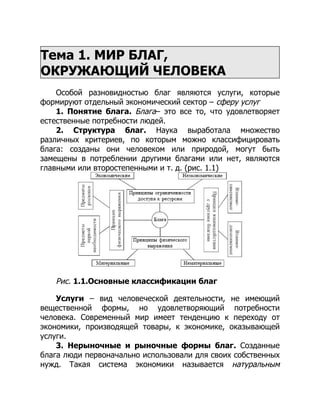
2. Структура благ. Наука выработала множество
различных критериев, по которым можно классифицировать
блага: созданы они человеком или природой, могут быть
замещены в потреблении другими благами или нет, являются
главными или второстепенными и т. д. (рис. 1.1)
Рис. 1.1.Основные классификации благ
Услуги – вид человеческой деятельности, не имеющий
вещественной формы, но удовлетворяющий потребности
человека. Современный мир имеет тенденцию к переходу от
экономики, производящей товары, к экономике, оказывающей
услуги.
3. Нерыночные и рыночные формы благ. Созданные
блага люди первоначально использовали для своих собственных
нужд. Такая система экономики называется натуральным
12.
хозяйством. Постепенно ейна смену пришло товарное
хозяйство, когда в ходе разделения и специализации труда
люди стали обмениваться благами, причем не только
излишками, но и специально изготовленными на продажу. В
результате возникла специфическая разновидность
экономических благ – товар.
Товар – это продукт труда, предназначенный на продажу.
4. Ценность благ для людей. При товарном хозяйстве
обмен благами происходит на рынке. Этот обмен выгоден и
продавцам, и покупателям, если он доброволен и равнозначен.
Следовательно, блага надо соизмерять. Люди научились это
делать с помощью денег.
Но что лежит в основе равнозначного обмена благ: затраты
труда на его производство или полезность благ для
потребителя?
В экономической науке имеются две теории, объясняющие
это явление, причем обе ведут истоки от классической школы А.
Смита, Д. Рикардо и Д. С. Милля, – это трудовая теория
стоимости и теория убывающей предельной полезности.
В настоящее время среди ученых укрепилось мнение о том,
что обе они дополняют друг друга и могут быть объединены в
одну общую теорию.
13.
Тема 2. ПОТРЕБНОСТИКАК
ОСНОВНОЙ МОТИВ
ДЕЯТЕЛЬНОСТИ ЛЮДЕЙ
1. Понятие потребности. Потребности – это нужды
людей, выражающиеся в благах, товарах, услугах, требующихся
для жизнедеятельности и развития.
Неудовлетворенные потребности являются для человека
побудительным мотивом, стимулом к трудовой деятельности по
созданию или приобретению недостающих ему благ.
Степень удовлетворения потребностей людей зависит от
уровня развития сферы: материального производства и
непроизводственной. В первой создаются материальные
ценности – товары, а во второй – духовные ценности и услуги.
2. Закон возвышения потребностей. Потребности
людей безграничны, хотя возможность удовлетворения
потребности отдельного человека в конкретном благе вполне
реальна. Человеческие потребности непрерывно растут
количественно и качественно (закон возвышения потребностей),
т. к. включают в себя не только индивидуальные нужды, но и
потребности социальных групп, трудовых коллективов
работников, населения и, наконец, государства в целом. При
этом производство не только удовлетворяет растущие
потребности населения, но на основе развития науки и техники
предлагает новые, ранее не известные виды материальных благ,
которые посредством широкой рекламы и маркетинговой
деятельности фирм расширяют круг существующих
потребностей.
3. Потребности и потребление. Производство,
откликаясь на потребности, создает поле для потребления.
Потребление – это процесс удовлетворения потребностей
людей, состоящий в использовании продуктов производства по
их прямому назначению. При этом само производство, создавая
14.
блага, потребляет, расходуетопределенные ресурсы. Эту часть
потребления принято называть производственным
потреблением.
В условиях рыночной экономики потребление людей
зависит от величины их доходов и измеряется с помощью таких
экономических показателей, как: структура потребления,
средний уровень потребления, потребление на душу населения
и др.
4. Пирамида потребностей А. Маслоу. Существуют
многочисленные классификации человеческих потребностей.
Обычно различают материальные, духовные и социальные
потребности. Однако в современных условиях наибольшее
распространение получила теория американского экономиста А.
Маслоу, расположившего потребности в восходящем порядке –
от низших (материальных) до высших (духовных) (рис. 2.1).
Рис. 2.1. Пирамида социальных и человеческих
потребностей по А. Маслоу
15.
Тема 3. РЕСУРСЫ
ХОЗЯЙСТВЕННОЙДЕЯТЕЛЬНОСТИ
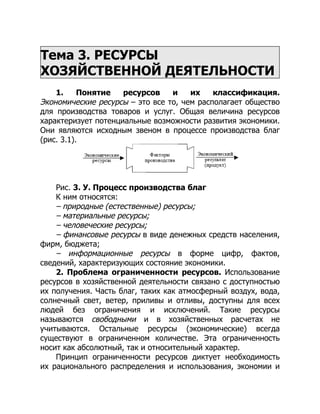
1. Понятие ресурсов и их классификация.
Экономические ресурсы – это все то, чем располагает общество
для производства товаров и услуг. Общая величина ресурсов
характеризует потенциальные возможности развития экономики.
Они являются исходным звеном в процессе производства благ
(рис. 3.1).
Рис. 3. У. Процесс производства благ
К ним относятся:
– природные (естественные) ресурсы;
– материальные ресурсы;
– человеческие ресурсы;
– финансовые ресурсы в виде денежных средств населения,
фирм, бюджета;
– информационные ресурсы в форме цифр, фактов,
сведений, характеризующих состояние экономики.
2. Проблема ограниченности ресурсов. Использование
ресурсов в хозяйственной деятельности связано с доступностью
их получения. Часть благ, таких как атмосферный воздух, вода,
солнечный свет, ветер, приливы и отливы, доступны для всех
людей без ограничения и исключений. Такие ресурсы
называются свободными и в хозяйственных расчетах не
учитываются. Остальные ресурсы (экономические) всегда
существуют в ограниченном количестве. Эта ограниченность
носит как абсолютный, так и относительный характер.
Принцип ограниченности ресурсов диктует необходимость
их рационального распределения и использования, экономии и
16.
заботы о восстановлении.
3.Факторы производства. Ресурсы, вовлеченные в
производство, модифицируются в его факторы. Их общая
величина составляет производственный потенциал экономики.
Существуют различные классификации факторов производства.
Традиционно исходной в науке является теория «трех факторов
производства», предложенная более 200 лет назад французским
экономистом Ж.Б. Сэем. Она включает в себя труд, землю и
капитал. Это основные факторы производства. В современных
условиях они дополняются предпринимательской
деятельностью, технологией, энергией, информацией и
экологией. Их взаимосвязи можно выразить схемой (рис. 3.2).
Рис. 3.2. Взаимодействие факторов производства.
Дадим определения всех приведенных факторов
производства.
Труд – это расходование человеком в созидательных целях
его физической, интеллектуальной и духовной энергии. Труд в
процессе производства характеризуется интенсивностью и
производительностью.
Интенсивность труда – его напряженность, измеренная
степенью расходования рабочей силы в единицу времени.
Производительность труда – его результативность,
измеряемая количеством благ, произведенных в единицу
времени.
Земля – естественные природные ресурсы.
Капитал – созданные людьми средства производства и
деньги, используемые при производстве товаров и услуг.
17.
Предпринимательство – деятельность,направленная на
получение дохода, прибыли. Предпринимательская
деятельность выражается в организации производства в
соответствии с поставленными целями.
Технология – способы воздействия на ресурсы в процессе
производства. Новые технологии, созданные человеком,
расширяют возможности использования свойств ресурсов и
позволяют развивать безотходные и малоотходные технологии.
Энергия – движущая сила, преобразующая природные
ресурсы с целью создания благ. До недавнего времени этот
фактор не выделялся в качестве самостоятельного, так как
движущей силой при производстве материальных благ
выступала преимущественно физическая сила человека или
животных.
Информационный фактор – поиск, сбор, обработка,
хранение и распространение полезных сведений, необходимых
для производственной деятельности человека. Роль этого
фактора в современных условиях также резко выросла и
оказывает воздействие на всю рыночную экономику,
предопределяя выбор потребителей и производителей на
микроэкономическом уровне.
Экология – взаимодействие человека с окружающей
природой. Любая производственная деятельность человека
прямо или косвенно связана с воздействием на окружающую
среду.
Результатом взаимодействия факторов производства
является создание благ.
18.
Тема 4. ЭКОНОМИЧЕСКИЙВЫБОР
И ГРАНИЦЫ ПРОИЗВОДСТВЕННЫХ
ВОЗМОЖНОСТЕЙ
1. Что, как и для кого производить? Любая страна,
развивая производство, вынуждена ставить перед собой три
фундаментальных вопроса: 1) что из благ производить, 2) как их
производить и 3) для кого это делать?
В условиях рыночной экономики производитель ставит
перед собой цель получения максимально возможного дохода,
отбирая для производства наиболее подходящие для этой цели
материальные блага. Это ответ на первый вопрос: что
производить?
Определившись с кругом выпускаемых товаров, фирмы в
рыночной экономике выбирают те технологии, которые
обеспечивают наименьшие затраты на производство. Таким
образом, рынок дает ответ на второй фундаментальный вопрос
экономики: как производить товары и услуги?
Население, обладая денежным доходом, который также
является ограниченным потребительским ресурсом, сравнивая
цены разных товаров и примеривая их к собственным
возможностям, выбирает, что и по какой цене покупать.
Следовательно, в рыночной экономике товар производится для
потребителя.
2. Закон редкости. В рыночной экономике ресурсы не
просто ограничены – они редки, т. е. их не хватает на всех, и
поэтому люди вынуждены конкурировать за право их
использовать.
В хозяйственной практике постоянно воспроизводится
зависимость между ограниченностью, редкостью ресурсов и
необходимостью для людей делать выбор: что производить, а от
чего отказаться. Поэтому в экономике действует закон редкости.
Его сущность заключается в невозможности удов – летворить
19.
безгранично растущие потребности,что вынуждает людей
делать выбор в очередности и степени их удовлетворения, а
также заставляет их при этом рационально использовать
ресурсы.
3. Кривая производственных возможностей. Действие
закона редкости можно проиллюстрировать с помощью кривой
производственных возможностей. Она показывает, какой
максимальный объем производства товара или услуги может
быть получен при данном объеме производства другого товара
(рис. 4.1).
Рис. 4.1. Кривая производственных возможностей
СП – средства производства;
ПП – предметы потребления.
Кривая производственных возможностей разграничивает
экономическое пространство на две части: возможных и
невозможных из-за необеспеченности ресурсами уровней
производства. Сама эта кривая может перемещаться, расширяя
или сужая сферу производственных возможностей.
Прогрессивный сдвиг кривой происходит в двух случаях:
1) под воздействием научно-технического прогресса
(изобретений, новых технологий и др.);
2) в результате роста ресурсов (открытия нового
месторождения, увеличения численности трудоспособного
населения и т. п.).
При сбалансированном соотношении факторов на
перспективу сдвиг кривой производственных возможностей
20.
будет осуществляться равномерно(рис. 4.2).
4. Понятие альтернативной стоимости.
Кривая производственных возможностей показывает цену
переключения ресурса с производства одного товара на другой
в форме альтернативной стоимости. Альтернативная
стоимость – это количество альтернативного товара, которым
надо поступиться ради производства дополнительной единицы
данного товара.
Рис. 4.2. Равномерный сдвиг кривой
производственных возможностей
По существу речь идёт о фиксации упущенных
производителем возможностей – так называемых
альтернативных (вмененных) издержек.
5. Производственная функция. Сдвиг кривой
производственных возможностей наглядно показывает, что чем
большим объемом ресурсов обладает экономика, тем больших
результатов она может достичь.
Подобная зависимость между количеством использованных
факторов производства и максимально возможным объемом
выпуска продукции называется производственной функцией.
Любая фирма имеет свою производственную функцию.
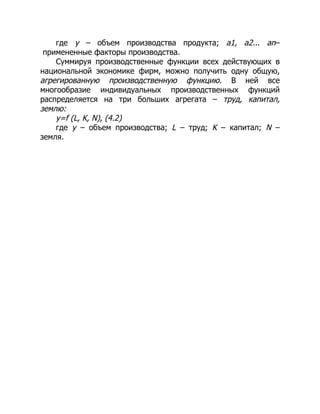
В общем виде ее можно записать:
y = f (a1,a2,...an), (4.1)
21.
где у –объем производства продукта; a1, a2... an–
примененные факторы производства.
Суммируя производственные функции всех действующих в
национальной экономике фирм, можно получить одну общую,
агрегированную производственную функцию. В ней все
многообразие индивидуальных производственных функций
распределяется на три больших агрегата – труд, капитал,
землю:
y=f (L, K, N), (4.2)
где y – объем производства; L – труд; K – капитал; N –
земля.
22.
Тема 5. ЭКОНОМИЧЕСКИЕ
ОТНОШЕНИЯМЕЖДУ ЛЮДЬМИ
1. Взаимодействие людей в хозяйственной жизни.
Хозяйственная деятельность людей предполагает наличие
социальных связей.
На эти связи существенное влияние оказывают отношения
собственности, так как за ними стоят экономические интересы
как отдельных людей, групп, так и общества в целом.
Экономический интерес – это побудительный мотив, стимул
человеческой хозяйственной деятельности в каком-либо
направлении.
Среди огромного количества фактов, явлений, связей
объективного характера можно выделить наиболее
существенные, предопределяющие действия и развитие многих
хозяйственных процессов и даже экономики в целом. Их принято
называть экономическими законами.
Экономический закон – это объективно необходимые,
устойчивые и массово повторяющиеся связи и
взаимозависимости между явлениями и процессами,
происходящими в хозяйственной деятельности людей.
2. Экономические отношения и их структура.
Объективные экономические законы представляют собой ядро
экономических отношений.
Экономические отношения – отношения между людьми,
возникающие в процессе производства, распределения, обмена
и потребления материальных и духовных благ и услуг.
Существуют три группы носителей экономических
отношений в рыночной экономике: а) производители и
потребители; б) продавцы и покупатели; в) владельцы и
пользователи благ. В целом экономические отношения между
людьми характеризуют их имущественное положение в
обществе.
23.
Тема 6. ВИДЫИ МОДЕЛИ
ЭКОНОМИЧЕСКИХ СИСТЕМ
1. Понятие экономической системы. Экономическая
теория всегда рассматривает хозяйство как экономическую
систему.
Экономическая система – это упорядоченная структура
связей между людьми в отношении производства и потребления
материальных благ и услуг.
В экономической системе всегда существуют три основных
субъекта экономики: домохозяйства, фирмы и государство.
2. Критерии классификации. Экономические системы
можно классифицировать по различным признакам:
– по функциональному назначению;
– отраслевому набору;
– воспроизводственному подходу;
– институционному составу;
– социальному содержанию.
Структурные элементы экономической системы находятся в
динамичном взаимодействии, формируя пропорции
экономической системы.
Экономические пропорции – это количественное
соотношение отдельных частей в рамках всей экономической
системы.
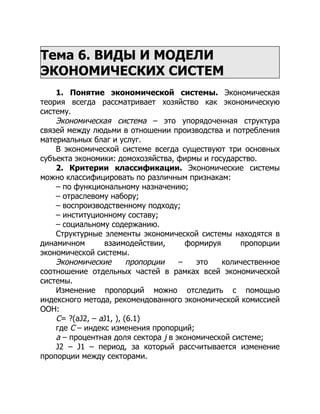
Изменение пропорций можно отследить с помощью
индексного метода, рекомендованного экономической комиссией
ООН:
C= ?(aJ2, – aJ1, ), (6.1)
где С – индекс изменения пропорций;
а – процентная доля сектора j в экономической системе;
J2 – J1 – период, за который рассчитывается изменение
пропорции между секторами.
24.
3. Типы экономическихсистем. В самом общем виде
можно выделить три основных типа экономических систем.
При традиционной системе в экономике сильны
национальные исторические традиции и обычаи хозяйствования,
которым присущи натурализация хозяйственной деятельности и
сословность.
При планово-хозяйственной системе государство
регламентирует хозяйственную деятельность.
При рыночной системе центральную роль играет не
государство, а рынок. В целом эта система основана на частной
собственности и свободной конкуренции производителей и
потребителей.
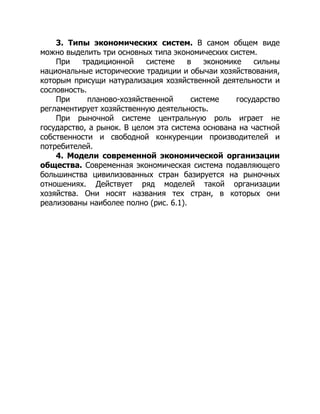
4. Модели современной экономической организации
общества. Современная экономическая система подавляющего
большинства цивилизованных стран базируется на рыночных
отношениях. Действует ряд моделей такой организации
хозяйства. Они носят названия тех стран, в которых они
реализованы наиболее полно (рис. 6.1).
25.
Рис. 6.1. Содержаниеосновных моделей современной
экономики
Перечисленные модели современных экономических систем
хозяйствования нередко дополняются промежуточными
вариантами: немецким, французским, южно-корейским и др.
26.
Тема 7. ЭВОЛЮЦИЯИДЕЙ В
ТЕОРЕТИЧЕСКОЙ
ЭКОНОМИЧЕСКОЙ НАУКЕ
1. Исходные направления развития экономической
науки. Самые ранние суждения об экономике дошли до нас
через учения мыслителей древности. Древнегреческие
мыслители Ксенофонт, Платон, Аристотель уже в середине
первого тысячелетия до н. э. обращали внимание на принципы
ведения домашнего хозяйства, рынок, обмен.
Суждения древних об экономике не являлись наукой, так
как хозяйственные отношения еще не были развиты.
Развитие серьезной экономической науки началось со
становлением капитализма в XVI–XVII вв. В это время создается
первая значительная школа в мировой экономической науке –
меркантилизм (от ит. – торговец). Его представителями были
Томас Ман (1551–1611), Антуан Монкретьен (1575–1621), Дэвид
Юм (1711–1776). Источник богатства в экономике
меркантилисты видели в торговле. Именно они впервые
поставили вопрос об активном торговом балансе, проблемы
которого волнуют многие страны и сегодня.
Со временем экономика все усложнялась, и наука перешла
от анализа обмена и торговли к анализу производства. В
результате возникло учение физиократов (от греч. – власть
природы). Его представителями являлись Франсуа Кенэ (1694–
1774), Жак Тюрго (1727–1781). Вследствие неразвитости
производства физиократы исследовали его состояние лишь в
аграрном секторе экономики.
Ограниченность подхода школы физиократов преодолела
классическая школа (представители: Адам Смит (1729–1790),
Давид Рикардо (1772–1823). Классической она названа потому,
что впервые в истории экономической мысли ее представители
рассмотрели всю экономику в целом, разработав при этом
27.
основы трудовой теориистоимости, раскрыв понятие рынка и
механизм ценообразования. На базе ее теоретического
наследства возникли два противоположных учения – марксизм и
маржинализм.
Марксизм – учение об экономическом строе капитализма и
смене его новым, передовым строем – коммунизмом.
Основоположник марксизма – Карл Маркс (1818–1883).
Маржинализм – экономическая теория, возникшая во второй
половине ХГХ в. и с противоположных марксизму позиций
оценившая наследие классической школы (представители:
Уильям Джевонс (1835–1882), Карл Менгер (1840–1921),
Фридрих фон Визер (1851–1926), Евгений фон Бам-Баверк
(1851–1914).
Неоклассическая школа (основоположник – Альфред
Маршалл (1842–1924)), развивая маржинализм, увязала его
идеи с классической школой, за что и получила свое название.
Используя механизмы спроса-предложения и рыночного
ценообразования, Маршалл соединил воедино производство и
обмен, не противопоставляя их друг другу.
ХХ в. принес в мировую экономику огромные изменения,
нашедшие отражение в рождении двух новых школ –
кейнсианства и институционализма.
Кейнсианская школа сложилась в 30-е гг. XX в. на основе
идей Джона Мейнарда Кейнса (1883–1946) и развивается до
сегодняшнего дня. Особенность учения заключается в том, что:
а) идеи неоклассиков перенесены на уровень всей национальной
экономики (макроэкономики); б) обоснована роль государства в
регулировании рынка. Институ-ционализм – научная школа,
введшая в научный анализ, помимо рынка, различные институты
– корпорации, профсоюзы, государство, а также национальные
особенности, традиции и т. д. Его представители – Торстейн
Веблен (1857–1929), Уэсли Митчел (1874–1948).
2. Современные взгляды на экономическую теорию.
Экономическая теория продолжает разваться, появляются новые
экономические учения.
28.
1. Теория постиндустриальногообщества и конвергенции,
выросшая из институционализма (представители: Джон
Гэлбрейт, Уолт Ростоу (США), Ян Тинберген (Нидерланды)).
Главная идея: под воздействием НТР во второй половине ХХ в.
возникает смешанное общество, приходящее на смену
социализму и капитализму.
2. Монетаризм как ответвление неоклассики, ставящее во
главу анализа экономики денежные отношения, считая их
решающим фактором в экономике (основоположник – Милтон
Фридмен (США)).
3. Экономический либерализм – течение, идущее от
классической школы (представители: Людвиг фон Мизес,
Фридрих фон Хайек (Германия). Главная идея: минимальное
воздействие государства на экономику, неограниченная свобода
предпринимательства.
4. Теория рациональных ожиданий, исходящая из того
положения, что современная экономическая деятельность
невозможна без прогнозирования, предвидения основных путей
развития (основоположник – Роберт Лукас (США)).
5. Теория неоклассического синтеза стремится объединить
основные идеи неоклассической школы и кейнсиан-ства на путях
анализа общего экономического равновесия, экономического
роста и налогообложения (представители: Джон Хикс
(Великобритания), Пол Самуэльсон (США).
3. Вклад российских экономистов в развитие
экономической теории. Российская экономическая наука
имеет своих представителей практически во всех перечисленных
школах, начиная с А.А. Ордин-Нащокина и И.Т. Посошко-ва,
современников Петра I, ставших основателями российского
меркантилизма, и до М.Н. Туган-Барановского (1865–1919),
стремившегося объединить марксизм и мар-жинализм.
Мировую известность получила теория длинных волн в
экономике Н. Д. Кондратьева (1892–1938), труды теоретика
аграрной сферы А.В. Чаянова (1882–1937). Во второй половине
ХХ в. советские экономисты В. В. Новожилов (1892–1970), В.С.
Немчинов (1894–1964), Л.В. Канторович (1912–1986) внесли
Тема 8. ПРЕДМЕТ
ЭКОНОМИЧЕСКОЙТЕОРИИ.
МЕТОДЫ ИССЛЕДОВАНИЯ И
АНАЛИЗА ЭКОНОМИЧЕСКИХ
ПРОЦЕССОВ
1. Научные школы – о предмете экономической
теории. Теоретические исследования в экономике А. Монкре-
тьен в 1516 г. определил как политическую экономию, А.
Маршалл в 1890 г. – как экономикс, а в современной России она
приобрела название экономической теории. Большинство
ученых считают, что речь идет не о разных науках, а о
специфике взглядов на предмет и содержание общей
универсальной теоретической экономики.
Экономическая теория – это универсальная наука,
изучающая экономические явления и процессы,
функционирование хозяйства, экономические отношения,
основанные на логике, историческом опыте и теоретических
концепциях.
Хозяйственные процессы экономическая наука
рассматривает на двух уровнях. Это:
а) микроэкономика – раздел экономической теории, в
котором анализируются экономические процессы у отдельных
хозяйственных субьектов и вырабатываются рекомендации
производителям и потребителям благ.
б) макроэкономика – раздел экономической теории,
изучающий сферу национального хозяйства в целом и
вырабатывающий методы борьбы с инфляцией, безработицей,
экономическим спадом и другими проблемами.
2. Функции экономической теории. Экономическая
теория – общественная наука (наряду с философией, историей,
31.
юриспруденцией и др.),призванная объяснить людям принципы
их экономического бытия. При этом она выполняет четыре
функции: познавательную, практическую, методологическую,
идеологическую.
Познавательная функция выражается в изучении и
объяснении сути экономических процессов.
Выработка нового знания помогает предвидеть будущее
состояние экономики, что, в свою очередь, требует усилий по
преобразованию действительности.
Эту роль выполняет практическая функция экономической
теории. Практическая функция выступает в форме разработки
принципов и методов рационального хозяйствования, научного
обоснования экономической стратегии проведения реформ
экономической жизни.
Практическая функция экономической теории тесно связана
с экономической политикой. Принцип связи: «идеи – решения».
Экономическая политика – это целенаправленная система
мер государства по регулированию хозяйства.
Методологическая функция выражается в том, что
экономическая теория является теоретическим фундаментом
для целой группы наук:
– отраслевых (экономика строительства, промышленности,
сельского хозяйства и т. д.);
– функциональных (бухгалтерский учет, финансы,
маркетинг и др.);
– межотраслевых (статистика, эконометрика, экономическая
история, демография и т. д.).
3. Применяемые методы. Экономическая теория
вооружает данный комплекс наук общими подходами и
взглядами на хозяйственные процессы, действующие в них
законы развития, при этом вырабатывает рекомендации по
применению целого ряда приемов в изучении объектов.
Существуют как общенаучные, так и специальные методы.
Общенаучные методы:
– научной абстракции;
– анализа и синтеза;
32.
– исторического илогического подхода;
– индукции и дедукции;
– метафизический;
– диалектический. Специальные методы:
– эконометрический;
– позитивный и нормативный;
– экономического эксперимента;
– идеологический.
Экономическая теория разрабатывается конкретными
людьми, которыми движут мотивы, часто не совпадающие с
интересами других людей. Поэтому экономическая теория
неизбежно привносит в оценку хозяйственной жизни
идеологический оттенок в части справедливости,
эффективности, рациональности экономических отношений,
сложившихся в обществе.
4. Научный аппарат. Применение различных методов в
экономической науке обеспечивается с помощью научного
аппарата.
Научный аппарат составляют вспомогательные приемы и
средства, с помощью которых исследуется экономика:
– гипотезы – непроверенные предварительные выводы о
состоянии экономики;
– экономико-математические модели, т. е. абстрактные,
упрощенные представления об экономических процессах и их
взаимодействии в виде математических формул и уравнений;
– графики – наглядное пространственное изображение
зависимости между двумя (и более) экономическими
переменными.
33.
Тема 9. РЫНОККАК
ЭКОНОМИЧЕСКАЯ КАТЕГОРИЯ
1. Понятие рынка. В экономической теории рынок – это
сфера экономических отношений между людьми по поводу
купли-продажи товаров и услуг, основанная на принципах
добровольности и равенства в обмене.
Рынок выполняет важные функции:
– функцию саморегулирования экономики, основанную на
взаимодействии спроса и предложения, с помощью которой
даются ответы на вопросы: что, как и для кого производить?
– стимулирующую функцию, позволяющую победить в
конкурентной борьбе сильнейшим;
– учетную функцию, посредством которой устанавливаются
пропорции в обмене товаров, определяются цены и подаются
информационные сигналы продавцам и покупателям;
– посредническую функцию, позволяющую сводить агентов
рынка.
Рынок не является идеальной формой экономических связей
в обществе, поэтому неоднократно делались теоретические
попытки обосновать возможность нерыночного развития – от Т.
Мора и Т. Кампанеллы до К. Маркса и построения социализма в
СССР Однако на сегодняшний день рынок – наиболее
эффективная форма хозяйствования, так как реализует самую
понятную людям вещь – материальную заинтересованность в
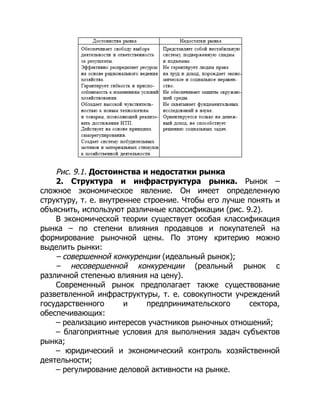
результатах их труда (рис. 9.1).
34.
Рис. 9.1. Достоинстваи недостатки рынка
2. Структура и инфраструктура рынка. Рынок –
сложное экономическое явление. Он имеет определенную
структуру, т. е. внутреннее строение. Чтобы его лучше понять и
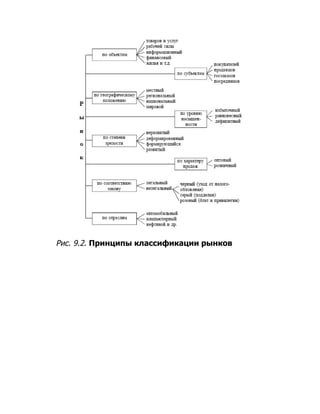
объяснить, используют различные классификации (рис. 9.2).
В экономической теории существует особая классификация
рынка – по степени влияния продавцов и покупателей на
формирование рыночной цены. По этому критерию можно
выделить рынки:
– совершенной конкуренции (идеальный рынок);
– несовершенной конкуренции (реальный рынок с
различной степенью влияния на цену).
Современный рынок предполагает также существование
разветвленной инфраструктуры, т. е. совокупности учреждений
государственного и предпринимательского сектора,
обеспечивающих:
– реализацию интересов участников рыночных отношений;
– благоприятные условия для выполнения задач субъектов
рынка;
– юридический и экономический контроль хозяйственной
деятельности;
– регулирование деловой активности на рынке.
Рис. 9.3. Составрыночной инфраструктуры
3. Границы развития рынка. Уровень, темп и границы
развития рыночных отношении зависят от выгодности обмена
для его участников. Этот механизм объясняют теорема обмена
А. Смита и теорема границ рынка Р. Коуза.
Суть теоремы А. Смита заключается в том, что рыночный
обмен выгоден и продавцам, и покупателям и поэтому вызывает
углубление разделения труда и специализацию производства. В
итоге растут объемы производства и снижаются издержки на
изготовление продукции, т. е. увеличивается
производительность труда.
Одновременно с этим растут затраты на продажу
произведенных товаров, их транспортировку, сохранность,
обслуживание денежных расчетов и т. д. Следовательно, рынок
37.
расширяется до техпор, пока рост затрат на обращение не
превысит экономию от увеличения масштабов производства.
Теорема Р. Коуза, разработанная через два века после
теоремы А. Смита, дополняет характеристику границ рынка
показателем урегулированности отношений собственности: если
они урегулированы законом, то рыночные связи осуществляются
без вмешательства государства и рынок растет по принципам А.
Смита, но если правовая база хозяйственных отношений слаба,
то государство вынуждено вмешиваться в дела бизнеса, быть
арбитром в спорах. Для фирм это оборачивается увеличением
риска сделок, ростом издержек на судебные иски, содержание
адвокатов, проведение экспертиз и т. д. В результате
бизнесмены уходят в тень, обзаводятся криминальными
«крышами», пытаясь защититься от роста таких затрат, и как
следствие рынок перестает расширяться.
38.
Тема 10. СПРОСИ ПРЕДЛОЖЕНИЕ
1. Спрос и его функция. Чтобы построить четкую модель
рынка, необходимо исследовать в идеальных условиях (при
совершенной конкуренции) взаимодействие важнейших
категорий рынка – спроса и предложения, за которыми стоят
покупатели и продавцы.
Спрос – это количество товаров (услуг), которое покупатели
готовы приобрести на рынке.
Величина спроса зависит от ряда факторов. Такую
зависимость принято называть функцией спроса.
Qda = f (Pa, Pb...z, K, L, M, N, T), (10.1)
где Qda– функция спроса на товар; Pa– цена товара; Pb...z–
цены других товаров, в том числе товаров-заменителей и
сопутствующих; K – денежные доходы покупателей; L – вкусы и
предпочтения людей; M – потребительские ожидания; N –
общее число покупателей; T – накопленное имущество людей.
Основной фактор спроса – цена товара, поэтому
зависимость можно упростить:
Qda= f(Pa).(10.2)
Функцию спроса можно представить также в виде графика
(рис. 10.1).
Рис. 10.1. Функция спроса
T
CHAPTER IV
SUBMARINES INTHE CIVIL WAR
he most powerful battleship in the world, half a century ago,
was the U.S.S. New Ironsides. She was a wooden-hulled,
ship-rigged steamer of 3486 tons displacement—about one
tenth the size of a modern superdreadnought—her sides plated with
four inches of iron armor, and carrying twenty heavy guns. On the
night of October 5, 1863, the New Ironsides was on blockade duty
off Charleston Harbor, when Ensign Howard, the officer of the deck,
saw something approaching that looked like a floating plank. He
hailed it, and was answered by a rifle ball that stretched him,
mortally wounded, on the deck. An instant later came the flash and
roar of a tremendous explosion, a column of water shot high into the
air alongside, and the New Ironsides was shaken violently from stem
to stern.
The Confederate submarine David had crept up and driven a
spar-torpedo against Goliath’s armor.
But except for a few splintered timbers, a flooded engine-room,
and a marine’s broken leg, no damage had been done. As the
Confederate craft was too close and too low in the water for the
broadside guns to bear, the crew of the ironclad lined the rail and
poured volley after volley of musketry into their dimly seen
adversary till she drifted away into the night. Her crew of seven men
had dived overboard at the moment of impact, and were all picked
up by different vessels of the blockading fleet, except the engineer
41.
and one other,who swam back to the David, started her engine
again, and brought her safely home to Charleston.
Views of a Confederate David.
From Scharf’s History of the Confederate States Navy.
The David was a cigar-shaped steam launch, fifty-four feet long
and six feet broad at the thickest point. Projecting from her bow was
a fifteen-foot spar, with a torpedo charged with sixty pounds of
gunpowder at the end of it. This was exploded by the heat given off
by certain chemicals, after they were shaken up together by the
impact of the torpedo against the enemy’s ship. The David, steaming
at her full speed of seven knots an hour, struck squarely against the
New Ironsides at the water-line and rebounded to a distance of
seven or eight feet before this clumsy detonator could do its work.
When the explosion came, the intervening body of water prevented
it from doing any great damage.
42.
The David wasnot a true submarine but a surface torpedo boat,
that could be submerged till only the funnel and a small pilot-house
were exposed. A number of other Davids were built and operated by
the Confederate States navy, but the first of them was the only one
to accomplish anything.
C. S. S. Hundley.
The Only Submarine to sink a Hostile Warship before the Outbreak of
the Present War.
The one real submarine possessed by the Confederacy was not a
David, though she is usually so called. This was the C.S.S. Hundley,
a hand-power “diving-boat” not unlike Fulton’s Nautilus, but very
much clumsier and harder to manage. She had ballast tanks and a
pair of diving-planes for steering her up and down, and she was
designed to attack an enemy’s ship by swimming under it, towing a
torpedo that would explode on striking her opponent’s keel.
43.
The Hundley wasbuilt at Mobile, Alabama, by the firm of
Hundley and McKlintock, named for the senior partner, and brought
to Charleston on a flatcar. There she was manned by a crew of nine
volunteers, eight of whom sat in a row and turned the cranks on the
propellor-shaft, while the ninth man steered. There was no conning-
tower and the forward hatchway had to be left open for the
helmsman to look out of while running on the surface. On the
Hundley’s first practice cruise, the wash from the paddle-wheels of a
passing steamer poured suddenly down the open hatchway. Only the
steersman and commanding officer, Lieutenant Payne, had time to
save himself before the submarine sank, drowning the rest of her
crew.
The boat was raised and Payne took her out with a new crew.
This time a sudden squall sank her before they could close the
hatches, and Payne escaped, with two of his men. He tried a third
time, only to be capsized off Fort Sumter, with the loss of four of his
crew. On the fourth trip, the hatches were closed, the tanks filled,
and an attempt was made to navigate beneath the surface. But the
Hundley dived too suddenly, stuck her nose deep into the muddy
bottom, and stayed there till her entire crew were suffocated. On the
fifth trial she became entangled in the cable of an anchored vessel,
with the same result.
By this time the submarine’s victims numbered thirty-five, and
the Confederates had nicknamed her the “Peripatetic Coffin.” But at
the sixth call for volunteers, they still came forward. It was decided
to risk no more lives on practice trips but to attack at once. In spite
of the protests of Mr. Hundley, the designer of the craft, her latest
and last commander, Lieutenant Dixon of the 21st South Carolina
Infantry, was ordered by General Beauregard to use the vessel as a
surface torpedo-boat, submerged to the hatch-coaming and with the
hatches open. A spar-torpedo, to be exploded by pulling a trigger
with a light line running back into the boat, was mounted on the
bow. Thus armed, and manned by Lieutenant Dixon, Captain
Carlson, and five enlisted men of their regiment, the little Hundley
put out over Charleston bar on the night of February 17, 1864, to
44.
attack some vesselof the blockading fleet. This proved to be the
U.S.S. Housatonic, a fine new thirteen-gun corvette of 1264 tons.
What followed is best described by Admiral David Porter in his “Naval
History of the Civil War.”
“At about 8.45 P.M., the officer of the deck on board the
unfortunate vessel discovered something about 100 yards away,
moving along the water. It came directly towards the ship, and
within two minutes of the time it was first sighted was alongside.
The cable was slipped, the engines backed, and all hands called to
quarters. But it was too late—the torpedo struck the Housatonic just
forward of the mainmast, on the starboard side, on a line with the
magazine. The man who steered her (the Hundley) knew where the
vital spots of the steamer were and he did his work well. When the
explosion took place the ship trembled all over as if by the shock of
an earthquake, and seemed to be lifted out of the water, and then
sank stern-foremost, heeling to port as she went down.”
The Hundley was not seen after the explosion, and it was
supposed that she had backed away and escaped. But when peace
came, and Charleston Harbor was being cleared of the wrecks with
which war had clogged it, the divers sent down to inspect the
Housatonic found the Hundley lying beside her. Sucked in by the
rush of the water through the hole her torpedo had made, she had
been caught and dragged down by her own victim. All the Hundley’s
crew were found dead within her. So perished the first and last
submarine to sink a hostile warship, before the outbreak of the
present war. A smaller underwater boat of the same type was
privately built at New Orleans at the beginning of the war, lost on
her trial trip, and not brought up again till after peace was declared.
The North had a hand-power submarine, that was built at the
Georgetown Navy Yard in 1862. It was designed by a Frenchman,
whose name is now forgotten but who might have been a
contemporary of Cornelius Van Drebel. Except that its hull was of
steel instead of wood and greased leather, this first submarine of the
United States navy was no better than an eel-boat of the
45.
seventeenth century. Itwas propelled by eight pairs of oars, with
hinged blades that folded up like a book on the return stroke. The
boat was thirty-five feet long and six in diameter, and was rowed by
sixteen men. It was submerged by flooding ballast tanks. There was
an oxygen tank and an apparatus for purifying the used air by
blowing it over lime. A spar-torpedo was to be run out on rollers in
the bow.
Ten thousand dollars was paid to the inventor of this medieval
leftover, and he prudently left the country before he could be called
on to operate it, though he had been promised a reward of five
thousand dollars for every Confederate ironclad he succeeded in
blowing up. Like the first Monitor, this nameless submarine was lost
in a storm off Cape Hatteras, while being towed by a steamer.
After the loss of the Housatonic, the North built two semi-
submersible steam torpedo-boats on the same idea as the David,
but larger and faster. Both were armed with spar-torpedoes and
fitted with ballast tanks to sink them very low in the water when
they attacked. The smaller of the two, the Stromboli, could be
submerged till only her pilot-house, smoke-stack, and one ventilator
showed above the water. The other boat was called the Spuyten
Duyvil. She could be sunk till her deck, which was covered with
three inches of iron armor, was level with the water, but she bristled
with masts, funnels, conning-towers, ventilators, and other
excrescences that sprouted out of her hull at the most unexpected
places. Neither of these craft was ever used in action.
46.
H
CHAPTER V
THE WHITEHEADTORPEDO
ow best to float a charge of explosives against the hull of an
enemy’s ship and there explode it is the great problem of
torpedo warfare. The spar-torpedo, that did such effective
work in the Civil War, was little more than a can of gunpowder on the
end of a stick. This stick or spar was mounted usually on the bow of a
steam-launch, either partially submerged, like the David, or boldly
running on the surface over log-booms and through a hail of bullets
and grapeshot, as when Lieutenant Cushing sank the Confederate
ironclad Albemarle. Once alongside, the spar-torpedo was run out to its
full length, raised, depressed, and finally fired by pulling different
ropes. So small was the chance of success and so great the danger to
the launch’s crew that naval officers and inventors all the world over
sought constantly for some surer and safer way.
Early in the sixties, an Austrian artillery officer attached to the coast
defenses conceived the idea of sending out the launch without a crew.
He made some drawings of a big toy boat, to be driven by steam or hot
air or even by clockwork, and steered from the shore by long ropes. As
it would have no crew, this boat could carry the explosives in its hull,
and the spars which were to project from it in all directions would carry
no torpedoes themselves but would serve to explode the boat’s cargo
of guncotton by firing a pistol into it, as soon as one of the spars came
into contact with the target. Before he could carry out his ideas any
further, this officer died and his plans were turned over to Captain
Lupuis of the Austrian navy. Lupuis experimented diligently with surface
torpedoes till 1864, but found that he would have to discover some
47.
better steering-device thanropes from the shore and some other
motive-power than steam or clockwork. So he consulted with Mr.
Whitehead, the English manager of a firm of engine manufacturers at
the seaport of Fiume.
Whitehead gave the torpedo a fish-shaped hull, so that it could run
beneath instead of on the surface. For motive-power he used
compressed air, which proved much superior to either steam or
clockwork. And by improving its rudders, he enabled the little craft to
keep its course without the aid of guide-ropes from the shore. The
chief defect of the first Whitehead torpedoes, which were finished and
tried in 1866, was that they kept bobbing to the surface, or else they
would dive too deep and pass harmlessly under the target. To correct
this defect, Whitehead invented by 1868 what he called the “balance
chamber.” Then, as now, each torpedo was divided into a number of
separate compartments or chambers, and in one of these the inventor
placed a most ingenious device for keeping the torpedo at a uniform
depth. The contents of the balance-chamber was Whitehead’s great
secret, and it was not revealed to the public for twenty years.
The automobile or, as it was then called, the “submarine
locomotive” torpedo was now a practicable, though by no means
perfected, weapon, and the Austrian naval authorities gave it a
thorough trial at Fiume in 1868. Whitehead rigged up a crude ejecting
tube on the bow of a gunboat, and successfully discharged two of his
torpedoes at a yacht. The Austrian government promptly adopted the
weapon, but could not obtain a monopoly of it, for Whitehead was a
patriotic Englishman. The British admiralty invited him to England two
years later, and after careful trials of its own, induced the English
government to buy Whitehead’s secret and manufacturing rights for
$45,000. Other nations soon added “Whiteheads” to their navies, and
in 1873 there was built in Norway a large, fast steam launch for the
express purpose of carrying torpedoes and discharging them at an
enemy. Every one began to build larger and swifter launches, till they
evolved the torpedo-boat and the destroyer of to-day.
The torpedo itself has undergone a similar development in size and
efficiency. The difference between the Whiteheads of forty-five years
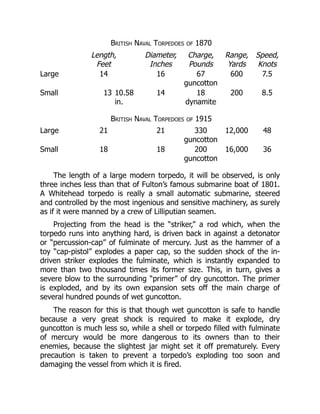
ago and those of to-day is strikingly shown in the following table:
48.
British Naval Torpedoesof 1870
Length,
Feet
Diameter,
Inches
Charge,
Pounds
Range,
Yards
Speed,
Knots
Large 14 16 67
guncotton
600 7.5
Small 13 10.58
in.
14 18
dynamite
200 8.5
British Naval Torpedoes of 1915
Large 21 21 330
guncotton
12,000 48
Small 18 18 200
guncotton
16,000 36
The length of a large modern torpedo, it will be observed, is only
three inches less than that of Fulton’s famous submarine boat of 1801.
A Whitehead torpedo is really a small automatic submarine, steered
and controlled by the most ingenious and sensitive machinery, as surely
as if it were manned by a crew of Lilliputian seamen.
Projecting from the head is the “striker,” a rod which, when the
torpedo runs into anything hard, is driven back in against a detonator
or “percussion-cap” of fulminate of mercury. Just as the hammer of a
toy “cap-pistol” explodes a paper cap, so the sudden shock of the in-
driven striker explodes the fulminate, which is instantly expanded to
more than two thousand times its former size. This, in turn, gives a
severe blow to the surrounding “primer” of dry guncotton. The primer
is exploded, and by its own expansion sets off the main charge of
several hundred pounds of wet guncotton.
The reason for this is that though wet guncotton is safe to handle
because a very great shock is required to make it explode, dry
guncotton is much less so, while a shell or torpedo filled with fulminate
of mercury would be more dangerous to its owners than to their
enemies, because the slightest jar might set it off prematurely. Every
precaution is taken to prevent a torpedo’s exploding too soon and
damaging the vessel from which it is fired.
49.
When the torpedois shot out of the tube, by compressed air, like a
pea from a pea-shooter, the striker is held fast by the “jammer”: a
small propellor-shaped collar, whose blades begin to revolve as soon as
they strike the water, till the collar has unscrewed itself and dropped off
after the torpedo has traveled about forty feet. A copper pin that runs
through the striker-rod is not removed but must be broken short off by
a blow of considerable violence, such as would be given by running into
a ship’s hull. As a third safeguard, there is a strong safety-catch, that
must be released by hand, just before the torpedo is placed in the
tube.
The explosive charge of two or three hundred pounds of wet
guncotton is called the “war-head.” In peace and for target-practice it is
replaced by a dummy head of thick steel. The usual target is the space
between two buoys moored a ship’s length or less apart. At the end of
a practice run, the torpedo rises to the surface, where it can be
recovered and used again. This is distinctly worth while, for a modern
torpedo costs more than seven thousand dollars.
Back of the war-head is the air-chamber, that contains the motive-
power of this miniature submarine. The air is either packed into it by
powerful pumps, on shore or shipboard, or else drawn from one of the
storage flasks of compressed air, a number of which are carried on
every submarine. The air-chamber of a modern torpedo is charged at a
pressure of from 2000 to 2500 pounds per square inch. As the torpedo
leaves the tube, a lever on its back is struck and knocked over by a
little projecting piece of metal, and the starting-valve of the air-
chamber is opened. But if the compressed air were allowed to reach
and start the engines at once, they would begin to revolve the
propellors while they were still in the air inside the tube. This would
cause the screws to “race,” or spin round too rapidly and perhaps break
off. So there is a “delaying-valve,” which keeps the air away from the
engines till another valve-lever is swung over by the impact of the
water against a little metal flap.
As the compressed air rushes through the pipe from the chamber
to the engine-room, it passes through a “reducing-valve,” which keeps
it from spurting at the start and lagging at the finish. By supplying the
air to the engines at a reduced but uniform pressure, this device
50.
enables the torpedoto maintain the same speed throughout the run. At
the same time the compressed air is heated by a small jet of burning
oil, with a consequent increase in pressure, power, and speed,
estimated at 30 per cent. All these devices are kept not in the air-
chamber itself but in the next compartment, the balance-chamber.
Here is the famous little machine, once a close-kept secret but now
known to all the world, that holds the torpedo at any desired depth.
Think of a push-button, working in a tube open to the sea, with the
water pressure pushing the button in and a spiral spring inside shoving
it out. This push-button—called a “hydrostatic valve”—is connected by
a system of levers with the two diving-planes or horizontal rudders that
steer the torpedo up or down. By turning a screw, the spring can be
adjusted to exert a force equal to the pressure of the water at any
given depth. If the torpedo dives too deep, the increased water-
pressure forces in the valve, moves the levers, raises the diving-planes,
and steers the torpedo towards the surface. As the water pressure
grows less, the spring forces out the valve, depresses the diving-
planes, and brings the miniature submarine down to its proper depth
again. When his torpedoes grew too big to be controlled by the
comparatively feeble force exerted by the hydrostatic valve, Whitehead
invented the “servo-motor”: an auxiliary, compressed-air engine, less
than five inches long, sensitive enough to respond to the slightest
movement of the valve levers but strong enough to steer the largest
torpedo, exactly as the steam steering-gear moves the huge rudder of
an ocean liner.
There is also a heavy pendulum, swinging fore and aft and
attached to the diving-planes, that checks any sudden up-or-down
movement of the torpedo by inclining the planes and restoring the
horizontal position.
Next comes the engine-room, with its three-cylinder motor, capable
of developing from thirty-five to fifty-five horse-power. The exhaust air
from the engine passes out through the stern in a constant stream of
bubbles, leaving a broad white streak on the surface of the water as
the torpedo speeds to its mark.
51.
The aftermost compartmentis called the buoyancy chamber.
Besides adding to the floatability of the torpedo, this space also holds
the engine shaft and the gear attaching it to the twin propellors. The
first Whiteheads were single-screw boats. But the revolution of the
propellor in one direction set up a reaction that caused the torpedo
itself to partially revolve or heel over in the other, disturbing its rudders
and swerving it from its course. This reaction is neutralized by using
two propellers, one revolving to the right, the other to the left. Instead
of being placed side by side, as on a steamer, they are mounted one
behind the other, with the shaft of one revolving inside the hollow shaft
of the other, and in the opposite direction.
Long after they could be depended on to keep a proper depth, the
Whiteheads and other self-propelled torpedoes were liable to swing
suddenly to port or starboard, or even turn completely round. During
the war between Chile and Peru, in 1879, the Peruvian ironclad Huascar
discharged an automobile torpedo that went halfway to the target,
changed its mind, and was coming back to blow up its owners when an
officer swam out to meet it and succeeded in turning it aside, for the
torpedoes of that time were slow and small as well as erratic.
Nowadays a torpedo is kept on a straight course by a gyroscope
placed in the buoyancy chamber. Nearly every boy knows the
gyroscopic top, like a little flywheel, that you can spin on the edge of a
tumbler. The upper part of this toy is a heavy little metal wheel, and if
you try to push it over while it is spinning, it resists and pushes back,
as if it were alive. A similar wheel, weighing about two pounds, is
placed in the buoyancy chamber of a Whitehead. When the torpedo
starts, it releases either a powerful spring or an auxiliary compressed
air engine that sets the gyroscope to spinning at more than two
thousand revolutions a minute. It revolves vertically, in the fore-and-aft
line of the torpedo, and is mounted on a pivoted stand. If the torpedo
deviates from its straight course, the gyroscope does not, and the
consequent change in their relative positions brings the flywheel into
contact with a lever running to the servo-motor that controls the two
vertical rudders, which soon set the torpedo right again.
52.
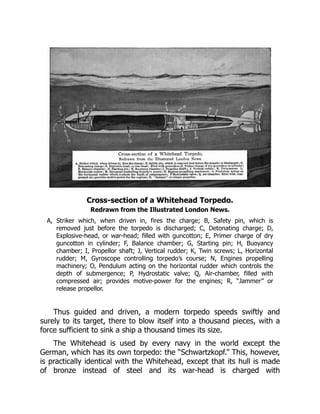
Cross-section of aWhitehead Torpedo.
Redrawn from the Illustrated London News.
A, Striker which, when driven in, fires the charge; B, Safety pin, which is
removed just before the torpedo is discharged; C, Detonating charge; D,
Explosive-head, or war-head; filled with guncotton; E, Primer charge of dry
guncotton in cylinder; F, Balance chamber; G, Starting pin; H, Buoyancy
chamber; I, Propellor shaft; J, Vertical rudder; K, Twin screws; L, Horizontal
rudder; M, Gyroscope controlling torpedo’s course; N, Engines propelling
machinery; O, Pendulum acting on the horizontal rudder which controls the
depth of submergence; P, Hydrostatic valve; Q, Air-chamber, filled with
compressed air; provides motive-power for the engines; R, “Jammer” or
release propellor.
Thus guided and driven, a modern torpedo speeds swiftly and
surely to its target, there to blow itself into a thousand pieces, with a
force sufficient to sink a ship a thousand times its size.
The Whitehead is used by every navy in the world except the
German, which has its own torpedo: the “Schwartzkopf.” This, however,
is practically identical with the Whitehead, except that its hull is made
of bronze instead of steel and its war-head is charged with
53.
trinitrotuluol, or T.N.T.,a much more powerful explosive than
guncotton.
After the Russo-Japanese War, when several Russian battleships
kept afloat although they had been struck by Japanese torpedoes,
many naval experts declared that an exploding war-head spent most of
its energy in throwing a great column of water up into the air, instead
of blowing in the side of the ship. So Commander Davis of the United
States navy invented his “gun-torpedo.” This is like a Whitehead in
every respect except that instead of a charge of guncotton it carries in
its head a short eight-inch cannon loaded with an armor-piercing shell
and a small charge of powder. In this type of torpedo, the impact of the
striker against the target serves to fire the gun. The shell then passes
easily through the thin side of the ship below the armor-belt and
through any protecting coal-bunkers and bulkheads it may encounter,
till it reaches the ship’s vitals, where it is exploded by the delayed
action of an adjustable time-fuse. What would happen if it burst in a
magazine or boiler-room is best left to the imagination. Several Davis
gun-torpedoes have been built and used against targets with very
satisfactory results, but they have not yet been used in actual warfare.
54.
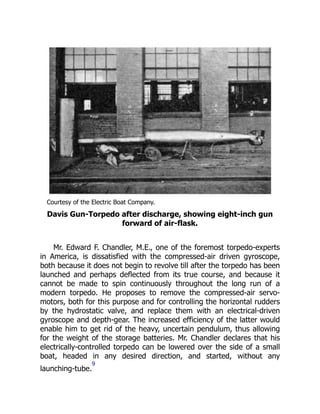
Courtesy of theElectric Boat Company.
Davis Gun-Torpedo after discharge, showing eight-inch gun
forward of air-flask.
Mr. Edward F. Chandler, M.E., one of the foremost torpedo-experts
in America, is dissatisfied with the compressed-air driven gyroscope,
both because it does not begin to revolve till after the torpedo has been
launched and perhaps deflected from its true course, and because it
cannot be made to spin continuously throughout the long run of a
modern torpedo. He proposes to remove the compressed-air servo-
motors, both for this purpose and for controlling the horizontal rudders
by the hydrostatic valve, and replace them with an electrical-driven
gyroscope and depth-gear. The increased efficiency of the latter would
enable him to get rid of the heavy, uncertain pendulum, thus allowing
for the weight of the storage batteries. Mr. Chandler declares that his
electrically-controlled torpedo can be lowered over the side of a small
boat, headed in any desired direction, and started, without any
launching-tube.
9
55.
Courtesy of theElectric Boat Company.
Effect of Davis Gun-Torpedo on a specially-constructed
target.
Though the automobile torpedo has been brought to so high a
state of perfection, the original idea of steering from the shore has not
been abandoned. The Brennan and Sims-Edison controllable torpedoes
were driven and steered by electricity, receiving the current through
wires trailed astern and carrying little masts and flags above the
surface to guide the operator on shore. But these also served as a
warning to the enemy and gave him too good a chance either to avoid
the torpedo or destroy it with machine-gun fire. Then, too, the trailing
wires reduced its speed and were always liable to get tangled in the
propellors. Controllable torpedoes of this type were abandoned before
the outbreak of the present war and will probably never be used in
action.
56.
A new andmore promising sort of controllable torpedo was
immediately suggested by the invention of wireless telegraphy. Many
inventors have been working to perfect such a weapon, and a young
American engineer, Mr. John Hays Hammond, Jr., seems to have
succeeded. From his wireless station on shore, Mr. Hammond can make
a small, crewless electric launch run hither and yon as he pleases about
the harbor of Gloucester, Massachusetts. The commander and many of
the officers of the United States coast artillery corps have carefully
inspected and tested this craft, which promises to be the forerunner of
a new and most formidable species of coast defense torpedo.
57.
D
CHAPTER VI
FREAKS ANDFAILURES
uring the half-century following the death of Fulton, scarcely
a year went by without the designing or launching of a new
man-power submarine. Some of these boats, notably those
of the Bavarian Wilhelm Bauer, were surprisingly good, others were
most amazingly bad, but none of them led to anything better.
Inventor after inventor wasted his substance discovering what Van
Drebel, Bushnell, and Fulton had known before him, only to die and
have the same facts painfully rediscovered by some one on the other
side of the earth.
A striking example of this lack of progress is Halstead’s
Intelligent Whale. Built for the United States navy at New York, in
the winter of 1864–5, this craft is no more modern and much less
efficient than Fulton’s Nautilus of 1801. The Intelligent Whale is a
fat, cigar-shaped, iron vessel propelled by a screw cranked by
manpower and submerged by dropping two heavy anchors to the
bottom and then warping the boat down to any desired depth. A
diver can then emerge from a door in the submarine’s bottom, to
place a mine under a hostile ship. It was not until 1872 that the
Intelligent Whale was sent on a trial trip in Newark Bay. Manned by
an utterly inexperienced and very nervous crew, the clumsy
submarine got entirely out of control and had to be hauled up by a
cable that had been thoughtfully attached to her before she went
down. Fortunately no lives had been lost, but the wildest stories
58.
were told andprinted, till the imaginary death-roll ran up to forty-
nine. The Intelligent Whale was hauled up on dry land and can still
be seen on exhibition at the corner of Third Street and Perry Avenue
in the Brooklyn Navy Yard.
Lack of motive-power was the reason why man-sized submarines
lagged behind their little automatic brethren, the Whitehead
torpedoes. Compressed air was just the thing for a spurt, but when
two Frenchmen, Captain Bourgois and M. Brun, built the Plongeur, a
steel submarine 146 feet long and 12 feet in diameter, at Rochefort
in 1863, and fitted it with an eighty-horse-power, compressed-air
engine, they discovered that the storage-flasks emptied themselves
too quickly to permit a voyage of any length.
The Plongeur also proved that while you can sink a boat to the
bottom by filling her ballast-tanks or make her rise to the surface by
emptying them, you cannot make her float suspended between two
bodies of water except by holding her there by some mechanical
means. Without anything of the kind, the Plongeur kept bouncing up
and down like a rubber ball. Once her inventors navigated her
horizontally for some distance, only to find that she had been sliding
on her stomach along the soft muddy bottom of a canal. Better
results were obtained after the Plongeur was fitted with a crude pair
of diving-planes. But the inefficiency of her compressed-air engine
caused her to be condemned and turned into a water tank.
59.
The Intelligent Whale.
Drawnby Lieutenant F. M. Barber, U. S. N., in 1875.
Electricity was first applied in 1861 by another Frenchman,
named Olivier Riou. This is the ideal motive-power for underwater
boats, and it was at this time that Jules Verne described the ideal
submarine in his immortal story of “Twenty Thousand Leagues Under
the Sea.” But before we can have a Nautilus like Captain Nemo’s we
must discover an electric storage battery of unheard-of lightness and
capacity.
Le Plongeur.
60.
There was agreat revival of French interest in electric
submarines after Admiral Aube, who was a lifelong submarine “fan,”
became minister of marine in 1886. In spite of much ridicule and
opposition, he authorized the construction of a small experimental
vessel of this type called the Gymnote. She was a wild little thing
that did everything short of turning somersaults when she dived, but
she was enough of a success to be followed by a larger craft named,
after the great engineer who had designed her predecessor, the
Gustave Zédé.
“The history of the Gustave Zédé shows how much in earnest
the French were in the matter of submarines. When she was first
launched she was a failure in almost every respect, and it was only
after some years, during which many alterations and improvements
were carried out, that she became a serviceable craft. At first
nothing would induce the Gustave Zédé to quit the surface, and
when at last she did plunge she did it so effectually that she went
down to the bottom in 10 fathoms of water at an angle of 30
degrees. The committee of engineers were on board at the time,
and it speaks well for their patriotism that they did not as a result of
their unpleasant experience condemn the Gustave Zédé and advise
the government to spend no more money on submarine craft.”
10
Twenty-nine other electric submarines were built for the French
navy between 1886 and 1901. During the same period, a French
gentleman named M. Goubet built and experimented with two very
small electric submarines, each of which was manned by two men,
who sat back to back on a sort of settee stuffed with machinery.
Little or big, all these French boats had the same fatal defect: lack of
power. Their storage batteries, called on to propel them above, as
well as below, the surface, became exhausted after a few hours’
cruising. They were as useless for practical naval warfare as an
electric run-about would be to haul guns or carry supplies in
Flanders.
But if compressed-air and electricity were too quickly exhausted,
gasoline or petroleum was even less practicable for submarine
61.
navigation. To setan oil-engine, that derives its power from the
explosion of a mixture of oil-vapor and air, at work in a small closed
space like the interior of a submarine, would soon make it
uninhabitable. While Mr. Holland was puzzling how to overcome this
difficulty, in the middle eighties, a Swedish inventor named
Nordenfeldt was building submarines to be run by steam-power.
Mr. Nordenfeldt, who is remembered to-day as the inventor of
the famous gun that bears his name, had taken up the idea of an
English clergyman named Garett, who in 1878 had built a submarine
called the Resurgam, or “I Shall Rise.” Garett’s second boat, built a
year later, had a steam-engine. When the vessel was submerged,
the smoke-stack was closed by a sliding panel, the furnace doors
were shut tight, and the engine run by the steam given off by a big
tank full of bottled-up hot water. Nordenfeldt improved this system
till his hot-water tanks gave off enough steam to propel his boat
beneath the surface for a distance of fourteen miles.
He also rediscovered and patented Bushnell’s device for
submerging a boat by pushing it straight down and holding it under
with a vertical propellor. His first submarine had two of these, placed
in sponsons or projections on either side of the center of the hull.
The Nordenfeldt boats, with their cigar-shaped hulls and projecting
smoke-stacks, looked like larger editions of the Civil War Davids, and
like them, could be submerged by taking in water-ballast till only a
strip of deck with the funnel and conning-tower projected above the
surface. Then the vertical propellors would begin to revolve and
force the boat straight down on an even keel. Mr. Nordenfeldt
insisted with great earnestness that this was the only safe and
proper way to submerge a submarine. If you tried to steer it
downward with any kind of driving-planes, he declared, then the
boat was liable to keep on descending, before you could pull its head
up, till it either struck the bottom or was crushed in by the pressure
of too great a depth of water. There was a great deal of truth in this,
but Mr. Nordenfeldt failed to realize that if one of his vertical
propellors pushed only a little harder than the other, then the keel of
his own submarine was going to be anything but even.
62.
Steam Submarine NordenfeldtII, at Constantinople, 1887.
Observe vertical-acting propellors on deck.
Reproduced from “Submarine Navigation, Past and Present” by Alan H.
Burgoyne, by permission of E. P. Dutton & Company.
The first Nordenfeldt boat was launched in 1886 and bought by
Greece, after a fairly successful trial in the Bay of Salamis. Two
larger and more powerful submarines: Nordenfeldt II and III, were
promptly ordered by Greece’s naval rival Turkey. Each of these was
125 feet long, or nearly twice the length of the Greek boat, and each
carried its two vertical propellors on deck, one forward and the other
aft. Both boats were shipped in sections to Constantinople in 1887,
but only Nordenfeldt II was put together and tried. She was one of
the first submarines to be armed with a bow torpedo-tube for
discharging Whiteheads, and as a surface torpedo-boat, she was a
63.
distinct success. Butwhen they tried to navigate her under water
there was a circus.
No sooner did one of the crew take two steps forward in the
engine-room than down went the bow. The hot water in the boilers
and the cold water in the ballast-tanks ran downhill, increasing the
slant still further. English engineers, Turkish sailors, monkey-
wrenches, hot ashes, Whitehead torpedoes, and other movables
came tumbling after, till the submarine was nearly standing on her
head, with everything inside packed into the bow like toys in the toe
of a Christmas stocking. The little vertical propellors pushed and
pulled and the crew clawed their way aft, till suddenly up came her
head, down went her tail, and everything went gurgling and
clattering down to the other end. Nordenfeldt II was a perpetual
see-saw, and no mortal power could keep her on an even keel. Once
they succeeded in steadying her long enough to fire a torpedo.
Where it went to, no man can tell, but the sudden lightening of the
bow and the recoil of the discharge made the submarine rear up and
sit down so hard that she began to sink stern-foremost. The water
was blown out of her ballast tanks by steam-pressure, and the main
engine started full speed ahead, till she shot up to the surface like a
flying-fish. The Turkish naval authorities, watching the trials from the
shores of the Golden Horn, were so impressed by these antics that
they bought the boat. But it was impossible to keep a crew on her,
for every native engineer or seaman who was sent on board
prudently deserted on the first dark night. So the Nordenfeldt II
rusted away till she fell to pieces, long before the Allied fleets began
the forcing of the Dardanelles.
Fantastic though their performances seem to us to-day, these
submarines represent the best work of some of the most capable
inventors and naval engineers of the nineteenth century. With them
deserve to be mentioned the boats of the Russian Drzewiecki and
the Spaniard Peral. Failures though they were, they taught the world
many valuable lessons about the laws controlling the actions of
submerged bodies.
64.
Bauer’s Submarine Concert,Cronstadt Harbor, 1855. See
footnote, page 120
An original drawing by the author, Alan H. Burgoyne; reproduced from
“Submarine Navigation, Past and Present,” by permission of E. P.
Dutton & Company.
But many of the underwater craft invented between 1850 and
1900 can be classified only as freaks. Most of them, fortunately,
were designed but never built, and those that were launched
miraculously refrained from drowning any of their crews. There were
submarines armed with steam-driven gimlets: the
“nimble tail,
Made like an auger, with which tail she wriggles,
Betwixt the ribs of a ship and sinks it straight,”
that Ben Jonson playfully ascribed to Van Drebel. Dr. Lacomme, in
1869, proposed a submarine railroad from Calais to Dover, with
tracks laid on the bottom of the Channel and cars that could cast off
their wheels and rise to the surface in case of accident. Lieutenant
65.
André Constantin designed,during the siege of Paris, a boat to be
submerged by drawing in pistons working in large cylinders open to
the water. A vessel was actually built on this principle in England in
1888, and submerged in Tilbury Docks, where the soft mud at the
bottom choked the cylinders so that the pistons could not be driven
out again and the boat was brought up with considerable difficulty.
Two particularly delirious inventors claimed that their submarines
could also be used as dirigible balloons. Boucher’s underwater boat
of 1886 was to have gills like a fish, so that it need never rise to the
surface for air, and was further adorned with spring-buffers on the
bottom, oars, a propellor under the center of the keel, and a
movable tail for sculling the vessel forward. There were submarines
with paddle-wheels, submarines with fins, and submarines with
wings. A Venezuelan dentist, Señor Lacavalerier, invented a double-
hulled, cigar-shaped boat, whose outer hull was threaded like a
screw, and by revolving round the fixed inner hull, bored its way
through the water. But he had been anticipated and outdone by
Apostoloff, a Russian, who not only designed a submarine on the
same principle but intended it to carry a large cabin suspended on
davits above the surface of the water, and declared that his vessel
would cross the Atlantic at an average speed of 111 knots an hour.
66.
Apostoloff’s Proposed Submarine.
Anoriginal drawing by the author, Alan H. Burgoyne; reproduced from
“Submarine Navigation, Past and Present,” by permission of E. P.
Dutton & Company.
As late as 1898 the Spanish government, neglecting the
promising little electric boat built ten years before by Señor Peral,
was experimenting with two highly impossible submarines, one of
which was to be propelled by a huge clock-spring, while the other
was perfectly round. Needless to say, neither the sphere nor the toy
boat ever encountered the American fleet.
At the same time, the United States government declined to
accept the war services of the already practicable boats of the two
American inventors who were about to usher in the present era of
submarine warfare: Simon Lake and John P. Holland.
68.
W
CHAPTER VII
JOHN P.HOLLAND
hen the Merrimac rammed the Cumberland, burned the
Congress, and was fought to a standstill next day by the
little Monitor, all the world realized that there had been a
revolution in naval warfare. The age of the wooden warship was
gone forever, the day of the ironclad had come. And a twenty-year-
old Irish school-teacher began to wonder what would be the next
revolution; what new craft might be invented that would dethrone
the ironclad. This young Irishman’s name was John P. Holland, and
he decided to devote his life to the perfection of the submarine.
Like Robert Fulton, Admiral Von Tirpitz, and the Frenchman who
built the Rotterdam Boat in 1652, Holland relied on submarines to
break the power of the British fleet. Though born a British subject, in
the little village of Liscannor, County Clare in the year 1842, he had
seen too many of his fellow countrymen starved to death or driven
into exile not to hate the stupid tyranny that characterized England’s
rule of Ireland in those bitter, far-off days. He longed for the day of
Ireland’s independence, and that day seemed to be brought much
nearer by the American Civil War. Not only had many thousand brave
Irish-Americans become trained veterans but Great Britain and the
United States had been brought to the verge of war by the sinking of
American ships by the Alabama and other British-built, Confederate
commerce-destroyers. When that Anglo-American war broke out,
there would be an army ready to come over and free Ireland—if only
69.
the troublesome Britishnavy could be put out of the way. And
already the English were launching ironclad after ironclad to replace
their now useless steam-frigates and ships-of-the-line. It is no use
trying to outbuild or outfight the British navy above water, and John
P. Holland realized this in 1862, as several kings and emperors have,
before or since.
The Holland No. 1. Designed to carry a torpedo and fix it to
the bottom of a ship, on the general principle of Bushnell’s
Turtle.
Drawn by Lieutenant F. M. Barber, U. S. N., in 1875.
Though his friends in Cork kept laughing at him, Holland worked
steadily on his plans for a submarine boat, throughout the sixties.
Presently he came to America and obtained a job as school-teacher
in Paterson, New Jersey. There he built and launched his first
submarine in 1875. It was a sharp-pointed, little, cigar-shaped affair,
only sixteen feet long and two feet in diameter amidships. This craft
was designed to carry a torpedo and fix it to the bottom of a ship,
on the general principle of Bushnell’s Turtle. It was divided into four
compartments, with air-chambers fore and aft. Air-pipes led to
where Holland sat in the middle, with his head in a respirator shaped
like a diver’s helmet, and his feet working pedals that turned the
propellor.
70.
There was nothingrevolutionary about this Holland No. 1. A
similar underwater bicycle is said to have been invented by Alvary
Templo in 1826, and Drzewiecki used one at Odessa in 1877. But
Holland used his to teach himself how to build something better. Just
as the Wright brothers learned how to build and fly aeroplanes by
coasting down through the air from the tops of the Kitty Hawk sand-
hills in their motorless “glider,” so John P. Holland found how to
make and navigate submarines by diving under the surface of the
Passaic River and adjacent waters, and swimming around there in
his No. 1 and her successors.
The Holland No. 2 was launched in 1877 and became
immediately and prophetically stuck in the mud. She had a double
hull, the space between being used as a ballast-tank, whose
contents leaked constantly into the interior, and she was driven
intermittently by a four horse-power petroleum engine of primitive
design. After a series of trials that entertained his neighbors and
taught the inventor that the best place for a single horizontal rudder
is the stern, Holland took the engine out of the boat and sank her
under the Falls Bridge, where she lies to this day.
He then entered into negotiations with the Fenian Brotherhood,
a secret society organized for the purpose of setting up an Irish
republic by militant methods. Though not a Fenian himself, Holland
was thoroughly in sympathy with the brotherhood, and offered to
show them how they could get round, or rather under, the British
navy. You may have seen a once-familiar lithograph of a green-
painted superdreadnought of strange design flying the Crownless
Harp, and named the Irish battleship Emerald Isle. The only real
Irish warships of modern times, however, were the two submarines
Holland persuaded the Fenians to have him build at their expense.
Rear-Admiral Philip Hichborn, former Chief Constructor, U.S.N.,
said of these two boats:
“She (the earlier one) was the first submarine since Bushnell’s
time employing water ballast and always retaining buoyancy, in
which provision was made to insure a fixed center of gravity and a