Chikungunya
Visits
The
Caribbean
Dec. 2013 – ?
Chikungunya, a mosquito-borne virus, is epidemic
in the Caribbean. The first 12 transmissions were
reported on St. Martin on December 6, 2013. The
virus then spread to neighboring Dutch St. Maarten.
In seven months, by July 21, 2014, there were over
442,000 cases in 34 countries and territories after a
24% monthly increase from June to July. Two cases
of transmitted chikungunya are in Florida, probably
the start of a pandemic, as over 300 chikungunya
cases have been diagnosed among returning
Caribbean travelers across the U.S. in 34 states.
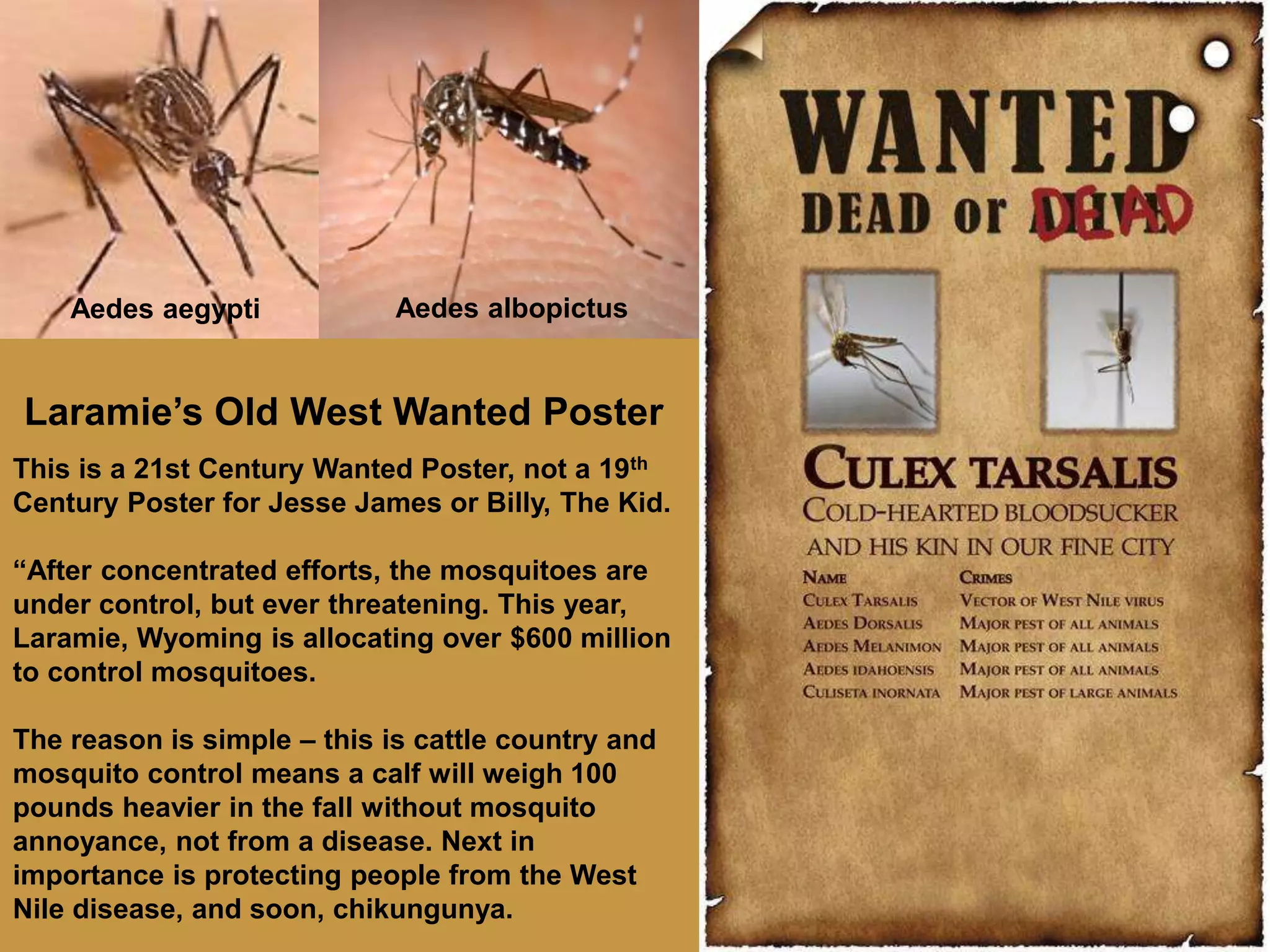
Laramie’s Old West Wanted Poster
This is a 21st Century Wanted Poster, not a 19th
Century Poster for Jesse James or Billy, The Kid.
“After concentrated efforts, the mosquitoes are
under control, but ever threatening. This year,
Laramie, Wyoming is allocating over $600 million
to control mosquitoes.
The reason is simple – this is cattle country and
mosquito control means a calf will weigh 100
pounds heavier in the fall without mosquito
annoyance, not from a disease. Next in
importance is protecting people from the West
Nile disease, and soon, chikungunya.
Aedes albopictus
Aedes aegypti
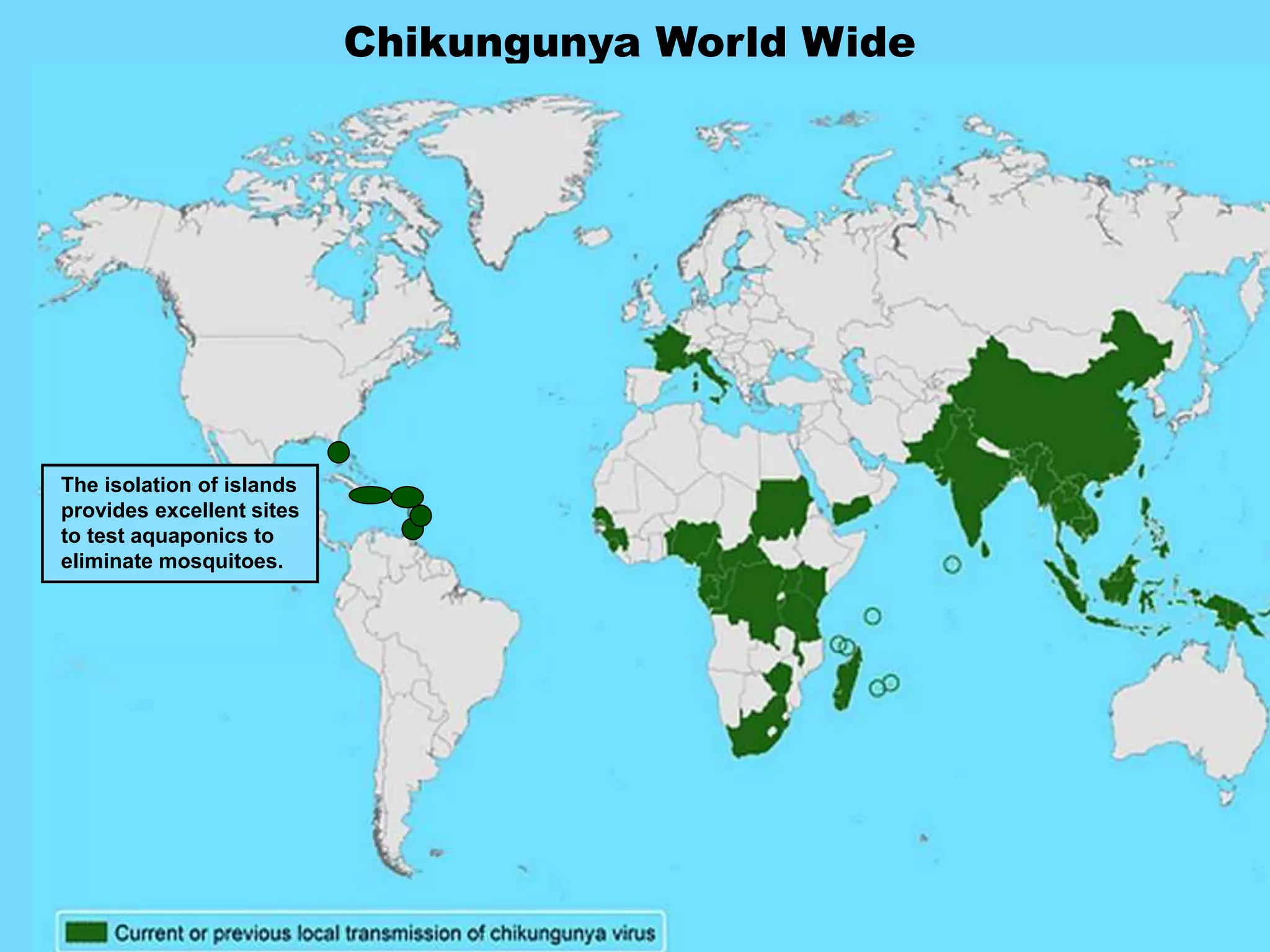
Chikungunya World Wide
The isolation of islands
provides excellent sites
to test aquaponics to
eliminate mosquitoes.
Eradicate Mosquitoes and Diseases With Proven
Methods Using Mosquito Fish
April 6, 2014 - Punjab, Pakistan:
2011 – Over 20,000 cases of dengue fever, over 300 deaths
2013 – Over 100 cases of dengue fever, zero deaths
http://www.theguardian.com/world/2013/oct/01/punjab-fish-dengue-mosquito
Early 21 Century - Hawaiians Tim Mann and Sussane Friend
observed total elimination of mosquitoes on seven acres of
previously heavily mosquito infested land within six months
after installing a commercial aquaponics system. After several
years of aquaponics farming, no mosquitoes have returned.
http://www.friendlyaquaponics.com/no-more-malaria/
1925 – Sochi, USSR
In the fight to eradicate malaria, the USSR introduced the
mosquitofish. In 2010, Sochi erected a monument to the Gambusia
affinis (mosquitofish) after having no malaria deaths since 1956.
Aquaponics Could Eliminate Mosquitoes
“An additional benefit of aquaponics farming (that we noticed after our first
system was operational for six months) was that the mosquitoes on our seven
acre farm had COMPLETELY disappeared! We live in Hawaii, where there are as
many mosquitoes as any other tropical area, even during a drought, when the soil
was dusty and dry and there was no standing water visible anywhere, there were
still clouds of mosquitoes at dawn and dusk.
When we built our first aquaponics system we introduced a few mosquito fish
(Gambusia affinis) and neon tetras into our system water. They spread through
the system and soon had become a self-sustaining population numbering in the
tens of thousands. After six months, we noticed there were no mosquitoes around
any longer. We are not certain when the number went to zero, but it was sometime
during that six-month period. That was three years ago.
How does this work? We live in the center of a deadly efficient mosquito trap:
every female mosquito in the neighborhood can sense the roughly 50,000 gallons
of water in our commercial aquaponics system and comes to lay her eggs. Each
egg hatches into a larva, which is then promptly consumed by one of the tens of
thousands of mosquito fish in our water before it can ever develop sufficiently to
become an adult mosquito.”
http://www.friendlyaquaponics.com/no-more-malaria/
Tim Mann, Friendly Aquaponics, Hawaii
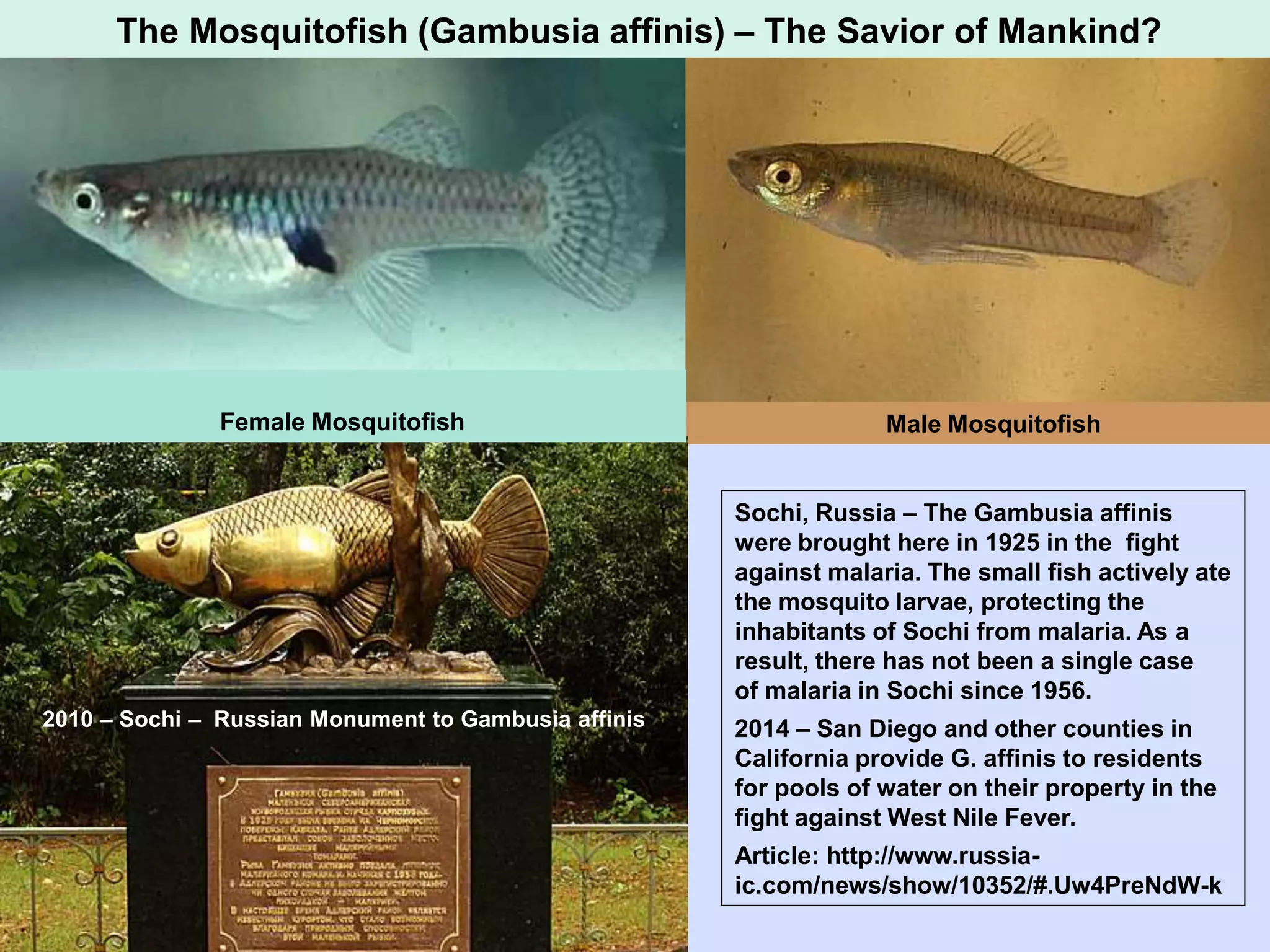
Male Mosquitofish
Sochi, Russia – The Gambusia affinis
were brought here in 1925 in the fight
against malaria. The small fish actively ate
the mosquito larvae, protecting the
inhabitants of Sochi from malaria. As a
result, there has not been a single case
of malaria in Sochi since 1956.
2014 – San Diego and other counties in
California provide G. affinis to residents
for pools of water on their property in the
fight against West Nile Fever.
Article: http://www.russia-
ic.com/news/show/10352/#.Uw4PreNdW-k
The Mosquitofish (Gambusia affinis) – The Savior of Mankind?
Female Mosquitofish
2010 – Sochi – Russian Monument to Gambusia affinis
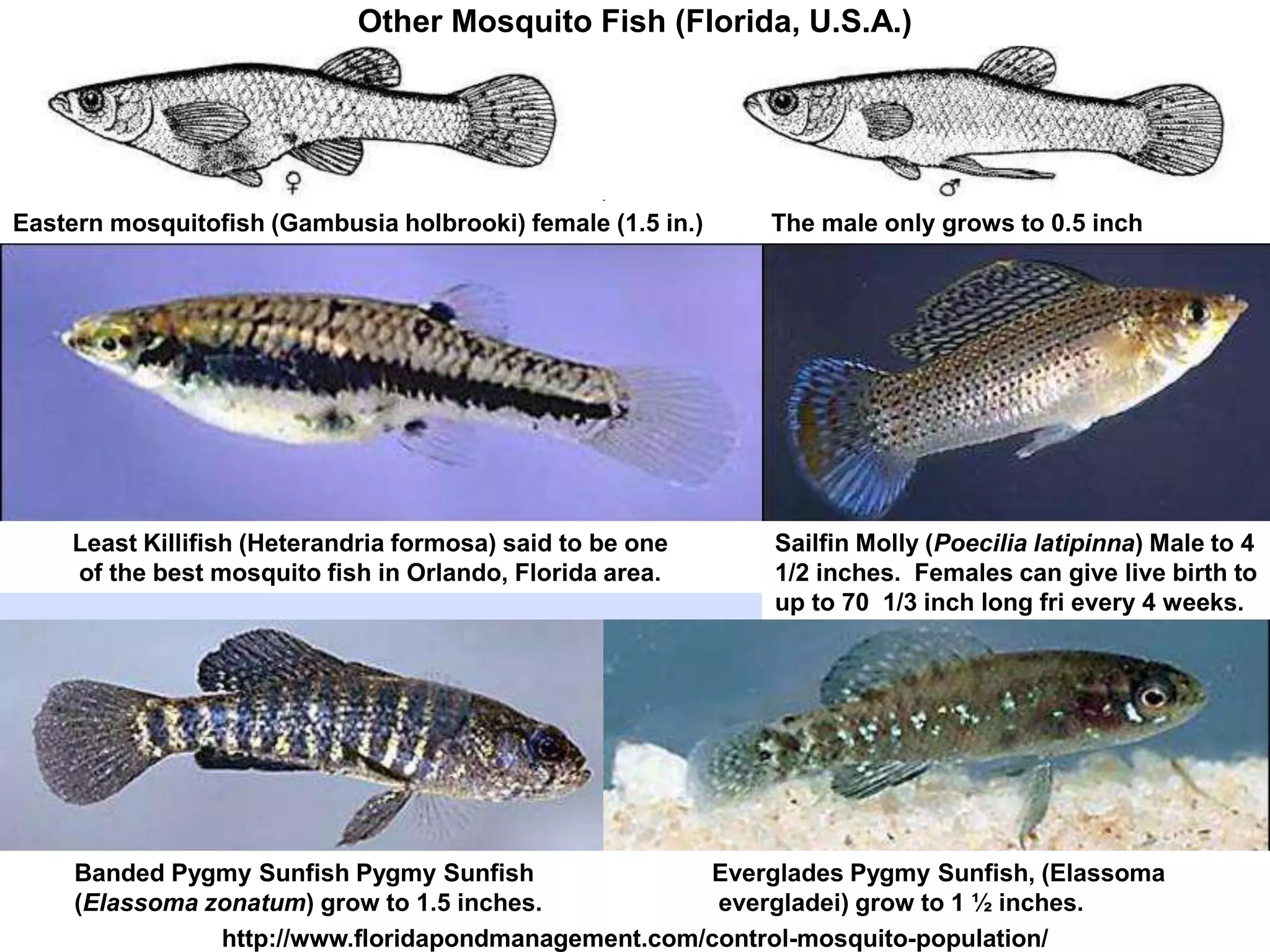
http://www.floridapondmanagement.com/control-mosquito-population/
Least Killifish (Heterandria formosa) said to be one
of the best mosquito fish in Orlando, Florida area.
Sailfin Molly (Poecilia latipinna) Male to 4
1/2 inches. Females can give live birth to
up to 70 1/3 inch long fri every 4 weeks.
Other Mosquito Fish (Florida, U.S.A.)
Eastern mosquitofish (Gambusia holbrooki) female (1.5 in.) The male only grows to 0.5 inch
Banded Pygmy Sunfish Pygmy Sunfish
(Elassoma zonatum) grow to 1.5 inches.
Everglades Pygmy Sunfish, (Elassoma
evergladei) grow to 1 ½ inches.
Add Cuba
and Jamaica
Does not include countries or territories where only imported cases have been documented. Countries
where chikungunya has been transmitted by Aedes mosquitoes are: Anguilla, Antigua, Antigua and
Barbuda, Aruba, Barbados, British Virgin Islands, Dominica, Dominican Republic, Grenada Guadeloupe,
Haiti, Martinique, Puerto Rico, Saint Barthelemy, Saint Kitts and Nevis, Saint Lucia, Saint Martin, Saint
Vincent, and the Grenadines, Sint Maarten, Turks and Caicos Islands, US Virgin Islands, and Venezuela.
(Credit: CDC.GOV) The Pan-American Health Organization - PAHO
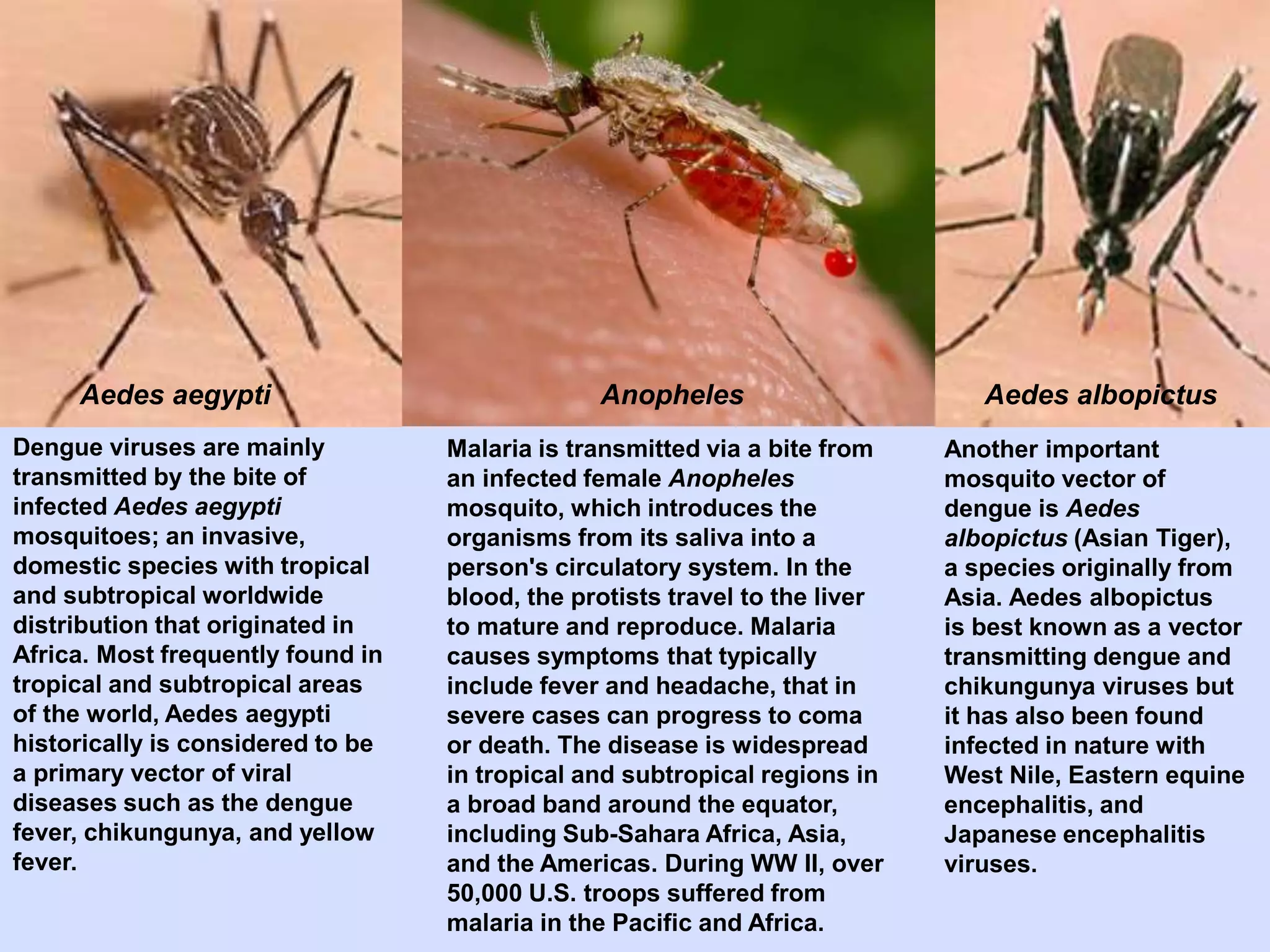
Dengue viruses are mainly
transmitted by the bite of
infected Aedes aegypti
mosquitoes; an invasive,
domestic species with tropical
and subtropical worldwide
distribution that originated in
Africa. Most frequently found in
tropical and subtropical areas
of the world, Aedes aegypti
historically is considered to be
a primary vector of viral
diseases such as the dengue
fever, chikungunya, and yellow
fever.
Another important
mosquito vector of
dengue is Aedes
albopictus (Asian Tiger),
a species originally from
Asia. Aedes albopictus
is best known as a vector
transmitting dengue and
chikungunya viruses but
it has also been found
infected in nature with
West Nile, Eastern equine
encephalitis, and
Japanese encephalitis
viruses.
Malaria is transmitted via a bite from
an infected female Anopheles
mosquito, which introduces the
organisms from its saliva into a
person's circulatory system. In the
blood, the protists travel to the liver
to mature and reproduce. Malaria
causes symptoms that typically
include fever and headache, that in
severe cases can progress to coma
or death. The disease is widespread
in tropical and subtropical regions in
a broad band around the equator,
including Sub-Sahara Africa, Asia,
and the Americas. During WW II, over
50,000 U.S. troops suffered from
malaria in the Pacific and Africa.
Aedes aegypti Anopheles Aedes albopictus
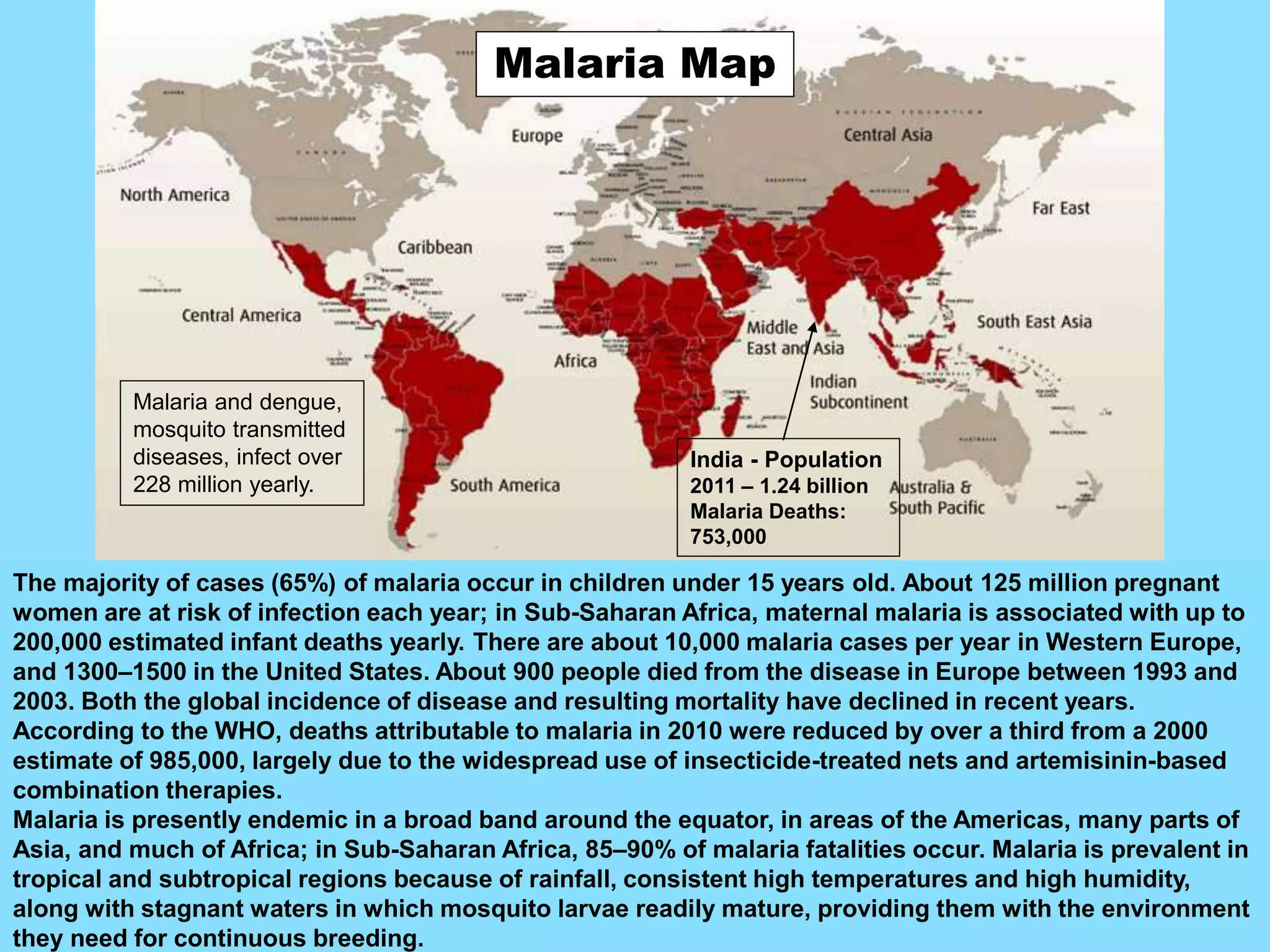
The majority of cases (65%) of malaria occur in children under 15 years old. About 125 million pregnant
women are at risk of infection each year; in Sub-Saharan Africa, maternal malaria is associated with up to
200,000 estimated infant deaths yearly. There are about 10,000 malaria cases per year in Western Europe,
and 1300–1500 in the United States. About 900 people died from the disease in Europe between 1993 and
2003. Both the global incidence of disease and resulting mortality have declined in recent years.
According to the WHO, deaths attributable to malaria in 2010 were reduced by over a third from a 2000
estimate of 985,000, largely due to the widespread use of insecticide-treated nets and artemisinin-based
combination therapies.
Malaria is presently endemic in a broad band around the equator, in areas of the Americas, many parts of
Asia, and much of Africa; in Sub-Saharan Africa, 85–90% of malaria fatalities occur. Malaria is prevalent in
tropical and subtropical regions because of rainfall, consistent high temperatures and high humidity,
along with stagnant waters in which mosquito larvae readily mature, providing them with the environment
they need for continuous breeding.
Malaria Map
India - Population
2011 – 1.24 billion
Malaria Deaths:
753,000
Malaria and dengue,
mosquito transmitted
diseases, infect over
228 million yearly.
Dengue Fever in the Americas
The incidence of dengue fever has increased dramatically since the 1960s, with around 50–100 million
people infected yearly. Early descriptions of the condition date from 1779, and its viral cause and the
transmission were elucidated in the early 20th century. Dengue has become a global problem since
the Second World War and is endemic in more than 110 countries.
With more than one-third of the world’s population living in areas at risk for infection, dengue virus is a
leading cause of illness and death in the tropics and subtropics. As many as 400 million people are
infected yearly. Dengue is caused by any one of four related viruses transmitted by mosquitoes. There are
not yet any vaccines to prevent infection with dengue virus and the most effective protective measures
are those that avoid mosquito bites. When infected, early recognition and prompt supportive treatment
can substantially lower the risk of medical complications and death.
Dengue has emerged as a worldwide problem only since the 1950s. Although dengue rarely occurs in the
continental United States, it is endemic in Puerto Rico and in many popular tourist destinations in Latin
America, Southeast Asia and the Pacific islands.
Africa
Asia and
Oceania
Worldwide Dengue Fever
Maps of Africa, Asia, and Oceania showing dengue fever areas.
Paraguay – Announcement for public participation
to control mosquito population.
1.8 m
1 m
Welded, Thick Plastic Pool Liner
Fish and Sump Tanks
No wood or metal side supports, no
drains, and no openings except top.
2.4 m
1.2 m
0.4 m
Grow Bed
Liner
W = 4 ft
L = 8 ft
H = 16 in
Economy family system – two water
tanks and three grow bed liners. To
bury in ground. 1,000 + price
Fish
Tank
Sump
Tank
Grow Bed
Grow Bed
Grow Bed
Economy System
(Very cheap system made of
pool liner used in fish ponds
and ditches and buried in the
ground.) System consists of
two water tanks (Fish and
Sump) and three Grow Beds.
(A) Nutrient water:
Gravity flow from Fish tank
to Grow Beds.
(B) Bell siphons empty clean
water from grow beds into
Sump tank.
(C) Air pump lifts clean water
from Sump tank to Fish tank.
A
C
Air Pump
lifts clean
water to
Fish tank.
B
B
B
Tank covers – fish tank closed
with hinged opening to clean
and feed fish. Sump tank is
screened against birds,
snakes, rodents, dogs, and
kids, but open to mosquitoes.
Wood grow bed frames
support liners – added cost.
Three Bell Siphons
PVC pipe, valves, plumbing,
and connectors
Air pump and tubing
Liner material plastic handles
to move empty liners easily.
For more information: alhodg@gmail.com
Mosquito Vectors of Deadly Diseases
Mosquitoes are territorial, rarely flying farther than 1 mile from
their hatching location, so aquaponics can provide a mosquito
free zone around a home. But don’t go outside your zone!
A program to install an aquaponics installation at almost every
home can protect a village, a city, a state, a country, and
eventually the world. Mosquito fish may be the salvation of the
world.
And the aquaponics installation feeds the living! The cost is
low, the results:
* Eradicate mosquitoes
* Eradicate deadly diseases
* Eradicate mosquitoes year after year at no additional cost
* Feed the people organic fruits and vegetables
100 square feet of grow beds can feed a family of four with less
water, no soil, no chemicals, no pesticides, no fungicides, and
no contamination. Eliminate starvation by feeding the living.
Work with nature and teach a man to fish.

1-Mosquito-Elimin.ppt

  • 1.
    Chikungunya Visits The Caribbean Dec. 2013 –? Chikungunya, a mosquito-borne virus, is epidemic in the Caribbean. The first 12 transmissions were reported on St. Martin on December 6, 2013. The virus then spread to neighboring Dutch St. Maarten. In seven months, by July 21, 2014, there were over 442,000 cases in 34 countries and territories after a 24% monthly increase from June to July. Two cases of transmitted chikungunya are in Florida, probably the start of a pandemic, as over 300 chikungunya cases have been diagnosed among returning Caribbean travelers across the U.S. in 34 states.
  • 2.
    Laramie’s Old WestWanted Poster This is a 21st Century Wanted Poster, not a 19th Century Poster for Jesse James or Billy, The Kid. “After concentrated efforts, the mosquitoes are under control, but ever threatening. This year, Laramie, Wyoming is allocating over $600 million to control mosquitoes. The reason is simple – this is cattle country and mosquito control means a calf will weigh 100 pounds heavier in the fall without mosquito annoyance, not from a disease. Next in importance is protecting people from the West Nile disease, and soon, chikungunya. Aedes albopictus Aedes aegypti
  • 3.
    Chikungunya World Wide Theisolation of islands provides excellent sites to test aquaponics to eliminate mosquitoes.
  • 4.
    Eradicate Mosquitoes andDiseases With Proven Methods Using Mosquito Fish April 6, 2014 - Punjab, Pakistan: 2011 – Over 20,000 cases of dengue fever, over 300 deaths 2013 – Over 100 cases of dengue fever, zero deaths http://www.theguardian.com/world/2013/oct/01/punjab-fish-dengue-mosquito Early 21 Century - Hawaiians Tim Mann and Sussane Friend observed total elimination of mosquitoes on seven acres of previously heavily mosquito infested land within six months after installing a commercial aquaponics system. After several years of aquaponics farming, no mosquitoes have returned. http://www.friendlyaquaponics.com/no-more-malaria/ 1925 – Sochi, USSR In the fight to eradicate malaria, the USSR introduced the mosquitofish. In 2010, Sochi erected a monument to the Gambusia affinis (mosquitofish) after having no malaria deaths since 1956.
  • 5.
    Aquaponics Could EliminateMosquitoes “An additional benefit of aquaponics farming (that we noticed after our first system was operational for six months) was that the mosquitoes on our seven acre farm had COMPLETELY disappeared! We live in Hawaii, where there are as many mosquitoes as any other tropical area, even during a drought, when the soil was dusty and dry and there was no standing water visible anywhere, there were still clouds of mosquitoes at dawn and dusk. When we built our first aquaponics system we introduced a few mosquito fish (Gambusia affinis) and neon tetras into our system water. They spread through the system and soon had become a self-sustaining population numbering in the tens of thousands. After six months, we noticed there were no mosquitoes around any longer. We are not certain when the number went to zero, but it was sometime during that six-month period. That was three years ago. How does this work? We live in the center of a deadly efficient mosquito trap: every female mosquito in the neighborhood can sense the roughly 50,000 gallons of water in our commercial aquaponics system and comes to lay her eggs. Each egg hatches into a larva, which is then promptly consumed by one of the tens of thousands of mosquito fish in our water before it can ever develop sufficiently to become an adult mosquito.” http://www.friendlyaquaponics.com/no-more-malaria/ Tim Mann, Friendly Aquaponics, Hawaii
  • 6.
    Male Mosquitofish Sochi, Russia– The Gambusia affinis were brought here in 1925 in the fight against malaria. The small fish actively ate the mosquito larvae, protecting the inhabitants of Sochi from malaria. As a result, there has not been a single case of malaria in Sochi since 1956. 2014 – San Diego and other counties in California provide G. affinis to residents for pools of water on their property in the fight against West Nile Fever. Article: http://www.russia- ic.com/news/show/10352/#.Uw4PreNdW-k The Mosquitofish (Gambusia affinis) – The Savior of Mankind? Female Mosquitofish 2010 – Sochi – Russian Monument to Gambusia affinis
  • 7.
    http://www.floridapondmanagement.com/control-mosquito-population/ Least Killifish (Heterandriaformosa) said to be one of the best mosquito fish in Orlando, Florida area. Sailfin Molly (Poecilia latipinna) Male to 4 1/2 inches. Females can give live birth to up to 70 1/3 inch long fri every 4 weeks. Other Mosquito Fish (Florida, U.S.A.) Eastern mosquitofish (Gambusia holbrooki) female (1.5 in.) The male only grows to 0.5 inch Banded Pygmy Sunfish Pygmy Sunfish (Elassoma zonatum) grow to 1.5 inches. Everglades Pygmy Sunfish, (Elassoma evergladei) grow to 1 ½ inches.
  • 8.
    Add Cuba and Jamaica Doesnot include countries or territories where only imported cases have been documented. Countries where chikungunya has been transmitted by Aedes mosquitoes are: Anguilla, Antigua, Antigua and Barbuda, Aruba, Barbados, British Virgin Islands, Dominica, Dominican Republic, Grenada Guadeloupe, Haiti, Martinique, Puerto Rico, Saint Barthelemy, Saint Kitts and Nevis, Saint Lucia, Saint Martin, Saint Vincent, and the Grenadines, Sint Maarten, Turks and Caicos Islands, US Virgin Islands, and Venezuela. (Credit: CDC.GOV) The Pan-American Health Organization - PAHO
  • 9.
    Dengue viruses aremainly transmitted by the bite of infected Aedes aegypti mosquitoes; an invasive, domestic species with tropical and subtropical worldwide distribution that originated in Africa. Most frequently found in tropical and subtropical areas of the world, Aedes aegypti historically is considered to be a primary vector of viral diseases such as the dengue fever, chikungunya, and yellow fever. Another important mosquito vector of dengue is Aedes albopictus (Asian Tiger), a species originally from Asia. Aedes albopictus is best known as a vector transmitting dengue and chikungunya viruses but it has also been found infected in nature with West Nile, Eastern equine encephalitis, and Japanese encephalitis viruses. Malaria is transmitted via a bite from an infected female Anopheles mosquito, which introduces the organisms from its saliva into a person's circulatory system. In the blood, the protists travel to the liver to mature and reproduce. Malaria causes symptoms that typically include fever and headache, that in severe cases can progress to coma or death. The disease is widespread in tropical and subtropical regions in a broad band around the equator, including Sub-Sahara Africa, Asia, and the Americas. During WW II, over 50,000 U.S. troops suffered from malaria in the Pacific and Africa. Aedes aegypti Anopheles Aedes albopictus
  • 10.
    The majority ofcases (65%) of malaria occur in children under 15 years old. About 125 million pregnant women are at risk of infection each year; in Sub-Saharan Africa, maternal malaria is associated with up to 200,000 estimated infant deaths yearly. There are about 10,000 malaria cases per year in Western Europe, and 1300–1500 in the United States. About 900 people died from the disease in Europe between 1993 and 2003. Both the global incidence of disease and resulting mortality have declined in recent years. According to the WHO, deaths attributable to malaria in 2010 were reduced by over a third from a 2000 estimate of 985,000, largely due to the widespread use of insecticide-treated nets and artemisinin-based combination therapies. Malaria is presently endemic in a broad band around the equator, in areas of the Americas, many parts of Asia, and much of Africa; in Sub-Saharan Africa, 85–90% of malaria fatalities occur. Malaria is prevalent in tropical and subtropical regions because of rainfall, consistent high temperatures and high humidity, along with stagnant waters in which mosquito larvae readily mature, providing them with the environment they need for continuous breeding. Malaria Map India - Population 2011 – 1.24 billion Malaria Deaths: 753,000 Malaria and dengue, mosquito transmitted diseases, infect over 228 million yearly.
  • 11.
    Dengue Fever inthe Americas The incidence of dengue fever has increased dramatically since the 1960s, with around 50–100 million people infected yearly. Early descriptions of the condition date from 1779, and its viral cause and the transmission were elucidated in the early 20th century. Dengue has become a global problem since the Second World War and is endemic in more than 110 countries. With more than one-third of the world’s population living in areas at risk for infection, dengue virus is a leading cause of illness and death in the tropics and subtropics. As many as 400 million people are infected yearly. Dengue is caused by any one of four related viruses transmitted by mosquitoes. There are not yet any vaccines to prevent infection with dengue virus and the most effective protective measures are those that avoid mosquito bites. When infected, early recognition and prompt supportive treatment can substantially lower the risk of medical complications and death. Dengue has emerged as a worldwide problem only since the 1950s. Although dengue rarely occurs in the continental United States, it is endemic in Puerto Rico and in many popular tourist destinations in Latin America, Southeast Asia and the Pacific islands.
  • 12.
    Africa Asia and Oceania Worldwide DengueFever Maps of Africa, Asia, and Oceania showing dengue fever areas. Paraguay – Announcement for public participation to control mosquito population.
  • 13.
    1.8 m 1 m Welded,Thick Plastic Pool Liner Fish and Sump Tanks No wood or metal side supports, no drains, and no openings except top. 2.4 m 1.2 m 0.4 m Grow Bed Liner W = 4 ft L = 8 ft H = 16 in Economy family system – two water tanks and three grow bed liners. To bury in ground. 1,000 + price Fish Tank Sump Tank Grow Bed Grow Bed Grow Bed Economy System (Very cheap system made of pool liner used in fish ponds and ditches and buried in the ground.) System consists of two water tanks (Fish and Sump) and three Grow Beds. (A) Nutrient water: Gravity flow from Fish tank to Grow Beds. (B) Bell siphons empty clean water from grow beds into Sump tank. (C) Air pump lifts clean water from Sump tank to Fish tank. A C Air Pump lifts clean water to Fish tank. B B B Tank covers – fish tank closed with hinged opening to clean and feed fish. Sump tank is screened against birds, snakes, rodents, dogs, and kids, but open to mosquitoes. Wood grow bed frames support liners – added cost. Three Bell Siphons PVC pipe, valves, plumbing, and connectors Air pump and tubing Liner material plastic handles to move empty liners easily.
  • 14.
    For more information:alhodg@gmail.com Mosquito Vectors of Deadly Diseases Mosquitoes are territorial, rarely flying farther than 1 mile from their hatching location, so aquaponics can provide a mosquito free zone around a home. But don’t go outside your zone! A program to install an aquaponics installation at almost every home can protect a village, a city, a state, a country, and eventually the world. Mosquito fish may be the salvation of the world. And the aquaponics installation feeds the living! The cost is low, the results: * Eradicate mosquitoes * Eradicate deadly diseases * Eradicate mosquitoes year after year at no additional cost * Feed the people organic fruits and vegetables 100 square feet of grow beds can feed a family of four with less water, no soil, no chemicals, no pesticides, no fungicides, and no contamination. Eliminate starvation by feeding the living. Work with nature and teach a man to fish.