INTRODUCTION
TO DYNAMICS
CSPC-PSUB College of Engineering and Architecture
ENGR. ULYSSA MAE B. SERRANO
Class Instructor
1. Define the position, velocity, and acceleration of
a particle
2. Apply formulae in determining the change in
motion of particles
3. Define rectilinear motion
4. Explain the concept and type of rectilinear
motion
5. Apply the equations of rectilinear motion in
calculating the change in motion of a particle
LEARNING OBJECTIVE
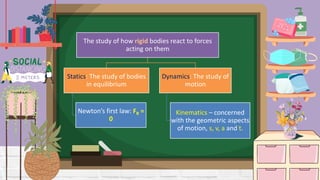
The study of how rigid bodies react to forces
acting on them
Statics: The study of bodies
in equilibrium
Newton’s first law: FR =
0
Dynamics: The study of
motion
Kinematics – concerned
with the geometric aspects
of motion, s, v, a and t.
MOTION CONCEPT
𝒗 =
𝒔
𝒕
=
𝟏𝟎𝟎𝟎
𝟓
= 𝟐𝟎𝟎 𝒎/𝒔
1000 m
t=5 s
BASIC TERMINOLOGY
Position
Displacement
Distance
Velocity
Acceleration
POSITION
1 2 3
DISPLACEMENT AND
DISTANCE
1 2 3
VELOCITY AND
ACCELERATION
1 2 3
ADDITIONAL TERMINOLOGY
Average Velocity – of the particle over the time
interval ∆t is defined as the quotient of the
displacement ∆x and the time interval ∆t:
Instantaneous Velocity, v – of the particle at the
instant t is obtained from the average velocity by
choosing shorter and shorter time intervals ∆t and
displacements ∆x:
ADDITIONAL TERMINOLOGY
Average Acceleration - of the particle over the time
interval ∆t is defined as the quotient of ∆v and ∆t:
Instantaneous acceleration, a – of the particle at the
instant t is obtained from the average acceleration
by choosing smaller and smaller values for ∆t and
∆v.
Kinematics – concerned with the geometric
aspects of motion: s, v, a, and t.
KINEMATICS
𝐯 =
𝐝𝐬
𝐝𝐭
𝐚 =
𝐝𝐯
𝐝𝐭
=
𝒅𝟐
𝒔
𝒅𝒕𝟐
Kinematics – concerned with the geometric
aspects of motion: s, v, a, and t.
KINEMATICS
The study of how rigid bodies react to forces
acting on them
Statics: The study of bodies
in equilibrium
Newton’s first law: FR
= 0
Dynamics: The study
of motion
Kinematics – concerned
with the geometric
aspects of motion, s, v, a
and t.
Kinetics – concerned
with how forces causing
the motion
Newton’s second law:
FR= ma
FORMULA
Note: only scalar equations are shown
from here on for simplification purpose
FORMULA
Principle of work and energy
FORMULA
Principle of linear impulse and momentum
FORMULA
Three common classes of motion:
1. 𝒂 = 𝒇(𝒕) Acceleration Is a Given Function of
time t
2. 𝒂 = 𝒇(𝒙) Acceleration Is a Given Function of
distance x
3. 𝒂 = 𝒇(𝒗) Acceleration Is a Given Function of
velocity v
DETERMINATION OF THE MOTION
OF A PARTICLE
Solving for dv and substituting f(t) for a, we write
Integrating
Specify the initial conditions of the motion
ACCELERATION IS A GIVEN
FUNCTION OF TIME, T
Specify the initial conditions of the motion
which yield v in terms of t
Solving for dx
ACCELERATION IS A GIVEN
FUNCTION OF TIME, T
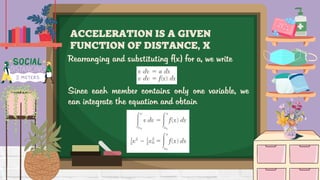
Rearranging and substituting f(x) for a, we write
Since each member contains only one variable, we
can integrate the equation and obtain
ACCELERATION IS A GIVEN
FUNCTION OF DISTANCE, X
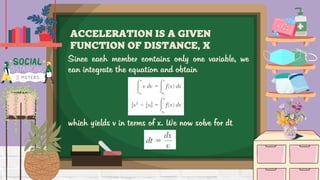
Since each member contains only one variable, we
can integrate the equation and obtain
which yields v in terms of x. We now solve for dt
ACCELERATION IS A GIVEN
FUNCTION OF DISTANCE, X
We substitute f(v) to obtain the following relations:
Integration of the first equation will yield a relation between v and
t; integration of the second equation will yield a relation between
v and x. Either of these relations can be used to obtain the
relation between x and t which characterizes the motion of the
particle.
ACCELERATION IS A GIVEN
FUNCTION OF VELOCITY, V
THANK YOU
CSPC-PSUB College of Engineering and Architecture
ENGR. ULYSSA MAE B. SERRANO
Class Instructor

1-INTRODUCTION-TO-DYNAMICS.pdf

  • 1.
    INTRODUCTION TO DYNAMICS CSPC-PSUB Collegeof Engineering and Architecture ENGR. ULYSSA MAE B. SERRANO Class Instructor
  • 2.
    1. Define theposition, velocity, and acceleration of a particle 2. Apply formulae in determining the change in motion of particles 3. Define rectilinear motion 4. Explain the concept and type of rectilinear motion 5. Apply the equations of rectilinear motion in calculating the change in motion of a particle LEARNING OBJECTIVE
  • 3.
    The study ofhow rigid bodies react to forces acting on them Statics: The study of bodies in equilibrium Newton’s first law: FR = 0 Dynamics: The study of motion Kinematics – concerned with the geometric aspects of motion, s, v, a and t.
  • 4.
  • 5.
  • 6.
  • 7.
  • 8.
  • 9.
    ADDITIONAL TERMINOLOGY Average Velocity– of the particle over the time interval ∆t is defined as the quotient of the displacement ∆x and the time interval ∆t: Instantaneous Velocity, v – of the particle at the instant t is obtained from the average velocity by choosing shorter and shorter time intervals ∆t and displacements ∆x:
  • 10.
    ADDITIONAL TERMINOLOGY Average Acceleration- of the particle over the time interval ∆t is defined as the quotient of ∆v and ∆t: Instantaneous acceleration, a – of the particle at the instant t is obtained from the average acceleration by choosing smaller and smaller values for ∆t and ∆v.
  • 11.
    Kinematics – concernedwith the geometric aspects of motion: s, v, a, and t. KINEMATICS 𝐯 = 𝐝𝐬 𝐝𝐭 𝐚 = 𝐝𝐯 𝐝𝐭 = 𝒅𝟐 𝒔 𝒅𝒕𝟐
  • 12.
    Kinematics – concernedwith the geometric aspects of motion: s, v, a, and t. KINEMATICS
  • 13.
    The study ofhow rigid bodies react to forces acting on them Statics: The study of bodies in equilibrium Newton’s first law: FR = 0 Dynamics: The study of motion Kinematics – concerned with the geometric aspects of motion, s, v, a and t. Kinetics – concerned with how forces causing the motion Newton’s second law: FR= ma
  • 14.
    FORMULA Note: only scalarequations are shown from here on for simplification purpose
  • 15.
  • 16.
    FORMULA Principle of linearimpulse and momentum
  • 17.
  • 18.
    Three common classesof motion: 1. 𝒂 = 𝒇(𝒕) Acceleration Is a Given Function of time t 2. 𝒂 = 𝒇(𝒙) Acceleration Is a Given Function of distance x 3. 𝒂 = 𝒇(𝒗) Acceleration Is a Given Function of velocity v DETERMINATION OF THE MOTION OF A PARTICLE
  • 19.
    Solving for dvand substituting f(t) for a, we write Integrating Specify the initial conditions of the motion ACCELERATION IS A GIVEN FUNCTION OF TIME, T
  • 20.
    Specify the initialconditions of the motion which yield v in terms of t Solving for dx ACCELERATION IS A GIVEN FUNCTION OF TIME, T
  • 21.
    Rearranging and substitutingf(x) for a, we write Since each member contains only one variable, we can integrate the equation and obtain ACCELERATION IS A GIVEN FUNCTION OF DISTANCE, X
  • 22.
    Since each membercontains only one variable, we can integrate the equation and obtain which yields v in terms of x. We now solve for dt ACCELERATION IS A GIVEN FUNCTION OF DISTANCE, X
  • 23.
    We substitute f(v)to obtain the following relations: Integration of the first equation will yield a relation between v and t; integration of the second equation will yield a relation between v and x. Either of these relations can be used to obtain the relation between x and t which characterizes the motion of the particle. ACCELERATION IS A GIVEN FUNCTION OF VELOCITY, V
  • 24.
    THANK YOU CSPC-PSUB Collegeof Engineering and Architecture ENGR. ULYSSA MAE B. SERRANO Class Instructor