Professional Practices
“Finance and
Accounting”
Contents
• The need for capital
• Sources of funds
• Budgeting and monitoring
• Sales and order intake
• Costing
• Pricing
• Annual statements
• Capital and its maintenance
• Auditing
Finance and Accounting
• Any organization can not be successful unless
its finances are soundly managed.
• In this chapter, those aspects of finance and
accounting with which the newly graduated
software engineer is most likely to come into
contact are emphasized.
The need for capital
• It is not uncommon for recent graduates in
computing to start their own company that
provide software services.
– Contract hire services
– Develop packages
• They will be in need of some money to start
the venture.
The need for capital
• Capital will be needed for
– Salaries
– Rents and bills
– Equipments
– Costs of advertising
– Miscellaneous expenses
– Interests on any money borrowed
The need for capital
• Present a business plan to potential funders.
This plan should include
– Description of what the company will be doing,
together with information to show that it is
technically feasible and founders of the company
have the necessary expertise.
– Assessment of the size of market and competition
– Prediction of financial performane of the campany
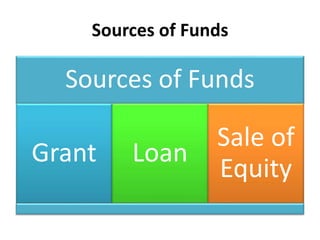
Sources of Funds
Sources of Funds
Grant Loan
Sale of
Equity
Sources of Funds
• A grant is a sum of money given to the
company.
• Company is obliged to demonstrate that it has
been used for the purposes for which it was
intended.
• Grant is never paid back to the organization
who gave it.
Sources of Funds
• A loan is a sum of money lent to the company.
• Interest is payable on it, at a rate that may be
fixed or variable.
• Loan is usually for a fixed period.
• The company is liable to pay back the loan,
and if company dissolves, the lender is
entitled to recover the loan from the sale of
company’s assets.
Sources of Funds
• Equity capital is money paid to the company
in exchange for a share in the ownership of
the company.
• Advantge/ disadvantage
Budgeting and monitoring
• A budget is a financial plan for a defined period
of time, usually a year.
• It is an estimation of revenue and expenses over
a specified future period of time; it is compiled
and re-evaluated on a periodic basis.
• Budgets can be made for a person, a family, a
group of people, a business, a government, a
country, a multinational organization or just
about anything else that makes and spends
money.
Budgeting and monitoring
• A budget is a prediction of the future financial
position of an organization covering usually
the current or the next financial year.
• A complete budget includes prediction for all
of the annual financial statments, but the
most concerned aspect of budgeting is income
and expenditure budget.
Budgeting and monitoring
• Budgeting is an iterative process.
• First version of the budget is likely to show
expenditure exceeding income.
• Adjustment are made repeatedly until a
situation is reached where sales exceed
expenditure with a reasonable profit margin.
Budgeting and monitoring
• Budget is mostly used as a basis for monitoring
the organization’s performance.
• The figures in the budget are split into monthly or
weekly figures.
• When the actual figures of a month become
available, they are compared with the budgeted
figures.
• If real expenditure of any field exceeds the
budgeted value, reason is determined quickly and
remedial action is taken.
Sales and Order Intake
• A sale is a transaction between two parties
where the buyer receives goods, services, and
assets in exchange for money.
• Order intake is a measure of company
production in terms of customer offers to buy
products or services, it refers to receiving or
processing a customer's order.
Sales and Order Intake
• A company’s cost, its pricing and the level of
overheads that it can afford, all depends
critically on the level of sales.
• Monitoring the level of sales is therefore a
very important managerial activity.
Costing
• The price at which an organization decides to
sell a product or a service depends on
– The cost of producing and providing it
– Market conditions
• Price and availablity of competing products
• Elasticity of demand
Costing
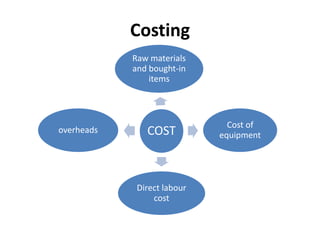
COST
Raw materials
and bought-in
items
Cost of
equipment
Direct labour
cost
overheads
Costing
• Materials which are bought by a campany and
processed as part of the campany’s
manufacturing process are called raw
materials.
• Brought-in items are those items that are
bought by a company and incorporated into
their products, as it is (unchanged).
Costing
• The cost of equipment for a company is
simply how much the company paid for the
equipment.
• The cost of labour is the sum of all wages paid
to employees.
Costing
• Overheads are the costs that cannot be
directly associated with specific products or
services but must still be covered by the total
revenue.
• Examples are marketing costs, manager’s costs
and costs related to preparation of bids.
Costing
• Departmental overheads are associated with
specific parts of the organization and should
be covered by the revenue earned by those
parts.
• Corporate overheads are associated with the
whole organization.
Pricing
• Pricing is the method of determining the value
a producer will get in the exchange of goods
and services. Simply, pricing method is used to
set the price of producer’s offerings relevant
to both the producer and the customer.
• The price that a company charges for its
products and services is constrained by the
fact that revenue must exceed the cost of
those products.
Pricing
• Software companies are typically faced with
pricing in three contexts
– Pricing a bid to provide services, such as
consultancy, design or programming, with
payment based on the effort supplied.
– Pricing a bid for a contract to supply bespoke
software at a fixed price.
– Pricing a software product which they have
developed.
Annual Statements
• All limited companies are required to produce
annual accounts and to give a copy of them to
the registrar of companies for filing.
• Company accounts should include
– The balance sheet
– A profit and loss account
Annual Statements
Annual Statements
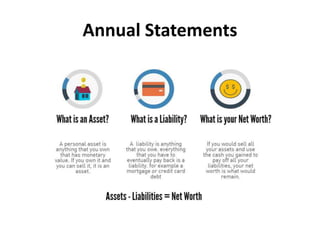
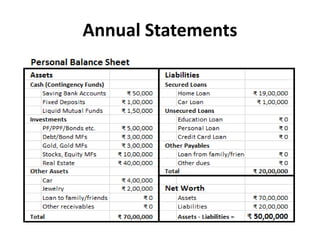
• A balance sheet is a snapshot of financial
state of an organization at a single instant,
normally at the end of an organization’s
financial year.
• It shows the values of organization’s assets
and its liabilities.
• Normally a balance sheet also shows the
twelve months previously position for
comparison purpose.
Annual Statements
• As the name suggests....a balance sheet must
balance: the total assets and total liabilities
should be equal.
• To acieve this a balancing item is added on
one side or the other.
Annual Statements
Annual Statements
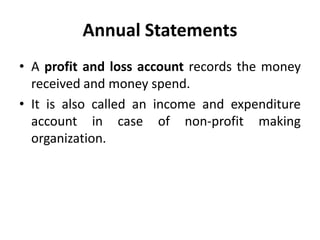
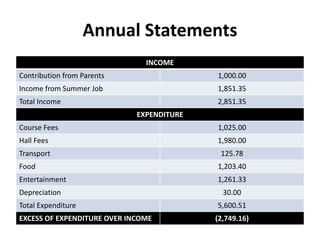
• A profit and loss account records the money
received and money spend.
• It is also called an income and expenditure
account in case of non-profit making
organization.
Annual Statements
INCOME
Contribution from Parents 1,000.00
Income from Summer Job 1,851.35
Total Income 2,851.35
EXPENDITURE
Course Fees 1,025.00
Hall Fees 1,980.00
Transport 125.78
Food 1,203.40
Entertainment 1,261.33
Depreciation 30.00
Total Expenditure 5,600.51
EXCESS OF EXPENDITURE OVER INCOME (2,749.16)
Capital and its Maintenance
• The concept of capital maintenance has
important practical consequences.
• The capital of a company is usually taken as a
gurantee that the company will be able to
meet its obligations.
• A lender also takes into account a campany’s
capital, when deciding whether or not to give
a loan.
Capital and its Maintenance
• To maintain capital
– A company is not allowed to issue shares at a
discounted value.
– A company cannot pay back to the shareholders
any of their original contributions.
Auditing
• Financial auditing is the process of examining an
organization's financial records to determine if
they are accurate and in accordance with any
applicable rules , regulations, and laws.
• The company accounts should be accompanied
by an auditor’s report.
• Purpose of the report is to provide members of
the company and public with an assurance that
accounts give a “true and fair view” of the state
of the affairs of the company.
Auditing
• It is not practicable for auditors to check every
financial transaction.
• They work by
– Examimining the adequacy of the company’s
financial procedures
– Making detiled checks on a small sample of
transactions and assets.
Auditing
• The primary resposibility for preventing and
detecting fraud lies with the directors of the
company, not with the auditors.
• However auditors are also expected of finding
anything seriously misleading in the financial
statements.
• If they find evidence of fraud , they have a
duty to report it to directors.

1beab392-6675-448d-a721-0d0ae34662b3.pptx

  • 1.
  • 2.
    Contents • The needfor capital • Sources of funds • Budgeting and monitoring • Sales and order intake • Costing • Pricing • Annual statements • Capital and its maintenance • Auditing
  • 3.
    Finance and Accounting •Any organization can not be successful unless its finances are soundly managed. • In this chapter, those aspects of finance and accounting with which the newly graduated software engineer is most likely to come into contact are emphasized.
  • 4.
    The need forcapital • It is not uncommon for recent graduates in computing to start their own company that provide software services. – Contract hire services – Develop packages • They will be in need of some money to start the venture.
  • 5.
    The need forcapital • Capital will be needed for – Salaries – Rents and bills – Equipments – Costs of advertising – Miscellaneous expenses – Interests on any money borrowed
  • 6.
    The need forcapital • Present a business plan to potential funders. This plan should include – Description of what the company will be doing, together with information to show that it is technically feasible and founders of the company have the necessary expertise. – Assessment of the size of market and competition – Prediction of financial performane of the campany
  • 7.
    Sources of Funds Sourcesof Funds Grant Loan Sale of Equity
  • 8.
    Sources of Funds •A grant is a sum of money given to the company. • Company is obliged to demonstrate that it has been used for the purposes for which it was intended. • Grant is never paid back to the organization who gave it.
  • 9.
    Sources of Funds •A loan is a sum of money lent to the company. • Interest is payable on it, at a rate that may be fixed or variable. • Loan is usually for a fixed period. • The company is liable to pay back the loan, and if company dissolves, the lender is entitled to recover the loan from the sale of company’s assets.
  • 10.
    Sources of Funds •Equity capital is money paid to the company in exchange for a share in the ownership of the company. • Advantge/ disadvantage
  • 11.
    Budgeting and monitoring •A budget is a financial plan for a defined period of time, usually a year. • It is an estimation of revenue and expenses over a specified future period of time; it is compiled and re-evaluated on a periodic basis. • Budgets can be made for a person, a family, a group of people, a business, a government, a country, a multinational organization or just about anything else that makes and spends money.
  • 12.
    Budgeting and monitoring •A budget is a prediction of the future financial position of an organization covering usually the current or the next financial year. • A complete budget includes prediction for all of the annual financial statments, but the most concerned aspect of budgeting is income and expenditure budget.
  • 13.
    Budgeting and monitoring •Budgeting is an iterative process. • First version of the budget is likely to show expenditure exceeding income. • Adjustment are made repeatedly until a situation is reached where sales exceed expenditure with a reasonable profit margin.
  • 14.
    Budgeting and monitoring •Budget is mostly used as a basis for monitoring the organization’s performance. • The figures in the budget are split into monthly or weekly figures. • When the actual figures of a month become available, they are compared with the budgeted figures. • If real expenditure of any field exceeds the budgeted value, reason is determined quickly and remedial action is taken.
  • 15.
    Sales and OrderIntake • A sale is a transaction between two parties where the buyer receives goods, services, and assets in exchange for money. • Order intake is a measure of company production in terms of customer offers to buy products or services, it refers to receiving or processing a customer's order.
  • 16.
    Sales and OrderIntake • A company’s cost, its pricing and the level of overheads that it can afford, all depends critically on the level of sales. • Monitoring the level of sales is therefore a very important managerial activity.
  • 17.
    Costing • The priceat which an organization decides to sell a product or a service depends on – The cost of producing and providing it – Market conditions • Price and availablity of competing products • Elasticity of demand
  • 18.
    Costing COST Raw materials and bought-in items Costof equipment Direct labour cost overheads
  • 19.
    Costing • Materials whichare bought by a campany and processed as part of the campany’s manufacturing process are called raw materials. • Brought-in items are those items that are bought by a company and incorporated into their products, as it is (unchanged).
  • 20.
    Costing • The costof equipment for a company is simply how much the company paid for the equipment. • The cost of labour is the sum of all wages paid to employees.
  • 21.
    Costing • Overheads arethe costs that cannot be directly associated with specific products or services but must still be covered by the total revenue. • Examples are marketing costs, manager’s costs and costs related to preparation of bids.
  • 22.
    Costing • Departmental overheadsare associated with specific parts of the organization and should be covered by the revenue earned by those parts. • Corporate overheads are associated with the whole organization.
  • 23.
    Pricing • Pricing isthe method of determining the value a producer will get in the exchange of goods and services. Simply, pricing method is used to set the price of producer’s offerings relevant to both the producer and the customer. • The price that a company charges for its products and services is constrained by the fact that revenue must exceed the cost of those products.
  • 24.
    Pricing • Software companiesare typically faced with pricing in three contexts – Pricing a bid to provide services, such as consultancy, design or programming, with payment based on the effort supplied. – Pricing a bid for a contract to supply bespoke software at a fixed price. – Pricing a software product which they have developed.
  • 25.
    Annual Statements • Alllimited companies are required to produce annual accounts and to give a copy of them to the registrar of companies for filing. • Company accounts should include – The balance sheet – A profit and loss account
  • 26.
  • 27.
    Annual Statements • Abalance sheet is a snapshot of financial state of an organization at a single instant, normally at the end of an organization’s financial year. • It shows the values of organization’s assets and its liabilities. • Normally a balance sheet also shows the twelve months previously position for comparison purpose.
  • 28.
    Annual Statements • Asthe name suggests....a balance sheet must balance: the total assets and total liabilities should be equal. • To acieve this a balancing item is added on one side or the other.
  • 29.
  • 30.
    Annual Statements • Aprofit and loss account records the money received and money spend. • It is also called an income and expenditure account in case of non-profit making organization.
  • 31.
    Annual Statements INCOME Contribution fromParents 1,000.00 Income from Summer Job 1,851.35 Total Income 2,851.35 EXPENDITURE Course Fees 1,025.00 Hall Fees 1,980.00 Transport 125.78 Food 1,203.40 Entertainment 1,261.33 Depreciation 30.00 Total Expenditure 5,600.51 EXCESS OF EXPENDITURE OVER INCOME (2,749.16)
  • 32.
    Capital and itsMaintenance • The concept of capital maintenance has important practical consequences. • The capital of a company is usually taken as a gurantee that the company will be able to meet its obligations. • A lender also takes into account a campany’s capital, when deciding whether or not to give a loan.
  • 33.
    Capital and itsMaintenance • To maintain capital – A company is not allowed to issue shares at a discounted value. – A company cannot pay back to the shareholders any of their original contributions.
  • 34.
    Auditing • Financial auditingis the process of examining an organization's financial records to determine if they are accurate and in accordance with any applicable rules , regulations, and laws. • The company accounts should be accompanied by an auditor’s report. • Purpose of the report is to provide members of the company and public with an assurance that accounts give a “true and fair view” of the state of the affairs of the company.
  • 35.
    Auditing • It isnot practicable for auditors to check every financial transaction. • They work by – Examimining the adequacy of the company’s financial procedures – Making detiled checks on a small sample of transactions and assets.
  • 36.
    Auditing • The primaryresposibility for preventing and detecting fraud lies with the directors of the company, not with the auditors. • However auditors are also expected of finding anything seriously misleading in the financial statements. • If they find evidence of fraud , they have a duty to report it to directors.

Editor's Notes

  • #4 What is finance and accounting?
  • #5 Invoices are issued at the end of the month.
  • #6 Money will require some time to come.
  • #7 How to raise money?
  • #10 Association between loan and assets
  • #14 Why?
  • #15 Two remedial actions.
  • #17 Examples, small items, bespoke software.
  • #20 Examples of both Method of estimation sale price.
  • #23 Examples, how to allocate?
  • #24 Breaking this rule can be bearable for 1 or 2 year but not more than that.
  • #25 explain
  • #26 SECP