1987 CONSTITUTION VIS-A-VIS 1973
CONSTITUTION
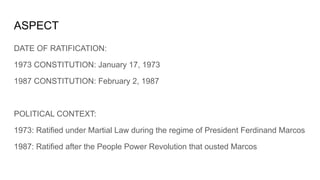
ASPECT
DATE OF RATIFICATION:
1973 CONSTITUTION: January 17, 1973
1987 CONSTITUTION: February 2, 1987
POLITICAL CONTEXT:
1973: Ratified under Martial Law during the regime of President Ferdinand Marcos
1987: Ratified after the People Power Revolution that ousted Marcos
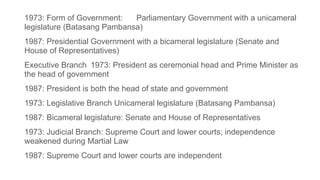
1973: Form of Government: Parliamentary Government with a unicameral
legislature (Batasang Pambansa)
1987: Presidential Government with a bicameral legislature (Senate and
House of Representatives)
Executive Branch 1973: President as ceremonial head and Prime Minister as
the head of government
1987: President is both the head of state and government
1973: Legislative Branch Unicameral legislature (Batasang Pambansa)
1987: Bicameral legislature: Senate and House of Representatives
1973: Judicial Branch: Supreme Court and lower courts; independence
weakened during Martial Law
1987: Supreme Court and lower courts are independent
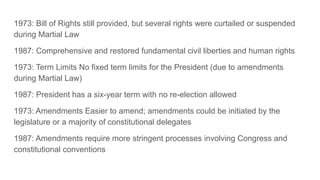
1973: Bill of Rights still provided, but several rights were curtailed or suspended
during Martial Law
1987: Comprehensive and restored fundamental civil liberties and human rights
1973: Term Limits No fixed term limits for the President (due to amendments
during Martial Law)
1987: President has a six-year term with no re-election allowed
1973: Amendments Easier to amend; amendments could be initiated by the
legislature or a majority of constitutional delegates
1987: Amendments require more stringent processes involving Congress and
constitutional conventions
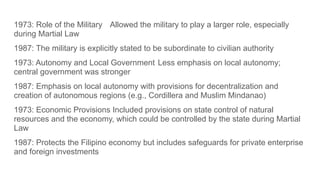
1973: Role of the Military Allowed the military to play a larger role, especially
during Martial Law
1987: The military is explicitly stated to be subordinate to civilian authority
1973: Autonomy and Local Government Less emphasis on local autonomy;
central government was stronger
1987: Emphasis on local autonomy with provisions for decentralization and
creation of autonomous regions (e.g., Cordillera and Muslim Mindanao)
1973: Economic Provisions Included provisions on state control of natural
resources and the economy, which could be controlled by the state during Martial
Law
1987: Protects the Filipino economy but includes safeguards for private enterprise
and foreign investments
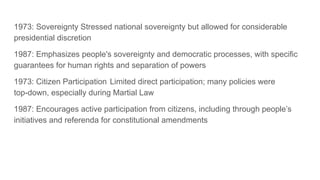
1973: Sovereignty Stressed national sovereignty but allowed for considerable
presidential discretion
1987: Emphasizes people's sovereignty and democratic processes, with specific
guarantees for human rights and separation of powers
1973: Citizen Participation Limited direct participation; many policies were
top-down, especially during Martial Law
1987: Encourages active participation from citizens, including through people’s
initiatives and referenda for constitutional amendments
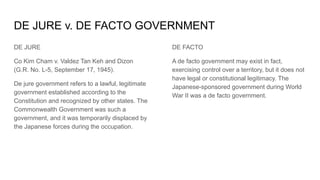
DE JURE v. DE FACTO GOVERNMENT
DE JURE
Co Kim Cham v. Valdez Tan Keh and Dizon
(G.R. No. L-5, September 17, 1945).
De jure government refers to a lawful, legitimate
government established according to the
Constitution and recognized by other states. The
Commonwealth Government was such a
government, and it was temporarily displaced by
the Japanese forces during the occupation.
DE FACTO
A de facto government may exist in fact,
exercising control over a territory, but it does not
have legal or constitutional legitimacy. The
Japanese-sponsored government during World
War II was a de facto government.
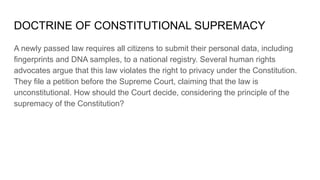
DOCTRINE OF CONSTITUTIONAL SUPREMACY
A newly passed law requires all citizens to submit their personal data, including
fingerprints and DNA samples, to a national registry. Several human rights
advocates argue that this law violates the right to privacy under the Constitution.
They file a petition before the Supreme Court, claiming that the law is
unconstitutional. How should the Court decide, considering the principle of the
supremacy of the Constitution?
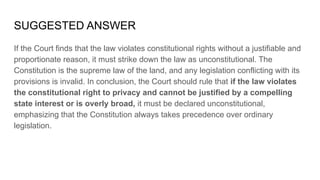
SUGGESTED ANSWER
If the Court finds that the law violates constitutional rights without a justifiable and
proportionate reason, it must strike down the law as unconstitutional. The
Constitution is the supreme law of the land, and any legislation conflicting with its
provisions is invalid. In conclusion, the Court should rule that if the law violates
the constitutional right to privacy and cannot be justified by a compelling
state interest or is overly broad, it must be declared unconstitutional,
emphasizing that the Constitution always takes precedence over ordinary
legislation.
DOCTRINE OF SUPREMACY OF THE CONSTITUTION
Manila Prince Hotel v. GSIS (G.R. No. 122156, February 3, 1997).
Government Service Insurance System (GSIS) decided to privatize and sell its
controlling shares in the Manila Hotel Corporation (MHC). Two entities, the Manila
Prince Hotel Corporation (a Filipino-owned corporation) and a foreign-owned
corporation, Renong Berhad, submitted bids. Renong Berhad offered a higher bid.
However, before the finalization of the sale, the Manila Prince Hotel Corporation
exercised its right to match the bid based on the Filipino First Policy under Section
10, Article XII of the 1987 Constitution, which grants preference to Filipino citizens
in the granting of rights and privileges over foreign entities.
Supreme Court ruled in favor of Manila Prince Hotel Corporation, emphasizing that
the Constitution is the supreme law of the land and that constitutional provisions,
especially those that promote national interest like the Filipino First Policy, are
self-executing. The Court held that the Constitution must be applied immediately,
even in the absence of enabling legislation, when the provision is clear and
requires no further legislative action for its enforcement.
KEY POINTS IN CONSTITUTIONAL SUPREMACY
1. The 1987 Constitution is the highest law, and any act that contradicts its
provisions is void.
2. All branches of government, including the executive and judiciary, are bound
to uphold the supremacy of the Constitution.
SEPARATION OF POWERS
The President issues an executive order directing the national budget to allocate
additional funding to a special infrastructure project without the approval of
Congress, claiming that the project is urgent for economic recovery. Several
members of Congress file a case before the Supreme Court, arguing that the
President has usurped the power of the legislature by bypassing the constitutional
requirement for congressional approval of budget allocations. How should the
Supreme Court resolve this issue in light of the principle of separation of powers
under the 1987 Constitution?
SUGGESTED ANSWER
The 1987 Constitution clearly vests the power of the purse in Congress. Under
Article VI, Section 29(1), it states that "[n]o money shall be paid out of the
Treasury except in pursuance of an appropriation made by law." This means that
the allocation of public funds must be approved by Congress through the passage
of the General Appropriations Act or a supplemental budget law. Supreme Court
should declare the executive order invalid if it finds that the President acted
outside the bounds of executive authority by reallocating funds without the
approval of Congress. The ruling would reinforce the constitutional principle that
the executive cannot exercise powers reserved for the legislature.
SEPARATION OF POWERS
Angara v. Electoral Commission (G.R. No. L-45081, July 15, 1936).
This case arose when Pedro Y. Angara, a member of the National Assembly, questioned
the decision of the newly established Electoral Commission to take jurisdiction over an
electoral protest filed against him. Before the creation of the Electoral Commission,
electoral contests involving members of the National Assembly were resolved by the
Assembly itself, acting as the sole judge of its members' elections, returns, and
qualifications. However, the 1935 Constitution established the Electoral Commission as
an independent body to handle such disputes.
Angara argued that the Electoral Commission had overstepped its jurisdiction and that
the National Assembly should retain the power to resolve the protest.
Supreme Court ruled in favor of the Electoral Commission, upholding its
independence and authority. The Court emphasized that the 1935 Constitution
explicitly transferred the power to resolve electoral contests from the National
Assembly to the Electoral Commission. The Court’s ruling highlighted the doctrine
of separation of powers, which divides government powers into three branches:
executive, legislative, and judicial.
KEY POINTS IN SEPARATION OF POWERS
Each branch of government is supreme within its own sphere of authority as
provided by the Constitution.
No branch should encroach on the powers of another. The legislative branch
enacts laws, the executive implements them, and the judiciary interprets laws and
settles disputes.
CHECKS AND BALANCES
IMBONG v. OCHOA (G.R. No. 204819, April 8, 2014)
This case involves multiple petitions challenging the constitutionality of the Republic Act
No. 10354, commonly known as the Responsible Parenthood and Reproductive Health
Act of 2012 (RH Law). The petitioners argued that several provisions of the RH Law
violated the Constitution, particularly on issues relating to the right to life, freedom of
religion, and parental authority.
The main issue in this case was whether certain provisions of the RH Law infringed on
constitutional rights, and whether the judiciary had the authority to review the
constitutionality of a law passed by Congress and signed by the President, thus invoking
the doctrine of checks and balances.
Supreme Court partially upheld the RH Law, declaring most of its provisions constitutional while
striking down certain sections that infringed on individual rights, such as provisions related to
mandatory reproductive health education and penalties on healthcare providers who refuse to
provide services based on religious beliefs.
The Court's ruling highlighted the doctrine of checks and balances, which ensures that the three
branches of government (legislative, executive, and judiciary) regulate and limit each other's
powers to prevent abuse:
The legislative branch (Congress) enacts laws like the RH Law.
The executive branch (President and agencies) implements the laws.
The judicial branch (Supreme Court) has the power to review and declare laws unconstitutional if
they violate constitutional rights.
KEY POINTS:
Checks and balances ensure that no branch of government becomes too powerful
or exceeds its constitutional mandate.
The judiciary acts as a check on the legislative and executive branches by
reviewing laws for constitutionality.
In this case, the Supreme Court exercised its judicial review powers to strike down
unconstitutional provisions of the RH Law, maintaining a balance between
individual rights and state power.
The ruling exemplifies how the judiciary can check the legislative and executive
branches to ensure that laws do not violate constitutional protections.
ARTICLE V, 1987 CONSTITUTION
Penera v. Commission on Elections (G.R. No. 181613, November 25, 2009).
This case involved Evelyn Penera, a candidate for mayor in the 2007 elections,
who was accused of premature campaigning under the Omnibus Election Code.
She filed her certificate of candidacy (COC) and then joined a motorcade to
promote her candidacy before the official campaign period began. The
Commission on Elections (COMELEC) disqualified her, ruling that she violated
election laws prohibiting campaigning outside the designated period.
Penera challenged the ruling, arguing that her right to suffrage, particularly her
right to be elected, was being infringed upon.
ARTICLE V
The Supreme Court initially ruled against Penera but later reversed its decision. It
held that premature campaigning cannot occur after a candidate files their
certificate of candidacy because a person does not officially become a candidate
until the campaign period begins. The Court noted that under the 1987
Constitution, the right to suffrage includes both the right to vote and the right to be
voted for, and any restrictions on this right must be strictly construed.
DELEGATION OF POWER, ARTICLE VI
Abakada Guro Party List v. Purisima (G.R. No. 166715, August 14, 2008).
This case involved a constitutional challenge to Republic Act No. 9335, also known as
the Attrition Act of 2005, which aimed to increase revenue collection by offering
incentives and imposing penalties on officials of the Bureau of Internal Revenue (BIR)
and Bureau of Customs (BOC). The petitioners argued that certain provisions of the law
violated the Constitution because it delegated legislative powers to the executive branch,
particularly to the Department of Finance (DOF).
The central issue was whether the Attrition Act constituted an undue delegation of
legislative power, which would violate the constitutional mandate that only Congress has
the power to make laws.
Supreme Court upheld the constitutionality of the Attrition Act, ruling that the law
did not involve an undue delegation of legislative power. It emphasized that the
legislative power to make laws, including taxation laws, is vested in Congress
under the 1987 Constitution. However, the Court also recognized that Congress
can delegate certain powers to the executive branch, provided that it lays down
clear standards to guide the implementation of the law.
The Court held that the law merely empowered the DOF to implement the policies
set by Congress in the Attrition Act, and it contained sufficient standards to prevent
an arbitrary exercise of discretion. Therefore, the delegation of authority to the
DOF was valid.
LEGISLATIVE POWER
Legislative power under the 1987 Constitution is vested in Congress, which
consists of the Senate and the House of Representatives (Article VI, Section 1).
Congress has the authority to enact laws, including those related to taxation and
revenue collection.
The non-delegation doctrine means that Congress cannot delegate its legislative
power to another branch of government. However, delegation is allowed if
Congress provides clear standards to guide the implementing authority.
CITIZENSHIP REQUIREMENT
David v. Senate Electoral Tribunal (G.R. No. 221538, December 8, 2015)
Grace Poe, a senator and candidate for president in the 2016 elections, faced
petitions questioning her natural-born citizenship and residency qualifications
under the Constitution. The main issue was whether she met the requirement of
being a natural-born Filipino citizen, which is a constitutional qualification for
running for president under Article VII, Section 2 of the 1987 Constitution.
Poe was a foundling, found in Iloilo, and was later adopted by Filipino actors
Fernando Poe Jr. and Susan Roces. The petitioners argued that, because her
biological parents were unknown, she could not be presumed a natural-born
citizen, casting doubt on her qualification to run for president.
Key Issues Raised:
Natural-Born Citizenship: The Constitution defines a natural-born citizen as
someone who is a Filipino from birth without having to perform any act to acquire
or perfect their citizenship. Since Poe’s biological parents were unknown, the
petitioners argued that she could not claim natural-born status, as there was no
proof that her parents were Filipino.
Residency: Petitioners also questioned whether Poe had met the ten-year
residency requirement for presidential candidates, arguing that she reacquired her
Filipino citizenship too recently after living in the United States.
Supreme Court later affirmed this decision in a ruling on March 8, 2016. It held that Grace Poe
was a natural-born citizen and eligible to run for president under the 1987 Constitution. The Court
based its decision on several key points:
Foundlings are presumed natural-born: The Court relied on both constitutional principles and
international conventions (such as the 1954 Convention relating to the Status of Stateless
Persons) that favor granting citizenship to foundlings to prevent them from being stateless. Since
Poe was found in the Philippines, it was presumed that she was born of Filipino parents.
Reacquisition of Citizenship: Grace Poe renounced her Filipino citizenship when she became a
naturalized American citizen but later reacquired her Filipino citizenship under Republic Act No.
9225 (the Citizenship Retention and Re-acquisition Act of 2003). The Court held that this did not
affect her status as a natural-born Filipino, as she was considered to have merely re-acquired
her natural-born status upon resumption of her Filipino citizenship.
Residency Requirement: The Court found that Poe had resided in the Philippines for over 10
years by the time of the election and had sufficiently established her intent to return to the
Philippines permanently, thus meeting the residency requirement for the presidency.
Key Points on Citizenship Under the 1987 Constitution:
Natural-born citizenship is a requirement for holding elective positions such as the
presidency, as stated in the 1987 Constitution.
A natural-born citizen is defined as a person who does not need to take any act to
acquire or perfect their citizenship. Foundlings like Grace Poe are presumed to be
natural-born Filipinos, especially when found in the Philippines, unless proven
otherwise.
The 1987 Constitution does not explicitly exclude foundlings from being
considered natural-born citizens.
The reacquisition of Filipino citizenship under RA 9225 allows natural-born citizens
who were naturalized in other countries to reacquire their Filipino citizenship
without losing their status as natural-born Filipinos.
POWER TO DECLARE MARTIAL LAW
Lagman v. Medialdea (G.R. Nos. 231658, 231771, 231774, 231780, and 231782, July 4,
2017).
On May 23, 2017, President Duterte issued Proclamation No. 216, declaring martial law
and suspending the writ of habeas corpus in Mindanao, following the attack of the Maute
group, a local terrorist organization, on Marawi City. Petitioners, including Albay
Representative Edcel Lagman, questioned the declaration before the Supreme Court,
arguing that the conditions for the imposition of martial law under the 1987 Constitution
were not present, and that the President exceeded his powers.
The petitioners claimed that the attack in Marawi was not an invasion or rebellion as
required by the Constitution and did not pose sufficient public danger to justify the
declaration of martial law throughout Mindanao.
The Supreme Court upheld the constitutionality of President Duterte's declaration of martial law in
Mindanao. The Court ruled that there was sufficient factual basis to declare martial law, given that an
armed rebellion was occurring, which was threatening public safety.
Factual Basis for Martial Law: The Court held that the President had sufficient factual basis for declaring
martial law, citing the armed uprising by the Maute group, which was aligned with the Islamic State (ISIS).
The Court recognized that the Maute group's siege of Marawi was part of a larger rebellion aimed at
establishing a caliphate in the Philippines, thereby threatening public safety.
Scope of Martial Law: The petitioners argued that the martial law declaration should be limited to Marawi
City or Lanao del Sur, but the Court upheld the President's discretion to declare martial law over the entire
Mindanao region, finding that the rebellion had the potential to spread to other areas.
Judicial Review of Martial Law: Under the 1987 Constitution, the Supreme Court can review the factual
basis of the declaration of martial law. The Court, however, stated that it gives deference to the President's
discretion on matters of national security and only intervenes if there is a clear lack of factual basis. In this
case, the Court found that the executive and military reports provided sufficient justification for the
declaration.
KEY POINTS TO REMEMBER:
President’s power to declare martial law under the 1987 Constitution is an extraordinary
measure intended to protect national security in the face of invasion or rebellion when
public safety is at risk.
The Constitution imposes checks and balances on this power by requiring both Congress
and the Supreme Court to review the declaration. Congress can revoke or extend martial
law, while the Supreme Court can review its factual basis within 30 days.
The Supreme Court generally defers to the President's judgment on matters of national
security but retains the authority to determine whether the declaration is supported by
facts.
Unlike under the 1973 Constitution, which allowed indefinite martial law, the 1987
Constitution limits martial law to 60 days, after which the President must seek an
extension from Congress.
The southern province of a country is facing an insurgency led by a group aiming
to overthrow the government and establish its own independent state. The
insurgents have gained control of several towns, set up armed checkpoints, and
launched attacks on military bases. Civilians in the area have been displaced, and
the local government has been unable to restore order. Intelligence reports
indicate that the insurgency is growing and may spread to neighboring provinces.
As President of the Philippines, you are considering whether to declare martial law
in the affected region. What factors should you consider in making your decision,
and how will you ensure that your actions comply with the 1987 Constitution?
Suggested Answer:
As President, my decision to declare martial law must be guided by Article VII,
Section 18 of the 1987 Constitution, which allows the declaration of martial law in
cases of invasion or rebellion and when public safety requires it. The insurgency
described could be considered a rebellion, as it involves an armed group
attempting to overthrow the government and establish its own state.
JUDICIAL POWER
Marcos v. Manglapus" (1990)
In this case, the Supreme Court addressed the power of judicial review, particularly regarding the
President's authority to allow former President Ferdinand Marcos to return to the Philippines after
being ousted. The Court ruled that the judiciary has the authority to review acts of the executive
branch, especially when they involve the protection of constitutional rights and the public interest.
The Court emphasized that judicial review is a fundamental aspect of the checks and balances
system enshrined in the Constitution. It serves to ensure that no branch of government exceeds
its authority or infringes upon the rights of citizens. The ruling reinforced the judiciary's role as a
guardian of the Constitution, asserting that it has the responsibility to scrutinize executive
actions, especially those that may threaten democracy or public safety.
This case exemplifies the judiciary's power to intervene in matters of significant public concern
and highlights its role in maintaining constitutional governance.
Imagine a scenario where the President of a country issues an executive order
that effectively suspends a law passed by the legislature, claiming it is necessary
for national security. Several citizens and civil society groups believe this action is
unconstitutional and file a petition for judicial review. How should the judiciary
approach this case?
SUGGESTED ANSWER
In approaching this case, the judiciary should first assess its jurisdiction to hear the petition. It should determine
whether the executive order violates constitutional provisions, particularly regarding the separation of powers and the
legislative authority.
The judiciary should:
Examine the Constitution: Review relevant constitutional articles that outline the powers of the executive and the
legislature, as well as the scope of judicial review.
Evaluate the Basis for the Executive Order: Analyze the President's claims of national security and whether they
justify suspending the law. The judiciary must ensure that the executive is not overstepping its bounds and that there
is a legitimate threat to national security that warrants such action.
Consider Precedents: Look at previous cases involving executive orders and the judiciary's role in upholding or
nullifying them. This can provide context and guidance on how to handle the current situation.
Protect Fundamental Rights: Assess if the executive order infringes upon any constitutional rights of citizens. The
judiciary has a responsibility to safeguard these rights, even in times of national crisis.
Issue a Ruling: If the judiciary finds that the executive order is unconstitutional, it should declare it null and void,
reinforcing the principle that no branch of government is above the Constitution.

1987 consti vis-a-vis 1973 Constitution.pdf

  • 1.
    1987 CONSTITUTION VIS-A-VIS1973 CONSTITUTION
  • 2.
    ASPECT DATE OF RATIFICATION: 1973CONSTITUTION: January 17, 1973 1987 CONSTITUTION: February 2, 1987 POLITICAL CONTEXT: 1973: Ratified under Martial Law during the regime of President Ferdinand Marcos 1987: Ratified after the People Power Revolution that ousted Marcos
  • 3.
    1973: Form ofGovernment: Parliamentary Government with a unicameral legislature (Batasang Pambansa) 1987: Presidential Government with a bicameral legislature (Senate and House of Representatives) Executive Branch 1973: President as ceremonial head and Prime Minister as the head of government 1987: President is both the head of state and government 1973: Legislative Branch Unicameral legislature (Batasang Pambansa) 1987: Bicameral legislature: Senate and House of Representatives 1973: Judicial Branch: Supreme Court and lower courts; independence weakened during Martial Law 1987: Supreme Court and lower courts are independent
  • 4.
    1973: Bill ofRights still provided, but several rights were curtailed or suspended during Martial Law 1987: Comprehensive and restored fundamental civil liberties and human rights 1973: Term Limits No fixed term limits for the President (due to amendments during Martial Law) 1987: President has a six-year term with no re-election allowed 1973: Amendments Easier to amend; amendments could be initiated by the legislature or a majority of constitutional delegates 1987: Amendments require more stringent processes involving Congress and constitutional conventions
  • 5.
    1973: Role ofthe Military Allowed the military to play a larger role, especially during Martial Law 1987: The military is explicitly stated to be subordinate to civilian authority 1973: Autonomy and Local Government Less emphasis on local autonomy; central government was stronger 1987: Emphasis on local autonomy with provisions for decentralization and creation of autonomous regions (e.g., Cordillera and Muslim Mindanao) 1973: Economic Provisions Included provisions on state control of natural resources and the economy, which could be controlled by the state during Martial Law 1987: Protects the Filipino economy but includes safeguards for private enterprise and foreign investments
  • 6.
    1973: Sovereignty Stressednational sovereignty but allowed for considerable presidential discretion 1987: Emphasizes people's sovereignty and democratic processes, with specific guarantees for human rights and separation of powers 1973: Citizen Participation Limited direct participation; many policies were top-down, especially during Martial Law 1987: Encourages active participation from citizens, including through people’s initiatives and referenda for constitutional amendments
  • 7.
    DE JURE v.DE FACTO GOVERNMENT DE JURE Co Kim Cham v. Valdez Tan Keh and Dizon (G.R. No. L-5, September 17, 1945). De jure government refers to a lawful, legitimate government established according to the Constitution and recognized by other states. The Commonwealth Government was such a government, and it was temporarily displaced by the Japanese forces during the occupation. DE FACTO A de facto government may exist in fact, exercising control over a territory, but it does not have legal or constitutional legitimacy. The Japanese-sponsored government during World War II was a de facto government.
  • 8.
    DOCTRINE OF CONSTITUTIONALSUPREMACY A newly passed law requires all citizens to submit their personal data, including fingerprints and DNA samples, to a national registry. Several human rights advocates argue that this law violates the right to privacy under the Constitution. They file a petition before the Supreme Court, claiming that the law is unconstitutional. How should the Court decide, considering the principle of the supremacy of the Constitution?
  • 9.
    SUGGESTED ANSWER If theCourt finds that the law violates constitutional rights without a justifiable and proportionate reason, it must strike down the law as unconstitutional. The Constitution is the supreme law of the land, and any legislation conflicting with its provisions is invalid. In conclusion, the Court should rule that if the law violates the constitutional right to privacy and cannot be justified by a compelling state interest or is overly broad, it must be declared unconstitutional, emphasizing that the Constitution always takes precedence over ordinary legislation.
  • 10.
    DOCTRINE OF SUPREMACYOF THE CONSTITUTION Manila Prince Hotel v. GSIS (G.R. No. 122156, February 3, 1997). Government Service Insurance System (GSIS) decided to privatize and sell its controlling shares in the Manila Hotel Corporation (MHC). Two entities, the Manila Prince Hotel Corporation (a Filipino-owned corporation) and a foreign-owned corporation, Renong Berhad, submitted bids. Renong Berhad offered a higher bid. However, before the finalization of the sale, the Manila Prince Hotel Corporation exercised its right to match the bid based on the Filipino First Policy under Section 10, Article XII of the 1987 Constitution, which grants preference to Filipino citizens in the granting of rights and privileges over foreign entities.
  • 11.
    Supreme Court ruledin favor of Manila Prince Hotel Corporation, emphasizing that the Constitution is the supreme law of the land and that constitutional provisions, especially those that promote national interest like the Filipino First Policy, are self-executing. The Court held that the Constitution must be applied immediately, even in the absence of enabling legislation, when the provision is clear and requires no further legislative action for its enforcement.
  • 12.
    KEY POINTS INCONSTITUTIONAL SUPREMACY 1. The 1987 Constitution is the highest law, and any act that contradicts its provisions is void. 2. All branches of government, including the executive and judiciary, are bound to uphold the supremacy of the Constitution.
  • 13.
    SEPARATION OF POWERS ThePresident issues an executive order directing the national budget to allocate additional funding to a special infrastructure project without the approval of Congress, claiming that the project is urgent for economic recovery. Several members of Congress file a case before the Supreme Court, arguing that the President has usurped the power of the legislature by bypassing the constitutional requirement for congressional approval of budget allocations. How should the Supreme Court resolve this issue in light of the principle of separation of powers under the 1987 Constitution?
  • 14.
    SUGGESTED ANSWER The 1987Constitution clearly vests the power of the purse in Congress. Under Article VI, Section 29(1), it states that "[n]o money shall be paid out of the Treasury except in pursuance of an appropriation made by law." This means that the allocation of public funds must be approved by Congress through the passage of the General Appropriations Act or a supplemental budget law. Supreme Court should declare the executive order invalid if it finds that the President acted outside the bounds of executive authority by reallocating funds without the approval of Congress. The ruling would reinforce the constitutional principle that the executive cannot exercise powers reserved for the legislature.
  • 15.
    SEPARATION OF POWERS Angarav. Electoral Commission (G.R. No. L-45081, July 15, 1936). This case arose when Pedro Y. Angara, a member of the National Assembly, questioned the decision of the newly established Electoral Commission to take jurisdiction over an electoral protest filed against him. Before the creation of the Electoral Commission, electoral contests involving members of the National Assembly were resolved by the Assembly itself, acting as the sole judge of its members' elections, returns, and qualifications. However, the 1935 Constitution established the Electoral Commission as an independent body to handle such disputes. Angara argued that the Electoral Commission had overstepped its jurisdiction and that the National Assembly should retain the power to resolve the protest.
  • 16.
    Supreme Court ruledin favor of the Electoral Commission, upholding its independence and authority. The Court emphasized that the 1935 Constitution explicitly transferred the power to resolve electoral contests from the National Assembly to the Electoral Commission. The Court’s ruling highlighted the doctrine of separation of powers, which divides government powers into three branches: executive, legislative, and judicial.
  • 17.
    KEY POINTS INSEPARATION OF POWERS Each branch of government is supreme within its own sphere of authority as provided by the Constitution. No branch should encroach on the powers of another. The legislative branch enacts laws, the executive implements them, and the judiciary interprets laws and settles disputes.
  • 18.
    CHECKS AND BALANCES IMBONGv. OCHOA (G.R. No. 204819, April 8, 2014) This case involves multiple petitions challenging the constitutionality of the Republic Act No. 10354, commonly known as the Responsible Parenthood and Reproductive Health Act of 2012 (RH Law). The petitioners argued that several provisions of the RH Law violated the Constitution, particularly on issues relating to the right to life, freedom of religion, and parental authority. The main issue in this case was whether certain provisions of the RH Law infringed on constitutional rights, and whether the judiciary had the authority to review the constitutionality of a law passed by Congress and signed by the President, thus invoking the doctrine of checks and balances.
  • 19.
    Supreme Court partiallyupheld the RH Law, declaring most of its provisions constitutional while striking down certain sections that infringed on individual rights, such as provisions related to mandatory reproductive health education and penalties on healthcare providers who refuse to provide services based on religious beliefs. The Court's ruling highlighted the doctrine of checks and balances, which ensures that the three branches of government (legislative, executive, and judiciary) regulate and limit each other's powers to prevent abuse: The legislative branch (Congress) enacts laws like the RH Law. The executive branch (President and agencies) implements the laws. The judicial branch (Supreme Court) has the power to review and declare laws unconstitutional if they violate constitutional rights.
  • 20.
    KEY POINTS: Checks andbalances ensure that no branch of government becomes too powerful or exceeds its constitutional mandate. The judiciary acts as a check on the legislative and executive branches by reviewing laws for constitutionality. In this case, the Supreme Court exercised its judicial review powers to strike down unconstitutional provisions of the RH Law, maintaining a balance between individual rights and state power. The ruling exemplifies how the judiciary can check the legislative and executive branches to ensure that laws do not violate constitutional protections.
  • 21.
    ARTICLE V, 1987CONSTITUTION Penera v. Commission on Elections (G.R. No. 181613, November 25, 2009). This case involved Evelyn Penera, a candidate for mayor in the 2007 elections, who was accused of premature campaigning under the Omnibus Election Code. She filed her certificate of candidacy (COC) and then joined a motorcade to promote her candidacy before the official campaign period began. The Commission on Elections (COMELEC) disqualified her, ruling that she violated election laws prohibiting campaigning outside the designated period. Penera challenged the ruling, arguing that her right to suffrage, particularly her right to be elected, was being infringed upon.
  • 22.
    ARTICLE V The SupremeCourt initially ruled against Penera but later reversed its decision. It held that premature campaigning cannot occur after a candidate files their certificate of candidacy because a person does not officially become a candidate until the campaign period begins. The Court noted that under the 1987 Constitution, the right to suffrage includes both the right to vote and the right to be voted for, and any restrictions on this right must be strictly construed.
  • 23.
    DELEGATION OF POWER,ARTICLE VI Abakada Guro Party List v. Purisima (G.R. No. 166715, August 14, 2008). This case involved a constitutional challenge to Republic Act No. 9335, also known as the Attrition Act of 2005, which aimed to increase revenue collection by offering incentives and imposing penalties on officials of the Bureau of Internal Revenue (BIR) and Bureau of Customs (BOC). The petitioners argued that certain provisions of the law violated the Constitution because it delegated legislative powers to the executive branch, particularly to the Department of Finance (DOF). The central issue was whether the Attrition Act constituted an undue delegation of legislative power, which would violate the constitutional mandate that only Congress has the power to make laws.
  • 24.
    Supreme Court upheldthe constitutionality of the Attrition Act, ruling that the law did not involve an undue delegation of legislative power. It emphasized that the legislative power to make laws, including taxation laws, is vested in Congress under the 1987 Constitution. However, the Court also recognized that Congress can delegate certain powers to the executive branch, provided that it lays down clear standards to guide the implementation of the law. The Court held that the law merely empowered the DOF to implement the policies set by Congress in the Attrition Act, and it contained sufficient standards to prevent an arbitrary exercise of discretion. Therefore, the delegation of authority to the DOF was valid.
  • 25.
    LEGISLATIVE POWER Legislative powerunder the 1987 Constitution is vested in Congress, which consists of the Senate and the House of Representatives (Article VI, Section 1). Congress has the authority to enact laws, including those related to taxation and revenue collection. The non-delegation doctrine means that Congress cannot delegate its legislative power to another branch of government. However, delegation is allowed if Congress provides clear standards to guide the implementing authority.
  • 26.
    CITIZENSHIP REQUIREMENT David v.Senate Electoral Tribunal (G.R. No. 221538, December 8, 2015) Grace Poe, a senator and candidate for president in the 2016 elections, faced petitions questioning her natural-born citizenship and residency qualifications under the Constitution. The main issue was whether she met the requirement of being a natural-born Filipino citizen, which is a constitutional qualification for running for president under Article VII, Section 2 of the 1987 Constitution. Poe was a foundling, found in Iloilo, and was later adopted by Filipino actors Fernando Poe Jr. and Susan Roces. The petitioners argued that, because her biological parents were unknown, she could not be presumed a natural-born citizen, casting doubt on her qualification to run for president.
  • 27.
    Key Issues Raised: Natural-BornCitizenship: The Constitution defines a natural-born citizen as someone who is a Filipino from birth without having to perform any act to acquire or perfect their citizenship. Since Poe’s biological parents were unknown, the petitioners argued that she could not claim natural-born status, as there was no proof that her parents were Filipino. Residency: Petitioners also questioned whether Poe had met the ten-year residency requirement for presidential candidates, arguing that she reacquired her Filipino citizenship too recently after living in the United States.
  • 28.
    Supreme Court lateraffirmed this decision in a ruling on March 8, 2016. It held that Grace Poe was a natural-born citizen and eligible to run for president under the 1987 Constitution. The Court based its decision on several key points: Foundlings are presumed natural-born: The Court relied on both constitutional principles and international conventions (such as the 1954 Convention relating to the Status of Stateless Persons) that favor granting citizenship to foundlings to prevent them from being stateless. Since Poe was found in the Philippines, it was presumed that she was born of Filipino parents. Reacquisition of Citizenship: Grace Poe renounced her Filipino citizenship when she became a naturalized American citizen but later reacquired her Filipino citizenship under Republic Act No. 9225 (the Citizenship Retention and Re-acquisition Act of 2003). The Court held that this did not affect her status as a natural-born Filipino, as she was considered to have merely re-acquired her natural-born status upon resumption of her Filipino citizenship. Residency Requirement: The Court found that Poe had resided in the Philippines for over 10 years by the time of the election and had sufficiently established her intent to return to the Philippines permanently, thus meeting the residency requirement for the presidency.
  • 29.
    Key Points onCitizenship Under the 1987 Constitution: Natural-born citizenship is a requirement for holding elective positions such as the presidency, as stated in the 1987 Constitution. A natural-born citizen is defined as a person who does not need to take any act to acquire or perfect their citizenship. Foundlings like Grace Poe are presumed to be natural-born Filipinos, especially when found in the Philippines, unless proven otherwise. The 1987 Constitution does not explicitly exclude foundlings from being considered natural-born citizens. The reacquisition of Filipino citizenship under RA 9225 allows natural-born citizens who were naturalized in other countries to reacquire their Filipino citizenship without losing their status as natural-born Filipinos.
  • 30.
    POWER TO DECLAREMARTIAL LAW Lagman v. Medialdea (G.R. Nos. 231658, 231771, 231774, 231780, and 231782, July 4, 2017). On May 23, 2017, President Duterte issued Proclamation No. 216, declaring martial law and suspending the writ of habeas corpus in Mindanao, following the attack of the Maute group, a local terrorist organization, on Marawi City. Petitioners, including Albay Representative Edcel Lagman, questioned the declaration before the Supreme Court, arguing that the conditions for the imposition of martial law under the 1987 Constitution were not present, and that the President exceeded his powers. The petitioners claimed that the attack in Marawi was not an invasion or rebellion as required by the Constitution and did not pose sufficient public danger to justify the declaration of martial law throughout Mindanao.
  • 31.
    The Supreme Courtupheld the constitutionality of President Duterte's declaration of martial law in Mindanao. The Court ruled that there was sufficient factual basis to declare martial law, given that an armed rebellion was occurring, which was threatening public safety. Factual Basis for Martial Law: The Court held that the President had sufficient factual basis for declaring martial law, citing the armed uprising by the Maute group, which was aligned with the Islamic State (ISIS). The Court recognized that the Maute group's siege of Marawi was part of a larger rebellion aimed at establishing a caliphate in the Philippines, thereby threatening public safety. Scope of Martial Law: The petitioners argued that the martial law declaration should be limited to Marawi City or Lanao del Sur, but the Court upheld the President's discretion to declare martial law over the entire Mindanao region, finding that the rebellion had the potential to spread to other areas. Judicial Review of Martial Law: Under the 1987 Constitution, the Supreme Court can review the factual basis of the declaration of martial law. The Court, however, stated that it gives deference to the President's discretion on matters of national security and only intervenes if there is a clear lack of factual basis. In this case, the Court found that the executive and military reports provided sufficient justification for the declaration.
  • 32.
    KEY POINTS TOREMEMBER: President’s power to declare martial law under the 1987 Constitution is an extraordinary measure intended to protect national security in the face of invasion or rebellion when public safety is at risk. The Constitution imposes checks and balances on this power by requiring both Congress and the Supreme Court to review the declaration. Congress can revoke or extend martial law, while the Supreme Court can review its factual basis within 30 days. The Supreme Court generally defers to the President's judgment on matters of national security but retains the authority to determine whether the declaration is supported by facts. Unlike under the 1973 Constitution, which allowed indefinite martial law, the 1987 Constitution limits martial law to 60 days, after which the President must seek an extension from Congress.
  • 33.
    The southern provinceof a country is facing an insurgency led by a group aiming to overthrow the government and establish its own independent state. The insurgents have gained control of several towns, set up armed checkpoints, and launched attacks on military bases. Civilians in the area have been displaced, and the local government has been unable to restore order. Intelligence reports indicate that the insurgency is growing and may spread to neighboring provinces. As President of the Philippines, you are considering whether to declare martial law in the affected region. What factors should you consider in making your decision, and how will you ensure that your actions comply with the 1987 Constitution?
  • 34.
    Suggested Answer: As President,my decision to declare martial law must be guided by Article VII, Section 18 of the 1987 Constitution, which allows the declaration of martial law in cases of invasion or rebellion and when public safety requires it. The insurgency described could be considered a rebellion, as it involves an armed group attempting to overthrow the government and establish its own state.
  • 35.
    JUDICIAL POWER Marcos v.Manglapus" (1990) In this case, the Supreme Court addressed the power of judicial review, particularly regarding the President's authority to allow former President Ferdinand Marcos to return to the Philippines after being ousted. The Court ruled that the judiciary has the authority to review acts of the executive branch, especially when they involve the protection of constitutional rights and the public interest. The Court emphasized that judicial review is a fundamental aspect of the checks and balances system enshrined in the Constitution. It serves to ensure that no branch of government exceeds its authority or infringes upon the rights of citizens. The ruling reinforced the judiciary's role as a guardian of the Constitution, asserting that it has the responsibility to scrutinize executive actions, especially those that may threaten democracy or public safety. This case exemplifies the judiciary's power to intervene in matters of significant public concern and highlights its role in maintaining constitutional governance.
  • 36.
    Imagine a scenariowhere the President of a country issues an executive order that effectively suspends a law passed by the legislature, claiming it is necessary for national security. Several citizens and civil society groups believe this action is unconstitutional and file a petition for judicial review. How should the judiciary approach this case?
  • 37.
    SUGGESTED ANSWER In approachingthis case, the judiciary should first assess its jurisdiction to hear the petition. It should determine whether the executive order violates constitutional provisions, particularly regarding the separation of powers and the legislative authority. The judiciary should: Examine the Constitution: Review relevant constitutional articles that outline the powers of the executive and the legislature, as well as the scope of judicial review. Evaluate the Basis for the Executive Order: Analyze the President's claims of national security and whether they justify suspending the law. The judiciary must ensure that the executive is not overstepping its bounds and that there is a legitimate threat to national security that warrants such action. Consider Precedents: Look at previous cases involving executive orders and the judiciary's role in upholding or nullifying them. This can provide context and guidance on how to handle the current situation. Protect Fundamental Rights: Assess if the executive order infringes upon any constitutional rights of citizens. The judiciary has a responsibility to safeguard these rights, even in times of national crisis. Issue a Ruling: If the judiciary finds that the executive order is unconstitutional, it should declare it null and void, reinforcing the principle that no branch of government is above the Constitution.