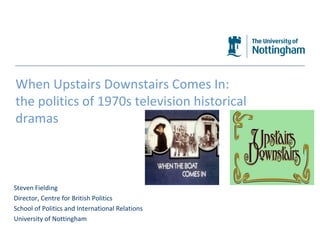
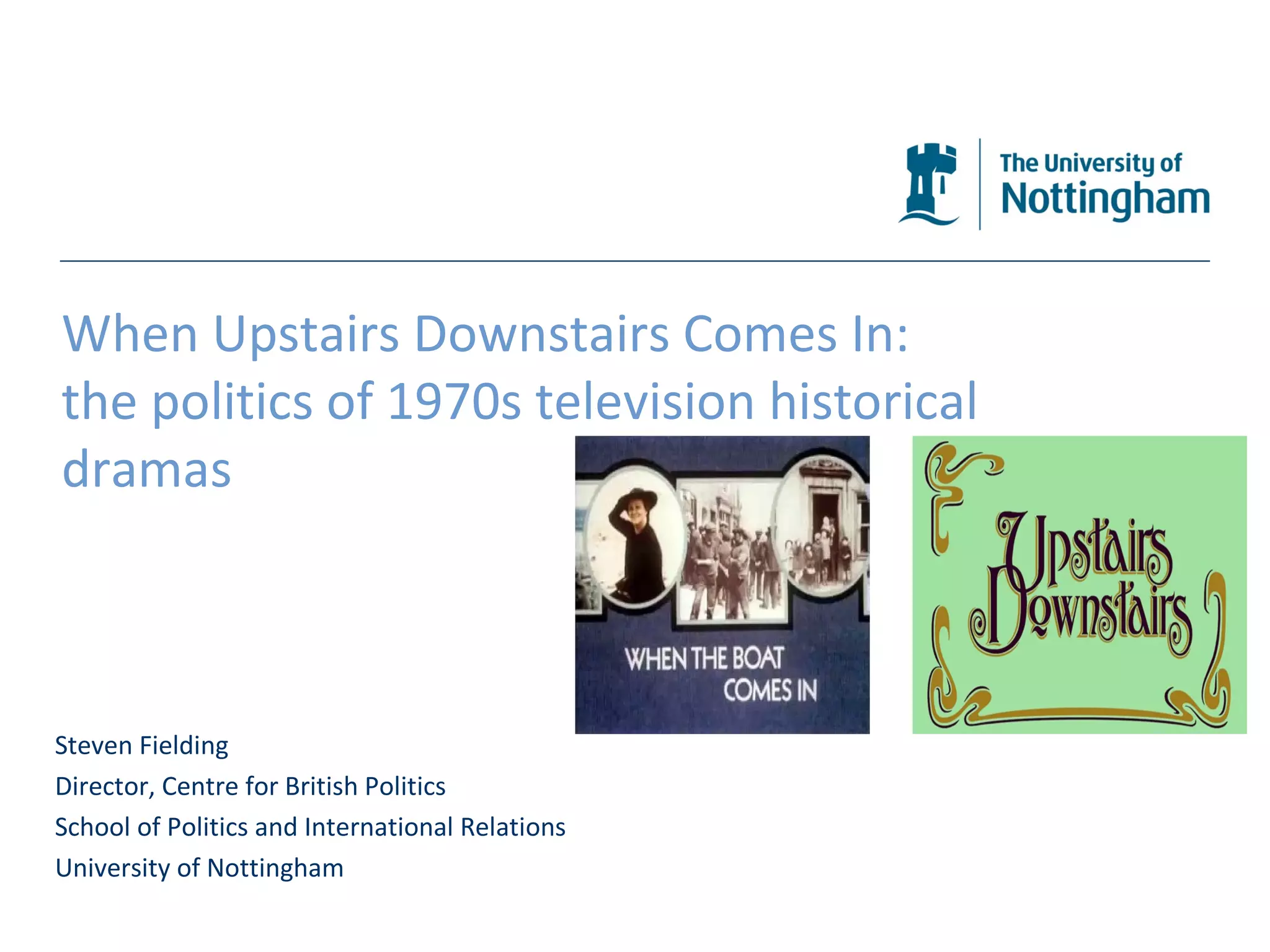
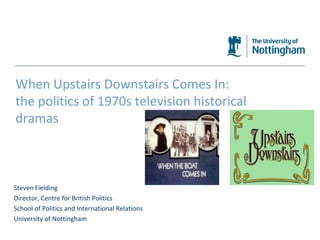
The University of Nottingham When Upstairs Downstairs Comes In:  the politics of 1970s television historical dramas Steven Fielding Director, Centre for British Politics School of Politics and International Relations University of Nottingham
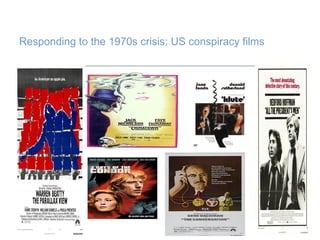
Responding to the 1970s crisis: US conspiracy films
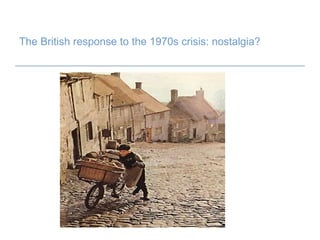
The British response to the 1970s crisis: nostalgia?
Historical dramas on television   T.C. Worsley : a ‘wave of period nostalgia which seems to have overtaken the medium’. Culturally significant & educate the public? Focus on personalities, the private sphere and family: depoliticised? Dennis Potter : ‘curator’s drama, covering old conflicts with an embalmer’s art and a mortician’s brisk formality. You can approach them with nostalgia rather than indignation, and the gentlest of surface grief instead of the volatile agitations of doubt and anger’. Escape from present day - the unions! NOT all like that -  Days of Hope  the exception that proves the rule? Variation in form and approach - not perfect reflections of past or present BUT on the basis of such dramas if the past was another country it was one in which the natives looked familiar, talked a similar language and shared many modern problems.
An incomplete list   A Family at War  (ITV, 1970-2)  The Onedin Line (BBC, 1971-80) Upstairs Downstairs  (ITV, 1971-5) The Edwardians  (BBC, 1972-3) The Regiment  (BBC, 1972-3)  Sam  (1973-5) The Pallisers  (BBC, 1974) Shoulder to Shoulder  (BBC, 1974) Walk with Destiny  (BBC, 1974) South Riding  (ITV 1974) Jennie, Lady Randolph Churchill  (ITV, 1974) Edward the Seventh  (ITV, 1975) How Green Was My Valley  (BBC, 1975) Looking for Clancy  (BBC, 1975) Days of Hope  (BBC, 1975) The Stars Look Down  (ITV, 1975) Clayhanger  (ITV, 1976) When the Boat Comes In  (BBC, 1976-8) The Cedar Tree  (ITV, 1976-9) Lillie (1978) Disraeli  (ITV, 1978) Churchill and the Generals  (BBC, 1979)
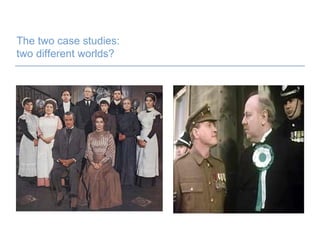
The two case studies:  two different worlds?
Upstairs Downstairs  and  When the Boat Comes In   USDS : 1971-5, 68 episodes covering 1903-30.  Upper class household but drama gives servants equal time.  If ‘Up the Working Class’, focus increasingly on romantic plots that marginalised servants.  WTBCI : 1976-8, 31 episodes covering 1919-24. North east working class - miners and shipbuilders - but focus embraces upper class by the end.  Similar trajectory and tackled common themes - place of women, homosexuality, class conflict, party politics.
Stability versus aspiration USDS - one family: household a refuge for the servants. Poverty to be escaped from. Transgressions but within limits: Thomas and Sarah have to go. America and the lessons of the Wall Street Crash. WTBCI - Jack Ford’s ambition defines the series. The Seaton family - a sociological miracle.  Poverty seen but not experienced - but TB. Ford leaves for America to continue his rise. Stability and aspiration in constant tension.  Jack’s fight with Matt - what does it mean? s
Industrial conflict WTBCI: first season dominated by a miners’ strike but it achieves nothing.  Sympathy for strike-breaking Tom. Matt to Sir Horatio: ‘We’ve both got a our jobs to do. Yours is to make a profit. Mine is to make sure none of my members are hurt in the process’.  The Reds always looking for disputes - but these will harm the workers.  The need for compromise is the message in USDS episode on General Strike. Household articulate various positions on the dispute. Richard Bellamy is the voice of ‘reason’: ‘You must have strong unions for the future good of the country’ but the Strike must be defeated once called.
Party politics Bellamy an honourable man - liberal Conservative with a conscience that often conflicts with party. But high politics a dubious world - influence can be bought, leading lights morally dubious, low motives of press.  James’ by-election campaign - used by Central Office, abused by opponents and ignored by voters.  But who are the ‘Bloody fools’? Jack Ford: ‘Vote? Me?!’ Local politics corrupt; deals to be done. The Reds: naïve, malign and/or weak - and Labour won’t change anything.  Ford’s manipulation of the people through words and iconography.
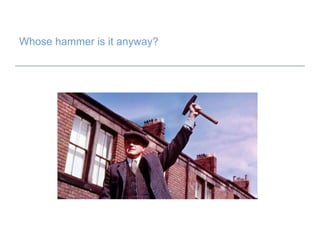
Whose hammer is it anyway?
So what? Very popular series but what was their impact? All texts polysemic and all audiences disaggregated. BUT the power of the screen to shape views.  A distorting mirror but a mirror nonetheless? Some critics sceptical of ‘authenticity’ claims but such claims were made by producers and often endorsed by critics writing for tabloids.  How to interpret Jack Ford: working class hero or proto-Thatcherite?  Can sympathise with fictional characters from past but still despise their counterparts in the present.
The University of Nottingham When Upstairs Downstairs Comes In:  the politics of 1970s television historical dramas Steven Fielding Director, Centre for British Politics School of Politics and International Relations University of Nottingham

1970s period drama

  • 1.
    The University ofNottingham When Upstairs Downstairs Comes In: the politics of 1970s television historical dramas Steven Fielding Director, Centre for British Politics School of Politics and International Relations University of Nottingham
  • 2.
    Responding to the1970s crisis: US conspiracy films
  • 3.
    The British responseto the 1970s crisis: nostalgia?
  • 4.
    Historical dramas ontelevision T.C. Worsley : a ‘wave of period nostalgia which seems to have overtaken the medium’. Culturally significant & educate the public? Focus on personalities, the private sphere and family: depoliticised? Dennis Potter : ‘curator’s drama, covering old conflicts with an embalmer’s art and a mortician’s brisk formality. You can approach them with nostalgia rather than indignation, and the gentlest of surface grief instead of the volatile agitations of doubt and anger’. Escape from present day - the unions! NOT all like that - Days of Hope the exception that proves the rule? Variation in form and approach - not perfect reflections of past or present BUT on the basis of such dramas if the past was another country it was one in which the natives looked familiar, talked a similar language and shared many modern problems.
  • 5.
    An incomplete list A Family at War (ITV, 1970-2) The Onedin Line (BBC, 1971-80) Upstairs Downstairs (ITV, 1971-5) The Edwardians (BBC, 1972-3) The Regiment (BBC, 1972-3) Sam (1973-5) The Pallisers (BBC, 1974) Shoulder to Shoulder (BBC, 1974) Walk with Destiny (BBC, 1974) South Riding (ITV 1974) Jennie, Lady Randolph Churchill (ITV, 1974) Edward the Seventh (ITV, 1975) How Green Was My Valley (BBC, 1975) Looking for Clancy (BBC, 1975) Days of Hope (BBC, 1975) The Stars Look Down (ITV, 1975) Clayhanger (ITV, 1976) When the Boat Comes In (BBC, 1976-8) The Cedar Tree (ITV, 1976-9) Lillie (1978) Disraeli (ITV, 1978) Churchill and the Generals (BBC, 1979)
  • 6.
    The two casestudies: two different worlds?
  • 7.
    Upstairs Downstairs and When the Boat Comes In USDS : 1971-5, 68 episodes covering 1903-30. Upper class household but drama gives servants equal time. If ‘Up the Working Class’, focus increasingly on romantic plots that marginalised servants. WTBCI : 1976-8, 31 episodes covering 1919-24. North east working class - miners and shipbuilders - but focus embraces upper class by the end. Similar trajectory and tackled common themes - place of women, homosexuality, class conflict, party politics.
  • 8.
    Stability versus aspirationUSDS - one family: household a refuge for the servants. Poverty to be escaped from. Transgressions but within limits: Thomas and Sarah have to go. America and the lessons of the Wall Street Crash. WTBCI - Jack Ford’s ambition defines the series. The Seaton family - a sociological miracle. Poverty seen but not experienced - but TB. Ford leaves for America to continue his rise. Stability and aspiration in constant tension. Jack’s fight with Matt - what does it mean? s
  • 9.
    Industrial conflict WTBCI:first season dominated by a miners’ strike but it achieves nothing. Sympathy for strike-breaking Tom. Matt to Sir Horatio: ‘We’ve both got a our jobs to do. Yours is to make a profit. Mine is to make sure none of my members are hurt in the process’. The Reds always looking for disputes - but these will harm the workers. The need for compromise is the message in USDS episode on General Strike. Household articulate various positions on the dispute. Richard Bellamy is the voice of ‘reason’: ‘You must have strong unions for the future good of the country’ but the Strike must be defeated once called.
  • 10.
    Party politics Bellamyan honourable man - liberal Conservative with a conscience that often conflicts with party. But high politics a dubious world - influence can be bought, leading lights morally dubious, low motives of press. James’ by-election campaign - used by Central Office, abused by opponents and ignored by voters. But who are the ‘Bloody fools’? Jack Ford: ‘Vote? Me?!’ Local politics corrupt; deals to be done. The Reds: naïve, malign and/or weak - and Labour won’t change anything. Ford’s manipulation of the people through words and iconography.
  • 11.
    Whose hammer isit anyway?
  • 12.
    So what? Verypopular series but what was their impact? All texts polysemic and all audiences disaggregated. BUT the power of the screen to shape views. A distorting mirror but a mirror nonetheless? Some critics sceptical of ‘authenticity’ claims but such claims were made by producers and often endorsed by critics writing for tabloids. How to interpret Jack Ford: working class hero or proto-Thatcherite? Can sympathise with fictional characters from past but still despise their counterparts in the present.
  • 13.
    The University ofNottingham When Upstairs Downstairs Comes In: the politics of 1970s television historical dramas Steven Fielding Director, Centre for British Politics School of Politics and International Relations University of Nottingham