Gamify learning   Learning and Teaching through having fun  CITERS 2011 @Hong Kong University  June 30 th  2011 Frankie Tam, FifthWisdom Technology Limited  Clara Hui, Hong Kong Digital Game-Based Learning Association
Gamify learning is  the implementation of gaming mechanics into learning and teaching experience to increase learner engagement, motivation and fun. It is a Digital Game-Based Learning solution in which learners acquire targeted subject knowledge as well as essential generic skills.  1. Learn through playing digital games 2. Learn through creating digital games
 
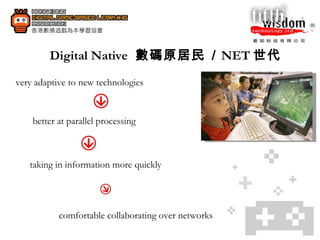
Digital Native   數碼原居民   /  NET 世代   better at parallel processing taking in information more quickly comfortable collaborating over networks very adaptive to new technologies
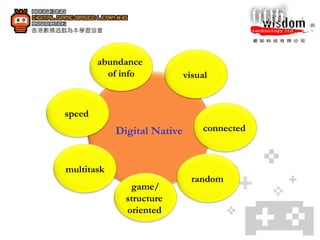
Digital Native abundance  of info visual   connected   random   speed   multitask game/ structure  oriented
Types of games educational + learning political + public policy health + wellness Business Military advertising
When you are playing…   player is the center of attention the game world is very responsive to your every single move  player is the expert everything is possible, you would be the best NBA player things are relatively simpler compares to the real world  trial and error is the best plan
What’s so attractive about digital games? it’s the learning that digital game provides kids like all humans, love to learn when it isn’t forced digital game provides learning opportunity every second
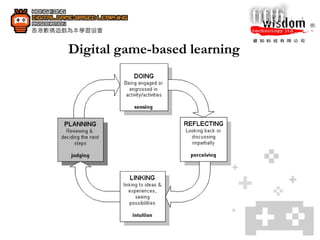
Digital game-based learning
What do they learn? on the surface, they learn how to do things, like driving a car, plane, etc. on the deeper levels, they take in information from many sources and make decisions quickly deduce game’s rules from playing rather than being told create strategies for overcoming obstacles understand complex systems through experimentation learn to collaborate with others
Why digital game-based learning? Digital games and technology can transform the traditional classroom into a constructivist classroom  which produced improved skills of question formulating, hypothesis generation and ability to intelligently address new problems” - Salomon 2002 Students are more willing to learn , Moulder (2004) recounts an elementary school student once raises: ‘ Why read about ancient Rome when I can build it?
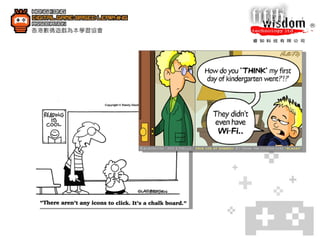
What students learn at school nowadays  lack of real-life context , student are not able to apply what they learnt at school in their everyday life and thus they are not interested in the school subjects Siexas , 2000 It has been increasingly difficult to capture the interest and attention of young people especially in a traditional classroom setting. The single feed of information and step by step logics just simply  can not satisfy the needs of the new generation .  Prensky, Windham, 2005
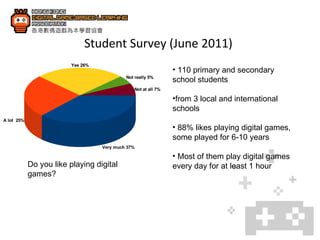
Student Survey (June 2011) Do you like playing digital games? 110 primary and secondary school students  from 3 local and international schools 88% likes playing digital games, some played for 6-10 years Most of them play digital games every day for at least 1 hour
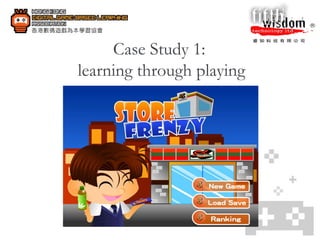
Case Study 1:  learning through playing
Students’ difficulties in learning ESL Students understand the importance of learning English. BUT they think… English lesson is boring Vocabularies are hard to learn  Can’t keep up with the teacher in the classroom
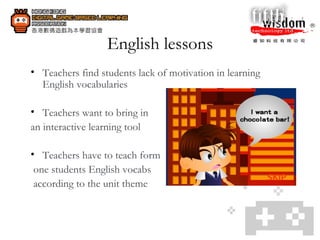
English lessons  Teachers find students lack of motivation in learning English vocabularies Teachers want to bring in  an interactive learning tool  Teachers have to teach form one students English vocabs according to the unit theme
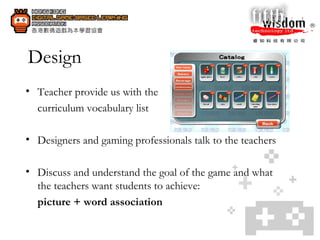
Design Teacher provide us with the  curriculum vocabulary list  Designers and gaming professionals talk to the teachers Discuss and understand the goal of the game and what the teachers want students to achieve: picture + word association
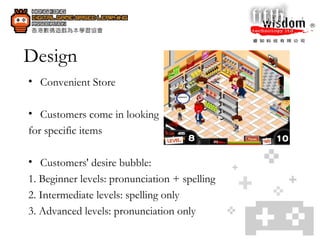
Design Convenient Store Customers come in looking  for specific items  Customers' desire bubble: 1. Beginner levels: pronunciation + spelling 2. Intermediate levels: spelling only 3. Advanced levels: pronunciation only
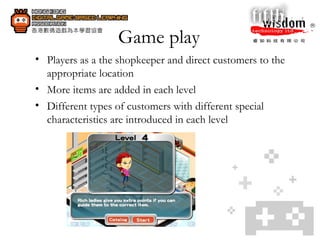
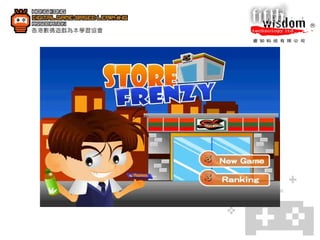
Game play Players as a the shopkeeper and direct customers to the appropriate location More items are added in each level Different types of customers with different special characteristics are introduced in each level
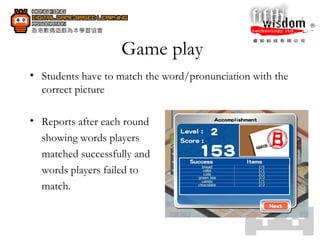
Game play Students have to match the word/pronunciation with the correct picture  Reports after each round  showing words players  matched successfully and  words players failed to  match.
 
Applying the game in the classroom 5  form 1 classes from a CMI school 104 students , 5 English teachers involved students are given netbook computers 15-20 mins game play in class teachers do recap and debriefing with the students each time  Approach 1:  learn the vocabularies only through the game (pre-test    game    post-test) Approach 2:  teaching before playing the game (pre-test    teaching   game    post-test)
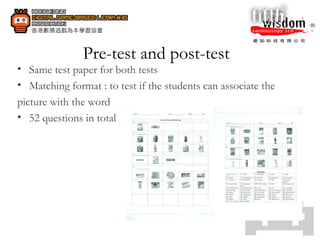
Pre-test and post-test  Same test paper for both tests Matching format : to test if the students can associate the  picture with the word 52 questions in total
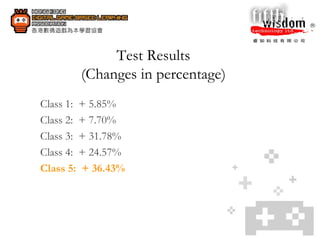
Test Results (Changes in percentage) Class 1:  + 5.85% Class 2:  + 7.70% Class 3:  + 31.78% Class 4:  + 24.57% Class 5:  + 36.43%
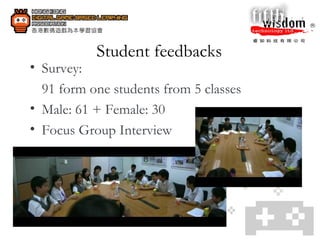
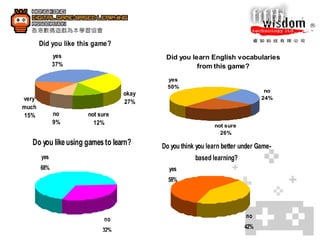
Student feedbacks  Survey:  91 form one students from 5 classes Male: 61 + Female: 30 Focus Group Interview
 
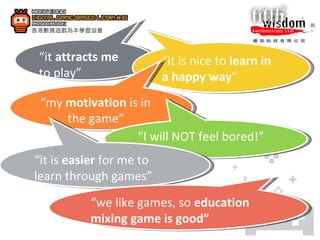
“ it  attracts me  to play” “ it is nice to  learn in a happy way ” “ my  motivation  is in the game” “ I will NOT feel bored!” “ it is  easier  for me to learn through games” “ we like games, so  education mixing game is good”
Teacher feedbacks Total: 10 teachers  Did the game give your students a better learning motivation?  Yes: 7/ No: 1/ Not sure 2 Do you think your  students are learning English vocabularies from the game?  Yes: 6/ No: 1/ Not sure 3 “ students were motivated and happy to find out more about the new learning element” “ students are highly motivated”  “ students were more concentrated” “games can a be very supportive teaching tool  to consolidate knowledge”
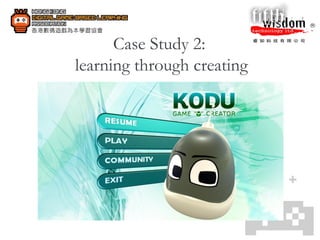
Case Study 2:  learning through creating
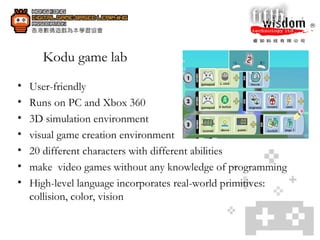
Kodu game lab User-friendly  Runs on PC and Xbox 360 3D simulation environment visual game creation environment 20 different characters with different abilities make  video games without any knowledge of programming High-level language incorporates real-world primitives: collision, color, vision
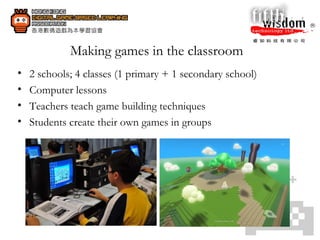
Making games in the classroom 2 schools; 4 classes (1 primary + 1 secondary school) Computer lessons  Teachers teach game building techniques  Students create their own games in groups
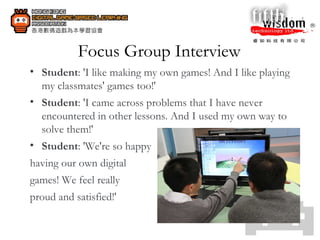
Focus Group Interview  Student : 'I like making my own games! And I like playing my classmates' games too!' Student : 'I came across problems that I have never encountered in other lessons. And I used my own way to solve them!' Student : 'We're so happy  having our own digital  games! We feel really  proud and satisfied!'
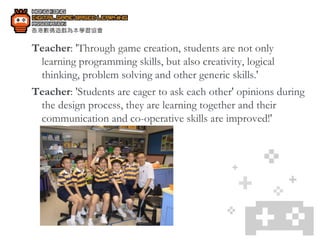
Teacher : 'Through game creation, students are not only learning programming skills, but also creativity, logical thinking, problem solving and other generic skills.' Teacher : 'Students are eager to ask each other' opinions during the design process, they are learning together and their communication and co-operative skills are improved!'
Conclusion  We seek for advices and improvements while looking for a possible future of digital game-based learning in the Hong Kong classrooms. Thank you! Question or comments? [email_address]   www. fifthwisdom.com  clara@digitalgameslearning.org  www.digitalgameslearning.org

18 digital game based learning - learning and teaching through having fun

  • 1.
    Gamify learning Learning and Teaching through having fun CITERS 2011 @Hong Kong University June 30 th 2011 Frankie Tam, FifthWisdom Technology Limited Clara Hui, Hong Kong Digital Game-Based Learning Association
  • 2.
    Gamify learning is the implementation of gaming mechanics into learning and teaching experience to increase learner engagement, motivation and fun. It is a Digital Game-Based Learning solution in which learners acquire targeted subject knowledge as well as essential generic skills. 1. Learn through playing digital games 2. Learn through creating digital games
  • 3.
  • 4.
    Digital Native 數碼原居民 / NET 世代 better at parallel processing taking in information more quickly comfortable collaborating over networks very adaptive to new technologies
  • 5.
    Digital Native abundance of info visual connected random speed multitask game/ structure oriented
  • 6.
    Types of gameseducational + learning political + public policy health + wellness Business Military advertising
  • 7.
    When you areplaying… player is the center of attention the game world is very responsive to your every single move player is the expert everything is possible, you would be the best NBA player things are relatively simpler compares to the real world trial and error is the best plan
  • 8.
    What’s so attractiveabout digital games? it’s the learning that digital game provides kids like all humans, love to learn when it isn’t forced digital game provides learning opportunity every second
  • 9.
  • 10.
    What do theylearn? on the surface, they learn how to do things, like driving a car, plane, etc. on the deeper levels, they take in information from many sources and make decisions quickly deduce game’s rules from playing rather than being told create strategies for overcoming obstacles understand complex systems through experimentation learn to collaborate with others
  • 11.
    Why digital game-basedlearning? Digital games and technology can transform the traditional classroom into a constructivist classroom which produced improved skills of question formulating, hypothesis generation and ability to intelligently address new problems” - Salomon 2002 Students are more willing to learn , Moulder (2004) recounts an elementary school student once raises: ‘ Why read about ancient Rome when I can build it?
  • 12.
    What students learnat school nowadays lack of real-life context , student are not able to apply what they learnt at school in their everyday life and thus they are not interested in the school subjects Siexas , 2000 It has been increasingly difficult to capture the interest and attention of young people especially in a traditional classroom setting. The single feed of information and step by step logics just simply can not satisfy the needs of the new generation . Prensky, Windham, 2005
  • 13.
    Student Survey (June2011) Do you like playing digital games? 110 primary and secondary school students from 3 local and international schools 88% likes playing digital games, some played for 6-10 years Most of them play digital games every day for at least 1 hour
  • 14.
    Case Study 1: learning through playing
  • 15.
    Students’ difficulties inlearning ESL Students understand the importance of learning English. BUT they think… English lesson is boring Vocabularies are hard to learn Can’t keep up with the teacher in the classroom
  • 16.
    English lessons  Teachersfind students lack of motivation in learning English vocabularies Teachers want to bring in an interactive learning tool Teachers have to teach form one students English vocabs according to the unit theme
  • 17.
    Design Teacher provideus with the curriculum vocabulary list Designers and gaming professionals talk to the teachers Discuss and understand the goal of the game and what the teachers want students to achieve: picture + word association
  • 18.
    Design Convenient StoreCustomers come in looking for specific items Customers' desire bubble: 1. Beginner levels: pronunciation + spelling 2. Intermediate levels: spelling only 3. Advanced levels: pronunciation only
  • 19.
    Game play Playersas a the shopkeeper and direct customers to the appropriate location More items are added in each level Different types of customers with different special characteristics are introduced in each level
  • 20.
    Game play Studentshave to match the word/pronunciation with the correct picture Reports after each round showing words players matched successfully and words players failed to match.
  • 21.
  • 22.
    Applying the gamein the classroom 5 form 1 classes from a CMI school 104 students , 5 English teachers involved students are given netbook computers 15-20 mins game play in class teachers do recap and debriefing with the students each time Approach 1: learn the vocabularies only through the game (pre-test  game  post-test) Approach 2: teaching before playing the game (pre-test  teaching  game  post-test)
  • 23.
    Pre-test and post-test Same test paper for both tests Matching format : to test if the students can associate the picture with the word 52 questions in total
  • 24.
    Test Results (Changesin percentage) Class 1: + 5.85% Class 2: + 7.70% Class 3: + 31.78% Class 4: + 24.57% Class 5: + 36.43%
  • 25.
    Student feedbacks Survey: 91 form one students from 5 classes Male: 61 + Female: 30 Focus Group Interview
  • 26.
  • 27.
    “ it attracts me to play” “ it is nice to learn in a happy way ” “ my motivation is in the game” “ I will NOT feel bored!” “ it is easier for me to learn through games” “ we like games, so education mixing game is good”
  • 28.
    Teacher feedbacks Total:10 teachers Did the game give your students a better learning motivation? Yes: 7/ No: 1/ Not sure 2 Do you think your students are learning English vocabularies from the game? Yes: 6/ No: 1/ Not sure 3 “ students were motivated and happy to find out more about the new learning element” “ students are highly motivated” “ students were more concentrated” “games can a be very supportive teaching tool to consolidate knowledge”
  • 29.
    Case Study 2: learning through creating
  • 30.
    Kodu game labUser-friendly Runs on PC and Xbox 360 3D simulation environment visual game creation environment 20 different characters with different abilities make video games without any knowledge of programming High-level language incorporates real-world primitives: collision, color, vision
  • 31.
    Making games inthe classroom 2 schools; 4 classes (1 primary + 1 secondary school) Computer lessons Teachers teach game building techniques Students create their own games in groups
  • 32.
    Focus Group Interview Student : 'I like making my own games! And I like playing my classmates' games too!' Student : 'I came across problems that I have never encountered in other lessons. And I used my own way to solve them!' Student : 'We're so happy having our own digital games! We feel really proud and satisfied!'
  • 33.
    Teacher : 'Throughgame creation, students are not only learning programming skills, but also creativity, logical thinking, problem solving and other generic skills.' Teacher : 'Students are eager to ask each other' opinions during the design process, they are learning together and their communication and co-operative skills are improved!'
  • 34.
    Conclusion Weseek for advices and improvements while looking for a possible future of digital game-based learning in the Hong Kong classrooms. Thank you! Question or comments? [email_address] www. fifthwisdom.com clara@digitalgameslearning.org www.digitalgameslearning.org