
WEBSITE DEVELOPMENT& INTRODUCTION TO ASP.net15th June 2010
What is a Website ?
Behind the scenesIn Static websiteIn Dynamic Website
ASP.netASP.NET is a technology for building powerful, dynamic Web applications and is part of the .NET Framework.ASP.NET is a unified Web development model that includes the services necessary for you to build enterprise-class Web applications with a minimum of coding.
Different Type of Projectsin VS 2010WebsitesWeb ApplicationsWeb ServicesAjax Server Controls
ASP.NET API ReferenceSystem.WebHttpRequest classHttpResponse classHttpServerUtility classcookie manipulationfile transferexception informationoutput cache control.
System.Web.ApplicationServicesProvides classes that provide access to ASP.NET forms authentication, roles, and profiles application services as Windows Communication Foundation (WCF) services.System.Runtime.CachingContains types that let you implement caching in .NET Framework applicationsSystem.Web.ConfigurationContains classes that are used to programmatically manage ASP.NET configuration.
System.Web.HandlersContains HTTP handler classes that process HTTP requests to a Web server. (An ASP.NET Web Forms page -- .aspx file -- is a special form of an HTTP handler.)System.Web.RoutingProvides classes that are used with URL routing, which enables you to use URLs that do not map to a physical file.System.Web.SecurityContains classes that are used to implement ASP.NET security in Web server applications.
Website which is CompiledASP.NET CompilerAll ASP.NET code is compiled, which enables strong typing, performance optimizations, and early binding, among other benefits. Once the code has been compiled, the common language runtime further compiles ASP.NET code to native code, providing improved performance.
HTMLOUTERMOST SHELL OF WEBSITE
ASP.net Application LifecycleUser requests an application resource from the Web server.ASP.NET receives the first request for the application,a class named ApplicationManager creates an application domain. ASP.NET core objects are created for each request.HttpContext, HttpRequest, and HttpResponse
An HttpApplication object is assigned to the request, if the application has a Global.asax file, ASP.NET instead creates an instance of the Global.asax class that is derived from the HttpApplicationclassThe request is processed by the HttpApplication pipeline.
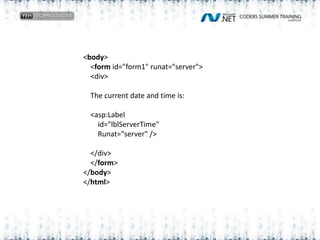
First ASP.net Application<%@ Page Language="C#" %><!DOCTYPE html PUBLIC "-//W3C//DTD XHTML 1.0 Transitional//EN""http://www.w3.org/TR/xhtml1/DTD/xhtml1-transitional.dtd"><script runat="server">    void Page_Load()    {        lblServerTime.Text = DateTime.Now.ToString();    }</script><html xmlns="http://www.w3.org/1999/xhtml" ><head>    <title>First Page</title></head>
<body>    <form id="form1" runat="server">    <div>    The current date and time is:    <asp:Label        id="lblServerTime"        Runat="server" />    </div>    </form></body></html>

15th june