Ecotourism
Responsible travel to natural areas which conserves the
environment and sustains the well being of local people.
Generally Ecotourism refers to two criteria:
environmentally responsible and
socially and culturally sound.
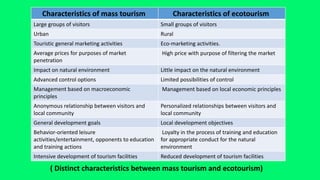
Characteristics of ecotourism
Characteristics of mass tourism
Small groups of visitors
Large groups of visitors
Rural
Urban
Eco-marketing activities.
Touristic general marketing activities
High price with purpose of filtering the market
Average prices for purposes of market
penetration
Little impact on the natural environment
Impact on natural environment
Limited possibilities of control
Advanced control options
Management based on local economic principles
Management based on macroeconomic
principles
Personalized relationships between visitors and
local community
Anonymous relationship between visitors and
local community
Local development objectives
General development goals
Loyalty in the process of training and education
for appropriate conduct for the natural
environment
Behavior-oriented leisure
activities/entertainment, opponents to education
and training actions
Reduced development of tourism facilities
Intensive development of tourism facilities
( Distinct characteristics between mass tourism and ecotourism)
Standards of ecotourism
1. Protection of the Ecosystem
a. Maintenance of the ecosystem where the ecotourism attraction is located.
b. Protection and maintenance of wildlife especially endangered species .
c. Wildlife live harmoniously with people.
2. Maintenance of the physico-chemical conditions of the area .
a. Maintenance of the quality of fresh water and marine resources .
b. No wastes overflow and contamination of the environment (water, soil and air).
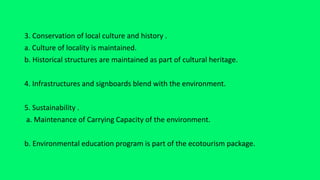
3. Conservation of local culture and history .
a. Culture of locality is maintained.
b. Historical structures are maintained as part of cultural heritage.
4. Infrastructures and signboards blend with the environment.
5. Sustainability .
a. Maintenance of Carrying Capacity of the environment.
b. Environmental education program is part of the ecotourism package.
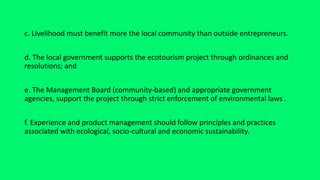
c. Livelihood must benefit more the local community than outside entrepreneurs.
d. The local government supports the ecotourism project through ordinances and
resolutions; and
e. The Management Board (community-based) and appropriate government
agencies, support the project through strict enforcement of environmental laws .
f. Experience and product management should follow principles and practices
associated with ecological, socio-cultural and economic sustainability.
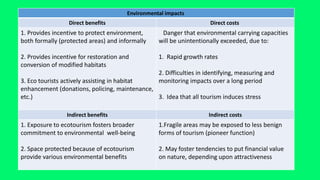
Environmental impacts
Direct costs
Direct benefits
Danger that environmental carrying capacities
will be unintentionally exceeded, due to:
1. Rapid growth rates
2. Difficulties in identifying, measuring and
monitoring impacts over a long period
3. Idea that all tourism induces stress
1. Provides incentive to protect environment,
both formally (protected areas) and informally
2. Provides incentive for restoration and
conversion of modified habitats
3. Eco tourists actively assisting in habitat
enhancement (donations, policing, maintenance,
etc.)
Indirect costs
Indirect benefits
1.Fragile areas may be exposed to less benign
forms of tourism (pioneer function)
2. May foster tendencies to put financial value
on nature, depending upon attractiveness
1. Exposure to ecotourism fosters broader
commitment to environmental well-being
2. Space protected because of ecotourism
provide various environmental benefits
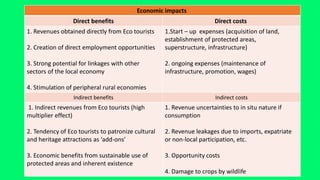
Economic impacts
Direct costs
Direct benefits
1.Start – up expenses (acquisition of land,
establishment of protected areas,
superstructure, infrastructure)
2. ongoing expenses (maintenance of
infrastructure, promotion, wages)
1. Revenues obtained directly from Eco tourists
2. Creation of direct employment opportunities
3. Strong potential for linkages with other
sectors of the local economy
4. Stimulation of peripheral rural economies
Indirect costs
Indirect benefits
1. Revenue uncertainties to in situ nature if
consumption
2. Revenue leakages due to imports, expatriate
or non-local participation, etc.
3. Opportunity costs
4. Damage to crops by wildlife
1. Indirect revenues from Eco tourists (high
multiplier effect)
2. Tendency of Eco tourists to patronize cultural
and heritage attractions as ‘add-ons’
3. Economic benefits from sustainable use of
protected areas and inherent existence
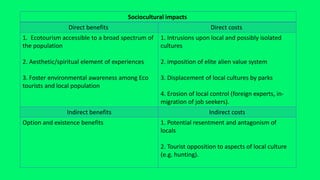
Sociocultural impacts
Direct costs
Direct benefits
1. Intrusions upon local and possibly isolated
cultures
2. imposition of elite alien value system
3. Displacement of local cultures by parks
4. Erosion of local control (foreign experts, in-
migration of job seekers).
1. Ecotourism accessible to a broad spectrum of
the population
2. Aesthetic/spiritual element of experiences
3. Foster environmental awareness among Eco
tourists and local population
Indirect costs
Indirect benefits
1. Potential resentment and antagonism of
locals
2. Tourist opposition to aspects of local culture
(e.g. hunting).
Option and existence benefits

14_2020_03_30!11_14_45_PM.pptx

  • 1.
    Ecotourism Responsible travel tonatural areas which conserves the environment and sustains the well being of local people. Generally Ecotourism refers to two criteria: environmentally responsible and socially and culturally sound.
  • 2.
    Characteristics of ecotourism Characteristicsof mass tourism Small groups of visitors Large groups of visitors Rural Urban Eco-marketing activities. Touristic general marketing activities High price with purpose of filtering the market Average prices for purposes of market penetration Little impact on the natural environment Impact on natural environment Limited possibilities of control Advanced control options Management based on local economic principles Management based on macroeconomic principles Personalized relationships between visitors and local community Anonymous relationship between visitors and local community Local development objectives General development goals Loyalty in the process of training and education for appropriate conduct for the natural environment Behavior-oriented leisure activities/entertainment, opponents to education and training actions Reduced development of tourism facilities Intensive development of tourism facilities ( Distinct characteristics between mass tourism and ecotourism)
  • 3.
    Standards of ecotourism 1.Protection of the Ecosystem a. Maintenance of the ecosystem where the ecotourism attraction is located. b. Protection and maintenance of wildlife especially endangered species . c. Wildlife live harmoniously with people. 2. Maintenance of the physico-chemical conditions of the area . a. Maintenance of the quality of fresh water and marine resources . b. No wastes overflow and contamination of the environment (water, soil and air).
  • 4.
    3. Conservation oflocal culture and history . a. Culture of locality is maintained. b. Historical structures are maintained as part of cultural heritage. 4. Infrastructures and signboards blend with the environment. 5. Sustainability . a. Maintenance of Carrying Capacity of the environment. b. Environmental education program is part of the ecotourism package.
  • 5.
    c. Livelihood mustbenefit more the local community than outside entrepreneurs. d. The local government supports the ecotourism project through ordinances and resolutions; and e. The Management Board (community-based) and appropriate government agencies, support the project through strict enforcement of environmental laws . f. Experience and product management should follow principles and practices associated with ecological, socio-cultural and economic sustainability.
  • 6.
    Environmental impacts Direct costs Directbenefits Danger that environmental carrying capacities will be unintentionally exceeded, due to: 1. Rapid growth rates 2. Difficulties in identifying, measuring and monitoring impacts over a long period 3. Idea that all tourism induces stress 1. Provides incentive to protect environment, both formally (protected areas) and informally 2. Provides incentive for restoration and conversion of modified habitats 3. Eco tourists actively assisting in habitat enhancement (donations, policing, maintenance, etc.) Indirect costs Indirect benefits 1.Fragile areas may be exposed to less benign forms of tourism (pioneer function) 2. May foster tendencies to put financial value on nature, depending upon attractiveness 1. Exposure to ecotourism fosters broader commitment to environmental well-being 2. Space protected because of ecotourism provide various environmental benefits
  • 7.
    Economic impacts Direct costs Directbenefits 1.Start – up expenses (acquisition of land, establishment of protected areas, superstructure, infrastructure) 2. ongoing expenses (maintenance of infrastructure, promotion, wages) 1. Revenues obtained directly from Eco tourists 2. Creation of direct employment opportunities 3. Strong potential for linkages with other sectors of the local economy 4. Stimulation of peripheral rural economies Indirect costs Indirect benefits 1. Revenue uncertainties to in situ nature if consumption 2. Revenue leakages due to imports, expatriate or non-local participation, etc. 3. Opportunity costs 4. Damage to crops by wildlife 1. Indirect revenues from Eco tourists (high multiplier effect) 2. Tendency of Eco tourists to patronize cultural and heritage attractions as ‘add-ons’ 3. Economic benefits from sustainable use of protected areas and inherent existence
  • 8.
    Sociocultural impacts Direct costs Directbenefits 1. Intrusions upon local and possibly isolated cultures 2. imposition of elite alien value system 3. Displacement of local cultures by parks 4. Erosion of local control (foreign experts, in- migration of job seekers). 1. Ecotourism accessible to a broad spectrum of the population 2. Aesthetic/spiritual element of experiences 3. Foster environmental awareness among Eco tourists and local population Indirect costs Indirect benefits 1. Potential resentment and antagonism of locals 2. Tourist opposition to aspects of local culture (e.g. hunting). Option and existence benefits