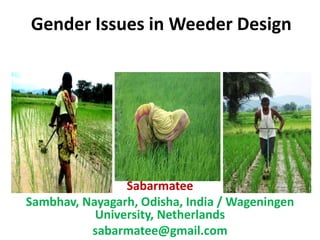

Gender Issues in Weeder Design
Sabarmatee
Sambhav, Nayagarh, Odisha, India / Wageningen
University, Netherlands
sabarmatee@gmail.com
2
Need Action?
Need frequent weeding + Soil aeration
(Weed and soil management contributing to
better plant growth and hence to yield)
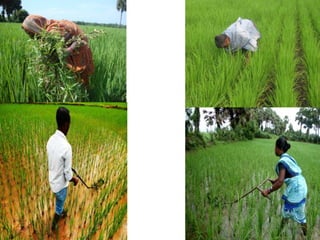
Conventional way of manual weeding at
frequent interval is a challenge
One of the options:
Mechanical weeding + Manual
Major concern
Techno-economic centered designs rarely
focus upon :
social issues (including gender) and
health concerns
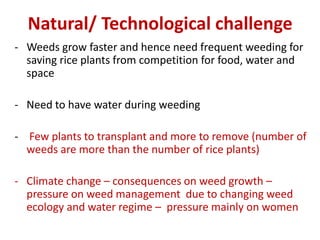
Natural/ Technological challenge
- Weeds grow faster and hence need frequent weeding for
saving rice plants from competition for food, water and
space
- Need to have water during weeding
- Few plants to transplant and more to remove (number of
weeds are more than the number of rice plants)
- Climate change – consequences on weed growth –
pressure on weed management due to changing weed
ecology and water regime – pressure mainly on women
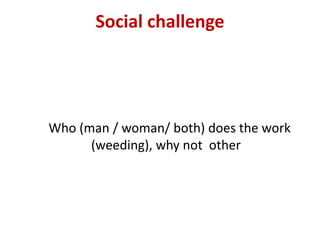
Social challenge
Who (man / woman/ both) does the work
(weeding), why not other
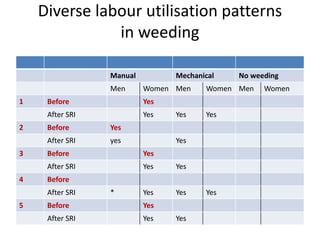
Diverse labour utilisation patterns
in weeding
Manual Mechanical No weeding
Men Women Men Women Men Women
1 Before Yes
After SRI Yes Yes Yes
2 Before Yes
After SRI yes Yes
3 Before Yes
After SRI Yes Yes
4 Before
After SRI * Yes Yes Yes
5 Before Yes
After SRI Yes Yes
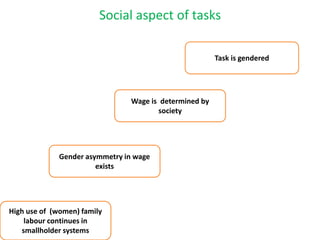
Social aspect of tasks
Gender asymmetry in wage
exists
Wage is determined by
society
Task is gendered
High use of (women) family
labour continues in
smallholder systems
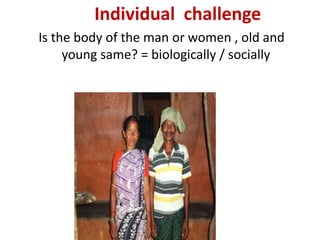
Individual challenge
Is the body of the man or women , old and
young same? = biologically / socially
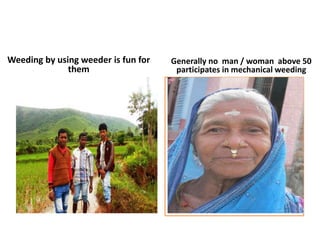
Weeding by using weeder is fun for
them
Generally no man / woman above 50
participates in mechanical weeding
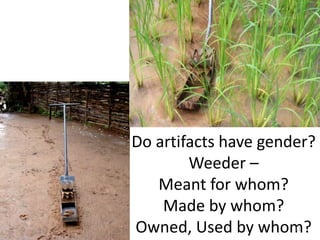
Do artifacts have gender?
Weeder –
Meant for whom?
Made by whom?
Owned, Used by whom?11
For centuries, not many changes took
place in the tools women use in rice
farming in the fields.
It is mostly limited to hand hoes, sickles
and hatchets.
Introduction of weeder in SRI brought a
major transformation in - nature of work,
posture (from bending to standing)
Gender of labourers – determinants
• Environmental dynamics
(weed growth and type, water regime, soil type)
• Household dynamics , social dynamics
(negotiation among household members, customary gender
role in weeding, household gender roles, institutional
membership, livelihood strategies)
• Extension dynamics
(provisioning of tool - availability, adequacy, accessibility,
ownership , management, clientele of training)
• Engineering dynamics
(design , ergonomics of weeders) 14
Phase 1
Weeders were given to use
Phase 2
Use
Understood
Acceptance / rejection / modification of
models - feedback on models – promoters
looking for new models - facing challenges
Phase 3?????
Are women involved? Do designers take
feedback of women at any stage?
If yes, great.
Understanding bodily experiences -
Parameters
- Gender roles – off farm, on-farm
- Food intake, disease, child bearing and caring
- Embodiment of postures - cultural
………………………………………………………………………………………
- Manual handling of materials
- Posture
- Work environment
- Distance covered per unit of time / speed
- Area of work
- Total hours of work
- Gender-wise work participation
- Type of tools and equipments 16
• Manual handling of materials differ and is less –
handling weeder, not grasses in mechanical weeding, no
change in manual weeding
• Work time per unit of land is less, speed is more
(16-25 hrs / ac), (30-50 mtrs x 18-20 cms/ minute) - in SRI
at one time
(Up to 150 hrs / ac), (1 sq mtr max / minute)- in conv.
• Work environment is better and time remaining in that
environment is less
• Some men participate in weeding
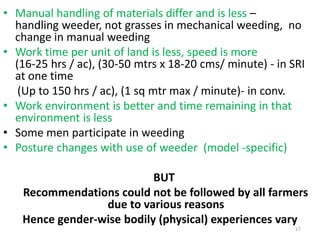
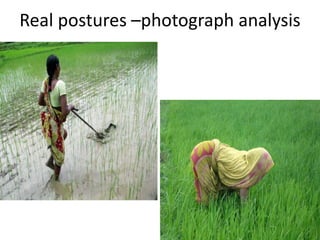
• Posture changes with use of weeder (model -specific)
BUT
Recommendations could not be followed by all farmers
due to various reasons
Hence gender-wise bodily (physical) experiences vary
17
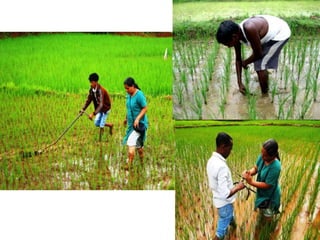
Real postures –photograph analysis
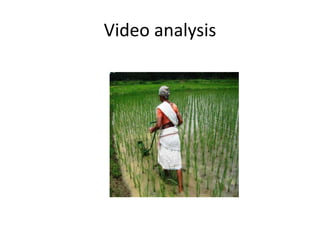
Video analysis
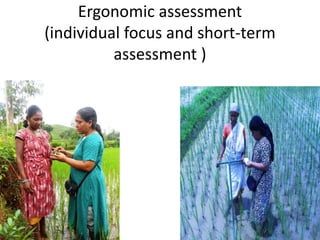
Ergonomic assessment
(individual focus and short-term
assessment )
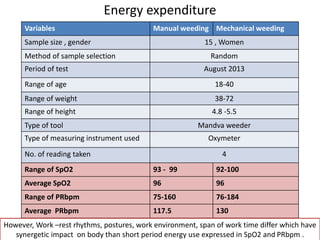
Energy expenditure
22
Variables Manual weeding Mechanical weeding
Sample size , gender 15 , Women
Method of sample selection Random
Period of test August 2013
Range of age 18-40
Range of weight 38-72
Range of height 4.8 -5.5
Type of tool Mandva weeder
Type of measuring instrument used Oxymeter
No. of reading taken 4
Range of SpO2 93 - 99 92-100
Average SpO2 96 96
Range of PRbpm 75-160 76-184
Average PRbpm 117.5 130
However, Work –rest rhythms, postures, work environment, span of work time differ which have
synergetic impact on body than short period energy use expressed in SpO2 and PRbpm .
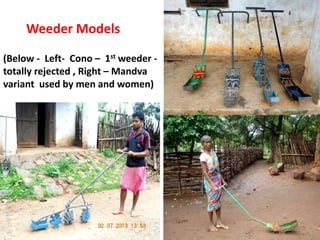
Weeder Models
(Below - Left- Cono – 1st weeder -
totally rejected , Right – Mandva
variant used by men and women)
23
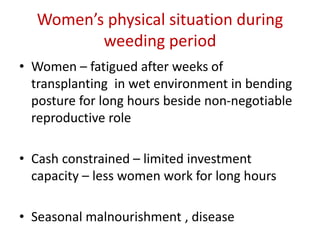
Women’s physical situation during
weeding period
• Women – fatigued after weeks of
transplanting in wet environment in bending
posture for long hours beside non-negotiable
reproductive role
• Cash constrained – limited investment
capacity – less women work for long hours
• Seasonal malnourishment , disease
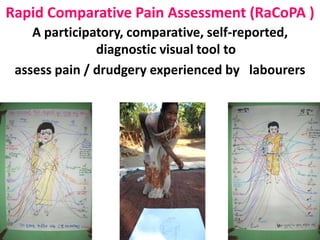
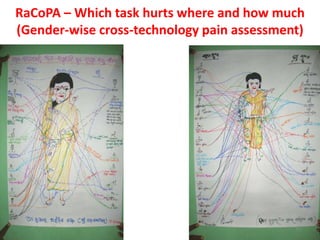
Rapid Comparative Pain Assessment (RaCoPA )
A participatory, comparative, self-reported,
diagnostic visual tool to
assess pain / drudgery experienced by labourers
In RaCoPA
• Focus Group Discussion method is used;
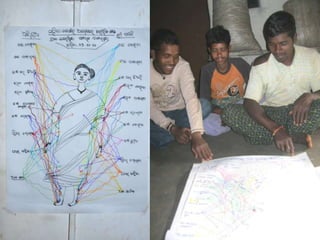
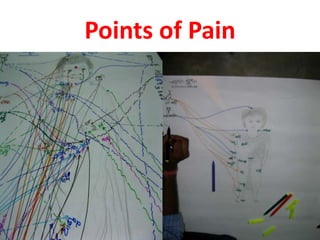
• Body map is used to point locations of pain
experienced as specific activities are
performed to make comparative assessment
of pain;
• All existing rice cultivation technologies /
practices of the selected village are taken into
account;
• Opinion of all the participants – technology
users count.
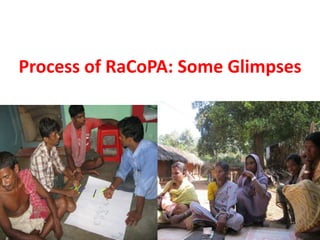
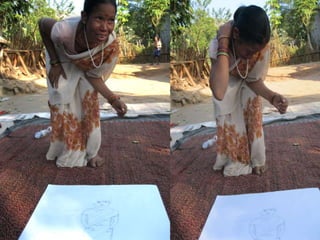
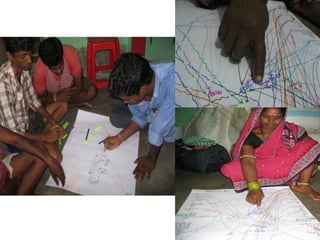
Process of RaCoPA: Some Glimpses
Postures Enacted
Pointing Pain
Points of Pain
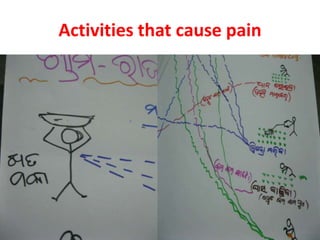
Activities that cause pain
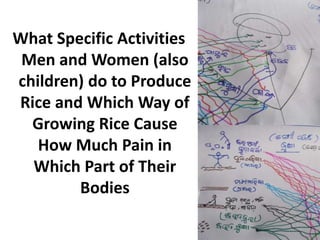
What Specific Activities
Men and Women (also
children) do to Produce
Rice and Which Way of
Growing Rice Cause
How Much Pain in
Which Part of Their
Bodies
RaCoPA – Which task hurts where and how much
(Gender-wise cross-technology pain assessment)
36
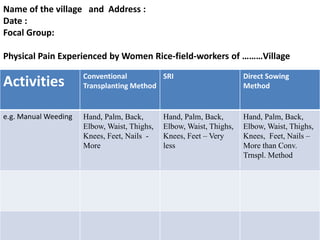
Name of the village and Address :
Date :
Focal Group:
Physical Pain Experienced by Women Rice-field-workers of ………Village
Activities Conventional
Transplanting Method
SRI Direct Sowing
Method
e.g. Manual Weeding Hand, Palm, Back,
Elbow, Waist, Thighs,
Knees, Feet, Nails -
More
Hand, Palm, Back,
Elbow, Waist, Thighs,
Knees, Feet – Very
less
Hand, Palm, Back,
Elbow, Waist, Thighs,
Knees, Feet, Nails –
More than Conv.
Trnspl. Method
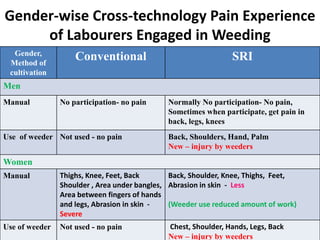
Gender-wise Cross-technology Pain Experience
of Labourers Engaged in Weeding
Gender,
Method of
cultivation
Conventional SRI
Men
Manual No participation- no pain Normally No participation- No pain,
Sometimes when participate, get pain in
back, legs, knees
Use of weeder Not used - no pain Back, Shoulders, Hand, Palm
New – injury by weeders
Women
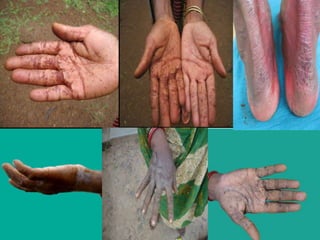
Manual Thighs, Knee, Feet, Back
Shoulder , Area under bangles,
Area between fingers of hands
and legs, Abrasion in skin -
Severe
Back, Shoulder, Knee, Thighs, Feet,
Abrasion in skin - Less
(Weeder use reduced amount of work)
Use of weeder Not used - no pain Chest, Shoulder, Hands, Legs, Back
New – injury by weeders
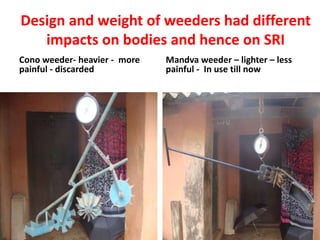
Design and weight of weeders had different
impacts on bodies and hence on SRI
Cono weeder- heavier - more
painful - discarded
Mandva weeder – lighter – less
painful - In use till now
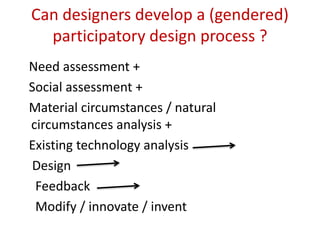
Can designers develop a (gendered)
participatory design process ?
Need assessment +
Social assessment +
Material circumstances / natural
circumstances analysis +
Existing technology analysis
Design
Feedback
Modify / innovate / invent
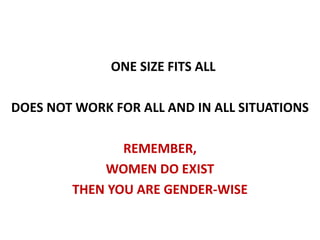
ONE SIZE FITS ALL
DOES NOT WORK FOR ALL AND IN ALL SITUATIONS
REMEMBER,
WOMEN DO EXIST
THEN YOU ARE GENDER-WISE

1415 - Gender Issues in Weeder Design

  • 1.
    Gender Issues inWeeder Design Sabarmatee Sambhav, Nayagarh, Odisha, India / Wageningen University, Netherlands sabarmatee@gmail.com
  • 2.
  • 3.
    Need Action? Need frequentweeding + Soil aeration (Weed and soil management contributing to better plant growth and hence to yield) Conventional way of manual weeding at frequent interval is a challenge One of the options: Mechanical weeding + Manual
  • 4.
    Major concern Techno-economic centereddesigns rarely focus upon : social issues (including gender) and health concerns
  • 5.
    Natural/ Technological challenge -Weeds grow faster and hence need frequent weeding for saving rice plants from competition for food, water and space - Need to have water during weeding - Few plants to transplant and more to remove (number of weeds are more than the number of rice plants) - Climate change – consequences on weed growth – pressure on weed management due to changing weed ecology and water regime – pressure mainly on women
  • 6.
    Social challenge Who (man/ woman/ both) does the work (weeding), why not other
  • 7.
    Diverse labour utilisationpatterns in weeding Manual Mechanical No weeding Men Women Men Women Men Women 1 Before Yes After SRI Yes Yes Yes 2 Before Yes After SRI yes Yes 3 Before Yes After SRI Yes Yes 4 Before After SRI * Yes Yes Yes 5 Before Yes After SRI Yes Yes
  • 8.
    Social aspect oftasks Gender asymmetry in wage exists Wage is determined by society Task is gendered High use of (women) family labour continues in smallholder systems
  • 9.
    Individual challenge Is thebody of the man or women , old and young same? = biologically / socially
  • 10.
    Weeding by usingweeder is fun for them Generally no man / woman above 50 participates in mechanical weeding
  • 11.
    Do artifacts havegender? Weeder – Meant for whom? Made by whom? Owned, Used by whom?11
  • 13.
    For centuries, notmany changes took place in the tools women use in rice farming in the fields. It is mostly limited to hand hoes, sickles and hatchets. Introduction of weeder in SRI brought a major transformation in - nature of work, posture (from bending to standing)
  • 14.
    Gender of labourers– determinants • Environmental dynamics (weed growth and type, water regime, soil type) • Household dynamics , social dynamics (negotiation among household members, customary gender role in weeding, household gender roles, institutional membership, livelihood strategies) • Extension dynamics (provisioning of tool - availability, adequacy, accessibility, ownership , management, clientele of training) • Engineering dynamics (design , ergonomics of weeders) 14
  • 15.
    Phase 1 Weeders weregiven to use Phase 2 Use Understood Acceptance / rejection / modification of models - feedback on models – promoters looking for new models - facing challenges Phase 3????? Are women involved? Do designers take feedback of women at any stage? If yes, great.
  • 16.
    Understanding bodily experiences- Parameters - Gender roles – off farm, on-farm - Food intake, disease, child bearing and caring - Embodiment of postures - cultural ……………………………………………………………………………………… - Manual handling of materials - Posture - Work environment - Distance covered per unit of time / speed - Area of work - Total hours of work - Gender-wise work participation - Type of tools and equipments 16
  • 17.
    • Manual handlingof materials differ and is less – handling weeder, not grasses in mechanical weeding, no change in manual weeding • Work time per unit of land is less, speed is more (16-25 hrs / ac), (30-50 mtrs x 18-20 cms/ minute) - in SRI at one time (Up to 150 hrs / ac), (1 sq mtr max / minute)- in conv. • Work environment is better and time remaining in that environment is less • Some men participate in weeding • Posture changes with use of weeder (model -specific) BUT Recommendations could not be followed by all farmers due to various reasons Hence gender-wise bodily (physical) experiences vary 17
  • 18.
  • 19.
  • 20.
    Ergonomic assessment (individual focusand short-term assessment )
  • 22.
    Energy expenditure 22 Variables Manualweeding Mechanical weeding Sample size , gender 15 , Women Method of sample selection Random Period of test August 2013 Range of age 18-40 Range of weight 38-72 Range of height 4.8 -5.5 Type of tool Mandva weeder Type of measuring instrument used Oxymeter No. of reading taken 4 Range of SpO2 93 - 99 92-100 Average SpO2 96 96 Range of PRbpm 75-160 76-184 Average PRbpm 117.5 130 However, Work –rest rhythms, postures, work environment, span of work time differ which have synergetic impact on body than short period energy use expressed in SpO2 and PRbpm .
  • 23.
    Weeder Models (Below -Left- Cono – 1st weeder - totally rejected , Right – Mandva variant used by men and women) 23
  • 24.
    Women’s physical situationduring weeding period • Women – fatigued after weeks of transplanting in wet environment in bending posture for long hours beside non-negotiable reproductive role • Cash constrained – limited investment capacity – less women work for long hours • Seasonal malnourishment , disease
  • 26.
    Rapid Comparative PainAssessment (RaCoPA ) A participatory, comparative, self-reported, diagnostic visual tool to assess pain / drudgery experienced by labourers
  • 27.
    In RaCoPA • FocusGroup Discussion method is used; • Body map is used to point locations of pain experienced as specific activities are performed to make comparative assessment of pain; • All existing rice cultivation technologies / practices of the selected village are taken into account; • Opinion of all the participants – technology users count.
  • 28.
    Process of RaCoPA:Some Glimpses
  • 29.
  • 31.
  • 33.
  • 34.
  • 35.
    What Specific Activities Menand Women (also children) do to Produce Rice and Which Way of Growing Rice Cause How Much Pain in Which Part of Their Bodies
  • 36.
    RaCoPA – Whichtask hurts where and how much (Gender-wise cross-technology pain assessment) 36
  • 37.
    Name of thevillage and Address : Date : Focal Group: Physical Pain Experienced by Women Rice-field-workers of ………Village Activities Conventional Transplanting Method SRI Direct Sowing Method e.g. Manual Weeding Hand, Palm, Back, Elbow, Waist, Thighs, Knees, Feet, Nails - More Hand, Palm, Back, Elbow, Waist, Thighs, Knees, Feet – Very less Hand, Palm, Back, Elbow, Waist, Thighs, Knees, Feet, Nails – More than Conv. Trnspl. Method
  • 38.
    Gender-wise Cross-technology PainExperience of Labourers Engaged in Weeding Gender, Method of cultivation Conventional SRI Men Manual No participation- no pain Normally No participation- No pain, Sometimes when participate, get pain in back, legs, knees Use of weeder Not used - no pain Back, Shoulders, Hand, Palm New – injury by weeders Women Manual Thighs, Knee, Feet, Back Shoulder , Area under bangles, Area between fingers of hands and legs, Abrasion in skin - Severe Back, Shoulder, Knee, Thighs, Feet, Abrasion in skin - Less (Weeder use reduced amount of work) Use of weeder Not used - no pain Chest, Shoulder, Hands, Legs, Back New – injury by weeders
  • 39.
    Design and weightof weeders had different impacts on bodies and hence on SRI Cono weeder- heavier - more painful - discarded Mandva weeder – lighter – less painful - In use till now
  • 40.
    Can designers developa (gendered) participatory design process ? Need assessment + Social assessment + Material circumstances / natural circumstances analysis + Existing technology analysis Design Feedback Modify / innovate / invent
  • 41.
    ONE SIZE FITSALL DOES NOT WORK FOR ALL AND IN ALL SITUATIONS REMEMBER, WOMEN DO EXIST THEN YOU ARE GENDER-WISE

Editor's Notes

  • #3 The challenge begins here
  • #12 Show video clipping
  • #33 Don’t ask men to talk about women’s problem and vice versa