Fine- Needle
Aspiration
Cytology(FNAC)
Dilum Weliwita
B.Sc. Nursing (U.K)
FNAC - definition
 Aspiration of cells/ tissue fragments using
fine needles (21, 22 , 23, 25 Gauge) ;
external diameter 0.6 to 1.0 mm
 1.5 inches long needle ( radiologists use
longer needles)
 Diagnostic materials in the needle and
not in the syringe even in cystic lesions
Clinical skill required
 Familiarity with general anatomy eg
thyroid vs other neck swelling
 Ability to take a focused clinical
history
 Sharp skill in performing physical
examination eg solid vs cystic,
benign vs maligant lesions
Clinical skill required -2
 Good knowledge in normal cellular
elements from various organs and
tissue and how they appear on
smears eg fats cells vs breast
tumour cells
 Comprehensive knowledge of
surgical pathology
Clinical skill required -3
 Ability to translate traditional tissue
patterns of lesions to their
appearance in smears
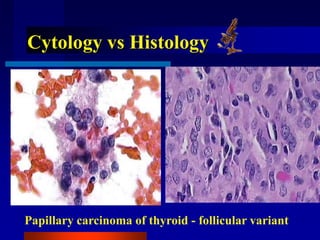
Cytology vs Histology
Papillary carcinoma of thyroid - follicular variant
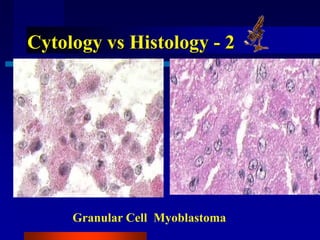
Cytology vs Histology - 2
Granular Cell Myoblastoma
Who should do FNA?
 Clinicians
 Cytotechnologists
 Radiologists
 Pathologists
The one who examines the patients , does the aspiration,
makes the smears, interprets the cytology
is the best one to do FNA -
PATHOLOGIST
Cont:
 Ideal is specialist physician to
conduct the procedure
 Eg: transthorasic biopsy –by
radiologist with guidance of USS or
CT guided,
 Brain biopsy by neurosurgeon
 Transbronchial biopsy by
pulmonologist in the bronchoscopy
suite
Current status
 Palpable lesions
 Outpatients , in- patients
 Thyroid , breast, lymph nodes,
salivary glands , soft tissue lumps...
 Lung, intra-abdominal and
retroperitoneal by radiologic imaging
: CT, ultrasound, flouroscopy
,endoscopy
LIMITATIONS
 Soft vs hard ( bone) lesions
 Solid vs cystic lesions
 Poor cellular yield vs poor technique
 Reactive vs specific diseases eg
reactive lymphadenitis vs Hodgkins
disease
 Diffuse vs nodular lymphoma
Complications
 Needle trauma
– granulation tissue
formation
– granuloma
formation
– Needle linear tract
haemorrhage
– tissue necrosis
 Needle track
seeding - testicular
tm,
 Hematoma
 Pain
 Pneumothorax???
Complications: (Minor)
 Vasovagal reaction
 Small hematona
 Pain persisting for a few hours –ice
pack, analgesia can be given
Complications (Major)
 Rare
 Infection
 Bleeding
 No studies show, any adverse effects
of FNAC yet
ADVANTAGES
 Fast - early diagnosis
 Less pain, less trauma, minimal
discomfort to patient
 No anaesthesia
 Acceptable by patients and doctors
 Accurate, early diagnosis
 Low risk of morbidity and mortality
 Low cost
Cont:
 False- negative rate of FNAC is 3%-
5% due to sampling problems rather
than interpretative error
 It can lead to specific diagnosis in
more than 90%
How to interpret?
 Aspiration materials eg colloid,
blood, mucus?
 Cellular yield vs acellular yield
 Smear pattern - 3 dimensional balls
vs flat monolayered sheet os cells
 Cohesiveness vs discreet cells
 Cell morphometry
The nurse’s role
 Involved in care through the entire
process, first contact until discharge
 Patient education
 Explain the procedure, answer the
questions
 Screening for coagulation such as
PT, aPTT and conduct , Review prior
to procedure
 History, current medication eg:
warfarin , asprin
Nurse’s role cont:
 Along with the physician informed
consent and sign forms.
 Complete nurse’s documents
 When starts, responsible for
monitoring the patient. Either
administers the drug accordingly
 Vital signs
Nurse’s role cont:
 Provide emotional support as needed
 Direct the specimen and request
necessary test which advised by the
doctor.
 Once completed, dresses puncture
site with adhesive dressing
 Continues to assess the site for
bleeding or swelling
 if major organ or sedation involves
pt need to recover least 30 min
Nurse’s role cont:
 Checking the patient’s vital sign till
discharge
 Provide the discharge instructions
and answer any questions
Future directions
 Aspirating non palpable lesions
using MRI
 Molecular pathology eg In Situ
Hybridization
 Replacing diagnostic surgical
pathology?
 Combined with MRI - replacing
autopsy?
Future Direction
 Genomics and proteomics in DNA
and protein typing
 Polymerase chain reaction
 Thus practice of FNAC continues to
evolve, with investigation and
innovation focused on several areas
SUMMERY
 FNAC is simple, accurate, fast
economical procedure that
frequently offers a viable alternative
diagnostic modality to surgery
 Presence of nurse during procedure
ensure patient’s comfort and safety
and positive experience for the
patient and other health care
professionals involved
Questions????????????????????
THANK YOU

14054779.ppt

  • 1.
  • 2.
    FNAC - definition Aspiration of cells/ tissue fragments using fine needles (21, 22 , 23, 25 Gauge) ; external diameter 0.6 to 1.0 mm  1.5 inches long needle ( radiologists use longer needles)  Diagnostic materials in the needle and not in the syringe even in cystic lesions
  • 3.
    Clinical skill required Familiarity with general anatomy eg thyroid vs other neck swelling  Ability to take a focused clinical history  Sharp skill in performing physical examination eg solid vs cystic, benign vs maligant lesions
  • 4.
    Clinical skill required-2  Good knowledge in normal cellular elements from various organs and tissue and how they appear on smears eg fats cells vs breast tumour cells  Comprehensive knowledge of surgical pathology
  • 5.
    Clinical skill required-3  Ability to translate traditional tissue patterns of lesions to their appearance in smears
  • 6.
    Cytology vs Histology Papillarycarcinoma of thyroid - follicular variant
  • 7.
    Cytology vs Histology- 2 Granular Cell Myoblastoma
  • 8.
    Who should doFNA?  Clinicians  Cytotechnologists  Radiologists  Pathologists The one who examines the patients , does the aspiration, makes the smears, interprets the cytology is the best one to do FNA - PATHOLOGIST
  • 9.
    Cont:  Ideal isspecialist physician to conduct the procedure  Eg: transthorasic biopsy –by radiologist with guidance of USS or CT guided,  Brain biopsy by neurosurgeon  Transbronchial biopsy by pulmonologist in the bronchoscopy suite
  • 10.
    Current status  Palpablelesions  Outpatients , in- patients  Thyroid , breast, lymph nodes, salivary glands , soft tissue lumps...  Lung, intra-abdominal and retroperitoneal by radiologic imaging : CT, ultrasound, flouroscopy ,endoscopy
  • 11.
    LIMITATIONS  Soft vshard ( bone) lesions  Solid vs cystic lesions  Poor cellular yield vs poor technique  Reactive vs specific diseases eg reactive lymphadenitis vs Hodgkins disease  Diffuse vs nodular lymphoma
  • 12.
    Complications  Needle trauma –granulation tissue formation – granuloma formation – Needle linear tract haemorrhage – tissue necrosis  Needle track seeding - testicular tm,  Hematoma  Pain  Pneumothorax???
  • 13.
    Complications: (Minor)  Vasovagalreaction  Small hematona  Pain persisting for a few hours –ice pack, analgesia can be given
  • 14.
    Complications (Major)  Rare Infection  Bleeding  No studies show, any adverse effects of FNAC yet
  • 15.
    ADVANTAGES  Fast -early diagnosis  Less pain, less trauma, minimal discomfort to patient  No anaesthesia  Acceptable by patients and doctors  Accurate, early diagnosis  Low risk of morbidity and mortality  Low cost
  • 16.
    Cont:  False- negativerate of FNAC is 3%- 5% due to sampling problems rather than interpretative error  It can lead to specific diagnosis in more than 90%
  • 17.
    How to interpret? Aspiration materials eg colloid, blood, mucus?  Cellular yield vs acellular yield  Smear pattern - 3 dimensional balls vs flat monolayered sheet os cells  Cohesiveness vs discreet cells  Cell morphometry
  • 18.
    The nurse’s role Involved in care through the entire process, first contact until discharge  Patient education  Explain the procedure, answer the questions  Screening for coagulation such as PT, aPTT and conduct , Review prior to procedure  History, current medication eg: warfarin , asprin
  • 19.
    Nurse’s role cont: Along with the physician informed consent and sign forms.  Complete nurse’s documents  When starts, responsible for monitoring the patient. Either administers the drug accordingly  Vital signs
  • 20.
    Nurse’s role cont: Provide emotional support as needed  Direct the specimen and request necessary test which advised by the doctor.  Once completed, dresses puncture site with adhesive dressing  Continues to assess the site for bleeding or swelling  if major organ or sedation involves pt need to recover least 30 min
  • 21.
    Nurse’s role cont: Checking the patient’s vital sign till discharge  Provide the discharge instructions and answer any questions
  • 22.
    Future directions  Aspiratingnon palpable lesions using MRI  Molecular pathology eg In Situ Hybridization  Replacing diagnostic surgical pathology?  Combined with MRI - replacing autopsy?
  • 23.
    Future Direction  Genomicsand proteomics in DNA and protein typing  Polymerase chain reaction  Thus practice of FNAC continues to evolve, with investigation and innovation focused on several areas
  • 24.
    SUMMERY  FNAC issimple, accurate, fast economical procedure that frequently offers a viable alternative diagnostic modality to surgery  Presence of nurse during procedure ensure patient’s comfort and safety and positive experience for the patient and other health care professionals involved
  • 25.
  • 26.