13 themes for
2013…
(what’s keeping retailers awake at night)
#1
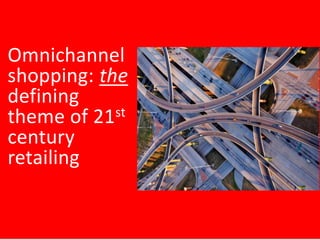
Omnichannel
changes everything
Omnichannel
shopping: the
defining
st
theme of 21
century
retailing
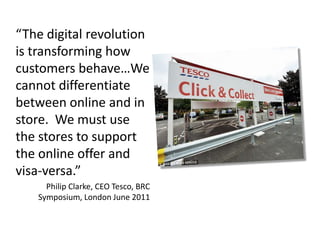
“The digital revolution
is transforming how
customers behave…We
cannot differentiate
between online and in
store. We must use
the stores to support
the online offer and
visa-versa.”
Philip Clarke, CEO Tesco, BRC
Symposium, London June 2011
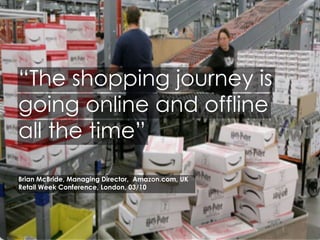
“The shopping journey is
going online and offline
all the time”
Brian McBride, Managing Director, Amazon.com, UK
Retail Week Conference, London, 03/10

5
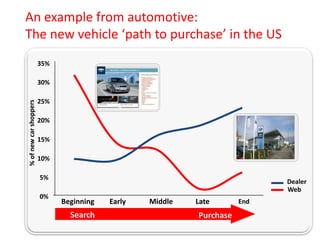
An example from automotive:
The new vehicle ‘path to purchase’ in the US
35%
30%
25%

20%
15%
10%
5%
0%

Dealer
Web

Beginning

Search

Early

Middle

Late

Purchase

End
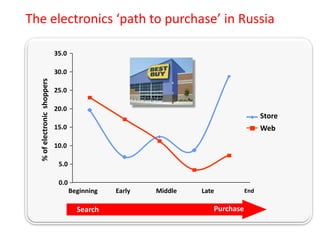
The electronics ‘path to purchase’ in Russia
35.0

% of electronic shoppers

30.0
25.0
20.0

Store

15.0

Web

10.0
5.0
0.0
Beginning

Search

Early

Middle

Late

Purchase

End
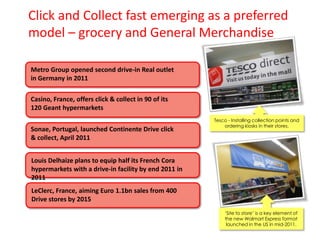
Click and Collect fast emerging as a preferred
model – grocery and General Merchandise
Metro Group opened second drive-in Real outlet
in Germany in 2011
Casino, France, offers click & collect in 90 of its
120 Geant hypermarkets
Sonae, Portugal, launched Continente Drive click
& collect, April 2011

Tesco - Installing collection points and
ordering kiosks in their stores.

Louis Delhaize plans to equip half its French Cora
hypermarkets with a drive-in facility by end 2011 in
2011
LeClerc, France, aiming Euro 1.1bn sales from 400
Drive stores by 2015
„Site to store‟ is a key element of
the new Walmart Express format
launched in the US in mid-2011.
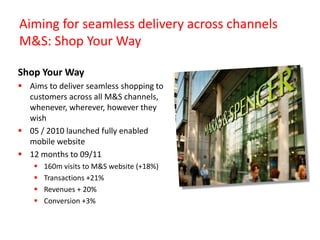
Aiming for seamless delivery across channels
M&S: Shop Your Way
Shop Your Way
 Aims to deliver seamless shopping to
customers across all M&S channels,
whenever, wherever, however they
wish
 05 / 2010 launched fully enabled
mobile website
 12 months to 09/11





160m visits to M&S website (+18%)
Transactions +21%
Revenues + 20%
Conversion +3%
New school convenience - technology enabled
to make online and in-store seamless

Product
email

In-store
support

web
offer
In-store
sale

Recycle
email
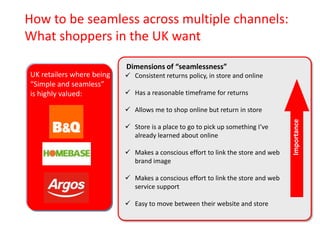
How to be seamless across multiple channels:
What shoppers in the UK want
 Consistent returns policy, in store and online
 Has a reasonable timeframe for returns
 Allows me to shop online but return in store
 Store is a place to go to pick up something I’ve
already learned about online
 Makes a conscious effort to link the store and web
brand image
 Makes a conscious effort to link the store and web
service support
 Easy to move between their website and store

Importance

UK retailers where being
“Simple and seamless”
is highly valued:

Dimensions of “seamlessness”
#2
Stores need
reinventing to stay
relevant
Eataly, NYC

Re-imagining the store:
Dial up product
engagement
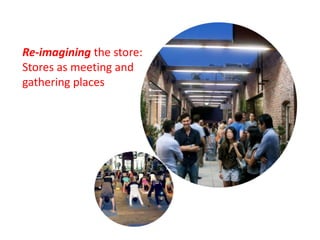
Re-imagining the store:
Stores as meeting and
gathering places
Re-imagining the store:
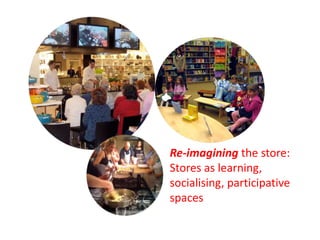
Stores as learning,
socialising, participative
spaces
Fewer, better stores in specialty –
Treat every store as a flagship

Top Shop, NYC
But some store formats are under pressure
to survive: Hypermarkets – in long term decline in Europe

Source: Images from Planet Retail
#3
The rise and rise of
non-store retailing
amazon and the power of online
Mission
To be the place where people can find, discover & buy
anything online

Global Banner Sales (USD bn)

140

Amazon: Global Banner Sales, 2005-2015f (USD bn)

120

USD126.9 bn

100

World’s 6th
largest retailer
World’s 31st
largest retailer

80

60

World’s 99th
largest retailer

USD37.7 bn

40
USD9.2 bn

20
0
2005 2006 2007 2008 2009 2010 2011 2012 2013 2014 2015
Note: f - forecast
Source: Planet Retail

Amazon trialling
collection lockers in
shopping centres, office
buildings in UK and in 7Eleven in US
No store walls = no stock limits
Amazon’s assortment by marketplace
Marketplace

ASIN (SKU) count

Amazon.com

127,811,266

Amazon.co.uk

101,680,706

Amazon.de

91,933,337

Amazon.fr

75,252,368

Amazon.co.jp

59,104,884

Amazon.ca

25,973,378

Amazon.es

18,874,265

Amazon.it

18,196,941

Amazon.cn

4,483,795

ASIN counts at 20/02/12
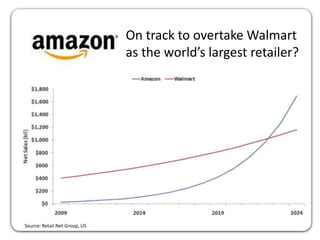
On track to overtake Walmart
as the world’s largest retailer?

Source: Retail Net Group, US
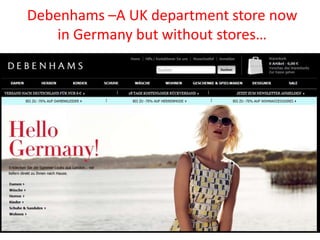
Debenhams –A UK department store now
in Germany but without stores…
Williams Sonoma – US homewares store
everywhere
asos – Fashion clothing without any stores

• Strategy: Move from being a UK shop to a global fashion destination
•

International sales latest quarter +49% to 65% of asos total sales

– Of which, Rest of World (mostly Australia) +61%
#4
Mobile as a key
engagement platform
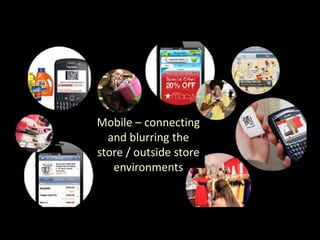
Mobile – connecting
and blurring the
store / outside store
environments
Global m-commerce sales expected to
reach USD119 bn by 2015 (source: ABI Research)
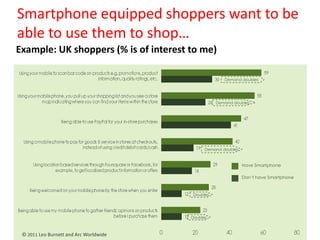
Smartphone equipped shoppers want to be
able to use them to shop…
Example: UK shoppers (% is of interest to me)
Demand doubles

Demand doubles

Demand doubles

Have Smartphone
Don‟t have Smartphone

Doubles

Doubles

© 2011 Leo Burnett and Arc Worldwide
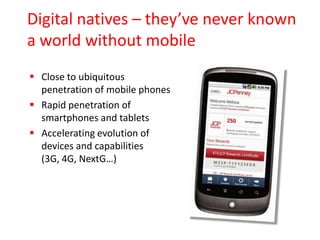
Digital natives – they’ve never known
a world without mobile
 Close to ubiquitous
penetration of mobile phones
 Rapid penetration of
smartphones and tablets
 Accelerating evolution of
devices and capabilities
(3G, 4G, NextG…)
#5
More personalised
shopper engagement
Leveraging data to deliver more
personalised promotions

Major UK grocers have used technology to launch price
guarantees which calculates the costs of shopping
versus rivals and offers customers a refund if their shop
was cheaper elsewhere. Sainsbury’s Brand Match,
launched in mid-2011, is perhaps the most innovative
offering a coupon directly at the till at the time of
purchase.
Source: Planet Retail
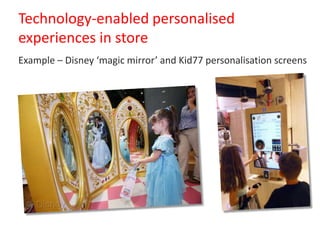
Technology-enabled personalised
experiences in store
Example – Disney ‘magic mirror’ and Kid77 personalisation screens
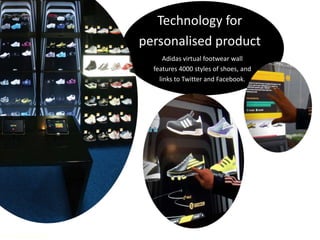
Technology for
personalised product
Adidas virtual footwear wall
features 4000 styles of shoes, and
links to Twitter and Facebook.

© 2011 Leo Burnett and Arc Worldwide
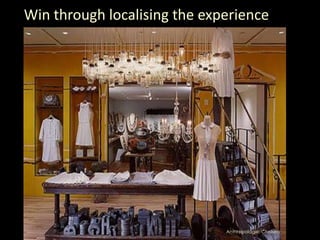
Win through localising the experience

Selfridges: Shoe Gallery

Anthropologie: Chelsea
#6
The power of sharing
and social
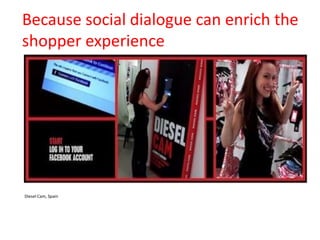
Because social dialogue can enrich the
shopper experience

Diesel Cam, Spain
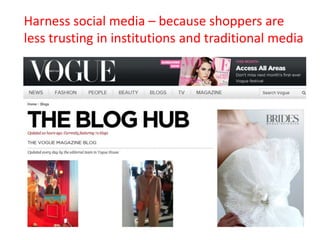
Harness social media – because shoppers are
less trusting in institutions and traditional media
Social media can build – and destroy –
brands overnight
Example: Mumsnet
 Launched in UK 2000
 25,000 posts every day
 850,000 regular users
 80% of whom said they wouldn’t
make a purchase before
consulting the site or their peers
Social media and the power of crowds

82%
of UK consumers use the
internet at least once a
week to research products
or services

Groupon – 120m subscribers
mid-2011 (50m Dec 2010)
#7
The challenge of
complexity (connecting
multiple touchpoints)
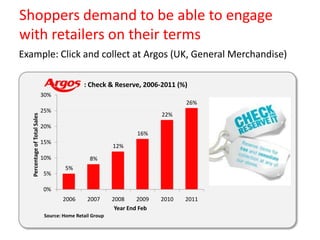
Shoppers demand to be able to engage
with retailers on their terms
Example: Click and collect at Argos (UK, General Merchandise)
: Check & Reserve, 2006-2011 (%)
30%
Percentage of Total Sales

26%
25%

22%

20%
16%
15%

12%

10%
5%

8%
5%

0%
2006

2007

Source: Home Retail Group

2008
2009
Year End Feb

2010

2011
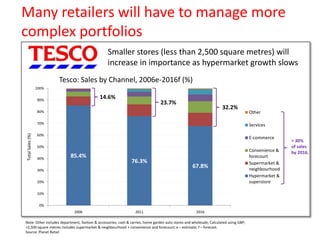
Many retailers will have to manage more
complex portfolios
Smaller stores (less than 2,500 square metres) will
increase in importance as hypermarket growth slows
Tesco: Sales by Channel, 2006e-2016f (%)
100%

14.6%

90%

23.7%

32.2%

80%

Total Sales (%)

70%

Services

60%

E-commerce

50%
40%

Other

85.4%

76.3%

30%

67.8%

20%
10%
0%
2006

2011

2016

Note: Other includes department, fashion & accessories, cash & carries, home garden auto stores and wholesale; Calculated using GBP;
<2,500 square metres includes supermarket & neighbourhood + convenience and forecourt; e – estimate; f – forecast.
Source: Planet Retail

Convenience &
forecourt
Supermarket &
neighbourhood
Hypermarket &
superstore

> 30%
of sales
by 2016.
#8
The challenge of
transparency
Price transparency driving persistent
downward pressure on retailers’ margins
Technology to
help establish
trust, through
transparency
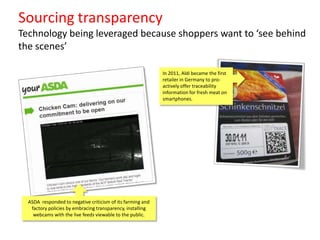
Sourcing transparency
Technology being leveraged because shoppers want to ‘see behind
the scenes’
In 2011, Aldi became the first
retailer in Germany to proactively offer traceability
information for fresh meat on
smartphones.

ASDA responded to negative criticism of its farming and
factory policies by embracing transparency, installing
webcams with the live feeds viewable to the public.
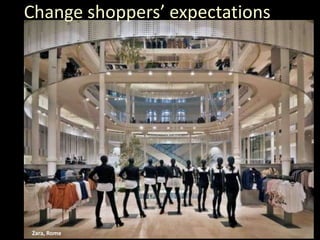
#9
Winning by changing
category conventions
Change shoppers’ expectations

Zara, Rome
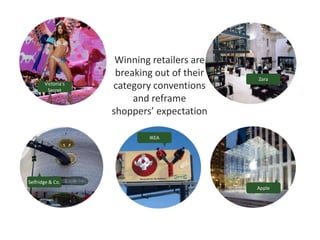
Victoria’s
Secret

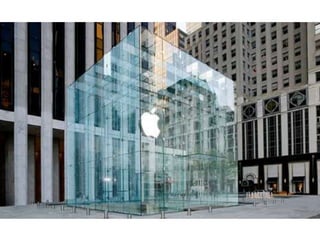
Winning retailers are
breaking out of their
category conventions
and reframe
shoppers’ expectation

Zara

IKEA

Selfridge & Co.
Apple
#10
Retailers as brands
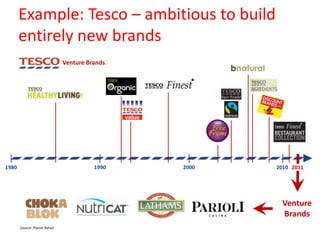
Example: Tesco – ambitious to build
entirely new brands
Venture Brands

1980

1990

2000

2010 2011

Venture
Brands
Source: Planet Retail
Aiming to be a global
power brand in apparel
Turning private label into
standalone brands
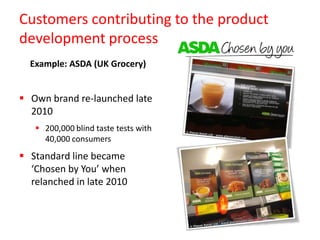
Customers contributing to the product
development process
Example: ASDA (UK Grocery)

 Own brand re-launched late
2010
 200,000 blind taste tests with
40,000 consumers

 Standard line became
‘Chosen by You’ when
relanched in late 2010
#11
Responsibility as
mandatory
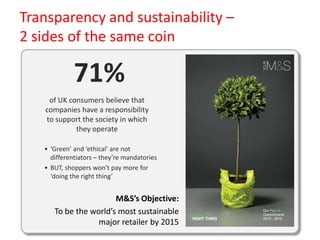
Transparency and sustainability –
2 sides of the same coin

71%
of UK consumers believe that
companies have a responsibility
to support the society in which
they operate
• ‘Green’ and ‘ethical’ are not
differentiators – they’re mandatories
• BUT, shoppers won’t pay more for
‘doing the right thing’

M&S’s Objective:
To be the world’s most sustainable
major retailer by 2015
Sustainability credentials – A
mandatory, not a differentiator
“We want to be a
restorative retailer. It’s
not enough to be a
sustainable retailer.”
Mark Price
Managing Director
Waitrose, 8/6/11
#12
Polarisation and the
disappearing middle
market
Value retailers showing strong growth in
most categories
Value retailers transforming shoppers’
expectations

Uniqlo

Forever 21, Birmingham

Designers at H&M

Zara, Rome
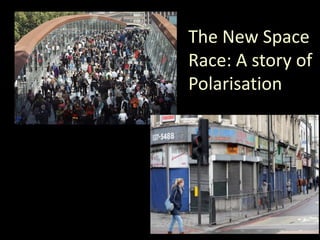
The New Space
Race: A story of
Polarisation
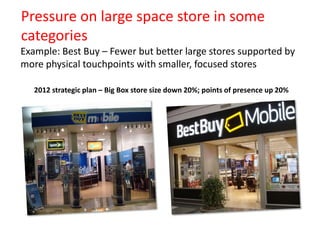
Pressure on large space store in some
categories
Example: Best Buy – Fewer but better large stores supported by
more physical touchpoints with smaller, focused stores
2012 strategic plan – Big Box store size down 20%; points of presence up 20%
#13
The risks of playing safe
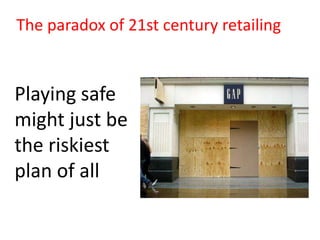
The paradox of 21st century retailing

Playing safe
might just be
the riskiest
plan of all
Attributes of
Winning Retailers
 Genuinely customer centric
 No more rhetoric. The customer will genuinely be at the centre of the retailer’s
engagement efforts
 Using social and digital media to share information that matters to shoppers:
‘Nothing to hide’ mantra

 Delivering across multiple touchpoints
 Multiple points of engagement with the shopper, online and offline
 Seamless movement by the shopper across multiple touchpoints
 Stores still important for many, but not the only – or even the main – point of
engagement
 Click and collect likely to be important for many

 Digitally adept
 Using technology outside the store for shopper engagement
 Using technology inside the store to improve efficiency and / or experience

 Brand focused
 To deliver shopper engagement across multiple touchpoints
 To build shopper confidence throughout the business
In Summary
13 themes for 2013
1.
2.
3.
4.
5.
6.
7.
8.
9.
10.
11.
12.
13.

Omnichannel changes everything
Stores must reinvent to stay relevant
The rise and rise of non-store retailing
Mobile as a key engagement platform
More personalised shopper engagement
The power of social and sharing
The challenge of complexity
The challenge of transparency
Winning by changing category conventions
Retailers as brands
Responsibility as mandatory
Polarisation and the disappearing middle ground
The dangers of playing safe
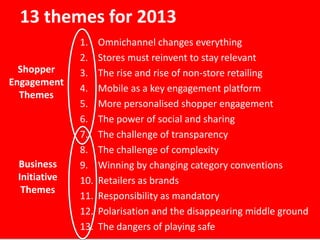
13 themes for 2013
Shopper
Engagement
Themes

Business
Initiative
Themes

1.
2.
3.
4.
5.
6.
7.
8.
9.
10.
11.
12.
13.

Omnichannel changes everything
Stores must reinvent to stay relevant
The rise and rise of non-store retailing
Mobile as a key engagement platform
More personalised shopper engagement
The power of social and sharing
The challenge of transparency
The challenge of complexity
Winning by changing category conventions
Retailers as brands
Responsibility as mandatory
Polarisation and the disappearing middle ground
The dangers of playing safe

13themesfor2013

  • 1.
    13 themes for 2013… (what’skeeping retailers awake at night)
  • 2.
  • 3.
  • 4.
    “The digital revolution istransforming how customers behave…We cannot differentiate between online and in store. We must use the stores to support the online offer and visa-versa.” Philip Clarke, CEO Tesco, BRC Symposium, London June 2011
  • 5.
    “The shopping journeyis going online and offline all the time” Brian McBride, Managing Director, Amazon.com, UK Retail Week Conference, London, 03/10 5
  • 6.
    An example fromautomotive: The new vehicle ‘path to purchase’ in the US 35% 30% 25% 20% 15% 10% 5% 0% Dealer Web Beginning Search Early Middle Late Purchase End
  • 7.
    The electronics ‘pathto purchase’ in Russia 35.0 % of electronic shoppers 30.0 25.0 20.0 Store 15.0 Web 10.0 5.0 0.0 Beginning Search Early Middle Late Purchase End
  • 8.
    Click and Collectfast emerging as a preferred model – grocery and General Merchandise Metro Group opened second drive-in Real outlet in Germany in 2011 Casino, France, offers click & collect in 90 of its 120 Geant hypermarkets Sonae, Portugal, launched Continente Drive click & collect, April 2011 Tesco - Installing collection points and ordering kiosks in their stores. Louis Delhaize plans to equip half its French Cora hypermarkets with a drive-in facility by end 2011 in 2011 LeClerc, France, aiming Euro 1.1bn sales from 400 Drive stores by 2015 „Site to store‟ is a key element of the new Walmart Express format launched in the US in mid-2011.
  • 9.
    Aiming for seamlessdelivery across channels M&S: Shop Your Way Shop Your Way  Aims to deliver seamless shopping to customers across all M&S channels, whenever, wherever, however they wish  05 / 2010 launched fully enabled mobile website  12 months to 09/11     160m visits to M&S website (+18%) Transactions +21% Revenues + 20% Conversion +3%
  • 10.
    New school convenience- technology enabled to make online and in-store seamless Product email In-store support web offer In-store sale Recycle email
  • 11.
    How to beseamless across multiple channels: What shoppers in the UK want  Consistent returns policy, in store and online  Has a reasonable timeframe for returns  Allows me to shop online but return in store  Store is a place to go to pick up something I’ve already learned about online  Makes a conscious effort to link the store and web brand image  Makes a conscious effort to link the store and web service support  Easy to move between their website and store Importance UK retailers where being “Simple and seamless” is highly valued: Dimensions of “seamlessness”
  • 12.
  • 13.
    Eataly, NYC Re-imagining thestore: Dial up product engagement
  • 14.
    Re-imagining the store: Storesas meeting and gathering places
  • 15.
    Re-imagining the store: Storesas learning, socialising, participative spaces
  • 16.
    Fewer, better storesin specialty – Treat every store as a flagship Top Shop, NYC
  • 17.
    But some storeformats are under pressure to survive: Hypermarkets – in long term decline in Europe Source: Images from Planet Retail
  • 18.
    #3 The rise andrise of non-store retailing
  • 19.
    amazon and thepower of online Mission To be the place where people can find, discover & buy anything online Global Banner Sales (USD bn) 140 Amazon: Global Banner Sales, 2005-2015f (USD bn) 120 USD126.9 bn 100 World’s 6th largest retailer World’s 31st largest retailer 80 60 World’s 99th largest retailer USD37.7 bn 40 USD9.2 bn 20 0 2005 2006 2007 2008 2009 2010 2011 2012 2013 2014 2015 Note: f - forecast Source: Planet Retail Amazon trialling collection lockers in shopping centres, office buildings in UK and in 7Eleven in US
  • 20.
    No store walls= no stock limits Amazon’s assortment by marketplace Marketplace ASIN (SKU) count Amazon.com 127,811,266 Amazon.co.uk 101,680,706 Amazon.de 91,933,337 Amazon.fr 75,252,368 Amazon.co.jp 59,104,884 Amazon.ca 25,973,378 Amazon.es 18,874,265 Amazon.it 18,196,941 Amazon.cn 4,483,795 ASIN counts at 20/02/12
  • 21.
    On track toovertake Walmart as the world’s largest retailer? Source: Retail Net Group, US
  • 22.
    Debenhams –A UKdepartment store now in Germany but without stores…
  • 23.
    Williams Sonoma –US homewares store everywhere
  • 24.
    asos – Fashionclothing without any stores • Strategy: Move from being a UK shop to a global fashion destination • International sales latest quarter +49% to 65% of asos total sales – Of which, Rest of World (mostly Australia) +61%
  • 25.
    #4 Mobile as akey engagement platform
  • 26.
    Mobile – connecting andblurring the store / outside store environments
  • 27.
    Global m-commerce salesexpected to reach USD119 bn by 2015 (source: ABI Research)
  • 28.
    Smartphone equipped shopperswant to be able to use them to shop… Example: UK shoppers (% is of interest to me) Demand doubles Demand doubles Demand doubles Have Smartphone Don‟t have Smartphone Doubles Doubles © 2011 Leo Burnett and Arc Worldwide
  • 29.
    Digital natives –they’ve never known a world without mobile  Close to ubiquitous penetration of mobile phones  Rapid penetration of smartphones and tablets  Accelerating evolution of devices and capabilities (3G, 4G, NextG…)
  • 30.
  • 31.
    Leveraging data todeliver more personalised promotions Major UK grocers have used technology to launch price guarantees which calculates the costs of shopping versus rivals and offers customers a refund if their shop was cheaper elsewhere. Sainsbury’s Brand Match, launched in mid-2011, is perhaps the most innovative offering a coupon directly at the till at the time of purchase. Source: Planet Retail
  • 32.
    Technology-enabled personalised experiences instore Example – Disney ‘magic mirror’ and Kid77 personalisation screens
  • 33.
    Technology for personalised product Adidasvirtual footwear wall features 4000 styles of shoes, and links to Twitter and Facebook. © 2011 Leo Burnett and Arc Worldwide
  • 34.
    Win through localisingthe experience Selfridges: Shoe Gallery Anthropologie: Chelsea
  • 35.
    #6 The power ofsharing and social
  • 36.
    Because social dialoguecan enrich the shopper experience Diesel Cam, Spain
  • 37.
    Harness social media– because shoppers are less trusting in institutions and traditional media
  • 38.
    Social media canbuild – and destroy – brands overnight Example: Mumsnet  Launched in UK 2000  25,000 posts every day  850,000 regular users  80% of whom said they wouldn’t make a purchase before consulting the site or their peers
  • 39.
    Social media andthe power of crowds 82% of UK consumers use the internet at least once a week to research products or services Groupon – 120m subscribers mid-2011 (50m Dec 2010)
  • 40.
    #7 The challenge of complexity(connecting multiple touchpoints)
  • 41.
    Shoppers demand tobe able to engage with retailers on their terms Example: Click and collect at Argos (UK, General Merchandise) : Check & Reserve, 2006-2011 (%) 30% Percentage of Total Sales 26% 25% 22% 20% 16% 15% 12% 10% 5% 8% 5% 0% 2006 2007 Source: Home Retail Group 2008 2009 Year End Feb 2010 2011
  • 42.
    Many retailers willhave to manage more complex portfolios Smaller stores (less than 2,500 square metres) will increase in importance as hypermarket growth slows Tesco: Sales by Channel, 2006e-2016f (%) 100% 14.6% 90% 23.7% 32.2% 80% Total Sales (%) 70% Services 60% E-commerce 50% 40% Other 85.4% 76.3% 30% 67.8% 20% 10% 0% 2006 2011 2016 Note: Other includes department, fashion & accessories, cash & carries, home garden auto stores and wholesale; Calculated using GBP; <2,500 square metres includes supermarket & neighbourhood + convenience and forecourt; e – estimate; f – forecast. Source: Planet Retail Convenience & forecourt Supermarket & neighbourhood Hypermarket & superstore > 30% of sales by 2016.
  • 43.
  • 44.
    Price transparency drivingpersistent downward pressure on retailers’ margins Technology to help establish trust, through transparency
  • 45.
    Sourcing transparency Technology beingleveraged because shoppers want to ‘see behind the scenes’ In 2011, Aldi became the first retailer in Germany to proactively offer traceability information for fresh meat on smartphones. ASDA responded to negative criticism of its farming and factory policies by embracing transparency, installing webcams with the live feeds viewable to the public.
  • 46.
  • 48.
  • 49.
    Victoria’s Secret Winning retailers are breakingout of their category conventions and reframe shoppers’ expectation Zara IKEA Selfridge & Co. Apple
  • 50.
  • 51.
    Example: Tesco –ambitious to build entirely new brands Venture Brands 1980 1990 2000 2010 2011 Venture Brands Source: Planet Retail
  • 52.
    Aiming to bea global power brand in apparel Turning private label into standalone brands
  • 53.
    Customers contributing tothe product development process Example: ASDA (UK Grocery)  Own brand re-launched late 2010  200,000 blind taste tests with 40,000 consumers  Standard line became ‘Chosen by You’ when relanched in late 2010
  • 54.
  • 55.
    Transparency and sustainability– 2 sides of the same coin 71% of UK consumers believe that companies have a responsibility to support the society in which they operate • ‘Green’ and ‘ethical’ are not differentiators – they’re mandatories • BUT, shoppers won’t pay more for ‘doing the right thing’ M&S’s Objective: To be the world’s most sustainable major retailer by 2015
  • 56.
    Sustainability credentials –A mandatory, not a differentiator “We want to be a restorative retailer. It’s not enough to be a sustainable retailer.” Mark Price Managing Director Waitrose, 8/6/11
  • 57.
  • 58.
    Value retailers showingstrong growth in most categories
  • 59.
    Value retailers transformingshoppers’ expectations Uniqlo Forever 21, Birmingham Designers at H&M Zara, Rome
  • 60.
    The New Space Race:A story of Polarisation
  • 61.
    Pressure on largespace store in some categories Example: Best Buy – Fewer but better large stores supported by more physical touchpoints with smaller, focused stores 2012 strategic plan – Big Box store size down 20%; points of presence up 20%
  • 62.
    #13 The risks ofplaying safe
  • 63.
    The paradox of21st century retailing Playing safe might just be the riskiest plan of all
  • 64.
  • 65.
     Genuinely customercentric  No more rhetoric. The customer will genuinely be at the centre of the retailer’s engagement efforts  Using social and digital media to share information that matters to shoppers: ‘Nothing to hide’ mantra  Delivering across multiple touchpoints  Multiple points of engagement with the shopper, online and offline  Seamless movement by the shopper across multiple touchpoints  Stores still important for many, but not the only – or even the main – point of engagement  Click and collect likely to be important for many  Digitally adept  Using technology outside the store for shopper engagement  Using technology inside the store to improve efficiency and / or experience  Brand focused  To deliver shopper engagement across multiple touchpoints  To build shopper confidence throughout the business
  • 66.
  • 67.
    13 themes for2013 1. 2. 3. 4. 5. 6. 7. 8. 9. 10. 11. 12. 13. Omnichannel changes everything Stores must reinvent to stay relevant The rise and rise of non-store retailing Mobile as a key engagement platform More personalised shopper engagement The power of social and sharing The challenge of complexity The challenge of transparency Winning by changing category conventions Retailers as brands Responsibility as mandatory Polarisation and the disappearing middle ground The dangers of playing safe
  • 68.
    13 themes for2013 Shopper Engagement Themes Business Initiative Themes 1. 2. 3. 4. 5. 6. 7. 8. 9. 10. 11. 12. 13. Omnichannel changes everything Stores must reinvent to stay relevant The rise and rise of non-store retailing Mobile as a key engagement platform More personalised shopper engagement The power of social and sharing The challenge of transparency The challenge of complexity Winning by changing category conventions Retailers as brands Responsibility as mandatory Polarisation and the disappearing middle ground The dangers of playing safe