CONTENTS
 INTRODUCTION TO POLYMERS
 CLASSIFICATION OF POLYMERS
 GENERAL MECHANISM OF DRUG RELEASE
 APPLICATION IN CONVENTIONAL DOSGAE FORMS
 APPLICATIONS IN CONTROLLED DRUG DELIVERY
 BIODEGRADABLE POLYMERS
 NATURAL POLYMERS
 REFERENCESS
7th Sept. 2010 KLECOP, Nipani
1
INTRODUCTION
• A polymer is a very large molecule in which one or
two small units is repeated over and over again
• The small repeating units are known as monomers
• Imagine that a monomer can be represented by the
letter A. Then a polymer made of that monomer
would have the structure:
• -A-A-A-A-A-A-A-A-A-A-A-A-A-A-A-A-A-A-A-A-A-
7th Sept. 2010 KLECOP, Nipani
2
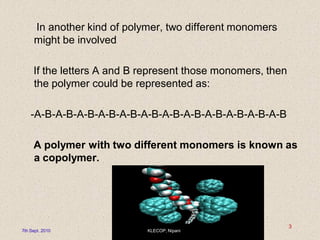
In another kind of polymer, two different monomers
might be involved
If the letters A and B represent those monomers, then
the polymer could be represented as:
-A-B-A-B-A-B-A-B-A-B-A-B-A-B-A-B-A-B-A-B-A-B-A-B
A polymer with two different monomers is known as
a copolymer.
7th Sept. 2010 KLECOP, Nipani
3
Chemistry of the polymers
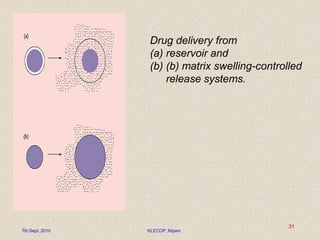
 Polymers are organic, chain molecules
 They can, vary from a few hundreds to
thousands of atoms long.
 There are three classes of polymers that we
will consider:-
a. Thermo-plastic - Flexible linear chains
b. Thermosetting - Rigid 3-D network
c. Elastomeric - Linear cross-linked chains
7th Sept. 2010 KLECOP, Nipani
4
THERMOPLASTICS
 In simple thermoplastic polymers, the chains are bound
to each other by weaker Van der Waal’s forces and
mechanical entanglement.
 Therefore, the chains are relatively strong, but it is
relatively easy to slide and rotate the chains over each
other.
7th Sept. 2010 KLECOP, Nipani
5
ELASTOMERS
 Common elastomers are made from highly coiled,
linear polymer chains.
 In their natural condition, elastomers behave in a similar
manner to thermoplastics (viscoelastic)
– i.e. applying a force causes the chains to uncoil and
stretch, but they also slide past each other causing
permanent deformation.
 This can be prevented by cross-linking the polymer
chains
7th Sept. 2010 KLECOP, Nipani
6
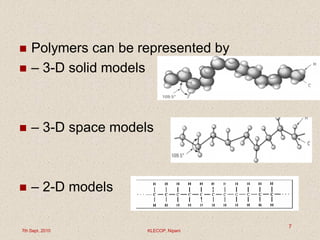
 Polymers can be represented by
 – 3-D solid models
 – 3-D space models
 – 2-D models
7th Sept. 2010 KLECOP, Nipani
7
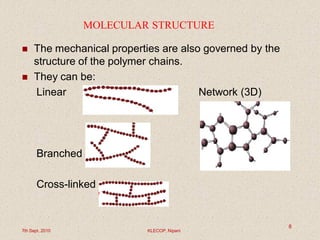
MOLECULAR STRUCTURE
 The mechanical properties are also governed by the
structure of the polymer chains.
 They can be:
Linear Network (3D)
Branched
Cross-linked
7th Sept. 2010 KLECOP, Nipani
8
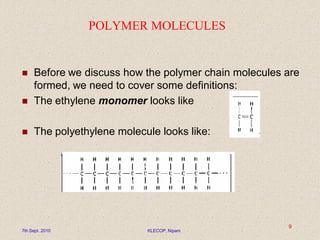
POLYMER MOLECULES
 Before we discuss how the polymer chain molecules are
formed, we need to cover some definitions:
 The ethylene monomer looks like
 The polyethylene molecule looks like:
7th Sept. 2010 KLECOP, Nipani
9
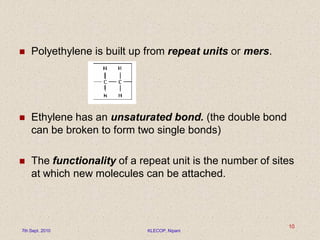
 Polyethylene is built up from repeat units or mers.
 Ethylene has an unsaturated bond. (the double bond
can be broken to form two single bonds)
 The functionality of a repeat unit is the number of sites
at which new molecules can be attached.
7th Sept. 2010 KLECOP, Nipani
10
MOLECULAR WEIGHT
 When polymers are fabricated, there will always be a
distribution of chain lengths.
 The properties of polymers depend heavily on the
molecule length.
 There are two ways to calculate the average molecular
weight:
1 Number Average Molecular Weight
2. Weight Average Molecular Weight
7th Sept. 2010 KLECOP, Nipani
11
 Number Average Molecular Weight
Mn= Σ Xi Mi
Where, xi = number of chains in the ith weight range
Mi = the middle of the ith weight range
 Weight Average Molecular Weight
Mw = Σ Wi Mi
Where, wi = weight fraction of chains in the ith range
Mi = the middle of the ith weight range
7th Sept. 2010 KLECOP, Nipani
12
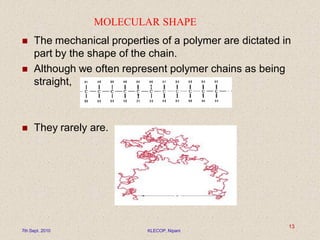
MOLECULAR SHAPE
 The mechanical properties of a polymer are dictated in
part by the shape of the chain.
 Although we often represent polymer chains as being
straight,
 They rarely are.
7th Sept. 2010 KLECOP, Nipani
13
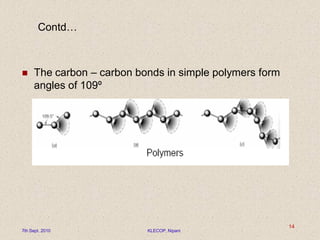
 The carbon – carbon bonds in simple polymers form
angles of 109º
Contd…
7th Sept. 2010 KLECOP, Nipani
14
7th Sept. 2010 KLECOP, Nipani
15
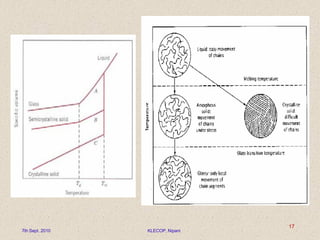
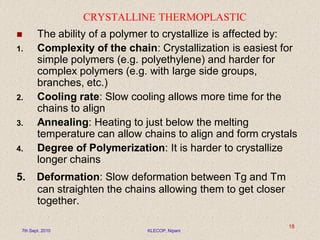
POLYMER CRYSTALLINITY
 Thermoplastic polymers go through a series of changes
with changes in temperature. (Similar to ceramic
glasses)
 In their solid form they can be semi-crystalline or
amorphous (glassy).
7th Sept. 2010 KLECOP, Nipani
16
7th Sept. 2010 KLECOP, Nipani
17
CRYSTALLINE THERMOPLASTIC
 The ability of a polymer to crystallize is affected by:
1. Complexity of the chain: Crystallization is easiest for
simple polymers (e.g. polyethylene) and harder for
complex polymers (e.g. with large side groups,
branches, etc.)
2. Cooling rate: Slow cooling allows more time for the
chains to align
3. Annealing: Heating to just below the melting
temperature can allow chains to align and form crystals
4. Degree of Polymerization: It is harder to crystallize
longer chains
5. Deformation: Slow deformation between Tg and Tm
can straighten the chains allowing them to get closer
together.
7th Sept. 2010 KLECOP, Nipani
18
Study Questions
 Define the following terms:
[Polymer, monomer, elastomer, thermoplastic, sphere, cylinder, annealing,
crystallization, polymerization, deformation, condensation, diffusion, degradation,
binder, Ocusert, Progestasert, synthesis, micro, nano, mega, ionization, degradation,
protonation, erosion, hydrolysis, homogeneous, heterogeneous, etc]
 Respond to the following questions:
 Give a descriptive account of chemical nature of a polymeric substance and relate to its physical nature
 Give a descriptive account of the phases of matter with logical relevance to state of medicines as they
are taken for their respective therapeutical values
 What is viscosity and its relation with fluids
 What is surface tension and its association with activities of a substance material with surface area
 Describe some key phase changes of materials substance when exposed to some environmental
conditions of change
 How is a chemical change different from a physical change
 ON BASIS OF INTERACTION WITH WATER:
 Non-biodegradable hydrophobic Polymers
 E.g. polyvinyl chloride, polyethylene vinyl acetate
 Soluble Polymers E.g. HPMC, PEG
 Hydrogels E.g. Polyvinyl pyrrolidine
 BASED ON POLYMERISATION METHOD:
 Addition Polymers E.g. Alkane Polymers
 Condensation polymers E.g. Polysterene and Polyamide
 Rearrangement polymers
 BASED ON POLYMERIZATION MECHANISM:
 Chain Polymerization
 Step growth Polymerization
7th Sept. 2010 KLECOP, Nipani
19
CLASSIFICATION POLYMERS:
 BASED ON CHEMICAL STRUCTURE:
 Activated C-C Polymer
 Polyamides, polyurethanes
 Polyesters, polycarbonates
 Polyacetals, Polyketals, Polyorthoesters
 Inorganic polymers
 Natural polymers
 BASED ON OCCURRENCE:
 Natural polymers E.g. 1. Proteins-collagen, keratin, albumin, 2.
carbohydrates- starch, cellulose
 Synthetic polymers E.g. Polyesters, polyamides
Contd….
7th Sept. 2010 KLECOP, Nipani
20
 BASED ON BIO-STABILITY:
 Bio-degradable
 Non Bio-degradable
Contd….
7th Sept. 2010 KLECOP, Nipani
21
CHARACTERISTICS OF AN IDEAL POLYMER
 Should be versatile and possess a wide range of
mechanical, physical, chemical properties
 Should be non-toxic and have good mechanical strength
and should be easily administered
 Should be inexpensive
 Should be easy to fabricate
 Should be inert to host tissue and compatible with
environment
7th Sept. 2010 KLECOP, Nipani
22
CRITERIA FOLLOWED IN POLYMER SELECTION
 The polymer should be soluble and easy to synthesis
 It should have finite molecular weight
 It should be compatible with biological environment
 It should be biodegradable
 It should provide good drug polymer linkage
7th Sept. 2010 KLECOP, Nipani
23
 There are three primary mechanisms by which active
agents can be released from a delivery system: namely,
Diffusion, degradation, and swelling followed by
diffusion
 Any or all of these mechanisms may occur in a given
release system
 Diffusion occurs when a drug or other active agent
passes through the polymer that forms the controlled-
release device. The diffusion can occur on a
macroscopic scale as through pores in the polymer
matrix or on a molecular level, by passing between
polymer chains
GENERAL MECHANISM OF DRUG RELEASE FROM
POLYMER
7th Sept. 2010 KLECOP, Nipani
24
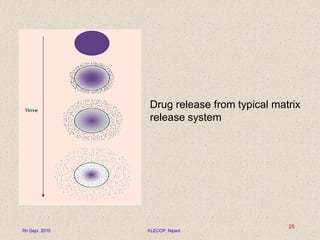
Drug release from typical matrix
release system
7th Sept. 2010 KLECOP, Nipani
25
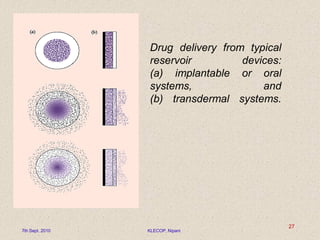
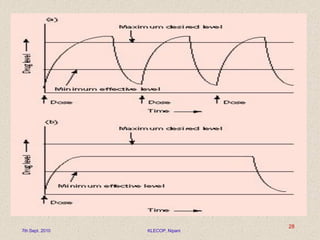
 For the reservoir systems the drug delivery rate can remain
fairly constant.
 In this design, a reservoir whether solid drug, dilute solution,
or highly concentrated drug solution within a polymer matrix
is surrounded by a film or membrane of a rate-controlling
material.
 The only structure effectively limiting the release of the drug
is the polymer layer surrounding the reservoir.
 This polymer coating is uniform and of a nonchanging
thickness, the diffusion rate of the active agent can be kept
fairly stable throughout the lifetime of the delivery system.
The system shown in Figure a is representative of an
implantable or oral reservoir delivery system, whereas the
system shown in b.
7th Sept. 2010 KLECOP, Nipani
26

Drug delivery from typical
reservoir devices:
(a) implantable or oral
systems, and
(b) transdermal systems.
7th Sept. 2010 KLECOP, Nipani
27

7th Sept. 2010 KLECOP, Nipani
28
ENVIRONMENTALLY RESPONSIVE SYSTEM
 It is also possible for a drug delivery system to be designed
so that it is incapable of releasing its agent or agents until it is
placed in an appropriate biological environment.
 Controlled release systems are initially dry and, when placed
in the body, will absorb water or other body fluids and swell,
 The swelling increases the aqueous solvent content within
the formulation as well as the polymer mesh size, enabling
the drug to diffuse through the swollen network into the
external environment.
 Examples of these types of devices are shown in Figures a
and b for reservoir and matrix systems.
 Most of the materials used in swelling-controlled release
systems are based on hydrogels, which are polymers that will
swell without dissolving when placed in water or other
biological fluids.
 These hydrogels can absorb a great deal of fluid and, at
equilibrium, typically comprise 60–90% fluid and only 10–
30% polymer.
7th Sept. 2010 KLECOP, Nipani
29
 Drug delivery from
(a) reservoir and
(b) (b) matrix swelling-controlled
release systems.
7th Sept. 2010 KLECOP, Nipani
31
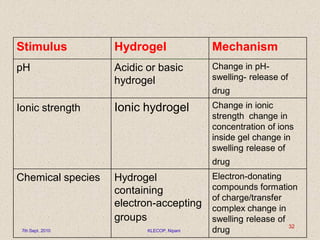
Stimulus Hydrogel Mechanism
pH Acidic or basic
hydrogel
Change in pH-
swelling- release of
drug
Ionic strength Ionic hydrogel Change in ionic
strength change in
concentration of ions
inside gel change in
swelling release of
drug
Chemical species Hydrogel
containing
electron-accepting
groups
Electron-donating
compounds formation
of charge/transfer
complex change in
swelling release of
drug7th Sept. 2010 KLECOP, Nipani
32
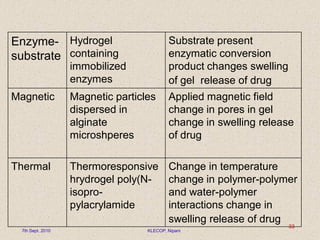
Enzyme-
substrate
Hydrogel
containing
immobilized
enzymes
Substrate present
enzymatic conversion
product changes swelling
of gel release of drug
Magnetic Magnetic particles
dispersed in
alginate
microshperes
Applied magnetic field
change in pores in gel
change in swelling release
of drug
Thermal Thermoresponsive
hrydrogel poly(N-
isopro-
pylacrylamide
Change in temperature
change in polymer-polymer
and water-polymer
interactions change in
swelling release of drug
7th Sept. 2010 KLECOP, Nipani
33
APPLICATIONS
 The pharmaceutical applications of polymers range
from their use as binders in tablets
 Viscosity and flow controlling agents in liquids,
suspensions and emulsions
 Polymers are also used as film coatings to disguise the
unpleasant taste of a drug, to enhance drug stability and
to modify drug release characteristics.
07/09/2010 KLECOP, Nipani
34
Applications in
Conventional Dosage Forms
7th Sept. 2010 KLECOP, Nipani
 Tablets :
- As binders
- To mask unpleasant taste
- For enteric coated tablets
 Liquids :
- Viscosity enhancers
- For controlling the flow
 Semisolids :
- In the gel preparation
- In ointments
 In transdermal Patches
35
Applications In Controlled
Drug Delivery
 Reservoir Systems
- Ocusert System
- Progestasert System
- Reservoir Designed Transdermal Patches
 Matrix Systems
 Swelling Controlled Release Systems
 Biodegradable Systems
 Osmotically controlled Drug Delivery
7th Sept. 2010 KLECOP, Nipani
36
BIO DEGARADABLE POLYMERS
7th Sept. 2010 KLECOP, Nipani
37
BIO DEGRADABLE POLYMER
 Biodegradable polymers can be classified in two:
 Natural biodegradable polymer
 Synthetic biodegradable polymer
 Synthetic biodegradable polymer are preferred more than the
natural biodegradable polymer because they are free of
immunogenicity & their physicochemical properties are more
predictable &reproducible
7th Sept. 2010 KLECOP, Nipani
38
FACTORS AFFECTING BIODEGRADATION
OF POLYMERS
 PHYSICAL FACTORS
 Shape & size
 Variation of diffusion coefficient
 Mechanical stresses
 CHEMICAL FACTORS
 Chemical structure & composition
 Presence of ionic group
 Distribution of repeat units in multimers
 configuration structure
 Molecular weight
 MORPHOLOGY
 Presence of low molecular weight compounds
 Processing condition
 Annealing
 Site of implantation
 Sterilization process
 PHYSICOCHEMICAL FACTORS
 Ion exchange
 Ionic strength
 pH
7th Sept. 2010 KLECOP, Nipani
39
ADVANTAGES OF BIODEGRADABLE
POLYMERS IN DRUG DELEVERY
 Localized delivery of drug
 Sustained delivery of drug
 Stabilization of drug
 Decrease in dosing frequency
 Reduce side effects
 Improved patient compliance
 Controllable degradation rate
7th Sept. 2010 KLECOP, Nipani
41
ROLE OF POLYMER IN DRUG DELIVERY
The polymer can protect the drug from the physiological
environment & hence improve its stability in vivo.
Most biodegradable polymer are designed to degrade within the
body as a result of hydrolysis of polymer chain into biologically
acceptable & progressively small compounds.
TYPES OF POLYMER DRUG DELIVERY SYSTEM:
MICRO PARTICLES: These have been used to deliver
therapeutic agents like doxycycline.
NANO PARTICLES: delivery drugs like doxorubicin, cyclosporine,
paclitaxel, 5- fluorouracil etc
7th Sept. 2010 KLECOP, Nipani
42
 POLYMERIC MICELLES: used to deliver therapeutic agents.
 HYDRO GELS: these are currently studies as controlled
release carriers of proteins & peptides.
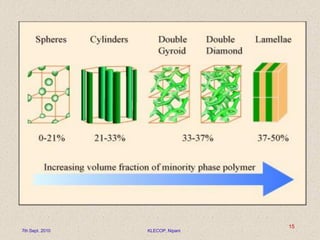
 POLYMER MORPHOLOGY:
The polymer matrix can be formulated as either
micro/nano-spheres, gel, film or an extruded shape.
The shape of polymer can be important in drug release
kinetics.
7th Sept. 2010 KLECOP, Nipani
43
Application
 For specific site drug delivery- anti tumour agent
 Polymer system for gene therapy
 Bio degradable polymer for ocular, non- viral DNA, tissue
engineering, vascular, orthopaedic, skin adhesive &
surgical glues.
 Bio degradable drug system for therapeutic agents such
as anti tumor, antipsychotic agent, anti-inflammatory
agent and biomacro molecules such as proteins, peptides
and nucleic acids
7th Sept. 2010 KLECOP, Nipani
44
BIO DEGRADABLE POLYMERS FOR ADVANCE
DRUG DELIVERY
 Polymers play an vital role in both conventional as well as
novel drug delivery. Among them , the use of bio degradable
polymer has been success fully carried out.
 Early studies on the use of biodegradable suture
demonstrated that these polymers were non- toxic &
biodegradable.
 By incorporating drug into biodegradable polymer whether
natural or synthetic, dosage forms that release the drug in
predesigned manner over prolong time
7th Sept. 2010 KLECOP, Nipani
45
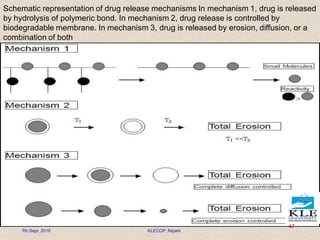
DRUG RELEASE MECHANISM
 The release of drugs from the erodible polymers occurs
basically by three mechanisms,
I. The drug is attached to the polymeric backbone by a
labile bond, this bond has a higher reactivity toward
hydrolysis than the polymer reactivity to break down.
II. The drug is in the core surrounded by a biodegradable
rate controlling membrane. This is a reservoir type device
that provides erodibility to eliminate surgical removal of
the drug-depleted device.
III. a homogeneously dispersed drug in the biodegradable
polymer. The drug is released by erosion, diffusion, or a
combination of both.
7th Sept. 2010 KLECOP, Nipani
46
Schematic representation of drug release mechanisms In mechanism 1, drug is released
by hydrolysis of polymeric bond. In mechanism 2, drug release is controlled by
biodegradable membrane. In mechanism 3, drug is released by erosion, diffusion, or a
combination of both
7th Sept. 2010 KLECOP, Nipani
47
POLYMER EROSION MECHANISM
 The term 'biodegradation' is limited to the description of
chemical processes (chemical changes that alter either
the molecular weight or solubility of the polymer)
 ‘Bioerosion' may be restricted to refer to physical
processes that result in weight loss of a polymer device.
 The erosion of polymers basically takes place by two
methods:-
1. Chemical erosion
2. Physical erosion
7th Sept. 2010 KLECOP, Nipani
48
CHEMICAL EROSION
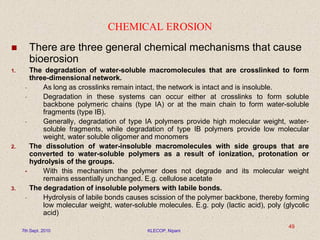
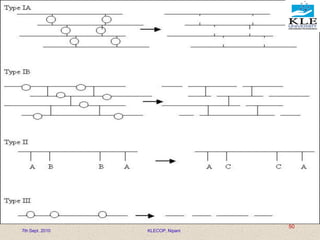
 There are three general chemical mechanisms that cause
bioerosion
1. The degradation of water-soluble macromolecules that are crosslinked to form
three-dimensional network.
• As long as crosslinks remain intact, the network is intact and is insoluble.
• Degradation in these systems can occur either at crosslinks to form soluble
backbone polymeric chains (type IA) or at the main chain to form water-soluble
fragments (type IB).
• Generally, degradation of type IA polymers provide high molecular weight, water-
soluble fragments, while degradation of type IB polymers provide low molecular
weight, water soluble oligomer and monomers
2. The dissolution of water-insoluble macromolecules with side groups that are
converted to water-soluble polymers as a result of ionization, protonation or
hydrolysis of the groups.
• With this mechanism the polymer does not degrade and its molecular weight
remains essentially unchanged. E.g. cellulose acetate
3. The degradation of insoluble polymers with labile bonds.
• Hydrolysis of labile bonds causes scission of the polymer backbone, thereby forming
low molecular weight, water-soluble molecules. E.g. poly (lactic acid), poly (glycolic
acid)
7th Sept. 2010 KLECOP, Nipani
49
7th Sept. 2010 KLECOP, Nipani
50
PHYSICAL EROSION
 The physical erosion mechanisms can be characterized as
heterogeneous or homogeneous.
 In heterogeneous erosion, also called as surface erosion, the polymer
erodes only at the surface, and maintains its physical integrity as it
degrades. As a result drug kinetics are predictable, and zero order
release kinetics can be obtained by applying the appropriate geometry.
Crystalline regions exclude water. Therefore highly crystalline polymers
tend to undergo heterogeneous erosion. E.g. polyanhydrides
 Homogeneous erosion, means the hydrolysis occurs at even rate
throughout the polymeric matrix. Generally these polymers tend to be
more hydrophilic than those exhibiting surface erosion. As a result, water
penetrates the polymeric matrix and increases the rate of diffusion. In
homogeneous erosion, there is loss of integrity of the polymer matrix. E.g
poly lactic acid
7th Sept. 2010 KLECOP, Nipani
52
 Natural polymers
 Polymers are very common in nature
 some of the most widespread naturally occurring substances are
polymers Starch and cellulose are examples
 Green plants have the ability to take the simple sugar known as
glucose and make very long chains containing many glucose units
 These long chains are molecules of starch or cellulose
 If we assign the symbol G to stand for a glucose molecule, then
starch or cellulose can be represented as:
 -G-G-G-G-G-G-G-G-G-G-G-G-G-G-G-G-G-G-G-G-G-G-G-G-G-G-G-
7th Sept. 2010 KLECOP, Nipani
54
NATURAL POLYMERS
 Natural polymers remains the primary choice of
formulator because
- They are natural products of living organism
- Readily available
- Relatively inexpensive
- Capable of chemical modification
 Moreover, it satisfies most of the ideal requirements of
polymers.
 But the only and major difficulty is the batch- to-batch
reproducibility and purity of the sample.
7th Sept. 2010 KLECOP, Nipani
55
 Examples :
1) Proteins :
- Collagen : Found from animal tissue.
Used in absorbable sutures, sponge
wound dressing, as drug delivery vehicles
- Albumin : Obtained by fabrication of
blood from healthy donor.
Used as carriers in nanocapsules &
microspheres
- Gelatin : A natural water soluble polymer
Used in capsule shells and also as coating
material in microencapsulation.
7th Sept. 2010 KLECOP, Nipani
56
2) Polysaccharides :
- Starch : Usually derivatised by introducing acrylic
groups before manufactured int microspheres.
Also used as binders.
- Cellulose :
Naturally occuring linear polysaccharide. It
is insoluble in water but solubility can be obtained by
substituting -OH group.
Na-CMC is used as thickner, suspending agent, and
film formers.
3) DNA & RNA :
They are the structural unit of our body. DNA
is the blueprint that determines everything of our body.
7th Sept. 2010 KLECOP, Nipani
57
CURRENTLY AVAILABLE POLYMERS FOR
CONTROLLED RELEASE
 Diffusion controlled systems
 Solvent activated systems
 Chemically controlled systems
 Magnetically controlled systems
7th Sept. 2010 KLECOP, Nipani
58
DIFFUSION CONTROLLED SYSTEM
 Reservoir type
 Shape : spherical, cylindrical, disk-like
 Core : powdered or liquid forms
 Properties of the drug and the polymer : diffusion rate
and release rate into the bloodstream
 Problems : removal of the system, accidental rupture
 Matrix type
 Uniform distribution and uniform release rate
 No danger of drug dumping
7th Sept. 2010 KLECOP, Nipani
59
SOLVENT ACTIVATED SYSTEM
 Osmotically controlled system
 Semipermeable membrane
 Osmotic pressure decrease concentration gradient
 Inward movement of fluid : out of the device through
a small orifice
 Swelling controlled system
 Hydrophilic macromolecules cross-linked to form a
three-dimensional network
 Permeability for solute at a controlled rate as the
polymer swells
7th Sept. 2010 KLECOP, Nipani
60
CHEMICALLY CONTROLLED SYSTEMS
 Pendant-chain system
 Drug : chemically linked to the backbone
 Chemical hydrolysis or enzymatic cleavage
 Linked directly or via a spacer group
 Bioerodable or biodegradable system
 Drug : uniformly dispersed
 Slow released as the polymer disintegrates
 No removal from the body
 Irrespective of solubility of drug in water
7th Sept. 2010 KLECOP, Nipani
61
MAGNETICALLY CONTROLLED SYSTEMS
 Cancer chemotherapy
 Selective targeting of antitumor agents
 Minimizing toxicity
 Magnetically responsive drug carrier systems
 Albumin and magnetic microspheres
 High efficiency for in vivo targeting
 Controllable release of drug at the microvascular
level
7th Sept. 2010 KLECOP, Nipani
62
RECENTLY DEVELOPED MARKETED FORMULATIONS
 Medisorb
• Microencapsulation by PLA, PGA, PLGA
• Drug release : week to one year
 Alzamer
• Bioerodible polymer : release at a controlled rate
• Chronic disease, contraception, topical therapy
7th Sept. 2010 KLECOP, Nipani
63
USE OF FEW POLYMERS IN DRUG DELIVERY
 Poly(L-lactic acid) for release of progesterone, estradiol,
dexamethasone
 Copolymer of gluconic acid and –ethyl-L-glutamte as bioerodible
monolithic device
 PLA, PGA, PLGA for parenteral administration of polypeptide
 Sustained release (weeks or months)
Orahesive® : sodium carboxymethyl cellulose, Pectin,
gelatin
 Orabase ® : blend in a polymethylene/mineral oil base
7th Sept. 2010 KLECOP, Nipani
64
REFERENCES
 Novel drug delivery systems – Y.W.Chien –
Dekker 50
 Bio–adhesive drug delivery system –
Dekker 98
 Encyclopedia of controlled drug delivery
systems.
 www.google.com
7th Sept. 2010 KLECOP, Nipani
65
ANY QUERIES or ADDITIONS?
7th Sept. 2010 KLECOP, Nipani
66
7th Sept. 2010 KLECOP, Nipani
67
Cell No: 00919742431000
E-mail:bknanjwade@yahoo.co.in
Study Questions
 Define the following terms:
[Polymer, monomer, elastomer, thermoplastic, sphere, cylinder, annealing, crystallization,
polymerization, deformation, condensation, diffusion, degradation, binder, Ocusert,
Progestasert, synthesis, micro, nano, mega, ionization, degradation, protonation, erosion,
hydrolysis, homogeneous, heterogeneous, etc]
 Respond to the following questions:
 Give a descriptive account of chemical nature of a polymeric substance
 Give a descriptive account of classification of polymeric material substance with examples
 State and explain with examples the characteristics of ideal polymeric material substances
 Give a descriptive account of general mechanisms polymeric material substance in particle release processes
 Describe the pharmaceutical fields of applications using polymeric materials
 Give a detailed material nature of biodegradable polymeric substances
 List and elaborate on the advantages and disadvantages of biodegradable polymeric material use
pharmaceutically
 Illustrate the use of biodegradable polymers for the present-time pharmaceutical care service provision
 Describe the erosive mechanisms of polymer material from another material substance
 How is a chemical nature of polymeric substance different from its physical nature
 Group work discussional questions:
 Give a descriptive account of chemical and physical nature of a
polymeric substances
 Give a descriptive account of classification of polymeric material
substances that are used regularly
 Give a descriptive account of general mechanisms polymeric material
substance in particle release processes
 Describe the pharmaceutical fields of applications using polymeric
materials
 Give a detailed material nature of biodegradable polymeric substances
 How is a chemical nature of polymeric substance different from its
physical nature
 Give a detailed descriptive account of structural classification of
polymeric active agents

13 polymer science

  • 2.
    CONTENTS  INTRODUCTION TOPOLYMERS  CLASSIFICATION OF POLYMERS  GENERAL MECHANISM OF DRUG RELEASE  APPLICATION IN CONVENTIONAL DOSGAE FORMS  APPLICATIONS IN CONTROLLED DRUG DELIVERY  BIODEGRADABLE POLYMERS  NATURAL POLYMERS  REFERENCESS 7th Sept. 2010 KLECOP, Nipani 1
  • 3.
    INTRODUCTION • A polymeris a very large molecule in which one or two small units is repeated over and over again • The small repeating units are known as monomers • Imagine that a monomer can be represented by the letter A. Then a polymer made of that monomer would have the structure: • -A-A-A-A-A-A-A-A-A-A-A-A-A-A-A-A-A-A-A-A-A- 7th Sept. 2010 KLECOP, Nipani 2
  • 4.
    In another kindof polymer, two different monomers might be involved If the letters A and B represent those monomers, then the polymer could be represented as: -A-B-A-B-A-B-A-B-A-B-A-B-A-B-A-B-A-B-A-B-A-B-A-B A polymer with two different monomers is known as a copolymer. 7th Sept. 2010 KLECOP, Nipani 3
  • 5.
    Chemistry of thepolymers  Polymers are organic, chain molecules  They can, vary from a few hundreds to thousands of atoms long.  There are three classes of polymers that we will consider:- a. Thermo-plastic - Flexible linear chains b. Thermosetting - Rigid 3-D network c. Elastomeric - Linear cross-linked chains 7th Sept. 2010 KLECOP, Nipani 4
  • 6.
    THERMOPLASTICS  In simplethermoplastic polymers, the chains are bound to each other by weaker Van der Waal’s forces and mechanical entanglement.  Therefore, the chains are relatively strong, but it is relatively easy to slide and rotate the chains over each other. 7th Sept. 2010 KLECOP, Nipani 5
  • 7.
    ELASTOMERS  Common elastomersare made from highly coiled, linear polymer chains.  In their natural condition, elastomers behave in a similar manner to thermoplastics (viscoelastic) – i.e. applying a force causes the chains to uncoil and stretch, but they also slide past each other causing permanent deformation.  This can be prevented by cross-linking the polymer chains 7th Sept. 2010 KLECOP, Nipani 6
  • 8.
     Polymers canbe represented by  – 3-D solid models  – 3-D space models  – 2-D models 7th Sept. 2010 KLECOP, Nipani 7
  • 9.
    MOLECULAR STRUCTURE  Themechanical properties are also governed by the structure of the polymer chains.  They can be: Linear Network (3D) Branched Cross-linked 7th Sept. 2010 KLECOP, Nipani 8
  • 10.
    POLYMER MOLECULES  Beforewe discuss how the polymer chain molecules are formed, we need to cover some definitions:  The ethylene monomer looks like  The polyethylene molecule looks like: 7th Sept. 2010 KLECOP, Nipani 9
  • 11.
     Polyethylene isbuilt up from repeat units or mers.  Ethylene has an unsaturated bond. (the double bond can be broken to form two single bonds)  The functionality of a repeat unit is the number of sites at which new molecules can be attached. 7th Sept. 2010 KLECOP, Nipani 10
  • 12.
    MOLECULAR WEIGHT  Whenpolymers are fabricated, there will always be a distribution of chain lengths.  The properties of polymers depend heavily on the molecule length.  There are two ways to calculate the average molecular weight: 1 Number Average Molecular Weight 2. Weight Average Molecular Weight 7th Sept. 2010 KLECOP, Nipani 11
  • 13.
     Number AverageMolecular Weight Mn= Σ Xi Mi Where, xi = number of chains in the ith weight range Mi = the middle of the ith weight range  Weight Average Molecular Weight Mw = Σ Wi Mi Where, wi = weight fraction of chains in the ith range Mi = the middle of the ith weight range 7th Sept. 2010 KLECOP, Nipani 12
  • 14.
    MOLECULAR SHAPE  Themechanical properties of a polymer are dictated in part by the shape of the chain.  Although we often represent polymer chains as being straight,  They rarely are. 7th Sept. 2010 KLECOP, Nipani 13
  • 15.
     The carbon– carbon bonds in simple polymers form angles of 109º Contd… 7th Sept. 2010 KLECOP, Nipani 14
  • 16.
    7th Sept. 2010KLECOP, Nipani 15
  • 17.
    POLYMER CRYSTALLINITY  Thermoplasticpolymers go through a series of changes with changes in temperature. (Similar to ceramic glasses)  In their solid form they can be semi-crystalline or amorphous (glassy). 7th Sept. 2010 KLECOP, Nipani 16
  • 18.
    7th Sept. 2010KLECOP, Nipani 17
  • 19.
    CRYSTALLINE THERMOPLASTIC  Theability of a polymer to crystallize is affected by: 1. Complexity of the chain: Crystallization is easiest for simple polymers (e.g. polyethylene) and harder for complex polymers (e.g. with large side groups, branches, etc.) 2. Cooling rate: Slow cooling allows more time for the chains to align 3. Annealing: Heating to just below the melting temperature can allow chains to align and form crystals 4. Degree of Polymerization: It is harder to crystallize longer chains 5. Deformation: Slow deformation between Tg and Tm can straighten the chains allowing them to get closer together. 7th Sept. 2010 KLECOP, Nipani 18
  • 20.
    Study Questions  Definethe following terms: [Polymer, monomer, elastomer, thermoplastic, sphere, cylinder, annealing, crystallization, polymerization, deformation, condensation, diffusion, degradation, binder, Ocusert, Progestasert, synthesis, micro, nano, mega, ionization, degradation, protonation, erosion, hydrolysis, homogeneous, heterogeneous, etc]  Respond to the following questions:  Give a descriptive account of chemical nature of a polymeric substance and relate to its physical nature  Give a descriptive account of the phases of matter with logical relevance to state of medicines as they are taken for their respective therapeutical values  What is viscosity and its relation with fluids  What is surface tension and its association with activities of a substance material with surface area  Describe some key phase changes of materials substance when exposed to some environmental conditions of change  How is a chemical change different from a physical change
  • 21.
     ON BASISOF INTERACTION WITH WATER:  Non-biodegradable hydrophobic Polymers  E.g. polyvinyl chloride, polyethylene vinyl acetate  Soluble Polymers E.g. HPMC, PEG  Hydrogels E.g. Polyvinyl pyrrolidine  BASED ON POLYMERISATION METHOD:  Addition Polymers E.g. Alkane Polymers  Condensation polymers E.g. Polysterene and Polyamide  Rearrangement polymers  BASED ON POLYMERIZATION MECHANISM:  Chain Polymerization  Step growth Polymerization 7th Sept. 2010 KLECOP, Nipani 19 CLASSIFICATION POLYMERS:
  • 22.
     BASED ONCHEMICAL STRUCTURE:  Activated C-C Polymer  Polyamides, polyurethanes  Polyesters, polycarbonates  Polyacetals, Polyketals, Polyorthoesters  Inorganic polymers  Natural polymers  BASED ON OCCURRENCE:  Natural polymers E.g. 1. Proteins-collagen, keratin, albumin, 2. carbohydrates- starch, cellulose  Synthetic polymers E.g. Polyesters, polyamides Contd…. 7th Sept. 2010 KLECOP, Nipani 20
  • 23.
     BASED ONBIO-STABILITY:  Bio-degradable  Non Bio-degradable Contd…. 7th Sept. 2010 KLECOP, Nipani 21
  • 24.
    CHARACTERISTICS OF ANIDEAL POLYMER  Should be versatile and possess a wide range of mechanical, physical, chemical properties  Should be non-toxic and have good mechanical strength and should be easily administered  Should be inexpensive  Should be easy to fabricate  Should be inert to host tissue and compatible with environment 7th Sept. 2010 KLECOP, Nipani 22
  • 25.
    CRITERIA FOLLOWED INPOLYMER SELECTION  The polymer should be soluble and easy to synthesis  It should have finite molecular weight  It should be compatible with biological environment  It should be biodegradable  It should provide good drug polymer linkage 7th Sept. 2010 KLECOP, Nipani 23
  • 26.
     There arethree primary mechanisms by which active agents can be released from a delivery system: namely, Diffusion, degradation, and swelling followed by diffusion  Any or all of these mechanisms may occur in a given release system  Diffusion occurs when a drug or other active agent passes through the polymer that forms the controlled- release device. The diffusion can occur on a macroscopic scale as through pores in the polymer matrix or on a molecular level, by passing between polymer chains GENERAL MECHANISM OF DRUG RELEASE FROM POLYMER 7th Sept. 2010 KLECOP, Nipani 24
  • 27.
    Drug release fromtypical matrix release system 7th Sept. 2010 KLECOP, Nipani 25
  • 28.
     For thereservoir systems the drug delivery rate can remain fairly constant.  In this design, a reservoir whether solid drug, dilute solution, or highly concentrated drug solution within a polymer matrix is surrounded by a film or membrane of a rate-controlling material.  The only structure effectively limiting the release of the drug is the polymer layer surrounding the reservoir.  This polymer coating is uniform and of a nonchanging thickness, the diffusion rate of the active agent can be kept fairly stable throughout the lifetime of the delivery system. The system shown in Figure a is representative of an implantable or oral reservoir delivery system, whereas the system shown in b. 7th Sept. 2010 KLECOP, Nipani 26
  • 29.
     Drug delivery fromtypical reservoir devices: (a) implantable or oral systems, and (b) transdermal systems. 7th Sept. 2010 KLECOP, Nipani 27
  • 30.
     7th Sept. 2010KLECOP, Nipani 28
  • 31.
    ENVIRONMENTALLY RESPONSIVE SYSTEM It is also possible for a drug delivery system to be designed so that it is incapable of releasing its agent or agents until it is placed in an appropriate biological environment.  Controlled release systems are initially dry and, when placed in the body, will absorb water or other body fluids and swell,  The swelling increases the aqueous solvent content within the formulation as well as the polymer mesh size, enabling the drug to diffuse through the swollen network into the external environment.  Examples of these types of devices are shown in Figures a and b for reservoir and matrix systems.  Most of the materials used in swelling-controlled release systems are based on hydrogels, which are polymers that will swell without dissolving when placed in water or other biological fluids.  These hydrogels can absorb a great deal of fluid and, at equilibrium, typically comprise 60–90% fluid and only 10– 30% polymer. 7th Sept. 2010 KLECOP, Nipani 29
  • 32.
     Drug deliveryfrom (a) reservoir and (b) (b) matrix swelling-controlled release systems. 7th Sept. 2010 KLECOP, Nipani 31
  • 33.
    Stimulus Hydrogel Mechanism pHAcidic or basic hydrogel Change in pH- swelling- release of drug Ionic strength Ionic hydrogel Change in ionic strength change in concentration of ions inside gel change in swelling release of drug Chemical species Hydrogel containing electron-accepting groups Electron-donating compounds formation of charge/transfer complex change in swelling release of drug7th Sept. 2010 KLECOP, Nipani 32
  • 34.
    Enzyme- substrate Hydrogel containing immobilized enzymes Substrate present enzymatic conversion productchanges swelling of gel release of drug Magnetic Magnetic particles dispersed in alginate microshperes Applied magnetic field change in pores in gel change in swelling release of drug Thermal Thermoresponsive hrydrogel poly(N- isopro- pylacrylamide Change in temperature change in polymer-polymer and water-polymer interactions change in swelling release of drug 7th Sept. 2010 KLECOP, Nipani 33
  • 35.
    APPLICATIONS  The pharmaceuticalapplications of polymers range from their use as binders in tablets  Viscosity and flow controlling agents in liquids, suspensions and emulsions  Polymers are also used as film coatings to disguise the unpleasant taste of a drug, to enhance drug stability and to modify drug release characteristics. 07/09/2010 KLECOP, Nipani 34
  • 36.
    Applications in Conventional DosageForms 7th Sept. 2010 KLECOP, Nipani  Tablets : - As binders - To mask unpleasant taste - For enteric coated tablets  Liquids : - Viscosity enhancers - For controlling the flow  Semisolids : - In the gel preparation - In ointments  In transdermal Patches 35
  • 37.
    Applications In Controlled DrugDelivery  Reservoir Systems - Ocusert System - Progestasert System - Reservoir Designed Transdermal Patches  Matrix Systems  Swelling Controlled Release Systems  Biodegradable Systems  Osmotically controlled Drug Delivery 7th Sept. 2010 KLECOP, Nipani 36
  • 38.
    BIO DEGARADABLE POLYMERS 7thSept. 2010 KLECOP, Nipani 37
  • 39.
    BIO DEGRADABLE POLYMER Biodegradable polymers can be classified in two:  Natural biodegradable polymer  Synthetic biodegradable polymer  Synthetic biodegradable polymer are preferred more than the natural biodegradable polymer because they are free of immunogenicity & their physicochemical properties are more predictable &reproducible 7th Sept. 2010 KLECOP, Nipani 38
  • 40.
    FACTORS AFFECTING BIODEGRADATION OFPOLYMERS  PHYSICAL FACTORS  Shape & size  Variation of diffusion coefficient  Mechanical stresses  CHEMICAL FACTORS  Chemical structure & composition  Presence of ionic group  Distribution of repeat units in multimers  configuration structure  Molecular weight  MORPHOLOGY  Presence of low molecular weight compounds  Processing condition  Annealing  Site of implantation  Sterilization process  PHYSICOCHEMICAL FACTORS  Ion exchange  Ionic strength  pH 7th Sept. 2010 KLECOP, Nipani 39
  • 41.
    ADVANTAGES OF BIODEGRADABLE POLYMERSIN DRUG DELEVERY  Localized delivery of drug  Sustained delivery of drug  Stabilization of drug  Decrease in dosing frequency  Reduce side effects  Improved patient compliance  Controllable degradation rate 7th Sept. 2010 KLECOP, Nipani 41
  • 42.
    ROLE OF POLYMERIN DRUG DELIVERY The polymer can protect the drug from the physiological environment & hence improve its stability in vivo. Most biodegradable polymer are designed to degrade within the body as a result of hydrolysis of polymer chain into biologically acceptable & progressively small compounds. TYPES OF POLYMER DRUG DELIVERY SYSTEM: MICRO PARTICLES: These have been used to deliver therapeutic agents like doxycycline. NANO PARTICLES: delivery drugs like doxorubicin, cyclosporine, paclitaxel, 5- fluorouracil etc 7th Sept. 2010 KLECOP, Nipani 42
  • 43.
     POLYMERIC MICELLES:used to deliver therapeutic agents.  HYDRO GELS: these are currently studies as controlled release carriers of proteins & peptides.  POLYMER MORPHOLOGY: The polymer matrix can be formulated as either micro/nano-spheres, gel, film or an extruded shape. The shape of polymer can be important in drug release kinetics. 7th Sept. 2010 KLECOP, Nipani 43
  • 44.
    Application  For specificsite drug delivery- anti tumour agent  Polymer system for gene therapy  Bio degradable polymer for ocular, non- viral DNA, tissue engineering, vascular, orthopaedic, skin adhesive & surgical glues.  Bio degradable drug system for therapeutic agents such as anti tumor, antipsychotic agent, anti-inflammatory agent and biomacro molecules such as proteins, peptides and nucleic acids 7th Sept. 2010 KLECOP, Nipani 44
  • 45.
    BIO DEGRADABLE POLYMERSFOR ADVANCE DRUG DELIVERY  Polymers play an vital role in both conventional as well as novel drug delivery. Among them , the use of bio degradable polymer has been success fully carried out.  Early studies on the use of biodegradable suture demonstrated that these polymers were non- toxic & biodegradable.  By incorporating drug into biodegradable polymer whether natural or synthetic, dosage forms that release the drug in predesigned manner over prolong time 7th Sept. 2010 KLECOP, Nipani 45
  • 46.
    DRUG RELEASE MECHANISM The release of drugs from the erodible polymers occurs basically by three mechanisms, I. The drug is attached to the polymeric backbone by a labile bond, this bond has a higher reactivity toward hydrolysis than the polymer reactivity to break down. II. The drug is in the core surrounded by a biodegradable rate controlling membrane. This is a reservoir type device that provides erodibility to eliminate surgical removal of the drug-depleted device. III. a homogeneously dispersed drug in the biodegradable polymer. The drug is released by erosion, diffusion, or a combination of both. 7th Sept. 2010 KLECOP, Nipani 46
  • 47.
    Schematic representation ofdrug release mechanisms In mechanism 1, drug is released by hydrolysis of polymeric bond. In mechanism 2, drug release is controlled by biodegradable membrane. In mechanism 3, drug is released by erosion, diffusion, or a combination of both 7th Sept. 2010 KLECOP, Nipani 47
  • 48.
    POLYMER EROSION MECHANISM The term 'biodegradation' is limited to the description of chemical processes (chemical changes that alter either the molecular weight or solubility of the polymer)  ‘Bioerosion' may be restricted to refer to physical processes that result in weight loss of a polymer device.  The erosion of polymers basically takes place by two methods:- 1. Chemical erosion 2. Physical erosion 7th Sept. 2010 KLECOP, Nipani 48
  • 49.
    CHEMICAL EROSION  Thereare three general chemical mechanisms that cause bioerosion 1. The degradation of water-soluble macromolecules that are crosslinked to form three-dimensional network. • As long as crosslinks remain intact, the network is intact and is insoluble. • Degradation in these systems can occur either at crosslinks to form soluble backbone polymeric chains (type IA) or at the main chain to form water-soluble fragments (type IB). • Generally, degradation of type IA polymers provide high molecular weight, water- soluble fragments, while degradation of type IB polymers provide low molecular weight, water soluble oligomer and monomers 2. The dissolution of water-insoluble macromolecules with side groups that are converted to water-soluble polymers as a result of ionization, protonation or hydrolysis of the groups. • With this mechanism the polymer does not degrade and its molecular weight remains essentially unchanged. E.g. cellulose acetate 3. The degradation of insoluble polymers with labile bonds. • Hydrolysis of labile bonds causes scission of the polymer backbone, thereby forming low molecular weight, water-soluble molecules. E.g. poly (lactic acid), poly (glycolic acid) 7th Sept. 2010 KLECOP, Nipani 49
  • 50.
    7th Sept. 2010KLECOP, Nipani 50
  • 51.
    PHYSICAL EROSION  Thephysical erosion mechanisms can be characterized as heterogeneous or homogeneous.  In heterogeneous erosion, also called as surface erosion, the polymer erodes only at the surface, and maintains its physical integrity as it degrades. As a result drug kinetics are predictable, and zero order release kinetics can be obtained by applying the appropriate geometry. Crystalline regions exclude water. Therefore highly crystalline polymers tend to undergo heterogeneous erosion. E.g. polyanhydrides  Homogeneous erosion, means the hydrolysis occurs at even rate throughout the polymeric matrix. Generally these polymers tend to be more hydrophilic than those exhibiting surface erosion. As a result, water penetrates the polymeric matrix and increases the rate of diffusion. In homogeneous erosion, there is loss of integrity of the polymer matrix. E.g poly lactic acid 7th Sept. 2010 KLECOP, Nipani 52
  • 52.
     Natural polymers Polymers are very common in nature  some of the most widespread naturally occurring substances are polymers Starch and cellulose are examples  Green plants have the ability to take the simple sugar known as glucose and make very long chains containing many glucose units  These long chains are molecules of starch or cellulose  If we assign the symbol G to stand for a glucose molecule, then starch or cellulose can be represented as:  -G-G-G-G-G-G-G-G-G-G-G-G-G-G-G-G-G-G-G-G-G-G-G-G-G-G-G- 7th Sept. 2010 KLECOP, Nipani 54
  • 53.
    NATURAL POLYMERS  Naturalpolymers remains the primary choice of formulator because - They are natural products of living organism - Readily available - Relatively inexpensive - Capable of chemical modification  Moreover, it satisfies most of the ideal requirements of polymers.  But the only and major difficulty is the batch- to-batch reproducibility and purity of the sample. 7th Sept. 2010 KLECOP, Nipani 55
  • 54.
     Examples : 1)Proteins : - Collagen : Found from animal tissue. Used in absorbable sutures, sponge wound dressing, as drug delivery vehicles - Albumin : Obtained by fabrication of blood from healthy donor. Used as carriers in nanocapsules & microspheres - Gelatin : A natural water soluble polymer Used in capsule shells and also as coating material in microencapsulation. 7th Sept. 2010 KLECOP, Nipani 56
  • 55.
    2) Polysaccharides : -Starch : Usually derivatised by introducing acrylic groups before manufactured int microspheres. Also used as binders. - Cellulose : Naturally occuring linear polysaccharide. It is insoluble in water but solubility can be obtained by substituting -OH group. Na-CMC is used as thickner, suspending agent, and film formers. 3) DNA & RNA : They are the structural unit of our body. DNA is the blueprint that determines everything of our body. 7th Sept. 2010 KLECOP, Nipani 57
  • 56.
    CURRENTLY AVAILABLE POLYMERSFOR CONTROLLED RELEASE  Diffusion controlled systems  Solvent activated systems  Chemically controlled systems  Magnetically controlled systems 7th Sept. 2010 KLECOP, Nipani 58
  • 57.
    DIFFUSION CONTROLLED SYSTEM Reservoir type  Shape : spherical, cylindrical, disk-like  Core : powdered or liquid forms  Properties of the drug and the polymer : diffusion rate and release rate into the bloodstream  Problems : removal of the system, accidental rupture  Matrix type  Uniform distribution and uniform release rate  No danger of drug dumping 7th Sept. 2010 KLECOP, Nipani 59
  • 58.
    SOLVENT ACTIVATED SYSTEM Osmotically controlled system  Semipermeable membrane  Osmotic pressure decrease concentration gradient  Inward movement of fluid : out of the device through a small orifice  Swelling controlled system  Hydrophilic macromolecules cross-linked to form a three-dimensional network  Permeability for solute at a controlled rate as the polymer swells 7th Sept. 2010 KLECOP, Nipani 60
  • 59.
    CHEMICALLY CONTROLLED SYSTEMS Pendant-chain system  Drug : chemically linked to the backbone  Chemical hydrolysis or enzymatic cleavage  Linked directly or via a spacer group  Bioerodable or biodegradable system  Drug : uniformly dispersed  Slow released as the polymer disintegrates  No removal from the body  Irrespective of solubility of drug in water 7th Sept. 2010 KLECOP, Nipani 61
  • 60.
    MAGNETICALLY CONTROLLED SYSTEMS Cancer chemotherapy  Selective targeting of antitumor agents  Minimizing toxicity  Magnetically responsive drug carrier systems  Albumin and magnetic microspheres  High efficiency for in vivo targeting  Controllable release of drug at the microvascular level 7th Sept. 2010 KLECOP, Nipani 62
  • 61.
    RECENTLY DEVELOPED MARKETEDFORMULATIONS  Medisorb • Microencapsulation by PLA, PGA, PLGA • Drug release : week to one year  Alzamer • Bioerodible polymer : release at a controlled rate • Chronic disease, contraception, topical therapy 7th Sept. 2010 KLECOP, Nipani 63
  • 62.
    USE OF FEWPOLYMERS IN DRUG DELIVERY  Poly(L-lactic acid) for release of progesterone, estradiol, dexamethasone  Copolymer of gluconic acid and –ethyl-L-glutamte as bioerodible monolithic device  PLA, PGA, PLGA for parenteral administration of polypeptide  Sustained release (weeks or months) Orahesive® : sodium carboxymethyl cellulose, Pectin, gelatin  Orabase ® : blend in a polymethylene/mineral oil base 7th Sept. 2010 KLECOP, Nipani 64
  • 63.
    REFERENCES  Novel drugdelivery systems – Y.W.Chien – Dekker 50  Bio–adhesive drug delivery system – Dekker 98  Encyclopedia of controlled drug delivery systems.  www.google.com 7th Sept. 2010 KLECOP, Nipani 65
  • 64.
    ANY QUERIES orADDITIONS? 7th Sept. 2010 KLECOP, Nipani 66
  • 65.
    7th Sept. 2010KLECOP, Nipani 67 Cell No: 00919742431000 E-mail:bknanjwade@yahoo.co.in
  • 66.
    Study Questions  Definethe following terms: [Polymer, monomer, elastomer, thermoplastic, sphere, cylinder, annealing, crystallization, polymerization, deformation, condensation, diffusion, degradation, binder, Ocusert, Progestasert, synthesis, micro, nano, mega, ionization, degradation, protonation, erosion, hydrolysis, homogeneous, heterogeneous, etc]  Respond to the following questions:  Give a descriptive account of chemical nature of a polymeric substance  Give a descriptive account of classification of polymeric material substance with examples  State and explain with examples the characteristics of ideal polymeric material substances  Give a descriptive account of general mechanisms polymeric material substance in particle release processes  Describe the pharmaceutical fields of applications using polymeric materials  Give a detailed material nature of biodegradable polymeric substances  List and elaborate on the advantages and disadvantages of biodegradable polymeric material use pharmaceutically  Illustrate the use of biodegradable polymers for the present-time pharmaceutical care service provision  Describe the erosive mechanisms of polymer material from another material substance  How is a chemical nature of polymeric substance different from its physical nature
  • 67.
     Group workdiscussional questions:  Give a descriptive account of chemical and physical nature of a polymeric substances  Give a descriptive account of classification of polymeric material substances that are used regularly  Give a descriptive account of general mechanisms polymeric material substance in particle release processes  Describe the pharmaceutical fields of applications using polymeric materials  Give a detailed material nature of biodegradable polymeric substances  How is a chemical nature of polymeric substance different from its physical nature  Give a detailed descriptive account of structural classification of polymeric active agents