












PRINCIPLESOF HIGH QUALITY ASSESSMENTS
Hello, there!
I know you came here
because you have
problems regarding your
assessment tools.
I understand that.
Do not worry. This
is the problem
faced by most
teachers.
I know the feeling of
having no other tests
to give to the students
but only
PEN AND PAPER...
… and most of the
time, these do not tell
us anything about
how our students are
learning...
… or how we can
improve the quality of
our teaching.
There is hope.
Today, I am going to
show you guidelines to
improve your
assessment tools and
then some.
These will help us
teachers make,
choose, and design
our assessment tools...
… and make objective
academic decisions
about the students’
achievement.
1
Clearly define
your learning
targets
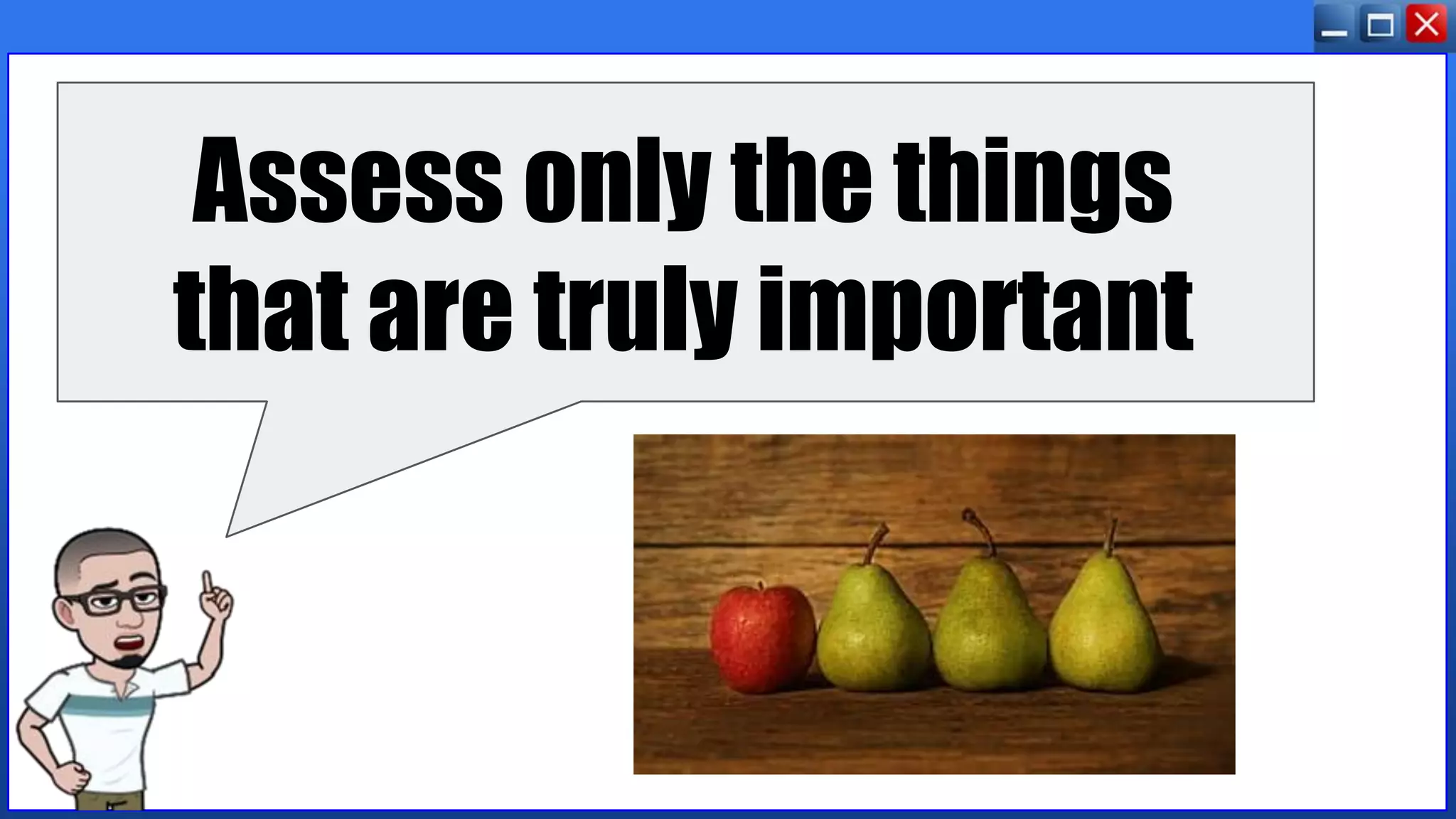
Assess only the things
that are truly important
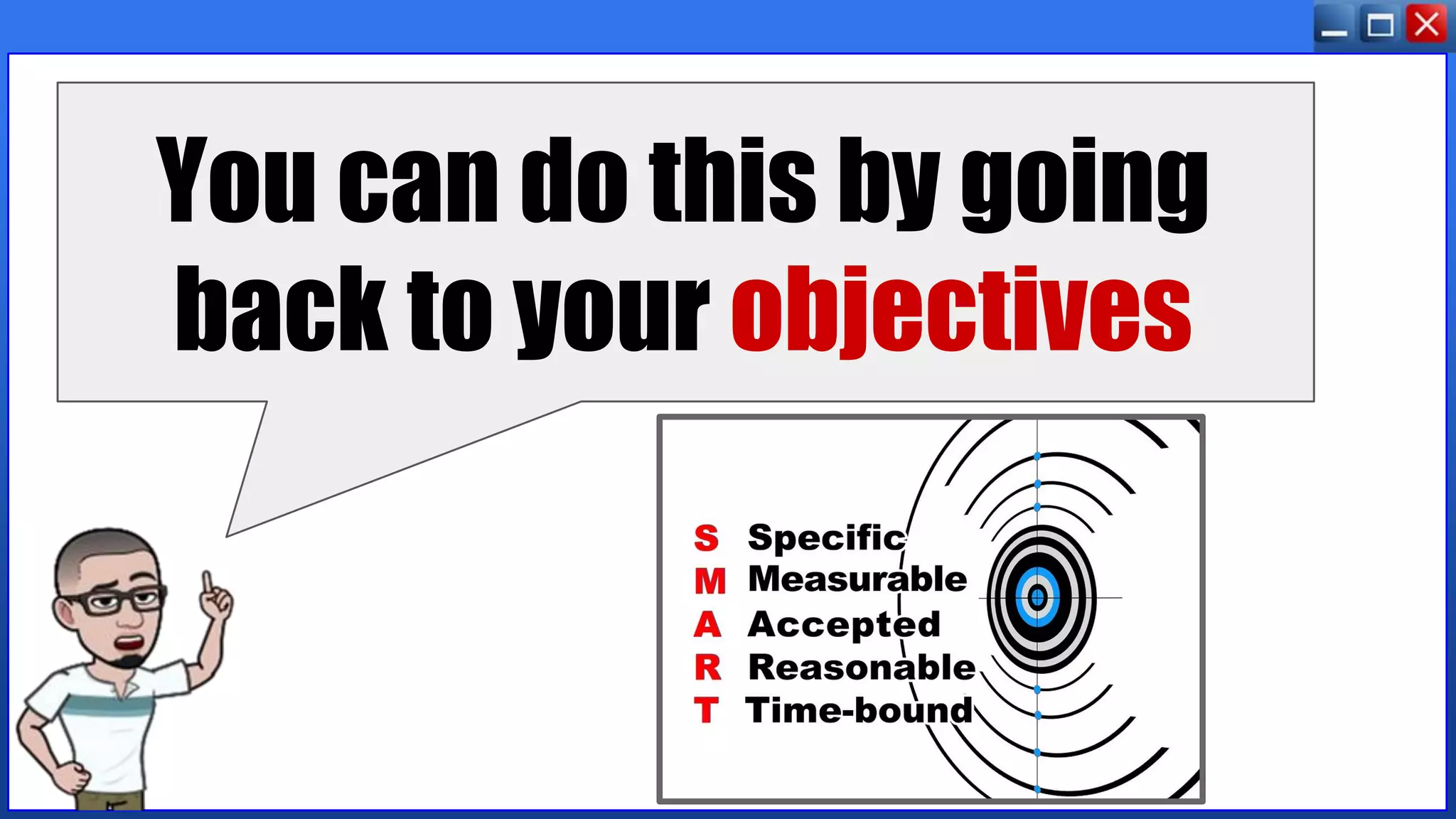
You can do this by going
back to your objectives
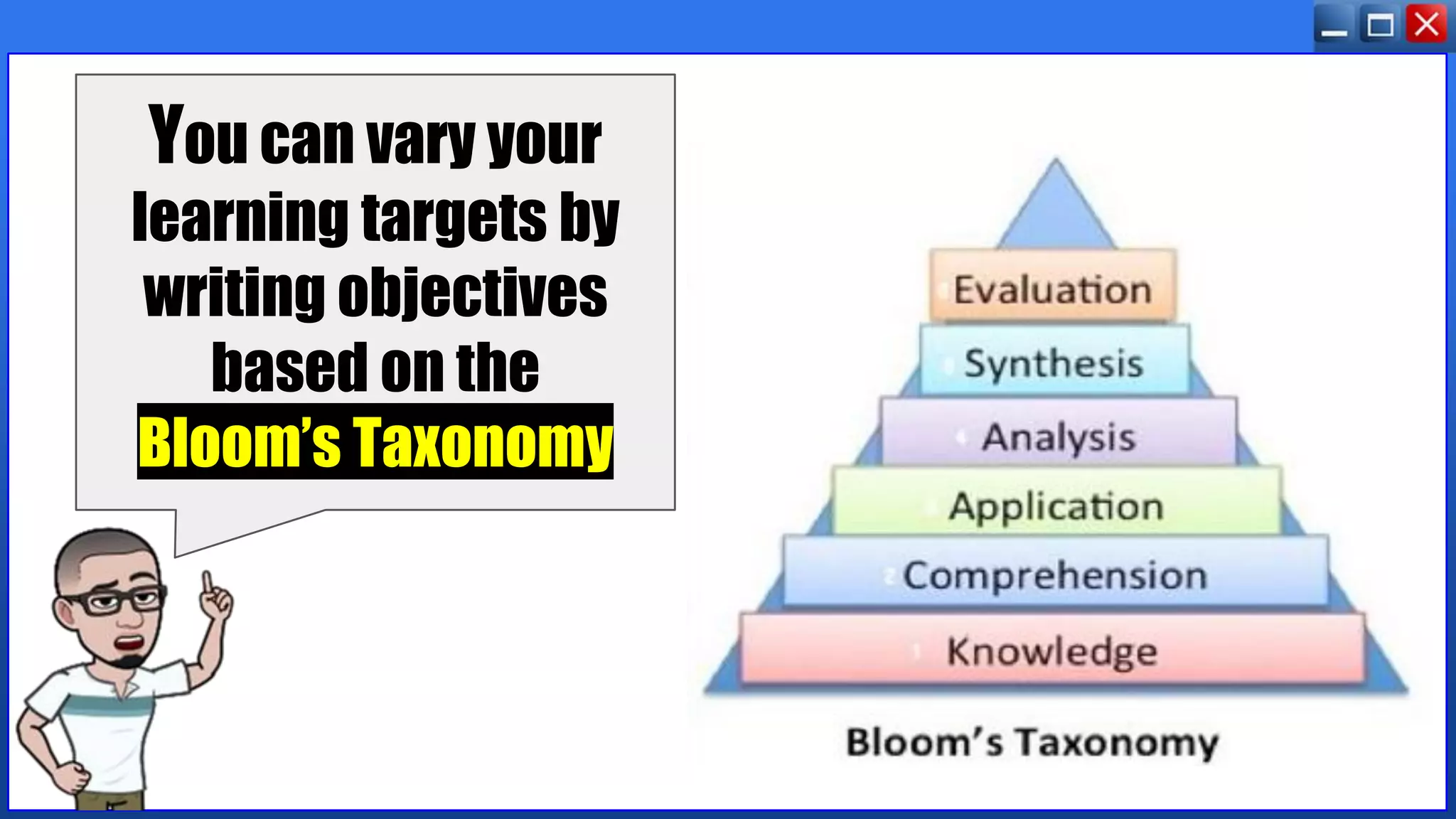
You can vary your
learning targets by
writing objectives
based on the
Bloom’s Taxonomy
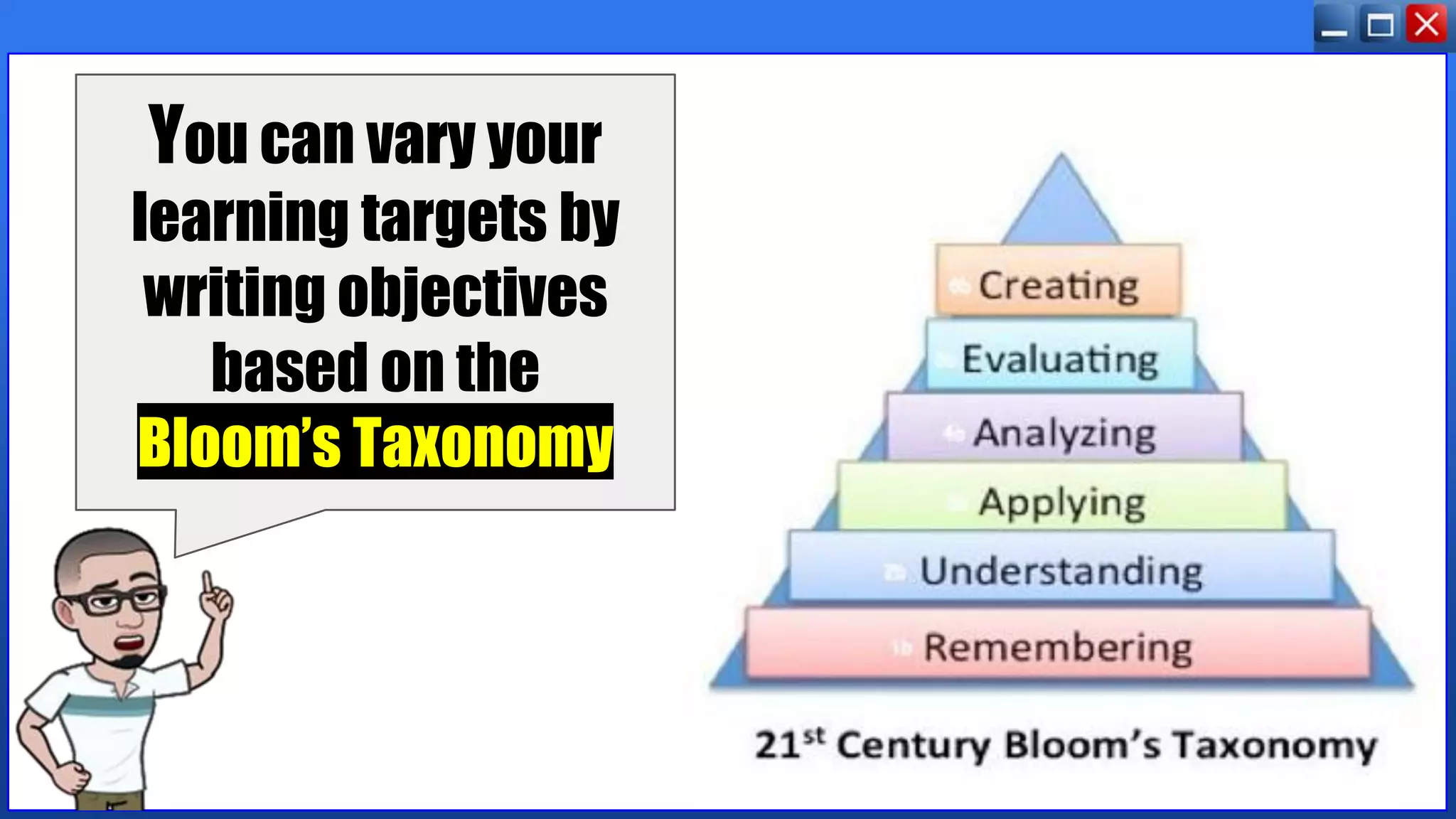
You can vary your
learning targets by
writing objectives
based on the
Bloom’s Taxonomy
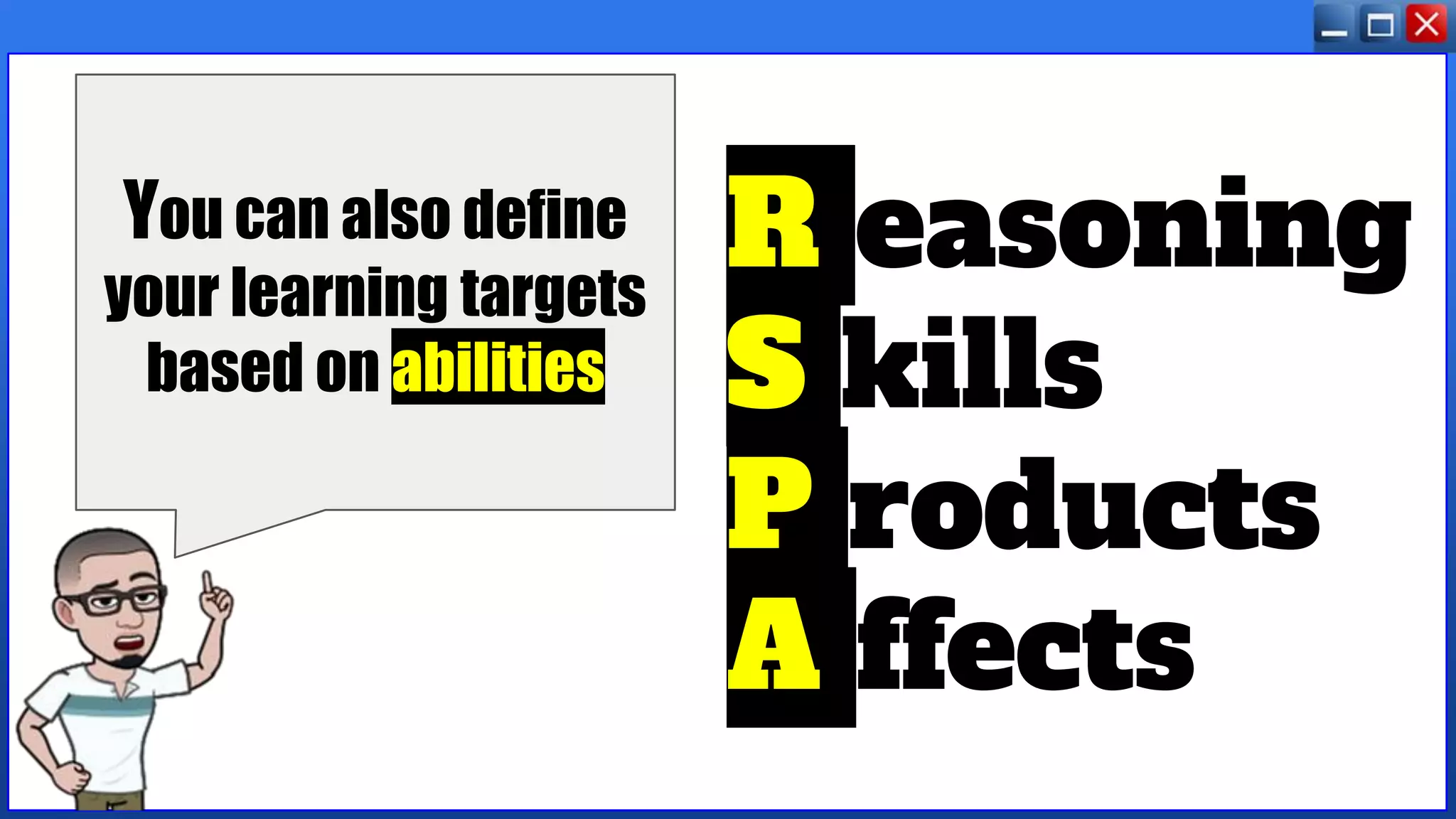
You can also define
your learning targets
based on abilities
R easoning
S kills
P roducts
A ffects
2
Match your
assessment
methods with
your targets
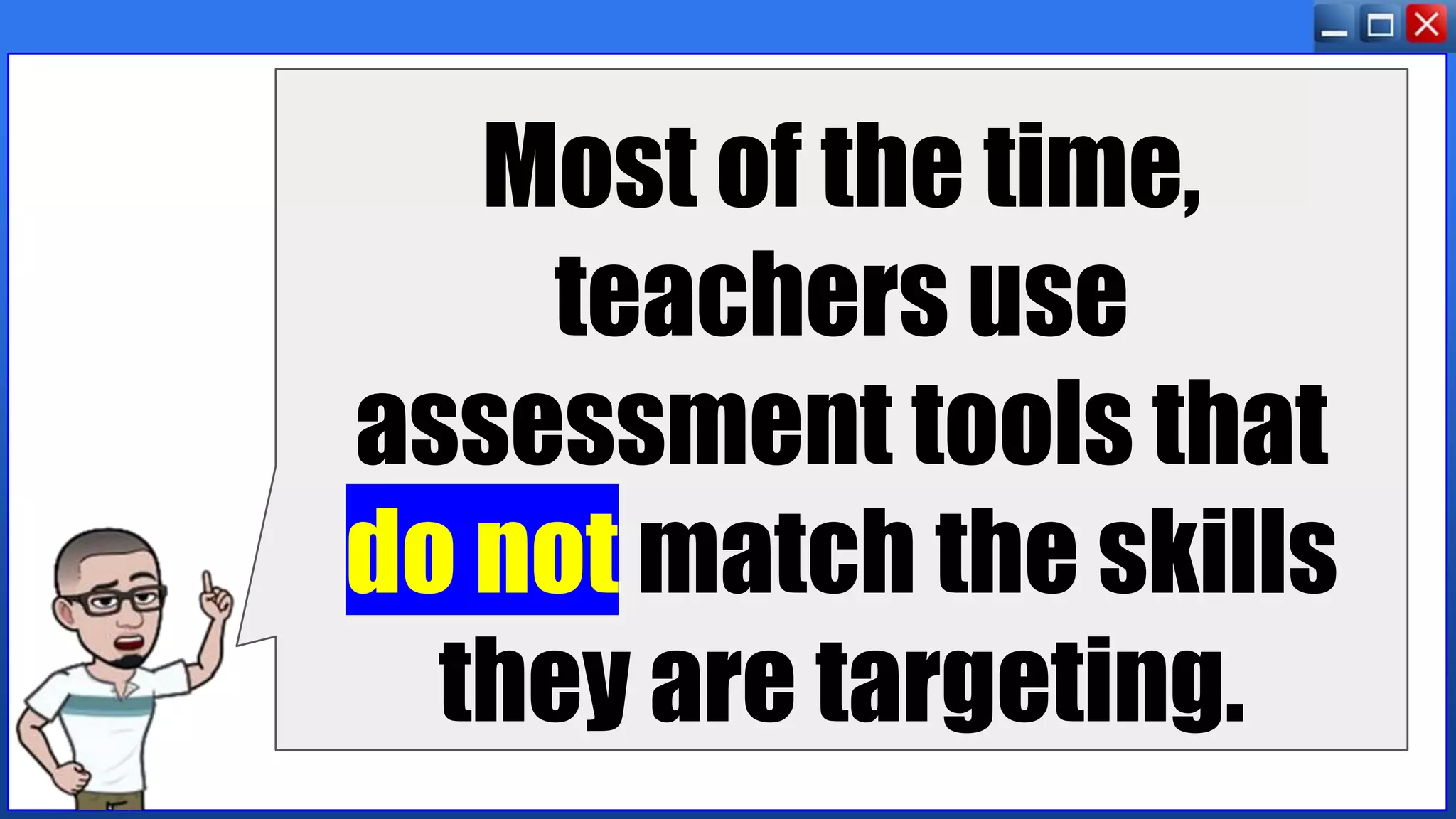
Most of the time,
teachers use
assessment tools that
do not match the skills
they are targeting.
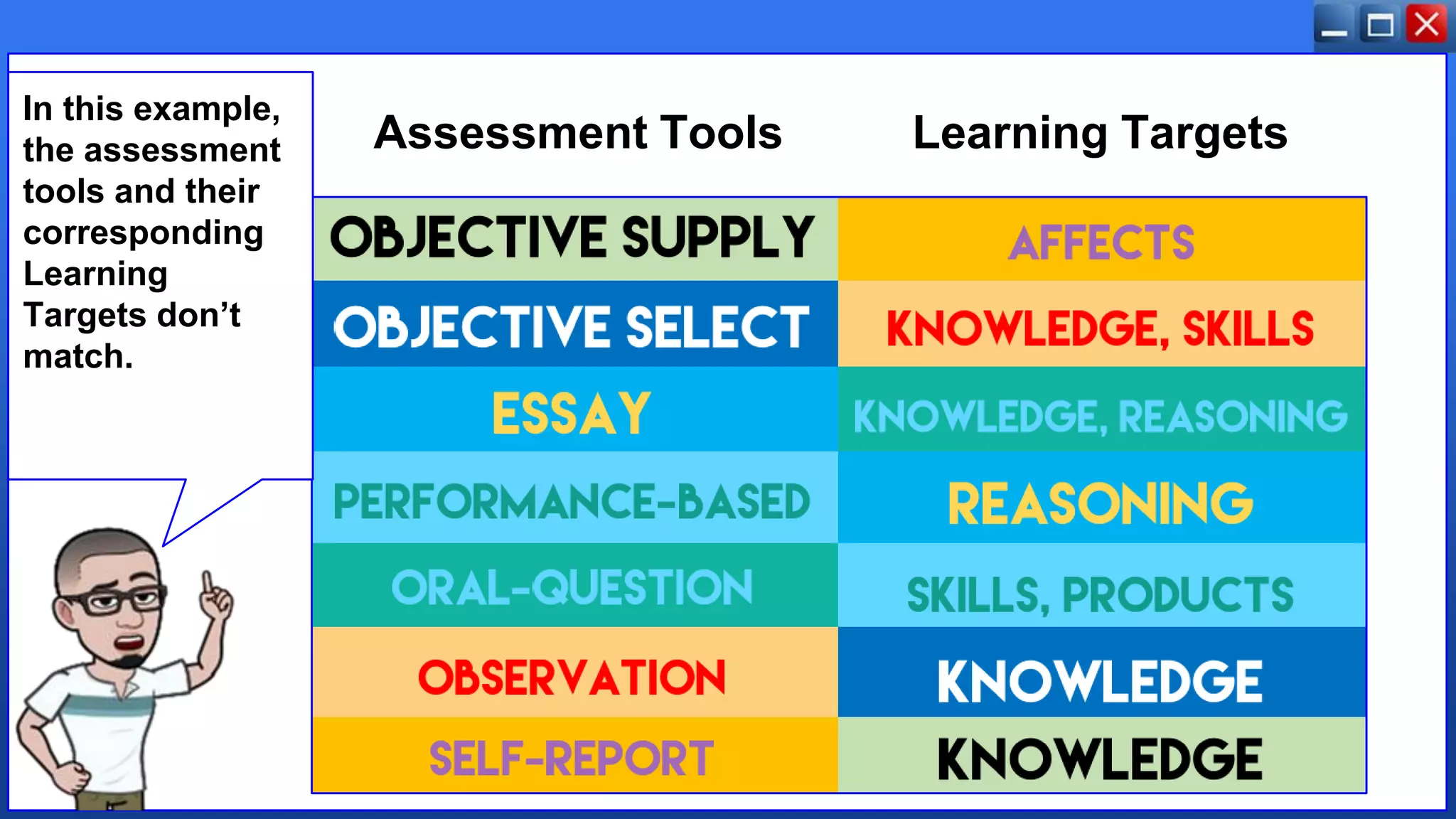
Assessment Tools Learning Targets
In this example,
the assessment
tools and their
corresponding
Learning
Targets don’t
match.
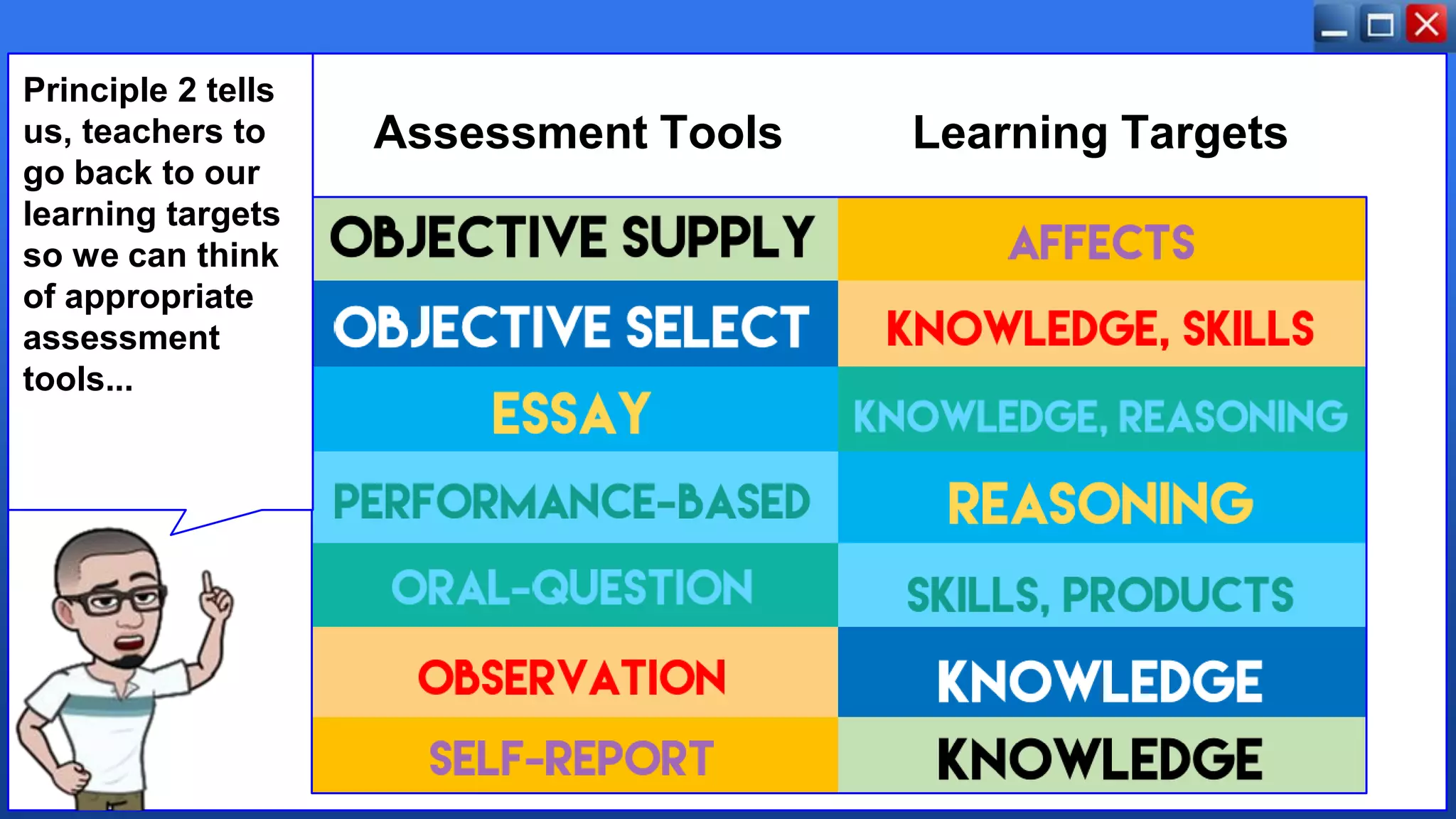
Assessment Tools Learning Targets
Principle 2 tells
us, teachers to
go back to our
learning targets
so we can think
of appropriate
assessment
tools...
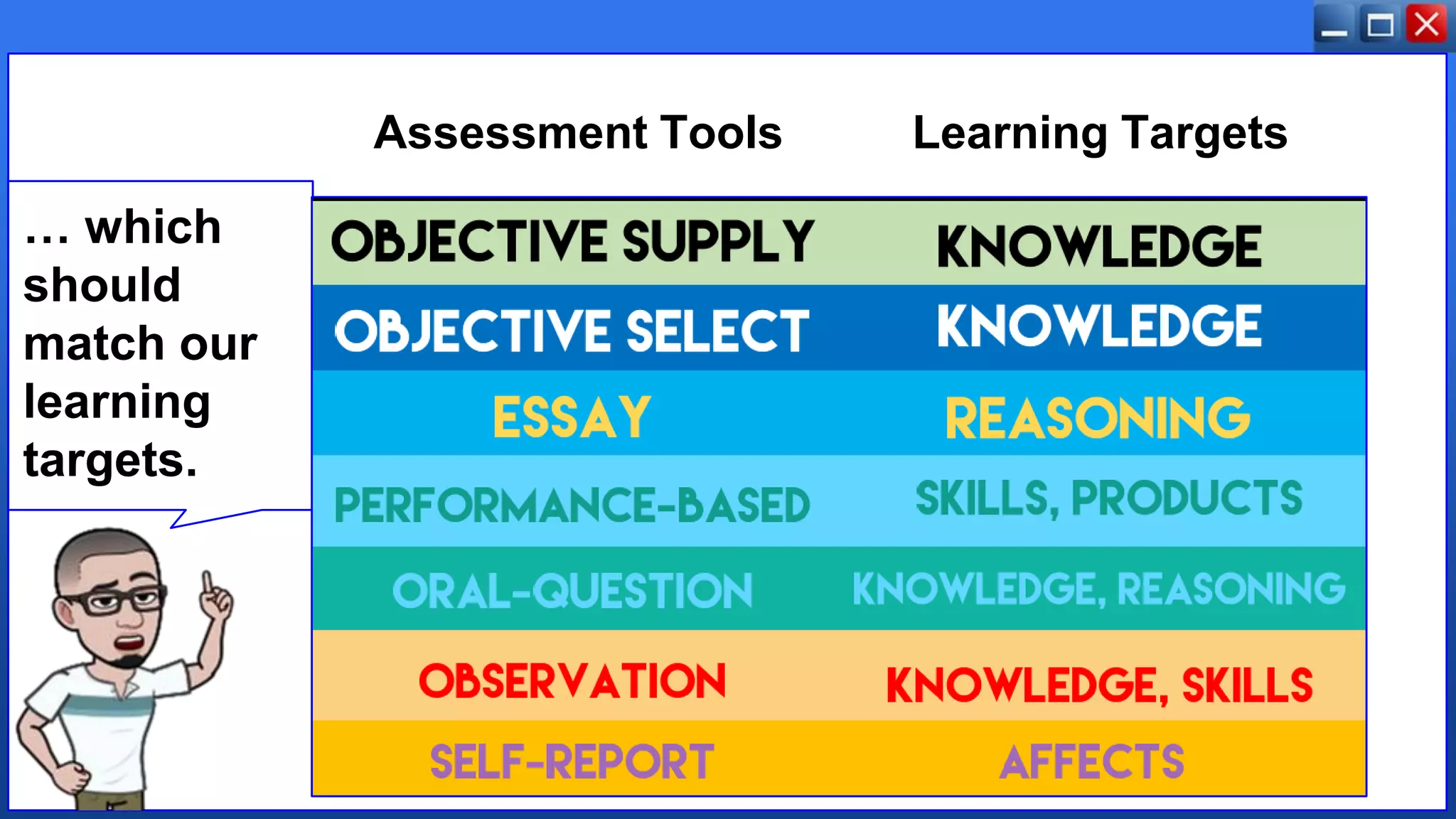
Assessment Tools Learning Targets
… which
should
match our
learning
targets.
Teacher Maria taught her pupils about plants
and plant growth. They had varied learning
activities such as songs and dances about plants,
picture shows, video presentations, and outdoor
observations. To culminate the topic, she conducted
an assessment to her pupils which is a 20 - item
identification exam. The students are given
questions / statements which ask them to supply
the answer on the blank before each number.
SCENE
What seems to be
wrong with Teacher
Maria’s final
assessment?
Did her 20-item test
assess properly the
learning targets?
Given her learning
targets, what should be
the MOST APPROPRIATE
assessment for the
topic?
3
Assess all
learning domains
and objectives
Assessments should
give equal importance
to all levels of the
learning domains.
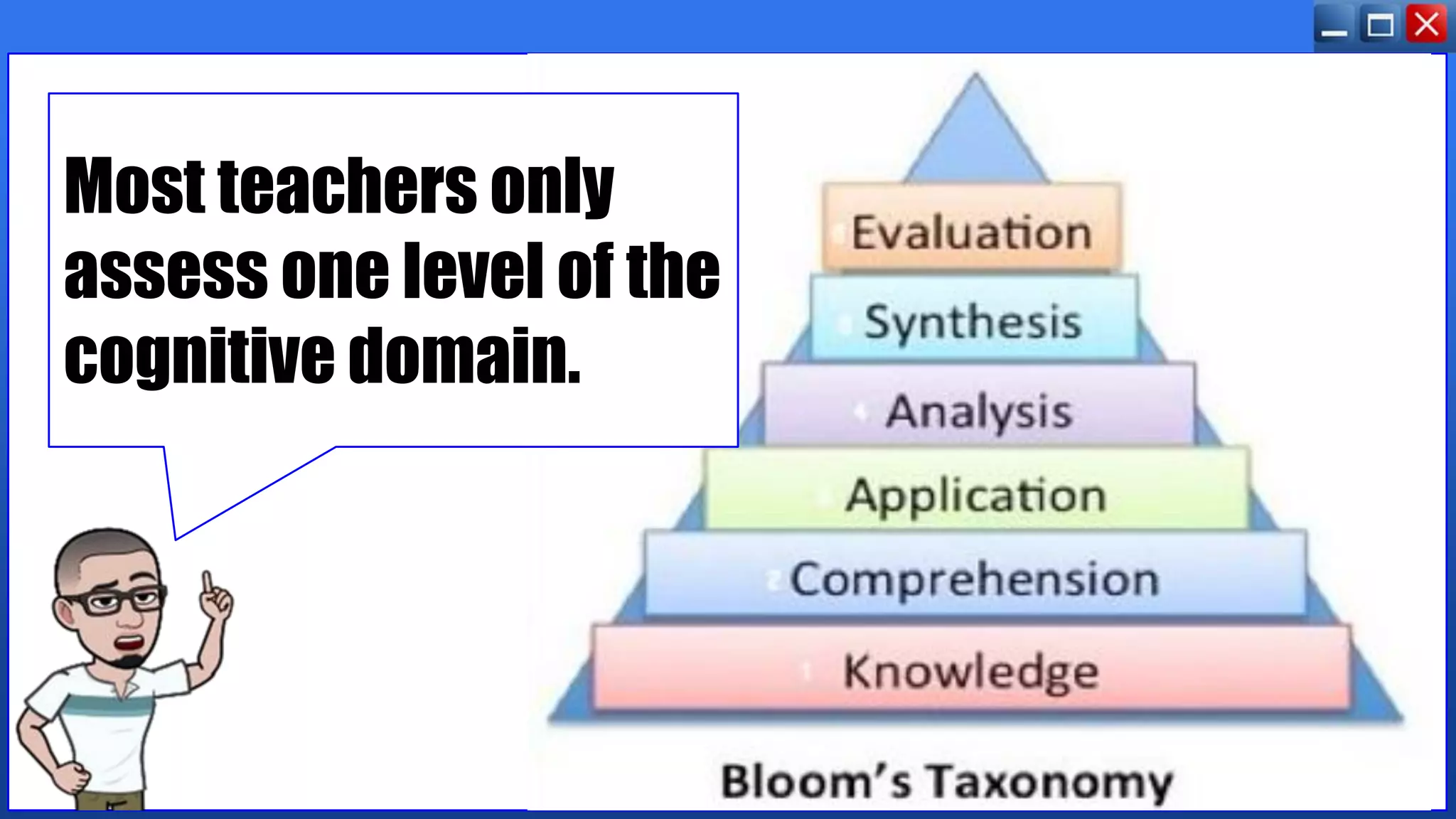
Most teachers only
assess one level of the
cognitive domain.
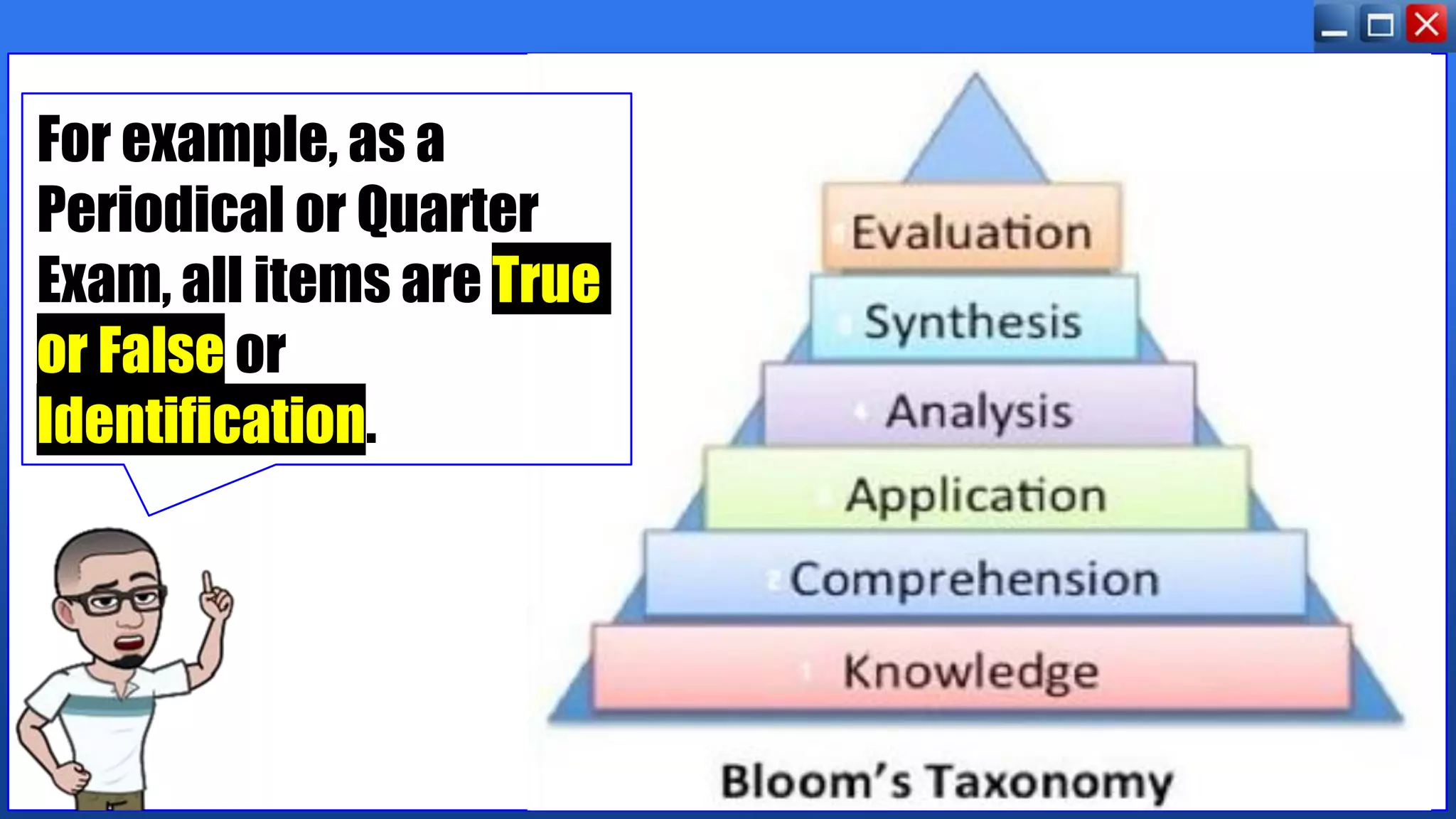
For example, as a
Periodical or Quarter
Exam, all items are True
or False or
Identification.
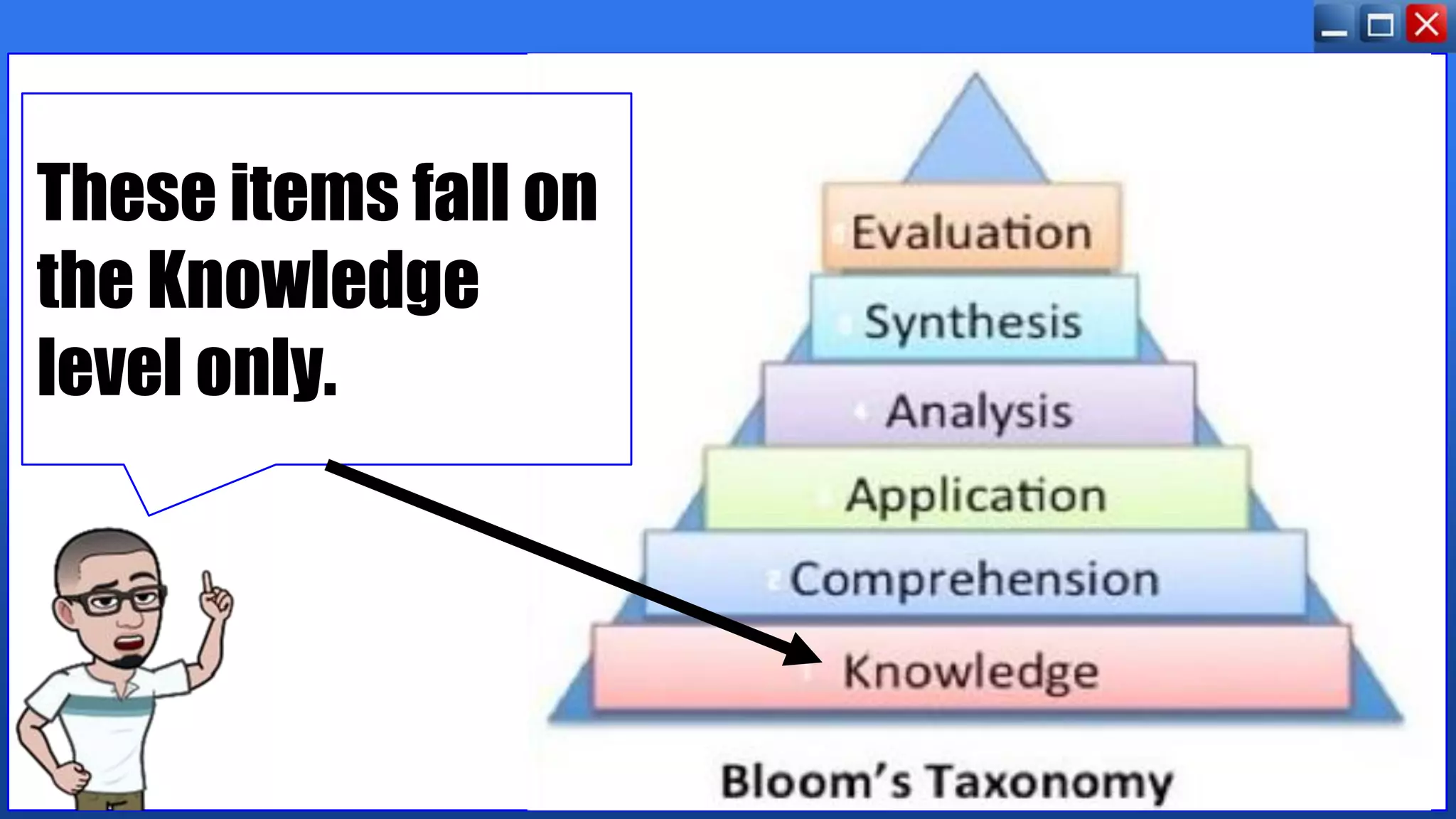
These items fall on
the Knowledge
level only.
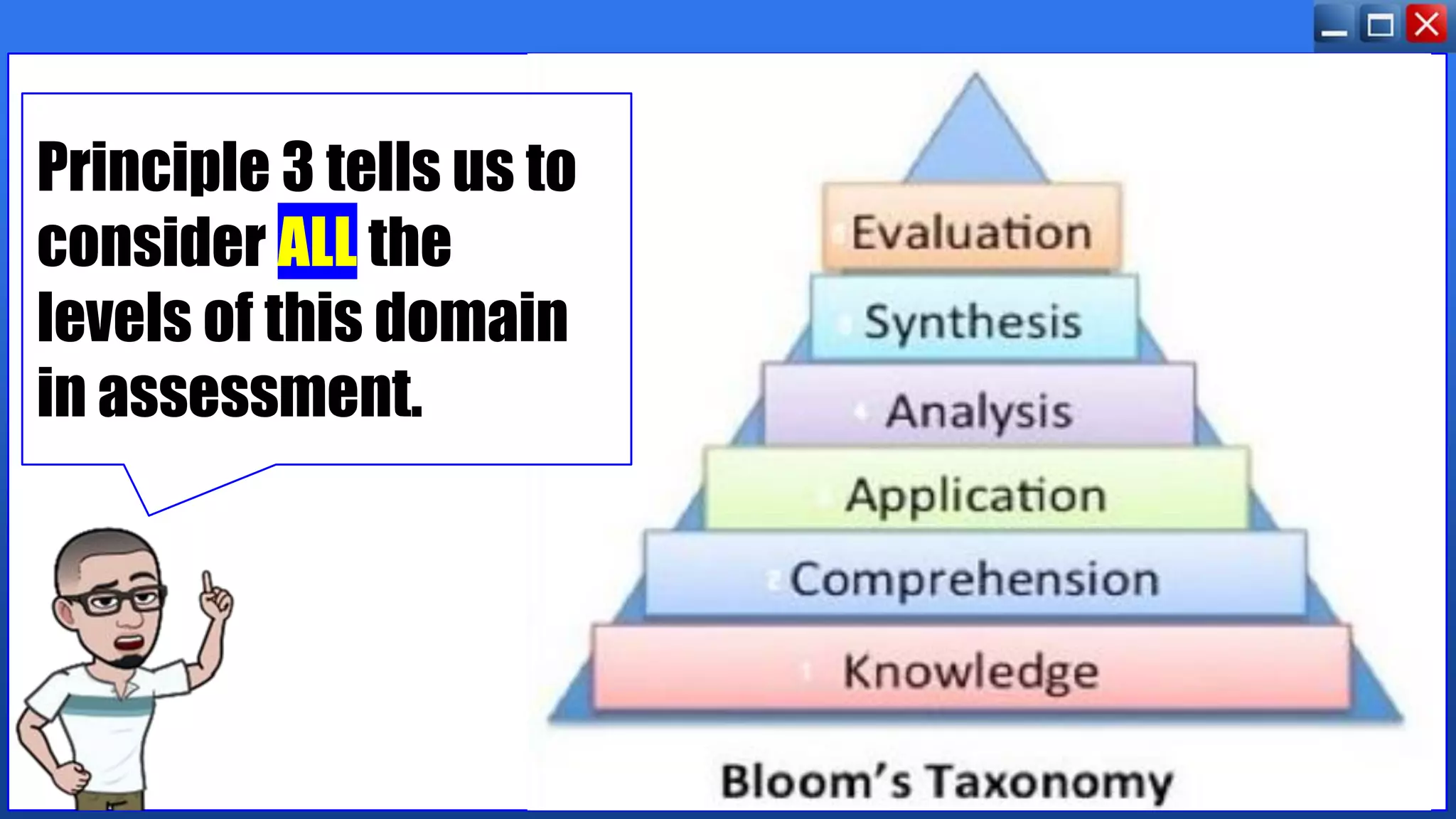
Principle 3 tells us to
consider ALL the
levels of this domain
in assessment.
Assessments should
give equal importance
to all the learning
objectives:
Assess students’
Knowledge, Skills, and
Attitudes
Assess Cognitive,
Psychomotor, and
Affective objectives.
4
Observe
VALIDITY
Principle 4 tells us,
teachers to test what
we INTEND to test.
In other words, if we
include items which do
not measure the skill or
not in our test coverage,
then our test is INVALID.
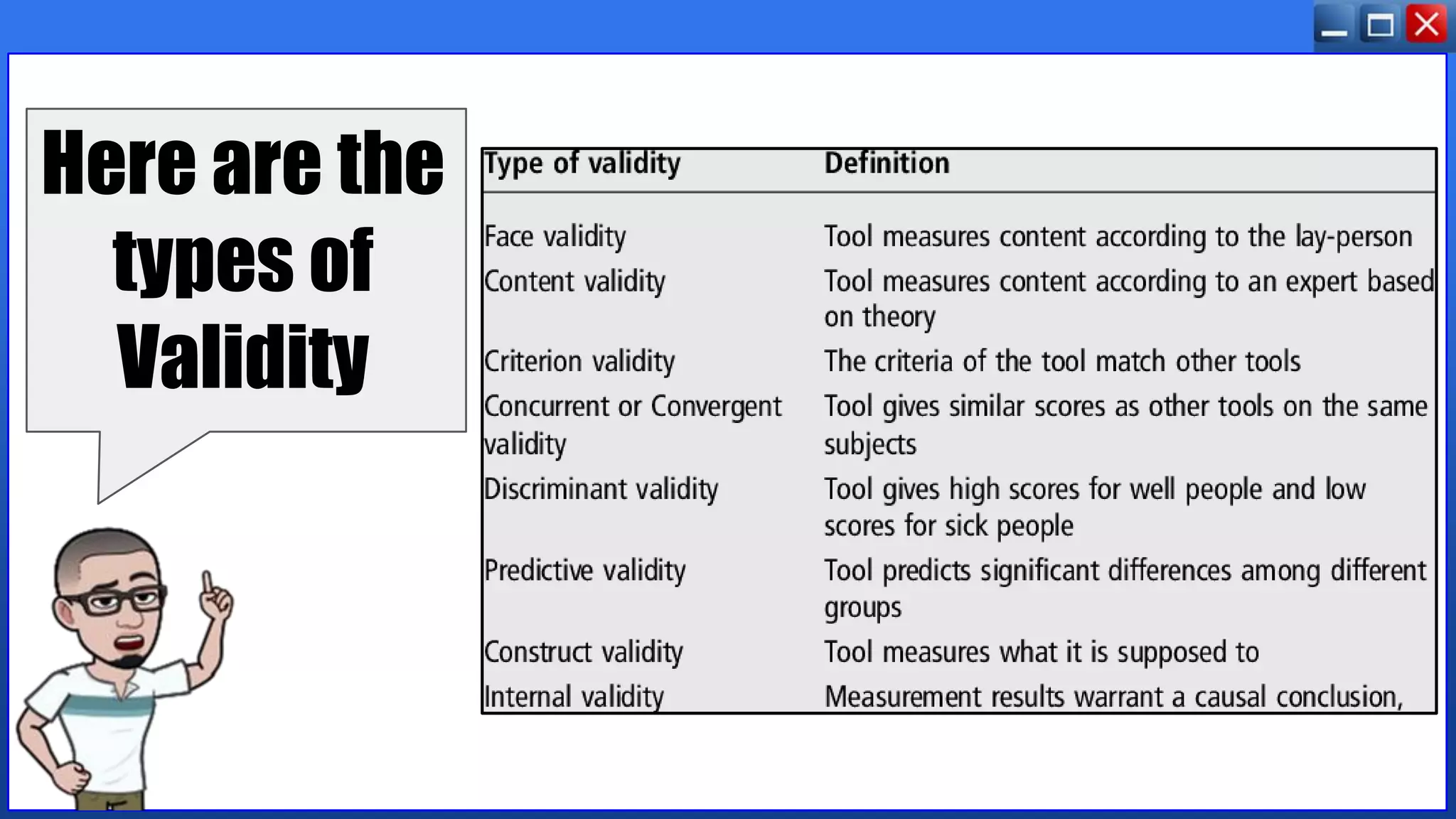
Here are the
types of
Validity
To finish making her Quarter Exam,
Ms. Alejandro included an item
asking the students to guess her
complete name.
Is the test valid?
To finish making her Quarter Exam,
Ms. Alejandro included an item
asking the students to guess her
complete name.
What will make her test invalid?
5
Observe
RELIABILITY
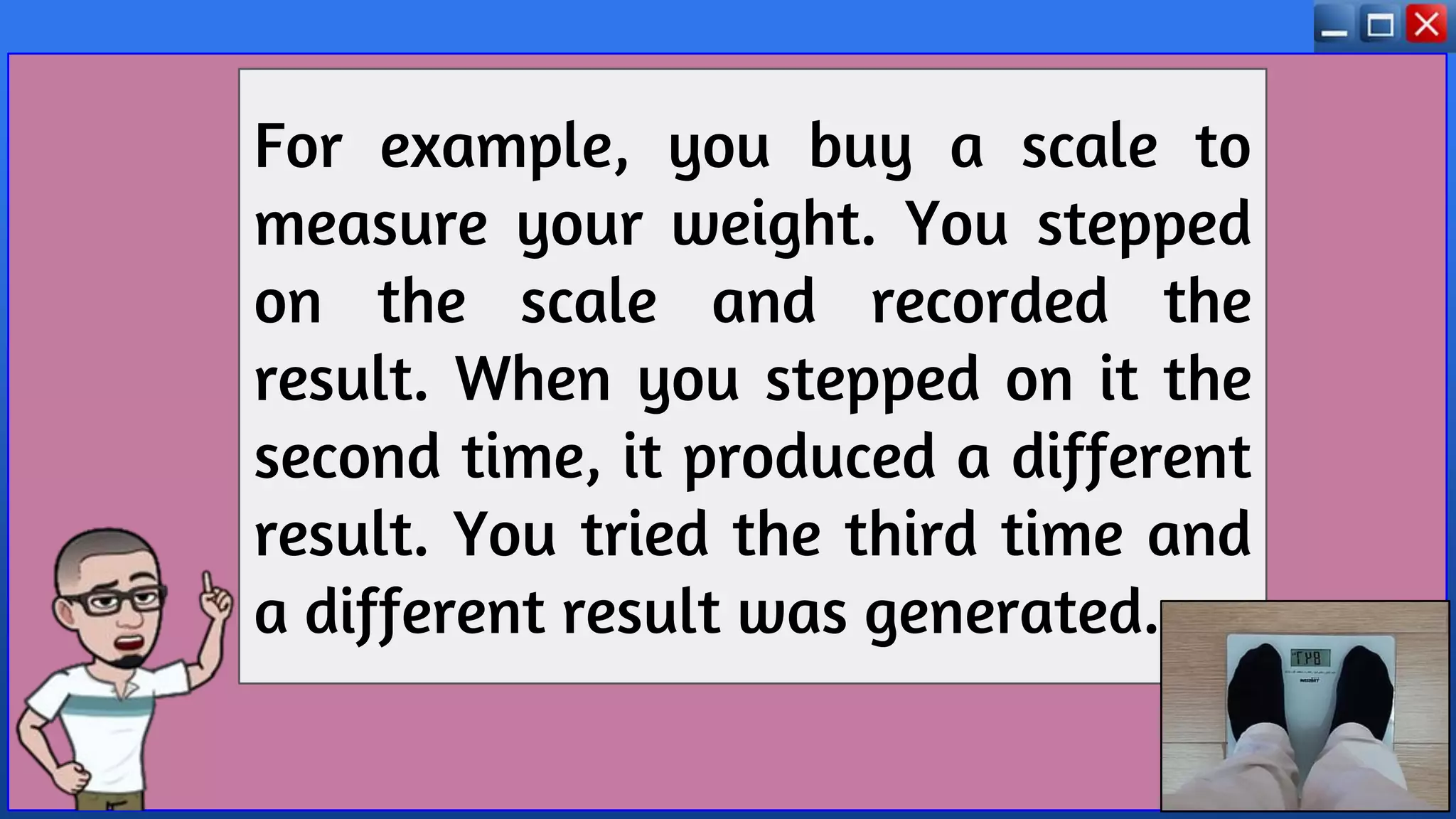
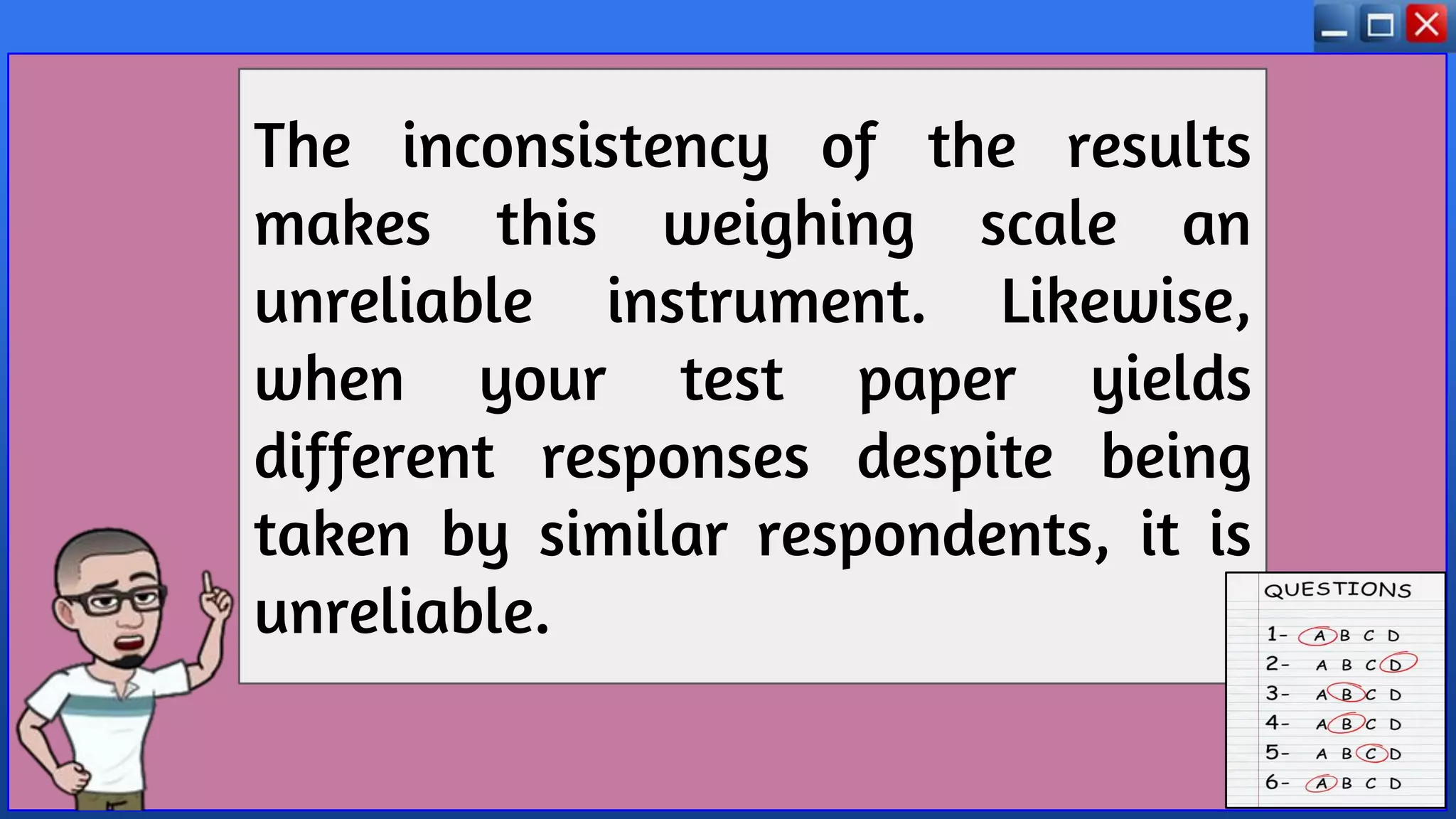
For example, you buy a scale to
measure your weight. You stepped
on the scale and recorded the
result. When you stepped on it the
second time, it produced a different
result. You tried the third time and
a different result was generated.
The inconsistency of the results
makes this weighing scale an
unreliable instrument. Likewise,
when your test paper yields
different responses despite being
taken by similar respondents, it is
unreliable.
Test reliability is all
about CONSISTENCY
of results.
A reliable test
produces consistent
responses regardless
of the reliability
instrument used.
If you are a teacher
handling the same
course/subject in the
same year level for many
years, then it is a must to
make a reliable test...
… so that you will not be
making different exams
every year.
A valid test is a
reliable test...
… but not all
reliable tests
are valid.
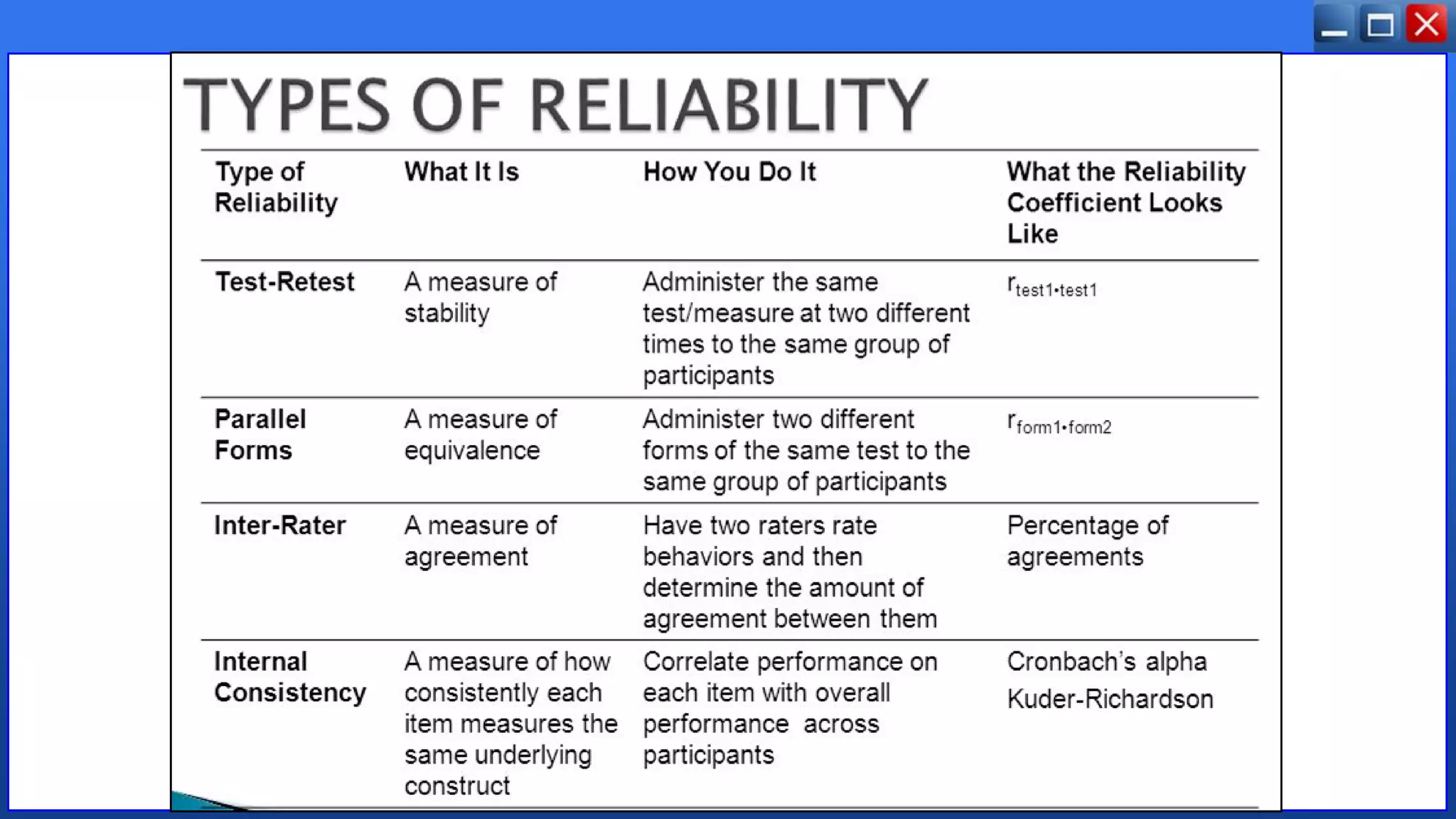
Here are the tools
to measure
reliability in a test:
Reliability is a
prerequisite for validity.
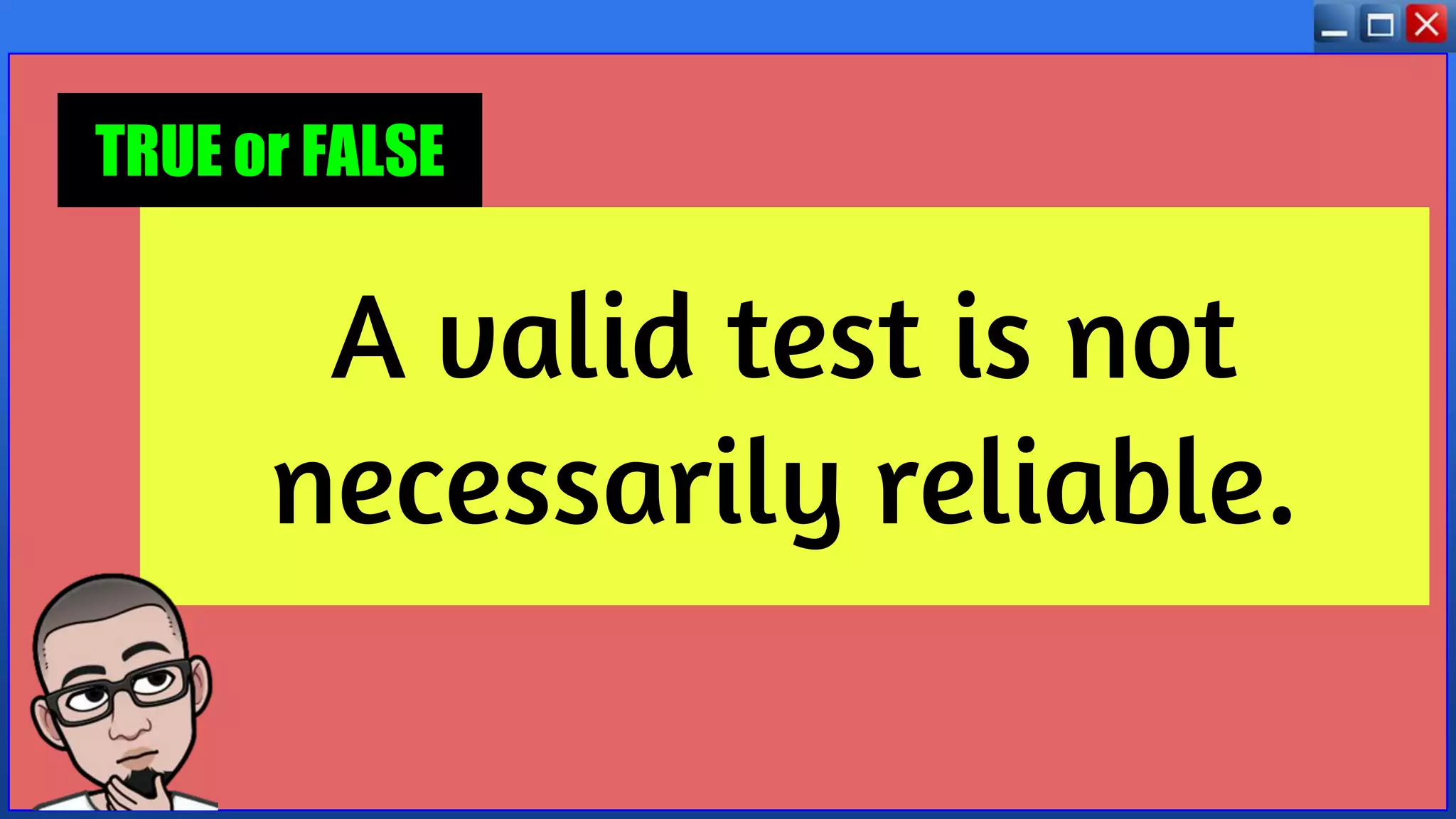
TRUE or FALSE
A valid test is not
necessarily reliable.
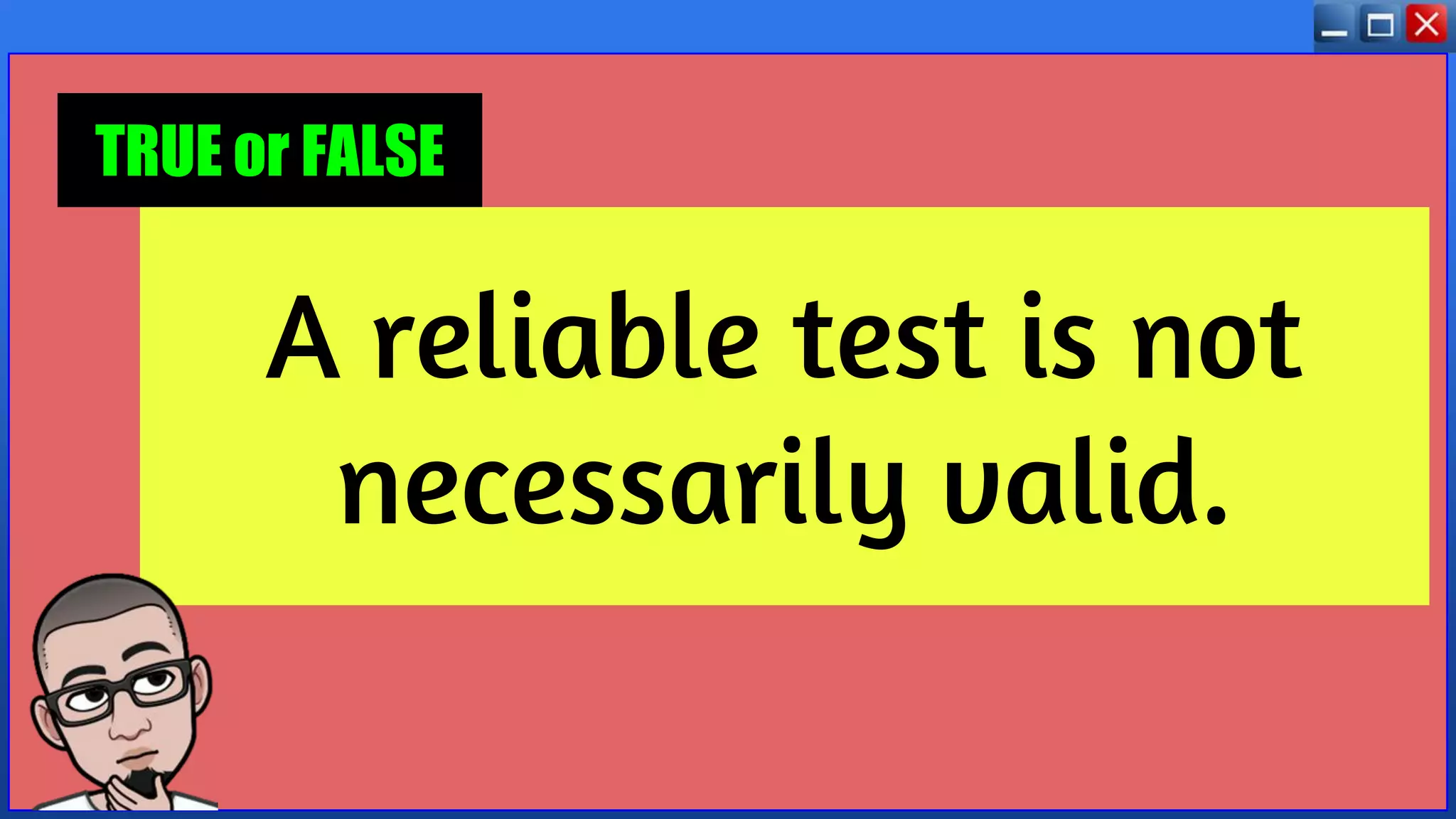
TRUE or FALSE
A reliable test is not
necessarily valid.
TRUE or FALSE
Only Multiple-choice
exams are valid.
TRUE or FALSE
6
Observe
FAIRNESS
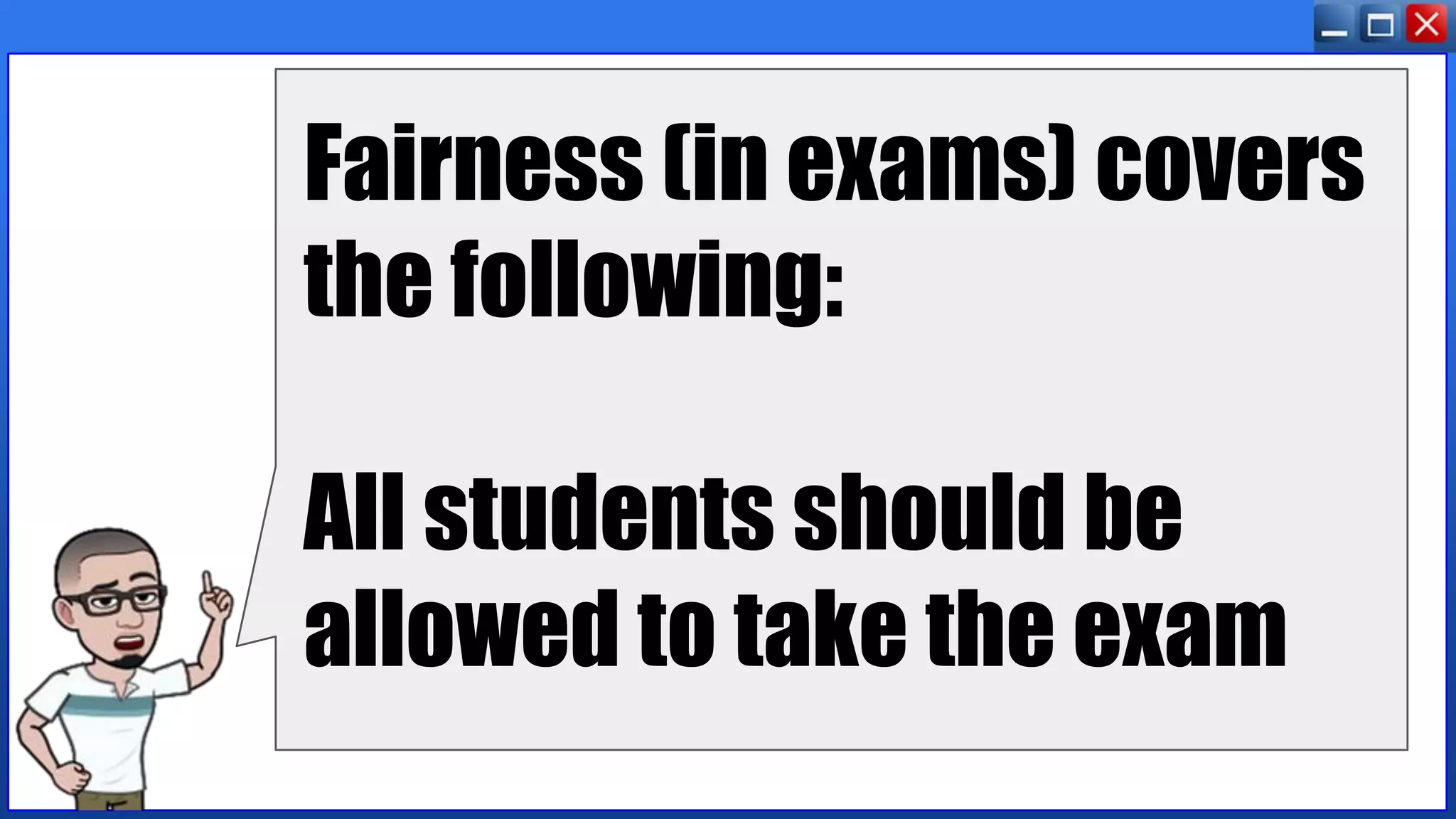
Fairness (in exams) covers
the following:
All students should be
allowed to take the exam
Students who have not
taken scheduled exams
should be allowed to take
equivalent delayed
examinations
Refer to RELIABILITY for this
equivalent examination.
Is it also FAIR to give
exemptions to students from
taking major examinations?
It is advisable to only reward
formative assessments as
exemptions.
However, in some cases, some
teachers can exempt students
from summative
assessments...
… if and only if the cause of his
exemption is equivalent to the
test itself, and of the
same coverage.
Exemptions: International and
National recognitions, awards
and from
competitions.
… or if the teacher and the school
administrators deliberated that the
previous efforts of the students merit
them to not to take the summative
exams anymore.
Fairness (in exams) covers
the following:
No evidence of discrimination
in the test items.
No discrimination of:
Race, Gender, Color,
Profession, Religion,
Language, Culture, etc.
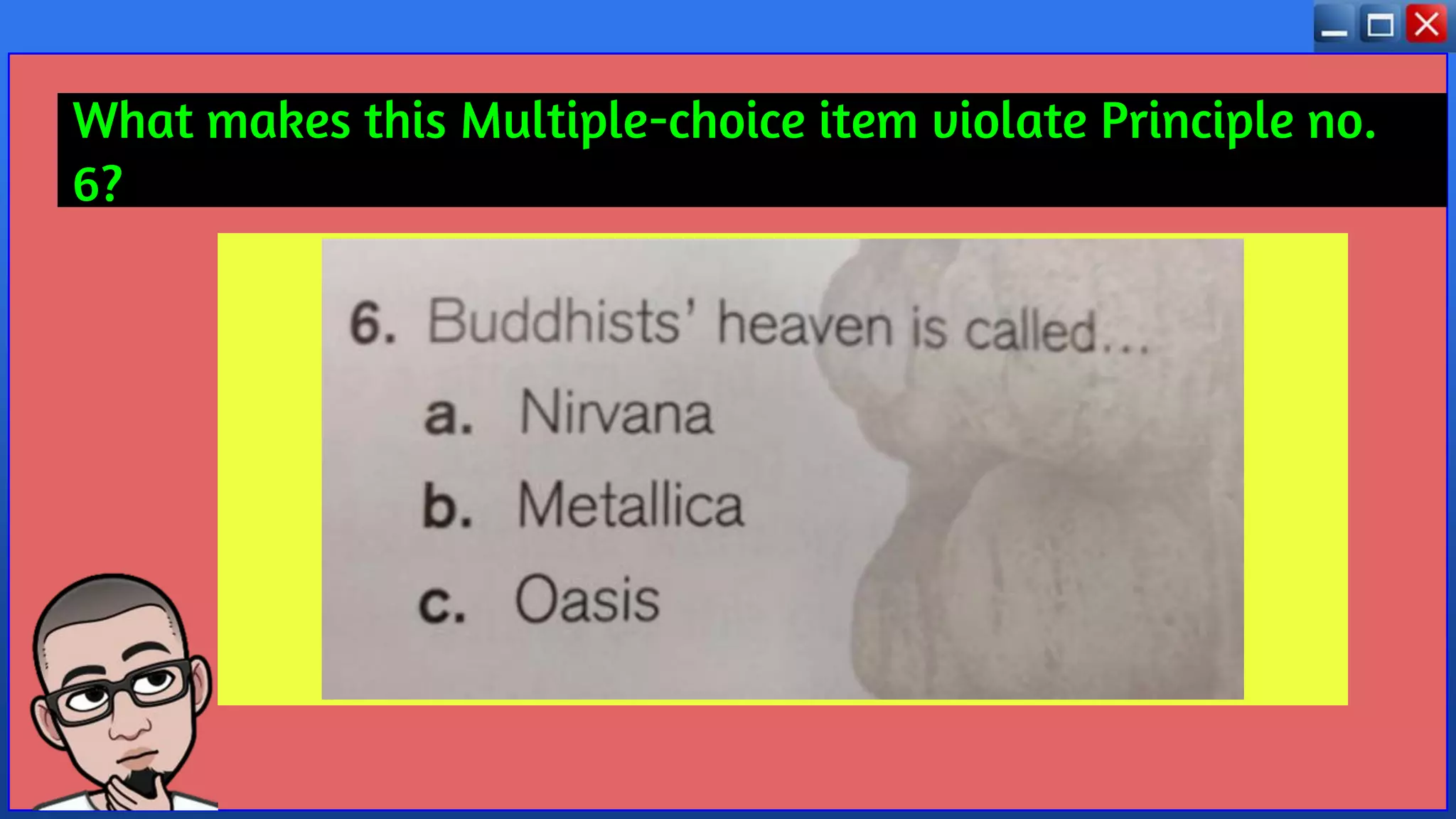
What makes this Multiple-choice item violate Principle no.
6?
7
Aim for
authentic
assessments
Assessment examples in
textbooks are good but
some of the examples
used there may be:
OUTDATED
Assessment examples in
textbooks are good but
some of the examples
used there may be:
FAR FROM THE STUDENTS’ CONTEXTS
Principle 7 tells teachers
to innovate assessment
tasks without compromising
the learning targets.
These innovations
should also cover
real-life situations
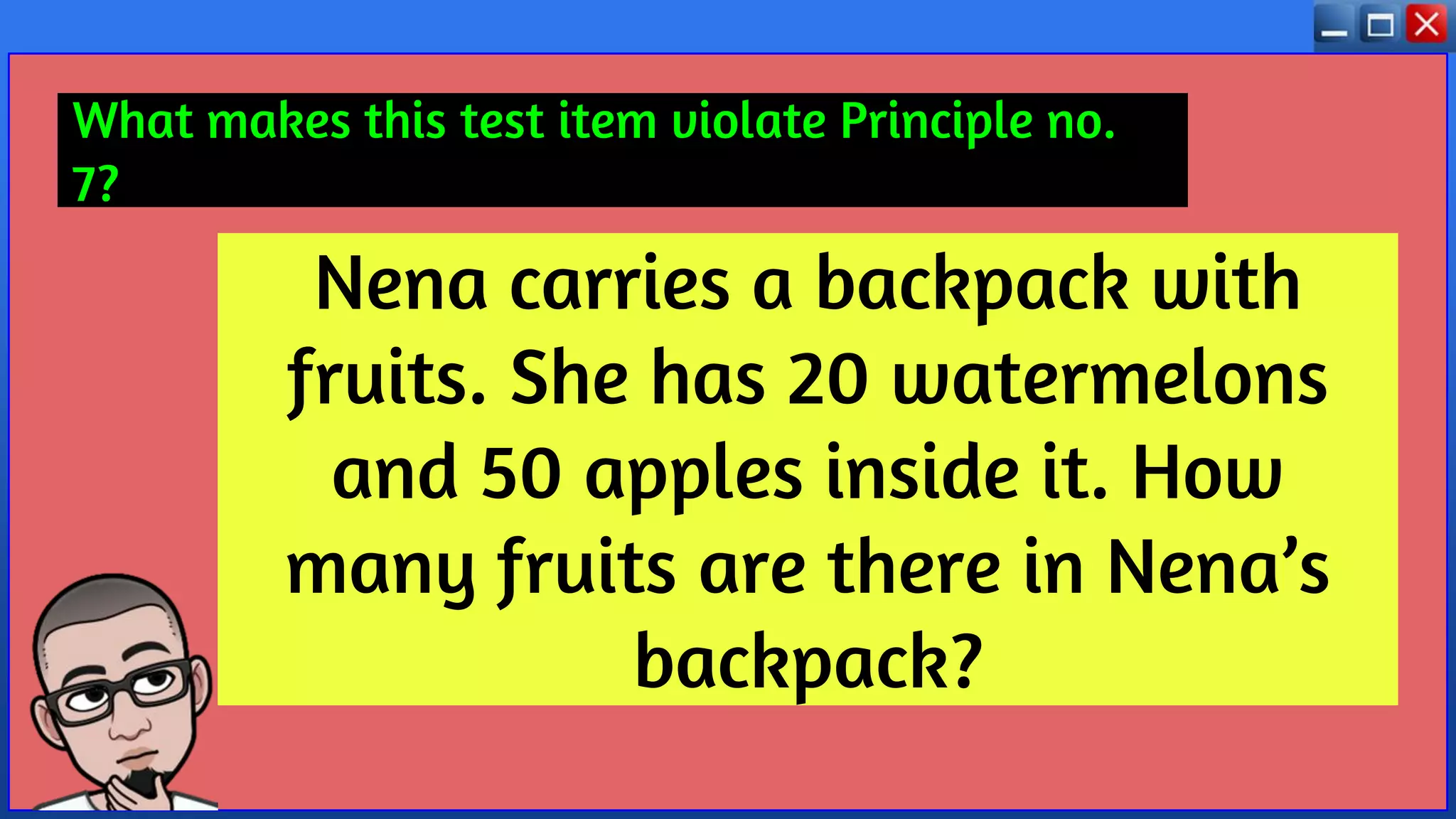
Nena carries a backpack with
fruits. She has 20 watermelons
and 50 apples inside it. How
many fruits are there in Nena’s
backpack?
What makes this test item violate Principle no.
7?
8
Aim for
practicality
& efficiency
Assessments need
not be grand all the
time.
Principle 8 tells teachers
to innovate assessment
tasks which help save
time, money, and
resources...
… without compromising
QUALITY
Examples include:
1. using of online exams
instead of paper exams
which cost money and
cubicle space.
Examples include:
2. asking students to answer
on their paper while they
look on the test questions
written in a Manila paper
posted on the board...
Examples include:
… instead of printing test
papers.
(This is applicable when you teach in
places where technology is limited.)
During these times when face
to face classes are prohibited,
how do you think teachers
can innovate with their
assessment methods?
9
Continuously
conduct
assessments
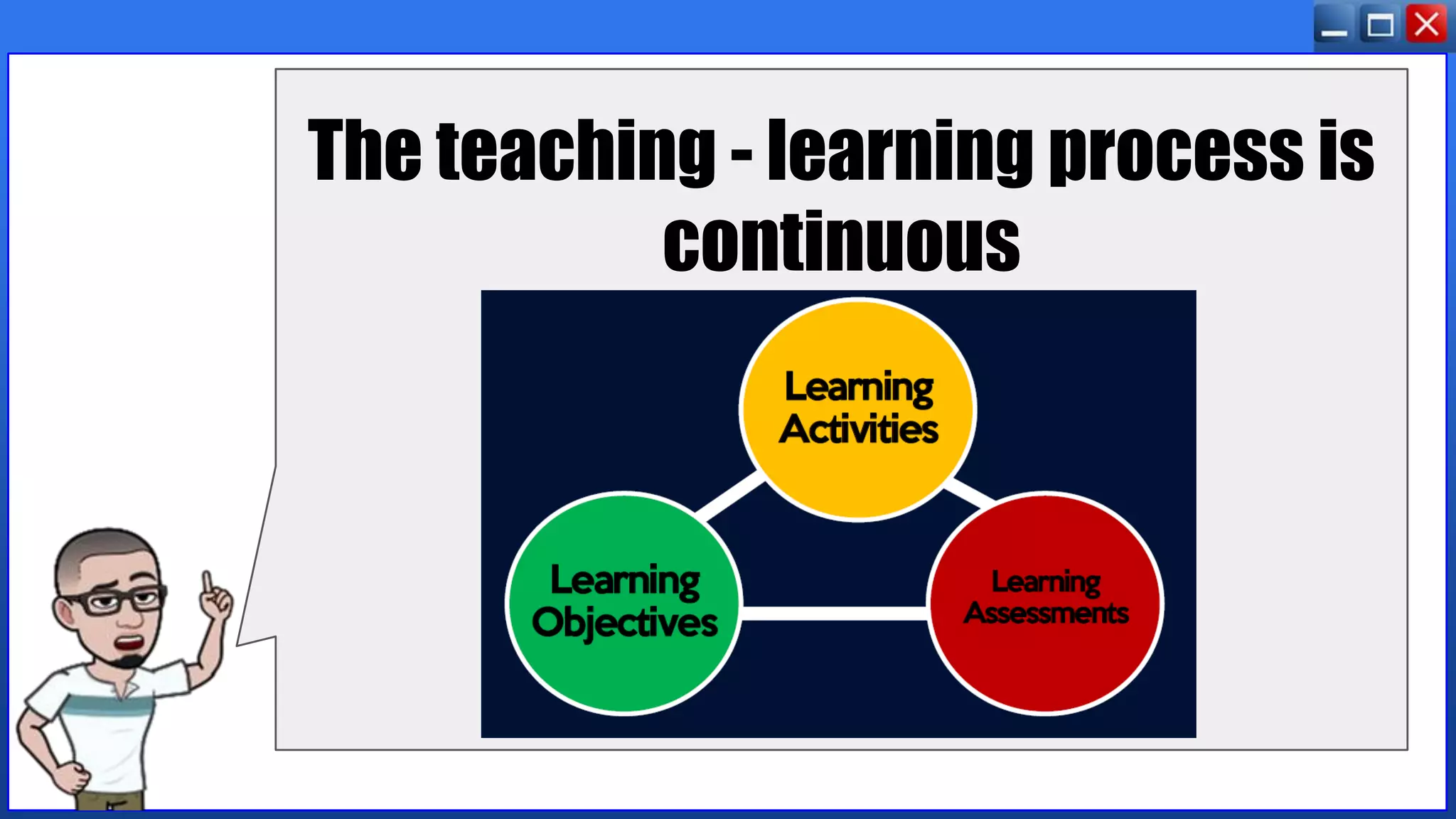
The teaching - learning process is
continuous
Which means we
teachers must assess
students continuously
Assessments can
occur in any part of
the lesson
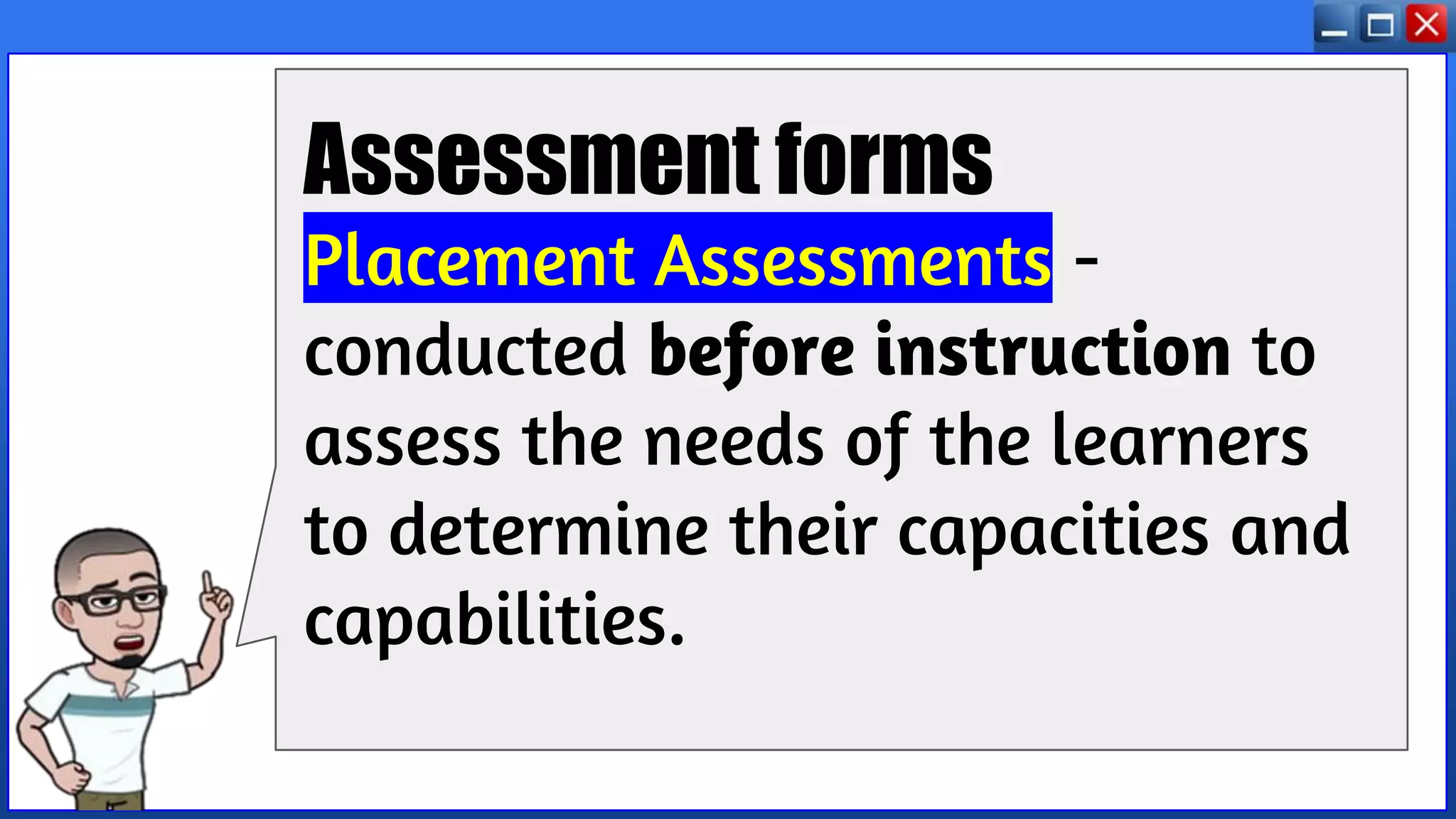
Assessment forms
Placement Assessments -
conducted before instruction to
assess the needs of the learners
to determine their capacities and
capabilities.
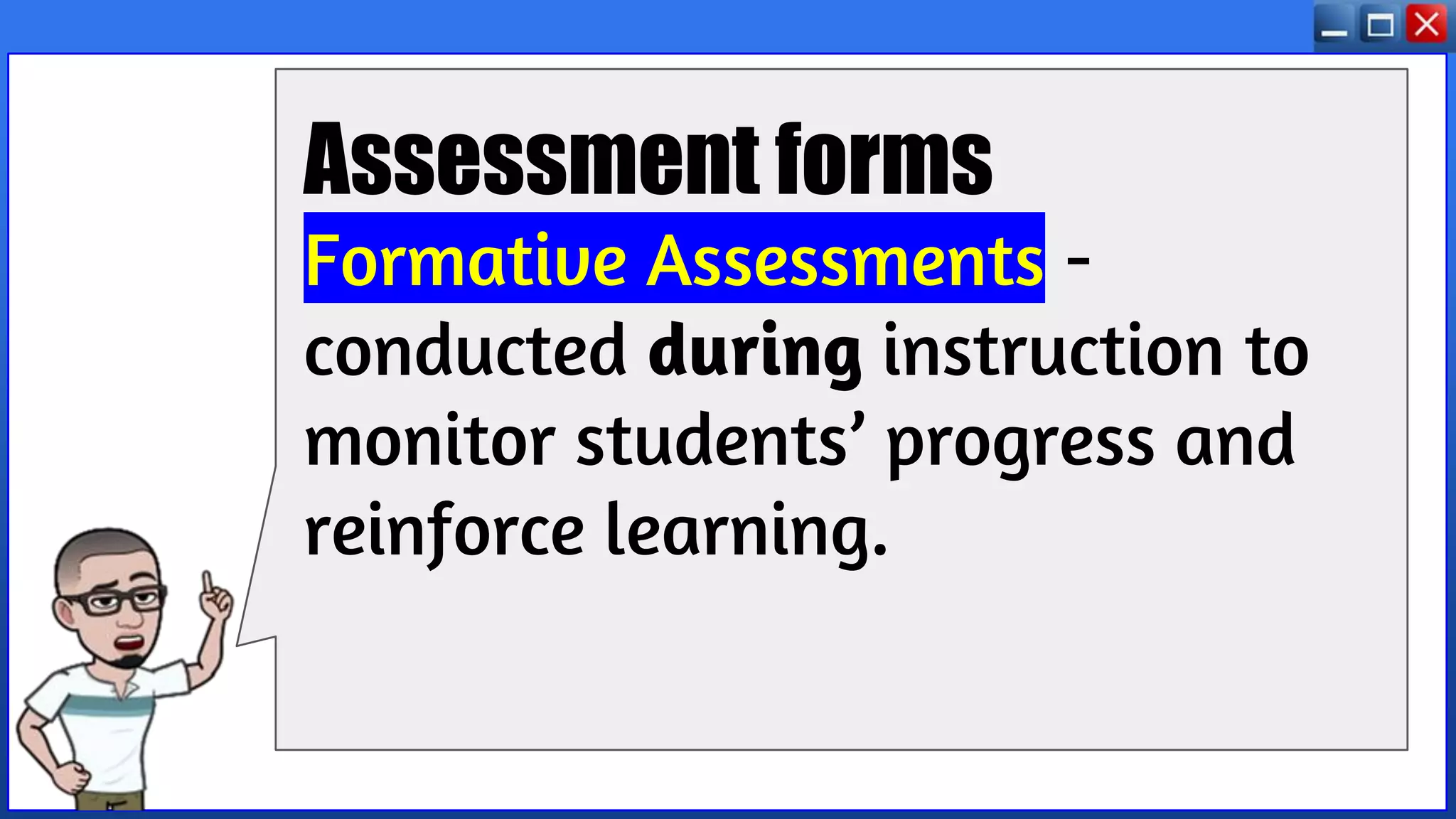
Assessment forms
Formative Assessments -
conducted during instruction to
monitor students’ progress and
reinforce learning.
Assessment forms
Diagnostic Assessments -
conducted at the beginning of
the course to see the problems
and learning difficulties of the
students.
Assessment forms
Summative Assessments -
conducted after the instruction
to assess students’ achievement
and to see the result of the
teaching-learning process.
Which assessment tool will you
use to measure students’ learning
progress about your topic?
Which assessment tool will you
use to measure students’ learning
at the end of the topic?
Which assessment tool will you
use to measure students’
strengths and weaknesses about
the subject / course?
10
Observe
assessment
ETHICS
Assessments are
used to measure
student achievement,
not for punishments.
Teachers should also
address immediately
errors found in the
assessment tools.
Assessment results
should also be
communicated properly
not for derogation.
Assessment results
should also be
confidential.
How should you confront a
student who has successive
low scores in all your quizzes
and performance tests?
11
Clearly
communicate
assessment
results
In connection to the
previous Principle,
assessment results must be
communicated accurately
and to the right people only.
These people include the
students, the parents, and
other professionals who
can help with the results
(intervention purposes).
You found out in the
screening test results that an
enrollee has exhibited
atypical results. What should
you do first about the
sensitive information?
12
Train yourself and the
students to develop a
positive attitude on
assessments
Orient the students and
the parents at the
beginning of the school
year about the benefits
of assessments.
Let them be also aware
of the positive effects
of assessment results.
As teachers, we should
motivate students
regardless of them
receiving a low or a high score.
Also, we should use
the assessment
results to improve our
quality of instruction.
Following Principle 12, which of
the following things should you
do first if you see a student
always dissatisfied with his/her
test score?
There you go!
I hope that by learning these
12 Principles, you will not
only improve your
assessment designing skills,
but also have fun making
them.
Finally, let
us have a
review.
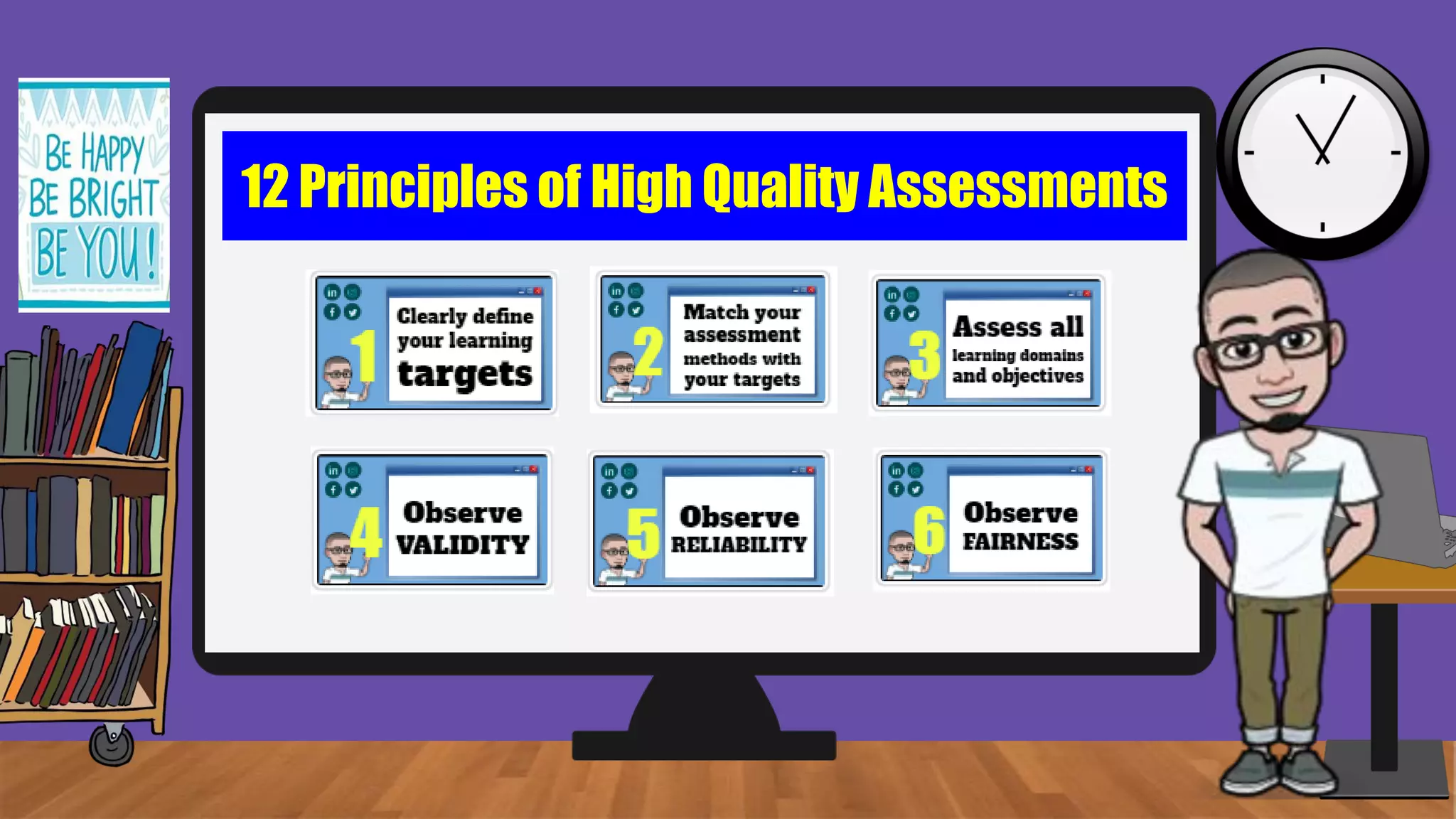
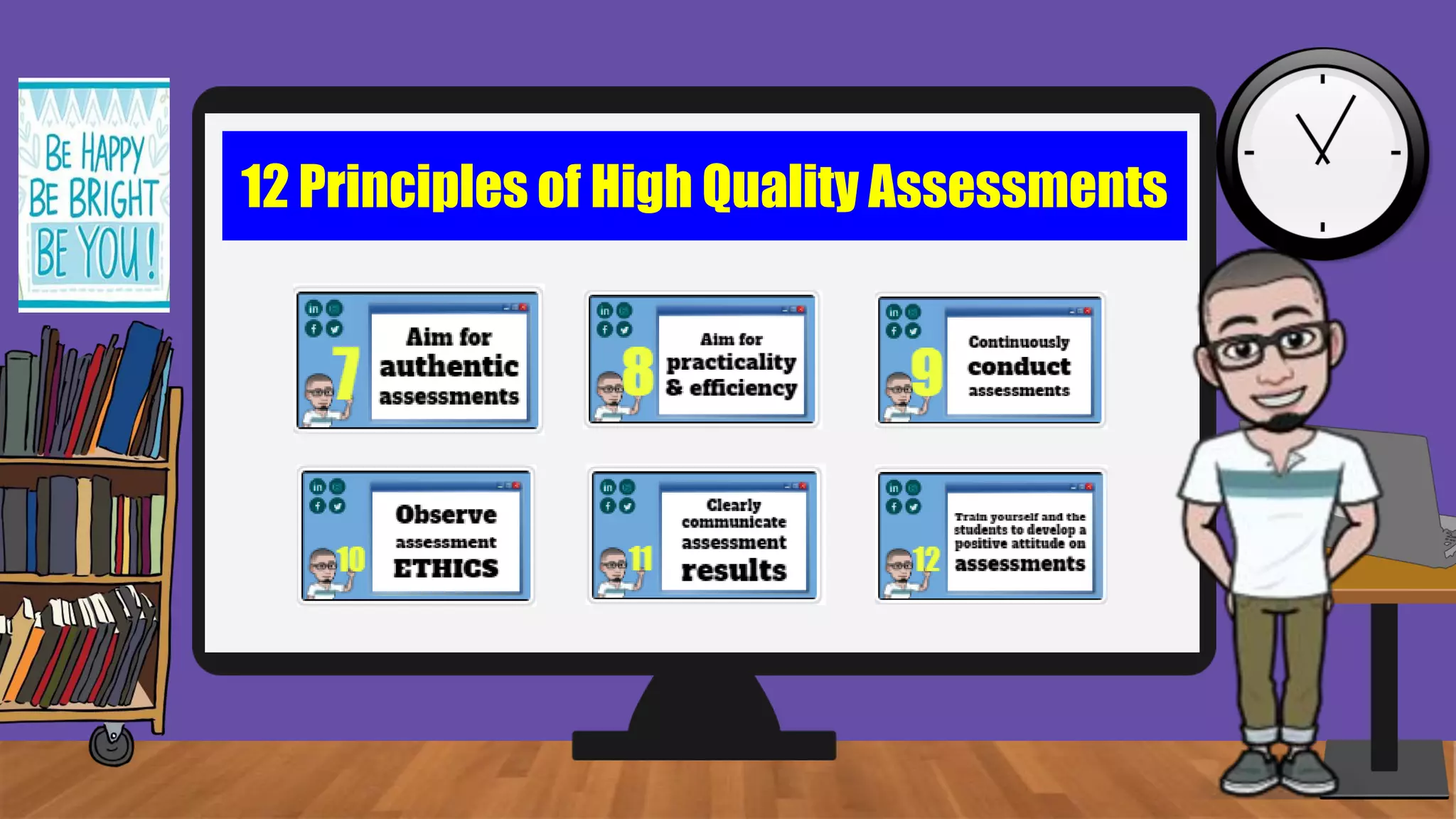
12 Principles of High Quality Assessments
Thank you very much!
Reference:
Van Blerkom, M. (2009).
Measurement and statistics for
teachers. Routledge. 270 Madison
Ave, New York, NY 10016.

12 Principles of High Quality Assessments (Version 2)