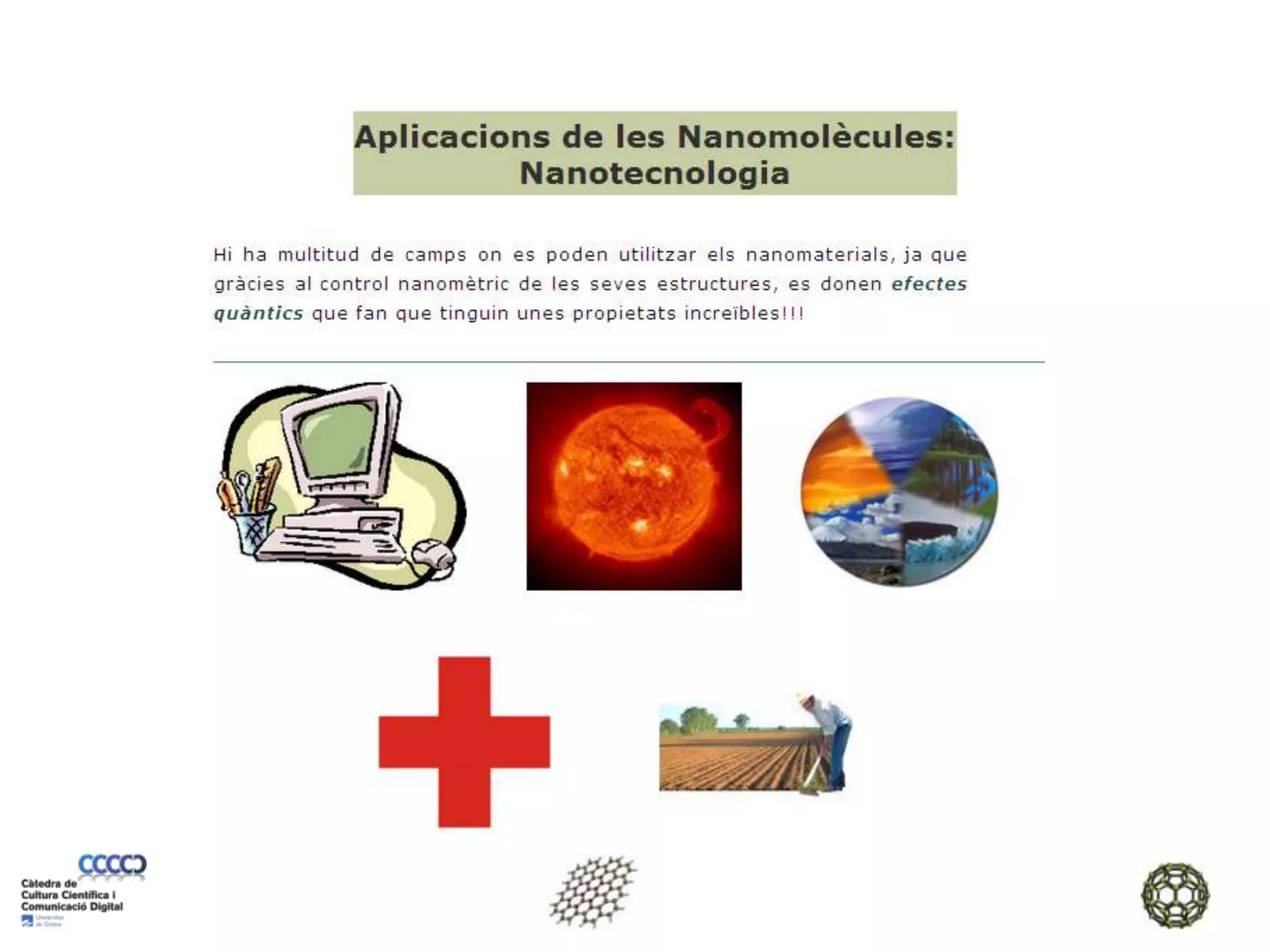
Del ful.lerè al grafè: el carboni, actor principalde l’enginyeria de la matèriaMiquel DuranUniversitat de GironaIES SS, Girona, 11/4/2011
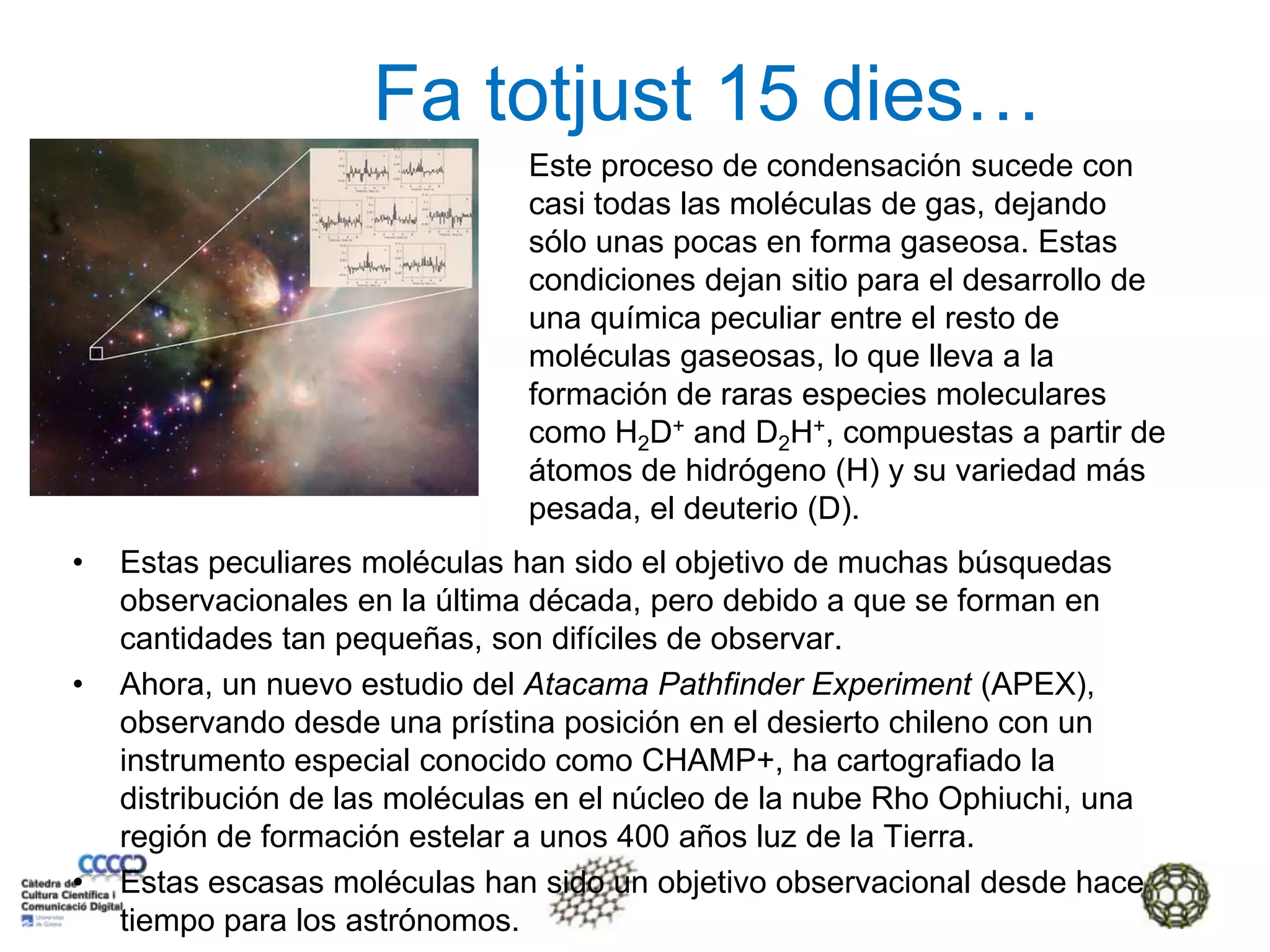
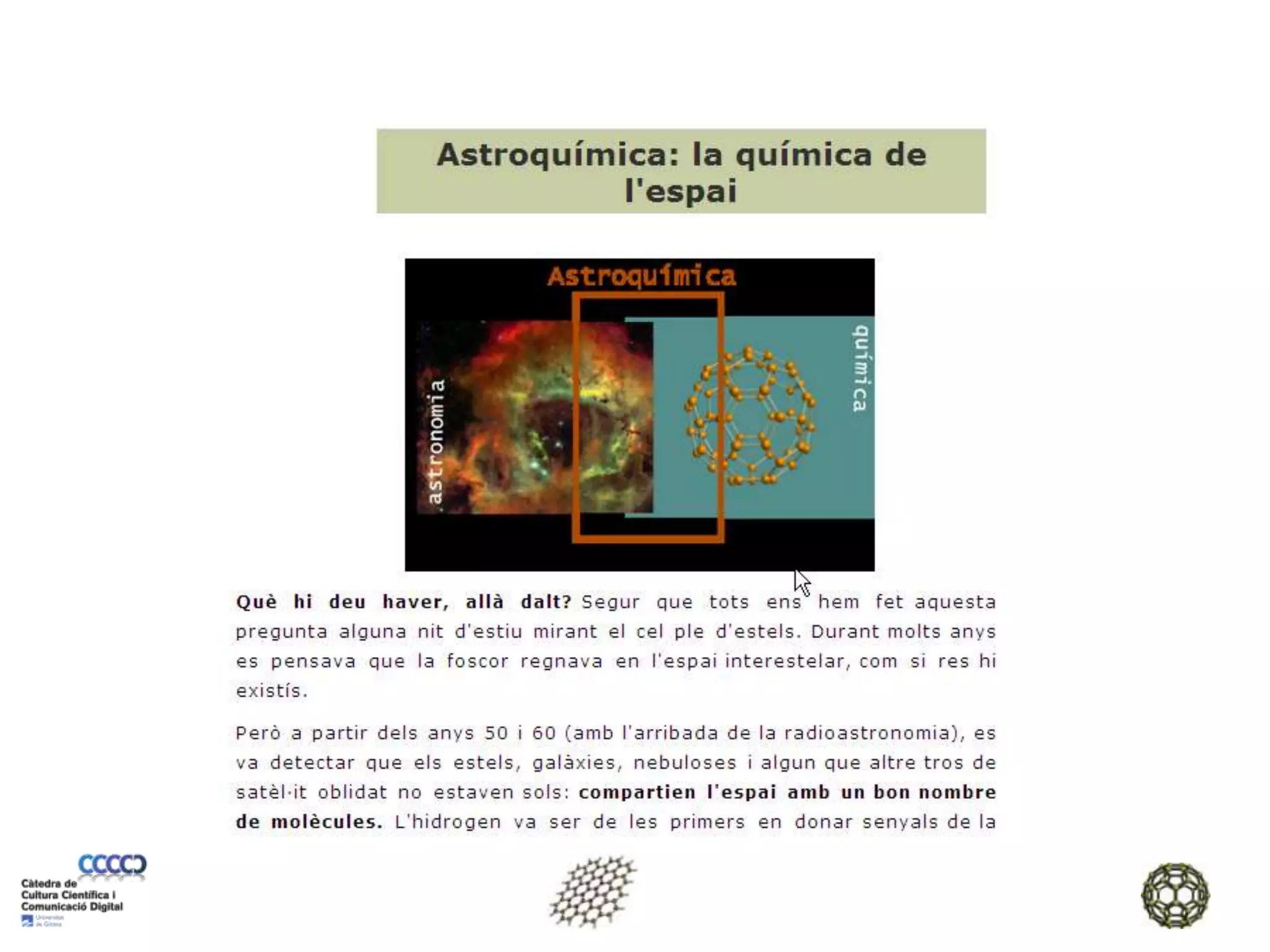
Fa totjust 15 dies…Este proceso de condensación sucede con casi todas las moléculas de gas, dejando sólo unas pocas en forma gaseosa. Estas condiciones dejan sitio para el desarrollo de una química peculiar entre el resto de moléculas gaseosas, lo que lleva a la formación de raras especies moleculares como H2D+ and D2H+, compuestas a partir de átomos de hidrógeno (H) y su variedad más pesada, el deuterio (D).Estas peculiares moléculas han sido el objetivo de muchas búsquedas observacionales en la última década, pero debido a que se forman en cantidades tan pequeñas, son difíciles de observar.Ahora, un nuevo estudio del Atacama Pathfinder Experiment (APEX), observando desde una prístina posición en el desierto chileno con un instrumento especial conocido como CHAMP+, ha cartografiado la distribución de las moléculas en el núcleo de la nube Rho Ophiuchi, una región de formación estelar a unos 400 años luz de la Tierra.Estas escasas moléculas han sido un objetivo observacional desde hace tiempo para los astrónomos.
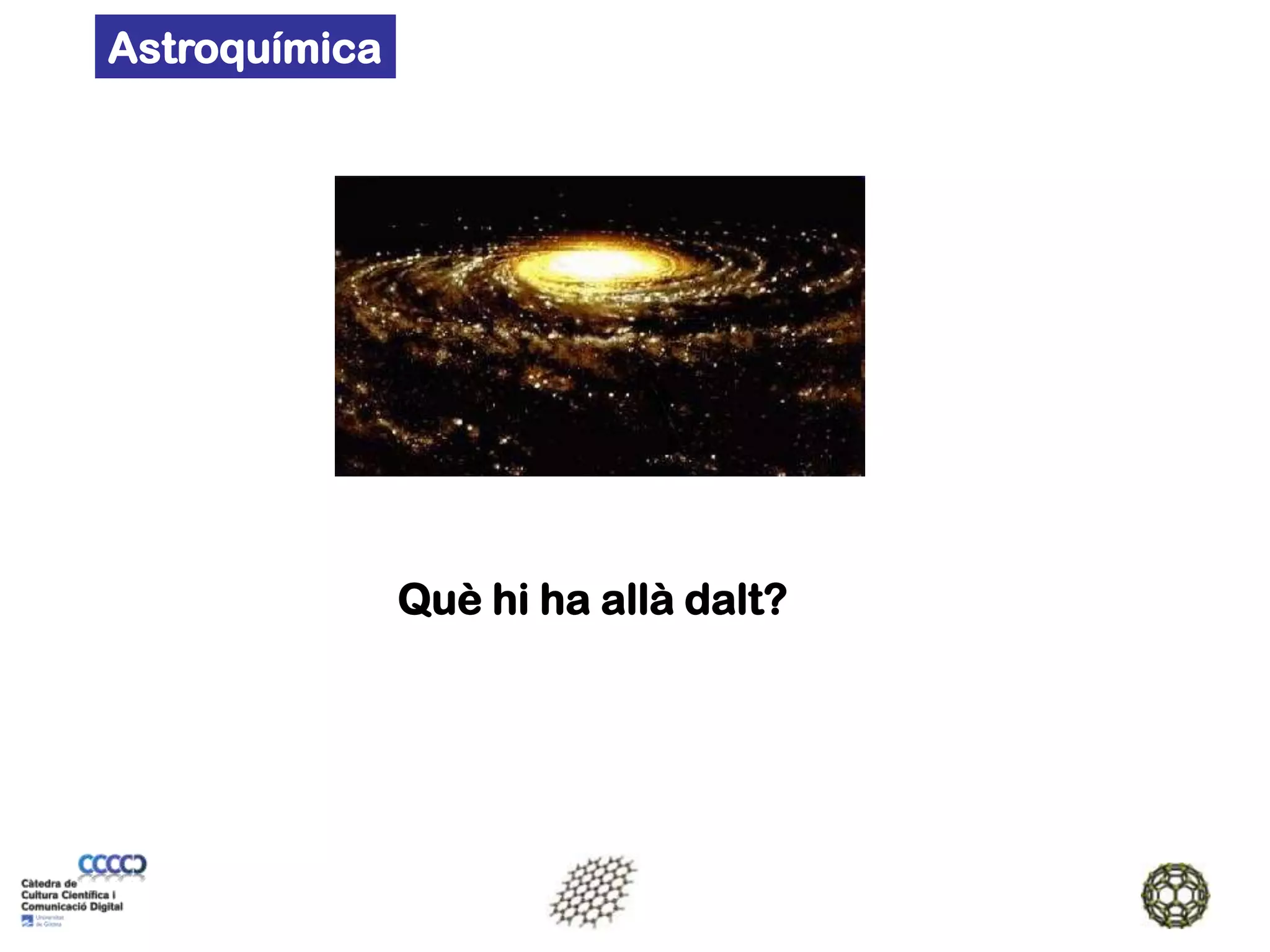
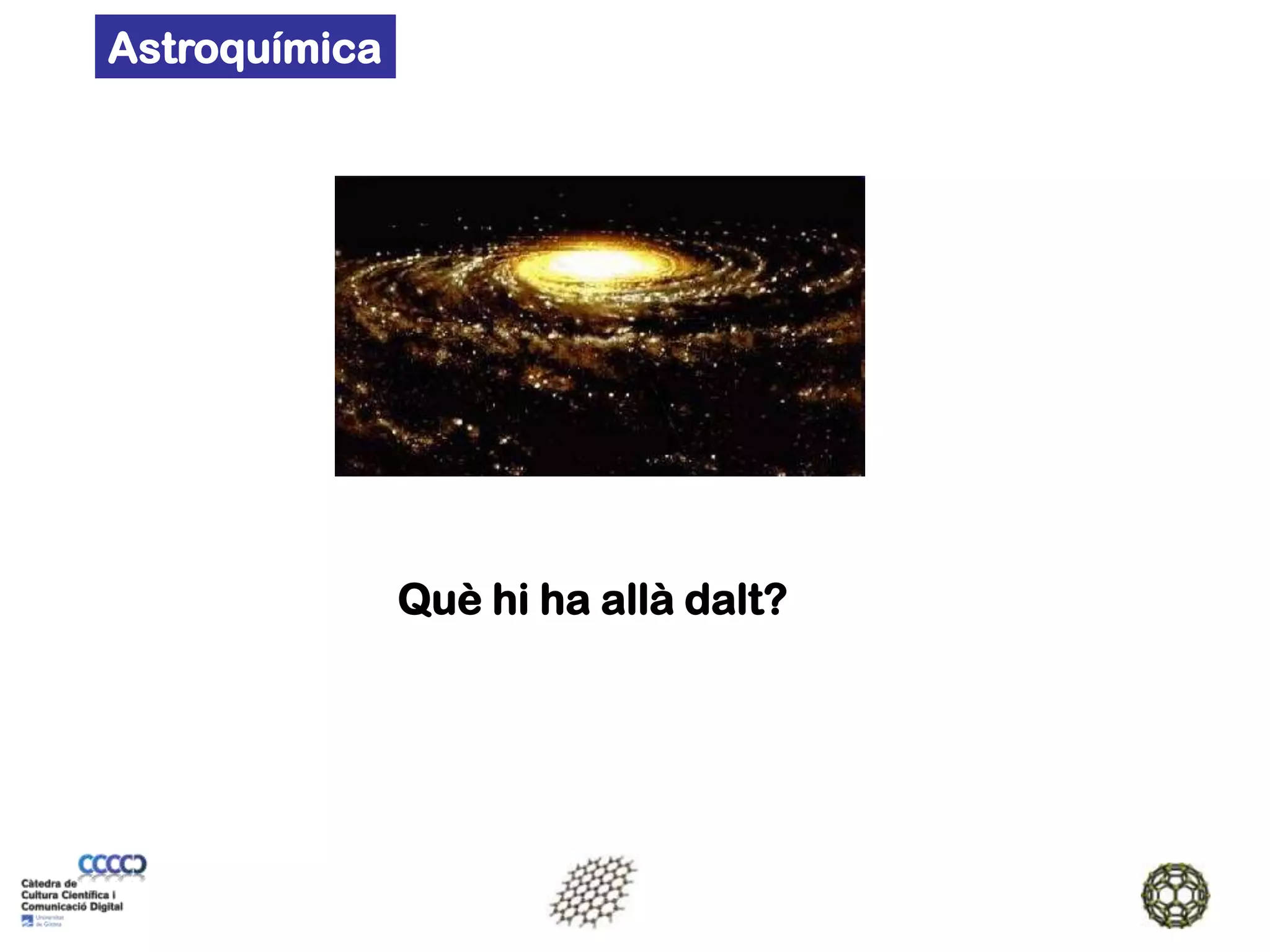
AstroquímicaQuè hi ha allà dalt?
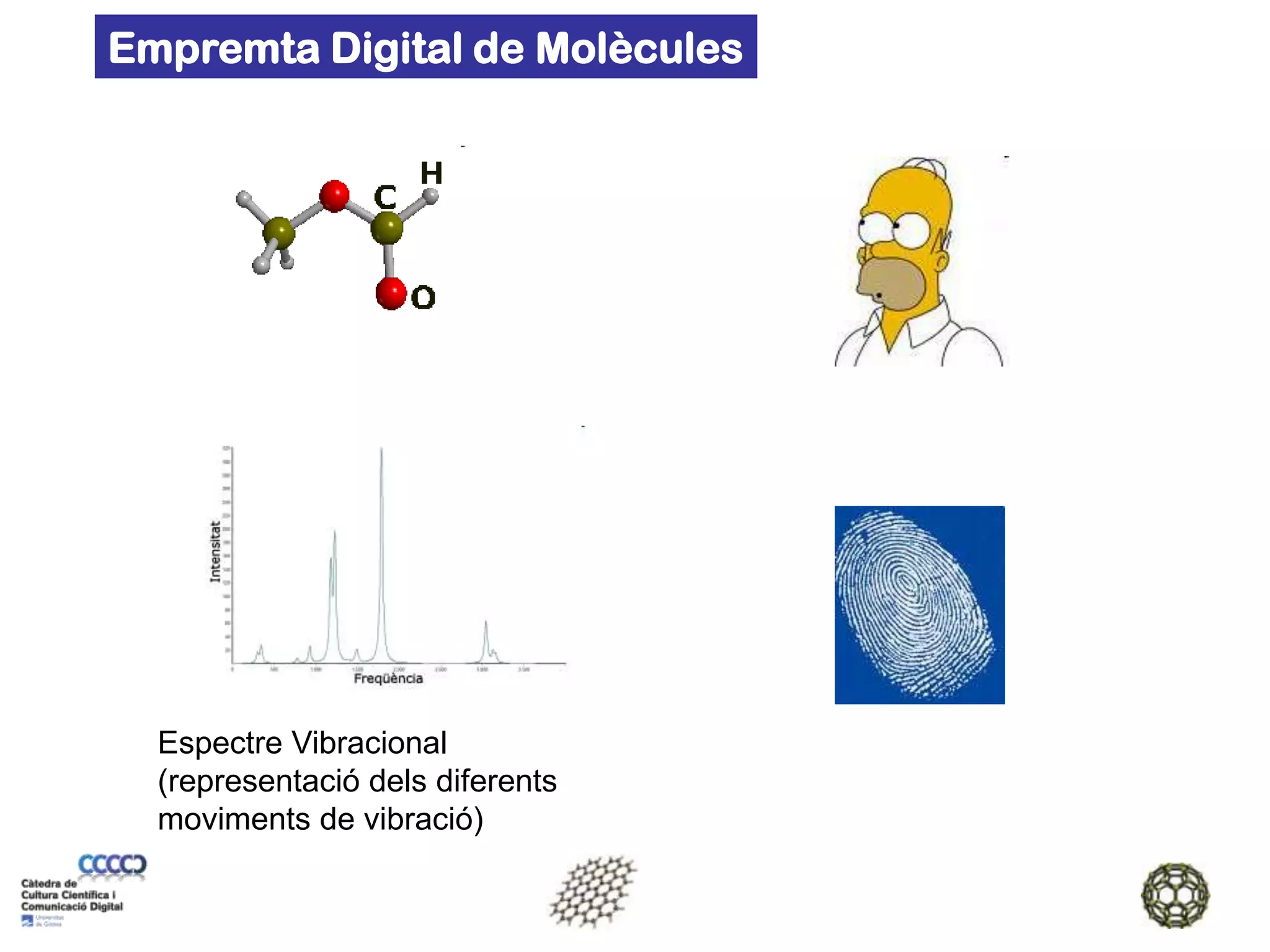
Empremta Digital de MolèculesEspectre Vibracional(representació dels diferents moviments de vibració)
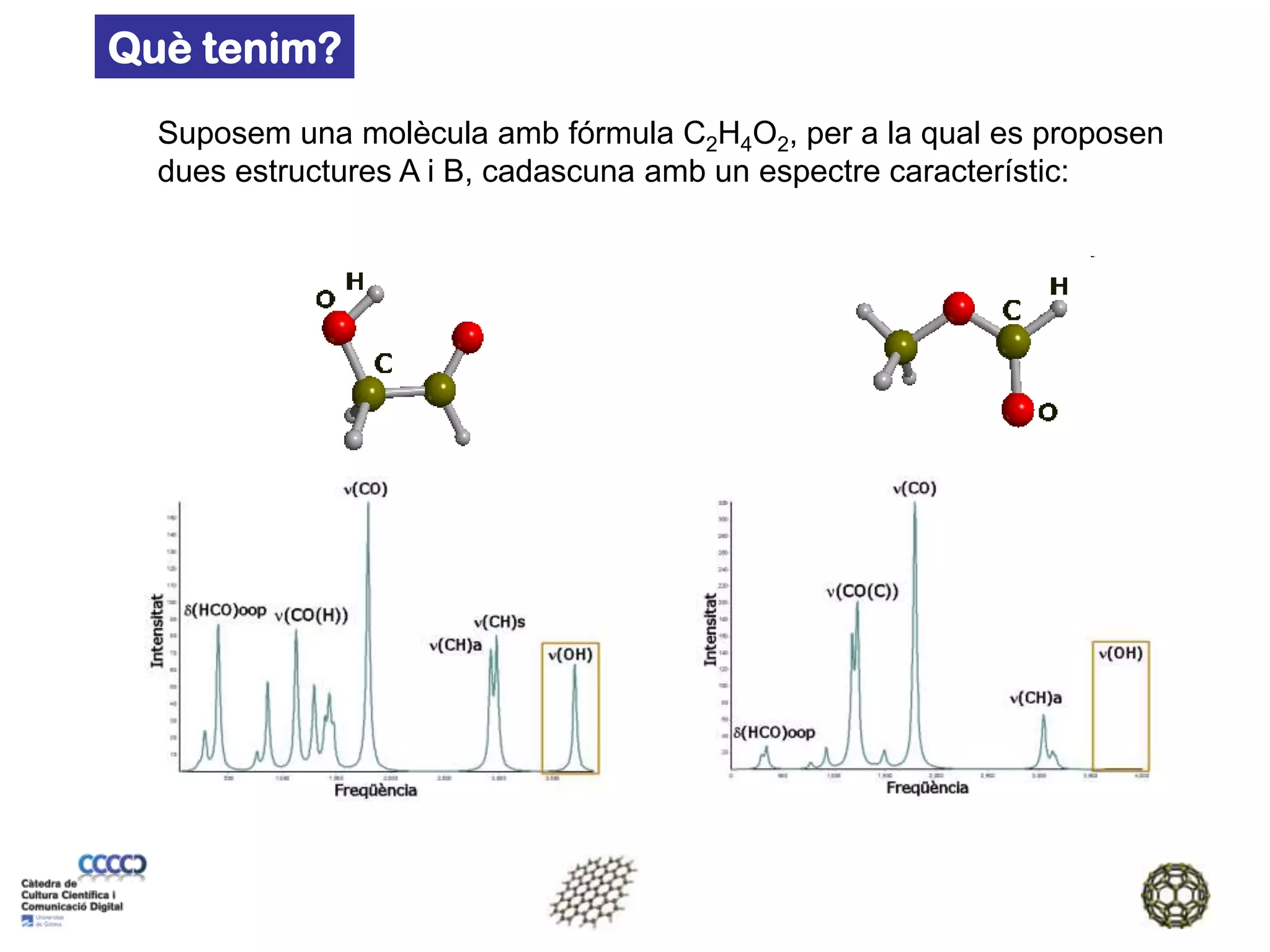
Què tenim?Suposem una molècula amb fórmula C2H4O2, per a la qual es proposen dues estructures A i B, cadascuna amb un espectre característic:
AstroquímicaQuè hi ha allà dalt?
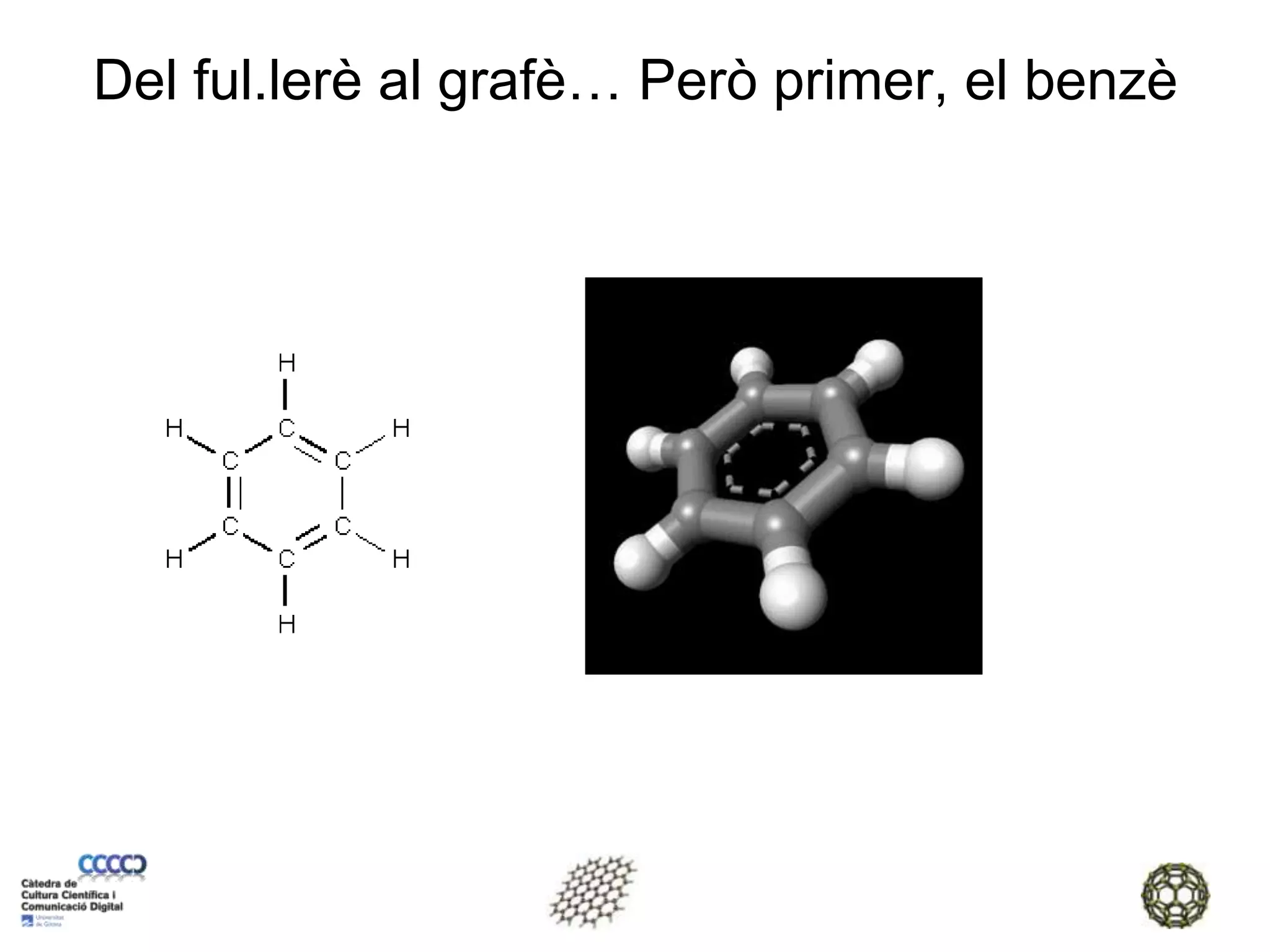
Del ful.lerè al grafè… Però primer, el benzè
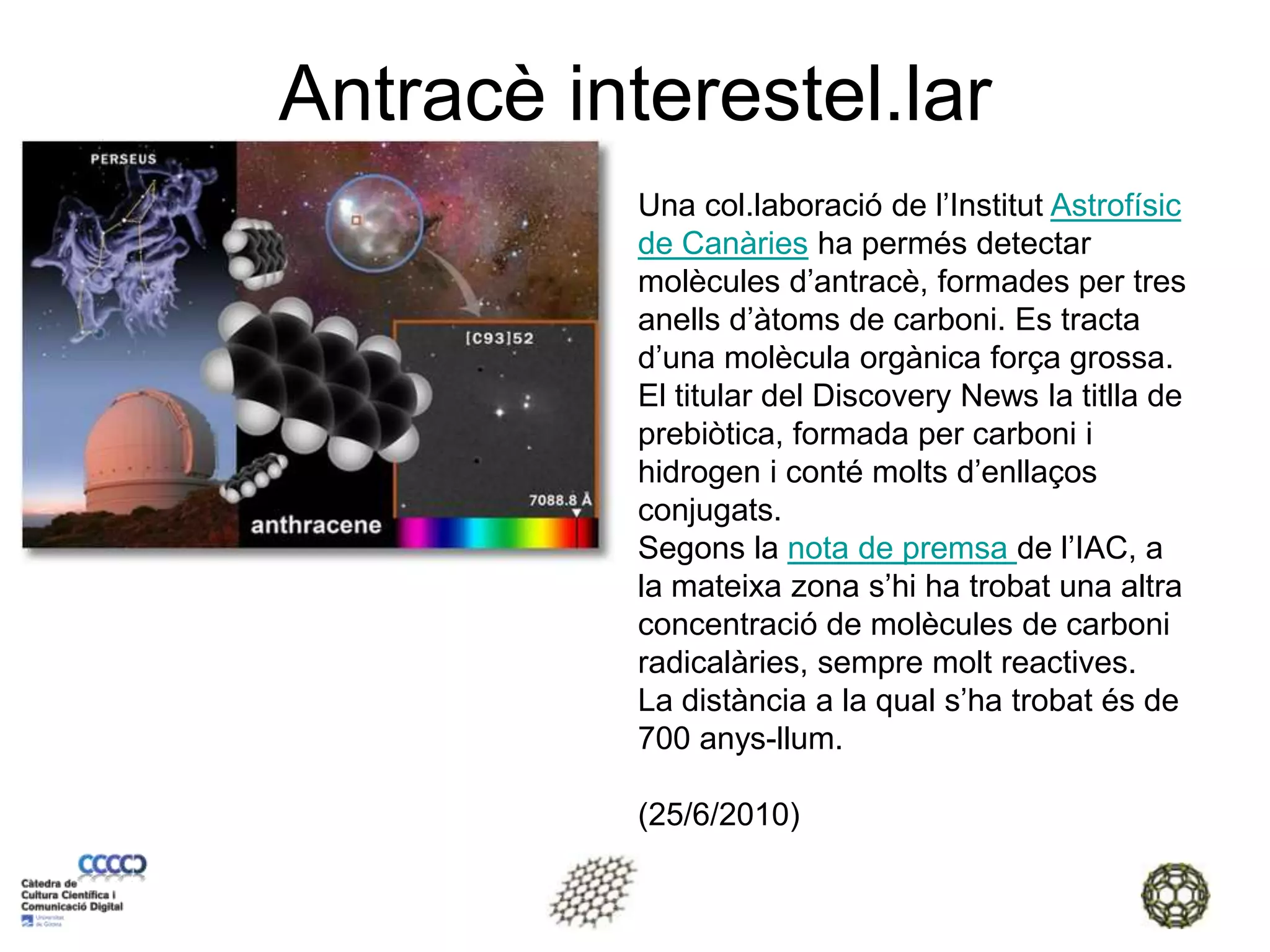
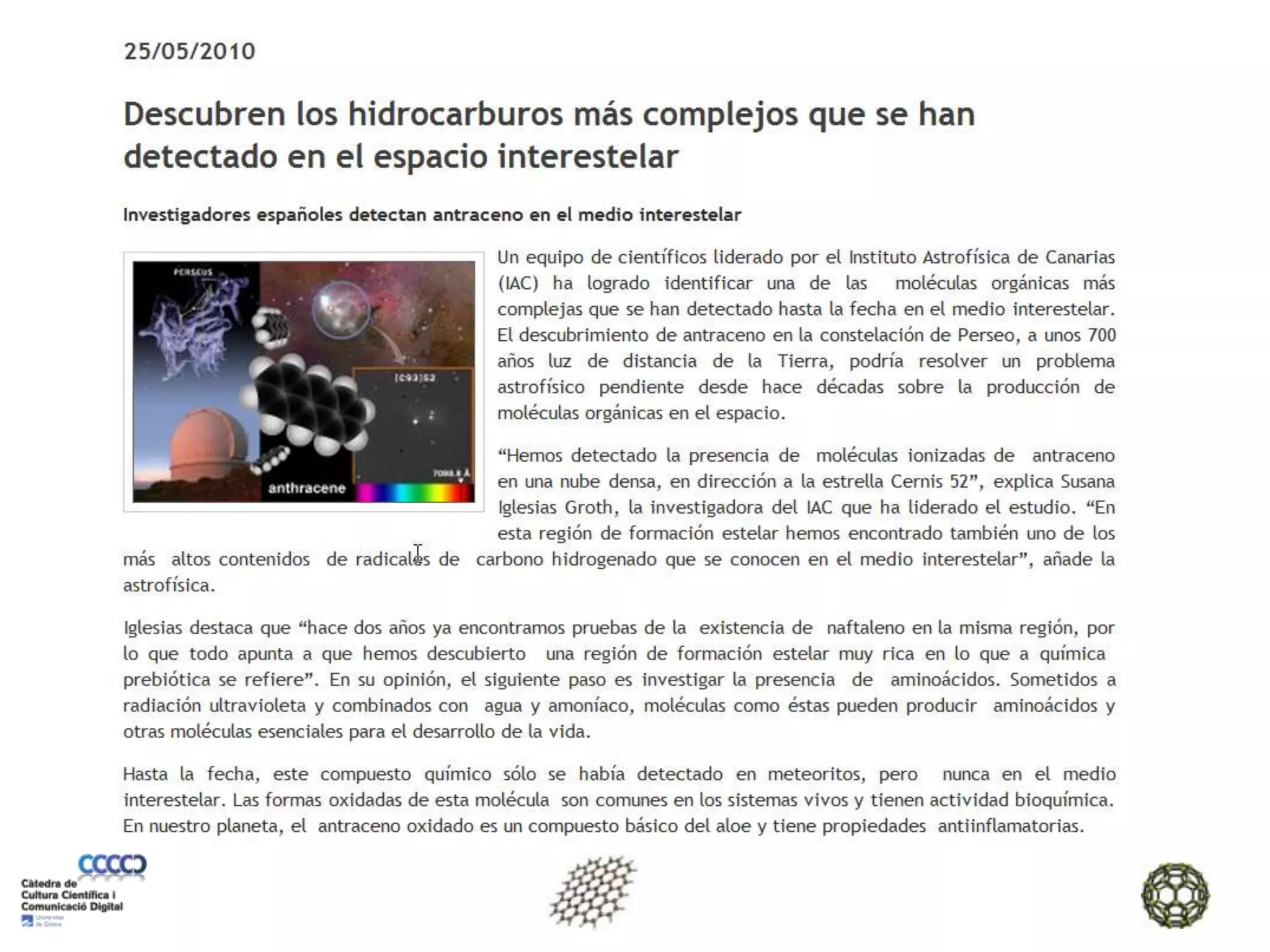
Antracè interestel.larUna col.laboració de l’Institut Astrofísic de Canàries ha permés detectar molècules d’antracè, formades per tres anells d’àtoms de carboni. Es tracta d’una molècula orgànica força grossa. El titular del Discovery News la titlla de prebiòtica, formada per carboni i hidrogen i conté molts d’enllaços conjugats.Segons la nota de premsa de l’IAC, a la mateixa zona s’hi ha trobat una altra concentració de molècules de carboni radicalàries, sempre molt reactives.La distància a la qual s’ha trobat és de 700 anys-llum. (25/6/2010)
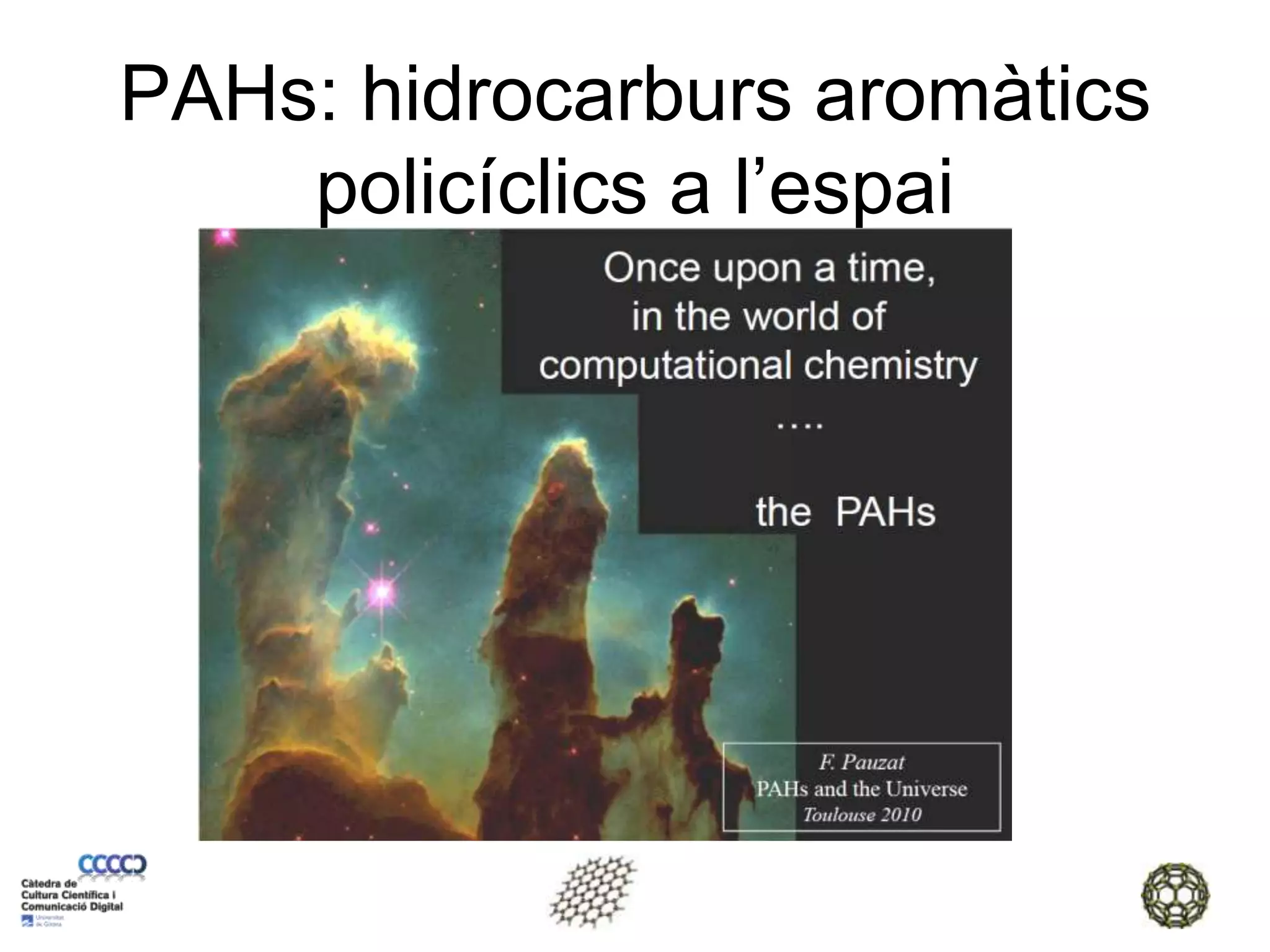
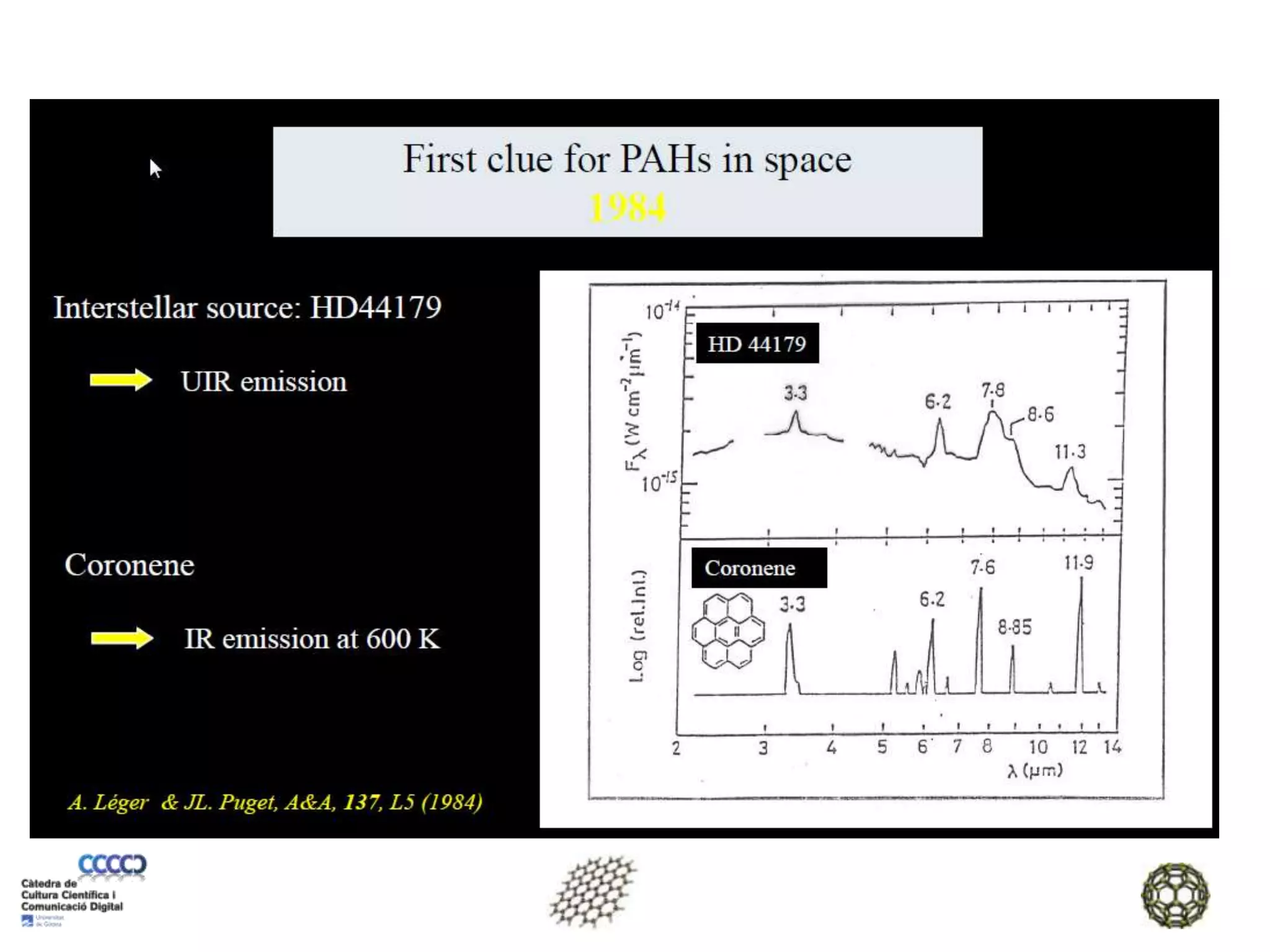
PAHs: hidrocarburs aromàtics policíclics a l’espai
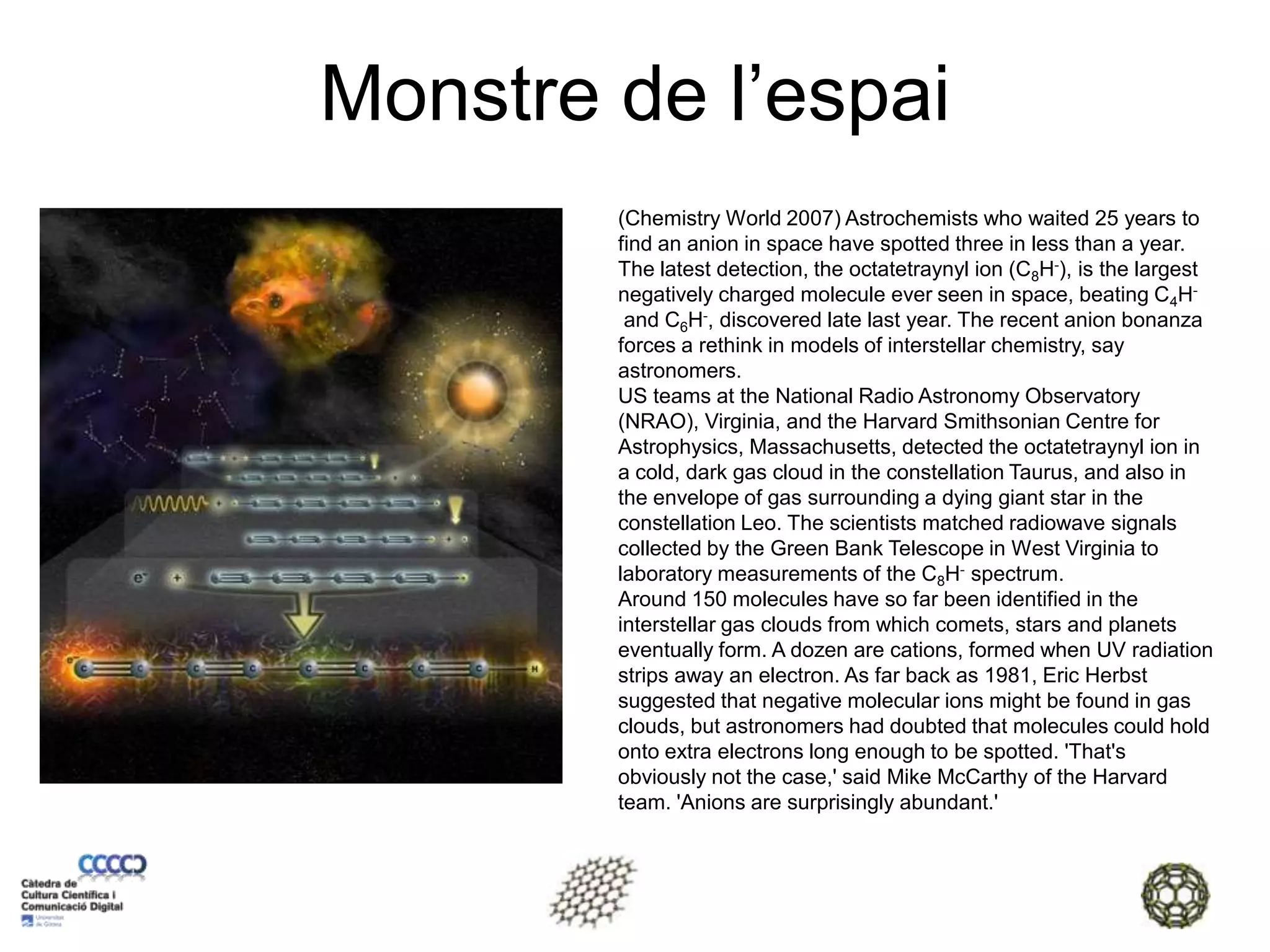
Monstre de l’espai(Chemistry World 2007) Astrochemists who waited 25 years to find an anion in space have spotted three in less than a year. The latest detection, the octatetraynyl ion (C8H-), is the largest negatively charged molecule ever seen in space, beating C4H- and C6H-, discovered late last year. The recent anion bonanza forces a rethink in models of interstellar chemistry, say astronomers. US teams at the National Radio Astronomy Observatory (NRAO), Virginia, and the Harvard Smithsonian Centre for Astrophysics, Massachusetts, detected the octatetraynyl ion in a cold, dark gas cloud in the constellation Taurus, and also in the envelope of gas surrounding a dying giant star in the constellation Leo. The scientists matched radiowave signals collected by the Green Bank Telescope in West Virginia to laboratory measurements of the C8H- spectrum. Around 150 molecules have so far been identified in the interstellar gas clouds from which comets, stars and planets eventually form. A dozen are cations, formed when UV radiation strips away an electron. As far back as 1981, Eric Herbst suggested that negative molecular ions might be found in gas clouds, but astronomers had doubted that molecules could hold onto extra electrons long enough to be spotted. 'That's obviously not the case,' said Mike McCarthy of the Harvard team. 'Anions are surprisingly abundant.'   
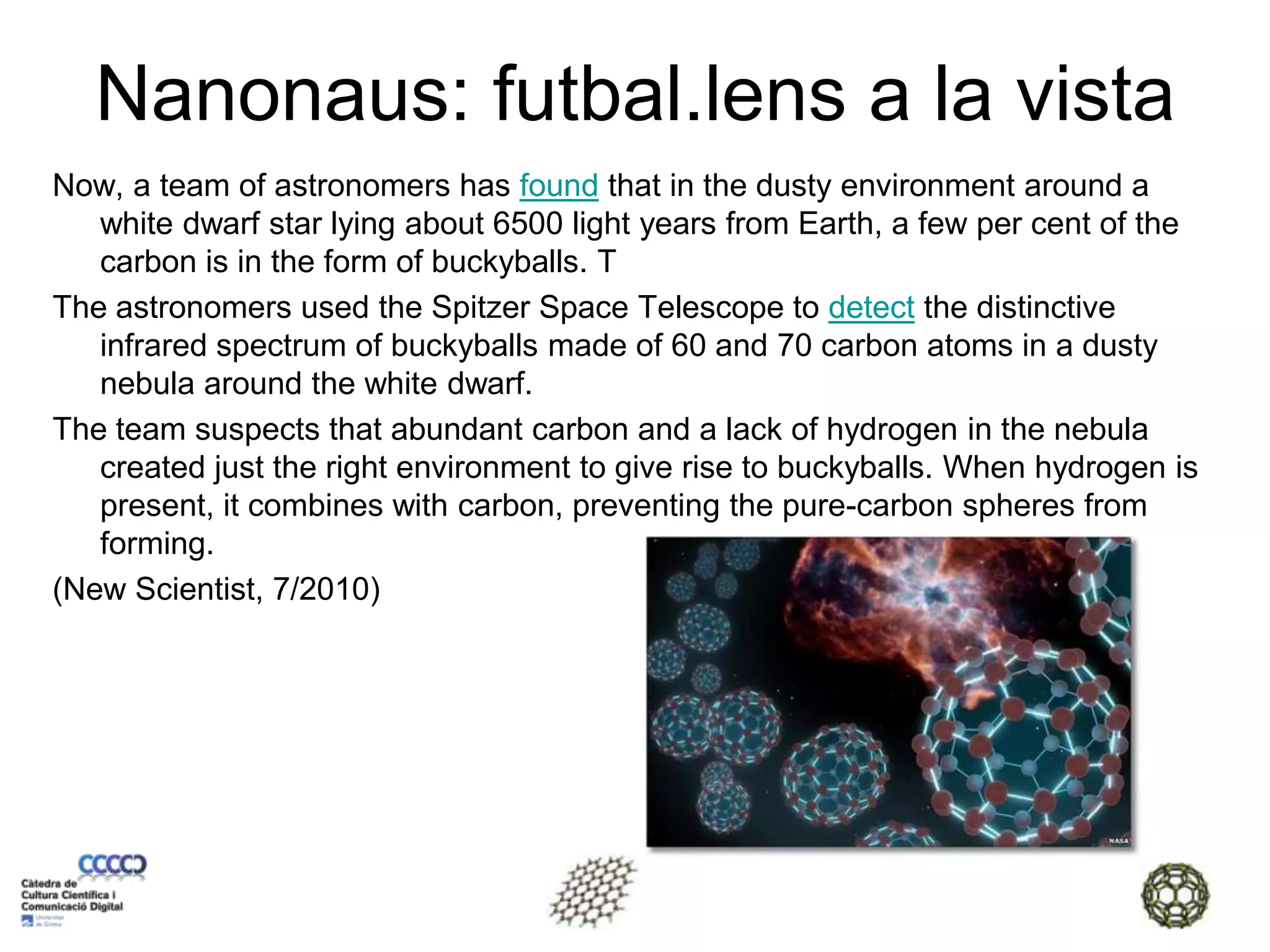
Nanonaus: futbal.lens a la vistaNow, a team of astronomers has found that in the dusty environment around a white dwarf star lying about 6500 light years from Earth, a few per cent of the carbon is in the form of buckyballs. TThe astronomers used the Spitzer Space Telescope to detect the distinctive infrared spectrum of buckyballs made of 60 and 70 carbon atoms in a dusty nebula around the white dwarf.The team suspects that abundant carbon and a lack of hydrogen in the nebula created just the right environment to give rise to buckyballs. When hydrogen is present, it combines with carbon, preventing the pure-carbon spheres from forming.(New Scientist, 7/2010)
Nanonaus: metoritsWe report on the discovery of naturally occurring fullerenes (C60 to C400) in the Allende and Murchison meteorites and some sediment samples from the 65 million-year-old Cretaceous/Tertiary boundary layer (KTB). Unlike the other pure forms of carbon (diamond and graphite), fullerenes are extractable in an organic solvent (e.g., toluene or 1,2,4-trichlorobenzene). The recognition of this unique property led to the detection and isolation of the higher fullerenes in the Kratschmer/Huffmann arc evaporated graphite soot and in the carbon material in the meteorite and impact deposits. By further exploiting the unique ability of the fullerene cage structure to encapsulate and retain noble gases, we have determined that both the Allende and Murchison fullerenes and the KTB fullerenes contain trapped noble gases with ratios that can only be described as extraterrestrial in origin.(PNAS 2000)
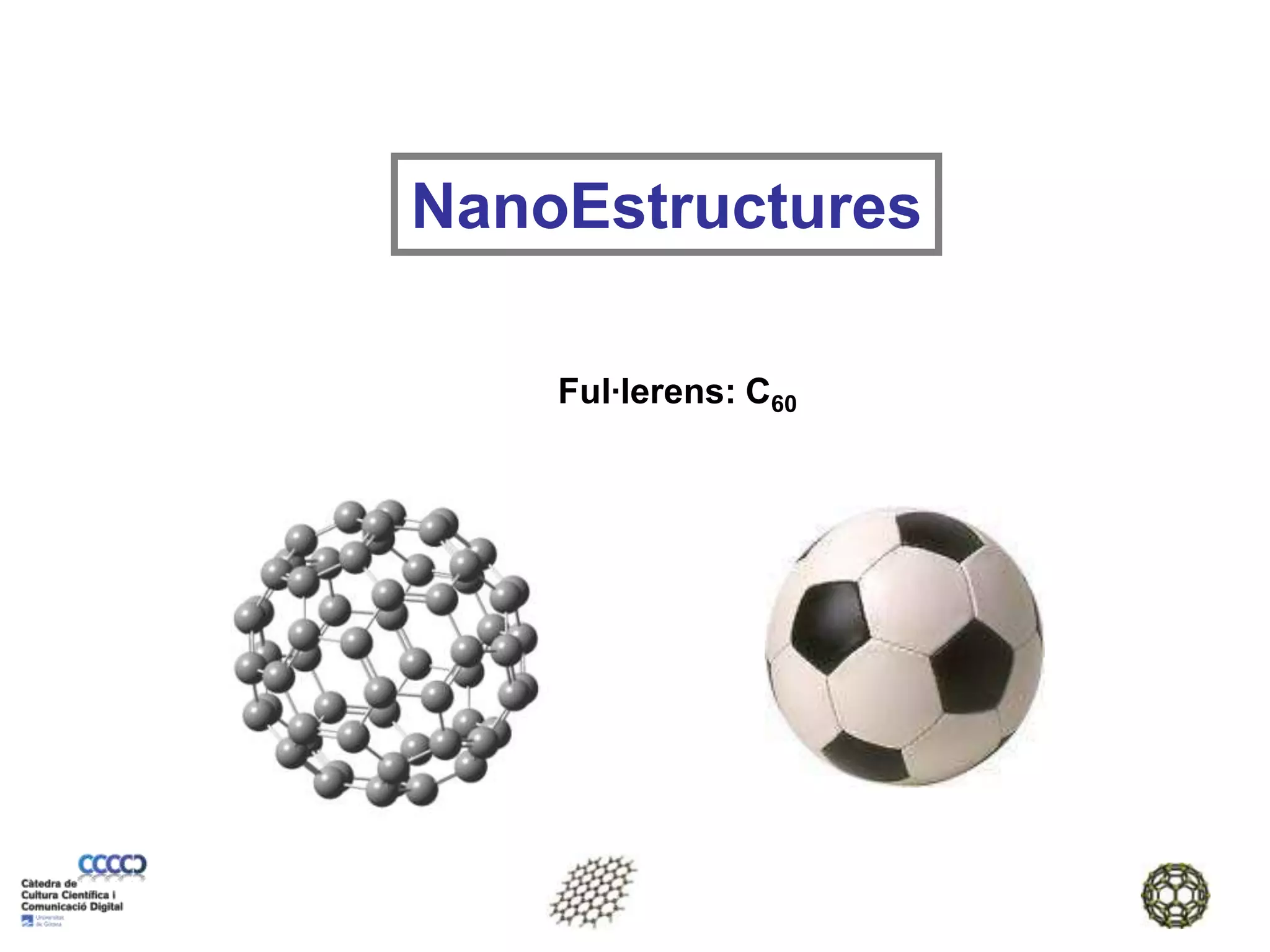
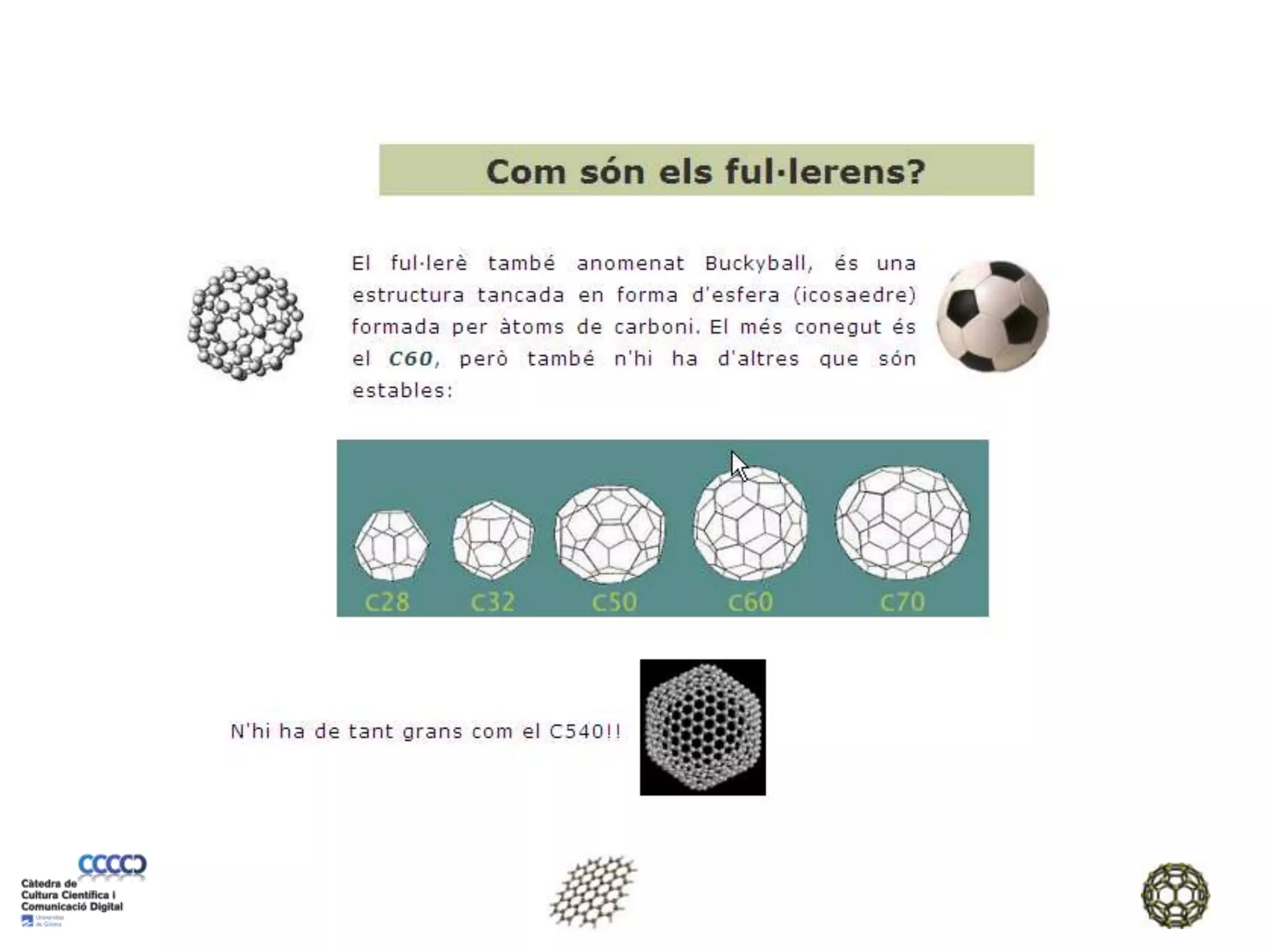
NanoEstructuresFul·lerens: C60
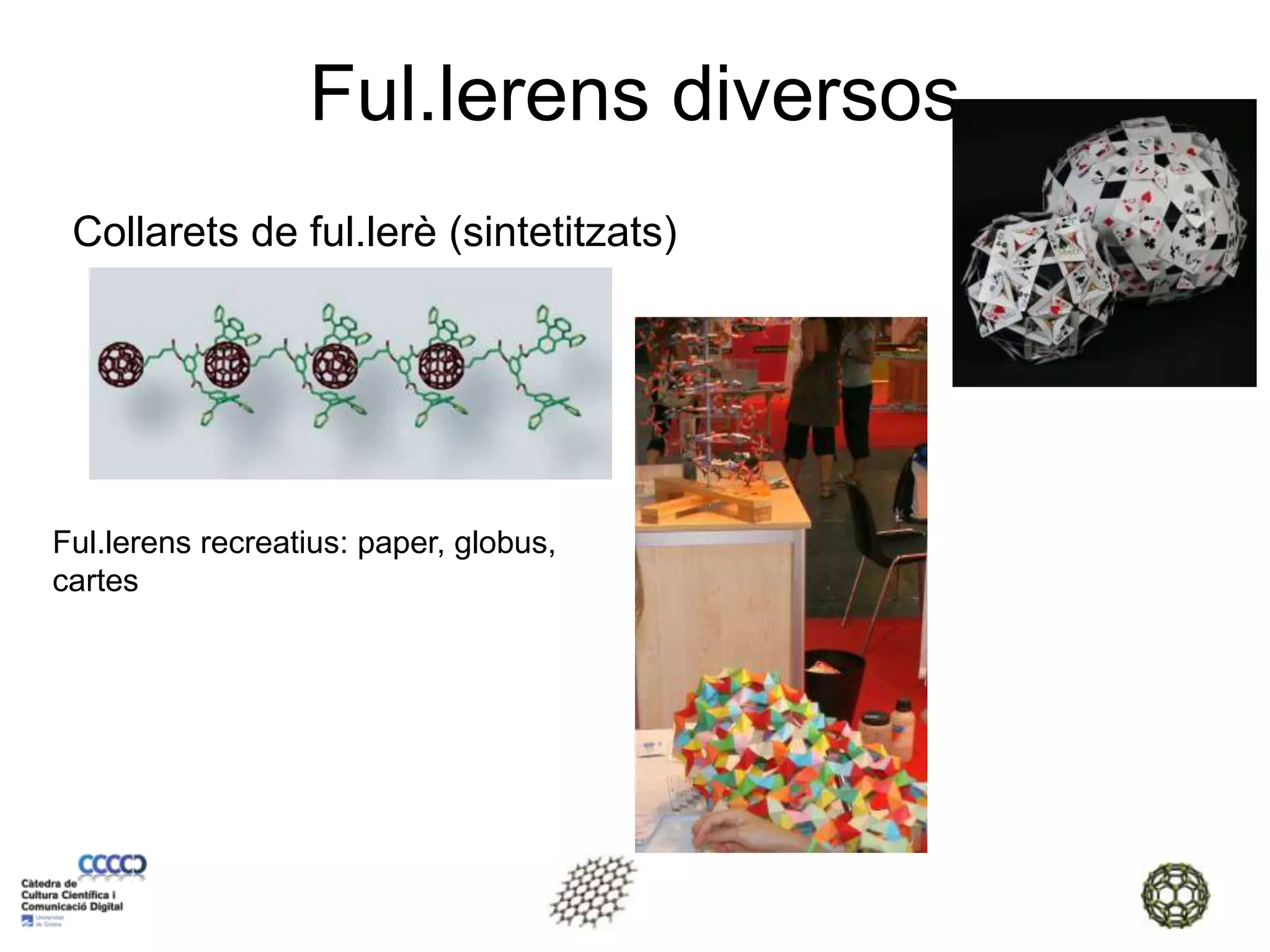
Ful.lerens diversosCollarets de ful.lerè (sintetitzats)Ful.lerens recreatius: paper, globus, cartes
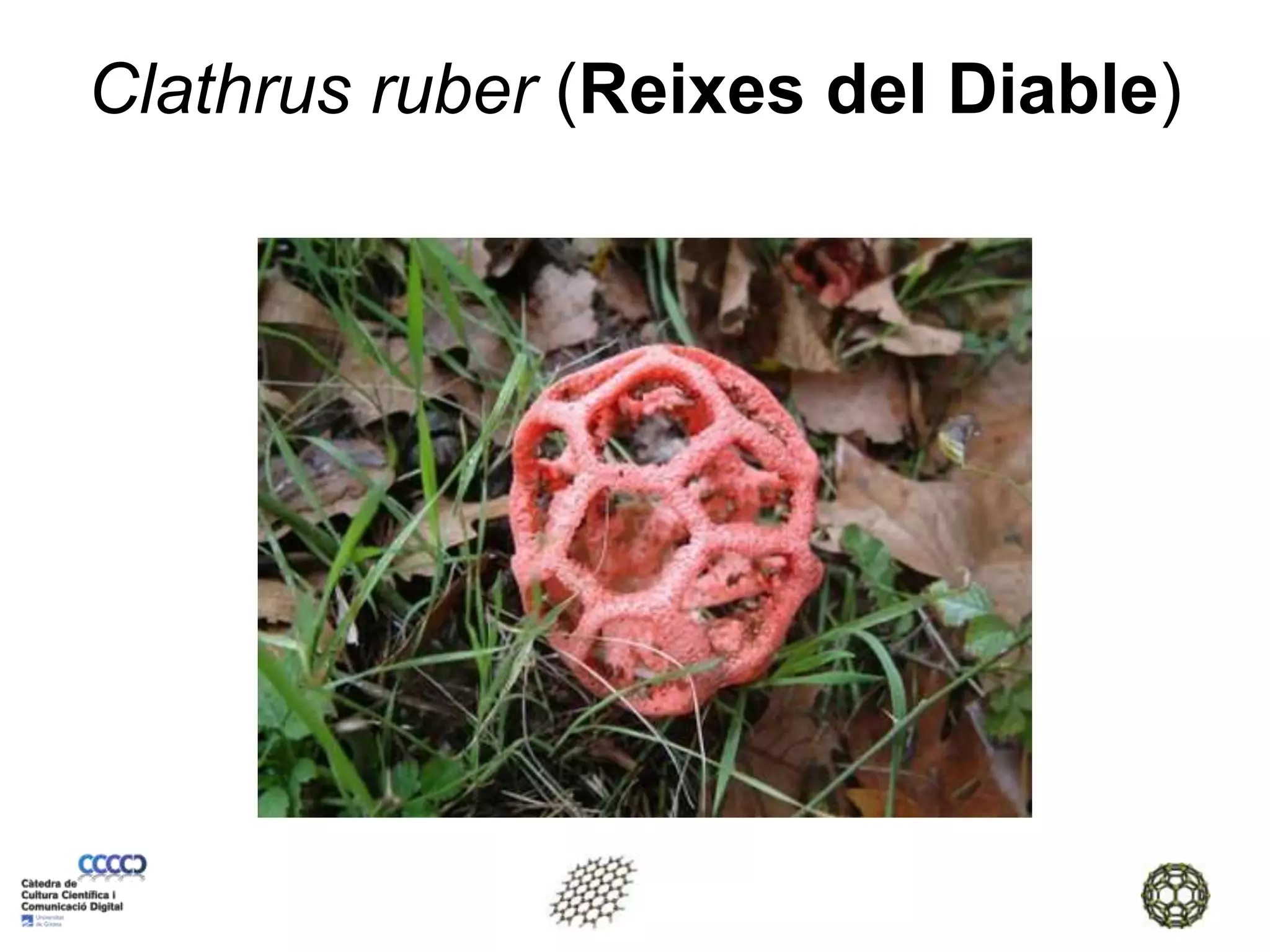
Clathrus ruber (Reixes del Diable)
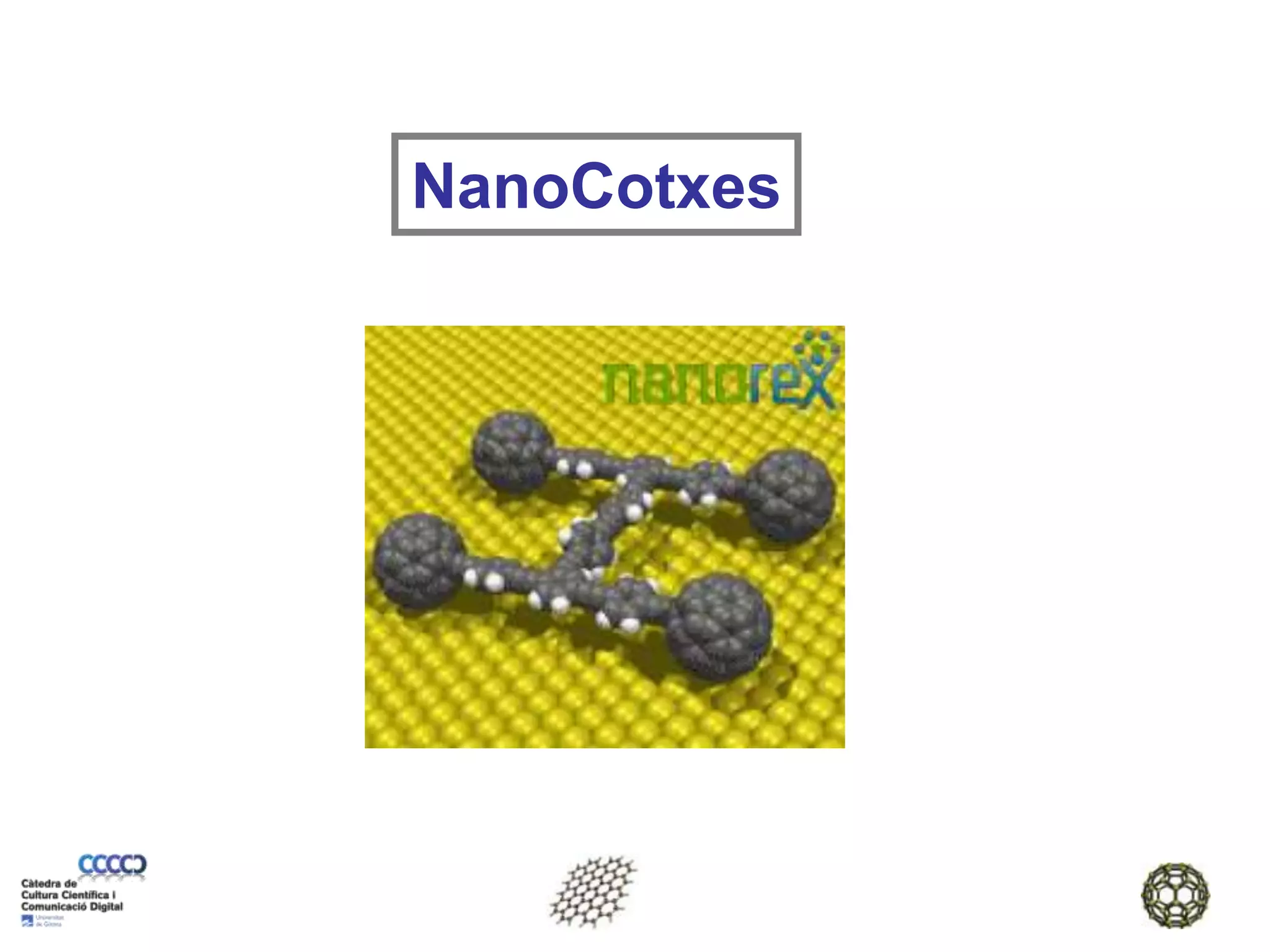
NanoCotxes
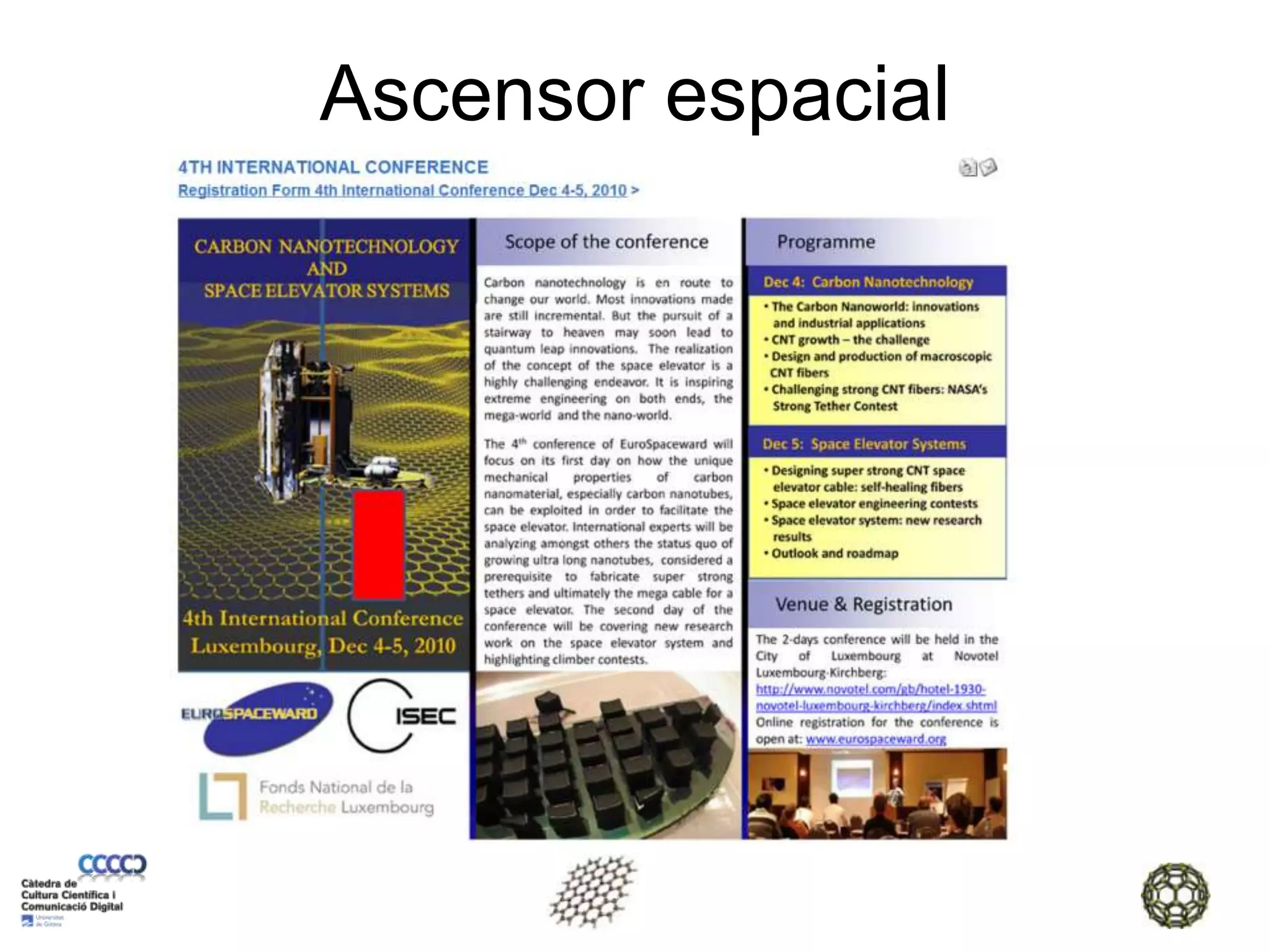
Ascensor espacial
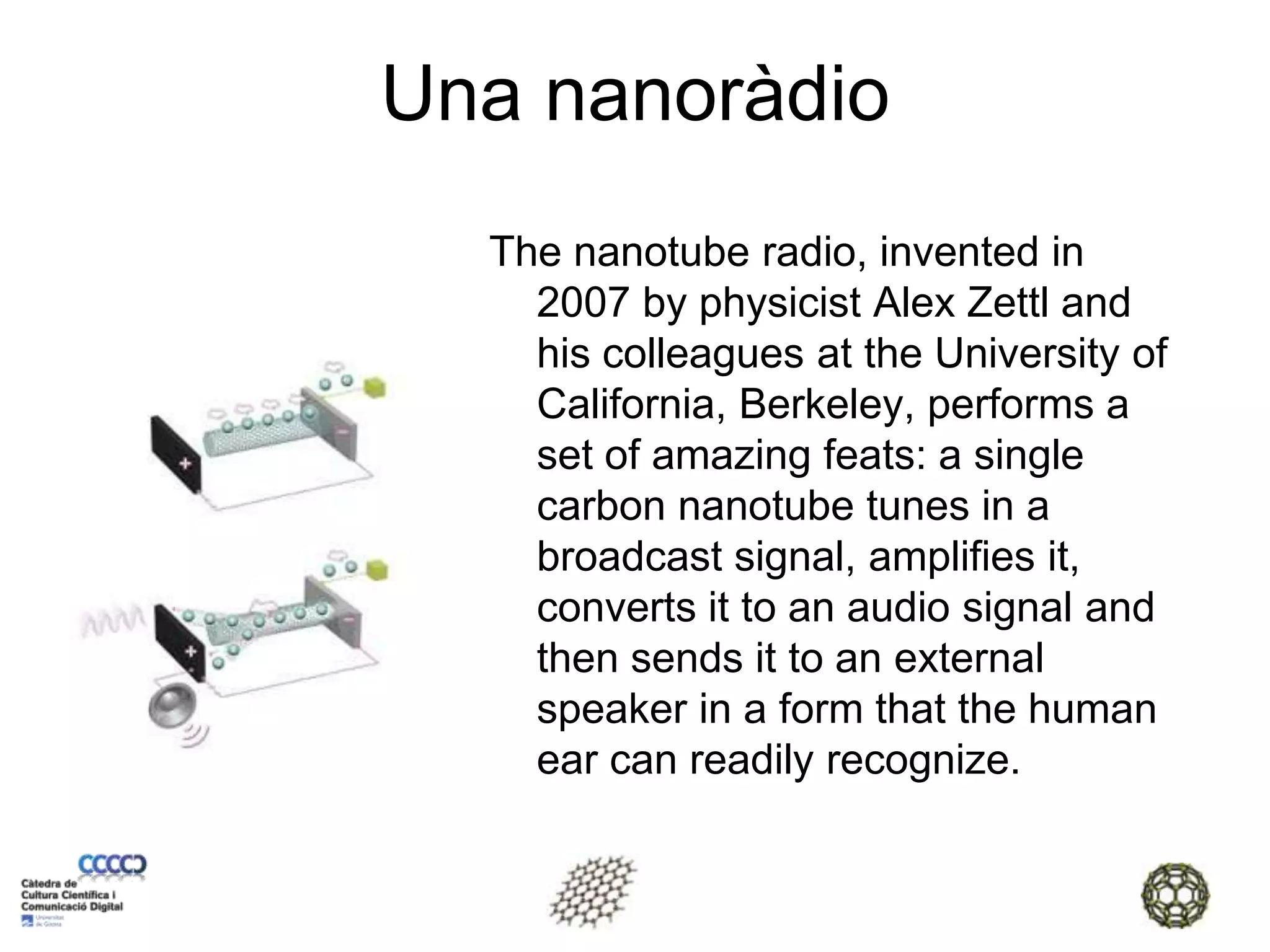
Una nanoràdioThe nanotube radio, invented in 2007 by physicist Alex Zettl and his colleagues at the University of California, Berkeley, performs a set of amazing feats: a single carbon nanotube tunes in a broadcast signal, amplifies it, converts it to an audio signal and then sends it to an external speaker in a form that the human ear can readily recognize.
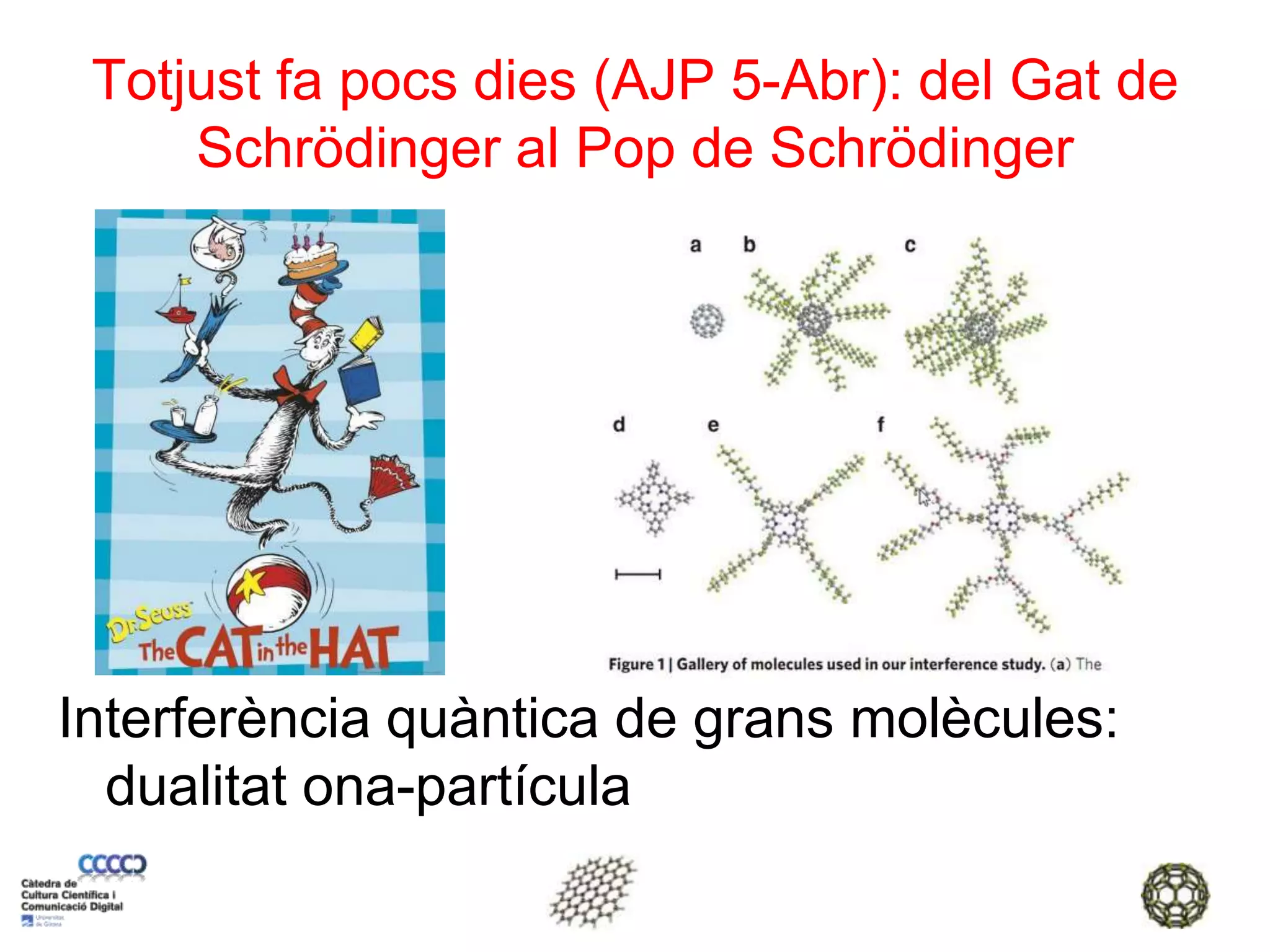
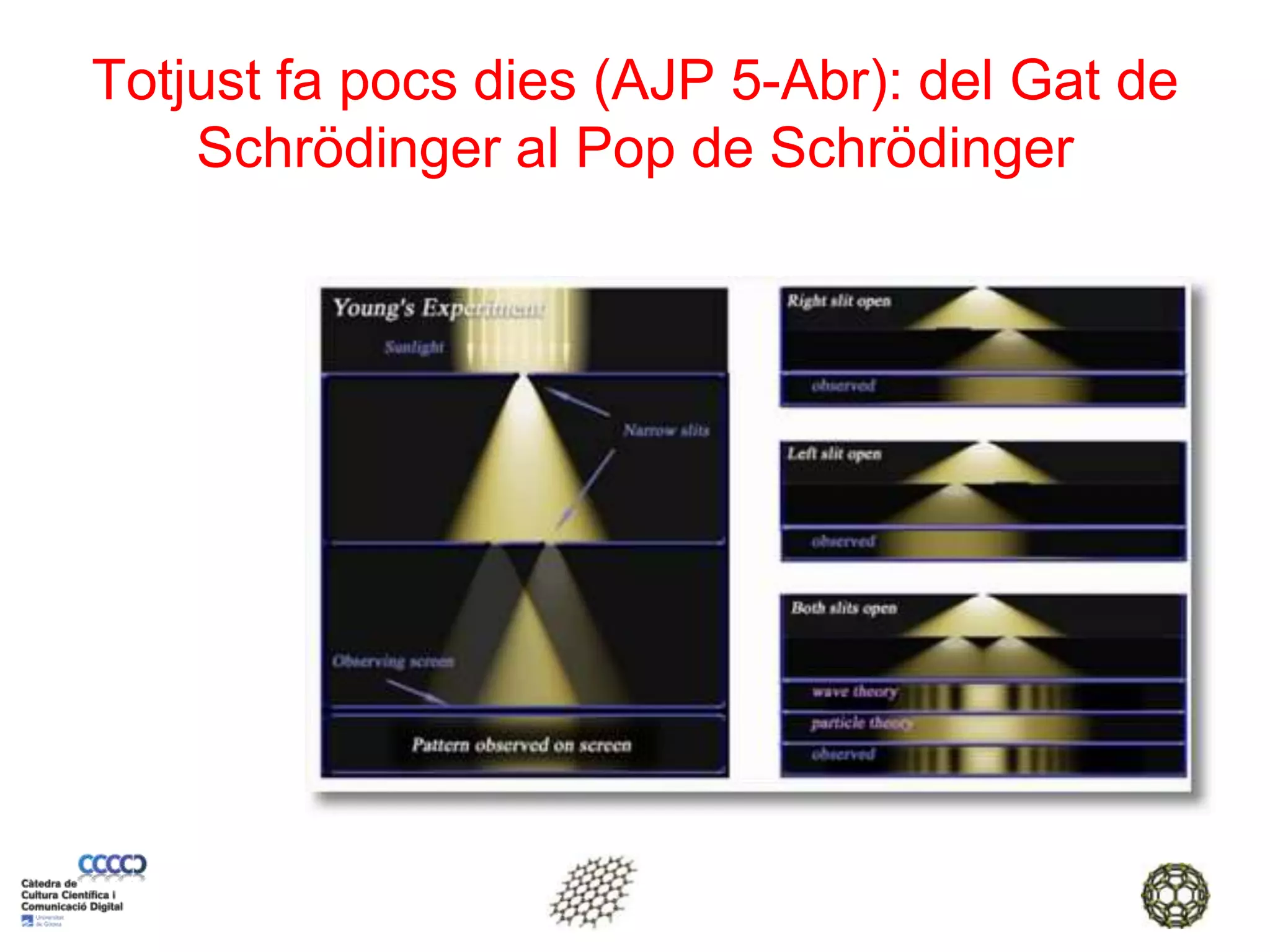
Totjust fa pocs dies (AJP 5-Abr): del Gat de Schrödinger al Pop de Schrödinger Interferència quàntica de grans molècules: dualitat ona-partícula
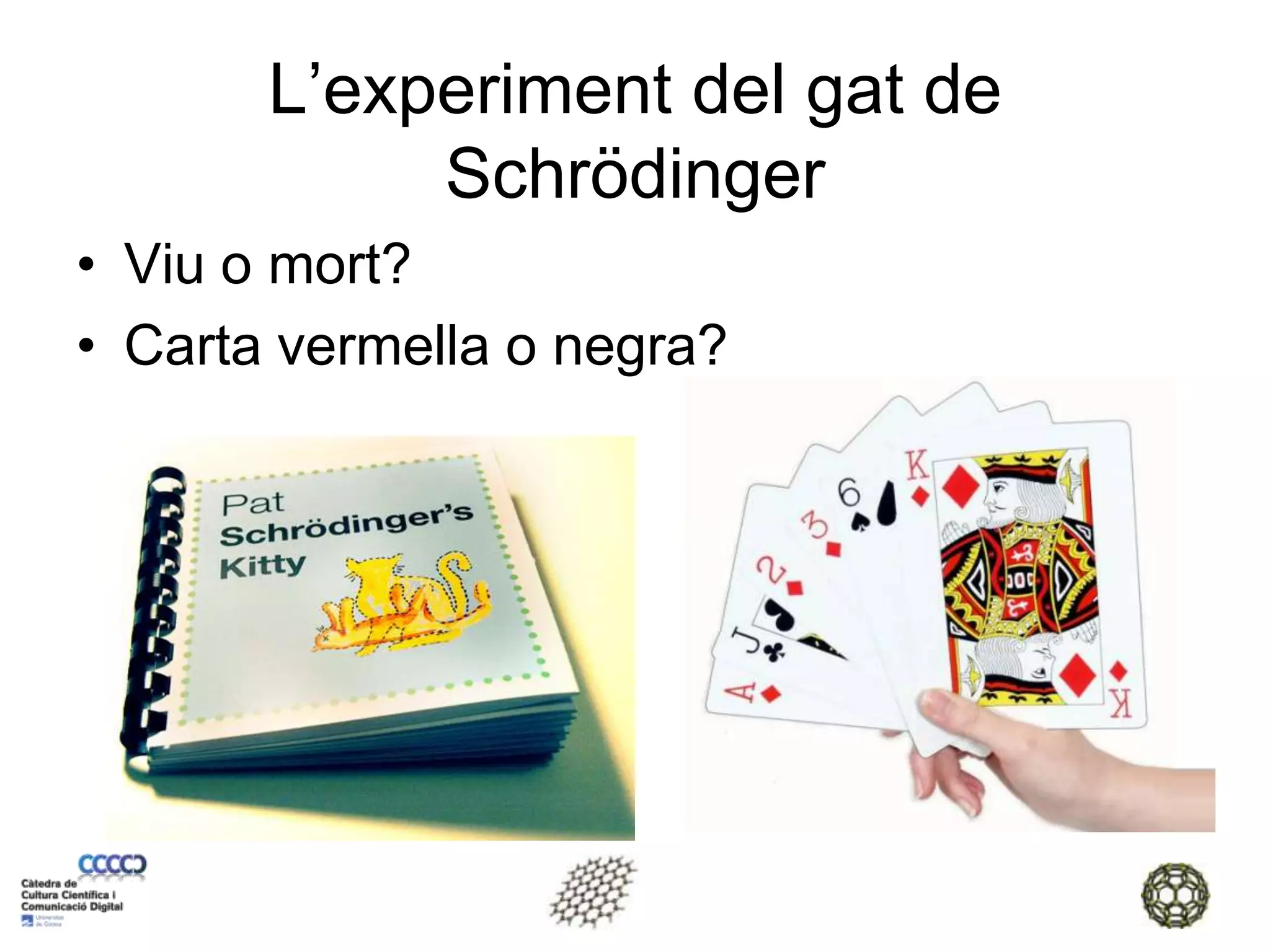
L’experiment del gat de SchrödingerViu o mort?Carta vermella o negra?
Totjust fa pocs dies (AJP 5-Abr): del Gat de Schrödinger al Pop de Schrödinger
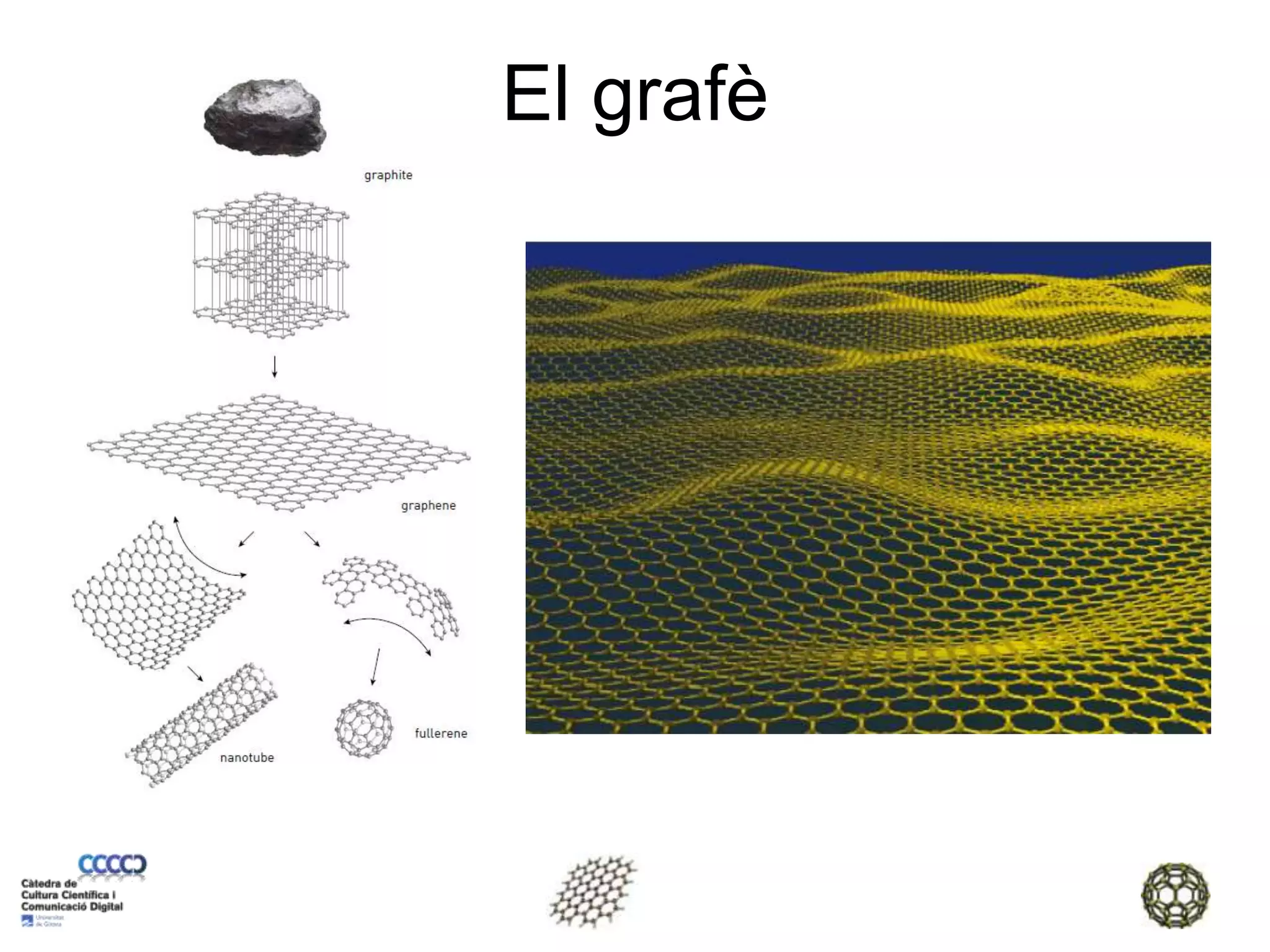
El grafè
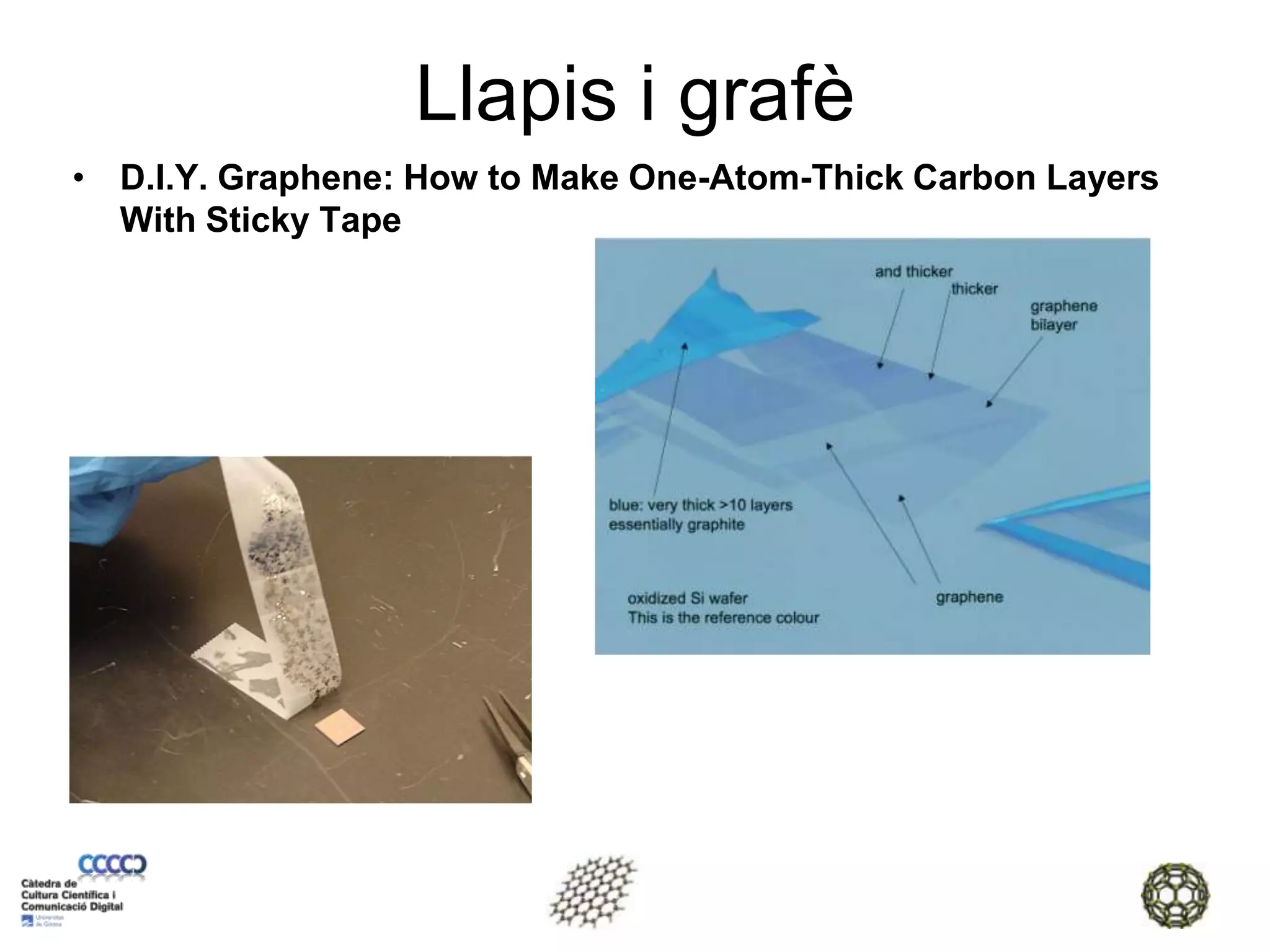
Llapis i grafèD.I.Y. Graphene: How to Make One-Atom-Thick Carbon Layers With Sticky Tape
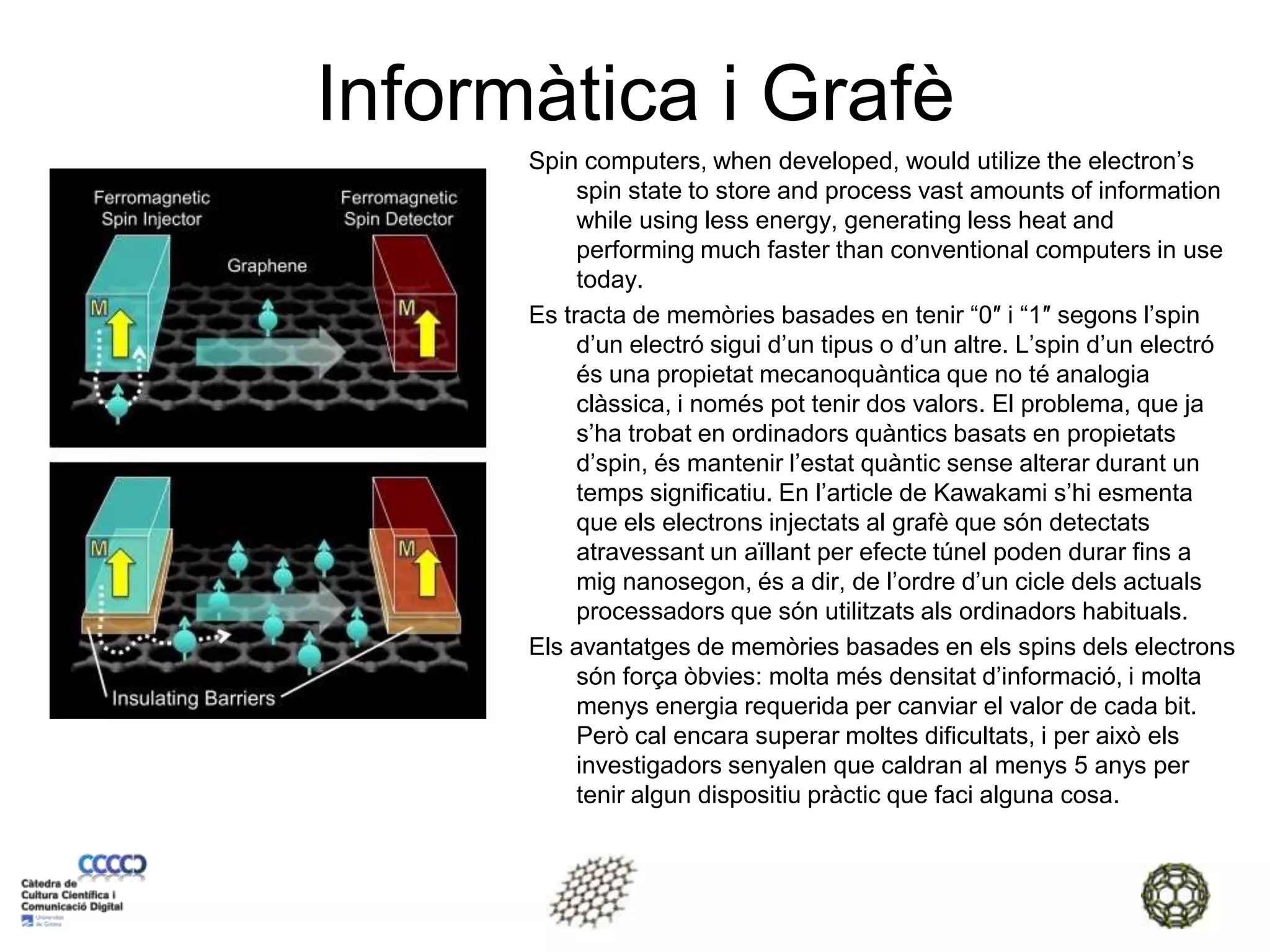
Informàtica i GrafèSpin computers, when developed, would utilize the electron’s spin state to store and process vast amounts of information while using less energy, generating less heat and performing much faster than conventional computers in use today.Es tracta de memòries basades en tenir “0″ i “1″ segons l’spin d’un electró sigui d’un tipus o d’un altre. L’spin d’un electró és una propietat mecanoquàntica que no té analogia clàssica, i només pot tenir dos valors. El problema, que ja s’ha trobat en ordinadors quàntics basats en propietats d’spin, és mantenir l’estat quàntic sense alterar durant un temps significatiu. En l’article de Kawakami s’hi esmenta que els electrons injectats al grafè que són detectats atravessant un aïllant per efecte túnel poden durar fins a mig nanosegon, és a dir, de l’ordre d’un cicle dels actuals processadors que són utilitzats als ordinadors habituals.Els avantatges de memòries basades en els spins dels electrons són força òbvies: molta més densitat d’informació, i molta menys energia requerida per canviar el valor de cada bit. Però cal encara superar moltes dificultats, i per això els investigadors senyalen que caldran al menys 5 anys per tenir algun dispositiu pràctic que faci alguna cosa.
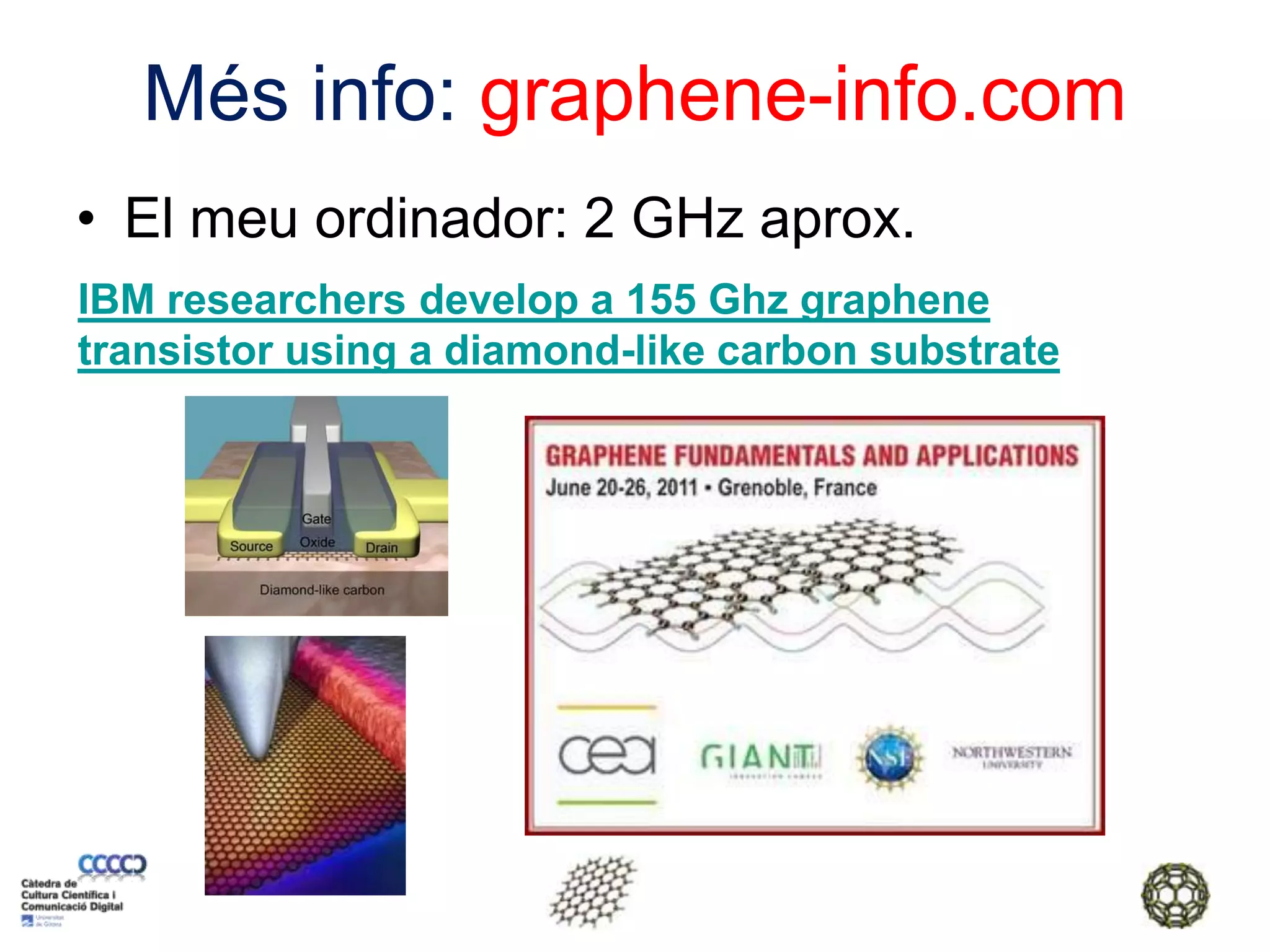
Més info: graphene-info.comEl meu ordinador: 2 GHz aprox. IBM researchers develop a 155 Ghz graphene transistor using a diamond-like carbon substrate
Premis NobelQuímica 1996: Ful.lerensFísica 2010: GrafèUna nostra aportació:Itinerari Químic AugmentatIphone, Android: aplicació Layar
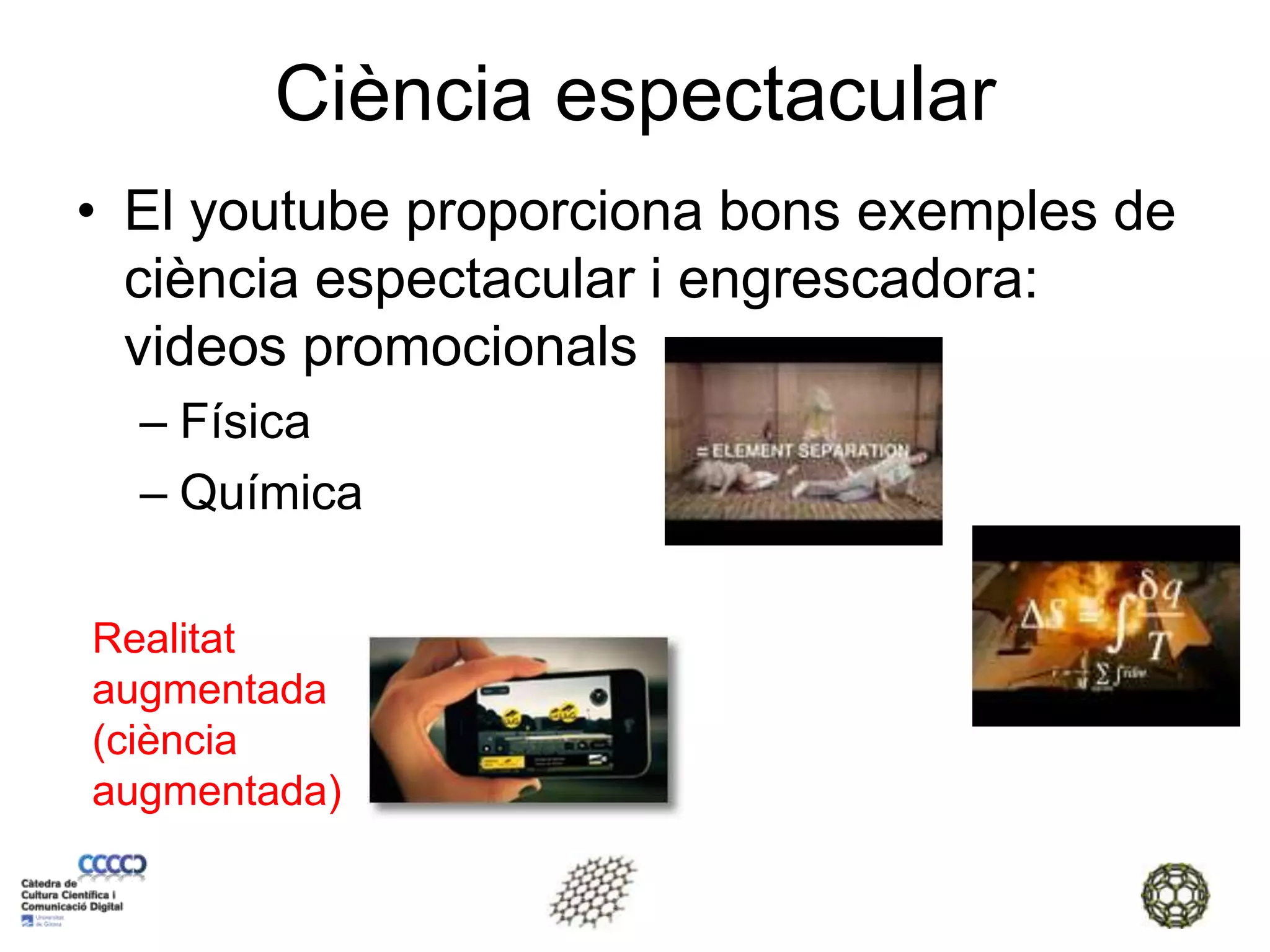
Ciència espectacularEl youtube proporciona bons exemples de ciència espectacular i engrescadora: videos promocionalsFísicaQuímicaRealitat augmentada (ciència augmentada)
Som a l’Any Internacional de la Química!CatQuimica.CatSeguiu al twitter@univgirona@catquimicaSeguiu a facebookUdg.universitatcatquimica
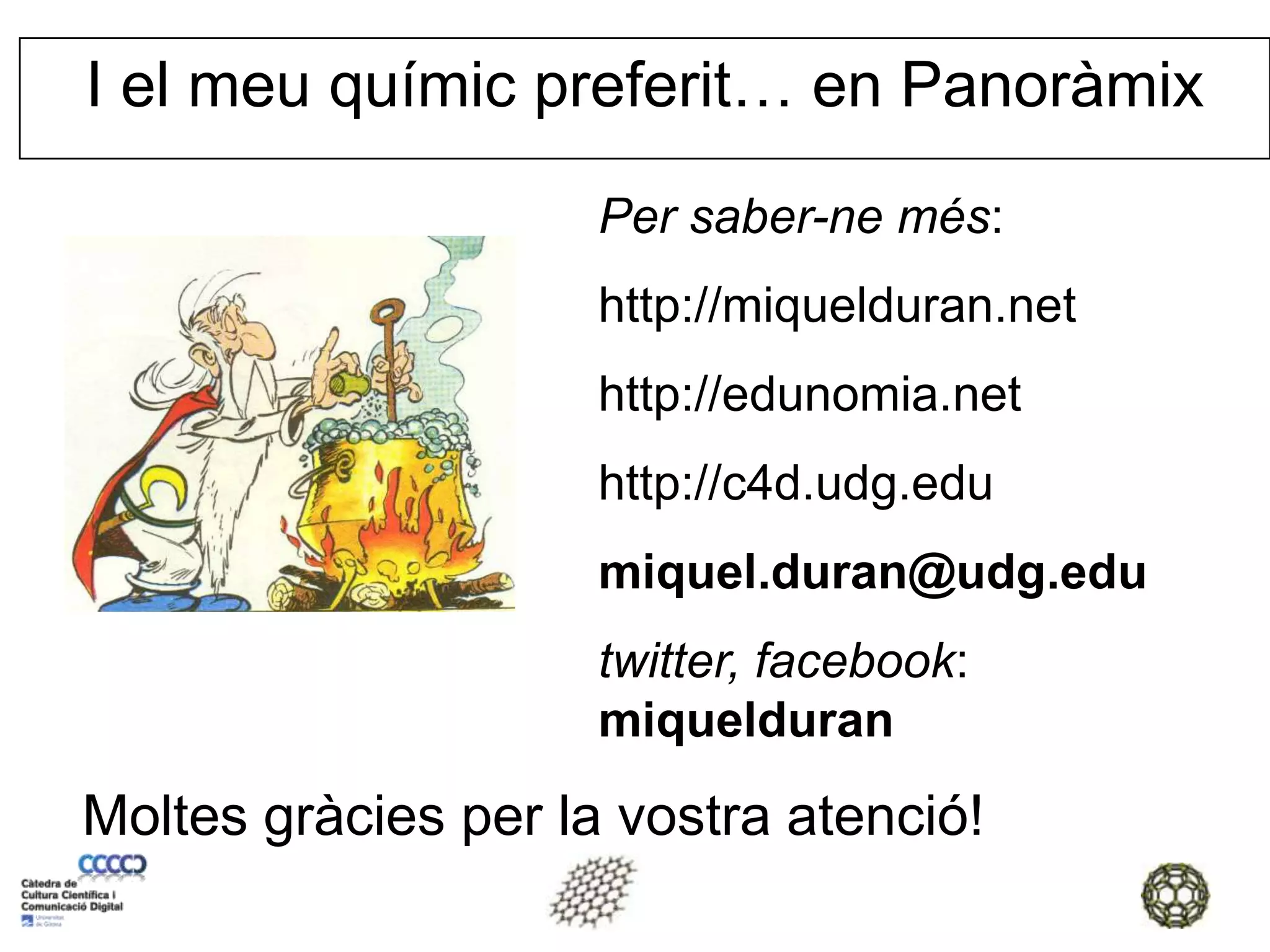
I el meu químic preferit… en PanoràmixPer saber-ne més:http://miquelduran.nethttp://edunomia.nethttp://c4d.udg.edumiquel.duran@udg.edutwitter, facebook: miquelduranMoltes gràcies per la vostra atenció!

110411 iesss-fullere-grafe

  • 2.
    Del ful.lerè algrafè: el carboni, actor principalde l’enginyeria de la matèriaMiquel DuranUniversitat de GironaIES SS, Girona, 11/4/2011
  • 3.
    Fa totjust 15dies…Este proceso de condensación sucede con casi todas las moléculas de gas, dejando sólo unas pocas en forma gaseosa. Estas condiciones dejan sitio para el desarrollo de una química peculiar entre el resto de moléculas gaseosas, lo que lleva a la formación de raras especies moleculares como H2D+ and D2H+, compuestas a partir de átomos de hidrógeno (H) y su variedad más pesada, el deuterio (D).Estas peculiares moléculas han sido el objetivo de muchas búsquedas observacionales en la última década, pero debido a que se forman en cantidades tan pequeñas, son difíciles de observar.Ahora, un nuevo estudio del Atacama Pathfinder Experiment (APEX), observando desde una prístina posición en el desierto chileno con un instrumento especial conocido como CHAMP+, ha cartografiado la distribución de las moléculas en el núcleo de la nube Rho Ophiuchi, una región de formación estelar a unos 400 años luz de la Tierra.Estas escasas moléculas han sido un objetivo observacional desde hace tiempo para los astrónomos.
  • 4.
  • 6.
    Empremta Digital deMolèculesEspectre Vibracional(representació dels diferents moviments de vibració)
  • 7.
    Què tenim?Suposem unamolècula amb fórmula C2H4O2, per a la qual es proposen dues estructures A i B, cadascuna amb un espectre característic:
  • 8.
  • 9.
    Del ful.lerè algrafè… Però primer, el benzè
  • 10.
    Antracè interestel.larUna col.laboracióde l’Institut Astrofísic de Canàries ha permés detectar molècules d’antracè, formades per tres anells d’àtoms de carboni. Es tracta d’una molècula orgànica força grossa. El titular del Discovery News la titlla de prebiòtica, formada per carboni i hidrogen i conté molts d’enllaços conjugats.Segons la nota de premsa de l’IAC, a la mateixa zona s’hi ha trobat una altra concentració de molècules de carboni radicalàries, sempre molt reactives.La distància a la qual s’ha trobat és de 700 anys-llum. (25/6/2010)
  • 12.
    PAHs: hidrocarburs aromàticspolicíclics a l’espai
  • 14.
    Monstre de l’espai(ChemistryWorld 2007) Astrochemists who waited 25 years to find an anion in space have spotted three in less than a year. The latest detection, the octatetraynyl ion (C8H-), is the largest negatively charged molecule ever seen in space, beating C4H- and C6H-, discovered late last year. The recent anion bonanza forces a rethink in models of interstellar chemistry, say astronomers. US teams at the National Radio Astronomy Observatory (NRAO), Virginia, and the Harvard Smithsonian Centre for Astrophysics, Massachusetts, detected the octatetraynyl ion in a cold, dark gas cloud in the constellation Taurus, and also in the envelope of gas surrounding a dying giant star in the constellation Leo. The scientists matched radiowave signals collected by the Green Bank Telescope in West Virginia to laboratory measurements of the C8H- spectrum. Around 150 molecules have so far been identified in the interstellar gas clouds from which comets, stars and planets eventually form. A dozen are cations, formed when UV radiation strips away an electron. As far back as 1981, Eric Herbst suggested that negative molecular ions might be found in gas clouds, but astronomers had doubted that molecules could hold onto extra electrons long enough to be spotted. 'That's obviously not the case,' said Mike McCarthy of the Harvard team. 'Anions are surprisingly abundant.'   
  • 15.
    Nanonaus: futbal.lens ala vistaNow, a team of astronomers has found that in the dusty environment around a white dwarf star lying about 6500 light years from Earth, a few per cent of the carbon is in the form of buckyballs. TThe astronomers used the Spitzer Space Telescope to detect the distinctive infrared spectrum of buckyballs made of 60 and 70 carbon atoms in a dusty nebula around the white dwarf.The team suspects that abundant carbon and a lack of hydrogen in the nebula created just the right environment to give rise to buckyballs. When hydrogen is present, it combines with carbon, preventing the pure-carbon spheres from forming.(New Scientist, 7/2010)
  • 16.
    Nanonaus: metoritsWe reporton the discovery of naturally occurring fullerenes (C60 to C400) in the Allende and Murchison meteorites and some sediment samples from the 65 million-year-old Cretaceous/Tertiary boundary layer (KTB). Unlike the other pure forms of carbon (diamond and graphite), fullerenes are extractable in an organic solvent (e.g., toluene or 1,2,4-trichlorobenzene). The recognition of this unique property led to the detection and isolation of the higher fullerenes in the Kratschmer/Huffmann arc evaporated graphite soot and in the carbon material in the meteorite and impact deposits. By further exploiting the unique ability of the fullerene cage structure to encapsulate and retain noble gases, we have determined that both the Allende and Murchison fullerenes and the KTB fullerenes contain trapped noble gases with ratios that can only be described as extraterrestrial in origin.(PNAS 2000)
  • 19.
  • 20.
    Ful.lerens diversosCollarets deful.lerè (sintetitzats)Ful.lerens recreatius: paper, globus, cartes
  • 21.
  • 22.
  • 26.
  • 27.
    Una nanoràdioThe nanotuberadio, invented in 2007 by physicist Alex Zettl and his colleagues at the University of California, Berkeley, performs a set of amazing feats: a single carbon nanotube tunes in a broadcast signal, amplifies it, converts it to an audio signal and then sends it to an external speaker in a form that the human ear can readily recognize.
  • 28.
    Totjust fa pocsdies (AJP 5-Abr): del Gat de Schrödinger al Pop de Schrödinger Interferència quàntica de grans molècules: dualitat ona-partícula
  • 29.
    L’experiment del gatde SchrödingerViu o mort?Carta vermella o negra?
  • 30.
    Totjust fa pocsdies (AJP 5-Abr): del Gat de Schrödinger al Pop de Schrödinger
  • 31.
  • 32.
    Llapis i grafèD.I.Y.Graphene: How to Make One-Atom-Thick Carbon Layers With Sticky Tape
  • 33.
    Informàtica i GrafèSpincomputers, when developed, would utilize the electron’s spin state to store and process vast amounts of information while using less energy, generating less heat and performing much faster than conventional computers in use today.Es tracta de memòries basades en tenir “0″ i “1″ segons l’spin d’un electró sigui d’un tipus o d’un altre. L’spin d’un electró és una propietat mecanoquàntica que no té analogia clàssica, i només pot tenir dos valors. El problema, que ja s’ha trobat en ordinadors quàntics basats en propietats d’spin, és mantenir l’estat quàntic sense alterar durant un temps significatiu. En l’article de Kawakami s’hi esmenta que els electrons injectats al grafè que són detectats atravessant un aïllant per efecte túnel poden durar fins a mig nanosegon, és a dir, de l’ordre d’un cicle dels actuals processadors que són utilitzats als ordinadors habituals.Els avantatges de memòries basades en els spins dels electrons són força òbvies: molta més densitat d’informació, i molta menys energia requerida per canviar el valor de cada bit. Però cal encara superar moltes dificultats, i per això els investigadors senyalen que caldran al menys 5 anys per tenir algun dispositiu pràctic que faci alguna cosa.
  • 34.
    Més info: graphene-info.comElmeu ordinador: 2 GHz aprox. IBM researchers develop a 155 Ghz graphene transistor using a diamond-like carbon substrate
  • 35.
    Premis NobelQuímica 1996:Ful.lerensFísica 2010: GrafèUna nostra aportació:Itinerari Químic AugmentatIphone, Android: aplicació Layar
  • 36.
    Ciència espectacularEl youtubeproporciona bons exemples de ciència espectacular i engrescadora: videos promocionalsFísicaQuímicaRealitat augmentada (ciència augmentada)
  • 37.
    Som a l’AnyInternacional de la Química!CatQuimica.CatSeguiu al twitter@univgirona@catquimicaSeguiu a facebookUdg.universitatcatquimica
  • 38.
    I el meuquímic preferit… en PanoràmixPer saber-ne més:http://miquelduran.nethttp://edunomia.nethttp://c4d.udg.edumiquel.duran@udg.edutwitter, facebook: miquelduranMoltes gràcies per la vostra atenció!