Graphene-based
Biosensors
Mohamed Labadi
April, 2015
Overview
Nature Nanotechnology, January 2011
What is Graphene?
G-properties/Superlatives/Applications
Producing Graphene/Synthesis
Graphene based Biosensors
Graphene’s patent trend and battle for
market space
Conclusion
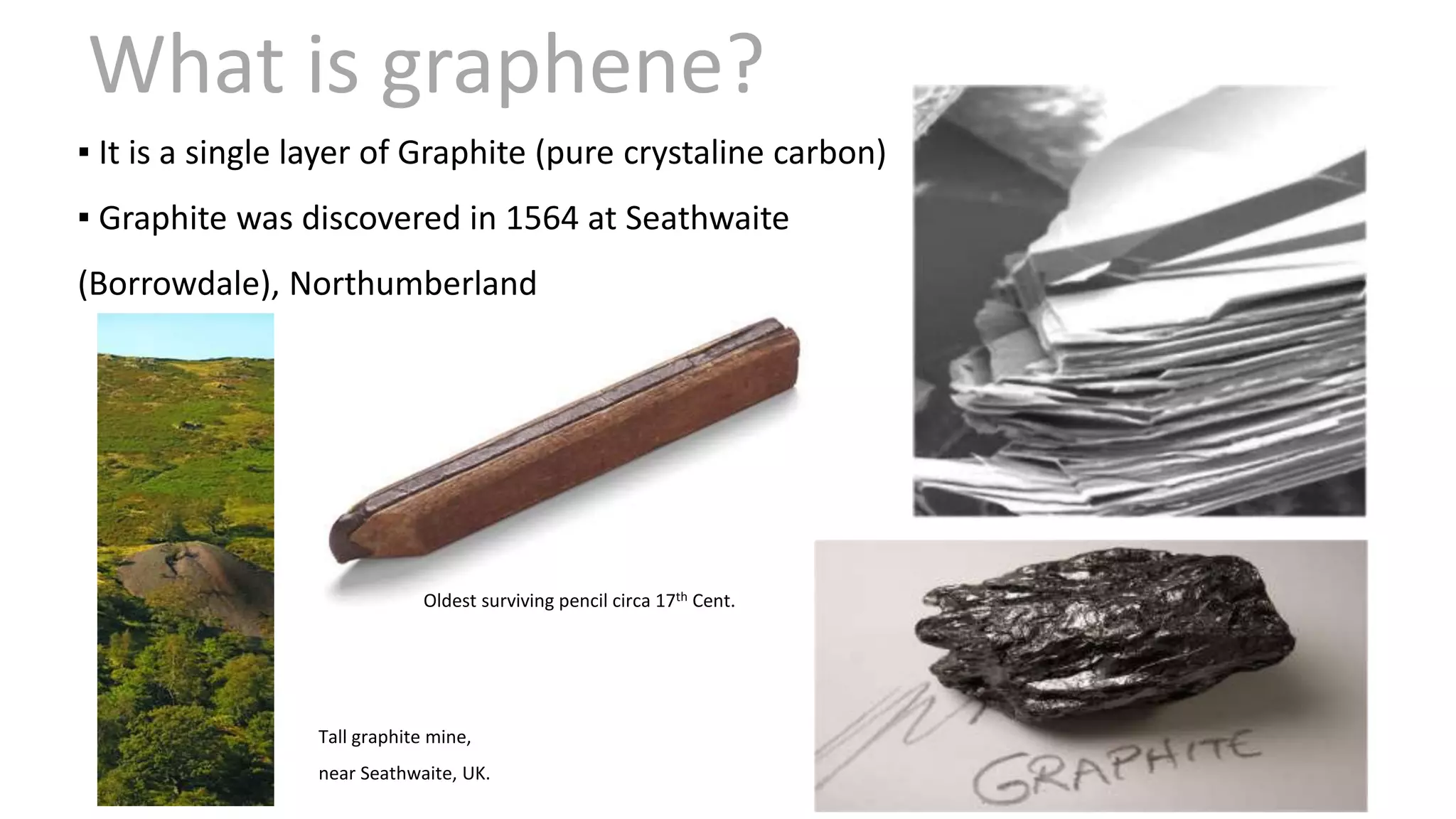
Tall graphite mine,
near Seathwaite, UK.
Oldest surviving pencil circa 17th Cent.
▪ It is a single layer of Graphite (pure crystaline carbon)
▪ Graphite was discovered in 1564 at Seathwaite
(Borrowdale), Northumberland
What is graphene?
▪ It is a single layer of Graphite (pure crystaline carbon)
▪ Graphite was discovered in 1564 at Seathwaite (Borrowdale), Northumberland
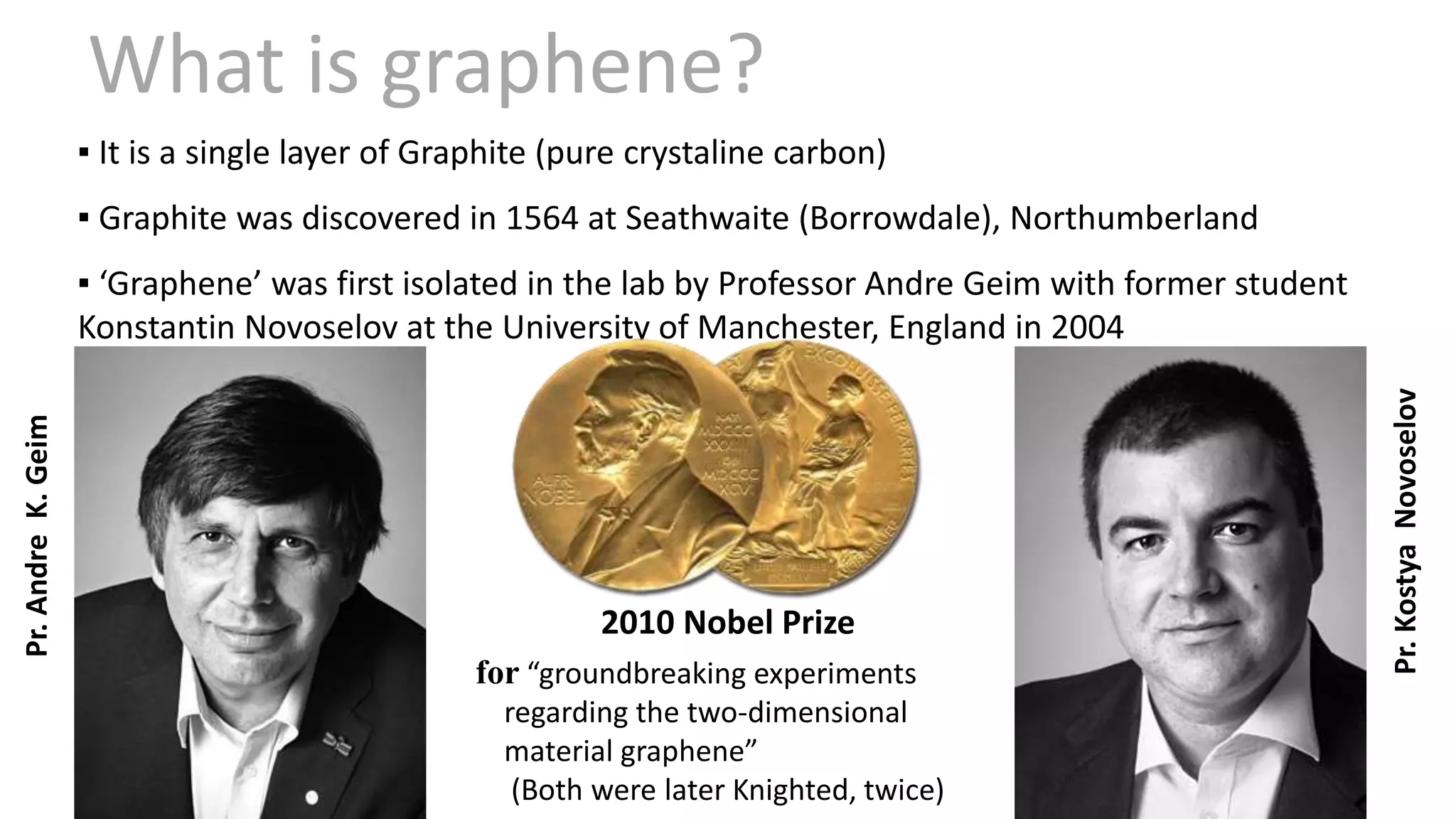
▪ ‘Graphene’ was first isolated in the lab by Professor Andre Geim with former student
Konstantin Novoselov at the University of Manchester, England in 2004
2010 Nobel Prize
for “groundbreaking experiments
regarding the two-dimensional
material graphene”
(Both were later Knighted, twice)
What is graphene?
Pr.AndreK.Geim
Pr.KostyaNovoselov
Graphene Superlatives
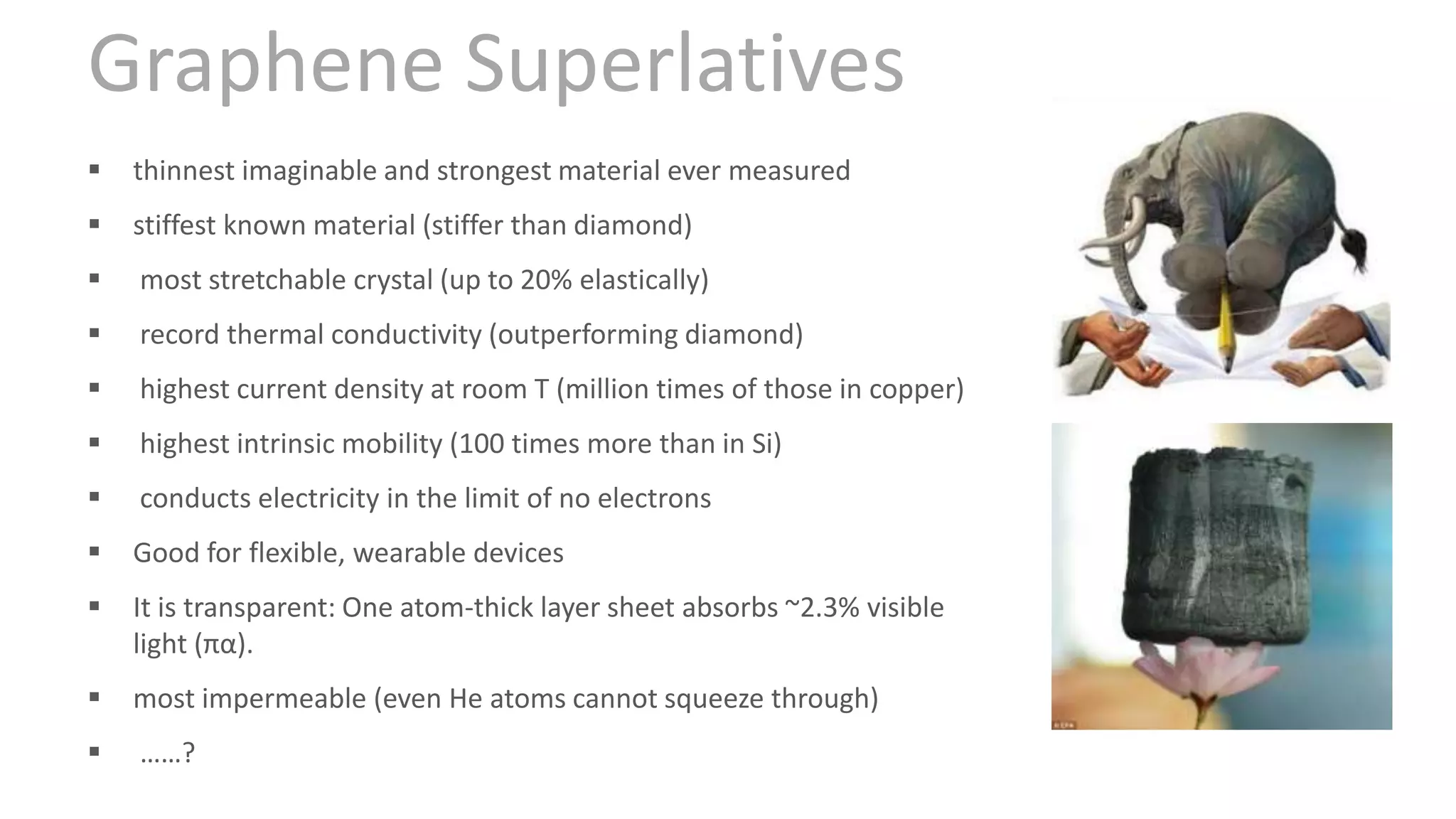
 thinnest imaginable and strongest material ever measured
 stiffest known material (stiffer than diamond)
 most stretchable crystal (up to 20% elastically)
 record thermal conductivity (outperforming diamond)
 highest current density at room T (million times of those in copper)
 highest intrinsic mobility (100 times more than in Si)
 conducts electricity in the limit of no electrons
 Good for flexible, wearable devices
 It is transparent: One atom-thick layer sheet absorbs ~2.3% visible
light (πα).
 most impermeable (even He atoms cannot squeeze through)
 ……?
Graphene properties
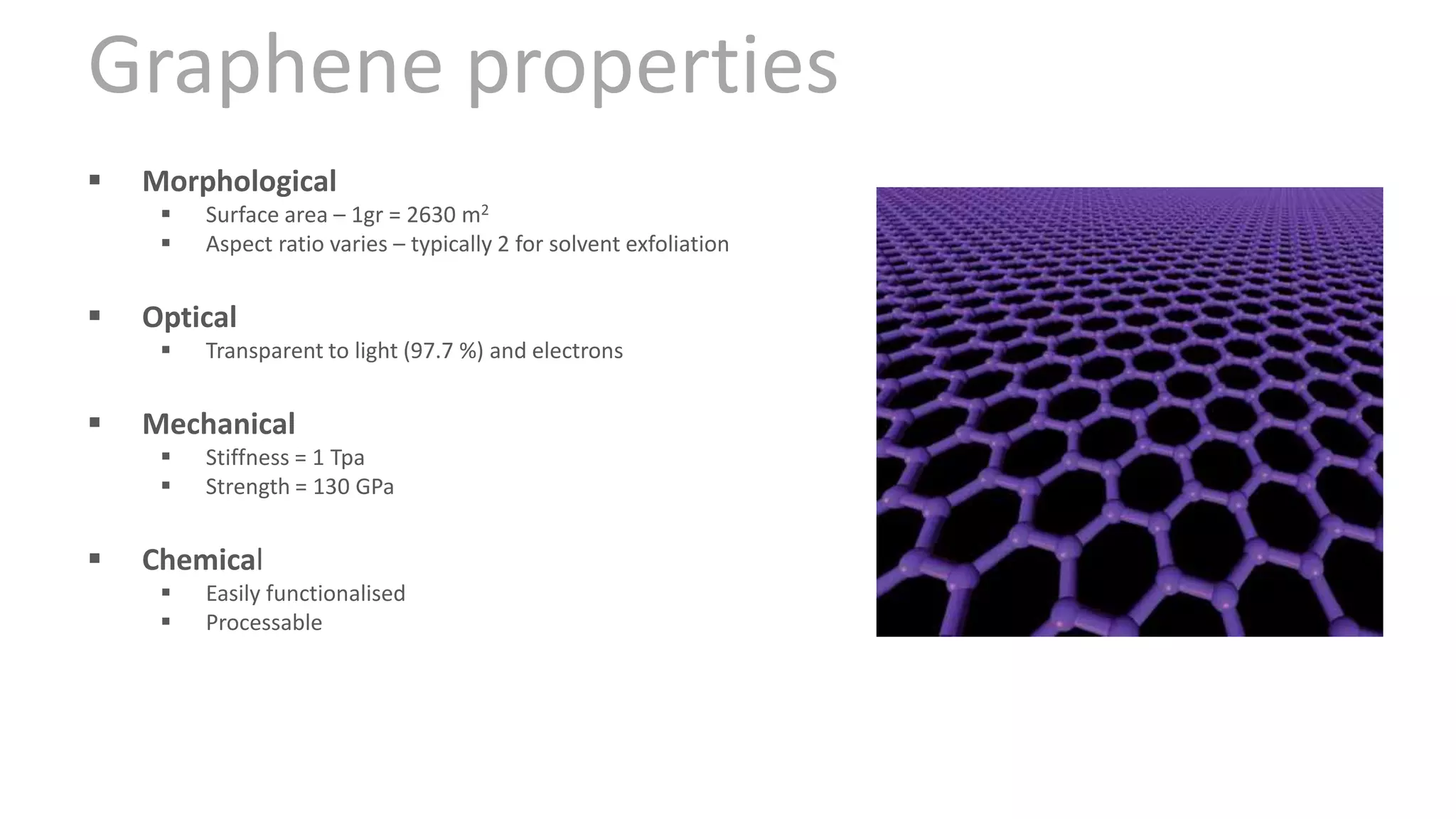
 Morphological
 Surface area – 1gr = 2630 m2
 Aspect ratio varies – typically 2 for solvent exfoliation
 Optical
 Transparent to light (97.7 %) and electrons
 Mechanical
 Stiffness = 1 Tpa
 Strength = 130 GPa
 Chemical
 Easily functionalised
 Processable
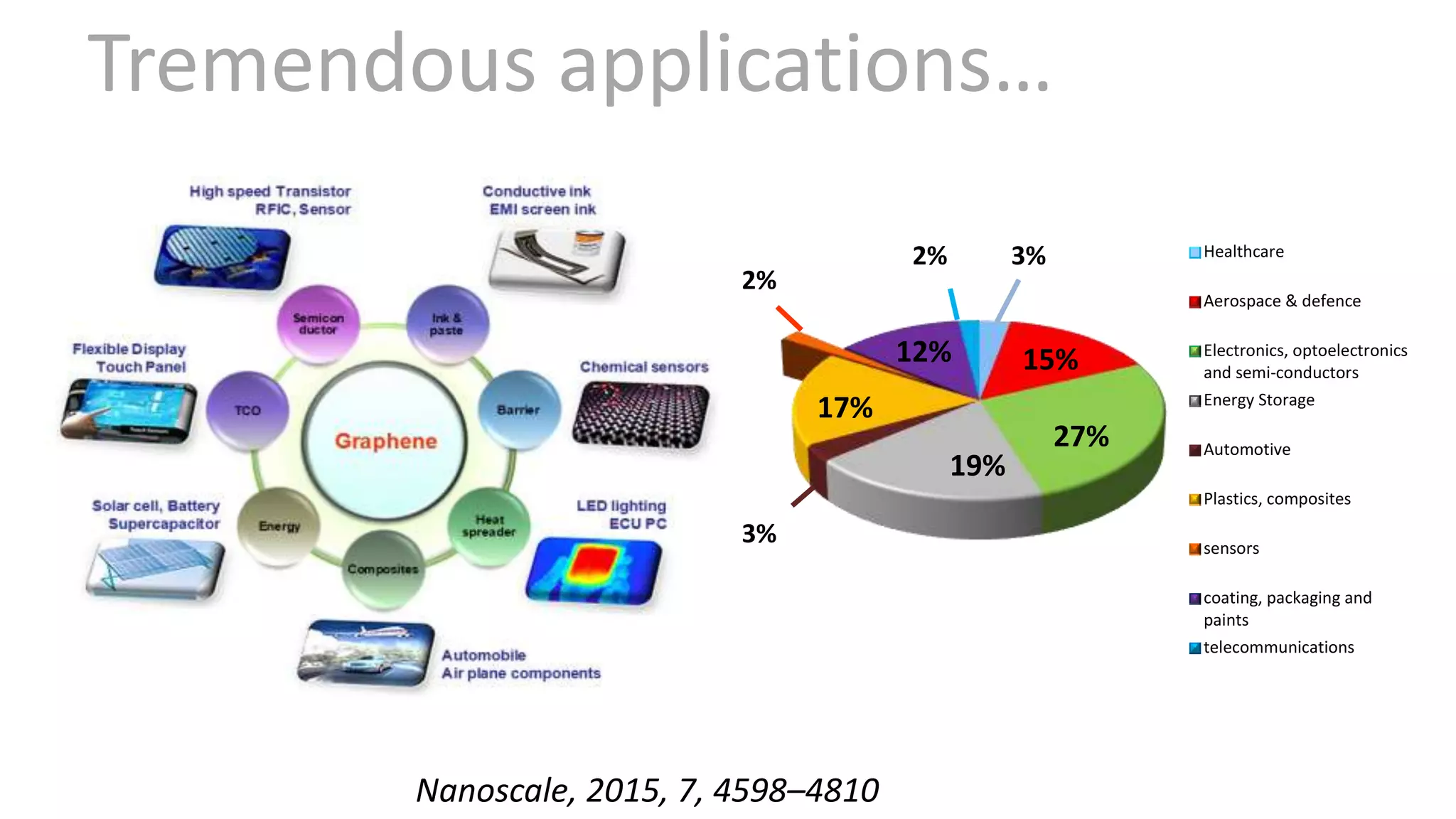
Tremendous applications…
Healthcare
Aerospace & defence
Electronics, optoelectronics
and semi-conductors
Energy Storage
Automotive
Plastics, composites
sensors
coating, packaging and
paints
telecommunications
15%
27%
19%
17%
12%
3%2%
2%
3%
Nanoscale, 2015, 7, 4598–4810
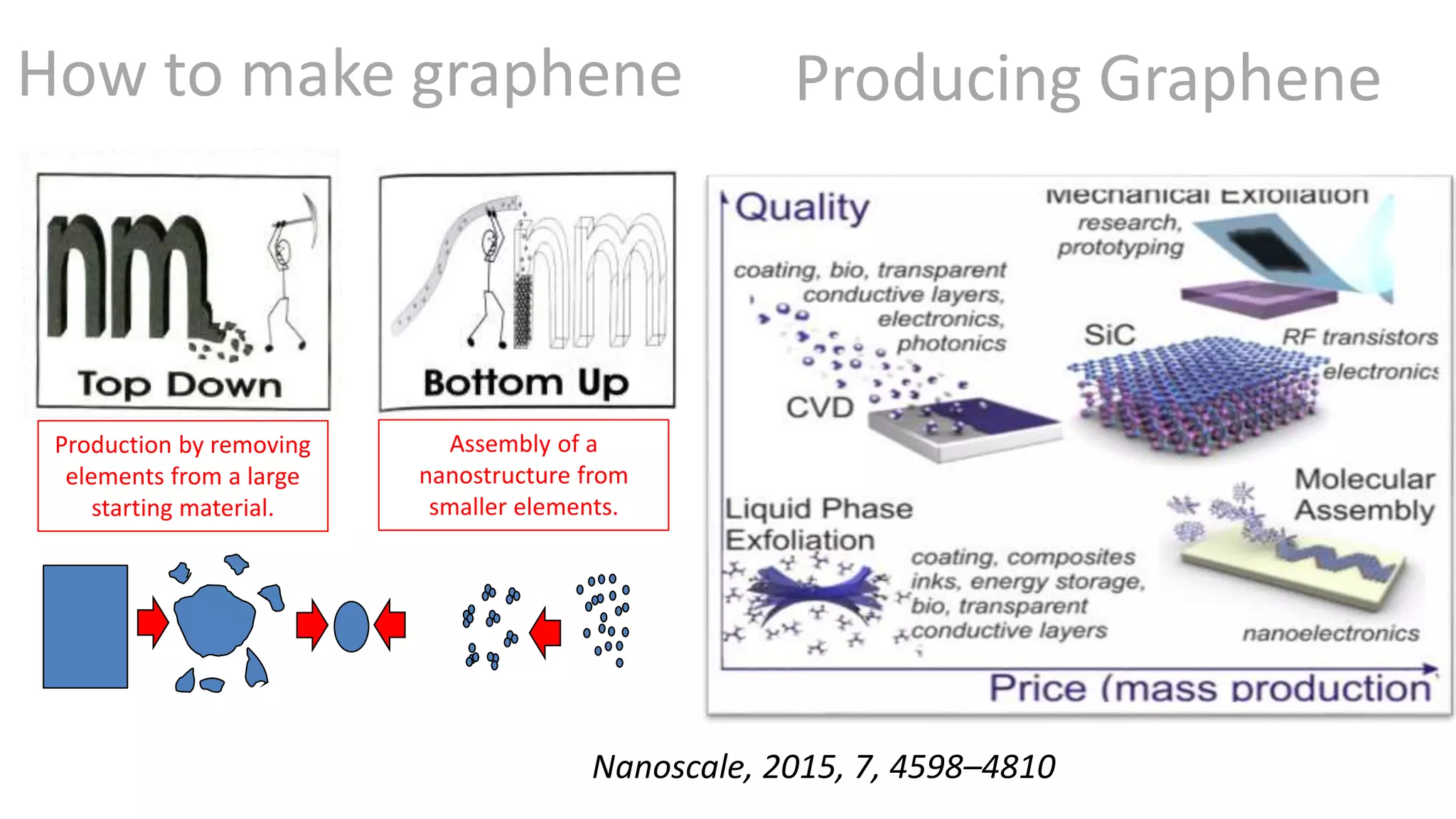
How to make graphene
Production by removing
elements from a large
starting material.
Assembly of a
nanostructure from
smaller elements.
Producing Graphene
Nanoscale, 2015, 7, 4598–4810
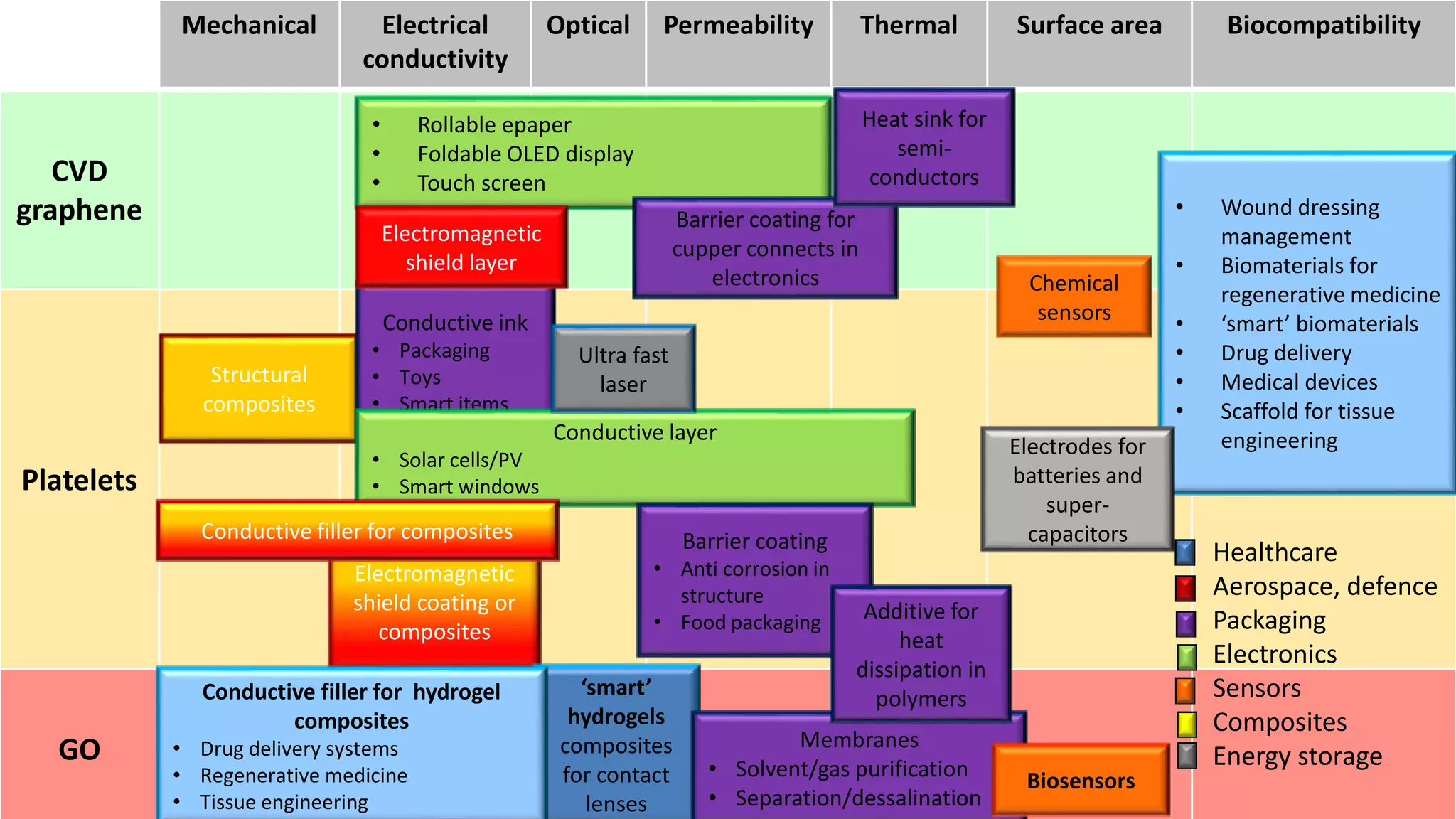
Mechanical Electrical
conductivity
Optical Permeability Thermal Surface area Biocompatibility
CVD
graphene
Platelets
GO
Structural
composites
• Rollable epaper
• Foldable OLED display
• Touch screen
Conductive ink
• Packaging
• Toys
• Smart items
Conductive layer
• Solar cells/PV
• Smart windows
Electromagnetic
shield coating or
composites
Barrier coating
• Anti corrosion in
structure
• Food packaging
Ultra fast
laser
• Wound dressing
management
• Biomaterials for
regenerative medicine
• ‘smart’ biomaterials
• Drug delivery
• Medical devices
• Scaffold for tissue
engineeringElectrodes for
batteries and
super-
capacitors
Chemical
sensors
Electromagnetic
shield layer
Barrier coating for
cupper connects in
electronics
‘smart’
hydrogels
composites
for contact
lenses
Conductive filler for hydrogel
composites
• Drug delivery systems
• Regenerative medicine
• Tissue engineering
Heat sink for
semi-
conductors
Healthcare
Aerospace, defence
Packaging
Electronics
Sensors
Composites
Energy storage
Membranes
• Solvent/gas purification
• Separation/dessalination
Conductive filler for composites
Additive for
heat
dissipation in
polymers
Biosensors
Graphene-based Biosensors
 Graphene-based Electrochemical Biosensors
 Excellent electrochemical behaviors of graphene
 Promising electrode materials in electroanalysis
 High electrocatalyst activity toward H2O2
 The graphene film accelerates the electrodic reaction
 A high background current is observed due to the large surface
area of graphene.
 Electrodes have more uniform distribution of electrochemically
active sites.
 Graphene: 2D structure: very efficient in detecting adsorbed
molecules
 Graphene-based Optical Biosensors
 Low cross-sensitivity
 Long life & lower contamination sensitivity
 Detecting biomolecules optically using graphene by attaching a
fluorophore (exhibit different photophysical properties because
of its interaction with carbon)
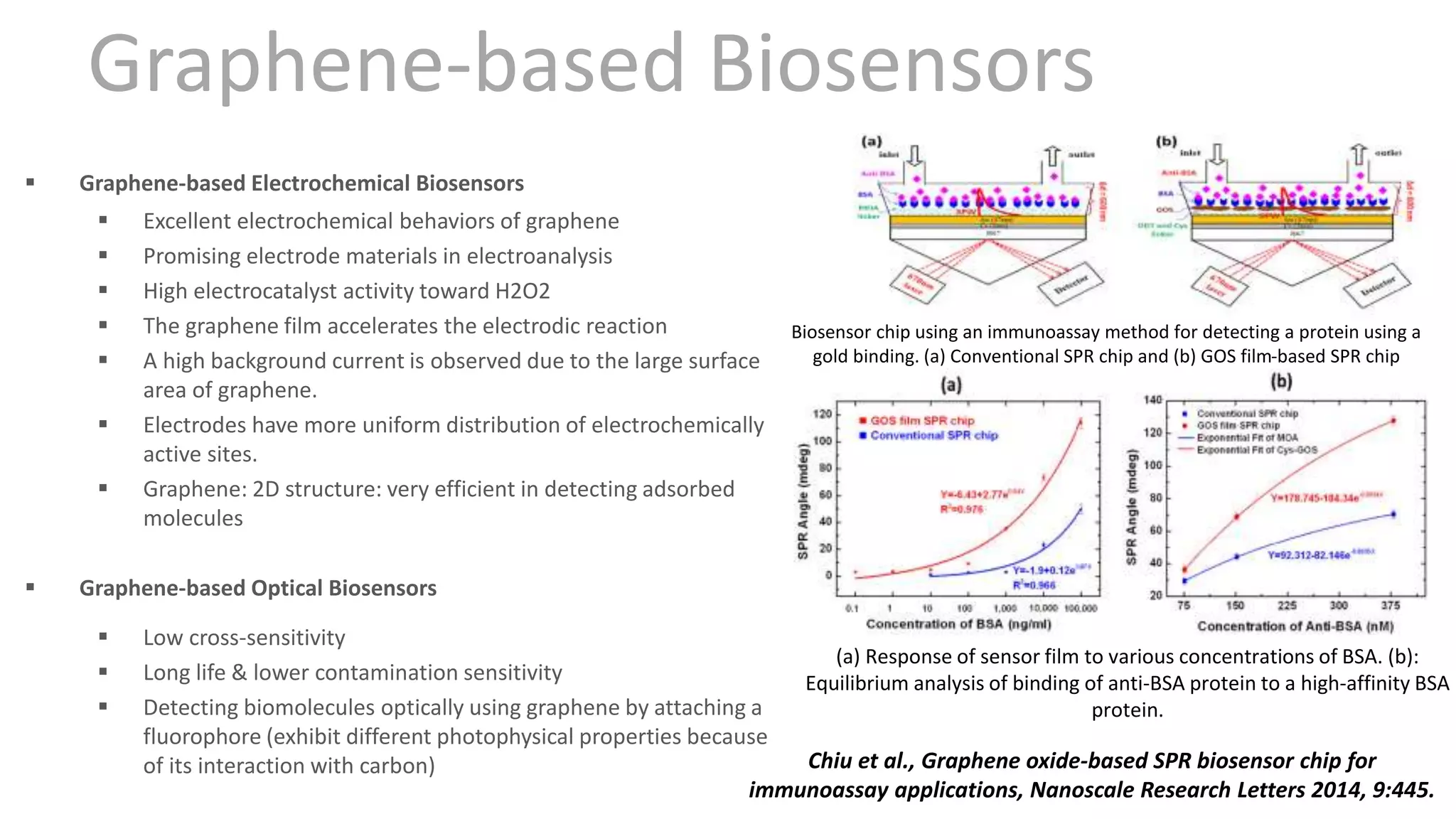
(a) Response of sensor film to various concentrations of BSA. (b):
Equilibrium analysis of binding of anti-BSA protein to a high-affinity BSA
protein.
Biosensor chip using an immunoassay method for detecting a protein using a
gold binding. (a) Conventional SPR chip and (b) GOS film-based SPR chip
Chiu et al., Graphene oxide-based SPR biosensor chip for
immunoassay applications, Nanoscale Research Letters 2014, 9:445.
Graphene-based Biosensors
 Graphene-based DNA Biosensors
 High sensitivity, high selectivity & low cost for the detection of
selected DNA sequence or mutated genes associated with
human disease
 Providing a simple, accurate and inexpensive platform of patien
diagnosis
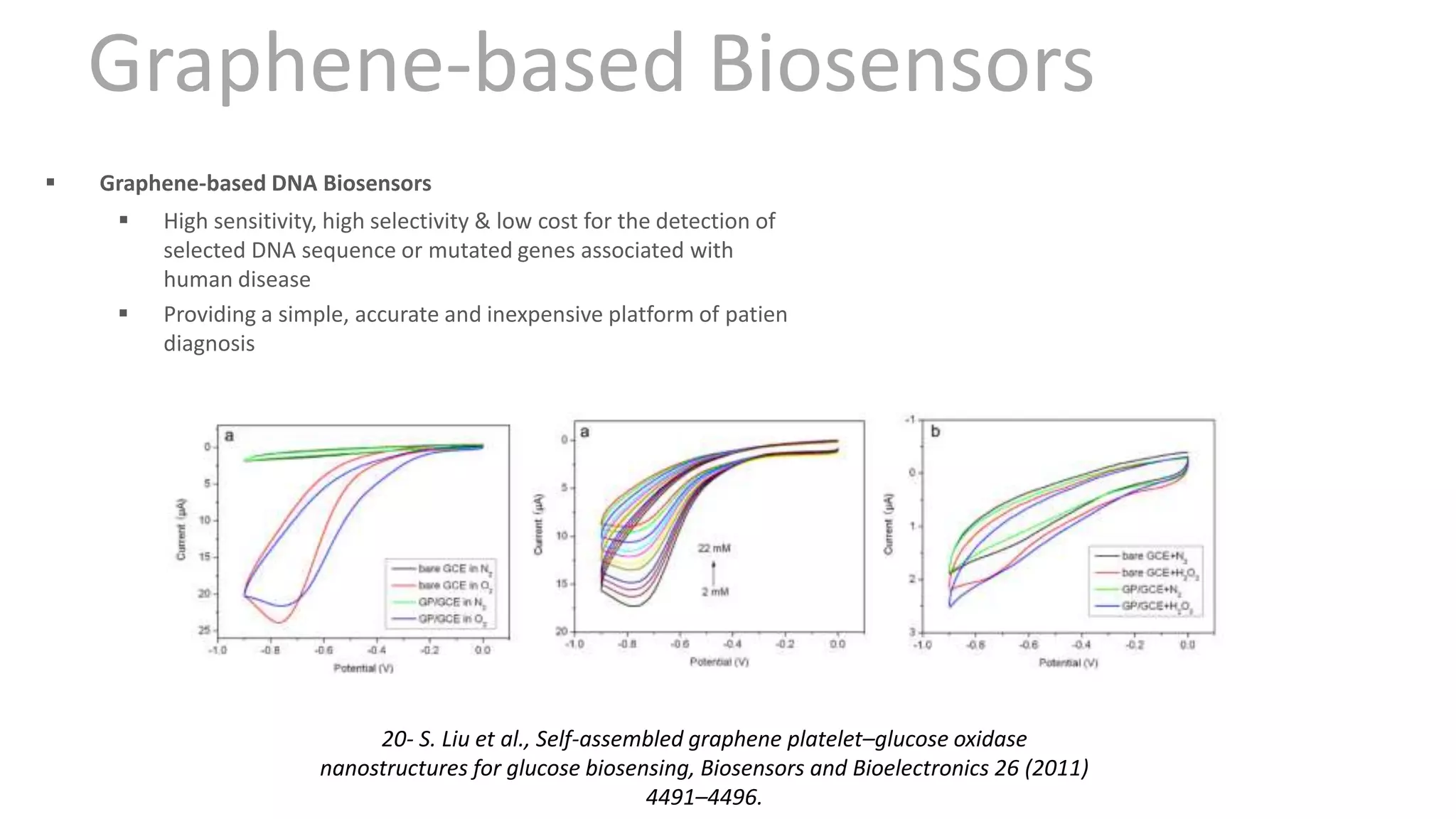
20- S. Liu et al., Self-assembled graphene platelet–glucose oxidase
nanostructures for glucose biosensing, Biosensors and Bioelectronics 26 (2011)
4491–4496.
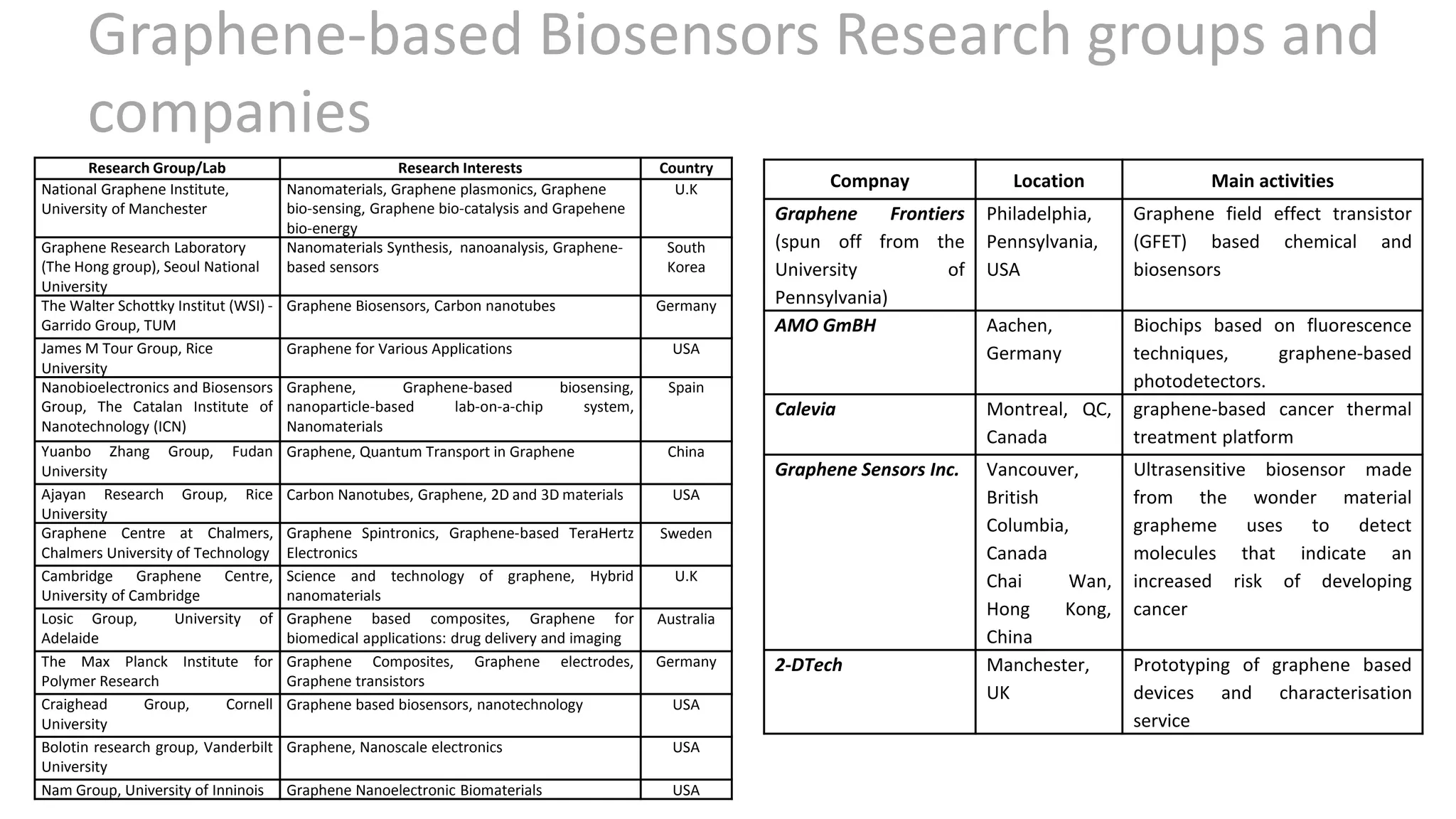
Graphene-based Biosensors Research groups and
companies
Research Group/Lab Research Interests Country
National Graphene Institute,
University of Manchester
Nanomaterials, Graphene plasmonics, Graphene
bio-sensing, Graphene bio-catalysis and Grapehene
bio-energy
U.K
Graphene Research Laboratory
(The Hong group), Seoul National
University
Nanomaterials Synthesis, nanoanalysis, Graphene-
based sensors
South
Korea
The Walter Schottky Institut (WSI) -
Garrido Group, TUM
Graphene Biosensors, Carbon nanotubes Germany
James M Tour Group, Rice
University
Graphene for Various Applications USA
Nanobioelectronics and Biosensors
Group, The Catalan Institute of
Nanotechnology (ICN)
Graphene, Graphene-based biosensing,
nanoparticle-based lab-on-a-chip system,
Nanomaterials
Spain
Yuanbo Zhang Group, Fudan
University
Graphene, Quantum Transport in Graphene China
Ajayan Research Group, Rice
University
Carbon Nanotubes, Graphene, 2D and 3D materials USA
Graphene Centre at Chalmers,
Chalmers University of Technology
Graphene Spintronics, Graphene-based TeraHertz
Electronics
Sweden
Cambridge Graphene Centre,
University of Cambridge
Science and technology of graphene, Hybrid
nanomaterials
U.K
Losic Group, University of
Adelaide
Graphene based composites, Graphene for
biomedical applications: drug delivery and imaging
Australia
The Max Planck Institute for
Polymer Research
Graphene Composites, Graphene electrodes,
Graphene transistors
Germany
Craighead Group, Cornell
University
Graphene based biosensors, nanotechnology USA
Bolotin research group, Vanderbilt
University
Graphene, Nanoscale electronics USA
Nam Group, University of Inninois Graphene Nanoelectronic Biomaterials USA
Compnay Location Main activities
Graphene Frontiers
(spun off from the
University of
Pennsylvania)
Philadelphia,
Pennsylvania,
USA
Graphene field effect transistor
(GFET) based chemical and
biosensors
AMO GmBH Aachen,
Germany
Biochips based on fluorescence
techniques, graphene-based
photodetectors.
Calevia Montreal, QC,
Canada
graphene-based cancer thermal
treatment platform
Graphene Sensors Inc. Vancouver,
British
Columbia,
Canada
Chai Wan,
Hong Kong,
China
Ultrasensitive biosensor made
from the wonder material
grapheme uses to detect
molecules that indicate an
increased risk of developing
cancer
2-DTech Manchester,
UK
Prototyping of graphene based
devices and characterisation
service
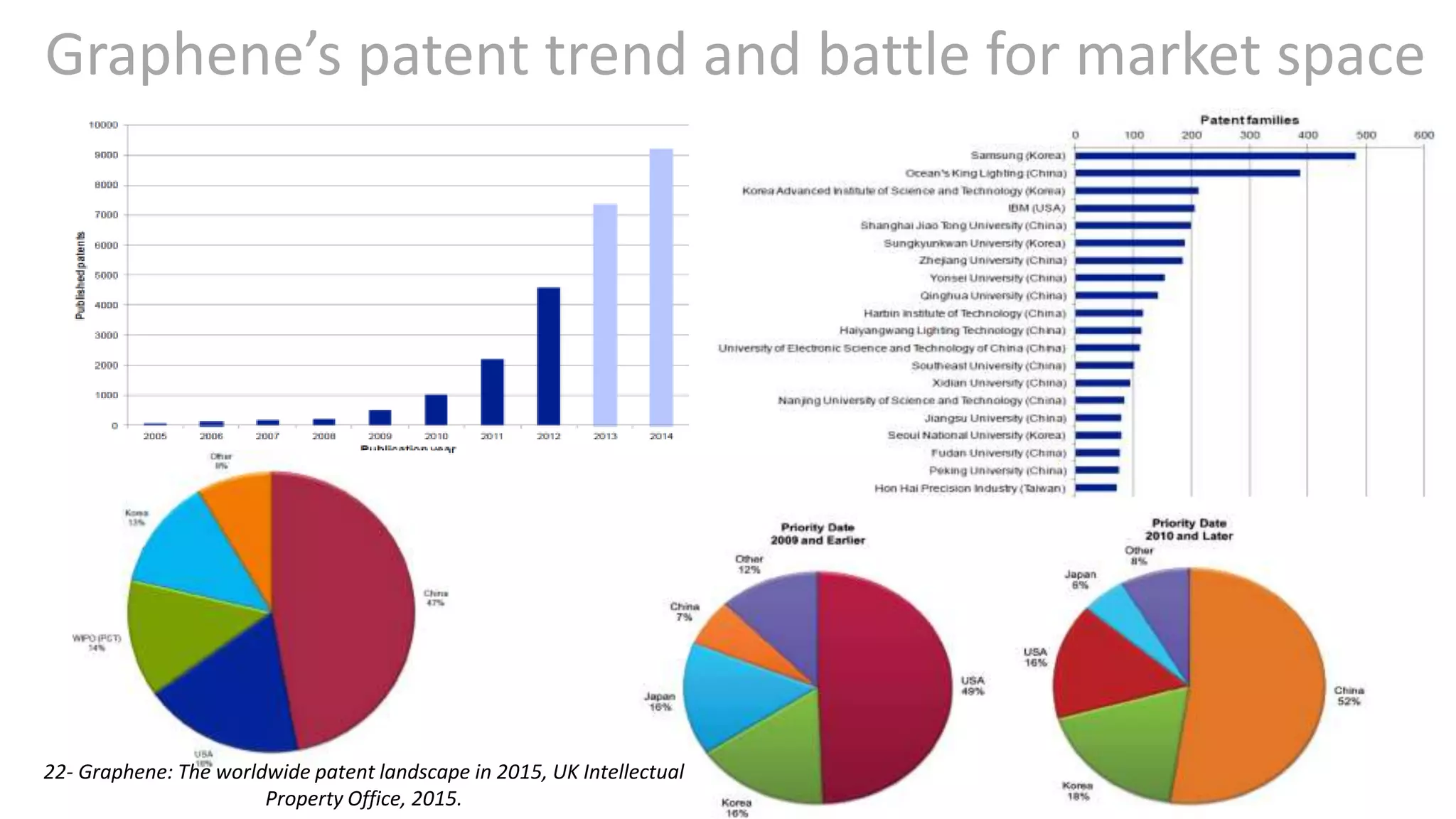
Graphene’s patent trend and battle for market space
22- Graphene: The worldwide patent landscape in 2015, UK Intellectual
Property Office, 2015.
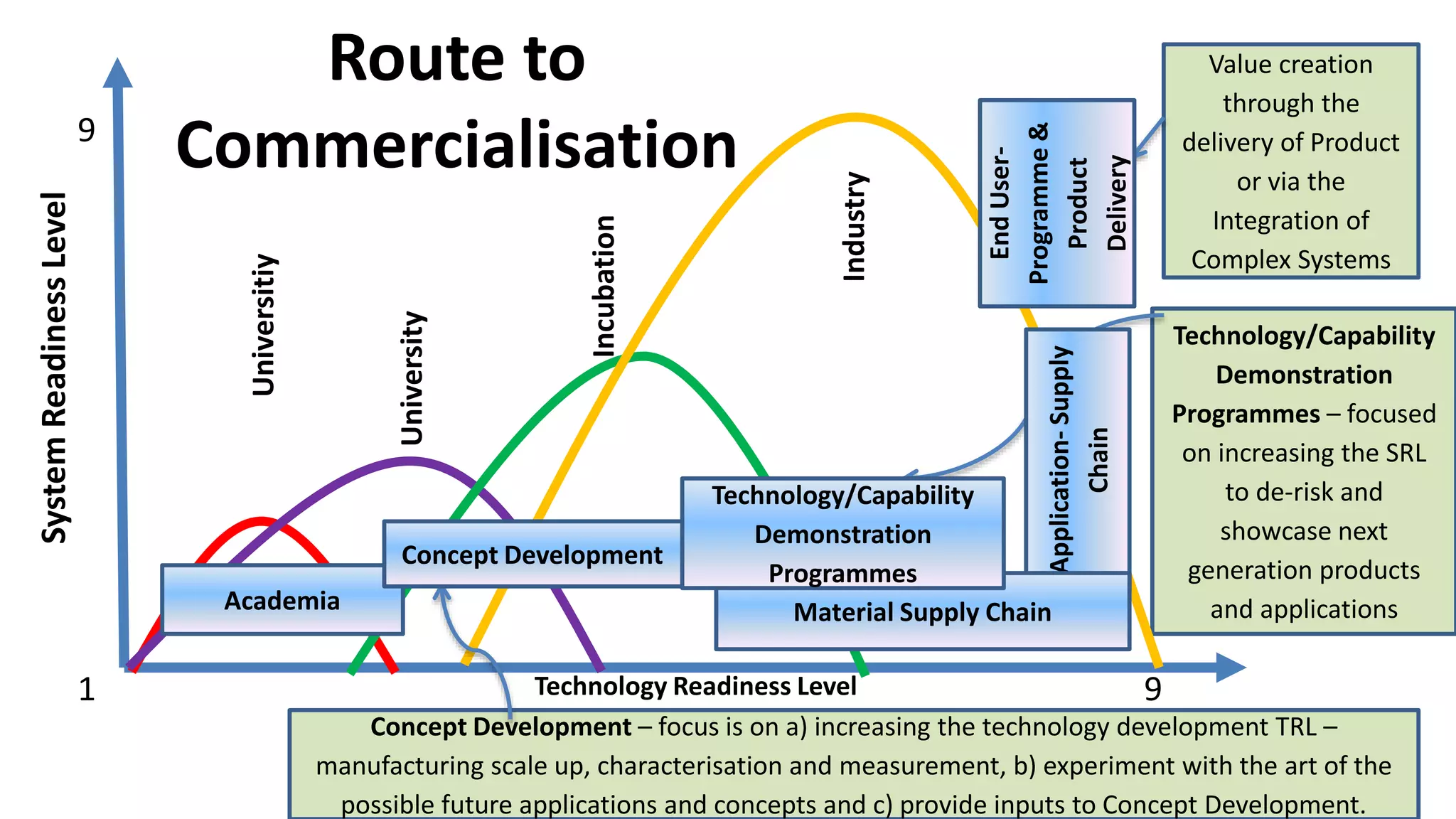
Concept Development – focus is on a) increasing the technology development TRL –
manufacturing scale up, characterisation and measurement, b) experiment with the art of the
possible future applications and concepts and c) provide inputs to Concept Development.
Value creation
through the
delivery of Product
or via the
Integration of
Complex Systems
Technology/Capability
Demonstration
Programmes – focused
on increasing the SRL
to de-risk and
showcase next
generation products
and applications
Route to
Commercialisation
Technology Readiness Level
SystemReadinessLevel
Universitiy
University
Incubation
Industry
1 9
9
EndUser-
Programme&
Product
Delivery
Application-Supply
Chain
Academia
Concept Development
Material Supply Chain
Technology/Capability
Demonstration
Programmes
Korean Graphene Research
Hub
Industrial Leaders
Conclusion
 The possibility to detect and characterize a single cell or
very lowly expressed biomolecules makes Graphen-
based biosensors among the most promising tools for
efficient translational, integrative, regenerative and
personalized medicine
 Future targets are the development of graphene-based
biosensor devices on a flexible substrates
 Investing in graphene: discover the next big thing
 Graphene Valley?
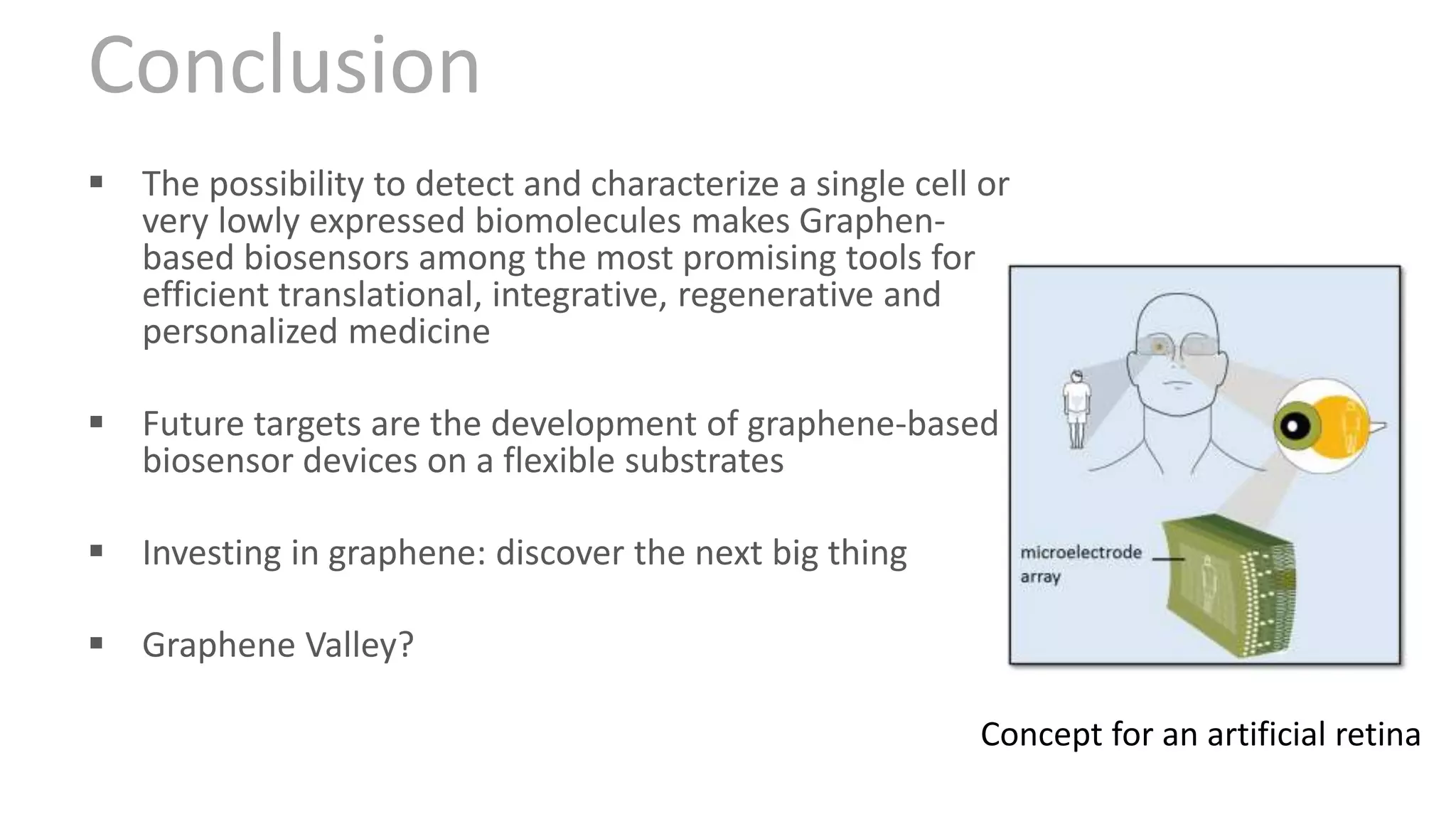
Concept for an artificial retina
Questions
The future in a pencil trace!
Thank you for your attention

Graphene-based Biosensors

  • 1.
  • 2.
    Overview Nature Nanotechnology, January2011 What is Graphene? G-properties/Superlatives/Applications Producing Graphene/Synthesis Graphene based Biosensors Graphene’s patent trend and battle for market space Conclusion
  • 3.
    Tall graphite mine, nearSeathwaite, UK. Oldest surviving pencil circa 17th Cent. ▪ It is a single layer of Graphite (pure crystaline carbon) ▪ Graphite was discovered in 1564 at Seathwaite (Borrowdale), Northumberland What is graphene?
  • 4.
    ▪ It isa single layer of Graphite (pure crystaline carbon) ▪ Graphite was discovered in 1564 at Seathwaite (Borrowdale), Northumberland ▪ ‘Graphene’ was first isolated in the lab by Professor Andre Geim with former student Konstantin Novoselov at the University of Manchester, England in 2004 2010 Nobel Prize for “groundbreaking experiments regarding the two-dimensional material graphene” (Both were later Knighted, twice) What is graphene? Pr.AndreK.Geim Pr.KostyaNovoselov
  • 5.
    Graphene Superlatives  thinnestimaginable and strongest material ever measured  stiffest known material (stiffer than diamond)  most stretchable crystal (up to 20% elastically)  record thermal conductivity (outperforming diamond)  highest current density at room T (million times of those in copper)  highest intrinsic mobility (100 times more than in Si)  conducts electricity in the limit of no electrons  Good for flexible, wearable devices  It is transparent: One atom-thick layer sheet absorbs ~2.3% visible light (πα).  most impermeable (even He atoms cannot squeeze through)  ……?
  • 6.
    Graphene properties  Morphological Surface area – 1gr = 2630 m2  Aspect ratio varies – typically 2 for solvent exfoliation  Optical  Transparent to light (97.7 %) and electrons  Mechanical  Stiffness = 1 Tpa  Strength = 130 GPa  Chemical  Easily functionalised  Processable
  • 7.
    Tremendous applications… Healthcare Aerospace &defence Electronics, optoelectronics and semi-conductors Energy Storage Automotive Plastics, composites sensors coating, packaging and paints telecommunications 15% 27% 19% 17% 12% 3%2% 2% 3% Nanoscale, 2015, 7, 4598–4810
  • 8.
    How to makegraphene Production by removing elements from a large starting material. Assembly of a nanostructure from smaller elements. Producing Graphene Nanoscale, 2015, 7, 4598–4810
  • 9.
    Mechanical Electrical conductivity Optical PermeabilityThermal Surface area Biocompatibility CVD graphene Platelets GO Structural composites • Rollable epaper • Foldable OLED display • Touch screen Conductive ink • Packaging • Toys • Smart items Conductive layer • Solar cells/PV • Smart windows Electromagnetic shield coating or composites Barrier coating • Anti corrosion in structure • Food packaging Ultra fast laser • Wound dressing management • Biomaterials for regenerative medicine • ‘smart’ biomaterials • Drug delivery • Medical devices • Scaffold for tissue engineeringElectrodes for batteries and super- capacitors Chemical sensors Electromagnetic shield layer Barrier coating for cupper connects in electronics ‘smart’ hydrogels composites for contact lenses Conductive filler for hydrogel composites • Drug delivery systems • Regenerative medicine • Tissue engineering Heat sink for semi- conductors Healthcare Aerospace, defence Packaging Electronics Sensors Composites Energy storage Membranes • Solvent/gas purification • Separation/dessalination Conductive filler for composites Additive for heat dissipation in polymers Biosensors
  • 10.
    Graphene-based Biosensors  Graphene-basedElectrochemical Biosensors  Excellent electrochemical behaviors of graphene  Promising electrode materials in electroanalysis  High electrocatalyst activity toward H2O2  The graphene film accelerates the electrodic reaction  A high background current is observed due to the large surface area of graphene.  Electrodes have more uniform distribution of electrochemically active sites.  Graphene: 2D structure: very efficient in detecting adsorbed molecules  Graphene-based Optical Biosensors  Low cross-sensitivity  Long life & lower contamination sensitivity  Detecting biomolecules optically using graphene by attaching a fluorophore (exhibit different photophysical properties because of its interaction with carbon) (a) Response of sensor film to various concentrations of BSA. (b): Equilibrium analysis of binding of anti-BSA protein to a high-affinity BSA protein. Biosensor chip using an immunoassay method for detecting a protein using a gold binding. (a) Conventional SPR chip and (b) GOS film-based SPR chip Chiu et al., Graphene oxide-based SPR biosensor chip for immunoassay applications, Nanoscale Research Letters 2014, 9:445.
  • 11.
    Graphene-based Biosensors  Graphene-basedDNA Biosensors  High sensitivity, high selectivity & low cost for the detection of selected DNA sequence or mutated genes associated with human disease  Providing a simple, accurate and inexpensive platform of patien diagnosis 20- S. Liu et al., Self-assembled graphene platelet–glucose oxidase nanostructures for glucose biosensing, Biosensors and Bioelectronics 26 (2011) 4491–4496.
  • 12.
    Graphene-based Biosensors Researchgroups and companies Research Group/Lab Research Interests Country National Graphene Institute, University of Manchester Nanomaterials, Graphene plasmonics, Graphene bio-sensing, Graphene bio-catalysis and Grapehene bio-energy U.K Graphene Research Laboratory (The Hong group), Seoul National University Nanomaterials Synthesis, nanoanalysis, Graphene- based sensors South Korea The Walter Schottky Institut (WSI) - Garrido Group, TUM Graphene Biosensors, Carbon nanotubes Germany James M Tour Group, Rice University Graphene for Various Applications USA Nanobioelectronics and Biosensors Group, The Catalan Institute of Nanotechnology (ICN) Graphene, Graphene-based biosensing, nanoparticle-based lab-on-a-chip system, Nanomaterials Spain Yuanbo Zhang Group, Fudan University Graphene, Quantum Transport in Graphene China Ajayan Research Group, Rice University Carbon Nanotubes, Graphene, 2D and 3D materials USA Graphene Centre at Chalmers, Chalmers University of Technology Graphene Spintronics, Graphene-based TeraHertz Electronics Sweden Cambridge Graphene Centre, University of Cambridge Science and technology of graphene, Hybrid nanomaterials U.K Losic Group, University of Adelaide Graphene based composites, Graphene for biomedical applications: drug delivery and imaging Australia The Max Planck Institute for Polymer Research Graphene Composites, Graphene electrodes, Graphene transistors Germany Craighead Group, Cornell University Graphene based biosensors, nanotechnology USA Bolotin research group, Vanderbilt University Graphene, Nanoscale electronics USA Nam Group, University of Inninois Graphene Nanoelectronic Biomaterials USA Compnay Location Main activities Graphene Frontiers (spun off from the University of Pennsylvania) Philadelphia, Pennsylvania, USA Graphene field effect transistor (GFET) based chemical and biosensors AMO GmBH Aachen, Germany Biochips based on fluorescence techniques, graphene-based photodetectors. Calevia Montreal, QC, Canada graphene-based cancer thermal treatment platform Graphene Sensors Inc. Vancouver, British Columbia, Canada Chai Wan, Hong Kong, China Ultrasensitive biosensor made from the wonder material grapheme uses to detect molecules that indicate an increased risk of developing cancer 2-DTech Manchester, UK Prototyping of graphene based devices and characterisation service
  • 13.
    Graphene’s patent trendand battle for market space 22- Graphene: The worldwide patent landscape in 2015, UK Intellectual Property Office, 2015.
  • 14.
    Concept Development –focus is on a) increasing the technology development TRL – manufacturing scale up, characterisation and measurement, b) experiment with the art of the possible future applications and concepts and c) provide inputs to Concept Development. Value creation through the delivery of Product or via the Integration of Complex Systems Technology/Capability Demonstration Programmes – focused on increasing the SRL to de-risk and showcase next generation products and applications Route to Commercialisation Technology Readiness Level SystemReadinessLevel Universitiy University Incubation Industry 1 9 9 EndUser- Programme& Product Delivery Application-Supply Chain Academia Concept Development Material Supply Chain Technology/Capability Demonstration Programmes
  • 15.
  • 16.
  • 17.
    Conclusion  The possibilityto detect and characterize a single cell or very lowly expressed biomolecules makes Graphen- based biosensors among the most promising tools for efficient translational, integrative, regenerative and personalized medicine  Future targets are the development of graphene-based biosensor devices on a flexible substrates  Investing in graphene: discover the next big thing  Graphene Valley? Concept for an artificial retina
  • 18.
    Questions The future ina pencil trace! Thank you for your attention