JUNIOR	
  CERTIFICATE	


JEWISH	
  STUDIES	
  
SECTION	
  4:	
  	
  HOLY	
  PLACES	
  	
  DRAFT	
  DOCUMENT	
  
Louise	
  O'Sullivan	
  IBVM	
  
  2	


SECTION	
  4	
   Holy	
  Places	
  
Topic	
  4.1	
   The	
  Jerusalem	
  Temple	
  
Description	
  of	
  
Topic	
  
The	
  biblical	
  account	
  of	
  the	
  building	
  and	
  decoration	
  of	
  the	
  
Temple;	
  The	
  role	
  of	
  Priests	
  and	
  Levites	
  in	
  the	
  Temple	
  service;	
  
The	
  purpose	
  and	
  nature	
  of	
  the	
  sacrificial	
  service;	
  The	
  
significance	
  of	
  the	
  Jerusalem	
  Temple	
  as	
  the	
  central	
  holy	
  place;	
  
The	
  relationship	
  between	
  Temple	
  and	
  Torah	
  
The	
  destruction	
  of	
  the	
  first	
  Temple	
  by	
  Nebuchadnezzar	
  in	
  586	
  
BCE	
  and	
  the	
  subsequent	
  exile	
  of	
  the	
  Jerusalem	
  inhabitants	
  to	
  
Babylon	
  (Iraq)The	
  consequences	
  of	
  this	
  exile;	
  The	
  rebuilding	
  of	
  
the	
  Temple	
  in	
  Jerusalem;	
  The	
  destruction	
  of	
  the	
  second	
  Temple	
  
by	
  the	
  Romans	
  70	
  CE;	
  The	
  consequences	
  of	
  the	
  destruction	
  of	
  
the	
  second	
  Temple	
  
Learning	
  
Outcomes	
  
Identify	
  and	
  summarise	
  the	
  biblical	
  account	
  of	
  the	
  building	
  and	
  
decoration	
  of	
  the	
  Temple;	
  explain	
  the	
  role	
  played	
  by	
  the	
  Priests	
  
and	
  Levites	
  in	
  the	
  Temple	
  service;	
  explain	
  the	
  purpose	
  and	
  
nature	
  of	
  sacrificial	
  service;	
  discuss	
  the	
  importance	
  of	
  the	
  
Temple	
  in	
  ancient	
  Judaism	
  as	
  the	
  central	
  holy	
  place;	
  explain	
  the	
  
link	
  between	
  Temple	
  and	
  Torah;	
  trace	
  the	
  events	
  surrounding	
  
the	
  destruction	
  and	
  rebuilding	
  of	
  the	
  first	
  Temple	
  and	
  the	
  
subsequent	
  exile	
  to	
  Babylon;	
  give	
  three	
  long-­‐lasting	
  effects	
  of	
  
the	
  exile;	
  describe	
  when	
  and	
  how	
  the	
  second	
  Temple	
  came	
  to	
  be	
  
built;	
  explain	
  when	
  and	
  why	
  the	
  second	
  Temple	
  was	
  destroyed;	
  
explain	
  why	
  prayer	
  substituted	
  Temple	
  sacrifices	
  after	
  the	
  
destruction	
  of	
  the	
  second	
  Temple;	
  explain,	
  with	
  examples,	
  how	
  
the	
  dispersal	
  of	
  Jewish	
  people	
  to	
  Spain,	
  Europe,	
  Asia,	
  N.	
  Africa	
  
after	
  the	
  destruction	
  of	
  the	
  second	
  Temple	
  has	
  impacted	
  on	
  
diverse	
  customs,	
  music,	
  food,	
  etc,	
  amongst	
  the	
  Sephardic	
  and	
  
Ashkenazic	
  cultures	
  to	
  the	
  present	
  time;	
  compare	
  the	
  first	
  
Temple	
  and	
  the	
  second	
  Temple	


  3	


Significance	
  of	
  the	
  Temple	
  as	
  the	
  Central	
  Holy	
  Place	


1. The	
  Temple	
  was	
  regarded	
  as	
  a	
  national	
  centre.	


2. It	
  was	
  the	
  site	
  of	
  revelation	
  of	
  Divine	
  Presence	
  and	
  the	
  preferred	
  place	
  for	
  
prayer.	


3. The	
   Temple	
   became	
   a	
   religious	
   centre	
   particularly	
   after	
   the	
   death	
   of	
  
Solomon.	
   	
   People	
   worshipped	
   idols	
   in	
   local	
   high	
   places.	
   	
   This	
   led	
   to	
  
increased	
  emphasis	
  on	
  the	
  special	
  significance	
  of	
  the	
  Temple	
  in	
  Jerusalem	
  
and,	
  in	
  the	
  reign	
  of	
  Hezekiah	
  (715-­‐687	
  BCE)	
  and	
  Josiah	
  (641-­‐609	
  BCE),	
  to	
  
the	
  prohibition	
  of	
  the	
  use	
  of	
  high	
  places	
  and	
  centralization	
  of	
  worship	
  in	
  
the	
  Temple.	


4. Enhanced	
  significance	
  of	
  the	
  Temple	
  is	
  apparent	
  in	
  the	
  statements	
  of	
  the	
  
prophets:	


a. Mt	
   Zion	
   is	
   the	
   mountain	
   of	
   the	
   Lord,	
   the	
   holy	
   mountain	
   (Isaiah,	
  
Joel,	
  Zephaniah)	
  
b. where	
  the	
  Lord	
  dwells	
  (Ps.	
  74).	
  
c. The	
  Temple	
  is	
  the	
  house	
  of	
  the	
  G-­‐d	
  of	
  Jacb	
  and	
  the	
  Lord’	
  s	
  house	
  
(Isaiah,	
  Jeremiah,	
  Ezekiel,	
  Joel,	
  Micah,	
  Haggai).	


d. The	
  Temple	
  is	
  the	
  place	
  where	
  G-­‐d’s	
  name	
  is	
  called	
  (Jeremiah),	
  ‘a	
  
glorious	
  throne	
  set	
  on	
  high	
  from	
  the	
  beginning’	
  (Jeremiah)	
  
e. The	
  place	
  of	
  the	
  Divine	
  Presence	
  (Ezekiel,	
  Joel,	
  Habakkuk)	
  
f. 	
  The	
   place	
   from	
   which	
   the	
   Divine	
   Presence	
   reveals	
   itself	
   to	
   the	
  
prophets.	
  
g. The	
   place	
   of	
   prayer	
   for	
   Israel	
   and	
   for	
   all	
   the	
   nations	
   (Isaiah,	
  
Jeremiah)	


5. With	
   the	
   destruction	
   of	
   the	
   Temple,	
   prophecy	
   focused	
   on	
   its	
  
reconstruction:	
   	
   Ezekiel	
   has	
   a	
   vision	
   for	
   a	
   future	
   Temple;	
   Haggai	
   and	
  
Zechariah	
   advocate	
   its	
   reconstruction	
   in	
   their	
   own	
   day;	
   and	
   Malachi	
  
emphasises	
  its	
  reconstruction	
  and	
  the	
  purification	
  of	
  its	
  worship.	


  4	


Some	
  Links	
  between	
  the	
  Temple	
  and	
  the	
  Torah	


Adapted	
  from	
  Dan	
  Cohn-­‐Sherbok,	
  Judaism:	
  	
  History,	
  Belief	
  and	
  Practice,	
  (pp.483-­‐
485)	
   and	
   ‘The	
   Lost	
   Ark	
   of	
   the	
   Covenant’	
   from	
  
http://www.jewishvirtuallibrary.org/jsource/Judaism/ark.html	


1.	
  The	
  Akedah,	
  the	
  binding	
  of	
  his	
  Abraham’s	
  son	
  
Isaac	
  	
  
The	
  naming	
  of	
  ‘the	
  land	
  of	
  Moriah’	
  (Genesis	
  22)	
  
as	
  the	
  place	
  where	
  the	
  sacrifice	
  occurred	
  is	
  also	
  
the	
  traditional	
  location	
  of	
  the	
  site	
  of	
  the	
  Temple	
  
(II	
  Chronicles	
  3:1).	
  	
  This	
  is	
  a	
  significant	
  event	
  in	
  
Judaism.	


2.	
   	
   Many	
   of	
   the	
   Mitzvot	
   (commandments)	
   in	
   the	
   Torah	
   relate	
   to	
   the	
   Temple	
  
sacrifices,	
   services,	
   and	
   various	
   priestly	
   functions.	
   	
   (See	
   some	
   of	
   the	
  
prescriptions	
  in	
  the	
  Book	
  of	
  Leviticus.)	


3.	
  Moses	
  and	
  the	
  Ark	
  of	
  the	
  Covenant	


In	
   Exodus	
   Chapters	
   25-­‐27,	
   it	
   is	
   told	
   that	
   Moses	
   made	
   a	
   portable	
   shrine,	
  
tabernacle,	
  or	
  sanctuary	
  following	
  G-­‐d’s	
  instructions.	
  	
  The	
  key	
  elements	
  of	
  this	
  
Tabernacle	
   are	
   included	
   in	
   the	
   construction	
   of	
   Solomon’s	
   Temple.	
   	
   This	
  
temporary	
  structure	
  travelled	
  with	
  the	
  Israelites	
  in	
  their	
  journeys	
  through	
  the	
  
desert.	
  	
  It	
  was	
  placed	
  in	
  the	
  centre	
  of	
  the	
  camp	
  in	
  an	
  open	
  courtyard	
  which	
  was	
  
1,000	
   cubits	
   by	
   50	
   cubits	
   in	
   size.1	
   	
   The	
   fence	
   surrounding	
   the	
   courtyard	
   was	
  
made	
  of	
  wooden	
  pillars	
  from	
  which	
  a	
  cloth	
  curtain	
  was	
  suspended.	
  	
  Located	
  in	
  
the	
  eastern	
  half	
  of	
  the	
  courtyard,	
  the	
  sanctuary	
  measured	
  30	
  cubits	
  by	
  10	
  cubits.	
  	
  
In	
  the	
  courtyard	
  there	
  was	
  also	
  an	
  outer	
  altar	
  on	
  which	
  sacrifices	
  were	
  offered,	
  
as	
  well	
  as	
  a	
  brass	
  washing	
  facility	
  for	
  priests.	
  
The	
   Tabernacle	
   was	
   the	
   resting	
   place	
   for	
   the	
   Ark,	
   and	
   also	
   contained	
   other	
  
vessels	
   that	
   were	
   used	
   in	
   the	
   physical	
   worship	
   of	
   God.	
   The	
   Biblical	
  
commentators	
  argue	
  over	
  why	
  G-­‐d	
  commanded	
  Moses	
  to	
  build	
  a	
  Tabernacle	
  in	
  
the	
  first	
  place.	
  	
  According	
  to	
  Rashi	
  (Ex.	
  31:18),	
  G-­‐d	
  realised	
  after	
  the	
  sin	
  of	
  the	
  
Golden	
   Calf	
   that	
   the	
   Israelites	
   needed	
   an	
   outlet	
   for	
   physical	
   worship,	
   and	
  
commanded	
   that	
   they	
   build	
   the	
   Tabernacle	
   as	
   a	
   way	
   of	
   expressing	
   their	
   own	
  
need	
  for	
  physical	
  representation	
  of	
  G-­‐d.	
  According	
  to	
  Nachmanides	
  (Ex.	
  25:1),	
  
however,	
  the	
  Jews	
  were	
  commanded	
  to	
  build	
  the	
  Tabernacle	
  even	
  before	
  the	
  sin	
  
of	
  the	
  Golden	
  Calf;	
  rather	
  than	
  filling	
  a	
  human	
  need,	
  the	
  Tabernacle	
  was	
  G-­d's	
  
method	
  of	
  achieving	
  continuous	
  revelation	
  in	
  the	
  Israelites'	
  camp.	
  These	
  two	
  
opinions	
   as	
   to	
   whether	
   the	
   Tabernacles,	
   and	
   the	
   Temples	
   that	
   followed	
   them,	


1	
  A	
  cubit	
  is	
  measured	
  from	
  the	
  tip	
  of	
  the	
  middle	
  finger	
  to	
  the	
  elbow	
  or	
  from	
  the	
  base	
  of	
  the	
  hand	
  
to	
  the	
  elbow.	
  	
  It	
  ranges	
  between	
  17	
  and	
  22	
  inches	
  in	
  length	
  or	
  43-­‐56	
  centimetres.	


  5	
  
were	
   necessary	
   to	
   demonstrate	
   the	
   controversial	
   role	
   of	
   physical	
   worship	
   in	
  
Judaism	
  as	
  a	
  whole.	
  
At	
  the	
  end	
  of	
  the	
  sanctuary	
  was	
  the	
  Holy	
  of	
  Holies	
  which	
  was	
  separated	
  by	
  a	
  
veil	
   hanging	
   on	
   five	
   wooden	
   pillars	
   on	
   which	
   were	
   woven	
   images	
   of	
   the	
  
cherubim.	
  	
  Inside	
  the	
  Holy	
  of	
  Holies	
  was	
  the	
  Ark	
  of	
  the	
  Covenant,	
  the	
  table	
  on	
  
which	
   the	
   shewbread	
   was	
   placed,	
   the	
   incense	
   altar,	
   and	
   the	
   menorah	
   (the	
  
eight-­‐branch	
  candelabrum).	


The	
   Ark	
   was	
   a	
   box	
   with	
   the	
   dimensions	
   of	
   two-­‐and-­‐a-­‐half	
   cubits	
   in	
   length,	
   by	
  
one-­‐and-­‐a-­‐half	
   cubits	
   in	
   heights,	
   by	
   one-­‐and-­‐a-­‐half	
   cubits	
   in	
   width	
   (a	
   cubit	
   is	
  
about	
  18	
  inches).	
  It	
  was	
  constructed	
  of	
  acacia	
  wood,	
  and	
  was	
  plated	
  with	
  pure	
  
gold,	
  inside	
  and	
  out.	
  On	
  the	
  bottom	
  of	
  the	
  box,	
  four	
  gold	
  rings	
  were	
  attached,	
  
through	
  which	
  two	
  poles,	
  also	
  made	
  of	
  acacia	
  and	
  coated	
  in	
  gold,	
  were	
  put.	
  	
  The	
  
family	
   of	
   Kehath,	
   of	
   the	
   tribe	
   of	
   Levi,	
   would	
   carry	
   the	
   ark	
   on	
   their	
   shoulders	
  
using	
  these	
  poles.	
  	
  Covering	
  the	
  box	
  was	
  the	
  kapporet,	
  a	
  pure	
  gold	
  covering	
  that	
  
was	
  two-­‐and-­‐a-­‐half	
  by	
  one-­‐and-­‐a-­‐half	
  cubits.	
  Attached	
  to	
  the	
  kapporet	
  were	
  two	
  
sculpted	
  Cherubs,	
  also	
  made	
  of	
  pure	
  gold.	
  The	
  two	
  Cherubs	
  faced	
  one	
  another,	
  
and	
  their	
  wings,	
  which	
  wrapped	
  around	
  their	
  bodies,	
  touched	
  between	
  them.	
  
The	
  contents	
  of	
  the	
  Ark	
  have	
  been	
  debated	
  through	
  the	
  centuries.	
  The	
  general	
  
consensus	
   is	
   that	
   the	
   first	
   tablets	
   containing	
   the	
  Ten	
   Commandments,	
   which	
  
were	
   broken	
   by	
   Moses,	
   and	
   the	
   second	
   tablets,	
   which	
   remained	
   intact,	
   were	
  
contained	
  in	
  the	
  Ark	
  (Bava	
  Batra	
  14b).	
  According	
  to	
  one	
  opinion	
  in	
  the	
  Talmud,	
  
both	
   Tablets	
   were	
   together	
   in	
   the	
   Ark;	
   according	
   to	
   another,	
   there	
   were	
   two	
  
Arks,	
  and	
  each	
  contained	
  one	
  set	
  of	
  Tablets	
  (Berakhot	
  8b).	
  	
  The	
  Ark	
  was	
  built	
  by	
  
Bezalel,	
   son	
   of	
   Uri,	
   son	
   of	
   Hur,	
   who	
   constructed	
   the	
   entire	
   Tabernacle	
   –	
   the	
  
portable	
  Temple	
  used	
  in	
  the	
  desert	
  and	
  during	
  the	
  conquest	
  of	
  the	
  land	
  of	
  Israel.	


  6	


The	
  First	
  Temple,	
  Solomon’s	
  Temple:	
  	
  1	
  Kings	
  6	
  
Biblical	
  Text	


1	
  Kings	
  6	
  	
  (From	
  the	
  New	
  International	
  Version,	
  NIV)	


Solomon	
  Builds	
  the	
  Temple(A)	
  
6	
  In	
  the	
  four	
  hundred	
  and	
  eightieth[a]	
  year	
  after	
  the	
  Israelites	
  came	
  out	
  of	
  Egypt,	
  
in	
  the	
  fourth	
  year	
  of	
  Solomon’s	
  reign	
  over	
  Israel,	
  in	
  the	
  month	
  of	
  Ziv,	
  the	
  second	
  
month,(B)	
  he	
  began	
  to	
  build	
  the	
  temple	
  of	
  the	
  Lord.(C)	
  
2	
  The	
   temple	
   (D)	
   that	
   King	
   Solomon	
   built	
   for	
   the	
   Lord	
   was	
   sixty	
   cubits	
   long,	
  
twenty	
  wide	
  and	
  thirty	
  high.[b]	
  3	
  The	
  portico(E)	
  at	
  the	
  front	
  of	
  the	
  main	
  hall	
  of	
  
the	
   temple	
   extended	
   the	
   width	
   of	
   the	
   temple,	
   that	
   is	
   twenty	
   cubits,[c]	
   and	
  
projected	
   ten	
   cubits[d]	
   from	
   the	
   front	
   of	
   the	
   temple.	
   4	
  He	
   made	
   narrow	
  
windows(F)	
  high	
  up	
  in	
  the	
  temple	
  walls.	
  5	
  Against	
  the	
  walls	
  of	
  the	
  main	
  hall	
  and	
  
inner	
   sanctuary	
   he	
   built	
   a	
   structure	
   around	
   the	
   building,	
   in	
   which	
   there	
   were	
  
side	
  rooms.(G)	
  6	
  The	
  lowest	
  floor	
  was	
  five	
  cubits[e]	
  wide,	
  the	
  middle	
  floor	
  six	
  
cubits[f]	
  and	
  the	
  third	
  floor	
  seven.[g]	
  He	
  made	
  offset	
  ledges	
  around	
  the	
  outside	
  
of	
  the	
  temple	
  so	
  that	
  nothing	
  would	
  be	
  inserted	
  into	
  the	
  temple	
  walls.	
  
7	
  In	
  building	
  the	
  temple,	
  only	
  blocks	
  dressed(H)	
  at	
  the	
  quarry	
  were	
  used,	
  and	
  no	
  
hammer,	
  chisel	
  or	
  any	
  other	
  iron	
  tool(I)	
  was	
  heard	
  at	
  the	
  temple	
  site	
  while	
  it	
  was	
  
being	
  built.	
  
8	
  The	
   entrance	
   to	
   the	
   lowest[h]	
   floor	
   was	
   on	
   the	
   south	
   side	
   of	
   the	
   temple;	
   a	
  
stairway	
  led	
  up	
  to	
  the	
  middle	
  level	
  and	
  from	
  there	
  to	
  the	
  third.	
  9	
  So	
  he	
  built	
  the	
  
temple	
  and	
  completed	
  it,	
  roofing	
  it	
  with	
  beams	
  and	
  cedar(J)	
  planks.	
  10	
  And	
  he	
  
built	
  the	
  side	
  rooms	
  all	
  along	
  the	
  temple.	
  The	
  height	
  of	
  each	
  was	
  five	
  cubits,	
  and	
  
they	
  were	
  attached	
  to	
  the	
  temple	
  by	
  beams	
  of	
  cedar.	
  
11	
  The	
  word	
  of	
  the	
  Lord	
  came(K)	
  to	
  Solomon:	
  12	
  “As	
  for	
  this	
  temple	
  you	
  are	
  
building,	
   if	
   you	
   follow	
   my	
   decrees,	
   observe	
   my	
   laws	
   and	
   keep	
   all	
   my	
  
commands(L)	
  and	
  obey	
  them,	
  I	
  will	
  fulfill	
  through	
  you	
  the	
  promise(M)	
  I	
  gave	
  to	
  
David	
   your	
   father.	
   13	
  And	
   I	
   will	
   live	
   among	
   the	
   Israelites	
   and	
   will	
   not	
  
abandon(N)	
  my	
  people	
  Israel.”	
  
14	
  So	
  Solomon(O)	
  built	
  the	
  temple	
  and	
  completed(P)	
  it.	
  15	
  He	
  lined	
  its	
  interior	
  
walls	
   with	
   cedar	
   boards,	
   paneling	
   them	
   from	
   the	
   floor	
   of	
   the	
   temple	
   to	
   the	
  
ceiling,(Q)	
  and	
  covered	
  the	
  floor	
  of	
  the	
  temple	
  with	
  planks	
  of	
  juniper.(R)	
  16	
  He	
  
partitioned	
  off	
  twenty	
  cubits	
  at	
  the	
  rear	
  of	
  the	
  temple	
  with	
  cedar	
  boards	
  from	
  
floor	
   to	
   ceiling	
   to	
   form	
   within	
   the	
   temple	
   an	
   inner	
   sanctuary,	
   the	
   Most	
   Holy	
  
Place.(S)	
  17	
  The	
  main	
  hall	
  in	
  front	
  of	
  this	
  room	
  was	
  forty	
  cubits[i]	
  long.	
  18	
  The	
  
inside	
   of	
   the	
   temple	
   was	
   cedar,(T)	
   carved	
   with	
   gourds	
   and	
   open	
   flowers.	
  
  7	
  
Everything	
  was	
  cedar;	
  no	
  stone	
  was	
  to	
  be	
  seen.	
  
19	
  He	
  prepared	
  the	
  inner	
  sanctuary(U)	
  within	
  the	
  temple	
  to	
  set	
  the	
  ark	
  of	
  the	
  
covenant(V)	
   of	
   the	
   Lord	
   there.	
   20	
  The	
   inner	
   sanctuary(W)	
   was	
   twenty	
   cubits	
  
long,	
  twenty	
  wide	
  and	
  twenty	
  high.	
  He	
  overlaid	
  the	
  inside	
  with	
  pure	
  gold,	
  and	
  he	
  
also	
  overlaid	
  the	
  altar	
  of	
  cedar.(X)	
  21	
  Solomon	
  covered	
  the	
  inside	
  of	
  the	
  temple	
  
with	
   pure	
   gold,	
   and	
   he	
   extended	
   gold	
   chains	
   across	
   the	
   front	
   of	
   the	
   inner	
  
sanctuary,	
  which	
  was	
  overlaid	
  with	
  gold.	
  22	
  So	
  he	
  overlaid	
  the	
  whole	
  interior	
  
with	
   gold.	
   He	
   also	
   overlaid	
   with	
   gold	
   the	
   altar	
   that	
   belonged	
   to	
   the	
   inner	
  
sanctuary.	
  
23	
  For	
   the	
   inner	
   sanctuary	
   he	
   made	
   a	
   pair	
   of	
   cherubim(Y)	
   out	
   of	
   olive	
   wood,	
  
each	
  ten	
  cubits	
  high.	
  24	
  One	
  wing	
  of	
  the	
  first	
  cherub	
  was	
  five	
  cubits	
  long,	
  and	
  the	
  
other	
   wing	
   five	
   cubits—ten	
   cubits	
   from	
   wing	
   tip	
   to	
   wing	
   tip.	
   25	
  The	
   second	
  
cherub	
  also	
  measured	
  ten	
  cubits,	
  for	
  the	
  two	
  cherubim	
  were	
  identical	
  in	
  size	
  and	
  
shape.	
   26	
  The	
   height	
   of	
   each	
   cherub	
   was	
   ten	
   cubits.	
   27	
  He	
   placed	
   the	
  
cherubim(Z)	
  inside	
  the	
  innermost	
  room	
  of	
  the	
  temple,	
  with	
  their	
  wings	
  spread	
  
out.	
   The	
   wing	
   of	
   one	
   cherub	
   touched	
   one	
   wall,	
   while	
   the	
   wing	
   of	
   the	
   other	
  
touched	
  the	
  other	
  wall,	
  and	
  their	
  wings	
  touched	
  each	
  other	
  in	
  the	
  middle	
  of	
  the	
  
room.	
  28	
  He	
  overlaid	
  the	
  cherubim	
  with	
  gold.	
  
29	
  On	
  the	
  walls(AA)	
  all	
  around	
  the	
  temple,	
  in	
  both	
  the	
  inner	
  and	
  outer	
  rooms,	
  he	
  
carved	
   cherubim,(AB)	
   palm	
   trees	
   and	
   open	
   flowers.	
   30	
  He	
   also	
   covered	
   the	
  
floors	
  of	
  both	
  the	
  inner	
  and	
  outer	
  rooms	
  of	
  the	
  temple	
  with	
  gold.	
  
31	
  For	
  the	
  entrance	
  to	
  the	
  inner	
  sanctuary	
  he	
  made	
  doors	
  out	
  of	
  olive	
  wood	
  that	
  
were	
   one	
   fifth	
   of	
   the	
   width	
   of	
   the	
   sanctuary.	
   32	
  And	
   on	
   the	
   two	
   olive-­‐wood	
  
doors(AC)	
  he	
  carved	
  cherubim,	
  palm	
  trees	
  and	
  open	
  flowers,	
  and	
  overlaid	
  the	
  
cherubim	
   and	
   palm	
   trees	
   with	
   hammered	
   gold.	
   33	
  In	
   the	
   same	
   way,	
   for	
   the	
  
entrance	
  to	
  the	
  main	
  hall	
  he	
  made	
  doorframes	
  out	
  of	
  olive	
  wood	
  that	
  were	
  one	
  
fourth	
  of	
  the	
  width	
  of	
  the	
  hall.	
  34	
  He	
  also	
  made	
  two	
  doors	
  out	
  of	
  juniper	
  wood,	
  
each	
   having	
   two	
   leaves	
   that	
   turned	
   in	
   sockets.	
   35	
  He	
   carved	
   cherubim,	
   palm	
  
trees	
  and	
  open	
  flowers	
  on	
  them	
  and	
  overlaid	
  them	
  with	
  gold	
  hammered	
  evenly	
  
over	
  the	
  carvings.	
  
36	
  And	
  he	
  built	
  the	
  inner	
  courtyard(AD)	
  of	
  three	
  courses(AE)	
  of	
  dressed	
  stone	
  
and	
  one	
  course	
  of	
  trimmed	
  cedar	
  beams.	
  
37	
  The	
  foundation	
  of	
  the	
  temple	
  of	
  the	
  Lord	
  was	
  laid	
  in	
  the	
  fourth	
  year,	
  in	
  the	
  
month	
  of	
  Ziv.	
  38	
  In	
  the	
  eleventh	
  year	
  in	
  the	
  month	
  of	
  Bul,	
  the	
  eighth	
  month,	
  the	
  
temple	
  was	
  finished	
  in	
  all	
  its	
  details(AF)	
  according	
  to	
  its	
  specifications.(AG)	
  He	
  
had	
  spent	
  seven	
  years	
  building	
  it.	
  
Footnotes:	
  
a. 1	
  Kings	
  6:1	
  Hebrew;	
  Septuagint	
  four	
  hundred	
  and	
  fortieth	
  
b. 1	
  Kings	
  6:2	
  That	
  is,	
  about	
  90	
  feet	
  long,	
  30	
  feet	
  wide	
  and	
  45	
  feet	
  high	
  or	
  about	
  27	
  meters	
  long,	
  9	
  meters	
  wide	
  and	
  14	
  
meters	
  high	
  
c. 1	
  Kings	
  6:3	
  That	
  is,	
  about	
  30	
  feet	
  or	
  about	
  9	
  meters;	
  also	
  in	
  verses	
  16	
  and	
  20	
  
d. 1	
  Kings	
  6:3	
  That	
  is,	
  about	
  15	
  feet	
  or	
  about	
  4.5	
  meters;	
  also	
  in	
  verses	
  23-­‐26	
  
e. 1	
  Kings	
  6:6	
  That	
  is,	
  about	
  7	
  1/2	
  feet	
  or	
  about	
  2.3	
  meters;	
  also	
  in	
  verses	
  10	
  and	
  24	
  
f. 1	
  Kings	
  6:6	
  That	
  is,	
  about	
  9	
  feet	
  or	
  about	
  2.7	
  meters	
  
  8	
  
g. 1	
  Kings	
  6:6	
  That	
  is,	
  about	
  11	
  feet	
  or	
  about	
  3.2	
  meters	
  
h. 1	
  Kings	
  6:8	
  Septuagint;	
  Hebrew	
  middle	
  
i. 1	
  Kings	
  6:17	
  That	
  is,	
  about	
  60	
  feet	
  or	
  about	
  18	
  meters	


Cross	
  references:	
  
A. 1	
  Kings	
  6:1	
  :	
  6:1-­‐29pp	
  —	
  2Ch	
  3:1-­‐14	
  
B. 1	
  Kings	
  6:1	
  :	
  Ezr	
  3:8	
  
C. 1	
  Kings	
  6:1	
  :	
  Ezr	
  5:11	
  
D. 1	
  Kings	
  6:2	
  :	
  Ex	
  26:1	
  
E. 1	
  Kings	
  6:3	
  :	
  Eze	
  40:49	
  
F. 1	
  Kings	
  6:4	
  :	
  Eze	
  41:16	
  
G. 1	
  Kings	
  6:5	
  :	
  Jer	
  35:2;	
  Eze	
  41:5-­‐6	
  
H. 1	
  Kings	
  6:7	
  :	
  S	
  Ex	
  20:25	
  
I. 1	
  Kings	
  6:7	
  :	
  S	
  Dt	
  27:5	
  
J. 1	
  Kings	
  6:9	
  :	
  SS	
  1:17	
  
K. 1	
  Kings	
  6:11	
  :	
  1Ki	
  12:22;	
  13:20;	
  16:1,	
  7;	
  17:2;	
  21:17;	
  Jer	
  40:1	
  
L. 1	
  Kings	
  6:12	
  :	
  1Ki	
  11:10	
  
M. 1	
  Kings	
  6:12	
  :	
  2Sa	
  7:12-­‐16;	
  1Ki	
  9:5	
  
N. 1	
  Kings	
  6:13	
  :	
  S	
  Lev	
  26:11;	
  S	
  Dt	
  31:6;	
  Jn	
  14:18;	
  Heb	
  13:5	
  
O. 1	
  Kings	
  6:14	
  :	
  Ac	
  7:47	
  
P. 1	
  Kings	
  6:14	
  :	
  1Ch	
  28:20;	
  2Ch	
  5:1	
  
Q. 1	
  Kings	
  6:15	
  :	
  1Ki	
  7:7	
  
R. 1	
  Kings	
  6:15	
  :	
  Eze	
  41:15-­‐16	
  
S. 1	
  Kings	
  6:16	
  :	
  S	
  Ex	
  26:33	
  
T. 1	
  Kings	
  6:18	
  :	
  ver	
  29;	
  Ps	
  74:6;	
  Eze	
  41:18	
  
U. 1	
  Kings	
  6:19	
  :	
  1Ki	
  8:6	
  
V. 1	
  Kings	
  6:19	
  :	
  S	
  Ex	
  25:10;	
  S	
  1Sa	
  3:3	
  
W. 1	
  Kings	
  6:20	
  :	
  Eze	
  41:3-­‐4	
  
X. 1	
  Kings	
  6:20	
  :	
  S	
  Ex	
  30:1	
  
Y. 1	
  Kings	
  6:23	
  :	
  S	
  Ex	
  37:1-­‐9	
  
Z. 1	
  Kings	
  6:27	
  :	
  S	
  Ge	
  3:24;	
  S	
  Ex	
  25:18	
  
AA. 1	
  Kings	
  6:29	
  :	
  S	
  ver	
  18	
  
BB. 1	
  Kings	
  6:29	
  :	
  ver	
  32,	
  35;	
  Eze	
  41:18,	
  25	
  
CC.1	
  Kings	
  6:32	
  :	
  Eze	
  41:23	
  
DD. 1	
  Kings	
  6:36	
  :	
  2Ch	
  4:9	
  
EE.1	
  Kings	
  6:36	
  :	
  1Ki	
  7:12;	
  Ezr	
  6:4	
  
FF.1	
  Kings	
  6:38	
  :	
  1Ch	
  28:19	
  
GG. 1	
  Kings	
  6:38	
  :	
  Ex	
  25:9;	
  Heb	
  8:5	


BACKGROUND	


The	
  most	
  common	
  biblical	
  names	
  for	
  the	
  Temple	
  are:	


"the	
  House	
  of	
  the	
  Lord"	
  (I	
  Kings	
  3:1)	
  	
  
"the	
  House	
  of	
  G-­‐d"	
  (Dan.	
  1:2)	
  	
  
"the	
  Holy	
  Temple"	
  (Jonah	
  2:5[4])	
  	
  
"the	
  Temple	
  of	
  the	
  Lord"	
  (II	
  Kings	
  24:13)	
  	
  
"the	
  Sanctuary"	
  (Ezek.	
  45:4)	


In	
  the	
  Mishnah	
  (e.g.,	
  Ma'as.	
  Sh.	
  5:2)	
  and	
  Tosefta	
  (e.g.,	
  Tosef.,	
  Ber.	
  3:16),	
  the	
  name	
  
commonly	
  used	
  is	
  Beit	
  (House)	
  ha-­Mikdash	
  (Miqdash),	
  which	
  occurs	
  only	
  once	
  in	
  
the	
  Bible	
  (II	
  Chron.	
  36:7).	


Following	
   the	
   destruction	
   of	
   Shiloh	
   (c.	
   1050	
   BCE),the	
   capital	
   of	
   Israel	
   before	
  
Jerusalem,	
  the	
  need	
  for	
  a	
  central	
  Temple	
  was	
  felt.	
  	
  	
  For	
  a	
  generation	
  and	
  more,	
  
the	
   ark	
   wandered	
   from	
   place	
   to	
   place	
   until	
   David	
   finally	
   brought	
   it	
   to	
   Mount	
  
Zion,	
  where	
  he	
  erected	
  a	
  tent	
  for	
  it	
  (II	
  Sam.	
  6:17).	
  	
  	
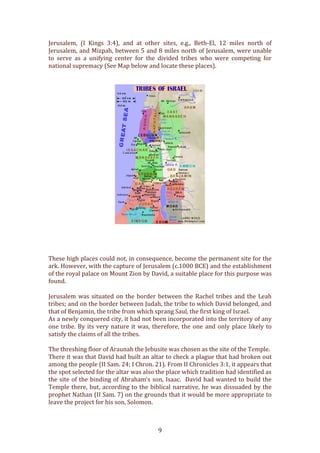
  The	
  high	
  places	
  set	
  up	
  at	
  Nob,	
  
north	
   of	
   Jerusalem,	
   (I	
   Sam.	
   21),	
   at	
   Gibeon,	
   which	
   is	
   8	
   miles	
   north-­‐west	
   of	
  
  9	
  
Jerusalem,	
   (I	
   Kings	
   3:4),	
   and	
   at	
   other	
   sites,	
   e.g.,	
   Beth-­‐El,	
   12	
   miles	
   north	
   of	
  
Jerusalem,	
  and	
  Mizpah,	
  between	
  5	
  and	
  8	
  miles	
  north	
  of	
  Jerusalem,	
  were	
  unable	
  
to	
   serve	
   as	
   a	
   unifying	
   center	
   for	
   the	
   divided	
   tribes	
   who	
   were	
   competing	
   for	
  
national	
  supremacy	
  (See	
  Map	
  below	
  and	
  locate	
  these	
  places).	


These	
  high	
  places	
  could	
  not,	
  in	
  consequence,	
  become	
  the	
  permanent	
  site	
  for	
  the	
  
ark.	
  However,	
  with	
  the	
  capture	
  of	
  Jerusalem	
  (c.1000	
  BCE)	
  and	
  the	
  establishment	
  
of	
  the	
  royal	
  palace	
  on	
  Mount	
  Zion	
  by	
  David,	
  a	
  suitable	
  place	
  for	
  this	
  purpose	
  was	
  
found.	


Jerusalem	
  was	
  situated	
  on	
  the	
  border	
  between	
  the	
  Rachel	
  tribes	
  and	
  the	
  Leah	
  
tribes;	
  and	
  on	
  the	
  border	
  between	
  Judah,	
  the	
  tribe	
  to	
  which	
  David	
  belonged,	
  and	
  
that	
  of	
  Benjamin,	
  the	
  tribe	
  from	
  which	
  sprang	
  Saul,	
  the	
  first	
  king	
  of	
  Israel.	
  	
  
As	
  a	
  newly	
  conquered	
  city,	
  it	
  had	
  not	
  been	
  incorporated	
  into	
  the	
  territory	
  of	
  any	
  
one	
  tribe.	
  By	
  its	
  very	
  nature	
  it	
  was,	
  therefore,	
  the	
  one	
  and	
  only	
  place	
  likely	
  to	
  
satisfy	
  the	
  claims	
  of	
  all	
  the	
  tribes.	


The	
  threshing	
  floor	
  of	
  Araunah	
  the	
  Jebusite	
  was	
  chosen	
  as	
  the	
  site	
  of	
  the	
  Temple.	
  	
  
There	
  it	
  was	
  that	
  David	
  had	
  built	
  an	
  altar	
  to	
  check	
  a	
  plague	
  that	
  had	
  broken	
  out	
  
among	
  the	
  people	
  (II	
  Sam.	
  24;	
  I	
  Chron.	
  21).	
  From	
  II	
  Chronicles	
  3:1,	
  it	
  appears	
  that	
  
the	
  spot	
  selected	
  for	
  the	
  altar	
  was	
  also	
  the	
  place	
  which	
  tradition	
  had	
  identified	
  as	
  
the	
  site	
  of	
  the	
  binding	
  of	
  Abraham‘s	
  son,	
  Isaac.	
  	
  David	
  had	
  wanted	
  to	
  build	
  the	
  
Temple	
  there,	
  but,	
  according	
  to	
  the	
  biblical	
  narrative,	
  he	
  was	
  dissuaded	
  by	
  the	
  
prophet	
  Nathan	
  (II	
  Sam.	
  7)	
  on	
  the	
  grounds	
  that	
  it	
  would	
  be	
  more	
  appropriate	
  to	
  
leave	
  the	
  project	
  for	
  his	
  son,	
  Solomon.	


  10	


THE	
  FIRST	
  TEMPLE	
  
Solomon	
  pursued	
  the	
  task	
  and	
  completed	
  it	
  with	
  the	
  assistance	
  of	
  King	
  Hiram	
  of	
  
Tyre	
  under	
  the	
  supervision	
  of	
  a	
  craftsman	
  who	
  was	
  the	
  son	
  of	
  "a	
  man	
  of	
  Tyre"	
  
and	
   "of	
   a	
   widow	
   of	
   the	
   tribe	
   of	
   Naphtali"	
   (I	
   Kings	
   7:14;	
   "of	
   a	
   woman	
   of	
   the	
  
daughters	
  of	
  Dan,"	
  according	
  to	
  II	
  Chron.	
  2:13	
  [14]).	
  	
  
The	
   copper	
   required	
   for	
   the	
   columns	
   and	
   the	
   vessels	
   came	
   from	
   Solomon's	
  
copper	
  mines	
  in	
  Edom,	
  on	
  the	
  shores	
  of	
  the	
  Red	
  Sea	
  (I	
  Kings	
  7:46).	
  It	
  was	
  from	
  
Solomon's	
   commercial	
   enterprises	
   and	
   especially	
   from	
   David's	
   war	
   booty	
   that	
  
the	
  ample	
  silver	
  needed	
  for	
  the	
  project	
  was	
  acquired.	


Thirty	
  thousand	
  Israelites	
  took	
  part	
  in	
  the	
  operation	
  (I	
  Kings	
  5:27–32),	
  together	
  
with	
  150,000	
  Canaanites	
  who	
  served	
  as	
  porters	
  and	
  quarrymen	
  (II	
  Chron.	
  2:16,	
  
17;	
   cf.	
   I	
   Kings	
   9:20–22),	
   and	
   "chief	
   officers	
   who	
   were	
   over	
   the	
   work,"	
   who	
  
numbered	
  3,300	
  men	
  (I	
  Kings	
  5:30;	
  3,600	
  in	
  II	
  Chron.	
  2:17	
  [16]).	


The	
  work	
  was	
  begun	
  in	
  the	
  month	
  of	
  Iyyar	
  in	
  the	
  fourth	
  year	
  of	
  Solomon's	
  reign	
  
and	
   was	
   completed	
   in	
   the	
   11th	
   year	
   of	
   his	
   reign	
   in	
   the	
   month	
   of	
   Bul	
   (=	
  
Marḥeshvan,	
  I	
  Kings	
  6:1,	
  38).	
  The	
  dedication	
  of	
  the	
  Temple,	
  which	
  took	
  place	
  in	
  
the	
  presence	
  of	
  the	
  elders	
  of	
  Israel,	
  the	
  heads	
  of	
  the	
  tribes,	
  the	
  "leaders	
  of	
  the	
  
fathers'	
   houses"	
   (I	
   Kings	
   8:1–2;	
   II	
   Chron.	
   5:2–3),	
   and	
   "a	
   great	
   assembly,	
   from	
  
Lebo-­‐Hamath	
  unto	
  the	
  Brook	
  of	
  Egypt,"	
  lasted	
  14	
  days	
  (I	
  Kings	
  8:65;	
  II	
  Chron.	
  
7:8).	


THE	
  CONSTRUCTION	
  OF	
  THE	
  TEMPLE	


The	
  two	
  principal	
  sources	
  for	
  the	
  plan	
  of	
  the	
  First	
  Temple	
  erected	
  on	
  Mt	
  Moriah	
  
in	
  Jerusalem	
  between	
  the	
  fourth	
  and	
  the	
  11th	
  years	
  of	
  Solomon's	
  reign	
  are	
  I	
  Kings	
  
6–8	
  and	
  II	
  Chronicles	
  2–4.	


These	
  differ	
  in	
  several	
  important	
  details;	
  in	
  addition	
  to	
  the	
  Book	
  of	
  Kings,	
  the	
  
editor	
   of	
   Chronicles	
   apparently	
   used	
   another	
   source	
   whose	
   description	
   of	
   the	
  
Temple	
  plan	
  varied	
  considerably.	
  A	
  third	
  independent	
  description	
  is	
  found	
  in	
  the	
  
Book	
  of	
  Ezekiel	
  (40ff.).	
  
The	
   Temple	
   was	
   not	
   originally	
   intended	
   to	
   serve	
   as	
   a	
   place	
   of	
   prayer,	
   but	
   to	
  
house	
  (or	
  as	
  an	
  abode	
  for)	
  the	
  ark	
  of	
  the	
  Lord,	
  symbol	
  of	
  the	
  Covenant	
  between	
  
the	
  people	
  and	
  its	
  G-­‐d	
  (I	
  Kings	
  8:21).	


As	
  a	
  tabernacle	
  it	
  was	
  not	
  necessary	
  for	
  it	
  to	
  be	
  large.	
  Its	
  structure	
  had	
  to	
  meet	
  
the	
  requirements	
  of	
  a	
  symbolic	
  tabernacle	
  of	
  G-­‐d	
  and	
  a	
  place	
  of	
  storage	
  for	
  the	
  
sacred	
  furniture	
  and	
  the	
  offerings	
  brought	
  to	
  G-­‐d	
  by	
  His	
  worshipers.	


As	
  a	
  place	
  for	
  divine	
  worship	
  the	
  Temple	
  was	
  not	
  judged	
  by	
  its	
  size	
  but	
  by	
  the	
  
splendor	
   and	
   enormity	
   of	
   its	
   construction	
   and,	
   indeed,	
   the	
   dimensions	
   of	
   the	
  
main	
  hall	
  of	
  the	
  First	
  Temple,	
  which	
  in	
  II	
  Chronicles	
  2:4[5]	
  is	
  called	
  "great,"	
  did	
  
not	
  exceed	
  40	
  ×	
  20	
  cubits	
  (approximately	
  66	
  ×	
  33	
  ft.).	


It	
  should	
  be	
  noted	
  that	
  the	
  roof	
  of	
  the	
  Temple	
  was	
  not	
  supported	
  by	
  pillars	
  set	
  in	
  
  11	
  
the	
  center	
  of	
  the	
  room	
  as	
  was	
  the	
  practice	
  in	
  palaces	
  of	
  this	
  period	
  and	
  its	
  width	
  
was	
   the	
   maximum	
   which	
   was	
   structurally	
   possible.	
   Without	
   pillars	
   the	
   rooms	
  
were	
  impressive	
  in	
  their	
  spaciousness.	


The	
  Temple	
  was	
  also	
  relatively	
  high	
  –	
  30	
  cubits	
  (about	
  50	
  ft.)	
  –	
  much	
  taller	
  than	
  
most	
  Canaanite	
  temples.	


The	
  courtyard	
  of	
  the	
  Temple,	
  however,	
  had	
  to	
  be	
  extensive,	
  for	
  it	
  served	
  as	
  the	
  
place	
  of	
  assembly	
  for	
  the	
  public	
  which	
  came	
  to	
  inquire	
  of	
  God,	
  to	
  bring	
  sacrifices,	
  
and	
  to	
  pray.	
  	
  
The	
  "House	
  of	
  the	
  Lord"	
  was	
  built	
  originally	
  by	
  Solomon	
  as	
  a	
  royal	
  chapel,	
  like	
  
the	
  temples	
  which	
  kings	
  in	
  the	
  Near	
  East	
  built	
  adjoining	
  their	
  palaces.	


The	
   Temple	
   of	
   Solomon,	
   however,	
   was	
   quickly	
   transformed	
   into	
   a	
   national	
  
religious	
  center	
  and	
  the	
  symbol	
  of	
  the	
  Covenant	
  between	
  the	
  people	
  of	
  Israel	
  and	
  
its	
  G-­‐d.	


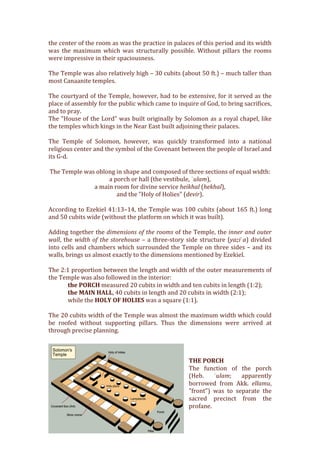
The	
  Temple	
  was	
  oblong	
  in	
  shape	
  and	
  composed	
  of	
  three	
  sections	
  of	
  equal	
  width:	
  
a	
  porch	
  or	
  hall	
  (the	
  vestibule,	
  ʾulam),	
  
a	
  main	
  room	
  for	
  divine	
  service	
  heikhal	
  (hekhal),	
  
and	
  the	
  "Holy	
  of	
  Holies"	
  (devir).	


According	
  to	
  Ezekiel	
  41:13–14,	
  the	
  Temple	
  was	
  100	
  cubits	
  (about	
  165	
  ft.)	
  long	
  
and	
  50	
  cubits	
  wide	
  (without	
  the	
  platform	
  on	
  which	
  it	
  was	
  built).	


Adding	
  together	
  the	
  dimensions	
  of	
  the	
  rooms	
  of	
  the	
  Temple,	
  the	
  inner	
  and	
  outer	
  
wall,	
  the	
  width	
  of	
  the	
  storehouse	
  –	
  a	
  three-­‐story	
  side	
  structure	
  (yaẓiʿa)	
  divided	
  
into	
  cells	
  and	
  chambers	
  which	
  surrounded	
  the	
  Temple	
  on	
  three	
  sides	
  –	
  and	
  its	
  
walls,	
  brings	
  us	
  almost	
  exactly	
  to	
  the	
  dimensions	
  mentioned	
  by	
  Ezekiel.	


The	
  2:1	
  proportion	
  between	
  the	
  length	
  and	
  width	
  of	
  the	
  outer	
  measurements	
  of	
  
the	
  Temple	
  was	
  also	
  followed	
  in	
  the	
  interior:	


   the	
  PORCH	
  measured	
  20	
  cubits	
  in	
  width	
  and	
  ten	
  cubits	
  in	
  length	
  (1:2);	


   the	
  MAIN	
  HALL,	
  40	
  cubits	
  in	
  length	
  and	
  20	
  cubits	
  in	
  width	
  (2:1);	


   while	
  the	
  HOLY	
  OF	
  HOLIES	
  was	
  a	
  square	
  (1:1).	


The	
  20	
  cubits	
  width	
  of	
  the	
  Temple	
  was	
  almost	
  the	
  maximum	
  width	
  which	
  could	
  
be	
   roofed	
   without	
   supporting	
   pillars.	
   Thus	
   the	
   dimensions	
   were	
   arrived	
   at	
  
through	
  precise	
  planning.	


THE	
  PORCH	
  
The	
   function	
   of	
   the	
   porch	
  
(Heb.	
   ʾulam;	
   apparently	
  
borrowed	
   from	
   Akk.	
   ellamu,	
  
"front")	
   was	
   to	
   separate	
   the	
  
sacred	
   precinct	
   from	
   the	
  
profane.	
  	
  
  12	


The	
  Septuagint	
  (Greek)	
  version	
  of	
  Ezekiel	
  40:49	
  cites	
  the	
  number	
  of	
  steps	
  which	
  
led	
   to	
   the	
   Temple:	
   "and	
   they	
   ascended	
   it	
   by	
   ten	
   [ʿeser]	
   steps"	
   instead	
   of	
   the	
  
original	
  text	
  "and	
  it	
  was	
  by	
  steps	
  that	
  [ʾasher]	
  it	
  was	
  ascended."	


The	
  width	
  of	
  the	
  porch	
  –	
  alongside	
  of	
  which	
  the	
  entrance	
  was	
  located	
  –	
  was	
  20	
  
cubits,	
  and	
  its	
  depth	
  was	
  10	
  cubits.	
  The	
  height	
  of	
  the	
  porch	
  is	
  not	
  certain.	
  The	
  
only	
  source	
  which	
  mentions	
  its	
  height	
  –	
  120	
  cubits	
  –	
  is	
  II	
  Chronicles	
  3:4	
  and	
  the	
  
text	
  is	
  apparently	
  corrupt.	


Some	
  suggest	
  that	
  the	
  porch	
  rose	
  above	
  the	
  main	
  
hall,	
   like	
   a	
   tower,	
   following	
   the	
   description	
   in	
   II	
  
Chronicles	
   (this	
   interpretation	
   was	
   followed	
   by	
  
the	
  builders	
  of	
  the	
  Second	
  Temple).	


Others	
  lower	
  the	
  porch	
  and	
  still	
  others	
  conclude	
  
from	
  the	
  silence	
  on	
  this	
  point	
  in	
  the	
  main	
  source	
  
in	
  the	
  Book	
  of	
  Kings	
  that	
  the	
  height	
  of	
  the	
  porch	
  
was	
  the	
  same	
  as	
  the	
  general	
  height	
  of	
  the	
  building	
  
(30	
   cubits).	
   On	
   both	
   sides	
   of	
   the	
   entrance	
   stood	
  
supporting	
  pillars	
  (Jachin	
  and	
  Boaz)	
  each	
  3	
  cubits	
  
wide	
  and	
  5	
  cubits	
  thick;	
  the	
  width	
  of	
  the	
  entrance	
  
gate	
  was	
  14	
  cubits	
  (23	
  ft.).	


MAIN	
  HALL	
  (HEKHAL)	
  OR	
  HOLY	
  PLACE	


The	
  main	
  room	
  was	
  entered	
  from	
  the	
  porch	
  through	
  a	
  gate,	
  10	
  cubits	
  wide,	
  in	
  
which	
  two	
  doors	
  of	
  cypress	
  wood	
  were	
  set.	
  	
  	
  The	
  doorposts,	
  made	
  of	
  olive	
  
wood,	
  were	
  apparently	
  composed	
  of	
  four	
  frames	
  set	
  one	
  within	
  the	
  other.	
  	
  	
  The	
  
thickness	
  of	
  the	
  walls	
  between	
  the	
  porch	
  and	
  the	
  hekhal	
  was	
  6	
  cubits.	
  The	
  latter	
  
was	
  the	
  largest	
  chamber	
  of	
  the	
  Temple,	
  measuring	
  40	
  ×	
  20	
  cubits	
  (approximately	
  
66	
  ×	
  33	
  ft.)	
  ×	
  30	
  cubits	
  in	
  height.	


The	
  hekhal	
  served	
  as	
  the	
  main	
  chamber	
  for	
  divine	
  service.	
  The	
  windows	
  of	
  the	
  
hekhal	
   were	
   set	
   in	
   its	
   upper	
   part.	
   In	
   the	
   Bible	
   they	
   are	
   called	
   "windows	
   with	
  
recessed	
  frames"	
  (I	
  Kings	
  6:4)	
  wide	
  on	
  the	
  outside	
  and	
  narrowing	
  toward	
  the	
  
inside,	
  an	
  effect	
  achieved	
  by	
  the	
  use	
  of	
  window	
  frames	
  set	
  one	
  within	
  the	
  other.	


HOLY	
  OF	
  HOLIES	
  (DEVIR)	
  
The	
   Holy	
   of	
   Holies,	
   the	
   rear	
   part	
   of	
   the	
   Temple,	
   was	
   designed	
   to	
   serve	
   as	
   a	
  
tabernacle	
   for	
   the	
   ark	
   of	
   the	
   Covenant	
   and	
   the	
   cherubim.	
   	
   Its	
   interior	
  
measurements	
  were	
  20	
  ×	
  20	
  ×	
  20	
  cubits.	
  	
  	
  It	
  may	
  be	
  assumed	
  that	
  the	
  raised	
  floor	
  
of	
  the	
  Holy	
  of	
  Holies	
  served	
  as	
  a	
  sort	
  of	
  platform	
  on	
  which	
  stood	
  the	
  ark	
  and	
  the	
  
cherubim	
  (a	
  hint	
  of	
  this	
  may	
  be	
  found	
  in	
  Isa.	
  6:1).	


The	
  jambs	
  (vertical	
  portion	
  of	
  door-­‐frame)	
  of	
  the	
  devir	
  gate,	
  in	
  which	
  olive	
  wood	
  
doors	
  were	
  set,	
  were	
  constructed	
  like	
  the	
  hekhal	
  gate	
  and	
  the	
  Temple	
  windows,	
  
  13	
  
that	
   is,	
   of	
   five	
   frames	
   set	
   one	
   within	
   the	
   other	
   (I	
   Kings	
   6:31).	
   There	
   were	
   no	
  
windows	
  in	
  the	
  Holy	
  of	
  Holies.	


Josephus,	
  the	
  historian,	
  reported,	
  in	
  The	
  Antiquity	
  of	
  the	
  Jews,	
  that	
  the	
  vessels	
  in	
  
the	
   Temple	
   were	
   composed	
   of	
   Orichalcum	
   (an	
   ancient	
   gold-­‐coloured	
   bronze	
  
alloy,	
  second	
  in	
  value	
  to	
  gold).	
  	
  According	
  to	
  I	
  Kings	
  7:48	
  there	
  stood	
  before	
  the	
  
Holy	
  of	
  Holies	
  a	
  golden	
  altar	
  of	
  incense	
  and	
  a	
  table	
  for	
  showbread.	
  This	
  table	
  was	
  
of	
  gold,	
  as	
  were	
  the	
  five	
  candlesticks	
  at	
  either	
  side	
  of	
  it.	
  	
  The	
  implements	
  for	
  the	
  
care	
  of	
  candles	
  –	
  tongs,	
  snuffers,	
  basins	
  and	
  fire-­‐pans	
  –	
  were	
  of	
  gold.	
  	
  The	
  door	
  
hinges	
  were	
  also	
  in	
  gold.	


R.	
  de	
  Vaux	
  maintains	
  that	
  the	
  wall	
  between	
  the	
  main	
  hall	
  and	
  the	
  Holy	
  of	
  Holies	
  
was	
  merely	
  a	
  thin	
  partition	
  of	
  cedarwood,	
  since	
  the	
  Bible	
  treats	
  the	
  hekhal	
  and	
  
the	
  Holy	
  of	
  Holies	
  as	
  one	
  unit	
  and	
  gives	
  their	
  combined	
  length	
  in	
  one	
  figure	
  –	
  60	
  
cubits,	
  with	
  that	
  of	
  the	
  hekhal	
  40	
  cubits,	
  and	
  that	
  of	
  the	
  Holy	
  of	
  Holies	
  20	
  cubits.	


THE	
  ADJACENT	
  BUILDING	
  (YAZI’AH)	
  
This	
  building,	
  whose	
  walls	
  ran	
  parallel	
  to	
  those	
  of	
  the	
  Temple	
  and	
  surrounded	
  it	
  
on	
  all	
  sides	
  except	
  the	
  front,	
  was	
  of	
  three	
  stories	
  of	
  varying	
  widths.	
  The	
  inner	
  
width	
  of	
  the	
  rooms	
  of	
  the	
  lowest	
  storey	
  was	
  5	
  cubits	
  and	
  to	
  lay	
  the	
  beams	
  of	
  the	
  
roof	
  which	
  formed	
  the	
  floor	
  of	
  the	
  second	
  storey,	
  the	
  thickness	
  of	
  the	
  walls	
  was	
  
reduced	
  so	
  that	
  the	
  width	
  of	
  the	
  rooms	
  of	
  the	
  second	
  storey	
  was	
  6	
  cubits	
  and	
  of	
  
the	
  third	
  story,	
  7	
  cubits.	
  Each	
  storey	
  was	
  divided	
  into	
  about	
  30	
  chambers.	


The	
  entrance	
  to	
  this	
  side	
  structure	
  was,	
  according	
  to	
  I	
  Kings	
  6:8,	
  on	
  the	
  south	
  
side,	
  while,	
  according	
  to	
  Ezekiel	
  41:5–6,	
  it	
  was	
  entered	
  on	
  both	
  sides.	
  The	
  upper	
  
storeys	
   were	
   reached	
   by	
   lulim,	
   i.e.,	
   apertures	
   in	
   the	
   shape	
   of	
   holes.	
   In	
   this	
  
building	
  the	
  numerous	
  Temple	
  vessels,	
  utensils,	
  and	
  treasures	
  were	
  stored.	
  The	
  
building	
  was	
  a	
  little	
  over	
  15	
  cubits	
  high	
  with	
  each	
  storey	
  5	
  cubits	
  (about	
  8.2	
  ft.)	
  
high.	


TEMPLE	
  FURNITURE	


ALTARS	
  
The	
  small	
  altar	
  (2	
  ×	
  2	
  ×	
  3	
  cubits),	
  made	
  of	
  cedar	
  and	
  overlaid	
  with	
  gold,	
  stood	
  
before	
  the	
  entrance	
  to	
  the	
  Holy	
  of	
  Holies.	
  It	
  resembled	
  the	
  altars	
  of	
  the	
  ancient	
  
Canaanite	
  temples.	
  The	
  large,	
  main	
  altar	
  for	
  burnt	
  sacrifices	
  and	
  the	
  fat	
  of	
  peace	
  
offerings,	
  was	
  made	
  of	
  bronze	
  and	
  stood	
  in	
  the	
  court	
  of	
  the	
  Temple,	
  before	
  the	
  
porch	
  (II	
  Chron.	
  8:12).	


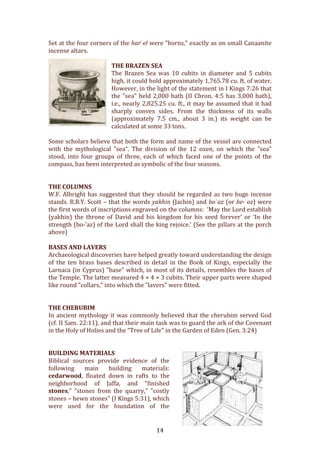
The	
  large	
  altar	
  at	
  Jerusalem	
  was	
  10	
  cubits	
  high	
  and	
  was	
  built	
  
in	
  stepped	
  tiers.	
  The	
  lowest	
  tier,	
  which	
  was	
  sunk	
  in	
  the	
  earth	
  
and	
  was	
  called	
  "the	
  base	
  on	
  the	
  ground"	
  (Ezek.	
  43:14),	
  was	
  
set	
  off	
  from	
  the	
  floor	
  of	
  the	
  court	
  by	
  a	
  channel,	
  and	
  measured	
  
20	
  ×	
  20	
  cubits.	
  The	
  length	
  and	
  width	
  of	
  the	
  three	
  tiers	
  above	
  
it	
  were	
  16	
  ×	
  16,	
  14	
  ×	
  14,	
  and	
  12	
  ×	
  12	
  cubits,	
  respectively;	
  the	
  
height	
  of	
  the	
  lowest	
  tier	
  was	
  2	
  cubits;	
  that	
  of	
  the	
  middle	
  4	
  
cubits;	
  and	
  that	
  of	
  the	
  uppermost,	
  called	
  harʾel,	
  4	
  cubits.	


  14	
  
Set	
  at	
  the	
  four	
  corners	
  of	
  the	
  harʾel	
  were	
  "horns,"	
  exactly	
  as	
  on	
  small	
  Canaanite	
  
incense	
  altars.	


THE	
  BRAZEN	
  SEA	
  
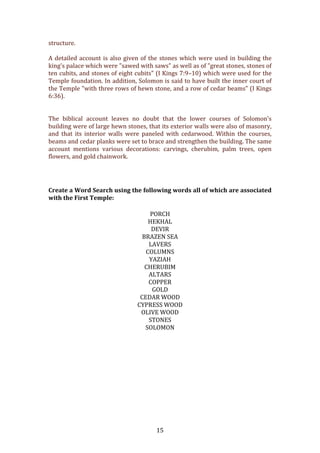
The	
   Brazen	
   Sea	
   was	
   10	
   cubits	
   in	
   diameter	
   and	
   5	
   cubits	
  
high,	
  it	
  could	
  hold	
  approximately	
  1,765.78	
  cu.	
  ft.	
  of	
  water.	
  
However,	
  in	
  the	
  light	
  of	
  the	
  statement	
  in	
  I	
  Kings	
  7:26	
  that	
  
the	
  "sea"	
  held	
  2,000	
  bath	
  (II	
  Chron.	
  4:5	
  has	
  3,000	
  bath),	
  
i.e.,	
  nearly	
  2,825.25	
  cu.	
  ft.,	
  it	
  may	
  be	
  assumed	
  that	
  it	
  had	
  
sharply	
   convex	
   sides.	
   From	
   the	
   thickness	
   of	
   its	
   walls	
  
(approximately	
   7.5	
   cm.,	
   about	
   3	
   in.)	
   its	
   weight	
   can	
   be	
  
calculated	
  at	
  some	
  33	
  tons.	


Some	
  scholars	
  believe	
  that	
  both	
  the	
  form	
  and	
  name	
  of	
  the	
  vessel	
  are	
  connected	
  
with	
   the	
   mythological	
   "sea“.	
   The	
   division	
   of	
   the	
   12	
   oxen,	
   on	
   which	
   the	
   "sea"	
  
stood,	
   into	
   four	
   groups	
   of	
   three,	
   each	
   of	
   which	
   faced	
   one	
   of	
   the	
   points	
   of	
   the	
  
compass,	
  has	
  been	
  interpreted	
  as	
  symbolic	
  of	
  the	
  four	
  seasons.	


THE	
  COLUMNS	
  
W.F.	
  Albright	
  has	
  suggested	
  that	
  they	
  should	
  be	
  regarded	
  as	
  two	
  huge	
  incense	
  
stands.	
  R.B.Y.	
  Scott	
  –	
  that	
  the	
  words	
  yakhin	
  (Jachin)	
  and	
  boʿaz	
  (or	
  be-­ʿoz)	
  were	
  
the	
  first	
  words	
  of	
  inscriptions	
  engraved	
  on	
  the	
  columns:	
  	
  ‘May	
  the	
  Lord	
  establish	
  
(yakhin)	
   the	
   throne	
   of	
   David	
   and	
   his	
   kingdom	
   for	
   his	
   seed	
   forever’	
   or	
   ‘In	
   the	
  
strength	
  (bo-­‐’az)	
  of	
  the	
  Lord	
  shall	
  the	
  king	
  rejoice.’	
  (See	
  the	
  pillars	
  at	
  the	
  porch	
  
above)	


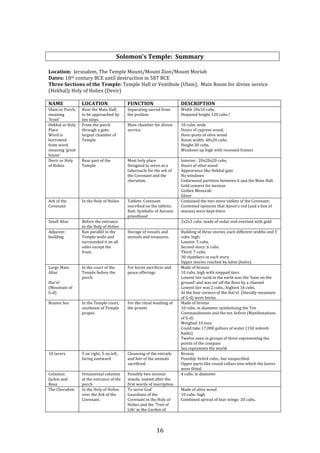
BASES	
  AND	
  LAVERS	
  
Archaeological	
  discoveries	
  have	
  helped	
  greatly	
  toward	
  understanding	
  the	
  design	
  
of	
   the	
   ten	
   brass	
   bases	
   described	
   in	
   detail	
   in	
   the	
   Book	
   of	
   Kings,	
   especially	
   the	
  
Larnaca	
  (in	
  Cyprus)	
  "base"	
  which,	
  in	
  most	
  of	
  its	
  details,	
  resembles	
  the	
  bases	
  of	
  
the	
  Temple.	
  The	
  latter	
  measured	
  4	
  ×	
  4	
  ×	
  3	
  cubits.	
  Their	
  upper	
  parts	
  were	
  shaped	
  
like	
  round	
  "collars,"	
  into	
  which	
  the	
  "lavers"	
  were	
  fitted.	


THE	
  CHERUBIM	
  
In	
  ancient	
  mythology	
  it	
  was	
  commonly	
  believed	
  that	
  the	
  cherubim	
  served	
  God	
  
(cf.	
  II	
  Sam.	
  22:11),	
  and	
  that	
  their	
  main	
  task	
  was	
  to	
  guard	
  the	
  ark	
  of	
  the	
  Covenant	
  
in	
  the	
  Holy	
  of	
  Holies	
  and	
  the	
  "Tree	
  of	
  Life"	
  in	
  the	
  Garden	
  of	
  Eden	
  (Gen.	
  3:24)	


BUILDING	
  MATERIALS	
  
Biblical	
   sources	
   provide	
   evidence	
   of	
   the	
  
following	
   main	
   building	
   materials:	
  
cedarwood,	
   floated	
   down	
   in	
   rafts	
   to	
   the	
  
neighborhood	
   of	
   Jaffa,	
   and	
   "finished	
  
stones,"	
   "stones	
   from	
   the	
   quarry,"	
   "costly	
  
stones	
  –	
  hewn	
  stones"	
  (I	
  Kings	
  5:31),	
  which	
  
were	
   used	
   for	
   the	
   foundation	
   of	
   the	
  
  15	
  
structure.	


A	
  detailed	
  account	
  is	
  also	
  given	
  of	
  the	
  stones	
  which	
  were	
  used	
  in	
  building	
  the	
  
king's	
  palace	
  which	
  were	
  "sawed	
  with	
  saws"	
  as	
  well	
  as	
  of	
  "great	
  stones,	
  stones	
  of	
  
ten	
  cubits,	
  and	
  stones	
  of	
  eight	
  cubits"	
  (I	
  Kings	
  7:9–10)	
  which	
  were	
  used	
  for	
  the	
  
Temple	
  foundation.	
  In	
  addition,	
  Solomon	
  is	
  said	
  to	
  have	
  built	
  the	
  inner	
  court	
  of	
  
the	
  Temple	
  "with	
  three	
  rows	
  of	
  hewn	
  stone,	
  and	
  a	
  row	
  of	
  cedar	
  beams"	
  (I	
  Kings	
  
6:36).	


The	
   biblical	
   account	
   leaves	
   no	
   doubt	
   that	
   the	
   lower	
   courses	
   of	
   Solomon's	
  
building	
  were	
  of	
  large	
  hewn	
  stones,	
  that	
  its	
  exterior	
  walls	
  were	
  also	
  of	
  masonry,	
  
and	
   that	
   its	
   interior	
   walls	
   were	
   paneled	
   with	
   cedarwood.	
   Within	
   the	
   courses,	
  
beams	
  and	
  cedar	
  planks	
  were	
  set	
  to	
  brace	
  and	
  strengthen	
  the	
  building.	
  The	
  same	
  
account	
   mentions	
   various	
   decorations:	
   carvings,	
   cherubim,	
   palm	
   trees,	
   open	
  
flowers,	
  and	
  gold	
  chainwork.	


Create	
  a	
  Word	
  Search	
  using	
  the	
  following	
  words	
  all	
  of	
  which	
  are	
  associated	
  
with	
  the	
  First	
  Temple:	
  
PORCH	
  
HEKHAL	
  
DEVIR	
  
BRAZEN	
  SEA	
  
LAVERS	
  
COLUMNS	
  
YAZIAH	
  
CHERUBIM	
  
ALTARS	
  
COPPER	
  
GOLD	
  
CEDAR	
  WOOD	
  
CYPRESS	
  WOOD	
  
OLIVE	
  WOOD	
  
STONES	
  
SOLOMON	


  16	


Solomon’s	
  Temple:	
  	
  Summary	


Location:	
  	
  Jerusalem,	
  The	
  Temple	
  Mount/Mount	
  Zion/Mount	
  Moriah	
  
Dates:	
  10th	
  century	
  BCE	
  until	
  destruction	
  in	
  587	
  BCE	
  
Three	
  Sections	
  of	
  the	
  Temple:	
  Temple	
  Hall	
  or	
  Vestibule	
  (Ulam);	
  	
  Main	
  Room	
  for	
  divine	
  service	
  
(Hekhal);	
  Holy	
  of	
  Holies	
  (Devir)	


NAME	
   LOCATION	
   FUNCTION	
   DESCRIPTION	
  
Ulam	
  or	
  Porch,	
  
meaning	
  
‘front’	
  
Near	
  the	
  Main	
  Hall;	
  
to	
  be	
  approached	
  by	
  
ten	
  steps	
  
Separating	
  sacred	
  from	
  
the	
  profane	
  
Width	
  20x10	
  cubs.	
  
Disputed	
  height	
  120	
  cubs.?	
  
Hekhal	
  or	
  Holy	
  
Place	
  
Word	
  is	
  
borrowed	
  
from	
  word	
  
meaning	
  ‘great	
  
house’	
  
From	
  the	
  porch	
  
through	
  a	
  gate;	
  
largest	
  chamber	
  of	
  
Temple	
  
Main	
  chamber	
  for	
  divine	
  
service	
  
10	
  cubs.	
  wide	
  
Doors	
  of	
  cypress	
  wood;	
  
Door-­‐posts	
  of	
  olive	
  wood	
  
Room	
  width:	
  40x20	
  cubs.	
  
Height:30	
  cubs.	
  
Windows	
  up	
  high	
  with	
  recessed	
  frames	
  
Devir	
  or	
  Holy	
  
of	
  Holies	
  
Rear	
  part	
  of	
  the	
  
Temple	
  
Most	
  holy	
  place	
  
Designed	
  to	
  serve	
  as	
  a	
  
tabernacle	
  for	
  the	
  ark	
  of	
  
the	
  Covenant	
  and	
  the	
  
cherubim.	
  
Interior:	
  	
  20x20x20	
  cubs.	
  
Doors	
  of	
  olive	
  wood	
  
Appearance	
  like	
  Hekhal	
  gate	
  
No	
  windows	
  
Cedarwood	
  partition	
  between	
  it	
  and	
  the	
  Main	
  Hall.	
  
Gold	
  censers	
  for	
  incense	
  
Golden	
  Menorah	
  
Silver	
  
Ark	
  of	
  the	
  
Covenant	
  
In	
  the	
  Holy	
  of	
  Holies	
   Tablets:	
  Covenant	
  
inscribed	
  on	
  the	
  tablets;	
  
Rod:	
  Symbolic	
  of	
  Aaronic	
  
priesthood	
  
Contained	
  the	
  two	
  stone	
  tablets	
  of	
  the	
  Covenant;	
  	
  
Contested	
  opinions	
  that	
  Aaron’s	
  rod	
  (and	
  a	
  box	
  of	
  
manna)	
  were	
  kept	
  there	
  
Small	
  Altar	
   Before	
  the	
  entrance	
  
to	
  the	
  Holy	
  of	
  Holies	
  
	
   2x2x3	
  cubs.	
  made	
  of	
  cedar	
  and	
  overlaid	
  with	
  gold	
  
Adjacent	
  
building	
  
Ran	
  parallel	
  to	
  the	
  
Temple	
  walls	
  and	
  
surrounded	
  it	
  on	
  all	
  
sides	
  except	
  the	
  
front.	
  
Storage	
  of	
  vessels	
  and	
  
utensils	
  and	
  treasures.	
  
Building	
  of	
  three	
  stories,	
  each	
  different	
  widths	
  and	
  5	
  
cubs.	
  high:	
  
Lowest:	
  5	
  cubs.	
  
Second	
  story:	
  6	
  cubs.	
  
Third:	
  7	
  cubs.	
  
30	
  chambers	
  in	
  each	
  story	
  
Upper	
  stories	
  reached	
  by	
  lulim	
  (holes)	
  
Large	
  Main	
  
Altar	


Har’el	
  
(Mountain	
  of	


G-­‐d)	
  
In	
  the	
  court	
  of	
  the	
  
Temple	
  before	
  the	
  
porch	
  
For	
  burnt	
  sacrifices	
  and	
  
peace	
  offerings	
  
Made	
  of	
  bronze	
  
10	
  cubs.	
  high	
  with	
  stepped	
  tiers	
  
Lowest	
  tier	
  sunk	
  in	
  the	
  earth	
  was	
  the	
  ‘base	
  on	
  the	
  
ground’	
  and	
  was	
  set	
  off	
  the	
  floor	
  by	
  a	
  channel	
  
Lowest	
  tier	
  was	
  2	
  cubs.;	
  highest	
  16	
  cubs.	
  
At	
  the	
  four	
  corners	
  of	
  the	
  Har’el	
  	
  (literally	
  mountain	
  
of	
  G-­‐d)	
  were	
  horns.	
  
Brazen	
  Sea	
   In	
  the	
  Temple	
  court,	
  
southeast	
  of	
  Temple	
  
proper.	
  
For	
  the	
  ritual	
  washing	
  of	
  
the	
  priests	
  
Made	
  of	
  bronze	
  
10	
  cubs.	
  in	
  diameter	
  symbolizing	
  the	
  Ten	
  
Commandments	
  and	
  the	
  ten	
  Sefirot	
  (Manifestations	
  
of	
  G-­‐d)	
  
Weighed	
  33	
  tons	
  
Could	
  take	
  17,000	
  gallons	
  of	
  water	
  (150	
  mikveh	
  
baths)	
  
Twelve	
  oxen	
  in	
  groups	
  of	
  three	
  representing	
  the	
  
points	
  of	
  the	
  compass	
  
Sea	
  represents	
  the	
  world	
  
10	
  lavers	
   5	
  on	
  right;	
  5	
  on	
  left,	
  
facing	
  eastward	
  
Cleansing	
  of	
  the	
  entrails	
  
and	
  feet	
  of	
  the	
  animals	
  
sacrificed.	


Bronze	
  
Possibly	
  4x4x4	
  cubs.,	
  but	
  unspecified.	
  
Upper	
  parts	
  like	
  round	
  collars	
  into	
  which	
  the	
  lavers	
  
were	
  fitted.	
  
Columns:	
  	
  
Jachin	
  and	
  
Boaz	
  
Ornamental	
  columns	
  
at	
  the	
  entrance	
  of	
  the	
  
porch	
  
Possibly	
  two	
  incense	
  
stands,	
  named	
  after	
  the	
  
first	
  words	
  of	
  inscription.	
  
4	
  cubs.	
  in	
  diameter	
  	
  
The	
  Cherubim	
  	
   In	
  the	
  Holy	
  of	
  Holies	
  
over	
  the	
  Ark	
  of	
  the	
  
Covenant.	
  
To	
  serve	
  God	
  
Guardians	
  of	
  the	
  
Covenant	
  in	
  the	
  Holy	
  of	
  
Holies	
  and	
  the	
  ‘Tree	
  of	
  
Life’	
  in	
  the	
  Garden	
  of	
  
Made	
  of	
  olive	
  wood	
  
10	
  cubs.	
  high	
  
Combined	
  spread	
  of	
  four	
  wings:	
  20	
  cubs.	
  
  17	
  
Eden	


The	
  Levitical	
  Priests	
  
Their	
  Function	
  and	
  Role	
  in	
  the	
  Holy	
  Temple	


The	
  following	
  material	
  is	
  from	
  The	
  Temple	
  Institute	
  website:	
  
http://www.templeinstitute.org/red_heifer/levitical_priests.htm	


"And	
   it	
   shall	
   be	
   for	
   them	
   an	
   appointment	
   as	
   priests	
   forever,	
   for	
   all	
  
generations."	
  (Ex.	
  40:15)	


"For	
   the	
   Lord	
   your	
   God	
   has	
   chosen	
   him	
   out	
   of	
   all	
   your	
   tribes,	
   to	
   stand	
   to	
  
serve	
  in	
  the	
  name	
  of	
  the	
  Lord,	
  him	
  and	
  his	
  sons	
  forever."	
  (Deut.	
  18:5)	
  
Who	
  are	
  the	
  Priests?	
  
The	
   first	
   kohen,	
   the	
   founder	
   of	
   the	
   priestly	
   clan,	
   was	
   Aaron,	
   brother	
   of	
  
Moses,	
  of	
  the	
  tribe	
  of	
  Levi.	
  All	
  of	
  Israel	
  are	
  descended	
  from	
  the	
  twelve	
  sons	
  
of	
   Jacob.	
   Jacob's	
   third	
   son	
   was	
   Levi,	
   and	
   Aaron	
   was	
   a	
   fourth	
   generation	
  
descendant	
  of	
  Levi.	
  
Aaron	
  and	
  his	
  four	
  sons	
  were	
  designated	
  as	
  the	
  first	
  priests;	
  Aaron	
  served	
  
as	
  the	
  first	
  High	
  Priest.	
  All	
  of	
  his	
  male	
  descendants	
  were	
  chosen	
  by	
  God	
  to	
  
be	
   priests	
   forever;	
   it	
   is	
   an	
   eternal	
   covenant.	
   Thus	
   even	
   today,	
   a	
   kohen	
  
amongst	
  the	
  Jewish	
  people	
  is	
  genealogically	
  a	
  direct	
  descendant	
  of	
  Aaron.	
  
The	
  Role	
  of	
  the	
  Priests	
  
The	
  Holy	
  One	
  chose	
  these	
  men	
  to	
  be	
  in	
  a	
  position	
  of	
  spiritual	
  leadership.	
  In	
  
the	
  days	
  of	
  the	
  Temple,	
  they	
  were	
  responsible	
  for	
  the	
  sacred	
  service.	
  The	
  
Hebrew	
   word	
   kohen	
   actually	
   means	
   "to	
   serve,"	
   and	
   a	
   deeper	
   linguistic	
  
connection	
  can	
  be	
  found	
  in	
  the	
  word	
  ken,	
  meaning	
  "yes,"	
  itself	
  related	
  to	
  
kivvun,	
   "to	
   direct."	
   Thus	
   a	
   kohen	
   is	
   called	
   upon	
   to	
   direct	
   himself,	
   and	
  
others,	
  in	
  the	
  proper	
  service	
  of	
  God:	
  "And	
  you,	
  separate	
  your	
  brother	
  Aaron	
  
and	
  his	
  sons	
  from	
  among	
  the	
  Israelites,	
  and	
  bring	
  them	
  close	
  to	
  you...	
  so	
  they	
  
can	
  serve	
  me."	
  (Ex.	
  28:1)	
  
A	
  Conduit	
  for	
  the	
  Reception	
  of	
  Divine	
  Blessing	
  
The	
  reader	
  is	
  undoubtedly	
  most	
  familiar	
  with	
  the	
  primary	
  role	
  which	
  the	
  
priests	
  perform	
  in	
  the	
  Temple,	
  that	
  of	
  officiating	
  at	
  the	
  sacrifices	
  and	
  other	
  
parts	
   of	
   the	
   service.	
   But	
   more	
   importantly,	
   by	
   attending	
   to	
   the	
   various	
  
aspects	
  of	
  the	
  Divine	
  service,	
  the	
  priests	
  serve	
  as	
  a	
  conduit	
  to	
  bring	
  down	
  
  18	
  
God's	
  radiant	
  blessing	
  and	
  influence	
  into	
  this	
  world.	
  In	
  fact,	
  it	
  is	
  on	
  this	
  
account	
  that	
  they	
  are	
  commanded	
  to	
  deliver	
  God's	
  blessing	
  of	
  peace	
  and	
  
love	
  to	
  the	
  people,	
  as	
  well:	
  "Say	
  to	
  Aaron	
  and	
  his	
  sons...	
  Thus	
  shall	
  you	
  bless	
  
the	
  people	
  of	
  Israel:	
  'May	
  the	
  Lord	
  bless	
  you	
  and	
  protect	
  you.	
  May	
  the	
  Lord	
  
shine	
  His	
  face	
  upon	
  you,	
  and	
  be	
  gracious	
  unto	
  you.	
  May	
  the	
  Lord	
  lift	
  up	
  His	
  
face	
  to	
  you	
  and	
  may	
  He	
  grant	
  you	
  peace'."	
  (Numbers	
  6:22	
  -­‐	
  26)	
  
The	
  Priestly	
  Blessing	
  is	
  Delivered	
  Daily	
  in	
  the	
  Temple	
  
Every	
   day	
   in	
   the	
   Temple,	
   at	
   the	
   conclusion	
   of	
   the	
   morning	
   service,	
   this	
  
blessing	
   was	
   performed	
   by	
   the	
   officiating	
   priests,	
   standing	
   on	
   the	
   steps	
  
leading	
  up	
  to	
  the	
  sanctuary.	
  Thus	
  while	
  it	
  is	
  only	
  God	
  who	
  has	
  the	
  power	
  to	
  
bestow	
  blessing	
  upon	
  people,	
  the	
  function	
  of	
  the	
  priests	
  was	
  to	
  serve	
  as	
  a	
  
vehicle,	
  a	
  medium,	
  through	
  which	
  the	
  Divine	
  influence	
  may	
  descend.	
  
"...	
  He	
  stands	
  behind	
  our	
  wall...	
  "	
  
This	
  concept	
  of	
  the	
  priests	
  "directing"	
  the	
  flow	
  of	
  Divine	
  blessing	
  is	
  alluded	
  
to	
  by	
  a	
  verse	
  in	
  the	
  Song	
  of	
  Songs	
  (2:9	
  -­‐	
  10):	
  "Behold,	
  He	
  stands	
  behind	
  our	
  
wall,	
  watching	
  through	
  the	
  windows,	
  glancing	
  through	
  the	
  cracks."	
  
The	
  sages	
  of	
  the	
  Midrash	
  interpret	
  these	
  words	
  to	
  mean	
  that	
  it	
  is	
  God	
  who	
  
stands	
  behind	
  the	
  priests	
  as	
  they	
  deliver	
  His	
  blessing.	
  The	
  illumination	
  of	
  
His	
  Presence	
  shines	
  through	
  their	
  hands,	
  which	
  are	
  outstretched	
  as	
  they	
  
utter	
  the	
  priestly	
  blessing.	
  
The	
  Priests	
  Possess	
  Special	
  Qualities	
  
The	
   priests	
   represent	
   kindness,	
   and	
   the	
   focusing	
   of	
   life's	
   energies	
   on	
  
sanctity	
   and	
   Divine	
   purpose.	
   It	
   was	
   the	
   attribute	
   of	
   kindness,	
  
understanding	
  and	
  love	
  for	
  all	
  which	
  Aaron,	
  the	
  first	
  High	
  Priest,	
  was	
  best	
  
known	
  for,	
  and	
  his	
  descendants	
  are	
  entrusted	
  to	
  exemplify	
  Hillel's	
  famous	
  
dictum	
  in	
  the	
  Chapters	
  of	
  the	
  Fathers	
  (Avot	
  1:12):	
  "Be	
  of	
  the	
  disciples	
  of	
  
Aaron,	
  loving	
  peace	
  and	
  pursuing	
  peace,	
  loving	
  your	
  fellow-­creatures,	
  and	
  
drawing	
   them	
   near	
   to	
   the	
   Torah."	
   This	
   quality	
   was	
   highly	
   visible	
   and	
  
crucially	
   instrumental	
   following	
   the	
   rebellion	
   of	
   Korach,	
   when	
   it	
   was	
  
Aaron	
   who	
   saved	
   the	
   people	
   from	
   the	
   full	
   extent	
   of	
   Divine	
   wrath	
   (see	
  
Numbers	
  17).	
  
Because	
   of	
   their	
   ability	
   to	
   invoke	
   Heavenly	
   influence,	
   the	
   sages	
   even	
  
record	
   that	
   the	
   priestly	
   families	
   possess	
   distinctive	
   character	
   traits	
   and	
  
qualities	
  which	
  are	
  part	
  of	
  their	
  special	
  spiritual	
  heritage:	
  they	
  are	
  known	
  
to	
  be	
  joyful,	
  giving,	
  and	
  driven	
  by	
  a	
  loftier	
  nature.	
  In	
  the	
  era	
  of	
  the	
  Temple,	
  
they	
   were	
   praised	
   for	
   their	
   zeal	
   and	
   dedication	
   to	
   fulfill	
   the	
  
commandments	
  and	
  give	
  honor	
  to	
  the	
  Creator.	
  
  19	
  
Later,	
  through	
  the	
  ensuing	
  course	
  of	
  history,	
  it	
  was	
  generally	
  the	
  tribe	
  of	
  
Levi	
   and	
   the	
   priestly	
   family	
   in	
   particular	
   that	
   were	
   exemplary	
   in	
   their	
  
zealousness	
   for	
   the	
   honor	
   of	
   God.	
   Thus	
   it	
   was	
   the	
   priestly	
   family	
   of	
   the	
  
Hasmonaim	
  -­‐	
  the	
  famous	
  "Maccabees"	
  -­‐	
  who	
  led	
  the	
  revolt	
  against	
  foreign	
  
idolatrous	
  influence	
  and	
  rededicated	
  the	
  Holy	
  Temple,	
  events	
  marked	
  by	
  
the	
  holiday	
  of	
  Hanukkah.	
  
The	
  daily	
  blessing	
  of	
  the	
  priests	
  in	
  the	
  Temple	
  serves	
  to	
  open	
  the	
  Heavenly	
  
gates	
   of	
   mercy.	
   Through	
   it,	
   the	
   people	
   of	
   Israel	
   merit	
   not	
   only	
   material	
  
well-­‐being	
  -­‐	
  including	
  offspring	
  and	
  longevity	
  -­‐	
  but	
  spiritual	
  blessings	
  as	
  
well;	
  mercy,	
  Divine	
  protection	
  and	
  the	
  greatest	
  blessing	
  of	
  all...	
  true	
  peace.	
  
Since	
   the	
   priests	
   themselves	
   represent	
   the	
   attribute	
   of	
   kindness,	
   their	
  
service	
  brings	
  the	
  flow	
  of	
  God's	
  blessing	
  down	
  to	
  His	
  people.	


  20	
  
Sacrificial	
  Service	
  in	
  the	
  Temple	


Although	
  the	
  idea	
  of	
  the	
  sacrifices	
  may	
  seem	
  difficult	
  for	
  contemporary	
  people	
  to	
  
accept,	
  it	
  was	
  the	
  commandment	
  of	
  G-­‐d.	
  	
  
The	
  Webster	
  Dictionary	
  definition	
  is:	
  an	
  act	
  of	
  offering	
  something	
  precious	
  to	
  a	
  
deity;	
   specifically	
   the	
   offering	
   of	
   an	
   immolated	
   victim;	
   something	
   offered	
   in	
  
something	
  else;	
  something	
  given	
  up	
  or	
  lost;	
  loss;	
  deprivation.	
  
However,	
  the	
  Hebrew	
  word	
  for	
  "sacrifice"	
  (Korban,	
  le-­‐hakriv)	
  is	
  from	
  the	
  same	
  
root	
   as	
   "to	
   come	
   near,	
   to	
   approach.	
   .	
   .	
   .	
   to	
   become	
   closely	
   involved	
   in	
   a	
  
relationship	
  with	
  someone."	
  	
  	
  This	
  is	
  meant	
  to	
  be	
  the	
  essence	
  of	
  the	
  experience	
  
which	
  the	
  bearer	
  of	
  the	
  sacrifice	
  undergoes.	
  	
  The	
  sacrifices	
  have	
  great	
  spiritual	
  
and	
  symbolic	
  value	
  and	
  an	
  intrinsic	
  importance	
  in	
  themselves.	


Abel	
   and	
   Cain	
   are	
   the	
   first	
   people	
   mentioned	
   in	
   the	
   Bible	
   to	
   have	
   offered	
  
sacrifice:	
  vegetable	
  or	
  bloodless	
  sacrifices,	
  and	
  animal	
  or	
  blood-­‐giving	
  sacrifices.	
  	
  
In	
  the	
  Book	
  of	
  Exodus,	
  the	
  proper	
  place	
  for	
  sacrifices	
  was	
  to	
  be	
  ‘before	
  the	
  door	
  
of	
  the	
  tabernacle’	
  where	
  the	
  altar	
  of	
  burnt	
  offerings	
  stood	
  and	
  where	
  G-­‐d	
  met	
  his	
  
people,	
  or	
  simply	
  before	
  G-­‐d,	
  and	
  later	
  in	
  the	
  Jerusalem	
  Temple	
  (Deuteronomy)	


In	
  the	
  Temple	
  of	
  Solomon,	
  Solomon	
  himself	
  (though	
  not	
  a	
  priest)	
  offered	
  three	
  
times	
   every	
   year	
   burnt	
   offerings,	
   thank-­‐offerings	
   and	
   incense.	
   	
   He	
   also	
   built	
  
altars	
  in	
  high	
  places	
  to	
  idols.	
  	
  This	
  practice	
  continued	
  down	
  to	
  the	
  destruction	
  of	
  
the	
  Temple	
  e.g.	
  vegetable,	
  animal	
  and,	
  even	
  sometimes,	
  human	
  sacrifices	
  to	
  Ba’al,	
  
Moloch,	
  Astarte	
  and	
  other	
  false	
  gods.	


  21	
  
The	
  prophets	
  showed	
  no	
  enthusiasm	
  for	
  sacrifice:	
  	
  
Hosea:	
   	
   ‘I	
   desire	
   mercy,	
   not	
   sacrifice;	
   knowledge	
   of	
   G-­‐d	
   over	
   burnt	
   offerings’	
  
(Hosea	
  6).	
  
Amos:	
  	
  ‘I	
  (G-­‐d)	
  hate	
  and	
  despise	
  your	
  feast-­‐days….	
  If	
  you	
  offer	
  me	
  burnt	
  offerings	
  
and	
  your	
  bloodless	
  offerings,	
  I	
  will	
  not	
  accept	
  them,	
  nor	
  will	
  I	
  regard	
  the	
  thank-­‐
offerings	
  of	
  your	
  fat	
  beasts,	
  …	
  but	
  let	
  justice	
  flow	
  like	
  water’	
  (Amos	
  5).	


The	
  Mosaic	
  sacrifices	
  are	
  set	
  forth	
  in	
  Leviticus.	
  	
  The	
  categories	
  are	
  of	
  bloodless	
  
and	
  blood-­‐giving	
  kinds.	
  	
  The	
  division	
  takes	
  into	
  account	
  the	
  nature	
  of	
  the	
  offering	
  
or	
   the	
   occasion	
   for	
   which	
   the	
   sacrifice	
   is	
   being	
   made	
   and	
   the	
   accompanying	
  
sentiments	
  or	
  motives	
  of	
  the	
  offerers.	
  	
  	
  Sacrifices	
  may	
  also	
  be	
  divided	
  into	
  those	
  
which	
   are	
   obligatory,	
   such	
   as	
   the	
   daily	
   morning	
   and	
   afternoon	
   sacrifices,	
   and	
  
those	
  which	
  are	
  voluntary,	
  offered	
  by	
  individuals	
  for	
  various	
  personal	
  reasons.	
  	
  
Every	
   sacrifice	
   required	
   sanctification	
   and	
   was	
   brought	
   to	
   the	
   Court	
   of	
   the	
  
Sanctuary.	
  	
  These	
  were	
  the	
  main	
  types	
  of	
  sacrifices:	


(a) Burnt	
  offerings	
  or	
  Olah	
  (Animal	
  usually):	
  	
  14	
  types	
  were	
  included	
  in	
  this	
  
category	
   e.g.	
   a	
   woman	
   who	
   had	
   given	
   birth;	
   ram	
   brought	
   by	
   the	
   High	
  
Priest	
  on	
  Yom	
  Kippur.	
  	
  Only	
  male	
  animals	
  could	
  be	
  use	
  and	
  either	
  sex	
  of	
  
fowl.	


(b) Guilt	
   offerings	
   or	
   Asham:	
   	
   There	
   were	
   six	
   types	
   of	
   guilt	
   offerings	
   e.g.	
  
Asham	
  gezilot,	
  the	
  "guilt	
  offering	
  of	
  theft."	
  If	
  a	
  person	
  denied	
  falsely	
  under	
  
oath	
  that	
  he	
  owed	
  another	
  person	
  money,	
  he	
  had	
  to	
  return	
  the	
  amount	
  
owed	
  plus	
  an	
  additional	
  fifth,	
  and	
  bring	
  this	
  sacrifice,	
  consisting	
  of	
  a	
  two-­‐
year-­‐old	
  ram.	
  The	
  guilt-­‐offering	
  is	
  regarded	
  as	
  serving	
  to	
  impress	
  upon	
  
the	
  person	
  bringing	
  the	
  sacrifice	
  the	
  enormity	
  of	
  his	
  sin,	
  to	
  the	
  extent	
  that	
  
whatever	
   happened	
   to	
   the	
   animal	
   that	
   was	
   sacrificed	
   should	
   by	
   rights	
  
have	
  happened	
  to	
  the	
  sinner.	


(c) Sin	
   offering	
   or	
   Hatat:	
   	
   This	
   sacrifice	
   was	
   brought	
   when	
   a	
   person	
   or	
   an	
  
entire	
  community,	
  through	
  negligence,	
  violated	
  a	
  commandment,	
  where	
  
the	
  punishment	
  for	
  the	
  deliberate	
  violation	
  would	
  have	
  been	
  Karet	
  (being	
  
"cut	
  off"	
  from	
  the	
  community).	
  Depending	
  on	
  the	
  specific	
  hatat	
  involved,	
  a	
  
bull	
  aged	
  two	
  or	
  three	
  years,	
  a	
  year-­‐old	
  he-­‐goat,	
  a	
  year-­‐old	
  female	
  sheep	
  
or	
   goat,	
   or	
   a	
   fowl	
   was	
   offered.	
   Where	
   the	
   hatat	
   was	
   to	
   atone	
   for	
   a	
   sin	
  
committed	
  by	
  the	
  High	
  Priest	
  or	
  by	
  the	
  entire	
  community,	
  the	
  animal	
  or	
  
fowl	
  was	
  burned	
  outside	
  the	
  Temple.	
  In	
  all	
  other	
  cases,	
  the	
  priests	
  ate	
  the	
  
meat.	


(d) Peace	
  offerings	
  or	
  Shelamim:	
  (Animal,	
  usually)	
  There	
  were	
  four	
  kinds	
  of	
  
peace	
  offering	
  e.g.	
  	
  the	
  "community	
  peace	
  offering,"	
  brought	
  on	
  Shavu’ot	
  
or	
  the	
  "festival	
  peace	
  offering"	
  and	
  the	
  "festive	
  peace	
  offering,"	
  brought	
  by	
  
an	
  individual,	
  the	
  former	
  as	
  a	
  way	
  of	
  celebrating	
  a	
  festival,	
  the	
  latter	
  as	
  a	
  
way	
  of	
  expressing	
  thanks	
  to	
  G-­‐d.	


(e) A	
  different	
  form	
  of	
  sacrifice	
  was	
  that	
  of	
  the	
  First	
  Fruits,	
  consisting	
  of	
  the	
  
Seven	
   Species	
   for	
   which	
   the	
   Land	
   of	
   Israel	
   is	
   praised:	
   wheat,	
   barley,	
  
grapes,	
  pomegranates,	
  figs,	
  olives,	
  and	
  dates.	
  	
  The	
  species	
  were	
  carried	
  in	
  
  22	
  
a	
   joyful	
   procession	
   to	
   Jerusalem,	
   especially	
   for	
   Shavu'ot,	
   but	
   could	
   be	
  
brought	
  until	
  Hanukkah.	
  Each	
  person	
  who	
  brought	
  his	
  first	
  fruits	
  to	
  the	
  
Temple	
   had	
   to	
   make	
   a	
   declaration	
   before	
   a	
   priest,	
   the	
   text	
   of	
   which	
   is	
  
recorded	
  in	
  Deuteronomy	
  26:5-­‐10.	


Animal	
  sacrifices	
  were	
  usually	
  accompanied	
  by	
  bloodless	
  offerings	
  e.g.	
  wine	
  or	
  
drink-­‐offering.	
  	
  The	
  Law	
  required	
  that	
  all	
  animals	
  be	
  perfect	
  though	
  fowl	
  lacked	
  
this	
  restriction.	
  The	
  utmost	
  care	
  was	
  taken	
  by	
  the	
  priest	
  to	
  receive	
  the	
  blood;	
  it	
  
represented	
  the	
  life	
  or	
  the	
  soul.	
  	
  Only	
  a	
  circumcised	
  Levite	
  who	
  was	
  Levitically	
  
pure	
  and	
  dressed	
  in	
  proper	
  vestments	
  could	
  perform	
  this	
  act.	
  	
  The	
  sprinkling	
  of	
  
blood	
   was	
   the	
   exclusive	
   privilege	
   of	
   the	
   priests	
   who	
   were	
   the	
   sons	
   of	
   Aaron.	
  	
  
Bloodless	
  offerings	
  were	
  brought	
  alone	
  e.g.	
  the	
  showbread	
  or	
  the	
  frankincense	
  
offering	
  on	
  the	
  golden	
  altar.	


No	
  particular	
  time	
  of	
  day	
  was	
  specified	
  for	
  sacrifice	
  except	
  that	
  the	
  daily	
  animal	
  
offerings	
  were	
  to	
  be	
  killed	
  in	
  the	
  morning	
  and	
  ‘between	
  the	
  two	
  evenings’.	
  	
  Each	
  
special	
  day,	
  such	
  as	
  the	
  Sabbath	
  and	
  the	
  days	
  of	
  each	
  of	
  the	
  festivals,	
  had	
  its	
  own	
  
list	
  of	
  sacrifices	
  as	
  prescribed	
  in	
  the	
  Torah.	
  	
  A	
  detailed	
  list	
  of	
  these	
  is	
  to	
  be	
  found	
  
in	
  Numbers	
  28-­‐29.	


Describe	
  the	
  main	
  types	
  of	
  sacrificial	
  offerings	
  of	
  the	
  Temple	
  services.	
  
Explain	
  their	
  purpose.	


Jonah’s	
  Diary	
  entries	
  about	
  the	
  Destruction	
  of	
  the	
  Temple:	
  586	
  BCE	


My	
  name	
  is	
  Jonah.	
  	
  My	
  family	
  lived	
  very	
  near	
  the	
  Temple	
  in	
  Jerusalem.	
  	
  We	
  loved	
  
that	
  place	
  so	
  much	
  because	
  it	
  was	
  the	
  house	
  of	
  G-­‐d;	
  	
  G-­‐d	
  was	
  present.	
  	
  We	
  saw	
  
people	
  coming	
  from	
  all	
  directions	
  daily	
  to	
  offer	
  sacrifice.	
  	
  On	
  three	
  occasions	
  in	
  
the	
  year	
  they	
  came	
  to	
  ‘see	
  and	
  be	
  seen	
  by	
  the	
  face	
  of	
  G-­‐d’.	
  	
  This	
  was	
  a	
  magnificent	
  
Temple,	
  the	
  largest,	
  most	
  beautiful	
  constructed	
  for	
  miles	
  around.	
  I	
  thought,	
  in	
  the	
  
back	
  of	
  my	
  mind	
  that,	
  surely,	
  the	
  prophet	
  Jeremiah	
  could	
  never	
  have	
  been	
  right	
  
when	
  he	
  suggested	
  that	
  the	
  Temple	
  could	
  be	
  destroyed.	
  	
  Had	
  we	
  gone	
  that	
  far	
  
away	
  from	
  the	
  commandments	
  of	
  God,	
  that	
  this	
  should	
  happen?	
  No	
  way!	
  	
  That	
  
was	
  a	
  ridiculous	
  thought!	
  I	
  mean	
  look	
  at	
  all	
  the	
  acacia	
  and	
  olive	
  wood	
  doors,	
  the	
  
beautiful	
  columns,	
  the	
  glistening	
  gold,	
  silver	
  and	
  bronze,	
  the	
  magnificence	
  of	
  the	
  
Main	
  hall,	
  and	
  the	
  height	
  of	
  the	
  building	
  which	
  dwarfed	
  us	
  considerably	
  in	
  its	
  
shadow.	


But	
   then	
   again…	
   all	
   had	
   not	
   been	
   well	
   in	
   the	
   last	
   years	
   of	
   Solomon’s	
   reign.	
  	
  
Prophets	
   were	
   sent	
   to	
   warn	
   him	
   and	
   his	
   followers	
   of	
   their	
   idolatry	
   but	
   they	
  
didn’t	
   heed	
   their	
   warnings	
   and	
   considered	
   them	
   to	
   be	
   false	
   messengers	
   who	
  
were	
  scaremongering.	
  	
  Before	
  Solomon’s	
  time,	
  we	
  don’t	
  forget	
  the	
  fate	
  that	
  befell	
  
Zechariah,	
  the	
  prophet.	
  	
  In	
  661	
  BCE	
  he	
  warned	
  the	
  people	
  of	
  their	
  ways	
  and	
  said	
  
unless	
  they	
  changed	
  that	
  they	
  would	
  be	
  destroyed.	
  	
  But	
  instead	
  of	
  listening	
  and	
  
  23	
  
heeding	
  Zechariah’s	
  message,	
  they	
  murdered	
  him	
  in	
  cold	
  blood	
  on	
  Yom	
  Kippur.	
  
Being	
   disobedient,	
   their	
   lives	
   became	
   less	
   secure	
   and	
   they	
   were	
   thrust	
   into	
  
conflict	
  with	
  neighbouring	
  kingdoms.	
  	
  Other	
  prophets	
  have	
  come	
  and	
  gone	
  in	
  the	
  
intervening	
  years.	
  	
  They	
  were	
  still	
  trying	
  to	
  talk	
  sense	
  to	
  Solomon	
  but	
  they	
  might	
  
as	
   well	
   have	
   been	
   talking	
   to	
   the	
   wall.	
   	
   He	
   had	
   loads	
   of	
   material	
   possessions,	
  
wealth	
  greater	
  than	
  most	
  in	
  the	
  region	
  at	
  the	
  time,	
  but	
  he	
  had	
  gone	
  astray	
  from	
  
the	
  commandments	
  of	
  G-­‐d	
  and	
  the	
  keeping	
  of	
  the	
  Law.	


We	
   were	
   always	
   in	
   the	
   middle	
   of	
   power-­‐struggles	
   between	
   the	
   Assyrians,	
   the	
  
Egyptians	
   and	
   now	
   the	
   Babylonians.	


   We	
   thought	
   that	
   we	
   were	
   strong	
   in	
  
standing	
  up	
  to	
  the	
  Babylonians,	
  that	
  we	
  could	
  defeat	
  them…	
  	
  But	
  then	
  again,	
  why	
  
would	
  they,	
  or	
  any	
  of	
  these	
  kingdoms,	
  be	
  worried	
  about	
  us.	
  	
  After	
  all,	
  aren’t	
  we	
  
only	
  very	
  small?	
  	
  What	
  good	
  would	
  we	
  be	
  to	
  them?	
  	
  Why	
  would	
  they	
  bother	
  with	
  
us?	
  	
  Weren’t	
  there	
  bigger	
  fish	
  to	
  fry	
  elsewhere?	
  …	
  but	
  then	
  again…	
  we	
  were	
  in	
  a	
  
great	
   strategic	
   location.	
   	
   We	
   were	
   in	
   the	
   heart	
   of	
   the	
   Levant	
   giving	
   access	
   to	
  
western	
  Asia,	
  the	
  eastern	
  Mediterranean,	
  and	
  northeast	
  Africa...	
  Of	
  course,	
  how	
  
could	
   we	
   have	
   been	
   so	
   stupid?	
   To	
   conquer	
   Jerusalem	
   would	
   have	
   meant	
   the	
  
inevitable	
  extension	
  of	
  neigbouring	
  kingdoms	
  ….We	
  thought	
  that	
  we	
  would	
  have	
  
been	
  protected	
  by	
  Egypt	
  but	
  they	
  were	
  too	
  worried	
  about	
  themselves	
  and	
  their	
  
own	
   protection	
   to	
   get	
   involved…	
   	
   But	
   we	
   couldn’t	
   counter	
   the	
   might	
   of	
   the	
  
Babylonians.	
  We	
  got	
  too	
  self-­‐important,	
  relying	
  on	
  our	
  own	
  power	
  and	
  on	
  idols,	
  
not	
  on	
  G-­‐d’s.	
  	
  We	
  thought	
  we	
  could	
  do	
  it	
  without	
  G-­‐d.	
  	
  We	
  just	
  couldn’t.	
  	
  As	
  I	
  write	
  
the	
  tears	
  are	
  streaming	
  down	
  my	
  face.	
  	
  The	
  pain	
  of	
  this	
  is	
  so	
  difficult	
  to	
  bear.	


That	
   man,	
   King	
   Nebuchadnezzar	
   of	
   Babylonia…such	
   a	
   name	
   …	
   NE-­‐BU-­‐CHAD-­‐
NEZZAR	
  …	
  I	
  can	
  hardly	
  pronounce	
  it…	
  his	
  name	
  is	
  said	
  to	
  mean	
  ‘Nebo,	
  defend	
  my	
  
boundaries’…	
   we	
   should	
   have	
   known,	
   even	
   from	
   that,	
   the	
   lengths	
   this	
   idol-­‐
worshipper	
  would	
  go	
  to	
  in	
  order	
  to	
  exert	
  his	
  power.	
  	
  To	
  say	
  his	
  name	
  fills	
  me	
  
with	
  such	
  fear	
  and	
  desolation.	
  	
  For	
  the	
  last	
  months	
  he	
  and	
  his	
  armies	
  have	
  been	
  
slowly	
  advancing	
  from	
  the	
  north,	
  and	
  finally	
  they	
  arrived	
  to	
  Judea	
  and	
  began	
  to	
  
cut	
  us	
  off.	
  	
  By	
  the	
  early	
  part	
  of	
  the	
  summer	
  they	
  encamped	
  around	
  Jerusalem.	
  	
  
You	
  should	
  have	
  seen	
  them.	
  	
  It	
  appeared	
  to	
  have	
  been	
  thousands.	
  	
  I	
  will	
  never	
  
forget	
  what	
  happened	
  then.	
  	
  On	
  the	
  7th	
  of	
  Av,	
  the	
  Babylonian	
  armies	
  besieged	
  the	
  
city,	
  breaking	
  down	
  its	
  walls.	


I	
  saw	
  fires	
  coming	
  out	
  of	
  the	
  
royal	
   palace	
   and	
   other	
  
buildings	
  of	
  the	
  city.	
  	
  It	
  was	
  a	
  
violent	
   assault;	
   the	
   armies	
  
killed	
  nearly	
  940,000	
  people,	
  
men,	
   women	
   and	
   children.	
  
Thousands	
   died	
   after	
   that	
  
immediate	
  assault	
  and	
  many	
  
died	
  as	
  a	
  result	
  of	
  disease	
  or	
  
fire.	
   	
   My	
   memory	
   is	
   filled	
  
with	
   the	
   most	
   appalling	
  
images,	
   terrible	
   sounds,	
   and	
  
the	
  stench	
  of	
  death.	
  I	
  cannot	
  
get	
   them	
   out	
   of	
   my	
   head.	
  	
  
  24	
  
They	
   will	
   stay	
   with	
   me	
   forever.	
   	
   Within	
   one	
   month	
   they	
   had	
   destroyed	
   any	
  
Jewish	
   resistance.	
   Those	
   who	
   could	
   do	
   so	
   fled.	
   But,	
   unknown	
   to	
   them,	
   the	
  
Babylonians	
  had	
  created	
  giant	
  slave	
  camps	
  in	
  the	
  vicinity	
  of	
  the	
  city	
  into	
  which	
  
these	
  people	
  went.	
  	
  They	
  had	
  ensnared	
  them	
  so	
  they	
  could	
  not	
  escape.	
  	
  About	
  
10,000	
  were	
  deported	
  to	
  Babylon	
  including	
  the	
  new	
  king	
  Jeconiah	
  (either	
  8	
  or	
  18	
  
years	
  of	
  age),	
  his	
  court	
  officials	
  and	
  prominent	
  craftmen.	
  	
  The	
  high	
  priest	
  and	
  
some	
   of	
   his	
   cohort	
   were	
   executed.	
   	
   I	
   was	
   one	
   of	
   the	
   many	
   poor	
   people	
   who	
  
survived	
  and	
  was	
  allowed	
  to	
  remain	
  in	
  Jerusalem.	
  We	
  were	
  left	
  tending	
  our	
  vines	
  
and	
   fields.	
   We	
   were	
   now	
   ruled	
   by	
   a	
   puppet-­‐king,	
   Zedekiah,	
   employed	
   by	
  
Nebuchadnezzar.	


And	
  the	
  Temple,	
  the	
  dwelling	
  place	
  of	
  G-­‐d	
  	
  was	
  completely	
  destroyed.	
  	
  	
  At	
  sunset	
  
of	
  the	
  9th	
  of	
  Av,	
  they	
  set	
  fire	
  to	
  the	
  Temple.	
  That	
  date	
  is	
  seared	
  into	
  all	
  of	
  Jewish	
  
memory	
   for	
   ages	
   to	
   come.	
   	
   I	
   remember	
   it	
   so	
   clearly.	
   	
   Flames	
   licked	
   the	
   sky.	
  	
  
Everything	
  was	
  destroyed.	
  Everything	
  of	
  value	
  like	
  the	
  sacred	
  vessels,	
  artwork,	
  
gold	
  and	
  silver,	
  were	
  plundered	
  and	
  taken	
  by	
  the	
  Babylonian	
  armies,	
  the	
  prize	
  of	
  
their	
  ‘victory’.	
  	
  	
  The	
  city	
  and	
  the	
  Temple	
  were	
  completely	
  ravaged.	
  	
  I	
  am	
  filled	
  
with	
  rage	
  and	
  uncertainty	
  about	
  the	
  future.	
  	
  It	
  seems	
  so	
  quiet	
  here	
  now	
  in	
  the	
  
smouldering	
   rubble	
   and	
   the	
   stifling	
   stench	
   of	
   death	
   all	
   around.	
   I	
   don’t	
   know	
  
anything	
  anymore.	
  I	
  don’t	
  even	
  know	
  who	
  I	
  am.	


Questions	


1. Where	
  did	
  Jonah	
  live?	
  
2. What	
  was	
  the	
  year	
  of	
  this	
  diary	
  entry?	
  
3. Describe	
  the	
  significance	
  of	
  the	
  Temple	
  for	
  Jonah.	
  
4. Solomon	
  was	
  the	
  person	
  who	
  built	
  the	
  first	
  Temple.	
  	
  What	
  problems	
  were	
  happening	
  to	
  
Solomon	
  as	
  the	
  years	
  went	
  by	
  during	
  his	
  reign?	
  
5. Write	
  a	
  note	
  on	
  the	
  strategic	
  importance	
  of	
  Jerusalem.	
  
6. Where	
  is	
  Babylonia	
  in	
  present-­‐day	
  maps?	
  
7. Who	
  was	
  the	
  king	
  of	
  Babylonia	
  ?	
  
8. What	
  was	
  the	
  meaning	
  of	
  his	
  name?	
  
9. Why	
  did	
  the	
  siege	
  of	
  Jerusalem	
  happen?	
  
10. What	
  were	
  the	
  effects	
  of	
  the	
  siege	
  on	
  the	
  city	
  and	
  on	
  its	
  inhabitants?	
  
11. What	
  is	
  meant	
  by	
  deportation?	
  
12. Give	
  other	
  examples	
  of	
  deportations	
  from	
  Jewish	
  history.	
  
13. Why	
  was	
  the	
  destruction	
  of	
  the	
  Temple	
  so	
  significant	
  in	
  Jewish	
  thought?	
  
14. As	
  the	
  Temple	
  was	
  the	
  place	
  of	
  divine	
  presence,	
  what	
  was	
  now	
  to	
  happen	
  to	
  the	
  Jewish	
  
people	
  in	
  their	
  relationship	
  with	
  G-­‐d?	
  
15. Explain	
  what	
  you	
  think	
  Jonah	
  means	
  by	
  his	
  statement	
  at	
  the	
  end	
  of	
  his	
  diary	
  entry:	
  	
  ‘I	
  
don’t	
  even	
  know	
  who	
  I	
  am.’	
  
16. If	
  the	
  Jewish	
  people	
  listened	
  carefully	
  to	
  the	
  prophets,	
  what	
  changes	
  would	
  they	
  have	
  
had	
  to	
  make	
  to	
  their	
  lives	
  if	
  the	
  outcome	
  was	
  to	
  be	
  different	
  to	
  what	
  is	
  described	
  above?	


  25	


Consequences	
  of	
  the	
  Babylonian	
  Exile	


1. The	
   breakup	
   and	
   displacement	
   of	
   Jews	
   removed	
   the	
   threat	
   of	
   national	
  
revival.	
  	
  This	
  was	
  achieved	
  by	
  keeping	
  the	
  leaders	
  in	
  captivity	
  and	
  leaving	
  
the	
  poor	
  behind	
  to	
  tend	
  the	
  crops	
  and	
  vineyards	
  meant	


2. Life	
   in	
   captivity	
   was	
   not	
   all	
   slavery	
   or	
   horror.	
   	
   They	
   were	
   given	
   social	
  
freedom	
  and	
  economic	
  opportunity.	
  	
  They	
  were	
  allowed	
  to	
  move	
  about	
  
freely,	
  to	
  live	
  within	
  their	
  communities	
  in	
  small	
  or	
  larger	
  cities,	
  and	
  carry	
  
on	
   a	
   normal	
   life.	
   	
   Their	
   skills	
   were	
   valued	
   by	
   their	
   captors.	
   	
   So	
   secure	
  
were	
   their	
   lives,	
   that	
   after	
   Cyrus	
   granted	
   them	
   freedom	
   70	
   years	
   later,	
  
many	
  refused	
  to	
  leave	
  and	
  remained	
  in	
  Babylon.	


3. The	
  fall	
  of	
  Jerusalem	
  was	
  a	
  turning	
  point	
  in	
  Israel’s	
  religious	
  life	
  because	
  
they	
  never	
  again,	
  according	
  to	
  scholars,	
  returned	
  to	
  idol	
  worship.	


4. The	
  captivity	
  experience	
  seemed	
  to	
  impress	
  upon	
  the	
  Jewish	
  people	
  that	
  
the	
  G-­‐d	
  of	
  Israel	
  was	
  a	
  jealous	
  G-­‐d.	
  	
  The	
  prophets	
  had	
  been	
  right	
  in	
  their	
  
warnings	
  of	
  the	
  doom	
  and	
  destruction	
  that	
  would	
  follow	
  if	
  the	
  people	
  did	
  
not	
   repent	
   and	
   follow	
   their	
   G-­‐d	
   and	
   Him	
   alone.	
   The	
   nation	
   as	
   a	
   whole	
  
accepted	
  the	
  verdict	
  that	
  G-­‐d’s	
  anger	
  had	
  been	
  poured	
  down	
  upon	
  them	
  
for	
  the	
  sin	
  of	
  image	
  worship.	
  They	
  reached	
  the	
  conclusion	
  that	
  only	
  the	
  
God	
  of	
  Israel	
  should	
  be	
  worshipped.	


5. Israel	
  became	
  a	
  very	
  zealous	
  nation	
  for	
  its	
  G-­‐d.	
  This	
  zeal	
  took	
  the	
  form	
  of	
  
devotion	
   to	
   G-­‐d’s	
   law,	
   which	
   led	
   over	
   the	
   years	
   to	
   the	
   creation	
   of	
  
numerous	
  rules	
  of	
  conduct	
  that	
  went	
  beyond	
  the	
  law	
  itself.	
  	
  This	
  has	
  been	
  
described	
  as	
  building	
  “a	
  hedge	
  around	
  the	
  Law	
  to	
  render	
  its	
  infringement	
  
or	
  modification	
  impossible”	
  (Alfred	
  Edersheim).	


Imagine	
  that	
  you	
  and	
  your	
  family	
  were	
  part	
  of	
  the	
  Babylonian	
  Exile.	
  	
  Write	
  
a	
  first-­hand	
  account	
  of	
  the	
  effects	
  of	
  deportation	
  on	
  you	
  and	
  your	
  family.	


SECOND	
  TEMPLE	


ZERUBBABEL,	
  CYRUS,	
  CAMBYSES,	
  DARIUS:	
  	
  520	
  -­19	
  BCE	


HEROD:	
  	
  19	
  BCE	
  –	
  70	
  CE	


The	
  Desire	
  to	
  build	
  a	
  Second	
  Temple	
  
New	
   government	
   in	
   Persia:	
   	
   Cyrus	
   the	
   Great	
   in	
   538	
   BCE	
   made	
   re-­‐
establishment	
  of	
  city	
  of	
  Jerusalem	
  and	
  rebuilding	
  of	
  Temple	
  possible.	
  
Jewish	
  exiles	
  began	
  to	
  return	
  after	
  70	
  years	
  in	
  captivity:	
  	
  42,360	
  returned	
  
(Ezra	
  2:65)	
  
They	
   had	
   a	
   strong	
   religious	
   impulse	
   and	
   wanted	
   to	
   build	
   the	
   Temple	
   and	
  
bring	
  back	
  sacrificial	
  rituals	
  (Korbanot)	
  
  26	
  
Zerubabbel,	
   the	
   governor,	
   invited	
   them,	
   gave	
   them	
   gifts,	
   and	
   so	
   the	
  
foundations	
  commenced.	


Altar	
  
Altar	
  erected	
  on	
  site	
  of	
  old	
  altar	
  
Clearing	
  of	
  debris	
  
535	
  BCE	
  foundation	
  stones	
  were	
  laid	
  
Samaritans	
  offered	
  to	
  help.	
  Zerubabbel	
  declined	
  saying	
  that	
  the	
  Jews	
  must	
  
build	
  their	
  Temple	
  without	
  help.	
  
Cyrus	
  died	
  and	
  was	
  succeeded	
  by	
  his	
  son,	
  Cambyses.	
  
An	
   imposter	
   ruled	
   for	
   seven	
   or	
   eight	
   months	
   until	
   Darius	
   I	
   of	
   Persia	
   took	
  
over	
  in	
  522	
  BCE	
  and	
  saw	
  the	
  project	
  to	
  its	
  completion	


Consecration	
  
The	
  Temple	
  was	
  consecrated	
  in	
  Spring	
  of	
  516	
  BCE,	
  twenty	
  years	
  after	
  the	
  return	
  
from	
   captivity	
   amidst	
   great	
   rejoicing.	
   	
   Jews	
   were	
   no	
   longer	
   an	
   independent	
  
people	
  but	
  subject	
  to	
  a	
  foreign	
  power.	


The	
  Second	
  Temple	
  lacked:	
  	
  
The	
  Ark	
  of	
  the	
  Covenant	
  containing	
  the	
  Tablets	
  of	
  Stone,	
  pot	
  of	
  manna	
  and	
  
Aaron’s	
  rod	
  
The	
  Urim	
  and	
  Thummim	
  (High	
  Priest’s	
  Breastplate)	
  
The	
  holy	
  oil	
  for	
  ordination	
  to	
  priesthood,	
  the	
  High	
  Priest,	
  and	
  consecration	
  of	
  
certain	
  articles	
  of	
  the	
  Tabernacle	
  
The	
  sacred	
  fire	


The	
  Second	
  Temple	
  had:	
  
Holy	
  of	
  Holies	
  which	
  was	
  now	
  separated	
  from	
  the	
  hekhal	
  by	
  a	
  veil	
  and	
  not	
  by	
  
a	
  walled	
  partition.	
  	
  
The	
  Menorah	
  
The	
  Table	
  of	
  Showbread	
  
The	
  golden	
  altar	
  of	
  incense	
  with	
  golden	
  censers.	


Political	
  Changes	
  Affecting	
  Second	
  Temple	
  
Judea	
  was	
  part	
  of	
  the	
  Kingdom	
  of	
  Egypt	
  until	
  200	
  BCE	
  
Judea	
  was	
  part	
  of	
  the	
  Seleucid	
  (Greek-­‐Macedonian)	
  Empire	
  of	
  Syria	
  
Second	
  Temple	
  looted,	
  religious	
  services	
  stopped	
  and	
  Judaism	
  outlawed.	
  
167	
   BCE	
   Antiochus	
   ordered	
   an	
   altar	
   to	
   Zeus	
   erected	
   in	
   Temple,	
   banned	
  
circumcision,	
  ordered	
  pigs	
  to	
  be	
  sacrificed	
  at	
  the	
  altar.	
  
Maccabean	
  Revolt	
  (167-­‐160	
  BCE):	
  Rural	
  Jewish	
  priest	
  led	
  revolt	
  by	
  refusing	
  
to	
  worship	
  Greek	
  gods.	
  His	
  son	
  Judas	
  Maccabee	
  led	
  a	
  Jewish	
  army	
  to	
  defeat	
  
the	
  Seleucids.	
  
Hanukkah	
  celebrates	
  the	
  re-­‐dedication	
  of	
  Temple	


  27	
  
Reconstruction	
  under	
  Herod	


Massive	
  expansion	
  of	
  Temple	
  Mount	
  
The	
  Temple	
  Mount	
  was	
  originally	
  intended	
  to	
  be	
  1600	
  feet	
  wide	
  by	
  900	
  feet	
  
deep	
  by	
  9	
  stories	
  high,	
  with	
  walls	
  up	
  to	
  16	
  feet	
  deep,	
  but	
  had	
  never	
  been	
  
finished.	
  	
  
To	
   complete	
   it,	
   a	
   trench	
   was	
   dug	
   around	
   the	
   mountain,	
   and	
   huge	
   stone	
  
"bricks"	
  were	
  laid.	
  
Some	
  of	
  these	
  weighed	
  well	
  over	
  100	
  tons,	
  the	
  largest	
  measuring	
  44.6	
  feet	
  by	
  
11	
  feet	
  by	
  16.5	
  feet	
  and	
  weighing	
  approximately	
  567	
  to	
  628	
  tons,	
  while	
  most	
  
were	
  in	
  the	
  range	
  of	
  2.5	
  by	
  3.5	
  by	
  15	
  feet	
  (approximately	
  28	
  tons).	
  	
  
Architects	
  were	
  Greek,	
  Roman,	
  Egyptian	
  
Blocks	
  quarried	
  using	
  pick-­‐axes	
  
These	
  were	
  cut	
  into	
  squares	
  and	
  numbered	
  for	
  their	
  re-­‐location	
  
Oxen	
  and	
  specialised	
  carts	
  used	
  to	
  haul	
  the	
  loads	
  
Roman	
  pulleys	
  and	
  cranes	
  also	
  used	


Pilgrimages	
  to	
  the	
  Second	
  Temple	
  
From	
  all	
  across	
  the	
  Roman	
  Empire	
  
Arrived	
  in	
  Jaffa	
  (Tel	
  Aviv)	
  by	
  boat;	
  then	
  three	
  days	
  trek	
  down	
  to	
  Jerusalem	
  
Changed	
  money,	
  found	
  lodging,	
  purchased	
  animal	
  for	
  sacrificial	
  offering	
  e.g.	
  
pigeon,	
  lamb	
  
Approached	
  public	
  entrance	
  on	
  south	
  side	
  of	
  the	
  Temple	
  Mount	


Checked	
  animal	
  
Visited	
  mikveh	
  (ritual	
  bath)	
  for	
  purification	
  
Retrieved	
   animal,	
   headed	
   for	
   Huldah	
   gates	
   and	
   eventually	
   to	
   Court	
   of	
   the	
  
Gentiles.	


  28	
  
Court	
  of	
  the	
  Gentiles	
  
Vendors	
  selling	
  souvenirs,	
  sacrificial	
  animals	
  
Money	
  changers	
  
Kohanim	
   (Priests)	
   in	
   white	
   garments	
   directed	
   pilgrims,	
   advised	
   type	
   of	
  
sacrifices	
  necessary	


Surrounding	
  the	
  Court	
  of	
  the	
  Gentiles	
  
Behind	
   was	
   the	
   Royal	
   Portico	
   which	
   had	
   a	
   marketplace,	
   administrative	
  
quarters	
  and	
  a	
  synagogue	
  
On	
  the	
  upper	
  floors,	
  the	
  great	
  Jewish	
  Sages	
  held	
  court;	
  Kohanim	
  (priests)	
  and	
  
Levites	
  performed	
  chores;	
  tourists	
  could	
  observe	
  
To	
  the	
  east	
  was	
  the	
  Portico	
  of	
  Solomon	
  
To	
  the	
  north,	
  the	
  Soreg,	
  giant	
  stone	
  structure	
  separating	
  public	
  from	
  Jewish	
  
areas.	
  
Within	
  the	
  Soreg	
  was	
  the	
  Temple	
  itself.	


TEMPLE WARNING:
NO FOREIGNER IS TO GO BEYOND
THE BALUSTRADE AND THE PLAZA
OF THE TEMPLE ZONE WHOEVER IS
CAUGHT DOING SO WILL HAVE
HIMSELF TO BLAME FOR HIS
DEATH WHICH WILL FOLLOW
Inside	
  the	
  Soreg	
  
According	
   to	
   Jewish	
   historian	
   Josephus	
   there	
   were	
   ten	
   entrances	
   to	
   the	
   inner	
  
courts:	
  	
  four	
  on	
  the	
  north;	
  four	
  on	
  the	
  south;	
  one	
  on	
  the	
  east;	
  one	
  for	
  east	
  and	
  
west.	
  	
  Within	
  this	
  section	
  was	
  the	
  Court	
  of	
  the	
  Women,	
  the	
  Court	
  of	
  the	
  Israelites	
  
and	
  the	
  Court	
  of	
  the	
  Priests.	


Court	
  of	
  the	
  Women	
  
For	
  men	
  and	
  women	
  
Place	
   for	
   lepers,	
   considered	
   ritually	
  
unclean	
  
Ritually	
   unclean	
   cohen	
   (priests)	
   could	
  
perform	
  limited	
  duties	
  
Ritual	
   barbershop	
   for	
   Nazirites	
   (took	
  
vows)	


Court	
  of	
  the	
  Israelites	
  and	
  the	
  Court	
  of	
  the	
  
Priests	
  
Court	
  of	
  the	
  Israelites	
  could	
  only	
  be	
  entered	
  
by	
  men	
  
Sacrifices	
  of	
  the	
  high	
  priest	
  from	
  the	
  Court	
  
of	
  Priests	
  was	
  visible	
  from	
  there.	
  
Court	
  of	
  the	
  Priests	
  was	
  reserved	
  for	
  Levite	
  
Priests	


  29	
  
Below	
  is	
  a	
  picture	
  of	
  the	
  High	
  Priest	
  in	
  full	
  ceremonial	
  garments	


Destruction	
  of	
  the	
  Second	
  Temple	
  
In	
   66	
   CE	
   the	
   Jewish	
   population	
  
rebelled	
   against	
   the	
   Roman	
  
Empire.	
  	
  Four	
  years	
  later,	
  in	
  70	
  
CE,	
   Roman	
   legions	
   under	
   Titus	
  
retook	
   and	
   subsequently	
  
destroyed	
   much	
   of	
   Jerusalem	
  
and	
  the	
  Second	
  Temple.	


Although	
   Jews	
   continued	
   to	
  
inhabit	
   the	
   destroyed	
   city,	
  
Jerusalem	
   was	
   razed	
   by	
   the	
  
Emperor	
   Hadrian	
   at	
   the	
   end	
   of	
  
the	
  Bar	
  Kokhba	
  Revolt	
  in	
  135	
  CE	
  
when	
  he	
  established	
  a	
  new	
  city	
  
called	
  Aelia	
  Capitolina.	


Exercise	
  
Compare	
  the	
  First	
  Temple	
  and	
  the	
  Second	
  Temple.	


  30	
  
Consequences	
  of	
  the	
  Destruction	
  of	
  the	
  Second	
  Temple	


There	
  is	
  one	
  excellent	
  online	
  resource	
  with	
  interactive	
  maps,	
  photos	
  and	
  images	
  which	
  would	
  be	
  
very	
   good	
   in	
   dealing	
   with	
   this	
   topic.	
   	
   It	
   is	
   Resources	
   for	
   History	
   Teachers	
   but,	
   nevertheless,	
   its	
  
content	
   is	
   very	
   helpful	
   for	
   context	
   of	
   JS.	
   	
   The	
   URL	
   is	
   as	
   follows:	


http://resourcesforhistoryteachers.wikispaces.com/7.23	


1. Jewish	
  people	
  were	
  again	
  separated	
  from	
  their	
  contact	
  with	
  G-­‐d.	


2. Sadducees,	
  Essenes	
  and	
  Zealots	
  faded	
  away	
  because	
  there	
  was	
  no	
  longer	
  
anything	
  to	
  fight	
  for.	
  	
  Their	
  existence	
  focused	
  on	
  Temple	
  ritual.	
  	
  Without	
  
the	
   Temple	
   more	
   than	
   half	
   of	
   the	
   laws	
   of	
   Judaism	
   were	
   no	
   longer	
  
applicable.	
  	
  	
  Pharisees	
  and	
  Christians	
  survived	
  because	
  they	
  incorporated	
  
the	
  memory	
  of	
  the	
  Temple	
  in	
  their	
  religious	
  life	
  even	
  after	
  its	
  destruction.	


3. Rabbinic	
  Judaism	
  found	
  a	
  portable	
  solution	
  to	
  religious	
  practice	
  no	
  longer	
  
dependent	
   on	
   the	
   physical	
   existence	
   of	
   the	
   Temple.	
   	
   Religious	
   practice	
  
shifted	
  to	
  rabbinical	
  authority.	


4. Approximately	
   70	
   years	
   after	
   the	
   Roman	
   Conquest	
   of	
   Jerusalem	
   Jews	
  
began	
   to	
   anticipate	
   the	
   Messianic	
   redemption.	
   They	
   believed	
   that	
   the	
  
master	
  of	
  history	
  who	
  rebuilt	
  the	
  second	
  Temple	
  seventy	
  years	
  after	
  the	
  
destruction	
  of	
  the	
  first	
  would	
  now	
  build	
  the	
  third.	
  	
  The	
  optimistic	
  spirit	
  of	
  
hopeful	
  anticipation	
  which	
  was	
  typical	
  of	
  this	
  period	
  is	
  expressed	
  most	
  
effectively	
  by	
  the	
  leading	
  Pharisee	
  of	
  the	
  time	
  Rabbi	
  Akiva	
  (c.	
  17-­‐	
  c.137	
  
CE).	


5. Rabbi	
  Akiva	
  hailed	
  the	
  charismatic	
  military	
  leader	
  Simon	
  Bar	
  Koziva	
  as	
  
Messiah.	
  He	
  changed	
  his	
  name	
  to	
  Bar	
  Kochba,	
  meaning,	
  "son	
  of	
  the	
  star"	
  
and	
  appointed	
  him	
  leader	
  of	
  the	
  Revolt	
  which	
  was	
  to	
  overthrow	
  Rome,	
  
reestablish	
   Jewish	
   sovereignty	
   in	
   Jerusalem	
   and	
   culminate	
   in	
   the	
  
rebuilding	
  of	
  the	
  Temple.	
  	
  The	
  Revolt,	
  which	
  lasted	
  from	
  132-­‐135	
  CE	
  won	
  
mass	
  support	
  among	
  the	
  Jews.	
  They	
  fled	
  to	
  the	
  caves	
  of	
  Judea	
  and	
  to	
  the	
  
hills	
   of	
   the	
   Galilee	
   filled	
   with	
   enthusiasm	
   and	
   messianic	
   fervour.	
   Early	
  
successes	
   provoked	
   a	
   fierce	
   Roman	
   counter-­‐attack	
   culminating	
   in	
   the	
  
slaughter	
  of	
  600,	
  000	
  men,	
  women	
  and	
  children.	
  Underground	
  warriors	
  
died	
  of	
  starvation.	
  Akiva	
  was	
  publicly	
  tortured.	
  	
  Jewish	
  name	
  of	
  the	
  city	
  of	
  
Jerusalem	
   was	
   replaced	
   by	
   Latin	
   one:	
   	
   Aelia	
   Capitolina.	
   	
   The	
   hopes	
   of	
  
reclaiming	
  Jerusalem	
  were	
  completely	
  dashed.	


6. Emperor	
  Hadrian	
  attempted	
  to	
  root	
  out	
  Judaism	
  completely.	


7. The	
   consequences	
   of	
   the	
   Bar	
   Kochba	
   revolt	
   precipitated	
   a	
   significant	
  
Jewish	
  Diaspora,	
  details	
  of	
  which	
  follow	
  below.	


8. In	
  the	
  second	
  century	
  (CE)	
  Jewish	
  communities	
  could	
  be	
  found	
  in	
  nearly	
  
every	
  notable	
  centre	
  throughout	
  the	
  Roman	
  Empire,	
  as	
  well	
  as	
  scattered	
  
communities	
  found	
  in	
  centers	
  beyond	
  the	
  its	
  borders	
  in	
  northern	
  Europe,	
  
in	
  eastern	
  Europe,	
  in	
  southwestern	
  Asia,	
  and	
  in	
  Africa.	
  	
  Farther	
  to	
  the	
  east	
  
  31	
  
along	
  trade	
  routes,	
  Jewish	
  communities	
  could	
  be	
  found	
  throughout	
  Persia	
  
(Iraq)	
  and	
  in	
  empires	
  even	
  farther	
  east	
  including	
  in	
  India	
  and	
  China.	


9. In	
  western	
  Europe,	
  following	
  the	
  collapse	
  of	
  the	
  Western	
  Roman	
  Empire	
  
in	
   476,	
   and	
   the	
   re-­‐orientation	
   of	
   trade	
   due	
   to	
   the	
   Moorish	
   (Islamic)	
  
conquest	
   of	
   Iberia	
   (Spain	
   and	
   Portugal)	
   in	
   the	
   8th	
   century,	
  
communications	
   between	
   the	
   Jewish	
   communities	
   in	
   northern	
   parts	
   of	
  
the	
  former	
  western	
  empire	
  became	
  less	
  frequent.	
  	
  At	
  the	
  same	
  time,	
  rule	
  
under	
   Islam	
   resulted	
   in	
   freer	
   trade	
   and	
   communications	
   within	
   the	
  
Muslim	
  world.	
  	
  Communities	
  in	
  Iberia	
  remained	
  in	
  frequent	
  contact	
  with	
  
Jewry	
  in	
  North	
  Africa	
  and	
  the	
  Middle	
  East.	
  	
  Communities	
  further	
  afield,	
  in	
  
central	
   and	
   south	
   Asia	
   and	
   central	
   Africa,	
   remained	
   more	
   isolated,	
   and	
  
continued	
  to	
  develop	
  their	
  own	
  unique	
  traditions.	


10. For	
  the	
  Sephardim	
  in	
  Spain,	
  it	
  resulted	
  in	
  a	
  "Hebrew	
  Golden	
  Age"	
  in	
  the	
  
10th	
   to	
   12th	
   centuries.	
   The	
   1492	
   expulsion	
   from	
   Spain	
   by	
   the	
   Catholic	
  
Monarchs	
  however,	
  made	
  the	
  Sephardic	
  Jews	
  hide	
  and	
  disperse	
  to	
  France,	
  
Italy,	
   England,	
   the	
   Netherlands,	
   parts	
   of	
   what	
   is	
   now	
   northwestern	
  
Germany,	
  and	
  to	
  other	
  existing	
  communities	
  in	
  Christian	
  Europe,	
  as	
  well	
  
as	
  to	
  those	
  within	
  the	
  Ottoman	
  Empire,	
  to	
  the	
  Maghreb	
  in	
  North	
  Africa	
  
and	
  smaller	
  numbers	
  to	
  other	
  areas	
  of	
  the	
  Middle	
  East,	
  and	
  eventually	
  to	
  
the	
  Americas	
  in	
  the	
  early	
  17th	
  century.	


11. In	
   northern	
   and	
   Christian	
   Europe	
   during	
   the	
   17th	
   century	
   financial	
  
competition	
  developed	
  between	
  the	
  authority	
  of	
  the	
  Pope	
  in	
  Rome	
  and	
  
other	
   states	
   and	
   empires.	
   This	
   dynamic,	
   with	
   the	
   Great	
   Schism,	
   anti-­‐
Christian	
   religious	
   Crusades,	
   and	
   later	
   protestations	
   and	
   wars	
   between	
  
Christians	
   themselves,	
   caused	
   repeated	
   periods	
   and	
   occurrences	
   of	
  
persecution	
  against	
  the	
  established	
  Jewish	
  minority	
  in	
  ‘Ashkenaz’	
  -­‐	
  that	
  
is,	
  the	
  areas	
  that	
  are	
  now	
  northern	
  France	
  and	
  Germany	
  -­‐	
  masses	
  of	
  Jews	
  
began	
  to	
  move	
  further	
  to	
  the	
  east.	
  There,	
  they	
  were	
  welcomed	
  by	
  the	
  king	
  
of	
  Poland,	
  and	
  with	
  Lithuania,	
  grew	
  greatly,	
  and	
  relatively	
  flourished	
  to	
  
the	
  end	
  of	
  the	
  18th	
  century.	


12. In	
   western	
   Europe,	
   the	
   conditions	
   for	
   Jewry	
   differed	
   between	
   the	
  
communities	
   within	
   the	
   various	
   countries	
   and	
   over	
   time,	
   depending	
   on	
  
background	
   conditions.	
   With	
   both	
   pull	
   and	
   push	
   factors	
   operating,	
  
Ashkenazi	
  emigration	
  to	
  the	
  Americans	
  would	
  increase	
  in	
  the	
  early	
  18th	
  
century	
  with	
  German-­‐speaking	
  Ashkenazi	
  Jews,	
  and	
  end	
  with	
  a	
  tidal	
  wave	
  
between	
   1880	
   and	
   the	
   early	
   20th	
   century	
   with	
   Yiddish-­‐speaking	
  
Ashkenazim,	
   as	
   conditions	
   in	
   the	
   east	
   deteriorated	
   under	
   the	
   failing	
  
Russian	
   Empire.	
   With	
   the	
   Holocaust	
   and	
   the	
   destruction	
   of	
   most	
  
European	
  Jewry,	
  North	
  America	
  would	
  hold	
  the	
  majority	
  of	
  world	
  Jewry.	


  32	


This document was downloaded from www.jewishprograms.org.
The Temple…
… gave … allowed
…represented
… reminded
… offered … meant
… symbolized
… showed
  33	


This document was downloaded from www.jewishprograms.org.
Activity 2
The Temple in Our Time: The Story of Loss and Life
The following practices continue among Jews as reminders
of the practices of the Temple and its destruction*:
MOURNING TRADITIONS due to the loss of the Temple which continue to be
practiced:
Without the Temple and sacrifice, the time between Rosh Hashanah and
Yom Kippur became a time of repentance, based on a person’s ability to
change his or her own life
Jewish worship includes prayers for the rebuilding of the Temple
Leaving a visible area of a house incomplete
Breaking a glass at a wedding
Omitting some food item from a party or banquet
Eating eggs at the Seder was instituted because eggs are part of a
mourner’s first meal after the burial of a loved one
Traditional laws of mourning are adapted:
In the Three Weeks prior to Tisha B’Av (the 9th
day of the month of Av, on
which the Destruction of the Temple is commemorated as a Fast Day):
no weddings take place, there are no parties or public celebrations, some people
abstain from getting haircuts and shaving or refrain from listening to music,
one does not eat a new fruit which would require saying Shehechiyanu
During the Nine Days prior to Tisha B’Av: some people refrain from eating
meat and drinking wine (except on Shabbat), buying or wearing new
clothes is not done, unnecessary bathing and laundry are avoided
On Tisha B’Av: mourning customs are practiced: sitting on low stools, no
wearing of leather shoes or greeting people.
RITUAL PRACTICES which serve as reminders of the life of the Temple:
Salting challah after reciting motzi because salt was offered with every
Temple sacrifice
Laws of personal purity and the use of the mikveh remind us of the
purification practices at the Temple
We face Jerusalem when we pray
Ritual hand washing prior to eating duplicates the actions of the High
Priests
Offering the Priestly Blessing as it was done at the Temple
Eating the sandwich of matzah and maror as Rabbi Hillel had done in the
time of the Temple
The lulav is used on each day of Sukkot as it was in the Temple
The Torah is ‘dressed’ using garments that mirror the garments of the
High Priest
The placement of the roasted shank bone on the Seder plate as a
reminder of the paschal sacrifice
Giving tzedakah establishing an important addition to the worship service
* The extent to which practices are observed varies with the tradition of each
Jewish community
  34	
  
Create	
  a	
  Word	
  Search	
  with	
  the	
  following	
  	
  words:	
  
TEMPLE	
  
DEVIR	


SYNAGOGUE	


A	
  Synagogue	
  is	
  also	
  known	
  as	


Beit	
  K’nesset	
  (House	
  of	
  Assembly)	
  
Beit	
  K’nesset	
  means	
  the	
  House	
  of	
  Assembly.	
  
It	
  is	
  a	
  place	
  for	
  the	
  Jewish	
  community	
  to	
  come	
  together	
  for	
  all	
  types	
  of	
  
meetings,	
  celebrations	
  and	
  other	
  community	
  activities.	


Beit	
  Tefillah	
  (House	
  of	
  Prayer)	
  
Beit	
  Tefillah	
  means	
  House	
  of	
  Prayer.	
  
It	
  is	
  where	
  Jews	
  come	
  to	
  worship	
  God.	
  
Jews	
  also	
  worship	
  at	
  home	
  but	
  worshipping	
  with	
  others	
  is	
  an	
  important	
  
part	
  of	
  Judaism.	


Beit	
  Midrash	
  (House	
  of	
  Study)	
  
Beit	
  Midrash	
  means	
  House	
  of	
  Study.	
  
It	
  is	
  where	
  Jews	
  come	
  to	
  learn	
  the	
  Jewish	
  language	
  of	
  Hebrew	
  and	
  to	
  learn	
  
about	
  Judaism.	
  
In	
  most	
  synagogues,	
  children	
  and	
  adults	
  can	
  take	
  classes	
  in	
  Hebrew,	
  study	
  
important	
  Jewish	
  religious	
  books	
  and	
  learn	
  all	
  about	
  Judaism.	


Although	
  synagogues	
  existed	
  a	
  long	
  time	
  before	
  the	
  destruction	
  of	
  the	
  Second	
  
Temple	
   in	
   70	
   CE,	
   communal	
   worship	
   in	
   the	
   time	
   while	
   the	
   Temple	
   still	
   stood	
  
centred	
   around	
   the	
   korbanot	
   (sacrificial	
   offerings	
   brought	
   by	
   the	
   kohanim	
   –	
  
priests	
  –	
  of	
  the	
  Holy	
  Temple)	


During	
  the	
  Babylonian	
  captivity	
  (586-­‐537	
  BCE)	
  the	
  Men	
  of	
  the	
  Great	
  Assembly	
  
formalised	
  and	
  standardised	
  the	
  language	
  of	
  Jewish	
  prayers.	
  	
  Before	
  that,	
  people	
  
prayed	
   as	
   they	
   wished,	
   with	
   each	
   person	
   praying	
   in	
   his	
   or	
   her	
   own	
   way;	
   no	
  
standard	
  prayers	
  were	
  recited.	


Rabbi	
  Yohanan	
  ben	
  Zakkai	
  (30-­‐90	
  CE)	
  spoke	
  of	
  the	
  idea	
  of	
  creating	
  individual	
  
houses	
   of	
   worship	
   wherever	
   Jews	
   found	
   themselves.	
   	
   They	
   were	
   then	
   able	
   to	
  
maintain	
  a	
  unique	
  identity	
  and	
  a	
  portable	
  way	
  of	
  worship	
  despite	
  the	
  destruction	
  
of	
  the	
  Temple.	


Synagogues	
  in	
  the	
  sense	
  of	
  purpose-­‐built	
  spaces	
  for	
  worship,	
  or	
  rooms	
  originally	
  
constructed	
  for	
  some	
  other	
  purpose	
  but	
  reserved	
  for	
  formal,	
  communal	
  prayer,	
  
however,	
  existed	
  long	
  before	
  the	
  destruction	
  of	
  the	
  Second	
  Temple	


  35	
  
The	
  earliest	
  archaeological	
  evidence	
  for	
  the	
  existence	
  of	
  very	
  early	
  synagogues	
  
comes	
  from	
  the	
  Palestinian	
  synagogues,	
  which	
  date	
  from	
  the	
  first	
  century	
  CE.	


Synagogue	
  Layout	
  
In	
  Orthodox	
  synagogues	
  men	
  and	
  women	
  sit	
  separately,	
  and	
  everyone	
  (except	
  
young	
  girls)	
  has	
  their	
  head	
  covered.	
  	
  	
  In	
  a	
  Reform	
  synagogue	
  men	
  and	
  women	
  
can	
  sit	
  together.	


Synagogue	
   services	
   can	
   be	
   led	
   by	
   a	
   rabbi,	
   a	
   cantor	
   or	
   a	
   member	
   of	
   the	
  
congregation.	


Traditional	
  Jewish	
  worship	
  requires	
  a	
  minyan	
  (a	
  quorum	
  of	
  ten	
  adult	
  males)	
  to	
  
take	
  place.	


In	
  an	
  Orthodox	
  synagogue	
  the	
  service	
  will	
  be	
  conducted	
  in	
  ancient	
  Hebrew,	
  and	
  
the	
   singing	
   will	
   be	
   unaccompanied.	
   	
   In	
   a	
   progressive	
   (Reform,	
   Liberal)	
  
synagogue	
  the	
  service	
  will	
  be	
  at	
  least	
  partly	
  in	
  English,	
  there	
  may	
  a	
  choir	
  and	
  
instruments,	
  and	
  men	
  and	
  women	
  can	
  sit	
  together.	


Clothing	
  
The	
  most	
  common	
  hat	
  for	
  men	
  in	
  the	
  synagogue	
  is	
  a	
  small	
  round	
  cap	
  called	
  a	
  
yarmulke	
  (Yiddish)	
  or	
  a	
  kippah	
  (Hebrew),	
  but	
  an	
  ordinary	
  homburg	
  or	
  street	
  hat	
  
is	
  acceptable.	


Adult	
  men	
  (i.e.	
  those	
  over	
  the	
  age	
  of	
  13)	
  often	
  wear	
  a	
  Tallit	
  or	
  prayer	
  shawl	
  for	
  
morning	
   prayer.	
   In	
   Reform	
   synagogues,	
   women	
   may	
   also	
   do	
   so.	
   	
   A	
   Tallit	
   has	
  
fringes	
   (called	
   tzitzit)	
   on	
   the	
   edges	
   to	
   remind	
   the	
   wearer	
   to	
   observe	
   G-­‐d's	
  
commandments	
  -­‐	
  as	
  commanded	
  by	
  G-­‐d	
  in	
  the	
  Bible.	


Tefillin	
  are	
  small	
  leather	
  boxes	
  that	
  contain	
  the	
  Shema	
  Israel,	
  Deuteronomy	
  6:4-­‐
9,	
  and	
  are	
  strapped	
  to	
  the	
  head	
  and	
  arm	
  during	
  weekday	
  morning	
  prayers.	


INSIDE	
  THE	
  SYNAGOGUE	


ARON	
  KODESH	
  
The	
  Ark	
  is	
  named	
  after	
  the	
  wooden	
  chest	
  which	
  held	
  the	
  stone	
  tablets	
  of	
  the	
  
Covenant	
  that	
  G-­‐d	
  gave	
  to	
  Moses	
  on	
  Mount	
  Sinai.	
  
Every	
   synagogue	
   contains	
   an	
   Ark,	
   which	
   is	
   a	
   cupboard	
   where	
   the	
   Torah	
  
Scrolls,	
  which	
  contain	
  the	
  text	
  of	
  the	
  Hebrew	
  Bible,	
  are	
  kept.	


TORAH	
  SCROLLS	
  
Contained	
  within	
  the	
  Ark	
  
Torah	
  Breastplate	
  and	
  Crown	
  similar	
  to	
  the	
  attire	
  
worn	
  by	
  the	
  High	
  Priest	
  in	
  the	
  Temple	


  36	
  
ARON	
  KODESH	
  CURTAIN	
  
The	
  Ark	
  has	
  an	
  inner	
  curtain	
  called	
  a	
  parokhet.	
  	
  
This	
  curtain	
  is	
  in	
  imitation	
  of	
  the	
  curtain	
  in	
  the	
  Sanctuary	
  in	
  the	
  Temple.	
  
Embroidery	
  can	
  be	
  abstract	
  or	
  biblically-­‐based	


NER	
  TAMID	
  
Eternal	
  light	
  which	
  burns	
  above	
  the	
  Ark	
  
Symbol	
  of	
  G-­‐d’s	
  presence	
  
It	
   also	
   represents	
   the	
   pillar	
   of	
   fire	
   that	
   guided	
   the	
   Jewish	
   people	
   on	
   their	
  
early	
  journey.	


TEN	
  COMMANDMENTS/ASERET	
  HA-­D’VARIM	
  
Given	
  to	
  Moses	
  by	
  G-­‐d	
  at	
  Mt	
  Sinai	
  (	
  Exodus	
  34:28,	
  Deuteronomy	
  4:13;	
  10:4)	
  
Judaism	
   teaches	
   that	
   the	
   first	
   tablet,	
   containing	
   the	
   first	
   five	
   declarations,	
  
identifies	
  duties	
  regarding	
  our	
  relationship	
  with	
  G-­‐d	
  
The	
   second	
   tablet,	
   containing	
   the	
   last	
   five	
   declarations,	
   identifies	
   duties	
  
regarding	
  our	
  relationship	
  with	
  other	
  people	


BIMAH	
  
The	
  platform	
  and	
  the	
  desk	
  for	
  Torah	
  readings	
  are	
  called	
  the	
  Bimah	
  and	
  in	
  an	
  
Orthodox	
  synagogue	
  are	
  in	
  the	
  centre	
  of	
  the	
  building.	
  	
  
In	
  a	
  Reform	
  synagogue,	
  the	
  Bimah	
  is	
  usually	
  close	
  to	
  the	
  Ark.	


RABBI’S	
  PODIUM	
  
The	
  place	
  from	
  which	
  the	
  Rabbi	
  speaks	
  during	
  the	
  synagogue	
  services.	


  37	
  
STAINED	
  GLASS	
  WINDOWS	
  
While	
  there	
  are	
  no	
  statues	
  or	
  representations	
  of	
  G-­‐d	
  or	
  humans	
  in	
  the	
  synagogue,	
  
the	
   windows	
   represent	
   different	
   aspects	
   of	
   Jewish	
   ritual,	
   significant	
   biblical	
  
events,	
  or	
  abstract	
  scenes.	


LIONS	
  
Often	
  lions	
  are	
  depicted	
  in	
  the	
  synagogue	
  stained	
  glass	
  windows	
  or	
  on	
  the	
  
doors	
  of	
  the	
  Ark.	
  
They	
  represent	
  the	
  tribe	
  of	
  Judah,	
  one	
  of	
  the	
  southern	
  tribes	
  of	
  Israel.	
  
In	
  Genesis	
  49:9,	
  Jacob	
  refers	
  to	
  his	
  son	
  Judah	
  as	
  Gur	
  Aryeh,	
  a	
  lion,	
  when	
  he	
  
blessed	
  him.	


MENORAH	


Calls	
   to	
   mind	
   the	
   seven-­‐branched	
  
candelabrum	
  used	
  in	
  the	
  Temple	
  
Priests	
   lit	
   the	
   menorah	
   in	
   the	
  
Sanctuary	
   every	
   evening	
   and	
  
cleaned	
   it	
   out	
   every	
   morning,	
  
replacing	
   the	
   wicks	
   and	
   putting	
  
fresh	
  olive	
  oil	
  into	
  the	
  cups	
  
Menorah	
   of	
   the	
   First	
   and	
   Second	
  
Temples	
  had	
  seven	
  branches	
  
Symbol	
  of	
  nation	
  of	
  Israel	


MAGEN	
  DAVID/STAR	
  OF	
  DAVID	
  
Shape	
  of	
  King	
  David’s	
  Shield	
  
Top	
  triangle	
  moves	
  upward	
  toward	
  G-­‐
d;	
   lower	
   triangle	
   moves	
   downward	
  
towards	
  the	
  world.	
  
Intertwining	
   of	
   triangles	
   represents	
  
united	
  nature	
  of	
  Jewish	
  people	
  
Three	
   sides	
   represent	
   the	
   Kohanim	
  
(descended	
   from	
   Aaron),	
   Levites	
   and	
  
Israel	
  
Identity	
  badge	
  of	
  Jews	
  in	
  Nazi	
  Germany	
  
On	
  the	
  flag	
  of	
  State	
  of	
  Israel	


QUESTIONS	
  
1. By	
  what	
  other	
  names	
  is	
  a	
  synagogue	
  
known?	
  
2. Name	
  the	
  three	
  functions	
  of	
  the	
  synagogue.	
  
3. Explain	
  these	
  functions.	
  
4. Where	
  would	
  you	
  find	
  synagogues	
  located	
  in	
  Ireland?	
  
5. Give	
  any	
  three	
  points	
  of	
  your	
  choice	
  about	
  the	
  historical	
  development	
  of	
  
the	
  synagogue.	
  
6. Where	
   would	
   you	
   find	
   the	
   earliest	
   archaeological	
   evidence	
   of	
   the	
  
existence	
  of	
  a	
  synagogue?	
  
  38	
  
7. In	
  what	
  languages	
  are	
  the	
  synagogue	
  services	
  conducted	
  in	
  an	
  Orthodox	
  
and	
  a	
  Reform	
  synagogue?	
  
8. Why	
  are	
  there	
  differences?	
  	
  
9. What	
  is	
  the	
  name	
  given	
  to	
  the	
  head-­‐covering	
  worn	
  by	
  Jewish	
  men	
  in	
  the	
  
synagogue?	
  
10. Give	
  the	
  Hebrew	
  name	
  for	
  the	
  prayer	
  shawl	
  worn	
  by	
  Jewish	
  men.	
  
11. The	
   fringes	
   (tzitzit)	
   of	
   the	
   prayer	
   shawl	
   have	
   a	
   particular	
   significance.	
  	
  
What	
  is	
  it?	
  
12. Why	
  might	
  that	
  be	
  so	
  important	
  in	
  the	
  live	
  of	
  a	
  Jew?	
  
13. Explain	
  the	
  function	
  of	
  the	
  Aron	
  Kodesh	
  (Ark)	
  in	
  the	
  synagogue.	
  
14. Why	
  is	
  there	
  a	
  curtain	
  on	
  the	
  Ark?	
  
15. Give	
   reasons	
   why	
   the	
   Ten	
   Commandments	
   included	
   in	
   the	
   design	
   of	
   a	
  
synagogue?	
  
16. What	
  is	
  a	
  Bimah?	
  	
  
17. Where	
  in	
  the	
  synagogue	
  would	
  you	
  expect	
  to	
  find	
  the	
  Bimah?	
  
18. Give	
  three	
  reasons	
  why	
  the	
  Ner	
  Tamid	
  is	
  significant	
  for	
  the	
  Jewish	
  people.	
  
19. Describe	
  what	
  might	
  be	
  on	
  the	
  stained	
  glass	
  windows	
  of	
  a	
  synagogue.	
  
20. Explain	
  the	
  significance	
  of	
  the	
  inclusion	
  of	
  a	
  Menorah	
  in	
  the	
  synagogue.	
  
21. What	
  are	
  the	
  three	
  sides	
  of	
  the	
  Star	
  of	
  David	
  said	
  to	
  represent?	
  
22. Write	
  a	
  note	
  about	
  the	
  Star	
  of	
  David	
  in	
  Judaism.	


Match	
  the	
  correct	
  name	
  on	
  the	
  left	
  to	
  the	
  definition	
  on	
  the	
  right	
  hand	
  side	
  
of	
  the	
  diagram	
  below	
  
(Adapted from the TES site: http://www.tes.co.uk/teaching-resource/Synagogue-6192619/)
The Jewish Synagogue
Star of David
Bimah
Rabbi
Ark
Torah
Yad
Ner Tamid
(eternal light)
Menorah
Podium
A. Most Jews think that this is the most important part of the
Synagogue as the Torah is kept in it. It is like a big ornate wardrobe
with the 10 commandments placed above them. Sometimes called the
Ark of the Covenant.
B. One of the most common symbols used in Judaism. It is a 5
pointer star named after the great King David
C. A pointer that is used when reading the Torah as you are not
allowed to tough the pages.
D. This is where the Rabbi stands to read the torah scrolls. It is a
more important table than the podium.
E. Similar to a Priest but also a teacher.
F. Can also be known as the Eternal Light. It is a hanging light that
stays on ALL the time in the synagogue.
G. The Jewish Holy book. It contains the first five books of the
Jewish Bible and is kept inside the ark.
H. A seven pointer candle holder used in the synagogue. The 9
pointed candle holder is used during Hanukah.
I. A little stand like table where the Rabbi preaches from to the
people. It usually has a microphone on it so everyone can hear.
  39	
  
Key for above exercise:
A.	
  Ark;	
  	
  B.	
  Star	
  of	
  David;	
  C.	
  Yad;	
  D.	
  Bimah;	
  E.	
  Rabbi;	
  F.	
  Ner	
  Tamid;	
  G.	
  Torah;	


H.	
  Menorah;	
  I.	
  Rabbi’s	
  Podium	


Identify	
  the	
  different	
  parts	
  of	
  the	
  synagogue	
  as	
  they	
  are	
  numbered	
  below:
(From http://www.tes.co.uk/teaching-resource/Synagogue-6192619/)
	
  
1. ___________________________________________________________	
  
2. ___________________________________________________________	
  
3. ___________________________________________________________	
  
4. ___________________________________________________________	
  
5. ___________________________________________________________	
  
6. ___________________________________________________________	
  
7. ___________________________________________________________	
  
8. ___________________________________________________________	
  
9. ___________________________________________________________	
  
10. ___________________________________________________________	


Key for the teacher: 1-Aron Kodesh (Ark); 2 – Torah Scrolls; 3 – Ner Tamid (Eternal Light); 4 –
Menorah; 5 –Ten Commandments; 6 – Rabbi’s/Cantor’s seats; 7 – Cantor’s or Torah
ReadingTable; 8 – Rabbi’s Podium; 9 – Bimah; 10 – Congregational Seating
  40	
  
Draw	
  a	
  diagram	
  of	
  a	
  synagogue,	
  putting	
  in	
  the	
  missing	
  parts	
  and	
  naming	
  
them.	


Fill	
  in,	
  name,	
  and	
  draw	
  the	
  parts	
  of	
  the	
  synagogue	
  ,	
  and	
  draw	
  an	
  image	
  which	
  one	
  
might	
   expect	
   to	
   see	
   in	
   a	
   stained	
   glass	
   window	
   in	
   a	
   Jewish	
   synagogue.	
   	
   The	
  
following	
  is	
  a	
  key	
  to	
  aid	
  you	
  in	
  the	
  completion	
  of	
  the	
  diagrams.	


Directions	


• The	
  ark	
  is	
  in	
  the	
  centre	
  of	
  the	
  room	
  on	
  the	
  back	
  wall.	
  Just	
  below	
  the	
  eagle	
  
on	
  the	
  Ark	
  is	
  where	
  the	
  Ten	
  Commandments	
  go.	
  They	
  are	
  written	
  on	
  to	
  
two	
  stone	
  arcs.	


• Inside	
  the	
  ark	
  is	
  the	
  where	
  the	
  Torah	
  scrolls	
  are	
  kept.	
  This	
  is	
  to	
  keep	
  them	
  
safe	
  and	
  free	
  from	
  being	
  destroyed	
  as	
  they	
  are	
  considered	
  very	
  special.	


• North	
  of	
  this	
  and	
  on	
  the	
  ceiling	
  is	
  the	
  Ner	
  Tamid.	
  It	
  hangs	
  from	
  the	
  roof	
  
and	
  is	
  always	
  alight.	


• In	
  the	
  centre	
  of	
  the	
  room	
  on	
  the	
  floor	
  is	
  the	
  Bimah.	


• Slightly	
  west	
  of	
  this	
  is	
  the	
  Rabbi’s	
  podium.	
  There	
  is	
  also	
  a	
  microphone	
  on	
  
top	
  of	
  the	
  podium	
  so	
  that	
  when	
  the	
  Rabbi	
  speaks	
  everyone	
  can	
  hear	
  him.	


• North	
  of	
  the	
  ark	
  but	
  south	
  of	
  the	
  Ner	
  Tamid	
  is	
  the	
  Star	
  of	
  David.	
  It	
  is	
  in	
  the	
  
middle	
  of	
  the	
  two	
  on	
  the	
  back	
  wall.	
  	
  There	
  is	
  also	
  a	
  Star	
  of	
  David	
  on	
  the	
  
outside	
  of	
  the	
  synagogue	
  above	
  the	
  arched	
  doorways	
  in	
  a	
  circle.	


• On	
   the	
   inside	
   of	
   the	
   synagogue,	
   on	
   the	
   eastern	
   walls	
   and	
   the	
   western	
  
walls	
   are	
   two	
   stained	
   glass	
   windows	
   each.	
   On	
   the	
   outside	
   of	
   the	
  
synagogue	
  are	
  4	
  stained	
  glass	
  windows	
  also;	
  two	
  on	
  the	
  left	
  hand	
  side	
  and	
  
two	
  on	
  the	
  right.	


• You	
  must	
  draw	
  a	
  stained	
  glass	
  window	
  on	
  the	
  outside	
  of	
  the	
  synagogue	
  
directly	
  above	
  the	
  arched	
  doorway.	


• The	
   Menorah	
   is	
   found	
   within	
   in	
   every	
   synagogue.	
   But	
   it	
   can	
   be	
   found	
  
anywhere	
  with	
  in	
  the	
  synagogue.	
  Place	
  the	
  Menorah	
  where	
  you	
  feel	
  it	
  best	
  
fits.	


  41	
  
Watch	
  the	
  following	
  video	
  clip	
  and	
  answer	
  the	
  questions	
  below	
  
Video of a synagogue in Exeter showing the artefacts of the synagogue (9 minutes
approximately); from http://pow.reonline.org.uk/judaism_video.htm
1. When was the synagogue built?
2. When were the Jews allowed back into England after Cromwell’s time?
3. What does the Star of David represent?
4. Where is the Bimah located in the synagogue?
5. What is the Ark? Describe in detail.
6. What is in the Torah scolls?
7. How are the scrolls written?
8. What happens if the scribe makes a mistake?
9. Why are the Tablets of the Commandments located above the Ark?
10. Describe the Torah scrolls and their coverings.
11. How is the Torah scroll read in the synagogue?
12. What is the high point of the Shabbat morning service?
13. What does the reader use to follow the script?
14. Why is this the case?
15. What is the meaning of having your head covered in the synagogue?
16. Describe the white prayer shawl and its origins.
17. What is written on the back of the collar of the prayer-shawl?
18. Why is the menorah kept in the synagogue?
19. Describe the menorah and its origins
	
  
BET	
  MIDRASH	
  
(commonly	
   bet	
   midrash;	
   Yid.,	
   besmedresh;	
   lit.,	
   “study	
   house”),	
   a	
   voluntary,	
  
public	
   institute	
   for	
   Torah	
   learning,	
   functioning	
   for	
   generations	
   within	
   Jewish	
  
communities	
   alongside	
   the	
   synagogue	
   and,	
   from	
   certain	
   halakhic	
   standpoints,	
  
even	
  surpassing	
  it	
  in	
  preference	
  and	
  importance.	
  Functioning	
  mainly	
  as	
  a	
  place	
  
of	
  study,	
  the	
  bet	
  midrash	
  (universally	
  referred	
  to	
  by	
  East	
  European	
  Jews	
  in	
  its	
  
Yiddish	
   form,	
   besmedresh)	
   has	
   also	
   served	
   as	
   an	
   alternative	
   place	
   of	
   worship	
  
due	
  to	
  the	
  many	
  hours	
  students	
  spend	
  there.	
  In	
  fact,	
  students	
  in	
  Eastern	
  Europe	
  
often	
  took	
  meals	
  there	
  and	
  slept	
  on	
  the	
  premises—so	
  that,	
  unlike	
  the	
  synagogue,	
  
the	
  bet	
  midrash	
  required	
  a	
  mezuzah.	
  Yet	
  as	
  a	
  community	
  of	
  learners	
  whose	
  daily	
  
routine	
  is	
  dictated	
  by	
  the	
  requirements	
  of	
  study,	
  the	
  bet	
  midrash	
  has	
  been	
  an	
  
institution	
   that	
   is	
   in	
   essence	
   the	
   reverse	
   of	
   the	
   synagogue,	
   challenging	
   it	
   and	
  
offering	
  a	
  certain	
  alternative	
  to	
  the	
  fixed	
  models	
  of	
  communal	
  life.	


The	
  bet	
  midrash	
  differed	
  from	
  the	
  synagogue	
  also	
  in	
  form.	
  In	
  the	
  service	
  of	
  its	
  
main	
  function,	
  which	
  was	
  study,	
  the	
  furnishings	
  of	
  a	
  bet	
  midrash	
  were	
  simple	
  
and	
  functional—chairs	
  and	
  tables.	
  The	
  accoutrements	
  of	
  prayer,	
  such	
  as	
  the	
  ark	
  
for	
   the	
   Torah,	
   were	
   simpler	
   and	
   smaller	
   than	
   those	
   of	
   the	
   synagogue.	
   The	
  
orientation	
   of	
   seating	
   in	
   the	
   bet	
   midrash,	
   unlike	
   the	
   synagogue,	
   was	
   not	
  
necessarily	
   to	
   the	
   east,	
   but	
   was	
   determined	
   by	
   the	
   way	
   people	
   sat	
   for	
   study.	
  
While,	
  in	
  the	
  case	
  of	
  the	
  synagogue,	
  an	
  effort	
  was	
  customarily	
  made	
  to	
  beautify	
  it	
  
so	
  that	
  it	
  stood	
  out	
  from	
  its	
  surroundings,	
  the	
  bet	
  midrash	
  had	
  no	
  architectural	
  
  42	
  
distinctiveness.	
   In	
   certain	
   communities	
   where	
   the	
   synagogue	
   and	
   the	
   bet	
  
midrash	
  shared	
  the	
  same	
  building,	
  this	
  distinction	
  was	
  particularly	
  obvious.	
  
Generally,	
   there	
   are	
   either	
   benches	
   or	
   chairs	
   and	
   tables,	
   on	
   which	
   books	
   are	
  
placed.	
  In	
  Lithuanian	
  Yeshivos	
  the	
  Beth	
  Midrash	
  will	
  have	
  shtenders	
  	
  (standing	
  
desks	
  resembling	
  lecterns).	
  
A	
   characteristic	
   bet	
   midrash	
   has	
   many	
   hundreds	
   of	
   books,	
   including	
   at	
   least	
  
several	
  copies	
  of	
  the	
  entire	
  Talmud,	
  Torah,	
  siddurim	
  (prayer	
  books),	
  Shulchan	
  
Aruch	
   (Code	
   of	
   Jewish	
   Law),	
   Mishneh	
   Torah2,	
   Arbaah	
   Turim3	
   and	
   other	
  
frequently	
  consulted	
  works.	
  
In	
  modern	
  times,	
  "batei	
  midrash"	
  are	
  typically	
  found	
  as	
  the	
  central	
  study	
  halls	
  of	
  
yeshivas	
  or	
  independent	
  kollels4,	
  both	
  institutions	
  of	
  Torah	
  study.	
  The	
  location	
  
and	
  institution	
  of	
  study	
  are	
  often	
  interchanged,	
  so	
  in	
  popular	
  parlance,	
  yeshivot	
  
are	
  sometimes	
  referred	
  to	
  as	
  batei	
  midrash.	
  A	
  bet	
  midrash	
  may	
  also	
  be	
  housed	
  in	
  
a	
  synagogue,	
  or	
  vice	
  versa.	
  In	
  antiquity,	
  this	
  is	
  a	
  matter	
  of	
  debate.	
  	
  Many	
  batei	
  
midrash	
   originally	
   serve	
   the	
   community	
   but	
   attract	
   a	
   yeshiva	
   in	
   the	
   course	
   of	
  
their	
  existence.	
  
A	
  bet	
  wa’ad,	
  meeting	
  place	
  of	
  scholars,	
  existed	
  as	
  early	
  as	
  the	
  Maccabean	
  times:	
  	
  
‘let	
  thy	
  house	
  be	
  a	
  bet	
  wa’ad	
  for	
  the	
  wise’	
  (Jose	
  ben	
  Joezer	
  of	
  Zereda,	
  martyr	
  of	
  
the	
  Maccabean	
  time).	
  
The	
  bet	
  wa’ad	
  is	
  also	
  mentioned	
  in	
  Sotah	
  ix.	
  15.	
  	
  The	
  hearers	
  or	
  disciples	
  were	
  
seated	
  on	
  the	
  ground	
  at	
  the	
  feet	
  of	
  their	
  teachers.	
  	
  In	
  the	
  first	
  century,	
  schools	
  
existed	
   everywhere	
   at	
   the	
   side	
   of	
   the	
   synagogues.	
   	
   The	
   primary	
   school,	
   bet	
  
hasefer,	
  was	
  a	
  later	
  development	
  by	
  100	
  BCE	
  in	
  Jerusalem.	
  
The	
  Hagaddah	
  speaks	
  of	
  a	
  bet	
  ha-­‐midrash	
  of	
  Shem	
  and	
  Eber	
  which	
  was	
  attended	
  
by	
   Isaac,	
   occasionally	
   by	
   Rebekah,	
   and	
   regularly	
   by	
   Jacob;	
   of	
   that	
   of	
   Jacob	
   at	
  
Sukkot,	
  which	
  Joseph	
  frequented;	
  of	
  that	
  which	
  Judah	
  was	
  sent	
  to	
  build	
  for	
  Jacob	
  
in	
  Egypt;	
  or	
  that	
  of	
  Moses,	
  where	
  Moses	
  and	
  Aaron	
  and	
  his	
  sons	
  taught	
  the	
  Law.	
  	
  
The	
   prophet	
   Samuel	
   had	
   his	
   bet	
   ha	
   midrash	
   in	
   Ramah.	
   	
   Solomon	
   built	
  
synagogues	
  and	
  schoolhouses.	
  	
  King	
  Hezekiah	
  furnished	
  the	
  oil	
  for	
  lamps	
  to	
  burn	
  
in	
  the	
  synagogues	
  and	
  schools	
  and	
  threated	
  to	
  have	
  killed	
  by	
  the	
  sword	
  anyone	
  
who	
  would	
  not	
  study	
  the	
  Law.	
  	
  The	
  tribe	
  of	
  Issachar	
  devoted	
  their	
  time	
  to	
  the	
  
study	
  of	
  the	
  Law	
  in	
  the	
  bet	
  ha-­‐midrash,	
  Zebulin	
  the	
  merchant	
  supporting	
  it.	


2	
  Sefer	
  Yad	
  HaHazaka	
  ("Book	
  of	
  the	
  Strong	
  Hand,")	
  is	
  a	
  code	
  of	
  Jewish	
  religious	
  law	
  (Halakha)	
  
authored	
  by	
  Maimonides	
  (Rabbi	
  Moshe	
  ben	
  Maimon,	
  also	
  known	
  as	
  RaMBaM	
  or	
  "Rambam"),	
  one	
  
of	
  history's	
  foremost	
  rabbis.	
  The	
  Mishneh	
  Torah	
  was	
  compiled	
  between	
  1170	
  and	
  1180	
  (4930-­‐
4940),	
  while	
  Maimonides	
  was	
  living	
  in	
  Egypt,	
  and	
  is	
  regarded	
  as	
  Maimonides'	
  magnum	
  opus.	
  
Accordingly,	
  later	
  sources	
  simply	
  refer	
  to	
  the	
  work	
  as	
  "Maimon",	
  "Maimonides"	
  or	
  "RaMBaM",	
  
although	
  Maimonides	
  composed	
  other	
  works.	
  
3	
  Tur,	
  is	
  an	
  important	
  Halakhic	
  code,	
  composed	
  by	
  Yaakov	
  ben	
  Asher	
  (Cologne,	
  1270	
  -­‐	
  Toledo	
  
c.1340,	
  also	
  referred	
  to	
  as	
  "Ba'al	
  ha-­‐Turim",	
  "Author	
  of	
  the	
  Tur").	
  The	
  four-­‐part	
  structure	
  of	
  the	
  
Tur	
  and	
  its	
  division	
  into	
  chapters	
  (simanim)	
  were	
  adopted	
  by	
  the	
  later	
  code	
  Shulchan	
  Aruch.	
  
4	
  A	
  kollel	
  (a	
  "gathering"	
  or	
  "collection"	
  [of	
  scholars])	
  is	
  an	
  institute	
  for	
  full-­‐time,	
  advanced	
  study	
  
of	
  the	
  Talmud	
  and	
  rabbinic	
  literature.	
  Like	
  a	
  yeshiva,	
  a	
  kollel	
  features	
  shiurim	
  (lectures)	
  and	
  
learning	
  sedarim	
  (learning	
  sessions);	
  unlike	
  a	
  yeshiva,	
  the	
  student	
  body	
  of	
  a	
  kollel	
  are	
  all	
  married	
  
men.	
  Kollels	
  generally	
  pay	
  a	
  regular	
  monthly	
  stipend	
  to	
  their	
  members.	
  
  43	
  
Early	
   rabbinic	
   literature,	
   including	
   the	
   Mishnah	
   makes	
   mention	
   of	
   the	
   bet	
  
midrash	
   as	
   an	
   institution	
   distinct	
   from	
   the	
   bet	
   din	
   (House	
   of	
  
Judgement/Rabbinical	
   Court)	
   and	
   Sandhedrin	
   (central	
   rabbinical	
   court	
   of	
  
ancient	
  Israel,	
  consisted	
  of	
  71	
  sages	
  and	
  was	
  a	
  crucial	
  source	
  of	
  leadership	
  after	
  
the	
  destruction	
  of	
  the	
  Second	
  Temple).	
  It	
  was	
  meant	
  as	
  a	
  place	
  of	
  Torah	
  study	
  
and	
   interpretation,	
   as	
   well	
   as	
   the	
   development	
   of	
   halakhah	
   (the	
   practical	
  
application	
  of	
  the	
  Jewish	
  Law).	
  
Bet	
  Midrash:	
  	
  After	
  the	
  Destruction	
  of	
  the	
  Second	
  Temple	
  and	
  the	
  Fall	
  of	
  
Jerusalem	
  70	
  CE	
  
The	
   origin	
   of	
   the	
   bet	
   midrash,	
   or	
   house	
   of	
   study	
   can	
   be	
   traced	
   to	
   the	
   early	
  
rabbinic	
  period,	
  following	
  the	
  destruction	
  of	
  the	
  Temple	
  in	
  Jerusalem	
  in	
  70	
  CE.	
  
The	
   earliest	
   known	
   rabbinical	
   school	
   was	
   established	
   by	
   Rabbi	
   Yochanan	
   ben	
  
Zakkai	
  at	
  Yavneh	
  (20km	
  south	
  of	
  Jaffa	
  on	
  the	
  eastern	
  Mediterranean).	
  	
  	
  He	
  was	
  
the	
  youngest	
  and	
  most	
  distinguished	
  disciple	
  of	
  Rabbi	
  Hillel5.	
  He	
  has	
  been	
  called	
  
the	
   "father	
   of	
   wisdom	
   and	
   the	
   father	
   of	
   generations	
   (of	
   scholars)"	
   because	
   he	
  
ensured	
  the	
  continuation	
  of	
  Jewish	
  scholarship	
  after	
  Jerusalem	
  fell	
  to	
  Rome	
  in	
  70	
  
C.E	


Vespasian's	
   troops	
   brutally	
   conquered	
   the	
   north	
   of	
   Israel,	
   eradicating	
   all	
  
resistance.6	
  Meanwhile,	
  the	
  Jewish	
  factions	
  –	
  now	
  increasingly	
  concentrated	
  in	
  
Jerusalem	
  –	
  moved	
  beyond	
  power	
  struggles	
  into	
  open	
  civil	
  war.	
  While	
  Vespasian	
  
merely	
  watched	
  from	
  a	
  distance,	
  various	
  factions	
  of	
  Zealots	
  (political	
  opponents	
  
of	
   Roman	
   rule)	
   and	
   Sicarii	
   (more	
   militant	
   and	
   violent	
   Zealots	
   known	
   as	
  	
  
‘daggermen’)	
  fought	
  each	
  other	
  bitterly,	
  even	
  those	
  that	
  had	
  common	
  goals.	
  They	
  
killed	
  those	
  advocating	
  surrender.	
  Thousands	
  of	
  Jews	
  died	
  at	
  the	
  hands	
  of	
  other	
  
Jews	
  in	
  just	
  a	
  few	
  years.	
  
Long	
  before,	
  the	
  residents	
  of	
  Jerusalem	
  had	
  stored	
  provisions	
  in	
  case	
  of	
  a	
  Roman	
  
siege.	
   Three	
   wealthy	
   men	
   had	
   donated	
   huge	
   storehouses	
   of	
   flour,	
   oil,	
   and	
  
wood—enough	
  supplies	
  to	
  survive	
  a	
  siege	
  of	
  21	
  years.	
  
The	
  Zealots,	
  however,	
  wanted	
  all-­‐out	
  war.	
  They	
  were	
  unhappy	
  with	
  the	
  attitude	
  
of	
  the	
  Sages,	
  who	
  proposed	
  sending	
  a	
  peace	
  delegation	
  to	
  the	
  Romans.	
  In	
  order	
  
to	
  brings	
  things	
  to	
  a	
  head	
  and	
  force	
  their	
  fellow	
  Jews	
  to	
  fight,	
  groups	
  of	
  militia	
  set	
  
fire	
  to	
  the	
  city's	
  food	
  stores,	
  condemning	
  its	
  population	
  to	
  starvation.	
  They	
  also	
  
imposed	
  an	
  internal	
  siege	
  on	
  Jerusalem,	
  not	
  letting	
  their	
  fellow	
  Jews	
  in	
  or	
  out.	
  
The	
  greatest	
  Jewish	
  sage	
  of	
  the	
  time	
  was	
  Rabbi	
  Yochanan	
  ben	
  Zakkai.	
  He	
  wisely	
  
foresaw	
  that	
  Jerusalem	
  was	
  doomed	
  and	
  understood	
  the	
  need	
  to	
  transplant	
  the	
  
center	
  of	
  Torah	
  scholarship	
  to	
  another	
  location,	
  to	
  ensure	
  the	
  survival	
  of	
  Torah	
  
study	
  after	
  Jerusalem's	
  destruction.	
  He	
  devised	
  a	
  plan	
  that	
  would	
  allow	
  him	
  to	
  
leave	
  Jerusalem,	
  despite	
  the	
  Zealots'	
  blockade.	
  He	
  feigned	
  death	
  so	
  that	
  he	
  could	


5	
  Hillel	
  and	
  his	
  descendants	
  established	
  academies	
  of	
  learning	
  and	
  were	
  the	
  leaders	
  of	
  the	
  Jewish	
  
community	
  in	
  the	
  Land	
  of	
  Israel	
  for	
  several	
  centuries.	
  	
  Shammai	
  was	
  concerned	
  that	
  if	
  Jews	
  had	
  
too	
  much	
  contact	
  with	
  the	
  Romans,	
  the	
  Jewish	
  community	
  would	
  be	
  weakened,	
  and	
  this	
  attitude	
  
was	
  reflected	
  in	
  his	
  strict	
  interpretation	
  of	
  Jewish	
  law.	
  Hillel	
  did	
  not	
  share	
  Shammai's	
  fear	
  and	
  
therefore	
  was	
  more	
  liberal	
  in	
  his	
  view	
  of	
  law.	
  
6	
  Roman	
  Emperor	
  69-­‐79	
  CE	
  
  44	
  
be	
  carried	
  out	
  of	
  the	
  city.	
  His	
  disciples	
  carried	
  the	
  coffin	
  out	
  of	
  the	
  city's	
  walls,	
  
and	
  Rabbi	
  Yochanan	
  proceeded	
  directly	
  to	
  Vespasian's	
  tent.	
  He	
  entered	
  the	
  tent	
  
and	
  addressed	
  Vespasian	
  as	
  "Your	
  Majesty."	
  
"You	
  are	
  deserving	
  of	
  death	
  on	
  two	
  accounts,"	
  said	
  Vespasian.	
  "First	
  of	
  all,	
  I	
  am	
  
not	
  the	
  emperor,	
  only	
  his	
  general.	
  Secondly,	
  if	
  I	
  am	
  indeed	
  emperor,	
  why	
  did	
  you	
  
not	
  come	
  to	
  me	
  until	
  now?"	
  	
  Rabbi	
  Yochanan	
  answered:	
  "You	
  are	
  an	
  emperor,	
  
because	
  otherwise	
  the	
  Holy	
  Temple	
  would	
  not	
  be	
  delivered	
  in	
  your	
  hands.…	
  And	
  
as	
  for	
  your	
  second	
  question,	
  the	
  reckless	
  Zealots	
  would	
  not	
  allow	
  me	
  to	
  leave	
  the	
  
city."	
  
While	
  they	
  were	
  speaking,	
  a	
  messenger	
  came	
  and	
  told	
  Vespasian	
  that	
  Nero	
  was	
  
dead	
   and	
   he	
   had	
   been	
   appointed	
   the	
   new	
   Roman	
   emperor.	
   Vespasian	
   was	
   so	
  
impressed	
   with	
   Rabbi	
   Yochanan's	
   wisdom	
   that	
   he	
   offered	
   to	
   grant	
   Rabbi	
  
Yochanan	
  anything	
  he	
  wanted	
  as	
  a	
  reward.	
  Rabbi	
  Yochanan	
  made	
  three	
  requests.	
  	
  
The	
  primary	
  request	
  was	
  that	
  Vespasian	
  spare	
  Yavne	
  	
  –	
  which	
  would	
  become	
  the	
  
new	
  home	
  of	
  the	
  Sanhedrin	
  –	
  and	
  its	
  Torah	
  sages.	
  
Rabbi	
   Yochanan	
   thus	
   ensured	
   the	
   continuation	
   of	
   Jewish	
   scholarship	
   after	
   the	
  
fall	
   of	
   Jerusalem.	
   Even	
   though	
   they	
   would	
   no	
   longer	
   have	
   a	
   Temple	
   or	
   a	
  
homeland,	
  the	
  Jews	
  would	
  always	
  have	
  a	
  spiritual	
  center	
  in	
  the	
  Torah.	
  
In	
  69	
  CE,	
  Vespasian	
  returned	
  to	
  Rome	
  to	
  serve	
  as	
  emperor,	
  but	
  first	
  he	
  appointed	
  
his	
  son,	
  Titus,	
  to	
  carry	
  on	
  in	
  his	
  stead.	
  In	
  70	
  CE,	
  Titus	
  came	
  towards	
  Jerusalem	
  
with	
  an	
  army	
  of	
  80,000	
  soldiers.	
  
Other	
  official	
  schools	
  were	
  soon	
  established	
  under	
  different	
  rabbis.	
  These	
  men	
  
traced	
   their	
   ideological	
   roots	
   back	
   to	
   the	
   Pharisees	
   of	
   the	
   late	
   Second	
   Temple	
  
Period,	
  specifically	
  the	
  Houses	
  of	
  Hillel	
  and	
  Shammai,	
  two	
  "schools"	
  of	
  thought.	
  	
  
By	
  late	
  antiquity,	
  the	
  "bet	
  midrash"	
  had	
  developed	
  along	
  with	
  the	
  synagogue	
  into	
  
a	
  distinct	
  though	
  somewhat	
  related	
  institution.	
  The	
  main	
  difference	
  between	
  the	
  
"bet	
   midrash"	
   and	
   "bet	
   hakeneset"	
   (synagogue)	
   is	
   that	
   the	
   "bet	
   hakeneset"	
   is	
  
sanctified	
   for	
   prayer	
   only	
   and	
   that	
   even	
   the	
   study	
   of	
   Torah	
   would	
   violate	
   its	
  
sanctity	
  while	
  in	
  the	
  "bet	
  midrash"	
  both	
  Torah	
  study	
  and	
  prayer	
  are	
  allowed.	
  For	
  
this	
  reason	
  most	
  synagogues	
  designate	
  their	
  sanctuary	
  as	
  a	
  "bet	
  midrash"	
  so	
  that	
  
in	
  addition	
  to	
  prayer	
  the	
  study	
  of	
  the	
  Torah	
  would	
  also	
  be	
  permitted.	


  45	


11

  • 1.
      JUNIOR  CERTIFICATE                       JEWISH  STUDIES   SECTION  4:    HOLY  PLACES    DRAFT  DOCUMENT   Louise  O'Sullivan  IBVM  
  • 2.
      2       SECTION  4   Holy  Places   Topic  4.1   The  Jerusalem  Temple   Description  of   Topic   The  biblical  account  of  the  building  and  decoration  of  the   Temple;  The  role  of  Priests  and  Levites  in  the  Temple  service;   The  purpose  and  nature  of  the  sacrificial  service;  The   significance  of  the  Jerusalem  Temple  as  the  central  holy  place;   The  relationship  between  Temple  and  Torah   The  destruction  of  the  first  Temple  by  Nebuchadnezzar  in  586   BCE  and  the  subsequent  exile  of  the  Jerusalem  inhabitants  to   Babylon  (Iraq)The  consequences  of  this  exile;  The  rebuilding  of   the  Temple  in  Jerusalem;  The  destruction  of  the  second  Temple   by  the  Romans  70  CE;  The  consequences  of  the  destruction  of   the  second  Temple   Learning   Outcomes   Identify  and  summarise  the  biblical  account  of  the  building  and   decoration  of  the  Temple;  explain  the  role  played  by  the  Priests   and  Levites  in  the  Temple  service;  explain  the  purpose  and   nature  of  sacrificial  service;  discuss  the  importance  of  the   Temple  in  ancient  Judaism  as  the  central  holy  place;  explain  the   link  between  Temple  and  Torah;  trace  the  events  surrounding   the  destruction  and  rebuilding  of  the  first  Temple  and  the   subsequent  exile  to  Babylon;  give  three  long-­‐lasting  effects  of   the  exile;  describe  when  and  how  the  second  Temple  came  to  be   built;  explain  when  and  why  the  second  Temple  was  destroyed;   explain  why  prayer  substituted  Temple  sacrifices  after  the   destruction  of  the  second  Temple;  explain,  with  examples,  how   the  dispersal  of  Jewish  people  to  Spain,  Europe,  Asia,  N.  Africa   after  the  destruction  of  the  second  Temple  has  impacted  on   diverse  customs,  music,  food,  etc,  amongst  the  Sephardic  and   Ashkenazic  cultures  to  the  present  time;  compare  the  first   Temple  and  the  second  Temple      
  • 3.
      3         Significance  of  the  Temple  as  the  Central  Holy  Place     1. The  Temple  was  regarded  as  a  national  centre.     2. It  was  the  site  of  revelation  of  Divine  Presence  and  the  preferred  place  for   prayer.     3. The   Temple   became   a   religious   centre   particularly   after   the   death   of   Solomon.     People   worshipped   idols   in   local   high   places.     This   led   to   increased  emphasis  on  the  special  significance  of  the  Temple  in  Jerusalem   and,  in  the  reign  of  Hezekiah  (715-­‐687  BCE)  and  Josiah  (641-­‐609  BCE),  to   the  prohibition  of  the  use  of  high  places  and  centralization  of  worship  in   the  Temple.     4. Enhanced  significance  of  the  Temple  is  apparent  in  the  statements  of  the   prophets:         a. Mt   Zion   is   the   mountain   of   the   Lord,   the   holy   mountain   (Isaiah,   Joel,  Zephaniah)   b. where  the  Lord  dwells  (Ps.  74).   c. The  Temple  is  the  house  of  the  G-­‐d  of  Jacb  and  the  Lord’  s  house   (Isaiah,  Jeremiah,  Ezekiel,  Joel,  Micah,  Haggai).       d. The  Temple  is  the  place  where  G-­‐d’s  name  is  called  (Jeremiah),  ‘a   glorious  throne  set  on  high  from  the  beginning’  (Jeremiah)   e. The  place  of  the  Divine  Presence  (Ezekiel,  Joel,  Habakkuk)   f.  The   place   from   which   the   Divine   Presence   reveals   itself   to   the   prophets.   g. The   place   of   prayer   for   Israel   and   for   all   the   nations   (Isaiah,   Jeremiah)         5. With   the   destruction   of   the   Temple,   prophecy   focused   on   its   reconstruction:     Ezekiel   has   a   vision   for   a   future   Temple;   Haggai   and   Zechariah   advocate   its   reconstruction   in   their   own   day;   and   Malachi   emphasises  its  reconstruction  and  the  purification  of  its  worship.                          
  • 4.
      4     Some  Links  between  the  Temple  and  the  Torah     Adapted  from  Dan  Cohn-­‐Sherbok,  Judaism:    History,  Belief  and  Practice,  (pp.483-­‐ 485)   and   ‘The   Lost   Ark   of   the   Covenant’   from   http://www.jewishvirtuallibrary.org/jsource/Judaism/ark.html     1.  The  Akedah,  the  binding  of  his  Abraham’s  son   Isaac     The  naming  of  ‘the  land  of  Moriah’  (Genesis  22)   as  the  place  where  the  sacrifice  occurred  is  also   the  traditional  location  of  the  site  of  the  Temple   (II  Chronicles  3:1).    This  is  a  significant  event  in   Judaism.       2.     Many   of   the   Mitzvot   (commandments)   in   the   Torah   relate   to   the   Temple   sacrifices,   services,   and   various   priestly   functions.     (See   some   of   the   prescriptions  in  the  Book  of  Leviticus.)       3.  Moses  and  the  Ark  of  the  Covenant     In   Exodus   Chapters   25-­‐27,   it   is   told   that   Moses   made   a   portable   shrine,   tabernacle,  or  sanctuary  following  G-­‐d’s  instructions.    The  key  elements  of  this   Tabernacle   are   included   in   the   construction   of   Solomon’s   Temple.     This   temporary  structure  travelled  with  the  Israelites  in  their  journeys  through  the   desert.    It  was  placed  in  the  centre  of  the  camp  in  an  open  courtyard  which  was   1,000   cubits   by   50   cubits   in   size.1     The   fence   surrounding   the   courtyard   was   made  of  wooden  pillars  from  which  a  cloth  curtain  was  suspended.    Located  in   the  eastern  half  of  the  courtyard,  the  sanctuary  measured  30  cubits  by  10  cubits.     In  the  courtyard  there  was  also  an  outer  altar  on  which  sacrifices  were  offered,   as  well  as  a  brass  washing  facility  for  priests.   The   Tabernacle   was   the   resting   place   for   the   Ark,   and   also   contained   other   vessels   that   were   used   in   the   physical   worship   of   God.   The   Biblical   commentators  argue  over  why  G-­‐d  commanded  Moses  to  build  a  Tabernacle  in   the  first  place.    According  to  Rashi  (Ex.  31:18),  G-­‐d  realised  after  the  sin  of  the   Golden   Calf   that   the   Israelites   needed   an   outlet   for   physical   worship,   and   commanded   that   they   build   the   Tabernacle   as   a   way   of   expressing   their   own   need  for  physical  representation  of  G-­‐d.  According  to  Nachmanides  (Ex.  25:1),   however,  the  Jews  were  commanded  to  build  the  Tabernacle  even  before  the  sin   of  the  Golden  Calf;  rather  than  filling  a  human  need,  the  Tabernacle  was  G-­d's   method  of  achieving  continuous  revelation  in  the  Israelites'  camp.  These  two   opinions   as   to   whether   the   Tabernacles,   and   the   Temples   that   followed   them,                                                                                                                   1  A  cubit  is  measured  from  the  tip  of  the  middle  finger  to  the  elbow  or  from  the  base  of  the  hand   to  the  elbow.    It  ranges  between  17  and  22  inches  in  length  or  43-­‐56  centimetres.      
  • 5.
      5   were   necessary   to   demonstrate   the   controversial   role   of   physical   worship   in   Judaism  as  a  whole.   At  the  end  of  the  sanctuary  was  the  Holy  of  Holies  which  was  separated  by  a   veil   hanging   on   five   wooden   pillars   on   which   were   woven   images   of   the   cherubim.    Inside  the  Holy  of  Holies  was  the  Ark  of  the  Covenant,  the  table  on   which   the   shewbread   was   placed,   the   incense   altar,   and   the   menorah   (the   eight-­‐branch  candelabrum).       The   Ark   was   a   box   with   the   dimensions   of   two-­‐and-­‐a-­‐half   cubits   in   length,   by   one-­‐and-­‐a-­‐half   cubits   in   heights,   by   one-­‐and-­‐a-­‐half   cubits   in   width   (a   cubit   is   about  18  inches).  It  was  constructed  of  acacia  wood,  and  was  plated  with  pure   gold,  inside  and  out.  On  the  bottom  of  the  box,  four  gold  rings  were  attached,   through  which  two  poles,  also  made  of  acacia  and  coated  in  gold,  were  put.    The   family   of   Kehath,   of   the   tribe   of   Levi,   would   carry   the   ark   on   their   shoulders   using  these  poles.    Covering  the  box  was  the  kapporet,  a  pure  gold  covering  that   was  two-­‐and-­‐a-­‐half  by  one-­‐and-­‐a-­‐half  cubits.  Attached  to  the  kapporet  were  two   sculpted  Cherubs,  also  made  of  pure  gold.  The  two  Cherubs  faced  one  another,   and  their  wings,  which  wrapped  around  their  bodies,  touched  between  them.   The  contents  of  the  Ark  have  been  debated  through  the  centuries.  The  general   consensus   is   that   the   first   tablets   containing   the  Ten   Commandments,   which   were   broken   by   Moses,   and   the   second   tablets,   which   remained   intact,   were   contained  in  the  Ark  (Bava  Batra  14b).  According  to  one  opinion  in  the  Talmud,   both   Tablets   were   together   in   the   Ark;   according   to   another,   there   were   two   Arks,  and  each  contained  one  set  of  Tablets  (Berakhot  8b).    The  Ark  was  built  by   Bezalel,   son   of   Uri,   son   of   Hur,   who   constructed   the   entire   Tabernacle   –   the   portable  Temple  used  in  the  desert  and  during  the  conquest  of  the  land  of  Israel.                                            
  • 6.
      6           The  First  Temple,  Solomon’s  Temple:    1  Kings  6   Biblical  Text     1  Kings  6    (From  the  New  International  Version,  NIV)     Solomon  Builds  the  Temple(A)   6  In  the  four  hundred  and  eightieth[a]  year  after  the  Israelites  came  out  of  Egypt,   in  the  fourth  year  of  Solomon’s  reign  over  Israel,  in  the  month  of  Ziv,  the  second   month,(B)  he  began  to  build  the  temple  of  the  Lord.(C)   2  The   temple   (D)   that   King   Solomon   built   for   the   Lord   was   sixty   cubits   long,   twenty  wide  and  thirty  high.[b]  3  The  portico(E)  at  the  front  of  the  main  hall  of   the   temple   extended   the   width   of   the   temple,   that   is   twenty   cubits,[c]   and   projected   ten   cubits[d]   from   the   front   of   the   temple.   4  He   made   narrow   windows(F)  high  up  in  the  temple  walls.  5  Against  the  walls  of  the  main  hall  and   inner   sanctuary   he   built   a   structure   around   the   building,   in   which   there   were   side  rooms.(G)  6  The  lowest  floor  was  five  cubits[e]  wide,  the  middle  floor  six   cubits[f]  and  the  third  floor  seven.[g]  He  made  offset  ledges  around  the  outside   of  the  temple  so  that  nothing  would  be  inserted  into  the  temple  walls.   7  In  building  the  temple,  only  blocks  dressed(H)  at  the  quarry  were  used,  and  no   hammer,  chisel  or  any  other  iron  tool(I)  was  heard  at  the  temple  site  while  it  was   being  built.   8  The   entrance   to   the   lowest[h]   floor   was   on   the   south   side   of   the   temple;   a   stairway  led  up  to  the  middle  level  and  from  there  to  the  third.  9  So  he  built  the   temple  and  completed  it,  roofing  it  with  beams  and  cedar(J)  planks.  10  And  he   built  the  side  rooms  all  along  the  temple.  The  height  of  each  was  five  cubits,  and   they  were  attached  to  the  temple  by  beams  of  cedar.   11  The  word  of  the  Lord  came(K)  to  Solomon:  12  “As  for  this  temple  you  are   building,   if   you   follow   my   decrees,   observe   my   laws   and   keep   all   my   commands(L)  and  obey  them,  I  will  fulfill  through  you  the  promise(M)  I  gave  to   David   your   father.   13  And   I   will   live   among   the   Israelites   and   will   not   abandon(N)  my  people  Israel.”   14  So  Solomon(O)  built  the  temple  and  completed(P)  it.  15  He  lined  its  interior   walls   with   cedar   boards,   paneling   them   from   the   floor   of   the   temple   to   the   ceiling,(Q)  and  covered  the  floor  of  the  temple  with  planks  of  juniper.(R)  16  He   partitioned  off  twenty  cubits  at  the  rear  of  the  temple  with  cedar  boards  from   floor   to   ceiling   to   form   within   the   temple   an   inner   sanctuary,   the   Most   Holy   Place.(S)  17  The  main  hall  in  front  of  this  room  was  forty  cubits[i]  long.  18  The   inside   of   the   temple   was   cedar,(T)   carved   with   gourds   and   open   flowers.  
  • 7.
      7   Everything  was  cedar;  no  stone  was  to  be  seen.   19  He  prepared  the  inner  sanctuary(U)  within  the  temple  to  set  the  ark  of  the   covenant(V)   of   the   Lord   there.   20  The   inner   sanctuary(W)   was   twenty   cubits   long,  twenty  wide  and  twenty  high.  He  overlaid  the  inside  with  pure  gold,  and  he   also  overlaid  the  altar  of  cedar.(X)  21  Solomon  covered  the  inside  of  the  temple   with   pure   gold,   and   he   extended   gold   chains   across   the   front   of   the   inner   sanctuary,  which  was  overlaid  with  gold.  22  So  he  overlaid  the  whole  interior   with   gold.   He   also   overlaid   with   gold   the   altar   that   belonged   to   the   inner   sanctuary.   23  For   the   inner   sanctuary   he   made   a   pair   of   cherubim(Y)   out   of   olive   wood,   each  ten  cubits  high.  24  One  wing  of  the  first  cherub  was  five  cubits  long,  and  the   other   wing   five   cubits—ten   cubits   from   wing   tip   to   wing   tip.   25  The   second   cherub  also  measured  ten  cubits,  for  the  two  cherubim  were  identical  in  size  and   shape.   26  The   height   of   each   cherub   was   ten   cubits.   27  He   placed   the   cherubim(Z)  inside  the  innermost  room  of  the  temple,  with  their  wings  spread   out.   The   wing   of   one   cherub   touched   one   wall,   while   the   wing   of   the   other   touched  the  other  wall,  and  their  wings  touched  each  other  in  the  middle  of  the   room.  28  He  overlaid  the  cherubim  with  gold.   29  On  the  walls(AA)  all  around  the  temple,  in  both  the  inner  and  outer  rooms,  he   carved   cherubim,(AB)   palm   trees   and   open   flowers.   30  He   also   covered   the   floors  of  both  the  inner  and  outer  rooms  of  the  temple  with  gold.   31  For  the  entrance  to  the  inner  sanctuary  he  made  doors  out  of  olive  wood  that   were   one   fifth   of   the   width   of   the   sanctuary.   32  And   on   the   two   olive-­‐wood   doors(AC)  he  carved  cherubim,  palm  trees  and  open  flowers,  and  overlaid  the   cherubim   and   palm   trees   with   hammered   gold.   33  In   the   same   way,   for   the   entrance  to  the  main  hall  he  made  doorframes  out  of  olive  wood  that  were  one   fourth  of  the  width  of  the  hall.  34  He  also  made  two  doors  out  of  juniper  wood,   each   having   two   leaves   that   turned   in   sockets.   35  He   carved   cherubim,   palm   trees  and  open  flowers  on  them  and  overlaid  them  with  gold  hammered  evenly   over  the  carvings.   36  And  he  built  the  inner  courtyard(AD)  of  three  courses(AE)  of  dressed  stone   and  one  course  of  trimmed  cedar  beams.   37  The  foundation  of  the  temple  of  the  Lord  was  laid  in  the  fourth  year,  in  the   month  of  Ziv.  38  In  the  eleventh  year  in  the  month  of  Bul,  the  eighth  month,  the   temple  was  finished  in  all  its  details(AF)  according  to  its  specifications.(AG)  He   had  spent  seven  years  building  it.   Footnotes:   a. 1  Kings  6:1  Hebrew;  Septuagint  four  hundred  and  fortieth   b. 1  Kings  6:2  That  is,  about  90  feet  long,  30  feet  wide  and  45  feet  high  or  about  27  meters  long,  9  meters  wide  and  14   meters  high   c. 1  Kings  6:3  That  is,  about  30  feet  or  about  9  meters;  also  in  verses  16  and  20   d. 1  Kings  6:3  That  is,  about  15  feet  or  about  4.5  meters;  also  in  verses  23-­‐26   e. 1  Kings  6:6  That  is,  about  7  1/2  feet  or  about  2.3  meters;  also  in  verses  10  and  24   f. 1  Kings  6:6  That  is,  about  9  feet  or  about  2.7  meters  
  • 8.
      8   g.1  Kings  6:6  That  is,  about  11  feet  or  about  3.2  meters   h. 1  Kings  6:8  Septuagint;  Hebrew  middle   i. 1  Kings  6:17  That  is,  about  60  feet  or  about  18  meters     Cross  references:   A. 1  Kings  6:1  :  6:1-­‐29pp  —  2Ch  3:1-­‐14   B. 1  Kings  6:1  :  Ezr  3:8   C. 1  Kings  6:1  :  Ezr  5:11   D. 1  Kings  6:2  :  Ex  26:1   E. 1  Kings  6:3  :  Eze  40:49   F. 1  Kings  6:4  :  Eze  41:16   G. 1  Kings  6:5  :  Jer  35:2;  Eze  41:5-­‐6   H. 1  Kings  6:7  :  S  Ex  20:25   I. 1  Kings  6:7  :  S  Dt  27:5   J. 1  Kings  6:9  :  SS  1:17   K. 1  Kings  6:11  :  1Ki  12:22;  13:20;  16:1,  7;  17:2;  21:17;  Jer  40:1   L. 1  Kings  6:12  :  1Ki  11:10   M. 1  Kings  6:12  :  2Sa  7:12-­‐16;  1Ki  9:5   N. 1  Kings  6:13  :  S  Lev  26:11;  S  Dt  31:6;  Jn  14:18;  Heb  13:5   O. 1  Kings  6:14  :  Ac  7:47   P. 1  Kings  6:14  :  1Ch  28:20;  2Ch  5:1   Q. 1  Kings  6:15  :  1Ki  7:7   R. 1  Kings  6:15  :  Eze  41:15-­‐16   S. 1  Kings  6:16  :  S  Ex  26:33   T. 1  Kings  6:18  :  ver  29;  Ps  74:6;  Eze  41:18   U. 1  Kings  6:19  :  1Ki  8:6   V. 1  Kings  6:19  :  S  Ex  25:10;  S  1Sa  3:3   W. 1  Kings  6:20  :  Eze  41:3-­‐4   X. 1  Kings  6:20  :  S  Ex  30:1   Y. 1  Kings  6:23  :  S  Ex  37:1-­‐9   Z. 1  Kings  6:27  :  S  Ge  3:24;  S  Ex  25:18   AA. 1  Kings  6:29  :  S  ver  18   BB. 1  Kings  6:29  :  ver  32,  35;  Eze  41:18,  25   CC.1  Kings  6:32  :  Eze  41:23   DD. 1  Kings  6:36  :  2Ch  4:9   EE.1  Kings  6:36  :  1Ki  7:12;  Ezr  6:4   FF.1  Kings  6:38  :  1Ch  28:19   GG. 1  Kings  6:38  :  Ex  25:9;  Heb  8:5             BACKGROUND     The  most  common  biblical  names  for  the  Temple  are:       "the  House  of  the  Lord"  (I  Kings  3:1)     "the  House  of  G-­‐d"  (Dan.  1:2)     "the  Holy  Temple"  (Jonah  2:5[4])     "the  Temple  of  the  Lord"  (II  Kings  24:13)     "the  Sanctuary"  (Ezek.  45:4)       In  the  Mishnah  (e.g.,  Ma'as.  Sh.  5:2)  and  Tosefta  (e.g.,  Tosef.,  Ber.  3:16),  the  name   commonly  used  is  Beit  (House)  ha-­Mikdash  (Miqdash),  which  occurs  only  once  in   the  Bible  (II  Chron.  36:7).       Following   the   destruction   of   Shiloh   (c.   1050   BCE),the   capital   of   Israel   before   Jerusalem,  the  need  for  a  central  Temple  was  felt.      For  a  generation  and  more,   the   ark   wandered   from   place   to   place   until   David   finally   brought   it   to   Mount   Zion,  where  he  erected  a  tent  for  it  (II  Sam.  6:17).      The  high  places  set  up  at  Nob,   north   of   Jerusalem,   (I   Sam.   21),   at   Gibeon,   which   is   8   miles   north-­‐west   of  
  • 9.
      9   Jerusalem,   (I   Kings   3:4),   and   at   other   sites,   e.g.,   Beth-­‐El,   12   miles   north   of   Jerusalem,  and  Mizpah,  between  5  and  8  miles  north  of  Jerusalem,  were  unable   to   serve   as   a   unifying   center   for   the   divided   tribes   who   were   competing   for   national  supremacy  (See  Map  below  and  locate  these  places).                 These  high  places  could  not,  in  consequence,  become  the  permanent  site  for  the   ark.  However,  with  the  capture  of  Jerusalem  (c.1000  BCE)  and  the  establishment   of  the  royal  palace  on  Mount  Zion  by  David,  a  suitable  place  for  this  purpose  was   found.           Jerusalem  was  situated  on  the  border  between  the  Rachel  tribes  and  the  Leah   tribes;  and  on  the  border  between  Judah,  the  tribe  to  which  David  belonged,  and   that  of  Benjamin,  the  tribe  from  which  sprang  Saul,  the  first  king  of  Israel.     As  a  newly  conquered  city,  it  had  not  been  incorporated  into  the  territory  of  any   one  tribe.  By  its  very  nature  it  was,  therefore,  the  one  and  only  place  likely  to   satisfy  the  claims  of  all  the  tribes.       The  threshing  floor  of  Araunah  the  Jebusite  was  chosen  as  the  site  of  the  Temple.     There  it  was  that  David  had  built  an  altar  to  check  a  plague  that  had  broken  out   among  the  people  (II  Sam.  24;  I  Chron.  21).  From  II  Chronicles  3:1,  it  appears  that   the  spot  selected  for  the  altar  was  also  the  place  which  tradition  had  identified  as   the  site  of  the  binding  of  Abraham‘s  son,  Isaac.    David  had  wanted  to  build  the   Temple  there,  but,  according  to  the  biblical  narrative,  he  was  dissuaded  by  the   prophet  Nathan  (II  Sam.  7)  on  the  grounds  that  it  would  be  more  appropriate  to   leave  the  project  for  his  son,  Solomon.      
  • 10.
      10     THE  FIRST  TEMPLE   Solomon  pursued  the  task  and  completed  it  with  the  assistance  of  King  Hiram  of   Tyre  under  the  supervision  of  a  craftsman  who  was  the  son  of  "a  man  of  Tyre"   and   "of   a   widow   of   the   tribe   of   Naphtali"   (I   Kings   7:14;   "of   a   woman   of   the   daughters  of  Dan,"  according  to  II  Chron.  2:13  [14]).     The   copper   required   for   the   columns   and   the   vessels   came   from   Solomon's   copper  mines  in  Edom,  on  the  shores  of  the  Red  Sea  (I  Kings  7:46).  It  was  from   Solomon's   commercial   enterprises   and   especially   from   David's   war   booty   that   the  ample  silver  needed  for  the  project  was  acquired.       Thirty  thousand  Israelites  took  part  in  the  operation  (I  Kings  5:27–32),  together   with  150,000  Canaanites  who  served  as  porters  and  quarrymen  (II  Chron.  2:16,   17;   cf.   I   Kings   9:20–22),   and   "chief   officers   who   were   over   the   work,"   who   numbered  3,300  men  (I  Kings  5:30;  3,600  in  II  Chron.  2:17  [16]).       The  work  was  begun  in  the  month  of  Iyyar  in  the  fourth  year  of  Solomon's  reign   and   was   completed   in   the   11th   year   of   his   reign   in   the   month   of   Bul   (=   Marḥeshvan,  I  Kings  6:1,  38).  The  dedication  of  the  Temple,  which  took  place  in   the  presence  of  the  elders  of  Israel,  the  heads  of  the  tribes,  the  "leaders  of  the   fathers'   houses"   (I   Kings   8:1–2;   II   Chron.   5:2–3),   and   "a   great   assembly,   from   Lebo-­‐Hamath  unto  the  Brook  of  Egypt,"  lasted  14  days  (I  Kings  8:65;  II  Chron.   7:8).         THE  CONSTRUCTION  OF  THE  TEMPLE     The  two  principal  sources  for  the  plan  of  the  First  Temple  erected  on  Mt  Moriah   in  Jerusalem  between  the  fourth  and  the  11th  years  of  Solomon's  reign  are  I  Kings   6–8  and  II  Chronicles  2–4.       These  differ  in  several  important  details;  in  addition  to  the  Book  of  Kings,  the   editor   of   Chronicles   apparently   used   another   source   whose   description   of   the   Temple  plan  varied  considerably.  A  third  independent  description  is  found  in  the   Book  of  Ezekiel  (40ff.).   The   Temple   was   not   originally   intended   to   serve   as   a   place   of   prayer,   but   to   house  (or  as  an  abode  for)  the  ark  of  the  Lord,  symbol  of  the  Covenant  between   the  people  and  its  G-­‐d  (I  Kings  8:21).       As  a  tabernacle  it  was  not  necessary  for  it  to  be  large.  Its  structure  had  to  meet   the  requirements  of  a  symbolic  tabernacle  of  G-­‐d  and  a  place  of  storage  for  the   sacred  furniture  and  the  offerings  brought  to  G-­‐d  by  His  worshipers.       As  a  place  for  divine  worship  the  Temple  was  not  judged  by  its  size  but  by  the   splendor   and   enormity   of   its   construction   and,   indeed,   the   dimensions   of   the   main  hall  of  the  First  Temple,  which  in  II  Chronicles  2:4[5]  is  called  "great,"  did   not  exceed  40  ×  20  cubits  (approximately  66  ×  33  ft.).       It  should  be  noted  that  the  roof  of  the  Temple  was  not  supported  by  pillars  set  in  
  • 11.
      11   the  center  of  the  room  as  was  the  practice  in  palaces  of  this  period  and  its  width   was   the   maximum   which   was   structurally   possible.   Without   pillars   the   rooms   were  impressive  in  their  spaciousness.       The  Temple  was  also  relatively  high  –  30  cubits  (about  50  ft.)  –  much  taller  than   most  Canaanite  temples.         The  courtyard  of  the  Temple,  however,  had  to  be  extensive,  for  it  served  as  the   place  of  assembly  for  the  public  which  came  to  inquire  of  God,  to  bring  sacrifices,   and  to  pray.     The  "House  of  the  Lord"  was  built  originally  by  Solomon  as  a  royal  chapel,  like   the  temples  which  kings  in  the  Near  East  built  adjoining  their  palaces.       The   Temple   of   Solomon,   however,   was   quickly   transformed   into   a   national   religious  center  and  the  symbol  of  the  Covenant  between  the  people  of  Israel  and   its  G-­‐d.     The  Temple  was  oblong  in  shape  and  composed  of  three  sections  of  equal  width:   a  porch  or  hall  (the  vestibule,  ʾulam),   a  main  room  for  divine  service  heikhal  (hekhal),   and  the  "Holy  of  Holies"  (devir).     According  to  Ezekiel  41:13–14,  the  Temple  was  100  cubits  (about  165  ft.)  long   and  50  cubits  wide  (without  the  platform  on  which  it  was  built).       Adding  together  the  dimensions  of  the  rooms  of  the  Temple,  the  inner  and  outer   wall,  the  width  of  the  storehouse  –  a  three-­‐story  side  structure  (yaẓiʿa)  divided   into  cells  and  chambers  which  surrounded  the  Temple  on  three  sides  –  and  its   walls,  brings  us  almost  exactly  to  the  dimensions  mentioned  by  Ezekiel.       The  2:1  proportion  between  the  length  and  width  of  the  outer  measurements  of   the  Temple  was  also  followed  in  the  interior:       the  PORCH  measured  20  cubits  in  width  and  ten  cubits  in  length  (1:2);       the  MAIN  HALL,  40  cubits  in  length  and  20  cubits  in  width  (2:1);       while  the  HOLY  OF  HOLIES  was  a  square  (1:1).       The  20  cubits  width  of  the  Temple  was  almost  the  maximum  width  which  could   be   roofed   without   supporting   pillars.   Thus   the   dimensions   were   arrived   at   through  precise  planning.         THE  PORCH   The   function   of   the   porch   (Heb.   ʾulam;   apparently   borrowed   from   Akk.   ellamu,   "front")   was   to   separate   the   sacred   precinct   from   the   profane.    
  • 12.
      12     The  Septuagint  (Greek)  version  of  Ezekiel  40:49  cites  the  number  of  steps  which   led   to   the   Temple:   "and   they   ascended   it   by   ten   [ʿeser]   steps"   instead   of   the   original  text  "and  it  was  by  steps  that  [ʾasher]  it  was  ascended."     The  width  of  the  porch  –  alongside  of  which  the  entrance  was  located  –  was  20   cubits,  and  its  depth  was  10  cubits.  The  height  of  the  porch  is  not  certain.  The   only  source  which  mentions  its  height  –  120  cubits  –  is  II  Chronicles  3:4  and  the   text  is  apparently  corrupt.       Some  suggest  that  the  porch  rose  above  the  main   hall,   like   a   tower,   following   the   description   in   II   Chronicles   (this   interpretation   was   followed   by   the  builders  of  the  Second  Temple).       Others  lower  the  porch  and  still  others  conclude   from  the  silence  on  this  point  in  the  main  source   in  the  Book  of  Kings  that  the  height  of  the  porch   was  the  same  as  the  general  height  of  the  building   (30   cubits).   On   both   sides   of   the   entrance   stood   supporting  pillars  (Jachin  and  Boaz)  each  3  cubits   wide  and  5  cubits  thick;  the  width  of  the  entrance   gate  was  14  cubits  (23  ft.).         MAIN  HALL  (HEKHAL)  OR  HOLY  PLACE     The  main  room  was  entered  from  the  porch  through  a  gate,  10  cubits  wide,  in   which  two  doors  of  cypress  wood  were  set.      The  doorposts,  made  of  olive   wood,  were  apparently  composed  of  four  frames  set  one  within  the  other.      The   thickness  of  the  walls  between  the  porch  and  the  hekhal  was  6  cubits.  The  latter   was  the  largest  chamber  of  the  Temple,  measuring  40  ×  20  cubits  (approximately   66  ×  33  ft.)  ×  30  cubits  in  height.       The  hekhal  served  as  the  main  chamber  for  divine  service.  The  windows  of  the   hekhal   were   set   in   its   upper   part.   In   the   Bible   they   are   called   "windows   with   recessed  frames"  (I  Kings  6:4)  wide  on  the  outside  and  narrowing  toward  the   inside,  an  effect  achieved  by  the  use  of  window  frames  set  one  within  the  other.         HOLY  OF  HOLIES  (DEVIR)   The   Holy   of   Holies,   the   rear   part   of   the   Temple,   was   designed   to   serve   as   a   tabernacle   for   the   ark   of   the   Covenant   and   the   cherubim.     Its   interior   measurements  were  20  ×  20  ×  20  cubits.      It  may  be  assumed  that  the  raised  floor   of  the  Holy  of  Holies  served  as  a  sort  of  platform  on  which  stood  the  ark  and  the   cherubim  (a  hint  of  this  may  be  found  in  Isa.  6:1).       The  jambs  (vertical  portion  of  door-­‐frame)  of  the  devir  gate,  in  which  olive  wood   doors  were  set,  were  constructed  like  the  hekhal  gate  and  the  Temple  windows,  
  • 13.
      13   that   is,   of   five   frames   set   one   within   the   other   (I   Kings   6:31).   There   were   no   windows  in  the  Holy  of  Holies.     Josephus,  the  historian,  reported,  in  The  Antiquity  of  the  Jews,  that  the  vessels  in   the   Temple   were   composed   of   Orichalcum   (an   ancient   gold-­‐coloured   bronze   alloy,  second  in  value  to  gold).    According  to  I  Kings  7:48  there  stood  before  the   Holy  of  Holies  a  golden  altar  of  incense  and  a  table  for  showbread.  This  table  was   of  gold,  as  were  the  five  candlesticks  at  either  side  of  it.    The  implements  for  the   care  of  candles  –  tongs,  snuffers,  basins  and  fire-­‐pans  –  were  of  gold.    The  door   hinges  were  also  in  gold.         R.  de  Vaux  maintains  that  the  wall  between  the  main  hall  and  the  Holy  of  Holies   was  merely  a  thin  partition  of  cedarwood,  since  the  Bible  treats  the  hekhal  and   the  Holy  of  Holies  as  one  unit  and  gives  their  combined  length  in  one  figure  –  60   cubits,  with  that  of  the  hekhal  40  cubits,  and  that  of  the  Holy  of  Holies  20  cubits.       THE  ADJACENT  BUILDING  (YAZI’AH)   This  building,  whose  walls  ran  parallel  to  those  of  the  Temple  and  surrounded  it   on  all  sides  except  the  front,  was  of  three  stories  of  varying  widths.  The  inner   width  of  the  rooms  of  the  lowest  storey  was  5  cubits  and  to  lay  the  beams  of  the   roof  which  formed  the  floor  of  the  second  storey,  the  thickness  of  the  walls  was   reduced  so  that  the  width  of  the  rooms  of  the  second  storey  was  6  cubits  and  of   the  third  story,  7  cubits.  Each  storey  was  divided  into  about  30  chambers.       The  entrance  to  this  side  structure  was,  according  to  I  Kings  6:8,  on  the  south   side,  while,  according  to  Ezekiel  41:5–6,  it  was  entered  on  both  sides.  The  upper   storeys   were   reached   by   lulim,   i.e.,   apertures   in   the   shape   of   holes.   In   this   building  the  numerous  Temple  vessels,  utensils,  and  treasures  were  stored.  The   building  was  a  little  over  15  cubits  high  with  each  storey  5  cubits  (about  8.2  ft.)   high.       TEMPLE  FURNITURE     ALTARS   The  small  altar  (2  ×  2  ×  3  cubits),  made  of  cedar  and  overlaid  with  gold,  stood   before  the  entrance  to  the  Holy  of  Holies.  It  resembled  the  altars  of  the  ancient   Canaanite  temples.  The  large,  main  altar  for  burnt  sacrifices  and  the  fat  of  peace   offerings,  was  made  of  bronze  and  stood  in  the  court  of  the  Temple,  before  the   porch  (II  Chron.  8:12).       The  large  altar  at  Jerusalem  was  10  cubits  high  and  was  built   in  stepped  tiers.  The  lowest  tier,  which  was  sunk  in  the  earth   and  was  called  "the  base  on  the  ground"  (Ezek.  43:14),  was   set  off  from  the  floor  of  the  court  by  a  channel,  and  measured   20  ×  20  cubits.  The  length  and  width  of  the  three  tiers  above   it  were  16  ×  16,  14  ×  14,  and  12  ×  12  cubits,  respectively;  the   height  of  the  lowest  tier  was  2  cubits;  that  of  the  middle  4   cubits;  and  that  of  the  uppermost,  called  harʾel,  4  cubits.    
  • 14.
      14   Set  at  the  four  corners  of  the  harʾel  were  "horns,"  exactly  as  on  small  Canaanite   incense  altars.       THE  BRAZEN  SEA   The   Brazen   Sea   was   10   cubits   in   diameter   and   5   cubits   high,  it  could  hold  approximately  1,765.78  cu.  ft.  of  water.   However,  in  the  light  of  the  statement  in  I  Kings  7:26  that   the  "sea"  held  2,000  bath  (II  Chron.  4:5  has  3,000  bath),   i.e.,  nearly  2,825.25  cu.  ft.,  it  may  be  assumed  that  it  had   sharply   convex   sides.   From   the   thickness   of   its   walls   (approximately   7.5   cm.,   about   3   in.)   its   weight   can   be   calculated  at  some  33  tons.       Some  scholars  believe  that  both  the  form  and  name  of  the  vessel  are  connected   with   the   mythological   "sea“.   The   division   of   the   12   oxen,   on   which   the   "sea"   stood,   into   four   groups   of   three,   each   of   which   faced   one   of   the   points   of   the   compass,  has  been  interpreted  as  symbolic  of  the  four  seasons.         THE  COLUMNS   W.F.  Albright  has  suggested  that  they  should  be  regarded  as  two  huge  incense   stands.  R.B.Y.  Scott  –  that  the  words  yakhin  (Jachin)  and  boʿaz  (or  be-­ʿoz)  were   the  first  words  of  inscriptions  engraved  on  the  columns:    ‘May  the  Lord  establish   (yakhin)   the   throne   of   David   and   his   kingdom   for   his   seed   forever’   or   ‘In   the   strength  (bo-­‐’az)  of  the  Lord  shall  the  king  rejoice.’  (See  the  pillars  at  the  porch   above)     BASES  AND  LAVERS   Archaeological  discoveries  have  helped  greatly  toward  understanding  the  design   of   the   ten   brass   bases   described   in   detail   in   the   Book   of   Kings,   especially   the   Larnaca  (in  Cyprus)  "base"  which,  in  most  of  its  details,  resembles  the  bases  of   the  Temple.  The  latter  measured  4  ×  4  ×  3  cubits.  Their  upper  parts  were  shaped   like  round  "collars,"  into  which  the  "lavers"  were  fitted.         THE  CHERUBIM   In  ancient  mythology  it  was  commonly  believed  that  the  cherubim  served  God   (cf.  II  Sam.  22:11),  and  that  their  main  task  was  to  guard  the  ark  of  the  Covenant   in  the  Holy  of  Holies  and  the  "Tree  of  Life"  in  the  Garden  of  Eden  (Gen.  3:24)         BUILDING  MATERIALS   Biblical   sources   provide   evidence   of   the   following   main   building   materials:   cedarwood,   floated   down   in   rafts   to   the   neighborhood   of   Jaffa,   and   "finished   stones,"   "stones   from   the   quarry,"   "costly   stones  –  hewn  stones"  (I  Kings  5:31),  which   were   used   for   the   foundation   of   the  
  • 15.
      15   structure.       A  detailed  account  is  also  given  of  the  stones  which  were  used  in  building  the   king's  palace  which  were  "sawed  with  saws"  as  well  as  of  "great  stones,  stones  of   ten  cubits,  and  stones  of  eight  cubits"  (I  Kings  7:9–10)  which  were  used  for  the   Temple  foundation.  In  addition,  Solomon  is  said  to  have  built  the  inner  court  of   the  Temple  "with  three  rows  of  hewn  stone,  and  a  row  of  cedar  beams"  (I  Kings   6:36).         The   biblical   account   leaves   no   doubt   that   the   lower   courses   of   Solomon's   building  were  of  large  hewn  stones,  that  its  exterior  walls  were  also  of  masonry,   and   that   its   interior   walls   were   paneled   with   cedarwood.   Within   the   courses,   beams  and  cedar  planks  were  set  to  brace  and  strengthen  the  building.  The  same   account   mentions   various   decorations:   carvings,   cherubim,   palm   trees,   open   flowers,  and  gold  chainwork.         Create  a  Word  Search  using  the  following  words  all  of  which  are  associated   with  the  First  Temple:   PORCH   HEKHAL   DEVIR   BRAZEN  SEA   LAVERS   COLUMNS   YAZIAH   CHERUBIM   ALTARS   COPPER   GOLD   CEDAR  WOOD   CYPRESS  WOOD   OLIVE  WOOD   STONES   SOLOMON                        
  • 16.
      16       Solomon’s  Temple:    Summary     Location:    Jerusalem,  The  Temple  Mount/Mount  Zion/Mount  Moriah   Dates:  10th  century  BCE  until  destruction  in  587  BCE   Three  Sections  of  the  Temple:  Temple  Hall  or  Vestibule  (Ulam);    Main  Room  for  divine  service   (Hekhal);  Holy  of  Holies  (Devir)     NAME   LOCATION   FUNCTION   DESCRIPTION   Ulam  or  Porch,   meaning   ‘front’   Near  the  Main  Hall;   to  be  approached  by   ten  steps   Separating  sacred  from   the  profane   Width  20x10  cubs.   Disputed  height  120  cubs.?   Hekhal  or  Holy   Place   Word  is   borrowed   from  word   meaning  ‘great   house’   From  the  porch   through  a  gate;   largest  chamber  of   Temple   Main  chamber  for  divine   service   10  cubs.  wide   Doors  of  cypress  wood;   Door-­‐posts  of  olive  wood   Room  width:  40x20  cubs.   Height:30  cubs.   Windows  up  high  with  recessed  frames   Devir  or  Holy   of  Holies   Rear  part  of  the   Temple   Most  holy  place   Designed  to  serve  as  a   tabernacle  for  the  ark  of   the  Covenant  and  the   cherubim.   Interior:    20x20x20  cubs.   Doors  of  olive  wood   Appearance  like  Hekhal  gate   No  windows   Cedarwood  partition  between  it  and  the  Main  Hall.   Gold  censers  for  incense   Golden  Menorah   Silver   Ark  of  the   Covenant   In  the  Holy  of  Holies   Tablets:  Covenant   inscribed  on  the  tablets;   Rod:  Symbolic  of  Aaronic   priesthood   Contained  the  two  stone  tablets  of  the  Covenant;     Contested  opinions  that  Aaron’s  rod  (and  a  box  of   manna)  were  kept  there   Small  Altar   Before  the  entrance   to  the  Holy  of  Holies     2x2x3  cubs.  made  of  cedar  and  overlaid  with  gold   Adjacent   building   Ran  parallel  to  the   Temple  walls  and   surrounded  it  on  all   sides  except  the   front.   Storage  of  vessels  and   utensils  and  treasures.   Building  of  three  stories,  each  different  widths  and  5   cubs.  high:   Lowest:  5  cubs.   Second  story:  6  cubs.   Third:  7  cubs.   30  chambers  in  each  story   Upper  stories  reached  by  lulim  (holes)   Large  Main   Altar     Har’el   (Mountain  of         G-­‐d)   In  the  court  of  the   Temple  before  the   porch   For  burnt  sacrifices  and   peace  offerings   Made  of  bronze   10  cubs.  high  with  stepped  tiers   Lowest  tier  sunk  in  the  earth  was  the  ‘base  on  the   ground’  and  was  set  off  the  floor  by  a  channel   Lowest  tier  was  2  cubs.;  highest  16  cubs.   At  the  four  corners  of  the  Har’el    (literally  mountain   of  G-­‐d)  were  horns.   Brazen  Sea   In  the  Temple  court,   southeast  of  Temple   proper.   For  the  ritual  washing  of   the  priests   Made  of  bronze   10  cubs.  in  diameter  symbolizing  the  Ten   Commandments  and  the  ten  Sefirot  (Manifestations   of  G-­‐d)   Weighed  33  tons   Could  take  17,000  gallons  of  water  (150  mikveh   baths)   Twelve  oxen  in  groups  of  three  representing  the   points  of  the  compass   Sea  represents  the  world   10  lavers   5  on  right;  5  on  left,   facing  eastward   Cleansing  of  the  entrails   and  feet  of  the  animals   sacrificed.       Bronze   Possibly  4x4x4  cubs.,  but  unspecified.   Upper  parts  like  round  collars  into  which  the  lavers   were  fitted.   Columns:     Jachin  and   Boaz   Ornamental  columns   at  the  entrance  of  the   porch   Possibly  two  incense   stands,  named  after  the   first  words  of  inscription.   4  cubs.  in  diameter     The  Cherubim     In  the  Holy  of  Holies   over  the  Ark  of  the   Covenant.   To  serve  God   Guardians  of  the   Covenant  in  the  Holy  of   Holies  and  the  ‘Tree  of   Life’  in  the  Garden  of   Made  of  olive  wood   10  cubs.  high   Combined  spread  of  four  wings:  20  cubs.  
  • 17.
      17   Eden       The  Levitical  Priests   Their  Function  and  Role  in  the  Holy  Temple       The  following  material  is  from  The  Temple  Institute  website:   http://www.templeinstitute.org/red_heifer/levitical_priests.htm     "And   it   shall   be   for   them   an   appointment   as   priests   forever,   for   all   generations."  (Ex.  40:15)     "For   the   Lord   your   God   has   chosen   him   out   of   all   your   tribes,   to   stand   to   serve  in  the  name  of  the  Lord,  him  and  his  sons  forever."  (Deut.  18:5)   Who  are  the  Priests?   The   first   kohen,   the   founder   of   the   priestly   clan,   was   Aaron,   brother   of   Moses,  of  the  tribe  of  Levi.  All  of  Israel  are  descended  from  the  twelve  sons   of   Jacob.   Jacob's   third   son   was   Levi,   and   Aaron   was   a   fourth   generation   descendant  of  Levi.   Aaron  and  his  four  sons  were  designated  as  the  first  priests;  Aaron  served   as  the  first  High  Priest.  All  of  his  male  descendants  were  chosen  by  God  to   be   priests   forever;   it   is   an   eternal   covenant.   Thus   even   today,   a   kohen   amongst  the  Jewish  people  is  genealogically  a  direct  descendant  of  Aaron.   The  Role  of  the  Priests   The  Holy  One  chose  these  men  to  be  in  a  position  of  spiritual  leadership.  In   the  days  of  the  Temple,  they  were  responsible  for  the  sacred  service.  The   Hebrew   word   kohen   actually   means   "to   serve,"   and   a   deeper   linguistic   connection  can  be  found  in  the  word  ken,  meaning  "yes,"  itself  related  to   kivvun,   "to   direct."   Thus   a   kohen   is   called   upon   to   direct   himself,   and   others,  in  the  proper  service  of  God:  "And  you,  separate  your  brother  Aaron   and  his  sons  from  among  the  Israelites,  and  bring  them  close  to  you...  so  they   can  serve  me."  (Ex.  28:1)   A  Conduit  for  the  Reception  of  Divine  Blessing   The  reader  is  undoubtedly  most  familiar  with  the  primary  role  which  the   priests  perform  in  the  Temple,  that  of  officiating  at  the  sacrifices  and  other   parts   of   the   service.   But   more   importantly,   by   attending   to   the   various   aspects  of  the  Divine  service,  the  priests  serve  as  a  conduit  to  bring  down  
  • 18.
      18   God's  radiant  blessing  and  influence  into  this  world.  In  fact,  it  is  on  this   account  that  they  are  commanded  to  deliver  God's  blessing  of  peace  and   love  to  the  people,  as  well:  "Say  to  Aaron  and  his  sons...  Thus  shall  you  bless   the  people  of  Israel:  'May  the  Lord  bless  you  and  protect  you.  May  the  Lord   shine  His  face  upon  you,  and  be  gracious  unto  you.  May  the  Lord  lift  up  His   face  to  you  and  may  He  grant  you  peace'."  (Numbers  6:22  -­‐  26)   The  Priestly  Blessing  is  Delivered  Daily  in  the  Temple   Every   day   in   the   Temple,   at   the   conclusion   of   the   morning   service,   this   blessing   was   performed   by   the   officiating   priests,   standing   on   the   steps   leading  up  to  the  sanctuary.  Thus  while  it  is  only  God  who  has  the  power  to   bestow  blessing  upon  people,  the  function  of  the  priests  was  to  serve  as  a   vehicle,  a  medium,  through  which  the  Divine  influence  may  descend.   "...  He  stands  behind  our  wall...  "   This  concept  of  the  priests  "directing"  the  flow  of  Divine  blessing  is  alluded   to  by  a  verse  in  the  Song  of  Songs  (2:9  -­‐  10):  "Behold,  He  stands  behind  our   wall,  watching  through  the  windows,  glancing  through  the  cracks."   The  sages  of  the  Midrash  interpret  these  words  to  mean  that  it  is  God  who   stands  behind  the  priests  as  they  deliver  His  blessing.  The  illumination  of   His  Presence  shines  through  their  hands,  which  are  outstretched  as  they   utter  the  priestly  blessing.   The  Priests  Possess  Special  Qualities   The   priests   represent   kindness,   and   the   focusing   of   life's   energies   on   sanctity   and   Divine   purpose.   It   was   the   attribute   of   kindness,   understanding  and  love  for  all  which  Aaron,  the  first  High  Priest,  was  best   known  for,  and  his  descendants  are  entrusted  to  exemplify  Hillel's  famous   dictum  in  the  Chapters  of  the  Fathers  (Avot  1:12):  "Be  of  the  disciples  of   Aaron,  loving  peace  and  pursuing  peace,  loving  your  fellow-­creatures,  and   drawing   them   near   to   the   Torah."   This   quality   was   highly   visible   and   crucially   instrumental   following   the   rebellion   of   Korach,   when   it   was   Aaron   who   saved   the   people   from   the   full   extent   of   Divine   wrath   (see   Numbers  17).   Because   of   their   ability   to   invoke   Heavenly   influence,   the   sages   even   record   that   the   priestly   families   possess   distinctive   character   traits   and   qualities  which  are  part  of  their  special  spiritual  heritage:  they  are  known   to  be  joyful,  giving,  and  driven  by  a  loftier  nature.  In  the  era  of  the  Temple,   they   were   praised   for   their   zeal   and   dedication   to   fulfill   the   commandments  and  give  honor  to  the  Creator.  
  • 19.
      19   Later,  through  the  ensuing  course  of  history,  it  was  generally  the  tribe  of   Levi   and   the   priestly   family   in   particular   that   were   exemplary   in   their   zealousness   for   the   honor   of   God.   Thus   it   was   the   priestly   family   of   the   Hasmonaim  -­‐  the  famous  "Maccabees"  -­‐  who  led  the  revolt  against  foreign   idolatrous  influence  and  rededicated  the  Holy  Temple,  events  marked  by   the  holiday  of  Hanukkah.   The  daily  blessing  of  the  priests  in  the  Temple  serves  to  open  the  Heavenly   gates   of   mercy.   Through   it,   the   people   of   Israel   merit   not   only   material   well-­‐being  -­‐  including  offspring  and  longevity  -­‐  but  spiritual  blessings  as   well;  mercy,  Divine  protection  and  the  greatest  blessing  of  all...  true  peace.   Since   the   priests   themselves   represent   the   attribute   of   kindness,   their   service  brings  the  flow  of  God's  blessing  down  to  His  people.                              
  • 20.
      20   Sacrificial  Service  in  the  Temple                           Although  the  idea  of  the  sacrifices  may  seem  difficult  for  contemporary  people  to   accept,  it  was  the  commandment  of  G-­‐d.     The  Webster  Dictionary  definition  is:  an  act  of  offering  something  precious  to  a   deity;   specifically   the   offering   of   an   immolated   victim;   something   offered   in   something  else;  something  given  up  or  lost;  loss;  deprivation.   However,  the  Hebrew  word  for  "sacrifice"  (Korban,  le-­‐hakriv)  is  from  the  same   root   as   "to   come   near,   to   approach.   .   .   .   to   become   closely   involved   in   a   relationship  with  someone."      This  is  meant  to  be  the  essence  of  the  experience   which  the  bearer  of  the  sacrifice  undergoes.    The  sacrifices  have  great  spiritual   and  symbolic  value  and  an  intrinsic  importance  in  themselves.     Abel   and   Cain   are   the   first   people   mentioned   in   the   Bible   to   have   offered   sacrifice:  vegetable  or  bloodless  sacrifices,  and  animal  or  blood-­‐giving  sacrifices.     In  the  Book  of  Exodus,  the  proper  place  for  sacrifices  was  to  be  ‘before  the  door   of  the  tabernacle’  where  the  altar  of  burnt  offerings  stood  and  where  G-­‐d  met  his   people,  or  simply  before  G-­‐d,  and  later  in  the  Jerusalem  Temple  (Deuteronomy)     In  the  Temple  of  Solomon,  Solomon  himself  (though  not  a  priest)  offered  three   times   every   year   burnt   offerings,   thank-­‐offerings   and   incense.     He   also   built   altars  in  high  places  to  idols.    This  practice  continued  down  to  the  destruction  of   the  Temple  e.g.  vegetable,  animal  and,  even  sometimes,  human  sacrifices  to  Ba’al,   Moloch,  Astarte  and  other  false  gods.        
  • 21.
      21   The  prophets  showed  no  enthusiasm  for  sacrifice:     Hosea:     ‘I   desire   mercy,   not   sacrifice;   knowledge   of   G-­‐d   over   burnt   offerings’   (Hosea  6).   Amos:    ‘I  (G-­‐d)  hate  and  despise  your  feast-­‐days….  If  you  offer  me  burnt  offerings   and  your  bloodless  offerings,  I  will  not  accept  them,  nor  will  I  regard  the  thank-­‐ offerings  of  your  fat  beasts,  …  but  let  justice  flow  like  water’  (Amos  5).     The  Mosaic  sacrifices  are  set  forth  in  Leviticus.    The  categories  are  of  bloodless   and  blood-­‐giving  kinds.    The  division  takes  into  account  the  nature  of  the  offering   or   the   occasion   for   which   the   sacrifice   is   being   made   and   the   accompanying   sentiments  or  motives  of  the  offerers.      Sacrifices  may  also  be  divided  into  those   which   are   obligatory,   such   as   the   daily   morning   and   afternoon   sacrifices,   and   those  which  are  voluntary,  offered  by  individuals  for  various  personal  reasons.     Every   sacrifice   required   sanctification   and   was   brought   to   the   Court   of   the   Sanctuary.    These  were  the  main  types  of  sacrifices:     (a) Burnt  offerings  or  Olah  (Animal  usually):    14  types  were  included  in  this   category   e.g.   a   woman   who   had   given   birth;   ram   brought   by   the   High   Priest  on  Yom  Kippur.    Only  male  animals  could  be  use  and  either  sex  of   fowl.     (b) Guilt   offerings   or   Asham:     There   were   six   types   of   guilt   offerings   e.g.   Asham  gezilot,  the  "guilt  offering  of  theft."  If  a  person  denied  falsely  under   oath  that  he  owed  another  person  money,  he  had  to  return  the  amount   owed  plus  an  additional  fifth,  and  bring  this  sacrifice,  consisting  of  a  two-­‐ year-­‐old  ram.  The  guilt-­‐offering  is  regarded  as  serving  to  impress  upon   the  person  bringing  the  sacrifice  the  enormity  of  his  sin,  to  the  extent  that   whatever   happened   to   the   animal   that   was   sacrificed   should   by   rights   have  happened  to  the  sinner.     (c) Sin   offering   or   Hatat:     This   sacrifice   was   brought   when   a   person   or   an   entire  community,  through  negligence,  violated  a  commandment,  where   the  punishment  for  the  deliberate  violation  would  have  been  Karet  (being   "cut  off"  from  the  community).  Depending  on  the  specific  hatat  involved,  a   bull  aged  two  or  three  years,  a  year-­‐old  he-­‐goat,  a  year-­‐old  female  sheep   or   goat,   or   a   fowl   was   offered.   Where   the   hatat   was   to   atone   for   a   sin   committed  by  the  High  Priest  or  by  the  entire  community,  the  animal  or   fowl  was  burned  outside  the  Temple.  In  all  other  cases,  the  priests  ate  the   meat.     (d) Peace  offerings  or  Shelamim:  (Animal,  usually)  There  were  four  kinds  of   peace  offering  e.g.    the  "community  peace  offering,"  brought  on  Shavu’ot   or  the  "festival  peace  offering"  and  the  "festive  peace  offering,"  brought  by   an  individual,  the  former  as  a  way  of  celebrating  a  festival,  the  latter  as  a   way  of  expressing  thanks  to  G-­‐d.     (e) A  different  form  of  sacrifice  was  that  of  the  First  Fruits,  consisting  of  the   Seven   Species   for   which   the   Land   of   Israel   is   praised:   wheat,   barley,   grapes,  pomegranates,  figs,  olives,  and  dates.    The  species  were  carried  in  
  • 22.
      22   a   joyful   procession   to   Jerusalem,   especially   for   Shavu'ot,   but   could   be   brought  until  Hanukkah.  Each  person  who  brought  his  first  fruits  to  the   Temple   had   to   make   a   declaration   before   a   priest,   the   text   of   which   is   recorded  in  Deuteronomy  26:5-­‐10.     Animal  sacrifices  were  usually  accompanied  by  bloodless  offerings  e.g.  wine  or   drink-­‐offering.    The  Law  required  that  all  animals  be  perfect  though  fowl  lacked   this  restriction.  The  utmost  care  was  taken  by  the  priest  to  receive  the  blood;  it   represented  the  life  or  the  soul.    Only  a  circumcised  Levite  who  was  Levitically   pure  and  dressed  in  proper  vestments  could  perform  this  act.    The  sprinkling  of   blood   was   the   exclusive   privilege   of   the   priests   who   were   the   sons   of   Aaron.     Bloodless  offerings  were  brought  alone  e.g.  the  showbread  or  the  frankincense   offering  on  the  golden  altar.           No  particular  time  of  day  was  specified  for  sacrifice  except  that  the  daily  animal   offerings  were  to  be  killed  in  the  morning  and  ‘between  the  two  evenings’.    Each   special  day,  such  as  the  Sabbath  and  the  days  of  each  of  the  festivals,  had  its  own   list  of  sacrifices  as  prescribed  in  the  Torah.    A  detailed  list  of  these  is  to  be  found   in  Numbers  28-­‐29.     Describe  the  main  types  of  sacrificial  offerings  of  the  Temple  services.   Explain  their  purpose.     Jonah’s  Diary  entries  about  the  Destruction  of  the  Temple:  586  BCE     My  name  is  Jonah.    My  family  lived  very  near  the  Temple  in  Jerusalem.    We  loved   that  place  so  much  because  it  was  the  house  of  G-­‐d;    G-­‐d  was  present.    We  saw   people  coming  from  all  directions  daily  to  offer  sacrifice.    On  three  occasions  in   the  year  they  came  to  ‘see  and  be  seen  by  the  face  of  G-­‐d’.    This  was  a  magnificent   Temple,  the  largest,  most  beautiful  constructed  for  miles  around.  I  thought,  in  the   back  of  my  mind  that,  surely,  the  prophet  Jeremiah  could  never  have  been  right   when  he  suggested  that  the  Temple  could  be  destroyed.    Had  we  gone  that  far   away  from  the  commandments  of  God,  that  this  should  happen?  No  way!    That   was  a  ridiculous  thought!  I  mean  look  at  all  the  acacia  and  olive  wood  doors,  the   beautiful  columns,  the  glistening  gold,  silver  and  bronze,  the  magnificence  of  the   Main  hall,  and  the  height  of  the  building  which  dwarfed  us  considerably  in  its   shadow.         But   then   again…   all   had   not   been   well   in   the   last   years   of   Solomon’s   reign.     Prophets   were   sent   to   warn   him   and   his   followers   of   their   idolatry   but   they   didn’t   heed   their   warnings   and   considered   them   to   be   false   messengers   who   were  scaremongering.    Before  Solomon’s  time,  we  don’t  forget  the  fate  that  befell   Zechariah,  the  prophet.    In  661  BCE  he  warned  the  people  of  their  ways  and  said   unless  they  changed  that  they  would  be  destroyed.    But  instead  of  listening  and  
  • 23.
      23   heeding  Zechariah’s  message,  they  murdered  him  in  cold  blood  on  Yom  Kippur.   Being   disobedient,   their   lives   became   less   secure   and   they   were   thrust   into   conflict  with  neighbouring  kingdoms.    Other  prophets  have  come  and  gone  in  the   intervening  years.    They  were  still  trying  to  talk  sense  to  Solomon  but  they  might   as   well   have   been   talking   to   the   wall.     He   had   loads   of   material   possessions,   wealth  greater  than  most  in  the  region  at  the  time,  but  he  had  gone  astray  from   the  commandments  of  G-­‐d  and  the  keeping  of  the  Law.         We   were   always   in   the   middle   of   power-­‐struggles   between   the   Assyrians,   the   Egyptians   and   now   the   Babylonians.         We   thought   that   we   were   strong   in   standing  up  to  the  Babylonians,  that  we  could  defeat  them…    But  then  again,  why   would  they,  or  any  of  these  kingdoms,  be  worried  about  us.    After  all,  aren’t  we   only  very  small?    What  good  would  we  be  to  them?    Why  would  they  bother  with   us?    Weren’t  there  bigger  fish  to  fry  elsewhere?  …  but  then  again…  we  were  in  a   great   strategic   location.     We   were   in   the   heart   of   the   Levant   giving   access   to   western  Asia,  the  eastern  Mediterranean,  and  northeast  Africa...  Of  course,  how   could   we   have   been   so   stupid?   To   conquer   Jerusalem   would   have   meant   the   inevitable  extension  of  neigbouring  kingdoms  ….We  thought  that  we  would  have   been  protected  by  Egypt  but  they  were  too  worried  about  themselves  and  their   own   protection   to   get   involved…     But   we   couldn’t   counter   the   might   of   the   Babylonians.  We  got  too  self-­‐important,  relying  on  our  own  power  and  on  idols,   not  on  G-­‐d’s.    We  thought  we  could  do  it  without  G-­‐d.    We  just  couldn’t.    As  I  write   the  tears  are  streaming  down  my  face.    The  pain  of  this  is  so  difficult  to  bear.         That   man,   King   Nebuchadnezzar   of   Babylonia…such   a   name   …   NE-­‐BU-­‐CHAD-­‐ NEZZAR  …  I  can  hardly  pronounce  it…  his  name  is  said  to  mean  ‘Nebo,  defend  my   boundaries’…   we   should   have   known,   even   from   that,   the   lengths   this   idol-­‐ worshipper  would  go  to  in  order  to  exert  his  power.    To  say  his  name  fills  me   with  such  fear  and  desolation.    For  the  last  months  he  and  his  armies  have  been   slowly  advancing  from  the  north,  and  finally  they  arrived  to  Judea  and  began  to   cut  us  off.    By  the  early  part  of  the  summer  they  encamped  around  Jerusalem.     You  should  have  seen  them.    It  appeared  to  have  been  thousands.    I  will  never   forget  what  happened  then.    On  the  7th  of  Av,  the  Babylonian  armies  besieged  the   city,  breaking  down  its  walls.         I  saw  fires  coming  out  of  the   royal   palace   and   other   buildings  of  the  city.    It  was  a   violent   assault;   the   armies   killed  nearly  940,000  people,   men,   women   and   children.   Thousands   died   after   that   immediate  assault  and  many   died  as  a  result  of  disease  or   fire.     My   memory   is   filled   with   the   most   appalling   images,   terrible   sounds,   and   the  stench  of  death.  I  cannot   get   them   out   of   my   head.    
  • 24.
      24   They   will   stay   with   me   forever.     Within   one   month   they   had   destroyed   any   Jewish   resistance.   Those   who   could   do   so   fled.   But,   unknown   to   them,   the   Babylonians  had  created  giant  slave  camps  in  the  vicinity  of  the  city  into  which   these  people  went.    They  had  ensnared  them  so  they  could  not  escape.    About   10,000  were  deported  to  Babylon  including  the  new  king  Jeconiah  (either  8  or  18   years  of  age),  his  court  officials  and  prominent  craftmen.    The  high  priest  and   some   of   his   cohort   were   executed.     I   was   one   of   the   many   poor   people   who   survived  and  was  allowed  to  remain  in  Jerusalem.  We  were  left  tending  our  vines   and   fields.   We   were   now   ruled   by   a   puppet-­‐king,   Zedekiah,   employed   by   Nebuchadnezzar.     And  the  Temple,  the  dwelling  place  of  G-­‐d    was  completely  destroyed.      At  sunset   of  the  9th  of  Av,  they  set  fire  to  the  Temple.  That  date  is  seared  into  all  of  Jewish   memory   for   ages   to   come.     I   remember   it   so   clearly.     Flames   licked   the   sky.     Everything  was  destroyed.  Everything  of  value  like  the  sacred  vessels,  artwork,   gold  and  silver,  were  plundered  and  taken  by  the  Babylonian  armies,  the  prize  of   their  ‘victory’.      The  city  and  the  Temple  were  completely  ravaged.    I  am  filled   with  rage  and  uncertainty  about  the  future.    It  seems  so  quiet  here  now  in  the   smouldering   rubble   and   the   stifling   stench   of   death   all   around.   I   don’t   know   anything  anymore.  I  don’t  even  know  who  I  am.         Questions     1. Where  did  Jonah  live?   2. What  was  the  year  of  this  diary  entry?   3. Describe  the  significance  of  the  Temple  for  Jonah.   4. Solomon  was  the  person  who  built  the  first  Temple.    What  problems  were  happening  to   Solomon  as  the  years  went  by  during  his  reign?   5. Write  a  note  on  the  strategic  importance  of  Jerusalem.   6. Where  is  Babylonia  in  present-­‐day  maps?   7. Who  was  the  king  of  Babylonia  ?   8. What  was  the  meaning  of  his  name?   9. Why  did  the  siege  of  Jerusalem  happen?   10. What  were  the  effects  of  the  siege  on  the  city  and  on  its  inhabitants?   11. What  is  meant  by  deportation?   12. Give  other  examples  of  deportations  from  Jewish  history.   13. Why  was  the  destruction  of  the  Temple  so  significant  in  Jewish  thought?   14. As  the  Temple  was  the  place  of  divine  presence,  what  was  now  to  happen  to  the  Jewish   people  in  their  relationship  with  G-­‐d?   15. Explain  what  you  think  Jonah  means  by  his  statement  at  the  end  of  his  diary  entry:    ‘I   don’t  even  know  who  I  am.’   16. If  the  Jewish  people  listened  carefully  to  the  prophets,  what  changes  would  they  have   had  to  make  to  their  lives  if  the  outcome  was  to  be  different  to  what  is  described  above?                              
  • 25.
      25     Consequences  of  the  Babylonian  Exile     1. The   breakup   and   displacement   of   Jews   removed   the   threat   of   national   revival.    This  was  achieved  by  keeping  the  leaders  in  captivity  and  leaving   the  poor  behind  to  tend  the  crops  and  vineyards  meant       2. Life   in   captivity   was   not   all   slavery   or   horror.     They   were   given   social   freedom  and  economic  opportunity.    They  were  allowed  to  move  about   freely,  to  live  within  their  communities  in  small  or  larger  cities,  and  carry   on   a   normal   life.     Their   skills   were   valued   by   their   captors.     So   secure   were   their   lives,   that   after   Cyrus   granted   them   freedom   70   years   later,   many  refused  to  leave  and  remained  in  Babylon.     3. The  fall  of  Jerusalem  was  a  turning  point  in  Israel’s  religious  life  because   they  never  again,  according  to  scholars,  returned  to  idol  worship.         4. The  captivity  experience  seemed  to  impress  upon  the  Jewish  people  that   the  G-­‐d  of  Israel  was  a  jealous  G-­‐d.    The  prophets  had  been  right  in  their   warnings  of  the  doom  and  destruction  that  would  follow  if  the  people  did   not   repent   and   follow   their   G-­‐d   and   Him   alone.   The   nation   as   a   whole   accepted  the  verdict  that  G-­‐d’s  anger  had  been  poured  down  upon  them   for  the  sin  of  image  worship.  They  reached  the  conclusion  that  only  the   God  of  Israel  should  be  worshipped.     5. Israel  became  a  very  zealous  nation  for  its  G-­‐d.  This  zeal  took  the  form  of   devotion   to   G-­‐d’s   law,   which   led   over   the   years   to   the   creation   of   numerous  rules  of  conduct  that  went  beyond  the  law  itself.    This  has  been   described  as  building  “a  hedge  around  the  Law  to  render  its  infringement   or  modification  impossible”  (Alfred  Edersheim).     Imagine  that  you  and  your  family  were  part  of  the  Babylonian  Exile.    Write   a  first-­hand  account  of  the  effects  of  deportation  on  you  and  your  family.         SECOND  TEMPLE     ZERUBBABEL,  CYRUS,  CAMBYSES,  DARIUS:    520  -­19  BCE     HEROD:    19  BCE  –  70  CE       The  Desire  to  build  a  Second  Temple   New   government   in   Persia:     Cyrus   the   Great   in   538   BCE   made   re-­‐ establishment  of  city  of  Jerusalem  and  rebuilding  of  Temple  possible.   Jewish  exiles  began  to  return  after  70  years  in  captivity:    42,360  returned   (Ezra  2:65)   They   had   a   strong   religious   impulse   and   wanted   to   build   the   Temple   and   bring  back  sacrificial  rituals  (Korbanot)  
  • 26.
      26   Zerubabbel,   the   governor,   invited   them,   gave   them   gifts,   and   so   the   foundations  commenced.     Altar   Altar  erected  on  site  of  old  altar   Clearing  of  debris   535  BCE  foundation  stones  were  laid   Samaritans  offered  to  help.  Zerubabbel  declined  saying  that  the  Jews  must   build  their  Temple  without  help.   Cyrus  died  and  was  succeeded  by  his  son,  Cambyses.   An   imposter   ruled   for   seven   or   eight   months   until   Darius   I   of   Persia   took   over  in  522  BCE  and  saw  the  project  to  its  completion     Consecration   The  Temple  was  consecrated  in  Spring  of  516  BCE,  twenty  years  after  the  return   from   captivity   amidst   great   rejoicing.     Jews   were   no   longer   an   independent   people  but  subject  to  a  foreign  power.         The  Second  Temple  lacked:     The  Ark  of  the  Covenant  containing  the  Tablets  of  Stone,  pot  of  manna  and   Aaron’s  rod   The  Urim  and  Thummim  (High  Priest’s  Breastplate)   The  holy  oil  for  ordination  to  priesthood,  the  High  Priest,  and  consecration  of   certain  articles  of  the  Tabernacle   The  sacred  fire       The  Second  Temple  had:   Holy  of  Holies  which  was  now  separated  from  the  hekhal  by  a  veil  and  not  by   a  walled  partition.     The  Menorah   The  Table  of  Showbread   The  golden  altar  of  incense  with  golden  censers.     Political  Changes  Affecting  Second  Temple   Judea  was  part  of  the  Kingdom  of  Egypt  until  200  BCE   Judea  was  part  of  the  Seleucid  (Greek-­‐Macedonian)  Empire  of  Syria   Second  Temple  looted,  religious  services  stopped  and  Judaism  outlawed.   167   BCE   Antiochus   ordered   an   altar   to   Zeus   erected   in   Temple,   banned   circumcision,  ordered  pigs  to  be  sacrificed  at  the  altar.   Maccabean  Revolt  (167-­‐160  BCE):  Rural  Jewish  priest  led  revolt  by  refusing   to  worship  Greek  gods.  His  son  Judas  Maccabee  led  a  Jewish  army  to  defeat   the  Seleucids.   Hanukkah  celebrates  the  re-­‐dedication  of  Temple                
  • 27.
      27   Reconstruction  under  Herod       Massive  expansion  of  Temple  Mount   The  Temple  Mount  was  originally  intended  to  be  1600  feet  wide  by  900  feet   deep  by  9  stories  high,  with  walls  up  to  16  feet  deep,  but  had  never  been   finished.     To   complete   it,   a   trench   was   dug   around   the   mountain,   and   huge   stone   "bricks"  were  laid.   Some  of  these  weighed  well  over  100  tons,  the  largest  measuring  44.6  feet  by   11  feet  by  16.5  feet  and  weighing  approximately  567  to  628  tons,  while  most   were  in  the  range  of  2.5  by  3.5  by  15  feet  (approximately  28  tons).     Architects  were  Greek,  Roman,  Egyptian   Blocks  quarried  using  pick-­‐axes   These  were  cut  into  squares  and  numbered  for  their  re-­‐location   Oxen  and  specialised  carts  used  to  haul  the  loads   Roman  pulleys  and  cranes  also  used     Pilgrimages  to  the  Second  Temple   From  all  across  the  Roman  Empire   Arrived  in  Jaffa  (Tel  Aviv)  by  boat;  then  three  days  trek  down  to  Jerusalem   Changed  money,  found  lodging,  purchased  animal  for  sacrificial  offering  e.g.   pigeon,  lamb   Approached  public  entrance  on  south  side  of  the  Temple  Mount       Checked  animal   Visited  mikveh  (ritual  bath)  for  purification   Retrieved   animal,   headed   for   Huldah   gates   and   eventually   to   Court   of   the   Gentiles.        
  • 28.
      28   Court  of  the  Gentiles   Vendors  selling  souvenirs,  sacrificial  animals   Money  changers   Kohanim   (Priests)   in   white   garments   directed   pilgrims,   advised   type   of   sacrifices  necessary     Surrounding  the  Court  of  the  Gentiles   Behind   was   the   Royal   Portico   which   had   a   marketplace,   administrative   quarters  and  a  synagogue   On  the  upper  floors,  the  great  Jewish  Sages  held  court;  Kohanim  (priests)  and   Levites  performed  chores;  tourists  could  observe   To  the  east  was  the  Portico  of  Solomon   To  the  north,  the  Soreg,  giant  stone  structure  separating  public  from  Jewish   areas.   Within  the  Soreg  was  the  Temple  itself.     TEMPLE WARNING: NO FOREIGNER IS TO GO BEYOND THE BALUSTRADE AND THE PLAZA OF THE TEMPLE ZONE WHOEVER IS CAUGHT DOING SO WILL HAVE HIMSELF TO BLAME FOR HIS DEATH WHICH WILL FOLLOW Inside  the  Soreg   According   to   Jewish   historian   Josephus   there   were   ten   entrances   to   the   inner   courts:    four  on  the  north;  four  on  the  south;  one  on  the  east;  one  for  east  and   west.    Within  this  section  was  the  Court  of  the  Women,  the  Court  of  the  Israelites   and  the  Court  of  the  Priests.     Court  of  the  Women   For  men  and  women   Place   for   lepers,   considered   ritually   unclean   Ritually   unclean   cohen   (priests)   could   perform  limited  duties   Ritual   barbershop   for   Nazirites   (took   vows)     Court  of  the  Israelites  and  the  Court  of  the   Priests   Court  of  the  Israelites  could  only  be  entered   by  men   Sacrifices  of  the  high  priest  from  the  Court   of  Priests  was  visible  from  there.   Court  of  the  Priests  was  reserved  for  Levite   Priests        
  • 29.
      29   Below  is  a  picture  of  the  High  Priest  in  full  ceremonial  garments         Destruction  of  the  Second  Temple   In   66   CE   the   Jewish   population   rebelled   against   the   Roman   Empire.    Four  years  later,  in  70   CE,   Roman   legions   under   Titus   retook   and   subsequently   destroyed   much   of   Jerusalem   and  the  Second  Temple.         Although   Jews   continued   to   inhabit   the   destroyed   city,   Jerusalem   was   razed   by   the   Emperor   Hadrian   at   the   end   of   the  Bar  Kokhba  Revolt  in  135  CE   when  he  established  a  new  city   called  Aelia  Capitolina.                   Exercise   Compare  the  First  Temple  and  the  Second  Temple.            
  • 30.
      30   Consequences  of  the  Destruction  of  the  Second  Temple     There  is  one  excellent  online  resource  with  interactive  maps,  photos  and  images  which  would  be   very   good   in   dealing   with   this   topic.     It   is   Resources   for   History   Teachers   but,   nevertheless,   its   content   is   very   helpful   for   context   of   JS.     The   URL   is   as   follows:         http://resourcesforhistoryteachers.wikispaces.com/7.23     1. Jewish  people  were  again  separated  from  their  contact  with  G-­‐d.     2. Sadducees,  Essenes  and  Zealots  faded  away  because  there  was  no  longer   anything  to  fight  for.    Their  existence  focused  on  Temple  ritual.    Without   the   Temple   more   than   half   of   the   laws   of   Judaism   were   no   longer   applicable.      Pharisees  and  Christians  survived  because  they  incorporated   the  memory  of  the  Temple  in  their  religious  life  even  after  its  destruction.     3. Rabbinic  Judaism  found  a  portable  solution  to  religious  practice  no  longer   dependent   on   the   physical   existence   of   the   Temple.     Religious   practice   shifted  to  rabbinical  authority.         4. Approximately   70   years   after   the   Roman   Conquest   of   Jerusalem   Jews   began   to   anticipate   the   Messianic   redemption.   They   believed   that   the   master  of  history  who  rebuilt  the  second  Temple  seventy  years  after  the   destruction  of  the  first  would  now  build  the  third.    The  optimistic  spirit  of   hopeful  anticipation  which  was  typical  of  this  period  is  expressed  most   effectively  by  the  leading  Pharisee  of  the  time  Rabbi  Akiva  (c.  17-­‐  c.137   CE).     5. Rabbi  Akiva  hailed  the  charismatic  military  leader  Simon  Bar  Koziva  as   Messiah.  He  changed  his  name  to  Bar  Kochba,  meaning,  "son  of  the  star"   and  appointed  him  leader  of  the  Revolt  which  was  to  overthrow  Rome,   reestablish   Jewish   sovereignty   in   Jerusalem   and   culminate   in   the   rebuilding  of  the  Temple.    The  Revolt,  which  lasted  from  132-­‐135  CE  won   mass  support  among  the  Jews.  They  fled  to  the  caves  of  Judea  and  to  the   hills   of   the   Galilee   filled   with   enthusiasm   and   messianic   fervour.   Early   successes   provoked   a   fierce   Roman   counter-­‐attack   culminating   in   the   slaughter  of  600,  000  men,  women  and  children.  Underground  warriors   died  of  starvation.  Akiva  was  publicly  tortured.    Jewish  name  of  the  city  of   Jerusalem   was   replaced   by   Latin   one:     Aelia   Capitolina.     The   hopes   of   reclaiming  Jerusalem  were  completely  dashed.         6. Emperor  Hadrian  attempted  to  root  out  Judaism  completely.     7. The   consequences   of   the   Bar   Kochba   revolt   precipitated   a   significant   Jewish  Diaspora,  details  of  which  follow  below.         8. In  the  second  century  (CE)  Jewish  communities  could  be  found  in  nearly   every  notable  centre  throughout  the  Roman  Empire,  as  well  as  scattered   communities  found  in  centers  beyond  the  its  borders  in  northern  Europe,   in  eastern  Europe,  in  southwestern  Asia,  and  in  Africa.    Farther  to  the  east  
  • 31.
      31   along  trade  routes,  Jewish  communities  could  be  found  throughout  Persia   (Iraq)  and  in  empires  even  farther  east  including  in  India  and  China.       9. In  western  Europe,  following  the  collapse  of  the  Western  Roman  Empire   in   476,   and   the   re-­‐orientation   of   trade   due   to   the   Moorish   (Islamic)   conquest   of   Iberia   (Spain   and   Portugal)   in   the   8th   century,   communications   between   the   Jewish   communities   in   northern   parts   of   the  former  western  empire  became  less  frequent.    At  the  same  time,  rule   under   Islam   resulted   in   freer   trade   and   communications   within   the   Muslim  world.    Communities  in  Iberia  remained  in  frequent  contact  with   Jewry  in  North  Africa  and  the  Middle  East.    Communities  further  afield,  in   central   and   south   Asia   and   central   Africa,   remained   more   isolated,   and   continued  to  develop  their  own  unique  traditions.       10. For  the  Sephardim  in  Spain,  it  resulted  in  a  "Hebrew  Golden  Age"  in  the   10th   to   12th   centuries.   The   1492   expulsion   from   Spain   by   the   Catholic   Monarchs  however,  made  the  Sephardic  Jews  hide  and  disperse  to  France,   Italy,   England,   the   Netherlands,   parts   of   what   is   now   northwestern   Germany,  and  to  other  existing  communities  in  Christian  Europe,  as  well   as  to  those  within  the  Ottoman  Empire,  to  the  Maghreb  in  North  Africa   and  smaller  numbers  to  other  areas  of  the  Middle  East,  and  eventually  to   the  Americas  in  the  early  17th  century.     11. In   northern   and   Christian   Europe   during   the   17th   century   financial   competition  developed  between  the  authority  of  the  Pope  in  Rome  and   other   states   and   empires.   This   dynamic,   with   the   Great   Schism,   anti-­‐ Christian   religious   Crusades,   and   later   protestations   and   wars   between   Christians   themselves,   caused   repeated   periods   and   occurrences   of   persecution  against  the  established  Jewish  minority  in  ‘Ashkenaz’  -­‐  that   is,  the  areas  that  are  now  northern  France  and  Germany  -­‐  masses  of  Jews   began  to  move  further  to  the  east.  There,  they  were  welcomed  by  the  king   of  Poland,  and  with  Lithuania,  grew  greatly,  and  relatively  flourished  to   the  end  of  the  18th  century.           12. In   western   Europe,   the   conditions   for   Jewry   differed   between   the   communities   within   the   various   countries   and   over   time,   depending   on   background   conditions.   With   both   pull   and   push   factors   operating,   Ashkenazi  emigration  to  the  Americans  would  increase  in  the  early  18th   century  with  German-­‐speaking  Ashkenazi  Jews,  and  end  with  a  tidal  wave   between   1880   and   the   early   20th   century   with   Yiddish-­‐speaking   Ashkenazim,   as   conditions   in   the   east   deteriorated   under   the   failing   Russian   Empire.   With   the   Holocaust   and   the   destruction   of   most   European  Jewry,  North  America  would  hold  the  majority  of  world  Jewry.          
  • 32.
      32       This document was downloaded from www.jewishprograms.org. The Temple… … gave … allowed …represented … reminded … offered … meant … symbolized … showed
  • 33.
      33     This document was downloaded from www.jewishprograms.org. Activity 2 The Temple in Our Time: The Story of Loss and Life The following practices continue among Jews as reminders of the practices of the Temple and its destruction*: MOURNING TRADITIONS due to the loss of the Temple which continue to be practiced: Without the Temple and sacrifice, the time between Rosh Hashanah and Yom Kippur became a time of repentance, based on a person’s ability to change his or her own life Jewish worship includes prayers for the rebuilding of the Temple Leaving a visible area of a house incomplete Breaking a glass at a wedding Omitting some food item from a party or banquet Eating eggs at the Seder was instituted because eggs are part of a mourner’s first meal after the burial of a loved one Traditional laws of mourning are adapted: In the Three Weeks prior to Tisha B’Av (the 9th day of the month of Av, on which the Destruction of the Temple is commemorated as a Fast Day): no weddings take place, there are no parties or public celebrations, some people abstain from getting haircuts and shaving or refrain from listening to music, one does not eat a new fruit which would require saying Shehechiyanu During the Nine Days prior to Tisha B’Av: some people refrain from eating meat and drinking wine (except on Shabbat), buying or wearing new clothes is not done, unnecessary bathing and laundry are avoided On Tisha B’Av: mourning customs are practiced: sitting on low stools, no wearing of leather shoes or greeting people. RITUAL PRACTICES which serve as reminders of the life of the Temple: Salting challah after reciting motzi because salt was offered with every Temple sacrifice Laws of personal purity and the use of the mikveh remind us of the purification practices at the Temple We face Jerusalem when we pray Ritual hand washing prior to eating duplicates the actions of the High Priests Offering the Priestly Blessing as it was done at the Temple Eating the sandwich of matzah and maror as Rabbi Hillel had done in the time of the Temple The lulav is used on each day of Sukkot as it was in the Temple The Torah is ‘dressed’ using garments that mirror the garments of the High Priest The placement of the roasted shank bone on the Seder plate as a reminder of the paschal sacrifice Giving tzedakah establishing an important addition to the worship service * The extent to which practices are observed varies with the tradition of each Jewish community
  • 34.
      34   Create  a  Word  Search  with  the  following    words:   TEMPLE   DEVIR             SYNAGOGUE     A  Synagogue  is  also  known  as       Beit  K’nesset  (House  of  Assembly)   Beit  K’nesset  means  the  House  of  Assembly.   It  is  a  place  for  the  Jewish  community  to  come  together  for  all  types  of   meetings,  celebrations  and  other  community  activities.     Beit  Tefillah  (House  of  Prayer)   Beit  Tefillah  means  House  of  Prayer.   It  is  where  Jews  come  to  worship  God.   Jews  also  worship  at  home  but  worshipping  with  others  is  an  important   part  of  Judaism.     Beit  Midrash  (House  of  Study)   Beit  Midrash  means  House  of  Study.   It  is  where  Jews  come  to  learn  the  Jewish  language  of  Hebrew  and  to  learn   about  Judaism.   In  most  synagogues,  children  and  adults  can  take  classes  in  Hebrew,  study   important  Jewish  religious  books  and  learn  all  about  Judaism.     Although  synagogues  existed  a  long  time  before  the  destruction  of  the  Second   Temple   in   70   CE,   communal   worship   in   the   time   while   the   Temple   still   stood   centred   around   the   korbanot   (sacrificial   offerings   brought   by   the   kohanim   –   priests  –  of  the  Holy  Temple)     During  the  Babylonian  captivity  (586-­‐537  BCE)  the  Men  of  the  Great  Assembly   formalised  and  standardised  the  language  of  Jewish  prayers.    Before  that,  people   prayed   as   they   wished,   with   each   person   praying   in   his   or   her   own   way;   no   standard  prayers  were  recited.       Rabbi  Yohanan  ben  Zakkai  (30-­‐90  CE)  spoke  of  the  idea  of  creating  individual   houses   of   worship   wherever   Jews   found   themselves.     They   were   then   able   to   maintain  a  unique  identity  and  a  portable  way  of  worship  despite  the  destruction   of  the  Temple.       Synagogues  in  the  sense  of  purpose-­‐built  spaces  for  worship,  or  rooms  originally   constructed  for  some  other  purpose  but  reserved  for  formal,  communal  prayer,   however,  existed  long  before  the  destruction  of  the  Second  Temple    
  • 35.
      35   The  earliest  archaeological  evidence  for  the  existence  of  very  early  synagogues   comes  from  the  Palestinian  synagogues,  which  date  from  the  first  century  CE.       Synagogue  Layout   In  Orthodox  synagogues  men  and  women  sit  separately,  and  everyone  (except   young  girls)  has  their  head  covered.      In  a  Reform  synagogue  men  and  women   can  sit  together.     Synagogue   services   can   be   led   by   a   rabbi,   a   cantor   or   a   member   of   the   congregation.     Traditional  Jewish  worship  requires  a  minyan  (a  quorum  of  ten  adult  males)  to   take  place.     In  an  Orthodox  synagogue  the  service  will  be  conducted  in  ancient  Hebrew,  and   the   singing   will   be   unaccompanied.     In   a   progressive   (Reform,   Liberal)   synagogue  the  service  will  be  at  least  partly  in  English,  there  may  a  choir  and   instruments,  and  men  and  women  can  sit  together.     Clothing   The  most  common  hat  for  men  in  the  synagogue  is  a  small  round  cap  called  a   yarmulke  (Yiddish)  or  a  kippah  (Hebrew),  but  an  ordinary  homburg  or  street  hat   is  acceptable.     Adult  men  (i.e.  those  over  the  age  of  13)  often  wear  a  Tallit  or  prayer  shawl  for   morning   prayer.   In   Reform   synagogues,   women   may   also   do   so.     A   Tallit   has   fringes   (called   tzitzit)   on   the   edges   to   remind   the   wearer   to   observe   G-­‐d's   commandments  -­‐  as  commanded  by  G-­‐d  in  the  Bible.         Tefillin  are  small  leather  boxes  that  contain  the  Shema  Israel,  Deuteronomy  6:4-­‐ 9,  and  are  strapped  to  the  head  and  arm  during  weekday  morning  prayers.     INSIDE  THE  SYNAGOGUE     ARON  KODESH   The  Ark  is  named  after  the  wooden  chest  which  held  the  stone  tablets  of  the   Covenant  that  G-­‐d  gave  to  Moses  on  Mount  Sinai.   Every   synagogue   contains   an   Ark,   which   is   a   cupboard   where   the   Torah   Scrolls,  which  contain  the  text  of  the  Hebrew  Bible,  are  kept.       TORAH  SCROLLS   Contained  within  the  Ark   Torah  Breastplate  and  Crown  similar  to  the  attire   worn  by  the  High  Priest  in  the  Temple          
  • 36.
      36   ARON  KODESH  CURTAIN   The  Ark  has  an  inner  curtain  called  a  parokhet.     This  curtain  is  in  imitation  of  the  curtain  in  the  Sanctuary  in  the  Temple.   Embroidery  can  be  abstract  or  biblically-­‐based     NER  TAMID   Eternal  light  which  burns  above  the  Ark   Symbol  of  G-­‐d’s  presence   It   also   represents   the   pillar   of   fire   that   guided   the   Jewish   people   on   their   early  journey.     TEN  COMMANDMENTS/ASERET  HA-­D’VARIM   Given  to  Moses  by  G-­‐d  at  Mt  Sinai  (  Exodus  34:28,  Deuteronomy  4:13;  10:4)   Judaism   teaches   that   the   first   tablet,   containing   the   first   five   declarations,   identifies  duties  regarding  our  relationship  with  G-­‐d   The   second   tablet,   containing   the   last   five   declarations,   identifies   duties   regarding  our  relationship  with  other  people     BIMAH   The  platform  and  the  desk  for  Torah  readings  are  called  the  Bimah  and  in  an   Orthodox  synagogue  are  in  the  centre  of  the  building.     In  a  Reform  synagogue,  the  Bimah  is  usually  close  to  the  Ark.       RABBI’S  PODIUM   The  place  from  which  the  Rabbi  speaks  during  the  synagogue  services.        
  • 37.
      37   STAINED  GLASS  WINDOWS   While  there  are  no  statues  or  representations  of  G-­‐d  or  humans  in  the  synagogue,   the   windows   represent   different   aspects   of   Jewish   ritual,   significant   biblical   events,  or  abstract  scenes.     LIONS   Often  lions  are  depicted  in  the  synagogue  stained  glass  windows  or  on  the   doors  of  the  Ark.   They  represent  the  tribe  of  Judah,  one  of  the  southern  tribes  of  Israel.   In  Genesis  49:9,  Jacob  refers  to  his  son  Judah  as  Gur  Aryeh,  a  lion,  when  he   blessed  him.     MENORAH     Calls   to   mind   the   seven-­‐branched   candelabrum  used  in  the  Temple   Priests   lit   the   menorah   in   the   Sanctuary   every   evening   and   cleaned   it   out   every   morning,   replacing   the   wicks   and   putting   fresh  olive  oil  into  the  cups   Menorah   of   the   First   and   Second   Temples  had  seven  branches   Symbol  of  nation  of  Israel       MAGEN  DAVID/STAR  OF  DAVID   Shape  of  King  David’s  Shield   Top  triangle  moves  upward  toward  G-­‐ d;   lower   triangle   moves   downward   towards  the  world.   Intertwining   of   triangles   represents   united  nature  of  Jewish  people   Three   sides   represent   the   Kohanim   (descended   from   Aaron),   Levites   and   Israel   Identity  badge  of  Jews  in  Nazi  Germany   On  the  flag  of  State  of  Israel     QUESTIONS   1. By  what  other  names  is  a  synagogue   known?   2. Name  the  three  functions  of  the  synagogue.   3. Explain  these  functions.   4. Where  would  you  find  synagogues  located  in  Ireland?   5. Give  any  three  points  of  your  choice  about  the  historical  development  of   the  synagogue.   6. Where   would   you   find   the   earliest   archaeological   evidence   of   the   existence  of  a  synagogue?  
  • 38.
      38   7.In  what  languages  are  the  synagogue  services  conducted  in  an  Orthodox   and  a  Reform  synagogue?   8. Why  are  there  differences?     9. What  is  the  name  given  to  the  head-­‐covering  worn  by  Jewish  men  in  the   synagogue?   10. Give  the  Hebrew  name  for  the  prayer  shawl  worn  by  Jewish  men.   11. The   fringes   (tzitzit)   of   the   prayer   shawl   have   a   particular   significance.     What  is  it?   12. Why  might  that  be  so  important  in  the  live  of  a  Jew?   13. Explain  the  function  of  the  Aron  Kodesh  (Ark)  in  the  synagogue.   14. Why  is  there  a  curtain  on  the  Ark?   15. Give   reasons   why   the   Ten   Commandments   included   in   the   design   of   a   synagogue?   16. What  is  a  Bimah?     17. Where  in  the  synagogue  would  you  expect  to  find  the  Bimah?   18. Give  three  reasons  why  the  Ner  Tamid  is  significant  for  the  Jewish  people.   19. Describe  what  might  be  on  the  stained  glass  windows  of  a  synagogue.   20. Explain  the  significance  of  the  inclusion  of  a  Menorah  in  the  synagogue.   21. What  are  the  three  sides  of  the  Star  of  David  said  to  represent?   22. Write  a  note  about  the  Star  of  David  in  Judaism.         Match  the  correct  name  on  the  left  to  the  definition  on  the  right  hand  side   of  the  diagram  below   (Adapted from the TES site: http://www.tes.co.uk/teaching-resource/Synagogue-6192619/) The Jewish Synagogue Star of David Bimah Rabbi Ark Torah Yad Ner Tamid (eternal light) Menorah Podium A. Most Jews think that this is the most important part of the Synagogue as the Torah is kept in it. It is like a big ornate wardrobe with the 10 commandments placed above them. Sometimes called the Ark of the Covenant. B. One of the most common symbols used in Judaism. It is a 5 pointer star named after the great King David C. A pointer that is used when reading the Torah as you are not allowed to tough the pages. D. This is where the Rabbi stands to read the torah scrolls. It is a more important table than the podium. E. Similar to a Priest but also a teacher. F. Can also be known as the Eternal Light. It is a hanging light that stays on ALL the time in the synagogue. G. The Jewish Holy book. It contains the first five books of the Jewish Bible and is kept inside the ark. H. A seven pointer candle holder used in the synagogue. The 9 pointed candle holder is used during Hanukah. I. A little stand like table where the Rabbi preaches from to the people. It usually has a microphone on it so everyone can hear.
  • 39.
      39   Keyfor above exercise: A.  Ark;    B.  Star  of  David;  C.  Yad;  D.  Bimah;  E.  Rabbi;  F.  Ner  Tamid;  G.  Torah;       H.  Menorah;  I.  Rabbi’s  Podium     Identify  the  different  parts  of  the  synagogue  as  they  are  numbered  below: (From http://www.tes.co.uk/teaching-resource/Synagogue-6192619/)   1. ___________________________________________________________   2. ___________________________________________________________   3. ___________________________________________________________   4. ___________________________________________________________   5. ___________________________________________________________   6. ___________________________________________________________   7. ___________________________________________________________   8. ___________________________________________________________   9. ___________________________________________________________   10. ___________________________________________________________       Key for the teacher: 1-Aron Kodesh (Ark); 2 – Torah Scrolls; 3 – Ner Tamid (Eternal Light); 4 – Menorah; 5 –Ten Commandments; 6 – Rabbi’s/Cantor’s seats; 7 – Cantor’s or Torah ReadingTable; 8 – Rabbi’s Podium; 9 – Bimah; 10 – Congregational Seating
  • 40.
      40   Draw  a  diagram  of  a  synagogue,  putting  in  the  missing  parts  and  naming   them.       Fill  in,  name,  and  draw  the  parts  of  the  synagogue  ,  and  draw  an  image  which  one   might   expect   to   see   in   a   stained   glass   window   in   a   Jewish   synagogue.     The   following  is  a  key  to  aid  you  in  the  completion  of  the  diagrams.         Directions     • The  ark  is  in  the  centre  of  the  room  on  the  back  wall.  Just  below  the  eagle   on  the  Ark  is  where  the  Ten  Commandments  go.  They  are  written  on  to   two  stone  arcs.         • Inside  the  ark  is  the  where  the  Torah  scrolls  are  kept.  This  is  to  keep  them   safe  and  free  from  being  destroyed  as  they  are  considered  very  special.     • North  of  this  and  on  the  ceiling  is  the  Ner  Tamid.  It  hangs  from  the  roof   and  is  always  alight.     • In  the  centre  of  the  room  on  the  floor  is  the  Bimah.       • Slightly  west  of  this  is  the  Rabbi’s  podium.  There  is  also  a  microphone  on   top  of  the  podium  so  that  when  the  Rabbi  speaks  everyone  can  hear  him.     • North  of  the  ark  but  south  of  the  Ner  Tamid  is  the  Star  of  David.  It  is  in  the   middle  of  the  two  on  the  back  wall.    There  is  also  a  Star  of  David  on  the   outside  of  the  synagogue  above  the  arched  doorways  in  a  circle.       • On   the   inside   of   the   synagogue,   on   the   eastern   walls   and   the   western   walls   are   two   stained   glass   windows   each.   On   the   outside   of   the   synagogue  are  4  stained  glass  windows  also;  two  on  the  left  hand  side  and   two  on  the  right.       • You  must  draw  a  stained  glass  window  on  the  outside  of  the  synagogue   directly  above  the  arched  doorway.       • The   Menorah   is   found   within   in   every   synagogue.   But   it   can   be   found   anywhere  with  in  the  synagogue.  Place  the  Menorah  where  you  feel  it  best   fits.                    
  • 41.
      41   Watch  the  following  video  clip  and  answer  the  questions  below   Video of a synagogue in Exeter showing the artefacts of the synagogue (9 minutes approximately); from http://pow.reonline.org.uk/judaism_video.htm 1. When was the synagogue built? 2. When were the Jews allowed back into England after Cromwell’s time? 3. What does the Star of David represent? 4. Where is the Bimah located in the synagogue? 5. What is the Ark? Describe in detail. 6. What is in the Torah scolls? 7. How are the scrolls written? 8. What happens if the scribe makes a mistake? 9. Why are the Tablets of the Commandments located above the Ark? 10. Describe the Torah scrolls and their coverings. 11. How is the Torah scroll read in the synagogue? 12. What is the high point of the Shabbat morning service? 13. What does the reader use to follow the script? 14. Why is this the case? 15. What is the meaning of having your head covered in the synagogue? 16. Describe the white prayer shawl and its origins. 17. What is written on the back of the collar of the prayer-shawl? 18. Why is the menorah kept in the synagogue? 19. Describe the menorah and its origins   BET  MIDRASH   (commonly   bet   midrash;   Yid.,   besmedresh;   lit.,   “study   house”),   a   voluntary,   public   institute   for   Torah   learning,   functioning   for   generations   within   Jewish   communities   alongside   the   synagogue   and,   from   certain   halakhic   standpoints,   even  surpassing  it  in  preference  and  importance.  Functioning  mainly  as  a  place   of  study,  the  bet  midrash  (universally  referred  to  by  East  European  Jews  in  its   Yiddish   form,   besmedresh)   has   also   served   as   an   alternative   place   of   worship   due  to  the  many  hours  students  spend  there.  In  fact,  students  in  Eastern  Europe   often  took  meals  there  and  slept  on  the  premises—so  that,  unlike  the  synagogue,   the  bet  midrash  required  a  mezuzah.  Yet  as  a  community  of  learners  whose  daily   routine  is  dictated  by  the  requirements  of  study,  the  bet  midrash  has  been  an   institution   that   is   in   essence   the   reverse   of   the   synagogue,   challenging   it   and   offering  a  certain  alternative  to  the  fixed  models  of  communal  life.     The  bet  midrash  differed  from  the  synagogue  also  in  form.  In  the  service  of  its   main  function,  which  was  study,  the  furnishings  of  a  bet  midrash  were  simple   and  functional—chairs  and  tables.  The  accoutrements  of  prayer,  such  as  the  ark   for   the   Torah,   were   simpler   and   smaller   than   those   of   the   synagogue.   The   orientation   of   seating   in   the   bet   midrash,   unlike   the   synagogue,   was   not   necessarily   to   the   east,   but   was   determined   by   the   way   people   sat   for   study.   While,  in  the  case  of  the  synagogue,  an  effort  was  customarily  made  to  beautify  it   so  that  it  stood  out  from  its  surroundings,  the  bet  midrash  had  no  architectural  
  • 42.
      42   distinctiveness.   In   certain   communities   where   the   synagogue   and   the   bet   midrash  shared  the  same  building,  this  distinction  was  particularly  obvious.   Generally,   there   are   either   benches   or   chairs   and   tables,   on   which   books   are   placed.  In  Lithuanian  Yeshivos  the  Beth  Midrash  will  have  shtenders    (standing   desks  resembling  lecterns).   A   characteristic   bet   midrash   has   many   hundreds   of   books,   including   at   least   several  copies  of  the  entire  Talmud,  Torah,  siddurim  (prayer  books),  Shulchan   Aruch   (Code   of   Jewish   Law),   Mishneh   Torah2,   Arbaah   Turim3   and   other   frequently  consulted  works.   In  modern  times,  "batei  midrash"  are  typically  found  as  the  central  study  halls  of   yeshivas  or  independent  kollels4,  both  institutions  of  Torah  study.  The  location   and  institution  of  study  are  often  interchanged,  so  in  popular  parlance,  yeshivot   are  sometimes  referred  to  as  batei  midrash.  A  bet  midrash  may  also  be  housed  in   a  synagogue,  or  vice  versa.  In  antiquity,  this  is  a  matter  of  debate.    Many  batei   midrash   originally   serve   the   community   but   attract   a   yeshiva   in   the   course   of   their  existence.   A  bet  wa’ad,  meeting  place  of  scholars,  existed  as  early  as  the  Maccabean  times:     ‘let  thy  house  be  a  bet  wa’ad  for  the  wise’  (Jose  ben  Joezer  of  Zereda,  martyr  of   the  Maccabean  time).   The  bet  wa’ad  is  also  mentioned  in  Sotah  ix.  15.    The  hearers  or  disciples  were   seated  on  the  ground  at  the  feet  of  their  teachers.    In  the  first  century,  schools   existed   everywhere   at   the   side   of   the   synagogues.     The   primary   school,   bet   hasefer,  was  a  later  development  by  100  BCE  in  Jerusalem.   The  Hagaddah  speaks  of  a  bet  ha-­‐midrash  of  Shem  and  Eber  which  was  attended   by   Isaac,   occasionally   by   Rebekah,   and   regularly   by   Jacob;   of   that   of   Jacob   at   Sukkot,  which  Joseph  frequented;  of  that  which  Judah  was  sent  to  build  for  Jacob   in  Egypt;  or  that  of  Moses,  where  Moses  and  Aaron  and  his  sons  taught  the  Law.     The   prophet   Samuel   had   his   bet   ha   midrash   in   Ramah.     Solomon   built   synagogues  and  schoolhouses.    King  Hezekiah  furnished  the  oil  for  lamps  to  burn   in  the  synagogues  and  schools  and  threated  to  have  killed  by  the  sword  anyone   who  would  not  study  the  Law.    The  tribe  of  Issachar  devoted  their  time  to  the   study  of  the  Law  in  the  bet  ha-­‐midrash,  Zebulin  the  merchant  supporting  it.                                                                                                                   2  Sefer  Yad  HaHazaka  ("Book  of  the  Strong  Hand,")  is  a  code  of  Jewish  religious  law  (Halakha)   authored  by  Maimonides  (Rabbi  Moshe  ben  Maimon,  also  known  as  RaMBaM  or  "Rambam"),  one   of  history's  foremost  rabbis.  The  Mishneh  Torah  was  compiled  between  1170  and  1180  (4930-­‐ 4940),  while  Maimonides  was  living  in  Egypt,  and  is  regarded  as  Maimonides'  magnum  opus.   Accordingly,  later  sources  simply  refer  to  the  work  as  "Maimon",  "Maimonides"  or  "RaMBaM",   although  Maimonides  composed  other  works.   3  Tur,  is  an  important  Halakhic  code,  composed  by  Yaakov  ben  Asher  (Cologne,  1270  -­‐  Toledo   c.1340,  also  referred  to  as  "Ba'al  ha-­‐Turim",  "Author  of  the  Tur").  The  four-­‐part  structure  of  the   Tur  and  its  division  into  chapters  (simanim)  were  adopted  by  the  later  code  Shulchan  Aruch.   4  A  kollel  (a  "gathering"  or  "collection"  [of  scholars])  is  an  institute  for  full-­‐time,  advanced  study   of  the  Talmud  and  rabbinic  literature.  Like  a  yeshiva,  a  kollel  features  shiurim  (lectures)  and   learning  sedarim  (learning  sessions);  unlike  a  yeshiva,  the  student  body  of  a  kollel  are  all  married   men.  Kollels  generally  pay  a  regular  monthly  stipend  to  their  members.  
  • 43.
      43   Early   rabbinic   literature,   including   the   Mishnah   makes   mention   of   the   bet   midrash   as   an   institution   distinct   from   the   bet   din   (House   of   Judgement/Rabbinical   Court)   and   Sandhedrin   (central   rabbinical   court   of   ancient  Israel,  consisted  of  71  sages  and  was  a  crucial  source  of  leadership  after   the  destruction  of  the  Second  Temple).  It  was  meant  as  a  place  of  Torah  study   and   interpretation,   as   well   as   the   development   of   halakhah   (the   practical   application  of  the  Jewish  Law).   Bet  Midrash:    After  the  Destruction  of  the  Second  Temple  and  the  Fall  of   Jerusalem  70  CE   The   origin   of   the   bet   midrash,   or   house   of   study   can   be   traced   to   the   early   rabbinic  period,  following  the  destruction  of  the  Temple  in  Jerusalem  in  70  CE.   The   earliest   known   rabbinical   school   was   established   by   Rabbi   Yochanan   ben   Zakkai  at  Yavneh  (20km  south  of  Jaffa  on  the  eastern  Mediterranean).      He  was   the  youngest  and  most  distinguished  disciple  of  Rabbi  Hillel5.  He  has  been  called   the   "father   of   wisdom   and   the   father   of   generations   (of   scholars)"   because   he   ensured  the  continuation  of  Jewish  scholarship  after  Jerusalem  fell  to  Rome  in  70   C.E       Vespasian's   troops   brutally   conquered   the   north   of   Israel,   eradicating   all   resistance.6  Meanwhile,  the  Jewish  factions  –  now  increasingly  concentrated  in   Jerusalem  –  moved  beyond  power  struggles  into  open  civil  war.  While  Vespasian   merely  watched  from  a  distance,  various  factions  of  Zealots  (political  opponents   of   Roman   rule)   and   Sicarii   (more   militant   and   violent   Zealots   known   as     ‘daggermen’)  fought  each  other  bitterly,  even  those  that  had  common  goals.  They   killed  those  advocating  surrender.  Thousands  of  Jews  died  at  the  hands  of  other   Jews  in  just  a  few  years.   Long  before,  the  residents  of  Jerusalem  had  stored  provisions  in  case  of  a  Roman   siege.   Three   wealthy   men   had   donated   huge   storehouses   of   flour,   oil,   and   wood—enough  supplies  to  survive  a  siege  of  21  years.   The  Zealots,  however,  wanted  all-­‐out  war.  They  were  unhappy  with  the  attitude   of  the  Sages,  who  proposed  sending  a  peace  delegation  to  the  Romans.  In  order   to  brings  things  to  a  head  and  force  their  fellow  Jews  to  fight,  groups  of  militia  set   fire  to  the  city's  food  stores,  condemning  its  population  to  starvation.  They  also   imposed  an  internal  siege  on  Jerusalem,  not  letting  their  fellow  Jews  in  or  out.   The  greatest  Jewish  sage  of  the  time  was  Rabbi  Yochanan  ben  Zakkai.  He  wisely   foresaw  that  Jerusalem  was  doomed  and  understood  the  need  to  transplant  the   center  of  Torah  scholarship  to  another  location,  to  ensure  the  survival  of  Torah   study  after  Jerusalem's  destruction.  He  devised  a  plan  that  would  allow  him  to   leave  Jerusalem,  despite  the  Zealots'  blockade.  He  feigned  death  so  that  he  could                                                                                                                   5  Hillel  and  his  descendants  established  academies  of  learning  and  were  the  leaders  of  the  Jewish   community  in  the  Land  of  Israel  for  several  centuries.    Shammai  was  concerned  that  if  Jews  had   too  much  contact  with  the  Romans,  the  Jewish  community  would  be  weakened,  and  this  attitude   was  reflected  in  his  strict  interpretation  of  Jewish  law.  Hillel  did  not  share  Shammai's  fear  and   therefore  was  more  liberal  in  his  view  of  law.   6  Roman  Emperor  69-­‐79  CE  
  • 44.
      44   be  carried  out  of  the  city.  His  disciples  carried  the  coffin  out  of  the  city's  walls,   and  Rabbi  Yochanan  proceeded  directly  to  Vespasian's  tent.  He  entered  the  tent   and  addressed  Vespasian  as  "Your  Majesty."   "You  are  deserving  of  death  on  two  accounts,"  said  Vespasian.  "First  of  all,  I  am   not  the  emperor,  only  his  general.  Secondly,  if  I  am  indeed  emperor,  why  did  you   not  come  to  me  until  now?"    Rabbi  Yochanan  answered:  "You  are  an  emperor,   because  otherwise  the  Holy  Temple  would  not  be  delivered  in  your  hands.…  And   as  for  your  second  question,  the  reckless  Zealots  would  not  allow  me  to  leave  the   city."   While  they  were  speaking,  a  messenger  came  and  told  Vespasian  that  Nero  was   dead   and   he   had   been   appointed   the   new   Roman   emperor.   Vespasian   was   so   impressed   with   Rabbi   Yochanan's   wisdom   that   he   offered   to   grant   Rabbi   Yochanan  anything  he  wanted  as  a  reward.  Rabbi  Yochanan  made  three  requests.     The  primary  request  was  that  Vespasian  spare  Yavne    –  which  would  become  the   new  home  of  the  Sanhedrin  –  and  its  Torah  sages.   Rabbi   Yochanan   thus   ensured   the   continuation   of   Jewish   scholarship   after   the   fall   of   Jerusalem.   Even   though   they   would   no   longer   have   a   Temple   or   a   homeland,  the  Jews  would  always  have  a  spiritual  center  in  the  Torah.   In  69  CE,  Vespasian  returned  to  Rome  to  serve  as  emperor,  but  first  he  appointed   his  son,  Titus,  to  carry  on  in  his  stead.  In  70  CE,  Titus  came  towards  Jerusalem   with  an  army  of  80,000  soldiers.   Other  official  schools  were  soon  established  under  different  rabbis.  These  men   traced   their   ideological   roots   back   to   the   Pharisees   of   the   late   Second   Temple   Period,  specifically  the  Houses  of  Hillel  and  Shammai,  two  "schools"  of  thought.     By  late  antiquity,  the  "bet  midrash"  had  developed  along  with  the  synagogue  into   a  distinct  though  somewhat  related  institution.  The  main  difference  between  the   "bet   midrash"   and   "bet   hakeneset"   (synagogue)   is   that   the   "bet   hakeneset"   is   sanctified   for   prayer   only   and   that   even   the   study   of   Torah   would   violate   its   sanctity  while  in  the  "bet  midrash"  both  Torah  study  and  prayer  are  allowed.  For   this  reason  most  synagogues  designate  their  sanctuary  as  a  "bet  midrash"  so  that   in  addition  to  prayer  the  study  of  the  Torah  would  also  be  permitted.                            
  • 45.
      45