Powerpoint Templates
Page 1
Powerpoint Templates
RAPID PROTOTYPING
PRESENTED BY
ASHOK A MULE
IND023
Powerpoint Templates
Page 2
INDEX
• Introduction of Rapid Prototyping
• Basic principle and methodology
• Various Techniques of RP
• Applications of RP
• Advantages and Disadvantages
• Future scope for development
Powerpoint Templates
Page 3
INTRODUCTION
• Prototype – A replica or model for testing
conceptualized design
• Manual fabrication and testing is now old practice
• New quick technique- Rapid Prototyping
• Definition- A group of techniques used to quickly
fabricate a scale model of a part or assembly using
three-dimensional computer aided design (CAD)
data.
• Characteristics of RP:
1.A RP model free-form manufacturing
2.layered manufacturing method
(i.e. layer by layer additive process)
Powerpoint Templates
Page 4
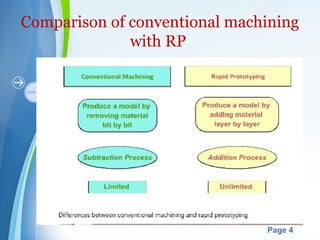
Comparison of conventional machining
with RP
Powerpoint Templates
Page 5
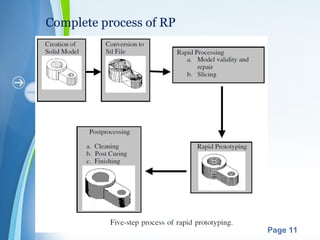
BASIC PRINCIPLE OF WORKING OF RP
Basic principle involves 5 steps:
• Creation of the CAD model of the design
• Conversion of the CAD model to STL format
• Slicing the STL file into 2-D cross-sectional layers
• Layer by layer construction
• Cleaning and finishing the model
Powerpoint Templates
Page 6
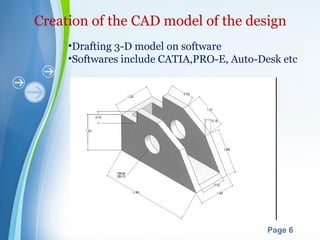
Creation of the CAD model of the design
•Drafting 3-D model on software
•Softwares include CATIA,PRO-E, Auto-Desk etc
Powerpoint Templates
Page 7
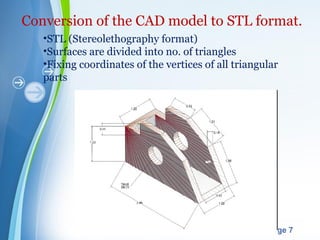
Conversion of the CAD model to STL format.
•STL (Stereolethography format)
•Surfaces are divided into no. of triangles
•Fixing coordinates of the vertices of all triangular
parts
Powerpoint Templates
Page 8
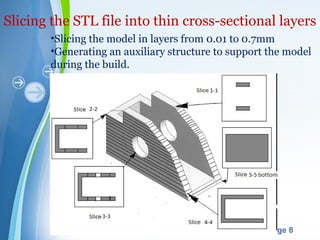
Slicing the STL file into thin cross-sectional layers
•Slicing the model in layers from 0.01 to 0.7mm
•Generating an auxiliary structure to support the model
during the build.
Powerpoint Templates
Page 9
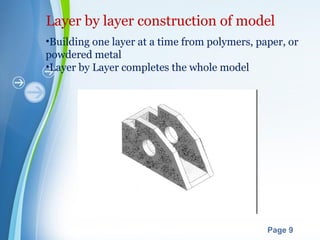
Layer by layer construction of model
•Building one layer at a time from polymers, paper, or
powdered metal
•Layer by Layer completes the whole model
Powerpoint Templates
Page 10
Cleaning and finishing the model
• Removing the prototype from the machine
• Detaching any supports
• Cleaning, finishing etc
Powerpoint Templates
Page 11
Complete process of RP
Powerpoint Templates
Page 12
VARIOUS TECHNIQUES OF RP
• Stereo-lithography Process
• Selective Laser Sintering(SLS)
• Laminated Object Manufacturing(LOM)
• Fused Deposition Modeling(FDM)
• 3-D Ink-Jet Printing
Powerpoint Templates
Page 13
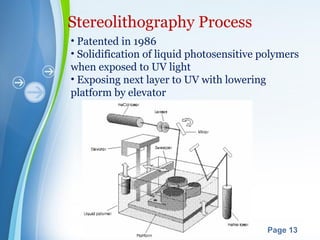
Stereolithography Process
• Patented in 1986
• Solidification of liquid photosensitive polymers
when exposed to UV light
• Exposing next layer to UV with lowering
platform by elevator
Powerpoint Templates
Page 14
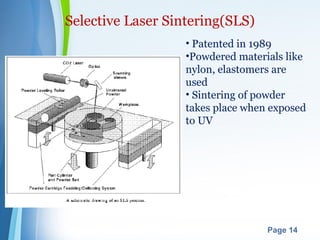
Selective Laser Sintering(SLS)
• Patented in 1989
•Powdered materials like
nylon, elastomers are
used
• Sintering of powder
takes place when exposed
to UV
Powerpoint Templates
Page 15
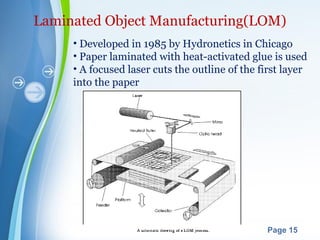
Laminated Object Manufacturing(LOM)
• Developed in 1985 by Hydronetics in Chicago
• Paper laminated with heat-activated glue is used
• A focused laser cuts the outline of the first layer
into the paper
Powerpoint Templates
Page 16
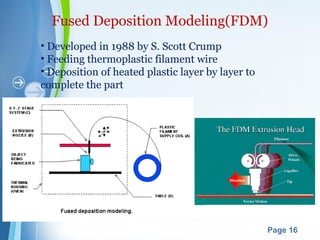
Fused Deposition Modeling(FDM)
• Developed in 1988 by S. Scott Crump
• Feeding thermoplastic filament wire
• Deposition of heated plastic layer by layer to
complete the part
Powerpoint Templates
Page 17
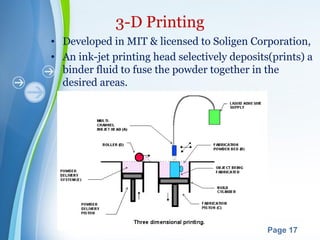
3-D Printing
• Developed in MIT & licensed to Soligen Corporation,
• An ink-jet printing head selectively deposits(prints) a
binder fluid to fuse the powder together in the
desired areas.
Powerpoint Templates
Page 18
APPLICATIONS OF RP
• Engineering
• Complex parts of Aerospace industries
• Rapid Tooling
• Architecture
• Medical Applications
• Tooth and bone implants
• Hearing instruments
• Arts and Archaeology
• Statues and ornaments
Powerpoint Templates
Page 19
ADVANTAGES & DISADVANTAGES
Advantages:
• Faster production of parts
• Less expensive
• Helps in quick testing of product
• Fast error elimination and assists product
developments
• Low labor cost
• Reduction in material cost, waste disposal cost,
inventory cost, material transportation cost
• Quick design modification
• Better communication between the designer and
user
Disadvantages:
• High machinery cost
• Unsuitability to very large product
Powerpoint Templates
Page 20
Future scope for developments in RP
• Improving speed
• Improved accuracy and surface finish.
• Use of metal and composite materials
• Increasing size capacity
• Distance Manufacturing on Demand(being
developed by Researchers at UC-Berkeley)
Powerpoint Templates
Page 21
THANK YOU!

ashok mule rapid prototyping presentation

  • 1.
    Powerpoint Templates Page 1 PowerpointTemplates RAPID PROTOTYPING PRESENTED BY ASHOK A MULE IND023
  • 2.
    Powerpoint Templates Page 2 INDEX •Introduction of Rapid Prototyping • Basic principle and methodology • Various Techniques of RP • Applications of RP • Advantages and Disadvantages • Future scope for development
  • 3.
    Powerpoint Templates Page 3 INTRODUCTION •Prototype – A replica or model for testing conceptualized design • Manual fabrication and testing is now old practice • New quick technique- Rapid Prototyping • Definition- A group of techniques used to quickly fabricate a scale model of a part or assembly using three-dimensional computer aided design (CAD) data. • Characteristics of RP: 1.A RP model free-form manufacturing 2.layered manufacturing method (i.e. layer by layer additive process)
  • 4.
    Powerpoint Templates Page 4 Comparisonof conventional machining with RP
  • 5.
    Powerpoint Templates Page 5 BASICPRINCIPLE OF WORKING OF RP Basic principle involves 5 steps: • Creation of the CAD model of the design • Conversion of the CAD model to STL format • Slicing the STL file into 2-D cross-sectional layers • Layer by layer construction • Cleaning and finishing the model
  • 6.
    Powerpoint Templates Page 6 Creationof the CAD model of the design •Drafting 3-D model on software •Softwares include CATIA,PRO-E, Auto-Desk etc
  • 7.
    Powerpoint Templates Page 7 Conversionof the CAD model to STL format. •STL (Stereolethography format) •Surfaces are divided into no. of triangles •Fixing coordinates of the vertices of all triangular parts
  • 8.
    Powerpoint Templates Page 8 Slicingthe STL file into thin cross-sectional layers •Slicing the model in layers from 0.01 to 0.7mm •Generating an auxiliary structure to support the model during the build.
  • 9.
    Powerpoint Templates Page 9 Layerby layer construction of model •Building one layer at a time from polymers, paper, or powdered metal •Layer by Layer completes the whole model
  • 10.
    Powerpoint Templates Page 10 Cleaningand finishing the model • Removing the prototype from the machine • Detaching any supports • Cleaning, finishing etc
  • 11.
  • 12.
    Powerpoint Templates Page 12 VARIOUSTECHNIQUES OF RP • Stereo-lithography Process • Selective Laser Sintering(SLS) • Laminated Object Manufacturing(LOM) • Fused Deposition Modeling(FDM) • 3-D Ink-Jet Printing
  • 13.
    Powerpoint Templates Page 13 StereolithographyProcess • Patented in 1986 • Solidification of liquid photosensitive polymers when exposed to UV light • Exposing next layer to UV with lowering platform by elevator
  • 14.
    Powerpoint Templates Page 14 SelectiveLaser Sintering(SLS) • Patented in 1989 •Powdered materials like nylon, elastomers are used • Sintering of powder takes place when exposed to UV
  • 15.
    Powerpoint Templates Page 15 LaminatedObject Manufacturing(LOM) • Developed in 1985 by Hydronetics in Chicago • Paper laminated with heat-activated glue is used • A focused laser cuts the outline of the first layer into the paper
  • 16.
    Powerpoint Templates Page 16 FusedDeposition Modeling(FDM) • Developed in 1988 by S. Scott Crump • Feeding thermoplastic filament wire • Deposition of heated plastic layer by layer to complete the part
  • 17.
    Powerpoint Templates Page 17 3-DPrinting • Developed in MIT & licensed to Soligen Corporation, • An ink-jet printing head selectively deposits(prints) a binder fluid to fuse the powder together in the desired areas.
  • 18.
    Powerpoint Templates Page 18 APPLICATIONSOF RP • Engineering • Complex parts of Aerospace industries • Rapid Tooling • Architecture • Medical Applications • Tooth and bone implants • Hearing instruments • Arts and Archaeology • Statues and ornaments
  • 19.
    Powerpoint Templates Page 19 ADVANTAGES& DISADVANTAGES Advantages: • Faster production of parts • Less expensive • Helps in quick testing of product • Fast error elimination and assists product developments • Low labor cost • Reduction in material cost, waste disposal cost, inventory cost, material transportation cost • Quick design modification • Better communication between the designer and user Disadvantages: • High machinery cost • Unsuitability to very large product
  • 20.
    Powerpoint Templates Page 20 Futurescope for developments in RP • Improving speed • Improved accuracy and surface finish. • Use of metal and composite materials • Increasing size capacity • Distance Manufacturing on Demand(being developed by Researchers at UC-Berkeley)
  • 21.