Control Statements
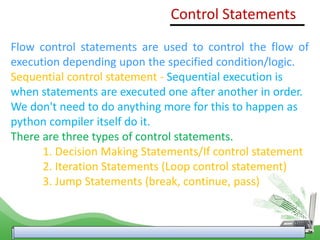
Flow controlstatements are used to control the flow of
execution depending upon the specified condition/logic.
Sequential control statement - Sequential execution is
when statements are executed one after another in order.
We don't need to do anything more for this to happen as
python compiler itself do it.
There are three types of control statements.
1. Decision Making Statements/If control statement
2. Iteration Statements (Loop control statement)
3. Jump Statements (break, continue, pass)
3.
Decision Making Statement
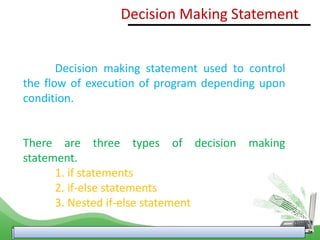
Decisionmaking statement used to control
the flow of execution of program depending upon
condition.
There are three types of decision making
statement.
1. if statements
2. if-else statements
3. Nested if-else statement
4.
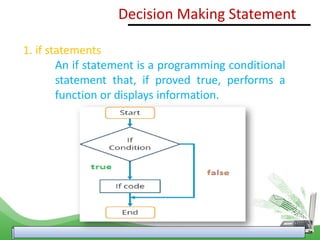
1. if statements
Anif statement is a programming conditional
statement that, if proved true, performs a
function or displays information.
Decision Making Statement
5.
1. if statements
Syntax:
if(condition):
statement
[statements]
e.g.
noofbooks= 2
if (noofbooks == 2):
print('You have ')
print(‘two books’)
print(‘outside of if statement’)
Output
You have two books
Note:To indicate a block of code in Python, you must indent each line of
the block by the same amount. In above e.g. both print statements are
part of if condition because of both are at same level indented but not
the third print statement.
Decision Making Statement
6.
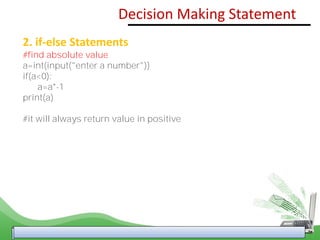
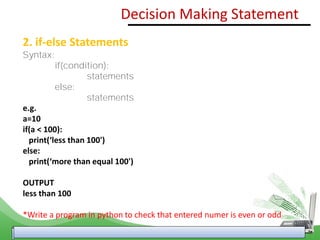
2. if-else Statements
#findabsolute value
a=int(input("enter a number"))
if(a<0):
a=a*-1
print(a)
#it will always return value in positive
Decision Making Statement
7.
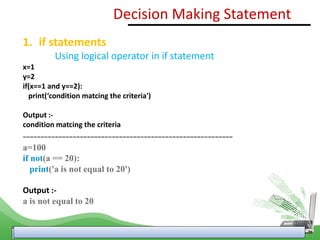
1. if statements
Usinglogical operator in if statement
x=1
y=2
if(x==1 and y==2):
print(‘condition matcing the criteria')
Output :-
condition matcing the criteria
-----------------------------------------------------------
a=100
if not(a == 20):
print('a is not equal to 20')
Output :-
a is not equal to 20
Decision Making Statement
8.
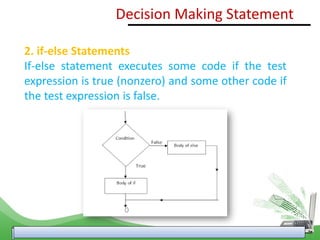
2. if-else Statements
If-elsestatement executes some code if the test
expression is true (nonzero) and some other code if
the test expression is false.
Decision Making Statement
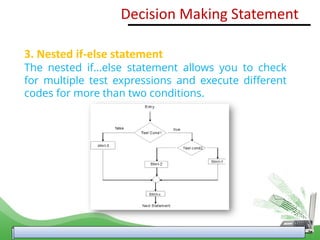
3. Nested if-elsestatement
The nested if...else statement allows you to check
for multiple test expressions and execute different
codes for more than two conditions.
Decision Making Statement
11.
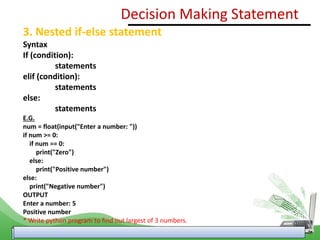
3. Nested if-elsestatement
Syntax
If (condition):
statements
elif (condition):
statements
else:
statements
E.G.
num = float(input("Enter a number: "))
if num >= 0:
if num == 0:
print("Zero")
else:
print("Positive number")
else:
print("Negative number")
OUTPUT
Enter a number: 5
Positive number
* Write python program to find out largest of 3 numbers.
Decision Making Statement
12.
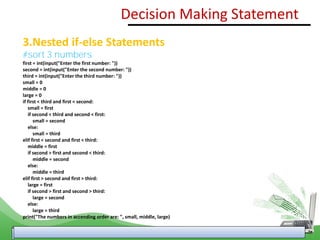
3.Nested if-else Statements
#sort3 numbers
first = int(input("Enter the first number: "))
second = int(input("Enter the second number: "))
third = int(input("Enter the third number: "))
small = 0
middle = 0
large = 0
if first < third and first < second:
small = first
if second < third and second < first:
small = second
else:
small = third
elif first < second and first < third:
middle = first
if second > first and second < third:
middle = second
else:
middle = third
elif first > second and first > third:
large = first
if second > first and second > third:
large = second
else:
large = third
print("The numbers in accending order are: ", small, middle, large)
Decision Making Statement
13.
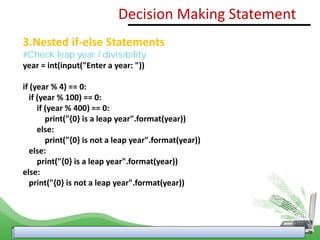
3.Nested if-else Statements
#Checkleap year / divisibility
year = int(input("Enter a year: "))
if (year % 4) == 0:
if (year % 100) == 0:
if (year % 400) == 0:
print("{0} is a leap year".format(year))
else:
print("{0} is not a leap year".format(year))
else:
print("{0} is a leap year".format(year))
else:
print("{0} is not a leap year".format(year))
Decision Making Statement
14.
Iteration Statements (Loops)
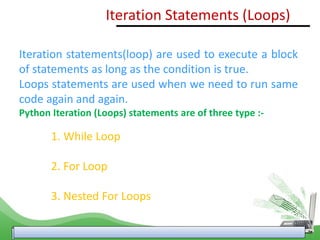
Iterationstatements(loop) are used to execute a block
of statements as long as the condition is true.
Loops statements are used when we need to run same
code again and again.
Python Iteration (Loops) statements are of three type :-
1. While Loop
2. For Loop
3. Nested For Loops
15.
1. While Loop
Itis used to execute a block of statement as long as a
given condition is true. And when the condition become
false, the control will come out of the loop. The condition
is checked every time at the beginning of the loop.
Syntax
while (condition):
statement
[statements]
e.g.
x = 1
while (x <= 4):
print(x)
x = x + 1
Output
1
2
3
4
Iteration Statements (Loops)
16.
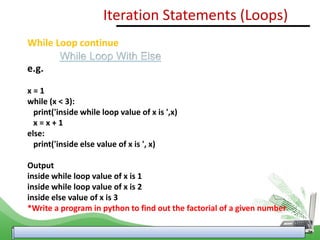
While Loop continue
WhileLoop With Else
e.g.
x = 1
while (x < 3):
print('inside while loop value of x is ',x)
x = x + 1
else:
print('inside else value of x is ', x)
Output
inside while loop value of x is 1
inside while loop value of x is 2
inside else value of x is 3
*Write a program in python to find out the factorial of a given number
Iteration Statements (Loops)
17.
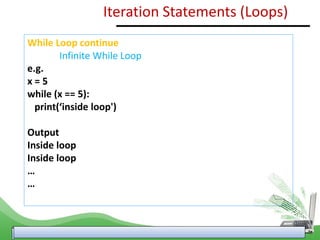
While Loop continue
InfiniteWhile Loop
e.g.
x = 5
while (x == 5):
print(‘inside loop')
Output
Inside loop
Inside loop
…
…
Iteration Statements (Loops)
18.
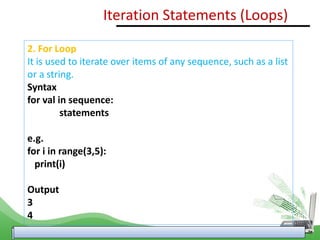
2. For Loop
Itis used to iterate over items of any sequence, such as a list
or a string.
Syntax
for val in sequence:
statements
e.g.
for i in range(3,5):
print(i)
Output
3
4
Iteration Statements (Loops)
19.
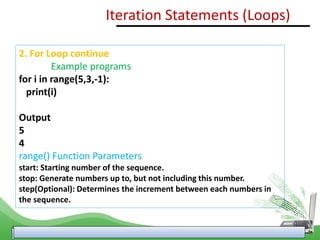
2. For Loopcontinue
Example programs
for i in range(5,3,-1):
print(i)
Output
5
4
range() Function Parameters
start: Starting number of the sequence.
stop: Generate numbers up to, but not including this number.
step(Optional): Determines the increment between each numbers in
the sequence.
Iteration Statements (Loops)
20.
2. For Loopcontinue
Example programs with range() and len() function
fruits = ['banana', 'apple', 'mango']
for index in range(len(fruits)):
print ('Current fruit :', fruits[index])
range() with len() Function Parameters
Iteration Statements (Loops)
21.
2. For Loopcontinue
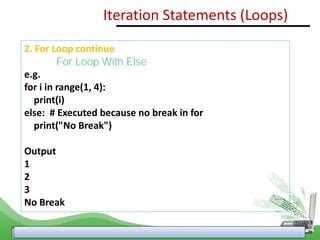
For Loop With Else
e.g.
for i in range(1, 4):
print(i)
else: # Executed because no break in for
print("No Break")
Output
1
2
3
No Break
Iteration Statements (Loops)
22.
2. For Loopcontinue
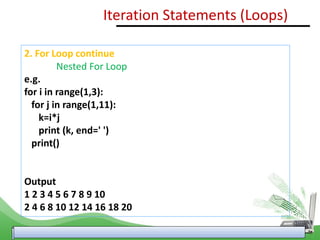
Nested For Loop
e.g.
for i in range(1,3):
for j in range(1,11):
k=i*j
print (k, end=' ')
print()
Output
1 2 3 4 5 6 7 8 9 10
2 4 6 8 10 12 14 16 18 20
Iteration Statements (Loops)
23.
2. For Loopcontinue
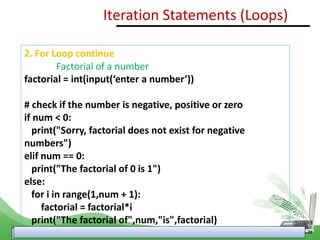
Factorial of a number
factorial = int(input(‘enter a number’))
# check if the number is negative, positive or zero
if num < 0:
print("Sorry, factorial does not exist for negative
numbers")
elif num == 0:
print("The factorial of 0 is 1")
else:
for i in range(1,num + 1):
factorial = factorial*i
print("The factorial of",num,"is",factorial)
Iteration Statements (Loops)
24.
2. For Loopcontinue
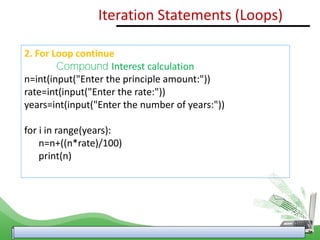
Compound Interest calculation
n=int(input("Enter the principle amount:"))
rate=int(input("Enter the rate:"))
years=int(input("Enter the number of years:"))
for i in range(years):
n=n+((n*rate)/100)
print(n)
Iteration Statements (Loops)
25.
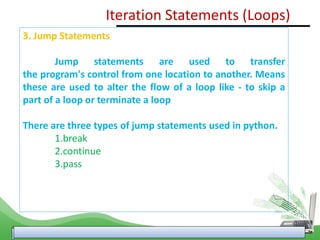
3. Jump Statements
Jumpstatements are used to transfer
the program's control from one location to another. Means
these are used to alter the flow of a loop like - to skip a
part of a loop or terminate a loop
There are three types of jump statements used in python.
1.break
2.continue
3.pass
Iteration Statements (Loops)
26.
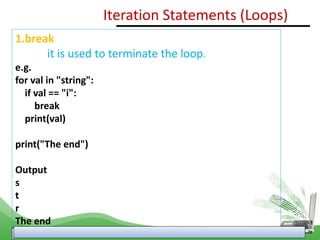
1.break
it is usedto terminate the loop.
e.g.
for val in "string":
if val == "i":
break
print(val)
print("The end")
Output
s
t
r
The end
Iteration Statements (Loops)
27.
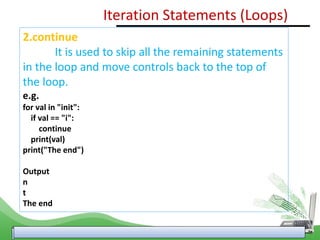
2.continue
It is usedto skip all the remaining statements
in the loop and move controls back to the top of
the loop.
e.g.
for val in "init":
if val == "i":
continue
print(val)
print("The end")
Output
n
t
The end
Iteration Statements (Loops)
28.
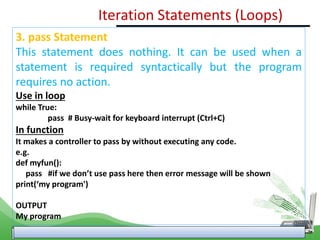
3. pass Statement
Thisstatement does nothing. It can be used when a
statement is required syntactically but the program
requires no action.
Use in loop
while True:
pass # Busy-wait for keyboard interrupt (Ctrl+C)
In function
It makes a controller to pass by without executing any code.
e.g.
def myfun():
pass #if we don’t use pass here then error message will be shown
print(‘my program')
OUTPUT
My program
Iteration Statements (Loops)
29.
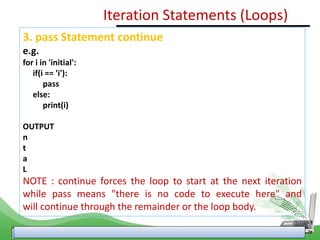
3. pass Statementcontinue
e.g.
for i in 'initial':
if(i == 'i'):
pass
else:
print(i)
OUTPUT
n
t
a
L
NOTE : continue forces the loop to start at the next iteration
while pass means "there is no code to execute here" and
will continue through the remainder or the loop body.
Iteration Statements (Loops)


![1. if statements
Syntax:
if(condition):
statement
[statements]
e.g.
noofbooks = 2
if (noofbooks == 2):
print('You have ')
print(‘two books’)
print(‘outside of if statement’)
Output
You have two books
Note:To indicate a block of code in Python, you must indent each line of
the block by the same amount. In above e.g. both print statements are
part of if condition because of both are at same level indented but not
the third print statement.
Decision Making Statement](https://image.slidesharecdn.com/10-flowofcontrol-260104042809-29f2c13d/85/10-flow-of-control-for-class-twelve-computer-science-5-320.jpg)
![1. While Loop
It is used to execute a block of statement as long as a
given condition is true. And when the condition become
false, the control will come out of the loop. The condition
is checked every time at the beginning of the loop.
Syntax
while (condition):
statement
[statements]
e.g.
x = 1
while (x <= 4):
print(x)
x = x + 1
Output
1
2
3
4
Iteration Statements (Loops)](https://image.slidesharecdn.com/10-flowofcontrol-260104042809-29f2c13d/85/10-flow-of-control-for-class-twelve-computer-science-15-320.jpg)
![2. For Loop continue
Example programs with range() and len() function
fruits = ['banana', 'apple', 'mango']
for index in range(len(fruits)):
print ('Current fruit :', fruits[index])
range() with len() Function Parameters
Iteration Statements (Loops)](https://image.slidesharecdn.com/10-flowofcontrol-260104042809-29f2c13d/85/10-flow-of-control-for-class-twelve-computer-science-20-320.jpg)


![제 23회 보아즈(BOAZ) 빅데이터 컨퍼런스 - [MBOAX] : ABSA를 활용한 소비자 반응 분석 기반 운영 효율화 대시보드 설계](https://cdn.slidesharecdn.com/ss_thumbnails/3-1boaz23rdconferencemboax-260203102709-9d519923-thumbnail.jpg?width=640&height=640&fit=bounds)
